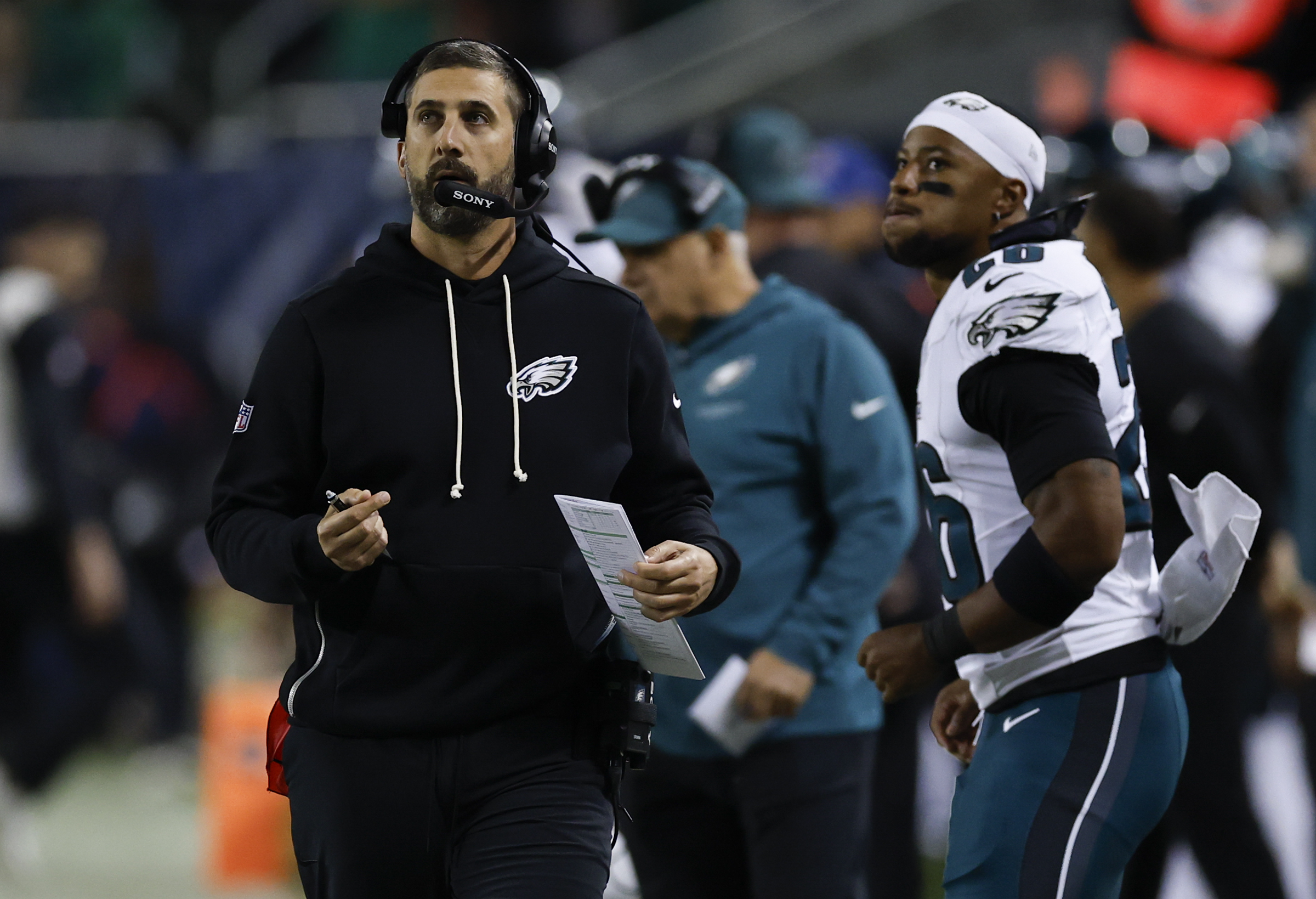
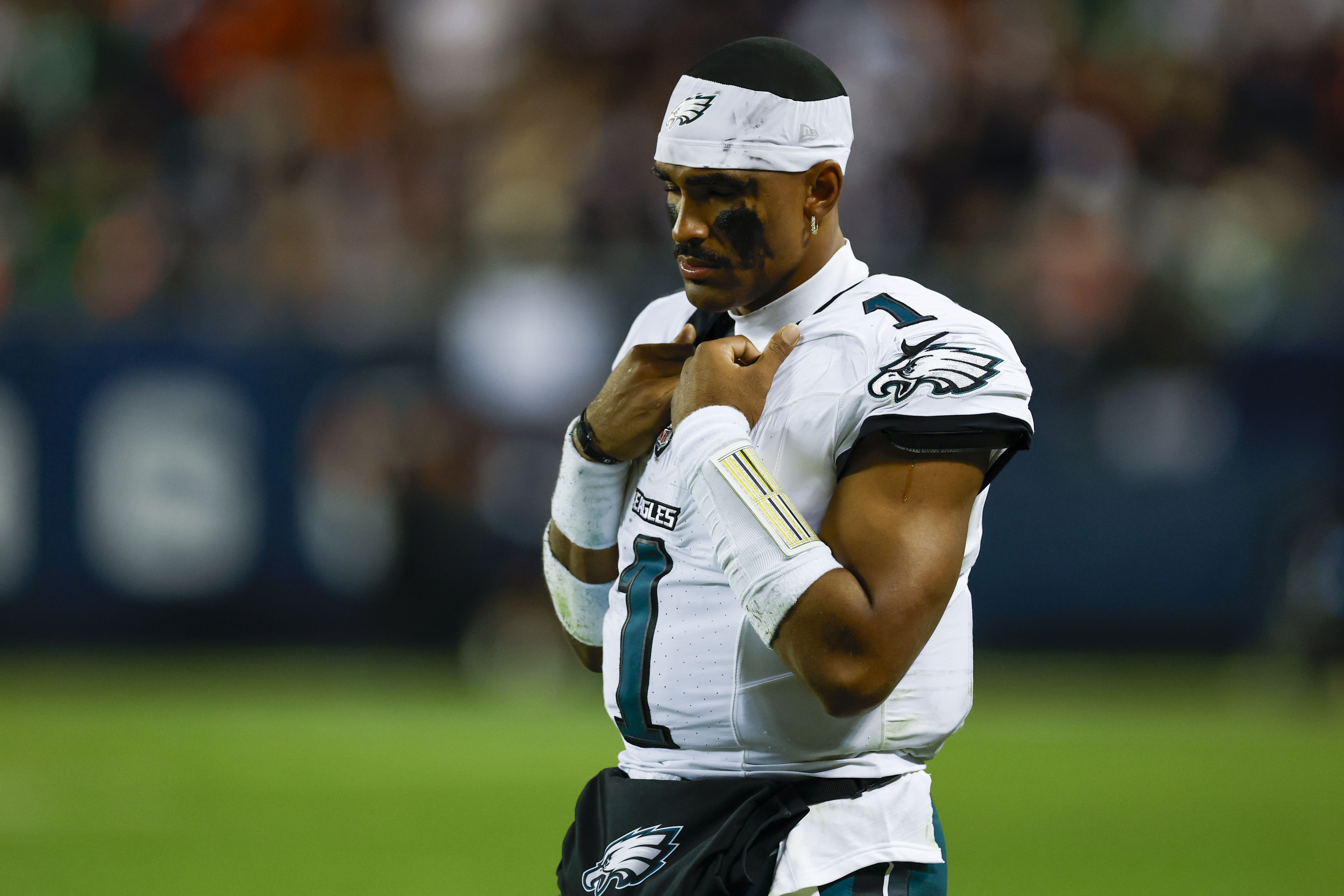
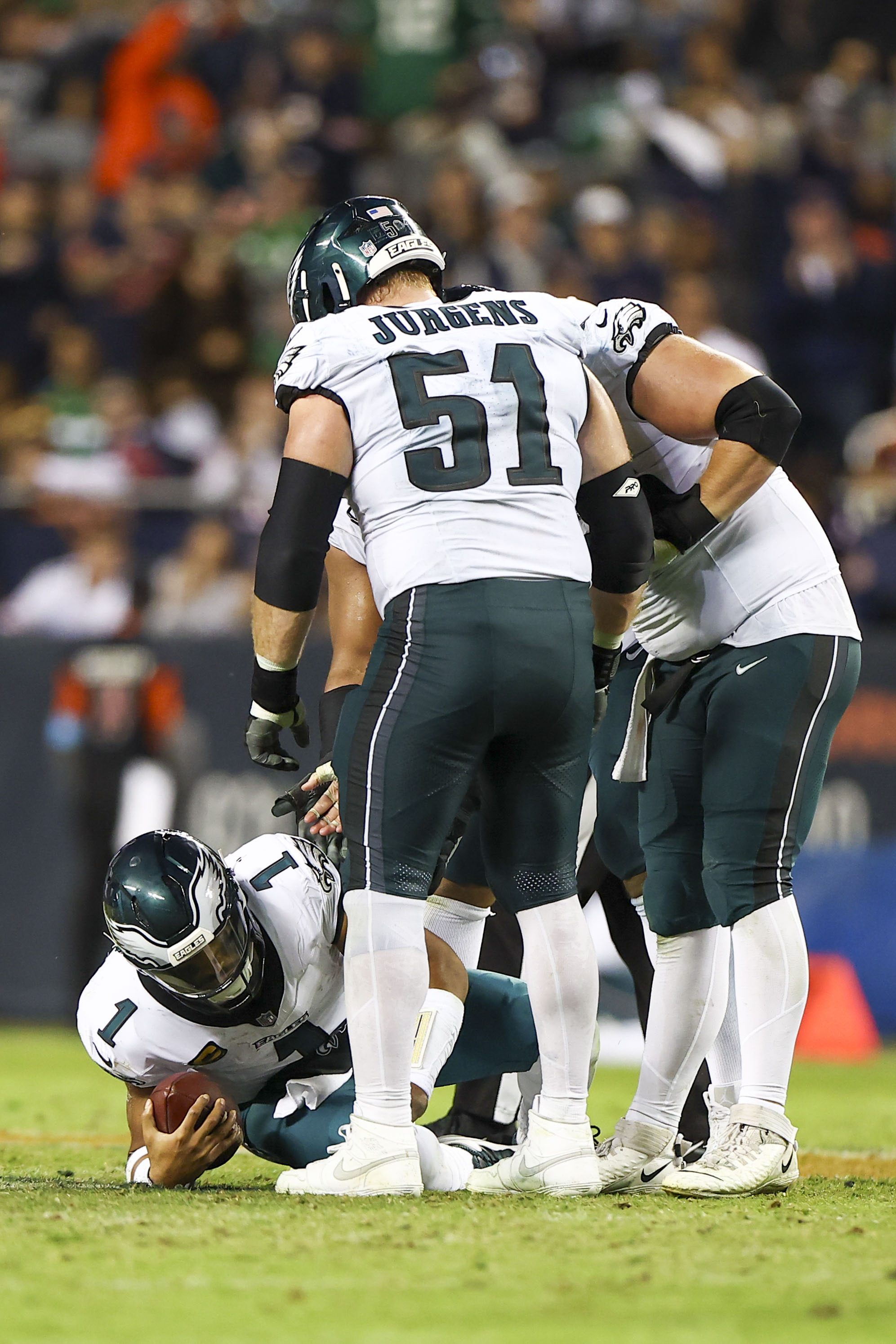
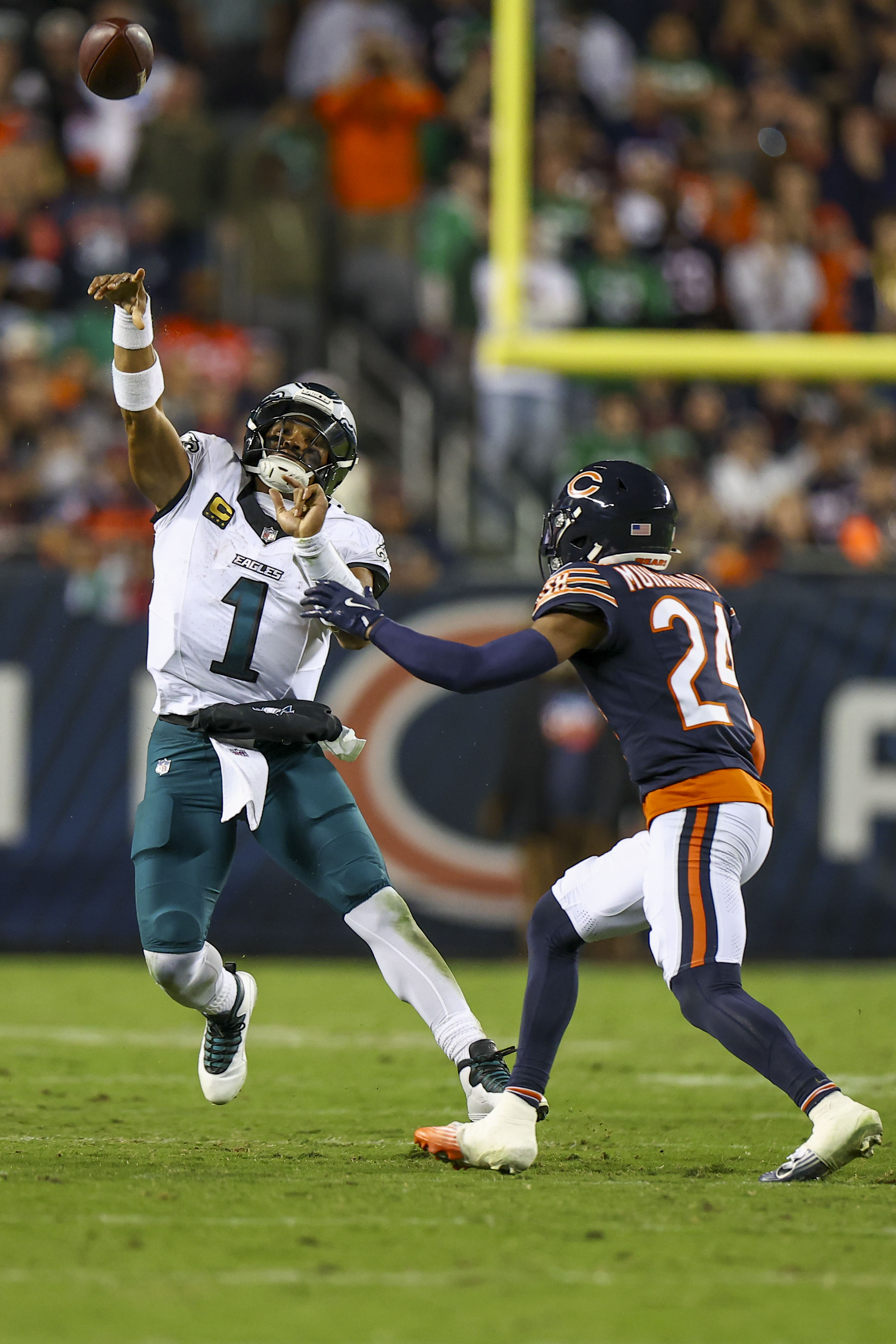
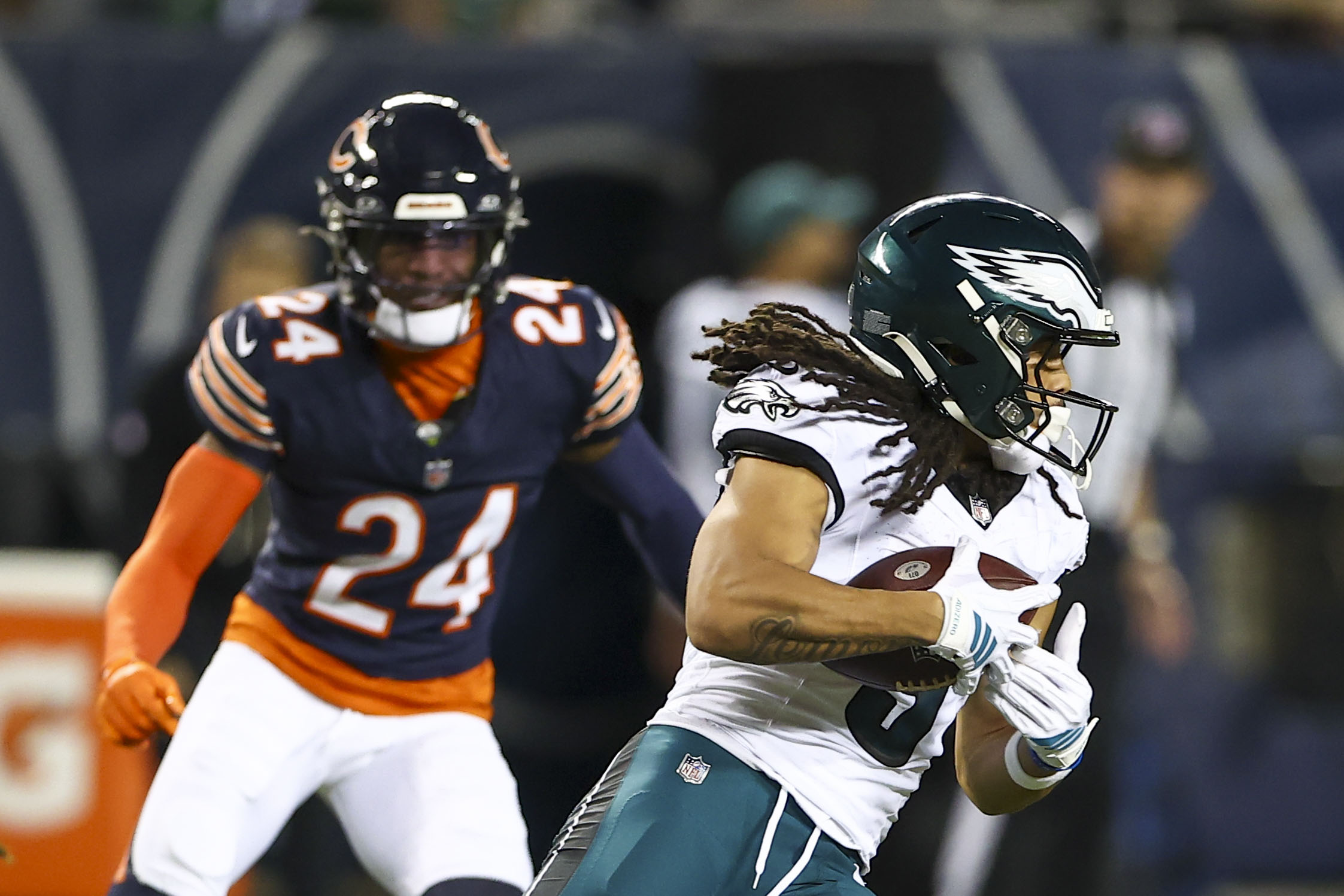
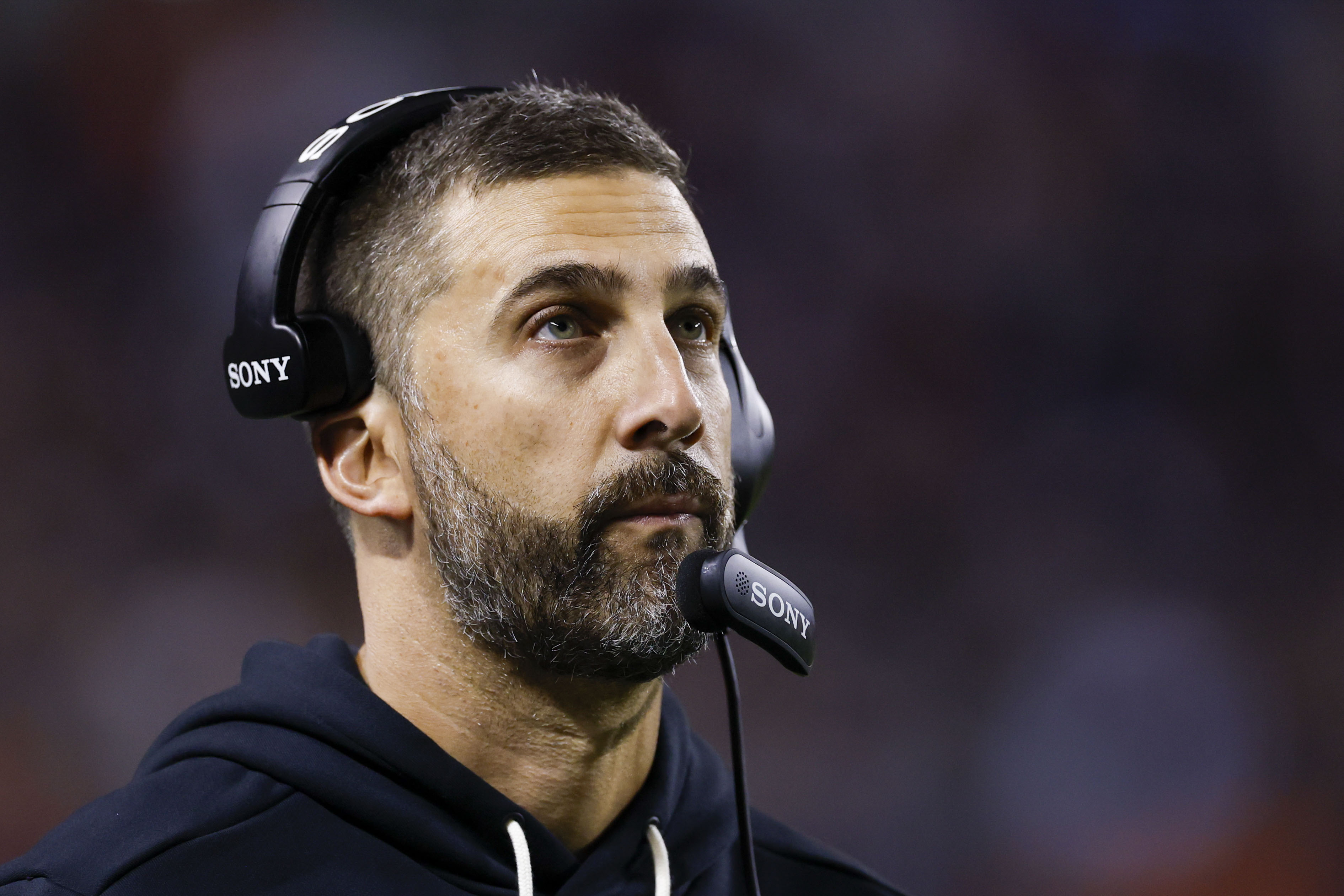
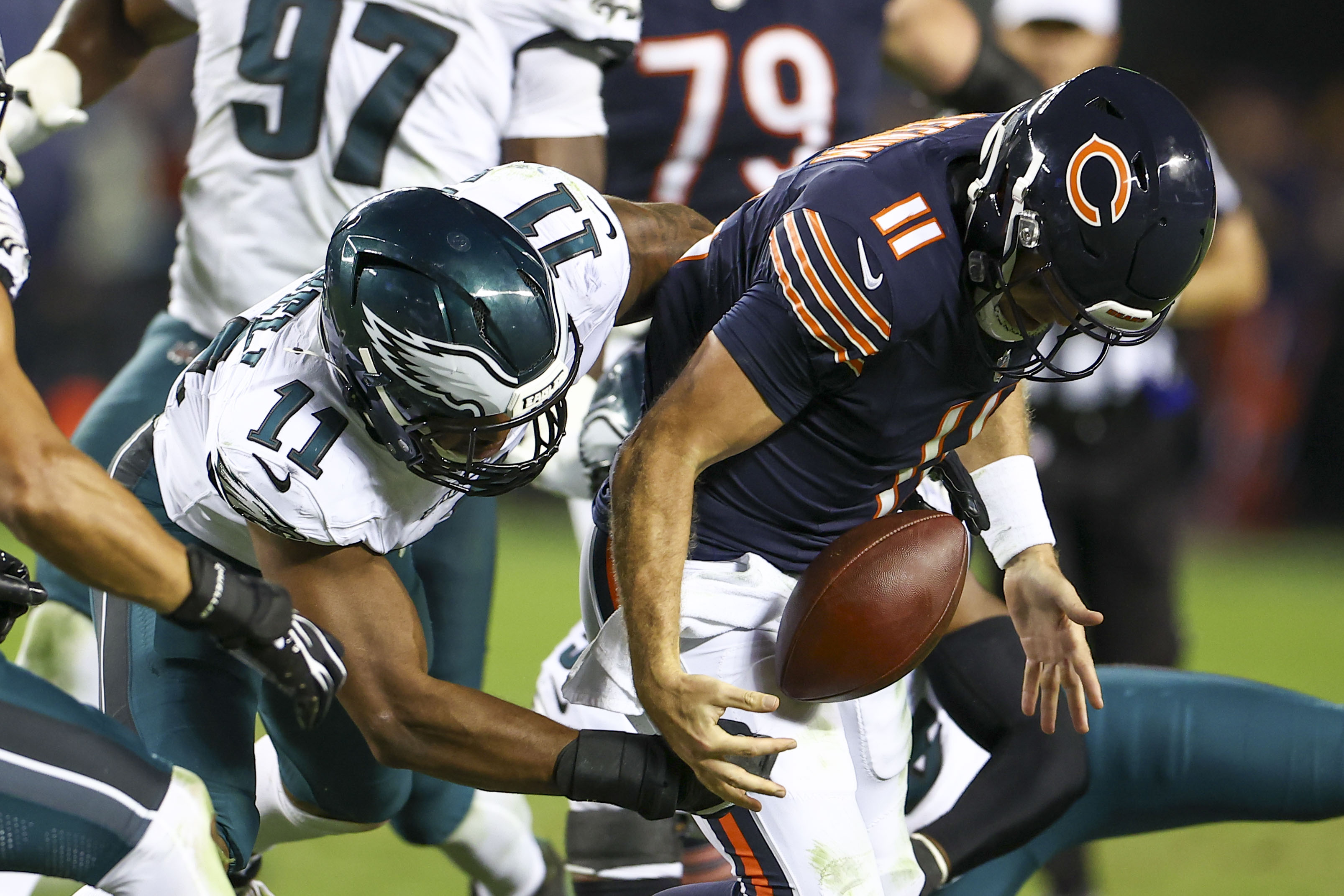
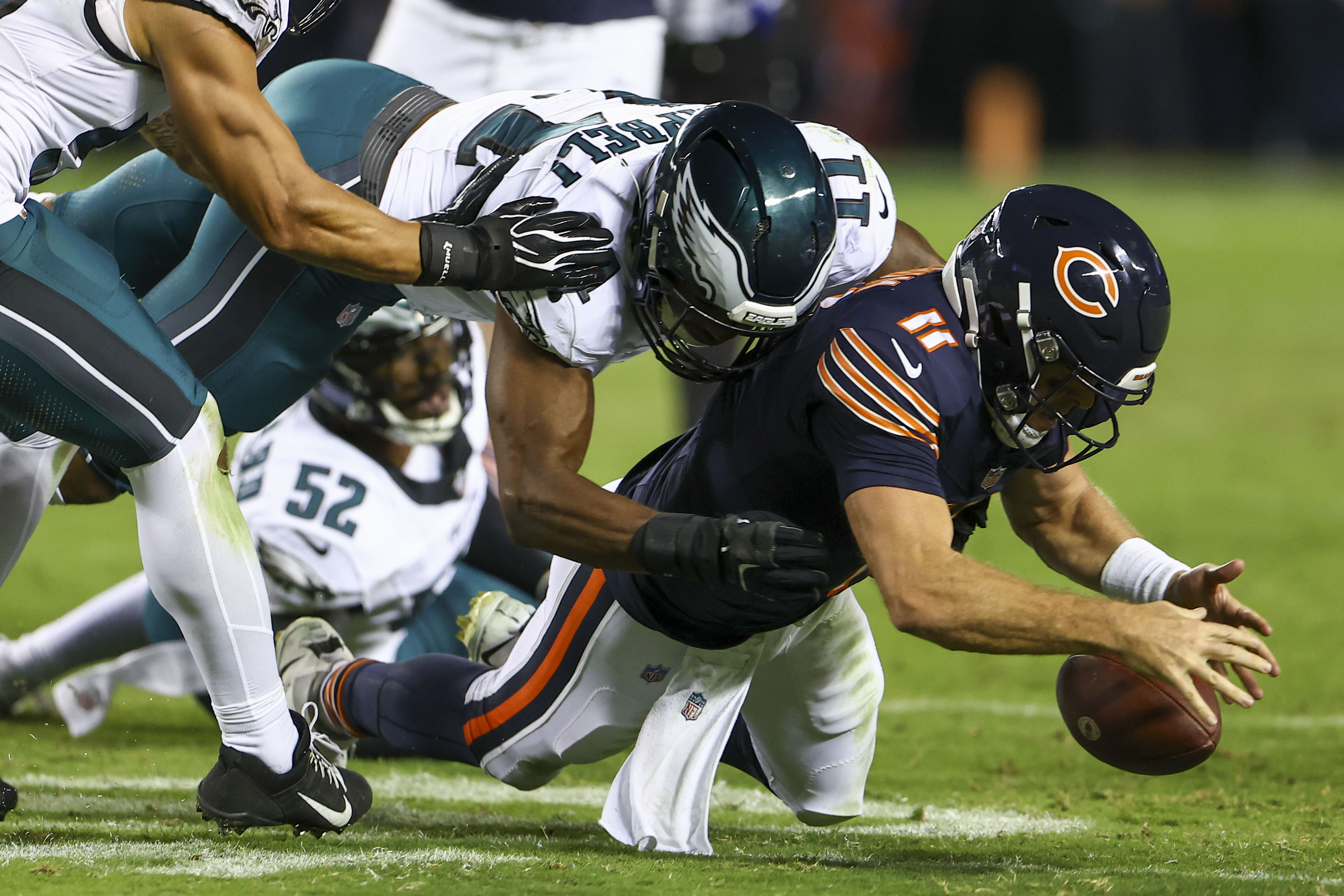
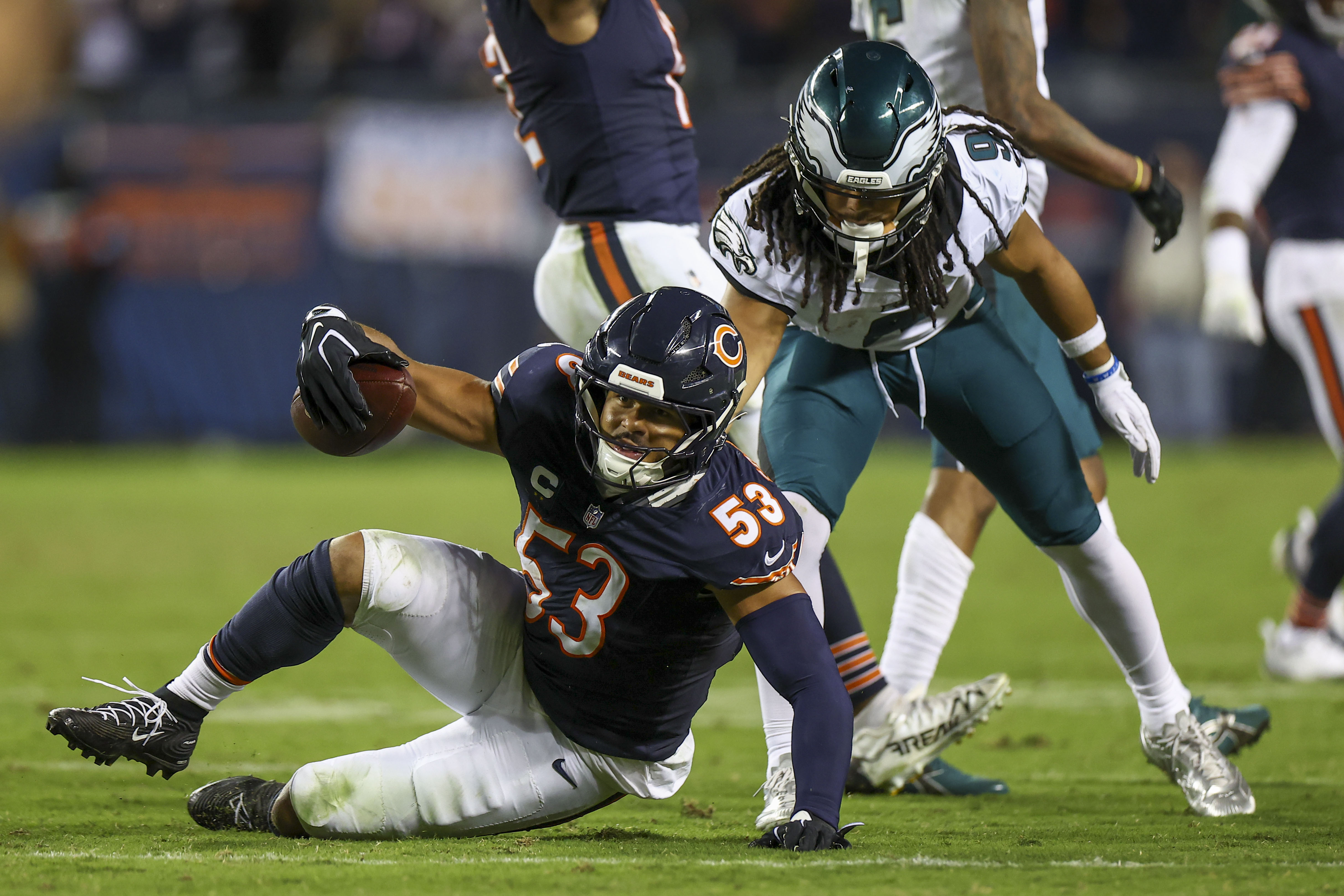
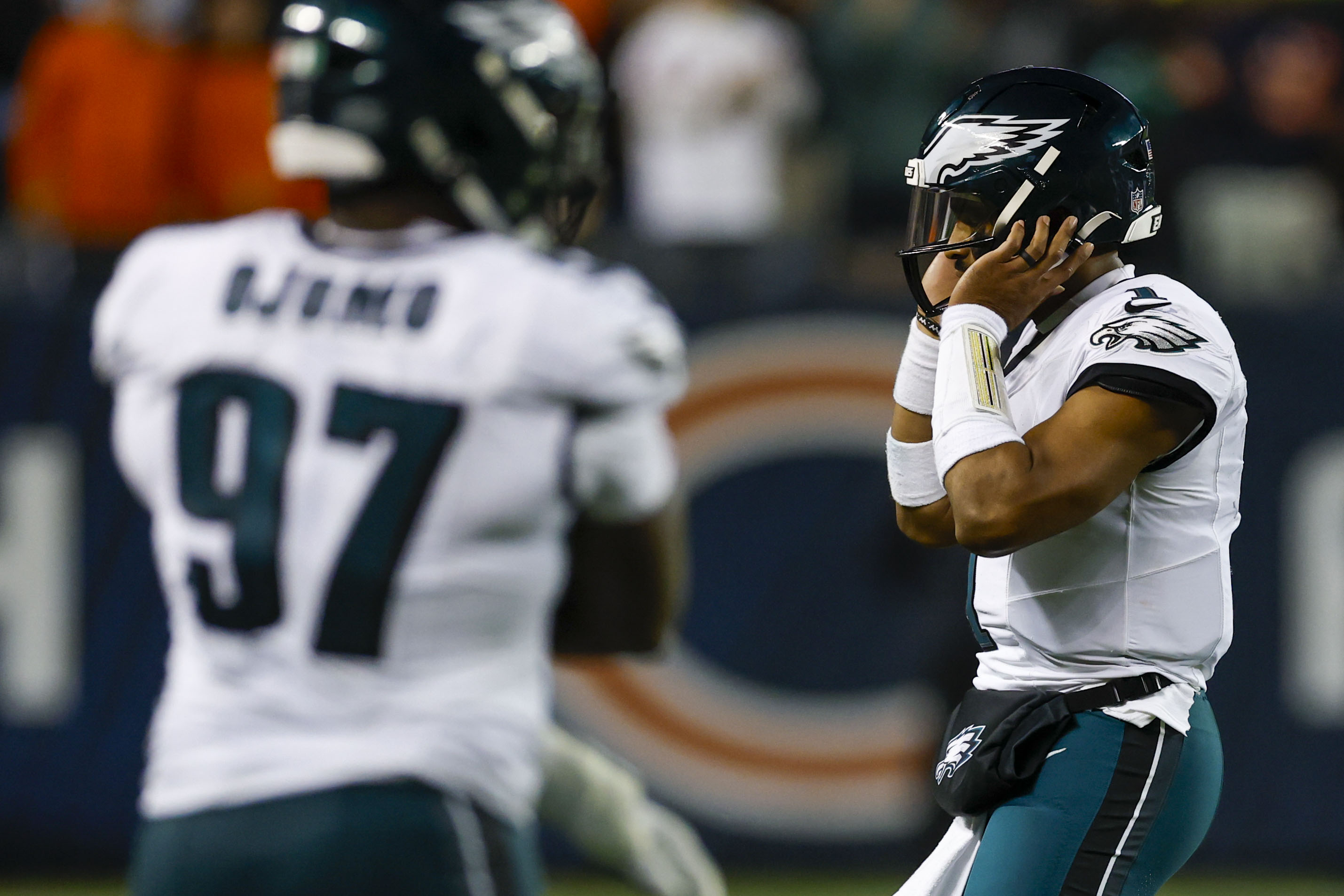
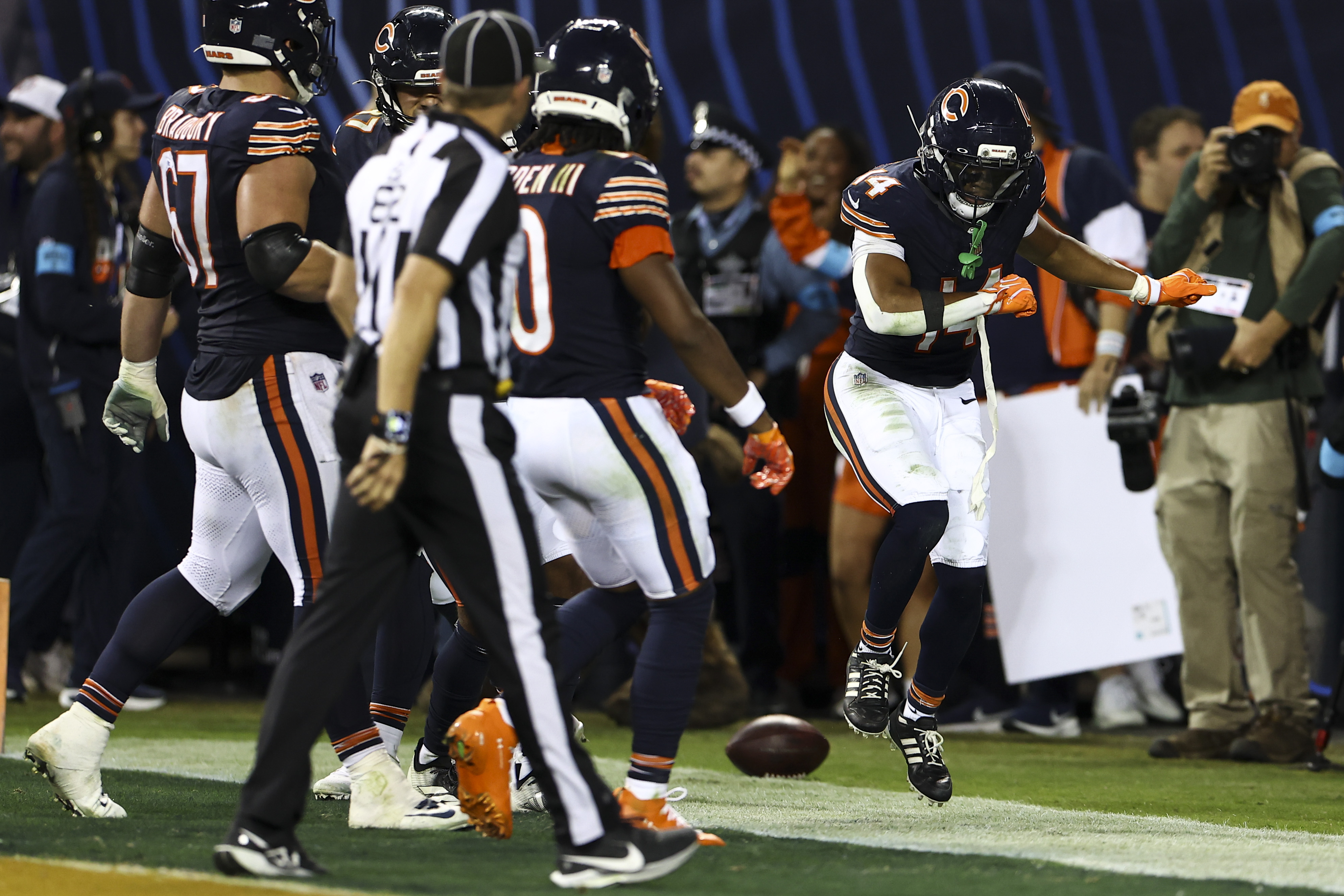
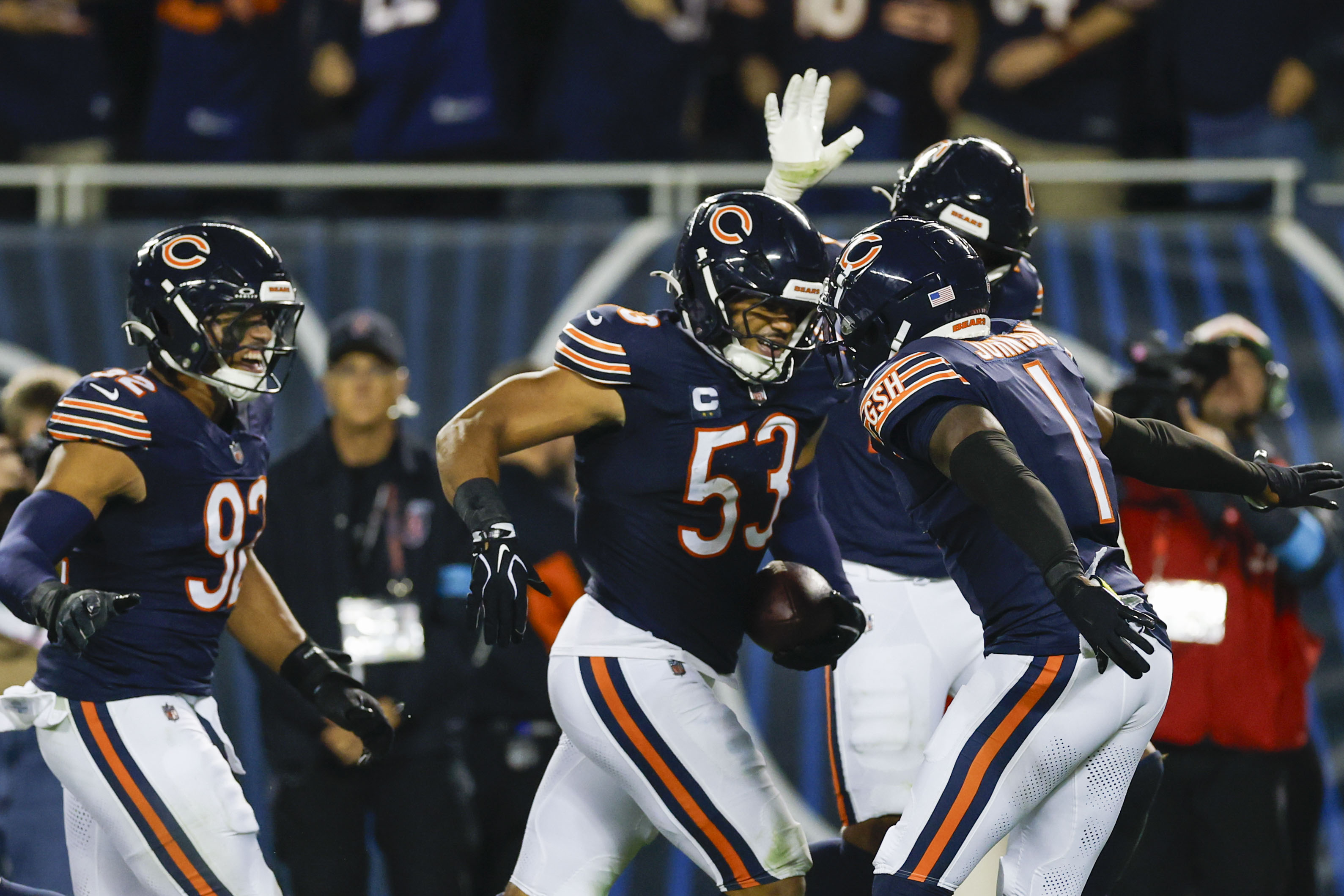
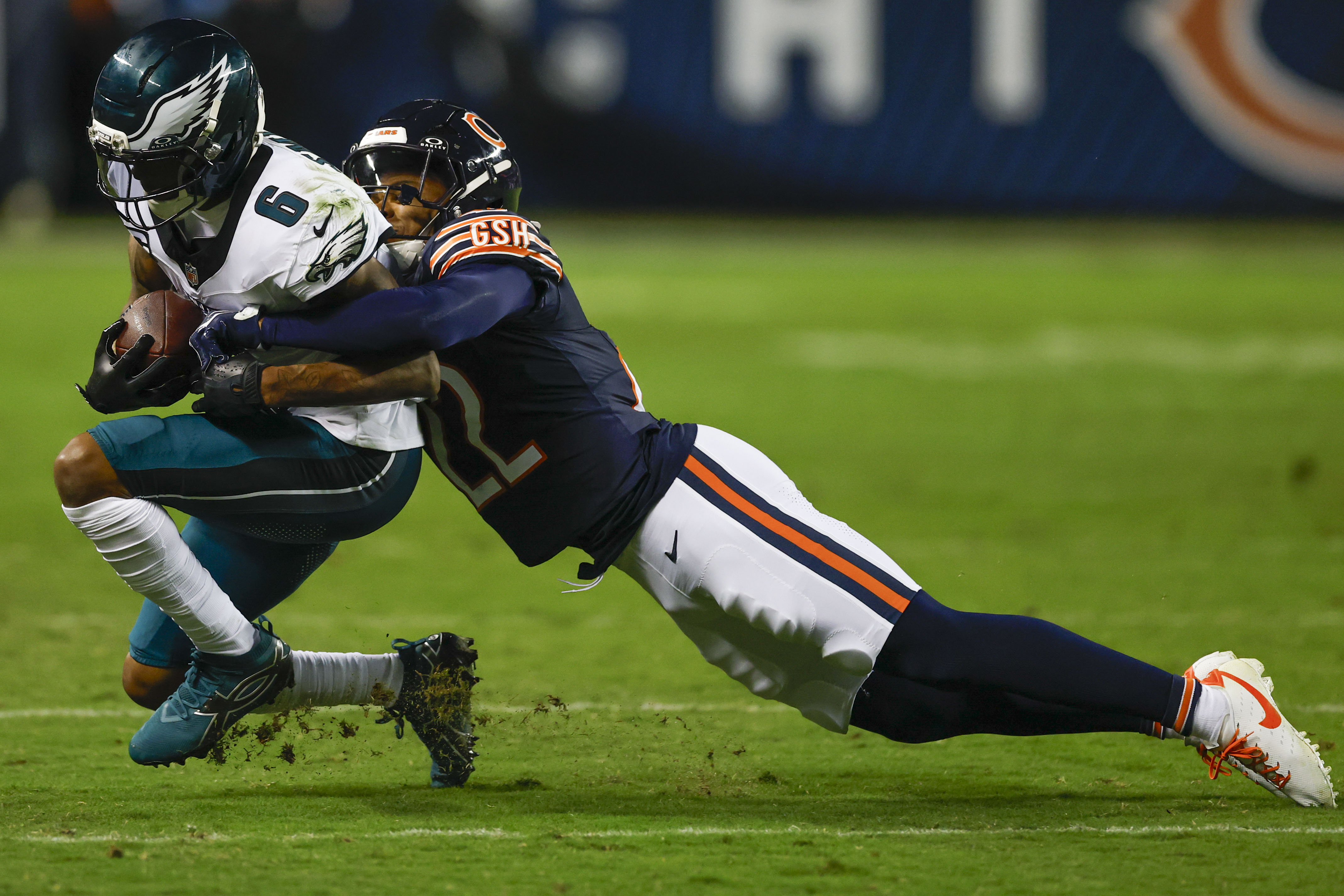
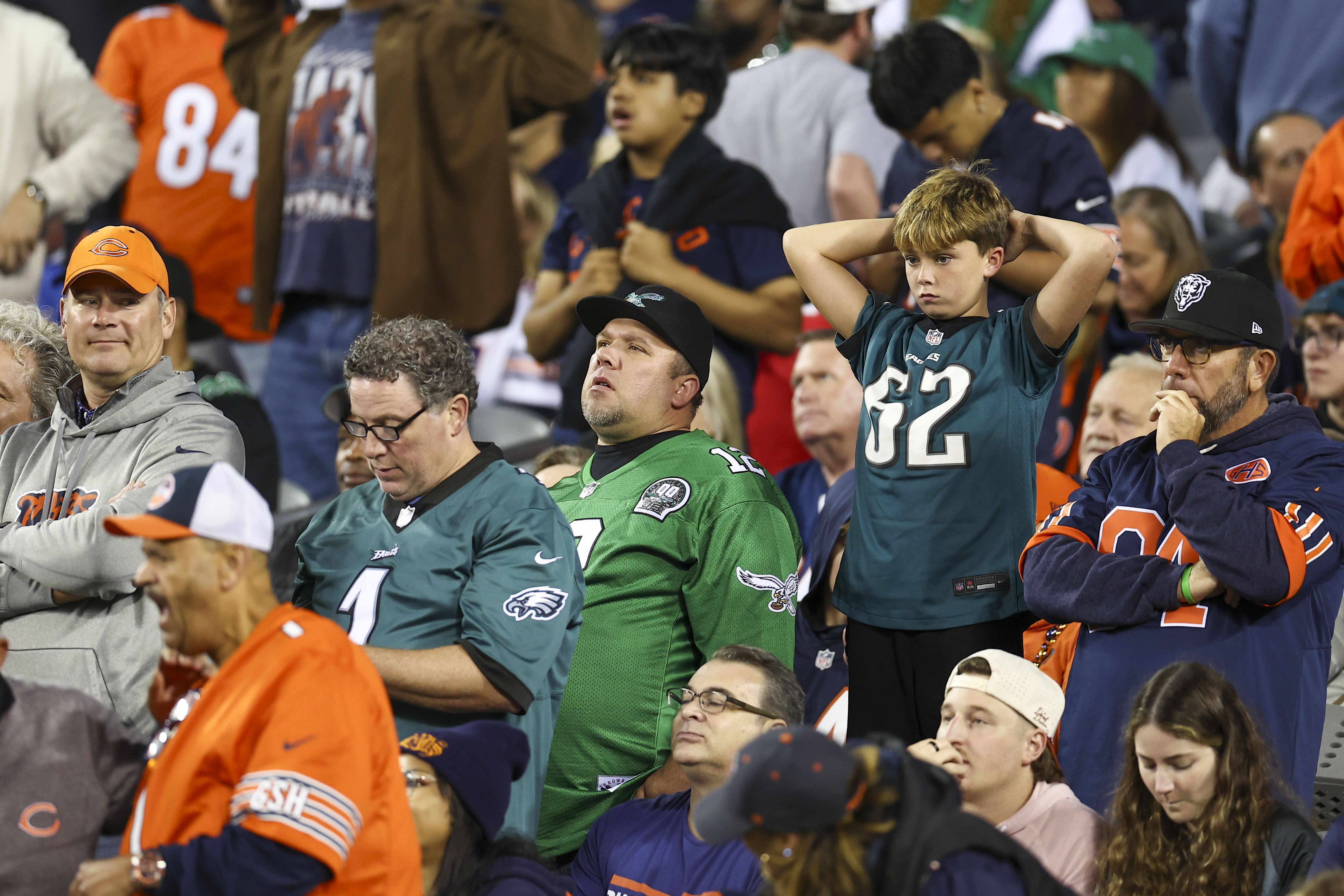
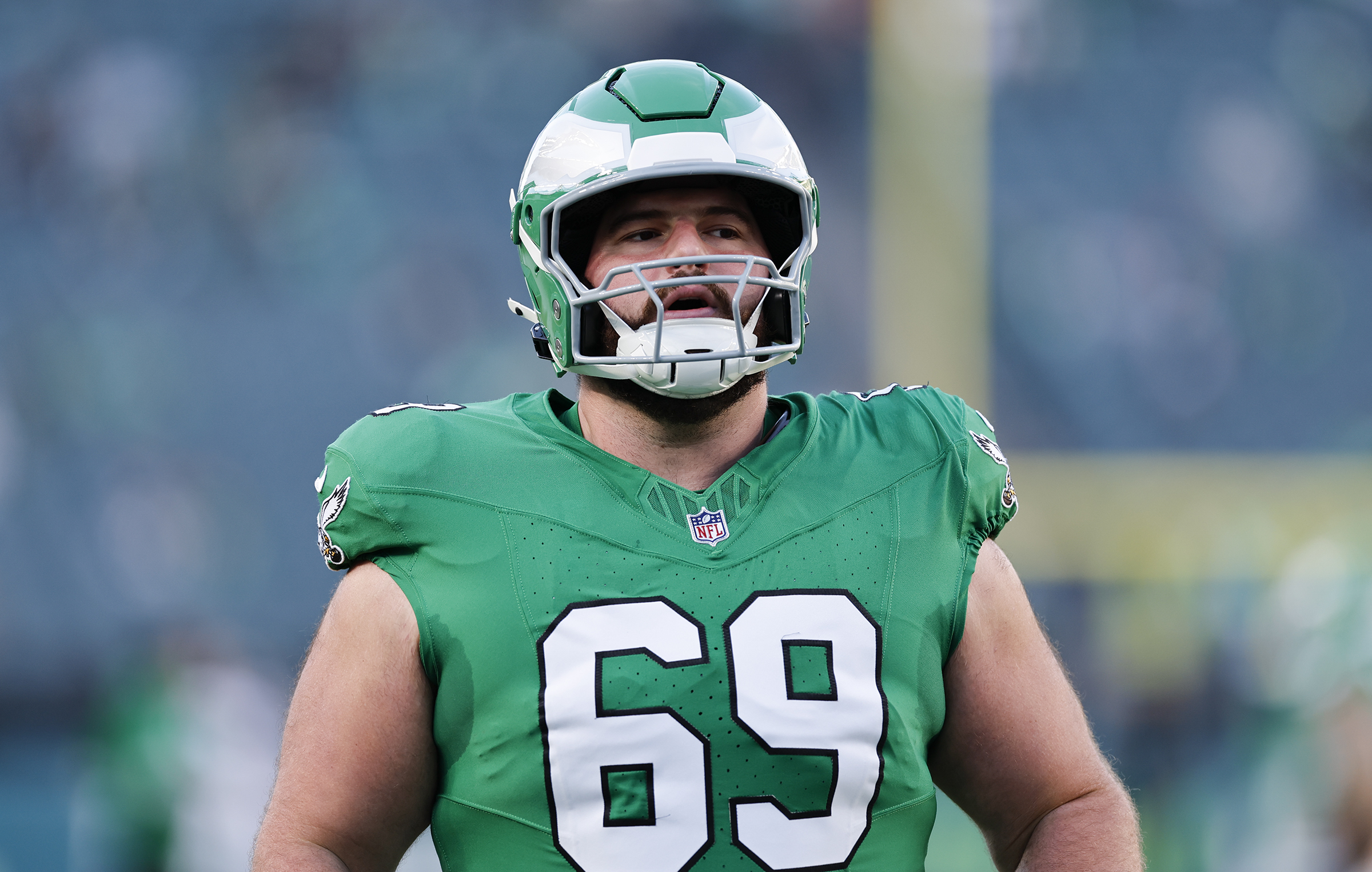
One more time, Nick Sirianni had spent several days seeking shelter from a storm whose clouds he had created. The Eagles’ 27-7 loss to the Bears last Monday had been a greatest-hits collection of the flaws his critics cite whenever they want to make a case that he’s the luckiest head coach in the NFL, that Howie Roseman’s brain and one of the league’s best rosters often save Sirianni from himself.
He had screamed an obscenity at Bears linebacker D’Marco Jackson just after Jackson had sent Jalen Hurts flying near the sideline. With the Eagles down by just two scores in the third quarter, he had decided to have his offense punt on fourth-and-1, seeming to freeze in the moment once he realized the distance to earn a first down was too long for Hurts to try a quarterback sneak. His team had been unprepared and overwhelmed from the start against third-string QB Case Keenum and a defense that doesn’t exactly recall Buddy Ryan, Mike Singletary, and the ’85 Bears.
Yes, it was another one of those weeks for Sirianni, which means it’s another one of those moments for Sirianni, the kind he has faced before during his five-plus seasons in Philadelphia. From a 2-5 start in 2021 to the Eagles’ free fall late in 2023, from teetering on the edge early in 2024 to winning a Super Bowl months later, he has these inflection points when it felt as if a season — or his career — could go either way. Find a way to win, and he quiets the noise and keeps his job. Fail to stop the spiral, and people start asking what Jeffrey Lurie might be thinking.
Now here’s his latest walk on the high wire. The Eagles are 2-1 but reeling after that embarrassing loss in Chicago, missing DeVonta Smith, Zack Baun, and several other key players, and hosting the Los Angeles Rams on Sunday — a championship-caliber team that’s ticked off that it’s 1-2. The following week, they travel to London to play the Jacksonville Jaguars, who are emerging as a contender in the AFC. No one should be surprised if the Eagles end up staring at a three-game losing streak and a 2-3 record out of these two weeks, and it’s on Sirianni to make sure everything doesn’t fall apart.
“Whether you win or you lose, you go through the same process,” he said. “I read something Kobe [Bryant] said: ‘You win, great. You’ve got to get up and do the same thing. You lose, it sucks, but you’ve got to get up and do the same thing.’ …
“I know it’s boring, and you can probably say, ‘Hey, that’s just coach-talk.’ But you’ve got to have faith in the process until the process produces results in everything that you do. So business as usual this week. I have a lot of faith in all the guys in this building. That’s why they’re in this building. That’s why they’re on the team.”
Sirianni could have said the same thing in ’21, when the Eagles won seven of nine games and scratched into the playoffs, or in ’24, when they won 16 of 17 and earned the right to party in New Orleans in early February.
Those turnarounds came with strategic changes on offense, sure, and Sirianni and Sean Mannion might need to rethink their approach. But first things first: Sirianni and his players can’t allow that Bears loss to snowball into an avalanche.
“You make the corrections, but you don’t stay on it too long,” defensive tackle Moro Ojomo said. “You can’t let a team beat you twice. We’ve got to game-prep, and we’ve got a hell of a team coming in. They’re a playoff team. They’ve been a great team. So you’ve got to flush that really quick. If you don’t, you’re going to lose twice on the same thing. You’ve probably got 24 hours to deal with it. That’s it.”
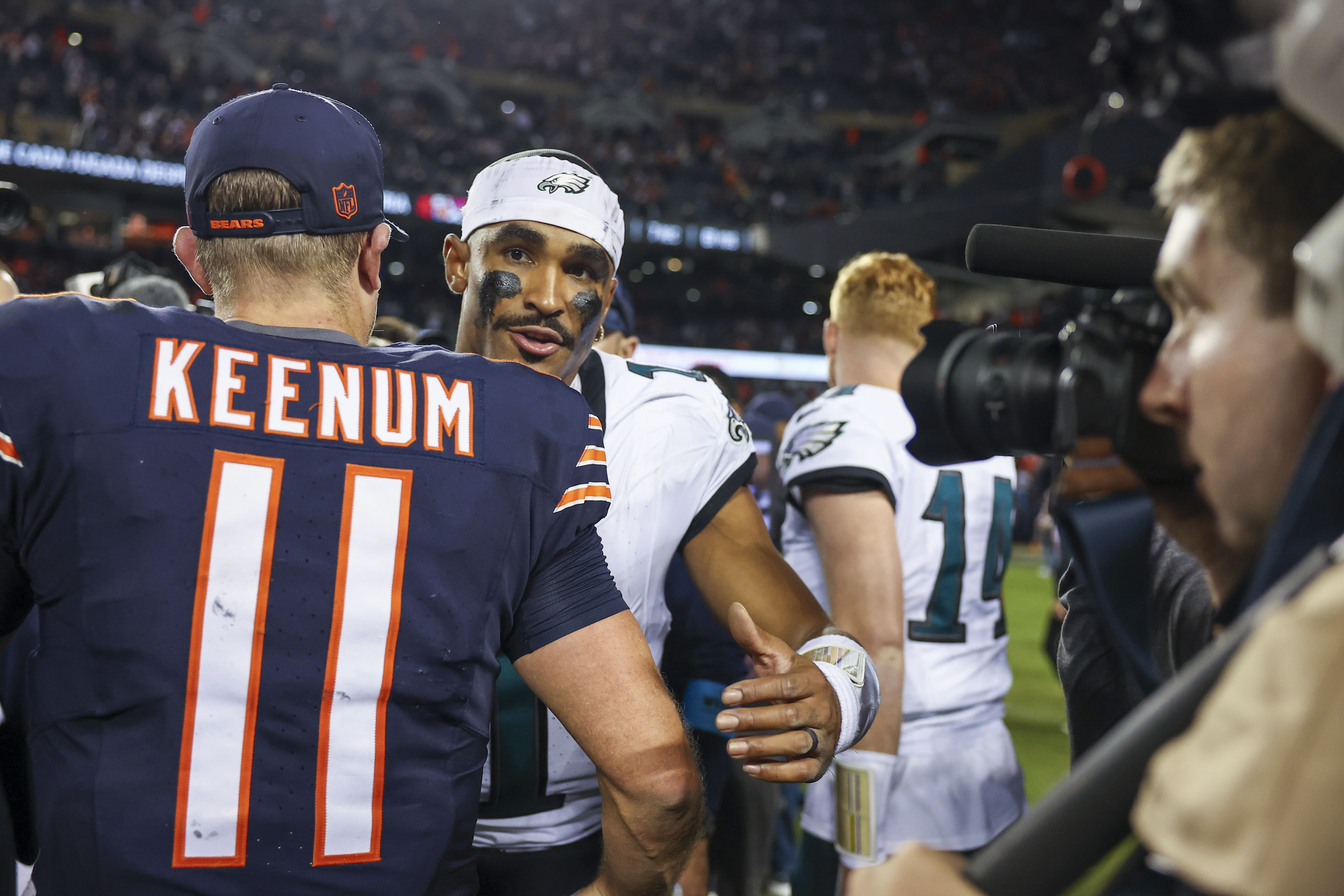
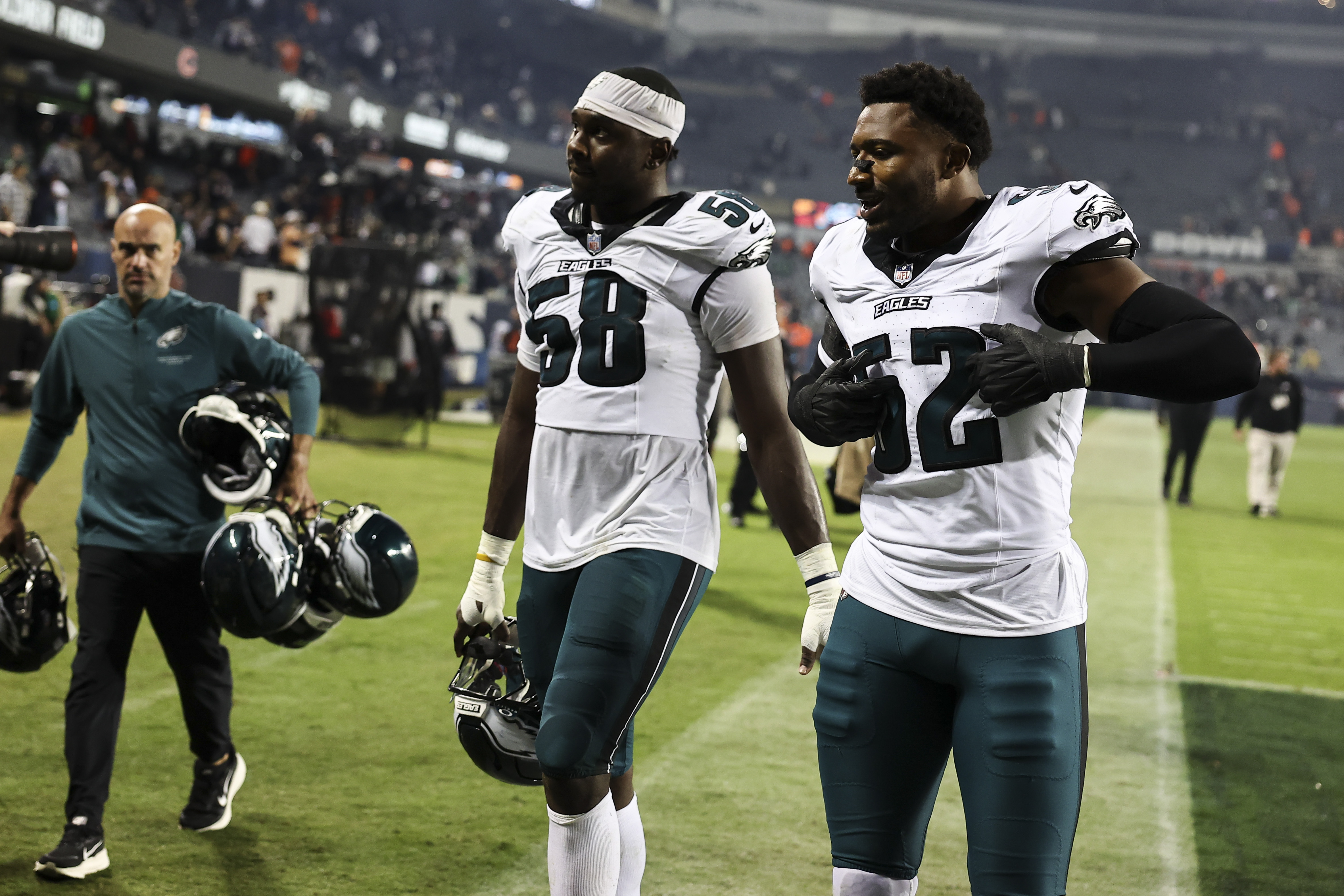
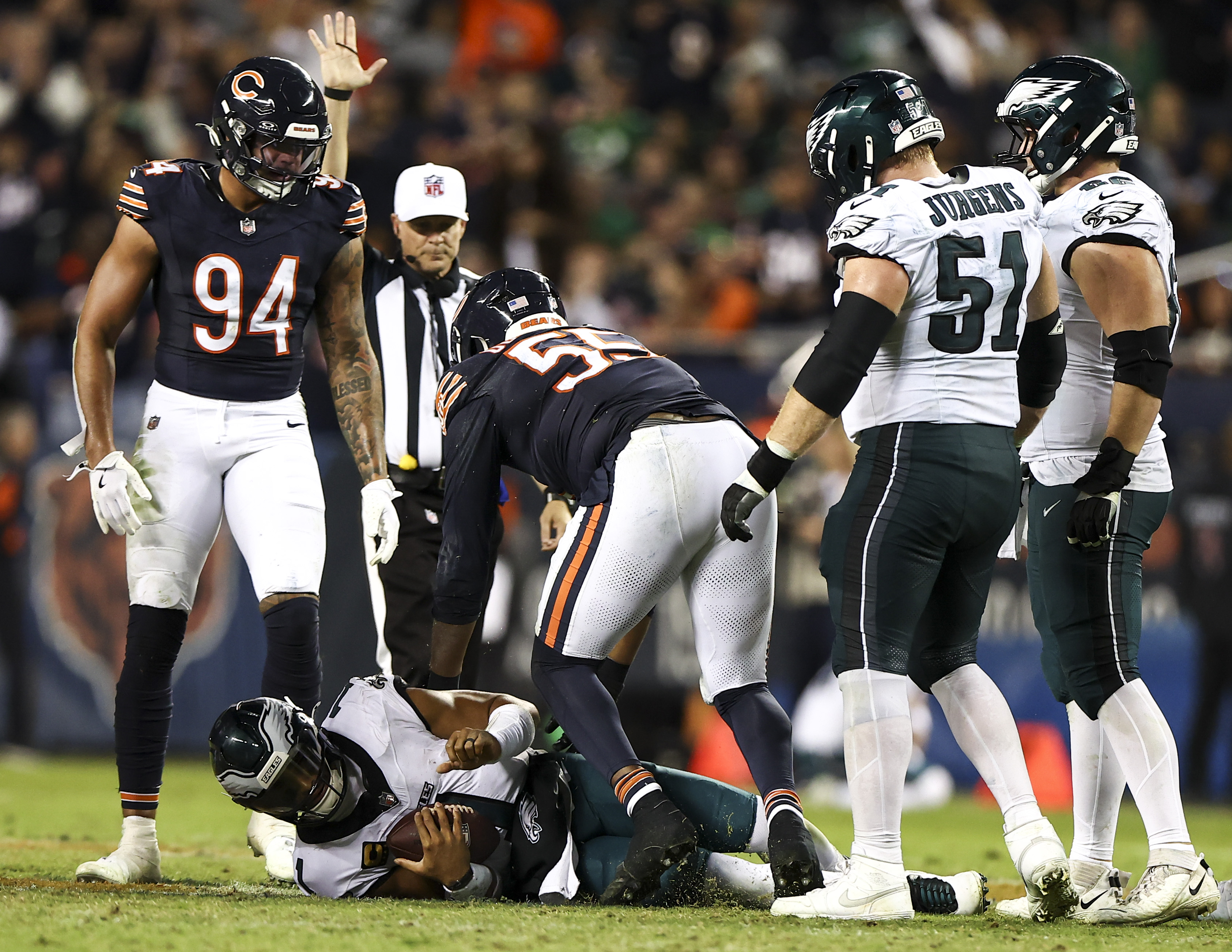
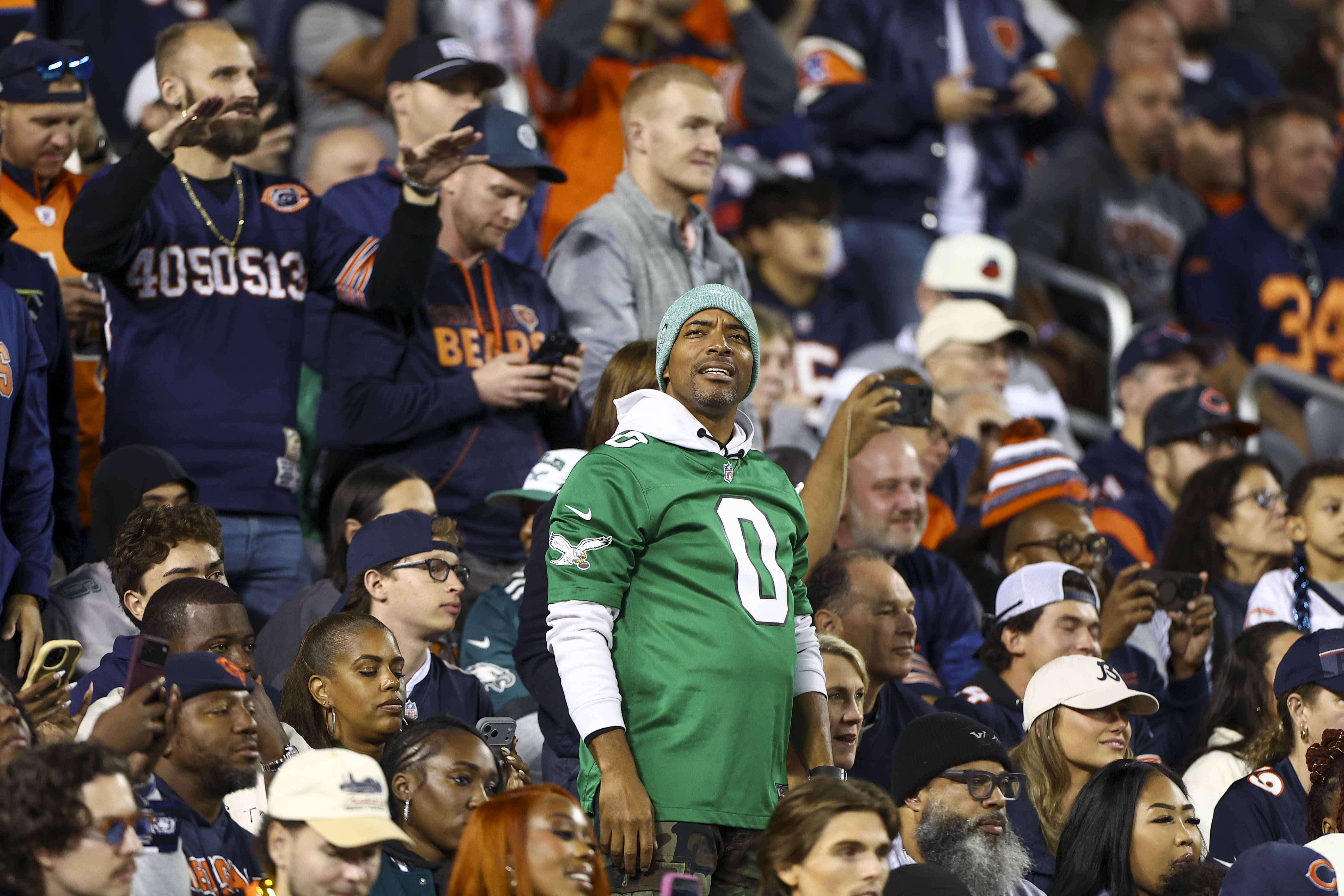
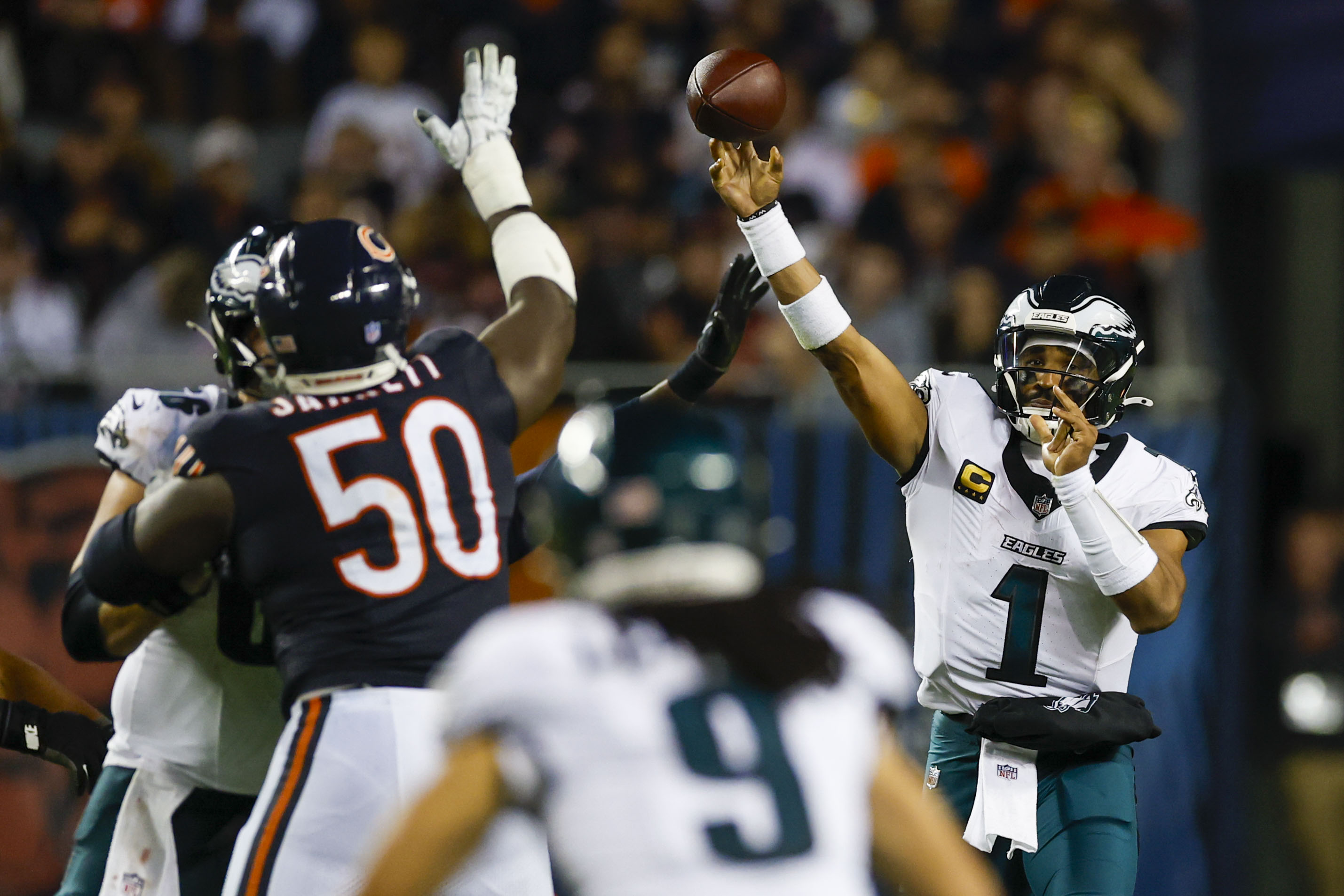
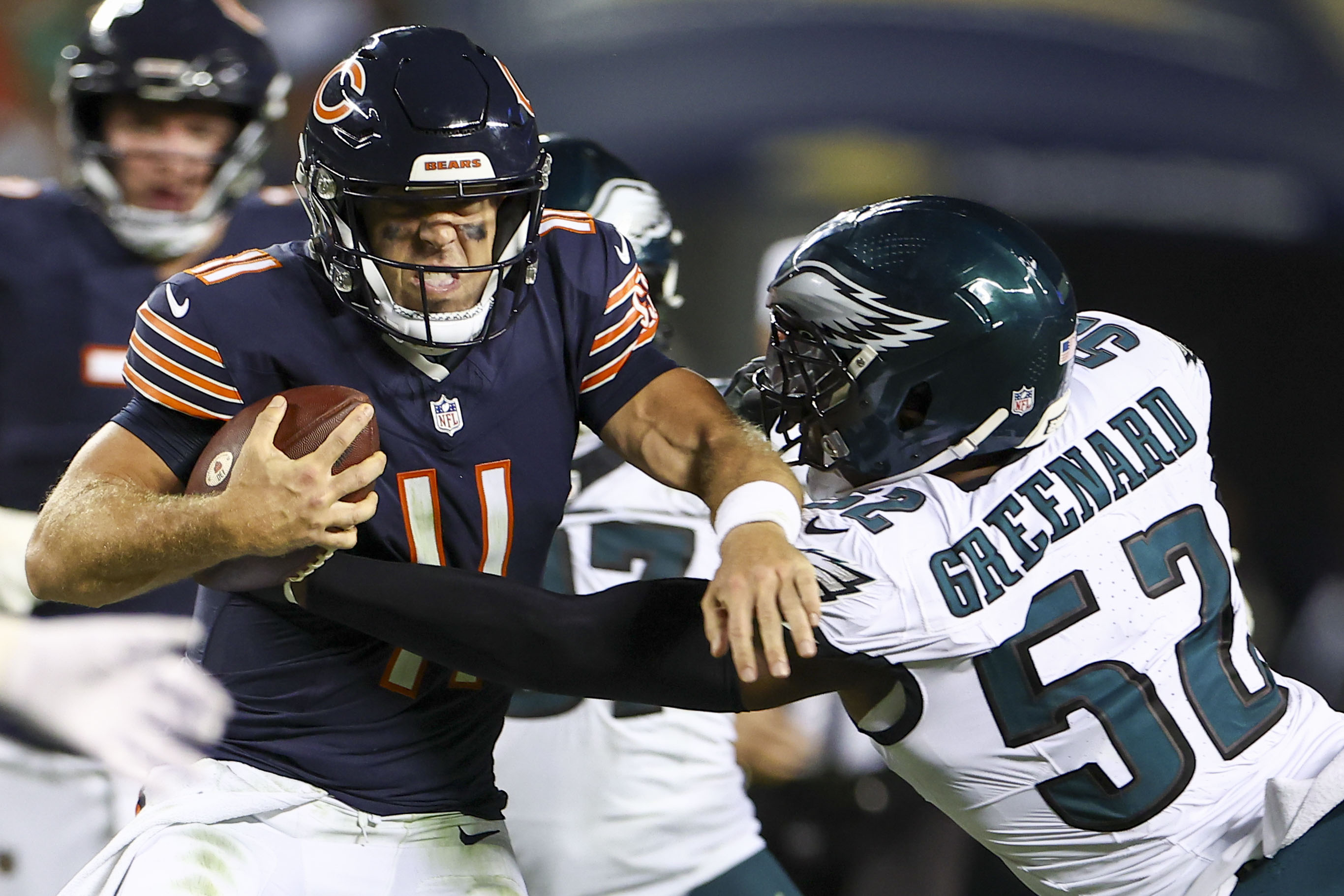
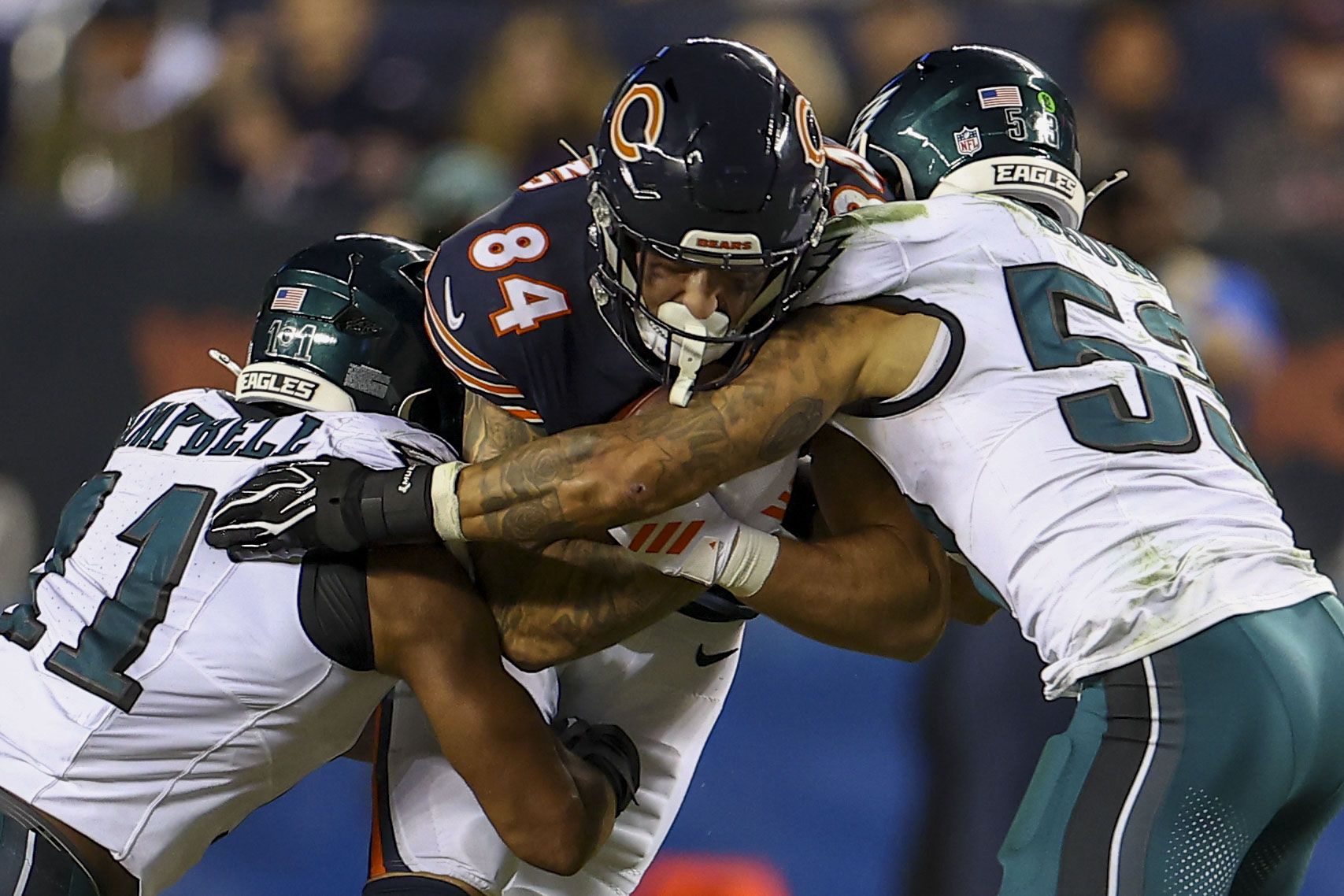
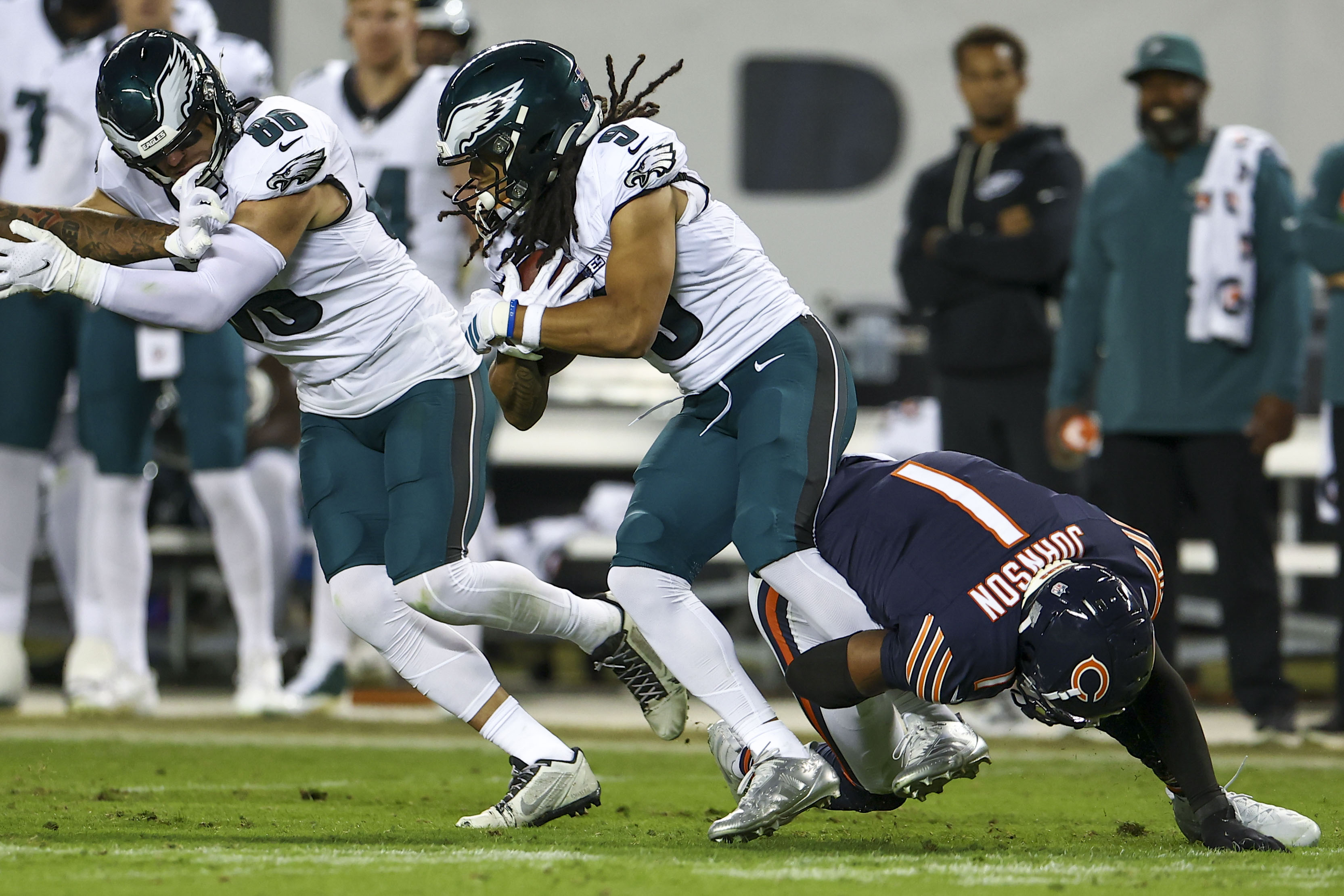
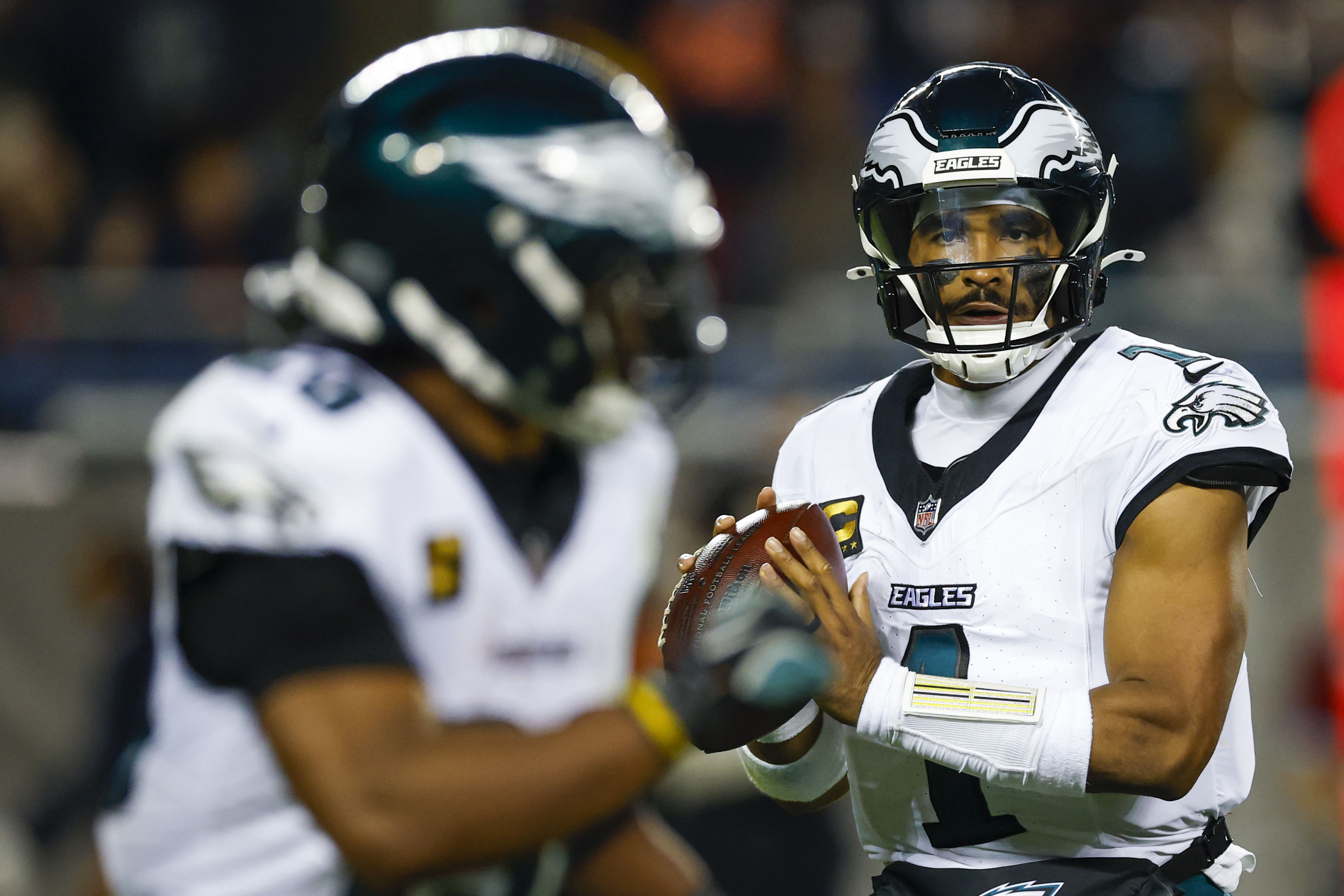
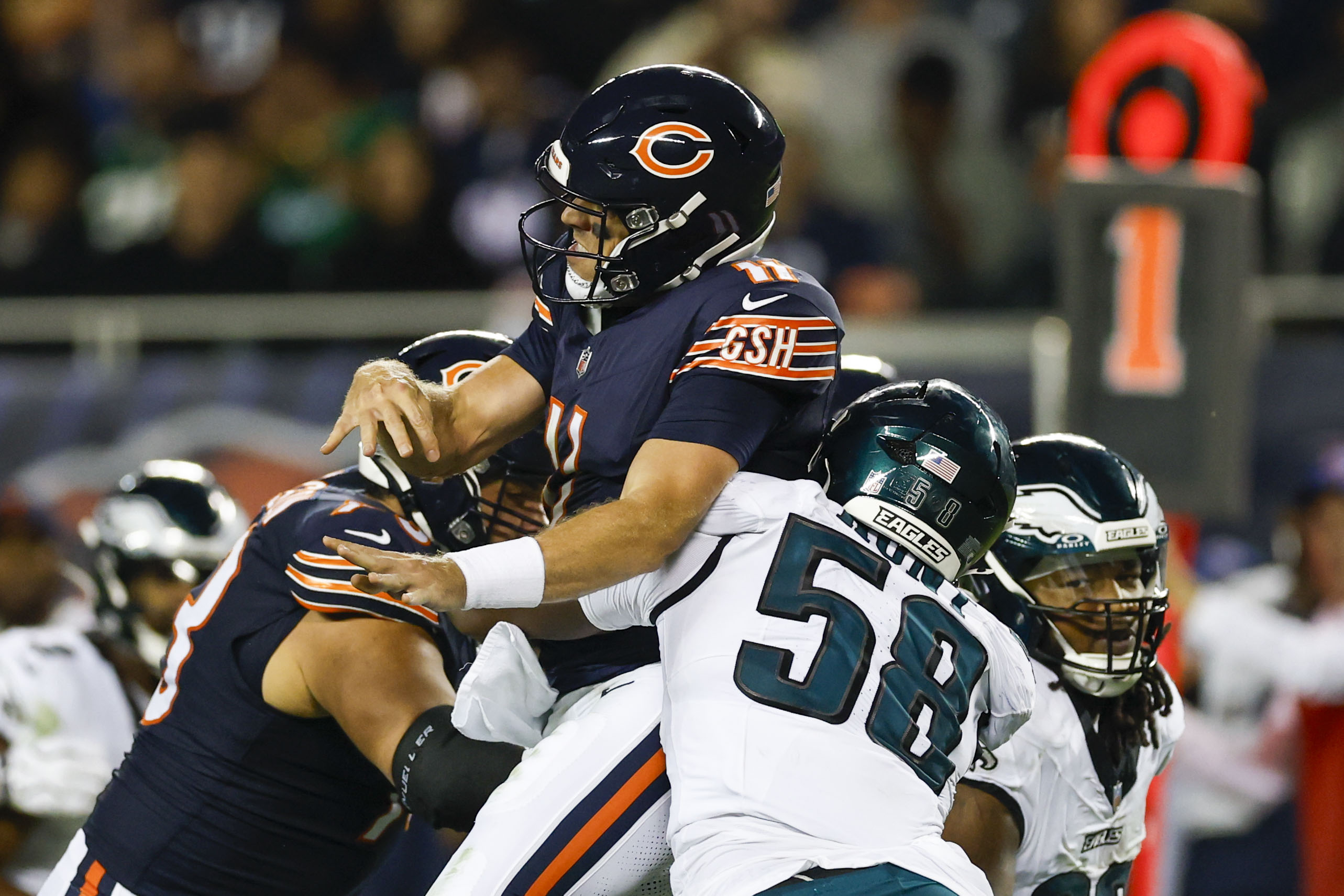
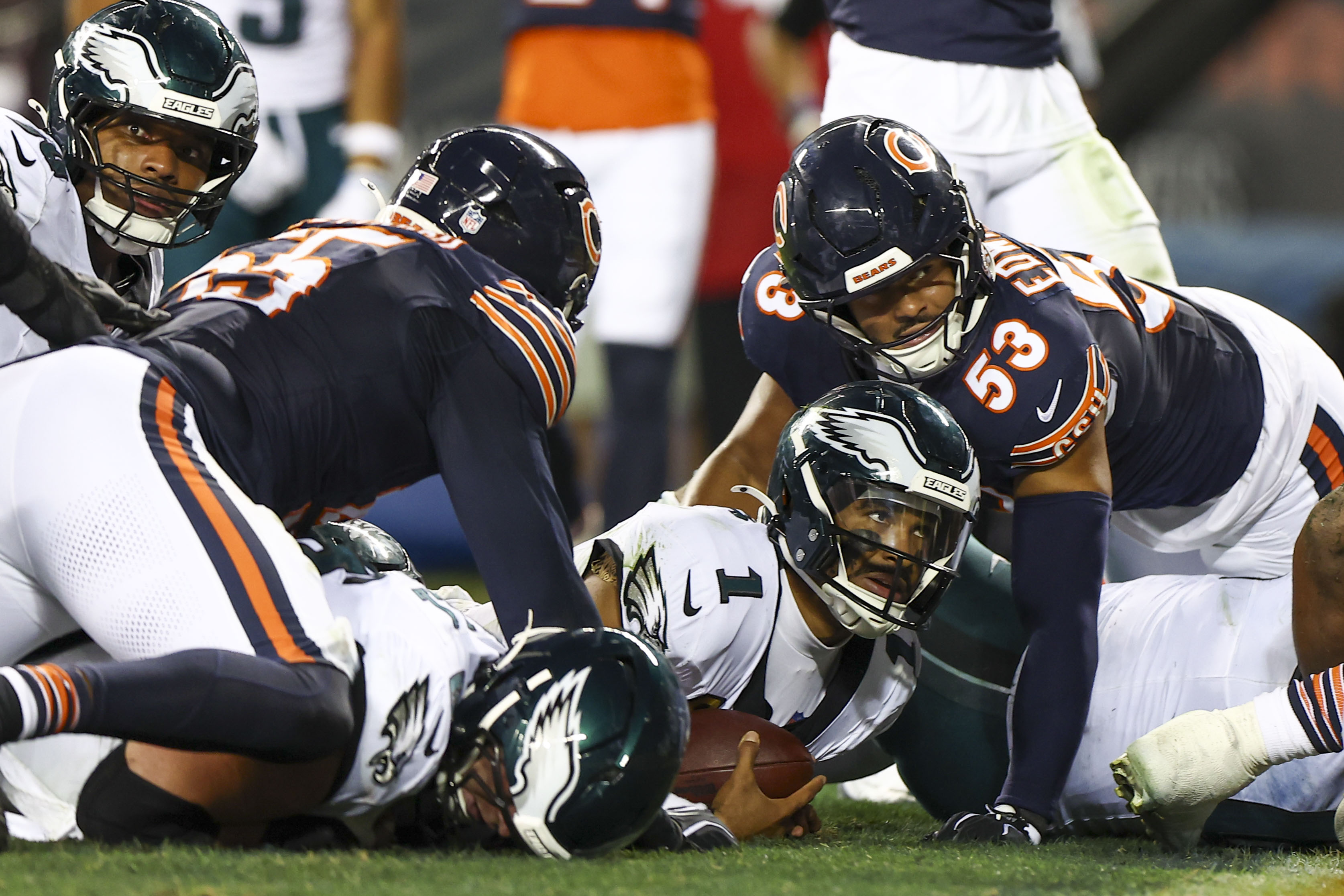
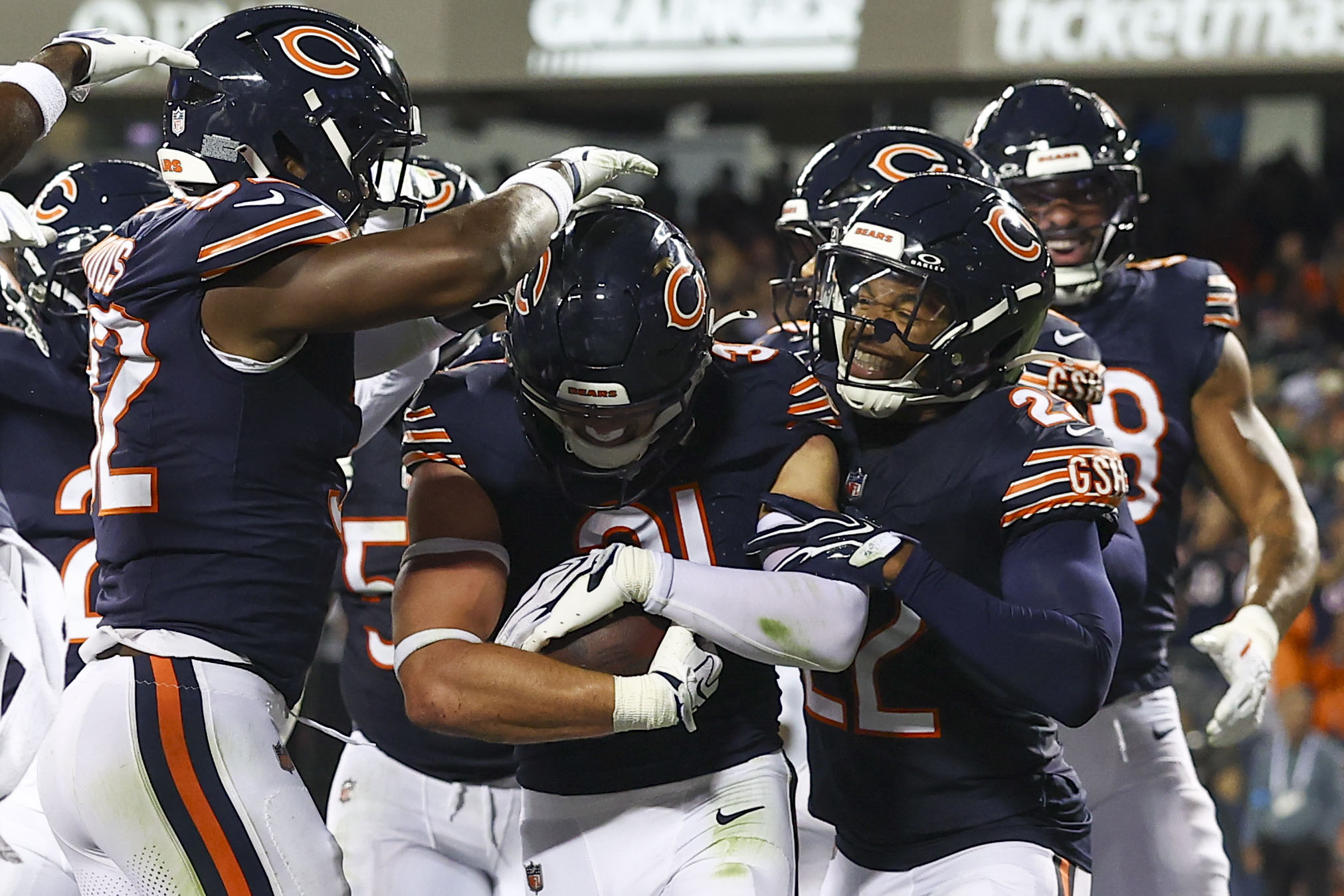
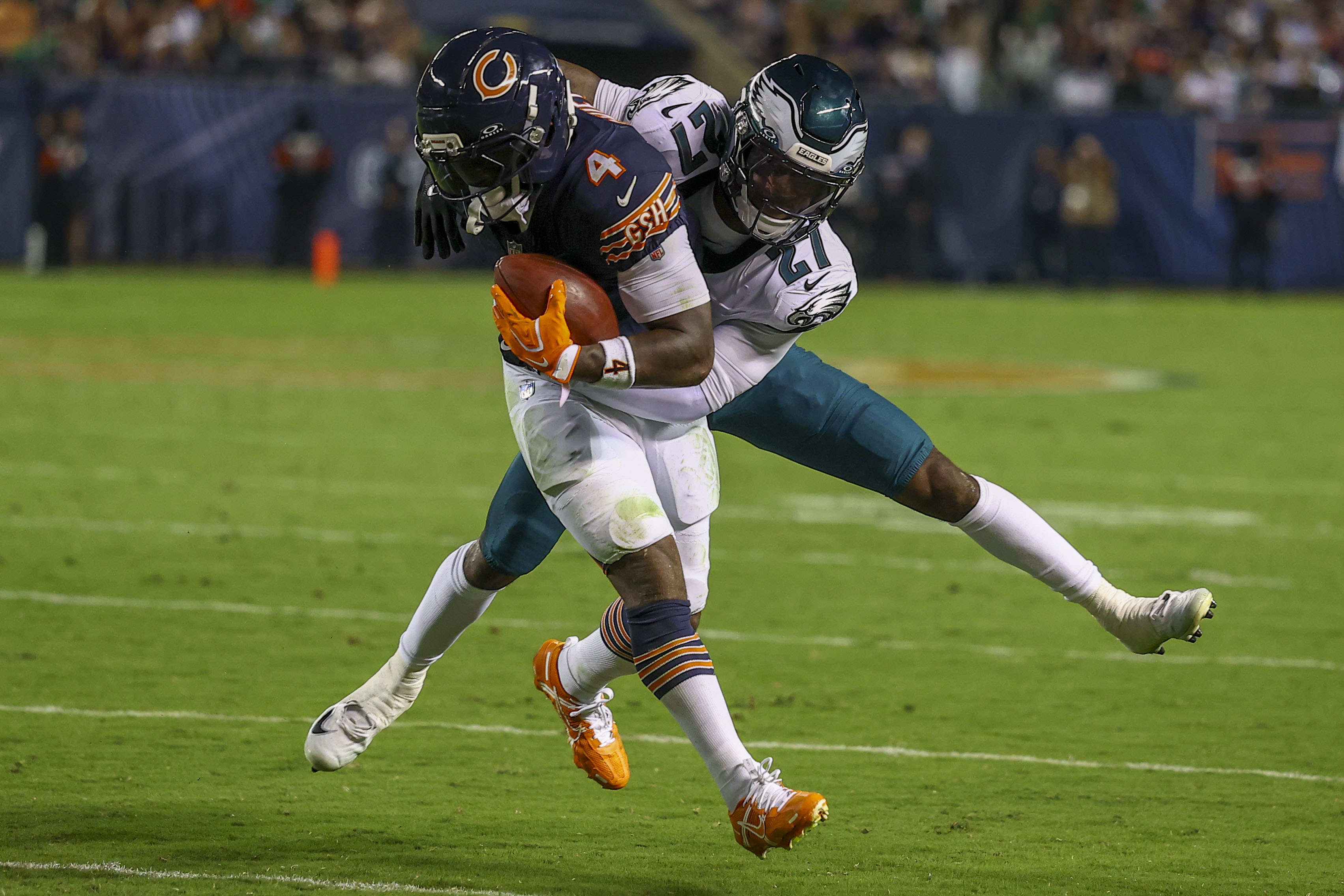
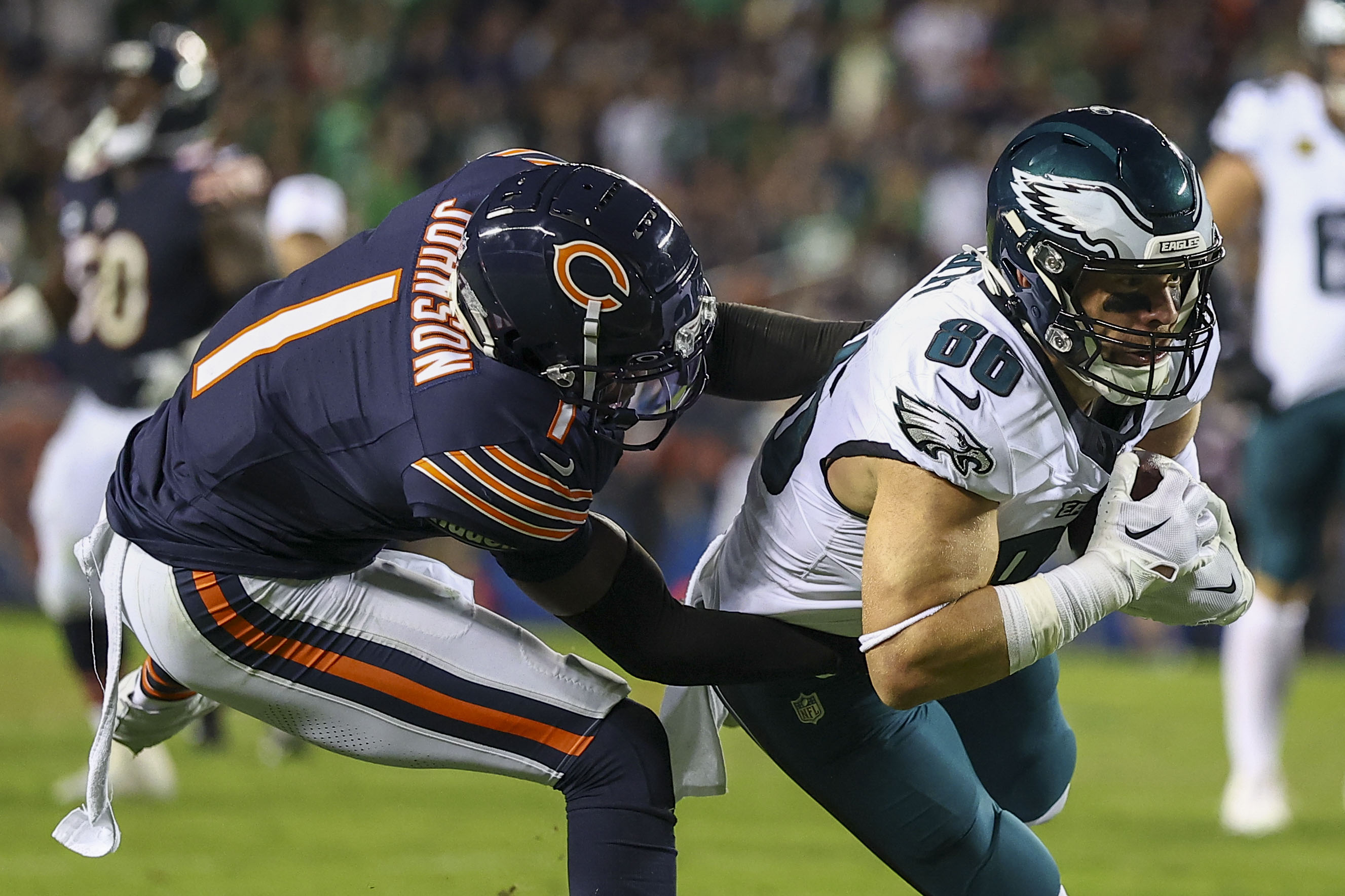
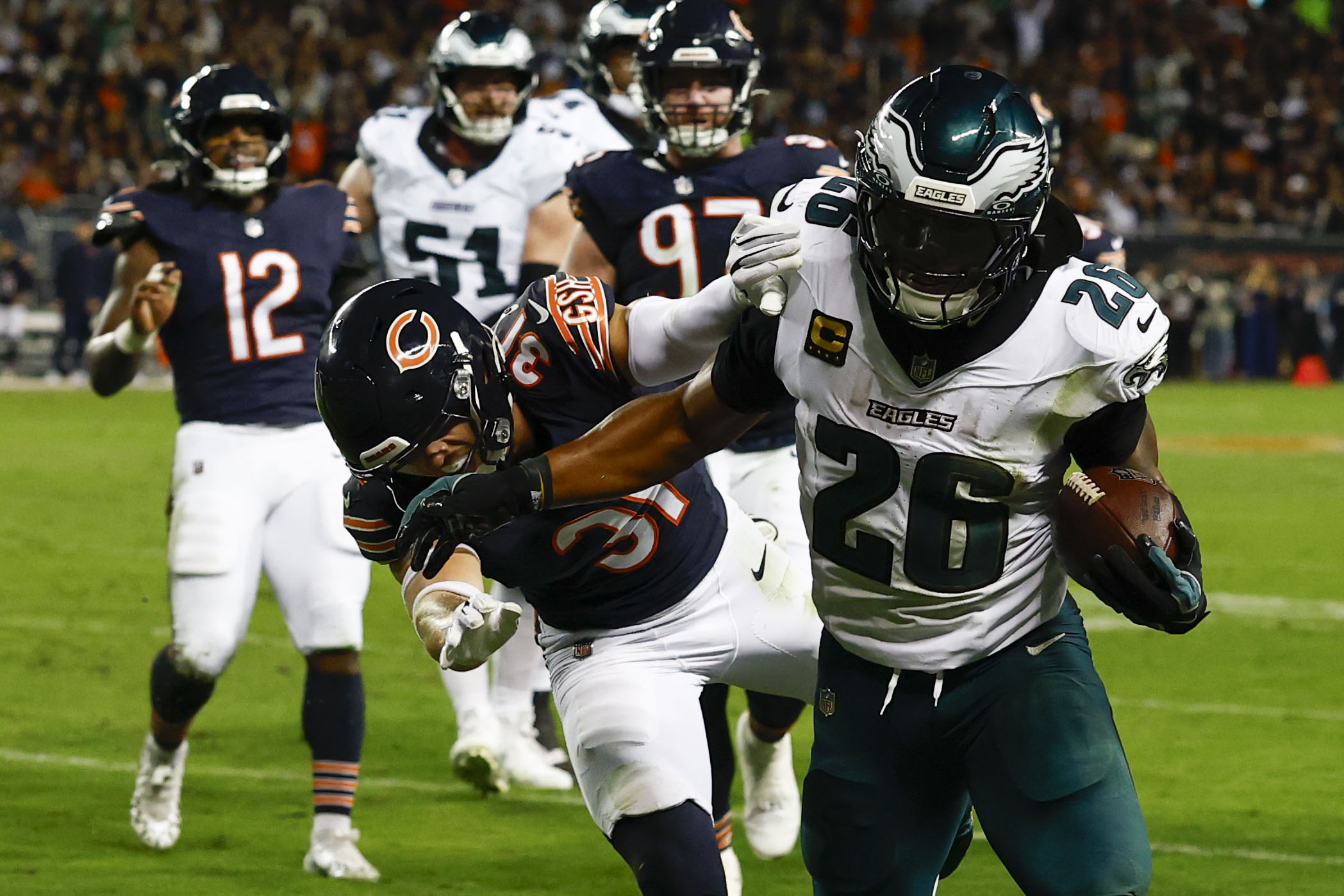
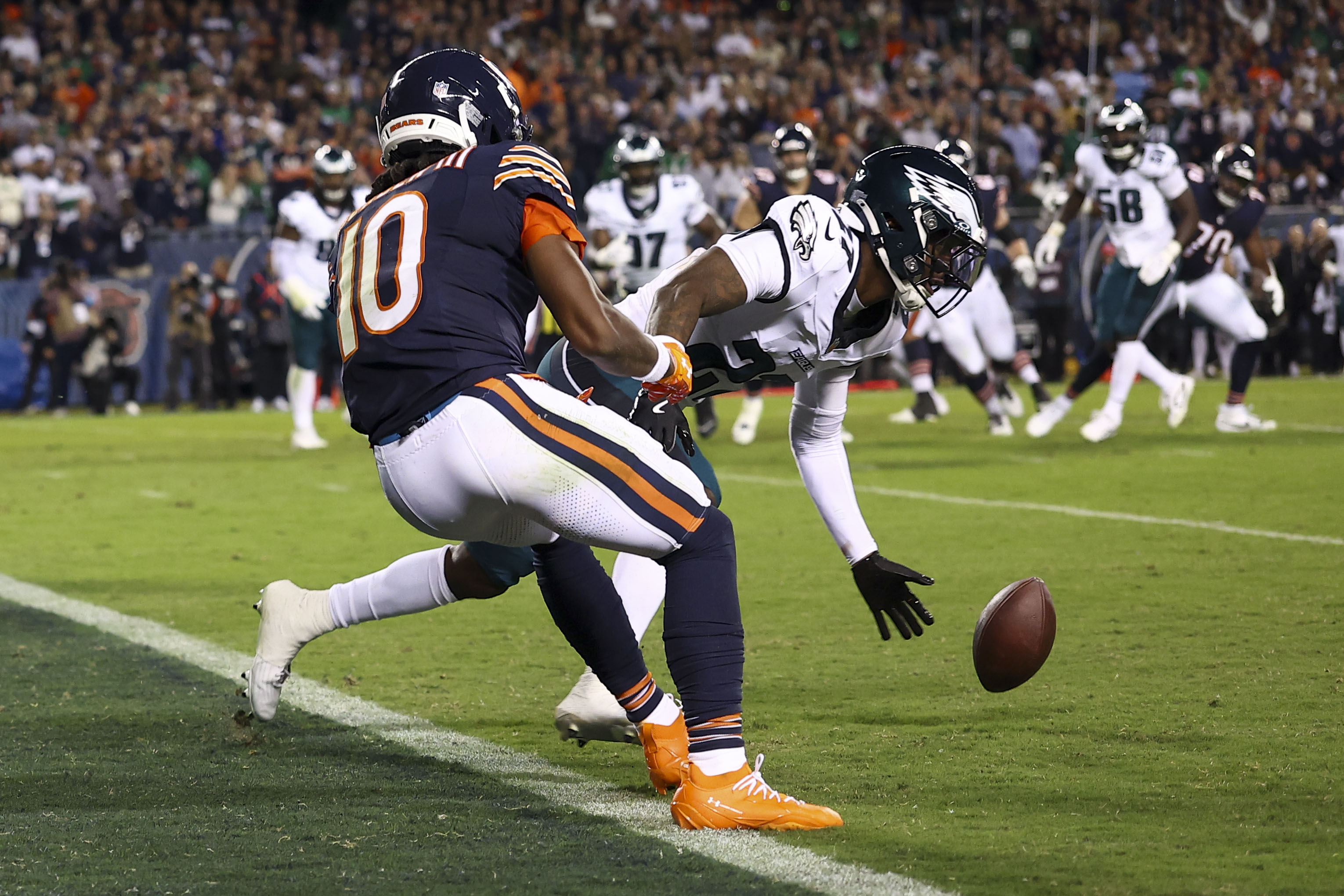
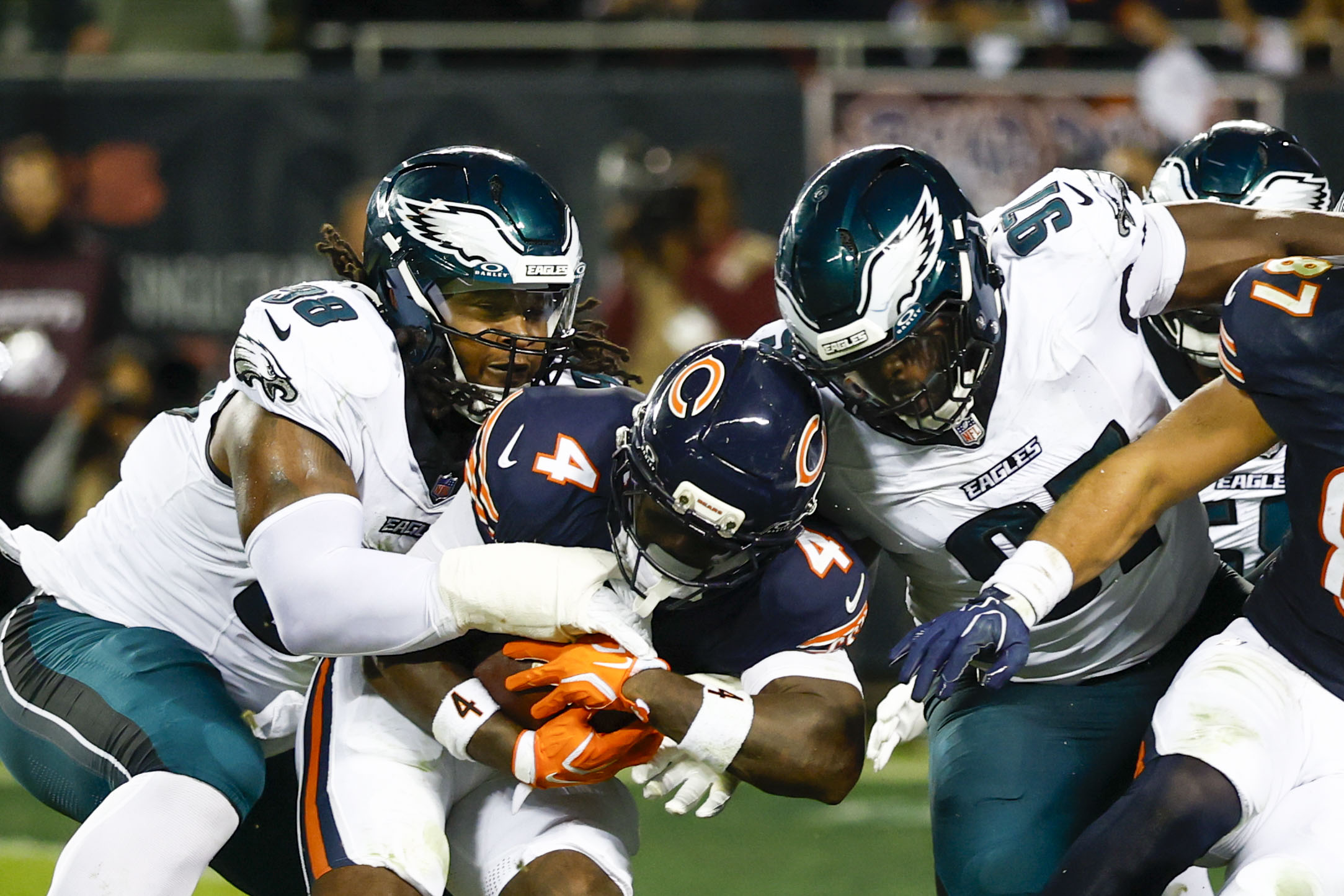
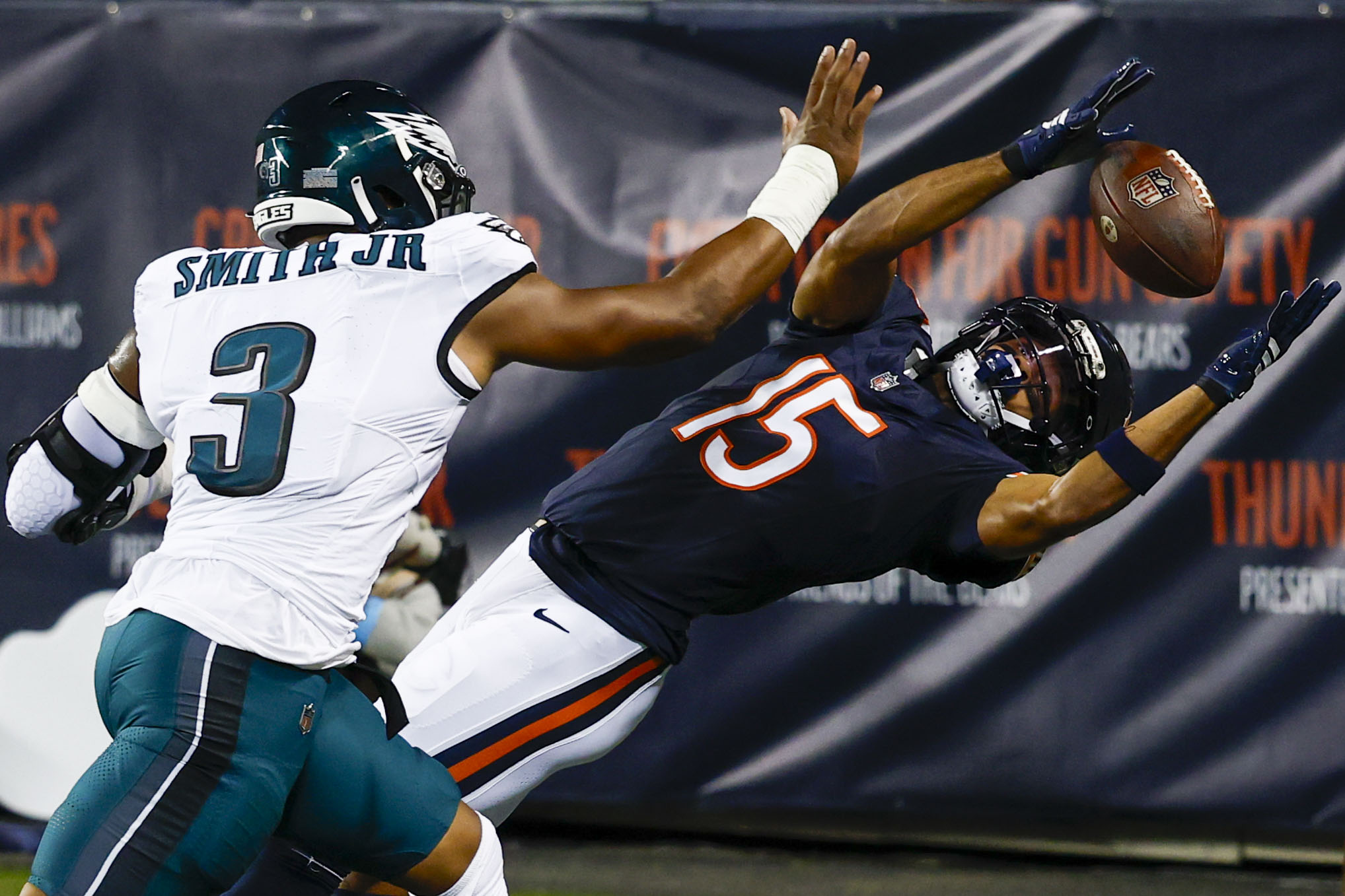
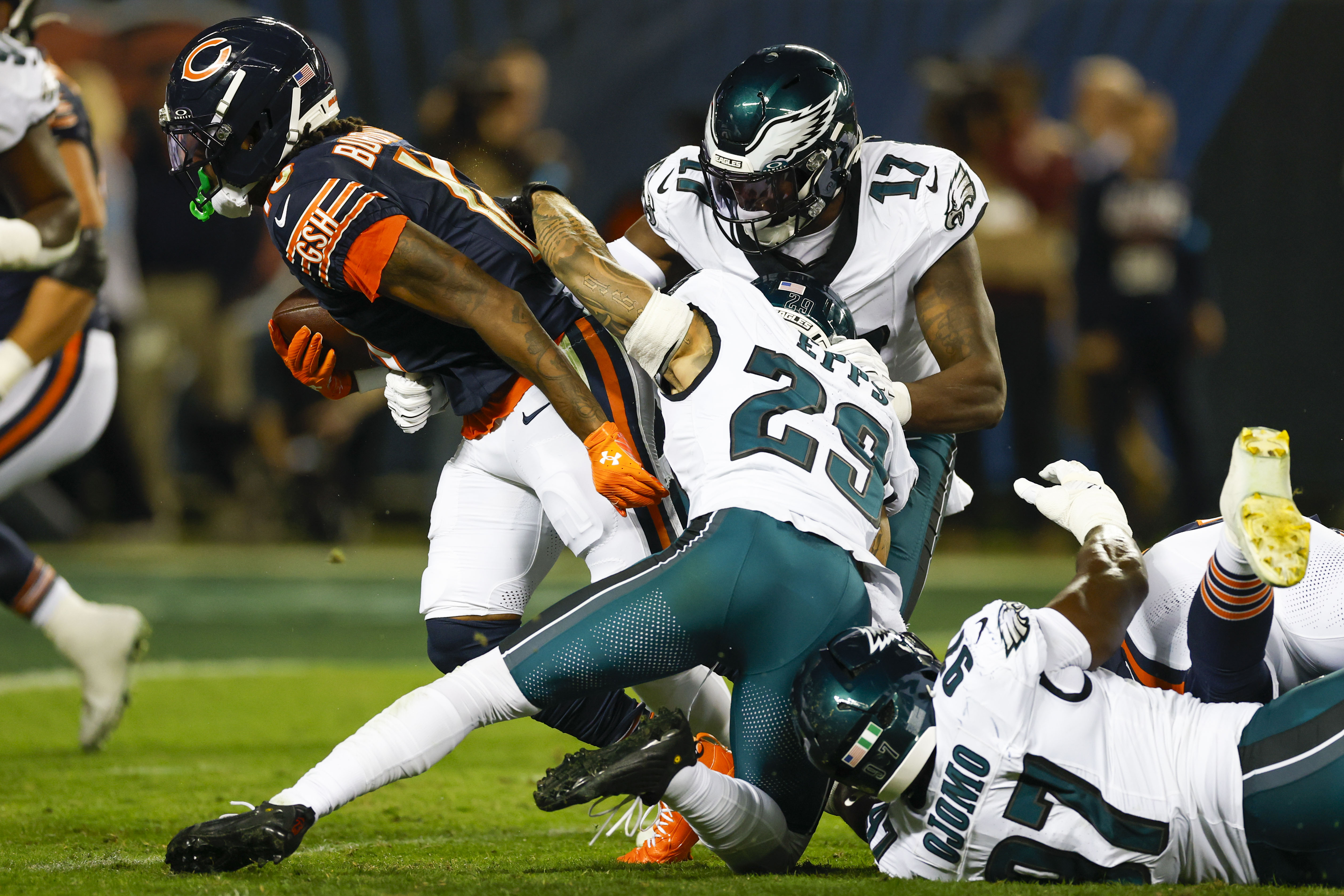
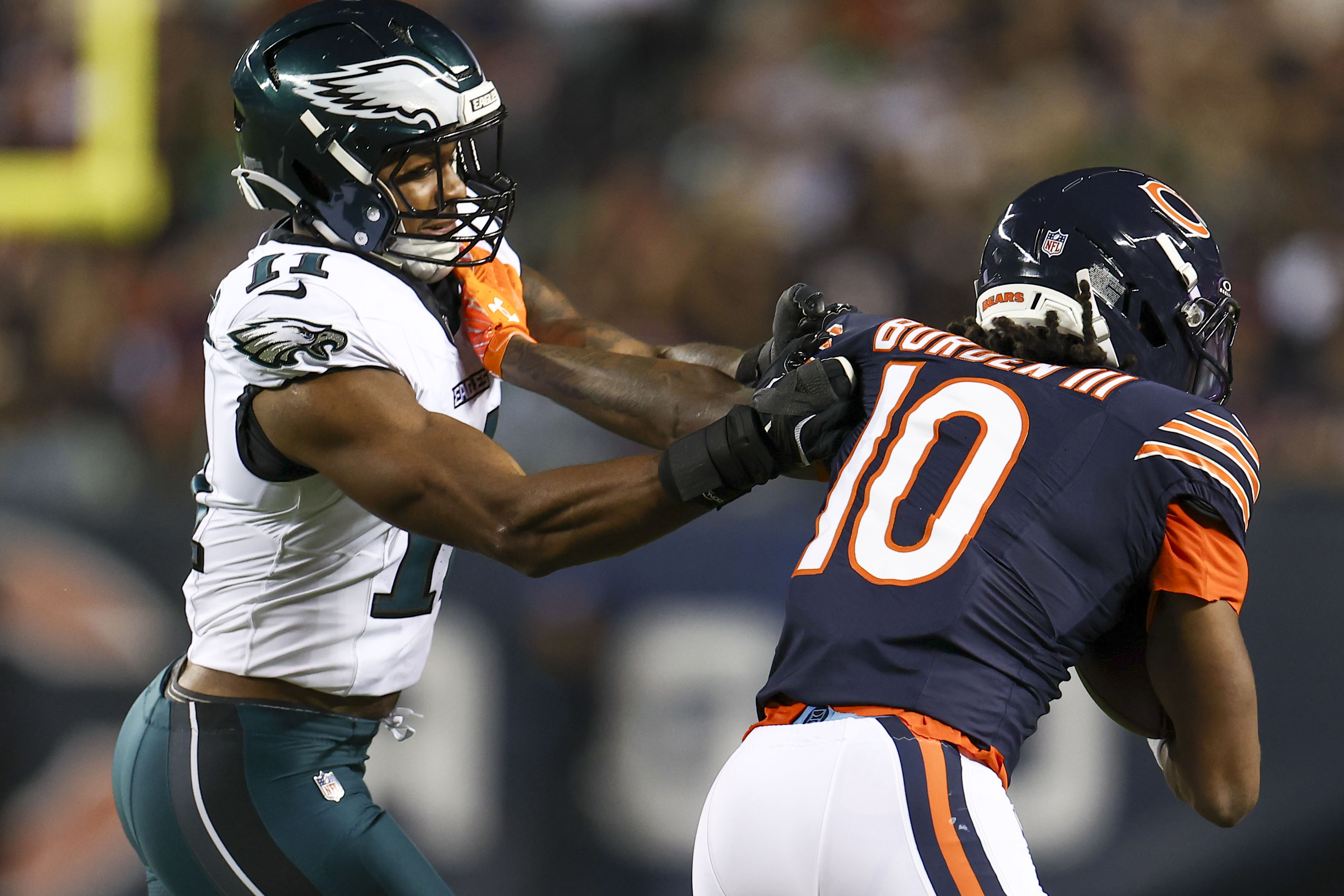
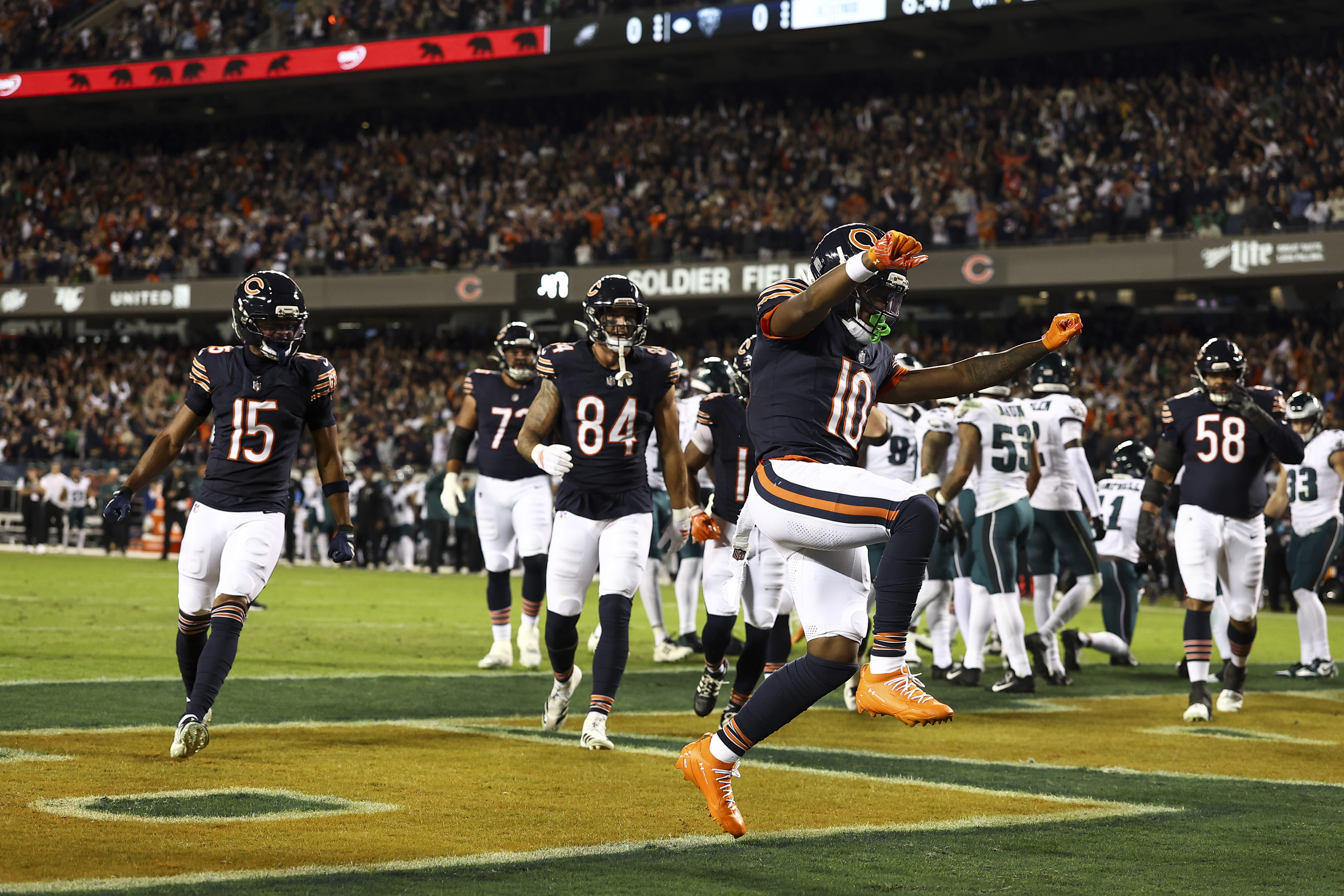
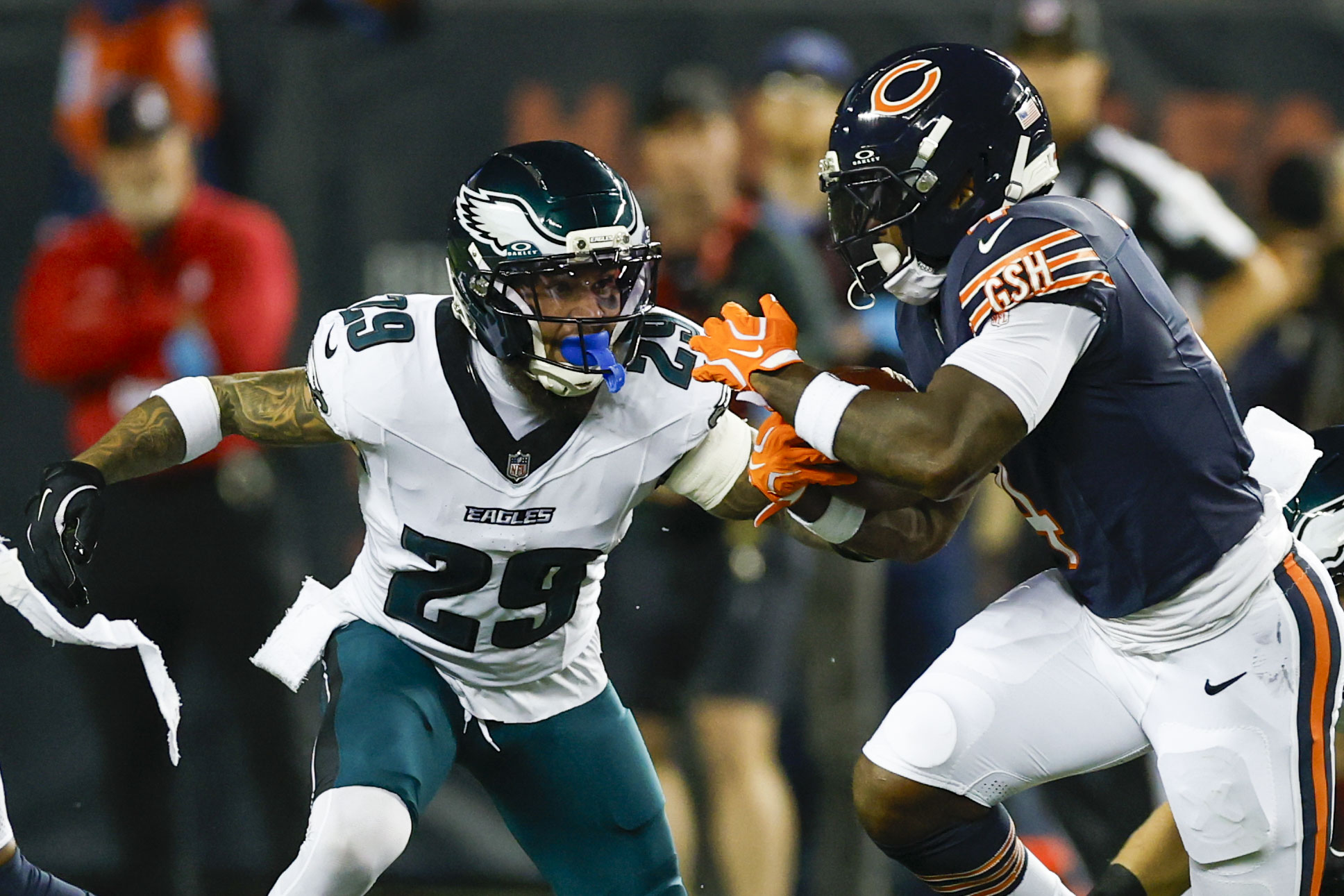
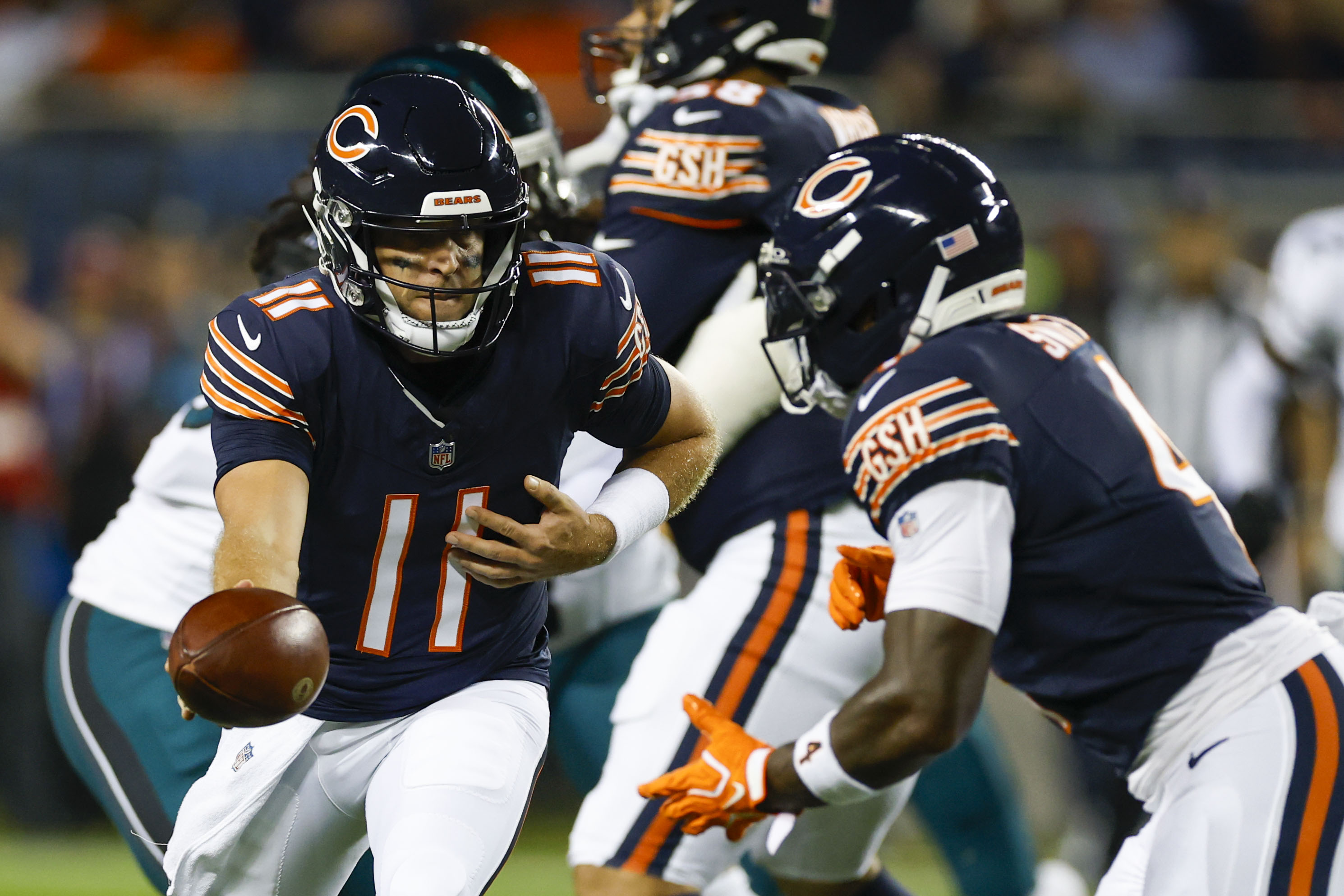
Philadelphia Eagles quarterback Jalen Hurts and Chicago Bears quarterback Case Keenum embrace at the end of the game at Soldier Field on Monday, Sept. 28, 2026, in Chicago, Ill. Chicago won 27-7.Monica Herndon / Staff PhotographerPhiladelphia Eagles linebacker Jalyx Hunt and Philadelphia Eagles linebacker Jonathan Greenard leave after the Chicago Bears game against the Philadelphia Eagles at Soldier Field.Monica Herndon / Staff PhotographerPhiladelphia Eagles quarterback Jalen Hurts lies on the ground after getting sacked during the fourth quarter of the Chicago Bears game.Monica Herndon / Staff PhotographerPhiladelphia Eagles quarterback Jalen Hurts watches the last two minutes of the game against the Chicago Bears at Soldier Field. Chicago won 27-7.Yong Kim / Staff PhotographerPhiladelphia Eagles quarterback Jalen Hurts gets up after getting sacked in the fourth quarter.Monica Herndon / Staff PhotographerPhiladelphia Eagles quarterback Jalen Hurts throws long on fourth down in the fourth quarter, pass incomplete at Soldier Field on Monday, Sept. 28, 2026, in Chicago, Ill.Monica Herndon / Staff PhotographerPhiladelphia Eagles wide receiver Makai Lemon makes a reception in the fourth quarter.Monica Herndon / Staff PhotographerPhiladelphia Eagles fan reacts after a penalty is called in the fourth quarter.Monica Herndon / Staff PhotographerPhiladelphia Eagles head coach Nick Sirianni in the fourth quarter. Chicago won 27-7.Yong Kim / Staff PhotographerPhiladelphia Eagles quarterback Jalen Hurts throws the ball to Philadelphia Eagles wide receiver Makai Lemon in the fourth quarter.Yong Kim / Staff PhotographerPhiladelphia Eagles linebacker Jonathan Greenard tackles Chicago Bears quarterback Case Keenum in the fourth quarter.Monica Herndon / Staff PhotographerChicago Bears quarterback Case Keenum almost loses possession of the ball in the fourth quarter.Monica Herndon / Staff PhotographerPhiladelphia Eagles linebacker Jihaad Campbell tackles Chicago Bears quarterback Case Keenum in the fourth quarter.Monica Herndon / Staff PhotographerChicago Bears linebacker T.J. Edwards after intercepting a pass in the third quarter.Monica Herndon / Staff PhotographerPhiladelphia Eagles quarterback Jalen Hurts after throwing a third-quarter interception.Yong Kim / Staff PhotographerChicago Bears wide receiver Kalif Raymond celebrates a touchdown during the third quarter.Monica Herndon / Staff PhotographerChicago Bears linebacker T.J. Edwards celebrates an interception in the third quarter.Yong Kim / Staff PhotographerPhiladelphia Eagles wide receiver DeVonta Smith is wrapped up by Chicago Bears safety Elijah Hicks in the third quarter.Yong Kim / Staff PhotographerPhiladelphia Eagles fans in the third quarter.Monica Herndon / Staff PhotographerPhiladelphia Eagles linebacker Jihaad Campbell and Philadelphia Eagles linebacker Zack Baun tackle Chicago Bears tight end Colston Loveland in the third quarter.Monica Herndon / Staff PhotographerPhiladelphia Eagles wide receiver Makai Lemon was tackled by Chicago Bears cornerback Jaylon Johnson in the third quarter.Monica Herndon / Staff PhotographerPhiladelphia Eagles quarterback Jalen Hurts throws the ball to Philadelphia Eagles running back Saquon Barkley.Yong Kim / Staff PhotographerPhiladelphia Eagles linebacker Jalyx Hunt goes after Chicago Bears quarterback Case Keenum in the third quarter.Yong Kim / Staff PhotographerChicago Bears fan reacts to the last-minute “tush push” score by Philadelphia Eagles quarterback Jalen Hurts.Monica Herndon / Staff PhotographerPhiladelphia Eagles quarterback Jalen Hurts looks up after scoring on the tush push with one second left to go.Monica Herndon / Staff PhotographerChicago Bears safety Dillon Thieneman celebrates an interception in the second quarter.Monica Herndon / Staff PhotographerPhiladelphia Eagles cornerback Quinyon Mitchell stops Chicago Bears running back D’Andre Swift in the second quarter.Monica Herndon / Staff PhotographerPhiladelphia Eagles tight end Zach Ertz is defended by Chicago Bears cornerback Jaylon Johnson in the second quarter.Monica Herndon / Staff PhotographerPhiladelphia Eagles running back Saquon Barkley runs by Chicago Bears safety Dillon Thieneman in the second quarter, just short of a touchdown.Yong Kim / Staff PhotographerPhiladelphia Eagles cornerback Quinyon Mitchell breaks up a pass intended for Chicago Bears wide receiver Luther Burden III in the second quarter.Monica Herndon / Staff PhotographerChicago Bears running back D’Andre Swift gets stopped by Philadelphia Eagles defensive tackle Jalen Carter (left) and Philadelphia Eagles defensive tackle Moro Ojomo (right) in the second quarter.Yong Kim / Staff PhotographerIncomplete pass to Chicago Bears wide receiver Rome Odunze in the second quarter, defended by Philadelphia Eagles linebacker Nolan Smith.Yong Kim / Staff PhotographerChicago Bears wide receiver Luther Burden III scores as the Philadelphia Eagles defense tries to stop him during the first quarter.Yong Kim / Staff PhotographerPhiladelphia Eagles linebacker Jihaad Campbell forces Chicago Bears wide receiver Luther Burden III out of bounds in the first quarter.Monica Herndon / Staff PhotographerChicago Bears wide receiver Luther Burden III celebrates a touchdown during the first quarter.Monica Herndon / Staff PhotographerChicago Bears running back D’Andre Swift runs with the ball against Philadelphia Eagles safety Marcus Epps in the first quarter.Yong Kim / Staff PhotographerChicago Bears quarterback Case Keenum hands off to Chicago Bears running back D’Andre Swift in the first quarter.Yong Kim / Staff Photographer
The good thing for Sirianni and his team this time is that the standard for success has to be different, has to be a little lower. Losses to the Rams and to the Jaguars wouldn’t necessarily be the worst possible outcomes for them. The nature of those losses — of how the Eagles play — would matter more. Put simply, even if they go down, the Eagles have to go down fighting. They can’t get blown out again. They have to remain competitive. They have to give everyone, themselves included, reason to believe they can turn things around once they get healthier, once all their defensive starters settle into Vic Fangio’s system, once Mannion has more opportunities to show whether he’s the budding genius the Eagles have billed him to be.
A 2-3 start is still too early in a season to write off any team, especially one that has qualified for the playoffs five years running. After Jacksonville, the Eagles get the Carolina Panthers and the Dallas Cowboys, both at home, so the schedule will ease up a bit, at least in theory. The most important task for Sirianni over the next month is to hold the locker room and the coaching staff together, to prevent what happened in 2023 — one awful loss leading to another and another, morale plummeting, veterans looking out for themselves instead of focusing on the team’s greater good — from happening again.
“You get in a bind,” Ojomo said, “and it’s hard to get out of it.”
For the Eagles and their head coach, then, the mission is simple: Don’t get in one.
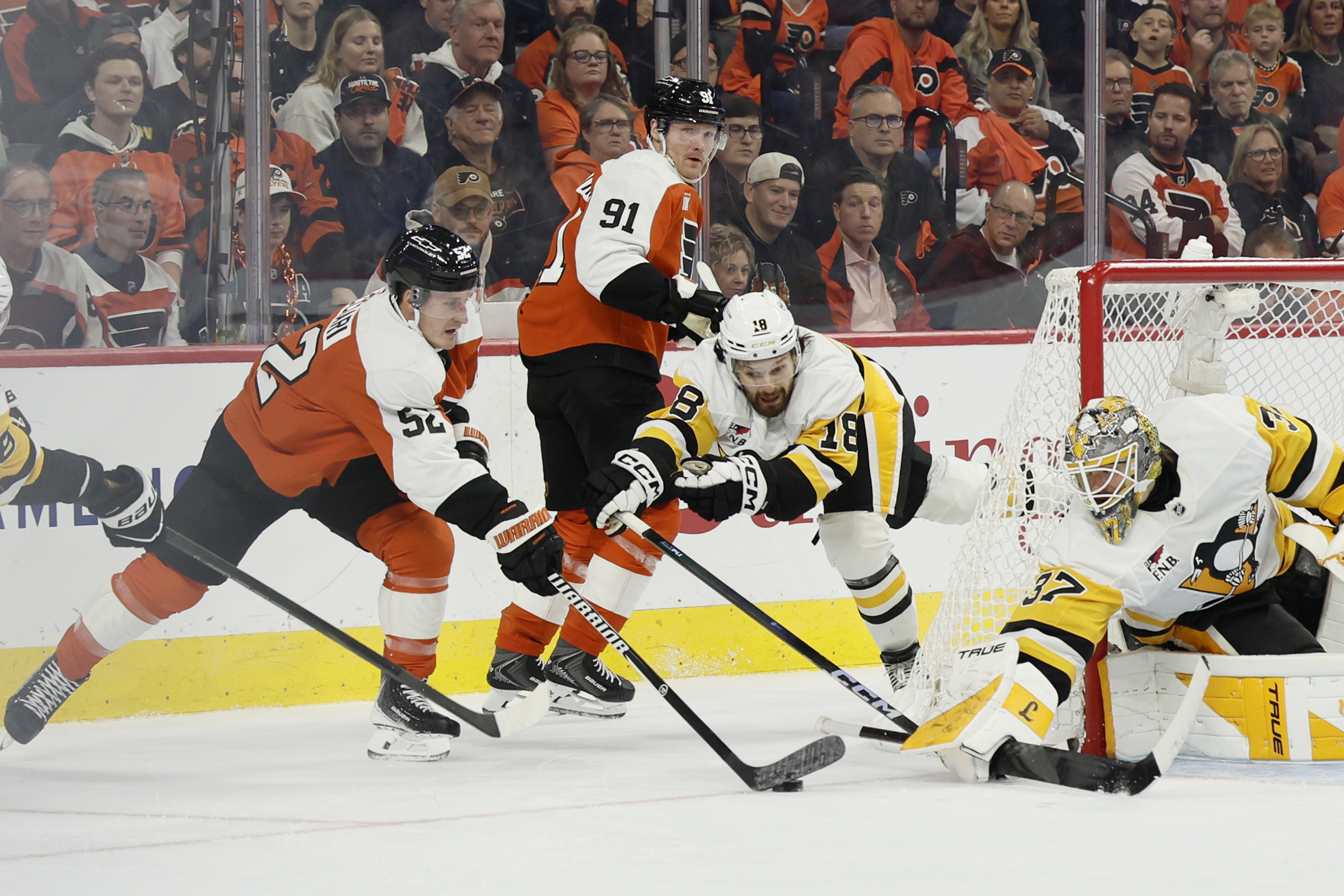
Amid the most optimism and the highest expectations around them in years, the Flyers opened their regular season Wednesday night and were bad. More than just bad, actually. They were horribly bad. They were terribly bad. They were Plan 9 from Outer Space bad, left-the-milk-out-too-long bad, Andy Dalton-on-third-and-goal bad. They were the kind of bad that stops being surprising and interesting and starts being embarrassing and … just more embarrassing. They were so bad that the Xfinity Mobile Arena staff could have played the final scene from Seven on the videoboard and it would have lifted everyone’s spirits.
They lost 7-0 to the Pittsburgh Penguins — their fiercest rival, the team they knocked out of the playoffs last season — in a game so one-sided that it’s a wonder they allowed themselves to be introduced before the opening faceoff. If your effort is going to be that pitiful, just stay in the locker room to spare the sellout crowd the few seconds of getting their hopes up. The Mites on Ice could have booed them. Gritty should go into hiding. Lauren Hart should have told everyone she had laryngitis.
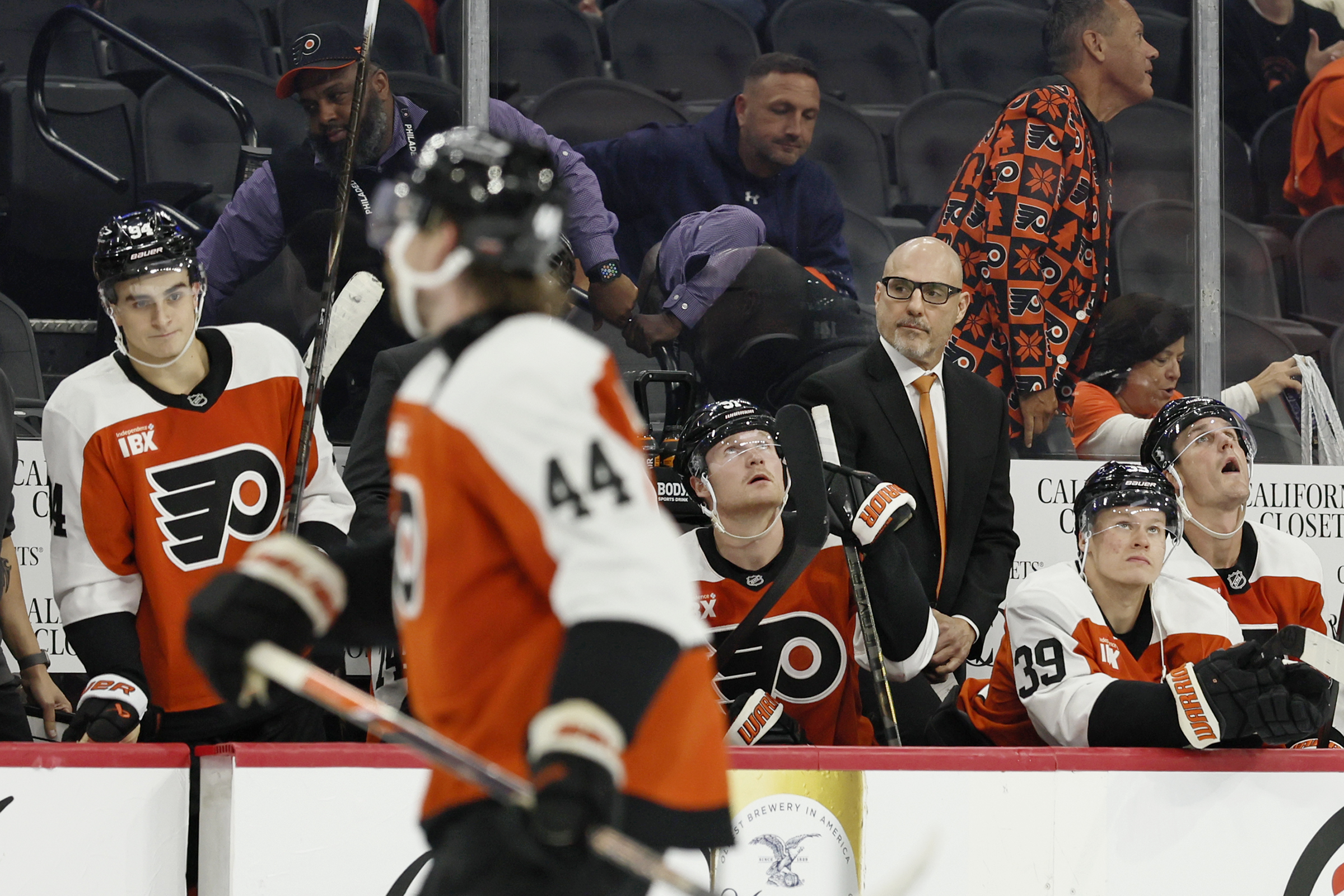
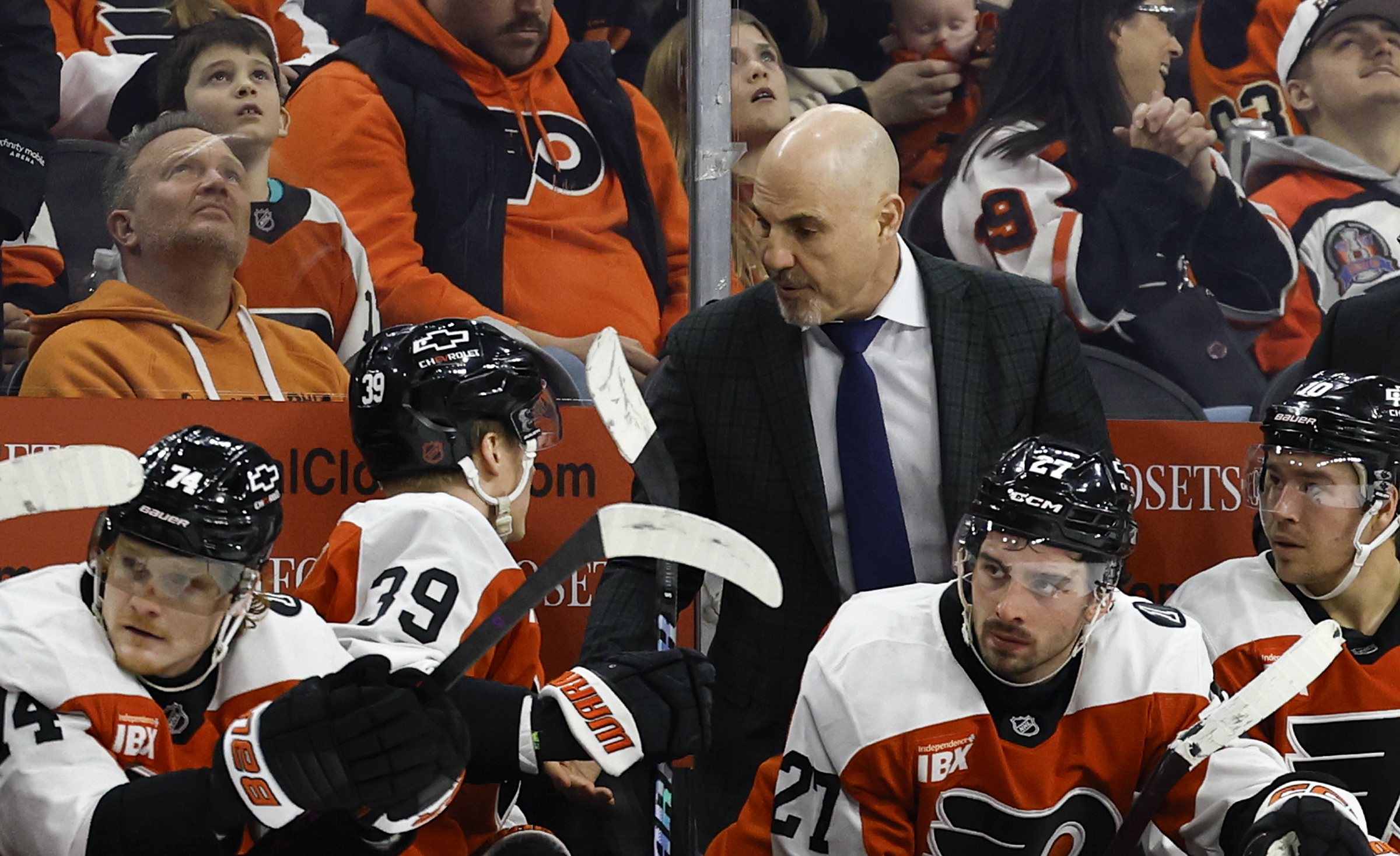
“You saw it,” coach Rick Tocchet said. “Obviously, I don’t have an answer. I don’t think we won a battle. They outcoached us tonight. They outplayed us. They did everything better than us tonight.”
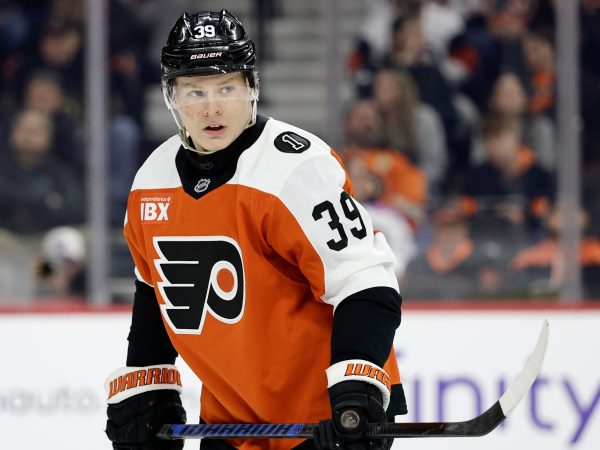
Was this the worst loss in Flyers history? No, but you have to give the club credit for trying. There was defenseman Cam York, attempting a behind-the-back pass near the Pittsburgh blue line, turning the puck over, and creating an odd-man rush and scoring chance for the Penguins. There was Travis Konecny, streaking down the right wing, puck on his stick, clean shot there to be taken, throwing a tough cross-ice pass that Tyson Foerster couldn’t handle, as if Konecny’s postseason scoring bugaboo was still hounding him like a ghost. There were the team’s two most promising players, Porter Martone and Matvei Michkov, doing silly things — the former taking a cross-checking penalty that led to an Evgeni Malkin power-play goal and getting demoted from one of the team’s top two lines, the latter staying on the ice too long on too many shifts.
“We had a lot of snowblowers,” Tocchet said. “We have plays where we don’t go through people. … I don’t know if guys are reading their press clippings. I don’t know, but it wasn’t good.”
The Flyers did almost nothing right Wednesday, as they were outworked and outclassed by the rival Pittsburgh Penguins.Matt Slocum
It was just one game out of the 84 the Flyers will play this season, yes, but Lord, was it ugly. They were lackluster in their final exhibition game last week, losing 5-1 to the Washington Capitals, and both Tocchet and team captain Sean Couturier suggested that a pattern might be developing within a still-young, still-inexperienced team that failed to prepare properly for the regular season. “Everyone’s like, ‘Oh, it’s training camp. We’ll ease our way into the season,’” Couturier said. “We’ve got to wake up here.”
That was the startling part — that the Flyers weren’t as juiced as their fans were, that they seemed to be skating through sludge, to be completely uninterested in building on the good feelings they had established last spring. Just six months ago, they charged into the postseason, beat the Penguins in six games, and left to a standing ovation despite getting swept by the eventual Stanley Cup champions, the Carolina Hurricanes. On Wednesday night, they were outshot 38-19, generated no offense or cohesion on their three power plays, and so infrequently threatened to score that Penguins goaltender Artūrs Šilovs could have played Solitaire in his crease all night and barely bothered to look up.
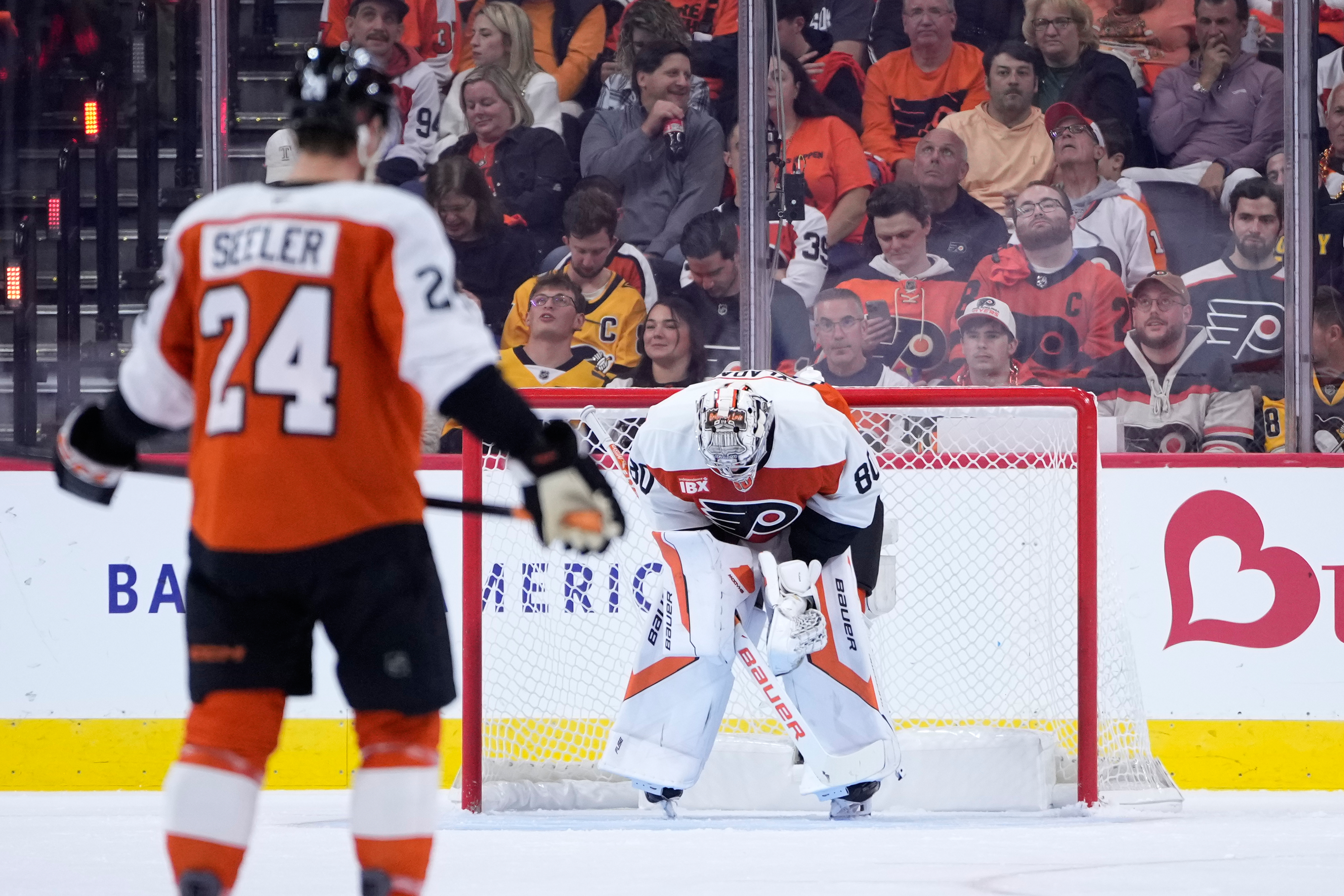
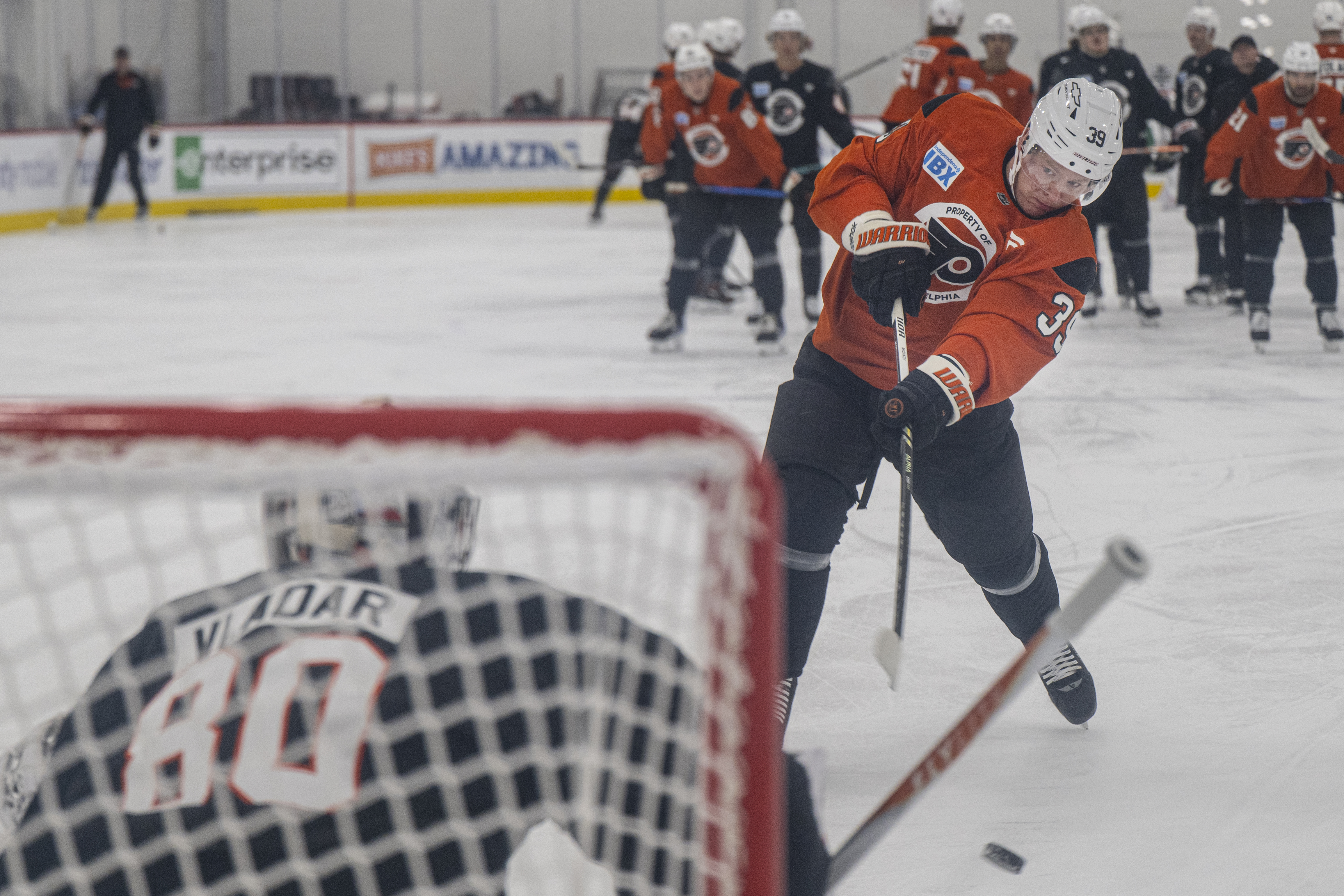
In one memorable second-period sequence, defenseman Nick Seeler, with teammate Owen Tippett prone on the ice several feet in front of him, flicked a shot toward Šilovs anyway. The puck plunked Tippett in the head. It was only a matter of time, though, before someone topped it, and goalie Dan Vladař did late in the third period, when a shot by Nick Robertson sailed wide and caromed into the crease, where Vladař kicked it into the net for a short-handed goal.
“There’s no panic, nothing,” Couturier said. “But we’ve got to realize that what happened last year is last year.”
Look, if you want to chalk up what happened Wednesday night to the randomness of hockey and the strangeness inherent in pro sports, you certainly can. Again, there are 83 games left before everything really matters. But at the risk of reading too much into the end of the Flyers’ 2025-26 season and the beginning of their 2026-27 season, it’s worth noting that technically they have lost seven of their last eight games.
They have not played a strong full game in a long time, and they had their head coach sounding like a man without an explanation for a humiliating night. “Some plays we were making, they were disturbing plays,” Tocchet said. “We’ve got to figure this out quickly.” Ernest Hemingway once wrote, “Man is not made for defeat. A man can be destroyed but not defeated.” The Flyers now have to prove they agree with the second part.
The Flyers managed just 19 shots on goal compared to the Penguins’ 38.Elizabeth Robertson / Staff Photographer
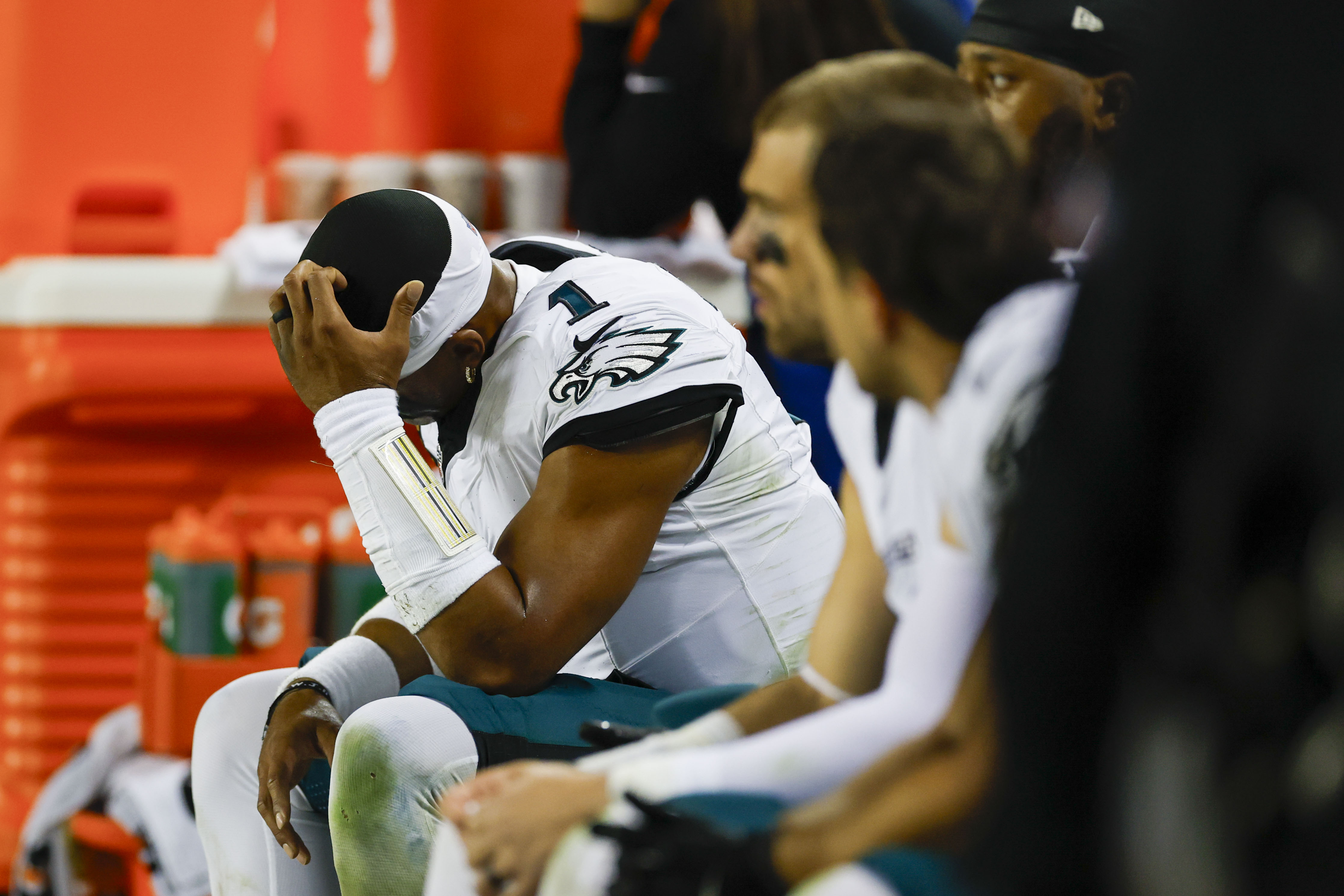
CHICAGO — Jalen Hurts had scrambled to his right toward the sideline, had taken a step out of bounds, had taken a hellacious hit from Bears linebacker D’Marco Jackson, and there Hurts was now, sprinting back to the Eagles’ huddle, making sure the world knew that he believed he was good to go.
The Eagles were moving, at the Bears’ 15-yard line midway through the second quarter, in striking distance of a tying touchdown. But the concussion spotter assigned to Monday night’s game at Soldier Field has a job to do, too, and it’s an important one, and he signaled to the officials that Hurts had to spend time getting his head checked in the medical tent.
What happened over the next four plays and several minutes wasn’t necessarily the turning point in the Eagles’ 27-7 loss, but it symbolized their night as perfectly as any sequence could. Throughout training camp and the preseason, the competition between Andy Dalton and Tanner McKee for the team’s No. 2 quarterback spot was nothing more than a battle between two bad choices. Then Dalton replaced Hurts and showed just how bad. After Saquon Barkley ripped off a 14-yard run to the Bears’ 1-yard-line, he was stuffed twice, and on third down from the shotgun, Dalton did the one thing he couldn’t do: He turned the ball over, throwing a horrible interception to the Bears’ Dillon Thieneman.
Maybe, even if the Eagles get in the end zone or just settle for a field goal there, nothing else changes about a game that they never looked ready to play. Maybe Ben Johnson stays one step ahead of Vic Fangio. Maybe Case Keenum — 38-year-old Case Keenum, playing in his first NFL game in nearly three years — keeps carving up the Eagles’ defense. Maybe that defense keeps missing tackles and breaking down in coverage. Maybe Sean Mannion keeps calling screen passes that don’t work, that lose yardage, and stall drives. Maybe the rest of Monday night unfolds exactly as it did, with Hurts throwing his own awful interception late in the third quarter, with Johnson showing that he doesn’t need Caleb Williams at quarterback to outclass Fangio for the second time in 10 months.
It was a disastrous night for Jalen Hurts and the Eagles offense.Yong Kim / Staff Photographer
But then, that’s the twisted game that you can play with a team like the one the Eagles have been through their first three games. You can what-if just about any moment, because there are so many moments in which they are making silly, inexcusable mistakes. They committed 10 penalties Monday. They left Bears wide receiver Kalif Raymond wide-open in the middle of the field and watched him dash for a 41-yard touchdown. They’re such a long way from the smart, buttoned-up team that head coach Nick Sirianni forever insists he expects them to be.
Go back to that pivotal point when Hurts left the game, Dalton entered it, and everything went to hell. Surely thousands of Eagles fans started screaming at their television screens when they saw that the trainers and doctors were examining Hurts. Sorry, everyone: It was the right thing to do. It doesn’t matter that Hurts appeared to be fresh and fine not long after Jackson hit him and said after the game that he had suffered no ill effects. Most NFL players in the same situation would have reacted exactly the same way he did, assuming they could. They’d want to stay on the field, and they’d hide any symptoms, and concussion spotters can’t take the chance of having players fool them and try to play through head trauma.
Per NFL rules as of 2015, a spotter can stop a game when a player “displays obvious signs of disorientation or is clearly unstable” and “is attempting to remain in the game and not be attended to by the club’s medical or athletic training staff.” Watch the play again. After Jackson levels him, Hurts remains prone on the ground for two full seconds, his legs and feet kicking slightly. It would be understandable if, based on the hit’s immediate aftermath, the spotter determined that Hurts was disoriented.
Sirianni, in theory, could have called a timeout to stall, to buy time for Hurts to clear the concussion protocol, except he said he had no idea what Hurts’ condition was and when he might be ready to return, if he could return at all. “I think that’s the right way to go about it,” he said. “The health of the player is the most important thing.” Besides, the problem wasn’t that Hurts was no longer in the game. The problem was that the Eagles, Dalton specifically, screwed up without him.
Dalton is 38, in his 16th NFL season. He is supposed to be experienced and savvy enough not to force a throw to a receiver, Dontayvion Wicks, who was blanketed in the back of the end zone. A coach should be able to count on a veteran backup to be smart in that situation, and the Eagles paid dearly for Dalton’s violation of that trust.
Philadelphia Eagles quarterback Jalen Hurts and Chicago Bears quarterback Case Keenum embrace at the end of the game at Soldier Field on Monday, Sept. 28, 2026, in Chicago, Ill. Chicago won 27-7.Monica Herndon / Staff PhotographerPhiladelphia Eagles linebacker Jalyx Hunt and Philadelphia Eagles linebacker Jonathan Greenard leave after the Chicago Bears game against the Philadelphia Eagles at Soldier Field.Monica Herndon / Staff PhotographerPhiladelphia Eagles quarterback Jalen Hurts lies on the ground after getting sacked during the fourth quarter of the Chicago Bears game.Monica Herndon / Staff PhotographerPhiladelphia Eagles quarterback Jalen Hurts watches the last two minutes of the game against the Chicago Bears at Soldier Field. Chicago won 27-7.Yong Kim / Staff PhotographerPhiladelphia Eagles quarterback Jalen Hurts gets up after getting sacked in the fourth quarter.Monica Herndon / Staff PhotographerPhiladelphia Eagles quarterback Jalen Hurts throws long on fourth down in the fourth quarter, pass incomplete at Soldier Field on Monday, Sept. 28, 2026, in Chicago, Ill.Monica Herndon / Staff PhotographerPhiladelphia Eagles wide receiver Makai Lemon makes a reception in the fourth quarter.Monica Herndon / Staff PhotographerPhiladelphia Eagles fan reacts after a penalty is called in the fourth quarter.Monica Herndon / Staff PhotographerPhiladelphia Eagles head coach Nick Sirianni in the fourth quarter. Chicago won 27-7.Yong Kim / Staff PhotographerPhiladelphia Eagles quarterback Jalen Hurts throws the ball to Philadelphia Eagles wide receiver Makai Lemon in the fourth quarter.Yong Kim / Staff PhotographerPhiladelphia Eagles linebacker Jonathan Greenard tackles Chicago Bears quarterback Case Keenum in the fourth quarter.Monica Herndon / Staff PhotographerChicago Bears quarterback Case Keenum almost loses possession of the ball in the fourth quarter.Monica Herndon / Staff PhotographerPhiladelphia Eagles linebacker Jihaad Campbell tackles Chicago Bears quarterback Case Keenum in the fourth quarter.Monica Herndon / Staff PhotographerChicago Bears linebacker T.J. Edwards after intercepting a pass in the third quarter.Monica Herndon / Staff PhotographerPhiladelphia Eagles quarterback Jalen Hurts after throwing a third-quarter interception.Yong Kim / Staff PhotographerChicago Bears wide receiver Kalif Raymond celebrates a touchdown during the third quarter.Monica Herndon / Staff PhotographerChicago Bears linebacker T.J. Edwards celebrates an interception in the third quarter.Yong Kim / Staff PhotographerPhiladelphia Eagles wide receiver DeVonta Smith is wrapped up by Chicago Bears safety Elijah Hicks in the third quarter.Yong Kim / Staff PhotographerPhiladelphia Eagles fans in the third quarter.Monica Herndon / Staff PhotographerPhiladelphia Eagles linebacker Jihaad Campbell and Philadelphia Eagles linebacker Zack Baun tackle Chicago Bears tight end Colston Loveland in the third quarter.Monica Herndon / Staff PhotographerPhiladelphia Eagles wide receiver Makai Lemon was tackled by Chicago Bears cornerback Jaylon Johnson in the third quarter.Monica Herndon / Staff PhotographerPhiladelphia Eagles quarterback Jalen Hurts throws the ball to Philadelphia Eagles running back Saquon Barkley.Yong Kim / Staff PhotographerPhiladelphia Eagles linebacker Jalyx Hunt goes after Chicago Bears quarterback Case Keenum in the third quarter.Yong Kim / Staff PhotographerChicago Bears fan reacts to the last-minute “tush push” score by Philadelphia Eagles quarterback Jalen Hurts.Monica Herndon / Staff PhotographerPhiladelphia Eagles quarterback Jalen Hurts looks up after scoring on the tush push with one second left to go.Monica Herndon / Staff PhotographerChicago Bears safety Dillon Thieneman celebrates an interception in the second quarter.Monica Herndon / Staff PhotographerPhiladelphia Eagles cornerback Quinyon Mitchell stops Chicago Bears running back D’Andre Swift in the second quarter.Monica Herndon / Staff PhotographerPhiladelphia Eagles tight end Zach Ertz is defended by Chicago Bears cornerback Jaylon Johnson in the second quarter.Monica Herndon / Staff PhotographerPhiladelphia Eagles running back Saquon Barkley runs by Chicago Bears safety Dillon Thieneman in the second quarter, just short of a touchdown.Yong Kim / Staff PhotographerPhiladelphia Eagles cornerback Quinyon Mitchell breaks up a pass intended for Chicago Bears wide receiver Luther Burden III in the second quarter.Monica Herndon / Staff PhotographerChicago Bears running back D’Andre Swift gets stopped by Philadelphia Eagles defensive tackle Jalen Carter (left) and Philadelphia Eagles defensive tackle Moro Ojomo (right) in the second quarter.Yong Kim / Staff PhotographerIncomplete pass to Chicago Bears wide receiver Rome Odunze in the second quarter, defended by Philadelphia Eagles linebacker Nolan Smith.Yong Kim / Staff PhotographerChicago Bears wide receiver Luther Burden III scores as the Philadelphia Eagles defense tries to stop him during the first quarter.Yong Kim / Staff PhotographerPhiladelphia Eagles linebacker Jihaad Campbell forces Chicago Bears wide receiver Luther Burden III out of bounds in the first quarter.Monica Herndon / Staff PhotographerChicago Bears wide receiver Luther Burden III celebrates a touchdown during the first quarter.Monica Herndon / Staff PhotographerChicago Bears running back D’Andre Swift runs with the ball against Philadelphia Eagles safety Marcus Epps in the first quarter.Yong Kim / Staff PhotographerChicago Bears quarterback Case Keenum hands off to Chicago Bears running back D’Andre Swift in the first quarter.Yong Kim / Staff Photographer
“I can’t put the team in that situation,” Dalton said. “Costly decision.”
The lasting price of that incompetence, just one example of so many Monday night, remains to be seen. The Eagles are 2-1, sure, but so far they haven’t been the team anyone expected them to be. They are asking so much of Hurts, perhaps too much. Their defense hasn’t been close to the shutdown unit it was presumed to be. And the Los Angeles Rams, 1-2 and dangerous, are ahead on Sunday. The Eagles had better wise up before then, because their leader and their self-image took some major hits Monday night, and right now, everyone is wondering what kind of team they really are.
Yeah, John Bunting saw Ben Johnson rip his shirt off. He saw Johnson go full-Hulk Hogan after the Chicago Bears beat the Eagles last season, and he laughed about it, even though Bunting remains proud that the Eagles were the only team he played for during his terrific 11-year career as an NFL linebacker. Even though Dick Vermeil — Bunting’s head coach for seven of those years, a man Bunting considers a second father — could have drowned all the rats in Veterans Stadium with his postgame weep-fests but wouldn’t have been caught dead screaming and flexing in the locker room like a bro dad who had dipped into his kid’s Ritalin. Even though, as a walk-on scout-team quarterback for Bunting at the University of North Carolina, Johnson tended to remain fully clothed.
“I never saw that,” Bunting, the Tar Heels’ head coach from 2001 to 2006, said by phone recently. “But I’ll bet you his players love him. He’s that kind of guy — a great leader.”
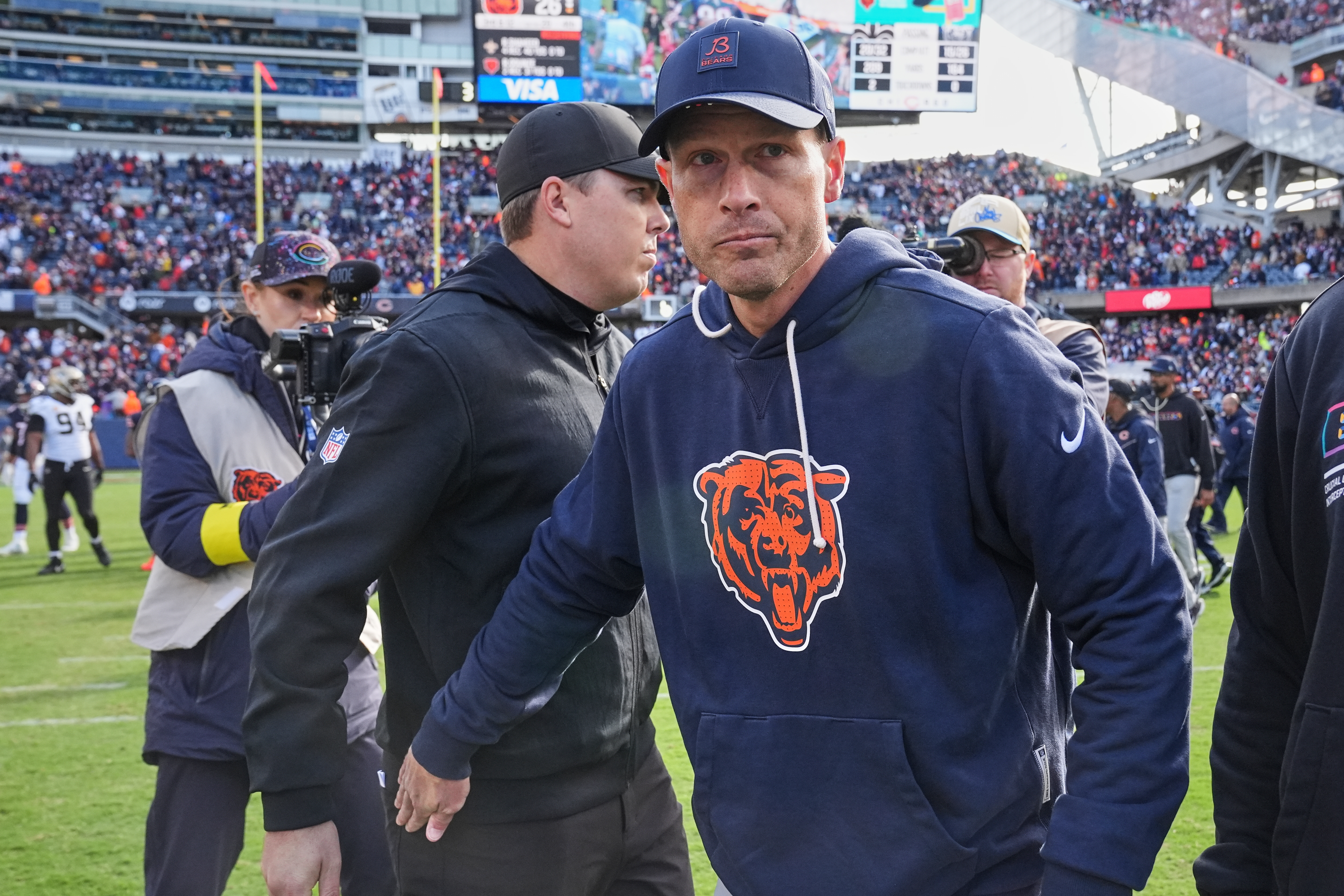
Just ask Johnson himself about his leadership, his qualities as the Bears’ head coach, and he might say the same thing. If his 21 games in charge have done nothing else, they’ve shown that he might just be capable of building a team that can back up his boasts. And if he isn’t, at least his rise and fall will be a hell of a ride. An 11-6 record and a playoff victory last season, a 59-point mushroom cloud on the Carolina Panthers in Week 1, a three-point washout against the Minnesota Vikings in Week 2: Johnson and the Bears do nothing but go to extremes whenever they’re on the field, or he has a mic and camera in front of him.
The Eagles will head to Soldier Field on Monday night still smarting from the Bears’ 24-15 Mack-trucking of them on Black Friday. Caleb Williams’ tender hamstring could prevent him from playing, but Johnson could still cook up something to keep Vic Fangio and his defense off balance, and for the Eagles, the risk isn’t just in losing to the Bears again — and maybe to third-string QB Case Keenum. It’s in listening to Johnson remind the world of his own awesomeness … at their expense.
Chicago Bears coach Ben Johnson doesn’t lack for confidence. He’s also not shy about telling you how he feels.Nam Huh
Don’t believe he’d do such a thing? Please. This is a coach who, as a precocious offensive coordinator for the Detroit Lions, called several trick plays in a 47-9 rout of the Dallas Cowboys in 2024, including some after the Lions had taken a comfortable lead. This is a coach who told The Athletic in August that he was shooting for “more than” a Super Bowl, that he wanted the Bears to go unbeaten and be the highest-scoring team in league history, as if they played half their games in a dome or in Southern California and not amid Lake Michigan’s freezing winds and frequent snow.
To beat the Eagles with a backup quarterback would be the sweetest treat that Johnson could hope to taste, and just because Keenum might have to suit up doesn’t mean Johnson will call nothing but basic, boring handoffs to D’Andre Swift and Kyle Monangai, though that strategy worked well enough last November.
“He’s not fearful,” Bunting said. “There are a lot of coaches who are. He’s not that way at all. He is willing to take a chance, and he’s motivated to do that. That’s part of his thought process. ‘Hey, we’re going to take chances.’”
A coach who, as a high school quarterback in Asheville, N.C., orchestrated a run-heavy I-formation offense and, as an undergraduate at Chapel Hill, earned degrees in computer science and mathematics doesn’t at first seem the sort to be so bold. That background suggests a certain set of principles — weigh the angles, crunch the numbers, stay conservative — that don’t apply to Johnson now and never have. He wasn’t always this brash, but he has never been shy about saying what he thought to be true, even during his first full-time coaching gig as a Boston College grad assistant under offensive coordinator Gary Tranquill.
“I mean, he didn’t mince his words,” Tranquill, who had been Johnson’s offensive coordinator and quarterbacks coach at UNC before hiring him at BC in 2009, said in a phone interview. “He comes right to the point. When he said something, he was assured that that was the right thing to say and he would say it. He didn’t hem-haw around. When he was coaching with us, he did all the scouting. When he would tell you something about the other team, what they were doing, what coverages they were doing, he was very explicit and knew exactly what he was talking about.”
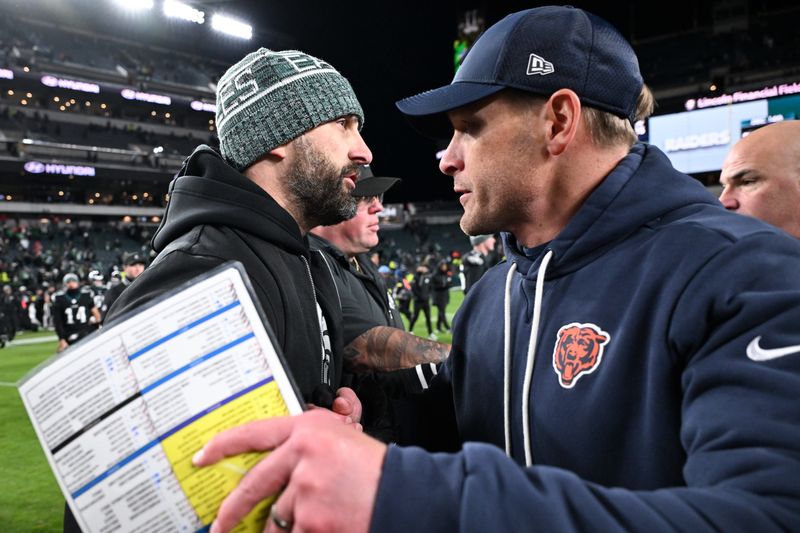
Looks like little has changed over the subsequent 17 years. Johnson is still treading that fine line that his counterpart Monday, Nick Sirianni, has walked with the Eagles for the last six years — still raising and answering the same questions. Is it possible to be too emotional, too demonstrative, too arrogant if, above all, you are authentic?
“The last thing that you can worry about as a head coach is trying to please anybody outside your building,” Sirianni said. “You’ve always got to be yourself. … Regardless of what you do, if you take your shirt off, if you don’t take your shirt off, if you’re emotional, if you’re not emotional, some of the people are going to say, ‘Man, I like that.’ Some are going to be like, ‘Man, I don’t like that.’
“That’s leadership. That’s what it is. Your job is to be yourself and do everything you can do as a head coach to get your team ready to play and to get your team better on a daily basis. You can’t look outside to see how you can please [people] because it’s an impossible task. Just win games.”
Sirianni-Johnson might be the most compelling comparison and matchup Monday night. There are no two more polarizing coaches in the NFL for their demeanors and personalities, and neither appears in any hurry to apologize for who he is. “That’s the other side of Ben Johnson,” Bunting said. “He’s still in many ways the kid from Asheville. He has great enthusiasm for the game itself and for his players and staff. He is emotional, and when there’s a time to celebrate, he’s going to do it.” It’s on the Eagles to deny the Bears and their bare-chested leader that opportunity.
One day last spring, just after the Flyers had finished an off-day practice in Raleigh during the Eastern Conference semifinals against the Carolina Hurricanes, Matvei Michkov lingered in the locker room, the only player there.
Two or three media members were hanging out, too, chatting with him about soccer, Michkov chatting back in splintered English. There was no tension. He was not sullen. If anything, he was effervescent: smiling, happy to engage. He did not in any way appear to be shattered by the hard but necessary treatment he had been receiving from head coach Rick Tocchet — limited ice time, often on the team’s third line — and would continue to receive. In just a few days, Tocchet would bench him for Game 4 of the Hurricanes’ series, the overtime loss that ended the Flyers’ season.
Now here we are, on the precipice of a Flyers season unlike any in the franchise in at least a decade, and Michkov is a reason, maybe the primary reason, for the welcome-if-unfamiliar atmosphere around the team. After the progress that the Flyers made last season — qualifying for the playoffs and winning a series for the first time since 2020, reassuring their fans that the team was, in fact, improving — they’re back to being a team on the rise again. It probably goes too far to say that expectations are or should be high for them, but there is certainly cause for cautious optimism.
Michkov is at the core of both that caution and those good feelings. His struggles, the fits and starts in his maturation, have been well documented. Considering how long it has been since the Flyers have drafted and developed a bona fide superstar, how often their fans and followers have been sold or were eager to buy bills of goods that turned out to be worthless, it was understandable that people might be concerned that Tocchet was hindering Michkov’s growth, if not stopping it altogether.
The subsequent four months, and some perspective, should have tempered that worry. Michkov had acknowledged that he was out of shape throughout last season; over the offseason, he said, he improved his diet and lost 29 pounds. And for all the complaints that Tocchet should have just thrown Michkov on the ice more often to sink or skate, for all the tongue-holding that the head coach did and failed to do, in 81 games Michkov still scored 20 goals and put up 51 points, the third-most on the team. If that measure of production constitutes a disastrous season, then the Flyers will happily take their chances on a lighter, presumably faster, revitalized Michkov. He is 21. Nothing is settled or ruined for him.
Flyers head coach Rick Tocchet and star Matvei Michkov didn’t always see eye to eye last season.Yong Kim / Staff Photographer
That relative gamble (what, were they really going to give up on another highly drafted player and trade him after one suspect season?) is emblematic of the approach that the Flyers took all offseason. Yes, they shocked the NHL with their eye-popping offer sheet to Leo Carlsson, but if you focus on the moves that they made (not the one they couldn’t quite pull off), it’s easy to see that they’ve made similar bets up and down their roster.
They re-signed Tyson Foerster to an eight-year, $56.8-million contract on the belief that an excellent two-way player who hasn’t scored more than 25 goals in a full season can be the kind of player who scores 40. They re-signed Trevor Zegras to a four-year, $36.5-million contract on the belief that he can tap even deeper into his well of skill and creativity. They re-signed Jamie Drysdale to a four-year, $26-million contract on the belief that he can be more than a solid No. 2 or No. 3 defenseman, more than just a coping mechanism for the departure of Cutter Gauthier.
Those players and others like them — Michkov, Foerster, Zegras, Drysdale, Porter Martone — will chart the course of this Flyers season and the franchise’s future, in the near and the long term. What the Flyers are banking on, really, is a factor that so many who work in, cover, and follow sports often forget: that athletes can and do get better with time, that a player won’t remain the same from his second year to his third and his third to his fourth, that a lengthy period of regression or stagnancy — like Michkov’s — doesn’t mean that player won’t return to form or make a great leap. It might even have been a necessary wake-up call.
Who makes that leap? Who shuffles just a few steps forward? Who seems stuck in place? The answers to those questions will define the ‘26-27 Flyers and will make them fascinating to watch. One player in particular.
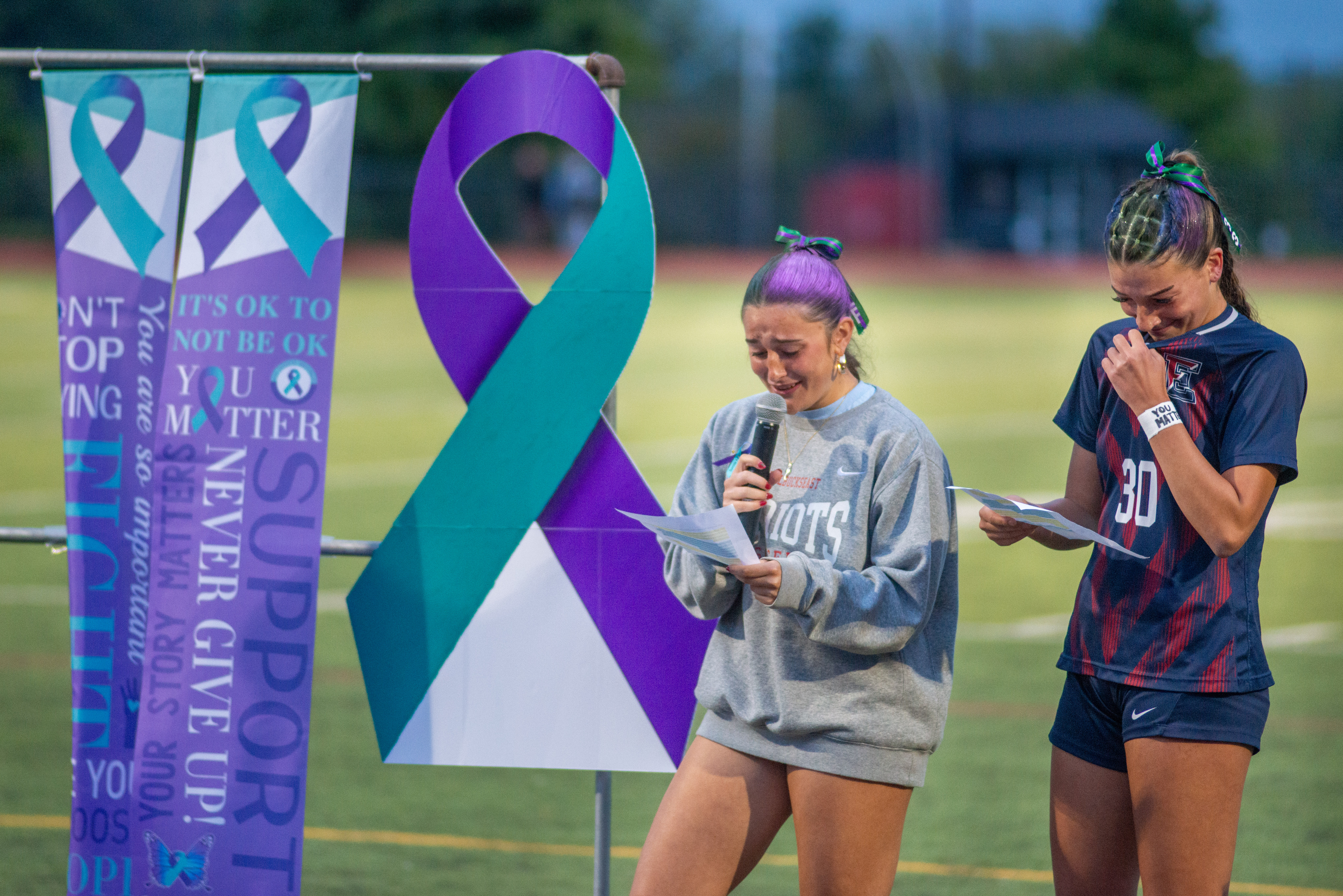
Before the soccer game, teenagers draped their arms over each other’s shoulders and let tears wash down their faces and parents listened in silence as a mother stood in the middle of a stadium to tell everyone there about her boy.
“I’d do anything,” Megan Hanson said into a microphone, “to have my beautiful son back.”
Sam Hanson was 16 years old when he died by suicide on April 5. A sophomore at Central Bucks High School East, a catcher on its baseball team, he was the second student-athlete at the school to take his own life in less than four months. The first — Frankie Pacitti, who was 17 and a standout lacrosse player, a self-described ladies’ man who could get guys guffawing and girls giggling just by being himself, the kid in school everyone knew — had died in December.
A few members of CB East’s girls’ soccer team, among them Mia Forney, a senior forward and perhaps the best female high school soccer player in Pennsylvania, arranged to hold a mental-health awareness night in the aftermath of Sam and Frankie’s deaths. “Once Sam passed,” Forney said, “we realized this is not normal.” When the players asked Megan Hanson if she would speak at the event, she wasn’t certain she was ready. Still, she wanted to try to prevent something like this from happening to someone else. So she wrote a brief speech, and she delivered it Tuesday night, just before the CB East girls’ team beat CB West, 4-0, and she hoped that the people in the bleachers and on the field were listening.
“Parents,” she said, “I’m not here to scare you but to share some insights I’ve learned … I won’t insult you by telling you to ‘talk to your kids.’ We all talk to our kids, and most of us are highly invested in their lives. What I will tell you to do is to talk to your kids directly about their mental health. Don’t be afraid to ask them hard questions, like, ‘Have you thought about suicide?’”
Megan Hanson, whose son Sam died by suicide in April, speaks during a pregame mental health awareness presentation on Sept. 22. William Thomas Cain / For The Inquirer
It was her most important, urgent, and accurate message. It aligned perfectly with what Derrick Gordon, an associate professor of psychiatry at Yale University, described as “the myth we have out there is that, if we suspect somebody is suicidal, we shouldn’t raise this with them because we don’t want to put the idea in their head.
“The reality is, you can’t put an idea in their head that’s already there,” Gordon told me in an interview last year. “Actually, the best course of action is to ask the question of the individual, then talk about it and address it. It’s been my experience, and I think other professionals would say this, that if you raise the issue of suicidality with people who are contemplating it, they feel relieved. ‘Oh, Jesus, I can now finally say it out loud.’ You can talk to them about the possibility that if they’re going to hurt themselves, it would impact you. Oftentimes, they get lost in their own experience of what they’re going through, and you want to get them outside of that space.”
Megan Hanson had no idea that her son was considering harming himself, how dark his world could get. How could she have an idea? Sam was pulling A’s and B’s in a roster of advanced-placement and honors courses at CB East. As a fourth grader, he had constructed a gift for his Connie Mack coach, Mike McCardle — a pen-and-pencil holder with a photo of the two of them set into it, a gift that McCardle still keeps on his desk. He died on the day before Easter, and it had been a full and wonderful day. Sam had practiced parallel parking in a middle-school lot in the morning, then passed his driver’s test and earned his license and was proud that he had.
CB East soccer players Mia Forney (left) and Rylie Leedy make remarks about their late friend, Frankie Pacitti, before the start of their game with CB West on Sept. 22. William Thomas Cain / For The Inquirer
He and Megan had gone out to lunch to celebrate. He had worked a few hours at the local pub and restaurant where he was a familiar and welcome face to the owners and patrons. Megan allowed him to borrow his car to drive to a friend’s house that night, and when he returned they talked about their plans for Easter. They would go to church in the morning and head to her parents’ house in the afternoon, and when she said good night to him she could never have thought, even in her most dismal nightmares, that he would get out of his bed and go downstairs into the basement and never come up again.
“It’s hard with teenagers because they’re moody and they don’t talk,” Megan said in a private moment Tuesday, “and I felt like we were getting to a better place where he was being more open with me, and I felt like we were getting to another level in our relationship. The hardest part is just looking back and saying, ‘Maybe this was a warning sign or a cry for help.’ I truly don’t believe it was something he planned out. I wish whatever went on in his brain, if he had just woken me up …”
She could not finish the sentence, and she did not need to. Home from the soccer game, I called my sons, who are 15 and 12, into the living room. Our family lives in the same school district that Sam Hanson and Frankie Pacitti did. My older son is a sophomore and has a class this semester with Sam’s sister. The boys paused the baseball video game they were playing and plopped on the couch. My wife and I wanted to talk to them directly about something.
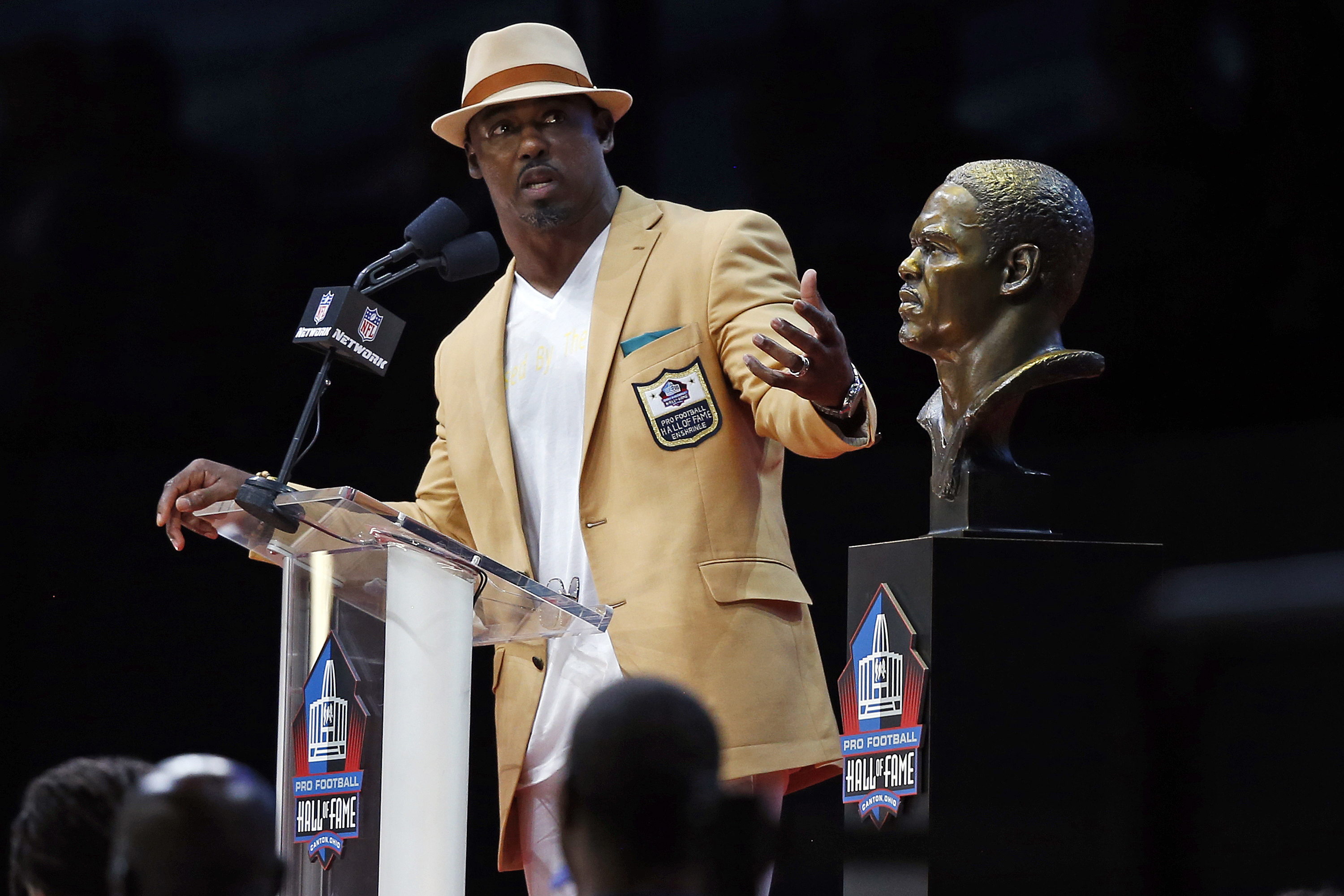
The Pro Football Hall of Fame announced Thursday that it had revamped its selection process, cutting the number of voters to 28 from 50. The decision inspired some disappointment among those selectors who were told their services were no longer required and among those football followers who pay close attention to such things. Mostly, though, it should have reaffirmed that, when it comes to picking who gets to be immortal and who doesn’t, those of us who cover major sports for a living should do our best to stay out of the way.
Every columnist has at least one hobbyhorse, a burr that’s always under their saddle, a thorn that’s always stuck in their side. I have three: the overuse of cliches, irony, and Hall of Fame selection processes. The Hockey Hall of Fame has an 18-member committee that, at the moment, includes a couple of longtime writers. The Naismith Memorial Basketball Hall of Fame keeps its process and the identities of its selectors a secret, which presents its own set of questions and issues.
But the National Baseball Hall of Fame and the Pro Football Hall of Fame rely primarily on writers and reporters, many if not most of whom are still actively covering those sports day to day, to select inductees, with football’s hall taking the additional step of having those media members actually lobby on behalf of particular candidates.
Like I said, I’ve touched on this topic often enough over the years that I’m not going to repeat each of my arguments and objections here. It’s enough to say that, as my colleague David Murphy has also noted, the major problem with having writers as Hall of Fame voters is that they end up having to cover a story that they themselves have created.
They were part of the cause, for instance, for the outrage that ensued last year when Bill Belichick wasn’t inducted in his first year on the ballot, and they are the reason for the annual debates about which alleged PED users should or should not be feted and celebrated at Cooperstown in late July. Those media members who don’t vote are still free to weigh in on the wisdom (or lack thereof) of the choices, but they can do it knowing — and allowing readers and news consumers to know — that they’re not stacking the deck in favor of their preferred candidate or outcome.
I have, of course, plenty of friends and colleagues who do and did take part in these traditions, among them former Daily News and Inquirer writer Paul Domowitch, who was a conscientious Canton voter for 24 years, and Ray Didinger, whom I consider a mentor and who wrote a famous play based around his (eventually successful) attempts to have Tommy McDonald inducted.
I don’t begrudge them or anyone else. I just disagree. The line between covering and/or commenting on the process and involving oneself in it is one I don’t feel comfortable crossing. The standard argument from the voters, generally speaking, is, It’s an honor, and if we don’t do it, who will? To which the correct response is, I don’t care. I just know it’s not my job.
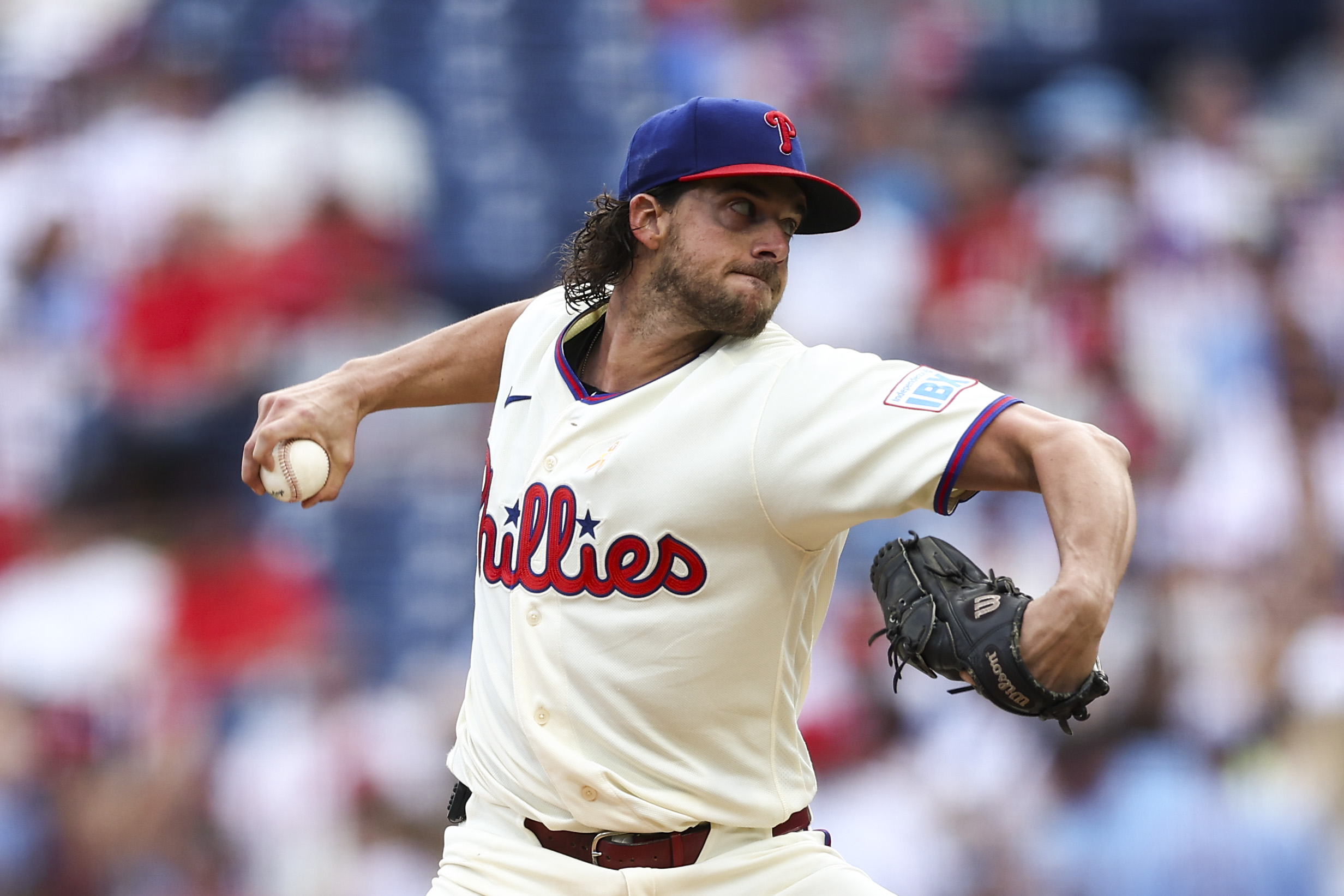
Aaron Nola has a 2.10 ERA in 60 innings over his last 10 starts.Monica Herndon / Staff Photographer
Quick hitters
Aaron Nola’s last 10 starts might just constitute the greatest and most surprising career comeback since Brendan Fraser won an Academy Award for The Whale. …
Only someone as aggressively insincere as James Franklin could take the simple act of saying hello and turn it into another example of his own obnoxious self-importance. …
Matvei Michkov said that he is 29 pounds lighter than he was at the start of last year’s training camp. Good on him for getting in better shape and losing a Denver Barkey’s worth of weight. …
A couple of literary recommendations: You should read Pat Croce’s new book, Enjoy Your Self Now!, if you want to find a deeper sense of personal peace and satisfaction. You should read The Playbook: The Hidden Forces Shaping Winners and Losers in the Modern NFL, by Wall Street Journal editors Joshua Robinson and Jonathan Clegg, if you want a better understanding of how and why certain teams and executives within the league — the Eagles and Howie Roseman, in particular — are thriving. …
Telltale game for the Eagles on Sunday. If they can’t beat the Titans — a franchise whose high-water mark was getting name-dropped by Tom Hanks and Helen Hunt in Cast Away a quarter-century ago — it’s definitely time to worry.
Here’s the funny part about the Flyers’ renaissance last season and their heightened expectations ahead of this season: There has been a pretty wide disparity between the team’s tangible achievements and the collective reaction to those achievements.
Achievement 1: The Flyers, with a desperate charge late in the regular season, qualify for the playoffs — an accomplishment that was once taken for granted by the franchise and its fans — for the first time since 2020. They then beat the Pittsburgh Penguins, perhaps the only playoff team the Flyers were capable of beating, in six games.
Reaction to Achievement 1: The crowds inside the Xfinity Mobile Arena, especially for the team’s victories in Games 3 and 6 against the Penguins, are louder than they’ve been in more than a decade.
Achievement 2: The Flyers are reasonably competitive against the eventual Stanley Cup champions, the Carolina Hurricanes, but nonetheless are swept in the second round, scoring just five goals in four games.
Reaction to Achievement 2: A standing ovation, to thank the team, fills the Xfinity Mobile Arena in the immediate aftermath of the Flyers’ season-ending overtime loss in Game 4.
Achievement 3: Danny Brière, the Flyers’ general manager, makes the daring decision to offer Anaheim Ducks up-and-comer Leo Carlsson a five-year, $90-million contract. But the move doesn’t actually work; the Ducks match the Flyers’ offer and keep Carlsson.
Reaction to Achievement 3:The Flyers are showing they’re back! They’re taking big swings!
This is not to denigrate the Flyers for their obvious improvement or to criticize their fans for being excited that their favorite team is relevant again. It is merely to remind everyone that the Flyers had a long way to go just to return to mediocrity, that they still have a long way to go to be a true Stanley Cup contender, and that any advancement, like the one they took last spring, would be greeted with unfettered joy. As Eddie Murphy said in a memorable stand-up bit years ago, if you’re starving and somebody throws you a cracker, you’re going to think that cracker is the best thing you’ve ever eaten in your life. That wasn’t a Saltine! That had to be a Ritz!
Now, though, those fans, and to a large extent the franchise’s players and power people themselves, won’t be satisfied with another round of appetizers. Brière hinted recently that it’s possible the Flyers will take a step backward, that the roster’s collection of talented players in their early-to-mid 20s struggles to replicate or surpass last season’s performance and justify all this hope.
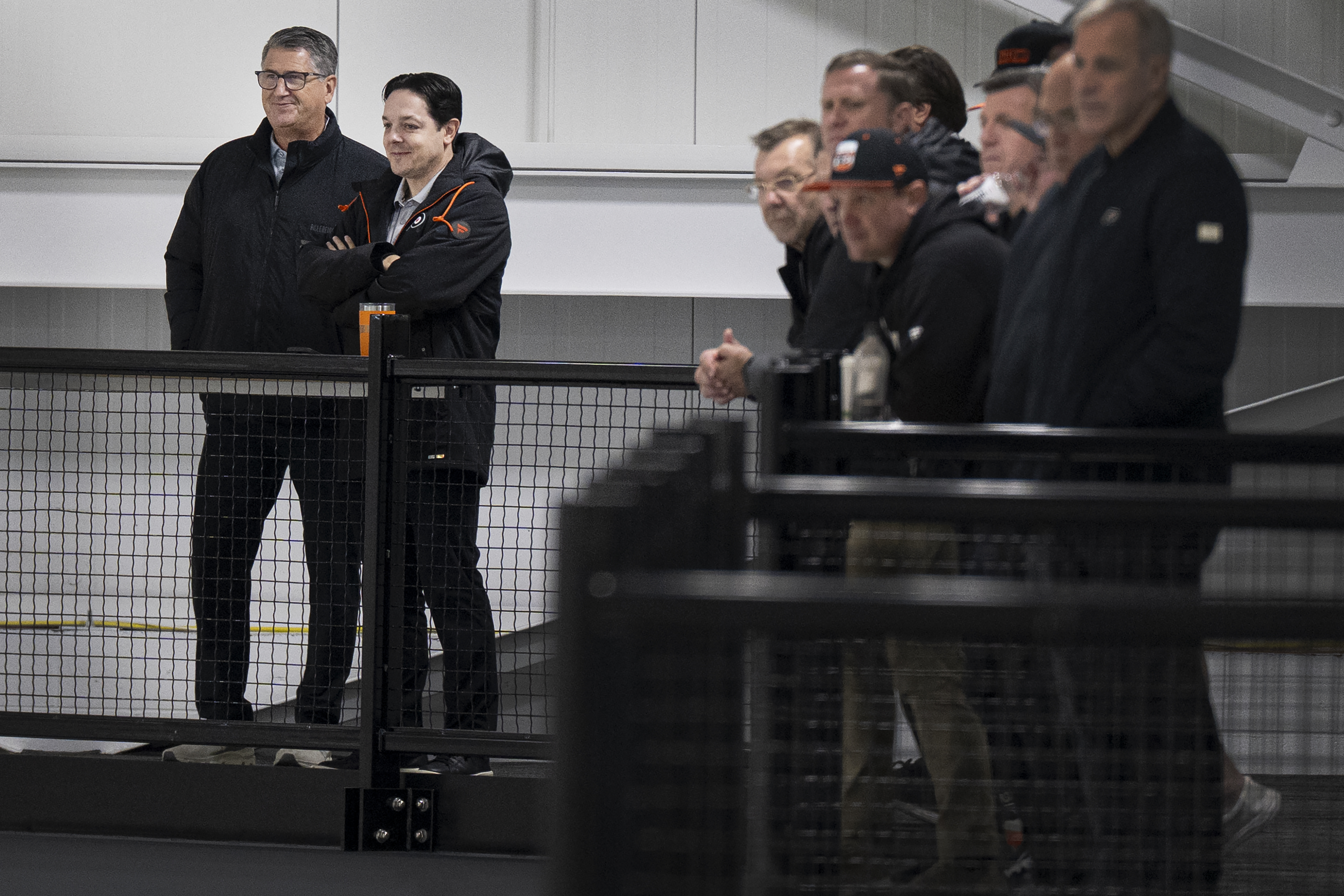
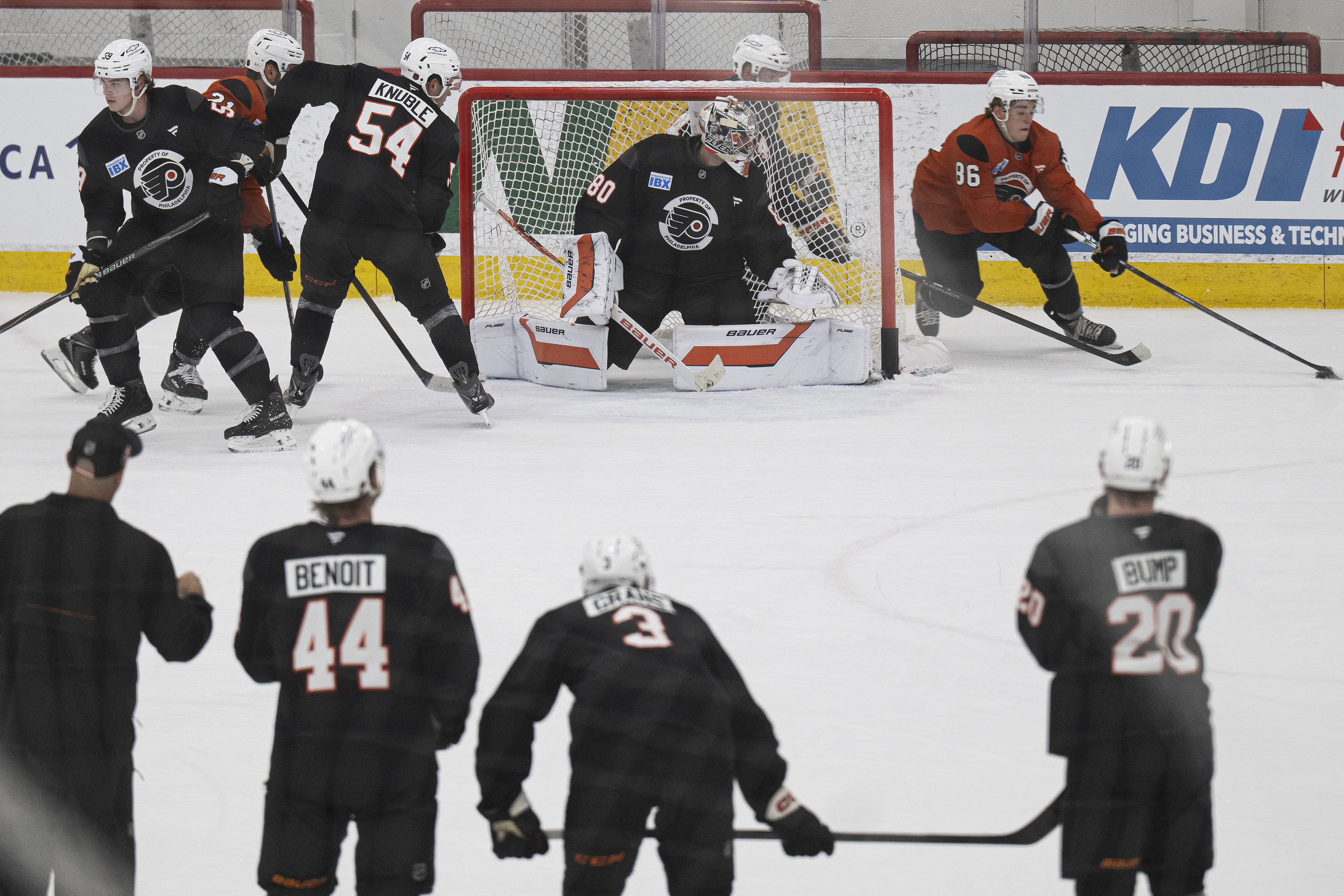
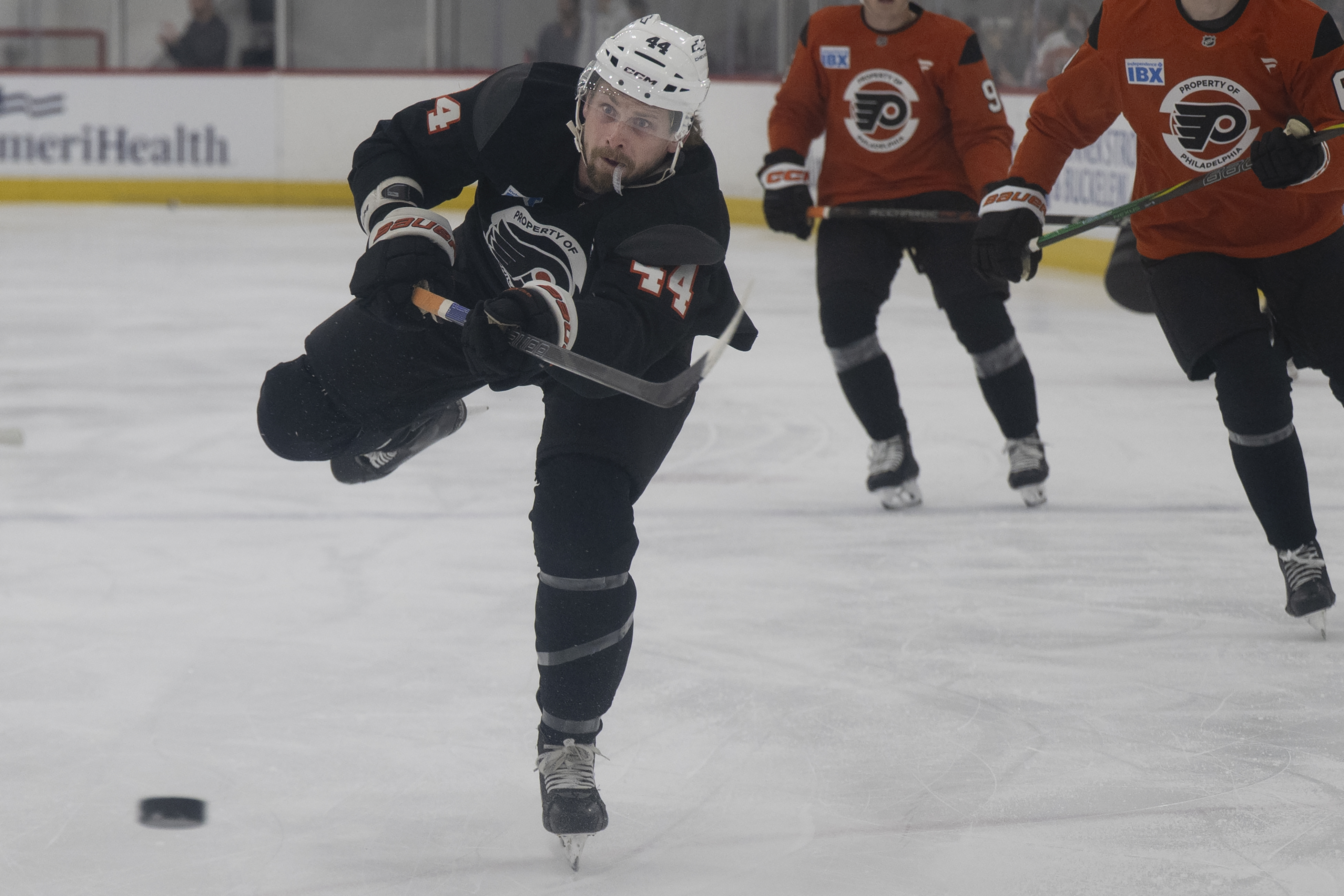
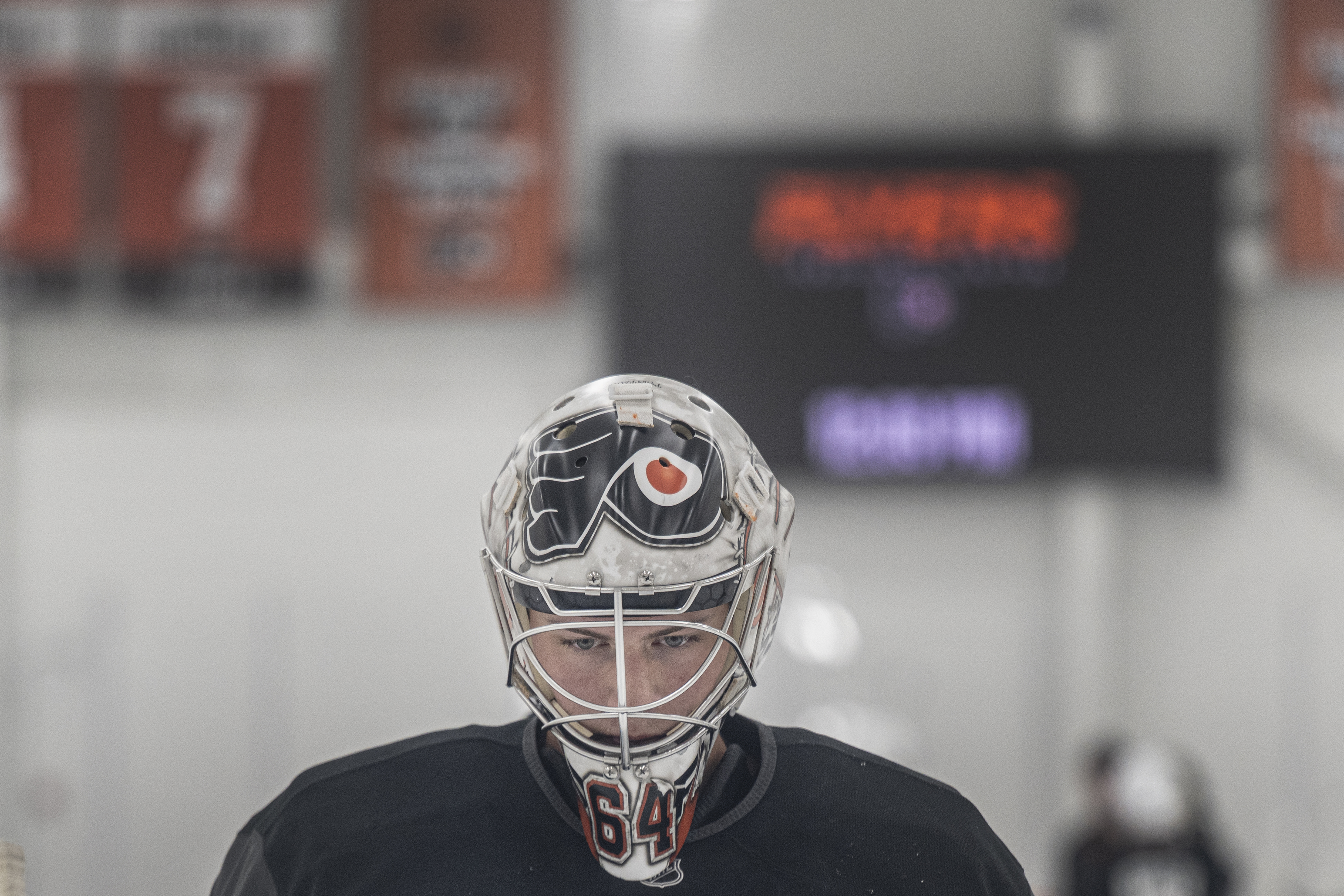
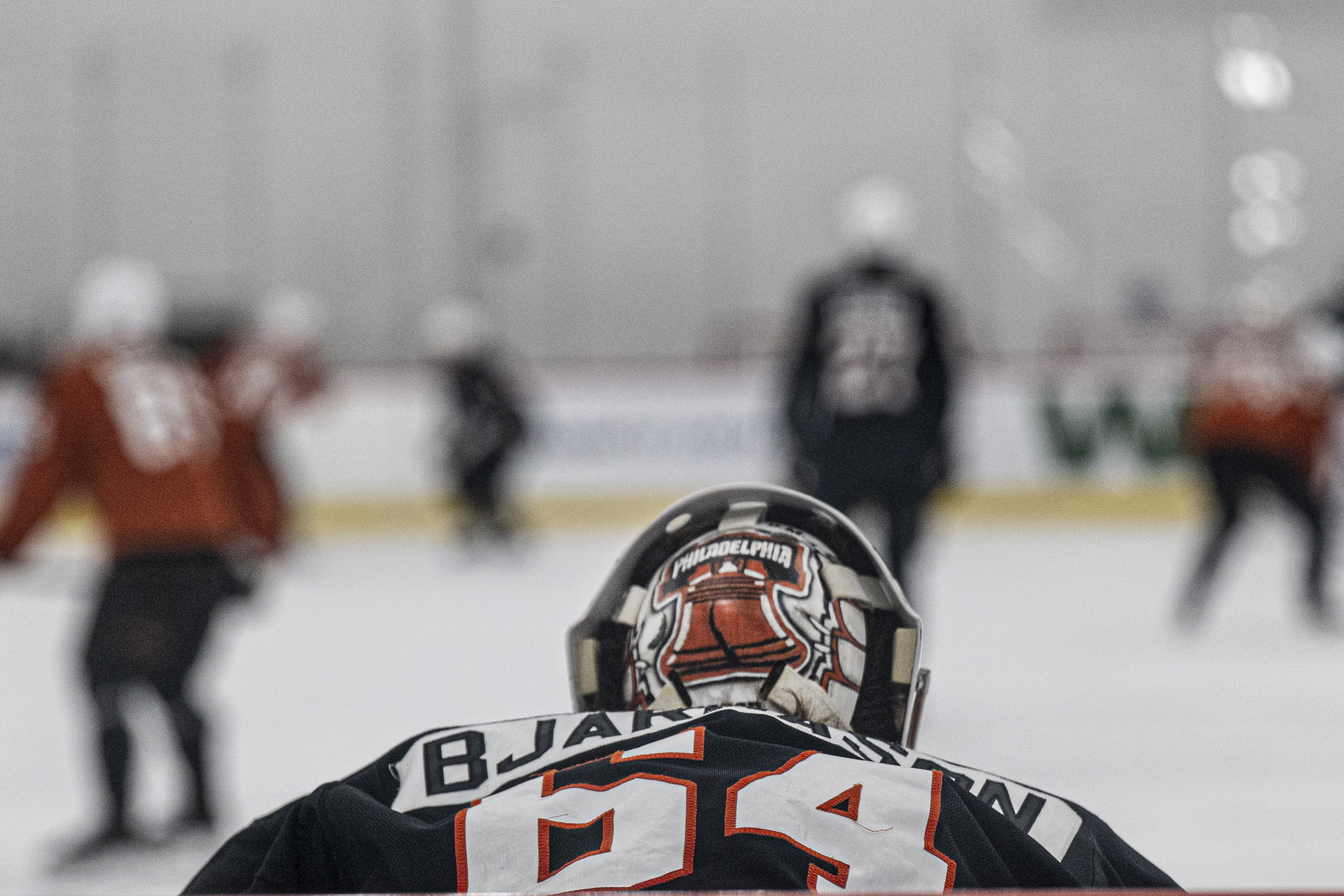
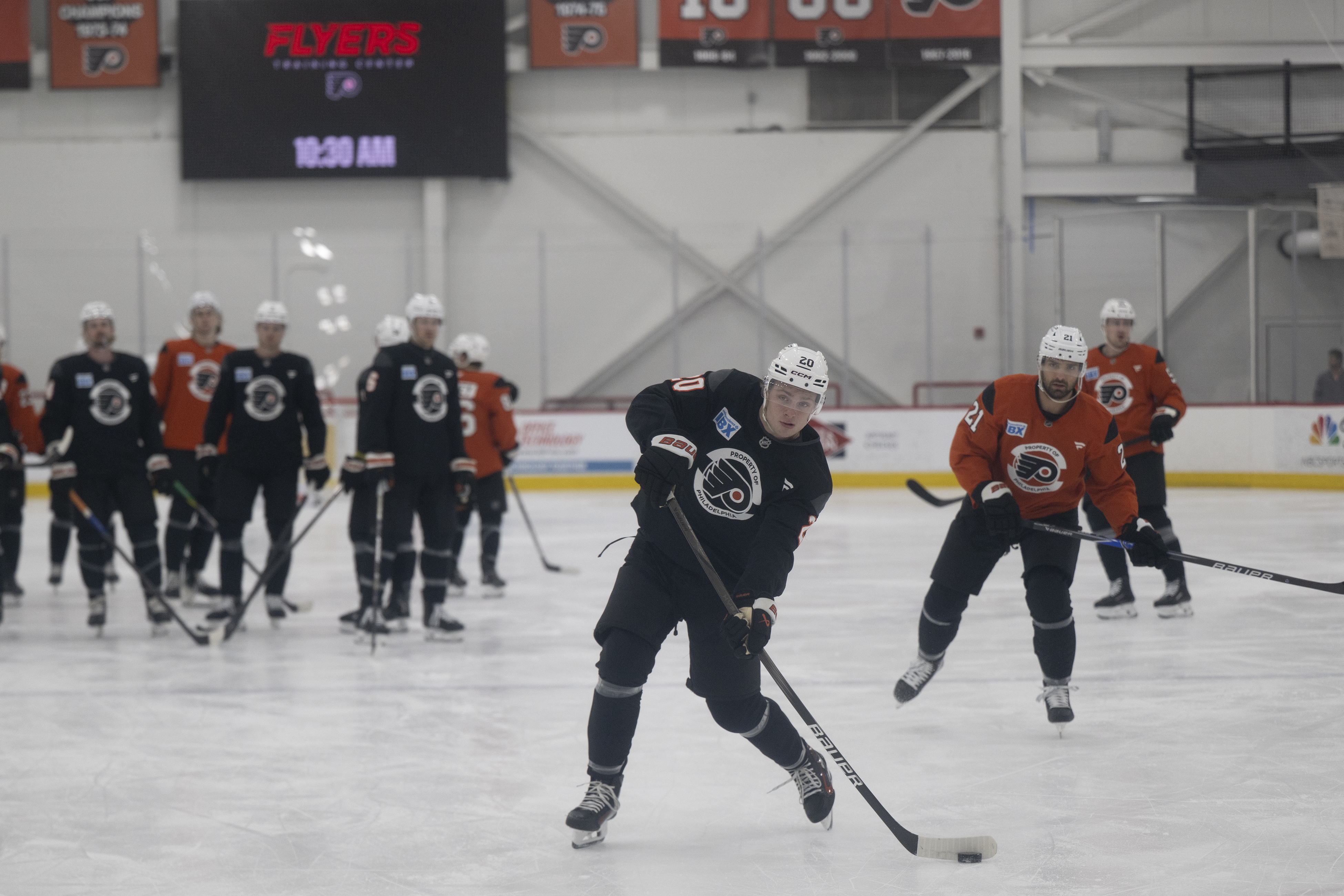
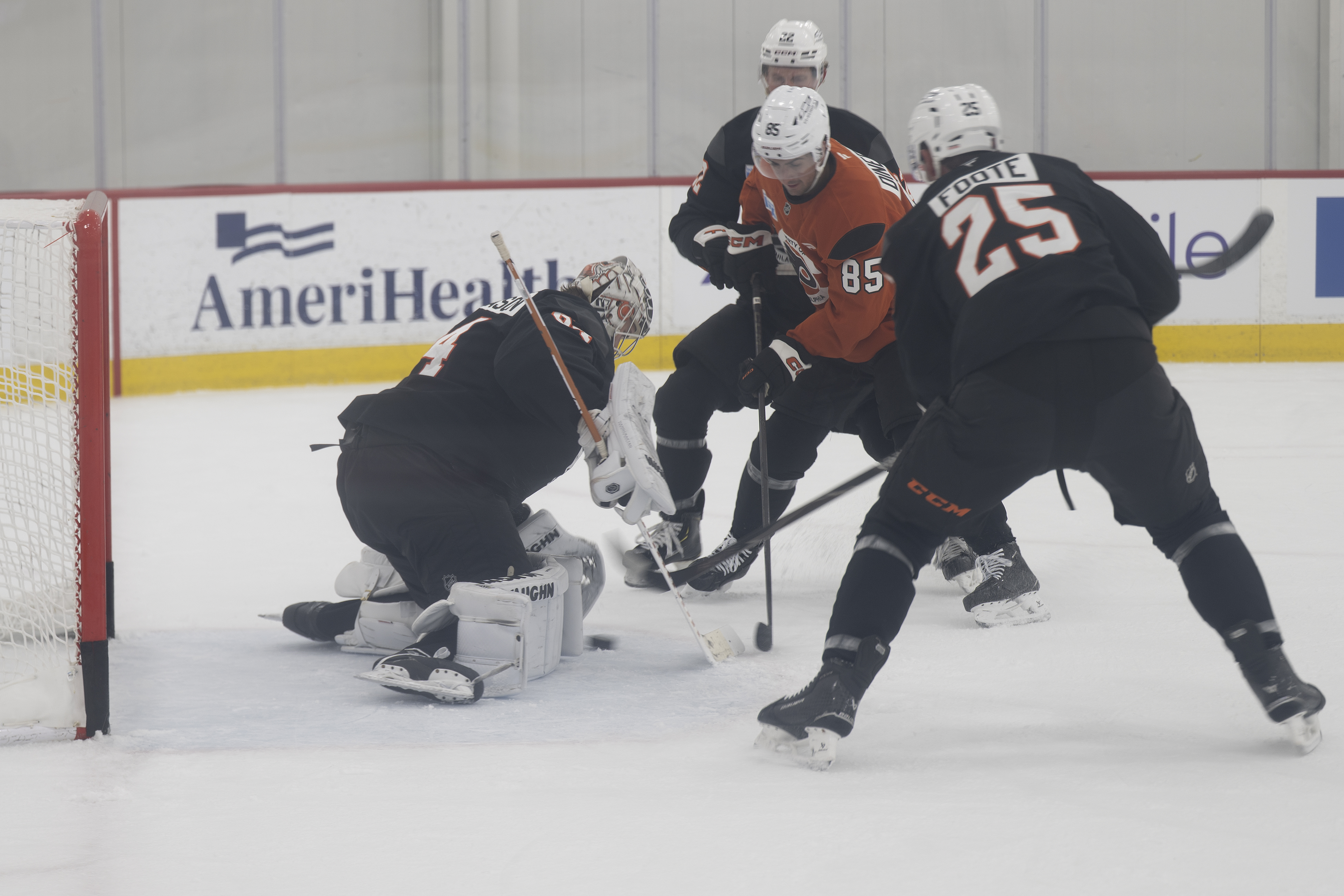
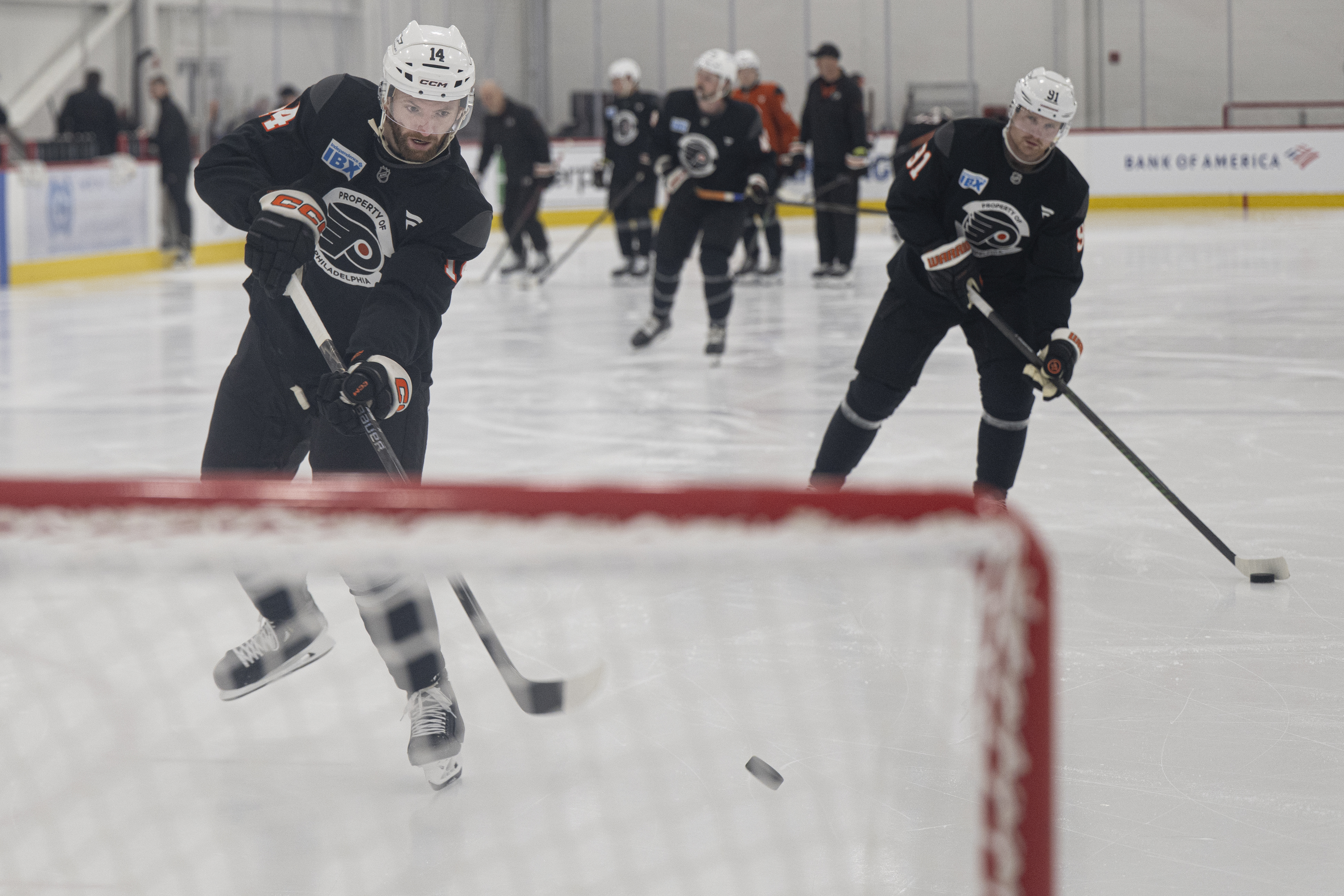
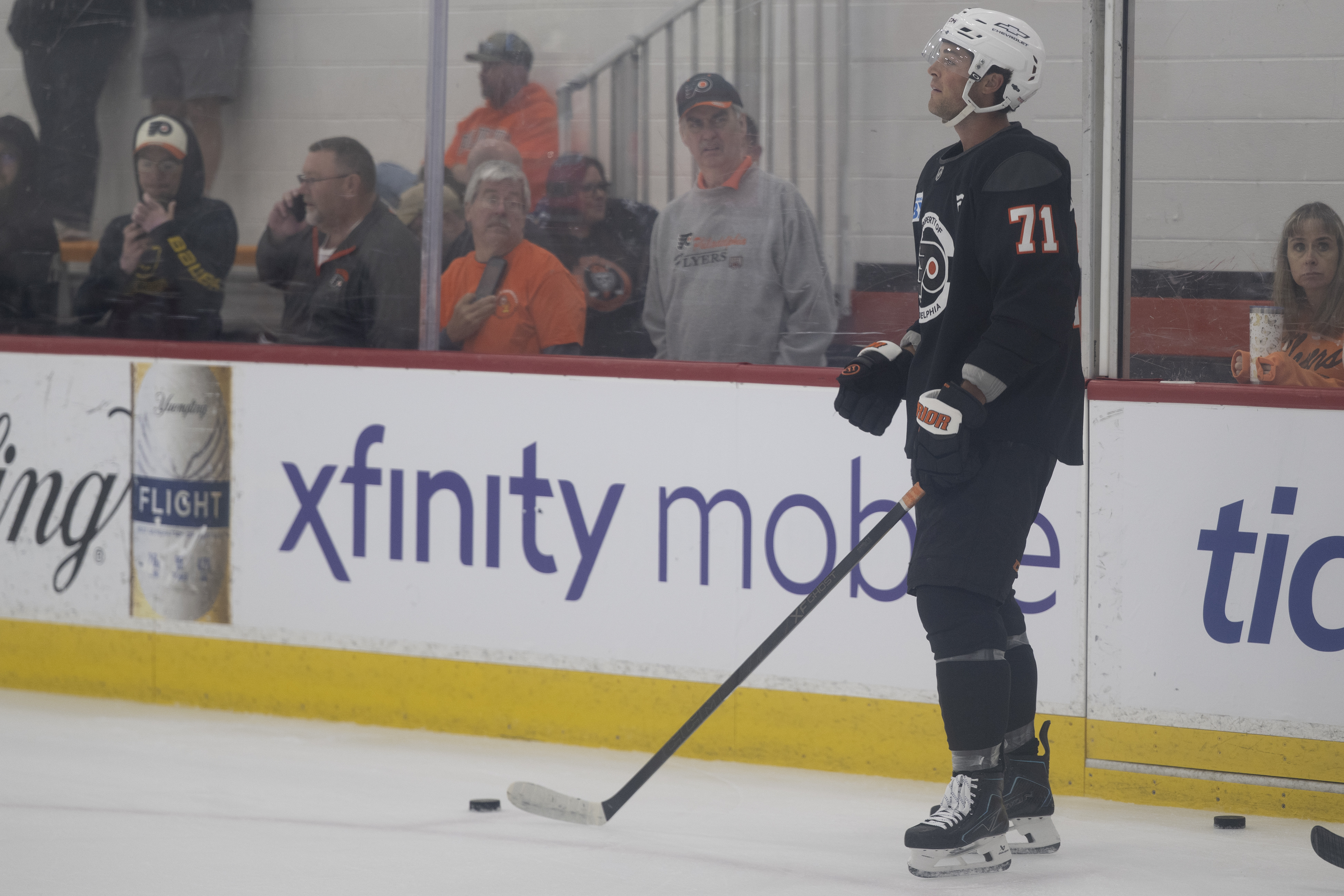
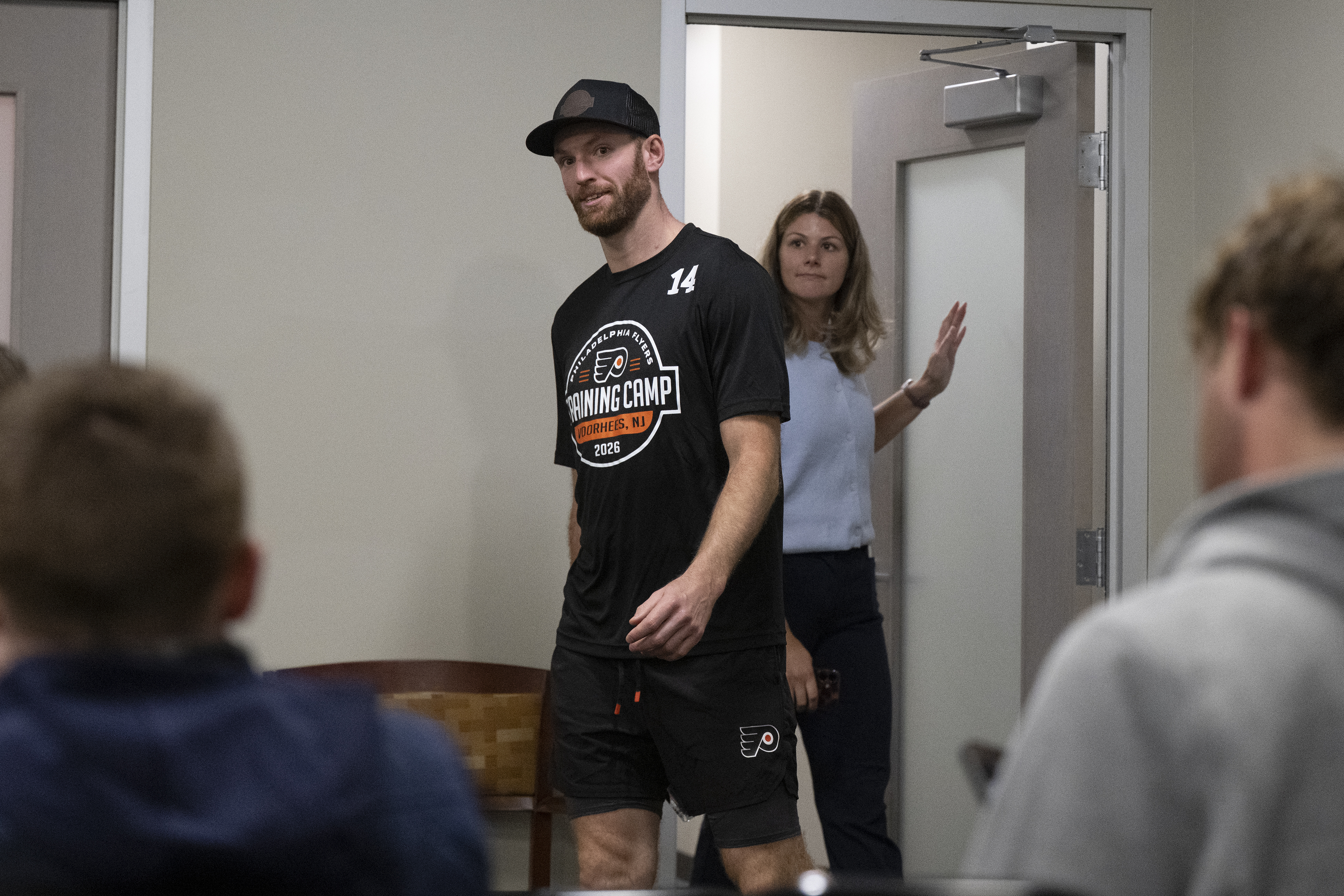
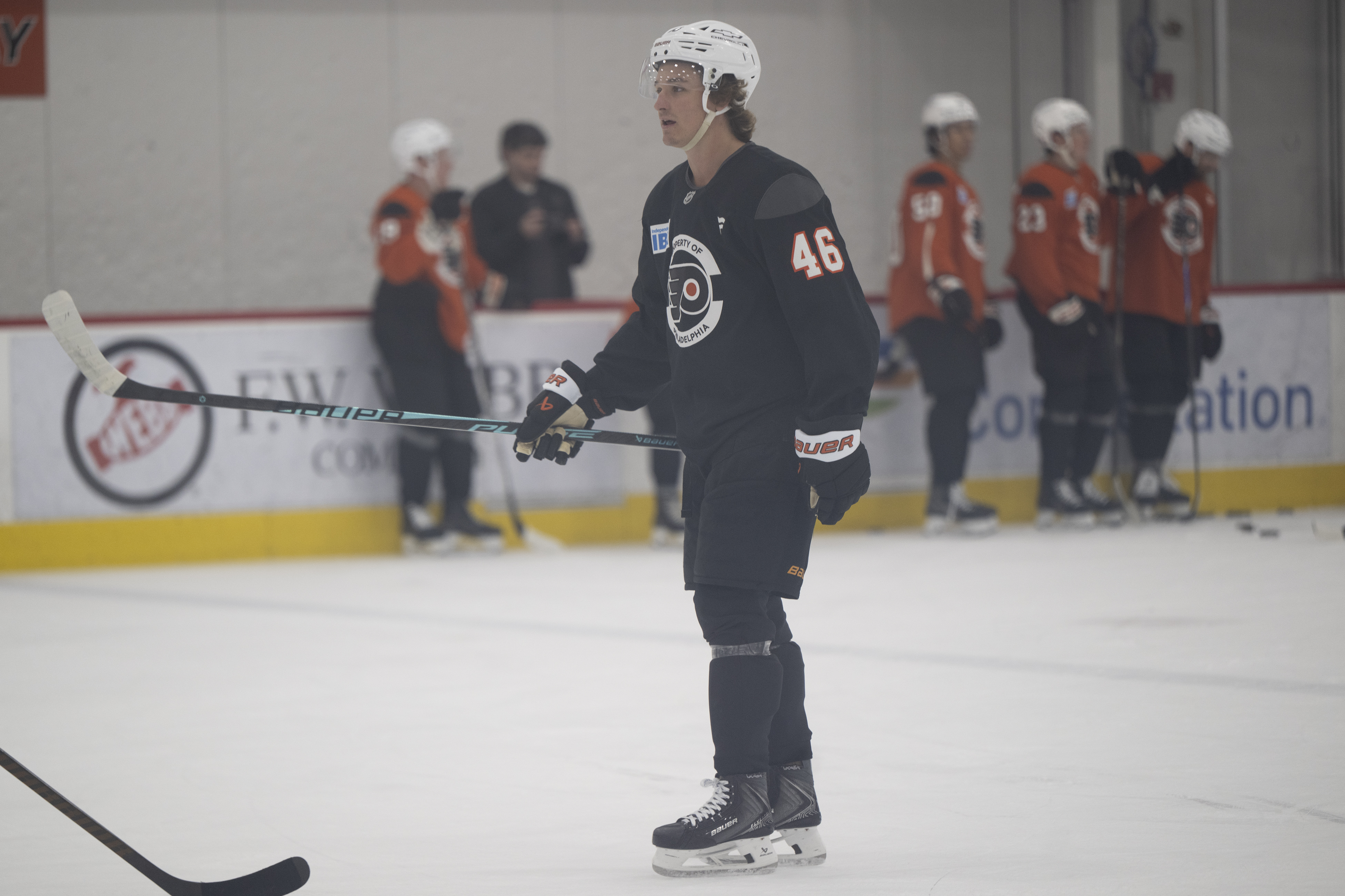
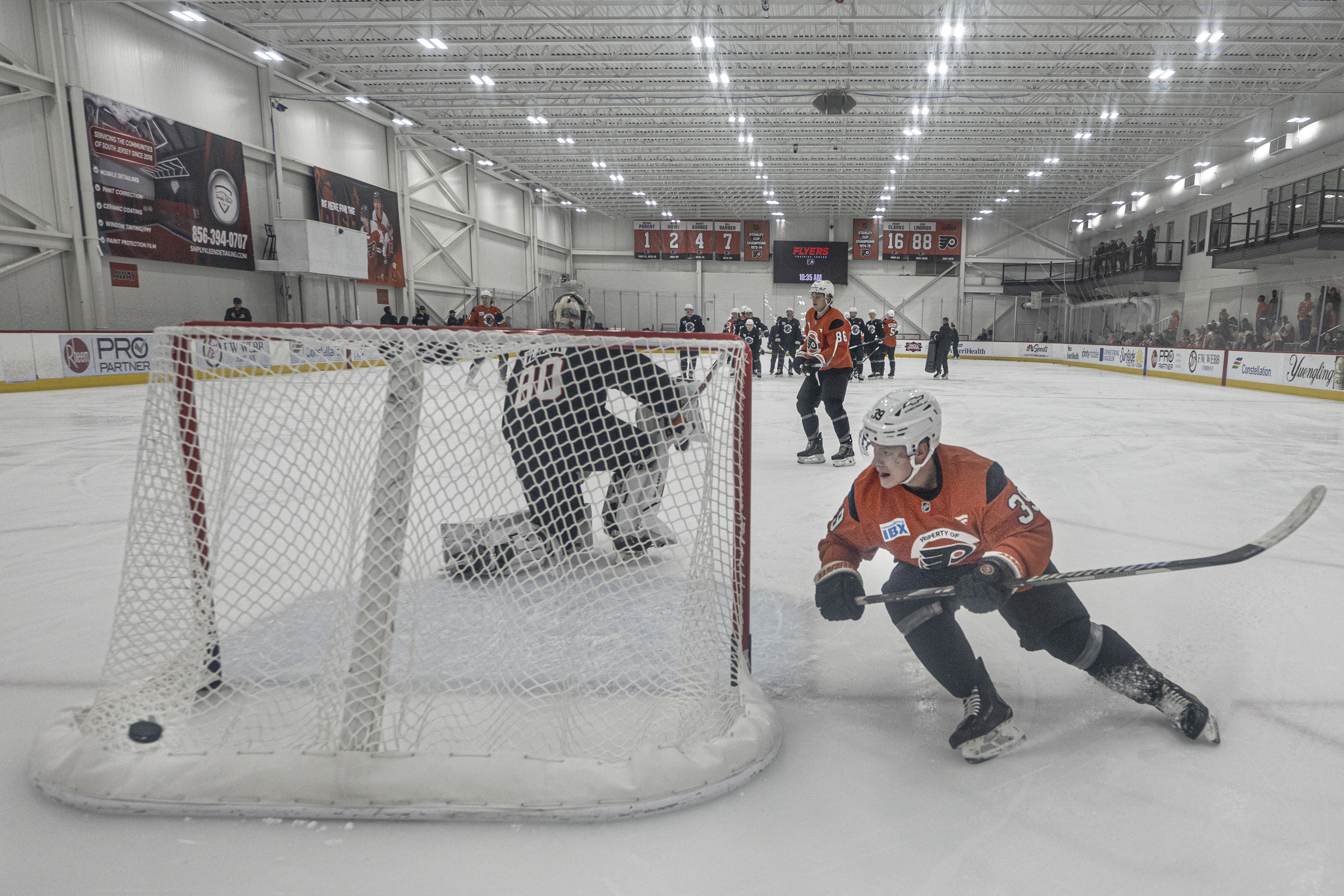
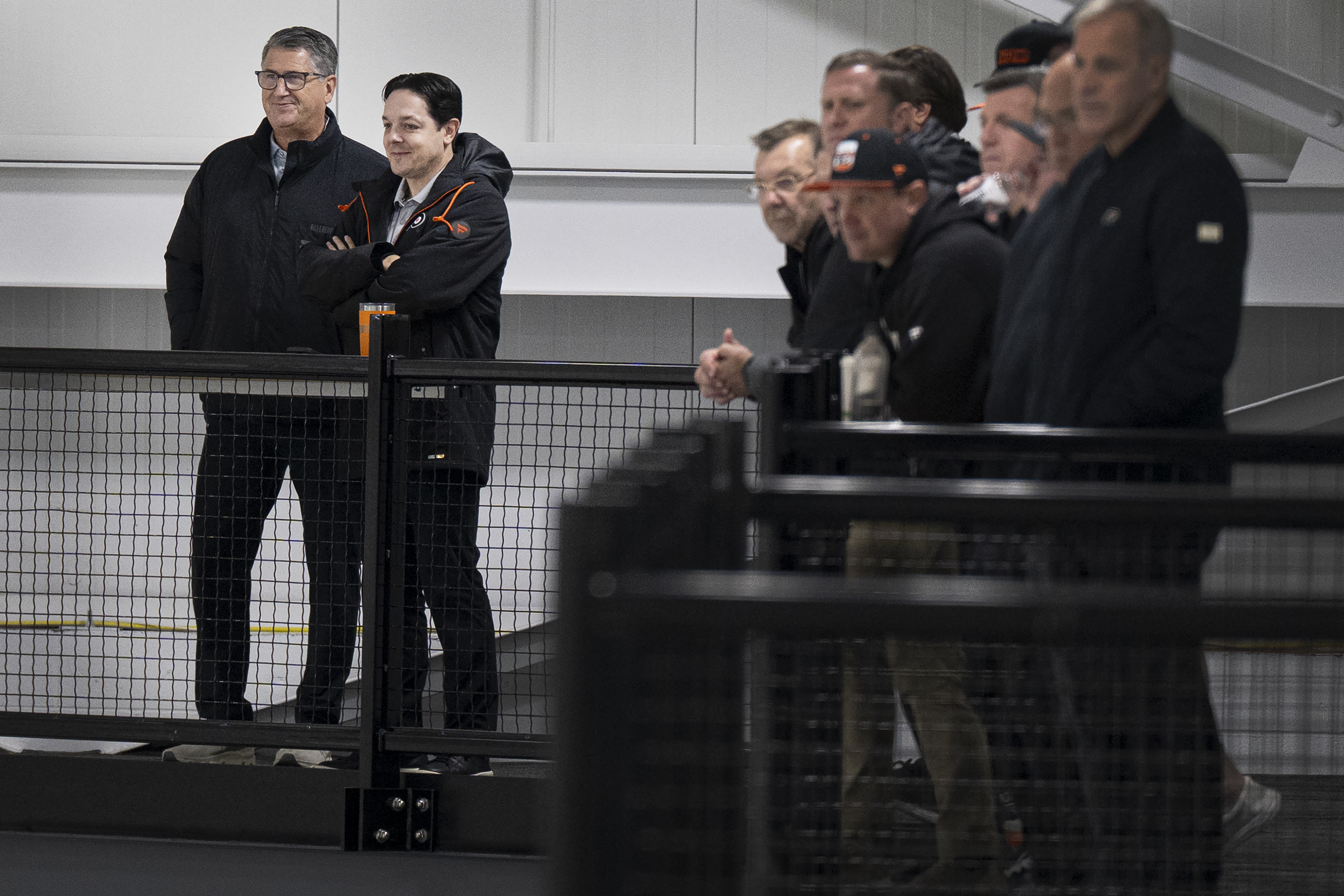
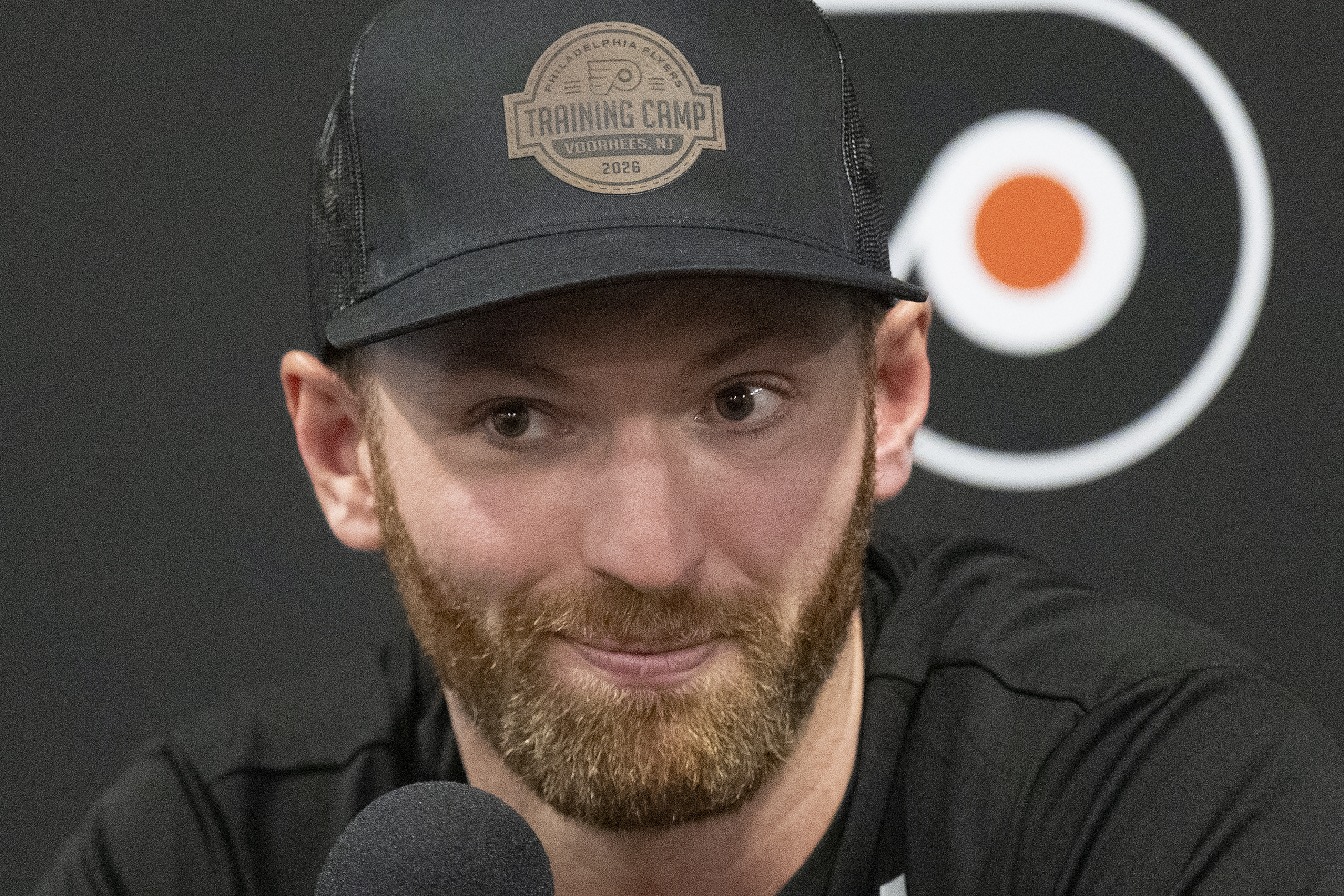
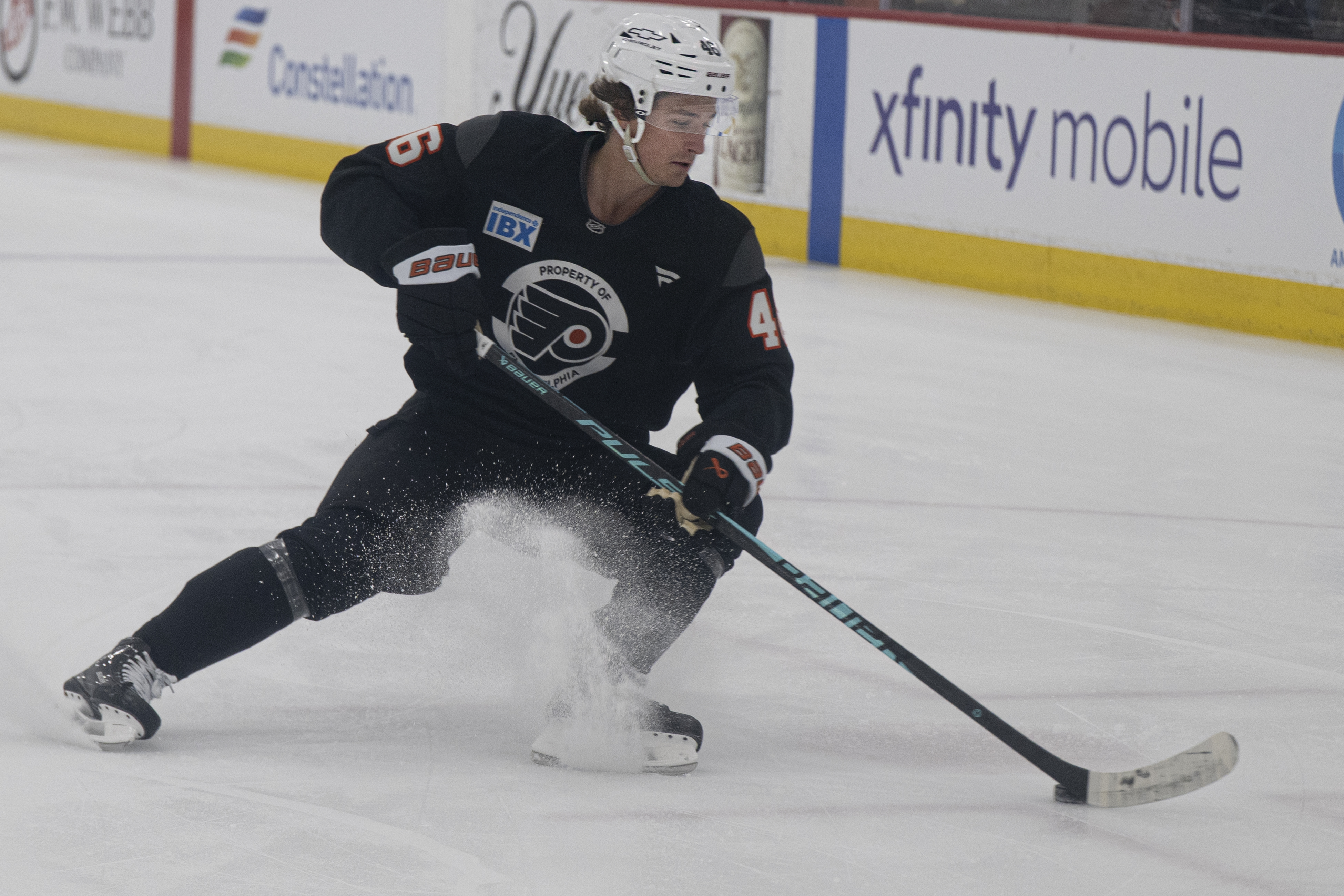
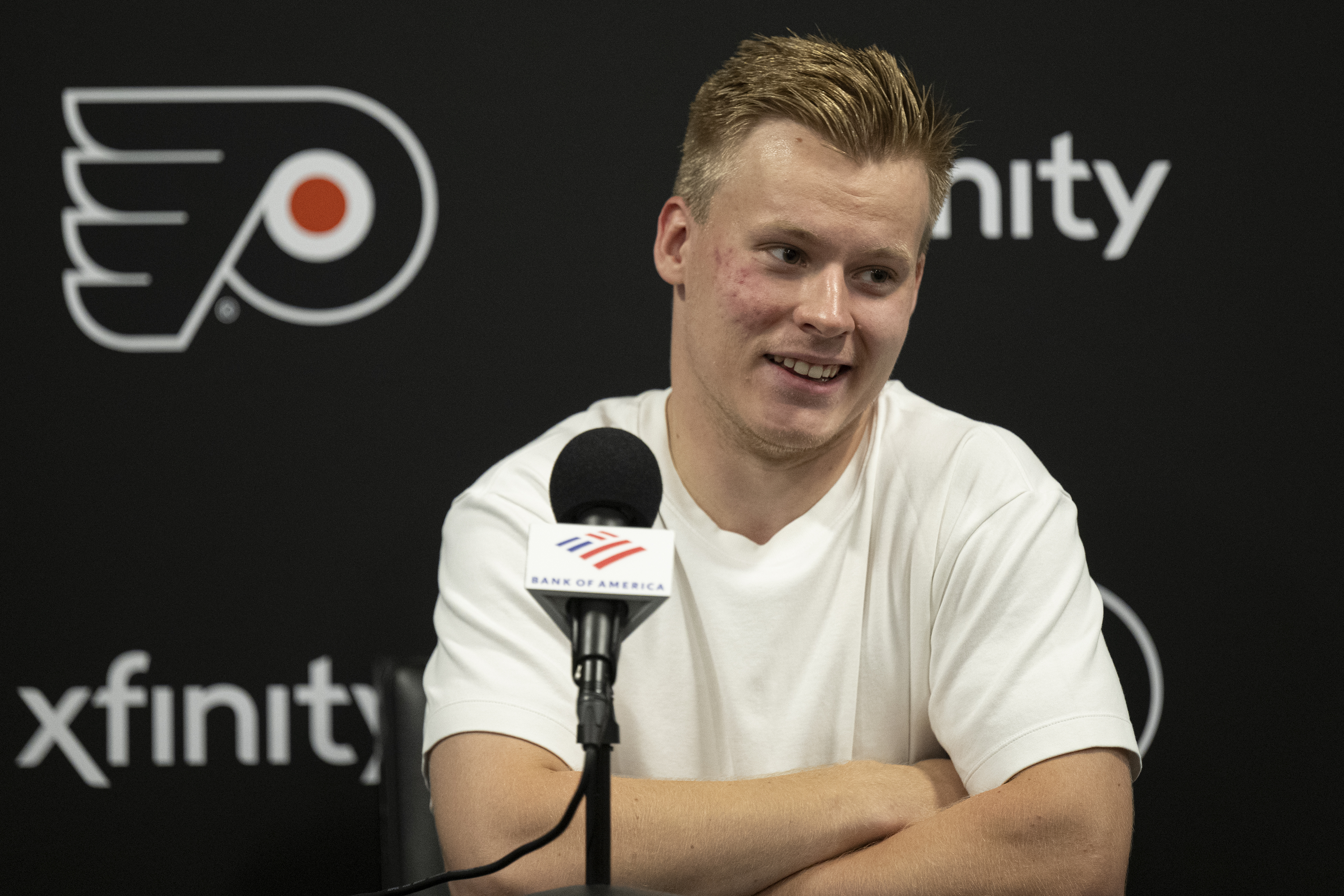
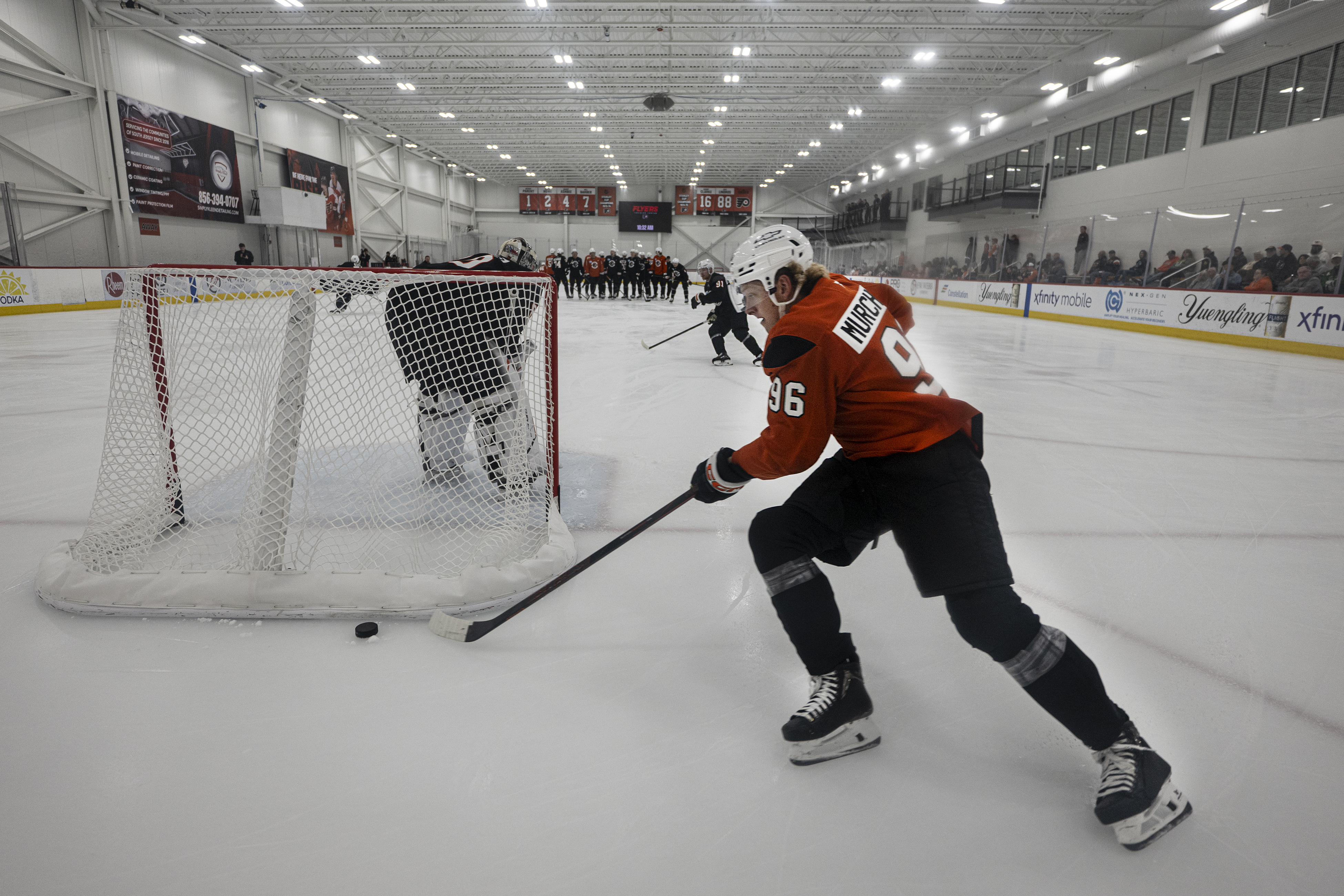
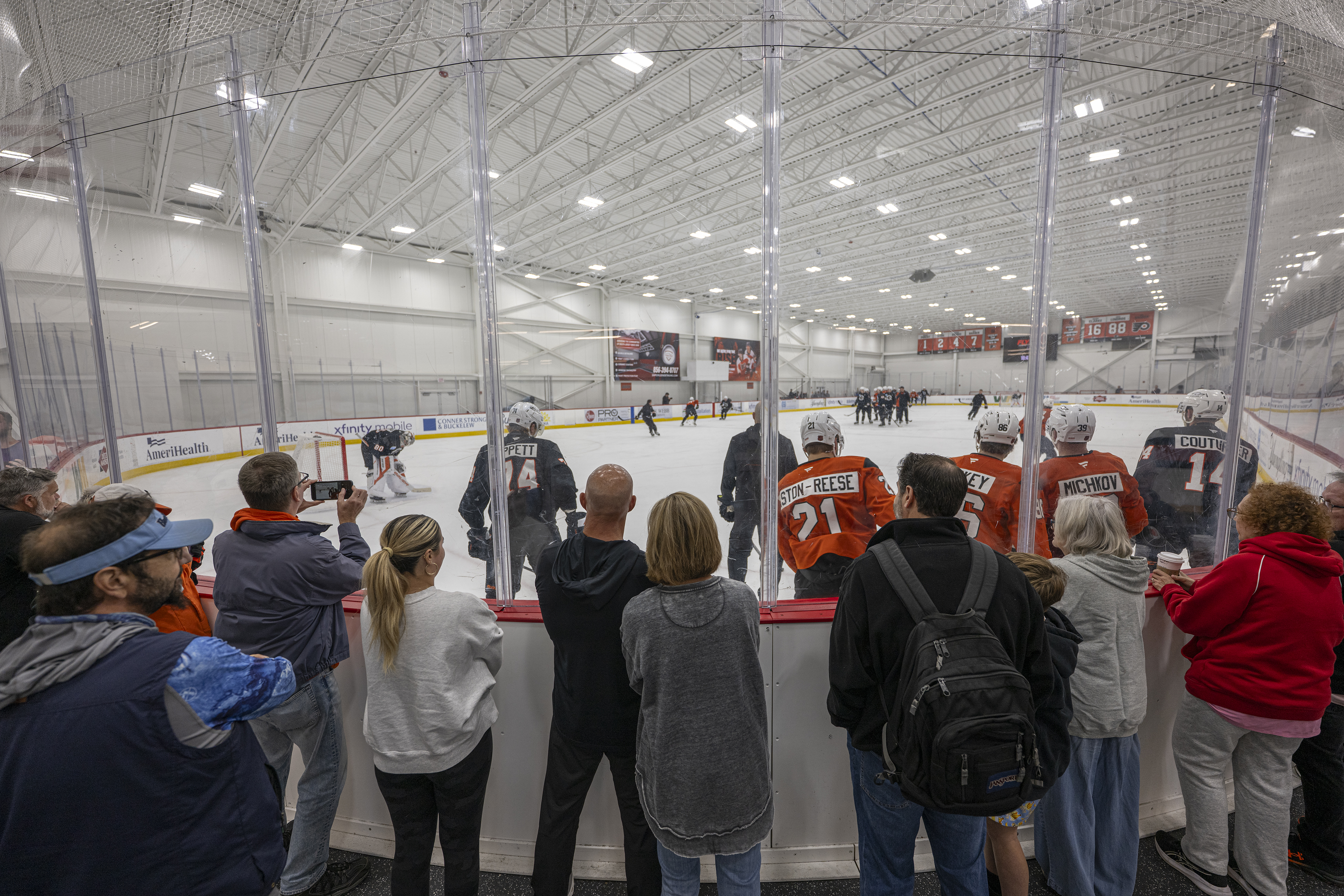
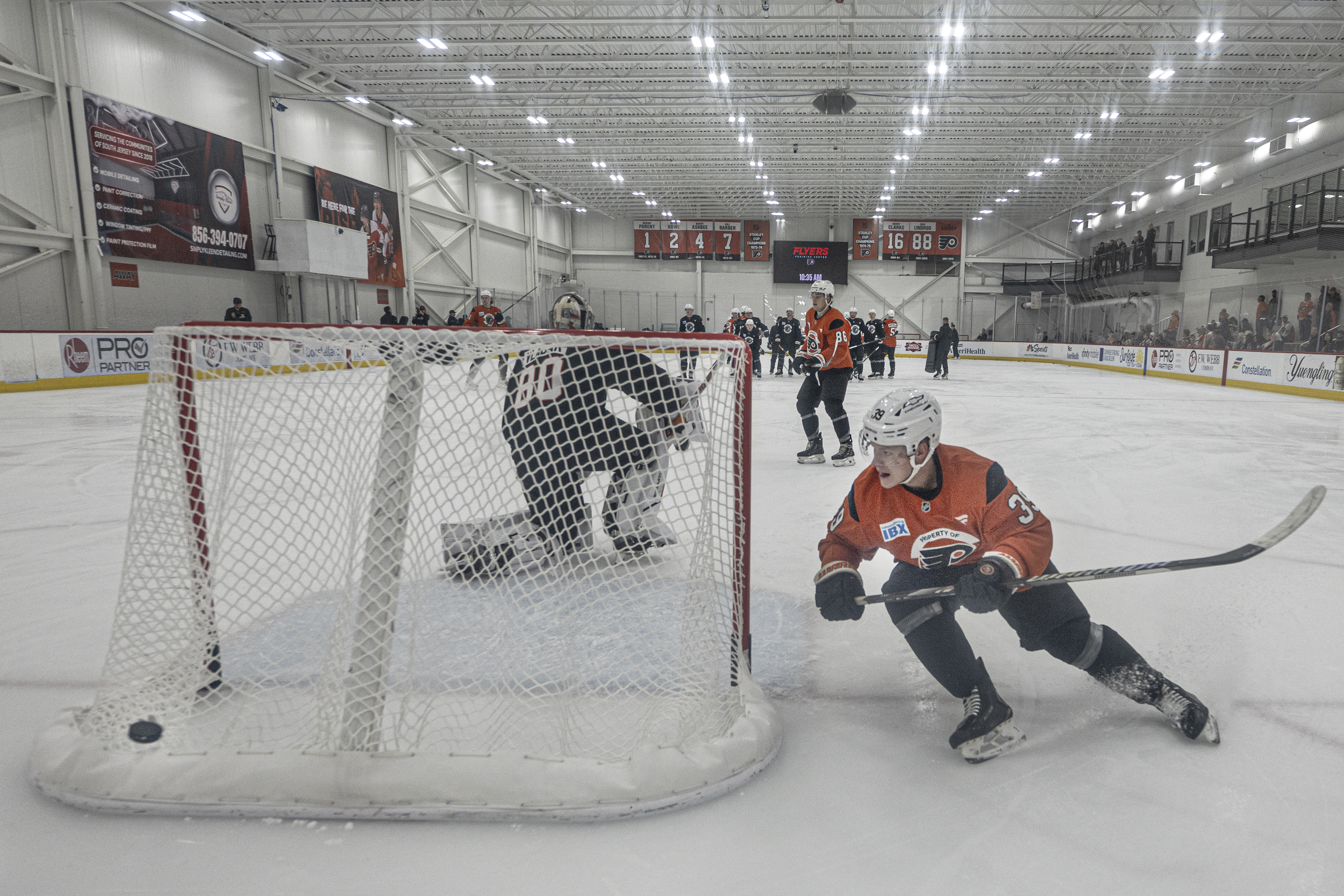
Philadelphia Flyers take the ice during the first day of training camp Thursday, Sept. 17, 2026, at the Flyers Training Center in Voorhees, N.J.Jose F. Moreno / Staff PhotographerPhiladelphia Flyers Simon Benoit shoots on goal during the first day of training camp Thursday, Sept. 17, 2026, at the Flyers Training Center in Voorhees, N.J.Jose F. Moreno / Staff PhotographerFlyer goalie, Carson Bjamason enters the ice during the first day of training camp Thursday, Sept. 17, 2026, at the Flyers Training Center in Voorhees, N.J.Jose F. Moreno / Staff PhotographerFlyer goalie, Carson Bjamason enters the ice during the first day of training camp Thursday, Sept. 17, 2026, at the Flyers Training Center in Voorhees, N.J.Jose F. Moreno / Staff PhotographerPhiladelphia Flyers Alex Bump shoots during the first day of training camp Thursday, Sept. 17, 2026, at the Flyers Training Center in Voorhees, N.J.Jose F. Moreno / Staff PhotographerFlyer Cam Dineen, (85) shoots on goal during the first day of training camp Thursday, Sept. 17, 2026, at the Flyers Training Center in Voorhees, N.J.Jose F. Moreno / Staff PhotographerPhiladelphia Flyers Matvei Michkov shoots on goal during the first day of training camp Thursday, Sept. 17, 2026, at the Flyers Training Center in Voorhees, N.J.Jose F. Moreno / Staff PhotographerPhiladelphia Flyers fans gathered behind the glass, during the first day of training camp Thursday, Sept. 17, 2026, at the Flyers Training Center in Voorhees, N.J.Jose F. Moreno / Staff PhotographerPhiladelphia Flyers Owen Tippett enters the ice during the first day of training camp Thursday, Sept. 17, 2026, at the Flyers Training Center in Voorhees, N.J.Jose F. Moreno / Staff PhotographerPhiladelphia Flyers take the ice during the first day of training camp Thursday, Sept. 17, 2026, at the Flyers Training Center in Voorhees, N.J.Jose F. Moreno / Staff PhotographerPhiladelphia Flyers Sean Couturier, left, shoots on goal during the first day of training camp Thursday, Sept. 17, 2026, at the Flyers Training Center in Voorhees, N.J.Jose F. Moreno / Staff PhotographerFlyer Tyson Foerster practice during the first day of training camp Thursday, Sept. 17, 2026, at the Flyers Training Center in Voorhees, N.J.Jose F. Moreno / Staff PhotographerPhiladelphia Flyers Sean Couturier talks to the media during the first day of training camp Thursday, Sept. 17, 2026, at the Flyers Training Center in Voorhees, N.J.Jose F. Moreno / Staff PhotographerPhiladelphia Flyers Trevor Zegras skates during the first day of training camp Thursday, Sept. 17, 2026, at the Flyers Training Center in Voorhees, N.J.Jose F. Moreno / Staff PhotographerPhiladelphia Flyers Matvel Michkov chases a puck behind the goal during the first day of training camp Thursday, Sept. 17, 2026, at the Flyers Training Center in Voorhees, N.J.Jose F. Moreno / Staff PhotographerFlyers President of Hockey Operations Keith Jones and General Manager Danny Briere look on from the balcony during the first day of training camp Thursday, Sept. 17, 2026, at the Flyers Training Center in Voorhees, N.J.Jose F. Moreno / Staff PhotographerPhiladelphia Flyers Sean Couturier talks to the media during the first day of training camp Thursday, Sept. 17, 2026, at the Flyers Training Center in Voorhees, N.J.Jose F. Moreno / Staff PhotographerPhiladelphia Flyers Trevor Zegras skates during the first day of training camp Thursday, Sept. 17, 2026, at the Flyers Training Center in Voorhees, N.J.Jose F. Moreno / Staff PhotographerPhiladelphia Flyers forward Matvei Michkov talks to reporters and answers questions in English for the first time during his first day of training camp Thursday, Sept. 17, 2026, at the Flyers Training Center in Voorhees, N.J.Jose F. Moreno / Staff PhotographerPhiladelphia Flyers Ty Murchinson handles the puck behind the net during the first day of training camp Thursday, Sept. 17, 2026, at the Flyers Training Center in Voorhees, N.J.Jose F. Moreno / Staff PhotographerPhiladelphia Flyers fans gathered behind the glass, during the first day of training camp Thursday, Sept. 17, 2026, at the Flyers Training Center in Voorhees, N.J.Jose F. Moreno / Staff PhotographerPhiladelphia Flyers forward Matvei Michkov talks to reporters and answers questions in English for the first time during his first day of training camp Thursday, Sept. 17, 2026, at the Flyers Training Center in Voorhees, N.J.Jose F. Moreno / Staff PhotographerPhiladelphia Flyers Matvel Michkov chases a puck behind the goal during the first day of training camp Thursday, Sept. 17, 2026, at the Flyers Training Center in Voorhees, N.J.Jose F. Moreno / Staff Photographer
“The part that keeps me up at night is having some of your players feel complacent, feel like they’ve made it,” Brière said. “Let’s face it, we’re still a young team. We’ve had guys who had success last year. You saw what happened with Matvei [Michkov]. Had a lot of success the first year. It’s tougher the second year. … They’re going to be a big part of our team, and if that happens, we’re going to have a setback.”
The more interesting development, actually, would be if all those promising youngsters did reach their potential or exceed expectations. Then Brière will have a real conundrum on his hands. With the Carlsson offer sheet and his public comments, Brière has left no doubt that the Flyers are looking for ways to acquire a top-line center or top-pair defenseman — or both if possible.
Cap space wouldn’t be the issue; they have more than enough to bring on a high-salaried star. Desire wouldn’t be the issue; at the moment, the Flyers know they need a premier player at one of those two premier positions. Timing wouldn’t necessarily be an issue, either; there’s no telling when a standout player who fits the Flyers — Dylan Larkin? Quinn Hughes? Someone no one is thinking of right now? — might become available.
“We’ve positioned ourselves,” Brière said. “It took a while, and we took some licks to miss the playoffs and be a bad team for way too long in my mind to just throw away the cap space we’ve built and the freedom we’re able to have. … We’re not going to be reckless about it. It was so tough to get there, with that freedom, that we want to try to get the right guy and spend our money properly. That’s the way I see it. If something comes up that makes sense, yes, definitely, we won’t be afraid to swing again.”
Alex Bump will be among the young Flyers Danny Brière and the rest of the organization will be counting on to replicate last season’s success.Jose F. Moreno / Staff Photographer
No, the primary issue could be a happy problem: What if the Flyers do continue their upward climb, and what if they make that climb at a rate that exceeds their own expectations? What if Michkov and Porter Martone and Trevor Zegras and Tyson Foerster and Owen Tippett and Jamie Drysdale and who knows who else demonstrate that any of them, or all of them, is indispensable? Does Brière still take that big swing? If so, who and what would he have to give up to pull it off?
That’s the potential risk. That’s the most important question he and the Flyers have to answer. Because if this team does manage to build on what it began last season, no one around here will settle for saltines anymore.
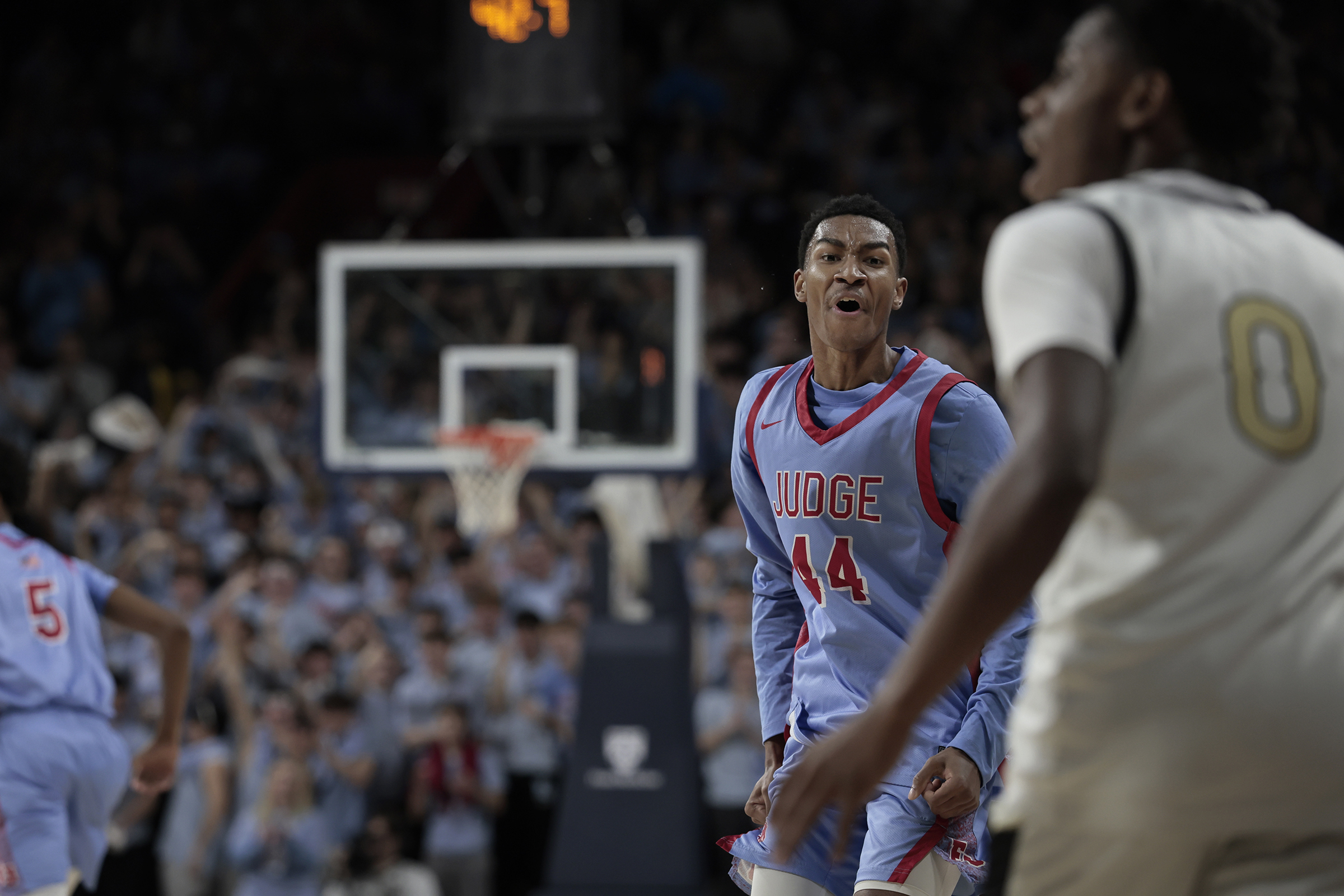
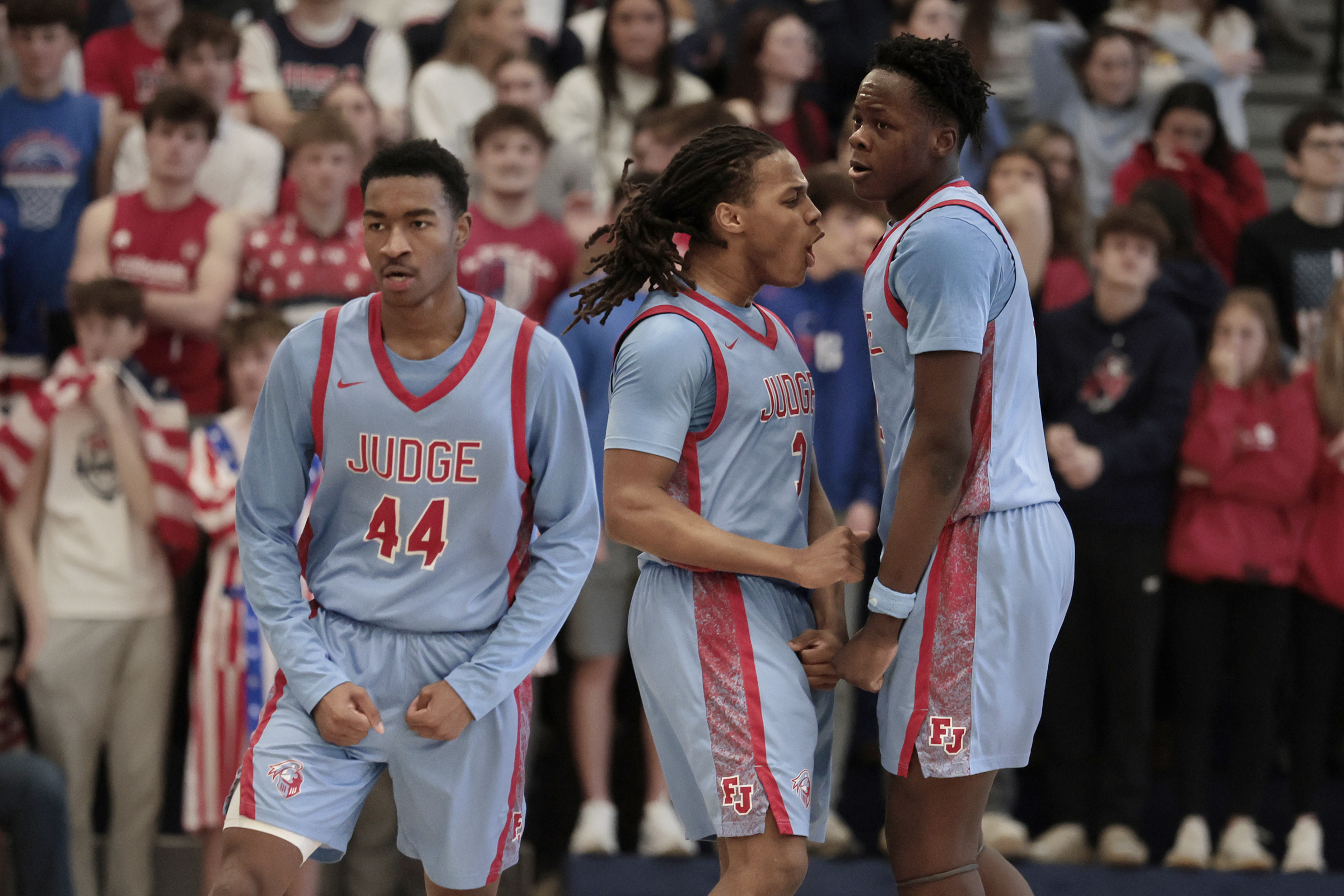
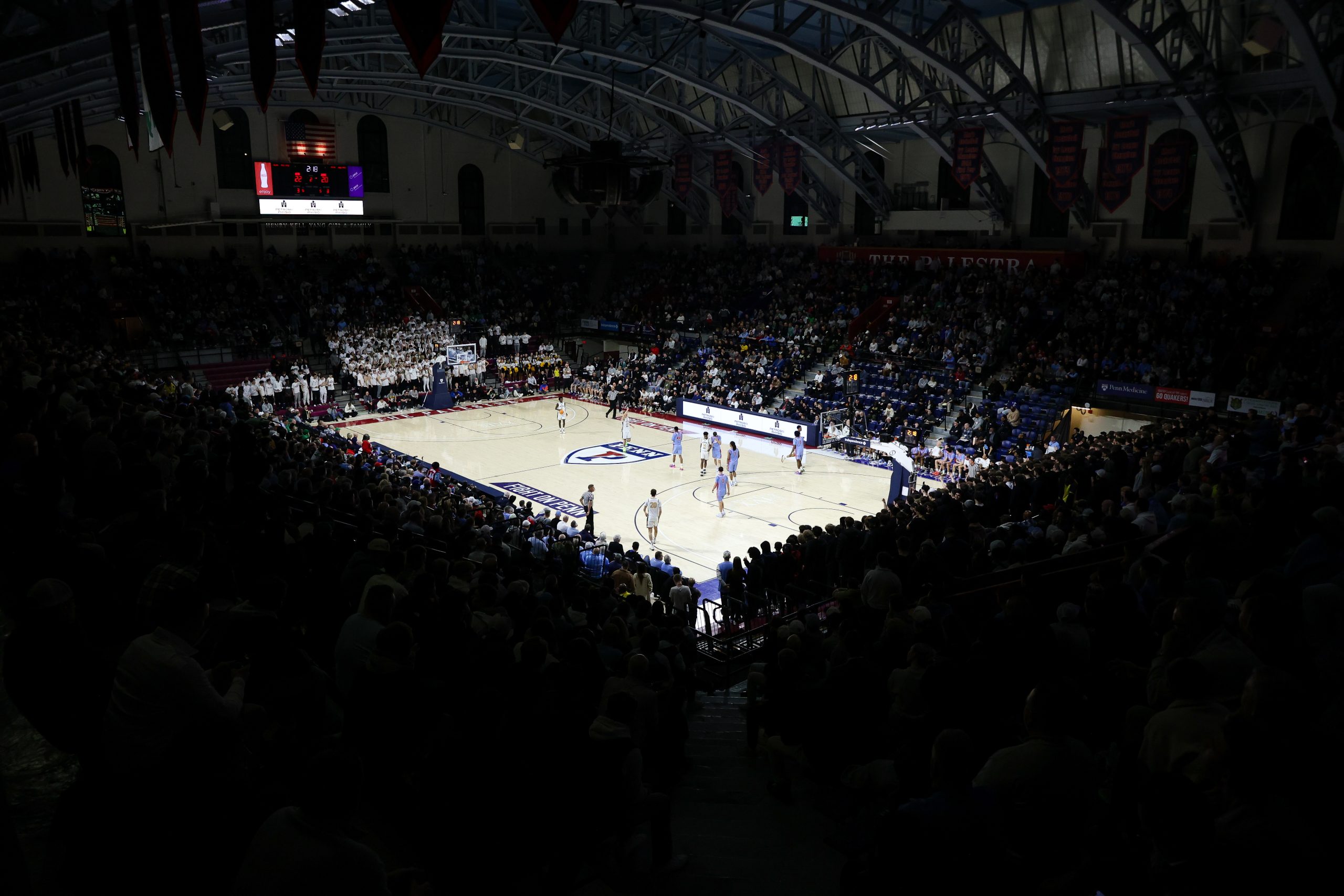
The sound inside the locker room was already overwhelming, Father Judge’s coaches and players shouting and singing after their 52-46 victory over Archbishop Wood in the Philadelphia Catholic League boys’ basketball semifinals last February. And every time someone opened the door to exit, the noise in the room rose, because a sold-out Palestra crowd was now roaring over the night’s second game: Neumann Goretti vs. Bonner-Prendergast.
Still, the kid who had been the primary cause of the celebration, the 6-foot-4 senior guard who had made the night his, was calm. Derrick Morton-Rivera had scored 27 points on an array of three-pointers and pull-up jumpers, leading the Crusaders back from an early 16-point deficit.
“Playing in front of 10,000 people every year, there’s nothing like it,” Morton-Rivera, now a freshman at Temple, said after the game. “I never knew about the PCL until my eighth-grade year. That’s when I learned.”
How did he end up at Judge?
The coaches “recruited me,” he said.
Father Judge graduate Derrick Morton-Rivera after he sank a three-point shot during the 2026 Catholic League boys’ championship.Elizabeth Robertson / Staff Photographer
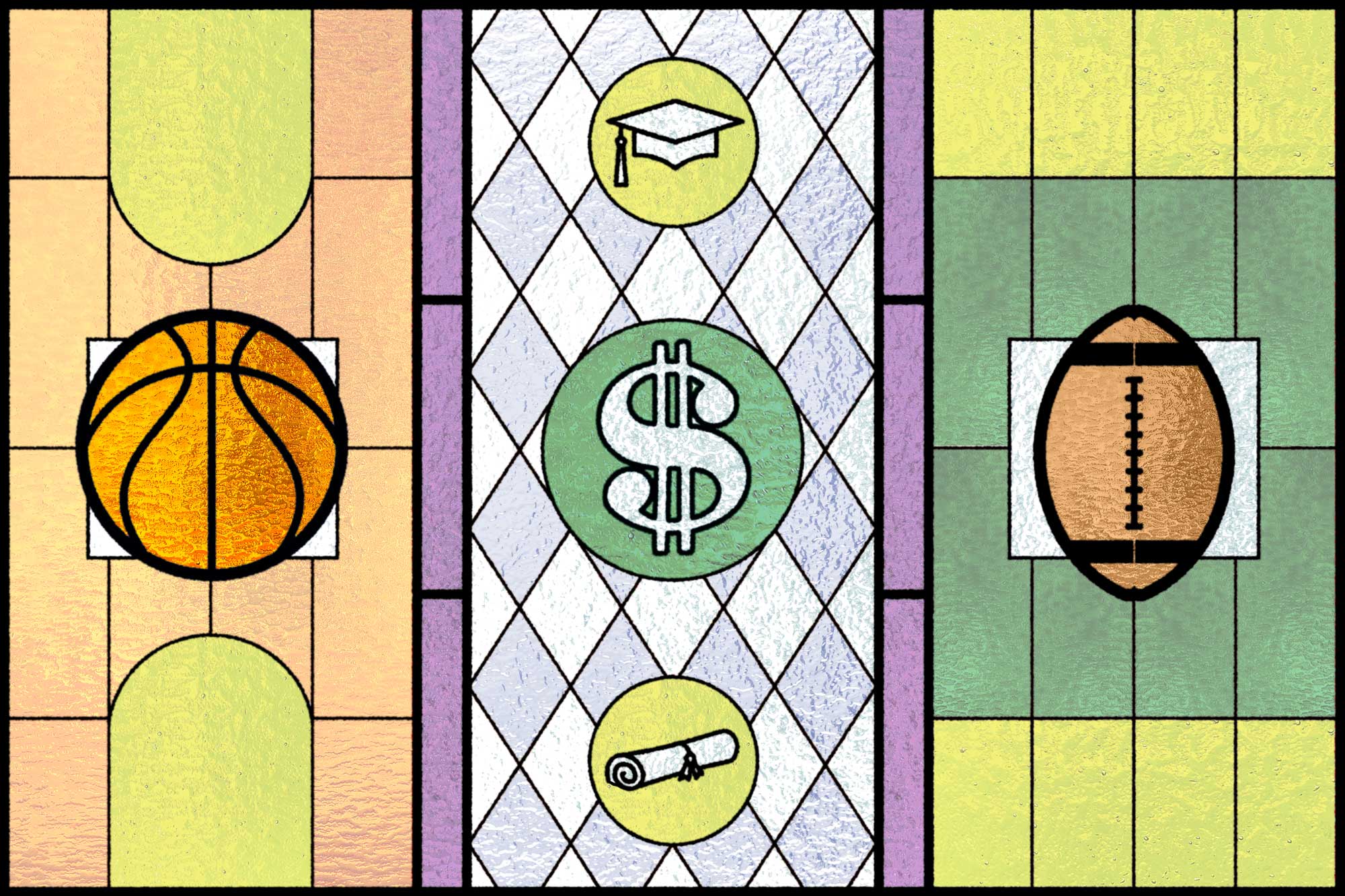
With that one verb, recruited, Morton-Rivera touched the live wire that crackles among coaches, parents, administrators, and players throughout the high school sports scene in Pennsylvania. House Bill No. 41 — a measure that would allow the PIAA to create separate postseasons, one for public schools and one for private, parochial, and charter schools — passed the Pennsylvania State House of Representatives in April. And of all the factors that play into the longtime dispute over whether boundary and non-boundary schools should compete against each other for championships, none generates as much heat and controversy as recruiting.
“It’s two different worlds,” longtime Lower Merion boys’ basketball coach Gregg Downer said. “If you don’t put massive talent out in basketball or football or soccer or lacrosse, you’re going to get run over.”
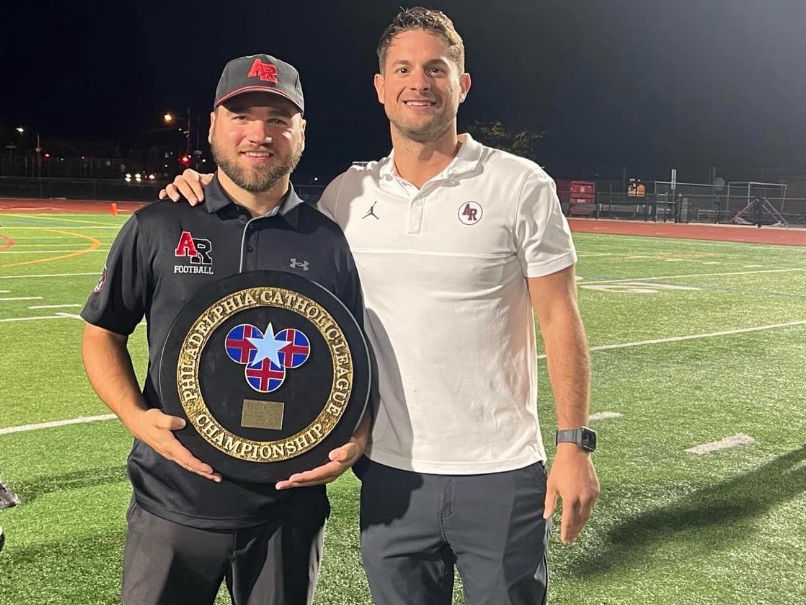
Mark Ostaszewski with Archbishop Ryan athletic director Joe Zeglinski after the Raiders won the Catholic League Blue Division title in 2024.Courtesy of Archbishop Ryan
‘Philly is Philly’
Since the Catholic League joined the PIAA in 2008, just one of its coaches, Archbishop Ryan football coach Mark Ostaszewski, has been suspended for recruiting violations. At a January 2025 football camp, Ostaszewski asked a student from the Bensalem School District if he wanted to apply to Ryan. District 12, the association’s umbrella for the Philadelphia Catholic and Public leagues, banned Ostaszewski for a year; he has returned to his role this season.
Locally, recruiting accusations often put programs from District 12 at odds with those from District One, which comprises schools in Philadelphia’s suburbs. And that confirmed example is tame compared to the more intense efforts that coaches have allegedly made to coax athletes to their programs.
A former basketball standout who graduated recently from a District One public school and his father told The Inquirer on the condition of anonymity that, while the student was in eighth grade and throughout his high school career, representatives from three Catholic League programs pursued him. One head coach offered him free tuition, a stipend, and the use of an apartment near campus. The coach also had his team’s star player send several direct messages on Instagram to the player in an attempt to persuade him to attend the school.
Another program had an assistant coach and a parent take the player’s father out to lunch twice, telling him at both meals that he would not have to worry about paying any tuition for his son. The third program’s head coach told the father that, if his son helped the team win the Catholic League championship, a booster would provide a house for the player. Each of the three schools were located between 15 and 35 miles from the player’s home.
Gregg Downer has spent three decades as the Lower Merion boys’ basketball coach.CHARLES FOX / Staff Photographer
“They can twist this however they want,” Downer said. “These kids are targeted because they’re good at sports. I could list 50 examples of kids who have been recruited.”
Morton-Rivera’s path to Father Judge captures the murkiness of the entire issue. Jim Meredith, a 1992 Judge graduate who became its president in late July, noted in a recent interview that while in eighth grade, Morton-Rivera had visited the school and taken its entrance exam — and that he grew up and lived in Lawncrest, just a mile-and-a-half from Judge.
“I can say with full confidence that we’re following PIAA rules and regulations,” Meredith said. “We’re trying to put out an excellent product for our school and our students. Part of that is making sure we adhere to the guidelines that are prescribed to us.”
When asked how Morton-Rivera ended up choosing Judge, head coach Chris Roantree pointed out that Morton-Rivera’s background and family history made it natural for him to consider attending a school with a strong basketball program. D.J. Rivera, his father, finished his high school career in 2006 as Neumann Goretti’s all-time leading scorer before playing Division I ball at St. Joseph’s and Binghamton.
Father Judge coach Chris Roantree noted that Morton-Rivera’s background and family history made it natural for him to consider attending a school with a strong basketball program.Elizabeth Robertson / Staff Photographer
“Philadelphia basketball is a very small community,” Roantree said. “There are different relationships that everybody has. When somebody shows interest in us, we sell the school. When we bring guys in, we show them our career-pathway center. We show them our academic center. …
“Ultimately, ‘recruiting’ is a very broad thing. It’s going to be questioned because we’re a Catholic and private school. He’s within a mile or two of the school. To me, that’s no different from [a public-school coach] talking to someone from a Plymouth Whitemarsh middle school or an Abington middle school. He’s not a transfer. We didn’t aggressively go after him like that.”
Under Article VI, Section 11 of its bylaws, the PIAA forbids “recruiting [that] is materially motivated in some way by an athletic purpose. Recruiting for athletic purposes is directly contrary to fundamental interests of PIAA and its member schools, and any school engaged in such conduct should do so with the expectation that it will be treated harshly upon proof of such conduct.”
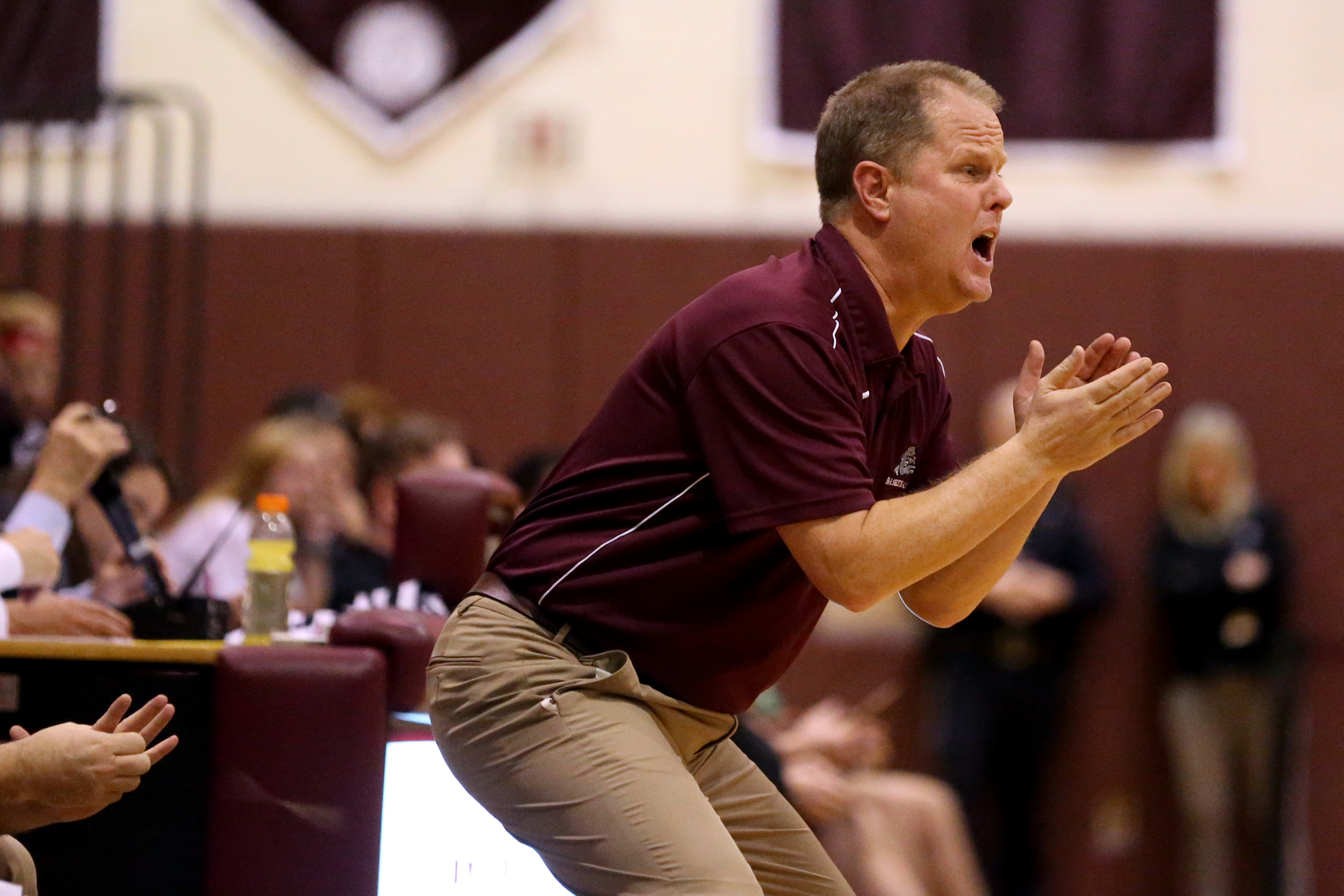
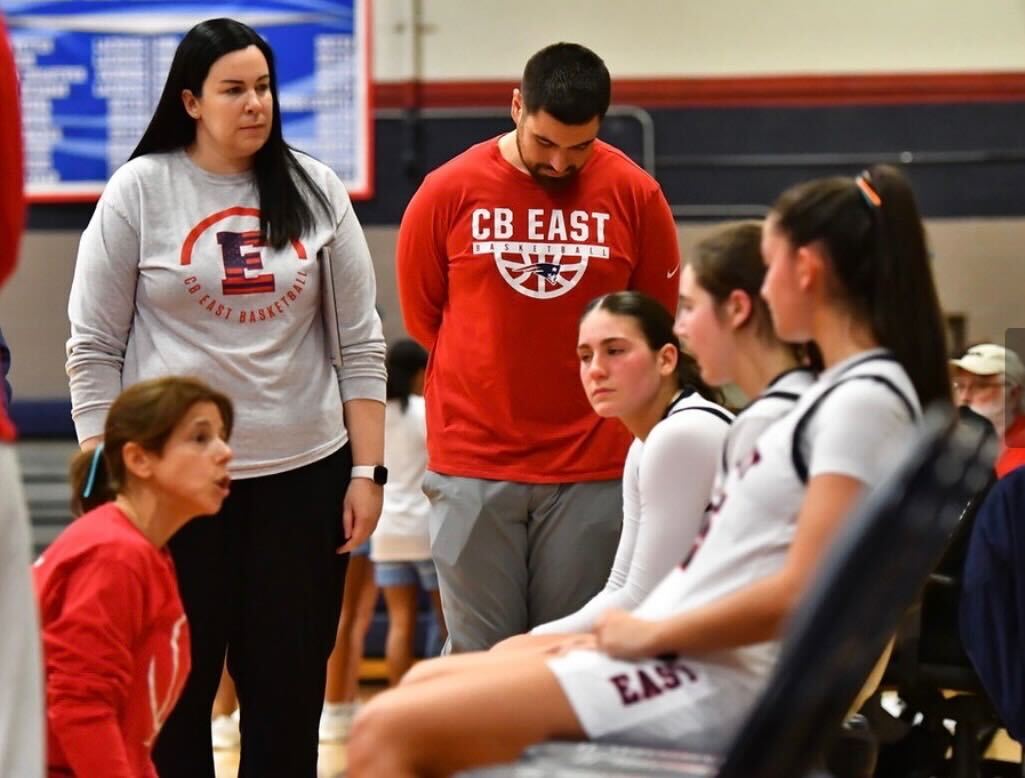
Liz Potash retired earlier this summer after 13 years as Central Bucks East’s girls’ basketball coach.Courtesy of Diane BarryShe said, “If I wanted to recruit, I wouldn’t be a public-school coach.” Courtesy of Diane Barry
As clear as that excerpt might seem, determining whether a student’s decision to attend a particular school was “materially motivated” by athletics requires hard and fast evidence, such as text or direct messages between a coach and the athlete, said Sean Kelly, District One’s vice chairman.
If a principal or athletic director files a formal complaint charging an opposing program with violating PIAA bylaws, the association’s corresponding district committee will hold a hearing on the matter.
“Sometimes I’ll get a call from a coach or an AD or somebody who’s associated with one of the schools who says, ‘Hey, this is what we’re hearing. We’re hearing Student A is going to go to this school,’” Kelly said. “I just ask them, ‘What evidence do you have? Are you saying they’re just transferring, or are you saying they’re being recruited?’ We take some time to make sure we pump the brakes because people get very sensitive and very emotional.”
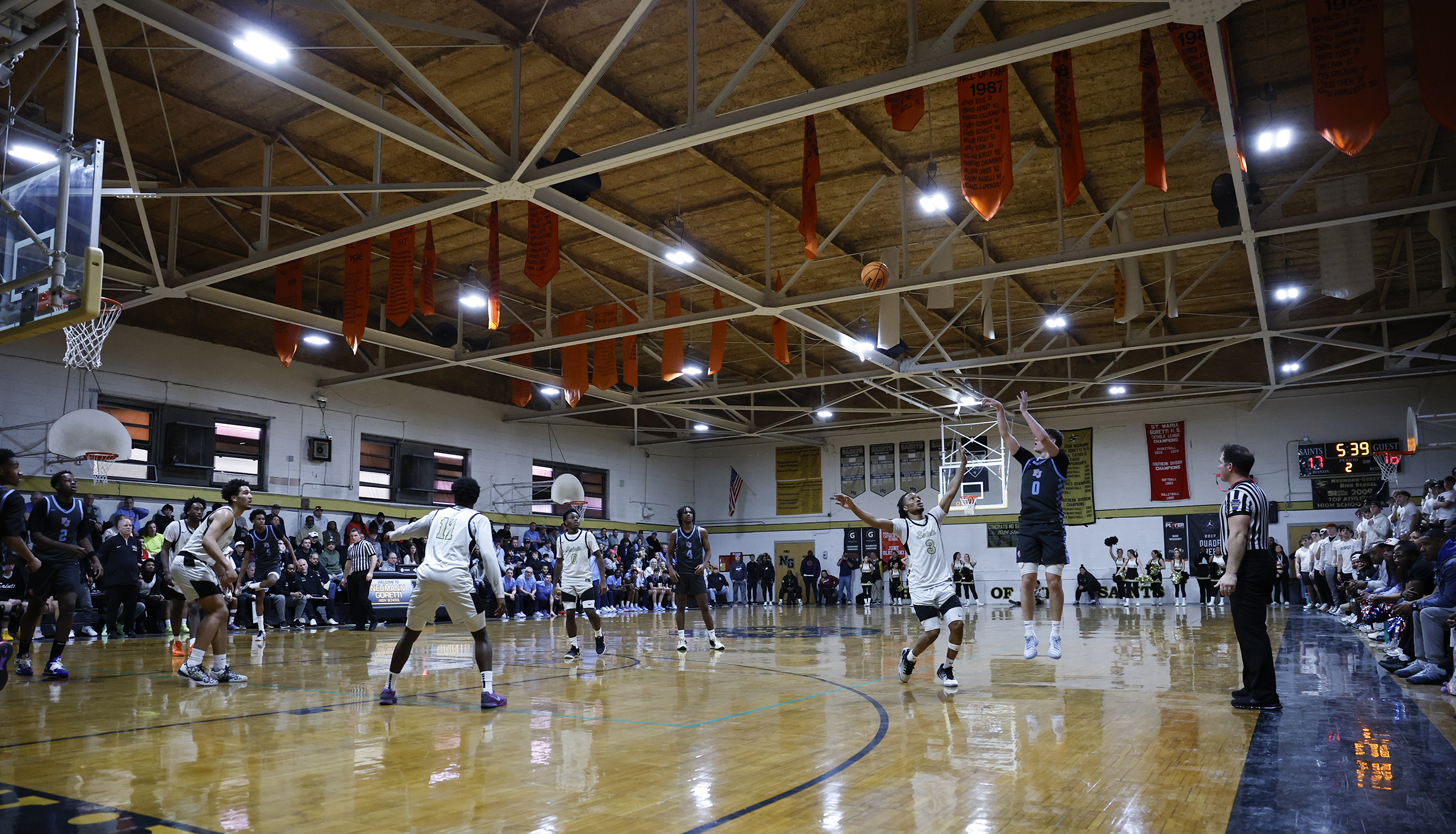
Neumann Goretti and Father Judge boys’ basketball play in South Philadelphia on Feb. 1, 2026.Yong Kim / Staff Photographer
Article VI, Section 11 applies to both boundary and non-boundary schools, but suburban public school coaches bemoan what they see as an inherent imbalance in the system: To play a varsity sport at a public high school, a student must live in that school district. But private, parochial, and charter schools, such as those in the School District of Philadelphia and the Archdiocese of Philadelphia, can draw their students from anywhere. Too many of those institutions, several District One coaches said, bend the rules to do it.
“It’s just not fair,” said Joe Dempsey, who has been the boys’ basketball coach at Spring-Ford High School in Royersford since 2021. “They have the ability to go and get players, to which I say: Let them do that. If they want to go play in that sandbox, let them go.”
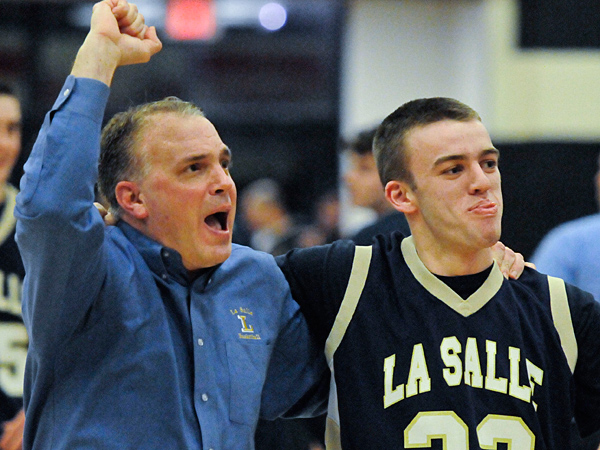
Dempsey had previously coached at La Salle College High School for 27 years, including 14 as the program’s head coach. At CYO games, he would see a promising seventh or eighth grader, he said, then approach the player’s parents without talking to the player.
Joe Dempsey previously coached at La Salle College High School for 27 years.
“La Salle made it very clear: Don’t step over the line. Don’t get us in trouble,” Dempsey said. “Once a couple of schools took the gloves off, the pressure came. The pressure was on me at La Salle. I went to the administration: ‘Are you looking around the Catholic League? I can’t just sit on my hands and wait on some wonderful 6-foot-7 kid who can pay a lot of tuition and go to school with all boys and get bused here. It ain’t going to happen by accident.’”
That archdiocesan schools compete for students within District 12’s open-enrollment landscape only complicates matters further. Consider one example: Bonner-Prendie, nestled in Drexel Hill in Delaware County, won the 2024 PIAA Class 4A football championship. Of the top six zip codes from which the school drew students that year, five were within Delco, and the other was just nearby — the Overbook section of Philadelphia — according to Steve Clement, the chief administrative officer of the archdiocese’s Office of Catholic Education.
How many of its football players did Bonner-Prendie recruit, if any? How many did it have to recruit, given the school’s proximity to West Philadelphia? And if a school such as Bonner-Prendie draws students from the city or St. Joseph’s Prep draws them from Camden — less than five miles away — how different is that from the dynamic at a public school in an especially large district?
“The reality,” Clement said, “is that these schools are still serving the areas they were intended to serve.”
Similarly, parents can and do contact the School District of Philadelphia to ask what high schools would best fit their children’s skills and interests: maybe sports, maybe drama, maybe career and technical education. Starr Davenport, the district’s director of finance for athletics, said she frequently fields phone calls from parents of rising ninth graders who ask her about the quality and array of athletic programs at a particular school, and she is happy to answer their questions.
“It’s not a recruitment strategy,” Davenport said. “It’s just transparency. When they want to know, it means they’re trying to find their school home. That selection process seems equitable because we’re not putting it out there, ‘Go to this school if you like football.’ But if a parent or student-athlete inquires, we are definitely transparent in terms of the full gamut of what is offered at a school.”
As for making competition across the state and the Delaware Valley more equitable — that is, giving boundary schools a better chance of beating non-boundary schools — it doesn’t matter much whether gifted athletes who already live within the city’s borders attend public or non-public schools. As long as it stays in Philadelphia, that talent will reveal itself in the results one way or another.
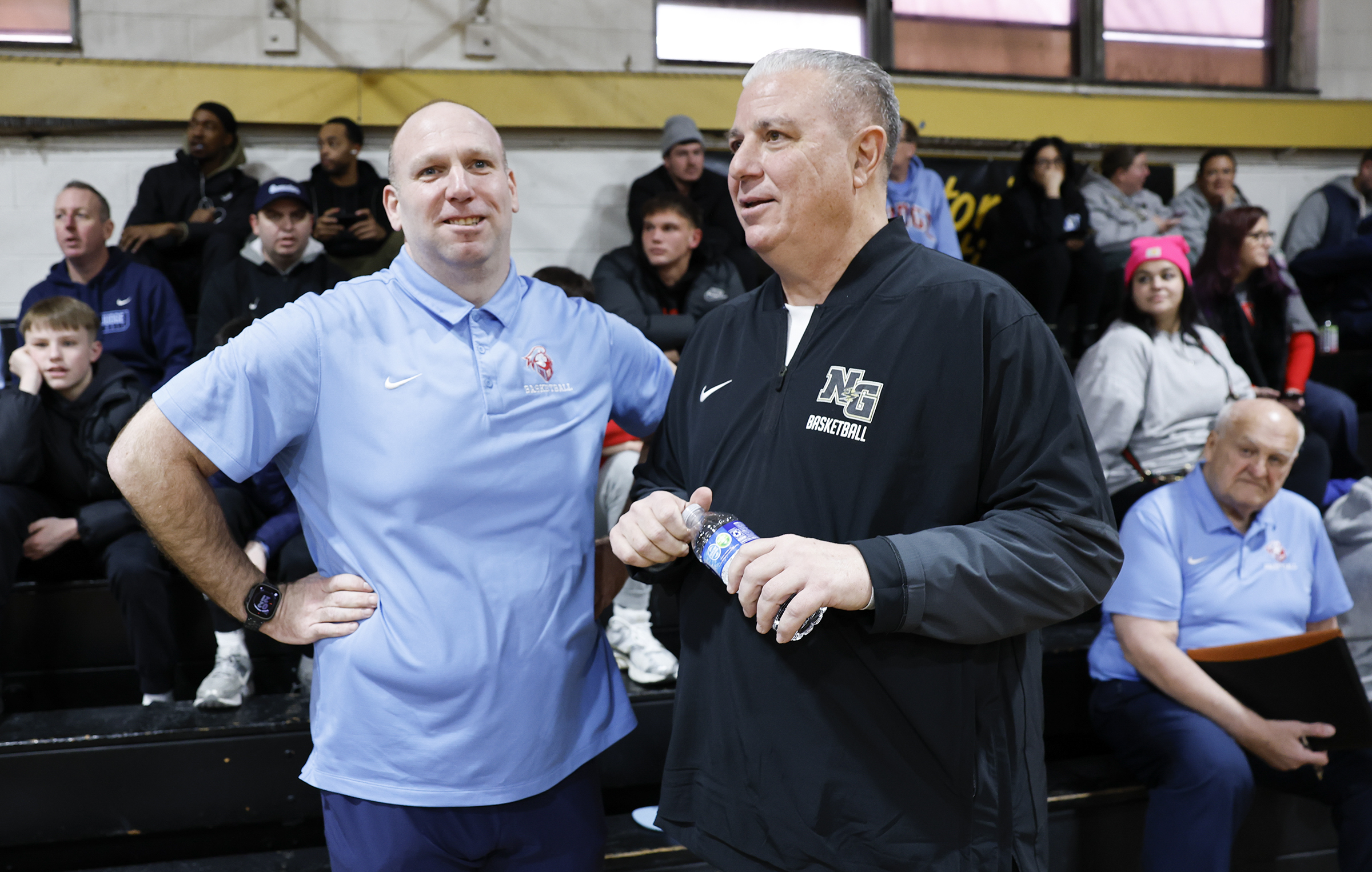
Neumann Goretti head coach Carl Arrigale (right) meets with Father Judge head coach Chris Roantree before the two teams played each other in February 2026.Yong Kim / Staff Photographer
“Here’s the thing: Philly is Philly,” Roantree said. “So if you want all the Philly kids to go to public schools, they’re still going to dominate. There are six, seven, eight, 10 good teams in the Catholic League. If they’re in the playoffs, they’re going to make some noise” in the state tournaments.
The primary complaint among suburban public school coaches and administrators, of course, is that non-boundary schools don’t limit themselves to drawing talent from the city or the neighborhoods that surround them. To some public-school coaches, the notion of recruiting is an alien concept, one they wouldn’t consider if for no other reason than they or the athletes’ families would have to make the necessary arrangements for the athletes to live within district boundaries — say, finding a long-lost aunt whose house was within walking distance of a school bus stop.
Liz Potash, who retired earlier this summer after 13 years as Central Bucks East’s girls’ basketball coach, said she never sought out players to refill her program’s talent pool. “If I wanted to recruit, I wouldn’t be a public-school coach,” she said. “I’m not going to beg an eighth grader to come to East.”
But another coach might.
“Everyone’s doing it,” said Daniel DiBerardinis, who spent 11 years as a Catholic League athletic director — six at Roman Catholic, five at St. Joe’s Prep — before becoming Penn Charter’s AD last year. “Public schools are recruiting. They recruit. People move to different zip codes all the time.
“I’m not going to put any school on blast, but I know intimate situations — I know families who got an address to be a part of a district. I’m not going to say any schools, but I do know it happens. The rules are super-gray, and people are always going to find workarounds.”
Father Judge takes on Archbishop Wood during in the Catholic League boys’ basketball semifinal at the Palestra on Feb. 18, 2026.Isaiah Vazquez / For The Inquirer
Technicalities
Football, boys’ basketball, girls’ basketball: It’s within the worlds of those three sports that the debates and bickering around recruiting are the loudest and have the most relevance. Rep. Scott Conklin, a Democrat who introduced House Bill No. 41 and represents the 77th district, in State College, all but admitted that the bill was aimed at stopping private, parochial, and charter schools from recruiting — and from continuing to move into the next frontier: wielding sponsor dollars or name, image, and likeness deals to entice athletes.
“Technically, yes, public schools could cheat,” he said in a phone interview. “But we know how difficult that is. I’m 67 years old, and I can win the high-jump competition — technically. But we all know it’s never going to happen.”
In that Palestra locker room back in February, Roantree snickered at the mere mention of the subject. “Everybody says it’s an unfair advantage,” he said. “What I say is, every kid’s got a dream of playing Division I, and there are a lot of coaches in our league who can make that happen. We don’t have to recruit as much as kids want to come and play for us.”
Four days later, behind a team-high 14 points from Morton-Rivera, Father Judge beat Goretti to win its second straight PCL championship. The Crusaders advanced to the semifinals of the PIAA Class 6A tournament, where they lost to a city rival, Imhotep Charter, which then lost in the championship game to Harrisburg’s Central Dauphin.
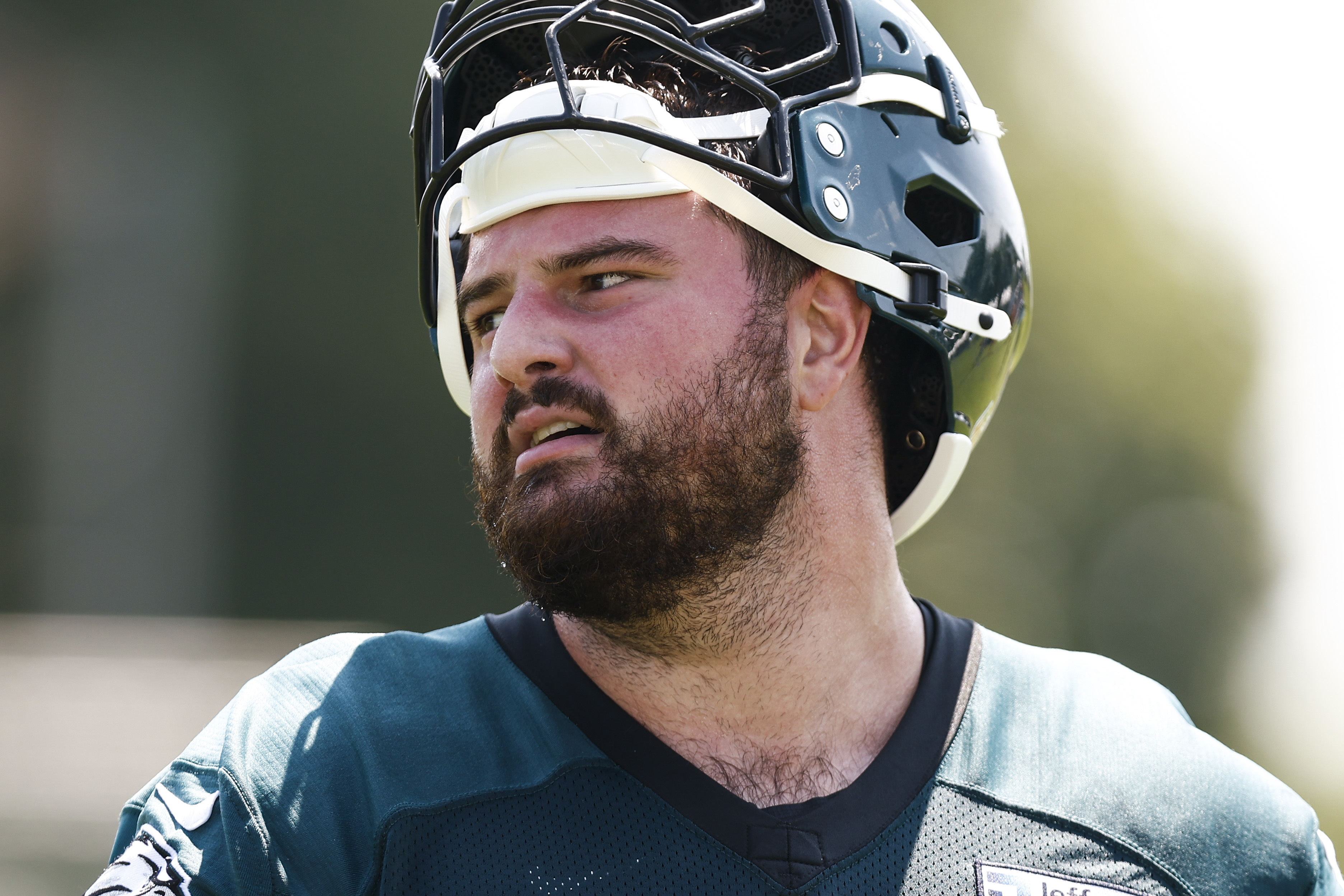
Landon Dickerson stepped into a South Philadelphia sports bar Monday night and started answering questions, and anyone there who cared to understand the reality of professional football should have stopped chowing down on cheesesteaks and crab fries and listened closely to him.
Dickerson didn’t break any news about his health or his status as the Eagles’ starting left guard. The Inquirer’s Jeff McLane took care of that, revealing that the team was placing Dickerson on injured reserve because of bone bruising in his right knee.
For at least four weeks, Dickerson will be out of the lineup, and backup Drew Kendall will probably replace him, and the easiest, coldest reaction is for Eagles fans to cheer that change and celebrate that their favorite team’s running game has a chance to be functional again. At best, they might laud Dickerson for acknowledging publicly what everyone who watched him could see: that he was nowhere close to 100% physically, just as he was a less effective player throughout last season after undergoing knee surgery and suffering through a host of other injuries, and that he shouldn’t have suited up Sunday at all.
“Honestly, to address the elephant in the room, I played like [poop],” he said during an interview on WIP 94.1. “I was a complete liability [Sunday], and again, that was my fault. I know I said earlier in camp I shouldn’t be out there until I feel healthy. A few weeks ago, got rolled up on in practice. I thought as weeks went by, it would get better, and it didn’t.”
Eagles offensive lineman Landon Dickerson learns he's being placed on IR on the air. Dickerson admits he played like “s**t and was a complete liability yesterday.” pic.twitter.com/xTXOVZz7A6
His stint on injured reserve, he said, might allow him to “have a good stretch at the back of the season as opposed to what happened last season, which was go out and limp it through for 18 weeks. I don’t think anybody wants to see that again because that was just ugly. I don’t want to do that again because that was just some B.S.” But his admissions only raise the obvious questions: If Dickerson was so compromised, why was he out there? Why not simply let Kendall start?
This, of course, is where pro sports generally and the NFL specifically get tricky and uncomfortable, especially for those who want to close their eyes and plug their ears and root for their team … and who don’t want to contemplate the potential cost of that victory. Dickerson felt an obligation to be on the field, sure, not just because he owed it to his teammates but also because he owed it to himself. It’s how he perceives himself. He’s 27. Football in high school. Football in college. Football as the only job he’s ever known.
If he’s not lining up across from a defensive tackle or end and trying to pancake that guy, if he’s not in the huddle or on the sideline, if he’s not testing himself as an individual, if he’s not sharing in the camaraderie and common mission of his teammates, then who is he?
“We’re football players,” Dickerson said. “That’s what we do for a living. When you take that away from us, when you’re not doing what you know you can do, it hurts. It’s just kind of like taking your identity away from you. It’s one of those things where you keep fighting for it. You’re like, ‘I’ve got to keep doing this until somebody pulls me out on a stretcher or something else.’ But then you’ve got to look at it and say, ‘Is it about you? Or can we put somebody else out there right now who is going to do better?’”
That’s an admirable, unselfish approach for Dickerson to take. But it’s likely cut with another, more practical perspective: that as accomplished and talented as he is, there’s no guarantee that, once he leaves the lineup, he’ll get his job back.
Landon Dickerson’s Pro Bowl citations do not guarantee him a place in the lineup when he returns from injury. Yong Kim / Staff Photographer
What if Kendall is a revelation at left guard? What if Dickerson’s knee doesn’t heal enough to allow him to play — or to play at the Pro Bowl level he did in 2024? Does anyone really believe that the Eagles or any NFL franchise would remain so loyal to someone in Dickerson’s shoes? And any fans suggesting that Dickerson has earned the right to return, regardless of the circumstances, should be honest with themselves:
If the Eagles are rolling, if the offensive line looks great with Kendall, how would you react if they removed him and reinserted Dickerson? Would you be so sympathetic to Dickerson then, or would you worry first and foremost about whether he’d be able to keep Jalen Hurts’ pocket clean and open holes for Saquon Barkley?
Would you tell him to keep his butt on the bench for the sake of your own hopes and happiness?
Were you all that sympathetic to him Sunday, when it looked like the Eagles might lose?
You ask why Landon Dickerson played against the Commanders, why in doing so he basically dared coach Nick Sirianni to make the difficult decision to bench him, why he was willing to damage the cohesion and performance of the Eagles’ offensive line, and the question answers itself. Next man up is a convenient cliche. Too many people forget or don’t give a damn about its corollary: First man, out. Sometimes for good.