Author: David Murphy

  • Draymond Green is right about VJ Edgecombe. But he couldn’t be more wrong about LeBron James.

    Draymond Green is right about VJ Edgecombe. But he couldn’t be more wrong about LeBron James.

    Draymond Green is wrong about one thing. VJ Edgecombe’s agent should be ecstatic. If he isn’t, then Edgecombe should find a new agent. There are only a small handful of people who have more to gain from LeBron James signing with the Sixers, and all of them own charter helicopter services that fly between New York and Philly.

    That’s not to say we should completely dismiss the concern raised by Green in a recent podcast episode.

    “If I’m VJ Edgecombe’s agent, I’m not sure I’m happy with the summer that the 76ers have had,” said Green, the star power forward whose Warriors were among a number of contenders that had hoped to land James. “Like you go from being sometimes the second option when [Joel] Embiid was out to sometimes being the fifth option. It’s a big, big difference.”

    Green isn’t wrong about the overarching issue. What he’s missing is that the issue predated James, and that James is much more likely to alleviate it than exacerbate it.

    Nick Nurse will need to be mindful of Edgecombe’s usage rate. On a team with three prime-aged players accustomed to getting 20-plus shots per game plus LeBron, the Sixers would be doing themselves a disservice if they allowed Edgecombe to pause his superstar progression to spend a couple of seasons as a glorified Josh Hart. I don’t know if I’d go so far as to call it a concern. But it is most definitely an unknown, one that carries some downside risk. Green is right about that.

    Edgecombe’s superstar flashes as a rookie occurred in moments and stretches where he operated as the primary option. We got the best glimpses of the guy he could become in the moments where the Sixers needed him to be that guy: when the offense ran through him, when the success or failure of the possession at hand was his to dictate. Remember the 20 points he scored in the first half against the Celtics in Game 2 of the Eastern Conference semis? Edgecombe scored five unassisted buckets during that heater. Four of them were pull-up jumpers, including a 27-footer from three-point range.
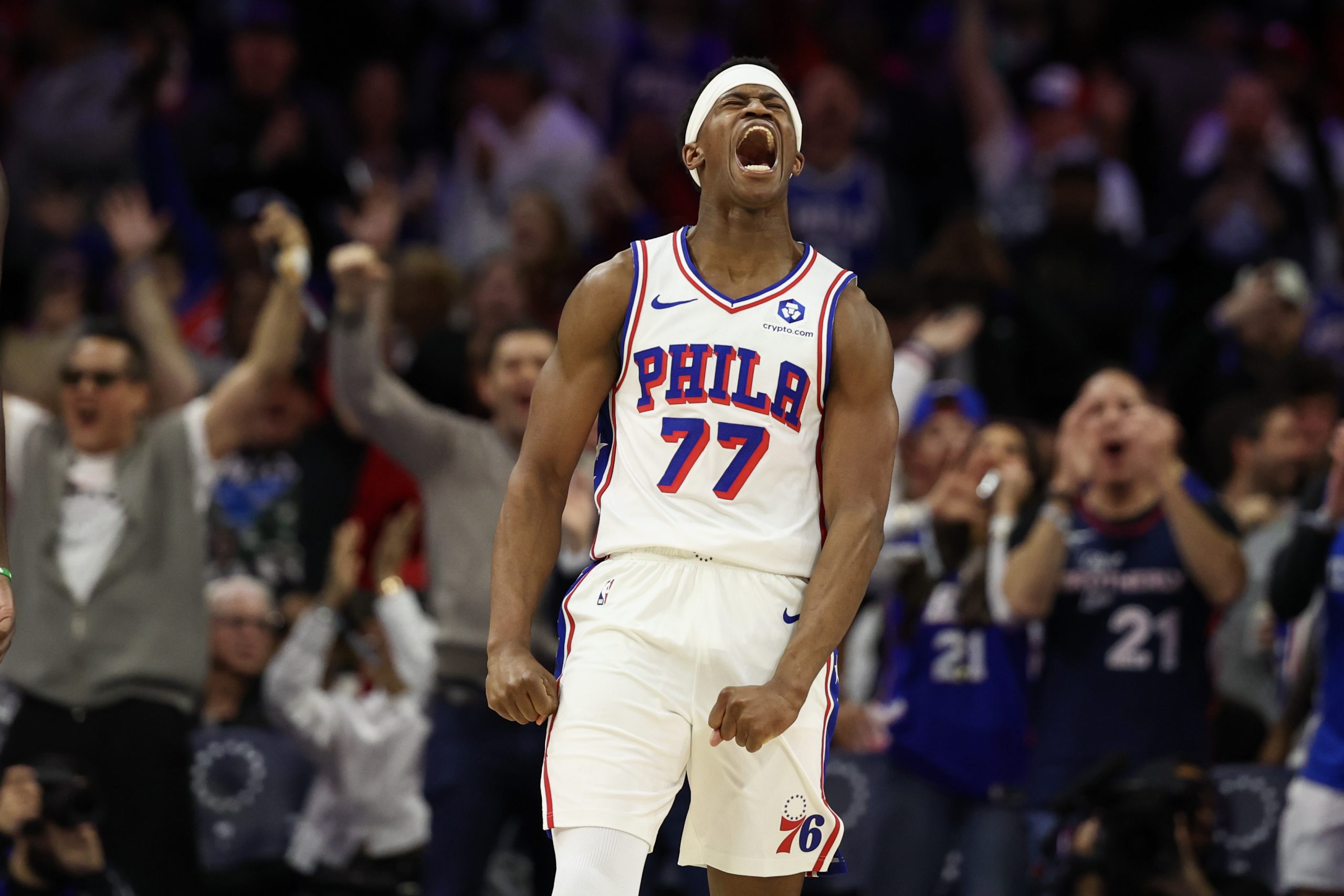
    Sixers guard VJ Edgecombe will be a key member of one of the NBA’s best five-man lineups.Monica Herndon / Staff Photographer

    That aspect of Edgecombe’s game is why NBA folks mention guys like Jimmy Butler and Dwyane Wade when talking about his potential. Neither is a perfect comp. Butler is a better one than Wade. They both make sense from a stylistic viewpoint. Wade and Butler are/were two of the best at methodically getting to their spots and then owning that spot. That’s something a player needs to develop, both in terms of feel and in terms of pacing. So, yeah, it’s a potential drawback if Edgecombe always gets last dibs on spots. I’m just not sure I agree with Green that LeBron compounds the potential issue. I actually think he could prove to be a godsend for Edgecombe.

    Two things you can say about James throughout his career. One, he recognizes talent; and, two, he is willing, even eager, to facilitate things for that talent. That’s especially true of young talent.

    Kyrie Irving flourished alongside James in Cleveland. So did Austin Reaves in Los Angeles. James has played with a slew of young up-and-comers who didn’t have nearly the talent that Edgecombe has. All had plenty of opportunities. Kyle Kuzma and Brandon Ingram both averaged at least 18 shots per 100 possessions when they were on the court with James during his first year with the Lakers. Malik Monk had arguably the best season of his career as a 23-year-old Laker. D’Angelo Russell’s most efficient seasons — really, his only efficient seasons — came during the 125 games he played with the LeBron Lakers.

    Two years ago, Russell, James and Anthony Davis all averaged between 14 and 18 shots per game, while Reaves and Rui Hachimura both got between 10 and 12. Keep in mind, James and Davis both played 70-plus games and 35-plus minutes per night that season.

    Nurse will be able to find spots to let Edgecombe do his thing. James only played in 60 games last season. Embiid has played in 96 total over the last three seasons. During the course of a game, you could see a lineup with Edgecombe, Dean Wade, Anfernee Simons, Kentavious Caldwell-Pope and a backup center on the court together.

    James shouldn’t be a drag on Edgecombe. He should be a force multiplier. There’d be a bigger reason for concern without him. Really, it’s what makes the signing of James so transformative. Before, there was some real reason to wonder how well Edgecombe and Maxey would mesh with a couple of ball-dominant alphas who both feel as if they have a lot left to prove. James’ biggest benefit to the Sixers is his ability to smooth that dynamic, not so much in the locker room but on the court with his style of play and commanding presence. There’s a very real world where he ends up serving as the bridge connector between the younger and older halves of the foursome.

    The biggest winners of last week’s wild turn of events were Edgecombe and his financial dependents. Them, and the Air Redick operators.
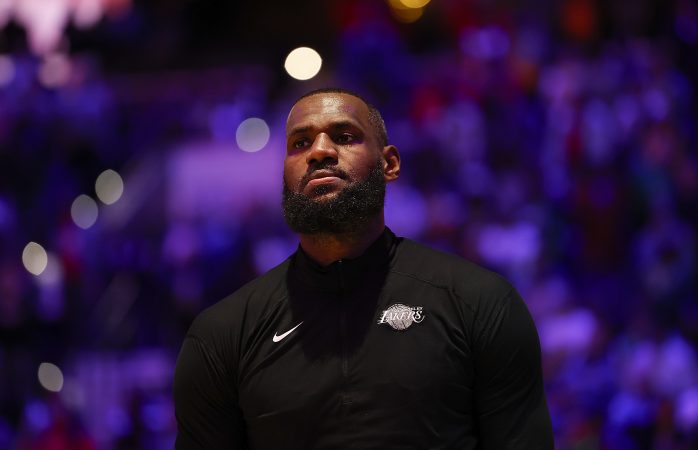
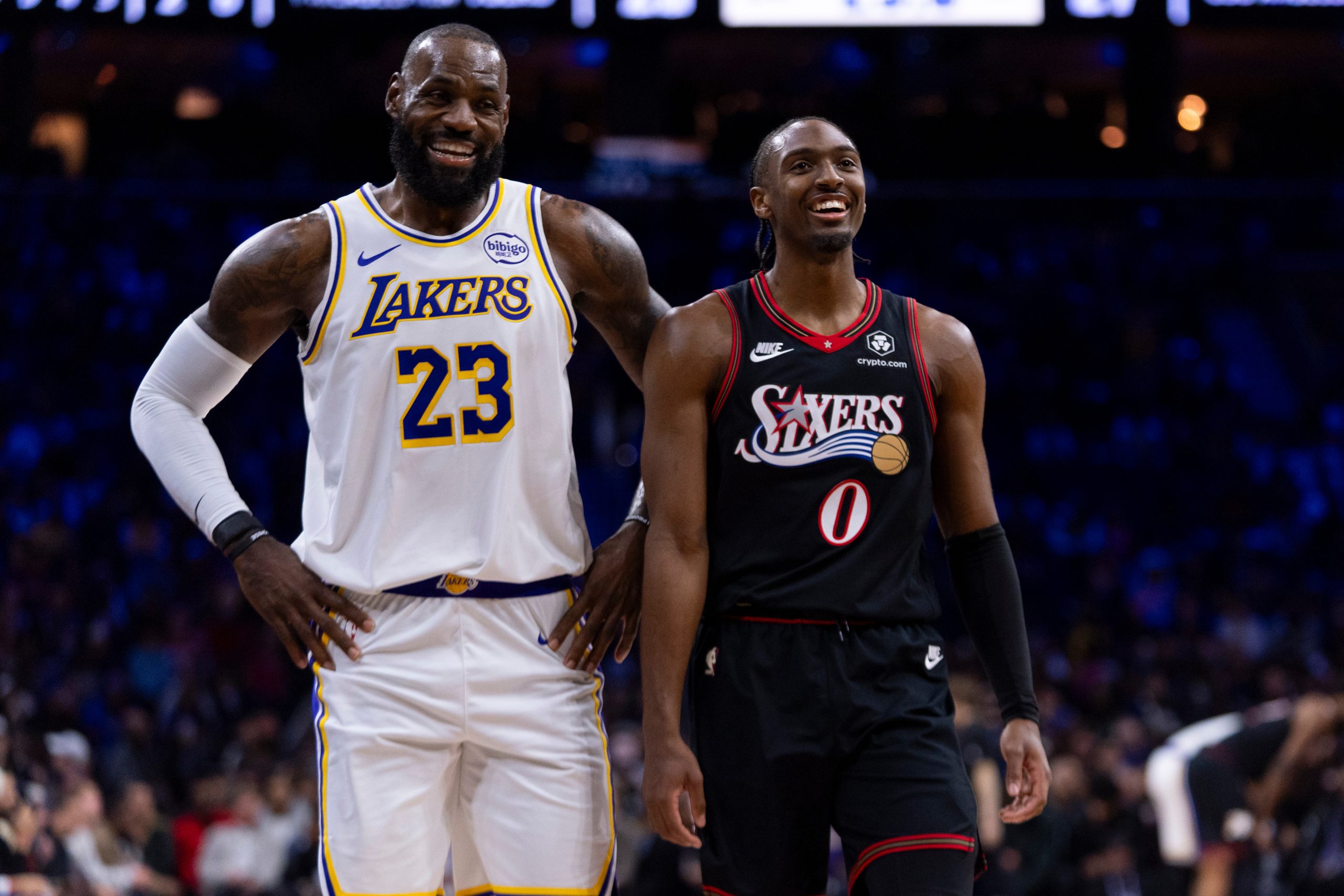
  • LeBron James’ maddening process was everything the Sixers needed

    LeBron James’ maddening process was everything the Sixers needed

    LeBron James chose the Sixers the only way he could.

    By letting everyone think there was no way he would.

    It all makes a little more sense now, doesn’t it? The weeks of deliberations, the radio silence, the professions of ignorance from those close to James, the cryptic dispatches from the Man Behind the (Recording Studio) Curtain. For nearly a month, the world watched and waited and speculated amid a maddening self-muzzling interrupted only by the occasional communication via proxy. What we knew came almost entirely from a handful of podcast episodes where Rich Paul sounded more like a bystander than James’ agent and confidant.

    Eyes were rolled. Deep breaths were sighed. Every lapsed news cycle was another shell in the stockpile of the critics and skeptics and purists who prefer brands of basketball to basketball brands. James’ most hostile audience has always been those who would rather live in a world where the Greatest of All Time is not first and foremost a business, man. But let’s give them their due. Even someone who is unbothered by the primacy of the 1099 in sports could have found their patience tested by James’ monthlong melodrama.

    In hindsight, James’ actions seem perfectly reasonable. This wasn’t attention-seeking behavior. It was the private torment of a man who was about to choose, via his own free will, to move from Los Angeles to Philadelphia.

    But it is deeper than that. Everybody involved needed it to go down this way. The significance of James’ signing with the Sixers is that he had every reason not to. He had other options, all of which had won championships within the last decade-and-a-half. They had superstars, some of the greatest to ever play the game: Steph Curry, Nikola Jokić, Giannis Antetokounmpo, James Harden.

    They had stronger personal ties, more spotlight appeal. They had the tech scene, the outdoors, the party scene. James said he was looking for basketball bliss. Which means there is a lot of political capital in the fact that he chose the Sixers. The basketball is all they had to offer.

    LeBron James has a well-documented friendship with Tyrese Maxey with both being part of Klutch Sports.Chris Szagola / AP

    It’s perfectly valid to question whether James at 42 years old will create the on-court impact worthy of the hoopla surrounding his decision. There are plenty of scenarios where the sum of the parts exceeds the whole. That’s true even before you factor in age and injury. In James, Jaylen Brown, and Joel Embiid, the Sixers have three players who are accustomed to having the loudest voice in the room. In Tyrese Maxey and VJ Edgecombe, they have two young players who have been plagued by bouts of deference when sharing the court with more established veterans.

    Yet, therein lies the significance of James’ deliberate evaluation of his options. The great general Charles de Gaulle once said that silence is the ultimate weapon of power. For weeks, everyone wondered what he would decide, and why. They thus imbued his ultimate decision and explanation with a tremendous amount of power. It meant something when James finally picked Maxey, and Edgecombe, and Brown, and, yes, Embiid. Everybody assumed James wouldn’t pick the Sixers because they were the Sixers. But he did pick them, which automatically makes them something nobody thought they were before.

    Intentional or not, James’ decision-making process has empowered both his new organization and his new teammates before he has even arrived.

    You probably saw the social media video Maxey released in the wake of James’ signing. It was just a few seconds of him yelling spastically. You have to think that there was a little bit of that going on inside Brown and Embiid as well. At various points over the last few years, both players have allowed their veils to slip from their insecurities. Brown, passed over for the Olympic team after winning NBA Finals MVP, second fiddle to Jayson Tatum, inefficient, overpaid, not a real superstar.

    Embiid, injured, maybe finished, soft, selfish, supplanted by Maxey and Edgecombe as the heart and soul of a franchise. Who knows how those insecurities would have played in a power vacuum like that which could have existed without an unquestioned adult in the room. Insecurity is mostly thirst for validation. To be good enough for the best is a heck of a quench.

    Part of me wonders whether LeBron’s real attraction to the Sixers is an opportunity to lead. Not that he hasn’t always led, in both spirit and example. But the Sixers offer him a unique opportunity.

    More than any of the teams that pursued him this offseason, maybe even more than any team he has been on to this point, the Sixers were a team that genuinely needed exactly a player and a person like James is right now. It will be fascinating to see how the whole thing will look on the court, and what part James will play. Don’t be surprised if his biggest impact has already been made.

  • A note to LeBron James’ skeptics. And maybe to the Sixers’.

    A note to LeBron James’ skeptics. And maybe to the Sixers’.

    Anybody who doubts the existential significance of the news that broke late Friday morning only needed to walk through Center City as the world broke for lunch. It was the darnedest of things, borderline ridiculous, enough to make you cringe in real time at the thought of writing it down. You could keep a steady pace and never escape the news, for every few strides there was another person telling someone else at a volume everybody else could hear, receptionists and tradesmen and medical technicians and folks waiting for buses to parts unknown, flashing phone screens like lottery tickets and yelling “Yo” into microphones and, in at least one case, wandering alone looking up toward the sky with a smile so zen you could have sworn you were one of the ones getting left behind.

    It was a startling thing to witness. A revelation, even. Amid the direct and inescapable blast of modern day America’s technological firehose, there are still stories so universally relevant as to draw a chorus from chaos and fragmentation.

    It was also a reminder. A reminder that, however ardent his skeptics and critics, however loud their sighs, however long their rolls of eyes, LeBron James long ago escaped the containment of both basketball court and court of public opinion. He is a cultural singularity, to an extent that few athletes before him have ever been.

    That might be a helpful thing for the sighers and eye-rollers to keep in mind. Even if LeBron is not your GOAT, or even your ideal of what a great athlete should be, it has little bearing on the significance of his deciding to cast his final lot with the Sixers. He is unquestionably on the shortest of short lists for the best to have ever done something, and even if he isn’t the best still doing it, he is good enough to have had a standing offer from virtually every contending team in the NBA. Sure, there are teams, and fans of teams, who could argue that the spectacle might conflict with the mission. But, then, these are the Sixers. The spectacle is James choosing to join them. The reputational risk is disproportionately his to bear.

    LeBron James has won titles recently, and the Sixers have not been close. Mark J. Terrill

    It would be silly and self-disqualifying to ignore the magnitude of such a decision. Miami, Cleveland, Golden State, Denver — all have won titles. Those who have done it without him might be justified in thinking about legacies, whether that of the organization or that of the incumbent superstar. The Sixers have no legacy. Less than a month ago, they had very little hope of being relevant for the next three years. There aren’t many worst-case outcomes for them.

    Isn’t that the genesis of the reaction? Its universality? Its … audibility? On a basketball level, on a competitive level, one has no choice but to at least pay some reconsiderations to one’s prior assumptions about both player and team.

    The only thing the Sixers had going for them was the basketball level. Whether James proves to be a difference-maker is almost secondary to the fact that he thinks he can be. Nobody has ever done what he is attempting to do, on practically every different level. Win a title with a fourth team. Win a title at the age of 42. Win a title alongside Joel Embiid.

    Nobody has ever done those things. Yet, few have done anything that James has already done at every juncture of his career. He already holds the record for most minutes played at both age 40 and age 41. The 1,989 he logged last season were nearly 300 more than Kareem Abdul-Jabbar in 1988-89. That doesn’t include the postseason, when James averaged 38 minutes and 23.2 points per game to lead the Lakers to a first-round upset of the Rockets without co-star Luka Dončić.

    James isn’t the player he once was, obviously. He may not even be the player that the current consensus holds him to be. His .594 true shooting percentage — a measure of collective offensive efficiency from the field and foul line — was slightly better than league average in 2025-26. His 30.8 points per 100 possessions average was his lowest since his rookie season and nearly four points lower than any season since. He does not rebound or force his way to the foul line the way he once did.

    But all of that only lowers James to the level of all of the other players throughout his career who weren’t anything close to the players he was in his prime. The difference is that those players were also in their primes. James is 41. If you erased everybody’s age from the stats, you’d easily zero in on him as a player who would be a massive value on a playoff roster at $4 million per year. That’s before you factor in the sum of his game: not only the ability to carry an offense for stretches as a primary scorer and spend the interim as an elite connector, but also the true ballplayer aspects of the game that escape quantification. It isn’t a fluke that the Lakers were a better defensive team in both the regular season and postseason when James was on the floor. It isn’t a coincidence that they rebounded better and committed fewer turnovers in the postseason.

    For all of James’ physical advantages, for all of the legitimate debates one can have when weighting those advantages in the Greatest of All Time argument, anybody who has watched James play should be able to appreciate the feel that he has for the game of basketball. He is the rare superstar who is also a glue guy, as evidenced by the varied rosters with which he has won championships.

    Therein lies the real coup for the Sixers.

  • It’s concerning that the little things the Phillies and Dodgers did were quite the contrast

    It’s concerning that the little things the Phillies and Dodgers did were quite the contrast

    It’s time to talk about every baseball diehard’s favorite topic.

    The little things.

    They are often overlooked, and often deservedly so. The little things are the last bastion of managers, players, and fans when a team doesn’t do the big things very well. They are a coping mechanism. Often. But not always.

    We can’t ignore the little things anymore when it comes to the Phillies. The little things cost them dearly in losing two out of three to the Dodgers. You might write that off as happenstance, except that the Phillies are less than a year removed from a playoff loss to the Dodgers where the little things proved decisive.

    Last October, we saw Nick Castellanos get thrown out at third with no outs in the top of the ninth inning while representing the game-tying run. We saw Orion Kerkering react to a routine ground ball like he was an iPhone that had just been dropped in a toilet.

    These weren’t your average, everyday bad bounces and tough breaks. They were the kind of plays that leave you trembling at the heavens. You don’t expect to see something like that in a baseball game. You certainly don’t expect to see it again.

    And yet …

    The most disconcerting thing about the Phillies’ series loss to the Dodgers wasn’t the mistakes. It was that the mistakes looked remarkably similar to the ones they made while losing last year’s National League Division Series to the Dodgers.

    The lasting image from October was J.T. Realmuto with his mask off pointing toward first base as Kerkering’s brain prepares to betray him.

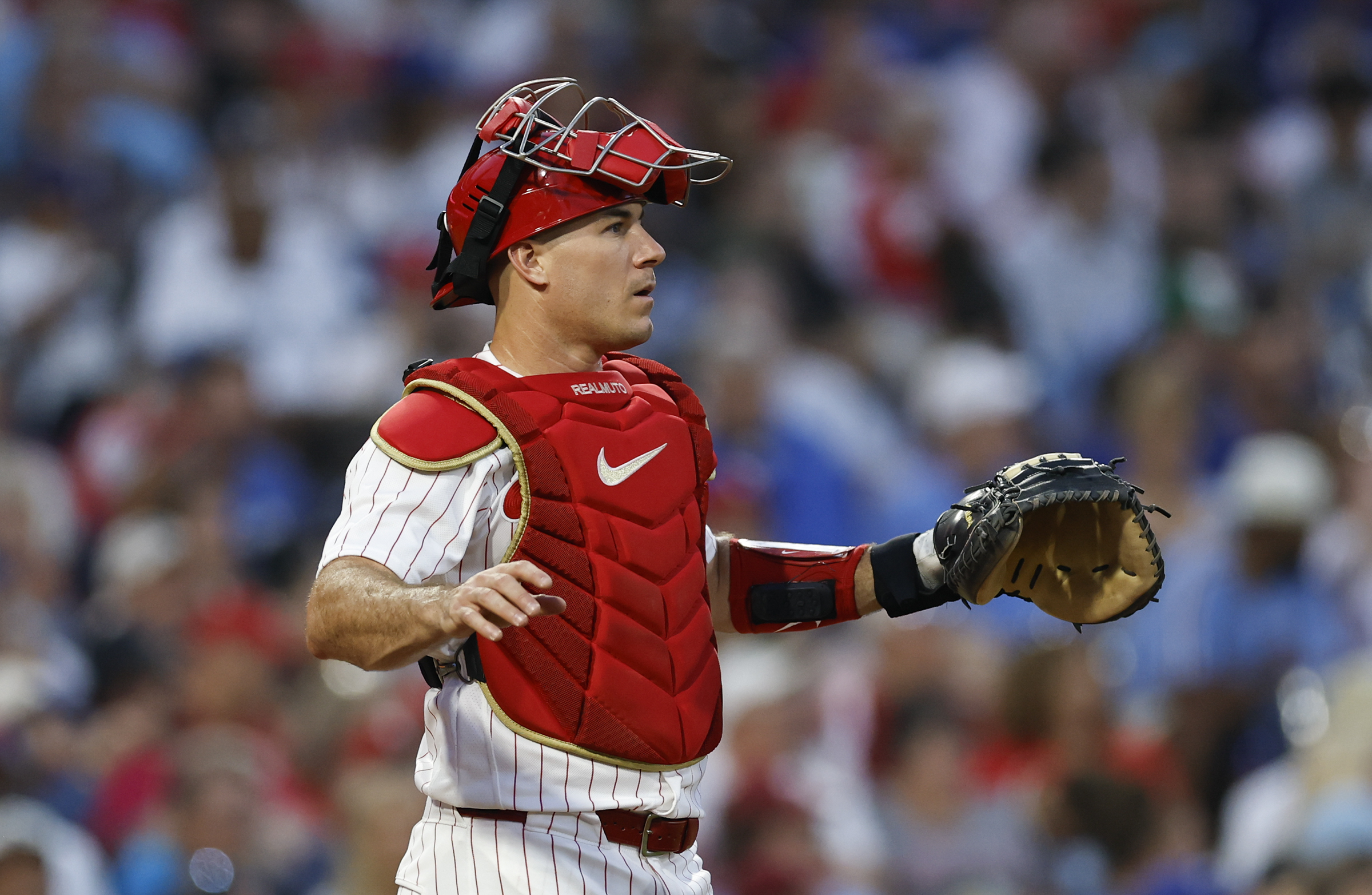
    J.T. Realmuto in action during the Phillies series against the Los Angeles Dodgers this week. Yong Kim / Staff Photographer

    The lasting image from this week’s series was Realmuto running from third base back to second base as everyone else stares in disbelief.

    Realmuto’s game-ending gaffe on the basepaths in the ninth inning on Tuesday was only the most iconic moment. Other consequential miscues included:

    • Bryson Stott running into a non-forceout at third base on a ground ball hit in front of him in Wednesday’s 9-5 loss.
    • Rafael Marchán popping up a sacrifice bunt attempt earlier in Wednesday’s game.
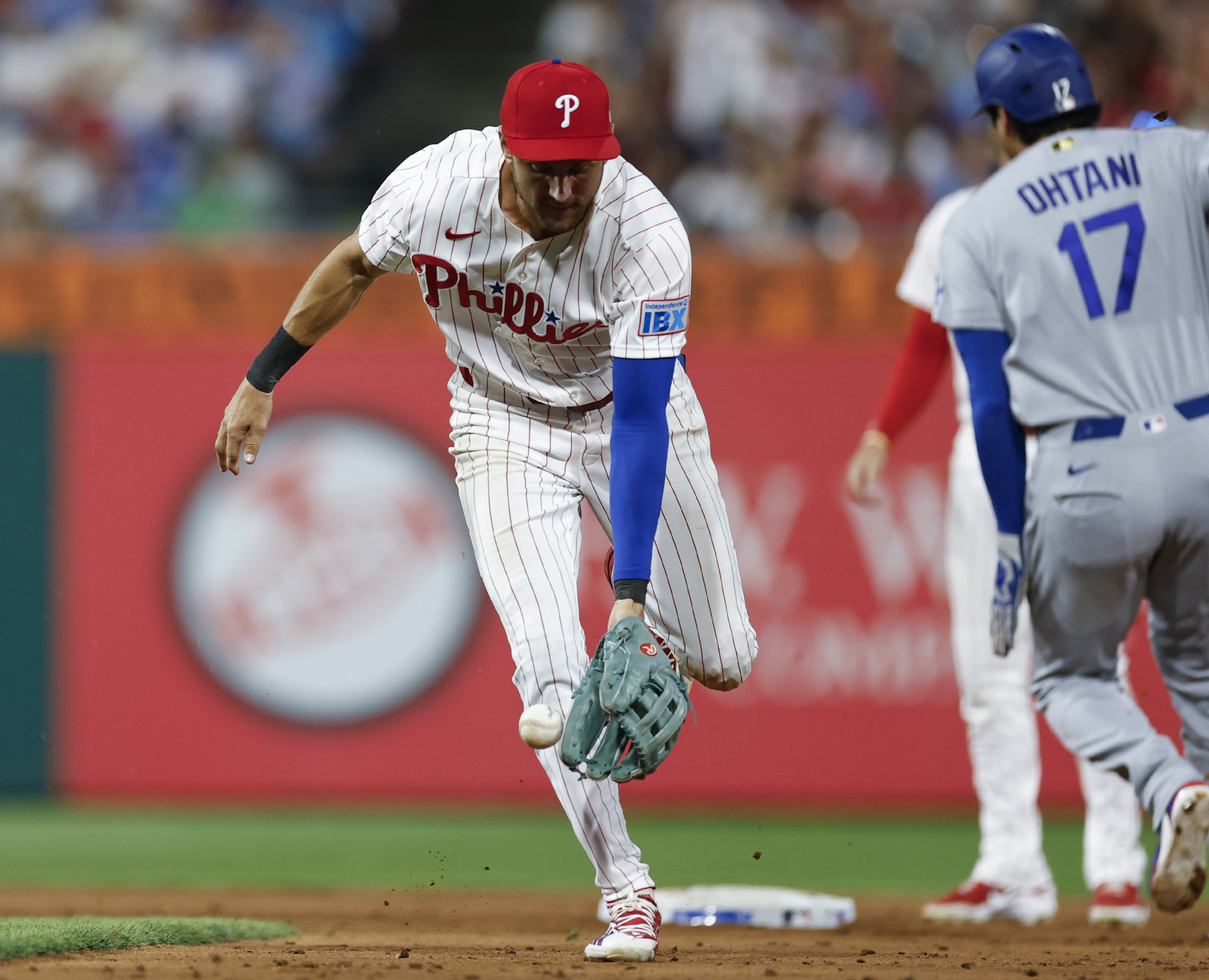
    • Trea Turner misplaying four balls in the series opener.

    Turner made up for his rough defensive showing by driving in five runs during the Phillies’ 10-7 win on Tuesday. But even that victory ended in inglorious fashion, with closer Jhoan Duran scrambling to get warm after the Dodgers halved a six-run deficit against Chase Shugart.

    It’s bad enough to fail at the little things. It’s devastating when your opponent does the exact opposite. For all the bellyaching about the Dodgers’ payroll and the competitive behemoth that Andrew Friedman has built, the reality is they’d be an enviable organization even without their limitless capital.

    It’s true in the front office, where LA has made a habit of finding pitching like lefty Justin Wrobleski and is currently paying Max Muncy the same amount as the Phillies are paying Adolis Garcia. It’s also true in between the white lines.

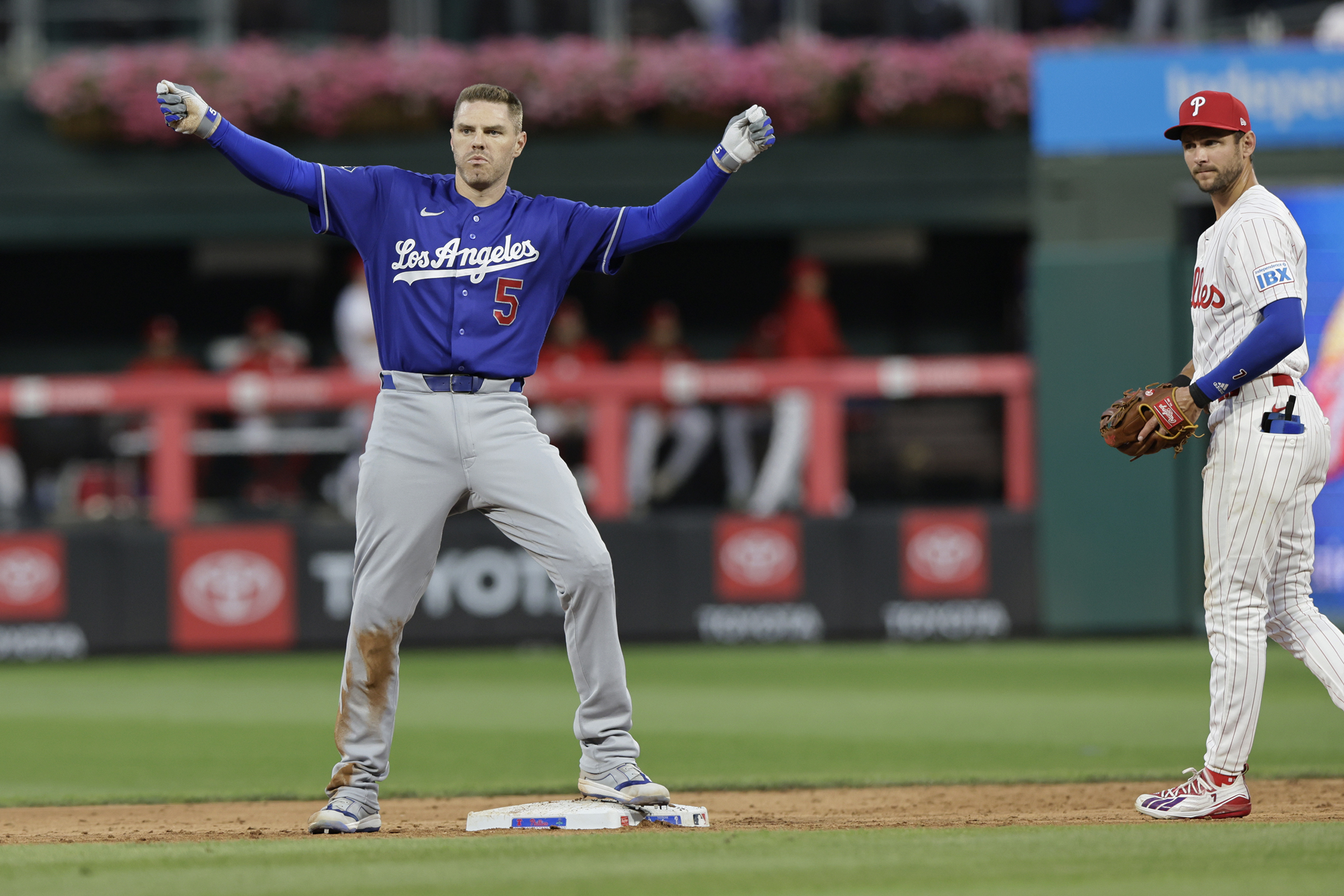
    Trea Turner looks on as the Dodgers’ Freddie Freeman goes into second base on a double in the fifth inning of Wednesday’s game.Elizabeth Robertson / Staff Photographer

    Baserunning? The Dodgers entered Thursday tied for second in the majors in extra bases taken and ranked fifth in efficiency. They also had the second-fewest outs on the basepaths. The Phillies rank 11th in extra bases but 24th in efficiency (credit where it’s due: They have the eighth-fewest outs on the basepaths).

    Situational hitting? The Dodgers rank 12th in productive out percentage (Phillies: 21st). They have 19 pinch hits compared with the Phillies’ nine.

    Fielding? The Dodgers have committed just 37 errors, tied for the fewest in the majors. Advanced metrics rank them even further as one of the better fielding teams in the majors. Not so for the Phillies. The Phillies have committed 50, which ranks 14th.

    “If we play well, we’re capable of beating anybody,” manager Don Mattingly said after Wednesday’s 9-5 loss.

    That’s less of a boast than it probably reads on paper. The “if” is the point.

    The bigger the games, the bigger the little things become. It’s hard to blame Mattingly for a problem that predates him. That said, he is the one who needs to figure out a fix before another October arrives.

  • Two players who could help the Phillies address their biggest trade deadline need

    Two players who could help the Phillies address their biggest trade deadline need

    An underrated stat as we look ahead toward the trade deadline: The Phillies are 42-15 in games started by Cristopher Sánchez, Zack Wheeler, or Jesús Luzardo.

    Impressive? Sure. But also jarring, due to the simple math that follows.

    The Phillies have a 56-46 overall record. Which means they were 14-31 in games started by anybody other than Sánchez, Wheeler, or Luzardo.

    Let that number marinate. The more you do, the more you might begin to rethink the Phillies’ trade deadline calculus. This time of year, there are wants and there are needs and there are would-be-helpful-to-haves. A lot of folks seem to have relegated starting pitching to that third bin. In reality, it might be Dave Dombrowski’s most pressing order of business.

    The Phillies don’t necessarily need a fourth Cy Young-caliber arm. They shouldn’t be looking for 2009 Cliff Lee or 2010 Roy Oswalt. They can set their sights much lower than the Tigers’ Tarik Skubal or even the Twins’ Joe Ryan. Maybe even lower than Boston’s Sonny Gray. At the same time, Dombrowski needs to be thinking bigger than this year’s version of Walker Buehler or Noah Syndergaard. The Phillies don’t just need someone who would give them a fighting chance in a late-season, must-win game against the Braves. They need someone who could potentially start Game 1 of the National League Division Series. Let’s begin our argument there.

    1) Who is the Phillies’ fourth starter in the postseason?

    They won’t make it through October without needing one. Unless their October is tragically brief. The Phillies could need someone outside of the Big Three as soon as Game 1 of the NLDS. All it would take is losing a game in the wild-card series, which would force Luzardo to the mound for a decisive Game 3. Assuming the usual one off day before the start of the NLDS, none of the Big Three would be on normal rest for Game 1.

    Even if the Phillies do have the top of their rotation lined up for the first three games of an NLDS, that still leaves Game 4. They were blessed with an extra off day last year against the Dodgers. That won’t be the case this year if Major League Baseball sticks to its previous pattern of alternating the extra off day between leagues.

    After their series concludes with the Dodgers on Wednesday, the Phillies face top teams like the Yankees, Rays, and Braves.Yong Kim / Staff Photographer

    2) Will the Phillies even make it to the postseason with the status quo, given the gauntlet that awaits?

    This week’s series against the Dodgers is the first of 11 that they will play against either the five winningest teams in the majors or three of the teams nipping at their heels in the NL playoff chase.

    It breaks down like this:

    • Six games against the two winningest teams in the American League (Yankees, Rays)
    • Six games against the two winningest teams in the NL, with two vs. the Dodgers already in the books
    • Seven games against the Braves, who entered Tuesday with a three-game lead in the division
    • Twelve games against the Cardinals and Marlins, both of whom were within four games of the Phillies in the loss column as of Tuesday
    • Factor in series against the Diamondbacks, Nationals, and Mariners and 43 of the Phillies’ 62 games post-All-Star break will feature opponents who entered Tuesday with a winning record.

    The Braves series looms especially large.

    The Phillies have a stretch in early September when they will play the Braves seven times in 10 days with no off days. Given the schedule, they’ll need someone other than the Big Three to face the Braves in at least two of those seven games.

    And what about the last week of the season? The Phillies are currently lined up to finish the year with six games against the Brewers and Rays. In order to line up the Big Three for a wild-card series, the Phillies would need a fourth and fifth starter to pitch two of the three games against the Rays. Even if they aren’t fighting for a playoff spot, they could be fighting for the right not to travel to Atlanta, Milwaukee, or Los Angeles for the wild-card round.

    3) Trading for a fourth starter could help the bullpen more than trading for another bullpen arm.

    To be clear, this isn’t an either-or. The Phillies clearly need to add some form of reinforcements for a bullpen that lost setup man Brad Keller for the season. José Alvarado offered some reason for hope in his appearance against the Dodgers on Monday. Orion Kerkering, less so.

    But innings are innings. The fewer of them that are pitched by starters, the more relievers must pitch. You’d rather have a starter coming out of the ’pen in a must-win postseason game than a reliever starting. Look at Luzardo in Game 4 of last year’s NLDS loss to the Dodgers.

    A couple of names that should at least intrigue the Phillies.

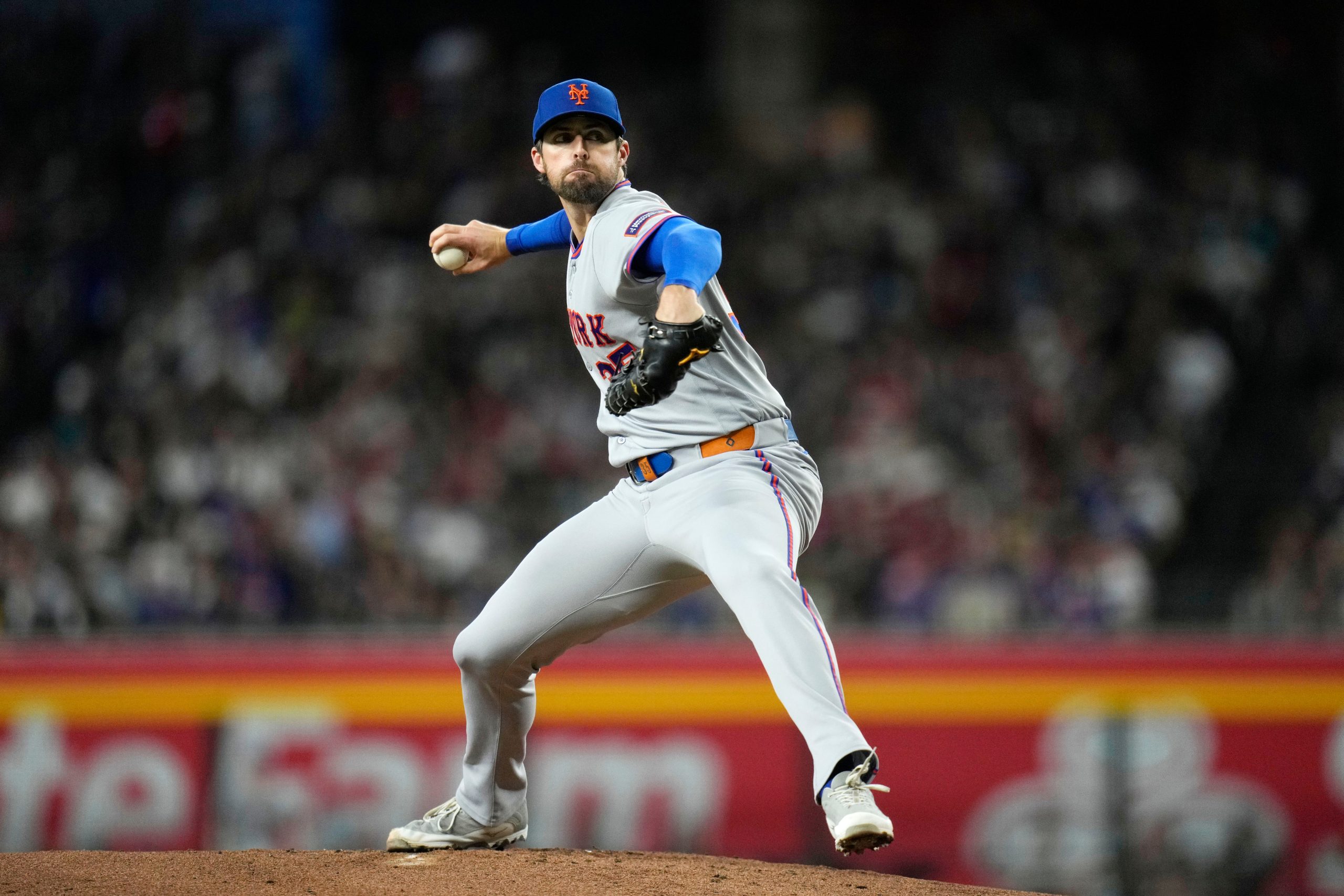
    Clay Holmes has a 2.39 ERA in nine starts this season for the Mets.Ross D. Franklin

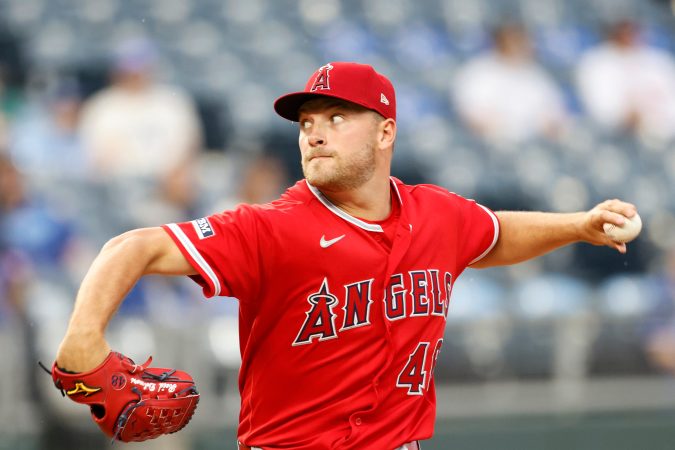
    Reid Detmers of the Angels and Clay Holmes of the Mets are both potentially available. Holmes, a right-hander, is presumably the most available, given that he is currently working his way back from a broken leg and has a player option for next season. Detmers, a lefty, still has two more full years left until free agency and is under contract for a meager $2.63 million this season. Only 27 years old, with borderline elite strikeout, walk, and home run numbers, he could end up costing more than the Phillies are willing to pay.

    Cost aside, both Detmers and Holmes have the kind of profile that should have the Phillies working the phones. Holmes was a longtime setup man with the Yankees who moved into the Mets rotation last season. Detmers moved to the bullpen last season after a disappointing year as a starter but has since rejoined the rotation. Either would dramatically improve the Phillies’ flexibility, both down the stretch and through the postseason.

  • Phillies’ bullpen desperation sets up a perilous trade deadline

    Phillies’ bullpen desperation sets up a perilous trade deadline

    Few things are more toxic than a bullpen that has no good answers.

    The Phillies are treading perilously close to that boundary line.

    Can they actually fix it?

    They can try, sure. They have no choice. With two weeks remaining before Major League Baseball’s trade deadline, the Phillies have exactly one reliever whom Don Mattingly would feel comfortable calling upon in a critical postseason moment. They have one who seems to be earning more of his trust but who would profile more as a dependable middle reliever in a legitimate championship bullpen. After Jonathan Bowlan, they have a couple of arms who are basically a coin flip. After Orion Kerkering and Jose Alvarado, Mattingly can do little more but pray for the best while expecting the worst.

    Dave Dombrowski was up against it even before he learned that high-priced free agent set-up man Brad Keller would miss the rest of this season and likely the next one with a UCL tear. Keller’s signing is ironic in the sense that the Phillies will be paying him the same money they would have been paying to Jeff Hoffman had they not allowed the righty to leave for Toronto, in part out of fear of the health of his arm. Further irony: Hoffman is one of the names that has been tossed around for teams in need of bullpen health, with the Blue Jays currently out of contention.

    Brad Keller is no longer a bullpen option for the Phillies. Yong Kim / Staff Photographer

    The most important thing to know about the trade deadline is that it isn’t as important as everyone would like to believe. Rare is the team that manages to fundamentally alter its outlook or identity midseason. In the best of cases, it is like the magic mushroom in a game of Mario Kart: a decisive boost deployed at exactly the right time while also eminently finite. The Phillies saw the best of cases back in 2009 with the acquisition of Cliff Lee. The next year brought Roy Oswalt, the year after that, Hunter Pence. They have yet to recapture the glory of 2008.

    The question is not binary, in other words. It is not, “Go for broke or stand pat?” The midseason trade market is, first and foremost, a market. All you can do is take what it gives you.

    From a decision-making perspective, the second-most important thing at the trade deadline is to stick to your principles. The first-most important thing is to figure out what those principles are.

    The biggest question right now:

    How confident are the Phillies that they will make the playoffs with the current roster?

    A better way to put it: How sure are the Phillies that the Marlins, Nationals, Cardinals, Pirates, and/or Diamondbacks will ultimately fade?

    Sounds crazy to ask, given that the Phillies have been one of the best teams in baseball since the beginning of May. But these are strange times in the National League. Nine teams are at 50+ wins. Two more are within two games of .500. The Phillies may only be two games behind Atlanta, but the Braves are playing on a different tier. Consider them booked for the postseason, along with the Dodgers and Brewers. The Cubs and the Phillies are alone in the next tier at 10+ games above .500. Problem is, that next tier is closer and more populous than usual. The Marlins, Cardinals, Pirates, and Diamondbacks all entered Sunday within four games in the loss column. That’s nine teams for seven postseason spots. A sudden losing streak could dramatically change the Phillies’ outlook.

    The bullpen would be an issue even if the circumstances were different. But the Phillies could at least be planning for the postseason. As things stand right now, Dombrowski first must decide if he has enough pitching to get him to October.

    Something else to ponder: If Gage Wood and Andrew Painter aren’t immediate solutions, are they potential trade chips?

    Andrew Painter posted a 7.06 ERA while with the Phillies.Yong Kim / Staff Photographer

    It is a double-edged question. The first edge: Are the Phillies willing to trade their two high-level pitching prospects for short-term help? The second edge: How do other teams value them?

    Painter is pretty clearly a lost cause for 2026. His most recent start at triple-A Lehigh Valley: seven runs, one strikeout, four walks, 2 ⅔ innings. In the two starts prior, he allowed just two runs in 10 innings while striking out 10 on three walks. All three outings came on five-plus days rest.

    Wood? We’ll see. The numbers look about as good as the Phillies could have hoped when they selected him at No. 26 overall last June. He has 39 strikeouts and nine walks in 28 ⅔ innings since being promoted to double-A Reading. He has also allowed six home runs. The fastball is crispy, but not to the extent that he can get away without locating it in the strike zone. Hard to believe that Dombrowski or anybody else is thinking of him as a potential answer in high-leverage situations.

    Gage Wood has posted a 3.51 ERA so far in 2026.David Maialetti / Staff Photographer

    Speaking of leverage …

    It isn’t in Dombrowski’s favor right now. The idea of buyers and sellers is a false choice. There is a price for everything. The more plausible a team’s denial of having to sell, the higher the price they can sell for. The more teams that could potentially buy at the right price, the higher the price for everyone.

    The Phillies enter the trade deadline with a farm system that Baseball America ranked as the 29th best in baseball. Their one no-doubt-about-it, blue-chip prospect has yet to take the field this season. Painter has gone from untouchable to would-anybody-touch-him. Once upon a time, the Phillies traded Spencer Howard for Kyle Gibson and Ian Kennedy.

    Are we there yet?

    Rather than buyers and sellers, the trade deadline’s real hierarchy is an order of desperation.

    How desperate are the Phillies? How desperate should they be?

    These are usually losing questions.

  • Does Mike Trout actually want to play in Philly? Better question: Do we actually want to see it?

    Does Mike Trout actually want to play in Philly? Better question: Do we actually want to see it?

    One of the keenest pieces of life advice is to never meet your heroes.

    Also, never trade for them when they are 34 years old and have $150 million remaining on their contract.

    It’s as simple as that, a big part of me thinks.

    I wouldn’t be surprised if a part of Mike Trout thinks it, too.

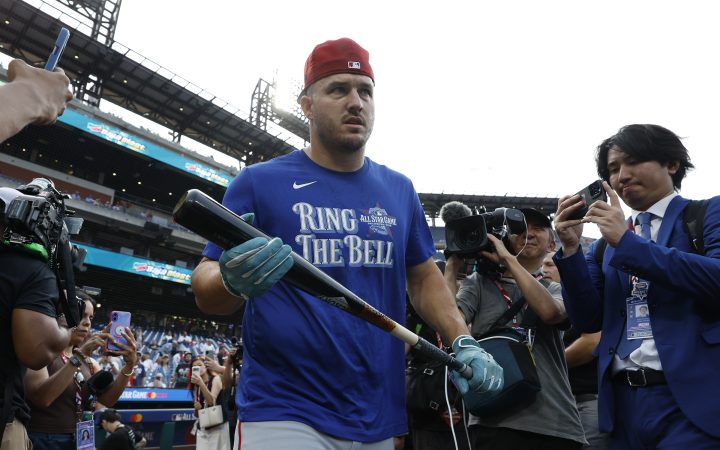
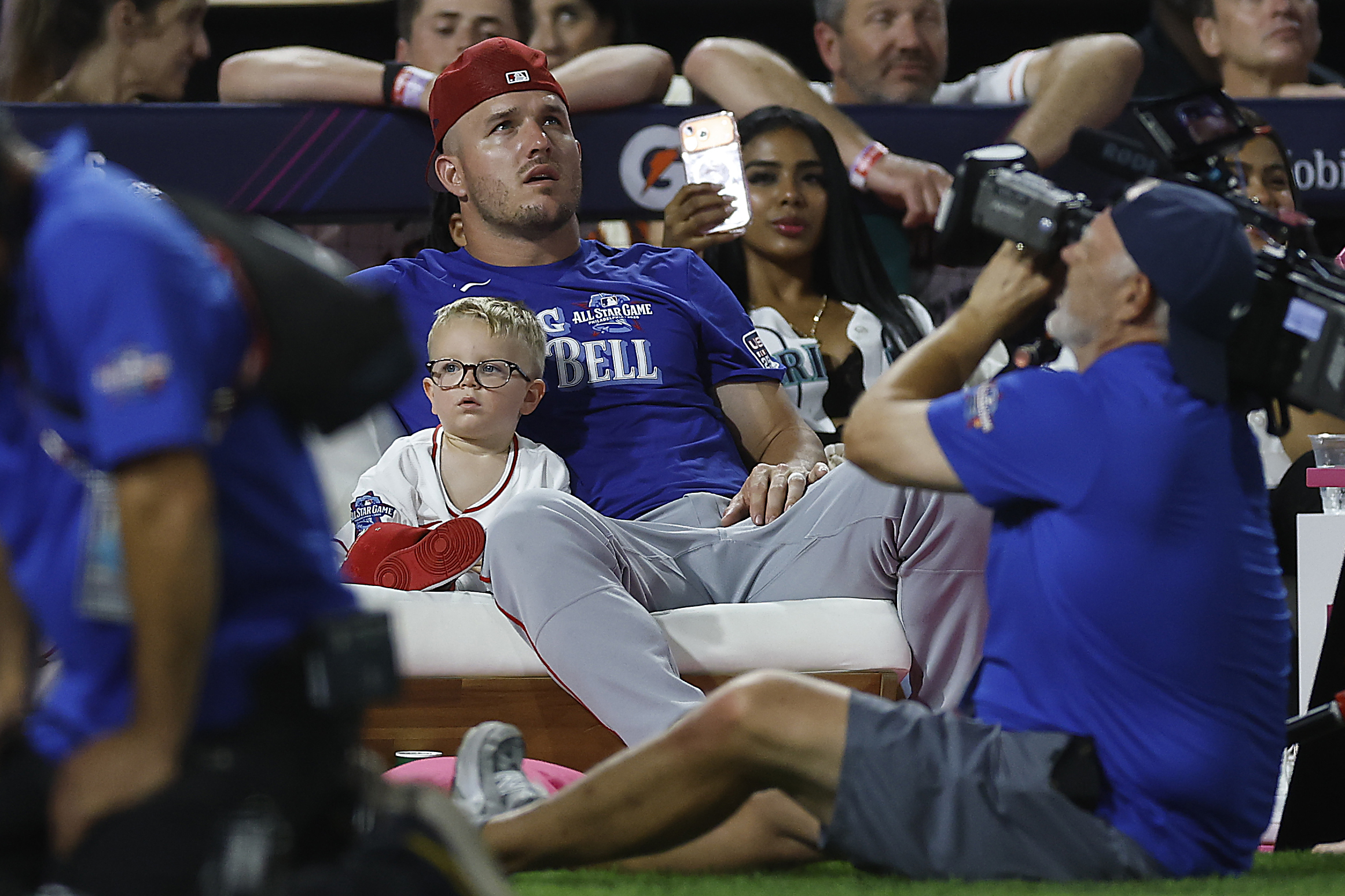
    It would certainly explain the vague but consistent discomfort that the Angels superstar projected throughout his All-Star weekend at Citizens Bank Park. From the obligatory arrival-day media free-for-all to a small postgame scrum that included some folks who’d covered him since high school, Trout politely but steadfastly declined to don the homecoming crown.

    “It’s been great,” the Millville native said after Tuesday night’s All-Star Game. “Being out there with the guys, seeing my family, friends, it was a special night, special couple days.”

    A questioner wanted to know where it ranked. He’d played at Citizens Bank Park in high school, after all. He routinely attends Eagles games across the street. He was applauded wildly during pregame introductions.

    “It’s up there,” was all Trout would allow.

    Philly loves nothing more than when someone loves it back. Trout surely knows this. Yet his responses were the ones you’d expect if somebody had asked if he enjoyed the meal.

    Virtually every year since Trout’s MVP runner-up rookie season, the idea of him in a Phillies uniform has surfaced like a white whale. From the trade-deadline fan fiction to the free-agent fantasy, nobody ever bothered to consider a fundamental question.

    Would Trout actually want to play here?

    In a lot of ways, Millville is as far away from the insanity of Philadelphia as Anaheim itself is. Trout has seen that insanity close enough at Lincoln Financial Field. Surely, he can imagine all that would await him and his family were he suddenly to become the potential savior of the Phillies.

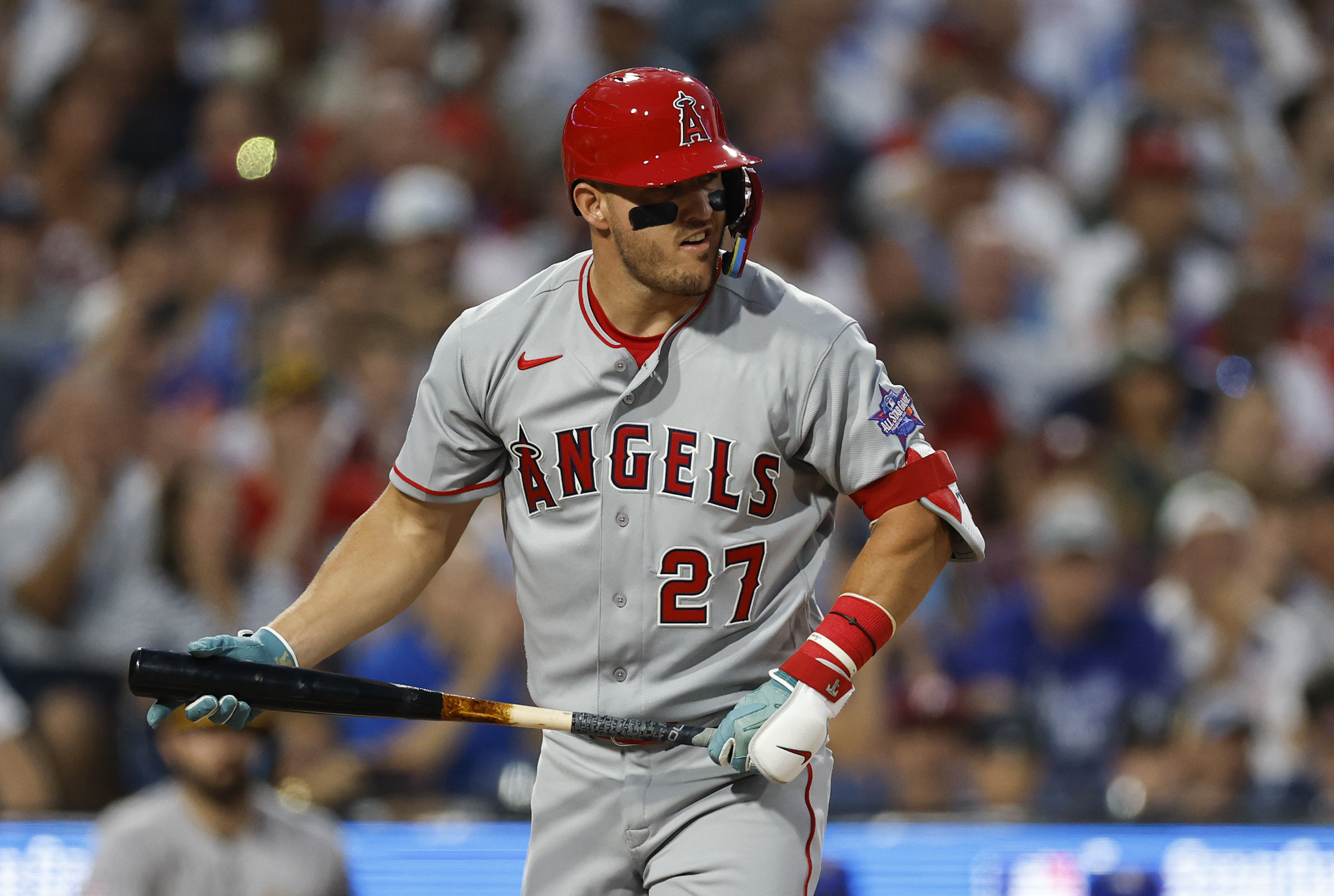
    Mike Trout, a Millville native, went 0-for-3 in Tuesday’s All-Star Game at Citizens Bank Park.Yong Kim / Staff Photographer

    “I hear this a lot,” Trout told reporters on Monday before the Home Run Derby. “I enjoy coming to Philly. I’m an Angel, obviously. I got a no-trade clause, so it’s ultimately my decision. But, like I said, I love Philly.”

    Even if Trout wants to be here, which he has given no indication he does …

    Even if the Angels are willing to accommodate it on the Phillies’ terms, which they have given no indication they do …

    Even if the Phillies would dramatically increase their World Series odds by adding Trout’s stout right-handed bat to a lineup that leans further left than the DSA. Which is debatable at best …

    Even if all that is true — which, again, it very likely isn’t — the Phillies would need to think long and hard about whether such a move makes sense for them.

    The rest of us would need to ask ourselves if we really want to see it.

    Instead of focusing on the fairy-tale beginning, let’s start with how the thing is most likely to end. That is, poorly. Very, very poorly.

    Frankly, the strongest argument for Trout in a Phillies uniform is that the world as we know it may have ceased to exist by the time his contract is off the books in 2030. You only die once, right? Might as well have lived.

    Other than that, let’s make sure we think about the likely reality of 2030.

    Think about how Trout’s last days, maybe years, in a Phillies uniform would likely look. Think about how the Phillies would likely look as a whole.

    Trout is one of the greatest athletes to ever play baseball. He is unquestionably the greatest to do it while holding Eagles season tickets (sorry, Kevin Mench). But Trout’s civic legacy has greatly benefited from the insulation of 2,700 miles. The injuries, the missed postseasons, the diminished production. Thus far, they’ve been the burden of Angels fans, whoever they are.

    Mike Trout had a .739 OPS with a .326 OBP in his last 20 games before the All-Star break.Yong Kim / Staff Photographer

    There will be no insulation when he is 38 years old and being paid $37 million to limp into the last year of his contract alongside a 37-year-old Bryce Harper and a 37-year-old Kyle Schwarber and a 37-year-old Aaron Nola and a 37-year-old Trea Turner and a Phillies team that needs to get its development house in order to be anything other than a soul-sucking disappointment when the year of our lord 2030 arrives.

    Sure, maybe this time will be different. But there are very few scenarios where Trout in a Phillies uniform is sensible for the organization and something other than cringeworthy to watch at the end.

    From the Phillies’ perspective, the depreciation calculus would be complex enough to jeopardize a deal even if both sides were open to one. Health is a significant variable. That’s true for most 34-year-old players. It is especially true for Trout, who has played 85+ games just twice in his previous six seasons and hasn’t played more than 140 since 2016, when he was 24. He is barely a week removed from returning from a hamstring strain that sidelined him for three weeks. He missed a month last season after reinjuring a knee that had previously cost him most of 2024. The 2021-23 seasons saw him deal with a calf strain, a back injury, and a fractured hamate bone. The actuarial work will require more than a cocktail napkin just to calculate Trout’s likely availability from now through October. Even more complicated is figuring out how to price the risk/reward of the rest of Trout’s contract, which will pay him about $150 million through 2030, when he will be 38 years old.

    That would be true even if the short-term payoff were as decisive as many envision. It isn’t. Trout’s production has cooled off considerably since a sizzling start. He had a .739 OPS with a .326 OBP in his last 20 games before the All-Star break and a .750 OPS with a .349 OBP in his last 42. Those numbers are better than they may sound, particularly compared with what the Phillies’ overall numbers have been in the outfield alongside Brandon Marsh. But they are far from vintage Trout, which is what he was in his first 36 games, reaching base at a .436 clip with a 1.000 OPS and 11 home runs in 126 at-bats.

    In the meantime, the Phillies are dealing with the reality that they have exactly one proven late-innings bullpen arm. Their trade deadline focus crystallized on Thursday with the news that setup man Brad Keller will miss the rest of the season — and presumably 2027 — with a torn UCL.

    It’s pretty easy to envision how October will end if the Phillies sink resources into Trout instead of allocating them for the bullpen.

    Nobody should want to see it.

  • ‘My favorite place to play’: Philly and Citizens Bank Park were All-Stars on a magical night. Just ask the actual All-Stars.

    ‘My favorite place to play’: Philly and Citizens Bank Park were All-Stars on a magical night. Just ask the actual All-Stars.

    Whenever somebody asks me to name my favorite ballparks, I spend most of my time trying to talk myself out of the most boring possible answer.

    Sure, Dodger Stadium is a personal favorite. There’s something about the way a SoCal dusk blends with Dodger Blue and the peaceful rise of the San Gabriel Mountains in the distance beyond center field.

    And, yeah, you won’t find a more distinctive setting than Oracle Park in San Francisco, where Mission Bay laps against the outfield walls and the lack of a second deck gives you the sense that you are watching a baseball game on a barge. The counterintuitive microclimate only adds to the surreal vibe. Half the winter coats I own were purchased in July in San Francisco.

    I can name a half dozen other stadiums that are worth a special trip. Each is unique in its own way. Yet they all have one thing in common. They aren’t Citizens Bank Park.

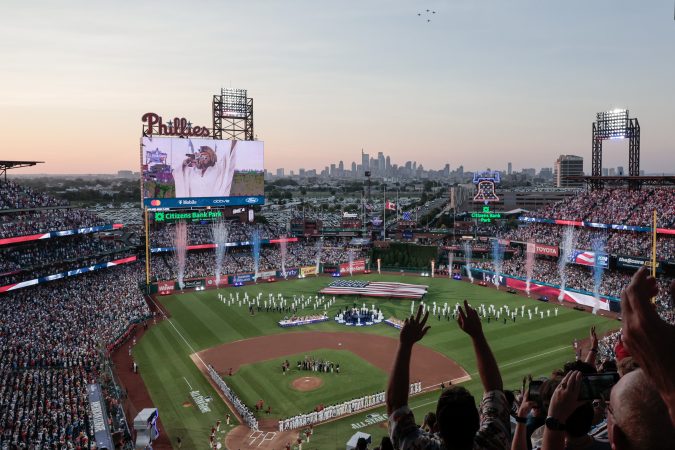
    I don’t know if the whole world saw it on Tuesday night. But anybody who attended sure did. The 68 players. The two coaching staffs. The nearly 50,000 fans who packed the rows and the aisles and seemingly every square inch of concourse.

    “Philly was awesome,” said Blue Jays infielder Ernie Clement. “What a great sports city.”

    On a competitive level, South Philly’s first All-Star Game in 30 years was a ho-hum affair. The American League scored three first-inning runs off Phillies lefty Cristopher Sánchez and then engaged in an eight-inning sprint for the exit. The two sides finished with 10 hits, only one for extra bases. Kyle Schwarber, Brandon Marsh and Bryce Harper combined to go 0-for-6.

    On every other level, it was a triumph.

    It was a triumph for the city, whose splendid skyline first gleamed and then glowed in the summer haze. It was a triumph for the Phillies organization, in particular a grounds crew and game day operations staff that has long powered one of the sport’s best extracurricular environments. Most of all, it was a triumph for the setting and its people: for a ballpark that doesn’t get the respect it deserves as one of the sport’s Crown Jewels, and for a fan base that consistently shows that a household is only as strong as its inhabitants.

    For years, it seemed like a glaring oversight that 22 ballparks would host an All-Star Game before Citizens Bank Park got its turn. As it turned out, the wait was more of a feature than a bug. The bright lights and national television cameras only served to accentuate the glow of a ballpark that somehow looks even better than it did when it opened in 2004. Similar to the red brick rowhouses in the city proper, the outfield’s masonry facades have an age-defying property, especially when contrasted with the industrial steel and wide-open concrete of the concourses and seating decks. You won’t find a stadium or arena in any sport that has aged as gracefully as the house that David Montgomery (and others) built.

    Earlier this spring, with the Eagles beginning their due diligence on a potential replacement for Lincoln Financial Field, Phillies owner John Middleton said he sees no reason why Citizens Bank Park shouldn’t last another 100 years.

    Tuesday night was a triumph for him, then, too.

    Of course, Middleton would be the first one to tell you that the people make the place. So it was on All-Star Weekend. The real star of the show on Monday and Tuesday night was the home crowd, whose caustic electricity provided a much-needed edge for an over-corporatized event that most years feels emptier than a bowl of sugar cereal.

    You saw it in the smiles that appeared on the faces of players as the crowd booed its lengthy list of civic enemies. From Yankees starting pitcher Cam Schlittler to Mets outfielder Juan Soto to anybody in a Braves or Red Sox jersey, those targeted grinned and waved in appreciation. By the end of the proceedings, it felt like an insult to be ignored.

    “Like they always say,” said Soto, “if they boo you, then you’re doing things right.”

    The heckling was mostly good-natured, save for an appearance by Mr. and Mrs. Met.

    This was a celebration first and foremost. The event’s organizers and executors were aided by a number of ready-made story lines. They included the All-Star debut of Catholic League standout Kevin McGonigle and the homecoming of Mike Trout in his career’s twilight, in addition to Sánchez on the mound and Schwarber and Marsh in the starting lineup. But MLB also did its part. With a devastating labor stoppage potentially looming in a sport that increasingly feels anachronistic in the swirl of a country’s division and distraction, baseball managed to summon a lot of its friendlier ghosts on Tuesday night.

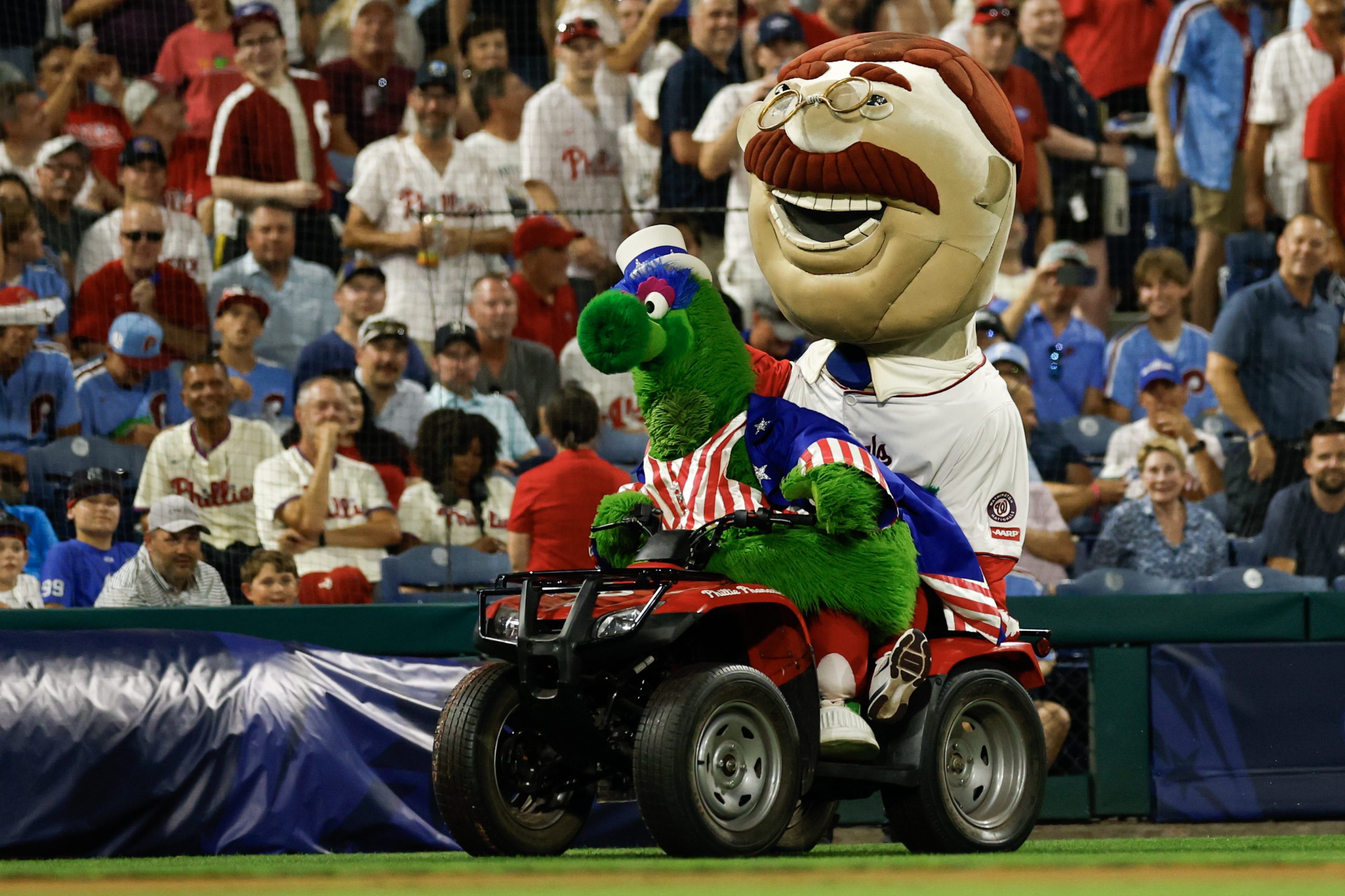
    The Phanatic gives Washington Nationals mascot Teddy Roosevelt a ride during the presidents race before the bottom of the fourth inning on Tuesday.Yong Kim / Staff Photographer

    The climactic moment was curiously timed and even more curiously powerful. In the fifth inning, with the stadium lights dimming and Ray Charles’ famous playing on the oversized videoboard in left field, Citizens Bank Park erupted with a fireworks display complete with players holding sparklers and Dodgers first baseman Freddie Freeman playing catch with one of the local kids who rode their bikes onto the field as part of the program.

    “Like I’ve been saying the last two days, since I came up with the Braves, this is my favorite place to play,” Freeman said after the game. “I love the Bank. It wasn’t fun to play because it was Halladay, Hamels, Lee every time, but it was packed every night. It’s a great place to play. Great city.”

    Sounds like a win in our book.

  • Is a bullpen arm now the Phillies’ biggest need at the trade deadline? Depends on how they feel about one man.

    Is a bullpen arm now the Phillies’ biggest need at the trade deadline? Depends on how they feel about one man.

    How much does Dave Dombrowski believe in his best acquisition of the offseason?

    By several metrics, Jonathan Bowlan has been one of the most productive relievers in the majors over the last 2½ months. Since May 3, he ranks among the top 15 in the majors in the following categories:

    • Strikeout rate (33.7%, 11th)
    • Walk rate (4.8%, 15th)
    • Strikeout/walk ratio (7.00, 8th)
    • Ground-ball rate (58.3%, 15th)

    And then there is the most important category. Heading into Sunday, only three pitchers carried a lower ERA than the 0.86 Bowlan had posted in his last 21 outings: Robert Suarez (Braves), Luke Weaver (Mets), and Mason Miller (Padres).

    That trio has logged a ton of high-leverage innings over the years. The question Dombrowski must ask himself: Can Bowlan do the same?

    The answer should play a big role in the Phillies’ trade deadline strategy. The back of their bullpen has been leaking some serious oil as of late. Since June 1, Orion Kerkering, Brad Keller, and Jose Alvarado have combined to allow 18 of 42 batters to reach base in high-leverage situations in the seventh, eighth, or ninth inning. Of those 18 baserunners, nine have scored.

    At this point, Kerkering shouldn’t be a serious consideration when the Phillies are projecting the top of their postseason depth chart. The 25-year-old righty’s struggles in pressure situations was a recurring theme even before last October’s meltdown in Game 4 at Dodger Stadium. Over the last two regular seasons, Kerkering has 37 strikeouts against 22 walks and hit-by-pitches in high-leverage situations. In the last two weeks, he has entered two late-game situations and then proceeded to walk three batters. There is nothing Kerkering can do between now and the trade deadline that should make the Phillies more comfortable with him high on the pecking order behind Jhoan Duran.

    Orion Kerkering shouldn’t be a serious consideration for the top of the Phillies’ postseason depth chart.Yong Kim / Staff Photographer

    Alvarado is fast approaching that point. The veteran lefty entered Sunday having allowed runs in eight of his last 19 outings, and at least two runs in six of them. Only two relievers in the majors had pitched as many innings as him with a higher ERA. The numbers are a little bit confusing. His 28.5 strikeout rate ranks 29th out of 171 qualified relievers. Although his walk rate is slightly worse than league average, it is markedly better than any that he posted during his prime years of 2021-24 (8.9% this season vs. a minimum of 10.5% previously). His fielding independent metrics are better than they’ve been since 2023.

    Even taking all of that into consideration, Alvarado is a dramatically different pitcher than he was in 2022 and 2023, when he struck out 37% of his batters with a 2.14 FIP (3.38 this season). It’s fine to consider him a wild card vs. writing him out of the picture completely. But he won’t be anything more than a wild card before the trade deadline.

    Keller? Even without the forearm issue, the Phillies haven’t seen much to make them comfortable heading into a postseason as the primary bridge to Duran. Opposing hitters have posted a whopping .856 OPS against him in high-leverage situations. In an ideal world, the 30-year-old is a sixth- or seventh-inning arm come October.

    Which brings us back to Bowlan. Acquired in an offseason trade that sent Matt Strahm to Kansas City, Bowlan appears to have elbowed his way into his manager’s circle of trust. On Saturday night, Don Mattingly turned to Bowlan with two on and nobody out in the bottom of the eighth inning to protect a 4-1 lead. After hitting his first batter with a pitch to load the bases, Bowlan got Spencer Torkelson to ground into a double play. He escaped the inning with just the one run scored, walking Riley Greene before getting Eduardo Valencia to ground out.

    It wasn’t exactly the cleanest audition. But maybe that counts for something. This was a big-boy spot. Middle of the order, a trio of young power hitters, two men already on base. To hit a batter and walk a batter and only allow one run at least shows a little bit of intestinal fortitude.

    If Mattingly is going to make Bowlan his primary eighth-inning arm for the foreseeable future, then he is doing the right thing. At 6-foot-6 and 240 pounds, the 29-year-old righty sure looks the part. But that is still very much a hypothetical. Bowlan was predominantly a middle-innings guy during his three years in Kansas City. He isn’t a classic strikeout arm, whatever the overall numbers say this year. He has seven of them in 28 high-leverage plate appearances this season, compared with four walks. Again, though, the sample size is small. The Phillies would be wise to get a longer look at him.

    In the meantime, there really isn’t a question about the trade deadline and the bullpen. The Phillies need to do everything they can to address it. A lot of people seem to want to frame it as an either/or, with regard to their clear holes in the outfield and/or from the right side of the plate. That’s not the right way to look at it. After this latest virtuoso performance by the top two pitchers in the Phillies’ rotation, and with Bryce Harper and Kyle Schwarber hitting like MVP candidates, Dombrowski can’t afford to pick and choose which holes he fills this July. Last year, the Blue Jays acquired Louis Varland and Ty France from the Twins in a deadline deal. The Phillies themselves landed Duran and Harrison Bader. They can and should be thinking quantity.

    The real question right now is quality. Do the Phillies need an eighth-inning version of Duran? Or can they get by with a Varland type? A lot depends on how they feel about Bowlan. Because, right now, he looks like the only viable option.

  • The Sixers’ title hopes still hinge on Joel Embiid. Mike Gansey admitted as much.

    The Sixers’ title hopes still hinge on Joel Embiid. Mike Gansey admitted as much.

    With all due respect to LeBron James, the Sixers’ greatest and most impactful unknown is the same as it has always been.

    Mike Gansey acknowledged as much on Thursday.

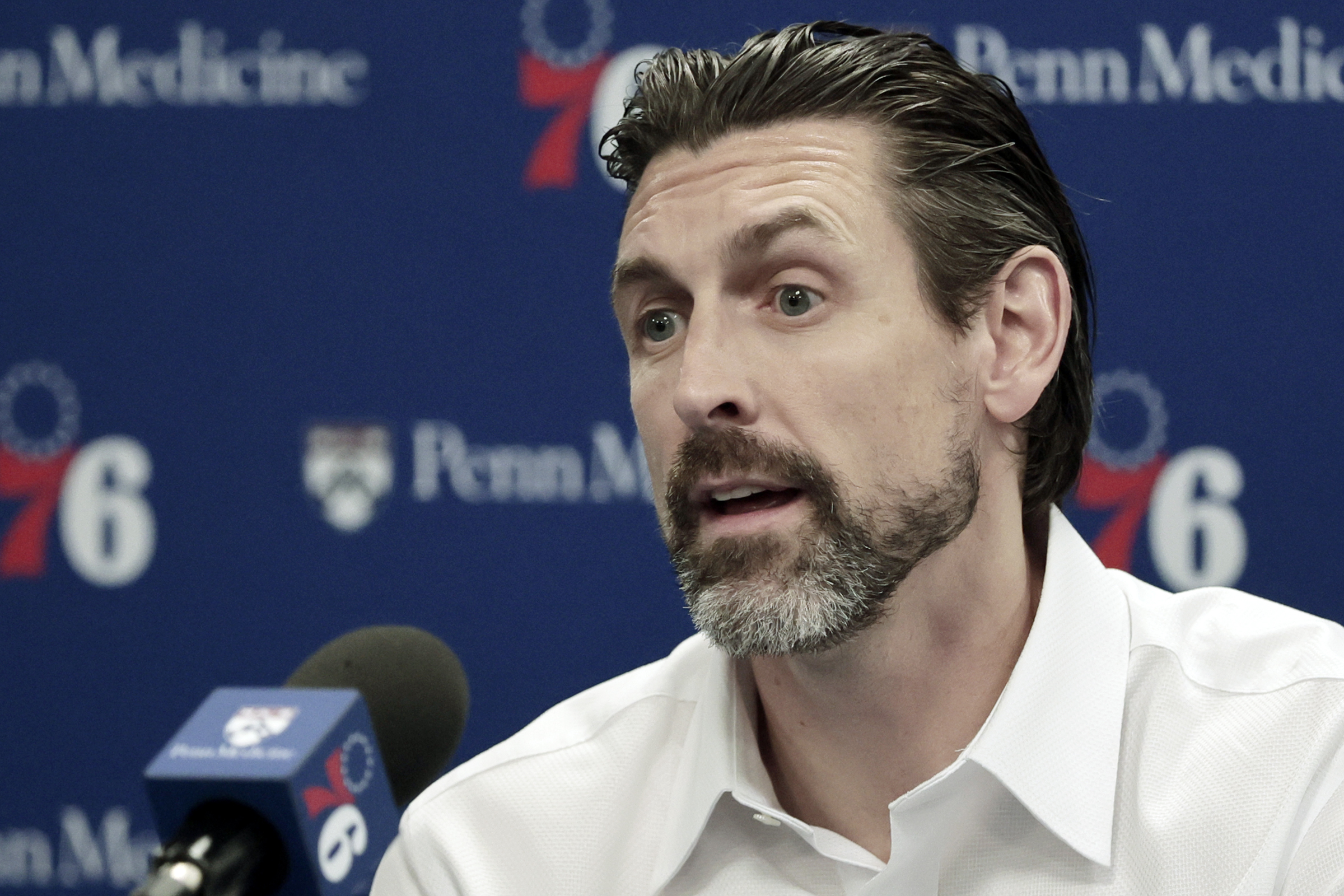
    “Obviously,” the Sixers new president of basketball operations said in a courtside interview during ESPN’s broadcast of the team’s summer league opener, “the big fella is the X-factor.”

    It speaks to the magnitude of Joel Embiid that such a sentiment can be qualified as obvious. Nothing about the Sixers over the last two months has been obvious. From the firing of Daryl Morey to the hiring of Gansey as his replacement to the dramatic trade of Paul George and a couple of first- and second-round picks to the Celtics for some guy named Jaylen Brown to the front office’s attempt to woo James, the Sixers are in the midst of an overhaul more radical than any Embiid has seen in his decade with the team.

    For maybe the first summer of his career, everyone’s focus is elsewhere. Yet, everyone is fooling themselves if they think they can talk about the Sixers as a legitimate contender without factoring the big fella into the equation.

    The exact nature of the question has changed. There’s no doubt about that. It is no longer, “How far can Embiid carry the Sixers?” In Tyrese Maxey and VJ Edgecombe, they have young guards who carried them to a Game 2 playoff win over Brown and the Celtics without Embiid. In Brown, they have a player who was overwhelmingly responsible for Boston’s win over the Sixers in Game 1 of the same series. That trio is talented enough to pencil in the Sixers for a playoff spot and, potentially, a top-four seed even if Embiid were not to play a game. At no point prior in the Embiid era have we been able to say such a thing.

    That’s more than a good thing. It’s the reason that a jaded city can now deconstruct its emotional walls and allow itself to invest time and energy in the Sixers again. The potential outcomes are no longer as divergent as “championship contention” or “No. 3 overall draft pick.” The exhaustion that people feel with regard to Embiid is in large part a function of his inordinate importance over the years. With him, the Sixers could beat anybody. Without him, there was little point in watching.

    So, yeah, the question has changed. But it is still the one that matters most when it comes to handicapping the Sixers’ 2026-27 title odds.

    What do they expect out of Embiid?

    What will they get?

    The first part is more interesting. The organization’s public rhetoric regarding their big man has shifted since the change in regimes.

    For Morey, Embiid was something like a mission statement: any time the former president spoke publicly about his team, his comments were centered around the center. He took the job in 2020 with the idea that Embiid was the exact sort of front line, once-in-a-generation superstar that teams need to win a title. The goal was to get him whatever help he needed. Morey professed that belief to (virtually) the bitter end.

    Sixers president of basketball operations Mike Gansey says Joel Embiid was excited about the Jaylen Brown trade.Elizabeth Robertson / Staff Photographer

    Gansey and ownership proxy Bob Myers have been far less committed in their public sentiments about Embiid. In his introductory press conference a month ago, Gansey avoided talking with much specificity about the big man beyond including him in the framing of the Sixers’ existing roster structure as a “Big Four.”

    “They’re our four guys, they’re under contract. We got to do the best to get them to their best self,” Gansey said on his first day on the job, “because I think every night at 7 p.m., we got to get them to their best to help us win.”

    Barely a month later, George was en route to Boston and the Sixers “Big Four” was now a “Big Three.”

    Perhaps it is notable, then, that Gansey now feels comfortable speaking of Embiid in such terms as the ones he deployed in his ESPN interview on Thursday.

    “Joel’s in a good space,” Gansey said. “He’s finally healthy going into the offseason. He’s excited about this summer. He’s getting to work here shortly. He expects to have a good year, as we all do.”

    Embiid has been conspicuously silent since the Brown trade. His lone Twitter post in the wake of the deal was about the Tour de France. In an interview with the Sixers’ flagship radio station on Thursday, Gansey said that Embiid was excited and “fired up” when Gansey informed him of the trade.

    Whatever the case, the Sixers are well past the point of factoring Embiid’s feelings into their actions. The Brown trade was as much about the Sixers’ ability to compete without him as with him. At the same time, the only way they contend for a title this season is with him.

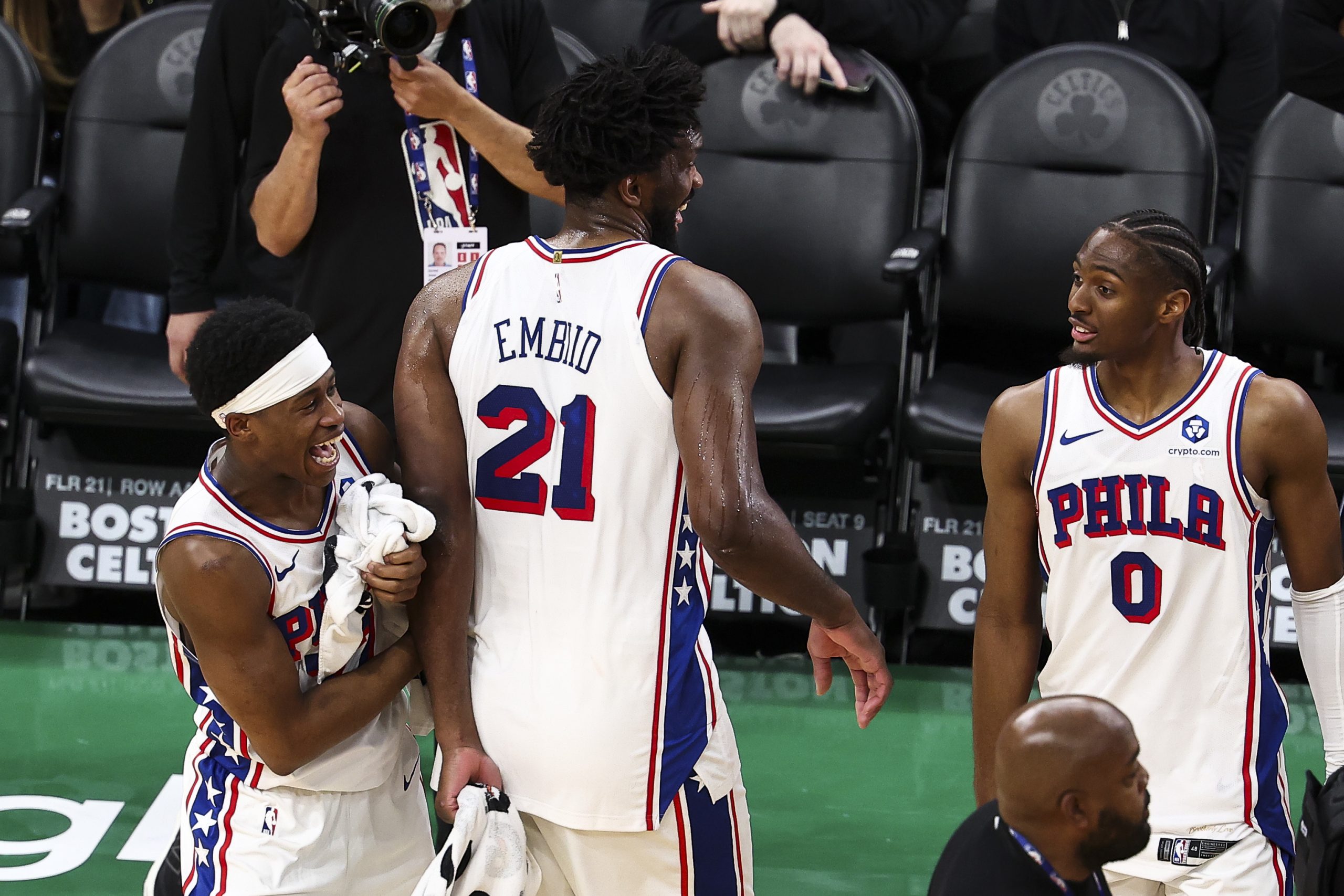
    VJ Edgecombe (left), Joel Embiid, and Tyrese Maxey celebrate after winning Game 7 against the Boston Celtics in May.Monica Herndon / Staff Photographer

    April’s playoff series against the Celtics offers a tidy encapsulation of where the Sixers are. As dominant as Brown was during various stretches, Boston still lost. As impressive as Maxey and Edgecombe were at times, the Sixers still needed to win a Game 7 against the Jayson Tatum-less Celtics just to earn the right of getting blown out of the playoffs by the Knicks. Celtics coach Joe Mazzulla offered the definitive sound byte after the Sixers finished off their series comeback.

    “What changed in this series was Joel Embiid came back and they’re a completely different team,” Mazzulla said.

    Embiid missed Game 2 of the next series. The Sixers were outscored by 57 points in the 88 minutes he played against the Knicks. Somewhere on that continuum, their immediate hopes lie.