Author: David Murphy

  • Some important context for the great shotgun debate and the Eagles moving forward under Sean Mannion

    Some important context for the great shotgun debate and the Eagles moving forward under Sean Mannion

    You could use the same four words to describe the Eagles offense in 2025 as you would Elmer Fudd.

    Uses shotgun, rarely well.

    So says the conventional wisdom, at least.

    During the Eagles’ recently completed mandatory minicamp, there was a lot of talk about new offensive coordinator Sean Mannion’s affinity for operating from under center and the adjustment it might require for those closest to the ball (namely, the quarterback). The topic of conversation was certainly valid. Throughout the Jalen Hurts/Nick Sirianni Era, shotgun has been the Eagles’ baseline look, more so than all but a small handful of NFL teams. I’m just not sure that the change under Mannion will be as radical as people hope/expect.

    What if I told you that Saquon Barkley has only had one fewer carry from under center than the Packers’ Josh Jacobs over the last two seasons, when Mannion was in Green Bay? Or that, in 2025, Hurts attempted more passes from under center than Joe Burrow and Patrick Mahomes, both of whom can make a case as the best in the game?

    All of this talk about scheme comes from a good place. But I think the term itself tends to get misapplied when we talk about what makes good teams good and bad teams bad. The perception of “scheme” is that it is some static, word-of-God recipe book that each coach draws up like a wizard and then carries with him from stop to stop. In reality, I think it’s closer to a core set of principles and best practices that guide the concrete aspects of coaching: teaching and game-planning. The actual output of all of those things — the plays — will look a lot different from roster to roster and opponent to opponent.
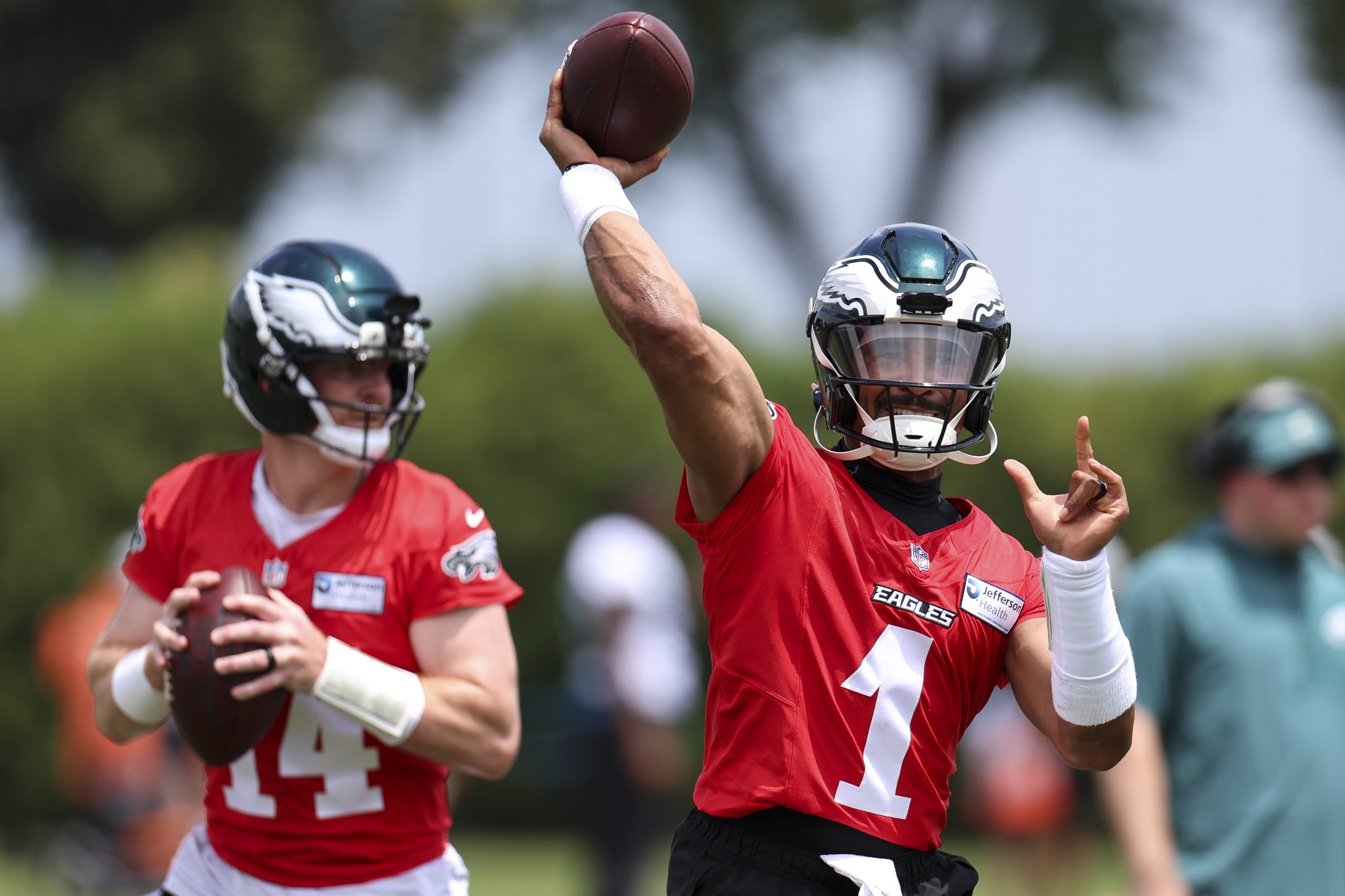
    Jalen Hurts attempted more passes from under center than Joe Burrow and Patrick Mahomes in 2025.Monica Herndon / Staff Photographer

    “There’s things I believe in and there’s things that schematically I have a background in, but ultimately it’s going to be a blend and it’s constantly going to evolve,” Mannion said earlier this offseason. “It’s about maximizing things for the players. How do we make the Eagles the best team we can be, how we make the Eagles offense the best it can be and how do we put all of our players in a position to really, really succeed and maximize their strengths.”

    Don’t get me wrong. There will be change. As I wrote last week, it will be real change, more so than at any point in Sirianni’s time as head coach.

    Context is important, though.

    Reality is, the NFL has become a shotgun league over the last decade. That’s true regardless of coach or quarterback. Last season, Matthew Stafford and Sam Darnold were the only two quarterbacks to line up under center on more than half their snaps. Both quarterbacks threw the ball out of shotgun roughly twice as much as they did under center.

    The evidence hardly supports the idea that the Eagles’ heavy reliance on the shotgun in recent years is an ipso facto indictment of Hurts and/or the offensive scheme. At least, not if you accept as fact that Burrow and Mahomes are two of the best quarterbacks in the NFL. Mahomes attempted just 32 passes from under center in 2025, 12 fewer than Hurts’ 44.

    The big difference between teams like the Seahawks/Rams and the Eagles was their preference for running from under center. The Rams ran out of shotgun just 64 times in 2025, for instance.

    At the same time, the Eagles ran the ball from under center more than you might think. Two years ago, nearly half Barkley’s 2,005 rushing yards came from under center. His 6.1 yards-per-carry average was best in the NFL, and better than his 5.6 yards per carry out of shotgun.
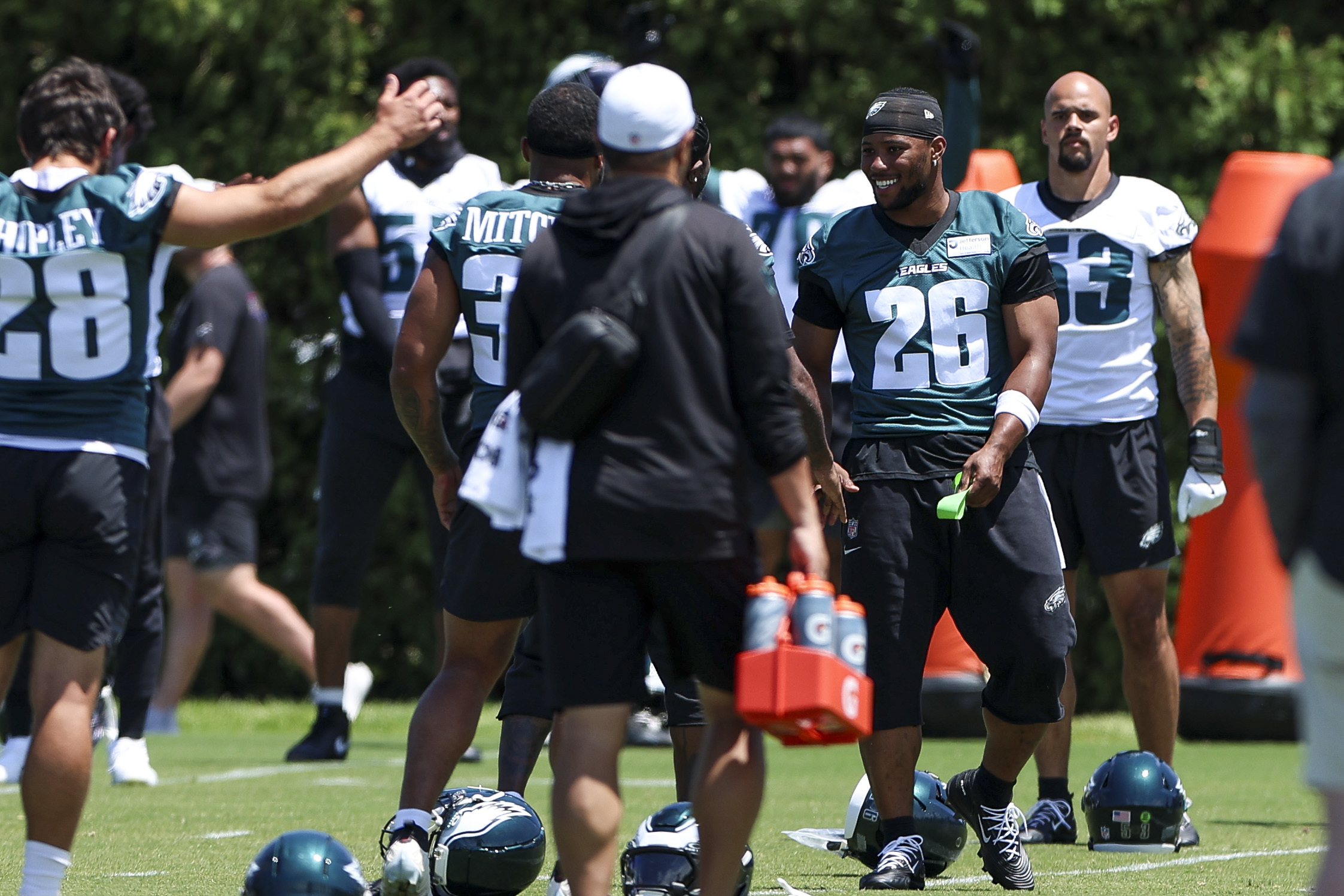
    Saquon Barkley is looking forward to running Sean Mannion’s system.Monica Herndon / Staff Photographer

    Again, to be clear, we should expect to see a significant difference. One takeaway from the Eagles’ pre-camp workouts is that Mannion’s run game philosophy is closer to the Shanahan/McVay/Kubiak tree than Sirianni’s.

    “It’s no secret what this system is about,” Barkley said earlier this offseason. “I look forward to doing that. It’ll probably be the most I’ve ever done it under center and outside zone and all that good stuff. It’s a challenge I’m looking forward to work on and getting better at and trying to be the best at it.”

    As for the passing game, one suspects we’ll still see plenty of shotgun. Jordan Love attempted roughly 30% of his passes from under center in 2025 when Mannion was with the Packers. That’s more than three times as often as Hurts did.

    We could be talking about an additional 5-7 passes per game from under center. That’s not nothing. But we’re probably not going to see something that looks completely foreign. As tight end Dallas Goedert said last week, “You can only do so much [different] on offense.”
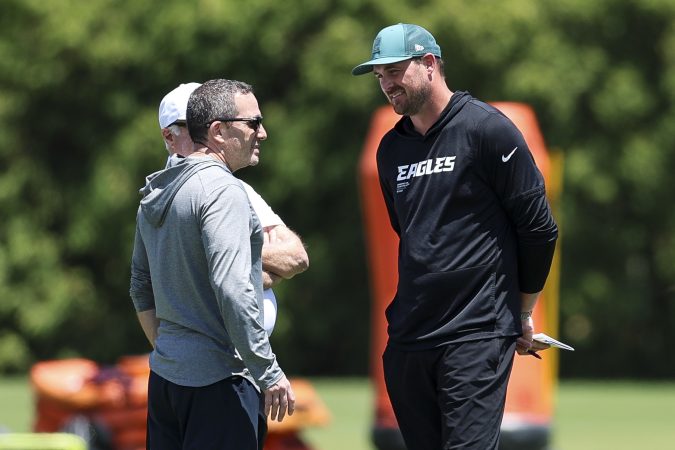
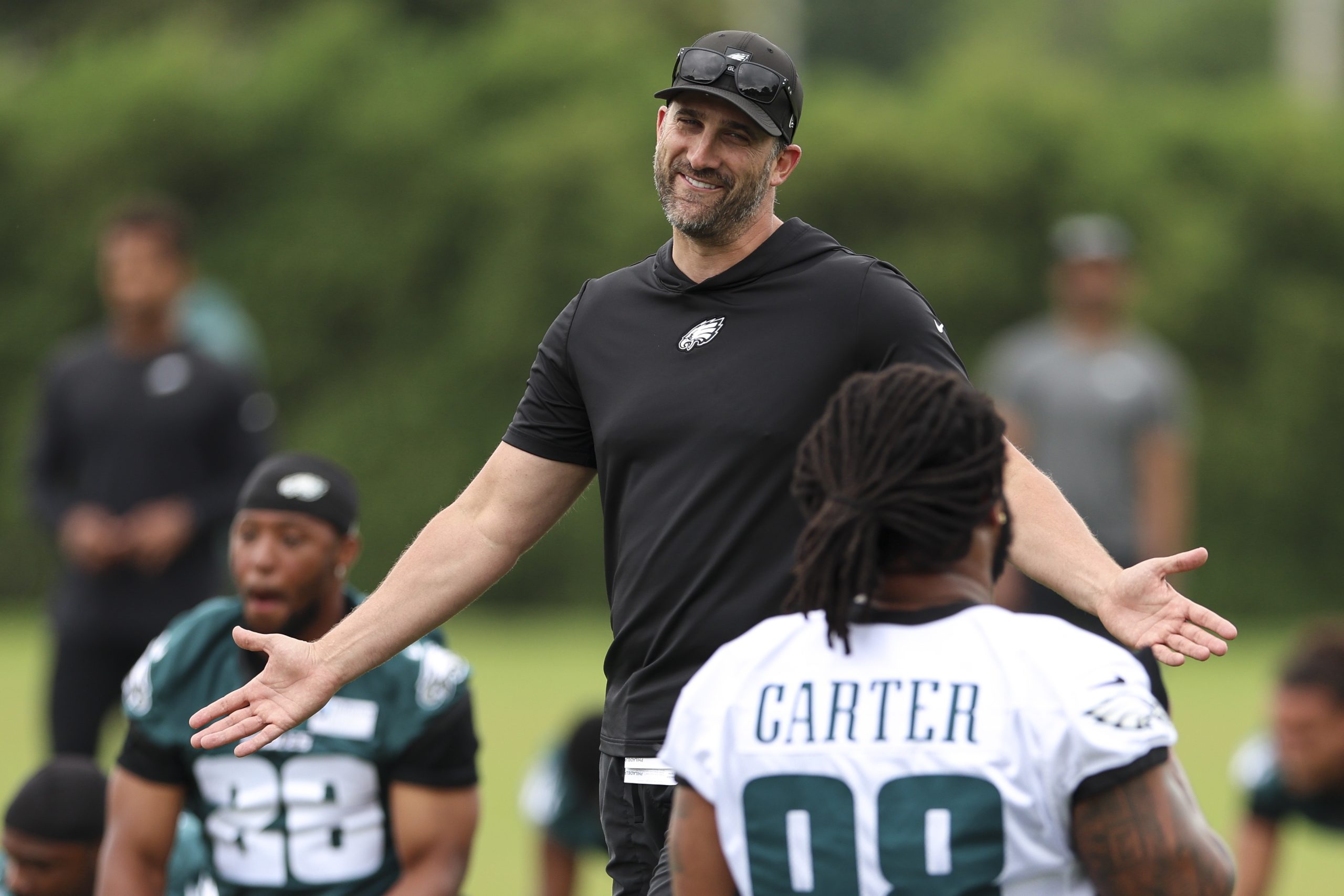
  • It looks — and sounds — like the Eagles knew what they were doing with Sean Mannion, Jeff Stoutland, and A.J. Brown

    It looks — and sounds — like the Eagles knew what they were doing with Sean Mannion, Jeff Stoutland, and A.J. Brown

    One of the Eagles’ great strengths as an organization is they understand the implications of the NFL’s competitive Darwinism. You evolve, or you die. It is a league full of maniacs who will not sleep until they figure out what your team is doing and how to stop it. The margins are slim, so fortune can flip fast. The Eagles saw it with Chip Kelly in Year 1 vs. Years 2 and 3. Anybody who can’t adapt to what comes next will quickly be out of the league.

    The Eagles were on the field for only a few days this week, but their mandatory minicamp was long enough to give you a real sense of why the offseason went the way it did. It was a startling thing to behold, both on the practice field and inside the building. Over five seasons, almost nothing had changed with regard to the fundamentals of the Eagles offense. Sure, coordinators came and went, but the identity remained the same. It served them well, with two Super Bowl appearances in three years, one of them a title from which they were less than a year removed when the offseason began. Yet they clearly sensed that an inflection point was coming, if it hadn’t already arrived.

    That sense was most evident in the words and tone of one Lane Johnson, the eldest statesman of the offense and the keystone around which the Eagles have built everything over the last decade and a half. Earlier this week, the veteran tackle spoke publicly for the first time since before a foot injury sidelined him for the last eight games of the season. A lot had changed in the interim. Gone was Jeff Stoutland, the legendary offensive line coach who inspired a fierce loyalty in his former players. In his place was a new blocking scheme, with new terminology, and a new philosophy, all under the command of a 34-year-old first-time playcaller whose playing career ended less than three years ago.

    Yet here was Johnson, barely a year removed from anchoring one of the greatest single-season offensive line performances of all time, and having done so under the tutelage of one of the greatest offensive line coaches of all time, en route to one of the most dominant Super Bowl victories of all time, and dadgummit if he didn’t sound positively refreshed.

    “I think with this offense, we’ll be able to stretch the field and really work our zone game and get the defense running and work things off of that,” Johnson said. “I’m really excited for what it can do, not just for tackles. I think it will open up a lot in our game.”

    The two keywords there are “this offense.” As opposed to that offense. You know, the one the Eagles used to run. It may sound like a small thing, but only if you didn’t listen closely during the four previous changes at playcaller. I don’t think that phrase was ever used. At least, not like Johnson and the rest of the Eagles who spoke publicly have been using it. As a signifier of real, legitimate change. It didn’t sound like this when Nick Sirianni gave way to Shane Steichen, nor when Steichen gave way to Brian Johnson, nor Johnson to Kellen Moore or Moore to Kevin Patullo. The operative question always centered on who would have final say over the plays rather than what those plays would look like from a broad schematic standpoint.

    Not so this time around.

    The change is real. That was the biggest takeaway from this week’s preamble to training camp. The hiring of Mannion, the jettisoning of Stoutland, the trading of A.J. Brown, the subtle challenges to Jalen Hurts … this was not the same window-dressing offseason of years past. These were purpose-driven moves rooted in the realization that 2025 would not be a one-year blip if the Eagles fooled themselves into thinking that the things that worked in previous seasons would one day work again.

    It remains to be seen what the scheme will actually look like. You’d have to work just to get an NFL coach to admit he will have precisely 11 players on the field. But Johnson referred to Mannion’s scheme as a Kubiak/Shanahan system, the archetype being the 1990s Broncos teams that utilized heavy amounts of outside zone/stretch runs from under center and the resulting play action looks that offered quarterbacks ample passing lanes and plenty of distance between them and the line.

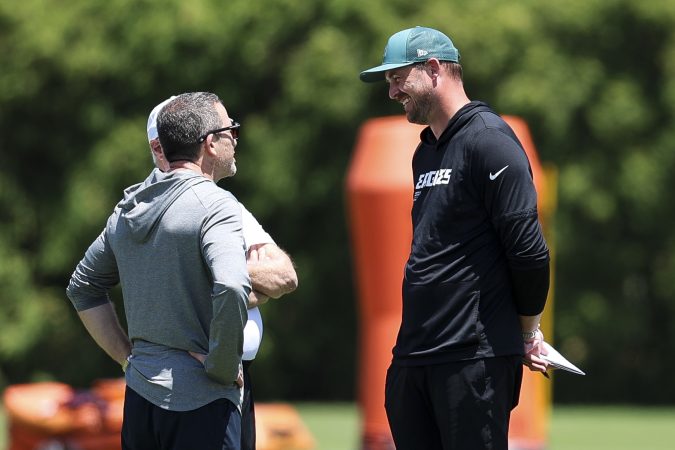
    Head coach Nick Sirianni and the Eagles have seemingly embraced an offensive scheme change this offseason.Monica Herndon / Staff Photographer

    “I’ve always envied wanting to be a part of it,” Johnson said. “So here I am, after all these years, getting that chance. Not to say we’re going to be better because there’s a lot to learn. I think we have the ability to be a lot more than what we were last year.”

    The Eagles did the right thing in treating last year as a sign of the times rather than awarding themselves a mulligan. Their strength as an organization has long been their willingness and ability to execute a hard pivot. Dating back to Joe Banner’s reign as club president, the Eagles front office has built its decision-making processes on a cold philosophical calculus. A team is better off being a year early than a year late on its consequential decisions.

    It is true at all levels of football management, from awarding contract extensions to the evaluation of veteran players to the identification of leaguewide trends. There is considerable risk in being early, which is why a lot of teams end up being late. It isn’t easy to let a franchise icon leave town, or to spend a second-round pick on a quarterback when one already has a starter. Vindication occurs in a separate time horizon from a fan base’s patience. It is good to be proved right. It is better to be employed.

    What Jeffrey Lurie and Howie Roseman both realize is that the last teams to arrive for dinner often become the dinner. Barely a year after winning their second ever Super Bowl title, the Eagles decided that they’d arrived at one of those inflection points that plenty of teams would ignore in the interest of convenience or ego protection.

    Will the offense actually look different? Like, materially? The players sure seem to think it will. In which case, the big question is this:

    Will it work?

  • The Mike Gansey era has begun. Where do the Sixers go from here?

    The Mike Gansey era has begun. Where do the Sixers go from here?

    Really, there wasn’t anything that Mike Gansey could have said that would have changed the expectations for the 76ers.

    Which is good, because he didn’t say much.

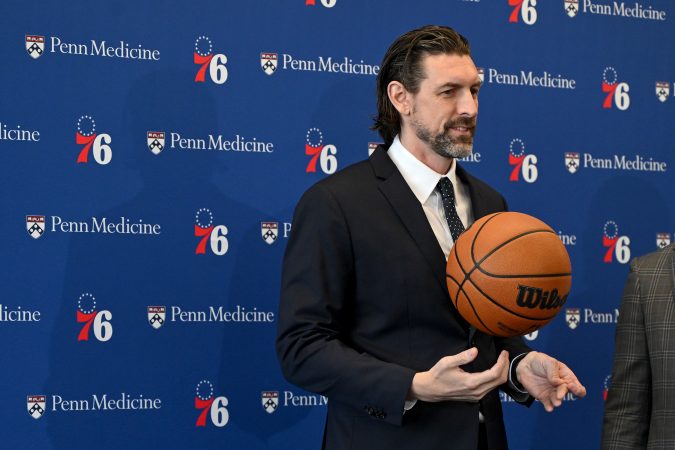
    Gansey’s first news conference as the 76ers’ president of basketball operations offered little in the way of detail about the team’s path forward. He acknowledged that Joel Embiid and Paul George are players who are currently on the Sixers roster. He noted that Tyrese Maxey and VJ Edgecombe are, too. He explained that he and his front office will attempt to select the best possible player with the No. 22 pick in the NBA draft later this month. You could say Gansey’s plan was short on specifics, except there weren’t many generalities, either.

    “I just got here,” the 43-year-old Ohio native and longtime Cleveland Cavaliers personnel man said at one point while prefacing one of his comments.

    All of this was to be expected. Smart, even. There is some short-term value a new hire can reap from winning the first news conference. But it often is outweighed by potential long-term damage he can sow. Look at Gansey’s three immediate predecessors. Each was haunted, even undone, by the narrative they sold at the outset.

    Sam Hinkie’s biggest problem wasn’t The Process itself. It was his explicit acknowledgment of it. Daryl Morey was ultimately defined by his unabashed and steadfast belief in the power of veteran superstars rather than his draft night successes. In between was Bryan Colangelo, who went all-in for Markelle Fultz as the Sixers launched a Welcome to the Moment marketing campaign.

    There were no slogans from Gansey on Monday. The surest sign that the Sixers have entered a new era is that we have no clue what it will look like. For more than a decade, the team has conducted its day-to-day business within the framework of a grand and easily articulated strategic vision. The Morey/Colangelo years were as well-defined a process as Hinkie’s capital-P Process years. Jimmy Butler, Tobias Harris, James Harden, George, every veteran backup center who used to be an All-Star. Star hunting, in the mortally immortal words of Brett Brown.

    Gansey, meanwhile, explained his vision only in the broadest, most abstract terms. He spoke of a desire to create “alignment” throughout the organization and remarked that he expected that he and coach Nick Nurse would be “attached at the hip.” On a couple of occasions, Gansey said he wanted to build an organization with people who are “fountains, not drains.”

    “We’ve got to do the work, you know?” Gansey said. “Obviously, draft coming up, for example, you’re talking to plenty of coaches, people that have been around these guys, and you want to bring in good people here. If they don’t want to be here, or you don’t feel they can fit with our culture, then we don’t want it. We want people that want to be in Philadelphia and we want guys that — I want competitiveness. I want toughness. I want guys that hate to lose. Those are the kind of people I’m going to try and target and want to bring onto this roster.”

    Mike Gansey expects to be “attached at the hip” with Sixers head coach Nick Nurse.Monica Herndon / Staff Photographer

    The first part of that comment is the important part. The Sixers have no magic bullet to shoot nor rabbit to pull. They likely are going to need to build a team the old-fashioned way. With Embiid and George under contract at roughly $115 million per year combined for the next two seasons, the most the Sixers can spend in free agency is $15 million (via the nontaxpayer mid-level exception) plus minimum-level contracts.

    “I don’t look at it as a timeline,” Gansey said. “I just look at like we have those four and we got to maximize those four. Obviously, VJ and Tyrese are younger, but Paul and Joel can still play at a high level. We were 24-14 when Joel played, and obviously the playoffs coming back from Boston. Like, we got to rely on those four and obviously keep [them] on the floor and then just build around them.”

    The important work over these next couple of seasons could look a lot like the roster grind Gansey helped preside over during his time with the Cavaliers, when he was Cleveland’s point man on the draft and related talent. Two rotation members from this year’s Eastern Conference finals team were Dean Wade, signed as an undrafted free agent in 2019, and Sam Merrill, initially signed to a 10-day contract in 2023. A third, Jaylon Tyson, was selected at No. 20 overall two years ago.

    One of the shrewder value plays swung by Cavs president Koby Altman during Gansey’s time with the team was the signing of restricted free agent Lauri Markkanen to a four-year, $67 million contract via a three-way sign-and-trade with the Cavs and Chicago Bulls. One year later, the Cavs made Markkenen the centerpiece of a trade package (along with three firsts and two pick swaps) that landed them star guard Donovan Mitchell. Two years later, Markkanen signed a five-year max contract extension with the Jazz.

    The most intriguing variable in the Sixers’ strategic decision-making is a competitive landscape that could be on the verge of shifting dramatically in the favor of teams such as theirs. In the new framework, a team that narrowly misses the playoffs would have better lottery odds than the four worst teams in the league, meaning the Sixers won’t have much of an incentive to bottom out or blow it up to maximize their chances of a successful rebuild.

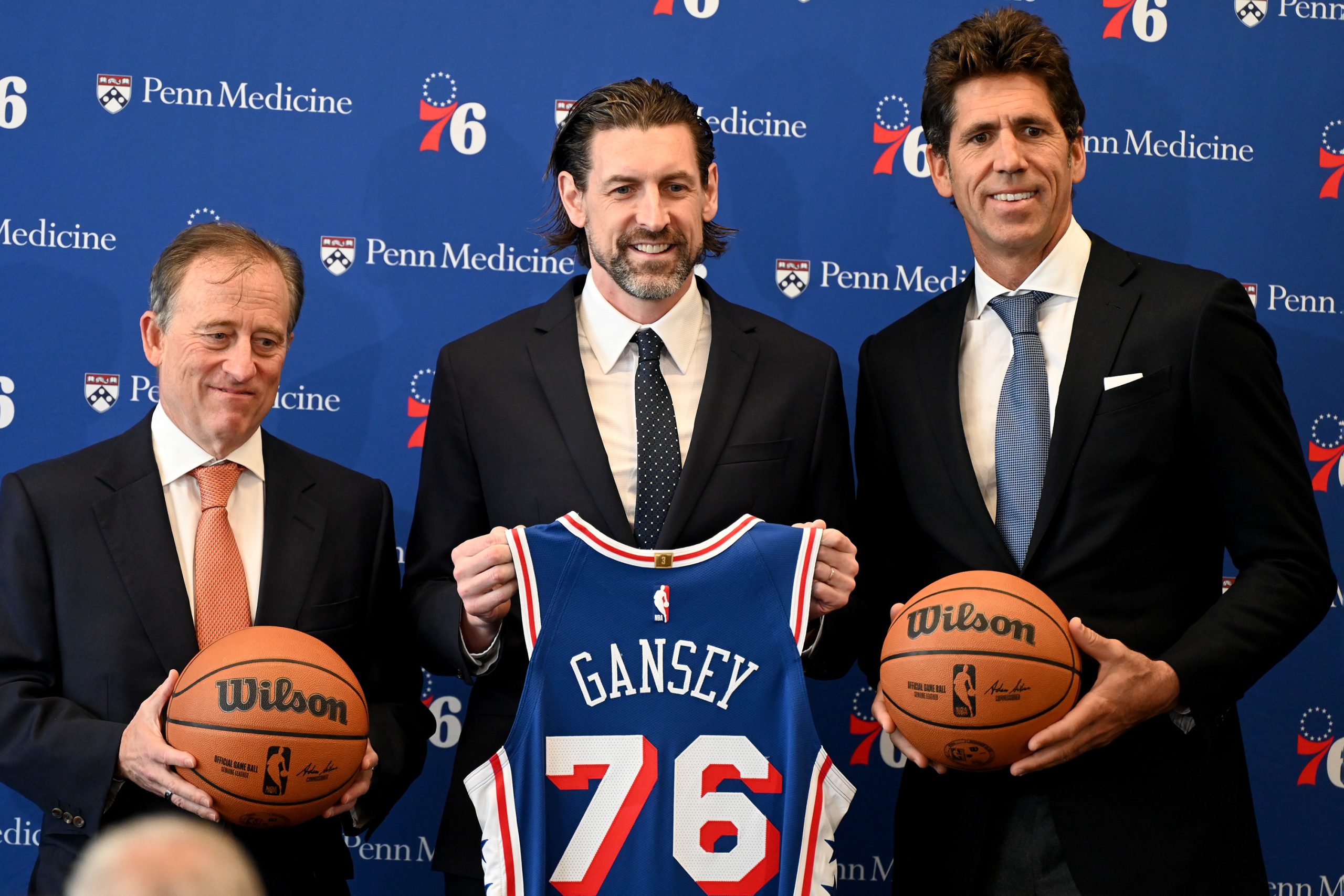
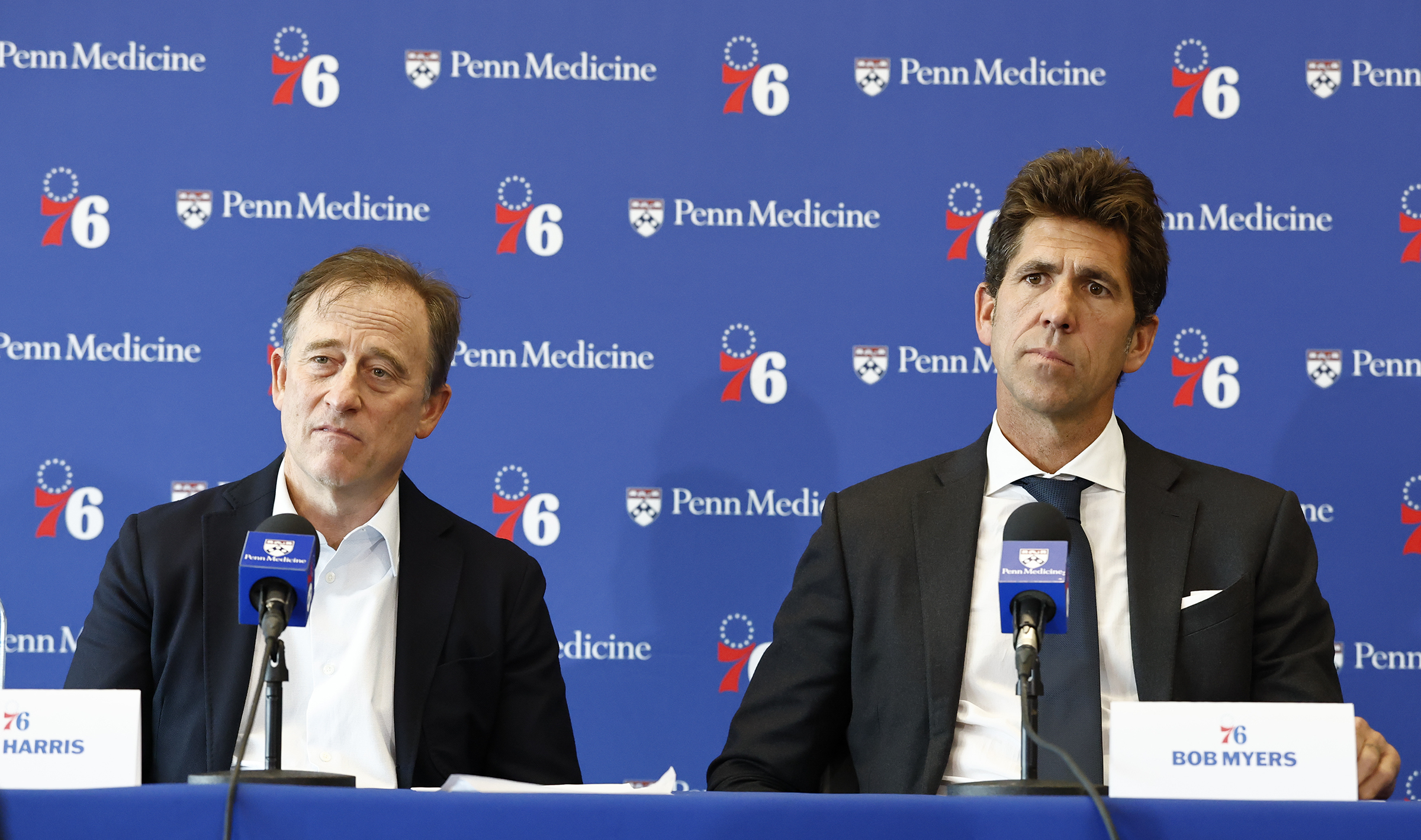
    Harris Blitzer Sports & Entertainment president Bob Myers (right) helped hire Mike Gansey and will work closely with him. At left is Sixers managing partner Josh Harris.Tom Gralish / Staff Photographer

    The dominant operating strategy for the next few years would seem to be playing it smart but honest: prioritize the three-to-five-year-plan while making this year’s team as good as possible within the constraints. The Eastern Conference landscape likely will get a lot tougher next season. With Pacers star Tyrese Haliburton returning to the 2024-25 Eastern Conference champs and Boston Celtics star Jayson Tatum fully recovered from Achilles surgery, the East should have at least three teams (including the New York Knicks) well out of reach of the Sixers.

    That doesn’t include the Detroit Pistons or the Cavs, both of whom have a 60-win season within the last two years. Nor does it include the Miami Heat, who are a perpetual threat to shake up the offseason, especially with a Giannis Antetokounmpo trade lurking. Meanwhile, the Atlanta Hawks and Charlotte Hornets ended the season on runs of 26-11 and 28-12. Factor in a talented Orlando Magic roster that underperformed in 2026, and the Sixers easily could enter the season as the eighth- or ninth-best team on paper, regardless of what they do this offseason.

    “We’ve got to find an identity,” said Bob Myers, the longtime Golden State Warriors executive who hired Gansey and will work in conjunction with him as president of sports at Sixers parent company, Harris Blitzer Sports & Entertainment. “We just don’t have one.”

    At this point, there isn’t much else to say.

  • Mike Gansey will have one big question to answer as his Sixers tenure begins

    Mike Gansey will have one big question to answer as his Sixers tenure begins

    It is fitting that the Sixers will introduce their new personnel chief on a day that could end with the Knicks one win away from their first NBA championship in 53 years. The last time they held one of these press conferences, the Knicks were coming off their sixth straight season with fewer than 33 wins and heading into a campaign where their starting lineup would include Nerlens Noel and Elfrid Payton.

    By the end of Daryl Morey’s first season as president of basketball operations, the Sixers would have a 15-game winning streak against the Knicks dating back to 2017. Six years later, there’s no better way to measure the organization’s stagnation than against the ascendancy of its closest neighbor.

    In short, the Sixers have selected a heck of a contextual backdrop for Mike Gansey’s first meeting with the Philadelphia media. Not only are the Knicks up 2-0 in the NBA Finals, but they are there with a starting lineup that features four players drafted no earlier than 23rd overall, plus a center whom Joel Embiid once used as his literal and figurative punching bag. Granted, the Knicks were not the team that drafted any of the five. But they also weren’t the team that traded one of them away.

    The Villanova angle has been well trod. For good reason. It is a remarkable twist of the knife. Less examined are the more painful connections.

    In 2017, the Sixers traded up for Markelle Fultz in a first round where OG Anunoby went at No. 23 and Josh Hart at No. 30. They are two of five players from that year’s draft who participated in this year’s conference finals.

    The following year is the year best known as the one where the Sixers drafted Mikal Bridges at No. 10 and then traded him away for a guy who would play 13 career games. It was also the year where they drafted Landry Shamet seven spots before the Mavericks took Jalen Brunson. The kicker is that Shamet is now on the verge of a ring as a key reserve with the Knicks.

    This exercise is mostly an example of the fun of cherry-picking your hindsight. But there is some level of truth in it. Like Morey, Gansey will be inheriting a team that is largely a function of some consequential missteps in its long ago past. The original vision was to lose a lot of games in the hopes of drafting a homegrown triumvirate like Fultz, Embiid, and Ben Simmons. The Sixers ended up with more chances than they deserved at executing a pivot. Each time — with Bridges and Jimmy Butler, notably — they kicked the ball right back out of bounds.

    Now, somehow, they have another chance.

    Gansey’s hiring comes at a critical time for the Sixers. Somehow, they find themselves at an inflection point that could prove just as critical as those they deflected in the past. Tyrese Maxey and VJ Edgecombe are both gifts from forgiving gods. Maxey was selected with the No. 20 overall pick that the Sixers initially traded to the Magic in the Fultz draft and then reacquired by trading a then-floundering Fultz to the Magic. Edgecombe was selected with the No. 3 overall pick that the Sixers landed because of how bad they were in Year 1 of the Paul George/Embiid Era.

    Monday’s press conference will hopefully be an opportunity to hear Gansey’s response to a question that nobody from the Sixers has yet answered. Bob Myers and Josh Harris took turns dodging it a month ago in the wake of Morey’s firing. They surely posed it during their interview sessions with the former Cavaliers general manager. However much say Gansey ends up having relative to Myers, his hiring is pretty good evidence that their philosophies are all in alignment here at the beginning.

    Where do the Sixers go from here?

    While the futures of Embiid and George are clearly the biggest variables, they also might be beside the point. There is only one answer. Their future is here, with the Sixers. Each of their contracts renders impossible a mutually beneficial trade, at least for next year. Gansey’s real challenge is how to factor that reality into his attempts to build around Maxey and Edgecombe.

    Maybe that is giving him and the Sixers too much credit. I suppose there is a chance he comes out and says he sees a roster that is built to win now, that Embiid is still the centerpiece of this team and George is still a fine championship-caliber starter. I suppose he could look at the No. 22 pick in this year’s draft and the Sixers’ relative wealth in future drafts and see mostly the capital it would take to add a win-now player to George, Embiid, Edgecombe, and Maxey.

    But I doubt it.

    Josh Harris and Bob Myers meet with the media at the 76ers Training Complex on May 14.Yong Kim / Staff Photographer

    If that was a philosophy Myers and Harris agreed with, they wouldn’t have had a reason to part ways with Morey. The change at the top only made sense if they sought a change in vision. Let’s hope we hear Gansey articulate that vision.

    There are lots of different ways to build a championship contender. There are lots of different timelines. The Knicks remade their entire roster from scratch in the span of a couple of seasons, but they built a team so sensible that it feels like it was drafted and developed together. The Spurs hit on three top-five draft picks in Victor Wembanyama, Stephon Castle, and Dylan Harper.

    In the push-pull between present and future, how much will the Sixers value players who make them a better team now vs. players who might make them the team they’ll need three years from now? Gansey’s first task as president of basketball operations is to sell his fan base on that vision.