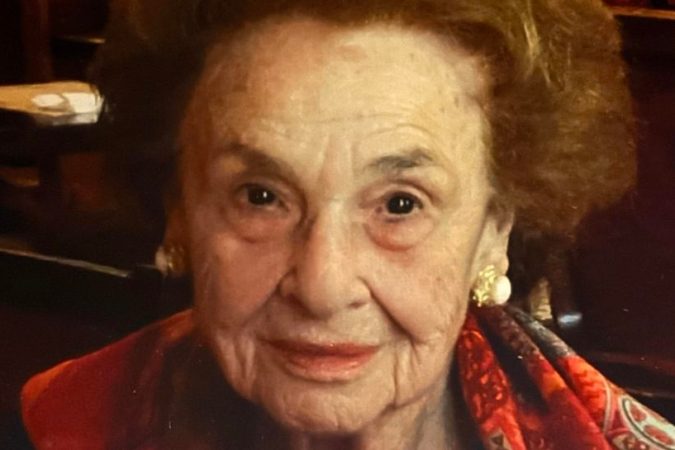
Author: Gary Miles

  • Neysa Adams, pioneering civic and community leader, scientist, and teacher, has died at 104

    Neysa Adams, pioneering civic and community leader, scientist, and teacher, has died at 104

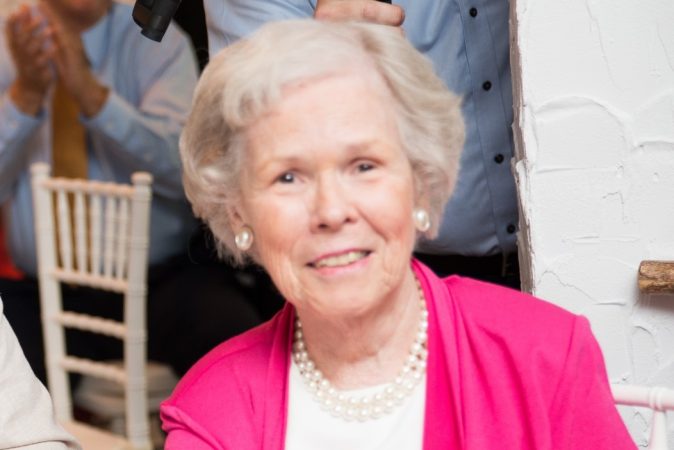
    Neysa Adams, 104, of Philadelphia, 1971 chair of the local United Fund women’s committee, former president of the Rebecca Gratz Club, onetime vice president of the women’s council for the Federation of Jewish Agencies, former associate trustee at the University of Pennsylvania, scientist, high school teacher, investment adviser, and philanthropist, died Friday, June 26, of heart disease at the Hearth at Drexel.

    Born and reared in Philadelphia, Mrs. Adams graduated from Olney High School and lived over the years in East Oak Lane, Germantown, and Elkins Park. She earned a degree in biochemistry with honors at Penn, did scientific research for a time, and taught English and history for two years at Philadelphia High School for Girls.

    Smart, friendly, and energetic, she joined the Philadelphia United Fund volunteer speakers bureau in 1963, became active with the fund’s public relations committee, schools committee, and women’s committee, and organized many community fundraising campaigns. In 1971, she told The Inquirer she had a “deep feeling for community work.”

    Mrs. Adams also served on the board at what is now Penn’s School of Social Policy and Practice and was active with the Emergency Aid of Pennsylvania Foundation, the National Conference on Social Welfare, and state and federal women’s advisory commissions. In 2003, then-Gov. Ed Rendell recognized her as a Distinguished Daughter of Pennsylvania for her “outstanding service and contributions to the Commonwealth of Pennsylvania.”

    As a philanthropist, Mrs. Adams and her husband, Arlin, were cochairs of Penn’s Harrison Society for fundraising recognition, and they established, among other endowments, the Arlin and Neysa Adams Lectureship and the Neysa and Arlin Adams Prize for excellence in prelaw studies at Temple University. Her husband died in 2015, and she donated his papers to the archives at Penn Carey Law School in 2017 and later funded its Arlin M. Adams Lecture in Law, Religion, and the First Amendment.

    “Everything good in my life came from him,” Mrs. Adams said in a 2024 online profile by the Hearth at Drexel.

    She also established Neysa Adams’ Library Fund at Reform Congregation Keneseth Israel in Elkins Park. Friends called Mrs. Adams “wonderful,” “outstanding,” and “one of life’s brightest lights” in tributes.

    One friend said: “Neysa was one of the kind.”
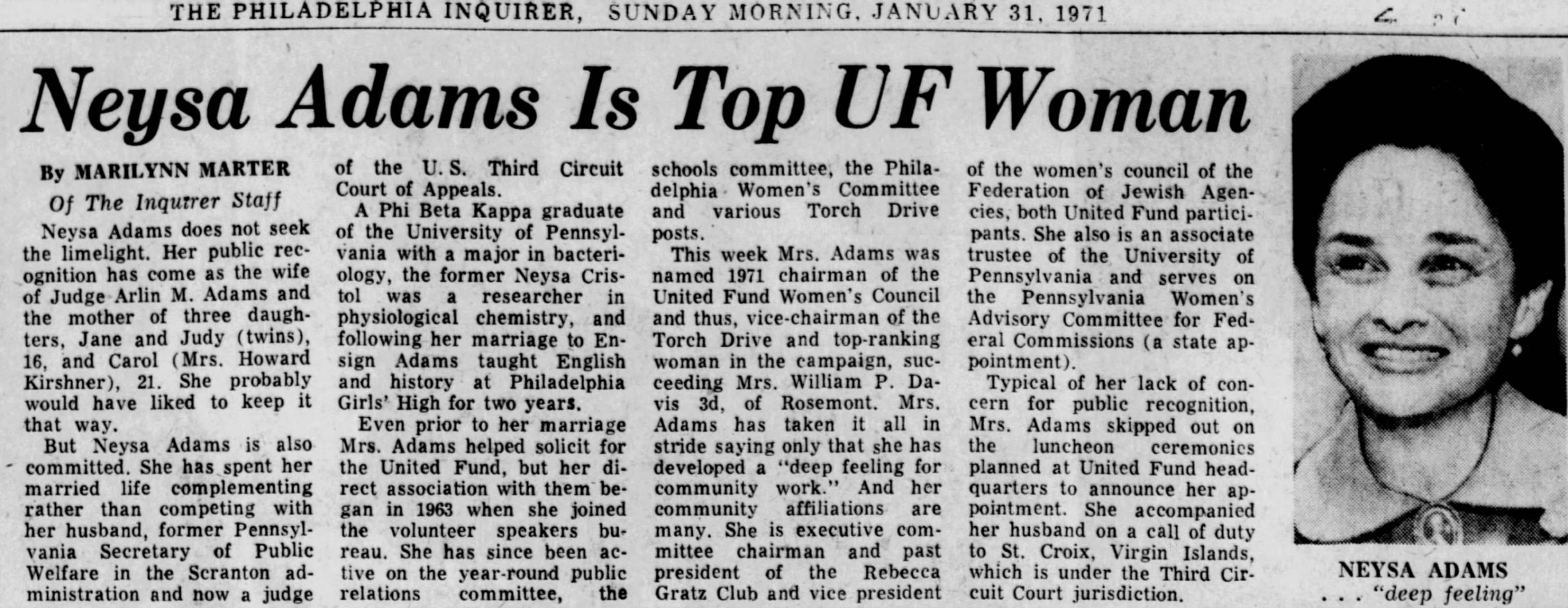
    This story about Mrs. Adams appeared in The Inquirer in 1971.Newspapers.com

    Neysa Norma Cristol was born Aug. 7, 1921. She met Arlin Adams in high school, and they married in 1942 while he was on leave from the Navy. They had daughters Carol, Judy, and Jane. Her daughter Jane died in 2017.

    Mrs. Adams and her husband, a state secretary of public welfare and longtime federal judge, traveled the world, mostly through his work, and she met a queen, a pope, several U.S. presidents, and other international notables. “Her resilience, intellectual curiosity, and dedication to serving others stand as a testament to a life well lived,” friends at the Hearth at Drexel said in 2024.

    She was active at Keneseth Israel, enjoyed cooking, and was an avid reader. She also worked as an investment adviser.

    She was featured on 6abc TV last August on her 104th birthday and said: “Get those things that make you happy. Enjoy them while you can.”
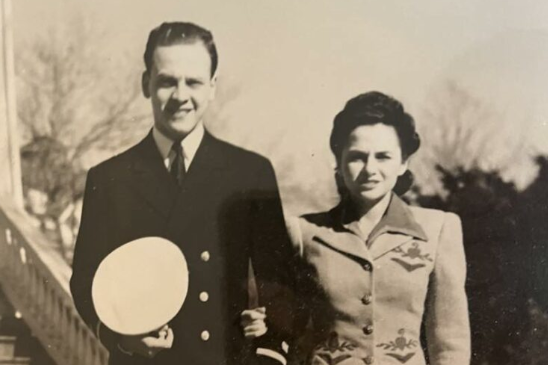
    Mrs.Adams and husband, Arlin, married in 1942 while he was on leave from the Navy.Courtesy of the family

    Her daughter Carol said: “She was outgoing and had lots of friends. It seemed like she knew everyone in Philadelphia.”

    In addition to her daughters, Mrs. Adams is survived by four grandchildren, one great-grandson, and other relatives. A sister and a brother died earlier.

    A celebration of her life is to be at 11 a.m. Friday, Aug. 7, at Reform Congregation Keneseth Israel, 8339 Old York Rd., Elkins Park, Pa. 19027.

    Donations in her name may be made to the University of Pennsylvania, Box 71332, Philadelphia, Pa. 19176; and Susquehanna University, 514 University Ave., Selinsgrove, Pa. 17870.
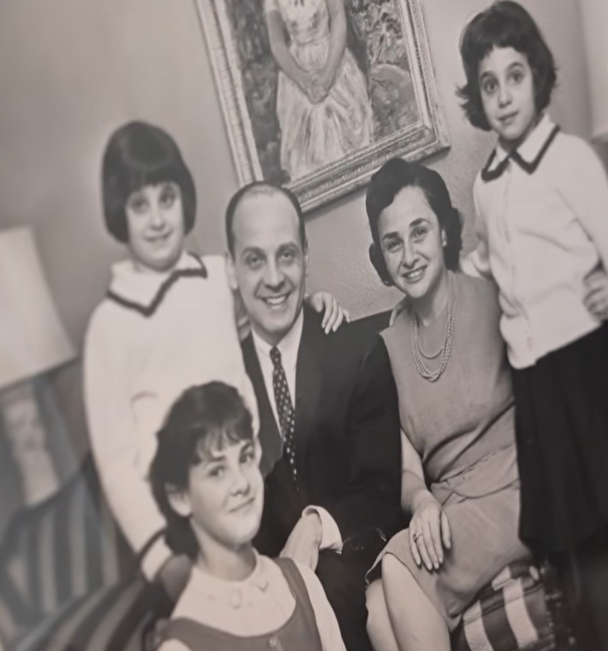
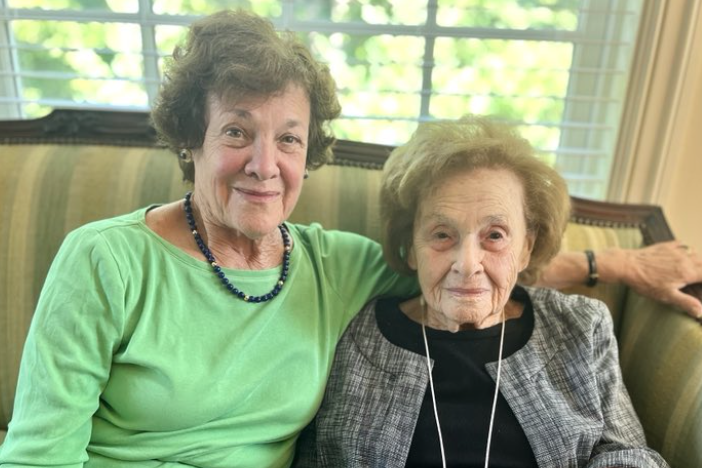
    Mrs. Adams (second from right) doted on her husband and three daughters. Courtesy of the family
    “It seemed like she knew everyone in Philadelphia,” said Mrs. Adams’ daughter Carol (left). Courtesy of the family
  • Akira Suwa, award-winning photojournalist at The Inquirer, has died at 84

    Akira Suwa, award-winning photojournalist at The Inquirer, has died at 84

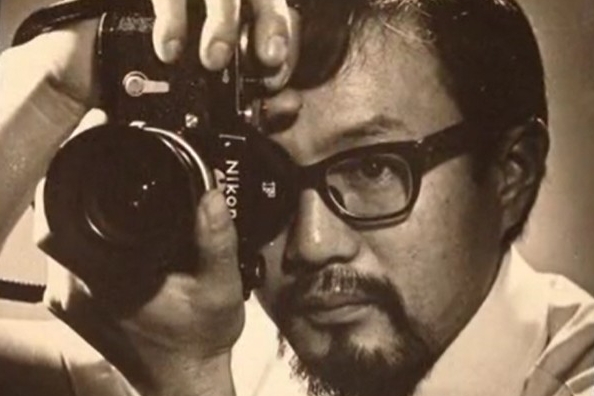
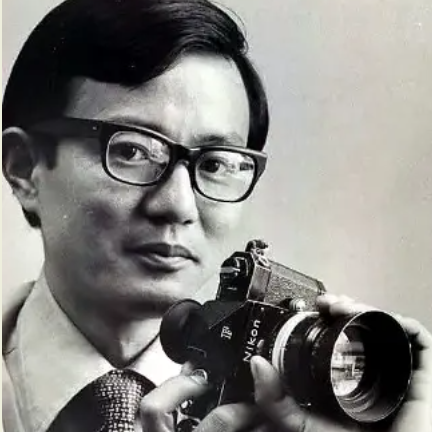
    Akira Suwa, 84, of Laurel Springs, Camden County, award-winning longtime photojournalist at The Inquirer, mentor, and lifelong green-thumb gardener, died Tuesday, July 14, of complications from dementia at his home.

    Born in what is now South Korea and reared in Japan, Mr. Suwa came to the United States for good in 1967 as a landscape designer and amateur photographer. When a landscaping job at a Florida garden center dried up, he polished his photography skills and, from 1969 to his retirement in 2014, worked as an award-winning staff photographer at the Tampa Tribune, the St. Petersburg Times, the Palm Beach Post, and The Inquirer.

    He joined The Inquirer in 1977 and, for 37 years, provided readers with thousands of illustrative, dramatic, stylish, and emotion-evoking photos from assignments around Philadelphia, South Jersey, and the world. He took poignant photos after the Three Mile Island nuclear accident, the fall of the Berlin Wall in Germany, and the Sept. 11 terrorist attacks, and during Operation Desert Storm in Saudi Arabia and the 1998 Winter Olympic Games in Japan.

    He sent back tragic and heroic images of conflict and despair from Libya and Brazil. He photographed drug traffickers in Colombia and was detained by authorities in China.

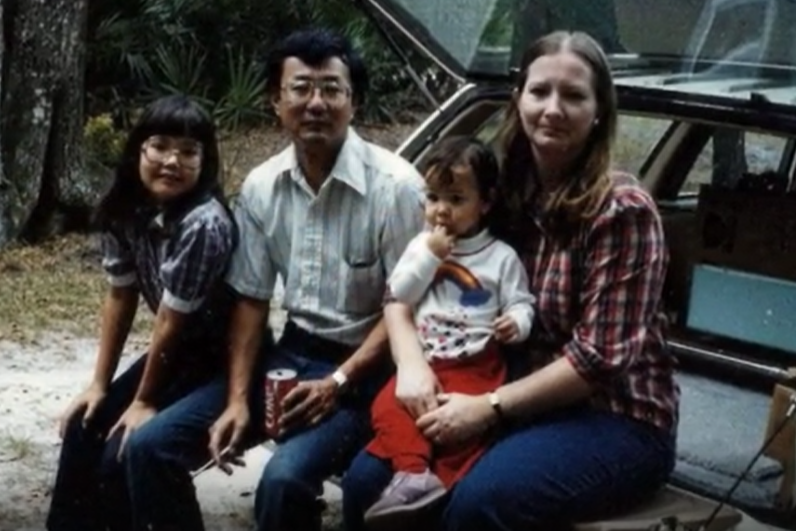
    Before the Inquirer, Mr. Suwa took photographs for the Palm Beach Post, the St. Petersburg Times, and the Tampa Tribune.Courtesy of the family

    Locally, he photographed athletes celebrating and commiserating, politicians and celebrities walking and waving, fashion models on runways, and restaurant specialties on tables. Former Inquirer colleagues called him a “brilliant photojournalist” and a “funny, engaging and terrific colleague” on Facebook.

    One former colleague said: “Akira told thousands of great stories with his camera.” His family said in a tribute: “Akira believed every story was worth telling.”

    Before the Inquirer, Mr. Suwa took photographs on all kinds of assignments for the Palm Beach Post, the St. Petersburg Times, and the Tampa Tribune. His father was an avid amateur photographer back in Japan, and Mr. Suwa honed his own emerging photo skills at nights and on weekends in Florida before joining the Tribune in 1969.

    He won several awards from the National Press Photographers Association and was named the 1973 Florida Newspaper Photographer of the Year by the University of Florida. He mentored young photographers and students, and one former student said: “He taught me so much about making the best photos possible.”

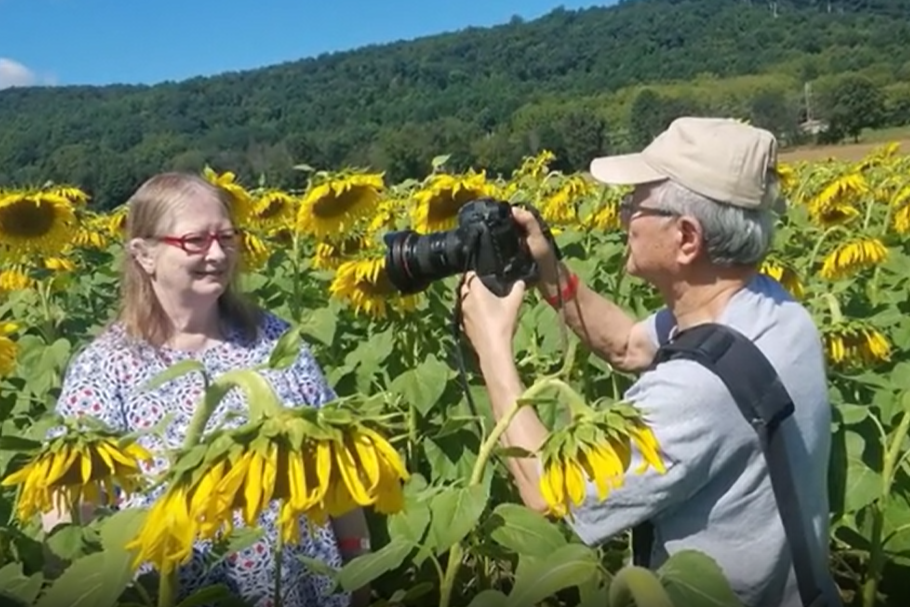
    Mr. Suwa photographed his wife, Deborah, often.Courtesy of the family

    Away from the lens, Mr. Suwa enjoyed tending his backyard garden in South Jersey, watching the birds flit about the feeders, and chasing the squirrels away. His mother was a serious gardener in Japan, and he studied agriculture in California as an exchange student while earning a degree at Tokyo Agricultural University in 1966.

    In 1964, he took a year off from college to work as a busser in the Japan pavilion at the World’s Fair in New York. “I fell in love with America, especially New York City,” Mr. Suwa wrote in an autobiography he shared with his family. “I was young and motivated to do something different from my peers back in Japan.”

    Akira Suwa was born Dec. 22, 1941, in what was then Taegu, Korea. He and his family fled Korea for Japan as refugees after World War II, and he grew up mainly in Osaka.

    He never formally studied photography, but his innate camera skills got him a job with a photo studio in Florida in the late 1960s.

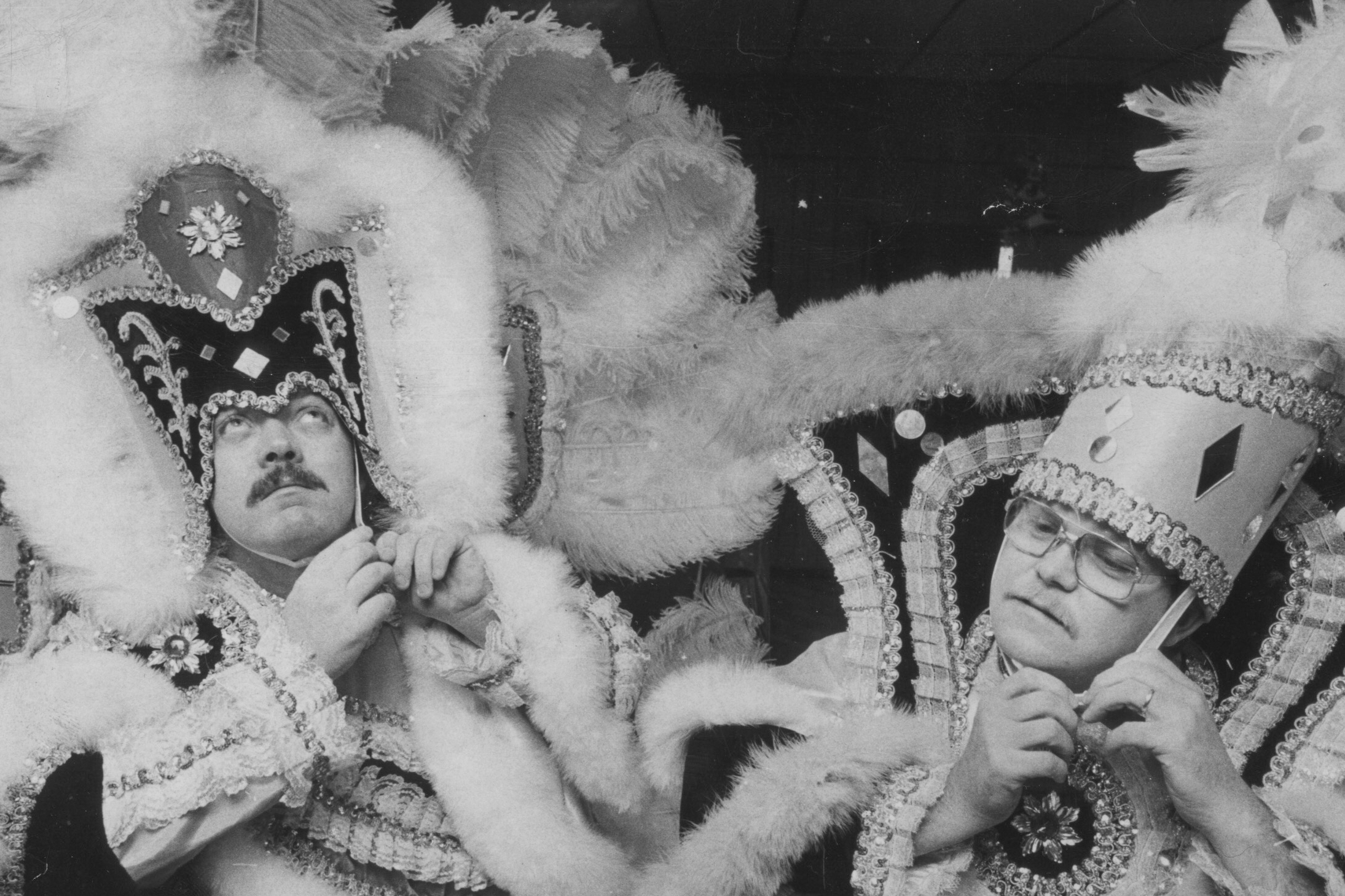
    Mr. Suwa photographed these Mummers in 1978. Akira Suwa / Staff Photographer

    He met Deborah Carter through a mutual friend at the studio, and he took her to see the musical Hello, Dolly! on their first date. She was smitten, she said, and they married in 1969, and had daughters Jasmine and Keiko.

    They settled in Laurel Springs when he joined The Inquirer and traveled to Japan several times to visit family and friends. “We enjoyed the best of both cultures,” his wife said.

    Mr. Suwa listened to jazz and built his own home computers. He liked to play pranks on the girls, his daughter Keiko said, but was simultaneously warm, serious, and practical. “If there was a job to do,” she said, “he would get it done.”

    His daughter Jasmine said: “He was forthright, sincere, and full of integrity.”

    Mr. Suwa and his family traveled to visit family in Florida and Japan. Courtesy of the family

    He doted on his wife and their grandchildren, and his family praised “his sharp eye, his mischievous sense of humor, and his devotion to his family.” His wife said: “He had my back and was as honest as the day is long.”

    Friends called him “the kindest person,” “wonderful and enormously talented,” and “a caring person to everyone.” He was interviewed by Photo Lounge in 2022 and said: “I just take pictures, and I like people.”

    His wife said: “He was my human, my person, my guy.”

    In addition to his wife and daughters, Mr. Suwa is survived by two grandchildren and other relatives. A brother died earlier.

    Visitation with the family is to be from 1 to 3 p.m. Saturday, Aug. 1, at Gardner Funeral Home, 126 S. Black Horse Pike, Runnemede, N.J. 08078.

    Donations in his name may be made to the Committee to Protect Journalists, Box 2675, New York, N.Y. 10108; and the Animal Welfare Association, 509 Centennial Blvd., Voorhees, N.J. 08043.

  • Keith A. Morrison, celebrated artist and former Temple dean, has died at 84

    Keith A. Morrison, celebrated artist and former Temple dean, has died at 84

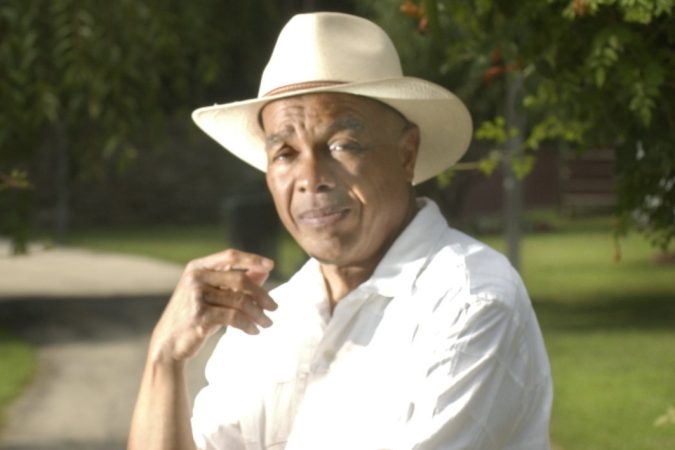
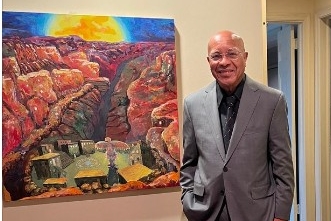
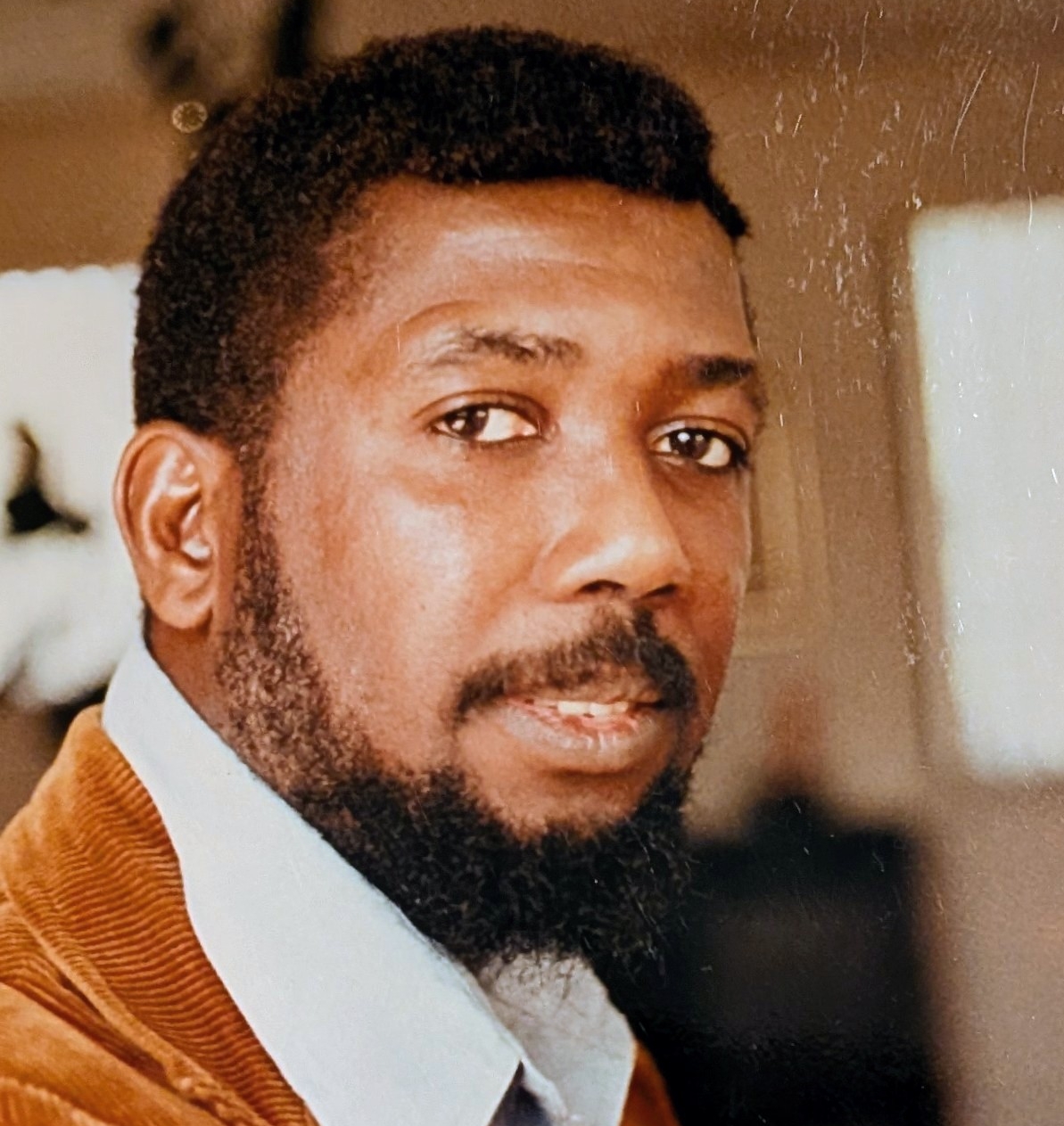
    Keith A. Morrison, 84, of Meadowbrook, Montgomery County, celebrated artist, professor of painting emeritus and former dean at Temple University’s Tyler School of Art and Architecture, curator, critic, consultant, writer, and lecturer, died Monday, June 1, of cancer at Fox Chase Cancer Center.

    Born in Jamaica, Dean Morrison left the Caribbean island for the School of the Art Institute of Chicago when he was 17 and earned bachelor’s and master’s degrees in fine arts and art education. He went on to teach college art classes in Nashville, Chicago, and College Park, Md., and, in addition to Temple, serve as dean at San Francisco State University, the University of Maryland, and the old San Francisco Art Institute.

    He was the first Black academic dean of art in a predominantly white American school in 1993 at the San Francisco Art Institute and joined Temple as dean of its art school in 2005. He became a professor of painting at Temple in 2008 and retired in 2018 as professor emeritus.

    As head of the Temple art school for three years, Dean Morrison hired staff, expanded degree programs, and coordinated popular activities with the school’s affiliated art programs in Europe and Japan. In an online tribute, former colleagues at Temple called him a “dedicated advocate for artists and arts organizations.”

    Earlier, he was associate dean of architecture and art at the University of Illinois, art department chair at DePaul University in Chicago, and associate professor of art at Fisk University in Nashville. He lectured around the world and was a visiting scholar at Sichuan Fine Arts Institute in China and the University of Michigan.

    “He was very serious, very thinking,” said his wife, Susan C. Alunan. “People said he was present and insightful, even life-changing.”

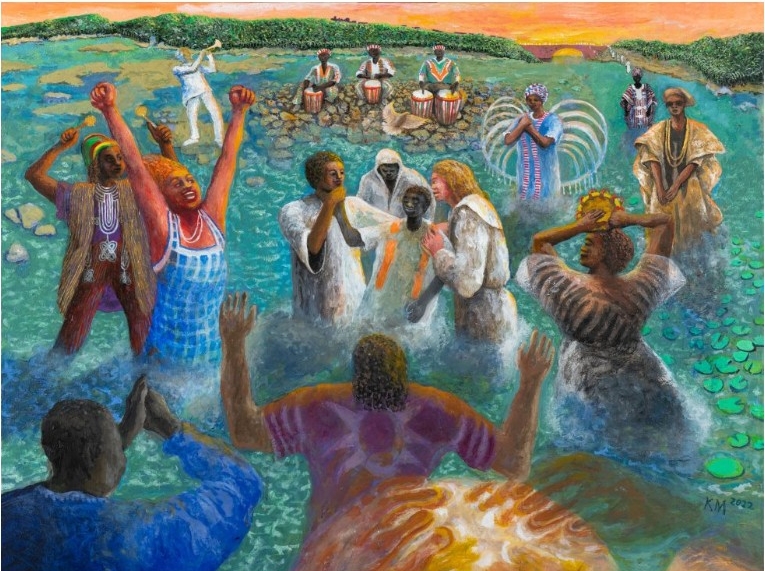
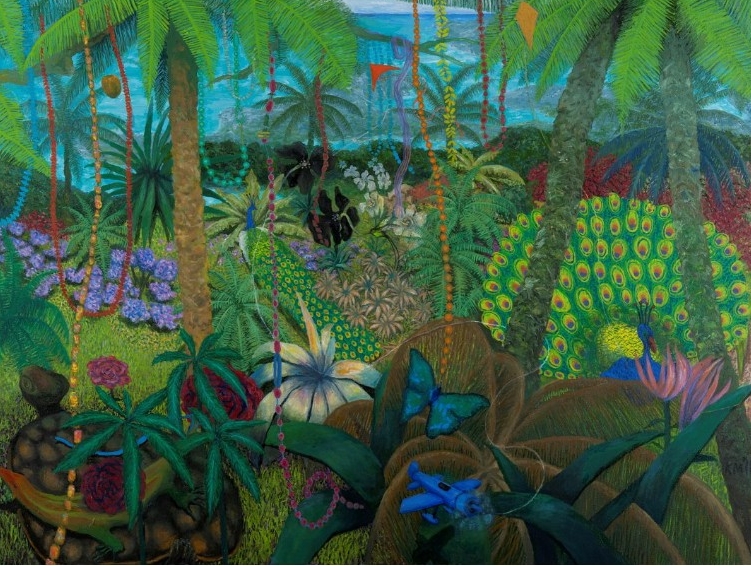
    As an artist, Dean Morrison was inspired by his Afro-Caribbean heritage, his childhood memories of lush Jamaican landscapes, and his multicultural experiences in Europe, Cuba, Mexico, and elsewhere. He worked in watercolors, oils, acrylic, and prints, and created memorable abstract, figurative, and surreal images.

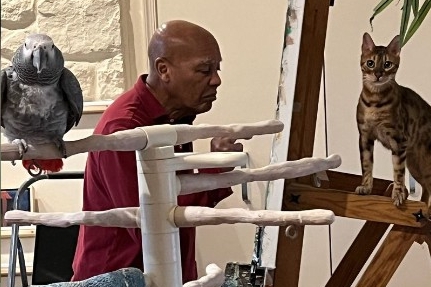
    Many of his paintings feature landscapes, people, plants, and animals, often including Scout, his African gray parrot. His images, he told colleagues, were “more intuitive than intellectualized.”

    Dean Morrison worked most often at his home studio in Meadowbrook. His parrot, Scout (left), sometimes appeared in his work. Susan C. Alunan

    Friends and colleagues called his paintings “unique and moving” and “magical in content and accessible by all who encounter them.” Allan Edmunds, founder of Brandywine Workshop and Archives, said on Facebook: “His art connects and shares hidden stories and myths that helped shape his creative vision of multiculturalism as a global reality.”

    Dean Morrison’s work appears on the covers of books and magazines, and in hundreds of solo and group shows around the world. It resides in collections at the Philadelphia Museum of Art, the Pennsylvania Academy of the Fine Arts, the National Gallery of Art and the Smithsonian American Art Museum in Washington, and other galleries.

    Colleagues at the David C. Driskell Center at the University of Maryland said in a tribute: “Morrison’s vivid, imaginative paintings — filled with brilliant color, history, mythology, and fantasy — speak to African diasporic experience as well as Morrison’s unique sense of humor and narrative composition.”

    As a writer, he pioneered Pan-African art criticism and was, in his own words, a Black critic “interested in art from a Black person’s perspective.” He was a visiting editor at the New Art Examiner in Chicago, and his reviews, interviews, and general observations appeared in the Washington Post, museum catalogs, and other publications.

    His book Art in Washington and Its Afro-American Presence: 1940-1970 was published in 1985 and serves as a text at art schools. In 2004, Renée Ater wrote a 128-page monograph called Keith Morrison.

    As a curator, Dean Morrison supervised exhibitions in the United States, Jamaica, and Cuba. He represented the United States and Jamaica at international art exhibitions, and was active with Brandywine Workshop and the Washington Project for the Arts.

    He earned lifetime achievement awards from Howard University and Brandywine Workshop, and was named a Jamaican Commander in the Order of Distinction in 2017 for “outstanding and important services to Jamaica.”

    “My mood is always happy,” Dean Morrison said in a 2008 interview with the University of Delaware’s UDaily. “You can paint anything you want. It does not have to be because you yourself feel that way.”

    This is Dean Morrison’s “In the Rivers of Babylon.”Keith A. Morrison
    This is Dean Morrison’s “Scenes From Childhood.”Keith A. Morrison

    Keith Anthony Morrison was born May 20, 1942, in Linstead, Jamaica. He ran track in high school and took drawing classes at the Jamaica School of Arts and Crafts.

    He learned about the School of the Art Institute of Chicago after high school and worked as a disc jockey and sound effects man for a Jamaican radio station to earn money to travel to the United States. He earned his bachelor’s degree at the University of Chicago in 1963 and his master’s degree at the Art Institute of Chicago in 1965.

    He had a son, Ron, a daughter, Melinda, and, after a divorce, married Alunan in 2003 and welcomed her children into his family. His daughter and former wife died earlier.

    Dean Morrison studied Aristotle and earned a Fulbright Senior Scholar grant. He enjoyed classical music and jazz, and he and his wife traveled the world together.

    Dean Morrison “had a great imagination and sense of humor,” his wife said.Susan C. Alunan

    He played tennis and ran, and lived in Chicago, Washington, and San Francisco before settling in Meadowbrook. “He had a great imagination and sense of humor,” his wife said. “He was a fun guy.”

    In addition to his wife and son, Dean Morrison is survived by a brother and other relatives.

    A celebration of his life is to be held later. Brandywine Workshop and Archives has scheduled a showing of his work from 6 to 8 p.m. on Thursday, Aug. 6.

  • Al Campbell, retired longtime Inquirer copy editor, has died at 74

    Al Campbell, retired longtime Inquirer copy editor, has died at 74

    Al Campbell, 74, of Philadelphia, retired longtime copy editor at The Inquirer, former copy boy, clerk, and library assistant at the Bulletin, mentor to many, and steady pitcher for the old Horsham Neighbors softball team, died Tuesday, June 9, of heart and kidney failure at the home of his brother Bob in the Northeast.

    Born in Philadelphia and a 1969 graduate of Northeast High School, Mr. Campbell spent nearly three years as a copy boy and editorial assistant in the old Bulletin newsroom before joining The Inquirer as a copy editor in 1970. That move to 400 N. Broad St. kicked off a colorful 46-year career at The Inquirer that included stints on the suburban news copy desk and the night sports copy desk, and a self-assigned 24-7 job as a friend and mentor to dozens of reporters, columnists, editors, and photographers.
    “Al was so kind and funny,” a former Inquirer colleague said on Facebook. “He made The Inquirer a better place.” Other former colleagues called him “a sage and an icon” and “a real pro and fun to be around.”

    Big and often boisterous — everybody called him Moose — Mr. Campbell was the son of a newspaper reporter, and he was adept at polishing prose, detecting mistakes, and working with reporters and photographers, usually over the phone. “Moosey looked out for us,” a former colleague said on Facebook.

    Mr. Campbell (center) “was a stickler for details,” his brother Bob said. Courtesy of the family

    He came up with witty headlines and captions, had years of practical and institutional knowledge of Philadelphia politics, culture, and sports, and worked nimbly on deadline, making him a favorite of other editors and page designers. He also served as a newsroom union steward.

    “He was a stickler for details,” his brother Bob said. “People said his favorite saying was: ‘I got you covered.’”

    A photographer said on Facebook: “He saved my neck many times with caption corrections.” Longtime Inquirer colleague Don McKee said: “He was diligent and took the job seriously. He actually cared about what we wrote and what went in the paper.”

    Away from the newsroom, Mr. Campbell organized softball games between Inquirer staffers and hosted memorable late-into-the-night parties at his home in the Northeast. He was quick with a joke and “put a smile on everyone’s face,” a longtime friend said.

    Mr. Campbell and his wife, Jean, married in 1980.Courtesy of the family

    Other former colleagues called him “unique,” “a real character,” “a larger-than-life personality,” and “the great wit of our team.” His brother said: “He was honest and loyal, an old-fashioned man of his word.”

    Alan Douglas Campbell was born Oct. 10, 1951. He was on track and basketball teams in high school, joined the Boy Scouts and Army Reserve Officers’ Training Corps, and studied at Temple University briefly before going into newspapers full-time.

    He met Jean Hunsberger in school. They reconnected at their 10-year high school reunion in 1979, married in 1980, and lived in a cozy house he called Moose Manor. His wife died in 2022.

    Mr. Campbell was fascinated by trains and public transportation, and he rode his bicycle as a boy to nearby train stations to watch the locomotives roar by. Later, he rode the trains to the suburbs and Washington, and assembled an extensive collection of model trains that he displayed at his home.

    Mr. Campbell was a cat lover. Courtesy of the family

    He loved cats, old movies, and comedy shows. He celebrated his Scottish heritage and became licensed as a massage therapist.

    “Moose was one of a kind,” a former colleague said. His brother Bob said: “He was the most gentle soul on the planet.”

    In addition to his brother, Mr. Campbell is survived by a brother, Tom, and other relatives.

    A celebration of his life is to be held later.

    Donations in his name may be made to the Pennsylvania SPCA, 350 E. Erie Ave., Philadelphia, Pa. 19134.

    Mr. Campbell started his 46-year career at The Inquirer in 1970.Courtesy of the family
    Mr. Campbell was a playing manager for the Horsham Neighbors softball team in the 1980s.Courtesy of the family
  • John Alviti, retired senior curator at the Franklin Institute and former executive director at the Atwater Kent Museum, has died at 76

    John Alviti, retired senior curator at the Franklin Institute and former executive director at the Atwater Kent Museum, has died at 76

    John Alviti, 76, of Flourtown, Montgomery County, retired innovative senior curator at the Franklin Institute, former executive director at the Atwater Kent Museum, adjunct professor of urban studies, and “Mr. Philadelphia History” to family and friends, died Saturday, June 20, of complications from heart and kidney disease at Jefferson Abington Hospital.

    Born in Chicago and devoted to history and his South Side White Sox baseball team, Mr. Alviti came to Philadelphia in the 1970s to pursue a doctorate in history and urban studies at Temple University. He never got that doctorate.

    But he fell in love with Philadelphia’s history and architecture, got married, settled down in Flourtown, and, for 34 years, was one of the region’s most influential museum curators and historians. Affable, creative, and energetic, by all accounts, Mr. Alviti became a groundbreaking executive director at the now-closed Atwater Kent Museum in 1982 and celebrated curator at the Franklin Institute in 1994.

    Even after he retired in 2018, he was known around town as “Mr. Philadelphia History.”

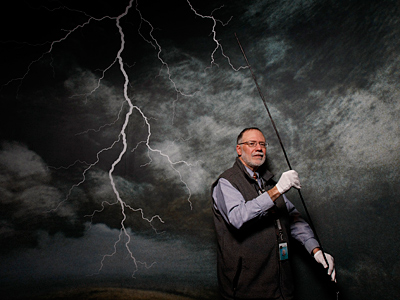
    Mr. Alviti displayed this 5-foot-long fragment of a lightning rod designed by Benjamin Franklin at the Franklin Institute in 2010. Michael S. Wirtz / Staff Photographer
    At the Atwater Kent, Mr. Alviti updated exhibits on William Penn, the history of Philadelphia, the old Enchanted Colonial Village display, and local cemeteries. He added maritime and archaeology galleries.

    At a gala to celebrate the museum in 1984, A. Atwater Kent Jr., son of the museum founder, said Mr. Alviti “has done a great job of creating interesting exhibits and improving the museum.”

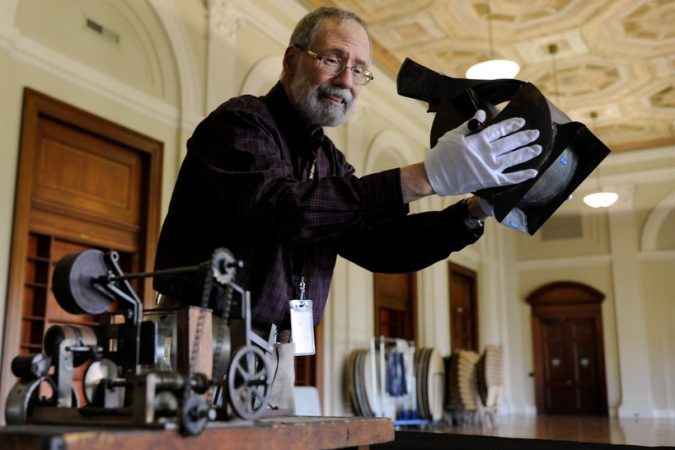
    At the Franklin Institute, he reorganized its huge inventory, redecorated the galleries, digitalized many artifacts, and created popular exhibits regarding the Wright Brothers, Benjamin Franklin, antique machines, X-rays, and dozens of other scientific subjects.

    “He loved objects,” said his wife, Maryellen. “He loved the history of objects and telling their story.”

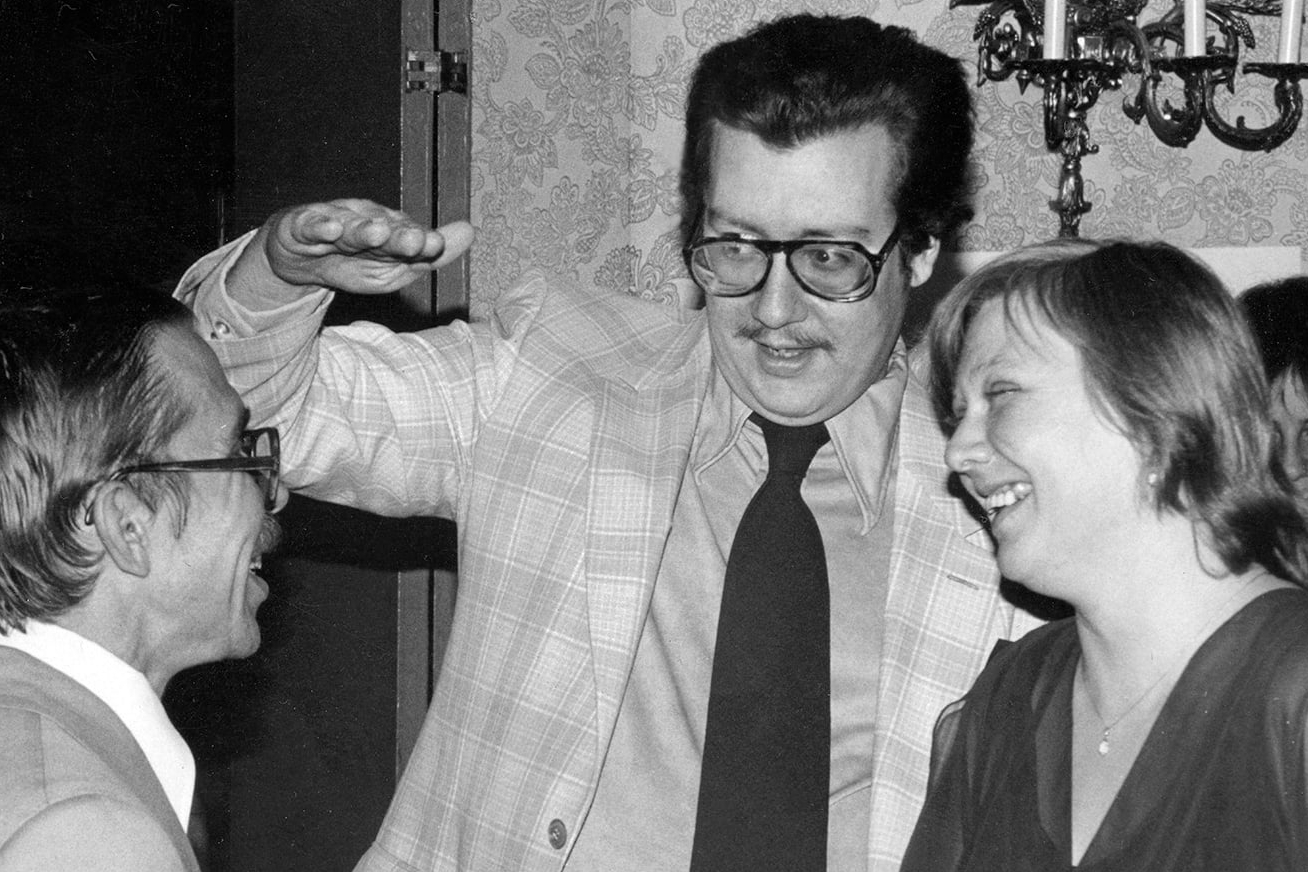
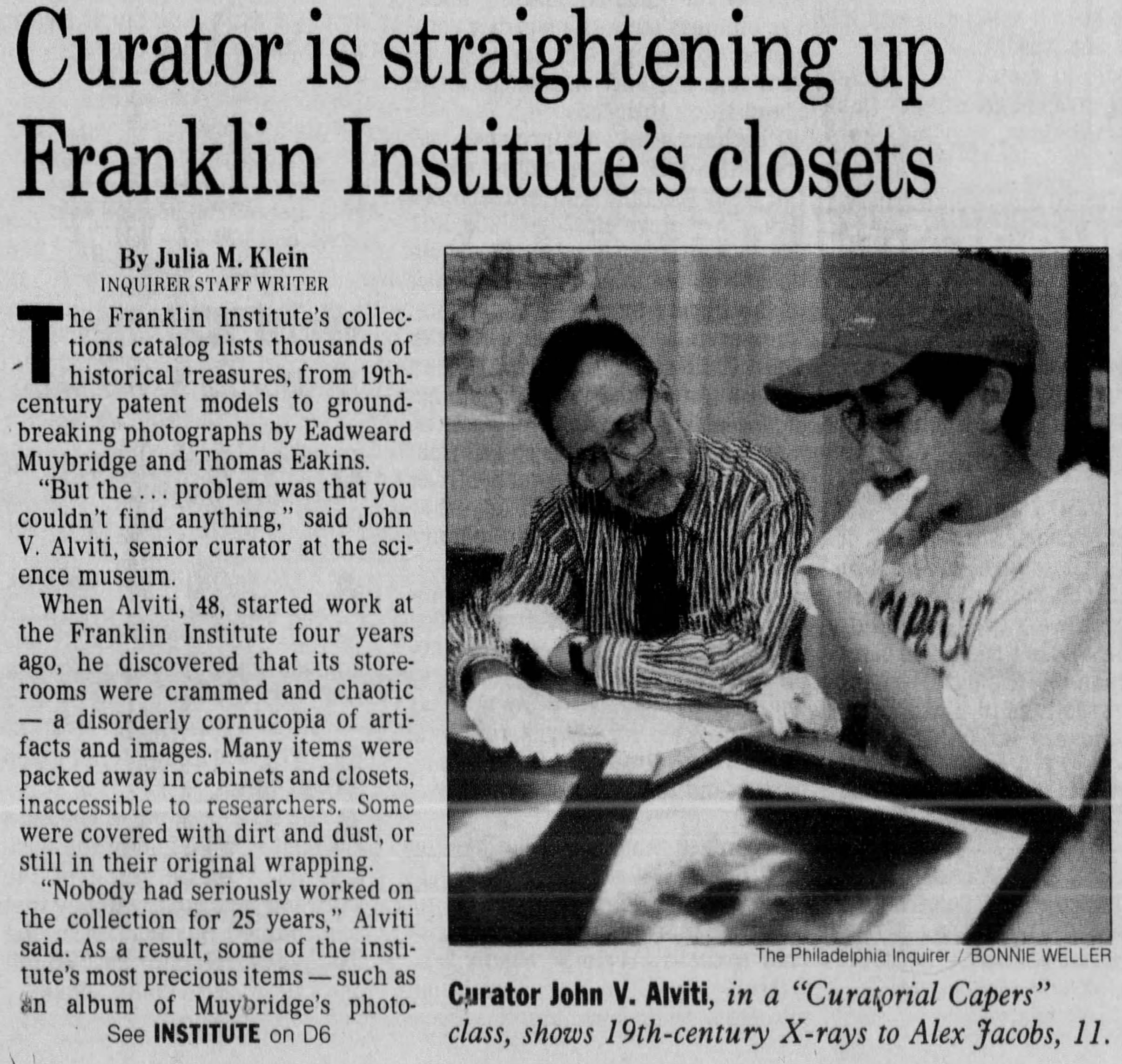
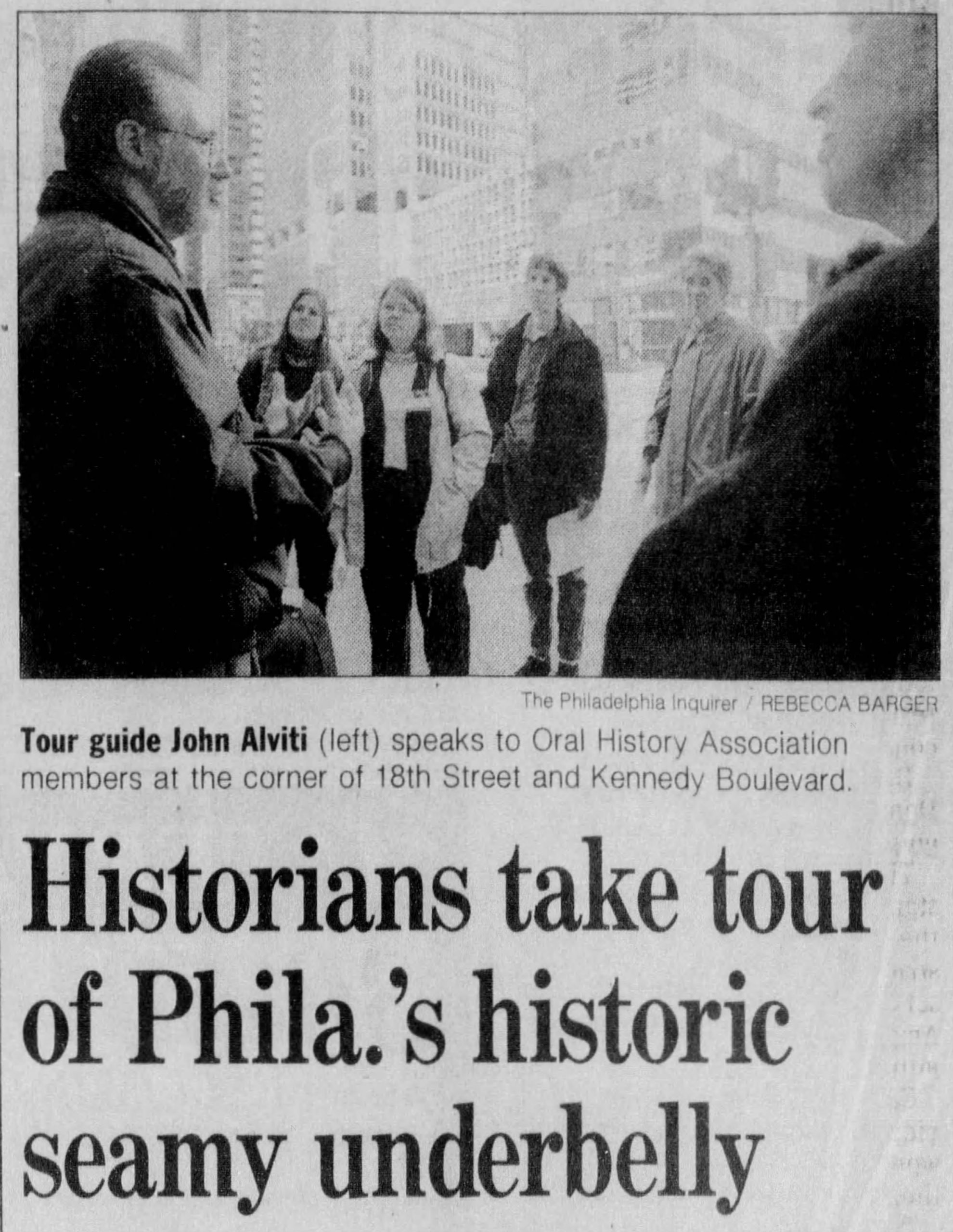
    This story and photo of Mr. Alviti (left) was published in The Inquirer in 1998.Newspapers.com

    In 1998, Mr. Alviti told The Inquirer: “Besides the curator of stuff, I’m also the curator of institutional memory. And institutional memory is more than just simply the facts about what happened in the past. It’s about the legacy of an institution … and how it informs our thinking and decision-making.”

    He was also adept at merging his collections with educational programs, and he helped organize the city’s National History Day competition for students, the Phil-A-Kid hands-on history workshop for fourth and fifth graders, the Peopling of Philadelphia research project, and the Curatorial Capers summer day camp program. Often, in a nod to the ever-present protective gloves he wore to handle the artifacts, he introduced himself as “Johnny Whitegloves.”

    “There are some curators who think I’m crazy,” he told The Inquirer. But a public presentation, he said, “really demonstrates the power of an object.”

    Mr. Alviti also led walking tours of the city for visiting colleagues from the Oral History Association, the Organization of American Historians, and other groups. He admired and worked closely with amateur historians, and led the successful effort in 1981 to save the historic Lit Bros. building complex on Market Street from demolition.

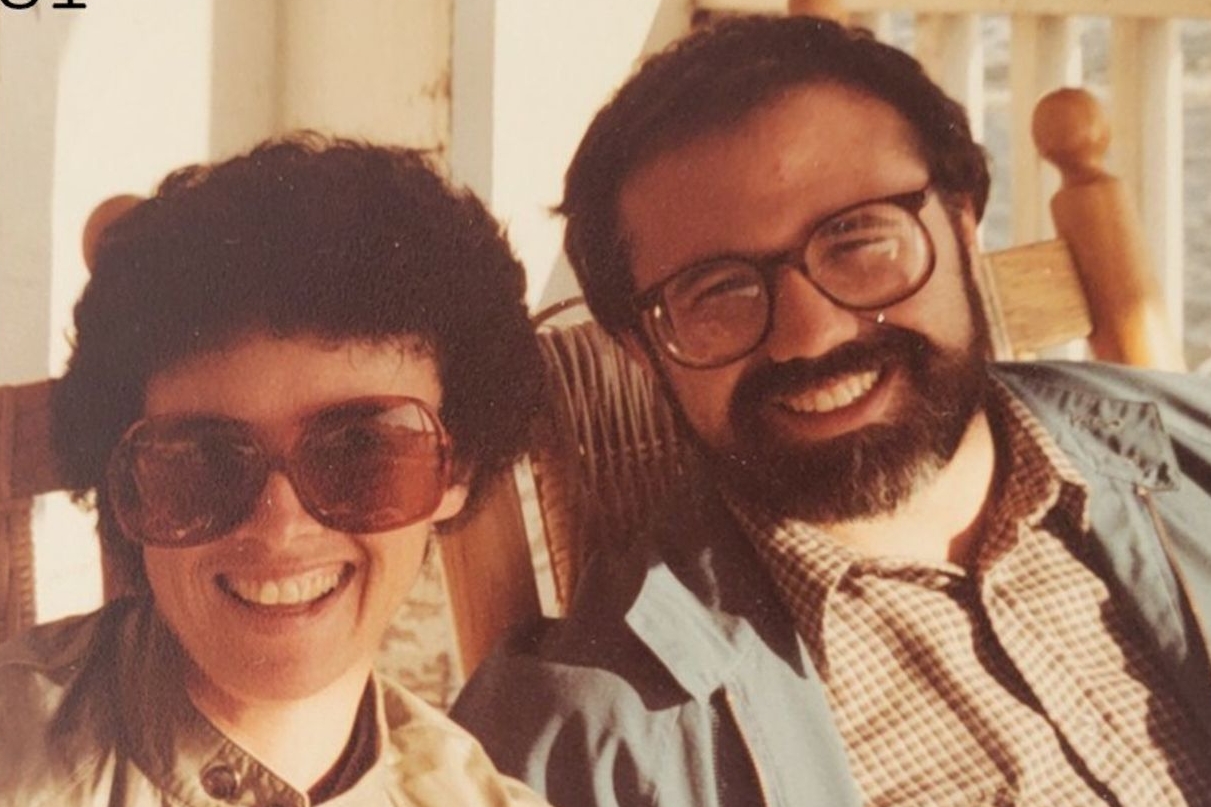
    Mr. Alviti and his wife, Maryellen, married in 1983.Courtesy of the family

    Between the Atwater Kent and the Franklin Institute, Mr. Alviti spent two years as director of the Historical Society of Washington, D.C. He was an expert on public transportation and taught urban studies, American history, and museum training at Temple and Stockton Universities, Rutgers University-Camden, and elsewhere.

    He was onetime curator of historic Fort Mifflin and president of what is now the Museum Council of Greater Philadelphia. He was on the advisory board of the old Philadelphia Alliance for Teaching Humanities in the Schools and active with the American Association of Museums and other groups.

    “He had a gift for making friends for life,” longtime friend Margaret Marsh said, “and he had a legendary generosity of spirit.” Longtime friend Howard Gillette said: “He never met a stranger.”

    John Vincent Alviti was born Sept. 22, 1949. A lifelong avid reader, he earned a bachelor’s degree in urban studies and history at Lewis University in Illinois in 1971 and a master’s degree in history at the University of Wisconsin-Milwaukee in 1975.

    The photo and a story about Mr. Alviti and his city walking tours appeared in The Inquirer in 1996.Newspapers.com

    He played piano and clarinet, and sang in choirs in high school and college. “He left Chicago when he was 25 or 26,” said his younger sister, Rosemarie Alviti Babic, “but never stopped loving the city.”

    He met Maryellen Coonahan when she took an urban studies class he was teaching at Temple, and they married in 1983 and lived in Philadelphia, Washington, and Flourtown. Together, they traveled the world and visited museums in London, Rome, Athens, Madrid, and elsewhere.

    Mr. Alviti enjoyed puzzles, games, and conversation. He lived with a heart condition for most of his life and was the lovable “Uncle Johnny” to his nieces and nephews. “He is missed beyond words,” said his niece Lindsay Hogan.

    He was fascinated by urban architecture and city life around the world, and he routinely bought food and drink for people without homes, picked up litter, and offered correct directions to those who looked lost.

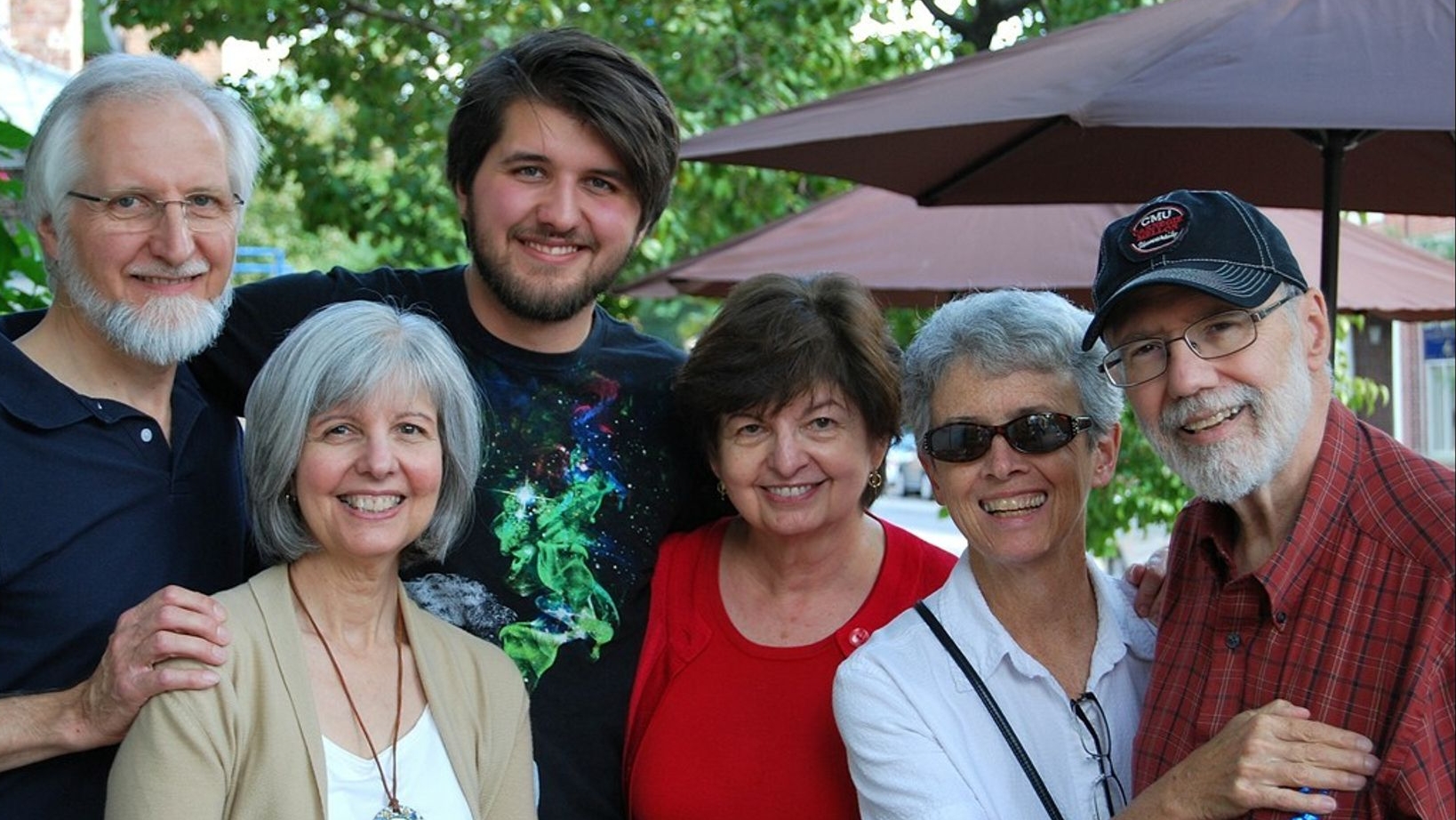
    Mr. Alviti (right) enjoyed time with family and friends.Courtesy of the family

    “He was a curious fellow,” his wife said, “who loved to help people.”

    In addition to his wife, sister, and niece, Mr. Alviti is survived by a sister, Rita Jo Alviti Coyne, a brother, James, and other relatives.

    A celebration of his life was held earlier.

    Donations in his name may be made to Face to Face, 123 E. Price St., Philadelphia, Pa. 19144.

    His wife called Mr. Alviti “a curious fellow who loved to help people.”Courtesy of the family
  • Ida Schmertz, pioneering women’s activist, political innovator, and former American Express senior vice president, has died at 91

    Ida Schmertz, pioneering women’s activist, political innovator, and former American Express senior vice president, has died at 91

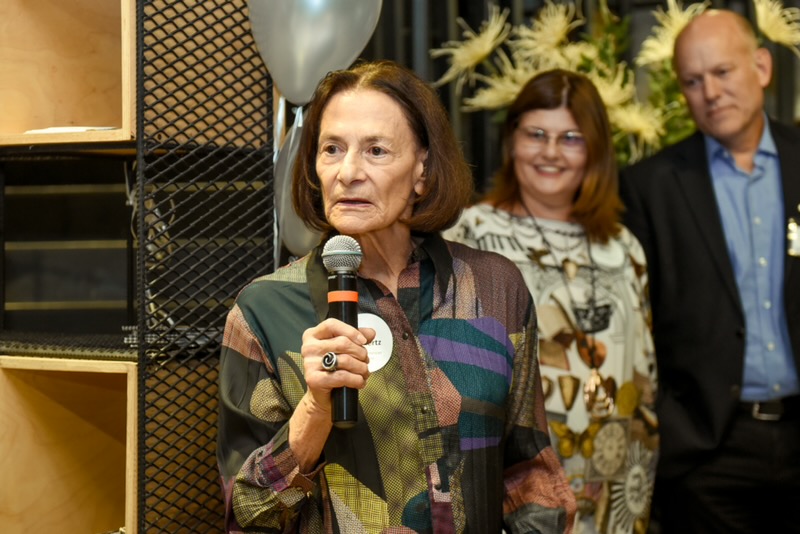
    Ida Schmertz, 91, formerly of Jenkintown, pioneering women’s activist, international relations innovator, presidential appointee, first female senior vice president at American Express, volunteer, mentor, and role model, died Thursday, July 2, of organ failure at New York Presbyterian Hospital.

    Born in Amsterdam, Ms. Schmertz and her family made their way to Philadelphia and then Jenkintown at the start of World War II in 1940, and she became a trailblazing American powerhouse in civil and women’s rights, international relations, corporate management, and healthcare.

    She earned a bachelor’s degree in political science and a master’s degree in international relations, and did everything but write a dissertation for a doctorate in international relations and Soviet studies. She was founding codirector in 1971 of the groundbreaking Center for American Women and Politics at Rutgers University, founding cochair in 1994 of the International Business Incubator and Training Center in Russia, and founding chair of the board of trustees for the Romanian-American Foundation in Bucharest in 1994.

    Wherever she was, Ms. Schmertz championed research, education, and public engagement. She helped organize the first national conference of women in political office for the Center for American Women and Politics in 1972, and later provided professional services to small businesses and startups in Russia, especially those owned by women.

    “I have empathy for people,” Ms. Schmertz told a colleague at the Romanian-American Foundation in a 2018 video interview. “I’ve always felt badly for people who are hurt or poor or unfortunate or don’t have access to something.”

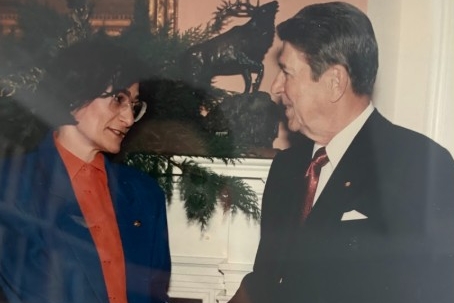
    Ms. Schmertz was interested in voluntary foreign service, gun reform, and U.S.-China relations, and she lectured and appeared on TV shows and in dozens of newspapers. She worked with New York Gov. Hugh Carey on statewide initiatives of all kinds in the 1970s and was appointed by President Bill Clinton to head the Romanian-American Enterprise Fund in 1994.

    In the 1950s and ’60s, she worked for the Democratic National Committee, the CIA, and the American Association of University Women. She spoke English, Dutch, Russian, and French, and served as a guide at the State Department’s first U.S. promotional exhibition in Moscow in 1959.

    She lobbied for fair elections in South Africa in the 1990s, and pressed New York lawmakers to support the state’s medical aid in dying act until it recently passed. Colleagues praised her “vision, energy, and grit” and “integrity and long-term commitment” in online tributes.

    From 1979 to 1992, Ms. Schmertz was the first woman to supervise corporate strategy and philanthropy at American Express in New York.Courtesy of the family

    One colleague said: “I feel so fortunate to have known her.”

    Colleagues at the Romanian-American Foundation said in a tribute: “She helped shape not just an organization but a picture of what philanthropy in Romania could be: transparent, accountable, built on partnership, and dedicated to creating opportunity for all Romanians.”

    From 1979 to 1992, Ms. Schmertz was the first woman to supervise corporate strategy and philanthropy at American Express in New York. She was also an honorary director of the Women’s Economic Roundtable and a former director at Prudential Financial Inc.

    “She was extraordinary, formidable, deeply caring, and exceptionally committed to the people and causes that she believed in,” her daughter, Lexy, said. “Her hobby was her job, learning and exploring.”

    Ms. Schmertz worked with President Ronald Reagan and many other political notables. Courtesy of the family

    Ida Frederieke Schaap was born Feb. 24, 1935. Her family traveled from the Netherlands to Indonesia in 1939 and then to the United States to escape the war.

    She was the first Jewish student to enroll in the old Stevens School for Girls in Germantown in 1940, was elected president of the student council and captain of the field hockey team, and graduated in 1952. She earned her bachelor’s degree at Wellesley College in Massachusetts in 1956 and her master’s degree at Columbia University in 1960.

    She also studied French political science at Sorbonne University in Paris and Russian at Middlebury College in Vermont. She married Herbert Schmertz in 1962 in Philadelphia, and they had a son, Anthony, and a daughter, Lexy. They divorced in 1976, and he died in 2018.

    Ms. Schmertz was tough and direct, her family said, intelligent and loving. She liked to read and travel, and was an engaging conversationalist.

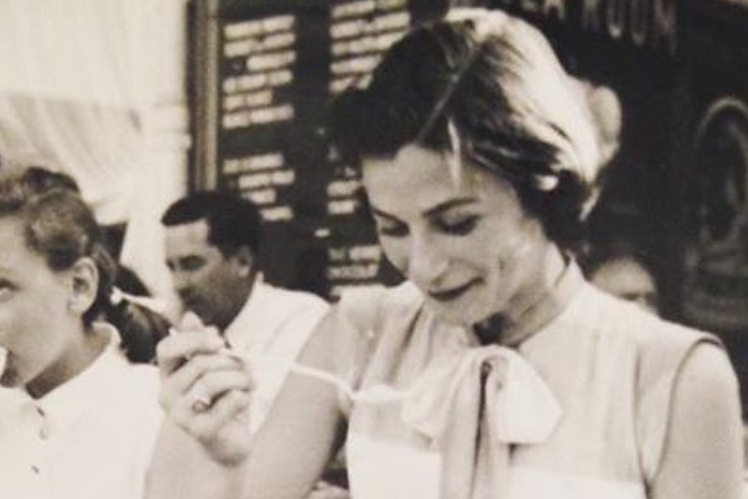
    Ms. Schmertz was a summer camp counselor for underserved children as a teen, loved cats, and supported the Philadelphia Museum of Art.Courtesy of the family

    She lived in Washington after college, moved to New York in the 1970s, and hosted friends and colleagues from around the world in her Upper West Side apartment. She doted on her four grandsons and took them to museums and hockey games. “She met them where they were,” her daughter said.

    She was a summer camp counselor for underserved children as a teen, loved cats, and supported the Philadelphia Museum of Art. For 30 years, she lived with chronic lymphocytic leukemia.

    “She was compassionate and caring,” her daughter said. Her son said: “She was devoted to her family.”

    In addition to her children and grandsons, Ms. Schmertz is survived by two sisters and other relatives.

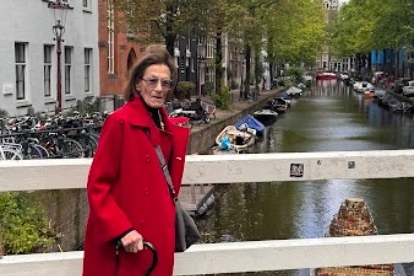
    Ms. Schmertz visited Amsterdam in May.Courtesy of the family

    A private memorial service is to be held later.

    Donations in her name may be made to Compassion & Choices, Box 485, Etna, N.H. 03750.

  • Emil DeJohn, celebrated clothing designer and longtime college fashion professor, has died at 88

    Emil DeJohn, celebrated clothing designer and longtime college fashion professor, has died at 88

    Emil DeJohn, 88, of Ambler, celebrated clothing designer, longtime college department chair and professor of fashion, lecturer, volunteer, and mentor to generations of designers, tailors, dressers, models, and students, died Wednesday, June 24, of a heart attack at his home.

    Born in Philadelphia, Professor DeJohn worked for 37 years with Bill Blass and other notable clothing designers on Seventh Avenue in New York, and for 21 years as chair of the fashion department at Moore College of Art and Design, director of fashion career development at Drexel University, and professor of fashion at the now-closed Art Institute of Philadelphia.

    He designed clothing of all kinds for men, women, and children for Jones New York, OshKosh B’Gosh, and other international labels from 1960 to 1997. He established his own label, Alex DeJohn by Emil, in the 1980s, and his creations appeared on the covers of Vogue, Harper’s Bazaar, and other magazines.

    Several of his gowns were offered to singer Barbra Streisand in the 1960s, and he received design compliments from, among others, film star Elizabeth Taylor and Andre Leon Talley, former editor-at-large at Vogue. In the 1980s, he was chosen by then-first lady Nancy Reagan to design a colorful clothing collection promoting her “Just Say No” antidrug campaign.

    In New York, Professor DeJohn showed designs at Bergdorf Goodman, Saks Fifth Avenue, Neiman Marcus, and Macy’s. In Philadelphia, he showed at Bonwit Teller and other top shops.

    He also showed in London, Paris, Milan, Hong Kong, and elsewhere around the world. He lectured about fashion at other universities, represented the industry at high school career fairs, and mentored many young designers.

    At fashion shows, they always gave him a front-row seat. “It’s an incredible profession,” he told The Inquirer in 2001. “Lots of ups and just as many downs. I wouldn’t trade one day.”

    In 1997, looking to engage less with consumers and more with emerging designers, Professor DeJohn left the workshops and showrooms in New York for classrooms in Philadelphia. He spent six years as chair of the fashion design department at Moore, several years as director of fashion career development at Drexel, and finally retired in 2018 as a professor of fashion at the Art Institute.

    At Moore, Professor DeJohn recruited Bob Mackie, Betsey Johnson, and other renowned designers to meet his students and provide internships and jobs. At Drexel, he oversaw the Crystal Star Award for design program and taught a class called Aspects of Fashion and Merchandising.

    Professor DeJohn (left) attended many galas as director of the Crystal Award for design at Drexel. Emil DeJohn

    He hosted a fashion club at the Art Institute and was named the school’s 2017 Teacher of the Year. “He was always happy to answer our questions and tell us about the industry,” a former student said in a tribute. Another said: “He inspired all of us to dream big.”

    Professor DeJohn won the city’s Phashion Phest Philadelphia Award for design in 2001 and told The Inquirer: “Teaching the students has been a gift to me. I never envisioned anything I could enjoy more than designing. But this has become an amazing part of my life. I actually love coming to work.”

    He earned other awards for design and his volunteer work at the Rowan House, the Ronald McDonald House, and other nonprofits. “He stood as a beacon of hope,” said his granddaughter Alexandra, “always making everyone feel like he believed in them, always bringing out what made them special.”

    His granddaughter Isabella said: “His legacy continues to inspire me every day.”

    Professor DeJohn met Bette Anne DeChiaro at a dance at the Shore when he was 17, and they married in 1963. Courtesy of the family

    Emil Joseph DeJohn was born Dec. 20, 1937, in his mother’s bedroom in South Philadelphia. The youngest of three children, he discovered art in grade school, took art classes at Fleisher Art Memorial, and graduated from John Bartram High School.

    He earned a bachelor’s degree in fine arts at the old Pennsylvania Museum and School of Industrial Art in 1959. He won the school’s design citation as a senior and worked at first as an illus­trator for the Bul­letin’s fashion pages.

    He met Bette Anne DeChiaro at a dance at the Shore when he was 17, and they married in 1963. They had a daughter, Leisa, and a son, Christian, and lived in Center City, Wyncote, and Ambler.

    Professor DeJohn liked antiques, flowers, and anything blue and white. He supported the old Carmelites monastery in Philadelphia and belonged to St. Luke the Evangelist Church in Glenside.

    Professor DeJohn first became interested in art and fashion in grade school. Courtesy of the family

    He made friends on his daily two-hour train rides to New York and said he never considered leaving Wyncote. “I loved leaving all that and coming home to cut the grass,” he told The Inquirer in 2001. “My neighbors didn’t even know what I did for a living.”

    He designed his daughter’s wedding dress, took his granddaughters to mesmerizing fashion events, and made memorable trips to Ocean City, N.J., Longwood Gardens, New Hope, New Mexico, and Florida. He especially enjoyed decorating his home and Christmas tree with ornaments and live flowers.

    “He made us all feel seen and special,” his daughter said. “He did that for everyone he met.”

    In addition to his wife and children, Professor DeJohn is survived by four grandchildren, one great-granddaughter, and other relatives. A sister, a brother, and a son-in-law died earlier.

    Professor DeJohn (right) said he would never leave Wyncote for New York. Courtesy of the family

    Services were held earlier.

    Donations in his name may be made to the Carmel of Jesus Crucified Monastery, Attn: Mother Pia, Box 308, Muenster, Texas 76252.

    Professor DeJohn (second from right) enjoyed time with his family.Courtesy of the family
  • Ewart Rouse, retired award-winning Inquirer reporter and editor, author, and journalism professor, has died at 85

    Ewart Rouse, retired award-winning Inquirer reporter and editor, author, and journalism professor, has died at 85

    Ewart Rouse, 85, of Lawnside, retired award-winning reporter and editor for The Inquirer, author, journalism adjunct professor, mentor, immigrant advocate, and indomitable cricketer, died Thursday, July 2, of age-associated decline at the Samaritan Center at Voorhees.

    Born in Trinidad, West Indies, Mr. Rouse immigrated to New York in 1969 and joined The Inquirer in 1974. For nearly 30 years, until he retired in 2002, Mr. Rouse was an award-winning business and news reporter, suburban editor, and mentor to hundreds of young journalists.

    He won a 1980 Keystone Award for a news series on city taxi service and was recognized for another series on street gang homicides involving Black youth. Later, he wrote business columns and covered South Jersey news.

    He opened a 1975 story about former President Gerald Ford’s first visit to Philadelphia with: “The old man sat alone and dejectedly with his flags against the wall of the Philadelphia National Bank building at 5th and Market Streets. ‘Not one,’ he muttered. ‘I haven’t sold not one flag today.’”

    Mr. Rouse worked for the Associated Press in Washington DC.Courtesy of the family

    Before The Inquirer, Mr. Rouse was a news and political reporter for the Associated Press in Newark, N.J., Atlantic City, and Washington, D.C. “He was a popular colleague who contributed importantly to the paper’s growth,” Gene Foreman, retired managing editor at The Inquirer, said on Facebook.

    Other former Inquirer colleagues called Mr. Rouse “professional and gracious,” “careful and respectful,” and “kind and generous.” Retired Inquirer editor Lil Swanson said on Facebook: “Ewart was filled with wisdom and grace. When he was an editor, young writers flocked to him because he always made their stories better and helped them grow.”

    He covered courts and politics for the Trinidad Guardian in Port-of-Spain before leaving for New York, and interviewed Trinidad Nobel laureate V.S. Naipaul for the 1997 book Conversations with V.S. Naipaul. In Philadelphia and South Jersey, he taught news writing, business writing, and investigative journalism at Temple, Rutgers, and Arcadia Universities.

    He mentored many students of color and edited books for other writers. He enjoyed fiction and detailed plots, and wrote a four-book series of cricket-themed novels he called the Sticky Wicket Collection.

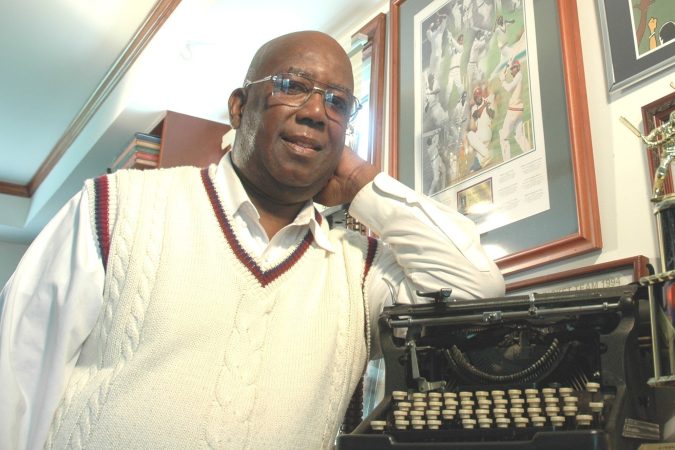
    Mr. Rouse loved to play, watch, and write about cricket.Ewart Rouse

    Readers called his books “highly entertaining” and “a wonderful addition to cricket literature” in reviews. His daughter Karen said: “The clackety-clack (zing!) of his typewriter was a constant in our home.”

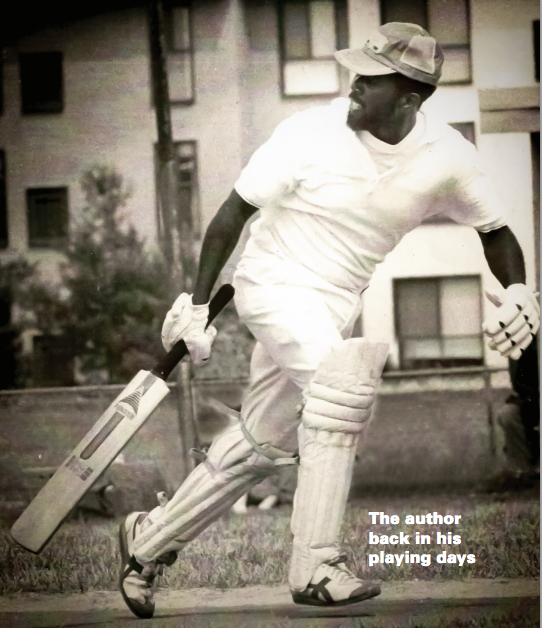
    Mr. Rouse played cricket in Trinidad and later in South Jersey, and he cofounded the Philadelphia Cricket League, the New Jersey Cricket Association, and the Echelon Cricket Club. He played the game, managed teams, and became one of the region’s greatest advocates for cricket and its immigrant players.

    In 2013, he earned a lifetime achievement award from the South Jersey Caribbean Cultural and Development Organization, and recognition from then-Camden Mayor Dana Redd for his contributions to the community as a journalist, teacher, and cricket activist. “It truly was an honor to be recognized by my own community,” he said on his website, ewartrouse.com.

    In a 2016 online interview, Mr. Rouse was asked to advise young writers. “Read anything you get your hands on,” he said, “From books and newspapers … to labels on paint. Each contains nuggets of information that the mind will retrieve for just the right spot in your next project.”

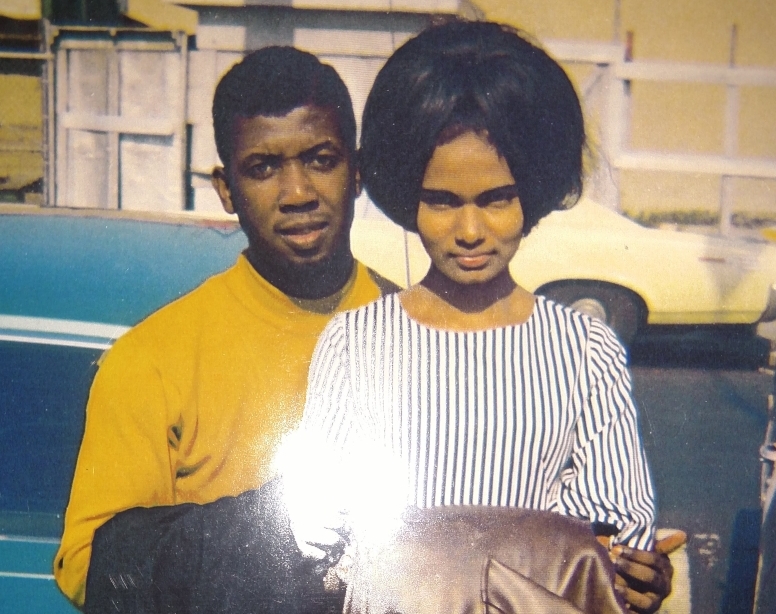
    Mr. Rouse and his wife, Vanda, met in Trinidad.Courtesy of the family

    Ewart Rigsby Rouse was born Sept. 16, 1940, in Tunapuna, Trinidad. He was an avid reader and creative writer as a boy, and noticed one day that several of his favorite writers — Charles Dickens, John Steinbeck, and Ernest Hemingway — started out as newspaper reporters.

    “And now I wanted to be a journalist like them,” he said in a short self-published autobiography.

    He met his wife, Vanda, in Trinidad, and they married and had daughters Joann, Karen, and Kristin. They lived in New York, Pleasantville, N.J., and Washington, and settled in Lawnside in the 1970s.

    Mr. Rouse was active with the C.C. Morris Cricket Library Association, the South Jersey Writers’ Group, and the Rainy Tuesday Writers Group. He was an avid gardener and routinely gave away bags of home-grown tomatoes to friends and neighbors.

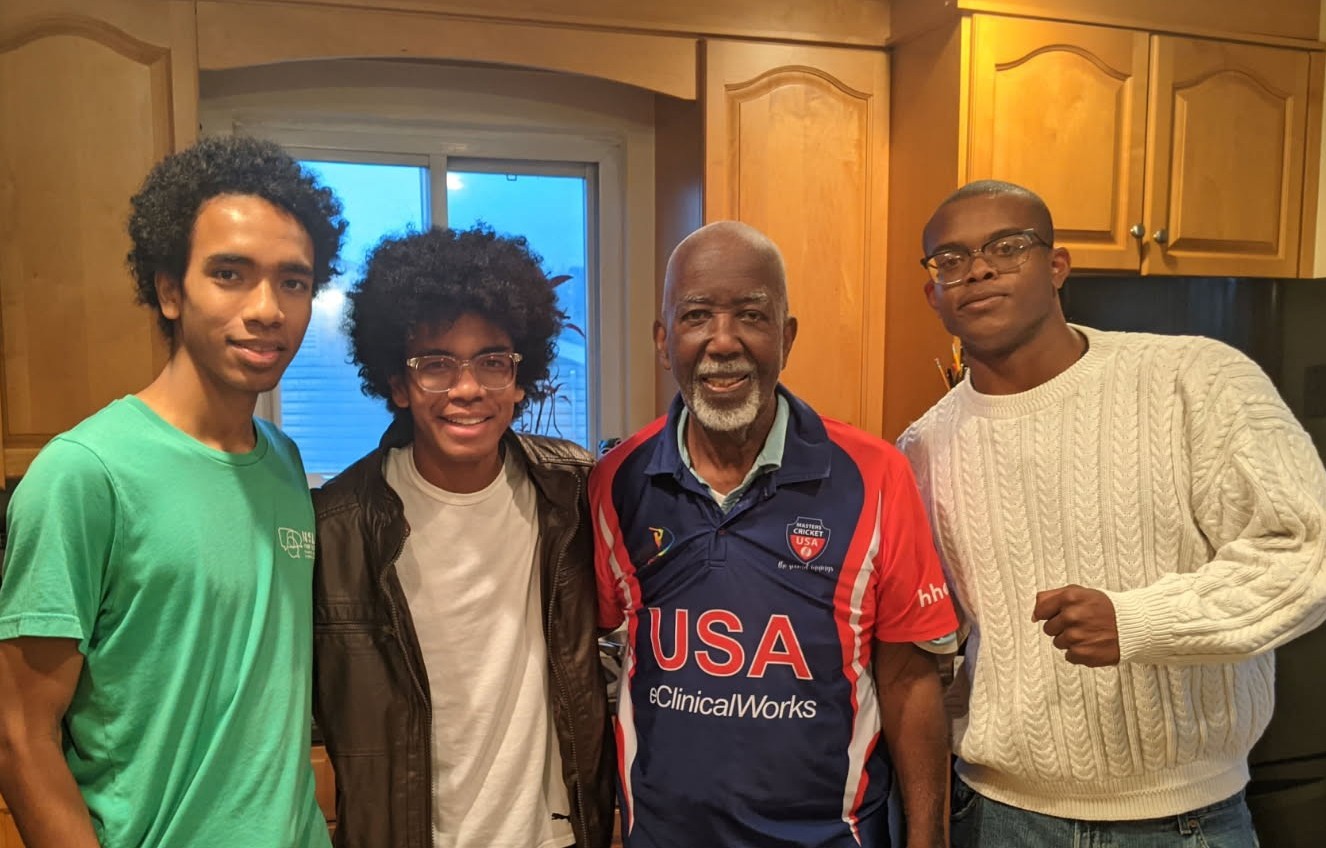
    Mr. Rouse enjoyed time with his grandsons. Courtesy of the family

    He collected records, listened to Nat King Cole and Frank Sinatra, followed the 76ers, and grilled outdoors as often as possible. He took his family on memorable trips to Trinidad that “opened up a world to us that was accessible, one that we could dare to explore,” said his daughter Karen.

    In 2016, Mr. Rouse told aspiring writers: “Who knows, maybe you end up with a bestseller. Some might call you a dreamer. But, hey, as the saying goes, you can’t have a dream come [true] if you don’t have a dream.”

    In addition to his wife and daughters, Mr. Rouse is survived by three grandsons, two sisters, a brother, and other relatives.

    A private celebration of his life is to be held later.

    Donations in his name may be made to the Philadelphia Association of Black Journalists, 30 S. 15th St., 15th Floor, Philadelphia, Pa. 19102.

    A former Inquirer colleague called Mr. Rouse “a true and kind gentleman.”Courtesy of the family
  • Gerry O’Reilly, Villanova track Hall of Famer, Irish Olympian, and Vanguard executive, has died at 61

    Gerry O’Reilly, Villanova track Hall of Famer, Irish Olympian, and Vanguard executive, has died at 61

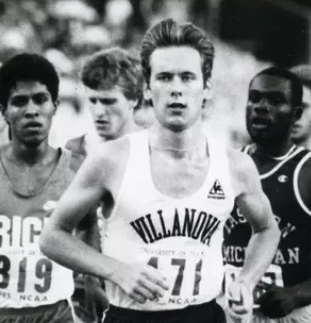
    Gerry O’Reilly, 61, of Chester Springs, Hall of Fame middle distance track star at Villanova University, 1988 Irish Olympian in the 1,500-meter run, longtime executive at the Vanguard Group Inc., mentor, and role model, died Thursday, June 11, at Phoenixville Hospital after an earlier sudden cardiac event.

    Born and reared in Dunboyne, County Meath, Ireland, Mr. O’Reilly earned a track scholarship to Villanova in 1983 and joined a dozen other Irish athletes in what became known as the school’s Irish Pipeline to the Main Line. He went on to run cross-country and indoor and outdoor track, win seven Big East Conference championships, and hold the Big East outdoor record in the 1,500 for 37 years.

    He ran the 1,500- and 3,000-meter runs, the mile, and the distance medley relay at Villanova, and was named All-America four times. He won six national collegiate championships, was named outstanding performer at the 1986 Big East Indoor Championships, and was inducted into the Penn Relays Wall of Fame in 2007 and the Villanova Varsity Club Hall of Fame in 2009.

    “Without exaggeration, those were four of the best years of my life,” Mr. O’Reilly told Dave Thomas on the Belmont Plateau Hall of Fame podcast. Villanova “kind of set me up both athletically and academically for the rest of my life.”

    Marcus O’Sullivan, former Villanova teammate and countryman, now director of track and field and cross-country at Villanova, said Mr. O’Reilly “had a steadfast moral compass that guided him in his life, and in doing so it had an intoxicating influence on others. … We all need a person like Gerry O’Reilly in our lives.”

    After college, Mr. O’Reilly competed in the international Millrose Games in New York, the 1987 World Championships, the 1989 World Indoor Championships, and for Ireland in what is now the World Athletics Championships. At the 1988 Summer Olympics in Seoul, South Korea, he made it to the semifinals of the 1,500.

    Irish Olympic team officials called him “an exceptional athlete” and praised his “genuine commitment to helping the next generation.” They said: “Once an Olympian, always an Olympian.”

    Irish marathon Olympian John Treacy told the Irish Times: “Gerry was a smashing runner and just the nicest guy, great for staying in contact and communicating with other Irish runners over the years.”

    Mr. O’Reilly ran miles at night after school in the rural Irish fields and lanes, and joined the Dunboyne Athletic Club when he was 9.
    Villanova University

    Mr. O’Reilly was also inducted into the Belmont Plateau Hall of Fame in 2025 and recently honored by his hometown Dunboyne Athletic Club.

    He earned a bachelor’s degree in economics in 1987, joined Vanguard in 1992 and the trading desk in 1994, and worked as an investment leader and portfolio manager. He was a mentor, colleagues said in a tribute, “who made immeasurable contributions to several of Vanguard’s flagship index funds.”

    He served on corporate panels and lectured at leadership development events. Colleagues called him “riveting and influential” and “a giant in every sense except ego.” One said: “You could tell he truly cared about the markets and about doing things right.”

    A friend said: “Great athlete, great person.”

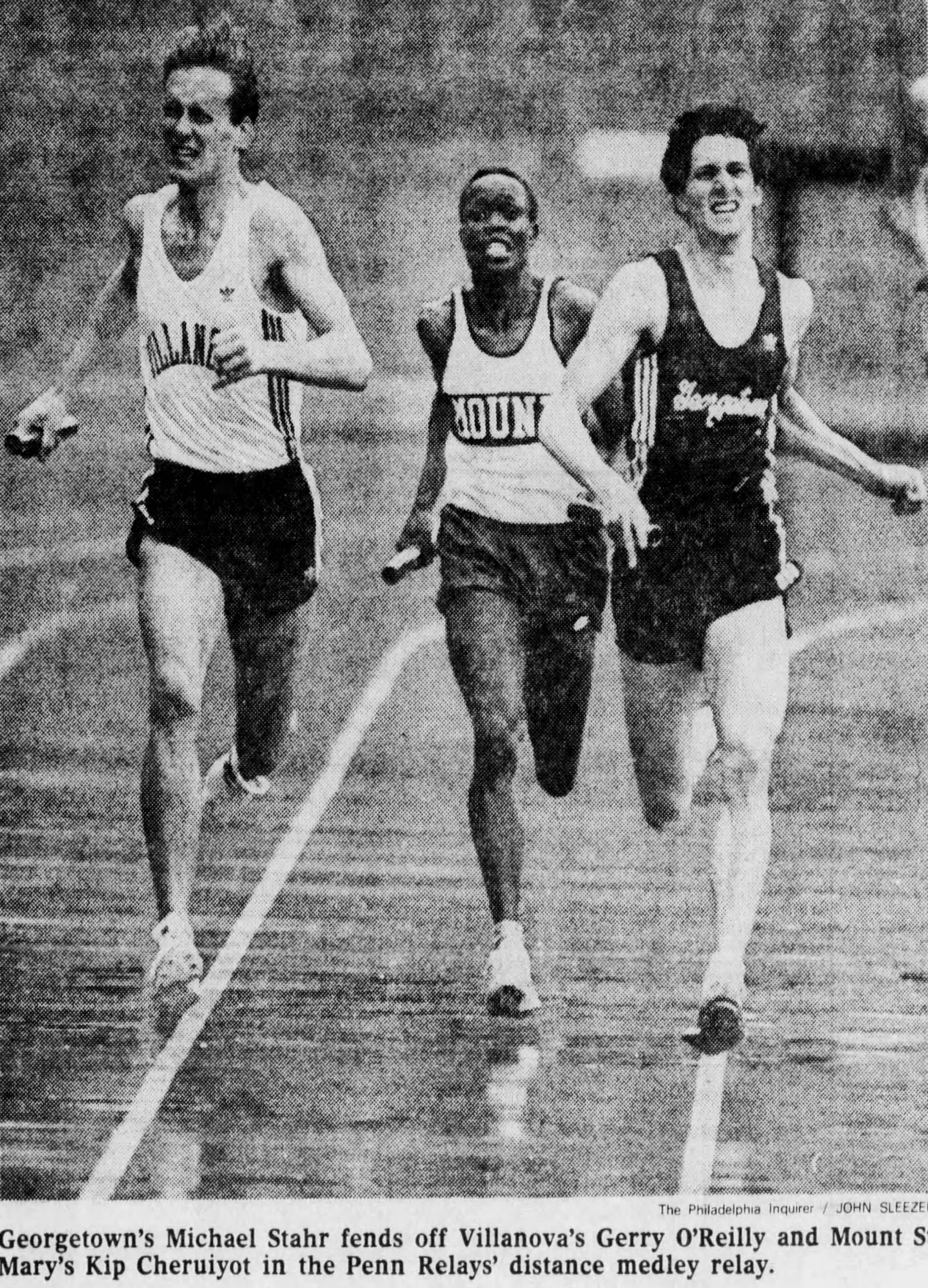
    This photo and a story about Mr. O’Reilly (left) appeared in The Inquirer in 1987.Newspapers.com

    Gerard Christopher O’Reilly was born July 1, 1964. He was the oldest of six children and excelled at cross-country, track, soccer, and other sports.

    He ran miles at night after school in the rural Irish fields and lanes, joined the Dunboyne Athletic Club when he was 9, and was inspired, he said later, by Irishman Eamonn Coghlan’s fourth-place finish in the 1,500 at the 1976 Summer Olympics. Mr. O’Reilly went on to win the 1983 Irish Junior 1,500 championship.

    He met fellow track star Melody Sye, and they married in 1992 and had a daughter, Meghan, and sons Keelan, Jack, and Conor. They divorced later.

    “Despite all his trophies and merits,” Mr. O’Reilly’s family said in a tribute, “he always remained humble and would say being a dad to his four kids was his proudest accomplishment.”

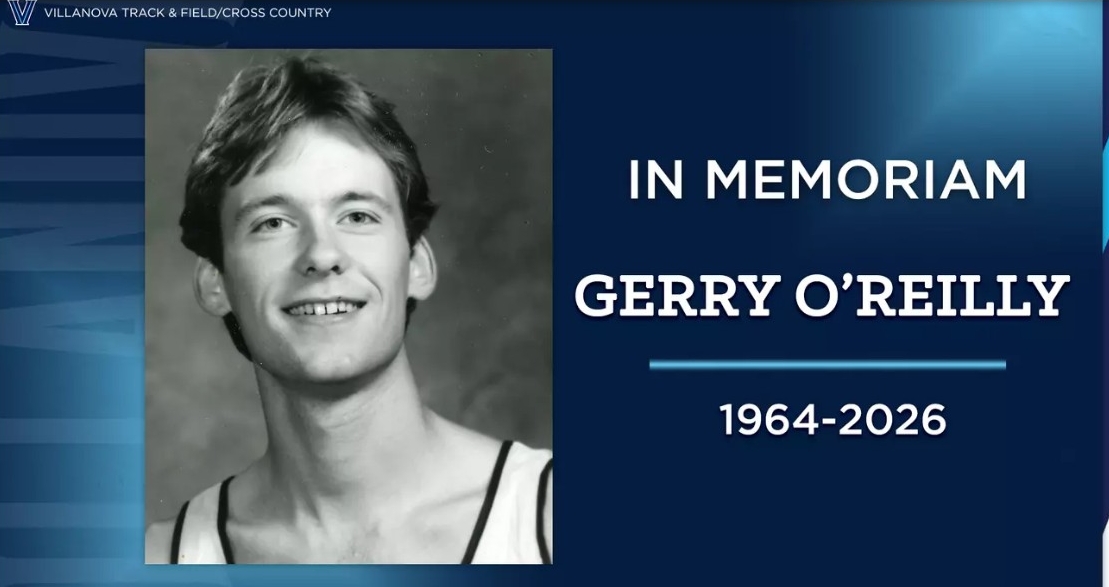
    Villanova honored Mr. O’Reilly online.Villanova University

    Mr. O’Reilly was an avid bicyclist, and he spent many weekends on long rides and at Eagles games on Sundays. He liked poker, hikes with his dog, Bear, and watching sports with his family.

    “Most of all,” his family said, “he simply enjoyed cracking jokes, sharing stories, and spending time with his friends and family.”

    In addition to his children and former wife, Mr. O’Reilly is survived by three sisters, two brothers, and other relatives. “His final gift,” his family said, “was saving multiple lives through organ donation.”

    Services were held earlier.

    Donations in his name may be made to the American Heart Association, 7272 Greenville Ave., Dallas, Texas 75231; Special Olympics, 2600 Virginia Ave. N.W., 11th Floor, Washington, D.C. 20037; and the American Cancer Society, Box 6704, Hagerstown, Md. 21741.

  • Kathy M. Winter, lifelong artist, teacher, and former parish council president, has died at 91

    Kathy M. Winter, lifelong artist, teacher, and former parish council president, has died at 91

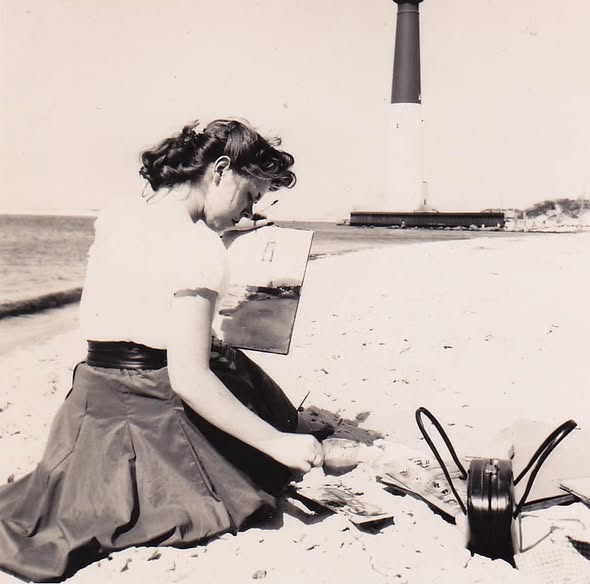
    Kathy M. Winter, 91, formerly of Philadelphia, lifelong artist, art and grade school teacher, author, and former council president at Our Mother of Consolation Parish in Chestnut Hill, died Tuesday, June 9, of complications from pneumonia at Forbes Hospital in Monroeville, Pa.

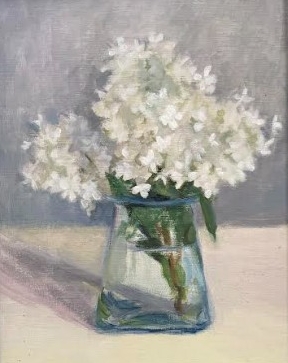
    Born in Philadelphia, Mrs. Winter studied art at the Pennsylvania Academy of the Fine Arts and earned a bachelor’s degree in fine arts at the University of Pennsylvania. She specialized in portraits, still life, and landscapes, and worked mostly in watercolors, pastels, oils, and acrylics.

    She painted portraits of celebrated naval chaplain John F. Laboon and Chinatown icon T.T. Chang, and contributed to a collection called “Lost Dreams on Canvas” that featured portraits of innocent victims of violent crime in Philadelphia. “You get into a portrait like that,” Mrs. Winter told the Chestnut Hill Local in 2012, “and you’re into the person.”

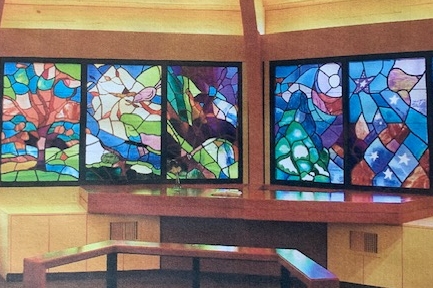
    She painted the statue of St. Gianna Beretta Molla for the Shrine of the Nativity of Our Lord in Warminster, and her painting of a restored statue of St. Gabriel for a church in New Orleans was featured in The Inquirer in 2007. She also designed stained glass windows for St. Bede the Venerable Church in Holland, Bucks County, and the chapel at Shore Memorial Hospital in Somers Point, N.J.

    “The best thing,” Mrs. Winter told the Chestnut Hill Local in 2012, “is that you don’t have to retire from making art.” Courtesy of the family

    Mrs. Winter studied Chinese brush painting with artist Phoebe Shih in Flourtown and showed her work at the Woodmere Art Gallery, the Conshohocken Art League, Daylesford Abbey, the Lutheran Theological Seminary, the Knickerbocker Exhibition in New York, and elsewhere. She also taught art classes at the Abington and Main Line Art Centers, the Conshohocken Art League, Our Mother of Consolation School, and elsewhere.

    “The best thing,” she told the Local in 2012, “is that you don’t have to retire from making art.”

    She met her husband, sculptor Joseph Winter, at the Pennsylvania Academy of the Fine Arts in 1953, and they opened Winter Art Studio in their Chestnut Hill home in 1983. For several commissions, he created the sculpture, and she painted it.

    “Since Joe was a sculptor and I’m a painter, we complemented each other very well,” Mrs. Winter told the Chestnut Hill Local in 2021. “If we had both been painters or both been sculptors, it would not have worked out so well. There would have been too much competition.”

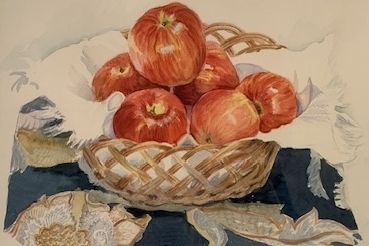
    Mrs. Winter painted fruit and flowers.Courtesy of the family

    In 2021, she self-published a 48-page children’s book called How the Bears Got to the Park. It features illustrations by her husband, and the plot she wrote is based on his award-winning 1966 sculpture Family of Bears that is displayed at Three Bears Park at Third and Delancey Streets in Society Hill.

    Mrs. Winter was a longtime member and onetime council president at Our Mother of Consolation Parish. She and her husband moved to Chestnut Hill from Southwest Philadelphia in 1962 so their children could attend the parish school, and she taught all subjects to third and fourth graders for a few years.

    Parish members scheduled Mass intentions to honor her on June 28, July 5, and July 10. “She was very determined,” her daughter Genienne Navarro said. “She never let anything stand in her way and would move mountains to get something done.”

    Kathleen Marie McKenna was born April 21, 1935. Her family moved to Virginia when she was young and returned to Philadelphia a few years later, and she graduated from West Philadelphia Catholic High School for Girls.

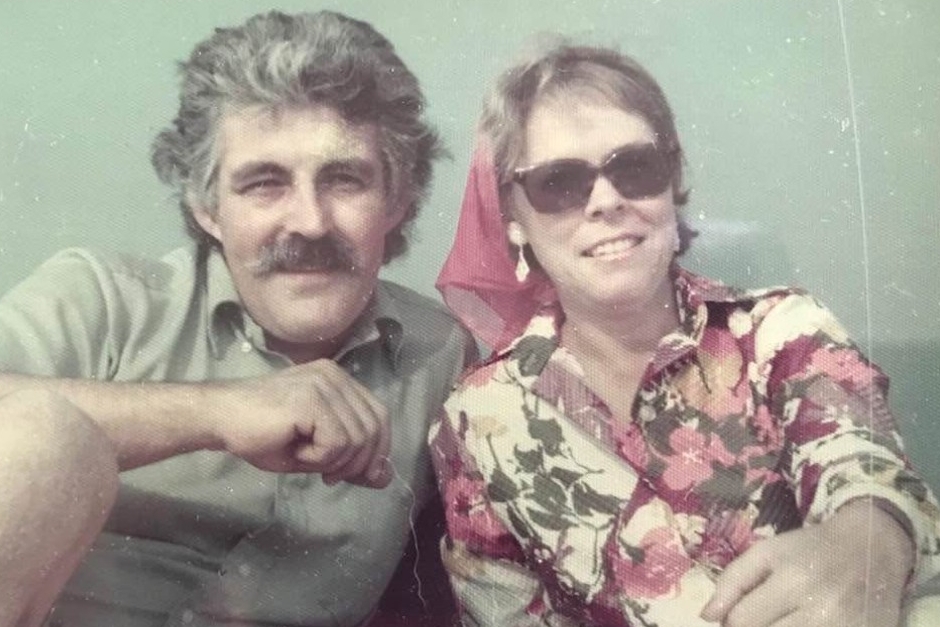
    Mrs. Winter and her husband, Joe, married in 1956. Courtesy of the family

    A perceptive nun recognized her artistic skills in high school and arranged for an admission interview with officials at the Pennsylvania Academy of the Fine Arts. She received a full scholarship, met her husband there, and they married in 1956 and had daughters Kathy and Genienne and a son, Joseph.

    Her husband died in 2020, and she moved to the Pittsburgh area a few years ago to be close to family. Mrs. Winter kept in touch with former classmates at the Pennsylvania Academy of the Fine Arts for years and took additional art classes later at Temple University and Chestnut Hill College.

    She played piano, doted on her family, and survived cancer in the 1970s. A longtime friend called her a “true, loving, nourishing, protective, guiding, steadfast Blessed Mother to me.”

    Her family said in a tribute: “She will be remembered for her friendship, spiritual support, listening ear, humor, deep caring, generosity, and undaunted optimism.”

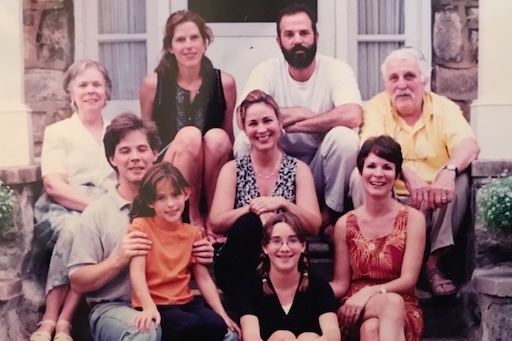
    Mrs. Winter (rear left) enjoyed time with her family.Courtesy of the family

    Her daughter Genienne said: “Her favorite saying was, ‘Nothing is impossible with God.’”

    In addition to her children, Mrs. Winter is survived by six grandchildren, three great-grandchildren, and other relatives. A sister died earlier.

    A memorial service is to be at 11 a.m. Saturday, Sept. 19, at Our Mother of Consolation Church, 9 E. Chestnut Hill Ave., Philadelphia, Pa. 19118.

    Donations in her name may be made to Our Mother of Consolation Church and School, 9 E. Chestnut Hill Ave., Philadelphia, Pa. 19118.

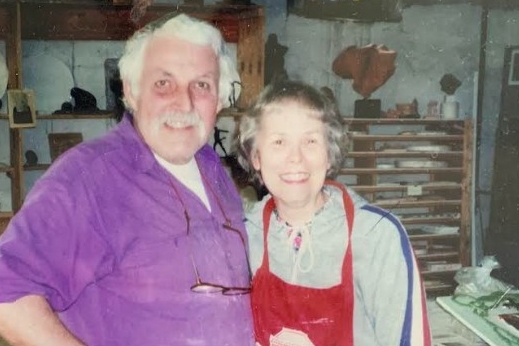
    Mrs. Winter and her husband, Joe, pose in their Chestnut Hill home studio. Courtesy of the family
    Mrs. Winter was an expert in designing stained glass. Courtesy of the family