Author: Joseph N. DiStefano

  • $2.5 billion Navy submarine contract expected to keep 700 working in Philly

    $2.5 billion Navy submarine contract expected to keep 700 working in Philly

    Rhoads Industries Inc. has confirmed some details of a long-term deal to extend the work the family-owned ship repair company is doing for General Dynamics Electric Boat, which builds and upgrades Virginia- and Columbia-class nuclear submarines for the U.S. Navy.

    “Rhoads will continue providing steel fabrication, structural assembly, outfitting, and other shipbuilding support services” from its Navy Yard operations, the family-owned business said in a statement Wednesday. The contract, which Rhoads estimates is worth $2.5 billion over 10 years, is expected to keep around 700 people working 40 hours a week for a year.

    Rhoads has done work for General Dynamics since 2021, according to a spokesperson for the Reston, Va., company, whose annual sales top $50 billion.

    With the contract and other work Rhoads does at its ship-repair and testing facilities, Rhoads says it will eventually employ nearly 1,500 workers, roughly double its current headcount and five times what Rhoads employed three years ago.

    Like the larger workforce at neighboring Hanwha Philly Shipyard, Rhoads shipyard workers and contractors are represented by the Philadelphia Metal Trades Council, a coalition of unions including locals of the Operating Engineers, Boilermakers, Ironworkers, Sheet Metal Workers, and other trades.

    In a statement, company president Mike Rhoads said the expanded General Dynamics work would pay for “high-quality careers in skilled trades, engineering, project management, and manufacturing, further strengthening the Greater Philadelphia region as a center for advanced maritime manufacturing.”
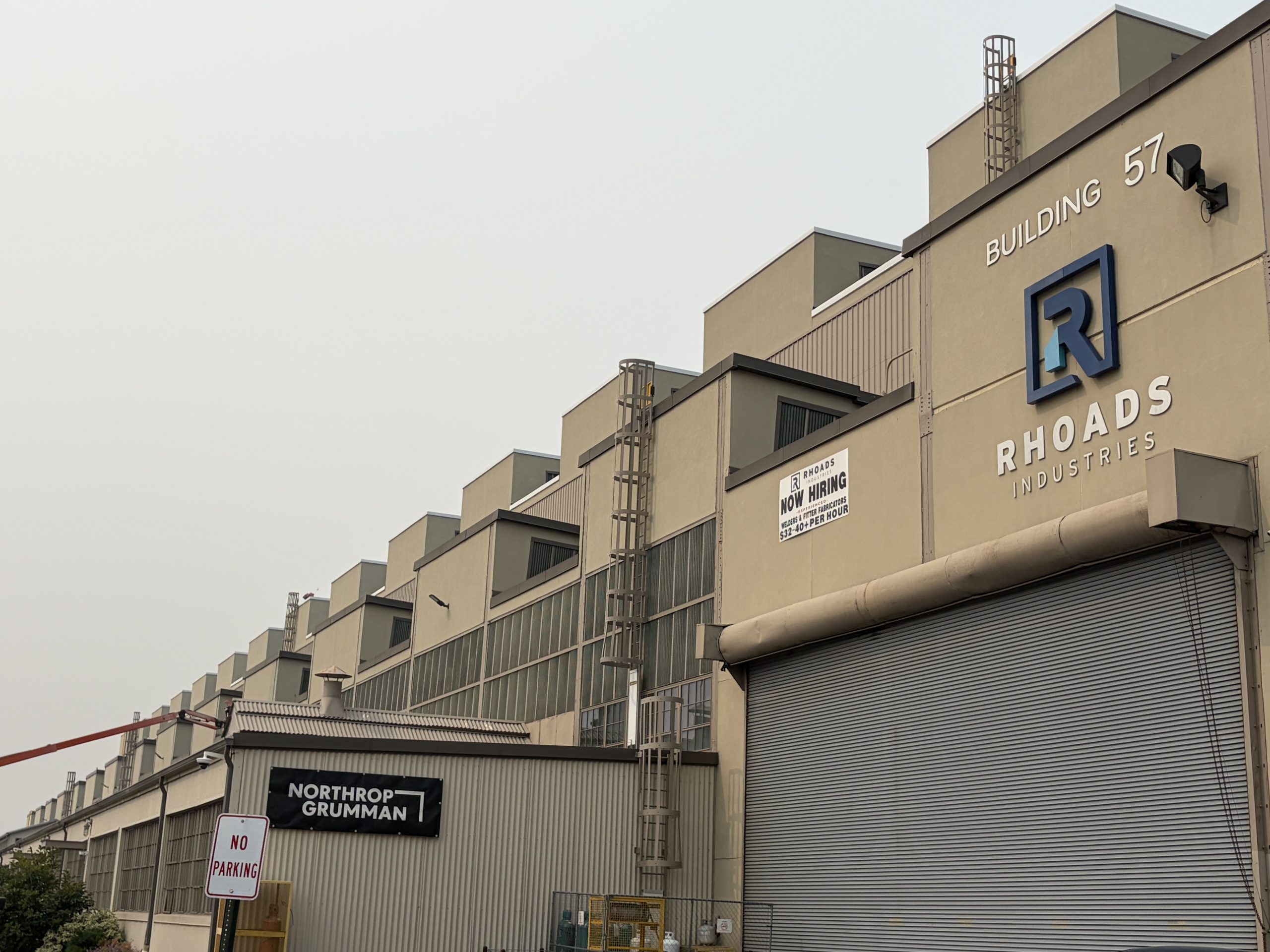
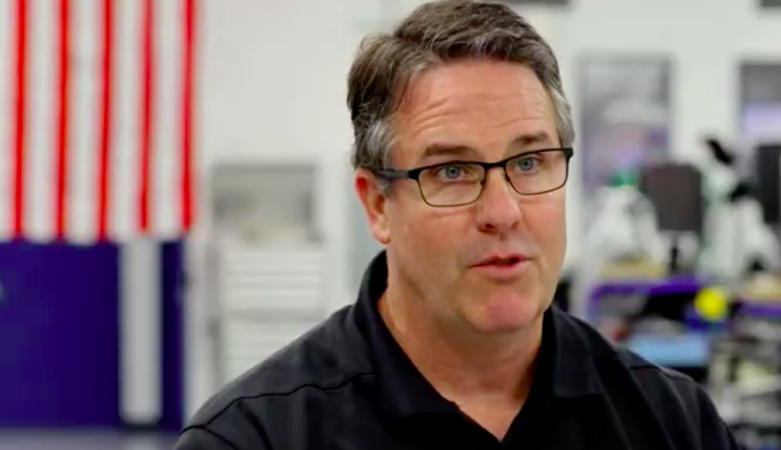
    Rhoads Industries is a family-owned ship repair company in Philadelphia’s Navy Yard, which also builds submarine components. Joseph N. DiStefano

    Rhoads last year said it was building a $100 million manufacturing shed specifically for the Navy submarine work, designated Building 57A. On Tuesday, JPMorgan CEO Jamie Dimon visited the Navy Yard business district and announced a $13 million loan funded by federal tax incentives to aid completion of the facility, which Rhoads said should be finished next year. JPMorgan also is funding $11 million in loans and grants to Chamber of Commerce-affiliated worker training and subcontractor assistance nonprofits.

    Rhoads added that his company has met Navy performance targets.

    The Navy’s attempts to speed production and updating of the submarines have met delays, which industry observers tie to a national shortage of ship construction workers and to the Navy’s time-consuming design, approval, and change-order processes.

    The Trump administration has vowed to speed production of submarines, which are considered less vulnerable than surface ships to the proliferation of drones that have extensively damaged shipping in Ukraine and Iran conflicts.

    The Rhoads deal was briefly disclosed Wednesday by Sen. Dave McCormick (R., Pa.) when President Donald Trump spoke at the Pennsylvania Defense and Innovation Summit in Carlisle.

    General Dynamics Electric Boat builds Columbia- and Virginia-class nuclear Navy submarines at its yards in Groton, Conn., and Quonset, R.I., in partnership with Huntington Ingalls Newport News Shipbuilding in Virginia.

  • U.S. pledges to buy more Philly-made ships and nuclear sub parts

    U.S. pledges to buy more Philly-made ships and nuclear sub parts

    As President Donald Trump prepared Wednesday to address CEOs from Boeing, General Dynamics, and other big military contractors in Carlisle, Pa., Sen. Dave McCormick confirmed details of large government projects that will keep workers busy at Philadelphia’s two principal shipyards as they plan to grow.

    Hanwha Philly Shipyard, which employs around 2,000, will get approvals for new ship orders to continue building National Security Multi-Mission Vessels for the U.S. Maritime Administration (MARAD). McCormick valued the new orders at $1.5 billion, which is about the same as it cost to build the previous five MARAD ships at the yard.

    The new orders will enable the yard to keep workers busy as it plans new facilities for civilian and military orders that could double employment and add work for thousands of subcontractors.

    General Dynamics, which builds Columbia-class nuclear submarines for the Navy at its New England shipyards, and Rhoads Industries, which builds modules for parts of those submarines, will share $2.5 billion over 10 years in additional orders for submarine construction work in Philadelphia.

    JPMorgan Chase & Co. chief executive Jamie Dimon visited the Navy Yard district to pledge $13 million in financing for the ongoing construction of Rhoads’ 95,000-square-foot submarine manufacturing facility near its existing ship repair pier, which Rhoads announced a year ago.

    Company president Michael Rhoads said his family is paying most of the $100 million cost of that facility, with help from the Navy, state government, and now the loan from JPMorgan.

    Dimon also pledged $11 million for subcontractor assistance and labor training programs, which are affiliated with the Chamber of Commerce for Greater Philadelphia.

    Dimon noted that JPMorgan is a banker to Hanwha operations in Korea, where the company has its main shipyard, and may finance larger future Hanwha projects.

    JPMorgan is seeking more government, military, data center, and energy work as mass-market consumer companies, office construction, and other sectors are lagging, Dimon said.

    The bank also wants to raise its profile in the Philadelphia area, where it is targeting small businesses and investors as it builds a 100-branch network as part of a larger national system, even as other banks are closing offices.

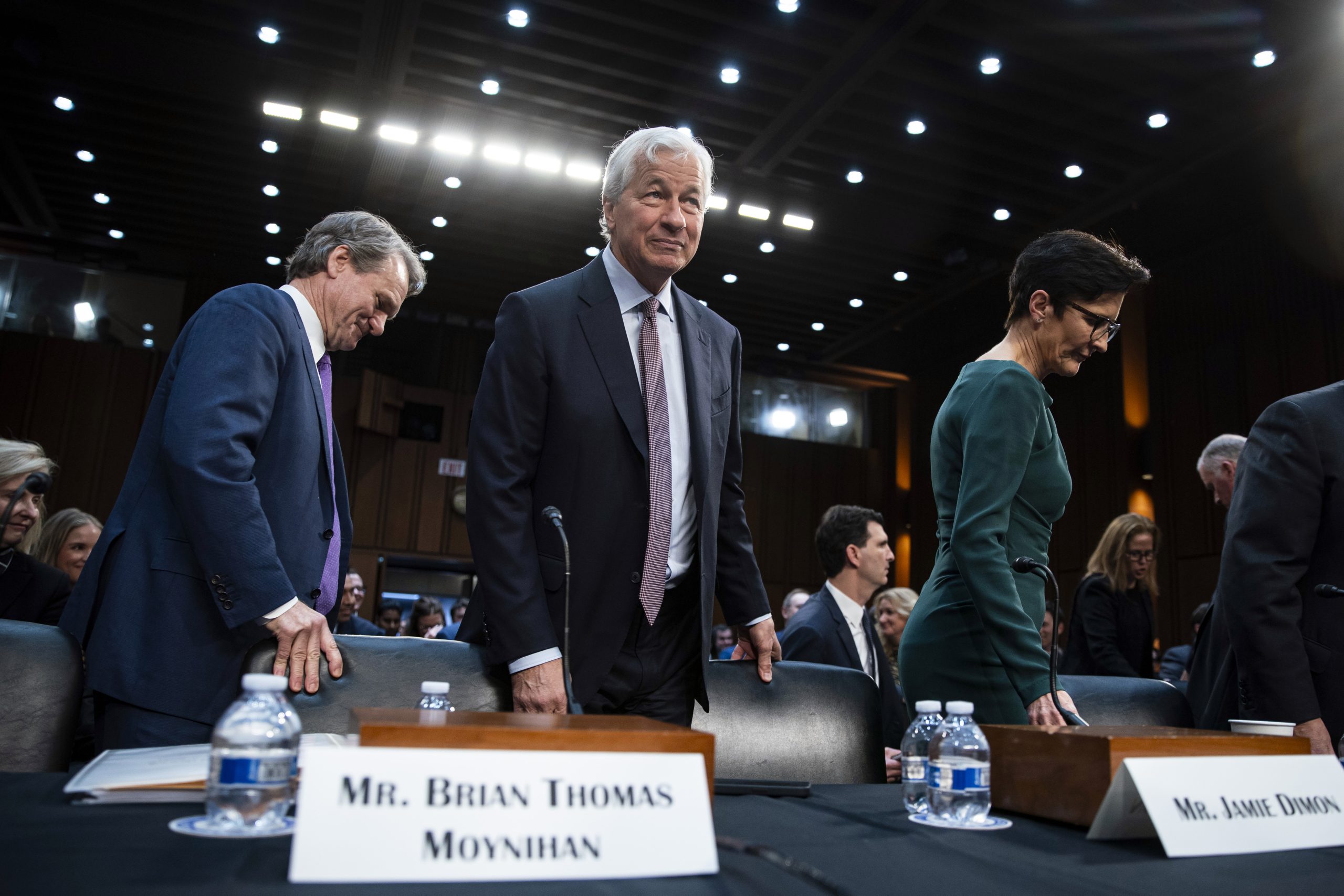
    Jamie Dimon (center), CEO of JPMorgan Chase, with rival Brian Moynihan of Bank of America, at a Washington hearing in 2023. AL DRAGO

    The $13 million loan to Rhoads will be raised through the federal New Market Tax Credits program, Dimon said.

    Rhoads’ current ship repair facilities employ around 700. The company says it will add 450 to handle new work at the complex. President Michael Rhoads said it should open next year.

    Employees and contracted labor at Hanwha and Rhoads are represented by the Philadelphia Metal Trades Council. Union tradespeople also work on construction projects and hope for more hiring as Hanwha expands operations, said Ryan Boyer, business manager of the Philadelphia Building & Construction Trades Council, who attended Dimon’s announcement.

    Hanwha has promised to invest up to $5 billion in the yard. The company bought the complex in 2024 for $100 million and says it has spent another $100 million upgrading facilities. Larger investments such as new drydocks, giant cranes, or more land may follow as Hanwha vies for U.S. and foreign contracts.

    Shares of the company’s shipbuilding affiliate Hanwha Ocean fell 23% on July 6 after the company was passed over for a Canada submarine-building contract.

    U.S. shipbuilding costs are far higher than in industry-leading China, Japan, and Korea.

    Hanwha says it can make the Philadelphia yard profitable and bring down costs for building Navy ships if it can increase volume — from the recent one ship every eight months to one or two a month. Hanwha officials have said they will build ships for the company’s own nascent shipping arm to keep workers busy, especially when orders are slow.

    Rhoads noted that his father, chief executive officer Dan Rhoads, was with McCormick at the Pennsylvania Defense and Innovation Summit at the Army War College in Carlisle, a gathering of military contractors and Washington officials, where Dimon was also on the guest list.

    Other funding that JPMorgan promised include:

    After Dimon’s announcement, Mayor Cherelle L. Parker reiterated her support for shipbuilding, heavy industry, and job creation along the Delaware River waterfront in what she calls Lower South Philly. She has pledged to speed up permitting for large projects.

    Parker promised “to make sure government bureaucracy, which is usually the most significant barrier to entry the private sector has,” is kept out of the way of the bank and its clients’ projects.

    The former Navy Yard, which includes the Hanwha and Rhoads ship facilities, is co-owned by the city and the Chamber of Commerce. It is home to businesses and government agencies that employ around 16,000.

    “We are eds and meds — and maritime and shipbuilding and defense,” Parker said.

    Dimon responded: “God bless you 100%.”

  • Army laser weapon maker plans 100 hires at a new $30 million Bucks County factory

    Army laser weapon maker plans 100 hires at a new $30 million Bucks County factory

    Attalon, a company that makes laser weapons for the U.S. Army, plans a new $30 million headquarters in Trevose, Bucks County, and will hire for more than 100 engineering, technical, and management jobs in the next few years, company officials said Tuesday. The headquarters will include a factory.

    The company moved its headquarters to Philadelphia from California in January when it was bought by Boston- and U.K.-based private-equity giant Advent from Coherent Corp., which is based in Western Pennsylvania.

    The new plant will be “a major expansion of our U.S. manufacturing footprint” and will focus on protective metal coatings and crystal production, chief executive John Bergeron said in a short, recorded presentation that aired at the Pennsylvania Defense and Innovation Summit on Tuesday in Carlisle, Pa.

    Bergeron was named CEO by the new owner in January. He was previously an operating executive at GE, Raytheon, and other military contractors. Attalon also has facilities in California, Michigan, Colorado, Connecticut, Florida, Ohio, and central New Jersey.

    The company’s laser warfare products and optical assemblies have been deployed along the Mexico border, where the Army shot down a wayward Border Patrol drone last winter. The company has also sought Navy contracts.

    In moving to the Philadelphia area, Attalon will locate in a longtime center of the military aerospace industry. The region is home to Lockheed Martin missile and L3Harris military communications factories, as well as helicopter makers Boeing and Leonardo, electronic sensor giant TE Connectivity, and aerospace systems makers Innovative Aerosystems, Triumph Group, and Analytical Graphics Inc., among others.

    President Donald Trump is expected to address the chief executives of Boeing, Lockheed Martin, and dozens of other military contractors on the summit’s second day on Wednesday, and more investment announcements are expected.

    The event was introduced by military officers and Sen. Dave McCormick (R., Pa.), an Army veteran and former private equity CEO, who last year hosted Trump at a similar event announcing $90 billion in data center and electric power projects for Pennsylvania.

    Along with companies in Pittsburgh and in central Pennsylvania, a pair of Philadelphia-area defense start-ups also announced expansion plans at the event Tuesday.

    Deepwave, which makes artificial intelligence-backed radio-frequency systems for government and telecommunications companies, will hire 20 business development staff to boost sales after negotiating with the Air National Guard to improve systems for aging F-16 jet fighter aircraft, chief executive John Ferguson said in a video presentation.

    “Our manufacturing is all in Pennsylvania,” Ferguson said, noting that state-backed Ben Franklin Technology Partners centers were among Deepwave’s early investors, along with Philadelphia-based NextFab Ventures and Philadelphia-based Robin Hood Ventures.

    Deepwave is based on Walnut Street in Center City.

    Also, Karman Space & Defense, a publicly traded, California-based missile and hypersonic systems maker with a facility in Horsham, said it would invest $2.7 million in expanding that plant and add 20 new “high-tech” jobs.

    This story has been updated to correct the identify of an investor in Deepwave. It is Robin Hood Ventures of Philadelphia.

  • Pa. robot maker wins Air Force deal for DroneDogs and other automated inspectors

    Pa. robot maker wins Air Force deal for DroneDogs and other automated inspectors

    Asylon Robotics, a 100-employee robot software and hardware maker based in Norristown, says it has been picked to test its network of doglike robots, flying robots, and software links at the Air Force’s Warner Robins Air Logistics Complex in Georgia.

    The Air Force has already reviewed individual Asylon products. The new Phase Three contract will test four Asylon products networked into a single system dubbed Multimodal Autonomous Robotics for Inspection of Aircraft (MARIA).

    The goal is to improve the speed and reliability of plane checks by Air Force maintenance crews, the company said in a statement. The value of the contract was not immediately available. It’s worth “multimillions,” an Asylon spokesperson said.

    “This award reflects the Air Force’s confidence” in Asylon’s systems, said Anthony McCarty, a retired Air Force colonel who heads Asylon’s government sales arm.

    Asylon noted that its systems have already completed 350,000 autonomous missions. Civilian clients include Citizens Bank.

    McCarty said the new award puts better systems directly in the hands of Air Force personnel.

    MARIA includes:

    • Guardian sUAS (small, unmanned aircraft systems), flying drones that can check aircraft from above and around;
    • DroneDog Q-UGV (four-legged, unmanned ground vehicles), which adds Asylon’s PupPack security system — magnifying cameras, heat sensors, connectivity, and video analysis processors — to off-the-shelf Boston Dynamics Spot-brand robots;
    • Asylon’s Range autonomy system, the hardware and software that makes the robots go;
    • DroneIQ command and dashboard system, which gives Air Force maintenance humans two- and three-dimensional images of what the vehicle sensors project so they can be analyzed and acted upon.

    Asylon promises faster, more consistent review than human-only teams. Its systems collate images via Light Detection and Ranging (LiDAR) and other mapping tools for review, analysis, and action by human maintenance crews.

    The company is based on Buttonwood Street near the Schuylkill in a century-old brick factory building at a complex where ring-binders were formerly made for Philadelphia’s once-vast mass-publishing industry.

    Asylon in a statement said successful tests will speed autonomous aircraft inspection and boost demand for its products.

    The company was founded in 2015 by three MIT grads: CEO Damon Henry, who earlier worked at GE and Boeing; Adam Mohamed, a helicopter engineer, now chief technology officer; and Brent McLaughlin, a former Johns Hopkins Applied Physics Lab engineer, now chief operating officer.

    Asylon has raised more than $45 million from investors including Allegion, which owns Schlage locks and other physical security products; Insight Partners, a New York venture capital firm backed by Pennsylvania teachers’ PSERS retirement plan and other big investors; the Texas-based Hersh family-led Veteran Ventures Capital; and the taxpayer-backed GO PA Fund.

  • Delta Air Lines customers are paying more after the recent leak and fire at its Delco refinery

    Delta Air Lines customers are paying more after the recent leak and fire at its Delco refinery

    Record jet fuel costs — including a 5 cents-a-gallon boost due to a leak and fire at Delta Air Lines’ Monroe Energy plant in Trainer, Delaware County — have been passed along on to airline customers, and Delta has still been able to boost profits, chief executive Ed Bastian told investors at its quarterly investor call Friday.

    At Trainer, “we’re back up to about 75%” of full capacity, but production will remain slow through the third quarter, boosting costs another 5 to 7 cents a gallon, Bastian said.

    Delta’s fuel costs averaged $3.93 a gallon — the highest ever, the company says — in the three months ending June 30. That’s up from $2.25 a gallon a year earlier.

    World fuel costs spiked after the U.S. and Israel attacked Iran in February, and Iran retaliated against U.S.-allied Arab oil suppliers and shippers, reducing exports from producers from several large oil-producing nations through the Strait of Hormuz.

    With demand high and profits rising, U.S refineries have kept production high but reported recent fires and temporary shutdowns this past spring and early summer, in what is usually a maintenance season for refinery operators.

    Despite higher revenues and products, Delta shares fell 2% in morning trading to around $87 and closed at $87.39. The stock hit an all-time high of $95 June 30 before Iran and the Trump administration agreed to a truce, which has since been suspended amid new attacks.

    Delta, which is based in Atlanta, burned 1.12 billion gallons of fuel in the past quarter, up from 1.11 billion a year earlier. The Monroe Energy facility in Trainer produces more than 8 million gallons of jet fuel and other products a day when operating at peak capacity.

    Despite the Trainer slowdown and the Iran conflict’s effect on global tanker traffic, Delta expects its fuel prices have peaked and will fall to around $3.15 a gallon by September, Bastian told investors.

    Delta bought the Trainer refinery from ConocoPhillips in 2012 to make the company less vulnerable to sometimes-volatile jet fuel costs.

    The complex, which employs 500 United Steelworkers members and managers and hundreds of union tradespeople, is configured to maximize jet fuel for Delta’s East Coast operations and trades other products — gasoline, diesel fuel, heating oil — for jet fuel in other markets.

    Delta employs 100,000 worldwide, and Bastian says it continues to hire as it sells new services. Delta sold more “premium” services to passengers than main-cabin service in the second quarter, a reversal from its historical pattern.

    “We are still in the early stages” of further segmenting travel into new premium travel classes, Bastian told investors.

    Corporate-business travel continues to rise, and customers have been willing to pay higher prices. Delta ticket revenues jumped 13% compared to last year, while passenger-miles were only up 1%.

    Transatlantic and domestic U.S. travel has risen, while U.S.-Mexico travel is down over previous years, Delta officials told investors.

    International traffic will grow faster than U.S. travel as Delta continues to add new airports, especially in East and Southeast Asia and the Middle East, Bastian predicted. The company will have to cut costs in the U.S. and Europe. Delta’s shift to new Boeing 787s that are built for more premium travelers and more cargo will help.

    A big challenge, he added, is finding enough airplanes to meet the demand.

  • Exploding lithium-ion batteries are blamed for fires in area junkyards and drop in port traffic

    Exploding lithium-ion batteries are blamed for fires in area junkyards and drop in port traffic

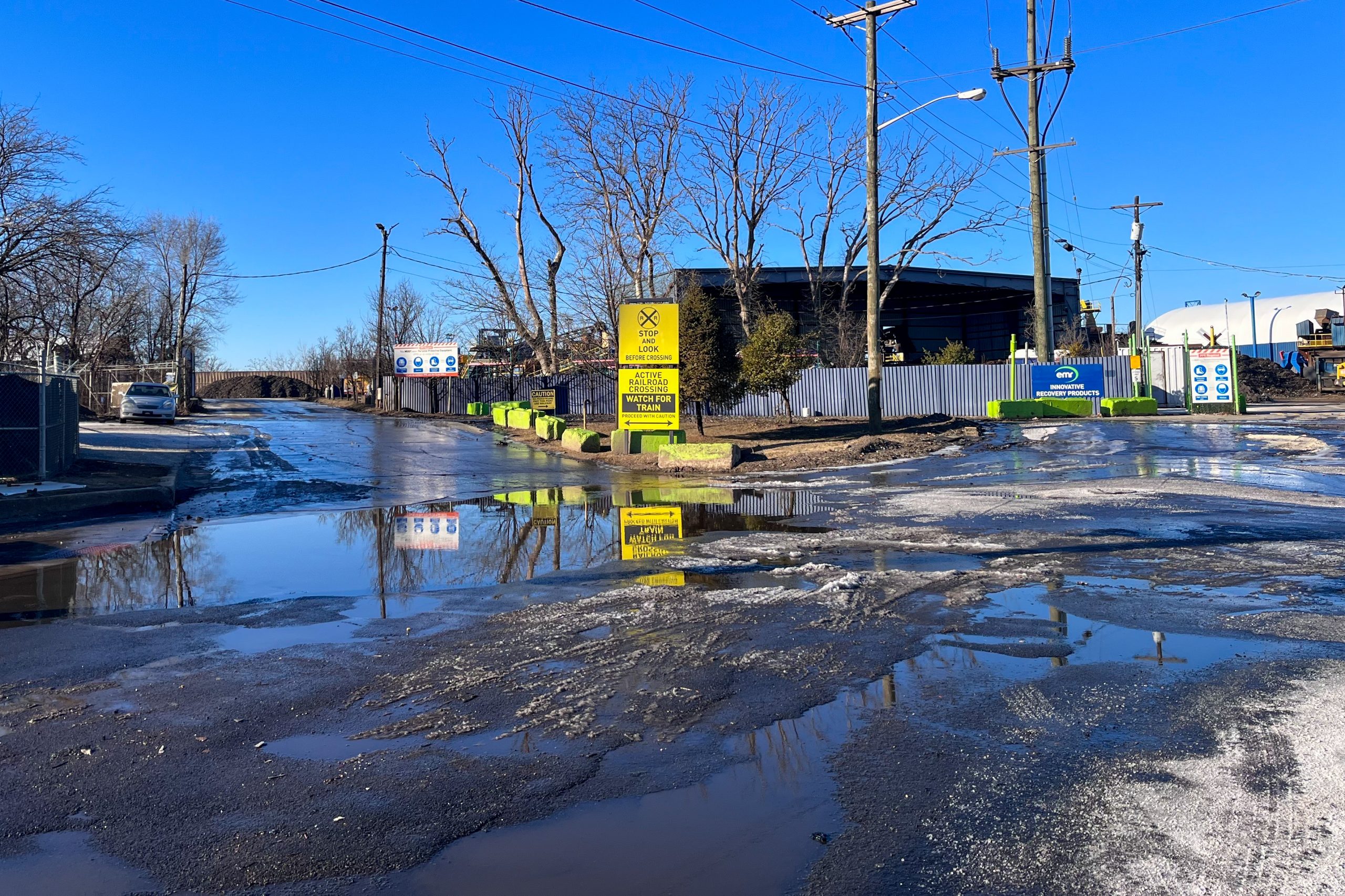
    Scrap metal, one of the Philadelphia area’s biggest shipping products, has been piling up in area scrapyards since June 4 when Camden officials closed EMR USA Holdings Inc.’s metal-shredding facilities after the latest in a series of fires affecting the region’s million-ton-a-year scrap shipping industry.

    Scrap dealers, faced with bulging inventories, blame the fires on the increased use of lithium-ion batteries — not so much large car batteries but the increasingly ubiquitous, highly combustible smaller batteries slipping into landfills from lawn mowers, construction tools, “smart” infrastructure, and household appliances.

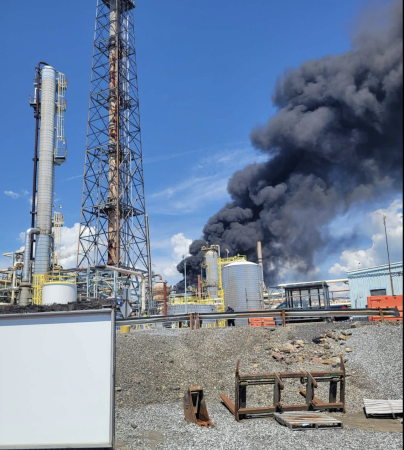
    The two-alarm May 29 fire, following a four-alarm Feb. 21, 2025, blaze that sent 100 neighbors fleeing for shelter, is the latest in what Camden code enforcement director Gabriel Camacho said have been up to a dozen “harmful, offensive, or obstructive” blazes at the Camden yard, which is at 1400 S. Front St. near the city’s Beckett Street Terminal. The fires spread smoke and hazardous materials.

    Camden officials in statements on the fire have focused on the effects, not the causes, of the fires.

    EMR CEO Joseph W. Balzano, whose company sued to reopen, last year agreed to pay the city $4.5 million up front and $2.2 million over five years, plus more for community and facility upgrades. After the May fire, the company promised steps to reduce fire risk.

    City Council is scheduled to review the proposal at a meeting Tuesday evening.

    The scene at EMR Metal Recycling in Camden on Feb. 22, 2025, the morning after a four-alarm fire sent thick plumes of black smoke over Camden County, causing some residents to evacuate two nearby hotels.Frank Kummer / Staff

    EMR, including its offices and auto-parts business as well as its recycling facilities, employs 575 workers — almost 200 are Camden residents — including members of the Teamsters union. Some workers operate shredding and sorting machinery and haul old iron and steel to the South Jersey Port Corp.’s nearby pier, which is named for Balzano’s late father, who headed the port.

    EMR shreds and ships steel from smaller dealers, some to foreign users, but most of it, in recent years, to U.S. electric steel mills and other industrial recyclers.

    “We haven’t laid anyone off — our people are like family — but we are getting to the end of our rope,” Balzano said last week.

    Competing terminals at the port in Fairless Hills, Bucks County, and in Newark, N.J., have picked up some of the business, he said — at a higher price, including the cost of trucking scrap a longer distance.

    England-based European Metal Recycling Ltd. acquired and began operating the Camden site since it purchased the former Camden Iron & Metal in 2006.

    Scrapyard officials say they tracked the latest fire to a discarded lithium-ion battery, a factor in what they say is a surge of scrap fires.

    “It’s the biggest issue all recyclers face,” Balzano said. “Regulations need to be put in place that keep these batteries out of commerce.”

    The batteries are used in items like stoves, washing machines, dryers and “things you wouldn’t think of like light ballasts or guard rails,” he said.

    “Just last week we had 440 people in a Zoom meeting about lithium battery fires. Since then, you had Doylestown Recycling and another facility in Long Island burn to the ground,” said John Thomas, president of the national Construction & Demolition Recycling Association.

    “Nine times out of 10, it’s a power-tool lithium-ion battery,” he said. “Contractors throw ‘em in the dumpster, not realizing it’s hazardous once it’s broken out of its original container. Lead-acid batteries, not such a big deal. But lithium batteries burn so hot, you almost have to let ‘em burn out.”

    New Jersey lawmakers have been advancing bills to better track lithium-ion batteries and to regulate scrap recycling yards.

    Burns Co., a building-materials recycler whose yard covers more than 12 acres in Philadelphia’s Hunting Park section, needed city help putting out its most recent lithium-ion battery fire in May, said Allen Burns, who runs the family-owned yard, which employs nearly 100.

    He points to scorch marks on a concrete-block wall at the facility.

    “It took 30 firemen five hours to put out the fire,” Burns said. “They looked on our camera system, dug down, and found a lithium-battery-powered tool. There must be a landfill fire every day from a lithium battery.”

    Burns said the Camden shutdown has backed up shipments at yards around the region.

    “We have had to bail metal to conserve space,” he said. Disposal costs are up.

    David Wiechecki, owner of International Scrap Iron & Metal in Chester, said, “You don’t want to leave [lithium-ion batteries] laying in your yard. It’s a real problem.”

    “You go over the loads with a fine-tooth comb, but people who want to sneak them by will do it,” he said. “Meanwhile, prices are down because export demand is down,” leaving scrapyards with more iron and more fire concerns.

    Lithium-ion battery fires were blamed last year for burning dozens of decommissioned SEPTA buses and led to the end of SEPTA’s Proterra electric-bus program.

    Thomas said his group and national scrap-metal and waste-disposal trade associations want federal legislation forcing manufacturers to pay lithium-ion battery recycling fees.

    “But they don’t want them back. It’s cheaper for them to buy virgin material,” he said. “So there’s a big tug of war in state legislatures with the manufacturers. In Pennsylvania, we had a bill stalled in the state Senate just in the last 10 days with no action.”

    Staff writer Frank Kummer contributed to this article.

    This story has been updated to correct the timing of EMR’s agreement with Camden last year.

  • How unknown Chinese ‘insider traders’ cost Jeff Yass’ firm more than $70 million

    How unknown Chinese ‘insider traders’ cost Jeff Yass’ firm more than $70 million

    Susquehanna Investment Group, the Bala Cynwyd investment and trading firm that has made cofounder Jeff Yass the richest man in Pennsylvania, on Monday persuaded a federal judge in New York to freeze accounts of up to 100 options traders, who the firm contends used inside information to book illegal profits of over $100 million, largely at Susquehanna’s expense.

    The firm won the temporary injunction even though Susquehanna acknowledged it didn’t know the names of any of the alleged inside traders. It hopes the freeze will force them into the open.

    Susquehanna’s lawsuit, accusing them of illegal insider trading and unjust enrichment, identifies each as “John Doe” and asks the court to order the traders to pay back their illegal profits, plus expenses.

    “The timing, size, type and pattern of their trading, and the lack of any plausible alternative explanation” for some 200,000 “short-dated put options” are “powerful evidence” of the scheme, according to Susquehanna’s June 29 complaint. The company alleges that someone traded illegally on inside information about the Chinese government’s planned May 22 crackdown on international trading platforms.

    At the firm’s request, Judge Arun Subramanian of U.S. District Court in Manhattan signed an order that day freezing the unknown traders’ profits from suspiciously successful bets that the valuations of two online trading firms would shortly crash:

    • Futu Holdings Ltd. (which trades under the share symbol FUTU), a Hong Kong-based, Nasdaq-listed online brokerage
    • UP Fintech Holdings Ltd. (TIGR), the Singapore-based, Nasdaq-listed owner of New York-based TradeUp Securities, another electronic trading platform.

    The preliminary injunction stopped the unknown traders from cashing out Futu and UP Fintech options held in their accounts at brokerages associated with both of the firms and with Interactive Brokers Group Inc., billionaire online-trading pioneer Thomas Peterffy’s Connecticut-based trading platform. The brokerages themselves were not accused of wrongdoing.

    The traders will have a chance to ask the court to release their assets at a hearing July 10 in New York, after posting $100,000 in advance — effectively identifying themselves as defendants in Susquehanna’s suit. The court order also authorizes Susquehanna to subpoena broker records in an effort to learn their identities.

    On Wednesday, Bloomberg reported the SEC is investigating the case.

    According to Susquehanna’s complaint, the traders, operating through their brokerage accounts, bought $12 million worth of low-cost options in Futu and UP Fintech, betting the stocks would decline in the days before China announced stern penalties on brokers accused of illegally moving cash to foreign markets.

    The purchases were many times the usual volume of Futu and UP Fintech options trades and accounted for most of the trades in those options during that period, according to the suit.

    Futu and UP Fintech announced on the day of the crackdown that they were, in fact, facing enforcement actions by China regulators, with proposed multimillion-dollar penalties.

    That news sent each stock crashing more than 30%, according to the lawsuit — a loss for shareholders and for other options traders who were betting the stocks would rise, but enriching the unknown traders who had bet on a drop.

    In all, the news boosted the value of the unknown traders’ investments by more than $100 million, according to the suit.

    More than $70 million of the profit was made on options purchased from Susquehanna, the suit says.

    The options purchases were so closely coordinated, their expiration dates so soon after May 22, that the trades “suggest inside knowledge” of the crackdown, the suit contends.

    Susquehanna suggested two possible groups of insiders, who either “tipped” favored traders to buy the options, or illegally traded on the inside information themselves:

    • Futu and UP Fintech staff “who had knowledge of discussions with Chinese securities regulators” or
    • Corrupt Chinese securities regulators who knew in advance of their agency’s own enforcement actions.

    Acting on such insider information is illegal under Chinese and U.S. law, according to the lawsuit, and adding the scale of the profits makes this “one of the largest documented cases of insider trading in recent memory.”

    Susquehanna asked for a jury trial, the return of $71.4 million it lost to the traders, plus costs and other payments.

    Susquehanna is one of the biggest U.S. “proprietary trading” firms that buy and sell securities, mostly using their partners’ funds.

    Under Yass, it has also been a pioneering, long-term investor in China-based digital companies. That includes large positions in TikTok owner ByteDance.

    Because of the fraught U.S.-China relationship and concerns by Congress members of both parties about TikTok’s influence over U.S. consumers, President Donald Trump and other U.S. officials have mulled potential restrictions on TikTok’s ownership and operations, and Susquehanna and other investors in that business have been obliged to engage with them. Yass is a prolific political donor.

    Susquehanna has reinvested profits from its large, lucrative trading operations into more than 350 China-based tech, retail, and industrial companies. Some of them have prospered, and for many more profits have been elusive.

    The firm also has funds that invest in U.S., European, and Israeli private and public companies, and in South and Southeast Asian companies.

  • With a new $400M investor, FMC says it can remain independent and boost pesticide sales

    With a new $400M investor, FMC says it can remain independent and boost pesticide sales

    FMC Corp., the world’s fifth-largest farm pesticide maker, said Wednesday that it has received a $400 million investment from Belgium’s Tessenderlo investment group, ending a “strategic review” and concluding inquiries into the potential sale of the company, based in the FMC high-rise tower on Philadelphia’s Schuylkill riverfront.

    Tessenderlo agreed to pay $13.30 a share for a 20% stake in publicly traded FMC. That’s a modest premium to FMC’s recent trading price but less than the share value as recently as June 1. As if unimpressed with FMC’s prospects even with the new cash, traders drove the share price down almost 5% Wednesday to close at $10.95.

    FMC traded at over $120 a share in early 2022 but has since lost most of its value, with crop-protection sales growth slowing worldwide amid slow progress on regulatory approval and marketing for new products to offset last year’s expiration of patent protection on the company’s best-selling Rynaxypyr insecticide.

    The buyer expressed faith in FMC’s next-generation fungicides, herbicides, and insecticides.

    “FMC offers an attractive opportunity to invest in a business with meaningful long-term potential, driven by a new generation of proprietary molecules that are renewing its portfolio and strengthening its competitive position,” Luc Tack, chief executive of publicly traded Tessenderlo Group, said in a statement.

    That includes products developed at the company’s Stine research labs in Newark, Del., which FMC acquired from DuPont Co. in 2017 as DuPont spun off its farm chemicals and seed business into Corteva.

    FMC “perfectly aligns” with Tessenderlo’s farm businesses, Tack added. Tessenderlo gets a seat on FMC’s board as part of the deal.

    Those businesses include Kerley, an Arizona-based farm fertilizer maker and niche pesticide distributor; sulfur-based fertilizer maker Tiger-Sul, based in Connecticut; and French organic fertilizer developer Violleau.

    Other Tessenderlo investments include plastics, chemicals, industrial machinery, electronics, and animal-byproduct (“bio-valorization”) businesses.

    FMC’s board approved Tessenderlo’s investment after a “comprehensive and deliberate” process, which the company started in February with its investment bankers and lawyers, as the best way forward for the company and its shareholders, said Pierre Brondeau, FMC board chairman and chief executive.

    The $400 million inflow is the last piece in FMC’s efforts to reach Brondeau’s debt-reduction and cash-boosting targets, so the company can more easily remain independent until its new products get to market.

    Other recent steps by FMC included renegotiating its credit agreements; raising $1.2 billion in a junk-rated bond offering; selling its India commercial business for around $250 million; a $200 million deal to supply key products to its larger rival, Corteva, which is moving its headquarters from Wilmington to Indiana; and selling the 250-acre Stine Research Center to a unit of New York-based real estate investor Broadstone Net Lease Inc., while leasing back part of the property for continued research.

    These actions, plus reduced debt and increased cash, put FMC “on a path to growth,” Brondeau said.

    FMC employs around 5,500 worldwide, including around 300 at its headquarters and 330 at the Stine research and development center.

    Editor’s note: This article has been updated with FMC’s closing share price.

  • Philadelphia’s First Bank cited in Supreme Court ruling limiting Trump’s power

    Philadelphia’s First Bank cited in Supreme Court ruling limiting Trump’s power

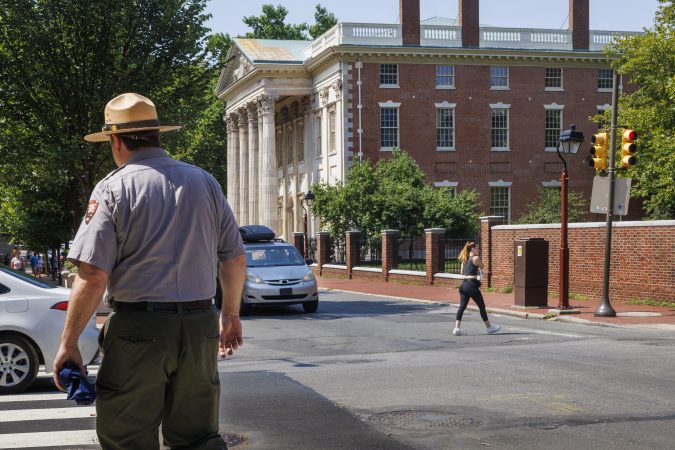
    The First Bank of the United States shut in 1811, but the U.S. Supreme Court just ratified the enduring relevance of the Philadelphia-based central bank, whose marble-faced home on Third Street reopened Wednesday as a museum.

    First Bank’s independence from presidential authority was cited as precedent on the first page of Monday’s’s 5-4 Supreme Court decision that backed the independence of the Federal Reserve.

    The long-departed central bank also remains a center of controversy: A dissenting opinion challenged the First Bank’s actual role, as did hostile Democrats back in its day.

    The First Bank — along with the partly government-owned original Bank of the United States and the Second Bank of the United States — was cited by Chief Justice John Roberts and a bare majority in the decision that blocked President Donald Trump from firing Fed governor Lisa Cook.

    “The United States has a long tradition of independent central banking,” Roberts wrote, noting that Philadelphia-based central banking enjoyed “independence from the federal government,” even though its job was maintaining a sound U.S. dollar.

    After President Thomas Jefferson ended the First Bank and President Andrew Jackson refused to recharter the Second Bank, 80 years of “ruinous financial panics” convinced Congress to protect “public and private interests at times when they were imperiled” by setting up today’s Federal Reserve, Roberts wrote for the majority.

    The resulting system of independent Federal Reserve Banks in Philadelphia and 11 other cities shares control of the system with the presidentially appointed Federal Reserve Board of Governors. The governors are appointed to 14-year terms, stretching across three or four presidential terms. They can be fired only “for cause.”

    Calling the court’s ruling an early Independence Day for the Fed, Michael Reynolds, vice president at Glenmede, a $50 billion investment firm based in Center City, said the court majority “are carving out a special place for the Fed,” and it’s not by accident.

    The Fed “is a distinct case,” and its “unique historical lineage” tracing back to the First and Second Banks of the United States in Philadelphia provided legal justification to the court for preserving its independence, he said in an interview.

    The Cook decision contrasts with the court’s 6-3 Slaughter opinion, posted the same day, which allows Trump freer rein to fire staff at the Federal Trade Commission and other “independent” federal agencies.

    First Bank’s independence echoes in Fed

    Trump tried to fire Cook, a Fed governor appointed by President Joe Biden in 2024, alleging falsehoods in her mortgage application. Lower courts said Trump lacked the power to fire her that way. As Roberts put it, the president can fire a Fed governor “for cause” but subject to court review as to whether the president’s target has committed a fireable offense.

    “The Federal Reserve operates at a deliberate remove from the ordinary political process, including a budget free of congressional control and policies set not only by governors, but also by representatives of the private regional banks,” Roberts wrote.

    If a president could cite or make up any reason for firing a Fed official, “any perceived or alleged misstep, past or present, could provide a ready pretext for a governor’s removal,” Roberts wrote — and “nothing could be more corrosive of the independence that Congress sought” than for Fed leaders to know the president could fire them on any pretext, while pushing them to ratify his favored policies.

    Trump didn’t allow Cook to challenge her firing. She “was entitled notice and some opportunity to respond,” which Trump denied her, Roberts wrote.

    Liberal-leaning Justices Sonia Sotomayor, Elena Kagan, and Ketanji Brown Jackson concurred, along with Roberts’ fellow conservative Brett Kavanaugh.

    Kavanaugh added that letting a president fire Fed leaders at will would “expose the Federal Reserve to political influences and jeopardize the efficacy of U.S. monetary policy,” sparking “political upheaval” and “turmoil in the U.S. and world economies. I would not go down that road. I would not risk destabilizing the U.S. economy.”

    Justice Clarence Thomas in his solo dissent disparaged Philadelphia’s First and Second Banks as “short-lived corporations.” He noted that Paul Warburg, one of the bankers who helped found the current Federal Reserve System in 1913, had sought to distance the planned Fed from the Philadelphia central banks, “ridiculing” them as no more advanced than banks of medieval Italy or even ancient Mesopotamia.

    Justices Samuel Alito, Neil Gorsuch, and Amy Coney Barrett in separate dissents argued that Roberts wrote too sweeping an opinion in a case that should have been reviewed at greater length in the lower courts.

    The Fed’s Independence Day

    “Central bank independence is not an abstraction,” Glenmede’s Reynolds wrote in a letter to investors Tuesday. “The premise that monetary policy is set by long-term price stability, rather than near-term political pressure, underpins the credibility of the dollar, the anchoring of inflation expectations,” and the yield on Treasury debt.

    “A Fed perceived as subject to political direction” would hurt the dollar’s value, he added. Removing that risk “is a quiet but meaningful positive for the stability” of U.S. interest rates.

    Reynolds said in an interview that the court’s Slaughter decision, allowing the president wider powers to fire leaders of other agencies, is pro-business — even though its conclusion freeing Trump to fire Federal Trade Commissioners seems at odds with the Cook case.

    Greater presidential control of regulatory agencies should “accelerate deregulation efforts, which is a priority of both the president and his Treasury secretary,” Reynolds added.

    But Reynolds predicted that it will be a few years until such changes are likely to significantly reshape U.S. business rules.

    For now, he’s more interested in the Fed’s next jobs report, due Thursday.

    Editor’s note: This story has been updated to correct the day of the Supreme Court’s decision.

  • Comcast plans no big change for its 15,000 Philly workers as company splits in two

    Comcast plans no big change for its 15,000 Philly workers as company splits in two

    Comcast, the $125 billion-a-year media and communications giant based in Philadelphia, is planning to split into two publicly traded companies, one based on the NBCUniversal media group, the other focused on broadband and wireless services.

    Comcast’s consumer and business services and NBCUniversal media now face “distinct” opportunities that are best pursued separately, Brian L. Roberts, chief executive since 2002, told investors in a conference call.

    Shares of Comcast, which had recently been trading near a 10-year low, jumped as much as 17% on the news, before closing at $24.22, a 4.5% gain for the day but well below the stock’s highs earlier this year.

    The split reverses major Comcast media acquisitions.

    “We previously believed that scale and diversification benefits warranted operating these businesses as one company; we’ve now simply changed our mind about that,” said Michael Cavanagh, the former chief financial officer of both Comcast and JPMorgan Chase & Co., who became Comcast’s co-CEO last fall.

    “We’ve now concluded that future success for each of our businesses will depend on focus, speed, and strategic flexibility that this separation will unlock,” said Cavanagh, who will head NBCUniversal, based at 30 Rockefeller Center in New York, after the split.

    Comcast will retain the consumer and business services that employ the majority of the company’s 180,000 workers, including most of its 15,000 Philadelphia-area staff and managers.

    Michael Angelakis when he was CFO of Comcast in 2009. He is returning, this time as CEO, as the company divests NBCUniversal and Sky. Ed Hille / Staff Photographer

    Comcast’s CEO after the split will be Michael Angelakis, a Gladwyne resident, who was Comcast’s chief financial officer from 2007 to 2015 and has since headed tech investment firm Atairos while also advising Comcast.

    Comcast’s acquistion of NBCUniversal, announced in 2011 and financially structured by Angelakis, was “a brilliant success financially” since Comcast got a bargain price as it was the first multibillion-dollar acquisition after the Great Recession, telecommunications analyst Craig Moffett told clients in a report Monday.

    But it didn’t make much sense strategically, Moffett added. While original media and theme parks did little to boost cable sales, the combination turned investors off, depressing the share price.

    Angelakis’ return to Comcast is “the best part” of the “wonderful, overdue” breakup decision, Moffett said. He noted that the two successor companies were themselves unlikely to become takeover targets in the near future as it would endanger the tax-free structure of the spin-off and likely require long, expensive work to persuade national and state regulators.

    Angelakis told investors on the call: “This place was my home for many years. It’s great to be here. It feels familiar and exciting at the same time.”

    The planned move comes after Comcast announced in November 2024 that it was spinning off cable networks such as USA, Oxygen, E!, SYFY and Golf Channel, as well as CNBC and MSNBC into a new company, Versant. Movie ticketing platform Fandango and the Rotten Tomatoes movie rating site were also included. Versant went public in January at around $45 a share; it has lately traded around $36.

    Like other cable companies, Comcast in recent years has shifted its business emphasis away from traditional cable toward streaming and other sources of revenue, such as its movie studio, theme parks and home wireless and internet services.

    Media and entertainment company NBCUniversal includes a theme parks division, Universal film and television studios, NBC and Telemundo networks, Peacock, and Bravo. Its portfolio will now include European media business Sky.

    Comcast will continue providing internet and phone services to residential and business customers.

    Once the transaction is complete, Comcast shareholders will own shares in both Comcast and NBCUniversal. The separation is expected to be completed in about a year. It still needs final approval from Comcast’s board and is subject to regulatory approvals.

    Comcast expects to keep a stake of up to 19.9% ownership position in NBCUniversal for up to one year after the spinoff is complete.

    The Associated Press contributed to this report.