Author: Joseph N. DiStefano

  • Construction software giant based in Exton opens a new Philly office

    Construction software giant based in Exton opens a new Philly office

    Exton-based Bentley Systems International, the software company with the highest market capitalization in the Philadelphia area, has opened a Center City office as its new base for 150 engineers and other tech and business staff, replacing two smaller outposts in the city.

    The construction design and building software maker’s 22,000-square-foot hub in the Curtis Center building will replace Bentley’s 14-year-old office on Cherry Street and the 30-person 400 Market St. former headquarters of Cesium GS Inc., which Bentley acquired in 2024.

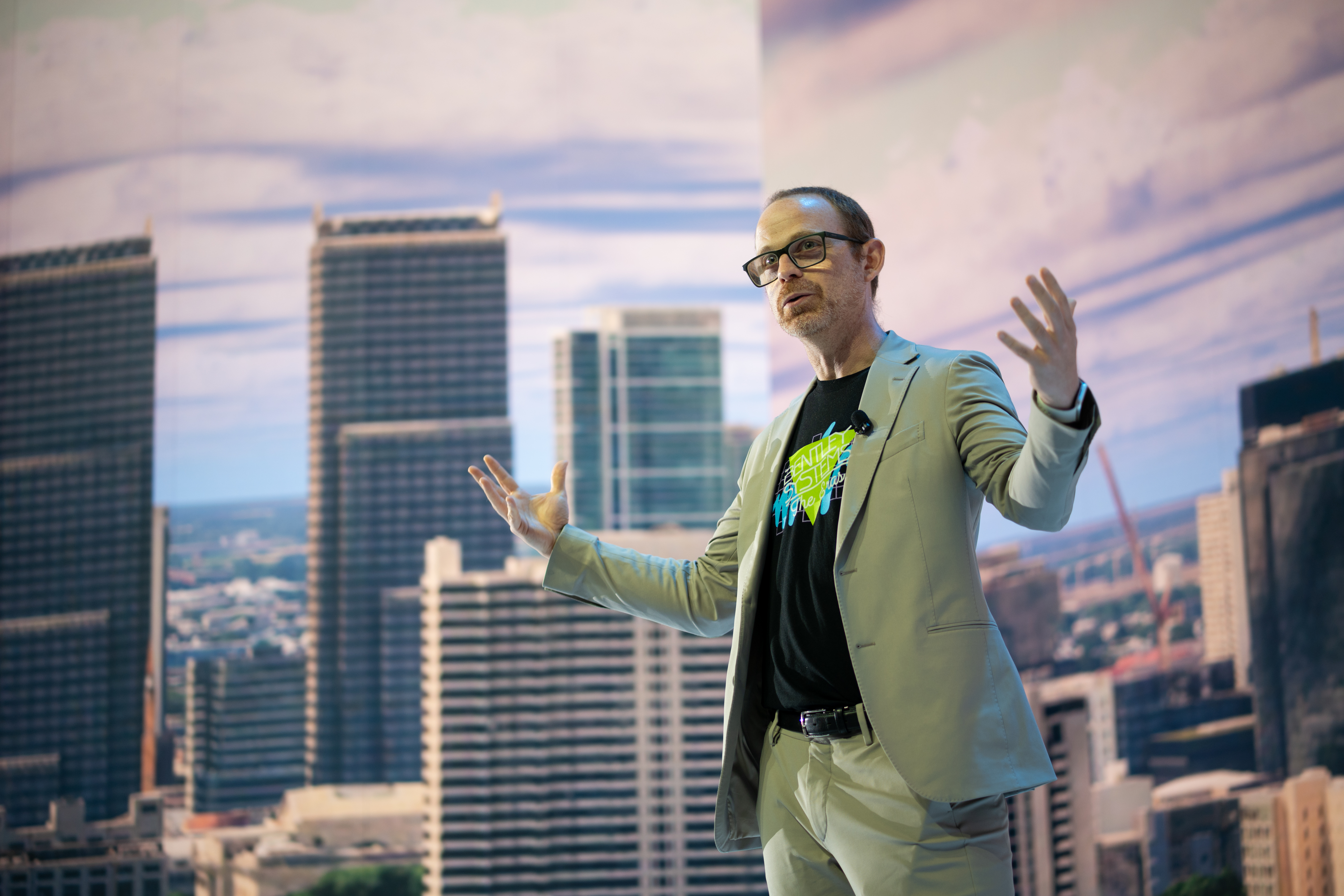
    Cesium founder and past CEO Patrick Cozzi is now Bentley’s chief platform officer and will head the new office, near Independence Hall.
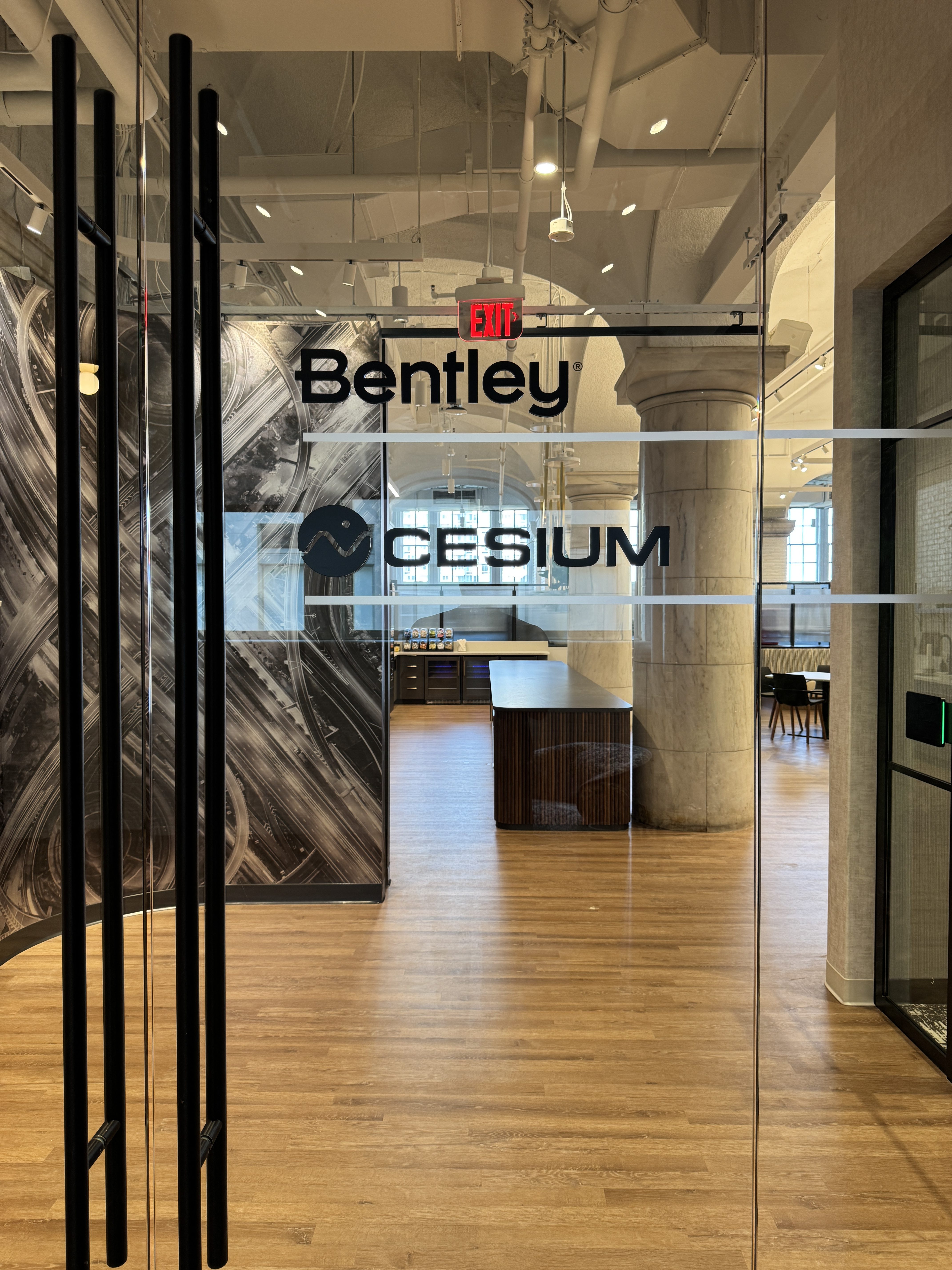
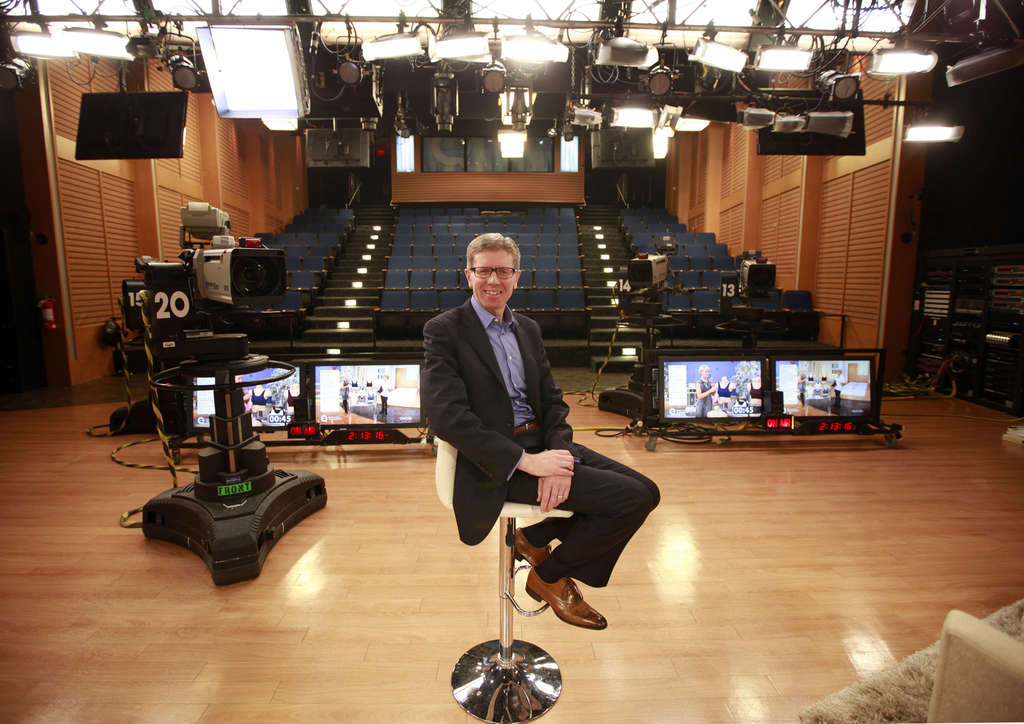
    At Bentley Systems’ new Philadelphia office, where the company’s Cesium team has its home, in the Curtis Center, 2026.Bentley Systems

    Bentley, founded by five brothers from Delaware in 1984, has sales totaling $1.5 billion last year.

    Cozzi set up Cesium as a geospatial-mapping applications unit of serial tech developer Paul Graziani’s Exton-based Analytical Graphics Inc. (AGI) in 2011 and spun Cesium off as an independent company in 2019.

    Bentley customers use what’s now its Cesium Ion mapping platform to show sites and buildings in complex detail on office computers and hand-held devices.

    A Penn State grad, who also earned a master’s and taught programming and architecture at the University of Pennsylvania, Cozzi says he sees Philadelphia as a “magical place” for tech companies.

    “When I was CEO raising capital on the West Coast, some of the investors told me the best tech entrepreneurs want to move to the [San Francisco] Bay area. I said no, we can build a great tech company in Philadelphia,” he said.

    Philadelphia was an early computing industry center. ENIAC, the pioneering system built at Penn to help plan World War II artillery attacks, and other early Philly-built computing systems relied on the vacuum tubes mass-produced for radio manufacturers in Philadelphia and Camden.

    But by the 1970s, the industry committed to far more efficient silicon-based microprocessors developed in California’s “Silicon Valley.” Investor-rich cities such as Boston, Seattle, and Austin also became important computer hardware and software centers. Few large tech companies are now based in the Philadelphia region.

    Cozzi says Philadelphia’s affordability is now an asset.

    “We have reasonable cost of living and fantastic schools, graduates who want to stay here, great restaurants and quality of life, it’s an awesome place for the tech community,” he said, as he prepared to welcome Mayor Cherelle L. Parker, State Rep. Jordan Harris (D., Phila.), and 200 other guests to the new space for a grand opening celebration Thursday evening.

    Cozzi said neither the city or state provided incentives for the new office.

    Invited guests at Thursday’s event include Bentley clients from Center City-based Pennoni Engineering; Ansys, the Pittsburgh-based owner of AGI, and Earthbrain, a Japanese construction equipment and computing joint venture, which uses Philadelphia as a U.S. base.

    Bentley went public in its 2020 IPO at $22 a share. The stock peaked in the low $60s the next year and ran almost as high last summer. It has lately traded around $35 a share.

    It employs more than 5,000 at offices in 42 countries. The company is worth nearly $11 billion on the Nasdaq stock exchange. That compares to around $6 billion for Newtown, Bucks County-based software-outsourcing provider EPAM, $2 billion for King of Prussia tax-accounting software maker Vertex Inc., and $200 million for Blue Bell legacy hardware and software provider Unisys.

    Bentley’s 10th-floor space in the Curtis Center includes a public-meeting area to host events.

    The building was built in 1910 for Curtis Publishing and its mass market magazines, led by the Saturday Evening Post and Ladies’ Home Journal. Curtis moved its press operations to Delaware County in 1949 and shut both Philadelphia offices and Delco operations by the time of its 1969 bankruptcy.

    The Curtis building’s owner, Keystone Development + Investment, has in recent years added apartments, biotech labs, and other specialized units to help fill the block-long complex.
  • U.S. grabs made-in-Philly training ship as Navy seeks to beef up bases after Iran hits

    U.S. grabs made-in-Philly training ship as Navy seeks to beef up bases after Iran hits

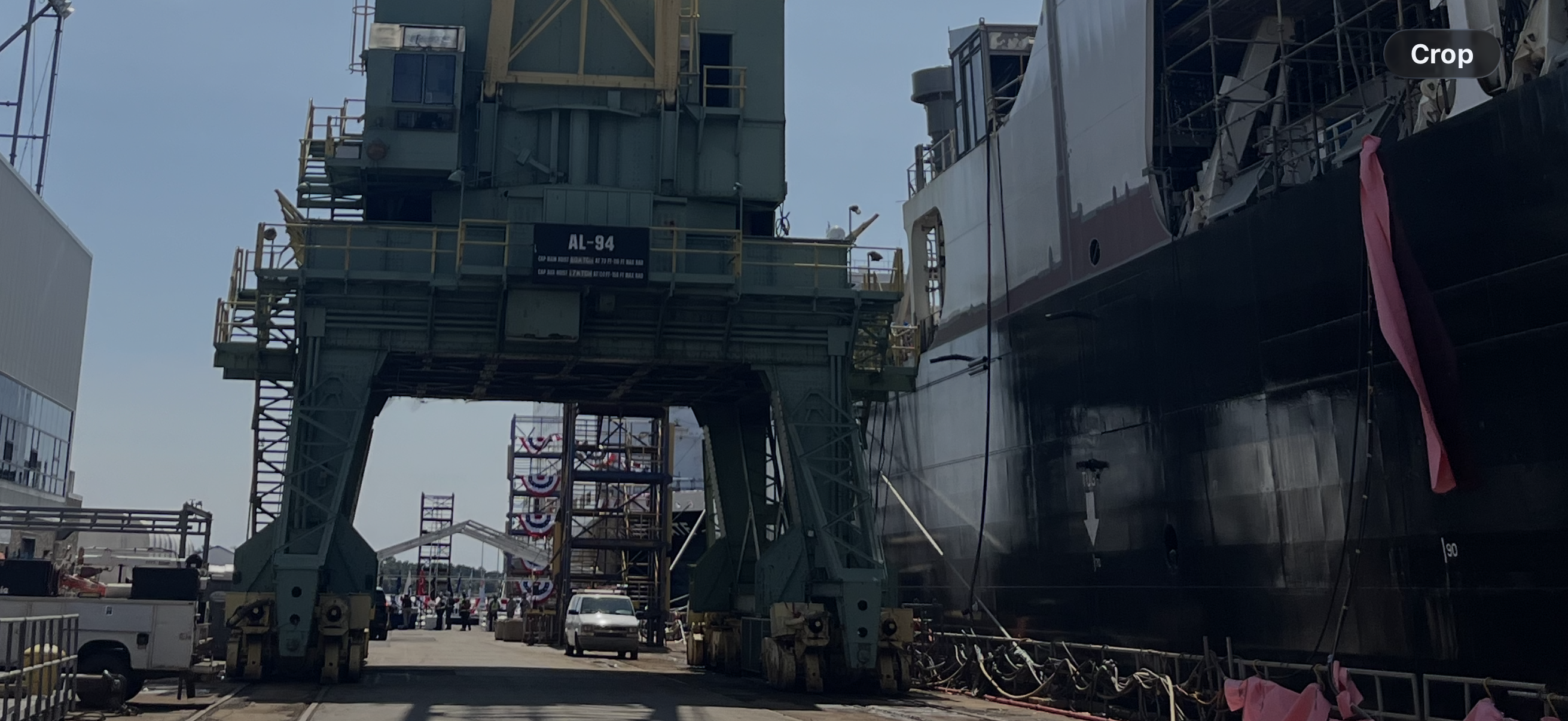
    The first of the five $300 million-plus, 525-foot-long ships built at Hanwha Philly Shipyard has been reassigned to U.S. Navy duties for about six months.

    The move comes as the U.S. military realigns resources to support U.S. bases now tasked with replacing military and supply facilities in Bahrain and other Arab countries, which were damaged this year by Iranian missile attacks in the war with the U.S. and Israel.

    It also comes as shipbuilder Hanwha and construction supervisor Tote Services, which has overseen construction of the five National Security Multi-mission Vessels (NSMVs) in South Philly since 2021, have been seeking contracts to build more of the ships, as work on the last one draws toward a close next year.

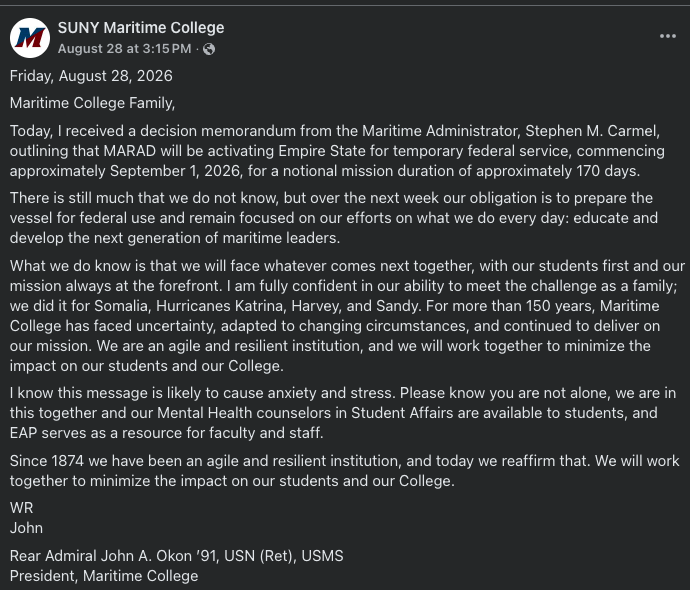
    TS Empire State will be sent over Tuesday for 170 days of “temporary federal service,” retired Rear Admiral John A. Okun, president of the Bronx-based Maritime College of the State University of New York, told faculty and staff in a memo Friday, confirming earlier reports from shipping and government sources.

    “There is still much that we do not know” about how the ship, which normally carries hundreds of cadets on training voyages, will be used by the government, Okun said.

    The memo posted by retired Rear Admiral John A. Okon, president of State University of New York Maritime College, informing faculty and students that their Philadelphia-built training ship, TS Empire State, has been moved to “temporary federal service” starting Sept. 1. Maritime College, State University of New York

    ‘They should be up for it’

    Military commenters linked the move to the U.S. military’s efforts to shuttle supplies to and from its base on Diego Garcia in the Indian Ocean and other far-flung stations, after stations in Bahrain and other Arab countries were damaged by Iran earlier this year in retaliation for U.S. and Israeli attacks.

    The Navy’s Sealift Command, which carries military equipment and supplies, asked for Empire State and said no other available ship has its capabilities for an undisclosed strategic mission, according to an article Monday in GCaptain, published by merchant marine Capt. John A. Konrad V.

    “The ship is likely headed to Diego Garcia,” according to Salvatore Mercogliano, a maritime historian at Campbell University in North Carolina, who reported in social media posts in mid-August that the move was likely.

    The Empire State and its sister ships are oceangoing vessels, and “they should be up for it,” said Gary Kim, a shipbuilding and industrial scholar, reserve officer, and Wharton graduate student who as an active-duty Navy lieutenant worked for the unit that manages the base at Diego Garcia, among other installations.

    The ship’s removal “is likely to cause anxiety and stress” at the academy, so mental health counselors have been made available to midshipman cadets to help them cope, academy president Okun said in his note.

    He pointed out that a previous Empire State training ship — there have been six of that name before the current one — had supported U.S. forces in Somalia in the 1990s, as well as aiding relief work for Hurricane Sandy, which ravaged the Jersey Shore in 2012, among other storms.

    “We will face whatever comes next together,” he said.

    On time and on budget

    Empire State was delivered to the Maritime College in the Bronx in 2023. The next ships in its class were sent to academies in Massachusetts and Maine. TS Lone Star was scheduled to leave Philly Shipyard for its new Texas home on Monday.

    Empire State’s success on deployment could help determine the future of the construction program, which has kept many of Philadelphia’s workers busy since 2021. The yard now employs around 2,000, which Hanwha hopes to double.

    In July, Transportation Secretary Sean Duffy and other federal officials came to Philadelphia to announce that the government planned to purchase two more NSMV-like hulls to be built at the shipyard and used to track enemy missiles, replacing ships built in the 1960s. Duffy praised Tote for building ships “on time and on budget.”

    Tote has noted that the program has run modestly overbudget due partly to much higher steel costs added and other factors. Federal officials said it is far closer to target than recent Navy-run shipbuilding programs.

    Hanwha’s expansion goals

    Hanwha has sought additional contracts to build similar vessels for other federal civilian agencies and as potential replacements for the Navy’s aging hospital ships, USNS Mercy and USNS Comfort.

    Hanwha has said it is losing money on the yard and that it will turn a profit only if it can expand ship construction from the current one ship every eight months or so to at least one every few weeks. Its shipyard on Geoje Island, South Korea, produces almost one ship a week, assembly line-fashion in contrast with the expensive ship-by-ship style that has characterized U.S. ship construction in recent decades.

    Tote officials have said Hanwha needs more space if it is going to build more government ships in Philadelphia. Officials of the Philadelphia Industrial Development Corp., the city/Chamber of Commerce partnership that finds city properties and public financing for industrial users, say they have been helping Hanwha look for expansion sites nearby. In March, the company canceled a plan to add facilities in Paulsboro, Gloucester County, after it could not reach an agreement with port operator Holt Logistics.

    Hanwha last year pledged to invest $5 billion in Philadelphia shipyard facilities. It has so far spent around $200 million, according to company officials.

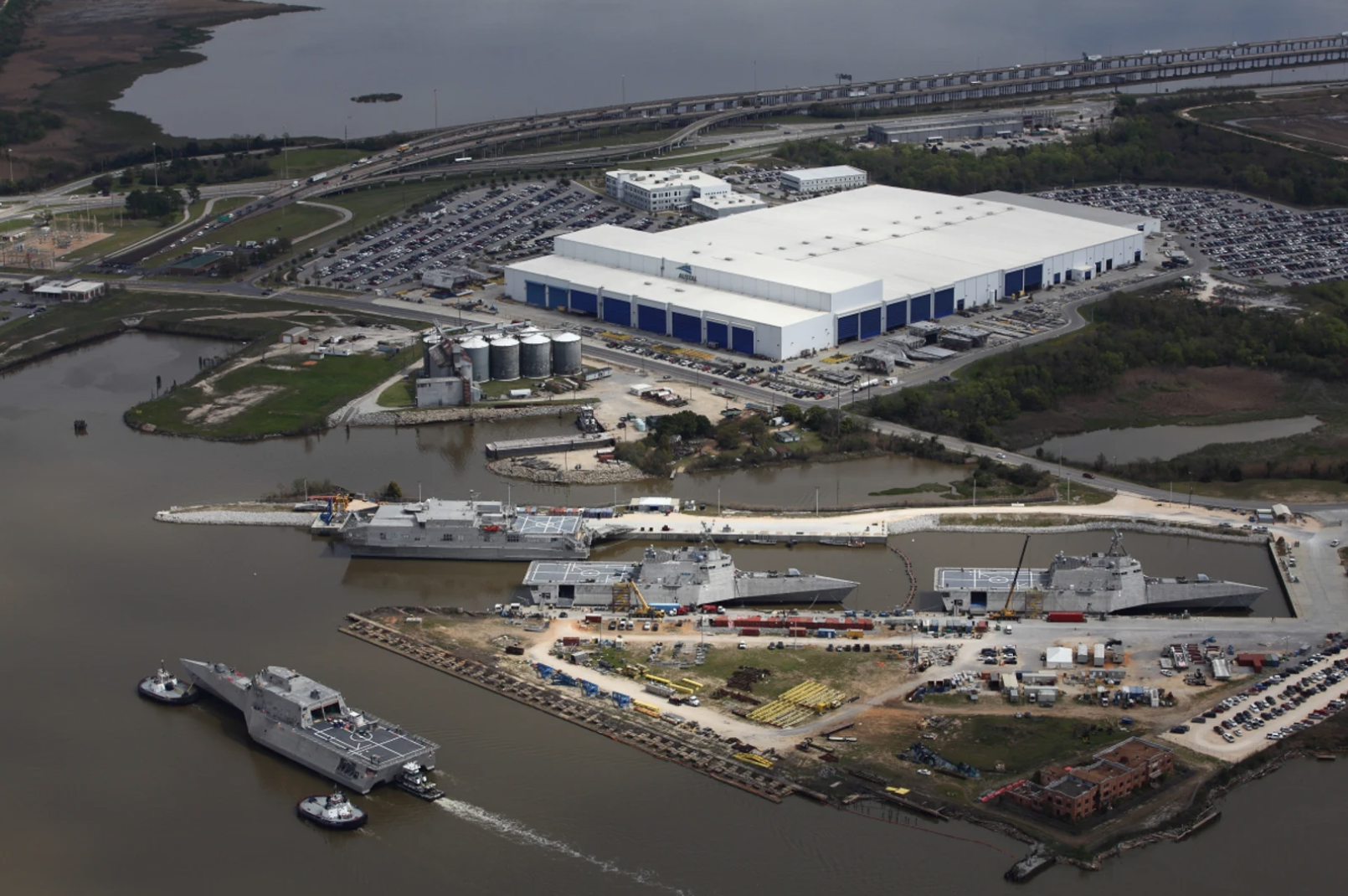
    Hanwha in August offered to spend over $1 billion for Australia-based Austal’s shipyards in Alabama, amid a boom in public and private military shipbuilding fueled by a record U.S. defense budget.

    Besides finishing the last of the NSMVs, Hanwha is building three liquefied natural gas-fueled cargo ships for the Matson shipping line, which operates between the U.S., Hawaii, other U.S possessions, and China.

    The company has said it would build its own cargo ships if necessary to keep the yard running.

  • This Manayunk company creates AI surveillance for 100 U.S. buildings, part of an evolving Philly start-up scene

    This Manayunk company creates AI surveillance for 100 U.S. buildings, part of an evolving Philly start-up scene

    The people who built 3.0 University Place, an eight-story lab and office complex that covers a landscaped block of West Philly, had a problem: During the biotech slump after their 2023 opening, security costs escalated faster than occupancy.

    “We had 80 Siemens cameras in there,” remotely monitored from a suburban surveillance office, and were “paying more than $150,000 a year for guard shifts,“ said Anthony Maher, the University Place Associates president.

    But the building’s New York owners were still getting midnight calls for nonevents. Meanwhile the human video watchers missed incidents of concern — the stranger who had taken to sleeping on a tenant’s canopy at night, the fired contractor who sneaked back into the building one weekend.

    Investors pressed them for a better way.

    Maher and his partner, Scott Mazo, went hunting for an artificial-intelligence solution — an AI-era automated security system to collect and analyze camera, physical, and human-observed surveillance data; rank threats; sort out false alarms; open or shut locks; and quickly notify law enforcement, emergency services, management and owners’ groups as needed.

    They rang an entrepreneur they’d met five years earlier at a Drexel University pitch meeting: Matias Klein, founder of Manayunk-based Kognition AI.

    Kognition specializes in what Klein calls “cyber-physical threat detection systems,” which link and analyze digital security video, activate remote locks and sensors, load key data into formulas matching clients’ priorities and requests, sort and share communications to alert the right people and agencies, and update responses based on results.

    “You hang the cameras; we network the building systems,” as Klein puts it.

    100 North American buildings

    At 3.0 University Place, “Matias’ system gave us full access to the best 25 cameras, every floor, all times,” said Maher. The system caught incidents, routed them to the right people, and suggested simpler warning paths.

    “They keep teaching us to manage the building, telling us, for example, about our people coming in when they didn’t really need to,” he said.

    It worked so well “we told the owners to take the security-guard line-item out of the budget,” though they still use guards on occasion. It helps that the building’s big new tenant is the city police forensics unit: “We have a lot of cops coming here,” Mazo added, laughing.

    More than 100 North American properties use Kognition AI, from Scotia Plaza, one of the largest office buildings in Toronto; to Pa.-based Benco Dental locations in several states.

    A growing sector

    Kognition, founded by Klein in 2017, was one of a handful of Philadelphia-area AI start-ups that presented to local investors at a June gathering. Investors included Osage Capital, MissionOG, and Susquehanna International Group’s SIG Growth Equity Fund.

    “The AI landscape is changing so fast, it’s hard to tell what will be supplanted in a few months,” said Ellen Weber, who runs Robin Hood Ventures, and attended the meeting.

    Robin Hood is a Philadelphia investors’ group whose members include start-up veterans. Members’ portfolio of local AI-dependent start-ups include Center City-based Deepwave, which makes laser weapons guidance systems for Air National Guard jets and other military projects; University City-based GreenIRR, which uses AI to speed carbon-emissions detection for truckers; and Proscia, which digitizes biotech images for fast diagnosis and pharmaceutical drug trials.

    Thomas P. Dwyer, a partner at the law firm Troutman Pepper Locke who organized the June meeting, said Philadelphia trails other AI hotbeds.

    “Philly has a lot of potential and opportunity here, especially if some of its larger companies get involved, as they do in Silicon Valley,” he said.

    AI, he noted, is still seen as a threat by many local companies. They worry, “Can someone armed with Claude overtake your business, duplicate your software, and compete with you immediately — without having to hire people?”

    And veteran investors are “gun shy” about AI profitability, he said.

    Which, he added, leaves opportunity to those investors who make the “leap of faith” to promising AI start-ups

    Operating on ‘the edge’

    “An AI product makes itself better” the more it is used, said Kognition AI founder Klein.

    Some of the best-known (and most-feared) AI image-and-data applications are based on giant AI companies’ mass sorting of millions of individuals’ information into ever-improving, readily searchable central databases at big new data centers — raising familiar privacy worries, as seen in the recent controversy over the alleged misuse of Flock digital camera data that police have used in attempting to quickly identify drivers.

    By contrast, Kognition is one of the firms that operates at the “edge” of big networks, Klein said in an interview at his firm’s Manayunk meeting space. “We don’t send customers’ data throughout our network, and we don’t preload that information,” he said. “We don’t flow data back to a central monitoring station.”

    Rather, the goal is “to give people control over the spaces where they live or work or worship, so they can get into a defensive posture fast, if they ever need to.” Custom, localized, focused solutions are “a big area of value creation” for AI start-ups, according to Klein.

    Customized experiences

    Kognition AI’s custom sharing limits and options are part of its appeal to Ravi Kalidindi. He was tasked by leaders of Bharatiya Temple, a Jain and Hindu religious congregation in Montgomery County, with setting up a system “that gave us control of our doors” without intimidating visitors or compromising members’ private information.

    Kalidindi turned to Kognition as a locally based provider.

    The system at Bharatiya starts with security cameras at the main entrance and stairways, integrated into a software and communications platform. “They check if our doors are closed. They tell us where there is human traffic. We can let the cleaning crew in without a key. It has mobile device control. It can even work on fobs,” Kalidindi said.

    Kognition also has capabilities the temple has not used: “It has a weapons-detection system we have not enabled. It has additional sensors that can ID what people are carrying. It can tell us if we are seeing an above-average or above-expected crowd, make a note of the faces of people who are entering for the first time, and trigger an alert.”

    There is a sense of user control of the AI systems that Kalidindi finds reassuring: ”We want to enhance the sense of security, that our facilities are being monitored, but also that everyone with good intent is allowed to enjoy the premises.”

  • CEO of robot tech company Exyn is out after unauthorized credit card spending

    CEO of robot tech company Exyn is out after unauthorized credit card spending

    The CEO of South Philly drone software and hardware maker Exyn Technologies resigned Wednesday after an internal investigation showed he used a company credit card to rack up $287,000 in unauthorized personal expenses, according to a statement Exyn filed Thursday in a revised quarterly financial report with the SEC.

    Brandon Torres Declet, the CEO, had pledged to boost sales and profits after taking the money-losing company public in an IPO in May.

    Exyn named chief operating officer Benjamin Williams as acting CEO, a role Williams also filled for five months in 2023 after founder Nader Elm left the company and before Torres Declet’s hiring. The company named director Gregory McNeal as board chair to replace Torres Declet in that position.

    In a Wednesday filing, Exyn had said the CEO was “terminated.” In a brief interview Wednesday night, Torres Declet said he expected the company would amend that statement, as it did. He declined further comment.

    Torres Declet’s departure followed an internal investigation opened Aug. 11 by the board’s audit committee into allegations that Torres Declet “used a company-issued credit card to pay for personal travel and other personal expenses that were recorded as business expenses in the company’s books and records.”

    Torres Declet was denied severance, according to the filing. Exyn added that it has asked him to return the unauthorized payments.

    Torres Declet joined Exyn in late 2023. He was paid a salary of $366,667 plus a bonus of $200,000 for 2025, plus stock options. The stock went public at $7.70 but has traded lower ever since, closing Wednesday at $2.

    On Aug. 3, eight days before the investigation opened, the board boosted his salary to $482,000, plus a bonus of up to $362,000.

    Exyn raised $19 million in the IPO. Sales of Exyn’s drone hardware and software, used by mining companies and offered to military and commercial users, totaled $5.8 million last year, up modestly from $5.6 million in 2024. But expenses in each year, including salaries for the company’s staff of 45, totaled around three times that much.

    Before joining Exyn in 2023, Torres Declet, a lawyer, had worked for years in the drone business and earlier as a counsel to Congress and for the New York Police Department, according to his posted resume.

    Interim CEO Williams, who holds engineering and business degrees from the University of Pennsylvania, worked previously at AT&T, Lockheed Martin, and for the U.S. Navy. He also ran a string of small start-ups, including Reelio Inc., purchased by an AT&T affiliate in 2018.

    After Torres Declet’s departure, Exyn said in its SEC filing that the company acknowledged poor credit card controls. The company listed other “material weaknesses” in its accounting procedures including a lack of oversight in tracking inventory, failure to properly report its loan agreement with Arizona-based Western Alliance Bank, and failure to properly recognize expenses.

    Exyn attributed the accounting issues to having too few staff with technical accounting knowledge.

    The company is based in a former brewery barn on Washington Avenue in Philadelphia. Torres Declet said last spring that he was looking for larger quarters to accommodate growth after Exyn’s lease agreement expires next year.

    Exyn’s investors represent the breadth of interest in industrial and military drone projects. The largest shareholder before and after the IPO was Reliance Strategic Business Ventures Ltd., owned by India’s multibillionaire Ambani family. Others include Wilmington-based Longview Innovation; Israel-based Neolync Holding; and Penn Engineering dean Vijay Kumar, an Exyn cofounder. Early investors included Chicago-based Alyeska Investment Group; military-focused Anzu Partners, a firm linked to the Japan-based Softbank Vision Fund; In-Q-Tel, which invests in tech companies that sell to the CIA; Pennsylvania-funded Ben Franklin Technology Partners of Southeast Pennsylvania; and Penn alumni-funded Red & Blue Ventures.

    Early funding also came from the Defense Advanced Research Projects Agency, the research and development arm of the U.S. Department of Defense.

    Exyn was founded in 2014 by Kumar and Elm, a Penn robotics scholar who worked for Kumar’s General Robotics, Automation, Sensing & Perception (GRASP) lab, which helped develop drone quadcopters. The company’s initial clients included mining companies hoping to reopen closed deep mines in the U.S., Canada, and other countries.

    The IPO prospectus said the company’s Exyn Defense Inc. subsidiary focuses on such military uses as “autonomous systems for reconnaissance, contested logistics, and force protection,” for use in underground tunnels and on city buildings.

    Exyn’s Range-brand products offer “uncrewed” navigation and mapping to military and national security users on battlefields and in other places where GPS doesn’t reach.

  • Pa. state workers’ pension outsources $2 billion to a firm it just fired

    Pa. state workers’ pension outsources $2 billion to a firm it just fired

    The $42 billion Pennsylvania State Employees’ Retirement System (SERS) last month unanimously agreed to end a $300 million foreign-stocks investment for failing to meet targets — then gave the same firm a fresh $2 billion to invest in U.S. stocks.

    The plan to eliminate Center City-based Xponance Inc.’s Non-U.S. Small Cap Equity fund passed unanimously at SERS’s meeting July 28.

    That came 20 months after SERS put the investment on its “Evaluation List,” a special status that SERS’s adviser, Callan Inc., told trustees in a memo was “due to underperformance.”

    According to SERS investment data, Xponance, which manages around $25 billion, was the only one of five firms it hired to pick foreign company stocks that has failed to beat its benchmark index of those stocks “since inception.” SERS uses Morgan Stanley’s MSCI ACWI ex USA Small Cap Index of foreign stocks, as Xponance’s benchmark.

    Xponance actually met or slightly beat that index in three of the seven years since SERS invested. But that wasn’t enough to cover larger shortfalls from other years, including 2025, when Xponance trailed the index by 6%, yielding $15 million less than its target.

    SERS has paid Xponance more than $10 million in fees since hiring the firm’s predecessor, FIS, in 2018, with the support of longtime SERS trustee State Sen. Vincent Hughes (D., Phila.).

    Hughes and Xponance officials didn’t return calls seeking comment.

    In all, SERS paid more than $230 million in fees, profit sharing, and expenses to hundreds of investment fund managers in 2024, the last year for which it has published data.

    SERS has profited from rising investment valuations in recent years, which helped persuade state lawmakers in July to boost pensions for staff retired more than 25 years.

    The system also beat its self-imposed annual investment benchmark, currently 6.875% a year, by more than one percentage point from 2015 to 2025. That enabled SERS to reduce the “employee contributions” collected from 67,000 state employees, which vary from 5% to 9%, by half a percentage point for three years. SERS collected about five times as much from taxpayers last year, and collects varying amounts from its investments.

    While SERS voted to “liquidate” Xponance’s account with one hand, it awarded Xponance a new account with the other. In the same July 28 vote, trustees headed by chairman Gregory Thall, a Harrisburg lobbyist, unanimously agreed to give Xponance $2 billion to invest in a “passive” index fund based on the Russell 3000 index of large and small U.S. stocks.

    Though the $2 billion SERS granted is more than six times the $300 million SERS took away, Xponance is still likely to lose significant income in the switch. Xponance charged SERS around 80 basis points a year (that’s 0.8% of the investment’s value) plus expenses — a total of around $2 million a year — for the former stock-picking account.

    According to a formula in Xponance’s marketing materials, for a $2 billion investment in its “passive” Russell 3000 index fund, the firm would typically charge around $400,000 in client fees a year. That’s less than one-quarter what Xponance charged SERS to “actively” pick and manage foreign stocks.

    The highest fees are typically paid to private-equity and real estate investors. Stock-pickers like the former Xponance foreign-stock fund are paid less. Index funds such as the new Xponance fund tend to collect some of the lowest fees. Xponance’s new fees will be “very competitive,” according to SERS spokesperson Pamela Hile.

    SERS said it’s still negotiating the terms of its new Xponance mandate.

    “SERS has been laser-focused on negotiating and lowering investment manager fees,” which totaled 0.41% for all managers last year, according to Hile.

    Xponance, headed by past Philadelphia city chief investment officer Tina Byles Williams, is the only fund managing stocks for SERS that is “owned and/or controlled by a majority of persons who are women and/or minorities.”

    SERS investment policy “encourages the use of diverse investment managers” in all asset classes “within the bounds of financial and fiduciary prudence,” adding that a diverse range of professionals contribute different points of view that improve the system and its economic performance.

    Among SERS’s more than 200 outside money managers are five other firms controlled by women or diverse owners. Those five firms all manage private assets, rather than publicly traded stocks and bonds like Xponance, according to SERS.

    The pension system helps defray the annual cost to taxpayers of funding guaranteed pensions for around 250,000 working and retired state troopers, prison guards, social workers, state college staff, judges, legislators, and other state employees. The majority of its board is appointed by Gov. Josh Shapiro.

    SERS already pays Mellon Investment Management, a Pittsburgh unit of New York-based BNY Mellon, to manage $14 billion, SERS’s largest single investment, in Mellon’s Russell 1000 big-stock index fund, and for smaller investments in two Russell 2000 small-stocks funds.

    The new Xponance investment will be SERS’s only Russell 3000 fund, combining the big- and small-stock indexes. The Russell indexes are licensed to Xponance and other fund managers by the London Stock Exchange Group.

    Money for the new Xponance investment will include funds taken from SERS’s Mellon account.

    Elsewhere, BNY Mellon has been winning significant new public business. In June, the larger Pennsylvania school pension plan, PSERS, agreed to outsource $20 billion in investments to BNY Mellon.

    Last month, BNY Mellon was also named financial agent for Trump Accounts, the federal government’s new lifetime savings program.

  • As Philly-area construction has slowed, builders are shifting to data centers and military projects

    As Philly-area construction has slowed, builders are shifting to data centers and military projects

    This summer showed signs of a regional construction slowdown: projects downsized or canceled, contractors suing developers for nonpayment, partners suing each other as their bankers close in.

    “Confidence is shaky in the construction industry,” said Ed DeAngelis, founder and head of Bensalem-based EDA Contractors Inc., whose 450 union workers do outdoor construction — roofs, walls, sides, masonry, glass, waterproofing.

    “First, we saw the architects starting to slow down,” he said. “Then we started to see developers financing, not from banks, but private credit, names we don’t know.” A few stopped payment as they waited for financing.

    The Philadelphia region needs more towering cranes building homes and big office projects, he said. “But our margins are not high enough to afford your default. Even if you can still pay 50 cents on the dollar, it takes years for us to make up for that loss.”

    In past years, a commercial slowdown meant falling back on “eds and meds” — college, hospital, and drug-company jobs.

    But Trump administration funding cuts to medical and research universities like Penn and Princeton “hurt us,” DeAngelis said. Some projects were announced this summer after a lull but “even a six-month lag sets us back.”

    Public agencies, though slow and bureaucratic, are generally reliable payers. But the federal government’s reversal on Diversity, Equity, Inclusion requirements has created “a lot of confusion” for contractors and delayed bids, DeAngelis said.

    Add it up and “what industry right now is doing great?” DeAngelis said, noting only the “tremendous amount of money going into AI,” with Philadelphia general contractors busy in parts of Pennsylvania and South Jersey.

    The majority of the action this summer is industrial with Pennsylvania lenders and investors backing strategic metals, minerals, and manufacturing projects, of all sizes, including military contractors, said Dan Fitzpatrick, head of the Mid-Atlantic and Midwest regions for Citizens Bank, which operates the Philadelphia area’s largest branch network.

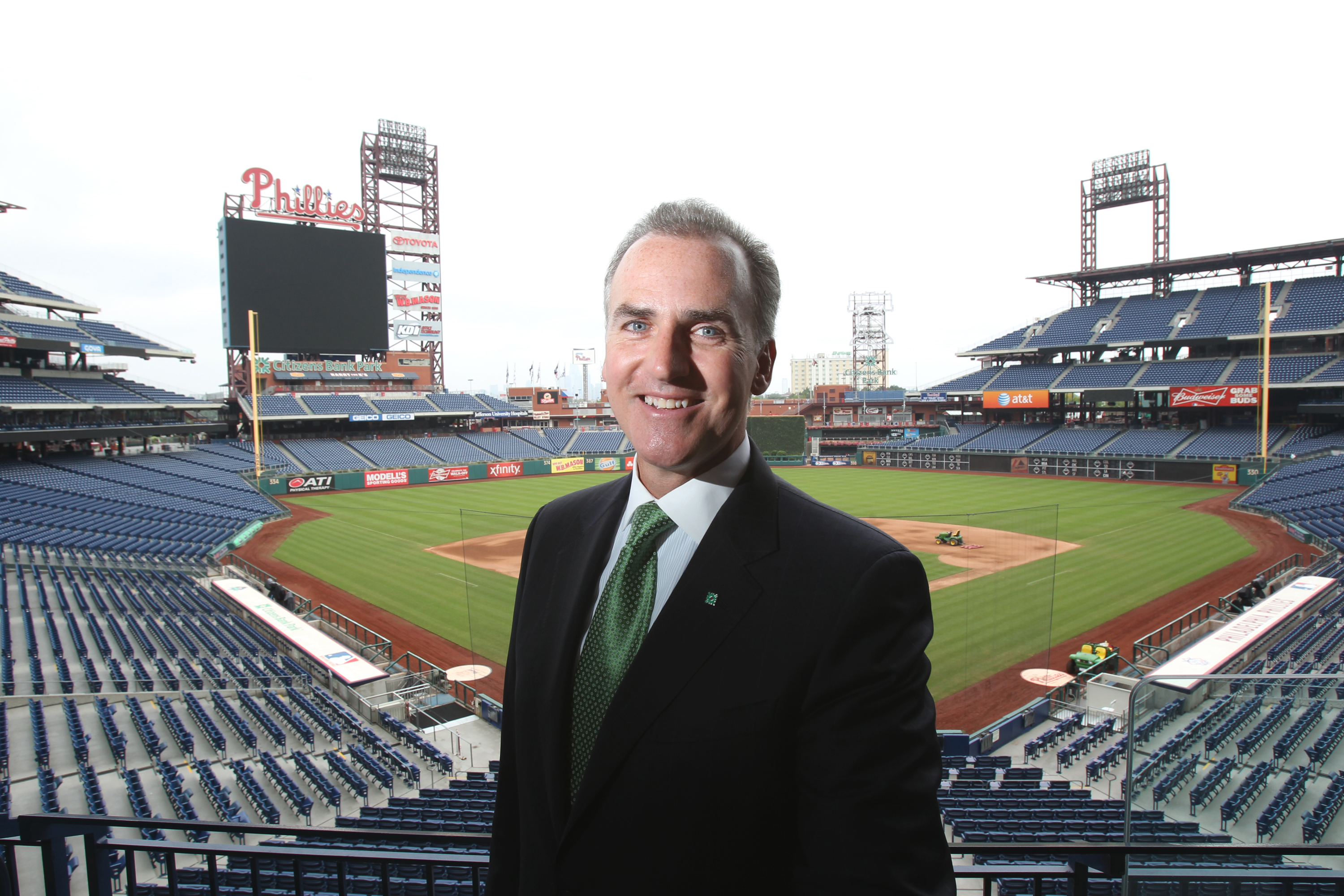
    Dan Fitzpatrick, head of Mid-Atlantic and Midwest regions for Citizens Bank, shown at Citizen’s Bank Park in 2013.Photographer: CHARLES FOX

    In residential development, “we are going through an adjustment period,” he said. Higher interest rates and higher fuel, materials, and labor prices have pushed up new home costs.

    While “there’s now a bit of a glut of luxury homes, we have a shortage of more modest, $200,000 to $500,000 homes,” Fitzpatrick said. “But it’s tough for developers to build those right now with a reasonable return.”

    Citizens has been funding more apartment construction since 2020, but there, too, “developers are hitting a pause.”

    Turning to D.C.

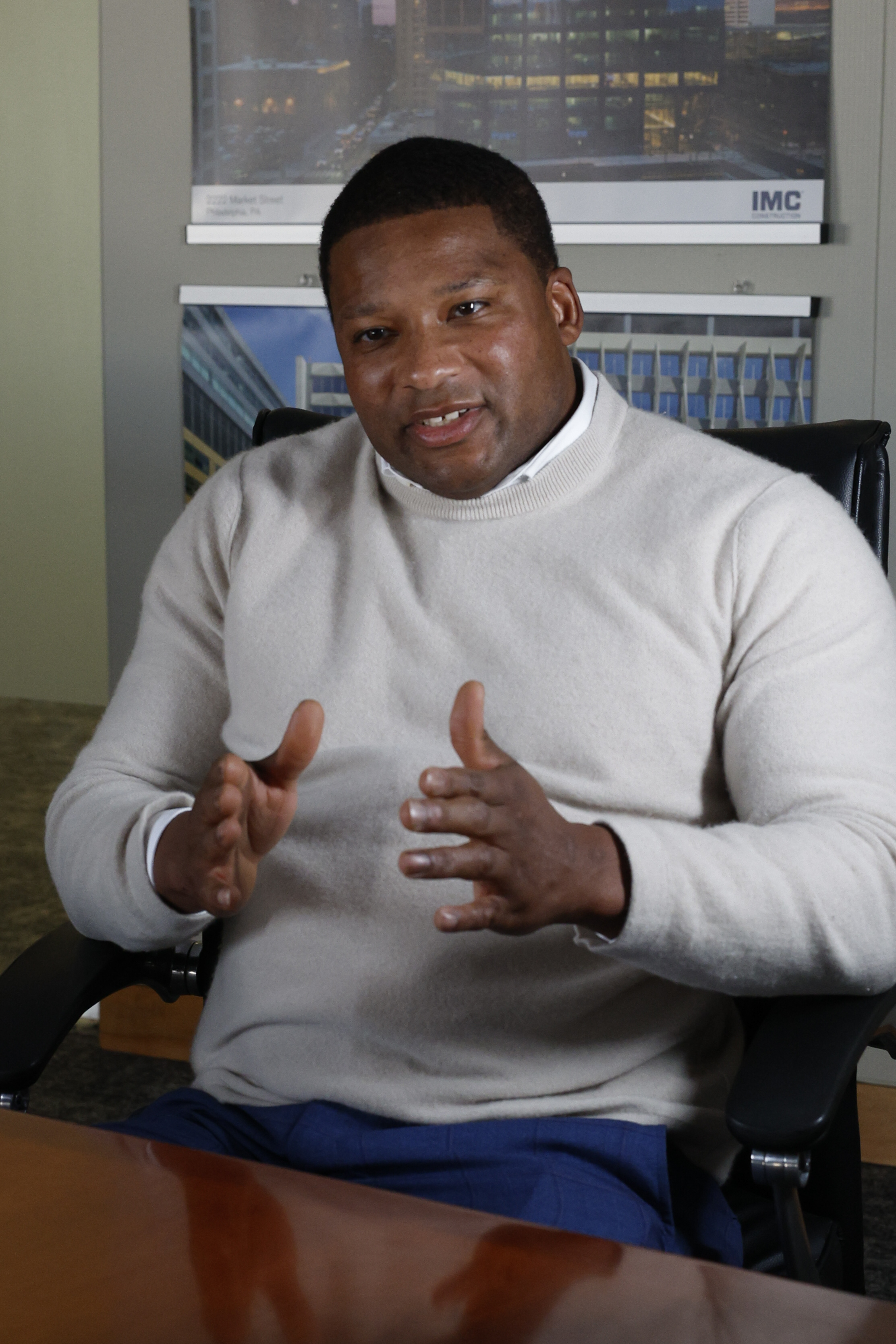
    Mike Lloyd, CEO and owner of IMC Construction, at his Malvern headquarters.Steven M. Falk / For The Inquirer

    One of the Philadelphia area’s largest builders, Malvern-based IMC Construction, is adding a Washington-area office because data and military contractors, anticipating next year’s record military budget, are hiring and growing there.

    “Northern Virginia has been the data-center capital,” said Mike Lloyd, IMC’s CEO and owner. So much is going up — not just data centers, but commercial development that follows big capital investments — that some of the largest, multibillion-dollar national general contractors are overstretched.

    A $100 million project used to be very attractive to big national firms, but “now it’s not large enough to put their best teams on,“ he said. ”And some of the traditional defense contractors are now busy with data center work. That has created a niche for firms like ours in the D.C. market.”

    “With respect to the Philadelphia market more broadly, I’d say the only projects that can get financed right now are data centers, multifamily, and senior living,” Lloyd said.

    He pointed to a Philadelphia-area life-sciences project he said has collected tenant commitments but still can’t attract financing. “You are seeing a crowding-out of other commercial sectors by the data-center hyperscalers.”

    Philadelphia Mayor Cherelle L. Parker’s “Lower South Philly” program of speeding permits for defense, port, and industrial contractors acknowledges that capital is flowing into industrial development and jobs, he added.

    “She’s understanding our competitive strengths and leaning into them,” Lloyd said. ”There are entire supply chains centered around defense projects, and contractors here are ramping up investment.” There’s still demand for Class A office space, but firms are still moving to smaller quarters.

    To Lloyd, “the big question is, why does Pennsylvania still lag in data centers?” He was among the builders who went to Harrisburg in 2019 to testify in favor of a data-center sales-tax exemption, which passed.

    Pennsylvania ranks with Texas as a source of natural gas for cheap power. Lloyd said that in his native Louisiana, communities are prospering from data center-funded job training and road improvements, but in much of Pennsylvania, residents have mobilized against the projects.

    “There are ways to facilitate that growth in an equitable fashion that benefits all parties,” he said.

    On the roads

    Unlike colleges or healthcare, spending for federal transportation didn’t change with the Trump administration, said James Bilella, new CEO of Philadelphia-based Urban Engineers, which designs and advises cities and states on large public projects.

    “We have not seen a drop off in federal transportation spending, especially in the rail and transit industry,” he said. “This administration is trying to be sharper, with quicker turnaround, more efficiency.”

    Bilella said the Parker administration has pledged ongoing support for heavy industry, biotech, and military industries, while continuing to back popular infrastructure safety upgrades like the “Great Streets” project, which Urban helped design.

    Bilella said he is excited by the prospects for Lower South. “It’s rare in a well-established city to have an opportunity to rededicate such a large area [two square miles] to industry and create jobs that can improve lives and attract new people.”

    He added, “We still need to decide about the infrastructure that get people to work there easily. Can people walk in safety? Can they drive, bike, use the river? It’s the kind of project we hope to get involved with.”

    Long-term investments

    “Industrial, logistics, data center, and defense-related projects” are attracting capital because lenders and investors believe they’ll be in demand a long time, said Abe Ibrahim, regional president for the Philadelphia area at Dauphin County-based Mid Penn Bank, whose largest investor is the family of Cooper University Health Care board chairman George Norcross.

    “It’s not that lenders are walking away from office or multifamily, as much as we’re seeing a return to disciplined underwriting,” Ibrahim said. “There are still plenty of opportunities for well-conceived projects to move forward.”

    This story has been updated to correct the location of IMC Construction’s headquarters.

  • Ex-Philly Fed chair is back at Wharton and on a quest to save the world financial system

    Ex-Philly Fed chair is back at Wharton and on a quest to save the world financial system

    U.S. borrowing is at record levels, interest rates are up, and Social Security is running low on cash. Yet new Federal Reserve Chairman Kevin Warsh has offered investors little information on whether the Fed will boost interest rates and fight inflation, or cut rates to feed growth.

    As a past president of the Philadelphia Federal Reserve Bank, Patrick Harker sat in and sometimes voted at Fed Open Market Committee meetings that decided interest rate targets under Warsh’s predecessors from 2015 to 2025. He says it’s important for Fed leaders to speak clearly.

    An engineering Ph.D. who grew up in blue-collar Gloucester City, Harker spent the previous 15 years, first as dean of the Wharton business school at University of Pennsylvania, then as president of the University of Delaware, before he was chosen to run the Philly Fed by the search committee he headed after others declined the job.

    Harker finished his second five-year Fed term in June 2025 and reported back to Wharton the next day as a professor. He says he has been putting what he learned there to use.

    This interview has been edited for clarity and brevity.

    How did you align while you were with the Fed?

    People at the Fed asked: Was I a hawk, leaning toward higher rates to fight inflation? Or a dove, leaning toward lower rates to support jobs? I’m an eagle, loyal to this country. I’m for doing what the economy requires.

    I’m where the vast majority of Americans are: They’re sick of ideology. It gets us nowhere. It drives countries to ruin. That’s never been us.

    We are a pragmatic people. Let’s do reasonable stuff.

    Are you worried digital finance will spin out of control?

    My particular interest is around operational risks caused by technology. Those come in different flavors:

    • Concentration risk: Just a few key firms — Amazon, Microsoft — providing a lot of the financial infrastructure.
    • Model risk: Everyone using the same AI models. Some of my colleagues have found that if AI models set prices, they will collude [to illegally boost prices at consumers’ expense]. They will do the same with loans.
    • Fraud risk: Faster payments equals faster fraud.
    • Market risk, credit risk, and operational risk: We are looking down into the bowels of the systems moving the money and at cyber hygiene.
    Will hedge funds’ use of insurance companies to make risky private credit loans fuel the next financial crisis?

    If you pull one thread, will it start to fall apart? At the Fed, I was a bank supervisor. I worried about it. I still worry.

    It’s not big enough yet to threaten the system [as mortgage losses did in 2008]. But the ‘private’ asset risks eventually all filter back to the regulated institutions.

    I said that at a dinner of people in the private credit industry. They said, ‘We know what we are doing!’ They do; the first people in always know what they are doing.

    But there’s only so much talent. And now you have people on the fringe taking bigger and bigger risks. And again all hell will break loose, and everyone will have to deal with it. It will go beyond the skill set of the industry.

    At the Fed you wrote about radical changes in the workforce. Will AI kill jobs? Do we still need immigrants?

    You know Jevons Paradox? Technology puts people out of work, then becomes so cheap, demand for that technology explodes, and so do the jobs providing it.

    Will AI improve productivity? It better. Our birth rate is not replacing ourselves. Our immigration policy has flatlined.

    It’s the most basic rule of economics: If you want more output, you either get more workers, or better machines.

    I’m more worried that in the United States, we are really bad at helping people make transitions to new kinds of work. A kid will figure it out. But if you’re 40 or 50, what do we do with you? No one cares; you can understand their anger.

    Can Congress fix Social Security and the deficit?

    I’m less worried about Social Security because politicians know they can’t get reelected without solving the problem.

    With the deficit, they keep kicking the can down the road. It really depends on healthcare, a very large part of the U.S. budget. Economists are starting to talk about the Fed losing the ability to set rates [because it is too busy] keeping Treasury’s financing costs down. When debt gets too high, you can’t avert default.

    After the Supreme Court said the president can’t fire Fed officials, you wrote about the Fed’s ‘fragility’ on LinkedIn. How did readers respond?

    A lot of people want the Fed to be independent.

    Fed independence is not a slam dunk. And the Fed’s independence is only around monetary policy. Congress is free to change the bank regulations.

    So you have to earn that independence every day. And you have to defy the administration sometimes because it’s the right thing to do.

    I worry about the new chair [Kevin Warsh, who has promised to comment less than his predecessors]. The Fed needs to communicate more. Very clearly.

    In this country, we’ve all gone into our own herds, we don’t listen to the other side. But if there’s a vacuum in communications, someone else will fill it with their narrative instead of yours.

    You protect credibility the institution built over decades by explaining yourself.

    What can you make happen now that you’re back at Penn?

    I’m a tenured faculty member. I put together an MBA class. I’m publishing academic journal articles on fraud in payment systems. I had to dust off my quantitative brain.

    I’m director of academic engagement for Penn Washington. We work with faculty, bringing fact-based, objective content like Kent Smetters’ Penn Wharton Budget Project and Olivia Mitchell’s work on pensions and Social Security to Washington. They aren’t lobbying. They don’t tell anyone what to do. You want to do this; here’s what it costs.

    And I’m joining Itay Goldstein at the Wharton Future of Finance initiative.

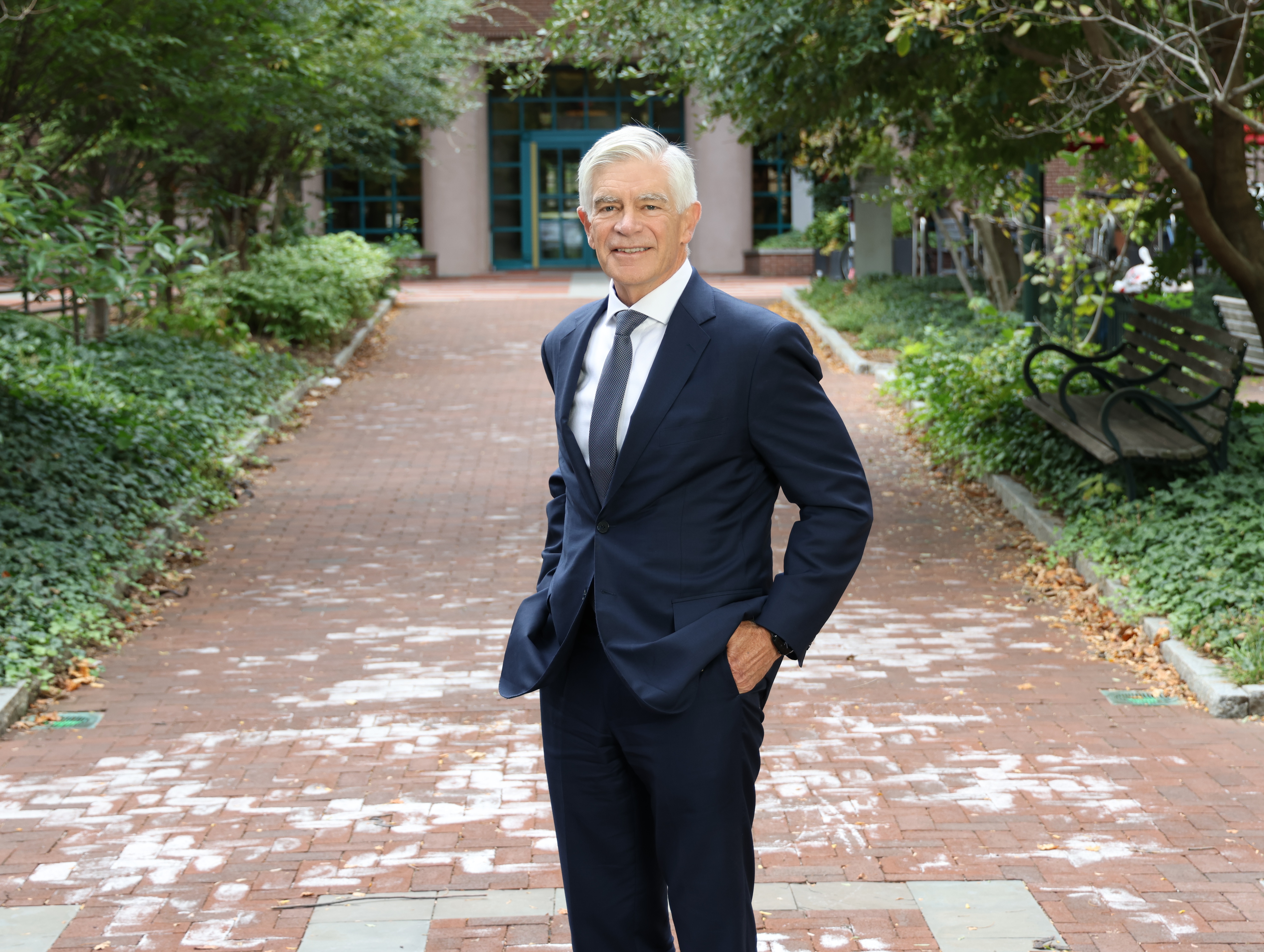
    Patrick Harker outside the Wharton School, 2026.The Wharton School
    Billionaire investor Marc Rowan is at the center of your interests. He led a fight to change Penn’s leaders; he backed the Wharton Budget Project, and his Apollo led the private-equity charge into private-credit and insurance.

    What motivates him I’m not sure, but he loves this place. His father died when he was here, and the school stepped up with financial aid, he doesn’t forget that.

    What do you miss about the Fed?

    One of the great privileges of the Fed, when you go to the Open Market Committee, there’s no personal electronics. For two days you have nothing to do but seriously think about what everyone else is saying.

    Even if you disagree, it’s in a very professional way. To the public, Washington can look like a big food fight. But at places like the Fed, there are people seriously dedicated to their job.

    Are you worried for your grandchildren?

    There is hope. People worry everything’s gone nuts; we’re leaving the young people with a giant bill. And a political system that is seemingly broken.

    People peddling crazy ideas understand the brain very well: Push these panic buttons. But to quote [former President Richard] Nixon, there is a silent majority who want to have a better life. Not to fight culture wars.

  • Philly shipyard owner Hanwha is shifting its investment focus to the South and West

    Philly shipyard owner Hanwha is shifting its investment focus to the South and West

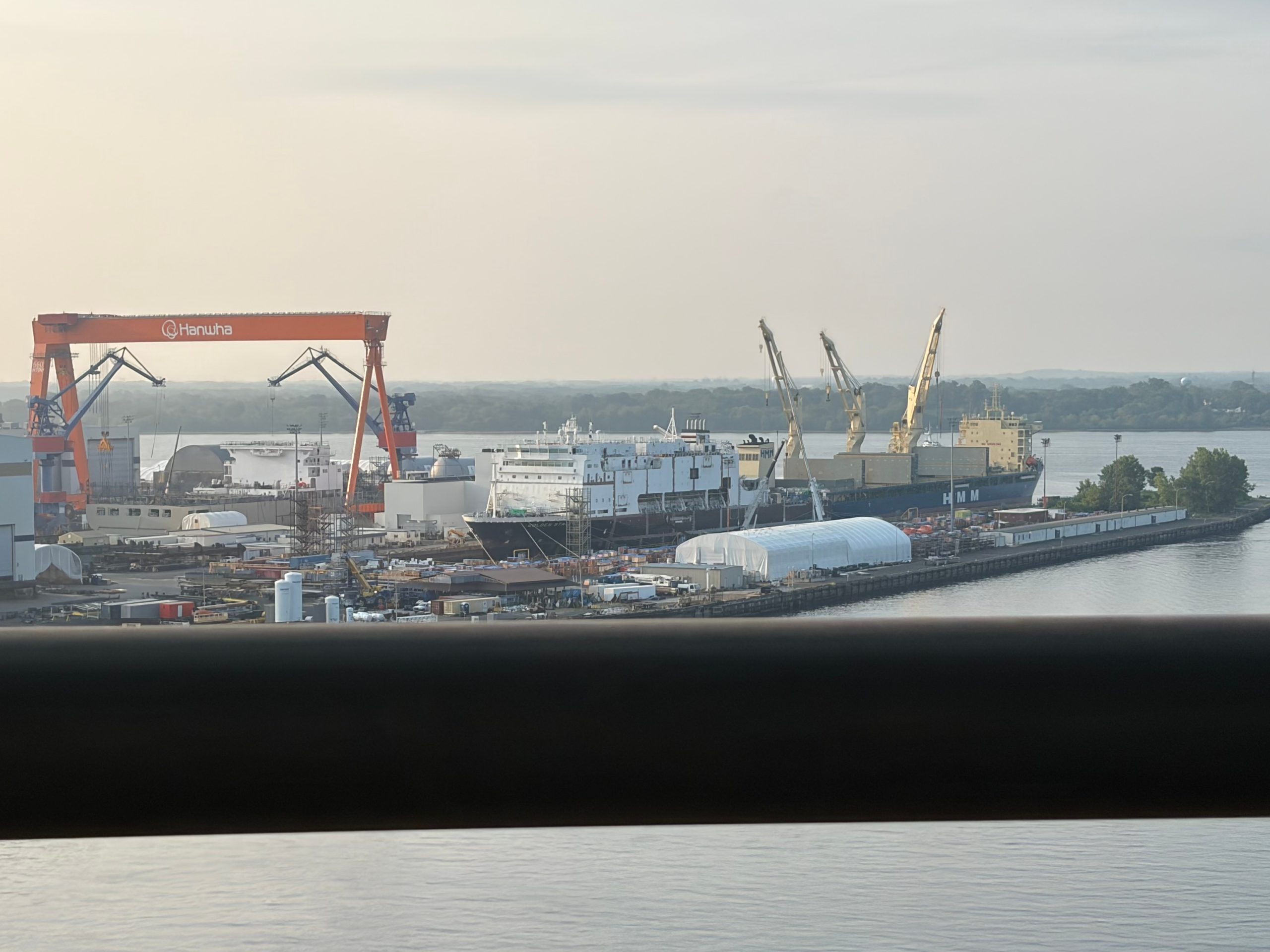
    A unit of the Hanwha Group, which paid $100 million for Hanwha Philly Shipyard in 2024, has offered to pay more than $1 billion for an Australian company’s shipyard in Mobile, Ala., the company’s nearby nuclear submarine fabrication sites, and a San Diego ship repair facility.

    Hanwha has four weeks to review the facilities and meet with the U.S. Navy and other government agencies before closing a deal, according to a statement from shipbuilder Austal USA.

    The South Korean-owned Hanwha Group last year promised to pump $5 billion into the facilities it owns at the heart of the former Philadelphia Naval Shipyard to add a second giant Goliath crane, a second 1,000-foot dry dock, larger fabrication structures, and other portside facilities. The company also said it would hire thousands more workers, as part of a larger $150 billion investment by several South Korean companies to revive U.S. shipbuilding.

    Hanwha Philly Shipyard has not added those major facilities. Company officials have since said their group is looking at other U.S. sites to build enough ships to turn a profit.

    Hanwha “is exploring a range of options to expand our footprint in the United States,” said James Hewitt, Hanwha Defense USA spokesperson. The company declined to say more about its search.

    South Korean President Lee Jae Myung waves as he arrives at the Hanwha Philly Shipyard for a christening ceremony in 2025. Jose F. Moreno / Staff Photographer

    The proposal fits with Hanwha’s ambition to be a leading global defense contractor, competing with General Dynamics and other big shipbuilders, said Gary Kim, a U.S. Naval Reserve engineer and Wharton graduate student who writes extensively on shipbuilding. The Philadelphia yard “would focus on surface auxiliary vessels, where Austal would focus on smaller warships and submarine modules.”

    In Philadelphia last month, JPMorgan CEO Jamie Dimon said his bank looks forward to helping fund Hanwha’s expansion.

    Hanwha last year had agreed to purchase portside facilities in Paulsboro, Gloucester County, four miles up the Delaware River from its South Philly yard. It pulled out of the agreement after failing to reach a deal with the port operator, Holt Logistics.

    Hanwha has not ruled out developing another Philadelphia-area location but has been visiting southern facilities that are ready to run, such as the Austral yards. Austal USA employs around 3,500, compared to around 2,000 employees and outside contractors at Hanwha Philly Shipyard.

    The former Philadelphia Navy Base covered a much larger area before it closed in 1994. Philadelphia Industrial Development Corp., a partnership between city government and the Chamber of Commerce that screens tenants for vacant land, has since committed much of the property to corporate offices, apartments, and other nonindustrial uses, though some waterside industrial property is still available.

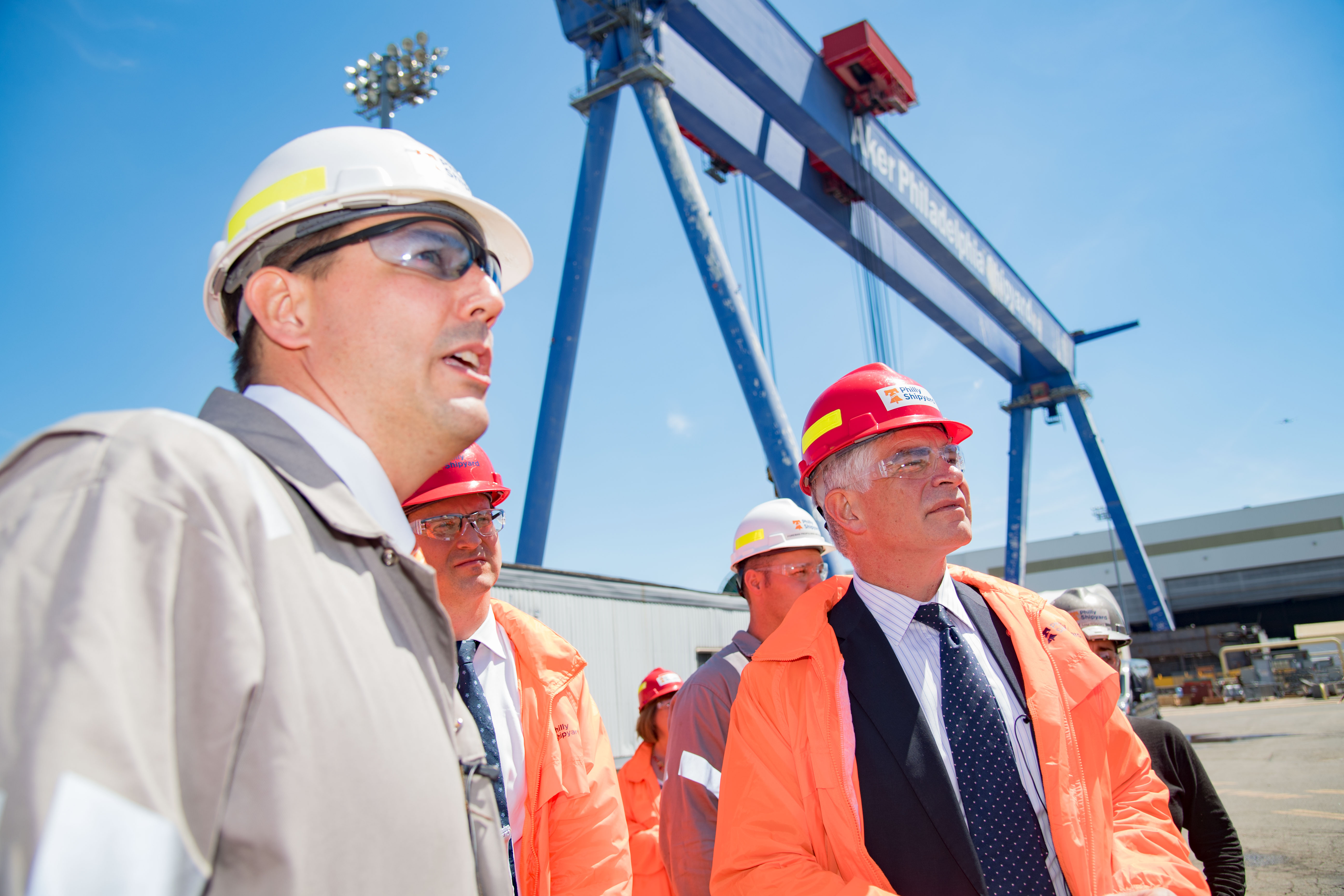
    Hanwha Philly Shipyard in July. Joseph N. DiStefano

    Hanwha’s specialty at its main yard on South Korea’s Geoje Island is mass-producing cargo ships. Hanwha Defense said in a statement last month that building ships for the U.S. government is more profitable for the Philadelphia yard than commercial ships.

    Hanwha is finishing work on the final two of five ships it is building for the U.S. Maritime Administration to use as state merchant marine trading academies. Secretary of Transportation Sean Duffy said last month that the Philly yard had built those ships “on time and on budget,” in part by hiring Tote Services of Jacksonville, Fla., to manage construction. Hanwha says it has lost money on the $1.7 billion program, which began in 2021.

    The government said last month that Hanwha Philly Shipyard will also build two “tracking ships” replacing missile-defense ships from the 1960s.

    Hanwha Philly Shipyard is also building three ships for a total of around $1 billion for the Matson container line to operate between U.S. ports under the Jones Act requiring U.S.-built ships between U.S. ports. The cost of those ships is more than double what Chinese yards are charging for similar ships.

    The Trump administration suspended the Jones Act last winter, and foreign ships are now carrying cargoes between U.S. ports, including natural gas from Marcus Hook to ports in Puerto Rico and New England.

    In a securities filing Tuesday, Austal USA’s owner, Austal Ltd., disclosed that its shipbuilding arm has lost $175 million in its recently concluded fiscal year, after the U.S. Navy last week refused to pay more for ships Austal has been building.

    Austal has been building noncombat salvage, dry dock, and equipment-landing ships for the U.S. Navy. The company based its case for larger payments on changes in Navy orders and “deficiencies in design specifications.” Austal said it would “strongly pursue the claims” even after the War Department’s recent refusal.

    At an Alabama facility near its shipyard that would be part of the deal with Hanwha, Austal USA constructs submarine modules for General Dynamics, which builds Navy nuclear submarines in Connecticut and Rhode Island. Austal says that business is profitable.

    Rhoads Industries, Hanwha’s neighbor at the former Philadelphia Naval Shipyard, also fabricates nuclear submarine modules used by General Dynamics and plans to double employment to 1,400, as it builds new facilities for that business over the next few years.

    Hanwha has said it wants to enter the submarine supply business as well. An Austal USA purchase would add that capability.

  • QVC brings in old boss and digital-minded board members as it comes out of bankruptcy

    QVC brings in old boss and digital-minded board members as it comes out of bankruptcy

    QVC Group Inc. has replaced chief executive David Rawlinson, bringing back predecessor Mike George as interim boss as the West Chester-based remote-shopping pioneer comes out of bankruptcy and charts a future.

    The company also has named new directors with long retail and digital experience, replacing those who oversaw the company under billionaire media investor John Malone.

    With over 1,000 employees at its broadcasting campus, once one of Chester County’s top tourism draws, QVC has struggled with the decline of television and the fragmentation of digital media.

    George said in a statement that he is excited to reconnect with company veterans and to work with the new board. He promised “innovative shopping experiences” and better investor returns during the search for his permanent replacement.

    Having cut its crushing debt load in its bankruptcy reorganization, QVC still faces the challenge of adding young shoppers at a time when retailing has spread across social media platforms, streaming apps, and global e-commerce sites.

    QVC said it has emerged from Chapter 11 after cutting its debt load by over $5 billion and gaining access to $600 million in new credit.

    The stock will re-list on Nasdaq under trading symbol QVCG, replacing pre-bankruptcy shares that traded below $1 just before the bankruptcy.

    David Rawlinson was CEO of the QVC companies from 2021 to 2026 as the West Chester remote-shopping group struggled with shoppers’ migration to social media, logistics challenges, and financial stress.Qurate Retail Inc.

    The company filed for bankruptcy protection in April after years of losses and cost cuts. Those included the shutdown of rival-turned-affiliate HSN’s Florida campus last year. The companies had merged in 2017.

    The new financing is provided by hedge funds specializing in corporate turnarounds, led by Connecticut-based Strategic Value Partners LLC, whose past focus includes natural gas and building materials companies and the 2022 relaunch of airline Aeromexico and Los Angeles-based Oaktree Capital, a unit of Canada-based Brookfield Corp.

    Pennsylvania’s school pension fund, PSERS, is an investor in Oaktree. The New Jersey Division of Investment, which manages state, school, and local-government worker pension funds, is an investor in Strategic Value Partners.

    In a parting statement, Rawlinson praised “the resilience, commitment and execution our teams have demonstrated,” along with customers and investors. He noted QVC was “a TikTok Shop Seller of the Year for 2025″ and has been growing its streaming-media business rapidly. He added that it’s the “right time” for him to move on, and “I can think of no one better qualified” than George to take over.

    George departed after initiatives including his acquisition of Seattle online-shopping network Zulily failed to generate profits. Rawlinson shut the division in 2023.

    A fatal fire at QVC’s main warehouse in North Carolina during the 2021 Christmas season worsened COVID-era shipping delays early in Rawlinson’s tenure, making it tougher to pay down debt and endure the costs of new programs.

    George is a past chairman of the National Retail Federation, currently chairs the National Constitution Center in Philadelphia, and is a board member at AutoZone and Ralph Lauren. He was an executive at Dell Computer and McKinsey & Co. before joining QVC, and will chair the new board.

    Gone from that board are longtime allies of media billionaire John Malone, who invested in QVC in the 1990s, bought control of the company from Comcast in 2003, and had served as chairman. He left the board last year. His son Evan, a Philadelphia entrepreneur, and other longtime QVC board members have been replaced.

    Besides George, the new QVC board members are:

    • David Charles Boone, CEO of Michaels stores
    • Nicolas Le Bourgeois, a former Amazon and TikTok Shop executive
    • Jason Lee Horowitz, ex-head of marketing at Mattel
    • James A. Marcum, executive chair of David’s Bridal, the Conshohocken store chain downsized through two bankruptcies in recent years
    • Ann Mather, ex-Pixar CFO, who has served on the boards of Netflix, Google, and Airbnb, and as board chair for the Bumble dating service
    • Richard A. Mayfield, former CFO of Walmart and a senior adviser at McKinsey
    • Jonathan Zinman, former managing director at hedge fund Silver Point Capital, another major investor in QVC
  • Meet the South Jersey business making food carts for Jersey Shore vendors and Disney World

    Meet the South Jersey business making food carts for Jersey Shore vendors and Disney World

    In a country-industrial stretch of Hammonton halfway between Philadelphia and Atlantic City sits a concrete-block maze of machine shops, where workers have built thousands of stainless-steel hot-sandwich and coffee carts and catering trucks.

    This is the one-story home of Custom Mobile Food Equipment, which for 74 years has built these customized portable kitchen-storefronts of varying sizes, and kept them on the road with extra helpings of customer support. They roll onto Jersey Shore boardwalks and Center City street corners, at weeklong public festivals and private events across America, and in fancy resorts and on military bases abroad.

    It’s a South Jersey fixture, with Camden roots and deep Philly ties.

    “We started small,” with hot dog carts cut to fit, not block, city sidewalks, said Custom vice president David Kyle. He said his family helped Philadelphia officials write the city’s street vendor ordinances, and made sure the carts fit.

    Custom has outlasted food fashions and changes in the ways workers lunch. Kyle said he’s confident the enterprise will outlast recent inflation, global competition, and import tariffs: “A lot of our business is repeat business, and the big names we go after,” he said during a tour of the plant. “People rely on us to turn out a product that will last.”

    From pony-cart produce to theme-park fixture

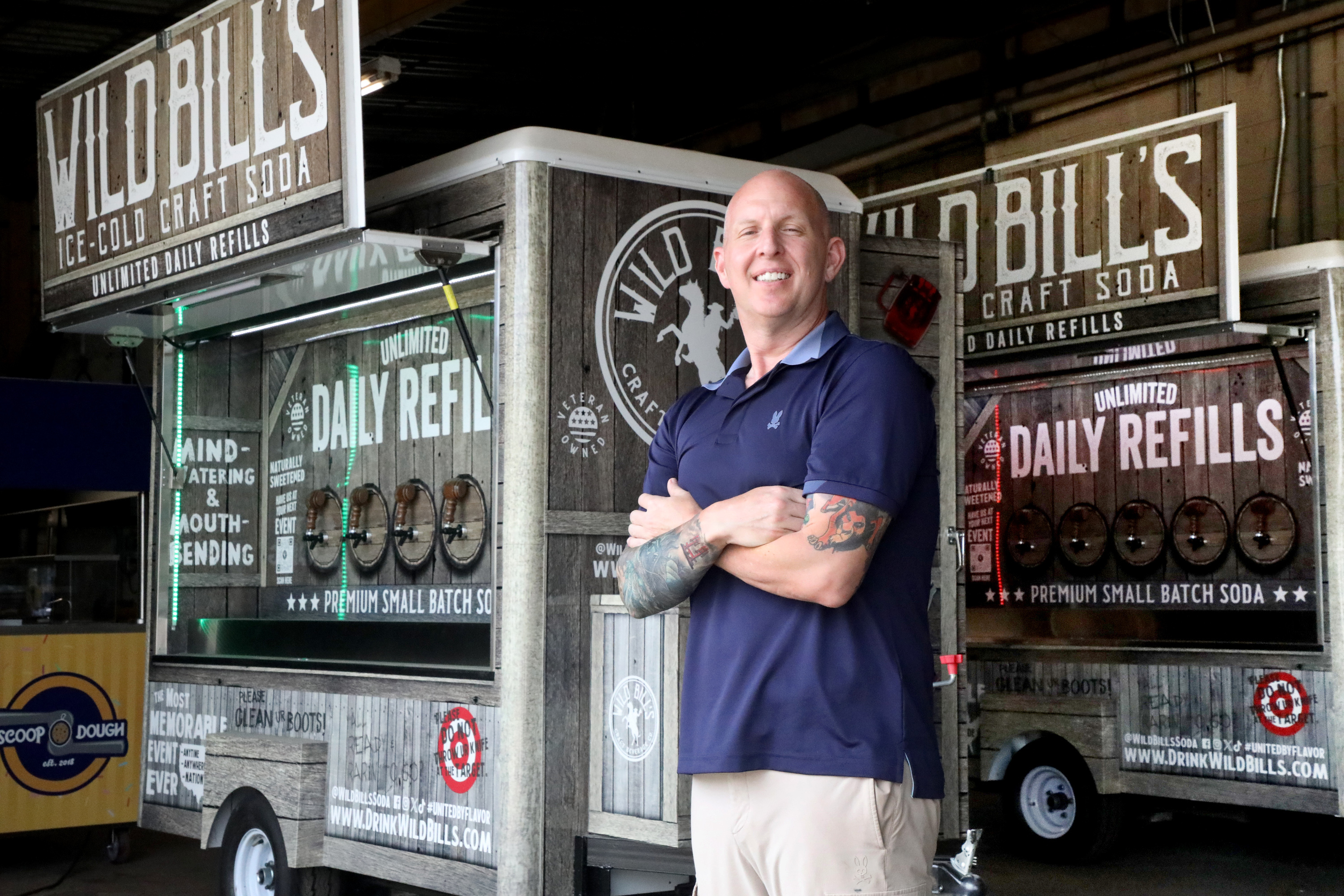
    Lehigh Valley-based Wild Bill’s Craft Beverage Co. serves its old-fashioned sodas from kegs mounted in Custom vehicles of several sizes. They sell drinks at crowded motorcycle rallies in Gettysburg and Sturgis, S.D., the Ohio State Fair, the Great State of Maine Air Show in Brunswick, San Diego Comic-Con, and Schuylkill regattas.

    “These are high-end, unique stands. We have 60 of them. We add a couple a year,” said Wild Bill’s chief executive, Mike Quilty. “One of our franchisees in Utah just drove one of Custom’s self-propelled Ford barrel wagons to Vancouver.”

    To make trips like that, the equipment has to be built well, Quilty said, noting Custom’s “unlimited support” for when technical issues arise, which doesn’t require buying a service contract.

    Custom’s late founder, William Sikora, developed the catering truck in the early 1950s as a kitchen on wheels installed on a Detroit-made chassis. Sikora as a grade-school kid in Camden had sold vegetables from a pony-drawn cart, then opened a grocery. He bought apartment buildings and diners, and became a top officer of First Peoples Bank.

    Walking room to room past heavy presses and cutters on the Hammonton shop floor, Sikora’s grandson Kyle said 40 workers build more than 100 pieces of equipment a year — food trucks, trailers, catering wagons, specialty equipment with kitchen-sized stoves, refrigerators, freezers.

    “We’ve sold to Disney World and SeaWorld, Sesame Place, and U.S. bases in Japan,” Kyle said on a muggy midsummer morning as room fans, metal-forming machinery, and new-cart test motors whirred. “We have 18 projects going right now.”

    Custom built 32 commercial kitchens on caster wheels for Carnival Cruise Line’s Calypso Lagoon in the Bahamas, which opened last year, with rounded bull-nose counters instead of sharp industrial edges to accommodate peak work flow.

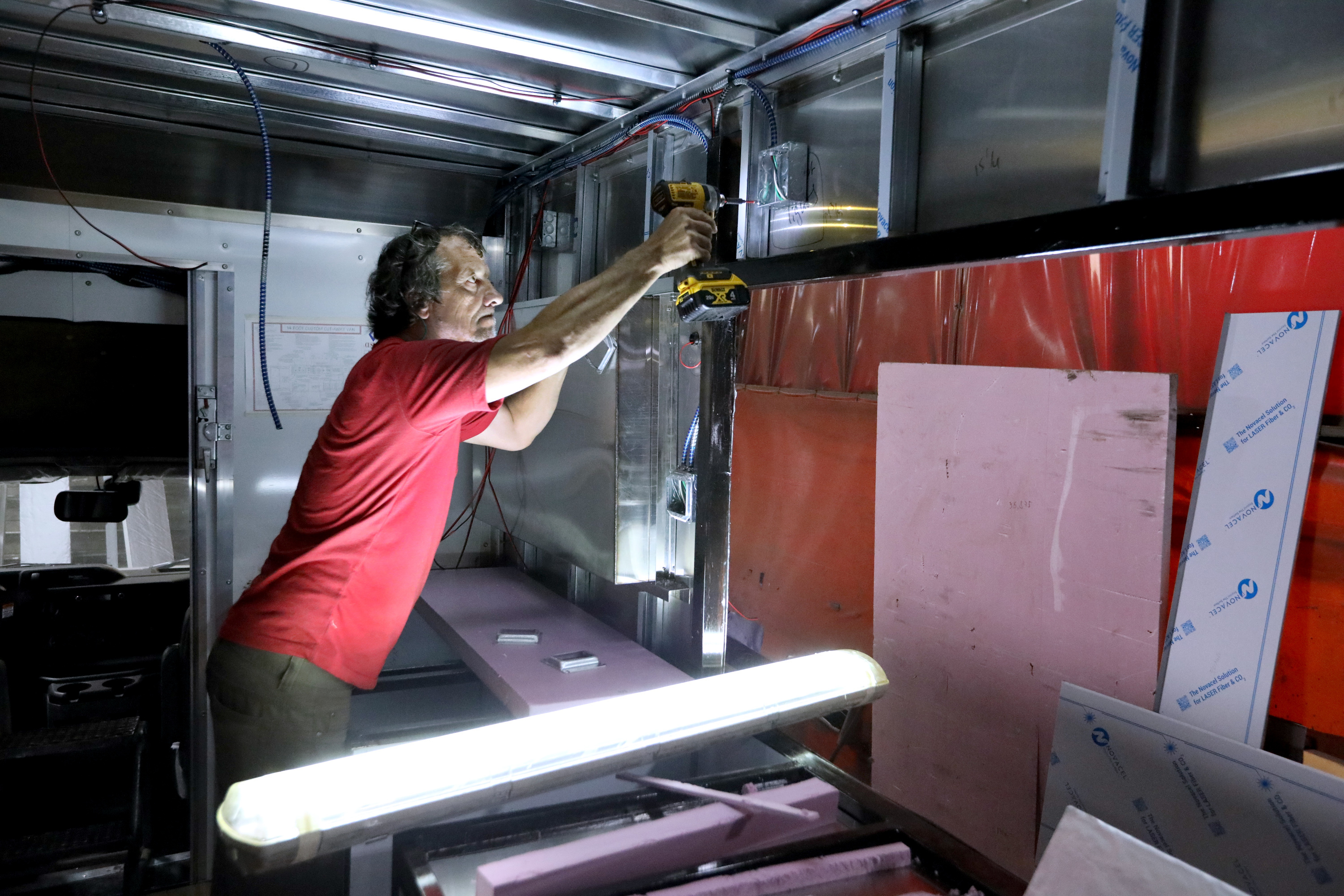
    Paul McIlvaine, an electrician, works on the interior of a Chickie & Pete’s food cart at Custom Mobile Food Equipment, in Hammonton, Tuesday, July 21, 2026.Vernon Ogrodnek / For The Inquirer

    How much does it cost to launch a kitchen cart?

    Today, Custom’s basic Model 525 carts retail for around $6,500. For that sum, plus storage, food, fuel, and licensing costs, “you’re in business serving food,” said Kyle.

    “It’s rewarding, you get to meet so many kinds of people,” he added.

    New catering trucks start at more than $125,000, like a high-end camper.

    All the carts and trucks are built from stainless steel sides, stamped with Custom’s distinctive elongated-diamond pattern over tubular steel framing. The company uses multiple steel suppliers, including Allegheny Ludlum Steel Corp. in Pittsburgh. It was harder to find domestic steel when the U.S. auto industry demand was stronger, Kyle said. But now materials costs are much higher, often in response to higher tariffs.

    “We try to use built-in-USA [materials], but some stuff you cannot get here,” Kyle said. Robertshaw Controls, for example, makes the only burner controls that fit Custom’s standards. They moved the operation to Mexico from Texas, so Custom now imports them.

    Cart metal is just one inflating cost vendors face, said Christian Subashi, second-generation owner of Loudogs hot-dog carts in Sea Isle City. Refrigerators were 50% cheaper before last year’s new tariffs, he said, and sausage prices have “gone through the roof.”

    Kyle said his company’s hot-dog cart price “has gone up $1,000 or $2,000 in 10 years,” lower than the general inflation rate. “We have to absorb some. It’s how you do business,” he said. He’s confident steel prices will stabilize eventually.

    The future of food carts

    The company has no plans to automate, Kyle said. “All our products are custom built — handmade and hand-fabricated. No two carts are exactly alike,” he said, noting that the company also retrofits and rehabs units as needed. “They can last forever.”

    “Our pricing is more, but it lasts longer than assembly-line stuff coming in from Mexico or China at low cost.”

    One once-robust market that has all but evaporated is carts for vendors who work construction sites. Custom employed over 100 during the building boom of the late 1990s. The company built a catering truck a day, on average, back then; now it’s closer to one a week.

    “Wawa and DoorDash are delivering deli trays to jobs sites now. And Wawa has built out so many stores in their area, guys can just leave the job and run to Wawa. So that business is down for us,” said Kyle.

    The focus now is on larger orders that can be built more efficiently. Plus it’s gotten harder, Kyle said, to hire skilled craftsmen.

    Local buyers of carts and trucks include Shore ice cream and water-ice vendors, as well as the food vendors that sell at breweries, thanks to the New Jersey’s restrictions on breweries serving food

    But Custom is also very much “a national brand,” said James Evans, who runs the food-truck division for Ocean City-based Manco & Manco Pizza, including eight Phillies stadium locations.

    Like Custom, Manco is a third-generation South Jersey business, and Evans said he wouldn’t have gone anywhere else to build stadium-ready trailers. The two firms cut a deal last February for Custom to build an initial “food truck you can drive, available for private parties, corporate functions, MLB events, anywhere we can take a truck.”

    The first was delivered in July, with four propane-fueled Baker’s Pride deck ovens “to cook our pizzas to Manco standards.”

    Custom faces a string of manufacturing challenges with any order, Kyle said.

    But from Manco’s perspective the passage of his project from plan to delivery “was seamless,” said Evans.

    “As we morph into their larger trucks, we will add wings and tenders,” he said. “If everything in business and life went that easy, it’d be great.”