
Alec Bohm stopped after he should’ve gone. Brandon Marsh kept going after he should’ve stopped.
In the spaces between, the Phillies lost.
It all happened within a five-pitch span of the seventh inning Tuesday night in a 6-5 loss to the Astros, and it prevented the Phillies from gaining ground in both the division and wild-card races.
But it also exposed an insidious weakness. Because while the bullpen’s tendency to melt like soft serve and shortcomings on defense tend to be more glaring, baserunning is often an issue for the Phillies, too.
“There’s games that the small things cost you runs, chances,” interim manager Don Mattingly said after the Phillies remained four games behind the NL East-leading Braves and a half-game ahead of the Cubs for the top wild card. “It can cost you a game.”
Never more than in that seventh inning.
Trailing 6-3 after Andrew Painter dropped them into an early 5-0 hole, the Phillies led off with a double from Bohm. Bryson Stott got hit by a pitch before Marsh crushed a fastball 403 feet toward Monty’s Angle, the part of the fence in left-center that juts back from 387 feet to 409.
Daulton Varsho, the Astros’ Gold Glove-winner who ran around the Citizens Bank Park outfield when his dad was the Phillies’ bench coach in the early 2000s, tried to run it down but was unable to make what would’ve been a sensational catch.
Bohm retreated to second base as Stott approached the bag and didn’t start running until the ball hit the wall and ricocheted into center field. Instead of two runs scoring and Marsh winding up on third base, only Bohm scored, with the speedier Stott on his heels and held up at third.
Mattingly, who coached Varsho over the last few years with the Blue Jays, didn’t take issue with Bohm’s read. Still, instead of cutting the margin to 6-5 with nobody out and the tying run on third for J.T. Realmuto, it was 6-4 with the tying run on second.
“That one doesn’t bother me at all because, I mean, I’ve seen [Varsho] catch that ball,” Mattingly said.“He’s close enough that that one’s fine.”
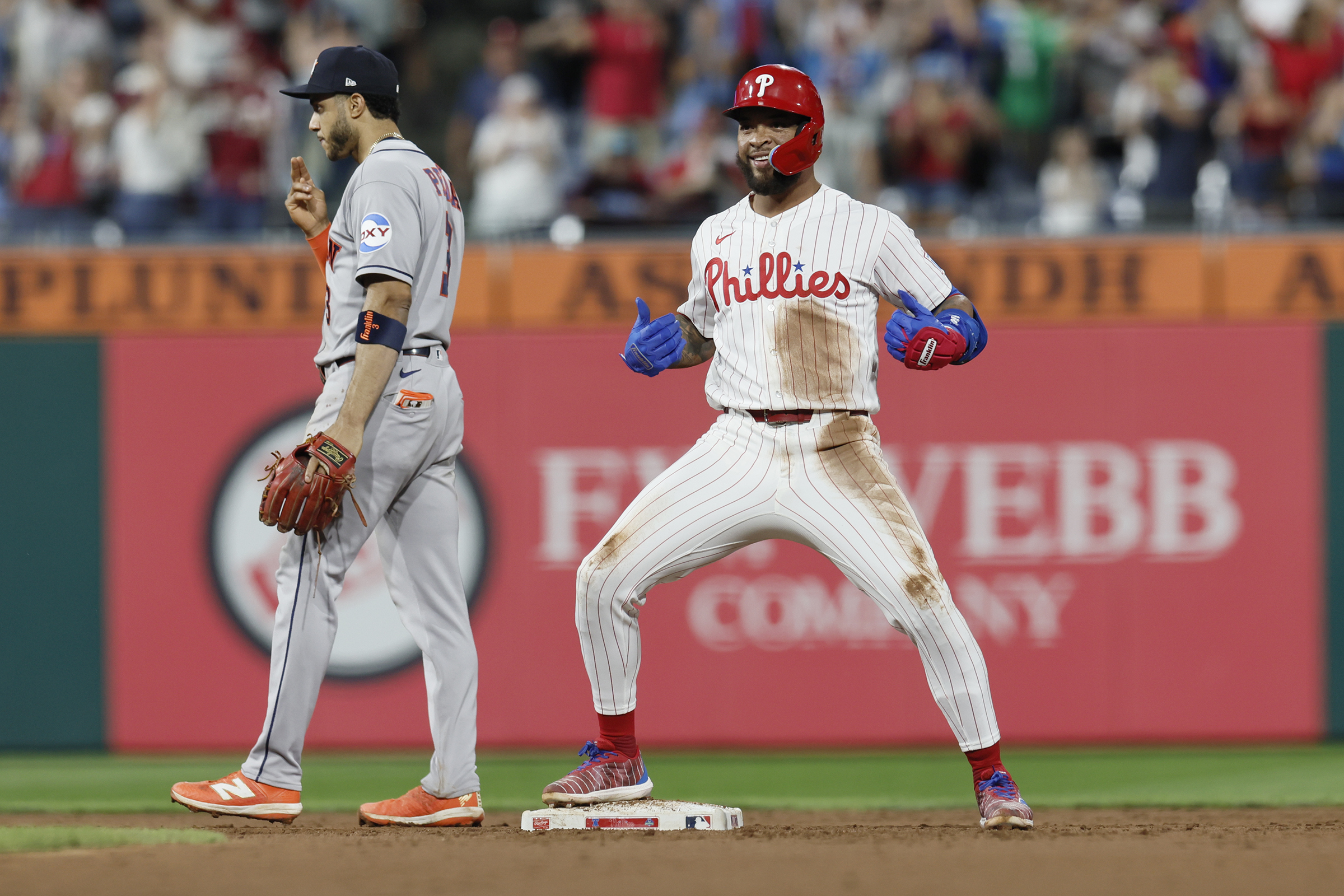
OK, but it also left Marsh at second base when Realmuto scorched a 102.9-mph liner to shortstop Jeremy Peña, who dove to his right and snared it. Marsh, already almost halfway to third base, was easily doubled off at second.
“The double-play ball is, for me, a little bit more where you get away from your principles,” Mattingly said. “Score of the game, we’re down two there, nobody out. If the ball gets through, Stott scores, Marshy’s at third. First and third, nobody out, you like your chances that you’re going to get it tied up.
“So, your principles say ‘freeze.’ I was taught freeze, and a lot of organizations teach [go] back on that play. Just too aggressive.”
Marsh agreed, regrettably.
“It’s unacceptable for me to take a step toward third,” he said. “It’s a huge mistake by me. Really no excuse. Just a really bad play on my part.”
Even though the expected batting average on Realmuto’s line drive was .710, according to Statcast?
“No, I’ve got to get back,” Marsh said. “First step’s got to be to my left there. No explanation other than I was just wrong and I have to clean that up and be better in the future if we want to be where we want to be at the end of the year.”
The Phillies rallied again in the ninth inning against Astros closer Josh Hader, but once again, baserunning contributed to their downfall. Edmundo Sosa didn’t run hard out of the box on a long drive to center field and wound up with an RBI double rather than a potential triple. The next three batters flew out to end the game.
NL wild-card standings
window.addEventListener(“message”,function(a){if(void 0!==a.data[“datawrapper-height”]){var e=document.querySelectorAll(“iframe”);for(var t in a.data[“datawrapper-height”])for(var r,i=0;r=e[i];i++)if(r.contentWindow===a.source){var d=a.data[“datawrapper-height”][t]+”px”;r.style.height=d}}});
“I was watching the ball, so I didn’t see if he was going full speed all the way,” Mattingly said. “I was a little surprised, when I looked up, where he was at. … I was wondering why he really wasn’t as far as he should have been.”
If Sosa was on third, could he have scored on Derek Hill’s one-out fly ball to medium-depth right field?
“I’m not sure about that,” Mattingly said. “But I mean, that’s kind of [neither] here nor there at that point. I think, just in general, when you talk about the way you should play and things you should do on the field, that’s really more important than could he or should he have scored on the next play.”
Mattingly suggested that baserunning is lacking across the sport, not only among his team.
“It’s one of the things that I’ve noticed in the game all over the place,” he said. “Players are better probably now than they’ve ever been. Obviously pitchers are throwing harder and tougher to hit than they’ve ever been. Baserunning, for me, has kind of went a little backward in a lot of scenarios, not just here but all over the place.
“I think you should always learn from it. And you should always stay on it.”
Leave a Reply