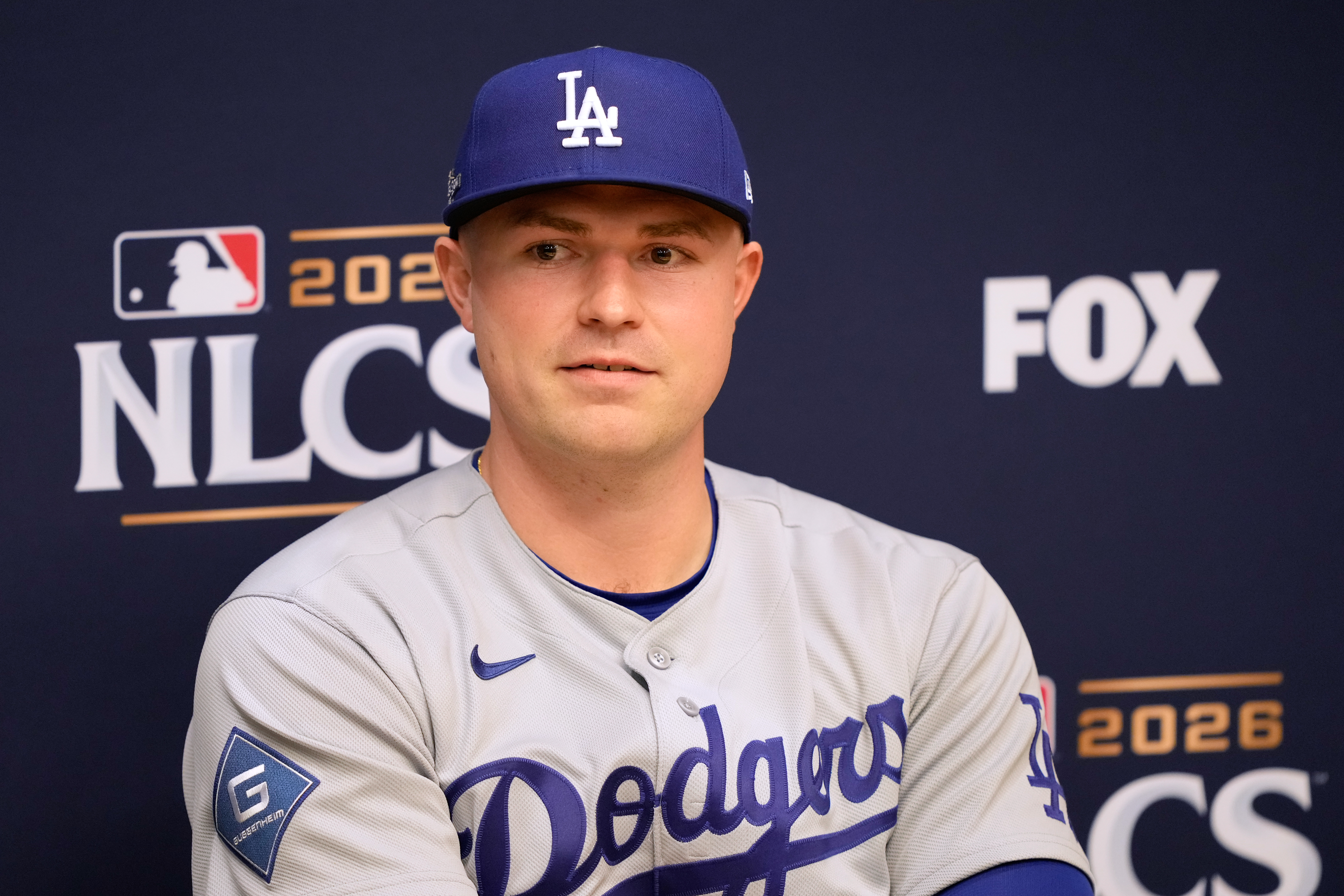
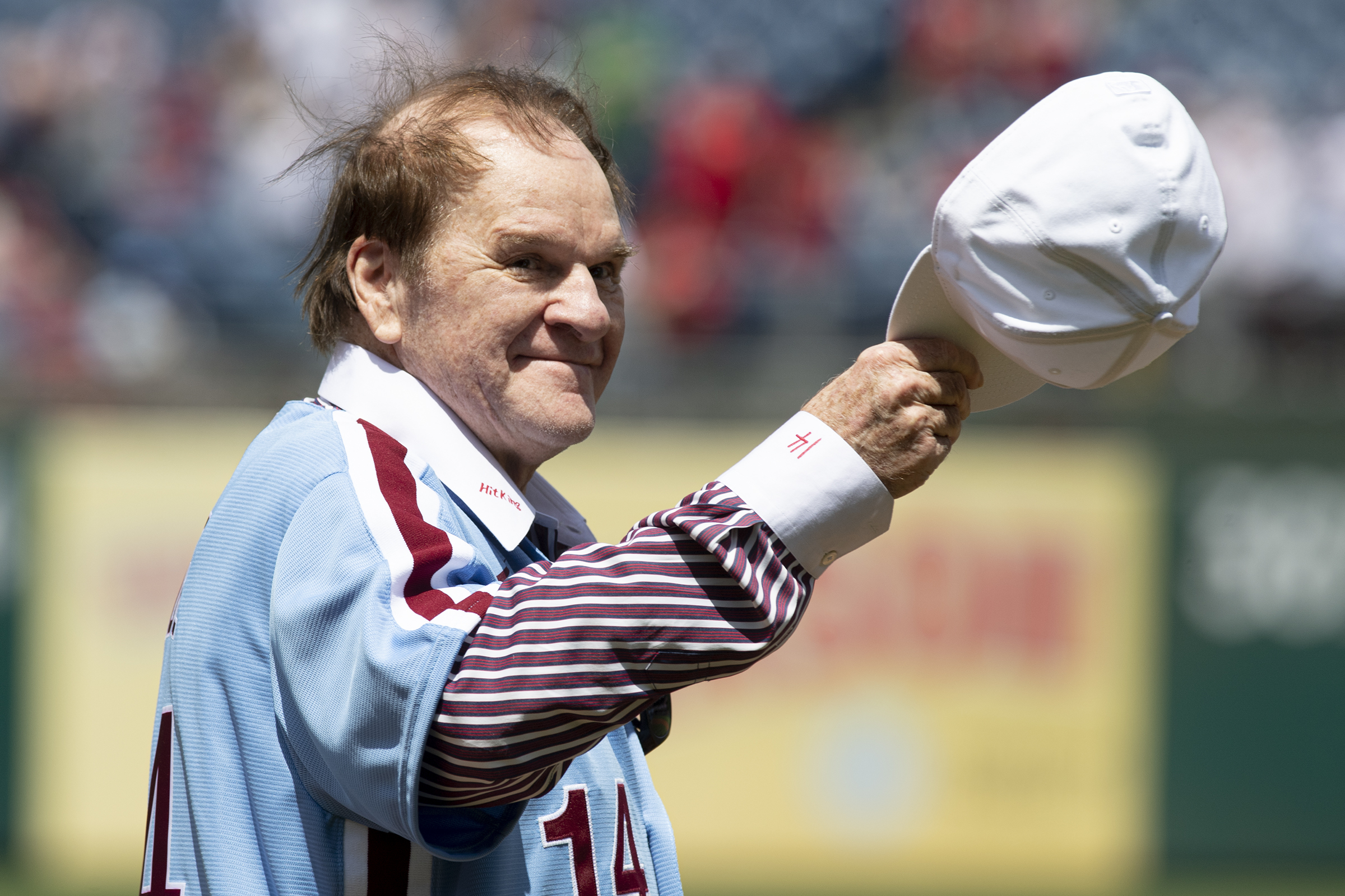
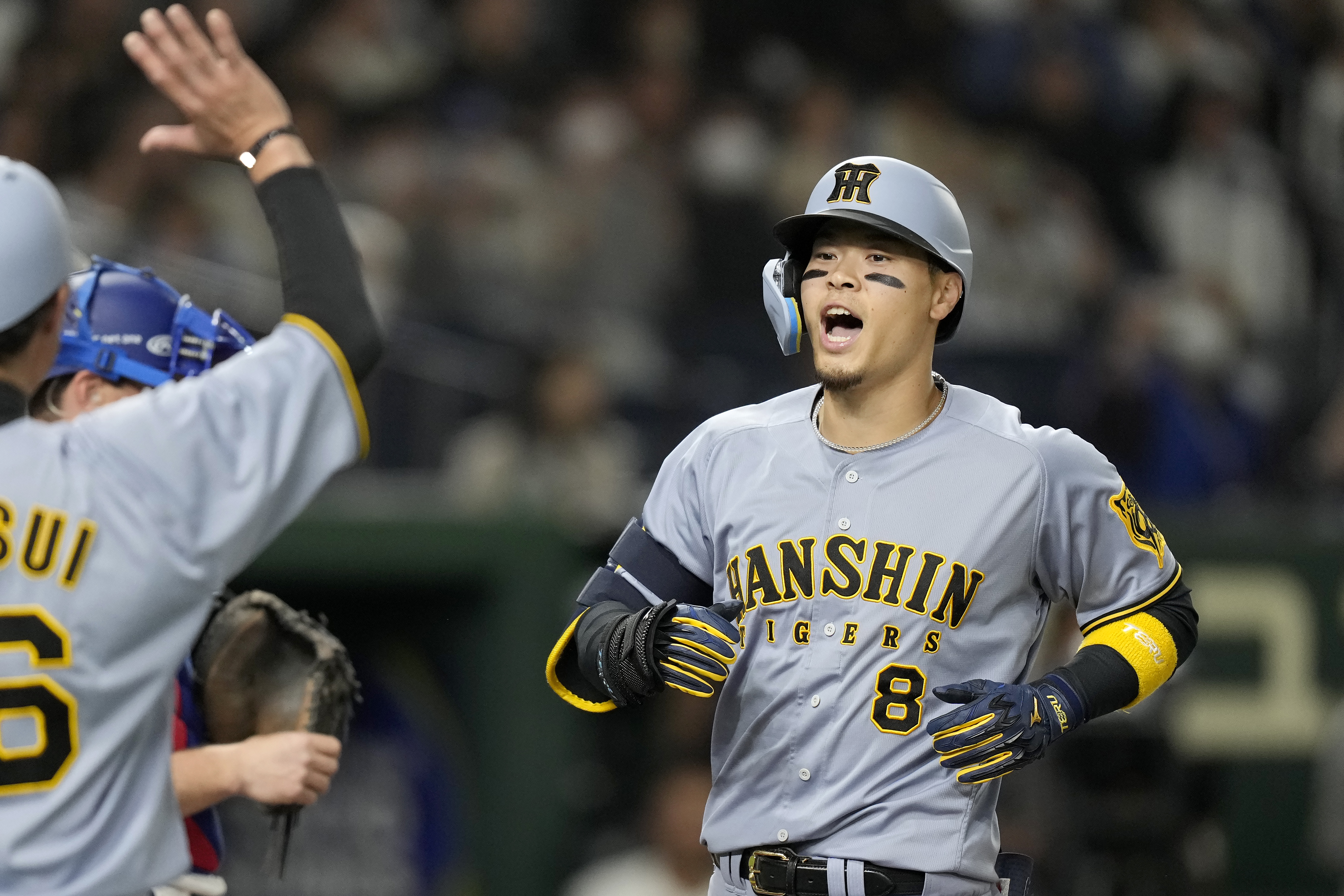
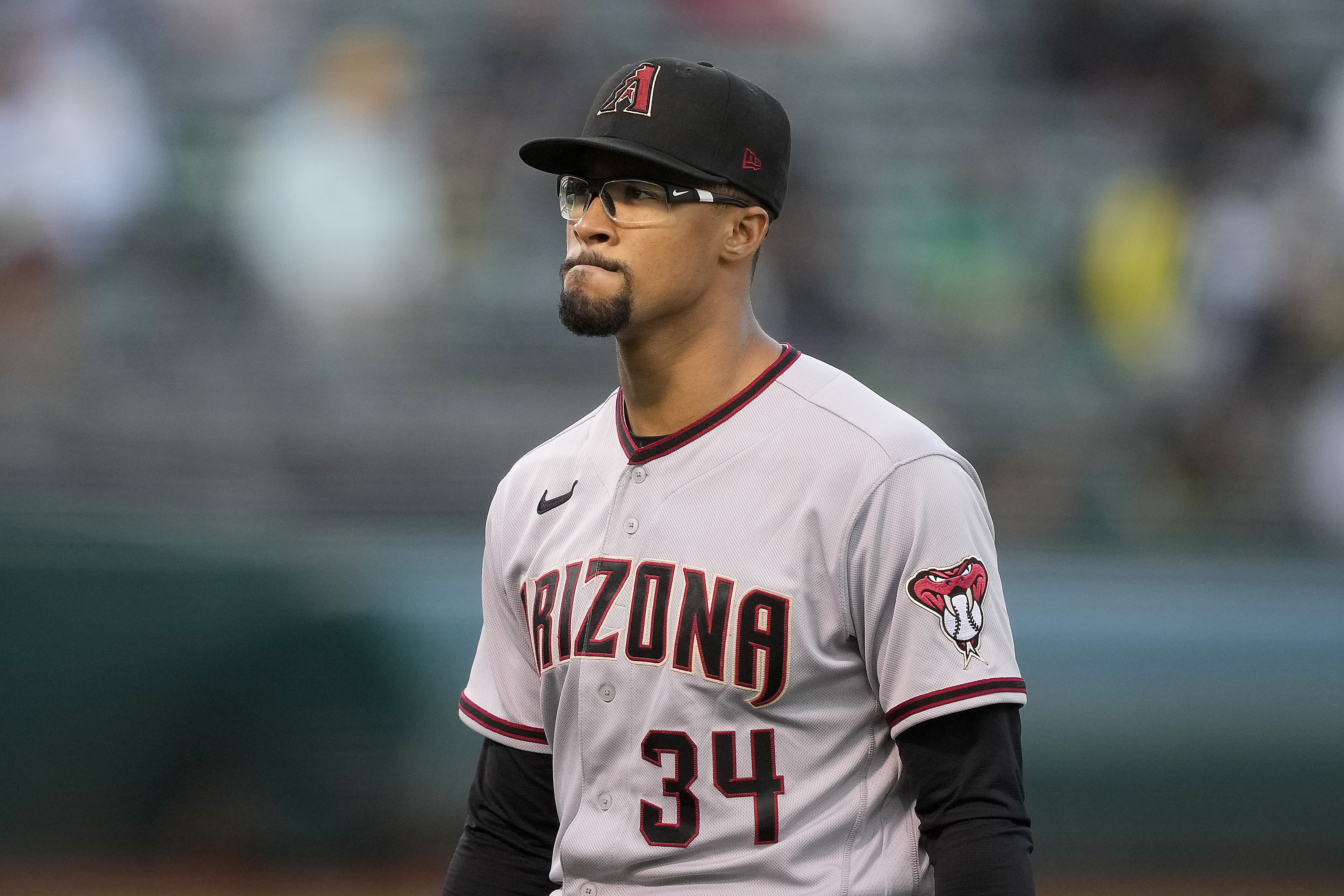
Tarik Skubal, the two-time Cy Young Award winner who was the top free agent on this offseason’s market, has agreed to record $450 million, nine-year contract with the New York Mets, a person familiar with the negotiations told The Associated Press on Sunday.
The person spoke on condition of anonymity because the agreement was subject to a successful physical.
It’s the fourth largest deal among all baseball players, trailing Juan Soto’s $765 million, Shohei Ohtani’s $700 million and Vladimir Guerrero Jr.’s $500 million.
Skubal’s agreement includes a full no-trade clause and a $45 million signing bonus that is shielded from the management lockout that threatens the 2027 season, the person said.
A two-time All-Star left-hander who turned 30 on Friday, Skubal is 43-17 with a 2.42 ERA in 88 starts over the last four seasons, striking out 655 and walking 95 in 546 innings.
Video: David Ortiz believes Kyle Schwarber is on a Hall-of-Fame path | Phillies Extra
He joins a Mets team that finished last in the NL East at 74-88 despite having baseball’s highest payroll on opening day at roughly $352 million. New York’s starters had a 4.47 ERA, ranking 23rd in the majors. Skubal will top a rotation featuring youngsters Nolan McLean and Christian Scott, with veterans Sean Manaea and Kodai Senga also under contract.
Skubal was 12-7 with a 2.72 ERA in 26 starts this year for Detroit and the Los Angeles Dodgers, who acquired him on Aug. 2 for three prospects: right-handers River Ryan and Brady Smith, and outfielder Zyhir Hope. Skubal didn’t pitch for the Tigers between April 29 and June 13 because of surgery to remove a loose body in his pitching elbow. Dodgers head team physician Dr. Neal ElAttrache used a NanoNeedle scope 2.0 to perform the procedure, designed to speed recovery.
He averaged 96.8 mph with his four-seam fastball this year, down from 97.6 mph in 2025, when he won his second straight AL Cy Young Award. He threw 38% four-seamers this year, 25.6% changeups, 17.5% sinkers, 13.9% sliders and 5% curveballs.
Skubal is 66-44 with a 3.02 ERA in 160 starts and three relief appearances over seven major league seasons with 1,075 strikeouts over 925⅓ innings.
Ahead of Friday’s non-tender deadline, the Phillies made a slew of roster moves.
They agreed to terms on 2027 contracts and avoided arbitration with outfielder Derek Hill, catcher Rafael Marchán, and left-handed reliever Tanner Banks. The Phillies also tendered contracts to infielder Bryson Stott, outfielder Brandon Marsh, and relievers Jhoan Duran and Orion Kerkering.
The players who were tendered contracts will now be able to negotiate with the club on a salary for 2027. If an agreement cannot be reached, both sides will attend an arbitration hearing.
The Phillies did not tender contracts to outfielder Bryan De La Cruz, infielder Brett Harris, and pitchers Moisés Chace and Andrew Hoffman. They immediately become free agents, though they could still return to the Phillies on a minor league deal.
De La Cruz was the only non-tendered player to appear in a game for the Phillies in 2026. In 34 games, the right-handed hitter batted .280 with a .762 OPS.
Harris was a waiver claim from the Giants on Nov. 2, while Hoffman was activated by the Phillies in September but did not get into a game. Chace has not pitched since 2025 after undergoing elbow surgery. The 23-year-old has a 4.34 career minor league ERA.
Video: Former MLB GM Jim Duquette is remaining optimistic about 2027 MLB season | Phillies Extra
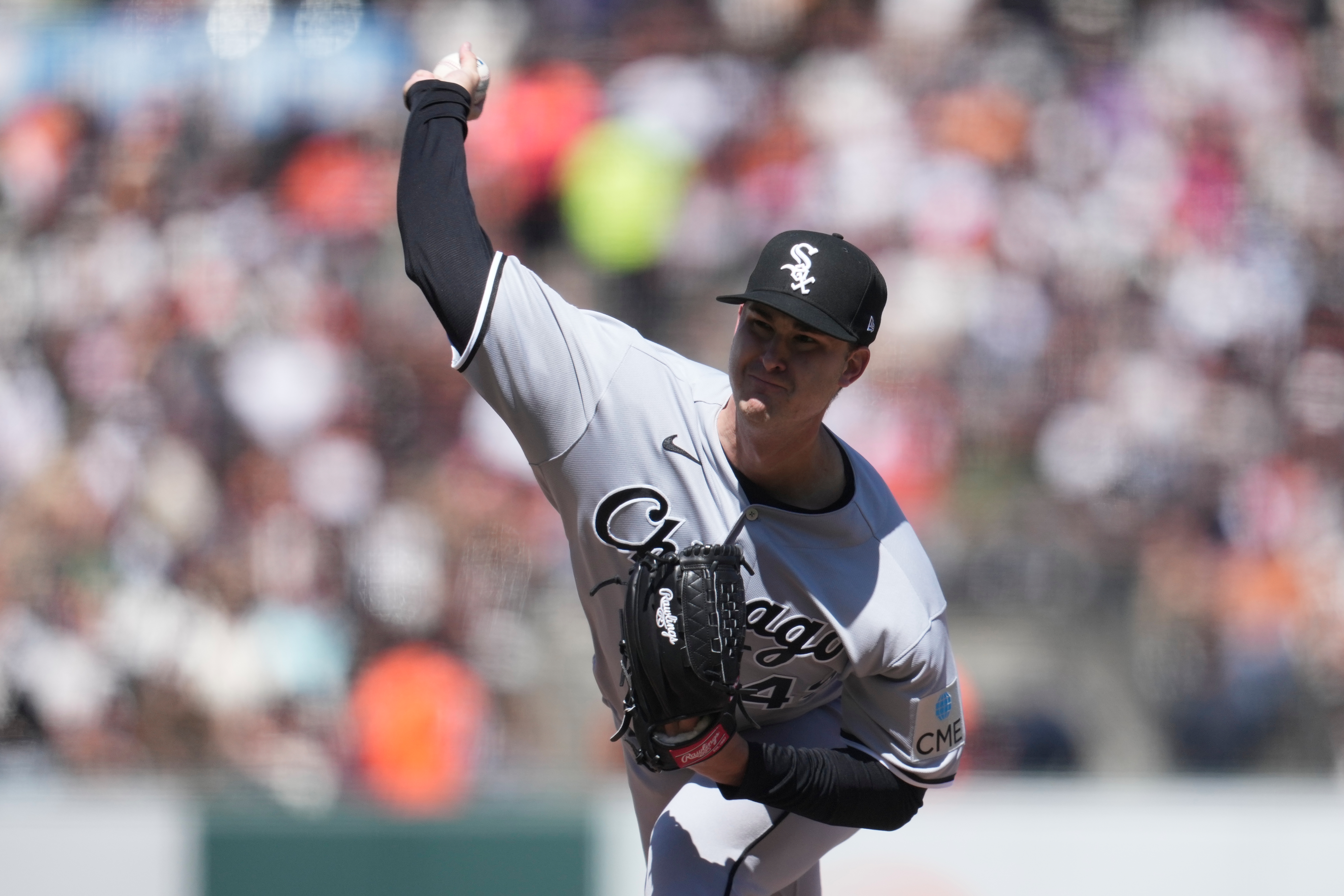
In addition, the Phillies acquired pitcher Jordan Leasure in a trade with the White Sox, in exchange for minor league pitcher Christian Coppola. The Phillies also agreed to a 2027 contract with Leasure.
The right-hander pitched just 18⅔ innings for the White Sox in 2026 due to a right flexor strain, and had a 6.27 ERA. He underwent elbow surgery in August and is expected to miss the 2027 season. In 2025, however, Leasure had a 3.92 ERA over 64⅓ innings, primarily appearing in relief but also making one start. Leasure, 28, had a 31.9% whiff rate and 30.1% strikeout rate in 2025.
Under the bright lights of Citizens Bank Park, 45-year-old Nicole Sage sat at home plate surrounded by hundreds of people dressed for cold weather — in mittens, hoodies, and heavy winter coats. Layers of clothing peeked from underneath zippers and poked out from the bottom of sweatpants.
In her reflective gold jacket, Sage looked over the crowd sitting in the bleachers and began to tell her story.
“I fully believe I wouldn’t be the person that I am today without the support of the Covenant House,” Sage told The Inquirer at the second annual Sleep Out at the Ballpark. “They were the first people that were really excited to see me when I was having a really hard time in my life. If it wasn’t for Covenant House and how they helped me, there is a really good possibility that I would be dead today. Covenant House fundamentally believed in me and believed in what I could achieve, even when I didn’t believe in myself.”
Nicole Sage (front) and Covenant House Pennsylvania CEO Alexia Clarke hug after Sage spoke to the group during Sleep Out at the Ballpark. Sage, a 2017 Penn graduate, lived at Covenant House on and off for six years.Elizabeth Robertson / Staff Photographer
At 18 years old, Sage found herself homeless after returning from the Marine Corps.
While walking down the streets of Kensington, she spotted something about Covenant House Pennsylvania, which says it is Philadelphia’s largest provider of housing and support for young people ages 18 to 24 experiencing homelessness, human trafficking, and housing instability. For six years, Sage lived in and out of Covenant House.
The people within the organization helped her in times of need, finding a safe space for her 2-year-old son to live when she felt she wasn’t ready to take care of him, and motivating her to get a college education — she graduated from Penn in 2017 with a degree in health and societies.
Covenant House played a crucial part in Sage’s life — and that’s why attending Thursday’s Sleep Out was nonnegotiable.
“I still see the stigma that people experience,” Sage said. “And I’m hoping that after spending one night on the street, I know it’s not the full experience, they’ll be able to understand what it might be like to be a little bit cold, or what it might be like to be a little bit hungry. And I’m hoping that the next time they see someone that’s unhoused, they might be a little kinder to them — even if it’s just a little bit.”
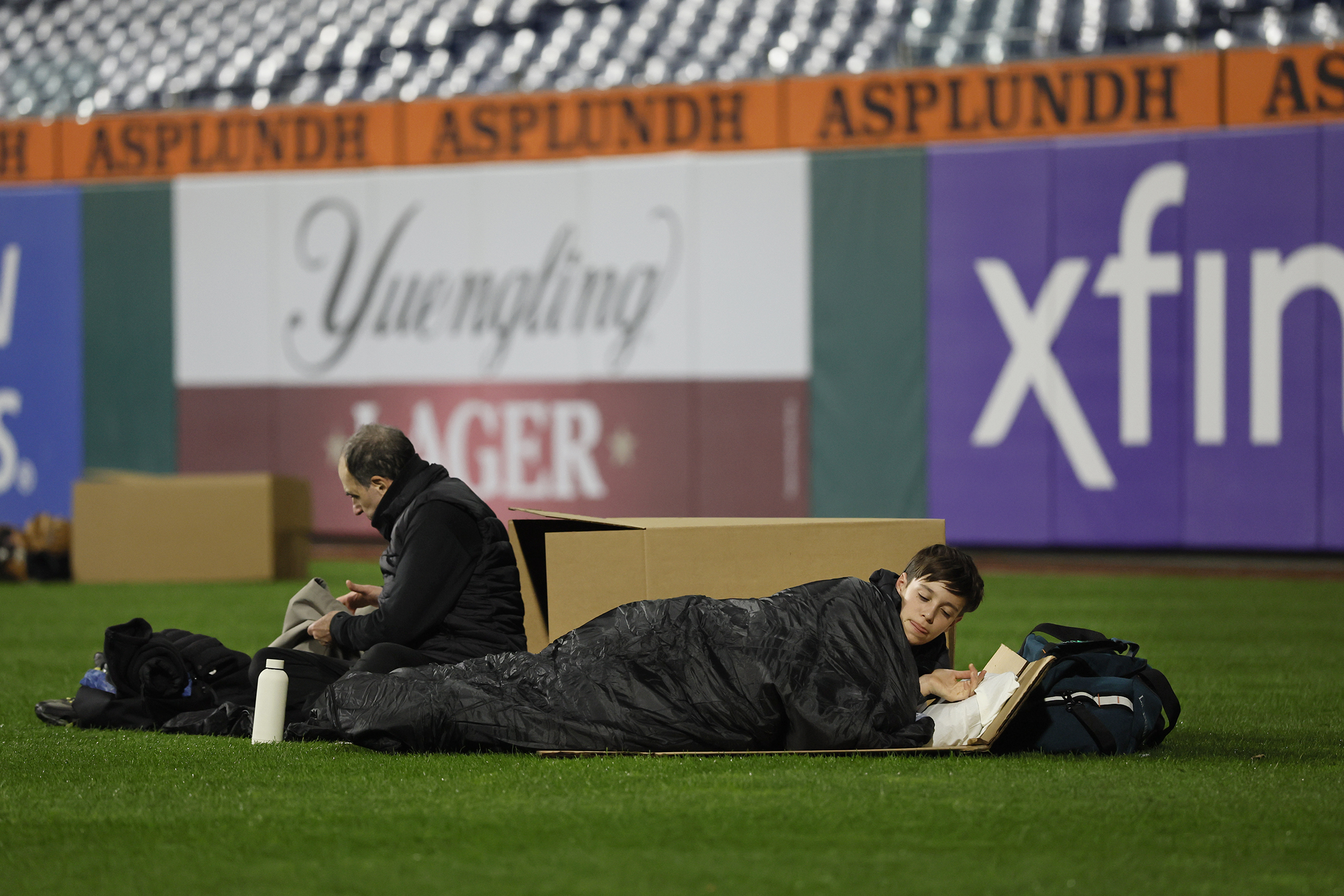
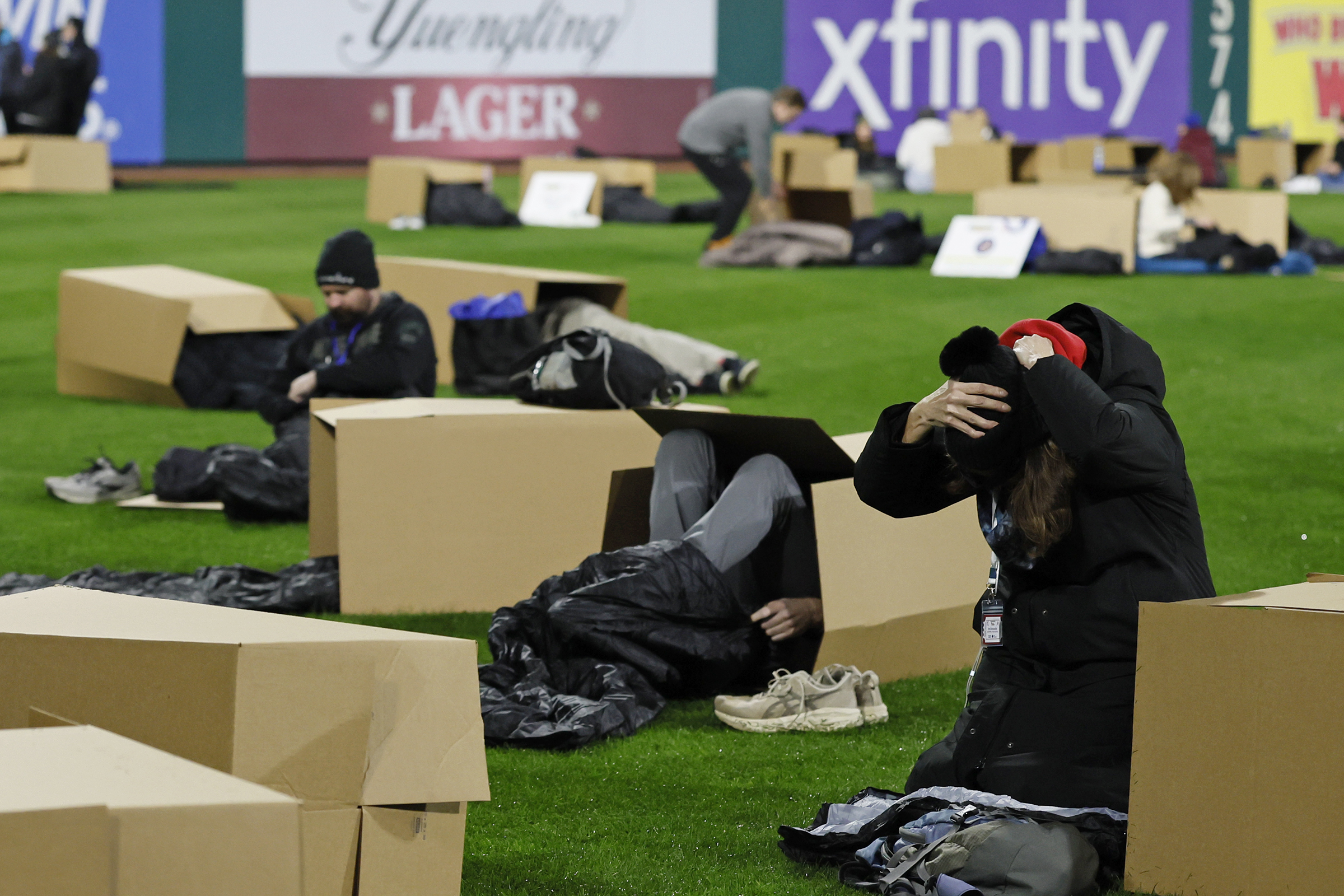
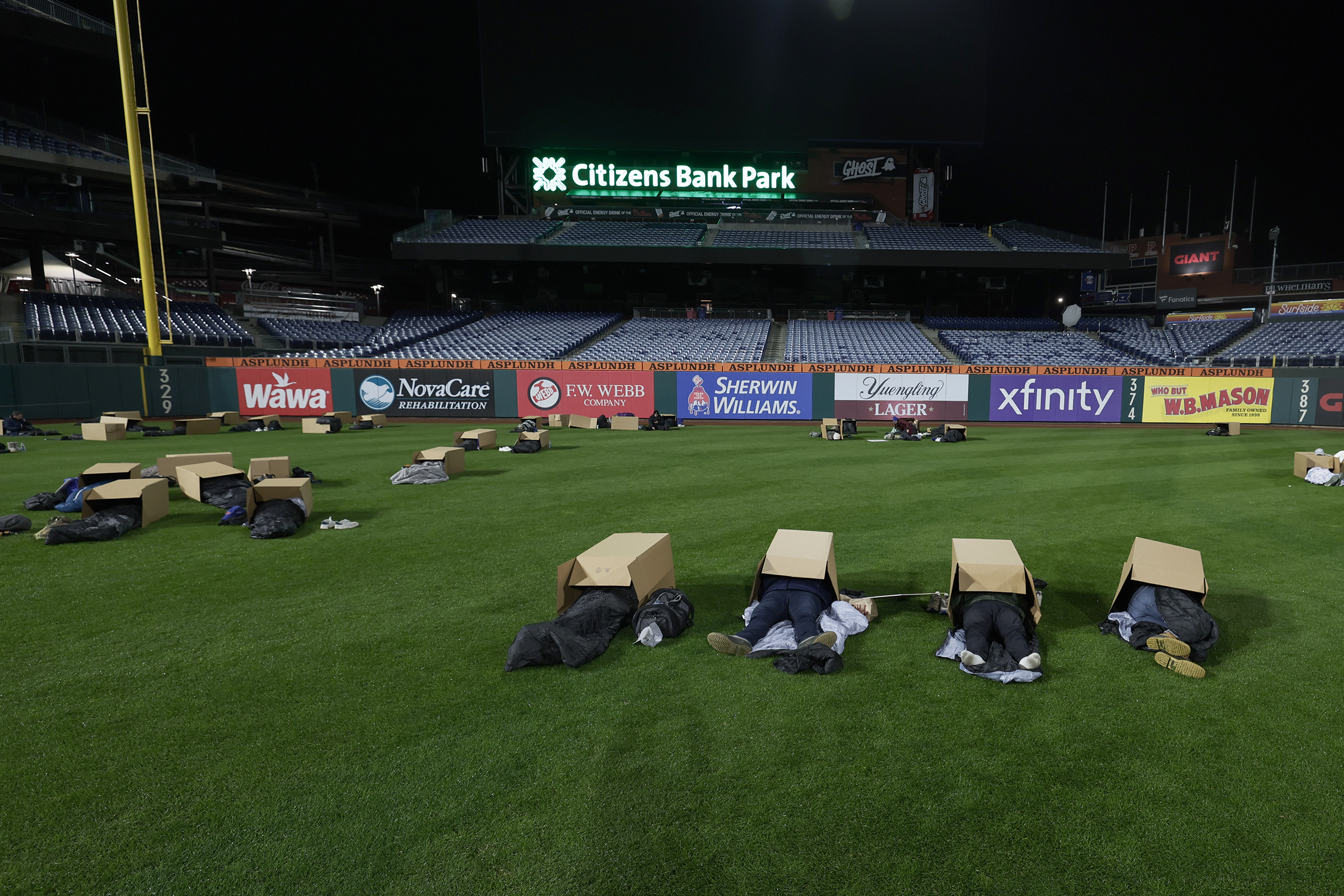
For Sleep Out at the Ballpark, community members gave up their beds for one night to sleep in the outfield of Citizens Bank Park, replicating the environment homeless people experience every night.
This year, the event raised $1,246,509, an increase from last year’s $1,028,132. The money raised will support programming and their Germantown shelter, which stays open 24/7 for 365 days a year.
“One of the main things we want people to take away is that homelessness is preventable and solvable,” said Alexia Clarke, the CEO of Covenant House Pennsylvania. “What we need is folks to continue to join in the work with us and help us in anyway that they can — whether it’s helping a young person get a good job with a living wage or supporting our programming by volunteering or donating to the organization so we can keep the doors open and provide meals and provide safety. There are lots of ways to be part of the solution.”
The night started at around 7:30 p.m. Among the crowd was 1993 National League champion Milt Thompson, former Phillies longtime public address announcer Dan Baker, and Phillies Wall of Famer Larry Bowa, who was participating in his fourth Sleep Out with Covenant House. Thursday’s was part of a nationwide Sleep Out fundraiser that’s in its 16th year.
“Let’s say it gets really cold at 2 a.m., we can get up, go get in our car, turn on the heater, go home, take a shower,” Bowa said. “But these young kids, they have no chance. … I can’t even imagine young kids, 14, 15, 16 years old out in the streets. To see how the Covenant House can turn their life around, that’s what it’s all about.”
Attendees got to see the impact firsthand between 8-9 p.m., when the group split into three to listen to the stories of Covenant House alumni.
People bundle up before hitting the sack in their cardboard box during Sleep out at the Ballpark.Elizabeth Robertson / Staff Photographer
Switching out their beds for sleeping bags
10:50 p.m., 46 degrees
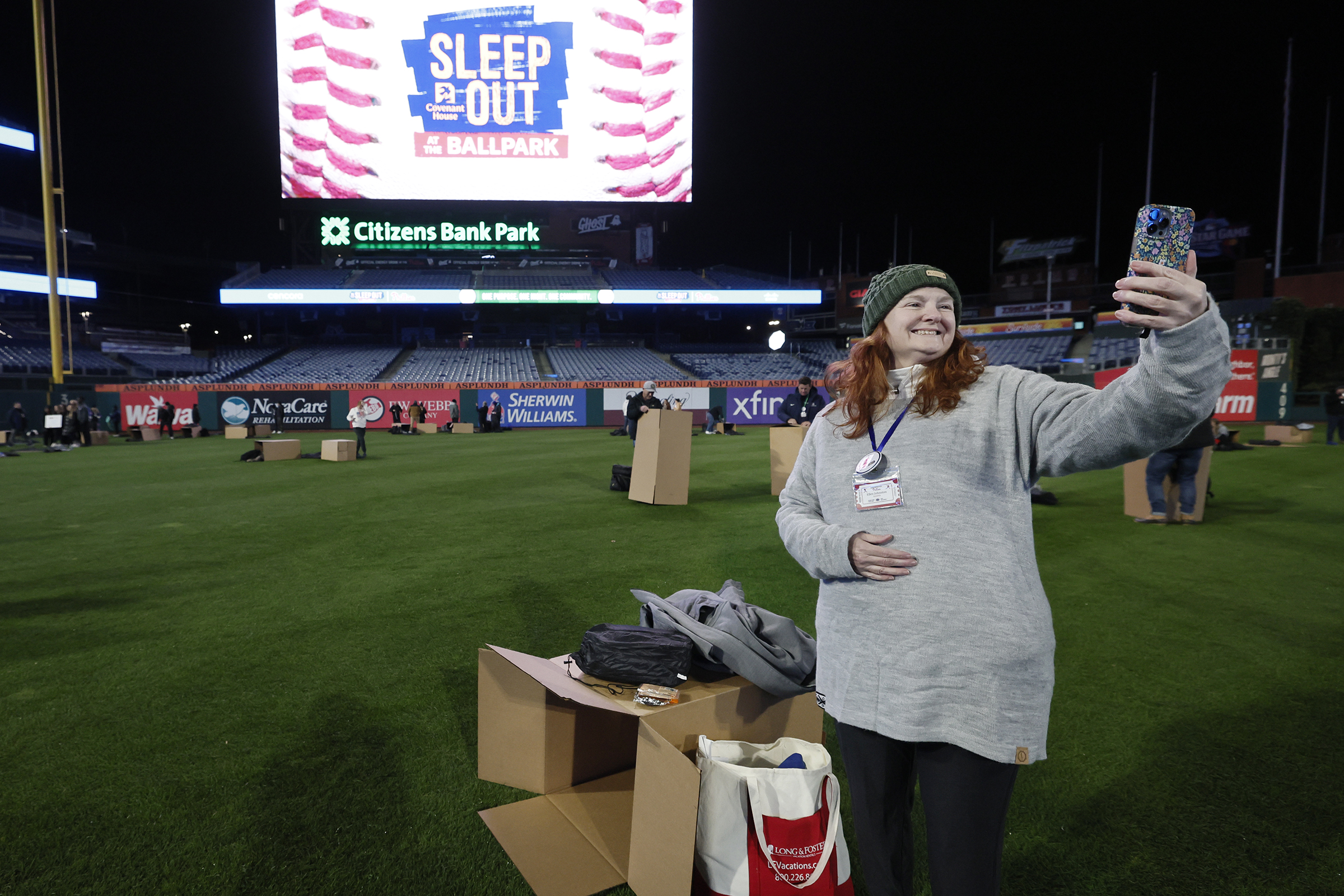
With her cardboard box set up, her sleeping bag on the ground, and toe warmers already placed strategically inside her shoes, 56-year-old Ellen Johnston was getting ready for a night of shut-eye — maybe.
Each attendee was given one cardboard box, a sleeping bag, hand warmers, and a black eye mask. But even with the stadium lights dimmed at 11 p.m., rays still made their way through the thin cotton lining.
“I’m not sure how much sleep I’ll get, even with the eye mask, but I’m glad I came back and did it again this year,” Johnston said.
Ellen Johnston, of Gilbertsville, was motivated to volunteer with Covenant House after her experience with Sleep Out at the Ballpark.Elizabeth Robertson / Staff Photographer
In fact, the experience motivated her to get more involved. She’s volunteering with Covenant House’s workforce readiness program — giving kids interview and resumé tips backed by 30 years of experience in human resources.
”It’s not simply about giving a young person a place to stay,” Johnston said. “It’s about making sure that they are physically and mentally safe as well. And I think it has to be all of it in order to make a difference for a young person who finds themself on the street.”
The Phillies and Covenant House Pennsylvania teamed up for the second annual Sleep Out at the Ballpark fundraiser.Elizabeth Robertson / Staff Photographer
A ‘Take Me Out to the Ball Game’ wake-up call
5 a.m., 40 degrees
The sound of “Take Me Out to the Ball Game,” echoed throughout the stadium’s sound system at 4:50 a.m. Glasses frosted over from the 40-degree weather, morning dew covered the grass in the outfield, and those just waking up — or those who never slept — slowly gathered their belongings, picked up their cardboard boxes, and packed away their sleeping bags to make their way inside for coffee, breakfast, and a morning reflection.
63-year-old Jeffrey Scott was one of 14 members of Philadelphia 215 Church in attendance. As the youth director in the ministry, this is his fourth year sleeping out with Covenant House. And each year, he continues to learn more about the struggles of youth homelessness.
“Every single year has been something different,” Scott said. “This time, I was laying in the box, and three things impacted me. No. 1, I have a 13-year-old lady part of our ministry who slept out with us. I wanted to make sure she understands how it’s impacting her class. Second, we increased our numbers of sleepers from three to 14 and that made me feel some type of way.
“And then from a safety standpoint, the third thing that was in my mind when I was inside the box was I have the luxury of having security around me as I lay in this box. How do the people who live in Kensington or in a park bench or under a bridge, how safe do they feel as they feel people walking by them that they clearly can’t trust.”
More than 10,000 children and youth have experienced homelessness in Philadelphia during the 2023-24 school year. Across Pennsylvania, that number increases to more than 50,000 — filling nearly every seat in Citizens Bank Park. For those struggling to find stability, Sage had one last message.
“Never give up,” Sage said. “Always fight. There’s people who will support you, even when you think that there isn’t anyone. Find that one person who is there and find a way to trust them.”
As the dutiful sports columnist working the night shift when President Donald Trump announced he had pardoned Pete Rose, I have been told that it is my place to respond. It is a difficult task. The most pertinent response would require breaking the third wall. It would investigate the merits of lending credence to an issue that exists solely to provoke a response. In short, it would require way too many words, all of which have probably been written.
My general operating procedure is to treat the things that the President of the United States says with as much gravity as he himself treats them. Often times, that means treating them superfluously. Words needn’t always be words in the traditional sense, i.e. symbolized thought. Sometimes, they are just inhaled air that the vocal cords eject from the body via the mouth.
There’s something worth remembering whenever the POTUS says or does something that, in a normal world, would warrant a response. Our world is one in which the POTUS is Trump. That’s not to say that every Truth Social post is authored without the careful deliberation commensurate with the power and gravity of the office. But some of them aren’t, it seems more likely than not. And so we must take a critical eye.
The first thing I do is look at all the other things that the president has said or done immediately after the thing in question. In this case, Trump’s Truth Social post granting a “Complete and Total pardon” to Rose was quickly buried under a flurry of posts that included two video clips headlined “Biden’s Border Invasion is Almost Complete” and a screenshot of a post from Laura Loomer, a far right influencer who has recently come under fire for accepting undisclosed payments for her political posts.
“I have just given a Complete and Total Pardon to the Late, Great Pete Rose, a true Baseball SUPERSTAR & LEGEND, whose record of 4,256 Hits in a Season will never be broken,” Trump wrote, a few hours after he sent out pictures of his remodeled front office and later offered congratulations to the Anderson University Women’s Volleyball Team on winning the South Atlantic Conference.
Another helpful thing is to look at the substance of the post. Does the material in question suggest some level of forethought and diligence on behalf of its author? Does it warrant careful consideration? Does it prompt a reckoning that attempts to balance Rose’s disgraceful post-playing career with his unparalleled ability to hit a baseball with a bat? Do we meditate on society’s permissive infatuation with anybody who possesses Rose’s skills?
Pete Rose, being honored during alumni day at Citizens Bank Park in 2022, died in 2024 at age 83.Jose F. Moreno / Staff Photographer
A few notes:
Rose does not actually hold MLB’s single season record for hits.
That single season record — Ichiro Suzuki’s, not Rose’s — is nowhere close to 4,256 hits.
Rose did set MLB’s career record with 4,256 hits, an error later corrected in the Truth Social post.
Details aside, Trump’s post raises a number of substantive questions.
What differentiates a “Complete and Total pardon” from the standard presidential pardon? Are there two files? If so, are there separate files for “Complete” pardons and “Total” pardons? Or is it like a square and a rectangle?
Then there is the biggest question of all.
For what offense is Trump completely and totally pardoning Rose?
The Truth Social post makes no mention of a crime. In 1990, Rose pleaded guilty to two counts of filing false federal income tax returns for failing to report income from autograph signings, memorabilia sales and gambling winnings. But baseball didn’t ban Rose because he didn’t pay taxes on his gambling winnings. And MLB reinstated him well before Thursday’s pardon announcement.
Rose never faced criminal charges for a woman’s allegation that he had sex with her when she was a minor during his career with the Reds. Trump certainly didn’t pardon Rose for being snippy with an Inquirer reporter who asked him about the allegations at a 2022 ceremony honoring the Phillies’ 1980 World Series championship team. Even if we are to believe that Rose’s pardon was complete and total in the most literal and omnipotent sense, why did Trump wait until two years after Rose died at 83 years old? Might’ve it come in handy at the pearly gates?
These probably seem like rhetorical questions. That makes them worth asking. They can remind us of the questions that actually matter. Often, they are the ones we’d be asking if not for the distraction.
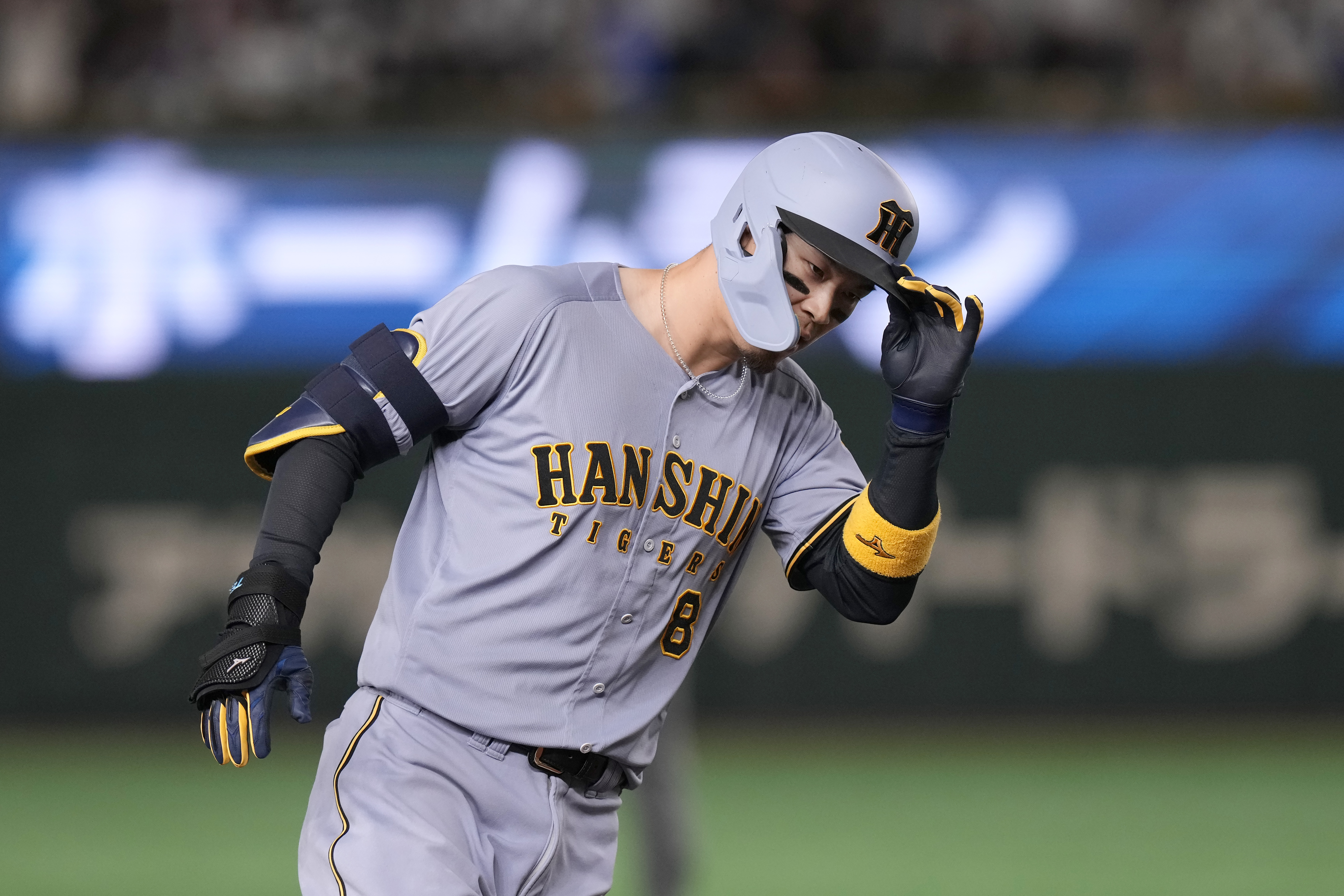
Munetaka Murakami and Teruaki Sato bat from the left side of the plate. They have light-tower power — and the swing-and-miss tendency that often goes with it. And they are the last two winners of the triple crown in Japan’s Nippon Professional Baseball, where they were poor defenders at third base.
So, after Murakami banged 35 home runs with an .825 OPS this season and finished fourth in the American League Rookie of the Year voting — after signing a two-year, $34 million contract with the White Sox last December — what’s reasonable to expect from Sato?
“I believe [that] Teru,” Jon Duplantier said by phone, “I think he’s better [than Murakami].”
OK, a few disclaimers: Duplantier, an erstwhile prospect who pitched for the Diamondbacks and went to spring training with the Phillies in 2023, respects Murakami. He faced him in Japan two years ago and gave up a double. He wasn’t surprised by the slugger’s success in the majors.
But Duplantier played alongside Sato with the Hanshin Tigers in 2025. They won a Central League pennant together. Flags fly forever in Osaka, just like in Philly, so let’s concede that Duplantier’s scouting report on his one-time teammate is tinged with the forever bonds of a sudsy celebration and championship rings.
Even so, the perspective of a former major league pitcher is valuable, especially as at least a handful of teams, notably the Phillies, explore a deal with Sato before the owners lock out the players and shut down the sport on Dec. 2.
Speaking of which, here’s what we know, based on information from sources familiar with the Sato sweepstakes but not authorized to discuss them:
Video: The Phillies are counting on youth in 2027 | Gameday Central
The Phillies scouted Sato this season, with general manager Preston Mattingly getting an in-person look in May, and are discussing him as a corner outfielder. Sato started 45 games in the outfield over the last two seasons and played right field for Japan in the World Baseball Classic. A non-Phillies evaluator described him as a “below average” third baseman and said “left field is probably his best position.”
Even though the Phillies’ lineup leans left-handed, Sato’s youth appeals to them. He will turn 28 in March. The best righty-hitting outfielders in free agency — Randy Arozarena and Seiya Suzuki — will play at 32 next season. The Phillies have four everyday players who will be 34 or older next year (J.T. Realmuto, Kyle Schwarber, Bryce Harper, Trea Turner).
After the success this season of Murakami and the Blue Jays’ Kazuo Okamoto (33 homers, .762 OPS after signing a four-year, $60 million deal), Sato is expected to get bigger offers, likely for more than four years and $20 million annually.
Under the posting rules, Sato’s 45-day window to sign with a major league team closes on Dec. 16. But MLB said it won’t pause the window during a lockout, effectively moving up Sato’s deadline to Dec. 1 at 11:59 p.m. His market is difficult to ascertain. Various reports have linked him to the Yankees, Padres, Blue Jays, Cubs, and Angels. Only a fool would count out the Dodgers, a pipeline for Japan’s best players long before Shohei Ohtani went there.
There are other unknowns. For instance: Would Sato go where no player from NPB has gone before? The Phillies have never signed a player directly from Japan to a major league contract. Their interest in Yoshinobu Yamamoto was unrequited in 2023; a year later, Roki Sasaki didn’t meet with them.
Sato also brings a super-aggressive plate approach. He swings at more pitches than most hitters. And although he had an 82.2% contact rate on in-zone pitches over the last four seasons, based on data compiled by Japanese baseball analyst Yuri Karasawa, he also chased 31.9% of pitches out of the zone.
How will Sato’s aggressiveness translate in the majors?
“Dude is the real deal,” Duplantier said. “He’s a good baseball player, and he knows it. It’s not an arrogance. It’s not hubris. He’s confident in himself, and he should be. He puts in a lot of work. He’s a very talented baseball player.
“I’m really excited for him because I know he’s excited for this opportunity, and he’s going to make the most out of it.”
Teruaki Sato won the triple crown in Japan this year, batting .306 with 39 homers and 106 RBIs.Hiro Komae
‘The dude’s got pop’
Pop quiz: Name the last left-handed hitter to homer off two-time Cy Young-winning lefty Blake Snell.
No, it wasn’t Schwarber. Or Harper.
Juan Soto? Officially, yes. Soto took Snell deep on June 2, 2024. Technically, though, it last happened on March 16, 2025. Sato rocked the Tokyo Dome by hitting a 95-mph Snell fastball for a three-run homer in the Tigers’ 3-0 exhibition victory over the Dodgers.
Not a bad way to get everyone’s attention.
“It was a moment that made people [in the U.S.] aware of who was on the horizon,” Duplantier said. “For sure.”
But Sato wasn’t always a star, even in Japan. He went undrafted out of high school in Osaka before getting noticed for his prodigious power at Kindai University and eventually drafted in the first round by the Tigers, his hometown team.
As a rookie in 2021, Sato struck out 38% of the time and went 59 plate appearances without a hit, but also smashed 24 homers. Two years later, he helped the Tigers win their first Japan Series title since 1985. A year after that, he got demoted to the minors for 17 games to work on his defense at third base.
Sato emerged as a force over the last two years, the homer off Snell serving as a preview of a 40-homer, 102-RBI season in 2025. His 79 homers over the last two years were 15 more than any NPB player; he ranked second with a .958 OPS.
And he played in Koshien Stadium, a pitcher-friendly park that Duplantier likened to Kauffman Stadium in Kansas City.
Kazuma Okamoto vs. Munetaka Murakami vs. Teruaki Sato compared in their final 4 NPB seasons pic.twitter.com/rznOKdlORo
“The ball does not fly there … but I watched this guy, and he used to leave left-center like it was nothing, man,” Duplantier said. “It’s fun. It’s fun when he connects with the ball. It’s loud. You know how some guys are described like that? It’s like the ball off the bat is a little bit heavier for them. Teru has that. The dude’s got pop. He’s strong.”
Indeed, Sato makes high-quality contact. His hard-hit rate, defined as balls put in play at 95 mph or more, was 55.3% this season, based on NPB tracking data. For context, Schwarber’s hard-hit rate over the last three years was 55%, according to Statcast.
Sato’s average bat speed (74.6 mph) this season was similar to the Braves’ Matt Olson (74.8), his exit velocity (93.3 mph) identical to the Royals’ Jac Caglianone (93.3). Those metrics also compared favorably to Murakami (74.7 mph bat speed, 93.9 exit velocity).
But about those swings and misses …
Murakami came with similar red flags, notably a 26.4% strikeout rate in his last four seasons in Japan. (Sato had a 26.2% mark.) Murakami also made less contact on in-zone pitches (74.5%) than Sato (82.2%).
Former major-league pitcher Jon Duplantier played with Japanese slugger Teruaki Sato with the Hanshin Tigers in 2025.Tony Avelar
The biggest divergence, though, is in their approaches. Murakami had a 16.9% walk rate and swung at 22% of pitches out of the zone during his last four seasons in Japan. Sato is far more aggressive. He swings a lot, walking at only a 9.5% rate and chasing at a 31.9% rate.
“Over there, a big part of the game is bunting, running, and taking bags; Teru’s game is a little bit more American,” Duplantier said. “He’s going up there to do damage. He ain’t bunting. If it’s time to move a guy over, or we need to elevate to get a run in, cool. But he’s not trying to put it on the ground and beat it out.”
But just because Sato is stylistically American doesn’t guarantee he will have success against better pitching. The average major league fastball this season was 94.7 mph; in NPB, the average fastball was approximately 92 mph, according to data from Yakyu Cosmopolitan.
Murakami’s strikeout rate rose to 35.4% in the majors, while his walk rate stayed roughly the same (16.6%). With superior contact skills, Sato might be able to keep his strikeouts under control. Then again, given how often he swings, he may be vulnerable to striking out more.
Regardless, Duplantier said it won’t change Sato’s style of hitting.
“With Teru, I’ve seen guys throw certain pitches, he takes the big swing and miss, it looks like you have him fooled, and you throw it again and he makes the adjustment,” Duplantier said. “Or he took a big swing, he looked silly, so you try to go into his kitchen and he spins on it. I just think he’s a really good hitter.
“I won’t say there’s not swing-and-miss there. But I don’t think he’s concerned with his swing-and-miss. It’s gonna be power vs. power. And he’s been good at it.”
Over the last two seasons, Teruaki Sato hit 79 homers, 15 more than any other player in Japan’s Nippon Professional Baseball. Eugene Hoshiko
Blazing a trail
Upon taking over the Phillies’ baseball operations six years ago, Dave Dombrowski felt he lacked adequate information about available Japanese players. He tasked assistant general manager Jorge Velandia to “build a better infrastructure in how we approach the Far East.”
The Phillies believe they’ve made inroads.
Yet they still haven’t broken through.
In 2023, they flew a seven-person delegation to Southern California to make a presentation — and an offer of more than $300 million — to Yamamoto, who wasn’t interested. The next year, they signed veteran reliever Koyo Aoyagi to a minor-league contract but released him after a few months when he struggled in triple A.
Relationship-building, at the amateur and pro levels, is central to recruiting Japanese players. The Phillies have two full-time scouts in Japan. Tora Otsuka recently left the organization for opportunities outside of scouting, and the Phillies replaced him with 27-year-old Ataru Yamaguchi, a former minor-league outfielder in Japan.
But there isn’t a direct flight from Philadelphia to Tokyo. And if Sato wants to know what it’s like to play in Los Angeles, New York, Chicago, Boston, or Seattle, he can ask several players who came before him.
“With the Phillies, you’re starting more from scratch,” former Mets general manager Jim Duquette said on The Inquirer’s Phillies Extra podcast. “And it does require a lot of recruitment. It requires an infrastructure. In essence here, you might have to pay a little bit more to that first guy to get them.”
It also takes a player who is open to blazing a trail in an unfamiliar market.
Video: Former MLB GM Jim Duquette is remaining optimistic about 2027 MLB season | Phillies Extra
Duplantier said Sato speaks “a little bit of English,” but said they really started to hit it off because he tried to learn Japanese. He believes the Phillies’ veterans would make a similar attempt to help ease Sato’s transition.
“I think Teru has personality enough to where he could handle being in a place that he hasn’t learned about from fellow countrymen,” Duplantier said. “He could trail blaze that. He could definitely handle that. And I believe he’s confident enough and he’s personable enough that he would make friends. I think that he would get along with guys.
“And one thing that I remember about my brief stint in camp with the Phils is that clubhouse was really, really tight. Those guys enjoy each other. I felt welcomed in there, and I was injured and was only there for a couple of weeks. I’m sure that they would do the exact same thing for Teru. And he would kind of lean into that as well, if that were the situation.”
The Phillies have 10 more days to figure out if Sato is the right fit — and vice versa.
“There’s always got to be a first,” Duplantier said. “And if it works out, he’s the kind of player that would be a good first.”
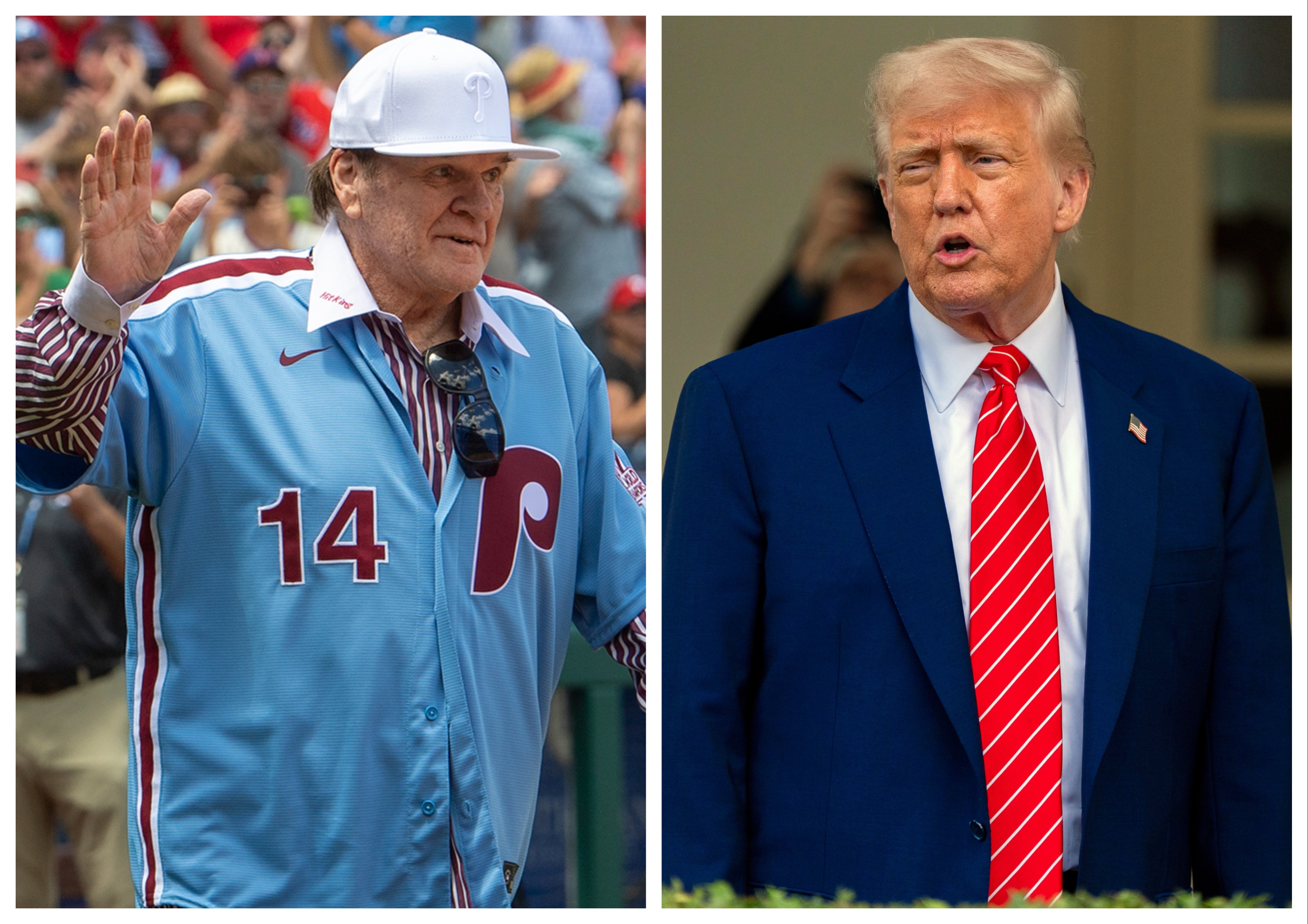
Two years after the death of Pete Rose, President Donald Trump said Thursday that he had pardoned the baseball legend who helped the Phillies win the 1980 World Series but was banned from baseball — though later reinstated — for betting on games.
“I have just given a Complete and Total Pardon to the Late, Great Pete Rose, a true Baseball SUPERSTAR & LEGEND, whose record of 4,256 Hits in a Season will never be broken,” Trump wrote on his Truth Social platform, incorrectly stating that Rose’s career hits record was for a single season.
Rose’s career hits mark was achieved over 24 major league seasons, breaking the longstanding previous record of 4,191 hits accumulated by Ty Cobb. Rose, who was 83 when he died on Sept. 30, 2024, made 17 All-Star teams and won three batting titles.
Despite all that, he was ineligible to be inducted into the Baseball Hall of Fame after an investigation by Major League Baseball determined that Rose had bet on games in 1986 while he was managing the Cincinnati Reds, where he played most of his career before landing in Philadelphia in 1979 to play first base.
I have just given a Complete and Total Pardon to the Late, Great Pete Rose, a true Baseball SUPERSTAR & LEGEND, whose record of 4,256 Hits in a Season will never be broken. In addition, Pete played 3,562 career games (Highest Ever!), had 1,314 Runs batted in, 160 Home Runs, a… pic.twitter.com/dgIXHkoMk2
— Commentary Donald J. Trump Truth Social Posts On X (@TrumpTruthOnX) November 19, 2026
Last year, MLB commissioner Rob Manfred issued a decision that allowed for Rose to be considered for the Hall of Fame. The ruling also cleared the way for Shoeless Joe Jackson and others who had been banned from baseball but have since died.
Trump said Rose “was treated terribly by Major League Baseball in not allowing him to go into the Baseball Hall of Fame. Politics, I guess!”
Trump did not explicitly state what the pardon was for, but in 1990 — less than a year after Rose agreed to a permanent ban from baseball — Rose pleaded guilty to two federal counts of filing false tax returns. He admitted that he did not report $354,968 of income during a four-year period.
In March 2025, Trump said he was going to pardon Rose. He did not say on Friday — after completing a major trip to Asia — why he decided to do the pardon now instead of last year when he first announced it.
In 2016, MLB allowed teams to honor Rose, and the Reds retired his No. 14. The Phillies decided against adding Rose to the team’s Wall of Fame in 2017 after a woman said she had illegal sexual contact with Rose in the 1970s when she was 14 or 15.
Rose said he had thought the woman was 16, which would have been legal in Ohio at the time.
The Phillies won the National League pennant again with Rose in 1983, but lost to the Baltimore Orioles in the World Series.
He eventually returned to Cincinnati, where he was a player and manager before retiring from playing after the 1986 season. He managed the Reds for three more seasons before he was ousted in 1989.
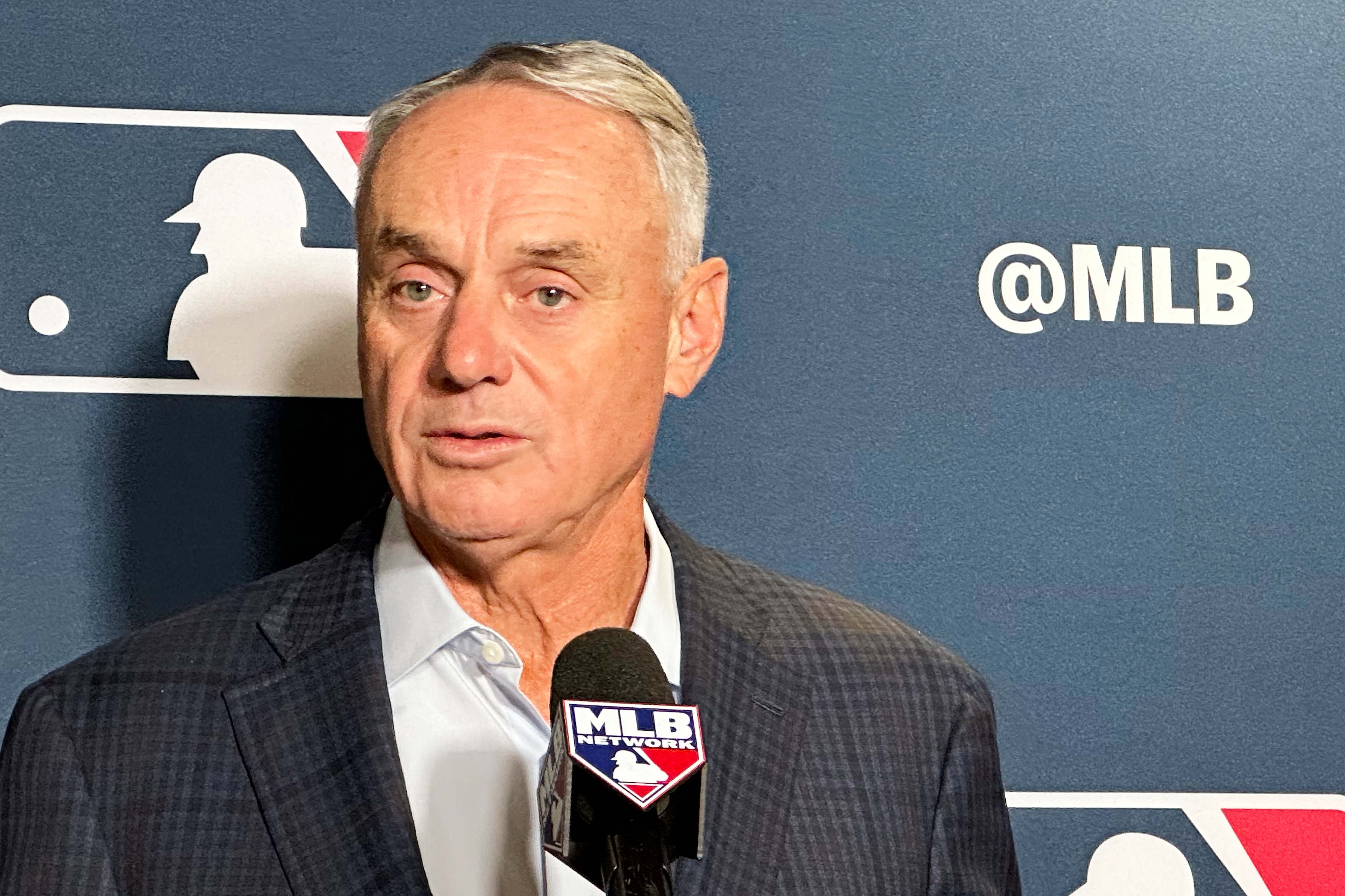
NEW YORK — Major League Baseball Commissioner Rob Manfred said owners will not move off their demand for a salary cap, leaving the sport on track for a lockout starting Dec. 2 that could threaten the 2027 season.
“I can’t imagine the owners ratifying a deal that does not include a cap and floor,” he said Wednesday at a news conference during an owners meeting.
Players say they will never accept a salary cap. The last time management proposed a cap in 1994, it led to a 7½-month strike that caused cancellation of the World Series for the first time in 90 years.
“There’s plenty of room for compromise, but there’s one thing that I will not compromise and that’s the issue that we’re hearing from the vast majority of our fans: They want a salary cap and floor and on that we will not compromise,” Manfred said. “We are not prepared to tell 70% of our fans that they’re wrong on this issue. Competitive balance is a serious problem, and it needs to be addressed and it’s one that we can’t avoid just because the negotiation may be difficult.”
Just a little more than a month after Milwaukee became the first small-market team to win the World Series since 2015, baseball’s five-year collective bargaining agreement expires at 11:59 p.m. EST on Dec. 1. A lockout, the sport’s 10th work stoppage since 1972, would halt all trades and signings.
“A decision on a lockout is one that we’re going to make at the last possible moment,” Manfred said. “We’re going to devote ourselves to the bargaining process. I’m not that big on Thanksgiving as a holiday. We’ll make ourselves available whenever and wherever to bargain in an effort to make an agreement.”
MLB proposed the sport adopt a hard cap of $258.2 million for 2028 and a floor of $180.2 million, using luxury tax payrolls with average annual values. A team would be allowed to remain as low as 90% of the floor in 2028, which would be $162.18 million, but would have to spend the entire amount of the floor over a three-year period.
Video: Former MLB GM Jim Duquette is remaining optimistic about 2027 MLB season | Phillies Extra
The union remains steadfastly opposed to a salary cap
Individual contracts also would be capped at 15% of payroll under the plan (16% for re-signing free agents). MLB says it proposed a 50-50 split of revenue, while the union says it calculates the players’ current share as over 55%.
“There can be no clearer example of the league’s lack of seriousness than their insistence that they will not negotiate over the economics outside of a radical change to the system that would dramatically reduce overall player compensation for all categories of players and strip fundamental rights from players like the ability to have truly guaranteed contracts,” union head Bruce Meyer said in a statement. “There should be no illusions about the owners’ true motivation in pushing for this system. They want to make more money in profits and franchise values by artificially suppressing player salaries.”
Players have called the salary cap a “non-starter.”
“We made the proposal way back in May. Another word for ‘non-starter’ over months is a refusal to bargain,” Manfred said. “I think it’s time that the MLBPA needs to realize that this proposal is serious. I’m not suggesting they need to accept it whole cloth. I think they need to look at the proposal and try to find some ways to move to the middle as opposed to making no proposal at all.”
Players proposed a “competitive integrity tax” that would penalize teams dropping below a payroll floor. They also asked for a rise in the luxury tax threshold, almost doubling the minimum salary and increased salary arbitration rights.
“The MLBPA wants more and its proposals undermine, further undermine the competitive quality of our game,” Manfred said.
“What has the MLBPA done? They’ve engaged in a lot of rhetoric,” he added. “They’ve characterized our proposals as not real or not serious. They’ve criticized and mischaracterized aspects of the cap and floor system in an effort to promote player opposition. What the MLBPA has not done is made any meaningful effort to move towards us. In fact, they have not made a significant economic proposal since their opening proposal. Indeed, there’s a paucity of responses even on topics that do not directly impact our economics.”
Video: Garrett Stubbs isn’t buying the competitive balance argument in CBA talks | Phillies Extra
MLB exec says the Brewers’ small-payroll championship was ‘truly aberrational’
In a 40-minute presentation before Manfred’s news conference, MLB executive vice president Morgan Sword outlined the economics behind MLB’s proposals. He said according to the Financial Information Questionnaires submitted by teams, revenue this year was $12.9 billion.
MLB said FIQ revenue rose 246% from 2003 and player payroll increased 147%. The union disputes the validity of management’s conclusions from those calculations.
While the World Series champion Brewers play in baseball’s smallest market and the World Series matchup was the first since 1991 between teams in the bottom half of payrolls, MLB contends high-spending teams have better chances of success in the long term. It highlighted that since 1998 only one team that didn’t have a top-20 payroll won the title and eight of the top-10 teams by payroll reached this year’s playoffs.
“It is truly aberrational in baseball for small markets to be successful,” Sword said. “It’s not impossible, but it is much, much more difficult in our sport than it is in any of the other sports.”
MLB said that since the start of the current labor contract in March 2022, the Los Angeles Dodgers, New York Mets, New York Yankees and Phillies combined to commit $5.95 billion to free agents and the bottom 22 teams in free-agent spending allocated $5.41 billion.
Based on 2026 payrolls and the 2028 cap level, the Dodgers would have to cut payroll by $174 million, the Mets by $108 million, the Yankees by $83 million and the Phillies by $64 million.
Sword said it had not yet been determined how teams with players with no-trade provisions would be able to get under the cap, saying it was to be bargained.
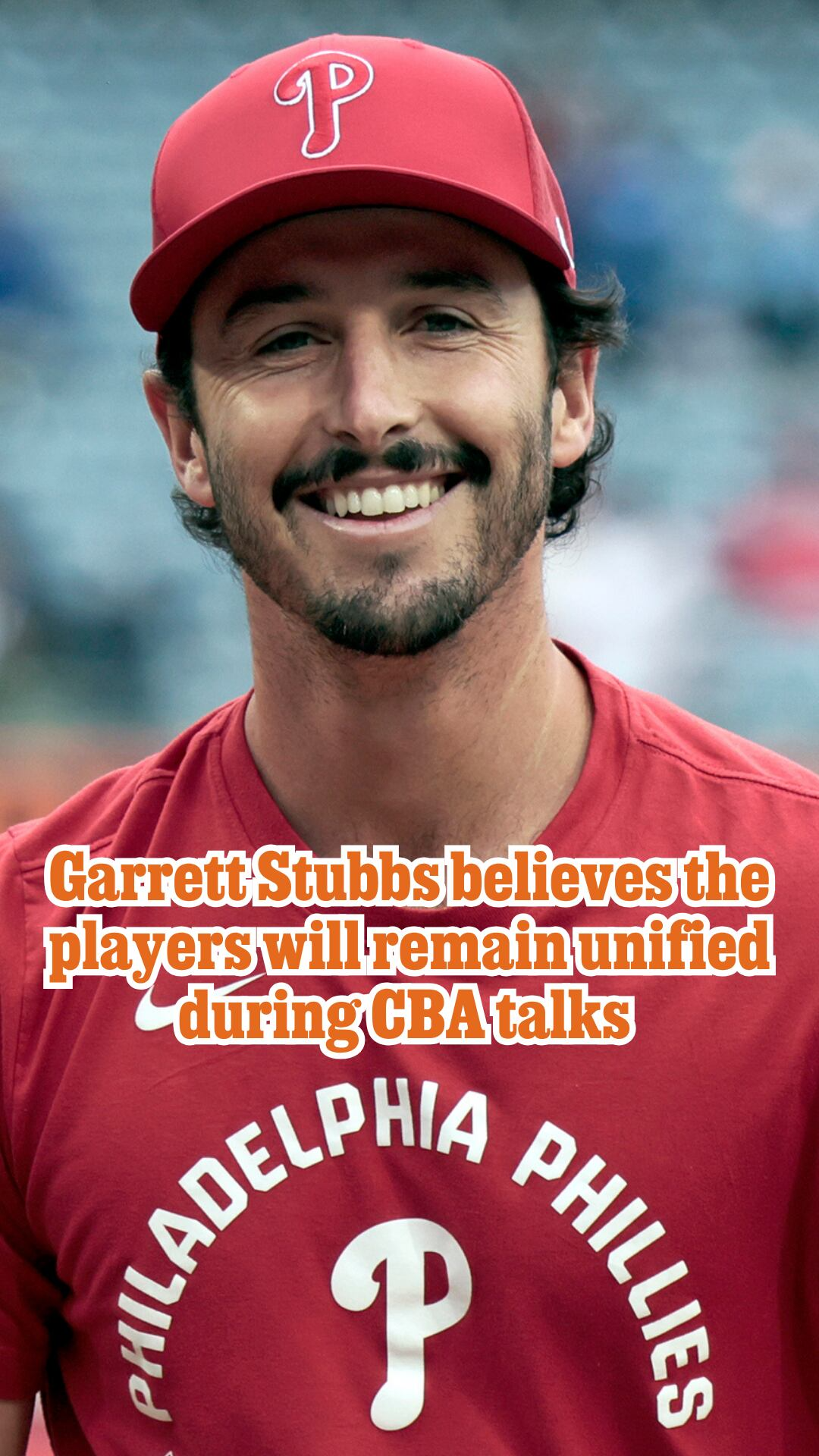
Video: Garrett Stubbs believes the players will remain unified during CBA talks | Phillies Extra
MLB’s proposal includes splitting local media revenue equally among the 30 teams for the first time. MLB said that due to the decline of cable networks, local media revenue is $1.8 billion this year, down $575 million from a high of about $2.4 billion annually from 2021-24.
Management said that while players with six or more years of service earned 69% of compensation this year, counting regular payrolls and the pre-arbitration bonus pool, those players combined for just 29% of an averaged Baseball Reference and Fangraphs WAR.
“Major league players will earn more money in this system and it’s just a matter of just distributing the players differently across the teams,” Sword said. “The key to having valuable national media rights we believe is having lots of teams that have a national audience and appeal beyond just the contours of their city.”
The union says MLB isn’t accounting for what players currently are getting from luxury proceeds and from amateur signing bonuses.
SURPRISE, Ariz. — Aidan Miller’s 2026 season ended where his 2025 campaign was supposed to — in the Arizona Fall League. In between, a back injury shelved the Phillies’ top position player prospect for not just the 2025 AFL, but all but two weeks of his 2026 minor league season.
With help from Tom Brady’s TB12 chain of training and recovery centers, Miller, 22, made it back for the final two weeks of the minor league season, playing three games for double-A Reading on the way to its first Eastern League title in 25 years.
From there he closed out what he considered a “long year” with 16 games in the AFL, where he dazzled with a .557 on-base percentage to go with a .327 batting average, seven stolen bases and six extra-base hits. His performance earned him a start at third base in the Arizona Fall Stars Game.
But most importantly, Miller is healthy as he goes into the offseason.
“I feel amazing, man,” Miller said. “I feel like it’s a thing of the past, so looking to go into spring training next year, if there is one, on a good note and yeah, I’m ready for it.”
With Trea Turner remaining at shortstop for now and third baseman Alec Bohm a free agent, Miller appears to be a serious contender to be the Phillies’ opening day third baseman.
Video: The Phillies are counting on youth in 2027 | Gameday Central
Drafted in the first round in 2023 as a shortstop, Miller said a return to third base has felt natural this fall.
“I played it growing up, in high school, travel ball and all that,” Miller said. “So coming to pro ball, my first time really playing shortstop was in pro ball. And then, moving back over to third, I kind of feel like it’s my home spot. It feels good. I mean, there’s a little bit of adjustments I’ve got to make over there with bunt defenses, positioning, and all that, but it’s not too much different from shortstop.”
Miller said he has not discussed the prospect of playing the outfield with the Phillies, but he would certainly be open to it if asked.
Video: Phillies Extra: Aidan Miller on how Tom Brady’s training center helped him recover from injury
“I haven’t heard anything about outfield,” Miller said. “I mean, if that ends up being the case, then that’s totally OK with me. But I haven’t heard anything from them.”
Miller has impressed scouts with his ability to hit for contact. Graded as just an average runner by MLB Pipeline, Miller believes his ability to run the bases may be underrated by talent evaluators. He swiped 59 bases in 116 minor league games in 2025.
One spectator who has been impressed with Miller throughout the fall is Phillies outfield prospect and fellow first-round pick Dante Nori. He had a front-row seat to watch Miller in the AFL as they played for the Saguaros, and roomed together in Surprise.
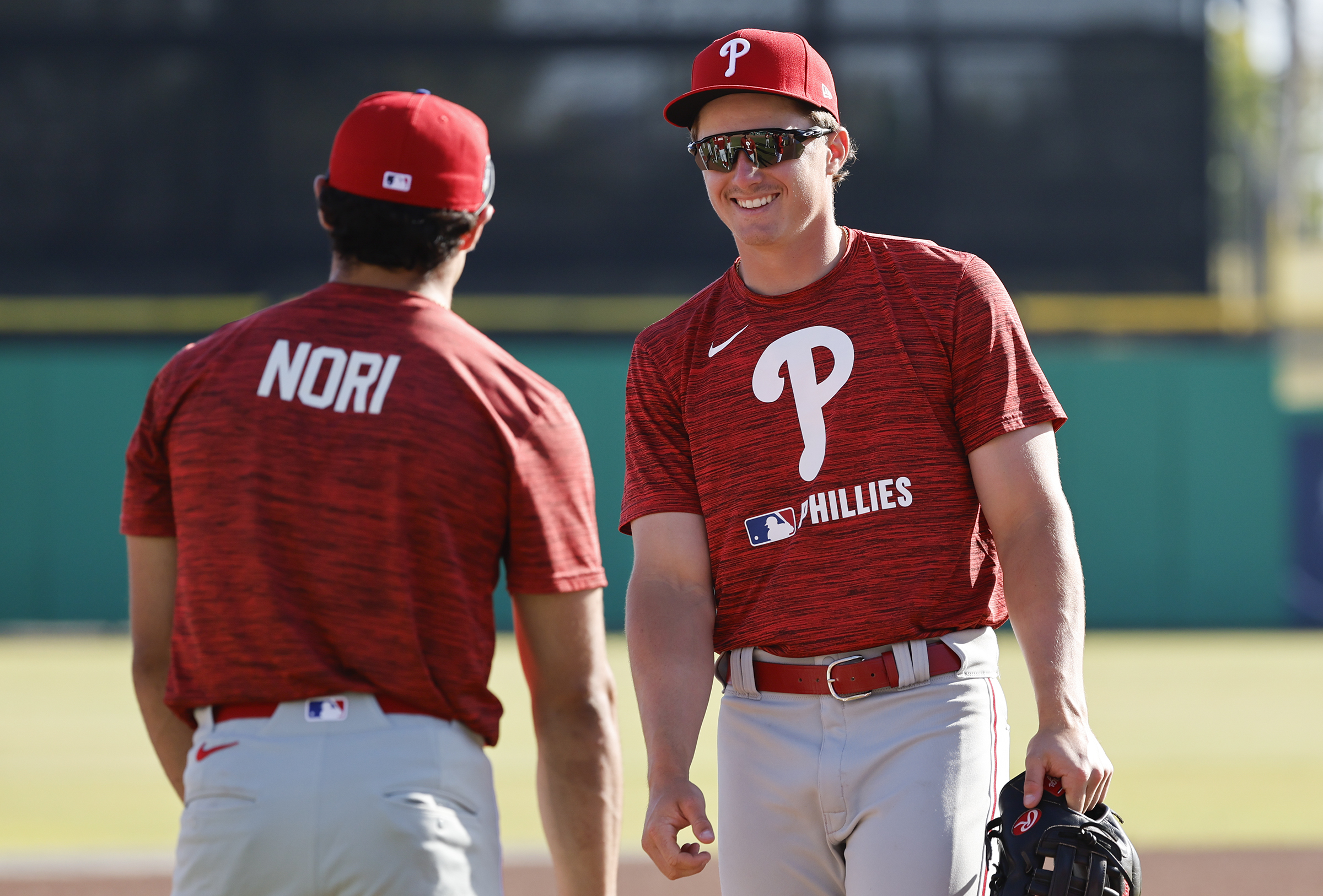
Fellow first-round picks Aidan Miller (right) and Dante Nori (left) were roommates during the Arizona Fall League.Yong Kim / Staff Photographer
“I mean, he’s a five-tool guy,” Nori said. “Wherever he goes, he wins. He helps the team win. I haven’t really lived with him, ever, so to live down here with him, it’s been great. Every day, we’re sitting on the couch, chopping it up, always watching stuff, always just feeding questions off each other. The Phillies got a dog in him and absolutely, he’s going to help the big-league team as soon as they open back up.”
While the impending work stoppage casts uncertainty over 2027, Miller plans to prepare for the season as he normally would. Having spent the past few offseasons with his parents in the greater Clearwater area, Miller recently moved out and got a place with his girlfriend in Tarpon Springs.
“It’s weird, it’s my first time kind of going through this,” Miller said of the expected lockout. “So, just kind of take it day-by-day, and see what happens. If there’s a spring training, that’s awesome, but if there’s not, I’ll figure it out.
“I’m going to train in Clearwater all offseason. We have a great strength coach down there, Ryan Maedel. He was my double-A strength coach last year. So, we’re going to work together all offseason, and just continue building on what got me back onto the field.”
For 46 years, Bill Luzinski held on to a piece of Phillies history.
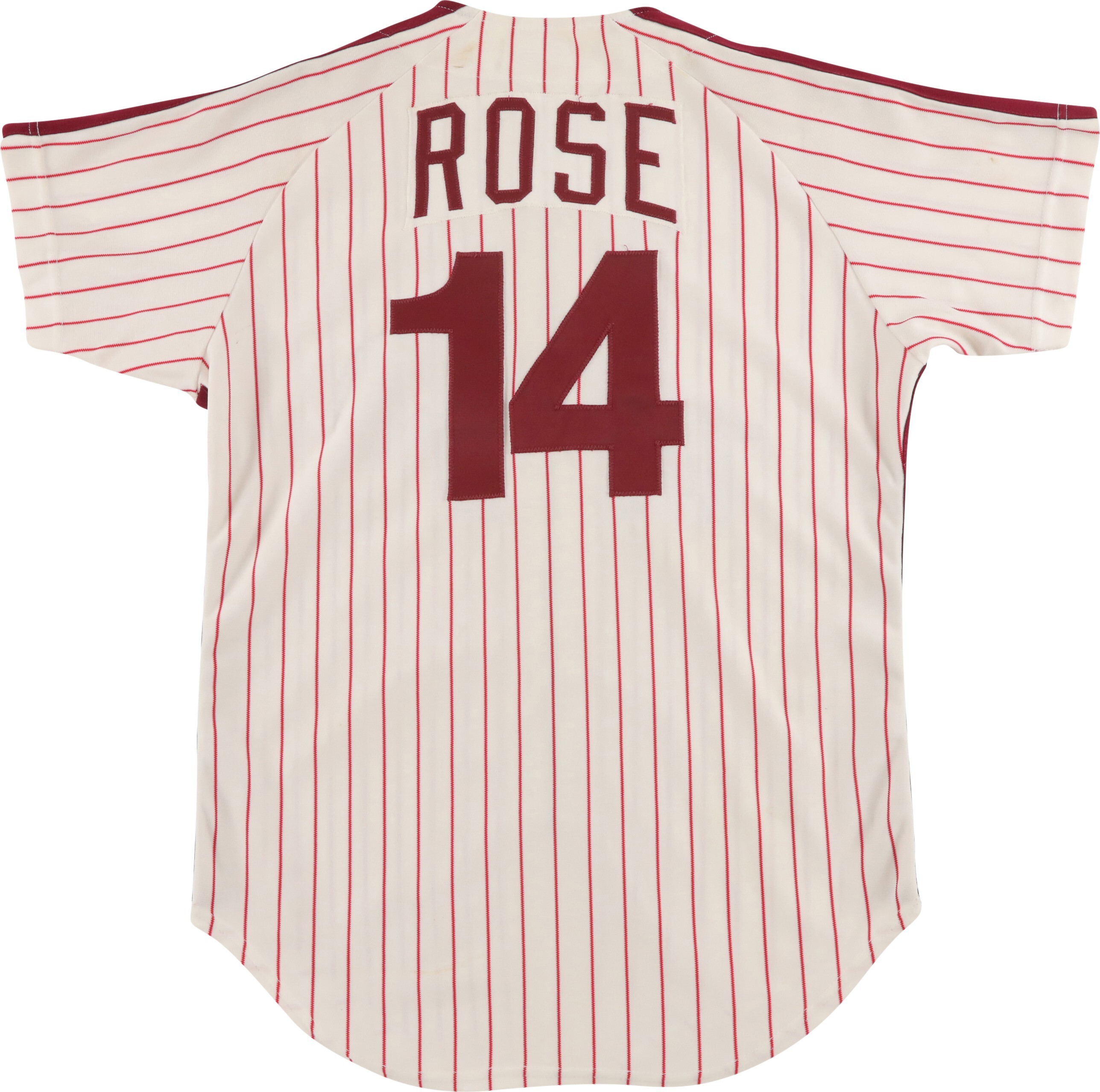
It was the jersey Pete Rose wore on Oct. 21, 1980, when the Phillies defeated the Kansas City Royals to capture their first World Series championship. Amid the postgame celebration at Veterans Stadium, Rose handed Luzinski, the brother of Phillies outfielder Greg Luzinski, a bag containing the jersey.
“He actually put it in a brown bag and gave it to me,” Bill said Wednesday. “He said, ‘That’s yours. Get it out of here.’”
He took the jersey home that night and kept it for more than four decades. Now, the historic piece is available through Lelands Sports Auctions, with bidding scheduled to close Dec. 5. The bidding started at $25,000 and was up to $69,649 as of Wednesday afternoon.
Bill said his decision to part with the jersey came after watching the prices other baseball memorabilia commanded. Rather than let it sit in his closet, he figured he could use the proceeds to benefit his family.
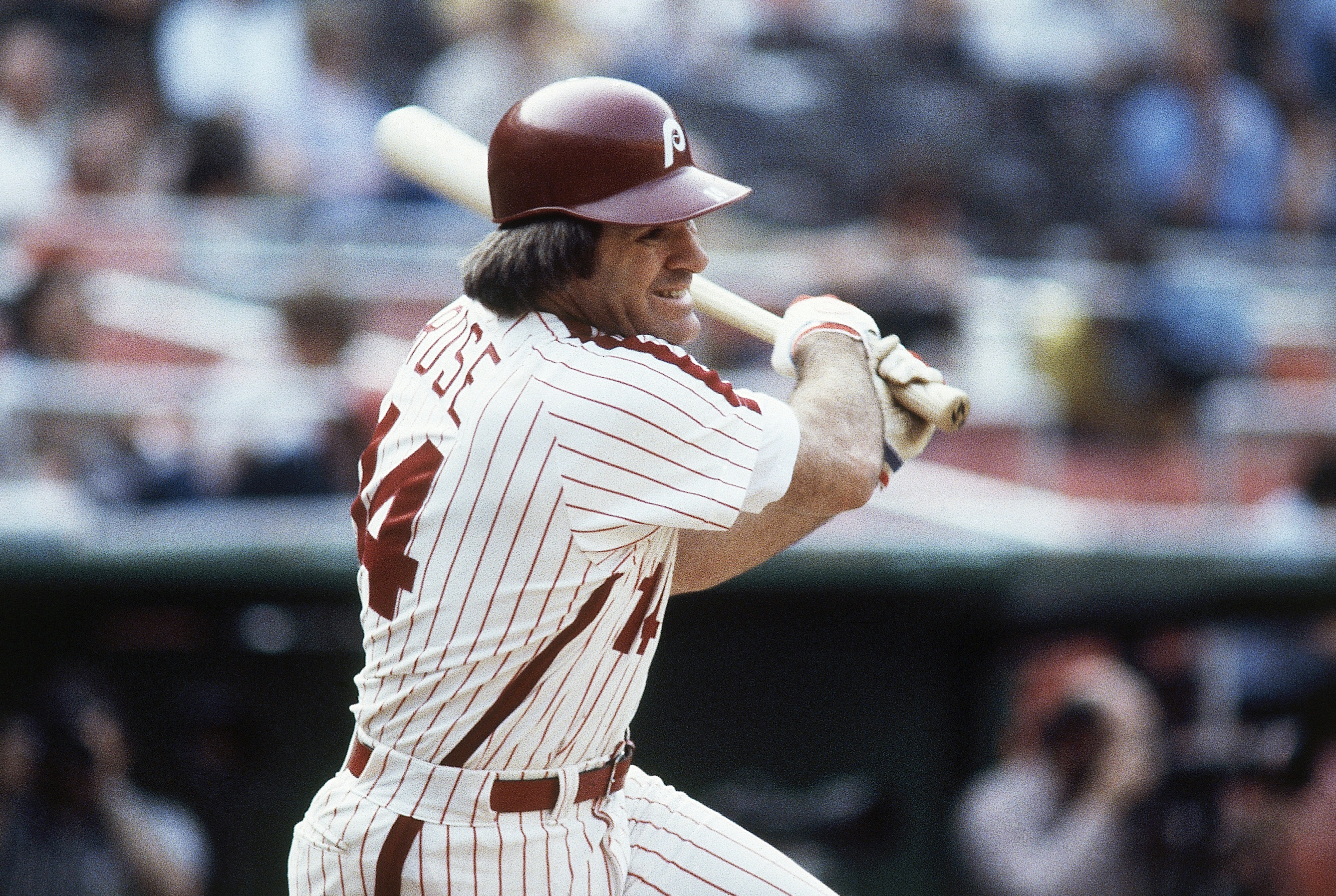
Pete Rose, batting during a game in 1980, handed his game-worn jersey from Game 6 of that season’s World Series to Bill Luzinski. That jersey is now up for auction.Anonymous
Bill attended every Phillies home playoff game during the 1980 postseason, including all three World Series games at Veterans Stadium. He often arrived early with his brother to watch batting practice and had become familiar with the players through years spent around major league clubhouses.
Bill was the seventh overall pick in the 1980 draft by the White Sox and spent two seasons in their organization.
Through his brother, Bill developed a relationship with Rose that extended beyond their encounters at the ballpark.
“Pete sort of liked me for some reason,” he said. “I don’t know.”
Rose occasionally gave Bill rides home from spring training when Greg was unavailable. He also recalled Rose attending one of his games at Miami Dade College alongside Greg and former Phillies shortstop Larry Bowa.
Rose would look out for him financially, too.
“Pete was always good to me,” Bill said. “He’d give me a hundred-dollar bill like nothing because he knew I was in the minor leagues.”
Those interactions preceded Rose’s gift during the championship celebration.
The jersey was part of one of the most memorable nights in Phillies history. With one out in the ninth inning of Game 6, Rose caught a foul pop-up that bounced out of catcher Bob Boone’s glove, preserving the second out. Tug McGraw struck out Willie Wilson moments later, securing the Phillies’ 4-1 victory.
Bill remembers the atmosphere afterward as “unbelievable.”
The jersey remained in his home for the next 46 years. Although he had it framed at one point, he said he never made a habit of showing it off to visitors.
Eventually, he considered selling it and researched auction houses before choosing Lelands. When a representative asked him to ship the jersey, Bill refused.
Instead, a representative flew to Florida to collect it.
When the collective bargaining agreement expires after 11:59 p.m. on Dec. 1, baseball’s owners are expected to lock out the players and suspend all transactions — free agency, trades, any 40-man roster moves — until a new deal is negotiated.
And it might take a while.
In this week’s Phillies Extra podcast, Inquirer baseball writer Scott Lauber was joined by Phillies reporter Lochlahn March to discuss the sprint to the lockout. Here’s an excerpt from their conversation.
Watch the full show, including an interview with Hall of Fame slugger David Ortiz, below and subscribe to the Phillies Extra podcaston Spotify or Apple Podcasts.
What were your takeaways from the GM meetings last week?
March: I think one of the things that really stood out to me was how Dave Dombrowski emphasized the need in the bullpen, specifically with some high-leverage left-handed relievers. The Phillies already re-signed Tim Mayza, but that’s just step one in the process. They need more. If you look at the depth chart right now in the bullpen, all the top trustworthy arms are right-handed. There really isn’t anyone left-handed who can be expected to take on some of those late innings. They’re counting on a rebound from left-hander Tanner Banks, but they still need to add to that group. And there’s not a ton that’s out there, which is one of the problems. And it might mean that Dombrowski has to do what he doesn’t typically like to do, which is give a multiyear deal to a reliever.
Lauber: I came away feeling like Aidan Miller is going to be in the lineup on opening day — whenever that is — probably at third base, and the Phillies may be leaning toward making Teruaki Sato their top free-agent target.
Signing Japan’s Teruaki Sato, who will be 28 in March, would add a younger player to the Phillies’ 30-something core.Hiro Komae
How does Teruaki Sato fit in to the Phillies’ offseason plan?
Lauber: You hear from people who’ve watched him play that he’s similar to the White Sox’s Munetaka Murakami in terms of the power from the left side, but also the swing and miss and the strikeouts. And both Bryce Harper and Kyle Schwarber hit from the left side. So you think, OK, they could really use a right-handed bat to balance out the middle of the order. And for that reason, I think I’ve leaned more toward [free-agent outfielders] Randy Arozarena or Seiya Suzuki.
But I also bristle at the thought of them committing to another 30-something through 2030 or 2031. Sato is going to be 28 in March, so you’d presumably be paying for his prime years. … Even though Sato bats left-handed and strikes out a lot, and even if you’re not sure of the positional fit in left field, he’s four years younger than those other two guys. And you’d finally be breaking into the Japanese market in a big way.
March: I think the Phillies can’t keep being on the outside of all these top Japanese names coming over, and that is something they have to break through somehow to become attractive to the next Roki Sasaki, the next Yoshinobu Yamamoto. I’m not going to say the next Shohei Ohtani because I don’t know if we’ll ever see anyone like that again, but just the next superstar. The Phillies just haven’t been even on the inside at all, and they need to break through somehow. And there are drawbacks. Yes, he hits left-handed. It’s another lefty. But I think that at least you’re accomplishing something, even if it doesn’t work out as well as Murakami worked out for the White Sox. I think you’re taking a step that you haven’t taken before.
Video: The Phillies are counting on youth in 2027 | Gameday Central
If you can have one big-ticket player, do you go after a big bat or a reliever?
Lauber: They have a bunch of needs, the bullpen among them, but I believe that their biggest need is still a middle-of-the-order slugger. The more distance we get from the season, the more glaring it is just how reliant they were on Harper and Schwarber. I’d bet on Trea Turner bouncing back, at least offensively. He’s 32. It’s not like he’s suddenly lost his skills as a hitter. And I know Dombrowski thinks Miller could be next year’s version of Kevin McGonigle. But they haven’t had a legit cleanup hitter now for some time. So whether it’s Sato or Arozarena or Suzuki, or a trade for somebody we’re not talking about, I don’t think they can go into another season without addressing the middle of the order.
March: I think the hitter is probably step one. You’re not even going to get to the back end of the bullpen if you’re not putting up runs. You need to have a cleanup hitter, especially since Alec Bohm is now a free agent. He’d been in the No. 4 spot for a couple years. Last year he was up and down the lineup, but there’s a hole there, and they have some directions that they could go to fill that hole. I think signing a Japanese player — whether it’s Suzuki or Sato — would be an interesting step, and it would be something different that the Phillies have not done before. And it would be accomplishing a goal that they’ve had, to break into that market, because you need the first player to come before you can really start making yourself a destination for some of the talent from Japan. So, I think that would be a creative, unique way of addressing that.
Phillies outfielder Brandon Marsh had surgery on his left wrist and is expected to be ready for spring training.
Are the Phillies blaming Brandon Marsh’s second-half struggles on a wrist injury?
Lauber: The short answer is no; they’re not connecting the injury to his second half. In fact, they’re saying the issue with a bony overgrowth on the back of his left wrist began in spring training. He got treatment and played through it, and then chose to [have elective surgery] now to correct it because he wanted to avoid future flare-ups. And, according to the Phillies, he has full range of motion and is set to start his hitting program in December when he normally would.
March: I agree. I think that if they were trying to connect it, they would have brought it up, and that’s not something that Dombrowski has brought up in public statements either in his season-ending news conference, or in Vegas at the GM meetings. He didn’t talk about it in Vegas — and he did mention Marsh both times and Marsh’s disappointing second half. So, I don’t think that they’re trying to draw those connection lines, and they’ve done that before. They did with Bryson Stott in the past. I think he had an elbow injury a couple years ago, and we came into spring training in 2025 and everyone was talking about that as the reason he kind of fell off in the second half [of 2024]. Not saying that’s not why [Stott struggled], but I’m just saying they’re not shy from doing that.
Lauber: I do think it’s a little bit of a complication in terms of talking about Marsh in potential trades. The biggest thing might be that Marsh is one year from free agency and nobody knows how many games will be played next year, and acquiring teams would obviously value him differently if they’re getting him for a full season vs. say, 100 games or 60 games. But then you’ve got the wrist thing looming over it, too.
Honestly, I think the Phillies probably wish that an injury could explain Marsh’s second half, in which he batted .184 with a .502 OPS after hitting .301 with an .829 OPS and started in the All-Star Game. It’s like he was two totally different players. At least an injury would help explain why that happened.