Tag: UniversalPremium

  • Alec Bohm represents changes that might be coming to the Phillies. Who else could be on the way out?

    Alec Bohm represents changes that might be coming to the Phillies. Who else could be on the way out?

    Let’s play a game of Name That Hitter, using statistical hints of batting average/on-base percentage/slugging and other relevant numbers through Thursday.

    Ready? Here goes.

    • Hitter A: .259/.310/.386, 24 doubles, 17 homers, 76 RBIs, 47 walks, 124 strikeouts, 96 OPS+, 0.8 WAR (Baseball-Reference).
    • Hitter B: .253/.318/.390, 29 doubles, 15 homers, 88 RBIs, 46 walks, 88 strikeouts, 90 OPS+, 0.1 WAR.

    Cue the Jeopardy music.

    OK, lock in your answers.

    Hitter A is Bo Bichette, object of the Phillies’ desire in January when they offered the free-agent infielder a seven-year, $200 million contract. Bichette took the Mets’ bid of fewer years (three) but higher salary ($42 million annually, $126 million total), plus opt-outs after this season and next.

    If they’d landed Bichette, the Phillies planned to trade Alec Bohm, according to multiple sources at the time. And Bohm happens to be Hitter B, with eerily similar production at a fraction of the salary ($10.2 million).

    Sometimes, the best moves are ones that aren’t made.

    This isn’t meant to suggest that Bohm had a particularly good season. The Phillies dropped him from the cleanup spot after two weeks and benched him for two games in early May. He had a .593 OPS through June 3. At the All-Star break, he was hitting .215 with a .278 on-base percentage and .632 OPS.

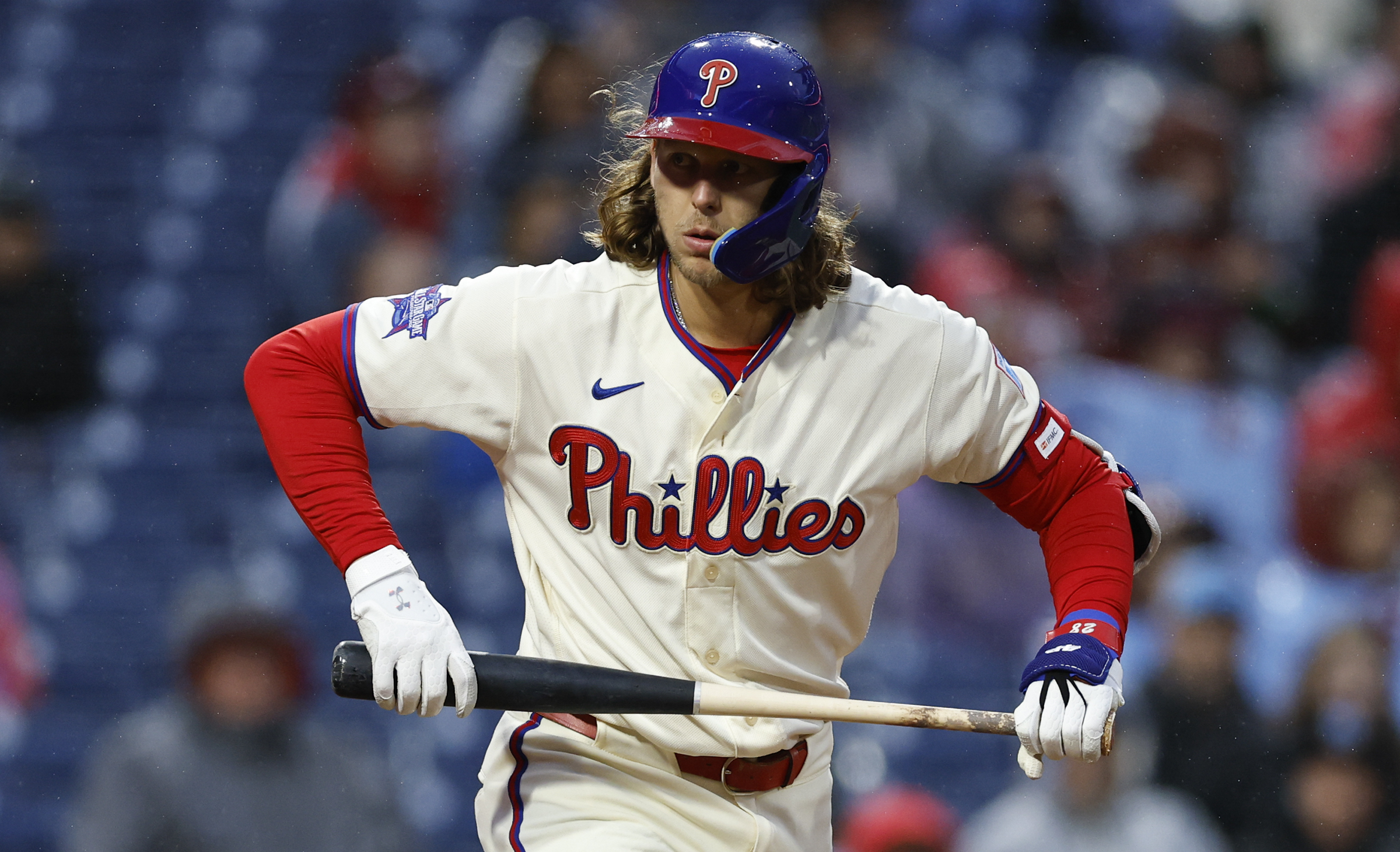
    After a rough first half of the season, Phillies first baseman Alec Bohm has had more to smile about since the All-Star break.Elizabeth Robertson / Staff Photographer

    (It was even worse for Bohm off the field. In March, he sued his parents, alleging multimillion dollar mismanagement of his finances. They reached a settlement three weeks ago.)

    But Bohm found salvation in the second half. Entering the weekend, he was batting .312 since the break, ninth in the majors, with an .824 OPS that was tied for 33rd.

    “I was in a pretty deep hole early on, and I think I just chipped away,” said Bohm, who also moved from third base to first when the Phillies rearranged their infield after the deadline trade for Luis Arraez. “For me, it was kind of focusing less on, ‘What’s my batting average today?’ and more on, ‘All right, let’s go out and try to win a game today.’

    “Just one of those things you can always look back on and never get too low or panic too much throughout a season. Right?”

    It’s a mature perspective from a 30-year-old whose maturity has been questioned over the last six seasons. But it may also reflect the realization that these are likely his last days with the Phillies.

    Bohm will be a free agent. And after the Phillies talked about trading him two offseasons ago and were poised to replace him with Bichette last winter, it would be a surprise if they didn’t let him walk out the door now.

    It also makes Bohm the symbol of changes that may be coming to an organization that has been marked by extreme continuity since 2022. Barring a deep run through October, several longstanding players — as well as interim manager Don Mattingly — face a cloudy future at the corner of 11th and Pattison.
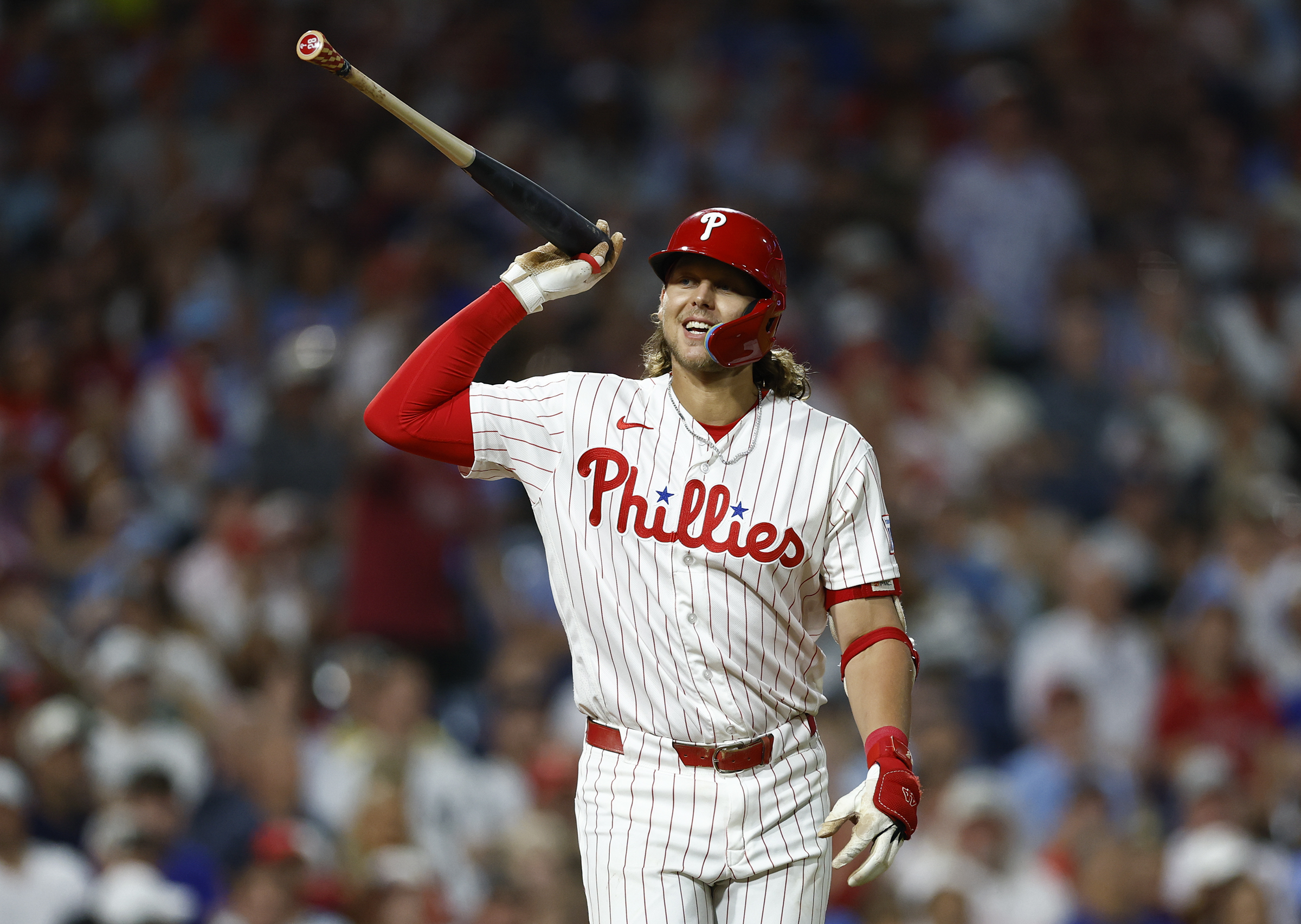
    Since the start of the 2023 season, Phillies infielder Alec Bohm has driven in 341 runs, 18th-most in baseball.Yong Kim / Staff Photographer

    Third degree

    Bohm tends to get judged on things he doesn’t do well, notably his defense and a lack of home-run power for a mountain of a 6-foot-4, 218-pound man.

    Yet as one scout said when Dave Dombrowski convened his top lieutenants at the trade deadline, “When you see a player every day, you have a tendency to look at their downside. But if you compare his numbers, how many guys have more RBIs than he does?”

    Try 17 since 2023, including only one who plays for the Phillies (Kyle Schwarber). Entering the weekend, Bohm needed two RBIs to reach 90 for the third time in four seasons.

    In a sense, then, Bohm represents an organizational success story. Drafted third overall out of college in 2018, developed through the farm system, and brought to the majors in 2020, he has averaged 564 plate appearances per year while batting .274, including a .315 mark with runners in scoring position. He was even an All-Star in 2024.

    Along the way, Bohm got demoted to triple A in 2021 and nearly punched a ticket out of town early the next season. After committing three errors in three innings and getting roundly booed, he got caught on camera saying, “I (bleeping) hate this place.” He was contrite after the game and largely forgiven by the fan base.

    If anything, the Phillies miscast Bohm as cleanup-hitting protection for Bryce Harper and overvalued him at his peak. But replacing him isn’t straightforward.

    Aidan Miller once appeared poised to inherit third base from Bohm. But a back condition sidelined the 23-year-old top prospect until September and limited him to 34 plate appearances, including the postseason with double-A Reading.
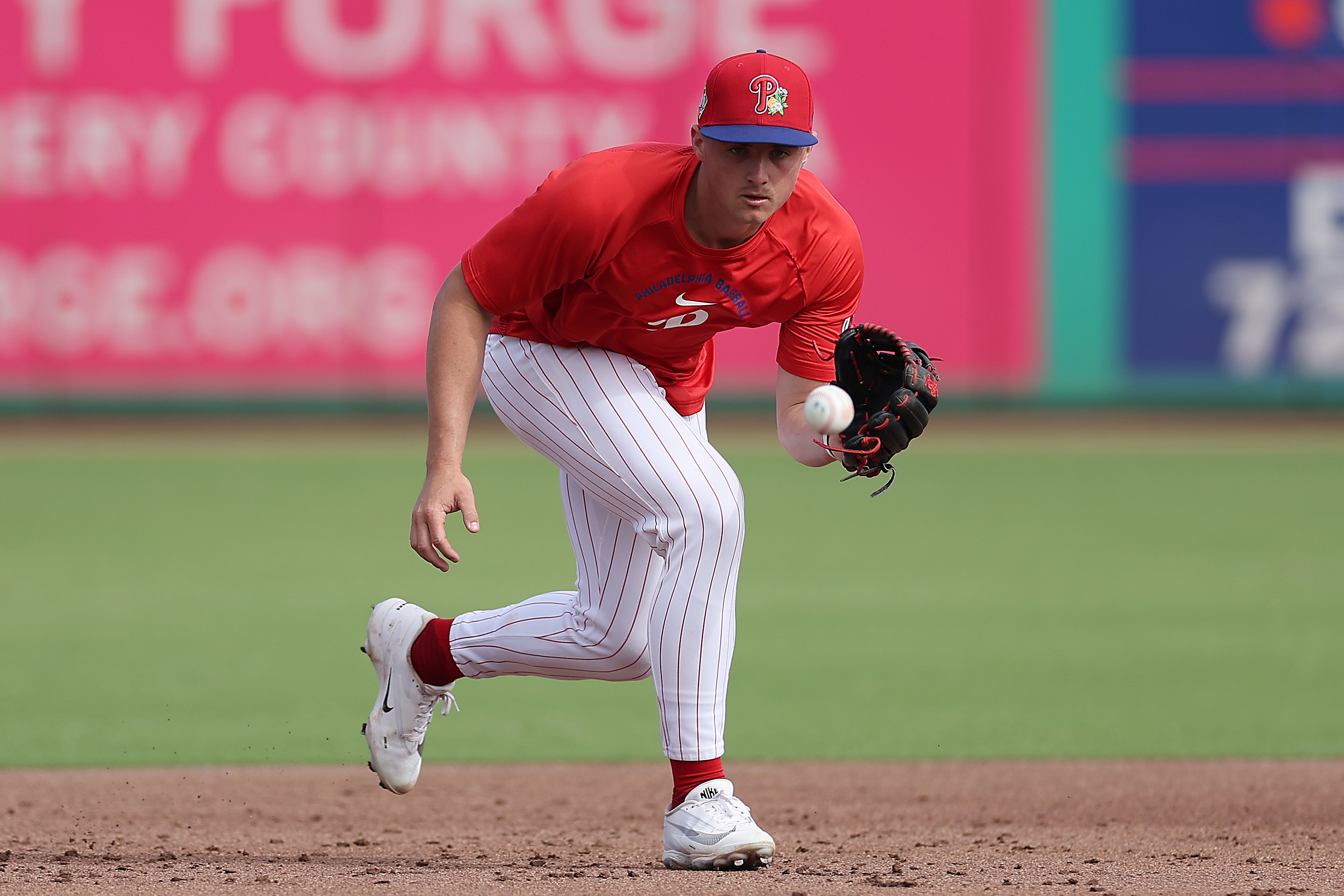
    Phillies top prospect Aidan Miller missed almost all of the season with a back condition.David Maialetti / Staff Photographer

    The Phillies have scouted 27-year-old third baseman Teruaki Sato, who mashed 36 homers this season and 40 last year in Japan’s Nippon Professional Baseball. But he bats from the left side, like Harper and Schwarber (and Bryson Stott and Brandon Marsh), and some major-league evaluators wonder if he’s better suited for first base.

    Oh, and there’s always Bichette, who could opt-out of his Mets deal and reenter the market. But will he really walk away from that $42 million annual salary after a down year? And would the Phillies chase after him again after feeling spurned last winter?

    Meanwhile, Bohm is playing out what’s left of his Phillies career back in the middle of the order as the hottest hitter down the stretch in an overall chilly month for the offense. He entered the weekend with a .319 average and .869 OPS in September; as a team, the Phillies were batting .225 with a .655 OPS this month.

    “The numbers are what the numbers are,” Bohm said of turning his brutally slow start into a respectable finish. “Can’t really do much about it at this point. So, let’s try to go help the team win and contribute in some way. Getting lost in that for a while, they’ve found their way back to, I guess, more of the norm for myself.”
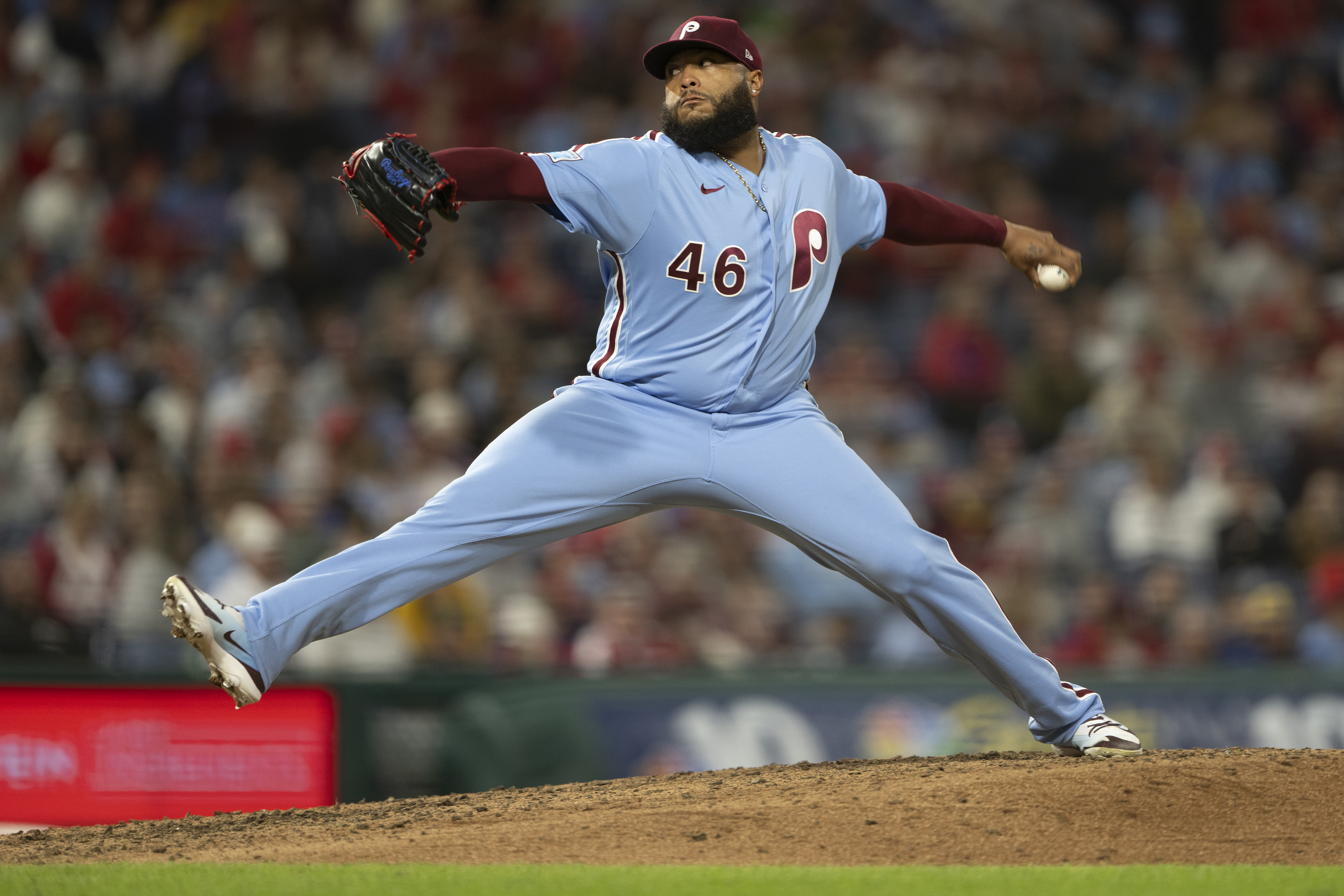
    Phillies lefty reliever José Alvarado has had an inconsistent season.Jose F. Moreno / Staff Photographer

    Seeking relief

    Just when the Phillies thought they could depend again on José Alvarado, he entered a 1-1 game in the eighth inning Thursday night and walked the leadoff batter before giving up a stolen base, an RBI single up the middle, and another single to left field.

    How’s that for a snapshot of his tenure here?

    Dombrowski became the Phillies’ president of baseball operations in December 2020. His first move was the three-way trade that brought Alvarado from the Rays. The big lefty has been dominant at times, injury-prone at others. He gave up the World Series-clinching homer to Houston’s Yordan Alvarez in 2022 and got suspended for 80 games last season for failing a drug test. But he also has unleashed the fifth-most pitches at 98 mph or more since 2021.

    In all, Alvarado has a 3.86 ERA and 378 strikeouts and 152 walks in 293⅔ innings with the Phillies. Opponents have hit .227 against him; lefties have hit .219.

    This season, lefties are batting .333 with an .865 OPS against Alvarado. Maybe he needs to come inside more to lefties. Maybe hitters are sitting on his signature sinker. Maybe he needs to throw more cutters.

    In any case, as Mattingly decides whether he can trust Alvarado in the postseason, the Phillies face a longer-term decision about whether to bring him back (again) in free agency.

    Orion Kerkering can’t be a free agent until after the 2029 season. But the righty is eligible for salary arbitration for the first time. And after posting a 9.43 ERA since the All-Star break, including a 10.66 mark since the middle of August, he became “unusable,” in Mattingly’s words.

    The Phillies demoted Kerkering to triple A last weekend, prompting a larger question: Would a change of scenery be best for everyone involved?
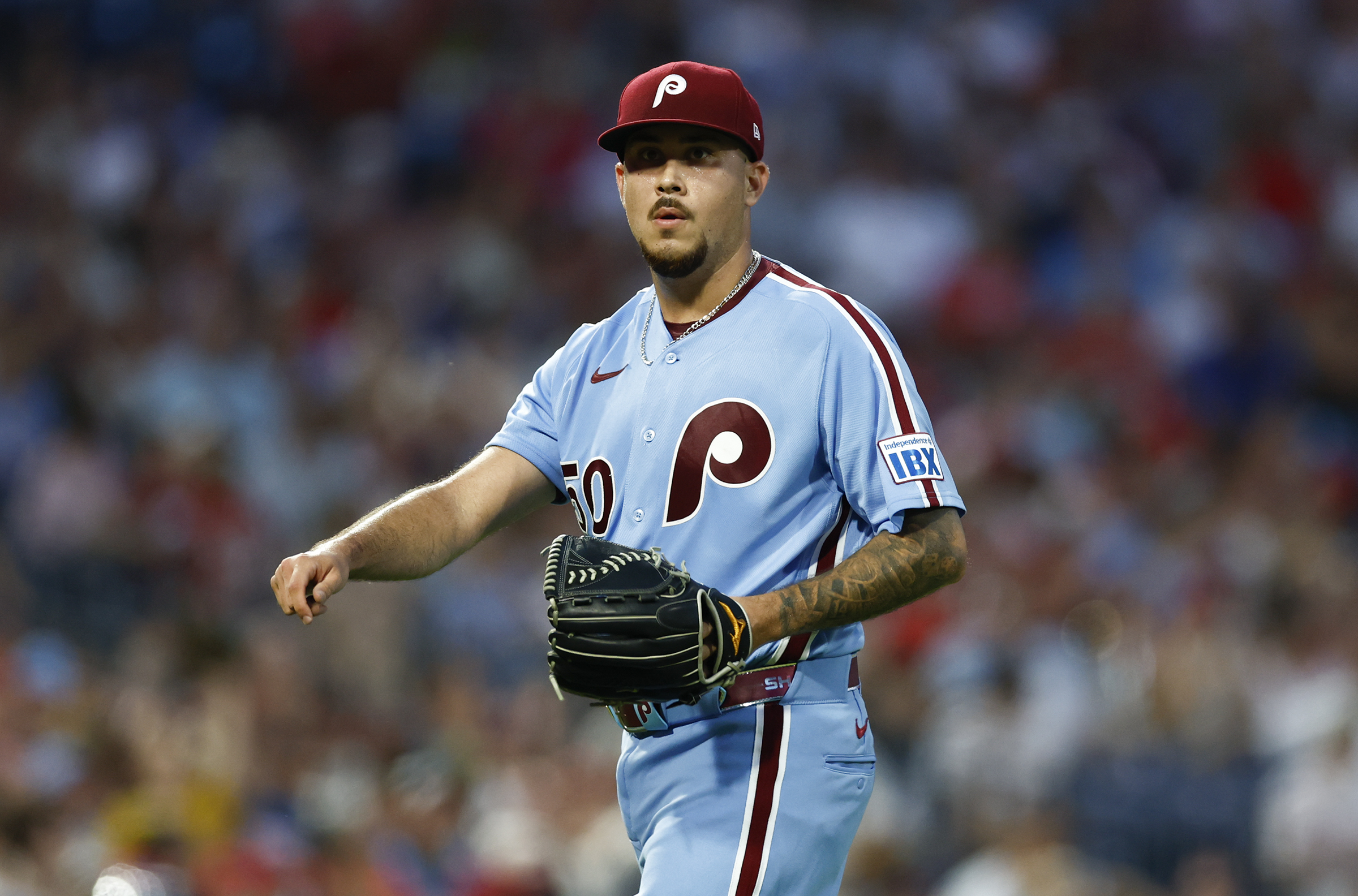
    Phillies reliever Orion Kerkering got demoted to triple A last week.Yong Kim / Staff Photographer

    Let’s come back to that.

    The Phillies drafted Kerkering in 2022 and brought him to the majors 14 months later after he climbed four levels of the farm system in one season. Thrust into high-leverage situations in October, he faltered in the 2023 NL Championship Series against Arizona.

    Even so, Kerkering dominated for stretches in each of the last three seasons, looking at times like a closer-in-waiting. But he was complicit in the bullpen meltdown in the 2024 divisional round against the Mets and made the ill-fated throwing error that ended last season in Game 4 at Dodger Stadium.

    It’s been … a lot. And in a short time.

    So, about that change of scenery. It’ll surely be a topic during the Phillies’ organizational meetings after the season.

    For now, they sent Kerkering to Allentown to continue pitching at their “stay ready” camp, although he’s ineligible for a call-up until Oct. 6 unless there’s an injury.

    “It looks like he needs a break to get away from here,” Dombrowski said. “Sometimes you need to step away.”
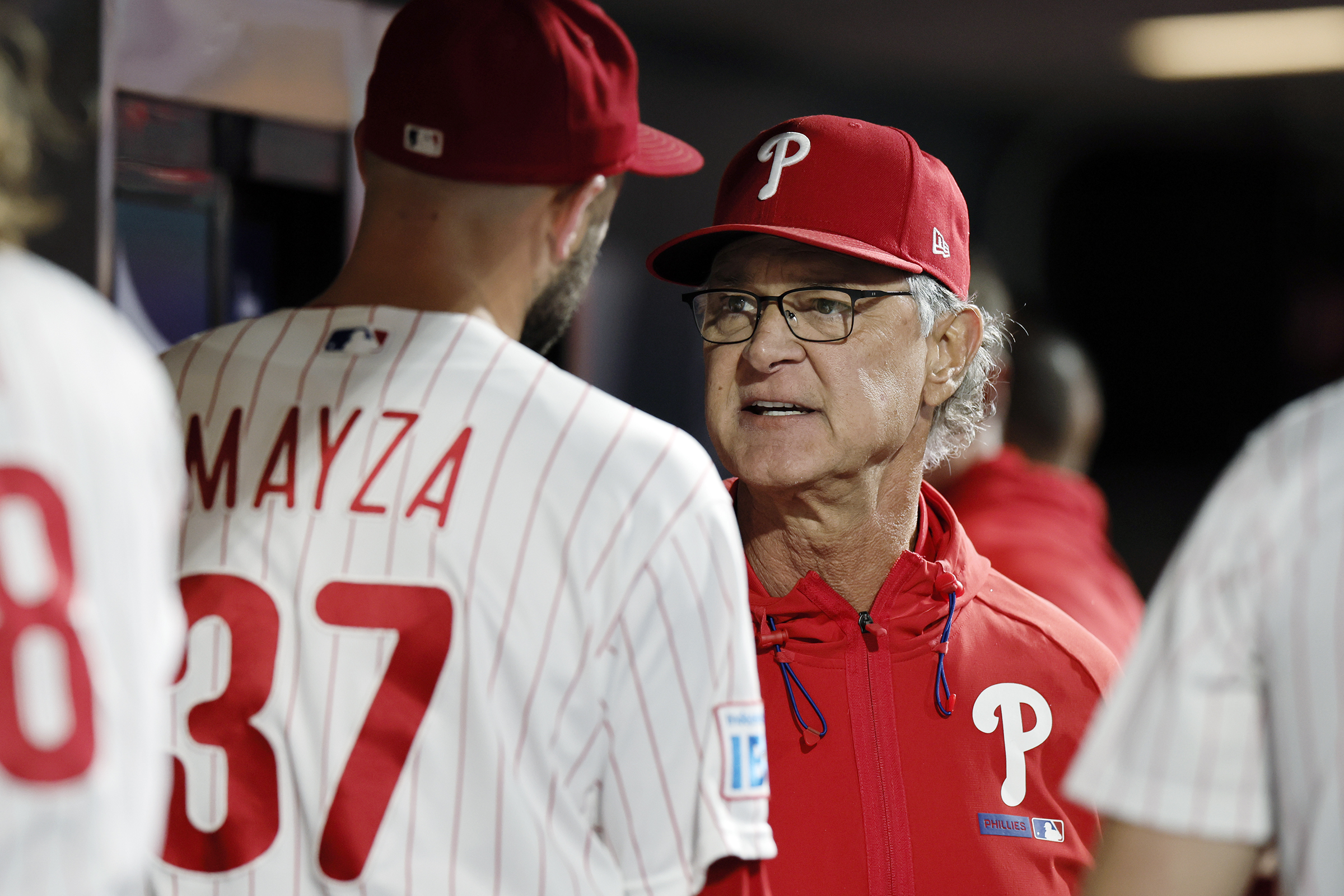
    The Phillies haven’t removed the “interim” label from manager Don Mattingly’s title.Elizabeth Robertson / Staff Photographer

    About the manager

    Earlier this week, the Mets and Red Sox removed the interim label from managers Andy Green and Chad Tracy, respectively, with each receiving a three-year contract to stay at the wheel of those clubs.

    Has there been more thought to Mattingly’s future in the dugout beyond this season?

    “No, there has not been,” Dombrowski said in a text message. “[We] have felt it is better to wait until our season is complete.”

    That has been the Phillies’ stance since April 28, when they elevated Mattingly from bench coach after firing Rob Thomson. But the lack of commitment to Mattingly has only fueled speculation throughout the sport that the managerial seat is being held for Alex Cora.

    Dombrowski hired Cora with the Red Sox, and they won the World Series in their first season together in 2018. They remain close friends, with Dombrowski calling Cora “one of the finest managers in the game of baseball” and comparing him favorably to Hall of Fame managers Jim Leyland and Tony La Russa.

    The Red Sox fired Cora on April 25 amid a 10-17 start. Dombrowski offered him the Phillies’ job the next day, even though he had not yet let Thomson go. Cora, who will be paid by the Red Sox through the end of the next season, opted to take time with his family.

    How’s that for palace intrigue?
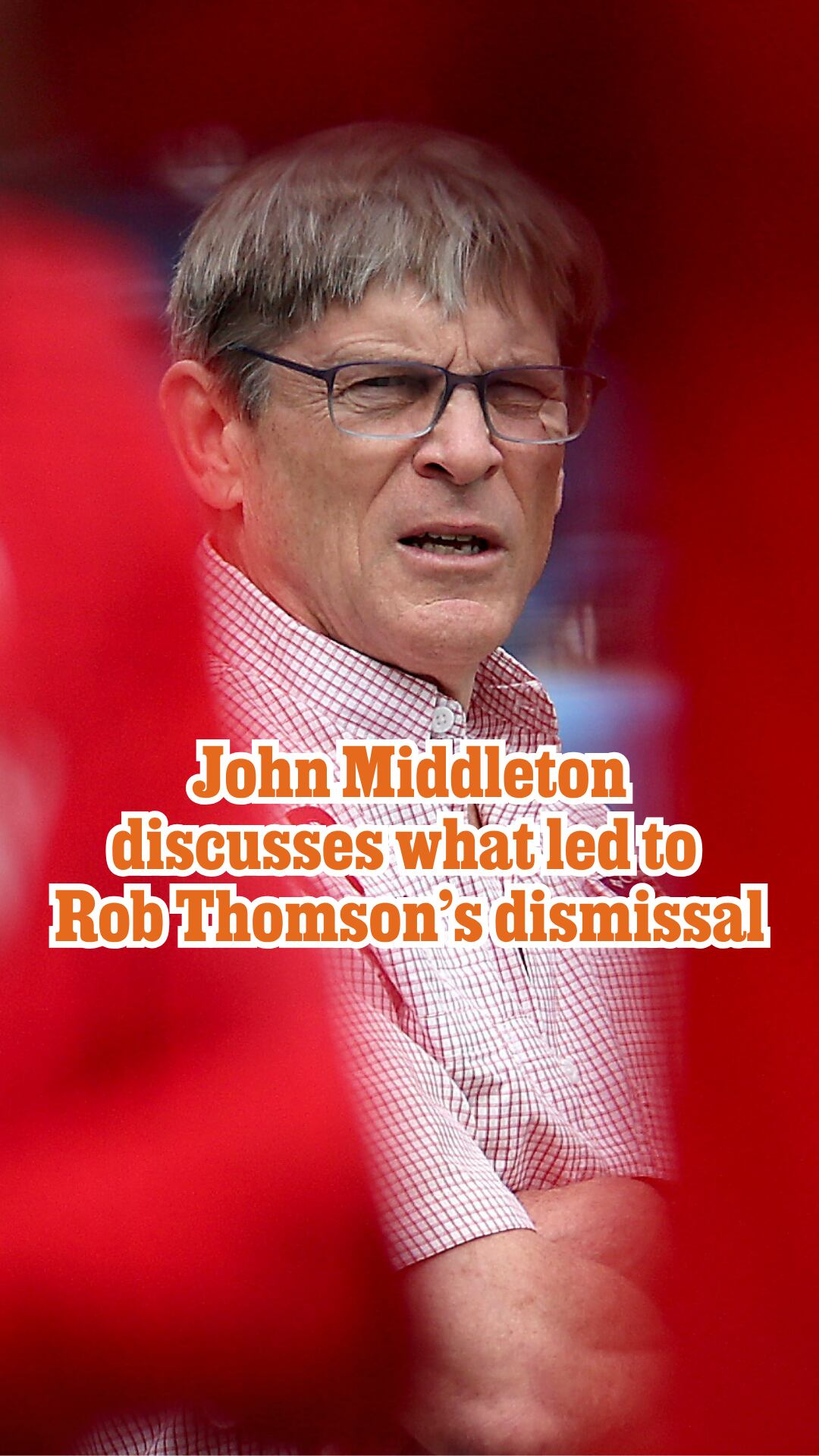
    John Middleton on what led to Rob Thomson's dismissal
    Video: John Middleton on what led to Rob Thomson’s dismissal

    Mattingly, 65, is under contract with the Phillies for another year and has expressed interest in staying on as the manager. His son, Preston, is the general manager under Dombrowski.

    In 2022, the Phillies took the interim tag off Thomson and gave him a two-year contract after winning the wild-card miniseries. How many rounds would the team need to win for Mattingly to receive similar treatment?

    Especially if Cora wants to get back in a dugout.
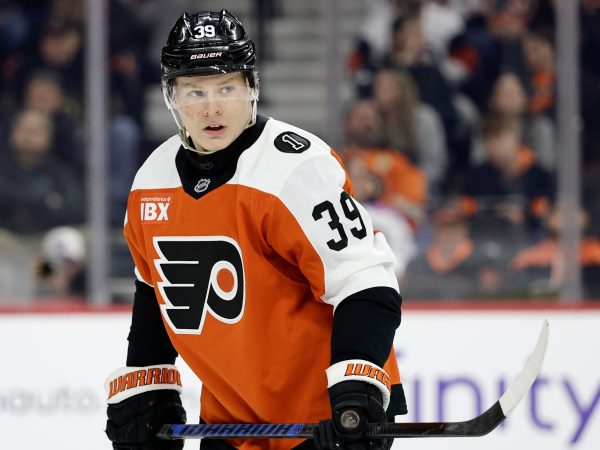
  • Matvei Michkov symbolizes the steps forward the Flyers can take in 2026-27

    Matvei Michkov symbolizes the steps forward the Flyers can take in 2026-27

    One day last spring, just after the Flyers had finished an off-day practice in Raleigh during the Eastern Conference semifinals against the Carolina Hurricanes, Matvei Michkov lingered in the locker room, the only player there.

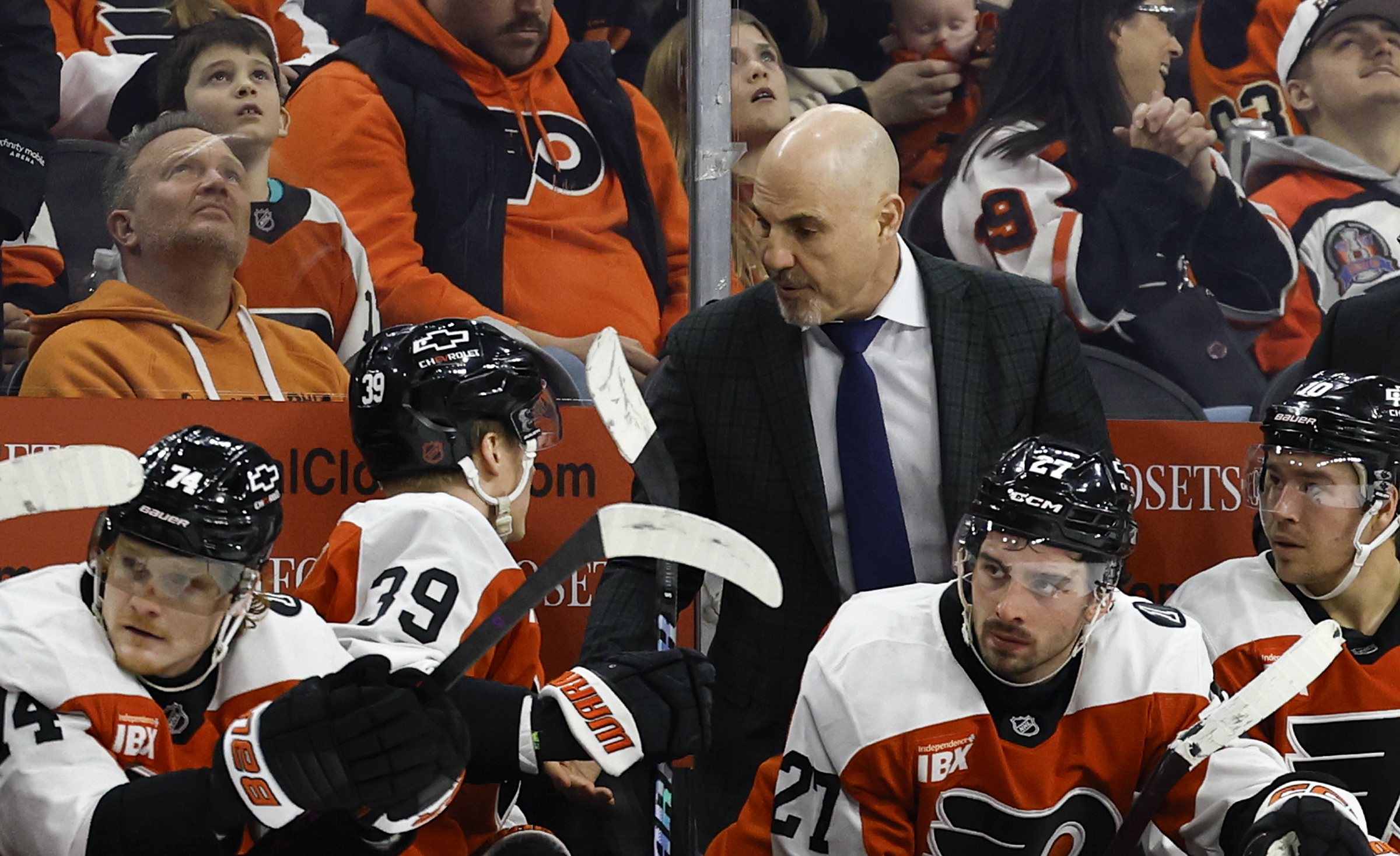
    Two or three media members were hanging out, too, chatting with him about soccer, Michkov chatting back in splintered English. There was no tension. He was not sullen. If anything, he was effervescent: smiling, happy to engage. He did not in any way appear to be shattered by the hard but necessary treatment he had been receiving from head coach Rick Tocchet — limited ice time, often on the team’s third line — and would continue to receive. In just a few days, Tocchet would bench him for Game 4 of the Hurricanes’ series, the overtime loss that ended the Flyers’ season.

    Now here we are, on the precipice of a Flyers season unlike any in the franchise in at least a decade, and Michkov is a reason, maybe the primary reason, for the welcome-if-unfamiliar atmosphere around the team. After the progress that the Flyers made last season — qualifying for the playoffs and winning a series for the first time since 2020, reassuring their fans that the team was, in fact, improving — they’re back to being a team on the rise again. It probably goes too far to say that expectations are or should be high for them, but there is certainly cause for cautious optimism.

    Michkov is at the core of both that caution and those good feelings. His struggles, the fits and starts in his maturation, have been well documented. Considering how long it has been since the Flyers have drafted and developed a bona fide superstar, how often their fans and followers have been sold or were eager to buy bills of goods that turned out to be worthless, it was understandable that people might be concerned that Tocchet was hindering Michkov’s growth, if not stopping it altogether.

    The subsequent four months, and some perspective, should have tempered that worry. Michkov had acknowledged that he was out of shape throughout last season; over the offseason, he said, he improved his diet and lost 29 pounds. And for all the complaints that Tocchet should have just thrown Michkov on the ice more often to sink or skate, for all the tongue-holding that the head coach did and failed to do, in 81 games Michkov still scored 20 goals and put up 51 points, the third-most on the team. If that measure of production constitutes a disastrous season, then the Flyers will happily take their chances on a lighter, presumably faster, revitalized Michkov. He is 21. Nothing is settled or ruined for him.

    Flyers head coach Rick Tocchet and star Matvei Michkov didn’t always see eye to eye last season.Yong Kim / Staff Photographer

    That relative gamble (what, were they really going to give up on another highly drafted player and trade him after one suspect season?) is emblematic of the approach that the Flyers took all offseason. Yes, they shocked the NHL with their eye-popping offer sheet to Leo Carlsson, but if you focus on the moves that they made (not the one they couldn’t quite pull off), it’s easy to see that they’ve made similar bets up and down their roster.

    They re-signed Tyson Foerster to an eight-year, $56.8-million contract on the belief that an excellent two-way player who hasn’t scored more than 25 goals in a full season can be the kind of player who scores 40. They re-signed Trevor Zegras to a four-year, $36.5-million contract on the belief that he can tap even deeper into his well of skill and creativity. They re-signed Jamie Drysdale to a four-year, $26-million contract on the belief that he can be more than a solid No. 2 or No. 3 defenseman, more than just a coping mechanism for the departure of Cutter Gauthier.

    Those players and others like them — Michkov, Foerster, Zegras, Drysdale, Porter Martone — will chart the course of this Flyers season and the franchise’s future, in the near and the long term. What the Flyers are banking on, really, is a factor that so many who work in, cover, and follow sports often forget: that athletes can and do get better with time, that a player won’t remain the same from his second year to his third and his third to his fourth, that a lengthy period of regression or stagnancy — like Michkov’s — doesn’t mean that player won’t return to form or make a great leap. It might even have been a necessary wake-up call.

    Who makes that leap? Who shuffles just a few steps forward? Who seems stuck in place? The answers to those questions will define the ‘26-27 Flyers and will make them fascinating to watch. One player in particular.

  • Penn picked first three faculty spinouts for early stage StartUP investments

    The University of Pennsylvania picked the first three faculty-founded companies for early stage investments from its newly established $10 million StartUP fund, the university said Wednesday.

    The three companies are working in maternal health, advanced radio-frequency filtering technology, and AI-powered drug discovery.

    Each is receiving the maximum investment of $250,000 from the fund launched in December to make seed investments in companies founded by university researchers.

    “Penn researchers are developing technologies with the potential to address some of the most important challenges facing society today, and many of these solutions have the potential to create entirely new markets,” John Swartley, Penn’s chief innovation officer, said in an announcement.

    Here are some details on the three companies:

    • Vasowatch is developing a non-invasive monitoring system to predict the risk of maternal postpartum hemorrhage, a leading cause of maternal death. Its cofounders are Penn Nursing adjunct professor Stefanie Modri and former Penn Engineering faculty James Weimer. The company will use the money to fine-tune the product and to pay for a clinical trial anticipated to start next year.
    • OneFiltr, cofounded by Troy Olsson, a professor in the School of Engineering and Applied Science, has a compact device designed to allow a cell phone to isolate and process specific frequencies. The company will use its investment to further development of its device for evaluation by aerospace and defense companies.
    • Peptaris Inc. has an AI platform for evaluating and developing drugs based on peptides, which are building blocks for proteins. Cofounders are César de la Fuente and Marcelo Der Torossian Torres. The StartUP investment is part of a larger seed round that Peptaris is using refine its model and evaluate its first candidates. Peptaris said in an SEC filing June that it raised $4 million from investors.
  • Redeemer Health CEO Greg Wozniak has resigned from the Montgomery County health system

    Redeemer Health CEO Greg Wozniak has resigned from the Montgomery County health system

    Redeemer Health CEO Greg Wozniak has resigned from the financially troubled nonprofit Montgomery County health system after a little more than two years, Redeemer announced Thursday.

    Replacing Wozniak on an interim basis is chief transformation officer Jim Logue, who has held the role since early 2025.

    Redeemer has posted operating losses every fiscal year from 2017 to 2025. It hasn’t yet posted financial results for the fiscal year that ended in June.

    “Jim and his team will work with our financial advisors and counsel to implement a reorganization of the Redeemer system to assure its continued viability and a sustainable business model,” board chair William R. Sasso said in an internal communication obtained by The Inquirer.

    “This reorganization is expected to involve some significant organizational changes which will be announced in the coming weeks as they are finalized,” the note said.

    More than four years ago, Redeemer announced that it was seeking what it called a “strategic partner” for its 239-bed hospital in Meadowbrook, near Abington, but nothing came of that effort.

    Redeemer also operates a home care business, nursing homes, senior apartments.

    Redeemer announced additional personnel changes Thursday in its internal communication, including the departure at the end of this month of chief financial officer Kim Cummings. Former CFO Michael Keen is returning to that position.

    Another returning executive is Donald Friel, a former executive vice president tapped to assist Logue.

    Diane Derr, who has been at Redeemer for 44 years, is being promoted to chief administrative officer from chief nursing officer.

    Editors note: This article has been updated to correct Derr’s history with Redeemer.

  • Rural Health Transformation Fund leaves gaping hole in finances at Pa.’s Geisinger Health

    Rural Health Transformation Fund leaves gaping hole in finances at Pa.’s Geisinger Health

    Geisinger Health expects to lose more than $180 million in revenue next year when deep cuts to Medicaid start impacting the nonprofit health system with 10 hospitals in a largely rural stretch of central and northeastern Pennsylvania.

    The Rural Health Transformation Program — meant to soften the blows from the cuts imposed by Congress under Republican’s so-called “One Big, Beautiful Bill Act” or H.R. 1 — offers limited relief. Geisinger expects to collect $6.7 million of the $193 million allotted to Pennsylvania.

    “It’s given us some money for some critical infrastructure that we need,” such as a CT scanner or an MRI machine for hospitals that serve rural counties, CEO Terry Gilliland said in an interview last month.

    But much of the money being distributed through the Rural Health Transformation Program, or RHTP, isn’t going to help rural hospitals because it wasn’t designed to do that. No more than 15% of the funding can be used to reimburse providers for healthcare services.

    That has left Geisinger, which is owned by California-based Kaiser Health, in a tough spot: “H.R. 1 is taking a big old chunk out of our hide, and there’s just no way for RHTP to fill the hole,” he said.

    Nationally, $911 billion in Medicaid cuts are anticipated over a decade, with $137 billion is expected to come from rural areas, according to KFF, a nonprofit that researches health policy. KFF’s analysis did not provide state estimates for rural losses.

    The Rural Health Transformation Fund totals $50 billion over five years. Pennsylvania would receive $965 million if it were to get the same amount each year as it did this year. Philadelphia-area health systems haven’t received money from the fund yet, but could participate in the future through projects that benefit rural Pennsylvania.

    Where the money is going

    The rural health fund is an incomplete response to the revenue hole created by H.R. 1, said Katherine Hempstead, a senior policy officer at the Robert Wood Johnson Foundation, a Princeton-based philanthropy focused on healthcare advocacy and research.

    “It is mostly targeted to upstream projects designed to make rural healthcare more efficient in the long run. They may or may not be successful,” she said.

    So far, Pennsylvania has provided a breakdown of how it is spending the first $42.2 million of its first year award.

    All but $2 million went to technology and infrastructure projects, including critical needs like new roofs, HVAC systems, elevator repairs, and the repair of a collapsed sewer line.

    On the technology side, new imaging equipment was popular in the first funding round.

    With $3.7 million from that round, Geisinger got a new X-ray machine for its Bloomsburg hospital, new CT units for Jersey Shore and Lewisburg hospitals, and an upgraded compounding pharmacy for its flagship hospital in Danville.

    Geisinger applied for $3 million from a forthcoming second round and plans to use the money for a special EMS vehicle, transport vans for senior care, telehealth equipment, and other capital equipment, if it is approved.

    In addition to technology and infrastructure, Pennsylvania is focusing the rural funding on workforce development, maternal health services, behavioral health services, aging and access, and emergency medical services and transportation.

    Geisinger’s approach to filling its financial hole

    Geisinger’s estimated $180 million revenue loss next year has three main drivers. They are limits on how much federal money the state can generate through provider taxes, changes to the supplemental payments for hospitals with large numbers of Medicaid patients, and an increase in the uninsured population caused by new Medicaid enrollment rules.

    In 2025, Geisinger had about $10 billion in revenue. That’s up from $7.7 billion in 2023, that last full year before it became part of Risant Health, a new nonprofit created by Kaiser in 2023 to acquire community health systems.

    Already this year, Geisinger has seen a $10 million a month increase in charity care and bad debt write-offs, Gilliland said, which he attributed to people not being able to afford individual Affordable Care Act plans after the enhanced tax subsidies expired.

    Geisinger also expects a $47 million loss of revenue from the federal 340b drug discount program.

    “How many more of these hits can I take? The answer is not very many,” Gilliland said.

    The health system is focused on becoming more efficient.

    “There’s some optimism that says we could find some way to have artificial intelligence do some of the tasks that we typically throw humans at,” Gilliland said.

    He hopes to avoid want layoffs, given that Geisinger is often the largest employer in its communities.

    “I’d really like to figure out ways to fill the hole without having people lose their jobs because that has a much more devastating impact on the local economy,” he said.

  • Highmark reached an agreement to keep Rothman Orthopaedics in network after Oct. 1

    Highmark reached an agreement to keep Rothman Orthopaedics in network after Oct. 1

    Highmark reached an agreement to keep Rothman Orthopaedics in network for Pennsylvania customers of Highmark Blue Shield plans and federal employee health programs after Oct. 1, the two companies said Wednesday.

    The Pittsburgh-based insurer had issued a termination notice over the summer, alleging that about a half-dozen Rothman surgeons were abusing a federal process designed to protect patients from unforeseen out-of-network bills.

    The dispute centered on the use of out-of-network physician assistants by Rothman surgeons who do not have residents or fellows working for them and need help treating patients.

    Highmark said that the practice violated a contract that took effect at the beginning of last year and that the use of arbitration under the federal No Surprises Act generated extraordinarily large payments for the physician assistants.

    The physician assistants worked for separate company that Rothman, a practice, had no control over, a Rothman official said earlier this month.

  • First Jesús Luzardo, then Landon Dickerson, and now Dan Vladař: Strike 1, 2, 3 for the Phillies, Eagles, and Flyers?

    First Jesús Luzardo, then Landon Dickerson, and now Dan Vladař: Strike 1, 2, 3 for the Phillies, Eagles, and Flyers?

    They say bad luck runs in threes. If you’re superstitious, maybe you think Philadelphia is finished with its streak of misfortune.

    Strike One: On Sept. 11, the Phillies announced that All-Star lefty Jesús Luzardo had a sore shoulder. He landed on the injured list four days later.

    Strike Two: On Sept. 14, the Eagles placed three-time Pro Bowl left guard Landon Dickerson on injured reserve with a bone bruise to his twice-repaired right knee.

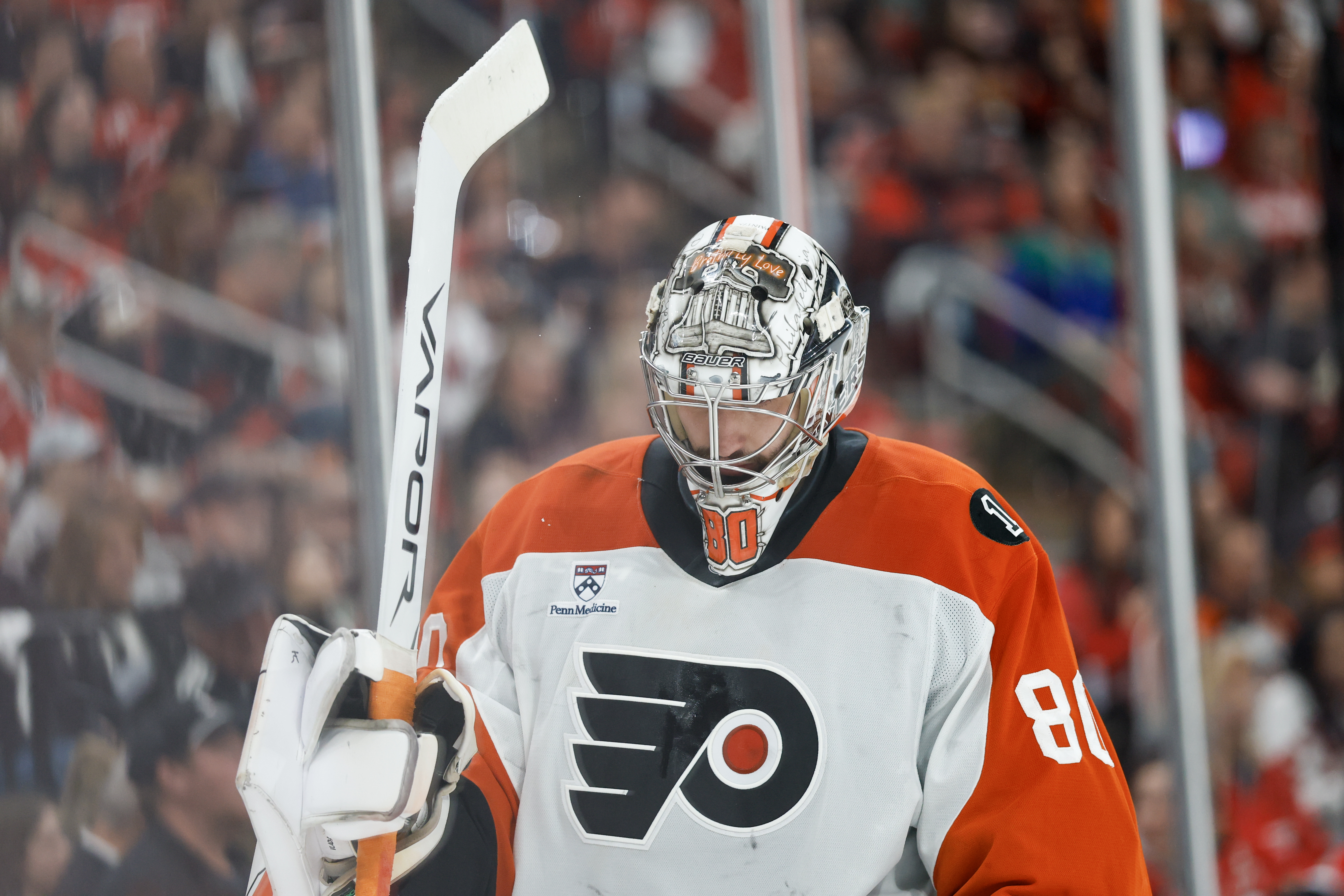
    Strike Three: In a preseason game Tuesday night, Dan Vladař, the Flyers’ goalie and linchpin, left after absorbing a glancing blow from Bruins forward Tanner Jeannot.

    Vladař appeared to take a skate to the back of his right arm, which he also appeared to injure last spring. He was uninterested in retrieving his stick and the Bruins scored. After that, Vladař got his stick back, but he could not manipulate it. Before play resumed, he skated off the ice, bent over in pain.

    Did the Flyers’ hopes of relevance skate off with him?

    The Flyers have offered no update. Maybe they were shell-shocked. They have every right to be shell-shocked.

    After the last 11 days, so do Philly sports fans.

    Repercussions

    You could argue that losing Vladař is not catastrophic, especially if his absence is brief. The season doesn’t start for a week. The Flyers upgraded their goalie stable in June when they shed Sam Ersson and traded for Joseph Woll, and the rest of the team is pretty good.

    If Dan Vladař’s injury is serious, the Flyers will turn to new backup Joseph Woll.David Zalubowski

    This is short-sighted.

    Vladař was the team MVP last year. At the age of 28, and in his first chance as a full-time starter after four full seasons in the NHL, Vladař, despite being a goalie, was the de facto captain of the team last year. He was its spirit and its soul. He led a team with no power play and a bunch of skittish kids through a wild stretch run, into an unlikely playoff berth, and past the rival Penguins in the franchise’s first series win since 2020.

    He might not have been the best Flyer — that was probably defenseman Travis Sanheim if it wasn’t leading scorer Travis Konecny — but he certainly was the most valuable.

    Vladař’s absence will be felt more than Dickerson’s, or even Luzardo’s.

    ‘Zeus’

    After he dealt his first complete-game shutout Sept. 7, “Zeus” had, against all odds, earned the undisputed right to be the Game 1 pitcher in the Phillies’ expected postseason run. This, in a year in which Zack Wheeler and Cristopher Sánchez both should get Cy Young Award votes (as should Luzardo).

    The ability to sandwich Wheeler — perhaps the best pitcher in Phillies history, when you include playoff effectiveness — between two elite left-handers is the sort of advantage managers dream of. What’s more, the Braves’ trio of Ronald Acuña Jr., Matt Olson, and Ozzie Albies are a combined 15-for-73 against Luzardo all time, with 19 strikeouts and only six walks.

    The Phillies would have strongly considered starting Jesús Luzardo in Game 1 of the NLDS. Now, they must wait to see if he’s even available.David Maialetti / Staff Photographer

    Luzardo is able to come off the IL on Saturday, and he threw on flat ground for the first time Monday and Tuesday with no immediate ill effects. But a gentle game of catch is wildly different from throwing an adrenalized 97 mph 70 times, off a mound, in a playoff game. If the Phillies use Luzardo at all, it probably won’t be until the end of the NLDS, if they get that far.

    Going left-right-left with their starters was the Phillies’ only real hope to beat the likes of the Dodgers, Brewers, or Braves, the latter their most likely opponent as things stand. And while Aaron Nola’s last 10 starts have been encouraging, Acuña (1.037 OPS) and Olson (1.075 OPS) own him.

    The Phillies’ bullpen lacks a dependable piece outside of closer Jhoan Duran. The lineup is maddeningly inconsistent, and one-third of it is utterly undependable: the No. 2 spot, with Trea Turner; No. 7, with Brandon Marsh; and No. 8, with J.T. Realmuto.

    The defense stinks. There is little real speed.

    The strength was left-right-left. Oh, well.

    Run it back

    In 2024, when Saquon Barkley won Offensive Player of the Year with 2,005 rushing yards, more than half of his runs went to the left side, where he averaged 4.0 yards before first contact from a defender. Not coincidentally, Dickerson enjoyed his best season in 2024, according to Pro Football Focus, which, nonetheless, criminally under-graded him, but that’s a different discussion.

    The discussion here is: If Dickerson isn’t healthy, then the Eagles’ run game simply won’t work. Not like it did in 2024, when the run game was the chief factor on their path to winning Super Bowl LIX.

    Eagles guard Landon Dickerson has suffered a litany of injuries in both college and the pros. His loss is a major hit to the team’s run game.Yong Kim / Staff Photographer

    It’s only been two games but the Birds are having lots of trouble running the ball. If you subtract Jalen Hurts’ rushing totals, most of which have come on scrambles, they’re averaging 81.5 rushing yards per game. In 2024 they averaged 179.3 rushing yards. In 2025, their rushing average fell by 62.4 yards.

    Why? Partly because of injuries all along the line, including the seven-game absence of right tackle Lane Johnson. That was not the entire reason.

    In 2025, Dickerson fought through pain in his surgically repaired knees and ankles that was so bad he got stem-cell injections in all four joints in March. He played so badly that sources say he contemplated retirement (which he now denies).

    This season, after Dickerson limped through Game 1 with the bone bruise, Cam Jurgens replaced Dickerson at guard in Game 2. Jurgens was, somehow, even worse in Week 2 than Dickerson was in Week 1. To be fair, Jurgens is a former Pro Bowl center with some experience at guard — but at right guard. Jurgens moved from center to guard last game. Fifth-round pick Drew Kendall, in his second year, started at center. It was a mess.

    An underlying effect here concerns the play of left tackle Jordan Mailata. He was the best offensive lineman in football in 2024, when, perhaps not coincidentally, Dickerson had his best season playing next to him. Mailata was still very good, though appreciably worse in 2025. So far, he’s playing even worse in 2026.

    Does this mean Dickerson made Maliata? Or vice versa? No: It means that the pair of them together is far greater than the sum of the parts.

    That pair doesn’t seem likely to reunite any time soon.

    Watching Vladař leave Tuesday’s game, he seems like a long-term loss, too.

    At least the luxury of time provides hope in both of those situations.

    For the Phillies and Zeus, time just might run out.

  • With tight ends hurt and blockers struggling, the Eagles need Zach Ertz to be more than a good story

    With tight ends hurt and blockers struggling, the Eagles need Zach Ertz to be more than a good story

    It’s simultaneously hard to believe that Zach Ertz has been gone for five years and easy to forget that his Eagles tenure overlapped with Jalen Hurts’. Time is funny like that, I guess. The question is whether Ertz can still play football. It’s a crucial one for the Eagles.

    It’s a decent bet that Ertz can still run and catch. He sure could before he tore his ACL last December. Even at 35 years old, in a subpar Commanders offense, Ertz was on pace for 70 catches and 700 yards before injuring his knee against the Vikings in Week 14. In his year-plus with the Commanders, he was averaging nearly four catches and 40 yards per game. Travis Kelce and Tony Gonzalez are the only tight ends in NFL history to average those numbers at age 36+. But, then, Ertz was one of only six to do it at age 35+.

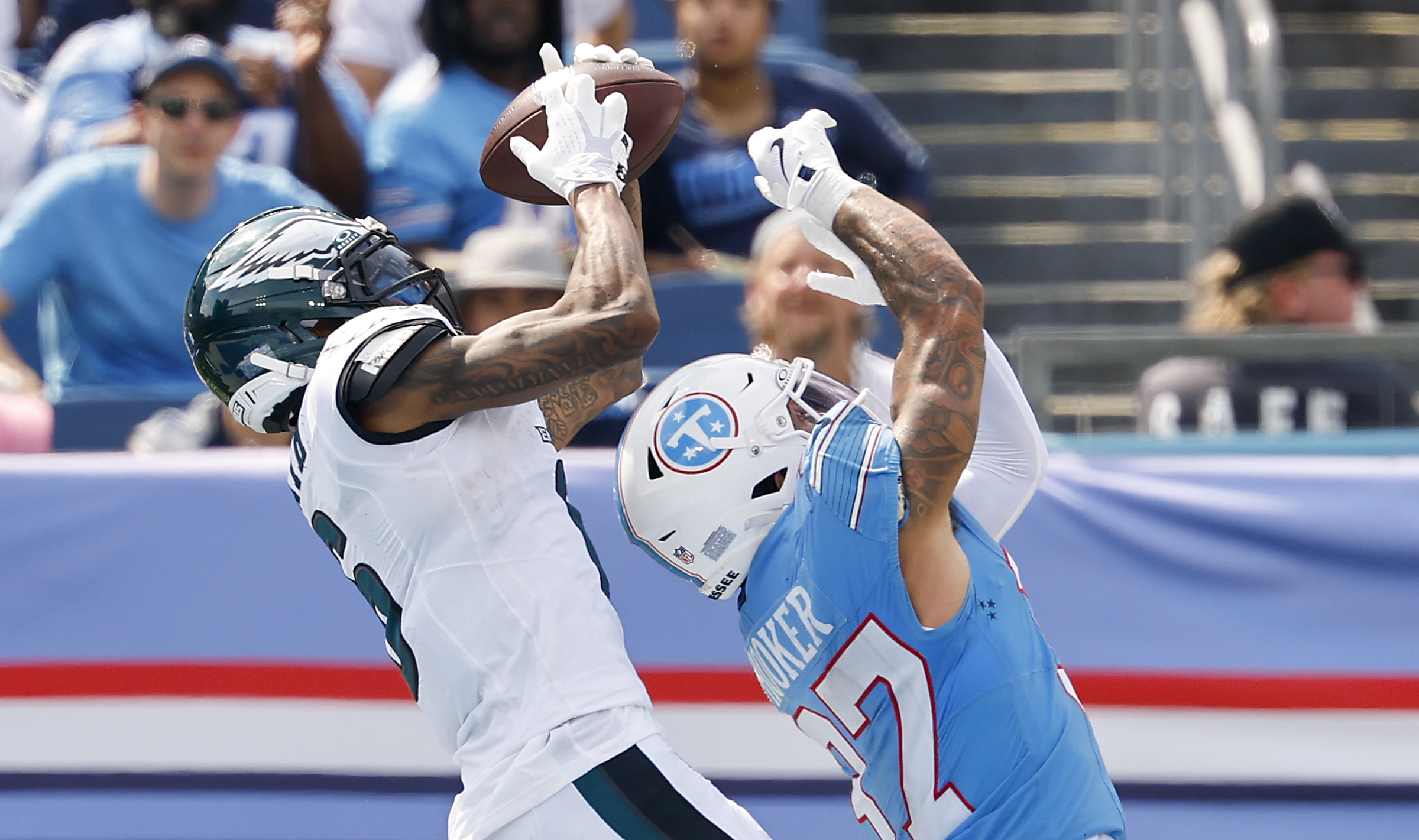
    The bigger unknown is whether Ertz can help replace all of the other things Dallas Goedert did before spraining his MCL in the Eagles’ 24-20 win over the Titans on Sunday. Goedert has played a central role in offensive coordinator Sean Mannion’s scheme through two weeks, with Mannion moving his 31-year-old tight end all over the field to take advantage of his abilities as both a receiver and as a blocker in the run and short-passing game.

    Goedert’s absence is a particular concern given the blocking struggles that have plagued them as a team. The Eagles rank among the NFL leaders in zero and negative yardage plays. Through two weeks, they’ve seen 18 runs and passes go for zero or negative yards. That’s 14.6% of their touches from scrimmage, more than all but three teams (Raiders, Patriots, Colts).

    Ertz was never regarded as a great blocker, even in his prime. The Eagles don’t need him to be great. But it would sure help if Ertz could be good enough to expand Mannion’s options for replacing Goedert while also fixing the overall run/short-passing game. It’d also be a great story.

    If Zach Ertz can reclaim his old Eagles magic, he’ll have a chance to ascend to the top of the franchise’s receptions list. DAVID MAIALETTI / Staff Photographer

    When the Eagles traded Ertz in 2021, midway through Hurts’ first full season as a starter, he was 11 catches shy of becoming the franchise’s all-time leader in receptions. His 579 catches are 10 behind Hall of Fame receiver Harold Carmichael and 127 more than Hall of Fame tight end Pete Retzlaff. Ertz might only keep the record for a year, given DeVonta Smith’s rapidly rising career total (398 at the moment). Still, it would tie a nice bow on a career that began in Chip Kelly’s first season as coach.

    Most of the heavy lifting will need to be done by Mannion and general manager Howie Roseman. The Eagles have leaned heavily on veteran blocking tight end Johnny Mundt thus far. His current 52.7% snap share is dramatically higher than the rate he logged in any of his first nine NFL seasons. One option is to make heavier use of Mundt in “11″ personnel paired with Darius Cooper, the Eagles’ best blocker at wide receiver. But, again, Mundt has never been a full-time player. His career-high single-season receiving totals are 19 catches and 172 yards.

    However Mannion decides to handle his personnel groupings, there will be tradeoffs. There is a reason why a legitimate two-way tight end has become one of the NFL’s more valuable commodities. There might not be another position in sports where the paradigm has shifted as dramatically as it has since Ertz entered the league. When the Eagles selected him at No. 35 overall in 2013, the previous four drafts had seen just seven tight ends go in the first or second rounds. That’s less than half the number of tight ends that went in the first and second rounds in the most recent four-year window (18, including Eagles rookie Eli Stowers).

    The renewed emphasis on the position has been evident through the first two weeks of the NFL season. Of the 14 players with 12+ receptions, five are tight ends. Buffalo’s Dalton Kincaid, Houston’s Dalton Schultz and Kelce all rank among the top 12 in receiving yards. Last season, the Rams had four tight ends rank among their top seven target-earners for a team that led the league in scoring.

    With teams increasingly relying on nickel and three-safety defensive packages, and with defensive coordinators prioritizing versatility, tight end is a position that can decide which team has the matchup advantage on any given play. The question isn’t how close Ertz is to the player he was. It’s how close can he be to the players the Eagles suddenly need.

  • Look up 100 top-paid employees at nonprofit health systems in the Philadelphia region in 2024

    Look up 100 top-paid employees at nonprofit health systems in the Philadelphia region in 2024

    Pay and benefits typically account for more than half the total costs in hospital systems at a time when healthcare costs are rising sharply in the Philadelphia region and nationally.

    Local nonprofit health systems reported compensation ranging from $1.2 million to $3.7 million in 2024 for the 100 highest-paid employees listed in their most recent federal nonprofit tax returns. The ranking excludes system CEOs.

    Meanwhile, employers are expecting insurance increases approaching 10% for the coming year, according to several national surveys by benefits consultants. Experts cite increased use of healthcare services, widespread use of expensive specialty drugs, and rising hospital prices as key factors leading to overall rising benefit costs.

    Clinicians accounted for 60 spots in The Inquirer’s top 100 ranking, which is based on compensation reported in dozens of 990 tax forms from Philadelphia-area hospitals, affiliated physician groups, and other related entities.

    Highly specialized neurosurgeons accounted for the highest number of top-paid clinicians, followed by cardiac and cardiothoracic surgeons and orthopedic surgeons.

    Chief financial officers and chief operating officers were well represented in the management ranks.

    The region’s largest health system also claimed its highest-paid non-CEO, Jefferson Health president and physician Baligh R. Yehia. His $3.7 million in compensation also topped that of all but two CEOs, as disclosed in a previous Inquirer analysis.

    Thomas Jefferson University, which is Jefferson Health’s parent entity, had 30 executives and physicians in The Inquirer’s top 100. The Jefferson group includes four executives who left during or before 2024, but not salaries reported through the Lehigh Valley Health Network, which Jefferson acquired in August of that year.

    Children’s Hospital of Philadelphia had the second-largest number of employees in the top 100, with 18, including surgeons and numerous top executives, such as CFO, general counsel, and head of human resources.

    Virtua was third, with nine employees, mainly surgeons.

    Across the region, 176 nonprofit health system employees received at least $1 million in total compensation in 2024. That amounts to one in five employees in The Inquirer’s database of more than 800 people.

    IRS rules require nonprofits to report compensation for officers, highest-paid employees, and employees with a certain level of responsibility.

    (function(){function e(){window.addEventListener(`message`,function(e){if(e.data[`datawrapper-height`]!==void 0){var t=document.querySelectorAll(`iframe`);for(var n in e.data[`datawrapper-height`])for(var r=0,i;i=t[r];r++)if(i.contentWindow===e.source){var a=e.data[`datawrapper-height`][n]+`px`;i.style.height=a}}})}e()})();

  • NFL Week 2: A.J. who? Feed DeVonta Smith; Eagles’ opponents having horrible injury luck

    NFL Week 2: A.J. who? Feed DeVonta Smith; Eagles’ opponents having horrible injury luck

    Since 2021, the year he was drafted just ahead of DeVonta Smith, Ja’Marr Chase has been targeted at least 10 times in 38 games. Justin Jefferson has been targeted at least 10 times in 39 games. CeeDee Lamb, 37.

    Smith: 16.

    The most recent: a 13-target, 10-catch explosion Sunday in Tennessee for 117 yards and a touchdown. Four of those targets came during the game-winning, fourth-quarter drive, when everyone in Nissan Stadium knew that Hurts would be looking for Smith on virtually every snap, the way Joe Burrow looks for Chase, Dak Prescott looks for Lamb, and whoever is Minnesota’s flavor of the moment looks for Jefferson, which only underscores Jefferson’s unmatched ability.

    But I digress.

    A number of reasons factor into Smith’s lower frequency of high targets. Among them: the presence of tandem receiver A.J. Brown from 2022-25; the presence of high-volume running back Saquon Barkley from 2024-26; and the presence of Jalen Hurts, a reluctant and limited passer whose 2,307 pass attempts and 1,505 completions since 2021 lag far behind the other nine quarterbacks who have played in at least 75 games.

    The point?

    The Eagles must feed Smith the way the Bengals feed Chase, the way the Vikings feed Jefferson, and the way the Cowboys feed Lamb.

    There no longer is any reason not to.

    There was much hand-wringing after Brown forced a trade to New England, reaction that now seems to have been overwrought. At any rate, he’s gone.

    Barkley clearly lacks the explosion and elusiveness that earned him the Offensive Player of the Year award in 2024.

    Which leaves Smith as the clear and constant No. 1 option.

    Smith beats man-to-man coverage, finds space against zones, makes contested catches and low catches and throws that lag behind him, and he has toe-tap sideline feet like Cris Carter. He has superb speed and is eager to catch in middle-of-the-field traffic.

    NFL rules were rewritten several times over the past three decades to make Smith and his ilk essentially unstoppable. Use him as such.

    Locking on Smith might occasionally lead to ruin, as was the case with Hurts’ first interception Sunday. But Hurts misdiagnosed a zone coverage as man-to-man, so that’s on Hurts. The better throw was probably to the other side, where Dontayvion Wicks was open in the corner. But again, I digress.

    I’m not jumping on a bandwagon here. I campaigned for the Eagles to draft Smith out of Alabama during the first half of the 2021 College Football Playoff title game.

    Before the season began, I predicted that Smith would rewrite the Eagles’ record books in 2026. It still could happen.

    We’ve seen other passers lock onto elite pass-catchers with negative outcomes: Prescott to Lamb, Josh Allen to Stefon Diggs when they were paired in Buffalo, Patrick Mahomes to Tyreek Hill when they were paired in Kansas City. It’s going to happen.

    Hurts’ second interception also was intended for Smith, who was wide open for at least a 30-yard gain, if not a touchdown. However, Cam Jurgens, who’d switched from center to left guard to replace injured Landon Dickerson, got beat cleanly by defensive tackle Jeffery Simmons, the Titans’ best player. Hurts failed to step up in the pocket, which continues to be one of his deficiencies, and, like most other quarterbacks, he lacks the arm strength to throw flat-footed through contact.

    If this seems like a lot of Hurts criticism, understand that, for years, I have presented Hurts as a franchise quarterback, full stop. But all except the best of franchise QBs have weaknesses, and Hurts has never been the best player on any Eagles roster.

    Considering the continued regression of offensive tackles Lane Johnson and Jordan Mailata, the stalled production of Barkley, and the inconsistency of defensive tackle Jalen Carter, the best candidates for that designation are linebacker Zack Baun, who makes the basic play; cornerback Quinyon Mitchell, who doesn’t intercept passes; and Smith.

    In this moment, Smith wins in a landslide.

    Feed him.

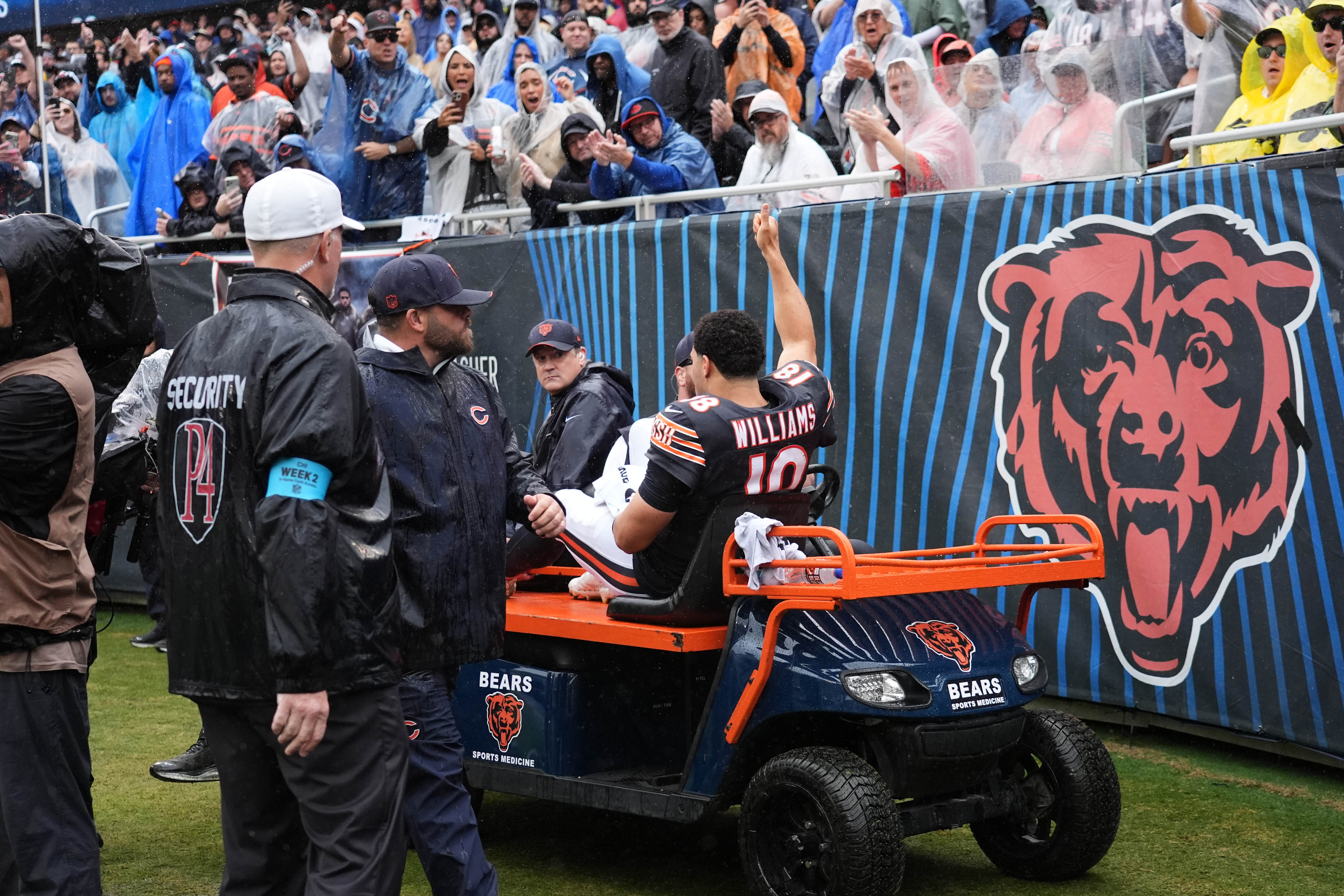
    The Bears’ Caleb Williams was carted off with a hamstring injury Sunday, eight days ahead of a meeting with the Eagles. Nam Y. Huh

    Injury attrition

    Nothing guarantees wins in the NFL, even when the other teams’ best players suffer injuries. But some of the most accomplished players the Eagles were scheduled to face have been beset by a series of misfortunes.

    In August, the Commanders lost five-time Pro Bowl left tackle Laremy Tunsil to a torn triceps. He was their best player. The Eagles beat the Commanders in Week 1.

    On Sunday, the Bears lost star quarterback Caleb Williams to a hamstring injury. Even if Williams’ injury is minor, there’s a good chance he will not be allowed to start, and if he does start, he certainly won’t be as dynamic a threat as he usually is. The Eagles play in Chicago on Monday night.

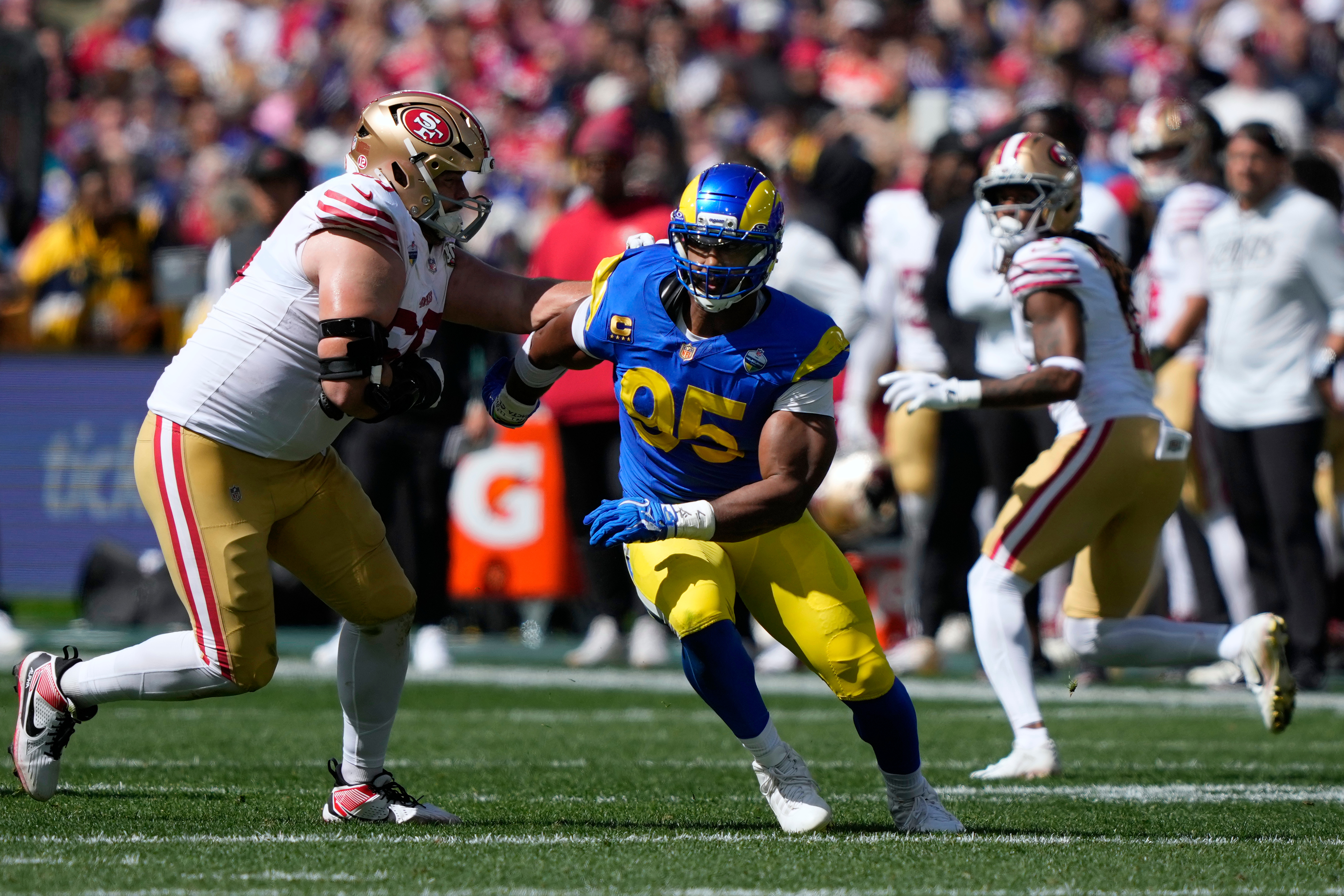
    Last Thursday in Australia, Myles Garrett, the best defender on the planet, limped through the Rams’ opening loss, then underwent knee surgery. The Eagles host the Rams in two weeks. Also, Pro Bowl receiver Puka Nacua was questionable for the Rams’ Monday night game with leg injuries that could linger.

    The Rams’ Myles Garrett underwent surgery after his debut with the team. Doug Benc

    On Sunday, the Commanders lost Pro Bowl quarterback Jayden Daniels to a dislocated left elbow. He was their most important player. The Eagles face the Commanders again Nov. 1, in six weeks. He injured the elbow twice last season. He missed three games after the first injury, but aggravated it a few weeks later and was lost for the rest of the year. He’s the No. 2 overall pick from the 2024 draft, and the Commanders might choose to sit him longer to protect him. Will he be back by Nov. 1?

    None of this is cause for celebration, of course, and the same fate could befall the Eagles at any point. There’s a case to be made that it already has, since left guard Landon Dickerson is on IR with a knee injury. But then, Dickerson, for all his accomplishments, isn’t quite as big a loss as Garrett, Williams, Daniels, or Tunsil.

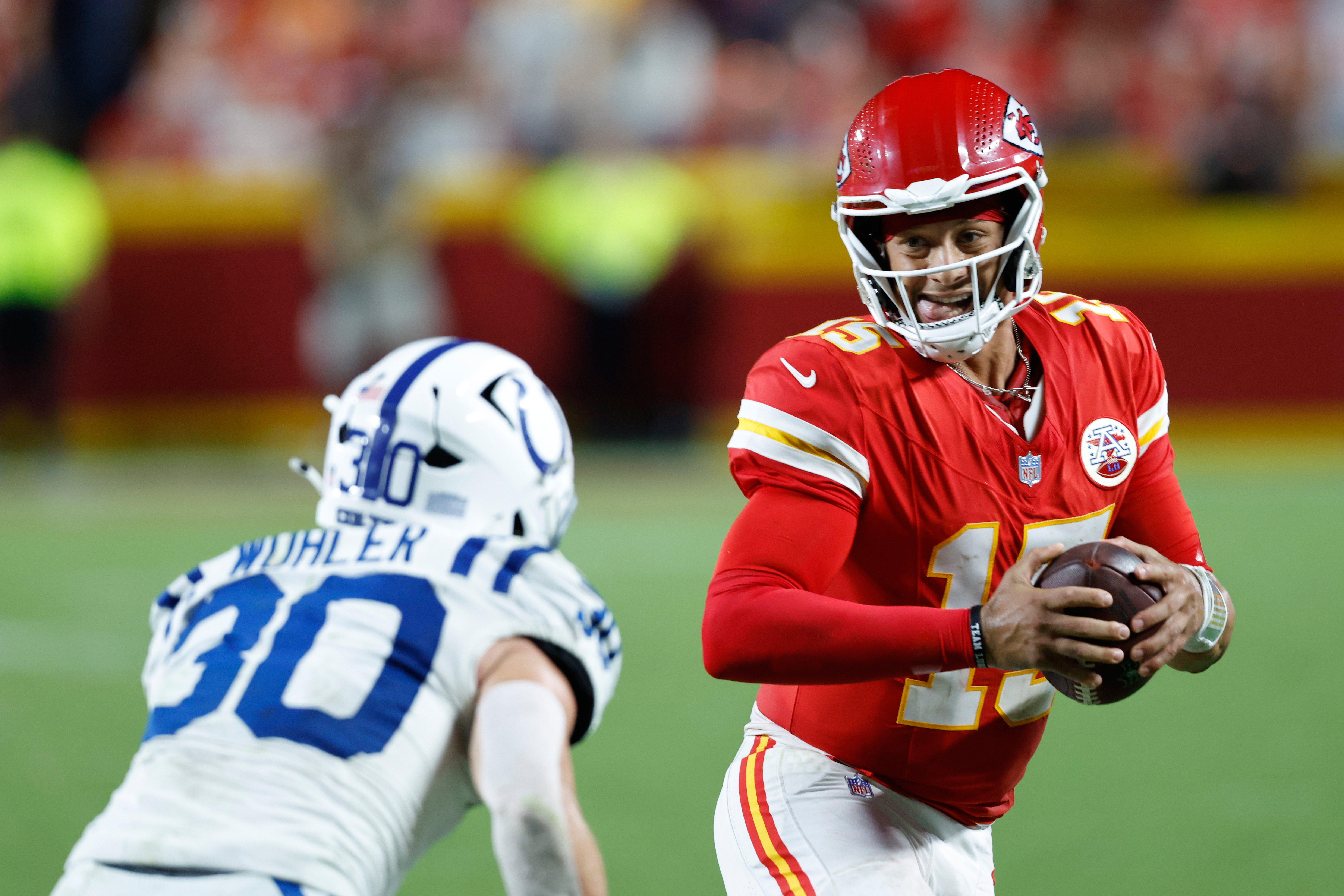
    It was a vintage Patrick Mahomes performance on Monday night. Colin E. Braley

    Extra points

    Prescott broke Tony Romo’s franchise record for TD passes with his 249th in Dallas’ win over Washington. They remain tied in playoff wins, at two. … Patrick Mahomes’ 382-yard passing performance in the Chiefs’ overtime win against the visiting Colts on Sunday Night Football should erase any doubt that Mahomes again is the NFL’s best player. … Don’t sleep on the Jags: Jacksonville had won nine straight regular-season games before losing at Denver on Sunday. … The Raiders, who lost their last nine meaningful games last season and had a trade of pass rusher Maxx Crosby in March nullified after the Ravens gave him a physical, are 2-0 after a road win over the 0-2 Chargers. New starter Kirk Cousins threw for three TDs. Crosby has 1½ sacks. … Controversial QB Deshaun Watson will remain the starter in Cleveland after his two TD passes led to a weird win over the Buccaneers. With 2 minutes to play, the game was stopped due to weather for more than two hours. The Bucs faced second-and-four at the Browns’ 28-yard line when the game stopped, picked up the first down when it resumed, but the drive then fizzled.