The National Board of Medical Examiners has named Suzanne Anderson the next CEO of the Philadelphia-based nonprofit that develops exams for medical licensing.
She will succeed Peter Katsufrakis, who has led the organization since 2017, the board announced Monday.
Anderson, who starts in October, will help steer the organization as the skills and competencies needed to practice medicine evolve. The organization creates the United States Medical Licensing Examination and other tests for medical students and resident physicians.
Anderson anticipates greater emphasis on communication skills, the ethical use of AI, and what happens outside of the clinic setting.
“Without having these assessments that ensure that people are developing the skills that they need, we wouldn’t have as high-quality a workforce as what we want in healthcare,” Anderson said.
Anderson most recently served as regional president of SSM Health Wisconsin, a not-for-profit health system. She has also been involved in the National Board of Medical Examiners for the last 20 years, chairing the board and volunteering on committees.
The Inquirer spoke to Anderson about the future of medicine in an interview lightly edited for length and clarity.
What is your vision as the incoming CEO?
My entire career, I’ve been really focused on the patient experience, quality and safety, and effective operations. The priorities for NBME will be to continue to innovate — because things are changing so rapidly — in order to continue to meet the needs of health professionals.
That’ll mean focusing on competencies in addition to medical knowledge. Things like critical reasoning, communication, professionalism, and other competencies ensure that we have high-quality healthcare professionals.
How have the exams evolved?
Communication skills, as an example, are something that NBME is focused on and has new assessments to address. The goal is to help people have better communication with their patients and families.
There are specific components of communication skills, in terms of creating a connection to the individual that you’re communicating with and communicating clearly in language that everyone can understand. It’s empathy.
Are there any other trends that you’re seeing in how future doctors are tested and trained?
One obvious trend is how AI will inform the development and assessment of skills. NBME has focused a lot on how we can use AI to support the human actions involved in providing human-centric care, as well as on the ethical use of AI.
When professionals are presented with information from AI, how do they evaluate it critically and ensure that they’re getting the right information to support particular circumstances? And then, also, how can NBME use AI to help streamline the examination development process?
What does the future of medicine look like?
The future of medicine is going to be highly collaborative, with health professionals across all disciplines working together to meet people’s needs. There’ll also be more focus on what happens in the home.
How do we help professionals work with patients outside of the normal office setting or hospital setting? You see it on the consumer side with wearables and having much more information at your fingertips that can help support the care that’s provided to you in more formal settings.
How do you feel about becoming the next CEO?
It’s an organization that is already performing at a very high level, and I’m just excited to be able to continue to help advance the mission.
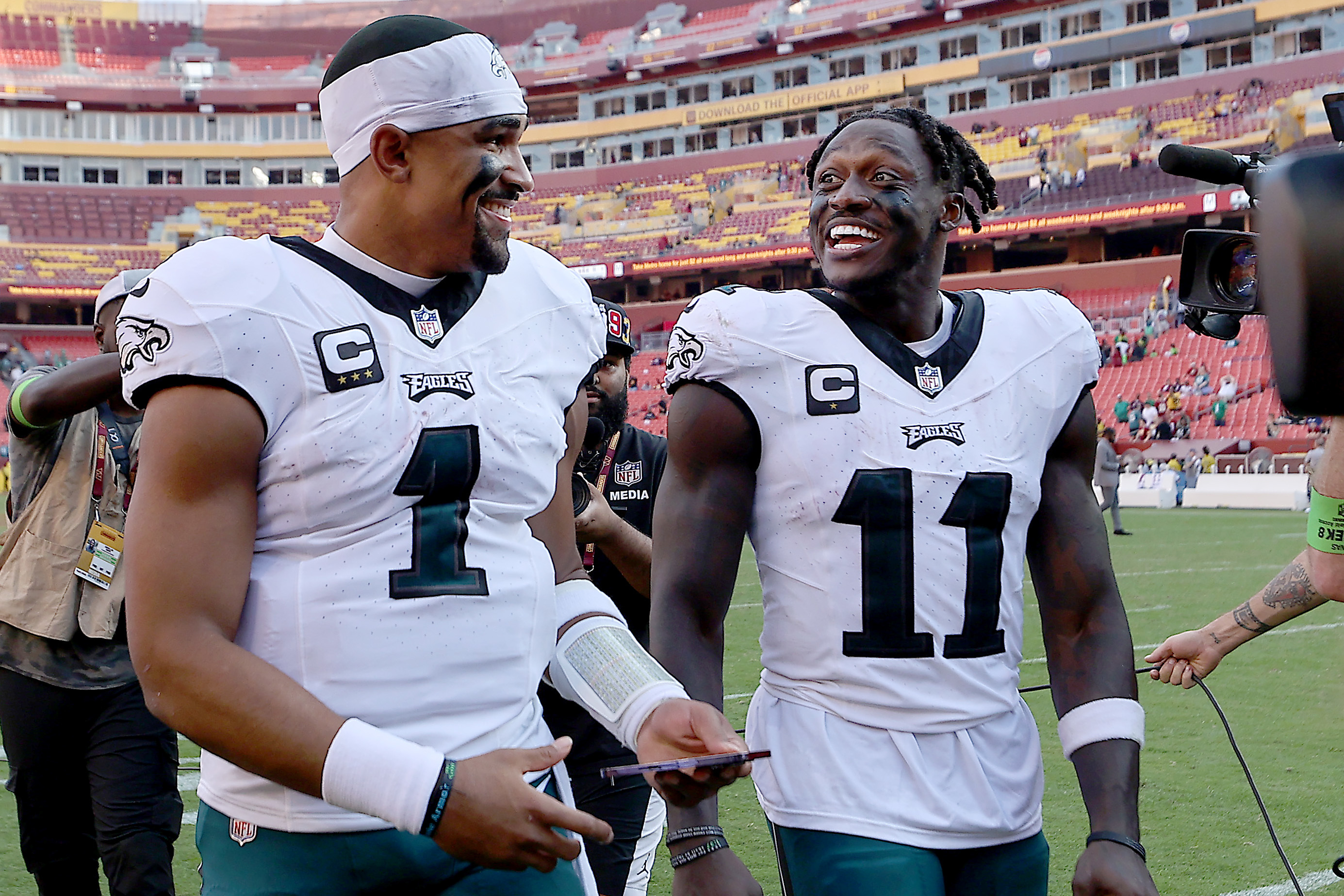
You know how this is going to go. The Eagles will take part in two joint practices, on Wednesday and Thursday, against the New England Patriots — and against A.J. Brown. Those workouts, plus the teams’ preseason game Saturday, will provide all the narrative jet fuel necessary to power us through the rest of the preseason and at least five weeks into the regular season.
By then, Jalen Hurts will have played a few real games in Sean Mannion’s offense, and Brown will have caught who-knows-how-many passes from Drake Maye, and we’ll have a better if incomplete gauge of each team’s chances of qualifying for the playoffs, winning its division, and reaching Super Bowl LXI. Let’s be honest, though: A lot of people who follow the NFL and root for the Eagles will pay attention to how the Patriots fare, sure, but they’ll be more interested in another comparison, another unspoken competition: Jalen vs. A.J.
Jalen vs. A.J. is about more than football. It’s about a friendship that fell apart and that may or may not have been put back together. It’s about a partnership that contributed to a championship, to four seasons’ worth of excellent collective performance, and to a year-plus of questions and passive-aggressive behavior that culminated in the acknowledgment that it was time for one of these men to move on.
Best of all, Jalen vs. A.J. taps into one of the most visceral and familiar sensations within Philadelphia sports fandom (and, to a less intense degree, sports fandom generally). People here love to hate a villain, and Brown — whether he intended to or not, whether it’s fair that he is perceived this way or not — made himself one when he made it clear that he’d be happier playing for another team.
He’s the guy who left, who snubbed the Eagles and everyone who cheers for them. Hurts is the guy who stayed, who wanted to be here. For a lot of fans here, it won’t be enough if Hurts has a terrific season or the Eagles win more games than the Patriots. Brown must drop every pass Maye throws to him, complain incessantly about how miserable he is, and be photographed paging through a copy of The TB12 Method on the New England sideline. These two are going to be held up against each other all season.
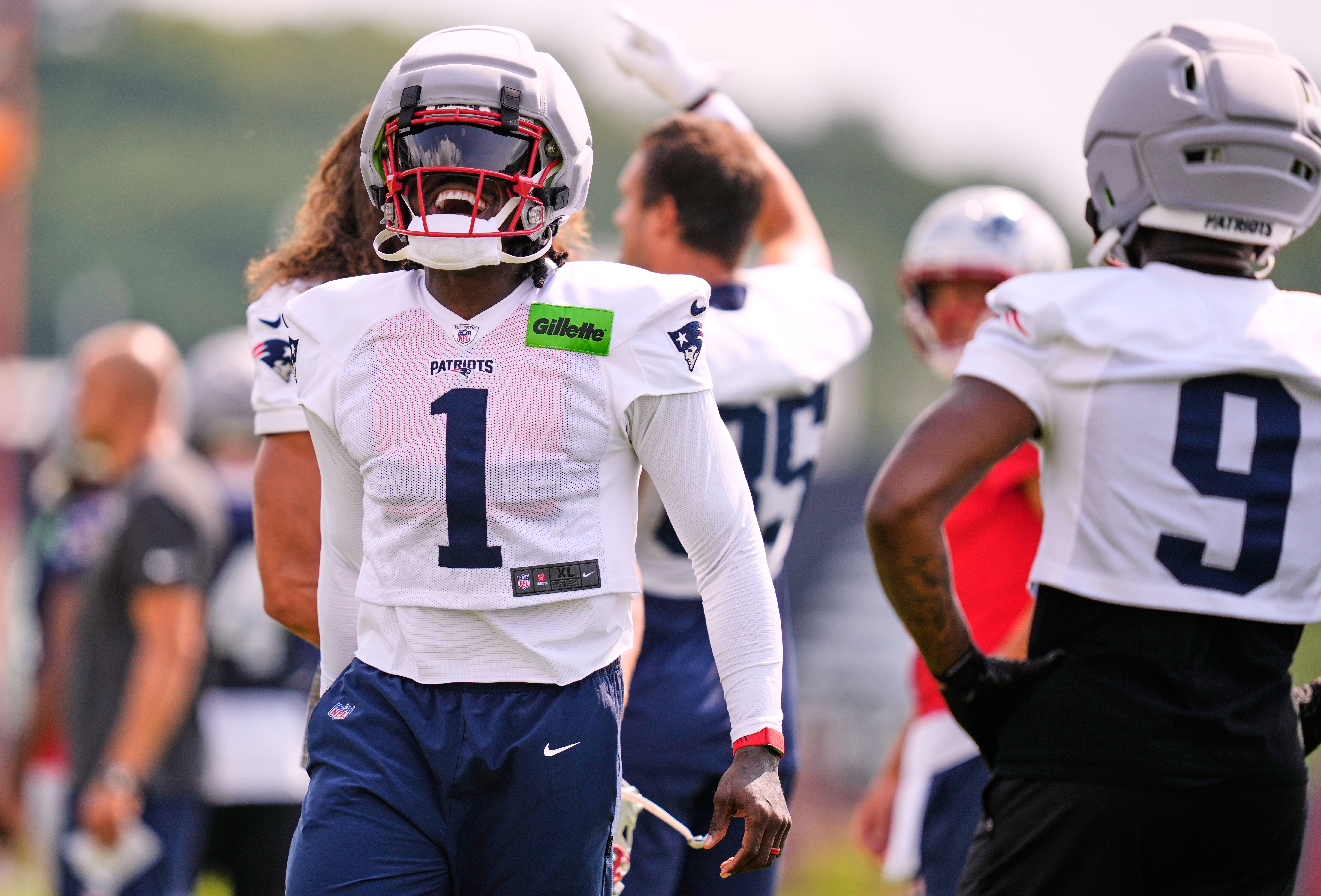
A.J. Brown (1) wanted out, and now resides in New England where many Eagles fans wish him to fail. Charles Krupa
So how will we judge who has won this soap-operatic battle? Obviously, team success and individual achievement will be the primary determining factors. And while there’s really no way to know for certain how the season will play out for either Hurts or Brown, we can look at some conditions and circumstances as they are now to make an educated guess about who will get the better of whom.
Hurts’ head coach is Nick Sirianni, who has won a Super Bowl and sometimes has his children accompany him to his postgame news conferences. Mike Vrabel, who has lost a Super Bowl and isn’t quite as devoted a family man, will hold Brown’s hand throughout their time together with the Patriots. Advantage: Jalen.
Brown’s quarterback will be Maye, who, before his four rocky playoff games, led the NFL last season in completion percentage, yards per attempt, passer rating, and QBR. Hurts’ wide receivers will be DeVonta Smith and three guys named Sal. Advantage: A.J.
In fairness, Hurts can probably count on Sal 1, Sal 2, and Sal 3 to finish running all their routes. Advantage:Jalen.
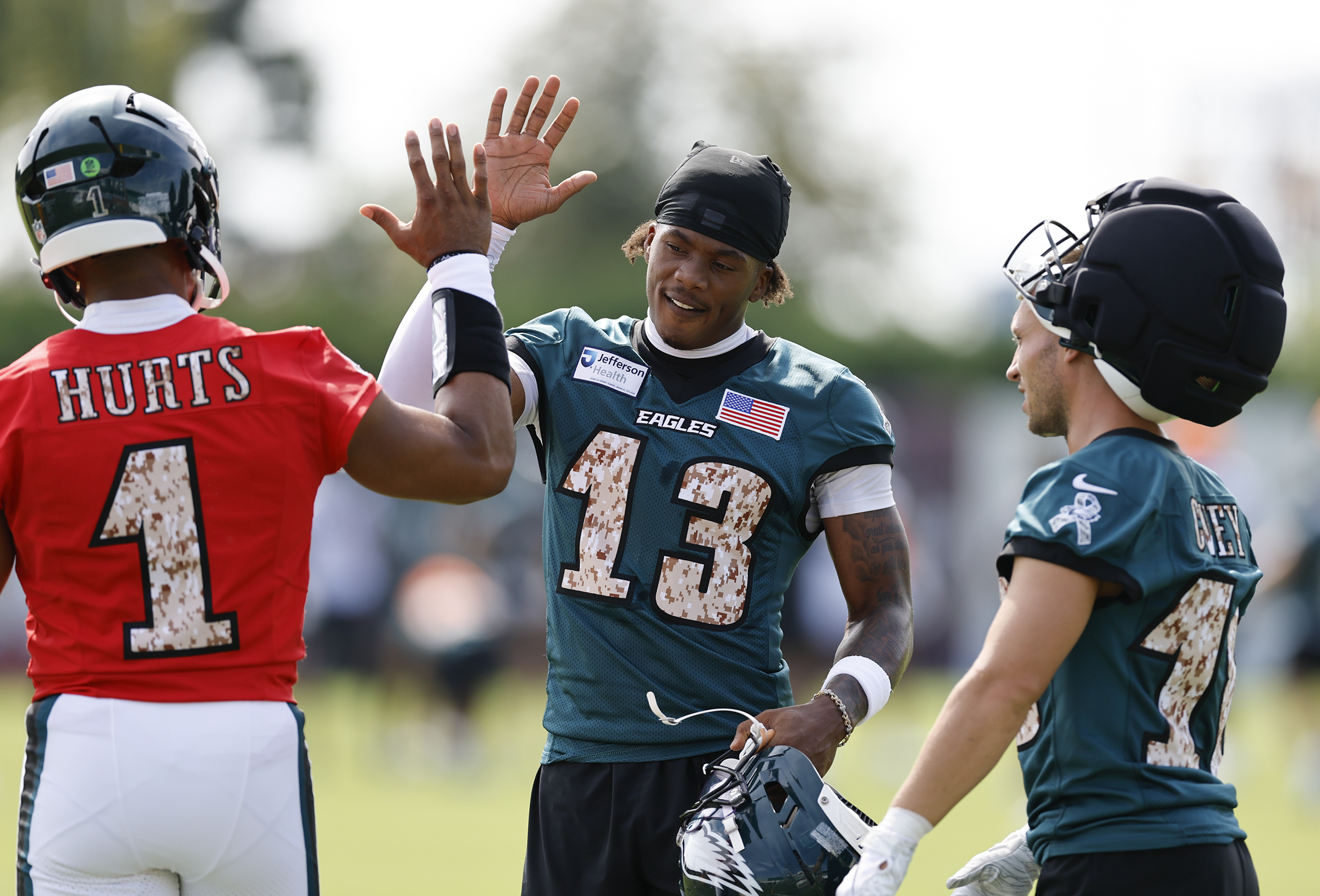
Jalen Hurts with wide receivers Dontayvion Wicks (center) and Britain Covey during training camp earlier this month. Yong Kim / Staff Photographer
The Patriots’ play-caller will be Josh McDaniels, regarded as one of the league’s most astute orchestrators of offense. The Eagles’ will be Mannion, who has never called plays in the NFL but is also not Kevin Patullo. Advantage: A.J.
Hurts still plays in Philadelphia, where he can have dinner at any number of world-class restaurants and partake of a robust cultural scene and night life. Brown now plays in Foxboro, Mass., where he can pay full price for a refill at Dunkin’. Advantage: Jalen.
Over his career, Brown has spent a lot of time, perhaps too much time, on Instagram and X/Twitter and paid a lot of attention, perhaps too much attention, to what has been written and said about him there. But with the Patriots, he doesn’t have to worry about the franchise’s social media team undermining his standing in the locker room by posting a video of him doing something totally humiliating and vitally important like throwing an interception in training camp. Advantage: A.J.
Welp, looks like Jalen vs. A.J. is too close to call at the moment. Which is great. More intrigue! More drama! More content! Two man enter. One man leave. There can be only one Highlander. The winner gets a free copy of Pat McAfee’s new country-rock-rap-grievance album and the satisfaction of knowing the other guy was the true source of the problems with the Eagles’ passing game all along. The loser must live with the shame of knowing he let down a desperate fan base starved for its first Super Bowl victory in a year and a half. Let our long march to the ultimate hot take begin.
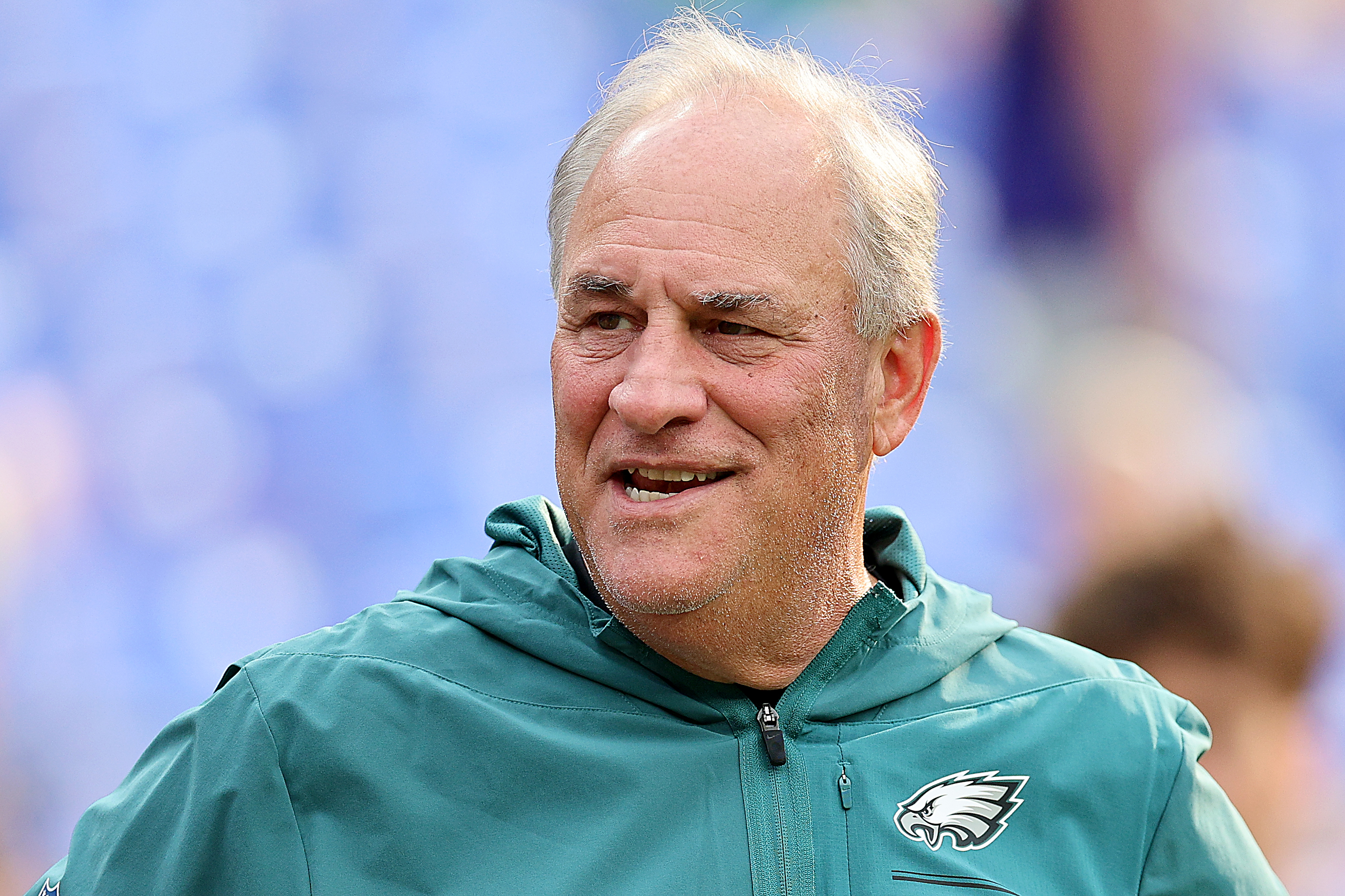
The most notable thing about the latest round of Eagles’ press conferences was Vic Fangio’s cautious tone when asked about the two newcomers who will determine the ceiling of his defense.
The first instance concerned Jonathan Greenard, whom the Eagles handed a four-year, $98 million contract extension after losing Jaelan Phillips to the Panthers. While the team has betrayed little concern regarding the pectoral strain that has sidelined the veteran defensive end since before training camp, Fangio didn’t go out of his way to reassure fans that Greenard will be ready for the season opener.
“We aren’t going to see him for another couple of weeks, at least,” the defensive coordinator said last week.
Your interpretation of that statement depends a lot on how you weigh the phrase, “at least.” Some might hear a coach who is timing Greenard’s return for the start of the week leading up to the Eagles’ Sept. 13 season opener against the Commanders. Others might instead train their angst on the uncertainty. Rarely does the phrase “at least” carry a hopeful connotation.
Even less clear is where Fangio’s heart was in assessing new cornerback Riq Woolen. The Eagles’ signing of Woolen to a one-year, $12 million contract spoke volumes about their assessment of last year’s disappointing campaign. While the vast majority of the public attention has focused (rightly) on an offense that looked like a shadow of its previous year’s self, the Eagles clearly felt the same about the downgrade from Darius Slay to Adoree’ Jackson in the secondary. While $12 million is a small price to pay relative to the potential market worth of Woolen’s talent, it is also a lot more than Jackson was paid last season on a veteran minimum deal worth up to $5 million, per reports.
General manager Howie Roseman consistently operates with the notion that potential salary cap dollars should be measured by how good you are at one position now vs. how much better you will become given expenditure X or Y. That logic precipitated the Eagles’ decision to sign Saquon Barkley to a contract that didn’t necessarily adhere to the current groupthink about running back value. The move to sign Woolen was an admission of how much better the Eagles think they would have been last year, and how much better they will be this year, with a legitimate outside cornerback to start opposite Quinyon Mitchell. That tells you all you need to know about Woolen’s importance to this team.
“At times he can get a little lazy or sloppy with his technique and have a bad down or two, but he’s still showing everything that I think he can do,” Fangio said of Woolen. “He’s just got to get in such great shape and calloused to football that those don’t happen.”
You could write off the comment as innocuous if it didn’t echo a lot of what came out of Seattle during the end of Woolen’s tenure there. One need spend only a day in the presence of Woolen to walk away convinced that Roseman and Fangio landed themselves a steal this offseason. The 26-year-old is as imposing a physical specimen as has ever played cornerback at a chiseled 6-foot-4 and 210 pounds with remarkable limb length. His All-Pro selection as a rookie in 2022 wasn’t a fluke.
Riq Woolen was an All-Pro corner in 2022, but fell out of the Seahawks’ starting lineup last season.Monica Herndon / Staff Photographer
At the same time, one would be foolish to completely discount what the market says when it values such a player for what the Eagles were able to sign him. Woolen is coming off a season in which the eventual Super Bowl champs jettisoned him from the starting lineup and then, after said Super Bowl victory, let him walk as a free agent for a pittance.
Woolen is as big of a wild card as exists on the Eagles roster. That’s not a criticism. What makes his range of outcomes so broad is the high-end potential. Woolen at his best has been more of an impact player than Slay was at the tail end of his Eagles career, when he was good enough to start for a dominant Super Bowl defense. The Eagles are coming off a season in which they allowed an opposing receiver to gain 99 or more yards in five of their first seven games. That CeeDee Lamb, Puka Nacua, Courtland Sutton, Emeka Egbuka, and Jordan Addison were all able to accomplish the feat is even more remarkable given the level Mitchell played at last season.
Greenard factors in here, too. The Eagles were desperate enough on the edge last season that Brandon Graham came out of retirement to become a true value add. The acquisition of Phillips at the trade deadline was a massive stabilizer, particularly defending the run. The Eagles defense was still one of the best units in the NFL. But their playoff loss to the 49ers was a microcosm of the season. That is, a game that was decided by a handful of plays that the 2025 defense was not in the habit of allowing.
There are lots of reasons to think this year’s Eagles will be closer to 2025, even given the questions about Woolen and Greenard. Their decision to hand Jalen Carter a massive contract extension is a good indication in their confidence that the fourth-year defensive tackle will be back to his dominant self after some midseason shoulder troubles. Edge Jalyx Hunt looks poised to take another big leap forward. Mitchell and Cooper DeJean are still in the exponential growth phases of their careers.
That said, in today’s NFL, a team is only as good as its weakest link, particularly when a weak link in the secondary is paired with a less-than-elite pass rush.
There is no need to raise alarms with either Greenard or Woolen. Roseman’s recent decision-making has earned him the benefit of the doubt. Fangio’s first two years have shown his brilliance in making things work as the season unfolds. The schedule sets up nicely in that regard.
Eagles defensive ends/outside linebackers coach Jeremiah Washburn (left) talks with edge rusher Jonathan Greenard, who has not yet practiced since joining the team in a trade.Monica Herndon / Staff Photographer
The Commanders will enter the season with a new offensive coordinator and a quarterback who will have played just five games in the previous calendar year. They could also potentially have a new left tackle, after five-time Pro Bowler Laremy Tunsil suffered a triceps tear in practice last week.
Washington has done surprisingly little to build on Jayden Daniels’ promising rookie season in 2024. The last Commanders receiver besides Terry McLaurin to gain 800 or more yards in a season was Pierre Garçon, who did it in 2016, three years before the Commanders drafted McLaurin. There are high school graduates who weren’t born when Garçon was a rookie. Newly signed Stefon Diggs still carries name value, and he is coming off a 1,000-yard season with the Patriots. But there is a reason the 33-year-old was available until the last moment and only then landed a contract with slightly more of a one-year guarantee than Juaun Jennings landed to be the Vikings’ third receiver.
In Week 2, the Eagles travel to Tennessee, where they’ll face another new coaching regime. Titans offensive coordinator Brian Daboll inspired little fear in the Eagles during his tenure with the Giants. This time, he has even less talent, with quarterback Cam Ward entering his sophomore season as likely to get Josh Rosen’ed as to get a contract extension down the road.
The immediate schedule means the Eagles defense will have a comfortable margin for error while easing into 2026. Granted, there are few unofficial bye weeks in the NFL. But the Eagles’ opening weeks are about as favorable as a team can hope when coming off an 11-6 season. They opened last season at home against the Cowboys and faced the Rams sandwiched around a road Super Bowl rematch in Kansas City. Two years ago brought the Packers in Brazil followed by the Falcons — maybe not a gauntlet, but a couple of teams with enough talent to rack up 400 or more yards of offense against an early-season defense.
Given the health questions about Greenard and uncertainty inherent in Woolen, Fangio could need another few weeks of runway before his defense reaches its full stride. But the upside is immense, and Greenard and Woolen are two of the biggest reasons to bet on the Eagles reaching their potential. Perhaps Fangio’s understanding of this is the real source of his caution.
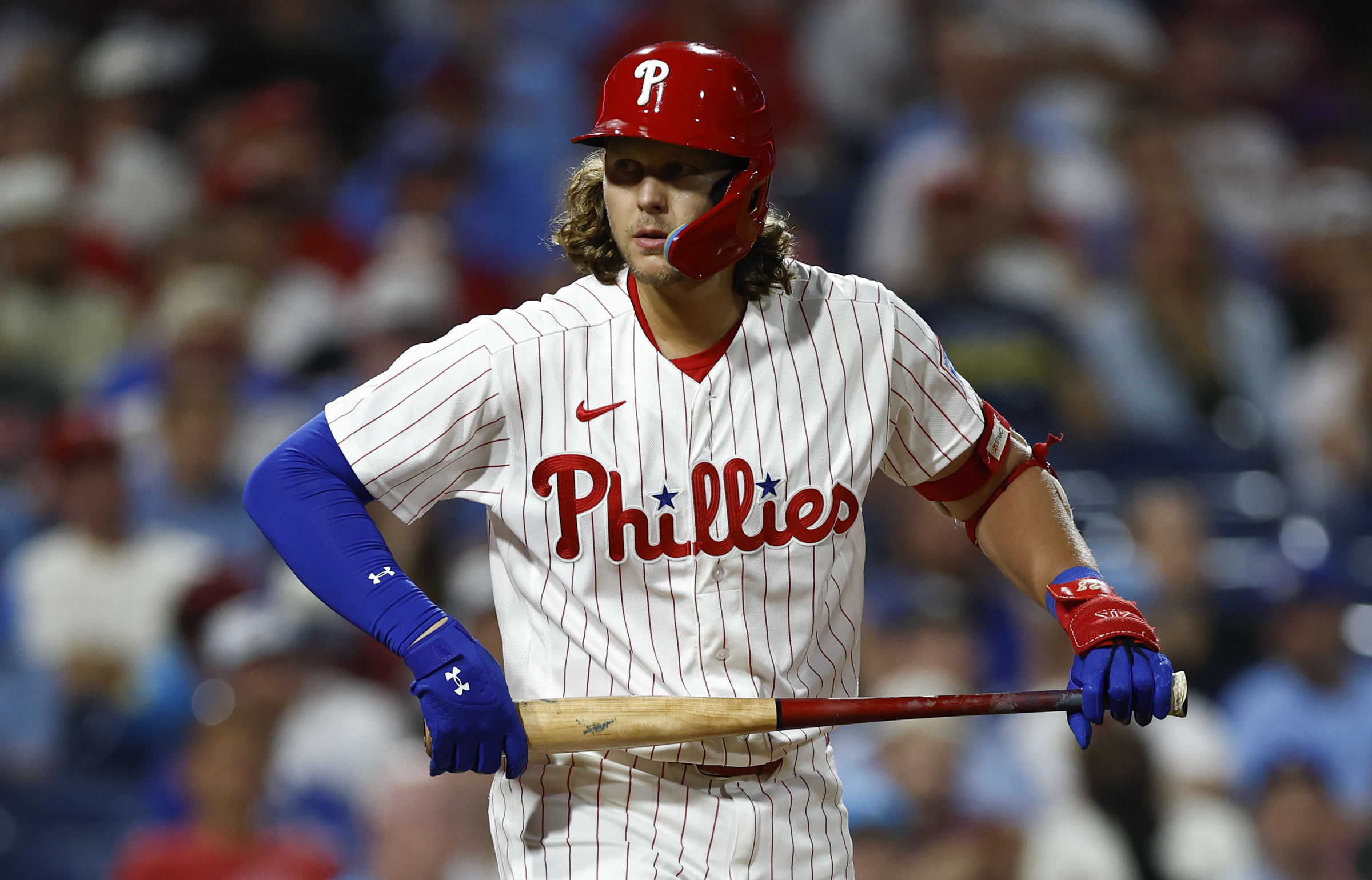
This time, this is about Alec Bohm, a career .273 hitter with a .734 OPS entering Monday night. That’s about 30 points better than the average major league batting average since Bohm hit the big leagues in 2020, and a slightly above-average OPS in the same span. That batting average is second-highest among the 11 everyday third basemen who have played at least 600 games at third since 2020.
He does not stink.
You’d never know that to listen to the critics.
The ones who wanted Bohm traded in the offseason.
The ones who wanted Bohm out of the lineup so Bryce Harper could move back to first base from right field, his natural position and where he was forced to return when the Phillies added infielder Luis Arraez near the trade deadline (Arraez’s arrival moved second baseman Bryson Stott to third base and Bohm to first).
The ones who went mysteriously silent over the last seven games going into Monday, in which Bohm hit .542 with four doubles, a homer, six RBIs, and a 1.426 OPS.
Monday night, he added what became the game-winning RBI.
These are the same folks who will tell you that Sixers cornerstones Andre Iguodala was overrated, Tobias Harris stole money, and Shayne Gostisbehere … yawn.
To this day, Sixers aficionados will deride Iguodala as the first casualty of Josh Harris’ disastrous ownership tenure, traded after the 2012 season as part of a package that brought Andrew Bynum to Philly for a season in which Bynum did not play. Iguodala was an All-Star that year, was first-team All-Defense two years later in Golden State, where he won four titles and the 2015 NBA Finals MVP award.
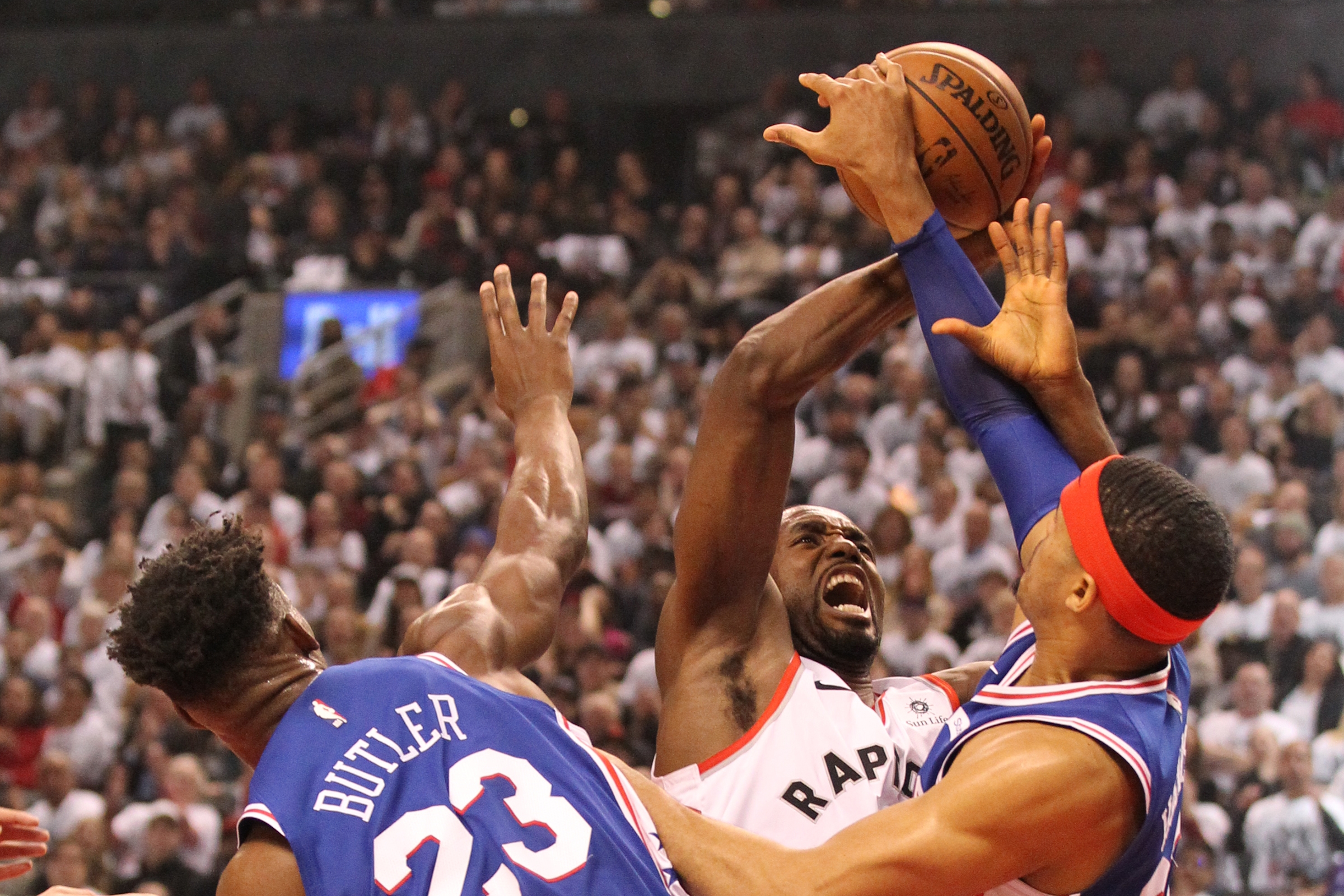
They’ll also bury Tobias Harris, who, in their minds, the Sixers chose to retain over Jimmy Butler in 2019. That’s a vast oversimplification, since there’s no real reason to believe the Sixers would have been better with Butler, who benefited from the presence of Harris that season, when Harris scored 18.2 points and pulled 7.9 rebounds and played well in the playoffs. Harris has had issues in other playoff appearances, but it’s foolish to let them diminish his overall body of work.
But this isn’t about whether Harris was better than Butler. It’s about whether Harris was a good player. And he was. Maybe not good enough to warrant a maximum contract, but he was really good, and, on a team that gave players playoff games off for having upset tummies, Harris showed up; only eight players in the NBA played more minutes between 2019-20 and 2023-24 than Harris.
Jimmy Butler (left) benefited from the presence of Tobias Harris in 2019.CHARLES FOX / Staff Photographer
As for “Ghost,” the Flyers traded him to Arizona in 2021 for salary-cap relief. He’d accumulated 219 points in six seasons by then, but nobody much cared that he was gone. He’s got 243 points in the five seasons since, and he just won the Stanley Cup with Carolina, while the Flyers are still looking for a defenseman to run the point on their power play.
I’ve been keeping this one in my holster for a few weeks, waiting for Bohm to surge. Even with his recent proficiency, Bohm is hitting .242 with a .684 OPS. He’s not having a great year, but few players have great years every year. Besides, there are obvious reasons.
First, he’s in a contract year. He’ll be a free agent for the first time after this season. That’s a lot of pressure on any player regardless of their personal situation.
Second, he’s got a personal situation. As the season began, Bohm sued his parents for mismanaging his money. The suit remains active, the next hearing is scheduled for Sept. 3.
Third, Bohm changed positions. He went 3-for-16 in his first five games at first base.
Should stud players be able to play through the noise and changes? Yes. Is Alec Bohm a stud player? Probably not.
But he does not stink.
For some, Bohm, who turned 30 two weeks ago, is the embodiment of Gen Z entitlement.
Alec Bohm will be a free agent for the first time after this season.Yong Kim / Staff Photographer
He’s a first-round pick, No. 3 overall in 2018, who signed for a nearly $6 million bonus and has made almost $30 million. He’s also 6-foot-4 and weighs 218 pounds — both likely outdated underestimates — but has just 14 homers this season and, since he’s 16 shy, he probably won’t break the 100-homer mark as a Phillie, assuming they don’t re-sign him.
Further, in 2022, after Bohm made two errors, he said, on camera and on the field, “I (bleeping) hate this place.” He apologized, and he has been effusively pro-Philly since, but, for some, this was unforgivable.
Also, he was an All-Star in 2024. He has not been an All-Star caliber player since, but he hasn’t stunk, either.
Finally, he pouts. He sulks. He has not been alone in this behavior — Taijuan Walker and Nick Castellanos come to mind — but now it’s part of his brand. Of course, the Phillies released both Walker and Castellanos this year, but less for their attitude than for their aptitude.
Bohm remains because his aptitude outweighs his occasionally sour attitude.
Dave Dombrowski, clearly a learned classicist, paraphrased the Greek aphorism “Familiarity breeds contempt” when asked recently why he didn’t trade Bohm at the deadline:
“When you see a player every day, you have a tendency to look at their downside.”
And that’s a choice.
As of Monday, Bohm’s tenure as a Phillie included just 37 more regular-season games. It would be wise to choose to appreciate him.
Chinatown’s Wizard of Ducks did not come from poultry royalty. Chuien Liu was born to a long line of Fujianese fishermen on a rural island beside the East China Sea.
“Going out every day to catch fish, shrimp, and crabs? That was a necessity,” says his son, Kenneth Liu, translating for his father. “But making duck was his passion, mostly because he liked to eat it.”
In that respect, Chuien Liu scored big-time when he came to Philadelphia in the mid-1990s, following a wave of immigration from Fujian Province, on China’s southeastern coast, to the United States. He landed a spot beside the roasting oven at Chinatown’s iconic Sang Kee Peking Duck House, and he remained there as the master of ducks, soy sauce chicken, and crispy pig for 25 years.
And then we, the voracious duck eaters of Philadelphia, became the lucky ones. Liu and his family went independent in 2019 to claim their own little slice of Chinatown at Lau Kee, a cozy 20-seater with no decorations on the walls, but an absolute masterpiece display of Cantonese-style roasted meats hanging in the spotless front window.
Lacquered brown ducks dangle temptingly from hooks beside paper-wrapped bundles of whole chickens, pink-edged hunks of sweet char siu pork shoulder, and tawny sheets of pork belly, whose slow-rendered layers of pale meat, pearly fat, and cracker-crisp skin are simultaneously so moist, tender, and shatteringly crunchy, taking merely one bite is not an option.
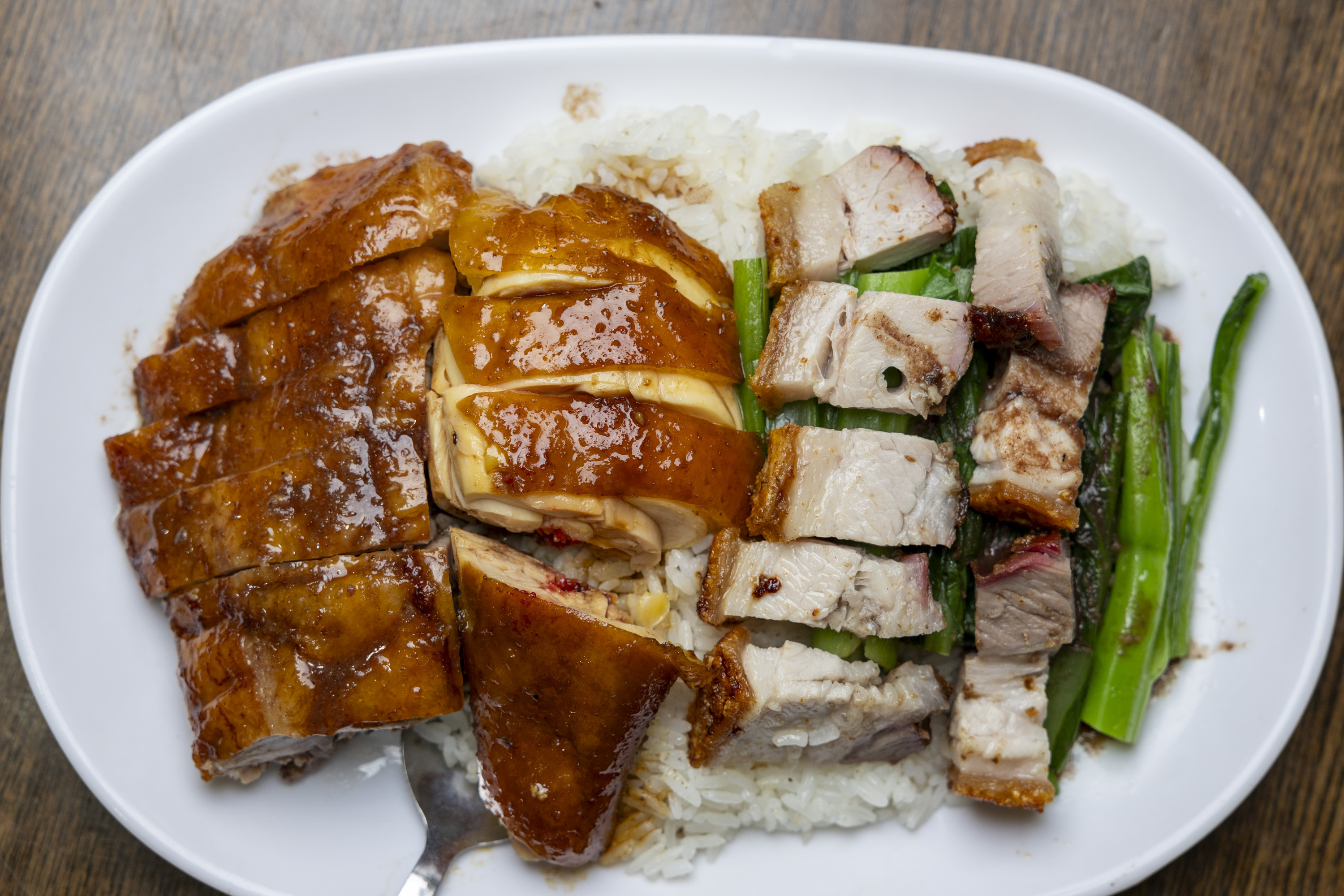
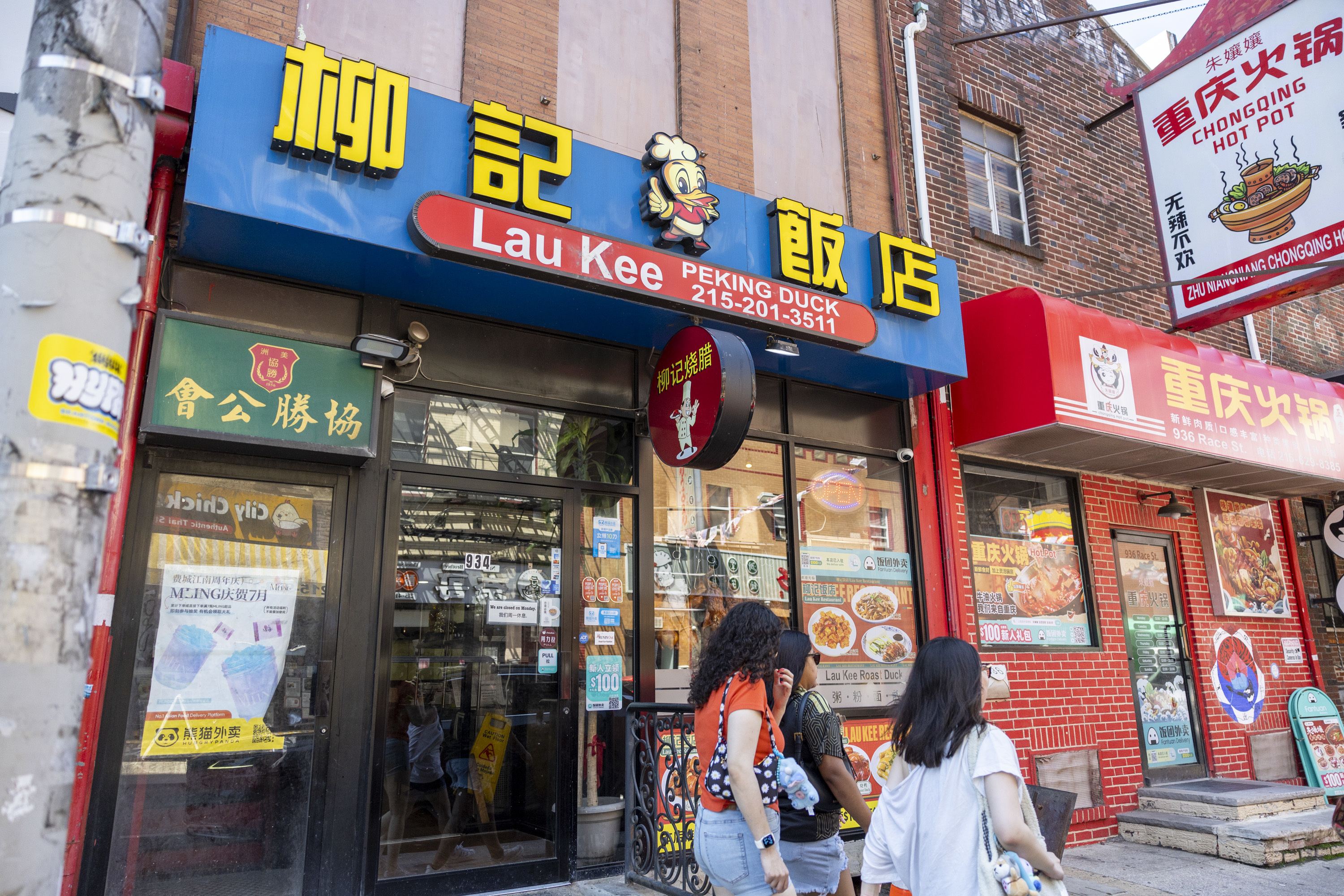
The three meat platter over rice at Lau Kee, in Philadelphia, Pa., on Friday, Aug. 7, 2026.Tyger Williams / Staff PhotographerOutside street view of Lau Kee, in Philadelphia, Pa., on Friday, Aug. 7, 2026.Tyger Williams / Staff Photographer
There are other, larger, better-known duck houses in Chinatown with long-established and devoted patrons, from Ting Wong to M Kee, takeout-only Siu Kee, and, of course, Liu’s alma mater, Sang Kee.
But with more than 31 years of experience and nearly half a million birds beneath his cleaver, Liu, now 55, is currently Chinatown’s longest-tenured duck chef — and also my vote for Philly’s best. As one of the very few chef-owners in the neighborhood, there is also an exceptional consistency in his insistence on doing things right.
Just preparing the ducks is a laborious, dayslong process, beginning with inflating them with air to separate the meat from the skin. A gingery marinade with chee hou sauce (a fermented bean paste that’s less sweet than hoisin) comes next, followed by a hot water bath to open the skin’s pores, then a dunk in a vinegar-sugar glaze that dries overnight. The following day, the ducks are hung in a vertical oven over an open flame to roast low and slow as juices collect below for a final basting. And that’s just for the Hong Kong-style roasted duck, which always comes chopped on the bone.
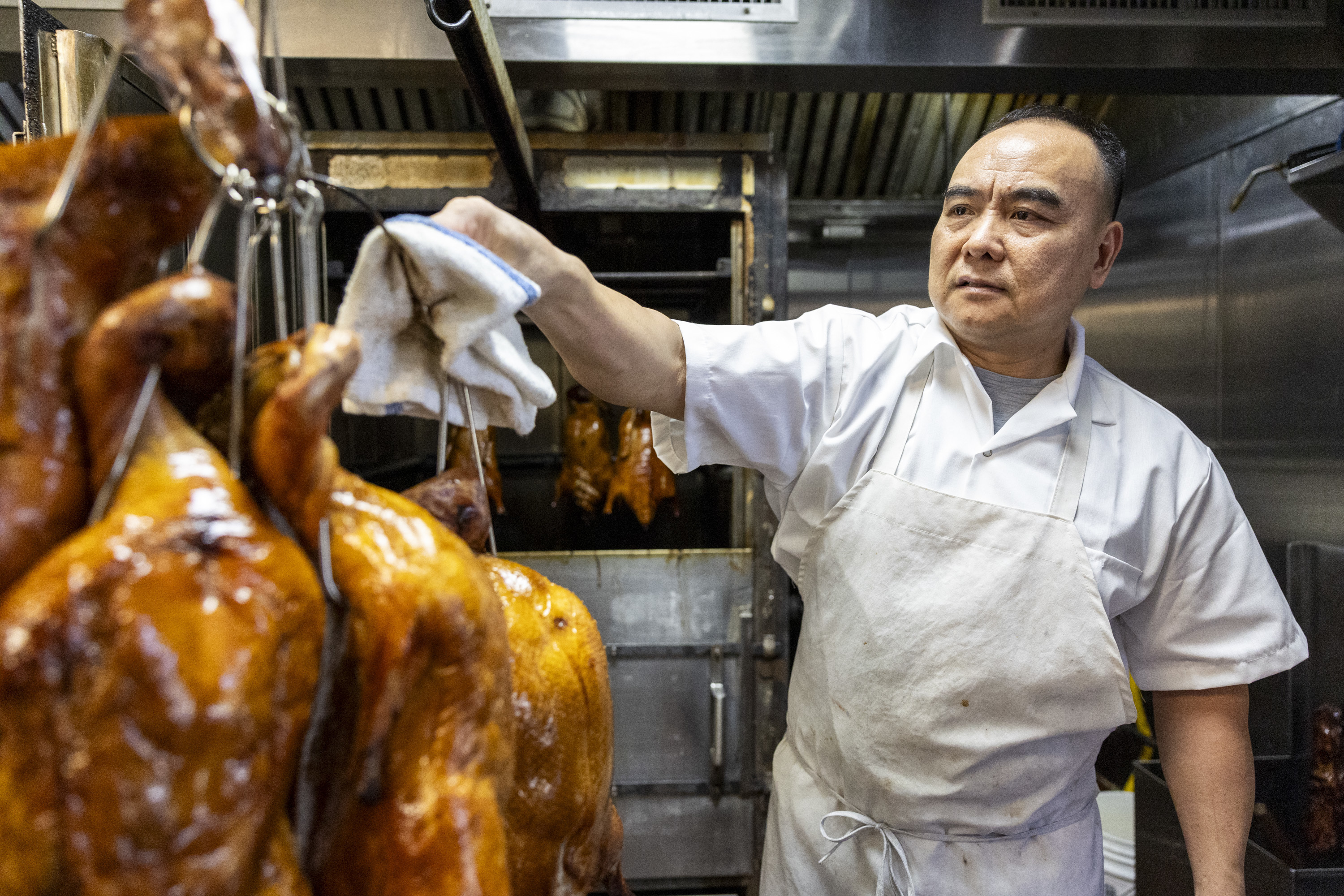
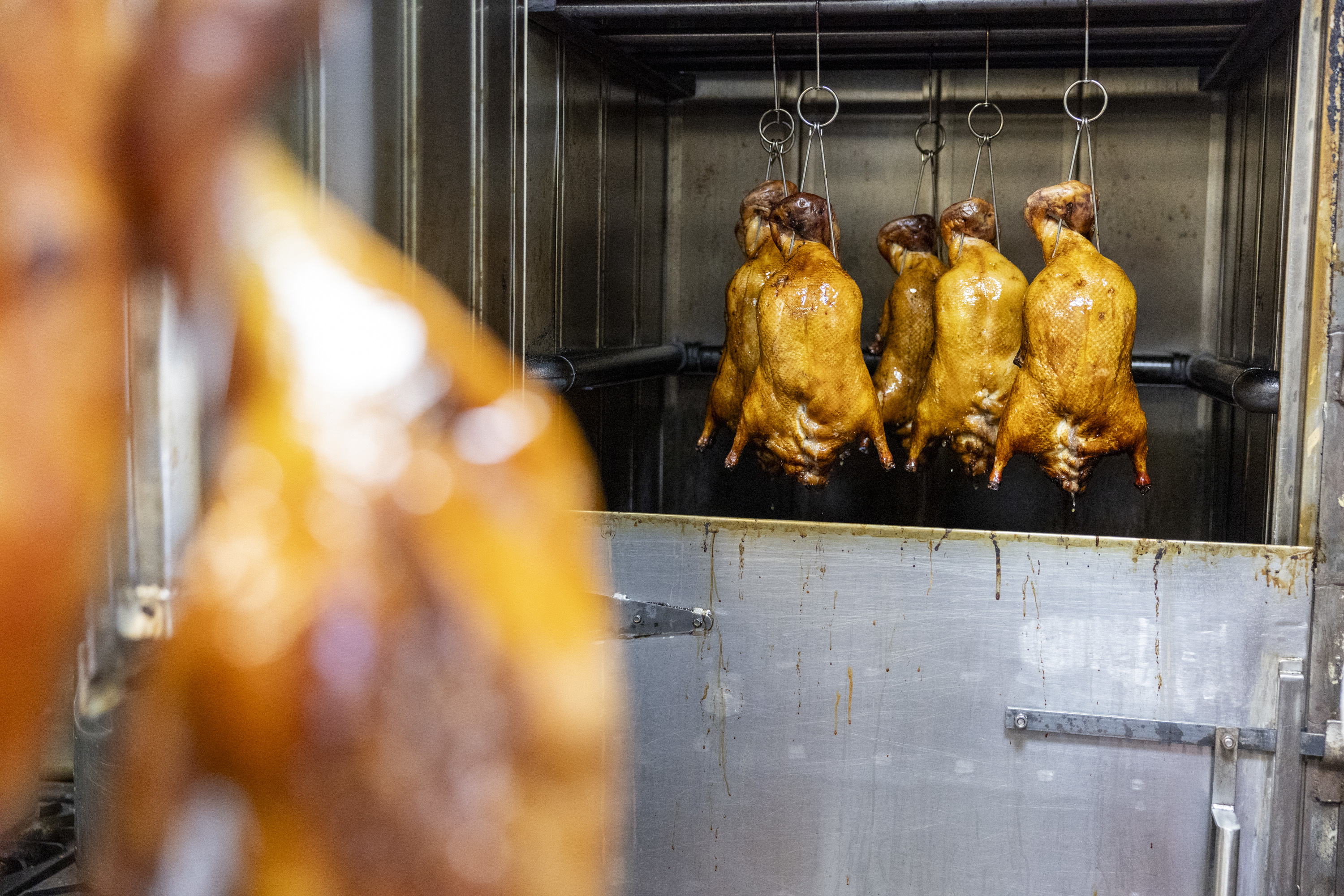
Chuien Liu, Owner of Lau Kee, is taking out the cooked ducks from the oven in Philadelphia, Pa., on Friday, Aug. 7, 2026.Tyger Williams / Staff PhotographerA platter of Peking duck at Lau Kee, in Philadelphia, Pa., on Friday, Aug. 7, 2026.Tyger Williams / Staff Photographer
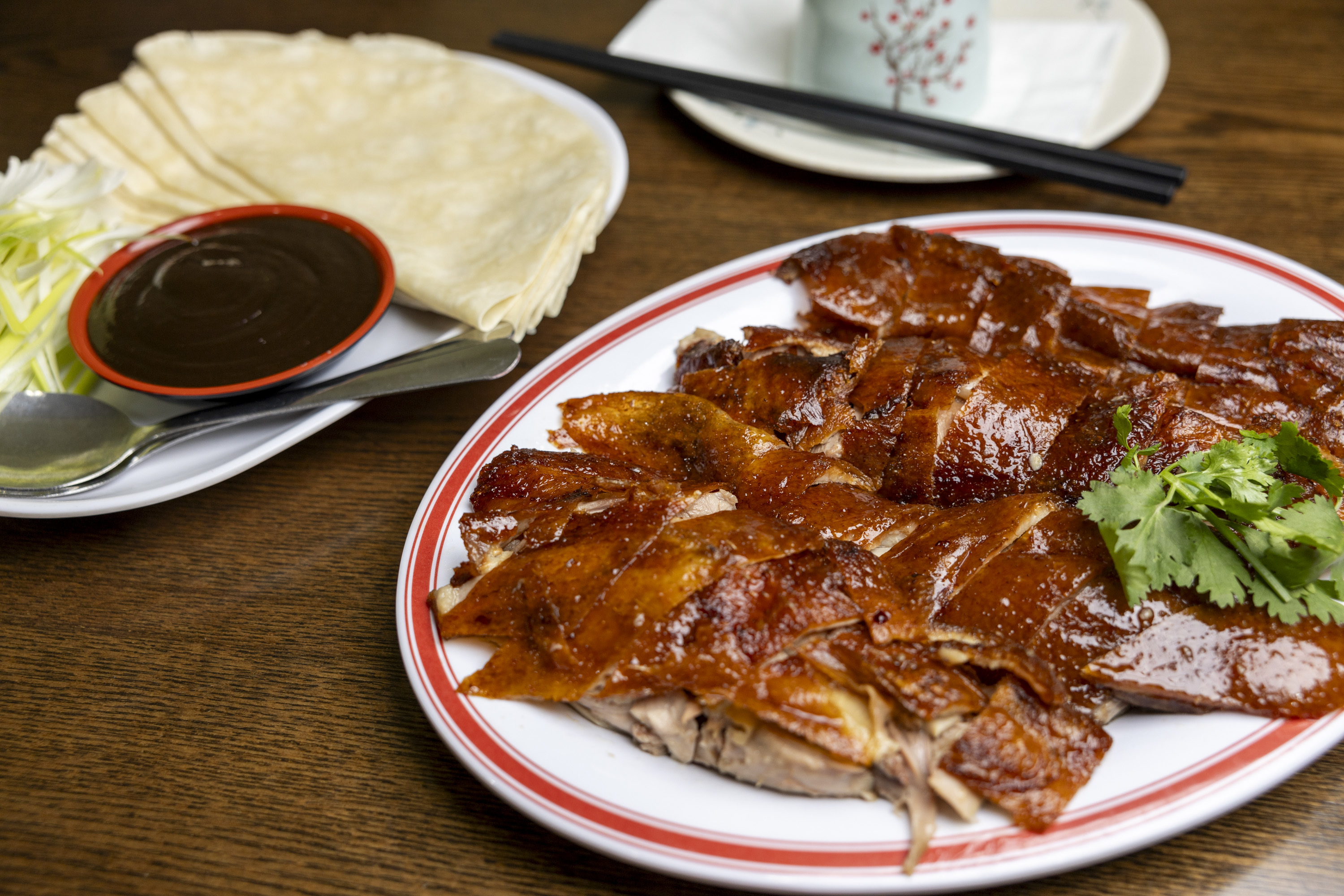
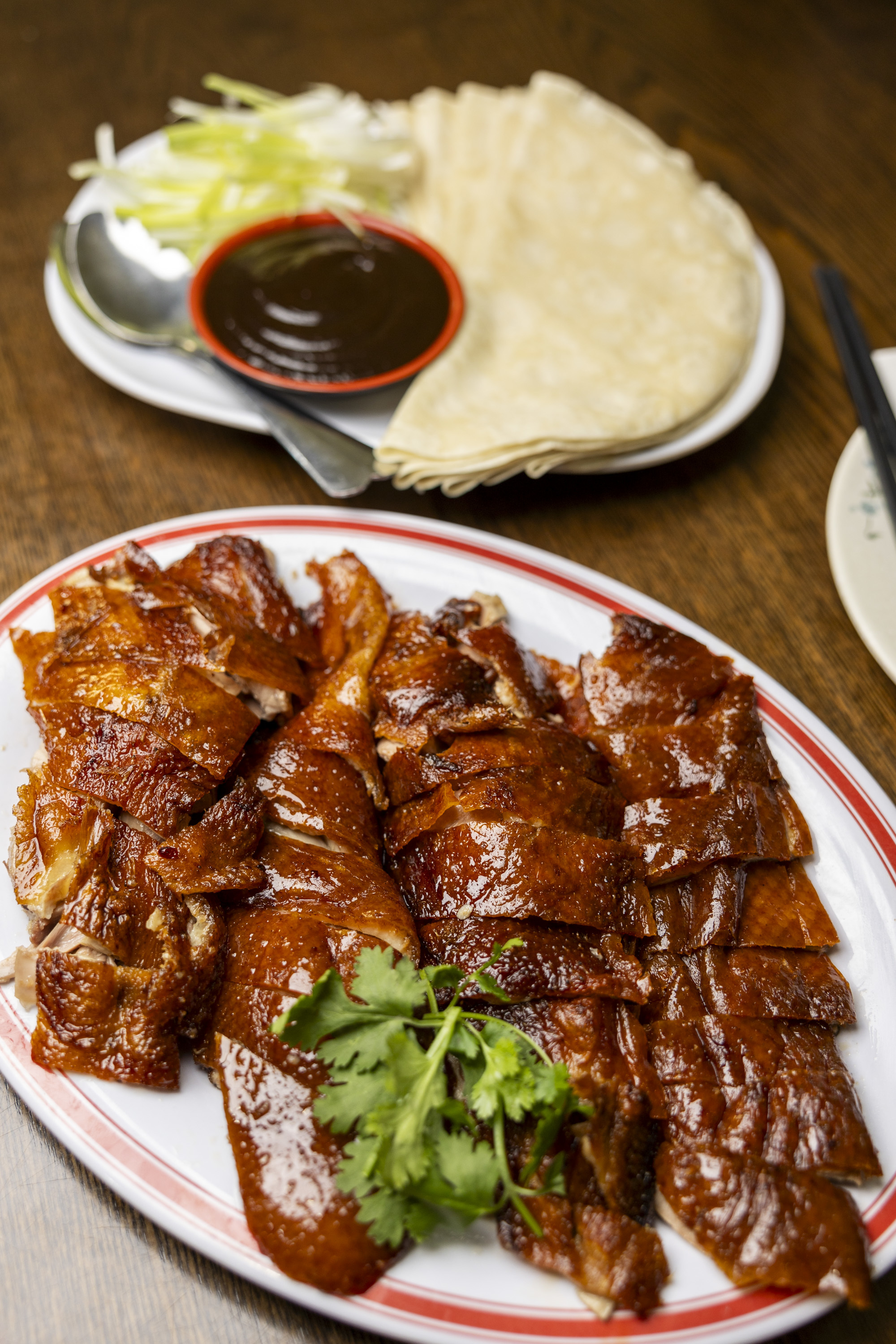
The Peking-style duck is yet another process, involving a slightly sweeter marinade with a more pronounced five-spice savor plus a longer roast time to give that skin a delicate snap. At $30 for a half duck or $47 a whole bird, the sliced meat, served boneless alongside pancakes and scallions, is a delicious centerpiece for a sharing meal.
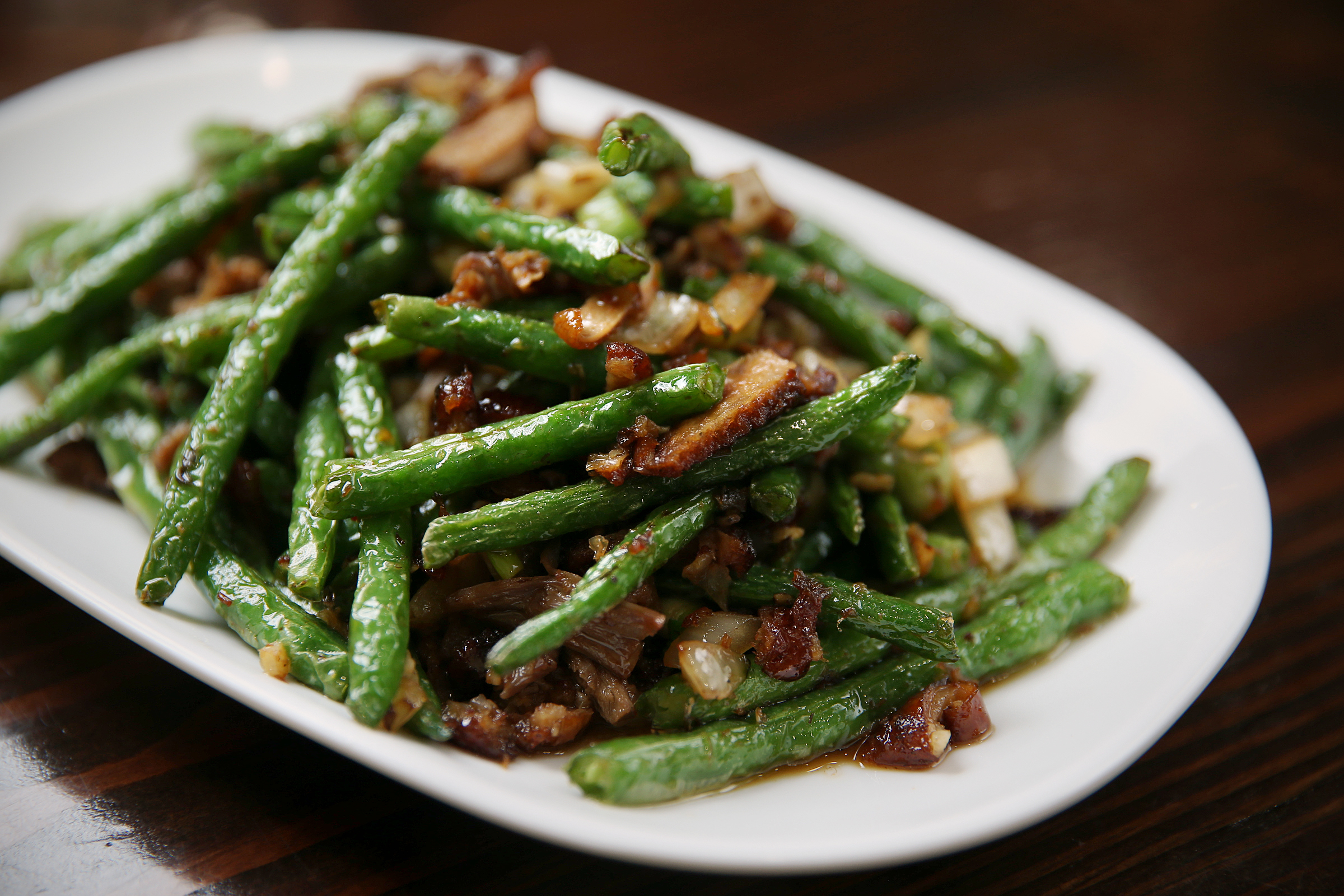
If that’s too much of a commitment, Lau Kee makes appetizer-size duck rolls out of its copious duck trim — the perfect balance of tender meat, crunchy scallions, and dark hoisin — folded inside a soft pancake. A generous helping of shredded duck also stars in a stir-fry of snappy green beans tossed with ground pork and XO sauce. The earthiness of sliced duck and the roasted flavor of its skin also fully infuse the bowls of congee, whose rice porridge is regularly beaten to a snowy white mist and refreshed throughout the day so its texture remains airy and light. (“It’s almost fluffy,” opined my Inquirer colleague, Kiki Aranita, a noted congee scholar.)
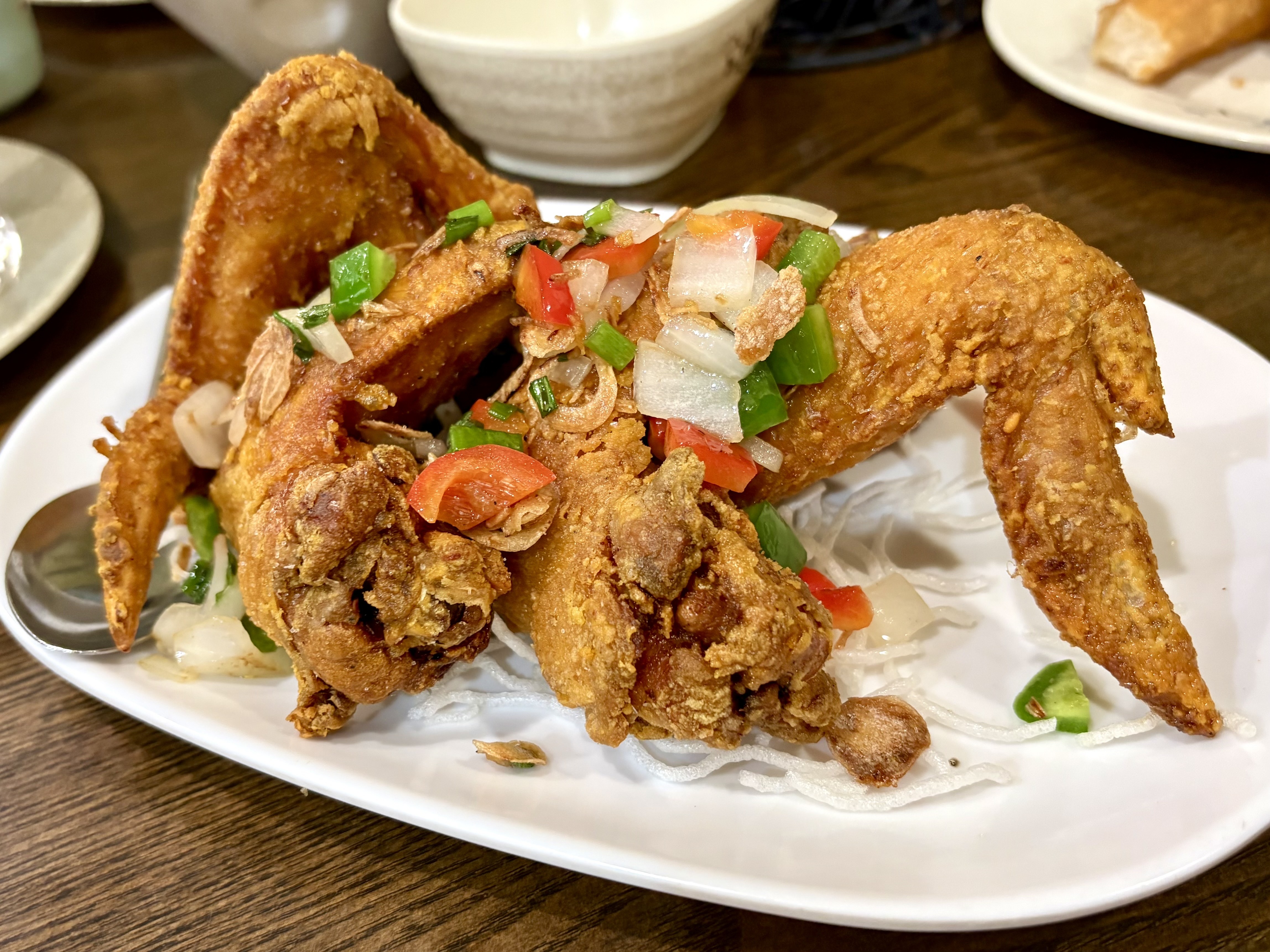
The shredded duck with string beans is pictured at Lau Kee in Philadelphia’s Chinatown on Thursday, April 1, 2021.TIM TAI / Staff PhotographerThe salt-baked chicken wings at Lau Kee are juicy, crisp and crackling with spice.Craig LaBan / Staff
Other popular congee combinations contain thousand-year egg and pork, or sliced flounder mingled with ginger threads and scallion — options that are standard at a dozen other Cantonese kitchens across Chinatown.
But it’s the subtle details of execution that make the difference in Lau Kee’s various soups, dumplings, stir-fries, and crispy delights. The battered crust on its salt-and-pepper shrimp in five-spice flavor might look heavy, but it’s as airy and crisp as tempura. Lau Kee’s juicy “salt-baked” chicken wings — which are actually perfectly fried — crackle with the spice of a crust infused with turmeric, cooking wine, and chili oil and easily rank among the city’s best.
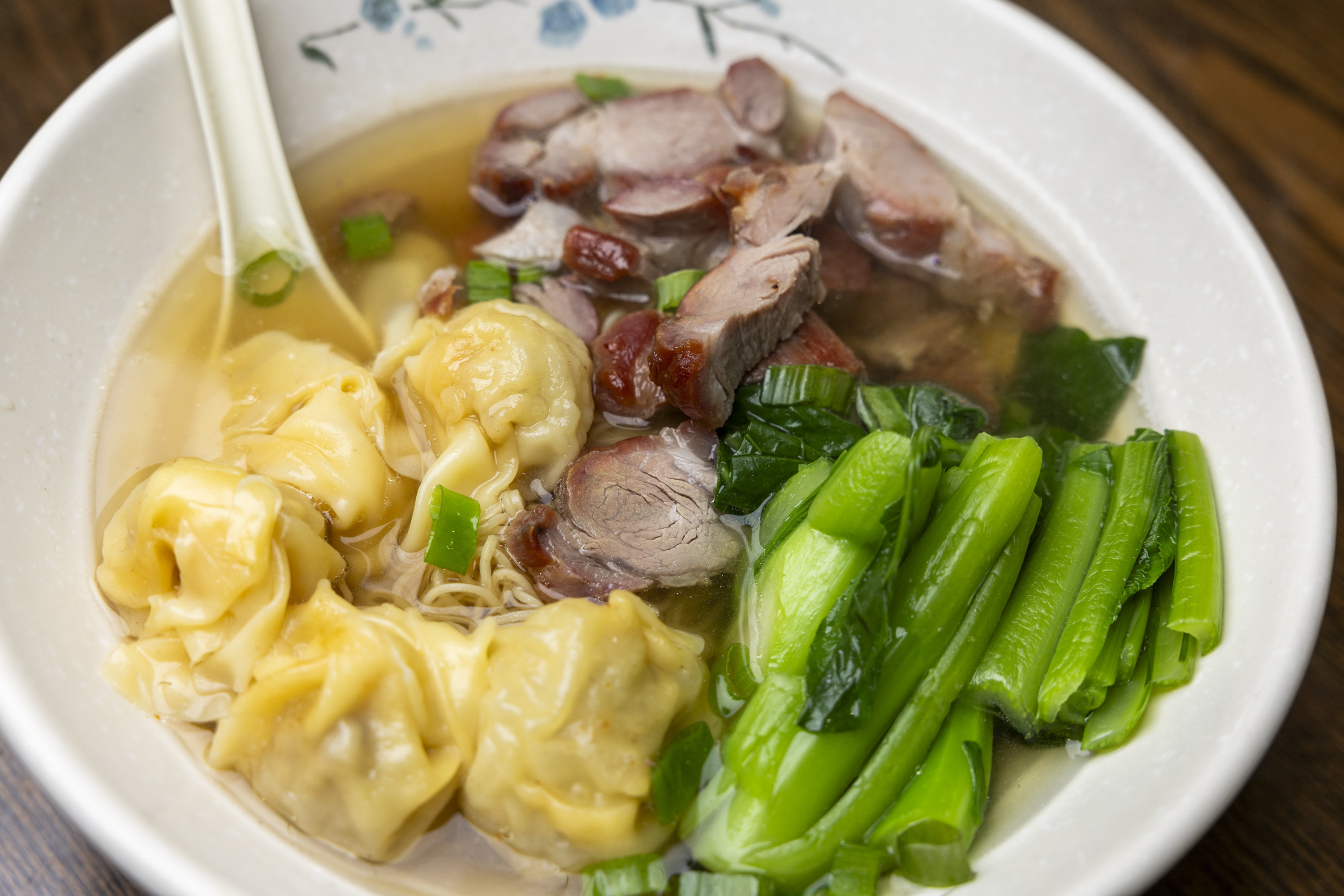
The broth in Lau Kee’s wonton noodle soup is crystalline gold yet complex, drawing subtle smoky depth from a lightly charred salt fish that steeps for five hours with chicken bones. The poached yu choy greens that bolster the soup are snappy yet toothsome, and Lau Kee’s wontons, made by Liu’s wife, Fannie Qiu, are special. The addition of mushroom adds tenderness to a shrimp-and-pork stuffing that elsewhere can become overly bouncy. Top the soup with any of the meats, but char siu is my favorite, the star anise sweetness of the pork’s glaze adding even more layers to the brew.
Wonton soup with greens and roast pork at Lau Kee.Tyger Williams / Staff Photographer
Those wontons are also perfect splashed with the vibrant orange house chili oil, defined more by its fragrance ofdried chilies than numbing Szechuan peppercorns.
Lau Kee’s shrimp dumplings are memorable, reminiscent of Sang Kee’s but softer, thanks to the addition of bamboo, and more fragrant from a pinch of curry. The West Lake beef soup is also one of my favorites, its hearty pairing of ground beef and silky tofu batons bobbing in broth sparkling with white pepper, delicate egg drop ribbons, and crunchy cilantro greens.
Lau Kee’s dry noodle dishes are solid, though less exciting. The minimalist scallion noodles, bright with shredded fresh ginger, is one of my two picks. The sesame oil-laced crispy noodle basket topped with morsels of flounder is another, notable for its delicacy and dual-textured noodles, both crunchy around the edges and soft in the middle from a velvety whitegravy. Other noodle standbys were fine but forgettable: a serviceable Singapore noodles, and a beef chow fun that lacked the smoky singe of wok hei.
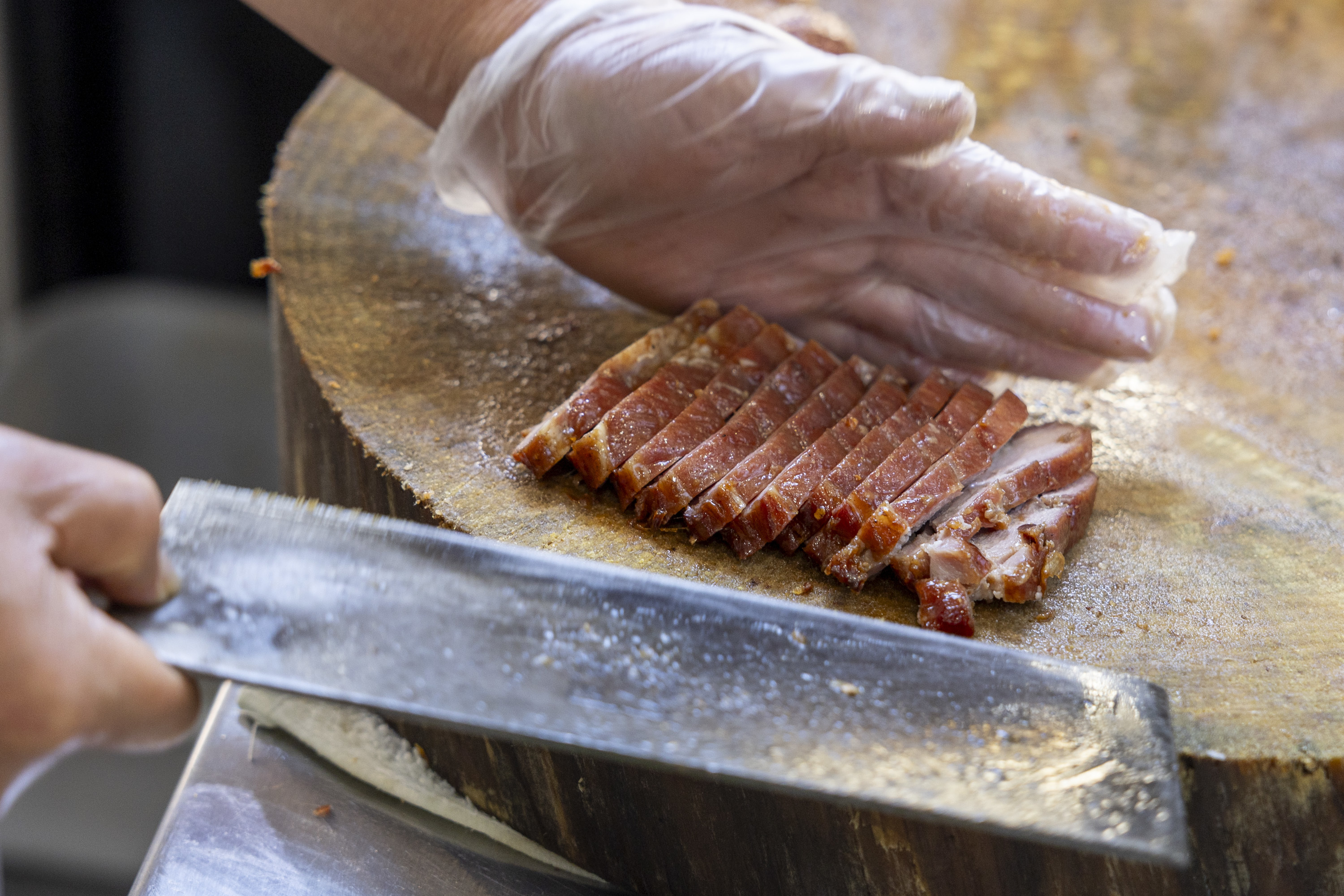
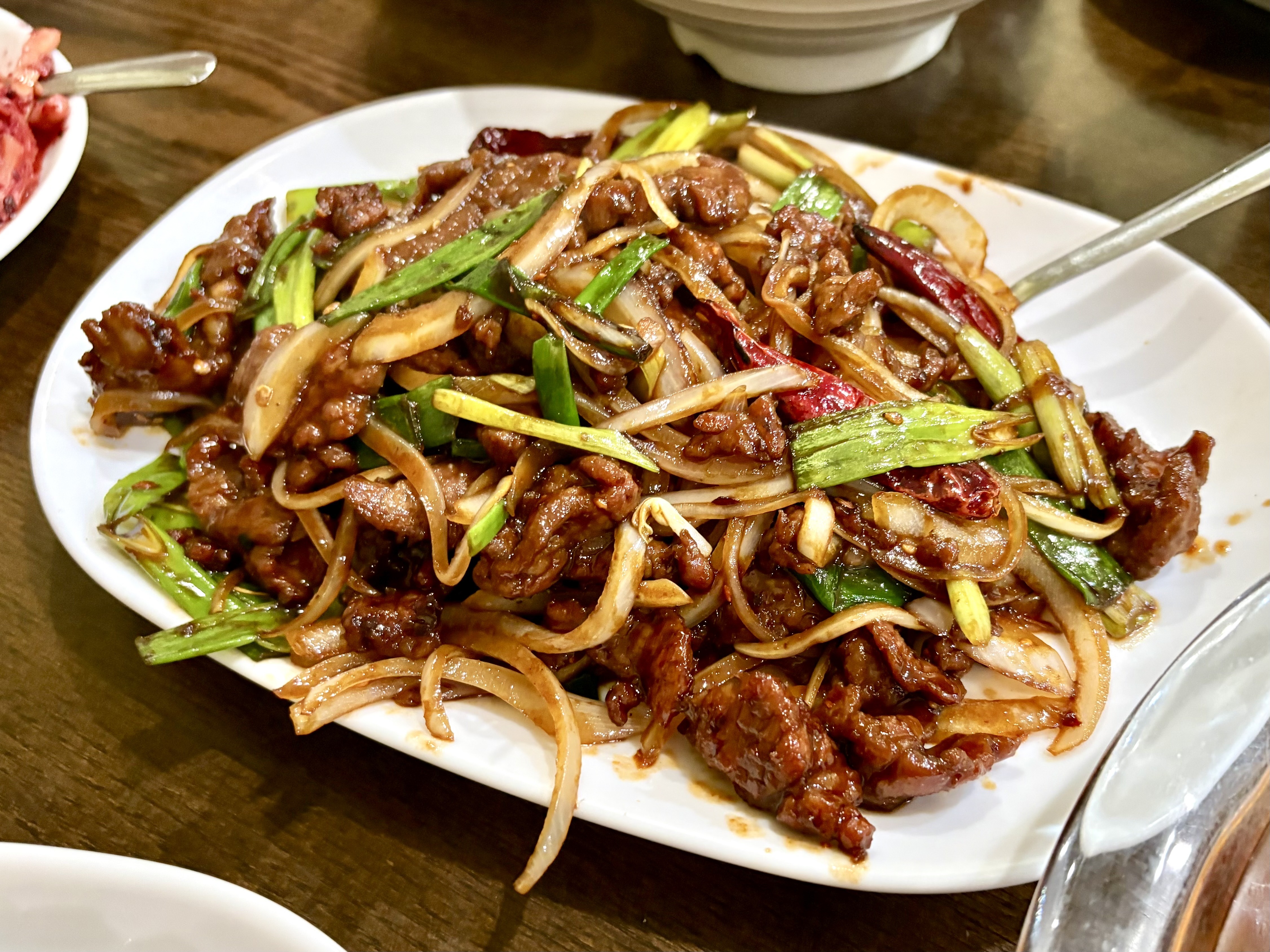
Fresh cut char siu pork shoulder at Lau Kee, in Philadelphia, Pa., on Friday, Aug. 7, 2026.Tyger Williams / Staff PhotographerThe Mongolian beef from Lau Kee in Chinatown.Craig LaBan / Staff
That whiff of caramelized char was absolutely present on the Mongolian beef, whose frizzled onion laces and dried chile heat added umami and sneaky spice to the sweet hoisin. It’s a specialty that traveled well by takeout, along with some good Americanized classics, including General Tso’s chicken, whose tender nuggets were glazed in a sweet sauce that also flickered with chili oil.
As a small business that needs every order (beyond the 250 ducks Chuien Liu sells each week), Lau Kee caters to the demands of a broad audience, and, to my mind, does many familiar dishes better than most.
But there’s an uncommon specialty on this vast menu that points to a niche of Fujianese specialties I wish Lau Kee would embrace more fully. Liu’s wife has mastered the Fujianese art of fermenting Qinghong, a wine made from sticky rice laced with red rice yeast.
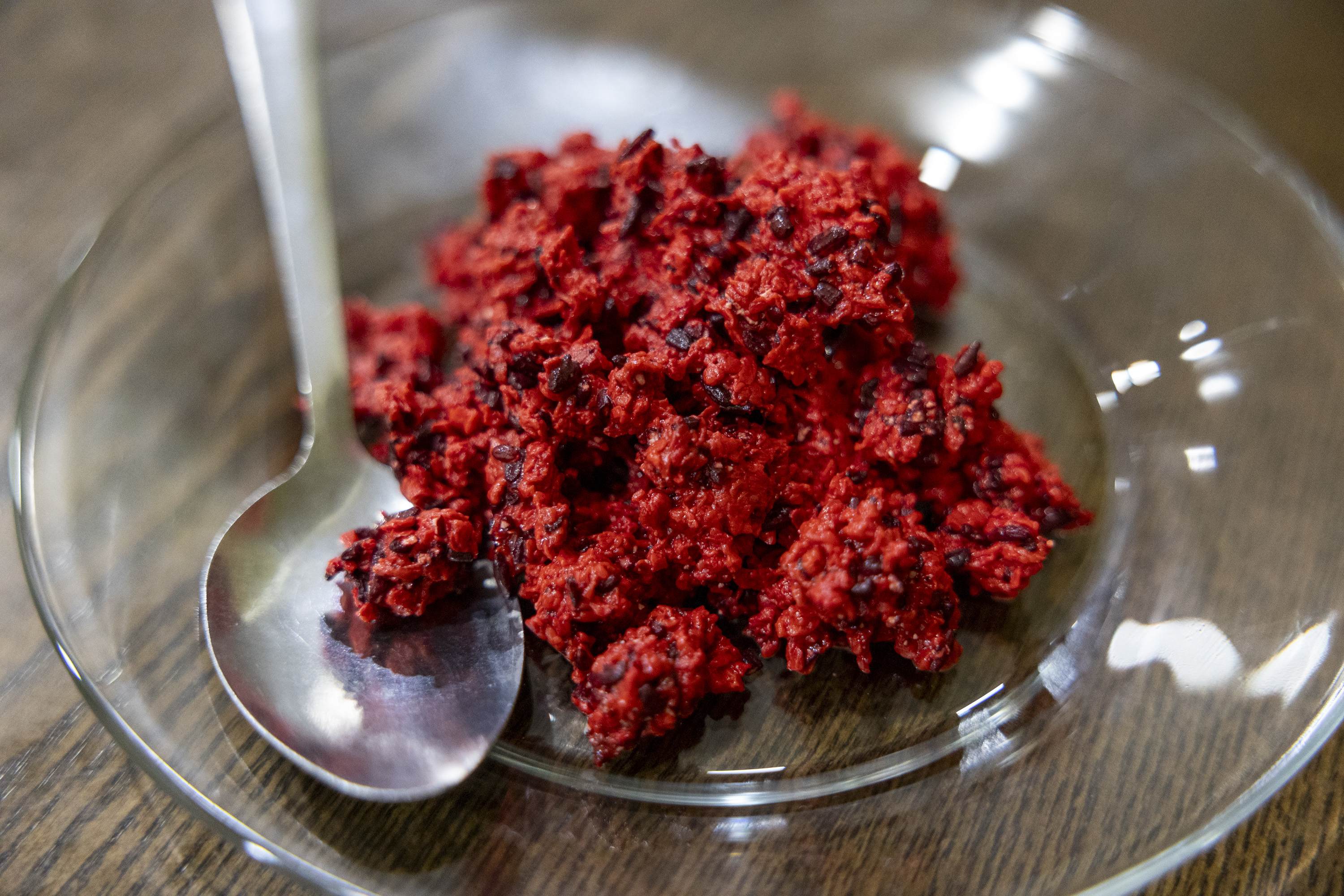
The red vinasse before processing to turn it into sauce at Lau Kee, in Philadelphia, Pa., on Friday, Aug. 7, 2026.Tyger Williams / Staff Photographer
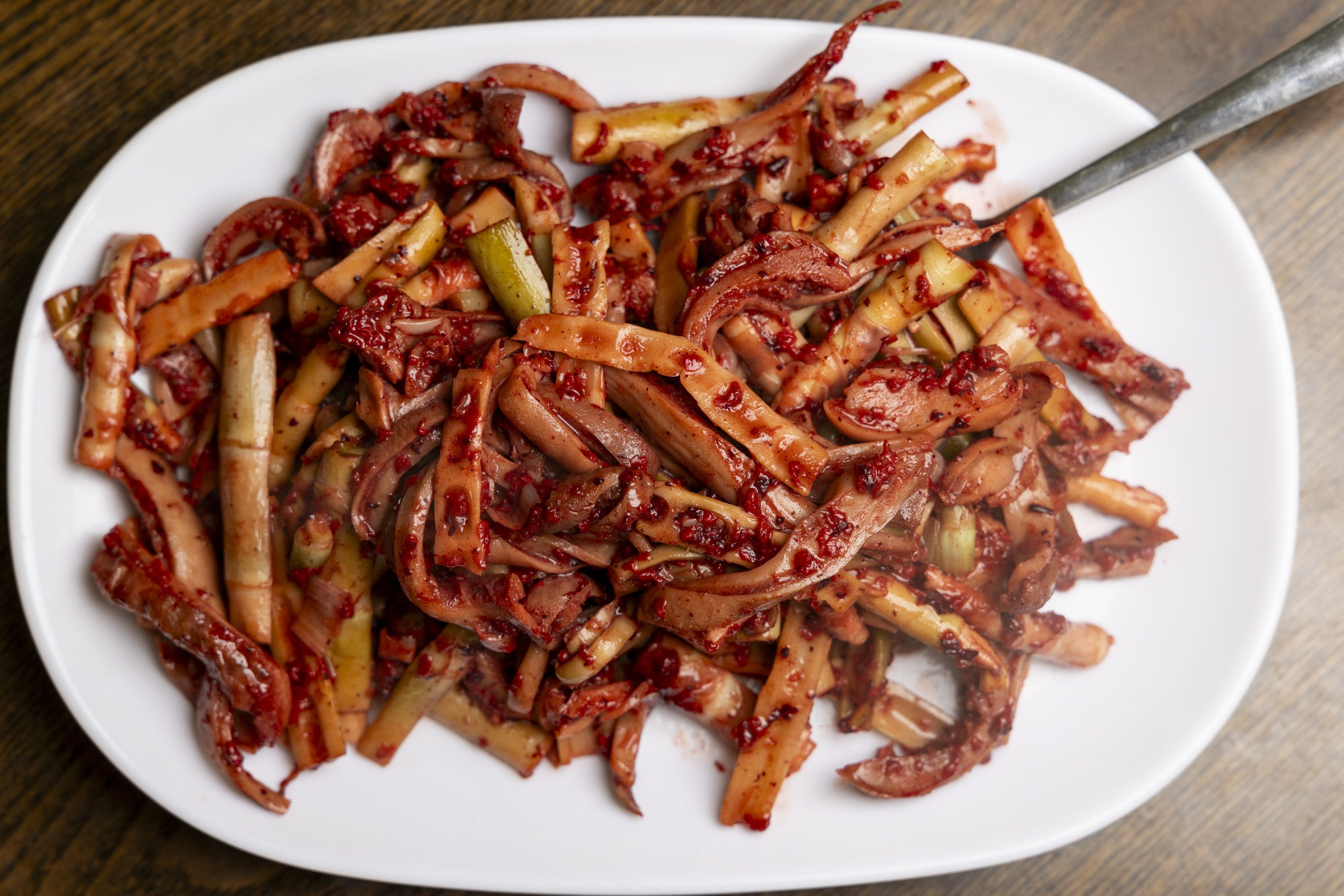
As Kenneth Liu notes only half-jokingly, “My dad does not share his wine.” But the leftover lees, a crimson paste noted on the menu as “red vinasse,” is a valuable condiment that carries a fruity, fermented note and yeasty tang. It’s a transformative addition to Lau Kee’s stir-fry of chopped pig stomach with bamboo shoots. (The squeamish can order it instead with shredded pork meat.) There’s a toothy-yet-tender snap to the offal and an earthy undertone that harmonizes with the lightly boozy lees for a far more rewarding dish.
The pig stomach with red vinasse at Lau Kee, in Philadelphia, Pa., on Friday, Aug. 7, 2026.Tyger Williams / Staff Photographer
Considering the sizable community of Fujianese entrepreneurs who’ve moved to this region over the past two decades and opened everything from Americanized Chinese takeout windows to sushi restaurants and, yes, excellent Cantonese duck houses, there are precious few places showcasing traditional Fujianese food, an underrated regional cuisine. Since the closure of both Ming River Side Walk House and my other longtime 10th Street favorite, simply called “Chinese Restaurant” (aka Tai Jiang), I can no longer find delicate noodles in peanut sauce, fried taro cakes studded with pork, wok-fried baby oyster omelets, and Fujianese wonton soup with tiny dumplings no larger than a penny.
Lau Kee doesn’t make them either, sadly, and even recently dropped another Fujianese specialty, drunken ribs, when Qiu’s brother retired from their kitchen. “[Fujianese cuisine] is not the fanciest food, and not everyone is willing to try,” says Kenneth Liu.
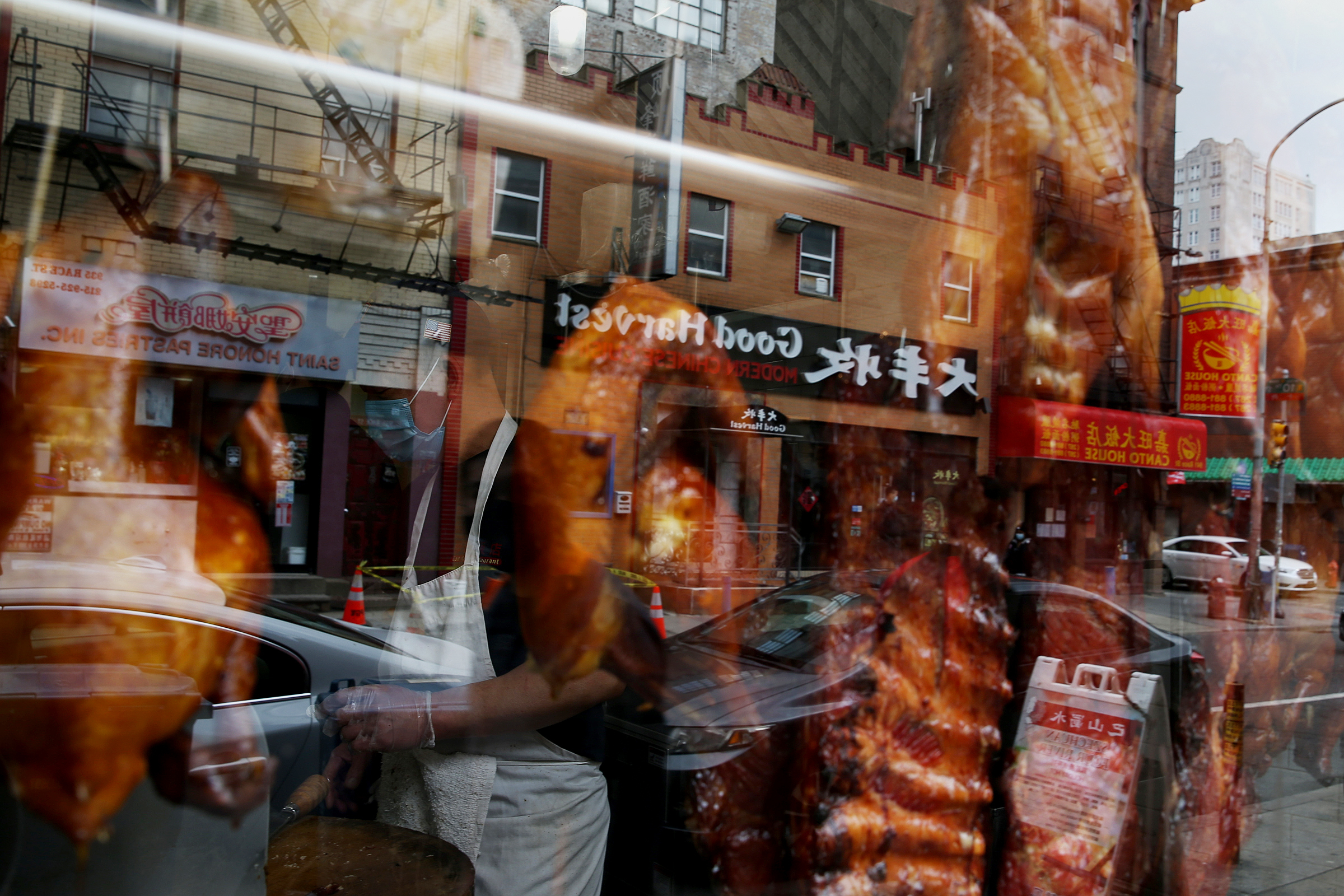
Businesses are reflected in a window in front of roasted ducks at Lau Kee in Philadelphia’s Chinatown on Thursday, April 1, 2021.Tim Tai / Staff Photographer
And yet, perhaps Philly’s diners would try if only they knew more of Lau Kee’s abilities to so beautifully represent their home region? My own enthusiasm was at least genuine enough to convince chef Liu to share a sample of his Qinghong wine stash.
“Don’t drink it all at once — it’s strong!” he warned, showing me the small bowl from which he sips a chilled cup of Qinghong daily.
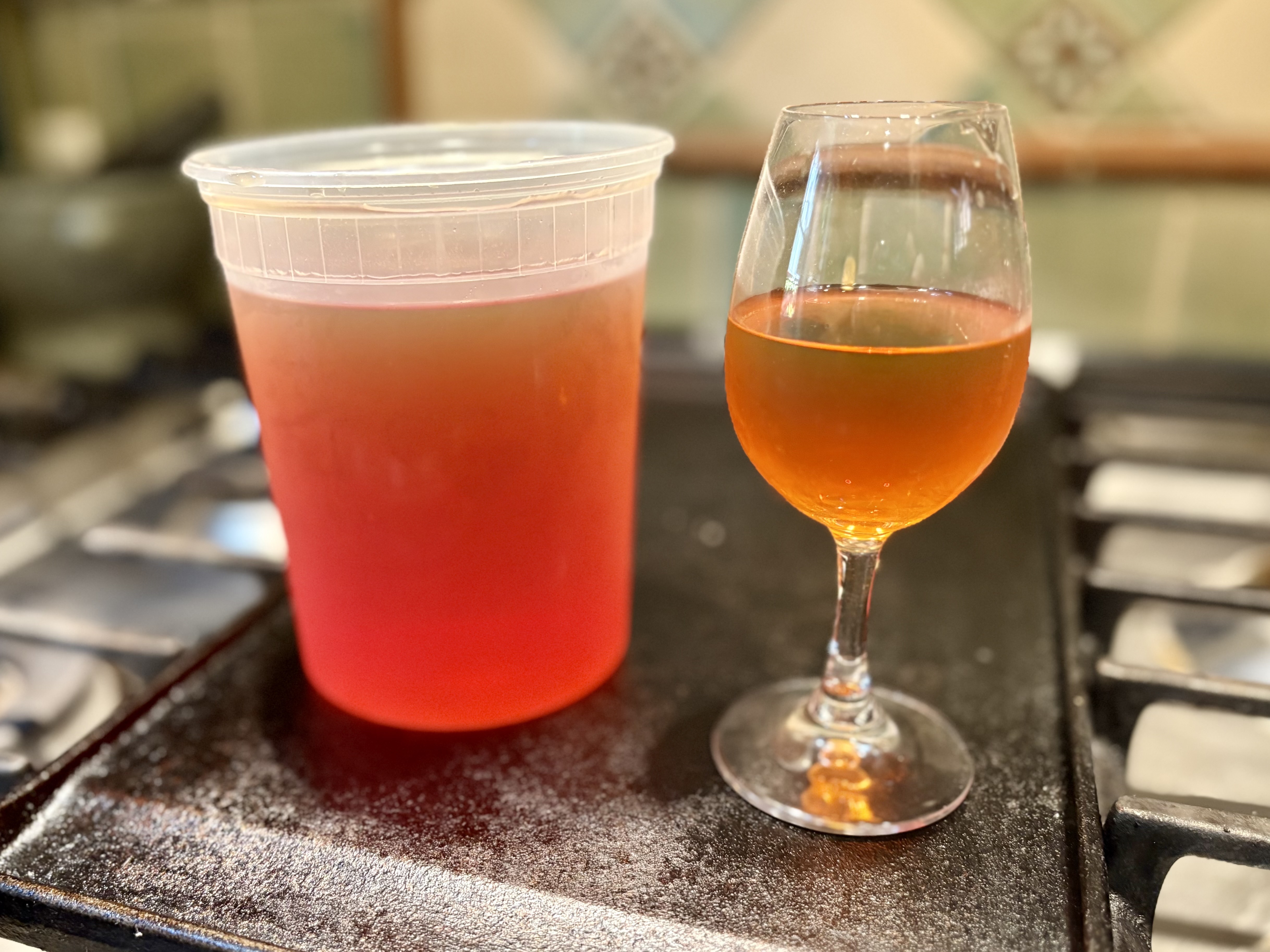
I took a sniff. It was tart like crushed red berries. I took a taste: a fruity tang but also dry and pleasantly funky, not unlike a refreshing sherry. I took another sip, and one more. And I understood. No matter what Lau Kee’s menu says, or how many perfect ducks Chuien Liu roasts for his adopted hometown of Philadelphia, this descendant of Fujianese fishermen will never forget the taste of home.
Qinghong, a Chinese wine made from fermented red rice, is made by Fannie Qiu for her husband, Chuien Liu, the chef-owner of Lau Kee in Chinatown, who used the leftover solids from the process to make Fujianese-style stir-fries.Craig LaBan / Staff
Lau Kee
934 Race St., 215-201-3511. Menu is posted on delivery apps.
Open 9 a.m. to 8 p.m. Tuesday through Sunday for dine-in; until 9 p.m. for takeout.
Wheelchair accessible via a small portable ramp.
Not ideal for gluten-free diners. A small portion of the menu can be made gluten-free, but none of the roasted meats.
BYOB
Menu highlights: Roasted meats: Hong Kong-style roast duck, (boneless) Peking duck, char siu pork, crispy pig, soy sauce chicken; Peking duck rolls; sliced beef in scallion pancake roll; wonton noodle soup with roast pork; shrimp dumpling noodle soup; West Lake beef soup; congee with roast duck; ginger-scallion noodles; shredded duck with string beans and XO sauce; Mongolian beef; pig stomach with red vinasse; salt-baked chicken wings.
The platter of Peking duck at Lau Kee, in Philadelphia, Pa., on Friday, Aug. 7, 2026.Tyger Williams / Staff Photographer
The Eagles held the 12th practice of their 2026 training camp on Monday at the Jefferson Health Training Complex. Here were my observations from Day 12 (and links to Days 1, 2, 3, 4, 5, 6, 7, 8, 9, 10 and 11):
DeVonta Day
DeVonta Smith returned to action after sitting out the last few weeks with a hamstring strain. He was limited and participated in individual drills. The Eagles are likely ramping him up ahead of this week’s joint practices with the Patriots. Cornerbacks Quinyon Mitchell (glute) and Cooper DeJean (groin) made full returns and should be ready to face A.J. Brown & Co. in New England.
The injury list grew after Saturday’s preseason opener. The following suffered injuries in Baltimore and missed practice: running back Tank Bigsby (toe), cornerback Jakorian Bennett (knee), cornerback Mac McWilliams (groin), tight end Grant Calcaterra (back), tackle JohnOjukwu (pectoral), cornerback Shaun Wade (eye/shoulder), and outside linebacker Jose Ramirez (hamstring).
The following remained out: receiver Makai Lemon (hamstring), cornerback Jonathan Jones (shoulder), receiver Johnny Wilson (knee), and running back Dameon Pierce (hamstring). The following were upgraded to limited participants: safety Cole Wisniewski (hamstring), outside linebacker Keyshawn James-Newby (ankle), cornerback Tariq Castro-Fields (heel), and receiver Danny Gray (concussion). Lemon did some sprints on a separate field. He’s running out of time if he is to play in the preseason.
Defensive tackle Uar Bernard wasn’t listed on the injury report, but he didn’t practice. I can see a future setback that lands the football neophyte on injured reserve for the season.
Nick Sirianni will likely place a lot of emphasis on the Patriots joint practices in his evaluations. David Maialetti / Staff Photographer
Start ’em up
The Eagles had a relatively light workout ahead of their trip to Massachusetts. First-unit players, most of whom didn’t face the Ravens, took most of the team drill repetitions. The same will likely hold for the joint practices. Coach Nick Sirianni is hoping the sessions with the Patriots carry a lot of weight ahead of the regular season, especially for his offense as it learns a new scheme. If Saturday showed anything, it’s that there could be a prolonged learning curve.
Offensive coordinator Sean Mannion said before practice that he could open up the playbook a little more in Foxboro. The Eagles should have their entire projected starting lineup if Smith goes. They could be light at receiver and running back, but the offensive line will enter intact. Right tackle Lane Johnson and left guard Landon Dickerson have mostly been partial participants in camp, but they appeared to take every snap on Monday.
Michael Carter II had a pick of Jalen Hurts on Monday. Tyger Williams / Staff Photographer
Gimme Carter
Defensive back Michael Carter II made the play of the day when he intercepted quarterback Jalen Hurts in team drills. Hurts threw to Quez Watkins on an intermediate route over the middle and Carter undercut the receiver to make a contested grab. It was a tight-window throw with a lot of bodies in the area. I’m not sure if Watkins’ route was precise or not, but it was another middle-field pick for Hurts. He’s had some strong throws in that area, but Sirianni may need to lower his turnover expectations if there are going to be more passes between the numbers.
Carter has locked down his spot on the roster. He may not have beaten out Marcus Epps for the nickel safety spot, but the dime position appears to be his. He should also be DeJean’s backup in the slot. Carter got home for two would-be sacks off slot blitzes during team drills on Monday. I’m intrigued to see the built-in answers Mannion has schemed up for his quarterback when he’s “hot.” I’m not sure why Hurts held the ball on both occasions.
Quinyon Mitchell is set to battle former teammate A.J. Brown later this week. Yong Kim / Staff Photographer
Mitchie-poo
The field tilts when Mitchell is manning the right side. We haven’t seen him follow a receiver since Smith’s injury, but he could be tasked with shadowing ex-teammate Brown later this week. They had their battles in Philly. Hurts did go at Mitchell on his first drop. Receiver Dontayion Wicks couldn’t shake the corner on a dig route, and the pass sailed incomplete.
Kelee Ringo replaced Mitchell when he took his first few rests. I’m not sure if this represented a promotion with Bennett and McWilliams sidelined. Ringo had an interception against the Ravens, but he had shaky moments, too. If either Mitchell or Riq Woolen was to get hurt, DeJean would likely move to the outside. Carter in the slot is a better option than any of the backups on the outside.
Monday was a good day for the Vic Fangio defense. David Maialetti / Staff Photographer
For the defense
Vic Fangio’s first-unit defense appeared, overall, to get the better of Hurts and Co. in about 25 plays. It wasn’t a lopsided performance by any stretch, but the turnover and several sacks gave the defense the edge. Hurts was forced to throw underneath a fair amount, which isn’t necessarily a bad thing. He hooked up with receiver Darius Cooper and tight end Dallas Goedert on short hitch routes during the first set.
The offense’s best moment might have come on a Hurts-to-Hollywood Brown connection for about 20 yards. Brown ran a curl route and settled in a soft spot in a deep zone. He made the catch and turned upfield ahead of Woolen for a few extra yards. Hurts then hit Gray on a slant on the next play.
There were a few other completions: a short toss to Elijah Moore when he was the third read on a naked bootleg and another shortie to the slot receiver. Hurts kept a play alive — even though Carter had eased off on a would-be sack — and threw to an open Goedert. But the tight end bobbled the ball and couldn’t reel it in.
Saquon Barkley (left) did not work out with the rest of the team in Baltimore but returned Monday. David Maialetti / Staff Photographer
Run it up
Barkley tweaked an ankle last week and didn’t warm up with the other starters ahead of the Ravens game. He was back in uniform, though, and took a few handoffs. Barkley hasn’t been kept in bubble wrap, but the Eagles have also been careful with their No. 1 running back. Bigsby will be the No. 2, but the guess here is that those expecting significantly more carries this season will be disappointed. Barkley will be the workhorse again.
He didn’t have much room when edge Nolan Smith Jr. and defensive tackle Jalen Carter blew up a couple of his rushes. Barkley did have a productive dash to the outside. Will Shipley and Carson Steele got a fair amount of first-team totes with Bigsby out. Shipley and Hurts had a botched exchange on a pitch. It was tough sledding for both tailbacks, but there were a few inside runs into the second level.
It was mostly the topliners up front who took reps in one-on-ones. Defensive tackle Moro Ojomo was able to swim by Dickerson on their first matchup, but the guard rebounded and stood firm against a bull rush. Left tackle Jordan Mailata easily handled edge Jalyx Hunt on both his rushes. Tackle Fred Johnson had a couple of strong sets vs. Smith. Hunt, it should be noted, recorded a sack in team drills.
Tyler Steen and Jalen Carter have had some battles in camp. Carter swam by the right guard in one-on-ones and bowled over him on the second turn. Steen might have had payback on his mind when he knocked the defensive tackle off his feet in team drills. Alas, the play resulted in Michael Carter’s interception.
Willie Lampkin made an impression on Saturday night, as he has throughout camp. Jose F. Moreno / Staff Photographer
Willie conk-a
Willie Lampkin was one of the few standouts on offense in the preseason opener. Loyal readers know I’ve been touting his abilities in camp. He has all the tools to compete in the NFL minus, maybe, his size (5-foot-11, 290). But the center/guard sure makes up for it with his technique, acumen and effort.
He took a lone snap vs. defensive tackle Byron Young in one-on-ones and had yet another win by my count. Lampkin and the second O-line unit didn’t get many snaps during team drills. On Thursday, the fight between Johnson and Ojomo ended practice early. I didn’t see any encounters between the pair several days later. But I did see Lampkin help Ojomo off the ground as Johnson stood nearby.
Ojomo addressed the fight after practice. “It’s football … I made a mistake,” he said. It’s time to move on.
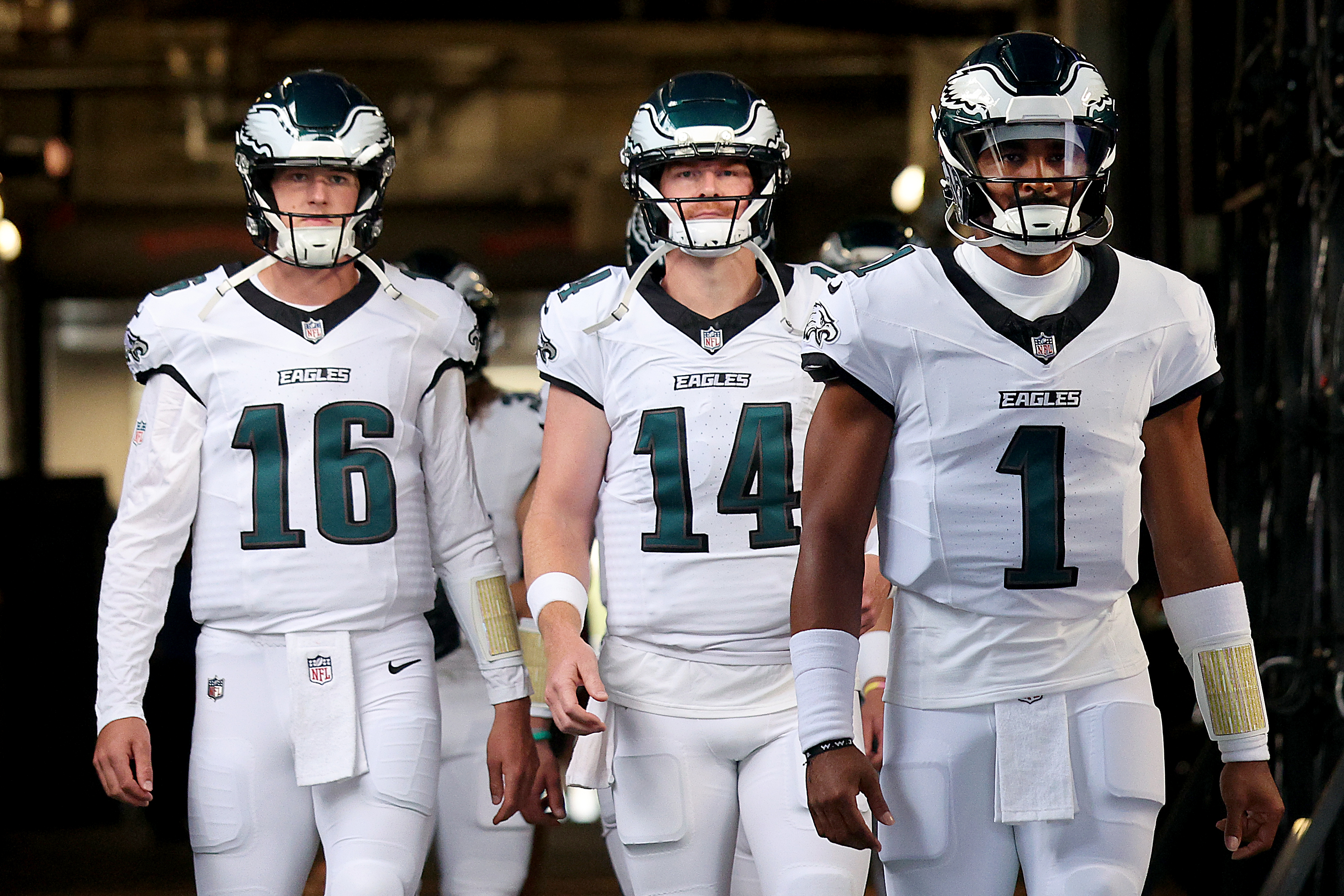
Tanner McKee (left), Andy Dalton (center) and Jalen Hurts all received reps on Monday. David Maialetti / Staff Photographer
Back to basics
Quarterback Andy Dalton was first up with the twos. Tanner McKee also got some snaps. As noted above, there weren’t many reps to go around, but the second-unit offense still looked ineffective. Dalton had to throw the ball away a few times. McKee essentially tossed one into the dirt when his receivers were all covered.
Linebacker Chance Campbell, who missed time with a groin strain, was back in team drills. Wisniewski blitzed at one point. He has a lot of ground to make up.
Extra points
Linebacker Jihaad Campbell had a couple of run stops. His talent is undeniable. He just needs to play. … Cole Payton took the last few snaps at quarterback. He had another scramble for positive yards. … The Eagles will have a walk-through on Tuesday before traveling to New England. Wednesday’s joint practice with the Patriots will begin at 10:15 a.m. and last about two hours.
Tower Health reported an $8.5 million operating profit in the year that ended June 30, compared to a $20.6 million loss the year before.
The fiscal 2026 profit will be Tower’s first in eight years, if the result holds in its audited financial.
In the Berks County nonprofit’s preliminary financial report to bond investors Friday, Tower management called the result “an important milestone in Tower Health’s ongoing journey toward sustained financial strength.”
In addition to Pottstown, Tower owns Phoenixville Hospital and Reading Hospital in West Reading, and half of St. Christopher’s Hospital for Children in North Philadelphia in a joint venture with Drexel University.
Here are more details:
Revenue: Tower reported a 2% increase in revenue, to $2.07 billion from $2.03 billion. Reading Hospital in West Reading logged an 11% increase in revenue, while the combined revenue of Phoenixville and Pottstown Hospitals fell 8%.
Patient volumes: Pottstown saw an 11% decrease in hospital admissions, likely because Tower closed the hospital’s intensive care unit at the beginning of the this year. Phoenixville had a small gain of 0.7% in admissions, while Reading was flat. Total surgeries across the system were flat.
Notable: A year ago, Tower reported a preliminary operating profit of $5.9 million for fiscal 2025, thanks to a gain on the sale of the former Brandywine Hospital. That would have been the system’s first profit in seven years, but it turned into a $20.6 million loss in Tower’s audited financial statements. Auditors from KPMG decided that Tower needed to boost medical malpractice reserves and give up on collecting millions owed by patients.
In an email to The Inquirer, Tower CEO Michael Stern expressed confidence this year’s audit will uphold the preliminary result, giving Tower its first profitable year since 2017.
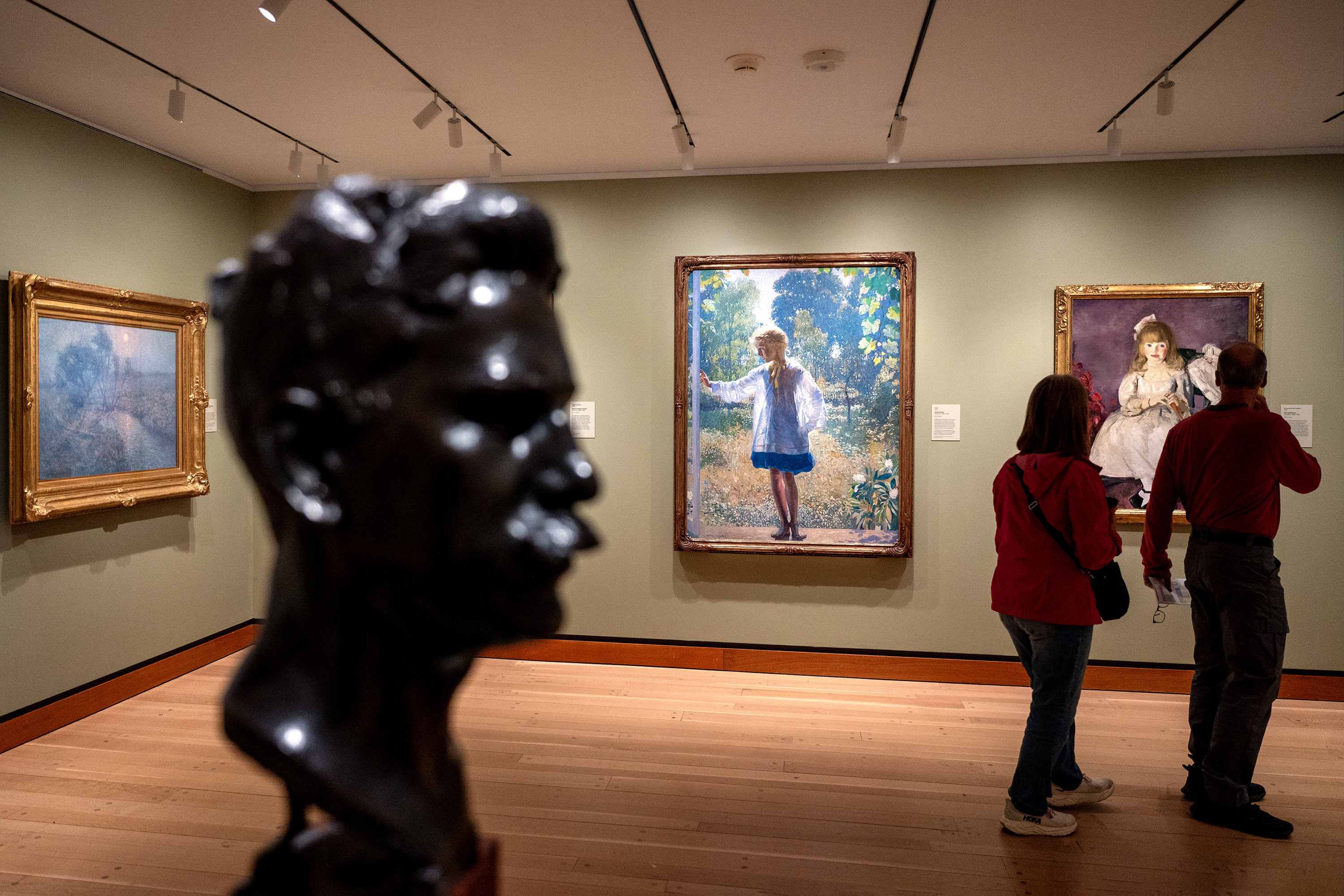
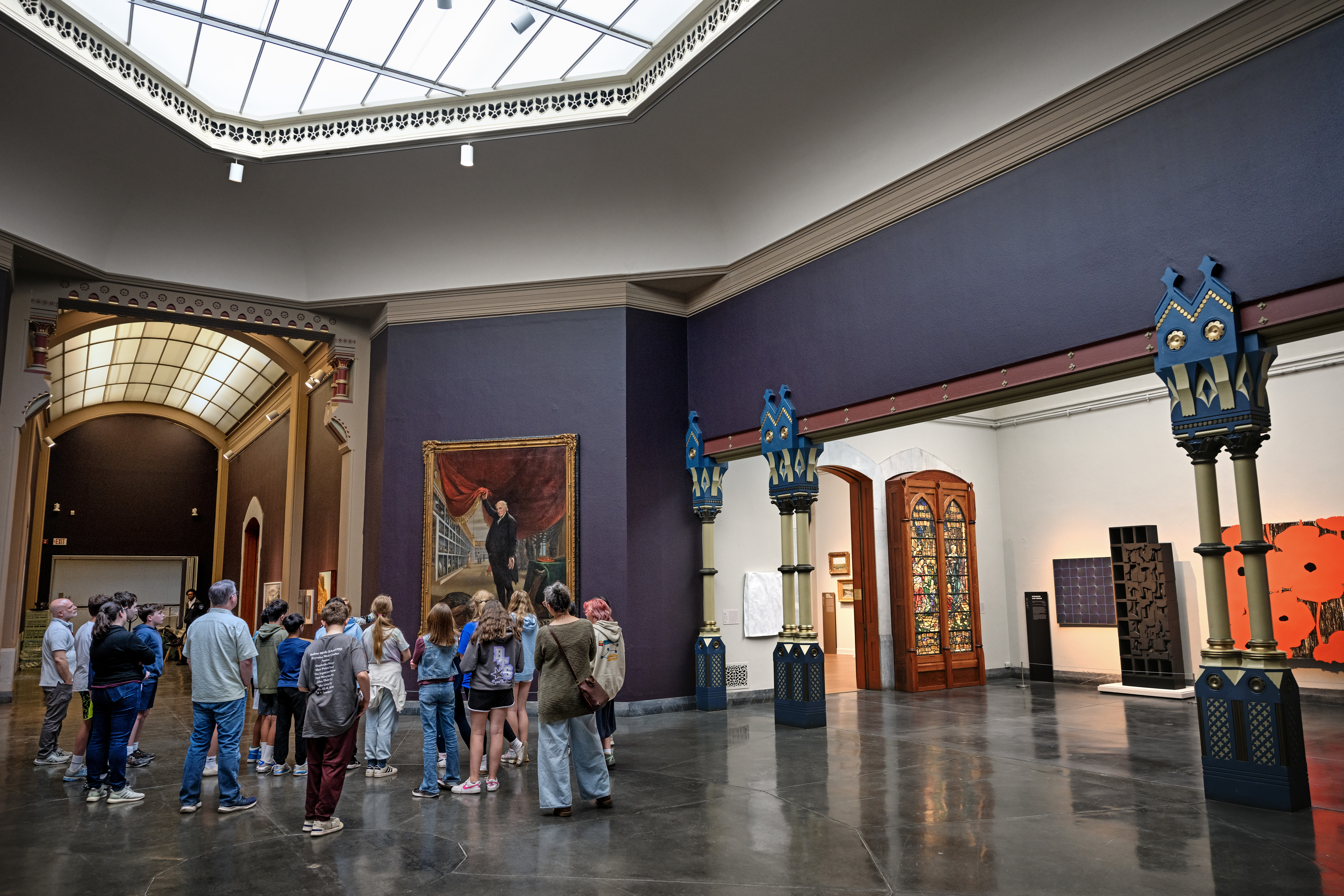
To find “A Nation of Artists” at the Philadelphia Museum of Art, you walk from the Great Stair Hall down a long gallery lined with art that’s not part of the show. The path zigs left and tightens into what looks like a service corridor, and then zags right past the bathrooms.
After this distinctly unceremonious approach, you’ve arrived at one of the museum’s most spectacular events of recent years.
Not only is “A Nation of Artists” momentous — it is billed as the “most expansive presentation of American art ever mounted in Philadelphia” — but it comes with the added juice of inaugurating the museum’s newly renovated American wing on the second floor after a 14-month closure.
The occasion brings yet another distinction: amazingly, after three more galleries open in the wing, it will be the first time in a decade that all of the galleries in the main building will have been open at the same time.
The odd journey to the second-floor American galleries has long been in place, but it seems especially odd now. It would have been nice to reopen this major piece of real estate with more of an architectural drumroll than a drab, winding hallway, especially for an institution that, after the tumultuous year it’s had, could use a thing or two to celebrate.
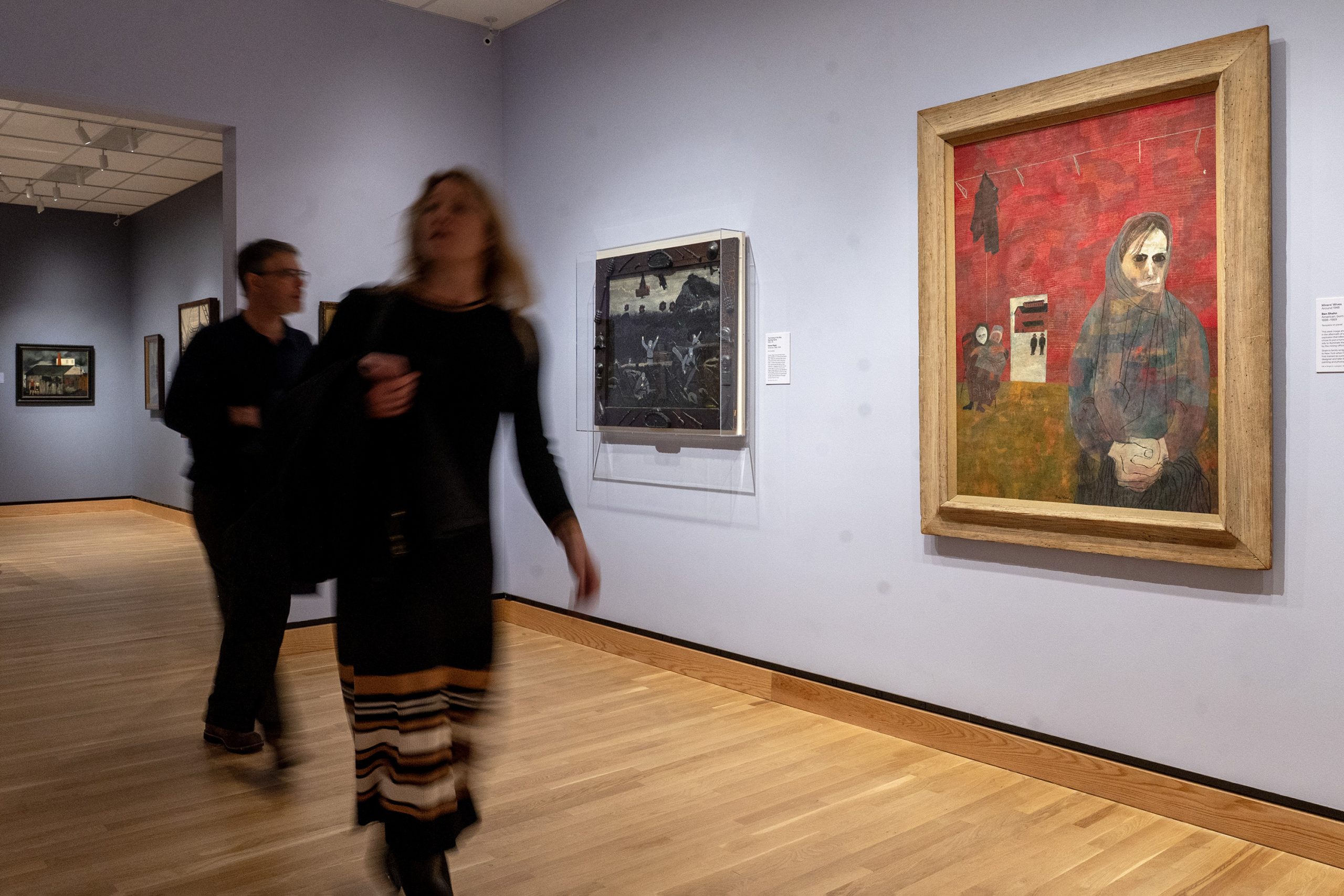
“Miners’ Wives” (right) by Ben Shahn and “The End of the War, Starting Home” by Horace Pippin at the Philadelphia Museum of Art.Tom Gralish / Staff Photographer
It might also be easy to miss the show’s greater significance to the museum and its cohost, the Pennsylvania Academy of the Fine Arts. “A Nation of Artists,” which opened in April with more than 1,000 works at both museums, arrives as a bolt of ambition as the groups work their way through deficits and reorganizations and remind audiences and funders that beyond crisis, there is art, and it is glorious.
The show is the city’s major visual arts celebration of the nation’s 250th anniversary, and while it’s an impossible task to compress the story of art in America into any single show, the overall image that emerges is not a cohesive snapshot, but a fascinating mirror.
There’s sometimes a random, almost improvisatory feeling to “A Nation of Artists” — despite the show’s attempt to place works around themes like the American West or inequity — because America is itself ever-random and improvisatory.
Works in thematically grouped ensembles in ‘A Nation of Artists’ in the newly renovated Furness and Hewitt building at the Pennsylvania Academy of the Fine Arts.Tom Gralish / Staff Photographer
More than 120 works from the collection of John and Leigh Middleton and their family are augmenting “A Nation of Artists.” But after the show closes and the Middleton works are gone, PAFA will put in place a newly curated permanent collection, and the PMA will be left with a sweeping look at American art that starts on the first floor with earlier works and proceeds to the second to bring it up to the mid-20th century.
In other words, “A Nation of Artists” absorbs the Middleton works, but also spotlights the incredible riches in residence nearly all the time. That’s no small thing at a time when arts and culture in Philadelphia is struggling for engagement in the attention economy.
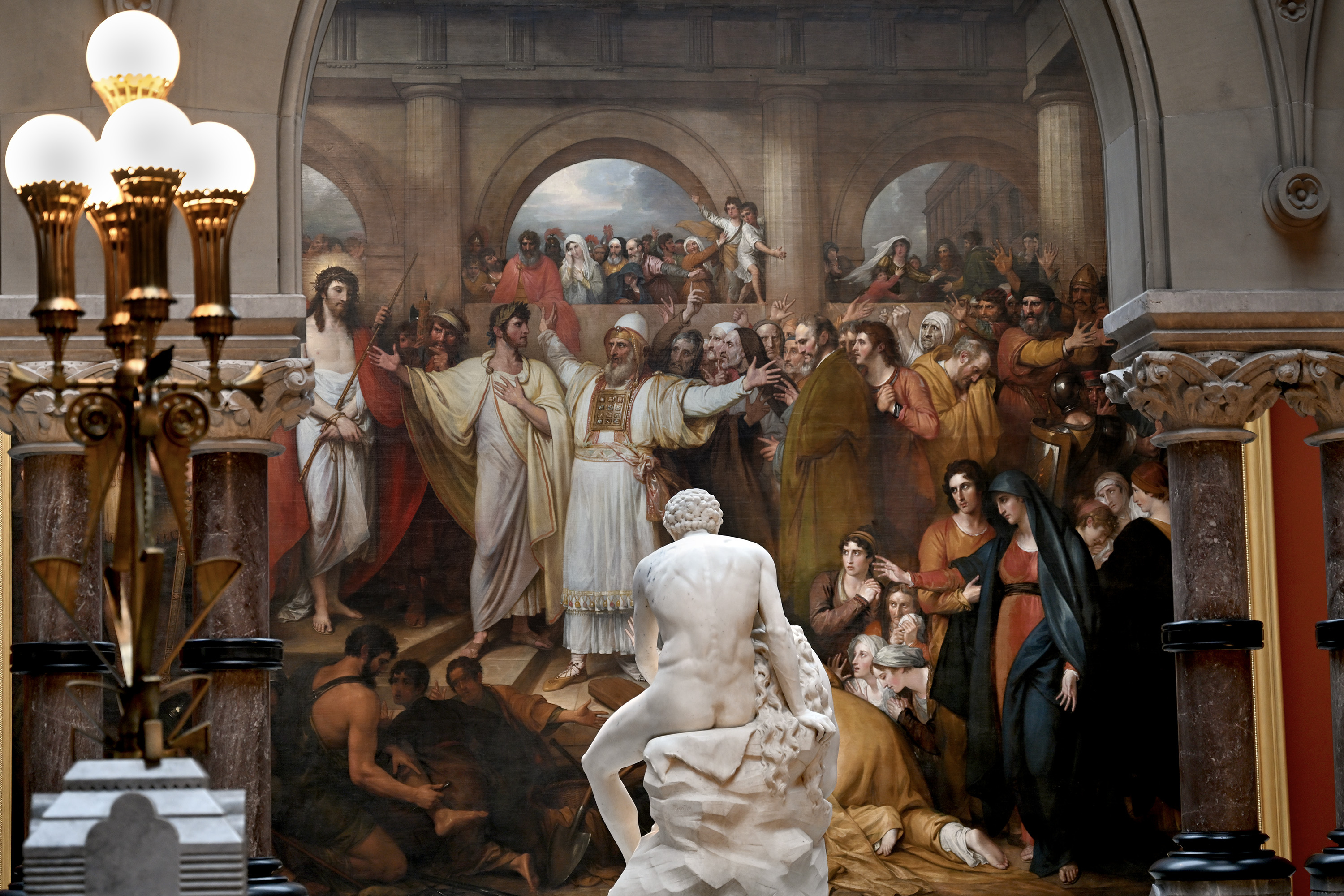
The painting “Christ Rejected” by Benjamin West and marble sculpture “Paradise Lost” by Joseph A. Bailly at the Pennsylvania Academy of the Fine Arts.Tom Gralish / Staff Photographer
A crisp reset at PAFA
At PAFA, the outside world seems to creep in in ways both positive and worrisome.
How can you admire the fruitful pedagogy at PAFA on display by generations of academy students and instructors without feeling concern for the place? The relationship between the museum and school — a specific artistic legacy unique to Philadelphia — is what makes PAFA special, and it remains to be seen whether a recently revamped certificate program at the school is the ultimate answer, artistically or financially.
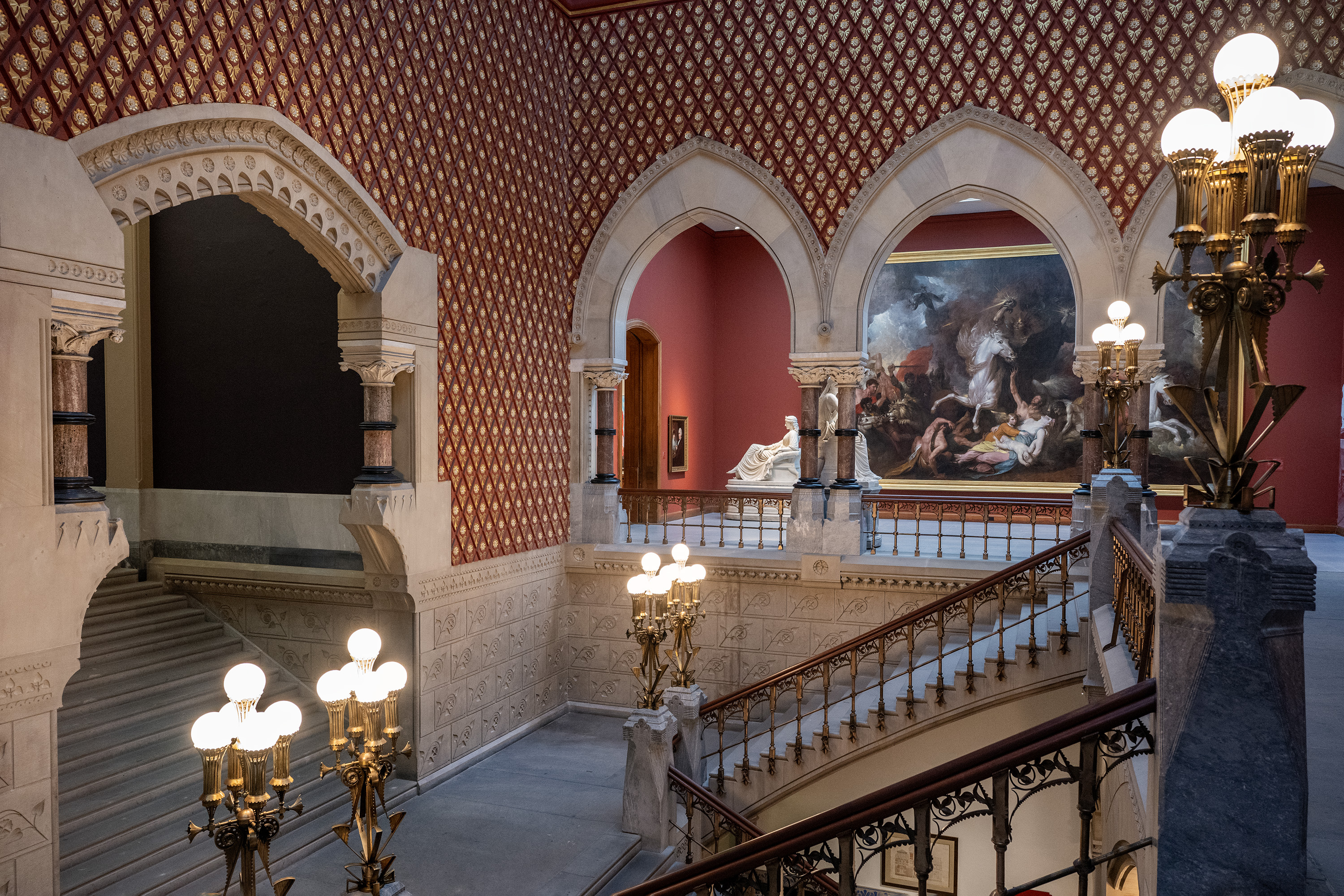
The exhibition marks a crisp reset: the reopening of PAFA’s jewel of a building, the riotously detailed 1876 Furness and Hewitt-designed landmark, after a renovation project that included a new HVAC system and other renovations.
Laylights (variously utilizing natural or artificial light) in the newly renovated Furness and Hewitt building at the Pennsylvania Academy of the Fine Arts.Tom Gralish / Staff Photographer
It’s good news that there are no dramatic changes; the building continues to dazzle. I visited the show there a half dozen times, and via the church-like rose window and skylights, nature played handmaiden to art. When clouds parted, sun filtered into some of the spaces, and in one gallery the natural light made the whites and colors of George Bellows’ North River pop.
The marble sculpture “Peri at the Gates of Paradise” by Thomas Crawford in the grand staircase at the Pennsylvania Academy of the Fine Arts.Tom Gralish / Staff Photographer
On another morning, the sunlight made the grand stair hall of the Furness building practically vibrate. The smooth white of marble sculptures like Thomas Crawford’s Peri at the Gates of Paradise glowed and the stars-on-cobalt pattern beneath the skylight seemed to be showering down.
Here on this day, there was no more beautiful interior in the city.
At the Pennsylvania Academy of the Fine Arts. In the rear is the oil painting “Death on the Pale Horse” by Benjamin West.Tom Gralish / Staff Photographer
A more sequestered PMA
If PAFA maintains a lively relationship with the outside world, the PMA’s new American wing feels sequestered. There are no visible windows letting in light in the second floor American galleries — no natural light except for a small opening in a staircase.
The layout and footpath (including that unceremonious approach) is largely the same as it had been before the renovation. But the flow within and from gallery to gallery is more open, and there is now a central spine of four continuous middle galleries that opens up a vista that helps to orient the visitor. Three remaining galleries in the renovated American wing are expected to reopen, though the date is uncertain.
Three Thomas Eakins oils (from left): “Mending the Net,” “The Pair-Oared Shell,” and “Sailboats Racing on the Delaware.”Tom Gralish / Staff Photographer
The PMA half of “A Nation of Artists” features a lot of big names (Andrew Wyeth, John Singer Sargent, Georgia O’Keeffe), as well as about three dozen works by Thomas Eakins — intimate portraits as well as epic canvases. There’s a beautiful sequence of three Eakins oils, all painted within a decade of one another, all with rivers in various hues and states of excitement: The Pair-Oared Shell, Sailboats Racing on the Delaware, and the stunning Mending the Net, a seemingly ordinary scene that gathers filmic mystery and story through minutely detailed figures mending a fishing net by the river against a gauzy beyond.
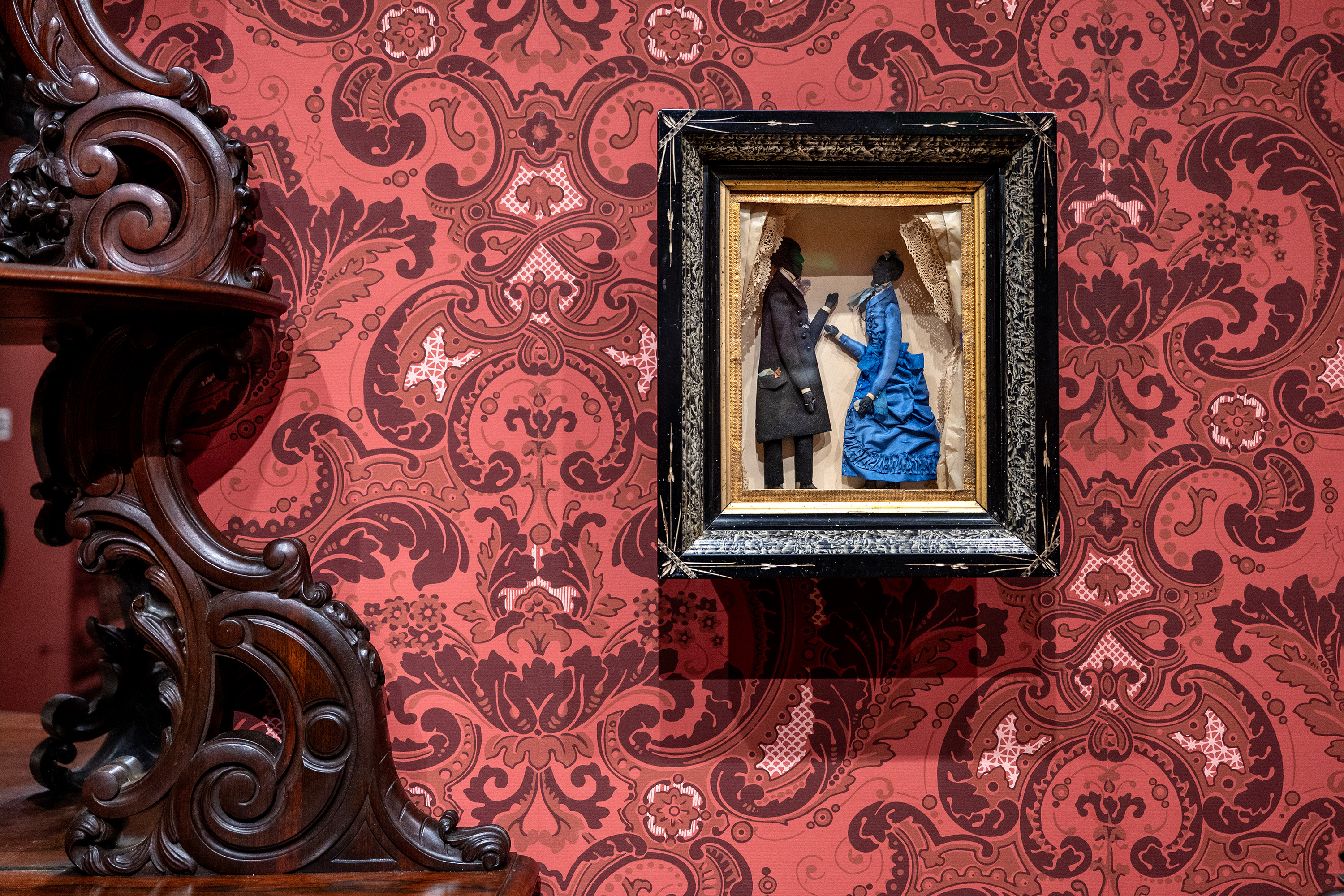
In terms of visitor experience, the new second floor American space succeeds most in moments of drama. The wall in one gallery uses a specially reproduced rich-burgundy period wallpaper, and the relationships among the paintings, furniture, pottery, and other items in the room ricochet beautifully.
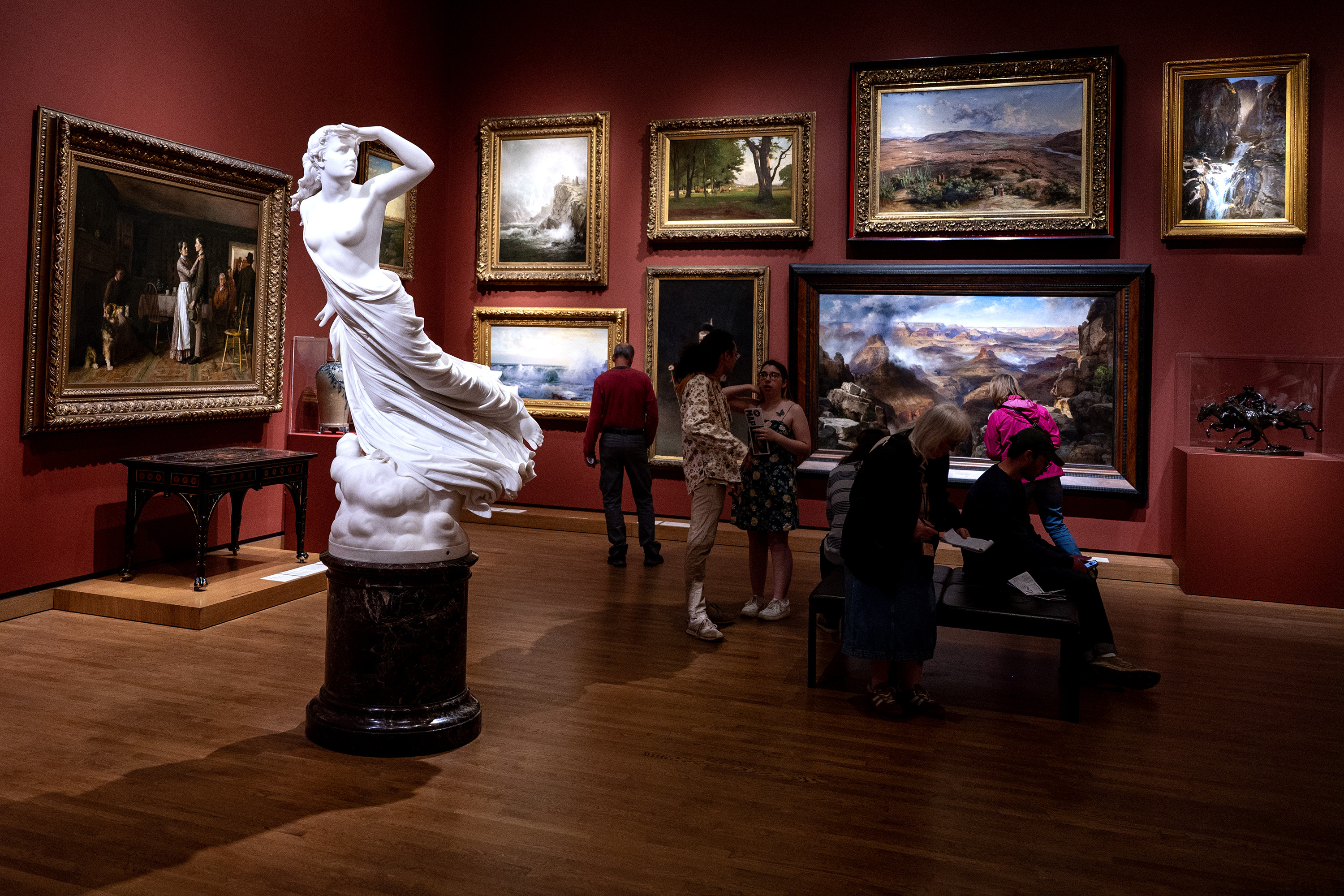
“The Lost Pleiad” by Randolph Rogers in the Philadelphia Museum of Art’s salon-style gallery.Tom Gralish / Staff Photographer
A sumptuous feeling immerses visitors in the high-ceilinged salon-style room (gallery 211) that includes vast landscapes and marble sculpture. Though it’s not immediately obvious, the first-floor American works are also part of the show, and they hold yet more Middleton works.
Classics and surprises, and a lot of charm
There’s greater poetry in the architecture at PAFA, but the work itself at both museums is undeniably impressive in scope, and especially at the PMA: painting, sculpture, furniture, silver, fabric, works in clay, and more.
The curators — Kathleen A. Foster and Alexandra A. Kirtley at the PMA, and Leah Triplett and Lea C. Stephenson at PAFA — have delivered not just old favorites, but also surprises.
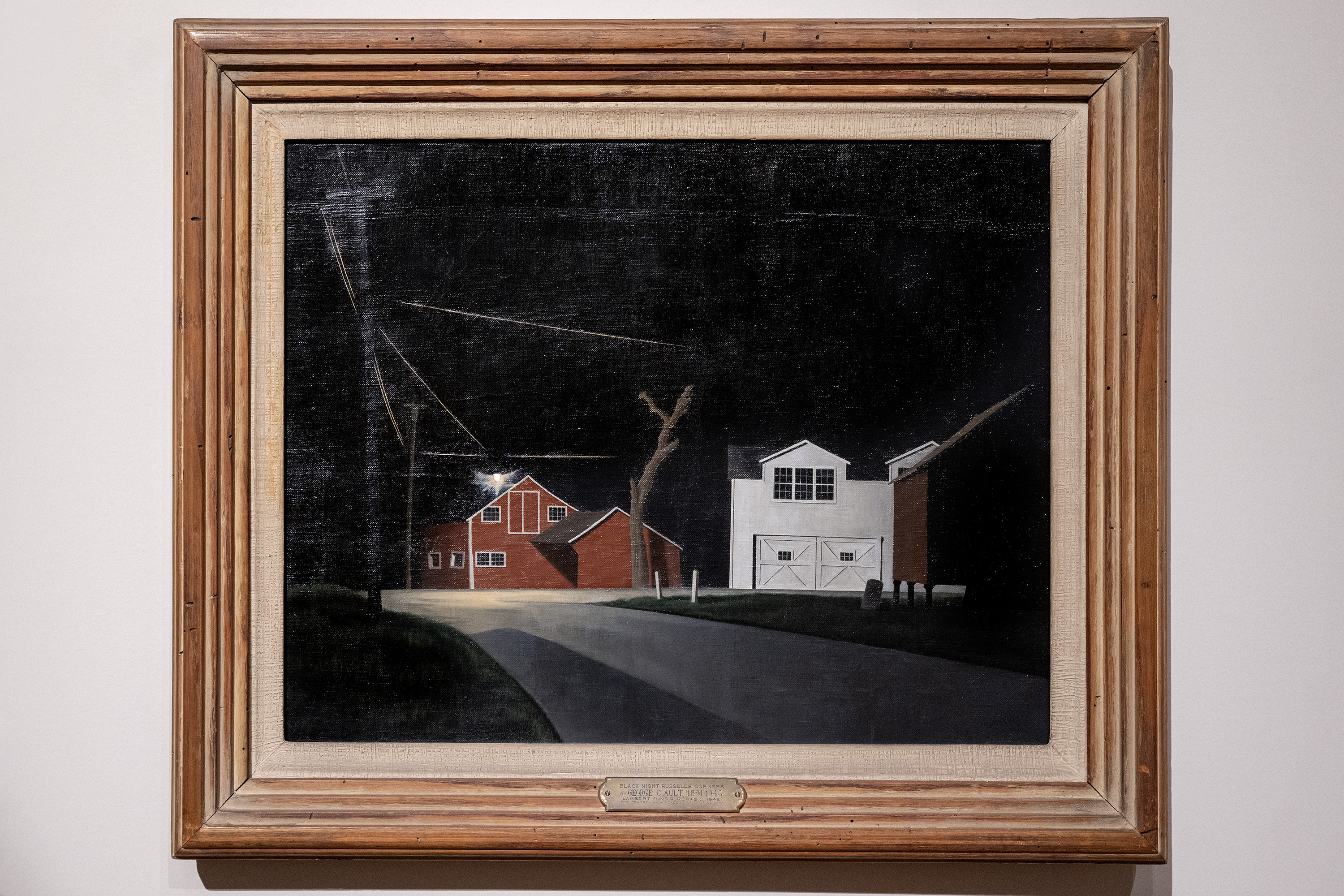
“Black Night: Russell’s Corners” by George Copeland Ault at the Pennsylvania Academy of the Fine Arts.Tom Gralish / Staff Photographer
PAFA’s classics include Winslow Homer’s Fox Hunt; the Jasper Johns Flag1960-66 from the Middletons (which the couple brought home from an auction in 2010 for $28.6 million); and George Copeland Ault’s Black Night: Russell’s Corners (1943), whose flat, cold, electric light suggesting a modern encroachment on agrarian life, can only be appreciated in person.
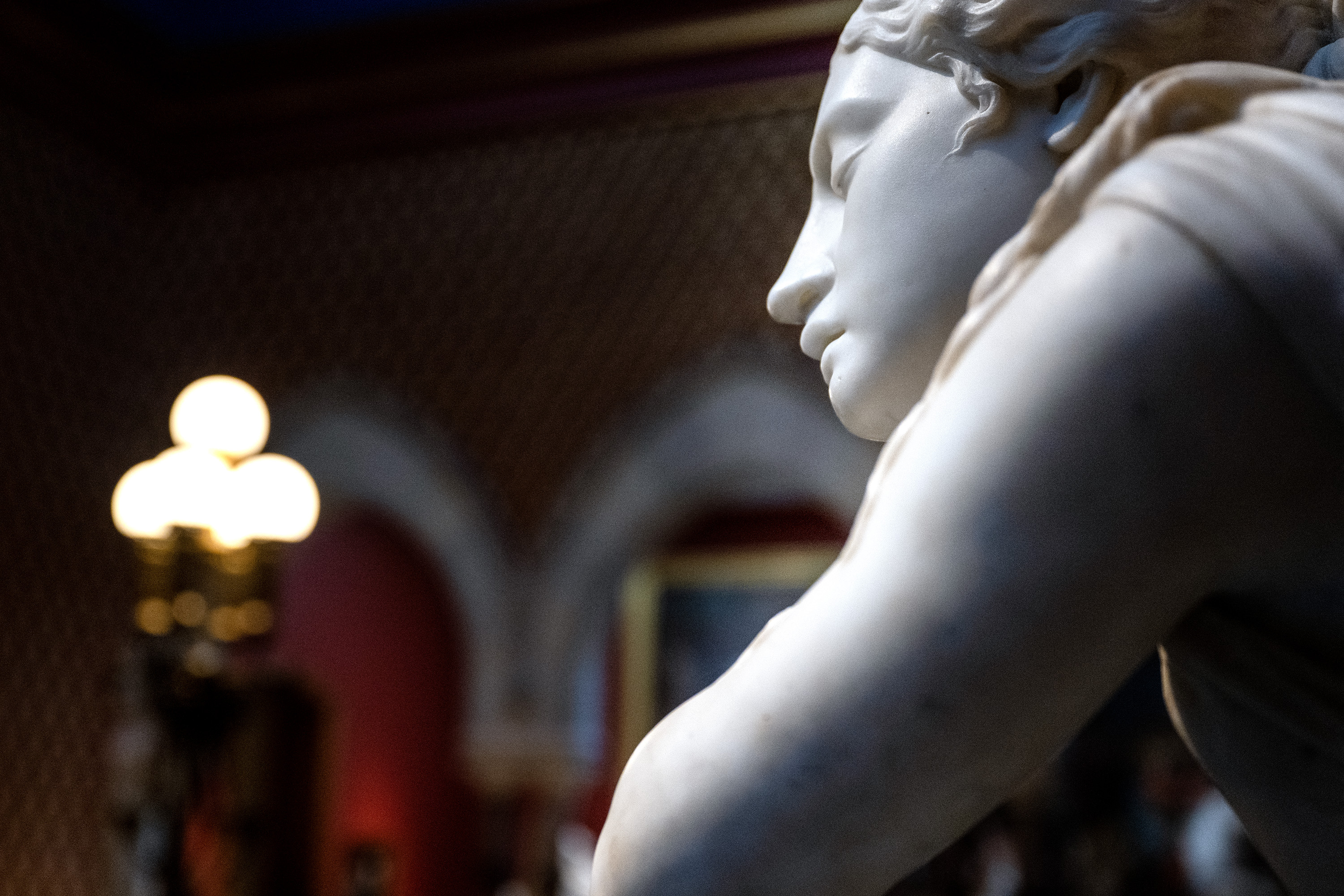
Among the pieces to which I kept returning: Pink Flower with Clock by PAFA 2011 graduate Aubrey Levinthal, because of the smart way it plays with the idea of photographic positive and negative imagery even though it is an oil; and Harriet Goodhue Hosmer’s Puck on a Toadstool, from 1856, whose supernatural energy is so potent that the figure appears poised to shape-shift and break free of its marble confines.
At the PMA, a single canvas has me reconsidering Edward L. Loper Sr., the Wilmington artist who had his beginnings working for the WPA. Loper’s Abandoned Ferry Terminal is a complex refraction of shadows and colors from 1958 whose geometries never seem to stop shifting.
A small shadowbox of a man and woman formally costumed from around 1880 might be the most unassuming bit of charm in the entire exhibition. Its maker is unknown.
Custom wallpaper at the Philadelphia Museum of Art, with “Portrait Figures of a Man and a Woman, in a Shadowbox.”Tom Gralish / Staff Photographer
Leaning into representation
If you ever wanted a lesson in the difference how a work is displayed can make, just consider how much more substantial an achievement The Gross Clinic looked a few months ago. With bright but warm lighting at the PMA, Eakins’ 1875 canvas was frightening in its vividness, the red of blood on the surgeons’ hands glistening. Today, at PAFA, it looks a little washed out, overpowered by the light coming through the nearby rose window.
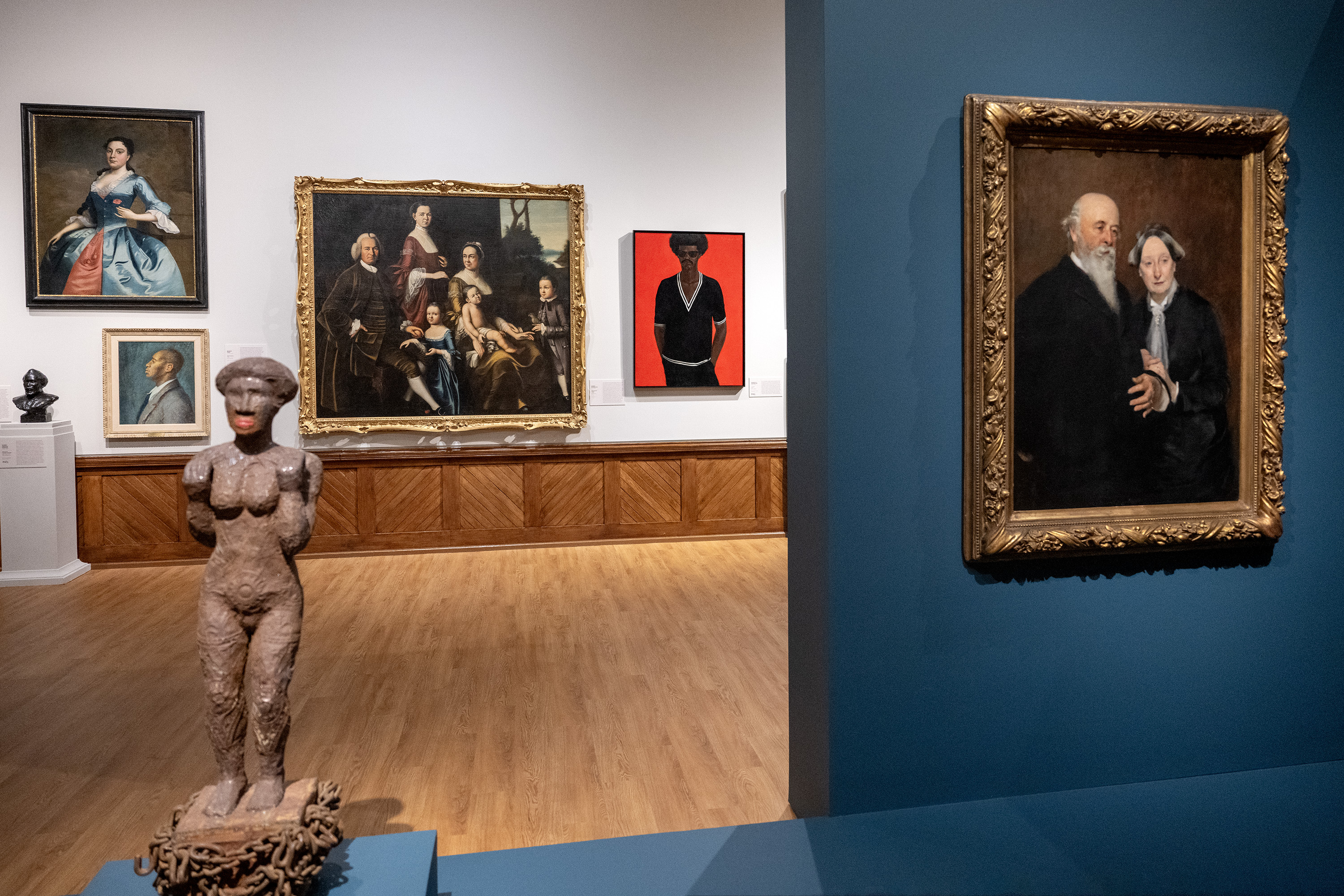
Both museums have made a conscious effort to represent a spectrum of identity — gender, regional origin, ethnicity, and so on. This is all to the good, of course. Everyone will find something relatable in this exhibition, and many will discover works that aren’t necessarily relatable on first examination but become so. This is why museums, and good curators, are important.
Detail of “Nydia, the Blind Girl of Pompeii” by Randolph Rogers at the Pennsylvania Academy of the Fine Arts.Tom Gralish / Staff Photographer
It’s a fascinating marker of time to think about the cultural whiplash of the past couple of years in this country, and how vulnerable the simple concept of representation now feels. The tastes of the art establishment change, and so too does how we perceive art.
How could it be otherwise? Every movement comes in with an air of moral and scholarly authority that purports to lay down once and for all an accurate cultural perspective.
The prevailing ethos arrives as the new reality. Then the next reality comes along.
“A Nation of Artists” runs through July 5, 2027, at the PMA, 2600 Ben Franklin Parkway; and Sept. 5, 2027, at PAFA, Broad and Cherry Streets. philamuseum.org, pafa.org.
MINNEAPOLIS — Pick a date, almost any date during the season, and the Phillies have ranked near the bottom of the majors in on-base percentage.
It’s a fundamental problem.
“Because everything we’re trying to do up there,” Kyle Schwarber said, at risk of stating the obvious, “is based around that result of trying to find a way on base.”
The numbers never really added up, though. Going into the last week of July, for instance, the Phillies reached base at a .303 clip, tied for last. But they also had the fourth-best hard-hit rate and were near the middle of the pack in barrel rate, which measures how often a hitter makes contact with the optimal combination of exit velocity and launch angle.
Maybe it was bad luck. The Phillies were batting .281 on balls in play. (Major league average is .289.) Or maybe it was self-inflicted. As a team, they swung at the second-highest rate of non-strikes (34%).
Whatever the case, they needed to figure it out.
So, they had a meeting.
Hitting coach Kevin Long, his two assistants, and hitting analysts meet with the players before every series to go over strategy and review scouting reports on opposing pitchers. But this was different, multiple players said over the weekend.
In getting together the last week of July — before the deadline trade for contact-hitting savant Luis Arraez — Long and his staff highlighted things the Phillies were doing well before inviting the players to brainstorm why it wasn’t translating into better on-base results.
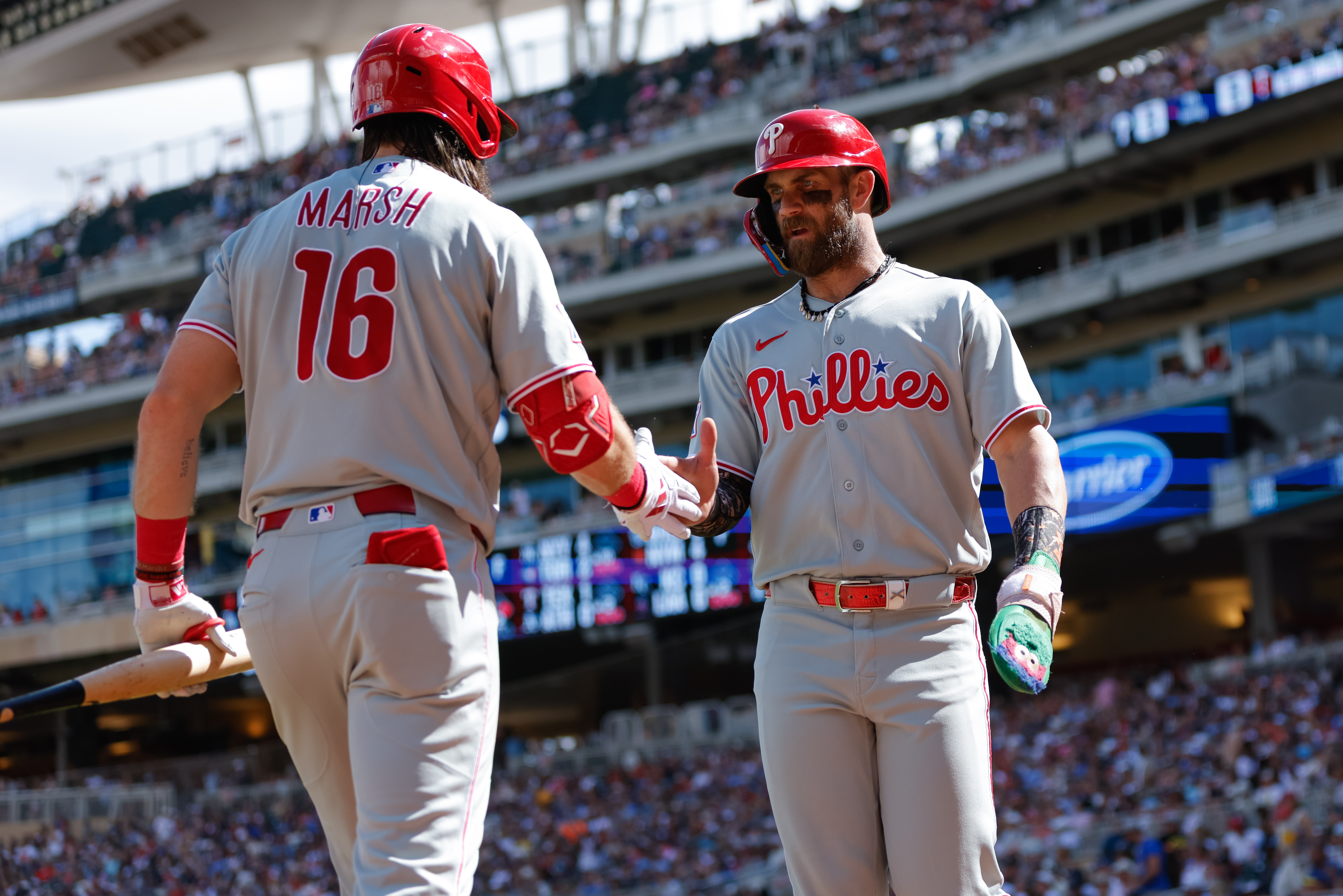
Bryce Harper (right) has drawn a walk in seven consecutive games through Sunday and has 21 walks in 15 games in August.Bailey Hillesheim
“I think there was a stigma there of us being last in on-base, and that can wear on a group, right?” Schwarber said. “But the room starts talking, guys start giving their opinions, and then it’s like, all right, how do we work through what we want to work through to get to where we need to be?
“As a group, it was a pretty good conversation, and I feel like we’ve been building on that and doing some really good things.”
In fact, halfway through the month, the Phillies are leading the majors with a .362 on-base percentage in August.
To make sense of the relative traffic jam on the bases, the easiest place to start is here: a 29% rate of swings at non-strikes so far this month, far below their 33.2% season average — and even the 30.4% league average.
But there’s more. The Phillies are walking nearly twice as often, from a 7.8% rate through July 31 to 13.1% this month. Bryce Harper says his dad tells him he’s at his best when he’s walking. With Arraez batting behind him, Harper has drawn 21 walks in 15 games in August. Bryson Stott (15) and Schwarber (13) are also walking at a higher clip.
As a team, the Phillies appear to be staying true to Long’s long-held philosophy of being “selective-aggressive.”
It’s more than that, though, according to Schwarber. Because if the last few years have taught the Phillies’ hitters anything, it’s that chasing pitches out of the strike zone is “the nature of the beast of the game,” Schwarber said. It’s in their DNA. Most of them won’t suddenly stop doing it, even though they don’t mean to.
And besides, every hitter is unique, with different strengths and vulnerabilities. There wasn’t a paint-by-numbers approach to figuring out how the collective group could reach base more frequently.
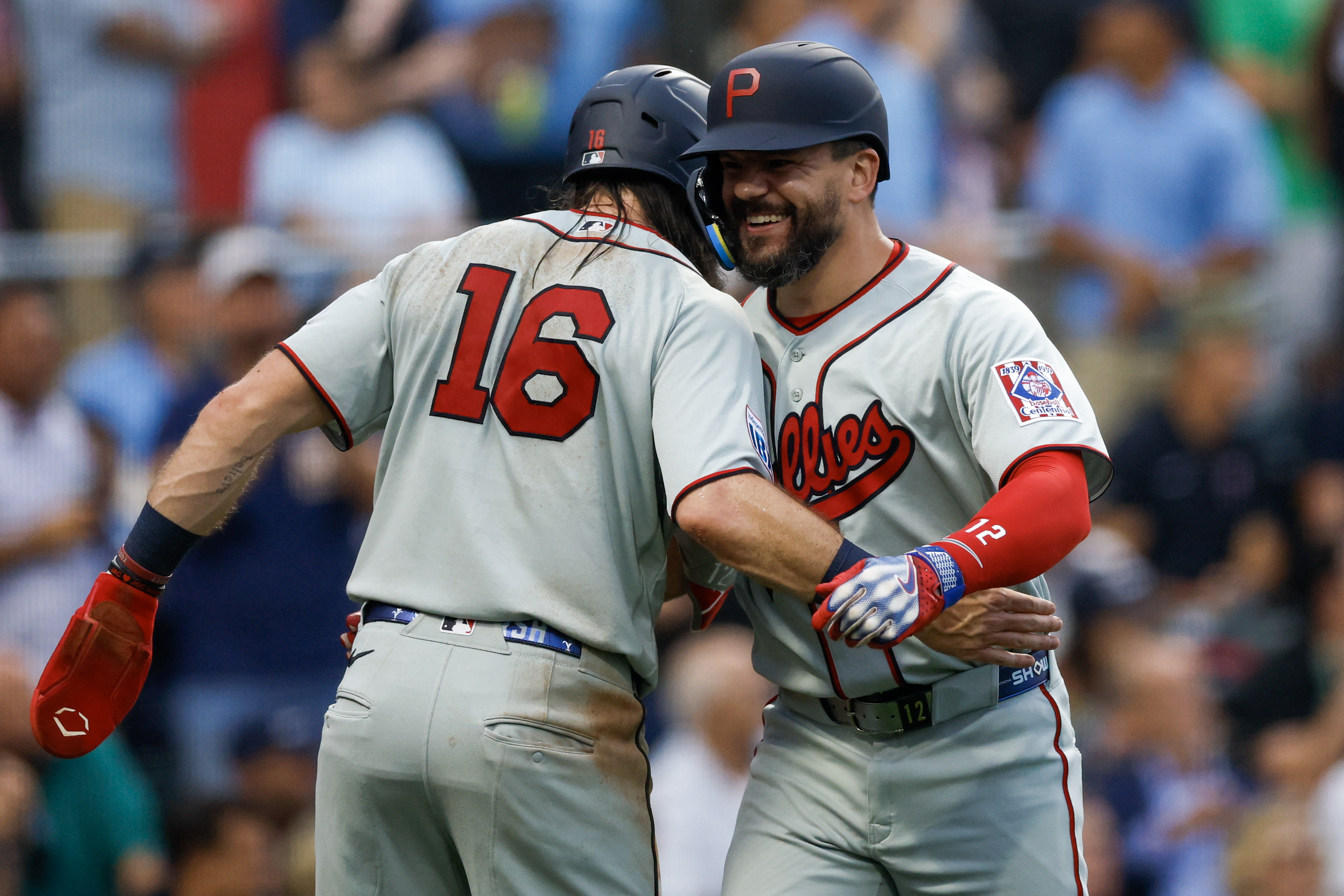
Phillies catcher J.T. Realmuto (left), celebrating after a homer by Brandon Marsh.Yong Kim / Staff Photographer
But several players cited something J.T. Realmuto brought up in the meeting that seemed to resonate.
Stay aggressive to your plan.
“There’s going to be times when, yeah, we’ll have a team approach on some guy or whatever it is, but also, everyone’s got their own individual plan, right?” Schwarber said. “So, if you have your plan, that means that you’re going to be aggressive to the things that you want to do.”
In talking it over, the hitters concluded that many of them were often deviating from their plan and letting the pitcher dictate an at-bat.
“I think it just kind of brought out that, look, we’ve kind of got to clean it up a little bit,” Alec Bohm said. “We’re swinging ourselves out of innings, out of at-bats, and the numbers say there’s not a lot of strikes coming over the plate to a lot of us.
“So, let’s at least be looking for something [specific]. And if we’re going to go down, let’s go down with a plan and not just be up there free-swinging. I think that kind of landed with everybody, and I think we’re definitely responding in a good way.”
The Phillies have 37 games left and a one-game lead for a National League wild card. Applying more pressure to opposing pitchers would help ease the burden on theirs. One-quarter of the Phillies’ games have been decided by one run.
Two weeks of getting on base at a higher clip doesn’t erase four months at or near the bottom of the leader board. But Arraez brings a contact-oriented approach and lengthens a lineup that has lacked a cleanup hitter to provide protection to Harper.
Maybe it’s all sustainable. Maybe not. Maybe they’ll look back at a hitters meeting in late July as a turning point.
window.addEventListener(“message”,function(a){if(void 0!==a.data[“datawrapper-height”]){var e=document.querySelectorAll(“iframe”);for(var t in a.data[“datawrapper-height”])for(var r,i=0;r=e[i];i++)if(r.contentWindow===a.source){var d=a.data[“datawrapper-height”][t]+”px”;r.style.height=d}}});
“The biggest thing we were able to accomplish in that meeting was highlighting a lot of things that we do well,” Schwarber said. “Those are things that can get your brain going in a different way, and then it’s like, ‘OK, we’re last in on-base. How do we kind of maneuver this?’
“I felt like it was just a really good conversation that we had. There was input from everyone in the room, so I felt like that was a really good way to go about it.”
The biggest reason to wonder about the Phillies’ playoff chances isn’t their pitching or the heart of their lineup.
It’s their schedule.
Only five teams in the majors will play a tougher slate than the one the Phillies face from here on out. Of their 37 remaining games, only 12 will come against teams that entered Sunday with a losing record. The Phillies have won about 60.5% of their games against losing teams. Even if they take two of three in each of those four series, they would need to go 15-10 against winning teams in order to reach 90 wins. They are 23-30 against such teams.
Maybe it’s a stretch to say that Alec Bohm saved the Phillies’ season when he hit a three-run home run in the eighth inning to lift them to a 7-5 win over the Twins on Sunday. But they are at a point of their season when they desperately need to stack up wins. At the very least, Bohm’s blast put them back on the safer side of a daunting bit of math.
Alec Bohm hit a three-run homer against the Twins on Sunday.Bailey Hillesheim
No team in baseball history has ever won a World Series after losing more than 42 of its final 81 games. The Phillies are now 22-22 since the midpoint of their schedule. If they maintain their current winning pace against both winning and losing teams, they would finish the season with 20 losses in their last 37 games, which would give them 42 losses in their last 81 games.
The Phillies face two issues here. The first is making the playoffs. They had a 65% chance to do so heading into Sunday’s game against the Twins. They are three games up on the Marlins and 3½ games up on the Cardinals. Both of those teams have tougher schedules than the Phillies. Except, both of those teams are in town this week for three-game series at Citizens Bank Park. The Cardinals took two of three from the Phillies last week. The Marlins swept them three weeks ago.
Long story short, there’s a decent chance that this week ends up deciding the Phillies’ fate. Win both series, and suddenly their cushion is four games on Miami and 4.5 on St. Louis with 31 to play. The flip side is perilous. Lose four of six, and suddenly the Phillies have lost ground on the competition with 13 of their remaining 31 games coming against the Rays, Braves and Brewers, who have the three best records in the majors. Not to mention a three-game series in Arizona against the Diamondbacks, who are 21-12 in their last 33 and who entered Sunday tied with the Phillies and Padres for the last two NL wild-card spots.
The second issue is a more abstract one. Only five teams in big league history have advanced to the World Series after losing more than half of their final 81 games. The Diamondbacks did it in 2023, when they lost 45 of 81 to finish the regular season but ended up beating the Phillies in the NLCS. That year, Arizona lost in the World Series to the Rangers, who were 41-40 in their last 81. It helps to be playing well this time of year. You are who you are most recently.
The Phillies are who they’ve been all season, save that torrid stretch that had everybody ready to give Don Mattingly a seven-year contract extension. Since June 27, they have one winning streak longer than two games. They haven’t won more than four in a row since May 18, and they haven’t won more than five in a row all season. Of the nine NL teams that entered Sunday with a winning record, only the Phillies do not have multiple winning streaks of five-plus games.
The time is now. Jonathan Bowlan needs to be a big part of it, too. He picked up a hold on Sunday, pitching a scoreless eighth inning two days after recording his first save of the season. The right-hander has allowed three runs in 16⅓ innings with 18 strikeouts and four walks since moving into a consistent high-leverage role.
The Phillies need to look at the next month and a half as an opportunity. In their last 41 games, they’ve won exactly three games against teams that had a winning record at the time. They haven’t won a series against such a team since taking three of four from the Nationals in late June. They’ve lost nine of their last 12 against teams that had a winning record as of Sunday.
They are going to play a lot of teams that happen to be the kinds of teams they need to beat. It starts on Monday.