Tag: topic-link-auto

  • Republican House candidate removed from panel after repeatedly misgendering Rep. Sarah McBride

    Republican House candidate removed from panel after repeatedly misgendering Rep. Sarah McBride

    Republican U.S. House contender Joseph “Dr. Joe” Arminio was removed from a panel Thursday featuring candidates in Delaware races after he repeatedly misgendered Democratic U.S. Rep. Sarah McBride.

    McBride is the first openly transgender member of the U.S. House and was sworn in last year.

    Things unraveled at the Siegel Jewish Community Center in Wilmington, where the Jewish Federation of Delaware’s Jewish Community Relations Committee coordinates a candidates forum every two years. The event featured candidates for U.S. Senate, U.S. House of Representatives, attorney general, state treasurer, and auditor of accounts.

    McBride will face Republican Arminio in November for the state’s only U.S. House seat.

    Arminio, a Wilmington native, political scientist, author, and educator, campaigned largely on inflation. His responses to a 2026 voter questionnaire indicate several anti-LGBTQ+ policy positions. In 2008, he ran unsuccessfully for Congress in Maryland. He did not receive the Delaware GOP’s endorsement, which went to Earl Cooper.

    At the public event, Arminio repeatedly referred to McBride using he/him pronouns and later called her a “gentleman.”

    In the first incident, Arminio’s remarks were met with boos from the crowd. After he spoke, moderator Ken Grant warned him to follow the forum’s rules for proper decorum.

    “If you fail to show respect to anyone else on this stage, you’ll be asked to leave,” Grant said.

    Arminio acknowledged the incident during one of his forum responses.

    “I committed an error before,” he said. “I do acknowledge it. It’s not the first error I’ve made in this campaign, or at any point in my future life.”

    But minutes later, Arminio misgendered McBride again, pointing at her and Democratic Sen. Chris Coons and calling the two of them “gentlemen.” The crowd started booing again, and Arminio’s microphone was cut off.

    McBride said on stage she wanted Arminio to stay and be able to talk about his platform, but organizers held firm.

    Arminio told 6abc he planned to address the incident. He did not immediately respond to The Inquirer’s request for comment.

    The Human Rights Campaign describes the political climate for transgender people and the LGBTQ+ community as an ongoing crisis amid legislative hostility, federal rollbacks, and discrimination. The organization estimates there are more than 2 million transgender people across the country.

    Experts say misgendering a trans person can range in severity from a microaggression or macroaggression to explicit harassment depending on the intent, frequency, and context. Studies show the LGBTQ+ community is more likely to experience harassment, discrimination, and violence than cisgender and heterosexual people.

    Bella Bautista, 22, right, a trans woman, has a photo taken with Rep. Sarah McBride, D-Del., the first trans woman to be a member of Congress, during a reception held by the Christopher Project in June 2025.Jacquelyn Martin

    McBride, who was previously a state senator, has been targeted by transphobic attacks across her career.

    After being elected to Congress, Rep. Nancy Mace (R., S.C.) introduced a resolution banning transgender women from using women’s facilities in the U.S. Capitol. Speaker Mike Johnson also implemented a policy restricting restroom access in the Capitol and House offices to a person’s “biological sex,” which experts say is a politicized term to describe someone’s assigned sex at birth.

    The policies were viewed as a way to directly target McBride, the only openly trans person serving in either chamber. McBride has also been repeatedly misgendered.

    Last year, Rep. Keith Self (R., Texas) called McBride “Mr. McBride.” She quipped back, calling him “Madame Chair.” Others stepped in on McBride’s behalf, but the exchange got heated, and the session ended early with Self refusing to honor McBride’s identity.

    Other House Republicans have continued to use male pronouns and honorifics while referring to McBride during interviews, debates, and on social media.

    The representative has worked across the aisle with politicians whose views on the LGBTQ+ community don’t align with hers. She says her job in public office is to represent her state’s priorities and, in turn, normalize trans visibility.

    At the forum, Mike Katz, a former Democratic state senator and now the GOP’s endorsed candidate for U.S. Senate, said Arminio’s actions were uncalled for and apologized to the crowd. Following the event, in a lengthy Facebook post, he called for Arminio to withdraw from the race, calling it a matter of “respect.”

    Grant, the event’s moderator, said ground rules were shared with candidates in advance and were clear: “treat everyone on stage with respect.”

    “When a candidate declined to do so after a clear and public warning, the rules were applied — as they would have been for any candidate, of any party, on any subject,” he said. “I want the focus to remain where it belongs: on the nine candidates who spent the evening answering voters’ questions thoughtfully and civilly, and on the hundreds of Delawareans who came, in person and online, to listen.”

    McBride appears to be taking the incident in stride.

    “I am always so proud to represent Delaware and Delawareans,” she wrote in a statement Friday. “Nothing — and certainly not politicians seeking to go viral — will ever distract me from my laser focus on lowering the cost of gas, groceries, housing, childcare, and healthcare.”
  • La Colombe will sell canned matcha lattes as the drink’s popularity grows

    La Colombe will sell canned matcha lattes as the drink’s popularity grows

    Matcha lovers have a new way to sip their beloved drink: out of a can.

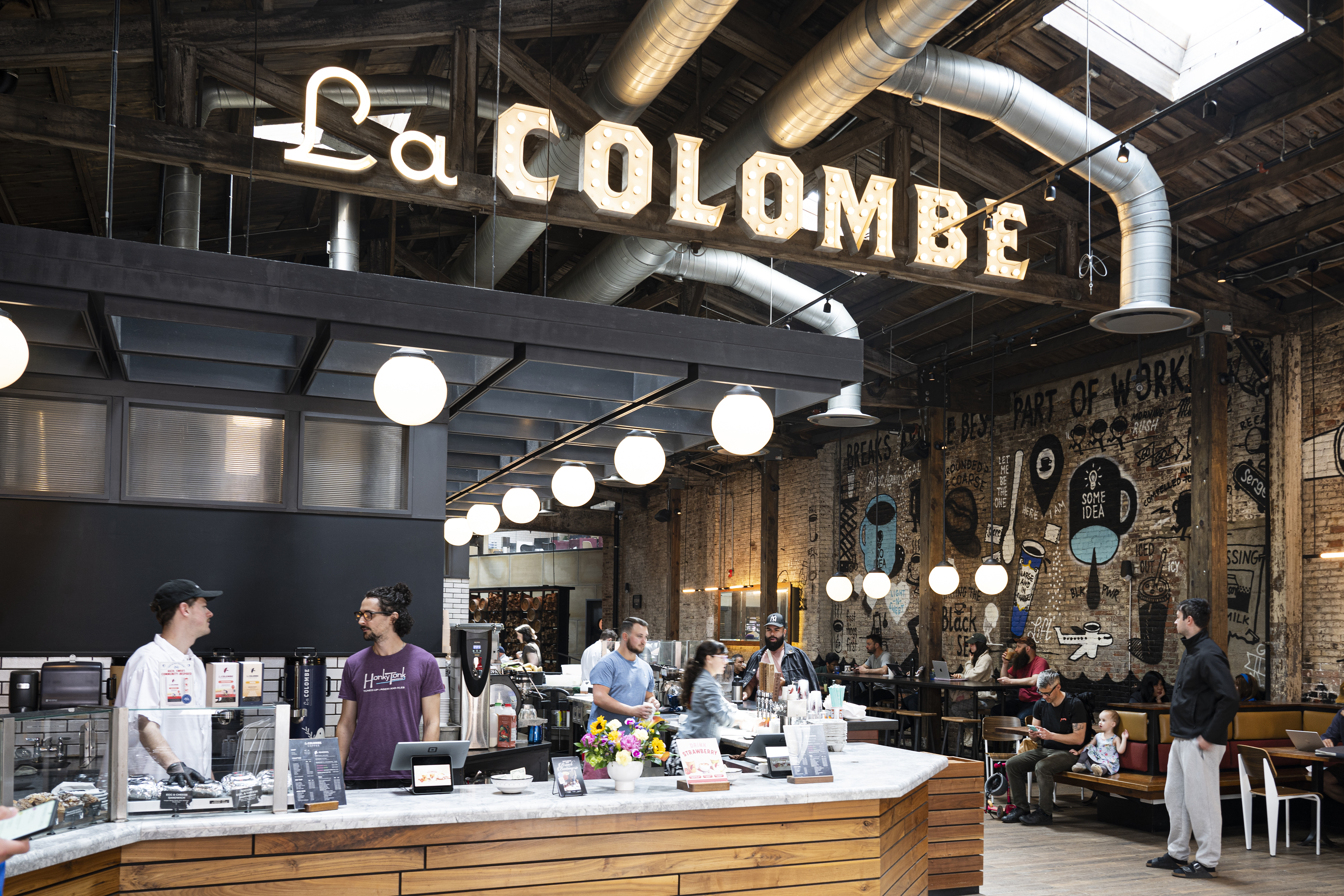
    La Colombe, the Philly-founded coffee company, is launching a canned matcha latte that is expected to be in stores this month. The brand already sells matcha drinks at its cafes, but the new line of canned drinks will reach customers at nationwide retailers, the company announced this week.

    Matcha sales at La Colombe have increased by 188% since 2023, according to the company. Matcha has been trending nationally and can be found in Philadelphia in cocktails, ice cream, and cakes.

    The 11-ounce La Colombe cans come in the original matcha flavor, as well as matcha with strawberry or vanilla. Each can contains lactose-free whole milk, Japanese matcha, and 65mg of caffeine.

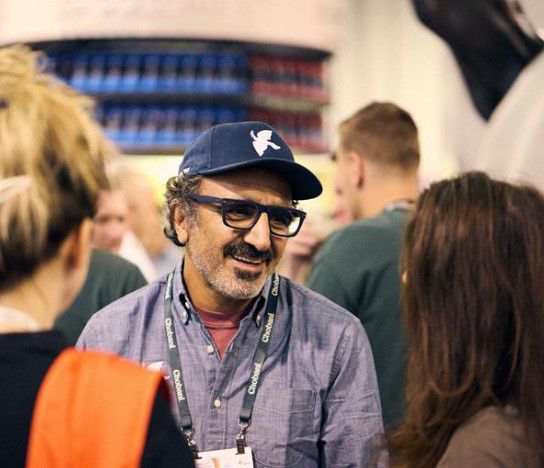
    Meanwhile, change has been brewing at La Colombe in recent years. In 2023, the Philly-born coffee brand was acquired by yogurt-maker Chobani for $900 million. Chobani founder and CEO Hamdi Ulukaya was already the majority owner of La Colombe as of 2015.

    As part of the acquisition, Chobani worked out a deal with a major La Colombe investor, Keurig Dr Pepper. Keurig Dr Pepper’s La Colombe stake became Chobani equity, but this year, Keurig Dr Pepper said it was selling it back.

    The canned matcha drinks join several other La Colombe canned beverages on store shelves. The canned draft latte was officially launched in 2016.

    Ulukaya is credited with originally challenging the co-founder of the coffee company, Todd Carmichael, to make a ready-to-drink latte, The Inquirer has reported.

    Hamdi Ulukaya, Chobani founder and CEO, became the majority owner of La Colombe in 2015.Chobani

    “When La Colombe first put the Draft Latte in a can, the brand helped reshape the [ready-to-drink] coffee category by making a true coffeehouse quality experience accessible to more people,” said Niel Sandfort, chief innovation officer at Chobani and La Colombe, in a statement this week. “Now, we’re bringing that same craft and innovation to matcha.”

    La Colombe has been looking to expand its ready-to-drink business and invested $567 million in a plant in Michigan earlier this year where it produces those drinks.

    And parent company Chobani recently announced it would invest $1.2 billion in Pennsylvania in a new dairy plant, in a move expected to create hundreds of jobs and increase milk demand, benefiting the local dairy industry. Chobani is buying the facility from Keurig Dr Pepper for $125 million.

    La Colombe canned draft lattes in Philadelphia, Pa., on Monday, May 6, 2024.Jose F. Moreno / Staff Photographer
  • Duncan Sheik, Tony- and Grammy-winning ‘Spring Awakening’ composer and pop star, dies at 56

    Duncan Sheik, Tony- and Grammy-winning ‘Spring Awakening’ composer and pop star, dies at 56

    NEW YORK — Duncan Sheik, the Tony- and Grammy-winning singer-songwriter who crafted the music for “Spring Awakening,” has died. He was 56.

    Sheik died Thursday from organ failure, his mother Suzanne Sheik told The New York Times. The Associated Press emailed his representatives for comment.

    Sheik had been best known for his lasting radio hit “Barely Breathing” when he turned his sights on Broadway with “Spring Awakening,” resulting in the envelope-pushing show that musicalized teenage angst.

    “With the exception of our director, we are all kind of Broadway outsiders. We wanted to shake things up a bit. And we just set out to make this really cool piece of theater,” Sheik told The Associated Press in 2007, as the show swept Tony nominations.

    Sheik also tackled musicals based on “American Psycho” and “Alice in Wonderland,” and “Barely Breathing” spent 55 weeks on the Billboard Hot 100, peaking at No. 16. But he was probably best known for “Spring Awakening,” which ran for over 860 performances on Broadway starting in 2006.

    ‘Spring Awakening’ roused a new side of Sheik — and Broadway

    The musical — adapted from a 19th-century play by German playwright Frank Wedekind, with music by Sheik and lyrics by playwright Steven Sater — is frank in its portrayals of incest, abortion and suicide. It’s intended partly as a warning that teens need good information about sex to avoid tragic mistakes.

    “I don’t mean to be disrespectful to more traditional theater composers,” he told the Los Angeles Times in 2015. “I love Stephen Sondheim. But it’s my mission to make sure that the theater is paying attention to what the rest of the world is listening to.”

    Sheik and Sater were practicing Buddhists who met while chanting. They were collaborating on Sheik’s third album, “Phantom Moon,” when Sater mentioned he was working on a new production. Neither had ever written a musical before.

    “I said to Steven, ‘I’m happy to do this musical, but I only want to do it if the music in the play is the kind that I and my peers can get behind stylistically and relate to and enjoy,’” Sheik recalled to the AP in 2006.

    They made a pact: They’d retain the provincial, 19th-century Germany setting but with, as Sater put it, “the characters breaking into pop-contemporary when they sing.”

    “Spring Awakening” won eight Tony Awards, including for best musical, as well as the Grammy for best musical show album.

    “Sheik’s music, spare in its simple orchestrations, lush in the lapping reach of its seductive choruses, embodies the shadowy air of longing that infuses the show, the excitement shading into fear, the joy that comes with a chaser of despair,” The New York Times said in its review.

    The show is beloved in the musical theater community for breaking ground in terms of staging and content, alongside the likes of “Rent” and “Hamilton.” It returned to Broadway in 2015 in a well-received production by Deaf West Theatre. An off-Broadway version is slated to open this fall.

    The cast of the original show was loaded with breakthrough actors like Jonathan Groff, Lea Michele, Lilli Cooper, Jennifer Damiano, Gideon Glick, John Gallagher Jr., Lauren Pritchard and Krysta Rodriguez, who have each gone on to fame in TV, film and stage. Groff would go on to earn a Tony with “Merrily We Roll Along,” and Michele became a superstar with “Glee.”

    Sheik blended musical theater with pop music

    Sheik next channeled the music he heard getting past the velvet ropes of trendy, late-1980s Manhattan clubs for a Broadway adaptation of the Bret Easton Ellis novel “American Psycho.”

    The 1991 novel — later made into a 2000 movie starring Christian Bale — chronicles a homicidal New York yuppie named Patrick Bateman who is obsessed with high-end clothes and beauty products even as he slashes his way through Manhattan. Sheik, who also supplied lyrics, recalled only getting halfway through the book before throwing it across the room as a Brown University student.

    For one standout song, “You Are What You Wear,” he reached out to old girlfriends to ask a question: What were you really into wearing in the late ’80s? He put the answers in the tune about high fashion: “Chanel, Gaultier, or Giorgio Armani/Moschino, Alaïa, or Norma Kamali/Should I rock/The Betsey Johnson/Or stick with classic/Comme des Garçons?”

    “Duncan is really a genius and an intellectual and brings something both uniquely his but importantly of this period to the stage,” producer Jesse Singer told the AP at the time.

    Because Bateman, played onstage by Benjamin Walker, fancies himself a bit of a music critic — spewing mostly inane ruminations about Phil Collins and Huey Lewis and the News — Sheik also peppered his score with sly reworkings of “In the Air Tonight” and “Hip to Be Square.”
    “There’s definitely an art to be able to write a song that on one level is a pop song and one that also has to tell a story and keep an audience engaged in terms of a larger narrative arc,” Sheik told the AP in 2013. “When you’re writing a song for the theater, it has to accomplish all this other stuff. It has to work in tandem with all these other agendas and creative impulses.”

    The show, directed by Rupert Goold and with a story by Roberto Aguirre-Sacasa, made its premiere in 2013 in London. On Broadway in 2016, it bombed, lasting less than 90 performances.

    “We were all sort of worried that it might be too violent for people and it might seem too misogynist,” Sheik told the AP on the eve of the opening. “But, in fact, the truth is this piece is a critique of a certain way of thinking about things. So in truth it’s better to go all-in.”

    ‘Barely Breathing’ was nominated for a Grammy

    Growing up between South Carolina and New Jersey, Sheik learned guitar as a child and got his first synthesizer when he was 12. He was heavily influenced by Talk Talk, David Sylvian and Nick Drake. His self-titled debut album was released in 1996 and Rolling Stone gave it a four-star review, calling it “a defiant debut — beautiful and benevolent of spirit.”

    “Barely Breathing,” from that album, was nominated for best pop vocal performance in 1998 and would be kept alive on TV shows like “Glee” and “Girls.”

    Other projects include “Whisper House,” an album and musical — a ghost story that ran in 2010 at the Old Globe Theatre in San Diego — and “Legerdemain,” an album that explored the tension between art and commerce. His most recent album was 2022’s “Claptrap.”

    But for someone who had once been a total stranger to Broadway, he told AP in 2016 that he had a sense of mission.

    “I feel like it’s become my project to kind of drag different people who might not normally go to musical theater pieces to come see a piece of musical theater,” he said.

  • Bensalem school district selects a longtime administrator as its next superintendent

    Bensalem school district selects a longtime administrator as its next superintendent

    The Bensalem Township School District has selected longtime district administrator Victoria Velazquez as its next superintendent, after its previous superintendent resigned this spring amid a budget shortfall.

    Velazquez, who has worked for the district for 12 years, is expected to be appointed superintendent at a school board meeting Sept. 23, the Bucks County Intermediate Unit said in a statement Friday.

    “I am deeply honored and grateful for the opportunity to continue serving the Bensalem Township School District as district superintendent,” Velazquez said in a statement.

    Noting that her daughter graduated from Bensalem, Velazquez said, “It is my home, and it is a community I care deeply about and am incredibly proud to serve.”

    Velazquez was selected to lead the 6,400-student district after a search led by the Bucks County Intermediate Unit that drew 27 applicants from five states, according to the intermediate unit.

    Deborah King, the Bensalem school board president, said in a statement that she had watched Velazquez “lead with humility, diligence, integrity, and a genuine love for Bensalem.”

    “She knows this community, she believes in this community, and she understands that our students must remain at the heart of every decision we make,” King said.

    Velazquez has worked in Bensalem as assistant to the superintendent for K-12 administration, director of elementary curriculum and instruction/federal programs, and supervisor of data and assessment/federal programs.

    She has served as interim superintendent since April, after the district’s former superintendent, Samuel Lee, resigned amid a $12 million budget shortfall. The district eliminated more than 30 positions to help fill the gap .

    As interim superintendent, Velazquez worked with the board on organizational systems and fiscal stewardship “during a consequential period for the district,” the intermediate unit said in the statement.

    Before coming to Bensalem, Velazquez worked as a principal in the School District of Philadelphia and the Norristown Area School District. She received bachelor’s and master’s degrees from Temple University, a principal certification from Drexel University, and a doctorate in educational leadership, management, and policy and superintendent certification from Seton Hall University.

    If approved on Sept. 23, Velazquez will be sworn in as superintendent on Oct. 1 at Bensalem High School, the intermediate unit said.

  • A ‘magical’ 15-acre property called Willow Lake Farm is for sale for almost $7 million in Chester County

    A ‘magical’ 15-acre property called Willow Lake Farm is for sale for almost $7 million in Chester County

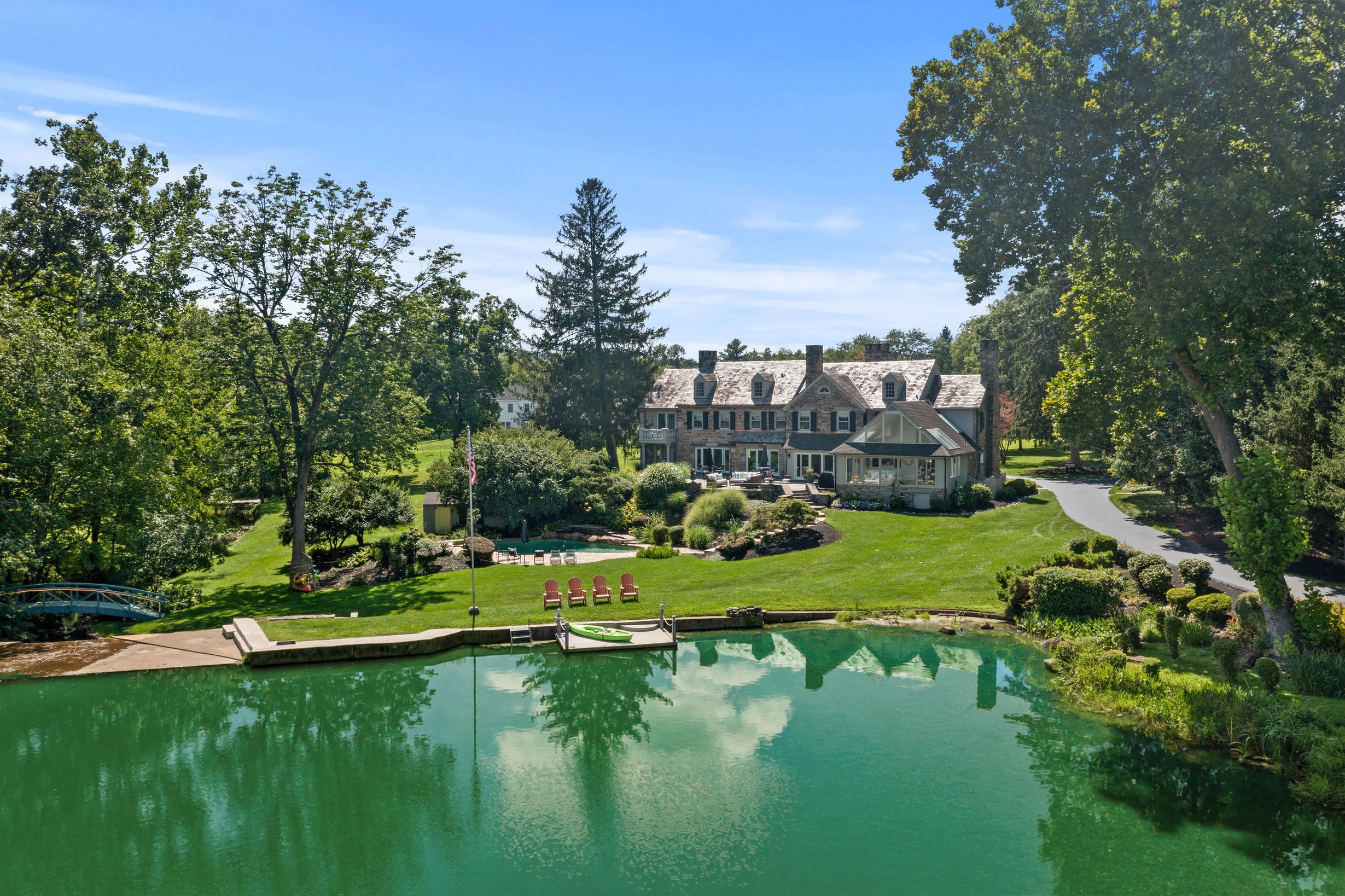
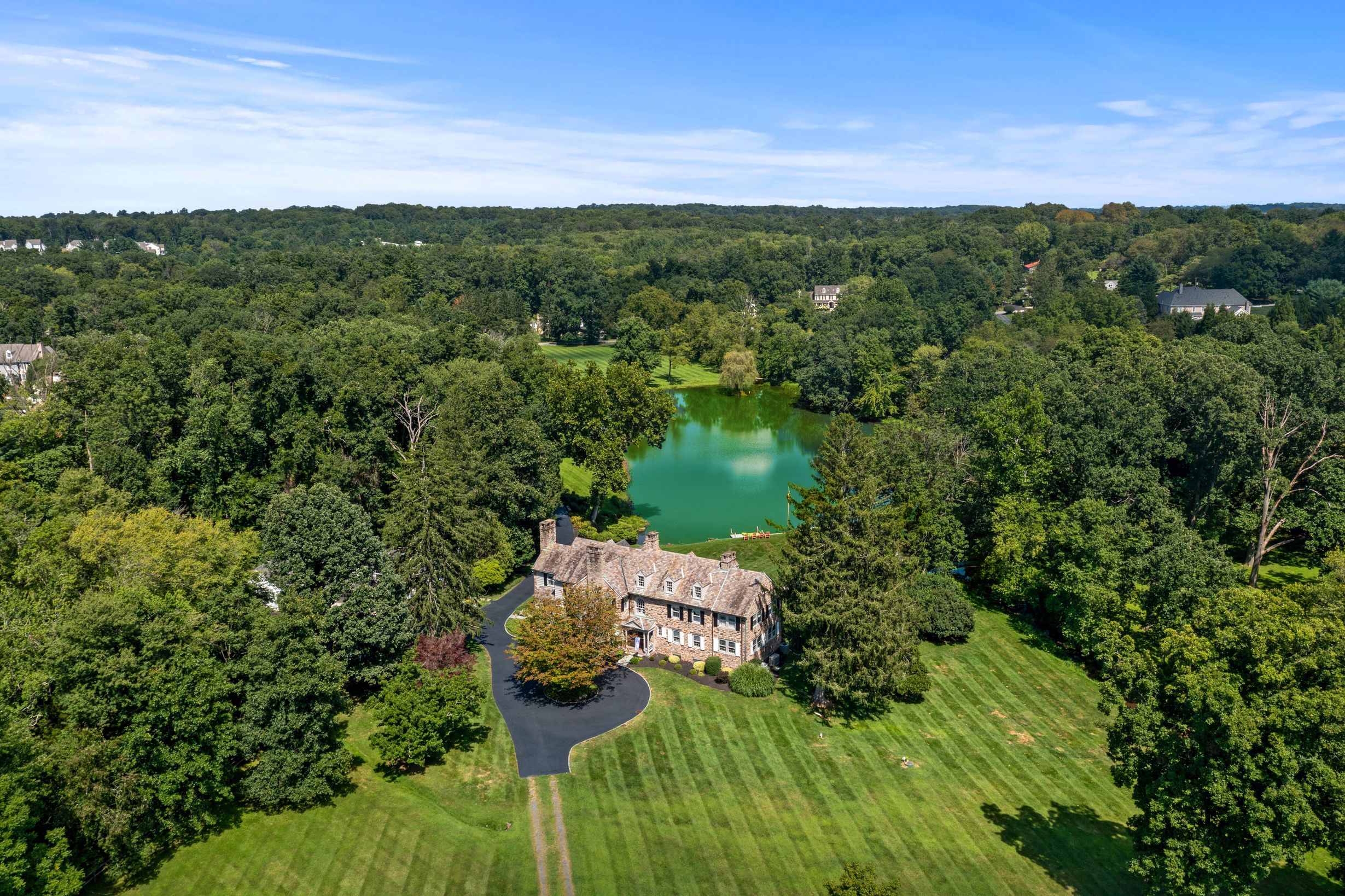
    The 15-acre Willow Lake Farm includes walking paths, a stream and waterfall, a meditation garden, an arched bridge, extensive lawns, and a pond. It’s also a private residence.

    And the Chester County property is for sale for $6,990,000.

    “It’s one of the most beautiful properties within Willistown” Township, said listing agent Meghan Chorin, leader of the Meghan Chorin Team with Compass Real Estate. She called it “magical.”

    This Willistown Township home is listed for sale for $6,990,000.Colin Burkhart of CdB Real Estate Photography

    “It’s just special. There’s nothing else like it,” she said. Along the Main Line, “having a house where you have a water view is rare.”
    The home’s creek-fed private pond spans three of the property’s 15 acres. The owners use it year round to swim, fish, kayak, and ice skate.

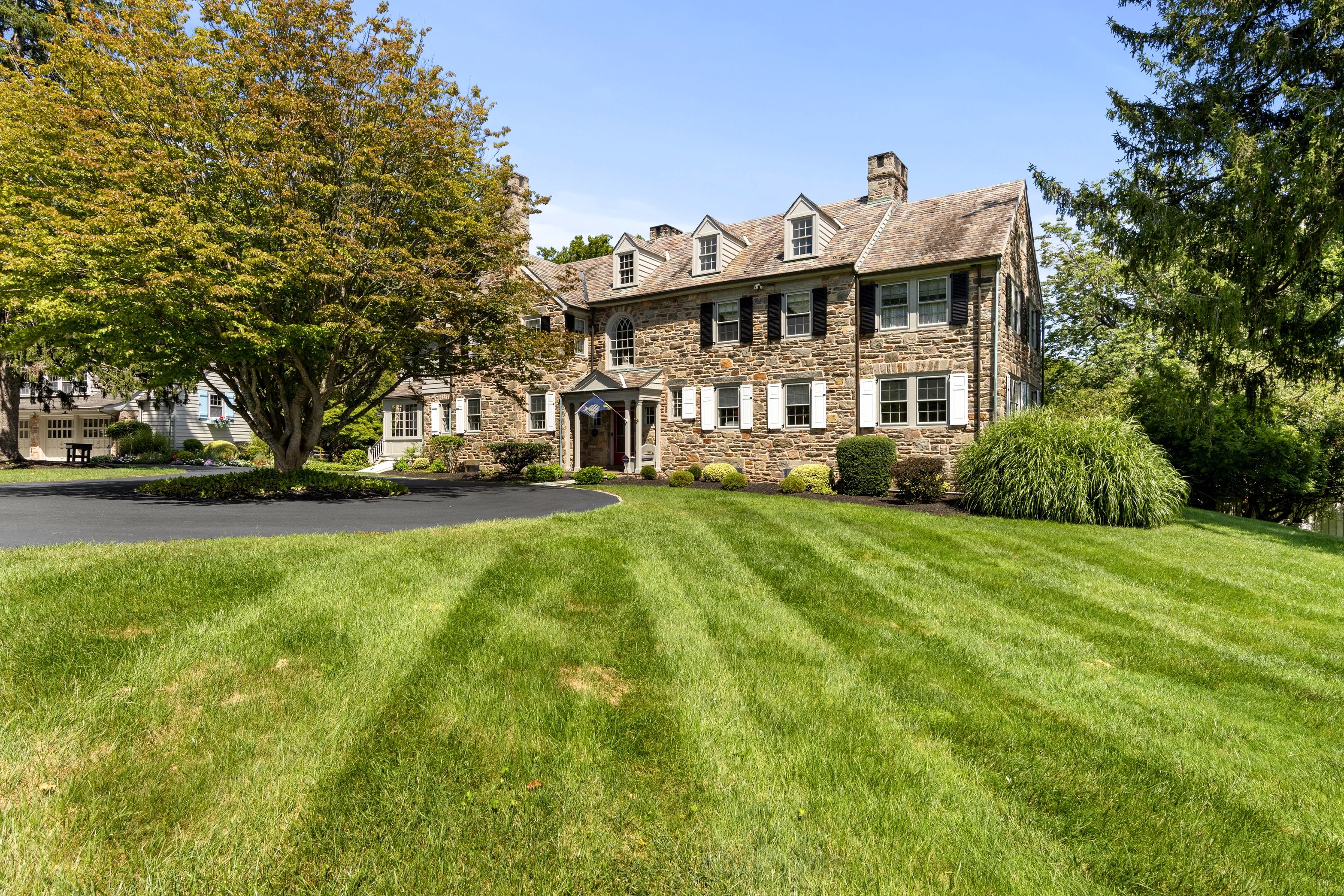
    A long driveway snakes through trees and leads to the 6,050-square-foot fieldstone house, constructed in 1935 by builder Albert H. Jacobs Jr.

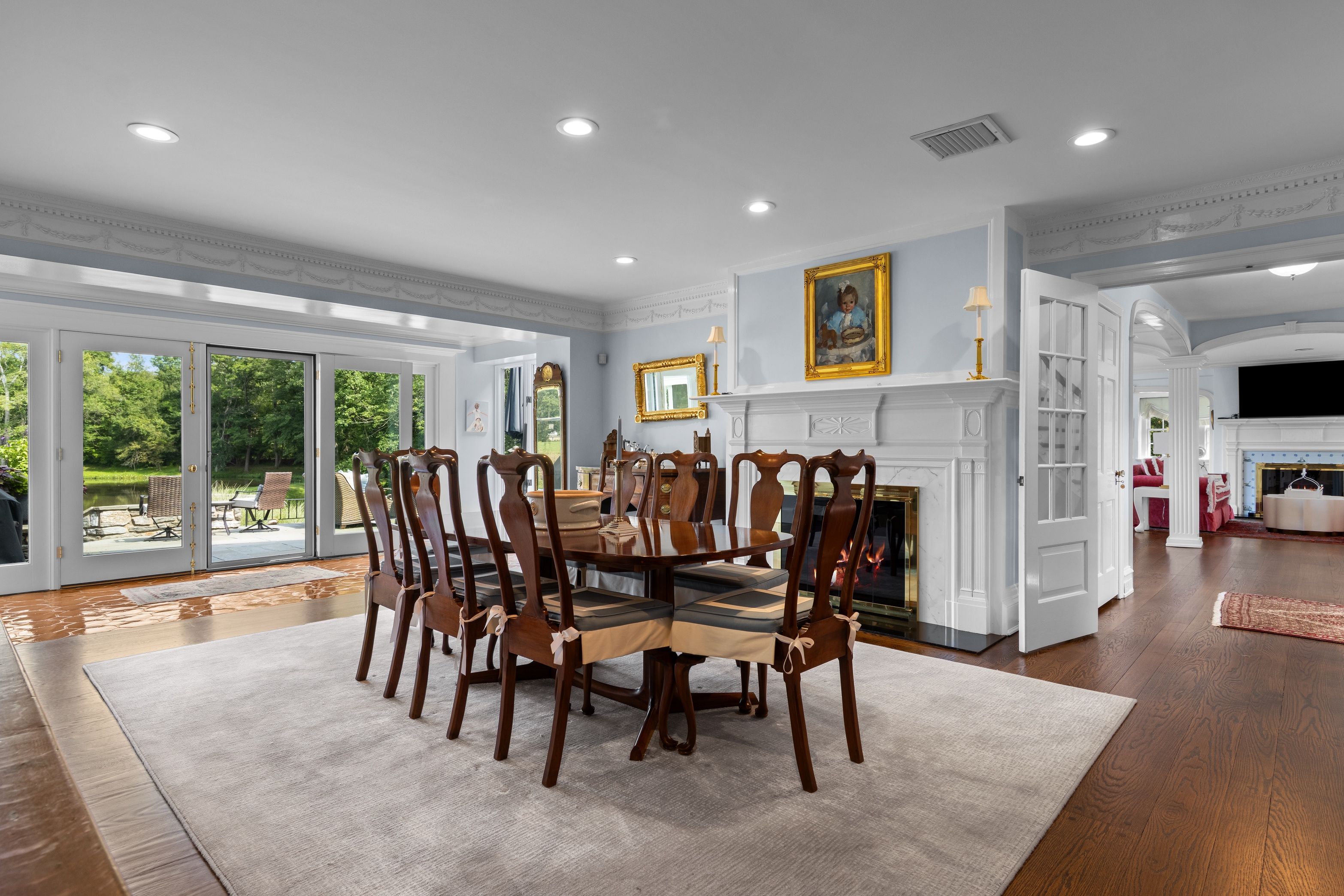
    The formal dining room includes a fireplace and looks out on the back terrace and grounds.Colin Burkhart of CdB Real Estate Photography

    The house has four bedrooms, three full bathrooms, and three half bathrooms. It features custom woodwork, oak floors, and eight fireplaces, including one in the formal dining room.

    Off the family room sits a private study with a built-in desk and bookcases.

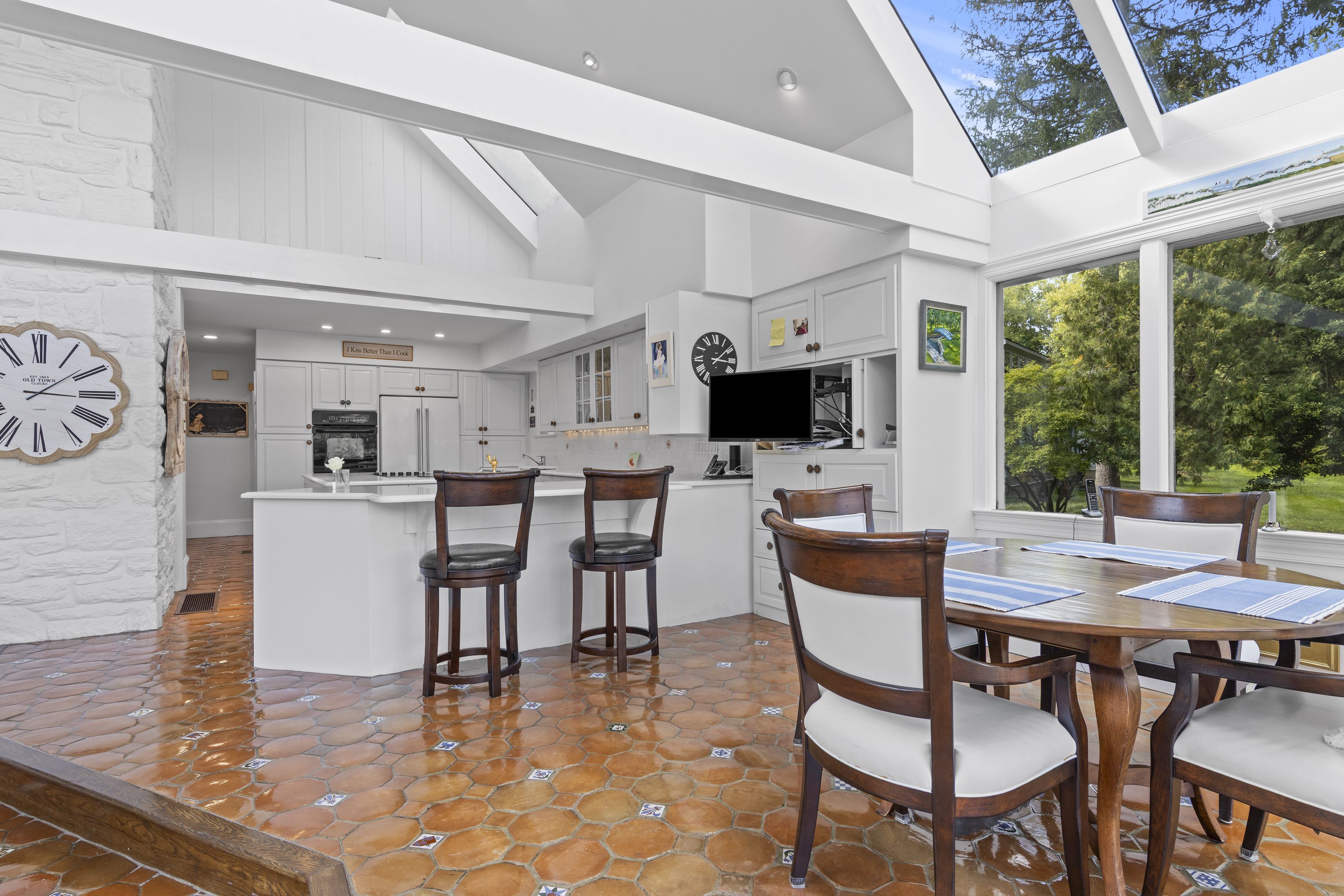
    The home’s kitchen features exposed stone walls, a vaulted ceiling, custom white cabinets, and floors of handmade Mexican tile. It has double ovens, two sinks, and a large center island with storage and a range. A butler’s pantry off the kitchen includes a wet bar, wine cooler, and dishwasher.

    Large windows effectively turn a dining and living area beyond the kitchen into a sunroom with views of the backyard.

    The kitchen includes double ovens, a large island, and seating at the peninsula.Colin Burkhart of CdB Real Estate Photography

    The primary suite includes a balcony with views of the grounds and a walk-in closet with its own washer and dryer.

    At the rear of the house, a line of French doors open to a flagstone terrace that overlooks an in-ground pool and the pond beyond.

    “It’s a great entertaining house,” Chorin said.

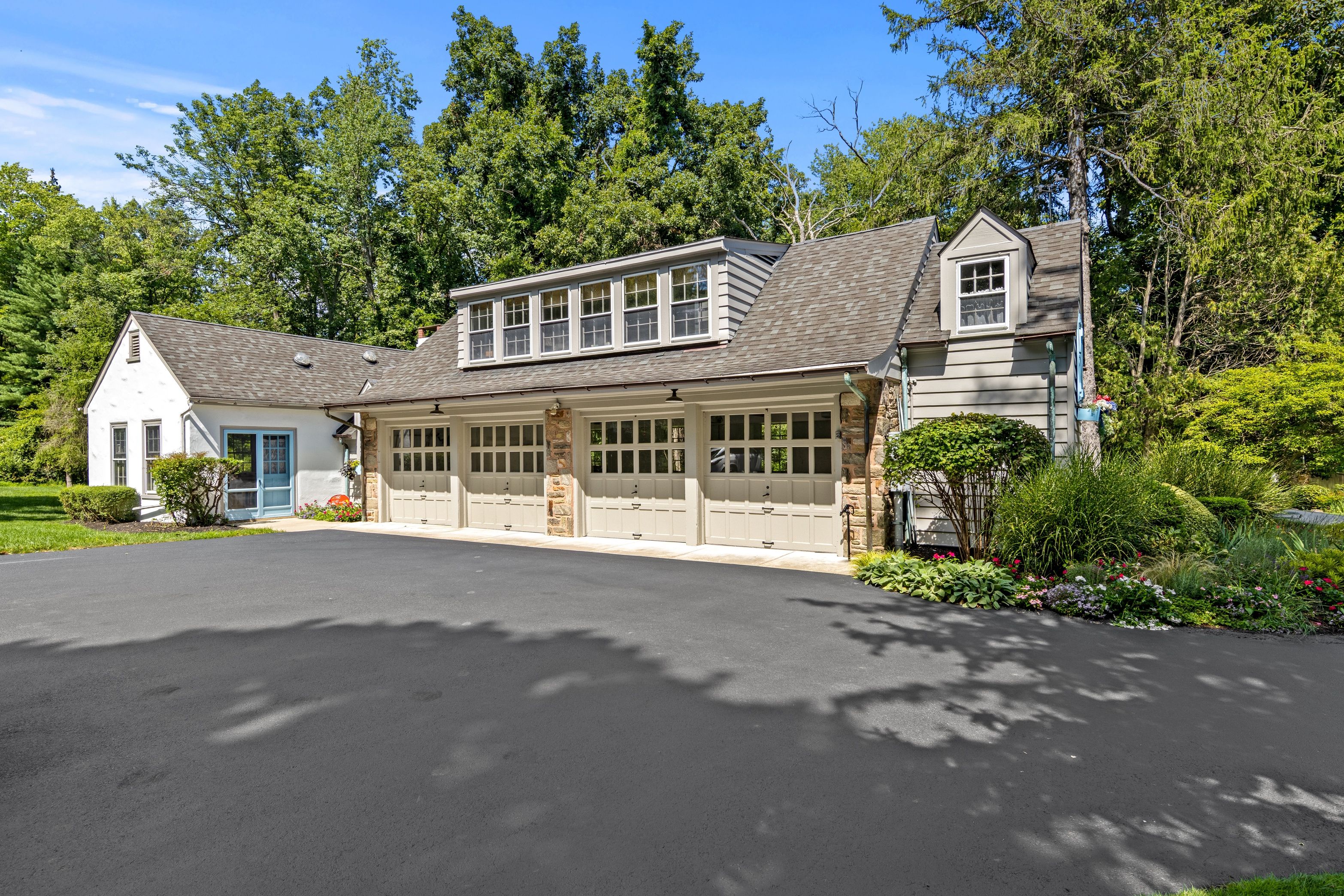
    A detached four-car garage has a large adjoining space that the property owner, an artist, uses as a studio. Above the garage is a studio apartment.

    The detached has a studio apartment above it and an adjoining art studio.Colin Burkhart of CdB Real Estate Photography

    The home is close to Mill Park and Malvern Borough and is a few minutes’ drive from the Paoli SEPTA station.

    Chorin said the property presents a rare opportunity for buyers.

    In Willistown, she said, “there’s not a lot of supply and a lot of demand.”

    The property was listed for sale on Aug. 24.

    The property spans 15 acres and includes a three-acre pond.Colin Burkhart of CdB Real Estate Photography
  • Will a pedestrian death move Philadelphia police to step up traffic enforcement? | Shackamaxon

    Will a pedestrian death move Philadelphia police to step up traffic enforcement? | Shackamaxon

    This week’s edition of Shackamaxon looks at a crackdown on “smoke shops,” the Philadelphia police’s handling of traffic citations, how Harrisburg deadlines can be leveraged to fund transit, and what City Council forgot to talk about in its first session after returning from summer break.

    Up in smoke?

    An increasingly common frustration has been expressed across Philadelphia over the rise of what are known as “smoke shops,” which have proliferated in the city’s commercial corridors. Ostensibly operating as grocery stores, they are often locations where illegal drugs and drug paraphernalia are sold. They tend to operate late into the night and attract the ire of both residents and other business owners.

    That’s why it was refreshing to see someone make a substantive move to shut them down. State Rep. Amen Brown, whose district includes parts of West Philadelphia and Logan Square, has put together an initiative he’s called Operation Breezy. Working with both city and state law enforcement, and relying on the support of members of the community, Brown’s efforts have already shuttered 13 of the establishments.

    Brown’s approach uses confidential informants, many of whom come from the community itself. He told me that one of the now-closed shops had roughly 40 pounds of marijuana on the premises, the outlets routinely sell out-of-state cigarettes, and that firearms have been seized as part of the efforts. Residents who would like to help can send an email to OperationBreezy@gmail.com or a message to the effort’s Instagram page, @operationbreezy.

    Brown said he’d like to do more to stop the smoke shops, but that the best option requires action at the local level. Rather than enacting a broad-based curfew for all businesses, he’d prefer to target just the smoke shops. He says that might be possible by imposing restrictions on the operating hours of grocery stores that are smaller than 300 square feet. That’s a size below which, officials say, legitimate uses for a storefront become impractical.

    Official inaction

    Philadelphians were rightly outraged at the actions of a police officer who, in August, left a struggling pedestrian lying in the street, where he was later killed in a hit-and-run. Commissioner Kevin J. Bethel said he was “disgusted” by the patrolman’s behavior. City officials announced their intent to fire the officer. That’s the right call, even if the city’s cop-friendly arbitration process leads to 85% of officers getting their jobs back after alleged misconduct.

    Still, I couldn’t help wondering whether this incident is a natural outgrowth of the department’s policies. The Philadelphia police simply do not seem to take enforcing traffic laws seriously enough. Traffic citations have plunged over the last few decades. In the 1990s, officers regularly issued roughly half a million tickets per year. In 2023, about 45,000 tickets were handed out. These days, we celebrate an increase of a few thousand citations, even as overall stops remain at a fraction of the total pedestrian safety experts say is needed. Commissioner Bethel has said that enforcing traffic violations is a lesser priority.

    While many officers blame the city’s Driving Equality Law for this decline, that measure does not prevent officers from enforcing moving violations, which are the most dangerous offenses. Failing to do so is a choice the department has made on its own. The result of this lack of enforcement, traffic safety experts say, has been an increase in reckless and aggressive driving.

    Given that a city controller report called Philadelphia’s streets the most dangerous of any major U.S. city, this lack of prioritization must change. While speed cameras and other forms of automated enforcement have made a difference along high-traffic corridors like Roosevelt Boulevard and Broad Street, they can only enforce certain offenses in certain locations. Reckless driving is an issue almost everywhere.

    It is impossible to know what went through the mind of the officer who left Eugene Beauford in the street. The department has declined to publish his name, let alone make him available for an interview. But perhaps this horrific incident will prompt police brass to rethink the department’s strategy for enforcing traffic laws.

    Skill game shutdown

    Next month, Pennsylvania’s so-called games of skill will need to be unplugged. Oct. 13 marks the last day of the grace period the state Supreme Court gave the General Assembly to devise a taxation and regulatory scheme for the machines, devices that resemble slot machines and which are currently banned under state law. For years, legislators have debated where the machines can operate, and whether they should pay the same tax rate as existing slot machines.

    By pure coincidence, there’s another big deadline approaching: the authorization period for the state-appointed SEPTA prosecutor. I’d like to propose a potential compromise for both issues. Harrisburg should extend the SEPTA prosecutor’s authority by three years, agree to Gov. Josh Shapiro’s proposed shift in sales tax revenue to support public transit, and pay for it by legalizing skill games and taxing them at the same rate as slot machines. They should also pass regulations limiting the placement of the machines and creating penalties for owners who allow children to use them.

    Given District Attorney Larry Krasner’s recent struggles, extending the SEPTA prosecutor should be less politically contentious now than it was in years past. Lawmakers can also point to the significant decline in fare evasion and violent crime on the transit system over the last few years as justification.

    For Philadelphia lawmakers who may be reluctant to place limits on the authority of Krasner, who has been overwhelmingly elected by their constituents three times, that kind of middle ground can provide fiscal peace of mind for SEPTA, which has been subject to financial uncertainty for three years. While Democrats seem to be pinning their hopes for approving more state funding for SEPTA on winning control of the state Senate during this fall’s elections, that is hardly guaranteed. If a deal can be reached ahead of time, it reduces the risk of a collapse. It also does not preclude additional action next year.

    Finally, the need to act on skill games is clear. As it stands, it will be difficult for the commonwealth to shut down every location that houses the machines. We don’t even know how many exist. I am not a fan of these devices, which have a negative impact on the communities that host them. Regulation will make it easier to mitigate that damage and ensure Pennsylvanians see some benefit from the funds that flow through them.

    Council comeback

    After its three-month summer hiatus, City Council is back in session. All eyes on the second floor of City Hall will be trained on how Mayor Cherelle L. Parker will respond to a series of potentially contentious legislative proposals — from Councilmember Jamie Gauthier’s bill to stop burning trash to Councilmember Isaiah Thomas’ efforts to stop at least part of the school closure plan.

    Then there’s the matter of those city officials who deserve additional scrutiny, in particular Krasner and Sheriff Rochelle Bilal. Krasner has been referred for prosecution by a federal judge, while Bilal misled Council during her budget hearing earlier this year.

    City Council should hold investigatory hearings into both officials. Residents deserve better from their leaders than what both Krasner and Bilal have shown.

  • Philly’s Notre Dame Harvey is making his 50th trip to South Bend and bringing Grays Ferry with him

    Philly’s Notre Dame Harvey is making his 50th trip to South Bend and bringing Grays Ferry with him

    Bob Sumner was reffing a high school basketball game years ago when Speedy Morris, then the coach at St. Joseph’s Prep, waved him over.

    Perhaps the legendary coach wanted to discuss a call or ask the ref to look for something on the court. Nope. He just wanted to tell Sumner what he thought of the ref’s beloved college football team.

    “You know something,” Morris said. “Notre Dame sucks.”

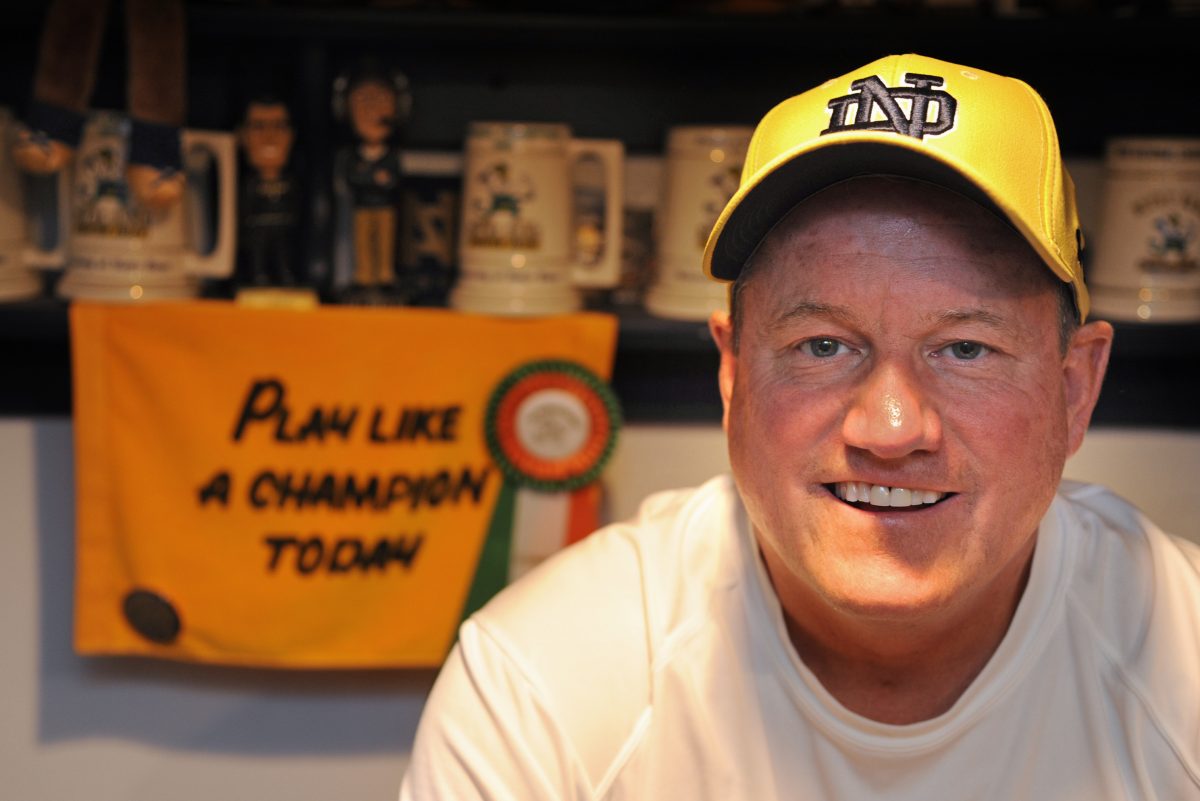
    Sumner’s passion for the Irish runs so deep — Saturday’s game against Michigan State marks his 50th annual pilgrimage to South Bend, Ind. — that even black-and-white referee stripes can’t hide his love for the blue and gold. Most don’t even know his name.

    “People will say, ‘Bob Sumner is doing the game,’” Sumner said. “They’ll say, ‘That wasn’t Bob. That was Notre Dame Harvey.’”

    Sumner, like so many Irish supporters, didn’t attend Notre Dame. But that didn’t stop him from falling for the Irish in the 1970s as a kid in Grays Ferry, where it seemed like half the neighborhood was split between Penn State and the Golden Domers.

    The neighborhood — just like pockets of Northeast Philly and Delaware County — often felt like a Notre Dame satellite campus.

    Sumner’s Uncle John took him as a kid to see the Irish at JFK Stadium and he used to race home with his brother after church at St. Gabriel’s to watch the ND highlight show.

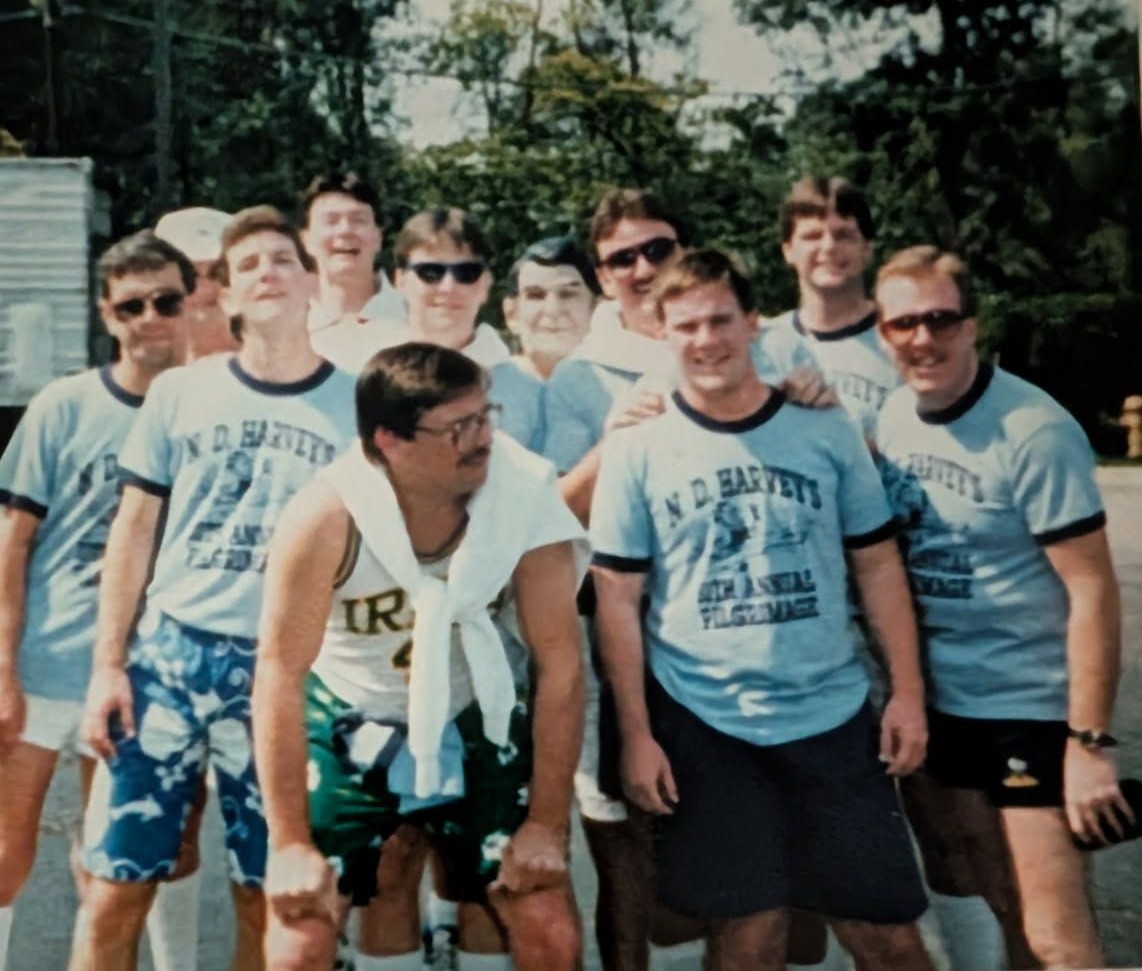
    In 1977, Sumner flew to South Bend with a bunch of older guys from the neighborhood who watched Notre Dame every Saturday at Dean’s Bar. Notre Dame Harvey — no one quite knows why his family started calling him Harvey, but it’s easy to explain the Notre Dame part — was born.

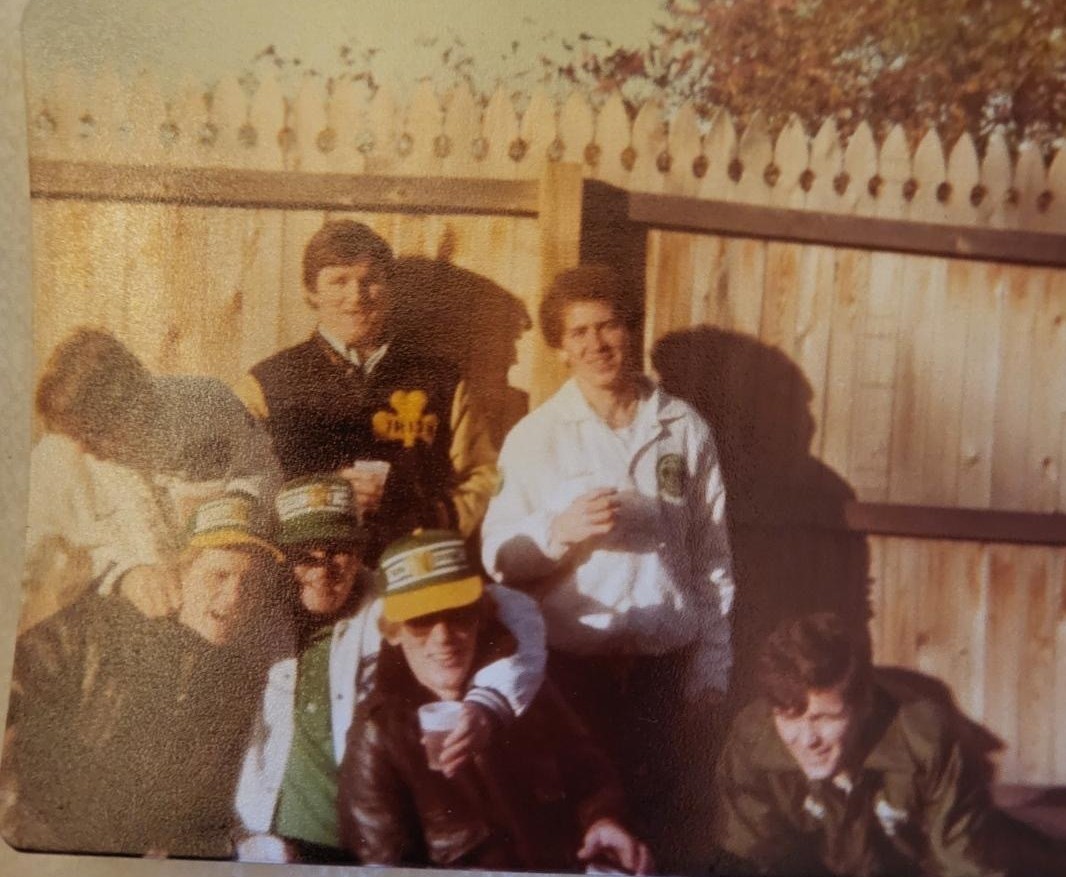
    Notre Dame Harvey and the “Gang From Grays Ferry” during a trip to South Bend in 1981. They’ve made 50 straight trips to see the Irish.Bob Sumner

    The Grays Ferry clan — “The Notre Dame Club of Grays Ferry,” they called themselves — went out every season as they drove Winnebagos, rented buses, and boarded airplanes to turn South Bend into South Philly.

    One guy said he told his wife before they got married that the annual trip was part of the deal. Sumner even played the fight song at his wedding.

    They hang in the bars, walk around campus, go to church, and even once helped paint the gold helmets. It’s hard to explain, Sumner said, until you make the trip. The school became his identity as there’s no hiding his love for ND. Even when he’s trying to ref.

    “I knew I couldn’t ‘T’ Speedy up,” said Sumner who ends every phone call with a ‘Go Irish.’ “He’s a legend.”

    A nail in the foot

    Sumner’s first trip to Notre Dame in October 1977 came a week after the Irish wore green jerseys and blew out fifth-ranked Southern California. The team ran onto the field that day behind a wooden Trojan horse, which was still on campus when the guys from Grays Ferry arrived.

    “I was jumping on it and I stepped on a nail,” said George Sumner, Notre Dame Harvey’s older brother. “I had to go to the hospital on my first night on campus.”

    A nail? No big deal. Sumner got a shot at the hospital and was back with the clan that night. The Irish played Navy the next afternoon and the guys returned to Dean’s at 29th and Tasker with a win.

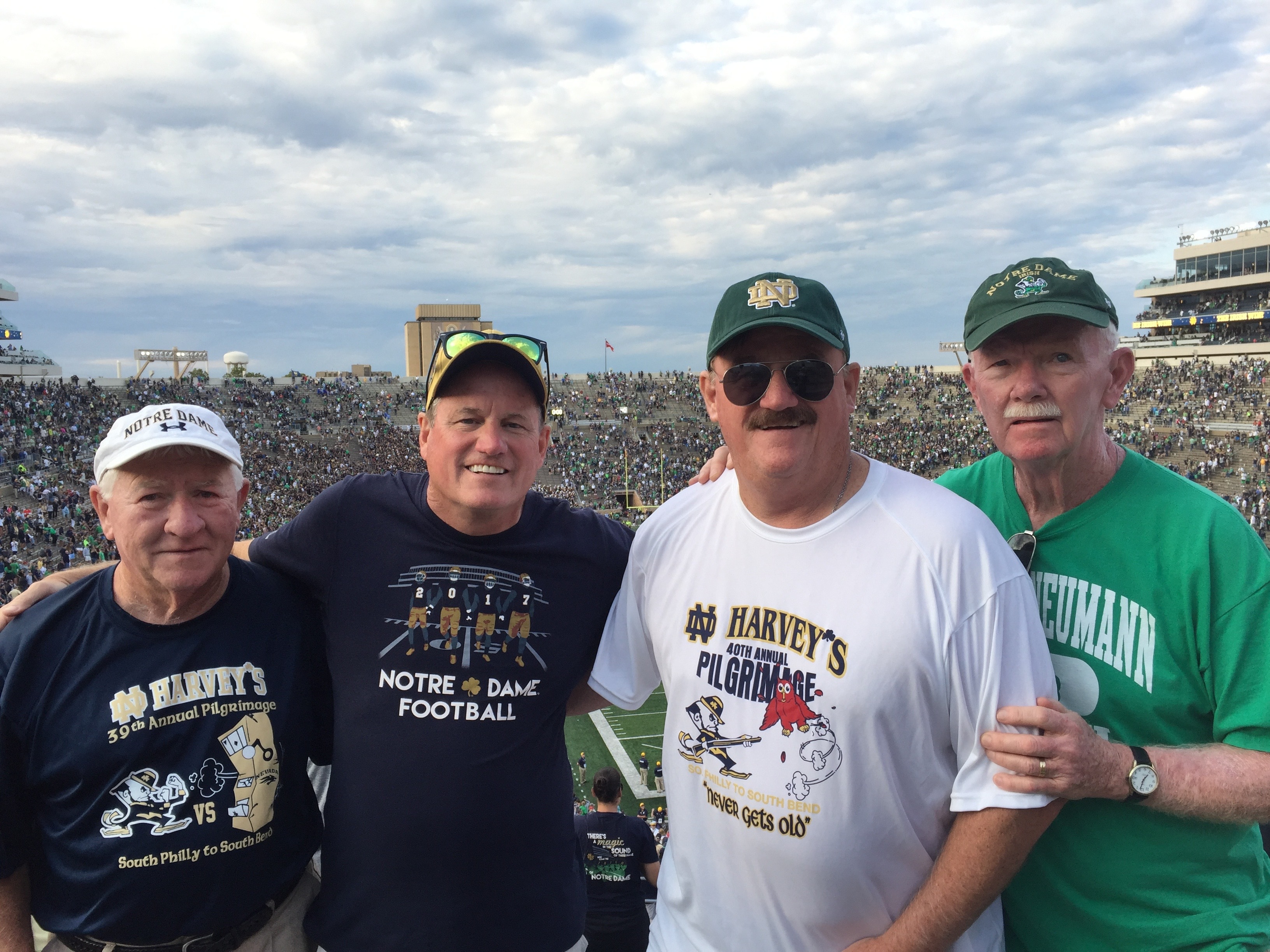
    Frank Henry, Notre Dame Harvey, George Sumner, and Joe “Whitey” Gibson at Notre Dame Stadium in 2017 for the 40th annual trip.Bob Sumner

    “First time in the stadium, I had the tears running,” Sumner said. “It’s something that you grew up with and you saw it on TV. But when you’re there, it’s like, ‘Oh my God. I’m here.’”

    The first trips were run by neighborhood pillars Jack Keenan and Greg Horan before Notre Dame Harvey took over. They connected with alumni, found ways to score tickets to sold-out games, and have met everyone from Ara Parseghian to Will Fuller.

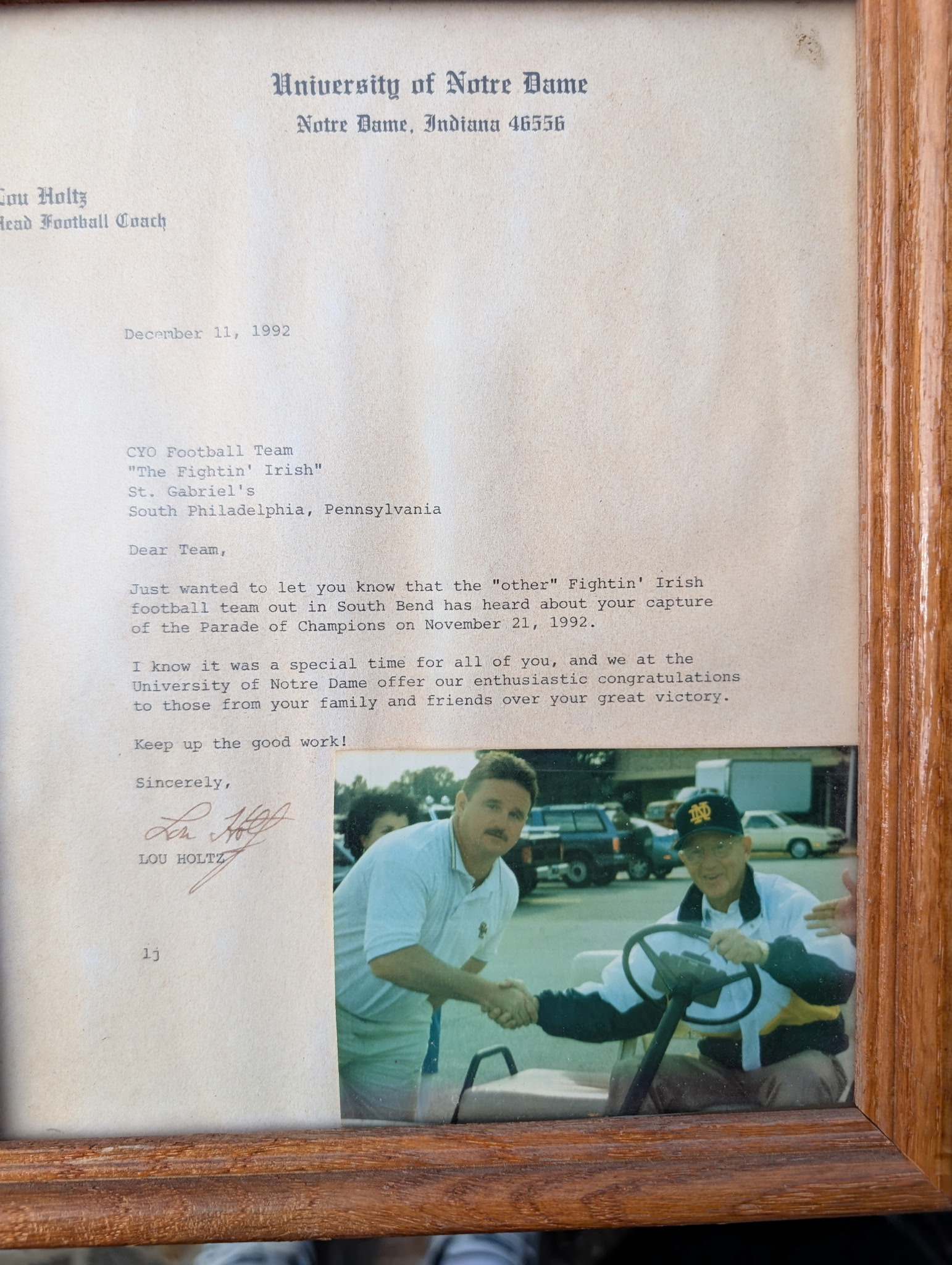
    Lou Holtz even wrote a letter to Bob Sumner after Sumner coached the St. Gabriel CYO football team — of course, they’re the Fightin’ Irish — to a 1992 championship.

    “Just wanted to let you know that the ‘other’ Fightin’ Irish football team in South Bend has heard about your capture of the Parade of Champions,” Holtz wrote.

    Notre Dame coach Lou Holtz wrote a letter to St. Gabriel’s CYO team after the other Fightin’ Irish won a football title in 1992.George Sumner

    Most of the crew who have traveled with Notre Dame Harvey are Subway Alumni, the moniker worn with pride by ND fans who didn’t go to school there. They used to pack a bus with neighborhood guys and made sure they had enough beer and hoagies for the ride.

    “Going out was phenomenal,” George Sumner said. “But coming home was a long ride. Win or lose. It’s brutal.”

    The annual trip became an event. For years, they parked their Winnebago next to the stadium all weekend and showered in the basketball arena. They were living large, George Sumner said.

    “People say, ‘You go there,’” said George Sumner, who went to Temple but cheered for the Irish against the Owls. “I say, ‘Yeah.’ My wife says, ‘Stop lying.’ I say I go every year. But I did sneak into two classes. I snuck into a philosophy class and a chemistry class so I’ve taken classes there. Dean’s list.”

    A kitty on the bar

    Harvey planned to leave Thursday morning before dawn, which he figured would get him to the Linebacker Lounge by 4:30 p.m.

    “We’re in ND,” Harvey texted Thursday at 4:38 p.m. “Go Irish.”

    They planned to have a “a couple cold ones” at the Linebacker Lounge and “go as far as their body takes us.” The 68-year-old Harvey said the crew might not stay out like they used to and has learned the importance of a good breakfast.

    But the bartenders at the spot by the football stadium still know the crew from Philly as the “Grays Ferry Gang” who always pile their cash together on the bar.

    “We’re Philly people,” Sumner said. “We throw up a kitty. People don’t know what a kitty is. The bartenders we know in the Linebacker say, ‘They’re all right. That’s a kitty.’”

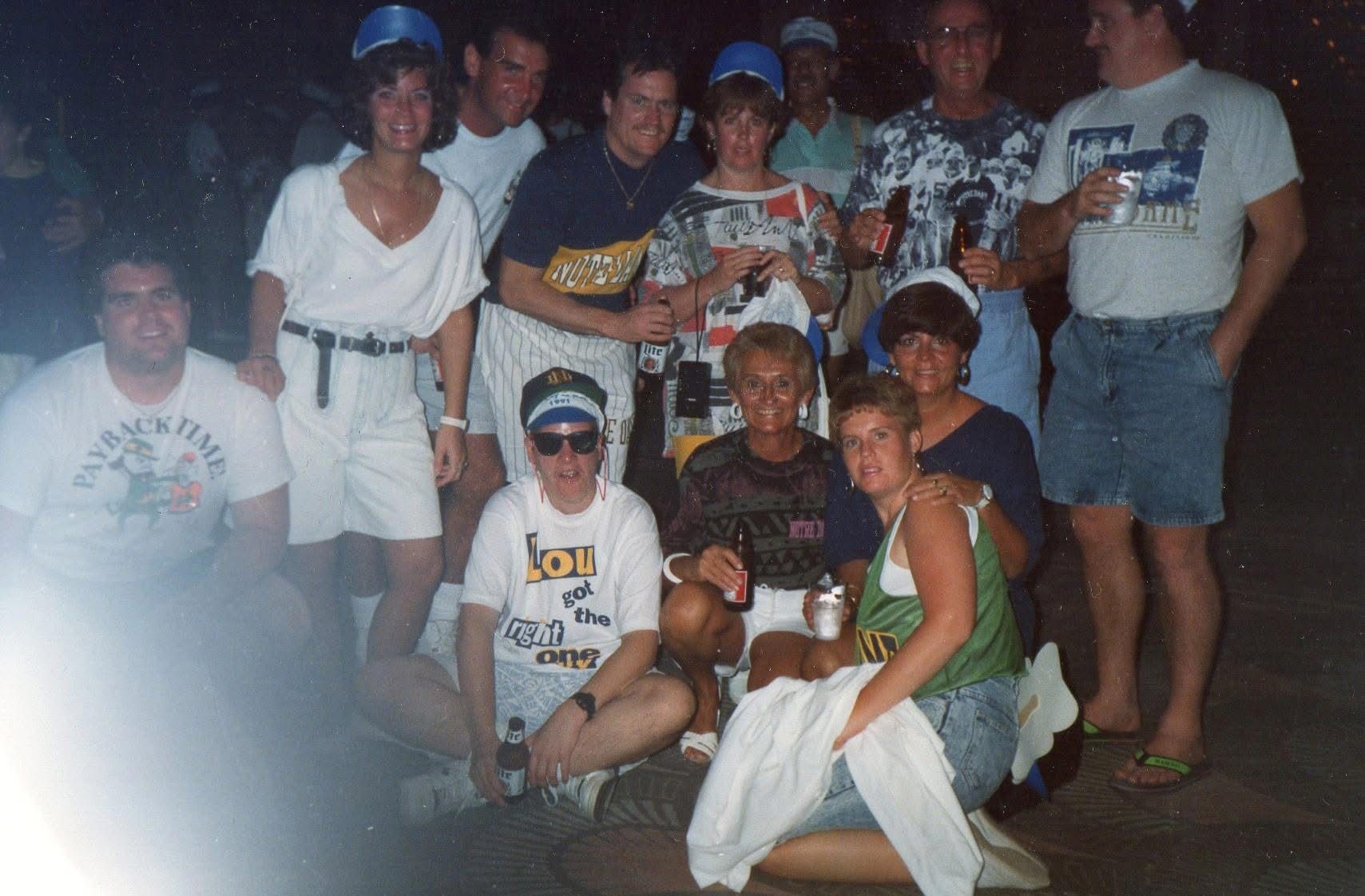
    Notre Dame Harvey and the Grays Ferry Gang in South Bend in the late 1980s.Bob Sumner

    The crew is about 700 miles from Grays Ferry, but they make an Indiana watering hole feel like Dean’s, where they still gather once a year to watch the Irish. They pool their money together and tell the bartender to pull from the pile whenever someone orders a drink. The leftover cash belongs to the bartender.

    “Being from South Philly and Grays Ferry, you always took care of the bartenders and treated them with respect just like a police officer,” Sumner said. “We went to Pittsburgh one time for a game and threw up a kitty with 300 or 400 dollars on the bar. Guy goes ‘What’s that?’”

    Sumner gave him a South Philly education. The crew stayed for two hours and left $100 on the bar.

    “He goes, ‘What’s that?’ I said, ‘That’s yours. We’re leaving,’” Sumner said. “He was almost in tears. We’re walking out the door and says to the gang, ‘By the way, guys, I open up tomorrow at 8 o’clock.’”

    Notre Dame Harvey and The Grays Ferry Gang even traveled to Hawaii to see the Irish play in a bowl game.Sumner

    The trip is planned around the game on Saturday but it has become so much more than just the four quarters. It’s the kitty on the bar, the pep rallies, the excitement when the crowds begin to fill campus on Friday, and the tailgate on Saturday — “Bring your own food,” they say — as kickoff nears.

    “People still think we’re crazy,” said 71-year-old George Sumner. “But there’s so many people we’ve met and friendships formed all over Notre Dame.”
    ‘I felt like Rudy’

    Sumner bartends each summer at Keenan’s — the North Wildwood bar Jack Keenan used to run — and one of his coworkers lives near Joey O’Brien, the star recruit from La Salle who is now a freshman at Notre Dame. Harvey needed to meet the kid and his parents so his buddy set up a dinner at a bar in Lafayette Hill.

    “I didn’t even know where Lafayette Hill was,” said the guy who calls his South Jersey town “Little South Philly.”
    He listened to O’Brien’s father Joe tell stories — “He’s like one of us,” Harvey said — and talked to the kid about playing at ND. Earlier this year, Harvey was wandering around campus the day before the Blue and Gold spring game when the football team walked by on their way to practice. O’Brien spotted him and asked Harvey if he wanted to come to practice.
    “I felt like Rudy,” he said.

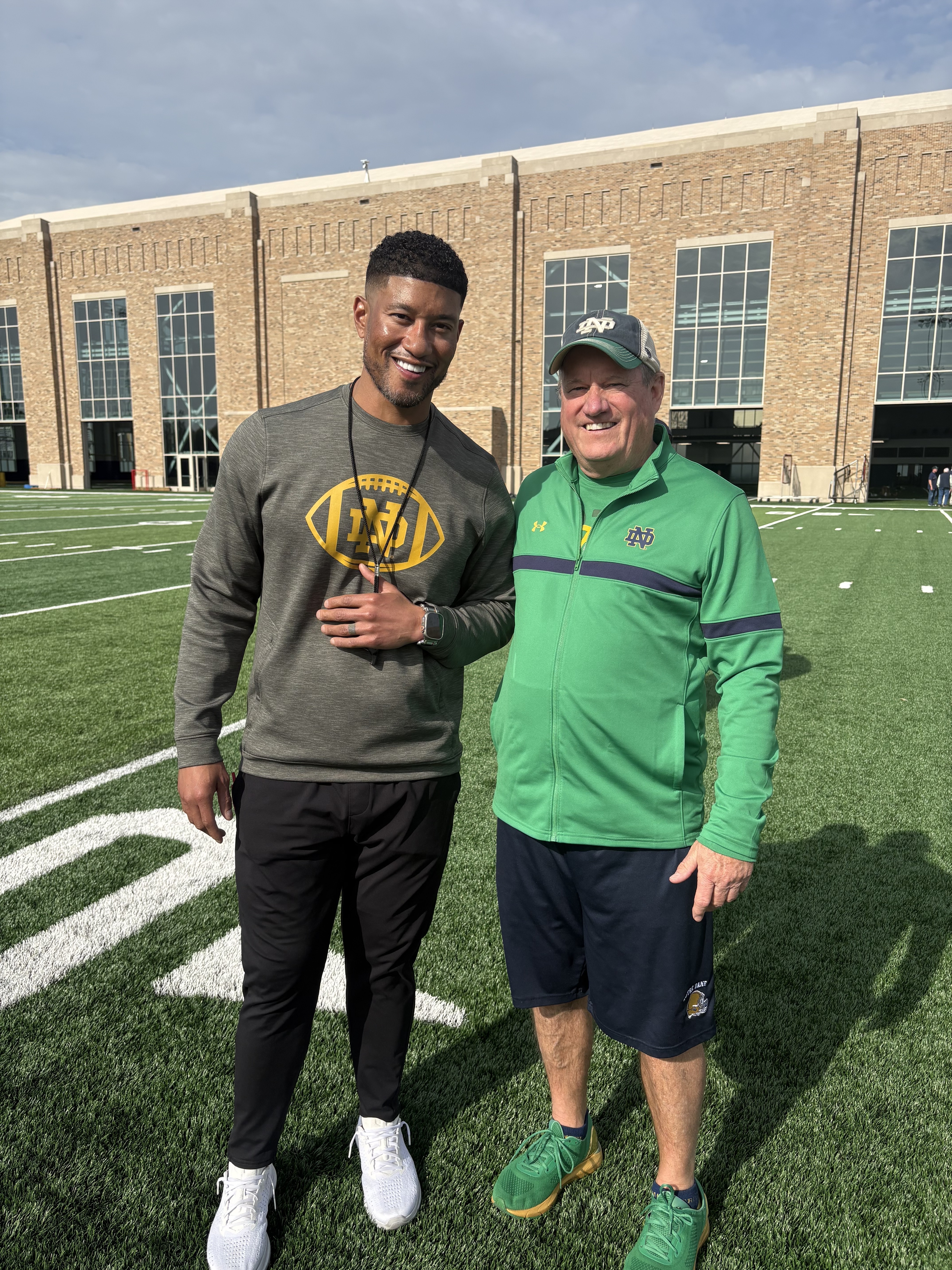
    Notre Dame Harvey met Irish head coach Marcus Freeman before the 2026 spring game. The coach thought he was a player’s uncle.Sumner

    A staffer brought him to head coach Marcus Freeman and introduced him as “O’Brien’s uncle.” He was in. Notre Dame Harvey — the guy who used to call into Howard Eskin’s WIP radio show to defend the Irish — watched practice on the sidelines. Eventually, he made it back to his crew after telling them he was making a coffee run. Three hours later, he had another story to tell.

    “I was just out for a casual walk and one of the greatest thrills of my life happened,” Sumner said. “I was like a kid in the candy store. Everyone treated me great. Freeman must’ve really thought I was his uncle.”

  • Mixed-income apartment project in Center City gets its final approval after almost 11 years

    Mixed-income apartment project in Center City gets its final approval after almost 11 years

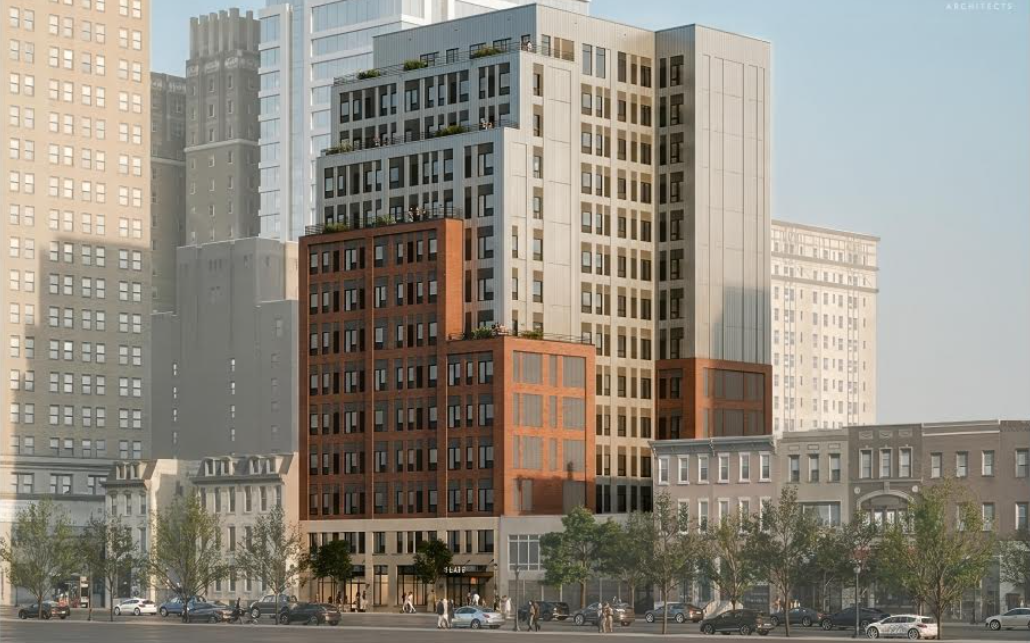
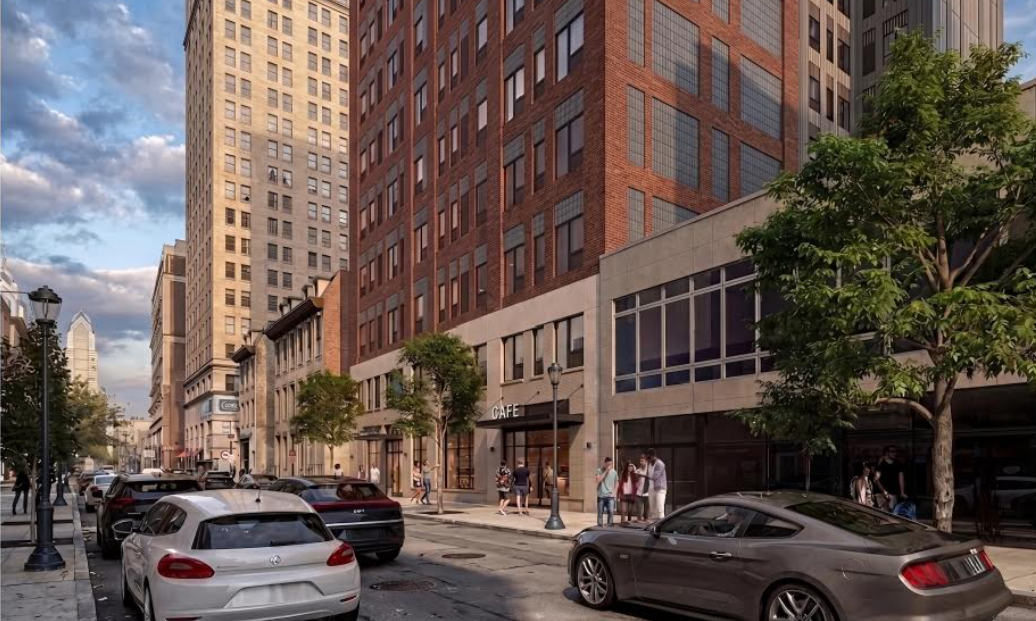
    Construction was supposed to have started on a 14-story apartment building at 2012 Chestnut St., a collaboration between the Philadelphia Housing Authority (PHA) and Alterra Property Group.

    In late 2025, after years of delays, the partners said construction would begin in early 2026. Instead, the 121-apartment project stalled for another nine months in the face of hang-ups at the federal level.

    But at a meeting of PHA’s board Thursday, the agency promised that this time, really, construction will begin in a matter of weeks.

    “The financial transaction was closed today, and so all regulatory approvals are now in hand, and we can move forward,” Kelvin Jeremiah, president and CEO of the authority, said in an interview Thursday. “Mobilization and construction starts before Oct. 6.”

    The building will include 30 two-bedroom apartments, 63-one bedrooms, and 28 studios, along with 2,000 square feet of commercial space and off-site parking. These will be PHA’s only apartments in Center City.

    According to interviews in 2025, 40% of the project’s 121 units will be rented to market-rate tenants, while the rest will go to tenants at 80% of Philadelphia’s area median income or $78,500 for a two-person household.

    The project is designed by JKRP Architects. The general contractor is the Hunter Roberts Construction Group.

    The street-level rendering of the Alterra and PHA property, looking southeast on Chestnut Street.JKRP Architects

    The building will fill the vacant lot left by the demolition of PHA’s former Center City headquarters, which the agency left 18 years ago. This mixed-income proposal has been in the works for 10 years, with the agency first partnering with Alterra on the project in 2016.

    According to a resolution passed by PHA’s board Thursday, the project hit further snags in early 2026 and experienced difficulties obtaining permits and approvals from the U.S. Department of Housing and Urban Development (HUD).

    The federal agency has suffered dramatic cuts under President Donald Trump’s administration.

    HUD “has lost a lot of staff, and so there were a lot of delays,” Jeremiah said. “But they worked very closely with us to navigate some of those issues.”

    Alterra will build and manage the mixed-income apartment project, but PHA will hold a 99-year ground lease on the property.

    The approval for that arrangement is part of what held up the project in D.C., as any time the agency disposes of an asset, it is subject to environmental and historic review — in this case of a rubble-strewn vacant lot.

    As these delays mounted, construction costs for supplies like steel and elevator parts have soared. The project will now cost an additional $5 million, bringing the price to $65 million.

    “And then you have the tariff situation, the unending uncertainty around construction equipment and supplies,” Jeremiah said. “It has caused a lot of strain for us as a major developer in the city.”

  • The busiest ambulatory surgery centers in the Philadelphia region

    The busiest ambulatory surgery centers in the Philadelphia region

    The two busiest surgery centers in the Philadelphia region last year were operated by Penn Medicine in Radnor and Jefferson Health in Center City.

    Such facilities have grown increasingly popular as a cost-saving option for procedures that do not require intensive hospital resources or overnight stays.

    While they offer convenience, the facilities operated by Penn and Jefferson both count as hospital departments for billing purposes, which means they cost more than surgery centers operated by independent physicians or other companies.

    Penn Medicine Radnor Surgery Center operates within a large outpatient facility near the intersection of I-476 and Route 30. It logged 12,464 surgical visits in 2025, up from 8,961 the year before, according to data published last month by the Pennsylvania Department of Health.

    Penn attributed the growth to the addition of new gastroenterologists in Radnor to perform colonoscopies, upper endoscopies, and other procedures. Colonoscopies, in particular, account for a large portion of the overall volume in surgery centers outside hospitals.

    Jefferson Surgery Center was close behind, with 12,261 surgical visits, up from 2,639 in 2024. It sits within the Honickman Center, which opened in 2024 at 1101 Chestnut St. in Philadelphia. Jefferson has gradually expanded the array of surgical services offered there.

    “Growth has been driven by both increasing patient demand and the strategic transition of services from other Jefferson locations, allowing us to provide care in a state-of-the-art outpatient environment,” Jefferson said in an email.

    Other fast-growing surgery centers include two independently operated facilities focused on orthopedics, Premier at Exton Surgery Center in Exton and Restore Orthopaedic Surgical Institute in Chadds Ford.

    (function(){function e(){window.addEventListener(`message`,function(e){if(e.data[`datawrapper-height`]!==void 0){var t=document.querySelectorAll(`iframe`);for(var n in e.data[`datawrapper-height`])for(var r=0,i;i=t[r];r++)if(i.contentWindow===e.source){var a=e.data[`datawrapper-height`][n]+`px`;i.style.height=a}}})}e()})();

    Surgery center ownership matters

    Even though the Penn and Jefferson outpatient facilities are not in hospitals, their ownership by large hospital systems enables providers to get paid as if they were located inside the Hospital of the University of Pennsylvania or Thomas Jefferson University Hospital.

    Hospital outpatient department billing rates are sometimes twice as much as the rates paid to independent surgery centers.

    For example, surgery to remove torn cartilage from a knee can cost $7,190 when performed on an outpatient basis in a hospital, nearly three times the $2,477 cost in ambulatory surgery centers (ASCs), according to Philadelphia-area commercial insurance averages from Turquoise Health.

    Health insurers Independence Blue Cross and Highmark have implemented policies this year seeking to save money for employers and patients by moving care out of hospitals and into ambulatory surgery centers or ASCs. Both insurers say they will only pay for certain procedures if they are done in an ASC.

    But it’s not enough to move surgeries to a setting outside a hospital, given the hospital-like billing status of certain surgery centers.

    “The cost savings from an ASC depend on the facility’s ownership, licensing, and billing model,” Richard Snyder, IBX’s chief operating officer, said in a email to The Inquirer.

    IBX would like to see more ASCs in its Southeastern Pennsylvania market and is “prepared to help catalyze growth through continued value-based arrangements, strategic partnerships, and investments,” Snyder said.

    Litigation over ASCs and other policies

    In a July lawsuit against IBX, Jefferson claimed that the insurer’s ASC policy amounted to a change to the financial terms of their contract that needed to be negotiated.

    The lawsuit said that ASC mandate will cost the health system $35.4 million, but doesn’t specify over what time period.

    IBX filed a motion last week to dismiss the lawsuit, which was moved to U.S. District Court in Philadelphia from the Philadelphia Court of Common Pleas.

    The insurer says that the lawsuit was premature because Jefferson filed it before completing a contractual process designed to resolve such policy conflicts.

  • The Big Picture: Eagles deliver — on and off the field — and more of the week’s best sports photos

    The Big Picture: Eagles deliver — on and off the field — and more of the week’s best sports photos

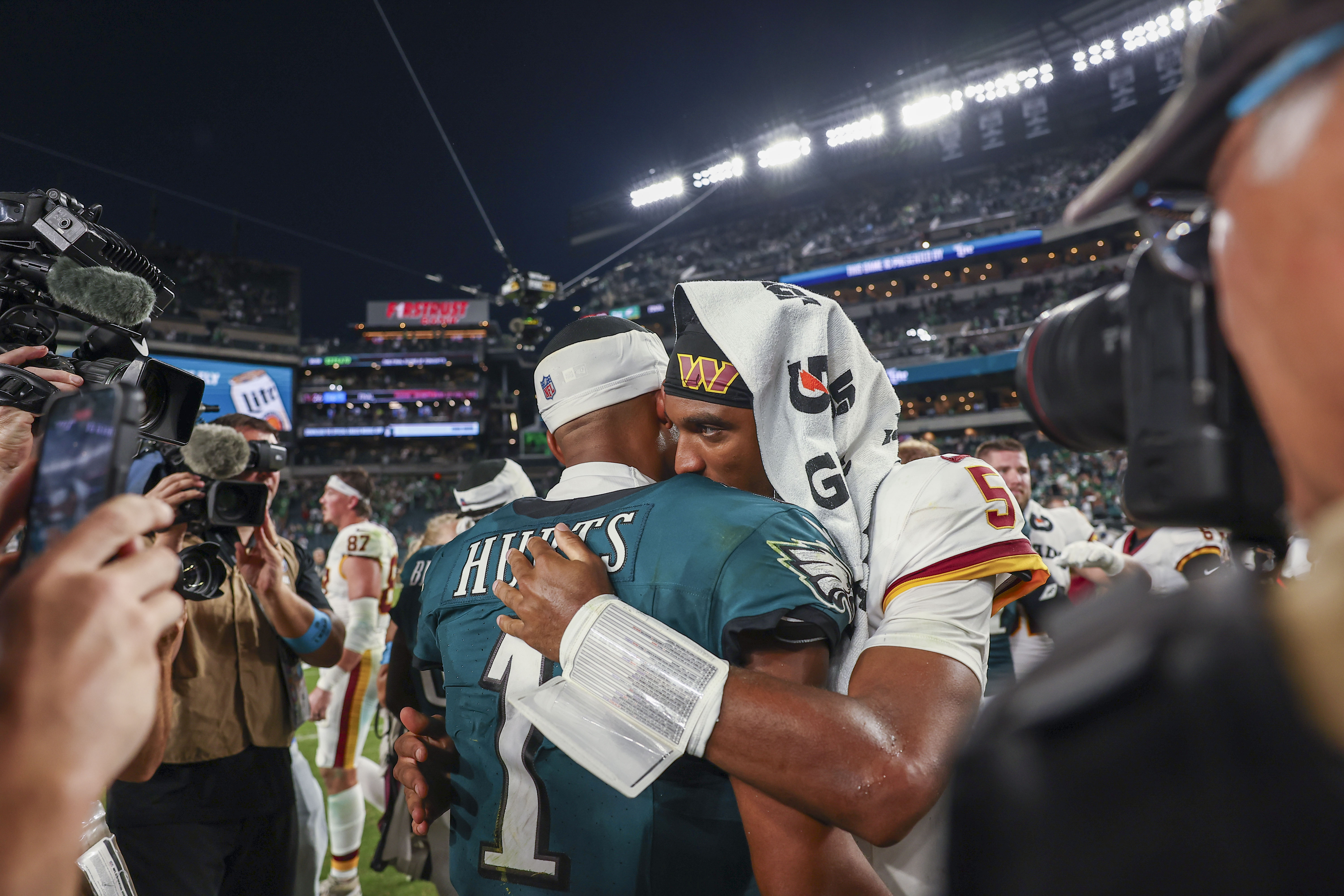
    The Eagles won (again) in Week 1 as the NFL season kicked off. They haven’t lost an opener since 2020, the year before Nick Sirianni and Jalen Hurts took over. While the Birds weren’t the only game in town this week, they were the biggest sports story — and a pair of players even made some headlines off the field. Each Friday, Inquirer photo editors picked the best sports images from the last seven days. Here’s this week’s Big Picture …

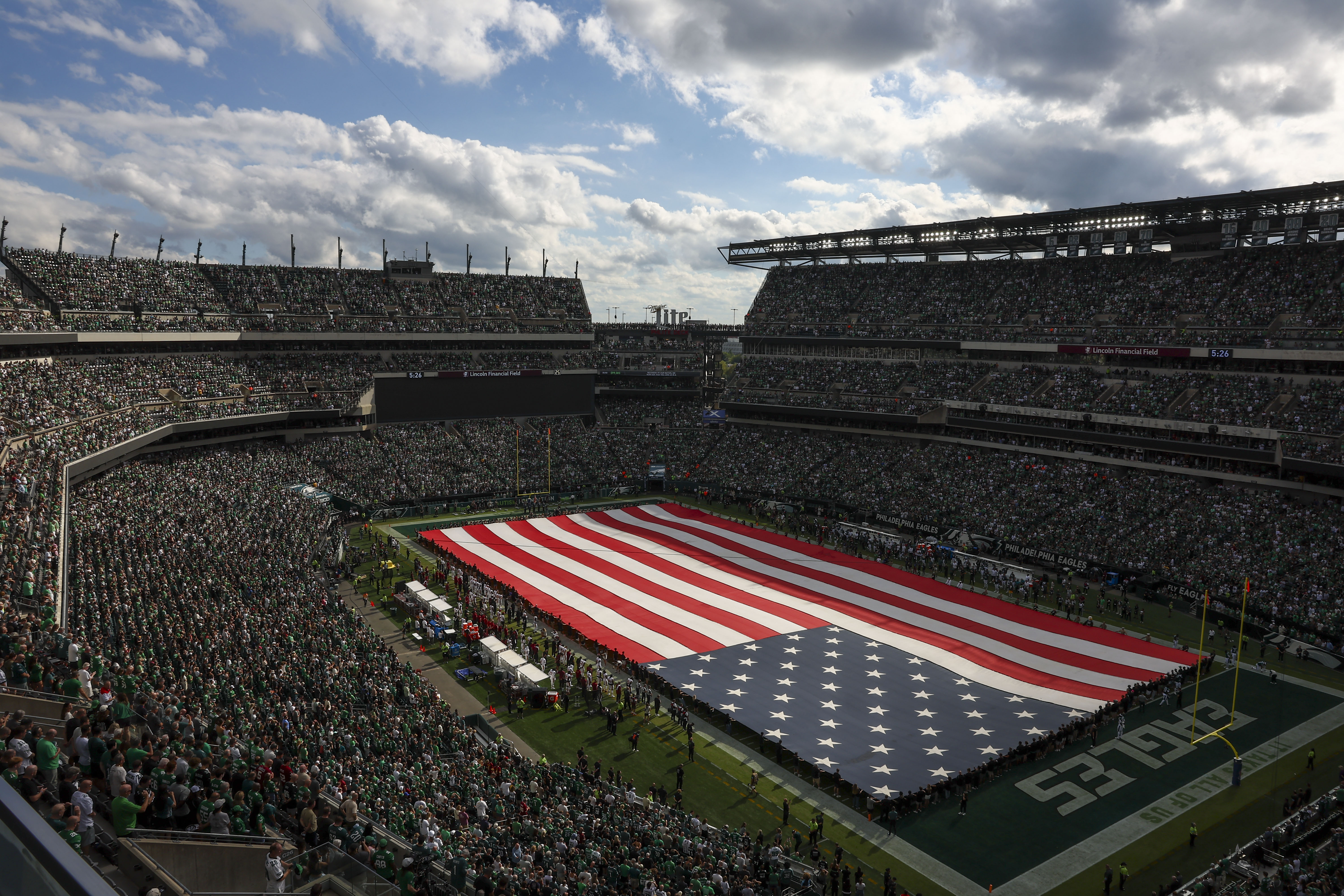
    The Eagles broke out the 100-yard-long American flag during the playing of the national anthem prior to Sunday’s season opener against the Washington Commanders.Monica Herndon / Staff Photographer
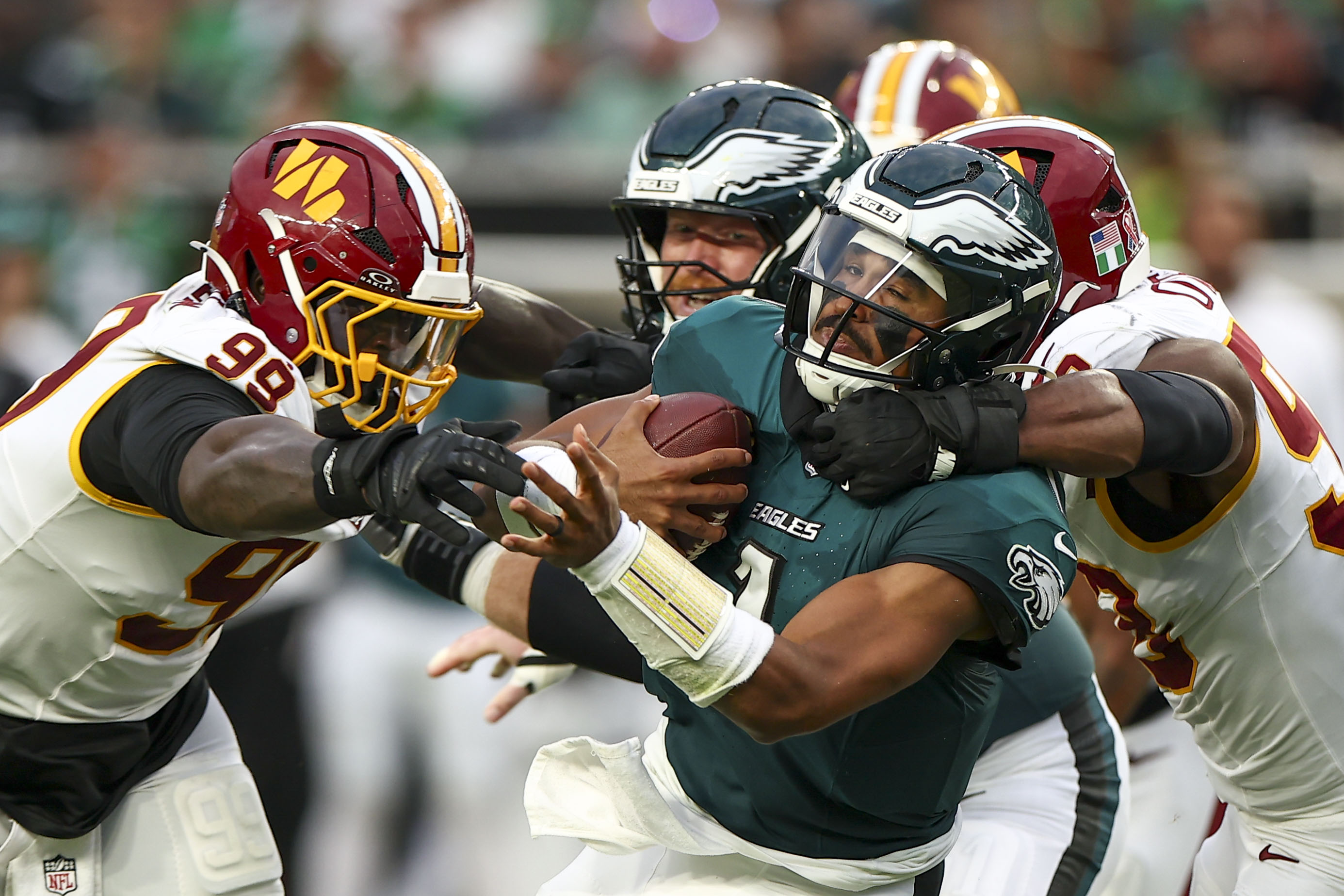
    Jalen Hurts was sacked three times by the Commanders as the Eagles offensive line struggled without a healthy Landon Dickerson (not pictured).Monica Herndon / Staff Photographer
    Wide receiver DeVonta Smith caught three passes, including this one for 31 yards, in the Eagles’ Week 1 win. He led all receivers with six targets.David Maialetti / Staff Photographer
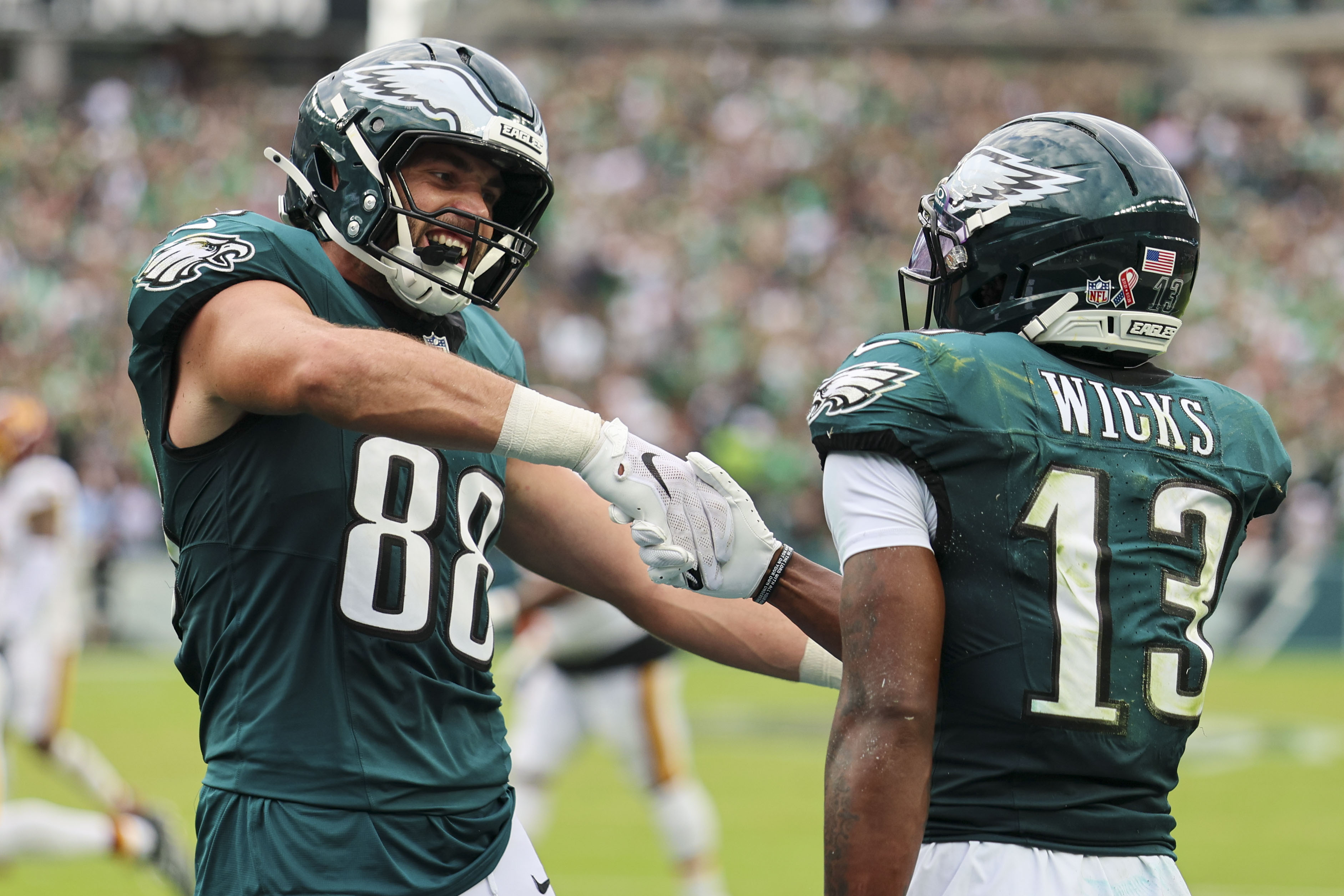
    Eagles tight end Dallas Goedert (left), who caught a pair of touchdowns on Sunday, celebrates with Dontayvion Wicks after the new wide receiver caught a touchdown of his own.David Maialetti / Staff Photographer
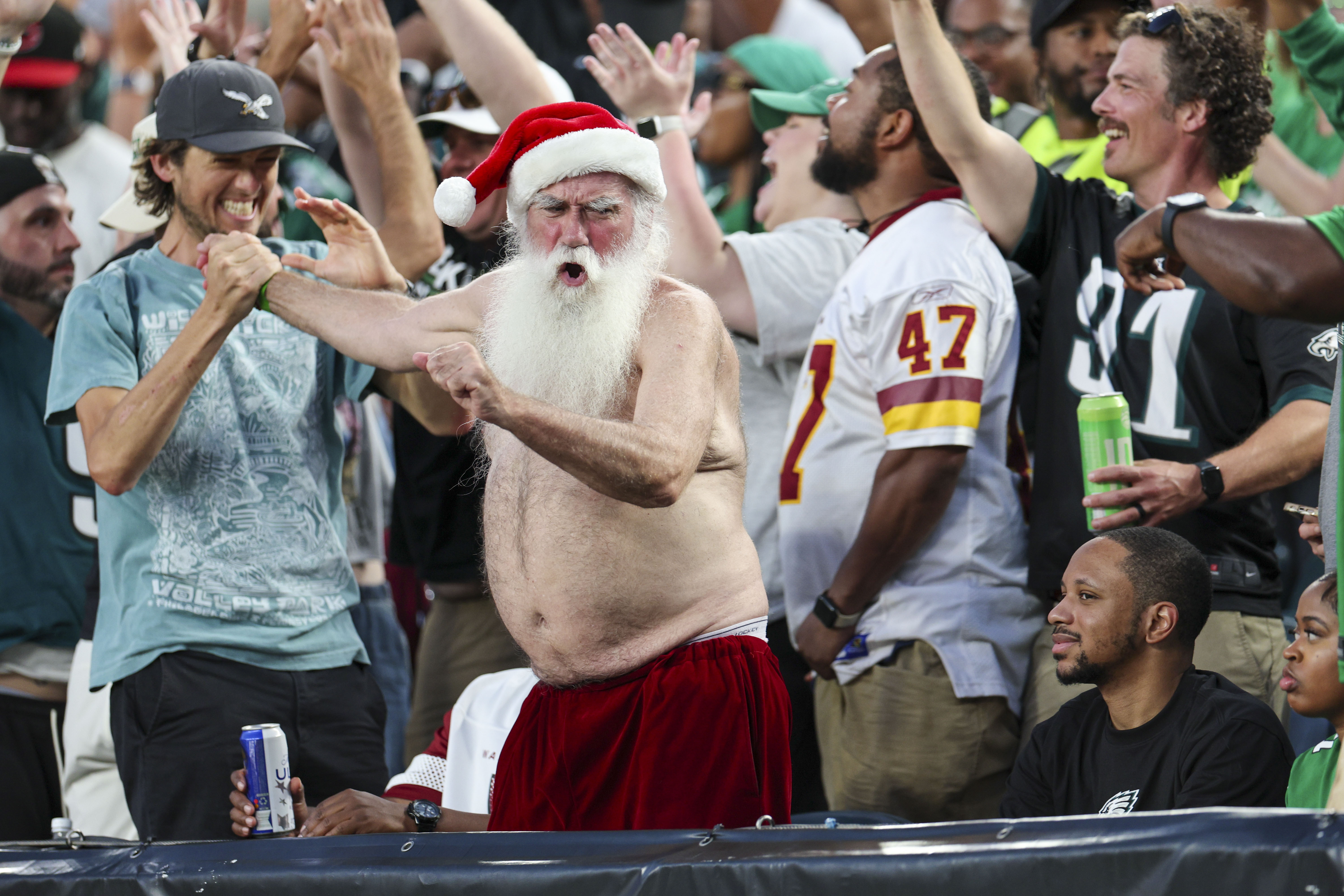
    A shirtless Santa celebrates after Dallas Goedert’s second touchdown extends the Eagles’ fourth-quarter lead.David Maialetti / Staff Photographer
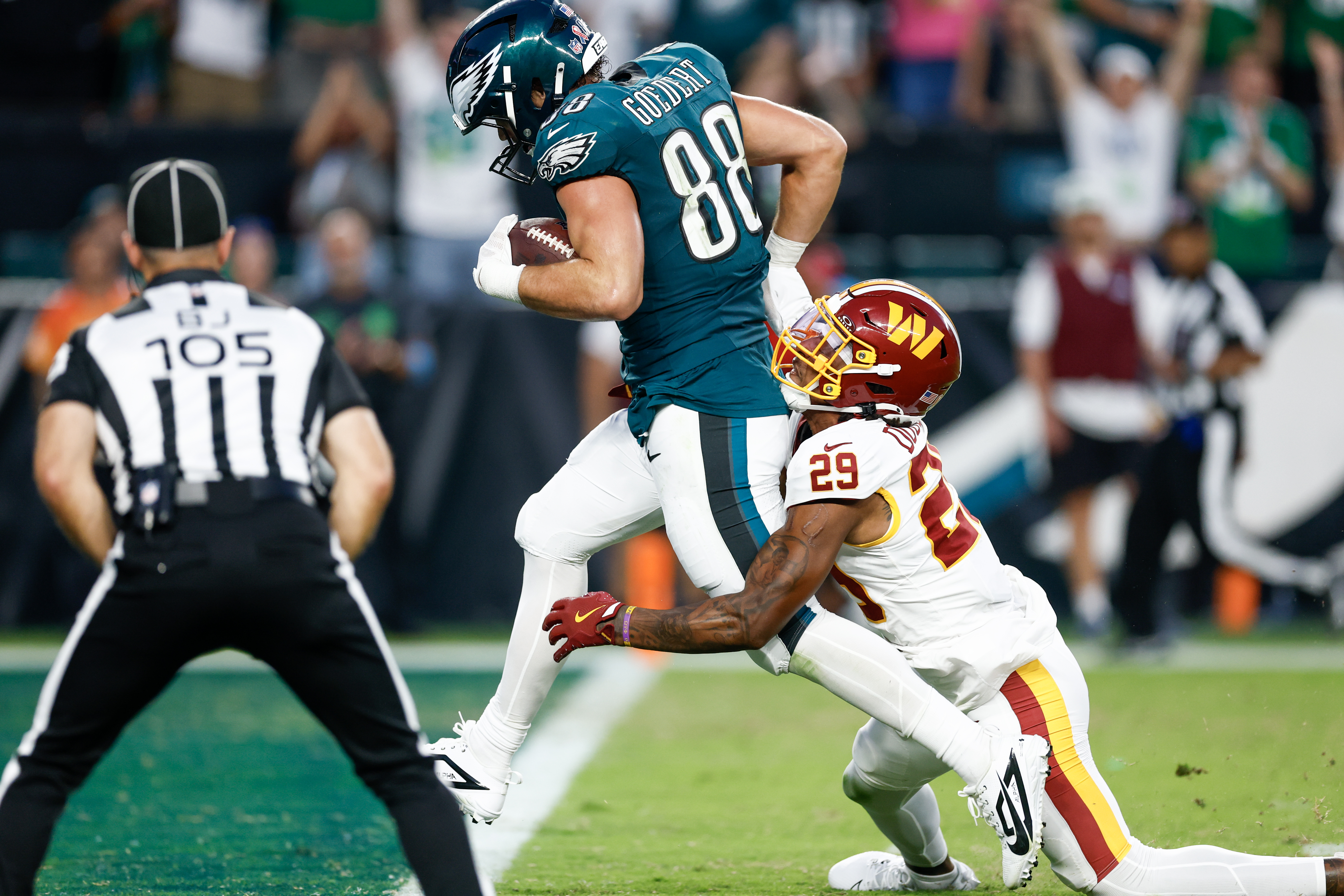
    Goedert’s 43-yard touchdown in the fourth quarter helped the Birds escape Week 1 with a win.Yong Kim / Staff Photographer
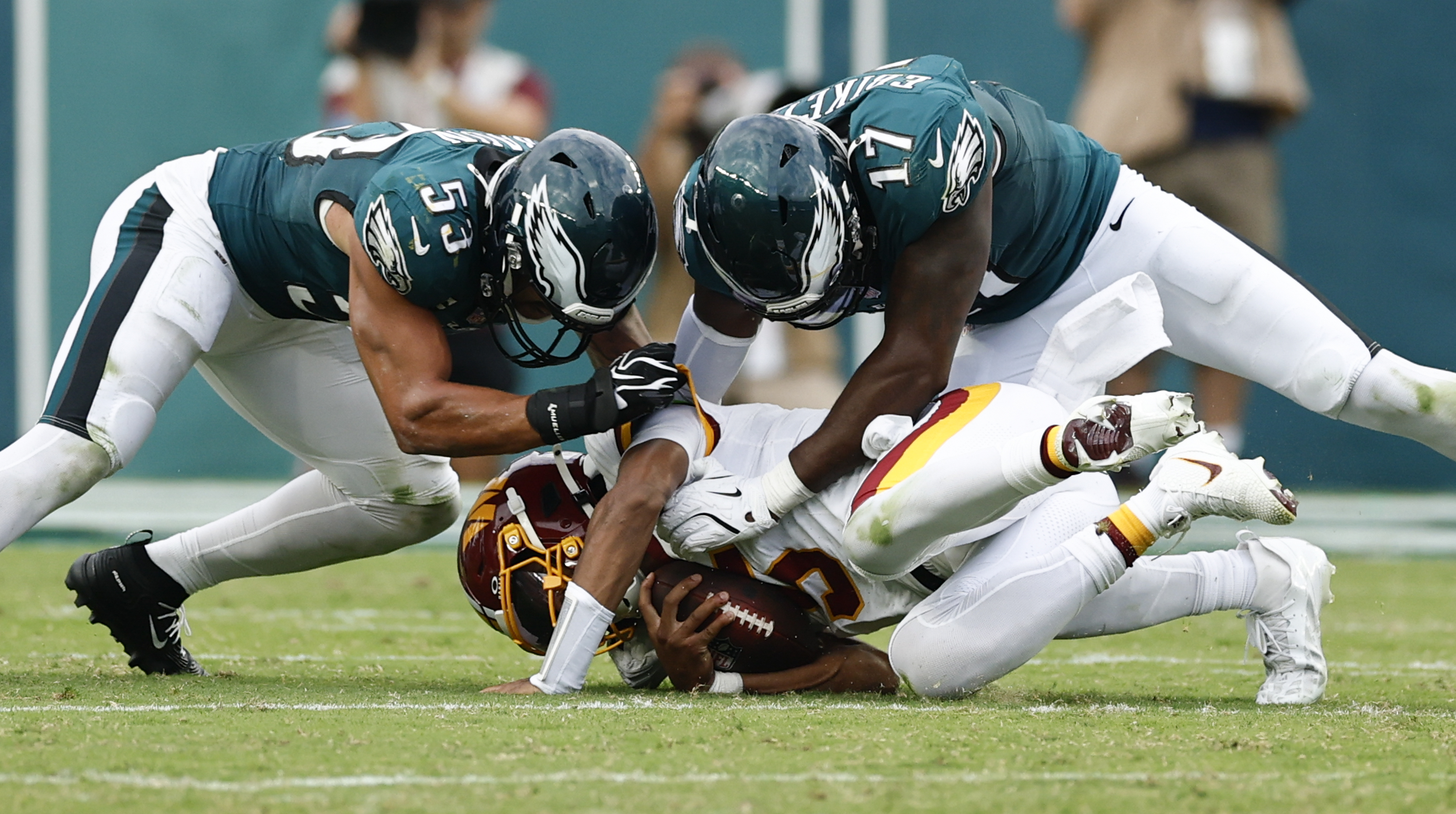
    Eagles linebackers Zack Baun (left) and Arnold Ebiketie (right) bring down Commanders quarterback Jayden Daniels. The Birds only sacked Daniels once, but limited him to 164 passing yards.Yong Kim / Staff Photographer
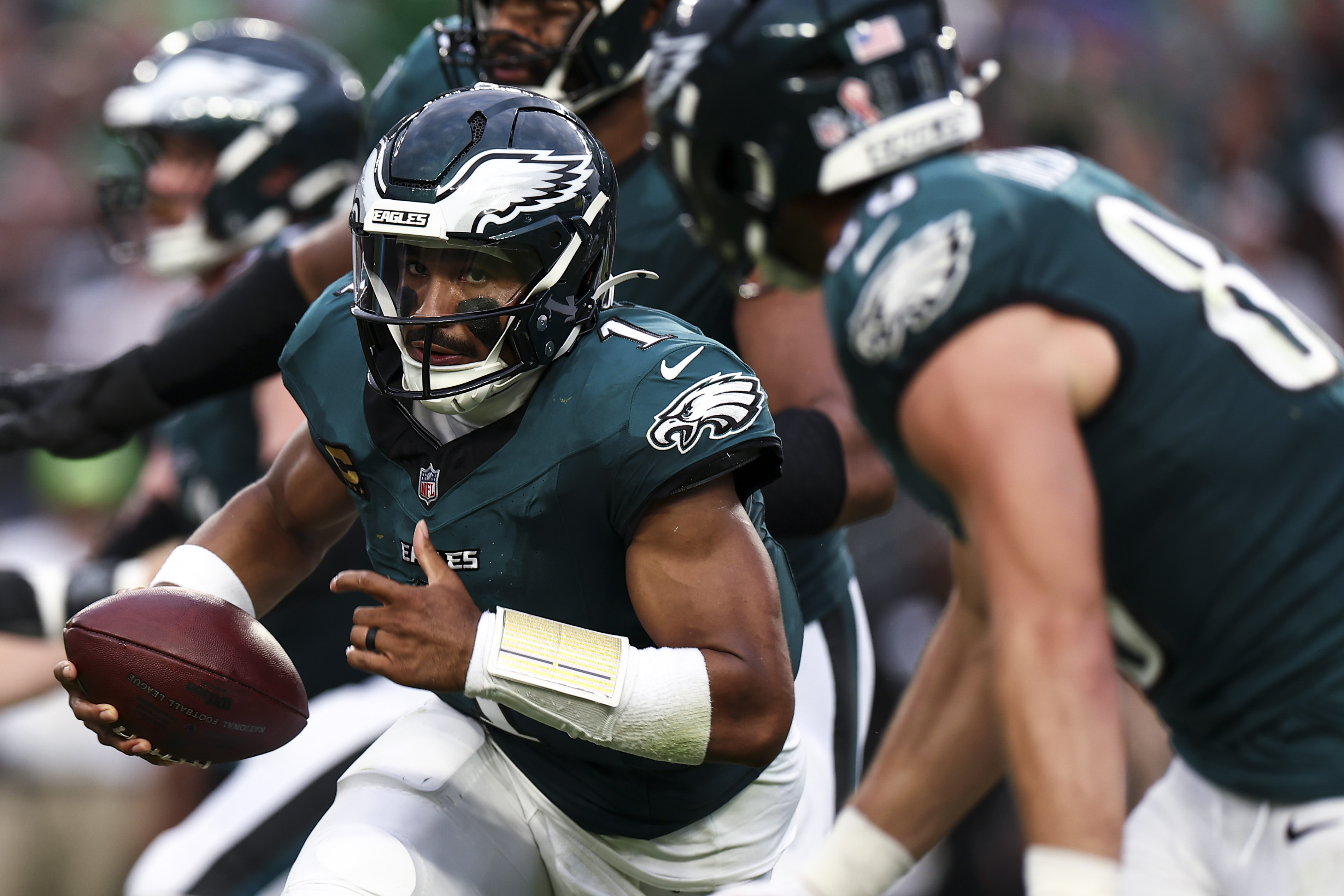
    Hurts ran for 46 yards in the win.Monica Herndon / Staff Photographer
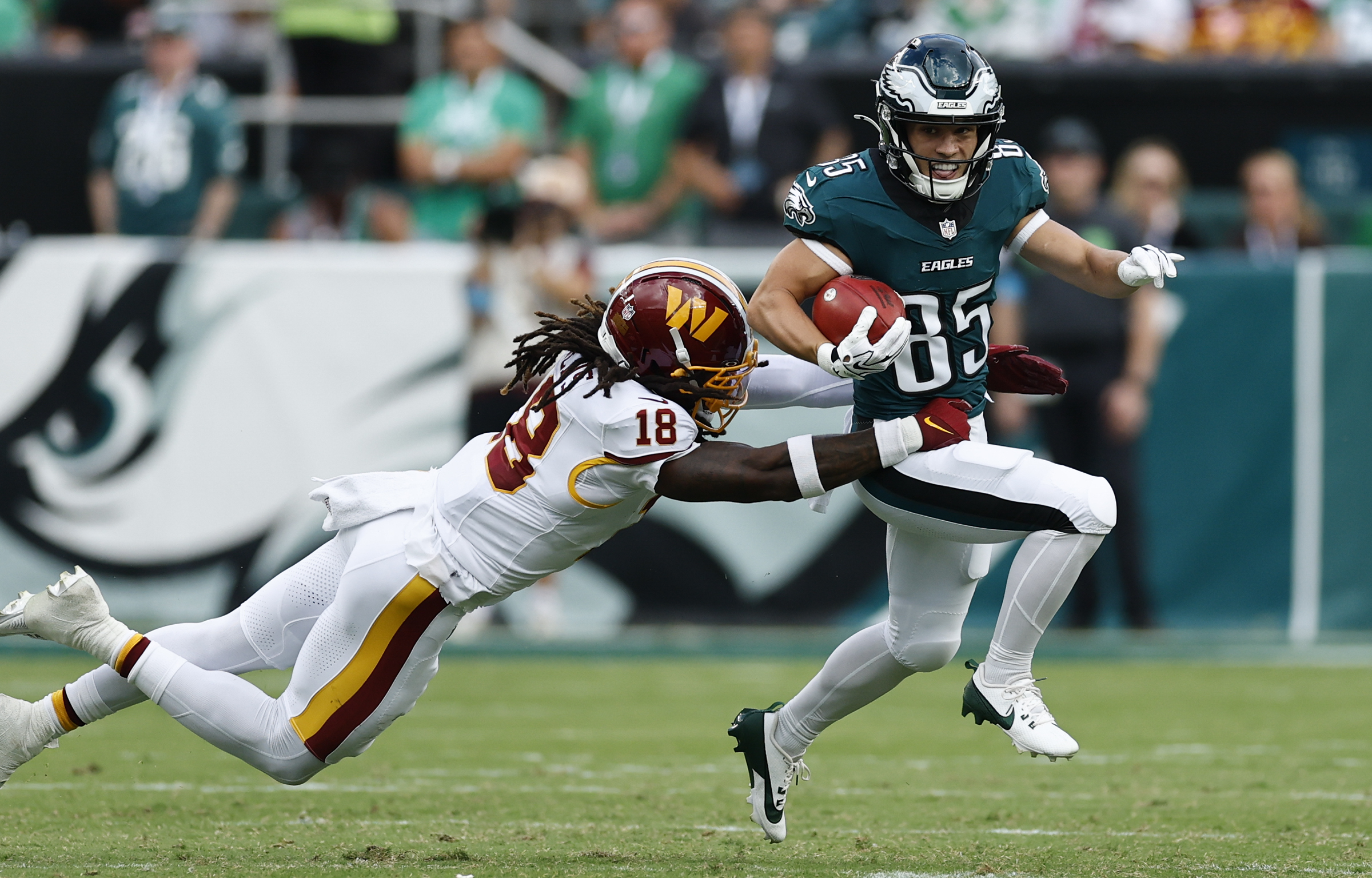
    Yes, that’s Eagles punt returner Britain Covey. He’s sporting a new number this year after previously wearing No. 18.Yong Kim / Staff Photographer
    Eagles cornerback Cooper DeJean (left), seen here in pursuit of Commanders wide receiver Stefon Diggs, admitted he didn’t have his best game in Week 1.David Maialetti / Staff Photographer
    Jalen Hurts outdueled Jayden Daniels to take home a crucial NFC East victory in Week 1.Monica Herndon / Staff Photographer
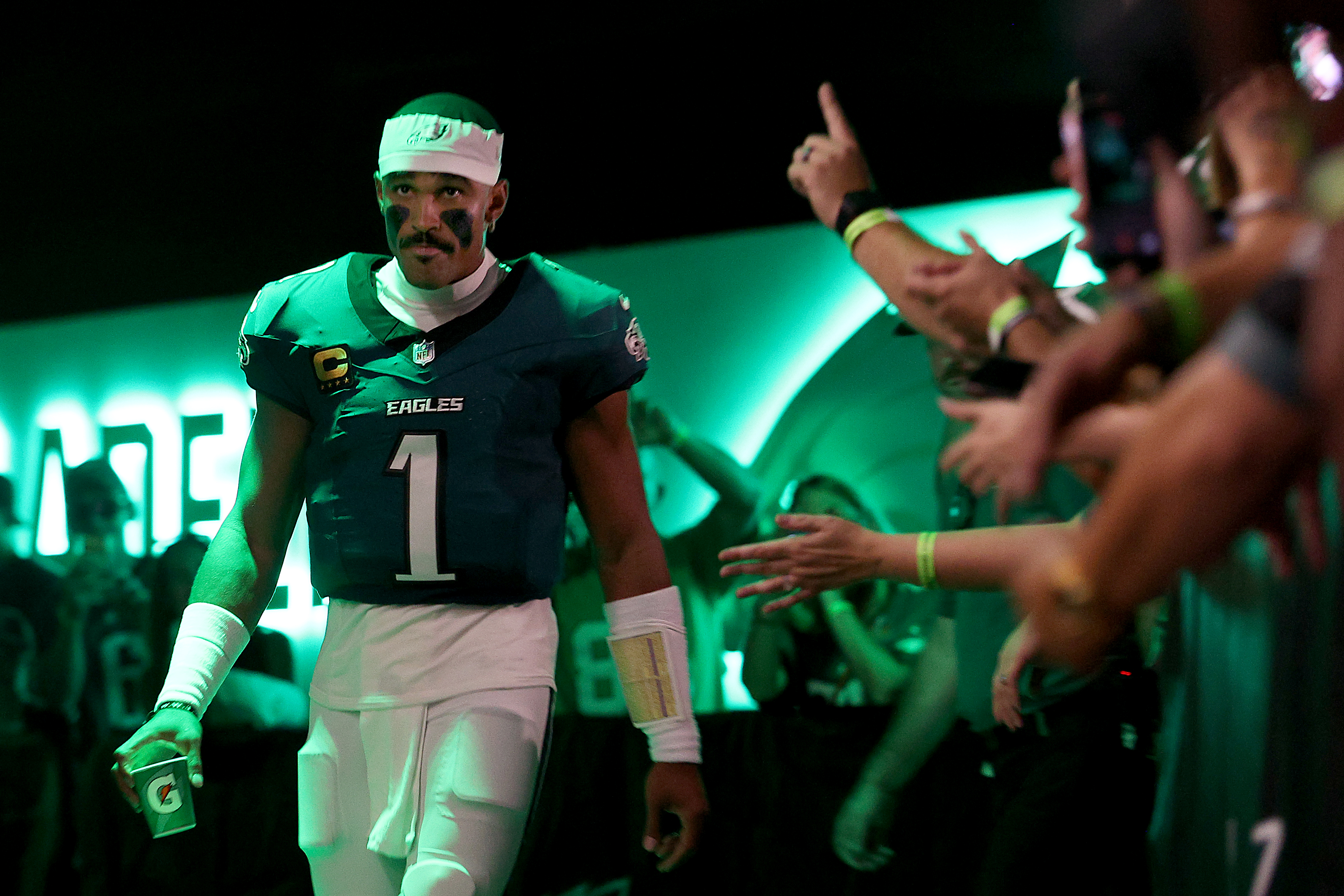
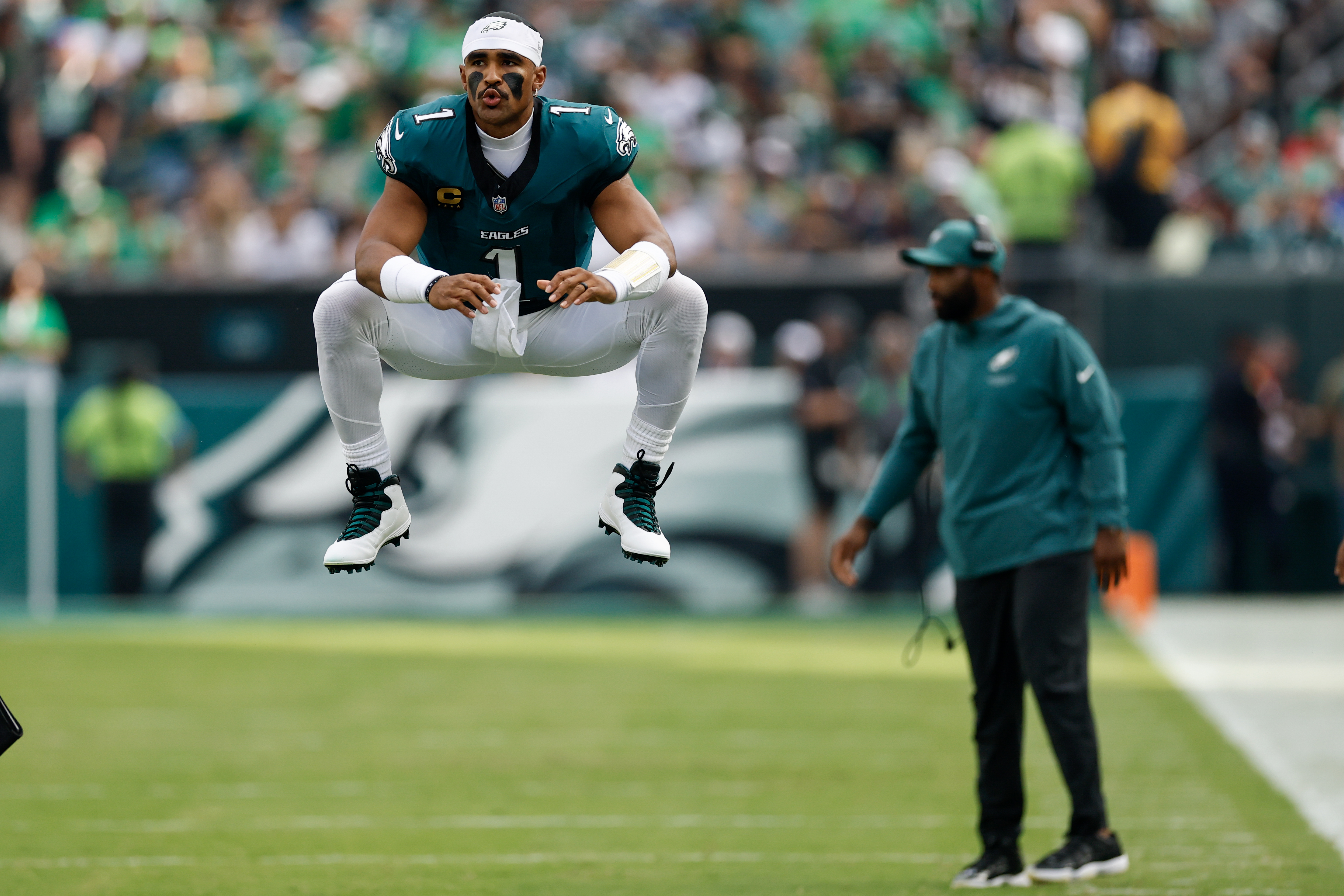
    Eagles quarterback Jalen Hurts before the start of the season opener against the Commanders Sunday, Sept. 13, 2026, in Philadelphia.Yong Kim / Staff Photographer
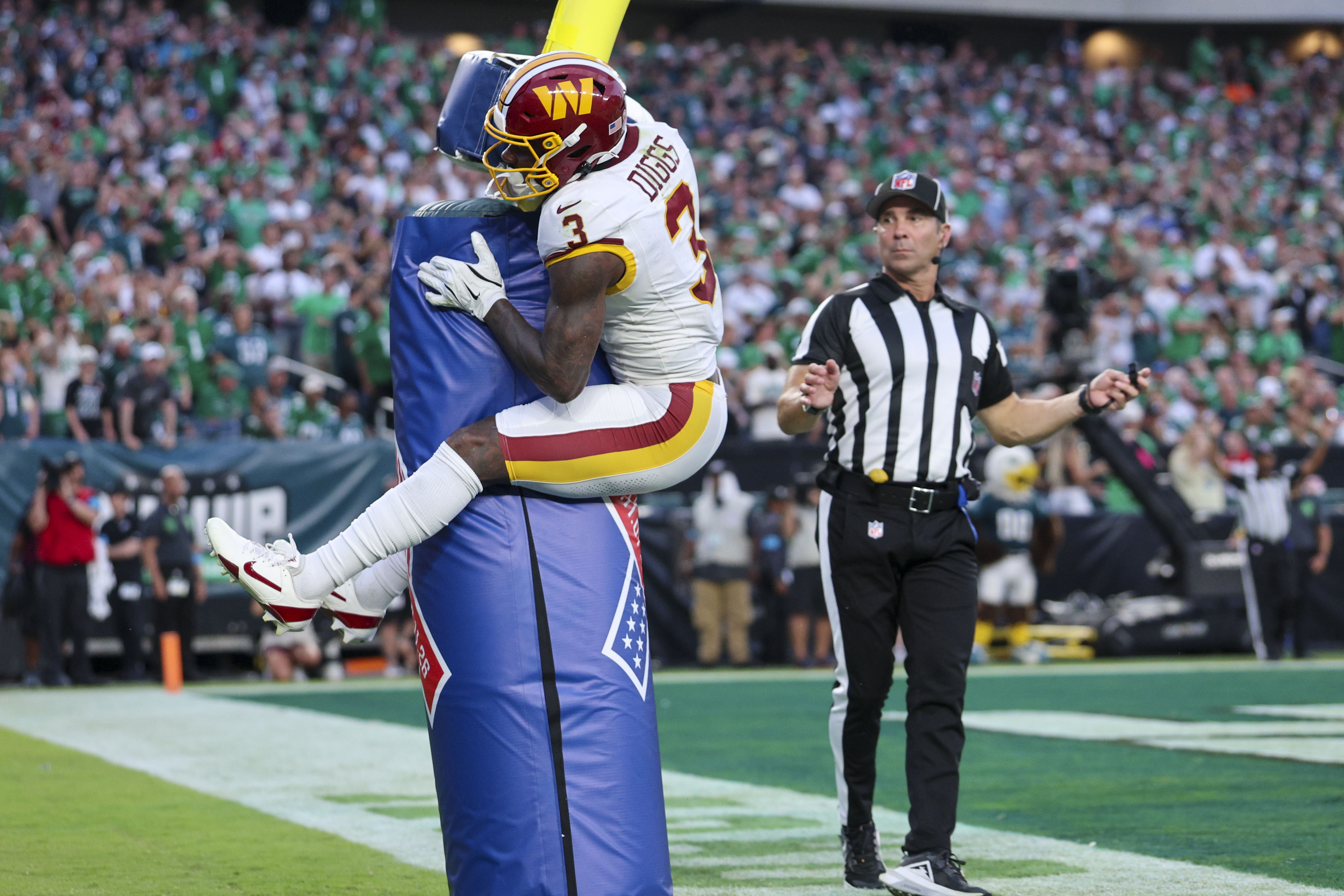
    Stefon Diggs was penalized for hugging the goalpost after scoring a touchdown in the fourth quarter. The call prevented the Commanders from going for two, helping the Eagles win the game.David Maialetti / Staff Photographer
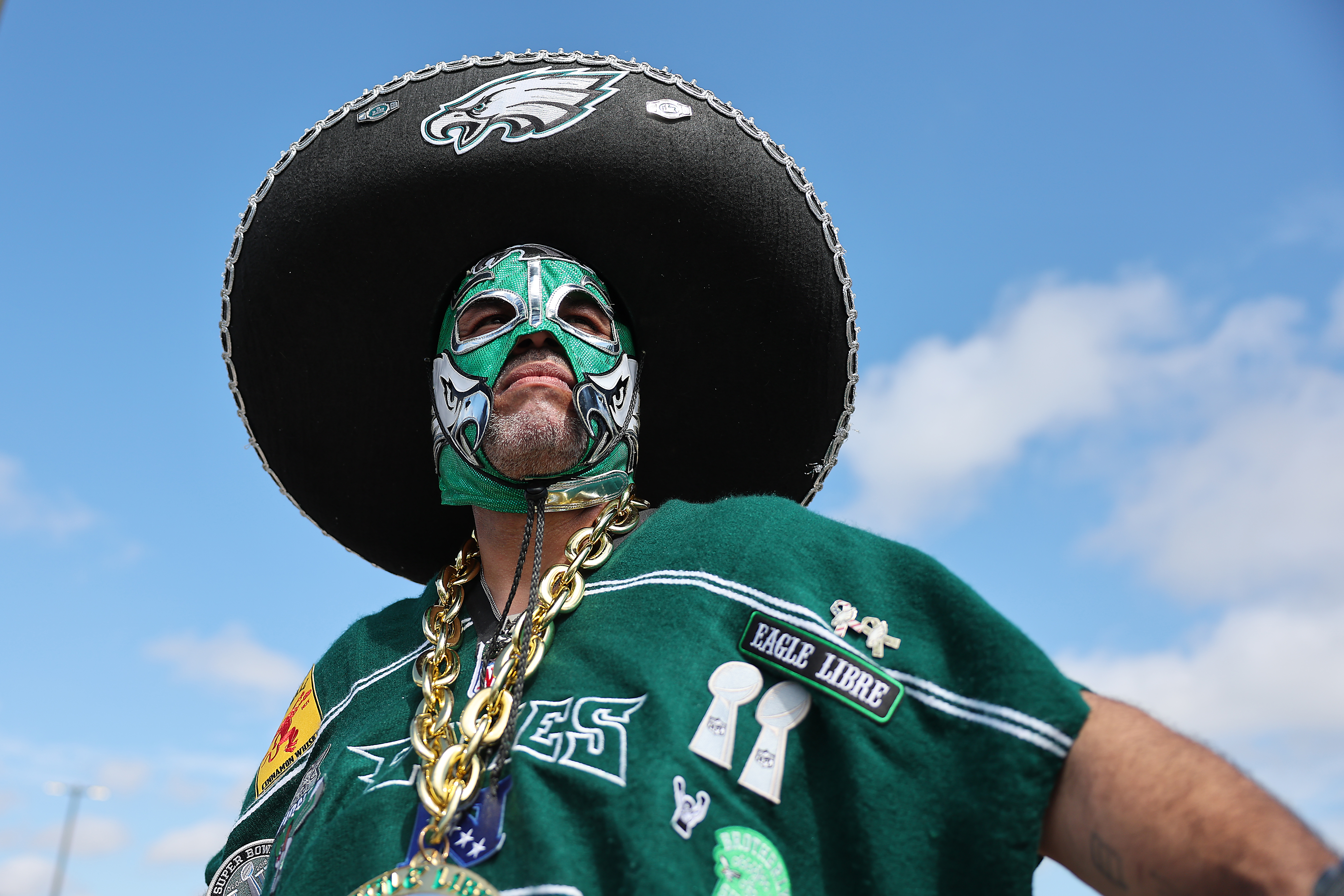
    Eagles fan Kenny Torres — also known as Eagle Libre — of Prospect Park, poses for a portrait while tailgating.David Maialetti / Staff Photographer
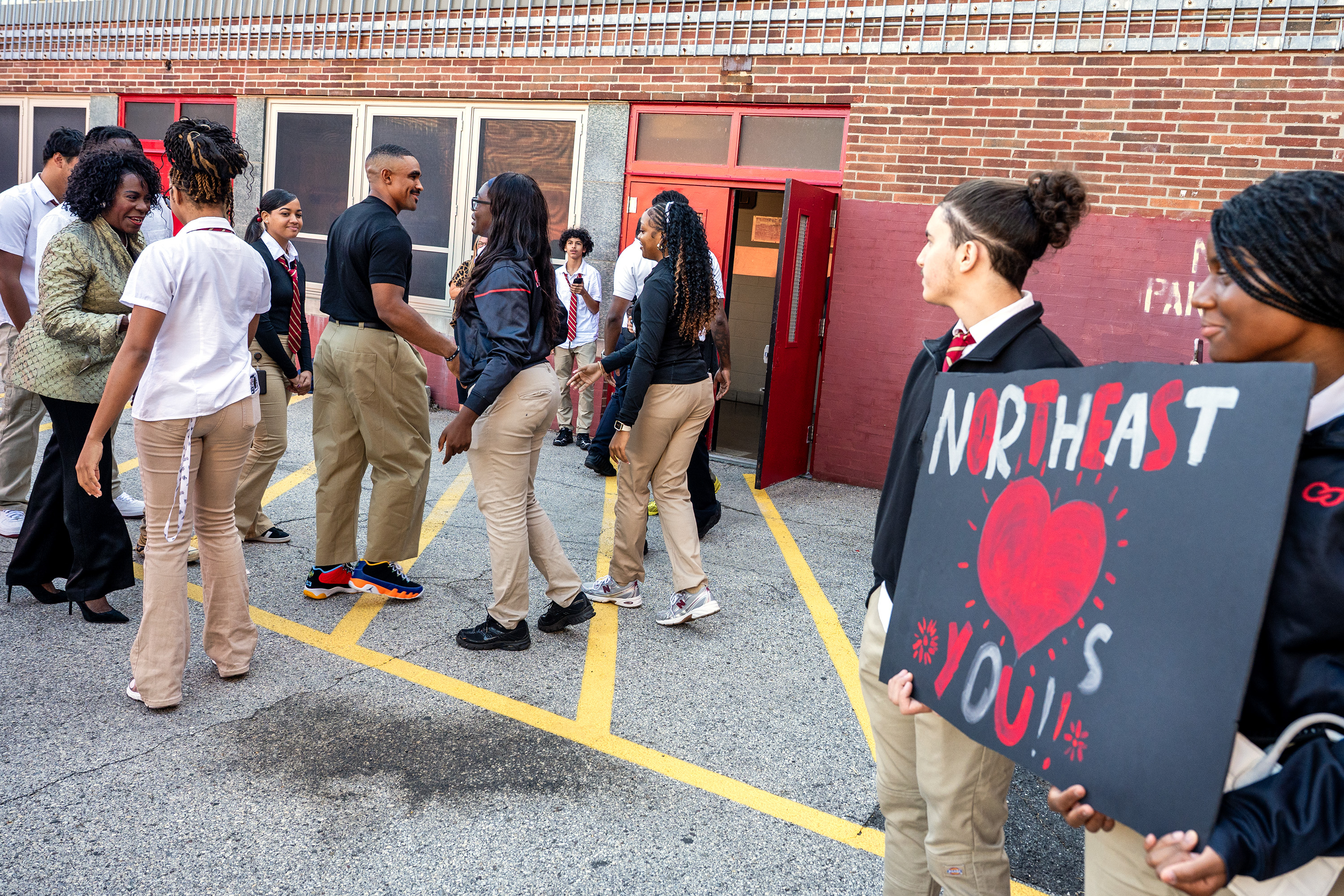
    Mayor Cherelle L. Parker (left) and Eagles quarterback Jalen Hurts (center) are greeted by students as they arrive Tuesday at Northeast High School, where Hurts announced he was donating $600,000 for an air conditioning system at the school.Tom Gralish / Staff Photographer
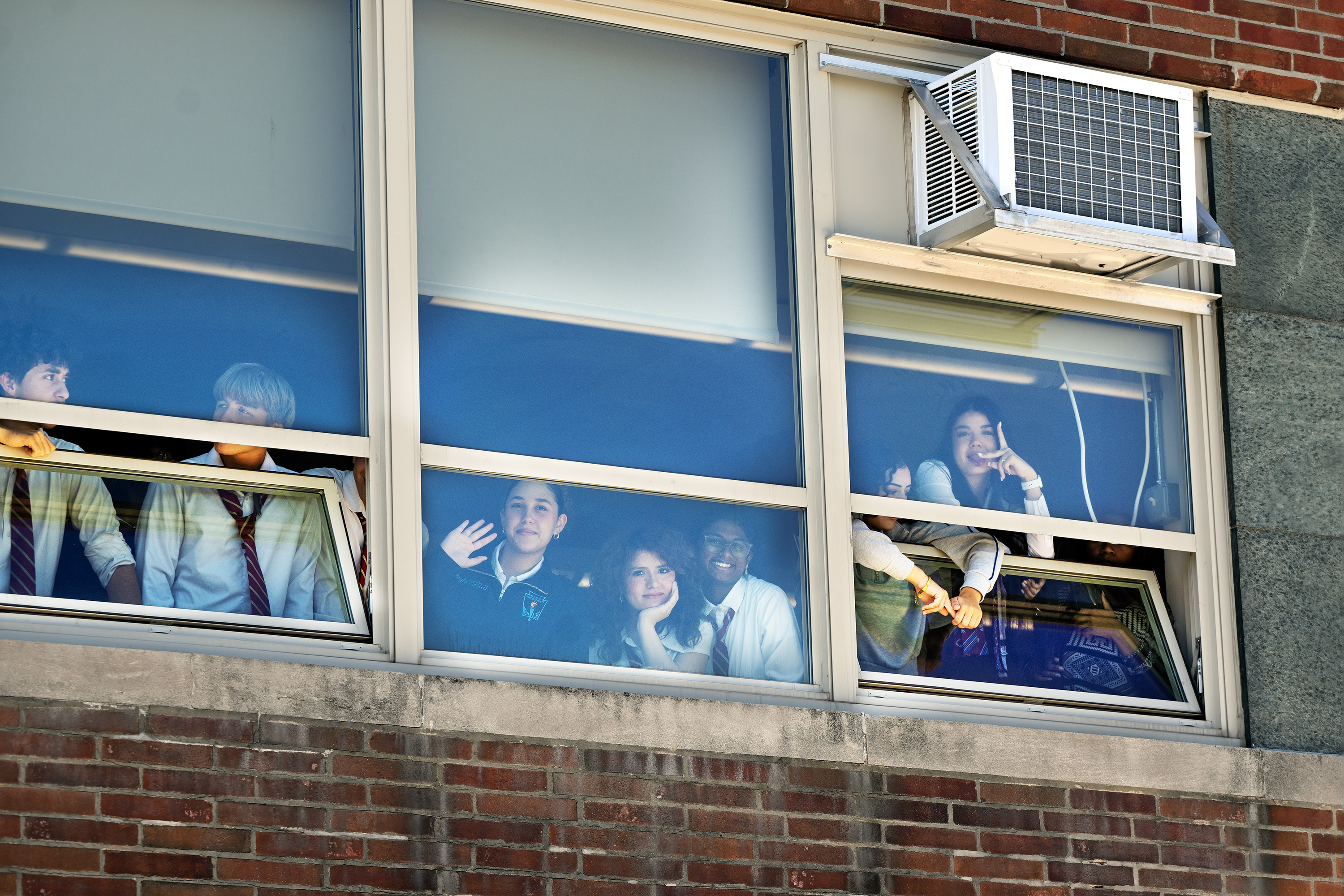
    Northeast High School students watch from their classroom — with a window air conditioning unit — as Eagles quarterback Jalen Hurts leaves.Tom Gralish / Staff Photographer
    Students welcome Eagles linebacker Jalyx Hunt at an assembly Tuesday at Little Flower Catholic High School, where he endowed four new scholarships.Tom Gralish / Staff Photographer
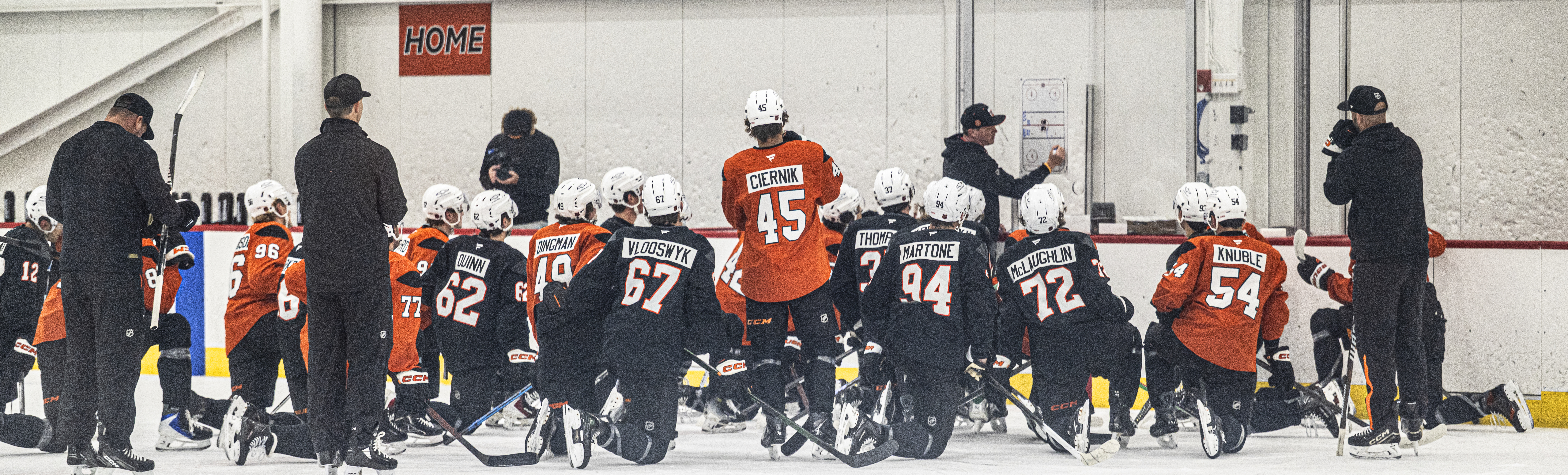
    Flyers camp kicked off this week, starting with the team’s rookies.Jose F. Moreno / Staff Photographer