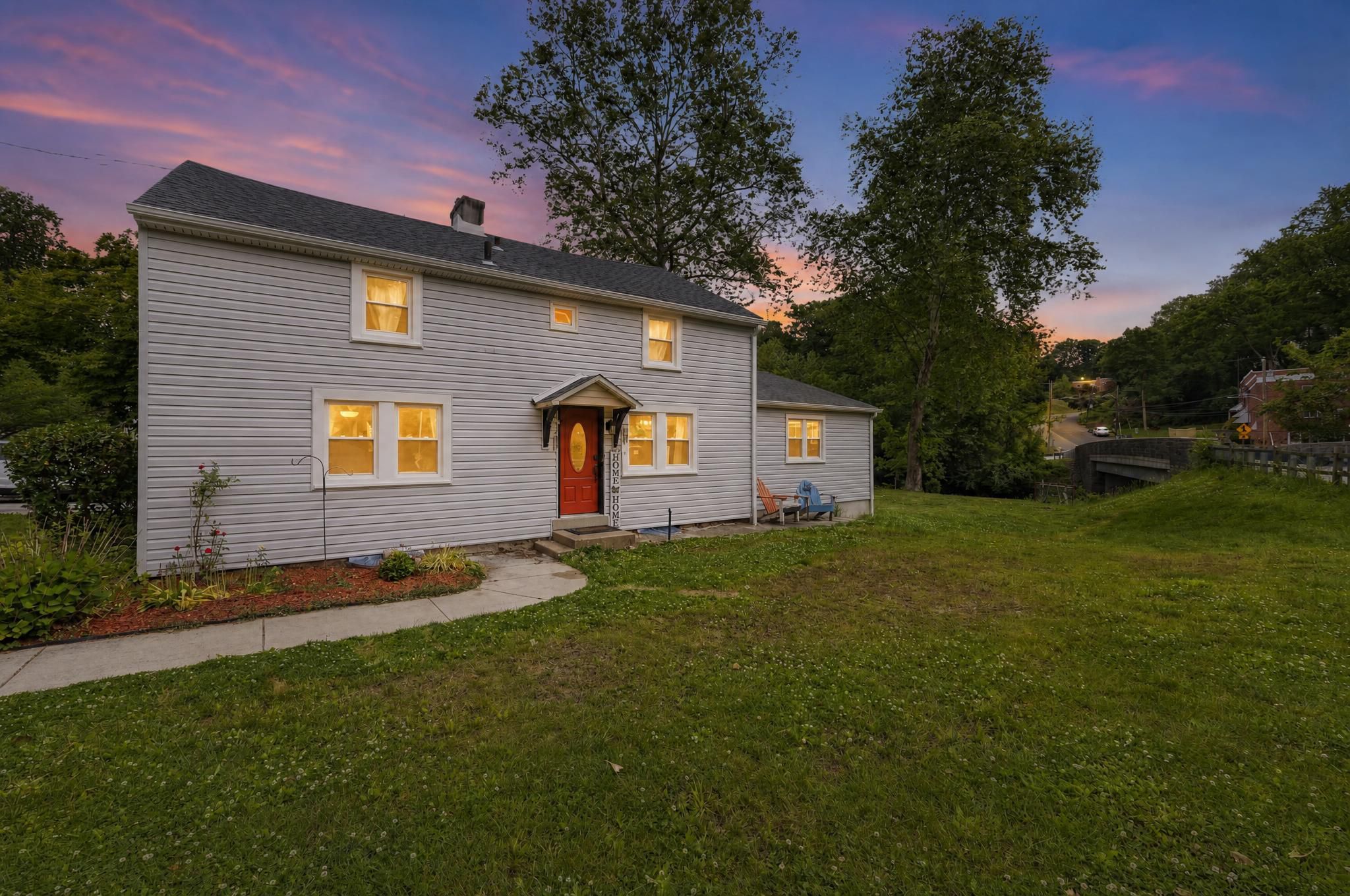
The five-bedroom, two-bathroom farmhouse-style home in Springfield, Delaware County, was once a church and a mill. But since 2014, it has been the Hornberger family’s “pride and joy,” said Kortney Hornberger.
That is when she and her husband, Bob, bought the 2,368-square-foot house, bordering Darby Creek and built in the mid-to late-19th century.
“It’s one of the coolest houses in Springfield,” Kortney said. Their three children grew up playing in the creek.
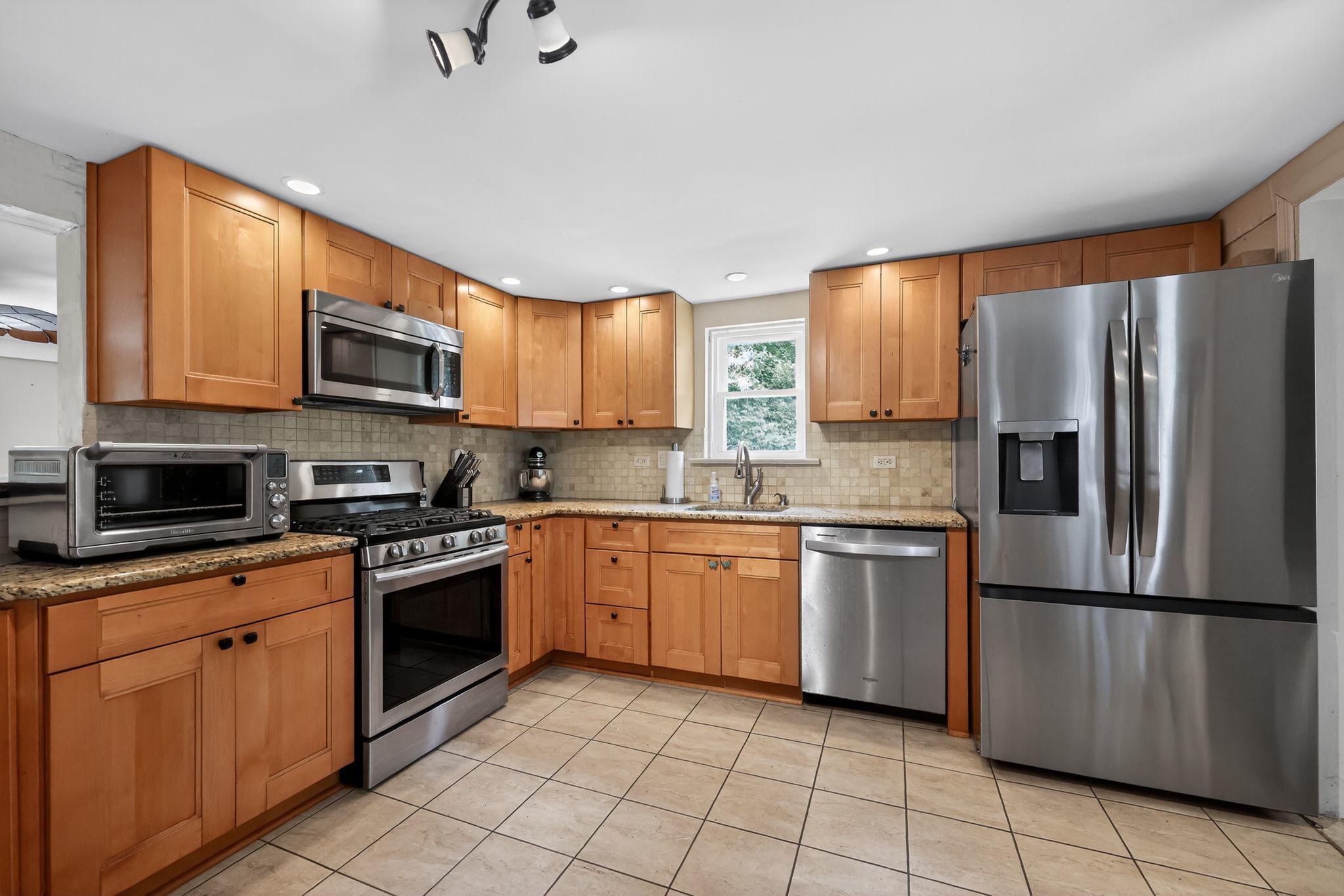
The kitchen has Shaker-style wood cabinets, stainless-steel appliances, and granite countertops.Derrick Kunzer
“We had been looking for a long time,” she said. “The old wood beams were beautiful” and “the yard with no neighbors on three sides of the corner lot sold me.”
But the Hornbergers — she is a civilian contractor for the Army National Guard and he is semi-retired from an administrative job with Wawa — are preparing to retire in Hawaii.
The house has four bedrooms on the second floor and one on the main floor. Bob said the couple made many improvements over the years, including a new boiler, windows, siding, three new entry doors, and whole-house water heater. The second floor has a walk-in storage area. The home has a large basement for additional storage and laundry.
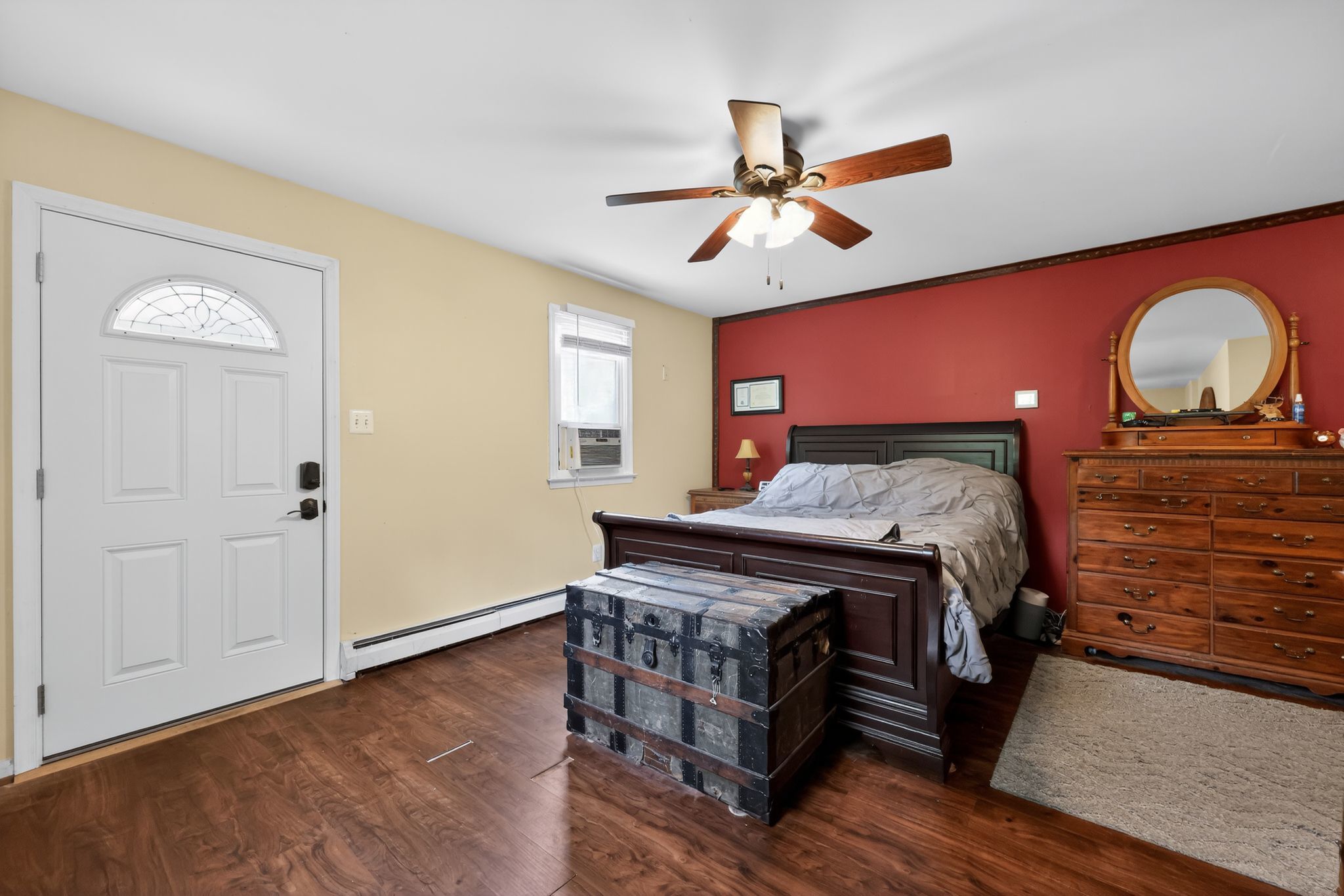
The primary bedroom, which has an exterior door.Derrick Kunzer
The main floor bedroom has a walk-in closet and a private entrance. An additional room on this level could be a home office, playroom, or gym.
The eat-in-kitchen adjoins a large dining room and has Shaker-style wood cabinets, stainless-steel appliances, and granite countertops.
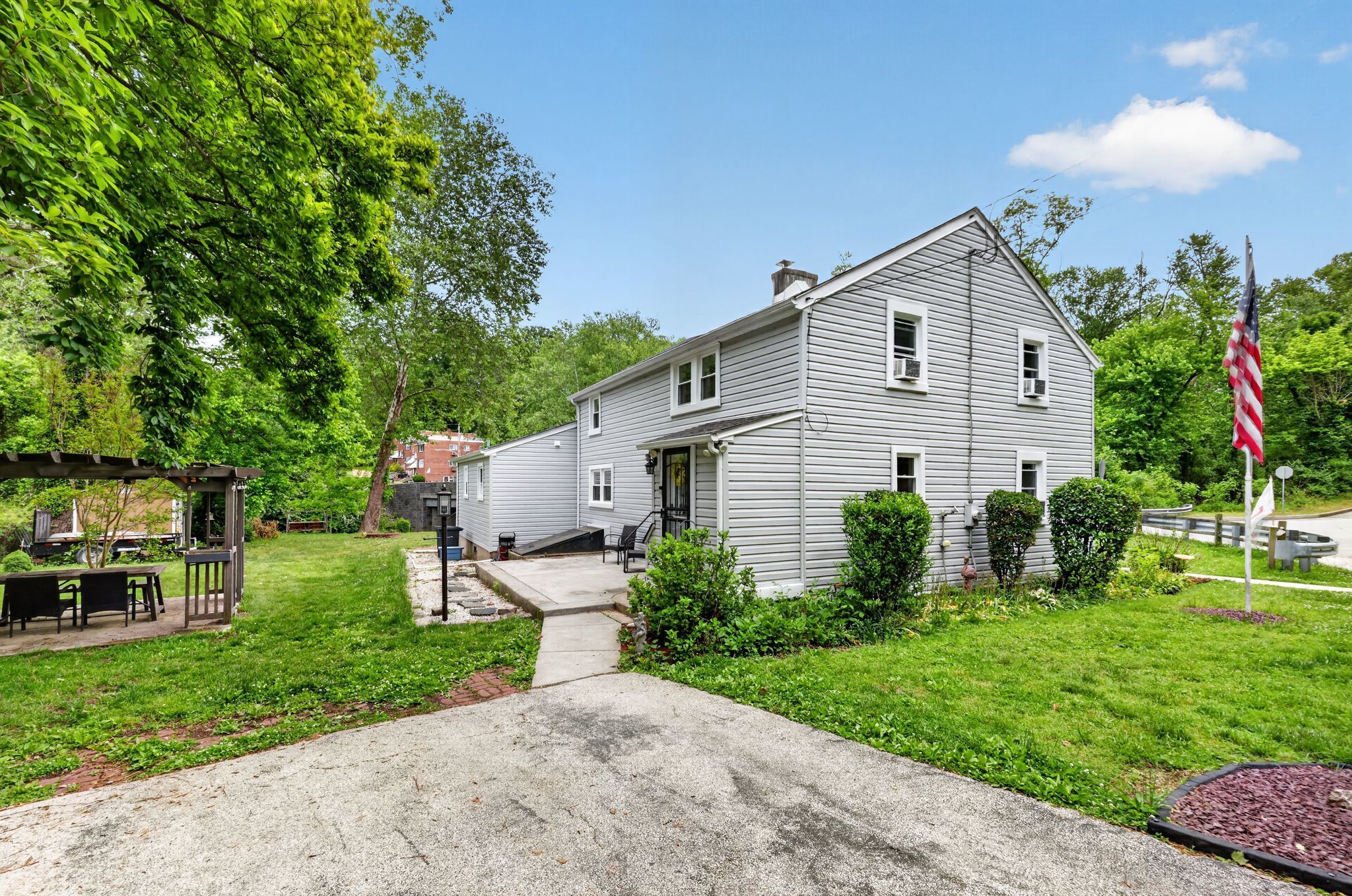
The backyard has a patio, a pergola, and a firepit, and there is a shed for additional storage.
The outdoor space, which has a patio, a pergola, and a firepit, as well as a shed.Derrick Kunzer
The house is a seven-minute drive to Media, and is served by SEPTA’s Media/Wawa Regional Rail line, the trolley to Media, and bus routes. There is driveway space for three cars.
It is in the Springfield School District.
It is listed by Amanda Terranova of Compass Realty for $475,000.
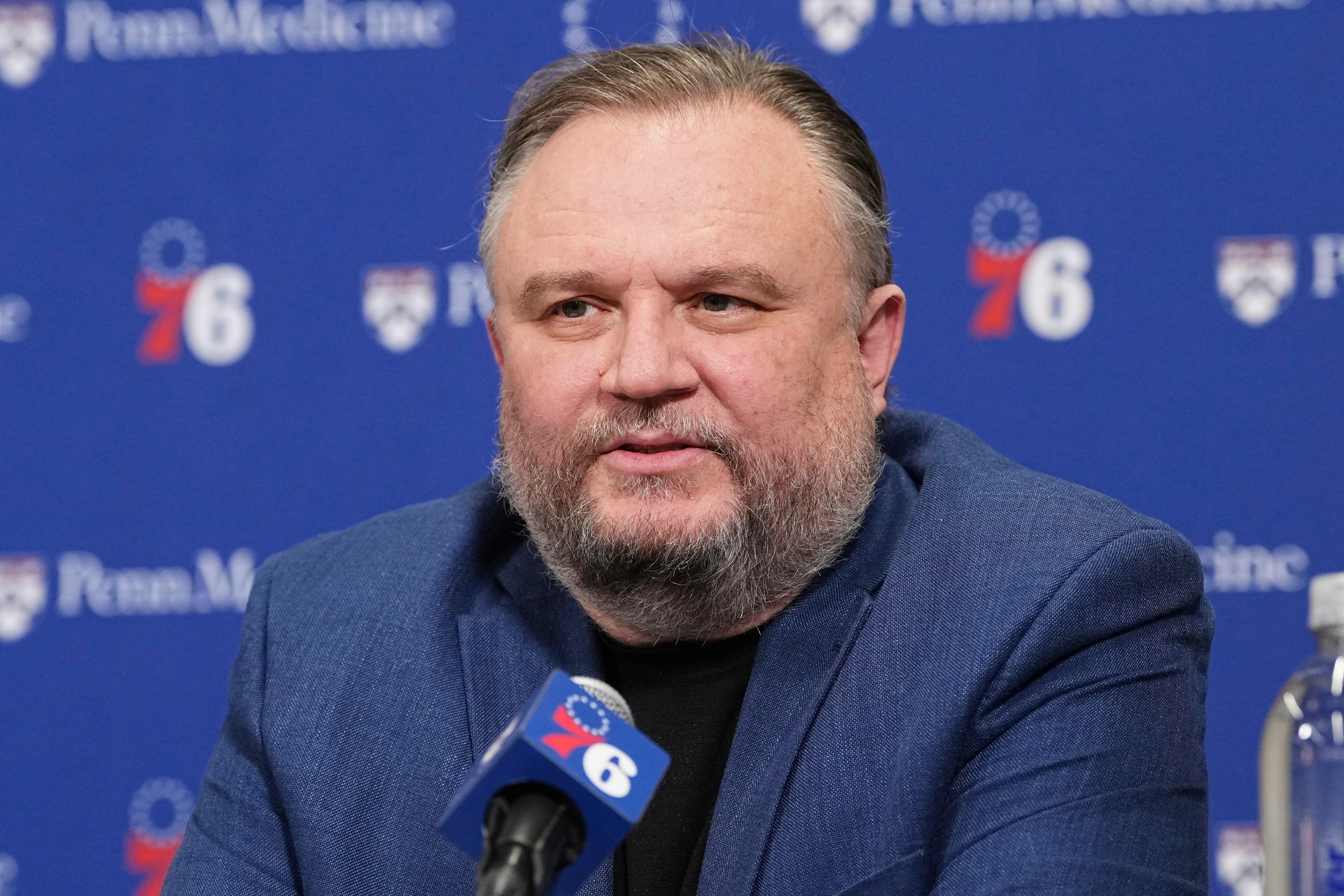
Would Sixers owner Josh Harris have fired president Daryl Morey if the Knicks hadn’t rolled the Sixers?
Working big sporting events can be an exercise in frustration. The Olympics, the World Cup, the Super Bowl, the World Series are objects of spectacle and celebration for a sports fan but can be vehicles of exclusion and futility for a sports writer.
They also can be veins of golden intel. Such was the case last week in New York.
Thanks to the vanity of the New Yorker in Chief, entering the arena last week was a protracted challenge. An NBA source with ties to the 76ers told me in the hours before Game 3, as we waited for President Trump to arrive:
“You know, if the Sixers had won a couple of games against the Knicks, no way Morey gets fired.”
That piqued my interest. The Knicks had swept the Sixers in the second round of the playoffs. Morey was fired two days later, news that shocked the NBA world.
Did the Knicks’ storybook run to the hoop-crazed city’s first title in 53 years make Morey’s career an unlikely casualty? Did the sweep cost Morey his job? Was it at least the final straw?
Apparently so.
The Knicks weren’t considered elite when they rolled the Sixers. By Game 3 of the Finals, however, they were playing great.
Folks were talking: Was Morey’s firing less warranted than it seemed at the time?
I was eager to leave Madison Square Garden and try to track down Morey himself, see what he’d say. He’s going to continue to live in Philadelphia, but, since he got fired, he’s been hanging out in New York, feeding his Broadway addiction and waiting for the unemployment checks to come in.
Then, a few hours later, the Knicks had lost Game 3, the Spurs seemed to have turned a corner, and the assertion lost its legs.
But only briefly.
Daryl Morey did some things well, but the Sixers were also hamstrung by some of his decisions. Matt Rourke
Genius dismissed
A computer scientist with an MBA from MIT, Morey’s moves might draw criticism but his intellect never has been in question. Twenty-one years ago he co-founded the annual analytics nerd-fest at MIT, the Sloan Sports Analytics Conference, a stats-based Davos gathering of the smartest suits in the sports industry, designed to render obsolete knuckle-draggers like Doc Rivers and me.
Despite having never won a title, Morey is front-office royalty. As such, the NBA was rocked by Morey’s dismissal, especially coming, as it did, on the heels of such a dizzying postseason high.
The week before the sweep, the Sixers beat the arch rival Celtics in seven games to win their first-round series. Boston had held a 15-7 record in the teams’ playoff series and had won the last six; the last time the Sixers won was 1982. It was their first Game 7 win in 25 years. It was their first Game 7 road win in 44 years (the aforementioned 1982 series). It was the first time the Sixers won a series when trailing 3-1 in their last 18 tries, and the Celtics had won 32 times in a row when leading a series 3-1.
Euphoria barely describes the mood around the franchise after Tyrese Maxey dropped 30 points and pulled down 11 rebounds in that Game 7. Maxey was Morey’s first draft pick when he arrived in 2020.
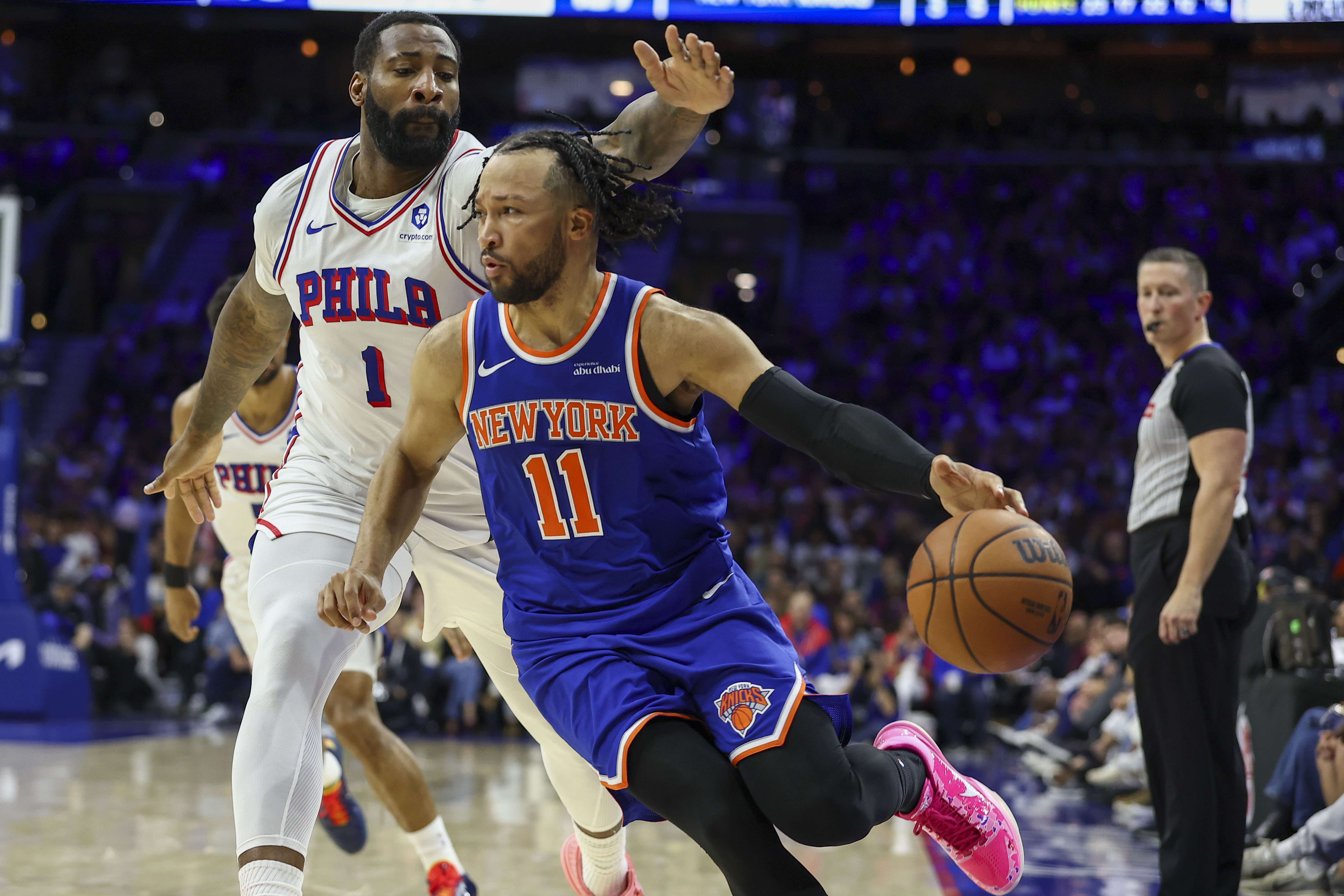
Humiliation barely describes the mood around the franchise 10 days later. The Knicks won Game 1 in New York by 39 points. They won Game 4 in Philadelphia by 30 and, at one point, they led by 44. That wasn’t the worst of it. Xfinity Mobile Arena was inundated with Knicks fans for Game 3 and was predominantly pro-Knicks in Game 4.
Harris, a New Yorker for most of his adult life, was galled. More than anything else, according to the source, it was those two home losses and the Knicks fans’ takeover that cost Morey.
It didn‘t help, of course, that Morey traded popular shooter Jared McCain in February, after which McCain thrived in Oklahoma City. It also didn‘t help that, two years ago, Morey max-extended the contract of Joel Embiid and max-signed Paul George. Both have been injured and suspended since.
Both were bigger stars than anyone on New York’s team. Neither played well against the Knicks.
As it turned out, nobody would play well against the Knicks.
Jalen Brunson and the Knicks rolled the Sixers in a way that was humiliating for the team and the fan base. Monica Herndon / Staff Photographer
Juggernaut
The Knicks’ sweep of the Sixers included wins three through six of 13 playoff wins in a row, the second-best streak in NBA history and just two fewer than the Warriors in 2017. Those Warriors had Steph Curry and Kevin Durant, Hall of Fame scorers who’d been to 12 All-Star Games between them.
Again, at the time of the Sixers series, nobody considered any of the Knicks on par with Steph or KD.
Then, the Knicks swept the Cavaliers in the Eastern Conference Finals.
Then, they won Games 1 and 2 in San Antonio.
Then, after losing Game 3 at home, they executed a Finals-record 29-point comeback in Game 4.
Then, on Saturday, they won Game 5 and the title in San Antonio. Jalen Brunson proved himself the biggest star in the playoffs, capping his Finals average of 32.6 points with 45 in the closeout game, a record for a Knick in the Finals, tied with Michael Jordan for the third-most in a Finals closeout game.
The Knicks finished the playoffs with a point differential of plus-283, the biggest in NBA history. Of course, the Sixers contributed 89 of those positive points, and the Knicks played only one team from the superior Western Conference, but those arguments are thin gruel.
The 2025-26 Knicks were a powerhouse team: deep, talented, hungry, well-coached, and led by a bona fide, if unlikely, superstar.
That’s who beat the Sixers.
That’s who, according to an NBA source, ultimately cost Morey his job.
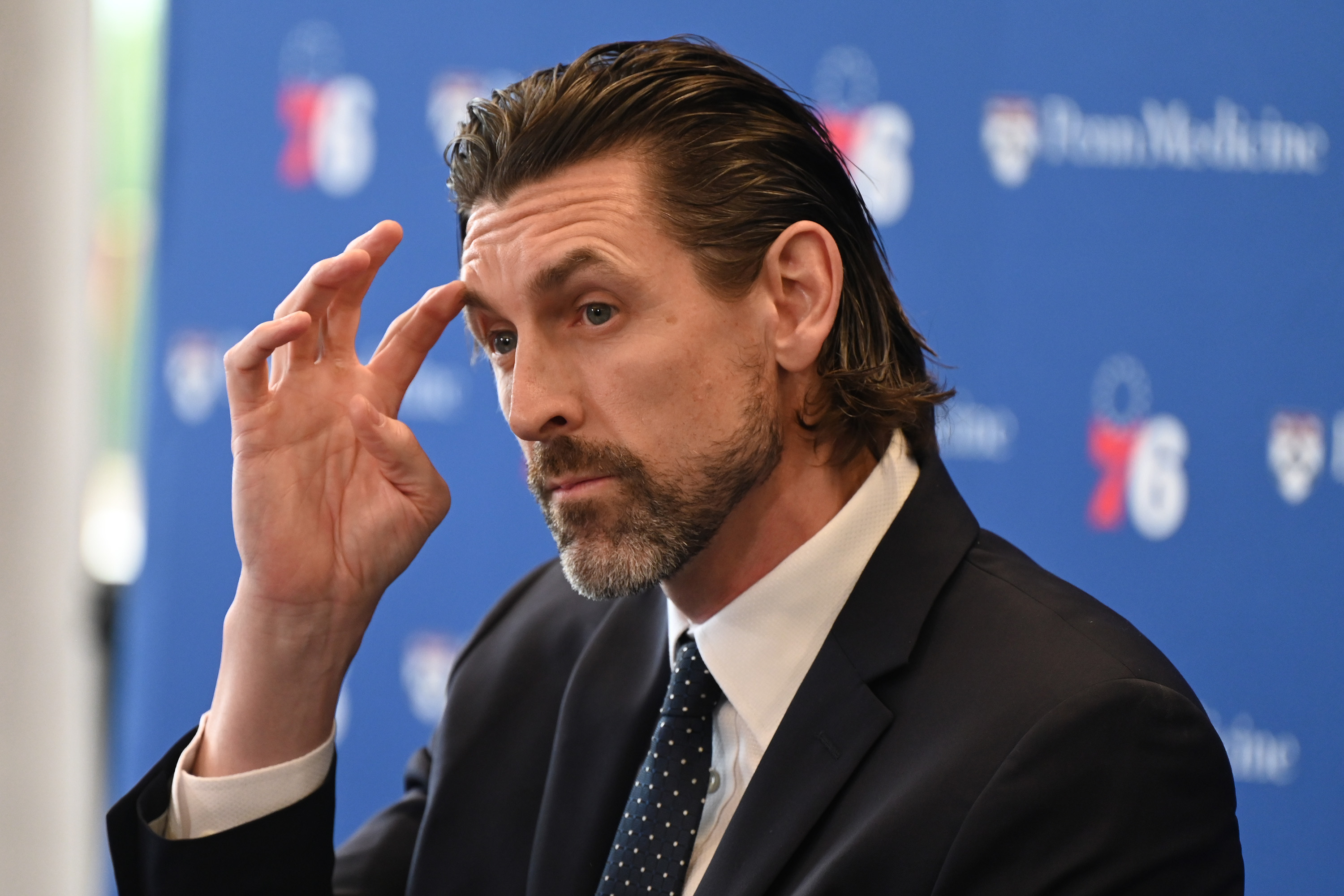
It’s new president of basketball operations Mike Gansey’s show now in Philly. Tom Gralish / Staff Photographer
So what?
I’ve always believed Morey to be a bit overrated as a team builder but I’ve always admired his innovation, his transparency, and intellectual capacity. These, I believe, burnished an image that was more impressive than the reality. He was, nevertheless, a very good basketball president.
Still, when a team with high expectations repeatedly fails to meet them, change is almost always good. Embiid just ate his way into wasting two more seasons. Paul George popped for PEDs. Both happened on Morey’s watch. Will it happen again under his replacement, Mike Gansey, who helped resurrect the Cavaliers after the LeBron James Era, Part 2? Will Gansey and his overseer, Bob Myers, the former Warriors president who runs all of Harris’ numerous sports franchises, keep the old guys from stealing more money?
Maybe a new sheriff in town who has no connection to either Embiid or George will serve as a catalyst for them to deliver more value for the combined $112 million they will make in the next season alone.
But maybe, had Harris known how humiliated his peers in Cleveland and San Antonio were going to be a month later, he wouldn’t have let go the man he’d introduced six years prior as “extraordinary,” an “innovator,” and a “visionary.”
Authorities intercepted a plot to attack the Ultimate Fighting Championship event held outside the White House over the weekend, according to court papers made public Tuesday that described plans to fly drones loaded with explosives over the crowd, set them off, and gun down fleeing attendees.
FBI Director Kash Patel posted on social media Tuesday morning that “multiple individuals” had been taken into custody. Following “a multi-state operation,” he wrote, the “allegedly planned attacks were stopped cold.”
It was not immediately clear how close the alleged plot came to reality or how many people authorities believe may have been involved.
Matthew C. Quinn, deputy director of the Secret Service, told reporters Tuesday morning that the event “was never at risk due to the great investigative work.”
But he cautioned that some people allegedly involved were still at large. And after Patel’s social media post revealed the alleged plot, Quinn pointedly noted that the Secret Service had chosen not to “leak” news of the investigation.
A criminal complaint filed in federal court in Ohio on Monday and unsealed Tuesday depicted plans to carry out “a coordinated attack against the United States government” during the UFC event.
The complaint alleges that Tycen Proper, 19, admitted to plotting the attack with people who began communicating via TikTok, a social media app, before shifting to Signal, an encrypted messaging app.
Proper has been arrested and is in custody, with a detention hearing set for Wednesday. An assistant public defender appointed to represent him did not immediately respond to a message seeking comment Tuesday.
According to an affidavit submitted with the complaint, Proper’s mother contacted law enforcement because she was alarmed by his recent actions, including buying guns “and communicating with certain individuals online.”
The affidavit was signed by Christopher S. Betts, who wrote that he is a Columbus, Ohio, police detective assigned to an FBI Joint Terrorism Task Force.
Betts wrote that police went to the home where Proper lives with his parents on Wednesday, four days before the UFC event. Proper’s father told them that his son had recently gotten new firearms and ammunition and was planning to meet up with the people he met online during the upcoming weekend, Betts wrote.
The local sheriff’s office took Proper to a local hospital and sought an “emergency admission based on homicidal ideations,” Betts continued. The sheriff’s office also called the FBI.
Betts said that he spoke with Proper’s mother the next day and that she said her son had been interacting with people online “who claimed to be ex-military and Christian-based.” Proper’s mother said the group had anti-government beliefs, Betts continued, and had expressed grievances dealing with the handling of files related to sex offender Jeffrey Epstein and data centers.
She also described seeing her son mapping an area outside D.C., Betts added. And he wrote that family members told investigators Proper had made “concerning statements” in recent months, including antisemitic rhetoric and sympathetic remarks about Adolf Hitler.
Investigators spoke to Proper on Thursday, and he admitted to planning to attack people at the UFC event, Betts said. He wrote that Proper described plans for members of the plot to meet in Fredericksburg, Va., south of D.C., and then “stage a demonstration” near the White House.
According to Betts, Proper said he was not going to the event to shoot people but reported that some other members of the group were intending to carry out violence.
Proper described plans to sent drones “laden with unspecified explosive devices” over the north side of the UFC arena, Betts wrote. Then the group planned to shoot attendees fleeing the explosions, including “wealthy people and politicians,” Betts said. He wrote that Proper said the attack was meant to start a revolution.
When investigators searched Proper’s phone, Betts said, they found chats on Signal “consistent with much of what” he had described. The phone showed a large chat with about 19 people and smaller groups with four to five people, Betts added. In another app, Betts wrote, Proper discussed targeting a U.S. senator because of her support for Israel.
News of the alleged plot spread widely Tuesday morning when Patel posted about it on social media.
“On June 10, FBI and our law enforcement partners became aware of a potential threat to the UFC America 250 event in Washington, D.C. involving individuals outside of the National Capital Region,” Patel wrote in his post.
The White House declined to comment further Tuesday, and the FBI referred questions to Patel’s social media post. The Justice Department and UFC did not immediately respond to requests for comment on the alleged plot.
When asked Tuesday whether he had been briefed about the alleged planned attack, President Donald Trump said he had not heard about it.
“The attack that I watched were the fighters,” Trump told reporters at the Group of Seven summit in France.
Speaking with reporters Tuesday, Quinn, the Secret Service’s deputy director, described the alleged plot as “unique” because of the number of people and the level of planning involved.
He said the Secret Service had led the investigation from the start.
“In order to maintain the integrity of the investigation and the security plan, we chose not to leak it,” he added.
Pressed on whether he was suggesting Patel or the FBI had jumped the gun by divulging details of the investigation, Quinn said he was “not going to comment on who or what.”
“I’m going to tell you that we, the Secret Service, made a conscious decision to maintain the integrity of the security plan and the ongoing investigation,” he said.
The FBI did not immediately respond to a request for comment Tuesday about Quinn’s remarks.
Patel has been criticized in the past for posting prematurely on social media about ongoing investigations, including when he announced last year that someone was in custody after conservative activist Charlie Kirk was killed. The person was soon released.
The UFC event held at the White House on Sunday was an unprecedented spectacle designed to mark America’s 250th anniversary and Trump’s 80th birthday. It was run by UFC CEO Dana White, a close Trump friend, and the president and the first lady sat in the front row to watch the fights.
Joe Rogan, a podcaster who provided color commentary at the UFC event Sunday, had called the decision to hold the event outside “odd” and the event a “security nightmare” and “kind of a gimmick.”
“I just don’t think that you should compete in a world championship fight in a noncontrolled environment,” Rogan said on his podcast last week. “I think it should be inside an air-conditioned arena. … You wouldn’t ask them to play a world championship basketball game outside in the sun.”
The event included two flyovers and a fireworks finale near the National Mall well after midnight. The Federal Aviation Administration implemented a ground stop at the region’s three airports during the fireworks Sunday “to ensure safety.”
Elon Musk’s company that runs the Starlink communications network, launches rockets for NASA, and develops artificial intelligence software raised more than $75 billion from investors last week — a record initial public stock offering (IPO) for a company fast-burning through billions in investor dollars in hopes of future profit.
SpaceX is just the flashiest of a string of industrial stocks that have soared as orders for missiles, drones, and other war machines, as well as civilian aircraft and rockets, pile up. S&P’s Aerospace and Defense Select Industry Index is up 44% over the past year vs. 24% for the broader S&P 500 stocks, even with Google, Nvidia, and other AI-linked stocks leading the 500.
The share price for Philadelphia-based Carpenter Technology is up 125%, almost three times as much as that index of aerospace and defense stocks.
Carpenter does $3 billion in annual sales, melting or grinding iron, tungsten, cobalt, and other metals into super hard or relentlessly flexible alloys used in stainless steel and other specialty parts by military, commercial airliner, medical, industrial, and space equipment makers.
The company operates plants in Reading, Berks County; Latrobe and other Western Pennsylvania towns; and around Athens, Ala. It has a finishing plant in China and distributors worldwide. Carpenter’s large customers include passenger jet and military aircraft maker Boeing and European aerospace giant Airbus.
CEO Tony Thene has said space is a fast-growing growing part of Carpenter’s customer base, exciting some investors into expecting the company will share SpaceX’s gains.
Thene, who is stepping down at the end of the month, hasn’t said SpaceX is a customer. Chief operating officer Brian Malloy will take over leading the company.
Investor Louis Navellier was quoted last month as saying he’d rather own Carpenter, which makes the metals used by SpaceX and other aerospace companies, and its larger customer, Pittsburgh-based Howmet Aerospace, than SpaceX itself, at recent valuations.
That price is above the targets set by analysts at Bala Cynwyd-based Susquehanna International Group and Wall Street brokerages after Thene reported earnings at the end of April. At that time, Carpenter officials predicted stronger than expected sales and higher profits, to be split between investor dividends and new furnace equipment.
Carpenter at recent valuations is worth around $30 billion, roughly as much as Hershey or Kraft Heinz, whose sales are much larger, and almost as much as gas-drilling giant EQT, based in Pittsburgh.
Shares of area aerospace manufacturers such as Ametek, which has its headquarters in Berwyn and plants around the world, and Innovative Aerosystem, of Exton, are also up significantly over the past year.
Howmet, with $8 billion in yearly sales to Carpenter’s $3 billion, hasn’t boosted its share value as fast in past year, but it has risen enough to become the most valuable company in Pennsylvania, the only company whose shares are worth over $100 billion on the stock market.
That’s more valuable than companies with much larger sales, such as Philadelphia-based media giant Comcast; mega-drug distributor Cencora of Conshohocken, or Pittsburgh’s PNC, the nation’s fifth-largest bank.
At today’s share prices, many times earnings or projected future profits, investors are gambling that suppliers like Carpenter and Howmet — and SpaceX, the spaceship builder — will grow a lot faster than the economy as a whole.
Half of the nonprofit health systems in Southeastern Pennsylvania had operating losses in the first nine months of fiscal 2026, the systems’ latest reports to municipal bond investors showed.
All had strong revenue growth, with the exceptions of Redeemer Health and Tower Health, the two smallest systems by revenue. The gains at Jefferson Health and Penn Medicine benefited from acquisitions in fiscal 2025.
The reports are not perfectly comparable because of variations in accounting practices.
For example, Jefferson, Main Line Health, and ChristianaCare changed their depreciation rates, which reduced their expenses relative to competitors. Jefferson includes investment income in its revenue, boosting its results.
Here’s a summary in order of revenue, from the region’slargest to smallest systems:
Jefferson Healthhad a $252.6 million operating loss, which it attributed to severe winter weather, restructuring costs related to layoffs, and shortfalls in insurance reimbursement. Total revenue was just shy of $13 billion, up from $11.6 billion last year, which included only eight months of results from Lehigh Valley Health Network.
Children’s Hospital of Philadelphia had a $271 million operating profit in the first nine months of fiscal 2026, up from $195.8 million the year before. Total revenue rose 9% to $4.1 billion from $3.7 billion, thanks to strong gains in payments for hospital patients and unspecified other operating revenue.
Temple University Health System had an operating loss of $9.9 million, recovering largely from a $50.5 million loss in the first half of fiscal 2026. In the same period a year ago, Temple had a $10.9 million operating loss. The health system’s revenue was $2.6 billion, up from $2.3 billion last year.
Main LineHealth reported a small operating profit of $214,000, following a winter quarter setback. The four-hospital nonprofit system recorded an $8.5 million loss in the three months that ended March 31. Severe winter weather reduced patient visits, and the health system increased its reserves for medical malpractice expenses.
Tower Health swung to a small operating loss of $3.6 million. During the same period a year ago, Tower had a $4.2 million operating profit. Revenue increased 1.6% to $1.6 billion.
Steep losses continued at Redeemer Health, which reported a $29 million operating loss, compared to a $33 million loss last year. Redeemer’s total revenue rose by less than 1%, to $332 million. Redeemer owns Holy Redeemer Hospital, a 239-bed facility in Abington Township, Montgomery County, not far from Jefferson Abington Hospital.
DUBAI, United Arab Emirates (AP) — Iran’s top diplomat said Tuesday that the tentative deal to end the war with the United States would require Israel to withdraw from Lebanon — a condition Israel has already rejected and that could sink the agreement, leading to the resumption of all-out war.
The deal, which is between the U.S. and Iran, has not been made public, and officials have sometimes offered contradictory interpretations of what is in it. While Israel is not party to the agreement, it is part of the war: It joined the U.S. in launching strikes on Iran on Feb. 28, and has since fought the Iran-backed Hezbollah militant group in Lebanon and seized large swaths of that country.
Iranian Foreign Minister Abbas Araghchi said Israel’s continued occupation of southern Lebanon would violate the deal.
“Without the withdrawal of Israeli forces from the territories they occupied during this war, the war has not fully come to an end,” Araghchi said.
Pakistan, a key mediator, has said the deal called for an end to military operations, including in Lebanon, as Iran long insisted. But Araghchi’s call for a withdrawal adds a new wrinkle.
A U.S. official, who spoke on condition of anonymity to discuss outlines of the agreement, has said the deal did not call for an Israeli withdrawal. And Israeli Prime Minister Benjamin Netanyahu said Monday that Israel would remain in Lebanon “as long as necessary.”
The negotiations to end the war have been plagued by such disagreements before — leading to a prolonged but uneasy ceasefire that has failed to develop into a permanent end to hostilities and that has left the Strait of Hormuz, a crucial waterway for the world’s energy supplies, effectively shut.
Unresolved issues cast doubt on agreement’s long-term prospects
The agreement is meant to provide a meaningful truce in a monthslong war that has killed thousands across the Middle East, including the top leaders of Iran’s theocracy, and raised the prices of fuel, food and other basic goods far beyond the region.
The unpublished agreement provides for the “immediate” opening of the Strait of Hormuz and lifting of the blockade, according to a senior U.S. official who spoke to reporters on condition of anonymity to discuss outlines of the agreement on Monday.
Brokered mainly by Pakistan, it starts with the simultaneous lifting of Iran’s closure of the strait and the U.S. blockade of Iran’s ports, according to Pakistani officials. The United States and Iran will then begin 60 days of negotiations over Iran’s nuclear program and the potential lifting of sanctions, Pakistani officials who helped broker the interim deal said, speaking on condition of anonymity about the unpublished text.
It also includes the possibility of releasing Iran’s frozen funds and a $300 billion fund to help rebuild Iran if Tehran meets certain benchmarks, senior U.S. officials told reporters Monday. President Donald Trump later said the United States would not “invest” funds in Iran.
Araghchi’s comments Tuesday appear to match the understanding of two regional officials with direct knowledge of the interim deal. The officials, speaking to The Associated Press on condition of anonymity to discuss the closed-door negotiations, said it would require Israel to leave nearly all the territory it occupies in Lebanon, minus a few hilltop points along the border seized earlier.
The officials say Iran insisted the accord include Lebanon in the last days of the negotiations. Regarding the timeline, the officials said the release of frozen Iranian assets are tied to Tehran implementing the deal. Gulf Arab states also have pledged to inject billions of dollars in Iran’s economy, they added.
Beyond Lebanon, there’s one more point of possible contention on Iran’s nuclear program. The interim deal begins a 60-day clock for talks over Tehran’s stockpile of highly enriched uranium.
Iran has agreed to discuss ways to possibly “dilute or remove” its stockpile, the officials said. However, it remains unclear whether Tehran would agree to that, particularly with hard-liners opposing to giving it up.
U.S. officials have not yet explained how they see the agreement addressing Iran’s nuclear program, including who will be in charge of verifying that Iran is in compliance and who will destroy or remove highly enriched uranium believed to be buried under nuclear sites that were badly damaged by U.S. strikes last summer.
Despite anger, US allies push to make deal work at G7 summit
Meanwhile, world leaders gathered in France for the first full day of the Group of Seven summit of major industrialized nations, where Iran was high on the agenda. Scheduled discussions include a work session focused on “ending crises and ensuring stability in the Middle East.” Leaders of Egypt, Qatar and the United Arab Emirates are to join the talks.
Trump has clashed with European leaders over not consulting them before going to war in Iran. Even so, leaders are expected to strike a measured tone as they seek ways to ease the economic fallout from rising oil prices caused by the blockade of the Strait of Hormuz.
The president told reporters on Tuesday that he’s “not happy with the way Israel has handled themselves with Lebanon and with Hezbollah.”
“It just goes on forever,” he said of Israel’s strategy. ”And when that happens, it throws a negative light on the big deal. And that’s the deal with Iran.”
Ahead of their meeting, the leaders of France, Germany, Italy and the United Kingdom issued a joint statement congratulating the United States, the Iranian government and the mediators on what they called a “diplomatic breakthrough.” Canada also signed the statement. The leaders said it was vital for detailed negotiations to take place and for the deal to be quickly implemented so the Strait of Hormuz can be reopened to tanker traffic.
For years, federal health officials have warned about the risks associated with a supplement derived from the leaves of kratom trees that adherents say can kill pain or boost energy. Sold in gas stations across America, kratom has been linked to liver toxicity, seizures and thousands of deaths.
Powerful figures close to President Donald Trump, including Homeland Security Secretary Markwayne Mullin, pushed to downplay those concerns.
Mullin, until recently a Republican senator from Oklahoma, played a key role in a sprawling influence campaign spearheaded by the kratom industry that courted Health Secretary Robert F. Kennedy Jr. and Vice President JD Vance, among others in the Trump administration, an investigation by The New York Times found.
Only when he was nominated by Trump in March to lead the Homeland Security Department did it become clear that Mullin had a financial connection to the supplement. In a disclosure statement, he listed an investment worth as much as $1 million in a kratom company, Botanic Tonics, that could benefit from the changes he has sought.
The company’s founder, Jerry W. Ross — who had been an energy executive in Mullin’s home state before pleading guilty to a financial crime — is a leading player in the influence campaign that was devised to benefit kratom at the expense of its rivals in the marketplace.
The kratom campaign underscores how corporations in the growing wellness industry can gain traction in Trump’s government by casting risky products as aligned with the administration’s Make America Healthy Again, or MAHA, agenda championed by Kennedy, who has sometimes prioritized unproven remedies over science.
In July, while still a senator, Mullin showed up at a Food and Drug Administration news conference and endorsed proposed federal restrictions on more powerful synthetic supplements that compete with kratom for shelf space. In explaining his position, Mullin pointed to a history of addiction in his family, though health experts say kratom products have also been shown to be addictive.
His disclosure form did not indicate when he acquired his stake in Botanic Tonics, but he has not filed paperwork to indicate that he has divested from it.
The Homeland Security Department did not answer questions about the investment. In a statement, the department said that Mullin “follows all ethics and conflict of interest standards and has not lobbied for any individual or company.”
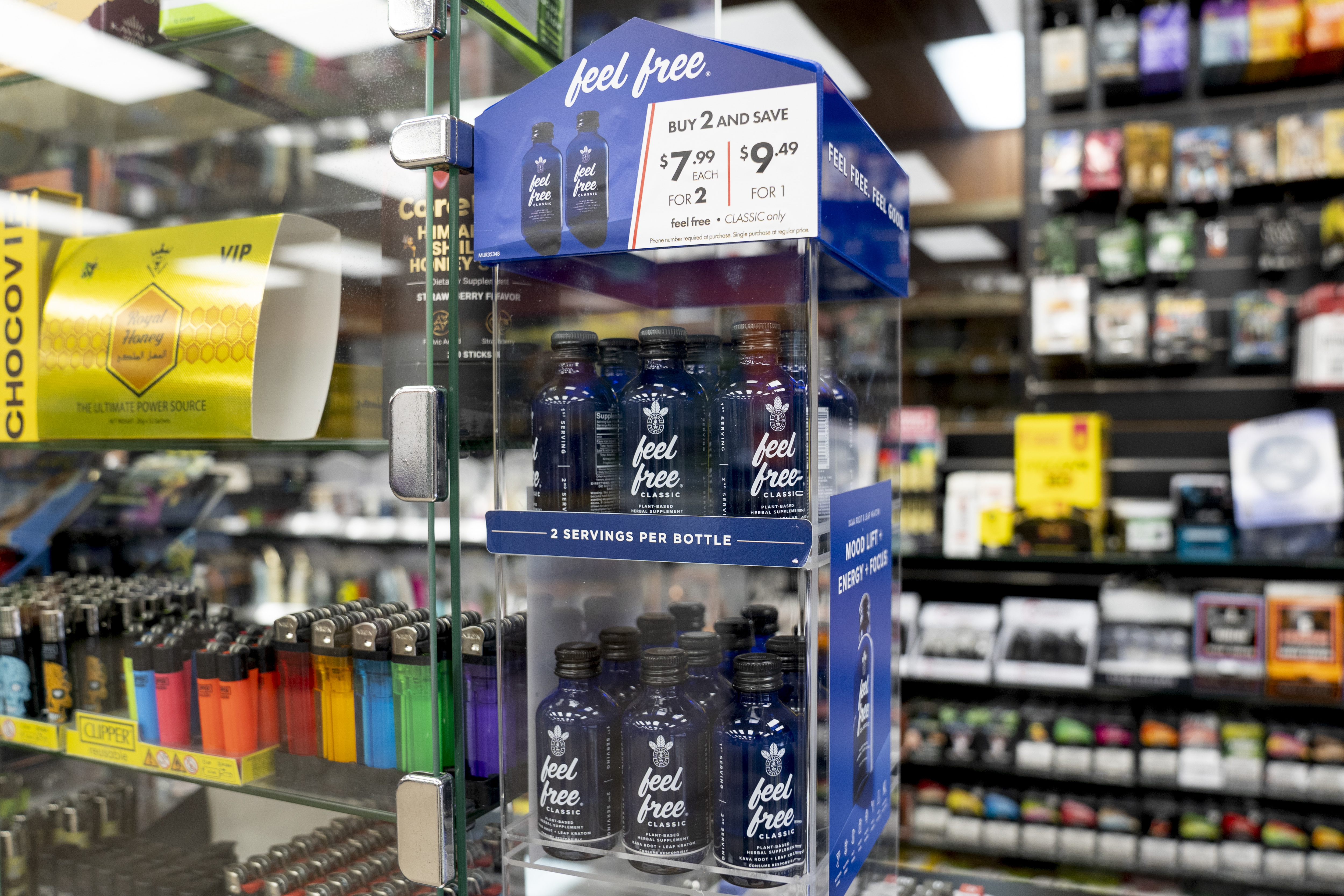
Bottles of Feel Free, a kratom product produced by Botanic Tonics, displayed at a smoke shop in Oklahoma City, May 27, 2026. With support from Markwayne Mullin and Robert F. Kennedy Jr., the kratom industry is pursuing a potentially lucrative policy. (Nick Oxford/The New York Times)NICK OXFORD
The restrictions that Mullin supported on the synthetic products would have been a boon to Ross’ company and others in the kratom industry, which market their supplements as safer and more natural. The kratom companies used donations and lobbyists to push for the crackdown.
“It’s not pay to play. It’s pay to have conversations. It’s pay to have a chance at the table,” Ryan Niddel, CEO of Diversified Botanics, another kratom company involved in the effort, said in an interview with the Times. “And anybody that considers any of the lobbying work or any of the governmental work that goes on being different than that, I think has their head buried in the sand at this point.
“I mean, that is the world that we live in.”
The Times’ investigation — drawn from campaign finance data, lobbying disclosures, court filings, private correspondence and dozens of interviews — found the following:
Ross ramped up his donations to Kennedy’s defunct presidential campaign after Trump chose him to be health secretary. Ross privately boasted that he was “working on a plan for Bobby.”
The FDA in 2025 deleted links on its kratom webpage that detailed a then-pending legal case against Ross’ company, Botanic Tonics, after his allies pushed for the change.
Botanic Tonics had been sued by the federal government for illegally selling kratom products that were not proven safe, which the company disputed. But in December, the Justice Department suddenly moved to drop the case — which the company celebrated as a sign of the federal government’s receptiveness to kratom.
Kennedy, as health secretary, called the governor of Ohio to try to head off a state ban on kratom in the fall of 2025. Months later, Botanic Tonics donated $1 million to a political committee associated with Kennedy.
Ross, joined by influential lobbyist Ches McDowell, used donations to secure a private audience with Vance to lobby him about the benefits of kratom and to urge the ban on the synthetic products.
Kush Desai, a spokesperson for the White House, suggested the administration was not swayed by the influence campaign, even though Trump recently made comments about needing to address the matter.
“The only guiding factor behind the Trump administration’s healthcare policymaking is gold standard science,” he said in a statement. The administration, he added, was working “to get this critical matter correct and ensure the health and safety of Americans.”
The Health and Human Services Department and Kennedy did not respond to requests for comment, nor did Ross.
The administration’s receptiveness to kratom comes as Trump has also expressed a willingness to loosen rules covering other drugs backed by influence campaigns, including cannabis and psychedelics. The permissive posture stands in contrast to Trump’s baseless skepticism about highly regulated and widely used medications like Tylenol and vaccines.
“It’s looking like we have a coin-operated drug policy that basically responds to whoever will give money,” said Kevin Sabet, who worked on drug policy under Republican and Democratic presidents. “And it threatens public health and safety because it’s going around the scientific process in favor of donors and influencers.”
A rising scourge
Long used medicinally in Southeast Asia, the leaves of the kratom tree contain a compound called mitragynine that interacts with the brain’s opioid receptors in a manner said to produce mild pain relief and — depending on its preparation — either sedation or energy and focus.
Kratom started gaining popularity in the United States in the early 2010s as the opioid addiction epidemic raged. With doctors tightening access to powerful prescription painkillers such as OxyContin, users spread the word that kratom — initially sold as a bitter-tasting powder — could produce a similar effect.
Devotees promoted it as a way to kick opioid addiction or to replace alcohol. But as reports of negative effects started rolling in, the government tried to take action.
Under the Obama administration, the Drug Enforcement Administration described kratom as “a drug and chemical of concern,” and moved to greatly restrict access by classifying it as a Schedule I drug. Doing so would have defined it as having no medicinal value, making it illegal to sell.
The proposal was withdrawn weeks later amid backlash from the fledgling industry, kratom users and members of Congress.
Another proposal to restrict access during the first Trump administration was also pulled after lobbying by an industry trade group, over the objection of Scott Gottlieb, the FDA commissioner at the time.
Kratom took off, appearing on the shelves of convenience stores and vape shops as tablets, drinks and gummies. The products varied in strength, and the concentration of active ingredients on the labels was not always accurate. They could be purchased in many states without age verification.
From 2020 through 2024, kratom was found in the system of more than 5,200 people who died of drug overdoses, according to data from the Centers for Disease Control and Prevention based on death certificates and other official reports. Though kratom was often found in combination with other drugs, one study determined that those using kratom carried a sixfold increase in the risk of overdose death.
Wyatt Wheeler, 27, was pursuing a master’s degree in business at Texas Christian University. He died of an overdose in October 2022, six weeks after he started taking a kratom extract, according to his mother, Patti Wheeler.
An autopsy report issued by a county medical examiner in Fort Worth found that the cause of the overdose was the “combined toxic effects” of the active compound in kratom, along with a prescribed antidepressant and antihistamines.
Patti Wheeler has become an anti-kratom activist, producing a documentary about the drug’s harms and pushing for state and federal restrictions.
She says the industry has used its influence to thwart safeguards.
If the federal government had effectively banned kratom earlier, Wheeler said in an interview, many overdose deaths could have been avoided.
“My son would be alive,” she said.
Feel free
It was in this profitable but unregulated landscape that Ross set out to take the kratom industry mainstream.
It was a fresh start for Ross after his stint in federal prison.
Formerly a prominent energy executive in Oklahoma named Jerry D. Cash, he was an admitted heavy drinker who was charged on three occasions with driving under the influence from 2001 through 2008.
In 2010, he pleaded guilty to a federal charge related to concealing his diversion of $10 million from oil and gas companies he ran.
He was released from prison in the fall of 2013, after serving less than three years of a nine-year sentence. He was ordered to participate in substance abuse treatment and to abstain from intoxicants including alcohol, which he has said he previously used to cope with social anxiety.
Eventually, he said later on a podcast, he began to experiment with other “social lubricants” — both legal and illegal — in search of a healthier alternative. By the time he created Botanic Tonics in 2020 with a base of operations in the Tulsa area, he had changed his name. The company began selling a roughly shot-size beverage called Feel Free containing kratom and another supplement called kava.
Business boomed as Feel Free and competing products were embraced by skeptics of mainstream medicine who would become the core of the MAHA movement.
Feel Free came to be sold at more than 24,000 retailers. Through a company, Ross would eventually pay more than $30 million for an 11,000-square-foot home in Malibu, California, overlooking the Pacific Ocean.
Still, serious challenges loomed for the kratom business.
In late 2023 a more powerful synthetic product emerged, featuring elevated levels of a psychoactive compound that is also found in lower levels in natural kratom. It is called 7-OH, or 7-hydroxymitragynine.
Government and legal scrutiny of both kratom and 7-OH began mounting. While some states passed industry-endorsed laws regulating kratom, others enacted restrictions or even banned it and 7-OH entirely.
Users also began suing.
A class-action lawsuit filed in 2023 asserted that Botanic Tonics targeted recovering alcoholics with advertising casting Feel Free as a healthy, safe and sober alternative. The suit claimed that, to the contrary, the tonic had the “potential to be highly addictive.”
The lead plaintiff in the suit was a recovering alcoholic in California. He spent $3,000 a month on Feel Free, according to the suit. (They retail for about $10 a bottle.) It said he “could no longer function without Feel Free and suffered severe withdrawal symptoms when he attempted to stop,” eventually turning back to alcohol “in an effort to cope with the worsening symptoms of his Feel Free addiction.”
To settle the class action, Ross last year signed an agreement under which Botanic Tonics would pay $8.75 million and include warnings on Feel Free labels about how kratom “can become habit-forming and cause serious adverse health effects.”
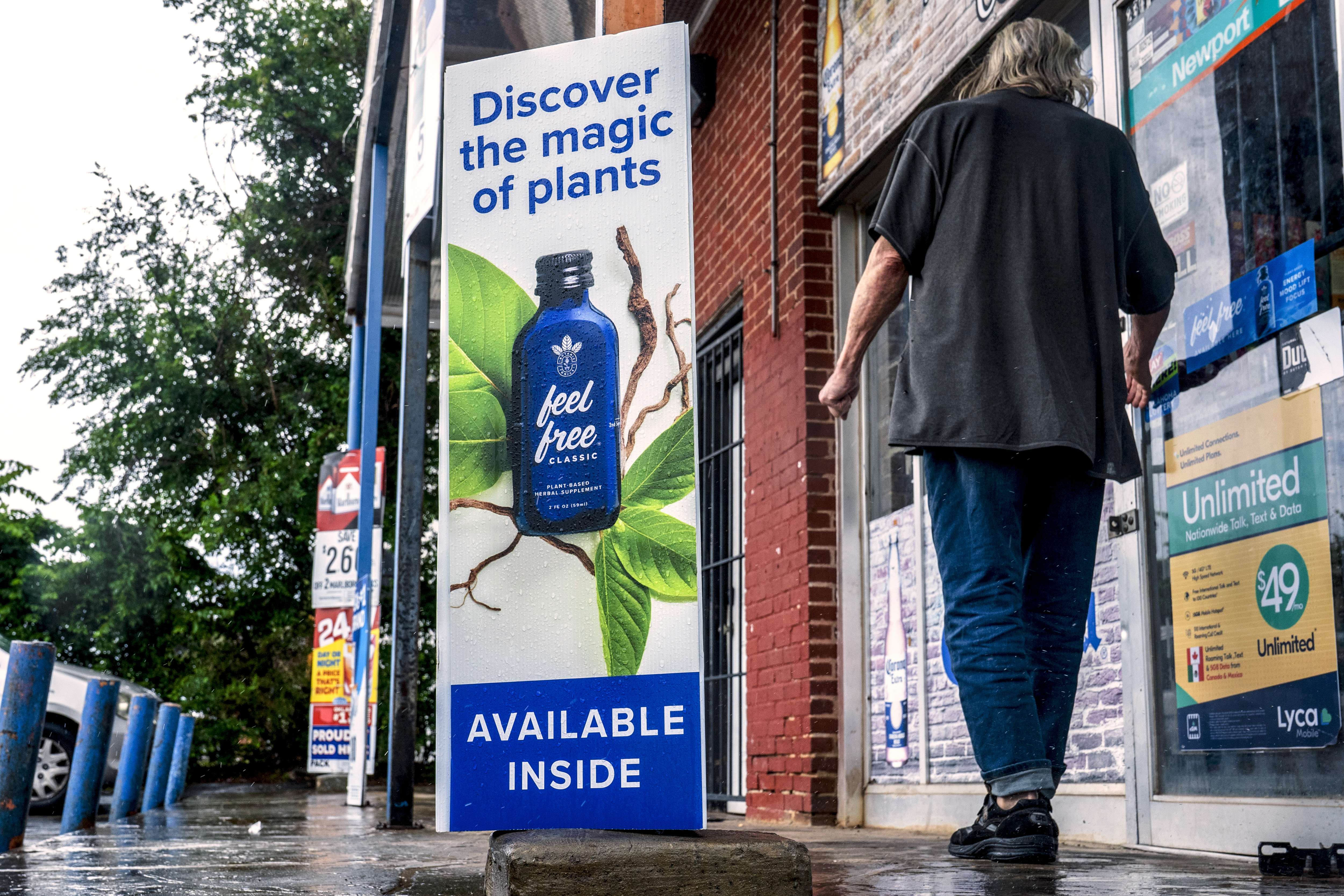
A sign advertising Feel Free, a kratom product produced by Botanic Tonics, outside a convenience store in Oklahoma City, May 27, 2026. With support from Markwayne Mullin and Robert F. Kennedy Jr., the kratom industry is pursuing a potentially lucrative policy. With support from Markwayne Mullin and Robert F. Kennedy Jr., the kratom industry is pursuing a potentially lucrative policy. (Nick Oxford/The New York Times)NICK OXFORD
The FDA would eventually receive more than 965 kratom-related reports of harm, including 264 resulting in death. The self-reported claims detailed instances of vomiting, paranoia and drug withdrawal.
In 2023, FDA inspectors visited Botanic Tonics’ warehouse in suburban Tulsa. They reported their findings to the Justice Department, which went to court to seize 250,000 bottles of Feel Free and other kratom supplements.
In court filings, prosecutors cited “serious safety concerns,” saying kratom had been linked to “addiction” and “liver toxicity.” They accused Botanic Tonics of engaging in illegal interstate trade of an unapproved substance.
On a podcast released in 2024, Ross indicated that he planned a campaign to differentiate between natural kratom and other versions.
“We’re going to be coming out of the chute asking for separate regulation for whole leaf kratom,” he said.
Calling a governor
Trump’s election — and his appointment of Kennedy as health secretary days later — created an ideal environment for such a campaign.
To others working on the issue, Ross highlighted his relationship with Kennedy, indicating that he was planning to enlist the incoming secretary in efforts to influence the administration, according to one associate.
In the weeks around the inauguration, Ross donated nearly $162,000 to Kennedy’s defunct presidential campaign, exceeding by many times his total federal political giving to that point.
Ross was not the only kratom entrepreneur jockeying for position.
A newly formed group called Botanicals for Better Health and Wellness, which is linked to a rival kratom supplement maker, retained the firm of Jeff Miller, a leading Trump fundraiser, to lobby the FDA, Congress and the White House. The new group donated $50,000 to the incoming president’s inaugural committee, for which Miller was finance chair.
Miller and the group did not respond to requests for comment.
Shortly after the inauguration, another rival firm, Diversified Botanics, which produces the popular kratom brand MIT45, hired a lobbyist who worked on Trump’s first presidential campaign and transition. The lobbyist helped arrange meetings with members of Congress and officials from the FDA and the health department for Diversified’s CEO, Niddel.
Niddel said he wanted to explain to government officials how his company’s products differed from those featuring 7-OH.
“We got to get in front of this,” Niddel said he recalled thinking. “It’s going to destroy the kratom industry, because an uninformed consumer or an uninformed legislator — it’s all being lumped in together.”
Vince Sanders, founder and president of CBD American Shaman, which helped popularize 7-OH, said the kratom industry is targeting businesses like his for financial reasons, not because of moral or safety concerns.
“We’ve devastated the industry,” Sanders said. “When 7-OH came in and people tried it, they learned very quickly that it was vastly superior. I mean, this is like going from a horse and buggy to an automobile.”
Sanders’ company received a letter from the FDA last year accusing it of illegally marketing 7-OH products. It recently agreed to halt sales in Missouri to settle a lawsuit brought by the state attorney general. The suit accused the company of peddling “deadly opioids,” though the company did not acknowledge liability.
Sanders believes that kratom lobbying has “demonized” his side of the industry.
Mullin used his connections in Trump’s orbit to help the other side.
Starting while he was in the Senate and continuing after he became homeland security secretary, Mullin urged officials in the health department to remove language from the FDA website warning of kratom’s harms, according to four people familiar with his efforts who were not authorized to discuss them.
For the kratom industry, the warnings on the FDA website were no small concern. Industry representatives said they feared state officials were taking their cues from the agency in deciding whether to pursue bans or other restrictions.
Records obtained by the Times show that the FDA was asked to remove from its kratom webpage links that took readers to enforcement actions against Ross’ kratom company and others.
By the end of 2025, the FDA had removed the links.
Other requested changes were not enacted, including one asking the agency to remove a warning “not to use kratom because of the risk of serious adverse events, including liver toxicity, seizures and substance use disorder.”
Emily Hilliard, a health department spokesperson, declined to comment on the website changes, but said the agency is “solely focused on serving the American people, not advancing industry interests.”
Mullin went public with his involvement in July.
In a notable move, he joined Kennedy and Dr. Marty Makary, then the FDA commissioner, at a news briefing to announce that the agency was moving to effectively end the legal sale of synthetic 7-OH products.
In a comment that was later highlighted by a group backed by Ross, Makary said at the briefing that “we’re not targeting the kratom leaf.”
Mullin added that companies selling 7-OH were exploiting a loophole in FDA regulations to cause harm to consumers.
“It’s legal, but it’s an addiction that’s ruining lives,” he said.
Kennedy referred to his own past struggles with addiction at the news briefing. Weeks later, he pushed Ohio to adopt a policy that would have protected the kratom industry.
Gov. Mike DeWine, a Republican, had announced a plan in August to designate all kratom products as illegal drugs. But Kennedy asked DeWine to crack down instead only on synthetic 7-OH — and not kratom leaf products. The health secretary had hoped to see states align with the federal effort, said Dan Tierney, a spokesperson for the governor.
DeWine soon dropped the push to ban kratom and moved forward with an emergency prohibition against 7-OH. After a review, though, his office said it was moving ahead with a broader kratom crackdown.
‘People are asking for it’
Having powerful people in Trump’s Cabinet vouching for kratom was not enough for Ross. He actively joined the effort to kneecap his competition.
His allies launched an opaque company to position natural kratom products as safer than synthetic alternatives.
They gave the company a name, Stop Gas Station Heroin, that made synthetics sound especially dangerous. The company hired the firm of the lobbyist McDowell, who had been introduced to Ross as a well-connected Trump insider.
McDowell, who is close to the president’s elder sons, also employs a nephew of Kennedy and the son of Trump’s 2024 campaign co-manager Chris LaCivita.
Stop Gas Station Heroin has paid McDowell’s firm, Checkmate Government Relations, at least $600,000, according to lobbying records.
McDowell’s firm has pushed for tougher enforcement against the rival synthetic products in meetings with congressional offices and Kennedy’s health department.
All the while, Botanic Tonics had been awaiting a ruling on its own battle with the federal government.
In December, a federal judge denied the company’s motion to dismiss the FDA lawsuit accusing it of unlawfully selling kratom.
Then, less than two weeks later, federal prosecutors moved to drop the case, as reported by The Kansas City Star. They told the judge that the seized supplements had expired and that the Trump administration had “determined it would not be a prudent use of government resources to sustain this action.”
In a statement praising the decision, the company said the dismissal “reflects a maturing regulatory landscape” in which federal agencies increasingly recognize the differences between natural kratom leaf and the synthetic products.
Justin A. Lollman, a lawyer for the company, told the Times in a statement that even during the lawsuit, the government “never sought to restrict Botanic Tonics’ continued manufacture and sale of Feel Free.” The company has sold more than 130 million servings of Feel Free, he added.
In February, after the dismissal, Ross donated a total of $443,000 to the Republican National Committee in connection with a fundraising dinner headlined by Vance in New York.
Before the dinner, Ross, accompanied by McDowell, secured a private meeting with Vance. Ross used the access to promote the benefits of natural kratom and urge the Trump administration, and particularly the DEA, to clamp down on 7-OH, according to two people briefed on the meeting who were not authorized to discuss it.
McDowell’s firm did not respond to a request for comment.
Over the next two months, Botanic Tonics donated $1 million to MAHA PAC, which is associated with Kennedy. The money from Botanic Tonics accounted for about 44% of all the funds raised by the political action committee between the beginning of last year and the end of April.
The PAC did not respond to a request for comment.
It is not clear whether the administration will approve the emergency ban of 7-OH that Ross and his allies have sought.
But during a briefing in the Oval Office about maternal healthcare last month, Trump made a stray comment indicating the issue had reached his desk, even as his administration was grappling with higher-profile priorities including a war with Iran.
“We’re looking very seriously at natural 7-OH and getting that approved,” Trump said.
The statement left even industry insiders divided on whether he was siding with natural kratom or synthetic 7-OH, or taking another position altogether.
Whatever his stance, Trump left the impression that he had heard from influential figures on the matter, adding that “we’re looking to see if we can do something there.
My response to the recent article about allegations of grade inflation, based on my experience as a teacher in Philadelphia public schools, is that the number of children in the classroom with one teacher matters. With a limit of 30 to 33 children assigned to a classroom with only one teacher working without an assistant, there is often not the possibility of meeting the academic needs of students who struggle to learn, even when they show up regularly. Without another adult in the classroom to help address the learning remediation and the behavioral needs of some students, classroom lessons, even when well planned, are affected by the variety of learning abilities of students in that one classroom. Situations arise that require the attention of a capable adult, while the regular classroom teacher continues the lesson with the rest of the class.
It would be interesting to compare student performance in schools that can afford to have fewer than 30 students in a classroom with our Philadelphia city public schools. Some suburban public schools have the resources to keep class size closer to the low to mid-20s. The ratio of teachers to the number of students matters. That is why special education class sizes are deliberately kept small. And reducing class size in our city schools would require paying for many more teachers — or hiring assistants to help in the regular classrooms.
Mary A. McKenna, Philadelphia
Welcome Center windfall
Last week, City Council passed a bill authorizing Philadelphia’s Parks and Recreation Department to lease the newly renovated Welcome Center at FDR Park to the Fairmount Park Conservancy for a term of up to 26 years, for “nominal” rent and with no apparent financial benefit to the city except savings on maintenance costs.
According to a recent analysis, the average cost of Philadelphia retail rentals was about $20 per square foot. Based on that figure, even conservative estimates put the value of such a lease in the eight figures. Fairmount Park Conservancy is a nonprofit, which means the city will likely not even see tax revenue from the concessions and events the conservancy plans to operate there.
Parks and Recreation has funding issues. In passing this bill, City Council seems to have missed an opportunity to create an ongoing revenue stream through a request for proposals to qualified concession managers.
Emily Bell, Devon
EV chargers
Installing 800 electric vehicle chargers is a good start, but as the shift to electric accelerates, the city should have higher aspirations. Why not consider changes to the building codes that would set goals for obvious locations like parking garages and new construction? It should be feasible to equip 20% of garage spaces in about three years and 50% within about eight years. In addition, any new construction should be designed to accommodate EVs. Deliberately phasing this in over a decade would ensure we aren’t constantly behind the curve.
Frederick Jones, Philadelphia
Walk-off interview
Donald Trump, after abruptly walking off during a Meet the Press interview with NBC White House correspondent Kristen Welker, said he is willing to reschedule the interview. Past behavior suggests he is more likely to push NBC to fire Welker. This most distinguished correspondent must not be added to the list of those struck down by the president.
Joel Chinitz,Philadelphia
Join the conversation: Send letters to letters@inquirer.com. Limit length to 150 words and include home address and day and evening phone number. Letters run in The Inquirer six days a week on the editorial pages and online.
After nearly 25 years in operation, the newly renovated H Mart in Cherry Hill is drawing crowds as regulars and newcomers marvel at its major improvements.
The outpost of the renowned Korean grocery store off Route 70 has served the local community since 2001. In April 2025, the Cherry Hill Township Planning Board approved plans for an expansion. A year later, the grocery store reopened with enhancements to the first floor and an open-concept food court, bakery, and retail space on the second.
As a diehard H Mart fan, I decided to venture across the bridge on a recent Thursday and see the 39,000-square-foot store for myself.
Customers shop inside H Mart Cherry Hill.Hira Qureshi
Where to start your H Mart visit
I arrived at the brick building, marked with the familiar “H Mart” sign in big red letters, at about 11 a.m. Entering through the double sliding doors of the second floor, I found myself inside the new food court.
A few customers dined in the massive seating area that morning, enjoying various dishes. I decided to grab an iced brown sugar coffee boba from Tiger Sugar as a little treat to sip on during my exploration.
Beginning the journey on the second floor was the right move, according to Ryan Solot, a regular shopper at H Mart. He and his wife, Miki Solot, came to the store once a week before renovations. The couple were shopping for dashi stock and Japanese sauces when I ran into them. They were happy to see the makeover, particularly on the second floor’s general shop department. But the Solots still felt the first-level aisles were a bit narrow for ideal grocery shopping.
“The layout is strangely unchanged,” Ryan Solot said. “It’s still kind of awkward to get through the aisles … but start from the top [floor] and make your way down, it’s much more organized upstairs.”
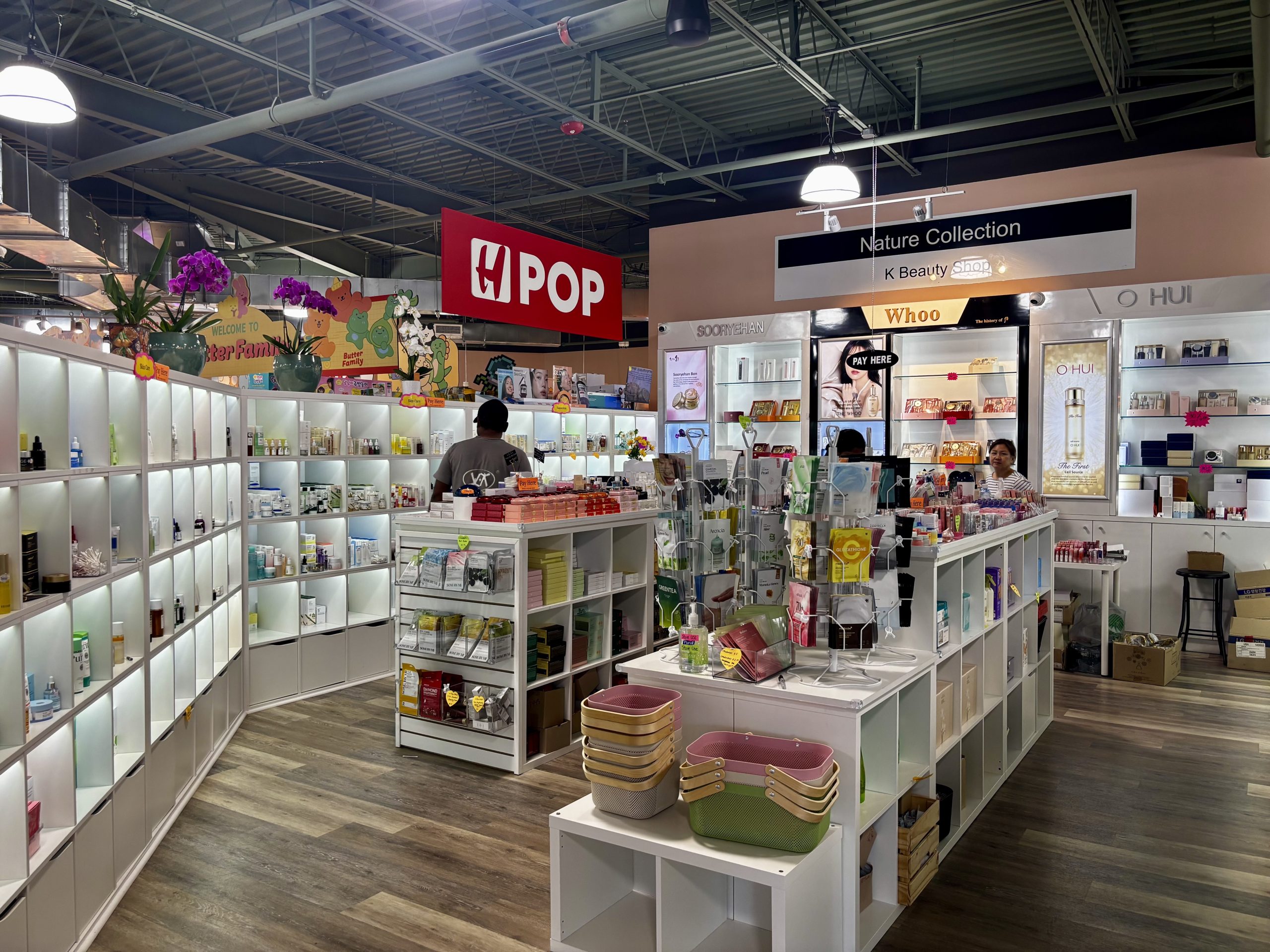
Korean beauty section at H Mart Cherry Hill.Hira Qureshi
The second floor of H Mart: general goods, Korean beauty products, and an arcade
Walking out of the food court area, I found a mini Korean beauty store with boxed shelving displaying creams, serums, cleansers, tonics, and other products from popular brands such as Medicube, Anua, and Beauty of Joseon. Attendants explained the various products to customers, especially to Korean skincare novices like myself.
Neon arrow signs next to the beauty department directed me into H Mart’s general store and “H Pop” section. A small selection of drinks and snacks lined the shelves leading me into the rows of shelves with over-the-counter medicines, vitamins, toiletry items, slippers, bedding, and kitchenware.
In the back corner I found a vast selection of cutesy notebooks, pens (ones with funky kiwi and toilet attachments), furry character key chains, mini toys, makeup storage containers, and other knickknacks. The prices for items were organized by serial numbers, which were listed on a card hanging off the shelves. Pro tip: Take a photo of that price card to reference as you shop.
Customers shop inside H Mart Cherry Hill.Hira Qureshi
The first floor of H Mart: frozen foods, fresh produce and seafood, snacks, and lots of instant noodles
Taped to the elevator, two signs offered directions on where to find specific items. “Second floor: food court, house ware, characters, K-beauty, game, health food” and “First floor: Asian/Western, produce, fish, meat, ready to eat, banchan” were written in all caps and highlighted in yellow.
The elevator also had another sign with an important tip for shoppers: “You are welcome to shop freely on both 1st and 2nd floor, and you may check out either floor.”
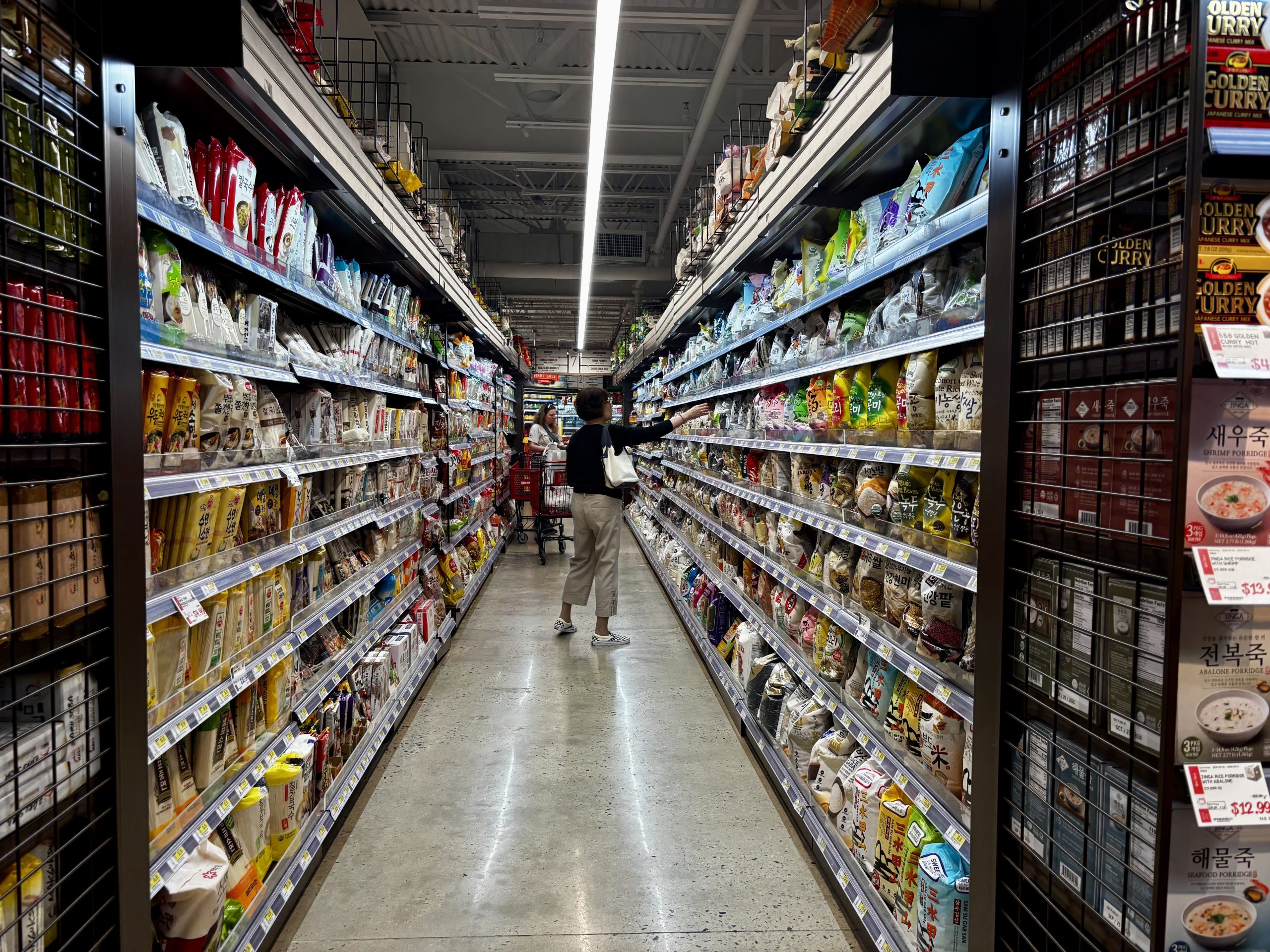
Downstairs on the first level, the elevator opened up to aisles upon aisles of snacks, produce, sauces, packaged sweets, and lots of instant noodles. Each aisle is organized by number with a sign noting all the items available.
Shrimp crackers at H Mart Cherry Hill.Hira Qureshi
I walk into Aisle 3 as I exited the elevator and found snacks galore. KitKats, Pocky sticks, Buldak ramen-flavored chips, O’jelly real plum candies, lychee gummies, Poongnyun Bakery seaweed crackers, and so much more lined the shelves. I picked up some of my favorites: Shrimp crackers, crispy snacks made from starch and ground shrimp, and a bag of chocolate yogurt-covered orange slices sitting nearby.
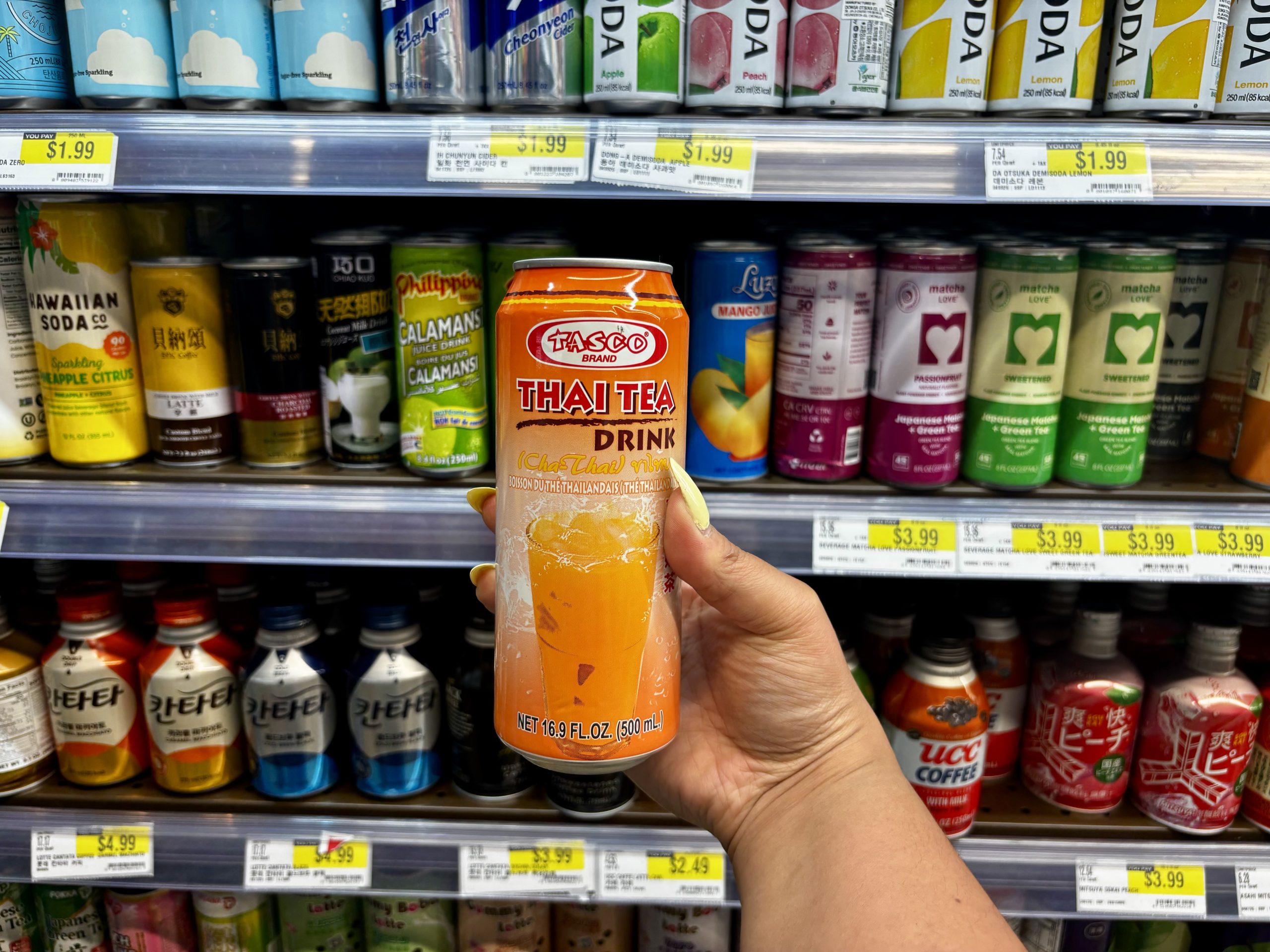
Next, I headed into Aisle 5 for beverages. The vast selection includes soy milk, hojicha, banana milk, corn silk tea, coconut milk and juice, and taro. I grabbed a tall can of Thai tea and a couple of glass bottles of Ramune, a fizzy, fruity, sweet Japanese soda.
Thai tea at H Mart Cherry Hill.Hira Qureshi
I stopped by Aisle 10 for chili oil and pho seasonings. And on Aisle 1, I found instant noodles plentiful — the Japanese-style soba noodle box piqued my interest. At the end of Aisle 9, I saw cups filled with ice in the freezer section and drinks packaged in pouches for easy pouring. I grabbed the peach mango tea to accompany my post-shopping food court lunch.
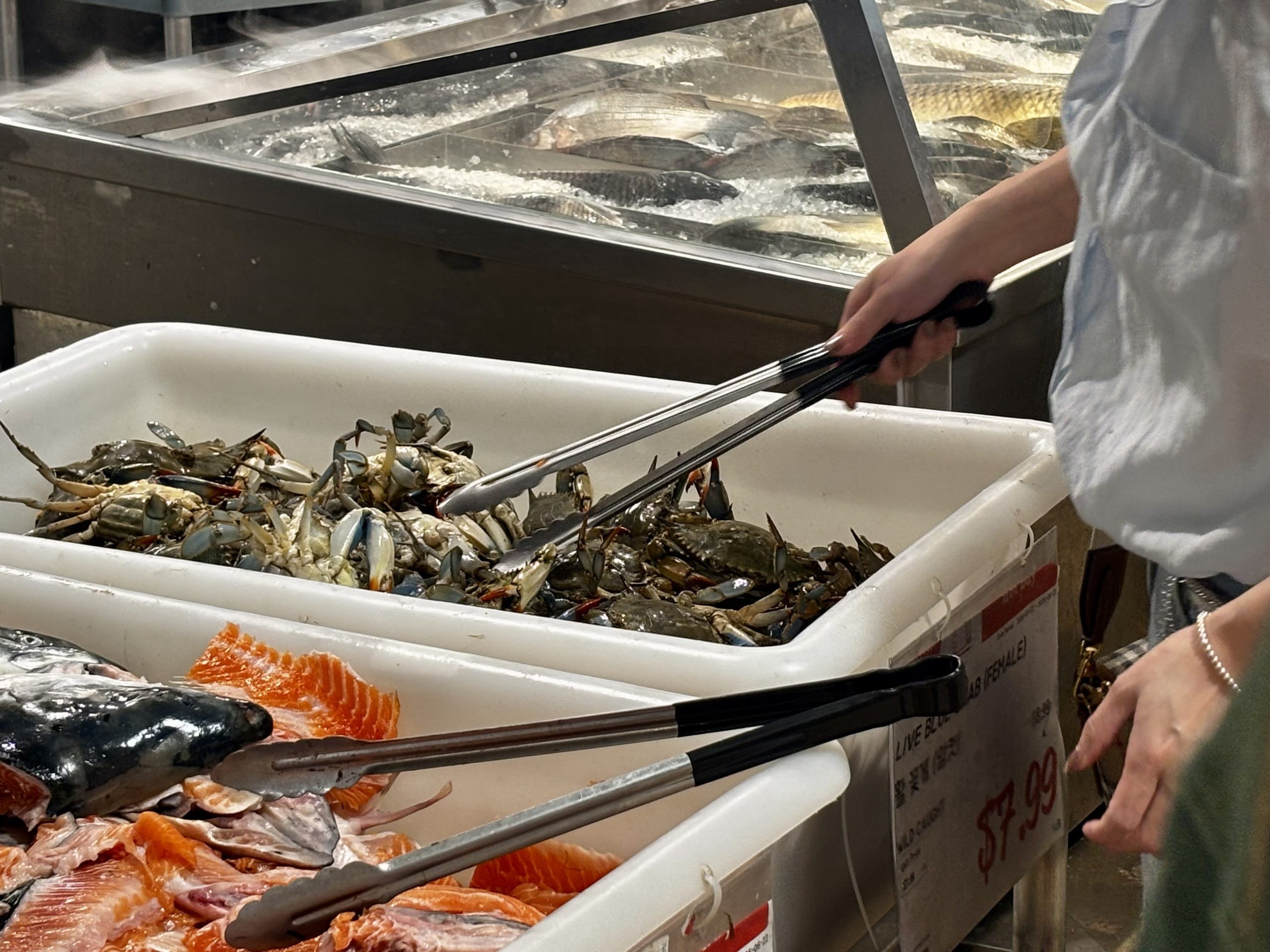
As I walked deeper into the store, I found Catherine Yao and her mother, Jingjing Dong, in the massive seafood section, picking live crabs from a big box.
Live crab selection at H Mart Cherry Hill.Hira Qureshi
Yao and Dong, who live five minutes from the store, come to the H Mart every week. They come for the fresh seafood — live fish, lobsters, and crabs swim in big tanks near the butchers, while some sit in displays on ice — and frozen meats — think beef bulgogi and pork belly. The two also like exploring the premade foods section next door; I picked up a crab onigiri for the road.
The mother-daughter duo recommended stopping by the vast produce section near the cashiers. “I like the fresh durian, lychees, mangoes, and the gold melons,” Dong said.
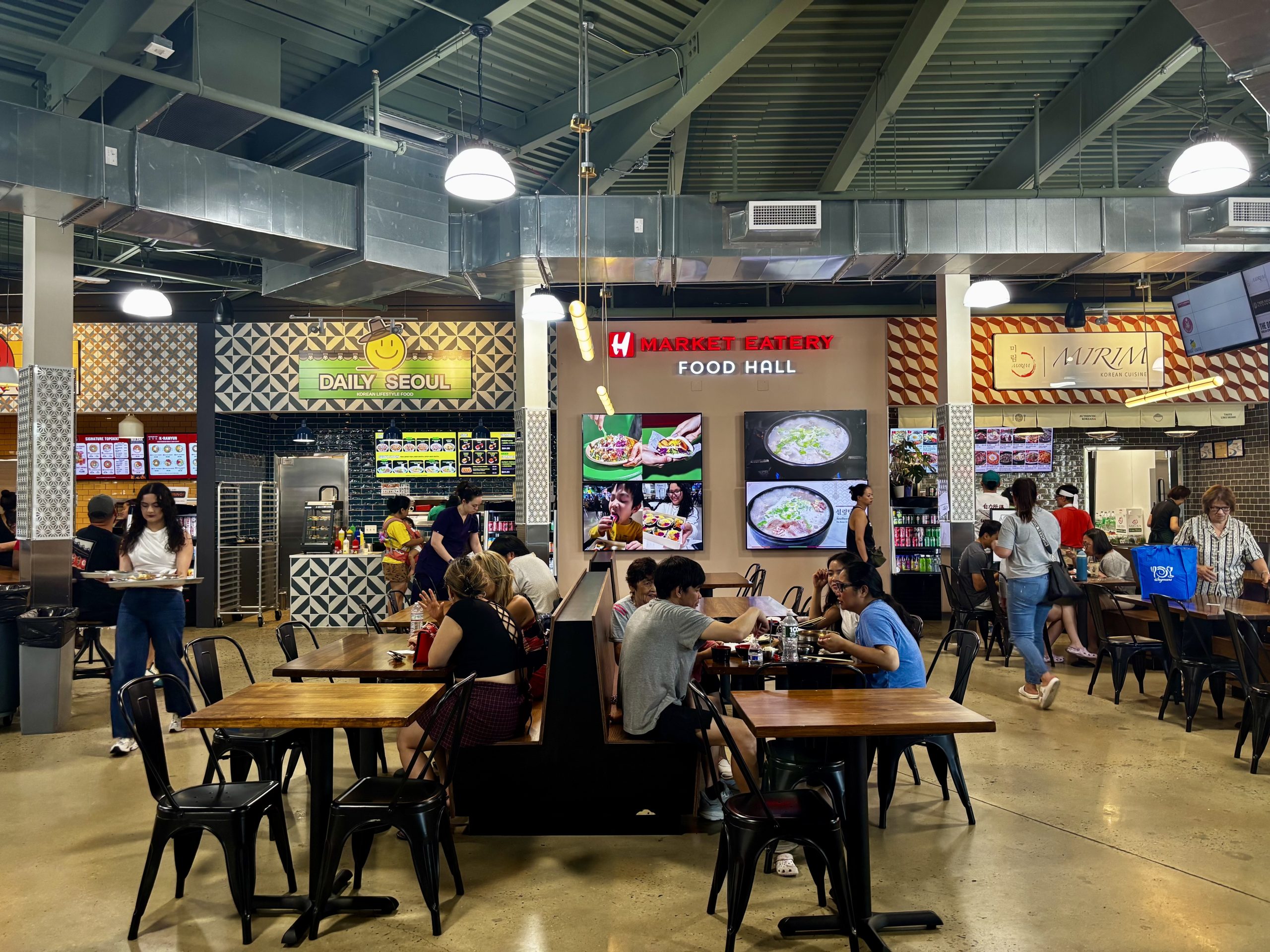
Food court at H Mart Cherry Hill.Hira Qureshi
The food court
Around noon, I took the elevator back up to the second floor and ventured back into the food court for lunch.
The court can feel overwhelming, with nine vendors to choose from — think bibimbap, Korean fried chicken, and noodles. Thankfully, Yao and Dong recommended a couple of options: Kyodong Noodles, a Korean-style Chinese noodle restaurant; Daily Seoul, a Korean lifestyle food brand; and Tiger Sugar, the Taiwanese bubble tea vendor I sampled earlier.
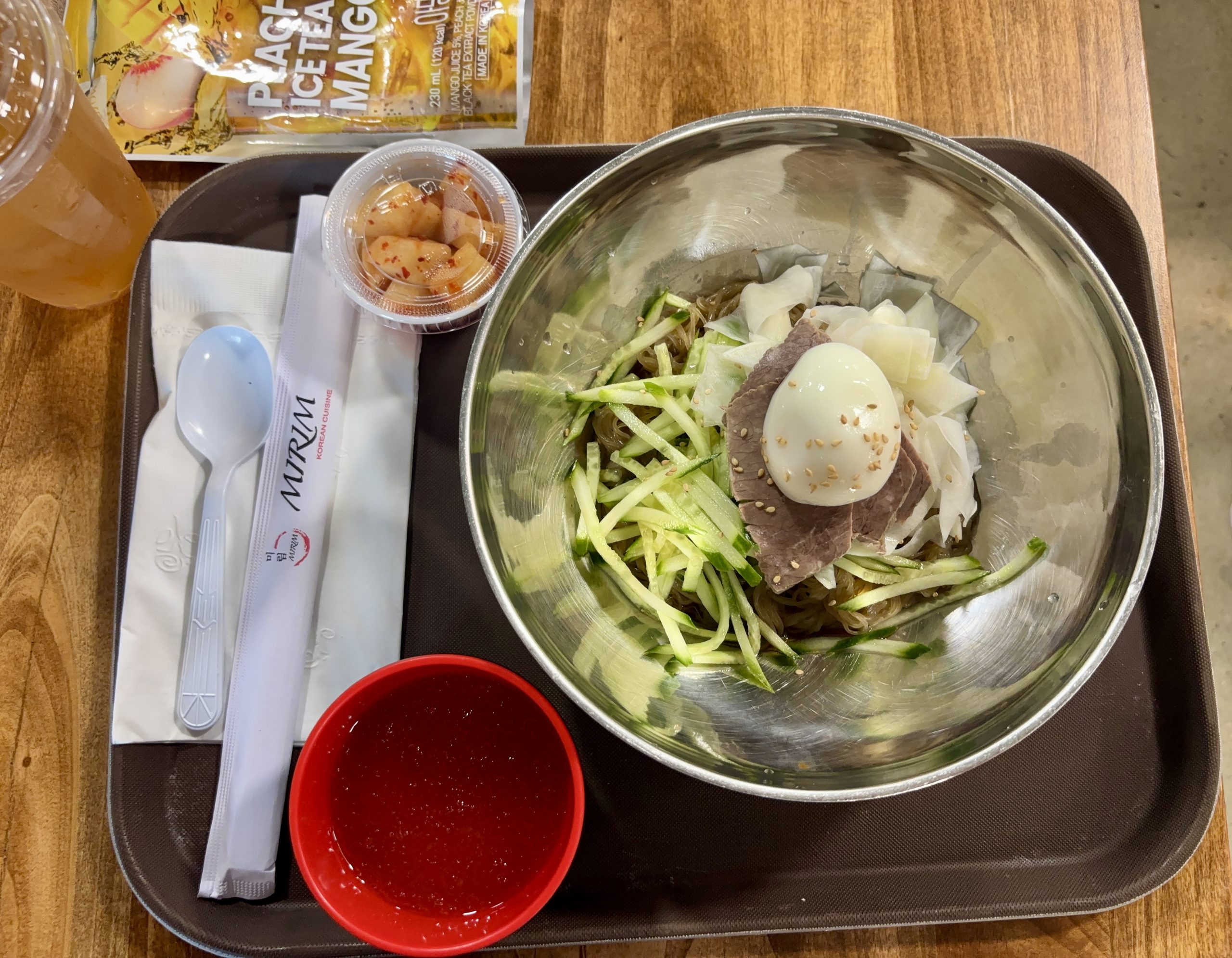
While perusing the vendors, I ran into regular Ryan Solot at Mirim, a traditional Korean restaurant. He recommended the cold buckwheat noodle soup. “I didn’t like how it looked at first but then I tried it and it was very good,” he said.
Spicy cold buckwheat noodle soup H Mart Cherry Hill.Hira Qureshi
I ordered the spicy buckwheat noodles with beef at Mirim. The dish was served in a metal bowl with pickled vegetables on the side, chopsticks included.
For Yao, the food court is a great addition to the store.
“I like coming here more now because they have a food court — we go to eat there pretty often, for lunch and dinner sometimes,“ she said.
H Mart Cherry Hill: 1720 Route 70 E, Cherry Hill; 856-489-4611; Monday to Sunday, 9 a.m. to 9 p.m.
On a warm weekend earlier this month, dozens of shoppers, some of them dressed in Regency-inspired apparel, milled about the city of Bordentown, in Burlington County.
Those donning bonnets and hand fans weren’t time travelers or lost actors — they were there to celebrate the opening of a new bookshop with plenty of historic flair of its own.
Inspired by the works of renowned 18th- and 19th-century novelist Jane Austen, Austen’s Shelf penned a new chapter June 6 with the opening of its storefront at 230 Farnsworth Ave. The bookshop, which held a period-inspired costume contest for the occasion, is part of a growing surge of independent bookstores nationwide.
Austen’s Shelf launched last year as a mobile bookstore in a 98-square-foot trailer.Jessica Griffin / Staff Photographer
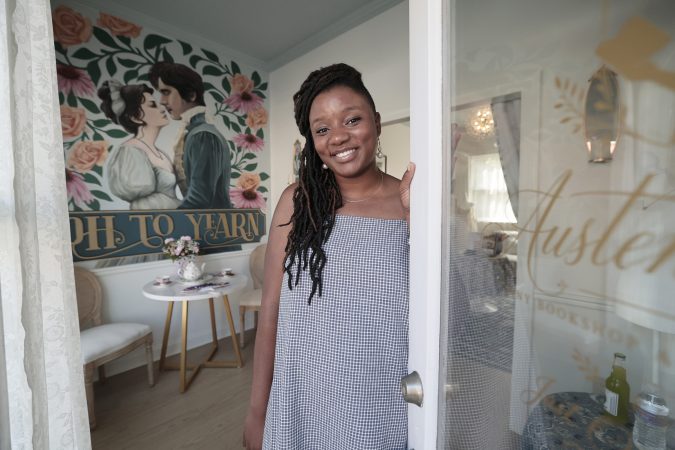
Austen’s Shelf launched last year as a 98-square-foot mobile bookstore that popped up at festivals and events, many of them in South Jersey. It was born out of founder Charity Herndon’s desire to fulfill a lifelong dream of owning a bookstore, something she decided to pursue after facing a breast cancer scare.
While she ultimately didn’t end up with a diagnosis, the experience changed how the now-30-year-old looked at life.
“I feel like a completely different person than I was before the health scare,” she said. “After you get over that mountain, it’s kind of like, all systems go.”
For Herndon, it was. Within months of her mobile shop’s September opening, she began to contemplate a more permanent space, seeing a desire from customers to “sit and linger.” With long lines forming at pop-ups, she felt like the shop had become as much about buying a book as it was a place for people to connect.
That was further stoked after a dreary winter and one particularly busy January pop-up at Turtle Beans Coffee in Bordentown. During that event, she said visitors told Herndon “we need a bookstore like this in town.”
While there’s already an independent bookstore there, Old Book Shop of Bordentown specializes in general used, out-of-print, and antiquarian books. Coincidentally, Jane Austen is the 21-year-old shop’s second-best selling author, owner Doug Palmieri said.
Given the two don’t have significant crossover in their business models, he welcomes having another bookshop nearby. Like antique stores, “the more there are in one area, the better for business,” he said, adding that he got a boost during Austen’s Shelf’s opening weekend, which coincided with the New Jersey book crawl and another store’s opening.
Independent bookstores like Austen’s Shelf are on the rise nationally. According to the American Booksellers Association, 605 new bookstore businesses opened in 2025, an 87% increase from 2024.
They’ve proliferated in the Philadelphia suburbs in recent months. Chapter Two Books opened in Wynnewood in May, Forage Books debuted in Kennett Square in February, and two bookstores, Celia Bookshop and Dirt Farm Books, opened in Swarthmore in October and January, respectively. The latter specializes in used and rare books.
Books aren’t the only media form making a resurgence. A Passyunk Square resident is on the hunt for a place to set up Little Movie Store, a video rental shop in the vein of Blockbuster.
Palmieri — a 20-year member, current secretary, and past president of the Downtown Bordentown Association, which promotes and supports local businesses — attributes the growth of indie bookshops partly to an uptick in younger readers, primarily those in their 20s and 30s.
“They like the touch and feel of books,” he said. “They like to have the books in their hands.”
DBA treasurer and past president CJ Mugavero, who owns Artful Deposit, sees the rise in retail as something of a reaction to the increased digitization of society.
“What people are craving is the human factor,” she said. That’s helped spur a number of new businesses in Bordentown recently.
Located next door to Austen’s Shelf, menswear and home store Haberdashery and Home debuted this month. Earlier this spring, the historic city welcomed art spaces Bonaparte Boutique and Sleeping Cat, an expansion of studio Leaping Dog. Abyssal Brewing and yoga and pilates studio The Movement also put down roots there in the first half of this year.
Beyond a desire for the tactile, “people long for community, and I think that’s something you can’t necessarily find if you’re just ordering your books off of Amazon,” Herndon said.
That was top of mind when she conceptualized her new space, which is small, but more than quadruple the size of the mobile bookshop. Clocking in at under 500 square feet, it has a “homey” vibe that allows for lingering and connecting. There are two sitting areas, one with a couch, the other a table and chairs. The latter sits beneath a large mural depicting Elizabeth Bennett and Mr. Darcy from Austen’s Pride and Prejudice,painted by Philadelphia artist Erik Weedeman.
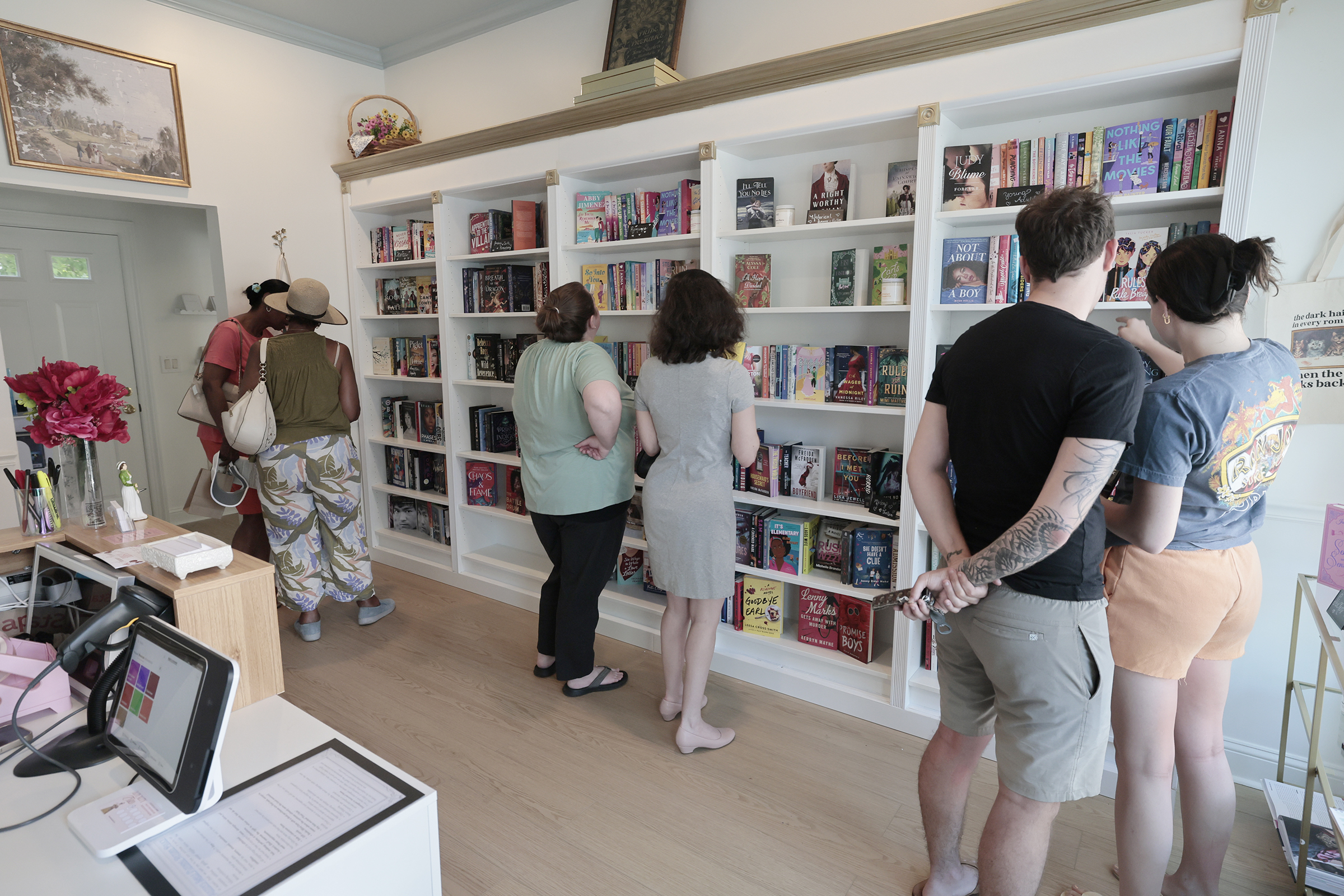
Shoppers browse for books and other goods at Austen’s Shelf in Bordentown. Elizabeth Robertson / Staff Photographer
Like its predecessor, this edition of Austen’s Shelf caters to a wide range of readers, stocking a curated selection of young adult, literary fiction, poetry, mystery and thriller, and fantasy, as well as children’s books.
There’s also a room dedicated to Austen, complete with a gilded digital display showing film adaptations of her books. Herndon also sells a selection of what she’s dubbed “Regency-modern” apparel.
With a permanent space now up and running, Herndon has no plans to stop taking the mobile bookstore out. She’s just refining the schedule and taking on fewer events.
A former Bordentown resident who now lives in Gloucester County, Herndon hopes the shop helps draw visitors to the city. She wants visiting Austen’s Shelf to feel “like an experience where the entire town can kind of be a place to linger.”
If opening weekend was any indication, that just might be the case. Looking out at the historic city during the grand opening and seeing people wander the streets in period-inspired attire, she said the image “just fits like a glove. It’s the dream, literally.”
Austen’s Shelf is open Wednesdays and Thursdays from 11 a.m. to 6 p.m., Fridays and Saturdays from 11 a.m. to 7 p.m. and Sundays from 11 a.m. to 5 p.m.
This suburban content is produced with support from the Leslie Miller and Richard Worley Foundation and The Lenfest Institute for Journalism. Editorial content is created independently of the project donors. Gifts to support The Inquirer’s high-impact journalism can be made at inquirer.com/donate. A list of Lenfest Institute donors can be found at lenfestinstitute.org/supporters.