Tag: topic-link-auto

  • Albert James Mamary, attending physician and professor of thoracic medicine and surgery at Temple, has died at 59

    Albert James Mamary, attending physician and professor of thoracic medicine and surgery at Temple, has died at 59

    Albert James Mamary, 59, of Wynnewood, attending physician and professor of thoracic medicine and surgery at Temple University, researcher, writer, mentor, artist, outdoorsman, craftsman, and amateur bicycling champion, died Thursday, July 9, of cholangiocarcinoma at Temple University Hospital.

    A 1999 graduate of Temple’s Lewis Katz School of Medicine, Dr. Mamary spent his career at Temple and affiliated hospitals. He was an expert in pulmonary disease, transplants, and sleep disorders at the Temple Lung Center, and became program director of the Pulmonary and Critical Care Fellowship at Temple Hospital in 2006.

    He earned a master’s degree in anthropology at the College of William and Mary in Virginia and his premedical school credits at the University of Pennsylvania. In a tribute, his family said: “His education in both medicine and anthropology reflected a lifelong belief that caring for a patient required understanding not only the disease but the whole person.”

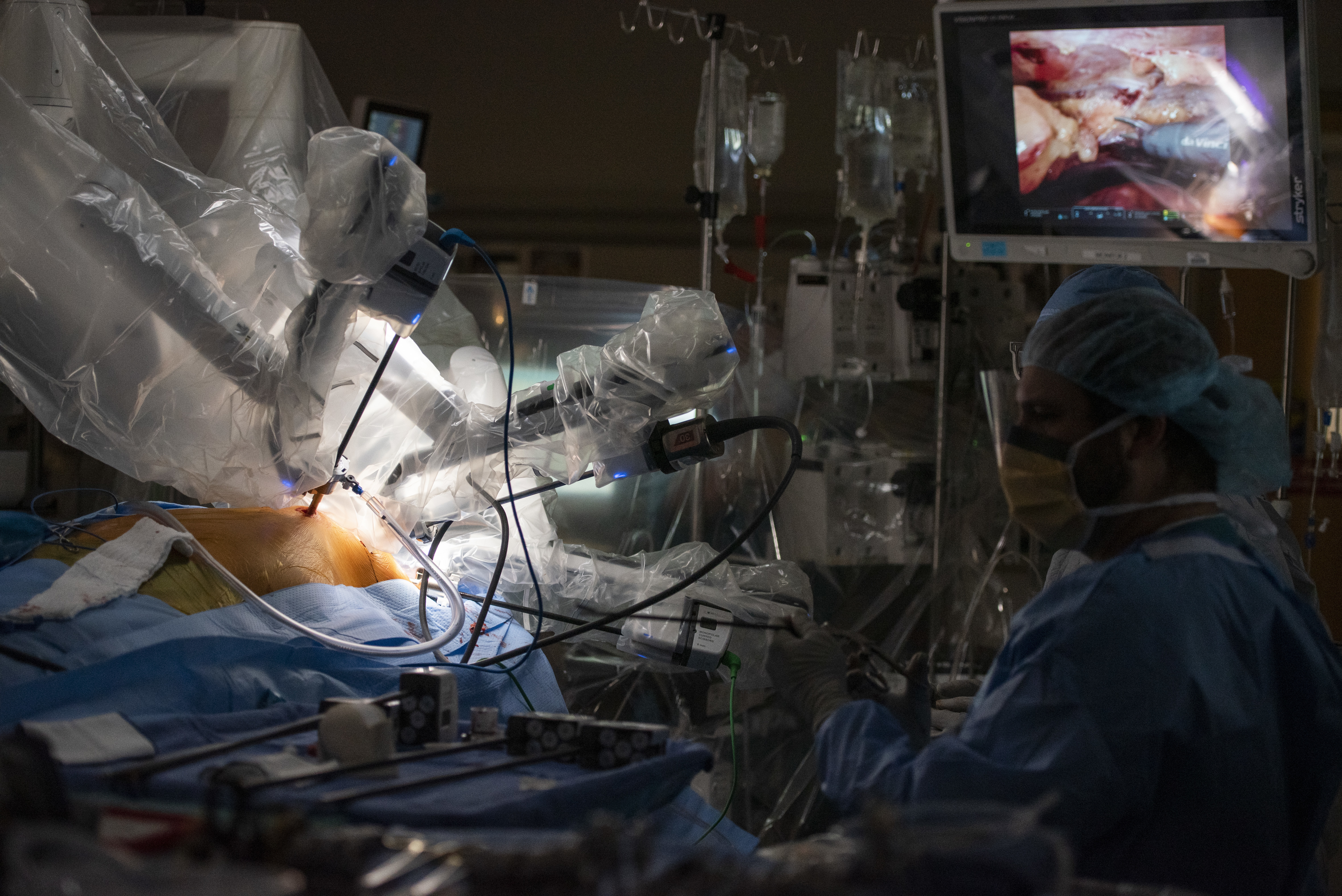
    Over more than three decades at Temple — as a student, resident, fellow, professor, and physician — Dr. Mamary treated thousands of patients, mentored hundreds of students and doctors, lectured in classrooms and at seminars, and wrote more than 60 scientific papers and textbook chapters. He was named a top doctor by Philadelphia Magazine several times and was featured in The Inquirer and on 6abc TV for his lead role in a successful double-lung transplant in 2015.

    “It’s been 120 to 145 patients, individual patients that we’ve been able to help every year,” Dr. Mamary told CBS News in 2024. “That’s really the aim here, is to add years of life to patients who otherwise wouldn’t have that opportunity.”

    Colleagues called Dr. Mamary a “physician’s physician” and noted his “amazing intelligence and clinical acumen” in tributes. Gerard J. Criner, chair of Temple’s Department of Thoracic Medicine and Surgery, said: “His patients loved him not only for his clinical skills but also for the warmth, compassion, and humanity he brought to every encounter.”

    A former patient said online: “He was a calm in the storm of my end stage disease. … The world has lost a hero.”

    A former student said: “His kindness, thorough and balanced approach to medicine, and quiet, thoughtful approach to even the most stressful emergencies reminded me of a Jedi master.”
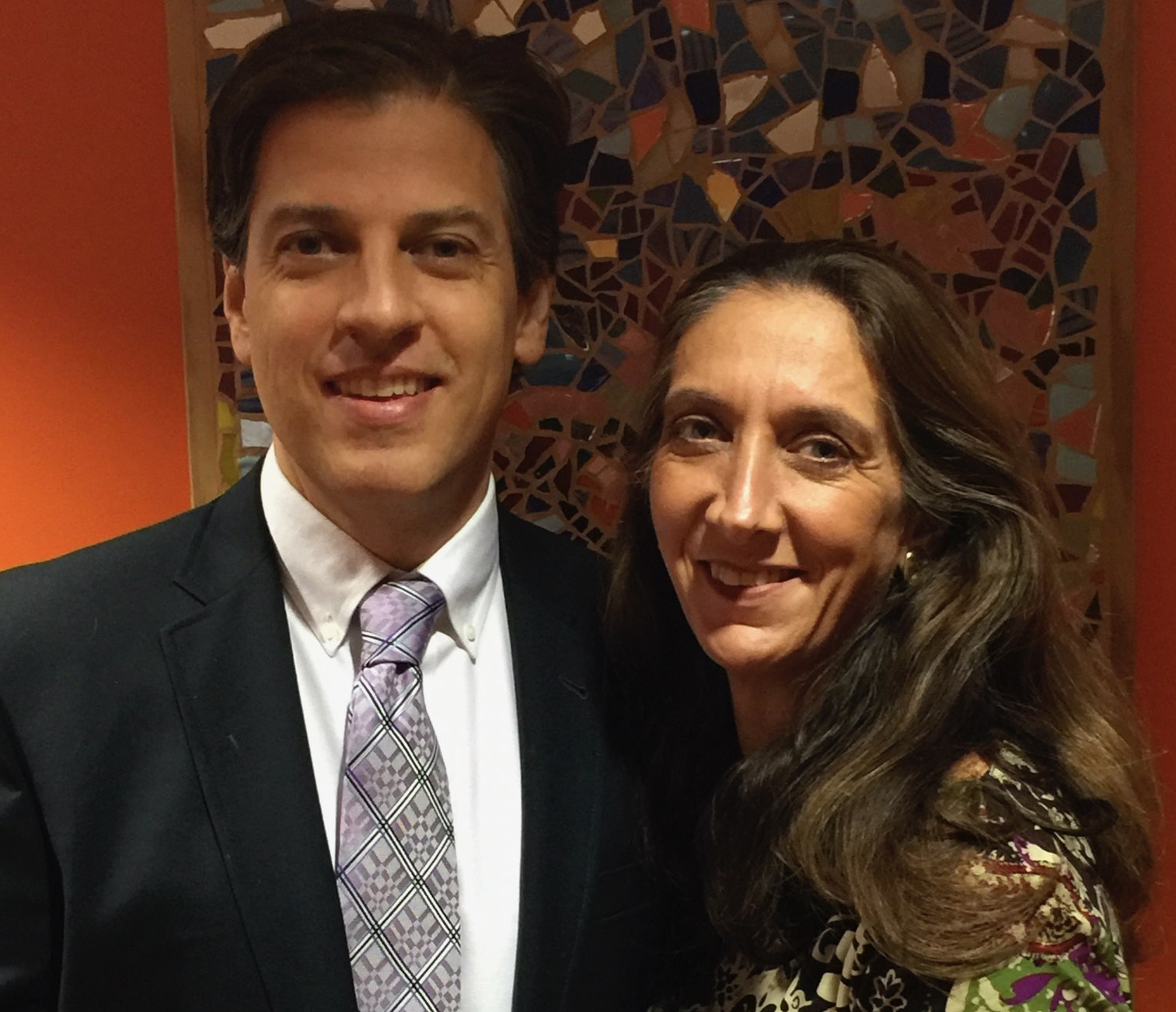
    Dr. Mamary and his wife, CeilaSue, married in 1996.Courtesy of the family

    Away from the hospital, Dr. Mamary liked to bike, hike, and camp. He built his own 18-foot mahogany canoe, walked the entire 272-mile Long Trail in Vermont, and won masters bicycling championship races.

    He also painted and sculpted, and earned a bachelor’s degree in art and psychology at Haverford College. He and his wife, CeliaSue, initiated the Shortridge Memorial Park Arboretum in Wynnewood and earned a 2024 community service award from Narberth and Lower Merion officials.

    “James brought wisdom, kindness, curiosity, and genuine joy to every moment,” his wife said.

    Albert James Mamary was born June 12, 1967, in Hempstead, N.Y. He grew up in Binghamton, N.Y., became an Eagle Scout, and was a wilderness river guide for the Boy Scouts in Maine during his college years.

    Dr. Mamary was an avid bicyclist and won masters championship races. Courtesy of the family

    He met CeliaSue Jaffe in class at Haverford, and they married in 1996 and had daughters HannahRose and LilyRuth. They lived in East Falls and Wynnewood, and he rode his bike from home to Penn and then Temple as often as he could.

    Dr. Mamary enjoyed traveling, baking, cooking, and gardening. “His specialty is fruits and vegetables, and I grow the flowers,” his wife said.

    He followed the Phillies, rescued cats and dogs, and doted on his daughters. Everybody said he was funny and silly.

    “He was curious and always learning or doing something new,” his daughter LilyRuth said. “He took joy in simple things.” His daughter HannahRose said: “Even if he wasn’t my dad I would want him as a friend because he was so interesting and so easy to talk to.”

    Dr. Mamary was a wilderness river guide for the Boy Scouts in Maine during his college years.Courtesy of the family

    Dr. Mamary was diagnosed with cholangiocarcinoma, bile duct cancer, in 2020 and treated by longtime colleagues and friends at Temple, some of whom he had mentored. “It was a profound reflection of the life he lived,” his family said, “that so many of those he had taught ultimately became his caregivers.”

    His wife said: “He was a very vibrant and adventurous person but so thoughtful, steady, and reliable. James was incredible.”

    In addition to his wife and daughters, Dr. Mamary is survived by a sister and other relatives.

    Private services were held earlier.

    Donations in his name may be made to the Albert James Mamary Memorial Fund at the Cholangiocarcinoma Foundation, 5526 West 13400 South, No. 510, Herriman, Utah 84096.

    Dr. Mamary “was a very vibrant and adventurous person but so thoughtful, steady, and reliable,” his wife said. Courtesy of the family
  • A robotic heart surgery specialist was fired by Main Line Health for blowing the whistle on complications, lawsuit says

    A robotic heart surgery specialist was fired by Main Line Health for blowing the whistle on complications, lawsuit says

    A former cardiac thoracic surgeon at one of Main Line Health’s flagship programs says in a federal lawsuit that he was fired after reporting a series of bad patient outcomes.

    Gianluca Torregrossa accuses the nonprofit hospital system in the Philadelphia suburbs of failing to thoroughly investigate a pattern of complications among the patients of another senior surgeon, including one instance that led to a heart transplant.

    The Italian physician attempted to have the cases reviewed multiple times during his tenure, which was just short of five years, but instead Torregrossa was marginalized by hospital leadership, suspended, and eventually terminated before the end of his contract, according to the suit.

    The termination caused issues with the physician’s visa, which required him to return to Italy without his wife and daughter while he got his new visa in order, according to the complaint. Torregrossa, who began working at Cleveland Clinic in June, says he also lost wages during the three-month period and his reputation suffered.

    “Cardiac surgery is a small professional field, and news of his suspension and termination spread nationally and internationally, creating questions about his professional standing despite his clinical outcomes and subsequent employment by Cleveland Clinic,” the suit says.

    Torregrossa’s attorney did not respond to a request for comment.

    The lawsuit, filed July 31 in the U.S. District Court for the Eastern District of Pennsylvania, names only Main Line Health as a defendant. The health system declined to comment on the active litigation.

    “Main Line Health’s Robotic Cardiac Vascularization Program is an important part of our commitment to providing advanced surgical care,” a spokesperson said in a statement. “The program helps ensure patients have access to specialized surgical expertise and innovative, minimally invasive treatment options close to home.”

    Torregrossa was recruited by the Montgomery County hospital system in 2021 to assist in expanding the robotic heart surgery program based at Lankenau Medical Center, the lawsuit says.

    The opportunity to join Main Line Health was lucrative. The surgeon signed a five-year contract starting at $800,000 a year, plus bonus, according to the lawsuit.

    Main Line Health is a national leader in a robotic procedure to replace a clogged artery with a new one, known as coronary artery bypass graft, which is the most commonly performed heart surgery in the United States. But at Main Line it is often performed in an uncommon way.

    The program was led by Francis Sutter, a pioneer of the advanced but controversial technique.

    Shortly after joining Main Line Health, Torregrossa became concerned about the outcomes of patients whom Sutter operated on robotically that the physician believed were preventable, the suit said.

    Torregrossa asked in 2023 for a review of seven of Sutter’s cases, the complaint says, but a team discussed them “only superficially, no meaningful follow-up was initiated, and the pattern of complications involving a single surgeon was not examined.”

    The physician continued to raise concerns over allegedly preventable complications through 2025, as well as ethical breaches in patient assignment at the program, according to the complaint.

    The Inquirer was unable to reach Sutter, who retired in July, based on publicly available records.

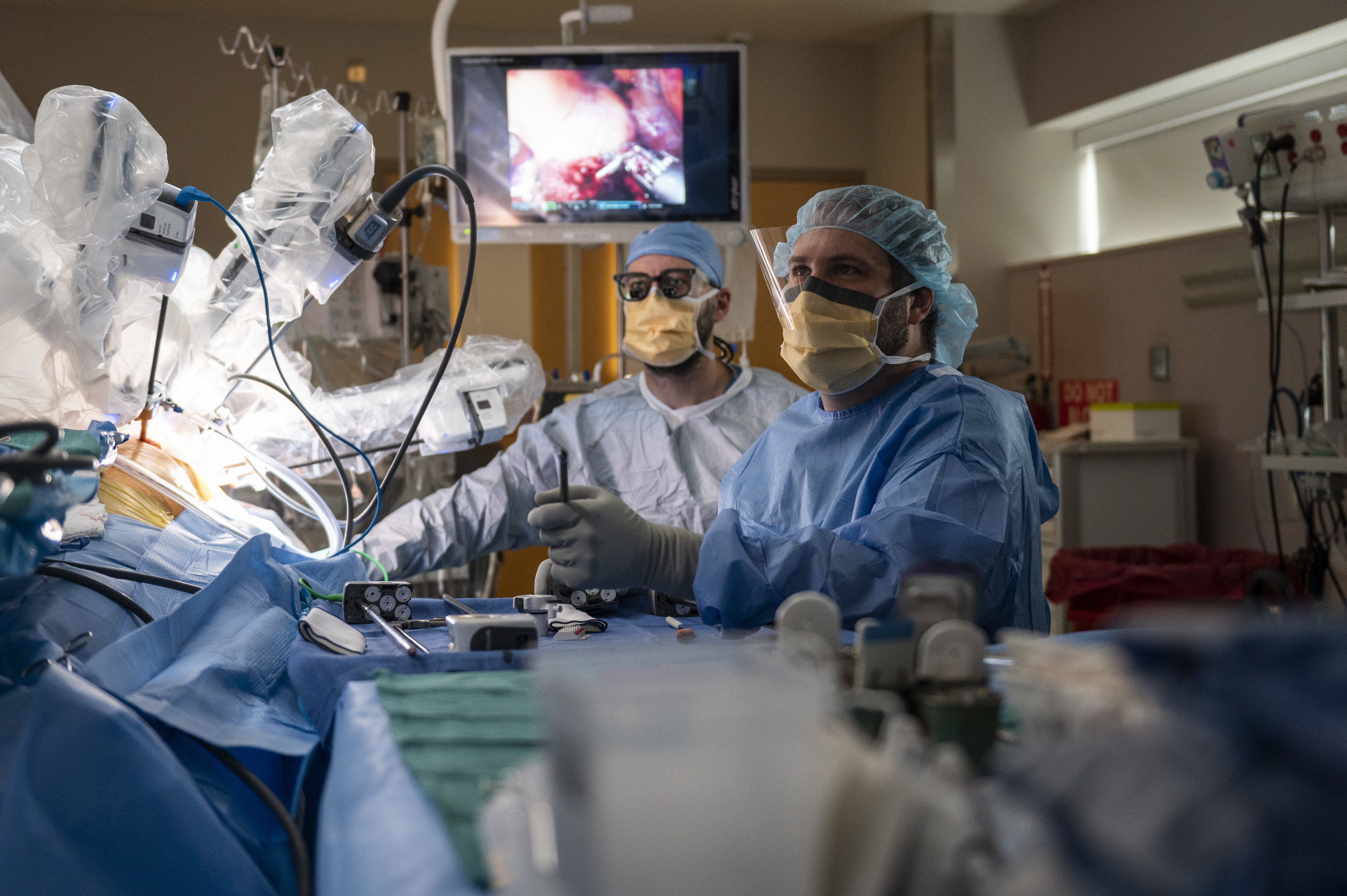
    Michael Carboine (left), physician assistant, and Jeff Roman (right), scrub nurse, watches the monitor as lead surgeon Francis Sutter moves the robotic instruments in the patient’s heart on Monday, June 26, 2023. Lankenau Hospital, part of Main Line Health, uses robotic coronary bypass surgeries at a higher percent than other hospitals.Allie Ippolito / Staff Photographer

    Following his internal reports, the suit says, Torregrossa was marginalized by leaders of the program and hospital.

    Human resources opened an investigation into Torregrossa based on a comment he had made in a brief recruitment interview, according to the complaint. The documents do not repeat the comment or provide more context to what was said.

    “That HR event reflected a broader pattern in which routine professional interactions involving Dr. Torregrossa were escalated against him, while more serious concerns involving others, like patient safety, were not meaningfully investigated,” the lawsuit says.

    In November 2025, the hospital system told Torregrossa that his contract would not be renewed past June 30, the suit says.

    Torregrossa continued to push internally for reviews, but his pleas fell on deaf ears, according to the complaint. In January, he submitted an external patient safety report to the Pennsylvania Licensing System and the Joint Commission, a hospital accreditation organization, which conducted a surprise visit to Lankenau shortly after.

    The surgeon also circulated an anonymous letter about the Sutter cases in question, the suit says without saying who were the recipients.

    Sutter’s medical license is active and Pennsylvania Department of State records show no disciplinary history. Lankenau has passed a series of Pennsylvania Department of Health inspections since January that found the hospital in compliance.

    Main Line Health placed Torregrossa on administrative leave in February and barred him from accessing the system’s hospitals and clinics. The system accused him of disparaging the health system during a presentation and engaging in unprofessional conduct.

    The lawsuit says both excuses were false and pretextual, leading to his March termination.

    The complaint accuses Main Line Health of violating the Pennsylvania whistleblower protection law and breaching his employment agreement. It asks for damages in an unspecified amount greater than $75,000.

    “Being removed from practice for approximately three months deprived him of the ability to operate, teach, proctor, maintain case volume, and continue refining a rare and demanding surgical technique,” the lawsuit says.

  • Gen Zers like what Philly has to offer, but they want better pay and more work opportunities, survey says

    Gen Zers like what Philly has to offer, but they want better pay and more work opportunities, survey says

    Gen Z has established a foothold in the workplace, and as these workers become a bigger part of Philadelphia’s workforce, they’re increasingly shaping the economy.

    So what do Philadelphia’s Gen Zers think is a good job?

    The perhaps unsurprising answer: one that allows advancement opportunities, high pay, and employer-funded healthcare benefits, as well as work-life balance and boundaries. That’s the finding of a new report from the Pew Charitable Trusts.

    And for some Gen Zers Pew heard from, pursuing a job in their field means looking beyond Philadelphia. Outside of healthcare, and some opportunities in law and engineering, they say, other desirable industries don’t seem to be hiring much here.

    “Understanding their attitudes, their perspectives about work, about what a workplace should be, what their feelings are about work-life balance” is important, said Thomas Ginsberg, author of the report on Gen Z workplace attitudes.

    Released Wednesday, the report is based on focus group discussions that took place last year with 54 Philadelphians aged 18 to 29.

    They’re skeptical about what’s learned in college and want to build up more hard skills. And they see work as a key to living well, not as the reason to live.

    “They’re not at all reticent about working hard,” Ginsberg said. “What they’re doing is questioning what’s the ultimate goal of ‘work hard.’ It’s to have an affordable personal life, in their view.”

    But participants in the survey expressed that “jobs today often don’t deliver that,” he said.

    “You work hard and you still can’t buy a house,” Ginsberg said. “Those two things are coming together pretty starkly for this group.”

    Gen Zers looking outside Philly for good, flexible jobs

    Gen Z Philadelphians want flexible work hours and perhaps the freedom to go to the dentist without requesting time off from work.

    They want boundaries when they’re off the clock, so they can maintain hobbies and relationships. But they also want some in-office time to learn from colleagues.

    “I don’t live to work. I work to live. So there needs to be that distinction between the two,” one participant said.

    Much of Philadelphia’s Gen Z population works in healthcare, social assistance, and education services, reflecting the city’s eds and meds focused economy.

    Survey participants interested in healthcare jobs said there were plenty to go around. Others looking outside that field said there aren’t enough good job opportunities.

    In particular, they said, jobs in tech, finance, and the arts seem more scarce. They said New York and Washington, D.C., seem to have more opportunities in those fields.

    And while cost of living and housing seems lower in Philadelphia than in other East Coast cities, jobs here generally pay less, they say.

    Still, they like much of what the city offers for nonwork hours, from the social life to the sports, arts, and transportation. SEPTA, PATCO, and NJ Transit attracted some Gen Zers to the area in the first place, the report said.

    College builds contacts, not skills, Gen Z says

    A little over half of Philadelphia residents between the ages of 25 and 29 had a bachelor’s degree between 2020 and 2024 — a higher share than residents older than them. But Pew found this age group has reservations about whether college provides what they need for career advancement.

    “This age group is the highest-educated age group that we can measure … and even so, they’re only marginally positive about the value of college education,” Ginsberg said.

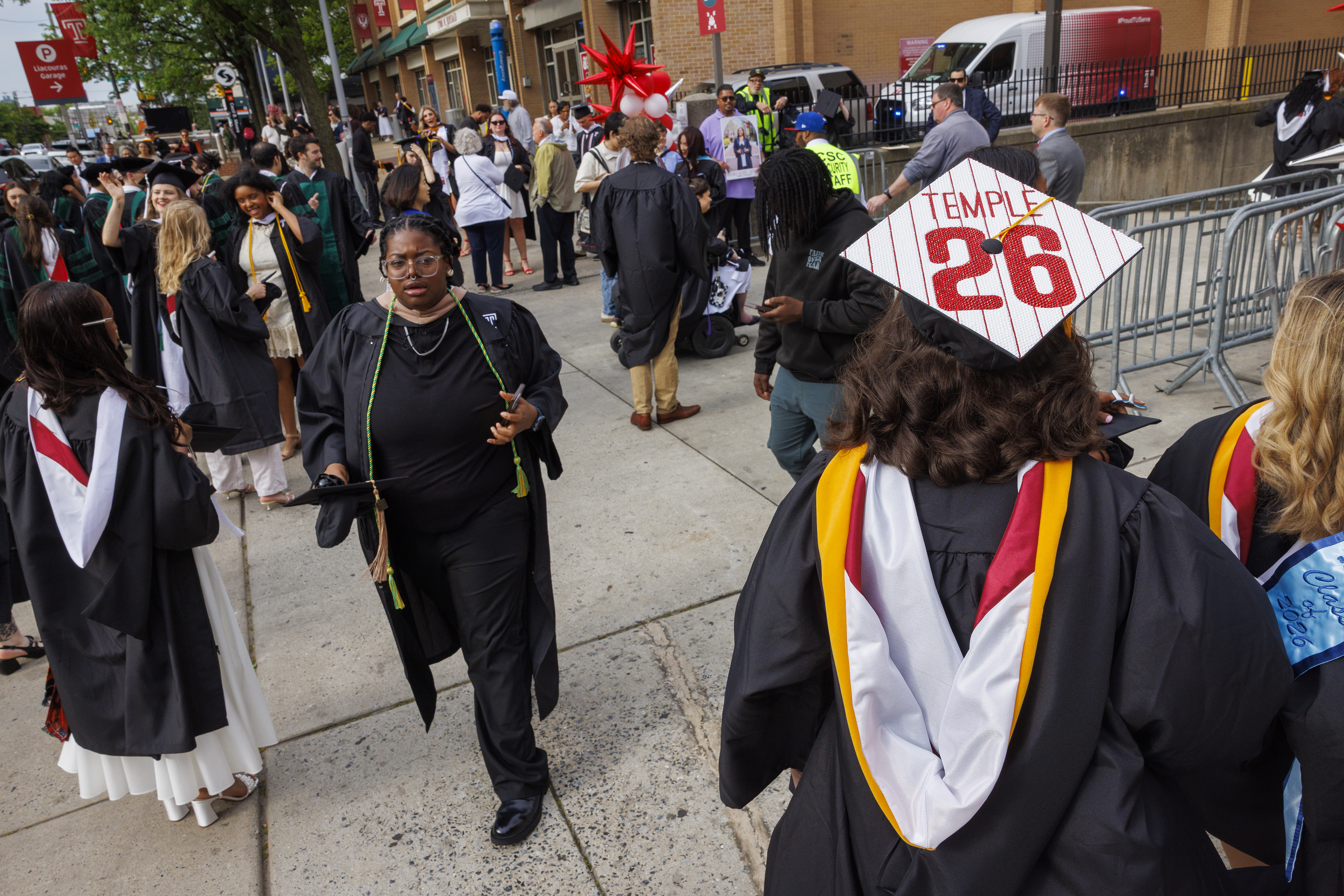
    Temple University students on graduation day on May 6.Alejandro A. Alvarez / Staff Photographer

    College-educated Philadelphians surveyed said their higher education was valuable for building a professional network, Ginsberg said, but not as much for hard skills. They said they want more training in skills like coding, data analytics, AI, and industry-specific software. Some said they know they will need a graduate degree to advance.

    Those without a degree felt they could get those hard skills without college, said Ginsberg, pointing to the availability of specialized programs and microcredentials.

    Still, those without an undergraduate degree said that they felt like employers favored potential hires who had gone to college and that they could have benefited from learning soft skills such as public speaking, networking, and interviewing in a college setting.

    Gen Z doubts the value of retirement benefits

    Ginsberg noted that the Gen Z respondents expressed skepticism about financial institutions and retirement, which he wasn’t expecting. Some said they had purposely forgone their employer’s 401(k) plan or couldn’t afford to set money aside to retire. Some said they felt more confident investing money on their own.

    “Gen Z has lived through two economic shocks in this country,” Ginsberg said. They’re also facing record levels of college debt, and high inflation.

    “They’re translating that, to some degree, into questioning whether the institutions of our economy actually are doing right by them.”

  • New LeBron James mural in Chinatown — featuring Billy Penn as Dwyane Wade — is about more than celebrating the Sixers star

    New LeBron James mural in Chinatown — featuring Billy Penn as Dwyane Wade — is about more than celebrating the Sixers star

    When it was announced that LeBron James was heading to Philly, artist Chenlin Cai immediately told social media he knew what his next project would be.

    On Wednesday, just two and a half weeks later, Cai was putting the finishing touches on his mural, which has already created a scene at 10th and Arch Streets in Chinatown, with residents and tourists alike stopping to take pictures and chat with the artist.

    The purpose of the mural, Cai says, isn’t just to celebrate the Sixers’ big signing, it’s also to bring people to his community.

    “I know this mural can bring positive interest to Chinatown,” Cai said. “There’s a lot of controversy about Chinatown, a lot, so I wanted to show some of the Asian elements in the art and bring business to this area, to this community — my community.”

    When sketching out his plan for the mural, which is painted on the side of a Vietnamese restaurant across from the Chinatown Friendship Gate, the famous photo of James and Dwyane Wade combining for an alley-oop in Miami immediately came to mind. From there, Cai (蔡陈林) — who asked that we print his Chinese name so his mom, who can’t read English, could see her son’s name in print — was inspired by Philadelphia and his heritage to make it his own.

    James Smith captures a photo with his phone of the LeBron James mural at 10th and Arch Streets.Jose F. Moreno / Staff Photographer

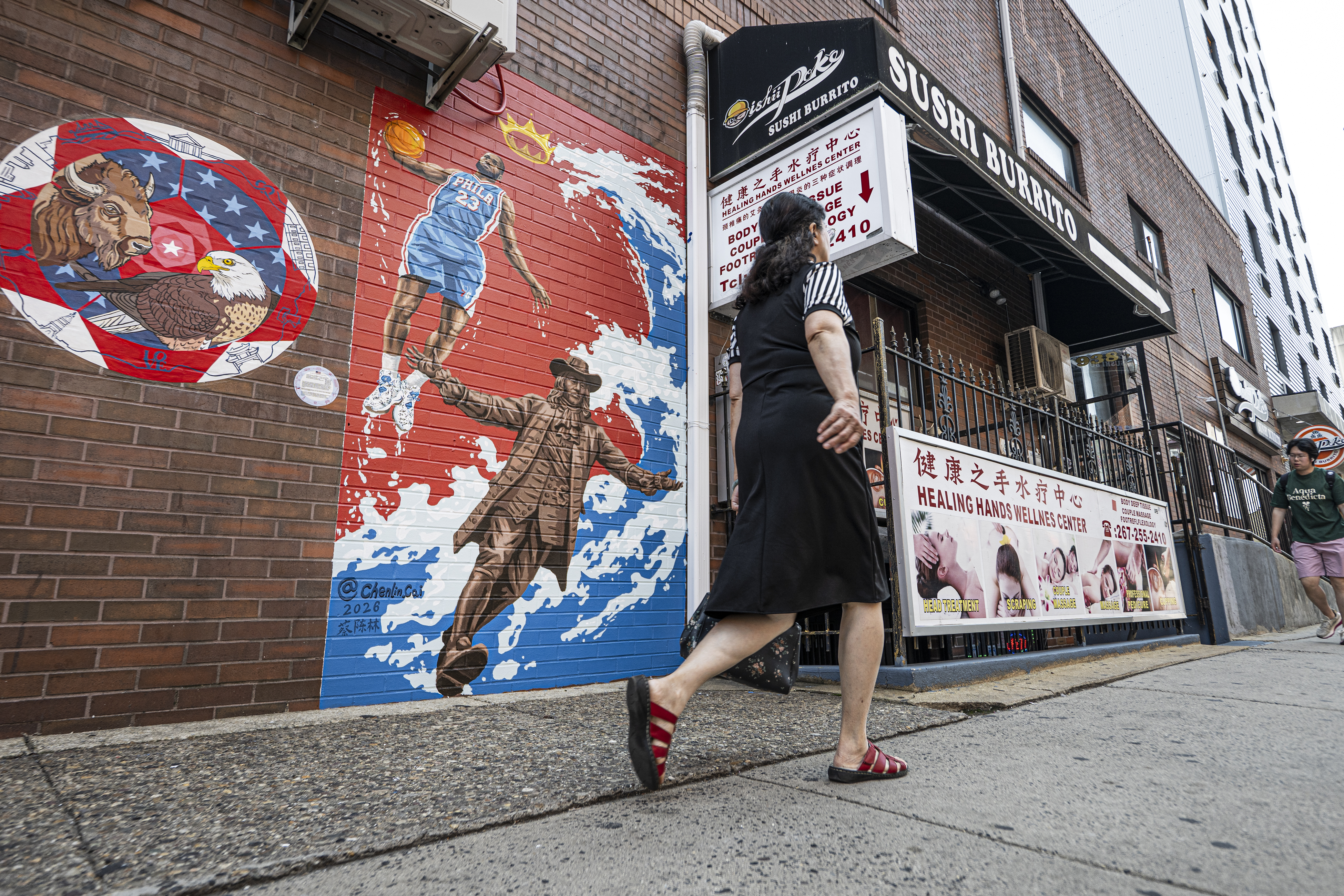
    He replaced Wade with a bronze William Penn, a nod to Penn’s statue atop City Hall, and included a wave reminiscent of The Great Wave off Kanagawa, a famous piece of Asian art, that crests into a dragon image. Cai explained that the dragon represents an ancient Chinese legend known as the “Dragon’s Gate,” which symbolizes hard work, bravery, and good fortune.

    “Just as in the legend, where a fish that leaps over the Dragon’s Gate transforms into a dragon, LeBron’s arrival in Philadelphia portends that his career will reach new peaks. As LeBron soared through the air, the waves rose up and transformed into a dragon,” Cai wrote in the description of his mural.

    No detail was too small. He even matched LeBron’s sneakers to his own favorite pair, which was a Christmas gift from his wife, Xingzi: the Nike LeBron Soldier 14 EP “Sisterhood.”

    “Philadelphia is The City of Brotherly Love, and I wanted to include it for everybody, and because these shoes are called the ‘Sisterhood,’ the whole city is welcoming him,” Cai said, beaming as he took pictures with fans.

    Pedestrians walk past a LeBron James mural at 10th and Arch Streets on Wednesday. Jose F. Moreno / Staff Photographer

    This is not Cai’s first Chinatown mural. He painted the crane mural that went up in 2022 and, more recently, a collection of 20 different World Cup murals celebrating some of the countries that played in the tournament. The U.S. installment is located right next to his LeBron mural.

    Among all his works, this one is extra special for Cai, who isn’t just a lifelong 76ers fan — he’s also been a LeBron fan since before he entered the league.

    “We are the same age. He is like my bro,” Cai said. “I watched him when he was in high school, even in 2002, when he was called ‘The Chosen One.’”

    As people passed by and fist bumped Cai on Wednesday, some stopped to chat about their shared love for the game and excitement over the upcoming season, while others hit the Wade pose for a meme of their own. Each time someone took a picture, Cai encouraged them to post on social media and continue to spread his message.

    “I am just so happy with the attention this has been getting,” Cai said. “It means so much for me and my family, and this is the true purpose of my art, to bring more traffic to Chinatown and help the small businesses here.”

  • Iowa native Derek Hill says Phillies’ Field of Dreams game will be a ‘full circle’ experience

    Iowa native Derek Hill says Phillies’ Field of Dreams game will be a ‘full circle’ experience

    ST. LOUIS — Growing up, Derek Hill usually had to travel away from his home state of Iowa for meaningful baseball competition.

    Baseball lags behind football and wrestling in terms of popularity in the state. So Hill, who is from Des Moines, would often go to places like Kansas City or Colorado for baseball tournaments to face higher-caliber opponents. When he was 14, he moved to California as he started pursuing the sport more seriously.

    But on Thursday, Hill, 30, will return to Iowa as a major leaguer, to play a major league baseball game. It’s something the Phillies outfielder hardly could have imagined on those long drives as a kid.

    “Full circle,” Hill said.

    The Phillies are set to take on the Twins in Dyersville, Iowa, for MLB’s Field of Dreams game inspired by the movie. The game will be held at a ballpark adjacent to the one actually seen in the 1989 film, with a cornfield beyond the outfield fence that the players enter through at the beginning of the game.

    It will be Hill’s first visit to Dyersville, which is less than two hours away from Des Moines. Even after moving away, Iowa remains a special place to him.

    “It made me who I am. I love the people there,” Hill said. “Midwest love, can’t get better.”

    Derek Hill is batting .300 with a 1.114 OPS as a pinch-hitter this season.Monica Herndon / Staff Photographer

    He will have several family members there in person. While it’s a bit too complicated of a trip for his wife and 20-month-old daughter to make for one game, Hill’s mother and brother still live in Iowa, and his sister is flying out from Philadelphia.

    Even though he doesn’t play every day, Hill has certainly made his presence felt on the Phillies in the two months since they acquired him from the White Sox. He has started just 18 games since the June 11 trade, primarily against left-handed pitchers.

    But he’s pulled off numerous highlight-reel plays in the outfield, provides significant speed off the bench, and has come up clutch several times at the plate. That included Sunday, when Hill delivered a walk-off single against Toronto in the 12th inning. Hill has a .233 batting average overall this season. But in 23 plate appearances as a pinch-hitter, that jumps to .300, with a 1.114 OPS to boot.

    With right-handed Taj Bradley expected to pitch for the Twins, it’s unlikely that Hill will start in Dyersville on Thursday. But that just means that there could be an opportunity for some more late-game heroics.

    He’s not the only Phillies player who is excited for the unique experience. Aaron Nola, who is scheduled to start the game, has never been to Iowa and is looking forward to seeing it for the first time. Bryce Harper and Bryson Stott have special gear they are planning to wear, and Harper wants to visit the former movie set to see the place where the film was actually shot.

    But it’s a bit more personal for Hill. Because while baseball once took him away from Iowa, now it’s bringing him back.

    “It’s pretty cool that they’re doing this, and that they built an actual stadium, like full-blown stadium there now. They’re taking it seriously,” Hill said. “I think that’s really cool. It’s bringing a lot of eyes and a lot of positivity to Iowa.”

    Extra bases

    Nola (3-9, 5.47 ERA) is scheduled to start in Dyersville against Minnesota’s Bradley (9-4, 3.76). … Iowa will become the 22nd U.S. state in franchise history that the Phillies have played in.

  • Montco joins thousands of others in suing social media giants over harms to teen mental health

    Montco joins thousands of others in suing social media giants over harms to teen mental health

    Montgomery County on Tuesday sued some of the nation’s largest social media companies in a Northern California federal court, joining nearly 3,000 actions from parents, school districts, cities, counties, and states that say the platforms are harming the mental health of children and teens.

    The social media giants have faced a flood of litigation in state and federal courts, part of a public reckoning over the negative impacts their products are accused of having on young people. The lawsuits allege that the companies have developed platforms that are addictive, especially to young people, and contribute to negative self-image and social isolation.

    Montgomery County is suing Meta, ByteDance, Snap, and Google on behalf of the county’s 148 schools and more than 180,000 minor students, the filing said. It accused the companies and their popular products — including Instagram, Facebook, Snapchat, and TikTok — of negligence and creating a public nuisance.

    “Too many young people are struggling with anxiety, depression, self-harm, and other serious mental health challenges,” Jamila Winder, chair of the Montgomery County commissioners, said in a news release Wednesday. “We believe social media companies must be held accountable for the role their products play in harming young people.”

    Montgomery County’s lawsuit is one of nearly 3,000 cases before a Northern District of California judge through a mechanism called multidistrict litigation. The process allows the federal court system to handle a large volume of similar complaints in one court, usually leading to a number of bellwether trials that help assess the value of a potential global settlement.

    The county’s suit is part of a larger partnership between its board of commissioners and its district attorney’s office “to proactively identify, investigate, and pursue cases against companies whose actions harm consumers or create illegal costs for taxpayers,” the news release said.

    The 2025 Pennsylvania Youth Survey found that 97% of youth respondents have a phone that can access the internet, 81% have a social media account, and 24% spend four or more hours on a school day on social media.

    Those habits are reflected nationwide. As many as 95% of American teens are on social media platforms, and a third report using them “almost constantly,” according to research cited in a 2023 advisory by the U.S. Surgeon General’s Office and highlighted by Montgomery County in its news release Wednesday.

    Teens who spend more than three hours a day on social media platforms have double the risk of depression and anxiety, and half of teens report that social media makes them feel worse about the way they look, according to the advisory.

    Spokespeople for TikTok and Snap did not immediately respond to requests for comment Wednesday.

    José Castañeda, a spokesperson for Google, said in a statement Wednesday that “the allegations in these complaints are simply not true.”

    “Providing young people with a safer, healthier experience has always been core to our work,” Castañeda said. “In collaboration with youth, mental health and parenting experts, we built services and policies to provide young people with age-appropriate experiences, and parents with robust controls.”

    A Meta spokesperson also objected to the allegations, saying the company is “confident the evidence will show our longstanding commitment to supporting young people.”

    “We’ve listened to parents, worked with experts and law enforcement, and conducted in-depth research to understand the issues that matter most. We’re proud of the progress we’ve made, and we’re always working to do better,” the spokesperson said.

    Jury selection began Wednesday in the first of the Northern California trials against the social media giants, part of a case against Meta brought in 2023 by 29 states, including Pennsylvania and New Jersey. The trial itself focuses on New Jersey and three other states.

    Meta said that damages in the case could reach $1.4 trillion, according to Reuters, which is not far from the $1.5 trillion market cap of the company that owns Facebook, Instagram, and WhatsApp.

    (In May, Meta settled for an undisclosed amount in a case brought by a rural Kentucky school district before jury selection took place. The case was slated to be the first bellwether trial in the centralized litigation.)

    In 2023, Bucks County also filed a lawsuit in the litigation concentrated in California federal court.

    The social media giants face legal challenges elsewhere, too.

    Also on Tuesday, Pennsylvania Attorney General Dave Sunday sued ByteDance, the company behind TikTok, in a Pittsburgh state court. That lawsuit accuses the company of creating an intentionally addictive platform and serving inappropriate content to teens as young as 13.

    The companies have argued in courts across the country that they are protected by federal laws that govern the internet, which were enacted before the advent of social media, complex algorithms, and personalized feeds.

    The social media platforms themselves cannot be held liable for the content other people post, the companies have argued in court. And, they said, social media addiction is not an established diagnosis and mental health harm cannot be directly linked to use of a platform, app, or website.

    But jurors in the first trials over social media’s harmful effects rejected most of the companies’ arguments. A New Mexico judge this month ordered Meta to pay nearly a billion dollars, combing a $567 million verdict and a $375 million civil penalty, after a jury found the company had committed 75,000 violations of the state’s Unfair Practices Act.

  • Half the 26 people charged in an NCAA gambling scandal have now pleaded guilty or admitted wrongdoing

    Half the 26 people charged in an NCAA gambling scandal have now pleaded guilty or admitted wrongdoing

    Two people charged with participating in an international scheme to rig basketball games for professional gamblers pleaded guilty in Philadelphia’s federal court Wednesday — the latest development in a scandal that shook the sports world when prosecutors unveiled a sprawling set of indictments earlier this year.

    The pleas entered by Bradley Ezewiro and Alberto Laureano mean that half the 26 people charged with participating in the scheme have admitted their crimes in court or have signaled in paperwork that they intend to do so before trial.

    None of the defendants has been sentenced, and cases remain pending against some of those charged with taking more active roles in the conspiracy — including Shane Hennen, a former Philadelphia resident and prolific sports bettor whom prosecutors have described as a key organizer.

    Still, Wednesday’s guilty pleas — which proceeded with little fanfare — served as a notable moment in a case that has attracted widespread attention as federal authorities across the country in recent years have increasingly been unveiling charges in sports gambling-related prosecutions.

    The U.S. Attorney’s Office announced the charges in January, saying it had arrested 26 people, including 20 basketball players, for participating in a multiyear scheme to fix games in the NCAA and the Chinese professional league.

    The scam was relatively straightforward, prosecutors said: Professional gamblers and some basketball trainers bribed players to underperform in games, and bettors then wagered against the players’ teams at various sportsbooks. The conspiracy involved dozens of games and millions of dollars in fraudulent bets, prosecutors said.

    Some of the bets were placed by Hennen or others in Philadelphia, prosecutors said, including a six-figure wager on a Chinese basketball game at Rivers Casino’s sportsbook in Fishtown.

    And some of the NCAA players charged with participating in the scheme spent time in the Philadelphia area, although none was accused of accepting bribes while playing for a local university.

    Ezewiro and Laureano each pleaded guilty Wednesday to bribery-related charges. Both were accused in court documents of playing supporting roles in the scheme.

    Laureano served as a “fixer” who recruited players into the conspiracy and sometimes delivered them bribe money, prosecutors said.

    Ezewiro joined the operation in 2024 while playing for St. Louis University, and also worked with another fixer to identify other players to bribe, prosecutors said.

    Their pleas came several days after other accused coconspirators also pleaded guilty.

    Over the last week, two former players at the University of New Orleans — Cedquavious Hunter and Dyquavion “Jah” Short — admitted accepting bribes while they played on that team.

    And last week, Shawn Fulcher pleaded guilty to taking bribes while playing at two schools, prosecutors said: the State University of New York at Buffalo and Alabama State University.

    U.S. District Judge Nitza I. Quiñones Alejandro has scheduled sentencing hearings in the coming months for the people who have pleaded guilty.

    A trial for the remaining defendants, meanwhile, is currently scheduled to take place early next year.

  • Battleship New Jersey is getting a 3-story visitor center, double the parking, and more with $24 million upgrades

    Battleship New Jersey is getting a 3-story visitor center, double the parking, and more with $24 million upgrades

    Battleship New Jersey will soon undergo another facelift through a $24.25 million redevelopment project tackling work on and off the ship.

    The project, which could take about two years to complete, includes an expanded visitor center, double the parking, and a new event space.

    Marshall Spevak, Battleship New Jersey’s CEO, said it is the biggest capital investment in the ship since it opened its doors 25 years ago.

    Big J, nearly 2½ football fields long, returned to the Camden waterfront in June 2024 after the World War II-era vessel was dry-docked in Philadelphia for 78 days while it received multimillion-dollar routine maintenance, repairs, and a paint job for the first time in three decades.

    Back on the water, the Battleship New Jersey Museum and Memorial announced plans Wednesday for infrastructure improvements to the ship, along with landside renovations, that are scheduled to start during the second or third quarter of 2027.

    The visitor center at 62 Battleship Place has not changed much since the USS New Jersey went public in 2001, Spevak said.

    Camden Mayor Victor Carstarphen finishes his talk on the Battleship New Jersey during a news conference Wednesday, Aug. 12, 2026 to announce the museum’s multimillion-dollar renovation. Tom Gralish / Staff Photographer

    At the time, the center was deemed temporary. At less than 4,000 square feet, Spevak said, the structure was comparable to a Butler building — a cost-effective, ready-made storage warehouse — and to a shipping container.

    But after 25 years, the nonprofit is looking to build something permanent.

    “Right now, we do what we can,” Spevak said. “But this entire project is building a campus that’s worthy of the ship.”

    The new $9.5 million visitor center, at the same address, will be about 8,700 square feet, more than double its current size. The facility, three stories with a roof deck, will include a new store, a small cafe with a commercial kitchen, exhibit and collection spaces, and offices for staff.

    The plan will also add a level to the current parking lot at Wiggins Marina, which will double visitors’ parking options to 240 spaces.

    Battleship New Jersey’s new visitor center, set to start construction in 2027, will sit along the Camden waterfront in South Jersey. This rendering by PS&S shows the northeast aerial view of the upcoming center.PS&S

    That $5 million parking project will allow all visitors to park in one place, Spevak said, and hopefully resolve confusion drivers currently face when their GPS devices lead them to various spots along the waterfront.

    Battleship New Jersey will also undergo $6 million in upgrades on board, including a new private event space on the main deck, painting and repairs to the ship’s superstructure, new exterior lighting, accessibility improvements, a better generator system, more than $1 million in bathroom renovations, pier repairs, elevator shaft fixes, and more.

    The U.S. Army Corps of Engineers is also set to dredge Big J’s berth, or remove sediment and silt from where the ship currently sits. Spevak said that likely will not take place until the second half of 2027, when the ship will close for a couple of weeks while it temporarily relocates during the dredging process.

    PS&S, an architectural and engineering firm based in Cherry Hill, is leading the project, Spevak said, with help from engineering firm Pennoni. A general contractor has not been assigned to the project yet, though Spevak said that decision could come later this year.

    Battleship New Jersey’s new visitor center, set to start construction in 2027, will sit along the Camden waterfront in South Jersey. This rendering by PS&S shows the west elevation of the upcoming center.PS&S

    The New Jersey Economic Development Authority will support the project with $19.9 million in tax credits awarded through its Cultural Arts Facilities Expansion program, according to Camden County officials. The program incentivizes capital projects at arts and culture spots statewide.

    Because Battleship New Jersey is a public charity and does not pay taxes, the nonprofit has a buyer lined up to purchase the tax credits, Spevak said, which will allow the organization to pay down its debt service on the project.

    Spevak said the nonprofit could not have pursued the renovations, which he hopes will help revitalize the Camden waterfront, without the state program.

    “This project is what will keep us growing on the waterfront,” Spevak said.

    After the tax credits, the outstanding project costs come from “a mix of Battleship funds, revenue, and investments along with a grant from the Camden County Open Space & Historic Preservation Fund,” Spevak said in an email.

    Camden County will help out, too.

    Spevak said the county will support the structure by giving the nonprofit a long-term lease for the parking garage, provide some cash equity, and guarantee the bond required for the project, which allows Battleship New Jersey to borrow using the county’s bond rating and get better interest rates.

  • Montco Intermediate Unit to tighten travel policy after probe into leaders’ trips to Africa and Asia

    Montco Intermediate Unit to tighten travel policy after probe into leaders’ trips to Africa and Asia

    The Montgomery County Intermediate Unit’s board of directors plans to tighten its professional development and travel policies after learning in March that its leaders had used their agency credit cards to purchase overseas trips — including a 14-day African safari — without the board’s knowledge.

    Mark Klein, an attorney and former schools superintendent who conducted a two-month investigation into the trips, told board members at a virtual meeting Tuesday night that, going forward, the board should require Montco IU leaders to receive board approval for travel.

    The current policy, which Klein said includes no such requirement, is “in conflict with many of the school districts that are in the area.” He noted that it is not an unusual policy for an intermediate unit.

    The outside investigation began after The Inquirer reported in March that the Montco IU’s executive director, Regina Speaker, and its assistant executive director, Sandra Edling, had used their procurement cards to book about $40,000 worth of international travel since 2023.

    Speaker has defended the 2023 trip she and Edling took to Kenya and Tanzania, which culminated a yearlong academy for education leaders run by the School Superintendents Association, known as AASA.

    The itinerary included a trip to a tribal school, as well as 11 nights in “handpicked hotels,” six sightseeing tours, and eight wildlife drives in search of zebras, monkeys, lions, baboons, cheetahs, hippos, elephants, wildebeests, and “the exceedingly rare black rhino.”

    “Everything was through the lens of leadership,” Speaker previously told The Inquirer. “It was about that process of survival of the fittest, and how are you a leader, and what do you prioritize.”

    At Tuesday night’s meeting, however, Speaker apologized for the lack of “adequate transparency” around her travel.

    “For anyone who felt disappointed, concerned or uncertain because of my decision, I sincerely apologize,” Speaker said. “I never take your confidence or trust for granted. I remain committed to serving with integrity, humility, and transparency.”

    Records obtained by The Inquirer last year through a Right-to-Know request showed that Speaker in May 2023 made about $9,000 in purchases related to the Africa trip without providing receipts. The only mention of Africa in the records appeared months later when she purchased a Tanzanian eVisa for $139.

    The Montco IU’s then-board president did not sign off on the expenses until after Speaker had returned from Nairobi.

    Klein did not directly address those issues in his presentation Tuesday. He recommended that the intermediate unit conduct an audit of how procurement cards are used.

    Speaker, whose base salary was $298,000 last year, also traveled to South Korea and Singapore for 11 days in April 2025 as part of a $13,000 leadership academy.

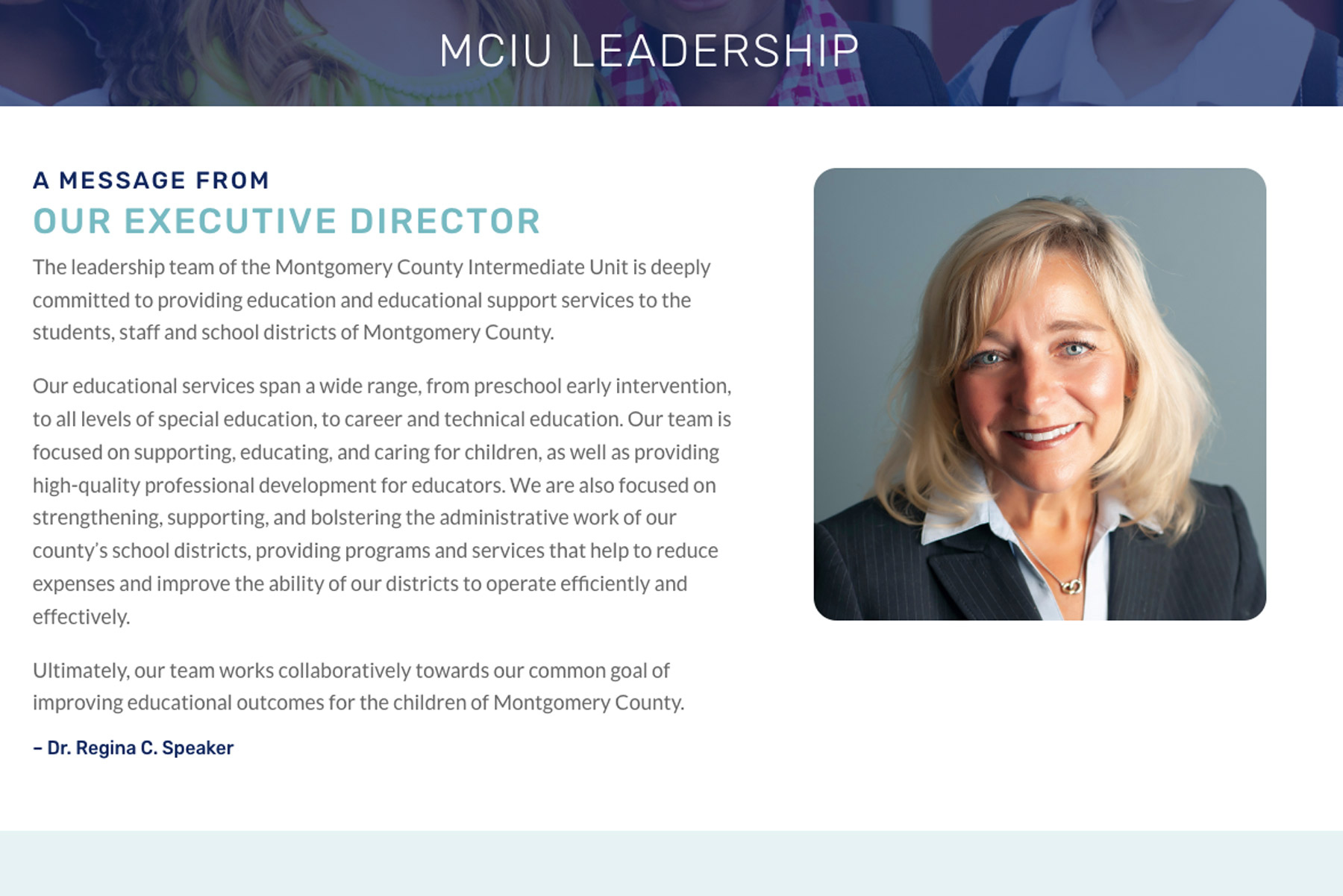
    The profile of Dr Regina C. Speaker on Montgomery County Intermediate Unit’s website.Courtesy of MCIU

    Gary Ledebur, a Montco IU board member who also sits on the board of the Upper Merion Area School District, said that while Speaker, according to Klein’s findings, did not violate any policies, “I think Dr. Speaker took advantage of this lack of policy.”

    “In my opinion, she exhibited an error in judgment,” Ledebur said. “I wish she had chosen not to go on these trips.”

    The intermediate unit, which provides support services to more than 200 area schools, is one of 29 state-mandated agencies in Pennsylvania. It has a $198 million budget and receives a mix of local, state, and federal funding.

    The full 21-person board, which is composed of members from each school district board in the county, will meet later this month. It is expected to accept Klein’s recommendations.

    “We have found some gaps in our policies, and now that we know that, we’re going to do better,” Margaret Wright, president of the intermediate unit’s board, said Tuesday night.

    Expense reports show that in March 2025, Edling, whose base salary last year was $215,000, used her procurement card to make about $7,000 in purchases related to what is described on the purchasing log only as a “conference.” The documents did not name a location or offer specifics.

    The Inquirer reported that the expenses were for a planned 10-day trip to Germany, Switzerland, and Austria in October 2025 sponsored by AASA, the same superintendents group that organized the African safari.

    “Ascend into the Alps for an evening of true Swiss hospitality,” reads the itinerary. “As you feast on beautiful views from your hosts’ mountain chalet, enjoy traditional food, entertainment and fun Swiss games and activities.”

    Two school visits were also planned, according to a brochure, in addition to quick-tempo Viennese waltz lessons, an underground train ride into Austria’s ancient Hallein Salt Mine, and a “journey to crazy King Ludwig’s fairy tale castle of Neuschwanstein.”

    Edling ended up not going on that trip. Speaker said the IU subsequently froze all travel amid Pennsylvania’s budget impasse that had held up much of the intermediate unit’s funding. (The cancellation also came after The Inquirer had requested the records. Speaker said the IU was able to get a refund for that trip.)

    After The Inquirer’s story was published, about 50 people showed up for the Montco IU’s next board meeting, which are usually sparsely attended. At least 225 more joined by Zoom. Intermediate unit employees expressed outrage.

    “The trips felt deceptive and intentionally secretive, and I struggle to understand how they related to our mission,” Liz Forcellini, an occupational therapist at the IU, told the board, adding that some staffers were paying for supplies with their own money.

    Public finance experts said the trips raised larger questions about whether taxpayers should pay the full cost of professional-development outings that include substantial leisure time. Some school administrators who went on the Africa safari paid for it out of pocket, including the head of a New Jersey education service agency who said she also took vacation days.

    “Most of us would consider it a dream trip,” Andrew MacLeod, a personal care assistant at the IU, told the board at the March 25 meeting.

    The saga took a bizarre turn the following evening when Kimberly Wheeler, then a member of the Montco IU board, falsely stated at a public meeting of the Souderton Area School District’s board of directors that The Inquirer reporter who wrote the story “right now is under investigation with the Philadelphia police for misleading information, and reporting on inaccurate information.”

    Sgt. Eric Gripp, a Philadelphia police spokesperson, said in June that the department does not conduct criminal investigations of journalists for their reporting.

    Wheeler later walked back her remarks about a police investigation and said she had been “going by the word of Dr. Speaker.”

    Asked for comment at the time, Speaker sent a 2023 news release issued by Philadelphia Sheriff Rochelle Bilal’s office complaining about a story that had exposed financial problems in her office that year. It made no mention of a police investigation.

    Staff writer Maddie Hanna contributed to this article.

  • Food insecurity in N.J. nearly doubled over four years, new report says

    Food insecurity in N.J. nearly doubled over four years, new report says

    Food insecurity nearly doubled in New Jersey since 2020, with some 1.2 million people struggling to regularly afford food here, according to a nonprofit analysis of federal data.

    Statewide, 13% of Garden State residents could not always count on three meals a day in 2024, the latest federal figures available, up from 7.4% in 2020, according to a new analysis of U.S. Department of Agriculture figures released by the nonprofit advocacy group Feeding America. That included nearly 330,000 children, the analysis found.

    Hunterdon County had the least food insecurity in 2024, with just 7.2% of its residents struggling to put food on the table, while Hudson had the highest rate, with 19.1%, Feeding America found.

    Feeding America has surveyed food insecurity since 2011 and produces the annual “Map the Meal Gap” study to help illustrate the scope of the problem. Nationwide, nearly 48 million people — 14.4% of Americans — meet the federal definition of food insecure, meaning the household did not earn enough to always afford food.

    The latest report notes that the U.S. Department of Agriculture has since canceled its collection of food-security data.

    “Feeding America is collaborating with the nationwide network and partners to explore alternative data sources to ensure local updates can continue in 2027 and beyond,” the organization said.

    In New Jersey, close to 900,000 people benefit from federally funded food stamps, which provide cash payments based on their income level to help them afford groceries. These payments, which average $194 a month, have been shown to reduce stress and boost the local economy, prompting some $33 million in direct spending between 2023 and 2025, according to a report commissioned by the state Department of Human Services, which oversees the food stamp program, formally known as the Supplemental Nutrition Assistance Program, or SNAP.

    “SNAP remains a critical lifeline that helps ensure families can meet their basic needs and maintain food security,” Human Services Commissioner Stephen Cha said when the office released that data in June.

    New Jersey’s food stamp program costs $1.9 billion annually, most of it traditionally covered by federal funding. Feeding America said it would have cost another $920 million to eliminate food security in New Jersey in 2024.

    Changes enacted by the Trump administration recently shifted some of the cost of the food stamp program to state governments. Other changes, including new rules requiring certain recipients to prove they are working, in school, or caring for a loved one at least 20 hours a week, could reduce benefits for some people and force at least 47,000 people from the food stamp program entirely, experts warn.

    In 2022, the state launched the New Jersey Office of Food Insecurity, as part of the Department of Agriculture, to help more families access nutrition. New Jersey had the fifth-lowest prevalence of food insecurity nationwide in 2024, according to the office.