All Jeremy Asch and Abby Armstrong wanted was a good breakfast sandwich close to their Point Breeze home.
“At some point, you say, ‘Screw it, I’ll do it myself,’” Asch said. “If we want it, I’m sure somebody else wants it, too.”
The result is Schmaltz, a new breakfast-and-lunch café at 18th and Wharton Streets serving a deliberately tight menu of latkes, blintzes, and egg sandwiches on house-baked English muffins. Since opening earlier this month, it has drawn lines during its Friday-through-Monday service.
Cheese blintzes, latkes, beet salad, and breakfast sandwich make up most of Schmaltz’s menu.Aidan T. Gallo / Staff Photographer
The sandwich that Asch and chef Sam Chertock devised satisfies that craving with an oniony potato pancake perched atop a slow-baked egg, whose firm texture helps the sandwich hold together. Tallarico’s hoagie spread, blended with seasoned mayo, supplies a Philadelphia accent.
“Are we breaking culinary boundaries? No,” Asch said. “It’s a latke on an egg-and-cheese sandwich.” Customers can also add gribenes — chicken-skin cracklings — and have the English muffin slathered with schmaltz, or rendered chicken fat.
Chef Sam Chertock (left) and owners Jeremy Asch and Abby Armstrong at Schmaltz’s kitchen counter.Aidan T. Gallo / Staff Photographer
Schmaltz joins newer neighborhood arrivals including Little Susie’s Coffee & Pie and Hannah K Cafe. American Sardine Bar, which opened in 2011, is about two blocks north.
The couple bought the building at 1300 S. 18th St. in 2023, creating a wide-open room with an espresso station and order counter, six stools facing the kitchen, six more along the window, table seating, and a small merchandise counter. The couple built a ramp leading toward the rear of the dining room, which toddlers have happily treated as a runway while their parents wait for food.
The building previously housed the Pharmacy, a DIY music venue, art gallery, and coffee shop. Before that, it was the medical practice of Walter Lomax Jr., a pioneering Black physician.
Chef Sam Chertock works at Schmaltz. A pot of jam is on the stove as a side for the blintzes. Aidan T. Gallo / Staff Photographer
That neighborhood accessibility is central to Schmaltz’s approach.
It’s a casual counter, not a full-scale Jewish restaurant or deli, Asch said. The opening menu is deliberately small. Besides the signature sandwich, cheese blintzes, and latkes, there’s a roasted beet salad and a shawarma-spiced chicken salad sandwich on rye, plus coffee, cold brew, espresso drinks, teas, and soda.
But no bagels.
“I will die on this hill,” Asch said. “There’s a lot more to Jewish restaurants than the bagel.”
Selling bagels, he said, can quickly define a restaurant, requiring staff and equipment to produce large quantities while pushing the rest of the menu into supporting roles. Schmaltz may eventually serve a locally made bagel as part of a specific dish, but Asch does not want it to become a bagel shop.
Table seating at Schmaltz.Aidan T. Gallo / Staff Photographer
Instead, the cooking draws broadly from the Ashkenazi and Eastern European food Asch and Chertock grew up eating. The blintzes, made from Asch’s recipe, are filled with lightly sweetened farmer’s cheese and served with Chertock’s jam.
Asch, who grew up in Bryn Mawr and attended Episcopal Academy, did not initially plan a restaurant career. After graduating from Brandeis University, he returned to Philadelphia in 2015 and spent several years working in clinical research at Penn Medicine.
Around the start of the pandemic, he left research and began cooking professionally, first at Grace Tavern. He later worked at Baology with Judy Ni and Andy Tessier before joining a.kitchen.
The tip jar and business cards at Schmaltz.Aidan T. Gallo / Staff Photographer
Ni and Tessier became mentors as Asch and Armstrong navigated zoning, vendors, construction, and the operational details that cannot be learned on the line.
“They took a huge weight off my shoulders of that knowledge burden,” Asch said. “They’re the reason we were able to do this.”
Armstrong, who grew up in Portland, Maine, studied theater at Brandeis before moving into investment and wealth management. She later earned an MBA at the Wharton School. Her work included chief-of-staff and operations roles, experience she likens to staging a complicated production.
“How do we make this whole orchestra, this whole production, work?” she said.
Chertock brings the deepest restaurant résumé of the trio. Trained as an architect at Syracuse University, he worked at a Lambertville firm while cooking nights at Charcoal BYOB in Yardley, his home town. He later joined the opening team at K’Far Cafe, worked his way up to sous chef, and went on to Zahav and Vernick Food & Drink.
Schmaltz merchandise has its own counter.Aidan T. Gallo / Staff Photographer
He found Schmaltz almost by accident. Chertock, who once lived nearby, was biking through South Philadelphia when he noticed the restaurant name on the freshly painted building.
“‘Schmaltz’ immediately caught my attention,” he said.
Despite the term’s cultural focus, Asch said Schmaltz is neither kosher nor intended as a political statement. Asch said his parents worried that openly identifying the restaurant as Jewish might invite problems, but he said the response has been overwhelmingly supportive.
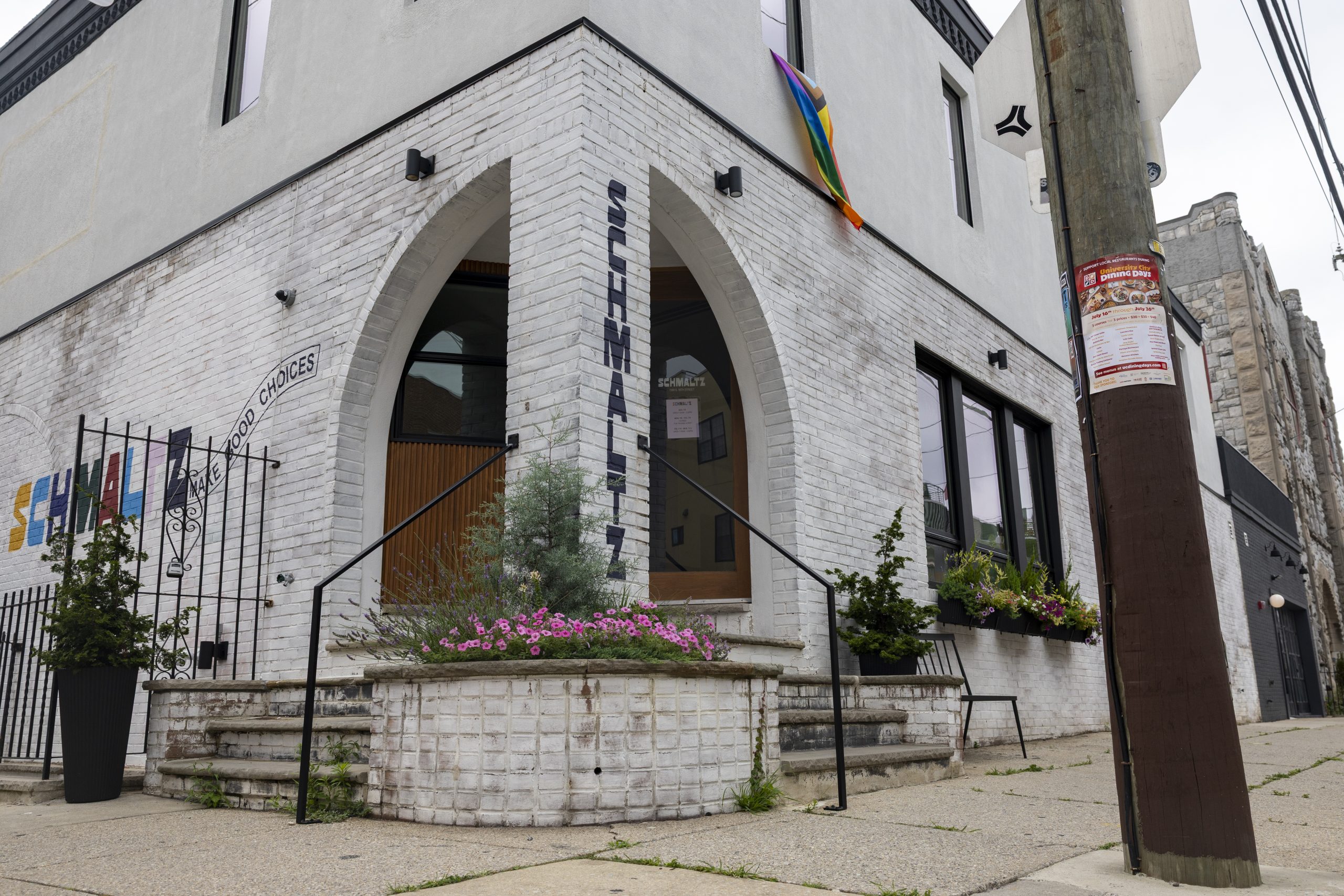
Schmaltz at 18th and Wharton Streets.Aidan T. Gallo / Staff Photographer
“We make food,” Asch said. “Maybe calling it Schmaltz is in itself a statement, but we can’t live in fear about what might happen.”
For now, the more immediate challenge is keeping up with the crowd outside. Asch expects most regulars to come from within a few blocks rather than from Center City.
That suits the couple, who bought the building with the idea of investing in the neighborhood where they live.
“We want to nourish it,” Armstrong said. “We want to be a part of it.”
Schmaltz, 1300 S. 18th St., schmaltzphilly.com. Opening hours: 7 a.m. to 2 p.m. Friday to Monday.
A previous version of this article incorrectly described the ramp in the restaurant. The owners added it to comply with ADA requirements.
The wildfire smoke in Philly is forecast to last into the weekend — and be followed by storms
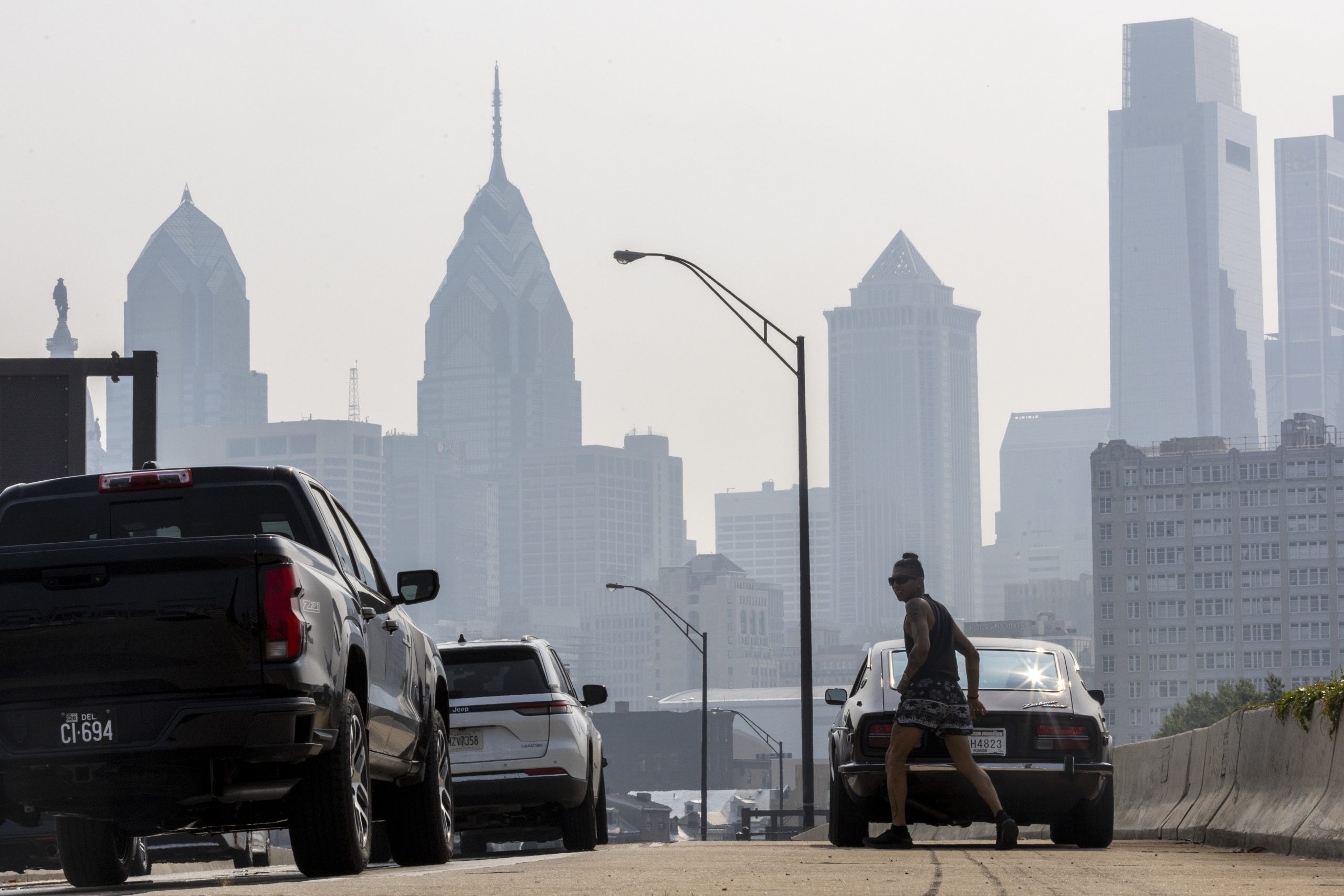
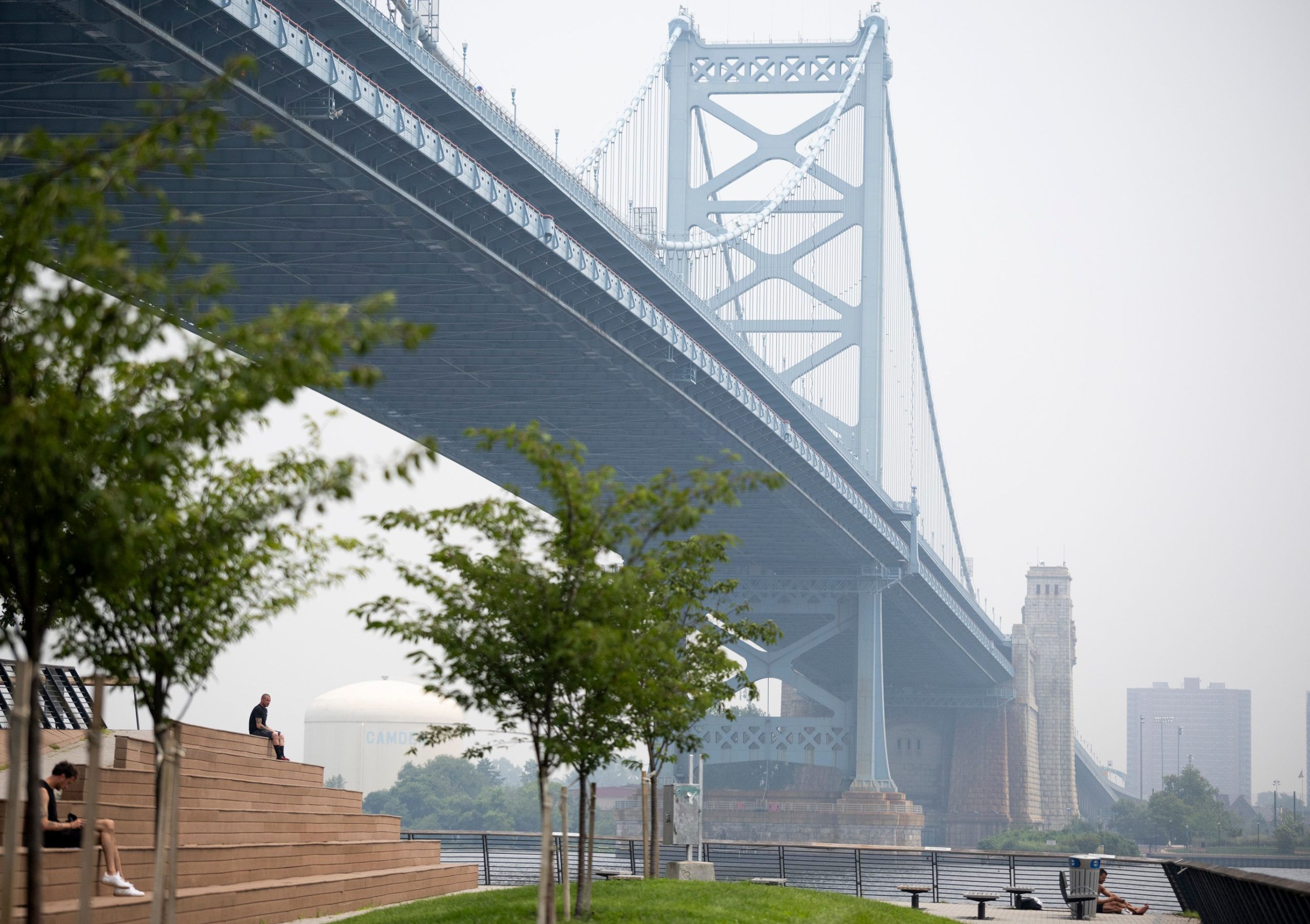
A man gets back into his car from the side of the highway as hazy skies cover the city skyline caused by wildfires in Canada on Friday, July 17, 2026, in Philadelphia.Aidan T. Gallo / Staff Photographer
Impacts from Canadian wildfire smoke increased throughout the Philadelphia region Friday, degrading air quality enough to prompt a code purple alert, and force the closure or suspension of some city amenities and services.
It was the latest bad weather event in Philadelphia’s run of tough luck in July, which has so far resulted in record-setting heat and destructive storms that have marred back-to-back weekends. Smoky conditions arrived Thursday, and were bad enough Friday to prompt the closure of city pools and spraygrounds, and temporarily stop trash pickup.
“Our worsening air quality is a dangerous development,” Palak Raval-Nelson, commissioner of the city Department of Public Health, said in a statement. “I strongly encourage all residents to take action to protect themselves by staying indoors, unless they need to be outdoors.”
Likewise, the Philadelphia Zoo remained closed Friday, saying in a statement that its animals were being “closely monitored.” The city, however, stopped short of recommending the cancelation of outdoor events, and large productions like comedian Shane Gillis’ performance at Lincoln Financial Field and a Death Cab for Cutie performance at the Highmark Mann Center for the Performing Arts were still set to go on as of late afternoon.
Officials said that venue owners had been advised of the conditions, and were able to make their own decisions as to whether those events would happen.
Trash collection in the city was expected to cautiously resume Saturday, officials said. Resumption of services was contingent upon improvement in air quality conditions, which vacillated between code purple and the comparatively less severe code red Friday.
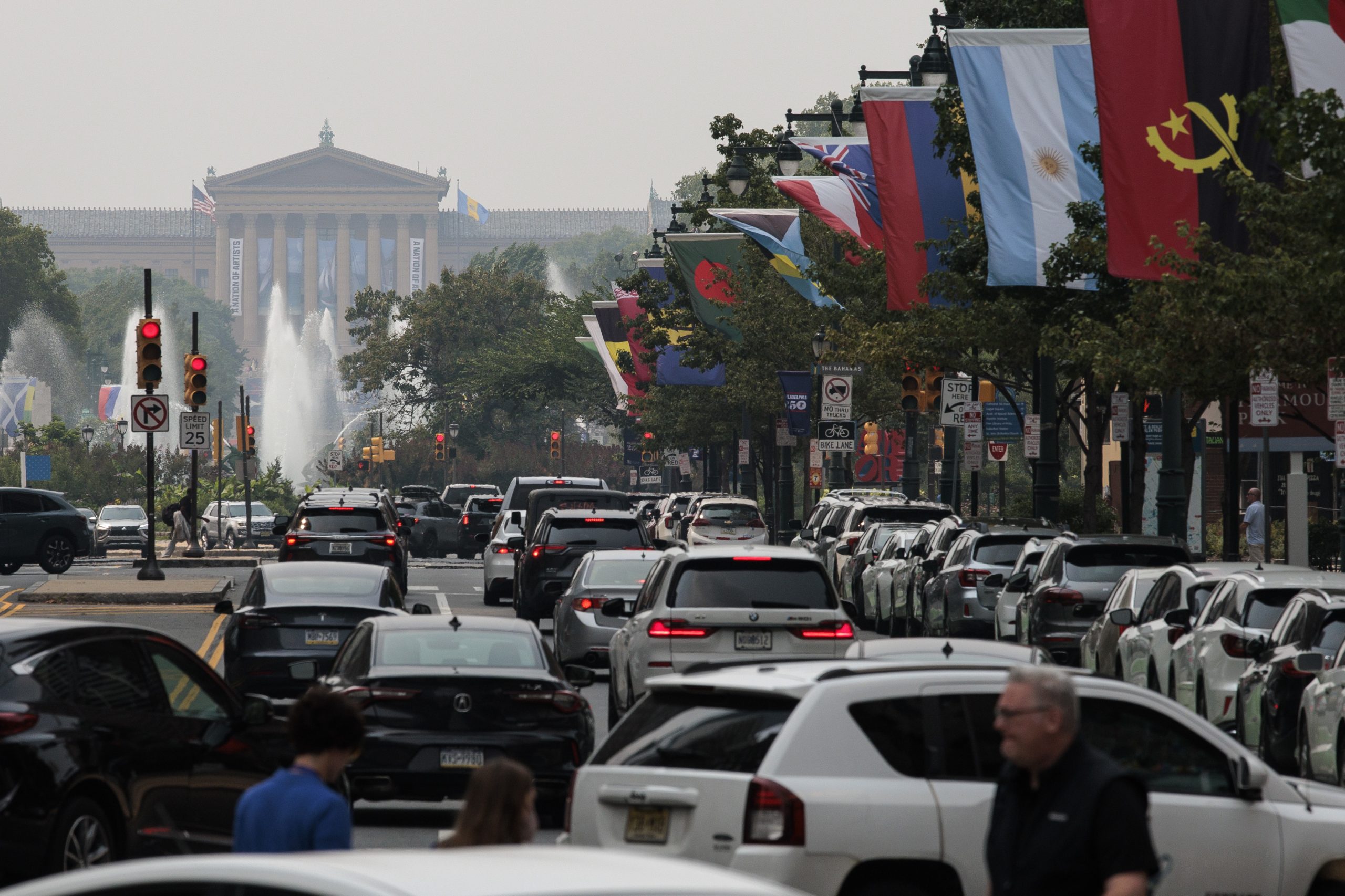
A man adjusts his mask before crossing the Benjamin Franklin Parkway on Friday, July 17, 2026, in Philadelphia.Aidan T. Gallo / Staff Photographer
The Pennsylvania Department of Environmental Protection early Friday evening said air quality continues to improve throughout the state and storms on Saturday will help.
The agency issued a Code Orange air quality alert for Saturday in Philadelphia, Bucks, Chester, Delaware, and Montgomery Counties. The rest of the state is expected to remain in the Code Yellow, or moderate range.
This is an improvement from the Code Red and Code Purple conditions that resulted Friday from the wildfire smoke from Canada.
Rain and thunderstorms on Saturday are expected to help, but improvements will be slower in Southeastern Pennsylvania because the rain will arrive later, the agency said.
During Code Orange alerts, people should avoid long or intense outdoor activities, the agency said. Sensitive groups, including children, elderly residents, and those with respiratory illnesses should avoid all outdoor activities.
The agency storngly advised people to check airnow.gov for current air quality conditions in their area, as conditions may change throughout the day.
Saturday evening gospel concert at Dell Music Center postponed due to air quality
The “Praise Under the Stars” gospel concert at the Dell Music Center scheduled for Saturday evening has been postponed, the center said Friday.
A new concert date would be announced soon, the center said.
“Due to the hazardous air quality conditions affecting our region as a result of the ongoing Canadian wildfires, Praise Under the Stars, scheduled for Saturday, July 18, 2026, at 7:00 PM at the Dell Music Center, has been postponed out of an abundance of caution,” the center said on its website.
“The safety and well-being of our guests, artists, vendors, and staff remain our highest priority. While we are disappointed to postpone this special event, we believe it is the responsible decision given the current environmental conditions,” the center said.
“A new concert date will be announced as soon as possible. All previously purchased tickets will be honored for the rescheduled event,” the center said.
“We sincerely appreciate your understanding, patience, and continued support of the Dell Music Center. Please stay safe, and we look forward to welcoming you back soon,” the center said.
Flights were delayed into Philadelphia due to low visibility
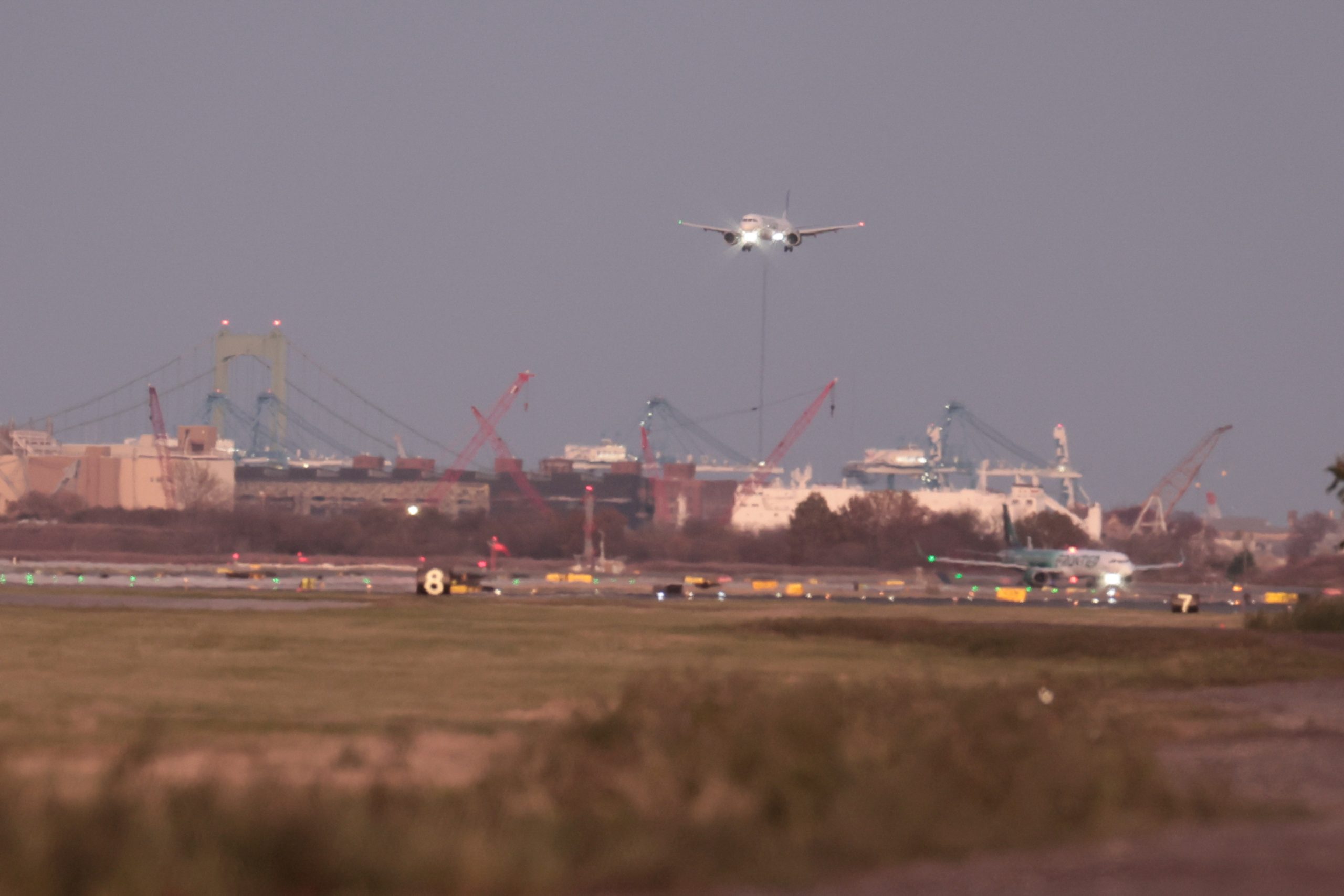
Air traffic at the Philadelphia International Airport is seen here in November 2025.Elizabeth Robertson / Staff Photographer
The Federal Aviation Administration issued a ground delay on flights headed into Philadelphia International Airport Friday afternoon due to low visibility caused by wildfire smoke.
According to FlightAware, 170 flights have been delayed heading into PHL Friday. Currently, the average delay for flights into Philly is 67 minutes, while the longest top out more than two hours.
Departing Philly, there have been 72 delays due to poor visibility.
Travelers are encouraged to check with their airlines for the latest flight information, as the impact of Canadian wildfires is expected to linger across the Philadelphia region Saturday.
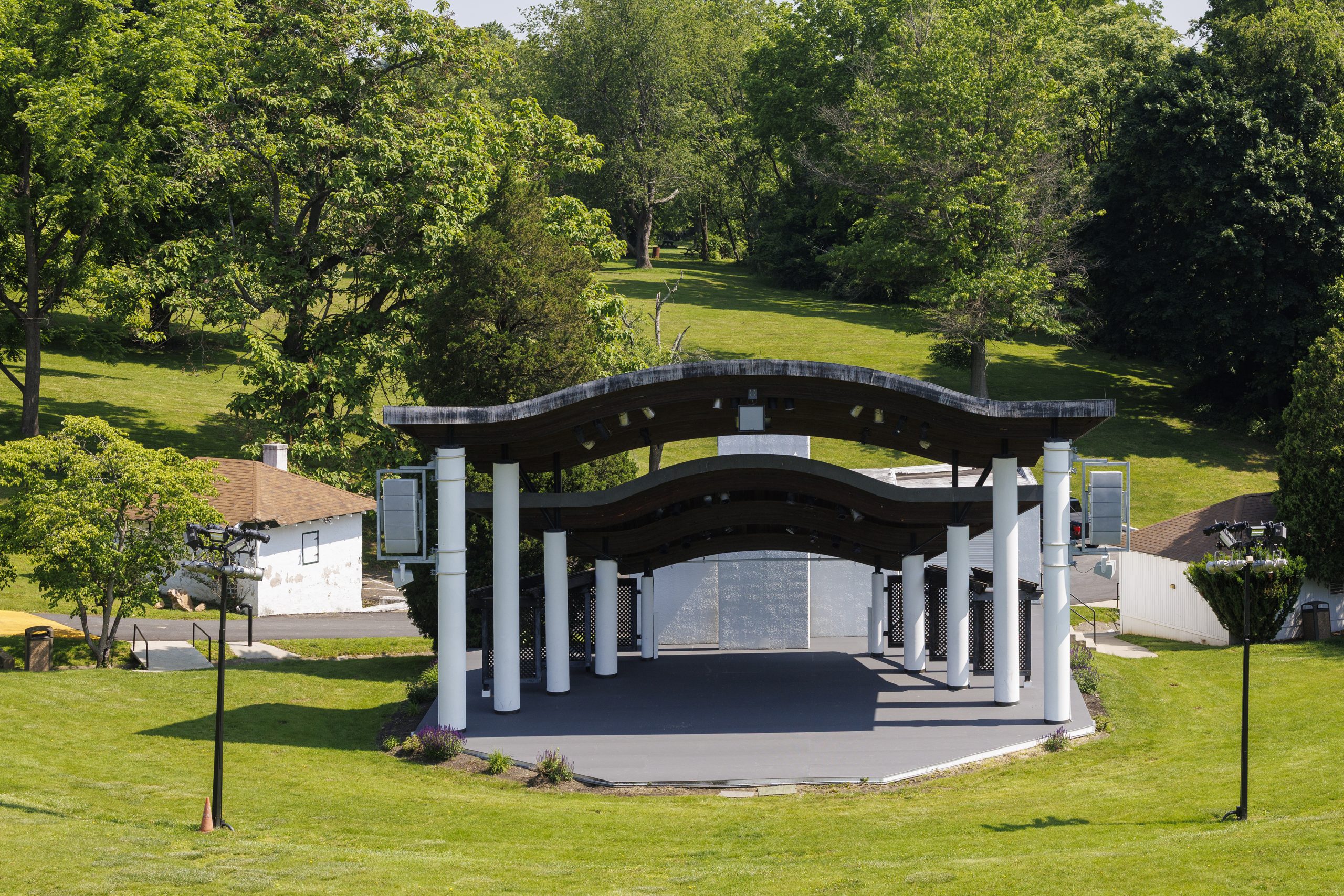
The amphitheater at Rose Tree Park in Media, Pa.Alejandro A. Alvarez / Staff Photographer
Delaware County is canceling two events in Media due to unhealthy air quality conditions — Friday night’s Summer Concert Series at Rose Tree Park and Saturday’s Upper Darby Summer Stage Shooting Stars performance.
“While we understand Delco looks forward to these award-winning performances, we will always continue to put our resident’s health and safety first,” officials said in a statement.
Philly reduced its air quality alert and plans to resume trash collection as well as reopen city pools
A biker wearing a mask along South Broad Street due to the poor air quality.Tyger Williams / Staff Photographer
Philadelphia officials said city sanitation services would cautiously resume Saturday, when smoky conditions brought to the area by Canadian wildfires are expected to improve.
City pools, which were closed Friday amid code purple air quality, were also expected to reopen, pending the air conditions the weekend brings, officials said at a Friday afternoon news conference.
“We will make judgment decisions as to when we will resume collections in terms of a start time tomorrow,” said Carlton Williams, director of the Philadelphia Office of Clean and Green Initiatives. “But we do plan on working all day Saturday and Sunday to ensure that last week’s trash and recycling is collected in time for our services to be on a regular schedule starting Monday.”
Palak Raval-Nelson, the commissioner of the city’s Department of Public Health, said air conditions had at least temporarily improved by Friday afternoon, moving from the more serious code purple to the less severe code red.
(function () {window.addEventListener(‘message’, function (e) { var message = e.data; var els = document.querySelectorAll(‘iframe[src*=”‘ + message.id + ‘”]’); els.forEach(function(el) { el.style.height = message.height + ‘px’; }); }, false); })();
Despite that change, air conditions remained unhealthy, and officials advised that residents remain inside if possible, and limit their exposure outside to no more than 90 minutes at a time.
Air conditions, Raval-Nelson added, could also change again back to code purple, and officials were monitoring the situation.
Pools, said city Parks and Recreation Commissioner Susan Slawson, would reopen Saturday if air conditions were code red or below. If air conditions creeped back into code purple territory, they would remain closed, Slawson said.
Officials said that venue owners had been advised of the conditions, and were able to make their own decisions as to whether those events would continue to go on.
“We provide them with the information, and they make their decisions,” said city Managing Director Adam Thiel.
Storms could clear wildfire smoke Saturday, but flooding is possible
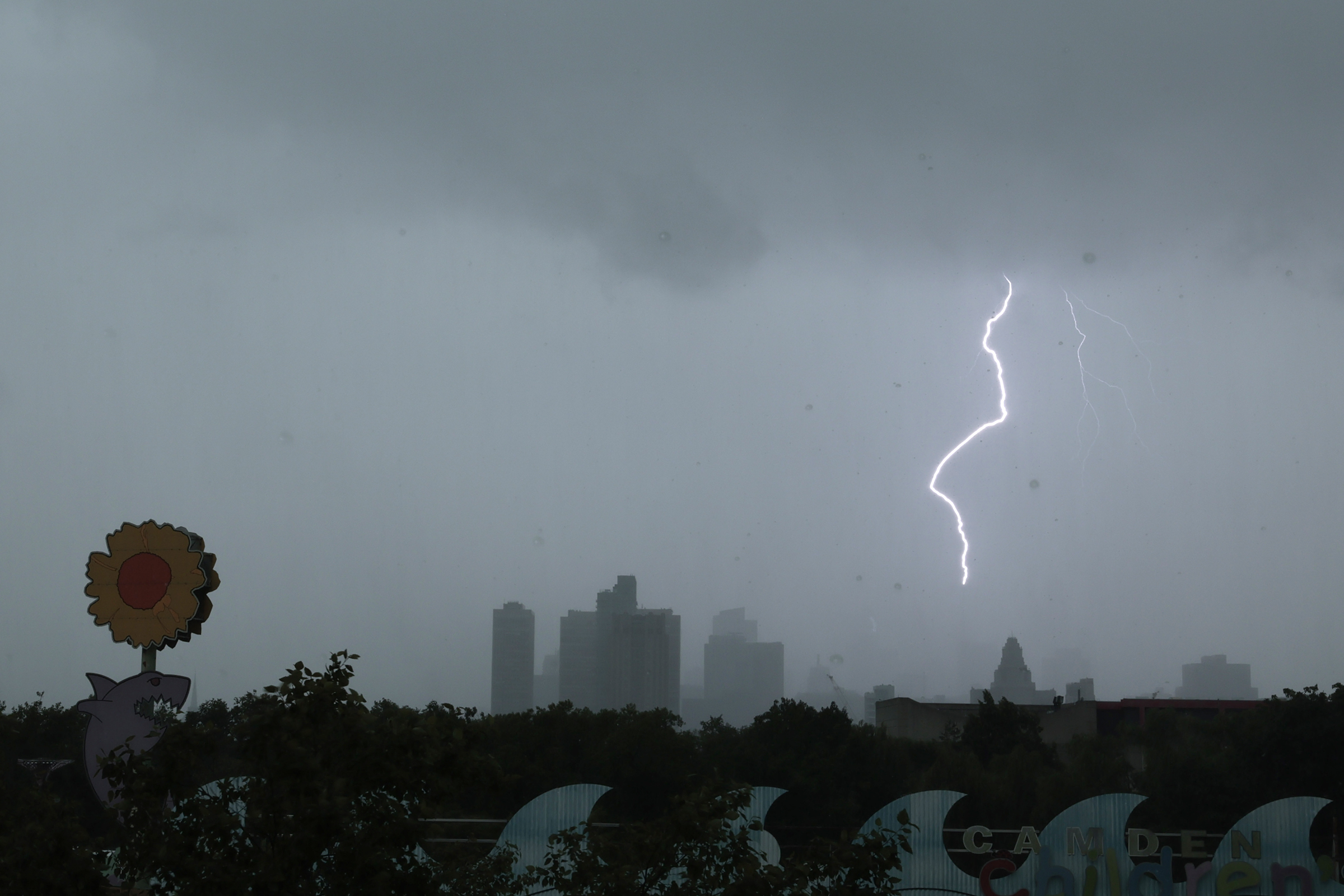
Lightning over Center City Philadelphia is seen from above the Camden Childrens Garden last week..Elizabeth Robertson / Staff Photographer
The city is warning people to prepare for potential flooding Saturday as heavy rainfall is expected to douse the region.
The forecasted Saturday storms likely will clear the wildfire smoke that has hung over the city since Thursday, the National Weather Service said. However, these “multiple rounds of storms” may cause flooding.
The flood watch is in effect from 10 a.m. Saturday through 2 a.m. Sunday, the city’s office of emergency management said. Storms may produce rainfall of two or three inches per hour.
“Be prepared to take action in the event that flooding develops,” the city said. It directed people to a website offering tips and resources.
Berks, Carbon, Delaware, Chester, Montgomery, Lehigh, Bucks, Monroe, and Northampton Counties also are all at risk. So are portions of northern Delaware and parts of New Jersey, including Camden and Gloucester Counties.
“Excessive runoff may result in flooding of rivers, creeks, streams, and other low-lying and flood-prone locations,” the city said. “Creeks and streams may rise out of their banks. Flooding may occur in poor drainage and urban areas.”
Flooding may not be the only problem. Friday morning, the National Weather Service said high winds and a potential tornado could also hit the area Saturday. On Saturday, high winds from four “microburst” storms downed nearly 300 trees in Philadelphia and left tens of thousands of residents without electricity. Philadelphia remains under a disaster emergency declaration as it recovers from those storms.
Bebe Rexha’s FIFA Fan Festival performance appears to still be on
FIFA Fan Festival is going on as scheduled, despite air quality issues.Jose F. Moreno / Staff Photographer
As FIFA Fan Festival at Philly’s Lemon Hill winds down in its last week of activity, Friday’s Bebe Rexha performance is still a go.
The dance pop artist’s free performance at Fan Fest is scheduled to begin at 7 p.m. with gates opening at 5 p.m.
So far, organizers haven’t announced any schedule changes. On Thursday, DEADMAU5’s free performance also went on as scheduled despite the air quality concerns.
The grounds are also scheduled to be open this weekend for the World Cup’s closing matches.
A Death Cab For Cutie and Japanese Breakfast concert at the Mann Center Friday is still on
Death Cab For Cutie play the Highmark Mann on Friday, with Japanese Breakfast opening.Ryan Russell
Friday’s Death Cab for Cutie headlining show at the TD Pavilion at Highmark Mann was expected to proceed as scheduled.
That’s according to officials at the Highmark Mann Center for the Performing Arts. Neither Death Cab for Cutie nor Japanese Breakfast, who is opening, have commented so far.
Anticipation is high for the show, featuring Japanese Breakfast, whose front woman Michelle Zauner has Philly ties. Friday’s show would mark Zauner’s first Philly performance since announcing her pregnancy at her band’s Governors Ball show.
On social media channels, fans have started game-planning: discussing wearing N95 masks to the show as a precaution as questions about the air quality linger.
And while the show must go on (for now at least) at the Highmark Mann and Shane Gillis at the Linc, smaller shows, like a Friday night concert and movie night, are being canceled.
According to a statement, the Chicago 9’s performance at Lindenwold Park and Movies with Metro at Von Nieda Park in Camden are off, citing the air quality.
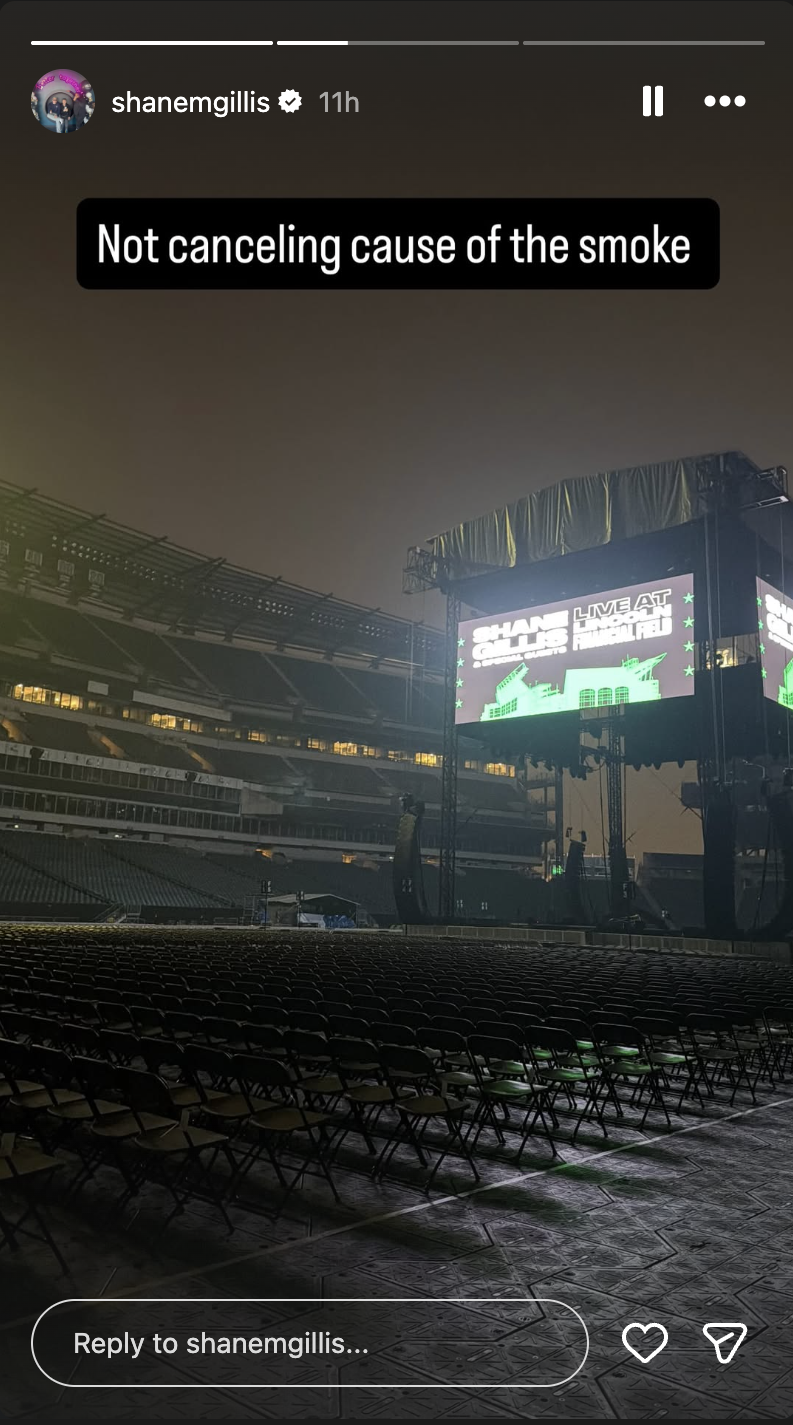
“Not canceling cause of the smoke,” the Mechanicsburg, Pa., native and Eagles die-hard fan posted on his Instagram story, with a sneak peek at the outdoor stage.
Shane Gillis says his comedy show at Lincoln Financial Field Friday night won’t be canceled.Shane Gillis / Instagram
Gillis is expected to perform his edgy, often controversial comedy to a near-capacity crowd. Unnamed special guests are also billed to make appearances.
Gillis cut his teeth in the Philly comedy scene after graduating from West Chester University. He landed a gig at Saturday Night Live butwas fired from the show for having made homophobic and racist jokes on a podcast.
As smoke from Canadian wildfires continues to impact air quality across the region, New Jersey is handing out masks to commuters forced to be outdoors.
“I’ve directed NJ TRANSIT and the New Jersey Turnpike Authority to make select quantities of masks available to commuters and at rest areas along the Turnpike and Parkway. The Port Authority will also be distributing masks,” Gov. Mikie Sherrill said in a statement shared on social media.
Air quality across New Jersey was in the “unhealthy” range as of 10 a.m. Friday morning, with South Jersey faring worse than the northern part of the state.
A station in East Greenwich Township, Gloucester County, reported an air quality index of 191, while Atlantic City was 173, both in the unhealthy range.
During Phillies game, smoke-filled skies were ‘not ideal’ for players
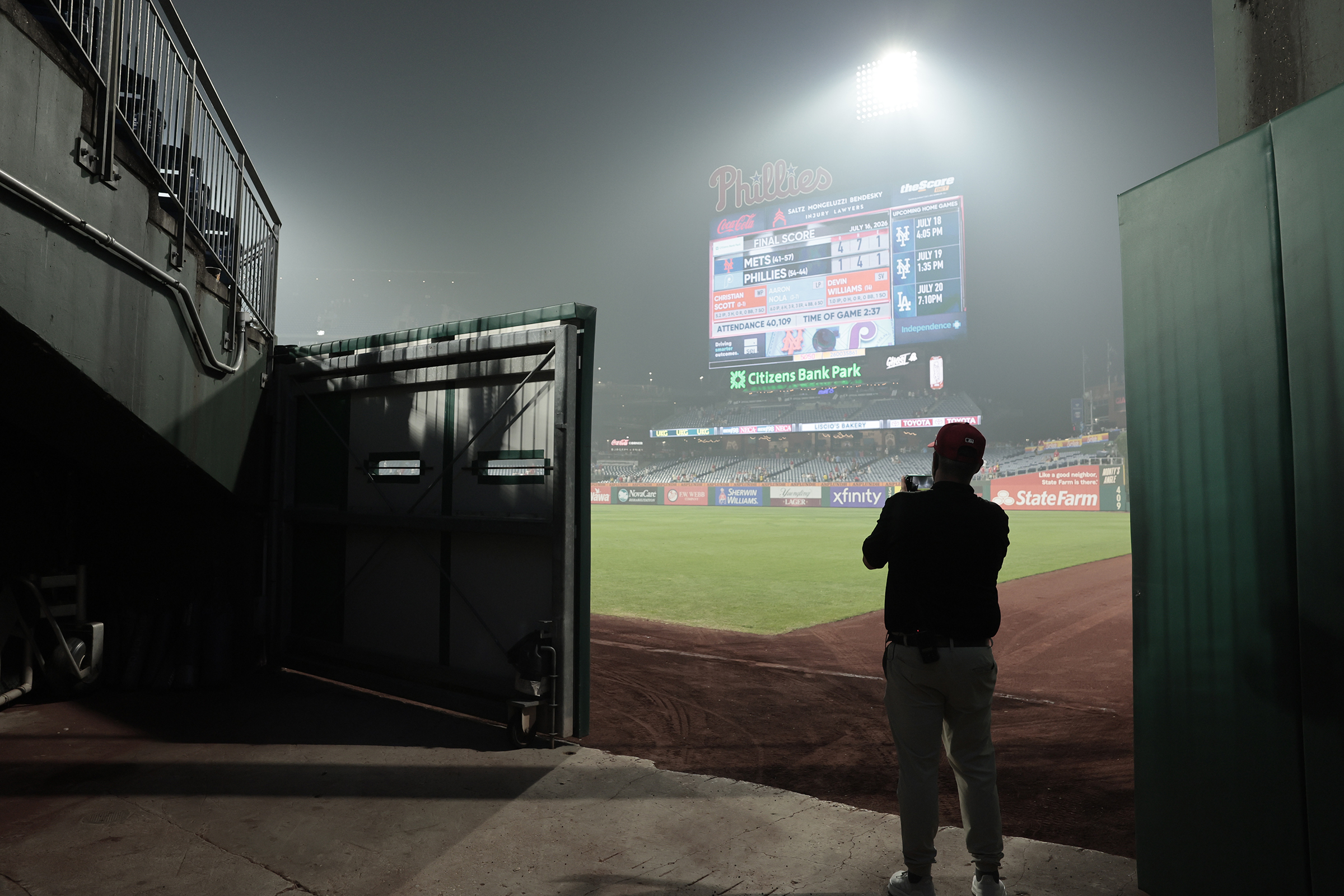
Smoke-filled air lingers over Citizens Bank Park Thursday night. Elizabeth Robertson / Staff Photographer
The Phillies aren’t scheduled to play again until late Saturday afternoon, but Thursday’s game was moved up an hour early because air quality was expected to worsen after sunset.
The forecast proved correct. When the game started, the air quality index was at 157, according to airnow.gov, categorized as “unhealthy.” It rose to 166 by 8 p.m., with the Center City skyline no longer visible from South Philly. By 9 p.m., it was 192.
“It’s not ideal,” Phillies pitcher Aaron Nola said. “But it is what it is. Can’t really do anything about it. It’s one of those days where it was smoky. But I mean, it’s an outdoor stadium. You’ve got to get the game in and play through different conditions.”
Brandon Marsh said home-plate umpire Dan Iassogna, also the crew chief, repeatedly asked players throughout the game if they didn’t feel well or if the conditions were disruptive in the game.
“Yeah, multiple times they were checking with us, asking us players — which was cool to see — if we were good to go, and obviously we were all ready to go,“ Marsh said. ”That was good by them. I wasn’t expecting that, but that was good.”
The Phillies and Mets also altered their pregame routines. Neither team took batting practice on the field and spent “as little time as possible on the field,” interim manager Don Mattingly said.
“Just doing what you absolutely feel like you have to do after being gone for three days,” he added. “Not trying to absorb a bunch of energy when you’re getting heated.”
Current look at air quality in Philly and across the area
(function () {window.addEventListener(‘message’, function (e) { var message = e.data; var els = document.querySelectorAll(‘iframe[src*=”‘ + message.id + ‘”]’); els.forEach(function(el) { el.style.height = message.height + ‘px’; }); }, false); })();
// Timestamp 07/17/26 9:13am
Smoke likely to stay until Saturday afternoon, National Weather Service says
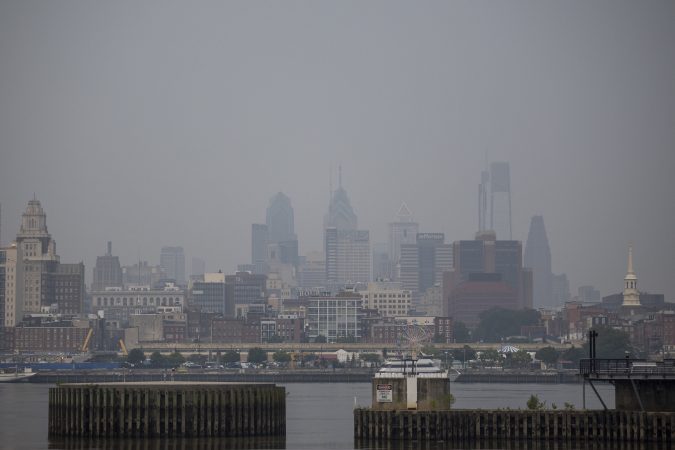
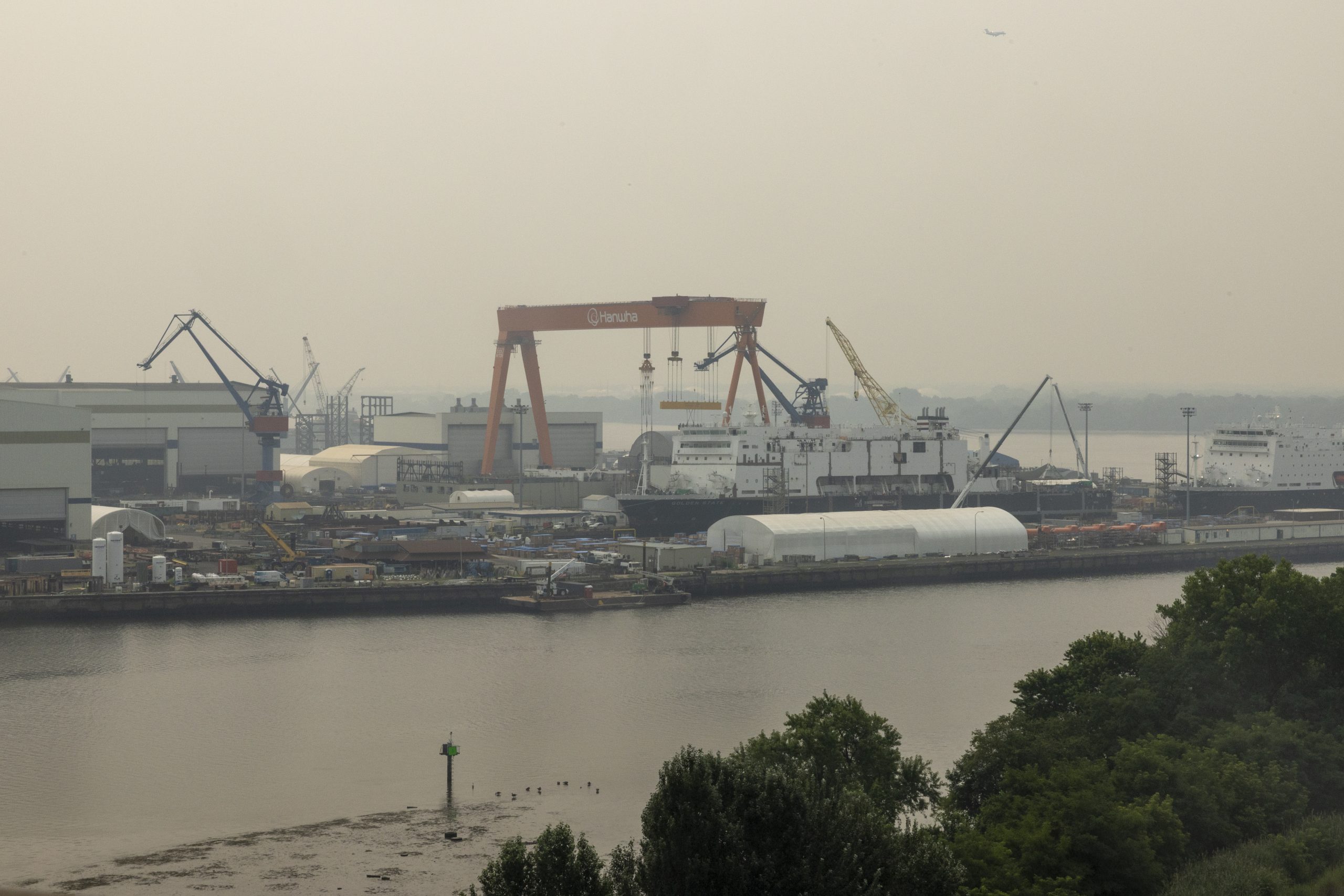
Hazy skies over the Navy Yard in Philadelphia Thursday.Aidan T. Gallo / Staff Photographer
Shifting winds may give Philly a break from the smoke today, but the air quality is likely to remain poor until at least Saturday afternoon, the National Weather Service said Friday.
Wildfires continue to burn in Western Ontario, and northwest winds are blanketing the region with particulate-filled air that gives the sky its hazy appearance, said meteorologist Joe DeSilva.
“As winds shift more northerly today, that’ll push the majority of the smoke south of our area briefly. A resurgence of the smoke is expected tonight as winds shift again,” DeSilva said.
The smoke is forecast out over the next 48 hours, and it’s difficult to predict what happens beyond that timeline, DeSilva said.
However, a storm system expected Saturday should clear the smoke out, he said.
That system will bring its own hazards. DeSilva predicted “multiple rounds” of showers and thunderstorms Saturday, bringing the potential for flash flooding. In addition, “damaging winds” are likely, with the potential for a tornado.
“It definitely looks like damaging winds will be the primary hazard type,” he said.
‘Hazardous’ air quality recorded in Chester as smoke lingers across the region
Air quality across the Philadelphia was poor Friday morning due to wildfire smoke from Canada, with most of the area in the “very unhealthy” zone.
The city of Chester was among the worse, hitting an air quality index of 312 at 7 a.m. Friday. A reading over 300 is considered “hazardous,” with air quality so poor it could be dangerous to everyone.
By 9 a.m., the number dipped down a bit to 279, solidly in the “very unhealthy” category.
An air quality station in Philadelphia The Inquirer is tracking peaked at 291 Thursday night, but had dropped to 250 by Friday morning.
Philly pools are closed and trash pickup suspended as residents are encouraged to stay indoors
The Philadelphia Museum of Art is behind a smoky haze Thursday.Monica Herndon / Staff Photographer
Philadelphia pools and spraygrounds will be closed Friday and trash pickup is suspended due to “very unhealthy” air quality caused by Canadian wildfires.
“Our worsening air quality is a dangerous development,” Palak Raval-Nelson, the commissioner of the city’s Department of Public Health, said in a statement. “I strongly encourage all residents to take action to protect themselves by staying indoors, unless they need to be outdoors.”
As of 7 a.m., Philadelphia’s air quality index was 267, solidly in the middle of the “very unhealthy” range, which means the the general public is at risk for serious heath effects.
Especially at risk are residents with heart or lung conditions, who should take “extra special care” outdoors, Raval-Nelson said. Children, older adults, pregnant women, and people with weakened immune systems are also at higher risk.
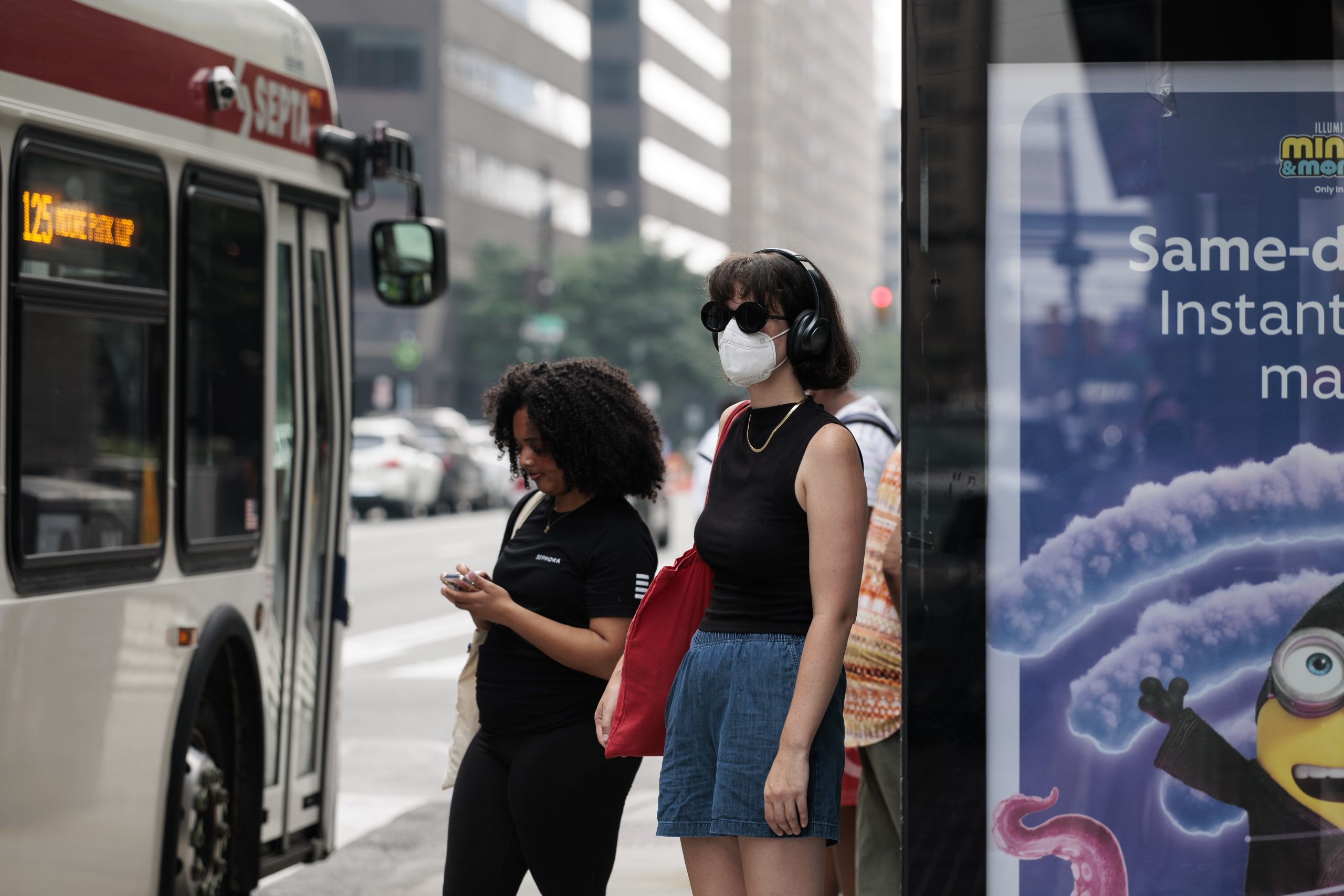
Raval-Nelson said residents should avoid going outdoors unless necessary, and those that do leave should wear an N95 or KN95 mask.
“This situation is dangerous, and if we all take care and look out for each other we will get through this,” Raval-Nelson said at a news conference Thursday night.
People experiencing symptoms including trouble breathing, heart palpitations, nausea, or dizziness are encouraged to seek immediate medical attention.
Despite the warning, most city services will operate normally. The city is not recommending outdoor events be canceled, and employees working outdoors are being encouraged to take frequent breaks and mask up.
A ‘code purple’ air quality alert is in place across Pennsylvania
John Burns Jr., of Grays Ferry, Philadelphia, Pa., sits out at Cherry Street Pier with the wildfire smoke from Canada Thursday.Tyger Williams / Staff Photographer
The smoke, which is expected to blanket the region at least through Friday, originated from fires burning in Western Ontario, said Sarah Johnson, a meteorologist at the National Weather Service’s Mount Holly office.
The Pennsylvania Department of Environmental Protection has declared a Code Purple Air Quality Alert for Friday. Code purple signifies very unhealthy air, meaning people should avoid long or intense outdoor activities, and sensitive groups should avoid all outdoor activities. The department suggested not using gas-powered lawn and garden equipment, and avoiding the burning of leaves or trash.
The smoke was swept in by winds that mixed to keep it closer to the ground.
“It’s just a factor of the winds at all levels kind of working together,” Johnson explained.
It is difficult to pinpoint when the air quality might return to normal, she said. Those forecasts come from state environmental protection departments and are usually no more than 48 hours out.
Rain forecast for Saturday could help suppress the smoke, Johnson said, but it’s too early to be sure.
What to know about the wildfire smoke in Philly and its health impacts
Penn State graduate student Ray Boone waits for the bus with a face mask because of the air quality Thursday.Monica Herndon / Staff Photographer
As Canada grapples with hundreds of active wildfires, the rest of North America is feeling the impacts with air quality alerts.
In Philadelphia and elsewhere, the air quality score is considered very unhealthy, particularly for the most sensitive people.
Whether you are planning to go out or stay home, here’s what three experts had to say about staying healthy and what precautions are needed:
What makes this smoke so toxic?
Exposure to this particular fire smoke is a serious matter due to “photochemical aging,” said Eric Balaban, a pulmonary and critical care fellow at Temple University.
As smoke travels, it interacts with oxygen, heat, and sunlight, creating a toxic profile that helps generate high levels of ground-level ozone and highly irritating aerosols, Balaban said.
Ground-level ozone is a pollutant that forms when nitrogen oxides and volatile organics emitted by vehicles, power plants, and industry react in sunlight, especially during hot days such as Thursday.
The pollutants aren’t the only problem.
The fine particulate matter within the smoke is small enough to cross from the lungs directly into the bloodstream, Balaban said, increasing the risk of heart attacks and strokes, in addition to causing acute chest tightness, shortness of breath, and dizziness in otherwise healthy people.
This map shows air quality in the Northeastern U.S.
(function () {window.addEventListener(‘message’, function (e) { var message = e.data; var els = document.querySelectorAll(‘iframe[src*=”‘ + message.id + ‘”]’); els.forEach(function(el) { el.style.height = message.height + ‘px’; }); }, false); })();
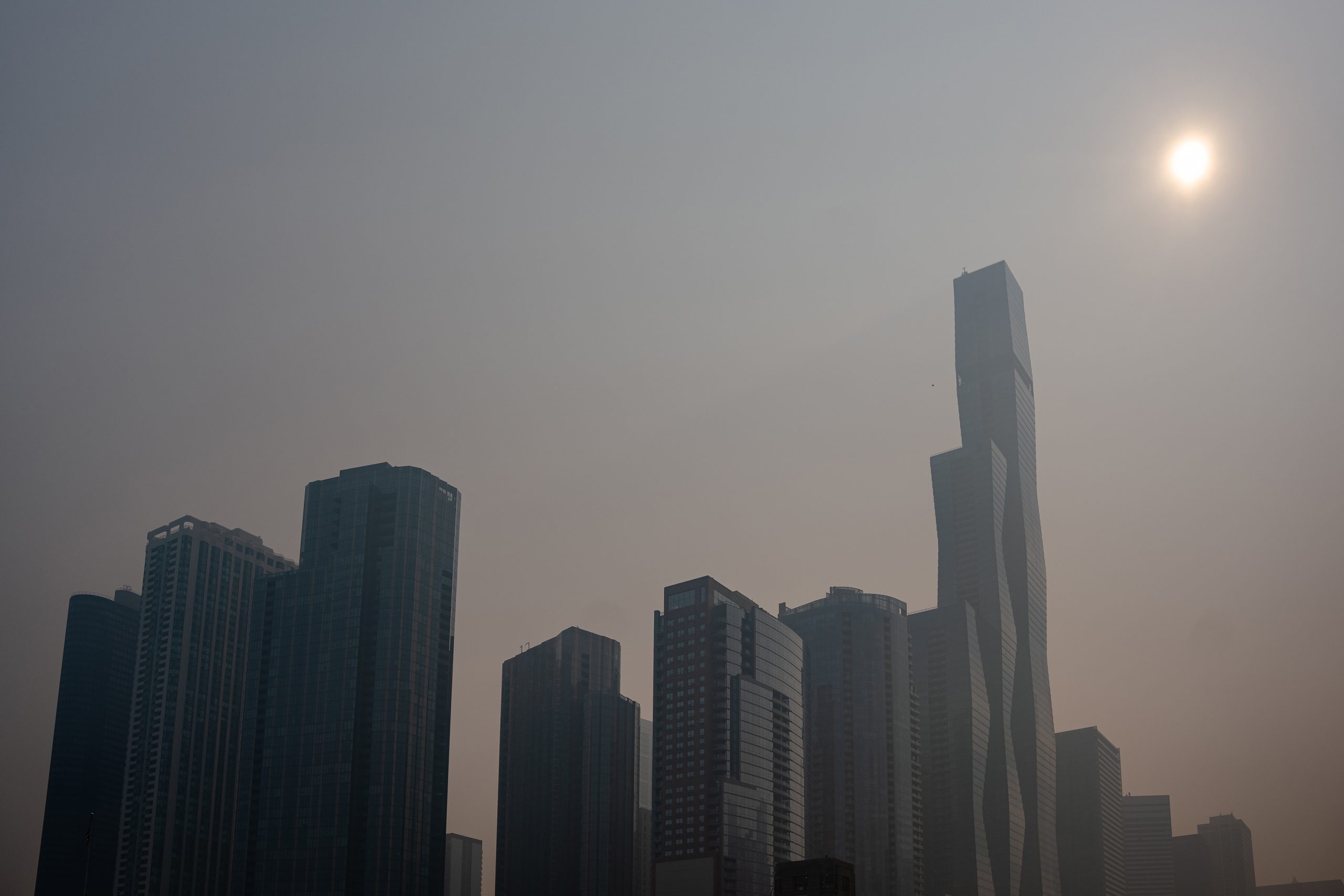
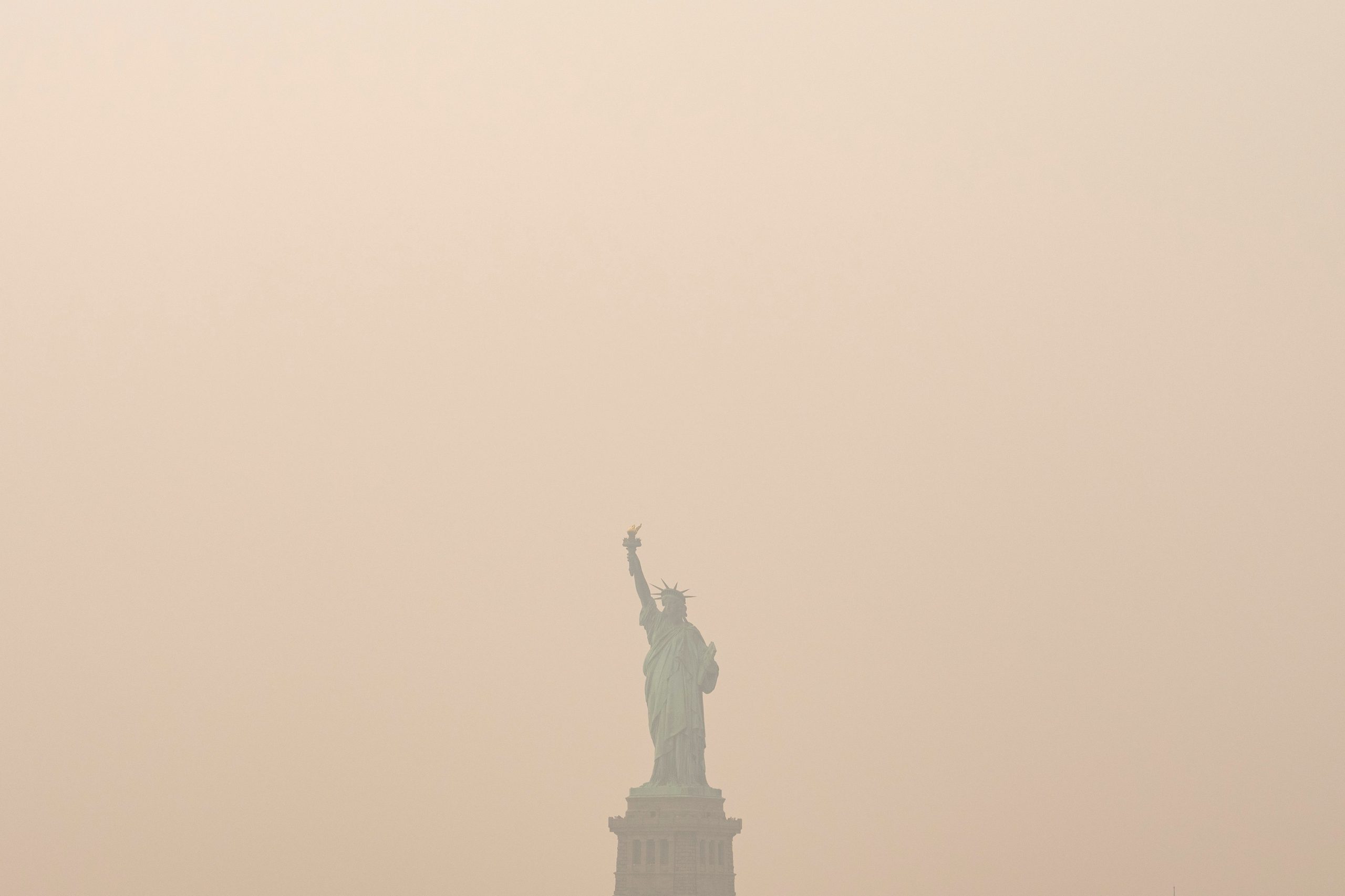
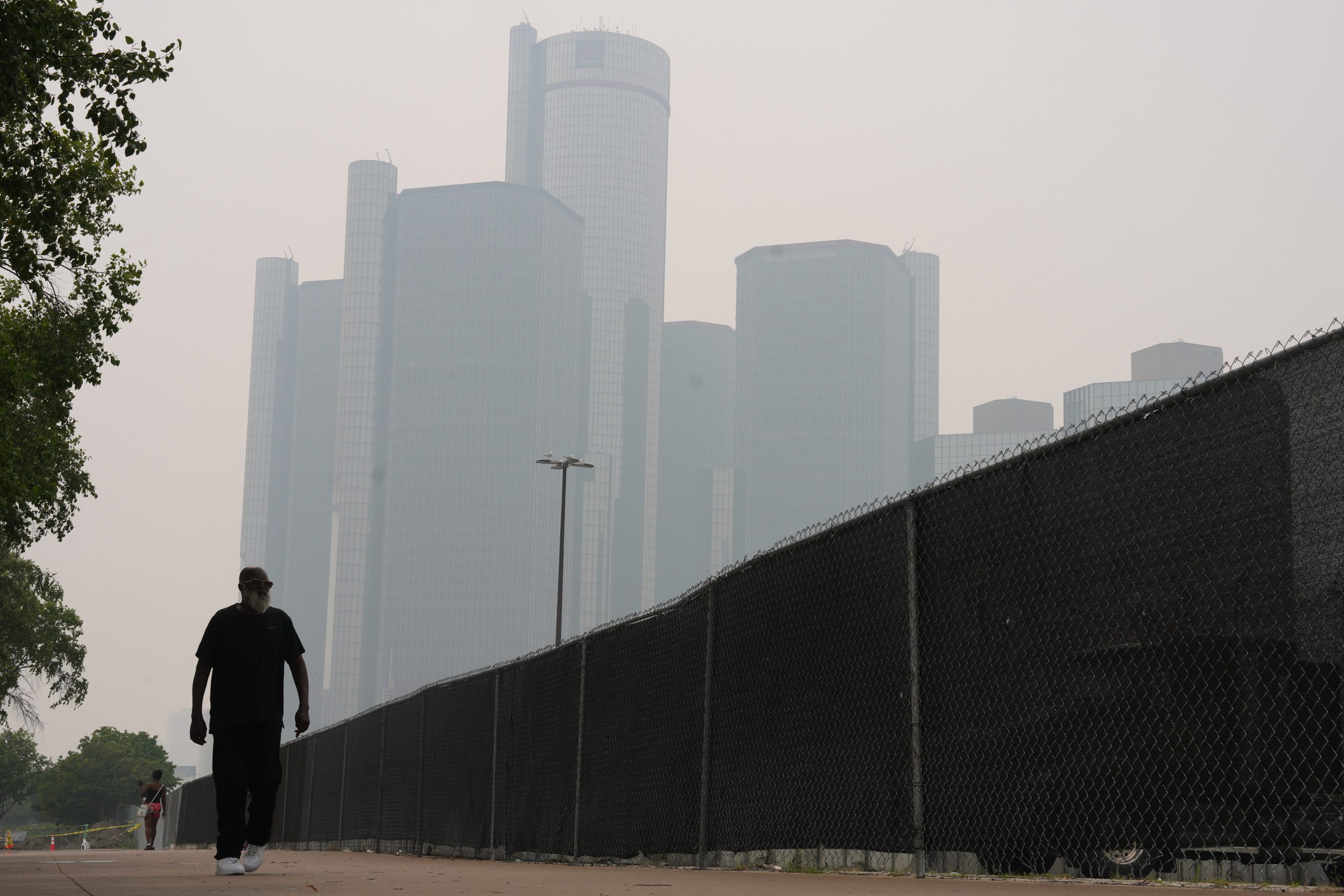
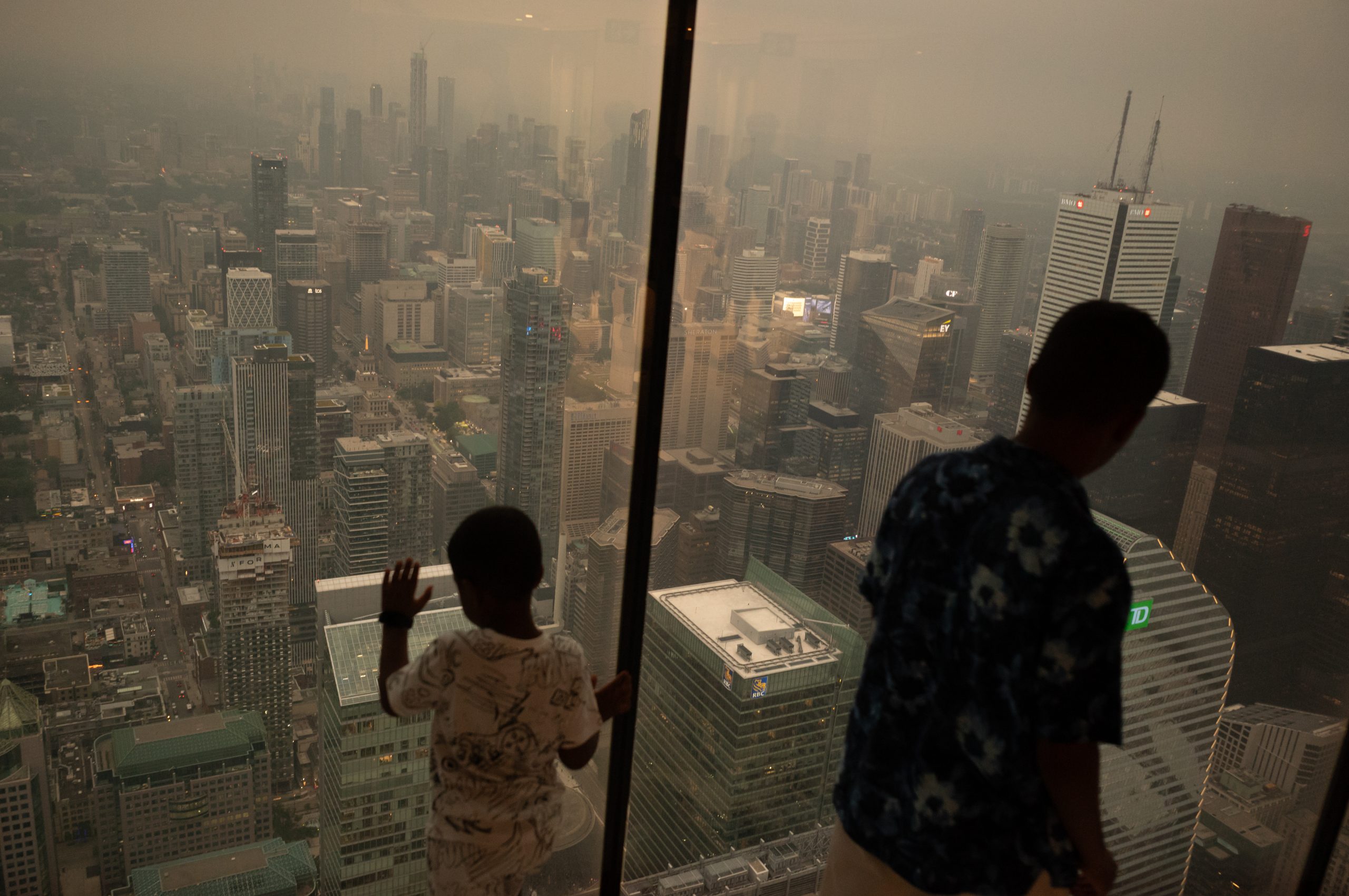
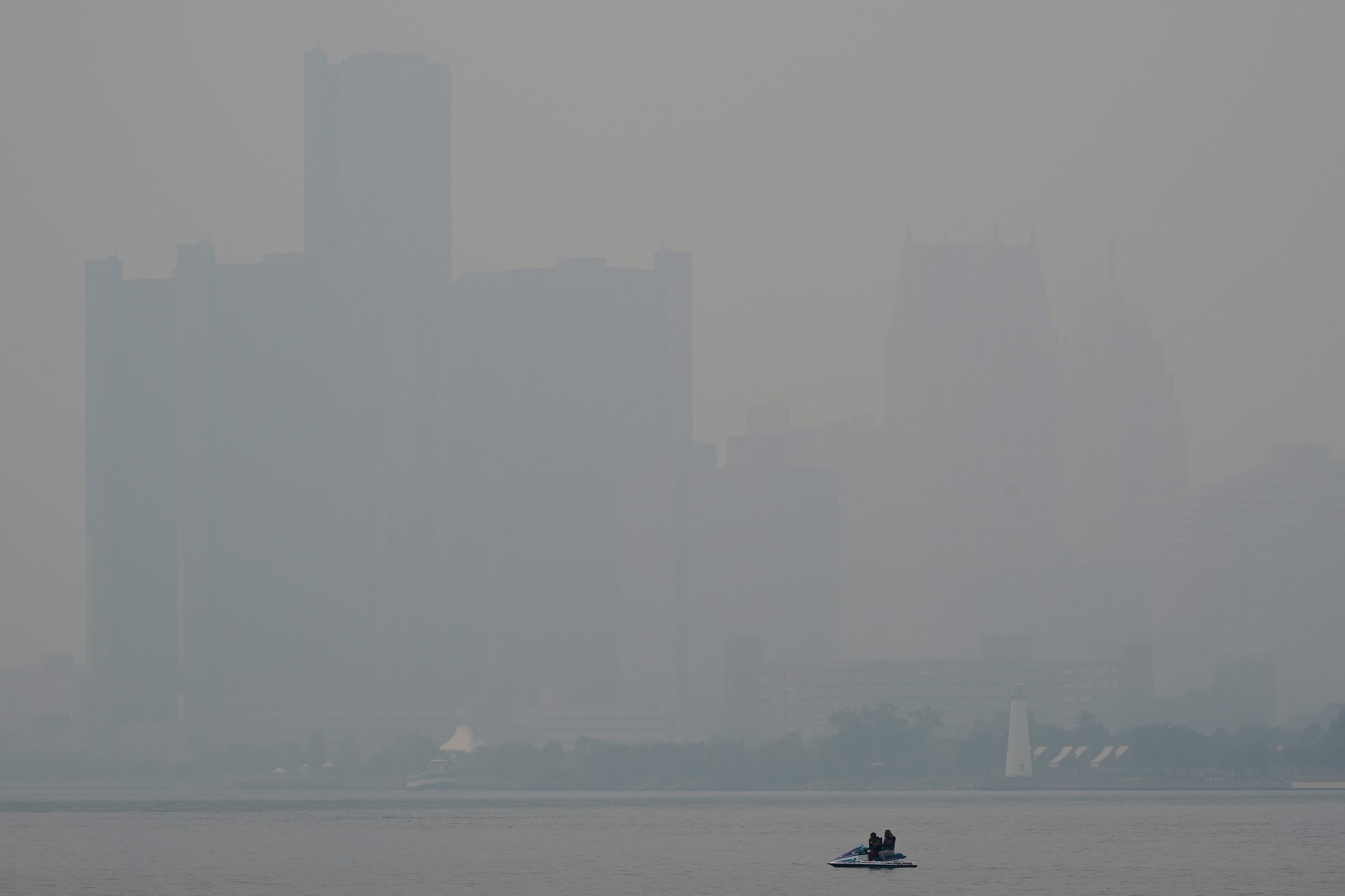
The sun peeks through a blanket of smoke over the Chicago skyline Thursday.JAMIE KELTER DAVISThe Statue of Liberty, seen from the Staten Island Ferry as smoke from wildfires blankets the sky.Yuki IwamuraA man walks along the Detroit River during poor air quality due to smoke from Canadian wildfires.Paul SancyaChildren look out at downtown Toronto from the observation deck of the CN Tower.IAN WILLMSA watercraft sits in the Detroit River near the skyline during poor air quality due to smoke from Canadian wildfires.Paul Sancya
Canadian wildfire photos: How things look elsewhere
Heat that hit Europe exceptionally early and hard this year appears to have led to a spike in deaths, with well over 10,000 more people dying at the height of the heat wave than would normally have been expected, according to figures that are still emerging across the continent.
Measures of what researchers call “excess mortality” — the difference between the normally expected number of deaths and the actual number — spiked in late June, when parts of Europe experienced record temperatures. Experts caution that it takes a while for a full picture to emerge, and that many heat-related deaths will never formally be recorded as such. For example, a heart attack, which can be triggered by extreme heat exposure, especially in people who are older or have underlying health issues, may be listed on a death certificate simply as a heart attack.
It’s an alarming start to the summer. Several heat waves have killed thousands of people in the past few years in Europe. Still, 2003 stands as the deadliest year in Europe for heat, with about 70,000 deaths. The frequency and intensity of heat waves are supercharged by climate change, which comes from the burning of fuels like coal, oil and gas.
An exceptionally deadly week in early summer 2026
The EuroMOMO mortality monitoring hub, which receives data from two dozen countries, gave an estimate of 14,260 for excess mortality from all causes in the week ending June 28, more than 12,000 of those deaths being among people age 65 and older. That’s out of a total 84,583 deaths that week. Figures in the preceding and following weeks were far lower.
Lasse Vestergaard of Denmark’s Statens Serum Institut, which coordinates EuroMOMO, said that “we attribute this to the heat wave affecting quite a lot of countries in Europe, and we do that because there is no other obvious explanation that could explain such a high excess mortality happening at the moment.”
Such a high excess in a single week is “highly unusual,” he added. EuroMOMO doesn’t give absolute numbers for individual countries, but found the highest rates of excess in France, Belgium and Germany.
Nations that bore the brunt of the heat have issued their own estimates — which don’t always follow the same methodology or timelines. Here is a snapshot of heat-related deaths being reported by various countries.
Germany
Germany’s disease control center, the Robert Koch Institute, directly attributed 6,830 deaths to heat this year through early July, 6,470 of them among people 65 and older. Temperatures in Germany late last month hit their highest levels since records began, peaking with a measurement of 41.7 degrees Celsius (107.06 Fahrenheit) on June 28, according to the German Weather Service.
United Kingdom
Britain’s Met Office, the national weather agency, said that 2,700 people are believed to have died from heat-related causes during heat waves in England and Wales in May and June. Of those deaths, it says that about 550 occurred in late May and about 2,200 in late June. This year brought national heat records for May of 35.1 Celsius (95.18 Fahrenheit) and for June of more than 37 Celsius (98.6 Fahrenheit).
France
France’s public health authority said there were at least 2,000 more deaths in the week of June 22-28 than the previous week, when temperatures were already climbing. France recorded its hottest-ever days on June 24 and 25, when the Meteo France weather service said the national thermal indicator — an average of daily temperatures measured at 30 weather stations — hit 30 Celsius (86 Fahrenheit). More than 40% of France saw peak temperatures of above 40 Celsius (104 Fahrenheit).
Spain
An estimated 937 deaths in Spain in June were attributed to excess heat, according to the Carlos III Health Institute, an official Spanish monitoring agency. Last month was Spain’s second-hottest June on record, with temperatures 3.2 Celsius (5.8 Fahrenheit) above the monthly normal average, according to the AEMET weather agency. A five-day heat wave saw temperatures regularly surpass 40 Celsius (104 Fahrenheit), AEMET said.
Belgium
There were 1,747 deaths above what would usually be expected during the heat wave that ran from June 18 to July 1, according to Sciensano, Belgium’s public health institute. It said that “a certain excess mortality is expected during heat waves, as during waves of cold weather and flu epidemics. Nevertheless, the heatwave of June 2026 is distinguished by its exceptional breadth.”
At the peak of the heat wave, there was a measurement of 35.5 Celsius (95.9 Fahrenheit) on June 26, the IRM weather institute said.
Netherlands
An initial estimate of excess death figures from the June heat wave found that the Netherlands had 480 more deaths than expected, according to the public health service. Increased mortality was particularly notable in eastern and southern areas, where the temperatures were the highest.
The country saw its highest temperature ever for June, with the Dutch weather service registering 36.8 degrees Celsius (98.24 Fahrenheit). That’s more than a degree Celsius (1.8F) higher than the previous record, set in 1947.
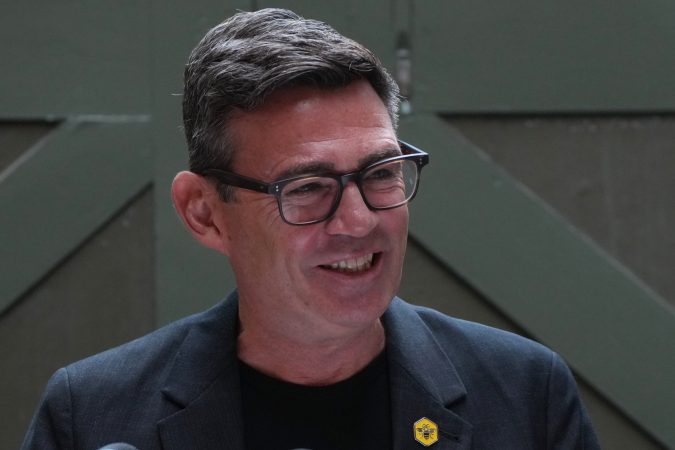
LONDON — Andy Burnham was officially declared leader of Britain’s governing Labour Party on Friday, promising to bring hope to the British people and purpose to the floundering government as he cleared his final hurdle to take office as prime minister next week.
The former mayor of Greater Manchester was the only contender in the center-left party’s leadership contest to replace departing Prime Minister Keir Starmer, who was forced out by a rebellion within his party. Friday’s announcement was a foregone conclusion after Burnham secured nominations from 379 of the 403 Labour lawmakers in the House of Commons.
Burnham pledged to serve “people and places who have been waiting too long for politics to let them hope again.”
“We’re going to give them hope back,” he told an audience of lawmakers, party activists, and trade union leaders in his first speech as leader. “I am ready.”
“I have a plan,” he added, in a bid to reassure a party that has seen its popularity nosedive since winning a landslide election victory two years ago. He pledged to end Labour’s factional disputes, saying, “We won’t beat Britain’s new right if we are consumed by infighting and pulling in different directions.”
Prime minister in waiting is about to take office
Burnham has been prime minister-in-waiting for weeks, since winning a special election for a seat in Parliament a month ago, but he has revealed little detail about his policy priorities. He will arrive in Number 10 Downing Street largely unknown to voters outside Manchester.
He sketched out some priorities in Friday’s speech, promising to deliver “hope in every heart” and “good growth in every post code,” in part by transferring power from central government in London to local leaders in cities and regions.
“We will take power back from Westminster and Whitehall and give it to the place you live,” he told the audience. “More power over life’s essentials so you can make them work better.”
Starmer announced last month that he would resign after two years in office marred by missteps and judgment errors that eroded his standing with his party and the public.
Labour regularly trails behind anti-immigration party Reform UK in opinion polls, and the governing party had catastrophic results in local elections in May, triggering pressure on Starmer to step down that he couldn’t resist.
Burnham deemed a better communicator than Starmer
Burnham brings a more relaxed style of leadership than the rather stern Starmer, and is regarded as one of the Labour Party’s best communicators. But he faces many of the same problems as his predecessor, including a sluggish economy, a cost-of-living squeeze fueled by wars in Ukraine and the Middle East, and overstretched public services.
And his promises of a new, less divisive politics are not too different to what Starmer pledged when he took office in 2024.
“I will work to build a new politics. The country is crying out for it,” Burnham said. “How can politicians point fingers when living standards are falling and politics as a whole isn’t working for them? It infuriates them and makes them switch off.”
He said he would have the “courage to fix the big things that politics has neglected,” such as tackling the patchy access to social care for those who need it because of age, illness, or disability. It’s a pressing issue in a country with an aging population, and one that has foxed previous Labour and Conservative governments.
Burnham says he’ll reverse 40 years of bad decisions
He highlighted plans to focus on economic renewal, more public control of key sectors, and creating new modern industrial jobs, arguing that Britain took “a series of wrong turns in the 1980s” when “political power was centralized and economic power privatized.”
That’s the decade when Conservative Prime Minister Margaret Thatcher oversaw policies of privatization, deindustrialization, and political centralization that transformed the U.K. economy.
“Slowly, at times imperceptibly, over four decades, political and economic power drained away out of our communities in every region and nation of the U.K.,” Burnham said, calling Britain’s change of prime ministers — for the sixth time in a decade — “the most significant change moment in our politics for 40 years.”
Starmer will remain prime minister until Monday, when he formally tenders his resignation to King Charles III. The king will then ask Burnham to form a government.
Britain’s parliamentary democracy allows governing parties to change leaders, and thus prime ministers, without the need for a general election. The next national election doesn’t have to be held until 2029.
New prime ministers have come with increasing frequency in recent years. Burnham will be the U.K.’s seventh leader since 2016.
He faces strong and sometimes conflicting pressures.
Unions welcomed his focus on living standards but said the test would be whether he can deliver. Business group the Confederation of British Industry praised his emphasis on economic growth, but also aid that “the challenge is execution.”
DUBAI, United Arab Emirates — The United States expanded its airstrike campaign against Iran early Friday by hitting more bridges, energy sites and collapsing a tower at a key Iranian port, part of U.S. President Donald Trump’s threats to start striking infrastructure to pressure Tehran to ease its chokehold on the Strait of Hormuz.
Iran launched new missile attacks against U.S.-allied nations in the Middle East, including Qatar, a key mediator in the war. It also damaged a power and water desalination plant in Kuwait — something crucial in the small, desert nation.
The interim ceasefire agreed to last month has collapsed, and the region has endured days of back-and-forth attacks by the U.S. and Iran as they battle for control of the strait. Iranian officials say U.S. strikes have killed dozens of people and wounded hundreds of others, with new casualties reported in Friday’s strikes.
When the U.S. and Israel launched the war on Iran on Feb. 28, Tehran effectively closed the strait to shipping traffic, a move that sent the price of oil soaring and gave Iran major leverage in negotiations.
Speaking in a primetime address to the American public, Trump insisted the war was going well.
“We are likewise winning big in Iran, and you will see the fruits of that labor very, very shortly,” Trump said.
Bridges and ‘electrical infrastructure’ hit in Iran
The U.S. airstrikes hit bridges overnight into Friday in Iran’s southern Hormozgan province, killing at least seven people, Iranian state television reported. The attacks hit Bandar Khamir, a city on Iran’s coast on the Strait of Hormuz.
The highway and railway bridge strikes appeared aimed at cutting off Bandar Abbas, Iran’s main port, from roads leading into the Islamic Republic’s central region onward to Tehran, the capital.
While other routes still are open, the U.S. strikes could expand further, potentially disrupting both the movement of military materiel and goods needed for Iran’s 90 million people.
Iran also acknowledged “attacks on power infrastructure” during the U.S. airstrike campaign for the first time Friday when its Energy Ministry issued a call for people to use less power in southern provinces.
It said those areas “are currently experiencing extreme heat and attacks on power infrastructure.” The ministry did not elaborate on whether it was power plants, transmission lines or other equipment that had been attacked.
Such strikes on power infrastructure had been suspected for days. Tehran city councilman Mehdi Chamran told journalists asking about electrical problems on Tuesday, “Just look at how many power facilities they hit … and you wouldn’t be asking that question.”
Tower at key port collapses in US strike
The U.S. military’s Central Command said it hit dozens of targets in its latest airstrikes, which concluded at dawn Friday, the sixth night in a row of American attacks.
The strikes also collapsed a tower at Iran’s Chabahar port on the Gulf of Oman, a key trade route for landlocked, neighboring Afghanistan, the state-run IRNA news agency reported.
Chabahar port, which Iran had been running with support from India, has been a repeated target of American airstrikes. Iranian state media acknowledged a third round of strikes on the facility without immediately acknowledging the tower’s collapse.
Iran described the tower as overseeing commercial traffic into the port. However, Iran’s paramilitary Revolutionary Guard also operates at ports across the country.
As of 6 a.m. Friday, the U.S. strikes had killed at least 38 people and wounded more than 400 in Iran, Health Ministry spokesperson Hossein Kermanpour said.
Iran retaliates by targeting Qatar, a mediator in the war
On Friday, Qatar twice warned the public to take shelter as a barrage of Iranian missiles targeted the nation. People heard explosions overhead as air defenses fired to intercept the missiles. Qatar’s Interior Ministry said falling debris wounded a child.
Qatar, along with Pakistan, is a key mediator in trying to reach an end to the Iran war. But talks have broken down over Iran’s chokehold on the Strait of Hormuz.
Iran also targeted Bahrain and Kuwait early Friday. In Kuwait, authorities said Iran attacked a power and water desalination plant, causing widespread damage to the station. About 90% of drinking water comes from desalination — and any disruption can threaten life.
Kuwait said it extinguished the blaze and was working to assess the damage and get the station working again.
Jordan’s military said it intercepted three incoming missiles Friday morning launched by Iran.
Explosions also could be heard Friday morning in Irbil and Sulaymaniyah in northern Iraq’s semiautonomous Kurdish region as air defenses targeted incoming fire. The attack apparently targeted the Iranian Kurdish dissident group Komala, killing at least nine people and wounding others, said an official who spoke on condition of anonymity for security reasons.
Iran did not immediately claim the attack but has targeted Komala in the past.
Also on Friday, a tanker came under attack traveling through the Strait of Hormuz taking the route closest to Oman, the British military said.
The report from the United Kingdom Maritime Trade Operations center said the ship sustained minor damage without any of its crew being injured.
Iran has been attacking tankers traveling on the route near Oman but did not immediately acknowledge any attack.
Strikes come as Iran and US vie for Strait of Hormuz
Trump has returned in recent days to his threats to target Iranian power stations and bridges to try to compel Iran to loosen its hold on the strait, through which about a fifth of all oil and natural gas traded once passed in peacetime. The U.S. also reimposed a naval blockade on Iranian ports to halt its shipments of crude oil.
Week-to-week cargo shipments through the strait dropped by almost a quarter at the beginning of the month, according to maritime data firm Lloyd’s List Intelligence. And that was before the recent surge in violence.
Given the risks, some oil shippers are transiting the strait with their location devices turned off, but many are just staying put, Lloyd’s said Thursday. A growing amount of the region’s energy is being shipped through pipelines, but not nearly enough to offset the decline in shipping through the strait.
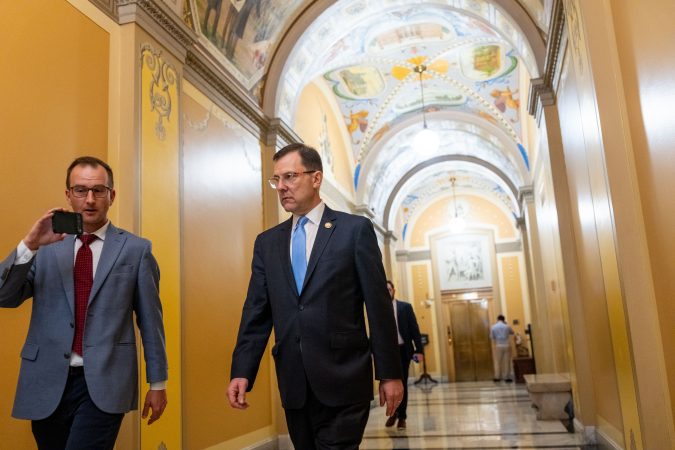
Rep. Thomas Kean Jr. is back at work — and back to avoiding the spotlight.
On Monday, Kean, a New Jersey Republican, silently refused to even acknowledge a reporter as he hustled out of the Capitol toward Independence Avenue. He did much the same on Thursday, when he was one of the last lawmakers to descend the Capitol steps after the House recessed for the week.
Asked about his return to Congress after a monthslong absence and his schedule as he runs for reelection in one of the country’s most competitive contests, Kean stared straight ahead.
If Kean has been on the campaign trail in New Jersey, it is hard to tell. Aides have refused repeated requests for his campaign schedule in the two weeks since Kean reappeared in Congress and explained that he had been hospitalized for depression.
He did not follow up a June 30 speech on the House floor with media interviews. And even some of his staunchest allies in New Jersey said they were unaware of his plans to campaign locally.
The Republican chair in Sussex County, a region seen as crucial to Kean’s victory, says he is “waiting on dates” for a hoped-for visit from the congressman. State Sen. Doug Steinhardt, the chair of the Republican Party in Warren, a neighboring county and conservative part of Kean’s district, said Kean was expected to attend the county fair at the end of July. But he was aware of no other scheduled campaign events.
“I hope he intends to be more visible,” said Steinhardt, who previously led the New Jersey Republican Party.
Harrison Neely, a spokesperson for Kean, said that the congressman was “full speed ahead with a campaign.”
“You can see that the congressman is active,” Neely said. “His social media is active.”
Since his June 30 return to Congress, Kean’s social media accounts have shared only a handful of posts that include recent photos of the congressman. One shows him marching with his wife in a parade. Another features him in an office, beside a family concerned about Lyme disease, an increasing worry in the area. There are also images of him with winners of an elementary school essay-writing contest and speaking at recent House committee hearings.
In some ways, Kean, 57, is operating as he always has. He has refused to hold in-person town hall meetings during his two terms. And he has shunned most media attention during his tenure. Neely noted that it was not unusual for Kean to decline to share his schedule of upcoming public appearances, as he had not done so during his previous congressional campaigns, either.
But Kean’s recent mental-health struggle and long absence — which he declined to explain in any detail for nearly four months — have increased his profile and brought a higher level of scrutiny to his campaign as he makes his pitch to voters. He is facing a tough race for a third term against Rebecca Bennett, the Democratic nominee, in a swing district that both parties consider a must-win in the midterm battle for control of Congress. His fate in November may depend in part on how he manages to shape the narrative of his return.
It may also hinge on how shrewdly he can navigate new headwinds. President Donald Trump’s low approval ratings and voter dissatisfaction over the prices of gas and food have made Republicans like him vulnerable. In New Jersey, Kean, who was endorsed by the president, has had to fend off claims that he failed to stand up to Trump when the president tried to cancel funding for a Hudson River train tunnel vital to commuters in the district.
He has also had to weather the administration’s abrupt changes in policy tied to a proposed migrant detention facility in Roxbury, New Jersey, a Republican stronghold in Kean’s district. The Trump administration last month said it had abandoned its expensive quest to build the detention center in a vacant warehouse, but last week signaled plans to revive the project. Republican leaders in the township, who have sued to block the 1,500-bed jail and months ago criticized Kean for failing to do enough to try to stop it, again began raising the alarm.
The mayor of Roxbury, Shawn Potillo, also contacted Kean’s office.
“As he resumes his official duties, we welcome any support he may be able to provide,” Potillo said in an email.
Kean’s most recent campaign finance filings point to the ground he lost while out of the public eye from March through June.
A report his campaign filed Wednesday with the Federal Election Commission showed that donors had chipped in roughly $300,000 in the last quarter, far short of the nearly $1.6 million in contributions Bennett reported.
Kean nonetheless continues to hold a sizable fundraising edge, with $3.6 million left on hand to spend in the run-up to the Nov. 3 election for his 7th District seat. Bennett, a former U.S. Navy helicopter pilot who has worked for healthcare companies, has less than half as much: $1.4 million.
The congressman also has the advantage of name recognition in a district where registered Republicans outnumber Democrats by roughly 19,000 voters. His father, who is also named Thomas Kean, was one of the state’s most popular governors and later steered the 9/11 Commission.
And he does still have time. Jeanette Hoffman, a Republican political strategist, noted that summertime is a typically slow season for campaigning. She said she was confident that Kean would run a “vigorous campaign when it matters most.”
“I don’t think anybody’s looking at his calendar and saying, ‘Oh my gosh where is he?’” Hoffman said. “That’s an insider’s game right now.”
WASHINGTON — President Donald Trump used a lot of alarming words on Thursday night as he addressed the American people about threats to the integrity of elections in the United States: “Deep state.” “Rigged and stolen.” “Conspiring.” “Manipulation.” “Corrupt.” “Fraud.” “Cover up.”
But the bottom-line message he clearly wanted to leave with the public was this: He is not a loser, regardless of the result of the 2020 election. There were dark forces at work to thwart him. And if his party loses this fall’s midterm election, he intimated, that may not be an honest outcome either.
Trump’s primetime speech from the East Room of the White House was an astonishing spectacle featuring a president intent on persuading the country that its elections cannot be trusted, at least not the ones where he or his allies fall short. He cited selectively declassified documents to make sensational claims about vulnerabilities of the election system, although nothing he revealed proved any outcomes were actually changed.
The exercise underscored how much Trump in his second term has come to be obsessed with relitigating the 2020 election and finding ways to cast doubt on the 2026 election. In the 18 months since he returned to office, he has installed election deniers in key positions, sought to change the rules to make it harder to cast ballots, seized voting records in a bid to prove his conspiracy theories and purged officials who investigated his efforts to overturn his election defeat six years ago.
“It does feel a little like Captain Ahab in ‘Moby Dick,’” said Trevor Potter, a Republican former chair of the Federal Election Commission. “He is just fixated on his claim that he didn’t lose the 2020 election. Armchair psychiatrists can say he doesn’t like losing, he can never admit he lost anything. But it’s clearly become an important part of his psyche and in some ways an important part of this administration.”
On one level, according to people close to him, Trump’s fixation on rewriting the history of 2020 is about salving the wounded ego of a man who constitutionally resists ever admitting that he has lost anything. He has made it a litmus test for anyone working for him to accede to, or at least not contradict, the lie that he won back then, not Joe Biden.
Trump has authorized investigations to revisit his many claims that have previously been debunked, inquiries seemingly aimed not at following wherever the facts may take them but in search of facts to back up his own unsubstantiated certitudes. It is hard to imagine that he would accept any investigation concluding that he lost fair and square.
But while part of this is about looking backward, it also is about looking forward. With Trump deeply unpopular, according to polls — just 37% approve of his performance in the latest Washington Post-Ipsos survey — his party faces a possible drubbing in congressional races in November. So Trump seems intent on laying a predicate that, at the least, could explain away a defeat and, at most, his critics fear, potentially justify direct intervention aimed at changing the results.
“It’s the standard approach to cast doubt on the electoral rules of the game where many populist authoritarians feel threatened by unpopularity at the polls or if the results declare them the loser at the ballot,” said Pippa Norris, who has taught political science at Harvard University for three decades and was the founding director of the Election Integrity Project. “Indeed, it’s been a leitmotif which the president has used for more than a decade now.”
Trump’s allies insist that he has well-founded reasons for his election conspiracy hunt, that Democrats, the news media, career officials and foreign governments all had cause to try to stop him from winning a second term and then hide their tracks. A self-serving establishment, they say, is protecting its own power and eager to take down a disruptive outsider in the form of Trump.
“The president passionately believes he was wronged in the 2020 election,” said Christopher Ruddy, his friend and CEO of Newsmax Media, “and I think he is motivated for two reasons, to get vindication and to prevent future election irregularities.”
But some Republicans wish Trump would move on, seeing the issue as politically unhelpful in a campaign season when voters are focused on the cost of living and other matters close to home.
An Economist-YouGov poll last month found that Trump has persuaded 50% of Republicans that the 2020 election was rigged, but that is more of an article of faith among the president’s base than the broader electorate. While 66% of self-identified MAGA Republicans share that view, just 32% of other Republicans do and only 23% of independents.
Trump’s repeated forays into election denialism this term also reflect the change in his inner circle. While there were powerful voices in his first term who told him that his claims of election fraud were not true, most notably William Barr, then the attorney general, Trump this time is surrounded by advisers who either cheer him on or keep quiet.
“Clearly, there’s nobody in the White House who can say no to him; there’s no adult in the room,” said former Rep; Barbara Comstock, R-Va., and a longtime Trump critic. “They won’t say to him, ‘Mr. President, you lost the damn election. Why are we doing this again?’”
Indeed, would-be administration officials at the start of this term were asked point-blank during job interviews if they believed Trump won the 2020 election. Those who said no were generally not welcomed into the fold. Conversely, Democrats have now made a point of asking the same question during confirmation hearings of Trump nominees, leaving them struggling to find an answer under oath that does not anger the president.
“Do you deny that Joe Biden won the 2020 election?” Sen. Mark Warner, D-Va., asked Jay Clayton, the president’s nominee for director of national intelligence, during a hearing this week.
“Senator, I’m not an election denier,” Clayton responded. “Joe Biden was certified as the president of the United States.”
Democrats noticed the use of the word “certified,” as opposed to “elected” or “won.” That has become an escape word for Trump nominees. Even the president does not deny that Biden was certified; he just claims that he should not have been.
Sen. Jon Ossoff, D-Ga., tried to pin Clayton down. “Who won the 2020 election?” he asked directly.
“Isn’t it humiliating to be unable to answer this question, to have to indulge the president’s delusions?” Ossoff replied.
Trump’s laser focus on 2020 was evident in his speech Thursday night. As he spun out assertions of Chinese hacking, illegally registered voters and cover-ups, Trump referred seven times to the 2020 election that he lost, albeit without an explicit claim that he won. He offered no concerns about the validity of the 2016 or 2024 elections that he won.
And while he suggested that China intervened in the election six years ago because it “wanted me to lose,” he made no mention of Russia’s intervention four years before that on his behalf. He used the words “China” or “Chinese” 20 times and mentioned Russia only once as part of a list of nations that have the capacity to hack election machines.
In fact, U.S. intelligence agencies have concluded that while China made nascent efforts to influence American opinion during the 2020 election, it largely stayed on the sidelines, while Russia mounted an expansive and aggressive campaign to help Trump win in 2016.
With just less than 16 weeks until the next election, the pressing issue is where Trump plans to take the matter. He used the speech to announce that he has ordered the FBI and other agencies to investigate election interference. He also pushed Congress again to pass legislation to require proof of citizenship to register and photo identification to cast ballots. But Senate Republicans have made clear to him again and again that there are not enough votes to pass it.
The idea that Trump might opt to take action if the election does not go the way he wants it to is not unthinkable. In an interview with The New York Times in January, Trump said he regretted not heeding advisers who urged him to order the National Guard to seize voting machines in swing states that he lost in 2020.
“Great damage has been done to our country,” he said Thursday night. “Our elections were left vulnerable to being rigged and stolen and the trust of the American people was lost. This cannot be allowed to continue.”
The question for many Americans will be who do they trust.
Federal health officials said Thursday that a multistate outbreak of cyclosporiasis that has sickened thousands of people has been linked to shredded iceberg lettuce served at Taco Bell restaurants in five states, confirming key findings first reported by the Washington Post.
The Centers for Disease Control and Prevention and the Food and Drug Administration said traceback investigators identified a single supplier of iceberg lettuce from Mexico used at Taco Bell restaurants in Indiana, Kentucky, Michigan, Ohio, and West Virginia. In updates posted to the CDC webpage and FDA webpage late Thursday, officials urged consumers not to eat shredded iceberg lettuce from Taco Bell restaurants in those states while the investigation continues.
The agencies did not name a supplier. But two individuals familiar with the inquiry said investigators have identified Taylor Farms as the supplier of the shredded iceberg lettuce. The individuals spoke on the condition of anonymity to share details of the ongoing investigation.
The FDA is working directly with the supplier to determine if contaminated shredded iceberg lettuce went to other places, officials said. More than 1,644 sick people in this outbreak reported eating at Taco Bell locations in the five states, officials said.
“The investigation remains active, and additional states, restaurants, retailers, or products may be identified as more information becomes available,” said Emily Hilliard, a spokesperson for the Health and Human Services Department.
This summer’s outbreak of cyclosporiasis, among the largest such outbreaks in the United States, has been largely concentrated in southeastern Michigan, where more than 4,300 cases have been reported and at least 100 people have been hospitalized as of Thursday.
“The signal we have gotten is that there is a very high percentage of people who got sick at Taco Bell, and when investigators asked what their menu items were in common, lettuce came up frequently,” said one of the individuals. When the FDA asked the company where it sourced the lettuce from, it was Taylor Farms, not just for the Taco Bell stores in Michigan but also for restaurants in other states, the person said.
Taylor Farms describes itself as one of the leading global producers of salads and healthy fresh foods, with production facilities across the U.S., Canada, Mexico, and Western Europe. Taylor Farms did not immediately respond to a request for comment.
In a statement, Taco Bell Corp. said:
“Based on ongoing conversations with public health officials, and out of an abundance of caution, Taco Bell has taken immediate action to voluntarily remove potentially impacted lettuce from a supplier in select states. The affected ingredient from our supplier is being indefinitely removed from our supply chain nationwide and will be replaced within 24 hours in select states.”
Taco Bell Corp. added: “While no official advisory has been issued, we believe public health is a shared responsibility among restaurants, their suppliers, and authorities, and we are proud to have consistently acted quickly and proactively to protect our guests. Taco Bell has taken precautionary action, and we encourage all relevant restaurants, retailers, and foodservice operators to do the same.”
Authorities in Michigan, which has been hit the hardest and has reported hundreds of cases daily, have said leafy lettuce is the leading suspected source based on interviews with more than 1,000 patients.
Notices posted at some Detroit-area Taco Bell restaurants this month told customers the chain was “currently unable to sell Lettuce, Cilantro Onion, Pico de Gallo, and Guacamole due to a nationwide recall,” according to media reports.
Cases have been identified in at least 34 states, and confirmed illnesses could continue to increase through the end of August, officials said.
Earlier this week, after Michigan officials warned that lettuce could be a culprit, the International Fresh Produce Association criticized how public health officials were investigating the outbreak.
“Everything pointing to produce is based on recollections of patients, and even those recollections — based on what we hear — explain, at most, only half of the current cases,” said Max Teplitski, the association’s chief science officer.
“We need to be candid about the limits of the data being used here,” he added. “A parasite with a notoriously complex life cycle, Cyclospora can be hard to detect in the environment, and some of the methods for its detection have performed inconsistently.”
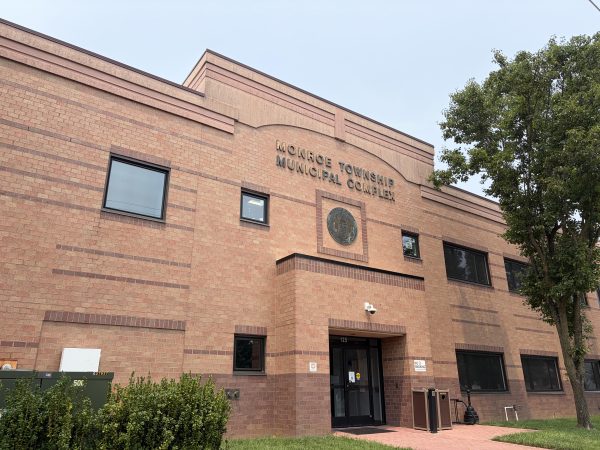
A real estate developer sued local officials in Monroe Township for $300 million shortly after the Gloucester County municipality banned data centers. Now, the case has moved to federal court.
Hexa Builders, a Princeton-based real estate developer, has long sought to develop a property at 3043 Black Horse Pike. Hexa filed a lawsuit on June 5 in New Jersey Superior Court after Monroe officials denied its application to build a 1 million-square-foot data center and a warehouse on the property.
The ban, put in place by two ordinances approved by the township on April 22, followed months of public outcry against Hexa’s potential project. Even after the ban was passed and officially took effect on May 13, Monroe Township residents packed the room when Hexa presented its application that still included a data center at a rowdy Special Planning Board meeting on May 22.
In the filing against Monroe’s mayor, township, and planning board, Hexa claimed the application rejection and data center ban are arbitrary, violate freedom of speech rights and the 14th Amendment, and more. The Woodbury Warbler, a local news site, reported on the filing last month.
Jim Maley, Hexa’s lawyer and a partner at Maley Givens in Collingswood, said he expects the ban to be overthrown, since he believes the ban in Monroe stems from trending public disdain for data centers.
“Nobody is giving any testimonial, any scientific reasons for the good of the community. Everybody’s doing it,” Maley said. “It’s just a thing.”
For now, Maley said Hexa is at a standstill. But the company still wants to complete the project, even with the public’s pushback and what could be a lengthy court process.
On July 6, the township moved for the case to be pushed to federal court, closing the Superior Court case, and no federal proceedings are on the docket yet.
“The Township is committed to vigorously and zealously defending this lawsuit while remaining steadfast in its commitment to protecting the interests of the Township, its residents, and its taxpayers,” said Sandra Graise, solicitor for Monroe Township, in an email.
Graise declined to further comment on the case or the data center ban, but the township wrote in a Facebook post last month that the lawsuit wasn’t a surprise.
How the ban came to be
Hexa, led by CEO Dipal Patel, officially obtained the property in a $5 million transfer of about 170 acres of farmland back in 2022. The township has included that land in a resolution for commercial redevelopment since 2019.
The site was previously approved for the construction of hundreds of homes when Hexa bought it, Maley said, but the township ended up moving in a different direction. In 2022, the township approved a redevelopment plan that set the grounds for Hexa to build warehouse, storage, and distribution facilities on Black Horse Pike, but not data centers.
That changed in early 2025, when the township passed an ordinance amending the redevelopment plan to allow data centers.
It didn’t take long for residents to speak out about the impact a data center could have on water quality, pollution, and noise in their neighborhoods, even before Hexa officially added a data center to their plan.
A planning board meeting in January 2026 dragged on for more than four hours because of resident objections, but the township still voted to approve a preliminary site plan for Hexa to move forward with its warehouse and distribution center project. The proposal didn’t include a data center at the time, though the lawsuit filed in June claims that Hexa had already expressed interest in developing one, and residents made it clear they weren’t fans of the possibility.
The township drafted an ordinance in March to set standards for data centers, including noise restrictions and a closed loop cooling system to avoid groundwater withdrawal, but that ordinance was tabled and never moved forward.
Instead, in April, Monroe passed two ordinances: one banning data centers altogether, and another repealing the 2025 ordinance that allowed data centers on Hexa’s property.
“At the end of the day, this Township has now banned any data center use from ever coming to Monroe Township. I thank those residents who attended the many meetings and expressed their concerns. The process worked,” Mayor Greg Wolfe wrote in a May township newsletter.
Two weeks before the ban was adopted, though, Hexa’s legal complaint claimed it submitted an amended application to the township to turn one of its proposed warehouses into a data center.
Maley said the amendment was driven by “interest from the marketplace that began before Township passed the ordinance” that allowed data centers at 3043 Black Horse Pike last year.
When Hexa sought approval for the new application on May 12, the township deemed the company’s application incomplete, prompting Hexa’s lawsuit.
The lawsuit
The $300 million sought by Hexa Builders accounts for financial losses related to the stunted data center project, Maley said.
“The damages all come from real, actual commercial realities here. … It’s the loss of the value of the project,” Maley said.
In its 102-page complaint, initially filed in Gloucester County court on June 5, Hexa claimed that Monroe violated the 14th Amendment by treating Hexa’s plan differently from similarly sized projects, like warehouses and other high water usage facilities, that it claims would have similar environmental and aesthetic impacts.
Hexa also claimed that banning data centers violates the First Amendment and free speech rights, since the facilities could support artificial intelligence and social media communications in the area.
Maley said the data center ban will have “an adverse effect on communications,” and the argument is an effort to adapt constitutional law to today’s tech.
“Data centers are a medium of expression and banning data centers would impose a significant burden on the free speech rights of all citizens in the United States,” the complaint reads.
Those are just some of the 20 counts alleged by Hexa, including that the township didn’t give the company ample notice of its ban as it prepared data center plans. Monroe Township officials have publicly shared their intention to keep mostly silent on the litigation as the case moves forward.
Some residents have continued to speak out at meetings and ask questions about potential loopholes in Monroe’s ordinances to ensure their neighborhoods remain data center-free.
At the township’s planning board session on July 9, Williamstown resident John Romano asked who allowed Hexa’s application to get so far in the first place, and whether Monroe will be able to hold a case against Hexa in court. He said the data center would be right in his backyard.
“I’d like to sit out in my backyard and enjoy a stogie and a cold one and not hear noise and pollution and this and that,” Romano said. “I would like to be able to stay in Monroe Township, live out my golden years here, which was the plan. This has got my wife and I really concerned.”
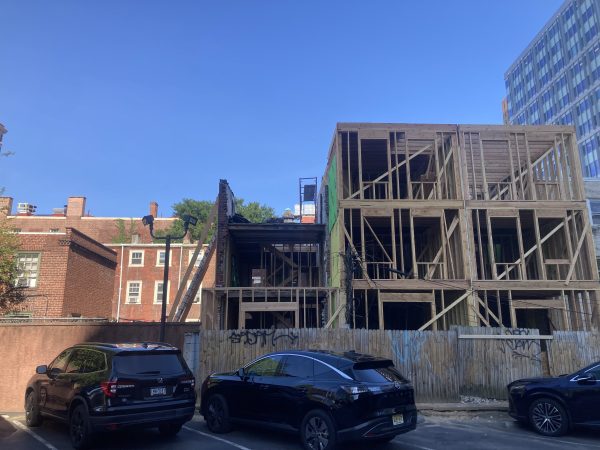
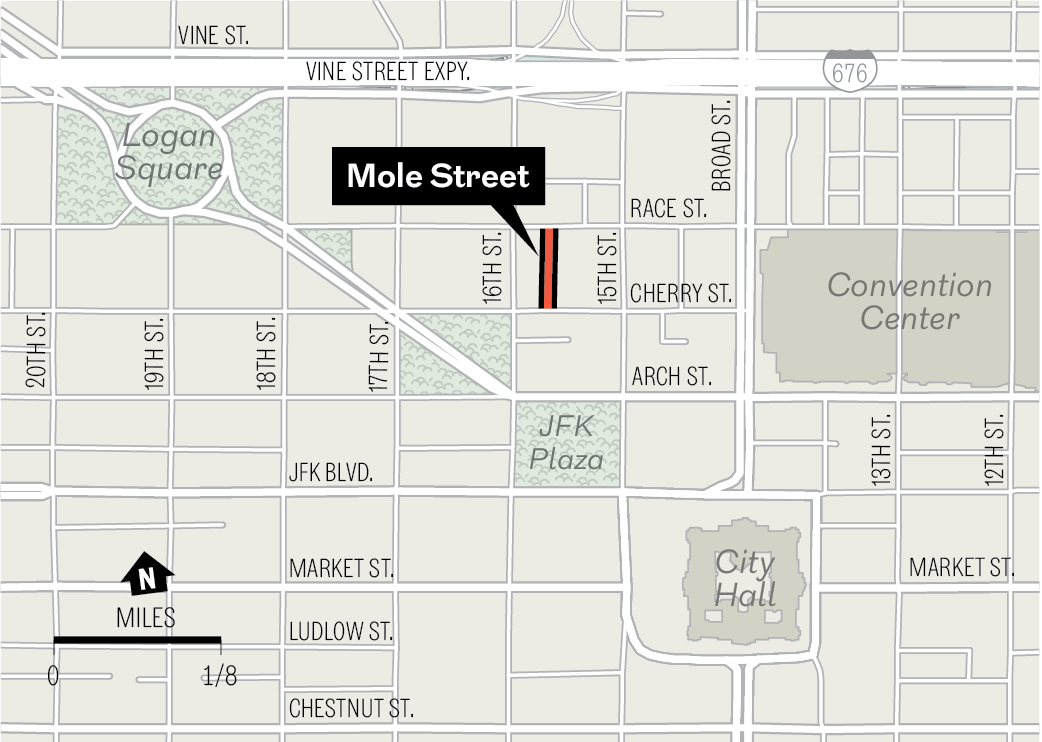
The work has stopped on the 100 block of North Mole Street, where developers have been attempting to remake this redoubt of historically protected below-market-rate housing.
The developer Purity Homes Inc. and its architect Canno Design got permission from the city’s Historical Commission last year to redevelop a handful of these almost 200-year-old rowhouses.
They planned to build expansive additions on the rear of the houses to allow for more square footage and rentable space and to eventually transform the rest of the block.
However, following an Inquirer article about the project, the Department of Licenses and Inspections issued stop work orders in June for “work not according to approved plans.”
“The Historical Commission had approved modest alterations to the properties,” said city spokesperson Karen Guss.
“The PHC staff member who managed the process of reviewing the developer’s proposed alterations observed out the window that the work actually going on seemed way out of line,” Guss said, referring to the fact that the 100 block of North Mole Street is visible from the offices of the commission, a block to the site’s south.
Armando Ahmad, whose name and address in Arlington, Texas, is listed on several permits for the project, did not respond to requests for comment. Further attempts to reach Purity Homes were unsuccessful as well.
Last year, Purity Homes bought eight of the 30 North Mole Street homes for $3.1 million. More purchases are in the works, although the original architect has left the project.
“We have terminated our agreement with the client, no further comment at this point,” said Carey Jackson Yonce of Philadelphia-based Canno Design.
A Department of Licenses and Inspections spokesperson noted that work continued on the house at 127 N. Mole St., despite the city’s order.
Mole Street in Center City.John Duchneskie
“The police have been assisting with enforcement efforts,” L&I spokesperson Shemeka Moore wrote in a June 26 email.
She also noted that 108 N. Mole had been approved for only a small addition and that a new construction permit would be required for the company’s more expansive plans.
However, following the stop work orders, preservationists and the Historical Commission said Purity Homes was reacting to city regulators in good faith.
“The Historical Commission’s staff is engaged in ongoing, productive discussions with the development team for the 100 block of North Mole Street,” said Jon Farnham, executive director of the Historical Commission. “The developers have acknowledged their missteps and are working diligently to develop a plan to bring the block into compliance.”
For decades, this block of North Mole Street has been a holdout of inexpensive rental rowhouses in an area of Center City otherwise dominated by tall buildings and surface parking lots.
Just west of the Central Friends Meeting, the street has been owned by a family trust, which dates to the 1800s and belongs to descendants of founding father Robert Morris. In 1960, the 30 homes on the block were given historic preservation protections.
The buildings were largely carved into group houses, where airline workers, artists, students, and journalists (including Inquirer reporters) have made their homes.
The block had a reputation for a vigorous party scene, culminating in an annual bacchanalia at the Molestice Festival block party. The celebration began when Jimmy Carter was president and was ended by the COVID-19 pandemic.
Molestice 2019 takes over the 100 block of Mole Street, in what would prove to be the final iteration of the decades-long tradition. Philip Gabriel Photography
As Purity moved on to the block, the company wrote letters to tenants promising to “minimize disruption.” Leases have not been renewed for residents living in the houses controlled by the company.
Tenants who remain have complained about developers starting work extremely early in the morning, parking trucks on the sidewalk in front of their homes, and cutting down all the trees before a scorching summer.
“They definitely don’t mean what they said about minimizing disruption,” said Alex Numan, a resident whose home is not yet owned by Purity, although his lease has been switched to month-to-month in preparation for a sale.
A cartoon by The Inquirer and Daily News’ Signe Wilkinson, dating to the 1980s when many reporters lived on the block.Signe Wilkinson
Since the stop work orders, construction has paused, but many longtime tenants still anticipate being made to leave their homes.
“The planning is still underway, and nothing has been submitted to the Historical Commission yet, but we will ensure that the revised plans preserve the historic character of the designated buildings,” Farnham said.