“We are” chants rang throughout Lincoln Financial Field, replacing the Eagles’ chants that would take over in less than 24 hours, and the stadium that typically would be engulfed in midnight green was temporarily blanketed in white as No. 16 Penn State made the trip to Philadelphia to face Temple.
Saturday’s game was the first time the teams faced off in a decade, renewing a 95-year-old rivalry. In their last meeting in 2016, the Owls lost by seven at Beaver Stadium.
This time around, Temple suffered a similar fate — losing, 27-9, as Penn State improved its all-time record against the Owls to 41-4-1.
From a Penn State takeover to a Meek Mill appearance, here’s everything you might’ve missed on Saturday at the Linc:
Meek Mill leads Temple out of the tunnel
The familiar sounds of Meek Mill’s “Dreams and Nightmares” track was heard throughout the Linc as Temple made its way onto the field. From the Jumbotron, fans could see the Philadelphia rapper front and center, leading the Owls out of the tunnel as red smoke and pyrotechnics covered one side of the field.
This came just a few days after the North Philly native partnered with the university to welcome high school seniors and Temple students to the Dream Chasers Summit, at the Liacouras Center.
Although the record against the Owls leans heavily in Penn State’s favor, Temple did shock the world in 2015 — the teams’ last matchup at the Linc. Temple’s defense dominated a game in which Penn State quarterback Christian Hackenberg was sacked 10 times.
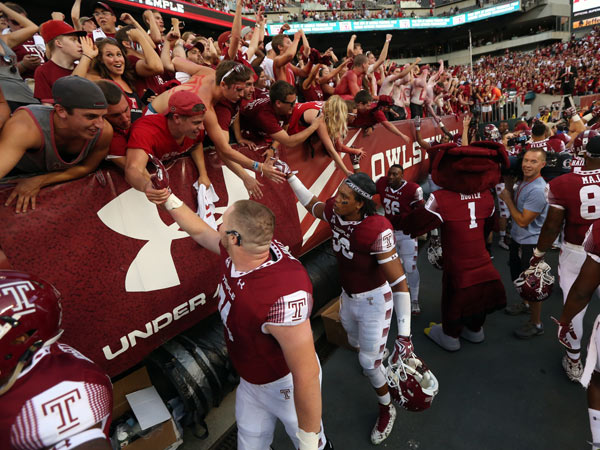
The Owls entered that game as a seven-point underdog and beat the Nittany Lions, 27-10, in front of a crowd of mostly blue and white. Temple alumnus Ron Fries attended the game, and after the upset, Fries, 55, knew he had to become a season-ticket holder.
Temple players celebrate the last time they beat Penn State, a 27-10 victory in 2015 at Lincoln Financial Field.DAVID SWANSON / Staff Photographer
“I went to that game and a couple other games that year, but being at that game and just the energy — the Penn State energy left and the Temple energy that was there, which was outnumbered a lot,” Fries said. “But the folks that stayed, it was tremendous, and that’s why I became a season-ticket holder.”
An upset wasn’t in the cards this time around, but a lot of fans were optimistic beforehand.
”I’m hopeful that they’re able to produce something positive,” Fries said. “I would be ecstatic if they won like they did 11 years ago, but if they don’t, I just want to see something positive come out of them against a big program like Penn State.”
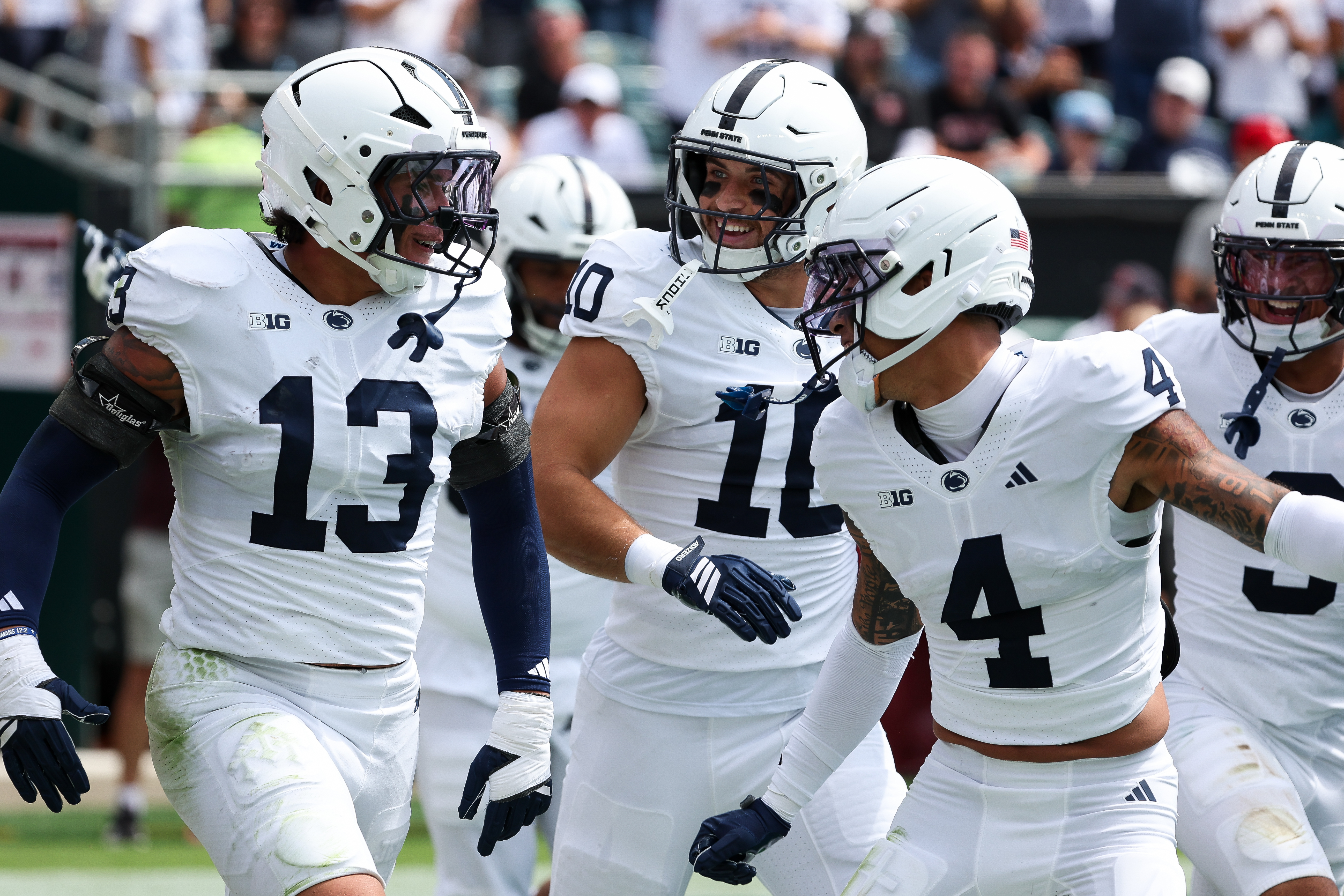
Penn State linebacker Tony Rojas (left) reacts after a first-quarter interception against Temple on Saturday.Isaiah Vazquez / For The Inquirer
Beaver Stadium East
Like the Penn State-Temple game in 2015, Temple fans were outnumbered at home.
”It looks like it’s been a pretty big whiteout here in the parking lots,” Penn State alum Joe McGoldrick, 26, said before the game.
Penn State flags were plentiful at tailgates in the sports complex parking lots, and fans in blue and white jerseys were out in droves through Lots D to M as students from State College were being bussed in. Shrines to the Nittany Lion could be seen at every turn — including at “Ernie’s Tailgate,” a tradition dating to 1977, when Tim Ernst was a freshman at Penn State.
Ernst, who graduated in 1981 and got his master’s in 1993, started the tradition from his dorm room. Since then, he said he’s attended every Penn State home game, and he isn’t thinking of stopping anytime soon.
“We’re excited for the new coach; we’re excited for our new team,” Ernst said. “Rocco Becht, our quarterback, we’re very excited to have him on board. College football is challenging with all the transfers taking place and all that, but we’re going to have a very good year this year.
“I think we’re going to make the playoffs, and we’ll see where it goes from there. And I don’t want to say any bad words about [James] Franklin but it was time to make a change. [Penn State coach Matt] Campbell has been saying all the right things. He believes in the [Joe] Paterno way where education is important, making these young boys into men is important. And that’s what Joe Paterno always emphasized.”
The Penn State takeover continued inside the stadium, as thousands of fans traveled to see Campbell improve his record to 2-0 as Penn State’s coach after a 45-0 win over Marshall in Week 1.
”Penn State isn’t coached by James Franklin anymore, thank God,” McGoldrick said. “I was there at the game last week, they looked very good against Marshall. I think they’re just going to do the same thing they did last week. I think they’ll have a home-crowd environment. So, that’ll help too.”
A neighborhood rivalry
As the ocean of blue and white jerseys swarmed the tailgating lots, one Temple fan, Michael Kiedaisch, wasn’t worried.
“The sea of red is on the way,” Kiedaisch said.
Kiedaisch, whose 18-year-old son, Brian, attends Temple, made the trip down from Newtown, Bucks County, with his family to watch the game and cheer on the Owls — but there was one issue. Kiedaisch’s neighbor, Art Krysko, also made the trip. And his family — including his 19-year-old daughter, Madelyn, and 21-year-old son, Joey, who attend Penn State — were cheering for the rival team.
“We had kids,” Krysko said. “And they went to different schools. And we’re a little [ticked] about it.”
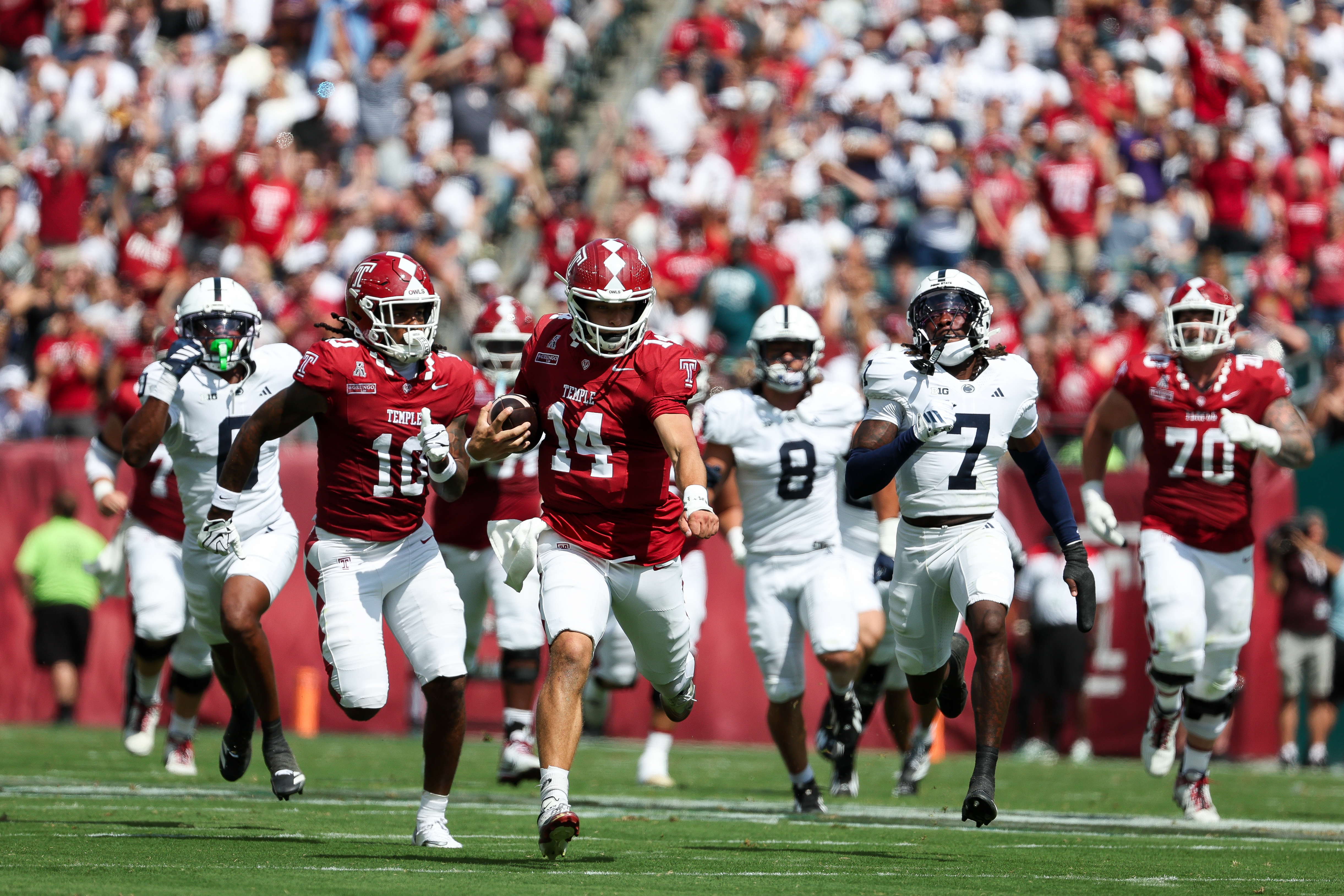
Temple Owls quarterback Jaxon Smolik (14) runs upfield during the second quarter in Saturday’s game against Penn State at the Linc. Isaiah Vazquez / For The Inquirer
The competition between the two started as soon as they left their neighborhood.
“When we left the neighborhood, he blew the stop sign and tried to lose me on the drive down because I’m supporting Temple and he’s supporting Penn State,” Kiedaisch said. “So that’s how the day started. But we’re set up and ready to go now.”
However, if Penn State took an early lead, Michael’s brother, Carl Kiedaisch, had a backup plan.
“We have Penn State shirts at halftime to put on in case it gets ugly,” Carl said.
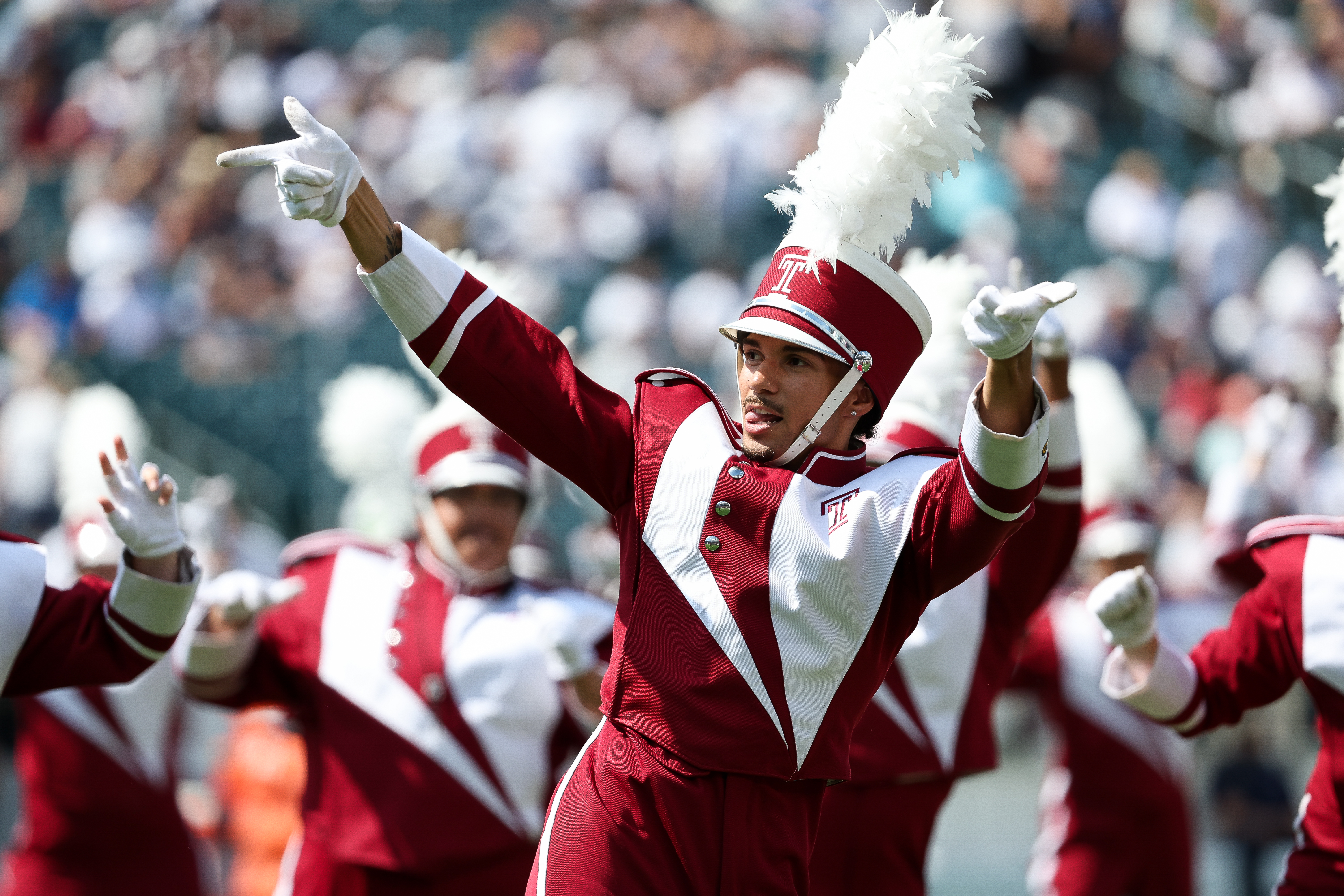
Penn State led, 10-3, at halftime but vibes still were high on the main concourse for Temple fans as the band performed near the student section. Fans bobbed their heads, talked to friends, and cheered along as they prepared for the second half.
And as soon as the third quarter started, “[Expletive] Penn State,” chants erupted from the crowd.
The band put on a show at halftime.Isaiah Vazquez / For The Inquirer
However, it was short-lived after Penn State scored another touchdown, putting them up, 17-3. From then on, Penn State ran away with the 27-9 win — leaving many Nittany Lions fans happy.
“I thought the stat line was pretty good all around,” said 22-year-old Penn State alumnus Colin Crissey. “It didn’t look pretty on the field, necessarily, but the numbers don’t lie, and they look pretty good. I thought Penn State somewhat sleepwalked in the first half. I don’t know if that’s the travel. I don’t know if that’s your first away game with a new coach or whatnot. Scoring right there at the end of the half really changed the mood.”
Meanwhile, Temple fans started to leave the stadium in the third quarter — leaving the student section fairly empty by the end of the game.
Charli XCX spent over a decade in the electro pop trenches before suddenly blowing up big time in the Brat summer of 2024.
So it’s not a surprise that the British singer, who said “all of my albums work in opposites” and “repel against each other,” would react to long-time-in-coming viral success with a stylistic about-face and pause for self-reflection.
The result is her new album Music, Fashion, Film, which gives its name to the tour that launched at Xfinity Mobile Arena in South Philadelphia on Friday with a hyperkinetic performance in front of a deliriously excitable opening-night crowd.
On its surface, the Music, Fashion, Film album appears to be a turn away from the Dionysian “Club Classics” culture of its predecessor into something more serious-minded and self-consciously mature.
The image on the album cover — and on the $50 T-shirts selling on the concourse — is not of the trendsetting pop star, but a group shot of three titans in their fields — Velvet Underground cofounder John Cale, fashion designer Marc Jacobs, and movie director Martin Scorsese.
Instead of the neon green that lit up Brat summer, the cover shot — and all Music, Fashion, Film imagery — is in black and white.
The album’s lead track, “Rock Music,” which she opened with Friday, Charli, 34, appears to be putting club culture in her rear view.
“Me and my friends,” she sings. “Yeah, we’re on to the next. I think the dance floor is dead / So now we’re making … Rock Music.”
And truth be told, she is — some of the time.
For most of the first and last thirds of the 100-minute show — which included 29 songs, with the briefest of breaks for exhortations like “Philly, this is the Music, Fashion, Film tour, are you [expletive] with me!” — she was accompanied by a three-piece band that included Morrisville, Pa., native Chris Greatti on guitar.
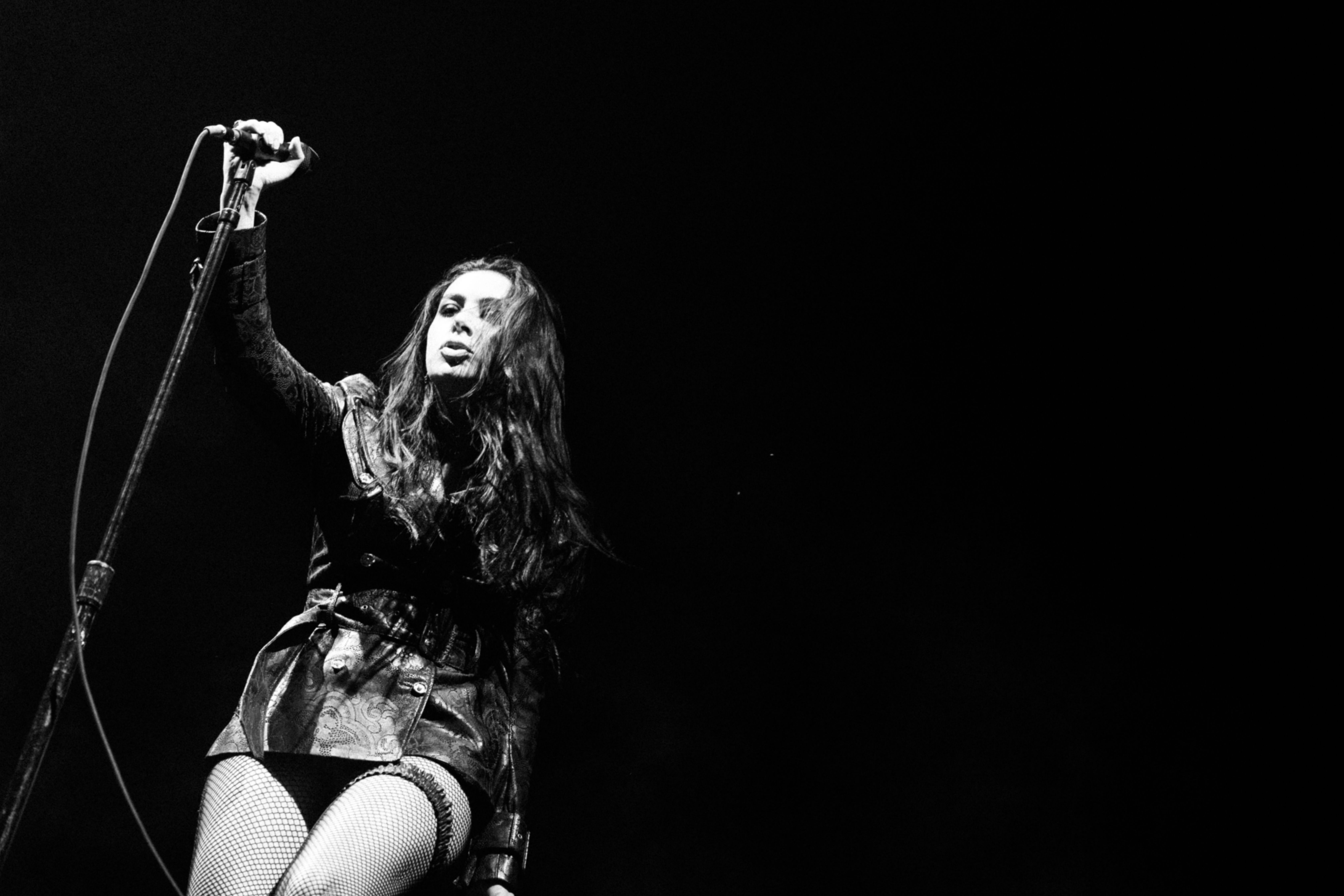
Charli XCX at the Leeds Festival in England in August. The British pop star opened her “Music, Fashion, Film” tour at Xfinity Mobile Arena in South Philadelphia on Friday night.Courtesy of the Artist
Music, Fashion, Film songs like “Wink, Wink,” “Persona,” and “2007” kicked into gear with overdriven guitars and hyper-pop-processed production that upped the adrenaline level.
And Charli — whose given name is Aitchison and whose stage name comes from a teenage online screen moniker meaning “Kiss Charli Kiss “ — fully embraced the rock aesthetic, striking poses that made her look like an Italian neorealist film star in the black-and-white image on the video screens.
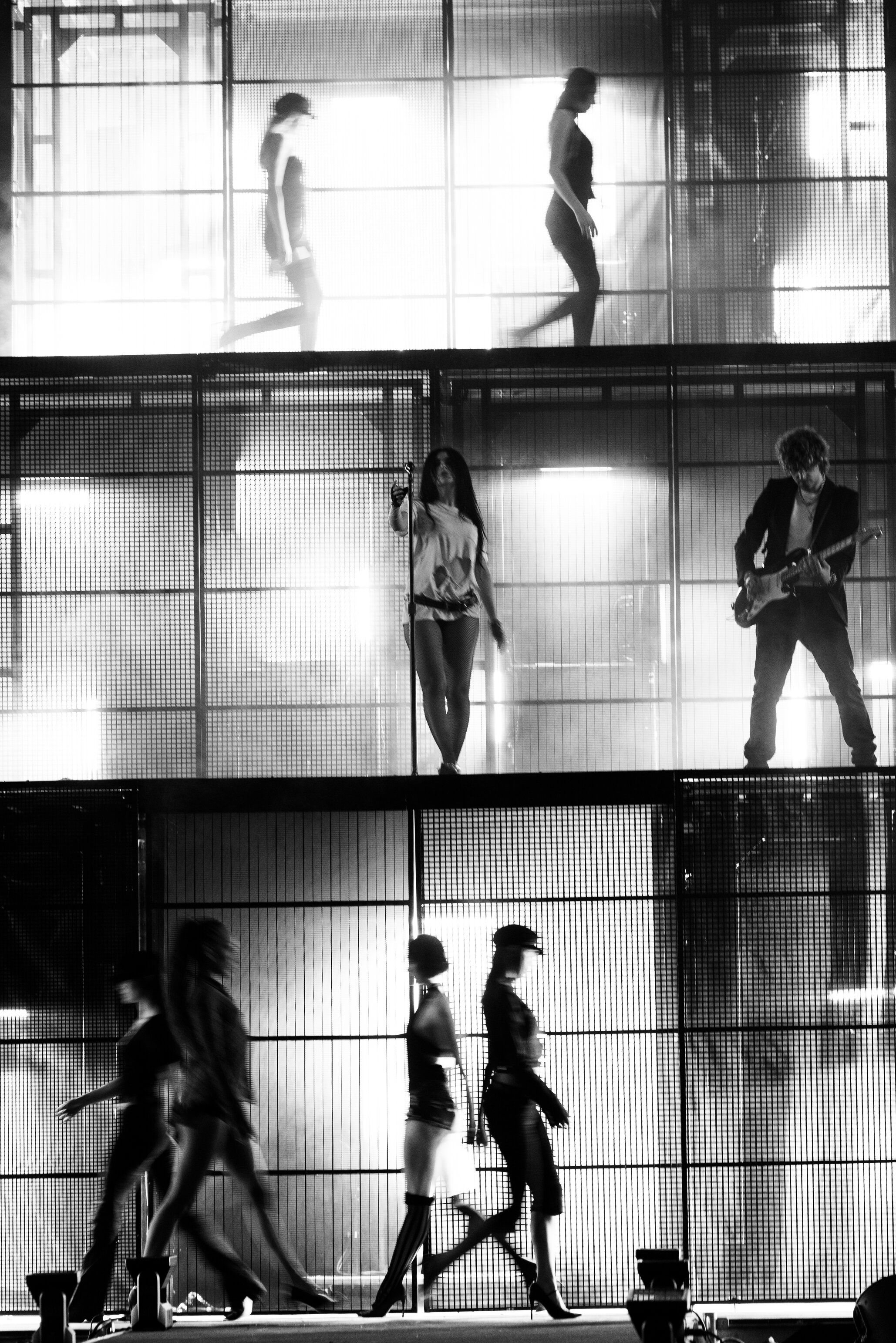
But for all of their brash rock and roll presentation on a three-tiered stage topped by a facsimile of a smoke-emitting giant speaker — and no shortage of pyro going off throughout the show — the Music, Fashion, Film songs are actually introspective and soul-searching.
Not in a navel-gazing, overly earnest way though. Charli XCX couldn’t bore you with self-pitying clichés about the perils of pop stardom if she tried.
Instead, she’s droll and sharply observant and self-aware about a lack of fulfillment from fame. Along with Cale, whose recorded voice was heard on Friday from their collaboration on “House,” from the Wuthering Heights soundtrack released this year, Charli is a also a super fan of his Velvets bandmate Lou Reed.
And several Music Fashion, Film songs display a deadpan dark wit that show she has more in common with Reed than an appreciation for black leather.
Most amusing was “Card Declined,” a song about the failure of retail therapy to come through and transform your essential self when you need it most. “Let’s go shopping,” she sang on Friday. “I’ll buy a handbag. I’ll buy some shoes … a personality, a whole backstory … Card declined.”
Equally astute and self aware were “Persona,” “Wink, Wink” — in which she vowed ”I’m not a bad girl anymore, I promise” — and “Camera,” about being addicted to growing up in public, to a dangerous degree.
Charli played 13 songs from Music Fashion, Film, and included a few older cuts, such as “Party 4 U,” from 2020’s How I’m Feeling Now and the title song from her 2014 EP Vroom, Vroom.
And the surprise of the evening was “Stay Away,” pulled from True Romance, the debut album that brought her to Philadelphia for her first-ever U.S. performance at a Making Time party at Voyeur in the Gayborhood in 2012.
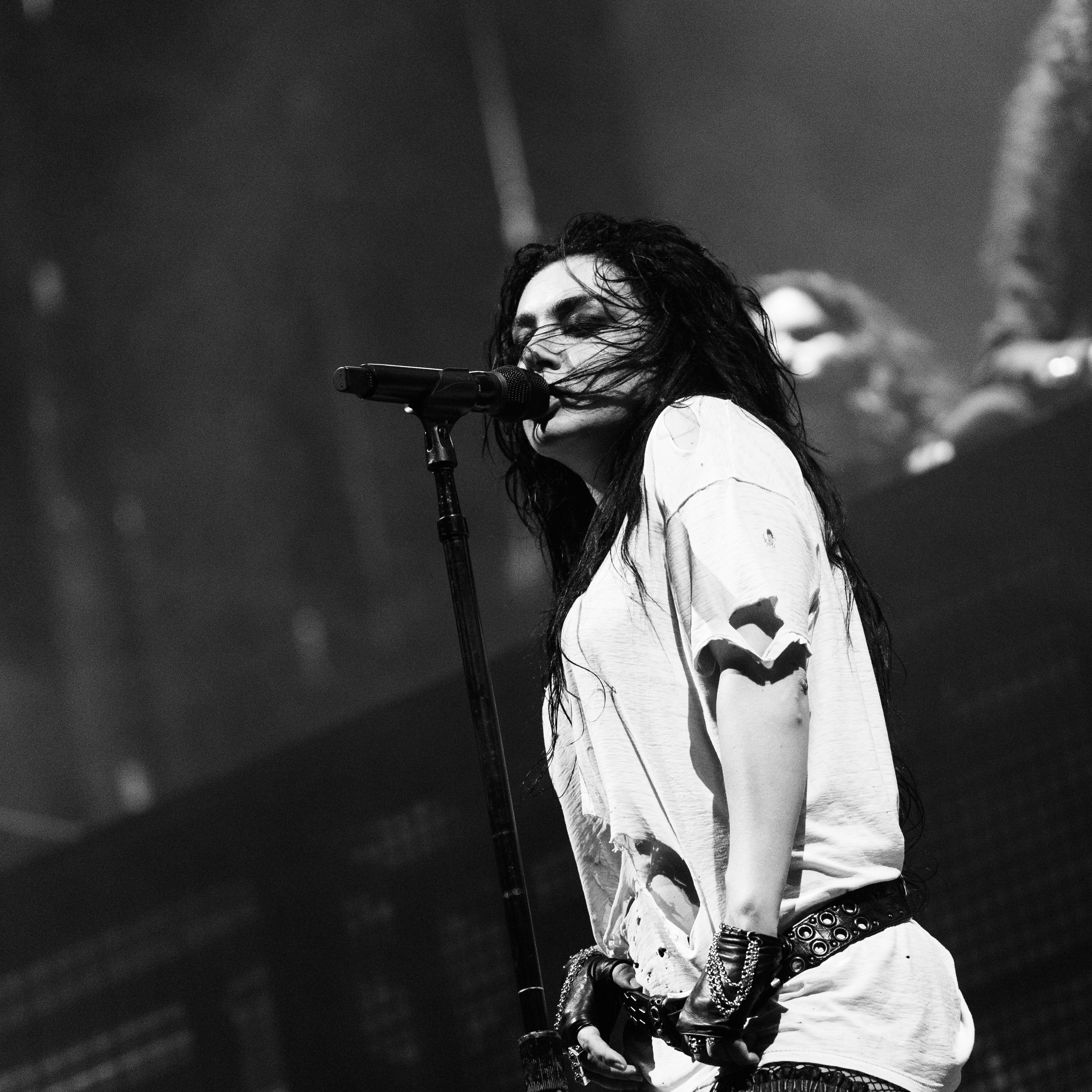
In the lead up to Friday’s show, Charli gave fans fashion tips on social media, saying the dress code is “whatever you want but if you want to commit I’d just get an old T-shirt and rip it to shreds and wear that.”
Charli XCX at the Lollapalooza in Chicago in July. The British pop star opened her ‘Music, Fashion, Film’ tour at the Xfinity Mobile Arena in South Philadelphia on Friday night.Courtesy of the Artist
Many women, men, girls and boys took heed, usually pairing the distressed garment with something black leathery, and most leaving Brat gear at home.
The songs from the new album carried the existential theme. Though to be honest, they were delivered with so much energy that the buzz in the room never let up.
But the unadulterated partying — and the shrieks of delight and singing along to every single lyric — really cut loose on the Brat songs that made up the meat in the middle of the show. With the band mostly out of sight, bass-heavy beats thumped as the general admission dance floor pulsated.
Like a boss, Charli prowled the catwalk and writhed on the ground. She was followed around by a coterie of what I counted as 14 associates, who were more like fashion-model voguers than dancers.
It was difficult to tell how many people were onstage at any one time because flashing strobes seemed to go off every millisecond. The group of planning-ahead fans next to me were better prepared than I, having arrived with Charli-esque sunglasses to wear when necessary.
The show got back to existential business at the end. First, with “SS26,” a lovely pop song with a sobering point of view that cast doubt on art’s ability to make a difference.
“Spring, Summer, ’26, when the world is gonna end, no hope for any of it,” she sang. “We’re walking on a runway that goes straight to hell, nothing’s gonna save us, not music, fashion, or film.”
That was followed by the closing, “No One Lasts Forever,” which also closes the album. It’s a song about seizing the day and embracing the here and now, ‘’cause nothing gonna last forever.”
On Friday, Charli put that point across musically as an inviting pop rock song. But then, as on the album, she handed off the mic to the voice of Canadian director David Cronenberg, recorded in conversation with her.
As a trancelike beat throbbed behind him, and Charli and dancers posed motionless on the elevated stage, Cronenberg spoke about how art can live forever, but artists can’t.
When everybody’s time is up — including the pop star being celebrated in that very arena on Friday — Cronenberg’s looped voice repeated 27 times, “They are dead, they are gone, no one lasts forever.”
And what that translates to — he and Charli were arguing — is the artistic license to be inspired and create in the moments that we’re here. That thought was boiled down to three words “Oblivion is Freedom,” which were spelled out on the video screens, and also on a T-shirt sold at the merch table.
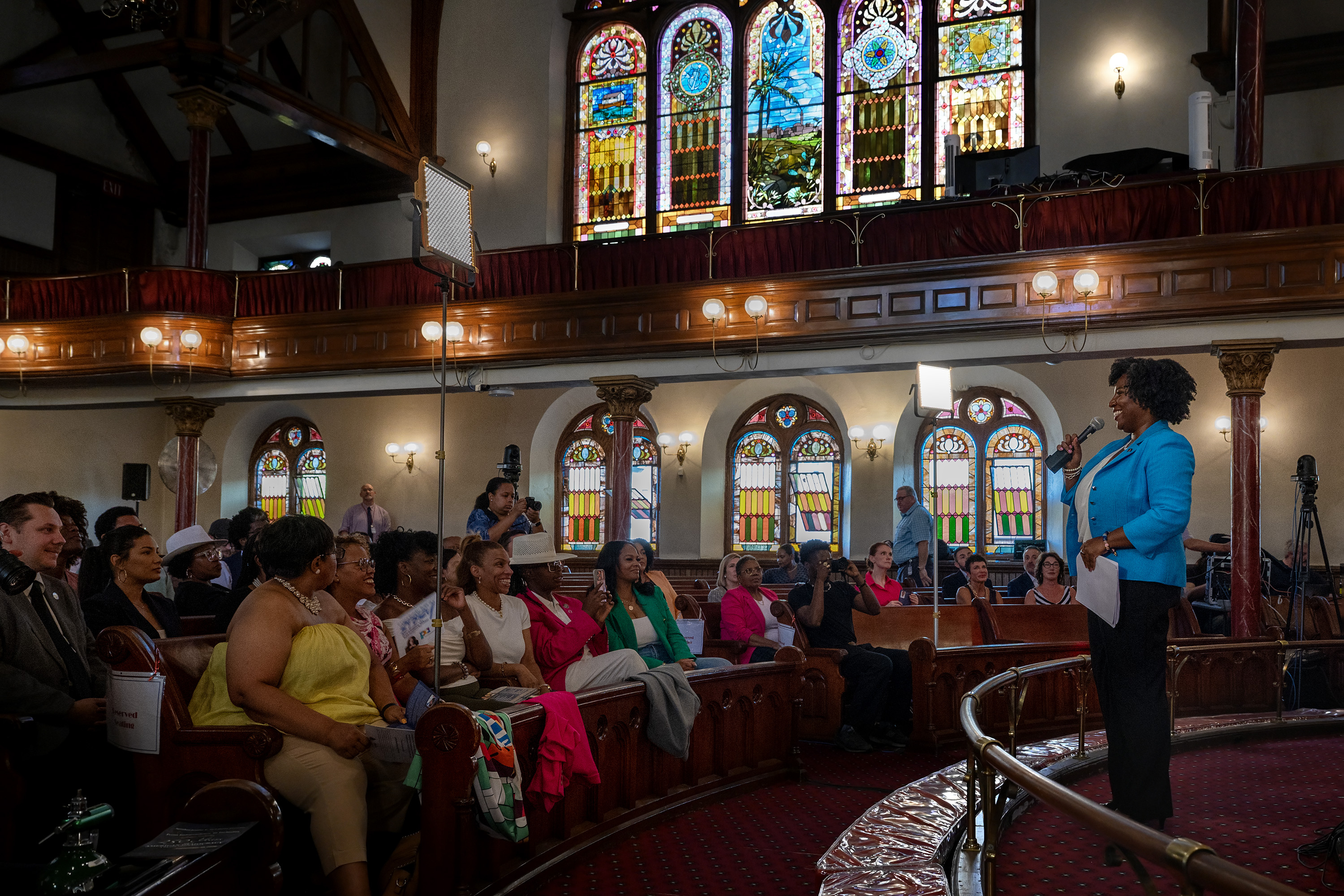
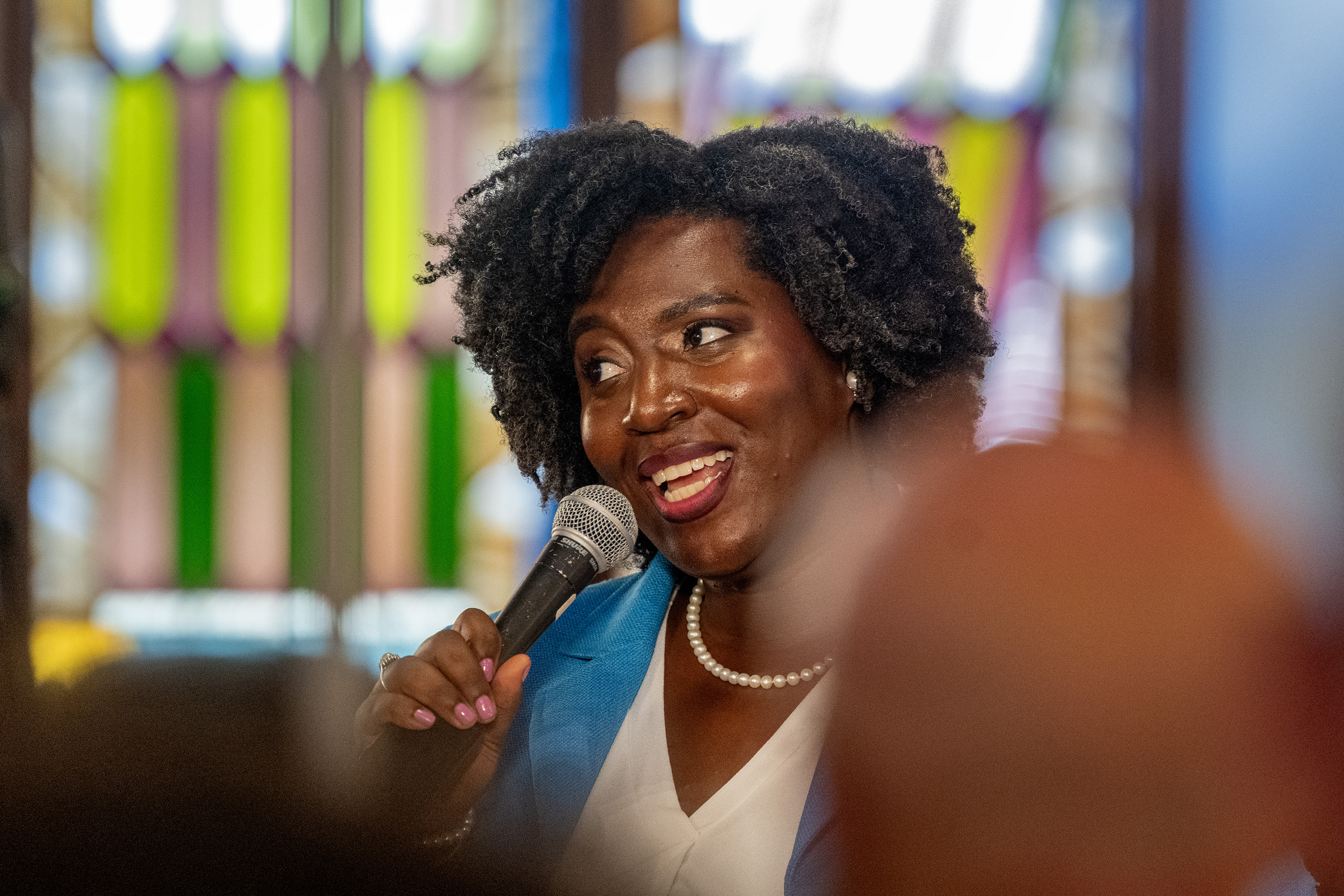
Addressing the crowd packed into Mother Bethel African Methodist Episcopal Church in Philadelphia on Thursday, Pennsylvania House Speaker Joanna McClinton and three other Black House speakers from around the country outlined the steps they’re taking in their state legislatures to safeguard the future of American democracy under President Donald Trump’s administration.
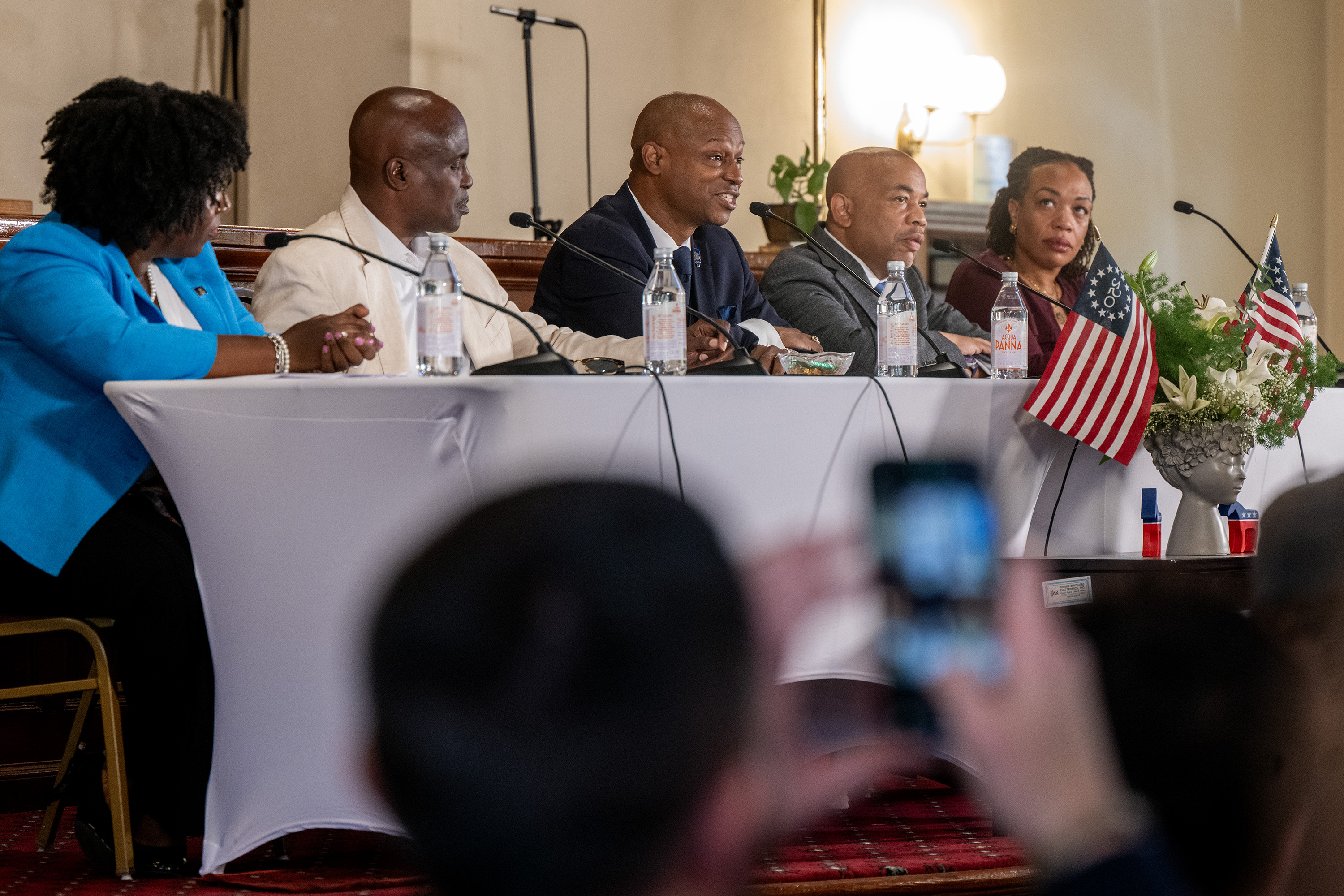
McClinton hosted the three House speakers — Delaware House Speaker Melissa Minor-Brown, New York House Speaker Carl Heastie, and Illinois House Speaker Emanuel “Chris” Welch — for the discussion on America’s progress toward its founding ideals 250 years ago. Each of the speakers, including McClinton, are the first Black person or Black woman to lead their chambers.
The event was moderated by WURD radio host Solomon Jones. Attendees from around the city, including at least two high school classes, packed Mother Bethel A.M.E. Church in Society Hill, which is on the oldest property continuously owned by African American people in the United States since 1791.
House Speaker Joanna McClinton (left) hosts an America 250 Conversation at Mother Bethel A.M.E. Church on Thursday. Others reflecting on America’s history and path to inclusion for Black Americans are, from left, moderator Solomon Jones, Illinois House Speaker Emanuel “Chris” Welch, New York House Speaker Carl Heastie, and Delaware House Speaker Melissa Minor-Brown.Tom Gralish / Staff Photographer
The three blue-state leaders from Illinois, New York, and Delaware have enshrined voting protections into state law under the John Lewis Voting Rights Act, following a U.S. Supreme Court ruling earlier this year that dismantled some federal protections.
“When we talk about voting, it’s very personal,” said Welch. “When I first got elected to the state House in 2012, I won my election by 36 votes … Eight years after winning the election by 36 votes, I became the state’s first Black speaker. You can’t tell me every vote doesn’t count.”
Similar legislation has yet to become law in Pennsylvania, where the General Assembly is split, with Democrats controlling the House and Republicans controlling the Senate.
McClinton, the first woman and first Black woman to lead the Pennsylvania state House, said she was jealous of her blue-state neighbors, as Pennsylvania Democrats are vying for control of the state Senate in November. The state House passed a bill to expand voting access to include same-day voter registration in a bill titled the Leroy Irvis Voting Rights Protection Act to memorialize the late Pennsylvania House speaker, who in 1977 became the first Black person to lead any state legislature since Reconstruction. That bill has yet to be called up for a vote by the GOP-controlled Senate.
“I know I’m not supposed to be envious of my neighbors,” McClinton joked from the table set up in front of the church pulpit.
House Speaker Joanna McClinton hosts an America 250 Conversation at Mother Bethel A.M.E. Church on Thursda. She hosted three other state House speakers from around the country at the event, reflecting on America’s history and path to inclusion for Black Americans.Tom Gralish / Staff Photographer
Each of the leaders acknowledged the ways Black Americans were purposely excluded from many of America’s liberties by the nation’s founders, progress in broadening civil rights since then — and how their state governments are trying to safeguard those protections under Trump’s administration. They each expressed concern about voting access, immigration, healthcare, and their state-level efforts to protect them through legislation.
“State legislatures have power,” McClinton said, noting Pennsylvania’s increased investments in public education and a focus on Black maternal health. “We are not in charge of ICE, we are not in charge of the president, but we do have power, and we do good work.”
In New York, Heastie said state lawmakers included protections in this year’s state budget to discourage U.S. Immigration and Customs Enforcement from appearing near polling places as Trump ramps up his efforts against noncitizen voting that advocates fear will discourage American citizens from going to the polls.
Each of the legislative leaders encouraged the young people in attendance to get involved in their local government, expressing hope for the future.
“I look at pictures of my late aunt and uncle back in the ’60s and ’70s and I see them at protests,” Minor-Brown said. “When I see those pictures, I look at our young people today and know that’s the direction that we’re going in. That’s where we’re at right now, and that’s what brings me hope that we’re going to get to a better place. I know we will, because our young people are so energized and ready to move and ready to close these gaps.”
McClinton also noted the ways the Trump administration has tried to rewrite history just a few blocks away from Mother Bethel A.M.E. Church at the President’s House Site, where officials swapped panels detailing the brutality of slavery for ones that sanitize George Washington’s history as an enslaver.
“We see the fact that this federal administration continuously out an eraser and says, ‘Oh that didn’t happen, that’s not how it occurred,’” McClinton said. “We, in this moment, have to recommit to the promise of this nation.”
During Thursday’s panel, the speakers fielded questions on a number of current events, including about the 25th anniversary of the Sept. 11, 2001, terrorist attacks. McClinton recalled her experience in college at the time, and said that America is at risk of another terrorist attack due to Trump eroding the nation’s image in the rest of the world.
“Thank God we’ve not had another attack … But we have to also recognize that our policies are impacting our perception around the world,” she said.
Several Pennsylvania Republicans were quick to seize on her comments on the eve of the anniversary as insensitive and trying to blame America for the terrorists’ actions.
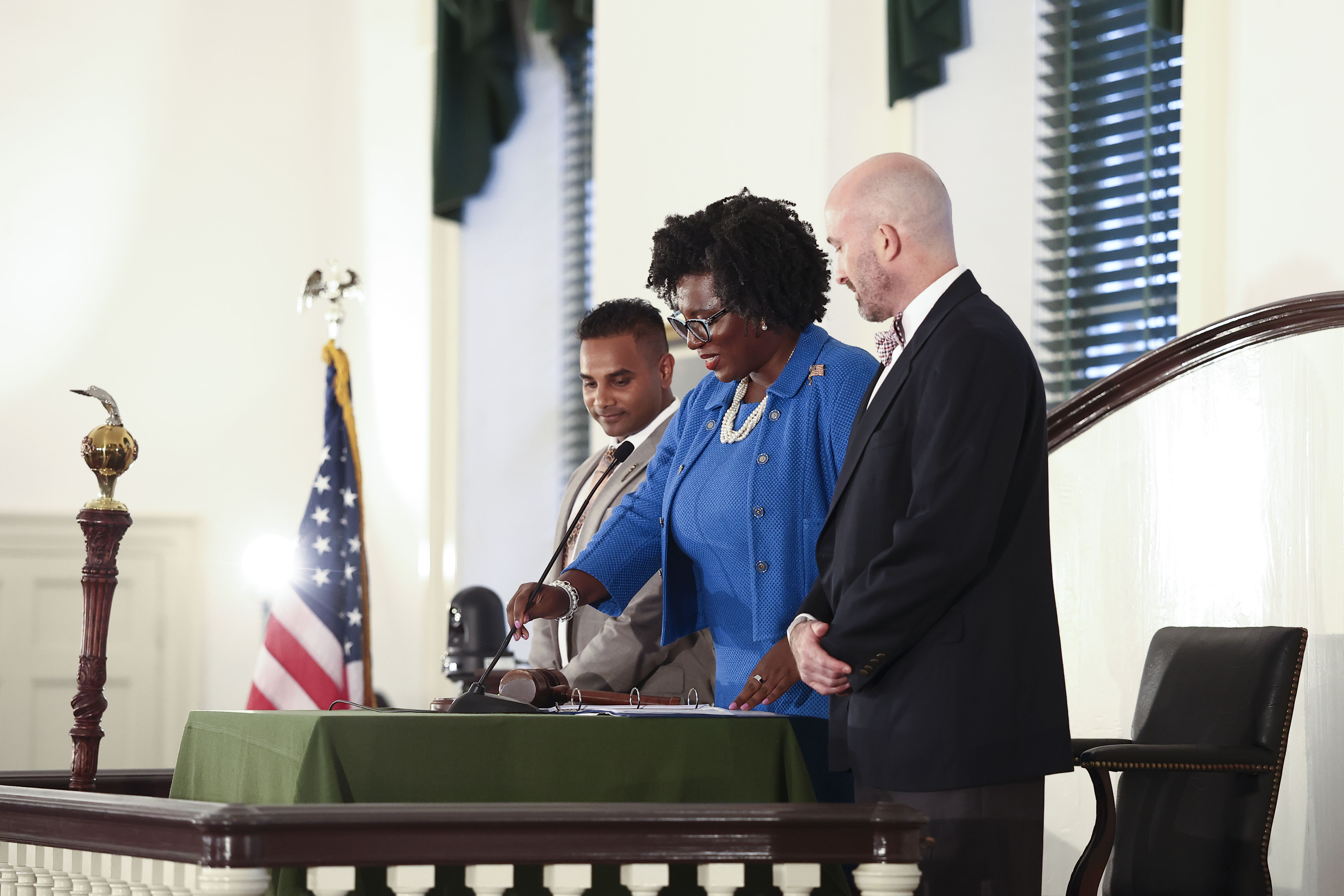
Earlier in the week, McClinton presided over a ceremonial session of the state House in Independence Hall, the same place where the Declaration of Independence was signed 250 years ago, and the building that also served as Pennsylvania’s first statehouse.
Joanna McClinton, speaker of the Pennsylvania House of Representatives, along with members of the Pennsylvania House of Representatives convened a special session at Congress Hall on Wednesday in Philadelphia. The gathering commemorates the 250th anniversary of America and Pennsylvania’s Constitution.Monica Herndon / Staff Photographer
She stood at the rostrum, leading the same room where in 1787 the nation’s founders decided that enslaved Black people would only be counted as three-fifths of the number of white residents when tallying America’s population to calculate congressional representation.
“We are in a day where ‘We, the people’ should mean what it says, finally,” McClinton said Thursday. “But starting with the inception of this country, it did not mean all of us. ‘We, the people’ meant white men who owned a certain amount of property.”
People told me about a great street messiah, so I set out to find him.
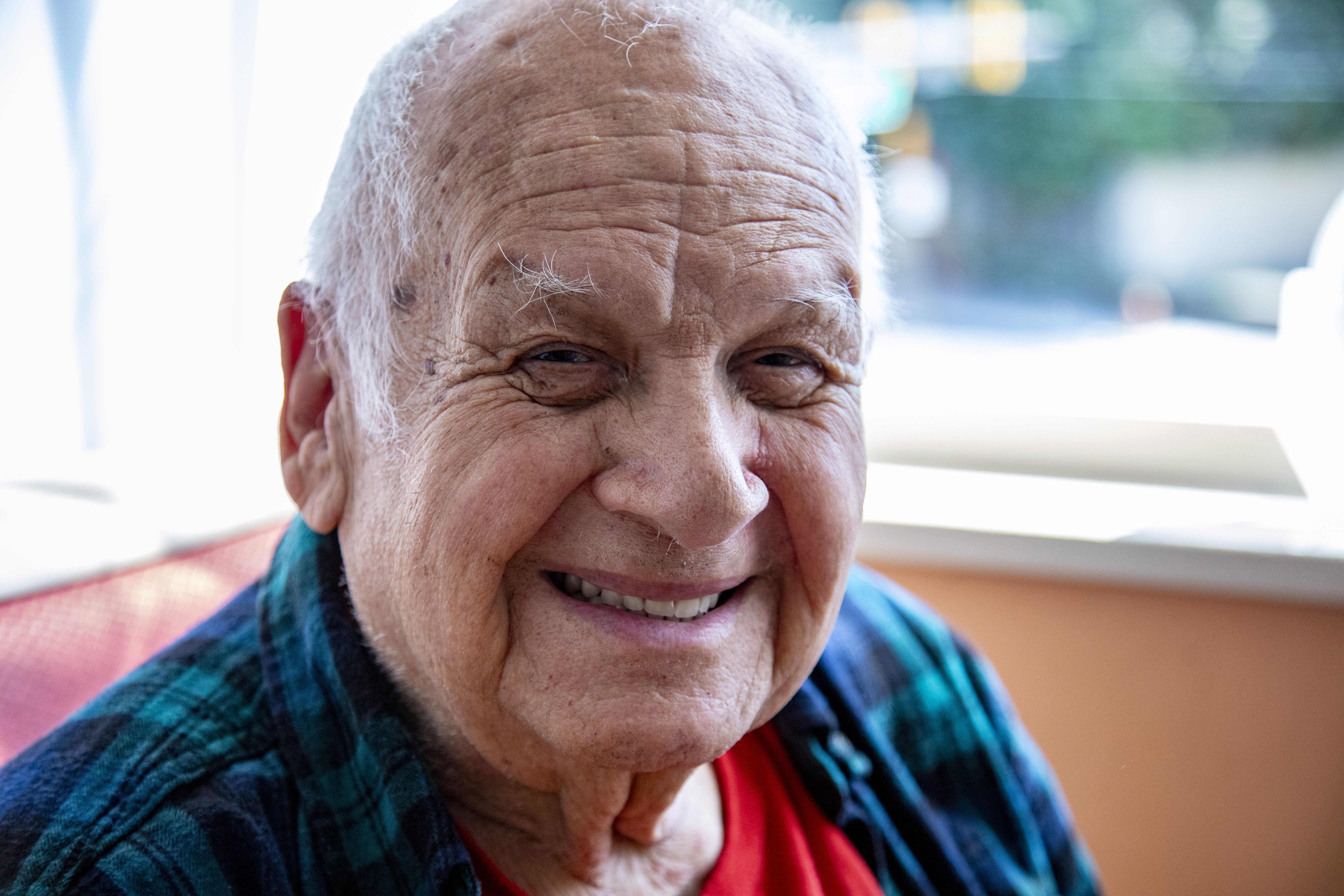
The homeless men simply called him Zave, short for Xavier de la Huerta.
In the 1980s, he ran St. Joseph’s Shelter for homeless men where Front Street meets Kensington Avenue, beneath the rumble of the Market-Frankford El. He was a Franciscan friar assigned to nearby St. Francis Inn, the soup kitchen that survives on donations and still serves meals each day to homeless people, those who are unemployed, people battling substance use, struggling seniors, poor children, and anyone else with nowhere to turn.
The Franciscans have both priests and brothers, such as Zave, with the order saying it is dedicated to serving God where they are most needed. Guests don’t shuffle through a buffet line carrying plastic trays; instead, they sit at tables while volunteers deliver meals, restoring a measure of dignity of which they mayhave known very little.
The neighborhood itself foreshadowed what has made Kensington known today beyond its borders, through YouTube videos focused on exploiting images of poverty and the opioid crisis for clicks.
Once called “The Workshop of the World,” Kensington was one of America’s great manufacturing neighborhoods, home to textile mills, carpet factories, and the John B. Stetson Hat Co., which employed 5,000 people before it closed in 1971.
As factories evaporated, jobs vanished, families left. Investment in the neighborhood dried up and poverty settled over streets lined with crumbling rowhouses and inoperable, abandoned cars.
Before meeting Zave in 1989, I imagined him as a stern schoolmaster. The homeless men called him the “Mayor of Front Street,” and spoke of him with such reverence that I pictured a towering authority figure in a black cassock with half-glasses sliding to the edge of his nose.
I had been talking with the men on the corner when a crowd suddenly gathered around a little man about 5-foot-5wearing a bright red knit cap with a white pom-pom. The huddle of people trailed him like pigeons chasing breadcrumbs.
“Who’s that?” I asked.
“That’s Zave,” they said.
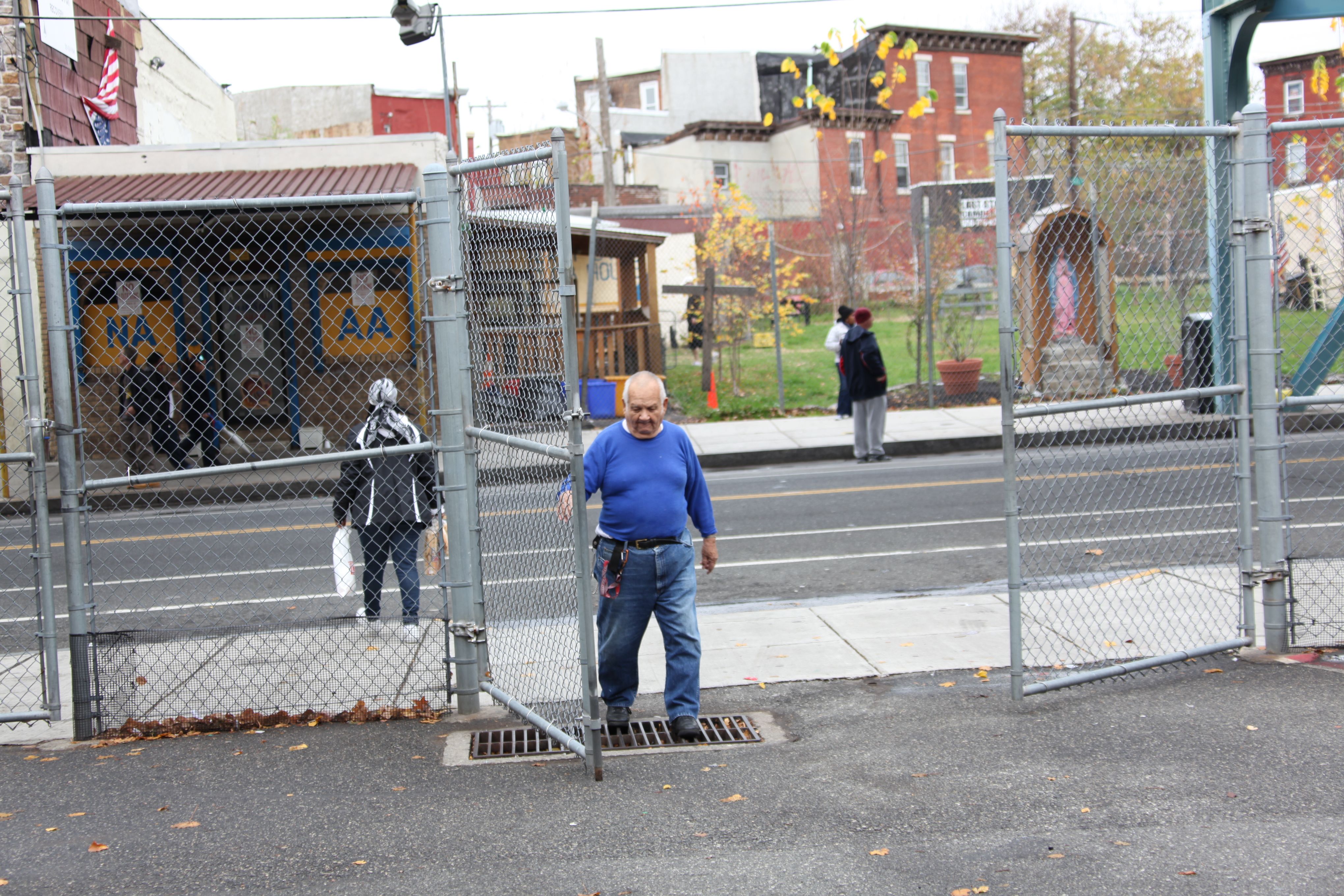
Brother Xavier de la Huerta opens the entrance gate so that people in need can access St. Francis Inn, in Kensington, in November 2011.Octavio Duran
I crossed the street, finding someone who seemed half my size, barrel-chested with a gleeful, disarming smile. He unlocked the shelter, empty during the afternoon before residents returned for the evening.
The building that housed St. Joseph’s Shelter was a narrow rowhouse that had once been Joe’s Bar, its name still preserved on the tile floor. Eight army barracks beds lined one wall. A small sitting room served as the heart of the house, where the men argued, laughed, mourned, and tried to help one another survive substance use and life on the streets.
I asked Zave what inspired him to dedicate his life to homeless men. Surely this had been his calling. He laughed.
“This is my assignment,” he said. “It’s where the Franciscans sent me.”
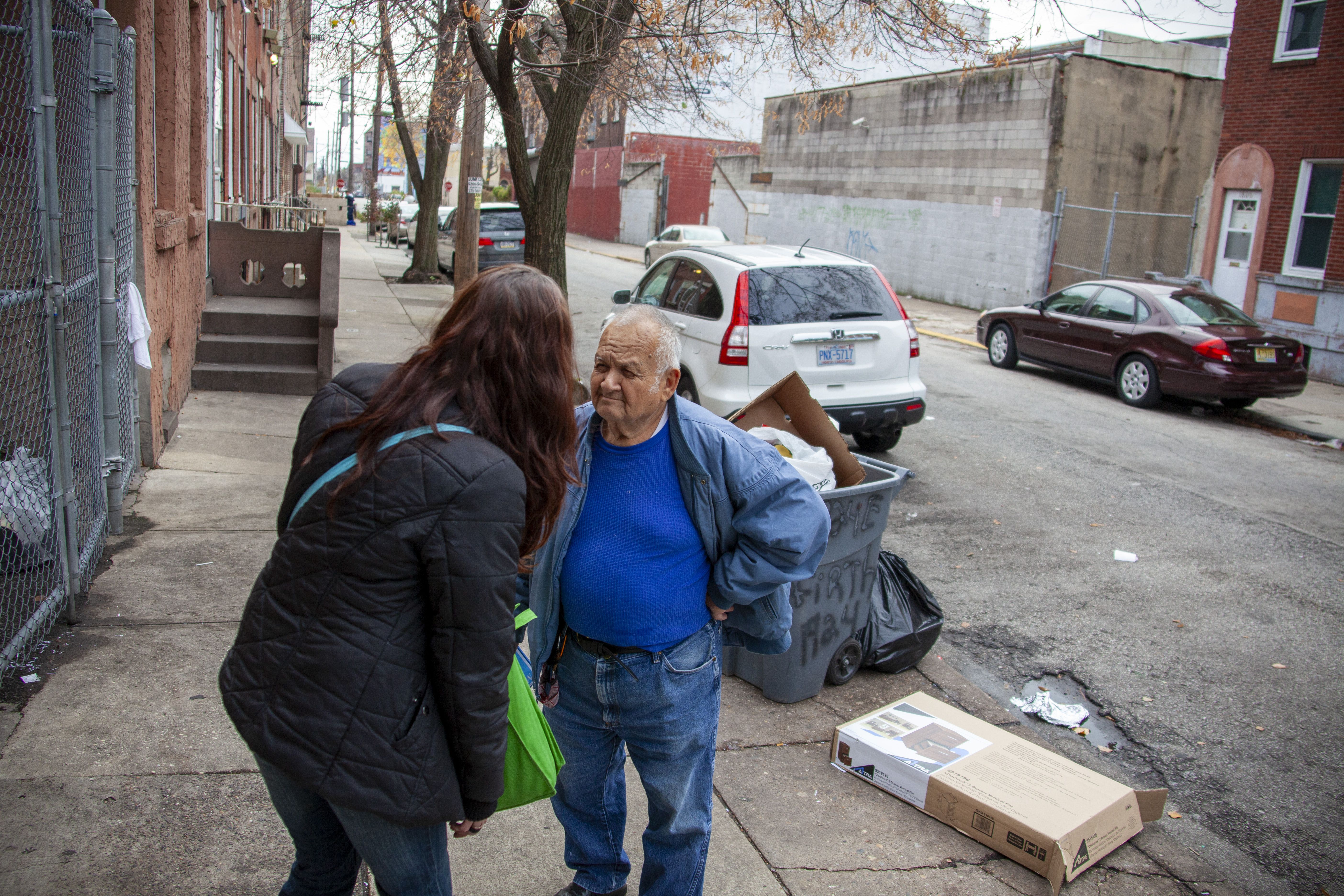
Brother Xavier de la Huerta listens to a homeless woman explaining how she needs assistance, outside St. Francis Inn in November 2011.Octavio Duran
I latervisited his sister, who lived near my Maryland home. She described her brother asa gentleman with innate kindness. When he stayed overnight at her home the first time, he asked her to replace the bed in the guest room because it was too comfortable. He rarely watched television because he lived upstairs at the shelter among the men, so he enjoyed viewing the old shows on his sister’s box.
She also told me a childhood story about a faithful dog who waited for youngZave at the school bus stop every afternoon. Neighbors were amazed at the canine’s devotion, but eventually learned the source.
On the walk home, Zave stopped at the butcher shop to collect discarded bones and carried them home for the waiting pup.
One homeless man who had spent a decade on Philadelphia’s streets described Zave to me in the most glowing terms.
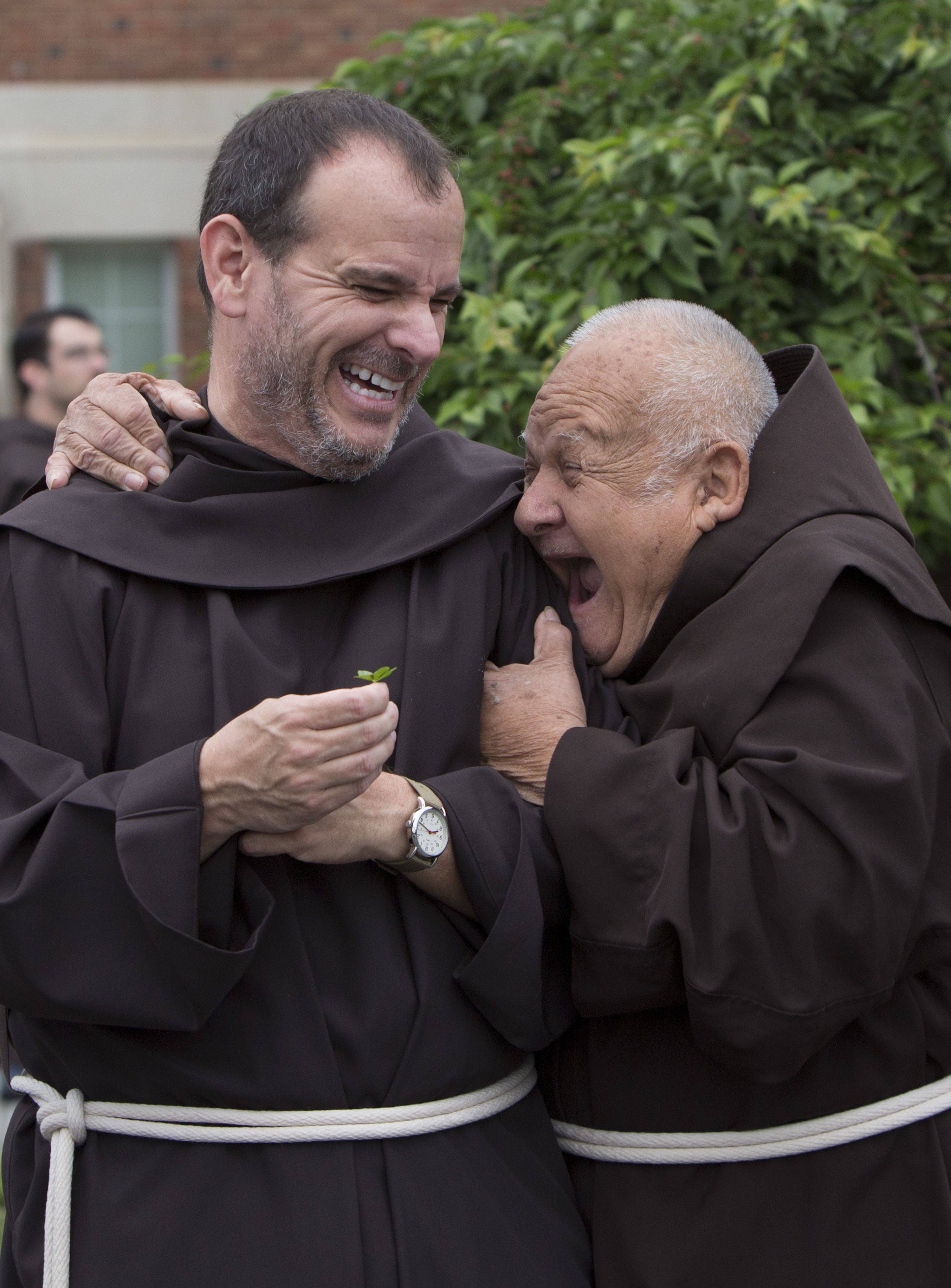
Brother Xavier de la Huerta (right) shares a laugh with Brother Fred Dilger at Siena College in Loudonville, N.Y., in June 2014.Octavio Duran
“Brother Xavier, he’s like a saint,” he said. “He’s good people. Very good people. He’d take the coat off his back to give it to somebody. I feel like it’s Christmas whenever I see him; that’s the glow he has. I don’t know how somebody so little can do so much.”
One of the men I met at the shelter eventually entered drug treatment, moved into a halfway house, found sobriety, and rented an apartment. Another quiet soul Zave saved.
When I visited Zave again, he looked exhausted.
“What happened?” I asked.
“I broke one of my own rules,” he said.
He had agreed to hold one resident’s money so the man wouldn’t spend it on drugs.
“At 2 o’clock this morning,” Zave said, “he came pounding on the door demanding it back.”
There was no complaint in his voice, just another day.
Last year, Zave, now 90, celebrated 60 years as a Franciscan brother and now lives quietly in his order’s retirement home, the St. Lawrence Friary in Beacon, N.Y. He retired in 2016 after suffering a stroke, completing 37 years of Front Street duty.
Thirty years of newspaper reporting for major newspapers has introduced me to presidents, governors, celebrities, athletes, and thousands of fascinating people. Few taught me more about the meaning of a life than the little friar in the red knit cap.
Muhammad Ali once said, “The service you do for others on this earth is the rent you pay for your room in heaven.”
Butter chicken has taken an indirect route to South Street’s Pronto Pizza: from its roots in North India to a Pakistani family kitchen in Northeast Philadelphia, then into an Italian American pizza shop and, finally, onto a roll.
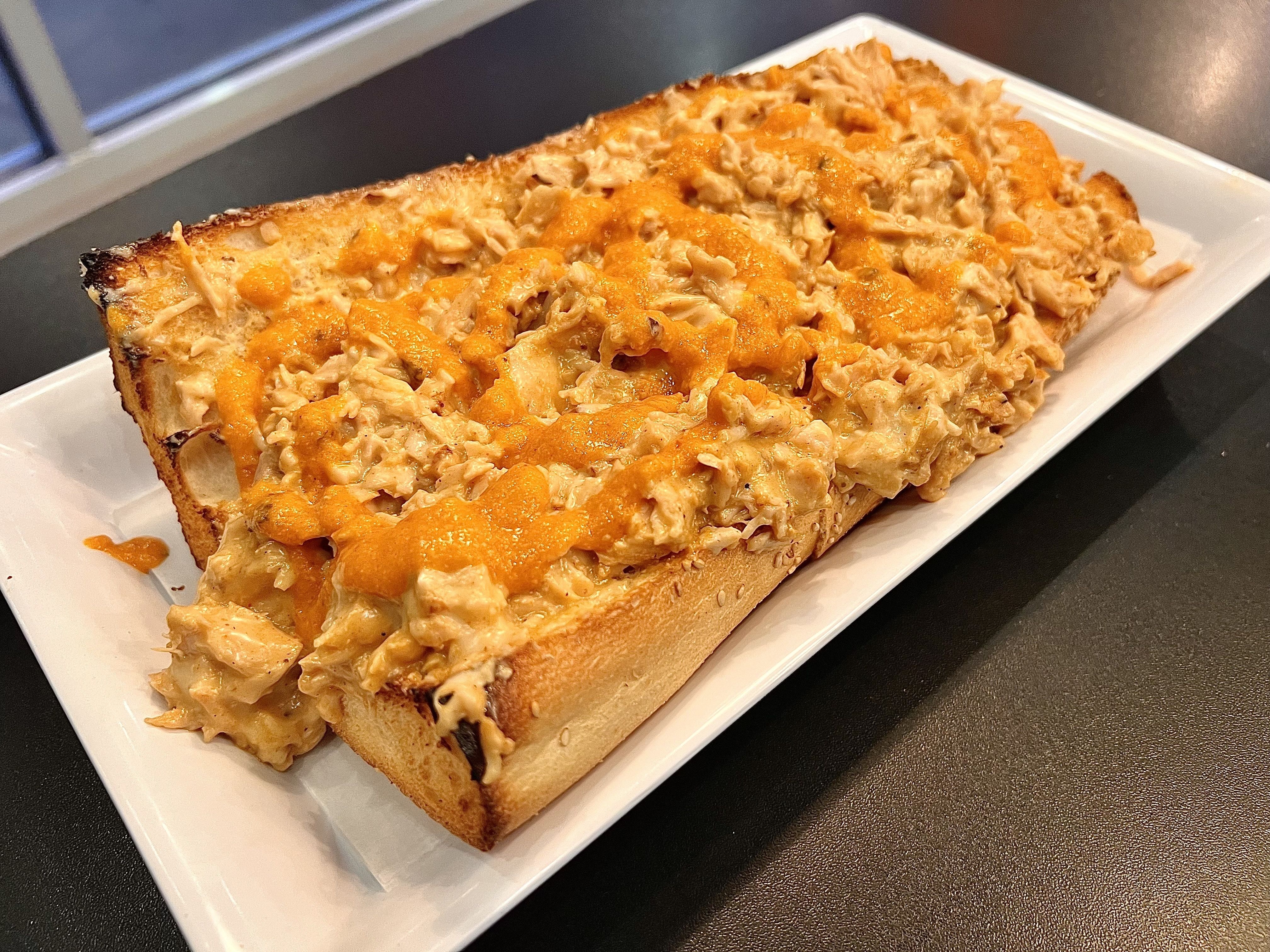
At Pronto, just off Broad Street, it’s a secret menu item. Owner Umair Cheema tops chopped marinated chicken with Cooper Sharp and butter chicken sauce based on his mother Asma’s recipe. The $12 sandwich is Cheema’s addition to a citywide assortment of cheesesteak variations that includes versions made with oxtail and salmon.
Cheema does not skimp. He lightly toasts the Liscio’s roll before adding nearly a pound of a mixture of chicken and melted cheese. Then comes a ladle or two of the rich butter sauce, which comes perilously close to gilding the lily.
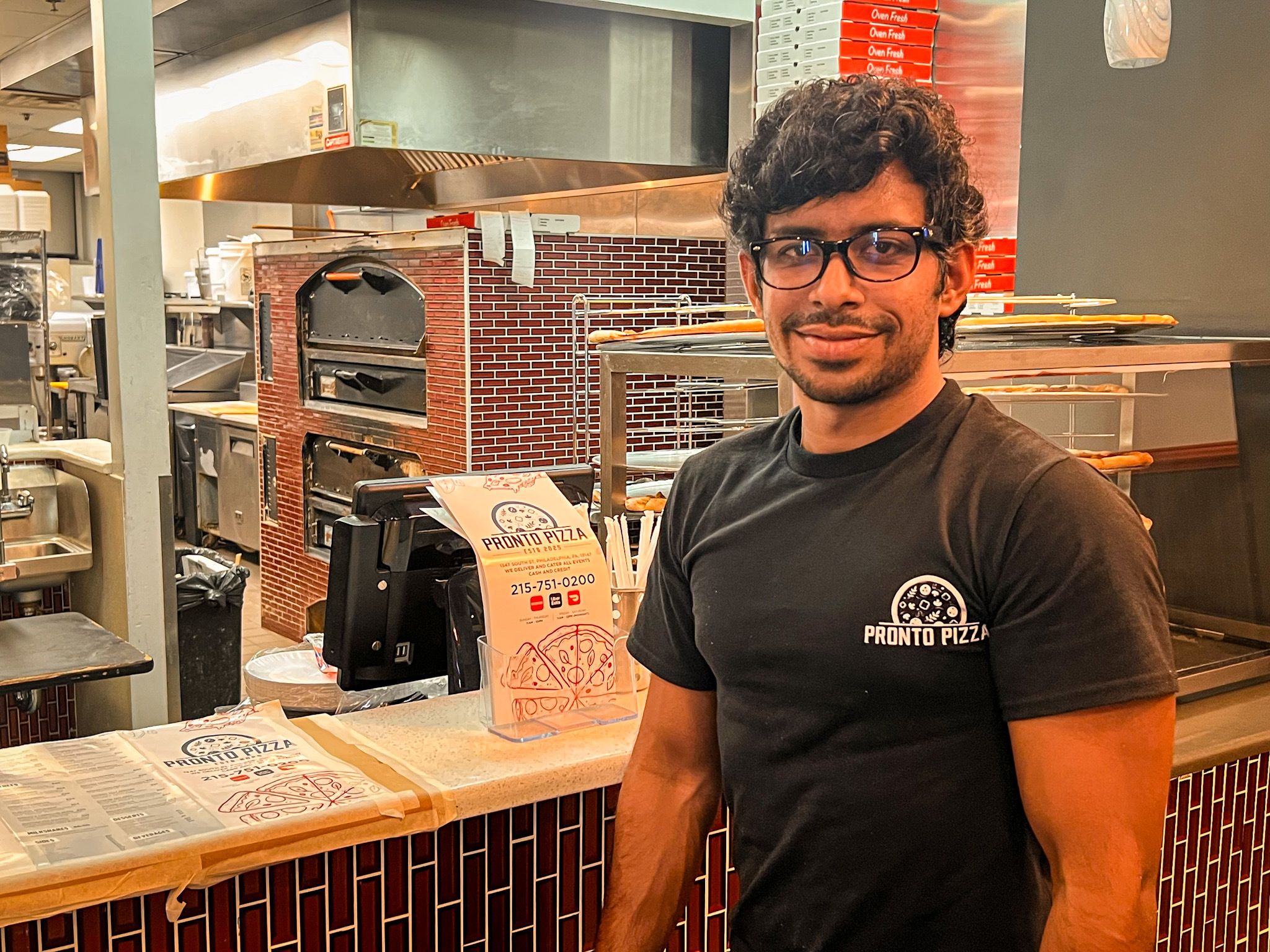
Umair Cheema owns Pronto Pizza, 1347 South St., which previously was LaScala’s Pronto.Michael Klein / Staff
Cheema, 28, had eaten plenty of butter chicken in Pakistan, but he credits his younger brother, Adil, with inspiring Pronto’s version. After the family moved to Northeast Philadelphia in 2019, Adil routinely asked their mother to cook for him.
“One day my mom made butter chicken, and I was like, ‘Mom, this is outstanding. This is the kind of butter chicken I eat at restaurants,’” Cheema said.
A staple entree on Indian restaurant menus in the United States, butter chicken typically features yogurt-marinated chicken in a mild, creamy tomato sauce seasoned with onions, garlic, and spices such as garam masala, turmeric, cumin, and coriander. The dish has proved adaptable to other formats. Chef Reuben Asaram, for example, has incorporated it into his Mexican-Indian “Reubychanga.”
Pronto is also not the area’s only shop making a butter chicken cheesesteak. Double Down Kitchen at Ridge Hall in Ambler serves one alongside versions made with jerk chicken and bulgogi-marinated rib-eye.
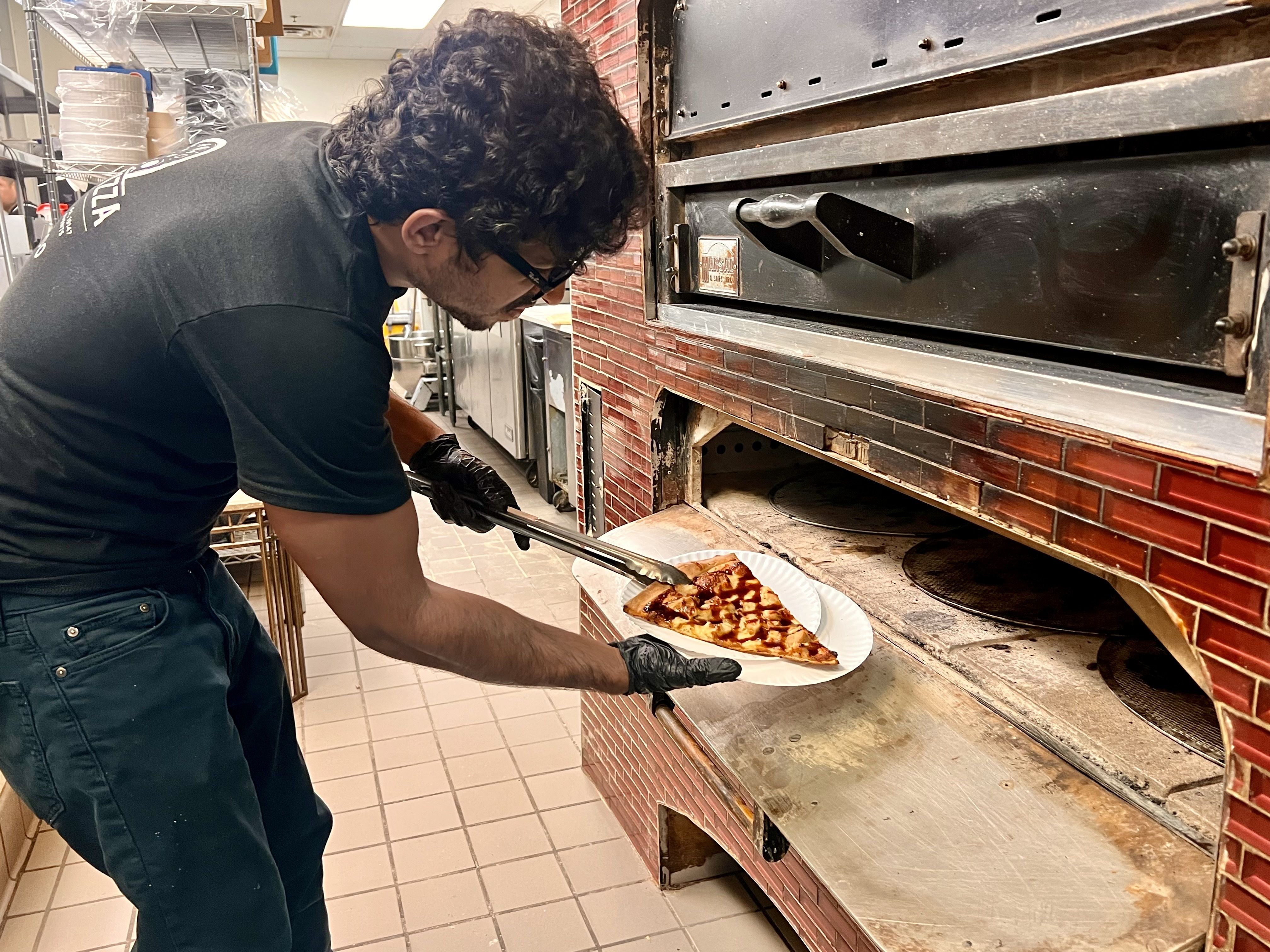
Owner Umair Cheema pulls a slice of pizza from the oven at Pronto Pizza, 1347 South St.Michael Klein / Staff
Cheema’s sandwich is part of his effort to broaden the menu at Pronto, which he bought from restaurateur Rob LaScala. He largely retained LaScala’s offerings of pizza, sandwiches, wings, pasta, meatballs, chicken Parmesan, and grilled salmon platters.
Cheema had not expected to enter the pizza business. After arriving from Pakistan, where his father had worked as a banker, he took a job at Kabobeesh, his aunt’s West Philadelphia restaurant. His father was diagnosed with severe diabetes soon afterward, while his mother found warehouse work.
“I took charge,” Cheema said. “I was like, ‘Let me deal with all of this now. It’s my time to handle this.’”
His opportunity came when an uncle learned that Naz’s Pizza in Chester was for sale.
“He called me and said, ‘Someone is really desperate. They want to sell their pizza shop. I know you have some money saved. If you really want to look into it, I’ll help you out, too.’”
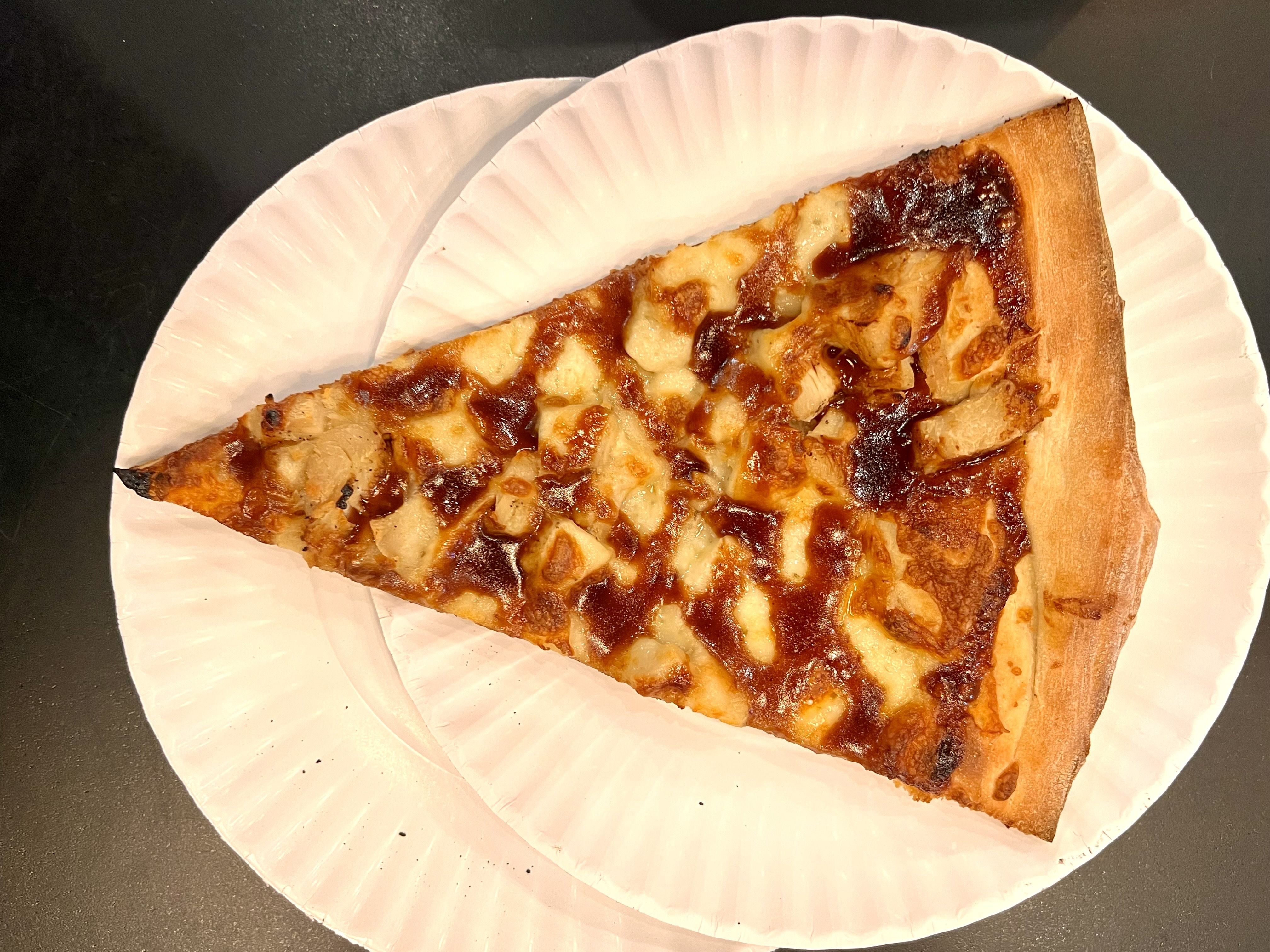
Barbecue chicken pizza slice at Pronto Pizza, 1347 South St.Michael Klein / Staff
Cheema drove to Chester the next day and arrived around 3 p.m., hardly primetime at most pizzerias. “I saw people coming in and the phones ringing,” he said. “That means a business is working. So I told my uncle, ‘Everything seems OK. They are short a couple of things, but we can fix it.’”
Cheema and his uncle bought the shop, and Cheema said sales doubled within six months. They eventually expanded to six shops before dividing the business to pursue separate growth; Cheema sold off the Chester store. Besides the Pronto at 1347 South St., Cheema owns another Pronto in Torresdale, Holme Style Pizza near Holme Circle, and Old English Style Pizza in Olney.
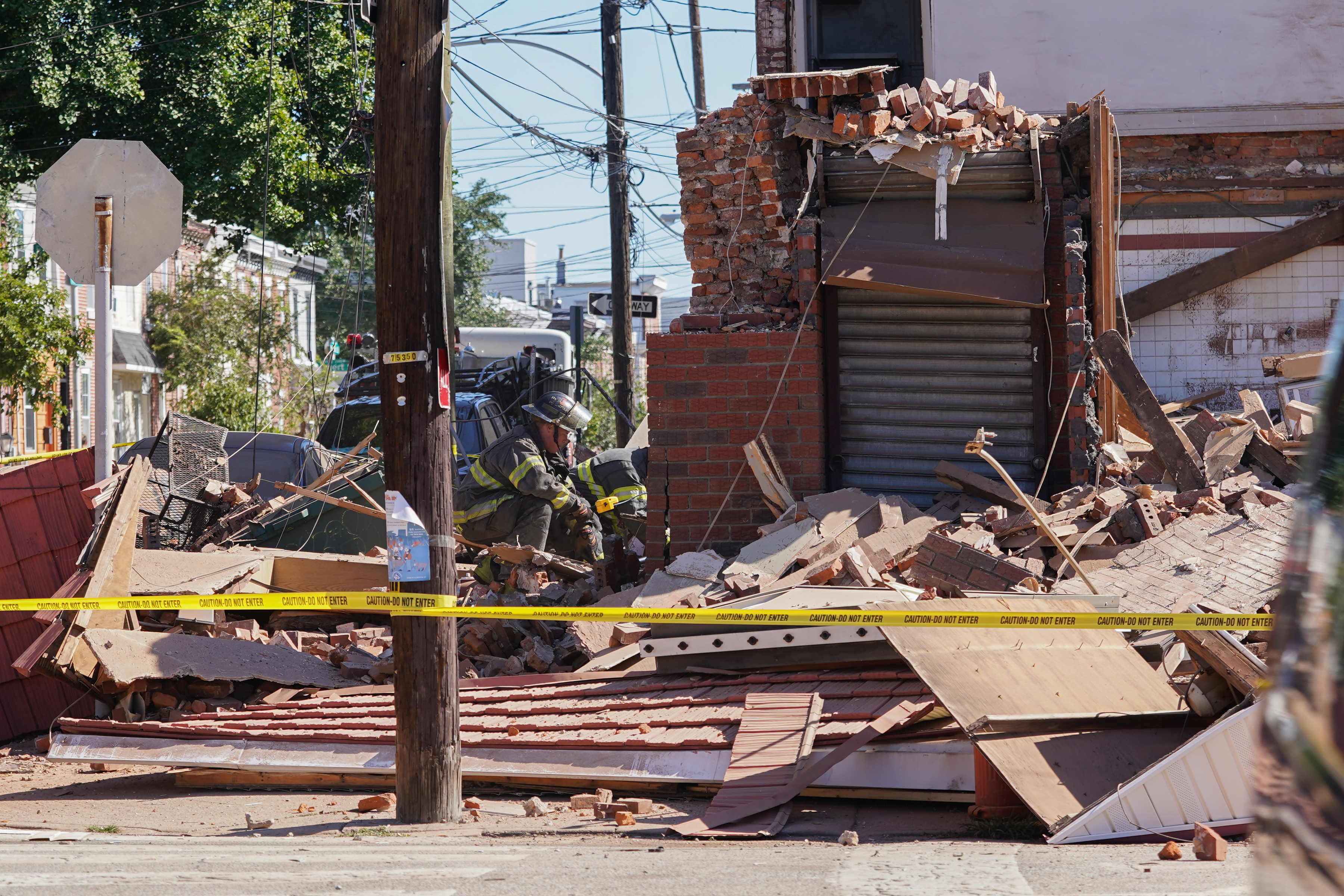
His most serious setback came in September 2022, when the three-story East York Street building housing Key Pizza, his busiest shop, collapsed. “You couldn’t tell there had been a pizza shop there the night before,” Cheema said. Construction work next door was blamed.
The roll-up door and some bricks are all that remained of Key Pizza at 2329 E. York St. after its collapse on Sept. 14, 2022.Jessica Griffin / Staff Photographer
No injuries were reported, but he lost the business, and the resulting insurance litigation was resolved only recently, about 3½ years later, he said.
Cheema does not plan to rebuild Key. He is focused instead on Pronto, its catering operation, and potential additional locations. The butter chicken cheesesteak gives him a way to integrate his family’s cooking into the kind of business in which he found his footing.
“Everybody in Philly knows what a cheesesteak is, and there are so many good places out there already selling cheesesteaks that are famous for them,” he said. “But I wanted to do something different, and something that still relates to Philly.”
Davina Neuson has been haunted for years by questions about the killing of her son Armand Hayes, who was fatally shot outside a West Philadelphia bar in 2022.
She never understood how the fight that ended her 30-year-old son’s life escalated into murder.
Now, finally, she may get an answer.
Lawrence Cary, 44, was arrested in late August and charged with murder and related crimes in connection with Hayes’ killing after the men got into a bar fight the evening of Aug. 15, 2022, according to court documents. He is set to appear Monday before Judge Gregory O. Yorgey-Girdy for a preliminary hearing.
“I don’t know how to put it into words,” Neuson said. “I’ve waited four years for this moment.”
Hayes, known by many as “Ace,” was a father of two daughters and beloved by his family, Neuson said.
He attended Strayer University and Philadelphia Community College and had been working as a compressor operator for Philadelphia Gas Works when he was killed.
“Ace was a genuinely good person, he had a personality that could light up a room,” Neuson said. “A smile of his was unforgettable.”
Neuson said she never has been able to stop wondering about his last moments.
Police investigators said Cary and Hayes got into a physical altercation around 11:45 p.m. in the Asmara Lounge on Haverford Avenue, not far from where Hayes was found laying in the street with multiple gunshot wounds through his body.
He was taken to nearby Lankenau Hospital and pronounced dead shortly after his arrival.
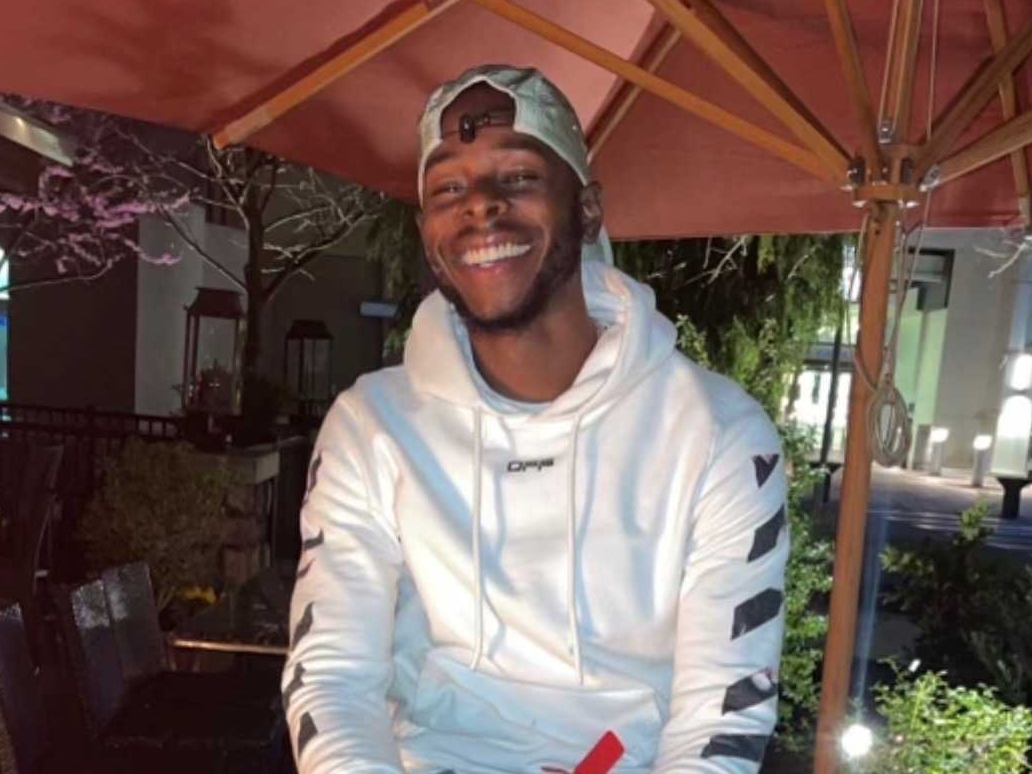
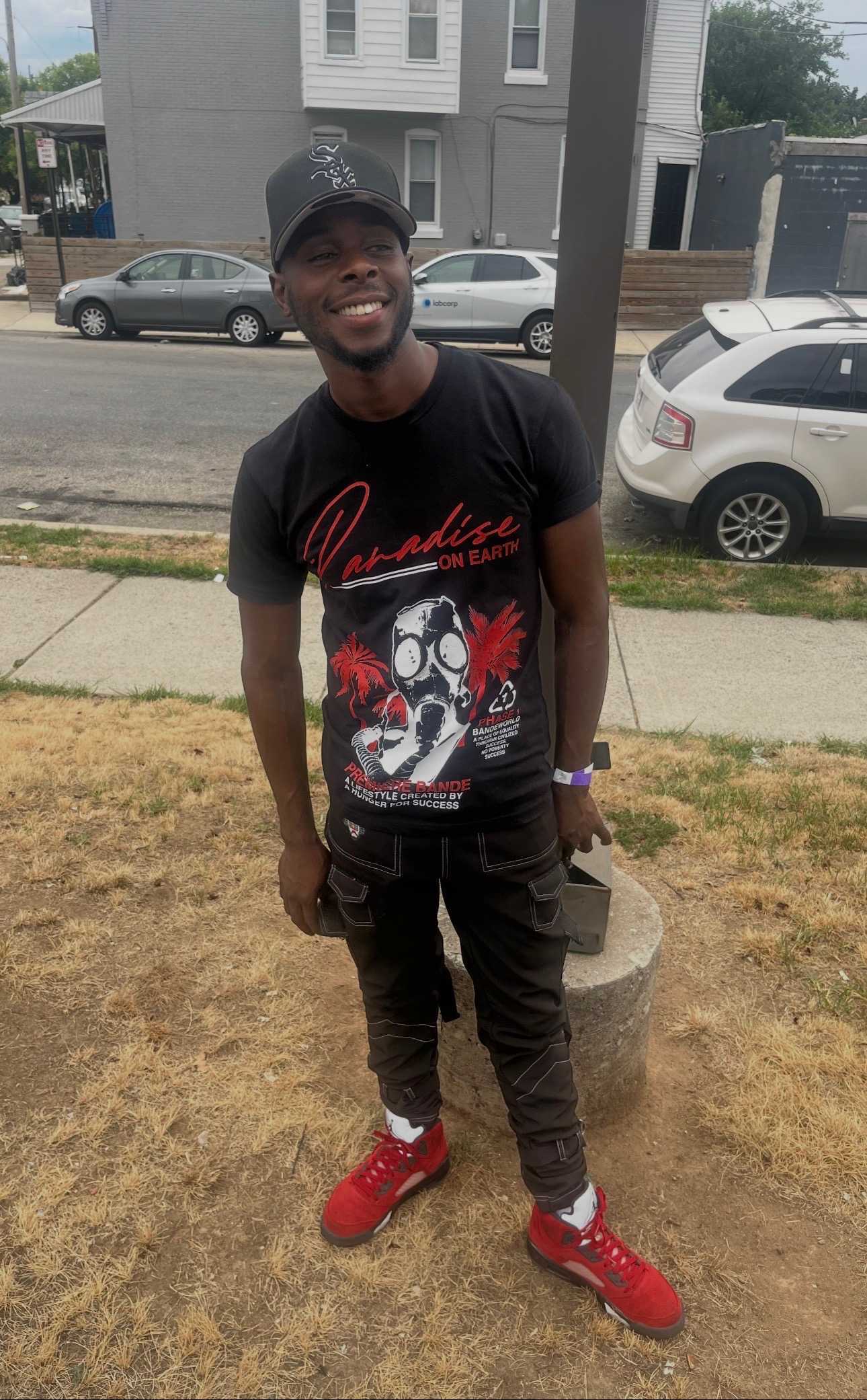
A photo of Armand Hayes.Davina Neuson
Surveillance footage showed Cary leaving the bar after the altercation and driving in the area of 64th and Vine streets, near where Hayes was found wounded, according to the affidavit of probable cause for his arrest.
Investigators later learned that Cary, seated in the driver’s seat of his Chevrolet Trailblazer, fired multiple shots from a handgun out his passenger window when he encountered Hayes, the document says.
Earlier in the evening, Hayes had told a bartender that Cary had bitten him during the scuffle, according to the document.
Investigators soon identified Cary using eyewitnesses, surveillance footage, and receipts from the bar marked with his name.
And in 2023, they learned that a week after the killing, Cary’s Trailblazer had been given a new title and gifted to another man who registered the vehicle in the name of a Bryn Mawr woman. The man asked the woman to do that for insurance purposes, according to the affidavit.
Neuson, Hayes’ mother, said she did not believe that Cary and her son knew each other before the incident.
She still cannot comprehend why her son’s life was taken.
“What hurts the most is knowing his life was taken so suddenly,” she said. “He had so much more life to live, so many more memories to make, so many people who loved him.”
Many of those people will be present in court as Cary’s case works through the system, Neuson added.
Cary is being held at the Curran-Fromhold Correctional Facility and was denied bail.
While Steve Gerben is known for having cocreated one of the year’s most popular Netflix comedy series, his friends and the internet are attempting to crown him with a more ribbing title: The “King of West Chester Golf.”
The Berwyn-born actor, comedian, and costar of Netflix’s Tires says the nickname is just a joke created by his costar and fellow Pennsylvanian Shane Gillis after Gerben “broke 80″ for the first time, scoring 79 on 18 holes of golf last year. It’s something that fewer than 10% of golfers worldwide reportedly do in their lifetime.
“I thought I would just get my friend to start videotaping in case it happened on the 18th hole. And then I did it,” Gerben, 43, remembers with fondness. “So Shane saw that video and was making fun of it on his podcast, calling me the ‘King of West Chester Golf.’”
Gerben’s character on Tires, Will, an anxious go-getter who sees the best in those around him, is not unlike Gerben in real life. Even when receiving praise for his golf prowess or growing television career, Gerben is more comfortable sharing credit with others and not taking the spotlight. And while he downplays his claim to the West Chester golf throne, Gerben does play golf every week in the Philadelphia region — from West Chester courses to the occasional charity event at Ardmore’s Merion Golf Club.
As his profile has grown with the success of Tires, Gerben continues to live in West Chester, cultivating a life around golfing near home and creating a local television production alongside his best friends.
“I can’t see myself leaving the area. I really love it here and it’s home,” he said. “Also, just given how I feel about golf, suburbs make way more sense — it’s just scratching the right itch for me.”
It also helps that the hit show Gerben cocreated with Mechanicsburg-born Gillis and Philadelphia’s John McKeever is filmed in West Chester off East Gay Street, inside an addition to the real-life tire shop of Gerben’s father.
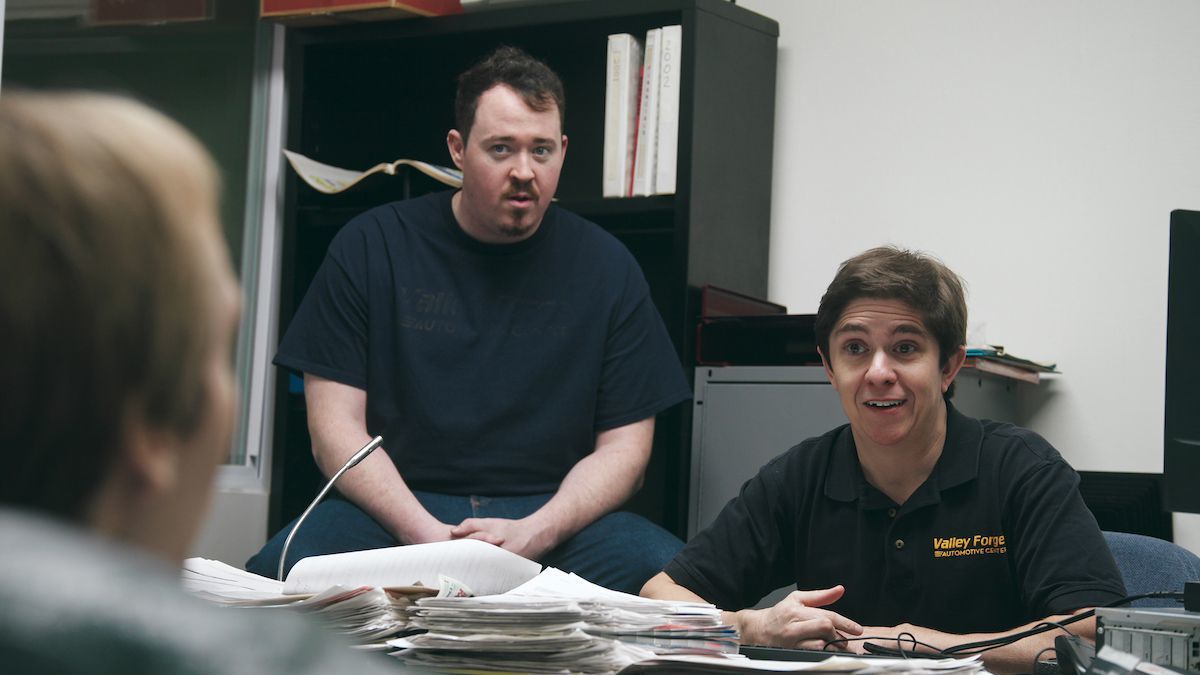
Tires, which had its season three premiere Aug. 13, follows two cousins, Will (Gerben) and Shane (Gillis) as they run the fictional Valley Forge Automotive Center, named after the previous real-life automotive business of Gerben’s father, which was sold in 2011.
“I remember after season one, my dad was on the boardwalk and he saw a Valley Forge Auto shirt in one of the stores, and he was just like, ‘This is insane,’ because it’s this company that he had for 20 years, and then gone, and now we brought it back in a way,” Gerben said.
With Gerben and Gillis on screen, and McKeever as the magic behind the camera, the Tires crew navigates the world of a Pennsylvania small business, rivalries with a national tire chain, and coming to terms with life and romance in your late 30s and 40s.
Tires was recently renewed for a fourth season. That renewal, along with the suburban life he’s created with his girlfriend and cat, has Gerben doubling down on the Philly region. One factor that now rules his life is golf, and how to keep enjoying the sport that eases his mind and boosts his confidence.
“Playing golf is a flow state for me. I get out of a perfect golf swing what I’m sure people that meditate get out of meditation or when people feel a piece of art really speaks to them,” Gerben said.
What started as something to do as a senior at Conestoga High School, joining the Valley Forge Golf Club for $8 after school, has grown into a passion that has seen him playing alongside Eagles players like Jason Kelce and appearing in vlog-style golfing videos with comedian Andrew Santino.
Golf feels like meeting up with an old flame for Gerben, who essentially gave up on the pastime as he attempted to make it in the East Coast stand-up comedy circuit in the 2010s. That’s where he met Gillis and McKeever, doing open mics at the now-closed Raven Lounge and Helium Comedy Club.
While Gillis would continue to rise in stand-up comedy, Gerben said he struggled to find footing. Yet, constants in his life were Gillis and McKeever, who reportedly were known to not take on certain projects unless Gerben could be involved.
But one thing that always sat in Gerben’s back pocket was a script for a show based on his experience working at his father’s Valley Forge tire shop that he initially wrote nearly 15 years before Tires would premiere on Netflix in 2024. Two years later, Tires’ third season debuted in the No. 9 spot on Netflix with 2.4 million views in its opening weekend.
The success doesn’t get to Gerben’s head, as he’s focused on enjoying life in the burbs and golfing as much as possible, he said. With golf swinging back into his life, the sport brings a chance of pace in a busy work schedule and/ allows Gerben, who has had arthritis since he was 2, to stay active.
“I feel so unbelievably healthy because I think it’s about like a five- or six-mile walk each golf session, and you’re not even paying attention to that, given you’re doing this thing that you just absolutely love doing, and is a little bit easier on the joints,” Gerben said.
Gerben also sees golf as a way to meet friends.
“Golf is just a weird addiction that some people have that cuts across generational barriers because you spend so much time with people on the course who have the same passion as you,” he said.
In the meantime, Gerben will continue flirting with the idea of starting his own golfing YouTube career, like “Bryan Bros Golf.” But until Tires is wrapped, Gerben said there would be no official online golf career on the horizon.
Besides, if Gillis finds Gerben’s golf videos, Gerben will never hear the end of it from his best friend, he said.
Philadelphians reacted with outrage when Drexel University and the Academy of Natural Sciences announced the closing of its museum on the Ben Franklin Parkway earlier this month.
But the museum is only a part of what the academy does. And while most Philadelphians think of dinosaurs and dioramas,the main business of the academy — its “beating heart,” as one board member calls it — will continue, even if it has often escaped the notice of the general public.
Housed backstage beyond the museum walls is one of the world’s largest repositories of natural specimens: bird carcasses, fish, mollusks, minerals, and bones of various kinds — millions of them amassed over more than two centuries.
And now, amid reports that the academy’s building may be sold and the collection moved, all eyes are on the fate of this trove.
“It’s not just the scope of the collection that’s so important — 19 million specimens representing every aspect of the natural world,” says Robert McCracken Peck, curator of art and artifacts and senior fellow emeritus of the Academy of Natural Sciences of Drexel University. “The collections are not only important because of their associations with historical figures like Lewis and Clark and Thomas Jefferson.
“But these collections were made at specific times in history. We can never go back to collect more of these voucher specimens. They tell us how our world is changing.
“It is by definition irreplaceable.”
Microalgae too numerous to count
Among its peers, the academy’s group of species collections is one of the most significant in the world, and is perhaps unrivaled in certain areas of concentration and historical importance.
More than 220 plant specimens collected by Lewis and Clark on their landmark 1804-06 expedition between the Mississippi River and the Pacific Ocean are housed at the academy. Among the institution’s corresponding members over the years were Thomas Jefferson, John James Audubon, and Charles Darwin. The American Medical Association was founded here in 1847.
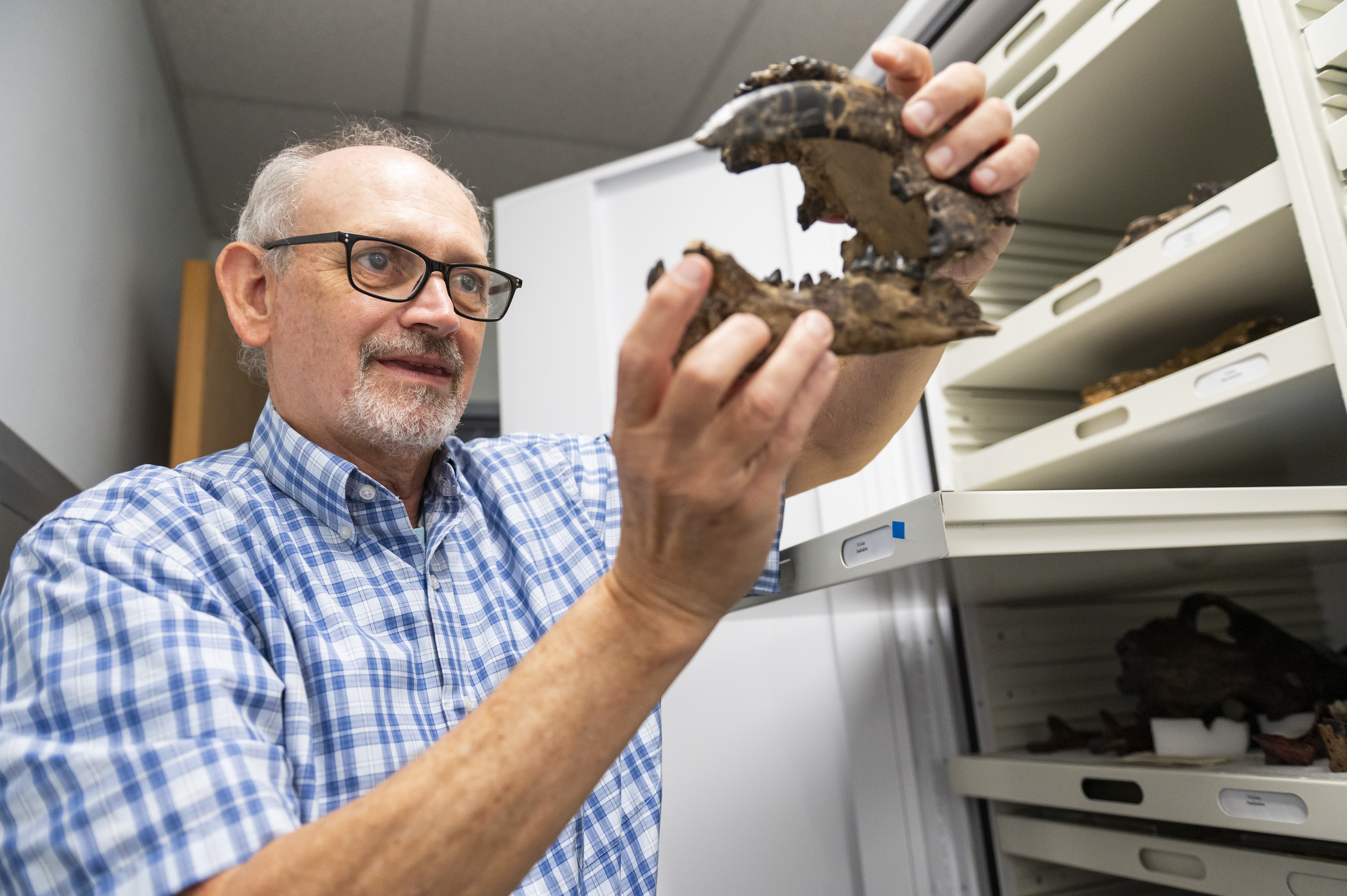
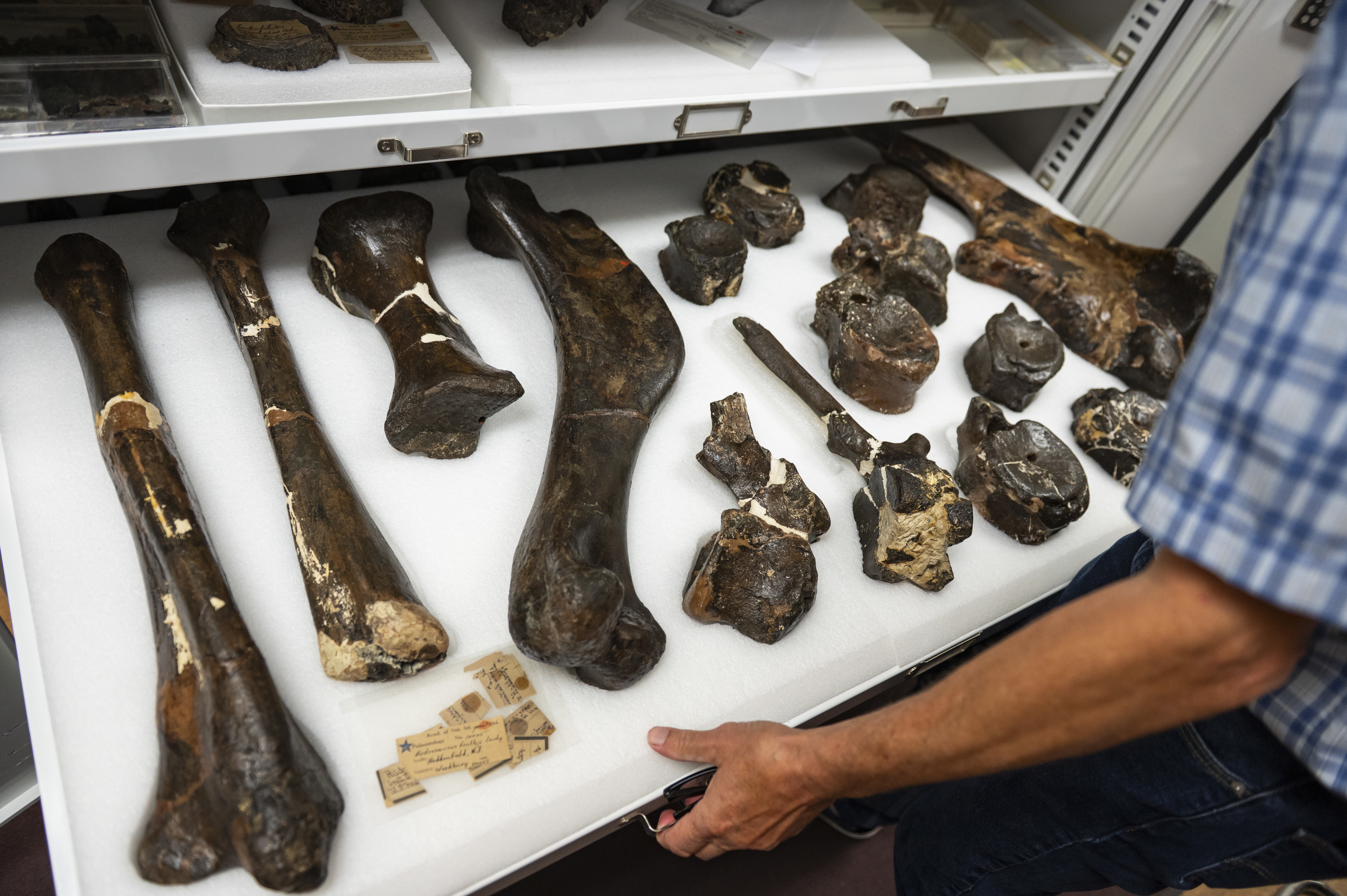
Ned Gilmore, collection manager for vertebrate paleontology, pulls out a drawer filled with bones from the Academy of Natural Sciences’ “Hadrosaurus foulkii.”Allie Ippolito / For The Inquirer
The plants and fungi collection holds 1.4 million specimens of algae, lichens, fungi, and slime molds and includes some of the oldest and most important plant collections in the Americas. The invertebrate paleontology collection is the oldest such collection in the United States.
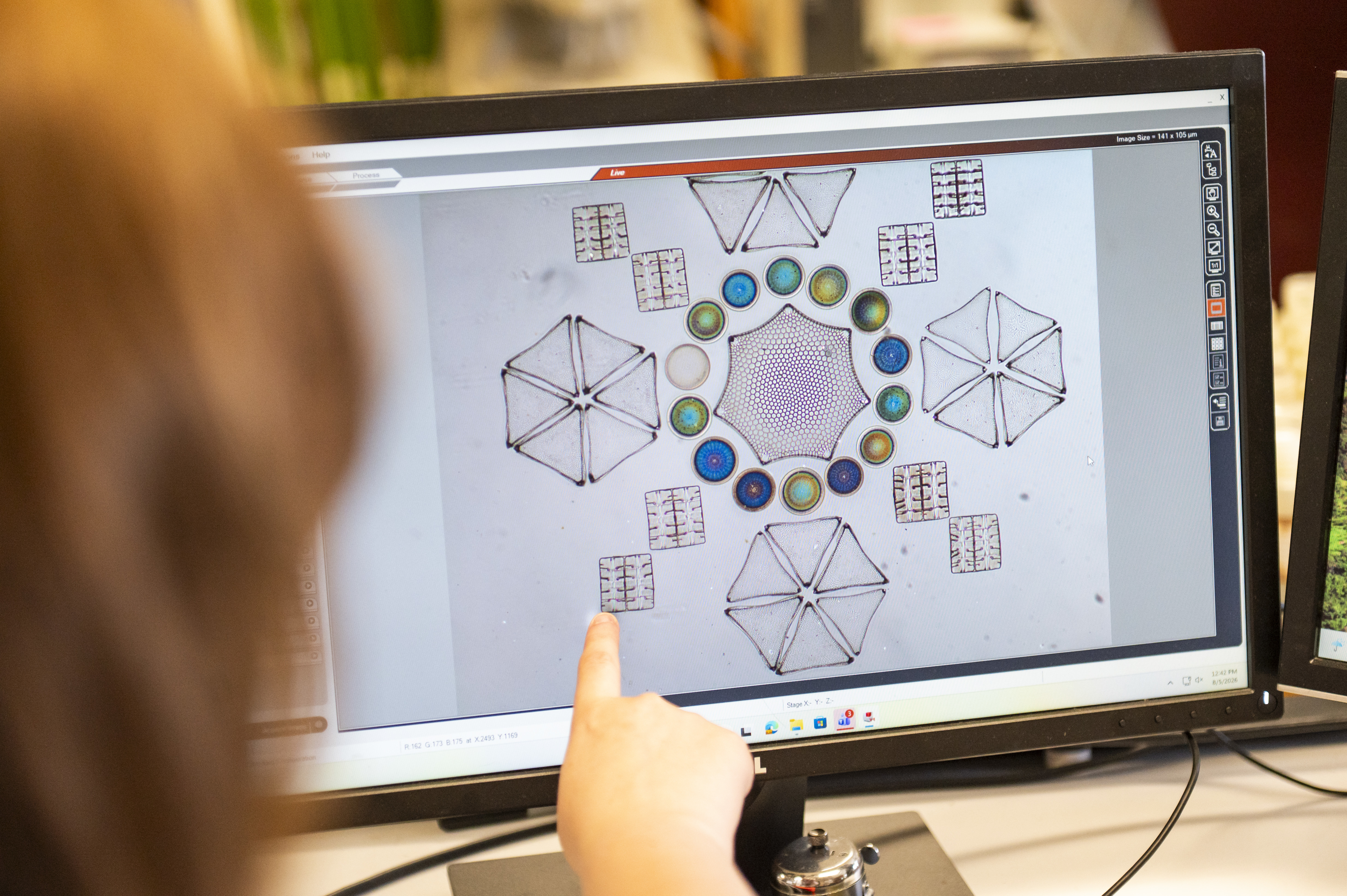
The number of diatoms in that collection is unknown, says Laura Aycock, manager of the academy’s hoard of the single-celled microalgae that are neither animals nor plants, though the academy has around 300,000 slides, with some slides containing upward of a hundred thousand diatoms.
“I’m not going to attempt to calculate that,” Aycock said.
Laura Aycock, collection manager of diatoms at the Academy of Natural Sciences. The diatoms serve as a time capsule.Allie Ippolito / For The Inquirer
The diatoms captured at the academy — which go back to the 19th century and come from around the world — serve as a time capsule.
“You can actually look at water quality and monitor how it’s changing and biodiversity of the diatoms looking at our slides,” says Aycock. “So people will reach out wanting to see, ‘Hey, can I see a snapshot of what this river looked like X many years ago?’”
The academy’s collections are a magnet internationally, says Ted Daeschler, professor emeritus, curator, and chair of vertebrate zoology at the academy.
“It’s a stopping point for people studying a wide variety of different things,” says Daeschler. “Every time I talk to any mollusk person in the world who’s done research, they’re like, ‘Oh yeah, I’ve been to the academy. I’ve done research there.’ Talk to anybody working on crickets and grasshoppers — ‘Oh yeah, I’ve been to the academy.’ People working on Devonian fish, they all came through at one point or another.”
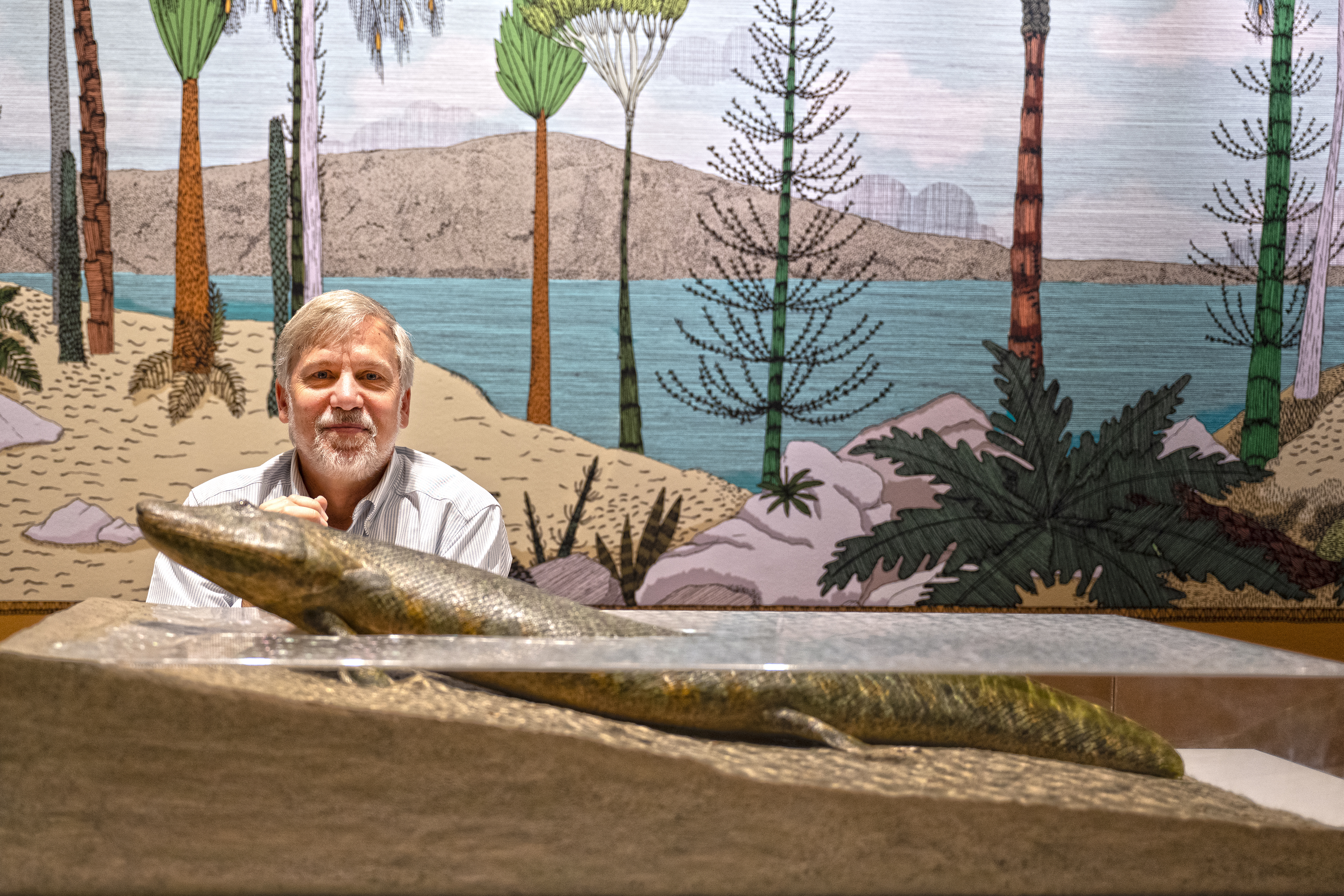
Ted Daeschler in 2023 with a model of “Tiktaalik roseae,” a 375-million-year-old beast whose discovery by Daeschler, Neil H. Shubin, and Farish A. Jenkins Jr. established a new link between fish and land creatures.Jose F. Moreno / Staff Photographer
The academy has seen some novelties over the years: an albacore tuna shipped to the institute from Ernest Hemingway in 1934, fingernail samples from now-retired U.S. Supreme Court Justice Stephen G. Breyer collected in 2010, and two red-eared sliders donated in 1977 by Sylvester Stallone as souvenirs from the original Rocky film.
Hemingway’s tuna remains. But Breyer’s fingernails were tested for stable isotopic composition of carbon and nitrogen to determine the justice’s diet and then discarded, and the turtles Cuff and Link are no longer with us, a spokesperson said.
A key to the ‘next pandemic’?
If some of the collections work and research going on at the academy seems esoteric, there’s no way of knowing what might become urgently relevant at some point.
“We all lived through a pandemic recently — pretty much hell on earth for most of us,” says Jason D. Weckstein, curator of the academy’s ornithology collection and professor at Drexel University College of Arts and Sciences.
“Understanding the ecological interactions that lead to those kinds of events is part of this kind of research. So why are some parasites specific to some hosts, whereas other ones can jump between hosts easily, and there are ecological characteristics that allow that?”
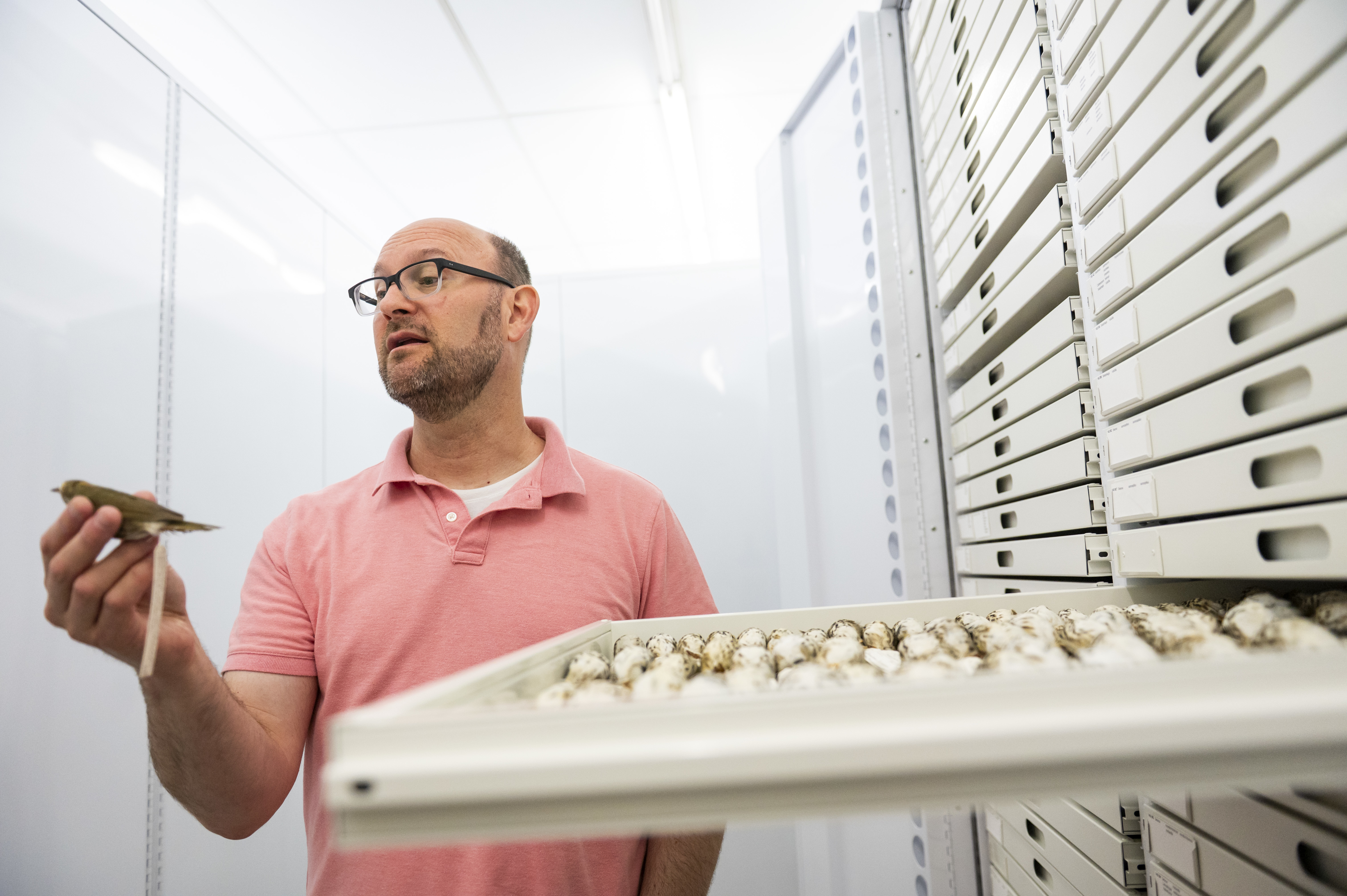
Jason Weckstein, curator of orninthology, holds a warbler at the Academy of Natural Sciences.Allie Ippolito / For The Inquirer
“You just never know when something’s going to happen in the world,” says Weckstein, “and then it turns out there’s something here. We have tissue samples from all over the world. It’s possible we could discover something in those samples that is important for understanding the next pandemic.”
That’s possible, in part, because in the future, specimens might be tested for characteristics whose existence is beyond our current base of knowledge.
Paul Callomon, the academy’s collection manager for malacology and general invertebrates, says that when the first snails entered the academy, “We had no idea what an isotope was. Nobody knew anything about that. But we had an unshakable faith that if we preserve and stabilize these things, as time goes on, they’ll become more important to more people. And so it’s turned out to be. And now of course, with climate change and with this enormous Anthropocene influence on the natural system, the number of ways in which our specimens are going to help tell that story is enormous.”
Each specimen functions as an irreplaceable snapshot in time. Organic materials in their environment are continually breaking down and becoming something else. But when a bird or fish is plucked from its environment, it becomes a permanent record — of itself, but also of the world as it existed at that particular moment.
Biological specimens are often called upon to help solve certain mysteries.
“There are examples in the world generally of new pharmaceutical products being developed from the study of mollusks and their venoms,” says Callomon, “or closer to the academy, we provided shells that were material evidence in the lawsuit against BP for the gulf [Deepwater] Horizon oil spill — historical specimens that proved there was oil in the gulf’s waters before any drilling started, but that it was of a very low level.”
There’s a bigger role now for the academy’s species collection to play, Callomon says.
“The real world is on fire. And the real natural world, the natural ecosystem that sustains all life on Earth, is undergoing enormous changes at the moment. And the only place that you can find material evidence for what it was like before that started, or what it was like at an earlier stage of that process, is natural history collections, and they are mostly housed in museums.”
Several hundred Academy of Natural Sciences supporters came out to protest the decision by Drexel University and the Academy to close the Academy’s museum, Sept. 8, 2026.Tyger Williams / Staff Photographer
‘Profound concern’
Curators and scientists say that as the academy has arrived at a vulnerable juncture, its collections and research are more critical than ever given the march of climate change, microplastics contamination, biodiversity loss, and other crises.
The scientific powerhouse’s own future is a question mark at the moment. Drexel is facing deficits and a challenging enrollment environment, and, in a cost-cutting move a decade and a half after a partial merger of Drexel and the academy, the two groups announced last week that the academy museum will end its nearly two-century run at the end of the month.
The aim now is to move the collection and sell the building, according to a source close to the situation who asked not to be identified. This raises questions about the fate of the academy’s historic building and the critical mass of the Parkway’s cultural attractions, as well as concerns for the future of the collection and the academy’s historically significant library and archive, whose holdings span five centuries.
“Profound concern” is how a group whose board includes the largest and most important natural history and science centers in the U.S. has expressed its apprehension over the future of the academy.
“As the oldest natural science research institution and museum in the United States, the academy is a globally important natural history collection and center for biodiversity research,” the Washington, D.C.-based Natural Science Collections Alliance wrote in an April statement after news of a potential schism between Drexel and the academy.
“Any administrative or structural changes at the Academy must prioritize the integrity of these collections. The destabilization of the institutional support or the specialist staff required to maintain these specimens for active use in research would represent an immense loss to the city of Philadelphia, the state of Pennsylvania, and the global scientific community.”
The NSCA’s concerns remain, said president Trina E. Roberts this week, and while “we’re glad to see that the importance of the collection has been acknowledged in public statements,” she said, the closing of the museum was an unwelcome surprise.
“Education, research and collections are all part of a truly functioning natural history museum. It would be wonderful if the academy can find a way to maintain all of those,” she said.
Academy leaders say they will work to find “new and financially sustainable opportunities for the public display of elements” of its collections, but have not specified any details.
In a statement last week, the two institutions affirmed their attention to the trove of specimens, library, and archive.
“The stewardship of the Academy’s collections and their use to advance scientific knowledge will be the focus of our work for the near future,” said a statement from Drexel president Antonio Merlo and academy board chair Suzanne Biemiller.
A Drexel spokesperson this week said there were no immediate plans to move the collection, and, regarding a potential sale of the building, “no decisions have been made regarding its future disposition.”
“The academy’s home will continue to house its collections, library, archives, and laboratories while Drexel and academy leadership consider potential pathways forward,” said Britt Faulstick.
Should relocation become part of a future plan, Faulstick said, “maintaining appropriate access to the collections for research [during a move] would be an important consideration in that process.”
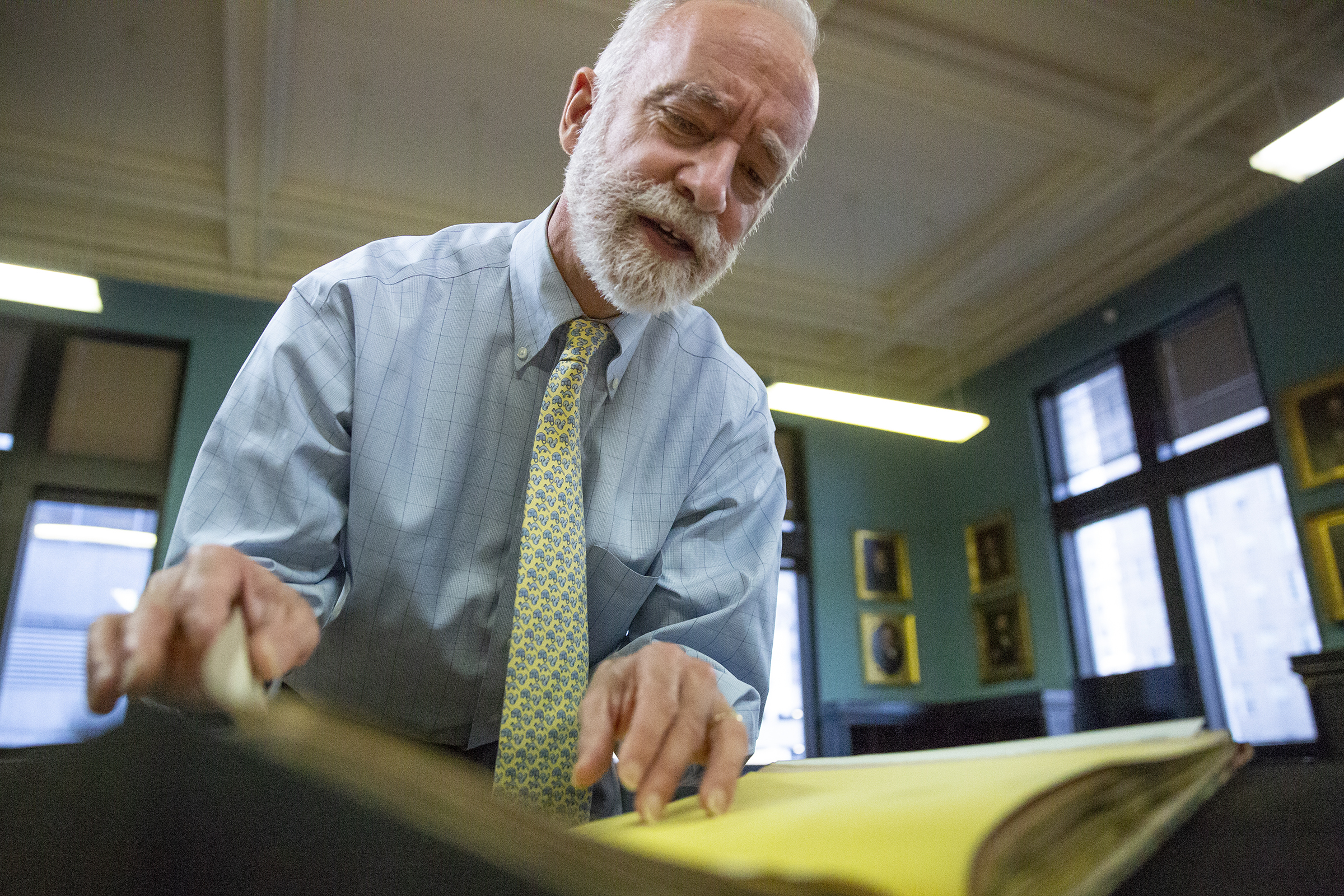
Robert McCracken Peck, curator of art and artifacts and senior fellow emeritus of the Academy of Natural Sciences of Drexel University.HEATHER KHALIFA / Staff Photographer
‘A recipe for disaster’
Moving the collection would be expensive and time-consuming, says Peck, who, with Patricia Tyson Stroud, co-authored AGlorious Enterprise: The Academy of Natural Sciences of Philadelphia and the Making of American Science.
Peck says that in the 1970s, parts of the collection were moved into the former Reliance Standard Life Insurance Co. building on Pennsylvania Avenue now occupied by the Philadelphia Museum of Art, and then, a short time later, were moved back.
“I imagine it would take a couple of years,” he says of a potential move now of 19 million specimens, “because that’s how long it took to move our collections to and from the Art Museum area, and they didn’t even move them all.”
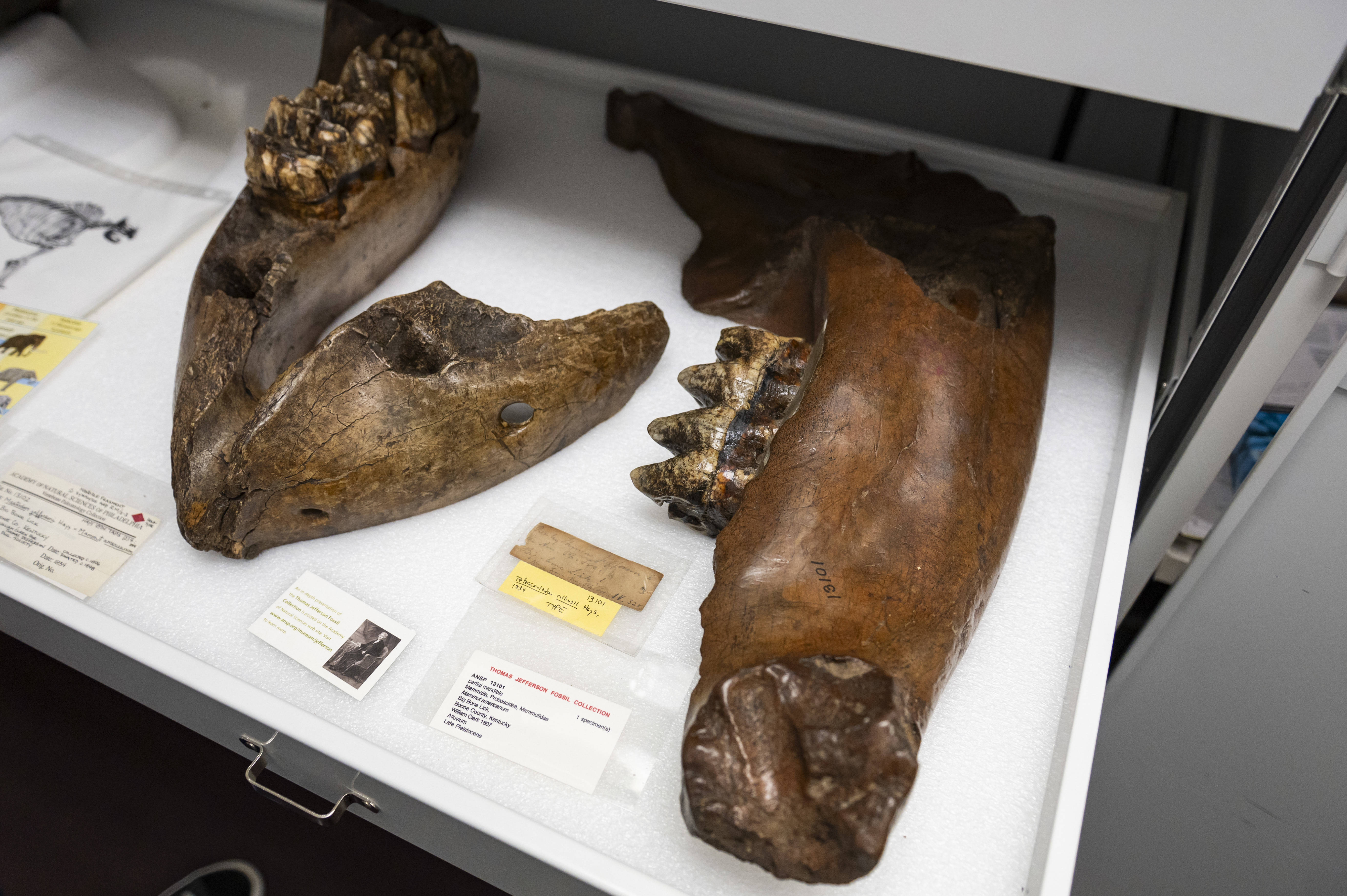
A partial mandible from an American mastodon from the Thomas Jefferson Fossil Collection at the Academy of Natural Sciences.Allie Ippolito / For The Inquirer
“It can be done, and it can be done in a professional and careful way that maintains the integrity of the collection, but you can’t do it in a hurried way,” says the NSCA’s Roberts. “That is a recipe for disaster for a collection of this size and importance. They need to plan for a year before they move any specimens out of the building.”
Collections like these require a specific kind of care, says Roberts, who is also associate vice president for collections at the Natural History Museums of Los Angeles County.
Specimens can degrade over time if not maintained properly, she said.
“We rely on good temperature and humidity control depending on what kind of specimen you have. A dinosaur bone that is basically stone is a lot less sensitive than a plant specimen that is a dried leaf. We’re also concerned about the curatorial and collections expertise that’s represented by the staff.”
Much of the academy’s collection is digitized, and a certain amount of information can be gleaned online, but for some purposes, the actual specimen must be available, which happens either by a visit to Philadelphia or a loan.
“DNA research is just exploding in natural history collections because it turns out that we have this resource we’ve been building for hundreds of years that can still be used for DNA,” says Roberts. “So a plant specimen, an insect specimen, a mammal specimen in a natural history collection from 100 years ago, you can get DNA out of that, and that’s an amazing resource. You absolutely cannot do that from a digitized record.”
It’s possible now, she says, “to look at actual gene expression patterns in different environments — for example, what genes are turned off or turned on in cold vs. hot conditions. That might be something important in an era of climate change if we want to understand how something like plant communities and animal communities are going to respond to that.”
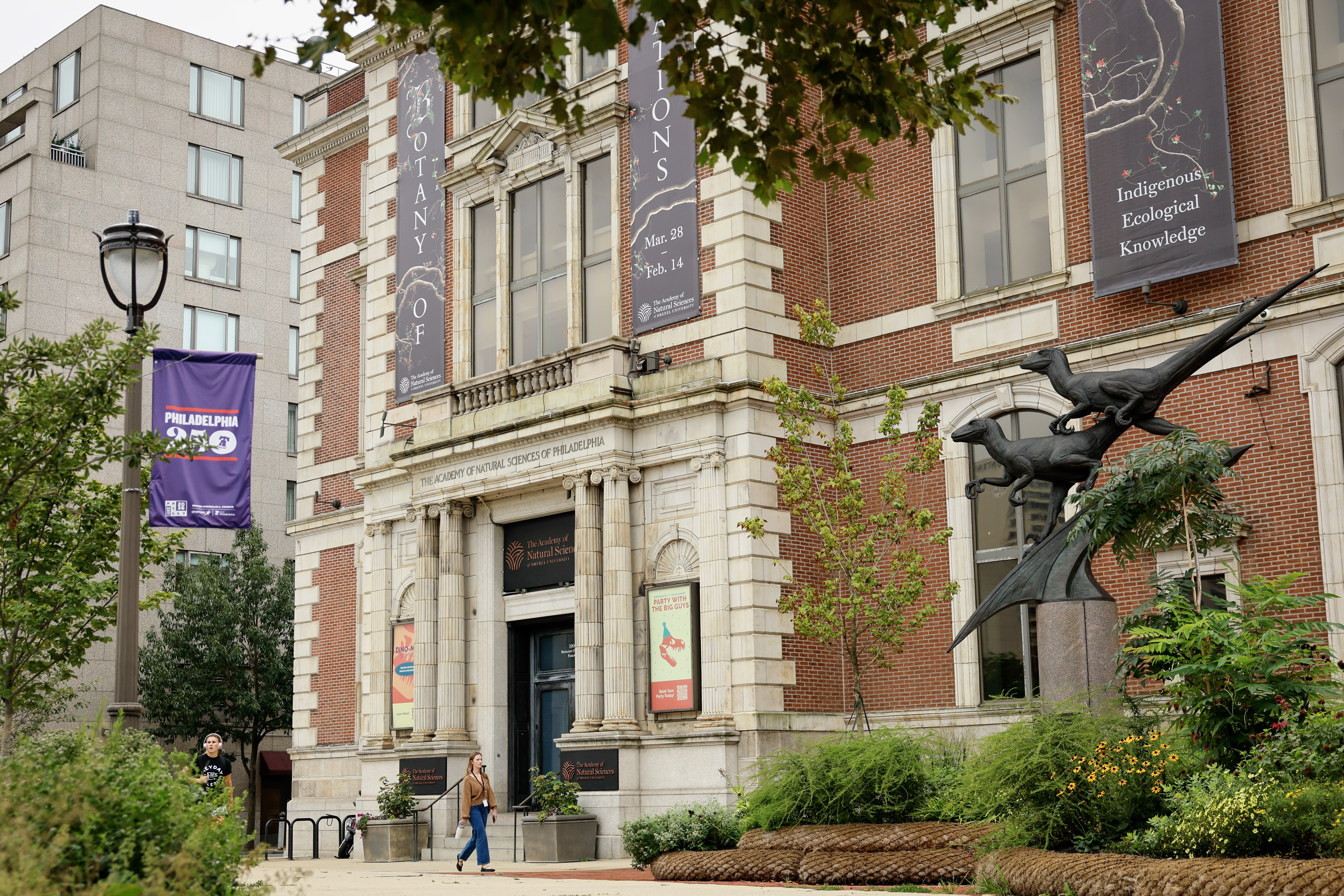
The Academy of Natural Sciences of Drexel University on the Ben Franklin Parkway.Elizabeth Robertson / Staff Photographer
‘It changed their minds completely’
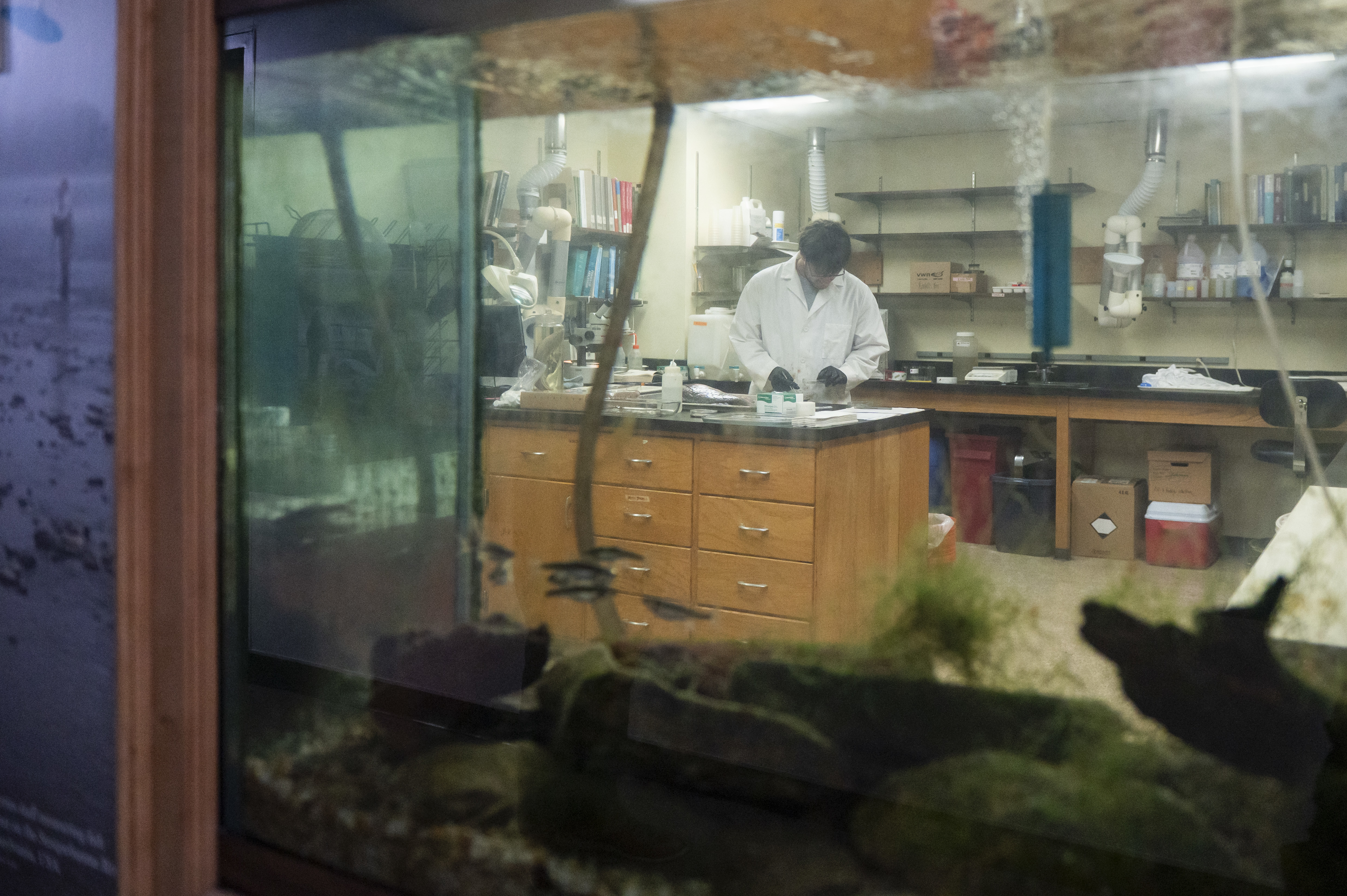
The academy-Drexel partnership, 15 years in, was much in evidence during a several hour visit in early August. In one room at the academy, a group of students was removing organs from birds, and in another, Drexel environmental sciences undergraduate Ean Geller-Nocella was examining a freshwater drum, an invasive species that’s recently turned up in local waters, to see what the fish has been eating.
“I’ve been cutting them open, taking out their stomachs and removing the stomach contents. All that is mussels — freshwater mussels,” he said, referring to a small cluster of crushed up shells.
Another invasive species is being looked at by the academy.
Ean Geller-Nocella, Drexel University co-op student, inspects the contents of the stomach of a freshwater drum in the fisheries department at the Academy of Natural Sciences.Allie Ippolito / For The Inquirer
“Ten years ago in Tinicum, snakeheads weren’t there and we got a picture of what the diet was for the resident fish,” said David Velinsky, senior scientist of the Patrick Center for Environmental Research and professor at Drexel University College of Arts and Sciences. “They’re now there, so we’re doing a study. We already have the samples collected, analyzing on the mass spectrometer how the food web changed, and this gives us an idea of what needs to be protected or not protected.”
Weckstein recently had a Drexel undergraduate student who sequenced the genomes of the parasitic lice living on vultures.
Having students working there “just adds a vibrancy to the place,” says Velinsky.
Says the malacology department’s Callomon:
“I think the role that I’m proudest of our collection’s playing is when Drexel undergrads come here on their co-op and we have successfully diverted careers in medicine, the law, and engineering in favor of working in our part of the world, in our part of science, because of the experience. They came and did a six-month co-op here and it changed their minds completely. It changed their minds because it moved their hearts, and your heart is what drives your mind. But they had no way of previously knowing.”
One persuading factor: at the academy, students have direct, hands-on contact with specimens in the collection.
“Other places use photographs,” says Peck. “Drexel students, thanks to the academy, get to work with real specimens, which dramatically enhances their interest in and understanding of the natural world.”
Just another reason, advocates say, that the academy’s treasures must be kept intact and accessible to all.
“My greatest concern is over keeping the collection together,” says Peck. “It needs to be cared for, for reasons that extend well beyond Philadelphia and the academy. These are collections we hold in trust for the world.”
Staff writer Susan Snyder contributed to this article.
Only 76 songs to encapsulate the history of the boundlessly rich and impossibly varied sound of Philadelphia?
That wasn’t nearly enough.
Earlier this year, in time for the approaching Philly 250 celebration of the nation’s Semiquincentennial, and with the help of my classical music colleague Peter Dobrin, I compiled a list of 76 songs made in the city — or about the city, or by people from the city or region — that are essentially Philadelphian.
I’m not complaining. It was fun and sent me on journeys of discovery to learn stuff I didn’t know about the bottomless depth of Philly soul, the city’s enthralling jazz history, or the range of indie rock that’s become a calling card this century.
But list-making is a difficult, fraught process, and I made lots of choices that I immediately had second thoughts about. Like cutting Grover Washington Jr. to make way for the Trammps, or leaving Sister Sledge or Jazmine Sullivan or personal favorites like Go To Blazes off the list. Or including the Soul Survivors’ “Expressway To Your Heart” but leaving “I-76” by G. Love & Special Sauce parked on the side of the road.
Were those stupid decisions? Possibly. So this list that follows — 25 more essential songs of Philadelphia — is a chance to make room for those shoulda-coulda selections and bring the total number up to a more reasonable 101. Which, quite frankly, will still be an inadequate number for any true Philly music lover.
Some ground rules: Artists who were included in the original 76 were ineligible this time. So while the initial list featured the O’Jays’ “Back Stabbers,” I ruled out another undeniably iconic O’Jays song, “For the Love of Money,” to make way for other artists.
And I didn’t consider holiday songs, which belong in a separate category. So apologies to the Philly Specials’ “Fairytale of Philadelphia” and Alan Mann’s “Christmas on the Block.”
Also, these songs are numbered in reverse, but I thought of them more as a playlist than a worst-to-first ranking. They’re all worthy additions to the original 76.
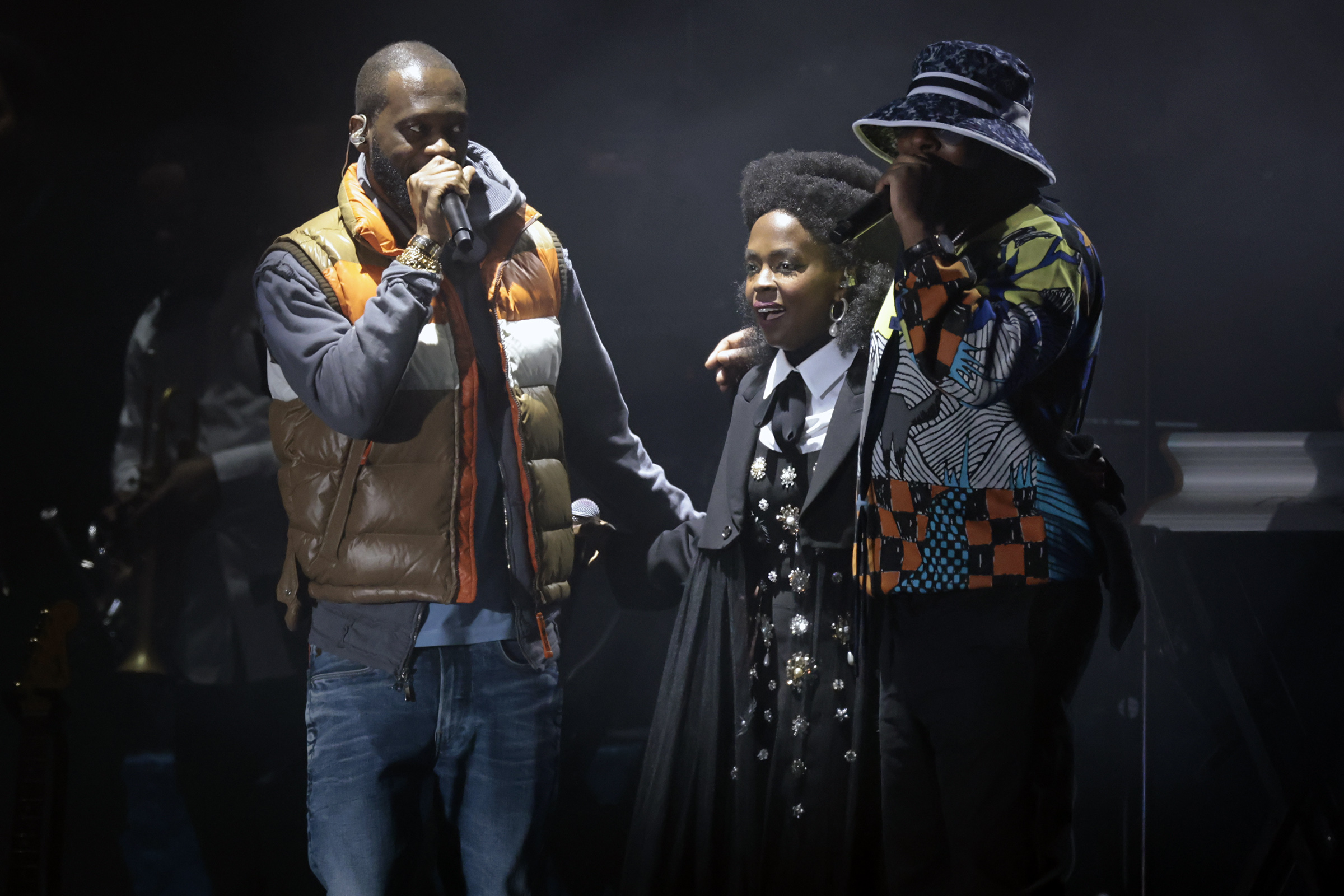
The Fugees reunite as Lauryn Hill (middle) is joined by Pras Michel (left) and Wyclef Jean during the Roots Picnic Philadelphia at the Mann in Fairmount Park on June 3, 2023.Elizabeth Robertson / Staff Photographer
25. The Fugees, “Ready or Not”
The Fugees are not a Philly band — they’re from Haiti and North Jersey. But the hip-hop trio of Lauryn Hill, Wyclef Jean, and Pras Michel recorded for Ruffhouse Records, the Conshohocken label founded by Chris Schwartz and Joe “The Butcher” Nicolo, which also released Hill’s 1998 album The Miseducation of Lauryn Hill, as well as albums by Cypress Hill, Kris Kross, and Ben Arnold. “Ready or Not,” from the Fugees’ 1996 album The Score, represents Ruffhouse because its chorus is based on a Philly soul classic, the Delfonics’ “Ready or Not Here I Come (Can’t Hide From Love),” written by William Hart and Thom Bell.
24. Mark Knopfler, “Sailing To Philadelphia”
“Sailing to Philadelphia” is a song about surveyors. Dire Straits leader Mark Knopfler was making his way through Thomas Pynchon’s 1997 novel Mason & Dixon, about Charles Mason and Jeremiah Dixon, the Englishmen who drew the boundary line that became recognized as the United States’ free states and slave states when he wrote what he once called a “two-minute take on a two-ton book.” (The lovely narrative ballad, which is a duet with James Taylor and the title cut of Knopfler’s 2000 album, is actually five and a half minutes long.)
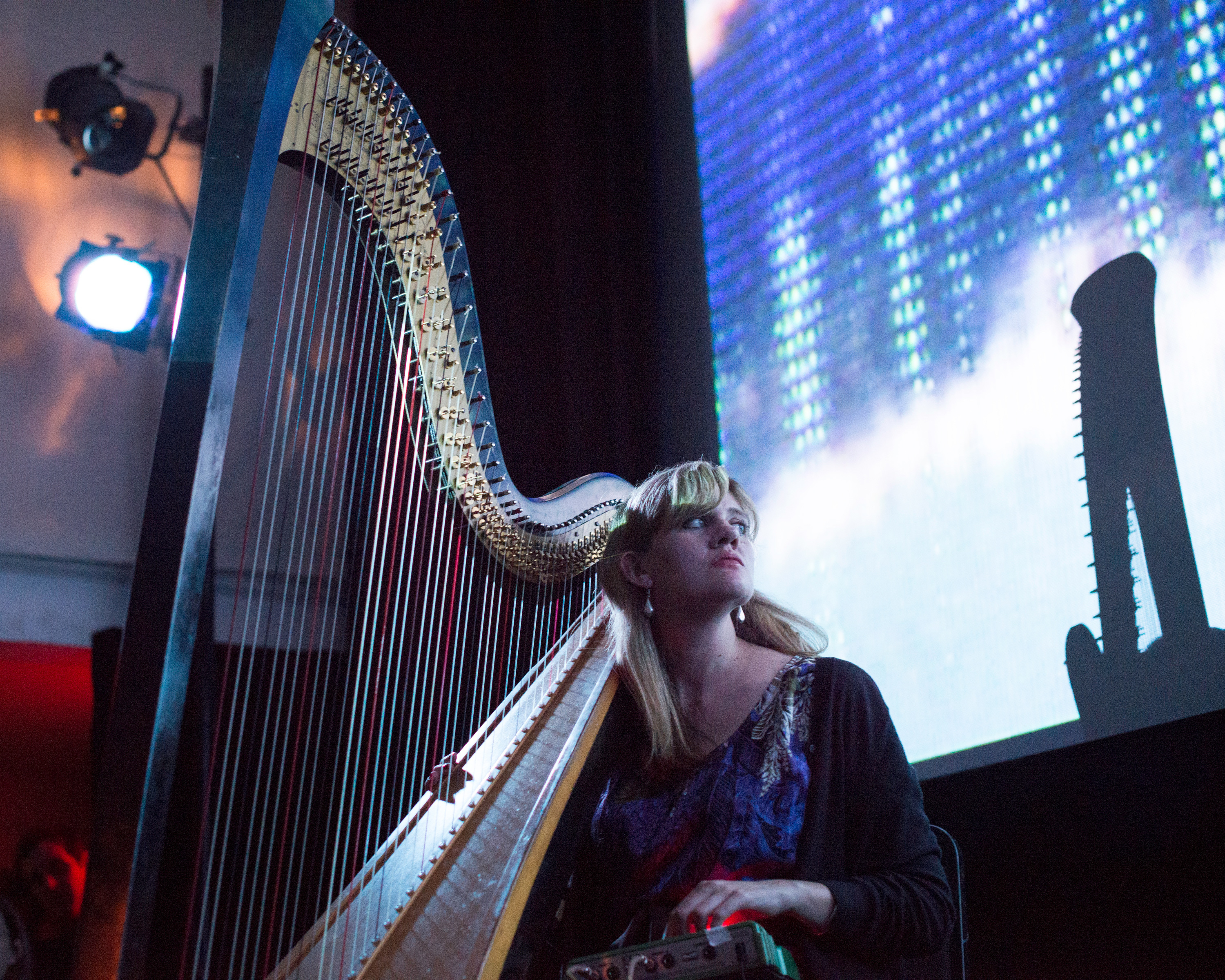
Indie rock harpist and “Wawa By the Ocean” composer Mary Lattimore. Scott Troyan
23. Mary Lattimore, “Wawa by the Ocean”
Philly’s favorite convenience store and the Jersey Shore, all in one song title? Indie rock harpist Mary Lattimore’s sparkling, transporting instrumental was inspired by a Wawa steps away from the beach on Long Beach Island.
22. The Wonder Years, “Came Out Swinging”
The lead track from the Lansdale-born band the Wonder Years’ 2011 album Suburbia I’ve Given You All and Now I’m Nothing reps Philadelphia’s central role in this century’s pop-punk and emo scene, which includes bands like Modern Baseball, Algernon Cadwallader, and Marietta.
Singer Dan “Soupy” Campbell is frank about struggling with his mental health on the song’s coda, repeated three times: “I came out swinging from a South Philly basement, caked in stale beer and sweat under half-lit fluorescents,” Campbell sings (and shouts). “And I spent the winter writing songs about getting better, well, if I’m being honest, I’m getting there.”
21. Clap Your Hands Say Yeah, “The Skin Of My Yellow Country Teeth”
To be honest, I didn’t like this song by the Philly band led by Alec Ounsworth when it came out in 2005. There’s the unappealing title, and I never understood the Talking Heads comparisons, other than a vocal similarity to David Byrne.
But with its driving, hypnotic rhythm, it’s aged well and is a great example of a Philly band at the center of a moment in music history. It’s a “blog-rock” success story from a time when the internet seemed like a wide-open, not malignant place. Bands like CYHSY could make their music available for free download on MP3 blogs and create a buzz that spread like wildfire, resulting in a career still going strong two decades later. Those were the days.
20. Go To Blazes, “New Morning Sun”
Hard-hitting Philly roots-rockers Go To Blazes made a series of bruising blues- and country-infused albums in the 1990s, each one marked by high-quality songwriting by singer Ted Warren and guitarist Tom Heyman that, in retrospect, was ahead of the Americana boom to come. This swaggering song from 1996’s Eric “Roscoe” Ambel-produced Waiting Around for the Crash faces the day after a restless night: “I can’t sleep, for the things I know I had done.”
19. Phyllis Hyman, “Old Friend”
Written by 2026 Rock & Roll Hall of Fame inductee Linda Creed — who died of cancer months before the song’s 1986 release — “Old Friend” is a melancholy ballad by the statuesque Philly soul singer on her first album for Philadelphia International Records. A modest hit, it became a sentimental fan favorite, particularly after Hyman’s death in 1995 at age 45.
18. Bill Haley & His Comets, “Rock Around The Clock”
With his kiss curl and clean-cut image, Bill Haley presented as more palatable to middle America than subversive 1950s sorts like Elvis Presley, Little Richard, and Chuck Berry. But that doesn’t mean Haley didn’t have a sizable pop-cultural impact. With 1954’s “Rock Around The Clock,” which was written by Max C. Freedman and James E. Myers, the singer and bandleader who transitioned from Western swing to rock and roll and grew up in Boothwyn in Delaware County, scored the first rock-and-roll song to top the pop charts in both the U.S. and the U.K.
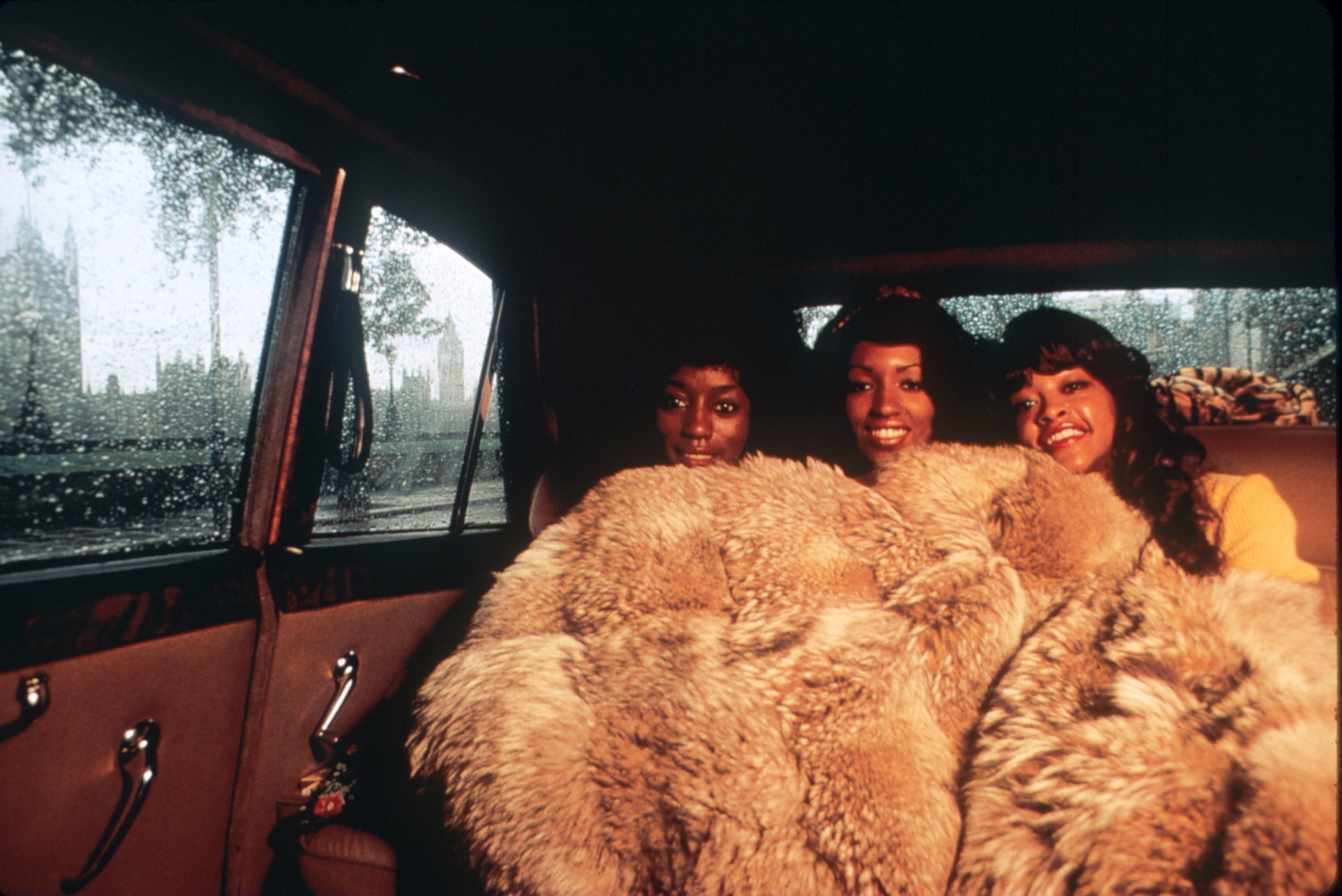
The Three Degrees.Courtesy of the artist
17. The Three Degrees, “When Will I See You Again”
My first exposure to this Gamble and Huff composition with a lead vocal by Sheila Ferguson and support from Fayette Pinkney and Valerie Holiday came from an episode of the 1970s sitcom Sanford and Son in which the Philly soul vocal trio guest-starred as themselves. Another fun fact: In the ‘70s, the Three Degrees were the favorite group of the now-king, Charles III, and performed at his 30th birthday party at Buckingham Palace in 1978 when he was known only as Prince Charles.
16. Benny Golson and the Philadelphians, “I Remember Clifford”
Hard-bop saxophonist Golson — with a band that included his fellow Philly natives Percy Heath, Lee Morgan, Ray Bryant, and Philly Joe Jones — paid tribute to Delaware trumpeter Clifford Brown, who died in a car accident in Pennsylvania in 1956 at 25. The song has been covered by dozens of artists, including Ray Charles and Sonny Rollins.
15. Sylk 130, “The Reason”
Philly DJ, producer, and Blacktronika professor King Britt put his own 1990s house music spin on classic Philly soul with his Sylk 130 project. Jafar Barron’s haunting trumpet and Vicki Miles’ seductive vocal add a touch of class.
14. The Jacksons, “Enjoy Yourself”
Yes, Michael Jackson recorded in Philadelphia. In the years between the Motown era with the Jackson 5 and his partnership with Quincy Jones, Michael and his brothers recorded as the Jacksons at Sigma Sound Studios on both 1976’s The Jacksons and 1977’s Goin’ Places. On the former, the songs were written by Kenny Gamble and Leon Huff. The upbeat “Enjoy Yourself” was the biggest hit from the Jacksons’ Philly years, and the one song from the era that points forward to the unstoppable alchemy that Michael and Jones would find starting with Off the Wall in 1979.
13. Jimmy Smith, “Walk on the Wild Side”
Norristown native Jimmy Smith revolutionized the Hammond B-3 organ as an instrument central to jazz and was the leading light of the long lineage of Philly organists that includes Shirley Scott, Charles Earland, Jimmy McGriff, Trudy Pitts, and Papa John DeFrancesco and Joey DeFrancesco.
“Walk on the Wild Side” is not the Lou Reed song. It’s an instrumental version of the Brook Benton song from a 1962 film noir. Later that year, Smith — whose music would later be sampled by hip-hop artists including the Beastie Boys, Nas, and Gang Starr — scored an unlikely hit from his album Bashin’: The Unpredictable Jimmy Smith.
12. Dee Dee Sharp, “Mashed Potato Time”
A 1962 dance-craze song by Kal Mann and Bernie Lowe that borrowed from the Marvelettes’ “Please Mr. Postman.” The Orlons sang backup vocals on the No. 1 hit from the American Bandstand era, when Philadelphia was the center of the pop music industry until Dick Clark moved the show to California in 1963.
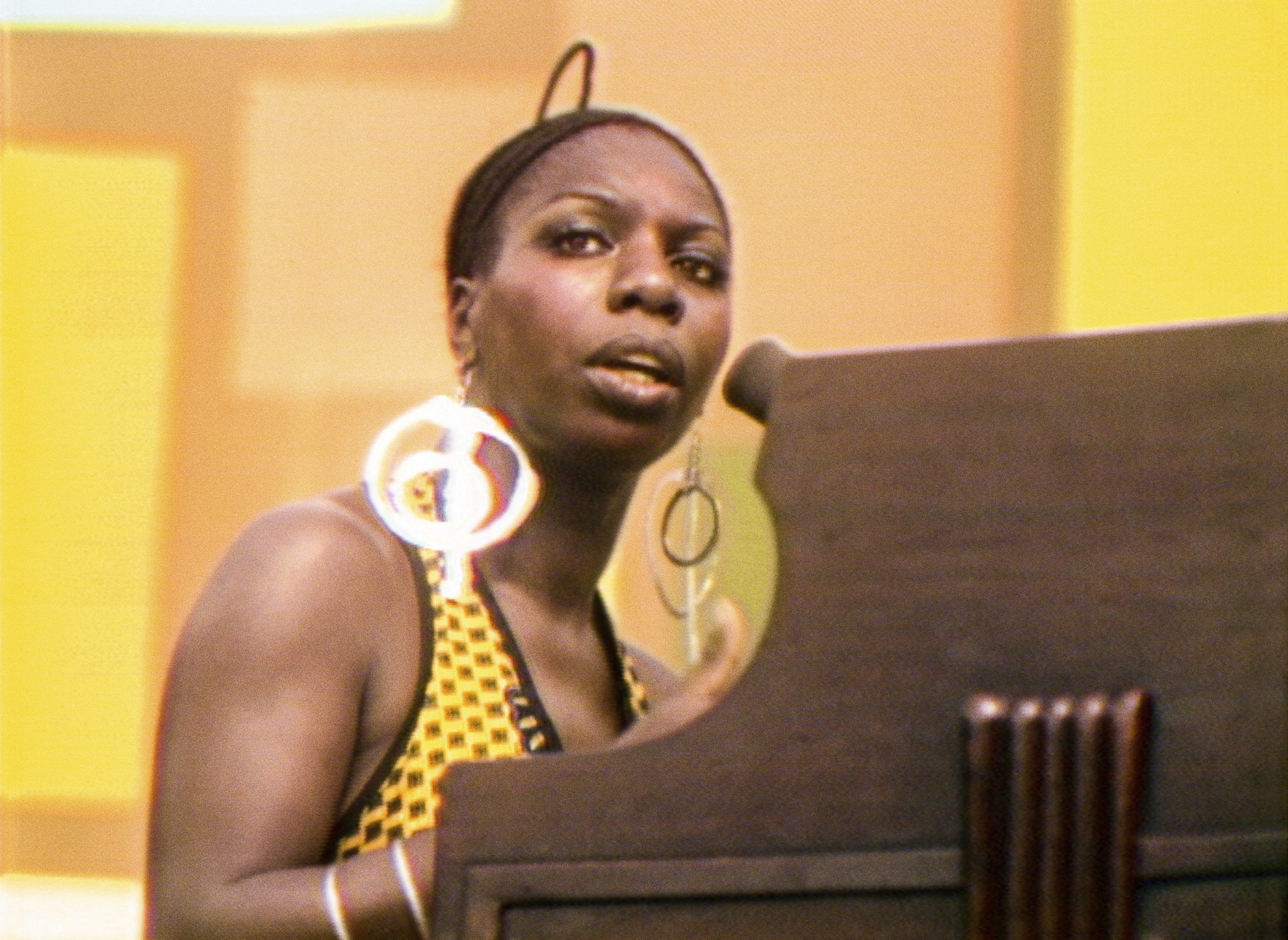
Nina Simone performing at the Harlem Cultural Festival in 1969, featured in the documentary “Summer of Soul.” / AP
But her failure to gain acceptance spurred reinvention: She adopted the stage name Nina Simone while playing piano and singing at the Midtown Bar & Grill in Atlantic City. A great career as an artist and civil rights activist followed. There are many songs to choose from — “Sinnerman,” “Feeling Good”— but I’m going with her most urgent and arresting, written in part as a response to the murder of Medgar Evers in 1963.
10. G. Love & Special Sauce, “I-76”
It might not be the best advice, but it does rhyme: “If you want to get downtown real quick, the only way to go is I-76.” Garrett Dutton’s ode to the Schuylkill Expressway from the hip-hop bluesman’s 1997 album Yeah, It’s That Easy includes shout-outs to Sixers players and the mascot from the 1983 championship year: “Big Shot, and Mo Cheeks and Moses Malone / Julius Erving called Philly his home.”
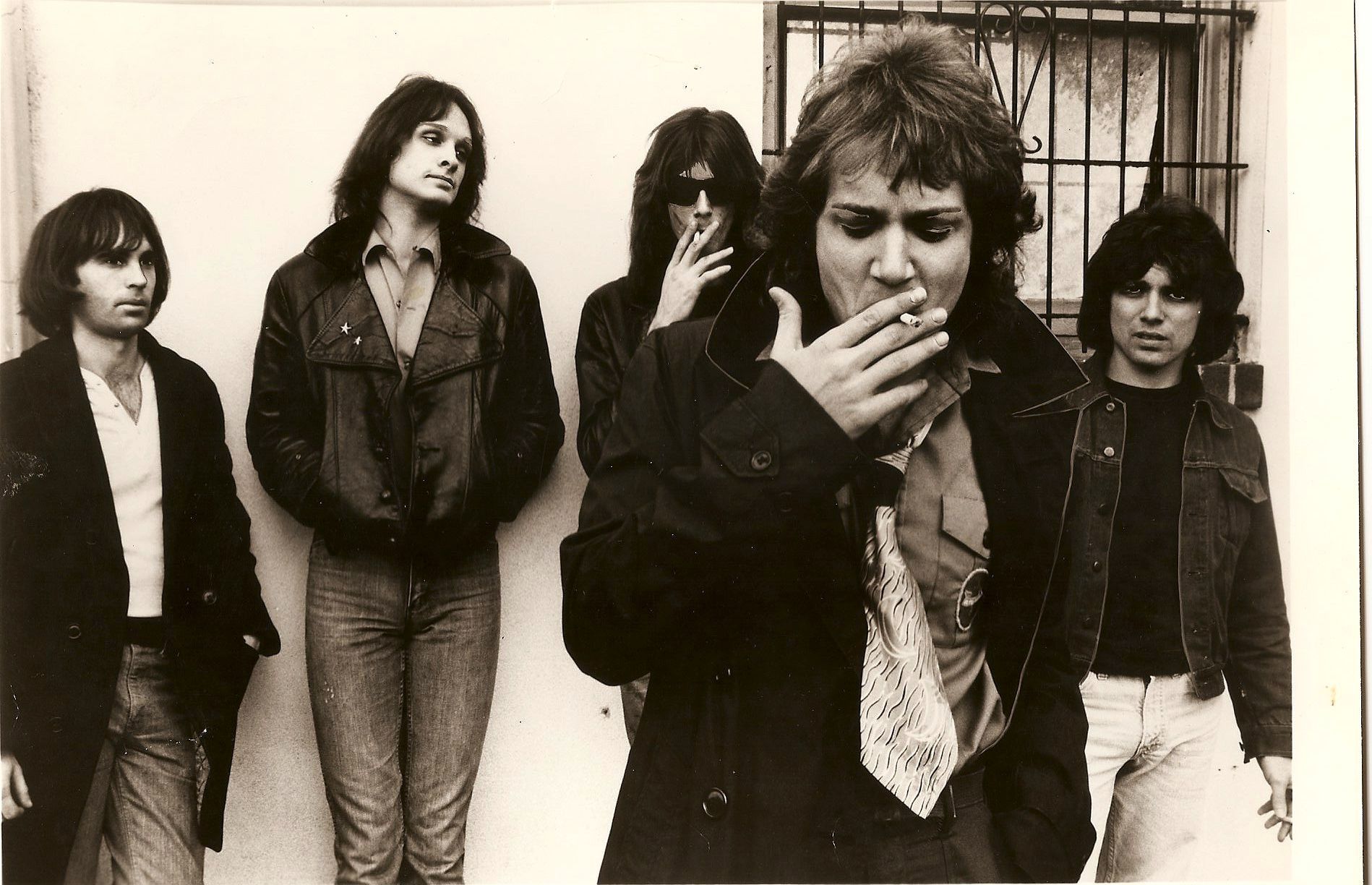
The Philadelphia rock band the A’s in the late 1970s. Left to right: Terry Bortman, Rocco Notte, Rick DiFonzo, Richard Bush, and Mikey Snyder. Courtesy of the A's
9. The A’s, “After Last Night”
A ripping power-pop masterwork that showcases the magnetism of Richard Bush, the lead singer of the A’s, the New Wave-era band that energized the Philly club scene before breaking up in 1982. One of two killer A’s singles written by Bush — who performs locally with his band the Peace Creeps — and songwriting partner Rocco Notte, along with “A Woman’s Got the Power.”
8. Laura Nyro, “Gonna Take A Miracle”
“Gonna Take A Miracle” is a case study in how Kenny Gamble, Leon Huff, Thom Bell, and Sigma Sound Studios founder Joe Tarsia turned Philadelphia into a music mecca in the early 1970s.
Nyro was a New York songwriter three albums into her career when she came to Sigma Sound in 1971 to record an album of cover songs with Labelle — the trio of Patti LaBelle, Nona Hendryx, and Sarah Dash, who would explode in popularity with “Lady Marmalade” three years later.
The Gonna Take a Miracle album was produced by Gamble and Huff, and featured the MFSB Sigma house band, with horn and string arrangements by Bell and Bobby Martin. And the title cut, originally a hit for the Royalettes in 1965, is cowritten by Teddy Randazzo, one of Bell’s musical heroes.
7. John Legend and the Roots, “Wake Up Everybody”
For their 2010 collaborative album Wake Up!, mostly made up of covers of socially conscious R&B songs, Penn grad Legend and the Philly hip-hop band picked a winner. Sure, Legend isn’t equal to Teddy Pendergrass, who sang the original version of the John Whitehead-, Gene McFadden- and Victor Carstarphen-penned title cut from Harold Melvin & the Blue Notes’ 1975 album. But then, who is?
6. The Tymes, “So Much In Love”
Swoony street corner harmony from 1963, written by Tymes singers George Williams and Roy Straigis with producer Billy Jackson, who voices the spoken intro. A hit on the Cameo-Parkway label in pre-Beatles doo-wop era, it was later a hit for R&B vocal group All-4-One in 1993.
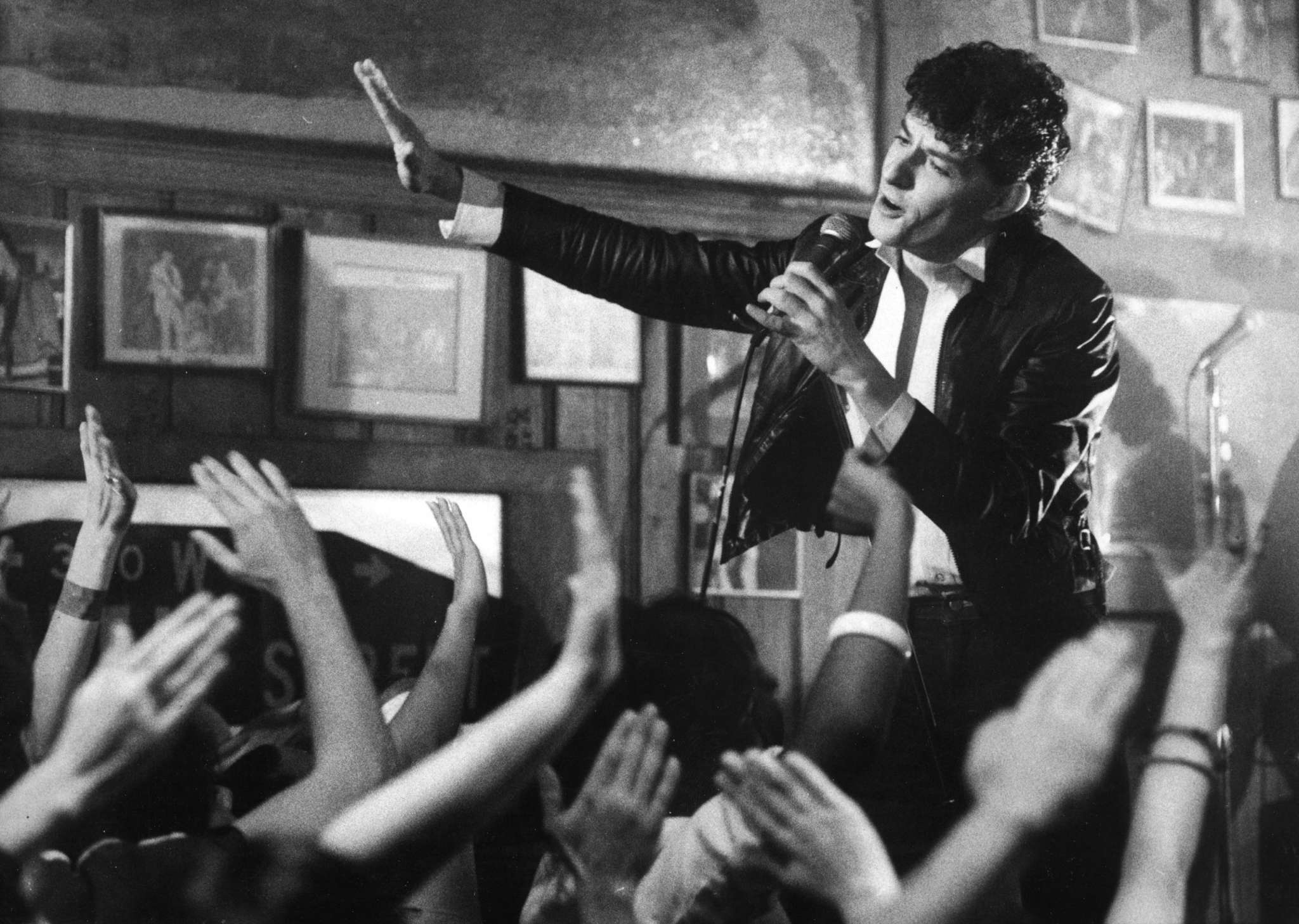
In 1983, Robert Hazard filmed a music video for his song “Change Reaction” at what was then J.C. Dobbs.File Photograph
5. Robert Hazard & the Heroes, “Escalator Of Life”
Along with the Hooters and Tommy Conwell & the Young Rumblers — whose “I’m Not Your Man” is a near miss on this list — Robert Hazard was one of the most-likely-to-succeed faces of Philadelphia rock in the 1980s. The son of a Philadelphia Opera Company tenor wrote and recorded “Girls Just Want To Have Fun” in 1979, four years before Cyndi Lauper turned it into a megahit. Hazard was in heavy rotation on FM stations WMMR and WYSP with this echoey electro-pop hit and “Change Reaction,” from his self-titled 1982 EP.
4. Grover Washington Jr., “East River Drive”
“Just The Two of Us,” Washington’s 1980 team-up with Bill Withers, was the much bigger hit. Will Smith repurposed it for a different song of the same name on 1997’s Big Willie Style. And “Mister Magic,” the nine-minute jazz-R&B jam that’s the title cut from his 1975 album is another Grover contender. But I’m going to go geographical on this smooth-jazz mood piece from the Philly saxophonist, who cruised down what is now Kelly Drive on his 1981 album Come Morning.
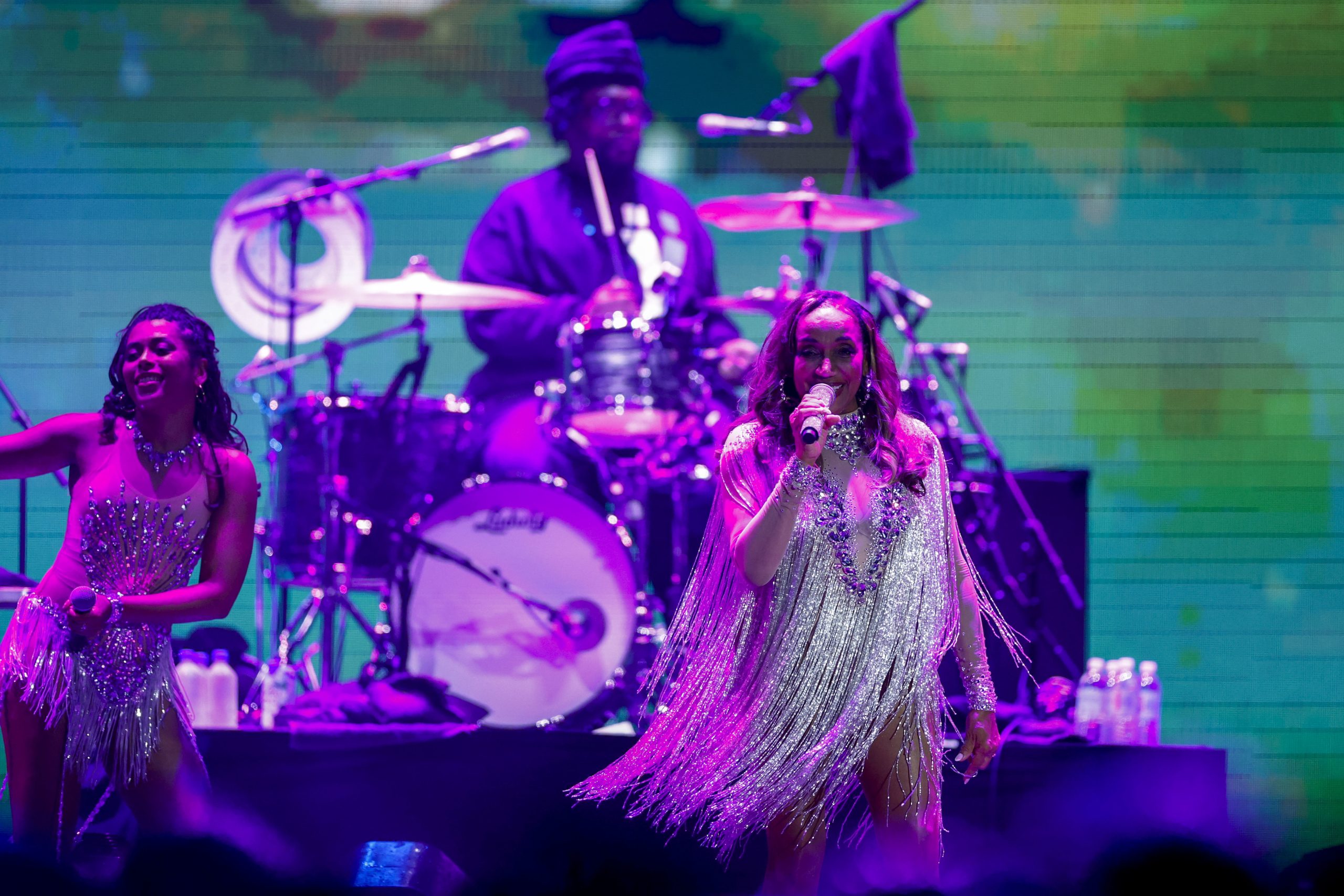
Kathy Sledge from Sister Sledge performs with the Roots at the July Fourth concert on the Benjamin Franklin Parkway.
3. Sister Sledge, “We Are Family”
“You couldn’t find room for Sister Sledge’s ‘We Are Family’ on a list of 76 songs?” was a refrain I heard in various forms. In excluding it I might have given too much weight to the fact that “We Are Family” became closely associated with Pittsburgh after the Pirates used it as their theme song on the way to winning the World Series in 1979.
In any case, “We Are Family” endures, well beyond its origins as a 1979 disco hit that was the first song penned by Nile Rodgers and Bernard Edwards outside of their own band, Chic. Kathy Sledge delivered a stirring version of it with the Roots at the One Philly concert on the Ben Franklin Parkway, and just the other night, I heard it at a Phillies game.
2. Maze, “Before I Let Go”
Frankie Beverly grew up in Germantown and didn’t hit his stride as a purveyor of smooth, sensual soul music until moving to San Francisco in the 1970s. Over time, songs like “Joy and Pain” and “Before I Let Go” sung by Eagles quarterback Jalen Hurts’ favorite musician became essential to Black culture, as “the soundtrack of cookouts and summer music fests … and that kind of bliss that is sweet and peaceful,” as novelist S.A. Cosby put it when Beverly died in 2024. Beyoncé covered “Before I Let Go” at Coachella in 2018, and Questlove has called the song “the happiest breakup song ever” and “the national anthem.”
1. Jazmine Sullivan, “Pick Up Your Feelings”
The standout track from Sullivan’s 2021 tour de force Heaux Tales is full of soaring, swooping vocal runs and staccato syncopations. Along with other hits like “Bust Your Windows,” it demonstrates why Sullivan is the premier contemporary embodiment of the grand Philly soul tradition of great vocalists like Patti LaBelle, Teddy Pendergrass, and Russell Thompkins Jr.
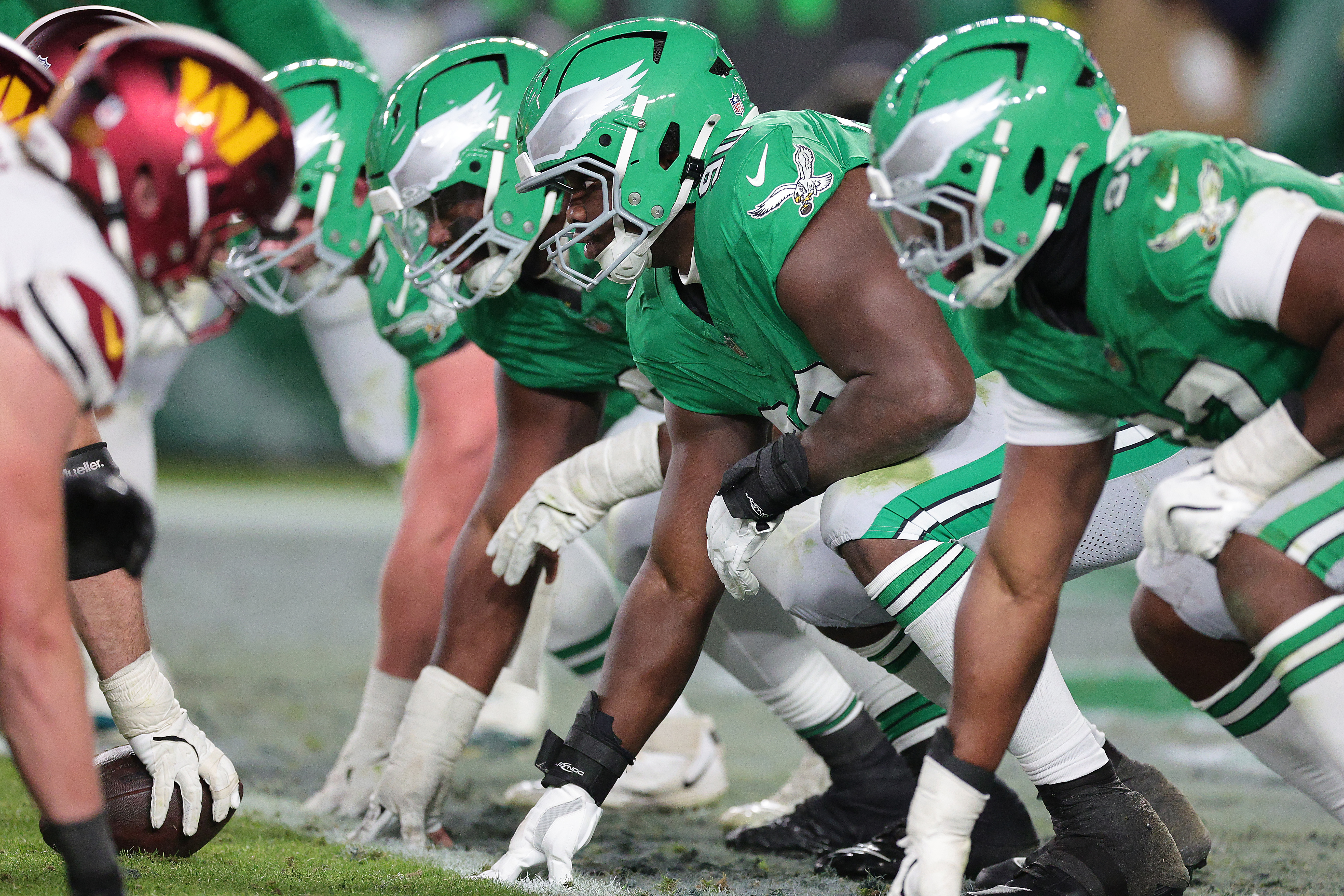
The Eagles begin their campaign for a third-straight NFC East title on Sunday afternoon, when they host the Washington Commanders in their season opener (4:25 p.m., Fox29).
The Eagles are coming off an 11-6 season and a busy offseason. The spotlight will be on the new offense led by first-year coordinator Sean Mannion.
Washington is looking to start strong after going 5-12 last season. Quarterback Jayden Daniels returns healthy after appearing in just seven games last season because of a left knee sprain, a right hamstring strain, and a dislocated left elbow.
What are the experts thinking about the season opener? Here’s a look at what local and national pundits are saying:
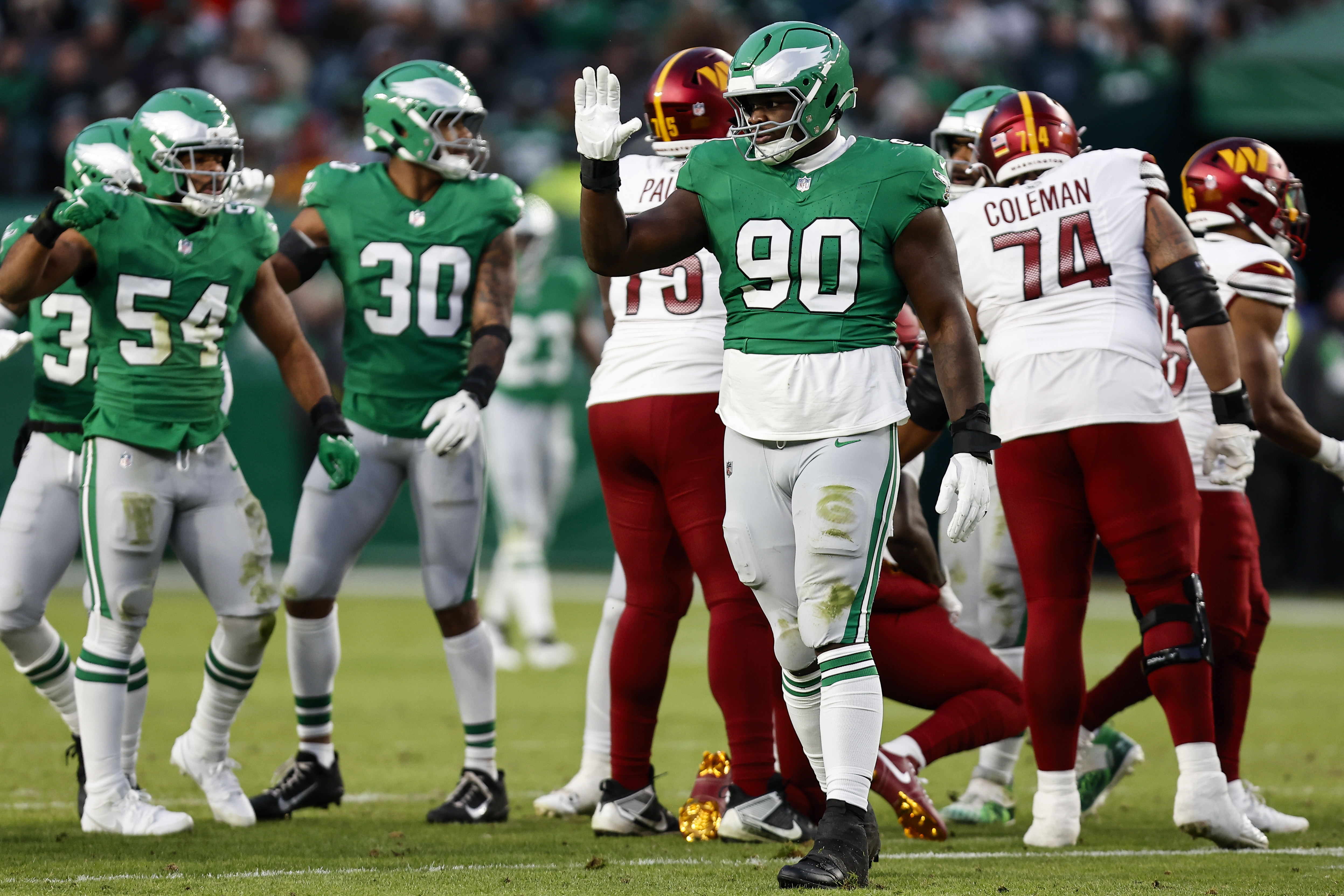
Eagles defensive tackle Jordan Davis waves after a stop on a Commanders’ offensive drive last season.Monica Herndon / Staff Photographer
Inquirer predictions
It’s a clean sweep for the Eagles. All three Inquirer beat reporters — Ryan Novozinsky, Jeff Neiburg, and Olivia Reiner — agree that the Eagles will win.
Novozinsky wrote that the Mannion era will begin “with a bang.” Here’s more:
“Sure, the Commanders have a new, lauded defensive coordinator in Daronte Jones. But they didn’t exactly make any splashy moves on that side of the ball, which means they’re largely returning a unit that ranked No. 32 in total defense last season.
“Their passing defense ranked fourth-worst in the league. Their run defense was even worse, ranking 30th. Mannion’s wide-zone scheme should feast against a unit like this, especially if the run game gets going early, which would set up a play-action attack through the air.”
The national media is just as high on the Eagles entering Sunday’s opener, with few experts picking the Commanders. Here’s a look at how the biggest outlets are predicting the outcome:
NFL.com: All five NFL.com editors selected Philadelphia to win. Gennaro Filice says Washington’s offensive line concerns, especially the loss of Laremy Tunsil, could create a lopsided matchup against defensive coordinator Vic Fangio’s unit.
ESPN.com: ESPN experts also are unanimously backing the Birds.
The Athletic: NFL reporter Vic Tafur is confident the Eagles will win their sixth straight season opener, writing: “Eagles quarterback Jalen Hurts is skipping around because they finally got rid of Brown and have a competent play caller.”
CBS Sports: The seven-person panel at CBS unanimously picked the Eagles to start the season 1-0.
USA Today: In the season-opening battle against NFC East opponents, USA Today analysts believe the winning team will be the Birds.
Sports Illustrated: Unlike many national outlets, there is a difference in predictions at Sports Illustrated. Out of the eight experts, Albert Breer and Conor Orr went with the Commanders in Week 1.
Bleacher Report: Five of the seven analysts picked the Commanders this weekend. Moe Moton said to “expect both teams to be inefficient in a game of missed opportunities, while both defenses capitalize on miscues with takeaways.”
Pro Football Talk: Mike Florio went with the Eagles for this weekend’s matchup, saying the Commanders are visiting “one of the best teams in the league to start the season.”
Sporting News: Bill Bender chose the Birds to win by eight against the Commanders.