Tag: topic-link-auto

  • Colman Domingo has taken over ‘Jimmy Kimmel Live!’ and a surprise makeover is his first order of business

    Colman Domingo has taken over ‘Jimmy Kimmel Live!’ and a surprise makeover is his first order of business

    Every year television host and comedian Jimmy Kimmel takes time off over the summer, and every year audiences wonder who is going to fill in his place.

    This week, it’s West Philly’s own Colman Domingo.

    The Disclosure Day actor made quite an entrance in his first show on Monday night, wearing a suit with a bow tie and a white robe-like jacket adorned with a pattern of playing card suits.

    Domingo dived right into current events in his monologue.

    The Four Seasons star talked about Trump getting booed at the World Cup, right-wing anger over The Odyssey casting Lupita Nyong’o as Helen of Troy and Clytemnestra, and the United Kingdom’s new prime minister, Andy Burnham.

    He also called attention to the number of projects he’s been involved in recently, having starred in five films and three television series in the past year alone. Domingo’s busy season corresponds with, as Variety reports, a massive uptick in box office attendance. “Why are movies doing so much better this summer?” the actor asked in his monologue.

    “Three words: Colman. F—. Domingo.”

    The monologue concluded in a skit where he gave comedian Guillermo Rodriguez, Kimmel’s sidekick and mock security guard, a makeover, very Project Runway style. Rodriguez walked out in a suit with a velvet jacket and flared pants, looking like a mini version of Domingo.

    Later in the show, Domingo proceeded to interview Euphoria costar Jacob Elordi and Michael costar Jaafar Jackson. Domingo starred in Euphoria as a recovering addict and sponsor for Zendaya’s character, Rue, and plays Jackson family patriarch Joe Jackson in Michael.

    The Temple alum has no plans of slowing down in the next year. His upcoming projects include thriller film An Innocent Girl, Nat King Cole biopic Unforgettable, satirical drama True-ish, and sci-fi romance Strange Arrivals.

    The article has been updated to reflect that Colman Domingo will host “Jimmy Kimmel Live!” for a week.

  • Fox Chase Farm volunteers disband after more than 30 years following conflict with Philly school district

    Fox Chase Farm volunteers disband after more than 30 years following conflict with Philly school district

    A volunteer group at Fox Chase Farm has dissolved after more than 30 years. The group says dwindling volunteers plus new fees and restrictions from the Philadelphia School District made their work at the city-owned farm too difficult to continue.

    “We finally folded,” said Karen Eble, former president of the group, Friends of Fox Chase Farm. “The farm is administered by the Philadelphia School District and they were, I guess, not very open to us being there.”

    Friends of Fox Chase Farm formed in 1990 to support the 112-acre property that straddles Philadelphia and Abington Township and is owned by the city.

    At its peak, the group drew over 400 local families, who grew thousands of pounds of produce for food banks annually and functioned as a parent-teacher association of sorts for a 4-H program, which some members’ children participated in. The group bought equipment, lent the program money, and attended farm shows with the kids.

    The Fox Chase 4-H allowed more than a dozen youth, including many who live in Philly, to raise animals on the city farm — rare for a program that typically attracts kids whose families own agricultural land.

    “We’d compete with the kids that grew up on farms,” said Jim Kates, a longtime leader of Friends of Fox Chase Farm.

    The farm’s 4-H was suspended in 2022 after the school district began charging fees for services it used to provide the program for free, such as housing the animals.

    4-H had long covered food and veterinary care for the animals and split feeding duties with the resident farmer, members said, but the school district used to board the animals for free.

    “It would’ve cost us $15,000 to have these kids keep their animals there,” Kates said.

    The district said at the time that the 4-H was not complying with new policies and procedures.

    “Fox Chase Farm is an educational facility operated by the School District of Philadelphia and is not in the business of boarding privately owned animals,” a spokesperson said this week.

    Officials did not directly respond to the volunteers’ assertion that they were made unwelcome by the school district, but the spokesperson said this week the farm saw 10,000 “community visitors” in the last year.

    The district spokesperson said there is an active 4-H program on the farm but did not immediately respond to questions about how much access the participants have to the livestock.

    The volunteers also held two fundraisers per year that raised thousands of dollars for the farm, group members said.

    The Philadelphia School District rents the farm for $1 from the city. The district is currently renegotiating that 30-year lease, said Mandy Fellouzis, who runs the district’s programs there.

    In recent years, the Friends group shrank as volunteers aged and the school district placed new restrictions on their activities, members said. By this past March, there were only a handful of active members, Kates said, and they decided to fold.

    One of the issues the school district raised about the group’s events, Kates said, was liability: A volunteer group at Pennypack Park disbanded in 2020 after being named in lawsuits that some considered frivolous.

    “We still had an insurance policy,” Kates said, but with the group dwindling anyway, “we decided it wasn’t worth it.”

    This suburban content is produced with support from the Leslie Miller and Richard Worley Foundation and The Lenfest Institute for Journalism. Editorial content is created independently of the project donors. Gifts to support The Inquirer’s high-impact journalism can be made at inquirer.com/donate. A list of Lenfest Institute donors can be found at lenfestinstitute.org/supporters.

  • Philadelphia’s World Cup and All-Star summer proved something. Let’s not waste it. | Editorial

    Philadelphia’s World Cup and All-Star summer proved something. Let’s not waste it. | Editorial

    It’s been a big year for Philadelphia. The cradle of American democracy has been in the public eye during the nation’s Semiquincentennial and a series of sporting events that have brought visitors from across the world — all to rave reviews.

    In a sign of how far we’ve come from the bad old days of apathy and deterioration, the City of Brotherly Love and Sisterly Affection rose to the challenge and then some.

    Those in town for the PGA Tour in nearby Aronimink, the FIFA World Cup and Fan Festival at Lemon Hill, Major League Baseball’s All-Star Game, and the country’s 250th birthday mostly raved. A visiting Brazilian fan called Philadelphia “the most beautiful city” he’d ever seen. A level of effusive praise that stunned many residents who are accustomed to scorn, not admiration.

    Officials must now take the planning, determination, and can-do attitude they brought to making the city succeed on the world stage and prove they can make Philadelphians proud even after the spotlight has dimmed.

    Fifty years ago, during America’s Bicentennial, many in the city rightly felt its best days were long gone.

    Then-Mayor Frank Rizzo, known for his brutal tactics as police commissioner, scared visitors away after he requested federal troops out of fear of protests. No soldiers came to the city, and the planned demonstrations went off without any bloodshed. Still, Rizzo’s warning did little to change the city’s blossoming reputation as a dead-end town.

    Under Rizzo, the city’s economy had stagnated. Roughly a quarter of a million people left Philadelphia during the 1970s. Mismanagement of city government led to a ballooning budget deficit, which officials filled with the biggest tax increase in city history.

    Philadelphia could never lose its place in U.S. history, but its status as the workshop of the world would never return. Instead, it became known as a symbol of America’s urban decline. Blight spread, violence proliferated, employers left, and quality of life deteriorated. This, in turn, fostered the rise of the “negadelphian,” residents and former residents who expected the worst of the city, its teams, and its people at every turn.

    Over time, this sentiment came to dominate conversations about our city. People who had never set foot in the Delaware Valley could all tell the story of how Eagles fans threw snowballs at Santa, while the terms “Filthadelphia” and “Killadelphia” became common.

    That negativity was rarely in sight this summer, as Philadelphia put its best face forward to wow the crowds who focused on the city’s history, architecture, walkability, and friendliness. Even much-maligned and chronically underfunded SEPTA reopened long-closed concourses and seamlessly ferried fans to their destinations.

    The challenge for city officials now is to keep the momentum going. After all, while the city’s faults may have been sanded down for guests, residents know them all too well.

    Mayor Cherelle L. Parker has received positive feedback from residents on cleanliness, and homicide has declined to rates not seen since the 1960s, but many of the city’s day-to-day challenges remain. Taxes on workers and businesses are high enough to impede commercial activity and push residents out of the city and into the suburbs. A lack of job opportunities continues to be the top reason people leave our region.

    Our city’s underfunded educational system is scheduled to close 17 schools soon. The city’s parks and libraries make do with fewer resources than their peers. Brutal transit service cuts could occur next year unless Harrisburg acts.

    Fortunately, the summer of sports may also point to a way out of these long-standing issues.

    Throughout the year, ordinary Philadelphians mobilized to help show off their city. Around 3,000 people signed up to serve as volunteers during the World Cup. Others chose to become Phambassadors through the Visitor Center, working to showcase the city.

    This grassroots energy should be harnessed and turned into political power that can keep Philadelphia moving forward.

    Ultimately, it isn’t enough to simply change the way outsiders talk about our city. For Philadelphia to truly move beyond its decades-long reputation, Philadelphians must truly believe the hype.

  • Olwethu Makhanya hasn’t returned to the Union yet, overshadowing Ryan Richter’s debut as manager

    Olwethu Makhanya hasn’t returned to the Union yet, overshadowing Ryan Richter’s debut as manager

    When the Union resume their season Wednesday night at Subaru Park against Red Bull New York (7:30 p.m., Apple TV), the spotlight should be on two stories: the many young American prospects who will be on the field, and interim manager Ryan Richter’s debut on the first team bench.

    For now, though, those items are overshadowed by a potential upheaval of the team’s defense.

    Key centerback Olwethu Makhanya hasn’t returned to the team yet after going to the World Cup with South Africa. Multiple sources have told The Inquirer that it’s a personal matter, but there seems to be more to it.

    The Union received an offer from Belgium’s Genk of around $4 million, and there’s been interest (though apparently not a formal offer yet) from Scotland’s Rangers. The sources also signaled there was an agreement of some kind that the club would sell him if an offer came.

    But there were different portrayals of how ironclad that agreement was, and whether the Union could hold firm on demanding a presumably higher fee.

    Unsurprisingly, Makhanya isn’t happy about the situation, as the Athletic first reported Monday morning. There’s been plenty of communication between his side and the Union front office, but it isn’t clear right now when he’ll be back on the field.

    What is clear is that Richter will be without one of his best defenders for his first game in charge, and possibly more than that.

    “I worked with Olwethu when he first joined the club, and we have a good personal relationship,” he said. “But right now, his situation, he’s away from the club for personal reasons, and I think we’re going to leave it like that for now with him.”

    Makhanya’s departure isn’t the only one on the table. A source who knows confirmed a report by the Courier of Dundee, Scotland, that the Union are in talks with Scottish Premiership club Dundee United to loan outside back Philippe Ndinga there for the European season that starts July 31.

    Philippe Ndinga (right) hasn’t lived up to expectations so far.Elizabeth Robertson / Staff Photographer

    If the move gets done and Ndinga doesn’t play again for the Union before it, the player who was supposed to be Kai Wagner’s successor will leave with eight games played, four starts, and 310 minutes on the field. It will be hard to see that as anything other than a punt.

    When Scheer met with the media over the weekend, he tried to not portray it that way. But in the end, he couldn’t quite keep his cards hidden.

    “He’s a young player, he’s got a lot of athletic tools,” Scheer said. “We need more production from the left fullback spot. But it doesn’t mean that Philippe doesn’t have talent and a skill set that he can offer ourselves, or any other club.”

    The good news for Wednesday is that Wagner is expected to be ready to play his first game back with the Union.

    Kai Wagner is ready to get back at it with the Union.Yong Kim / Staff Photographer

    “He’s fit, he’s ready to play, and it’s not only Kai and the fans that want him out there — it’s the coaching staff and it’s his teammates that also want him out there,” Richter said. “We [will] see exactly how he is for the 90 minutes in the match, but he’s in a really good spot, and I think he’s ready. And I don’t know if he would let me keep him out from this game.”

    Quinn Sullivan might also be ready for his first game minutes since tearing an ACL last September.

    “It’s not going to be that he’s just available 90 minutes from the start, but he will be available for the match,” Richter said.

    The bench might also include Neil Pierre, the promising 18-year-old centerback who spent the first six months of this year on loan at Danish club Lyngby — part-owned by the Union. He’s been dealing with an injury that Richter called “something that’s minor,” but the indication was that Pierre should be available.

  • Philadelphia offers forgivable $50,000 loans to help small businesses expand | Expert Opinion

    Philadelphia offers forgivable $50,000 loans to help small businesses expand | Expert Opinion

    Want $50K for your business, along with coaching and advice to help it grow? The City of Philadelphia has a program to provide just that.

    Since 2021, the city has been offering forgivable loans of up to $50,000 for businesses through its annual Boost Your Business program. Applications for this year’s program opened in June and will close Aug. 31. Up to 20 businesses will be selected.

    To be eligible, your business must be independently owned (this includes some franchises), located in Philadelphia, in operation for at least two years, and have at least $350,000 in annual revenue. Businesses also must be paid up or have an approved payment plan for all local, state, and federal taxes. And they must have all necessary licenses and permits, including an active Philadelphia commercial activity license.

    Applicants must provide a budget and growth plan, as well current financial statements and two years of federal business tax returns. Any debt must be disclosed and anyone with more than a 20% interest in your business must provide authorization. Eligible businesses that are seeking city contracts are encouraged to apply.

    The growth plan is a key document. That’s because businesses selected for the program are facing “unique barriers in accessing critical funding and resources that are needed to help their business grow,” according to the city’s Department of Commerce and its partner in the program, the Philadelphia Industrial Development Corp. (PIDC). The awards are made in the form of a loan, which can be forgiven assuming the business meets its stated growth goals.

    “Applications are scored for feasibility of the growth plan and whether and how this $50K will enable the business to achieve that growth,” said Miaya Darby, a senior manager of small business resources at the city’s Department of Commerce.

    The department looks at businesses’ plans to create jobs or compete for projects, Darby added. Favor is given to those who “can show how their business is integral to the success of other Philadelphia businesses and how their business gives back to the community.”

    Darby emphasized that the program is designed not only to help businesses grow, but also to support entrepreneurial development.

    “Through funding, business support services, and one-on-one coaching, participants gain the tools, knowledge, and resources needed to strengthen their leadership, build sustainable business practices, and position their businesses for long-term success,” she said.

    The application process takes time. Rolanda Robinson, a 2024 winner who owns Carefully Caring Home Care Agency in Mount Airy, said applicants should be careful with their due diligence and think ahead about how they’re going use the funds.

    “Just make sure whatever you want to add to your business is feasible and attainable,” she said. “It’s a loan that is forgiven and turned into a grant, so you don’t want to mess that up.”

    The program aims to help businesses obtain new contracts, increase revenue, and create jobs for Philadelphians.

    Winning applicants get one-on-one and monthly coaching sessions, peer networking, and other shared learning resources. They will also have access to experts in tax, human resources, finance, and operations through workshops and presentations. Previous recipients consistently said the coaching and peer network proved as valuable as the funding itself.

    Marc Coleman, who owns The Tactile Group in Center City, said the coaching, peer learning, and access to outside experts are just as valuable as the loan.

    “It’s not only the money; it’s the support,” said Coleman, whose software development company got the loan in 2024. “The professional development, that’s something that cannot be downplayed.”

    Mentorship and coaching was also most valuable for Ian Smith, who runs an architecture, planning, and interior design services firm in Fishtown and won his award in 2024.

    “The $50,000 is nice, but in the grand scheme of things, that money goes quick,” he said. “One of the best things about the program is that you’re there with a bunch of different types of business owners, experts, and advisers, and when you’re in a room of people that are cheerleaders, it’s invaluable.”

    When you own a business, Smith noted, “it’s a lonely space. You’re dealing with problems and you need to vent.”

    Coleman said the PIDC’s guidance helped his company “refine our plan” and move the business forward “in ways that we wouldn’t have come up with by ourselves.”

    Darby says the program’s real impact on past participants is reflected by receiving loan forgiveness each year.

    “Their achievement speaks to the hard work, growth, and dedication,” she said. “Not only have their businesses grown, but they have also grown as business owners throughout the process.”

    Interested business owners can learn more at the next Boost Your Business information session online and in-person Aug. 10.

  • House of the week: A three-bedroom rowhouse in Fairmount for $645,000

    House of the week: A three-bedroom rowhouse in Fairmount for $645,000

    “My house was like my first baby,” said Erin Donlon, who bought the three-bedroom, two-bathroom rowhouse in Fairmount in 2018.

    She updated the fireplace, put in new closets, and redid the primary bathroom.

    Fast forward to 2026. She is married to Joseph Chiarantona, and they have two real babies. The couple, both of whom work in medical device sales, bought a home in Newtown Square and moved out of the Fairmount house.

    “It will be emotional to pass it on to somebody new,” Donlon said.

    Living roomPowelton Digital Media

    The Fairmount house’s main level features a private back patio with Trex decking, a pergola, and built-in seating.

    It has an updated electric fireplace, and the kitchen has a pass-through window to the dining room.

    Primary bedroomPowelton Digital Media

    The second floor has a bedroom, an office area, and a full bath featuring marble basket weave pattern floors, and a soaking tub. There is also a bonus room that could serve as a home office or den, with built-in shelving.

    The third floor has the primary suite, with a modern bathroom with a glass-enclosed marble shower, and another bedroom.

    Rear deckPowelton Digital Media

    The basement is half-finished, with half dedicated to storage and laundry, and half upgraded with new rubber gym flooring. Donlon used it as a workout area.

    The 1,456-square-foot house has split heating and cooling with remote access.

    KitchenPowelton Digital Media

    It is easily accessible to Kelly Drive, the Art Museum, and major highways.

    Parking is easier than on most blocks in the neighborhood, Donlon said.

    The house is listed by Colleen Markey of BHHS Fox & Roach – Rosemont for $645,000.

  • Trump says he will impose 50 percent tariffs on Canadian goods in 30 days

    Trump says he will impose 50 percent tariffs on Canadian goods in 30 days

    President Donald Trump announced Monday that he will impose 50 percent tariffs on most Canadian goods effective in 30 days unless Canada drops what the administration called “discriminatory” trade barriers against U.S. products.

    The move comes one day after Trump threatened to impose tariffs in retaliation for wildfires in Ontario that sent thick smoke pouring into the United States late last week. After watching Sunday’s World Cup final alongside Canadian Prime Minister Mark Carney, Trump told reporters that the subject had come up.

    “Our air has been poisoned. Have a good relationship with Mark Carney, but you know we got to stop the fires up there. If we can help them, we’ll help them. But maybe they should pay us some damages or something, or we should do some tariffs,” the president said Sunday.

    On Monday, however, a senior administration official said the president’s latest tariff action was unrelated to his irritation over the wildfires. Instead, the official said, the president was acting in response to Canada’s retaliation for emergency tariffs Trump imposed in April 2025, when U.S. alcohol was removed from Canadian store shelves. The administration has also complained about Canadian limits on auto imports and dairy products.

    Monday’s action relies on a never-before-used provision of a 1930 trade law, which provides for tariffs of up to 50 percent against countries that discriminate against U.S. goods. The 30-day delay provides time for the two nations to resolve the dispute before tariffs take effect.

    If the tariffs do take effect, they will apply to most Canadian goods, including those that qualify for duty-free treatment under the United States-Mexico-Canada Agreement that Trump negotiated during his first term. Energy, potash fertilizer, critical minerals, fish and products covered by existing national security tariffs will be exempt, said the administration official, who briefed reporters under ground rules that did not allow them to be identified.

    That would probably hit consumers with higher prices ahead of the Nov. 3 midterm elections, exacerbating the administration’s political challenges with affordability, said Ed Gresser, vice president of the Progressive Policy Institute in D.C. and a former U.S. trade official.

    “If you as a family or you as a business were hoping for some relief this fall, you’re not going to get it. Things are going to get more expensive,” Gresser said.

    But it’s not clear that will ever happen. “The fact that it’s delayed 30 days makes me think it’s a negotiating tactic,” said Ryan Majerus, a partner at King & Spalding, who served in the U.S. Trade Representative’s Office during the first Trump administration. “It seems like leverage.”

    The administration has been negotiating revisions in USMCA, which the president hailed upon signing in 2020 as the “fairest, most balanced, and beneficial trade agreement we have ever signed.” Talks with Mexico have been proceeding apace, but negotiations with Canada have yet to begin.

    Jamieson Greer, the president’s chief trade negotiator, has made no secret of the administration’s irritation with the Canadian government. The impact of the Canadian wildfires has only aggravated the situation.

    Though the administration denied any link between Monday’s tariff announcement and the fires, the president has asked for potential measures that he can take in retaliation, the administration official said.

    Greer is scheduled to visit Mexico City starting Wednesday to continue talks with Mexico.

    Riley Beggin contributed to this report.

  • Lebanon’s president will meet with Trump in Washington to push for Israeli troop withdrawal

    Lebanon’s president will meet with Trump in Washington to push for Israeli troop withdrawal

    BEIRUT — Lebanon’s president will meet with U.S. President Donald Trump on Tuesday to wrap up a four-day visit to Washington, in a bid to bring about long-term calm in the war-torn country after months of war between Israel and the Iran-backed Hezbollah militant group.

    Joseph Aoun’s landmark meeting with Trump comes as Lebanon and Israel continue to hold rare direct talks mediated by Washington. Lebanon hopes they will result in Israeli troops withdrawing from large swaths of southern Lebanon that they currently occupy, and for the Lebanese military to receive support to assert full control in areas where Hezbollah militants had held sway.

    Lebanon and Israel announced a “framework agreement” on June 26, setting a plan for Israeli forces to withdraw from southern Lebanon as well as the disarmament of Hezbollah, which for decades had a strong presence in the area. It also lays out steps toward an eventual peace agreement between both countries, which have never held formal diplomatic ties and have been nominally in a state of war for nearly 80 years after Israel’s establishment.

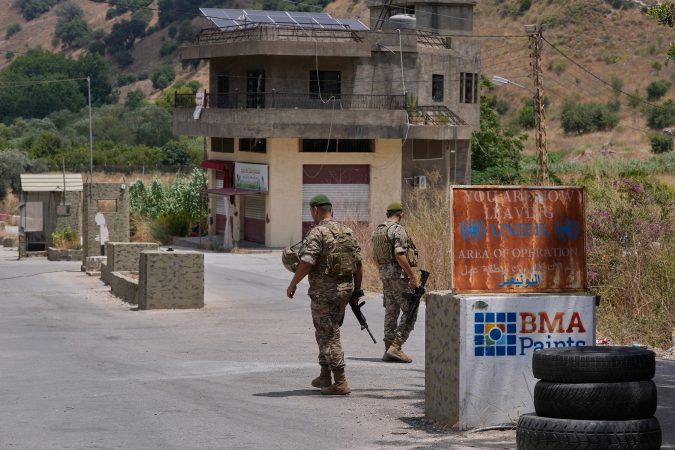
    The U.S. State Department announced Monday that operations in three villages deemed part of a “pilot zone” had begun, without giving details on what that entailed. Two of the three villages, Froun and Srifa, are not under Israeli military control and the Lebanese army is present there, while Israeli forces are in part of Zawtar al-Gharbieh.

    The Lebanese army in a statement said it was preparing for Israel to withdraw from Zawtar al-Gharbieh and that it had begun deploying troops to the area Tuesday. The Israeli military said it “will adjust its force posture in one of the pilot areas in order to enable the Lebanese Armed Forces to carry out their mission,” without specifying the location.

    An Israeli military official, speaking on condition of anonymity in accordance with military guidelines said Tuesday that the withdrawal had not yet begun.

    Village mayor waiting for safety to be confirmed

    Abed Ezzeldine, Mayor of Zawtar al-Gharbieh said that they are waiting for the Lebanese military to tell him whether its safe for residents to check on their homes after they fully deploy and patrol the area. He is concerned about the safety of his village given that the Israeli military is still present in another village next door, while Israeli strikes continue nearby.

    “The villages are intertwined, so we don’t feel safe because the Israelis are present there, they’re on our borders and are not very far from us,” Ezzeldine told The Associated Press, who said Zawtar al-Gharbieh is uninhabitable.

    “Once the army gives us permission to enter Zawtar al-Gharbieh, we as civilians will go in, but only to check it out and see how things are and then we will leave,” he said. “We can’t stay because the infrastructure is completely damaged and houses have been leveled. They (the Israelis) have bulldozed the roads.”

    Rubio says US will continue to support framework agreement

    Aoun met with Secretary of State Marco Rubio on Sunday, who said Washington will continue to endorse the Lebanese agreement and support the agreement’s full implementation. Rubio described the meeting as “very positive” and warned that Lebanon will “never be fully at peace” as long as the Hezbollah issue is not resolved.

    “How do you replace Hezbollah? You defeat and replace them with a government that is strong enough to be the sole force of arms in the country,” Rubio said after the meeting. Skeptics in Lebanon fear that a military confrontation with Hezbollah could lead to a civil war, as government officials have also urged for investment into the country’s battered infrastructure to empower the weakened state, which Rubio echoed.

    “This is not just about military stuff,” he added. ”This is about how can we attract more U.S. and international investment into Lebanon.”

    The Lebanese military last week increased its presence in some of the areas expected to be included in the pilot zone, including the three villages, with troops patrolling and setting up checkpoints. Though recent talks in Rome have signaled that the agreement’s implementation will begin soon, Israeli troops have not withdrawn from the areas under control.

    Israeli officials, meanwhile, have said they plan to keep forces long term in a “security zone” in southern Lebanon.

    Hezbollah has dismissed the direct talks brokered by the United States and instead backed Washington’s talks with their key ally and patron Iran to end their war, which also includes ending the war in Lebanon as a condition to bring back calm.

    Lebanon’s government came to power on a reformist platform in early 2025, vowing to disarm all non-state groups including Hezbollah. It blames Hezbollah for dragging the country into another war with Israel in March when the militant group fired several rockets toward northern Israel after the U.S. and Israel attacked Iran.

    Beirut’s leadership, however, has condemned Israel’s subsequent ground invasion and massive aerial campaign in the country, which killed over 4,000 people and displaced 1.2 million others. While grappling with stark political opposition from Hezbollah and allies within the deeply divided country, Lebanon’s leadership insists that Israeli withdrawal and international financial support for Lebanon’s cash-strapped army is crucial for a sustainable security solution.

  • The Pentagon, sinking billions into Iran, is quickly running short on cash

    The Pentagon, sinking billions into Iran, is quickly running short on cash

    The Pentagon faces an urgent budget shortfall caused largely by the war in Iran, with some critical lines of funding set to run out within weeks even as President Donald Trump escalates the conflict with Tehran, according to lawmakers and current and former U.S. officials.

    The funding crunch is already leading the Pentagon to limit training and maintenance that help maintain military readiness, according to four current and former officials, speaking on the condition of anonymity to candidly describe the budget constraints.

    And the collapsed ceasefire with Iran could further strain the military’s budget: After four U.S. service members died during more than a week of intensified fighting, officials in Washington signaled they were preparing for a wider conflict.

    The White House has asked Congress for an immediate infusion of $67 billion to help cover the costs of the war, but lawmakers are gridlocked over how to proceed. The House plans to leave Washington on Thursday for a month-long recess, leaving any deal on military funding weeks away at the earliest.

    “Everybody needs to look at this situation and get rid of the complacency that they have,” Rep. Pat Harrigan (North Carolina), a Republican member of the House Armed Services Committee, said in an interview.

    The Pentagon did not respond to a request for comment.

    On Tuesday, Defense Secretary Pete Hegseth and Joint Chiefs Chairman Gen. Dan Caine are scheduled to make their case for the money before the Senate Appropriations Committee — the first public hearing centered on the package. They last appeared on Capitol Hill in May, before a tenuous ceasefire broke down.

    White House budget director Russell Vought is also set to address Republican lawmakers Tuesday morning. Unless Congress acts, multiple current and former officials said the military will quickly be forced to make even more painful trade-offs.

    Trump launched the airstrike campaign in late February, repeatedly saying it would end within weeks. The conflict has instead lasted for months as Iran has closed the Strait of Hormuz — a vital waterway for the oil and fertilizer trade — and caused turmoil in the global economy.

    Vought told lawmakers last month that the war had so far cost about $30 billion, but some independent analysts say the price tag is likely much higher. The White House estimate does not include the cost of rebuilding U.S. bases in the Middle East damaged by Iranian strikes.

    The conflict has put unexpected stress on the Navy and Air Force, which have deployed aircraft and warships to the Middle East. Parts of the 2026 budget covering ongoing military operations for both services are on track to run out by the end of this month, according to two congressional aides, speaking on the condition of anonymity to candidly describe a sensitive budget situation.

    To bridge the gap until the 2027 fiscal year begins on Oct. 1, the Pentagon is already moving money around. Military exercises and trainings that help keep units prepared for combat are being limited or canceled, the four current and former officials said. The budget for equipment and facility and maintenance is also being drained to cover the shortfalls, the officials said.

    In recent weeks, the Pentagon has asked Congress for permission to reallocate $4.3 billion from trainings and weapons purchases to address more urgent priorities, according to a document reviewed by The Washington Post. Congress has yet to act on that request.

    A Trump administration official said the White House budget office was working to move some funding to the Pentagon’s operations and maintenance accounts. Doing so would come at the cost of other key programs, the person said, without offering further specifics. NBC News previously reported on some of the military’s budget constraints.

    Meanwhile, House Republicans are crafting a package using a complicated tool known as reconciliation to try to speed some money through Congress. The House is expected to vote this week on a framework that would authorize $73 billion in fresh defense spending, slightly more than the White House request.

    But that strategy faces significant hurdles in the Senate, where Majority Leader John Thune (R-South Dakota) has cast doubt on its prospects.

    Democrats have mostly said they oppose any new funding for the Iran conflict as part of a legislative blockade of major defense bills while the administration pursues a war that has drawn bipartisan objections. Even lawmakers open to additional funding — including some Republicans — have expressed frustration at the Pentagon’s delays in communicating with Congress.

    When Hegseth testified before the House panel on defense spending in April, committee leaders urged him to provide information on the war’s costs as soon as possible. The Pentagon later missed the panel’s deadline and has since failed to share requested details for weeks, including the number of precision weapons the military has in its inventories after burning through thousands of munitions in Iran, according to lawmakers and congressional aides.

    “We need to know what we’re purchasing and why we’re purchasing it,” Rep. Betty McCollum of Minnesota, the top Democrat on the panel, said in an interview.

    Hegseth has at times dismissed concerns about munitions shortages, telling CBS in an interview last month that U.S. stockpiles were “great, and they’re only getting stronger.”

    In private, Pentagon officials have expressed far greater anxiety, according to current and former officials, arguing that the military desperately needs more money to restock munitions needed to deter U.S. adversaries like Russia and China.

    After receiving a private briefing from top Pentagon officials, McCollum said replenishing these weapons was clearly a top administration priority and that Pentagon officials other than Hegseth were “very concerned” that lawmakers were not receiving the information they needed to make decisions on additional funding.

    This year’s defense budget is about $1 trillion including $150 billion in one-time funding Congress approved last year for a range of military priorities, from advanced weapons systems to energizing the U.S. defense industry. The Trump administration has requested $1.5 trillion for 2027, a massive increase that has sparked a fierce debate on Capitol Hill.

    Some lawmakers in both parties have shown discomfort with the total, due to concerns about adding to the $39 trillion national debt and financing an unpopular war. A recent Washington Post-Ipsos poll found that only 28 percent of Americans say the war has been worth fighting, compared with 68 percent who say it was not — on par with the worst assessments of the war in Afghanistan.

    Work on spending bills has been stalled in the Senate because of a stand-off among appropriators. Democrats have refused to support any fiscal year 2027 funding until a deal is reached on overall spending levels, as they oppose the hike in defense spending put forward by Republicans.

    Unexpected absences on the Senate Appropriations Committee have further complicated Republican efforts to begin some work on spending measures. Sen. Mitch McConnell (R-Kentucky), who chairs the panel on defense spending, has missed votes for a month while recovering from an injury. And Sen. Lindsey Graham (R-South Carolina), another member of the panel, died suddenly last week from what a medical examiner preliminarily ruled an aortic dissection.

    Harrigan, the North Carolina Republican, mostly faulted Democrats for the broader budget impasse but acknowledged that his party also deserves some blame.

    “There’s no question,” Harrigan said, “that every portion of those responsible for bringing the defense budget across the finish line — to include the Pentagon — are complicit.”


  • Iranian official meets mediators in Pakistan as Iran and US keep up attacks

    Iranian official meets mediators in Pakistan as Iran and US keep up attacks

    ISLAMABAD — An Iranian official began meetings Tuesday with mediators in Pakistan as diplomats sought to salvage the collapsed interim deal between Iran and the United States, even as both countries continued to launch attacks for a 10th day of renewed fighting.

    The visit by Iran’s Interior Minister Eskandar Momeni comes as Pakistan has intensified diplomatic efforts in recent days to resuscitate the deal. However, it remains unclear just what new arrangement could be reached to end the fighting.

    Iran attacked a tanker in the Strait of Hormuz early Tuesday, forcing its crew to abandon the ship, while the United States conducted yet another round of airstrikes targeting the Islamic Republic.

    The 10 consecutive nights of U.S. airstrikes haven’t compelled Tehran to loosen its grip on the strait, through which about a fifth of all crude oil and natural gas traded once passed in peacetime.

    The interim deal signed last month that was meant to end the fighting has crumbled. Shipping through the Strait of Hormuz has largely stalled. And as fighting intensifies, both sides have targeted civilian infrastructure relied on by millions of people.

    “Iran and groups supportive of Iran may target other U.S. interests overseas or at locations associated with the United States and Americans throughout the world,” the U.S. State Department said in a new warning to Americans.

    The escalation has pushed oil prices higher in recent weeks. Benchmark Brent crude traded Tuesday at nearly $90 a barrel and regular gasoline in the U.S. climbed to an average of $4 a gallon, keeping pressure on Americans’ wallets ahead of midterm elections this fall.

    President Donald Trump took to social media on Monday to warn that “Every time Iran kills an American Soldier they will pay for that killing many times over!”

    Iranian official begins meetings in Pakistan

    Momeni met Pakistan’s army chief Field Marshal Asim Munir, according to two officials who spoke on condition of anonymity to discuss the closed-door negotiations. Momeni later met Prime Minister Shehbaz Sharif.

    Pakistan’s political leadership and Munir, who serves as both the chief of army staff and defense forces, have played a key role in brokering last month’s interim agreement between the United States and Iran. Islamabad has been working to persuade both sides to return to the negotiating table to resolve outstanding issues under the June memorandum of understanding.

    Authorities did not immediately release details of the meeting, which came as Tehran continued its attacks on Gulf Arab allies of the U.S.

    On Sunday, U.S. Secretary of State Marco Rubio told reporters that the U.S. is still open to negotiating with Iran but that “it has to be real.” It remains unclear whether Tehran will offer anything that Trump would consider “real.”

    US strikes come as ships attacked

    The U.S. military’s Central Command said Tuesday it targeted “Iranian military command centers, maritime capabilities, missile and drone launch sites and air defense systems.” It released more footage of bombings that targeted sites in Iran.

    “American forces remain postured and prepared to hold Iran accountable for unwarranted aggression toward civilian mariners seeking to freely and openly transit the strait,” the command said.

    Iranian state media reported that explosions were heard in Fars, Hormozgan, Ilam, Kerman and Sistan and Baluchistan provinces.

    However, traffic through the strait has slowed to a crawl during the latest violence. Lloyd’s List Intelligence said only three ships transited the strait on Sunday.

    The British military’s United Kingdom Maritime Trade Operations center said a tanker came under attack early Tuesday in the strait off Oman, forcing the crew to abandon the vessel.

    Iran’s paramilitary Revolutionary Guard claimed the attack, as well as two other attacks on ships Monday in the waterway.

    The route around Oman has been the one the U.S. military has encouraged ships to travel to avoid Iran’s control. The UKMTO separately reported Tuesday that another previously unknown attack on a ship took place early the previous day.

    Iran strikes US allies around the region

    Tehran also hit U.S.-allied countries throughout the Middle East. Jordan military’s said Tuesday that Iran targeted it with five drones and three missiles, all of which were shot down. Bahrain sounded its missile alert sirens Tuesday afternoon as another Iranian barrage targeted the island kingdom, which is home to the U.S. Navy’s 5th Fleet.

    In Kuwait, its Electricity, Water and Renewable Energy Ministry said that Tehran had struck desalination and power plants for a fourth straight day on Monday night. Authorities said the attacks sparked fires and caused damage.

    Some 90% of Kuwait’s drinking water comes from desalination, making the attacks a matter of life and death for the tiny nation.

    U.S. strikes have been hitting electrical equipment in Iran as well, and Iranian officials also have said Americans targeted water facilities.