Tag: topic-link-auto

  • Storm warnings have been outdoing the actual storms in the Philly area

    Storm warnings have been outdoing the actual storms in the Philly area

    The smartphone alerts and the battery of weather watches and warnings were chilling. But they failed to capture what actually happened in the immediate Philadelphia area.

    As it turned out Tuesday, not all that much happened, beyond a beneficial rainfall, some flashbulb lightning, and wind gusts that officially did not get past 34 mph. Heavy rains hammered Upper Bucks County, but around Philly, creeks behaved and flooding reports were isolated, even as damaging storms struck to the north and south of the region.

    As so often occurs with summer thunderstorm outbreaks — not to mention winter storms — we learned science is playing catch-up with the atmosphere. That was evident Tuesday night, and if you feel as though you’ve seen this movie before, the forecasts and the outcomes were similar on July 18 and 21.

    And expect recurrences — and surprise storms — even if the climate stops changing.

    The atmosphere still is jealously guarding some of its most important secrets, said Bill Bunting, deputy director of the federal Storm Prediction Center, the national house of mayhem in Norman, Okla., that is responsible for all the severe-storm and tornado watches.

    In his 40-plus years in the storm-forecasting business, Bunting said, “I have seen remarkable progress, but we’re nowhere near perfection. In the end, the science has its limitations.”

    About the Tuesday night storms

    Life is unfair, and that works both ways. The Philly region has had its share of storm ambushes historically, and as for what did not happen in and around the city Tuesday, “we’ll consider that a much more fortunate outcome than what could have been,” said Mike Lee, meteorologist at the National Weather Service office in Mount Holly.

    The outcome was similar to that of July 18 and July 21, when the menu of threats — wind, possible floods and tornadoes, lightning — was about the same. The gusts on the 18th did not get above 35 mph at Philadelphia International Airport, and they did not get above 30 mph on the 21st.

    Bunting said this week’s storms were particularly problematical meteorologically. “The wind fields were quite strong” in the upper atmosphere, he said. “That environment was not one to mess around with.”

    It was as though the system had wandered in from a different season, when cooler temperatures create sharp temperature contrasts that drive storm development, Lee’s colleague Patrick O’Hara said.

    At 12:50 p.m., the storm center had seen enough to issue a broad-brush severe-thunderstorm watch that covered a huge swath of the Mid-Atlantic region, including much of Pennsylvania and all of New Jersey and Delaware.

    A tornado watch followed a few hours later.

    The Mount Holly office issued two tornado warnings for the Philly area — including one covering Wilmington and Chester City.

    However, the two twisters verified by the Mount Holly office occurred in Talbot County, Md.

    The heaviest rains — in some cases over 4 inches in Quakertown — mostly were confined well to the north of Philly. Officially, 0.72 inches of rain was measured at PHL.

    Wind-damage and flooding reports around the Philly area were sparse, although Bunting advised it can take days following a storm to get an accurate assessment of impacts.

    The future of thunderstorm forecasting

    Bunting suggested that complaints about forecast accuracy could be viewed as forms of flattery, since they well from the public’s expectations that, in turn, well from advances in forecasting.

    In 1985, Bunting recalled, he was working with one computer-model output that he received via a fax machine, and observation tools primitive by today’s standards.

    But forecasting the development and movement of thunderstorms remains one of the great challenges of meteorology, and it is inevitable that storms are not going to materialize in some areas that are under a storm watch.

    “You don’t now exactly where those storms will organize into a cluster, or fast-moving line segment,” he said. “So you have to put larger areas on notice.”

    A wild card in any cluster or line of storms would be renegade, isolated storms, the kind that are apt to spin up a tornado, Bunting said.

    For any given storm, he said, “until it forms in a larger area with similar conditions, it’s hard to pinpoint the risk.”

    What would it take to pinpoint the risks? Improved understanding of storm physics, improved remote-sensing capabilities, and more powerful models, Bunting said.

    “It is not a trivial challenge,” he said. “The decisions are not going to be perfect.”

    That is not necessarily a bad development, he added.

    “Sometimes I wonder what it would be like if we knew what the weather would be in great detail, weeks and months advance,” he said. “It seems to me it would get kind of old.”
  • The Women’s Lacrosse League is preparing to make history in the Philly area. To Mayor Parker, ‘it’s about opening doors.’

    The Women’s Lacrosse League is preparing to make history in the Philly area. To Mayor Parker, ‘it’s about opening doors.’

    The summer of unforgettable sports moments in Philadelphia is far from over, and Mayor Cherelle L. Parker was excited Wednesday for the next event coming to town.

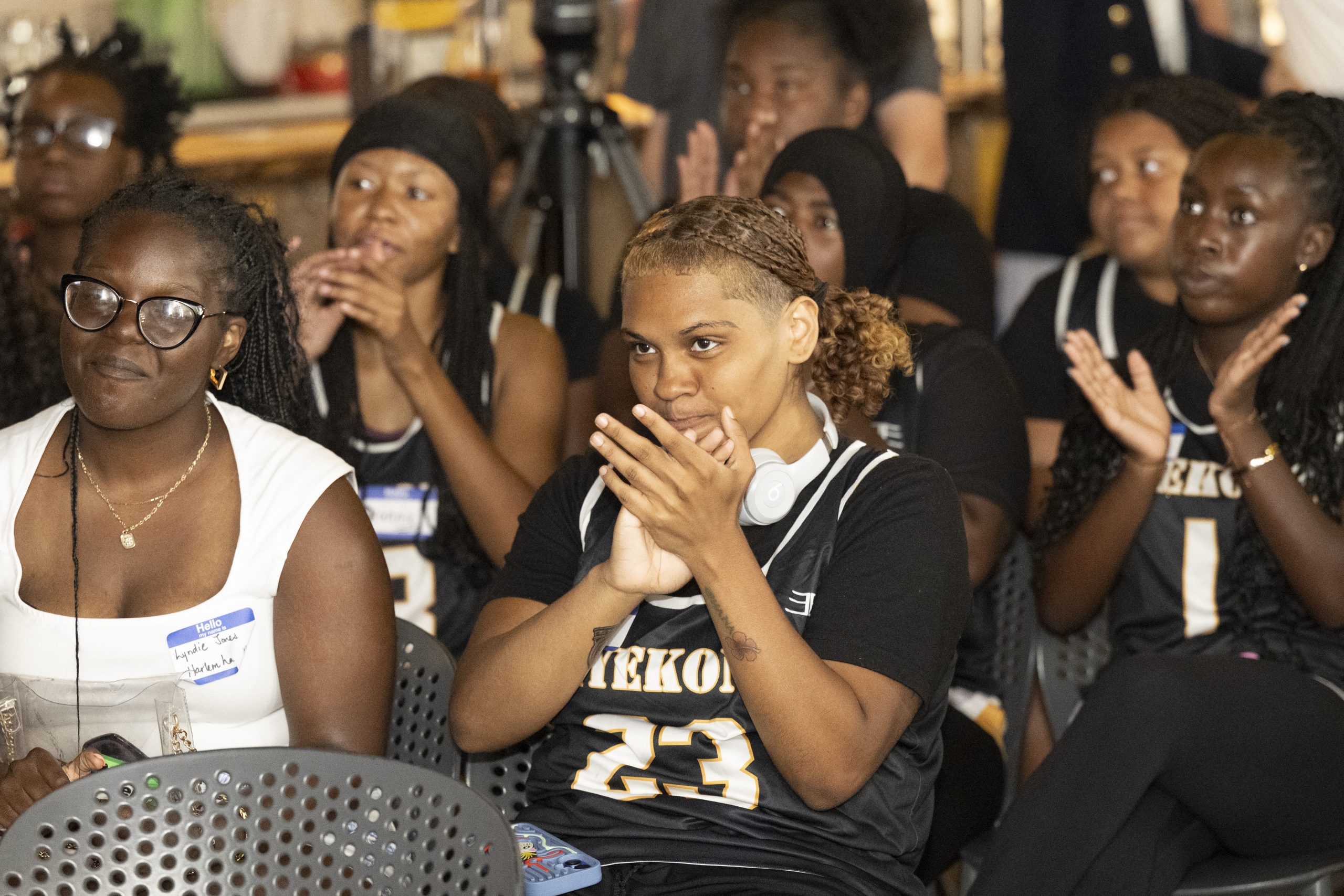
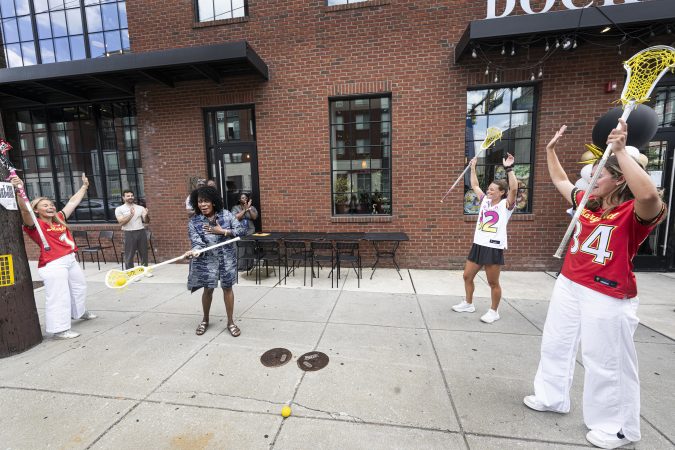
    Parker and local youth lacrosse players gathered at Dock Street South to celebrate the inaugural Women’s Lacrosse League championship, which is Aug. 15 (5 p.m., ESPN) at the Union’s Subaru Park in Chester.

    “For a long time, women’s sports were treated as an afterthought, a smaller version of the real thing,” said Rachael DeCecco, a USA Lacrosse Hall of Famer and Broomall native who’s the senior vice president of the PLL and WLL.

    “Every young girl who’s going to watch this league will understand, without ever having to be told, that this is a real path, a real career, a real sport worth playing at the highest level. And there is no better place to host this historic first-ever WLL championship than right here in Philadelphia.”

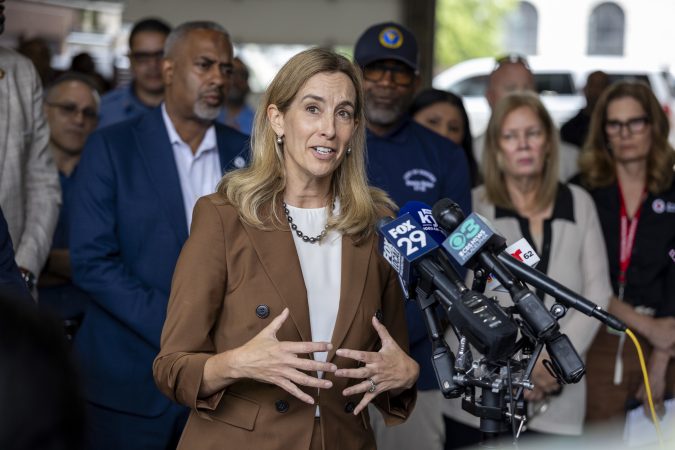
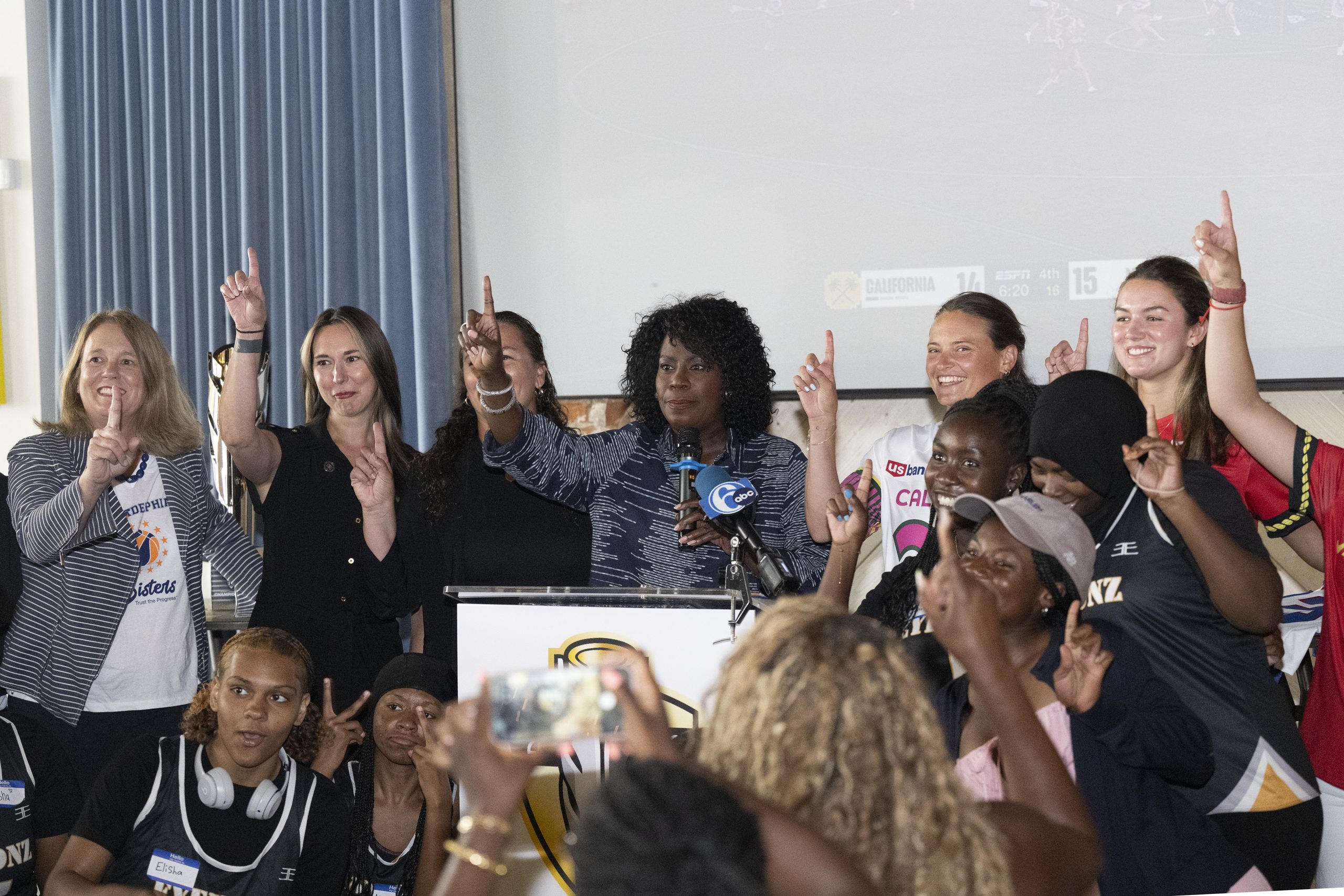
    Mayor Cherelle L. Parker (center) speaks at an event celebrating the inaugural Women’s Lacrosse League championship coming to the Philly area.Jose F. Moreno / Staff Photographer

    The Philly area is a hotbed for women’s lacrosse. Of the WLL’s four teams — the Maryland Charm, California Palms, New York Charging, and Boston Guard — 18 players and two coaches have ties to the region.

    Three of those players — California Palms defender Katie Detwiler (Devon, Archbishop Carroll) and the Maryland Charm’s McKenzie Blake (Haddonfield) and Abby Bosco (Penn) attended Wednesday’s event. Also in attendance was Tina Sloan Green, the former Temple women’s lacrosse coach who has been breaking barriers in field hockey and lacrosse since the 1970s.

    Now 82, Green said the formation of the WLL, which is in its second season, is her legacy.

    “I can’t even believe it,” Green said. “I grew up here and was the only Black female playing the sport. So this means so much to me because I know that my grandchildren, and their children, will get opportunities.”

    Parker also discussed wanting to create more opportunities in women’s sports. Discussions about hosting the WLL championship, as well as bringing a WNBA team to Philadelphia — which will happen in 2030 — have been on her radar since her days as a City Council member from 2015 to 2022.

    “We’re proving every year that our interests are in building and growing professional women’s sports in the city of Philadelphia. We’re doing it in a tangible way. We’re at the table,” Parker told the crowd. “This championship, to me, is about more than competition. It’s about opening doors. And in a city like Philadelphia, I can’t begin to talk about the importance of Black and brown young women being able to know that this sport, too, is for them.”

    At the end of her speech, Parker invited the youth lacrosse players in attendance to join her in reciting her signature chant, “one Philly, a united city; one America, a united nation,” before leading an “E-A-G-L-E-S” chant and laughing with the players about spelling it correctly this time.

    One of the young players in the crowd was Shiyann Werts, a lacrosse player and rising junior at Germantown Academy. Werts fell in love with the sport in sixth grade after being introduced to it at the Thomas K. Finletter School, where the Harlem Lacrosse program provides year-round academic and athletic support.

    Since then, she has seen the sport’s popularity grow.

    “It makes me really kind of emotional,” Werts said. “I’ve been seeing all the news on lacrosse, and it’s getting the recognition that I think it deserves. I’m really excited to see what the WLL will bring to that.”

    Werts hopes to play college lacrosse, and the opportunity to play professionally after graduation is becoming a realistic pathway for female athletes who previously had few options to continue competing after their NCAA careers ended.

    “I think it’s just super crazy growing up in the area,” Detwiler said. “When we were growing up, we didn’t have any of this. We played in college, and then it was on to the real world. So I think it’s really good for them to see what could be possible someday. It’s awesome to see.”

    The WLL and the city are working together to ensure the championship reaches all parts of the community. The league is donating 2,500 tickets to nonprofit organizations, youth programs, and community groups.

    Youth lacrosse players listen as Mayor Cherelle L. Parker speaks during a news conference on Wednesday.Jose F. Moreno / Staff Photographer

    Ashley Walkowiak, executive director of the Governor’s Advisory Commission on Women, echoed the hopes of the room that the championship is only the beginning of the impact women’s professional sports can have on Philadelphia.

    “Seeing the first WLL championship hosted right here in Pennsylvania is a powerful reminder of what’s possible when we invest in expanding opportunities,” Walkowiak said. “Philadelphia has long been a place where history is made, and this championship continues that legacy. But it is more than a game. It’s a celebration of talent, leadership, and the growing momentum around women’s athletics.”

  • Worker was ‘impaled’ by blow torch while dismantling an old crane at EMR Camden

    Worker was ‘impaled’ by blow torch while dismantling an old crane at EMR Camden

    A worker at EMR was impaled by a blow torch while taking apart a crane for scrap metal, according to Camden Fire Department incident reports.

    Camden County had confirmed that a worker at the scrap metal plant had been transported to the hospital after suffering life-threatening injuries less than two weeks ago on July 18. The man remains in the hospital in stable condition and conscious.

    The incident took place less than a week after the company announced its phased reopening after a string of fires. A judge had allowed EMR to resume operations after the company sued the city of Camden for suspending its operations.

    Fire department documents obtained by The Inquirer through a public records request reveal that worker was injured while dismantling a crane.

    He was on a stretcher with “what appeared to be a large Oxy-Acetylene blowtorch handle impaled into his left bicep and into his torso,” when Camden City Fire Department Battalion Chief Ezequiel Tirado arrived on the scene to respond to a burn victim, according to his report.

    Another worker who could not speak English had cuts on his face, and blood and mud on his hands, according to Tirado’s report. They spoke in Spanish, and the man said he was hurt but declined to be brought to the hospital, stating that he’s an undocumented worker.

    “I told him, ‘Don’t worry about that. Let’s get you some help,’” Tirado wrote. “He stared at me then ran away.”

    He was later found at the hospital, Tirado said.

    William Scott, the night time operations manager for EMR, said he did not know what caused the workers’ injuries, according to Tirado’s report. Scott said they were using a cutting torch to cut an old crane for scrap metal.

    Tirado described the site of the incident as “very dark with no lighting equipment” and lots of debris. He said emergency responders set up lighting and discovered a pool of blood near the crane and under a lift.

    Camden County spokesperson Dan Keashen said Wednesday that the now-stabilized man who was impaled with the blow torch was transported to the hospital in critical condition. He said the county police department is still investigating the incident.

    Joe Balzano, the CEO of EMR, said on the phone Wednesday that the workers were subcontractors hired to demolish an old crane and not employees of EMR.

    He said the injured worker is “a very hardworking nice man, unfortunately who was involved in a workplace injury.”

    “We’re just glad that he’s doing well,” the CEO said. “It’s unfortunate, heavy industry situations have, you know, unfortunate accidents … we just hope he does continues to progress well.”

  • Eagles practice observations: Sean Mannion’s offense starts clicking; Jalen Hurts under center; Jalyx Hunt hunts

    Eagles practice observations: Sean Mannion’s offense starts clicking; Jalen Hurts under center; Jalyx Hunt hunts

    The Eagles held their first practice of training camp on Wednesday at the Jefferson Health Training Complex. Here were my observations from Day 1:

    Healthy Birds

    The Eagles announced that outside linebacker Jonathan Greenard was placed on the Physically Unable to Perform (PUP) list just before practice. He apparently strained a pectoral muscle while lifting prior to camp. Greenard isn’t expected to be out long-term, but starting him on PUP allows the team to save a roster spot if he’s going to miss more than a month in the regular season.

    It’s unclear if the injury had anything to do with his recovery from December shoulder surgery. Greenard didn’t practice much in the spring after he was acquired via trade during the draft. He’s learning a new defense, but he’s been around the block a few times and shouldn’t be held back once healthy.

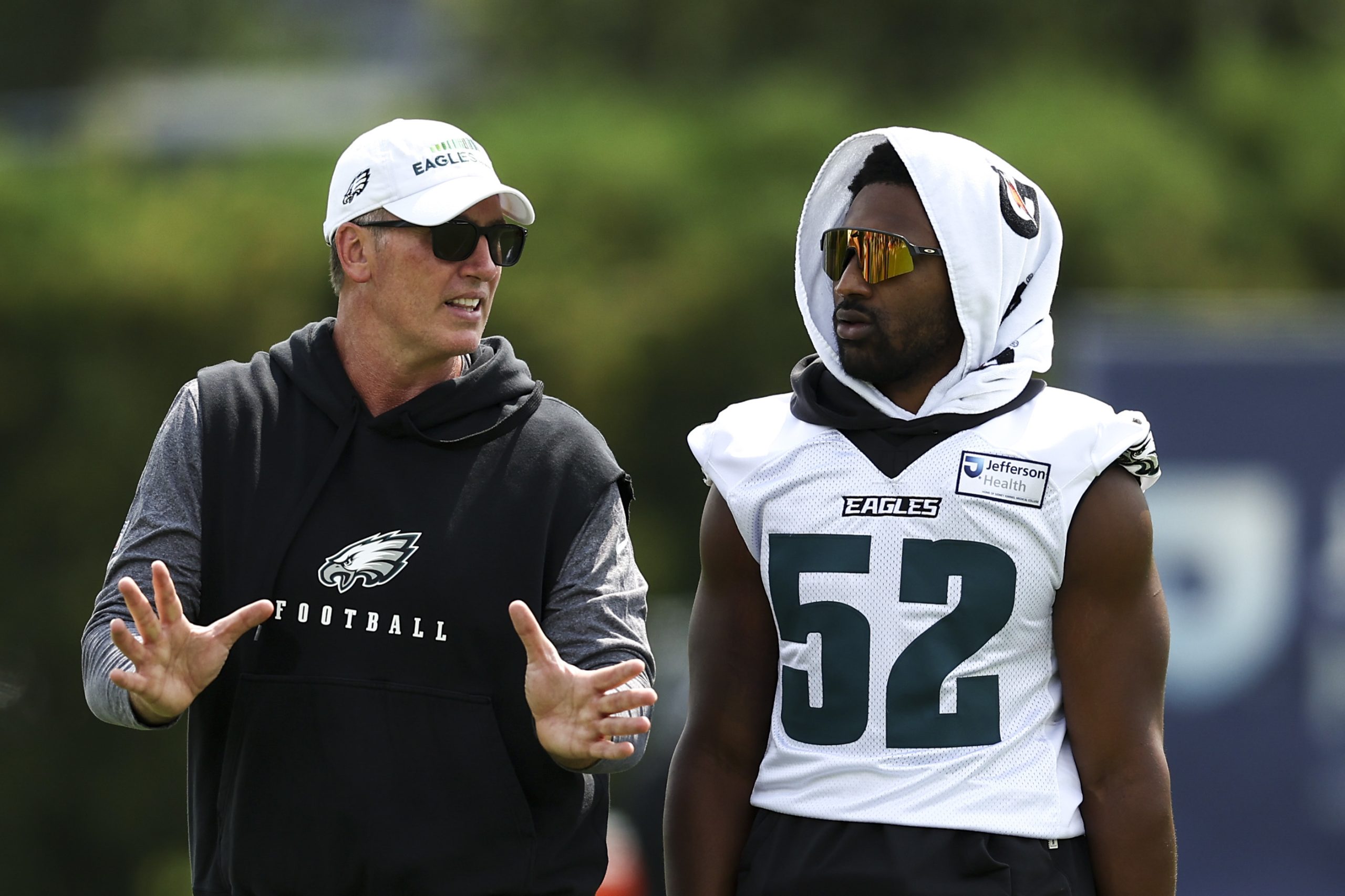
    Jonathan Greenard (right) was present on Wednesday but will remain sidelined indefinitely with a pectoral injury. Monica Herndon / Staff Photographer

    The Eagles were otherwise full-go. I don’t recall them being as healthy entering camp in all my years on the beat. Every player passed Tuesday’s conditioning test, as coach Nick Sirianni suggested before practice. Linebacker Jihaad Campbell (shoulder), wide receiver Makai Lemon (hamstring) and several other players who were limited in the spring were back in action.

    Campbell, by the way, switched his jersey number from 30 to 11. That should end all talk of the former Eagles wide receiver who previously wore the double ones. Right?

    Positional battles

    There’s really only one “starting” spot up for grabs and it technically isn’t a full-time job: safety. Cooper DeJean is expected to “start” at safety in base personnel alongside Andrew Mukuba. DeJean was there again on Wednesday. Marcus Epps filled the primary nickel role, however, with a splash of Michael Carter II at times. Those two appear to be the frontrunners. General manager Howie Roseman won’t be shy about trading for an upgrade if needed.

    There are some intriguing competitions further down the depth chart. Jonathan Jones was the first cornerback up when starter Quinyon Mitchell took a breather during team drills. Jeremiah Trotter Jr. and Smael Mondon were the backup inside linebackers behind Zack Baun and Campbell.

    A handful of receivers will be vying for the snaps that became available when A.J. Brown was finally traded to the Patriots. DeVonta Smith is the bona fide WR1, but new faces like Dontayvion Wicks, Hollywood Brown and Lemon, along with returnees like Darius Cooper and Johnny Wilson will be contending for playing time.

    Line ’em up

    The first-unit offensive line is set, but swing tackle along with a few other backup spots are up for grabs. New O-line coach Chris Kuper will work some reserve linemen at various positions to create versatility. Here’s how the units looked on Wednesday:

    A few notes:

    Jordan is new after the Eagles signed the veteran guard at the conclusion of minicamp in June. Bell was back in the lineup after sitting out the last day of minicamp. He and Fred Johnson are presumably battling for the swing tackle role, although Kuper could have both active on game days. Hollin Pierce and Jaeden Roberts were with the third unit at left tackle and left guard, respectively, during the period for developmental players.

    Mannion mirror

    New offensive coordinator Sean Mannion continued to implement many of the concepts we saw from the Kyle Shanahan-Sean McVay scheme he brought to the Eagles in the spring: a lot of under center sets, play-action and motion. I’d estimate that more than half of the plays came with the quarterbacks lined up under center.

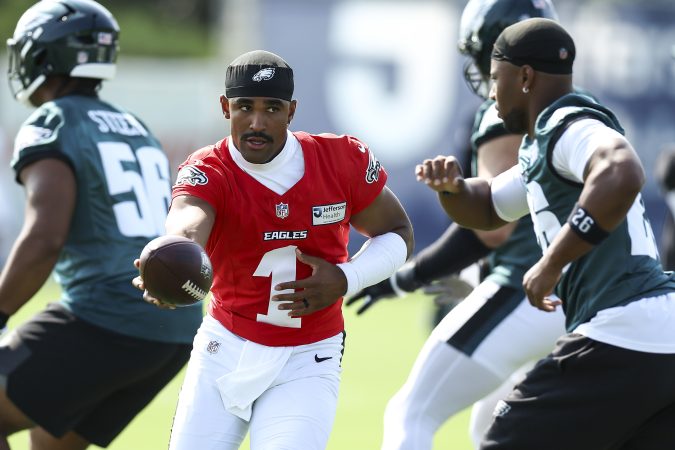
    Jalen Hurts continued to learn the intricacies of the new offense on Wednesday. Monica Herndon / Staff Photographer

    Jalen Hurts has improved from under center since entering the NFL, but he hasn’t done much of it, at least compared to rest of the league. There will be more of him turning his back to the defense on play action and naked bootlegs. An early awkward pass across Hurts’ body to Lemon illustrated that there will be some growing pains.

    Hurts to be…

    There will be an adjustment period for all involved, but mostly Hurts. He’s endured other previous changes in play-calling and scheme with varying results. The offense wasn’t sharp during the spring practices open to reporters. That came as little surprise, and neither should struggles during the summer.

    Hurts’ first pass of camp was a wobbler to Wicks that Mitchell nearly intercepted. But he had some strong moments in the later team portions with good ball placement on a toss to Wicks with cornerback Riq Woolen in coverage and a strike to a crossing Smith just over Mitchell.

    The catch of the day came during seven-on-sevens when Hurts hooked up with Cooper. The receiver got behind DeJean out of the slot and made a diving grab over the middle.

    Saquon Barkley’s ability to adapt to the wide-zone blocking scheme will be worth watching. Monica Herndon / Staff Photographer

    Run it back

    The Eagles won’t be in full pads until the fifth practice of camp on Tuesday, but they were able to incorporate more of the run game into team drills. Some of the biggest changes on offense will come with the move to more wide-zone blocking. Lane Johnson said the new system is “O-line friendly” and should theoretically place less stress on the group in pass blocking situations.

    Running back Saquon Barkley took the first handoff of camp and ran behind Johnson off tackle. He was met near the line of scrimmage by Baun on his next carry. Backup Tank Bigsby’s first touch came on a rush up the middle after Steen climbed to the second level. Could we see more of Bigsby as the inside complement to Barkley this season?

    Hunting season

    Greenard’s absence pushed Jalyx Hunt into the starting spot at right outside linebacker opposite Nolan Smith Jr. Hunt will likely play as many snaps as the other two this season. There’s an argument to be made that he should get more playing time than Smith. Nevertheless, he took advantage of his opportunities with Greenard out.

    Hunt shot into the backfield unblocked and forced Hurts to check down to Cooper on one play-action pass that came from under center. He blew up tight end Dallas Goedert with an edge rush and Hurts had to hurry a dump to Bigsby that wasn’t caught. And he beat Jordan Mailata on back-to-back rushes — one with an inside move and the other from the outside — that blew up pass plays.

    Dallas Goedert (right) rebounded from an early drop in Wednesday’s practice. Monica Herndon / Staff Photographer

    Sloppy go droppy

    Defensive coordinator Vic Fangio enters his third season at the helm with little turnover on his side of the ball. He’s always evolving and will introduce new ideas, but the core of his unit remains intact. The defense should have the upper hand in competitive periods, especially with the offense still ironing out details.

    Mannion’s unit had a couple of false starts from Mailata and Landon Dickerson. Brown lined up illegally at one point. Defensive tackle Jalen Carter, fresh off his contract extension, was flagged for offsides at one point. He slipped by Steen for a would-be tackle of Barkley in the backfield earlier in the session.

    Goedert dropped an early pass, but rebounded later on a short crossing route. Hurts and Barkley had a miscommunication on a botched handoff.

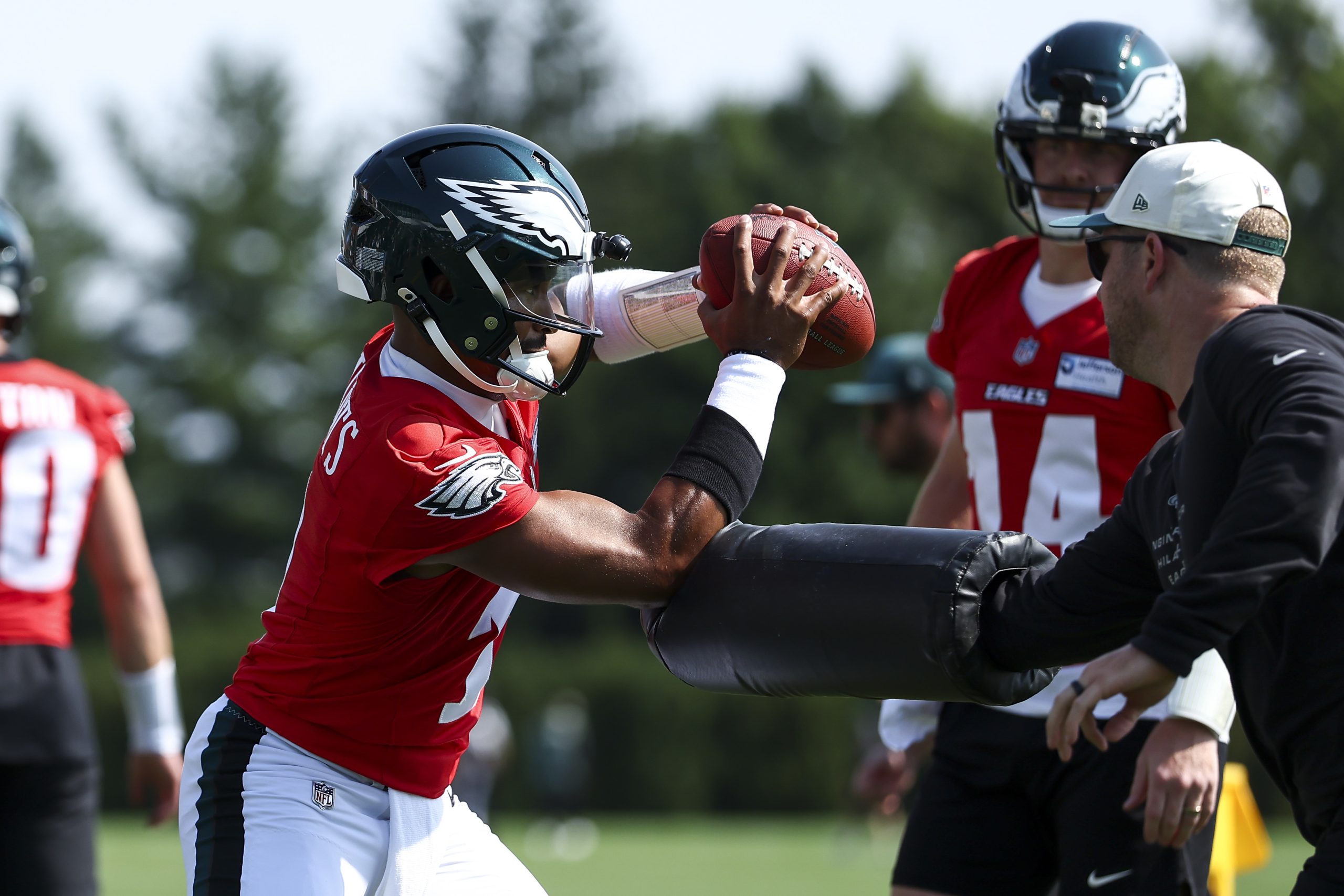
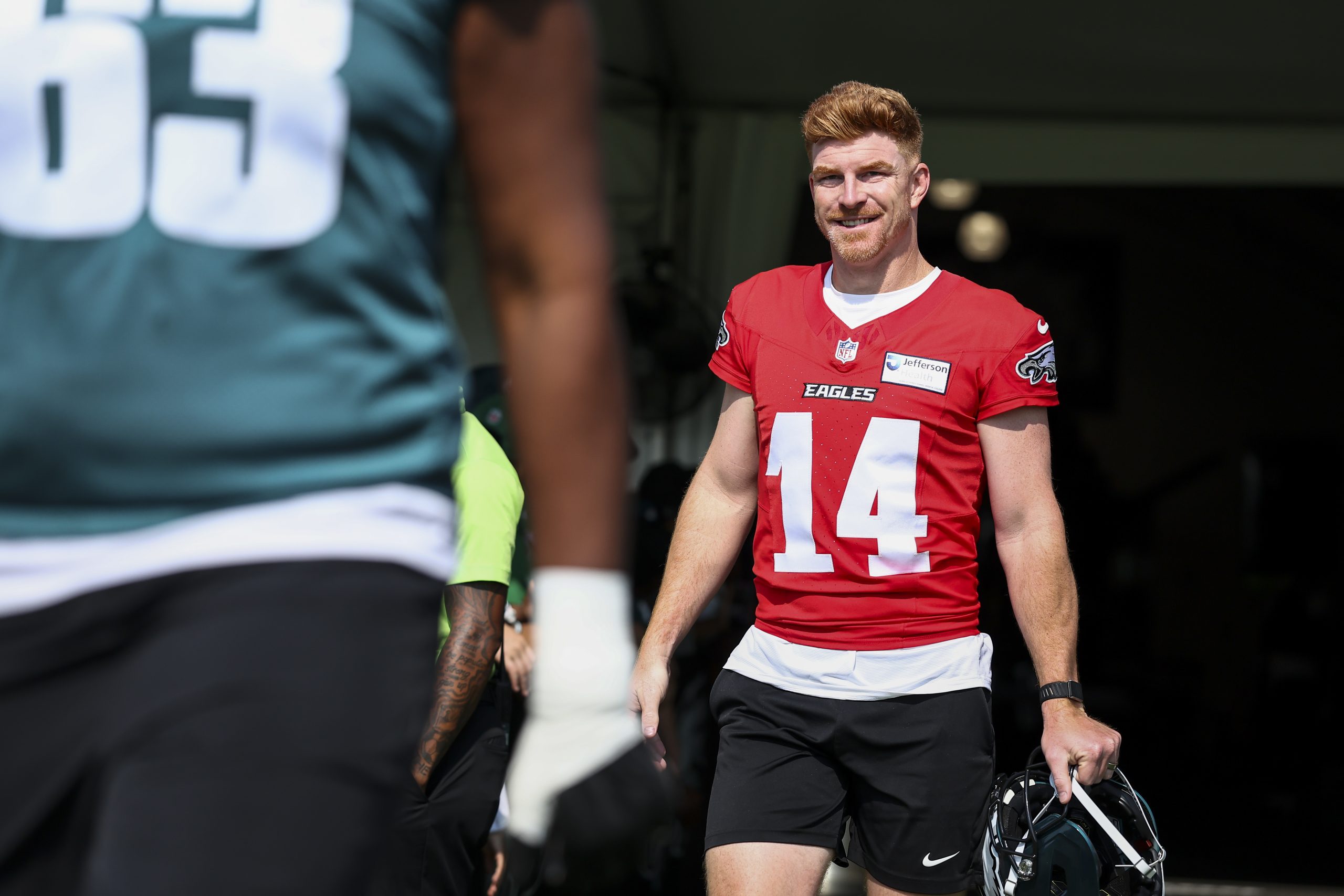
    Andy Dalton (14) is vying for the No. 2 quarterback job. Monica Herndon / Staff Photographer

    Back it up

    Quarterbacks Tanner McKee and Andy Dalton continued to split second unit snaps, much as they did in the spring. McKee’s first completion during seven-on-sevens went to rookie tight end Eli Stowers. Dalton hit Wilson over the middle with a pass only the 6-foot-6 receiver could reach.

    Trotter had a couple of run stops, one time seemingly filling a gap out of nowhere to stop Bigsby in his tracks. Former Texans running back Dameon Pierce was relatively quiet in the spring, but he had a nice cutback on an inside rush.

    Extra points

    Rookie quarterback Cole Payton had his ups and downs in the spring, but he continued to display a willingness to throw downfield a month later. He ripped a pass to receiver Quez Watkins during seven-on-sevens, and found receiver Britain Covey on a deep corner route. … Second-year defensive tackle Ty Robinson was relegated to snaps during the developmental period. Not a good sign. … Lemon fielded punts behind Covey and Elijah Moore. … The Eagles return Thursday for practice and will have a closed-to-reporters walkthrough on Friday.

  • Federal judge dismisses Trump administration’s lawsuit seeking New Jersey voter records

    Federal judge dismisses Trump administration’s lawsuit seeking New Jersey voter records

    A federal judge on Wednesday dismissed a lawsuit from President Donald Trump’s administration that sought New Jersey’s unredacted voter files.

    The case — one of more than two dozen lawsuits filed by the Trump administration against states ahead of the midterm election — predates New Jersey’s recent disclosure that thousands of noncitizens had been registered to vote in 2023 and 2024 due to a glitch in the motor vehicle system.

    The Justice Department attempted to use that news as leverage in the case, but it was unsuccessful.

    U.S. District Judge Zahid N. Quraishi ruled the department did not have the authority to compel New Jersey to hand over its unredacted records.

    “The Constitution’s architects chose to delegate election administration to the states, recognizing local governments have the deepest understanding of their constituents’ circumstances,” Quraishi wrote in the ruling, which granted New Jersey’s motion to dismiss the lawsuit.

    Quraishi has become the 18th U.S. District Court judge to rule against the Trump administration on the issue, according to data from the Brennan Center for Justice.

    The Trump administration will likely appeal the case, as the president and his allies have made election security a focal point ahead of the November midterms. It is mounting an appeal in a similar case in Pennsylvania.

    The ruling in the state’s favor came a day after New Jersey Gov. Mikie Sherrill formally told the Justice Department she would not release personal information about noncitizen voters who had been mistakenly added to the state’s voter rolls ahead of the 2024 election.

    Sherrill announced last week that about 6,600 noncitizens had been registered to vote due to a glitch in the automatic voter registration system at the New Jersey Motor Vehicle Commission. She said fewer than 400 had cast ballots and there was no evidence they had affected election results.

    On Tuesday, she said the New Jersey Department of State had begun removing 4,500 voters from the rolls. But there is a chance the rest could actually be citizens, so counties will review those about 2,000 individuals to ensure no eligible voters are disenfranchised, she said.

    Following Sherrill’s disclosure last week, Assistant U.S. Attorney General Harmeet Dhillon requested the full names, dates of birth, nationalities, and home addresses of the individuals who were erroneously registered, as well as additional information about the noncitizens who voted, within a week.

    Sherrill had publicly indicated she would not hand over the data, but her letter Tuesday put it on the books.

    The Justice Department’s request has no legal basis, Sherrill said in a Tuesday letter to Dhillon, and sharing “extensive personal information about thousands of New Jersey residents” is limited by state and federal privacy laws.

    “Here and always, I remain committed to protecting New Jerseyans’ personally identifying information,” Sherrill wrote, reiterating her stance from the previous week, when she cited concerns about federal data breaches under Trump.

    In response to Sherrill’s rebuffing, Dhillon said the Justice Department’s request was rooted in the legal authority to “keep ineligible voters off its rolls” and vowed to obtain the information “through all legal means!”

    Sherrill’s “refusal to cooperate with federal law enforcement does nothing to protect law-abiding NJ voters,” Dhillon said on X.

    Sherrill on Tuesday criticized the Trump administration for “weaponizing the government against individuals that disagree with them.”

    She pointed to an issue during her campaign last year in which the federal government provided personal information about her that should have been redacted, like her Social Security number, to an ally of her Republican opponent. The National Personnel Records Center director apologized at the time and called it a rare error, but Sherrill claims her data were “weaponized” against her.

    Sherrill has not shied away from the issue of voter access in New Jersey as it becomes a national talking point in the debate over election security after last week’s revelation that thousands of people had been improperly added to the voter rolls when applying for driver’s licenses and identification cards.

    On Tuesday, she championed a new law, the John R. Lewis Voter Empowerment Act, that offers a slew of policies meant to increase voter participation.

    The erroneous registrations took place between June 2023 and June 2024 under former Gov. Phil Murphy’s administration due to a software glitch in New Jersey’s motor vehicle system, which processes the automatic registration when citizens obtain an ID or a license unless they decline.

    Even though they checked “no” when asked if they were a U.S. citizen, the noncitizens were registered anyway.

    Sherrill pointed a finger at her predecessor but a spokesperson for Murphy said the former governor had “no knowledge” of the glitch.

    U.S. Rep. Jeff Van Drew, a South Jersey Republican, said he planned to hold hearings over the issue and called on Sherrill to answer a slate of questions.

    Sherrill said Tuesday that her administration had hired a law firm to conduct an independent bipartisan investigation. One of the firm’s main partners worked under former Republican Gov. Chris Christie as attorney general and was later appointed by Christie to the Senate, she noted, saying “we have nothing to hide.”

    Christie said in a post on X that Sherrill “made the right choice tapping my former AG Jeff Chiesa to lead the independent investigation into New Jersey’s voter rolls.”

    “Jeff won’t hide anything from the public,” he said. “You can count on it.”

    But the New Jersey GOP questioned Wednesday why Sherrill would not comply with the Justice Department if she “has nothing to hide.”

    “She ran on transparency and accountability,” the party said in a post online. “Apparently, those were campaign promises that expired the moment she was sworn in.”

    Republicans have seized on the noncitizen voter registrations to make the case for the SAVE America Act, which would require proof of citizenship like a passport or birth certificate to register to vote.

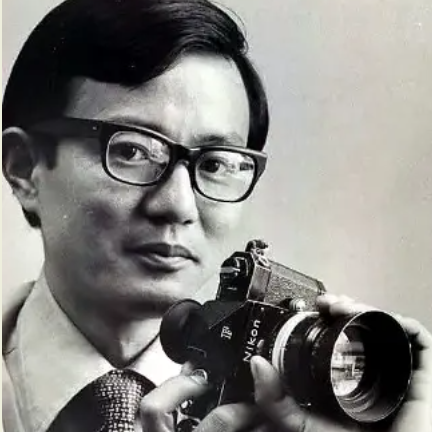
  • Akira Suwa, award-winning photojournalist at The Inquirer, has died at 84

    Akira Suwa, award-winning photojournalist at The Inquirer, has died at 84

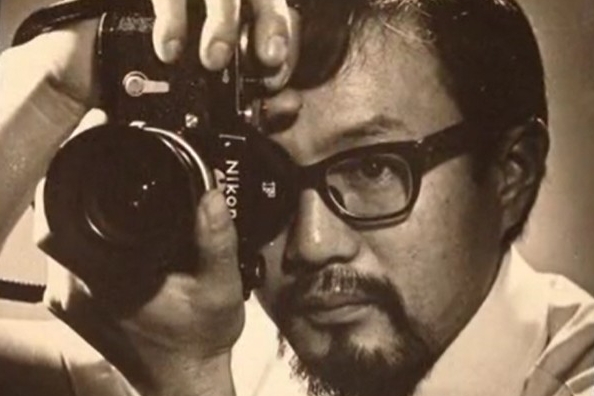
    Akira Suwa, 84, of Laurel Springs, Camden County, award-winning longtime photojournalist at The Inquirer, mentor, and lifelong green-thumb gardener, died Tuesday, July 14, of complications from dementia at his home.

    Born in what is now South Korea and reared in Japan, Mr. Suwa came to the United States for good in 1967 as a landscape designer and amateur photographer. When a landscaping job at a Florida garden center dried up, he polished his photography skills and, from 1969 to his retirement in 2014, worked as an award-winning staff photographer at the Tampa Tribune, the St. Petersburg Times, the Palm Beach Post, and The Inquirer.

    He joined The Inquirer in 1977 and, for 37 years, provided readers with thousands of illustrative, dramatic, stylish, and emotion-evoking photos from assignments around Philadelphia, South Jersey, and the world. He took poignant photos after the Three Mile Island nuclear accident, the fall of the Berlin Wall in Germany, and the Sept. 11 terrorist attacks, and during Operation Desert Storm in Saudi Arabia and the 1998 Winter Olympic Games in Japan.

    He sent back tragic and heroic images of conflict and despair from Libya and Brazil. He photographed drug traffickers in Colombia and was detained by authorities in China.

    Before the Inquirer, Mr. Suwa took photographs for the Palm Beach Post, the St. Petersburg Times, and the Tampa Tribune.Courtesy of the family

    Locally, he photographed athletes celebrating and commiserating, politicians and celebrities walking and waving, fashion models on runways, and restaurant specialties on tables. Former Inquirer colleagues called him a “brilliant photojournalist” and a “funny, engaging and terrific colleague” on Facebook.

    One former colleague said: “Akira told thousands of great stories with his camera.” His family said in a tribute: “Akira believed every story was worth telling.”

    Before the Inquirer, Mr. Suwa took photographs on all kinds of assignments for the Palm Beach Post, the St. Petersburg Times, and the Tampa Tribune. His father was an avid amateur photographer back in Japan, and Mr. Suwa honed his own emerging photo skills at nights and on weekends in Florida before joining the Tribune in 1969.

    He won several awards from the National Press Photographers Association and was named the 1973 Florida Newspaper Photographer of the Year by the University of Florida. He mentored young photographers and students, and one former student said: “He taught me so much about making the best photos possible.”

    Mr. Suwa photographed his wife, Deborah, often.Courtesy of the family

    Away from the lens, Mr. Suwa enjoyed tending his backyard garden in South Jersey, watching the birds flit about the feeders, and chasing the squirrels away. His mother was a serious gardener in Japan, and he studied agriculture in California as an exchange student while earning a degree at Tokyo Agricultural University in 1966.

    In 1964, he took a year off from college to work as a busser in the Japan pavilion at the World’s Fair in New York. “I fell in love with America, especially New York City,” Mr. Suwa wrote in an autobiography he shared with his family. “I was young and motivated to do something different from my peers back in Japan.”

    Akira Suwa was born Dec. 22, 1941, in what was then Taegu, Korea. He and his family fled Korea for Japan as refugees after World War II, and he grew up mainly in Osaka.

    He never formally studied photography, but his innate camera skills got him a job with a photo studio in Florida in the late 1960s.

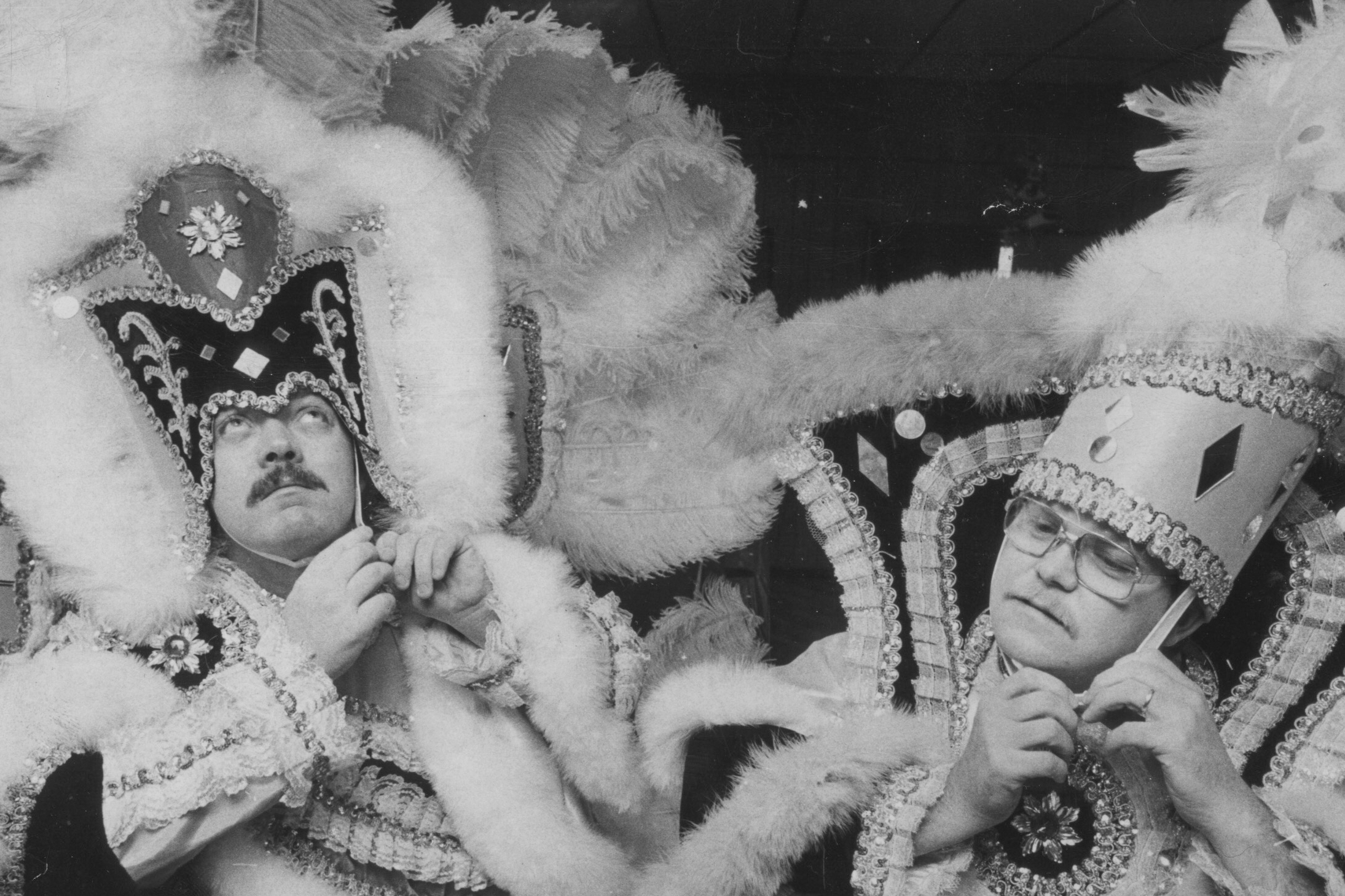
    Mr. Suwa photographed these Mummers in 1978. Akira Suwa / Staff Photographer

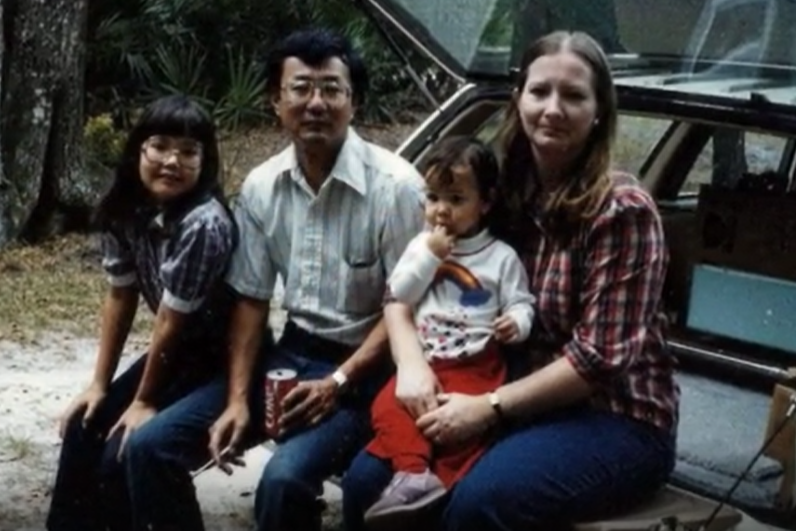
    He met Deborah Carter through a mutual friend at the studio, and he took her to see the musical Hello, Dolly! on their first date. She was smitten, she said, and they married in 1969, and had daughters Jasmine and Keiko.

    They settled in Laurel Springs when he joined The Inquirer and traveled to Japan several times to visit family and friends. “We enjoyed the best of both cultures,” his wife said.

    Mr. Suwa listened to jazz and built his own home computers. He liked to play pranks on the girls, his daughter Keiko said, but was simultaneously warm, serious, and practical. “If there was a job to do,” she said, “he would get it done.”

    His daughter Jasmine said: “He was forthright, sincere, and full of integrity.”

    Mr. Suwa and his family traveled to visit family in Florida and Japan. Courtesy of the family

    He doted on his wife and their grandchildren, and his family praised “his sharp eye, his mischievous sense of humor, and his devotion to his family.” His wife said: “He had my back and was as honest as the day is long.”

    Friends called him “the kindest person,” “wonderful and enormously talented,” and “a caring person to everyone.” He was interviewed by Photo Lounge in 2022 and said: “I just take pictures, and I like people.”

    His wife said: “He was my human, my person, my guy.”

    In addition to his wife and daughters, Mr. Suwa is survived by two grandchildren and other relatives. A brother died earlier.

    Visitation with the family is to be from 1 to 3 p.m. Saturday, Aug. 1, at Gardner Funeral Home, 126 S. Black Horse Pike, Runnemede, N.J. 08078.

    Donations in his name may be made to the Committee to Protect Journalists, Box 2675, New York, N.Y. 10108; and the Animal Welfare Association, 509 Centennial Blvd., Voorhees, N.J. 08043.

  • Ex-Comcast employee was hit in the face with a pie and tied to a chair for low sales, lawsuit says

    Ex-Comcast employee was hit in the face with a pie and tied to a chair for low sales, lawsuit says

    Sales low? You might get a pie to the face.

    That’s what a former Comcast retail employee says would happen, according to a new lawsuit filed against the Philadelphia-headquartered company.

    David Figueroa, a former employee at a retail location in Connecticut, alleges a store manager subjected workers to hazing and assault, forcing him to quit within a month of employment. That treatment included a monthly ritual where an employee was tied to a chair and smashed in the face with a cream pie. The antics were also videotaped.

    Comcast, the $125 billion-a-year media and communications giant, operates hundreds of retail stores nationwide. The stores act as point-of-sales locations for Xfinity products, including internet and TV products. They also offer equipment swaps and general customer support.

    “The Company has zero tolerance for harassment, humiliation, or any behavior that compromises a respectful and safe workplace,” Comcast spokesperson John Demming said in a statement. “This matter is in litigation so we will not comment on the specific allegations, other than to say that we disagree with the claims in the complaint and its characterization of the alleged events, and intend to fully respond through the legal process.”

    According to a lawsuit filed on behalf of Figueroa against Comcast, he was hired as a retail sales consultant in February at a retail location in Plainville, Conn., about 15 minutes outside of Hartford.

    But Figueroa said he was quickly rattled by his direct supervisor, the store’s manager, for her treatment of the staff. That store manager is not named as a defendant in the lawsuit. Demming declined to comment on the manager’s current employment status, citing personnel matters.

    The lawsuit says the store’s manager tracked employee sales metrics on a whiteboard in the back office that all employees could see. In the corner of that whiteboard, employees’ names were correlated to an emoji. The employee with the lowest monthly sales was listed next to an upset-looking emoji with a pie on its face, according to photos included in court documents.

    “[The chart] identified the employees who either had been recently assaulted or were scheduled to be assaulted in this way,” the lawsuit says.

    On Feb. 25, Figueroa witnessed a coworker being tied to the chair and assaulted in the face with a pie. The store manager “ordered, was present for, and videotaped this assault, as did the Plaintiff and other coworkers,” the lawsuit says. The coworker who struck the tied-up employee “had better sales results” and was ordered “to assault his poorer performing co-worker, in front of his peers,” the suit says.

    Figueroa’s coworkers showed him a video of another pieing incident where the assistant sales manager was hit in the face with a pie because of a poor survey score from a customer, according to the lawsuit.

    He attempted to report the incident to the store’s regional manager, who instructed Figueroa to send a text message documenting his concerns. According to the lawsuit, the regional manager “never responded” to Figueroa’s complaints about the store’s “hostile and violent work environment,” leading to his resignation.

    The Plainville retail location could not be reached for comment.

    Figueroa “suffered a pervasive and ongoing fear of being subjected to management-condoned assaults and public humiliation in the workplace,” the lawsuit says. Now, he’s suing Comcast for damages, including past and future financial, emotional, and reputational harm caused by the incident, along with court fees.

    It’s not the first time Comcast has found itself in a lawsuit involving a former employee. As reported on by The Inquirer, several past lawsuits waged by former employees have touched on hostile work environments at different Comcast stores, facilities, and call centers.

    The company reported lower profits last week, citing drops in domestic residential broadband customers in the second quarter.

  • Fed leaves interest rate unchanged but with 3 dissents as Warsh praises ‘good family fight’

    Fed leaves interest rate unchanged but with 3 dissents as Warsh praises ‘good family fight’

    WASHINGTON — The Federal Reserve left its key interest rate unchanged Wednesday, although three officials dissented in favor of higher rates as the central bank wrestles with how to deal with persistently high inflation.

    The Fed’s rate-setting committee reached its decision after two days of deliberations, marking the fifth straight meeting at which the benchmark rate was kept at around 3.6%.

    Some economists and Wall Street analysts had predicted the Fed would hike its rate by a quarter point. But while the decision to stand pat could be seen as good news for consumers, they might not feel much relief with the average credit card rate still near 20% and mortgage rates the highest since last August.

    Inflation has been stuck above the central bank’s 2% target for more than five years. The Iran war has generated uncertainty over the economic outlook and has driven energy prices higher, intensifying inflationary pressure and creating a quandary for Fed policymakers. In addition, the vast amounts of money being spent by technology companies on artificial intelligence are both driving manufacturing and have resulted in increased prices for items such as computer chips and electricity. President Donald Trump’s tariffs on foreign goods are also adding to inflation pressures.

    The three officials who dissented — Beth Hammack, president of the Federal Reserve Bank of Cleveland; Neel Kashkari, president of the Minneapolis Fed; and Lorie Logan, president of the Dallas Fed — had previously called for or signaled that they would be open to raising rates to combat high prices.

    “The dissents send a clear message: The Fed is not yet convinced the inflation battle has been won,’’ said Seema Shah, chief global strategist at Principal Asset Management.

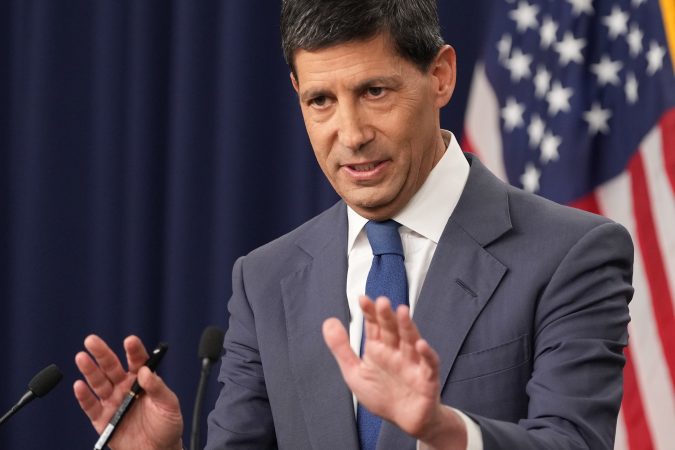
    At a news conference following the rate decision, Fed Chair Kevin Warsh reiterated the Fed’s commitment to combating inflation. At the same time, Warsh said, “We have no magic wand. This isn’t something we’re going to be able to carry out in days or weeks.”

    Warsh said he welcomed vigorous debate at the committee meeting. “I asked for a good family fight and I got one,’’ he told reporters at a news conference.

    Warsh, who was appointed by President Donald Trump, has sought to bring a number of changes to the Fed including giving financial markets fewer signals about the Fed’s thinking on interest rates. He said he believed that reticence was a factor in the bond market pushing up yields in the past few weeks as it weighed new economic data. The yield on the 10-year Treasury has risen from around 4.50% in mid-June to 4.64% just ahead of the Fed’s rate decision.

    The market is “learning to play the ball and not the referee,” Warsh said.

    Coming into Wednesday, traders on Wall Street saw a 33% chance the Fed would issue a rate hike, although most expected policymakers to hold off, reluctant to risk disrupting financial markets. But they give a 55% chance of a rate hike in September, according to data from CME.

    Trump, who had persistently pressured the Fed to cut rates, voiced support for Warsh. “He’s fantastic. He’s a brilliant guy. Smart. I know he’d love to see lower interest rates, but he’s got a board and it’s a political board and they want to keep rates up,” Trump told reporters.

    Fed officials likely want to see more economic data before changing the benchmark rate. On Thursday, the Commerce Department delivers the first look at April-June economic growth and it will also publish the Fed’s preferred inflation measure — the personal consumption expenditures (PCE) price index — for June.

    Adding uncertainty to the Fed’s decision-making process is the rising violence in Iran. The price of oil briefly blasted past $100 a barrel last week on intensifying fighting. It’s since settled down on hopes the United States and Iran can find some way to reduce tensions.

    Yet early Wednesday, Jordan intercepted missiles launched from Iran early just hours after the U.S. military said it knocked down another Iranian barrage launched against American forces in the Middle East, ending a brief pause in fighting.

    After the U.S. and Israel attacks on Feb. 28, Iran shut down the Strait of Hormuz — through which a fifth of the world’s oil and natural gas pass. That caused the greatest disruption in oil supplies in history and sent energy prices surging. They’ve since bobbed up and down depending on the ever-changing state of the conflict and negotiations to de-escalate it, but the average cost for a barrel is $10 to $15 more today than it was at this point last year.

    Inflation has exceeded the Fed’s 2% target since early 2021 when the U.S. economy overheated as it roared back from COVID-19 lockdowns. Inflation peaked at just over 9% in mid-2022 and began to drop in the face of 11 rate hikes by the Fed in 2022 and 2023. But progress has more or less stalled.

    So-called core inflation — which excludes volatile food and energy prices — cooled in June, partly because apartment rents aren’t rising as fast as they had been. And a temporary drop in gasoline prices last month also helped contain overall inflation.

    But several Fed policymakers have been arguing that the Fed will have to raise rates to return inflation to the 2% target.

    “Sternly staring at inflation until it melts before our withering gaze is not an option,’’ Christopher Waller, an influential member of the Fed’s governing board, said in a speech this month.

  • Wills Eye doctor George Spaeth, 94, reflects on his award-winning research and humanistic approach to medicine

    Wills Eye doctor George Spaeth, 94, reflects on his award-winning research and humanistic approach to medicine

    As a resident training at Wills Eye Hospital, George Spaeth was perplexed by a 7-year-old patient’s symptoms.

    Her legs angled inward, her hair was straw-colored with an odd consistency, and she had intellectual disabilities.

    She had come in for faulty vision caused by her lenses — the part of the eye that enables vision by focusing light — becoming loose. Spaeth’s job was to simply prepare her for surgery to remove her lenses.

    Yet, he couldn’t help but fixate on the constellation of symptoms she presented with — and the unknown cause underlying them. Nothing in his medical texts fit her profile.

    “She didn’t look like anything I’d ever seen before,” he said.

    He asked nurses to collect her urine for testing, and discovered it was full of an amino acid called homocysteine.

    In 1962, he diagnosed the little girl with a previously unknown rare metabolic disorder called homocystinuria (HCU) — making her one of the first patients in the United States to receive the diagnosis.

    An Illinois-based nonprofit dedicated to the disease, HCU Network America, presented Spaeth this month with their HCU Hero Award for his significant contributions to the detection and treatment of the disorder.

    In the fall, the Chestnut Hill resident will also collect a leadership award from the Wills Eye Hospital Alumni Society and the Laureate Award from the American Academy of Ophthalmology.

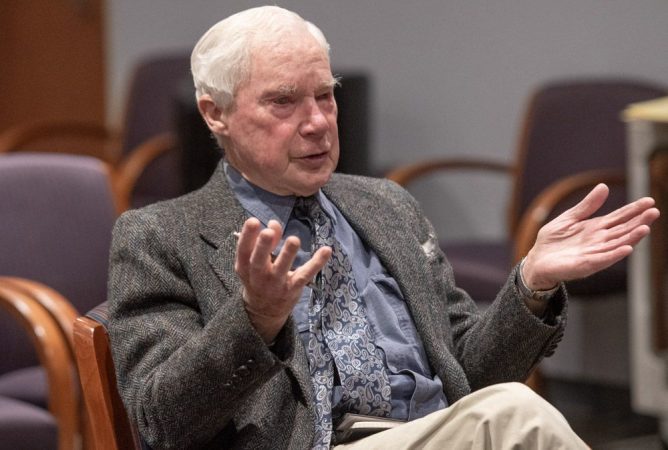
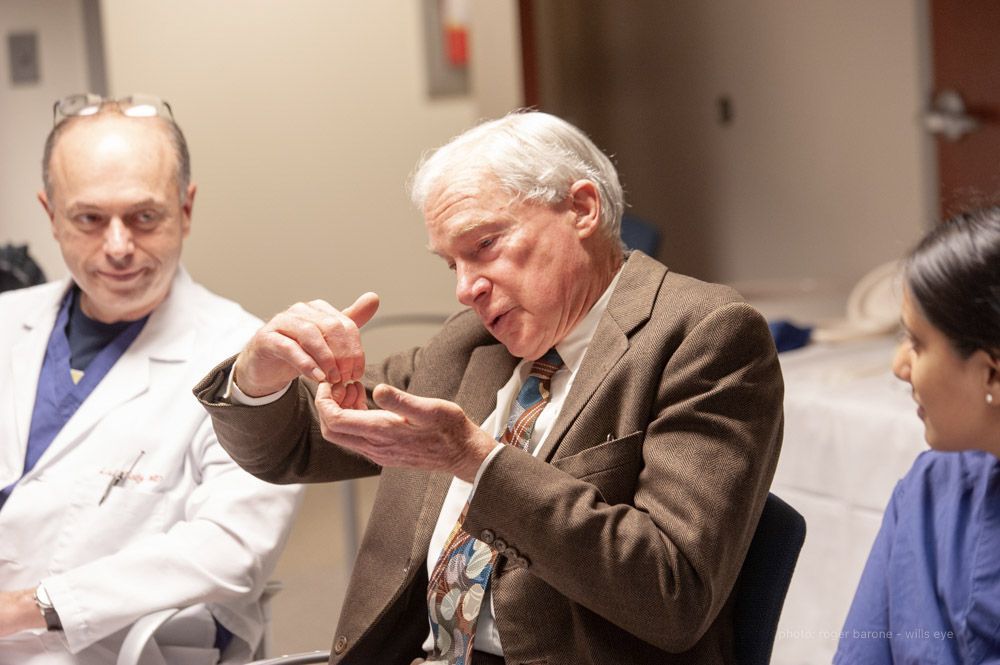
    The honors have given the 94-year-old ophthalmologist an opportunity to reflect on his decades-long career dedicated to research, finding the humanity in medicine, and emphasizing the importance of humility and curiosity.

    “The most important thing that I think any person in any field can do is say I don’t know,” he said.

    George Spaeth will be honored with a leadership award from the Wills Eye Hospital Alumni Society this fall.Courtesy of George Spaeth

    Solving a mystery

    When Spaeth told patients “I don’t know,” he tried to follow up with, “maybe we can find out.”

    Through studying the biochemical pathways involved in HCU, he landed on a potential treatment: vitamin B6.

    When his patient took it, the homocysteine levels in her urine dropped.

    Spaeth was the first to publish on this finding, which led to an uptake in the vitamin’s usage, said HCU Network America emeritus director Margie McGlynn. It works in about 50% of patients with the disorder, and is still used today.

    His work also helped spread awareness of the eye symptoms of the disorder, enabling earlier diagnoses.

    McGlynn’s sister, who first presented with severe nearsightedness, was diagnosed with HCU in the 1960s by an ophthalmologist who had recently read about the condition in a medical journal.

    “I firmly believe that it was Dr. Spaeth’s work and publication on this patient that made this ophthalmologist aware,” McGlynn said.

    Spaeth wrote to schools for children with intellectual disabilities and asked if they had any children that fit the symptom profile.

    When they sent urine samples, some came back positive for the disorder.

    One of the children he diagnosed at Willowbrook State School in Staten Island ended up dying. The boy’s mother told Spaeth she also had a daughter who was 2 years old and seemingly fine.

    “We better test your daughter,” Spaeth urged, given that the condition was inherited.

    He examined the boy’s sister, tested her urine, and diagnosed her with HCU.

    Spaeth started her on the vitamin treatment. Without it, she was likely to end up like her brother.

    Decades later, he received a call from her mother.

    “She was just admitted to medical school,” he recalled her saying.

    Finding the humanity in medicine

    Janine Tabas, vice chairman of the Wills Eye Alumni Society, said the society chose to honor him with their leadership award in recognition of his lifetime of accomplishments in patient care, teaching, and mentorship.Courtesy of George Spaeth

    Growing up, Spaeth dreamed of becoming a poet or composer, “but I’m no Bach, and I’m no Mozart,” he said.

    He studied history as an undergraduate at Yale University before pursuing medicine — the same profession as his father, renowned ophthalmologist Edmund Spaeth.

    He found he loved connecting with his patients, through finding out what they loved, and what they feared.

    “I was a great believer in putting my hand on the patient’s arm while I was talking to them and finding out who they were,” he said.

    In his field, glaucoma, he would often see the same patient for two or three decades.

    Spaeth operated on a 19-year-old college student suffering from severe headaches in 1969, and has stayed in touch with her ever since.

    Over the years, he watched her grow up and marry a wonderful man. When he fell and broke his leg, she came to visit.

    “I just think about what that means,” he said.

    Spaeth stopped seeing patients in 2013 to spend time with his wife, Ann, whose breast cancer had returned and stopped responding to treatment. She died that year.

    In the years since, Spaeth wrote and published a book for his late wife, Hope for Awareness, about “how lucky I was to be married to an amazing woman, and how unaware I was of how lucky [I was],” he said.

    ‘One of the forefathers’

    Janine Tabas, vice chairman of the Wills Eye Alumni Society, described him as “one of the forefathers of glaucoma” and “an absolute gentleman.”

    The society honored him with their leadership award in recognition of his lifetime of accomplishments in patient care, teaching, and mentorship, she said.

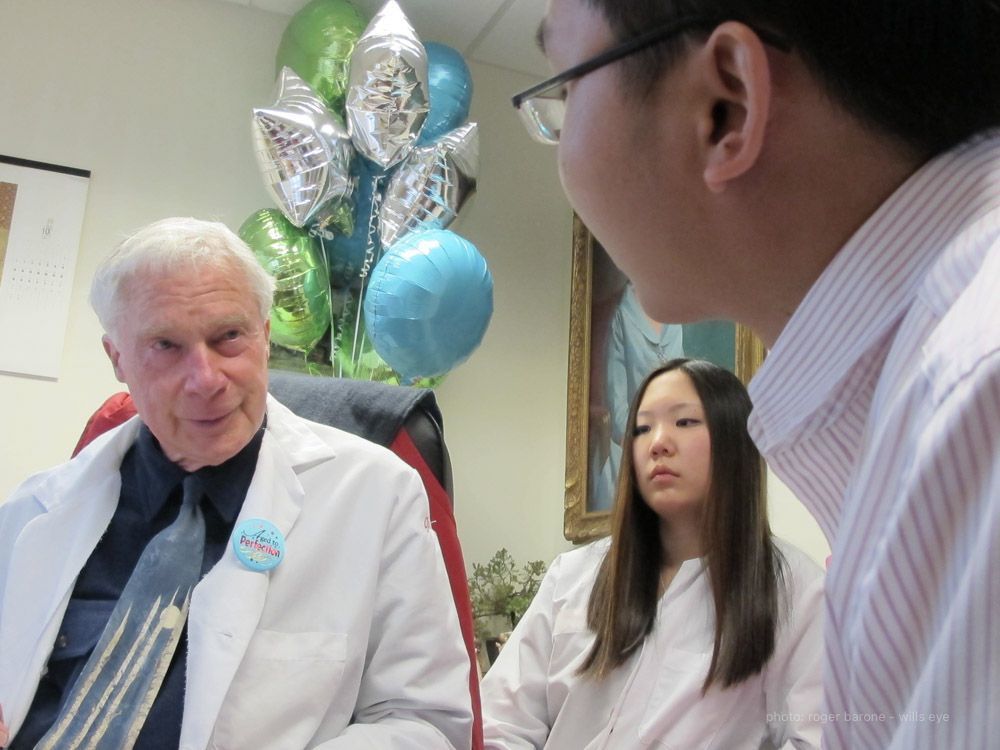
    When Tabas was a first-year resident at Wills Eye in the 1990s, Spaeth served on the senior faculty. She was struck by his humility and the way he treated everyone as equals.

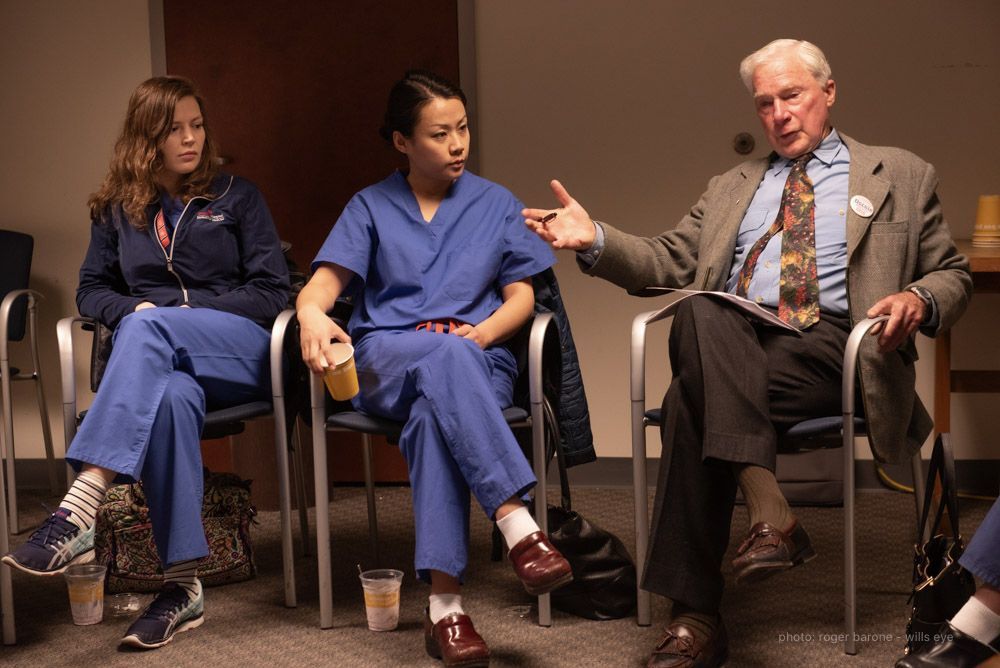
    Spaeth invited her whole cohort to his home for dinner, where they sat on his living room floor together. He also asked her to play tennis, knowing that was one of her interests.

    “I was a lowly resident,” Tabas recalled. “And here was the chairman of glaucoma. The guy whose name was on every book in the lobby.”

    She has since continued Spaeth’s tradition of inviting the residents out to play tennis.

    George Spaeth stopped seeing patients in 2013.Courtesy of George Spaeth

    When asked why he thought he was being honored with awards this year, Spaeth pointed to the importance of having humanity and humility and not being “a real jerk.”

    “Remember, the most important thing you can do is become a good person,” he said. “If you’re a good person, the likelihood is that you’ll have a good career.”

  • Switch to new digital tablets in N.J. prisons prompts civil rights lawsuit

    Switch to new digital tablets in N.J. prisons prompts civil rights lawsuit

    A man incarcerated in a New Jersey prison has sued the state in a bid to block corrections officials from forcing prisoners to surrender personal electronic tablets they purchased to message loved ones, listen to music, and access other digital content.

    Alonzo Hill, who has been incarcerated at New Jersey State Prison in Trenton since 1990, filed a civil rights complaint last week asking a federal judge to allow inmates to keep the handheld devices and their content — or require the state to reimburse people what they paid for them.

    The dispute comes as the state Department of Corrections switches to a new provider, ViaPath Technologies, to meet the communications needs of the 13,000 people in state custody.

    JPay had supplied such services since 2014, with people purchasing tablets and paying one-time fees for content they downloaded for use in their cells and recreation areas. The ViaPath tablets, in contrast, are considered loaners that are provided for free but require users to continuously pay for content in a subscription model. ViaPath users in New Jersey prisons also face high restitution fees for damaging tablets and new limits on tablet use outside of cells.

    Inmates bought the JPay tablets and content with the understanding they were “owned property without limitations,” Hill wrote. Yet corrections officials are requiring people to turn them in for disposal or send them home, gave incarcerated people no opportunity to chime in on the changes, and ignored his inquiries and grievances over it, he added.

    That’s a violation of the 14th Amendment, which says that no state shall deprive people of property without due process of law, he charged. Hill is director of his prison’s Inmate Legal Association, a nonprofit in which jailhouse lawyers help other incarcerated people with their court filings and disciplinary matters.

    “Many inmates utilize these tablets and content (at no additional cost) multiple times each day to relieve stress and anxieties of prison life,” Hill wrote. “State inmates were led to believe that if they didn’t violate JPay’s terms or NJDOC’s rules regarding the e-tablets, the chargers and content, that they could purchase and retain both throughout their sentences.”

    He also objected to the “exponential cost increases” he suspects users will face under ViaPath, noting that many inmates make less than $2 a day for prison jobs — and some make nothing, such as those held in disciplinary units.

    Corrections officials also have failed to guarantee that family photos downloaded and digital content purchased through JPay will transfer to the new ViaPath tablets, he added. They told people in custody that JPay tablets not sent home or surrendered for disposal will be considered contraband subject to confiscation, with their owners facing discipline, Hill said.

    Chris Greeder, a Department of Corrections spokesman, declined to comment on the lawsuit.

    But he said in an email that the department, JPay, and ViaPath have “reached an agreement allowing digital assets, including music, emails, photos, and related attachments, to be transferred to the new platform.”

    Eight of the state’s nine adult prisons have transitioned to ViaPath since March, with 9,500 people now using the new tablets, Greeder added. New Jersey State Prison’s switch is scheduled for the week of Aug. 10, he said. The department’s contract with JPay was set to expire this Friday, so officials negotiated a 90-day extension so people incarcerated in Trenton can continue using JPay services, he added.

    Officials switched vendors because ViaPath offers “a modern communications system” at a lower cost than JPay, Greeder said.

    Phone calls, money transfers, electronic messages, and video visits through ViaPath were cheaper than similar services through JPay, according to contracts and price sheets the New Jersey Monitor reviewed in May. It was tough to compare prices for music, movies, games, and such content, though, because those are pay-as-you-go services under ViaPath and outright purchases under JPay.

    The Department of Corrections is “committed to providing incarcerated individuals with safe, secure, reliable communication services” that allow them to communicate with family and loved ones, Greeder said in an email.

    Critics, though, have accused ViaPath of predatory pricing because of its pricing structure, service fees, and other practices, with people incarcerated in Nevada prisons boycotting use of ViaPath tablets earlier this year. The Virginia-based company also has racked up more than 600 complaints in the past three years with the Better Business Bureau and averages one star (out of five) in 87 reviews on its website, with many people complaining about costs and customer service. (JPay fared only marginally better on the watchdog site, with 368 complaints over the same time period and 27 reviews averaging 1.2 stars.)

    Ronald Allen, who’s also incarcerated in Trenton, filed a statement supporting Hill’s lawsuit, voicing an additional concern. He said people make inquiries and file grievances through their JPay tablets, which connect to kiosks in each prison where people download content and communicate both inside and outside the prison via a restricted, surveilled intranet. He has stored all the inquiries and grievances he’s made in the past decade on his JPay tablet, he wrote.

    “Without the kiosks, no accurate, reliable records of inquiries or grievances will exist,” Allen wrote.

    Greeder said officials are working with the vendors to acquire historical records of inquiries and grievances.

    Hill accuses state officials of deliberate indifference and is seeking a court order that would allow inmates to keep their JPay tablets, require the state to transfer all JPay content to the new ViaPath tablets, or reimburse people for content officials can’t or won’t transfer over. People in New Jersey prisons have spent between $1.5 million and $3.2 million each year over the past decade on JPay services, according to data the New Jersey Monitor obtained from the Department of Corrections last spring.

    Hill also is asking the judge to appoint an attorney to represent him in court and award damages of $7,500 per defendant.

    The lawsuit names as defendants ViaPath Technologies, Gov. Mikie Sherrill, Corrections Commissioner Victoria Kuhn, and New Jersey State Prison administrators Jeffrey Crothers and Douglas Stark.

    Spokespeople for Sherrill and ViaPath did not respond to requests for comment.

    This story originally appeared on New Jersey Monitor.