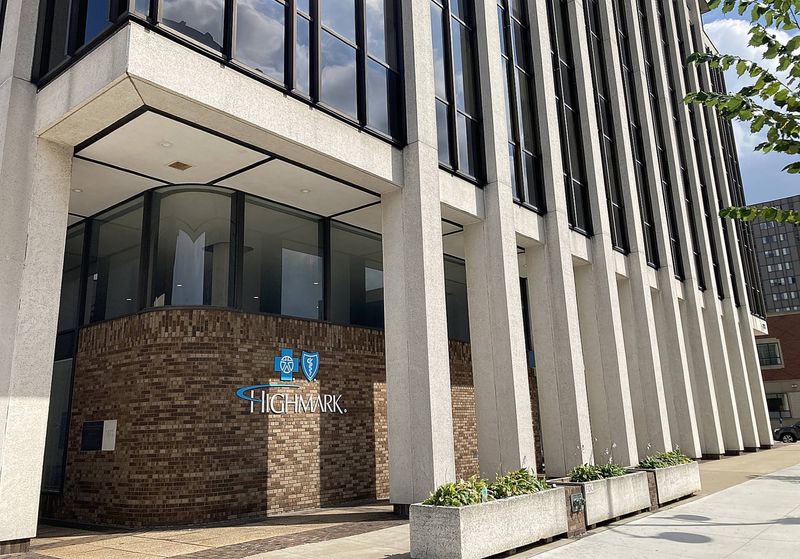
Highmark reached an agreement to keep Rothman Orthopaedics in network for Pennsylvania customers of Highmark Blue Shield plans and federal employee health programs after Oct. 1, the two companies said Wednesday.
The Pittsburgh-based insurer had issued a termination notice over the summer, alleging that about a half-dozen Rothman surgeons were abusing a federal process designed to protect patients from unforeseen out-of-network bills.
The dispute centered on the use of out-of-network physician assistants by Rothman surgeons who do not have residents or fellows working for them and need help treating patients.
Highmark said that the practice violated a contract that took effect at the beginning of last year and that the use of arbitration under the federal No Surprises Act generated extraordinarily large payments for the physician assistants.
The physician assistants worked for separate company that Rothman, a practice, had no control over, a Rothman official said earlier this month.
They say bad luck runs in threes. If you’re superstitious, maybe you think Philadelphia is finished with its streak of misfortune.
Strike One: On Sept. 11, the Phillies announced that All-Star lefty Jesús Luzardo had a sore shoulder. He landed on the injured list four days later.
Strike Two: On Sept. 14, the Eagles placed three-time Pro Bowl left guard Landon Dickerson on injured reserve with a bone bruise to his twice-repaired right knee.
Strike Three: In a preseason game Tuesday night, Dan Vladař, the Flyers’ goalie and linchpin, left after absorbing a glancing blow from Bruins forward Tanner Jeannot.
Vladař appeared to take a skate to the back of his right arm, which he also appeared to injure last spring. He was uninterested in retrieving his stick and the Bruins scored. After that, Vladař got his stick back, but he could not manipulate it. Before play resumed, he skated off the ice, bent over in pain.
Did the Flyers’ hopes of relevance skate off with him?
The Flyers have offered no update. Maybe they were shell-shocked. They have every right to be shell-shocked.
After the last 11 days, so do Philly sports fans.
Repercussions
You could argue that losing Vladař is not catastrophic, especially if his absence is brief. The season doesn’t start for a week. The Flyers upgraded their goalie stable in June when they shed Sam Ersson and traded for Joseph Woll, and the rest of the team is pretty good.
If Dan Vladař’s injury is serious, the Flyers will turn to new backup Joseph Woll.David Zalubowski
This is short-sighted.
Vladař was the team MVP last year. At the age of 28, and in his first chance as a full-time starter after four full seasons in the NHL, Vladař, despite being a goalie, was the de facto captain of the team last year. He was its spirit and its soul. He led a team with no power play and a bunch of skittish kids through a wild stretch run, into an unlikely playoff berth, and past the rival Penguins in the franchise’s first series win since 2020.
He might not have been the best Flyer — that was probably defenseman Travis Sanheim if it wasn’t leading scorer Travis Konecny — but he certainly was the most valuable.
Vladař’s absence will be felt more than Dickerson’s, or even Luzardo’s.
After he dealt his first complete-game shutout Sept. 7, “Zeus” had, against all odds, earned the undisputed right to be the Game 1 pitcher in the Phillies’ expected postseason run. This, in a year in which Zack Wheeler and Cristopher Sánchez both should get Cy Young Award votes (as should Luzardo).
The ability to sandwich Wheeler — perhaps the best pitcher in Phillies history, when you include playoff effectiveness — between two elite left-handers is the sort of advantage managers dream of. What’s more, the Braves’ trio of Ronald Acuña Jr., Matt Olson, and Ozzie Albies are a combined 15-for-73 against Luzardo all time, with 19 strikeouts and only six walks.
The Phillies would have strongly considered starting Jesús Luzardo in Game 1 of the NLDS. Now, they must wait to see if he’s even available.David Maialetti / Staff Photographer
Luzardo is able to come off the IL on Saturday, and he threw on flat ground for the first time Monday and Tuesday with no immediate ill effects. But a gentle game of catch is wildly different from throwing an adrenalized 97 mph 70 times, off a mound, in a playoff game. If the Phillies use Luzardo at all, it probably won’t be until the end of the NLDS, if they get that far.
Going left-right-left with their starters was the Phillies’ only real hope to beat the likes of the Dodgers, Brewers, or Braves, the latter their most likely opponent as things stand. And while Aaron Nola’s last 10 starts have been encouraging, Acuña (1.037 OPS) and Olson (1.075 OPS) own him.
The Phillies’ bullpen lacks a dependable piece outside of closer Jhoan Duran. The lineup is maddeningly inconsistent, and one-third of it is utterly undependable: the No. 2 spot, with Trea Turner; No. 7, with Brandon Marsh; and No. 8, with J.T. Realmuto.
In 2024, when Saquon Barkley won Offensive Player of the Year with 2,005 rushing yards, more than half of his runs went to the left side, where he averaged 4.0 yards before first contact from a defender. Not coincidentally, Dickerson enjoyed his best season in 2024, according to Pro Football Focus, which, nonetheless, criminally under-graded him, but that’s a different discussion.
The discussion here is: If Dickerson isn’t healthy, then the Eagles’ run game simply won’t work. Not like it did in 2024, when the run game was the chief factor on their path to winning Super Bowl LIX.
Eagles guard Landon Dickerson has suffered a litany of injuries in both college and the pros. His loss is a major hit to the team’s run game.Yong Kim / Staff Photographer
It’s only been two games but the Birds are having lots of trouble running the ball. If you subtract Jalen Hurts’ rushing totals, most of which have come on scrambles, they’re averaging 81.5 rushing yards per game. In 2024 they averaged 179.3 rushing yards. In 2025, their rushing average fell by 62.4 yards.
Why? Partly because of injuries all along the line, including the seven-game absence of right tackle Lane Johnson. That was not the entire reason.
In 2025, Dickerson fought through pain in his surgically repaired knees and ankles that was so bad he got stem-cell injections in all four joints in March. He played so badly that sources say he contemplated retirement (which he now denies).
This season, after Dickerson limped through Game 1 with the bone bruise, Cam Jurgens replaced Dickerson at guard in Game 2. Jurgens was, somehow, even worse in Week 2 than Dickerson was in Week 1. To be fair, Jurgens is a former Pro Bowl center with some experience at guard — but at right guard. Jurgens moved from center to guard last game. Fifth-round pick Drew Kendall, in his second year, started at center. It was a mess.
An underlying effect here concerns the play of left tackle Jordan Mailata. He was the best offensive lineman in football in 2024, when, perhaps not coincidentally, Dickerson had his best season playing next to him. Mailata was still very good, though appreciably worse in 2025. So far, he’s playing even worse in 2026.
Does this mean Dickerson made Maliata? Or vice versa? No: It means that the pair of them together is far greater than the sum of the parts.
That pair doesn’t seem likely to reunite any time soon.
Watching Vladař leave Tuesday’s game, he seems like a long-term loss, too.
At least the luxury of time provides hope in both of those situations.
For the Phillies and Zeus, time just might run out.
In his four seasons as an advisor in the Brewers’ front office, Milwaukee has won four consecutive National League Central crowns. This year, the Brew Crew has the best record in baseball and is closing in on the top seed in the NL playoffs.
As the Brewers came to town this week, Klentak, 46, joined Phillies Extra, The Inquirer’s baseball podcast, to discuss his time with the Phillies and the Brewers’ success.
Watch the full interview below and subscribe to the Phillies Extra podcaston Spotify or Apple Podcasts.
Q: The Brewers were probably the runner-up in the Tarik Skubal derby at the trade deadline. Can you describe the actuarial exercise of determining the level of risk that you might have been willing to take on for a great pitcher while also being wary of giving up too much?
A: I think just about every general manager, front office person would tell you that in just about every decision you’re making, there is some degree of balancing the present and the future. And how you balance that may differ based on a variety of factors. … For the nature of our market and the way we build our rosters, we typically put a lot of focus on the future because we know that for this franchise to be successful in the way that we have been, the way that we want to be in the future, we need to continue to have that pipeline of young players come into the big leagues year after year. So we know that.
Having said that, we very much recognized that this was somewhat of a unique year for us, given where we were in the standings, given the construction of our roster, given the strength of the farm system, and given how hard it is to reach the World Series and win the World Series. We did recognize that … and that’s frankly the reason that we went right down to the wire in the trade discussions for Tarik Skubal.
Why the Tigers opted to go with a different package of players vs. ours vs. any other teams, we may never know the answer to that. Was it frustrating in the moment? Sure. The thing was, in looking back on it, it was actually helpful for us was that trade took place several days before the actual [Aug. 3] deadline, so we had time to recover and pivot, and we ended up making the trade with the Cardinals [for starter Dustin May], making a trade with the Rockies [for reliever Antonio Senzatela]. We did a few things afterwards, not to add Tarik Skubal but to bolster our pitching in other ways. … But I think there are some years where it calls for a little bit more aggression and maybe a little bit more focus on the present. And there are other times when it probably is not as prudent to sink a lot of resources into the present and make sure you’re protecting your future a little bit, and that’s going to change from year to year.
Matt Klentak spent five years as Phillies general manager.
Q: As the Phillies close in on a fifth year in a row in the playoffs, I wonder how you feel about the success that they have, and whether you feel at all a part of that?
A: With each passing year, there are fewer and fewer players on the roster that I overlapped with. … I was in Pittsburgh for our clincher and ended up running into [reliever] JoJo Romero and spending a bunch of time with JoJo Romero, who was drafted when I was with the Phillies and came up. So, there are still quite a few players throughout the league from my Phillies time.
But yeah, there’s only whatever a small handful that are still on the club. Mostly, I’m happy for that group, that specific group of players you’re talking about, but also for the organization. Because that was always the goal was to build something that would … be good and that would stay good for a long time. And I happened to be a part of the first part of that, helping to build the roster and I’m not there now as the sustained winning has taken place over the last few years. But I’m just happy that has worked out as well as it has for the players, some of whom have really seen their careers advance to another level, which has been great. But also for ownership and fans and all the people in the front office that I worked with that are still there. It’s a hell of a lot more fun to win than to go through the rebuild like we did for a few years, and I’m glad for the organization that everybody’s getting to enjoy these winning seasons like this.
One of Matt Klentak’s best moves with the Phillies was trading for an unheralded pitching prospect named Cristopher Sánchez.Jose F. Moreno / Staff Photographer
Q: Is the Zack Wheeler signing and the Cristopher Sánchez trade the two moves that you are most proud of from your time with the Phillies?
A: I appreciate you calling out the good ones and casually omitting some of the ones that didn’t work out. Any time whether you’re sitting in the GM chair in Philly or more of an advisory chair like I am in Milwaukee, but any time that we make decisions, you’re trying to use the information you have to make the best decision you can in the moment based on the information and the resources that you have. So, in virtually all instances, whether the transaction works out really well or OK or not well at all, in the moment, you probably felt good about making the decision. And I would say that about those two transactions you brought up. … They themselves were very different transactions. Wheeler was [$118 million] free-agent signing, which was not one of the bigger free-agent signings in that offseason. There were some bigger ones for sure, but nonetheless, $100 million for a pitcher is still a big investment.
Whereas Sánchez was a pretty unrecognizable name outside of the scouting community. He was not on top 100 lists, and neither was Curtis Mead, who we traded for Sánchez. So they were very different in terms of profile. These were two very different types of transactions.
Video: Matt Klentak breaks down how the Phillies acquired Zack Wheeler and Cristopher Sánchez
… Wheeler had been in the big leagues for six years. A few of those were injury years, but he had been in the big leagues. He had more of a track record, but the prevailing thought was that there was more in that tank. We hadn’t quite seen him peak yet, and maybe because he had missed the amount of time that he had with injury, that maybe there are fewer innings on his ledger, and there might be more upside there in the future.
And with Sánchez, it was more of taking a chance on a gangly young lefty that doesn’t always know how all the parts are going to fit together. But if you squint, you can see that coming together. And in both cases, give a ton of credit first to the players for their work habits — they’re the ones throwing the pitches. So you always have to start with that. But behind the scenes … I think you have to give a lot of credit to the pitching coaches and analysts and those that are helping these players through, in Zack’s case, coming off of a … very significant surgery, and in Sanchez’s case, going from a true unknown to one of the best pitchers in the league. There are a lot of twists and turns along the way in both of those journeys, and the support those guys have received from various members of the organization should be recognized as well.
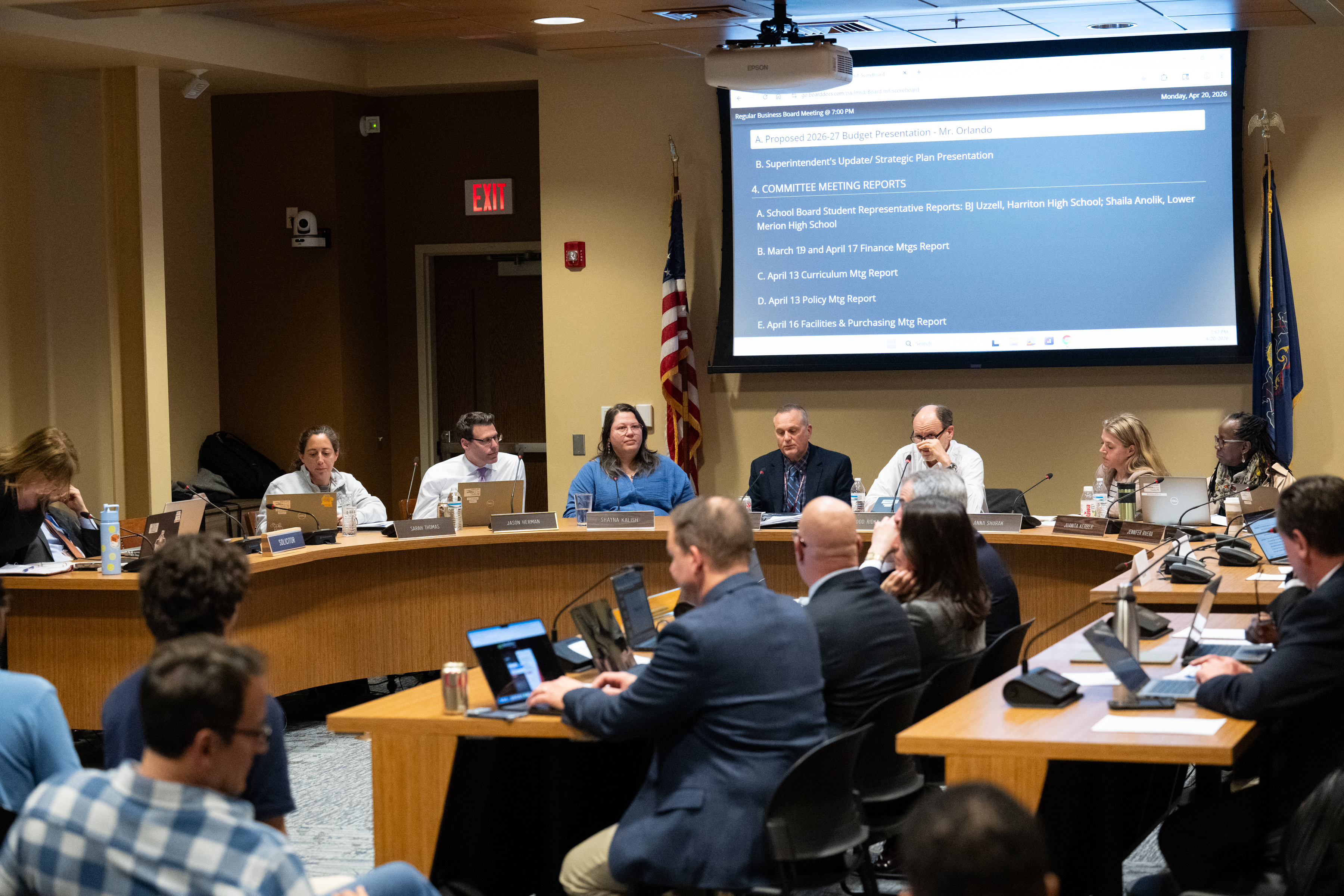
The Lower Merion school board on Tuesday selected a Tredyffrin/Easttown teacher and former Narberth Borough Council member to fill a seat left vacant by a school board member who was arrested.
The board picked Muna Elshakhs from a group of 17 applicants, after interviewing her and fellow applicant Andrea Gosfield during a special meeting Tuesday. The board had selected four candidates to be interviewed Tuesday, but two withdrew their names from consideration before the meeting.
The board did not release their names, or the names of the other candidates who had applied to fill the seat. The position became vacant after Jen Rivera resigned after she was arrested last month on charges of stealing more than $50,000 from her employer.
Some community members accused the board of a lack of transparency in appointing a new member to the term, which runs until December 2027.
“Table this appointment, give the full list of applicants, and enter them into the public record,” Matthew Posey, who is among a group of parents challenging the district over its use of technology, said during public comment Tuesday, as he accused the board of “backroom deliberations.”
District spokesperson Amy Buckman said before Tuesday’s meeting that the eight board members had “individually notified the board secretary of their top choices from among the applicants to be publicly interviewed.” The secretary tallied the selections, and “the applicants with the most selections” were scheduled to be interviewed, Buckman said.
Those who were not selected included at least two people who ran for the Democratic-led board unsuccessfully in 2025: Rich Lester, who ran as a Democrat but was not endorsed by the local Democratic Party, and Deena Pack, who ran as a Republican.
In an interview Tuesday, Lester said he was unsure how board members had made their selections for filling the vacant seat. He said he was told there was no scoring rubric used.
“To have no sort of what we’re looking for is disappointing,” said Lester, who had proposed more accountability and financial analysis from the board.
Pack, who addressed the school board during public comment Tuesday, said she was the only applicant who had received more than 7,000 votes, and had already been scrutinized by community members during the campaign process.
“Should the board change its mind, I’m ready,” she said.
When it was time for the board to nominate candidates, board president Kerry Sautner nominated Pack. But she did not vote for her.
Sautner voted for Elshakhs, as did board vice president Todd Ridky and members Shayna Kalish and Sarah Thomas. Board members Anna Shurak, Juanita Rivera, and Jason Herman voted for Gosfield.
Board member Abby Rubin, who has clashed with board leaders, including around the district’s technology policy, nominated and voted for Lester.
That gave Elshakhs four votes, but five were needed for a majority. The board voted again with the same result.
Elshakhs then withdrew her application, though some board members told her she did not have to do so, and solicitor Kenneth Roos told board members they could still vote for her.
“There’s nothing wrong” with the board’s split, Sautner said, calling the debate “healthy tension.”
“This is a good problem to have,” Ridky said, later adding, “I wish we had more seats to offer tonight.”
Shurak said that Gosfield, a lawyer, had been involved in the district’s equity policy and had children in district schools that were not currently represented by other board members.
Thomas credited Elshakhs’ perspective as a current teacher, though some board members questioned her ability to attend daytime committee meetings given her job. Sautner said the board could be flexible with scheduling.
Shurak ultimately switched her vote to Elshakhs, saying she wanted to respect the majority of the board. Kalish accused Lerner of obstructing the process by continuing to vote for Lester; Lerner said she had a different opinion.
After Elshakhs files a financial statement of interest, she will be sworn in and officially join the board, Roos said.
Nearly a decade ago, seniors asked the pastor of their West Philadelphia church for help.
They were getting older and so weretheir houses, and they needed safe, affordable homes that weren’t such a burden to keep up with. They wanted to stay in their community, too.
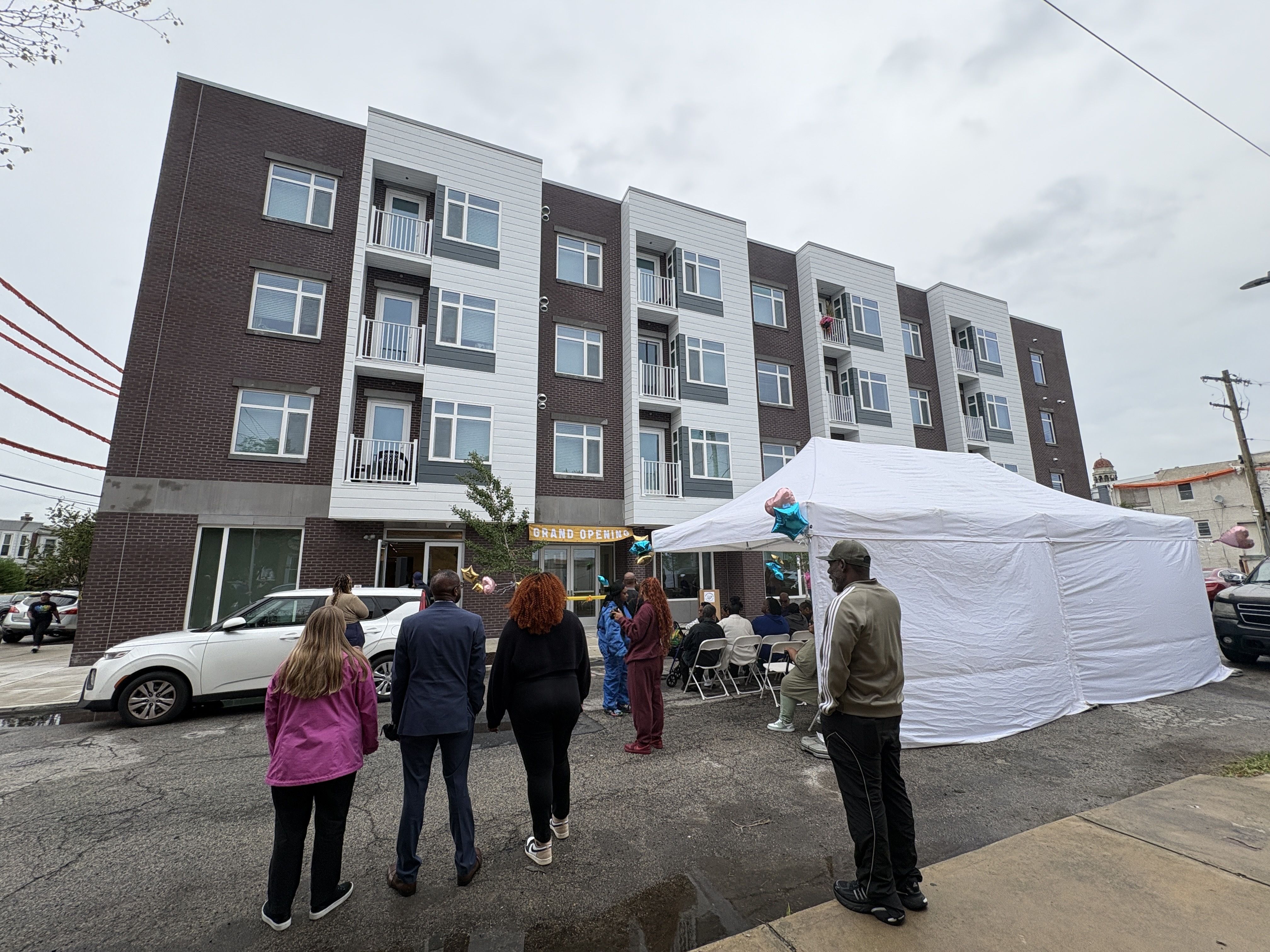
In the beginning of this year, on the site of what was once a dilapidated house and vacant lots filled with trash and rodents, the Church of Christian Compassion opened Compassion Senior Living, a new 38-unit subsidized apartment building in Cobbs Creek.
W. Lonnie Herndon, the church’s senior pastor, said the congregation “believe[s] ministry must extend beyond the walls of the church.”
“We’re called not only to preach about love and compassion but to demonstrate it in practical ways that strengthen people’s lives,” he said Tuesday during an event celebrating the building filling with residents.
People gather Tuesday for a grand opening ceremony at the Compassion Senior Living apartment building in Cobbs Creek.Michaelle Bond / Staff
Philadelphia’s 65-and-olderpopulation is growing, and more than a third live below or near the poverty line, according to a 2025 Pew Charitable Trusts report. As housing costs rise, finding an affordable apartment as a senior can be difficult.
Since 2001, the Church of Christian Compassion has owned a 10-unit, market-rate apartment building across from the new development. But the new apartments fill a specific need.
Compassion Senior Living accepts people 62 and older who make between 20% and 60% of the area median income. That’s roughly $17,200 to $51,540 for a single-person household, which most of the building’s residents are. Four apartments are reserved for people who were formerly homeless.
Rents for the complex’s one-bedroom apartments are based on tenants’ income and range from $900 to $1,300.
This is the kitchen in a model unit in the Compassion Senior Living apartment building.Michaelle Bond / Staff
Evelyn Norris, who declined to give her age but said she is older than she looks, moved into her apartment in early August from another West Philadelphia building. She is a member of the Church of Christian Compassion and called the pastor “a jewel” who “looks out for everybody.”
Norris is thrilled to live in a newly constructed buildingwhere residents have formed a tight-knit community. She said everyone’s friendly and keeps an eye on each other.
“This place is wonderful,” she said. “God is all in this.”
More than three in five tenants were already residents of West or Southwest Philadelphia.
That includes Angela Cook-Boyd, also a member of the Church of Christian Compassion, who turns 70 on Sunday. She was tired of climbing the steps at the West Philadelphia house she had been renting and said her legs told her it was time to move to a building for seniors.
She had told the church she was interested in living at the property about five years ago when it was still in the works.
“It was truly worth waiting for,” she said. “It just has been a blessing.”
This is the bathroom in a model unit in the Compassion Senior Living apartment building.Michaelle Bond / Staff
The independent living community cost about $20 million, with millions coming from city, state, and federal funding.
City Councilmember Jamie Gauthier, whose 3rd District includes the apartment building, said one of her first meetings after she was elected in 2020 was with the church’s pastors and now-Pennsylvania House Speaker Joanna McClinton (D., Philadelphia). They talked about the importance of finding funding for the project.
“It is no secret that Cobbs Creek, like many of our neighborhoods, is being gentrified, and our wisest neighbors are the ones being hit the hardest,” Gauthier said. “Our seniors deserve to stay in the communities they’ve called home for decades, the communities that they’ve built into the desirable places that they are today.”
Compassion Senior Living offers on-site social services and plans to partner with a healthcare provider in the future. The building includes a laundromat, a library, a multipurpose room, and a community center. It has a green roof, low-flow faucets, and energy-efficient heating, cooling, and ventilation systems.
Pastor Terrilynn Donnell, who is also the executive director of the church’s community development corporation, the Community of Compassion CDC, called the completion of the senior apartments “a relief” after so many years. She said the church wants to build more homes.
Kendra Brooks, a progressive who made history as the first third-party candidate to win a seat on Philadelphia City Council in 100 years, is considering challenging Mayor Cherelle L. Parker in the spring Democratic primary election, according to two sources familiar with her thinking.
The sources, who were not authorized to speak about the matter publicly and did so on the condition of anonymity, said Brooks is mulling a campaign but has not yet made a decision. She declined to comment Friday.
To run in the Democratic mayoral primary, Brooks would have to resign from her seat on Council. Under state law, she could remain a member of the Working Families Party or switch her party registration to Democrat..
A bid for the mayor’s office would pit Brooks, the de facto leader of the city’s Working Families Party and democratic socialist faction, against Parker, a centrist who has long been aligned with the city’s Democratic Party establishment.
“People want to see leaders fighting for something,” Brooks said at the time, “and right now we don’t see our city fighting for anything.”
Aren Platt, the executive director of the mayor’s political campaign arm, declined to comment.
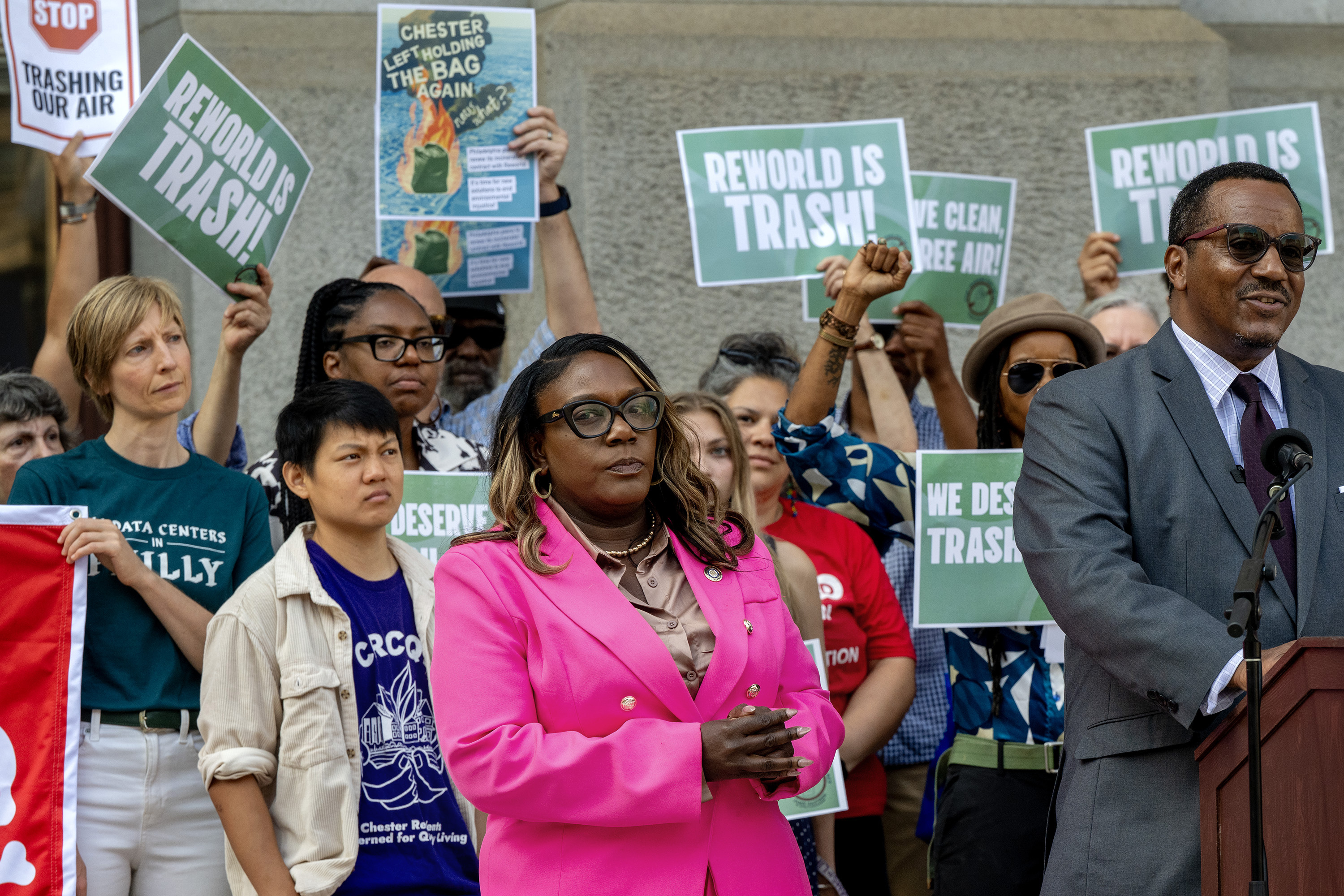
City Councilmember Kendra Brooks joins Chester Mayor Stefan Roots (right) and protesters at a rally outside City Hall Sept. 17, 2026.Tom Gralish / Staff Photographer
Brooks’ supporters see the mayor as potentially vulnerable as progressives have ascended nationally and notched wins over more traditional Democrats. That includes Mayor Zohran Mamdani’s victory last year in New York City and Abdul El-Sayed’s win in the Michigan Democratic primary for U.S. Senate.
Closer to home, the left is emboldened by State Rep. Chris Rabb, who was backed by Brooks’ coalition and in May won the Democratic primary for a seat in Congress representing about half of Philadelphia. He toppled two centrist Democrats who were each supported by party leaders, big donors, and politically powerful labor unions.
Despite the energy on the left, no progressive has officially launched a run for mayor ahead of the May primary election. Shania Bennett, the mayor’s former director of youth engagement, who has never run for office before, said this month that she will challenge Parker. Bennett said recently that she had not yet hired a campaign team or developed a policy platform.
Any challenger to Parker faces significant hurdles. No Philadelphia mayor has lost reelection in modern history, and Parker would be backed by the city’s Democratic Party, which can now spend unlimited amounts of money in coordination with its chosen candidates under a new board of ethics policy.
Parker will also be supported by the deep-pocketed building trades unions that boosted her in the crowded open mayoral primary in 2023.
“We’re going to put all the resources, both financial resources and people resources, to bear to make sure that Mayor Parker has a second term,” said Ryan Boyer, the head of the Philadelphia Building and Construction Trades Council. “I want to be clear and vociferous that the Philadelphia Building Trades … are fully and completely behind Cherelle Parker.”
In this March 2025 file photo, City Councilmember Kendra Brooks, left, listens to Mayor Cherelle L. Parker deliver her annual budget address.Alejandro A. Alvarez / Staff Photographer
Parker is likely to see support from a super PAC bankrolled by city developers, and she also has her own massive war chest. Her campaign had $1.4 million in the bank as of May, according to the most recent campaign finance paperwork available. Brooks had $17,000 on hand as of her last report in January.
But Brooks, who has won citywide election twice to represent the city as an at-large member of Council, could be a formidable opponent. She is one of the most prominent left-wing politicians in the city, and she is well-known in national progressive circles.
The Working Families Party’s chapter in Pennsylvania recently commissioned a poll that showed Brooks as broadly popular with the city’s Democratic primary electorate but with much lower name recognition than Parker, according to polling documents obtained by The Inquirer.
According to the survey of 900 respondents, 35% said they had a favorable view of Brooks, with just 4% saying they had an unfavorable view. Nearly 40% of respondents said they did not know who Brooks was.
Nearly all of the respondents knew of Parker. Forty-eight percent said they had a favorable view of the mayor, and 40% said they had an unfavorable view. Those findings are similar to a June Suffolk University/Philadelphia Inquirer poll.
Nick Gavio, a spokesperson for the Working Families Party, said in a statement that the organization often conducts polling on public opinion in the city and that the survey was “one test among a battery of others that we conducted in Philadelphia ahead of the 2027 elections.”
“We are pleased that the Working Families Party and Minority Leader Brooks are so popular,” he said, “which we believe reflects our focus on the issues that matter to the working people of this city.”
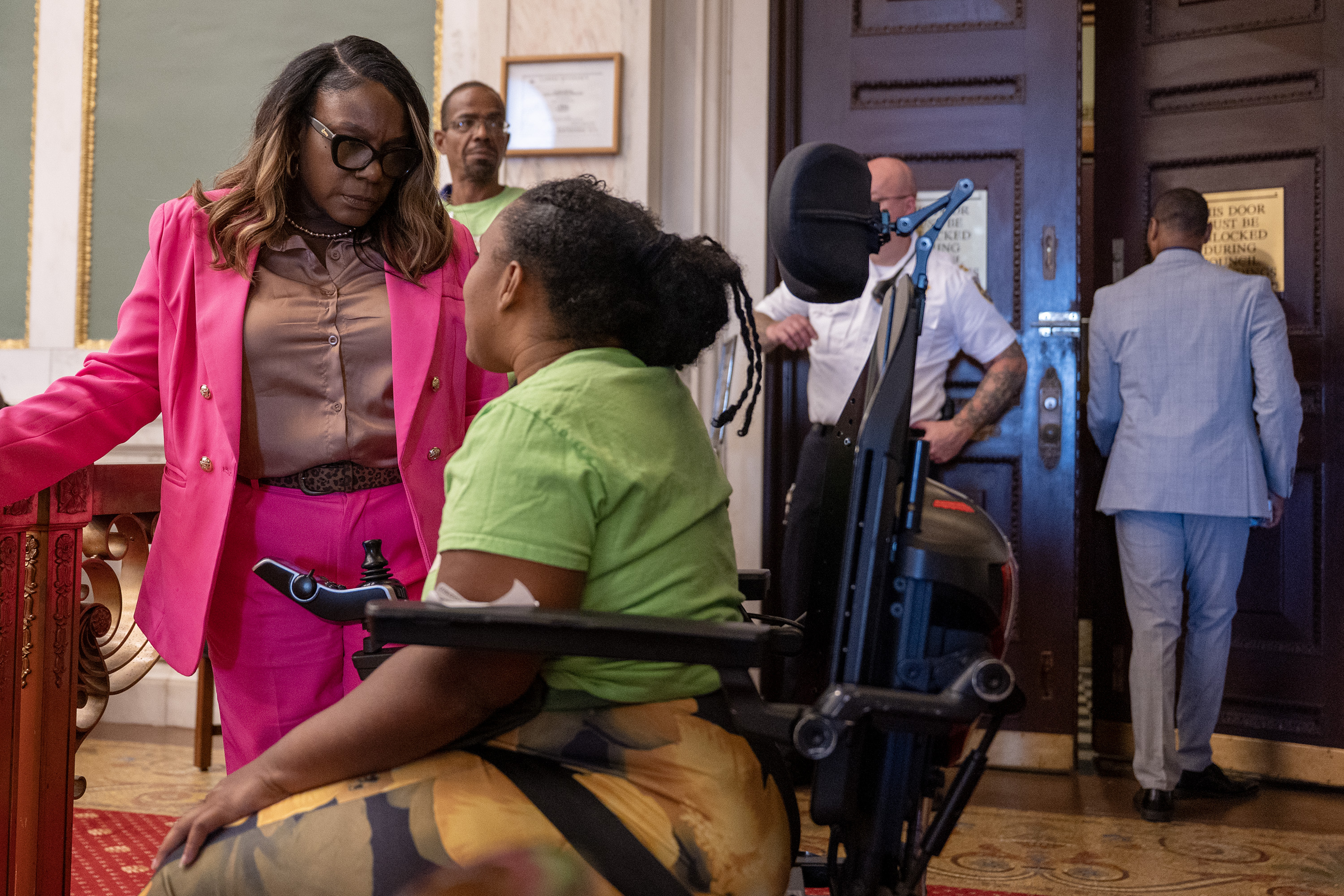
City Councilmember Kendra Brooks talks with Dominique Howell (right) in chambers as City Council returns for its fall session Thursday, Sept. 17, 2026. Howell is a long-time constituent and was there with the non-profit Liberty Resources, part of the Philadelphia Coalition for Affordable Communities.Tom Gralish / Staff Photographer
Several other leftist politicians in the city have been rumored to be considering running for mayor against Parker, but none have said publicly that they intend to launch a campaign.
One is District Attorney Larry Krasner, the third-term prosecutor who is one of the most prominent progressive district attorneys in the country. Krasner has been increasingly critical of Parker, and in June said that he would not rule out the possibility of running against her.
Correction: A previous version of this article incorrectly stated the steps Brooks would have to take to run in the Democratic mayoral primary. She could remain a registered member of the Working Families Party or switch her party registration.
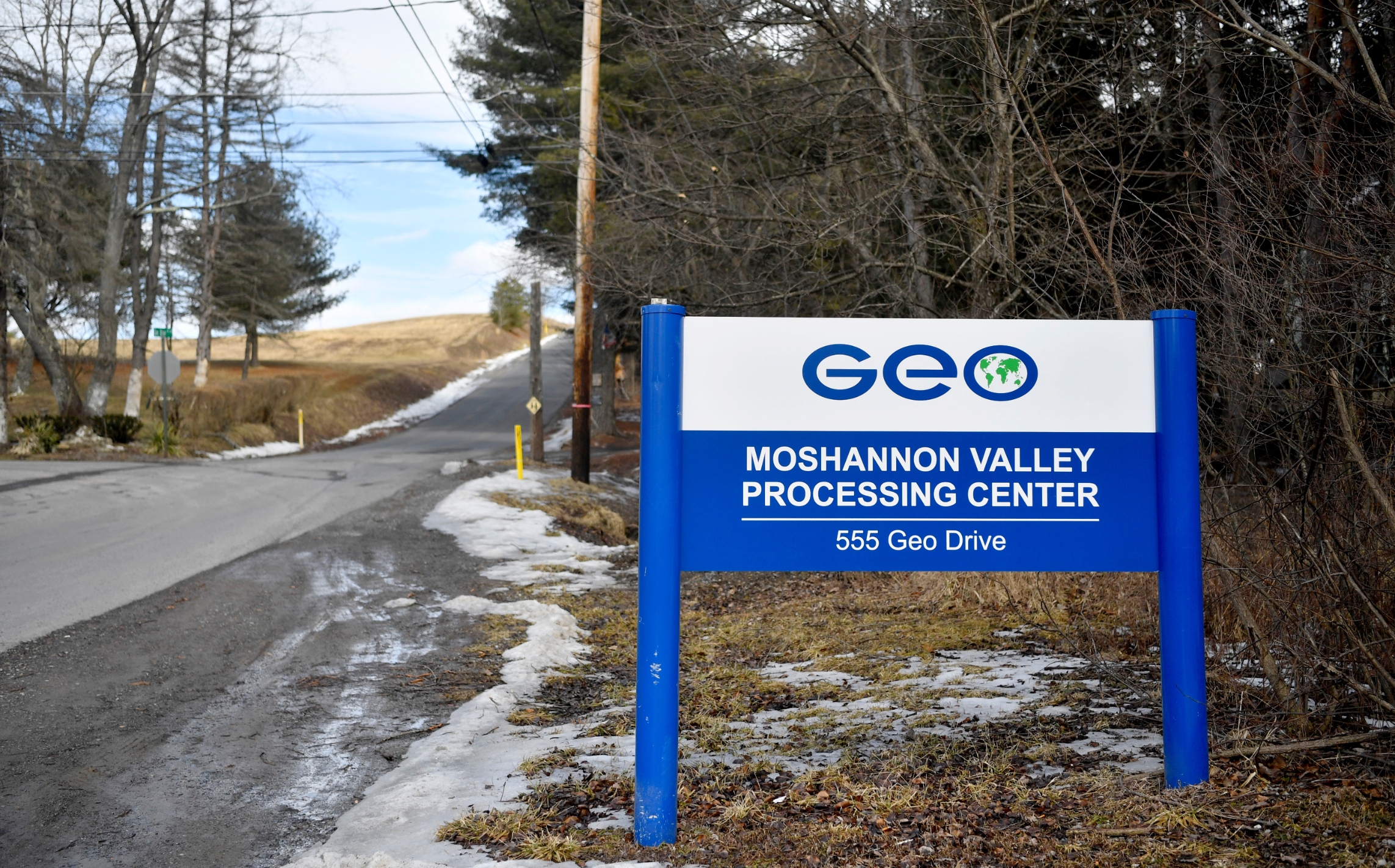
There are signs the Moshannon Valley Processing Center could end up being sold to the federal government, a move critics fear could insulate the center from some state regulation.
In the meantime, county officials approved a controversial extension of the current operating contract Tuesday, ensuring the largest detention center in the northeastern United States can run unimpeded for at least the next six months.
The contract between Clearfield County and Florida-based GEO Group, the for-profit owner of the 1,876-bed facility, was set to expire at the end of September. But Republican Commissioners Tim Winters and John Sobel voted 2-1 against Democratic Commissioner Dave Glass to extend GEO Group and ICE’s contract to operate the Moshannon center.
The vote came at a contentious meeting at which speakers from the audience mostly voiced opposition, questioning why the county had become entangled in federal immigration policy and doubting the true worth and use of the $100,000 payment.
“Blood money!” one person shouted after the vote.
Clearfield’s vote took place as President Donald Trump’s administration quietly mounts a takeover of private detention centers like Moshannon, as it is called, to expand bed capacity to support its mass-deportation goals.
Some local officials and immigration advocates think Moshannon may be next to be sold. In a statement, the Department of Homeland Security said ICE does not discuss potential facility acquisitions.
“The long-term solicitation process remains ongoing,” a spokesperson said.
Federal ownership could insulate the properties from compliance with certain local and state laws, important to the Trump administration when other expansion plans, like turning empty warehouses into detention centers, bogged down amid community and legal opposition.
Moshannon is a common destination of those arrested for immigration violations in Pennsylvania. An unannounced congressional oversight visit in May found that of the 1,417 adults detained there, roughly 78% lacked serious criminal charges or convictions of violent behavior — a contrast to Trump and his allies’ arguments for increased detention.
ICE agents outside the Delaney Hall migrant detention center in Newark, N.J., in June.LEXI PARRA
Trump’s push for mass detention and deportation
Congress voted in July 2025 to allocate $45 billion to the Department of Homeland Security for immigration detention, more than a decade’s worth of typical funding. At the time, Trump immigration officials touted the funding as a way to treat deportation “like a business,” with acting ICE director Todd Lyons saying he wants to see the deportation system run “like [Amazon] Prime, but with human beings.”
However, in June, ICE made plans to offload seven of those warehouses, totaling $700 million, by giving them to other agencies or selling them outright, according to the New York Times.
A warehouse purchased by DHS to house an ICE detention center in Surprise. Caitlin O'Hara
GEO Group’s founder and executive chairman, George Foley, said in a May earnings call that the private prison company was “engaged in an active process for the sale” of several facilities to ICE. Foley acknowledged Democratic-led states were considering more active oversight in detention centers, saying, “I think the logical solution to much of that is federal ownership of the facilities.”
GEO Group did not respond to a request for comment.
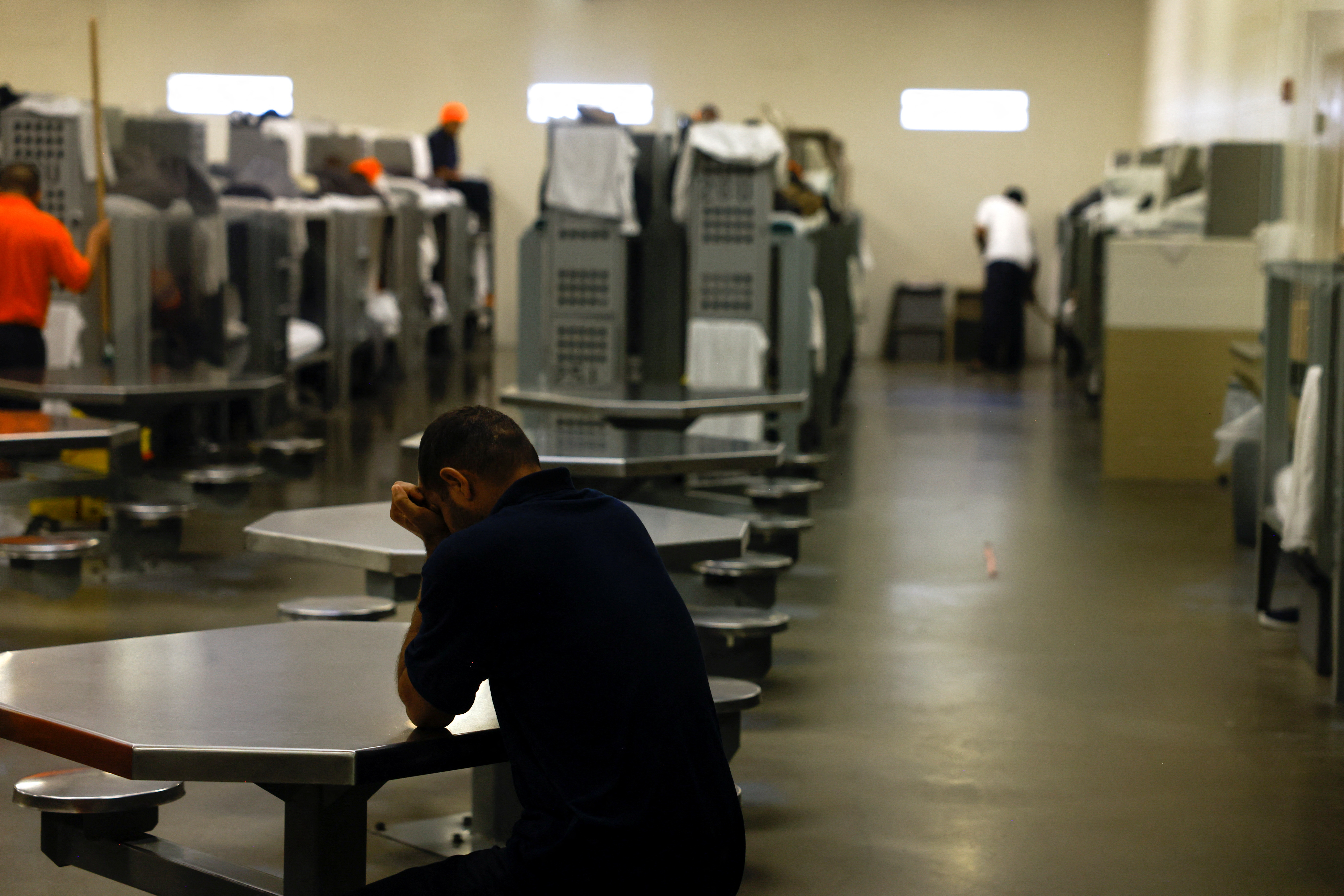
A detainee sits behind glass in a common area at the Moshannon Valley Processing Center in 2023.REUTERS / Quinn Glabicki
The potential sale of Moshannon to ICE
GEO Group has not officially stated its intention to sell Moshannon to ICE. But recent ICE contract bid requests and local dealings with the center’s warden are leading local officials and immigration advocates to suspect a sale.
Earlier this month, ICE requested 10-year contract bids for “turnkey” detention facilities across the country, including in the Philadelphia area. Moshannon is the only private facility in the region that fits that criteria, said Jasmine Rivera, executive director of the Pennsylvania Immigration Coalition, which had called on county commissioners to deny a contract extension.
Rivera said the proposal requests include provisions that could lead to the sale of private detention centers to ICE, similar to its dealings with CoreCivic. GEO Group and ICE’s contract extension “is a stopgap measure” so the parties have “the time to finish the land assessment in the sale of Moshannon,” Rivera said.
In a Sept. 8 Clearfield County commissioners meeting, Glass told the public he directly asked Moshannon warden Leonard Oddo earlier this year whether the Clearfield detention center could be sold to ICE. Oddo said no, according to Glass. In the first week of September, the commissioner e-mailed Oddo the same question, to which Oddo responded, “‘I’ll have to refer you to GEO corporate on that,’” Glass said.
“I took that as kind of a red flag that there may be some kind of a sale,” Glass said at the meeting.
Moshannon Valley Processing Center, an ICE detention facility operated by the Geo Group, where migrants are housed, in Philipsburg, Pennsylvania, U.S., August 24, 2025. REUTERS/Quinn GlabickiREUTERS
What it means for Pennsylvania residents
Having Moshannon fall under federal ownership would mean many of the tax benefits Clearfield County receives for serving as a middleman would cease, Glass said.
“Whatever you think about the facility, having that facility sold to the federal government and losing the tax base on that would be a huge blow,” he said.
Clearfield commissioners have no say in approving the sale if GEO Group and ICE agree to terms.
Due to a now-reversed order that banned federal agencies from contracting with private prisons, GEO Group is contracted through Clearfield County, meaning ICE funding — around $5 million monthly — flows through Clearfield to GEO Group for operating the detention center. Clearfield collects a $200,000 administration fee for its intermediary role.
Winters, who voted to extend the contract, said that current federal immigration policy was “not working,” but that losing a seat at the table with ICE and GEO would leave Clearfield County worse off.
Voting “no” on the contract extension would have eliminated “our communication and our ability to investigate claims,” he said. “Our oversight ability is very small, but we still have it.”
For Rivera, any sale is concerning because ICE could ignore Pennsylvania lawmakers’ attempts to protect public health, environmental and zoning standards, and the safety of those detained, she said.
The newly extended contract will allow ICE to continue paying GEO Group for operating Moshannon through Clearfield County until mid-March 2027. At that point, GEO Group and ICE could approach the county with a new contract, or, as advocates and some local officials fear, federal ownership could come into play.
The scariest thing about President Donald Trump’s address to the United Nations General Assembly Tuesday was not the wild exaggerations, false claims, or disgusting slurs against (truthful) critics. That all has become par for the course and was to be expected.
Far more terrifying was the distinct possibility that POTUS believed his delusional description of his alleged triumphs — in the Iran war, in bringing peace to the Middle East and the world, and in pursuit of victory in an unbounded artificial intelligence race with Beijing.
Perhaps his 38 minutes of self-praise at the podium — to tepid applause at the beginning and end and mostly silence in between — were merely meant as a stump speech to rally midterm MAGA voters growing restless with his endless war. (Of course, most of his MAGA base will only see brief clips from the speech, since the president banned CNN, MS NOW, and Politico from the pool that normally covers such events, and the four other pool members — ABC, NBC, CBS, and Fox — stayed away in solidarity.)
The greater danger is that, surrounded by sycophants, Trump truly believes his own hype. He showed no sign that he recognizes how Iran has out-strategized him, how Russia, China, and North Korea outmaneuvered him, and how he has alienated crucial European, Asian, and Mideast allies with his erratic and chaotic policies.
On the U.N. podium, he appeared as a braggart touting triumphs his audience viewed as U.S. failures. Yes, he still represented the world’s most powerful country, but his puerile speech reflected his inability to translate that power into securing American interests or a more peaceful world.
It is important for voters to fully grasp the self-delusion underlying Trump’s foreign policy. A new CNN poll shows only 29% of U.S. adults approve of POTUS’s handling of foreign affairs, with almost two-thirds saying the U.S. is not winning the Iran conflict. But domestic issues have become so paramount that many ordinary citizens can be excused for tuning out Trump’s overseas misadventures.
Having just returned from the bracing realities of Ukraine, here is my brief guide to Trump’s delusions or deliberate deceptions — take your pick — about foreign policy issues he raised at the U.N.
An armed Shiite cleric rides aboard a military vehicle past a billboard depicting Ayatollah Ruhollah Khomeini, founder of the Islamic Republic, during the state-organized “Janfada,” or “Sacrifice for Iran,” military-style parade in Tehran, Iran, Friday.Vahid Salemi
Iran
Trump verbally attacked the “cowards and traitors who would like to say we are low on munitions in Iran. That’s not true.” If POTUS were Pinocchio, his nose would have grown 10 feet at that lie.
In truth, it is Trump who is too cowardly to admit the truth to a public that is instinctively grasping it anyway. That truth, which has been laid out in reputable think tank studies and news reports, and by serving and ousted Pentagon officials, is that U.S. forces have consumedhalf to two-thirds of highly expensive missile interceptors in fending off cheap Iranian drones.
The Pentagon was not prepared for a war in which drones played such a major part. Never mind that Ukraine and some U.S. commanders had sounded the alarm beforehand.
Nor is Trump truthful when he brags that new munitions plants will soon replace any shortfalls, because, unlike rapid production cycles in Ukraine, rebuilding the most critical U.S. weapons stocks will take up to five years.
On the U.N. stump, Trump also repeated his mantra that he will never allow Iran to have a nuclear weapon. Yes, in 2025, a “12-day war” by the U.S. and Israel badly damaged Iran’s nuclear program. Yet, the current war, ongoing since February, has done little to nothing to further diminish that nuclear prospect. It is focused on lowering oil prices by reopening the Strait of Hormuz, which was functioning normally before Trump joined Israel in attacking Tehran.
Because of its diminished missile and interceptor stocks, the U.S. is in no position to reopen a kinetic war with Iran — let alone, to use Trump’s irresponsible threat, “annihilate” it. In real terms, Trump is stuck, with Tehran still able to control Hormuz and no way out of his self-inflicted trap, unless he makes concessions to Tehran. Meantime, the war is spreading to other Mideast countries and drawing in new players such as Yemeni Houthis.
Trump advertises his weakness when he desperately tries to convince fed-up Americans, in front of a U.N. audience, that peace is on the way.
President Donald Trump meets with Ukraine’s President Volodymyr Zelensky during the United Nations General Assembly, Tuesday.Julia Demaree Nikhinson
The Ukraine war
On the podium, Trump regurgitated his mantra that, regarding the war, “we will get that one done,” and that Russia and Ukraine have “had it.” But in truth, Trump’s refusal to pressure Moscow to stop destroying Ukraine’s civilian infrastructure, while demanding Kyiv stop targeting Russian oil exports, ensures there will be no ceasefire.
Why should Vladimir Putin stop his campaign of destruction when Trump only leans on Ukraine, and fails even to critique Putin’s new drone campaign against European airports and the industry of NATO members? Ukrainian President Volodymyr Zelensky said after meeting Trump Tuesday that he would agree to a ceasefire on hitting energy targets — but both sides would have to take part. Not likely, so long as Trump bows to Putin.
And don’t expect Trump to enforce the bipartisan sanctions bill newly passed in memory of U.S. Sen. Lindsay Graham. Repeat, POTUS refuses to pressure Putin, with whom his negotiating team is discussing “lucrative” business deals.
President Donald Trump holds up the document after signing a security agreement with Denmark’s Prime Minister Mette Frederiksen and Greenland’s Prime Minister Jens-Frederik Nielsen during the United Nations General Assembly, Tuesday.Julia Demaree Nikhinson
Trump as global peacemaker
The president shamefully read verbatim a long list of compliments by world leaders trying to pacify him, and once again exaggerated the “peace deals” he’s achieved — even though most were temporary ceasefires or have already been broken.
Trump praised his triumph in Venezuela — where, when talking about oil, he bluntly admitted that “to the victor belong the spoils.” He crowed that Cuba “will fall,” with no mention of the humanitarian disaster caused by the ongoing U.S. blockade.
And he bloviated about the “unprecedented agreement” the U.S. just signed with Denmark and Greenland, even though everything in that accord could have been agreed to under the terms of a 1951 treaty with Copenhagen, without alienating NATO allies by threatening to seize Greenland by force.
To sum up, Trump’s performance at the U.N. revealed a delusional leader who may still be feared by allies and small countries for his unpredictable and bizarre behavior that upsets the world economy, trade ties, and markets.
But adversaries watching the president’s self-praise could only conclude that a weakened old man with no clear strategy except self-aggrandizement now leads the world’s most powerful country. Voters of all parties, be aware.
While computer models still remain at sea on the fate of a nor’easter taking shape off the Southeast coast, it is all but certain that floodwaters will be covering some roads at the Jersey Shore the next few days while the beaches lose some sand.
Already, the Army Corps of Engineers beach-fill contractor working in Avalon has decided to halt operations and move the equipment out of harm’s way, said Army Corps spokesperson Stephen Rochette.
The National Weather Service has issued flood warnings for the oceanfronts and back-bay areas in effect from late Wednesday afternoon until early Saturday, with moderate flooding expected in four of the next five high-tide cycles, warning that “many roads” may become impassable. The agency said it’s possible that some of the flooding could reach the “major” category.
Inland impacts remained a source of considerable less certainty, but the National Weather Service posted a flood advisory for the tidal Delaware River from northern Delaware to central Bucks County from 10 p.m. Wednesday until 4 a.m. Friday.
And after that?
“Once you get to Friday and beyond, the forecasts becomes uncertain,” said Zachary Cooper, a meteorologist at the weather service’s Mount Holly office.
As expected, a coastal storm was taking shape off the Carolina coasts and was forecast to mature through the workweek, generating winds from the northeast — that’s why they are called nor’easters — adding to an already brisk onshore flow.
In addition, with a full moon due Saturday, the tides are going to get an additional astronomical tug.
“There could be some shenanigans with that,” said Matt Benz, senior meteorologist with AccuWeather Inc.
The timing of the storm’s impacts at the Shore and in the Philly area
The winds were forecast to increase Wednesday, with gusts to 45 mph at the coast and 35 mph in the Philly area.
Moderate flooding was expected with the early-evening high tides on the oceanfront and back Wednesday, Thursday, and Friday evenings, and on Friday morning.
Minor flooding was expected Tuesday evening on the oceanfront and back bays at the Shore, with more-significant moderate flooding at high tides Wednesday and Thursday evenings.
Along the Delaware River in Philadelphia, high-tide flooding was likely to be minor but could approach moderate levels late Wednesday and Thursday nights.
No significant rains were in the forecast at least through Thursday, but the outcome for the weekend would depend on the intensity and path of the coastal storm, with rain more likely at the Shore than inland.
What’s with all the forecast uncertainty?
The food fight among computer models has persisted, with the European favoring a more westward track, and the U.S. model more out to sea.
A more westward track, which would make substantial rains, and more wind, more likely, Cooper said. For now, the weather service was going with a 20% to 50% chance of rain across the region Friday into Sunday.
The forecasts are far more certain on the winds.
The onshore winds Tuesday were the result of high pressure, or heavier air, over southeastern Canada. Winds circulate clockwise around centers of highs, and thus the winds from the northeast, which also explain the October-like chill, with temperatures getting no higher than the 60s this week.
An intense coastal storm would add mojo to those winds and could make for quite a raw weekend.
One thing that is a near certainty is that the forecasts will undergo significant changes in the next day or two.
Yes, this is early for a nor’easter
This is unusually early to be concerned about a nor’easter. They usually wait until later in the fall, when the temperature contrasts that ignite storms become sharper as warm air lingers and interacts with the ambitious colder air from the north.
However, a precocious nor’easter would not be as unusual as what is happening with the hurricane season in the Atlantic Basin.
The season already has set a record for the longest wait for a first hurricane, and nothing is cooking. It is also setting records for the least amount of tropical-cyclone energy, said Philip Klotzbach, hurricane expert with the Colorado State University Tropical Meteorology project.
But while it will not become a hurricane, Benz said the coastal storm bears watching because it could draw up moisture from the waters around the Bahamas and take on some tropical characteristics.
That would increase the rainmaking and wind potential, he said.
Before landing in their historical Mount Airy farmhouse, Devin and Taylor Lashbrook tried to buy more than 10 properties in the neighborhood — including the house next door. But sometimes, things go exactly as they should.
“Honestly we put some offers in on houses I’m so glad we did not get,” Devin, a 42-year-old director of operations for a data center, said. He recalled, for instance, the house with an unwanted pool where they made an offer in the spring of 2020.
“You just start to get desperate,” he said. Devin and Taylor, 45, were starting to feel squeezed in the Manayunk rowhouse they had shared for six years and wanted out.
The Lashbrooks first saw their 1804-built house over Labor Day weekend in 2020. With three floors, two bedrooms, 1½ bathrooms, a working fireplace, and off-street parking, it checked every box on their wish list. The home’s updated kitchen and bathroom as well as the former owner’s paint choices matched the Lashbrooks’ own mid-century rustic taste, so they felt little would need to be done if they bought it.
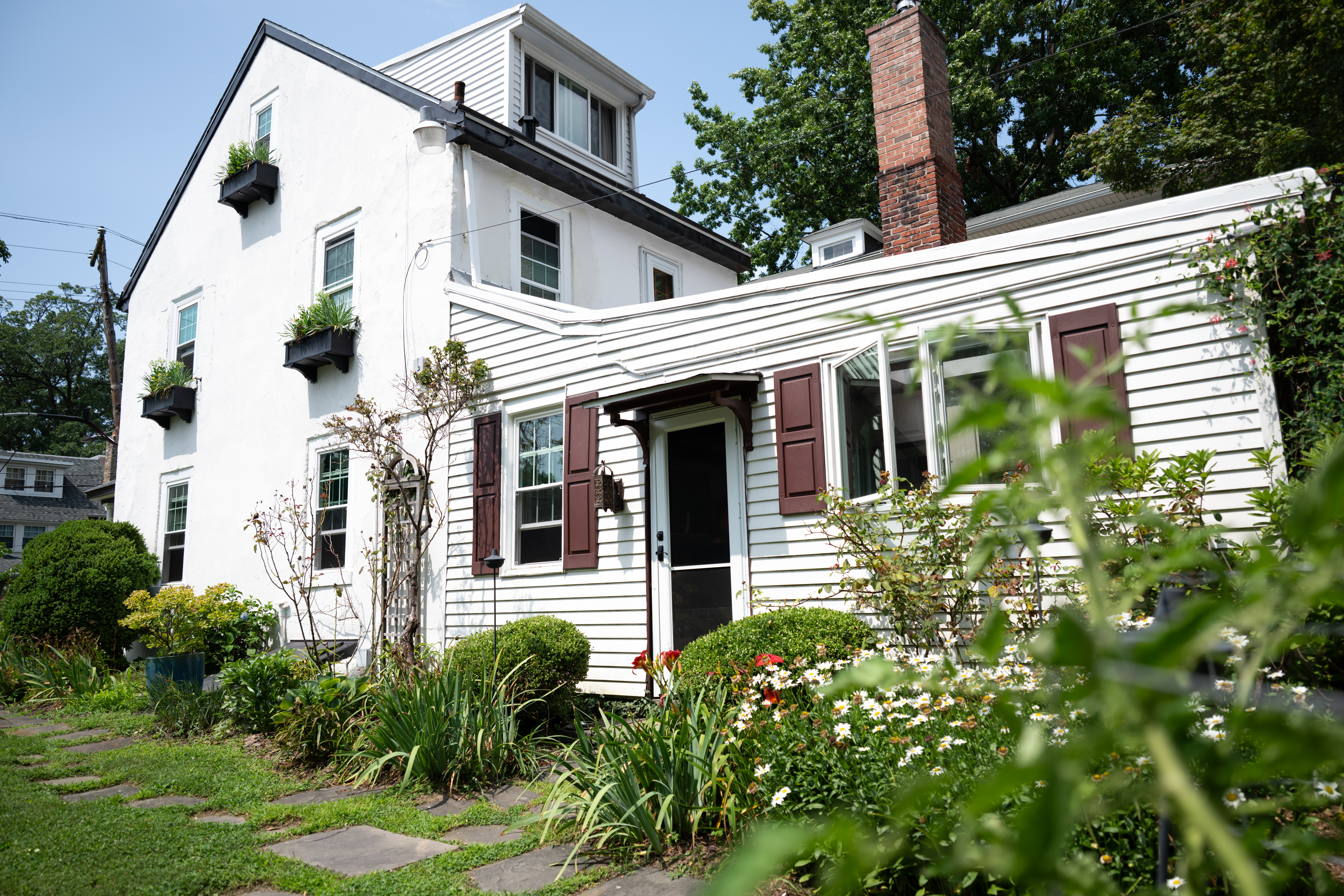
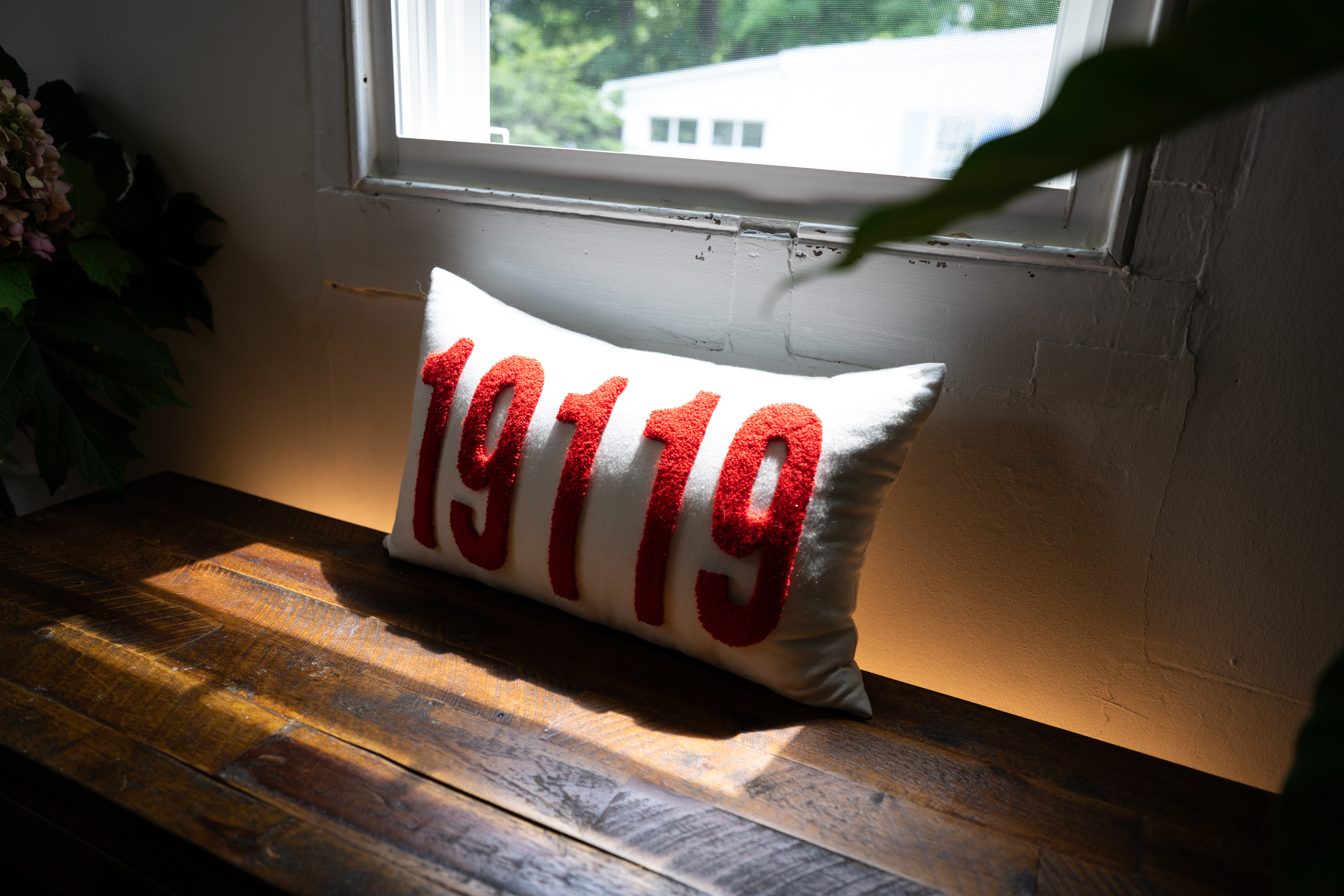
The outside of Devin and Taylor Lashbrook’s home and their surrounding gardens.Erin Blewett / For The InquirerA pillow displaying Mount Airy’s 19119 ZIP code sits under a window inside the home.Erin Blewett / For The Inquirer
They offered $399,900 and the offer was accepted. They attribute their winning bid to the holiday weekend, when some buyers may have been out of town, and competition may have been deterred by the slate roof that needed replacing. They also gave credit to the cover letter they submitted with their bid.
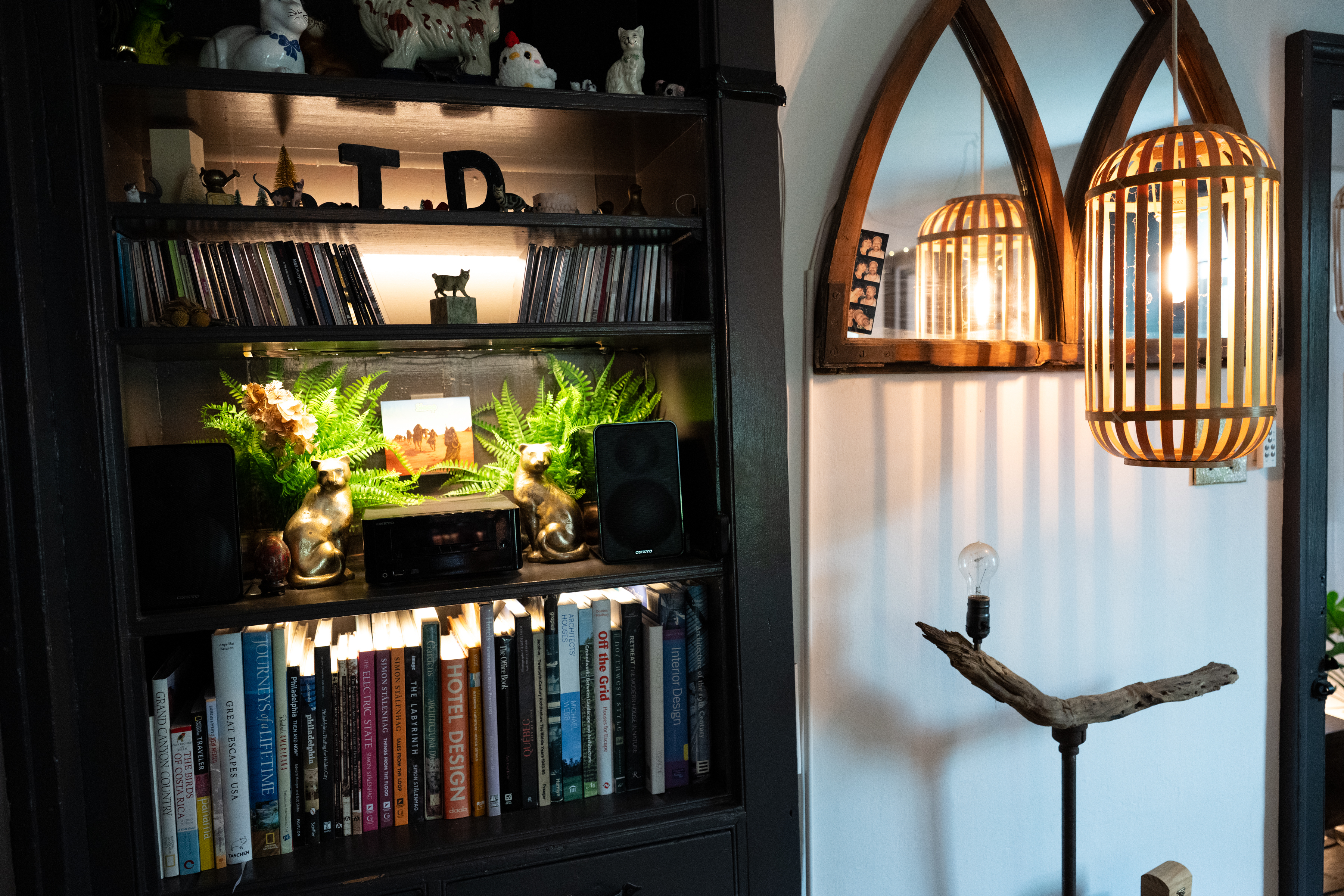
The Lashbrooks love the rich history conveyed through the home’s interiors and have done what they can to preserve it while making the necessary practical tweaks.
Insurance required them to get a new roof after moving in and, as the home isn’t historically protected, the couple opted for a less-pricey shingle roof instead of replacing the slate. On the front of the house near the roof line, a fire inspection seal hearkens to the home’s age when only dues-paying community members with seals could use the fire department’s services.
The living room of the Lashbrooks’ home, where they brought their mid-century interior design taste to a house built in the 1800s.Erin Blewett / For The Inquirer
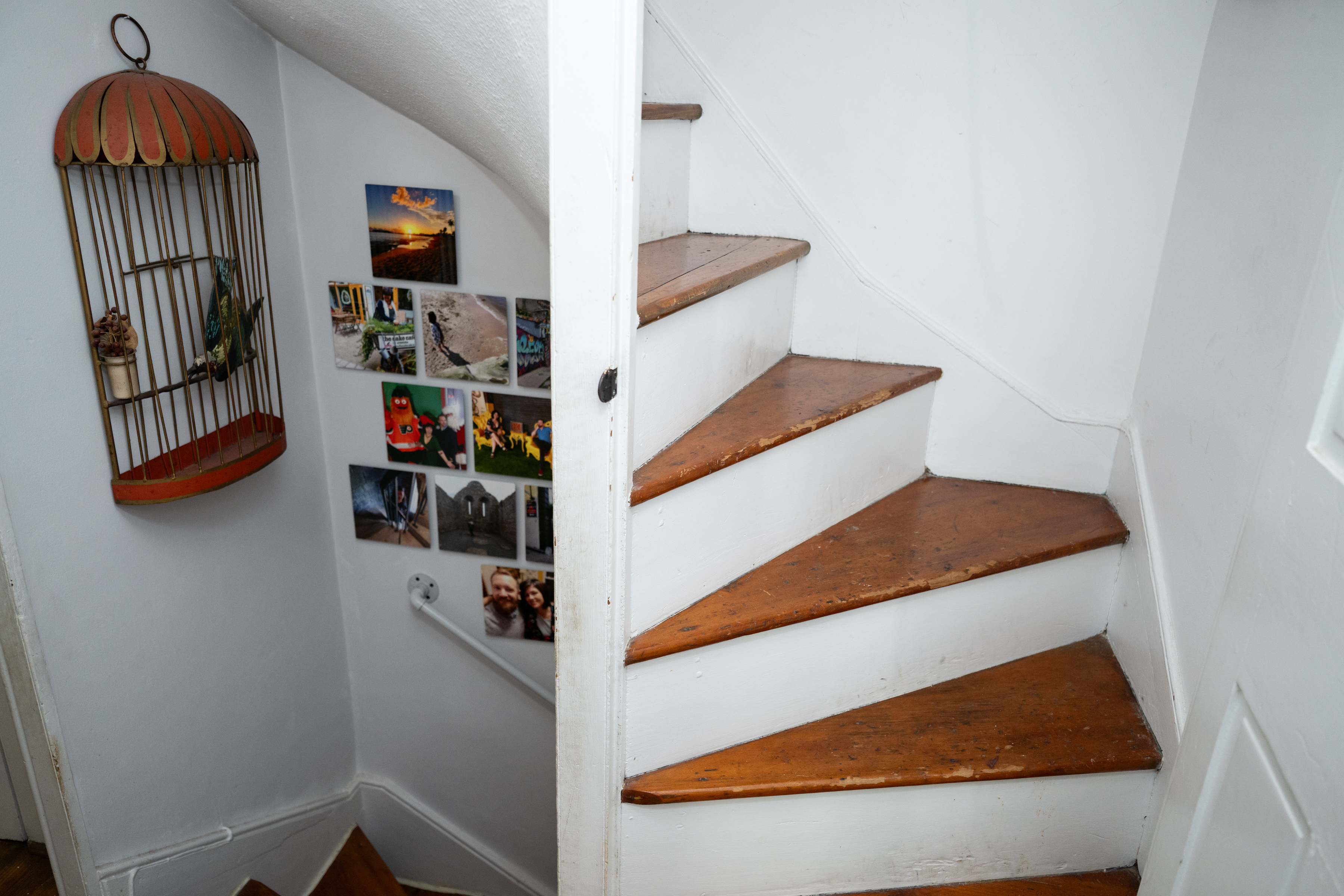
Devin refinished the floors, many of them original, before they moved in. Grab bars were added in the steep, twisting box staircase after Taylor took a few tumbles.
“There are a lot of families in the neighborhood,” Devin said, with Taylor adding, “This is not a house for little children.”
Those grab bars complement the original handles in the staircases, adhered to the wall with hand-forged nails. The couple have also found hand-forged nails in shallow dirt around the grounds of the house, a sign of its permanence in the neighborhood.
The Lashbrooks believe their home was the first built in the area, a farmhouse that once sat on empty acres with an outdoor kitchen. Of course that’s not the case anymore: All that’s left of the once-sprawling acreage is a second lot that serves as a driveway and the gardens that surround the house.
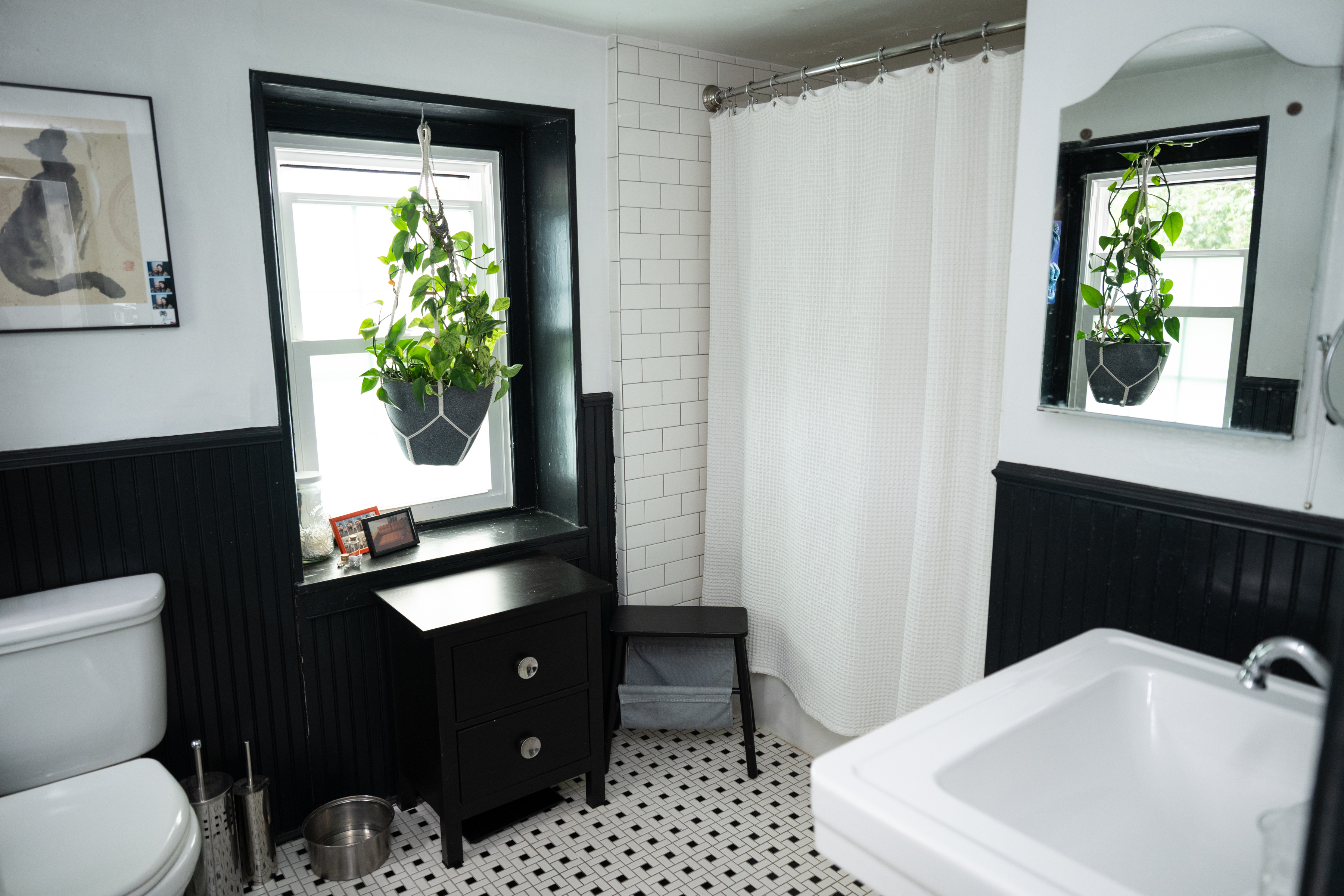
The bathroom features a monochrome theme.Erin Blewett / For The InquirerA wood-burning stove sits inside the original cooking fireplace of the Lashbrook home.Erin Blewett / For The InquirerThe couple added grab bars to the twisting box staircase. Their photos decorate the lower part of the stairs.Erin Blewett / For The InquirerMid-century and rustic decor combine harmoniously in the historical home.Erin Blewett / For The Inquirer
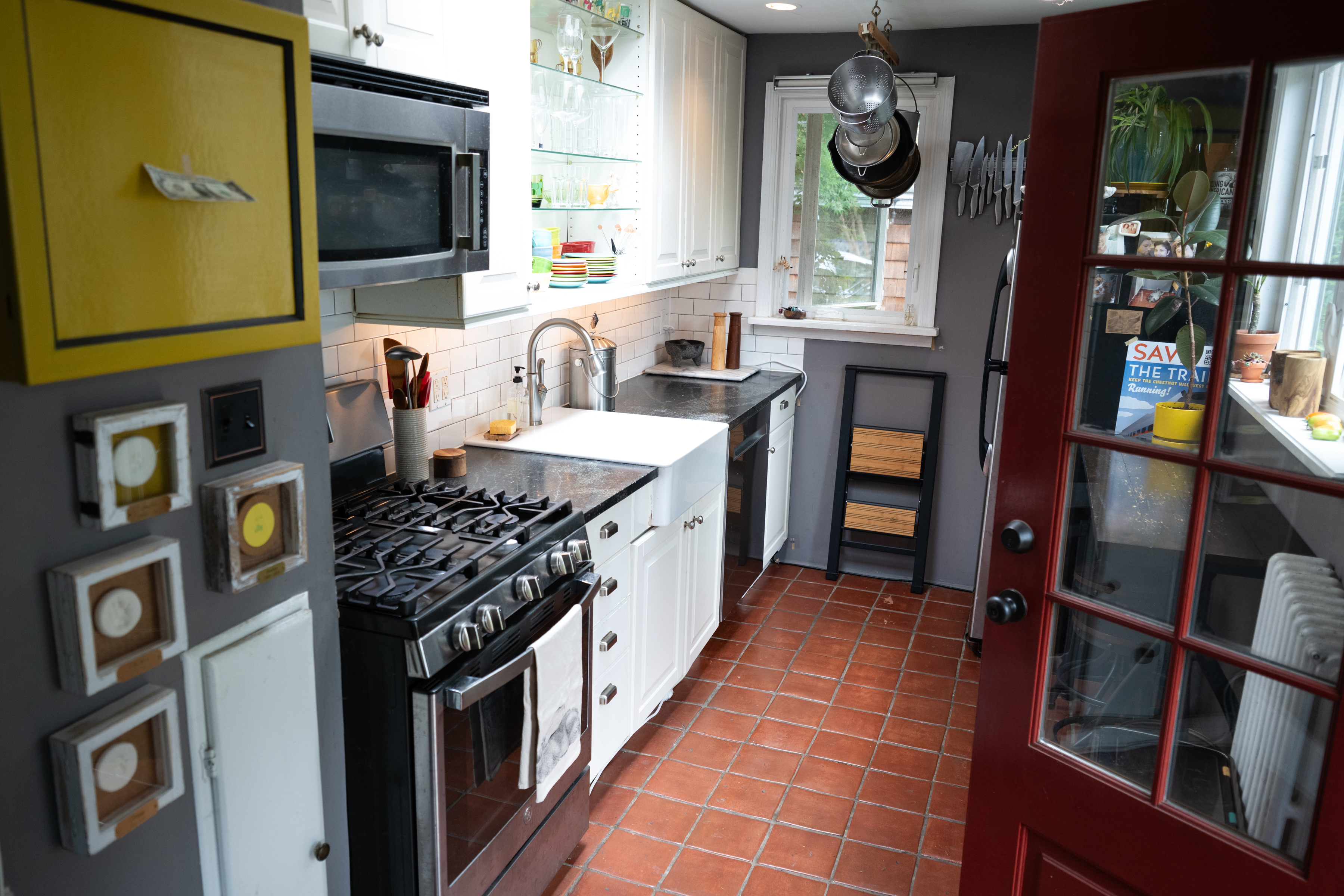
The kitchen has moved indoors, too, in a galley-style extension off the back. The former cooking fireplace now sports a cozy wood-burning insert that the Lashbrooks enjoy every day in the colder months, with a projection screen tucked into the opening for a bit of 21st-century entertainment.
The old house has its quirks. Because the original cooking fireplace was once outside, the Lashbrooks’ small sitting room, powder room, and kitchen are on the other side of the home’s original two-foot exterior wall, meaning it can get drafty if the fire isn’t lit. Devin supposes the sitting room’s slate floor sits on wood slats and dirt, making for a cool place where the couples’ two cats, Paulie and Mona, like to lay in the summer.
The galley kitchen has received modern updates over the years. Erin Blewett / For The InquirerMona the cat rests on the home’s cool floor.Erin Blewett / For The Inquirer
There isn’t much storage space, so non-everyday items are relegated to the basement and garage, or the two small closets on the second floor. Taylor’s office, where she works from home in quality assurance, is also the guest room with a pullout sofa.
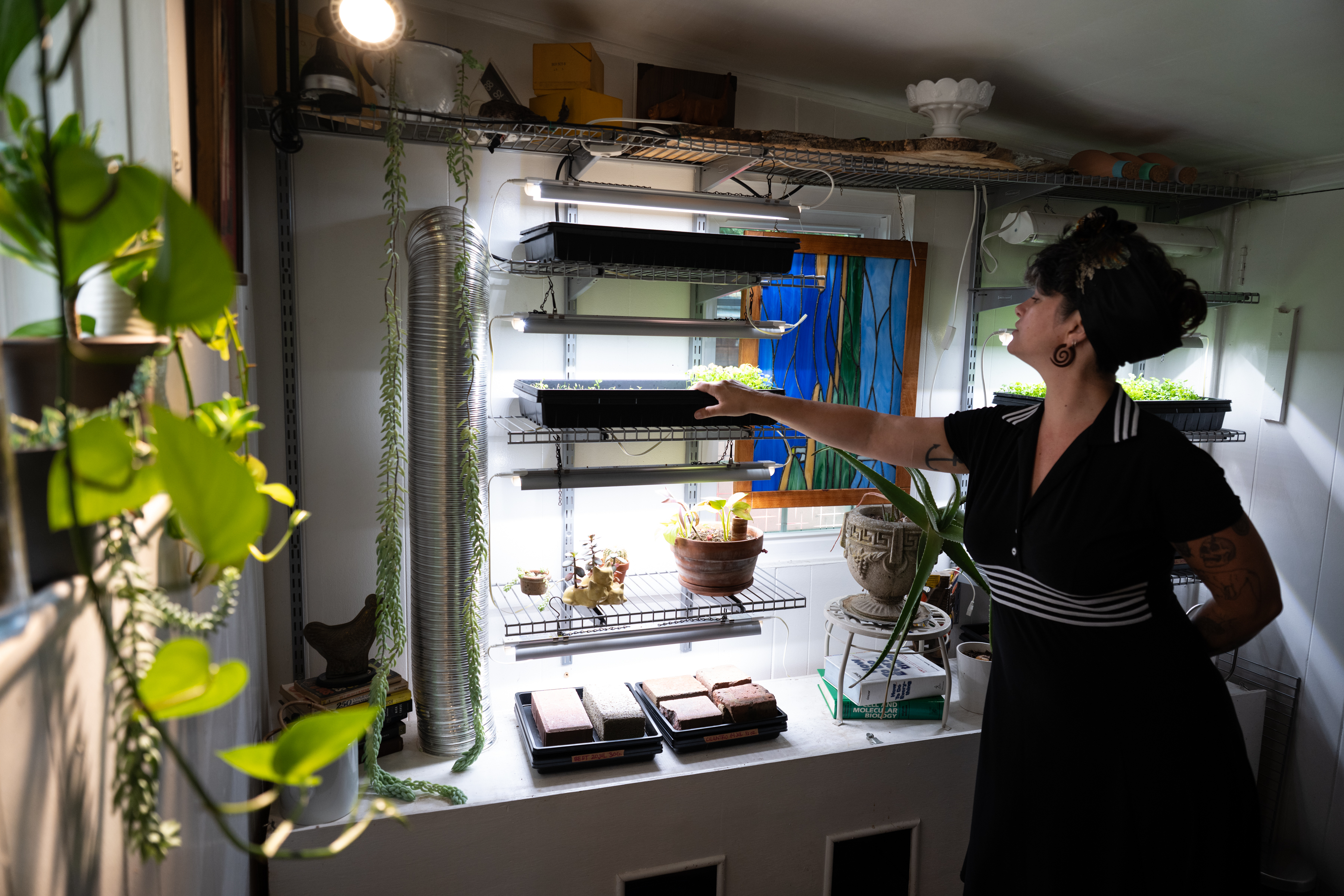
The Lashbrooks have tried to honor the legacy of the home’s former owner, a master gardener, by keeping the grounds lush. Taylor uses the space to grow products for her small business, Mount Airy Microgreens, that supplies to a handful of local eateries. They also cultivate a native garden for pollinators.
The couple want to add a large greenhouse off the kitchen to expand their living space, particularly for dining in the warmer months. They like to entertain but having more than four guests in their house is tough.
Taylor Lashbrook tends to plants she grows for the microgreens business she runs from her home.Erin Blewett / For The InquirerTaylor admires the flowers in her outdoor garden. She and Devin have added pollinator-friendly and native plants to the property.Erin Blewett / For The Inquirer
They usually share meals at a small round table near the front door that’s surrounded by Lucite chairs to minimize the visual footprint. A 10-by-16-foot greenhouse framed by sturdy wood would transform their ability to entertain.
“It’s currently a dream project,” Devin said, “but I don’t think it’s unattainable either.”
Is your house a Haven? Nominate your home by email (and send some digital photographs) at properties@inquirer.com.