A restaurant group in Idaho is determined to reclaim what it insists was theirs to begin with: a world record involving cheesesteaks.
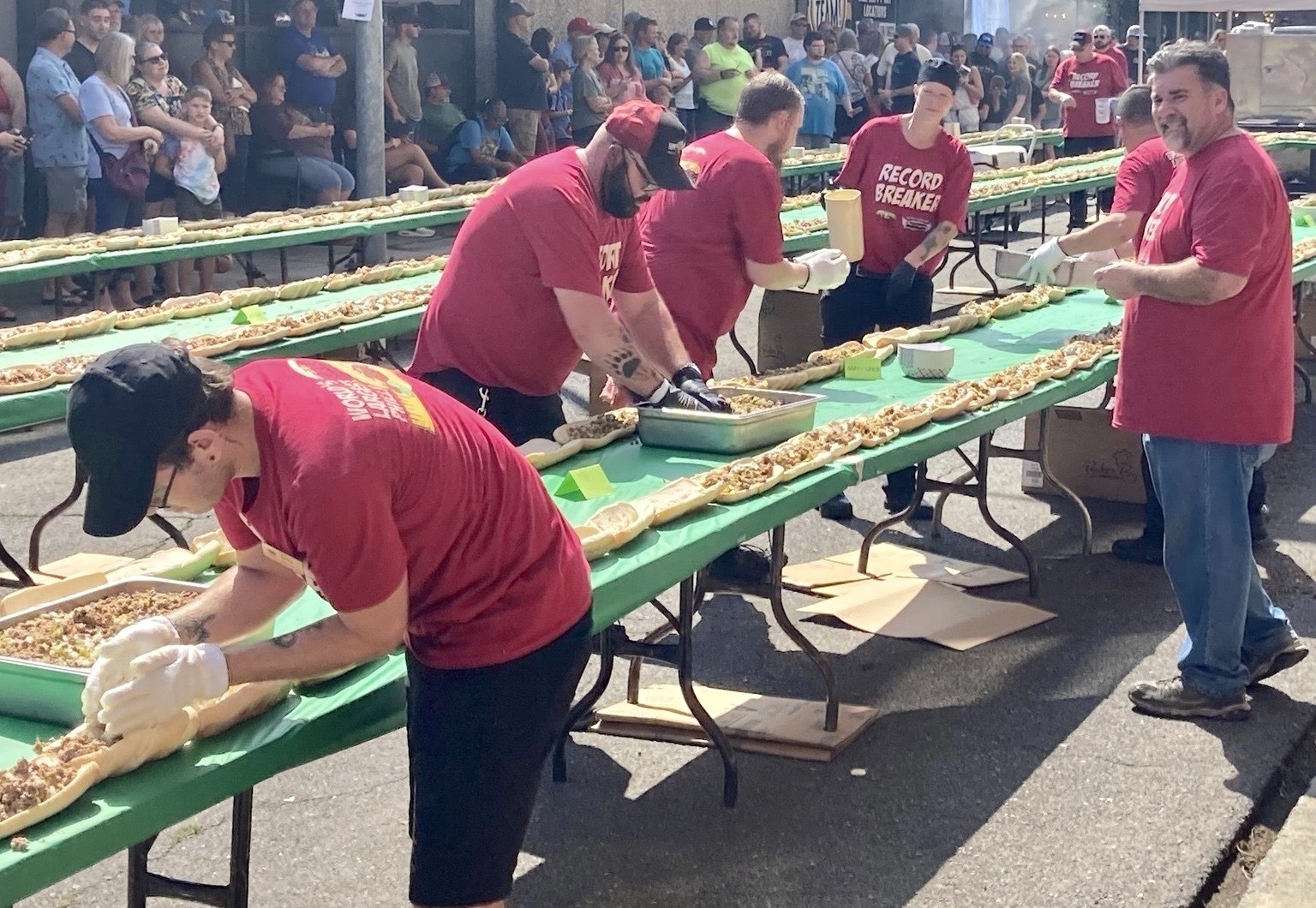
On Sunday, Happy Day Restaurants — a company with a slate of eateries across the Gem State — is hosting an event where they’ll attempt to assemble the longest cheesesteak.
It was only earlier this year that Philadelphia claimed that record with a massive event at Philadelphia International Airport, piling nearly 1,000 pounds of rib-eye atop Amoroso rolls as far as the eye could see.
Philly ended up setting an official Guinness World Record that fateful March day, with about 1,291 cheesesteaks stretching out about 1,271 feet. It’s worth noting that Philly’s cheesesteak line was the inaugural record for that category, according to a Guinness World Records adjudicator who spoke with The Inquirer.
But, over the years, others have attempted unofficial cheesesteak records — including Idaho.
Main Street Grill in Lewiston, Idaho, made a 700-foot cheesesteak on August 26, 2023. Until March, it held the unofficial world record for the longest cheesesteak.Frank Webster
In 2023, the Main Street Grill in Lewiston, Idaho, (operated by Happy Day Restaurants) completed a 722-foot line of cheesesteaks as part of a fundraiser event for the regional Boys and Girls Club. Locals took bragging rights and observers (including The Inquirer) admitted at the time that the sandwich line appeared to be a record-holder. But it was all under “unofficial” terms.
Now, let’s fast-forward to this week.
The bad news: Lewiston, Idaho, is coming for Philly’s newly established “longest cheesesteak” world record. The good news: It’s still unofficial and the proceeds are going to charity — which is kind of hard to bash.
According to a statement from Happy Day Restaurants, participants are aiming to break Philly’s record with an attempt of a 1,350-foot Philadelphia cheesesteak (notably, not called an Idaho or Lewiston cheesesteak).
The event will again benefit the local Boys and Girls Club with $10 sandwich tickets. In 2023, the fundraiser raised more than $10,000 for the organization.
This year’s attempt is also an effort to showcase local agriculture and food production infrastructure.
All of the cheesesteak ingredients, from the beef and veggies (including — gasp — peppers!!!) to the rolls, are being sourced locally for Sunday’s installation.
“It’s a demonstration of what our local food system can do,” the restaurant group said in a statement. “The hardest part of farming isn’t always growing the food. For small and medium-sized farms, one of the biggest challenges isn’t necessarily production. It’s finding someone who will reliably buy what they grow.”
The Lewiston cheesesteak line will include:
1,350 rolls with regenerative grain from Cottonwood, Idaho.
720 pounds of beef processed at a local USDA butcher shop (a 50/50 blend of Idaho beef and supplemental supply, citing summer heat impacting processing capacity).
275-plus pounds of onions and peppers grown regionally in Lewis-Clark Valley.
64 gallons of “cheese sauce” (their words not ours).
From left: Clarence LeJeune, Dana Krawchuk, marketing and guest experience manager for Marketplace PHL, and Mel Hannah, vice president and general manager of Marketplace PHL, with the award from Guinness World Records for a record-setting cheesesteak assembled at Philadelphia International Airport on Tuesday, March 24, 2026.Alejandro A. Alvarez / Staff Photographer
Asked for comment on Lewiston’s attempt to break Philly’s record, PHL sends its regards.
“As the first and current official Guinness World Record holder for ‘Longest Line of Cheesesteaks,’ MarketPlace PHL and the 18 restaurants serving cheesesteaks at Philadelphia International Airport send our very best wishes to Lewiston, Idaho,” Dana Krawchuk, MarketPlace PHL’s marketing manager who organized the airport’s spring record-breaker, said. “In partnership with all the Philly purveyors who supplied ingredients for 2026’s National Cheesesteak Day celebration honoring TSA workers at PHL and making Philly history … We just gotta ask the people of Lewiston, wit or witout?”
A series of human and oversight failings is being eyed by federal investigators as possible contributors to the fatal crash of a medical jet in Northeast Philadelphia last year, according to documents filed by the National Transportation Safety Board.
The federal agency does not identify a cause of the Jan. 31, 2025, crash of the Mexican-owned medical transport that crashed near the Roosevelt Mall just after takeoff, killing all six people onboard and twoon the ground.
But among the factors it has found during a 1½-year probe are possibly fatigued pilots who had never flown in or out of the airport, an improper setting on the Learjet tail’s elevators, and a lack of Federal Aviation Administration safety checks on a workhorse foreign-owned carrier.
Images released by the NTSB as part of their investigation show the scene along Cottman Ave. where a medical plane that crashed, in Northeast Philadelphia on Jan 31, 2025.Courtesy of NTSB
Upon impact, the 1982 Learjet 55 erupted into flames that spread to homes and cars in the heavily populated area. At least 24 people were reported injured. The jet took off just after 6 p.m. that Friday and within a minute had begun a swift nosedive into the sidewalk near Cottman Avenue and Roosevelt Boulevard.
On board were 11-year-old Valentina Guzmán Murillo, who had just received care at Shriners Children’s Philadelphia before returning home to Mexico; her mother; a pilot; a copilot; a flight physician; and a paramedic.
Investigators going through the debris on Cottman Avenue Saturday, Feb. 1, 2025, in Philadelphia. A medical jet with six people on board crashed Friday evening near the Roosevelt Mall in Northeast Philadelphia.Charles Fox / Staff Photographer
Potentially fatigued pilots and potential training weaknesses
As investigators try to piece together what might have gone wrong in the cockpit, they are focused on the two pilots.
One factor that could have played a role was their workload in the days leading to the fatal crash. They had flown multi-leg trips all four days before the accident.
NTSB investigators also looked into the effects of “spatial disorientation,” a phenomenon pilots experience when their perception of motion and relation to the Earth’s surface becomes mismatched.
During the ascent from Northeast Philadelphia Airport, the pilots rolled the plane to the right by 12 degrees. Air traffic controllers then communicated with the pilots, and the pilots responded just as the plane began to rotate back to zero degrees. According to the NTSB, within 10 seconds of their last communication with the air traffic tower, the plane continued rolling to the left at a rapid speed until the plane stopped climbing.
“Pilots who are properly trained and current in instrument flying can normally use instrument information to overcome misleading sensations, however, even well-trained pilots experience sensory illusions from time to time,” NTSB investigators wrote.
When there is a delay, it can take a few seconds or more for a pilot to regain spatial awareness. But during that delay, a pilot may make inappropriate control inputs that place an airplane in “an unrecoverable trajectory.”
In interviews with the pilots’ most recent training instructors at Flight Safety International in Tucson, Ariz., the pilot in command demonstrated a “tendency to react before thinking through a problem,” the report says. The instructor noted that the same pilot would select modes of operation when the autopilot system was off, something the pilot in command is supposed to delegate to the second-in-command pilot.
“That allows the pilot to concentrate on actually flying the aircraft. So what happens is, if the autopilot’s off and the pilot flying goes to select modes of operation, it’s distracting him from flying the aircraft, which typically results in deviations of altitudes, speeds, and headings,” said the flight instructor, who was not identified in the report.
Images released by the NTSB as part of their investigation show the wreckage of a medical plane that crashed in Northeast Philadelphia on Jan 31, 2025.Courtesy of NTSB
The second-in-command pilot’s training report also showed that his lack of recent experience in flying a similar-model Learjet “was evident.”
A spokesperson for Jet Rescue Air Ambulance, the Learjet 55’s operator, could not be immediately reached Wednesday for comment on the new release of documents.
Jeff Guzzetti, a former NTSB investigator, wondered if the low visibility that night, made more hazardous by overcast and lightly choppy weather conditions, could have exacerbated a phenomenon called somatogravic illusion.
That happens when rapid acceleration or deceleration, or other changes in gravity, can cause pilots to falsely believe a plane is pitching up or down when it is not.
“When you look at those four things — the low cloud ceiling, nighttime conditions, high velocity descent, less than a minute after takeoff — that could be consistent with spatial disorientation,” he said. Add in other distractions, like changing radio frequencies, and even experienced pilots have lost their bearings while relying solely on their instruments to navigate, Guzzetti said.
Images released by the NTSB as part of their investigation show the medical plane that crashed in Northeast Philadelphia on Jan 31, 2025.Courtesy of NTSB
Investigators search the jet
The extreme impact, and a debris field scattered across more than a dozen city blocks and a shopping center, has hampered the investigation. Nearly all parts of the plane, from its engines to the mechanical and electrical systems that controlled the jet, were found in damaged condition.
Even so, the NTSB has reported that the jet’s pitch trim, which would have aided the angle of flight and airspeed, was not in optimal position. That meant the pilots would have had to exert up to 50 pounds of force against the controls during takeoff and 12 pounds for level flight, investigators said.
Arthur Alan Wolk, a Philadelphia-based aviation attorney and pilot, was dubious. “They blame the pilot for the trim,” he said. “I don’t think you can rely on that record” because the impact makes interpreting the damaged parts difficult.
Wolk also said the pilot could have corrected for this by hitting an electrical trim switch. “Could it have happened? Yes. Is it a factor? In my opinion, I don’t think so.”
The investigation devoted extensive research into tanks filled with oxygen and other gases the medical jet had on board, which could have led to a fire or impaired the flight crew. Investigators said cameras that caught the airplane’s descent did not show trailing smoke or any visible internal fire.
In all, 11 gas cylinders were recovered with various states of damage. In previous incidents, investigators noted, flight crews had become incapacitated by carbon dioxide exposure. The Learjet’s carbon dioxide tank was found with its valve stem fractured, though the NTSB did not say if it believed there had been a leak prior to the crash.
Jet Rescue Air Ambulancetold the NTSB that the company had no record of the raft for this jet and believed it was installed by a crew member without authorization.
Despite the NTSB stating in March 2025 that the cockpit voice recorder had not worked in years, investigators were able to repair its analog tape and listen to the audio. But the recordings were of a prior landing.
The report did not say why the device failed to record the final takeoff. This jet was not required to carry or maintain a cockpit voice recorder, though it was listed on the preflight checklist.
The NTSB also examined the Learjet’s logbooks and maintenance reports and found they were largely in order, though they could not determine if any new maintenance was done prior to the final flight.
From left Philadelphia Mayor Cherelle Parker, Sean Patrick Duffy, United States Secretary of Transportation turning to acknowledge Pennsylvania Governor Josh Shapiro’s work at press conference. These three and others tour the scene of medical jet crash, Cottman Avenue on Monday, Feb. 3, 2025. The plane crashed Friday evening, Jan 31, 2025.Alejandro A. Alvarez / Staff Photographer
Lack of FAA oversight
A major piece of the investigation rests on the FAA’s Dallas International Field Office, which oversaw the U.S. operations of the medical jet operator.
Because the operator flew unscheduled, non-U.S. registered flights, FAA personnel said they were limited to performing “ramp checks,” or unannounced inspections of the aircraft and crew on the ground, as a safety measure. But when investigators searched the FAA’s safety assurance system for any record of ramp checks, they found none prior to the fatal crash.
Asked by NTSB investigators if there was a requirement to perform ramp checks or other surveillance on operators like Jet Rescue Air Ambulance, the primary inspector stated: “Oh, I’m not sure.”
The primary inspector continued that there was no surveillance plan in place before the time of the crash and that FAA staff in charge of Jet Rescue Air Ambulance’s operations had no knowledge of the operator’s previous crashes. The operator experienced a fatal accident in November 2012 in Fort Lauderdale, Fla., a nonfatal accident in February 2019 in Toluca, Mexico, and a fatal accident in November 2023 in Cuernavaca, Mexico.
Jet Rescue Air Ambulance was not on the FAA’s Heightened Surveillance List, which would have flagged the operator for additional inspections.
Unscheduled operators like Jet Rescue Air Ambulance are required to notify the Dallas FAA field office before operating in the United States, which the FAA would use todetermine when inspections are needed. But Jet Rescue Air Ambulance did not notify the office of its operations before the accident flight, according to the NTSB findings.
The NTSB release of evidence comes as federal probers complete their investigation phase and prepare their final report, followed by a review process that can take up to six months.
The Phillies have added a veteran reinforcement to their shallow pitching depth.
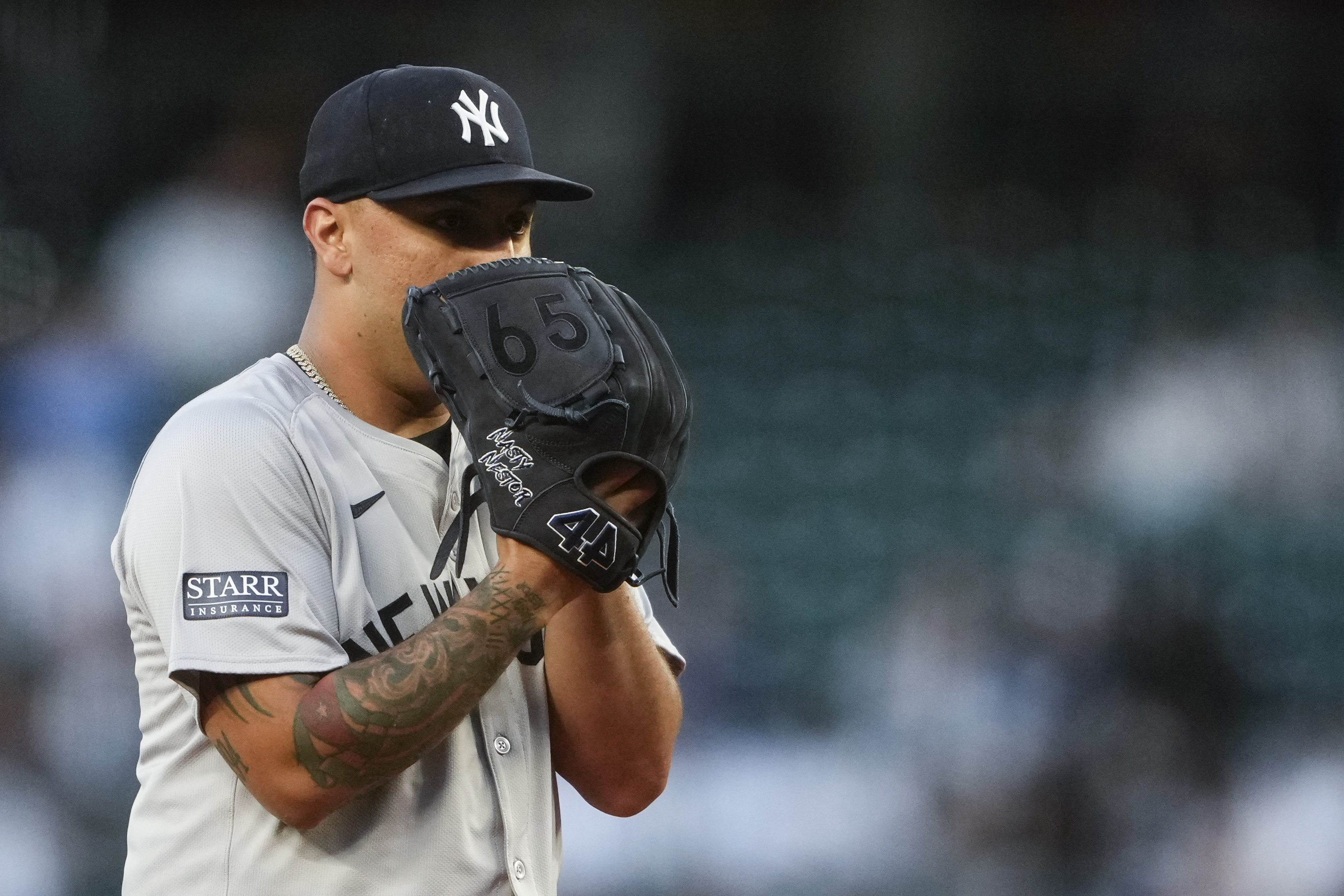
The club signed Nestor Cortes to a major league deal Wednesday, the Phillies announced. Cortes was optioned to single-A Clearwater. To clear a spot for him on the 40-man roster, right-hander Brian Keller was designated for assignment.
Cortes, a 31-year-old left-hander, last pitched on Sept. 3, 2025, before he was sidelined with a biceps tear that required surgery. Prior to the injury, he had a 6.29 ERA in eight starts with the Brewers and Padres. In his eight-year career, five of which Cortes spent with the Yankees, he has a 3.94 ERA with a 1.19 WHIP. He was an All-Star in 2022.
Cortes lacks elite velocity, with his average fastball clocking 90.1 mph in 2025. He relies on deception and misdirection in his windup, often varying his timing and even pausing in the middle of his windup to throw off hitters. He has a four-pitch mix of four-seam, cutter, changeup, and sweeper.
Cortes posted a video on X on Tuesday throwing for scouts.
The lefty has playoff experience with the Yankees in 2022 and 2024. He surrendered a walk-off grand slam to Freddie Freeman in the 10th inning of Game 1 of the 2024 World Series, which the Dodgers went on to win in five games.
Interim manager Don Mattingly said he wasn’t sure yet what role Cortes will play for the team.
“I don’t think I’ve ever seen Nestor pitch, besides a few pitches on TV and things like that. Never seen him in person, so we’ll see,” Mattingly said. “I think it’s depth. It’s another guy that’s got experience. And obviously when the signing, I think he’s throwing the ball pretty good.”
The Phillies’ starting pitching depth has been thin all season. They released Taijuan Walker in April after extended struggles. Rookie Andrew Painter was optioned to triple-A in June to work on his fastball, and while he was with the IronPigs, the Phillies relied on Alan Rangel and bullpen games to cover the No. 5 spot in the rotation.
Painter was recalled on July 31 and has shown improvement in the four starts since, and the Phillies opted not to add a starting pitcher at the trade deadline. Instead, they brought in second baseman Luis Arraez along with relievers Caleb Kilian and Brooks Raley. Kilian hit the injured list with an oblique strain after just four appearances with the Phillies.
Last September, the Phillies signed Walker Buehler as a depth starter ahead of their 2025 playoff push. To take stress off the Phillies’ starting pitching staff, they moved to a six-man rotation down the stretch.
Nestor Cortes was an All-Star in 2022 when he posted a 2.44 ERA in 28 starts with the Yankees.Lindsey Wasson
But a team using a six-man rotation can in turn tax their bullpen, because it means one fewer relief arm. The Phillies have already had issues with an overburdened relief corps this season, like last week in St. Louis when their only arm available for the ninth was Jonathan Bowlan. If that game went to extras, Mattingly was planning on putting backup catcher Garrett Stubbs on the mound, essentially conceding the game to the Cardinals.
Mattingly said “in theory” the Phillies could go to a six-man rotation, but it’s also a risk for a team without a secure playoff position. The Phillies entered Thursday’s off day with the second wild-card spot in the National League, but the Padres and Diamondbacks are right on their heels, trailing by two and three games, respectively.
“Depends where you’re at in the race and all that,” Mattingly said. “I guess in theory, I think teams that do it are probably more comfortable where they’re at in the race. But you never know.”
Extra bases
Tanner Banks (left forearm strain) threw a live batting practice session on Tuesday and is scheduled for another tentatively on Friday. … Jesús Luzardo (11-5, 3.23 ERA) is scheduled to start Friday’s series opener against St. Louis. The Cardinals have not announced their starter yet.
East Whiteland voters will decide this November whether they should add more elected officials to represent them, after residents’ staunch opposition to a controversial 1.5 million square-foot data center project propelled them to petition for a larger board of supervisors.
In a quick but forceful flurry, residents collected at least 500 signatures to get a question on the Nov. 3 general election ballot asking voters if they want two more elected officials. If the ballot issue is approved, it would bring the number from three to five members on the board of supervisors.
The project loomed large as township resident Jessica Larkin collected signatures for the referendum. She had to be “careful to clarify” that the question was not just on the data center, she said.
“It’s connected, though, because this board and the overall township management is all connected to how these projects get pushed through and approved, and I think that the conversations, while it did start with the data center, did kind of just bring us to general approach in the future of the township,” she said.
Board members are elected at-large and serve six year terms. They appoint township staff and members of the boards and commissions within the township, plus hear conditional use applications, levy taxes, and more.
In a letter to fellow residents, Larkin wrote that “a township the size of East Whiteland would benefit from having five supervisors.”
“A larger board has the potential to provide a broader range of perspectives, more balanced representation, and additional voices to help guide decisions affecting our growing community,” the letter continued.
The township and supervisors board chairman did not immediately respond to a request for comment on the ballot question and its impetus.
Earlier this week, amid increasing opposition among Pennsylvanians to the projects, Shapiro signed a sweeping executive order that requires local approval for projects to receive state permits, which could block many developments from moving forward.
Larkin, 44, a resident of the township for more than a decade, lives about a mile away from the site of the planned data center. She started attending meetings on the proposal, she said, and it was “just eye-opening to see how the process worked, and to learn how these projects get approved.”
“Ultimately, after attending several meetings and watching residents passionately oppose the project, it felt like we could use a little bit more representation,” she said.
Along with a team of other residents, Larkin, in less than two weeks, collected enough signatures to meet the county’s early August deadline to put the referendum on the ballot.
For local elected officials, data center projects have proved to be thorny. They hesitate to vote the projects down immediately. In the absence of state leadership earlier this year, a smattering of municipalities have, in recent months, charged township staff to pen ordinances to get ahead of any proposed projects so they have some level of control over where they go.
In East Whiteland, construction of the data center remains fraught, with concerns of construction unfolding on a contaminated parcel prompting a temporary work stoppage and a pending request to make changes to the plans.
Even if it has grown beyond just the data center, Larkin hopes residents see the need for more elected officials.
“There’s close to 15,000 residents, and there’s so many talented people that spoke up at these meetings,” Larkin said. “And I just would love to see more representation and more involvement at this level and with this consideration in terms of developing our township.”
This suburban content is produced with support from the Leslie Miller and Richard Worley Foundation and The Lenfest Institute for Journalism. Editorial content is created independently of the project donors. Gifts to support The Inquirer’s high-impact journalism can be made at inquirer.com/donate. A list of Lenfest Institute donors can be found at lenfestinstitute.org/supporters.
Loris Assadian, a French singer-songwriter and animal advocate known professionally known as Plumes, is globally recognized and celebrated for his distinctive sound and special connection with animals.
Videos of him playing his flamingo-pink guitar for farm and zoo animals have captivated millions of viewers worldwide, including former President Barack Obama, who talked about Assadian earlier this summer during the final month of The Late Show with Stephen Colbert.
Also count Megan Paier, of Cherry Hill, among the many fans of his calming musical moments. A member and volunteer docent at the Philadelphia Zoo, she thought it would be great after watching his reels on Facebook if he came here. “The way animals respond to him just warms the heart,” she said.
Assadian warms up before stepping to the tortoise environment.Tom Gralish / Staff Photographer
So she reached out in March, DMing him. “What do I have to lose?”
He got back to her right away.
She asked how much it would cost, and he told her he didn’t accept any money, he just needed his expenses covered.
He visited the zoo Tuesday — after running up the Rocky steps — and serenaded the tortoises ahead of sessions on Thursday and Friday, when he will play for other animals. Most tickets are already sold out.
Assadian serenades Abrazzo, a Western Santa Cruz Galapagos tortoise estimated to be around 97 to 100 years old.Tom Gralish / Staff Photographer
Assadian began performing for animals three years ago in France when he played Beatles songs for some local cows.
His appearance in Philly is the first at any U.S. zoo, and only his second visit to the United States (he went to Alaska last month).
Elizabeth Gibbons and her 2-year-old daughter Opal watch as the tortoises listen.Tom Gralish / Staff Photographer
Elizabeth Gibbons, of Kennett Square, is an “oh my gosh, a huge fan” and was excited to see he was coming to Philadelphia but disappointed she wouldn’t be able to be there.
She was at the zoo on Tuesday with 2-year-old daughter Opal and a mothers group from West Chester when she saw him opening his guitar case and teared up.
Megan Paier, the docent, noticed and got Assadian to take a selfie with her.
Before he plays, Assadian always talks with the animals’ caretakers to learn about their personalities and behavior. He keeps his own body language neutral, avoids sudden movements, and doesn’t expect or force interaction.
Assadian’s mother, Valerie, his social media videographer, records him with Abrazzo, a Western Santa Cruz Galapagos tortoise estimated to be around 97 to 100 years old.Tom Gralish / Staff Photographer
Beyond social media popularity, Assadian’s acoustic sessions serve as genuine behavioral enrichment for animals. Last year, he partnered with the Université de Nanterre for a scientific study at the Branféré animal park to evaluate music’s direct impact on animal behavior.
The $42 billion Pennsylvania State Employees’ Retirement System (SERS) last month unanimously agreed to end a $300 million foreign-stocks investment for failing to meet targets — then gave the same firm a fresh $2 billion to invest in U.S. stocks.
That came 20 months after SERS put the investment on its “Evaluation List,” a special status that SERS’s adviser, Callan Inc., told trustees in a memo was “due to underperformance.”
According to SERS investment data, Xponance, which manages around $25 billion, was the only one of five firms it hired to pick foreign company stocks that has failed to beat its benchmark index of those stocks “since inception.” SERS uses Morgan Stanley’s MSCI ACWI ex USA Small Cap Index of foreign stocks, as Xponance’s benchmark.
Xponance actually met or slightly beat that index in three of the seven years since SERS invested. But that wasn’t enough to cover larger shortfalls from other years, including 2025, when Xponance trailed the index by 6%, yielding $15 million less than its target.
Hughes and Xponance officials didn’t return calls seeking comment.
In all, SERS paid more than $230 million in fees, profit sharing, and expenses to hundreds of investment fund managers in 2024, the last year for which it has published data.
The system also beat its self-imposed annual investment benchmark, currently 6.875% a year, by more than one percentage point from 2015 to 2025. That enabled SERS to reduce the “employee contributions” collected from 67,000 state employees, which vary from 5% to 9%, by half a percentage point for three years. SERS collected about five times as much from taxpayers last year, and collects varying amounts from its investments.
While SERS voted to “liquidate” Xponance’s account with one hand, it awarded Xponance a new account with the other. In the same July 28 vote, trustees headed by chairman Gregory Thall, a Harrisburg lobbyist, unanimously agreed to give Xponance $2 billion to invest in a “passive” index fund based on the Russell 3000 index of large and small U.S. stocks.
Though the $2 billion SERS granted is more than six times the $300 million SERS took away, Xponance is still likely to lose significant income in the switch. Xponance charged SERS around 80 basis points a year (that’s 0.8% of the investment’s value) plus expenses — a total of around $2 million a year — for the former stock-picking account.
According to a formula in Xponance’s marketing materials, for a $2 billion investment in its “passive” Russell 3000 index fund, the firm would typically charge around $400,000 in client fees a year. That’s less than one-quarter what Xponance charged SERS to “actively” pick and manage foreign stocks.
The highest fees are typically paid to private-equity and real estate investors. Stock-pickers like the former Xponance foreign-stock fund are paid less. Index funds such as the new Xponance fund tend to collect some of the lowest fees. Xponance’s new fees will be “very competitive,” according to SERS spokesperson Pamela Hile.
SERS said it’s still negotiating the terms of its new Xponance mandate.
“SERS has been laser-focused on negotiating and lowering investment manager fees,” which totaled 0.41% for all managers last year, according to Hile.
Xponance, headed by past Philadelphia city chief investment officer Tina Byles Williams, is the only fund managing stocks for SERS that is “owned and/or controlled by a majority of persons who are women and/or minorities.”
SERS investment policy “encourages the use of diverse investment managers” in all asset classes “within the bounds of financial and fiduciary prudence,” adding that a diverse range of professionals contribute different points of view that improve the system and its economic performance.
Among SERS’s more than 200 outside money managers are five other firms controlled by women or diverse owners. Those five firms all manage private assets, rather than publicly traded stocks and bonds like Xponance, according to SERS.
The pension system helps defray the annual cost to taxpayers of funding guaranteed pensions for around 250,000 working and retired state troopers, prison guards, social workers, state college staff, judges, legislators, and other state employees. The majority of its board is appointed by Gov. Josh Shapiro.
SERS already pays Mellon Investment Management, a Pittsburgh unit of New York-based BNY Mellon, to manage $14 billion, SERS’s largest single investment, in Mellon’s Russell 1000 big-stock index fund, and for smaller investments in two Russell 2000 small-stocks funds.
The new Xponance investment will be SERS’s only Russell 3000 fund, combining the big- and small-stock indexes. The Russell indexes are licensed to Xponance and other fund managers by the London Stock Exchange Group.
Money for the new Xponance investment will include funds taken from SERS’s Mellon account.
Montgomery County will move its 9/11 memorial to Elmwood Park in Norristown on Sept. 1 in advance of the 25th anniversary of the terrorist attack.
The goal is to make the memorial more accessible for county residents and visitors than it is at its current location at the county’s emergency operations center in Eagleville, Jamila H. Winder, chair of the Montgomery County Board of Commissioners, said in a statement.
The monument, which was commissioned by the Montgomery County Board of Commissioners in 2003, was created by sculptor Sassana Norton, who used an I-beam from the North Tower of the World Trade Center in the 18-foot monument honoring victims and first responders. It was erected at the Montgomery County Courthouse in September 2005and then moved to the Eagleville campus in 2021 due to courthouse construction.
Members of the public are invited to watch the procession of the memorial starting at 9 a.m. on Sept. 1. The monument will travel from Eagleville through Lower Providence and West Norriton Townships to Elmwood Park in Norristown. The procession will be accompanied by a Norristown Police Department motorcycle escort as well as other first responders and representatives from across the county.
A rededication ceremony will be held at 10 a.m. on Sept. 11 at Elmwood Park.
“Norristown is proud to host the County’s 9/11 Memorial in Elmwood Park,” Rashaad Bates, president of Norristown Municipal Council, said in a statement. “We are honored to provide a permanent home where residents can gather to remember, reflect, and pay tribute to those whose lives were forever changed on September 11.”
He’s become world famous for embracing America’s enemies and backstabbing our allies. Yet, Donald Trump outdid himself Sunday — on the eve of joint military exercises with South Korea — when he announced the U.S. was scaling back participation to avoid offending his great friend, the nuclear-armed North Korean dictator Kim Jong Un.
Perhaps this was just a frantic attempt to shift attention from the quagmire in Iran. Having failed to end Tehran’s nuclear program, the president is offering nuclear talks “without preconditions” to Kim. You will recall the two “fell in love” after Kim wrote Trump “beautiful letters” in 2018, and he responded in kind.
The military exercises, Trump said, would be “inappropriate and hostile” to a country that “has been unthreatening and respectful” during his presidency.
Unthreatening? Respectful? Anything but.
Kim humiliated Trump after meetings in 2018 and 2019 by rejecting nuclear talks and massively increasing his stock of nuclear weapons and missiles. He’s made clear he wants U.S. recognition as a nuclear power, one that threatens South Korea, Japan, the Philippines, as well as U.S. bases and territory.
Yet, Trump’s selective memory — remembering Kim’s love letters, but ignoring his rebuffs and insults — lays bare a terrible truth about our aging, raging president: his unshakeable belief that his “great” relations with Kim (and with Russia’s Vladimir Putin and China’s Xi Jinping) will ultimately convince them to do his bidding.
The president’s megalomaniacal belief in his own brilliance blinds him to his repeated failures with all three dictators. He refuses to recognize that far from friendship, Kim, Putin, and Xi are bound together in an axis of adversaries who are helping a fourth member — Iran — stand up to the United States.
Trump’s superman delusions aid all these adversaries, even as he dismisses allies who could help keep them in check.
“To treat Kim Jong Un as a partner of some kind is absolutely illogical and counterproductive,” I was told by retired Rear Adm. Mark Montgomery, who served for more than three decades in the U.S. Navy, including in the Pacific.
Montgomery, who is a recognized expert on cyber and technology policy, is now a senior fellow at the Foundation for Defense of Democracies, where he has coauthored an important book, Axis of Aggressors: Countering the Cooperation of China, Russia, Iran, and North Korea.
Canceling the South Korea exercises, which Trump said he would have done if it wasn’t too late, decreases U.S. readiness, Montgomery told me, and puts U.S. troops at risk. About 28,500 are based in South Korea.
“Kim is not going to give up his nuclear weapon nor is he going to make some kind of deal that will win a Nobel Prize,” he said.
In fact, Montgomery added, Trump’s touted first term tête-à-têtes with Kim “made no impact whatsoever.” Kim increased his nuclear weapons yearly during Trump’s first and second term, and is now estimated to have around 50 to 60 nuclear warheads ready for use.
Moreover, North Korea is the perfect example of the close ties and fraternal help that the axis powers provide to each other. “Russia has helped North Korea build more accurate intercontinental missiles which can reach much of U.S. territory,” Montgomery said. “This already puts us under threat.”
Russia has also aided Pyongyang with advanced technology to improve its nuclear and missile programs, which decreases Kim’s willingness to negotiate.
For his part, the North Korean leader has repaid Russia by sending artillery shells, missiles, and tens of thousands of troops to help Putin attack Ukraine. They also work in Russian drone factories, freeing up Russian soldiers to go to the front.
Thus, the man Trump so admires contributes daily to Moscow’s slaughter of civilians in hospitals, schools, and apartment buildings in Ukraine.
Moreover, Putin, the president’s other self-professed buddy, joins axis members in helping the Iranian regime survive and continue to threaten American troops. Iran initially provided Russia with deadly Shahed drones, which Moscow now manufactures and upgrades. Those now-upgraded Iranian drones have killed U.S. troops in Kuwait. Putin also shared intelligence with Tehran that helped the regime target U.S. bases.
All this hasn’t even touched on the intensified partnership between Moscow and Beijing in which the two primary axis members share technology and intel to jointly undermine U.S. interests.
“The axis has helped Iran. The conflict with Iran ties up the U.S. military and makes us less ready for China, and the Russian attack on Ukraine distracts Europe. And Trump doesn’t see that the threats from North Korea make us less able to defend Taiwan,” Montgomery said.
Trump is incapable of connecting the dots. Like a sun god at the center of the world, he looks at each adversary through the lens of their relationship to him. He is blind to the links that bind them together.
The president thinks his personal diplomacy and that of close friends, like fellow real estate tycoon Steve Witkoff and son-in-law Jared Kushner, are superior to normal diplomatic engagement. No expertise is necessary, Montgomery told me.
“His first term didn’t prove that to be true. It hasn’t moved any of the four axis powers, and it hasn’t moved the Iranian Revolutionary Guards,” he noted. “It is an integrated task to fight the axis of aggressors. Especially if the president doesn’t recognize who the bad guys are.”
And, I would add, if those who do recognize the bad guys — like Secretary of State Marco Rubio and many GOP senators — are more interested in pacifying POTUS than in the security of the United States.
Watching TV outside comes with a host of challenges: Humidity. Mosquitoes. Glare so fierce you risk losing sight of Jalen Hurts at the goal line.
And yet, people are increasingly heading to the backyard for movies, sitcoms, and sports. One industry report values the global outdoor TV market at more than $400 million in 2026 and projects annual growth of nearly 12% through 2035.
The Philadelphia region? Right on trend. According to Kim Bucholsky, office manager with All Systems Audio & Visual, the Hatboro-based company has seen a 50% uptick in outdoor installations since 2019 — “with no slowdown in sight.”
Some people are sinking hundreds of thousands of dollars into these entertainment setups; others are dragging lawn chairs and an iPad to the front stoop every time Love Island releases a new episode. The common denominator isn’t age or gender or socioeconomic status. Kids and adults, armchair quarterbacks and prestige-TV junkies, agree: There’s something special about a backyard binge.
“When the sun’s going down, the breeze is blowing, you can hear the ocean in the distance and maybe the occasional coyote, and you’re watching your favorite Philly sports team, there’s absolutely nothing better,” said Anthony Farina, a communications executive based in Cape May. “To me, this is utopia.”
So how, exactly, did the lawn usurp the living room?
Cori Laphan talks to Randy Bock of Turnersville, as they watch the Eagles in the first preseason game of the year at her summer home in Cape May Court House. Tim Hawk / For The Inquirer
Experts say the hobby gained momentum during the COVID pandemic, when families had no choice but to hunker down at home. People invested in their spaces: pools, fitness rooms, and — yes — expanded entertainment options. Even after restrictions were lifted, the stay-put mentality stuck.
“Once you sink that money in, you have less to spend outside the home,” said Kevin Gillen, an economist with the Henderson Real Estate Institute at Drexel University. “Movie theaters, which are incredibly expensive and ruined by one loud family in the room, have not rebounded since COVID.”
But backyard viewing goes beyond financial sense. It’s also the sneakiest way to sidestep a 21st-century affliction: screen-time guilt.
“There’s a lingering bias around TV,” said Emil Steiner, associate professor at Rowan University, who lives in University City and studies audience viewing habits. “The stereotype is that you’re being a lazy couch potato staring at the idiot box while cooped up inside a dark room. But watching outside in the fresh air among friends? It feels like a free pass.”
That social piece matters. Open-air viewing has a way of turning into an event — firepit glowing, grill smoking, cooler cooling. What’s really streaming is camaraderie. Recent World Cup watch parties, from Lemon Hill to suburbia, are a proof point: Alfresco airtime is a happiness booster.
In Glenside, Emily Kelly and her family built a mount for their backyard projector screen out of a PVC pipe and some carabiners.Courtesy of Emily Kelly
“People feed off one another’s energy,” said Michael Marciante, executive director of the Partnership for Haddonfield, the town’s business improvement group. He spearheaded three viewing parties, drawing a total of 2,500 residents and visitors to a temporary screen on Kings Highway. “Outdoor viewing brings communities and neighbors together, and you can just feel the electricity.”
But before you haul your sectional onto the deck, you’ve got homework. To make the most of an outdoor viewing experience, channel surf through the following tips.
Know your why: Are you looking for romantic date nights? Neighborhood gatherings? Family bonding? Will this be a one-off thing or a permanent setup? Is your preference ultra-luxe or a bit more rustic? Zach Kades, who’s been hosting watch parties as an event manager at Soccer Post Cherry Hill, said his own home setup in Bryn Mawr involves little more than a projector and the back wall of his garage, because he likes the nostalgic, “camplike feel” it brings to a night with friends. Knowing your goal will make choosing your gear easier.
Try it out: Before his family gifted him a new TV for the front porch and a permanent mounting system, Farina spent four years carting his flat-screen and a trusty coffee table back and forth from the living room on a near-daily basis, a ritual he calls a “labor of love.” While your trial period doesn’t need to last that long, Farina does recommend a test run with your existing screen. “Notice whether people rally around it,” he said. “See if you feel the joy.”
Set your limit: Technically, you can make this work for the cost of a thrifted projector and a bedsheet flung over a fence. Or you can take the Jim Malamut route and spend more than $500,000 creating an oasis: “I call it my midlife crisis,” he said.
The mortgage lender purchased an overgrown lot behind his Linwood home and spent about three years converting it into a pool-and-bar retreat complete with three TVs (two at 98 inches and one at 75) for watching multiple games at once. No matter where on the spectrum you fall, the important thing is to know your financial cap “and stick to it,” Malamut said, “or things can get crazy fast.”
Research your tech: Purists will die on this hill: Your screen needs to be outdoor rated to fight glare with premium LED technology even in direct sunlight and withstand the elements longer than a few seasons.Others swear by less expensive, indoor screens that are shaded during viewing and protected with a water-resistant cover when not in use. Whatever you choose for your specific space, you’ll want to run a simple internet test: Stream a program from your phone or laptop in the designated spot, and see if Wi-Fi can handle the job or if hard-wired Ethernet is the better, no-buffer option. Ensure any required cables are made for outside use.
Bug off: Mantua resident Cori Laphan loves her “outdoor living room” at the Driftwood Too Camping Resort in Cape May Court House, complete with fire pit, grilling station and 55-inch TV. Only problem: things that bite. To keep the gnats, mosquitoes and greenheads at bay, she staged an offensive campaign: tiki torches, citronella candles, fans, even coffee grounds — TikTok wisdom holds that lighting them on fire inside a metal canister is a natural deterrent. Laphan, a senior-living salesperson, also took an empty planter to a local garden center with one instruction: Fill it with bug-repelling plants. “We’ve done everything imaginable,” she said. “Insects love me, and I’m still able to be outside much of the time.”
Get resourceful: If you don’t call in a team of home-theater professionals, creativity is key. Laphan’s brother-in-law, Jon Morad, reimagined a cutout in the side of a Home Depot shed intended for firewood — it now serves as an entertainment console that shades the family’s TV and offers some protection from the elements. “You have to think outside the box,” said Morad, a hospital maintenance supervisor.
In Glenside, another family built a mount for their backyard projector screen out of a PVC pipe and some carabiners — neighborhood kids sit on one side while adults watch on the other, reverse-image and all. “Our setup is definitely makeshift,” said physical therapist Emily Kelly. “But I think it feels more genuine that way.”
Learn the rules: Municipalities, HOAs, campgrounds … they all play by their own noise rules. According to Philadelphia code, your true-crime documentary or Hallmark movie marathon cannot exceed “three decibels above background level measured beyond the property boundary.” Translation: If your block’s typical soundtrack is the hum of traffic, your TV can raise that only slightly.
Kate Evans and her wife, a Philadelphia police officer, built a roofed pergola for watching games and movies behind their Roxborough rowhouse. They recommend investing in a soundbar, which aims audio directly at viewers so that sound doesn’t wander. “We don’t need to blare our TV,” Evans said. Be sure to check the relevant code books and, if in doubt, purchase a basic sound-level meter to ensure you’re in compliance.
Kate Evans and her wife built a roofed pergola for watching games and movies behind their Roxborough rowhouse. They recommend investing in a soundbar, which aims audio directly at viewers so that sound doesn’t wander.Courtesy of Kate Evans
Be a good neighbor: Even if you’re operating within the law, outdoor TV enthusiasts risk alienating neighbors who won’t appreciate the glow of a flat-screen after dark. Head off any tension early by inviting them over for a viewing. Or, at the very least, Farina advises: “Keep your emotions in check while watching Philly sports,” he said. “I know that’s tough to do.”
Border czar Tom Homan is putting employers on notice: Expect significantly more scrutiny of who you’re employing and whether your paperwork is in order.
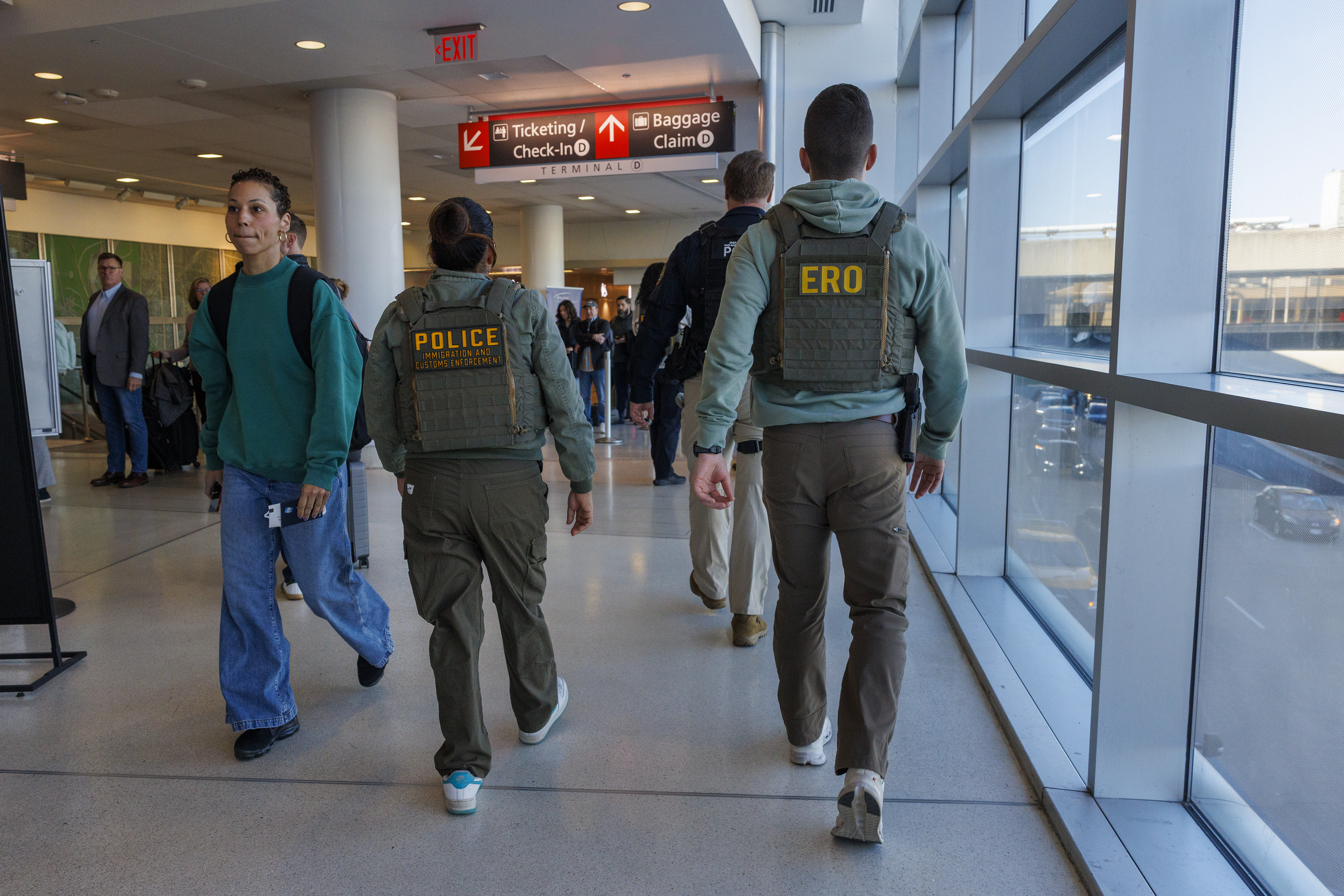
Homan, in a recent conversation with the Center for Immigration Studies, talked about his intention to expand employment verification inspections that would “dramatically increase” worksite enforcement.
“We want to hold employers who circumvent the law responsible,” he said.
This statement is in addition to a number of changes recently made to the Form I-9, Employment Eligibility Verification, which is required by the U.S. Citizenship and Immigration Services (USCIS) within the Department of Homeland Security and which employers generally must complete and retain for employees to verify their identity and authorization to work in the United States.
The bottom line is that immigration enforcement activity is, and will be, of increased concern for employers, and if your company is not in compliance, you could not only face fines but potential civil and criminal charges.
Here is what employers should do.
Audit your employees’ I-9s
“For businesses, the biggest mistake is having no plan at all,” said immigration attorney Kristofer C. Kaufmann of Philadelphia-based Kaufmann & Associates.
Kaufmann encourages his clients to conduct a privileged internal I-9 audit under the guidance of immigration counsel and then create a one-page response protocol that every manager knows.
“The audit tells you what is actually in the files and what needs fixing before the government ever asks, and the protocol tells your people exactly who to call, what to say, and what not to do if agents appear,” he said. “Most small businesses that get into serious trouble do so because they had neither.”
When auditing I-9s, businesses should not try to hide problems, said attorney Zachary Gold, from New Jersey law firm Cruz Gold & Associates, which serves clients in the Philadelphia area.
“Correct mistakes in the open: line through the error, enter the correction, then initial and date it,” Gold said. “Never backdate, which turns a compliance problem into fraud. Good compliance is a folder you can hand an auditor in five minutes.”
He says to keep I-9 records organized and separate enough that they can be produced quickly. Employers should include former employees as they can also be subject to a review, Gold said.
“Run the audit the same way for everyone, and do not start demanding new or different documents based on how a worker looks or sounds, because that trades an I-9 problem for a discrimination claim,” Gold said.
Ricky A. Palladino, an immigration attorney in Philadelphia, recommends going one step further by using E-Verify, an online system that compares an employee’s Form I-9 with records from the Department of Homeland Security and the Social Security Administration.
This step “gives an immediate answer on whether a person is authorized to work and provides electronic updates on when forms need to be updated,” he said.
Create an ICE response plan
So what happens if Immigration and Customs Enforcement shows up at your company’s door? The most important thing is to stay calm, professional, and cooperative but have some guardrails. And the first thing to know is that there’s a difference between an I-9 audit and a raid.
“An I-9 audit, sometimes called a ‘silent raid,’ begins with a Notice of Inspection,” Kaufmann said. “By regulation, ICE must give the employer at least three business days to produce the Forms I-9 and related documents.”
A raid, or unannounced worksite enforcement action, Kaufmann said, “usually involves a judicial search warrant. There is no advance notice.”
Kaufmann advises his clients to designate one or two people in advance to handle any ICE interaction, preferably the company owner or a senior manager. Requesting and verifying each agent’s identification card is also important.
When ICE agents arrive, employers should ask the purpose of their visit and then document all interactions either in writing or video in case questions later arise about what the agents requested, where they went, or what was produced, said Nadine C. Atkinson-Flowers, a Philadelphia-based attorney with experience in U.S. and Jamaican immigration law.
“If things get testy, try to de-escalate tensions so that you and your employees are safe,” she said. “Don’t become hostile. Don’t refuse lawful orders like a request to see compliance documents. Don’t allow ICE to go through private spaces.”
Palladino also warned against giving ICE access to nonpublic areas. “Employers should always ask to see a warrant and review it to determine which part of their premises ICE can examine,” he said.
Gold also recommends understanding the different types of warrants.
“A judicial warrant is signed by a judge and lets agents into the areas it lists,” he said. ”An administrative warrant is signed by an ICE officer, and it does not reach your nonpublic areas without your consent.”
If ICE presses in their search, Gold recommends telling them that you are not consenting and documenting that, too.
“Then, call your attorney,” he said.
Palladino is urging his clients to prepare.
“It’s clear that DHS intends to dramatically increase the number of audits moving forward,” Palladino said. “We’re telling our clients to get ready now. Businesses can be fined for both technical and substantive violations.”