When Gregory Williams stepped into Ravitz ShopRite in Cherry Hill, he was on a mission, carefully selecting fresh fruit to add to his shopping cart.
After stocking up on strawberries, peaches, nectarines, and a pineapple, Williams moved quickly to the meat section to peruse his options.
“I’m on the healthy side,” said Williams, 29, of Camden.
Williams got a ride recently to the ShopRite courtesy of a new program that offers free door-to-door transportation to the supermarket to Camden residents.
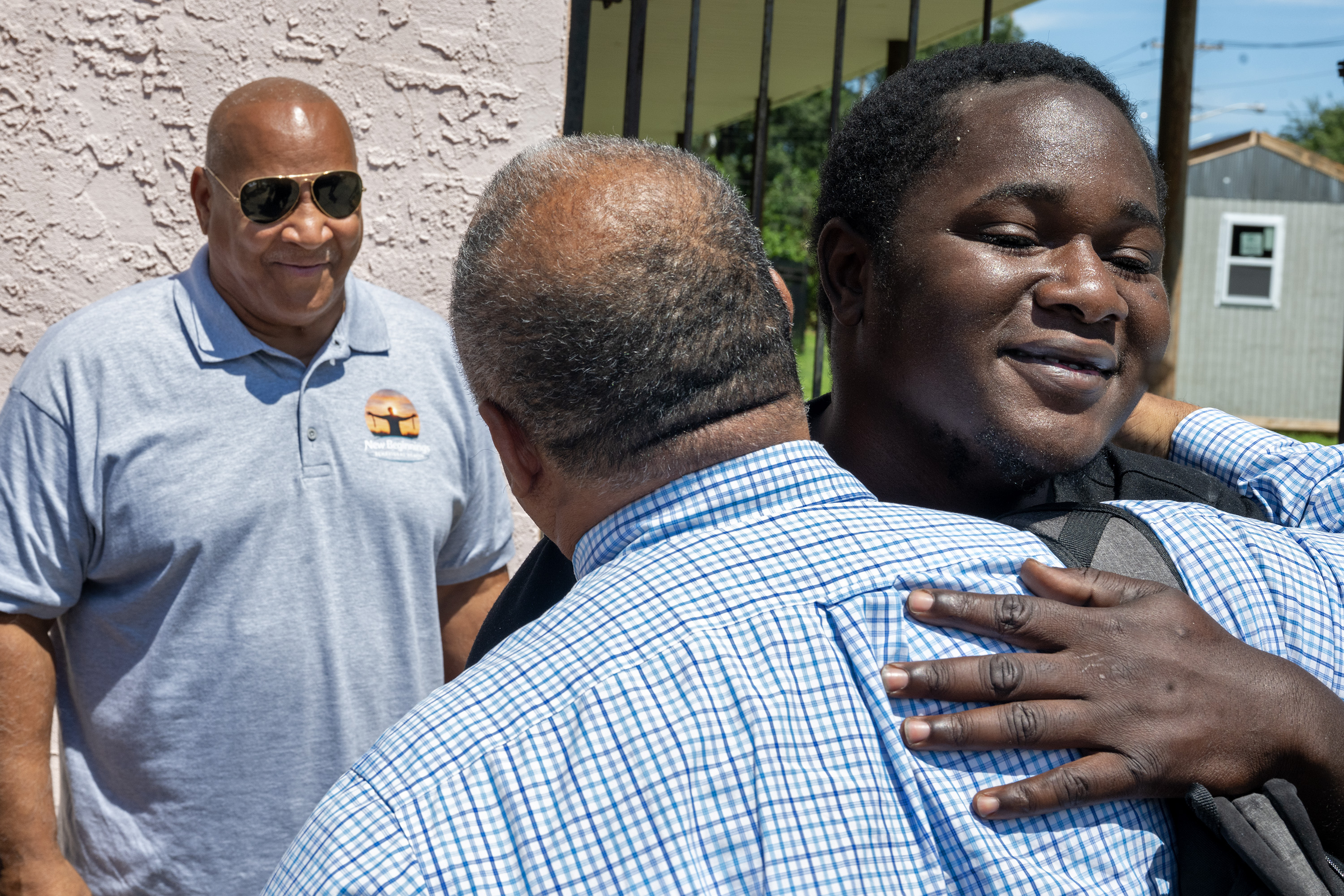
Camden resident Gregory “Baby Face” Williams arrives to take a van to the ShopRite in Cherry Hill Tuesday, Aug. 4, 2026. Pastor Amir Khan (left) is on a mission to help residents eat healthier, as Camden is a food desert and doesn’t have any grocery stores. With a grant from FEED NJ, Khan is picking up residents and transporting them free of a charge to the suburban store.Tom Gralish / Staff Photographer
It’s funded by a grant from Food Equity and Economic Development in New Jersey, or FEED NJ, which seeks to provide residents in food deserts like Camden and Salem with better access to fresh, affordable, and healthy food options not always available in their local community.
Camden, a nine-square-mile city of about 71,000, has not had a full-service supermarket since 2013, when the Pathmark store on Mount Ephraim Avenue closed. The city tops the state’s list of 50 food desert communities.
Those with cars or access to public transportation travel to nearby suburban communities or shop at pricey neighborhood corner stores or bodegas with fewer healthy options.
After efforts to bring a supermarket to Camden fell short, Pastor Amir Khan launched the free shuttle service with a $487,000 FEED NJ grant awarded earlier this year from the New Jersey Economic Development Authority (NJEDA). He purchased three vans to transport Camden residents to the supermarket along with equipment for a pantry.
“I knew that this was what was best for people of Camden,” Khan said. “God blesses us to be a blessing to others.”
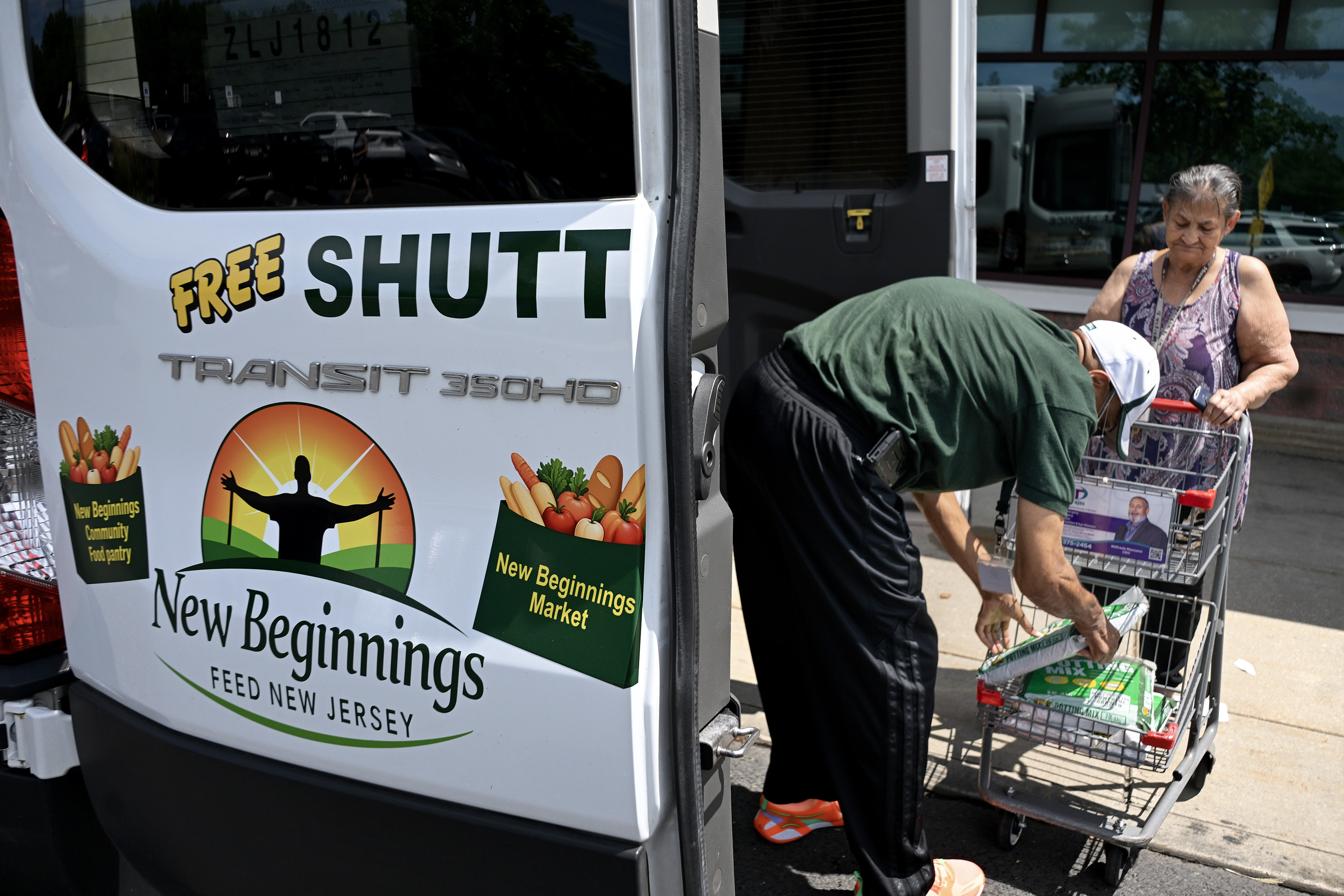
Van driver Lonnie Watkins helps Camden resident Agripina Vega unload her cart after shopping at the ShopRite in Cherry Hill Tuesday, Aug. 4, 2026. Camden is a food desert and doesn’t have any grocery stores. Pastor Amir Khan is on a mission to help residents eat healthier. With a grant from FEED NJ, Khan is picking up residents and transporting them free of a charge to the suburban store.Tom Gralish / Staff Photographer
The grant was made through a $30 million state pilot program that awards funds for projects to improve food access and food security in the New Jersey communities most in need, said Tara Colton, chief economic security officer at NJEDA.
Nearly $9 million was awarded to projects such as urban farming and fresh markets in Camden, Colton said, and statewide, 72 organizations received grants.
“Food security is crucial to the state’s economic success,” Colton said. “We need to ensure that everyone has their basic needs met.”
Agripina Vega, 75, was happy to get transported from the Riverview Towers, a building for senior citizens in Camden. Normally, she has to wait until her daughter-in-law can pick her up.
“I love it,” Vega said, standing in front of ShopRite waiting for a ride home after purchasing meat, fruit, and dog food.
Khan operates the shuttle through his New Beginnings Behavioral Health, a faith-based nonprofit that helps unhoused people, people recovering from addiction, and returning citizens transition back into society.
In addition to the shuttle service, the center provides a community food bank and pantry. It also has several shelters, provides job training and placement, and offers mental health and drug counseling.
Khan believes his mission is “changing and transforming lives.” He encourages clients to follow a motto on a sign in the lobby that reads: “Accept what is. Let go of what was. Have faith in what will be.”
Jay Rutherford, the program’s supervisor, hopes others will learn from his life. He was released from prison in 2023 after serving 31 years for felony murder.
“I was in a bad situation,” said Rutherford, 52. He was 19 when he went to prison.
Khan said his work at New Beginnings was inspired by his father, a doctor in Camden who often provided free treatment to patients unable to pay. His goal is to help residents choose healthier lifestyles.
The shuttle service to ShopRite is available to Camden residents only, said Lorene Watkins, a director at Khan’s organization. It operates Mondays through Fridays, and occasionally on Saturdays to meet demand, she said. About 25 people are transported weekly, she said.
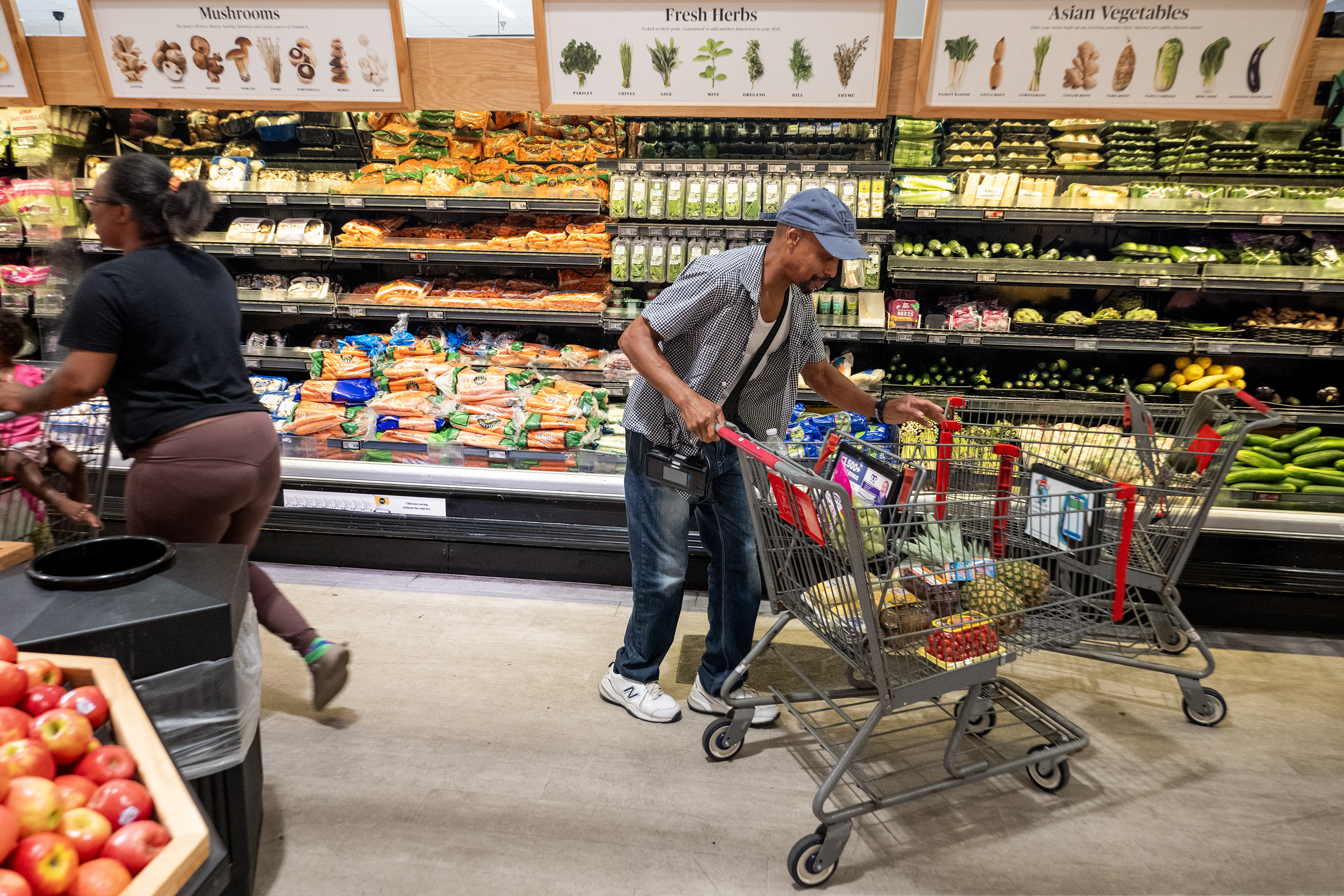
Camden resident Ryan Crews (right) shops at the ShopRite in Cherry Hill Tuesday, Aug. 4, 2026. Tom Gralish / Staff Photographer
“It’s terrible that there’s no supermarket here,” Watkins said. “These are people, too, and they should have a supermarket.”
Colton said there are “promising efforts” to eventually locate a supermarket in Camden, perhaps with a smaller footprint. Meanwhile, the state is funding food access programs to help meet the need, she said.
The state is not “giving up the goal of a full-service supermarket,” Colton said.
Watkins said a mobile market stocked with groceries will be added to the New Beginnings fleet in a few months. It will make stops around Camden and residents can purchase items from the van, she said.
Since it began a few weeks ago, the shuttle service has added stops at Walmart and Aldi stores in Cherry Hill to the routes, Khan said.
“We want to be a convenience,” he said. “Anything we can do to get people to eat healthier.”
The family-owned ShopRite supported the shuttle grant, said Jason Ravitz, vice president of operations for the Ravitz Family Markets. It has also donated food gift cards, Watkins said.
“Hopefully, people’s dollars can go further,” Ravitz said. “We were always taught you have to be there for the community.”
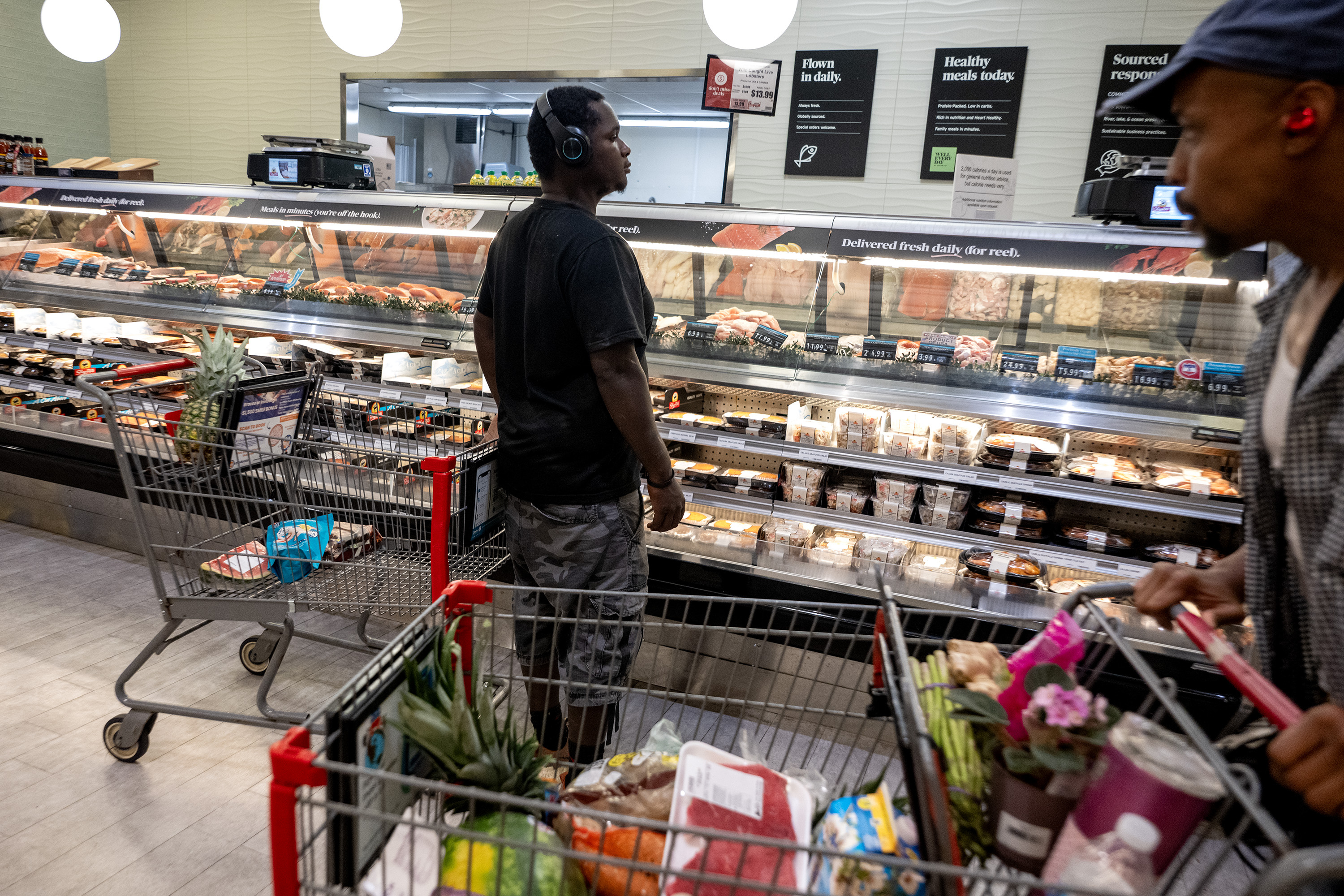
Camden residents Gregory “Baby Face” Williams (left) and Ryan Crews (right) shop at the ShopRite in Cherry Hill Tuesday, Aug. 4, 2026. Tom Gralish / Staff Photographer
First-time shopper Benjamin Moore, 33, picked up fresh fish, chicken, and dairy products. He typically shops at a corner store.
“There’s a lot more stuff here, more of a variety,” he said.
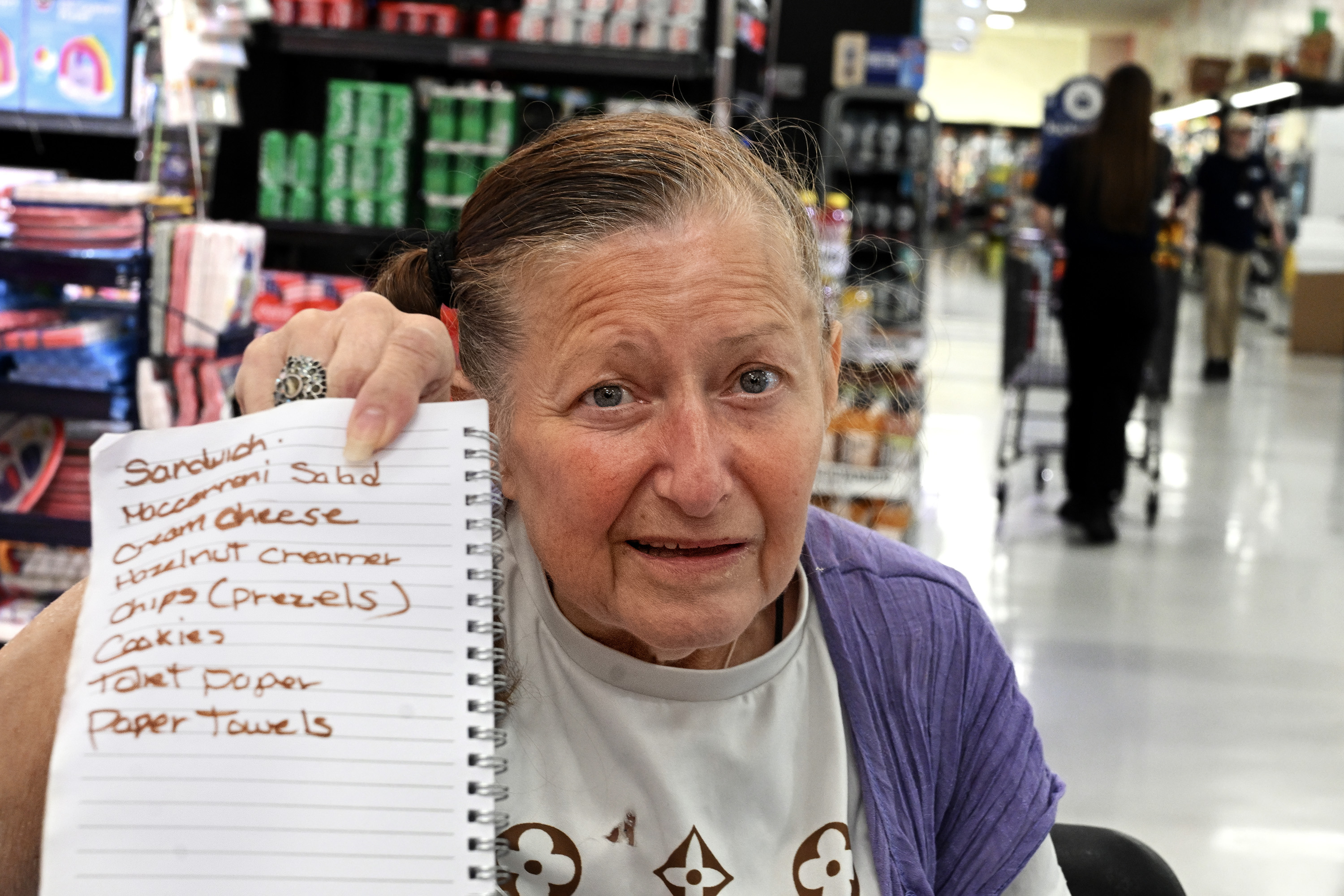
Kathy Mason, 65, made a shopping list before traveling to the store and pulled it out to make sure she didn’t forget anything. She navigated the massive store picking up items.
“I don’t have that much money at all,” Mason said. “For the whole month, it’s really tight.”
Camden resident Kathy Mason displays her shopping list at the ShopRite in Cherry Hill Tuesday, Aug. 4, 2026. Camden is a food desert and doesn’t have any grocery stores. Pastor Amir Khan is on a mission to help residents eat healthier. With a grant from FEED NJ, Khan is picking up residents and transporting them free of a charge to the suburban store.Tom Gralish / Staff Photographer
Like many of the other riders, Mason receives Social Security or Supplemental Nutrition Assistance Program food assistance benefits. They try to make healthy choices and stretch their dollars.
“Sometimes, if there is something I really want, I can’t get it,” said Williams, who receives $277 a month in food assistance. “You have to pay your bills.”
To schedule a pickup with New Beginnings Behavioral Health’s shuttle, call 856-588-0807.
Universal Health Services Inc. has long dominated as the nation’s largest provider of behavioral health services through its network of 182 hospitals and 110 outpatient facilities.
Last week, the King of Prussia company added a new dimension, completing the acquisition of Talkspace Inc., a virtual behavioral health company, for $835 million. It was UHS’s biggest deal in 15 years.
“We look at this as a real significant moment for healthcare,” UHS CEO Marc D. Miller said in an interview Tuesday. “It’s not simply a transaction for the company, but creating something in behavioral health that hasn’t existed.”
UHS’s goal is to create what Miller described as a new mental health continuum of care — including an AI agent introduced in June with human oversight and immediate intervention by licensed clinicians for safety if needed.
Talkspace’s network of 6,000 therapists conducted 933,000 treatment sessions with patients covered by insurance or employee assistance plans in the first half of this year. It had an additional 5,000 active patients who paid directly for the service during that period, according to Talkspace’s quarterly report.
The New York-based company reported $123.4 million in revenue and a $7.8 million net loss for the first six months of 2026.
UHS’s behavioral health arm had $3.9 billion in revenue and $773 million in profit before taxes in the six months that ended June 30. Philadelphia-area facilities include Friends Hospital in Philadelphia, Horsham Clinic in Ambler, and KeyStone Center in Chester.
UHS also owns the largest behavioral health company in the United Kingdom. Including its 30 acute-care hospitals, UHS’s six-month revenue totaled $9.1 billion.
The Inquirer spoke with Miller about how Talkspace is expected to complement UHS’s current business. This interviewhas been lightly edited for length and clarity.
What made Talkspace attractive to UHS?
By acquiring Talkspace for UHS, we’re creating the industry’s first nationally scaled end-to-end connected continuum in all of behavioral healthcare. Nobody has what we now have. For example, you can go to Talkspace to get treatment on your phone through the app, access therapists wherever you are, whatever’s comfortable for you. The vast majority are patients that UHS never would have touched.
Now, they’re going to know about UHS, so it would be natural that if they need excess care after they’ve had some care with Talkspace, they’re going to immediately be referred to all of the different options that UHS offers. On the flip side, we’re now going to have this Talkspace option after somebody’s either in one of our more intensive outpatient programs or an inpatient, so we can quickly say, as part of your aftercare, you might want to go to Talkspace, which is a subsidiary of UHS.
The concept makes sense. How do you make it work?
It’ll be totally integrated. Most of the insurers that they’re contracted with we’re contracted with, so there won’t have to be huge changes. There are some different contracts, and there will certainly be some things to work out, and there are some small pockets where they’re with somebody that we’re not. But for the most part, that’s not a big concern.
As far as the referral networks, we’re just doubling what we have. So there’s the current referral networks that go into UHS. There’s the current referral networks to Talkspace that are vastly different.
We’re now going to put this together, and we’re going to kind of double up the opportunities to both companies. It’s incredibly positive.
Talkspace’s AI agent Tee has gotten attention. Why is it different from using ChatGPT or Claude like a therapist?
Tee was purpose-built for mental health. Rather than just adapting a general purpose chatbot to a clinical context, this was built for this. That’s a huge difference. This was built by mental health experts who had safety and privacy in mind, and it was designed to complement human care.
People right now are going to ChatGPT and Claude and all these things and asking them questions that are totally disconnected, totally disjointed from any care they could be getting. If they’re not getting care, they’re really relying on something that is not expert to help them in a most serious endeavor.
Editor’s note: This article has been updated to correct UHS’s revenue and profit for the six months that ended June 30.
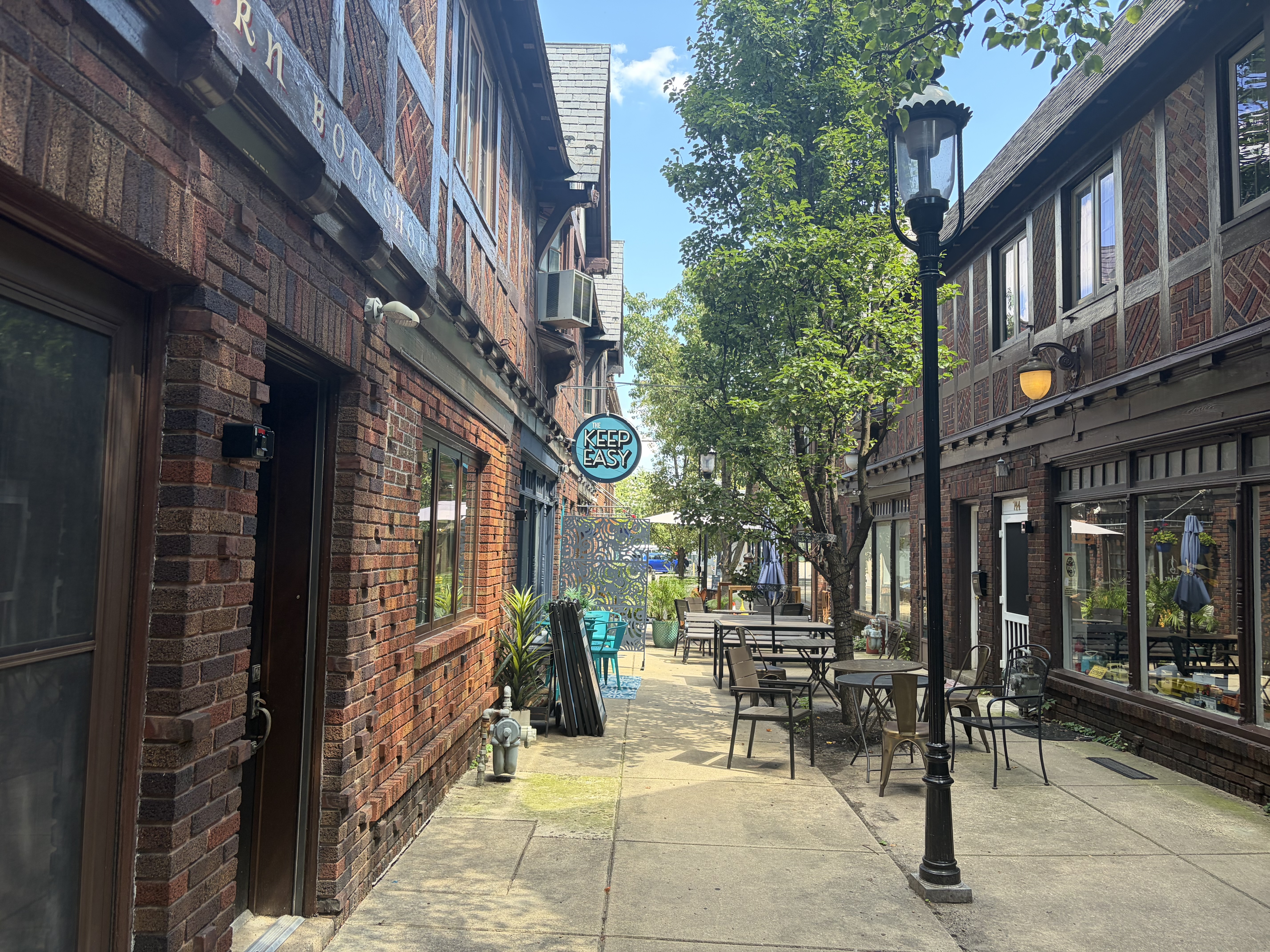
It looks like a street that belongs in its namesake English city, but the secluded, bricked Yorkway Place instead sits near the heart of Jenkintown, Pa.
For years, locals say, the pedestrian walkway drew few pedestrians: Offices and empty storefronts offered little reason to stroll along the 1930s Tudor-lined path, which runs into Route 611.
“I still meet people today who don’t even realize it’s there,” said Ross Abel, a Jenkintown resident who bought a Yorkway Place building this year that now hosts a cafe.
Unusual bar concept sparks alley renaissance
The tide began turning in 2023 when Melissa Hager turned her herb and tea store into a meadery, the Keep Easy, with her partner, Mike O’Donnell. While the Herb Shop had struggled, the bar took off.
Yorkway Place in Jenkintown, June 2026.Mel Hager
“That might’ve been the catalyst,” said Borough Manager George Locke. “The secret was getting that foot traffic in there.”
After the Keep Easy came Carminati Creamery, a gelato shop from Glenside, bringing a kid-friendly option to the alley.
The ice cream store “is the first thing that drew us in,” said Jenkintown Mayor Gabe Lerman, who has school-aged children. “Whatever we do for dinner, we can just walk up to Carminati’s.”
The Lore Café, an upscale, all-day coffee shop, added morning visitors to the scene. That’s what gave Jackie Botto the confidence to move Capricorn Books into Yorkway Place.
“We took a gamble,” Botto said. “I did not plan for it to be so busy.”
Themed events have attracted more newcomers, from a Nic Cage bar crawl to Jenkintown Festivus. Capricorn participated in the annual Philadelphia Bookstore Crawl, typically the store’s biggest day of the year, at their new Yorkway Place location for the first time this past weekend.
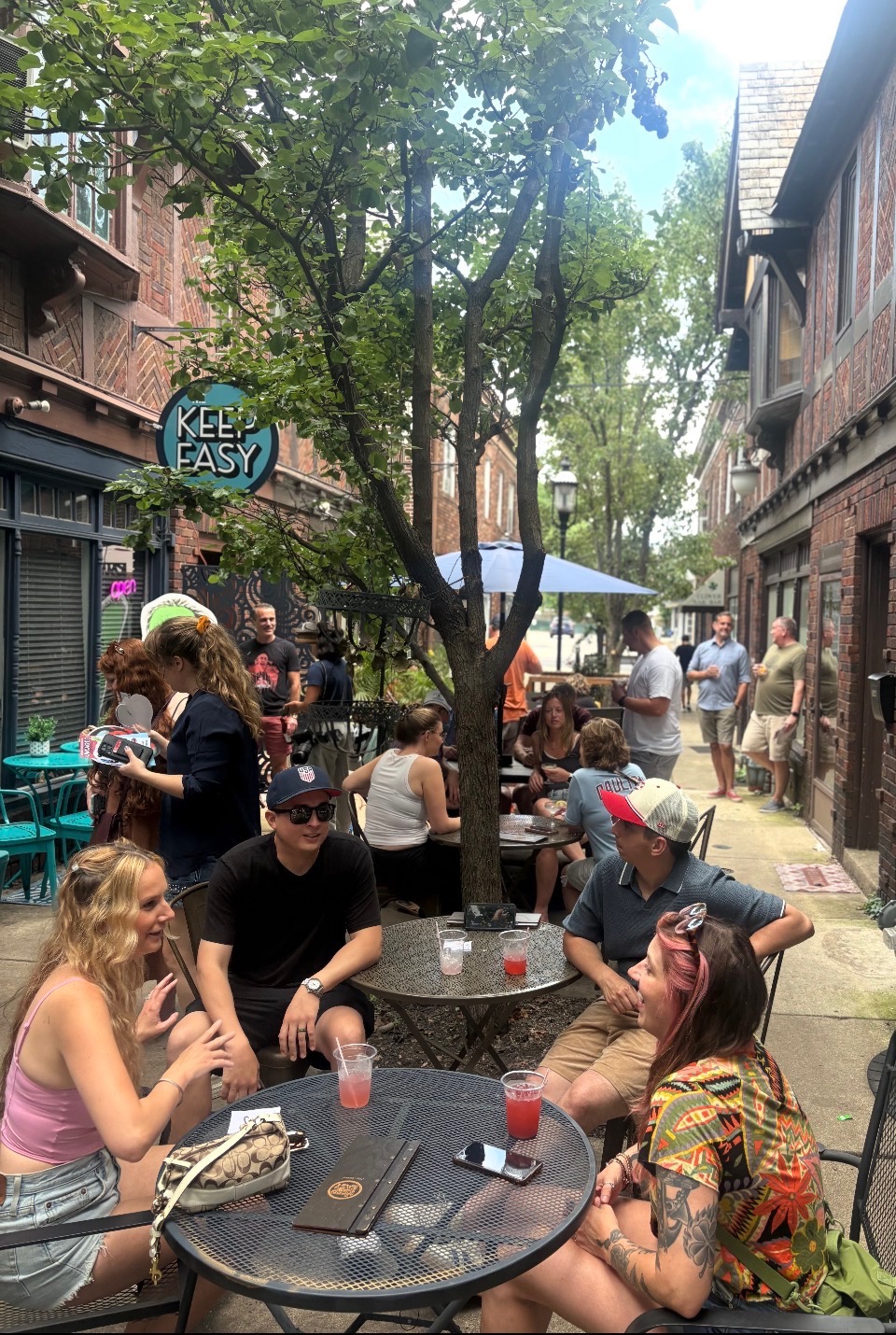
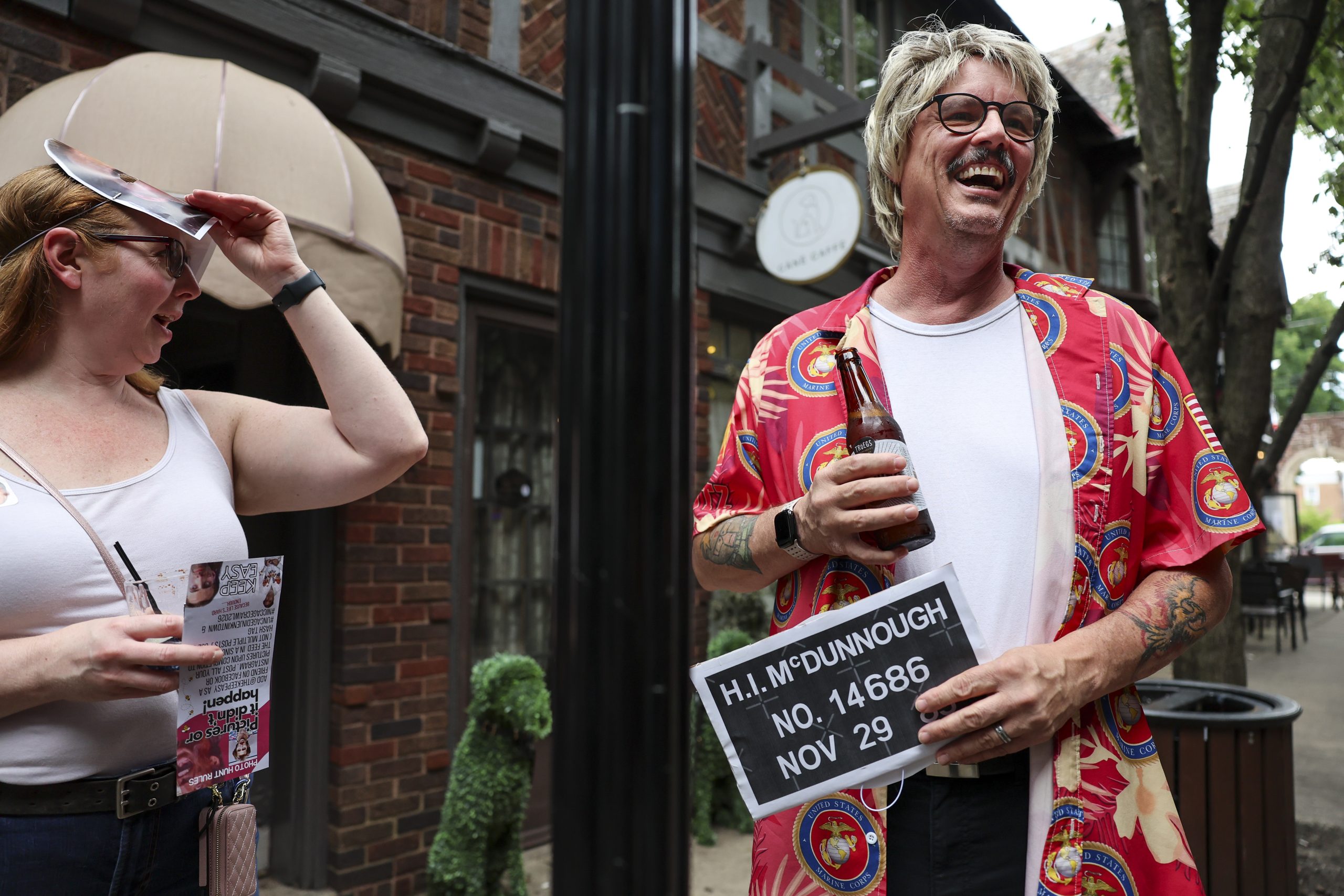
Vicky Hutz and Mike Hutz, of Huntington Valley, speak with a reporter at the Keep Easy during the Nic Cage cocktail crawl on Sunday, June 28, 2026, in Jenkintown, Pa. Participants gathered to celebrate actor Nicolas Cage with Cage-themed cocktails, movie screenings, and “Cage matches.”Monica Herndon / Staff Photographer
Personalized support helped local businesses
Personalized, direct support has helped bring more small businesses to Jenkintown, locals say.
The borough started helping owners secure sewer permits from the state several years ago, Locke said. Each permit is “20 to 40 hours of my time.”
“It’s a tough process,” he said.
As for filling Yorkway Place, “It’s been Mel,” Botto said, who’s been reaching out to potential owners about vacancies.
“I was texting everyone I know,” Hager, the meaderist, said.
Lerman said Jenkintown also recently added free 20-minute parking spots, which helped stores throughout the town.
And many of Yorkway Place’s business owners live in the borough, the mayor said: “They’re all invested in being good stewards and in having a place you can feel good about sending your kids with a few bucks to get a gelato, or a book.”
Jenkintown alley to see new stores in 2026
Several more businesses are set to arrive in Yorkway Place in the coming months.
In September, insect taxidermist Kat Smith is opening an art supply, stationery, and craft cafe.
A game room and bottle bar is slated to open above Keep Easy in October.
And a record store, Smelly’s Vinyl Vibes, is also coming this fall.
“This is such a cool little street,” Abel said. “All these new shops are helping people to discover it.”
This suburban content is produced with support from the Leslie Miller and Richard Worley Foundation and The Lenfest Institute for Journalism. Editorial content is created independently of the project donors. Gifts to support The Inquirer’s high-impact journalism can be made at inquirer.com/donate. A list of Lenfest Institute donors can be found at lenfestinstitute.org/supporters.
WASHINGTON — When the New York Liberty waived Betnijah Laney-Hamilton earlier this month, it caused quite a commotion around the WNBA.
The transaction wasn’t too much of a surprise, since her playing time had fallen sharply from years past. But the 32-year-old with roots in the Philly area was a Liberty fan favorite, and a key piece of the team’s long-awaited first title in 2024.
Now the rest of the league had a shot to sign a former WNBA and FIBA world champion, All-Star, and first-team all-defense player with a reputation as a great teammate.
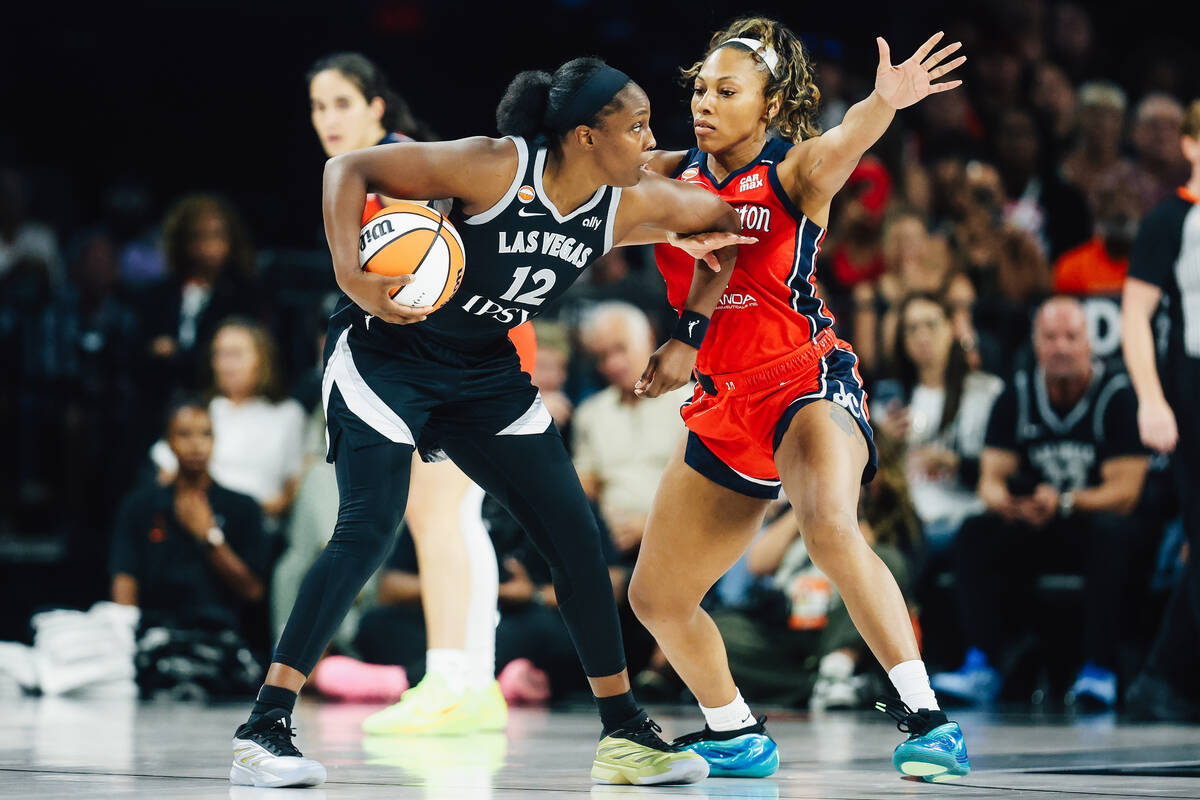
It turned out that the moving van didn’t have to go too far. The Washington Mystics won the race to claim her, jumping at the chance to add a veteran to a team full of young promise.
“The transition’s been pretty easy, just in terms of how everyone’s embraced me and just made it easy,” Laney-Hamilton said. “It’s nice always being able to be close to home, where my family can get here and everything.”
Washington has been the biggest surprise in the league this year. On a circuit full of sizzling stars, the Mystics have a lot of good players, but not a household name yet. Still, they started the week in seventh place, and clinched a playoff spot Sunday night with a win in Portland.
From there, they could look down at Paige Bueckers and Arike Ogunbowale’s Dallas Wings in eighth, and two marquee squads already eliminated from playoff contention: Nneka Ogwumike and Cameron Brink’s Los Angeles Sparks, and Kahleah Copper and Alyssa Thomas’ Phoenix Mercury.
The feed inside and the finish 🤝
Betnijah Laney-Hamilton finds an open Lauren Betts in the paint for two
The Mystics still have a ways to go until they’re real contenders, and they showed it in last Friday’s loss to the first-place Minnesota Lynx. Though Washington battled gamely throughout, the decisive moments were the little things down the stretch: a missed shot here, a turnover there, a basket conceded on a break the other way.
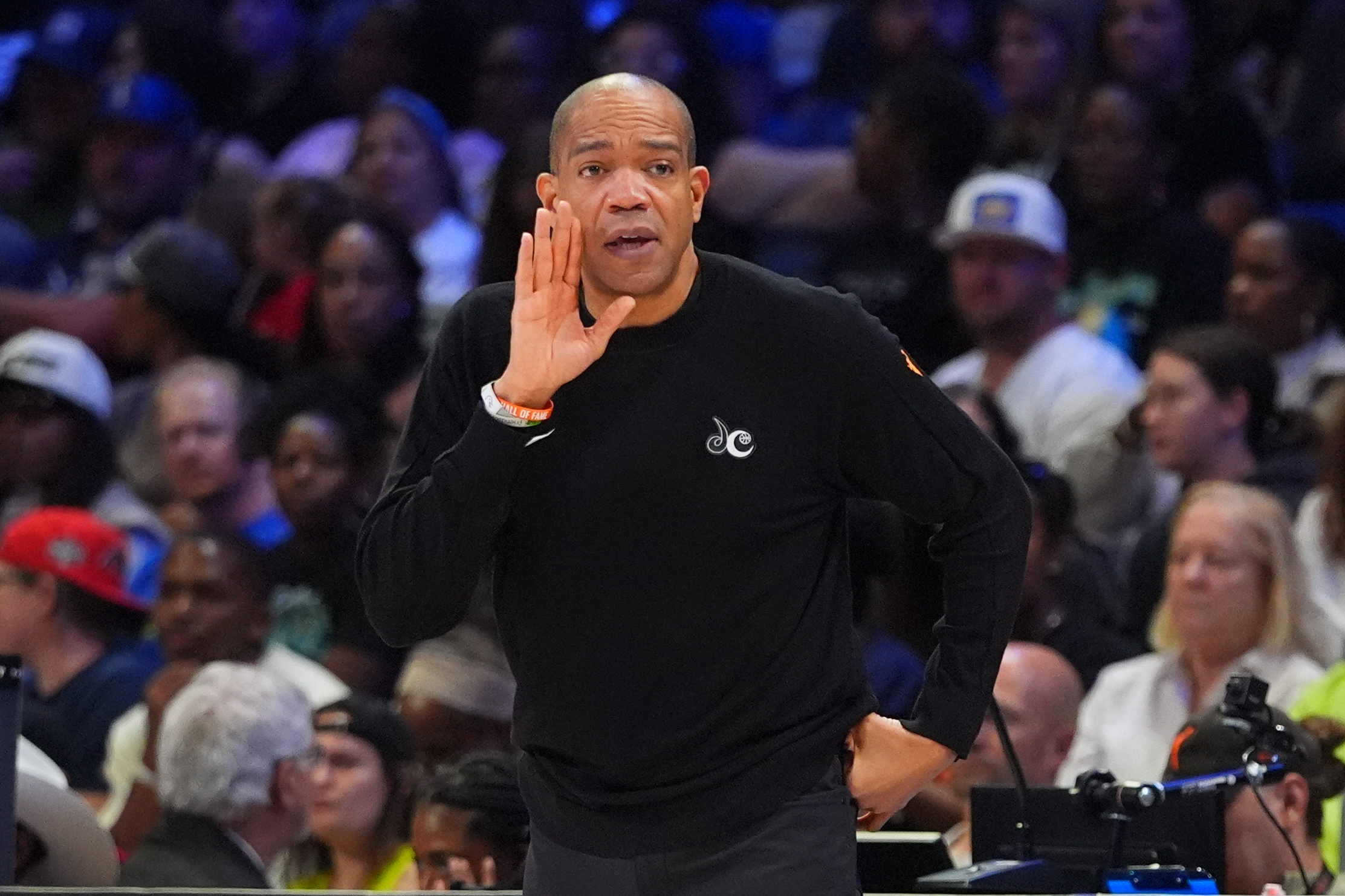
Perhaps those things will come in time for former college greats like Sonia Citron, Kiki Iriafen, and Lauren Betts as they develop in the pros. Coach Sydney Johnson can hope Laney-Hamilton’s presence alongside the team’s other veterans, Shakira Austin and Michaela Onyenwere, will help the process go even faster.
“She’s hit the ground running here,” Johnson said. “They really respect her, they look up to her, they understand her playoff experience. She speaks with a high level of command with the players and coaches.
For now, Johnson is simply thrilled to have her, and he does not take her easy integration for granted. Sometimes, a veteran’s arrival to a new team can upset existing chemistry. That hasn’t happened here.
Sydney Johnson is a leading WNBA Coach of the Year candidate thanks to the Mystics’ rise this season.LM Otero
“We are about toughness and togetherness,” Johnson said. “When you watch her, you watch her career, it’s pretty clear that she’s as tough as nails out there. You see her interacting with her teammates on the court, and then all the intel behind the scenes, she’s an outstanding person and a giver — she’s really giving to her team. So we felt like we got a steal, we really do.”
Laney-Hamilton in turn praised her new teammates for “the energy, the intention behind everyone.” And she called Johnson “great,” helping with the transition then being clear about his expectations.
The Mystics are spending this week on the west coast, with two games to come at Phoenix and one at Los Angeles before the WNBA pauses at the end of the month for the FIBA World Cup. When the season resumes, there will be just four games left to jostle for playoff positioning.
Whatever happens along the way, it’s clear those expectations Laney-Hamilton mentioned have changed, thanks to her arrival.
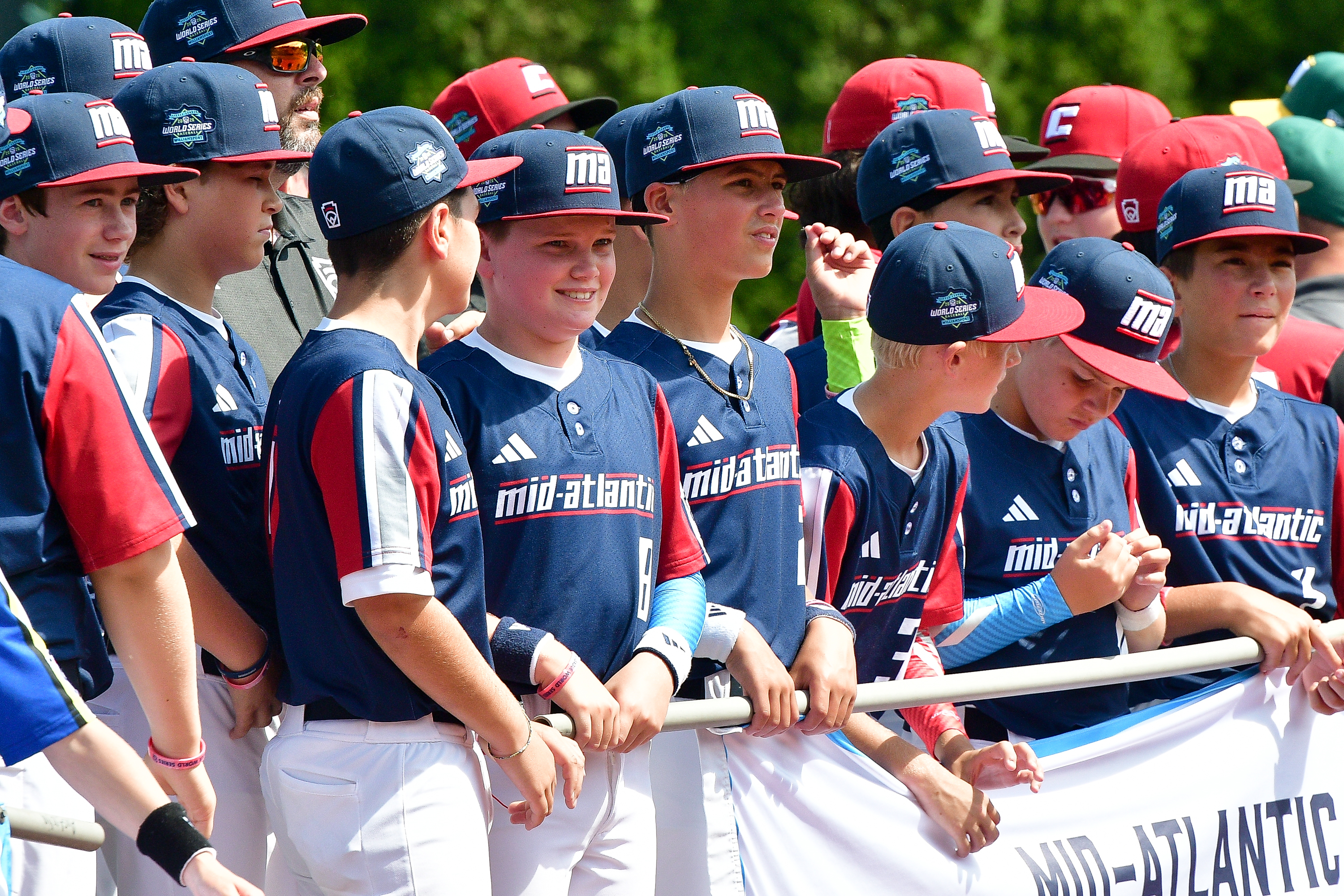
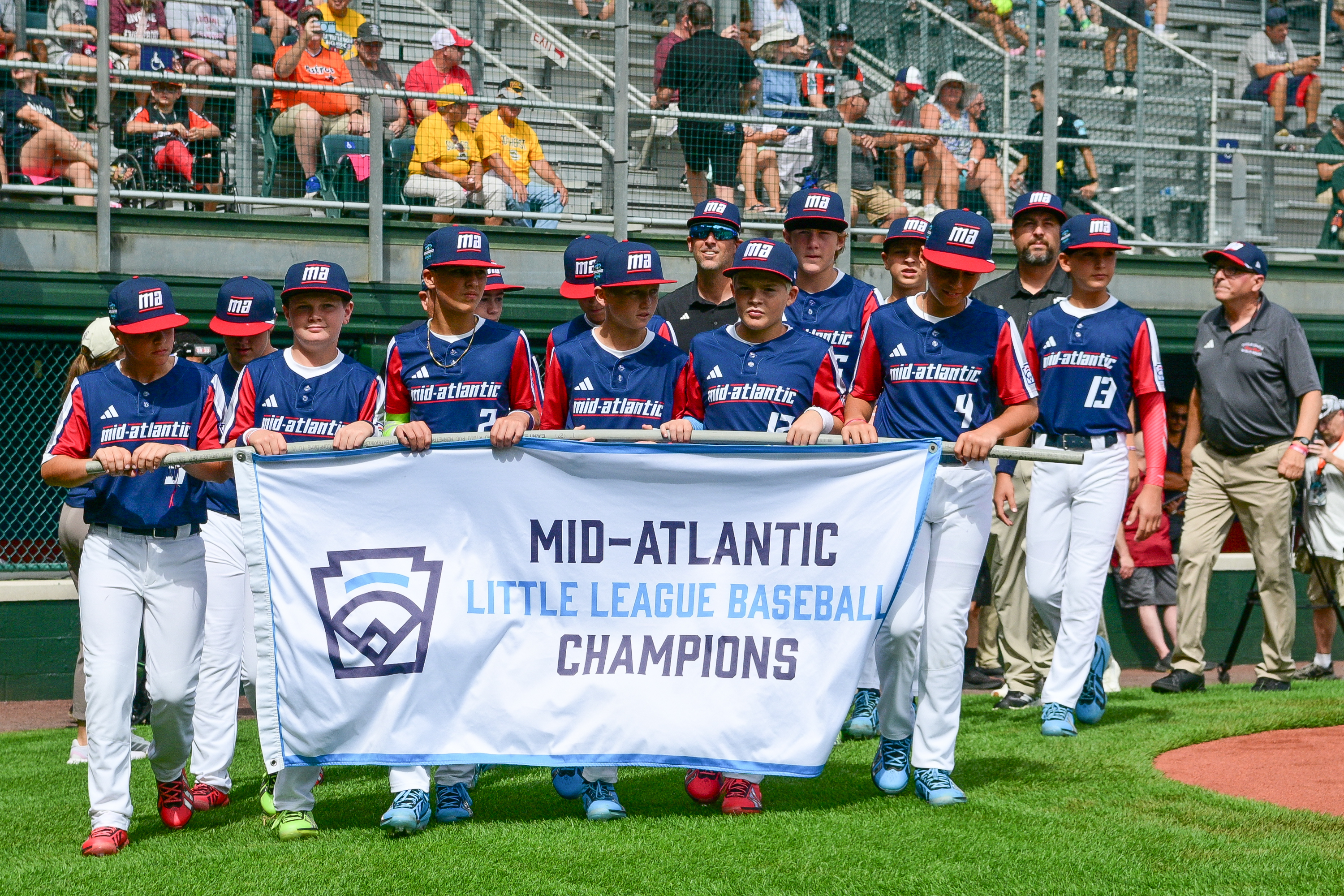
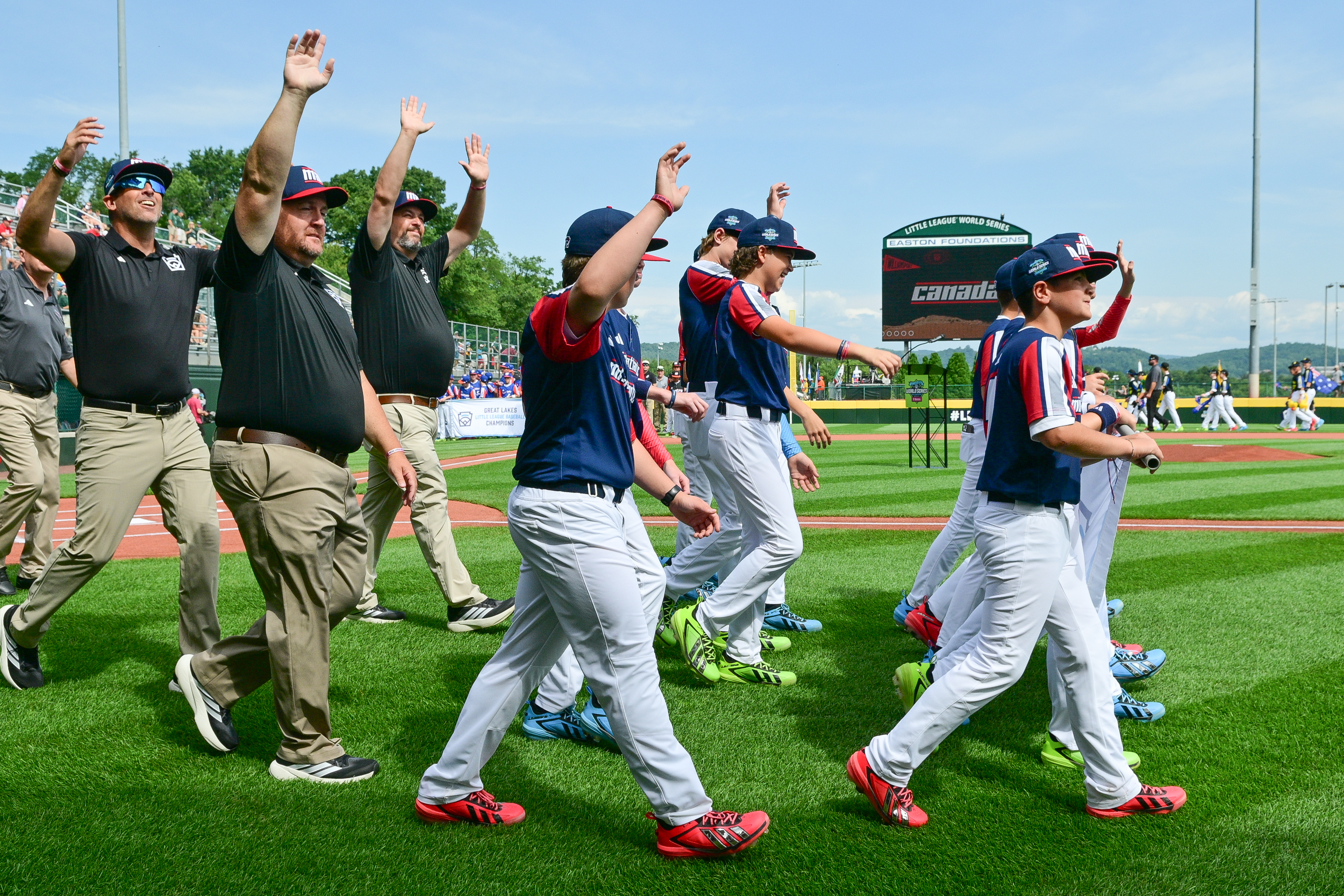
Though off to a disappointing start after losing their opening game Friday, nothing could dampen the fun for West Chester’s East Side Little League team Sunday as they hung out with the pros alongside their teammates during the Little League World Series MLB Classic.
Players from the Milwaukee Brewers and the Atlanta Braves came to Williamsport before their specialty game Sunday evening to sign balls, give high-fives and even play ping pong with the 12-and-under players from around the world.
“I got to play ping pong against Jacob Misiorowski and I beat him,” said Dillon DiGiulio, a first baseman and pitcher for East Side. “I was a little nervous. I was shaking.”
A highlight for many young players during the 12-day Little League World Series is the MLB Little League Classic. Started in 2017, the event brings two MLB teams to Williamsport to play a friendly game and celebrate the youth that fuel excitement in baseball.
East Side players were divided on who would win that night’s game, some cheering for the Brewers and some for the Braves, but they were all thrilled for the chance to talk with players they look up to.
East Side will play a team from Alabama in their next World Series matchup.Ralph Wilson / For The Inquirer
“My favorite part today has been getting all the signatures from the pros,” said Adam Zenis, a left fielder on the team. “We’re all really excited for the rest of the week, too.”
East Side will get its shot at redemption Monday, playing in the elimination bracket against the Southeast Region team from Phenix City, Ala. Ahead of the game, the 12-year-olds are feeling excited and confident.
For many of the players, though, the experience of playing in the World Series is the best part of it all, win or lose.
“My favorite part is just getting to hang out with all the different teams,” said Colton DeGrazio, a catcher on the team. “We’ve created so many bonds with teams and people around the world that we never even knew like Japan, Korea, and I just feel like that’s probably the coolest part.”
A loss on Monday would eliminate East Side from the tournament.Ralph Wilson / For The Inquirer
Though many of the boys root for different teams back home, from the Mets to the Phillies, it’s clear that every kid playing at the Little League World Series loves baseball to the bone.
“It’s just a dream come true, to be honest,” said East Side coach Bob Hennessey. “That’s every Little Leaguer’s dream. It was my dream growing up to see these boys get here and get to experience it. Nothing but amazing. I heard Colton say it’s an amazing experience to meet all these players and teams from around the world. So we’re lucky. We’re very lucky.”
It’s just about last call for roster hopefuls as Eagles training camp enters its final week.
The team plays its last preseason game Friday night at home vs. Cincinnati, and the initial 53-man roster is due Sunday by 6 p.m.
Only a few practices and one last audition separate those vying for a spot from knowing their fates.
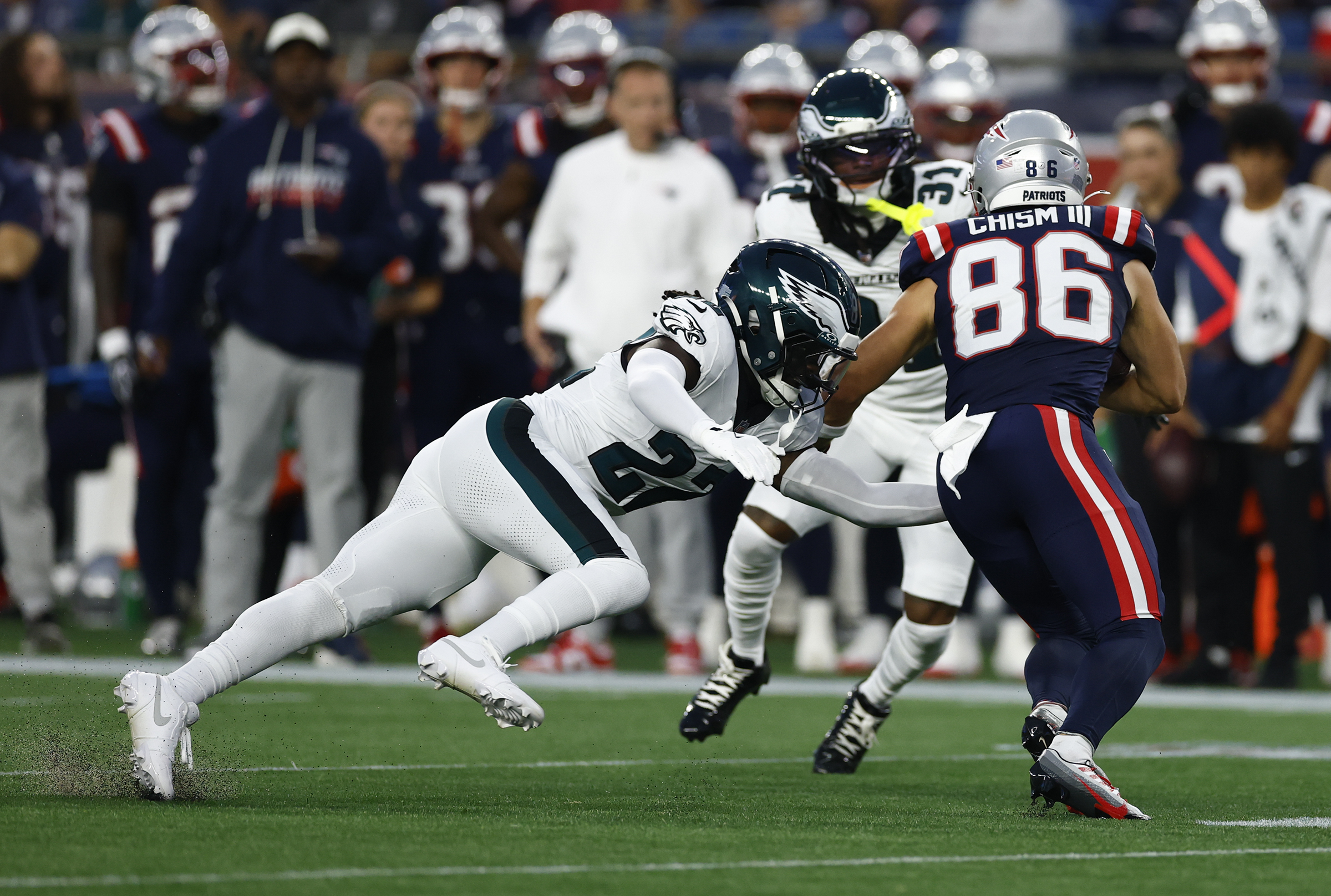
A second preseason game — this one a 24-21 Eagles loss in New England — brought a few changes to our latest 53-man roster projection. Who’s in, and who’s out?
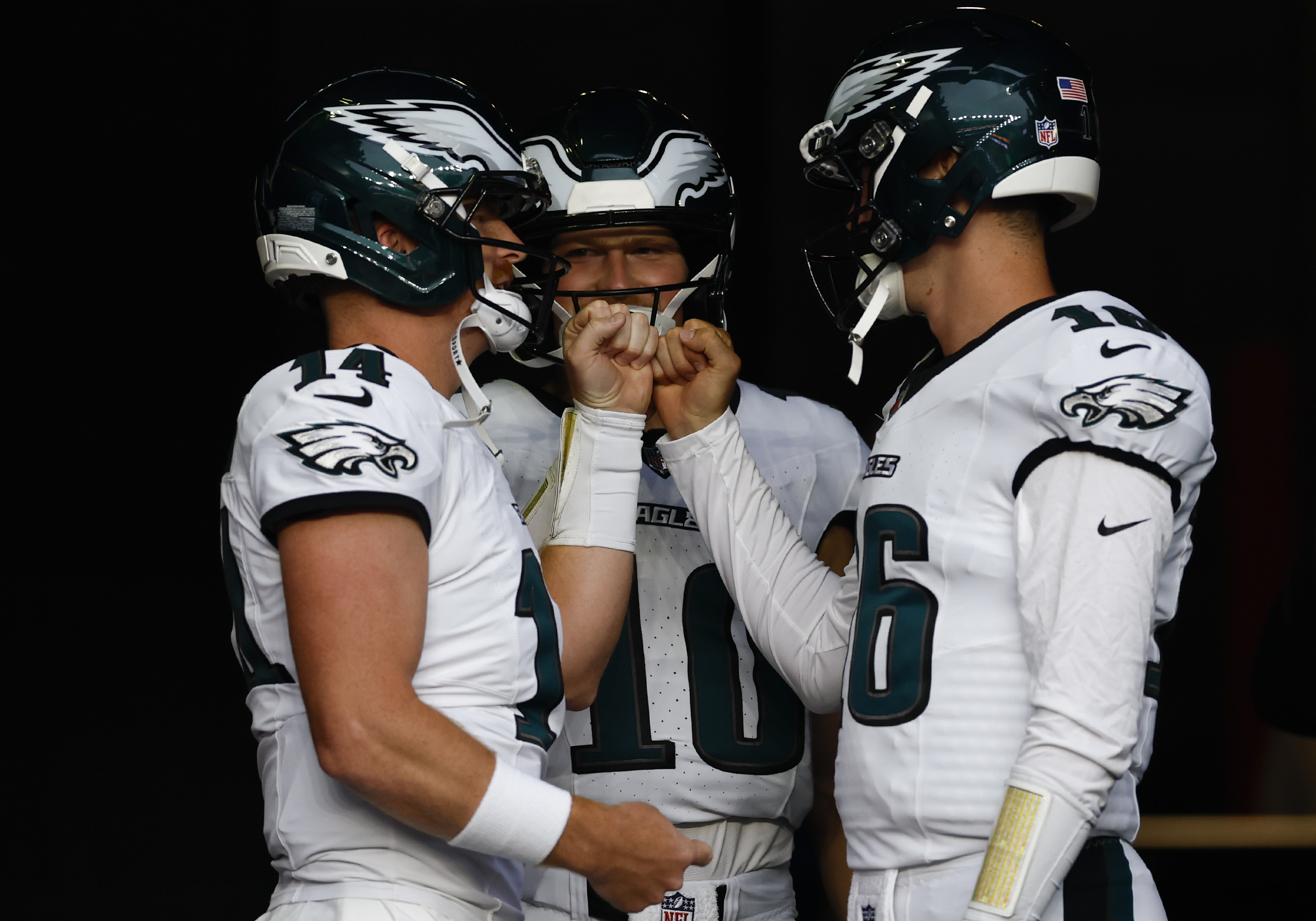
Eagles quarterbacks (from left to right): Andy Dalton, Cole Payton and Tanner McKee prepare for Saturday’s preseason game against the New England Patriots. We don’t expect all three to be on the Eagles roster by next week.Yong Kim / Staff Photographer
We’re sticking with the idea that one of the two quarterbacks hunting for the No. 2 job eventually will be traded, but for the first time this summer, Tanner McKee is in and Andy Dalton is out.
McKee outperformed Dalton Saturday night in New England, and while the Eagles certainly value Dalton’s experience and his practice film much more than two shaky, shortened preseason starts, it’s hard to argue that the 38-year-old looks more viable to back up Hurts than McKee does right now.
That being said, it actually might be Dalton who has more trade value than McKee. Will the Eagles end up flipping Dalton for the same price they paid for him (a seventh-round pick)? Maybe. This time of year, a team looking for a backup may be more likely to want Dalton as an experienced starter who may even mentor a young quarterback than they are to need McKee.
Cole Payton hasn’t wowed, and it remains possible the Eagles keep both Dalton and McKee and cut Payton, their fifth-round pick. But for now, Payton gets the roster spot and doesn’t get exposed to waivers.
Eagles running back Will Shipley carried the ball 11 times for 56 yards against the Patriots. We expect him to make the team’s initial roster.Yong Kim / Staff Photographer
Running backs (3): Saquon Barkley, Tank Bigsby, Will Shipley
Cut: Dameon Pierce, Carson Steele, Ja’Quinden Jackson
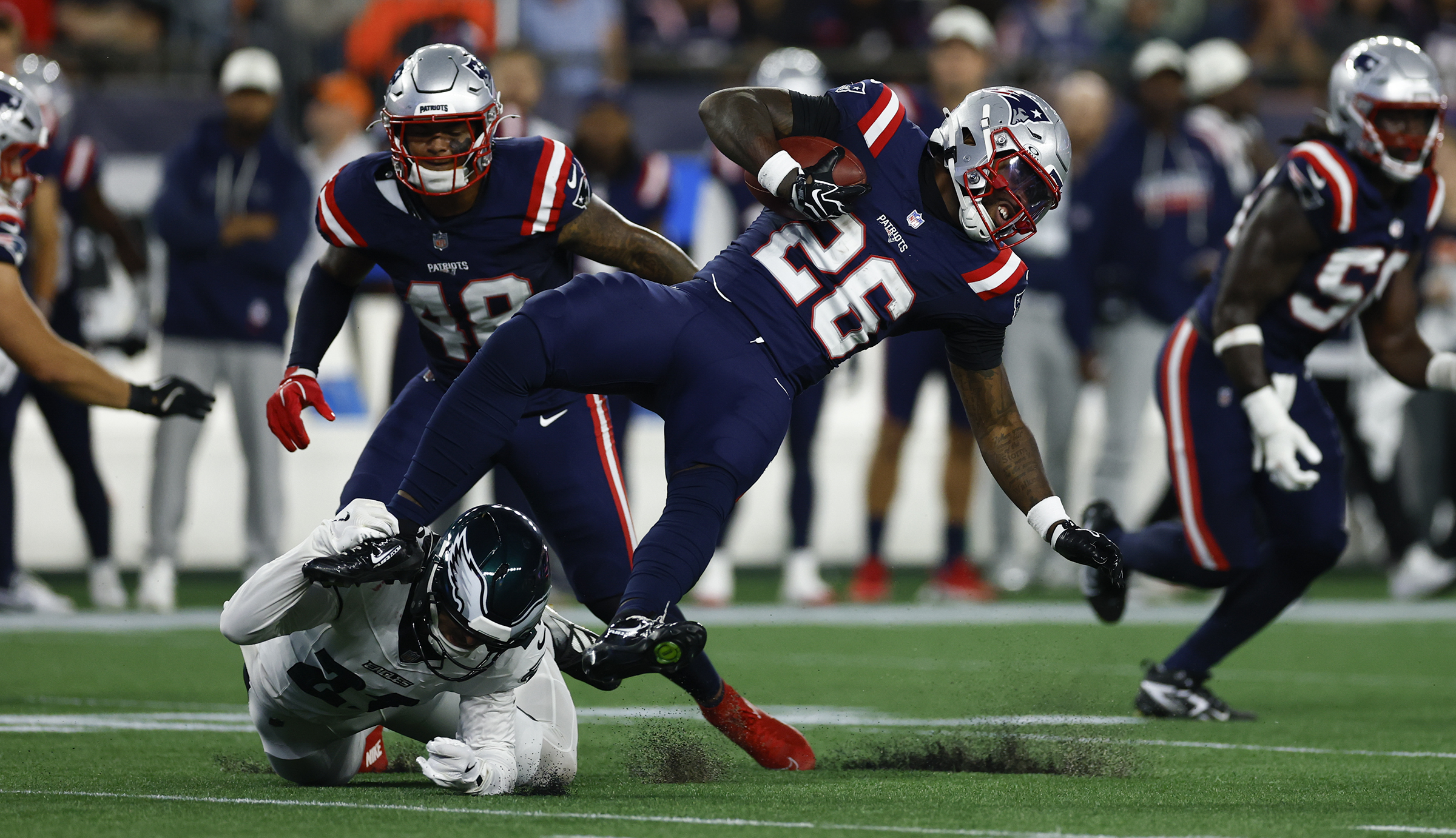
No changes here, despite Carson Steele going full Saquon Barkley and hurdling defenders on more than one occasion Saturday night. Steele played like a guy pushing for a roster spot, but the Eagles don’t have the luxury of keeping four running backs with the way their roster is shaped.
Eagles wide receiver Elijah Moore is on the roster bubble.Jose F. Moreno / Staff Photographer
Wide receivers (6): DeVonta Smith, Dontayvion Wicks, Makai Lemon, Darius Cooper, Hollywood Brown, Elijah Moore
Cut: Danny Gray, Britain Covey, Quez Watkins, Erik Ezukanma, Samori Toure, Brandon Hayes
Could Elijah Moore get cut and come back on the practice squad with the promise to be elevated on game day? It’s possible. He’s a vested veteran and doesn’t need to pass through waivers (though he’d be free to sign with any team). But Moore has done enough to make the roster and should be rewarded for having a better camp than Hollywood Brown, the guy the Eagles gave $5 million guaranteed.
Perhaps the Eagles use one of the two as a trade chip in the final week of camp, but they may want some extra insurance at the position considering Makai Lemon’s first NFL training camp has been marred by a hamstring injury.
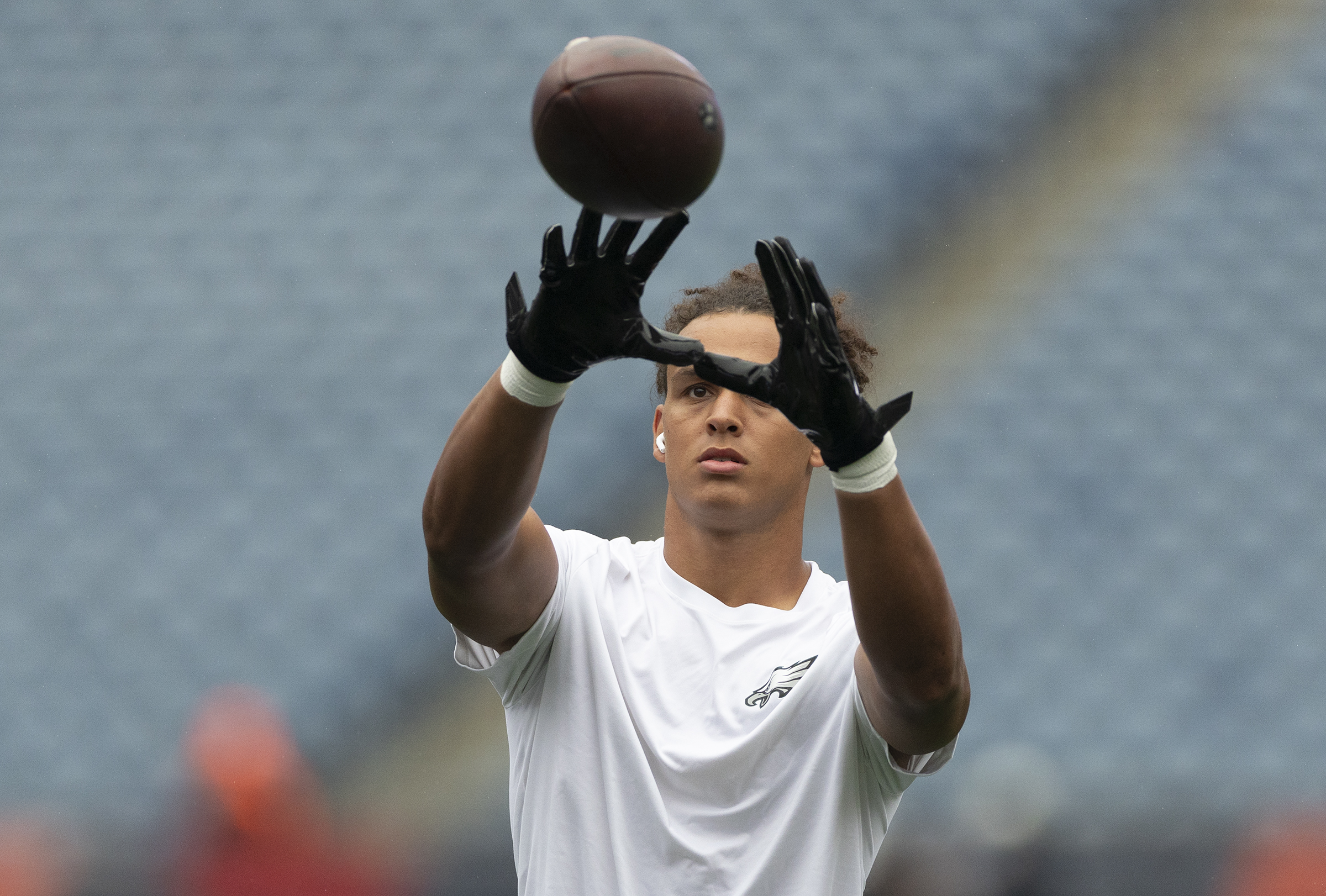
The Eagles selected tight end Eli Stowers in the second round of April’s NFL draft.Yong Kim / Staff Photographer
Tight ends (3): Dallas Goedert, Johnny Mundt, Eli Stowers
Cut: Cameron Latu, Grant Calcaterra, Stone Smartt, E.J. Jenkins
Cameron Latu is the roster casualty of the Eagles keeping Moore. Latu would need to pass through waivers, but he’s done so before, and the Eagles shouldn’t have trouble getting him through to the practice squad and elevating him for Week 1.
Eli Stowers has had a rocky camp, but the second-round pick isn’t going anywhere. His need for more seasoning, though, makes it pretty important to have a strong fourth option in the building. That could work in Latu’s favor come Sunday evening.
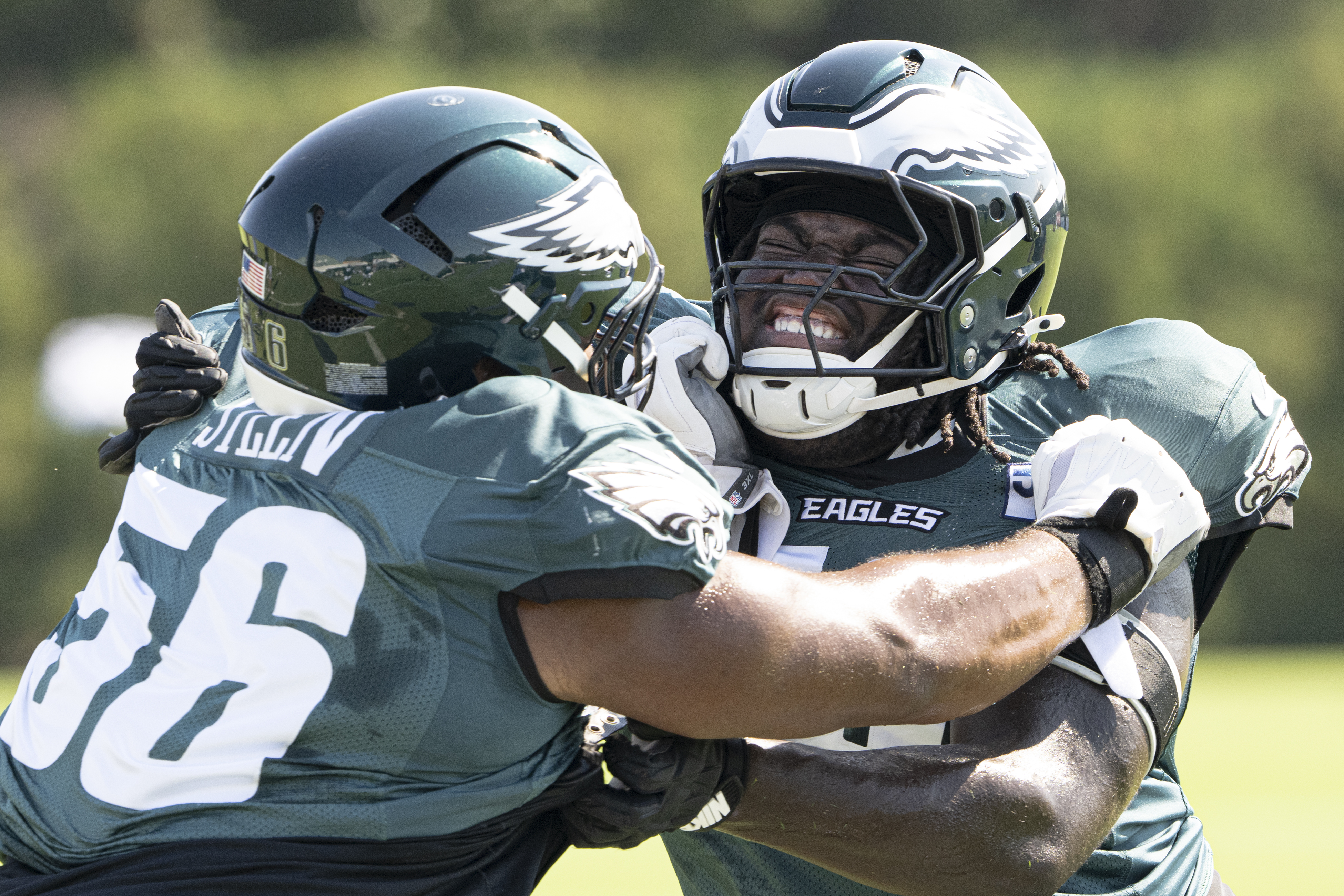
Offensive lineman Tyler Steen, left, is pretty much a lock to return, but Micah Morris’ fate could be determined in the coming week.Jose F. Moreno / Staff Photographer
Offensive line (10): Jordan Mailata, Landon Dickerson, Cam Jurgens, Tyler Steen, Lane Johnson, Fred Johnson, Markel Bell, Drew Kendall, Willie Lampkin, Micah Morris
Cut: Jake Majors, Michael Jordan, John Ojukwu, Myles Hinton, Cameron Williams, Zeke Correll
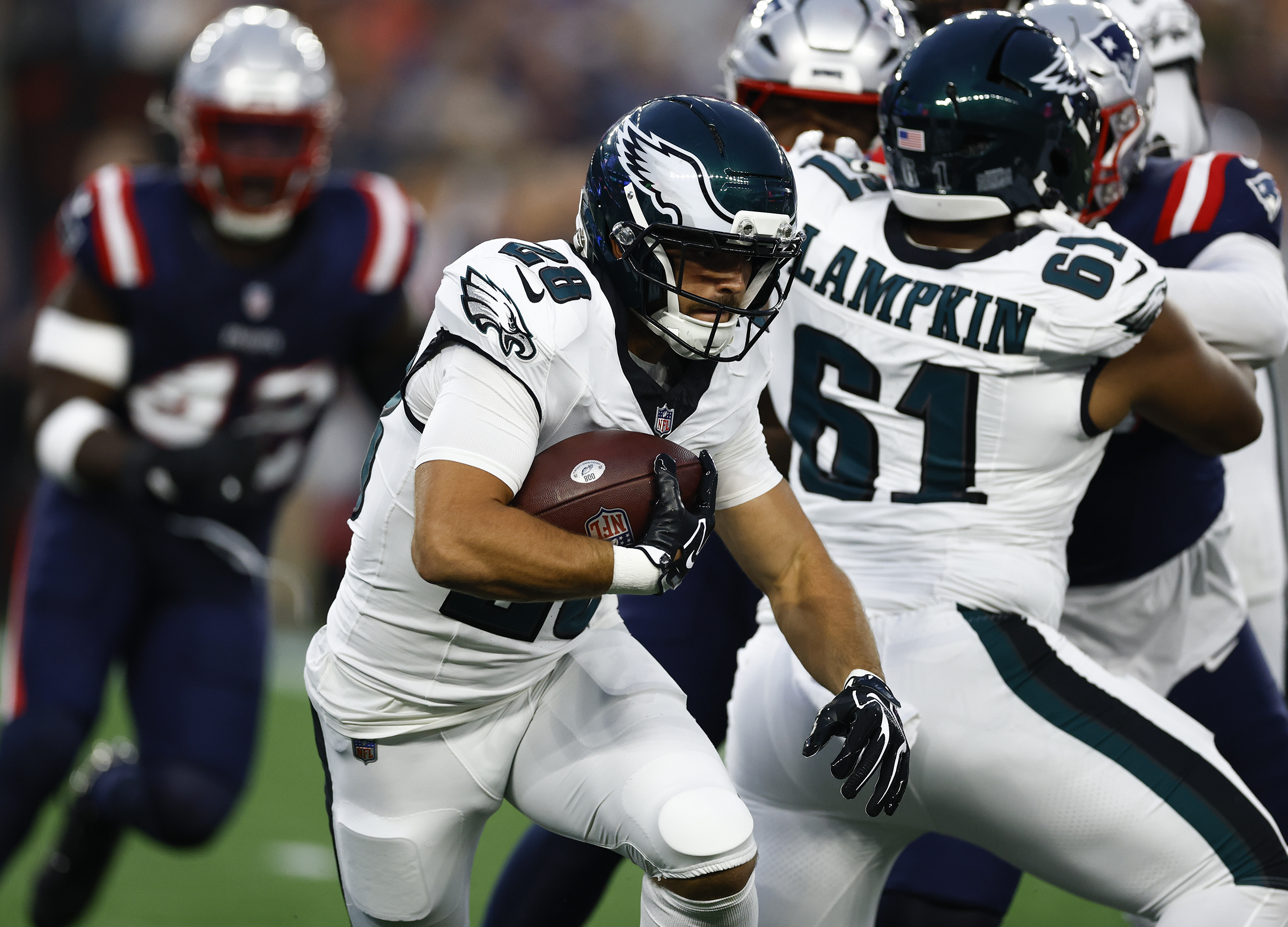
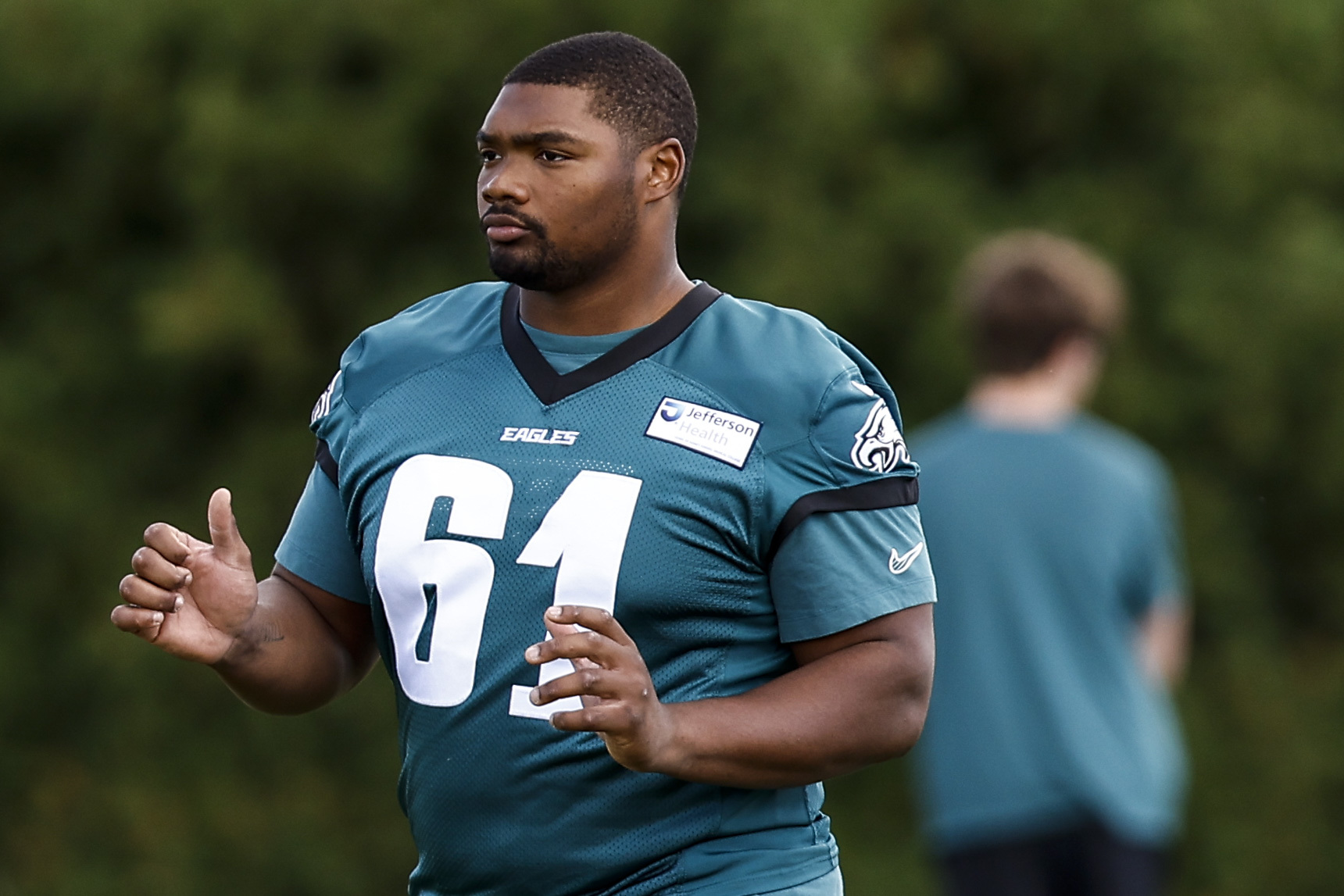
Willie Lampkin’s spot on the 53-man roster might be a lock at this point. The center/guard had another strong performance Saturday. Micah Morris, meanwhile, has shown some athletic traits that should keep the sixth-round pick on the initial roster.
Jake Majors played the entire game Saturday (63 snaps) and had some good moments. Like Lampkin and Drew Kendall, he has the ability to play center and guard. But Morris beats out the 2025 undrafted free agent who landed on the Eagles’ practice squad after training camp last year.
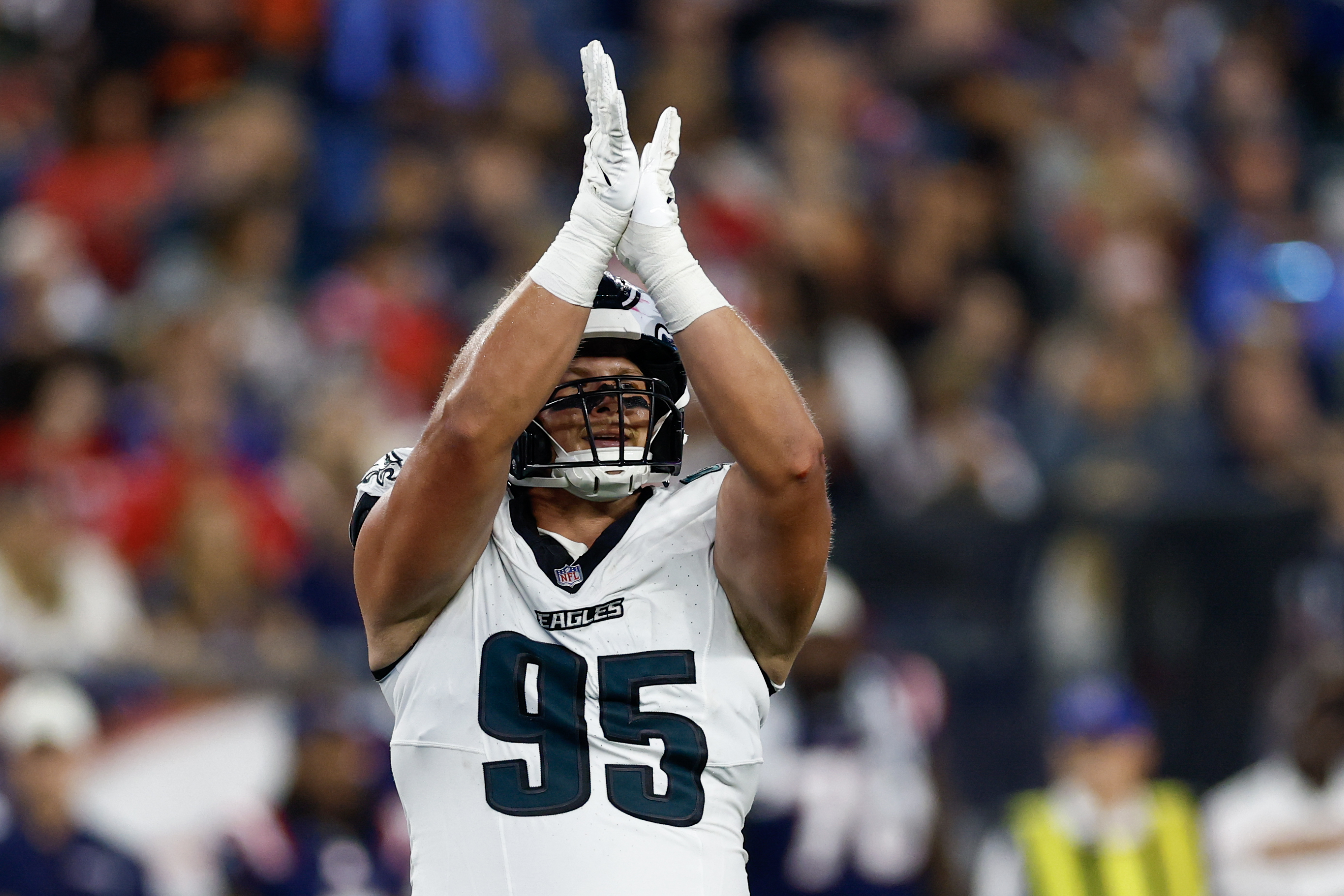
Eagles defensive tackle Ty Robinson had a pair of sacks in Saturday’s preseason game against the Patriots.Yong Kim / Staff Photographer
Defensive tackles (6): Jalen Carter, Jordan Davis, Moro Ojomo, Byron Young, Ty Robinson, Uar Bernard
Cut: Gabe Hall, Zion Wilson, David Blay
No changes here other than Ty Robinson pulling himself off life support (Vic Fangio’s words) and pretty much locking up his roster spot.
The 2025 fourth-round pick had two sacks Saturday and has had a strong last two weeks after working with the developmental group at the beginning of camp.
Uar Bernard played in his second football game Saturday and notched his first tackle. He’s improved throughout his first football camp, and it remains a risk for the Eagles to expose him to waivers even though he won’t play meaningful snaps this season.
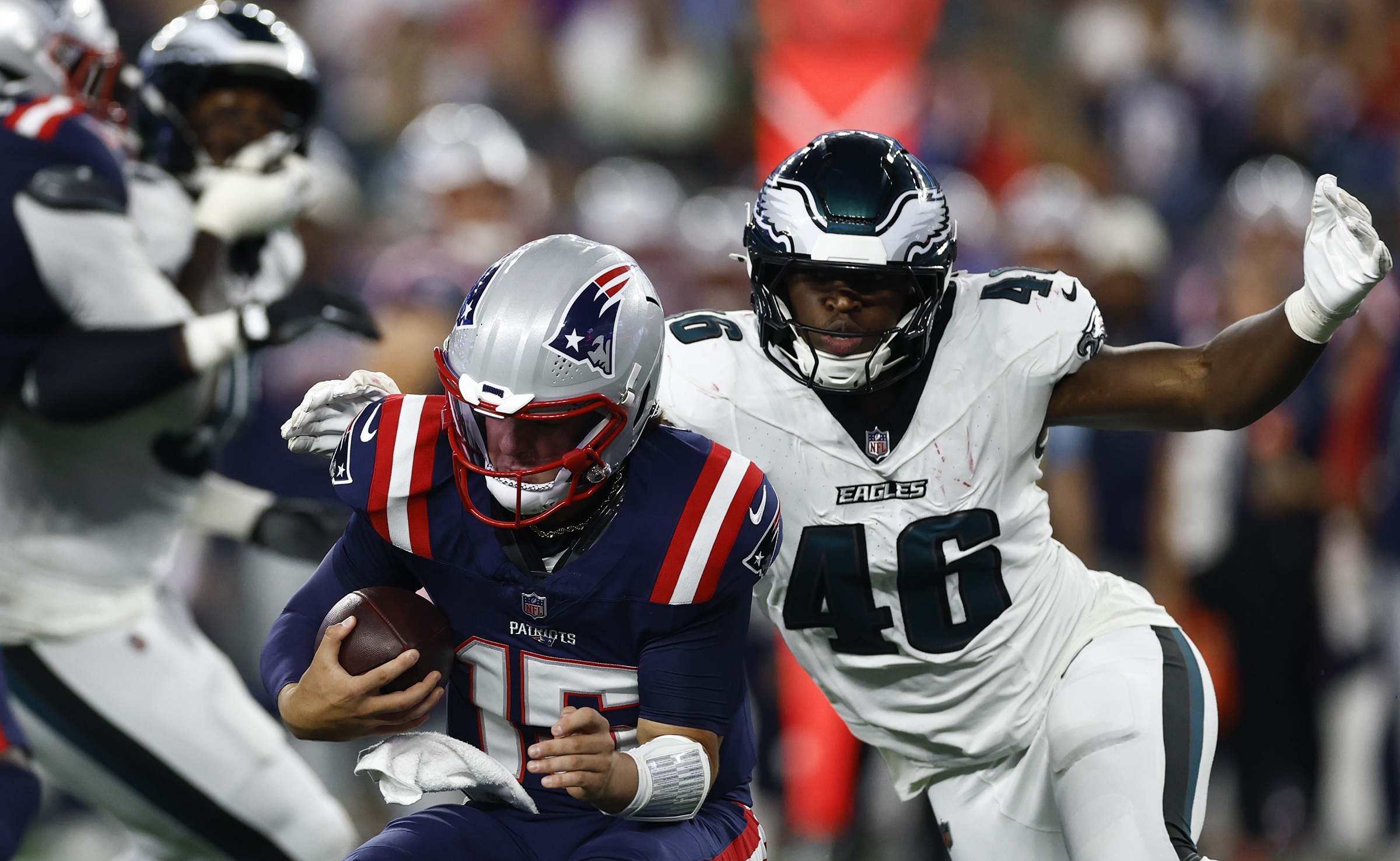
Eagles linebacker Joshua Weru got his first sack against New England Patriots quarterback Behren Morton Saturday night.Yong Kim / Staff Photographer
Edge rushers (6): Jonathan Greenard, Jalyx Hunt, Nolan Smith, Arnold Ebiketie, A.J. Epenesa, Joshua Weru
Cut: Tarron Jackson, Keyshawn James-Newby, Jose Ramirez
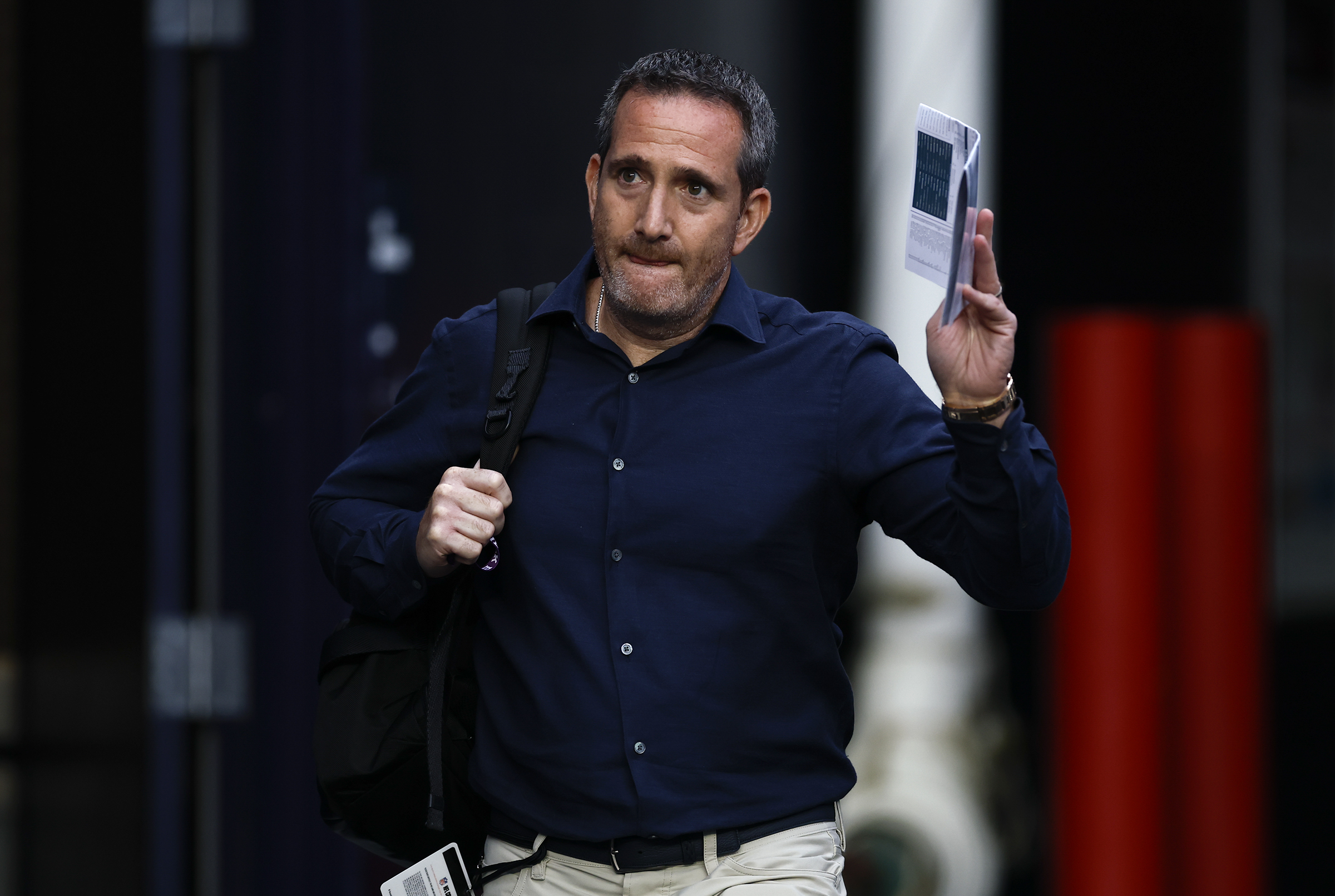
The decision on Joshua Weru will be a fascinating one for Howie Roseman next weekend. The former rugby player one-upped his padded football debut last weekend, when he had a quarterback hit, with his first sack during Saturday’s game. He’s a flashy athlete, and there may be enough on tape out there for one of the 31 other NFL teams to make him their own project and sign him to their 53-man roster if the Eagles decide to cut him.
Fangio expressed some concern Jonathan Greenard might not be ready to return from his pectoral injury for Week 1, though that’s still three weeks away.
Eagles linebacker Jeremiah Trotter Jr. could be a starter on several NFL teams. Will that make him attractive in a potential trade?Yong Kim / Staff Photographer
Cut: Chance Campbell, Deontae Lawson, Brandon George
The Eagles have an abundance of talent here. It’s probably a toss-up between off-ball linebacker and interior defensive line in terms of which position group is their best.
The top four are locks, though Fangio likes Chance Campbell a lot. Still, as we’ve written before during this exercise, the need for a fifth linebacker given this roster construction makes it hard to keep the former Titan.
Could Roseman pull off a trade to make room for him? Smael Mondon Jr. has looked capable, and Jeremiah Trotter Jr. could start on some teams.
Another spot with no changes, though there was more pause before typing Mac McWilliams over Kelee Ringo than last week. Ringo had a decent showing on the road trip to New England, while McWilliams hasn’t had the best couple of weeks.
Ringo’s value on special teams has been well-documented, but is it worth a roster spot? We’ll see.
We have Eagles safety Cole Wisniewski (bottom) making the roster, but that could change this week.Yong Kim / Staff Photographer
Safeties (4): Drew Mukuba, Marcus Epps, Michael Carter II, Cole Wisniewski
Cut: Kapena Gushiken, Andre Sam, J.T. Gray, Max Pulley
The fourth spot here still feels like a bit of a dart throw. Cole Wisniewski returned to the practice field and saw his first game action. He had a nice tackle on special teams, which he’ll need to make a big part of his game if he’s on the roster.
Kapena Gushiken and Max Pulley have had nice camps, Andre’ Sam has been around the team for the last few seasons, and J.T. Gray is an elite special teamer. You can make a worthy argument for any of them to get the fourth spot.
But it’s possible the Eagles go light here and go with three safeties, especially with Cooper DeJean playing on the back end in the base package. That route probably would be good news for Ringo.
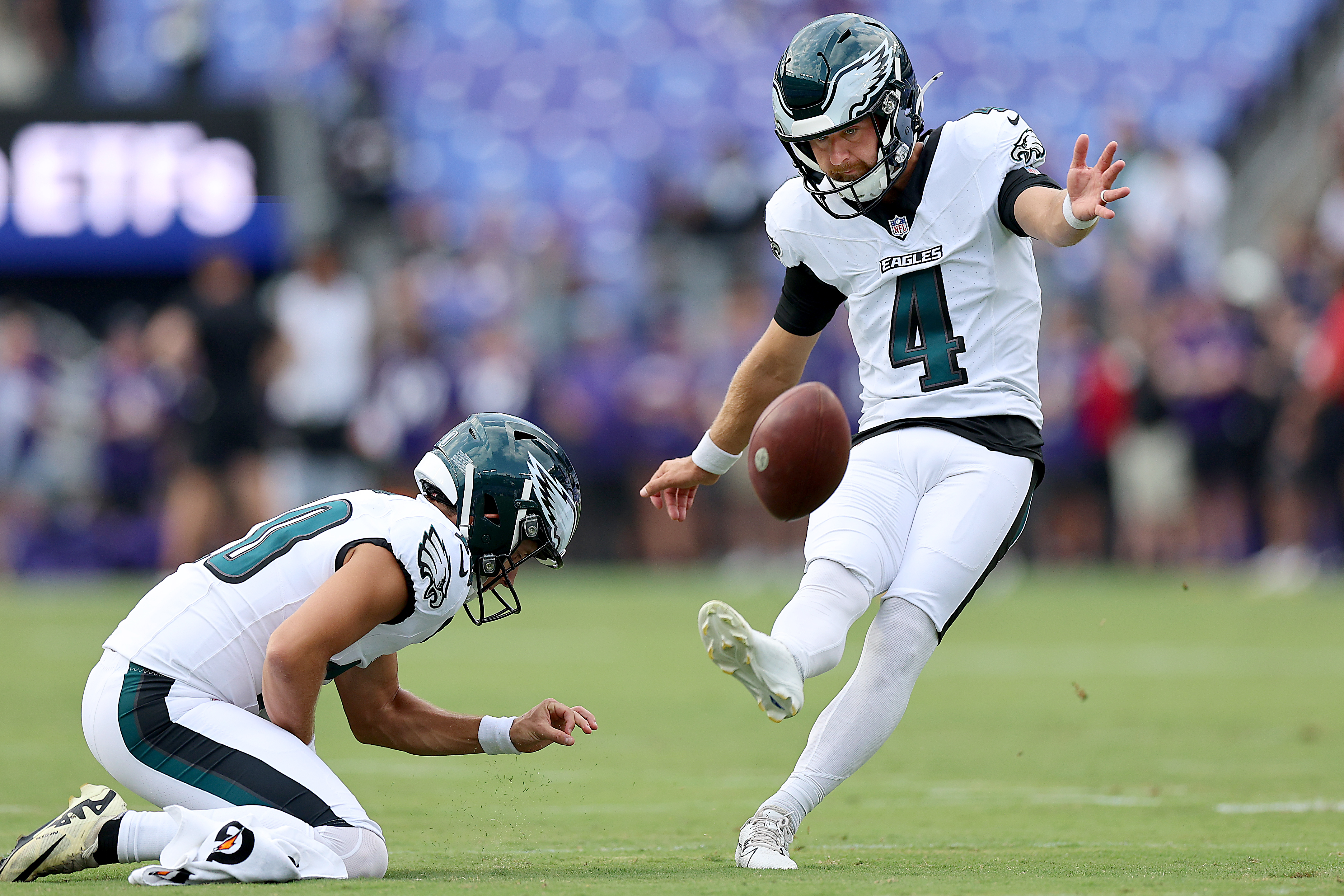
Philadelphia Eagles place kicker Jake Elliott (right) and punter Braden Mann (left) are locks.David Maialetti / Staff Photographer
Special teams (3): Jake Elliott (kicker), Braden Mann (punter), Rocco Underwood (long snapper)
These are the only three specialists on the roster. It’s possible the Eagles punt — excuse the pun — on a bubble decision and cut Rocco Underwood. The team only kept Jake Elliott and Braden Mann on the initial 53-man roster last season before bringing Charley Hughlett back to the active roster a day later during a series of roster moves after initial cuts were made around the league.
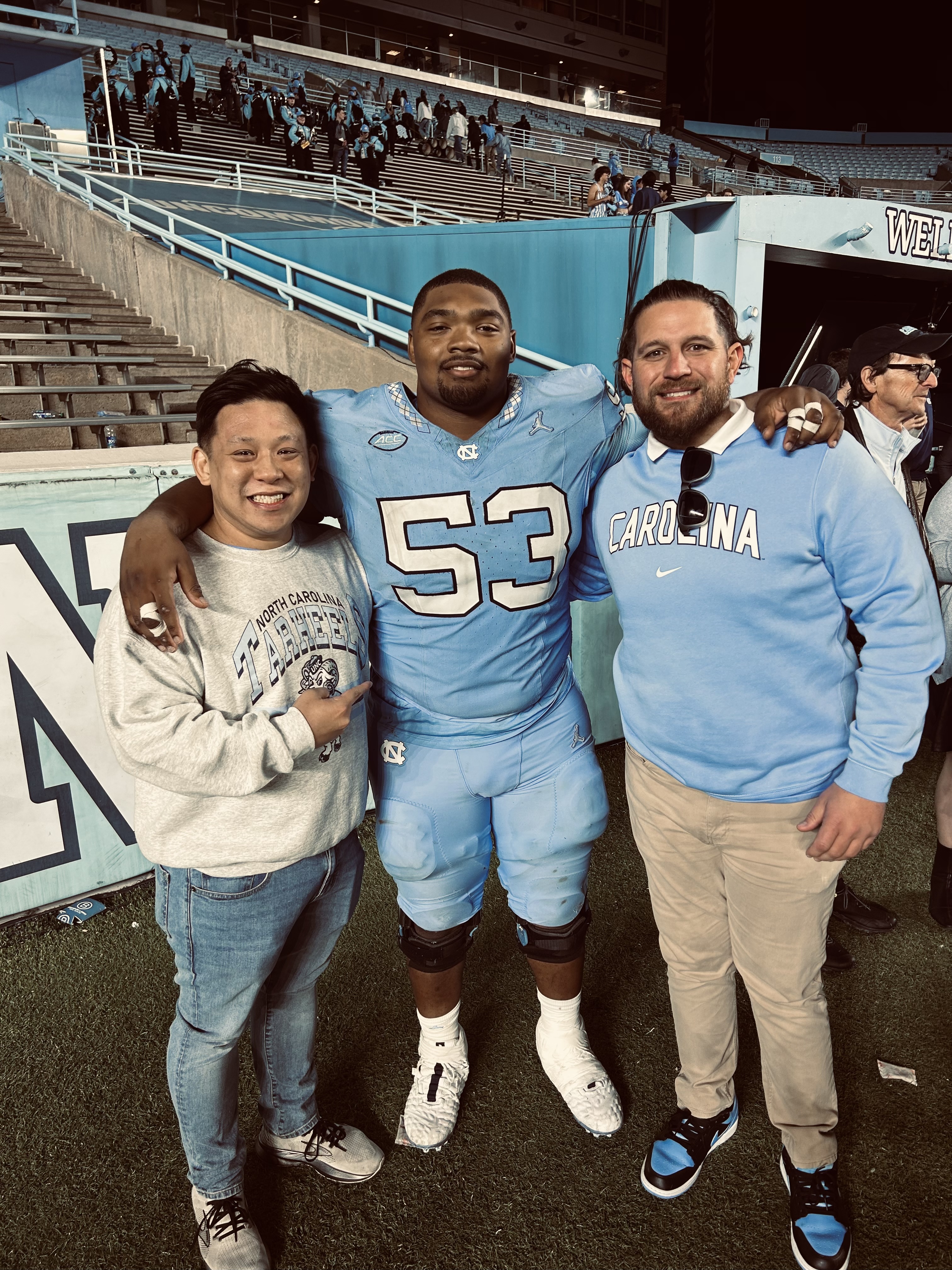
Five plays into the Eagles’ preseason opener against the Baltimore Ravens, Willie Lampkin introduced Ravens defensive tackle Broderick Washington’s backside to the grass — and, in turn, re-introduced himself to the NFL.
Lampkin, 24, had been hidden in plain sight for the past year. The Eagles claimed him off waivers at the end of camp from the Los Angeles Rams, who cut the 2025 undrafted free agent out of North Carolina with an injury designation due to knee and ankle injuries he suffered in their second preseason game. Two days later, the Eagles placed Lampkin on injured reserve for the remainder of the season.
The 5-foot-11, 290-pound interior offensive lineman returned to game action for the first time in 364 days like a wrecking ball, and Broderick was his first victim.
After snapping the ball at center, Lampkin quickly latched on to the 6-2, 315-pound defensive tackle and blocked him 10 yards downfield in pass protection before disposing of him into a pile of bodies.
Later at right guard, he sealed off 6-foot, 300-pound Aeneas Peebles on a Tank Bigsby run, taking him for a ride five yards downfield until the whistle before patting him on the helmet. That love between whistles never lasts longs, as his Eagles teammates know. Lampkin’s preseason excellence, which continued Saturday night against the New England Patriots, has been an extension of the effort they’ve witnessed in training camp this summer.
“I call him a bowling ball of knives, ’cause he’s so short, he’s so small, he’s so stubby, but he is so quick and powerful and precise with his hands that for a taller guy like me, it gives me a lot of trouble,” Jordan Davis said. “It gives me a lot of fits. That’s one of the things that keeps me up at night with Willie.
“He has a certain tenacity about him when he goes and plays a game.”
That tenacity, according to Lampkin, is rooted in his wrestling background.
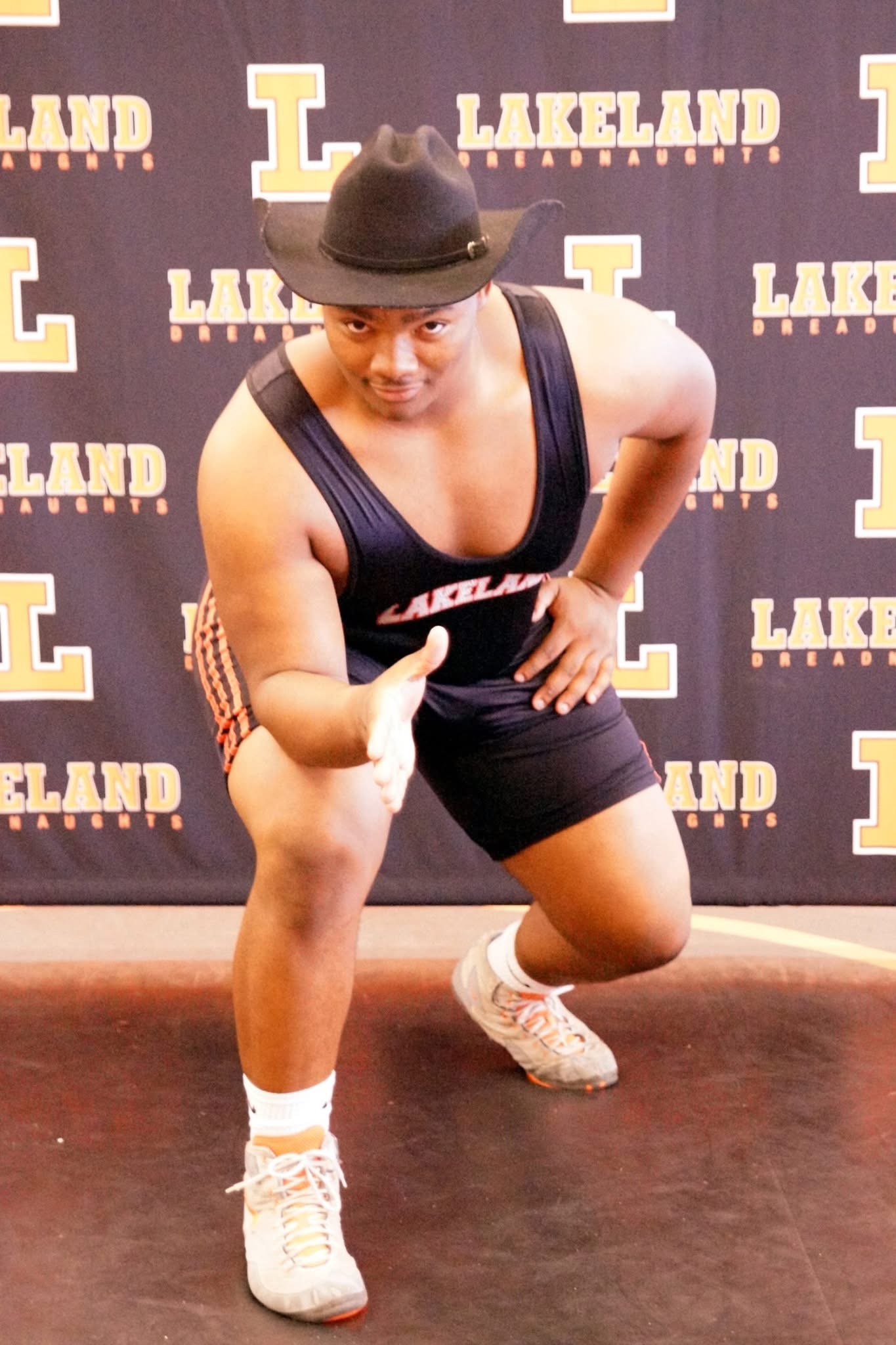
Willie Lampkin was a star wrestler at Lakeland High School in Florida.Courtesy of Winston Phan
Lampkin began wrestling as a freshman at Mulberry High School in Mulberry, Fla., a city in central Florida with a population of roughly 4,000. Within three years, he was the state tournament runner-up at heavyweight, and within four, he was a champion.
He ultimately chose to pursue football over wrestling in college, playing three seasons at Coastal Carolina and two at UNC before moving on to the NFL as an undrafted free agent. But as he vies for a depth spot on the Eagles’ initial 53-man roster as an undersized, undrafted interior offensive lineman, Lampkin continues to channel the mentality and the skill set he cultivated through wrestling.
“I feel like wrestling just helped me to be more gritty and just try to get after everybody,” Lampkin said.
Wrestlers the ‘ultimate combatants to deal with misery’
Former Mulberry wrestling coach Anthony Cerullo learned about Lampkin from Kyle Jones, one of the assistant football coaches at the school. Jones, who once wrestled for Cerullo in addition to playing football, wanted Lampkin to start wrestling, too.
Cerullo also played both sports. He understood that wrestling taught its athletes about balance, hand usage, and body positioning — all of the fundamentals that apply to sound play in the trenches.
He figured that Lampkin, a varsity starter on the offensive line as a freshman, was a 6-5 “behemoth” who grew faster than his peers. When he met him in line at the concession stand at a junior varsity football game, he quickly learned he was mistaken.
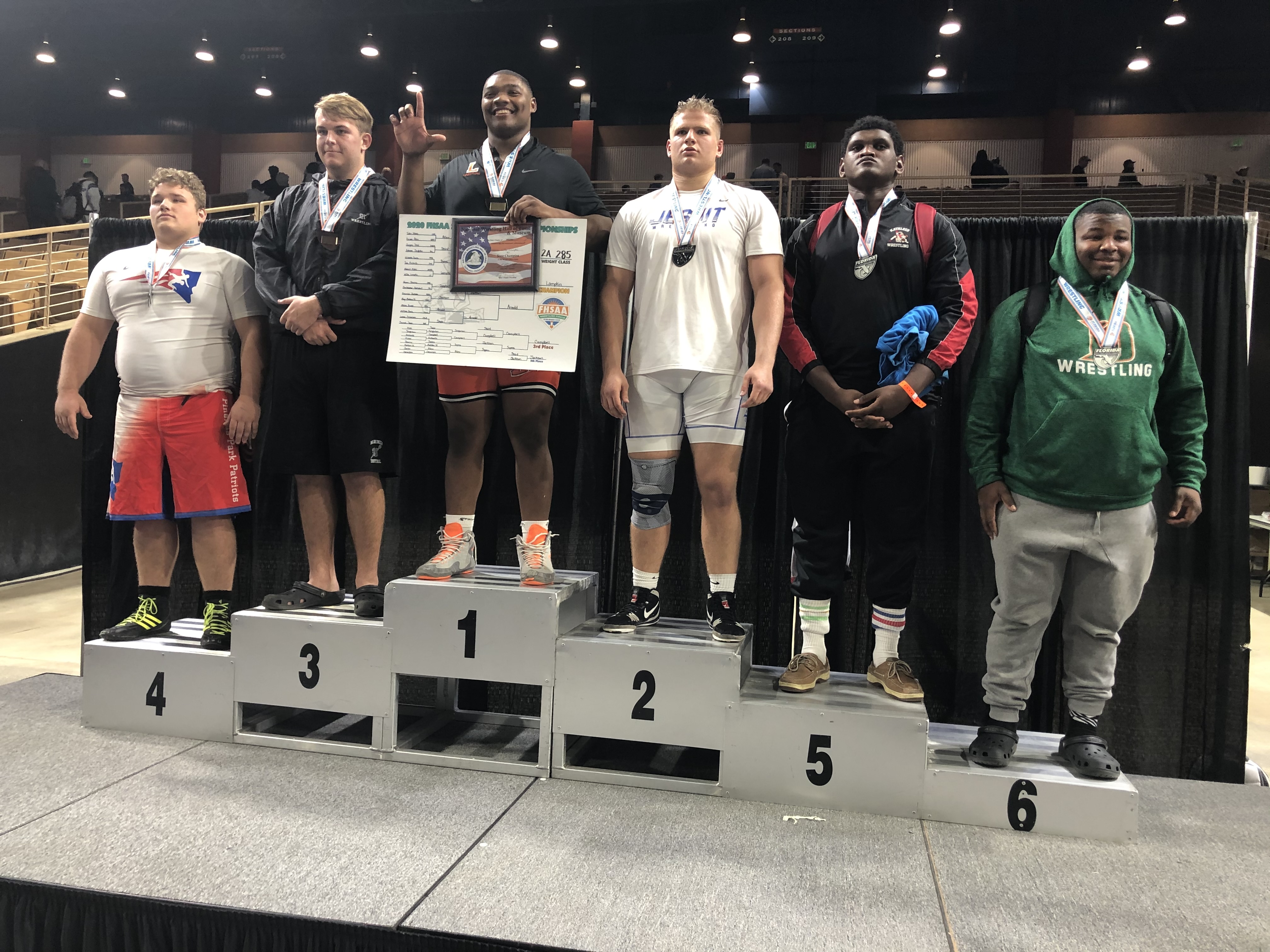
Willie Lampkin stands atop the podium after winning the 2020 2A state wrestling championship as a heavyweight.Courtesy of Winston Phan
He still made his recruiting pitch.
“Coach Jones says you’re going to be on the wrestling team, and I’m the wrestling coach,” Cerullo said.
“Ah, I don’t know about that,” Lampkin said. “He hasn’t said anything to me about it.”
At the end of the football season, Lampkin had his exit interview with his coaches. Afterward, Cerullo grabbed Lampkin as he was leaving for the school bus. Wrestling season was already underway.
“Hey, the wrestling room is not on the bus,” Cerullo said.
Lampkin obliged and followed Cerullo, even though he wasn’t entirely sure why he was there. Early on, Lampkin said he stuck with wrestling because a few of his football teammates had also decided to try it out. Plus, he didn’t want to just go home at the end of the school day in the football offseason.
Cerullo had a plan for Lampkin. In addition to the fundamentals of wrestling that would translate to football, he said he knew the O-lineman would benefit from draining practice sessions on the mat in the long term.
“Wrestlers are the ultimate combatants to deal with misery, right?” Cerullo said. “So we have a saying as wrestlers called ‘embrace the grind.’ So that means that it’s going to suck, it’s going to be hot, it’s going to be sweaty, it’s going to be nasty. You have another person acrossfrom you for two-and-a-half hours a day that’s trying to kill you, and you have to embrace that lifestyle to be great.”
Willie Lampkin has brought wrestling principles to the Eagles practice field. Monica Herndon / Staff Photographer
Cerullo ensured that Lampkin got that work in by serving as his practice partner. He learned firsthand of Lampkin’s athleticism. Lampkin, a heavyweight at roughly 230 pounds as a freshman, wasn’t going to run a 4.4 40-yard dash or jump over a building. But Lampkin was ultra-competitive, which drove his desire for improvement as he figured out how to use his hands and his body to his advantage.
He hated giving up a takedown. He hated not getting an escape. He hated losing. After all, Cerullo said, one person holding another down against their will is something to be taken personally, and Lampkin took every win for his opponent as a slight.
At the beginning, wins in practice were hard for Lampkin to come by against Cerullo, who was 20 years his senior and approximately the same size. Lampkin would ask Cerullo to stay after practice every day to work on different sequences, takedowns, and escapes. Those requests were particularly prevalent if Lampkin didn’t get an escape during practice.
“So we sat there for an hour-and-a-half one practice, and me just breaking him down to his stomach and to his face until he finally exploded up and was able to get an escape,” Cerullo said. “And then to his credit, he’s like, ‘OK, I want to do it twice before I leave.’
“‘Like, Willie, I’ve got to go to work in the morning, buddy. I love you. I’ll see you tomorrow.’”
It took about three weeks for Lampkin to embrace wrestling and the pain that came with it, Cerullo said. Pain turned to pride when he began to win his matches. According to Cerullo, there is something euphoric about the referee grabbing the winning wrestler’s hand at the end of the match and raising it for everyone to see.
Willie Lampkin was unfamiliar with wrestling but embraced the grind it took to become a champion. Courtesy of Winston Phan
Lampkin chased that feeling. He won 50 matches as a freshman, but he was one win shy of qualifying for the state tournament. That shortcoming fueled his offseason development. For the first time, he was lifting with intention to improve at both wrestling and football. He worked in the wrestling room to sharpen his skills, especially his hands.
“Willie has very large hands, and he learned how to make an impact when he put them on you going into that sophomore year,” Cerullo said. “When he would grab you, he had intention behind it. Where before, he was kind of just placing them and being … I’d say a big baby about it to some degree. Not understanding how strong he was. Sophomore year, he definitely knew what to do with his hands and when he put them on you, he meant to put them on you.”
Cerullo estimates that Lampkin took him down his freshman year twice in practice. In the summer leading up to his sophomore year, Lampkin took Cerullo down four times in one practice.
“He started moving his feet much better,” Cerullo said. “I think that he understood some more of the nuances of wrestling and not to put himself in those negative positions.”
That year, Lampkin would qualify for the state tournament, but he was eliminated early after being pinned. He transferred from Mulberry to nearby Lakeland High School the following year, helping the football team win a state championship as a junior. But leaving Mulberry didn’t mean he was leaving wrestling behind.
After the football season, Lampkin would lose weight quickly as he got in wrestling shape. He may have been the biggest wrestler on his team, but according to Lakeland assistant wrestling coach Winston Phan, he was a relatively light heavyweight compared to his peers. That weight class can be very one-dimensional, Phan said.
“A lot of times, they fall on top of each other, and whoever lands on top wins, right?” said Phan, who is now the head coach of the program. “But what Willie had going for him was his technique and his ability to learn all [this] new stuff that we were able to give him and allow him to use in his matches.
“Because people will tell you he didn’t wrestle like a heavyweight. They said he wrestled like somebody that was 106 pounds the way he knew how to do moves and the way he knew how to control somebody on top.”
Lakeland wrestling coaches Winston Phan (left) and Michael Farley visited Willie Lampkin while he was playing college football at North Carolina in 2023.Courtesy of Winston Phan
Phan and the other coaches would teach Lampkin a little bit of everything, even moves that weren’t typically performed by heavyweights. Among them were leg attacks, Phan said. One of Lampkin’s favorite moves that he honed in practice was a single-leg sweep. He kept it in his back pocket until he reached the first-place match at the 2A state championship his senior year.
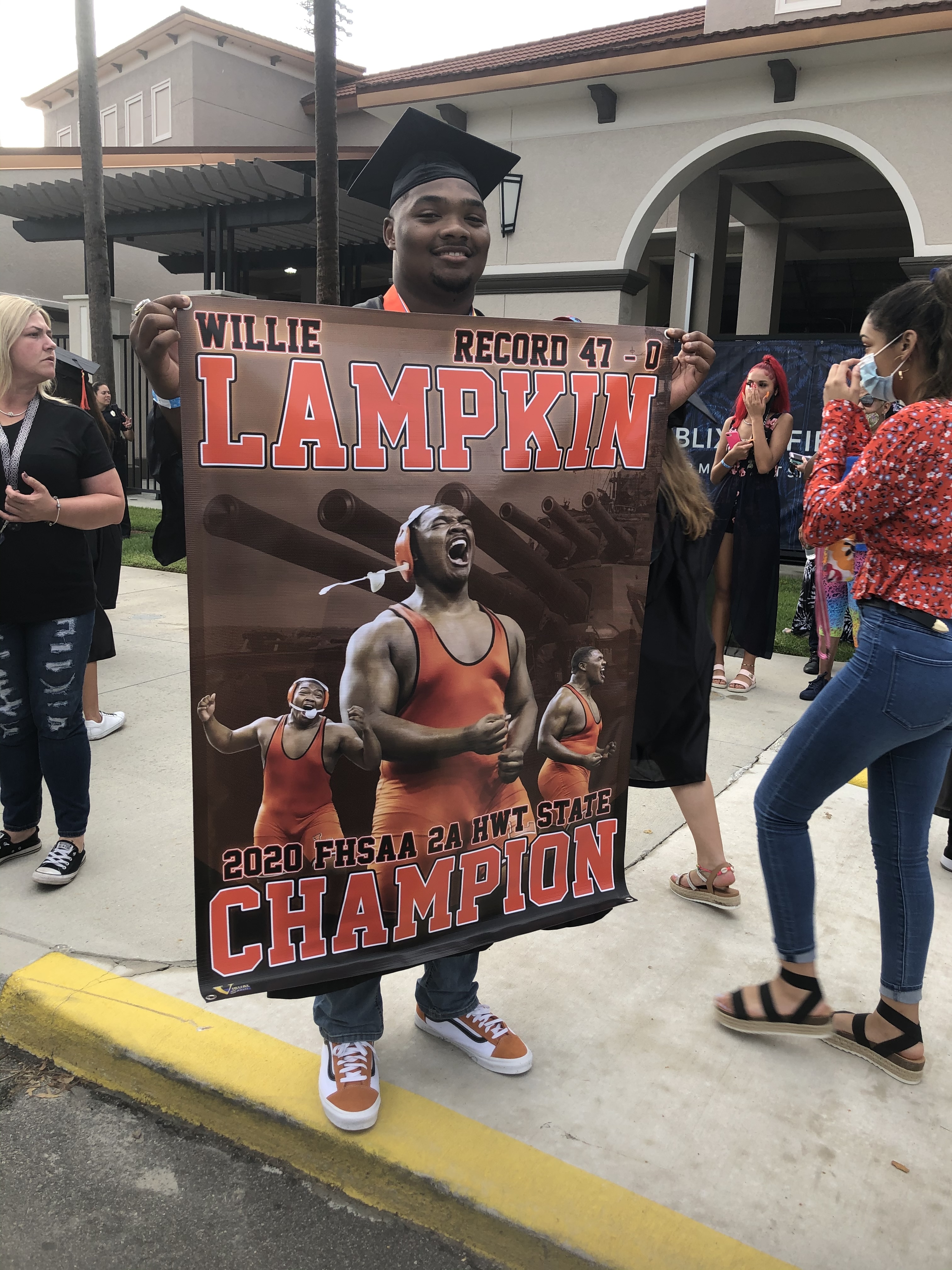
The prior year, Lampkin lost the state final in sudden-death overtime. He wouldn’t lose it twice. After he went 47-0 during the regular season, Lampkin faced Mason Arnold of Tampa Jesuit in the heavyweight state championship match. They were tied, 1-1, toward the end of the third period.
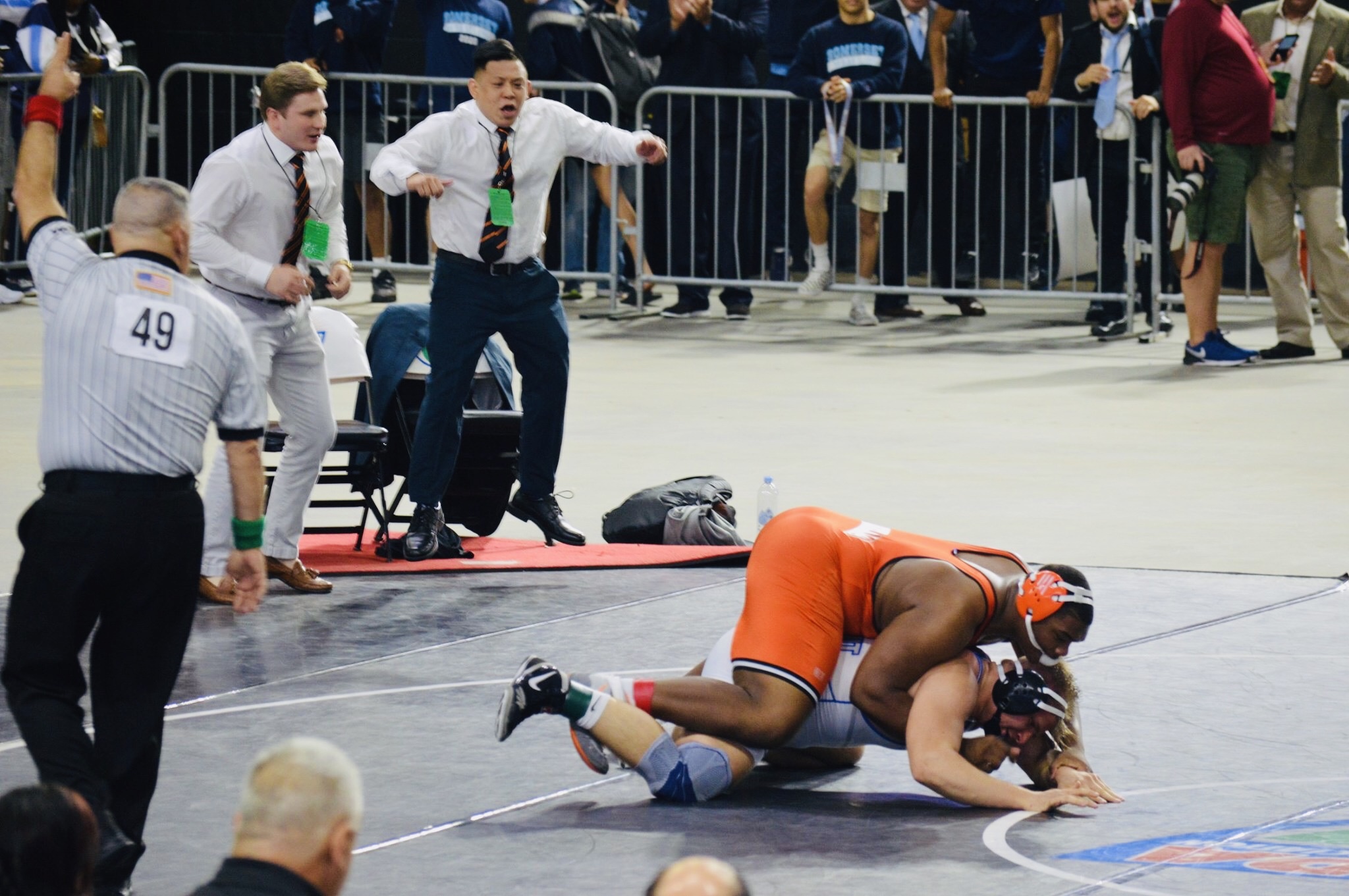
With 34 seconds remaining, Lampkin pulled out the single-leg sweep. Lampkin swung his body around his opponent’s leg, then flung him onto his back, switching off to a double leg to take him down and go up, 3-1. Lampkin rode Arnold out until time expired. He popped up, his headgear askew, and let out a roar before pouncing on top of Phan and assistant coach Chad Kirkman near the corner of the mat.
“It was like a potato jumping on a toothpick,” said Michael Farley, former Lakeland head wrestling coach.
That match marked the end of Lampkin’s wrestling career. His wrestling coaches still kept in touch with Lampkin as he continued on to college and attended his games when they could.
In some ways, the two sports couldn’t have been any different. Lampkin is one of 11 on the football field. In wrestling, he was alone against his opponent on the mat. A play in football lasts a matter of seconds within an hourslong game, while a wrestling match lasts at least six minutes over three periods. But whether Lampkin was wrestling or playing football, Phan saw the same athlete.
“He’s not doing anything differently,” Phan said. “They call the moves different things, but in the sense of it, the name of the game is manhandling your opponent, right? And he knows that that’s what his job is, and that’s what he’s looking to do every time he steps on the line, whether it’s on a wrestling mat or on the football field.”
Willie Lampkin took down Mason Arnold in the 2020 2A heavyweight state championship within the final seconds of the match to win.Courtesy of Winston Phan
In both sports, he used his relatively small size to his advantage. Both Cerullo and Phan said Lampkin’s best asset was his brain, as he was capable of understanding leverage and positioning. Combine that with fast feet in a small area of space on the gridiron, and Lampkin can get his leverage and change direction quickly to seal off bigger, taller defensive tackles.
He never lets up, either, whether he’s mustering a takedown in the waning seconds of the state title match or he’s blocking a defensive tackle into the next zip code through the whistle.
“It doesn’t matter who’s in front of him,” Phan said. “He’s ready to take their heads off and protect the quarterback and do what he has to do to be successful on the line.”
Farley had seen the headlines coming out of Eagles camp about Lampkin. Those labels about his size are nothing new.
“‘Five-11′ or ‘little secret weapon,’” Farley said. “But we know that for Willie, it’s real when the pads come on, and that’s when he can show his true value.”
After two standout preseason performances, the Eagles’ so-called little secret weapon might not be so secret any more.
A little past 6 o’clock on Saturday evening, Andrew Painter delivered a couple of pitches that could have some serious implications for the Phillies. Both of them were four-seam fastballs that registered 97 mph on the gun and crossed home plate at the sternum of Cardinals leadoff hitter JJ Wetherholt. The important thing is where those pitches ended up: inside the mitt of Phillies catcher J.T. Realmuto, rather than in play, or in the seats. Wetherholt swung at both. He did not make contact with either.
That two-pitch sequence may sound like a small thing. It mostly was, at least within the context of the game. But it was a very big thing with regard to the futures of both the Phillies and their prized pitching prospect. It was a reason to believe.
The top-line numbers suggest that Painter is a young man in the midst of a renaissance. Since returning from a six-week stint in the minors on July 31, the 23-year-old righty has posted a 3.62 ERA with 26 strikeouts, 10 walks, and two home runs allowed over 27⅓ innings. His most recent start was his finest yet: 103 pitches, seven innings, one run allowed, eight strikeouts, no walks.
That his season-long ERA is still 6.02 speaks to the extent of the struggles he endured during the first 14 starts of the season. It also warrants a skeptical eye. Yet the deeper you pore through the entrails of Painter’s recent performances, the more evidence you’ll find that suggests the rookie really is in the midst of a radical transformation.
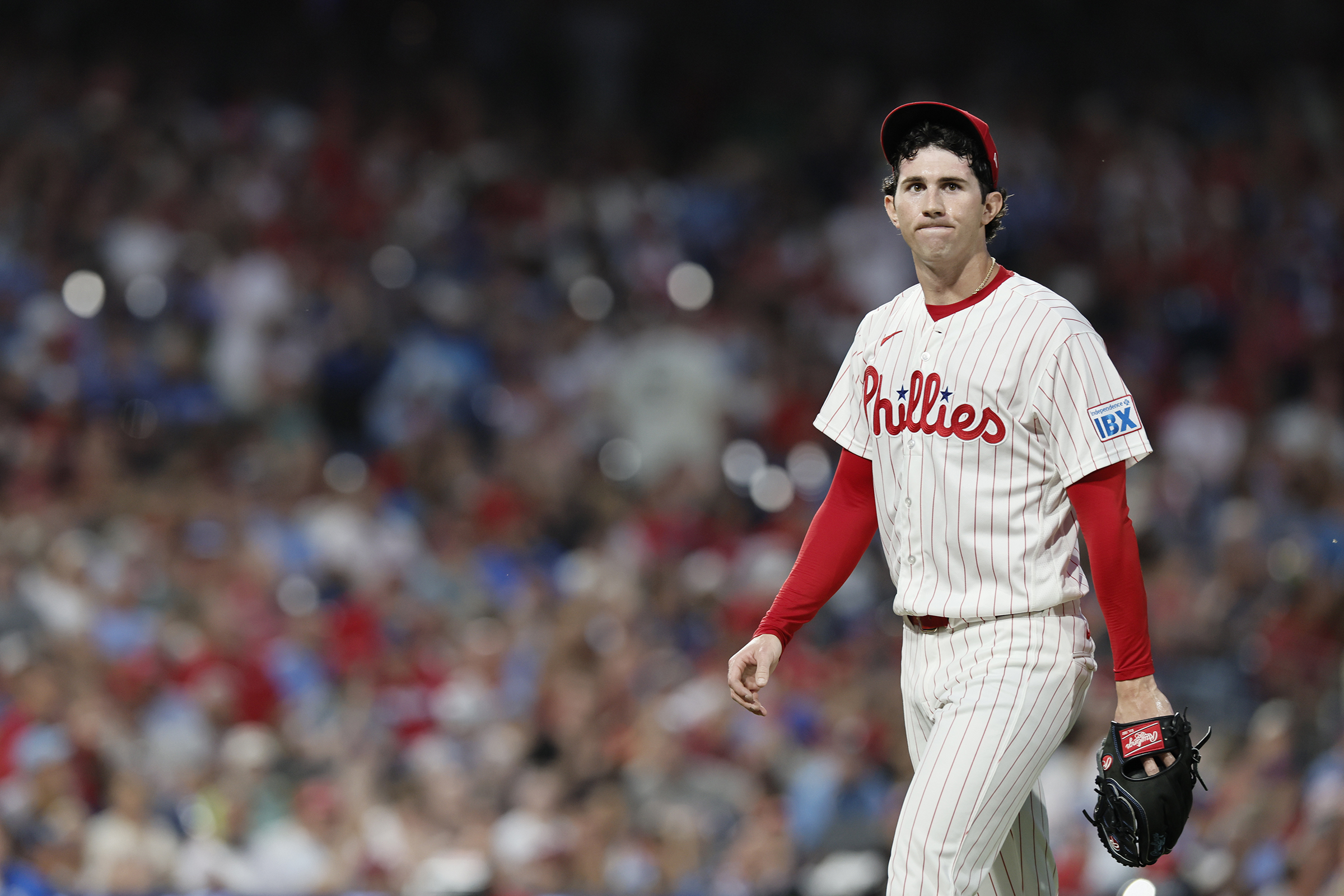
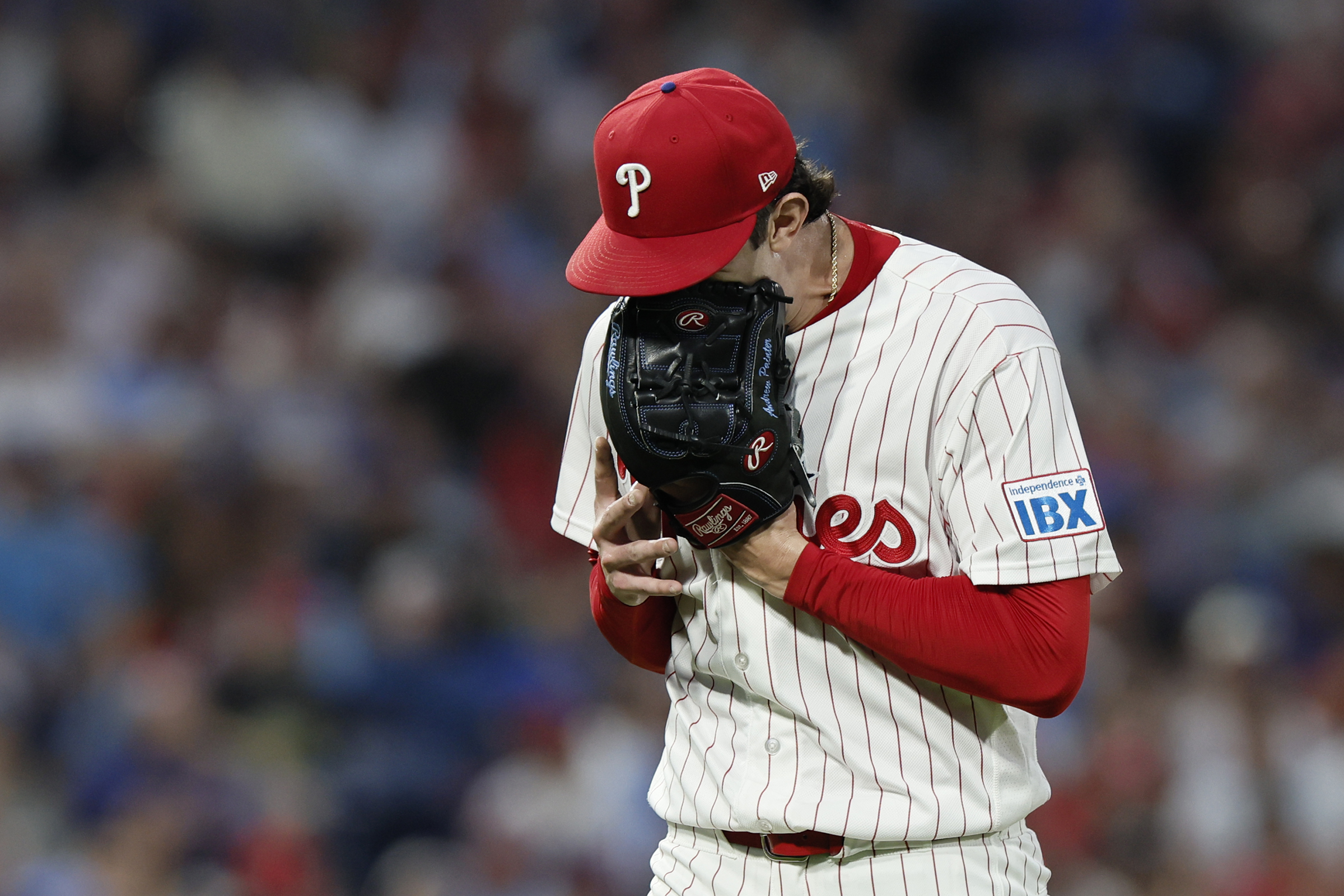
Phillies pitcher Andrew Painter yells into his glove after striking out Cardinals slugger Jordan Walker for the final out of the sixth inning Saturday.Elizabeth Robertson / Staff Photographer
It all starts with four-seam fastballs like the ones that prompted Wetherholt’s whiffs in the first inning on Saturday. By the end of the game, Cardinals hitters had failed to make contact on five of their 15 swings against Painter’s four-seamer. That may not sound like a lot, but consider this: In Painter’s last two starts before his demotion in June, he generated just three whiffs on 23 swings at his fastballs.
The numbers are staggering. When the Phillies sent Painter down to the minors in June, his four-seam fastball ranked as one of the least effective in the sport. He wasn’t missing bats with it: His whiff percentage ranked 276th out of 278 pitchers who’d thrown at least 200 pitches. Opponents had 38 hits against the pitch in just 12 starts. Their .404 batting average against Painter’s four-seamer was higher than against any other pitcher’s. He ranked among the bottom 4% in slugging percentage (.763), strikeout percentage (7.65%), and wOBA (.481). Only one pitcher in the majors had a four-seamer rated lower than Painter’s per FanGraphs’ Pitch Value metric.
Now, suddenly, Painter’s four-seamer has become one of baseball’s most difficult to hit. Of the 84 pitchers who have thrown at least 100 four-seamers since July 31, only seven have a higher whiff percentage inside the strike zone than Painter’s. Opposing hitters are making contact with just 78% of his fastballs in the strike zone. That’s lower than even Brewers fireballer Jacob Misiorowski. It is a massive difference from Painter’s 93.2% zone contact percentage in his first 14 starts. Painter isn’t generating out-of-zone swings-and-misses on the level of the Miz, but his overall contact rate still ranks in the top 25% of pitchers since July 31.
Andrew Painter’s four-seamer has gone from liability to strength in his return to the Phillies.Monica Herndon / Staff Photographer
It’s a lot easier to believe in real change when there is a logical explanation for it. With Painter, the four-seamer is the thing. His spin rate is up by about 6%. In his last two starts, the induced vertical break on his fastball was better than in any previous start, with an increase of about 10% over his predemotion baseline. Against the Cardinals on Saturday, he threw nine pitches at 98-plus mph, two of them at 99-plus. Sixteen of his 33 sinkers and four-seamers clocked at 97-plus mph. Compare that to his last start before his demotion, when Painter didn’t touch 98 and only reached 97 on five pitches.
“There’s a presence out there,” Phillies interim manager Don Mattingly said. “He’s on the attack. He looks confident. Obviously, the stuff has to be good, or all that doesn’t matter if you’re not getting anybody out.”
You saw it on Saturday. In the third inning, Jose Fermin struck out on a foul-tipped four-seamer. In the fifth, Jimmy Crooks swung and missed at a 1-2 four-seamer that registered 98.2 mph on Statcast. In the sixth, Alec Burleson swung and missed at another 98 mph four-seamer.
Painter still has plenty of work to do to reach the level of dominance many envisioned when he was rated as one of the top pitching prospects in the sport. But the improvement is very real. Make no mistake about that.
When Andrew Painter was optioned to triple-A Lehigh Valley in June, he received something he sorely needed: space. Seventy-seven miles north of Citizens Bank Park, far from the scrutiny of Philadelphia, the right-handed pitcher was able to work and think.
He could try grips, mechanical tweaks. In three straight games with the Iron Pigs, he threw three different changeups. This is not the type of thing Painter would be able to do in the big leagues, especially not in the midst of a playoff push.
“You’re able to go down there, and games don’t really mean much,” Painter said. “Obviously you’re playing to win, but it’s about development. There’s obviously a lot less stress, and you’re able to kind of freely work on things.”
“Freely” is an apt description. Before Painter was sent down on June 18, he looked anything but free. The 23-year-old labored through each start. He struggled with command. His fastball lacked its signature rise.
By June 17, his ERA had ballooned to 7.06 ERA.
The monthlong hiatus to Allentown appears to have helped. It allowed the highly touted rookie to take a hard look at what worked and what didn’t, and make changes without fear of failure.
Andrew Painter has a 3.62 ERA in five starts since being recalled from triple-A Lehigh Valley.Derik Hamilton
The Phillies’ pitching coaches dove deep into his mechanics and unearthed some telling data points. Chief among them was the way Painter moved his lower half.
Before, he was standing more upright, almost as if his back leg was completely straight.
The coaches suggested that he hinge his back hip, and bend his back knee more. What might seem like a small tweak has produced notable results.
Now, Painter is driving more toward the plate, which has improved his command. He’s moving more efficiently, which has helped him sustain velocity deeper into games.
In the rookie’s outing on Saturday, his fastest pitch of the night — and of his young career — was his 100th. It clocked in at 99.6 mph.
“To me it feels like it’s less effort, and I think that kind of goes to … now when I’m in the sixth inning, there’s a little bit more energy,“ he said. ”Whereas before it was kind of [like] I was reaching for everything, and those were 94s, 95s.”
He added: “I think everything’s good when I’m just synced up, right? I feel like some guys try to throw it as hard as they can, and it ends up being slow, because they’re not in as powerful of a position.
“For me, the moves that we worked on with the lower half, kind of allows me to just be behind the ball a little more.”
Andrew Painter has 26 strikeouts in 27 1/3 innings since rejoining the Phillies.Elizabeth Robertson / Staff Photographer
Another suggestion from the Phillies pitching corps was to adjust his fastball grip. Painter widened his fingers slightly, and shifted them more diagonally, so they aren’t right on top of the seams.
“Because when I was throwing fastballs in the first half, the seams were almost taking it down, so it was killing vertical [break],” Painter said. “Whereas [my fastball] has always risen.”
The changes haven’t just been mechanical. Those who work with Painter believe he has a different energy about him, more of a self-assured confidence. Lehigh Valley pitching coach Phil Cundari said they’ve focused on staying present; to not dwell on an inning, or even a pitch.
Cundari is uniquely qualified to help with this. Before he joined the Phillies organization in 2023, he was a licensed psychotherapist and had his own clinical practice.
Harvey Dorfman, the legendary mental skills coach who helped transform Roy Halladay’s career, was one of Cundari’s mentors. Halladay was introduced to Dorfman in 2001, in the midst of his lowest point in professional baseball.
Halladay had been demoted to the minor leagues after posting a 10.64 ERA through 67⅔ innings in 2000. He was at single-A Dunedin in the Blue Jays organization when Halladay’s wife, Brandi, bought him Dorfman’s book, The Mental ABC’s of Pitching.
That, coupled with some mechanical tweaks, guided Halladay back to the big leagues and onto a path toward the Hall of Fame. No one knows what path Painter will take, but he finds himself at a similar crossroads; humbled, at 23 years old.
From what Cundari can see, the rookie has responded well.
“The experience and the path that he’s had, both of those things are pretty challenging to try and overcome,” Cundari said. “But I think he’s done a great job. I think what you’re seeing right now is someone who’s much more in command. Not just of his stuff, but of his emotions, and who is in command, mentally.
“And you’re seeing a really confident young man up there. So, outings like [Saturday] night, hopefully we’re going to see more of those.”