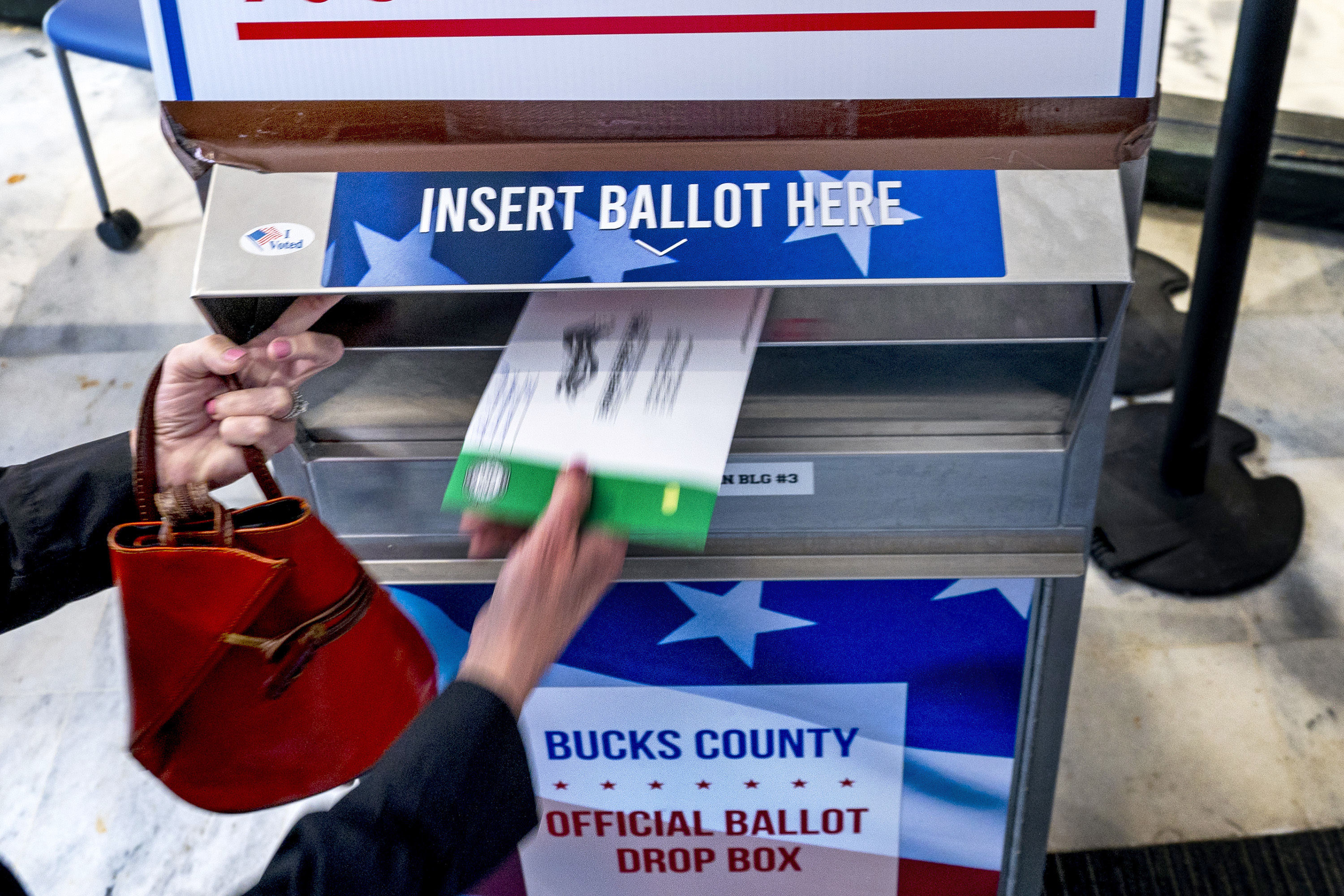
A Supreme Court decision on mail voting has created uncertainty with 70 days until critical midterm elections, but Pennsylvania Democrats are trying to reassurevoters that they will have the option to cast a ballot by mail.
More litigation over this highly watched issue is expected and further rulings could still come even after November, affecting the next presidential election.
“We will continue to fight at every stage — including in the Supreme Court the moment they attempt to implement this — to make sure every eligible Pennsylvanian can cast their ballot by mail, free from federal interference,” said Montgomery County Commissioner Neil Makhija, a Democrat and an attorney who sits on the county’s election board.
The procedural update, issued Monday, does not rule on the underlying legality of President Donald Trump’s March executive orderthat directed the U.S. Postal Service to help decide which voters should receive mail ballots but rather whether lower courts had the authority, at this stage, to block it.
Pennsylvania was among the states suing to block the order.
“Absolutely nothing has changed here in Pennsylvania. You can vote in person on Election Day or you can vote by mail before Nov. 3,” Democratic Gov. Josh Shapiro said Tuesday evening during a visit to the Eagles’ training camp.
“Your vote will be counted. Your vote is safe and secure,” Shapiro said. “No matter how many times the president wants to try and undermine people’s right to vote in this commonwealth, he needs to know that he will be met with a swift rebuke from me.”
Shapiro noted that the election is administered by the state and its counties under the Constitution.
Revival of the debate about the availability and security of mail voting, and the temporary clearance, however, may instill doubt among voters that their ballot will be received and tabulated, Makhija said.
“With just weeks until ballots go out, last-minute federal interference sows chaos for the voters we serve,” he said.
Trump’s efforts to restrict mail voting, part of his long-standing grievance against the system despite repeatedly utilizing the method himself, are still working through the courts, and several experts doubt the proceedings will move fast enough to affect the November elections, whenfour swing districts in Pennsylvania could help determine control of the U.S. House.
“Whatever may ultimately happen in this litigation, I’m pretty skeptical that anything is going to change for this November’s election,” saidBen Geffen, staff attorney at the Public Interest Law Center in Philadelphia, a nonprofit group that monitors election issues.
States across the country will soon begin preparing applications and mailing ballots to voters.
Pennsylvania voters, who can cast a ballot by mail for any reason, must complete an application by Oct. 27, and all ballots must be returned by Nov. 3 at 8 p.m., according to the Pennsylvania Department of State’s website.
“Turning that battleship around in a matter of days is extremely unlikely,” Geffen said.
A spokesperson for the Pennsylvania Department of State said the ruling does not change state law, and voters should be confident that counties will continue to ensure eligible voters can cast their ballot by mail.
“The USPS action is not lawful, and we will continue to challenge that rule to ensure that Pennsylvania voters can have their voice heard — whether they vote in person, on demand, or by mail,” Geoff Morrow, the department spokesperson, said.
Geffen’s advice for those concerned is to start early. Get your mail ballot application in right away, and as soon as you receive your ballot, fill it out and return it. For now, you can still send your ballot through the U.S. mail. But you can also drop it off at your county election board, and many counties offer satellite locations and drop boxes.
If you prefer to vote in person on Election Day, go in the morning, he said.
“You have options for how to vote, and you will get to vote. Nobody’s taking away the election, and just jump on it early,” he said.
After Trump, through his directive, ordered the Postal Service to withhold mail ballots to individuals who are not on an approved list, which he instructed states to develop in order to prevent noncitizens from voting, Shapiro promised to protect Pennsylvanians’ right to vote by mail. In April, he used his power as governor to join other Democratic states in a lawsuit that argued the order violated states’ constitutional power to carry out elections.
The unions representing postal employees also criticized Trump’s push to restrict mail voting as November approaches.
“Any insinuation that voting by mail is not safe and secure is severely misguided. Letter carriers have securely delivered ballots for decades, and there is no evidence that the existing system requires substantial changes,” NALC president Brian L. Renfroe said in the statement.
Gwen Ivey, president of the American Postal Workers Union, Local 89, which represents between 1,300 and 1,400 U.S. clerks in Philadelphia who process mail, maintenance employees, and drivers who transport mail, also warned against inserting the Postal Service into decisions over voting.
“The Postal Service is a public institution that serves the American people,” Ivey said Tuesday. “It should not be placed in a position of determining who is entitled to participate in elections or becoming an instrument for restricting access to the ballot boxes.”
Trump has long railed against mail voting, referring to the ballots as “crooked” in his State of the Union address and suggesting they amount to cheating. But his 2024 victory in Pennsylvania was thanks, in part, to a higher rate of mail voting by Republicans.
The practice is particularly useful for seniors and voters in rural areas — often with strong Republican bases — where voters may live far from their nearest polling location.
“If you want to win, mail it in, that’s our message to our Republican voters,” then-Pennsylvania GOP chairman Lawrence Tabas said two years ago. The Pennsylvania GOP did not respond to a request for comment for this article.
Pennsylvania Republicans have been more supportive of Trump’s SAVE America Act, an election reform proposal stalling in Congress that he insists will make voting more secure, though most election experts say new guidelines in the legislation would make it harder to vote.
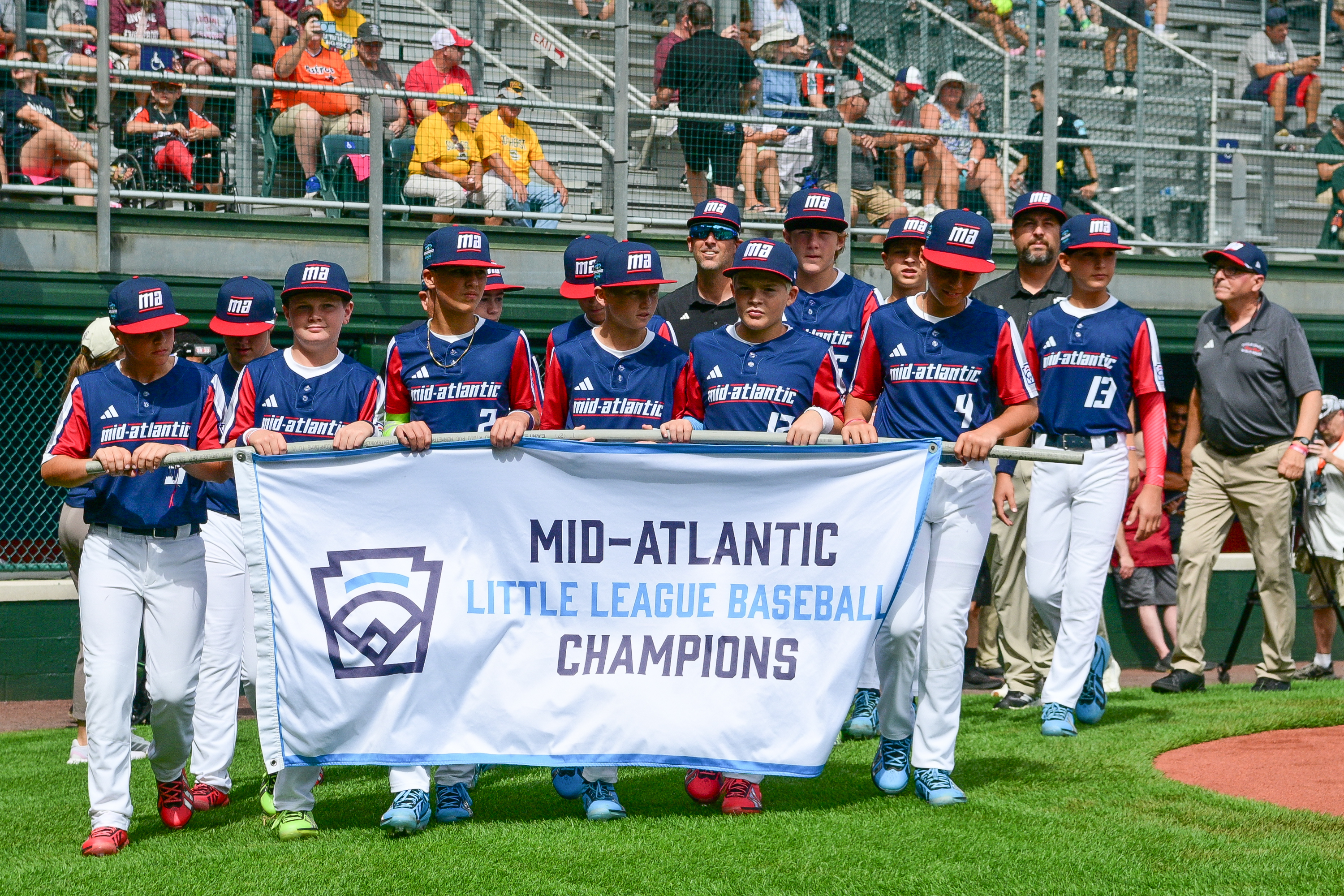
East Side Little League, a 12-and-under baseball team from West Chester, saw its run in Williamsport, Pa., end in a heartbreaker.
On Monday, East Side fell 6-5 to Phenix City Youth Baseball LL and was eliminated from the Little League World Series. Powered by its stellar hitting, East Side came out to an early 5-0 lead. However, a big third inning from Phenix City led the Alabama team’s comeback.
Trailing 5-0 with two outs in the third, Phenix City left fielder Cooper Champion stepped up to the plate with the bases loaded and hit a two-run single to right field. Phenix City added two runs before the inning was capped off by an RBI single from pitcher Kinley Rasmus that tied the score.
Rasmus is just the 25th girl to appear in a Little League World Series game.
The game stayed tied at 5-5 through the regulation six innings until Phenix City catcher Brooks Cameron’s single scored Urijah Berklite with the winning run in the bottom of the seventh.
For East Side, Cole Warner scored a run in the first inning before hitting a two-run homer to center field in the third. After starting the game at center field, Warner moved to the mound in the fourth inning. He allowed just one run while collecting six strikeouts to close out the game.
East Side outfielder Ryan Hennessey, the son of coach Bob Hennessey, scored two runs and had a two-run double before Phenix City stormed back.
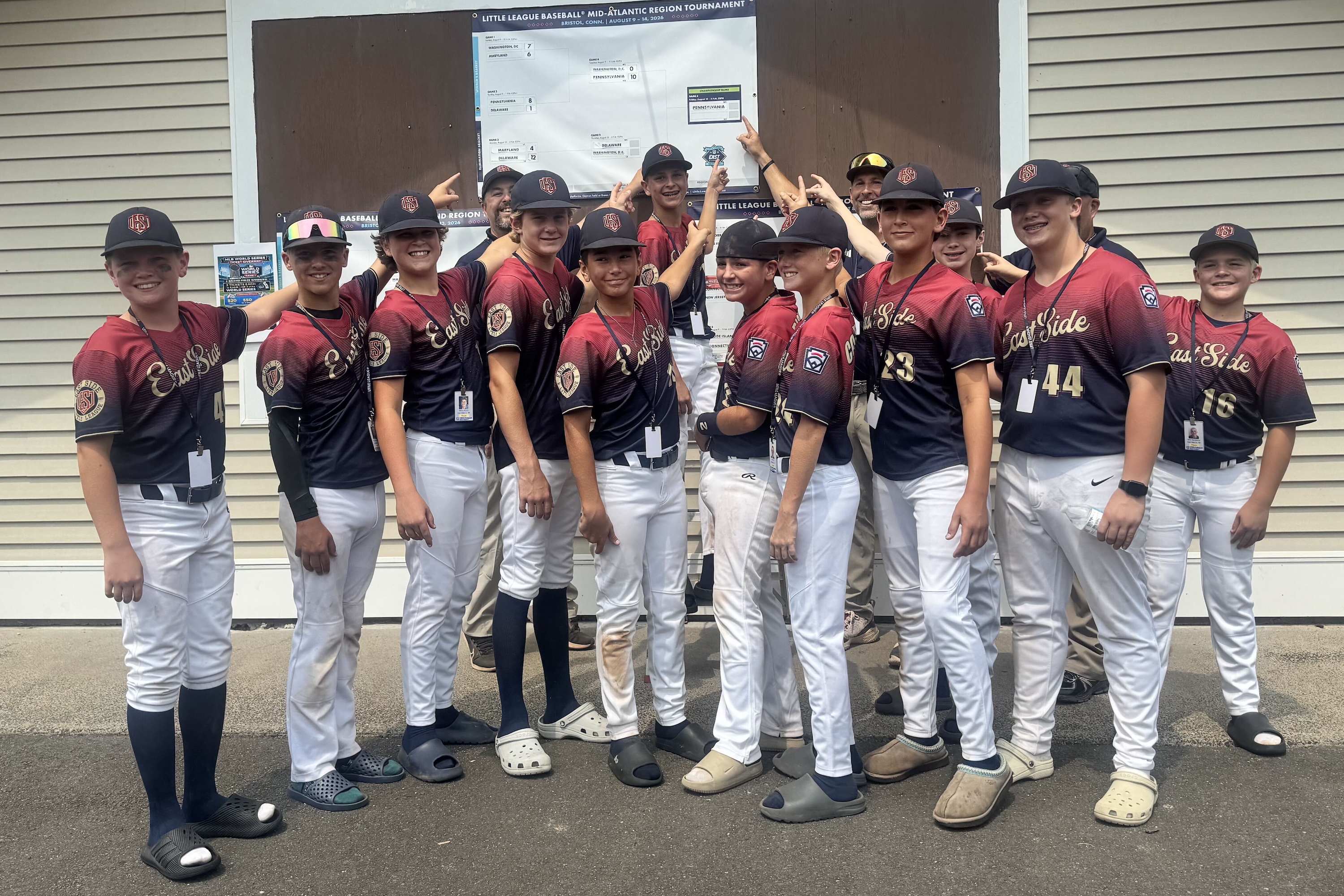
The kids from East Side Little League in West Chester made the trip to Williamsport.Courtesy of Katherine Cowperthwait
The loss marks East Side’s second of the tournament in as many appearances. The team, which battled out of the loser’s bracket in the Pennsylvania state tournament, gained significant support from the Greater Philadelphia area after cruising through the Mid-Atlantic regionals. In West Chester, watch parties, filled with East Side alumni and fans, sprung up around the borough.
In Williamsport, the East Side players were able to interact and befriend peers from all over the world — even bunking with Japan’s 12-and-under team. They also had the chance to meet players from the Milwaukee Brewers and Atlanta Braves before the Little League World Series MLB Classic.
“It’s just a dream come true, to be honest,” Bob Hennessey previously told The Inquirer. “That’s every Little Leaguer’s dream. It was my dream growing up to see these boys get here and get to experience it. Nothing but amazing.”
That gave her just about one day to prepare for her first professional tennis match at the Ennoble Care Philly Open, a WTA 125 event being held at the University of Pennsylvania’s Hamlin Tennis Center. Later that evening, she learned she was going to play her second — in doubles, with Penn teammate Lara Stojanovski, the next day.
“It’s been so hectic,” Velaga said. “Obviously, it didn’t go the way I wanted to in both singles and doubles, but no matter what, it was genuinely so cool. Even if I wasn’t necessarily preparing to the best of my ability, it was really fun.”
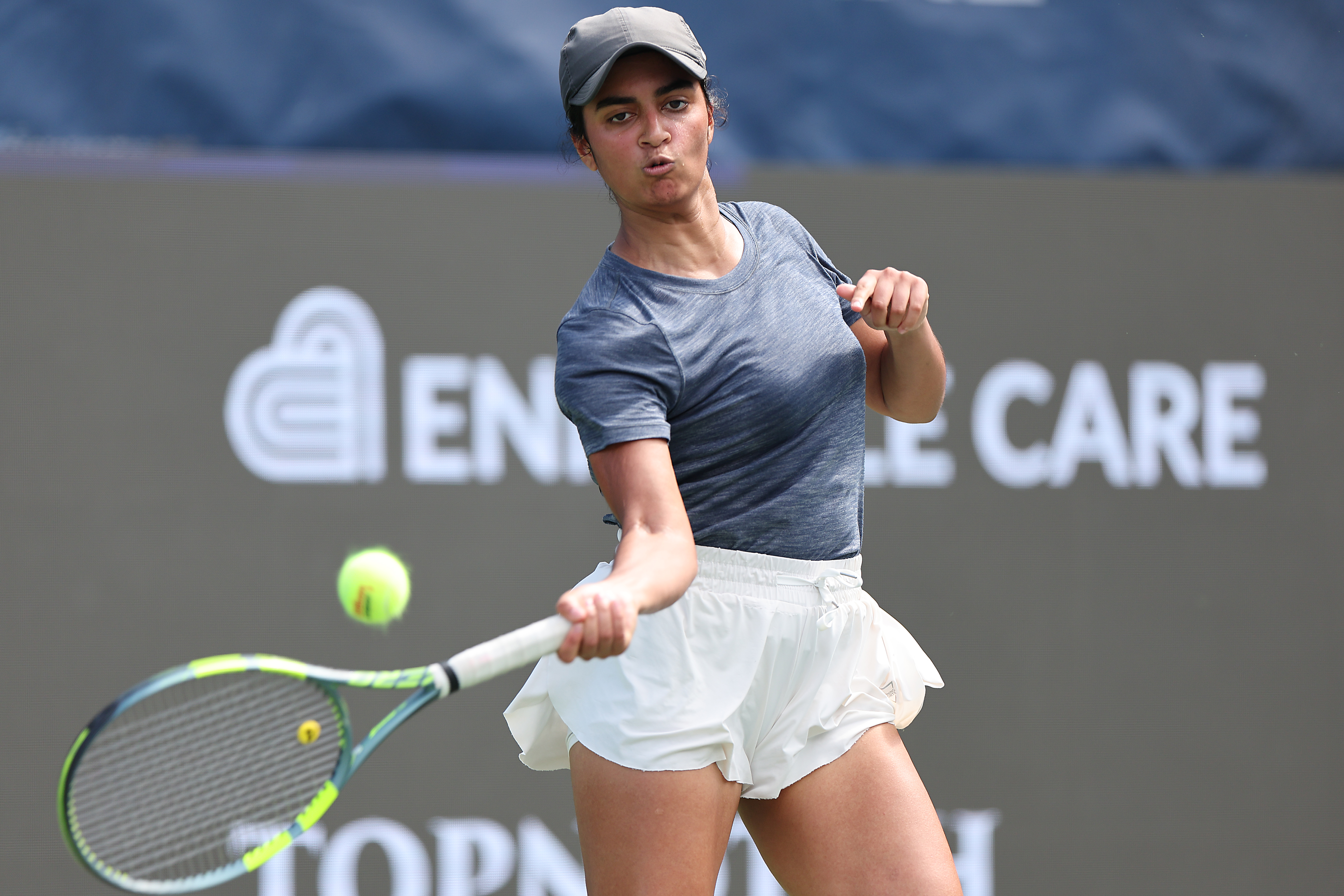
Velaga, a senior, lost her qualifying match 6-2, 6-4 to Ekaterina Ovcharenko in front of a packed crowd of Penn teammates, coaches, and friends cheering her on. She is headed for medical school after graduation instead of a professional tennis career. But she is planning on using the experience as a springboard for the Quakers’ upcoming season.
“We can compete here, even though we haven’t been doing professional-level training,” Velaga said. “I think we’ll definitely use the momentum and the good energy as well, and bring it into our very high-energy college season, and just know that no matter what team we compete against, we always have a chance, and we’re in it.”
Penn senior Esha Velaga played in her first professional tennis match on Sunday at the Ennoble Care Philly Open.David Maialetti / Staff Photographer
Velaga and Stojanovski were all-Ivy honorable mentions in doubles in 2025-26, but hadn’t practiced together all summer. They ultimately fell 6-4, 6-2 to the second-seeded team, but considering the circumstances, both were happy with the experience.
“It was a lot better than I expected,” Stojanovski said. “I think our chemistry since I came here as a freshman has been really good. We get each others’ games, so I don’t think we needed that much time to get on, but I do wish we had a little bit more time to prepare because I genuinely think we have the level.”
The Philly Open is the first WTA tournament in the area in over 20 years. Since the opening of the Penn Tennis Center, the university has been trying to attract a professional event, and they are taking full advantage of the opportunity.
Velaga lost both her matches, but thinks the experience will pay dividends for the Quakers this season.David Maialetti / Staff Photographer
The event is a boon to all of Penn’s tennis players. Stojanovski and Velaga got the wild-card entries into the draw, but other Penn players on campus got the chance to serve as hitting partners for players on-site and to watch their trainings.
Stojanovski said playing against the professionals showed her just how high the level is in college tennis, and that they have the ability to compete.
“It’s been an amazing experience because we got to practice with professionals, see how they’re preparing, see how they’re practicing, how they’re recovering,” Stojanovski said. “What are they doing differently?”
You’ve probably noticed that many of your favorite TV news anchors are on vacation right now, because the conventional wisdom is that nothing ever happens in August. That conventional wisdom has been wrong since Aug. 24, 79 A.D., when Mount Vesuvius erupted. The calendar has failed to stop natural disasters like Hurricane Katrina (see item below) or human-made ones like Richard Nixon, who resigned on Aug. 9, 1974. I’m going to tempt fate and take some vacation time next week, including a rare newsletter skip. I’ll see you in two weeks. What could possibly go wrong?
Trump’s autocratic assault on Stars and Stripes isn’t just bad. It’s personal.
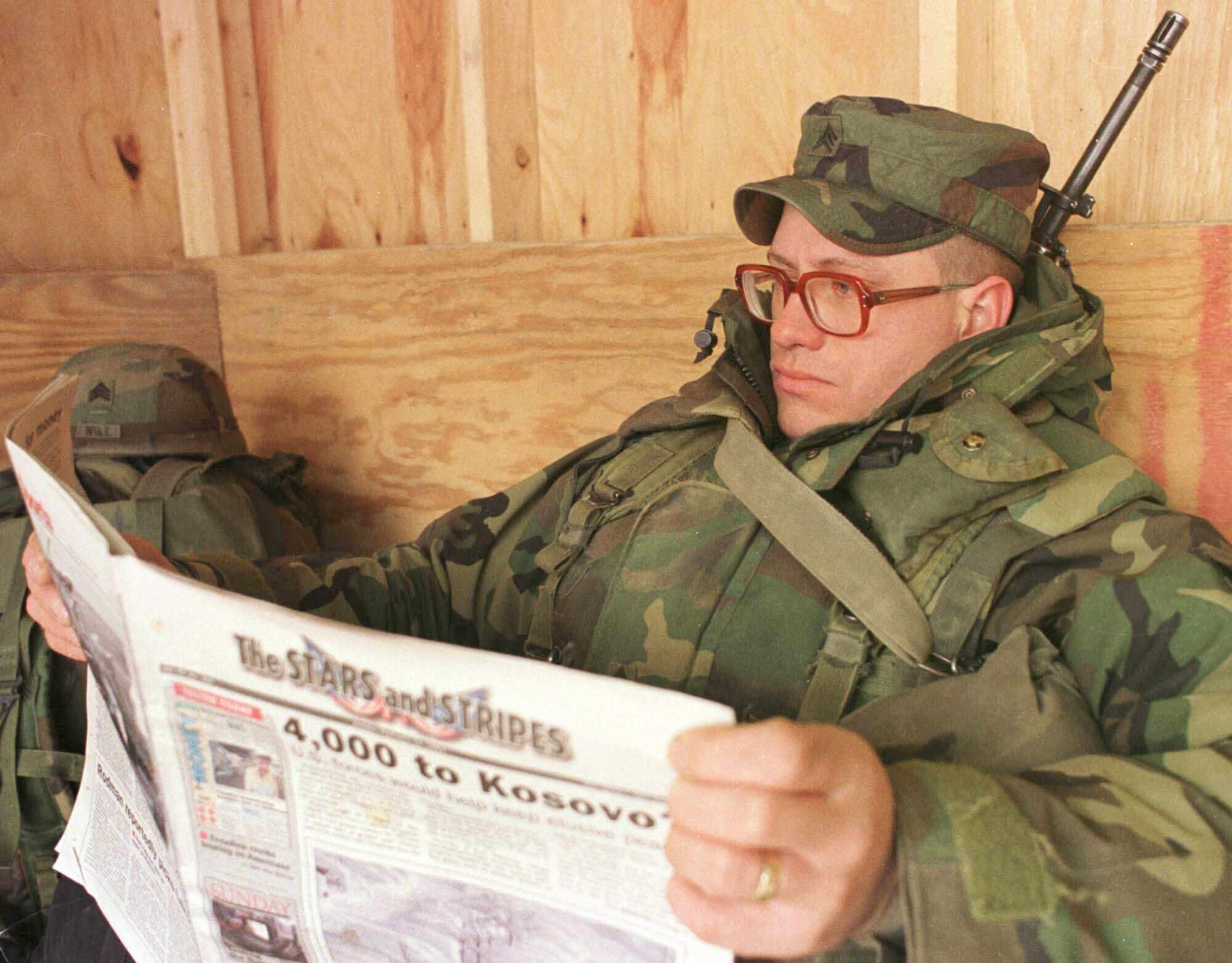
Sgt. John Hubbuch of Versailles, Ky., one of the members of NATO-led peacekeeping forces in Bosnia, reads a copy of the Stars and Stripes in 1999.AMEL EMRIC
Less than two months after the U.S. dropped the most powerful weapon humankind had ever invented — the atomic bomb — on the cities of Hiroshima and Nagasaki, the American military arrived in Japan to implement a very different kind of tool in the U.S. arsenal of democracy.
A free and largely unfettered newspaper.
The first edition of the Stars and Stripes Pacific newspaper was published from downtown Tokyo on Oct. 3, 1945, when the ink on the Japanese surrender that ended World War II was barely dry. This was the start of a decades-long run when print journalism was still the best way to get information that could be entertaining or essential out to hundreds of thousands of U.S. troops who initially occupied Japan and other Pacific outposts, and later would see combat in Korea and Vietnam.
Stars and Stripes Pacific — like virtually everything tied to U.S. imperial might after the war — is part of a complicated legacy that overlapped with American censorship of local and outside media in Japan. Yet, U.S. soldiers managed to get their own information from a publication that celebrated the better angels of the First Amendment back home, with coverage of Tokyo’s war-crimes trial and later from the front lines in Korea.
It was only part of a much grander legacy for Stars and Stripes, which has been the American military’s independent news source tracing all the way back to 1861 and the Slaveholder’s Rebellion.
Famously, when legendary World War II Gen. George Patton threatened to jail editorialcartoonist Bill Mauldin over a cartoon lampooning him, his superior, Gen. Dwight D. Eisenhower, stopped him. “Stars and Stripes is the soldiers’ newspaper,” Ike reportedly said. “We will not interfere.” Mauldin was awarded a Pulitzer Prize for his wartime cartoons. In 2010, Stars and Stripes reporters exposed the Pentagon’s efforts to slant mainstream media coverage of the war in Afghanistan, and won a George Polk Award.
That feisty spirit of Stars and Stripes runs deep in my family’s DNA. My maternal grandfather, Thomas Blender, who’d been a photo editor at the Peoria (Ill.) Journal Star before joining the Army, was sent to Tokyo in those early days to work as a top editor of the Pacific publication. I’ve always regretted, after Grandpa Tom died when I was only 11, that I never got to ask him about those days once I’d been infected with the family journalism bug I’d eventually pass on to my own son.
That must be why it felt like a personal attack last Friday when the Pentagon of Donald Trump and his like-minded “Secretary of War” Pete Hegseth obliterated 155 years of editorial freedom by firing its editor, its publisher — who, seeing the writing on the wall, was about to retire — and its Middle East correspondent. That journalist, Lara Korte, said she was pink-slipped for an interview with CBS News about her reporting on the dreadful conditions for Navy sailors aboard the USS Abraham Lincoln.
The fuse had already been lit back in January when Hegseth’s Pentagon gutted the regulations regarding the government-funded news organization by stripping language that called for “a free flow of news and information to its readership without news management or censorship.” The new rules, which instead said Stars and Stripes’ journalism “must be consistent with good order and discipline of the military,” were seen asan invitation for censorship. Sean Parnell, the formerly embattled Pennsylvania Republican who is now Hegseth’s chief spokesperson, blasted Stars and Stripes for “woke distractions.”
Three months later, Jacqueline Smith, the internal editorial watchdog of Stars and Stripes at the Pentagon, criticized military brass for editorial interference and was promptly fired. But the last straw for the outlet came two weeks ago with its aggressive reporting about problems aboard the Lincoln, which spent nine months mostly at sea with dwindling supplies tied to Trump’s ill-advised war on Iran. Journalist Alison Bath reported that sailors’ families were growing deeply concerned about the mental health of the aircraft carrier’s exhausted crew.
That work epitomized everything that has been good and decent about Stars and Stripes. What the newspaper has shown at its best is that — despite all the contradictions and moral failings of U.S. postwar imperialism — a democratic government can value the press freedom that its armed readers literally died for from Gettysburg to Omaha Beach. That high-minded ideal was a beacon to set us apart from our adversaries in Nazi Germany or Soviet Russia, who never would have permitted the kind of honest coverage Stars and Stripes offered for decades.
Until America found itself with a government with the same philosophy as 1939 Berlin or 1949 Moscow. Just like his boss, Hegseth has shown nothing but contempt for the notion that his “warfighters” might actually serve to protect Americans’ right to the truth about their own government, including the foibles of his Pentagon.
On Monday, it came out that the military’s U.S. Central Command told the Intercept that it maintains “a list of people to disregard,” a.k.a. a blacklist. This is the same U.S. Department of Defense — sorry, Pete, that is still its legal name — that also forced out any journalist who wouldn’t sign their integrity away to work in the press room at the Pentagon.
The firings at Stars and Stripes and the Pentagon’s apparent desire to turn the award-winning newspaper into a Pravda-style propaganda sheet for Hegseth’s testosterone-dosed military feels like a new low on the road toward the utter obliteration of all press freedom.
Since returning to power last year, Trump and his MAGA minions have waged war against journalists they’ve called “the enemy of the people” — and they’ve done so not through some grand Orwellian censorship edict, but through a mix of billionaire carrots and sticks that have inflicted a thousand small cuts. That means rewards for wealthy allies who buy prominent news organizations (think the Ellison family assuming control of CBS and being on the brink of getting CNN) or neuter them (Jeff Bezos at the Washington Post) — but lawsuits, obstacles, or straight-up bullying for everyone else.
Another alarming example of the precarious state of the First Amendment came earlier this month when a lawyer for Trump threatened a $5 billion (with a “b”) lawsuit against a left-leaning think tank, the Center for American Progress (CAP), if it didn’t retract a factual report that the Trump regime’s deployments of National Guard troops to U.S. cities have not lowered crime rates.
The CAP has stood its ground so far, but this reveals the state of play right now. MAGA World has already either bought off or intimidated much of the mainstream media, so now they are hoping they can crush the outliers like Stars and Stripes or CAP, one by one.
The mission my grandfather was dispatched to Tokyo to carry out after World War II was on the fringe of an idea that came to be known as “soft power” — the now-quaint notion that America could form healthy alliances with the rest of the world through good things like vaccinating children or printing uncensored journalism, instead of dropping bombs. Other organizations meant to show people in oppressed lands that press freedom and democracy are things to fight for — like Radio Free Europe — have been forced to grapple with Trump-ordered cutbacks.
The right knows exactly what it is doing — that truth and knowledge are kryptonite for its authoritarian project. Increasingly, they are saying the quiet parts out loud. The great Tennessee journalist Phil Williams recently unearthed a sound bite from a white supremacist confab in Rome in which the conversation turned to America’s growing number of news deserts where journalism has all but perished.
“Local media has been dying all over America, which means that there’s essentially no real way to hold local governments accountable — and they can do whatever they want,” white nationalist Kevin DeAnna told the gathering. “You should be fantasizing about this. This is a good thing.”
No, it’s not. The government’s bludgeoning of Stars and Stripes has truly — to borrow from a storied military campaign of yesteryear — crossed the Rubicon of no return for its all-out blitzkrieg against the truth. All of us, including the laggards of the mainstream media who continue to pretend this war doesn’t exist, need to fight back with everything we have.
I never got to know my Grandpa Tom very well, but I know in my soul that this is what he would have wanted.
Yo, do this!
Meep, meep! If timing is really everything, then the half-animated, half-real feature film Coyote vs. Acme, which hits theaters this week, will be the greatest motion picture of all time. The film is based on a 1990 New Yorker essay that imagines Warner Bros. cartoon icon Wile E. Coyote suing the giant Acme Corp. over years of faulty products that literally blew up in his face and ruined his shot at catching the speedy Road Runner. The fact that real-world corporate baloney delayed for several years the release of this film mocking the excesses of runaway capitalism is an unbelievable irony. I’m really looking forward to seeing it.
Books, despite their apparent looming extinction, remain a great way to track what humankind is thinking about. This summer, the hot topic is anxiety over AI and the unchecked power of Silicon Valley. In addition to the best-selling Nerd Reich, now there’s the great essayist and Harvard historian Jill Lepore with her new tome, The Rise and Fall of the Artificial State, out today. Lepore’s timely work tracks the rise of authoritarianism run not so much by a tinhorn dictator, but by machines, and how humanity can fight back.
Ask me anything
Question: Do PA Dems have a legit chance of freeing us from Joe Pittman’s reign of terror in the state Senate? — Travis (@unraptured.bsky.social) via Bluesky
Answer: Travis, the answer is absolutely yes. Democrats in the Keystone State have managed to chip away at what once seemed like a permanent GOP majority in the upper chamber at the same time that they’ve recaptured the state House. The current Republican Senate edge is just 27-23, meaning Democrats have to flip only three more GOP seats among November’s 25 contests. Every arrow — Trump’s high disapproval, the popularity of Gov. Josh Shapiro at the top of the ticket, and special-election results like last week’s shocking Democratic House victory in a blood-red district in Western Pennsylvania — points toward a blue tsunami. The Democrats have reportedly targeted three suburban swing districts. The big question for 2027 may be whether Shapiro really wants a Harrisburg trifecta pushing him to the left.
What you’re saying about …
OK, last week’s question about Georgia Sen. Jon Ossoff’s pointed comments regarding Donald Trump’s corruption, including an eyebrow-raising mention of ever-present aide Natalie Harp, was kind of a slam dunk for readers of this newsletter. You saw nothing uncivil in the fighting spirit of his remarks, and a surprising number of you echoed back a phrase from my question: “a breath of fresh air.” Wrote Daniel Fleischer: “Jon Ossoff called Trump a ‘crook.’ If anything, that’s a euphemism understating Trump’s criminality.” Added Patricia Eisenberg: “What he said was undeniably true — the President chose this young woman to travel on his escape plane, not one of his cabinet members.”
📮 This week’s question: It seems like the GOP’s got nothing ahead of the midterms beyond its opposition to what it calls “men playing women’s sports.” It’s kind of pathetic, but it does pose a question for Democrats: Do they strongly embrace transgender rights, or is that risking political defeat in today’s culture wars? I have a strong opinion on this, but what do you think? Please email me your answer and put the exact phrase “transgender politics” in the subject line.
Backstory on Indiana’s new, outrageous Katrina
A woman sits inside the City Life Center as she waits for food in Gary, Ind., on Aug. 20, more than a week after a deadly storm passed through the area.Nam Y. Huh
Exactly 21 years ago today, a tropical storm in the Atlantic Ocean rapidly intensified into a hurricane — Hurricane Katrina — and raced across Florida on a path into the Gulf of Mexico, where it became a Category 5 monster. Still, many of us in 2005 briefly thought the Gulf Coast dodged a bullet when Katrina weakened slightly, and its center struck what looked like only a glancing blow on populated New Orleans. Then, one by one, the city’s levees began to break, and the water rose.
The death and destruction in Katrina’s wake was covered around the clock on cable TV, yet it took a couple of days for news anchors to articulate what viewers were seeing with their own eyes. The thousands of people who crowded interstate overpasses or were trapped on roofs were almost all Black, and most were desperately poor.
In These Times wrote the following week that “many Americans were surprised that most of the victims of the New Orleans flood were Black: Their image of the Crescent City had been one of jazz, tasty cuisine and the good-natured excesses of its lively festivals. Where did all those black people come from, they wondered; and where were the white victims?” Katrina triggered some long-overdue conversations about inequality and racism in America, and the inept response from the George W. Bush administration would start his steep decline in public approval. Long before the roughly 1,400 New Orleanians who died in the flooding or chaotic aftermath could be buried, many folks were asking how to prevent this from ever happening again.
It wasn’t a hurricane that struck Gary, Ind., and surrounding communities in the state’s northwest corner exactly two weeks ago on Aug. 11 — just a thunderstorm — but the winds were nearly as intense, snapping trees and downing power lines across the region. Gary’s 67,000 predominantly Black residents hunkered down in the dark nights and blistering hot August days as their refrigerated food went bad, and waited for help. And waited.
While life returned to normal across the rest of the storm-battered Midwest, the massive outage in the region that includes Gary that began with some 375,000 homes lacking electricity dwindled at a snail’s pace. After two weeks, there were still more than 5,000 families without power and struggling with spoiled food and closed schools and workplaces. There is growing anger among residents who say that Indiana’s heavily Republican power structure and Donald Trump’s federal government feel no sense of urgency to rescue a city that is mostly African American.
“This isn’t a problem that started with the storm,” the hip-hop star Freddie Gibbs, who grew up in Gary, told MS Now Monday night. “We are a predominantly Black city that tends to get ignored.” It feels like Katrina redux — an island of utter despair in the world’s wealthiest nation, with a government’s inaction bordering on criminal neglect. But there is one big difference: This festering crisis has been mostly ignored by the national media. The tragedy isn’t just our inability to stop the next Katrina, but our inability to care.
What I wrote on this date in 2022
One of George Orwell’s greatest passages in 1984 concerns Winston Smith’s job of cutting out old newspaper articles and tossing them into “the memory hole” — inconvenient truths meant to be forgotten by civilization. That’s how it feels now reading news stories from those four years in the early 2020s when Donald Trump was out of power, and America took baby steps back toward normalcy that would later get crushed. On Aug. 25, 2022, I wrote about one of these: Joe Biden’s eventually failed plan to wipe out some $300 billion of the nation’s massive student loan debt. I wrote that “this week will be remembered as one giant leap toward an idea that can change everything — the notion that higher education should be a public good, not the privatized rat race that has demoralized our rising generations.”
Look what’s happening out in the streets, got a revolution — and it’s not the one anyone saw coming. Growing public rage against Big Tech — the intrusiveness of artificial intelligence and the noisy, polluting data centers that power it, and increasingly also against omnipresent surveillance cameras — has become the surprise issue of the 2026 midterms. Politicians in both parties are performing backflips to join the bandwagon. Over the weekend, I wrote about how voter anger against Silicon Valley and its billionaires is rapidly reshaping our politics, and what could happen if our broken system fails to deliver radical change.
For the first time in recent memory, August has been living up to its reputation as a slow news month (so far), but on the baseball diamond things have really been heating up as kids are drifting back to school. The Phillies’ just-ended nine-game winning streak has electrified a city that’s been having a pretty good summer in spite of everything. The Inquirer’s oft-cynical sports columnist Marcus Hayes even published a list of five reasons to believe the Phils can go deep into October with a reenergized starting lineup, world-class pitching, and improved defense. A stunning turnaround from long-anticipated rookie pitcher Andrew Painter has also been key to the team’s revival in the National League East. It’s an old-fashioned pennant race, and subscribing to The Inquirer is the best way to keepup.
By submitting your written, visual, and/or audio contributions, you agree to The Inquirer’s Terms of Use, including the grant of rights in Section 10.
Food magazine Bon Appétit released its annual best new restaurants list on Monday, and it includes two Philadelphia restaurants.
Honeysuckle, Omar Tate and Cybille St.Aude-Tate’s fine-dining restaurant in North Philadelphia, and Sao, Phila and Rachel Lorn’s East Passyunk oyster bar, were among the 19 establishments that made the cut.They joined restaurants in New York City, San Francisco, Chicago, Seattle, Nashville, and Birmingham, Ala., and more.
The unranked list defines new restaurants as those that opened between March 2025 and March 2026. Scouts visited restaurants in 43 U.S. cities and rated them according to seven criteria: flavor, technique, hospitality, ambiance, cultural significance, innovation, and sense of place.
To be considered the best, “a restaurant must serve dishes and drinks that are complete in terms of flavor and technique, from the pre-meal cocktails to dessert, like an album with no skips,” wrote Bon Appétit editor-in-chief (and former Inquirer food editor) Jamila Robinson.
Partners and chefs Cybille St.Aude-Tate and Omar Tate, who opened Honeysuckle at 611 N. Broad St. in April 2025.Clay Williams
Tate and St.Aude-Tate opened Honeysuckle at 611 N. Broad St. in April 2025. The restaurant’s five-course tasting menu evolved from the couple’s beloved West Philly café-market, Honeysuckle Provisions, which closed in 2024. The couple uses the menu to weave a dynamic and complex narrative about how the Black diaspora has shaped American food culture.
The Mawn Cutlet at Sao, the East Passyunk Avenue oyster bar from married restaurateurs Phila and Rachel Lorn.Monica Herndon / Staff Photographer
“Chefs Omar Tate and Cybille St.Aude-Tate deliver a showstopping walk through nostalgia, pop culture, Philadelphia, and Black American history through dishes that spark new reflection and conversation,” Robinson wrote of Honeysuckle.
Phila (left) and Rachel Lorn (right) own Cambodian noodle bar Mawn and oyster bar Sao. Bon Appétit has named Sao one of the country’s best new restaurants of 2026.Monica Herndon / Staff Photographer
The Major League Baseball Players Association said Monday that it supports prohibiting players from participating in personalized marketing campaigns for sportsbook VIP programs, amid congressional scrutiny of a video of Philadelphia Phillies star Bryce Harper that a FanDuel employee sent to a customer who had a gambling addiction.
Jeffrey Perconte, MLBPA’s general counsel, wrote in a letter to U.S. Sen. Richard Blumenthal (D., Conn.) and U.S. Reps. Paul D. Tonko (D., N.Y.) and Valerie P. Foushee (D., N.C.), that the union would be willing to adopt this restriction as part of a new collective bargaining agreement that it is negotiating with Major League Baseball.
The three members of Congress had sent letters on Aug. 10 to MLB, the players’ union, and FanDuel, demanding that each take corrective action to address The Inquirer’s reporting on the personalized video Harper recorded and a FanDuel VIP host sent in 2024 to Terry Thompson, a Montgomery County resident who lost $1.5 million on sports wagers that he placed with FanDuel.
Thompson planned to die by suicide earlier this year rather than acknowledge to his family the scope of his losses, according to a lawsuit that the nonprofit Public Health Advocacy Institute filed in March on Thompson’s behalf against FanDuel and DraftKings, which had also allegedly provided him with VIP perks.
Harper has said that he recorded the message through the video service Cameo but didn’t know that FanDuel would utilize the 21-second video as a reward for an addicted gambler.
The Democratic lawmakers told FanDuel to end its VIP program, which they described as predatory, and called on MLB and the MLBPA to prohibit players from performing promotional work for gambling entities.
That players aren’t prohibited from doing promotional work for gambling companies is a “systemic failure,” the lawmakers wrote, “rooted in the deep enmeshment between leagues, teams, and sports books.”
In his response, Perconte noted that the current collective bargaining agreement, which expires in December, allows players to appear in advertisements or make personal appearances for casinos, racetracks, or sportsbook companies, provided the ballplayers do not encourage betting on baseball.
“We believe the restrictions on endorsements and partnerships in our collectively bargained policies represents a good-faith effort to allow responsible betting-related promotional activity by teams and players,” Perconte wrote.
“That said, our current policies do not explicitly reference or otherwise address the types of ‘predatory VIP programs’ described in your Aug. 10 letter. The Association stands ready to make proposals to fill that gap.”
FanDuel responded in a separate letter to the lawmakers, explaining that the company offers tools that enable bettors to limit how much and how often they wager, and extensively reviews customers’ betting history before offering them VIP status, according to a copy of the message that was posted online by the outlet Sports Betting Dime.
“Employees who are primarily responsible for engaging with VIPs — VIP Account Managers — are salaried employees,” wrote Cory Fox, a FanDuel senior vice president. “Their compensation is not tied to how much their customers wager or the results of those customers’ wagering activities.”
FanDuel did not address questions that the Congress members raised about whether VIP managers had sent videos of other athletes or celebrities to gamblers.
Since the U.S. Supreme Court voted in 2018 to give states the authority to enact their own sports betting laws, MLB and other professional sports leagues have entered into lucrative partnerships with sportsbook companies and prediction markets.
Perconte wrote that half the league’s 30 franchises have partnerships or sponsorships with sports betting operators, while the owners of three teams — the Boston Red Sox, Chicago Cubs, and Los Angeles Dodgers — are “seed investors in a newly announced prediction market futures trading platform called FutureSports.”
As part of collective bargaining negotiations, the players union has proposed lobbying with MLB to ban proposition bets and event contracts that are based on a player’s in-game performance, which the union said is linked to higher rates of problem gambling and bettors harassing players and their families.
“And while MLB has thus far rejected this proposal, we intend to continue pursuing it,” Perconte wrote.
Elected officials in Pennsylvania are separately planning legislation that would restrict or eliminate sportsbook VIP programs, and in-game microbets, an effort that Joe Maloney, the president of the Sports Betting Alliance — a national advocacy organization whose members include FanDuel, DraftKings, BetMGM, bet365, and Fanatics — said the organization will oppose.
Pennsylvania’s Gaming Control Board, which regulates casinos, online gambling and sports wagering, has also said that it is reviewing the Harper video.
The Inquirer will continue to report on issues related to the growth of gambling addiction — among teens and adults — across Pennsylvania. If you or someone you know wants to speak with a reporter, please contact David Gambacorta or William Bender at dgambacorta@inquirer.com and wbender@inquirer.com
Don’t call it a potential breakout season for Jalyx Hunt.
Hunt, the 2024 third-round outside linebacker out of Houston Christian, has been one of the standout defensive players in training camp due to his consistent disruption off the edge. His performance in joint practices against the New England Patriots, which included a diving interception of Drake Maye, provided more evidence of his stellar summer ahead of his third season with the Eagles.
But Hunt isn’t all that fond of the “breakout” label for any player who is putting in the work behind the scenes, let alone himself.
“I feel like to say ‘breakout’ is not disrespectful to any player, but the amount of work that the athletes on the field, whether it be practice squad, whether it be rotational guys, whether it be starters, the amount of work they put in … it’s no surprise when someone is able to make plays or to do anything like that,” Hunt said Monday.
After all, there’s an argument to be made that Hunt has already broken out.
In his second season with the Eagles last year, the 25-year-old outside linebacker led the team in sacks with 6½, a dramatic increase over his rookie year output of 1½. His 16.5% pressure rate was the highest among all Eagles outside linebackers, too, according to Next Gen Stats.
Hunt said he has always known that he was capable of the production. The general public is just catching up with his potential.
“Last year was just a reflection of the work I put in,” Hunt said. “So I don’t think there’s any type of breakout. I think it’s just me and y’all are starting to see the type of plays I can make and the type of player I would like to be.”
Jalyx Hunt’s play in his second NFL season was a revelation, one he’s seeking to build on. Monica Herndon / Staff Photographer
Hunt could have plenty of opportunities to make more plays when the season begins. Jonathan Greenard has been sidelined for all of training camp with a pectoral muscle strain. Vic Fangio said on Aug. 19 that he didn’t know when Greenard would be back, casting some uncertainty about his availability for the season opener against the Washington Commanders in three weeks.
Greenard was sidelined during the offseason program, too, as he recovered from shoulder surgery earlier this year. At the time, Fangio didn’t seem too concerned about his ability to get up to speed in a new defense given his veteran status.
Still, if Greenard is sidelined for Week 1 or if he is on a snap count, that could mean more reps for the rest of the room, especially Hunt and Nolan Smith Jr. Even in training camp, Hunt is taking advantage of those additional opportunities, whether he’s going up in practice against Lane Johnson and Jordan Mailata or Patriots tackle Will Campbell.
He was especially grateful to get away from Johnson and Mailata for two practices last week.
“In a very respectful way,” Hunt said. “They’re just really good at their craft, so it’s nice to go against people who are stronger in other areas, make me work different moves and different tendencies, and try to dissect the rush as I go along in the game.”
Hunt is learning from his fellow Eagles teammates on defense, too. No longer the least experienced player among the edge rusher corps, he still relies on the entire room for input, and vice versa. The group feeds off of one another, he said, regardless of age or experience.
Jalyx Hunt (58) has explicitly credited teammate Zack Baun (53) in helping to fuel his growth. Yong Kim / Staff Photographer
That culture goes beyond the edge rusher room. Hunt said he has looked to Zack Baun for inspiration since both players arrived in Philadelphia in 2024. Baun had signed a one-year deal with the Eagles after spending four years with the New Orleans Saints primarily as a core special teams player.
But Hunt quickly picked up on Baun’s hardworking nature in training camp that year as he catapulted himself from a relatively unknown depth defender to an All-Pro inside linebacker and starter on a Super Bowl-winning defense.
Baun had put in the work early on, and when he earned his opportunity, he never gave it up.
“He became Zack Baun, the Bald Eagle, the superhero, the captain at the helm,” Hunt said. “So I learned that from him, too. You just have to keep putting in the work, and then when you’re put in those positions, your work will come through.”
Hunt is laying the groundwork with the aspiration of following the same trajectory as Baun. His progress in Year 3 is promising. Hunt has taken up residence in the backfield this training camp, but that isn’t a surprise to the outside linebacker given his work ethic.
Come Week 1, he will have an opportunity to replicate that performance in the regular season. He knows what he is capable of achieving, even if everyone else outside of the Jefferson Health Training Complex is just taking notice.
“I don’t think there’s any type of breakout,” Hunt said. “I think it’s just me and y’all are starting to see the type of plays I can make and the type of player I would like to be.”
The body of a 33-year-old woman who disappeared in the Delaware River after she rescued a struggling swimmer on Monday afternoon has been recovered, the Delran Township Police Department said Tuesday.
Search crews located the body of Priscila Alvares Pereira Dos Santos about 20 feet off a beach at Amico Island Park in Riverside shortly after 8 a.m. Tuesday, Delran police said, roughly 16 hours after she was last seen in the water.
Alvares Pereira Dos Santos reportedly drowned after saving a girl who was struggling in the river around 4 p.m. on Monday, according to officials.
She was able to push the girl toward bystanders on the shore before she vanished under the surface, they said.
The girl she saved has not been publicly identified and her condition is unknown.
Amico Island Park was closed Tuesday as the investigation into the incident continued.
SEATTLE — Six weeks after the Phillies lost their primary eighth-inning reliever for the season, five weeks before the playoffs, the bridge to Jhoan Duran is taking shape.
And Brooks Raley is emerging as the top lefty.
“Brooks has been easy to trust,” Don Mattingly said as the Phillies continued their West Coast trip here Tuesday. “He’s throwing strikes. He’s not walking people, all that. So, yeah, he’s easy to trust.”
Mattingly’s word choice was notable because, this time of year, there’s only one question for a manager as it relates to the composition of the bullpen: Who do you trust?
The Phillies tweaked the bullpen in the offseason. But their most expensive addition, Brad Keller, had Tommy John elbow surgery last month. Jonathan Bowlan has outkicked expectations. But holdovers Kerkering and Alvarado have been inconsistent.
So, as the Phillies attempt to cement a wild-card spot and close in on the division-leading Braves, the bullpen is coming into focus again, with relievers jockeying for position behind Duran in Mattingly’s circle of trust.
Hard-throwing Phillies rookie reliever Alex McFarlane has pitched well since returning from triple A.Elizabeth Robertson / Staff Photographer
Here’s what we know: Raley is earning more late-inning chances after being acquired in a deadline trade with the rival Mets. But hard-throwing rookie Alex McFarlane isn’t quite there yet.
Let’s start with Raley. After giving up a pair of two-out runs in his Phillies debut on Aug. 5, the 38-year-old lefty has allowed one run on three hits and a walk in six innings over his last seven appearances.
And with Duran unavailable last Tuesday night, Raley picked up his first save since 2023 in a 6-4 victory over the Marlins.
“He’s given up some hits, but I feel like he’s going to make pitches,” Mattingly said. “He’s not going to panic.”
There isn’t a more essential trait in October. Raley has appeared in 15 postseason games, mostly with the Astros, and has a 4.73 ERA that was inflated by a three-run outburst in Game 3 of the 2021 American League division series. He allowed two runs in his last 7⅓ postseason innings.
Raley also has a track record against some of the most dangerous left-handed hitters in the National League. Shohei Ohtani, for instance, is 1-for-7 with three walks and a .506 OPS against him. Freddie Freeman is 1-for-6; Pete Crow-Armstrong and Max Muncy are both 1-for-4 with a walk; Christian Yelich is 1-for-4 with three strikeouts.
And with Alvarado struggling (five earned runs in his last five appearances), Raley appears to be Mattingly’s lefty of choice with a late lead.
Phillies reliever Jonathan Bowlan has a 2.89 ERA in 49 appearances.Yong Kim / Staff Photographer
From the right side, Bowlan moved into the setup role vacated by Keller. But Mattingly has leaned hard on him and Kerkering, who appears to be catching a second wind after struggling to throw strikes for a stretch in late July.
The Phillies have given McFarlane some higher-leverage tests since recalling him from triple A two weeks ago. The 25-year-old righty has uncorked 32 pitches that reached at least 100 mph, with his fastball averaging 99.9.
But he also has given up three runs (one earned) on five hits and three walks in seven innings.
“I think he’s been good. He’s been fine,” Mattingly said. “But there’s no reason to have to push him forward. … He’s been easy to trust when I don’t have another righty out there. I trust him in right-handed pockets. I don’t put him in Bowlan’s category yet, or even Kerk’s. But I do put him in the category of like, if you match him up in the right pocket.”
Mattingly’s level of trust figures to rise as McFarlane’s command improves. He hasn’t issued a walk in his last three appearances after walking the leadoff batter in each of his previous three.
“We talked about the walks earlier with him,” Mattingly said. “He’s thrown strikes for the most part. I think he’s a tough at-bat, especially on the righty, with the combination of his movement and velo. Just the velo, in general.
“The more specific he gets over time with his breaking ball, the fastball, not just throwing it but getting it to an area of the plate. Being able to use both fastballs, the sink and the run straight [four-seamer], those are going to kind of dictate how good he becomes.”
Every appearance is an audition for a larger role. And the auditions will continue for another month.
Extra bases
With a third-inning single Monday night, Bryce Harper became the 34th player to record 1,000 hits with the Phillies. He has 1,922 hits overall, seventh-most among active players behind Freeman, José Altuve, Andrew McCutchen, Paul Goldschmidt, Manny Machado, and Nolan Arenado. … Aaron Nola (5-9, 5.12 ERA) is lined up to start Tuesday night against Mariners righty George Kirby (8-10, 4.18). The series wraps up Wednesday with Jesús Luzardo (11-5, 3.35) set to face Mariners righty Bryan Woo (9-8, 4.10).
Vincent Procopio pleaded guilty to unlawful use of a computer, criminal use of a communication facility, hindering apprehension, and related crimes. He is scheduled to be sentenced by Judge Deborah Krull on Oct. 7.
His attorney, Meaghan Wagner, said after the hearing that Procopio accepted responsibility for his actions as a means of continuing “to move forward in a positive direction in his life.”
“Meanwhile he continues to work on his sobriety every day and celebrates eight months sober on Sept. 7,” she said.
Before he resigned after his arrest in April, Procopio, 34, of Newtown Square, had worked for Sharon Hill for four years. He was at Academy Park High School on the night 8-year-old Fanta Bility was killed by a stray bullet amid a shooting caused by three of his colleagues.
Procopio and the dealer, whom investigators did not identify, met through mutual friends in 2025, according to court filings. The dealer told police Procopio approached him, saying he “wanted in” on his drug-smuggling operation.
Over the course of the next year, the dealer would give Procopio $100 baggies of cocaine in exchange for information from police databases, including whether undercover officers planned to make drug busts in the area where he was operating, and whether there were any warrants for his arrest.
The narcotics, prosecutors said, were for Procopio’s personal use and “wholly unrelated to his law enforcement duties.”
The scheme unraveled when the dealer was pulled over in Chester in December with 63 grams of cocaine in his car. He called Procopio for help, and Procopio made calls on his behalf, telling officers in Chester the man was a friend and was in the process of signing up to become a confidential informant.
Procopio later told investigators he knew the man had sold drugs, but said he had recently stopped. He said he never saw the dealer sell cocaine and had never bought cocaine from him.
Prosecutors said that Procopio’s statement was a lie, and that Procopio had deleted text messages between him and the dealer that made that clear.
Procopio and the dealer had developed a jocular relationship, they said. On the day they met, the detective snorted a line of cocaine with the dealer inside his truck. He later went to the man’s home, where they “stayed up all night doing cocaine,” according to the affidavit of probable cause for Procopio’s arrest.
The two regularly exchanged text messages, including one in which the detective, on his way to Sunday Mass, asked the dealer for a bag of cocaine.
And Procopio instructed the man to tell any police officer who stopped him that he was the detective’s cousin, prosecutors said.
In a statement announcing Procopio’s arrest earlier this year, State Attorney General Dave Sunday, whose office is prosecuting the case, decried Procopio’s actions, saying his “selfish, criminal acts also stain the reputations of many public servants who make sacrifices for their communities every day across the Commonwealth.”
As part of the same investigation, another Sharon Hill officer, Domenic Dellabarba Jr., was arrested for allegedly providing confidential information to the dealer.
Dellabarba, 27, is charged with obstructing the administration of the law and related crimes, and his case is pending in Delaware County Court.