Bucks County Court Judge Wallace H. Bateman Jr. accepted McCauley’s plea and scheduled him to be sentenced in the coming months.
Due to the nature of the offenses he pleaded to, McCauley will have to register as a sex offender for the rest of his life.
McCauley, 30, of Lexington, Ky., befriended the victim in 2024 through Snapchat, prosecutors said. He pretended to be a teenage boy on the social media platform and persuaded her to send him nude photos and videos.
He then used the explicit material as blackmail, along with threats against the girl’s mother. He created a profile for her on the dating app Grindr, presenting her as 18, and coached her on what to say during dates with men who responded to the profile.
Both pleaded guilty to statutory sexual assault and are serving sentences in state prison.
The girl met with Van Ingen twice in October 2024, and on both occasions he drove to the girl’s home and picked her up in his pickup truck, according to the affidavit of probable cause for his arrest. On their second meeting, the two had sex in the back of the truck while it was parked in a school parking lot, the affidavit said.
Quinn had sex with the girl twice, once in a park and another time in a motel in Doylestown, according to the affidavit. Both times, Quinn streamed the sexual encounters to McCauley through Snapchat, the document said.
A third man who picked the girl up at her home for a planned date called off the encounter after realizing she had lied about her age, according to prosecutors. He did not face any criminal charges.
Prosecutors said they learned of the crimes last year after the girl’s mother caught her taking risqué photos and later discovered pornographic text messages between her and McCauley on the girl’s cell phone.
The state Board of Education has rejected a plan to make it easier to score advanced on state tests.
The board, by a 9-5 vote Thursday, said no to lowering the bar for the top designation on exams taken by students across the Commonwealth.
It was an about-face following a public presentation earlier this month on proposed changes to the “cut scores” on PSSA and Keystone Exams. The Pennsylvania Department of Education had wanted the board to approve its changes immediately and apply them to the exams students took this spring.
Officials had said the move was necessary to better line up students’ learning expectations and exam performance, and aligned with national trends.
Ultimately, multiple board members expressed discomfort with the proposal.
“I’m just not sure that 2026 is the right year to serve as our baseline going forward,” said state Senator Lindsey Williams (D., Pittsburgh), a board member who noted that this was the first year all Pennsylvania students took exams online, and that there were widespread technical glitches in administration.
Williams said neither the board nor the public had enough time or information in advance of such a major change to consider its implications. Over 800,000 students in grades 3-8 and high school take the PSSAs and Keystone exams annually.
Board member Sandra Dungee Glenn said she appreciated the work of the educators who arrived at the recommendations for new cut scores, but “it would be better, more appropriate to do it next year.”
Here’s what the vote means:
Why were the changes being proposed?
Amy Lena, a PDE Deputy Secretary, said the change was needed “to ensure that performance labels accurately reflect what students know and can do, but not to make assessments easier or harder.“
Changes were overdue, administration officials said — Keystone cut scores were last recalibrated in 2012, and PSSAs in 2015.
A panel of 90 educators came up with the recommendations adopted by the board.
The change would not have made it easier for students to reach proficiency, just advanced status.
Brian Campbell, PDE’s director of the Bureau of Curriculum, Assessment and Instruction, said the new cut scores and descriptors would have provided more information for teachers, a “direct link now that a teacher can use to develop the lesson plans and the instruction around the performance-level descriptors.”
What affect will the cut score change rejection have on the release of 2026 PSSA and Keystone scores?
If the changes it recommended were made, PDE had planned on releasing final 2026 PSSA and Keystone scores to schools very soon, with parents receiving them in early 2027.
PDE officials said districts will still get test scores, but they will need to be re-run under the cut scores already in place.
It’s unclear how long that might push back the release of that information.
While officials said the move was necessary to better line up students’ learning expectations and exam performance, it drew criticism from some, who protested the watering down of standards.
Mark Gleason, managing partner of The Drexel Fund, a venture philanthropy, objected to what he said was a lack of parent input on the changes, and said it was wrong for Pennsylvania to chase national standards when “the national trend is to lower standards when it comes to K-12 education.”
Gleason, former director of the Philadelphia School Partnership, now called Elevate 215, noted that student performance on national and international exams are declining.
“This is the national trend,” Gleason told the board. “I don’t think it’s what we want Pennsylvania to be participating in.”
The conservative Commonwealth Foundation also objected to the proposed changes. Rachel Langan, senior education policy analyst for the foundation, said the change would obscure data points, making it tough to compare student achievement year over year.
“Pennsylvanians should be highly suspect of the proposed test score changes,” Langan said in a statement. “Administrators and bureaucrats are rewriting history right in front of our eyes.”
State Rep. Peter Schweyer (D., Lehigh), another board member, voted for the cut score change, but “reluctantly,” and said he thought that while the process behind it was done correctly, communications needs to improve and scores need to be examined more than once a decade.
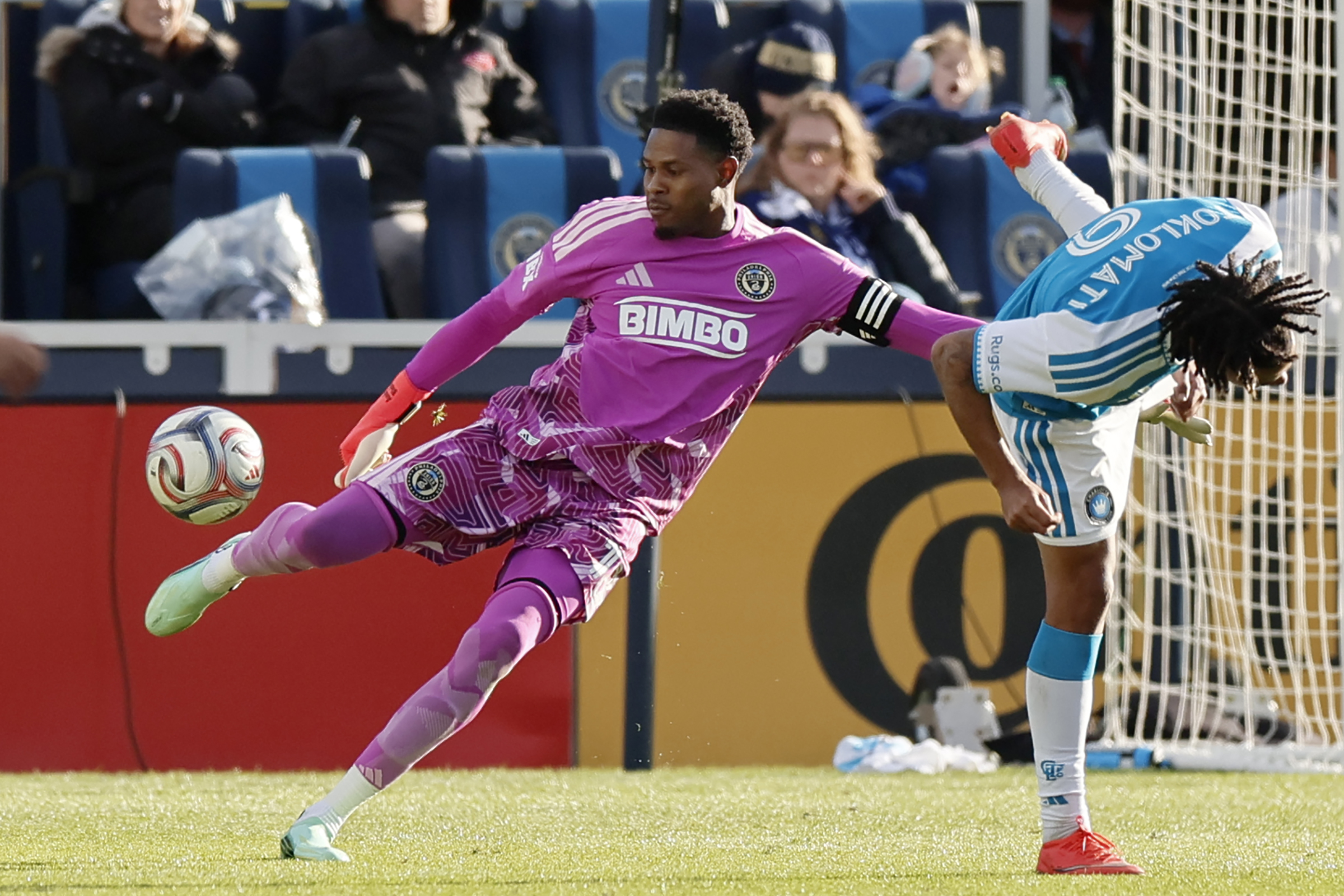
Union goalkeeper Andre Blake won’t play in Saturday’s playoff opener at New England (2 p.m., Apple TV) due to the groin injury he suffered in the regular season finale.
Blake left that game at halftime and hasn’t seen the field since. He went to Jamaica’s national team camp that just concluded, but did not play in the Reggae Boyz’ Concacaf Nations League quarterfinal games against Mexico.
(Despite his absence, Jamaica won the series opener, 3-2 at home. Mexico then won its home game, 1-0, and advanced on the away goals tiebreaker. El Tri will play the U.S. in the semifinals in March in Los Angeles, in what will be the first game for Mauricio Pochettino’s successor.)
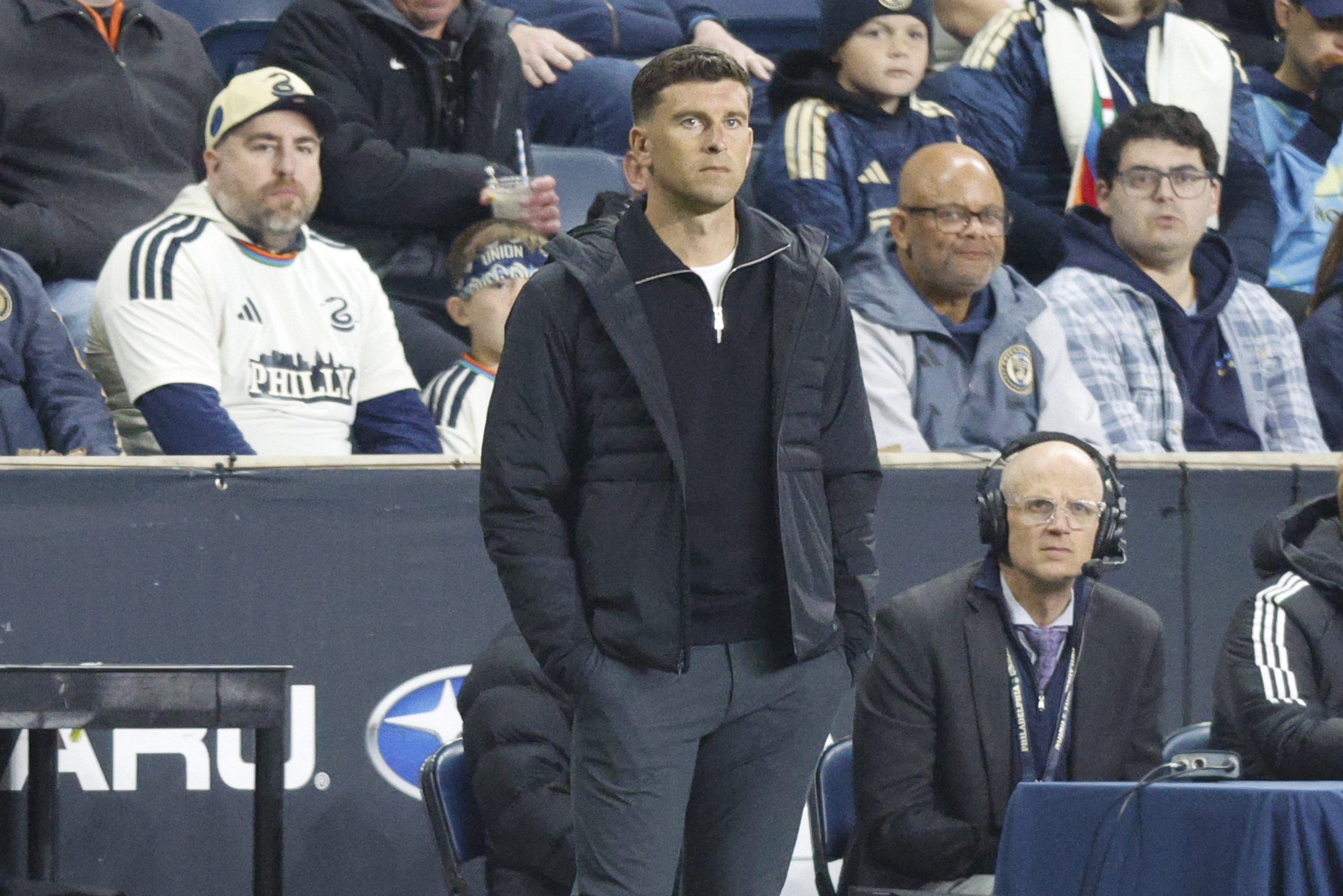
“He was on the field today, so what we’re hoping is that he’s available for the second game in the series,” interim Union manager Ryan Richter said Thursday. “But he won’t be available for this weekend.”
Ryan Richter will take charge of a MLS playoff game for the first time as Union manager on Saturday.Steven M. Falk / For The Inquirer
Blake was only on the field for some of the part of practice that was open to the media. He emerged from the team’s indoor facilities well into that time, and worked with a trainer on a separate field from the rest of the squad.
Game 2 of the series is Nov. 28 at Subaru Park (4:30 p.m., Apple TV).
“Andrew’s a good player and a confident young man, and he’s proven that he’s at the MLS level and he can be successful at this level,” Richter said. “So for us, it’s not even something that we really feel like we need to address with him, because I know the way that he’s going to approach it.”
Andrew Rick has seen plenty of action with the Union in his years with the first team.Elizabeth Robertson / Staff Photographer
Rick has done plenty to earn that confidence in his career, with 34 games for the Union’s first team. He has played in the regular season, the Concacaf Champions Cup, the U.S. Open Cup, and the Leagues Cup.
“Of course we miss Andre, and that’s a big topic,” Richter said. “But [with] Andrew, we have a really good goalkeeper, someone who is not afraid of the moment and will step in and do a great job. And we feel strongly about that.”
The good news is that Milan Iloski and Cavan Sullivan are healthy and good to go.
Iloski has finally shaken off the hamstring injury he suffered last month, coincidentally against New England. Richter said “he’s been fully in team training this entire week.”
Sullivan overcame the hit he took to an ankle in the Toronto game. He was with the U.S. squad for its Nations League quarterfinal series against Haiti, and played 25 minutes as a substitute in the second game.
The Justice Department Wednesday filed charges against Agostino Abbatiello, a former Penn State student accused of leading a sprawling cocaine trafficking operation that operated primarily out of two fraternity houses near campus.
Abbatiello, who is 24 and from Westbury, N.Y., was charged in a federal indictment with one count of conspiracy to distribute cocaine and six counts of distribution of cocaine.
Between January 2023 and December 2024, Abbatiello was “a major supplier” of cocaine on campus, federal prosecutors said, and recruited both fraternity brothers and pledges to help prepare and sell it. He sourced the drug from Philadelphia and New York, ultimately distributing over 5 kilograms, or more than 10 pounds, according to the federal indictment.
If convicted, the charges carry a mandatory minimum of 10 years in prison, the Justice Department said.
Abbatiello pleaded not guilty to the charges Wednesday. His lawyer, Philip Masorti, did not immediately respond to requests for comment.
Pennsylvania Attorney General Dave Sunday had previously said Abbatiello and other leaders in the fraternities drafted new pledges to package and sell cocaine as part of the pledge process. They described an organized, multiyear drug enterprise, with business so steady that when one brother stopped being able to sell because he went abroad or graduated, another took his place.
Abbatiello and 13 codefendants, all but one of whom were Penn State students around the time of the alleged operation, face related state charges. The Justice Department said the Pennsylvania AG’s office will assist with the federal prosecution.
Penn State also announced Wednesday that it would no longer recognize Delta Upsilon, one of the two main fraternities named in the indictment, for at least four years, cutting it off from university funding and university-sanctioned events such as THON.
The college said it had launched its own investigation of the fraternity after state prosecutors announced charges in August, and that the school had found “a pattern of hazing that included extensive control over daily activities, acts of servitude, sleep deprivation [and] physical punishment.” The other main fraternity named in the indictment, Sigma Chi, already operated as an unrecognized group.
About one-fifth of Penn State students are affiliated with Greek life, according to a 2024 report. The university’s Greek system came under intense scrutiny in 2017, when Tim Piazza, a sophomore pledging Beta Theta Pi, fell down the stairs at a booze-filled fraternity hazing party, after drinking 18 drinks in 82 minutes. No one called for help for nearly 12 hours, and he later died.
Nearly a decade later, the cocaine trafficking allegations have raised new questions about the culture inside Penn State’s fraternities.
“It’s ingrained as a part of the new member process. So you’re socializing and setting expectations for all of your new members, and that culture replicates itself,” said Pietro Sasso, a faculty research fellow with the Penn State Timothy J. Piazza Center for Fraternity & Sorority Research, where he studies Greek life.
He pointed to a culture of hypermasculinity in fraternities, where research suggests drugs are often part of the pledging process.
Abbatiello is being held in Clinton County Prison pending a detention hearing on November 24.
Staff reporter Abraham Gutman contributed to this report.
Kai Wagner’s return to the Chester waterfront didn’t just give the Union a big boost in the standings. It also gave this year’s roster a new highest earner.
But while the move was one of the key factors in the club’s sprint to a playoff spot, it did not move the Union out of last place in Major League Soccer’s team payroll ranking.
That was revealed Thursday, when the MLS Players Association published the second of its two annual databases of player salaries.
Wagner’s guaranteed compensation of $1,642,486 is a $554,236 raise from last year, before he moved to England’s Birmingham City – only to dramatically come back to Chester after half a season in Europe.
That sum makes him one of two Union players this year earning over $1 million. Andre Blake is the other, at $1,181,250.
Along with Wagner, longtime goalkeeper Andre Blake (left) is the other player on the Union’s roster collecting over $1 million this season. Elizabeth Robertson / Staff Photographer
The Union’s total payroll is $12,639,486. Sporting Kansas City, which finished last in the Western Conference, is 29th out of the 30 teams in salary at $13,299,800. CF Montréal won this year’s wooden spoon for the worst record league-wide, and had the 28th-place payroll at $15,015,578.
Each player’s salary includes two numbers: the base salary and guaranteed compensation. The latter number includes signing and guaranteed bonuses, plus marketing bonuses and agents’ fees, annualized over the term of a player’s contract, including option years.
For conversational and reporting purposes, the guaranteed compensation number is the one usually used here and around the league.
(function(){function e(){window.addEventListener(`message`,function(e){if(e.data[`datawrapper-height`]!==void 0){var t=document.querySelectorAll(`iframe`);for(var n in e.data[`datawrapper-height`])for(var r=0,i;i=t[r];r++)if(i.contentWindow===e.source){var a=e.data[`datawrapper-height`][n]+`px`;i.style.height=a}}})}e()})();
The annotations in parentheses mean the following:
(1) — Senior roster player; (2) — Supplemental roster player; (3) — Designated Player; (4) — Cap hit bought down with Targeted Allocation Money
(5) — International status; (6) — Homegrown Player status; (7) — Under-22 Player status to reduce salary cap charge; 8 — Supplemental roster spot 31, loaned to the reserve squad
(9) — Also has a “professional development role” with the team for work beyond the field; (10) — Off-roster supplemental player; (11) — Currently loaned out
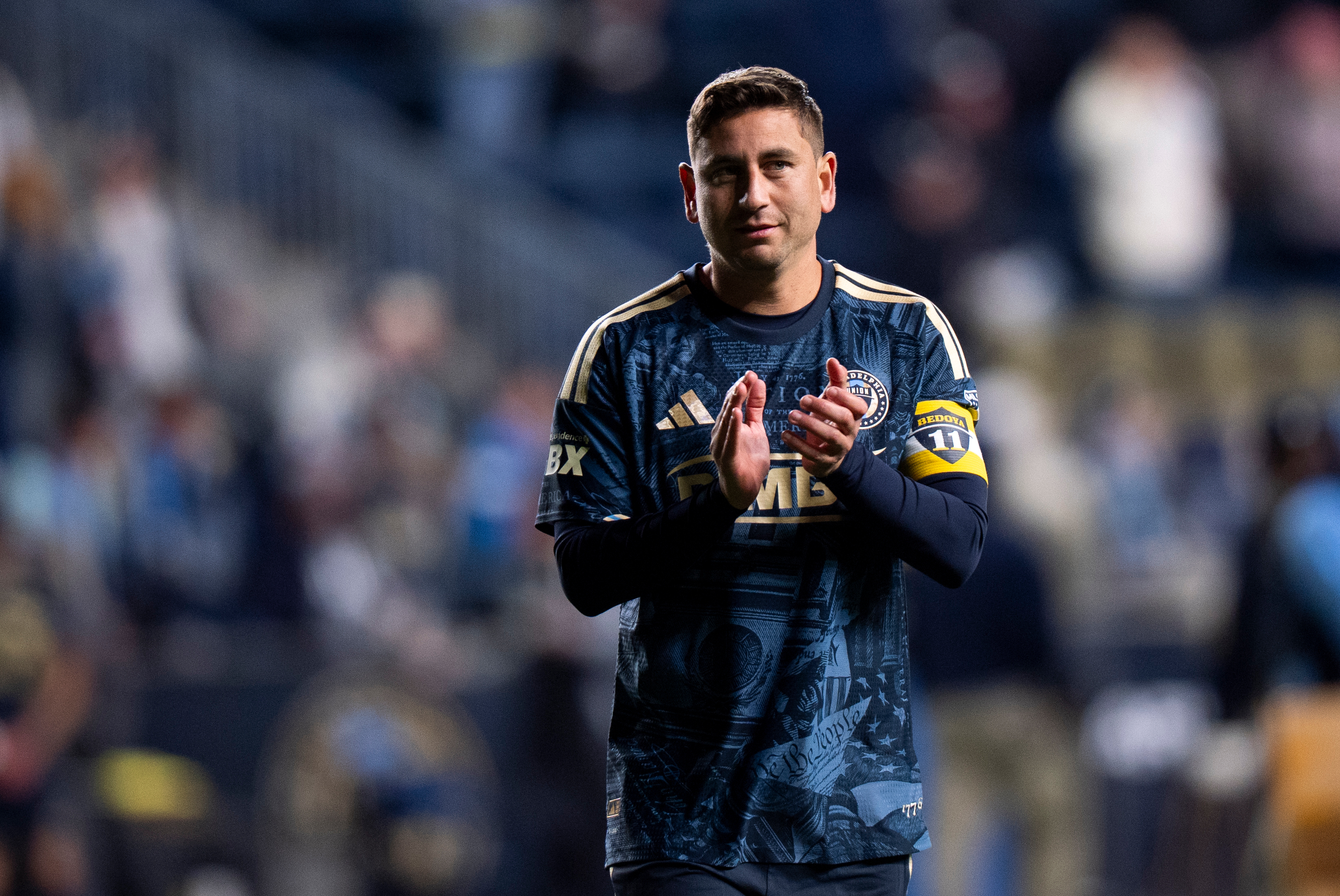
The Union will bid farewell to longtime captain Alejandro Bedoya after this season.Chris Szagola
How did MLS’ other high-dollar names fare?
Montréal’s account includes $2,965,000 for Chilean legend Alexis Sánchez’s arrival in the summer. He was one of the highest-profile summer signings, but played just 950 minutes over 17 games.
Other summer signings did better at paying off their sums. Robert Lewandowski’s paycheck is $19,510,000, but his goals helped launch Chicago into the playoffs — and his jersey has had the highest sales of anyone in MLS since the World Cup.
Robert Lewandowski has fulfilled the high hopes for him in Chicago so far.Lynne Sladky
Orlando’s Antoine Griezmann is making the league’s third-highest salary at $13,938,354, and he has also done his best to be worth it. Fifteen goals and seven assists earned him MLS’s Newcomer of the Year Award, a playoff berth, and sixth place in the best-selling jersey standings.
Columbus’ Brais Méndez ($5,200,000) and Santi Rodríguez ($3,896,733) helped the Crew make a late surge to a playoff place, while Charlotte’s Allan Saint-Maximin ($7,199,000) helped an already-good squad get better.
Atlanta’s Breel Embolo, meanwhile, failed to get the Five Stripes into the playoffs on a salary of $10,811,400. That’s the league’s fifth-highest.
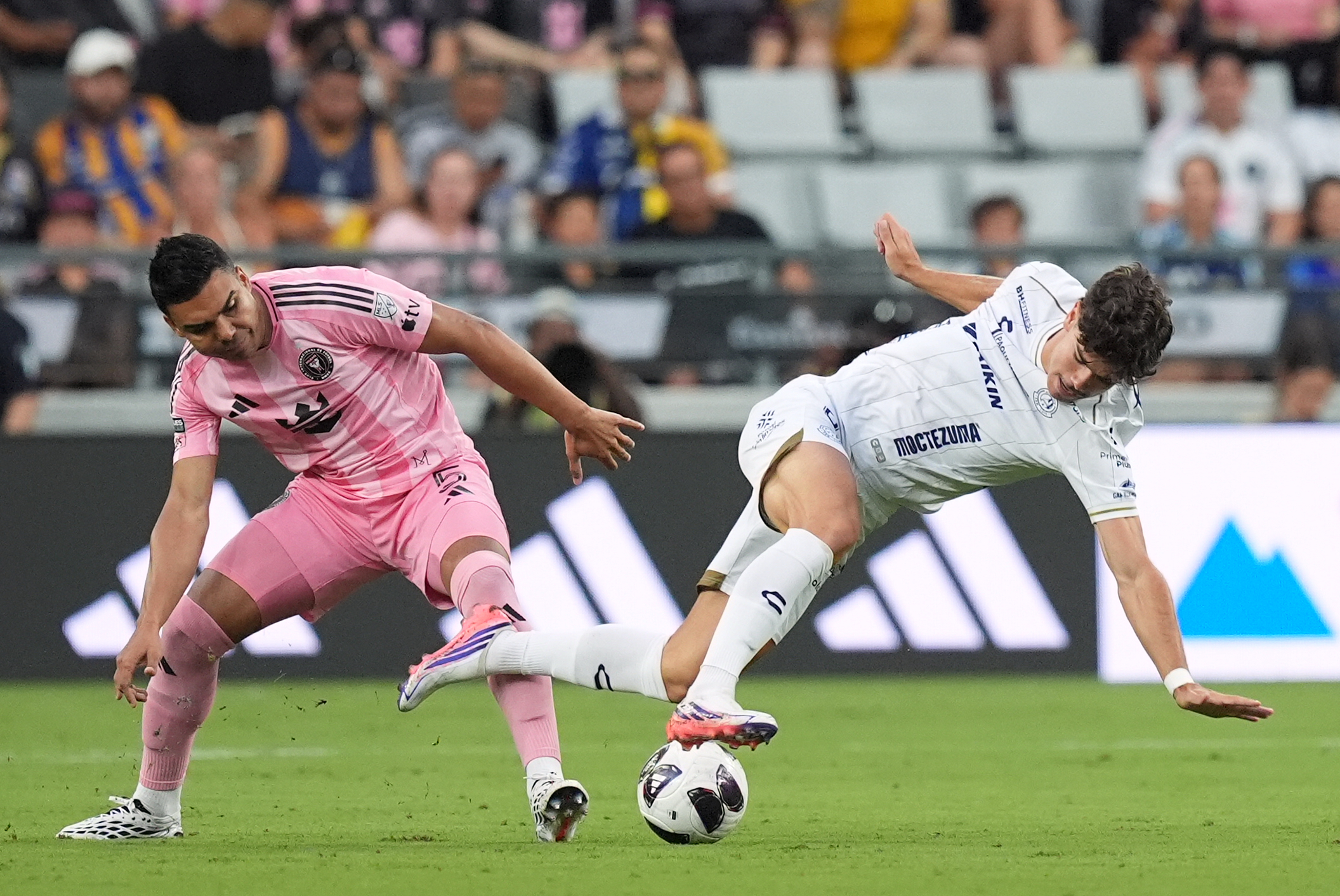
Inter Miami’s Casemiro arrived from Manchester United after the World Cup, and sent the Herons’ record payroll even higher. But his paycheck might spark new scrutiny around a club with a history of edging the rules. The midfielder is officially a Targeted Allocation Money player with a base salary of $896,004, but future years of his contract mean his annualized guaranteed compensation is $3,537,871.
Casemiro (left) is one of Inter Miami’s many big names.Rebecca Blackwell
The big numbers leaguewide
Across the landscape, MLS teams are paying a total of $724,528,392 to 970 players. It’s the first time the MLS payroll has surpassed $700 million.
The average salary is $746,936.46, the first time that number has topped $700,000. It’s also a big jump from the spring average of $688,816.33. The median salary is $360,041.67, also a record. The lowest salary in the league, which is set by the CBA, is $88,025. It’s also the most common salary league-wide, with 70 players earning that sum.
Atlanta has the most players on the minimum with six, followed by Miami with five. Dallas, Los Angeles FC, the L.A. Galaxy, New York City FC, abd St. Louis City have four each. The Union have two, forward Stas Korzeniowski and left back prospect Kaiden Moore.
A reminder that salary data do not include transfer fees, which occupy a significant portion of MLS team budgets and, these days, are often are bigger than salaries. But the payroll comparison still is a snapshot of how teams handle the salary part of the equation. To learn more about teams’ histories with player sales and purchases, check out the data at Transfermarkt.us.
It’s also important to note that players loaned out internationally usually still are counted on the MLSPA’s books. That can have a significant impact on the payroll rankings. For uniformity’s sake, all players listed in the MLSPA’s records are included in the calculations here.
Click here to see the team payroll comparison from the previous data set in the spring.
(function(){function e(){window.addEventListener(`message`,function(e){if(e.data[`datawrapper-height`]!==void 0){var t=document.querySelectorAll(`iframe`);for(var n in e.data[`datawrapper-height`])for(var r=0,i;i=t[r];r++)if(i.contentWindow===e.source){var a=e.data[`datawrapper-height`][n]+`px`;i.style.height=a}}})}e()})();
The millionaires club
The number of millionaires league-wide is 150, a big jump from the 133 in the spring and the 138 last fall.
As with the payroll rankings above, the table below may include some players who are loaned to clubs outside the league, but technically still on MLS teams’ books.
The positions listed here come from the MLSPA’s database. They might not all be perfect matches, but they’re close enough.
(function(){function e(){window.addEventListener(`message`,function(e){if(e.data[`datawrapper-height`]!==void 0){var t=document.querySelectorAll(`iframe`);for(var n in e.data[`datawrapper-height`])for(var r=0,i;i=t[r];r++)if(i.contentWindow===e.source){var a=e.data[`datawrapper-height`][n]+`px`;i.style.height=a}}})}e()})();
Historical charts
Here are the latest versions of other charts that are recurring features in this analysis, showing changes in key MLS salary metrics over time.
(function(){function e(){window.addEventListener(`message`,function(e){if(e.data[`datawrapper-height`]!==void 0){var t=document.querySelectorAll(`iframe`);for(var n in e.data[`datawrapper-height`])for(var r=0,i;i=t[r];r++)if(i.contentWindow===e.source){var a=e.data[`datawrapper-height`][n]+`px`;i.style.height=a}}})}e()})();
(function(){function e(){window.addEventListener(`message`,function(e){if(e.data[`datawrapper-height`]!==void 0){var t=document.querySelectorAll(`iframe`);for(var n in e.data[`datawrapper-height`])for(var r=0,i;i=t[r];r++)if(i.contentWindow===e.source){var a=e.data[`datawrapper-height`][n]+`px`;i.style.height=a}}})}e()})();
(function(){function e(){window.addEventListener(`message`,function(e){if(e.data[`datawrapper-height`]!==void 0){var t=document.querySelectorAll(`iframe`);for(var n in e.data[`datawrapper-height`])for(var r=0,i;i=t[r];r++)if(i.contentWindow===e.source){var a=e.data[`datawrapper-height`][n]+`px`;i.style.height=a}}})}e()})();
(function(){function e(){window.addEventListener(`message`,function(e){if(e.data[`datawrapper-height`]!==void 0){var t=document.querySelectorAll(`iframe`);for(var n in e.data[`datawrapper-height`])for(var r=0,i;i=t[r];r++)if(i.contentWindow===e.source){var a=e.data[`datawrapper-height`][n]+`px`;i.style.height=a}}})}e()})();
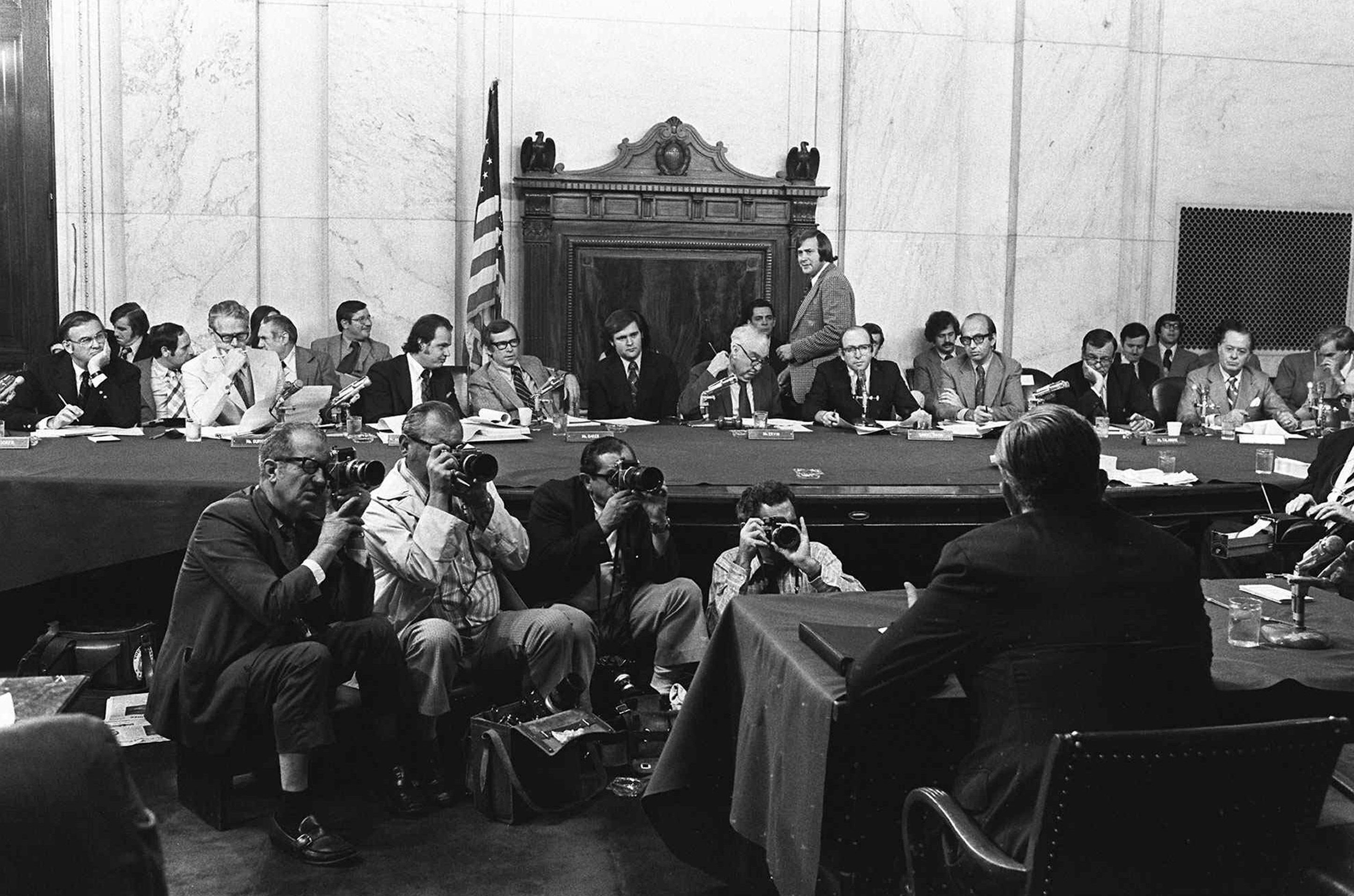
The slow fuse of Richard Nixon’s Watergate scandal had been burning for more than two years on the night of July 25, 1974, when millions turned on their TV sets and watched a woman who’d been previously unknown to most Americans — even after making history as the first Black congresswoman from a former Confederate state.
In a booming voice, the Democrat from Houston spoke of her passion for the U.S. Constitution after people like her had fought for nearly 200 years and counting for full recognition. “My faith in the Constitution is whole; it is complete; it is total,” Jordan said, in what is now regarded as one of the most memorable speeches of the 20th century. “And I am not going to sit here and be an idle spectator to the diminution, the subversion, the destruction, of the Constitution.”
In the most enduring moment of a televised debate that was watched at least in part by an estimated 90% of all Americans, Jordan outlined Nixon’s abuses of power in seeking to thwart probes into the 1972 Watergate break-in, and his other abuses. “If the impeachment provision in the Constitution of the United States will not reach the offenses charged here,” she concluded, “then perhaps that 18th-century Constitution should be abandoned to a 20th-century paper shredder.”
Jordan’s speech set the tone for a week of sober and sometimes moving debate that endedin the House Judiciary Committee, with bipartisan majorities, approving three impeachment counts against the embattled 37th president. Meanwhile, a unanimous U.S. Supreme Court forced Nixon to finally release incriminating Oval Office tapes sought by the committee and a special prosecutor. On Aug. 8, 1974 — two weeks after Jordan’s speech — Nixon became the first and only president to resign.
Over the long half-century since then, it’s been easy to forget how improbable Nixon’s ouster had truly been. In November 1972 — five months after the Watergate break-in — he’d been reelected with nearly 61% of the vote in one of the biggest landslides in the nation’shistory. In late 1973, after a summer of explosive Senate hearings and Nixon’s firing of the first special prosecutor in the notorious “Saturday Night Massacre,” support for impeachment rose, but only to about 37%.
There’s a reason one of the best modern histories of Watergate, a Slate podcast series, was named Slow Burn. The Democratic-led Congress took months to bring in top lawyers, gather evidence, hold hearings — both behind closed doors and on prime-time television — and build a case for impeachment that a majority of Americans — even some of Nixon’s fellow Republicans — could support.
In 1974, the House Judiciary Committee — led by a rising-to-the-moment ex-Newark ward-heeler, Rep. Peter Rodino — didn’t just make history. It also created a road map for today’s Democrats facing the quandary of how to address Donald Trump, his cabinet, and their growing list of high crimes, misdemeanors, and abuses of power. The Trump rap sheet makes Watergate actually seem like the “third-rate burglary” Nixon’s spokesperson claimed it was.
And think about this: These are just the impeachable offenses that we’ve learned about in two years of a GOP-led do-nothing Congress, a DOJ that sees itself as representing Trump and not the American people, and a partially cowed news media. Imagine what a thorough and intense investigation led by Democrats could additionally uncover about the questionable business dealings of the Trump family, including its hedge-fund envoy Jared Kushner, or the real motivations for the White House to look the other way on Nvidia’s chip sales to China.
A lot of rank-and-file Democratic voters will look at this laundry list of outrageous offenses and ask: Why not impeach Trump and his worst-of-the-worst cabinet secretaries on Jan. 4, 2027, the day after Hakeem Jeffries is elected House speaker? There’s a mechanism, after all, for the House to take a snap impeachment vote that was attempted this year not just for Trump but for his unctuous “secretary of war,” Pete Hegseth.
Both those efforts failed, and while in a moral sense sooner would be better for removing both men — especially Trump, with the nuclear football in his deteriorating grasp — from power, it’s politically much better for the Democrats to go the “slow burn” route of gathering every scrap of evidence and laying it out in dramatic public hearings over the course of 2027.
But that won’t be easy. House Democrats face pressure not just from their base voters demanding immediate action, but also from many in their own party who think impeachment is a waste of time either because “the votes aren’t there” to convict in the Senate, or because they believe voters want Congress to only focus on lowering prices. That’s in addition to a Trump White House with a new combative chief of staff in Stephen Miller, who will fight every subpoena to the death.
The good news is that after the Democrats’ “blue tsunami” in the midterm election, there seems to be growing consensus and understanding that a) the voters who elected them want accountability as much as affordability and b) a thorough and intentionally deliberate investigation into Trump’s corruption — one that could see impeachment (or impeachments, including other top officials) — is the strategy that makes the most sense.
The even better news is that the point man for all of this — the 21st century heir to Rodino — is someone who seems to get it: Maryland Rep. Jamie Raskin, a top constitutional lawyer, breakout star of Trump’s second impeachment in 2021, and a child of Watergate.
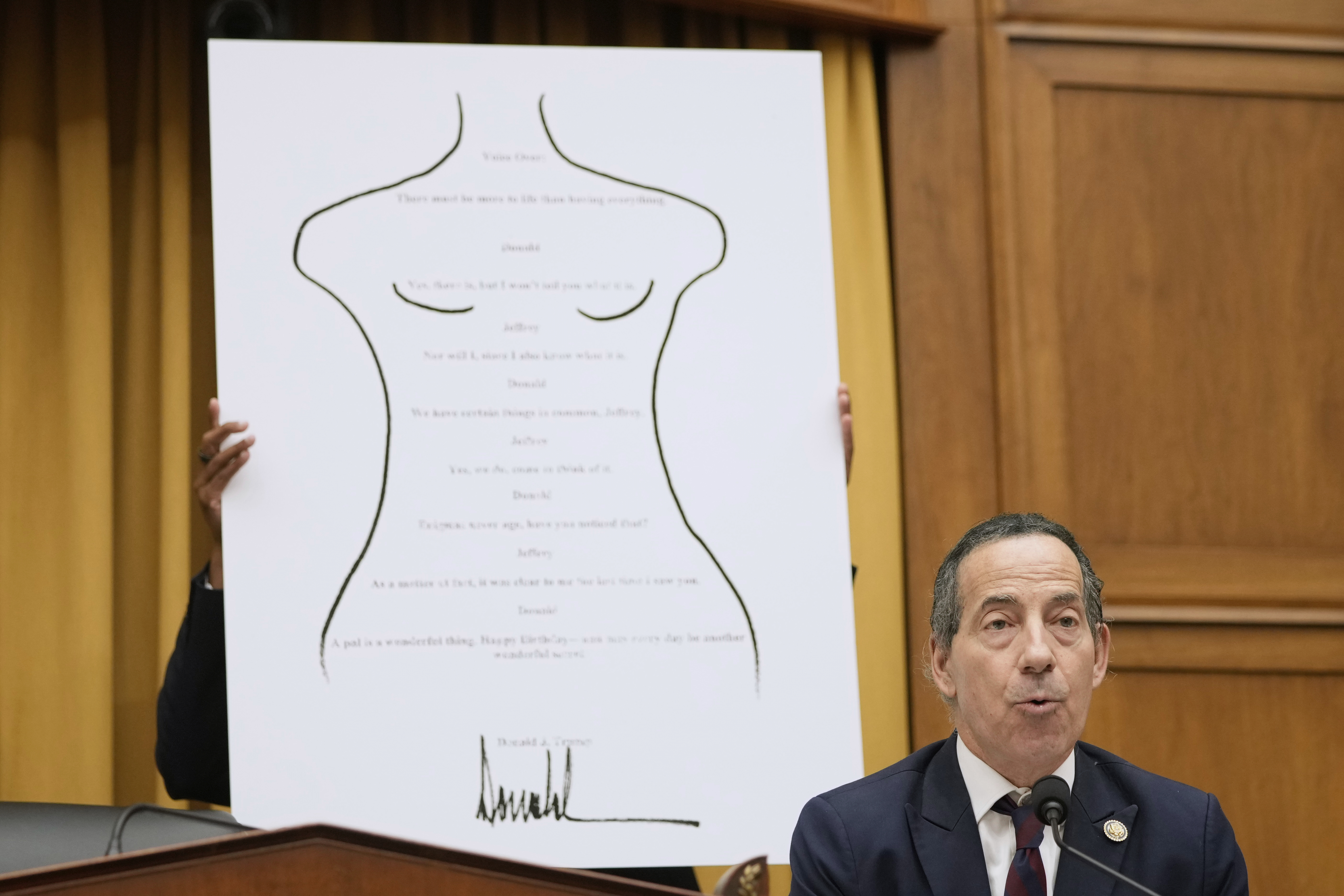
Committee Ranking Member Rep. Jamie Raskin (D., Md.) speaks as FBI Director Kash Patel appears before the House Judiciary Committee on Capitol Hill in September 2025.Mark Schiefelbein
Raskin pointed out to famed Watergate whistleblower John Dean at a 2019 hearing of the House Judiciary Committee — which he’s expected to chair when the Democrats take power in January — that his father, a liberal thought leader and former John F. Kennedy administration official named Marcus Raskin, was on Nixon’s notorious “enemies list.” And he’s said Trump’s conduct “makes Watergate look like a Cub Scout picnic.”
Raskin told Politico last week that he shares the concern of other Democrats that a rushed impeachment of Trump might benefit the president by giving him a rallying cry to reunite his fracturing base. What’s more, there’s a legitimate concern that an instant Trump impeachment would bog down the Senate in a winter trial that would delay votes on popular issues such as healthcare or the minimum wage.
But Raskin’s belief in White House accountability makes him the right man to lead — and work collaboratively with colleagues such as Rep. Robert Garcia — the kind of “slow burn” investigation over the course of 2027 that would not only educate the public about Trump regime wrongdoing, but would build support for impeachment beyond the roughly half of voters in the most recent polling. He told Politico on Thursday that the committee is bringing in a couple of dozen new investigators to probe “pardon brokers” and other alleged wrongdoing.
“I think we need a national conversation,” Washington Democratic Rep. Zoe Lofgren, who was a Trump impeachment manager in 2020, told Politico. That’s correct. When done properly, as it was in 1973-1974, impeachment is just the end result of a process that will allow Democrats to use their newfound subpoena powers to pry free documents and obtain new witness testimony, and to hold prime-time hearings to win over the not-yet-convinced.
There’s an even more recent example in 2022’s congressional hearings on the Jan. 6, 2021, Capitol Hill insurrection and Trump’s attempted election interference, with televised testimony that pressured then-Attorney General Merrick Garland into naming a special prosecutor who then indicted the between-presidencies Trump.
It’s certainly true that crusading for truth in prime time can be good politics. Just three months after the House Judiciary hearings and Nixon’s resignation, Democrats gained 49 seats in the 1974 midterms for a veto-proof House majority, on a path toward regaining the White House in 1976.
But the best argument for impeaching Trump with all deliberate speed is the one Jordan made that summer night in 1974 — respect for the rule of law. The Constitution Trump has tossed into a 21st-century shredder demands it.
“If there is something that is worthy of impeachment, we should have impeachment, even if it’s bad politics,” Democratic Rep. Suhas Subramanyam of Virginia told Politico. That’s not quite the poetry of Barbara Jordan, but he’s exactly right.
Hanwha Philly Shipyard says it’s started work on the first of four 600-foot, nearly 50,000-ton oil and chemical tankers to carry U.S. cargoes between U.S. ports.
The shipyard plans to deliver the ships to its Hanwha Shipping affiliate in 2029 and 2030.
Renderings and details of the new, medium-range ships, which typically haul cargoes in U.S. or East Asian waters or across the North Atlantic, but not on longer Pacific routes, were unveiled at a steel-cutting ceremony at the South Philly shipyard on Tuesday.
Hanwha plans to build the ships “simultaneously” with three liquid natural gas container ships it is building for Matson, which ships long-range cargoes between U.S. Pacific ports and to China. The first of the Matson ships, Makua, was christened last month and is to be delivered next year. Hanwha expects to deliver the other two by 2028.
Meanwhile, Hanwha will start work on the first of up to four Medium Landing Ships (LSMs), for the Navy to land Marines on Pacific islands, in late 2027.
Hanwha Philly Shipyard is shown at bottom left, alongside Navy contractor Rhoads Industries at right, with the office towers of Center City Philadelphia in the distance.Joseph N. DiStefano
And it plans to complete two enemy-missile-tracking Missile Range Instrumentation Vessel (MRIV) hulls for the U.S. government by 2030. It expects to begin that after completing TS Golden State, the last of five U.S. Maritime Administration training and multi-mission ships built since 2020, next year.
The Hanwha group had said last year that it planned to order up to 10 tanker ships for its own Hanwha Shipping affiliate as it seeks to boost production at the Philadelphia yard from about one ship every eight months to one every few weeks.
Shipping analysts have noted U.S.-built ships typically cost more than double the prices charged for similar-sized ships built in China, the world’s leading shipbuilder nation. U.S.-built ships also cost more than ships from Japan and South Korea, partly due to mass-production savings at those countries’ large commercial yards.
Hanwha says it can get costs down as it increases production. In a statement Wednesday, the company made clear it expects the 1920 Jones Act will remain in force, which will require shipments between U.S. ports to be carried by U.S.-built ships and American crews. That’s despite waivers currently granted some foreign shipsto haul certain cargoes during the Iran war.
Dozens of East Asian-built tankers have hauled Texas and Great Plains crude oil to Philadelphia-area refineries, and shipped natural gas, butane, fuel, and refinery feedstock from Delaware River terminals to plants in New England and Louisiana since March, when President Donald Trump suspended provisions of the Jones Act.
Lobbyists for Hanwha and other shipbuilders, as well as organizations representing merchant marine officers and Seafarers union seamen, have called for renewed protection for domestic shipping. That would boost demand for U.S.-built ships like the tankers Hanwha is building.
Against them, lobbyists for refiners such as Delta Air Lines’ Monroe Energy in Trainer, Delaware County, and for PBF, which runs refineries in Delaware City and Paulsboro, N.J., have argued for easing the Jones Act and bringing in more cheap foreign shipping to lower energy companies’ expenses.
The new ships “will join the Jones Act fleet to transport the fuels that power American homes, businesses, and communities safely and efficiently,” James Sagar, CEO of Hanwha Shipping, said in a statement.
He noted the overall Jones Act fleet is aging; the new tankers are the first of their size built in the U.S. in nearly 10 years. The Philly yard has been the largest builder of Jones Act ships since 2000, when it opened under previous owners at the former Philadelphia Naval Shipyard.
With these ships, “Hanwha is reaffirming its commitment to the United States, supporting highly skilled American jobs, and helping strengthen the shipbuilding industrial base that is critical to our nation’s economic and strategic interests,” Sagar concluded.
Hanwha says the new tanker ships will offer “an energy-efficient design” and meet International Maritime Organization standards for safely carrying chemicals.
The yard employs around 2,300. Hanwha says it has invested hundreds of millions, and plans to eventually invest a total of $5 billion, in cranes, new buildings and piers, dry docks, automatic welding equipment, and other facilities to increase shipbuilding. The company has said it hopes to boost employment to more than 4,000 welders, pipe fitters, equipment operators, engineers, and other workers over the next several years.
John Boggs had been down that tunnel before. It was dark, miserable, and an experience the 6-foot, 215-pound St. Joseph’s Prep senior linebacker did not want to relive. He felt a different voice had to be heard late last season, which rolled over into this season and a leadership role.
The Hawks finished 5-5 in 2025 and were out of the state playoffs for the first time in over a decade. It was also the first time they finished with five losses or more in a season since 2010 when they went 4-6 in legendary coach Gabe Infante’s first year.
So, on Nov. 3 at Temple’s training complex, the first practice after St. Joe’s Prep lost the Catholic League Red Division title in a 21-17 loss to Roman Catholic on Oct. 31, it was Boggs who called the Hawks in together before any of Prep’s coaches arrived. The Princeton-bound Boggs said he had to address it before the season unraveled. Wearing No. 10 has a high significance at St. Joe’s Prep. It’s a leadership number; it’s a digit traditionally given to the program’s rock. It’s the number Boggs was appointed.
“I told the team that this would not be the end of our season, we saw what happened last year, and I wanted us to have a Thanksgiving Day practice, which was a staple of the Prep program,” Boggs said. “Waking up Thanksgiving Day morning to see my team and coaches that I love; I refuse tonot let that happen. I told the team this won’t happen again, not while I’m on this team, not while I’m the captain. We’re not going out like we did last year (in the Catholic League 6A championship to eventual state champion La Salle). I knew we would come together and figure it out.”
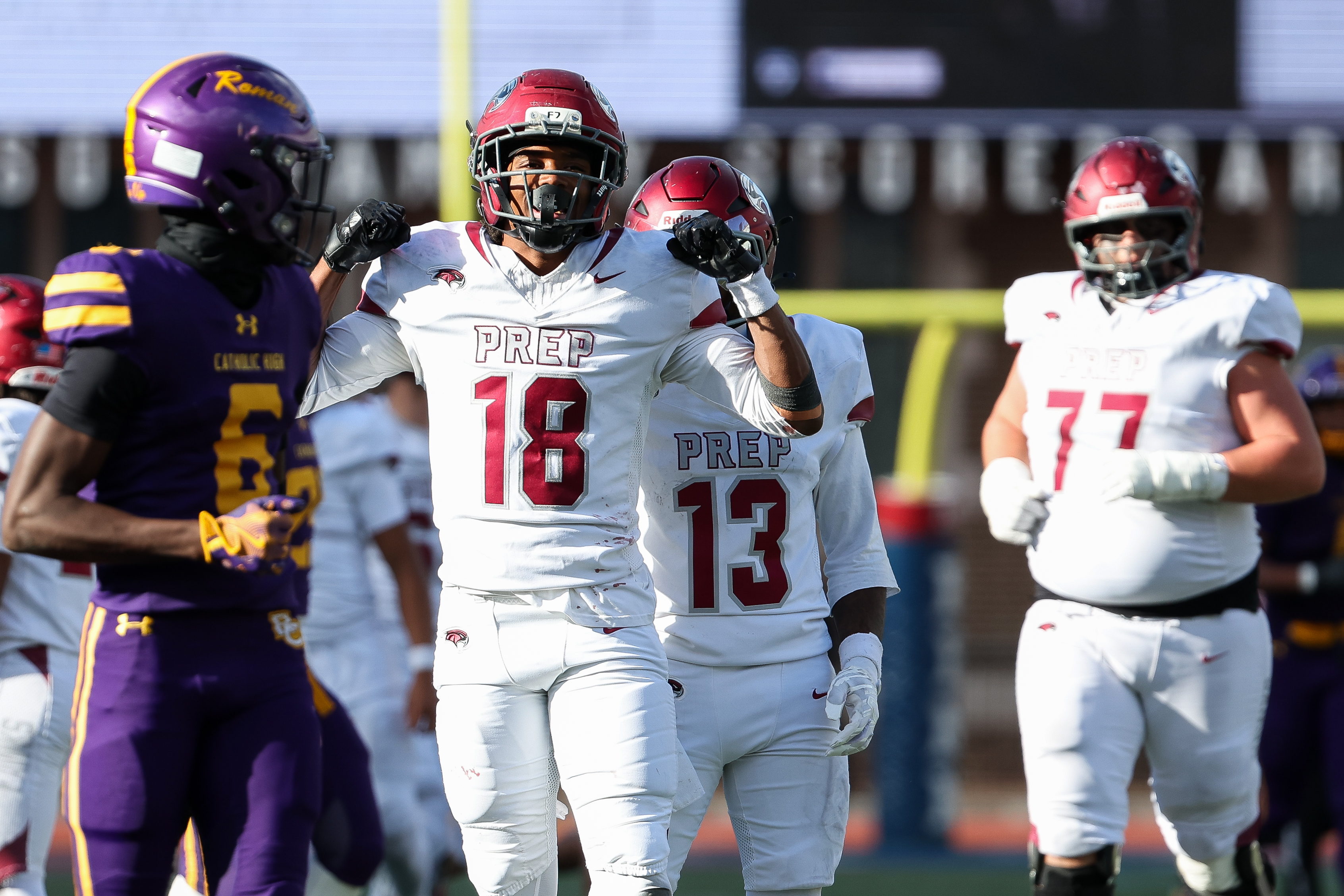
They upset Roman, 10-7, on Sunday in the Catholic League 6A classification championship — thanks to an improbable Jett Harrison fourth-quarter one-handed catch — and advance to the PIAA District 12 6A championship against Public League champion Northeast on Saturday at 2 p.m. at Northeast High School.
St. Joe’s Prep is 9-2 overall. The Hawks lost two starting quarterbacks that transferred, had a third starter lost to injury for five games, and for a time had their fourth-string quarterback starting during a crucial period. Boggs said this had to be a players-led program, not a coaches-led program. He also stressed that the winning culture, created by Infante and maintained by current coach Tim Roken, had some cracks that needed to be spackled.
“This has to be said: That had nothing to do with the coaching. It had everything to do with us the players, including me,” Boggs said. “This year we have restarted entire practices because we did not meet Coach Roken’s standard. I’ll admit it, we may not have as much talent as past Prep teams. We have a great player, Jett Harrison, and our coaching staff is the best in the state, probably the country. Our coaching staff had nothing to do with last year’s failures. It was entirely the players taking it on themselves to not represent the brand the right way.
St. Joe’s Prep wide receiver Jett Harrison (18) reacts after a one-handed catch against Roman Catholic.Isaiah Vazquez / For The Inquirer
“I refuse to hear excuses. We had to get back to our roots. Someone had to speak up so we didn’t fall like we did last year. Northeast is a great program, but we go into that game with the confidence of beating probably the best team in the state. That’s a testament to our program and the trust and love we have for each other. Watching the game film on Monday, it’s why I was happy to see our coaches get so emotional after we beat [Roman].”
Roken said he has depended on Boggs to lead this team and admits St. Joe’s Prep would not be where it is without his leadership. Boggs is a three-time Catholic League champion wrestler at 215 pounds and has known winning on the football field as consecutive state champions his freshman and sophomore years.
When the Hawks faced adversity, Boggs was the calming force.
“He is the one holding everyone accountable, including himself, because he calls our defense and is the one who makes sure everyone is lined up,” Roken said. “What John has gotten really good at is trusting his teammates around him will do their jobs. He’s the kind of young man every coach wants in their program.”
District 1 Class 6A semifinals
No. 4 Spring-Ford (11-1) at No. 1 Downingtown East (12-0) Friday at 7 p.m.
Downingtown East is playing with the special motivation that is the last season for Cougars’ legendary coach Mike Matta. Downingtown East, however, will be playing without a special talent, Notre Dame-bound edge rusher Abraham Sesay, who faced a season-ending injury in East’s 31-28 victory over Coatesville on Oct. 23. The Cougars do have junior tailback Juelz Chiron-Robinson, who rushed for a career-best 247 yards in East’s 30-27 district quarterfinal victory over Ches-Mont League rival Coatesville.
Matta and East have never won a PIAA District 1 football championship. The original Downingtown High School won District 1 titles in 1994 and 1996 before splitting into Downingtown East and West entering the 2003 season.
Spring-Ford is riding an eight-game winning streak. The Rams’ only loss came against Downingtown East, 35-7, on Sept. 18, when Chiron-Robinson rushed for 148 yards and three touchdowns.
No. 11 Council Rock South (8-3) at No. 2 Central Bucks West (11-1) Friday at 7 p.m.
Council Rock South upset No. 7 seed Downingtown West, 28-7, and followed that up by beating North Penn, which was under-seeded at No. 14, 20-13, with the winning score provided by Jerry Rogers with 2:14 to play. The Golden Hawks face a CB West team that is riding an eight-game winning streak during which its averaging 41.6 points a game.
District 1 Class 5A semifinals
No. 3 Great Valley (12-0) at No. 2 Springfield (Delco) (12-0) Friday at 7 p.m.
This may be the game of the weekend. This is the best Great Valley has been in over two decades, when the Patriots started their 2004 season 11-0. The Patriots are led by junior tailback Beau Kosmalski, who has rushed for a school-career record, a single-season record (2,525 yards), and single-game record (406) this season. He is the leading rusher in Pennsylvania and No. 23 overall in the country. Springfield had its eight-game, 34-quarter shutout streak stopped last week in a 22-17 victory over No. 7 Upper Perkiomen.
No. 4 Garnet Valley (11-1) at No. 1 Chester (12-0) Saturday at 1 p.m.
Chester’s Mekhi Wyche has stepped in at quarterback for Kenjai Gatling, who is ineligible for the postseason due to PIAA transfer rules, and has guided the Clippers to two district playoff victories, including a 14-13 win over Del-Val League rival Interboro last week. Interboro led 13-0 before Chester sophomore tailback Kanif Doward put Chester on the board. Garnet Valley will need to contain Clippers freshman tailback Sa’Mhad Williams, who has rushed for over 1,000 yards this season. Garnet Valley is riding a five-game winning streak and has the added motivation of making up for the 38-7 loss to Chester in last year’s district quarterfinals. Garnet Valley senior defensive back Nick D’Antonio had two picks in the Jags’ 42-7 district quarterfinal win over West Chester Henderson, one went for a touchdown.
Cardinal O’Hara (8-4) vs. District 1 Pottsgrove (10-2) Friday at Boyertown, 7 p.m.
O’Hara is looking to reach a second straight trip to the state semifinals and beyond, while Pottsgrove won the District 1 Class 4A championship and has qualified for the state playoffs for the first time since 2018.
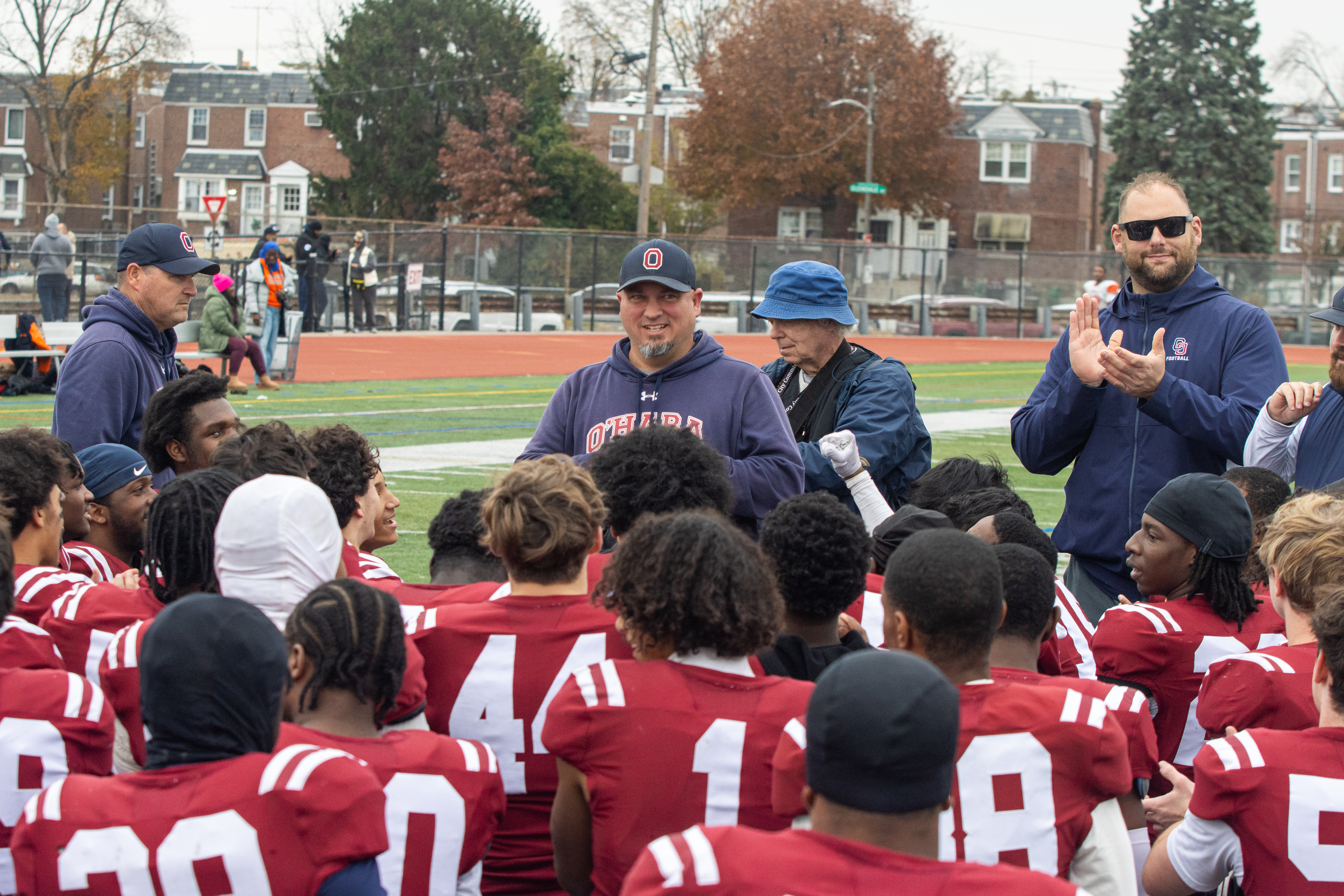
Cardinal O’Hara head coach Mike Ewing looks to lead his team past Pottsgrove on Friday night.Sophia Stempinski / For The Inquirer
PIAA Class 3A
Archbishop Wood (9-3) vs. District 2 Scranton Prep (11-1) Friday at Scranton High School, 7 p.m.
Scranton Prep has outscored its last three opponents 150-25. Wood is having a good season, sliding under the radar after winning the Catholic League Class 3A title, its first postseason title since the Vikings beat Cheltenham in the PIAA Class 5A state championship in 2019. His 2,063 yards rushing makes Wood running back D’Andre Webb the sixth running back in the state who has rushed for over 2,000 yards this season.
PIAA Class 2A
West Catholic (11-1) vs. District 3 Upper Dauphin (8-4), Friday at West Perry, 7 p.m.
West’s only loss came in a 38-0 shutout to O’Hara on Sept. 18. Since then, the Burrs have won eight-straight games. Upper Dauphin has won seven of its last eight games.
Belmont Charter (4-7) vs. District 11 Williams Valley (11-1), Friday at Catasauqua High School (Northampton), 7 p.m.
Williams Valley’s only loss was against perennial state powerhouse South Columbia back on Sept. 4. The Vikings have since won 10 straight games. Belmont Charter, which reached Class 1A state semis last year, played the more competitive schedule.
Other notes
Lansdale Catholic names head coach
On Monday, Lansdale Catholic announced Joe Whitesell as the Crusaders’ head coach. Whitesell was Lansdale Catholic’s defensive coordinator this season and was elevated as interim coach after Dom D’Addona resigned on Oct. 12 during his eighth season. D’Addona led the Crusaders to a 12-3 record last year and to the PIAA 2A state semifinals, where they lost to eventual state champion Southern Columbia. Lansdale Catholic finished 1-9 and shutout four times this season.
The first two seasons of Jihaad Campbell’s NFL career have not been smooth sailing.
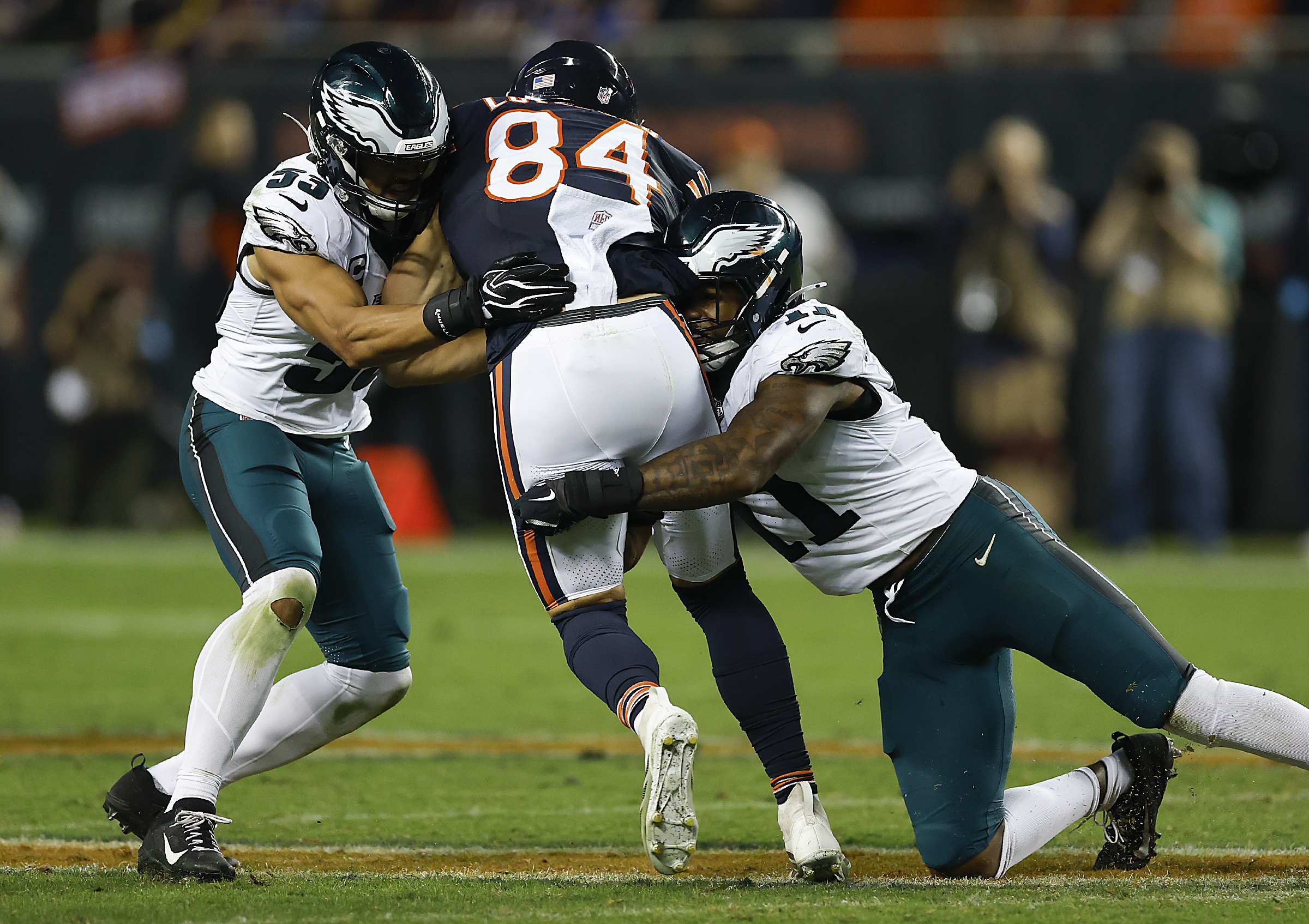
Last year, the 31st pick in the 2025 draft started out of the gates with the Eagles as a rookie and played well, only to take a back seat when Nakobe Dean returned from his surgery recovery. Campbell, an Erial, N.J., native, also had to fill in at times as an edge rusher while the Eagles dealt with injuries, which defensive coordinator Vic Fangio said stunted his progression.
Then, after five games this season, Campbell found himself in a rotation with Jeremiah Trotter Jr. His playing time in Week 6 dipped from 86% of the snaps to 61%, and then down to 54% in Week 7.
Campbell then missed the next two games before the bye week with hamstring and quad injuries. He’s back at practice this week and in line to play on Sunday, but the question of whether he will rotate with Trotter or reclaim his spot as a full-game starter seems to be answered by the status of Zack Baun, who missed practice Wednesday with a back injury and may not be able to suit up against the Pittsburgh Steelers.
Despite the up-and-down start to Campbell’s career, the 22-year-old said he hasn’t lost any confidence in himself.
“No,” Campbell said when asked on Wednesday. “I mean, I can’t. The journey that I’ve been on, there’s like no way I could lose that type of confidence. Being a kid from a small town and working my way all the way up to the top like this and still knowing I have a lot to prove, obviously, I can never really lose confidence. That’s just not in my DNA to do that.”
Fangio said on Wednesday that the Eagles are “looking for improvement really in all areas” from Campbell.
“A little bit more in the run defense, a little bit more in the pass coverage, but he’s been playing good when he’s in there,” Fangio said. “It’s not like he’s been bad or anything.”
Jihaad Campbell (right) could see major snaps this week with Zack Baun (left) potentially out due to injuryYong Kim / Staff Photographer
There are two ways of looking at the Campbell/Trotter rotation: Trotter earned playing time is one of them. The other is that Campbell, a first-round pick playing in his second season, wasn’t playing well enough to hold Trotter off.
Campbell said he wants to show over the next eight weeks that he’s improving in all areas, whether that’s as a blitzer, in coverage in both man and zone, diagnosing plays, or whatever is being asked of him.
His production in 2026 hasn’t been all that different from 2025. Campbell has six pressures on 32 pass rushes, a rate of 18.8% that is up from last season’s 17.2% mark on 64 pass rushes. He records a tackle on 12.6% of his snaps, up from 11.3% last season. But Pro Football Focus grades, which are imperfect, say Campbell has declined both as a run defender and in pass coverage, and the eye test sometimes lines up with that.
Linebackers coach Bobby King told Campbell this week to “control the controllables,” Campbell said.
“I feel like that’s just a life thing anyway,” Campbell said. “I try to leave my ego and my emotions out of it and really just be very mentally tough, continuing to progress and be the player that I want to be and continuing to progress and be a leader and do the right things. Lead by example and stuff like that.”
Jeremiah Trotter Jr. has played well enough to take snaps away from Jihaad Campbell at linebacker. Yong Kim / Staff Photographer
Missing the two games prior to the bye week allowed Campbell to take a step back and watch, he said.
“It’s competition, right?” Campbell said. “But ultimately in your competition you’re also learning. I can learn from Trot, I can learn from Smael [Mondon], I can learn from Zack and the rest of the guys in our room and our coaches. We all can piggyback and learn from each other. I think the biggest thing really is being a continuous learner. It’s not over till it’s over.”
It does get interesting beyond 2026, though. Baun remains under contract through 2027, and Trotter will be in the final year of his rookie deal then, too. Will the Eagles look to bring Trotter back in 2028? Will Campbell be forced into another time share? Will the Eagles see enough from Campbell to make him an every-down linebacker next to Baun? There are a few ways it could go.
In a lost season, the forward-looking storylines with the Eagles’ youngest players will be most interesting to track.
“This game is just about being the best version of yourself, whether you have good days, whether you have bad days, whether you have OK days,” Campbell said. “I always go back to the drawing board and say, ‘OK, I know my strengths, but what are my weaknesses and how can I get better at them?’”
Campbell likened the state of the Eagles, at 2-7, to being on a boat in distress.
“When things happen, some people are going to jump off the boat and die, or some people are going to stay on the boat and still have hope,” he said. “That’s what I have, that’s what all these guys have.”
Fifteen years ago, a partnership between the Academy of Natural Sciences and Drexel University boosted the school’s reputation and academics while allowing the research institute and museum — with its iconic wildlife dioramas and dinosaur skeletons — to keep its historic doors open on the Benjamin Franklin Parkway.
In a city renowned for its history and science, on an avenue more accustomed to gaining rather than losing attractions in recent years, it was distressing to see the Academy’s museum go dark. But the crisis has shown that its brick-and-limestone building and collections of thousands of volumes and millions of specimens aren’t its only irreplaceable assets. It also enjoys a priceless store of public and political will to keep it going — and keep it in Philadelphia.
The public outpouring of love, support, and sorrow for the two-century-old Academy has been impressive. It’s no doubt partly in response to that popular outcry that public officials, from City Council to Gov. Josh Shapiro, have rightly become engaged in the matter, as have many of Philadelphia’s civic and philanthropic institutions. All of that can and should help find a way forward for the Academy in the city where it belongs.
It’s also clear, however, that the museum didn’t reach this point as suddenly as it seemed to from the outside. Like many aging museums, the Academy has struggled to bring in enough paying customers to support its expenses, which are compounded by the age and condition of its building.
Drexel President Antonio Merlo answers questions from a hearing by City Council’s Committee on Legislative Oversight Monday into the closing of the museum at the Academy of Natural Sciences of Drexel University.Tom Gralish / Staff Photographer
According to Drexel officials, the Academy has been unable to consistently sustain itself, requiring millions of dollars a year in subsidies from a university that is no longer willing or able to provide. At the same time, financial documents and Academy leaders’ accounts raise questions about the extent and nature of the deficits.
This week’s City Council hearings, meanwhile, only affirmed the impression that the paired institutions have reached a point of mutual distrust and fundamental differences that has left them unable to productively cooperate or amicably separate. The closure has had a series of regrettable consequences, including layoffs and relocation of the museum’s live animals and other parts of its collection.
Some Council members are clearly eager to get the museum open and willing to dedicate public money to the effort. Reopening the Academy is the right goal, but Council should pursue it deliberately. While the Academy is worthy of public support, it also deserves the sort of thought and attention that will make it sustainable over the long term. That requires addressing its troubled relationship with Drexel, its long-term financial and capital stresses, and its need to appeal to a sufficient share of potential visitors. Then public officials can gauge the need for and feasibility of taxpayer subsidies.
Fortunately, the William Penn Foundation and other charitable groups offered to conduct a comprehensive review of the Academy’s condition and make recommendations for its future. And unlike William Penn’s earlier offer to temporarily cover the museum’s operating costs, this one was accepted. Given the complicated challenges facing the institution and the rancor between Drexel and the Academy — which disagree on basic facts of the closure and more — independent information and expert analysis are sorely needed steps that should have the full cooperation of both institutions.
Preserving history and fostering science and culture are Philadelphia strengths. Given that, the Academy of Natural Sciences doesn’t have to go the way of the fossils within.