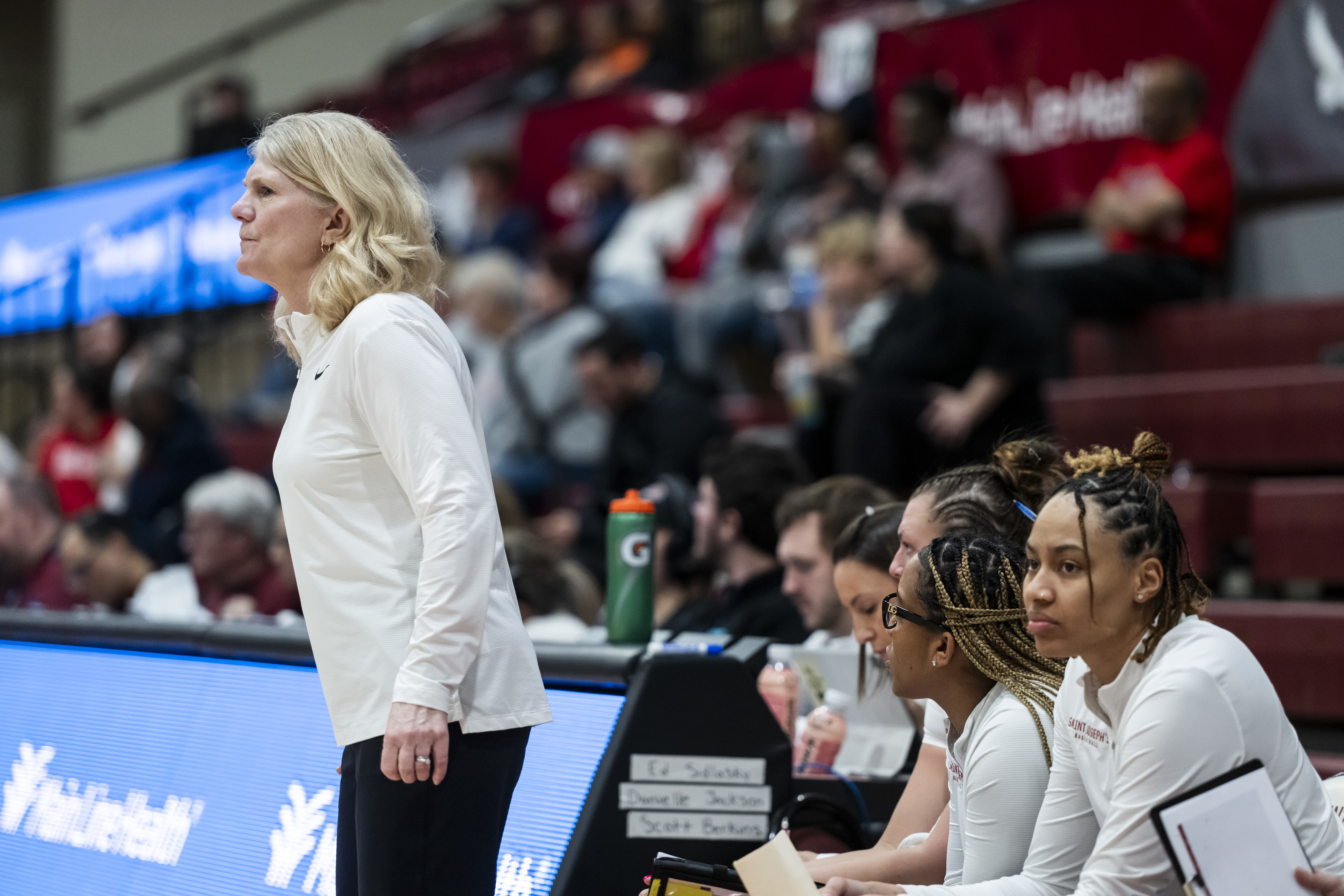
WASHINGTON — For the first time in over two decades, St. Joseph’s women’s basketball was selected to finish first in the Atlantic 10 preseason poll of coaches and media.
The Hawks were unanimously chosen as the preseason favorite, receiving all 14first-place votes.
“It feels good,” Hawks senior guard Gabby Casey said. “We know that it’s just preseason, it’s just a number. It’s a really good accolade, but there’s a lot to work for this year.”
Under coach Cindy Griffin, St. Joe’s has won 20 or more games in four consecutive years. Last season, the Hawks finished their regular season 20-11 overall and 11-5 in A-10 play. They were ousted by Davidson in the quarterfinal of the conference tournament.
Casey received all-conference first-team honors after averaging a team-high 15.7 points and 6.2 rebounds last season, with 3.1 assists. After doubling her scoring output from her sophomore season, the Lansdale Catholic graduate was named the conference’s most improved player.
Casey was not the only Hawk to receive recognition on Monday. Senior guard Aleah Snead, a Penn Charter graduate, was named to the preseason all-conference second-team and all-defensive team. Snead scored 11.6 points per game last season. Meanwhile, junior guard Rhian Stokes was a third-team selection.
One name to watch for the Hawks this season is Deja Evans. The senior forward averaged 9.8 points and 6.4 rebounds with Drexel last season and previously starred at Archbishop Wood.
“[Evans] brings immediate elite rebounding, which we needed to have in order to compete for a championship,” Griffin said. “I think first and foremost, she’s just a great defensive player. She’s a rim protector. She’s able to score with her back to the basket.”
St. Joe’s men
On the men’s side, St. Joe’s was selected to finish sixth out of the A-10’s 14 teams.
After starting slow under first-year coach Steve Donahue, the Hawks rattled off wins in 13 of their final 16 games of the regular season. They advanced to the A-10 tournament semifinals before being eliminated by Virginia Commonwealth. They accepted a bid to the National Invitation Tournament and won a game in the tournament for the first time in 20 years.
Junior Jaiden Glover-Toscano was selected to the conference’s first team. There was buzz that the guard, who averaged 15.7 points, would transfer following last season, but the sharpshooter opted to stay. Glover-Toscano played his freshman year at St. John’s but failed to crack coach Rick Pitino’s rotation.
“The biggest thing I learned about myself is how mentally strong I am,” Glover-Toscano said. “I’ve grown a lot mentally just through everything that I’ve been through, especially last year, playing all season, coming from a place where I didn’t play that much.”
Transfer forward Sean Logan was named to the A-10 all-defensive team after notching a conference-high 2.4 blocks per game with Davidson last season.
“I recruited Sean in high school,” Donahue said of the Westfield, N.J., native. “You can really run an offense through him, he’s a great facilitator. Reads screens well, so he gets in and out of them quickly. Knows how to deliver drill handoffs. Can rescreen well and kind of swallow the guy. Defensively, his discipline has to come that he can’t try to block every shot, and he’s growing into that.”
La Salle women
Despite an impressive 2025-26 campaign, the La Salle women were selected to finish 10th in the conference.
Last season, the Explorers finished 19-14 overall and 10-8 in the A-10 — marking a significant uptick in play. In the previous two seasons, coach Mountain MacGillivray’s squad went 18-45. A big reason why the team may have not been chosen higher is because of two key departures: Ashleigh Connor and Aryss Macktoon. The guards, who both transferred to high-major programs, ranked Nos. 1 and 2 on the Explorers in total scoring last season.
The Explorers did have two honorees on Monday’s poll. Junior Joanie Quinn, a product of Cardinal O’Hara, was named to the conference second team after averaging 11.2 points. With no seniors on MacGillivray’sroster, Quinn is expected to take on a greater leadership role.
“I feel like I was known as one of the younger kids and now I’m obviously one of the oldest on the team,” Quinn said. “That posed an interesting challenge over the summer, but I feel like now we’ve really settled into our roles and I think taking on a leadership position is something that I wanted to do anyway.”
Sophomore Kiara Williams was named to the A-10 third team. The forward put together an impressive freshman campaign last season, notching 9.6 points and 4.9 rebounds per game.
La Salle men
On the men’s side, La Salle was selected to finish 13th in the conference.
Last season, under first-year coach Darris Nichols, the injury-plagued Explorers finished 9-23 and 5-13 in A-10 play. The team was ranked the third-most injured team in Division I and was eliminated by St. Bonaventure in the first round of the conference tournament.
The big story for the Explorers this offseason was the team’s retention of 6-foot-6 guard Rob Dockery. Reports indicated that Dockery, who scored 12.5 points per game last season, had entered the transfer portal. However, two weeks after the initial report, the school announced Dockery would return. He was named to the conference’s second team on Monday.
“Comfortability is big in college basketball,” Dockery said. “Knowing I can trust [Nichols] and coming back and being comfortable while doing it was more important [than transferring].”
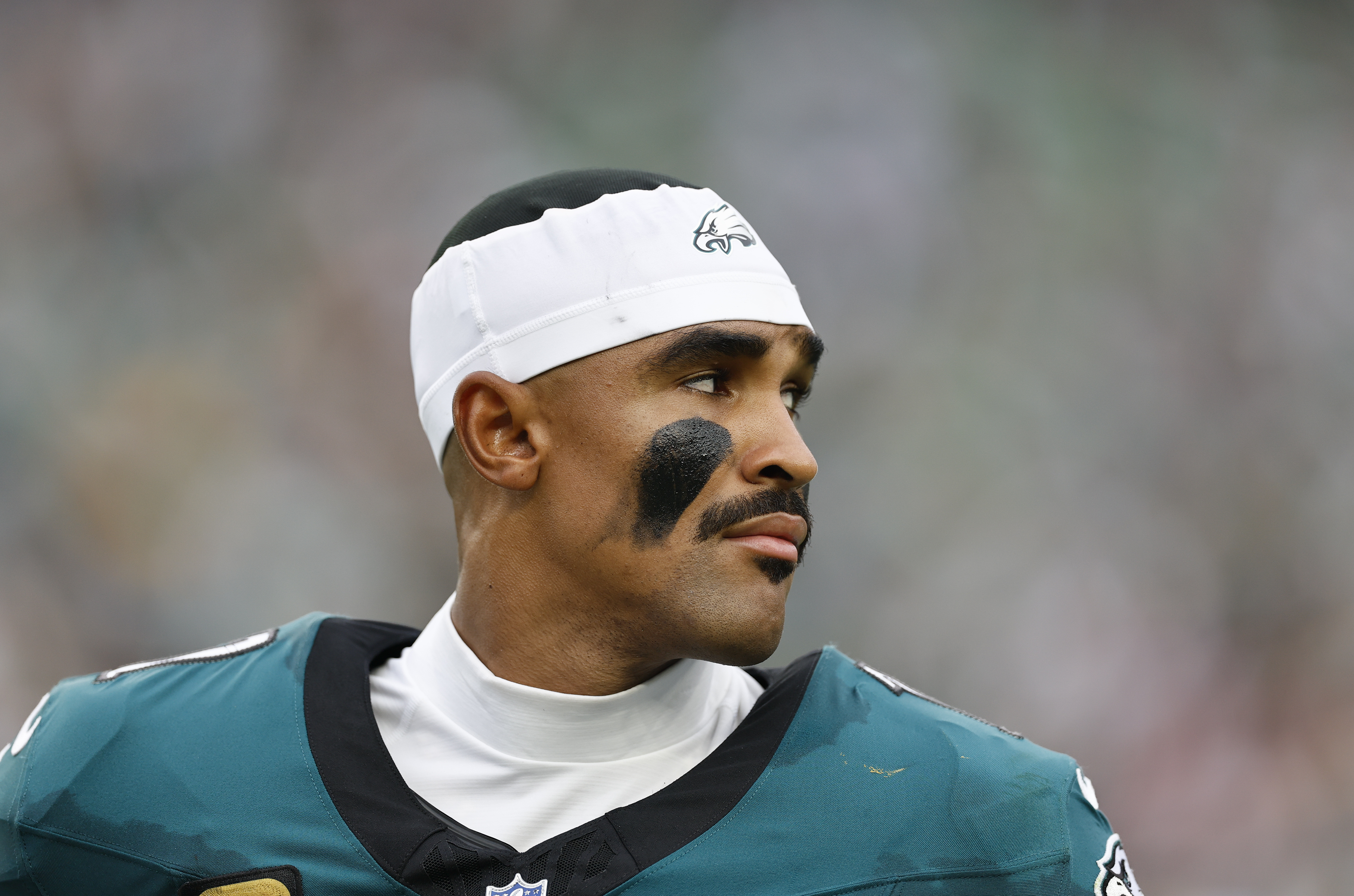
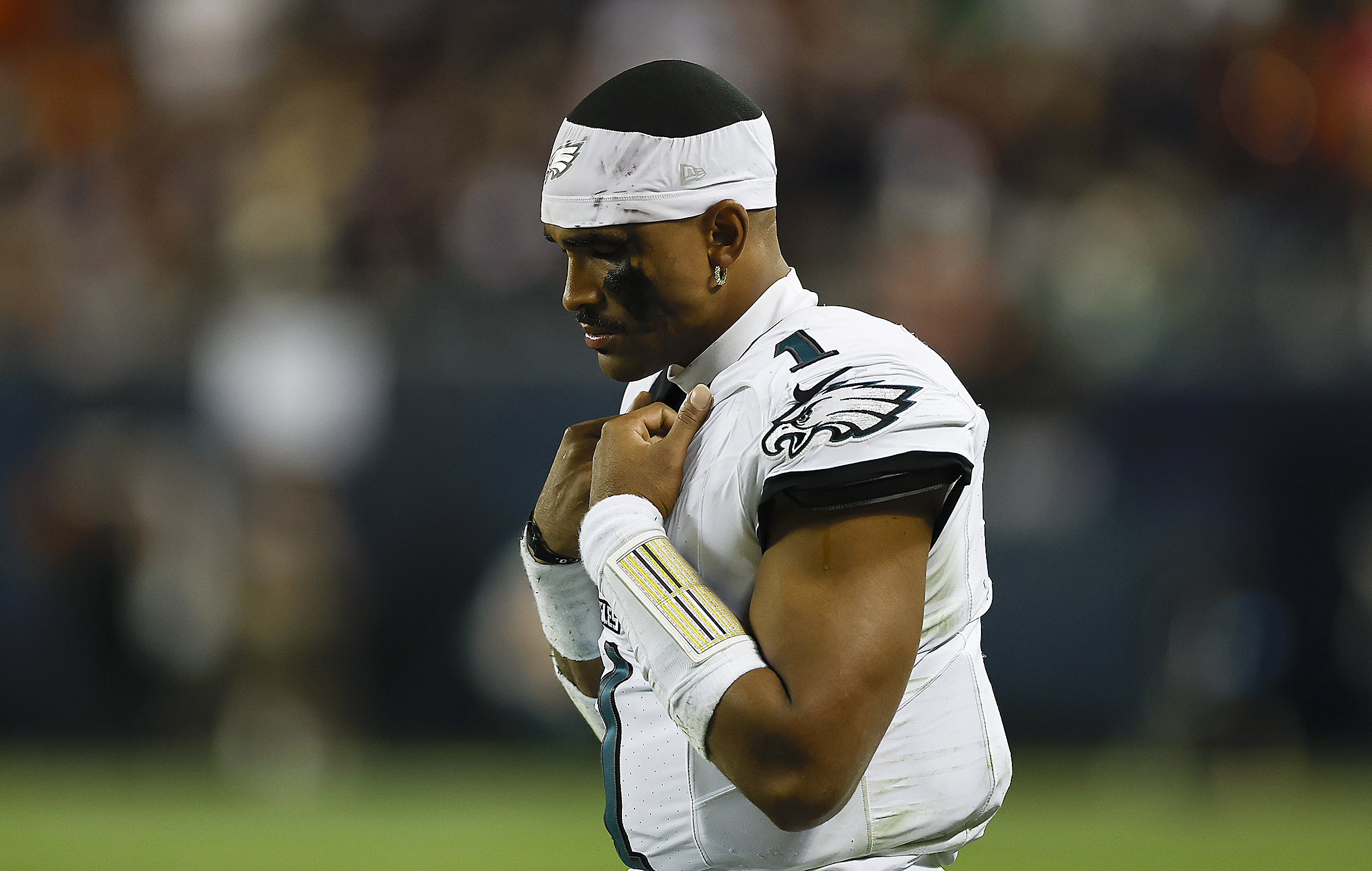
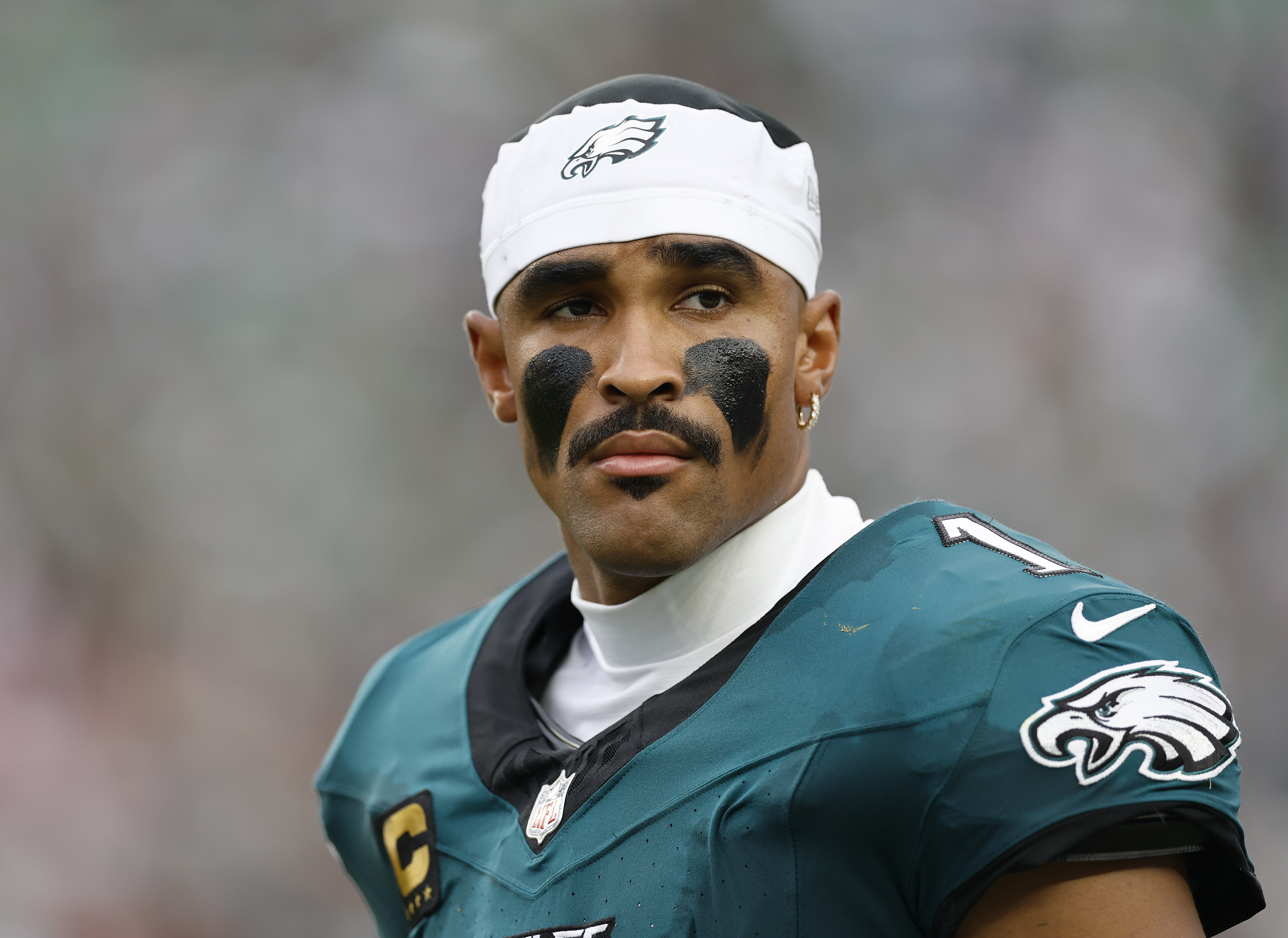
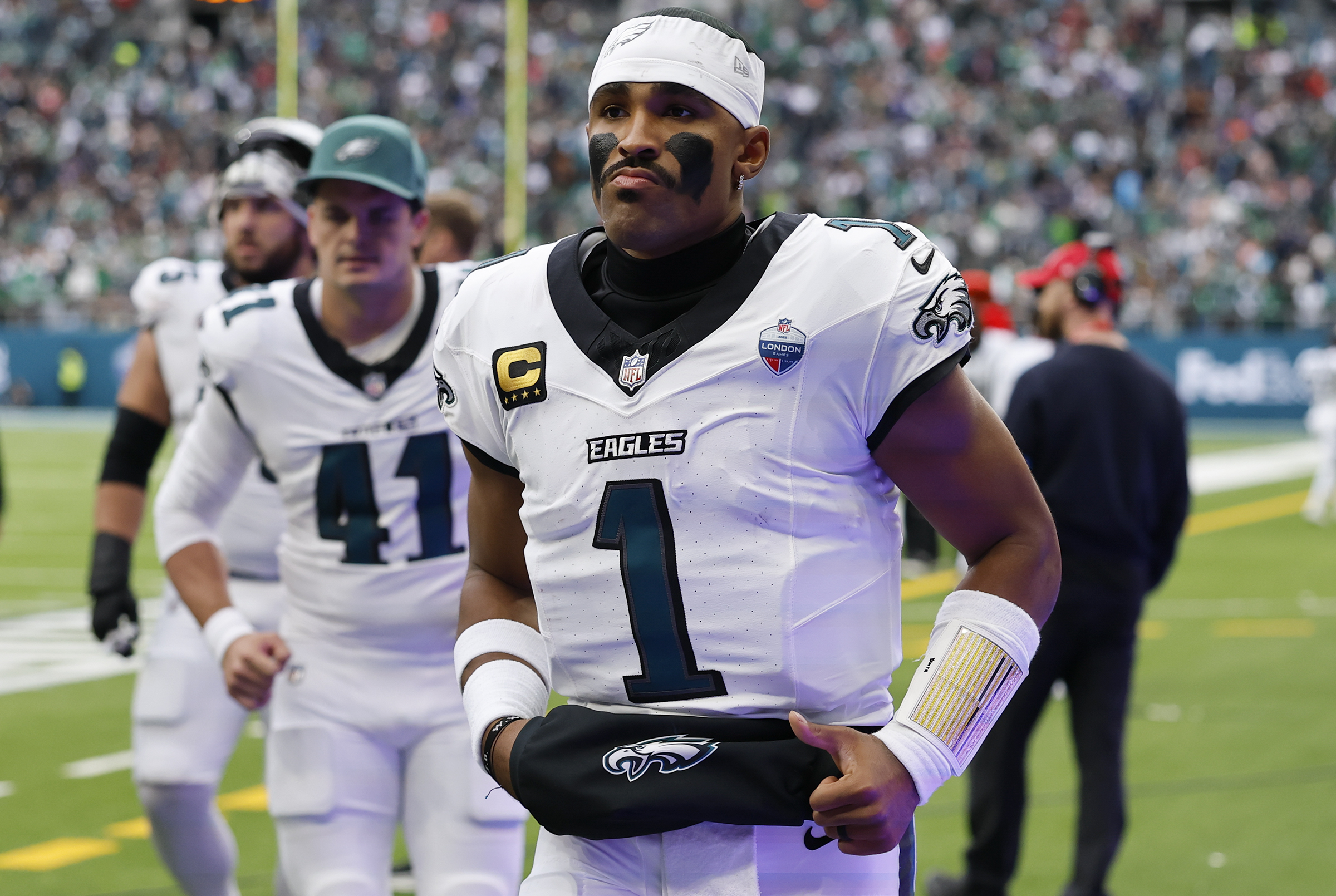
According to the statement, further medical testing revealed multiple blood clots in Hurts’ lungs. He has been diagnosed with deep vein thrombosis and “bilateral pulmonary emboli.”
Hurts “is clinically stable and has no significant functional limitations,” the statement read. “His treatment should only involve [blood thinners]. During this time, he will not be allowed to participate in any contact activities, including football.
“Jalen’s prognosis is very good, and we expect a full recovery. We anticipate that he will have the opportunity to resume contact football activities when off the blood thinners. In the meantime, he will remain active around the team and continue to condition. More importantly, we anticipate that he will have no long-term effects.”
Hurts was initially diagnosed with a blood clot in his calf last Saturday in London, according to the Eagles. He reported to the team after practice on Thursday, Oct. 8 that he had taken a cleat to the calf in the team’s Week 4 loss to the Los Angeles Rams. Hurts then practiced in full with the team the next day and flew with the team to London overnight.
According to the Eagles, Hurts underwent an ultrasound in London last Saturday “out of an abundance of caution,” and a “superficial blood clot” was found. According to multiple reports, from NBCSports and NFL Network, Hurts had minimal sleep and was awake late into the morning hours at a London hospital before playing in last Sunday’s game.
Asked at his Monday news conference why Hurts was permitted to play in the game in London, Eagles coach Nick Sirianni declined to offer specifics, saying “the health of our players is always at the forefront of our mind.
“We’ll leave that up to the medical experts. But we always, always care deeply about our players.”
After the game, Hurts flew home with the team and later practiced in full on Wednesday. He spoke with reporters after practice during his usual Wednesday news conference and called the ordeal “a very unique experience to say the least.”
“I don’t want to get into the details of leading up to the game and whatnot.”
In response to a series of questions at his Monday news conference, Sirianni declined to provide any further details about the timeline or what went into the decision to have Hurts play and, further than that, why he was allowed to fly home.
“I’m not a medical expert,” Sirianni said. “I lean on our guys on all of those situations. I’m a football coach. … I have full trust and full faith in [the medical team]. It’s not just me that has care for our players, it’s them as well.
“We get medical information from our guys and we always put the players’ health first and foremost in every situation.”
Sirianni also did not provide a clear answer Friday when asked why Hurts did not have an ultrasound performed until after the team was in London.
Hurts, according to the Eagles, had a follow-up ultrasound on Wednesday night that revealed movement in the clot. The team announced on Thursday that Hurts would be out Sunday while dealing with a “superficial” clot that had moved.
They then placed Hurts on injured reserve on Saturday.
Tanner McKee, who started Sunday’s loss to Carolina, is expected to be the starter for the foreseeable future. The Eagles also added Joe Milton to the roster on Friday. They now have McKee, Milton, and rookie Cole Payton on the roster.
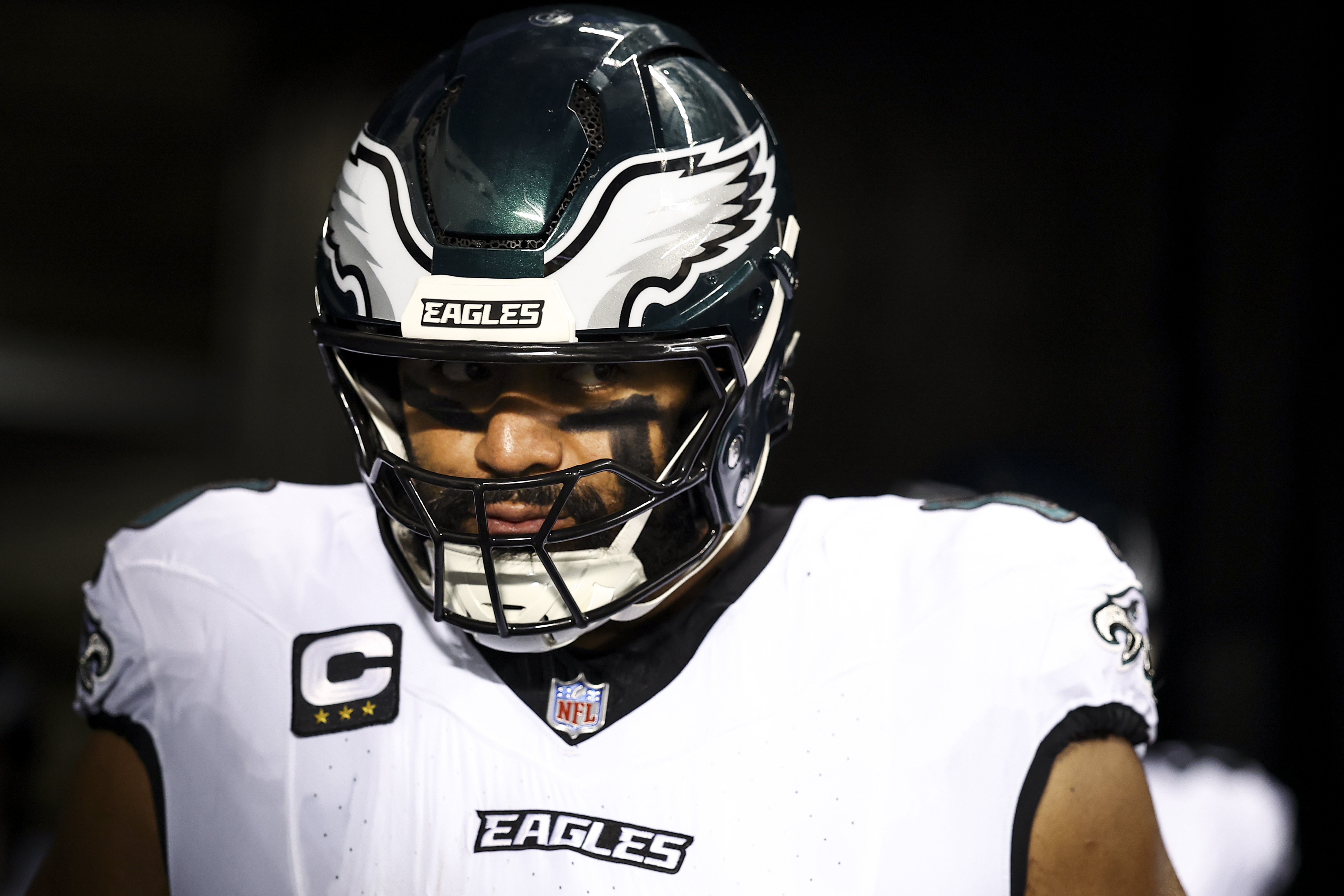
With the retirement of right tackle Lane Johnson, the trade of center/guard Cam Jurgens, and the chronic injury issues of left guard Landon Dickerson, Jordan Mailata has fully replaced retired center Jason Kelce as the Eagles’ conscience and soul.
He was asked Sunday what the players could improve upon during an error-riddled, four-game losing streak.
“The only thing that comes to mind is ‘want to,’” Mailata said. ”The ‘want to’ to execute that rep. The ‘want to’ to dominate the guy next to you. … Getting guys to just finish the blocks.”
“I don’t question our guys’ toughness,” head coach Nick Sirianni said. “I don’t question our effort.”
Why not?
The most prominent team leader is questioning it. Why won’t the head coach?
Because lack of focus, toughness, and effort is a direct reflection of the effectiveness of the head coach — especially a CEO head coach who delegates coordinator duties.
If there’s a problem with effort, that’s on the coach.
If there’s a problem with effort and the coach can’t change it, that’s an indictment of the coach.
If there’s a problem with effort and the coach can’t even see it — or worse, refuses to see it — that’s coaching malpractice.
Even with the losing, when factoring in the injuries and a new offensive scheme, Sirianni’s future in Philly seemed solid before this slide. If owner Jeffrey Lurie thinks Sirianni is ignoring culture rot, that future becomes much less solid.
Mailata on Sunday spoke mostly about the offensive line, but he really could have been speaking for all 53 players. The Birds, now 2-4, committed a season-high 11 penalties in Sunday’s 25-14 loss to the visiting Panthers. It’s the third time in six games this season they’ve hit double-digits; they were flagged 10 times against the Bears in Week 3 and the Rams in Week 4, the two losses that started the slump.
They hit double-digits just twice in the 34 games of the last two regular seasons combined. Mailata had another false start Sunday, his third this season, as many as he had all of last year.
It’s not just penalties.
Players are lining up in the wrong spot, blocking the wrong opponent, and generally playing a sloppy brand of football a team with a sudden deficit of talent cannot afford to play.
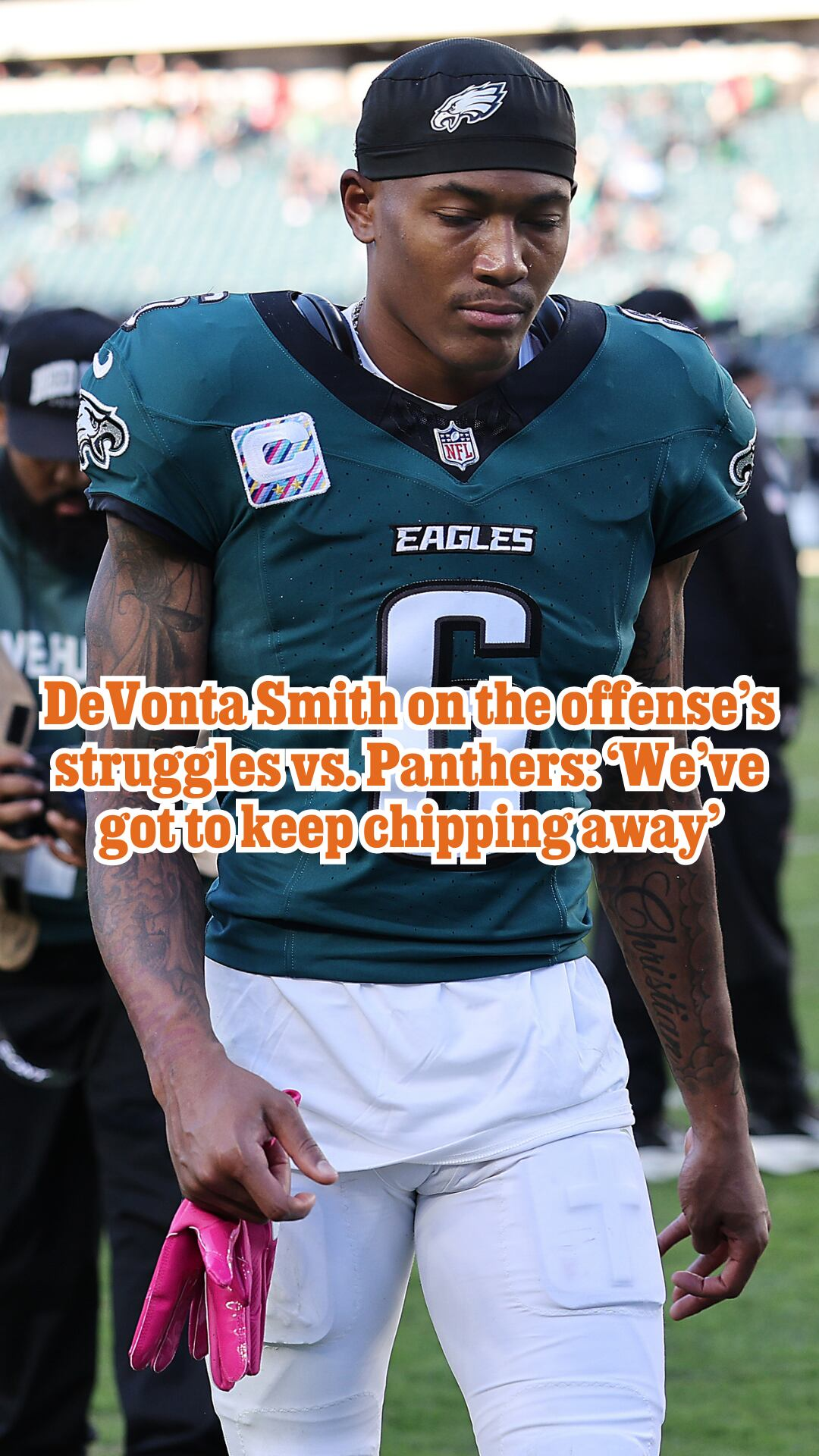
Video: DeVonta Smith on the offense’s struggles vs. Panthers: ‘We’ve got to keep chipping away’
Of the five planned starting linemen, only Mailata and Tyler Steen are playing their original positions. The left guard and center spots are occupied by third-stringers. The top three running backs are all injured, not to mention quarterback Jalen Hurts, who missed Sunday’s loss and is now expected to be out for the season with blood clots.
It’s easier to swallow when you lose to a superior opponent if you’re focused and playing hard, but there are no excuses for failing to execute the fundamentals.
“Those are all individual mistakes,” Mailata said. “If you’re lapsing in the moment … if you’re not focused in the moment, that’s like you’re not wanting to focus. … The ‘want to’ to not cause any false starts to try to jump the cadence because you’ve got to pull [as he did]. You know, it’s silly little errors that we can control.”
CJGJ, out of control
Josh Allen threw a backhanded, 12-yard touchdown pass after a 7-second scramble to charismatic receiver Keon Coleman in the Bills’ 33-30 win in Las Vegas that moved them to 5-1.
That wasn’t the only backhanded incident from the Bills, or even the most interesting.
Just before halftime, safety C.J. Gardner-Johnson was ejected for spitting on Raiders tight end Brock Bowers.
Gardner-Johnson said he expected a fine, or worse. He got worse in the form of a one-game suspension.
Last season, Eagles defensive tackle Jalen Carter was ejected for spitting on Cowboys quarterback Dak Prescott. He was suspended … sort of. Since Carter spat before the game’s first snap, the NFL declared that the missed game counted as his suspension and just forwarded his game check to NFL charities.
The Bills have a bye next week, so Gardner-Johnson, a repeat offender, will be suspended when the Ravens visit Nov. 1.
Gardner-Johnson was a starter on the Eagles teams that went to Super Bowls after the 2022 and 2024 seasons and earned a reputation as an uncontrollable player. In his eight-year career, he has 10 unnecessary roughness penalties. In 2024, he was ejected from an Eagles game against the Commanders for unsportsmanlike conduct, the second ejection of his career. Sunday’s was his third.
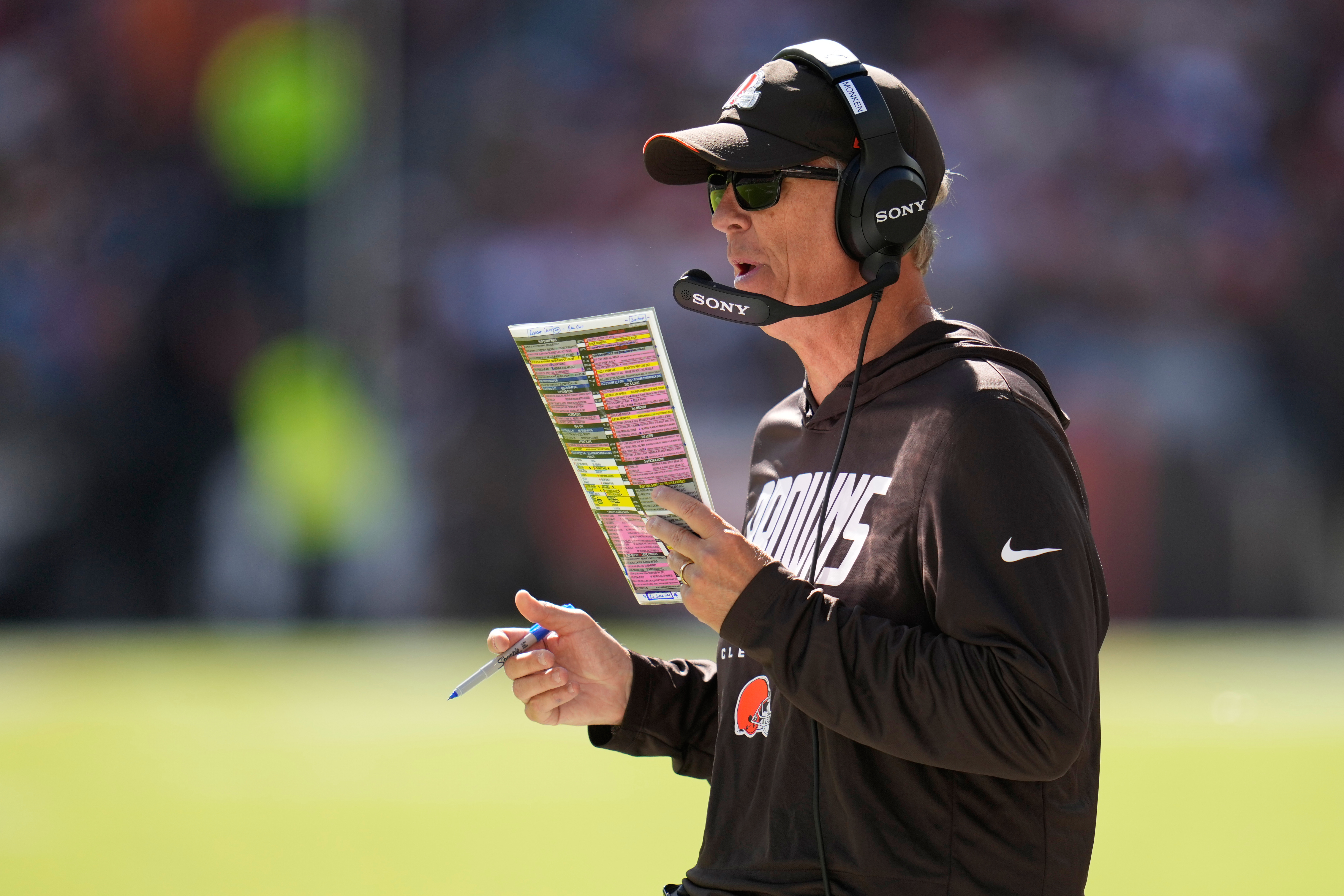
Todd Monken beat his former team on Sunday and moved the Browns into a first-place tie in the AFC North. Sue Ogrocki
Todd Monken’s … revenge?
After the sexual assault lawsuits, the resulting suspension, the megatrade amid all of it, and the injury issues that followed, Deshaun Watson will be the headline associated with Cleveland for the foreseeable future. However, on Sunday, good-guy head coach Todd Monken got some shine.
Monken was the offensive coordinator in Baltimore the past three seasons. Ravens coach John Harbaugh was fired and Monken, whose relationships with Ravens stars had deteriorated, was expected to follow Harbaugh to the Giants … if he didn’t get his first NFL head coaching job, at the age of 60, in Cleveland.
Monken got the Cleveland job.
Then, on Sunday, he and Watson and the rest of the Browns beat the visiting Ravens, 13-10. They shut them out over the final three quarters, came back from a 10-0 deficit, and moved to 4-2. That’s the same record as Baltimore and Pittsburgh, but you can argue the Browns are in first place in the AFC North since they hold the head-to-head tiebreaker against both the Ravens and Steelers.
Monken, perhaps the most authentic NFL coach since John Madden, did not gloat.
“I wouldn’t have this job without the Ravens,” Monken said.
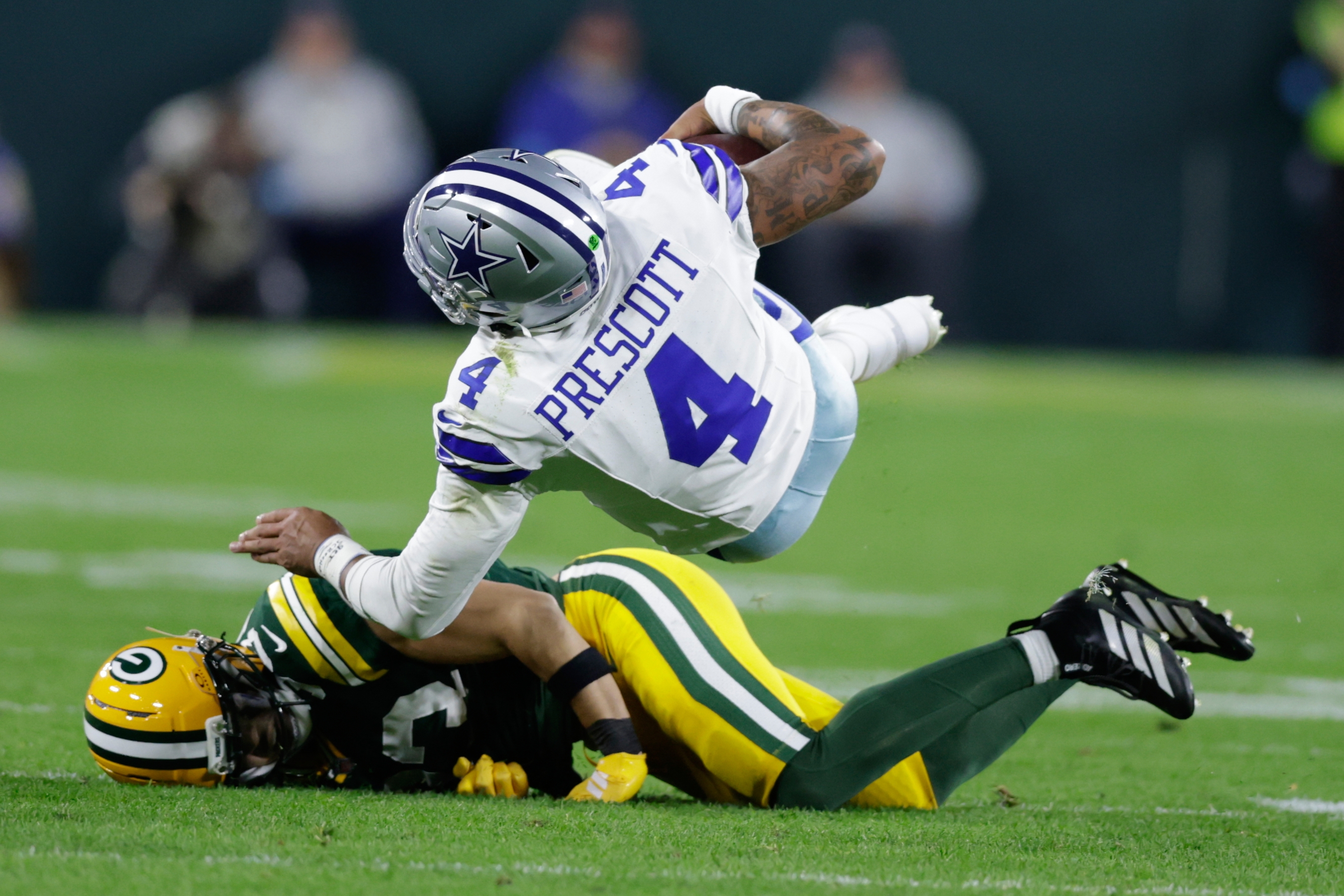
Bad call: Trailing by one point with 47 seconds to play and the ball on their 35, the Cardinals completed a 21-yard pass over the middle to Jalen Brooks, who was hit by Josh Wallace. It was a soft, safe hit, but was ruled unnecessary roughness, and it set up the winning field goal. The Rams lost to the visiting Cardinals, 18-16, their second straight defeat since beating the Birds in Philly. … Frequent fumbler Cam Skattebo got zero carries in the Giants’ loss to the visiting Saints, in which the Giants trailed by 24 early in the fourth quarter, prompting a wave of early exits. Skattebo has four fumbles. He played but did not touch the ball, though coach John Harbaugh denied freezing him out. … The Steelers scored 16 unanswered points in the fourth quarter to take a 19-16 lead, gave up a last-minute field goal, then scored a touchdown in overtime to beat the host Buccaneers (1-5). … A week after beating the Eagles on a long, last-second field goal in London, the Jaguars lost to the Texans on a long, last-second field goal in London. … Prescott threw two interceptions as the Cowboys (2-4) lost in Green Bay. … The Titans beat the Colts for their first win (1-5). … Andy Reid’s Chiefs moved to 5-0 and Jim Harbaugh’s Chargers fell to 0-6, but, while the zeros are more important, they weren’t as interesting as the block Patrick Mahomes threw on Kenneth Walker’s 2-yard touchdown run near the end of the second quarter.
Patrick Mahomes throws a block to help spring Kenneth Walker for the touchdown 👀 pic.twitter.com/AkYwhuMFE2
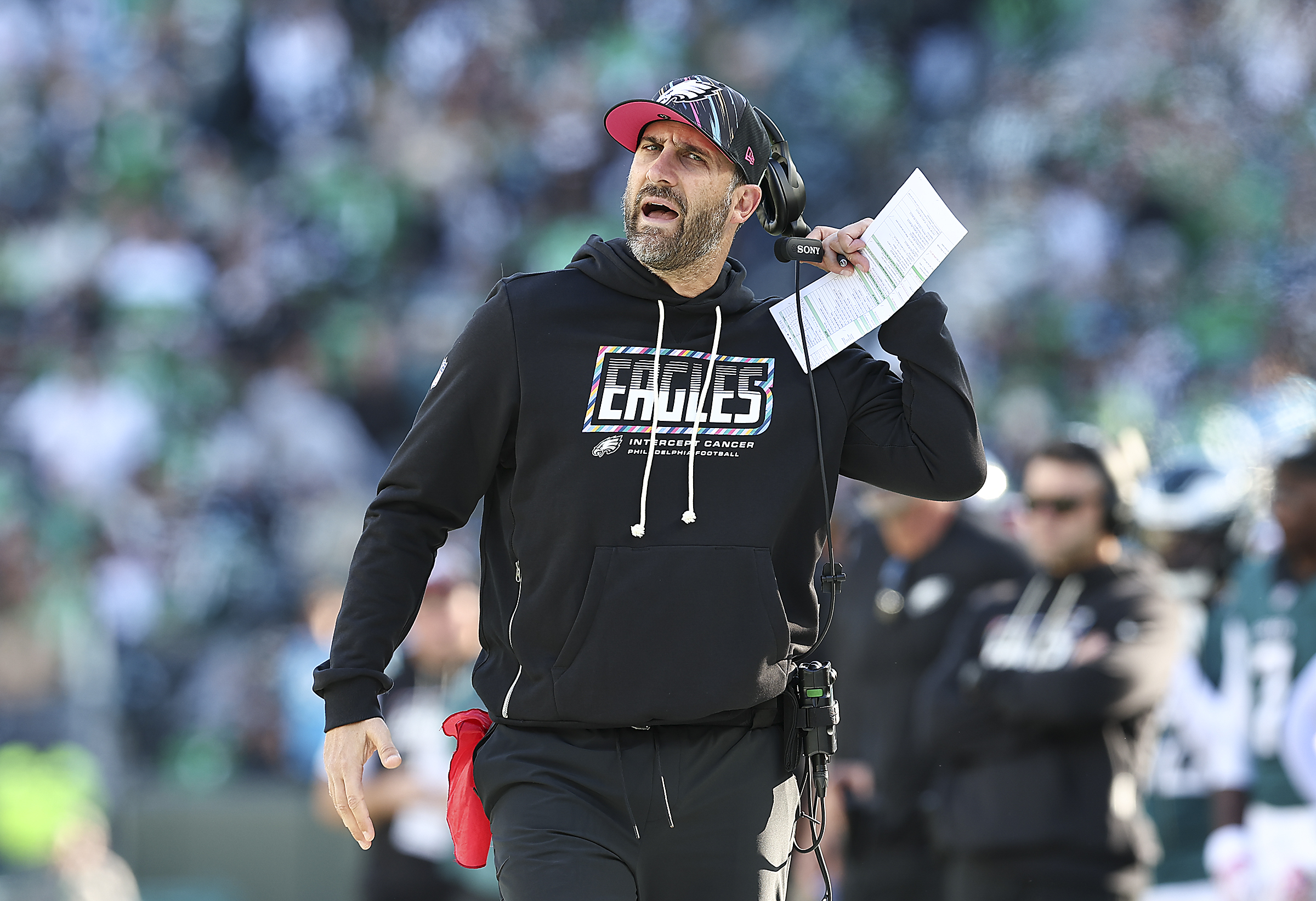
Nick Sirianni was asked about the busted coverage on the Panthers’ game-sealing touchdown that all but drove a stake through the Eagles.
“I thought it was a good design on their part. I’ll give them credit,” Sirianni said. “They went and executed it and they scored on it.”
It might have been a nifty call, but a miscommunication in the secondary allowed Bryce Young to hit a wide-open Tommy Tremble in the end zone and, ultimately, close out the Eagles, 25-14, on Sunday at Lincoln Financial Field.
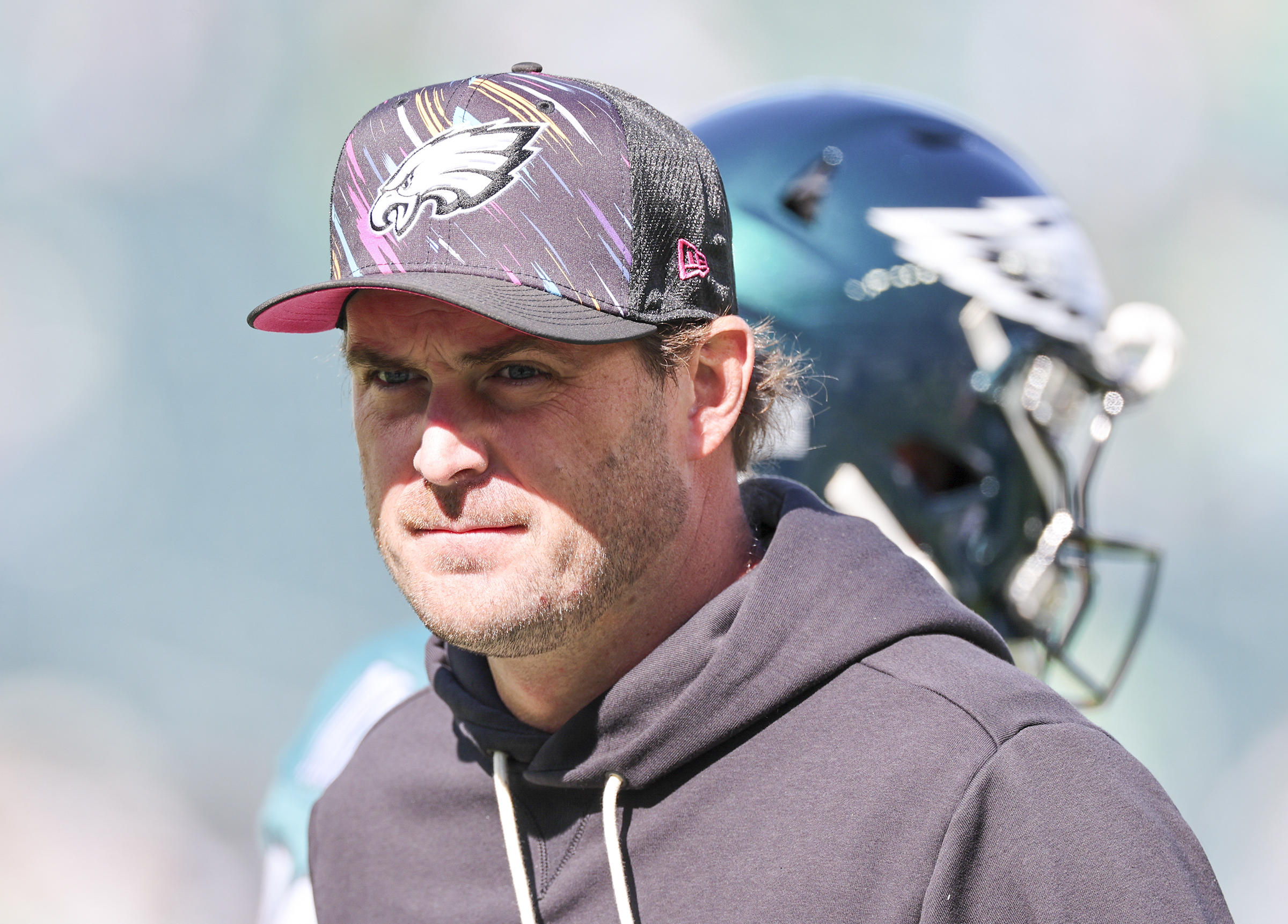
And yet, Sirianni initially focused on Carolina’s innovation rather than his defense when asked about the breakdown. He might not have intended for his response to say as much about his inadequate offense, but maybe subconsciously he did.
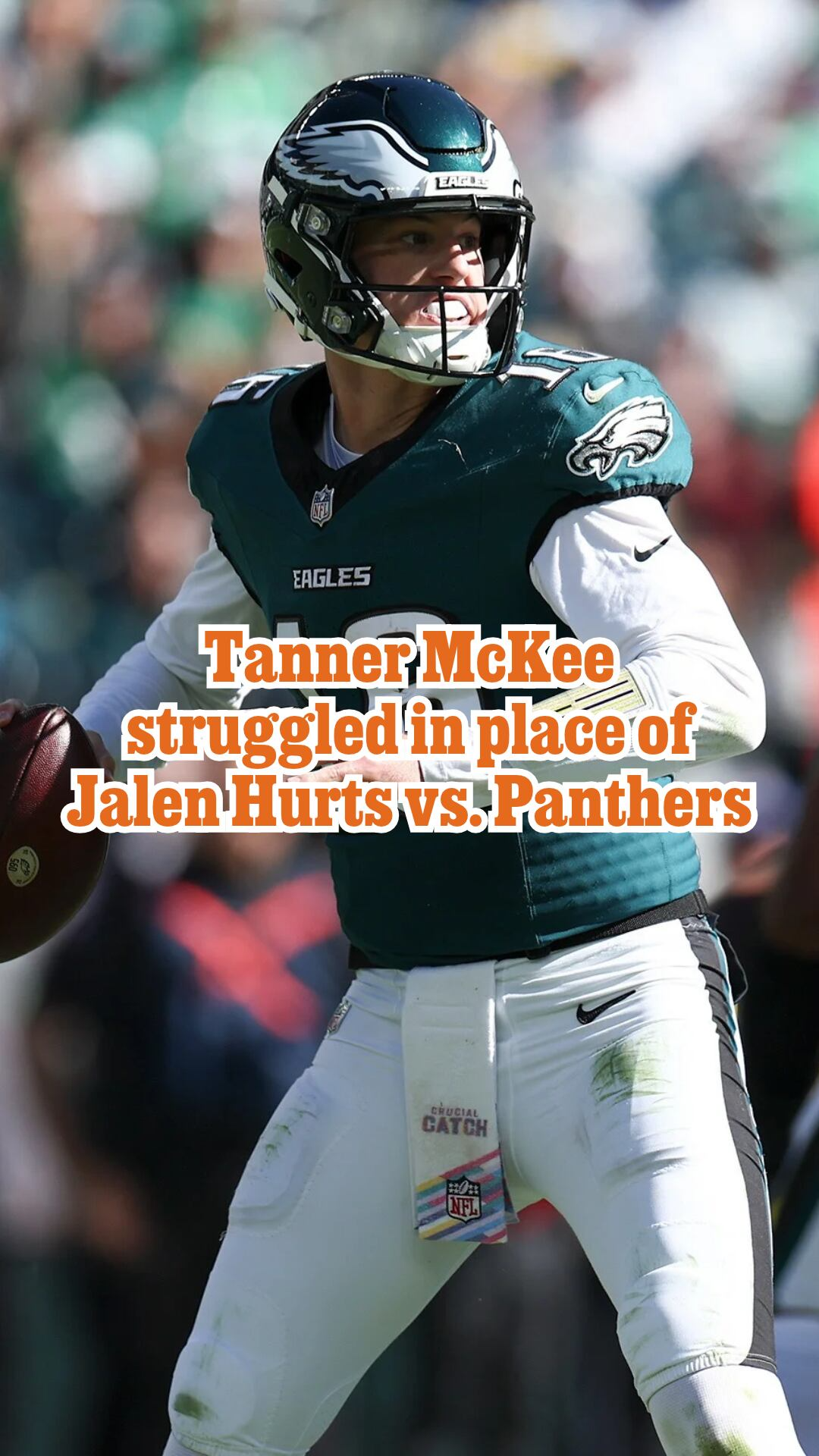
Video: Gameday Central: Tanner McKee struggled in place of Jalen Hurts vs. Panthers
Six games into Sean Mannion’s tenure, there has yet to be cause for the coach to compliment his offensive coordinator in a similar manner. Mannion’s scheme has been unimaginative, uncoordinated and, most important, unproductive.
Something has to change. The Eagles have lost four games in a row for the first time in the Sirianni era and over that span his offense has averaged just 14.5 points a game.
“We’re going to have to do different things to help the offense get going,” Sirianni said. “We’re never going to make an excuse on anything. We have to do different things to get them going and score more points, plain and simple, especially there in that second half.
“So, everything’s on the table. To do the same thing over and over again and not get the results, that’d be foolish. Everything’s on the table of what we need to do to be able to put points on the board.”
Sirianni used the phrase everything’s on the table just last week when asked about the possibility of having Mannion call plays from the field rather than the coaches’ box. Perhaps that is one of the modifications he implements to kick-start his offense.
The question that prompted Sirianni’s words was about altering the offense to play to quarterback Tanner McKee’s strengths with Jalen Hurts out for what at the time was thought to be at least another three games due to a blood clot in his calf, and not the rest of the season as it now stands. But having McKee under center only revealed that the scheme was more responsible for the ineptitude than the starting quarterback.
Hurts wasn’t close to perfect before he was sidelined, but the Eagles likely don’t win the first two games without his improvisation. Meanwhile, in his absence, the same problems persisted: an inability to run the ball, pick up blitzes and execute any of the under-center play-action game that Mannion was supposed to incorporate into a Sirianni-Hurts system that had become too predictable.
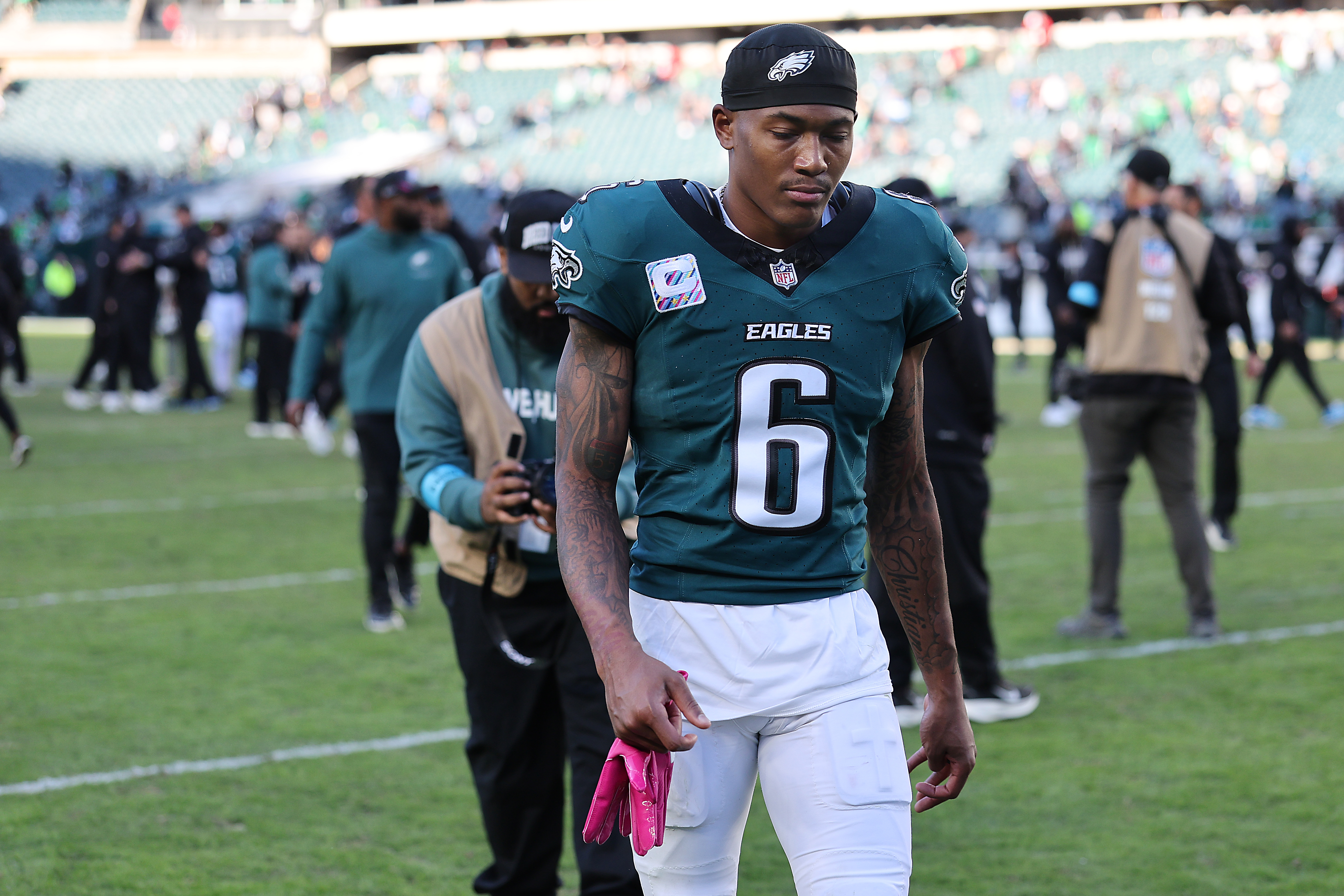
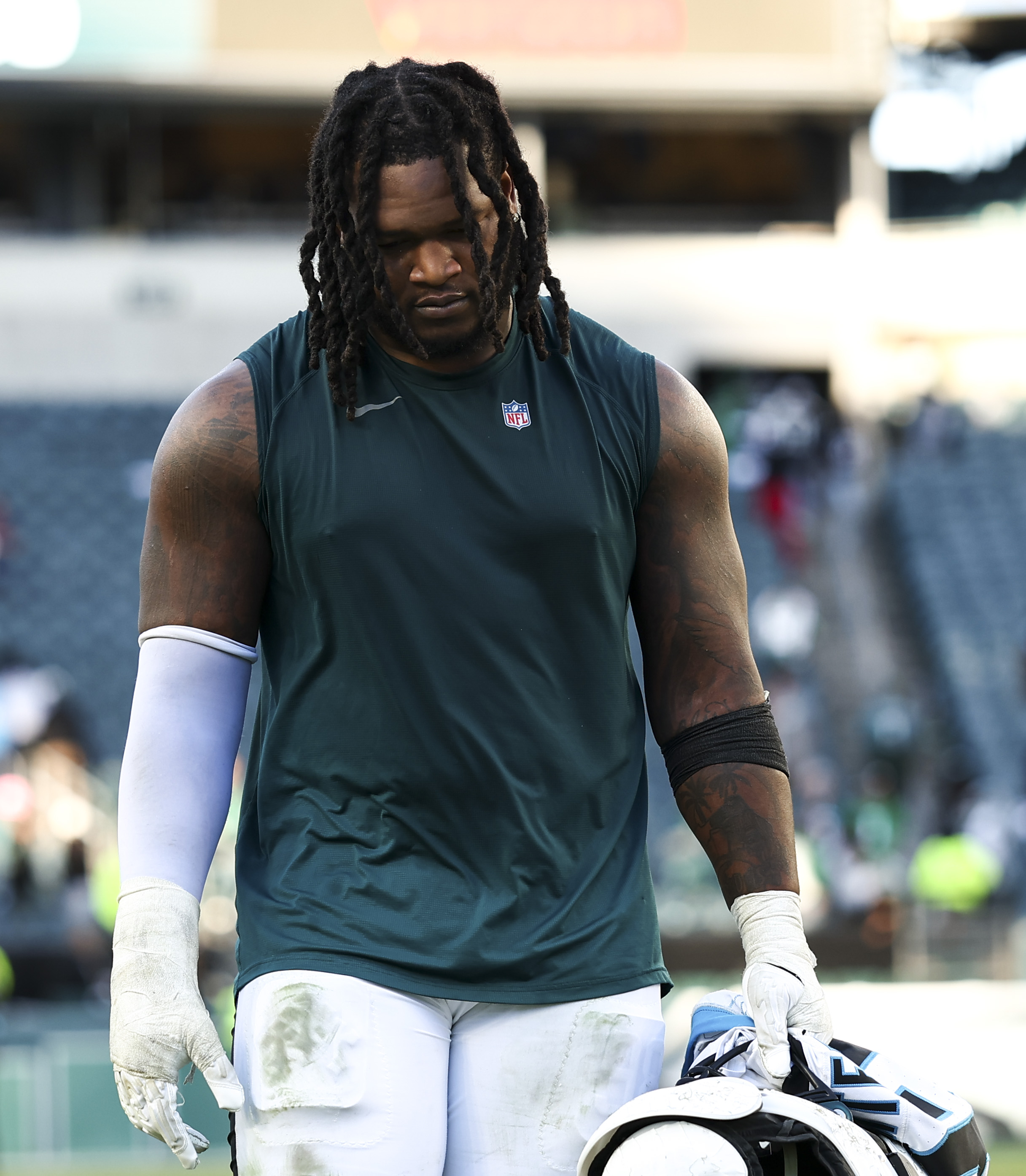
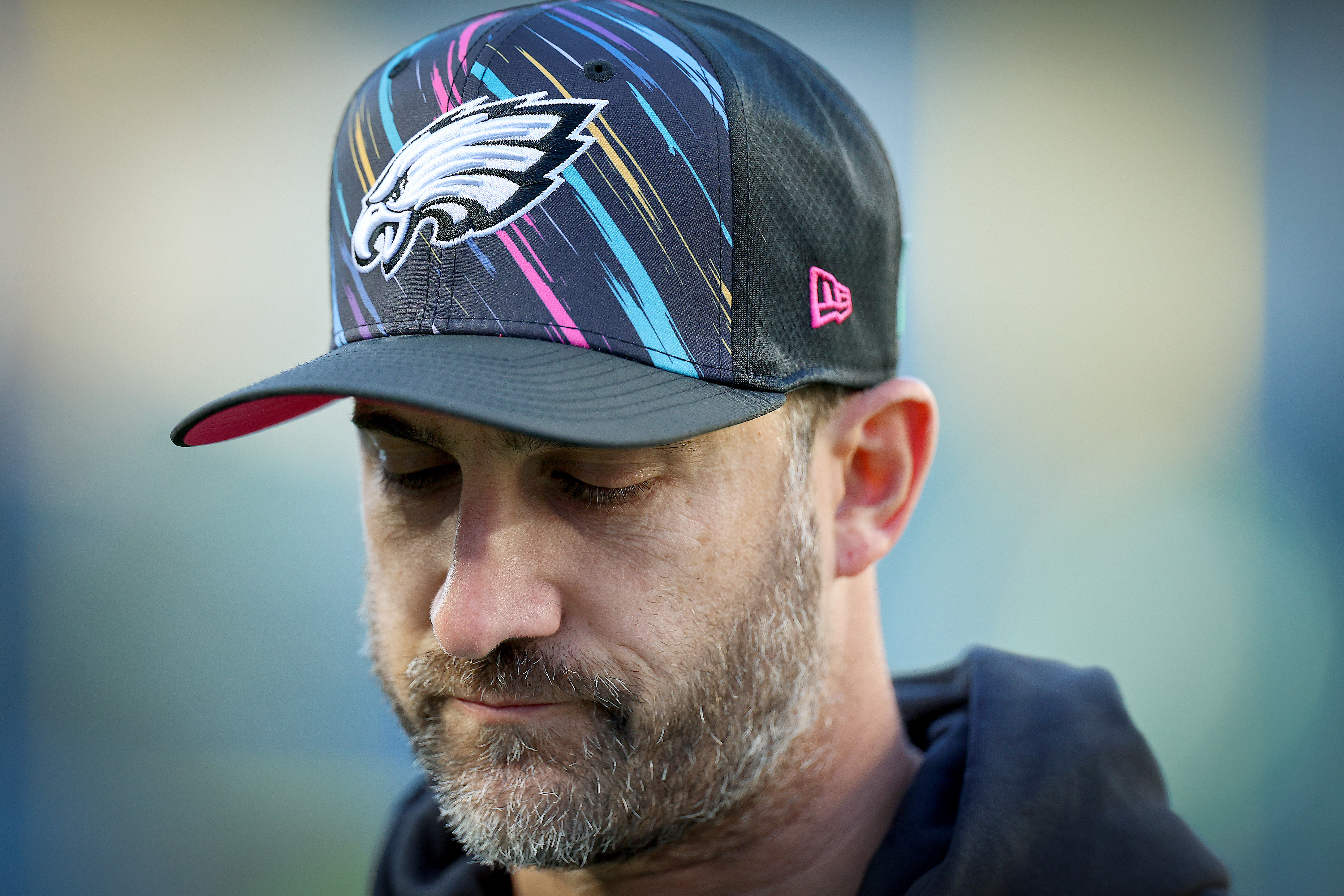
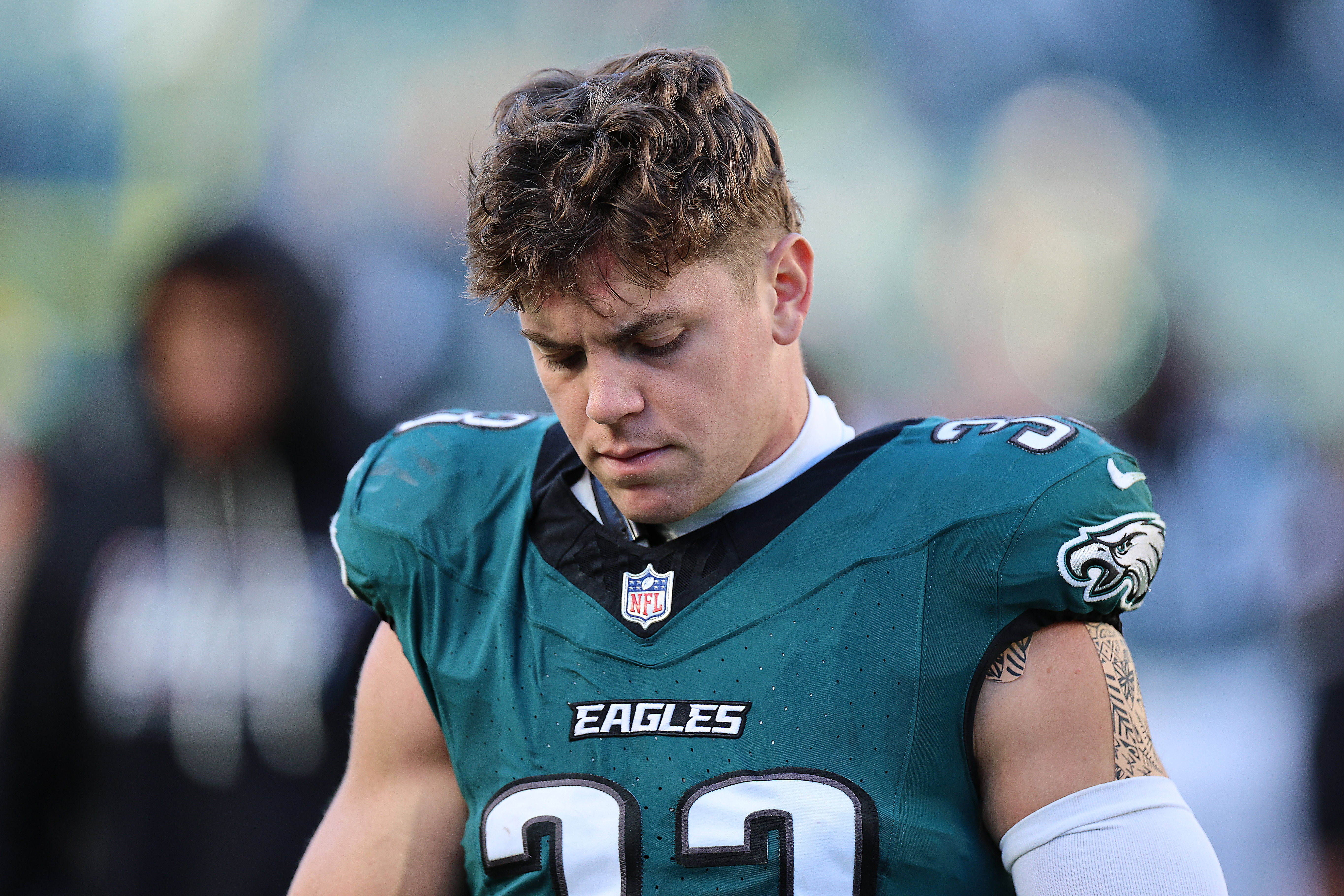
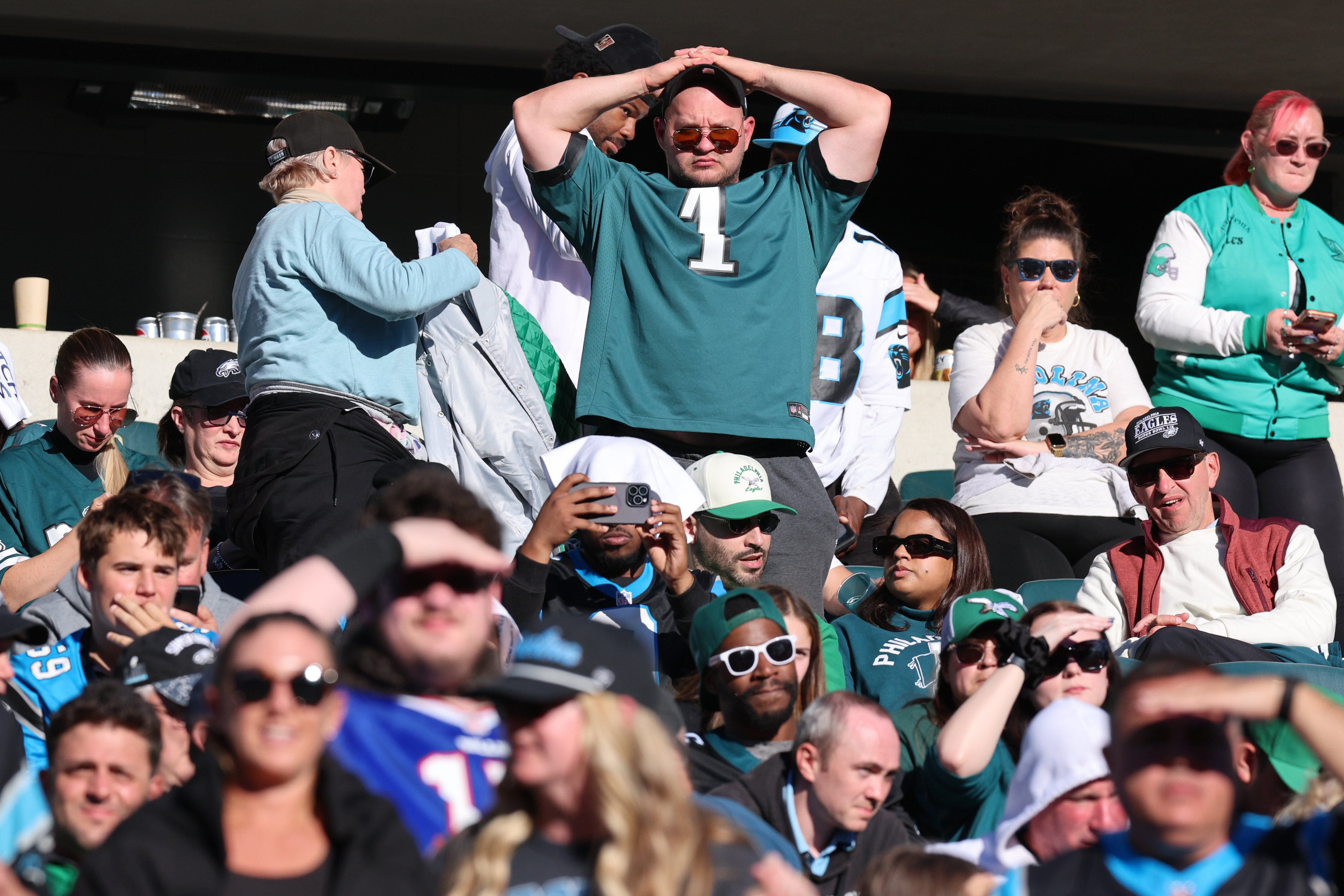
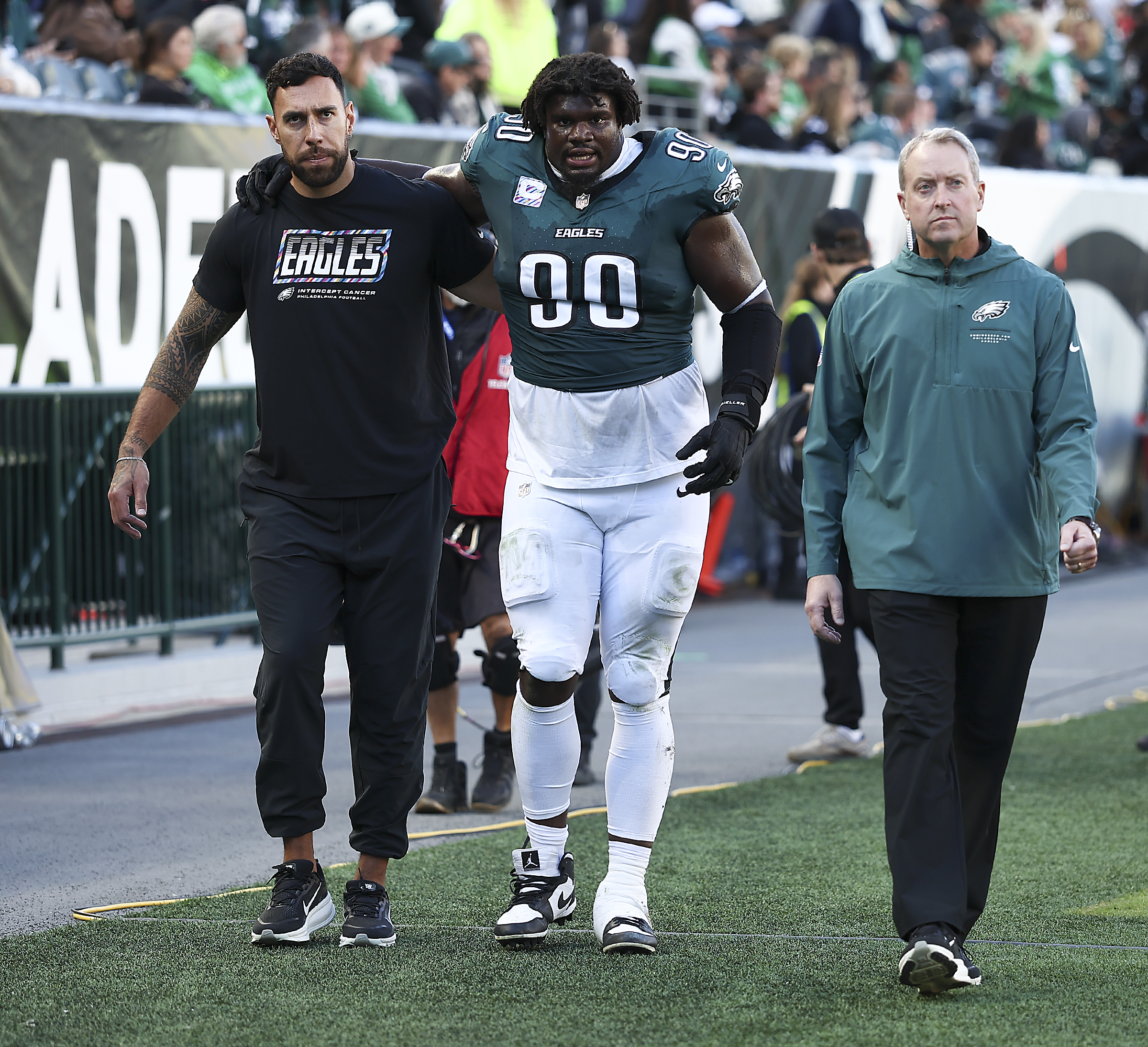
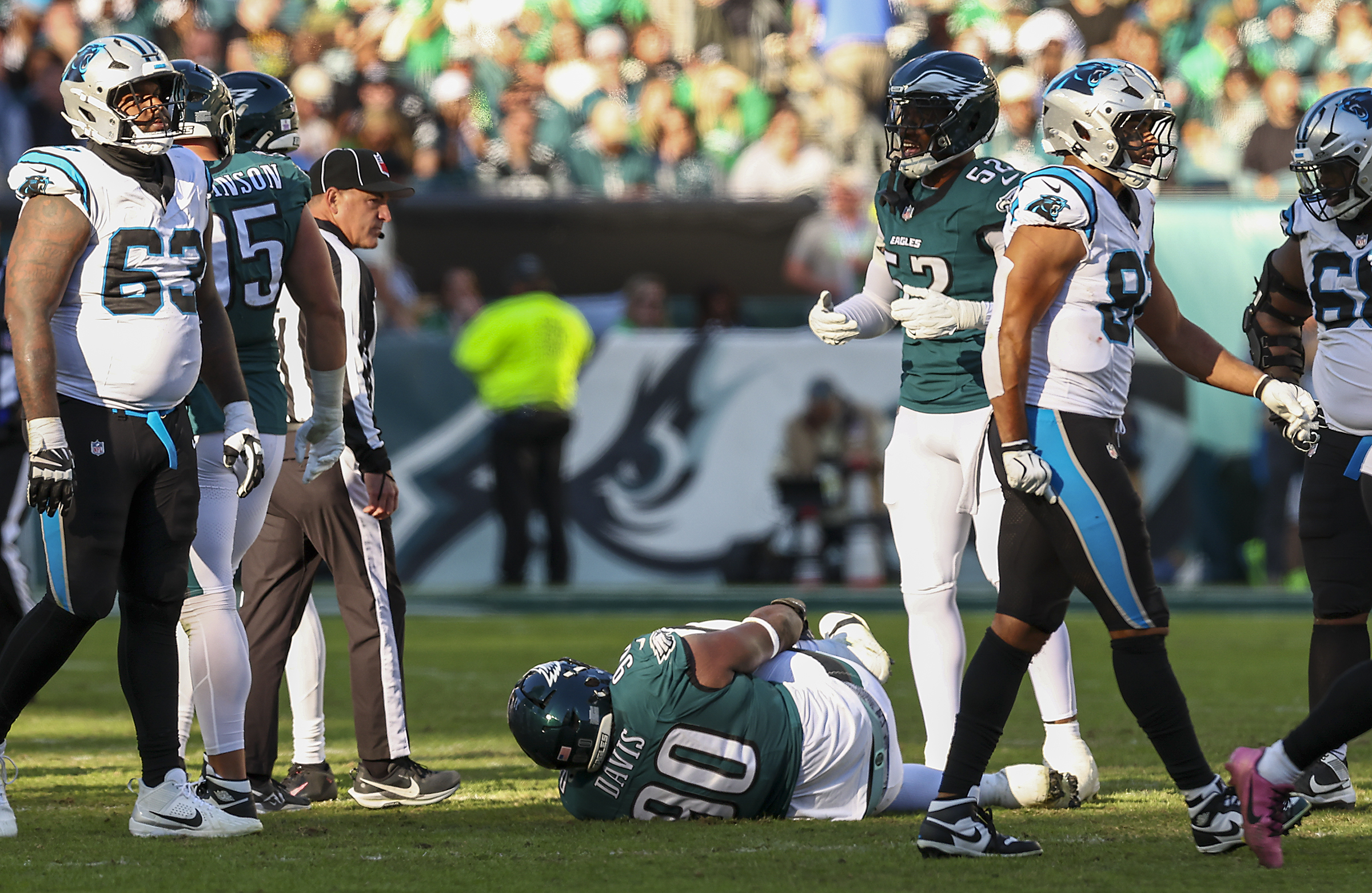
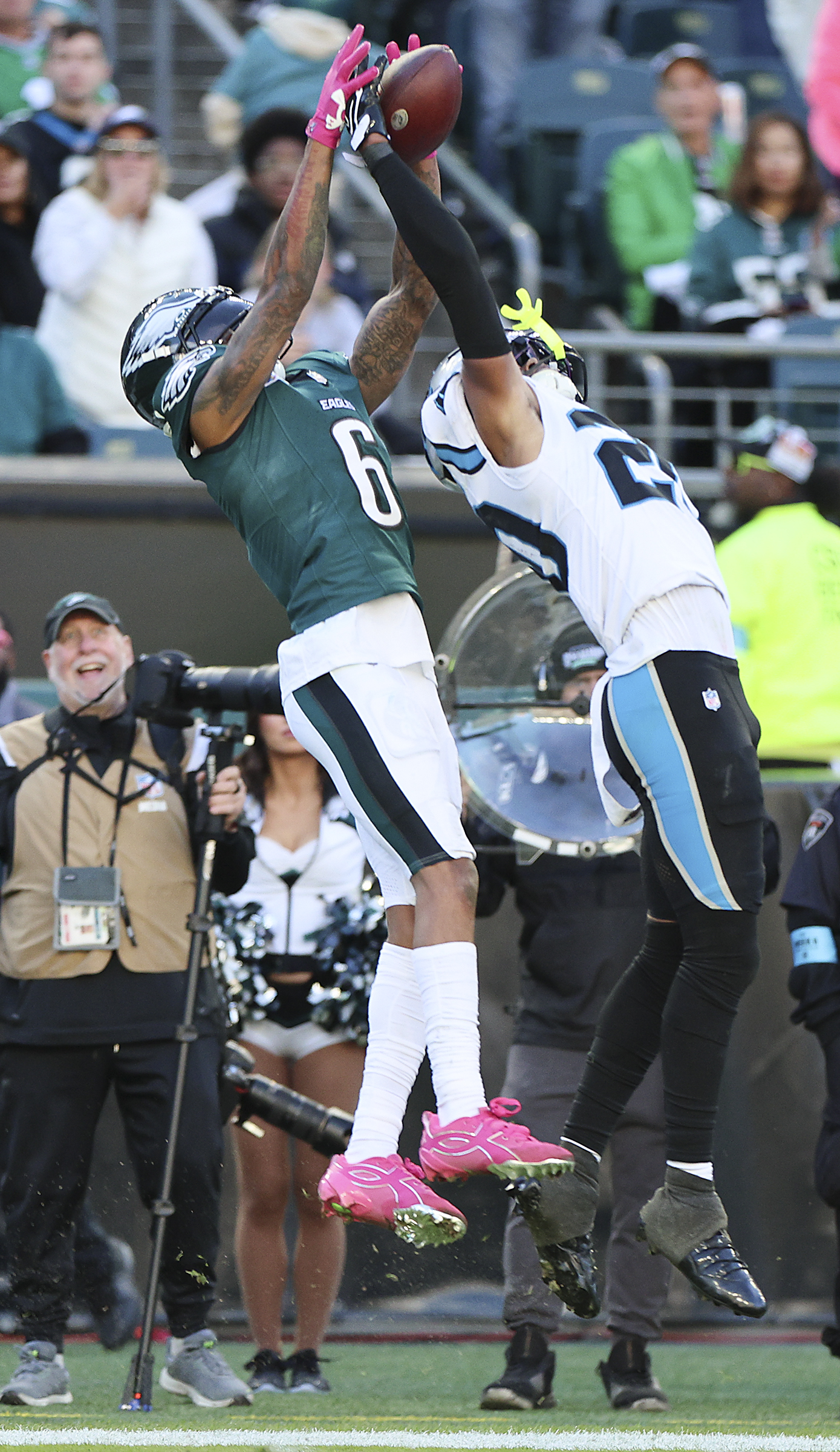
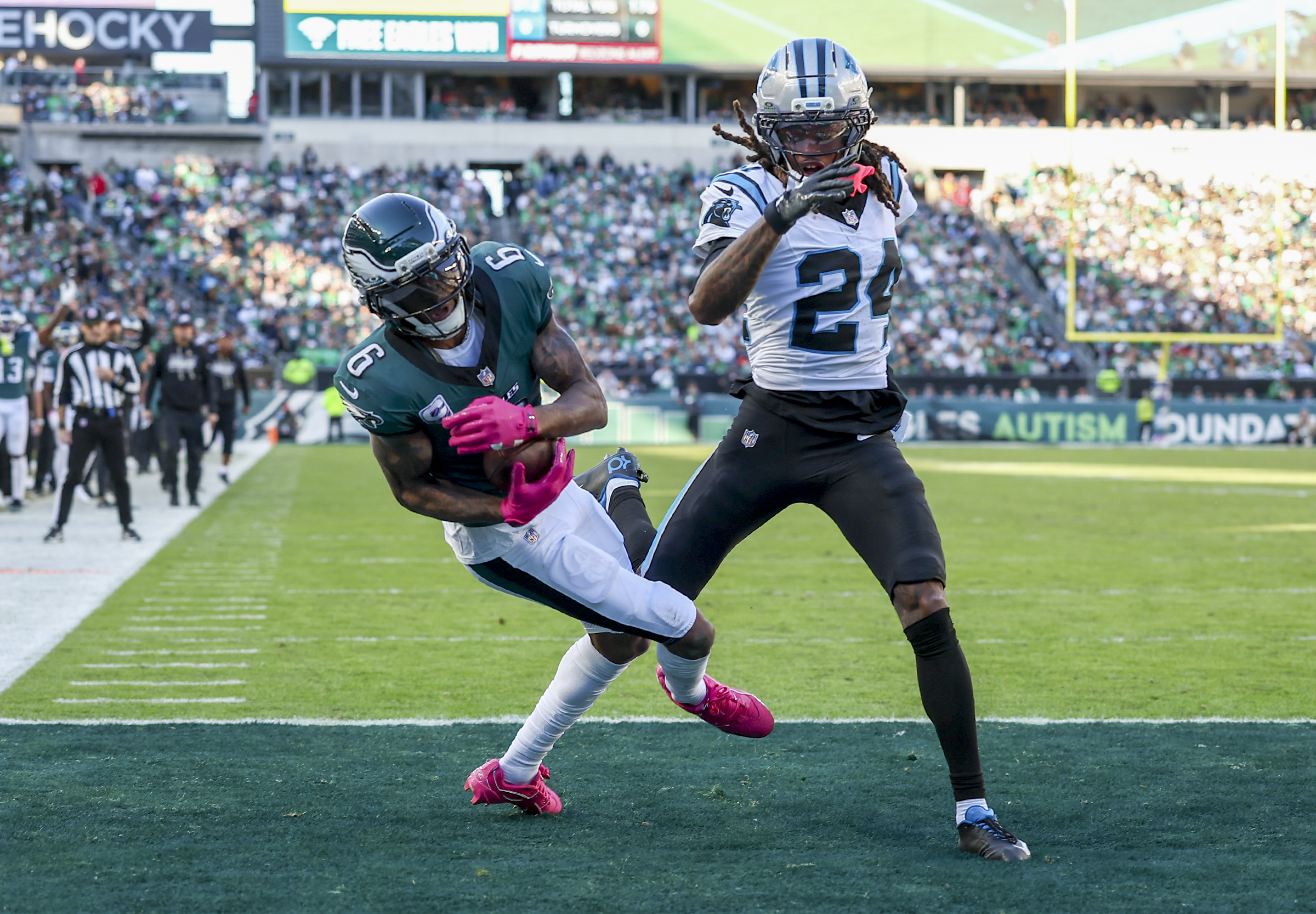
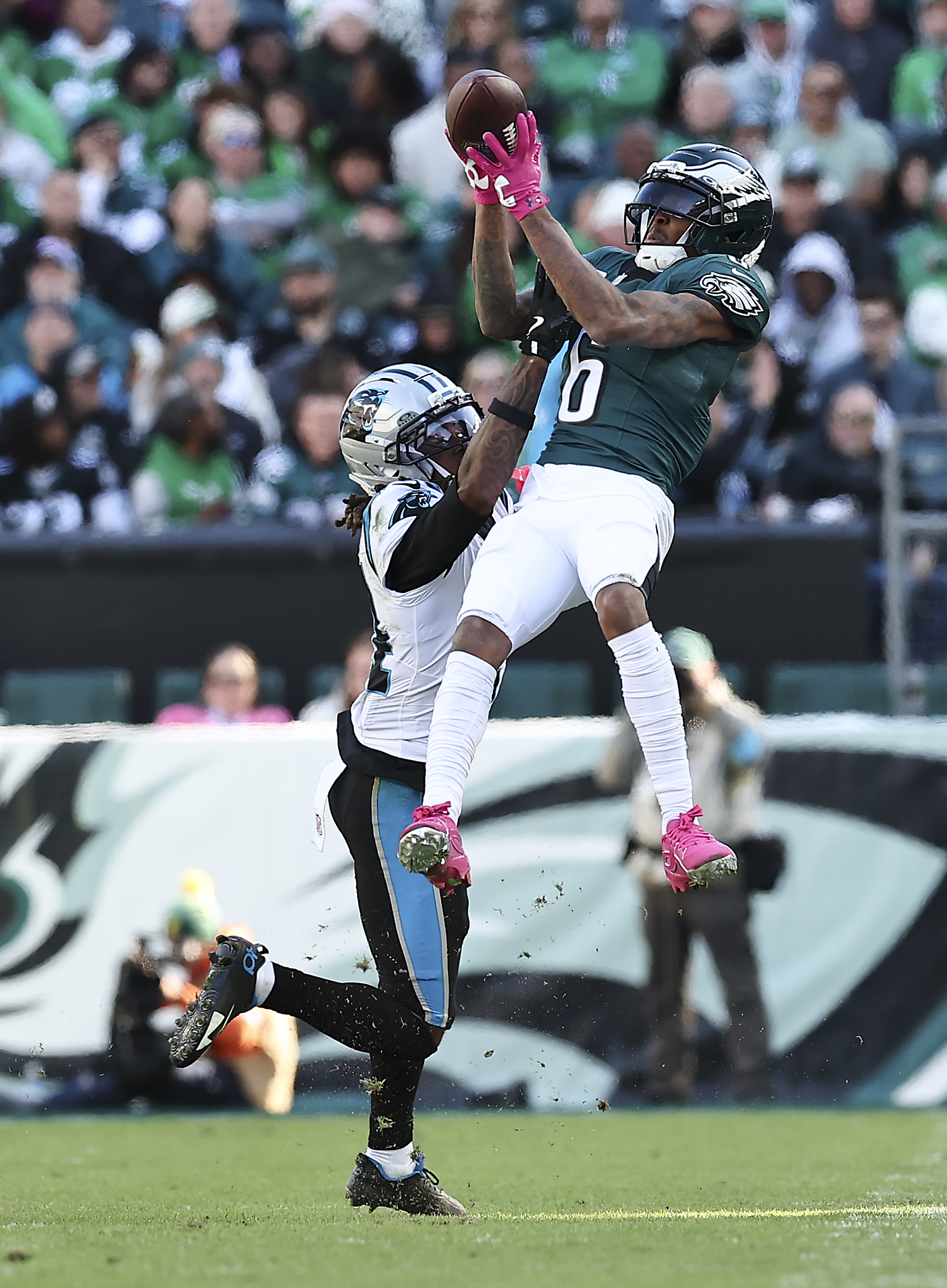
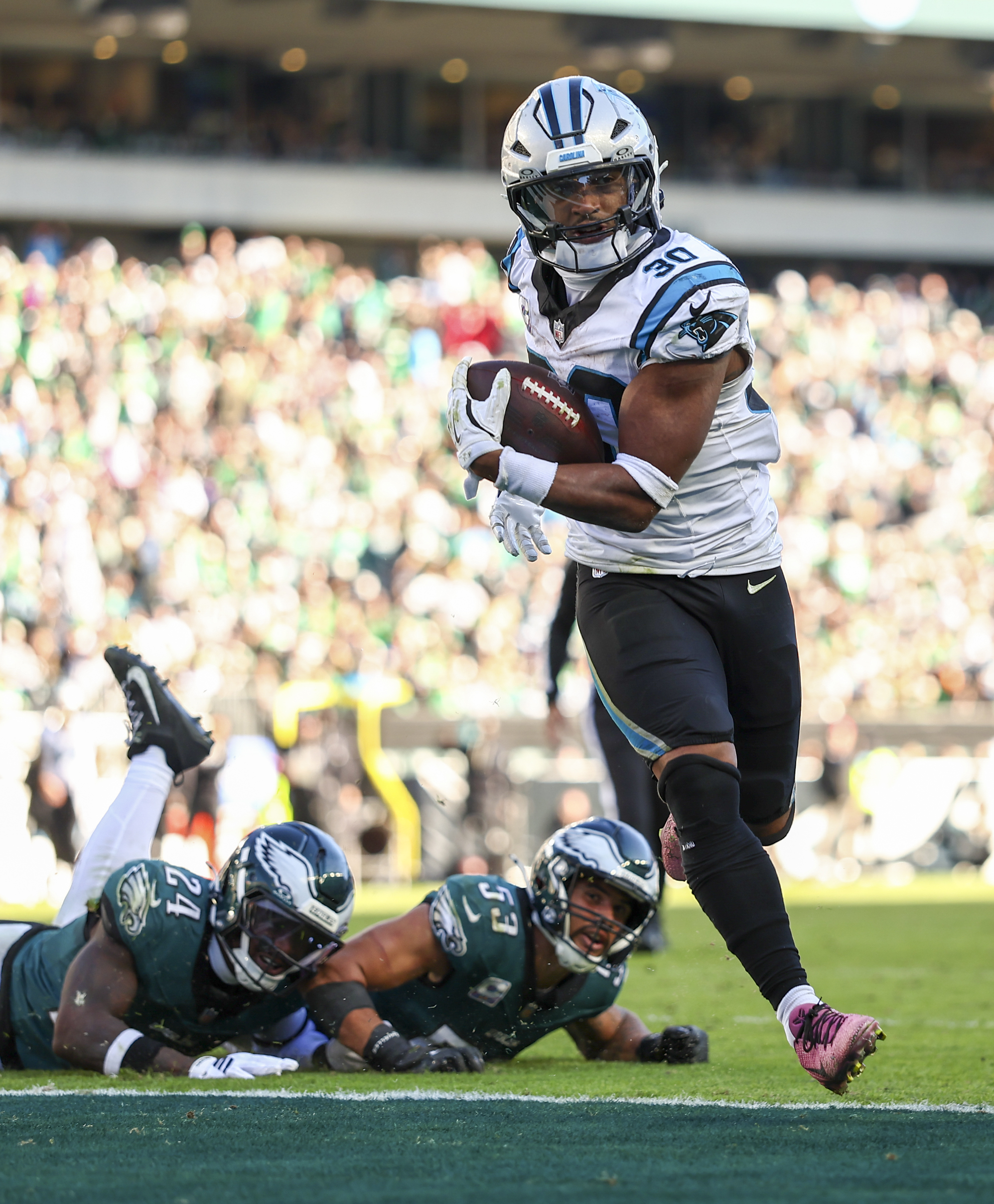
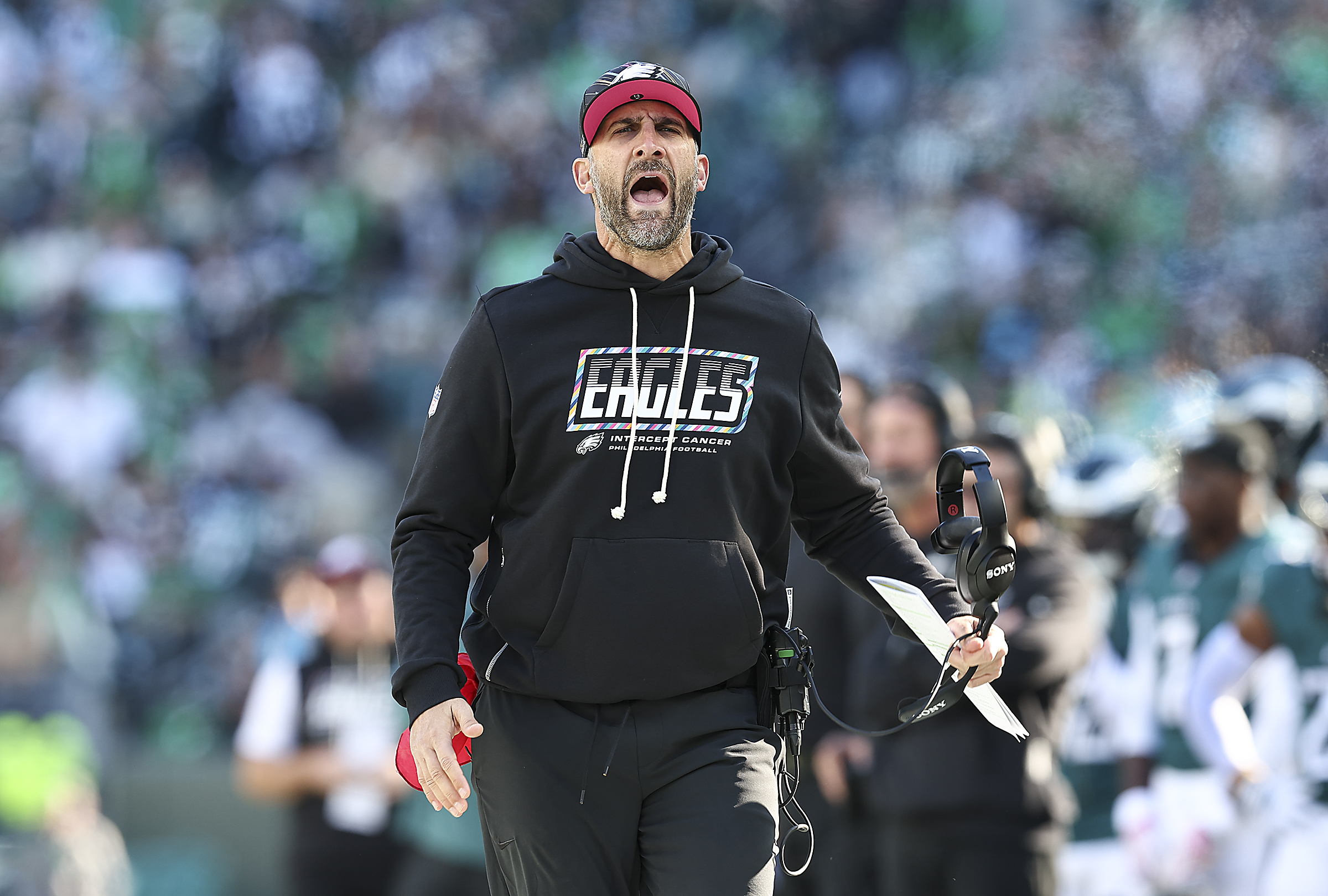
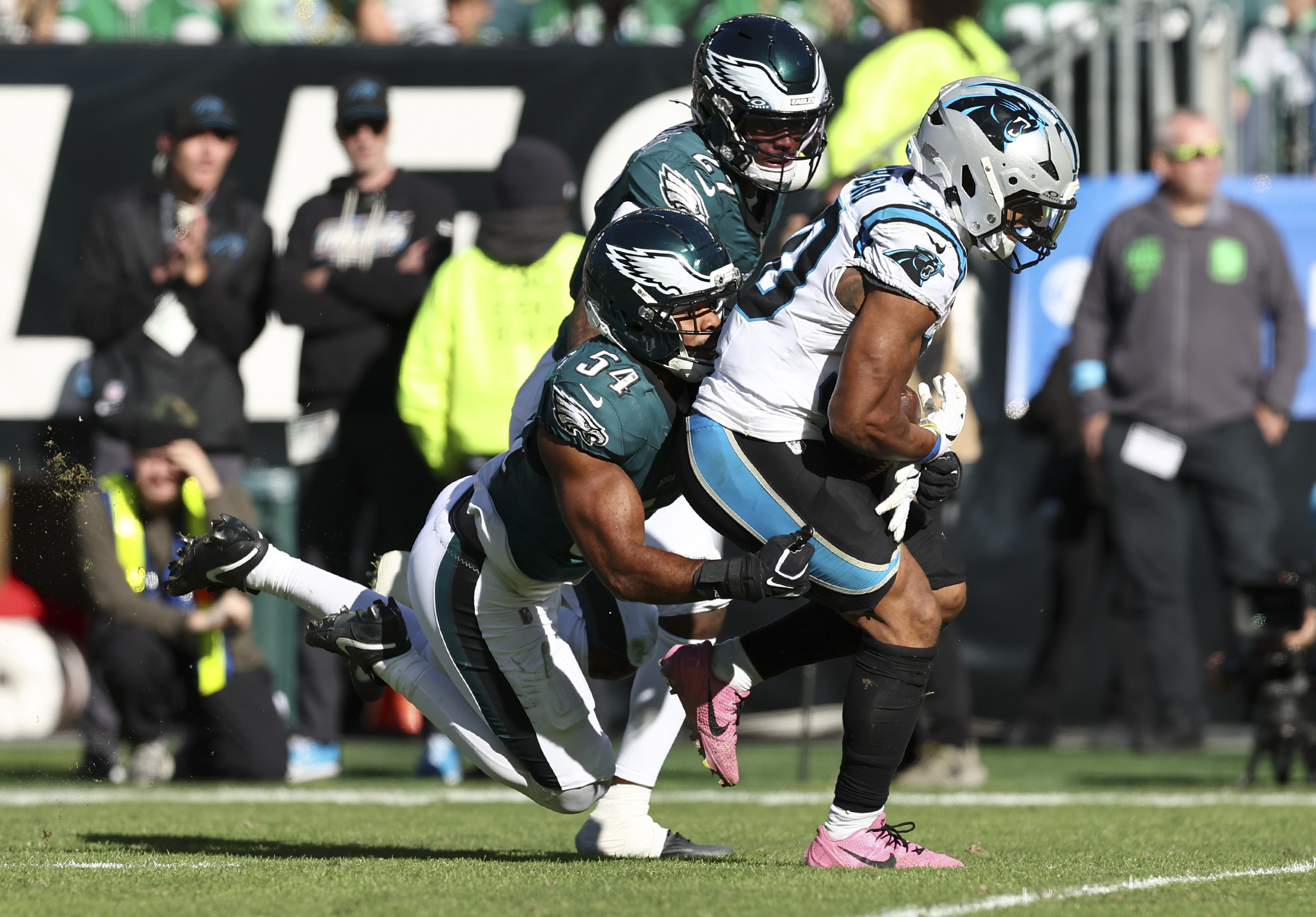
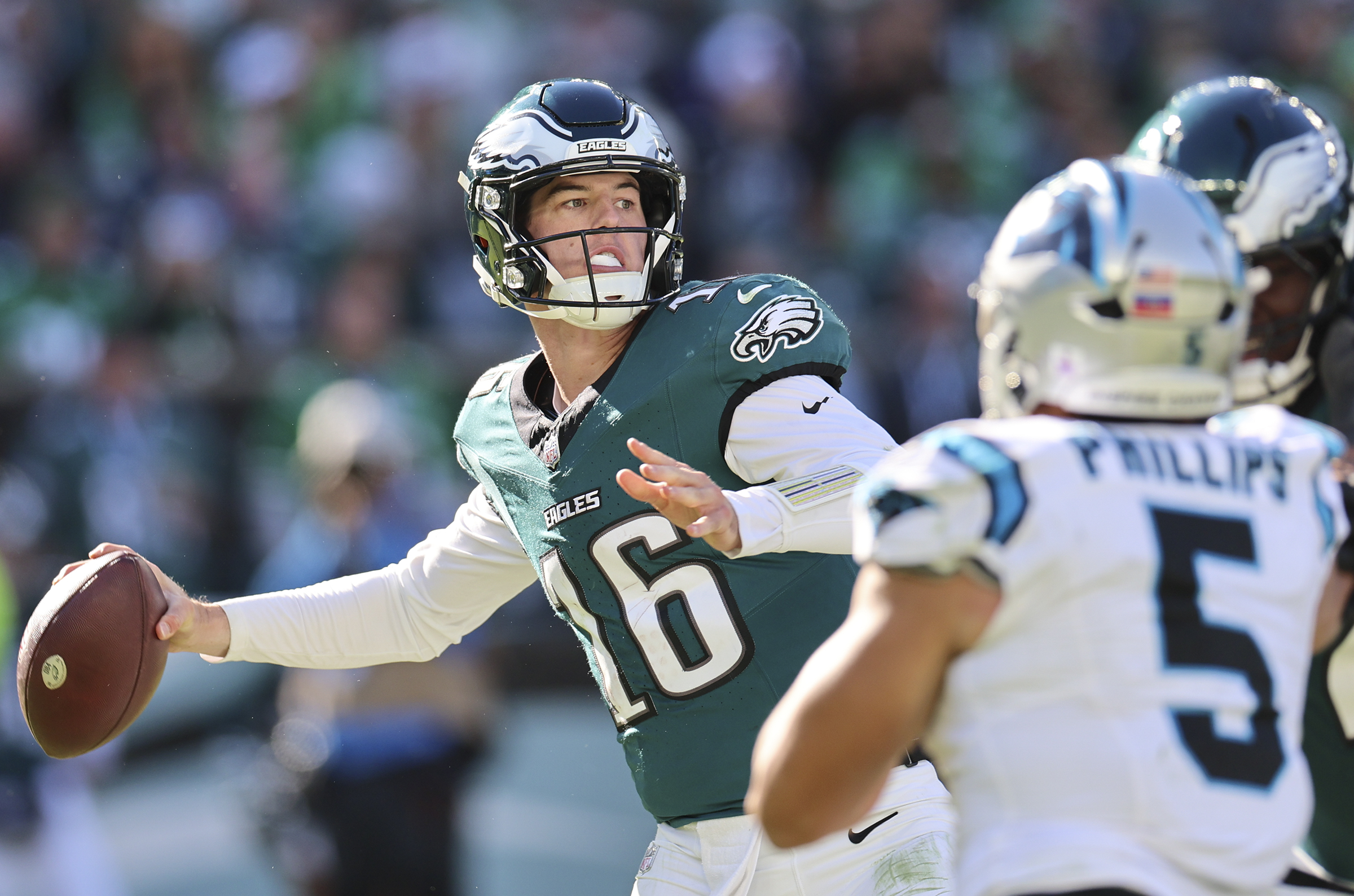
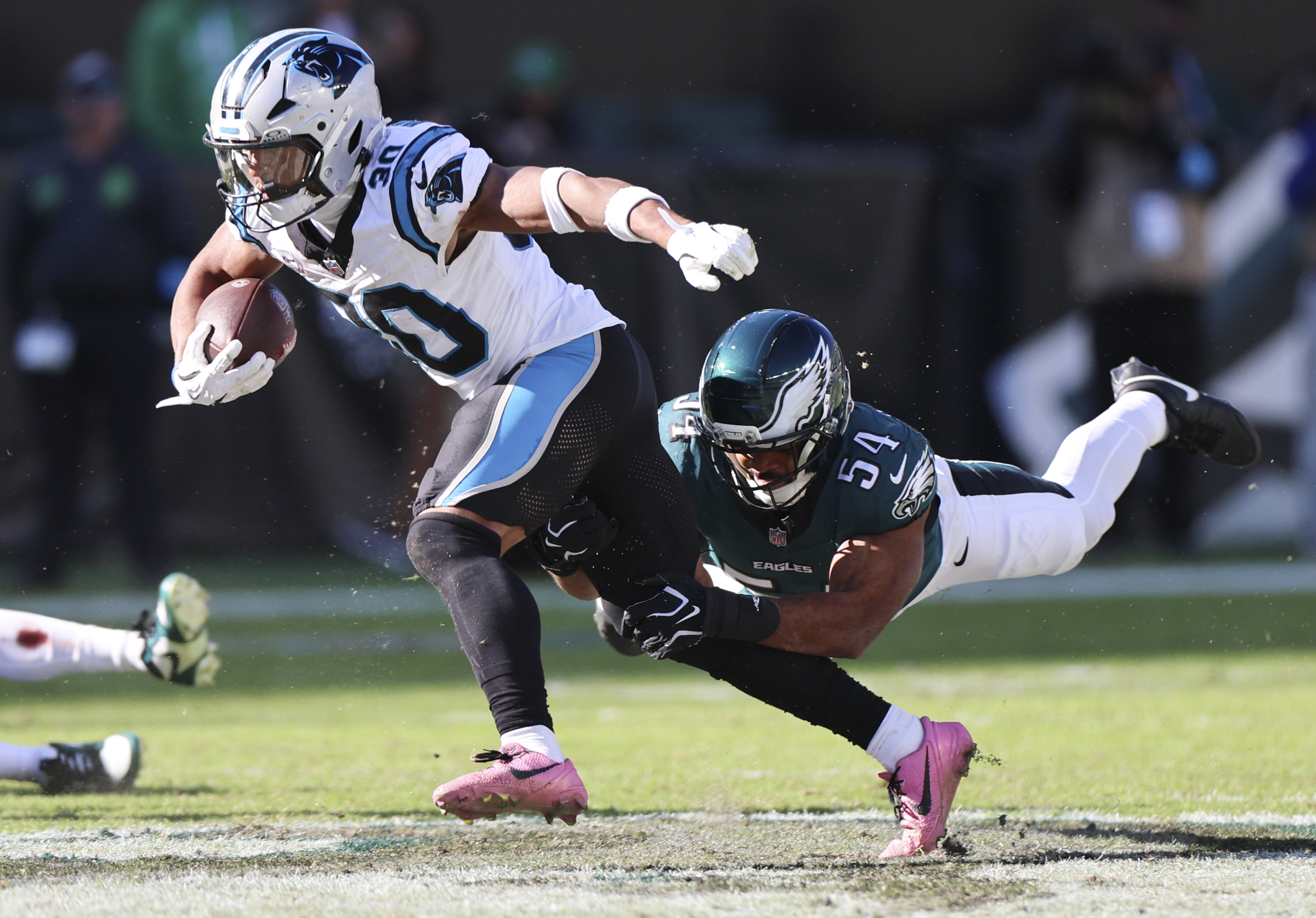
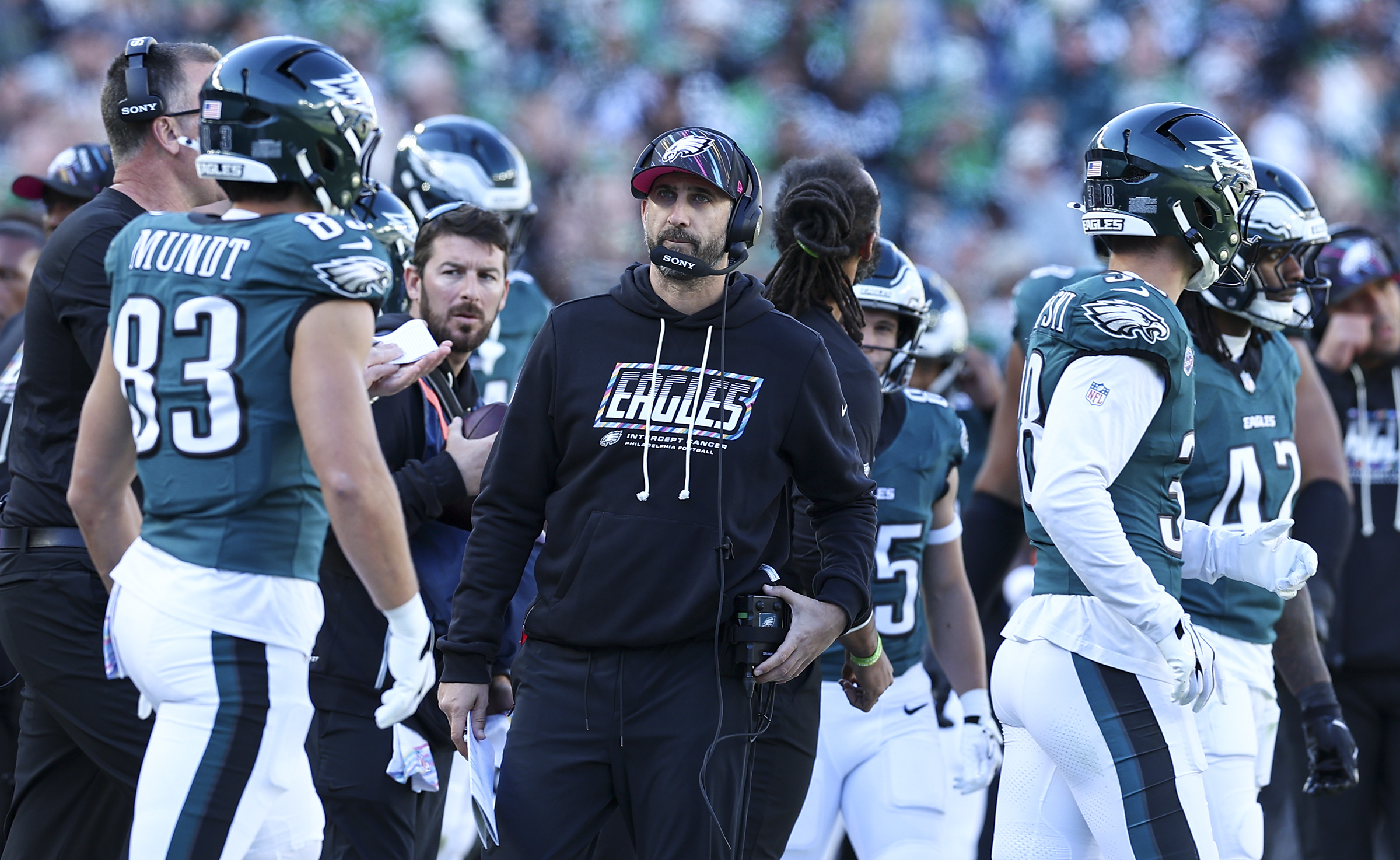
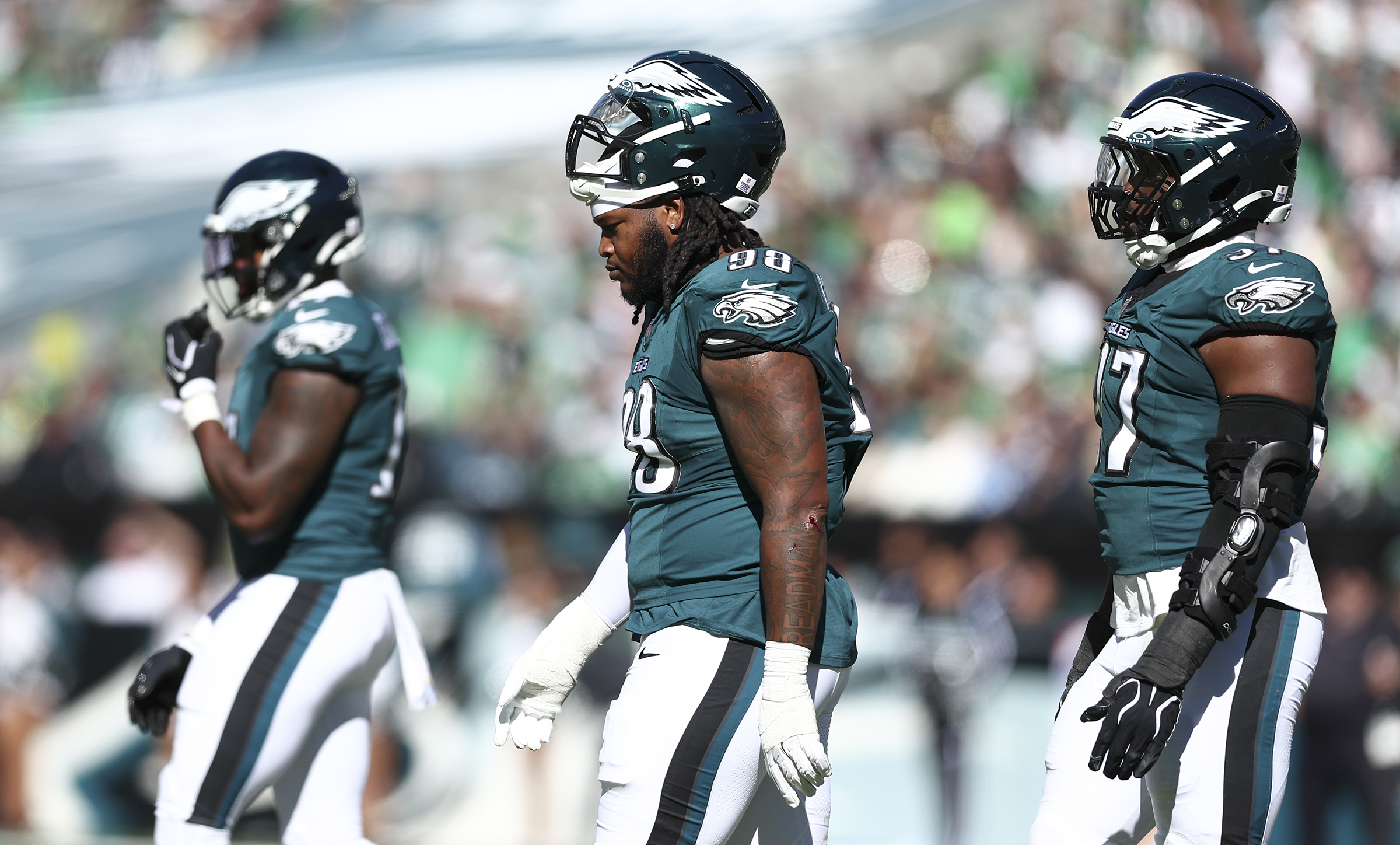
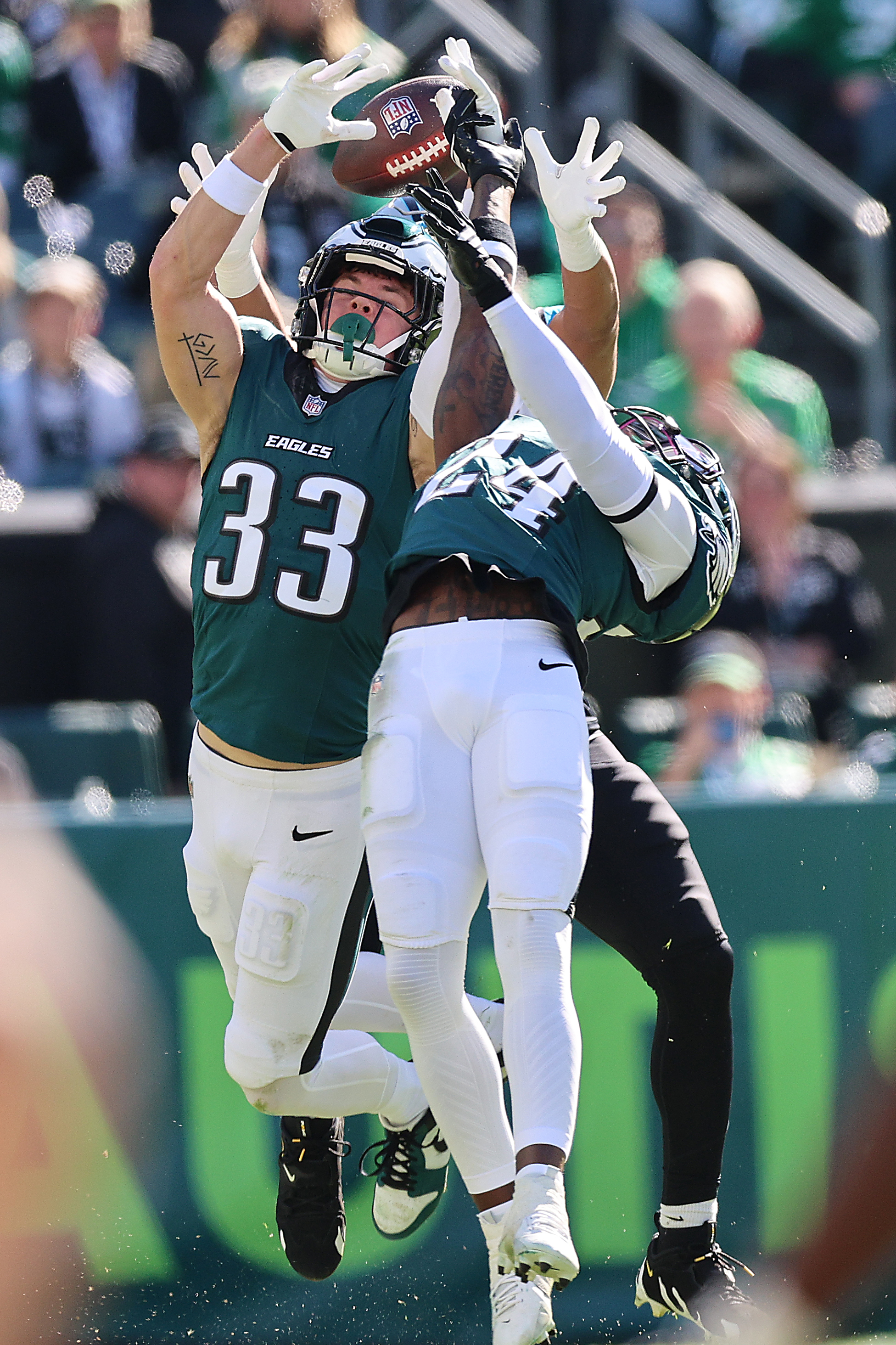
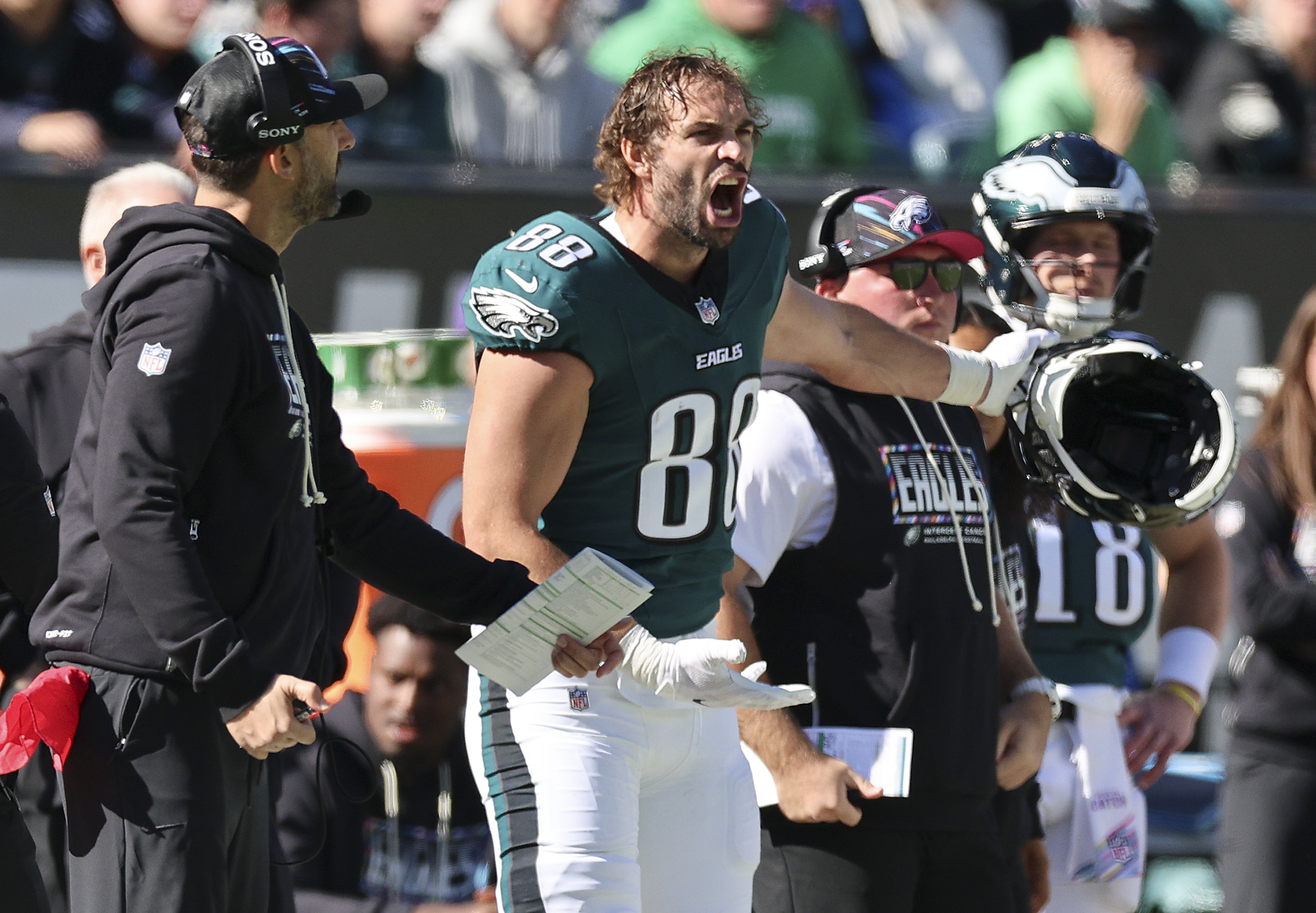
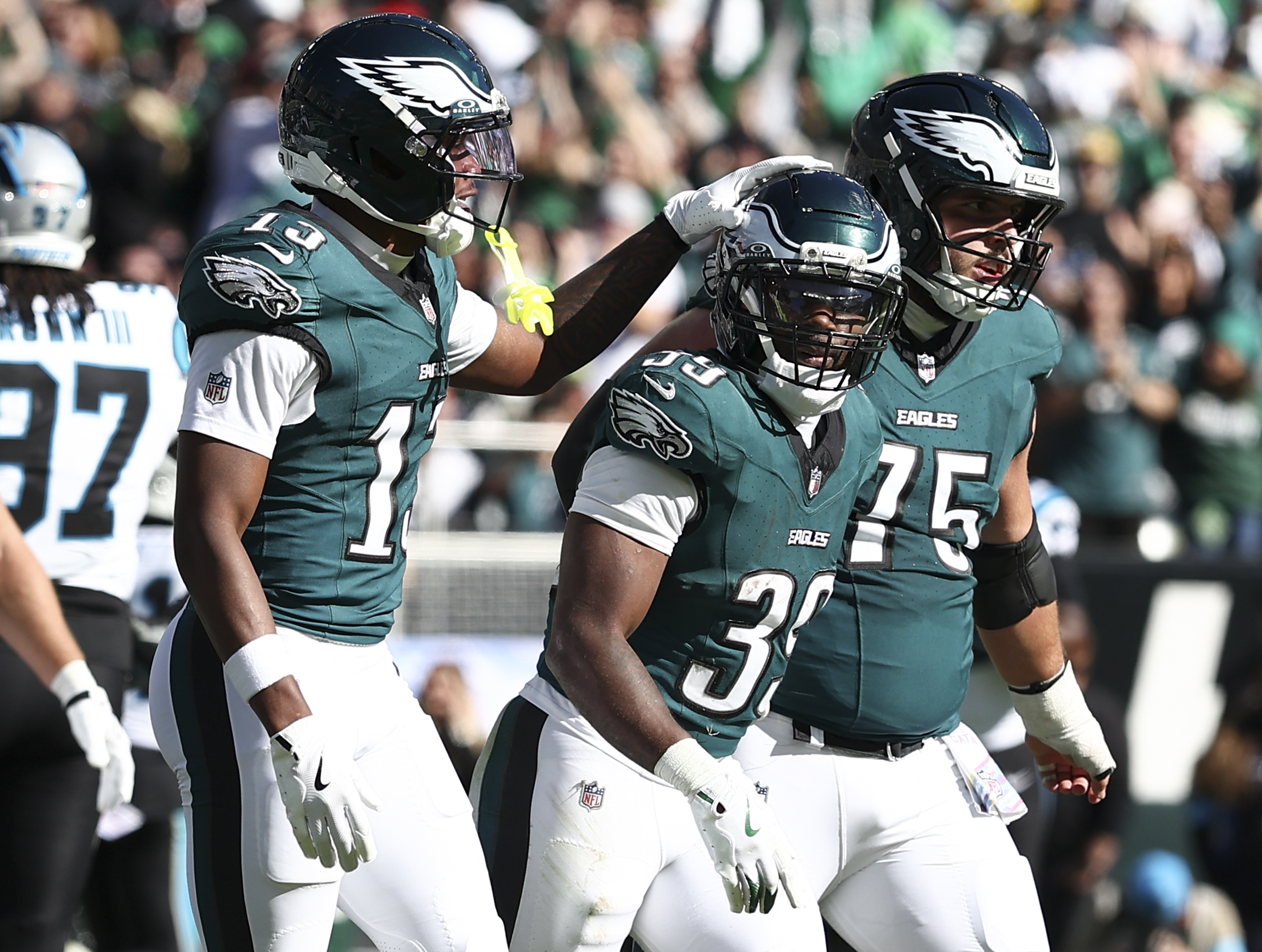
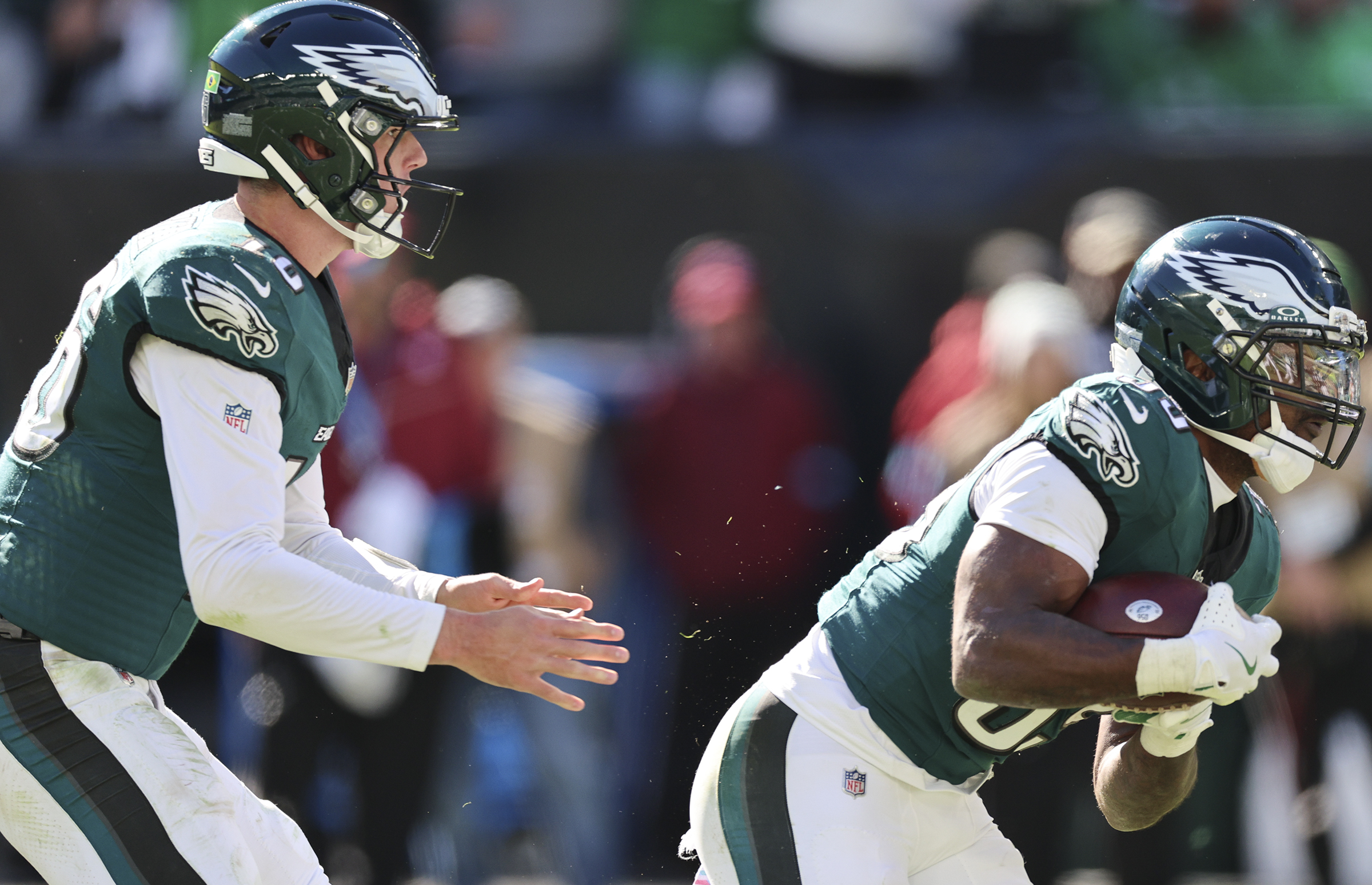
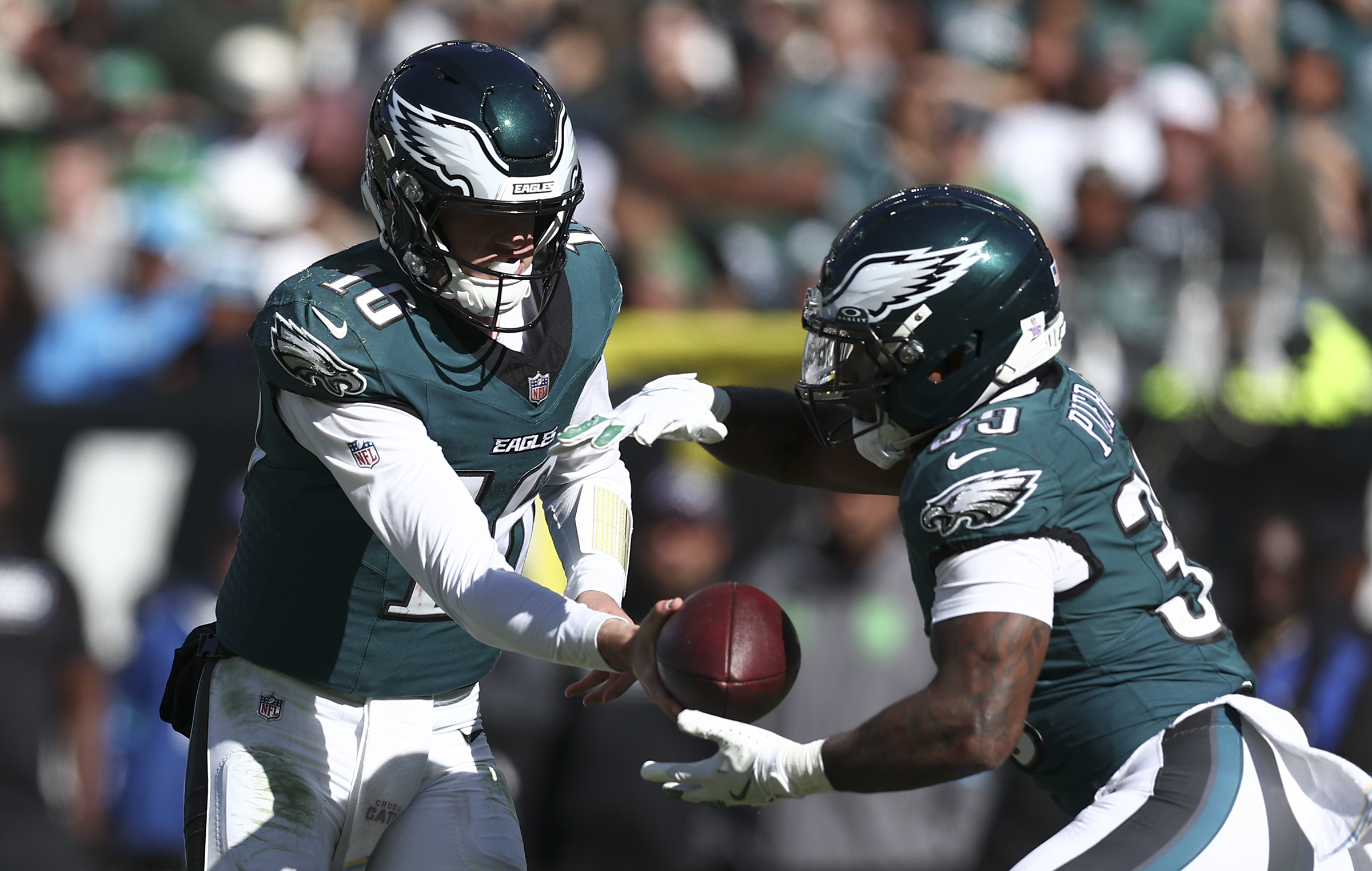
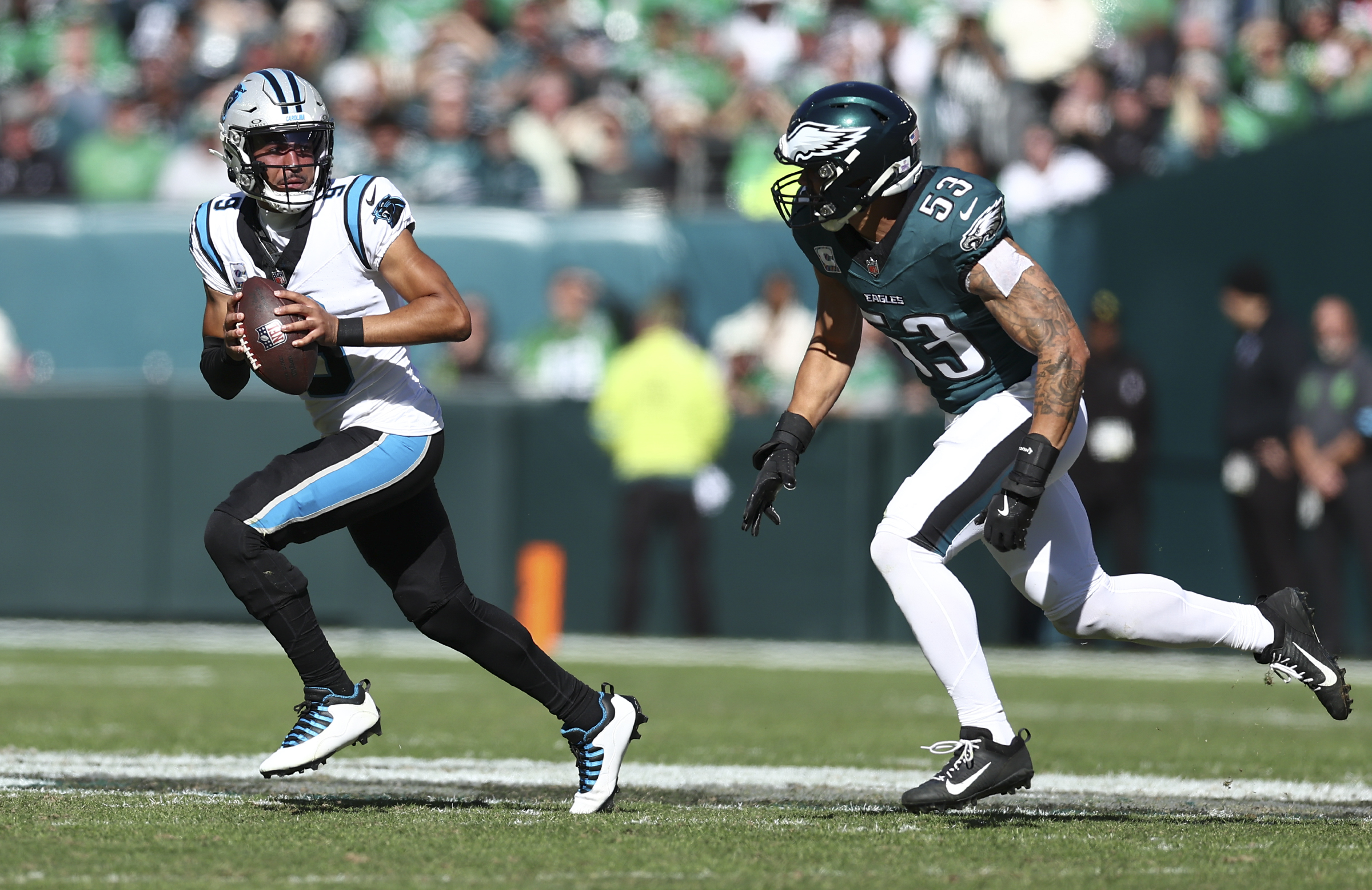
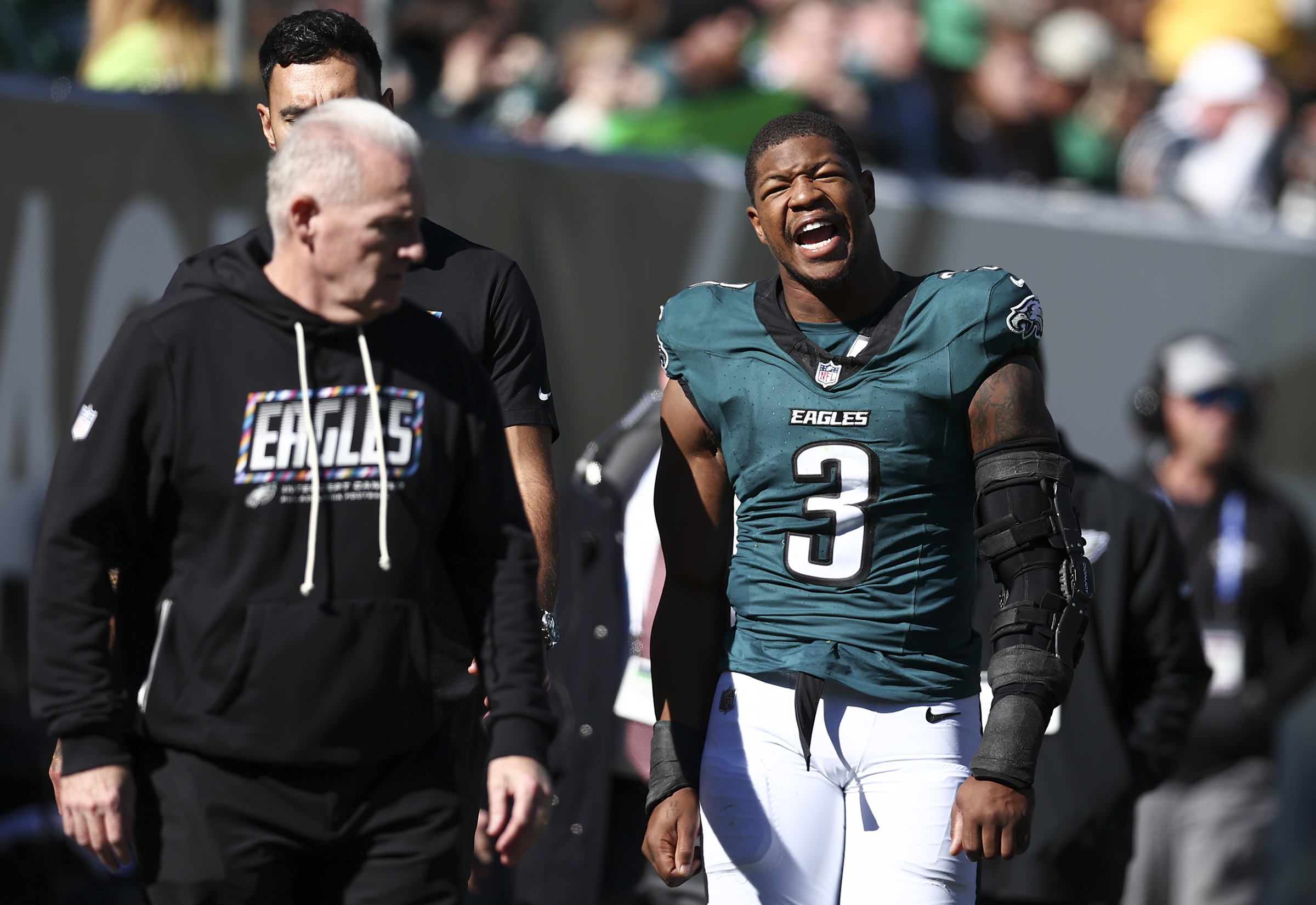
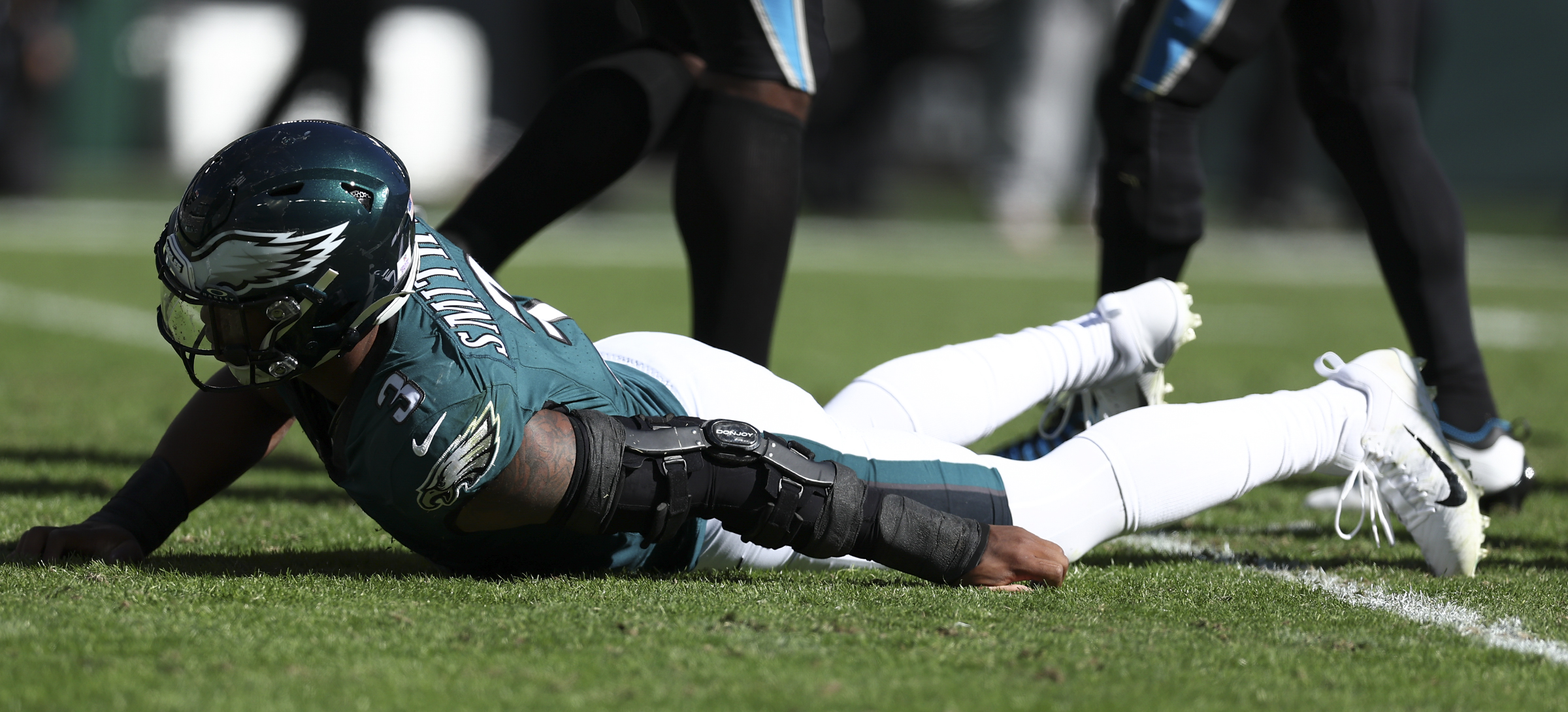
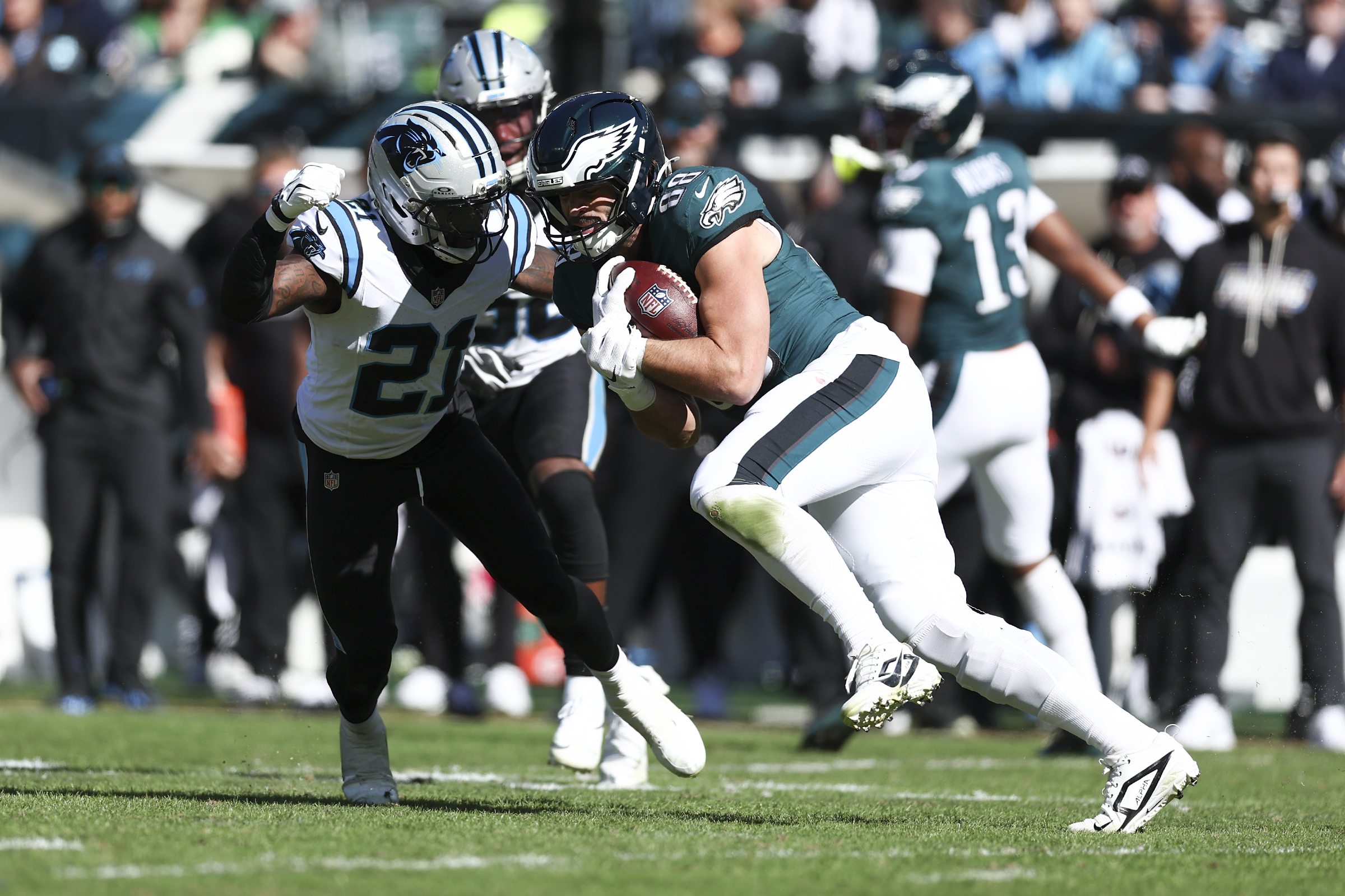
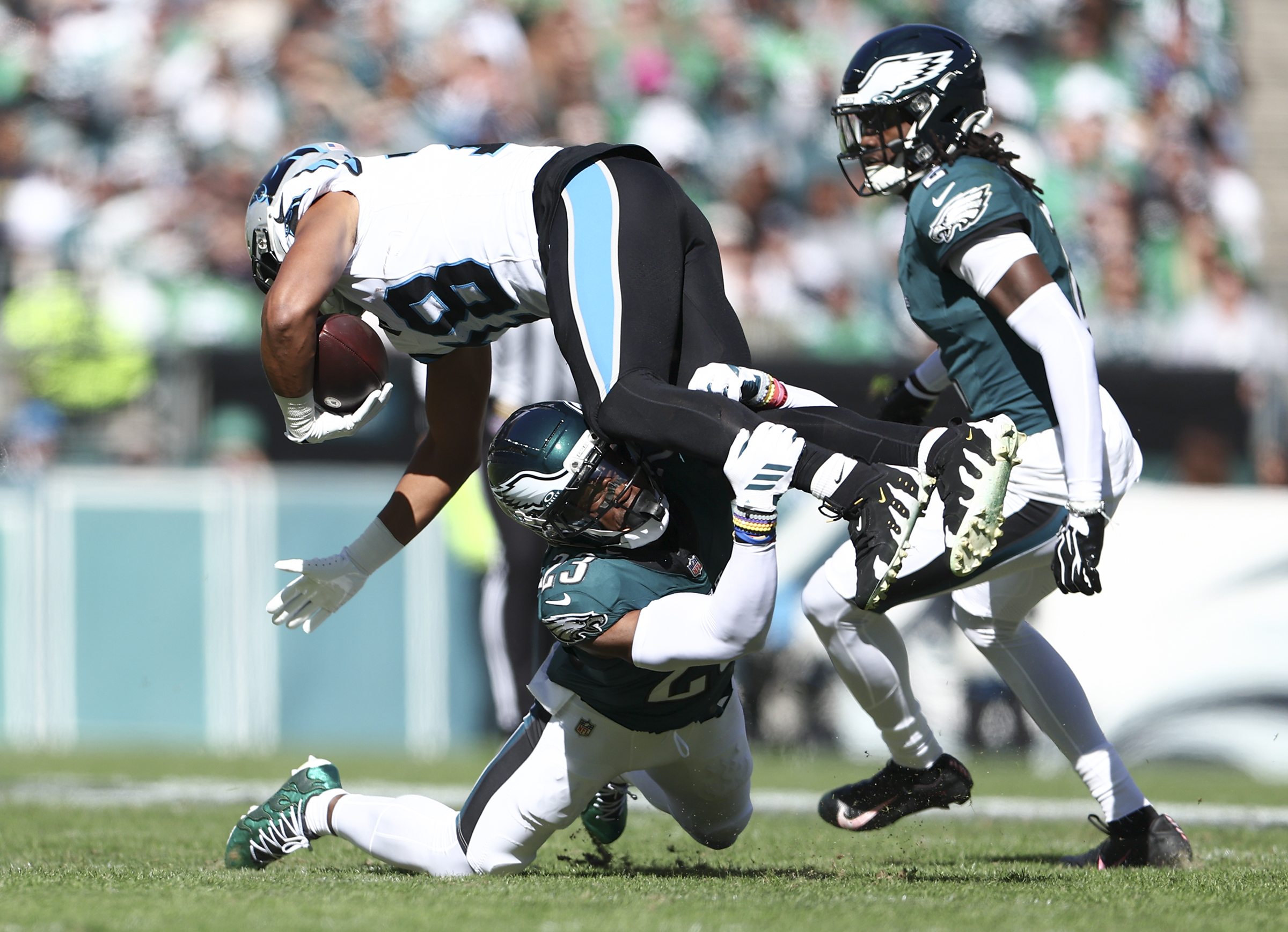
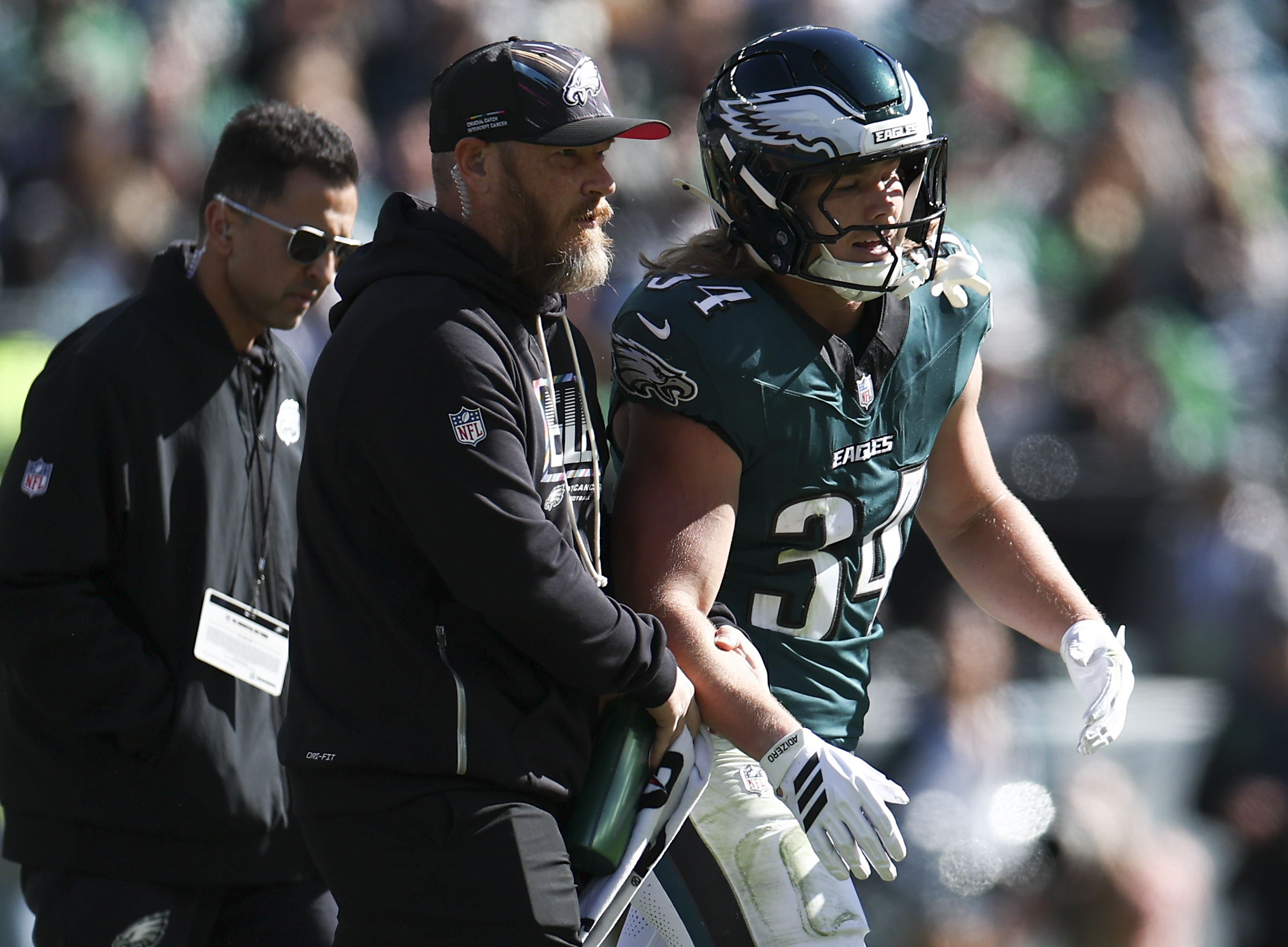
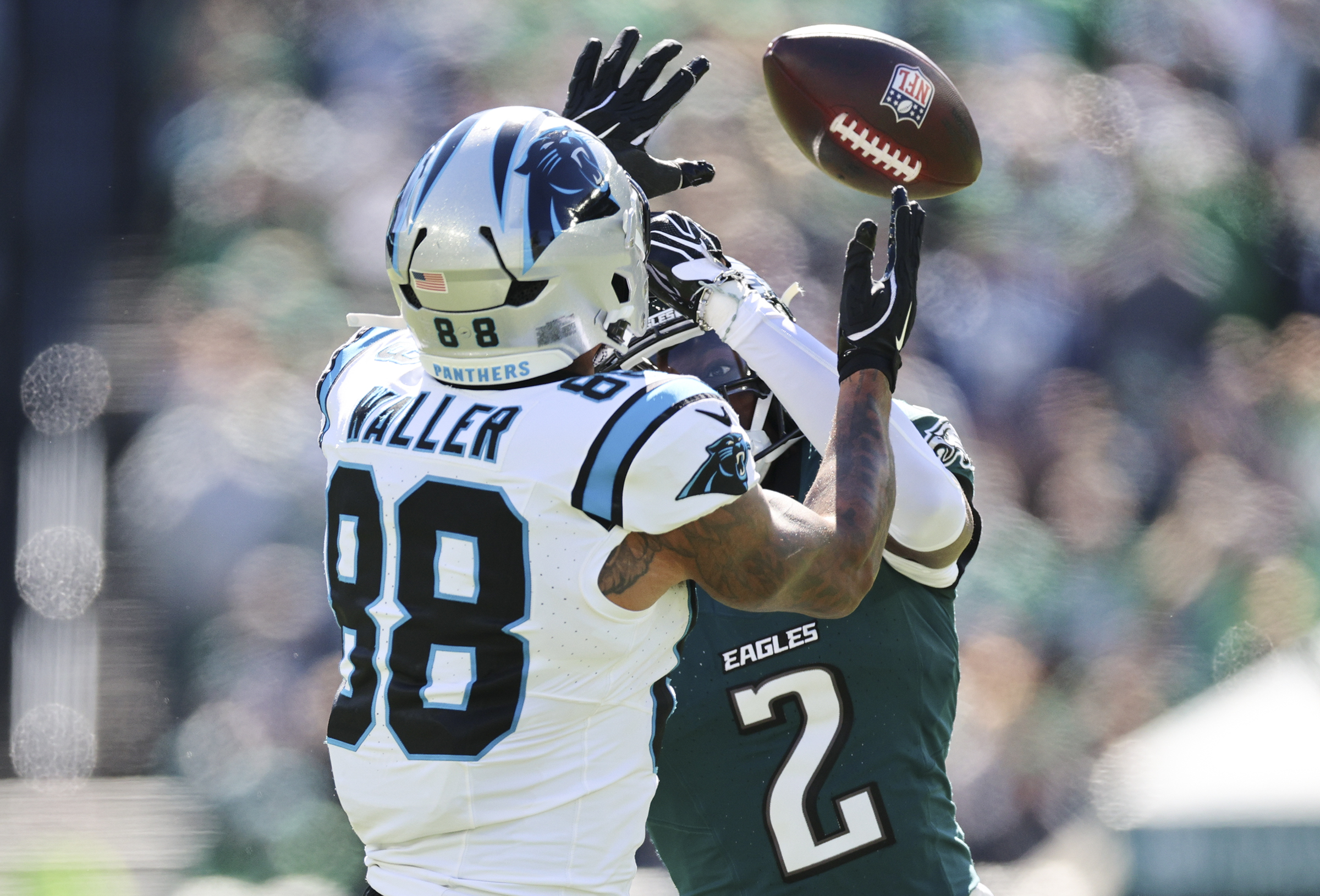
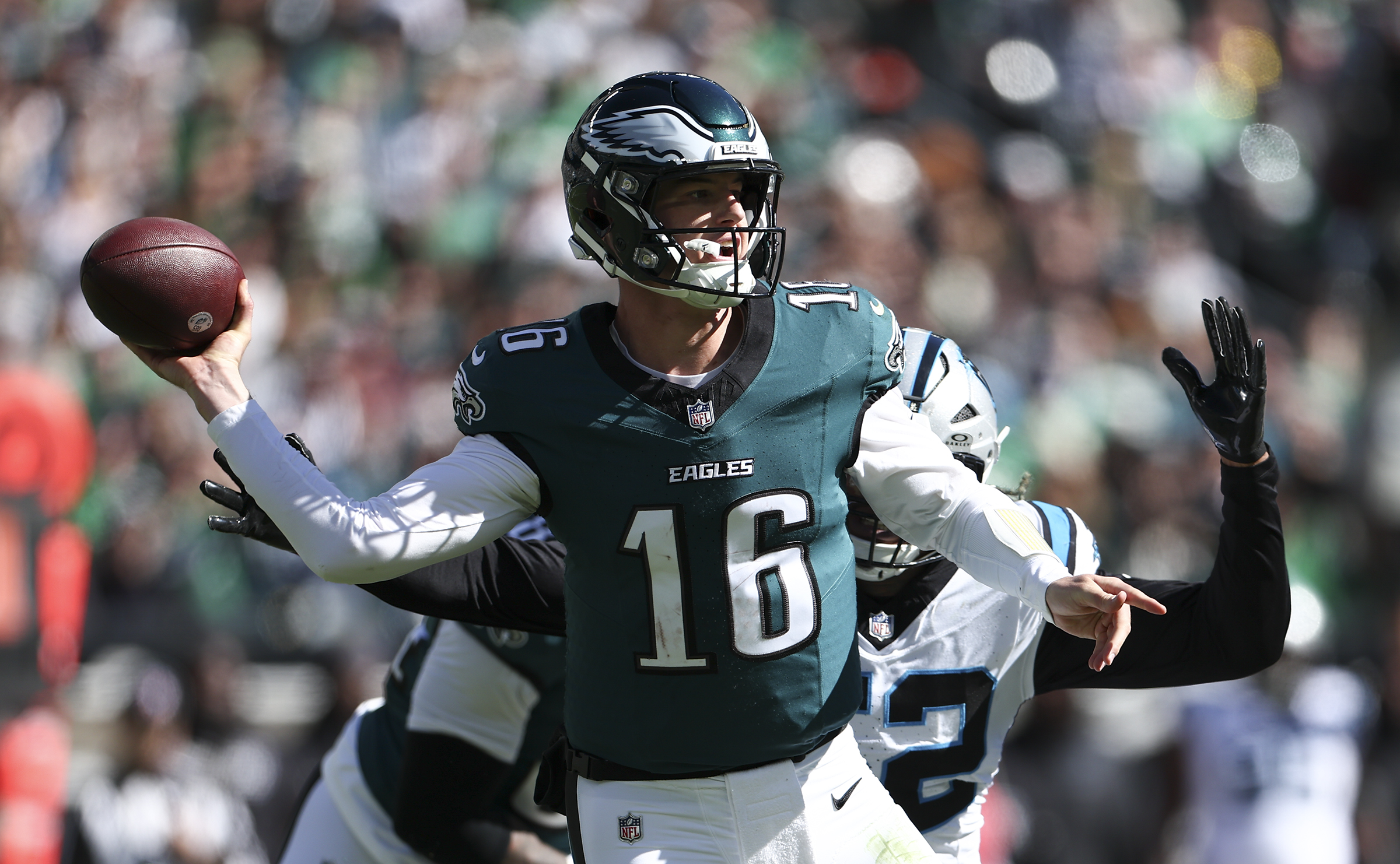
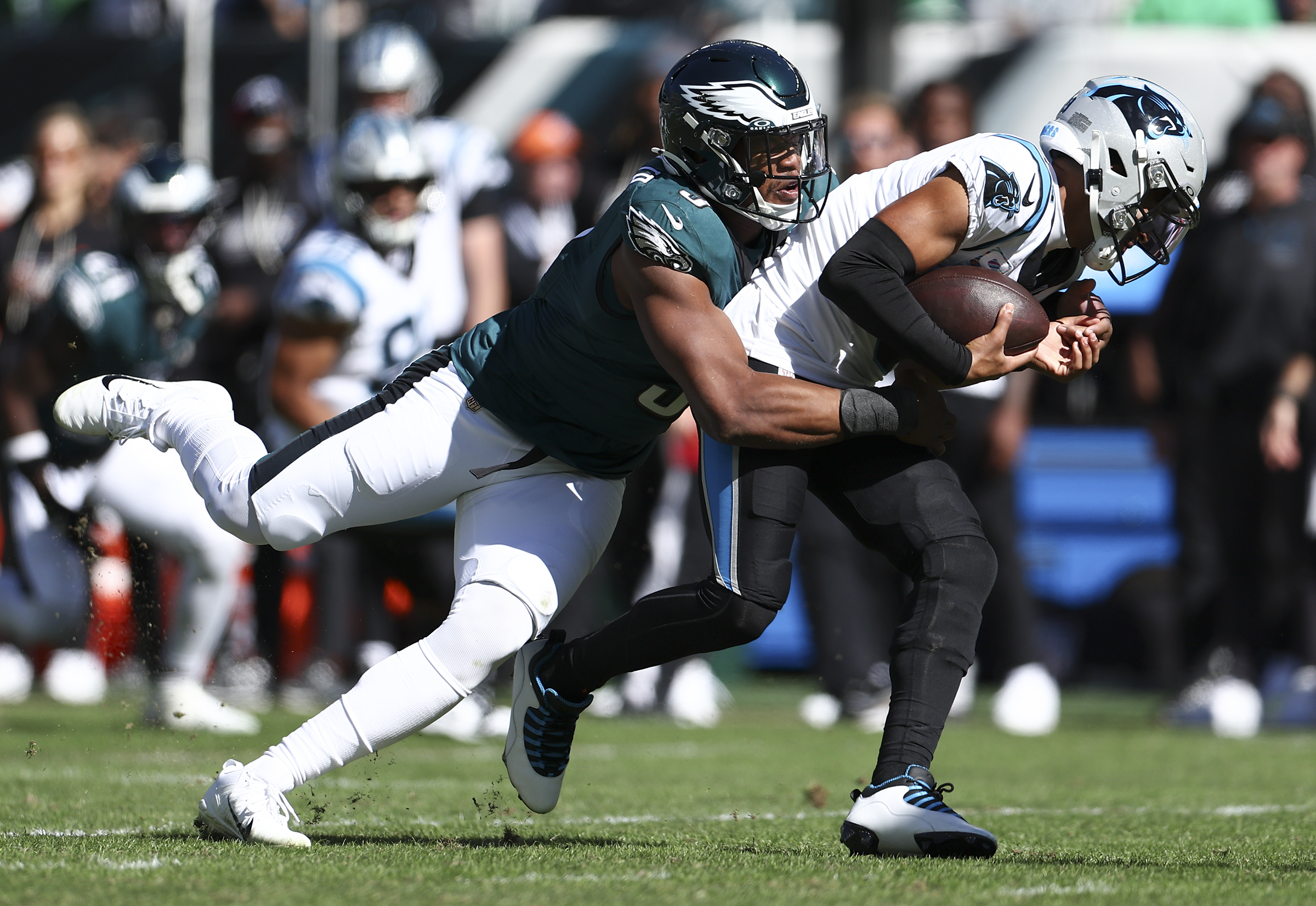
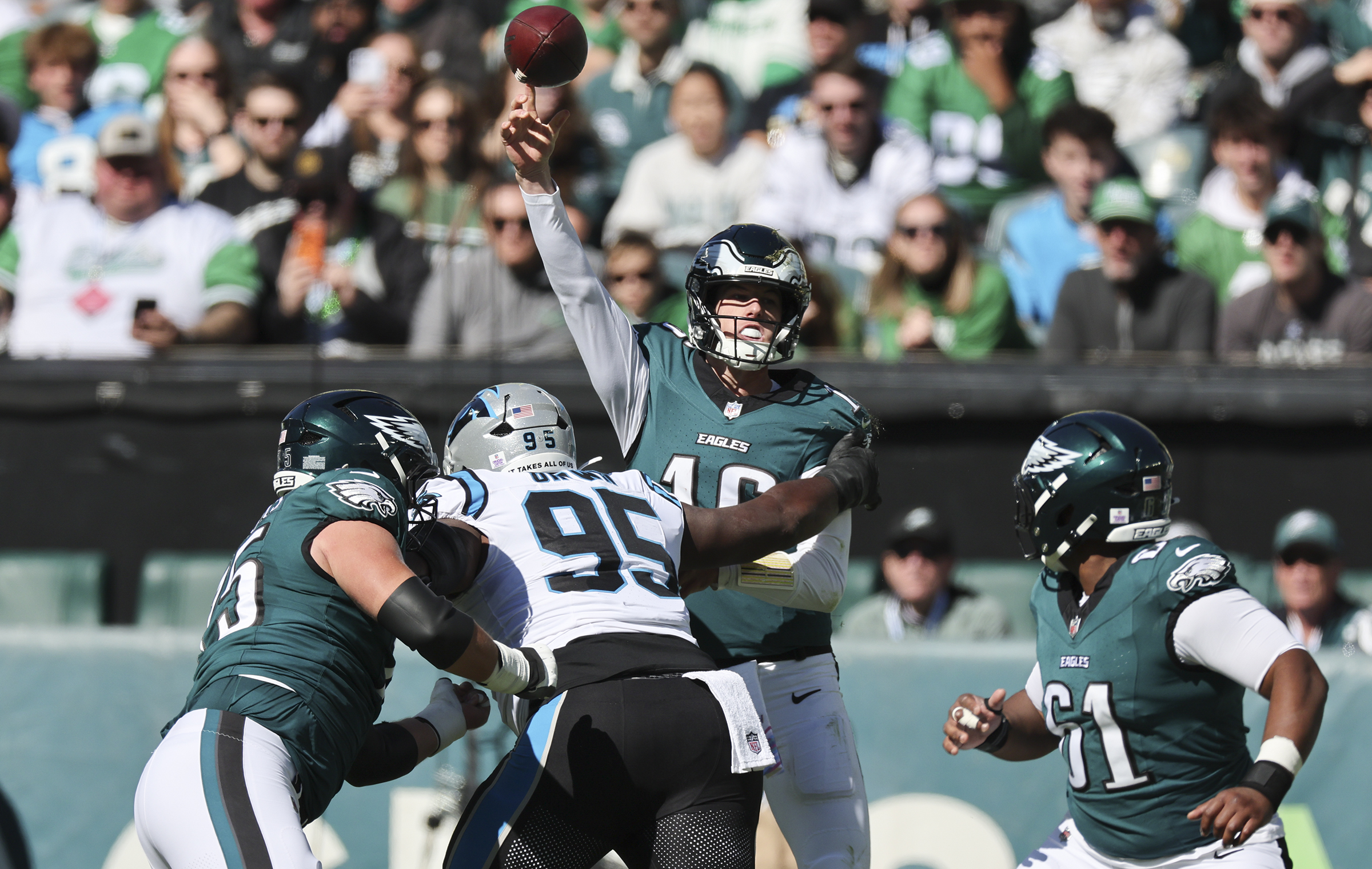
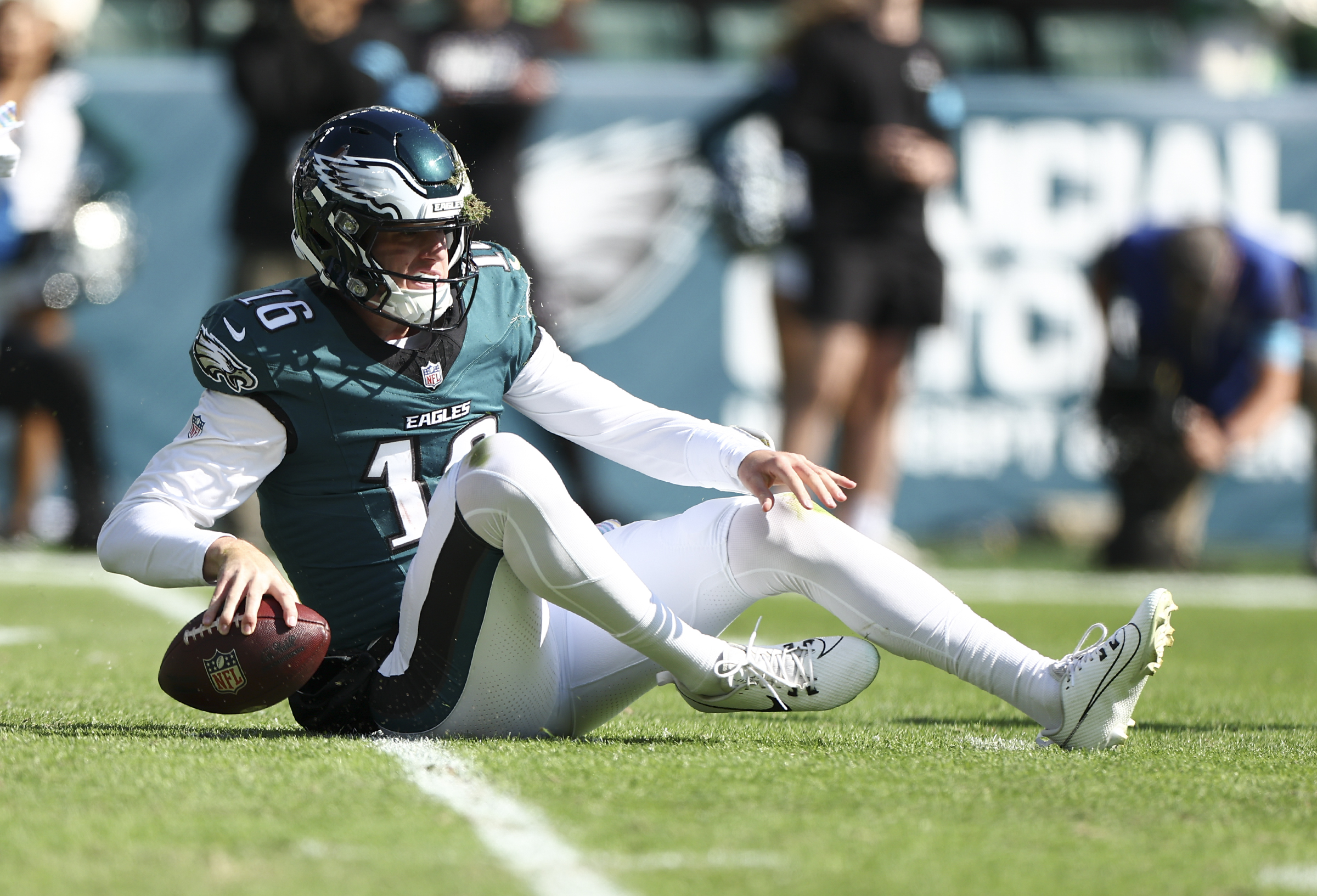
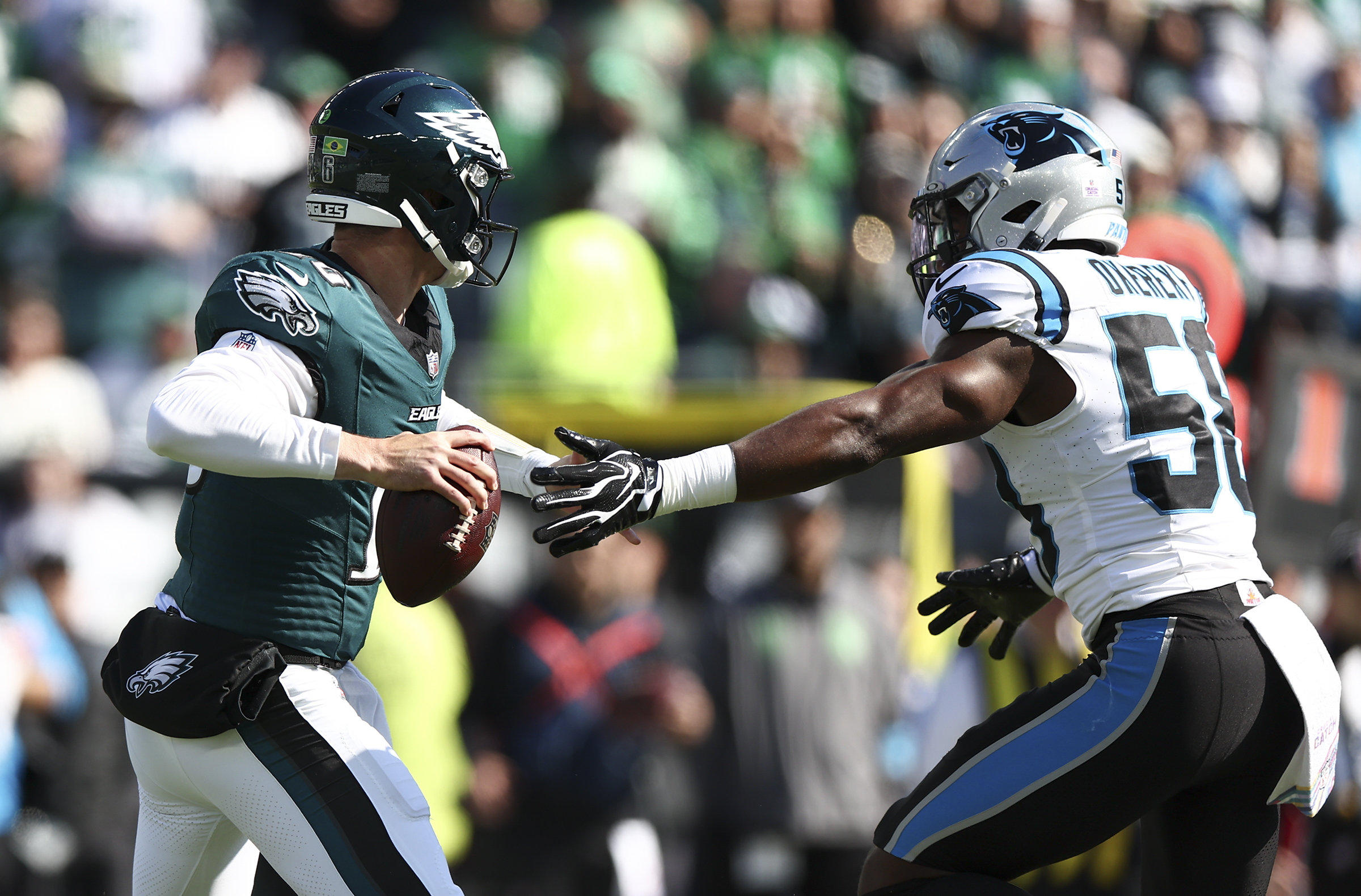
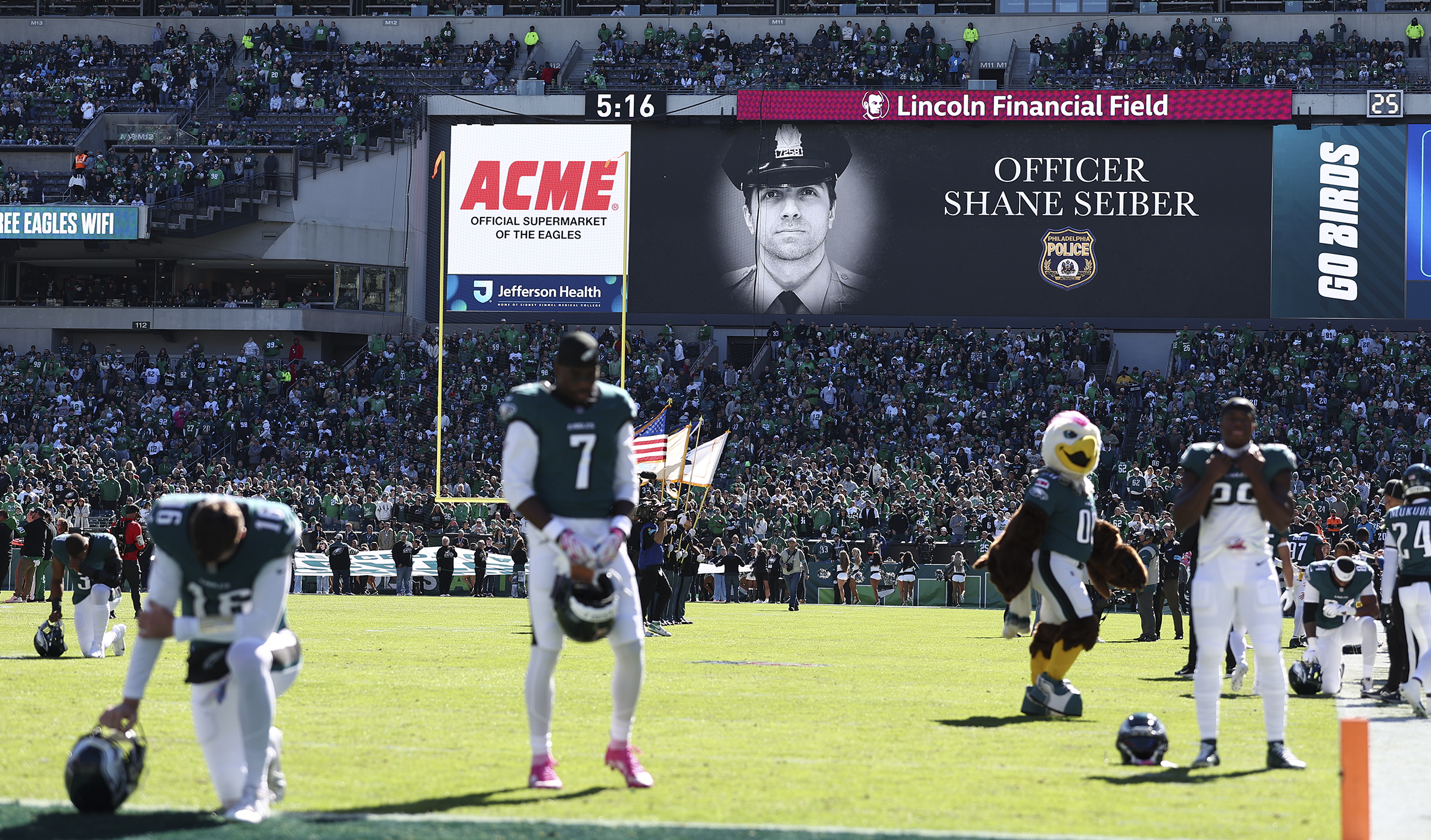
Eagles wide receiver DeVonta Smith walks off the field after the loss to the Panthers.David Maialetti / Staff PhotographerEagles defensive tackle Jalen Carter leaves after the Eagles lost to the Panthers.Monica Herndon / Staff PhotographerEagles head coach Nick Sirianni walks off the field after the loss to the Panthers.David Maialetti / Staff PhotographerEagles cornerback Cooper DeJean walks off the field after the loss to the Panthers.David Maialetti / Staff PhotographerAn Eagles fan watches the game in the fourth quarter.David Maialetti / Staff PhotographerEagles defensive tackle Jordan Davis (center) gets help leaving the field after a fourth quarter injury.Monica Herndon / Staff PhotographerEagles defensive tackle Jordan Davis lays on the turf after getting injured in the fourth quarter.Monica Herndon / Staff PhotographerEagles wide receiver DeVonta Smith attempts to catch the football against Panthers safety Zakee Wheatley during the fourth quarter.David Maialetti / Staff PhotographerEagles wide receiver DeVonta Smith catches a fourth quarter touchdown pass against Panthers cornerback Will Lee III.Monica Herndon / Staff PhotographerPanthers cornerback Will Lee III defends Eagles wide receiver DeVonta Smith in the fourth quarter. The pass was incomplete.Monica Herndon / Staff PhotographerPanthers running back Chuba Hubbard scores a fourth quarter touchdown run past Eagles safety Andrew Mukuba (left) and linebacker Zack Baun.Monica Herndon / Staff PhotographerEagles head coach Nick Sirianni reacts after his defense committed an offside penalty in the fourth quarter.Monica Herndon / Staff PhotographerPanthers running back Chuba Hubbard (right) runs with the football against Eagles linebacker Jeremiah Trotter Jr., (left) and cornerback Quinyon Mitchell in the third quarter.Monica Herndon / Staff PhotographerEagles quarterback Tanner McKee throws the football in the third quarter.David Maialetti / Staff PhotographerEagles linebacker Jeremiah Trotter Jr., dives after Panthers running back Chuba Hubbard in the third quarter.David Maialetti / Staff PhotographerEagles head coach Nick Sirianni during the third quarter.Monica Herndon / Staff PhotographerEagles defensive tackle Jalen Carter (center) and defensive tackle Moro Ojomo (right) walk off the field in the second quarter.Monica Herndon / Staff PhotographerEagles cornerback Cooper DeJean (left) and safety Andrew Mukuba (right) break up a pass intended for Panthers wide receiver Jalen Coker late in the second quarter.David Maialetti / Staff PhotographerEagles tight end Dallas Goedert yells at game officials next to head coach Nick Sirianni in the second quarter.David Maialetti / Staff PhotographerEagles running back Dameon Pierce (center) after scoring a second quarter touchdown run with teammates wide receiver Dontayvion Wicks (left) and center Jake Majors.Monica Herndon / Staff PhotographerEagles running back Dameon Pierce runs with the football, from quarterback Tanner McKee, for a second quarter touchdown.David Maialetti / Staff PhotographerEagles quarterback Tanner McKee hands-off the football to running back Dameon Pierce in the second quarter.Monica Herndon / Staff PhotographerPanthers quarterback Bryce Young runs past Eagles linebacker Zack Baun during the second quarter.Monica Herndon / Staff PhotographerEagles linebacker Nolan Smith reacts after getting injured in the second quarter.Monica Herndon / Staff PhotographerEagles linebacker Nolan Smith lays on the turf after getting injured in the second quarter.Monica Herndon / Staff PhotographerEagles tight end Dallas Goedert runs for 10-yards against Panthers safety Nick Scott during the second quarter.Monica Herndon / Staff PhotographerEagles defensive back Kenny Moore stops Panthers wide receiver Jalen Coker during the first quarter.Monica Herndon / Staff PhotographerEagles running back Carson Steele (right) gets help leaving the field from Eagles medical staff members, after getting injured in the first quarter.Monica Herndon / Staff PhotographerEagles cornerback Riq Woolen defends Panthers tight end Darren Waller for a incomplete pass in the first quarter.David Maialetti / Staff PhotographerEagles quarterback Tanner McKee throws the football pressured by Panthers linebacker Trevis Gipson during the first quarter.Monica Herndon / Staff PhotographerEagles linebacker Nolan Smith sack Panthers quarterback Bryce Young during the first quarter.Monica Herndon / Staff PhotographerEagles quarterback Tanner McKee gets rid of the football pressured by Panthers defensive tackle Derrick Brown in the first quarter.David Maialetti / Staff PhotographerEagles quarterback Tanner McKee sits on the turf after getting sacked in the first quarter.Monica Herndon / Staff PhotographerCarolina Panthers inside linebacker Bobby Okereke goes after Eagles quarterback Tanner McKee in the first quarter. Okereke sacked McKee.Monica Herndon / Staff PhotographerA moment of silence for Philadelphia Police officer Shane Seiber before the Eagles played the Panthers.Monica Herndon / Staff Photographer
The best course may be to just go back full time to the shotgun-heavy, inside zone-running, run-pass-run-option, up-tempo offense that at least still generates a modicum of success when the Eagles have the ball.
“We’ve got to be able to score more points, period. It’s the game of football,” Sirianni said when asked about Mannion. “So it’s on everybody, right? It’s not just on one coach.”
But everything means everything, and as Sirianni has shown before, he’s not afraid to make in-season changes to his coaching staff.
In 2023, he stripped then-defensive coordinator Sean Desai of responsibility on third downs and eventually demoted him for Matt Patricia. Last season, he took more of an active role over offensive game planning amid Kevin Patullo’s struggles.
Neither change worked, of course. But the season is slipping away, if not the competition in a dormant NFC East, and Sirianni simply may not be able to afford a season without a playoff appearance. That may sound ludicrous for a coach who’s won a Super Bowl, been to another, and reached the postseason in each of his first five seasons.
Despite an unprecedented few weeks in Eagles history, with much of the adversity out of his control, Sirianni has inspired great effort from his players. Some teams lose their quarterbacks. Some have as many injuries. Even a few have had future Hall of Famers retire midseason.
But how many have ever had all that happen in a span of two weeks, not to mention a couple of heartbreaking last-moment losses?
Video: DeVonta Smith on the offense’s struggles vs. Panthers: ‘We’ve got to keep chipping away’
Sirianni certainly bears culpability for the losing streak. The seeds of his core beliefs, however, don’t provide shade for areas in which his previous ingenuity is now lacking.
And that goes to the very root of the Sirianni conundrum. If he can’t devise an offense and/or call plays, and thus has to rely on Mannion-types for innovation, what is his greater value? To save himself, he may need to take back full ownership.
It’s been that ugly on offense. Mannion and new offensive line coach Chris Kuper have had almost no solutions for defenses that blitz Eagles quarterbacks when they’re under center and drop to throw. Maybe because they almost always try to run play-action in those situations.
McKee dropped five times from under center and each time there was a run fake. He didn’t complete a single pass and was sacked two times. Both sacks came from Panthers rushers who were unblocked. McKee had no time to find his “hot” answers, if there were any.
“We have to do a better job there, plain and simple,” Sirianni said. “We have to, as coaches, be able to put them in positions to succeed. We’ve got to go out and execute.”
It’s not all on the scheme or play-calling. The Eagles’ once-great offensive line has deteriorated partly due to neglect. Howie Roseman didn’t supply the offense with a single tight end who could block in a scheme that emphasizes winning in-line at the point of attack.
The Eagles general manager’s last two offseasons have been underwhelming, particularly in the draft. And even some of his previous homegrown successes are starting to wilt, especially on the other side of the ball.
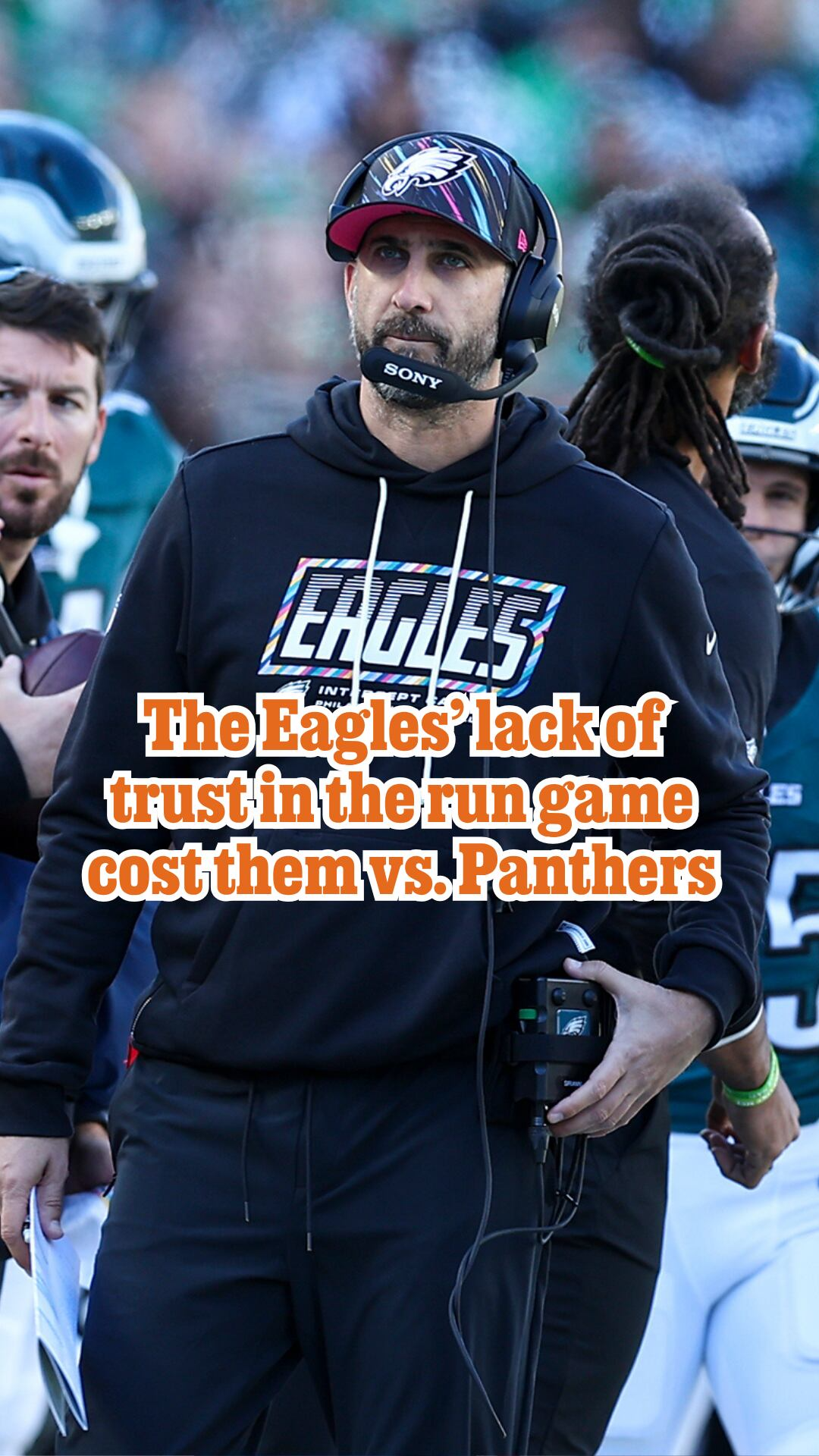
Video: Gameday Central: The Eagles’ lack of trust in the run game cost them vs. Panthers
The offensive deficiencies have largely overshadowed regression on defense. The Eagles were supposed to at least have Vic Fangio’s unit to rely on. And while it has played valiantly in the face of more snaps and playing time, the pass rush has been anemic and the back seven porous.
Cooper DeJean was once the poster boy for Roseman’s draft wizardry, but he can’t seem to tackle anymore. The switch to part-time safety may have stressed the slot cornerback, but he has now been part of two busted coverages with outside corner Riq Woolen that have resulted in back-breaking touchdowns.
“Miscommunication” was DeJean’s answer for what went wrong on the play.
“Everything as a defense, you always want to be on the same page because the easiest way to give up a big play or give up a touchdown is not everybody [being] all on the same page,” Sirianni said. “We had some of that there on defense.”
Nick Sirianni’s Eagles are 9-11 in their last 20 games dating back to last season. David Maialetti / Staff Photographer
The Eagles had some of it on offense, according to McKee, on his presnap signals to his receivers. Miscommunication likely resulted in the missed assignment that led the special teams to allow a blocked punt late in the game. Bad teams get lost in translation.
It was a theme long before the locker room resembled a medical ward. The Eagles have now gone 9-11 in their last 20 games dating back to last year’s 4-0 start. Sirianni is running out of time before owner Jeffrey Lurie starts asking Roseman about 2027.
“There’s always an urgency and you can be calm when there’s urgency,” Sirianni said. “You double down on the things you believe in; you double down on the things that have got you the success. Again, like I said, schemes can change, schedules can change, but your core values are your core values.
“We know those for us are the truths of football. That keeps you grounded there, but there’s always a sense of urgency and that’s my job to have the sense of urgency. All of us, our jobs are to have that. Then it’s my job to make sure we stick to the tough, detailed, and together portion of it.”
Sean Mannion will continue calling plays for the Eagles
Eagles offensive coordinator Sean Mannion. David Maialetti / Staff Photographer
A day after saying “everything is on the table” in order to get the offense back on track, Eagles head coach Nick Sirianni said offensive coordinator Sean Mannion will continue calling plays.
So, what’s on the table?
“Not going to get into too much of that,” Sirianni said. “Obviously we are looking at everything. I think those are conversations I’ve had with the staff this whole morning. Everything is on the table.
“Without getting too much into scheme-wise, I’m saying to you, obviously it hasn’t looked the way we wanted it to look, and we’re not scoring enough points, so everything is on the table.”
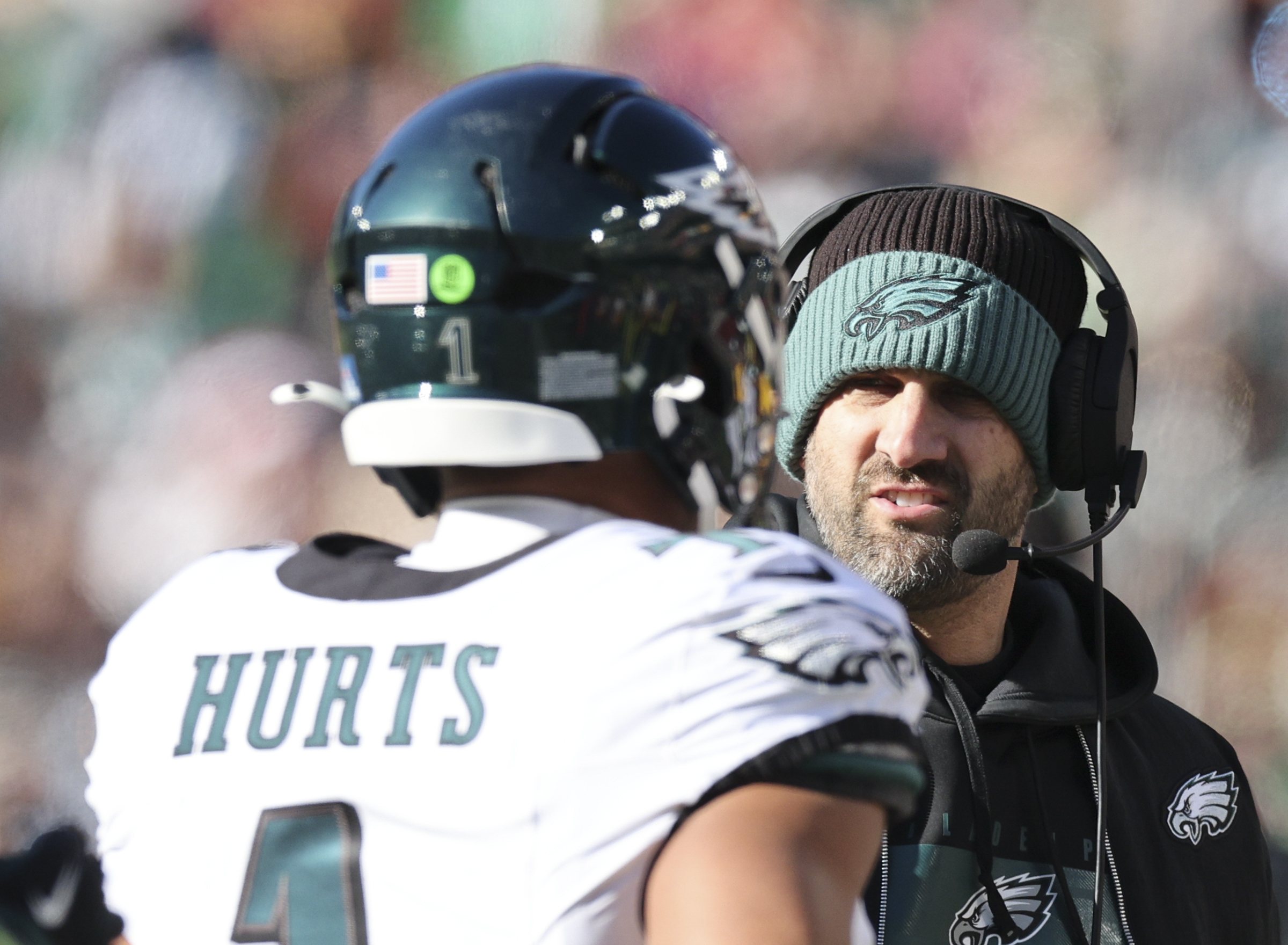
Eagles head coach Nick Sirianni with Jalen Hurts on the sideline. David Maialetti / Staff Photographer
Nick Sirianni has talked to Jalen Hurts in the aftermath of his latest health update, but the Eagles head coach declined to go into particulars about their conversation.
“I always talk to our guys and I never put our conversations out there,” Sirianni said. “I think you guys can understand that. That’s private conversations between myself and him.
Hurts and Sirianni have been together as quarterback and coach since 2021, and Hurts has not missed extended action over that timeframe.
“I haven’t been without Jalen for an extended period of time,” Sirianni said. “I have the utmost confidence in Tanner. But I miss [Hurts] … because Jalen and I have been together, head coach and quarterback for six years, so that’s natural.
“I don’t want to speak for him in any sense of the matter. But I deeply care about him and hopes he continues to improve with what he’s going through.”
Nick Sirianni sidesteps Jalen Hurts questions, goes back-and-forth a bit with reporters
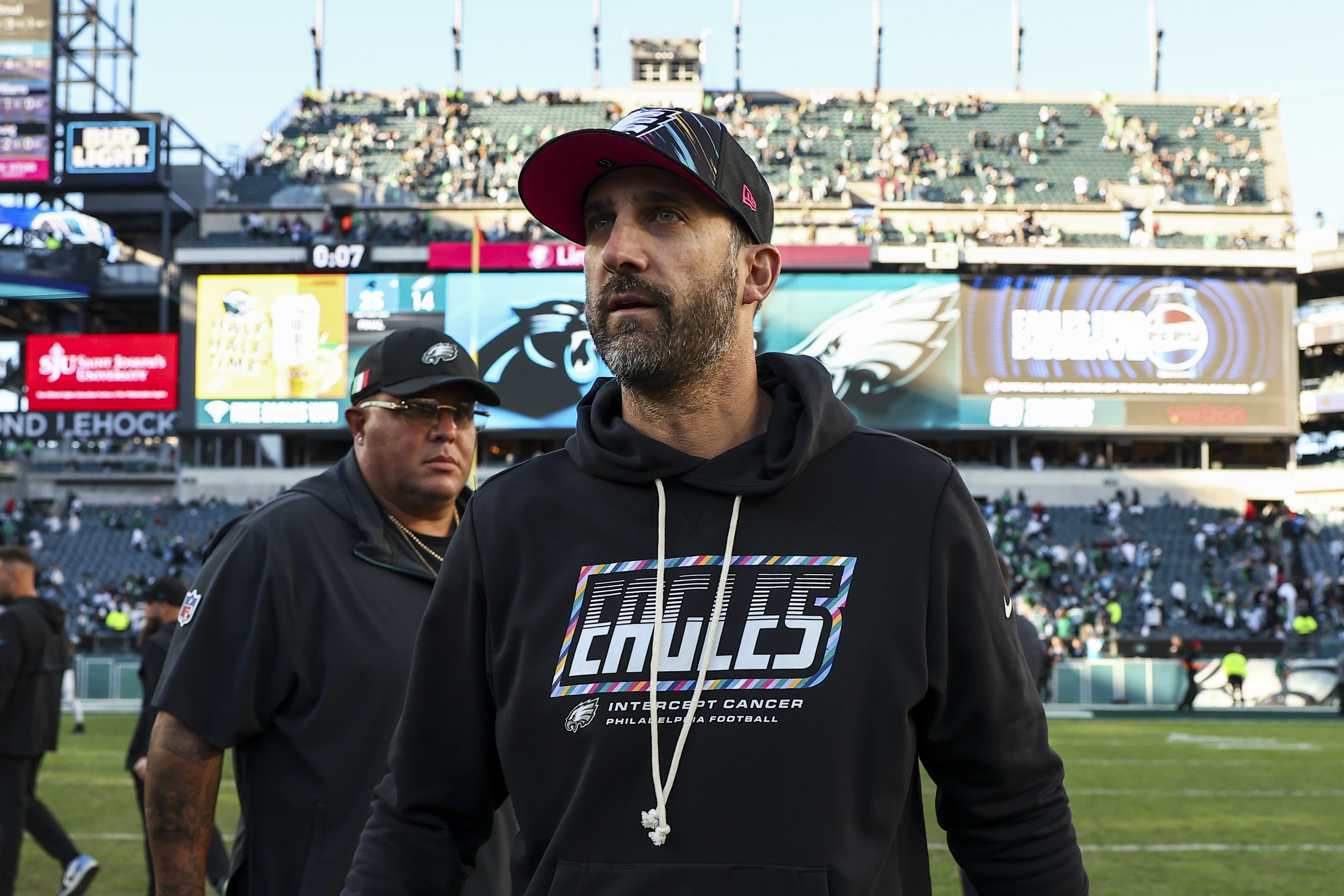
Eagles head coach Nick Sirianni leaves the Linc after Sunday’s loss.Monica Herndon / Staff Photographer
Why was Jalen Hurts permitted to play last week in London despite being diagnosed with a blood clot and having minimal sleep leading into the game?
“The health of our players is always at the forefront of our mind and we’ll leave that up to the medical experts,” Nick Sirianni said Monday during his weekly day-after press conference. “But we always, always care deeply about our players.”
Sirianni did not provide any further details about the timeline or what went into the decision to have Hurts play and, further than that, why he was allowed to fly home.
“Guys, I’m not a medical expert,” Sirianni said. “I lean on our guys on all of those situations. I’m a football coach … I have full trust and full faith in them. It’s not just me that has care for our players, it’s them as well.
“We get medical information from our guys and we always put the players’ health first and foremost in every situation.”
Eagles head coach Nick Sirianni went back-and-forth a bit with reporters Monday over what he knew about Jalen Hurts' blood clot situation. pic.twitter.com/NAAIFi6NMu
Some of the ugliest numbers for the Eagles’ offense right now
Eagles head coach Nick Sirianni has struggled to help turn around the offense.David Maialetti / Staff Photographer
The Eagles have lost four consecutive games for the first time under Nick Sirianni. They are 2-4 and, while they’ve been dealing with injuries – including the latest health update to Jalen Hurts and the retirement of their best offensive lineman – they have some issues.
The numbers aren’t pretty right now. Here’s a sampling of some:
As pointed out by PHLY’s Bo Wulf, the Eagles have been outgained by at least 175 yards in each of the last three games. That matches the number of times they were outgained by 175 yards in each of Nick Sirianni’s first five seasons combined.
The Eagles, according to The Ringer’s Sheil Kapadia, have been outgained by 650 yards. As you might’ve guessed, that’s 32nd of the 32 NFL teams. But it’s worse: It’s the Eagles’ worst yardage differential through six weeks since the turn of the century.
How bad has it been in the last four games? The Eagles are minus-723 in yard differential in their last four contests, as Rich Hofmann pointed out in his Broad Street Bulletin newsletter Monday morning.
The Eagles punted on their first five possessions on Sunday. According to The Athletic’s Zach Berman, that’s the first time they’ve done that under Sirianni. The Eagles now lead the NFL in punts and three-and-out percentage.
The Eagles were supposed to install a dynamic offense that utilized under center play action to marry the run and pass games. They’re now at a 15.2% success rate on under center dropbacks this season, Penn professor and Eagles data guy Deniz Selman posted. That’s the worst rate in the NFL, far below Denver’s success rate of 30.3%, which is good for 31st in the NFL.
The Eagles, according to Shawn Syed of SumerSports, had five under center dropbacks on Sunday. All of them were play action pass plays and led to zero completions, two sacks, and minus-17 yards.
Watch: Nick Sirianni reacts after Jalen Hurts news
// Timestamp 10/19/26 1:19pm
Are there any quarterbacks out there who could help the Eagles?
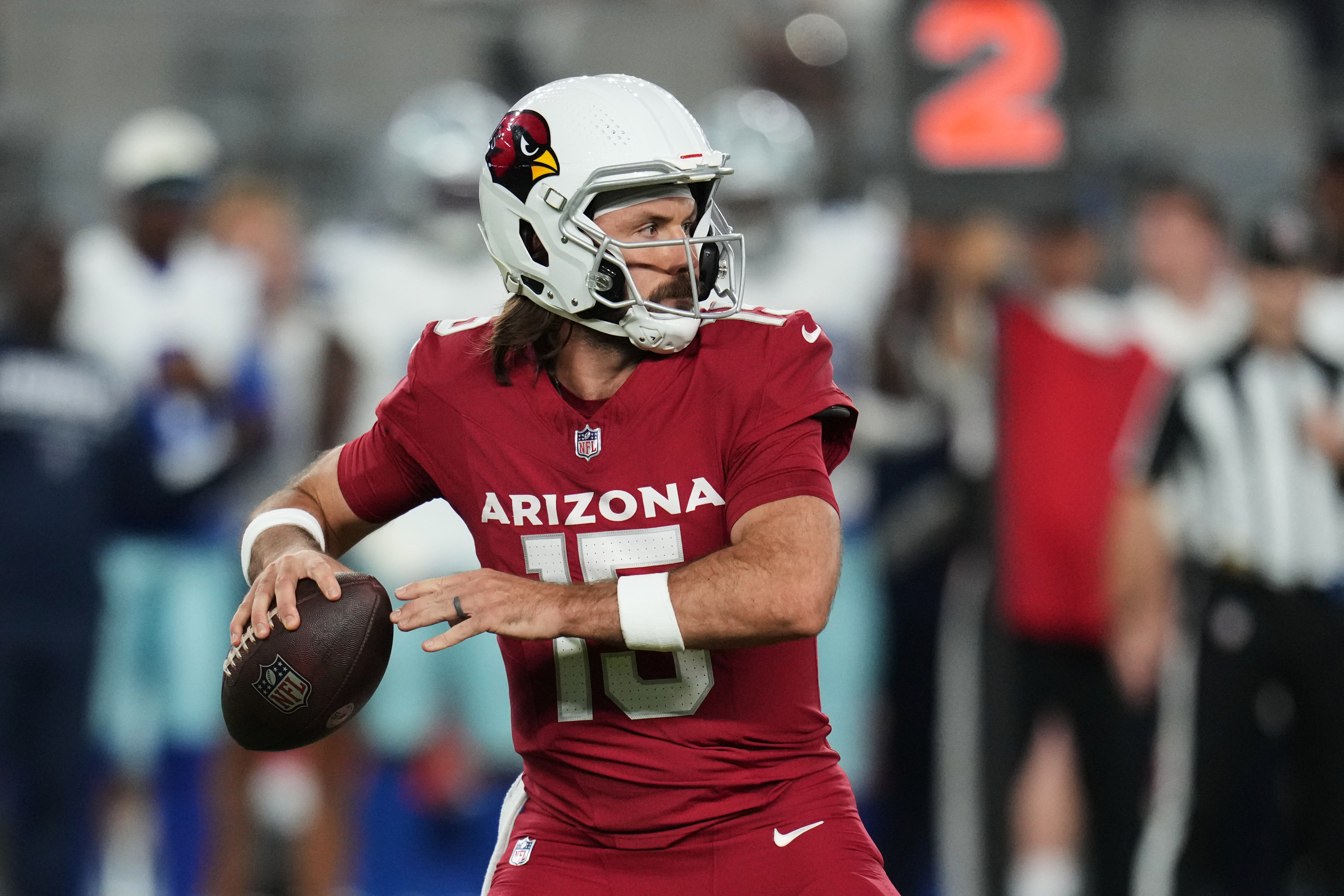
Cardinals quarterback Gardner Minshew does have experience with the Eagles.Rick Scuteri
The most immediate question the Eagles must answer is whether to expend some late-round draft capital to bring in a quarterback who might give them a better chance than Tanner McKee.
Former backup Gardner Minshew is the effective third-stringer with the Cardinals, who figure to switch to rookie Carson Beck if they eventually decide to bench veteran Jacoby Brissett.
Former Bengals interim starter Jake Browning is on the Chargers practice squad. The Steelers are carrying four quarterbacks. The Colts have former No. 4 overall pick Anthony Richardson on their roster.
The calculus of how to replace Hurts depends on some higher-level math. What is the Eagles’ likely path forward into the 2027 season? Who is the coach likely to be? What sort of offensive scheme will the Eagles be running? What is the minimum level of competence a team should be striving for in the meantime, both to do right by the locker room and coaching staff and to do right by themselves as they attempt to salvage whatever growth they can out of the current season?
A full timeline of Jalen Hurts’ blood clot diagnosis
Jalen Hurts could miss the rest of the season.Yong Kim / Staff Photographer
Jalen Hurts could miss the season after he was diagnosed with deep vein thrombosis and “bilateral pulmonary emboli,” the Eagles and his agent, Nicole Lynn, announced in a statement on Monday morning.
His treatment will only require blood thinners, the statement said, during which he will not be allowed to participate in any contact activities. They said they expect him to make a full recovery, with the opportunity to resume contact football activities when he is off blood thinners.
Here is the timeline of the events leading up to his diagnosis spanning approximately two weeks, according to statements released by the Eagles:
Sunday, Oct. 4: Jalen Hurts was cleated in his calf during the Eagles’ loss to the Los Angeles Rams, the team said in a statement on Oct. 15. He played all 61 offensive snaps in that game.
Thursday, Oct. 8: Hurts was a full participant in practice on Wednesday, Oct. 7, and Thursday, Oct. 8, during the week leading up to the team’s Week 5 game against the Jacksonville Jaguars in London. Sometime after practice on Thursday, the team said Hurts visited the training room requesting treatment for his calf. At that point, they said he informed the medical staff he had been cleated in his calf during the Rams game.
Friday, Oct. 9: Hurts received treatment on his calf again, according to the Oct. 15 statement. He practiced in full and was added to the team’s injury report for the first time that week. He did not have a game status against the Jaguars that reflected he could miss the game.
Saturday, Oct. 10: The team performed an ultrasound on Saturday, Oct. 10, following the team’s Friday night flight to London and their Saturday walk-through “out of an abundance of caution,” according to their Oct. 15 statement. The ultrasound revealed a “superficial blood clot.”
Based on the results, the Eagles’ medical staff and doctors in London concluded that “activity and mobility were important” and determined that Hurts could play “safely” against the Jaguars, the statement read. Doctors recommended a follow-up ultrasound within 72 hours of the game and the flight back to Philadelphia.
Sunday, October. 11: According to an NFL Network report, Hurts was in the hospital until 4 a.m. that morning and did not sleep before the Jaguars game because “sleep was a risk.” He came out to the sideline late, shortly before the coin toss. Hurts played all 62 offensive snaps in their 2:30 p.m. London-time game against the Jaguars reportedly without having slept the night before.
Monday, Oct. 12 and Tuesday, Oct. 13: Hurts received treatment on Monday, Oct. 12 and Tuesday, Oct. 13., according to the Eagles’ Oct. 15 statement.
Wednesday, Oct. 14: Hurts was listed on the injury report as a full participant in practice on Wednesday, Oct. 14, their first session of the week ahead of their Week 6 game against the Carolina Panthers on Sunday, Oct. 18.
After practicing at 2:30 p.m., Hurts spoke to the media shortly after 5 p.m. for his regularly scheduled press conference. He was asked about the nature of his calf injury.
“It was a very unique experience to say the least,” he said. “I don’t want to get into the details of leading up to the game and whatnot. I got nicked up in the Rams game.”
When asked why he did not come out of the tunnel and onto the field Sunday until just before the coin toss, Hurts said he was “trying to rest.”
Later that night, Hurts underwent a follow-up ultrasound, which revealed “movement in the small blood clot,” according to the team’s Oct. 15 statement.
Thursday, Oct. 15: The Eagles released a statement in the afternoon detailing the timeline of Hurts’ diagnosis at that point. They ruled him out against the Panthers as they determined “the appropriate course of treatment. His health and safety are our highest priority.” He did not practice later that day.
Friday, Oct. 16: Hurts did not practice again and was officially ruled out on the team’s final injury report.
“Jalen’s health is of the utmost importance to all of us in this building, [we] care deeply about Jalen,” head coach Nick Sirianni said that morning.
Saturday, Oct. 17: The Eagles placed Hurts on injured reserve in the afternoon. The move would require Hurts to miss at least four games, sidelining him through Nov. 22 against the Pittsburgh Steelers at a minimum. However, the team had not set a timeline for Hurts’ return at that point.
Sunday, Oct. 18: Tanner McKee started in the Eagles’ loss to the Panthers at Lincoln Financial Field.
Monday, Oct. 19: Hurts’ agent, Nicole Lynn, released a joint statement with the Eagles shortly after 10 a.m. providing more information on Hurts’ diagnosis in London and his most recent diagnosis.The statement said Hurts was initially diagnosed with a “left calf superficial vein thrombosis” in London. After further testing, the current diagnosis of Hurts’ injury is a “deep vein thrombosis” as well as “bilateral pulmonary emboli.” They said he is clinically stable and has no significant functional limitations.
His treatment, they said, should only involve blood thinners. He will not be allowed to participate in contact activities, including football. Again, they said they expect him to make a full recovery without any long-term effects. He will have the opportunity to resume contact football activities when he comes off blood thinners.
In the meantime, he will remain active around the Eagles and continue to condition.
According to the statement, further medical testing revealed multiple blood clots in Hurts’ lungs.
“He is clinically stable and has no significant functional limitations,” the statement read. “His treatment should only involve [blood thinners]. During this time, he will not be allowed to participate in any contact activities, including football.
“Jalen’s prognosis is very good, and we expect a full recovery. We anticipate that he will have the opportunity to resume contact football activities when off the blood thinners. … We anticipate that he will have no long-term effects.”
Hurts was initially diagnosed with a blood clot in his calf last Saturday in London, according to the Eagles. He played a game the next day and, after further evaluation following practice on Wednesday, it was discovered that the clot had moved.
The Eagles put Hurts on injured reserve on Saturday.
Tanner McKee, who started Sunday’s loss to Carolina, is expected to be the starter for the foreseeable future.
“Jalen Hurts was overseas, under-rested and dealing with a blood clot while playing without key offensive weapons at his disposal and ran the ball only twice,” wrote the NFL Network’s Mike Garafolo. “Just one question: Why?”
“Inevitably, right or wrong, there is going to be some probing of what the Eagles knew and how long ago they knew this,” Smith said on Monday’s First Take. “Because why was Jalen Hurts out on that football field against the Jacksonville Jaguars?”
“You shouldn’t be allowed to play a high-risk contact sport after 36 hours of sleep deprivation,” wrote Brian Sutterer, a physician and sports medicine expert at Mercy Hospital Southeast in Missouri. “That’s basically like playing drunk. That’s the real story here with Jalen Hurts and the medical decisions.”
“Unbelievable,” wrote sports reporter and former ESPNer Sage Steele. “If this is all accurate, I can’t wait to see how the Eagles hold their medical staff accountable.. and how the NFL holds the Eagles accountable. And it better be swift.”
Jalen Hurts was told not to sleep prior to Jaguars game in London
Jalen Hurts, seen here at halftime in London in Week 5.Yong Kim / Staff Photographer
Jalen Hurts spent most of the night before the Jaguars game in Week 5 at a London hospital because of the blood clot that was initially found in his calf.
Hurts didn’t sleep that entire night, per doctor’s orders. He still played the next day after little sleep because of travel and concerns over his medical condition.
“It was a very unique experience to say the least,” Hurts said Wednesday before his full condition became public.
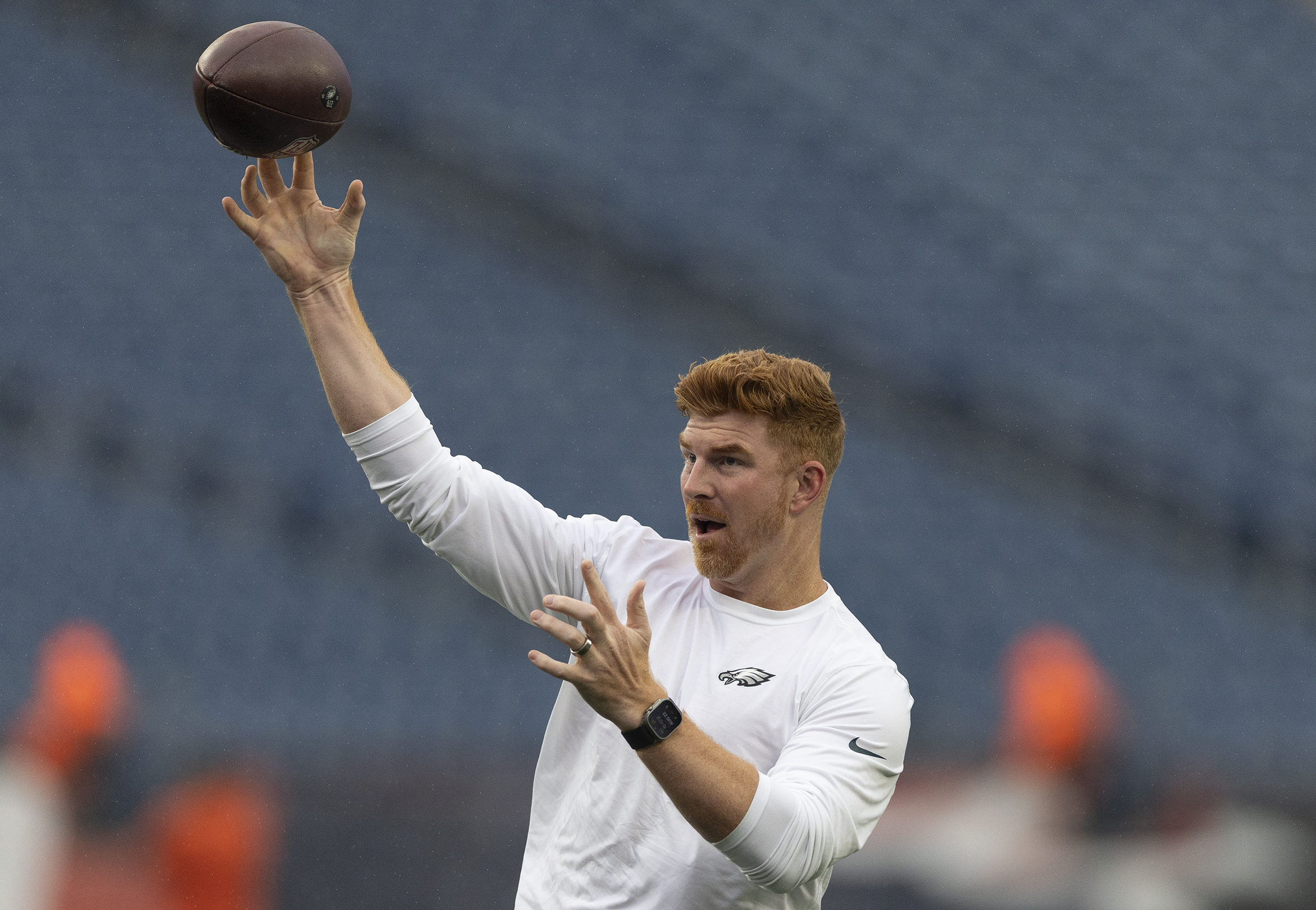
Andy Dalton signs with the Falcons after reportedly refusing an Eagles’ return
Andy Dalton chose Atlanta over a return to Philly.Yong Kim / Staff Photographer
A little more than a week after being released by the Eagles, quarterback Andy Dalton is signing with the Atlanta Falcons, according to multiple reports.
The Eagles reportedly wanted to bring Dalton back with Jalen Hurts out indefinitely as he deals with a blood clot, but Dalton “politely declined,” according to NBC’s Mike Florio.
To make room for Dalton, the Falcons released quarterback Cooper Rush.
DeVonta Smith’s snap restriction, Marcus Epps goes missing
DeVonta Smith was targeted 14 times on 37 routes Sunday.Monica Herndon / Staff Photographer
Once again, the defense was forced to be on the field longer than it should because of an Eagles offense that fails to sustain drives. The defense played 79 snaps on Sunday, the fifth time in six games the unit was on the field for 70 or more plays.
It’s not hard to figure out why the fourth-quarter defense hasn’t been consistent enough. Sure, there have been a few of what Cooper DeJean calls “miscommunications,” like the busted coverage that led to Tommy Tremble’s game-sealing touchdown, but there’s also the attrition factor at play, too.
“Not getting sustained drives there obviously cost us and puts the defense in a tough spot,” Nick Sirianni said on Sunday.
Here’s a look at some other notes and thoughts from the snap counts:
Marcus Epps was announced as a starter with the Eagles’ defense during pregame introductions, but he didn’t play a defensive snap. When the Eagles were in nickel or other sub packages, Kenny Moore was on the field. He played 48 snaps (61%).
The Eagles were already banged up at edge rusher entering Sunday without Jalyx Hunt (knee/ankle) and having Jonathan Greenard seemingly on a snap restriction (24 snaps, 30%). But then Nolan Smith went down with a concussion on his 14th snap, leaving the Eagles with three edge rushers. Rookie seventh-round pick Keyshawn James-Newby, a practice squad elevation, dressed for the first time and played 48 snaps. He had two pressures on 19 pass rushes. Arnold Ebiketie played a whopping 91% (72) of the snaps.
Speaking of positions with injuries, the running back corps began the day with the fourth-string back (Dameon Pierce) as the starter, and then lost the fifth-stringer (Carson Steele) to injury. That led to Pierce, who began the season on the practice squad, playing 95% (61) of the 64 offensive snaps. Saquon Barkley hit the 90% mark just twice in 2025 and once in 2024.
The Eagles did follow through with rotating Jihaad Campbell and Jeremiah Trotter Jr. at the off-ball linebacker spot next to Zack Baun. Campbell played 48 snaps to Trotter’s 28.
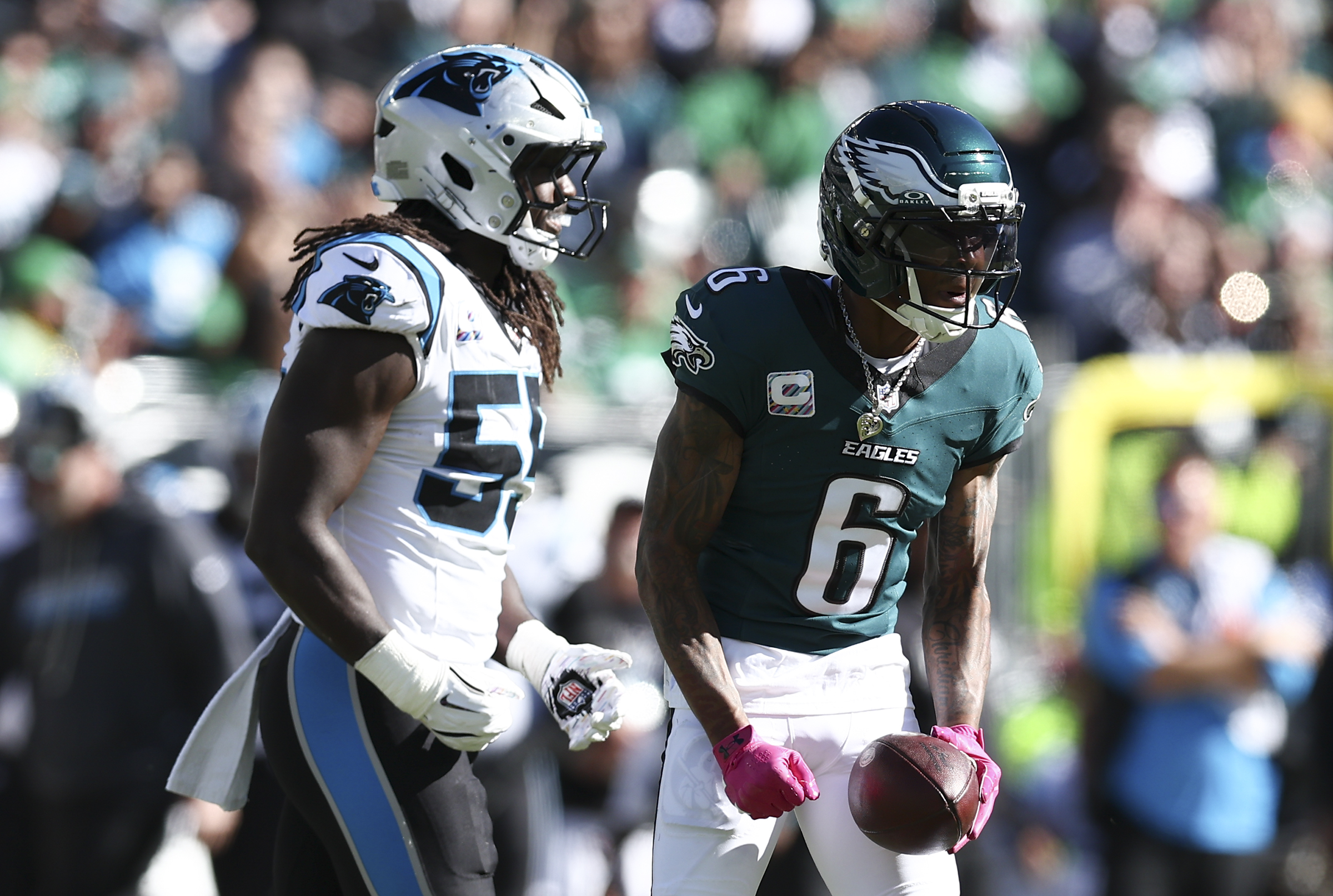
DeVonta Smith was on a snap restriction in his first game back from a two-game absence while he dealt with a hamstring injury. Smith played 42 snaps (66%) and was targeted 14 times on 37 routes. He had seven catches for 75 yards and a touchdown.
Dontayvion Wicks (hamstring) also was likely on a snap restriction. He played 40 snaps (62%), one more than Darius Cooper.
NFC Least? Eagles still have a decent mathematical chance to win the division
An Eagles fan reacts during Sunday’s loss to the Panthers.David Maialetti / Staff Photographer
The Washington Commanders are touchdown underdogs Monday night in San Francisco, and if they lose, the NFC East will become the first division since the AFL-NFL merger to have all of its teams play in consecutive weeks without winning, according to the Associated Press.
Yeah, the division appears to be that bad this season.
The Giants lead at 3-2-1 and the Eagles and Cowboys — who play each other next Monday in Philadelphia — are behind them at 2-4 with the Commanders in the basement at 1-3-1 heading into Monday night.
In other words, the division is wide open.
NFC East standings
(function(){function e(){window.addEventListener(`message`,function(e){if(e.data[`datawrapper-height`]!==void 0){var t=document.querySelectorAll(`iframe`);for(var n in e.data[`datawrapper-height`])for(var r=0,i;i=t[r];r++)if(i.contentWindow===e.source){var a=e.data[`datawrapper-height`][n]+`px`;i.style.height=a}}})}e()})();
Yes, even for the Eagles, who would likely need to completely revamp their offensive strategy — at least for the next several games with Tanner McKee at quarterback — to have any chance at winning a division title.
The math shows how open things are.
According to The Athletic’s playoff simulator, the Eagles have a 22% chance of winning the NFC East. The Cowboys lead the way at 36%, and the Giants and Commanders are both at 21%. PlayoffStatus, meanwhile, has the Eagles at 26% to qualify for the postseason.
The oddsmakers don’t have it at quite the longshot you’d think, either. FanDuel as of Monday morning had the Eagles at +350 to make the playoffs. That’s an implied probability of 22.2%.
If you’re reading this and rolling your eyes, that’s a fair reaction. What about the last four weeks, and the offensive performance over the last six weeks, could give you any faith the Eagles will be playing meaningful football in January?
Well, did you watch the Cowboys-Packers game on Sunday night?
With Jalen Hurts on injured reserve as he deals with a blood clot in his calf, the soonest he could be back with the Eagles would be Week 11 against the Pittsburgh Steelers.
There was some confusion over the weekend over his status. Saturday morning, ESPN’s Adam Schefter and NFL Network’s Ian Rapoport reported Hurts wasn’t expected to be placed on injured reserve, leaving open the possibility of him returning sooner. That changed a few hours later, with the duo reporting the move by the Eagles.
So what changed?
“At some time over the past 24 hours, additional information surfaced that made Philadelphia believe the wisest course of action was to place Hurts on IR, giving him the time he needs to heal,” Schefter and Rapoport reported.
The pair also reported the Eagles think the blood clot is “treatable” and the ultimate decision when or if he returns this season will come from Hurts’ medical team, with “the Eagles ready to follow his lead.”
Otherwise, we don’t know much about the severity of Hurts’ blood clot or his treatment.
Hurts was not on the sideline Sunday to watch the Eagles’ loss to the Carolina Panthers.
Running back Carson Steele gets help leaving the field Sunday.Monica Herndon / Staff Photographer
The Eagles suffered even more injuries during Sunday’s loss to the Carolina Panthers.
Here’s what we know and don’t know about a number of injured Birds players:
Carson Steele, RB: Steele exited the game with a shoulder injury early in the first quarter. He returned to action in the second, but he appeared to aggravate the injury again later in the same frame on a kickoff. He was ruled out in the third quarter.
Nolan Smith Jr., LB: Smith Jr. suffered a concussion in the second quarter and was ruled out for the game.
Jordan Davis, DT: Davis was injured late in the fourth quarter, grabbing his right leg during a run by Panthers running back Chuba Hubbard. Davis was ruled out.
Dontayvion Wicks, WR: Wicks was tackled by the right ankle in the fourth quarter on a 17-yard catch-and-run reception and went down in pain.
Heading into the game, the Eagles had five inactive players: Saquon Barkley (hamstring), Hollywood Brown, Michael Carter II (abdomen), A.J. Epenesa (back), and Jalyx Hunt (ankle/knee).
“I love Nick, but I can just see the writing on the wall if things don’t go good this year,” Graham said on PHLY’s postgame show Sunday. “We all know down years happen, but the wave now is get these coordinators as head coaches.”
“And with Nick being relieved of his duties of calling plays,” it leaves him vulnerable to being replaced by an up-and-coming offensive coordinator, Graham added.
While Graham didn’t offer specifics, he’s been on top of previous news with the team. A few weeks ago, he suggested Lane Johnson could retire early a week before the offensive lineman announced he wouldn’t be returning. Graham also pointed out the growing rift between Jalen Hurts and A.J. Brown in 2024, which ultimately ended with Brown being traded to the New England Patriots.
“We’re going to have to do different things to help the offense get going,” Sirianni said. “So, everything’s on the table. To do the same thing over and over again and not get the results, that’d be foolish.”
Graham also revealed after the Eagles’ Super Bowl victory against the Kansas City Chiefs in 2025, he and some of his teammates thought Sirianni could’ve been replaced by then-offensive coordinator Kellen Moore, who ended up taking a head coaching job with the New Orleans Saints.
“You thought there was a chance he’d be the head coach?” Graham’s surprised co-host Bo Wulf asked.
“From what I’ve seen, when you’ve got [coaches] that’s on the bubble, that’s in the hot, you bring people in that’s in there in case stuff don’t work out,” Graham said.
Graham also lamented the revolving door when it comes to offensive coordinators, pointing out the Eagles have had five coordinators in six seasons under Sirianni. The constant change has created a lack of stability on offense, which this season has been exacerbated by high-profile injuries.
“[Tanner McKee’s] been here two or three years, but he’s had different coordinators,” Graham said.
BG on the offensive struggles throughout the Sirianni era:
“I love Nick, but I can see the writing on the wall if things don't go well this year.” pic.twitter.com/1ZZxCwF7bI
Eagles face the Cowboys on ‘Monday Night Football’ next week
The Cowboys lost to the Packers Sunday night, 23-13.Matt Ludtke
If you want a sliver of good news, the Eagles scored more points than the Cowboys did Sunday night.
Dallas lost to the Green Bay Packers, 23-13, at Lambeau Field, and now travel to South Philly to face the Eagles in Week 7 in prime time on ESPN’s Monday Night Football.
It’s a matchup that’s lost a bit of luster. Both teams enter the game with a 2-4 record, and the high-powered Dallas offense has sputtered through the season. Dak Prescott and the Cowboys have only managed more than 20 points twice all season, and their only touchdown Sunday came with just 44 seconds on the clock and the game out of reach.
The Cowboys’ defense could be just the thing Tanner McKee and the Eagles’ offense needs. Dallas is giving up 382 yards per game, third worst in the league, and their defense against the run is dead last, allowing 149 yards per game.
That’s welcome news for the Eagles, who have been outgained by 650 yards this season, worst in the NFL and the biggest yardage differential through Week 6 this century, according to The Ringer’s Sheil Kapadia.
Calling the game will be Joe Buck and Troy Aikman, and there is some drama in ESPN’s booth. Buck signed a new contract through the 2032 season, while Aikman expects to be a free agent after the pair call the Super Bowl.
It’s more likely the NFL flexes the Eagles out of prime time
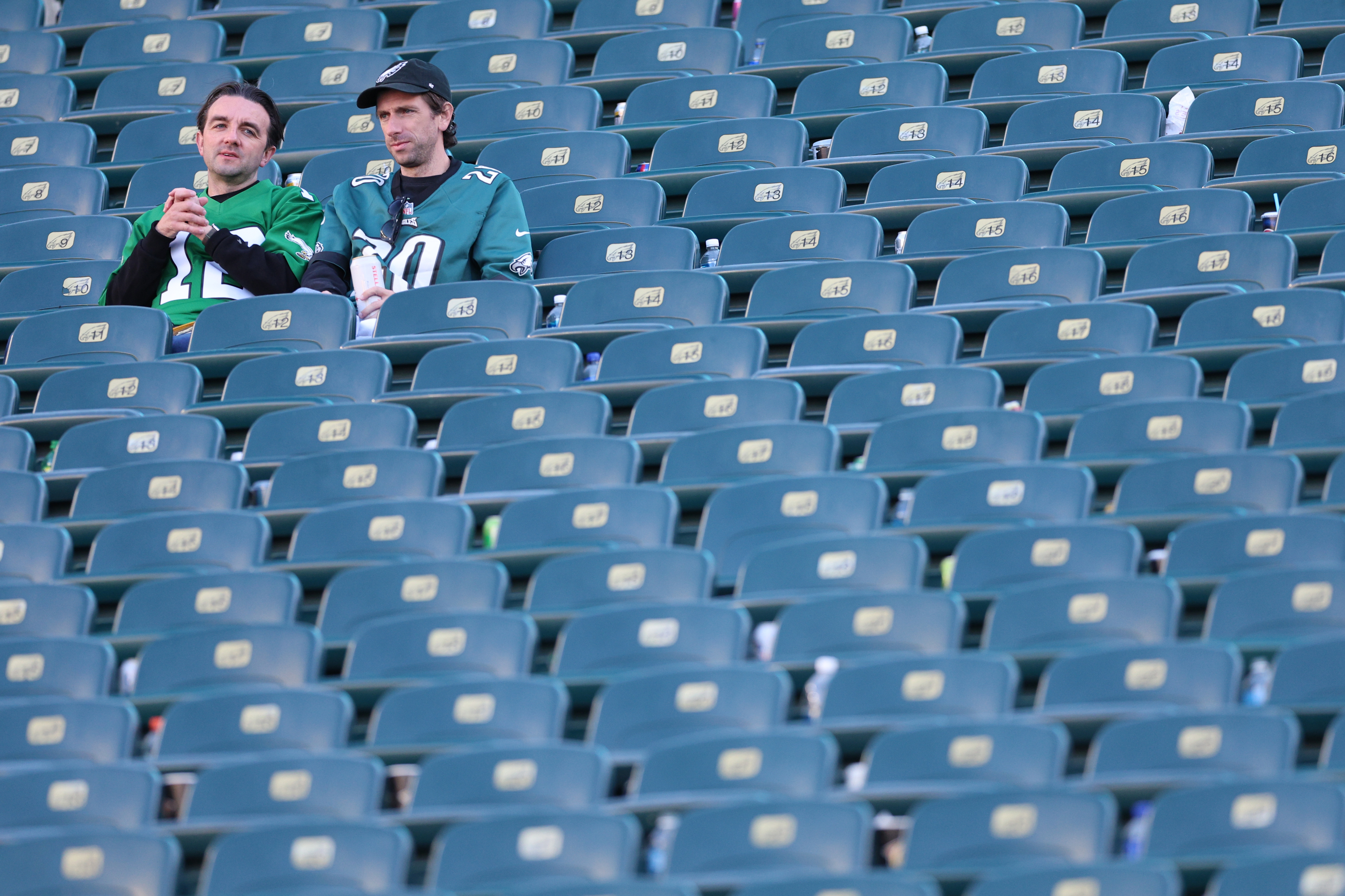
Eagles fans sit in an empty section of the Linc after Sunday’s loss to the Panthers.David Maialetti / Staff Photographer
The NFL was considering flexing the Eagles (2-4) out of prime time before Jalen Hurts was placed on injured reserve due to a blood clot in his leg.
Sunday’s loss to the Carolina Panthers certainly won’t help the Birds’ case.
As it stands now, the two-win Eagles are set to face the one-win Washington Commanders (1-3-1) in Week 8 on NBC’s Sunday Night Football. Even with Hurts, the Eagles weren’t exactly must-see TV on offense, and that didn’t change much with Tanner McKee under center.
Any Sunday Night Football flex through Week 13 require at least 12 days notice, so the NFL with have to make a decision by Tuesday. So they’ll be able to see what happens between the Commanders and undefeated San Francisco 49ers (5-0) Monday night before deciding how to proceed.
If Eagles-Commanders doesn’t get flexed out, it would likely be because of the lack of options. The best matchup in Week 8 is between the Buffalo Bills (5-1) and Baltimore Ravens (4-2), but the Ravens play the following Thursday night, so it’s highly unlikely the NFL would move them.
Other options include:
Minnesota Vikings (5-0) at Detroit Lions (3-2) on Fox at 1 p.m.
Kansas City Chiefs (5-0) at Denver Broncos (4-2) on CBS at 4:25 p.m.
Cleveland Browns (4-2) at Pittsburgh Steelers (4-2) on CBS at 1 p.m
The NFL might be blocked from moving any of these. CBS and Fox are generally guaranteed at least one game of each divisional rivalry during the season from the AFC and NFC, respectively. And for all three matchups, their second divisional game is scheduled or has already been played on a different network.
Still, the prime-time need could lead the NFL to make a deal with one of the networks to free up a better game. The 4:25 p.m. national game in Week 8 is also a poor matchup, which currently features the winless Los Angeles Chargers (0-6) facing off against the disappointing Los Angeles Rams (2-4).
Longer term, the NFL has an Eagles TV problem if the team fails to turn things round. The Birds are scheduled to appear in at least seven more standalone games this season, including four in prime time. That includes Christmas Eve against the Houston Texans and their Thanksgiving matchup against the Dallas Cowboys.
Jordan Mailata fielded questions for nearly 30 minutes about what’s going wrong
Eagles offensive tackle Jordan Mailata is among the veterans who has been forced to endure this four-game losing streak.Monica Herndon / Staff Photographer
Jordan Mailata stood in the center of the locker room, his game jersey still soaked and eye black dripping down his face, and loudly shouted toward reporters that he was ready for questions.
He hadn’t even stopped at his locker yet. Clearly he was eager to get his message out.
Shortly after the Eagles’ 25-14 loss to the Panthers — their fourth loss in a row — the All-Pro tackle held court in the quiet dressing room, fielding questions for nearly 30 minutes about what, exactly, is going wrong with the 2026 Eagles.
Mailata mostly spoke about the offense, which posted 222 total yards Sunday, including a meager 35 rushing yards. His prognosis for their issues was simple:
“Focus and ‘want to,’” Mailata said. “That’s it.”
He expanded on his thoughts later when pressed on it.
“It’s the focus, the lack of focus, and then you’ve got to have the ‘want to,’” Mailata said. “So if you’re not focusing in the moment, you’re not wantingto focus. That’s why I say the ‘want to.’
“The ‘want to’ to be focused. The ‘want to’ to understand your assignment. The ‘want to’ to not cause any false starts and try to jump the cadence because you got to prove it, you know?
“These are silly little errors that we can’t control. And again, it’s something that we have to correct, and we have to ‘want to’ correct. If it means staying back out to practice and getting these reps, that’s what it means.”
(function(){function e(){window.addEventListener(`message`,function(e){if(e.data[`datawrapper-height`]!==void 0){var t=document.querySelectorAll(`iframe`);for(var n in e.data[`datawrapper-height`])for(var r=0,i;i=t[r];r++)if(i.contentWindow===e.source){var a=e.data[`datawrapper-height`][n]+`px`;i.style.height=a}}})}e()})();
Despite four straight losses, the Eagles have as much of a shot as anyone to win the NFC East.
The New York Giants remain in first place in the NFC East, despite losing to the New Orleans Saints Sunday.
The Dallas Cowboys lost to the Green Bay Packers Sunday night, dropping them back into the tie with the Eagles.
The Washington Commanders face the undefeated San Francisco 49ers tonight on Monday Night Football. If the Commanders lose, it would be the first time in NFL history an entire division went winless two weeks in a row when every team played.
Keep in mind, last week two teams played each other.
The NFL East is looking more like the NFC South this season, where three teams finished with an 8-9 record last season, allowing the Carolina Panthers to sneak into the playoffs.
Eagles wide receiver DeVonta Smith walks off the field after the loss to the Panthers.David Maialetti / Staff PhotographerEagles defensive tackle Jalen Carter leaves after the Eagles lost to the Panthers.Monica Herndon / Staff PhotographerEagles head coach Nick Sirianni walks off the field after the loss to the Panthers.David Maialetti / Staff PhotographerEagles cornerback Cooper DeJean walks off the field after the loss to the Panthers.David Maialetti / Staff PhotographerAn Eagles fan watches the game in the fourth quarter.David Maialetti / Staff PhotographerEagles defensive tackle Jordan Davis (center) gets help leaving the field after a fourth quarter injury.Monica Herndon / Staff PhotographerEagles defensive tackle Jordan Davis lays on the turf after getting injured in the fourth quarter.Monica Herndon / Staff PhotographerEagles wide receiver DeVonta Smith attempts to catch the football against Panthers safety Zakee Wheatley during the fourth quarter.David Maialetti / Staff PhotographerEagles wide receiver DeVonta Smith catches a fourth quarter touchdown pass against Panthers cornerback Will Lee III.Monica Herndon / Staff PhotographerPanthers cornerback Will Lee III defends Eagles wide receiver DeVonta Smith in the fourth quarter. The pass was incomplete.Monica Herndon / Staff PhotographerPanthers running back Chuba Hubbard scores a fourth quarter touchdown run past Eagles safety Andrew Mukuba (left) and linebacker Zack Baun.Monica Herndon / Staff PhotographerEagles head coach Nick Sirianni reacts after his defense committed an offside penalty in the fourth quarter.Monica Herndon / Staff PhotographerPanthers running back Chuba Hubbard (right) runs with the football against Eagles linebacker Jeremiah Trotter Jr., (left) and cornerback Quinyon Mitchell in the third quarter.Monica Herndon / Staff PhotographerEagles quarterback Tanner McKee throws the football in the third quarter.David Maialetti / Staff PhotographerEagles linebacker Jeremiah Trotter Jr., dives after Panthers running back Chuba Hubbard in the third quarter.David Maialetti / Staff PhotographerEagles head coach Nick Sirianni during the third quarter.Monica Herndon / Staff PhotographerEagles defensive tackle Jalen Carter (center) and defensive tackle Moro Ojomo (right) walk off the field in the second quarter.Monica Herndon / Staff PhotographerEagles cornerback Cooper DeJean (left) and safety Andrew Mukuba (right) break up a pass intended for Panthers wide receiver Jalen Coker late in the second quarter.David Maialetti / Staff PhotographerEagles tight end Dallas Goedert yells at game officials next to head coach Nick Sirianni in the second quarter.David Maialetti / Staff PhotographerEagles running back Dameon Pierce (center) after scoring a second quarter touchdown run with teammates wide receiver Dontayvion Wicks (left) and center Jake Majors.Monica Herndon / Staff PhotographerEagles running back Dameon Pierce runs with the football, from quarterback Tanner McKee, for a second quarter touchdown.David Maialetti / Staff PhotographerEagles quarterback Tanner McKee hands-off the football to running back Dameon Pierce in the second quarter.Monica Herndon / Staff PhotographerPanthers quarterback Bryce Young runs past Eagles linebacker Zack Baun during the second quarter.Monica Herndon / Staff PhotographerEagles linebacker Nolan Smith reacts after getting injured in the second quarter.Monica Herndon / Staff PhotographerEagles linebacker Nolan Smith lays on the turf after getting injured in the second quarter.Monica Herndon / Staff PhotographerEagles tight end Dallas Goedert runs for 10-yards against Panthers safety Nick Scott during the second quarter.Monica Herndon / Staff PhotographerEagles defensive back Kenny Moore stops Panthers wide receiver Jalen Coker during the first quarter.Monica Herndon / Staff PhotographerEagles running back Carson Steele (right) gets help leaving the field from Eagles medical staff members, after getting injured in the first quarter.Monica Herndon / Staff PhotographerEagles cornerback Riq Woolen defends Panthers tight end Darren Waller for a incomplete pass in the first quarter.David Maialetti / Staff PhotographerEagles quarterback Tanner McKee throws the football pressured by Panthers linebacker Trevis Gipson during the first quarter.Monica Herndon / Staff PhotographerEagles linebacker Nolan Smith sack Panthers quarterback Bryce Young during the first quarter.Monica Herndon / Staff PhotographerEagles quarterback Tanner McKee gets rid of the football pressured by Panthers defensive tackle Derrick Brown in the first quarter.David Maialetti / Staff PhotographerEagles quarterback Tanner McKee sits on the turf after getting sacked in the first quarter.Monica Herndon / Staff PhotographerCarolina Panthers inside linebacker Bobby Okereke goes after Eagles quarterback Tanner McKee in the first quarter. Okereke sacked McKee.Monica Herndon / Staff PhotographerA moment of silence for Philadelphia Police officer Shane Seiber before the Eagles played the Panthers.Monica Herndon / Staff Photographer
PARIS — After riots erupted this weekend in cities across France, its centrist government blamed the main far-left party, accusing its politicians of inciting the violence. That party blamed the government, accusing it of stirring public anger through years of bad governance and heavy-handed policing.
What did the main far-right party do? It blamed both, and launched into campaign mode.
“We are paying for decades of being soft on crime, of weak authority, of the moral, psychological, and material disarmament of our internal security forces,” Jordan Bardella, the president of the far-right National Rally party, said after emerging from a police station in central Paris on Sunday. He said he had gone there to support police officers.
Then he addressed France’s “honest citizens” who were stunned Sunday by the smashed storefronts and burned-out businesses destroyed by rioters the night before. He said they had a vital role to play in reinstating national stability. And that would be by voting in the coming election for his party.
“People need to wake up now,” Bardella said. “They need to make the right political choices, and in any case, we stand ready to restore order in the country.”
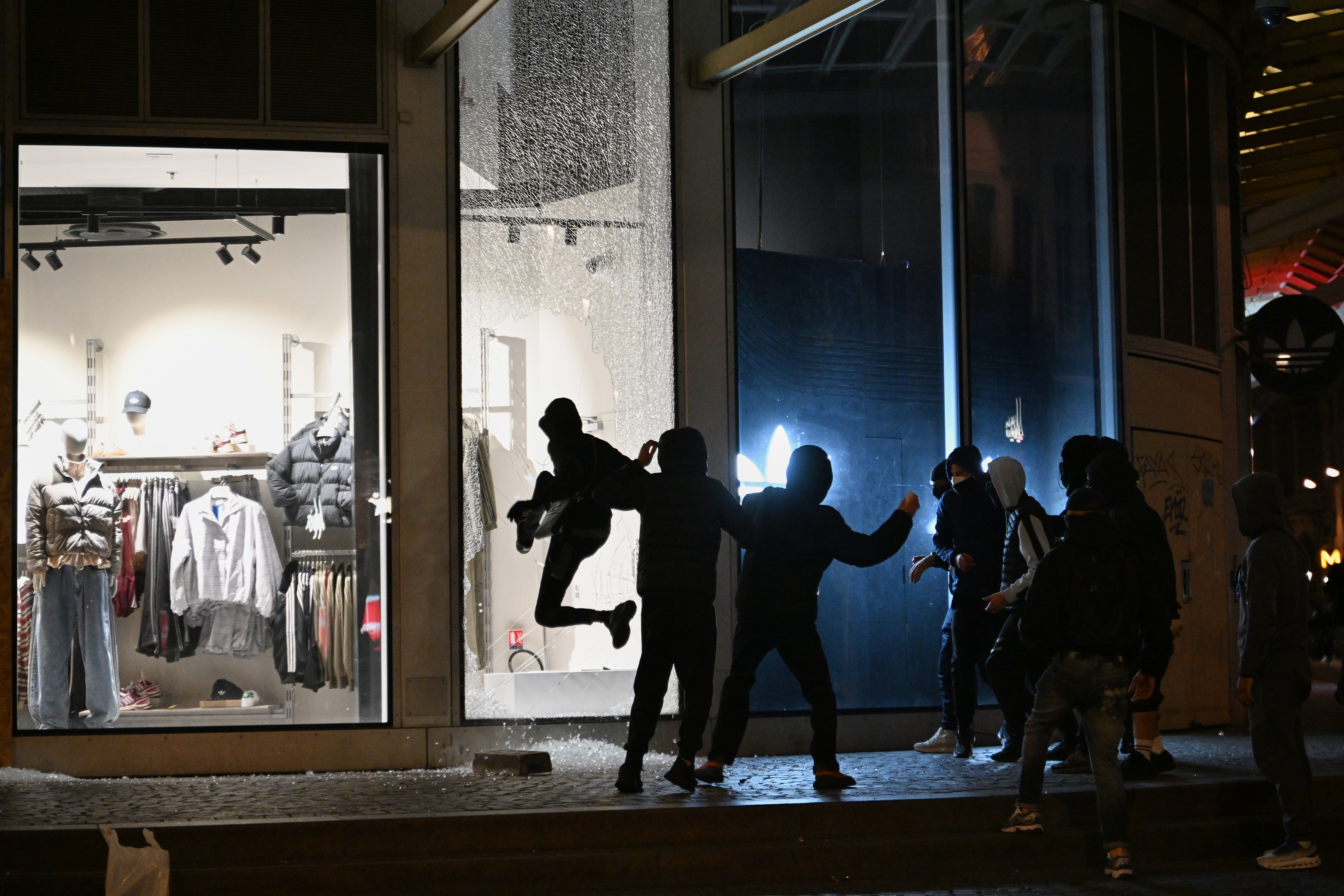
Sunday was a day of mourning, shock, and finger-pointing in France. The day before, huge peaceful protests for better school conditions and against rising living costs were overshadowed by black-clad and often masked agitators of unclear affiliation who attacked government buildings and shops across the country, sometimes stealing wine or electronics.
For the National Rally, which bills itself as the party of law and order as well as an advocate for expelling immigrants in the country illegally, Sunday was also a day of political opportunity. It is six months before a presidential election that the party’s candidate, Marine Le Pen, is the favorite to win.
“The picture of France emerging this morning, in light of all the destruction, plays well into their hands,” said Bruno Cautrès, a political scientist at Sciences Po, a university in Paris. “We can clearly see that the National Rally is not a loser here.”
The party’s approach mirrors how far-right groups across Europe are presenting themselves as the solution to different kinds of social and governmental challenges. In July, Spain’s government briefly lost control of the borders of a Spanish territory in North Africa, allowing a surge of migrants and handing the country’s far-right party, Vox, a new issue to campaign on. In Germany, the far-right Alternative for Germany party, or AfD, is leading national polls, in part by channeling anxiety over the country’s identity.
In France this week, as Bardella criticized the government’s policing, Le Pen seized the moment to criticize Jean-Luc Mélenchon, the leader of the main far-left party, France Unbowed, and one of her main rivals for the presidency. She said “legitimate social demands” had been “hijacked by the far left and the rhetoric of Jean-Luc Mélenchon” and his colleagues, whom she accused of fostering chaos by “legitimizing violence” — an accusation that the party denies.
The riots arrived at a sensitive time in France, with the country already dealing with a daunting budget deficit and a deadlocked parliament in which no party has a majority.
“The far right are sure to gain from this,” said Alexis Veller, 53, a filmmaker, who stopped his motorcycle Sunday morning to take photos of broken storefront windows and tagged walls in central Paris. “We are a very fractured country,” he said. “The situation is very, very worrying.”
Political analysts cautioned that the six months until the election is a long time in politics, and that voters’ motivations are complex and rarely focused on a single issue.
Still, the violence perfectly aligned with the image the National Rally has long painted of a France divided into two and battling for survival, said Vincent Martigny, a political science professor at the University of Nice, Côte d’Azur.
The party has portrayed the country as split between the France of the city centers — filled with woke students and rioters, it says — and the “good France” in the quiet countryside, he said.
“They try to oppose these two Frances, for an obvious reason, because their electorate is not in the city centers, nor in the suburbs, they are clearly in this other France,” Martigny said, adding that “this fuels the feeling decay, of decline.”
Whether the unrest offers a long-term bump in the National Rally’s fortunes will depend, in part, on if the protests continue, he said.
On Sunday evening, Le Pen released a video address in which she painted this very picture of a divided France. She was filmed sitting behind a wooden desk, with the French flag behind her, hands clasped — the image of a president in waiting.
“I condemn the hijacking of this anger by thugs who are sowing chaos in the cities of France,” she said.
“In six months,” she said, “the French people will be able to choose a different path: That of restored authority and security.”
The National Rally supports a bigger, stronger police force, and campaigned in legislative elections in 2024 for mandatory minimum sentences and an end to reduced sentences, as well as building more prisons. It also pledged to lower the age when defendants can be tried as adults by two years, to 16, and to cut state subsidies to the parents of juvenile criminals.
Since the current wave of protests broke out in working-class suburban high schools, Bardella has condemned students causing damage to schools and expressed support for police officers injured in confrontations with protesters.
Across the Atlantic, President Donald Trump and Vice President JD Vance, who have both expressed support for Le Pen in the past, weighed in on the unrest in ways that amplified the National Rally’s critiques. Though the identities of the black-clad and masked rioters are largely unknown, the American leaders portrayed the unrest as caused by immigrants.
“France is burning!” Trump said on social media. “The immigration of people from an entirely different world, people with hatred in their hearts, has shattered that once great country. Close your Borders and take control, before it is too late!”
Vance blamed the violence on “Western liberals” who “imported the third world into France and other countries in the name of diversity and compassion. They ignored fundamental questions of assimilation and compatibility.”
He added: “I hope Americans are paying attention. This is the future congressional Democrats seek for your country.”
Given how unpopular Trump’s government is in France, it was not clear whether those messages would help or hinder the National Rally.
At the police station Sunday, Bardella was confronted by the area’s Green lawmaker, Pouria Amirshahi, who was touring his constituency wearing the tricolor sash of an elected official. It was scandalous, he said, that while he was working, Bardella was out campaigning.
“They spend their time, as you can see, rubbing their hands together over this violence as if their time has come,” Amirshahi said.
Amirshahi then turned to the camera.
“We in France should unite,” he said. “We should stand together in the face of the challenge ahead of us, and not fall into this pattern of division and this pornography of violence that seems to excite him right now.”
But Bardella wasn’t listening. He had already hopped into a car and left.
The last two weeks have been a bit of a news whirlwind for Catholics like me. Not gonna lie — my candles have been lit 24/7, my rosary is at hand, and I’ve been regularly checking for Vatican updates on the health of Pope Leo XIV, who was diagnosed with lung cancer and underwent surgery on Oct. 13.
But I was already praying hard even before that, as were many other Catholics in the U.S.
But U.S. Roman Catholic bishops have been actively advocating against capital punishment for more than 50 years. And when Secretary of Defense Pete Hegseth announced earlier this month that the Pentagon would be livestreaming the firing squad execution of Fort Hood shooter Nidal Hasan — and that President Donald Trump backed the plan — the bishops denounced the plan quickly and decisively.
Many Catholics in the pews deplored it as well.
“As a Catholic, I cannot countenance the death penalty,” said Michelle Francl-Donnay, a parishioner of Our Mother of Good Counsel Church in Bryn Mawr. “But beyond that — to present this as public entertainment, to crow over the power on display, to suggest that this is a teaching moment — deeply offends me. It erodes our humanity. It diminishes us.”
Sister Bethany Welch from Philadelphia echoed that double concern in an email. “First, the announcement to livestream a public execution is a deliberate, calculated escalation of violence against human beings, intended to stir up hatred and fear. Let me name this before anything else. Second, the Gospel invitation to follow a nonviolent Jesus calls me to radically embrace the way of inclusive love that takes shape in works of mercy. I am thus compelled to decry the death penalty and all manner of government-sponsored killing.”
That condemnation of the death penalty is central to Jeff Singleton of Pax Christi Chester County. “We oppose the death penalty in all cases … televised or not,” he told me. “Those who are guilty, even of the most heinous crimes, are still sacred in the eyes of our loving God who embraces all sinners as sons and daughters. Mr. Hegseth has perhaps done us all a favor, by bringing the barbarism of execution into the light. Capital punishment is no less savage in secret.”
By the time President Trump backtracked Thursday, announcing that the execution of Hasan will still take place on Dec. 3, but won’t be livestreamed, Catholics were deep into prayer centered on Pope Leo’s recovery, and what that might mean in fraught moments like those last week.
“At a time when violence, extreme nationalism, xenophobia, contempt for international agencies, and total disregard for compassion and the common good are the new norms in policymaking, the world needs the example and leadership of Pope Leo,” Suzanne Wentzel, a parishioner of St. Joseph Parish in Downingtown, said via email.
“For people of all faiths or no faith, he provides the light of truth and goodness, and inspires hope that humanity can still find its soul,” she said.
From actors to heads of state to former Secretary of Labor Robert Reich, they are all expressing similar sentiments about the pontiff’s role on the world stage:
Wishing a speedy recovery to Pope Leo XIV.
He continues to serve the world as a much needed source of moral authority when many leaders, at home and abroad, are abdicating their responsibilities.
But the Catholics I reached out to about the precarity of Pope Leo’s voice at this crucial moment, are full of faith.
“Pope Leo may have to pull back in the sense of not being able to hold a press conference, or an audience at the Vatican, but recent popes have continued to be a force on the world stage even when very ill,” said Francl-Donnay, who is also a scientist, a scholar of the Vatican Observatory, and the author of Prayer: Biblical Wisdom for Seeking God. “I think of Pope Francis praying the Angelus from the balcony of the hospital after major surgery, bringing our attention to the need to accompany the sick, and for access to healthcare for the poor in particular.”
“Even when Pope Leo’s physical voice might be muted, his recent encyclical speaks clearly and firmly about the need to seek the truth, and to have a clear view of reality — not rely on alternative facts or live in our own bubbles,” she said. “Psalm 19 — prayed regularly by those who keep the Liturgy of the Hours, including me and Pope Leo — reminds us: … no voice is heard yet their span extends through all the earth, their words to the utmost bounds of the world. Ultimately the truth cannot be silenced.”
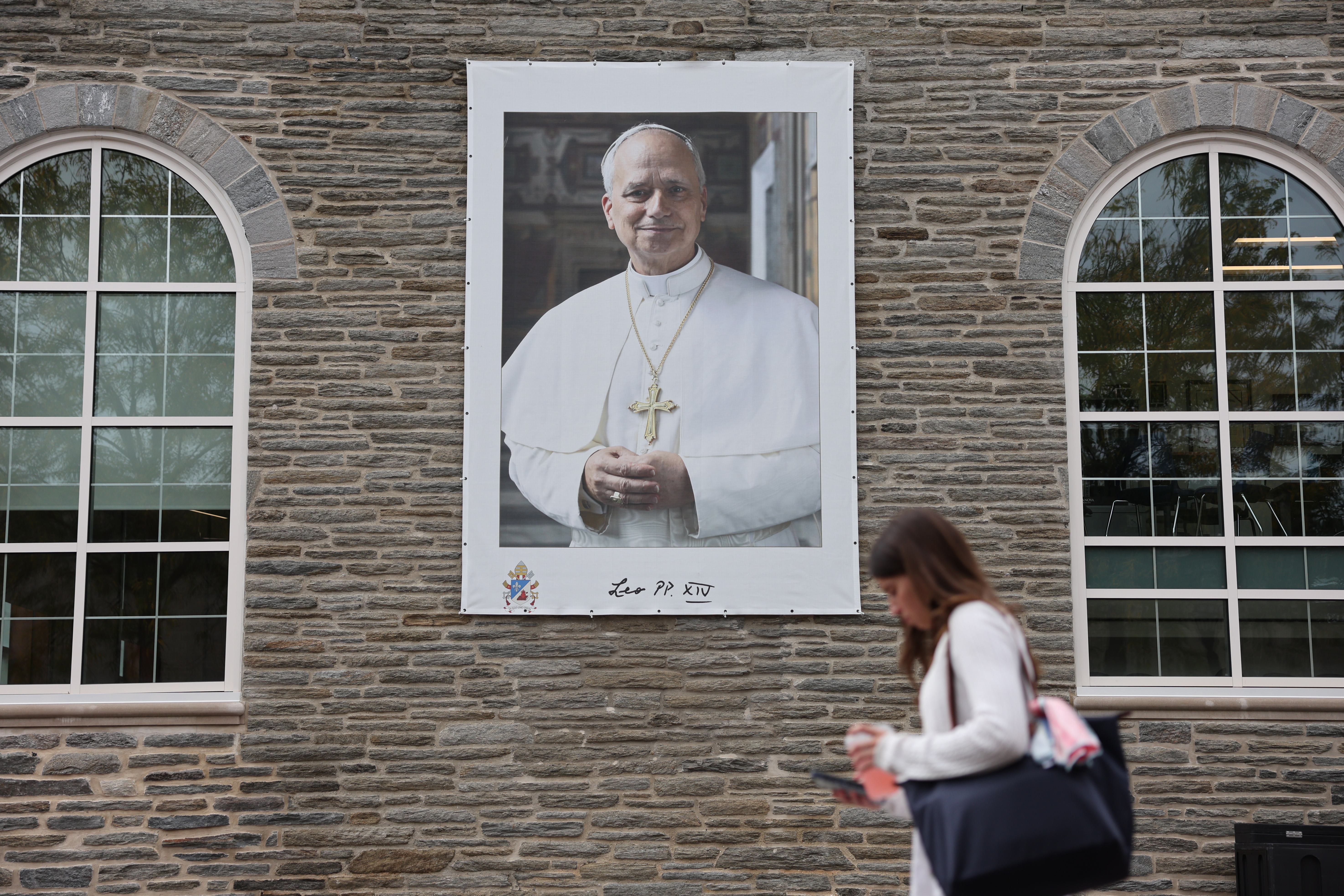
A student walks by a large poster of Pope Leo XIV at Villanova University on Sept. 30. “Pope Leo may have to pull back in the sense of not being able to hold a press conference, or an audience at the Vatican, but recent popes have continued to be a force on the world stage even when very ill,” Michelle Francl-Donnay said.David Maialetti / Staff Photographer
Msgr. Hugh Shields, a retired priest from the Archdiocese of Philadelphia, sees a clear role for Catholics and people of good will during the pontiff’s recovery.
“Pope Leo’s care, courage, and conviction on behalf of the ‘voiceless’ millions of our brothers and sisters is hopefully an impetus for us to speak up, even if Pope Leo’s voice need be silent in recuperation,” he told me. “We are required to question and challenge any person (president or pauper) who believes that his or her position is the only position that can solely determine what cherished words like constitutionality, morality, respect, justice, truth, legality, responsibility — let alone love, peace and fairness — actually mean.”
“That requirement,” he added, “impels us not to stand silently by and allow anyone to rewrite what our faith has taught us.”
The national political obsession has focused on the House and Senate, and whether Republicans will lose their lock on federal power. But Election Day could deliver another profound swing in power.
Democrats appear on track to govern a majority of states across the country for the first time since 2010, which could create enormous advantages for the party in 2028 and beyond.
With three dozen states holding gubernatorial contests, the map holds a wealth of opportunities for Democrats in part because 19 are for open seats in a climate where the winds are blowing against the party in control.
Democrats are considered even bets against Republican opponents in Georgia, Iowa and Ohio — none of which has elected a Democratic governor in two decades. They are looking more competitive than just about anyone six months ago would have imagined in red bastions such as Texas and Florida. Meanwhile, they are battling to keep the executive offices in swing states that include Arizona, Michigan and Wisconsin.
A new balance of statehouse power across the map would culminate a dramatic comeback from the Democrats’ low mark nine years ago, when they held only 15 of the nation’s 50 governorships. The number now stands at 24, to the GOP’s 26.
Yet governors’ races rarely spark the passions of big Democratic donors the way Senate and House contests do.
“The map keeps getting bigger and bigger, but our budget stays the same,” said Meghan Meehan-Draper, executive director of the Democratic Governors Association.
So Democratic gubernatorial candidates are being heavily outspent. Adding to that disadvantage, two of their biggest chances to flip seats are in states where Democrats are up against self-funding billionaires.
In Ohio, Republican Vivek Ramaswamy has put more than $36 million of his personal fortune into the contest where he holds a big lead in campaign spending against former state health director Amy Acton, the Democrats’ contender. In Georgia, the disparity is greater. Billionaire businessman Rick Jackson, the GOP contender, is expected by some to spend $200 million of his own money in his race against former Atlanta mayor Keisha Lance Bottoms.
This year’s battles have flipped some of the traditional scripts that Democrats followed when running for governor in conservative territory.
“I was always told, in a pretty red state, try not to nationalize the race, keep it about Kansas, keep it on the ground. So we always tried to insulate ourselves from Washington as much as possible,” said Kathleen Sebelius, who was Kansas governor from 2003 to 2009. “Just the opposite is going on this time, largely because the president’s policies are so unpopular across the country.”
Democrats seeking to lash their opponents to President Donald Trump are also aided by the president, who demanded fealty in exchange for endorsements in Republican primaries and made sure candidates and voters knew his role in choosing them.
Some, including GOP nominee Byron Donalds in Florida, have quietly scrubbed mentions of Trump from their websites. Others have attempted to distance themselves by shifting their rhetoric, but that is a delicate and awkward exercise.
In January, Wisconsin GOP nominee Tom Tiffany pronounced himself “deeply honored” to have Trump’s endorsement, which effectively cleared the primary field for him. But he was less effusive in an interview last week, when Madison television reporter Vanessa Kjeldsen noted that recent polling showed only 38 percent in the state approved of the job that Trump is doing. She asked Tiffany whether he was among them.
“The president is doing what he believes is best for the United States of America,” Tiffany said. “What I’m focused on is being the best governor possible in Wisconsin.”
In a statement to The Washington Post, Republican Governors Association communications director Kollin Crompton said Democratic gubernatorial candidates are talking so much about Trump because “they can’t defend their own records of higher taxes, sanctuary cities, and businesses fleeing their states. … If Democrats gain control, California and Illinois will become the blueprint for the rest of America.”
Though changes in who governs individual states do not have the immediate ripples across the country that flipping one or both houses of Congress would, the national impact could be profound, starting in the 2028 presidential contest. Sitting governors tend to have formidable grass roots and group operations that they can deploy to mobilize voters in their states.
And with so much congressional gridlock, states have become increasingly aggressive in setting policies on guns, health care, immigration, the environment and other issues where federal legislation is often stalled. Nearly all governors have power to appoint judges to state courts, and half of them name justices to state supreme courts.
On the longer horizon, governors and legislatures will preside over reapportionment that will take place after the 2030 Census — and possibly sooner in some places.
The population of the Sun Belt, where Democrats are hoping to pick up gubernatorial seats, has been growing, which means the census is likely to result in those states being allocated more congressional seats — and, with them, electoral votes. That could bring a dramatic rerouting of the road to the White House, which currently runs through seven swing states, three of which are in the Upper Midwest.
“Democratic governors are the most popular elected Democrats in the country,” Meehan-Draper said. And if all goes well for Democrats in November, the party hopes there will soon be more of them.
For Iran’s leadership, the next few weeks are a critical window. Anticipating that President Donald Trump will be less sensitive to high energy prices after the midterm elections, Tehran is scrambling to inflict maximum pain now by escalating attacks in the Strait of Hormuz, according to Iranian officials and diplomats in the region.
Two Iranian officials said their government is focused on the Nov. 3 midterms and sees the window leading up to them as critical to exercising leverage over Trump. Like other officials and diplomats interviewed for this story, they spoke on the condition of anonymity to discuss sensitive diplomacy.
For some Iranian officials, the goal is to “punish” Trump in the midterms, much as the Iran hostage crisis hampered President Jimmy Carter’s 1980 reelection campaign, an Arab diplomat and a Western diplomat said.
“They’re obsessed,” said the Arab diplomat. “They think they can bring down a presidency.”
The result has been an escalation in violence in the Strait of Hormuz. As the United States launched operations to encourage an increase in vessel traffic through the strait, Iran stepped up attacks on shipping to a rate not seen since the early days of the war.
U.S. forces are conducting massive, daily operations, with layers of fighter jets, drones, and Special Operations forces, guiding and protecting vessel traffic that shuttles back and forth through the narrow waterway, according to one Western official and an individual familiar.
Iranian attacks in the strait averaged around 30 a week in September, according to the official. So far this month, Iran has attacked more than 20 vessels, one of which sank, according to United Kingdom Maritime Trade Operations, a maritime monitoring body affiliated with the British military.
Despite the uptick in strikes, the United States has been successful in dramatically increasing oil flows out of the Persian Gulf.
Data from global analytics firm Kpler shows an increase in oil shipments out of Hormuz from mid-August to late September, with the number of barrels of oil exported a day approaching prewar averages on multiple days over the past month.
While “costs and risks” to shipping remain high, so will global energy prices, said Amena Bakr, head of Middle East energy at Kpler.
“The situation should not be regarded as going back to conditions we had before the war,” Bakr said. “Geopolitical risk,” by her estimates, adds $30 to the current price of a barrel of oil.
Iranian officials have described the expanded U.S. operations as “smuggling.” In an interview with ultraconservative newspaper Kayhan, Iranian lawmaker Fada Hossein Maleki said such traffic had made the situation in the strait “very complicated.”
“Iran is obliged to decisively defend the important global waterway that is our land and territory,” he said.
The midterm elections feature heavily in Iranian media. Talk shows on state television track soaring energy prices and dissect how Republican losses could hamper Trump’s ability to wage war in the latter half of his term, and print news roundups often feature daily updates on changes in Trump’s approval ratings.
Iran’s national security adviser, Mohsen Rezaei, addressed the Hormuz operations in an interview on government-run Press TV, saying Iran has responded by targeting “five or six” vessels every night.
“Trump has resorted to smuggling by hiring a number of thugs who operate in the coastal waters of Oman,” Rezaei said.
In the event of a resumption of full-blown war, Rezaei threatened to strike infrastructure targets in the region beyond what Iran has already hit. “Many cables, data centers, and artificial intelligence centers, which are very expensive in terms of financial value, would be in range,” he said.
Some voices in Iranian media have argued that a defeat for the Republicans in November will benefit Iran by constraining Trump, threatening him with impeachment and making it more difficult for him to execute the war.
“He, who had promised to end wars, has brought his party a few steps closer to defeat in the midterm elections by launching a war against Iran,” read an editorial last month in Fars, a semiofficial news network with close links to the Islamic Revolutionary Guard Corps.
If Trump is dealt a “bad fate” in November, “he will have to live out the remaining two years of his presidency as a nightmare,” said former foreign minister Manouchehr Mottaki during an appearance on a talk show on state media in August.
Beyond the elections, by increasing attacks in the strait now, Iran is attempting to regain leverage to use in talks to end the war, according to the Western diplomat. Faced with a deepening economic crisis and growing international isolation, there is increasing concern within the ranks of Iranian leadership that the country could be left unable to perform core functions like paying its security forces within a matter of months, the diplomat said.
Despite pressure on both sides, Iranian and U.S. negotiating teams appear unwilling to make significant concessions. The last time the two sides met directly at a senior level was in September at the United Nations. They exchanged proposals, and some senior Iranian leaders made a push for a deal before the U.S. midterms but rejected the U.S. request for a nuclear concession up front, according to an Iranian official briefed on the talks.
As much as Iran is pushing for a resolution to the war, the pressure campaign ahead of the U.S. midterm elections is also intended to be a message to future U.S. administrations, according to Negar Mortazavi, an Iranian researcher with the Center for International Policy, a progressive Washington think tank.
Iranian officials are seeking to send the message that “attacking Iran comes with a high political price, including the possibility of losing elections,” Mortazavi said. “Tehran is thinking beyond Trump. It wants future American presidents to remember what happened to him before considering another war against Iran.”
Gov. Gavin Newsom of California spent his Saturday weaving through New Hampshire, campaigning with midterm candidates as he faced questions about his presidential ambitions. Next weekend, former Vice President Kamala Harris, who is weighing another White House bid, plans to be in the state with the Democratic Senate nominee. And days after that, Sen. Mark Kelly of Arizona, who is also considering a run, will appear there, too.
In the final stage of this year’s midterms, prospective presidential candidates are parachuting into battleground states to rally support for candidates on the ballot this fall, road test their stump speeches, and introduce themselves to voters and activists. The Democratic schedule is especially packed in New Hampshire, an early presidential nominating state where there is a competitive Senate race. While New Hampshire has lost its long vaunted first-in-the-nation Democratic primary status to South Carolina, it will go third in 2028.
“Got here last night from the most un-Trump state in the United States of America, California,” Newsom told the crowd in Exeter, N.H., at a rally on Saturday with Rep. Chris Pappas, the Democratic Senate nominee, as well as other Democratic candidates. His 10-minute speech focused primarily on President Donald Trump.
Ambitious Republicans, too, are trying to leave lasting marks across the country in this year’s high-stakes elections. Vice President JD Vance and Sen. Ted Cruz of Texas are hitting the road for midterm candidates, including in states expected to figure prominently in the next GOP presidential race.
In both parties, the possible presidential candidates’ itineraries reflect their standings, showing where they are in demand and where they are not. At times, midterm candidates have subtly or loudly distanced themselves from some of them.
In other cases, midterm contenders have welcomed the extra attention and support. Newsom’s trip to New Hampshire follows recent visits by Sen. Raphael Warnock (D., Ga.) and Pete Buttigieg, the former transportation secretary, among others. Pappas, whose roster of surrogates from outside New Hampshire has grown, is facing former Sen. John E. Sununu, a Republican.
“I think of political campaigns like building a house. You have to build the foundation first before building the walls. That’s what these visits are,” said Jim Demers, a veteran New Hampshire Democratic strategist, who like other operatives refers to the current phase as the “shadow primary.”
At the town hall event in Exeter, Newsom popped out from behind a curtain, beaming as Macklemore and Ryan Lewis’s “Can’t Hold Us” played in the background. Asked about his political future, he waved his hand and said, “It’s all about 2026.”
While others similarly say they are solely focused on this year’s elections, Democratic and Republican strategists see multiple purposes in these visits.
“A campaign for president is like having an endoscopy and a colonoscopy at the same time,” said Jesse Ferguson, a Democratic strategist. “A lot of candidates are truly deciding whether they want to do this.”
Midterm travel may be especially attractive to lesser-known politicians looking to raise their national profiles, and to those who don’t hold public office.
Buttigieg, who left his post in the Biden administration in early 2025, has endorsed more than 100 candidates this cycle and campaigned for them in more than 30 states. Gov. Andy Beshear of Kentucky has headlined Democratic Party dinners or conventions in nine states, including several that will hold early presidential primaries. Rep. Ro Khanna of California has campaigned for more than 70 candidates.
Others have been more selective with their travels. Rep. Alexandria Ocasio-Cortez (D., N.Y.) recently campaigned in Michigan, another early-nominating state, with Abdul El-Sayed, the Democratic nominee for Senate. She plans to appear in Maine this week with Troy Jackson, the Democratic Senate nominee there.
The country faces a “pivotal and consequential moment,” Ocasio-Cortez said in Michigan on Friday. She brushed aside speculation about her 2028 plans, saying, “What matters right now is the next 19 days.”
Harris also recently appeared with El-Sayed. She plans to visit Nevada, an early-nominating state, as well as Mississippi, Georgia, and Wisconsin.
But Senate candidates in Alaska, Iowa, and Kansas have publicly and preemptively uninvited Harris, whose ties to the Biden administration have made her unwelcome in some conservative-leaning states.
Tensions have flared in other ways. In recent weeks, Latino leaders became angry that the Democratic Governors Association, chaired by Beshear, was not investing more money into Gina Hinojosa’s race for Texas governor against Greg Abbott, the Republican incumbent. They made veiled threats to withhold their support from Beshear should he run for president in 2028.
Within a week, the DGA made a seven-figure donation to help elect Hinojosa.
Some potential presidential candidates have sought to balance their own reelections: Govs. JB Pritzker of Illinois and Josh Shapiro of Pennsylvania are on the ballot in November. Shapiro recently started a federal political-action committee that enables him to give money to congressional candidates.
On the Republican side, Vance has campaigned in Kansas, Michigan, and other battlegrounds. In Michigan on Thursday, he called the Senate contest “the most important race in the United States of America,” as he stumped for Mike Rogers, the Republican nominee.
Trump’s sinking approval ratings have made the president and, by extension, Vance a liability for some battleground candidates, as they seek to energize the party’s base voters. When Vance held a rally in Iowa last month, Ashley Hinson, the Republican nominee for Senate, didn’t attend, citing scheduling conflicts.
Republican “candidates in swing seats want his voters, not necessarily his baggage,” said Matt Klink, a Republican strategist in California, speaking of Trump.
Cruz, who has clashed publicly with Vance, has raised money and campaigned in his home state of Texas for Ken Paxton, the Republican Senate nominee in a tight contest, and visited Iowa, which has been an early Republican nominating state, among other places.
Defense Secretary Pete Hegseth, a frequent target in Democrats’ campaign attacks, has also campaigned for Republicans this cycle in Iowa and Kentucky, a departure from past Pentagon officials who have stayed out of politics.
In New Hampshire, Derek Thibeault, 55, the chair of the Nashua Democratic City Committee, said he approached Newsom at an event on Saturday and asked the governor to let him know when he’d be back to campaign for the White House.
“He gave me a big laugh, but he didn’t say no,” Thibeault said.