House lawmakers, fresh from their August break, are expected to vote this week on a Senate-passed measure that would fund federal agencies through Dec. 11, avoiding a government shutdown before the Nov. 3 midterm elections.
Republican leaders aim to pass the stopgap funding bill Tuesday under a “suspension of the rules” — a fast-track process that requires support from a two-thirds majority of the chamber, according to two House GOP aides who spoke on the condition of anonymity to candidly discuss party strategy.
Bills on the House suspension calendar get limited time for debate and are not subject to amendment or other procedural hurdles, allowing Republican leaders to move quickly to avert a shutdown. With control of Congress on the line, both parties are eager to return to the campaign trail.
“That’ll be a priority over in the House because we get things done,” Majority Whip Tom Emmer (R-Minnesota) said Sunday in an interview on Fox News.
The House passed its own stopgap funding measure in July, but it lacked support in the Senate. Senate appropriators Susan Collins (R-Maine) and Patty Murray (D-Washington) instead drafted their own stopgap bill, which passed the Senate on a bipartisan 90-6 vote.
In addition to funding the government past the Sept. 30 deadline, the measure includes additional funding for housing and nutrition programs requested by the White House. It also would temporarily block the White House budget office from adopting a rule to give political appointees more power over discretionary grants.
Despite that constraint on its authority, the White House has issued a statement of administration policy in support of the legislation.
“President [Donald] Trump strongly opposes another futile Government shutdown,” the White House said in the statement. “Every Member of Congress should support passage of this [bill] to keep the Government open as discussions on fullyear appropriations continue.”
If the House approves the measure, lawmakers will be free to head back out of town by the end of the week.
Avoiding a shutdown is just the most urgent of several items on lawmakers’ to-do list before November elections. Republicans also hope to approve fresh funding for the war in Iran and implement new restrictions on voting — top Trump priorities. And they want to provide emergency assistance to American farmers battered by Trump administration policies, including tariffs and high fuel costs caused by the Iran war.
GOP lawmakers are looking to use the reconciliation process to advance all three priorities, which would allow them to pass with a simple majority in both chambers, forgoing Democratic support. But last month, Senate Republicans delayed a vote on a budget framework — the first step in the reconciliation process — amid opposition from multiple members of the conference.
Senate Budget Committee Chairman Ron Johnson (R-Wisconsin) told reporters that senators would bring forward a “better” budget framework in September.
Work on the federal farm bill — which is due to expire Sept. 30 — is also stalled just as lawmakers are eager to find another way to demonstrate support for a critical constituency. The House passed its version in April, but the Senate has struggled to advance its own version amid opposition from Democrats who do not support reductions in federal funding for food stamps proposed by Republicans.
With the Senate not due back in Washington until Sept. 14, House lawmakers are in a holding pattern on these measures. Emmer, speaking to Fox News on Sunday, expressed frustration with the Senate logjam.
“We sent our priorities over to the Senate,” he said. “We sent the Clarity Act. … We sent the Save America Act several times, and it sits over there, languishing in the Senate. … It really is going to be on the Senate’s shoulders to start getting something done when we get back.”
Besides voting on the stopgap budget bill this week, the House is expected to vote on a censure motion against Rep. Chuck Edwards (R-North Carolina) following a recommendation from the Ethics Committee.
Earlier this month, the committee found that Edwards engaged in “persistent unprofessional and inappropriate conduct” toward two female staffers, behavior Edwards denies.
FLAGSTAFF, Ariz. — More rain and thunderstorms were possible Monday at the Grand Canyon following a major flash flood that left one person dead and about 15 others missing or unaccounted for, with scores of visitors evacuated and the only water pipeline for tourists and residents destroyed.
Emergency water restrictions that began Monday prevented tourists from staying overnight at lodges and hotels within the park. Year-round residents were asked to conserve water.
A flood watch was in effect. Visiting the Grand Canyon — a crown jewel of the national park system — can be particularly dangerous in the summer because of the risk of flash flooding that accompanies the monsoon, or rainy season. Clear days can give way quickly to thunderstorms and downpours.
“With deep monsoonal moisture in place and already saturated soils in some locations, an elevated risk of flash flooding will be in place through Monday,” the National Weather Service said early Monday.
The body of a 46-year-old man was recovered Sunday evening near Crystal Rapids along the Colorado River, the National Park Service said without providing additional details.
The flooding Saturday in Bright Angel Creek, which flows into the river, led to more than 60 people being airlifted from the depths of the canyon. The park service asked anyone with details about hikers or campers still unaccounted for to get in touch. The Arizona Department of Public Safety helped with additional evacuations Sunday.
“These measures are crucial for ensuring the safety and sustainability of water resources,” the park said in a statement.
Parth Desai was hiking through a narrow passage in Bright Angel Canyon with fellow physicians and a park ranger when heavy rain started falling Saturday.
“We saw the creek flood, waterfalls coming up out of nowhere, boulders, mud, landslides happening everywhere,” he said.
Later, as they made their way toward Phantom Ranch, a colleague shouted “Up, Up, Up, Up!” as a 4-foot (1-meter) debris wall headed toward them and they ran up into a patch of cacti, he said. They were rescued by helicopter late Saturday after making it to the Phantom Ranch area, he said.
Torrents of water wiped out footbridges over the creek and altered the landscape, widening the creek bed and extending an existing river rapid or creating a new one. The flood was a major blow to an enduring effort to modernize the pipeline that serves 6 million visitors a year and roughly 1,600 residents of Grand Canyon Village.
“Heaven help us if the whole thing down there at the bottom has to be reconstructed,” said Jack Schmidt, director of the Center for Colorado River Studies at Utah State University. “Where are they going to get the money?”
Halting overnight stays at the park because of a lack of water is rare, although the pipeline frequently has failed over the years. While the Grand Canyon has large storage tanks for potable water on the South Rim, they won’t be refilled while the pipeline is out of service.
A $208 million rehabilitation of the pipeline and upgrades to the associated water delivery system started in 2023, with the park service calling it a crucial investment to ensure the park can meet the needs of residents and visitors. The project was expected to be completed next year.
BIDUR, Nepal — Rajendra Dawadi was inside his classroom when the school’s accountant rushed in with a warning: Floodwaters were racing through Nepal’s Trishuli Valley, tearing apart homes, bridges and entire villages.
Then a teacher received another warning by phone. Moments later, a parent arrived to take her child home. The danger had not yet been confirmed, but Dawadi had little time to act. He rang the school bell and ordered his students and staff out of the building and toward higher ground.
“I immediately decided to stop … school and (get the children out),” he told The Associated Press.
As he followed them to a nearby hill, the floodwaters rose behind him. From the safety of the hillside, he turned to watch the school where he had once been a student — and where he had spent years teaching — disappear beneath a torrent of water, mud, boulders and debris. Two staff members could not make it and remain missing.
Dawadi’s decision to evacuate the school saved at least 900 students from last week’s devastating flash floods in Nepal, unleashed after a glacial collapse in the Himalayas. The disaster killed over 900 people across Nepal and China, while more than 4,700 remain missing.
As Nepal grapples with the catastrophic natural disaster, Dawadi’s story has emerged as a striking example of foresight and courage.
The Tribhuvan Trishuli Secondary School in the Trishuli Valley of north-central Nepal had 1,643 students. At least 900 were on campus that morning, while some students were still making their way to school. Dawadi ordered those already there to leave and called bus drivers, telling them to only stop at safer places.
One bus, packed with students, had already reached the school when Dawadi told the driver to turn back, he said. The bus crossed a newly constructed bridge and, moments later, the old bridge beside it collapsed.
For Dawadi, the scale of the destruction has become personal, as the school had been both his workplace and a large part of his life.
“I have no words. I got education from that school. And I gave education at that school,” he said.
The destruction of Dawadi’s school was not an isolated loss.
Across northern Nepal, the floods have left thousands of children without classrooms, disrupted their education and raised fears that the disaster could cost them months of schooling. Charity group Save the Children said in a statement that at least 69 schools in northern Nepal have been completely destroyed, putting the education of nearly 19,000 students at risk.
Dawadi’s quick thinking and swift response during the disaster have been hailed as an act of heroism. When he returned to the site of the school days later, parents embraced him as they thanked him for saving their children.
“Their parents hugged me, they cried with me,” he said. “They were emotional.”
Student Suvina Tamang, 14, said the school’s three-story building was swept away shortly after all the students had been evacuated.
“I will thank him when I see him” for saving my life, she said.
But Dawadi is reluctant to accept the role of hero. For him, rescuing his students was his responsibility. Now he says, students will need psychological counseling. Then, lessons must begin again, even if the school must temporarily relocate.
His appeal to the Nepalese government is simple: rebuild the schools and get children back to classes.
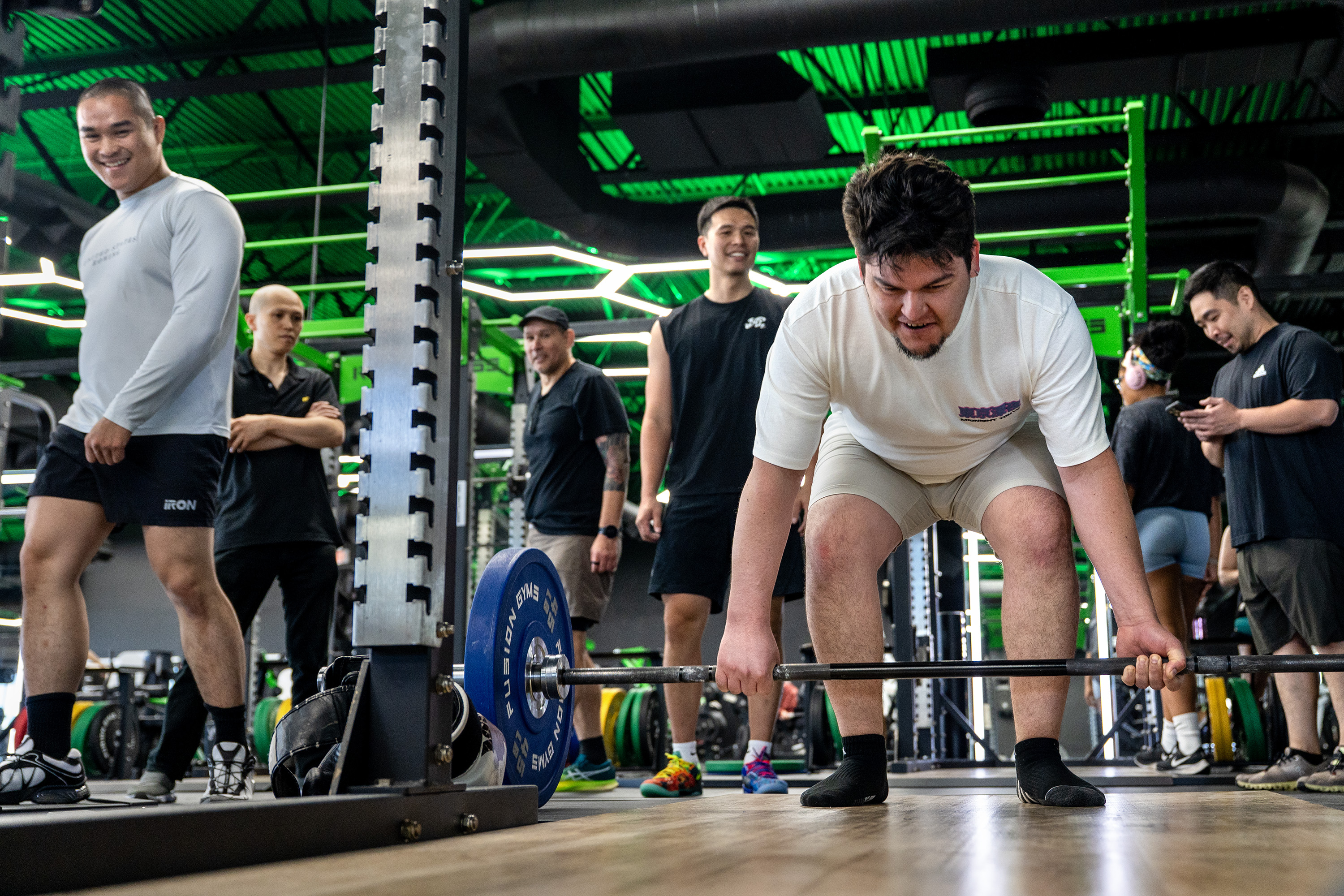
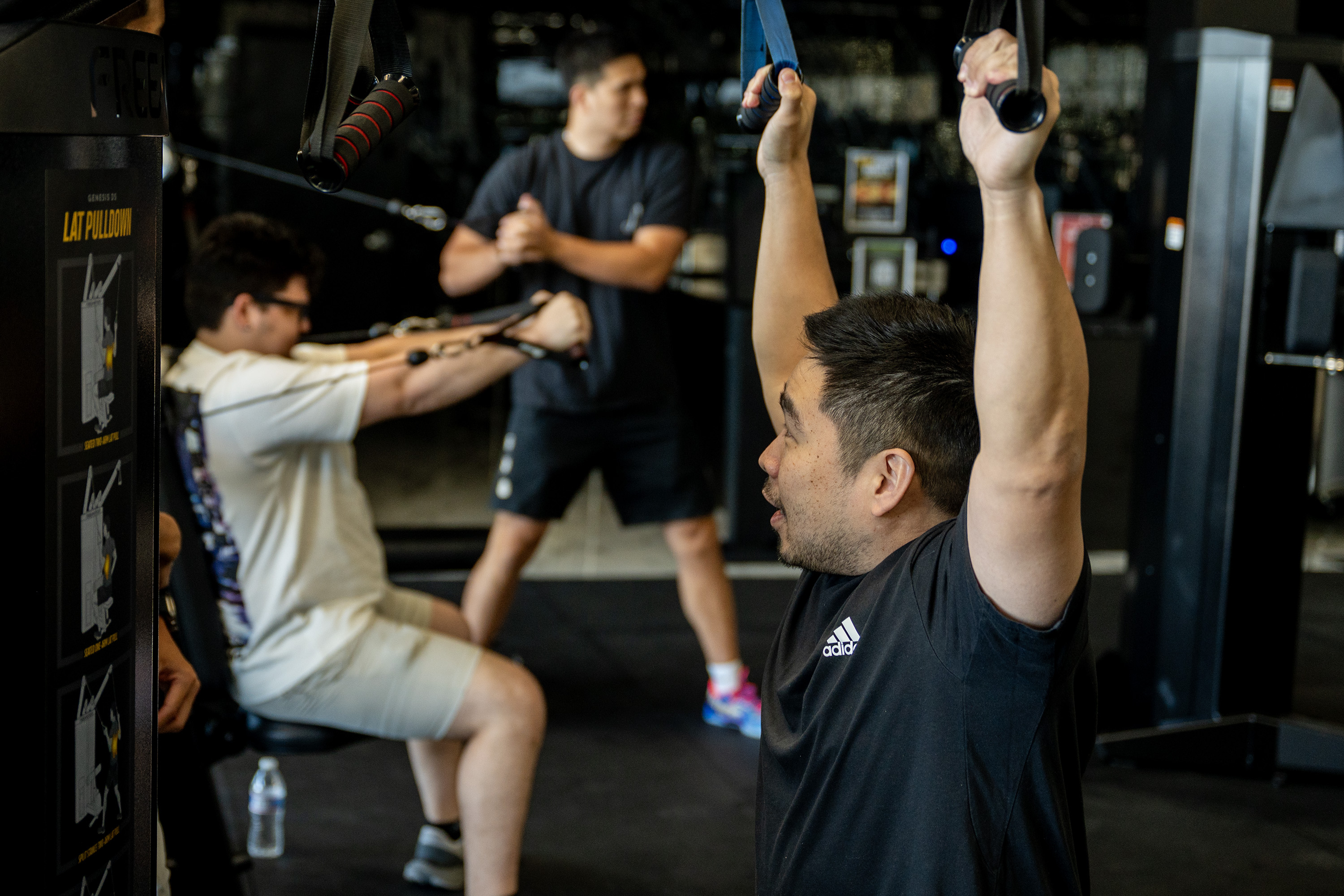
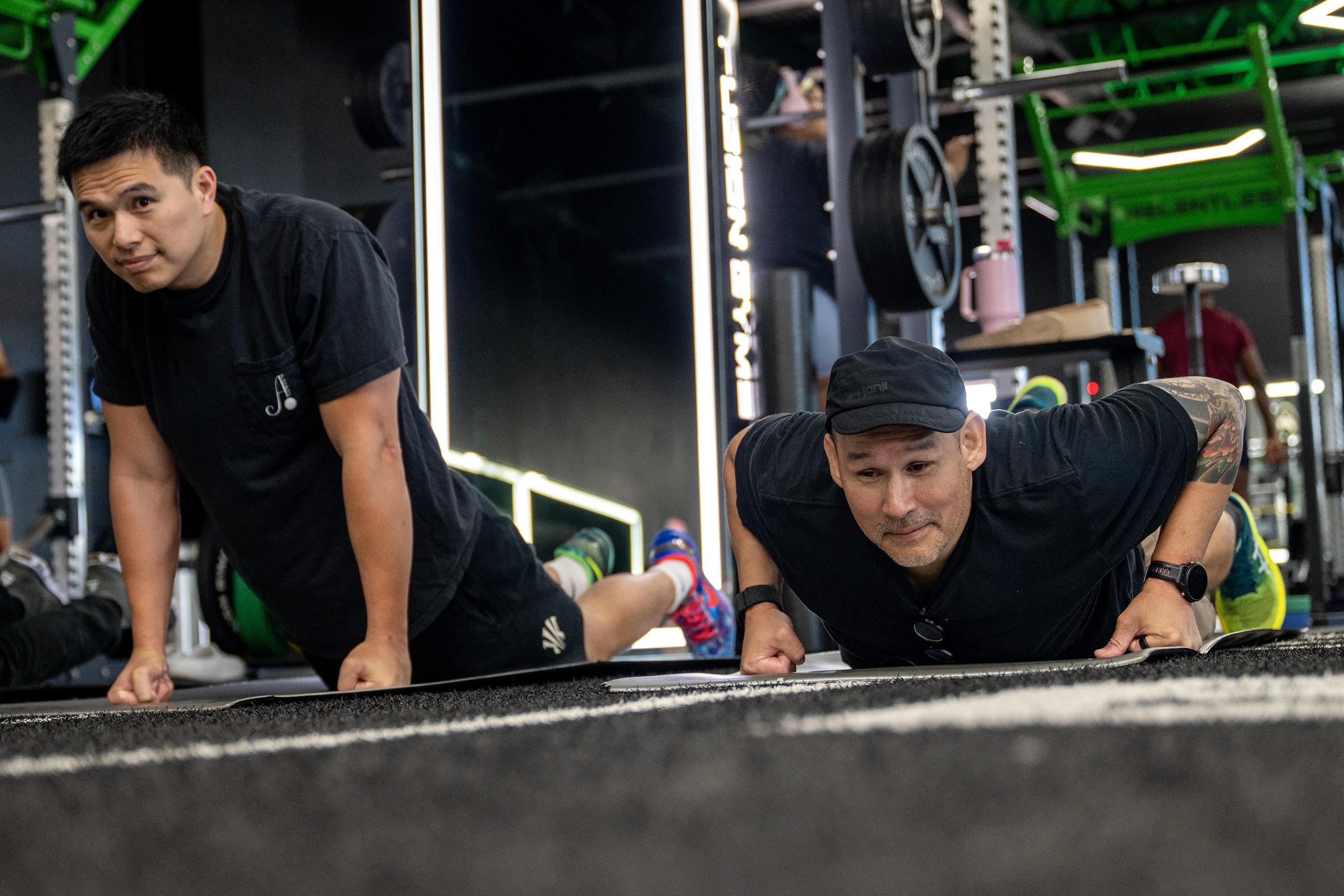
One of Fusion Gyms’ five locations is in a strip mall in deep South Philly, sandwiched between a children’s clothing shop and a wig store. In the neon-green glow of the gym’s bright lights, seven Philly sushi chefs stretched on rubber mats, preparing to lift weights set to be as heavy as a fully grown bluefin tuna.
The crew — usually just four or five chefs — meets regularly on weekday mornings, loosely led by Albert Zheng, 34, and Dan Santana, 40, who co-own and run Kiku Sushi in South Philadelphia. (Zheng also owns Javelin in Fairmount and is a partner in the upscale Old City omakase restaurant Ogawa.)
Zheng and Santana are there every weekday. The other chefs drop in weekly or monthly. They exercise to stay fit for their physically demanding jobs, but also just to hang out with each other.
On a recent Tuesday morning, a larger-than-normal group gathered, including chefs from Kiku, Ogawa, and Javelin, as well as Kichi Omakase and Yanaga Kappo Izakaya, which houses the omakase counter 637 Sushi Club.
Sushi chefs work out at Fusion Gyms in South Philadelphia in August. They get together regularly, trading both exercise tips and fish intel. From front to back are Dan Santana; Carlos Wills, Joseph Nguyen, Kevin Yanaga, Albert Zhang, Cai Li, and Alex Jiang.Tom Gralish / Staff Photographer
They also count among their crew sushi chefs from Sagami and Nakama. “We’re less consistent in summer, when our kids are home from school,” Zheng said. “During the school year, we drop the kids off and meet at the gym right after.”
They work out for two, sometimes three hours at a stretch. “The third hour is usually our jaw workout,” joked Zheng. “And it takes longer when there are more people.”
As they wove through Fusion Gyms’ open-floor plan, they compared ingredient lists andtraded tips about good restaurants and where to get salmon for a better price. These are regular topics ofdiscussion, along with mise en place and sourcing.
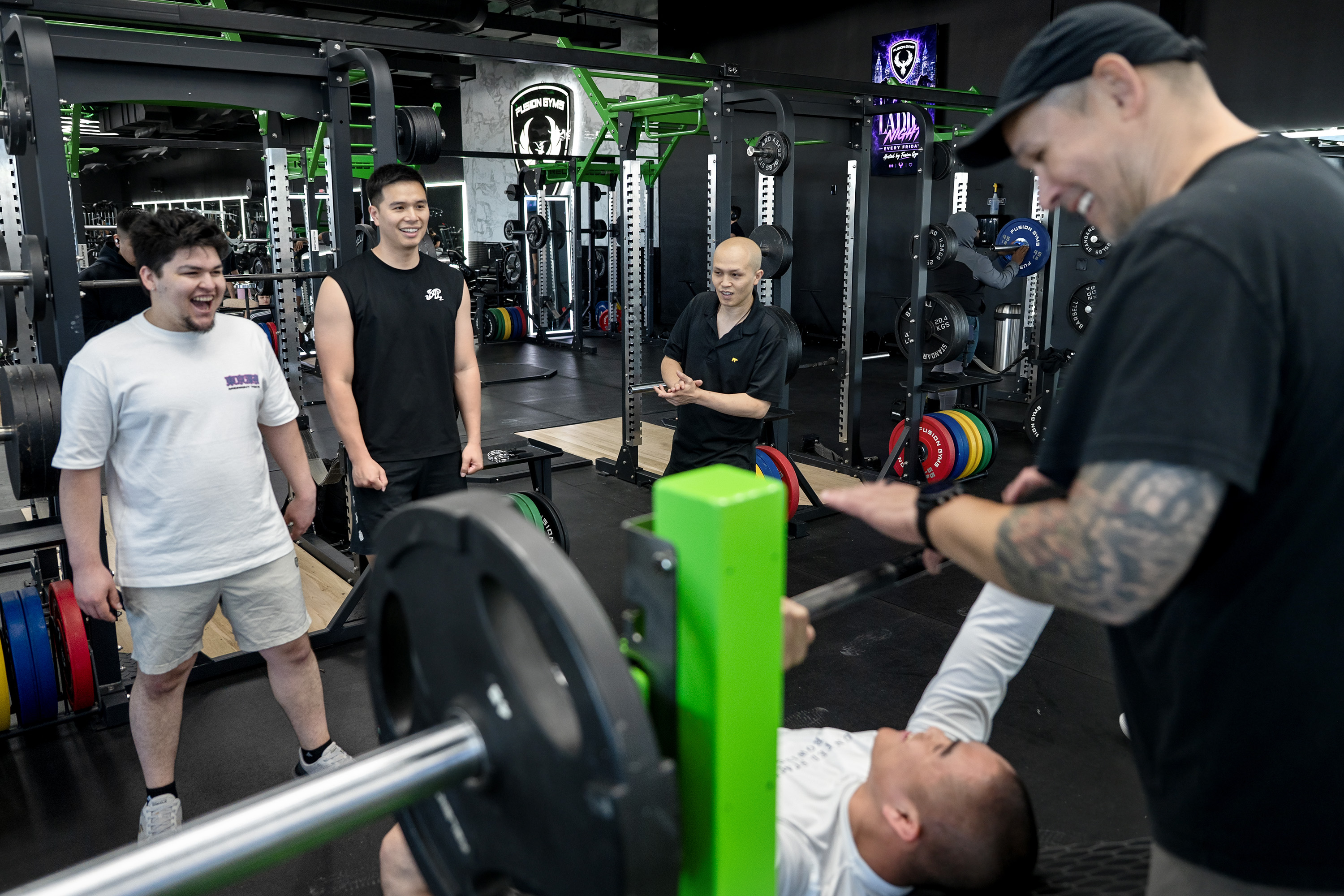
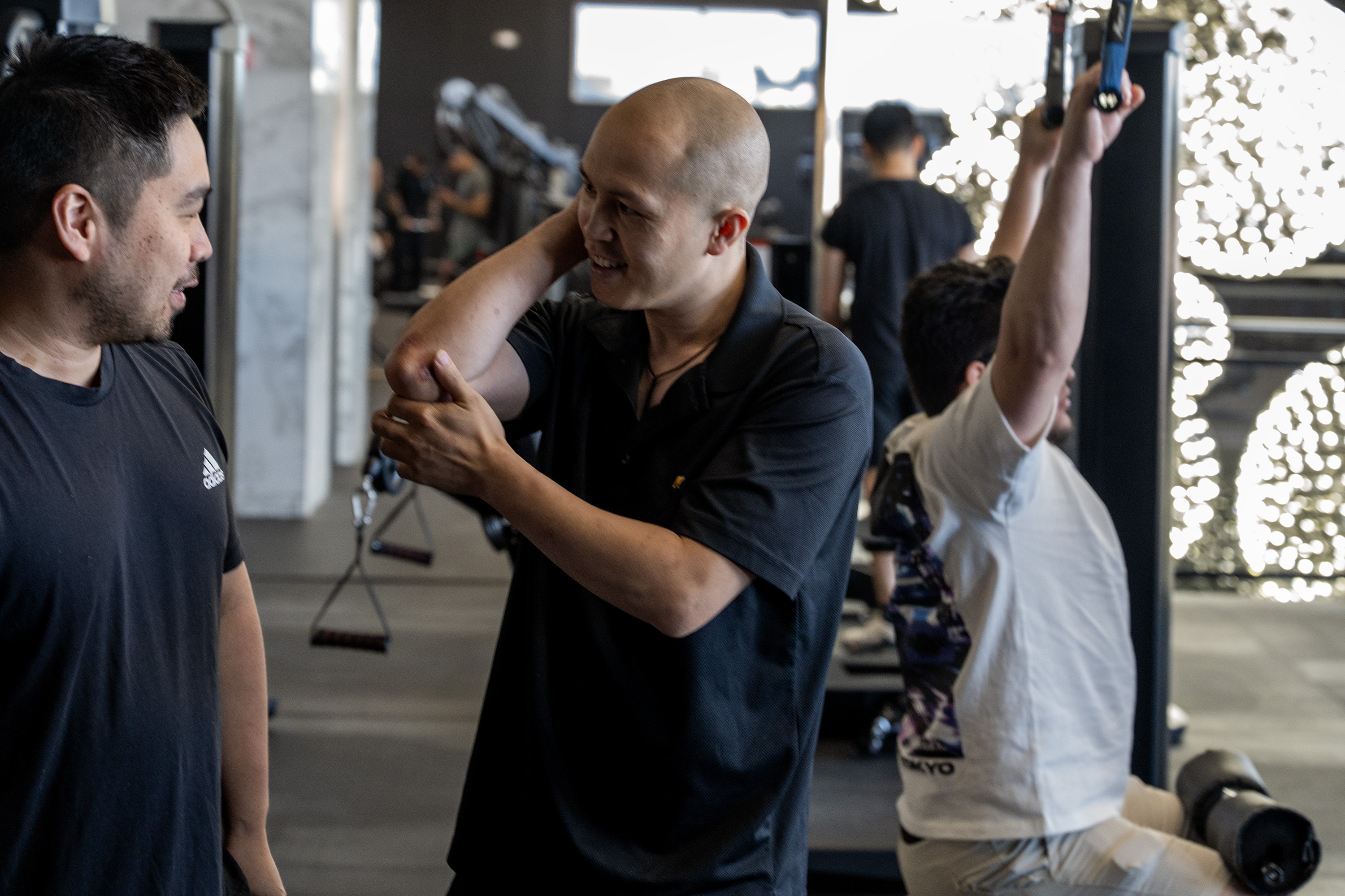
Sushi chefs work out at Fusion Gyms in South Philadelphia in August. They get together regularly, trading both exercise tips and fish intel. Clockwise from left: Carlos Wills, Albert Zheng, Alex Jiang, Kevin Yanaga, and Joseph Nguyen (on bench).Tom Gralish / Staff Photographer
Kevin Yanaga, 55, and Joseph Nguyen, 27 — partners in 637 Sushi Club’s Oma Cafe, which pairs fish with coffee — coached the others through Muay Thai moves while trying to convince the other chefs to join them on a November trip to Vietnam for a three-day Oma Cafe pop-up. “I need help prepping,” said Yanaga.
Sushi chefs work out at Fusion Gyms in South Philadelphia. They get together regularly, trading both exercise tips and fish intel. From front to back are Dan Santana, Carlos Wills, and Albert Zheng.Tom Gralish / Staff Photographer
At one point, Carlos Wills, 26, who helms the omakase counter at Ogawa, pulled up a list of available ingredients sent by his buyer from Japan’s Toyosu Market, the world’s largest wholesale seafood market, and showed Yanaga the $500 tray of uni and $55 60-sheet packet of nori that he was considering ordering once he was done working out.
On this Tuesday, the chefs were also drinking some of the world’s most expensive coffee, brewed by Nguyen. “It’s Orange Geisha and it’s expensive because it’s so rare and it takes half a pound of beans for me to brew one bottle,” explained Nguyen, who also owns and operates the Coffee Connoisseur Club. The Instagram-based subscription club sources beans from Nguyen’s plots in Vietnam and small farmers in South America. “This is a $250 bottle of coffee,” Yanaga interjected.
“I’m getting kumquat, jasmine, and orange notes coming from it,” said Nguyen. “I like saba [mackerel] paired with this, as the fattiness of it pairs with the bright citrusy notes. Saba with a little bit of wasabi.”
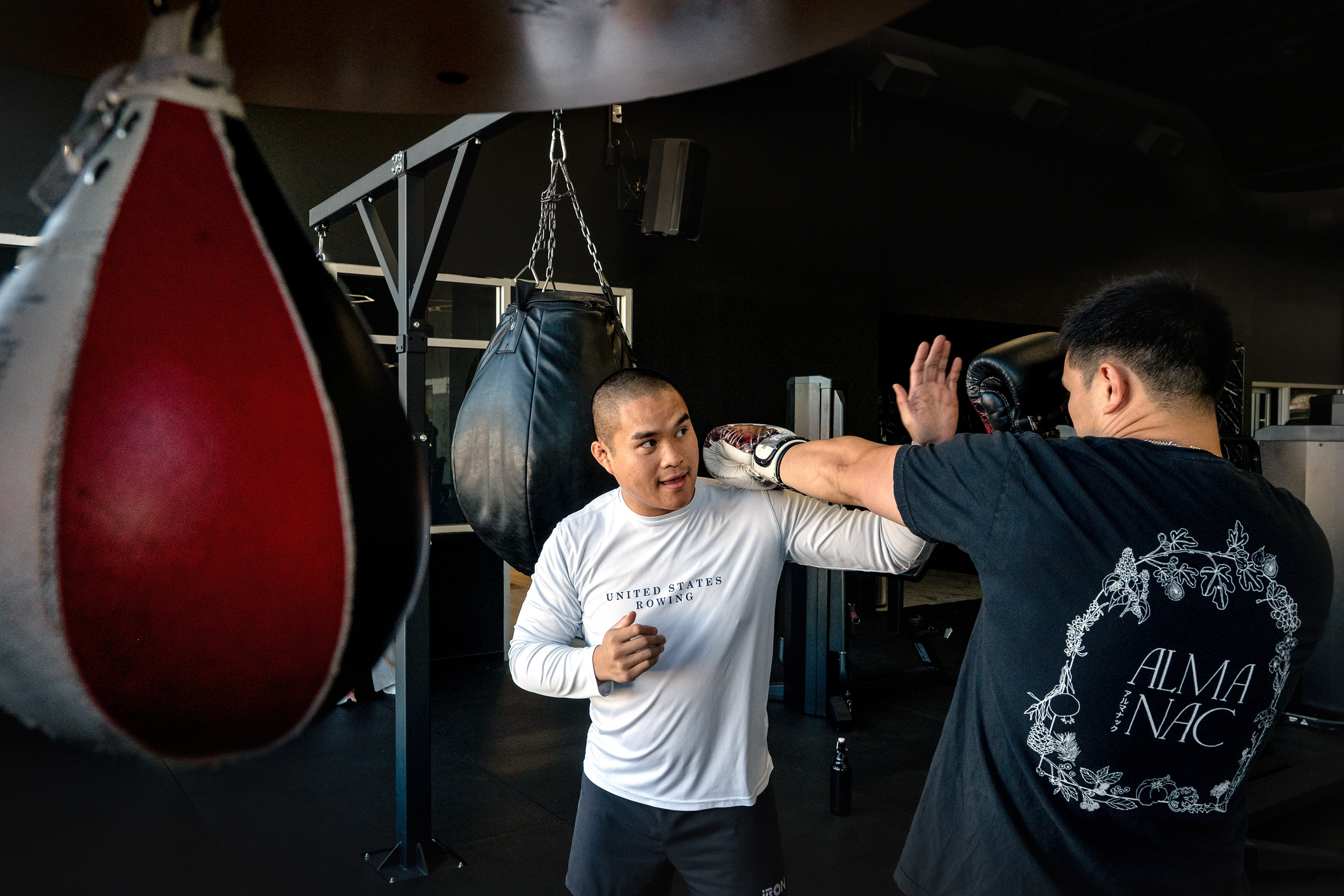
There was no saba in sight as Nguyen held a punching bag while Zheng jabbed, gently coaxing him on where to aim his punches. He did the same for Alex Jiang, 42, from Kichi Omakase. “We have a heavy jab over here!” he proclaimed.
Sushi chefs Joseph Nguyen (left) and Albert Zheng work on boxing at Fusion Gyms.Tom Gralish / Staff Photographer
When the crew moved on to bench-pressing, Wills said, “You can tell people this is how I prepare to lift a tuna.”
As Wills sat back on the weight bench and lifted the bar, he said, “This is a 60-pound tuna.”
The sushi chefs spot one another and cheer each other on: “One more! Half a tuna more! You’re very strong!”
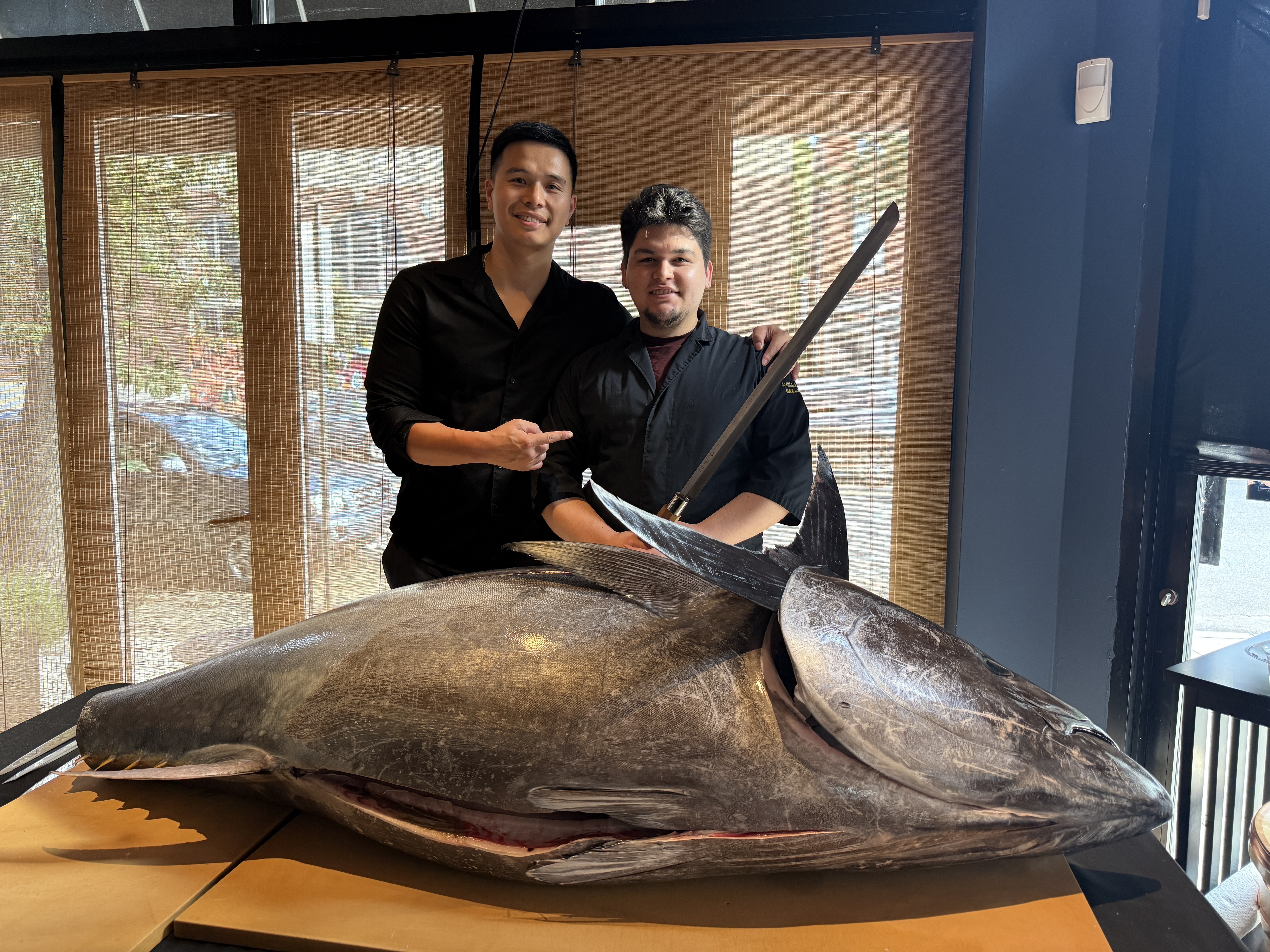
“I thought about bench-pressing the 281-pound tuna we brought into Javelin for the tuna breakdown last week,” said Zheng. “But it was so slippery.”
Sushi chefs like Albert Zheng and Carlos Wills say they work out to stay in shape for lifting fish like this 281-pound Spanish bluefin tuna at Javelin in Fairmount.Kiki Aranita / Staff /
“When we get a tuna like that, it takes eight of us to lift it,” said Yanaga.
“We got a Spanish bluefin last week,” said Wills. “It was $23 per pound, so just over $6,600. Pretty cheap. The Japanese ones are $31 per pound right now.”
“Who wants to do a whole tuna?” asked Zheng as he and Santana added more weights on to a bar for a round of dead lifts.
Nguyen steps up and dead lifts 315 pounds. “We’re hiring him for the next tuna breakdown,” said Wills.
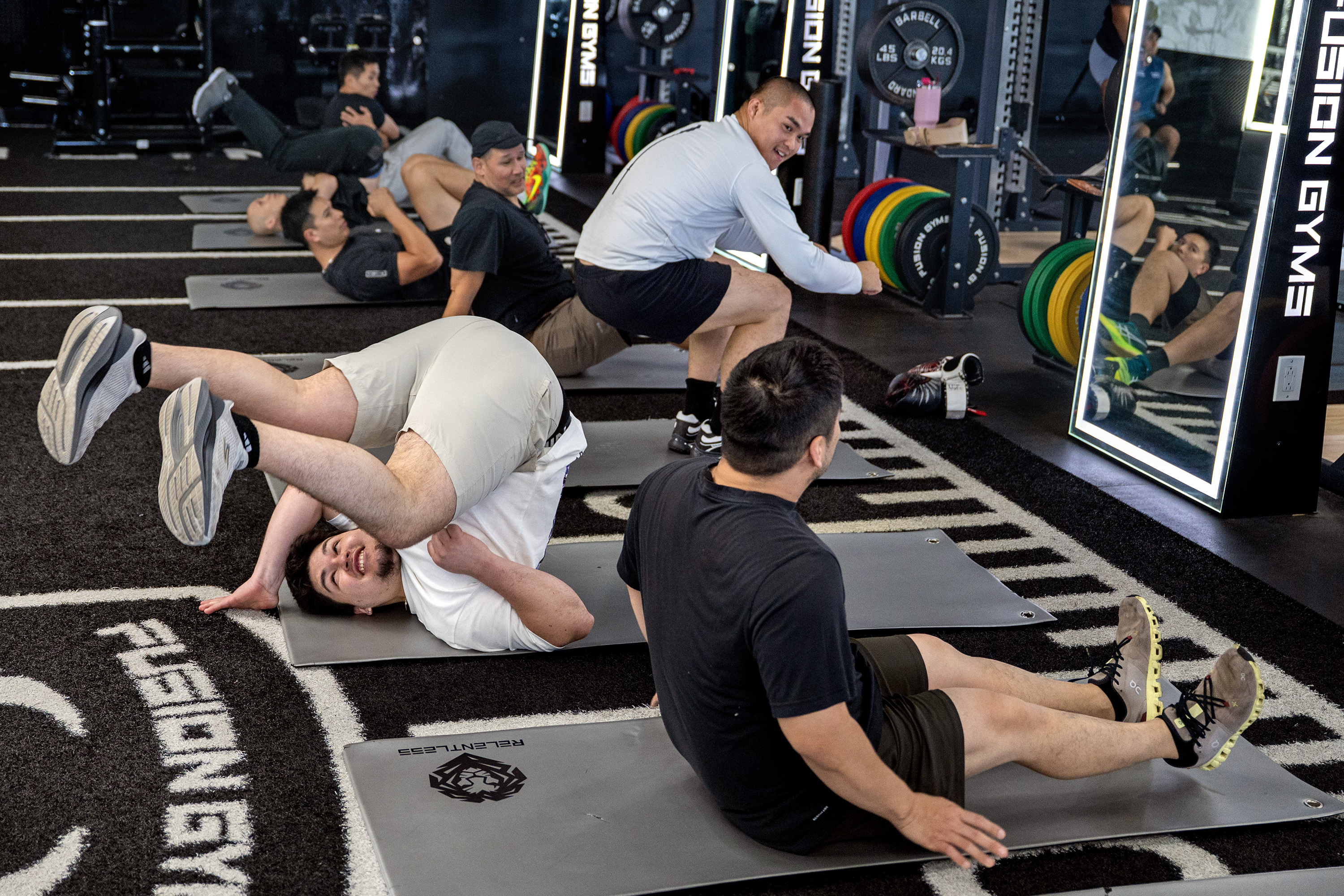
Sushi chefs (from left) Dan Santana, Alex Jiang, and Carlos Wills work out at Fusion Gyms.Tom Gralish / Staff PhotographerSushi chefs Albert Zheng (left) and Kevin Yanaga work on planks at Fusion Gyms in South Philadelphia.Tom Gralish / Staff Photographer
In fact, the chefs do often join up for tuna cuttings, helping one another out even if they aren’t in business together.
But mostly, the crew keeps one another accountable at the gym, welcoming each other even if weeks or months pass between workouts.
Once the coffee was consumed and their muscles were spent, the chefs dashed off in different directions, to their respective sushi counters.
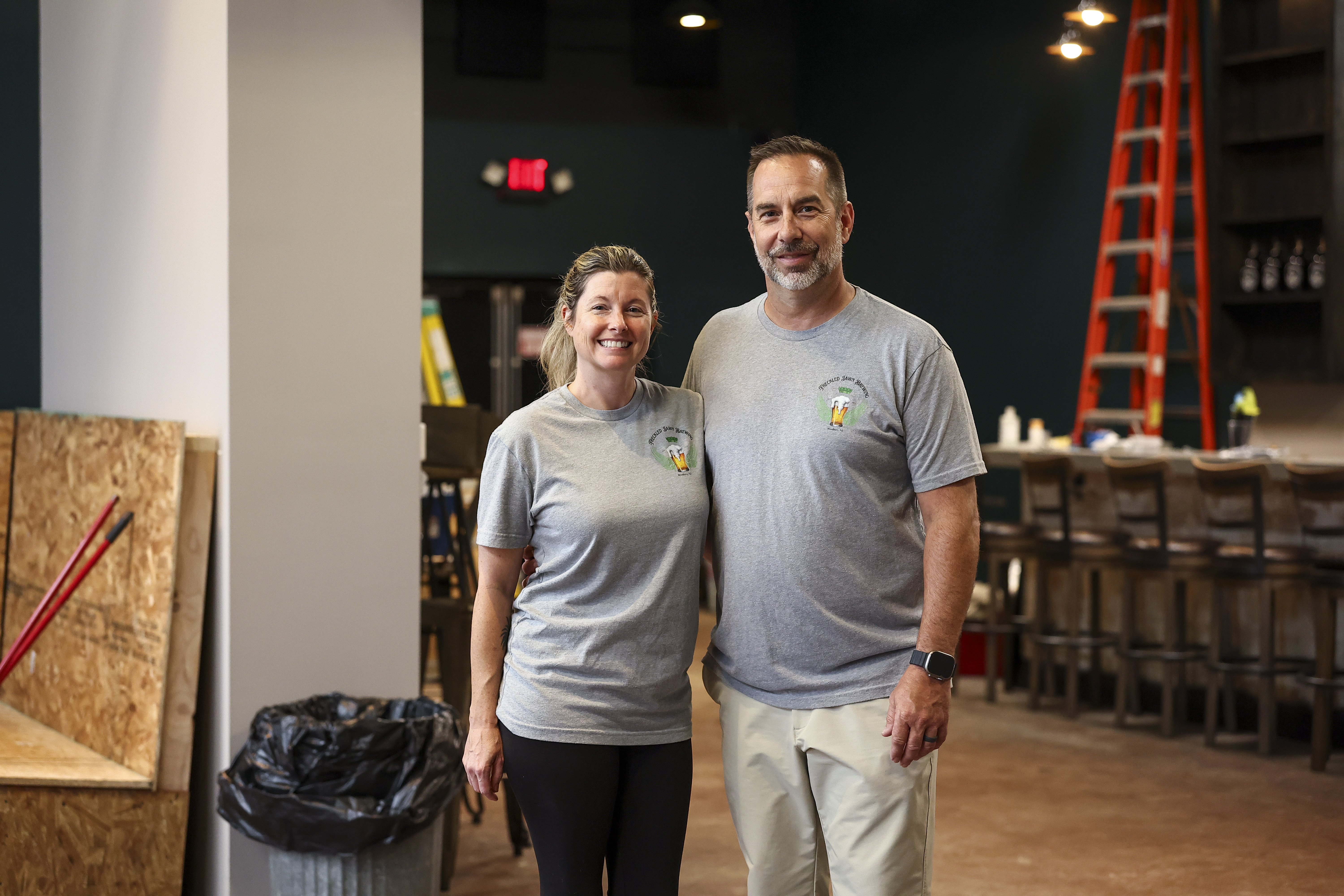
Woodbury residents John Wagner and Colleen Gibson never planned to own a brewery.
But when the husband-and-wife duo heard that their local drinking spot, Eight & Sand Beer Co. at 1003 N. Evergreen Ave., was up for sale last September, Wagner said they didn’t want to see a place so close to home shut down for good. They spoke with their neighbor, Woodbury’s former mayor Peg Hertrich, who connected them with the 10-year-old brewery’s owners.
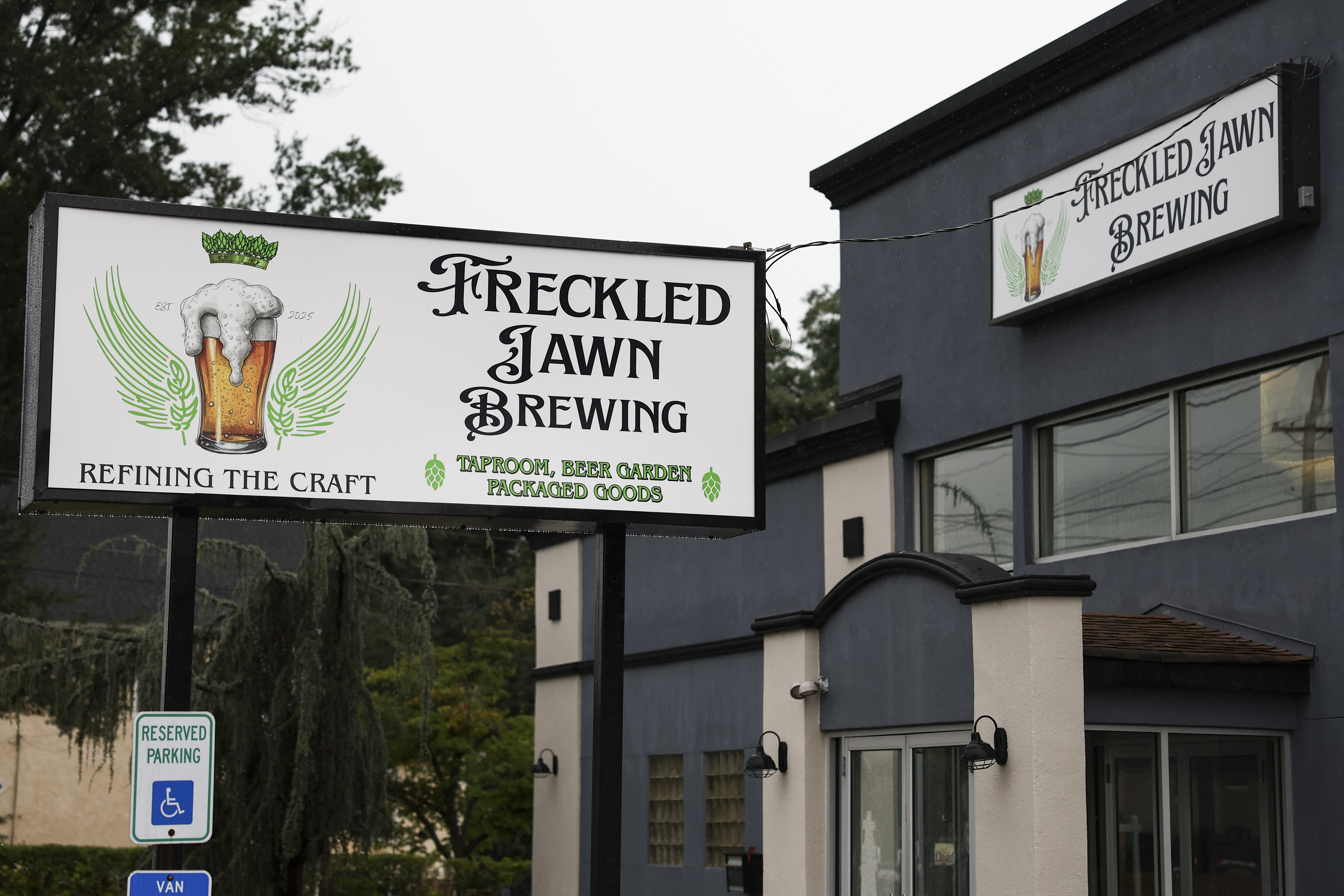
The exterior of the new Freckled Jawn Brewing on Thursday, Aug. 27, 2026 in Woodbury, NJ.Monica Herndon / Staff Photographer
“We never got an answer or a reason why not… so here we are,” Wagner, 53, said. “Fast forward almost a year later, and we’re getting ready to open.”
The couple, together for 12 years, officially closed on the 4,300-square-foot brewery (that includes the brewhouse) in Gloucester County in early August, months after Eight & Sand closed. The $730,000 sale, Wagner said, included brewery equipment and a vacant lot behind the building, which will help the couple expand the property’s beer garden come spring.
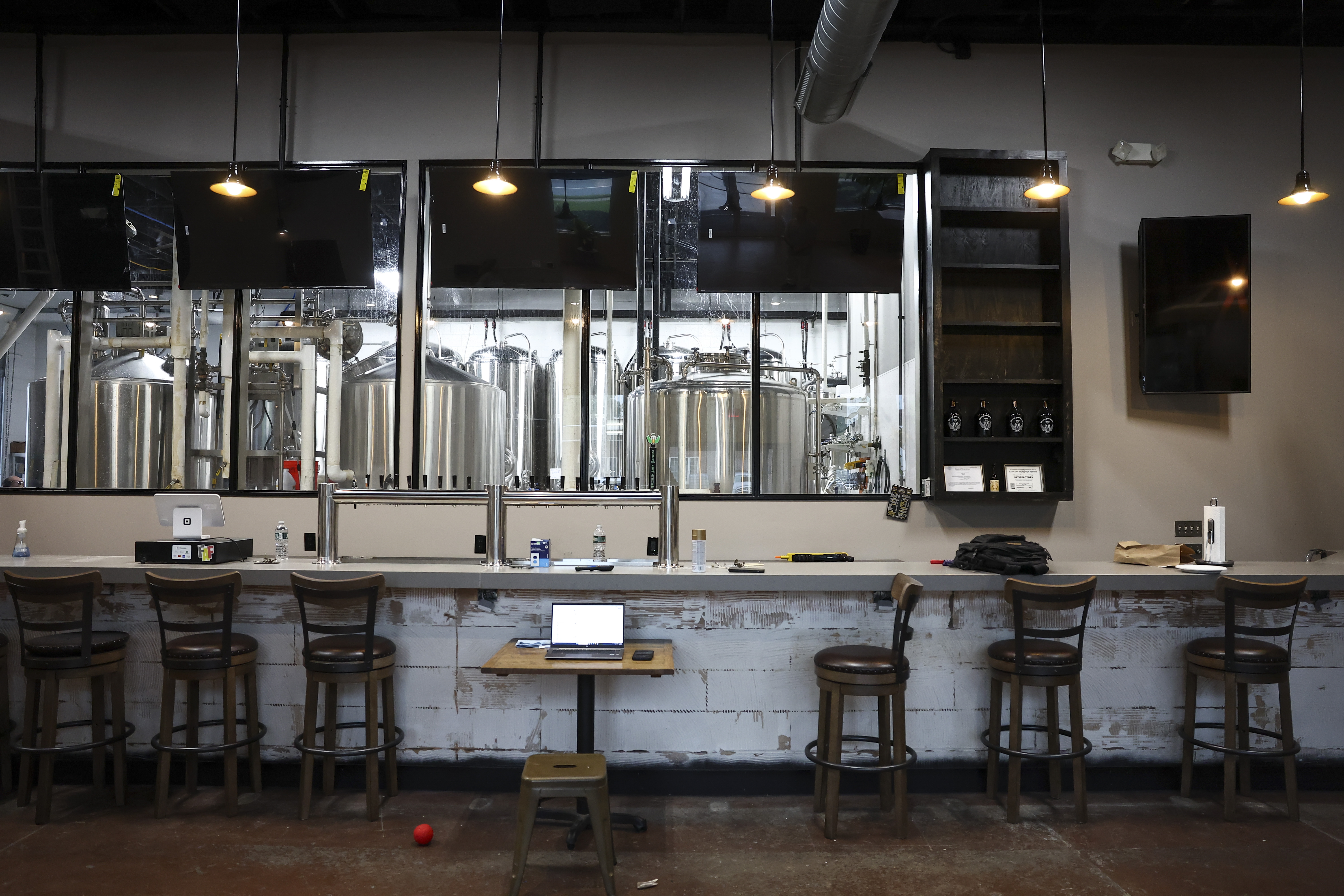
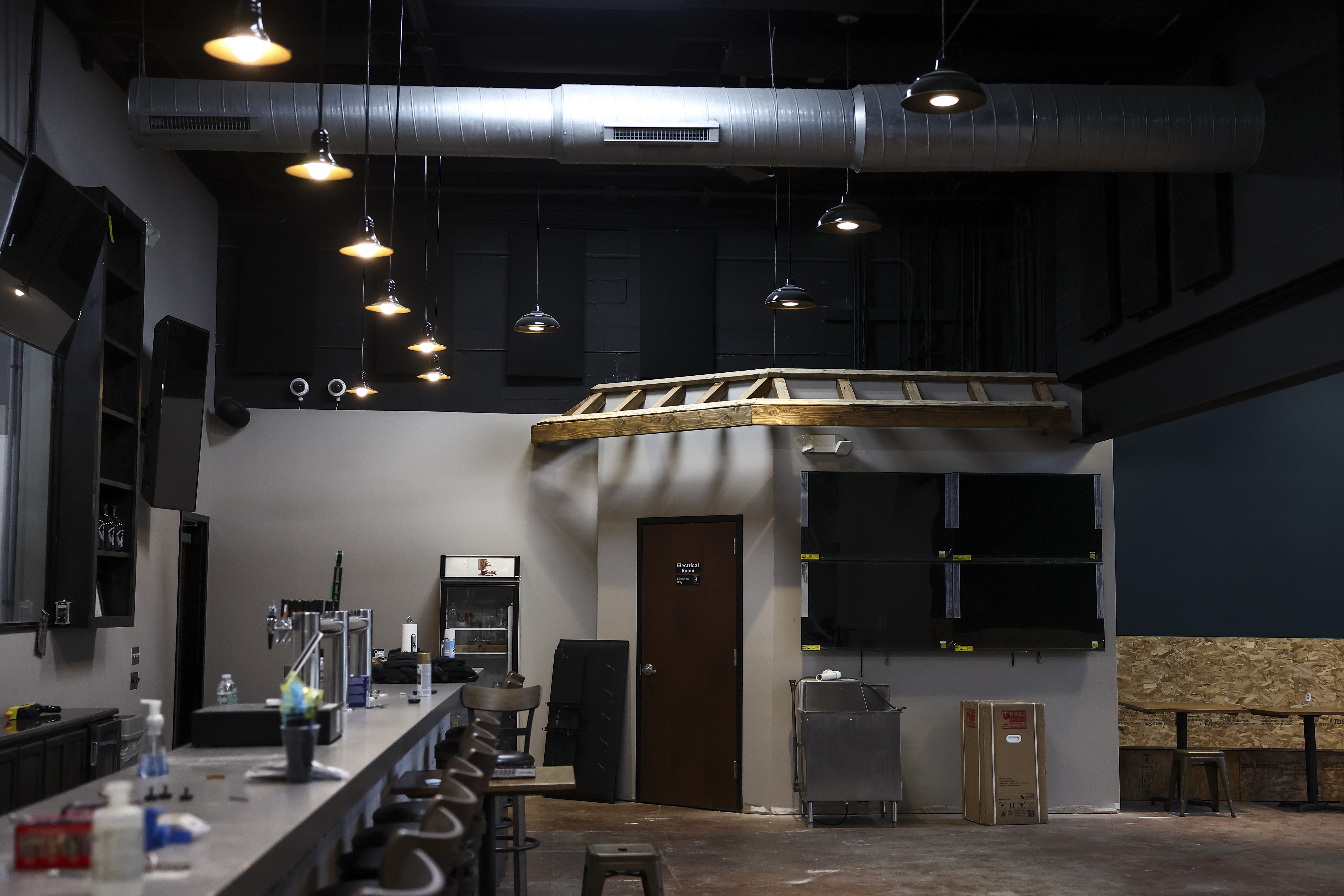
The in-progress interior of Freckled Jawn Brewing.Monica Herndon / Staff Photographer
Wagner and Gibson hope to open Freckled Jawn Brewing in the first week of October. An official date will come in the next couple of weeks, as they continue $40,000 of renovations and add new furniture to make the space feel less industrial and more inviting. Details will include leather and wood accents, an electric fireplace, dim lighting, and hopefully a touch of Philly sports.
“I just want the community to have somewhere they can go that they’re excited and proud to have in the neighborhood,” Wagner said.
The new brewery acquired Eight & Sand’s liquor license within 17 days of closing on the property, Wagner said, so Freckled Jawn has been clear to brew beer since Aug. 21.
The in-progress interior of Freckled Jawn Brewing on Aug. 27, 2026, in Woodbury, N.J.Monica Herndon / Staff Photographer
Three years ago, before their recent venture, the couple installed a basement bar in their South Jersey home for friends and family. They like to host St. Patrick’s Day parties.
They affectionately called the bar “Freckled Jawn Tavern,” Wagner’s 2 a.m. brainchild. The name was inspired by Gibson’s own freckles and the way she pronounces her husband’s name, John, as the multipurpose Philly term “Jawn,” a symptom of her Jersey accent. The new brewery kept it.
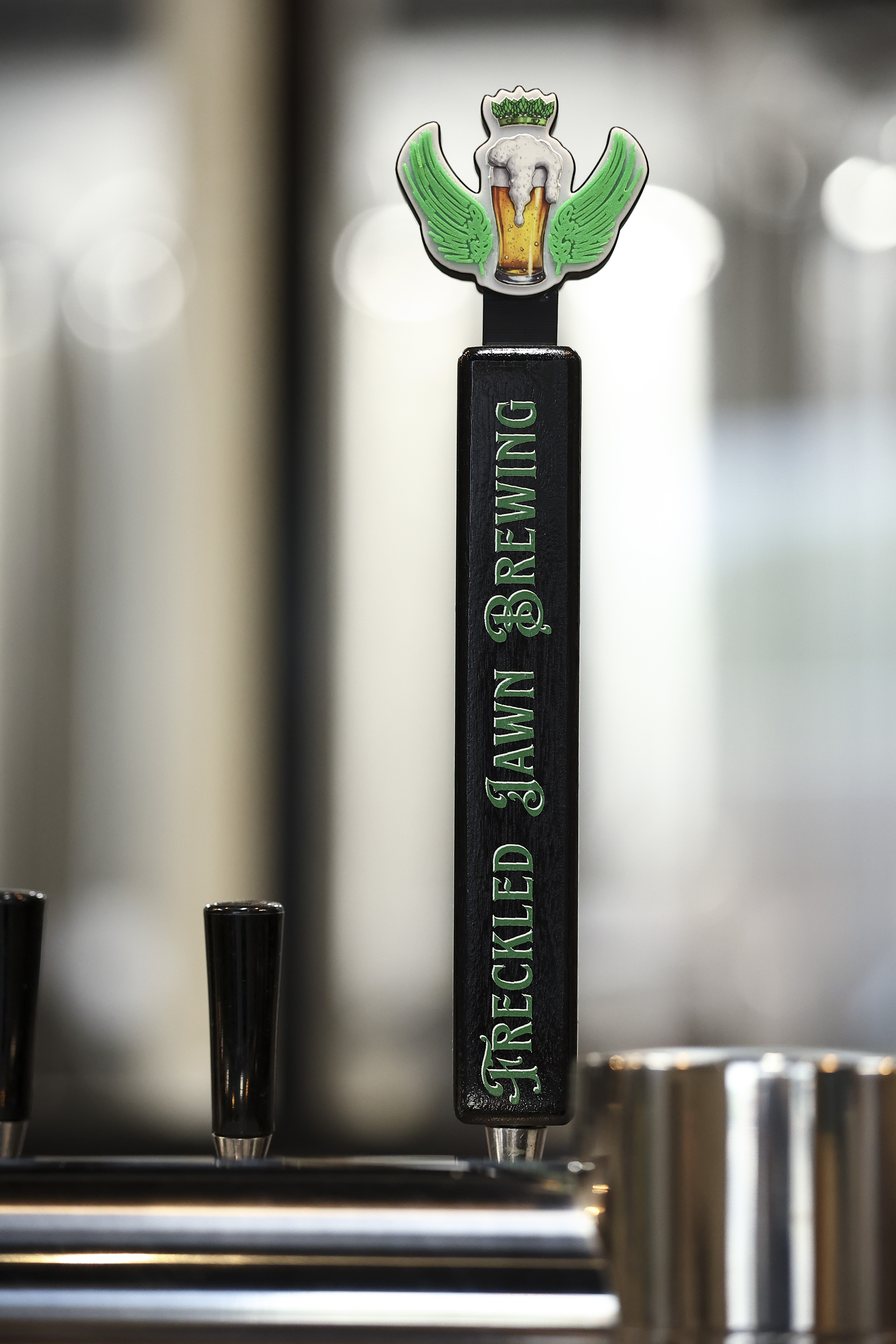
A Freckled Jawn Brewing tap in the in-progress brewery.Monica Herndon / Staff Photographer
“He calls me his ‘freckled jawn’ because I’m his anything and everything,” Gibson, 44, said.
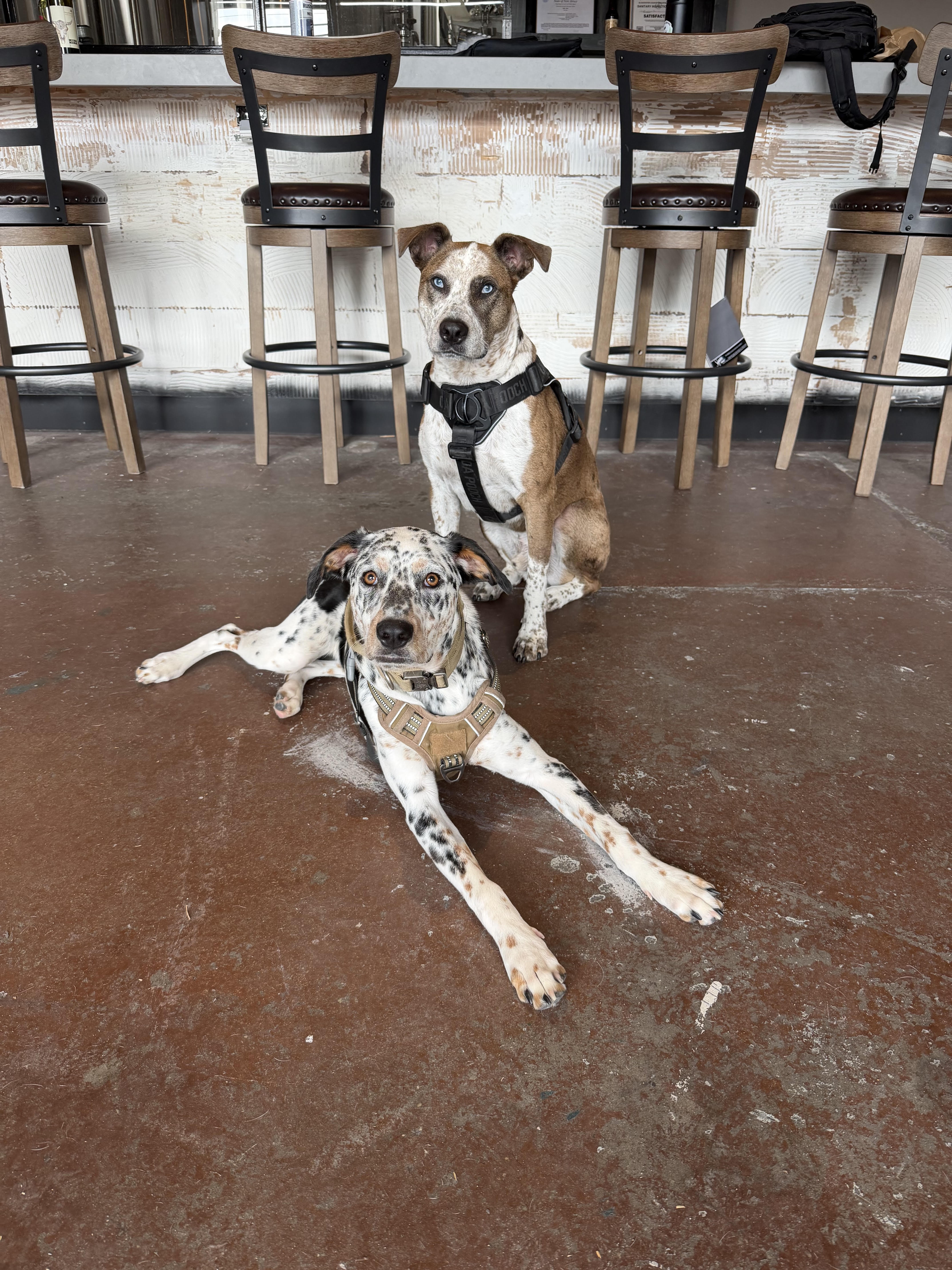
Plus, the couple has two freckled dogs, Neo and Trinity, adoptees named after The Matrix characters, who will be welcome in the brewery’s pet-friendly beer garden when it opens next year.
Neo (top) and Trinity (bottom) are the unofficial mascots of Freckled Jawn Brewing in Woodbury, Gloucester County, set to open in October 2026.Colleen Gibson
The brewery’s indoor tasting room has capacity for 77 people, while the expanded patio area will fit between 150 to 200 people, Wagner said.
Wagner and Gibson plan to run the brewery while continuing their jobs as managers in supply chain distribution and in transportation, respectively, in the Philly region, Gibson said. They’ll manage a staff under 10 to start, which will include some of their children, and head brewer Matt Karg.
The in-progress interior of Freckled Jawn Brewing.Monica Herndon / Staff Photographer
Karg, 37, moved to Philadelphia with his partner in July to be closer to family, and the head brewer position happened to open at the perfect time. He started brewing when he got out of the U.S. Coast Guard and went to North Carolina’s Asheville-Buncombe Technical Community College to learn brewing, distillation, and fermentation.
He previously brewed for Hickory Nut Gorge Brewery in Chimney Rock, North Carolina, before the spot was destroyed by Hurricane Helene in 2024, and then for Hi-Wire Brewing in Asheville. He said he’s eager to introduce people to Freckled Jawn’s Oktoberfest beer, made just in time for the fall opening.
“The New Jersey brewing scene is a close-knit community, which we’ve learned and loved. But everyone knows everyone,” Wagner said. “They almost know every brewer, so it’s exciting that nobody knows this guy.”
Ready for something new, Karg said his hope for the brewery is simple.
“Good beers and a good environment to sit and hang out for awhile,” he said.
The brewery started on an Oktoberfest lager, Wagner said, since it takes the longest to brew. Freckled Jawn will also serve a light lager, an IPA, a blonde ale, and a stout.
“We’ll continue to expand,” Wagner said. “But we don’t want to wait too long to open.”
Freckled Jawn Brewing’s hours will be 4 p.m. to 9 p.m., Monday through Thursday; noon to 10 p.m., Friday and Saturday; and noon to 7 p.m. on Sunday.
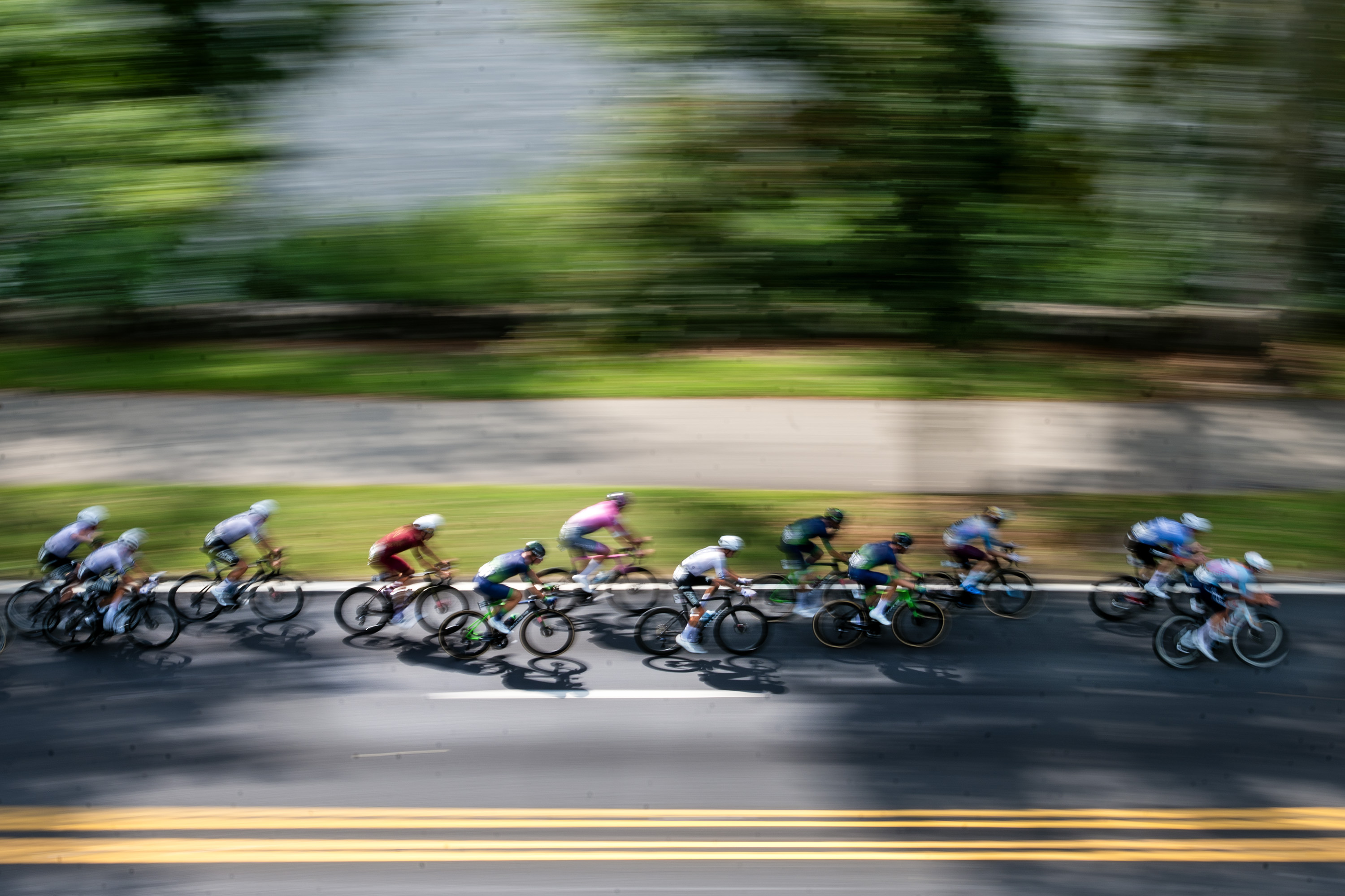
After decade-long hiatus, the Philadelphia Cycling Classic wheeled its way through the Benjamin Franklin Parkway to Manayunk this weekend.
The event, considered as one of the nation’s most storied races, has drawn cycling’s Olympians, national champions, and emerging talents to the city. The course is also a giant chessboard of strategy, aerodynamics, and aerobics.
On Sunday, it saw Italian cyclist Chiara Consonni place first in the women’s classic, and Germany’s Tim Torn Teutenberg won the men’s classic in a thriller.
For spectators, the event offered a unique opportunity in sports to see world-class competitors up close. Biking fans also came together to reminisce on its run from 1985 to 2016 and inspire folks “to go outside and get on the bike.”
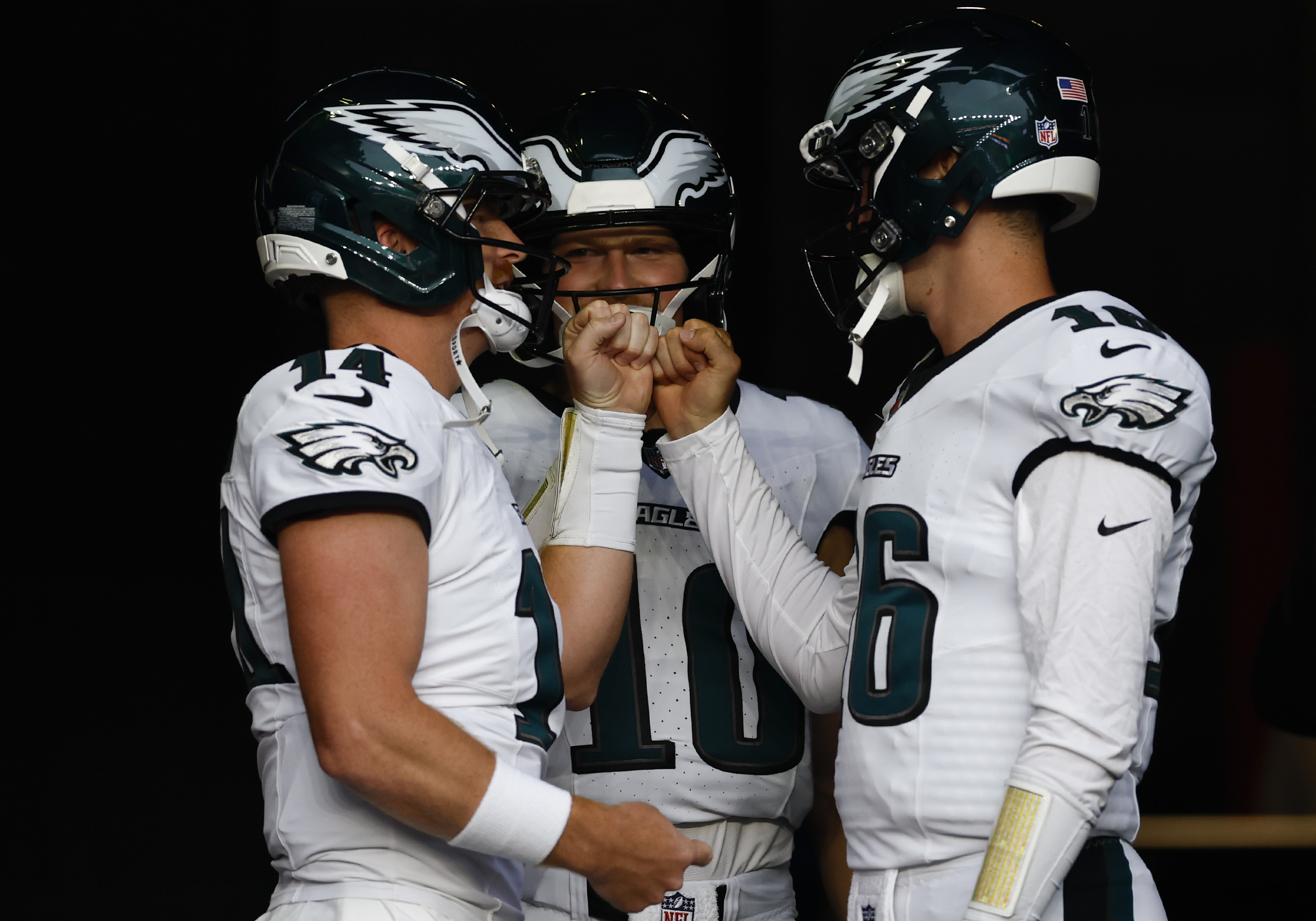
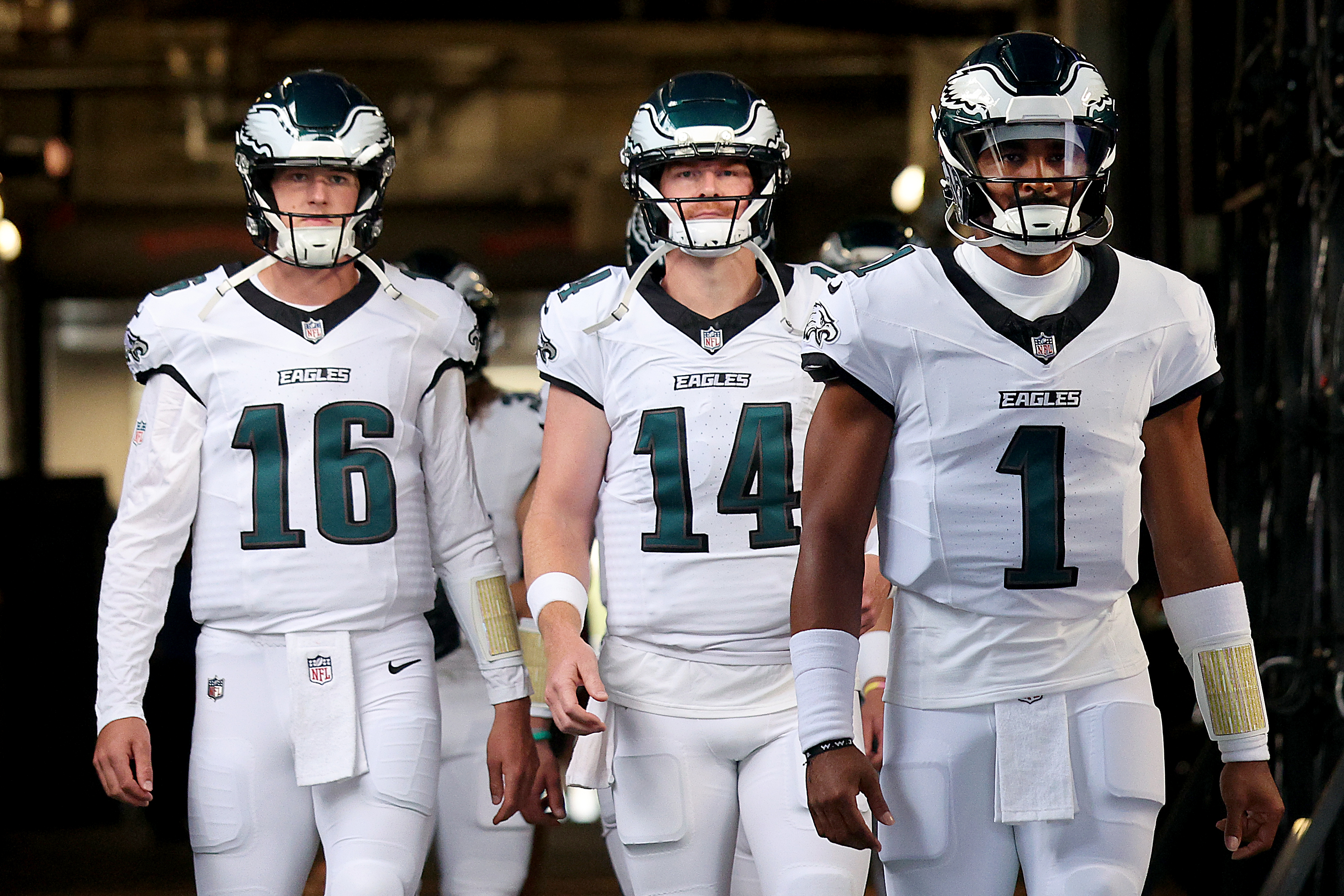
Eagles quarterbacks (from left to right) Andy Dalton, Cole Payton and Tanner McKee all made the 53-man roster announced Sunday.Yong Kim / Staff Photographer
The Eagles announced the active roster out of camp Sunday at the 6 p.m. deadline, and they plan to carry four quarterbacks to start the year. All three depth quarterbacks behind Jalen Hurts — Tanner McKee, Andy Dalton, and Cole Payton — made the cut.
However, neither Uar Bernard nor Joshua Weru, products of the International Player Pathway program, made the initial 53. But they could still return to the team.
Zack Wheeler throws during the first inning against the Los Angeles Angels on Sunday.Caroline Brehman
It wasn’t pretty at first, but Zack Wheeler found a way to battle back on Sunday and only allowed one run as he went on to complete six innings for the first time in over a month. The Phillies secured a 5-2 victory and pulled off the sweep in Anaheim.
However, this series revealed some sloppy baserunning against the Angels. Interim manager Don Mattingly, though, isn’t concerned about it. He says, “That’s going to happen now and then.”
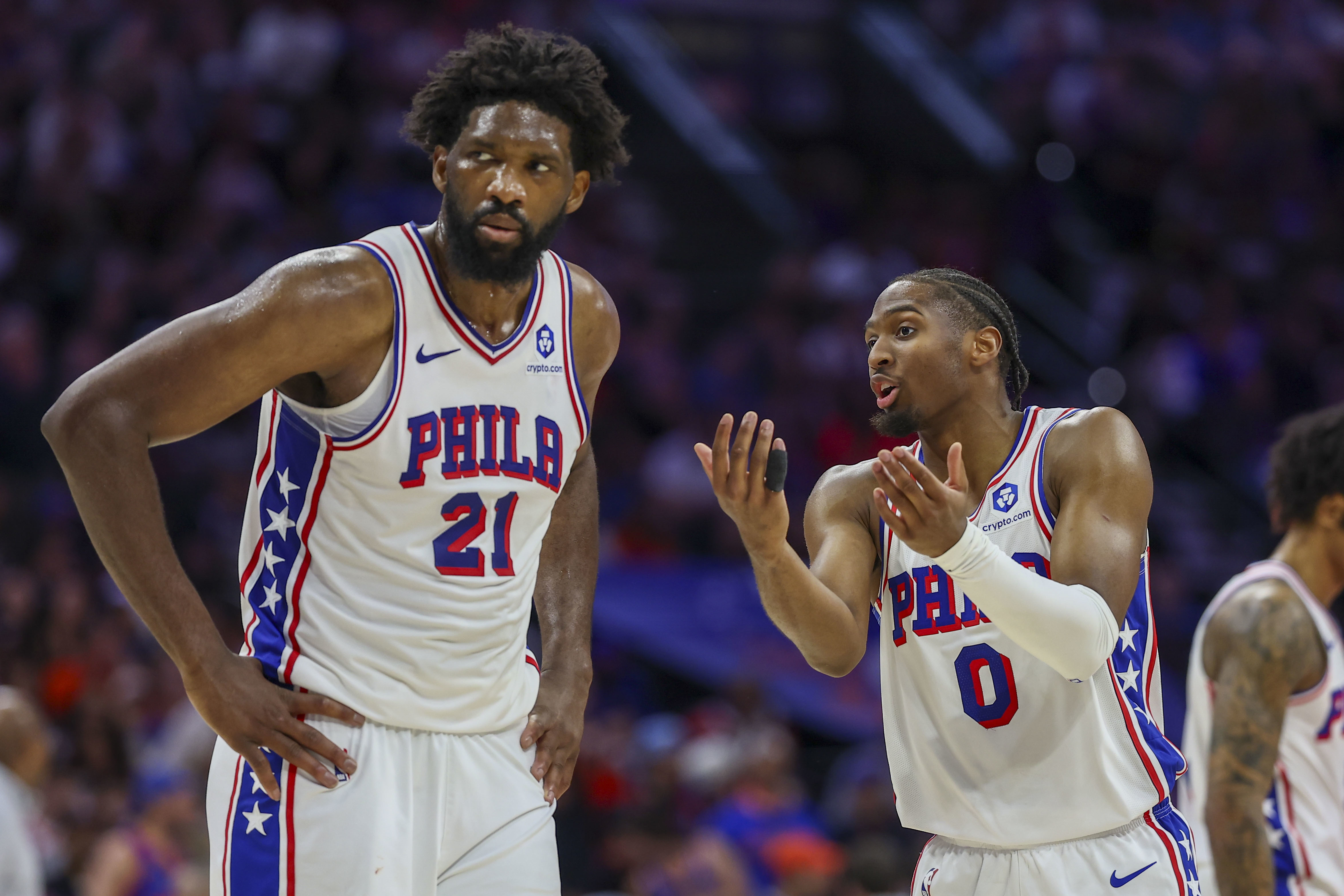
Sixers center Joel Embiid (left) and guard Tyrese Maxey will need to share the load with LeBron James, Jaylen Brown and VJ Edgecombe this season.Monica Herndon / Staff Photographer
The Sixers have formed a group that president of basketball Mike Gansey called the “Big Five.” But, with a star-studded lineup in LeBron James, Jaylen Brown, Tyrese Maxey, Joel Embiid, and VJ Edgecombe, someone will need to embrace change in order for the roster to succeed.
Our Sixers writers explain which member will need to sacrifice the most next season.
This trap of a ball in the air by Cavan Sullivan led to his highlight-reel goal in the Union’s win at Red Bull New York on Saturday.Philadelphia Union
The Union’s visit to Red Bull New York on Saturday drew the kind of hype that U.S. national team fans have waited to see for a domestic league game.
And Cavan Sullivan’s sixth goal for the Union’s first team — in a 3-1 rout of New York — was easily his most sensational. Sullivan continues to make his case to earn his first senior U.S. national team call-up for a four-game friendly in September and October.
There’s just a few weeks to go until Mauricio Pochettino will pick his team, and beside Sullivan, Neil Pierre, Frankie Westfield, and other Union players could be considered.
Eagles wide receiver Makai Lemon during training camp. Lemon has been dealing with soft tissue injuries this summer but remains integral to first-year offensive coordinator Sean Mannion’s scheme.Yong Kim / Staff Photographer
A.J. Brown’s departure gives Makai Lemon an excellent opportunity to make Sean Mannion’s new offense work. If there’s one thing you can safely say about the Eagles in its first year under Mannion: some wide receiver is going to have a breakout season.
The expectations for the Eagles’ 2026 first-round pick should be high. Because the bar is high. And he is the only one who has the skill set to clear it, writes columnist David Murphy.
The Eagles announced their 53-man roster at the 6 p.m. deadline on Sunday.Vaughn Johnson
Have any questions about the Eagles’ 53-man roster? Jeff Neiburg will answer them in an AMA in the r/Eagles Subreddit starting at noon Monday.
We compiled today’s newsletter using reporting from Maggie Prosser, Michelle Myers, Mia Messina, Conor Smith, Lochlahn March, Jonathan Tannenwald, DeAntae Prince, Chris Hine, Olivia Reiner, Jeff Neiburg, Isabella DiAmore, and David Murphy.
By submitting your written, visual, and/or audio contributions, you agree to The Inquirer’s Terms of Use, including the grant of rights in Section 10.
After being out on vacation, it’s good to be back! Hope you a had a restful weekend. I’ll catch up with you tomorrow. — Bella
If you have ever considered giving up your car, now is the time.
There’s the price of gasoline, which has shot up by more than 35% since President DonaldTrump launched the war against Iran in February. Even if you never start the ignition, simply owning a car will now set you back an average of $8,000 a year in insurance, maintenance, and loan payments.
And those are just the immediate costs. As a major source of greenhouse gases, cars contribute significantly to climate change, which is already pushing up the price of food and everyday purchases.
So, let’s say you’re ready to ditch your money pit on wheels. Then what?
I’ve been struggling with this question since I moderated a panel this spring with Sarah Goodyear and Doug Gordon, the duo from the popular podcast The War on Cars, who just published a rousing call to arms, Life After Cars: Freeing Ourselves from the Tyranny of the Automobile. The event, held at the capacious Resurrection Philadelphia church in Center City, was sponsored by Philly Bike Action and 5th Square Advocacy, two groups dedicated to promoting alternatives to driving.
Resurrection’s sanctuary was packed — with the converted. When Goodyear and Gordon asked the audience who had traveled to the event by car, only a few sheepish hands went up.
While their bookdoes a great job of detailing the ways cars “ruin everything,” there is little in it to help the car-dependent kick the habit. The problem is, most people have no idea where to start.
Even in the Philadelphia region, which has better-than-average transit and cycling infrastructure, the prospect of living without a car can seem a little like trying to swim without arms and legs. How will you take the kids to sporting events, look after elderly parents, and buy groceries without a vehicle? Our local transit services — SEPTA, NJ Transit, and PATCO — don’t serve every nook and cranny of the region and don’t run as frequently as they should.
Like everything else in America these days, the debate over the role of cars in our daily lives tends toward extremes. Philadelphia urbanists can sometimes come off as unsympathetic, as if they expect people to go cold turkey and swap their vehicles for bikes and SEPTA. Meanwhile, the pro-car lobby keeps insisting, against the evidence, that the car-free life is not practical outside a few transit-rich neighborhoods, like Center City.
But who says it has to be all or nothing?
‘Habituate walking’
My advice: Keep your car — for now, at least — but look for opportunities to get around by other means. Walk to the grocery store. Ride a bike to dinner at a nearby restaurant. Think of these excursions as a trial run. Once you feel comfortable, take the train or bus to work. You may never give up your car permanently, but you will save a bundle on gas and maintenance, reduce congestion, and boost your step count.
That’s how Jane Murray started weaning herself from the car. The Ardmore resident, who now runs a popular Instagram account called @Janewalksardmore, first began taking long walks as a way toexperience her Main Line town on a deeper level. To give shape to her Instagram project, she decided to visit every block in Ardmore and document her travels.
Jane Murray walks along Lancaster Avenue in downtown Ardmore, as part of a project to to walk every street in the Main Line town.Alejandro A. Alvarez / Staff Photographer
The more she walked, the more comfortable she felt leaving her car at home. She now wheels a “granny cart” to Trader Joe’s, a 15-minute walk from her house. Not long ago, she hopped a SEPTA bus to meet friends for quizzo in a pub a few towns away. At the end of the night, she took an Uber home.
Murray’s kids still have to take a bus the four miles to their middle school and she drives them to distant sporting events, but makes a conscious effort to “habituate walking” into her routine. Before leaving the house, she checks her transit apps to see if she can get to her destination without driving. Sometimes, she mixes it up: When she’s running errands, she’ll drive part of the way, then walk the last few blocks. Her Instagram has inspired her neighbors, who pepper her for tips about safe walking routes.
A mobility menu
Living in America without a car is often portrayed as a hardship, something that people on the margins are forced to endure. But, for me, living without a car has been a joy.
I didn’t know what to expect when I impulsively decided to get rid of my aging clunker 30 years ago after being presented with an expensive repair bill. Before then, I had rarely taken taxis or splurged on Amtrak to visit family in New York. Since I would no longer have to pay for car insurance, I promised to allow myself those indulgences. My husband and I were living in Center City, which certainly made our experiment more doable. (I should mention that I was pregnant at the time. I took a taxi to and from the hospital.)
Besides saving a lot of money, not having a car has liberated me in ways I never could have imagined. Bike lanes were virtually nonexistent in Philadelphia in the ’90s; today my bicycle is my main form of transportation. Thanks to the city’s mostly flat terrain, I can easily cycle to interviews and events in far-flung neighborhoods. My ride is equipped with side baskets, allowing me to do my grocery shopping by bike. When my destination is beyond biking distance, or when I have to look presentable, I’ll take SEPTA or reserve a Zipcar from the local car-sharing company. In a pinch, I can always summon an Uber, a Lyft, or a taxi. I still walk a lot, and it’s no exaggeration to say I run into people I know on every outing.
The key here is to think of mobility as a menu of options, rather than a car/no-car binary. While low-speed electric bikes have made it easier to cover long distances, not everyone can, or wants to, bike. Even transit can be daunting for a novice. The fear of crime also deters some people from using SEPTA, even though serious incidents have fallen dramatically in the last decade.
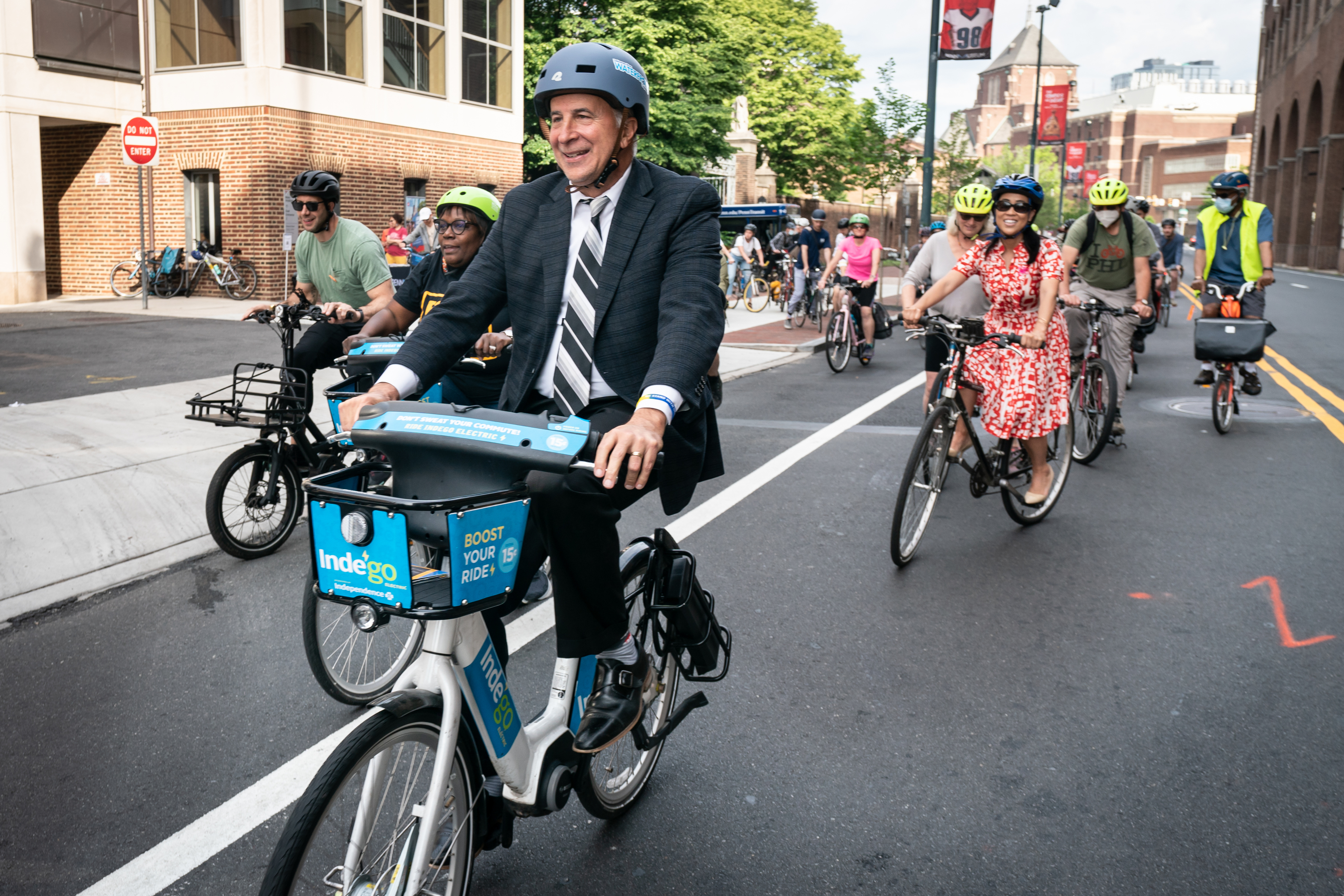
In 2022, Councilmember Mark Squilla (center), former Eagle Connor Barwin, Councilmember Kendra Brooks, and Councilmember Helen Gym took part in a Bike to Work Day event sponsored by the Bicycle Coalition of Greater Philadelphia to promote cycling as a means of transportation.JESSICA GRIFFIN / Staff Photographer
Eden MacDougall vividly remembers his trepidation when he started commuting from Langhorne, in Bucks County, to Temple University on SEPTA’s Regional Rail. “I kept thinking, how will I know it’s my stop?”
By the time MacDougall graduated in 2022, he was a super-commuter. To get to his new job at Mastery Charter School, where he is an AmeriCorps reading instructor, he had to use three forms of transportation: He started his day by biking two miles from his home to the Langhorne station. After taking a SEPTA train to Fern Rock, he changed to the Broad Street subway, getting off at Erie. The trip took an hour and 45 minutes, but MacDougall, who never learned to drive, loved it. “I’d open up my book and read the whole way.”
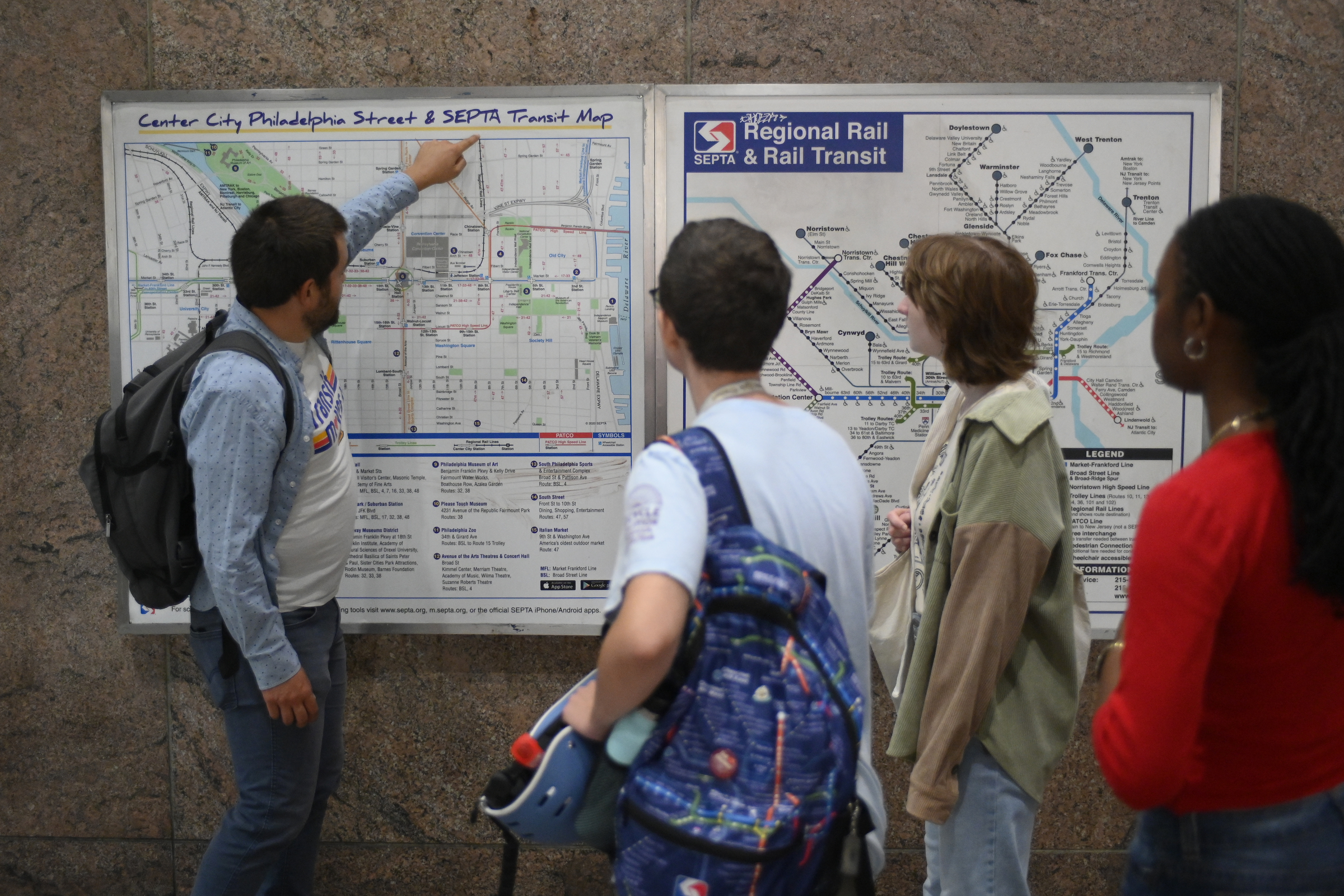
Stephen Bronskill, coalition manager for Transit Forward Philadelphia, shows incoming Temple University students how to navigate SEPTA during a tour organized at the start of the new semester. Bastiaan Slabbers / For The Inquirer
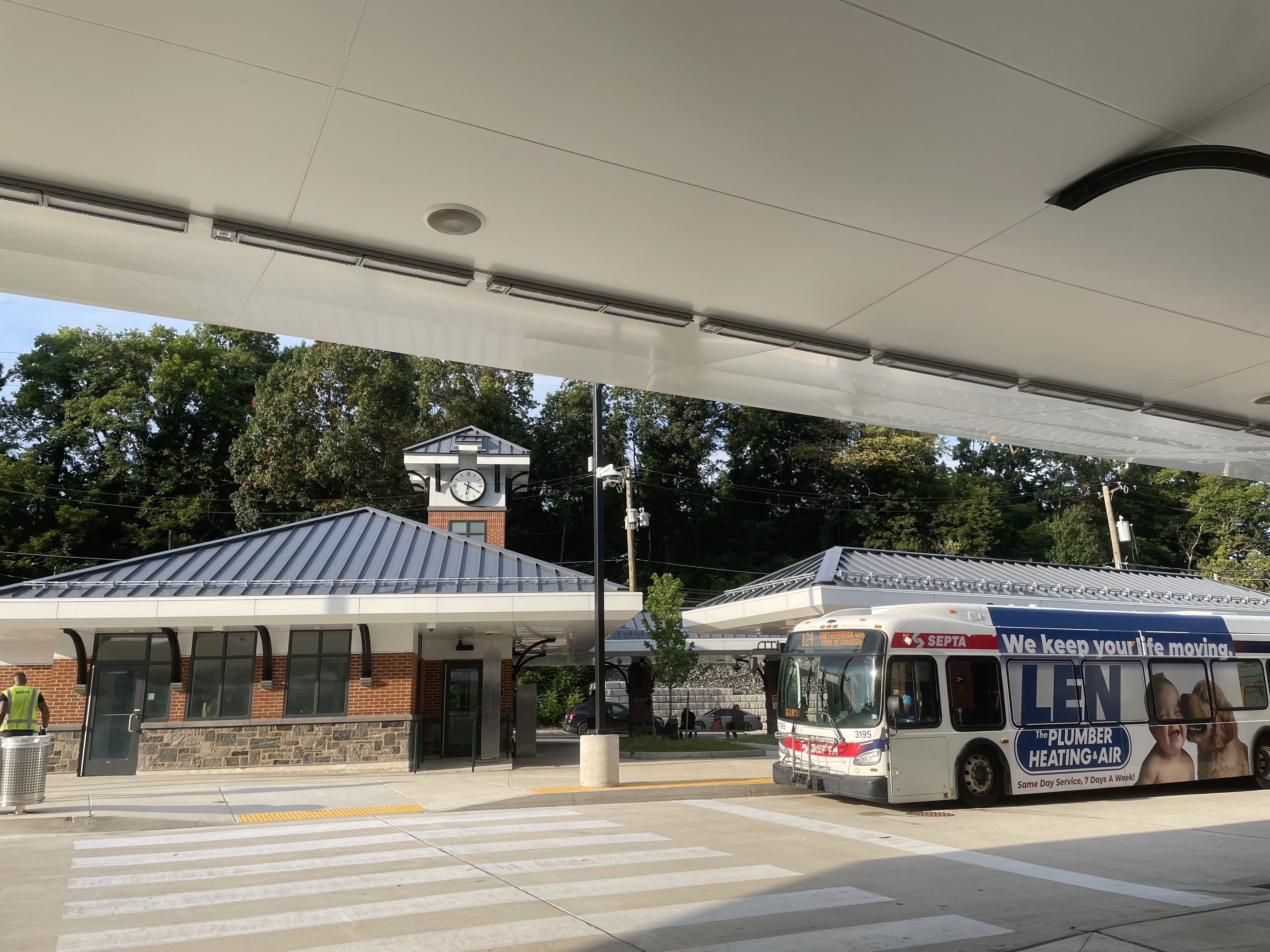
Now he lives in Philadelphia and volunteers as an instructor for Transit Forward Philadelphia and the Bicycle Coalition of Greater Philadelphia, which run Saturday tours to help people feel more confident riding SEPTA. Although the events provide practical advice, like how to use a transit app, they’re intended to be fun excursions. MacDougall recently shepherded a group from Roxborough to the Clark Park farmers market, showing them how to change from the Route 9 bus to a West Philadelphia trolley. Along the way, the group got to see SEPTA’s efficient new Wissahickon Transit Center on Ridge Avenue, where 11 bus routes converge.
The two groups, which have been lobbying the state legislature to help SEPTA secure much-needed state funding, started the Saturday tours as an extension of their advocacy work. They believe the exposure to SEPTA’s system can help reset public perceptions.
SEPTA’s new Wissahickon Transportation Center on Ridge Avenue in Manayunk is a major upgrade for the city’s bus riders. The sprawling, $50 million station opened in January 2026 and allows 5,000 passengers a day to switch between 11 bus lines. (photographeed Aug. 2026)Inga Saffron / For The Inquirer
“People had a lot of negative experiences during the pandemic,” Julio Rodriguez, the Bicycle Coalition’s policy director, told me. So, when SEPTA announced it was implementing its long-awaited schedule changes this summer, the transit advocates saw a chance to change the conversation.
Helping SEPTA boost ridership isn’t their only goal, however. Because they believe fewer cars will make Philadelphia a safer, more livable city, they’re organizing similar outings to get people comfortable with bike commuting.
Changing habits
Even while these advocates are gaining adherents, many skeptics remain convinced people will never give up their cars.
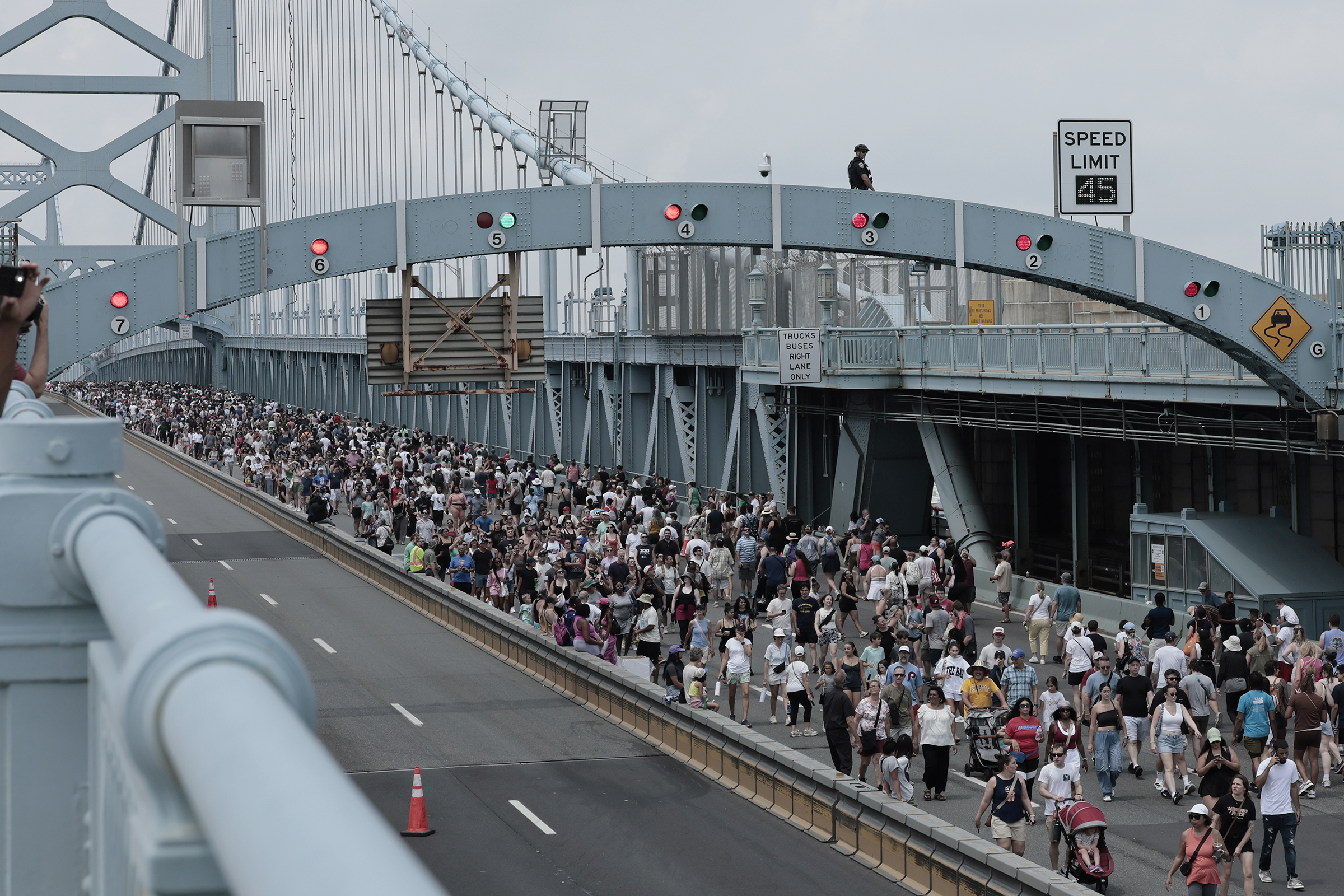
But the public’s cheerful response to this summer’s car-free celebrations around Philadelphia suggests that habits can change. Almost 600,000 people converged for World Cup watch parties at Lemon Hill in Fairmount Park during the 39-day FIFA Fan Festival — even though parking was banned. After the games ended, I saw hundreds of people streaming along the Schuylkill River Trail to 30th Street Station, a distance of 1.5 miles. Thousands took transit, rode bikes, or walked to the Ben Franklin Bridge to celebrate its centennial in July.
Thousands of people took transit, biked, or walked on July 11 to parade across the Ben Franklin Bridge to celebrate the 100th anniversary of its opening.Elizabeth Robertson / Staff Photographer
For people who switch to alternative forms of transportation, the payback is immediate. But Philadelphia and the region also have much to gain from having fewer cars racing through the streets: cleaner air, less noise, more casual social encounters with neighbors, and less wear-and-tear on infrastructure
The impact on climate change is a different story. Individual actions can only do so much to slow the dramatic shifts in global weather. It’s also a frustrating chicken-and-egg situation. People won’t see car-free living as truly feasible until there is intensive government investment in transit, bike infrastructure, and pedestrian safety.
Until that happens, carry a fare card, sign up for car-share, install a transit app on your phone — and don’t forget to wear ahelmet.
Thinking our way through the least climactic day on the NFL schedule. . .
The Eagles backup QB discourse has been a thrill ride over the last couple of years. We’ve gone from nothing-less-than-a-second-round-pick-for-Tanner-McKee to the Eagles trading for Andy Dalton to both-these-guys-stink to the Eagles keeping both quarterbacks plus rookie Cole Payton on their initial 53-man roster.
The only meaningful takeaway isn’t really a takeaway at all. More so, it’s a reminder of the longest-standing conventional wisdom in the game. In a league where half the teams don’t have a capable starting quarterback, nearly every team is going to have worse than that as its backup quarterback. It’s silly to suggest that the Eagles could have a better backup quarterback if only they looked outside of McKee or Dalton. What you see is what you get.
The devil is in the definition, as always. Gardner Minshew and Kenny Pickett were at the extreme upper end of capability among backups. Minshew has posted a .500 or better record in both of his seasons where he made at least 12 starts. Pickett (somehow) is 16-11 in his career. Yet, in their combined three seasons as Jalen Hurts’ backup, the Eagles lost three of the four games in which they attempted at least 16 passes.
Virtually every team in the NFL will be screwed if its starting quarterback goes down for an extended period of time. The only somewhat reliable exceptions are those teams that have invested significant draft capital or significant cap dollars in the No. 2 man on the depth chart. Nick Foles was an outlier. Even then, the Eagles were paying him more than triple what they are paying McKee and Dalton.
Eagles quarterbacks (from left to right) Andy Dalton, Cole Payton and Tanner McKee are all on the roster … for now. Yong Kim / Staff Photographer
The Eagles are at a point in their competitive and financial cycle where they can’t afford to be throwing around that Chase Daniel cheddar. The trade for Dalton was a workaround somewhat similar to the trade for Pickett. He is in the second-year of a two-year, $8 million extension, but the Eagles are responsible for a fraction of it.
In a best-case scenario, they get a backup QB who has shown the ability to, at the very least, give a team a chance at remaining relevant through a short- or medium-term absence. Dalton is just 2-6 in his starts since going 6-8 as a 35-year-old with the Saints in 2022.
But all of those starts were in relief of Bryce Young, who is just 14-30 himself over that span. That would be the equivalent of an additional three to four wins over 17 games compared to Dalton. Such a pace could be the difference between sneaking into the playoffs and giving up on the season for a team like the Eagles, who are expected to win 10-12 games with an upside well beyond that.
The actual calculus of Dalton versus McKee versus keeping both is far too marginal to be conveyed in an expository sentence. At such a minuscule level, the expected value between the lines must be compared to a variety of factors outside of the lines, including the expected value in practice or the film room of Player X versus Player Y.
That the Eagles have decided, at least for the moment, to keep both Dalton and McKee speaks to their regard for both. Ultimately, that regard, and the factors that compose it, will need to be weighted against the value of the additional roster spot that one of them will occupy. The real question isn’t Dalton versus McKee. It’s the other versus the lineman or defensive back or linebacker who isn’t currently on the roster because of them.
On that note. . .
Dollar for dollar, the biggest improvement the Eagles could make to their roster would be adding a running back who can do something different than Saquon Barkley and Tank Bigsby. Unless Will Shipley is that guy.
Will Shipley has caught only nine passes with the Eagles.Yong Kim / Staff Photographer
The most glaring anomaly on the Eagles roster is one that hasn’t gotten much attention over the last couple of years. Very few teams in the league have a less diverse running back room than they do. For the sake of the argument, let’s reduce it to a generalization that is overly broad and thus not entirely accurate. The Eagles don’t have a complement to Saquon Barkley, at least not one you’d classify as “pass-catching” or “change-of-pace.”
Unless Will Shipley is that guy.
I don’t necessarily think they need such a guy. I’m not even sure that such a guy would be attainable even if they thought they needed him. All I know is that they don’t have him. And, also, that his absence is worth contemplating for a team that should be looking for creative ways to distribute the touches that previously went to A.J. Brown.
The Ravens’ Justice Hill is the guy I think of when I think of a guy the Eagles could use. Two years ago, he touched the ball 89 times and gained 38 first downs with an average of 6.9 yards per touch. To put that in perspective, Bigsby gained 17 first downs on 61 touches with an average of 6.2 yards per touch in 2025. Meanwhile, Shipley has touched the ball a total of 57 times in the two years since the Eagles drafted him in the fourth round. That, with 13 first downs and 3.9 yards-per-touch.
Justice Hill caught 21 passes for the Ravens in 2025.Nick Wass
Is it a big thing? Maybe not. But it’s certainly an area where the Eagles can improve. Last season, they were one of only four teams in the NFL who didn’t have multiple running backs catch at least 10 passes. That’s not necessarily a bad thing. The Rams scored the most points in the league without a traditional pass-catching running back.
But the Eagles are clearly bucking convention in their backfield. We don’t even need to compare them to the rest of the league. Just look at their recent history. Even in 2024, when Barkley led the league with 345 rush attempts and 2,005 yards, Kenny Gainwell managed to catch 16 passes for 116 yards while carrying the ball 75 times for 290. Gainwell and Boston Scott were both members of the 2022 Super Bowl team. Go back to 2017. Think about Corey Clement’s touchdown catch.
The modern NFL game is all about mismatches, both between and within personnel groups. Tight ends are in vogue because they thrive on those margins. While Shipley brings top-end speed, he has yet to display the feel, shiftiness or receiving chops that would make him a competitive advantage in a dedicated package. Bigsby is the ideal back-up to Barkley, a power runner who you’d be comfortable handing off to 15-20 times a game. But he has 11 receptions in three NFL seasons. It just feels like the Eagles are missing an element.
BOSTON — Closure is a fickle concept, whether in relationships, friendships and even sports fandom.
When something ends, closure isn’t guaranteed, and people often have to move on from traumatic or life-altering moments without it.
The deep bond between a city, its people, and its sports heroes is a phenomenon with few parallels in life, especially those who have won championships and been as ingrained in their communities as Jaylen Brown was for 10 years with the Boston Celtics.
But rarely do those connections end without some sort of breakup, which can lead to hurt feelings and confusion. As Brown said recently, “I just threw my phone across the room” when he heard the Celtics were trading him to Philadelphia for Paul George and draft picks.
His life and the lives of Celtics fans all over Boston became a lot different, and the trajectory of his new franchise changed, since that move also led LeBron James to pick the Sixers as his next and potentially final basketball home.
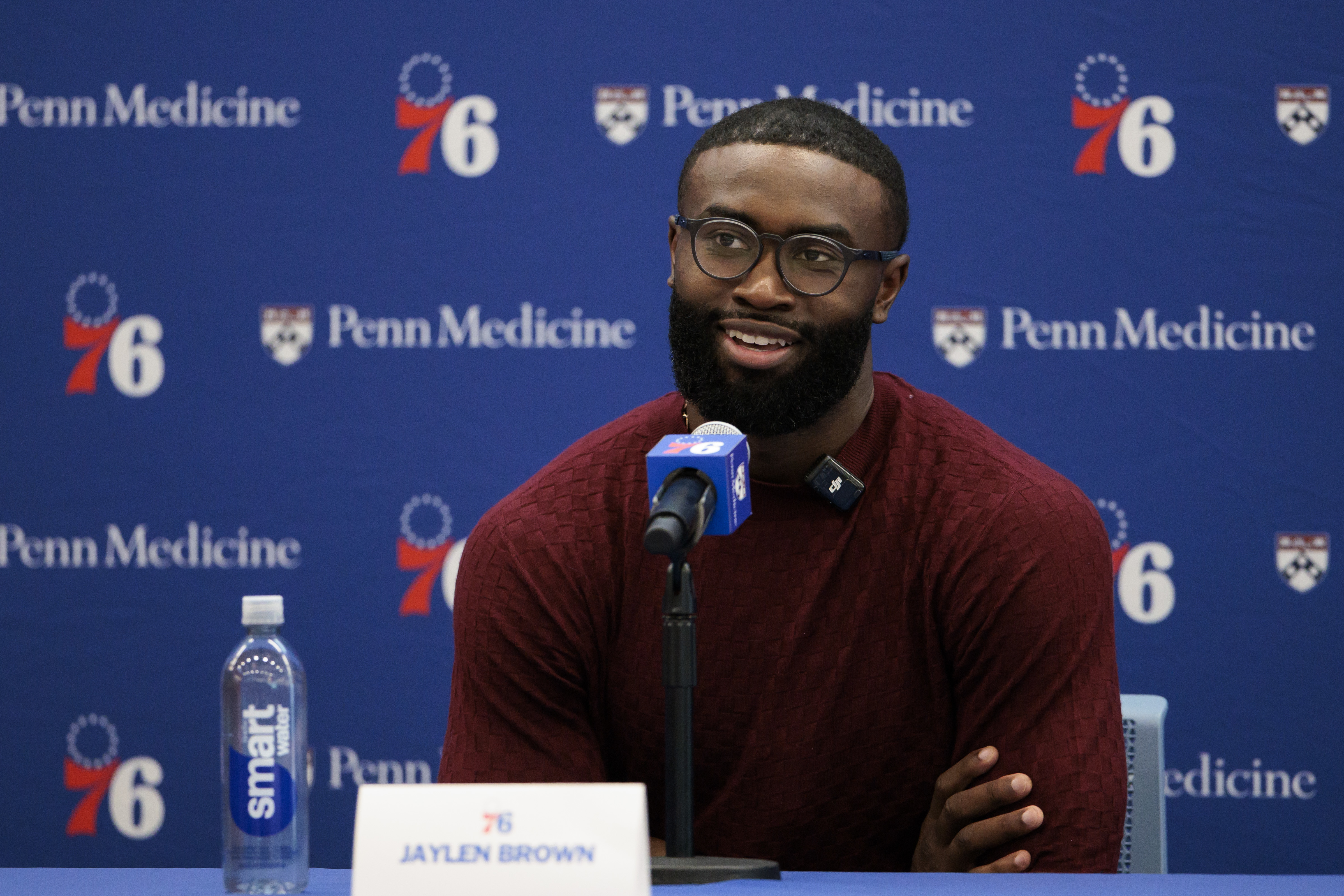
But before Brown officially gets going in Philadelphia when training camp starts with Media Day on Sept. 28, he had one bit of business to take care of in Boston — saying thank you. Brown did that Sunday with a block party and concert in Boston Common, which he titled the 741 Frequency Fest. He didn’t say much — he only addressed the crowd briefly two times — and he joined rapper A$AP Ferg for a performance of their collaboration “Just Do It.”
“I ain’t got too much to say because I’m at a loss for words,” Brown said. “I’m seeing all these people out here and I love each and every one of y’all. … I’ve been in this city for close to 10 years. I said I was gonna go to war for this city when I first got here.”
To Brown, that extended beyond the court, with city and state officials coming to offer Brown the key to the city and a commemorative street sign that said “Jaylen Brown Way.”
“Every minute that he has, he poured into the city,” Boston mayor Michelle Wu said. “We’re never going to let you forget us.”
Upon entering the Common, a large poster said “Thank you, Jaylen. Love, the city of Boston.” Fans could take a marker and sign the wall or write a message to Brown.
Here in Boston today, writing about the block party Jaylen Brown is throwing for the city. pic.twitter.com/SngbNaL1um
One such fan was Roberta Hayes-Bautista, a California transplant who has lived in Boston for over two decades and cited Brown’s commitment to the community, specifically with significant amounts of his money, as why Brown is “one in a million.”
“Gut punch,” Hayes-Bautista said of the trade. “I don’t think you’ll ever be able to replace him. This right here, who’s ever done this before? Nobody.”
Hayes-Bautista was referring to the block party in front of her. For most of the afternoon, it was a relaxing day in the park, with a DJ providing music from the stage where Brown and artists like Lil Jon and Lil Baby would eventually perform. The stage also displayed the Larry O’Brien Trophy Brown won with Boston in 2024, along with his Eastern Conference Finals and NBA Finals MVP trophies.
Fans stood behind barricades about 15-20 feet from the stage from around 1:30 p.m. waiting for Brown to come out. Food trucks lined the pathways, and there were a few different basketball games around the Common. In the meantime, fans flowed in to take advantage of a book bag giveaway, haircuts, and manicures. Cloud cover hid the sun and made for a comfortable afternoon.
That allowed Mary Vincent, who said she is a Celtics season-ticket holder, to come out with her family and greyhound Sangria, who was dressed up in a Celtics shirt. Vincent wanted to come out and support Brown even as she is recovering from a knee replacement.
She said she plans on giving up her season tickets and wasn’t buying the Celtics’ reasoning for trading Brown. Celtics President Brad Stevens said multiple times last month that trading Brown would give the team more “optionality” into the future. That wasn’t much of as an excuse to Vincent and the thousands of people who showed up Sunday.
“There was nothing wrong with the team. I think we had another possibility of winning another championship,” Vincent said. “I thought we would keep Jaylen Brown and Jayson Tatum through their whole careers. It was such a shock to me. I was grief-stricken.”
Hence why Brown felt a unique day like Sunday was necessary, a part of the processing of the trade for him and for fans.
Brown showed up to the event around 4 p.m., and mostly stayed quartered off from the crowds either on stage or behind it, except for one stretch of time when he walked down Charles Street as fans followed behind him. As the event wrapped up around 6:15 p.m., local and state officials made presentations to Brown, who was moved by the gestures.
“When I first got to Boston, none of this I imagined,” Brown said. “My grandma and my mom taught me to just dive into my community, so I was expecting nothing like this.”
A couple of the people who spoke on stage said they hoped Brown might make this party a regular thing. But those words sounded like people stating that they’ll still hang out after a break up, knowing that likely won’t be the case. There will still be more finality to Brown’s departure the first time he sets foot on the TD Garden floor in a regular-season game wearing a Sixers jersey. That day, slated for Jan. 21, is still about five months away. It won’t be easy for anyone involved.
“I don’t even know what to say,” Brown said. “I don’t do stuff for recognition, but I’m so grateful it’s so many people here. The feeling is mutual. Just know, Boston, I love you.”
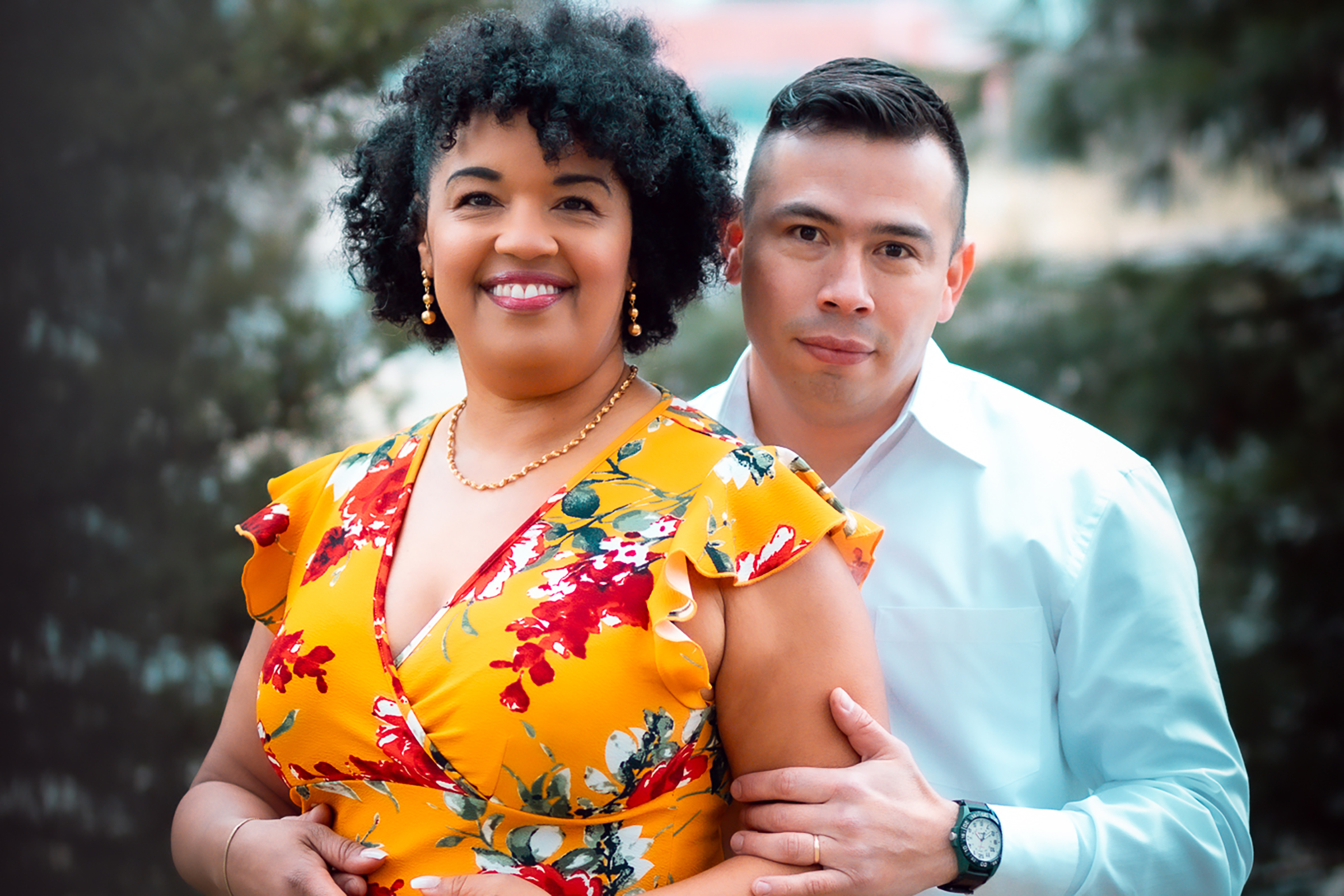
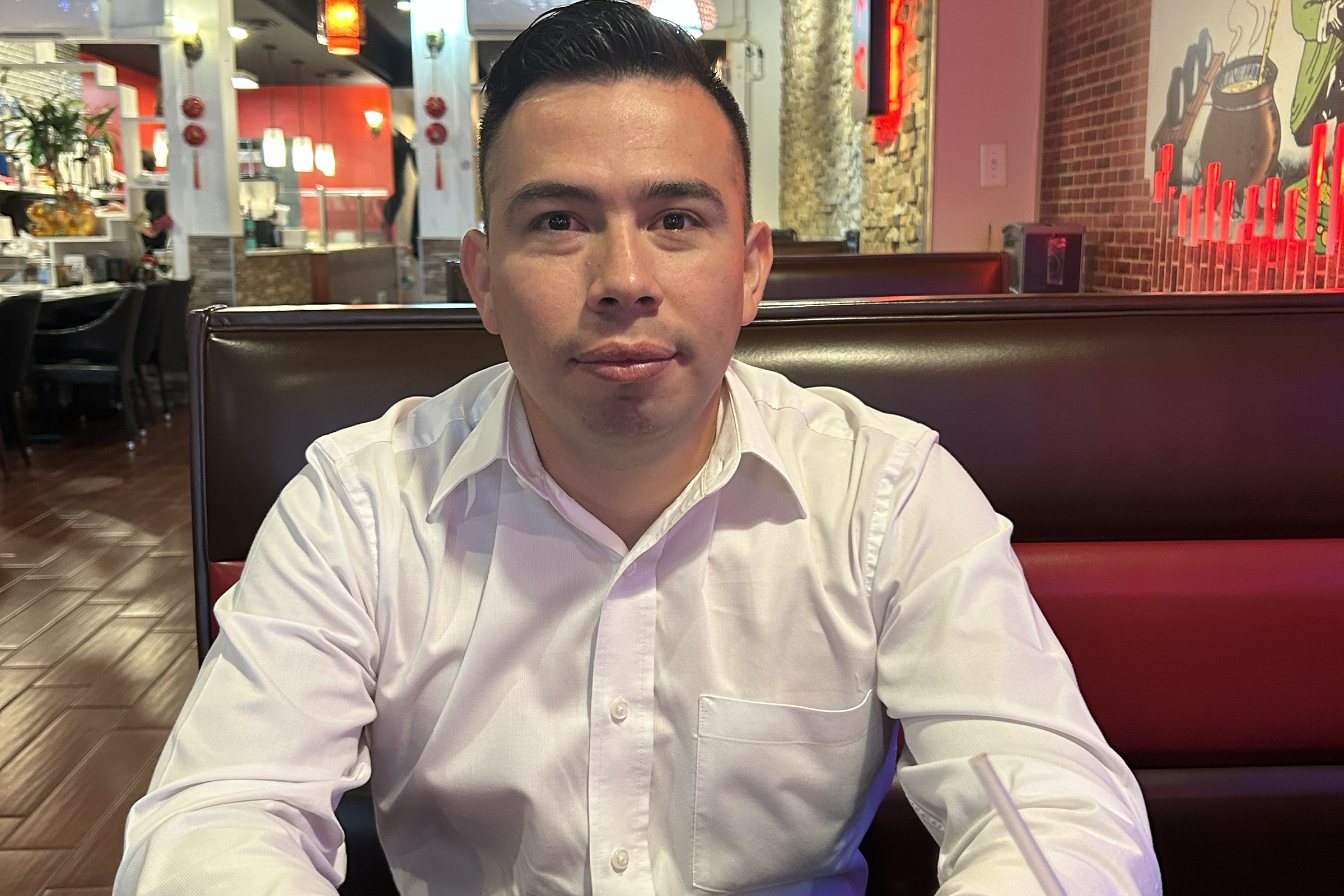
Jhon Perez Romero carries a driver’s license, Social Security card, and an employment permit, working as a Spark Driver for Walmart in York, Pa.
He also carries the fear of being tortured or killed if he should be deported to his Venezuelan homeland, where he’s been accused as a “traitor” by the government he once served as an intelligence officer.
Perez Romero, who was interviewed and released by U.S. immigration officials when he crossed the border in 2023, was arrested by ICE in Philadelphia on June 30, when he appeared for what he thought would be a routine check-in. He joined a growing number of immigrants taken into custody even while they pursue asylum, a long-established legal process that can grant permission to live in the United States to people who could be harmed at home.
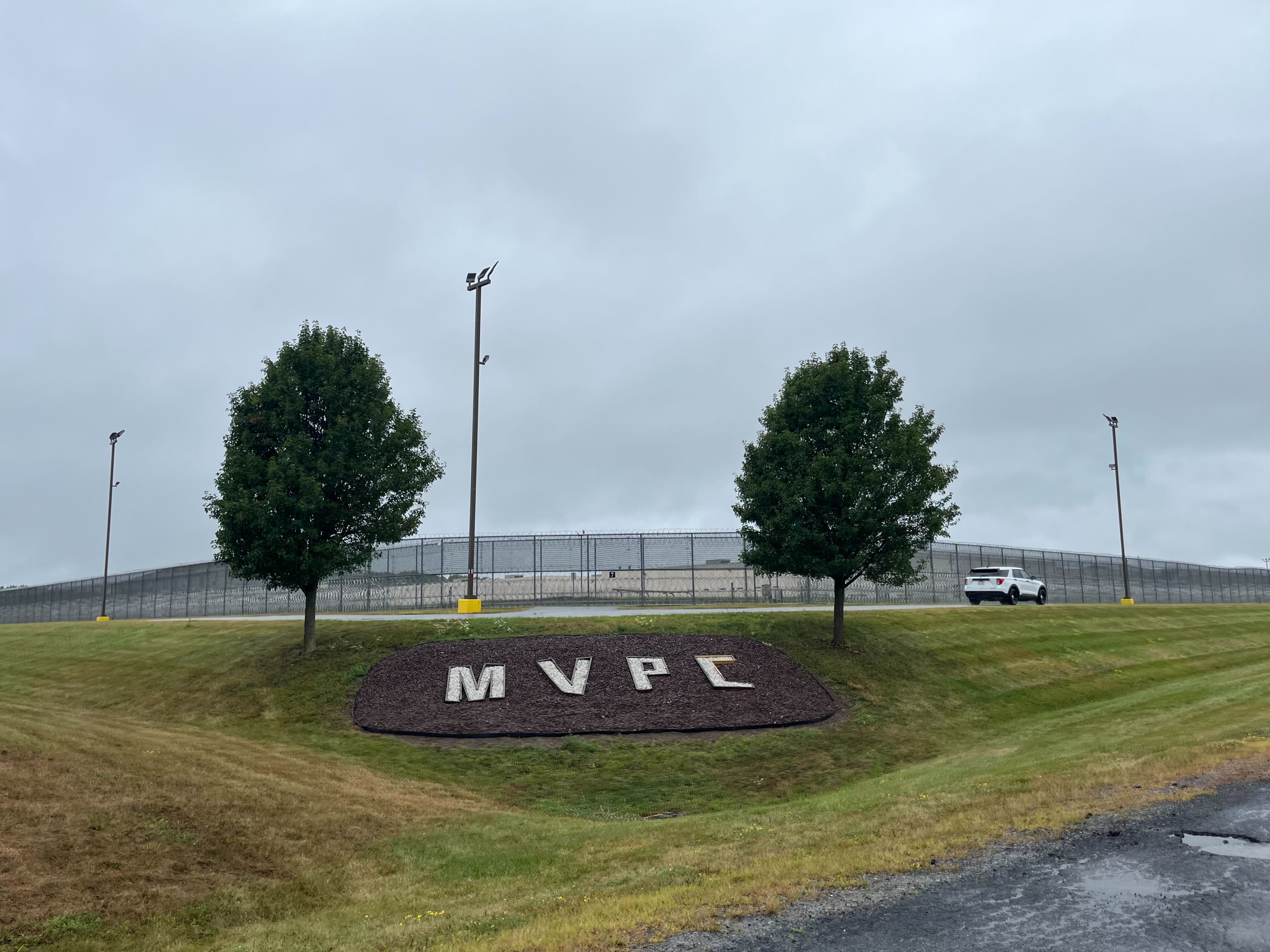
Perez Romero, 39, is being held at the Moshannon Valley Processing Center, the 1,876-bed ICE facility in Philipsburg, Pa., his future uncertain, his wife and step daughter in anguish.
“I thought the U.S. represented a place where people who are escaping political or religious persecution can come here and find safety,” said his wife, Sandra Quinones, an American citizen and high school teacher. “Especially if you’re law-abiding and contribute to society. That’s where my heart is broken.”
The Trump administration’s aggressive approach departs from previous administrations, where asylum seekers with no criminal record were mostly allowed to remain free while they pursued their claims. Now applicants have been detained in communities across the United States, including Pennsylvania and South Jersey.
Last week news broke that the administration intends to revoke the business and tourism visas of up to 200,000 people who are seeking asylum, putting them at risk of arrest and detention. That comes on top of procedural changes that have made it harder for people to prove they should be allowed to stay.
A spokesperson for the Department of Homeland Security said Perez Romero was released at the border by the Biden administration, not by officials under President Donald Trump.
“He will remain in ICE custody pending removal proceedings and will receive due process,” the spokesperson said in a statement. “A pending application does NOT confer legal status in the United States.”
The agency said that on Jan. 20 Perez Romero was charged with “harassing communication,” an offense that usually involves phone calls or text messages sent to upset someone.
DHS provided no other information. Dauphin County court records show that Perez Romero pleaded guilty in magisterial district court in March, but do not include details of what occurred. A court worker said Friday she could provide no additional information.
“Criminal illegal aliens are not welcome in the U.S.,” Homeland Security said. “We will find you, we will arrest you, and we will deport you.”
Jhon Perez Romero, originally of Venezuela, came to the United States seeking asylum in late 2023, afraid he could be harmed or killed by government agents in his homeland. Now Perez Romero, 39, is being held at the Moshannon Valley Processing Center, the ICE detention facility in Philipsburg, Pa., as the Trump administration detains more people who are seeking safety in the United States.Courtesy of family
Generally, the government cannot deport someone while their asylum claim is being decided — claimants must be given what’s called a merits hearing, where they can present evidence, before any final removal action.
The government does have the power to hold asylum seekers in detention for certain reasons, including if it believes the person might flee or is a danger to the public.
Immigration lawyers argue that there’s no gain for the government in detaining asylum seekers, since their names, addresses, and identifying information are already known to authorities, who require regular, in-person check-ins.
“The Trump administration is targeting people to subject them to detention, knowing they won’t be able to fight their way out of the system, so they’ll give up and leave,” said lawyer Lilah Thompson, who leads the immigration unit at the Defender Association of Philadelphia. “They’re wearing people down.”
For immigrants, freedom while pursuing asylum means everything, enabling them to work and earn money to hire an attorney, and to more easily gather evidence and documents for their cases.
Prolonged detention leads some to drop their legal cases and accept voluntary departure. Leaving voluntarily avoids the automatic 10-year ban on returning that can accompany a formal deportation.
“It’s very tough, for people who are facing these choices,” said immigration lawyer Robert Barchiesi II, who represents Perez Romero.
Thompson is helping defend a Chester County newlywed who has so far spent two months in detention after being arrested at a late-June check-in.
Nelson Contreras-Gelves, 35, originally from Venezuela, has followed government directions and broken no rules, Thompson said, noting that he recently married a U.S. citizen.
People seeking asylum must show not only that they could be harmed in their homeland, but also that the danger springs from at least one of five specific causes — their religion, race, nationality, political beliefs, or membership in a particular social group.
Moshannon Valley Processing Center, in Clearfield County, Pa., is the largest immigrant detention facility in the Northeastern United States.Max Marin / The Philadelphia Inquirer
People granted asylum can apply for lawful permanent residency and eventually for U.S. citizenship.
Perez Romero’s life has taken him from a position in Venezuela’s notorious national intelligence agency, to a flight across countries in fear of his life, to love and marriage to a U.S. citizen and a caring role as stepfather to her 17-year-old daughter.
From roughly 2011 to 2019, according to his asylum application, Perez Romero was an agent at the Servicio Bolivariano de Inteligencia Nacional, known as SEBIN. It was created in 2010 by then-President Hugo Chávez, officially aimed at protecting the nation but accused by human-rights groups of arresting and torturing political opponents, journalists, and activists.
Perez Romero said he quit the agency after receiving instructions — the specifics were not described in his asylum application — that he refused to obey. His resignation came less than three months after a failed military uprising against authoritarian President Nicolás Maduro triggered a purge of the intelligence services, targeting those suspected of disloyalty.
Perez Romero was told to report to government officials — and that he was accused of treason.
“Which is erroneous,” he wrote in his asylum application, “since I have not committed any crime.”
In March 2020, facing an arrest warrant, Perez Romero fled to Colombia, keenly aware of “what happens to political prisoners in Venezuela, things like imprisonment for life or murder.”
Two years later, after Gustavo Petro was elected as that nation’s president, he said, he began receiving threats from Venezuelan agents that he would be seized and forced home.
Perez Romero headed north. On New Year’s Eve 2023, he reached the U.S. border at Eagle Pass, Texas, where he was interviewed and released by immigration agents.
The next year he met Quinones at La Iglesia de Dios Voz de Alerta Church in York, and they wed in 2025.
She described him in an interview as an outstanding husband and father, working long hours to provide for their family. He’s deeply invested in their church, she said, and before his detention was developing a resource package to help missionaries serving in remote and dangerous areas.
Last month, he tried and failed in federal court to win his freedom from Moshannon.
U.S. District Court Judge Joseph Leeson ordered the government to hold a bond hearing, but Immigration Judge Tamar Wilson ruled that Perez Romero did not show he was not a flight risk or a danger to the community.
He may say he’s innocent of treason, the judge wrote, but “the court cannot simply take his word for it.”
Quinones says the family hasn’t lost hope. Their GoFundMe has raised $8,000 of its $9,000 goal, all of it going for legal fees and related expenses. They await the hearing to present evidence to support Perez Romero’s case for asylum.
Quinones said her husband relies on his Christian faith to stay strong. She’s trying to stay optimistic as well, she said, but so much is uncertain and in flux. Her husband could end up having to accept voluntary departure to a third country, like Colombia.
She’s prepared to retire early and join him, if necessary, and has begun exploring job possibilities there.
“I can’t be apart from my husband,” she said. “I can’t picture my life without him.”
Staff writer Dylan Purcell contributed to this article.