For the Eagles this season, everything seems to fall into two categories: bad or worse. And following a 25-14 loss to the Carolina Panthers, the national media has things getting worse for the Eagles when it comes to the power rankings heading into Week 7.
Ahead of a Monday Night Football game against the NFC East rival Dallas Cowboys (8:15 p.m., ESPN), here’s a look at where the Eagles rank across several sites.
Eagles fans react during the loss to Carolina last Sunday.Monica Herndon / Staff Photographer
ESPN: 21st
Dropping five spots to No. 21 in ESPN power rankings this week, Tim McManus said the Eagles’ “inability to sustain drives” remains the biggest offensive issue on a team with several offensive players to choose from.
“The Eagles have a three-and-out rate of 39.1%, far and away the worst in the NFL.” That has a direct impact on the defense, which ranks third in snaps played with 406, including 74 on Sunday. It’s no coincidence that Vic Fangio’s group has been most vulnerable late in games.”
With injuries mounting, including quarterback Jalen Hurts likely to miss the rest of the season with superficial blood clots that have spread to his lungs, and losses in the last few minutes of games, Yahoo! Sports has the Eagles at 27th. Frank Schwab asks: How bad will it get, and what will happen to coach Nick Sirianni and other star players?
Eagles quarterback Jalen Hurts won’t be playing anytime soon.Yong Kim / Staff Photographer
“The Eagles were unimpressive with Hurts at quarterback, only getting close wins over the Commanders and Titans,” Schwab wrote. “Tanner McKee became a cult hero for some good preseason games a couple years ago, but the hot takes surrounding him perhaps replacing Hurts or what general manager Howie Roseman could get in a trade for him have frozen over. McKee, who entered the season third on the depth chart after failing to beat Andy Dalton for the No. 2 spot, had 215 yards on 45 attempts Sunday in a loss to the Panthers. He’s not going to save the Eagles’ season.”
Bleacher Report: 23rd
The Bleacher Report power rankings saw the Birds dip from No. 20 last week to 23rd. As is the theme of the season, injuries remain a factor in the Eagles’ slip, wrote Brent Sobleski.
“A team down or hobbled at quarterback, running back and wide receiver is a tough enough starting point,” Sobleski wrote. “To make matters worse, Philadelphia’s next three games are all against NFC East rivals. The Eagles season could realistically be out of hand before the team even reaches its bye — especially with Hurts now done for the year.”
CBS Sports: 21st
Despite the drama of Week 6, the Eagles remained at No. 21 in the CBS Sports rankings.
Pete Prisco didn’t have anything new to say on the season that hasn’t already been said during the Eagles’ four-week tailspin.
“Without Jalen Hurts, they are in big trouble,” Prisco wrote. “The injuries have crippled this team. The season has turned into a disaster.”
The lowest, yet somewhat optimistic ranking came from NFL.com’s Nick Shook, with the Eagles moving down two spots from last week to be a bottom-five team in the league.
While Shook minced no words in calling the season a “disaster” for the Eagles after losing Hurts and Lane Johnson, and trading Cam Jurgens, he also commended the fight the Eagles have put up despite their setbacks. Still, he doesn’t see things getting much better.
“On paper, this roster should limp to the finish line — at best — yet Philly battled with Carolina on Sunday, proving competitive for a third straight week despite the mounting adversity,” Shook wrote. “I give the Eagles credit for fighting. It likely won’t be enough to prevent a rough experience from here on out, though.”
Longtime City Councilmember Mark Squilla is on the short list to become the new leader of the Philadelphia Parking Authority, Bob Brady, chair of the Democratic City Committee, said Monday.
If Squilla, 64, takes the job, it would shake up the race for Council’s 1st District, which he has represented for 14 years. It could also give progressives targeting the popular lawmaker’s seat an easier path to grow their ranks on Council.
Will Gross, 44, a democratic socialist and South Philadelphia ward leader who owns OX Coffee in Queen Village, has already launched a campaign to run in the 1st District Democratic primary next May.
Gross declined to comment on the possibility of Squilla joining the PPA.
Squilla declined to discuss the possibility of him joining the PPA, but did not rule it out.
“I would consider any offer if I had an offer,” Squilla said. “You’d be foolish to say I would never consider any offer.”
But he noted that rumors about the possibility of him not running for reelection have been wrong in the past, including last cycle in 2023.
“I’m running,” Squilla said. “At this point, I’m still having fundraisers, so the goal is to stay in it and see what happens.”
The 1st District includes many of the most progressive neighborhoods in the city, including East Passyunk, Queen Village, Fishtown, and Northern Liberties. And it could see one of the most competitive races in next year’s city elections, when Mayor Cherelle L. Parker and all 17 Council seats are on the ballot.
Squilla has championed some liberal policies, especially on environmental issues, but is generally seen as a centrist Democrat, with close ties to the building trades unions and party leaders.
Brady said he is confident the incumbent would prevail, should he seek a fifth four-year term.
“If Squilla runs, I think he’ll win,” Brady said. ”He’s been a great Council person. If he doesn’t run, it’s his choice.”
In addition to Squilla, the PPA board is said to be considering Keola Harrington, the authority’s current chief financial officer.
Harrington did not respond to a request for comment.
“The process is ongoing,” PPA spokesperson Martin O’Rourke said in a statement.
The state-appointed parking authority board is bipartisan and includes six members, leading to the potential for stalemates.
Rich Lazer, who had been a top aide to former Mayor Jim Kenney, led the PPA for three years before stepping down at the end of May to become the executive director and CEO of the Philadelphia Regional Port Authority, or Philaport.
Lazer’s PPA tenure was widely applauded. He cracked down on sidewalk parking and aggressively towed abandoned cars while working closely with other government agencies.
Gabe Roberts, the authority’s deputy director, has served as interim executive director since June.
If Squilla were to resign in the coming months to take the PPA job, there would likely be a special election to fill out his current term, which ends in January 2028.
Ward leaders choose their party’s nominees in special elections, and Democrats hold an overwhelming advantage in the 1st District. That means the 1st District’s ward leaders, many of whom have ties to the progressive movement, would be in the driver’s seat to name a temporary successor while the race for a full term unfolds.
Progressives eye 1st District
First elected in 2011, Squilla is well-liked and widely viewed by constituents and colleagues as a responsive Council member. But he became a target of progressive activists during the 2024 debate over the 76ers’ proposal to build an arena adjacent to Chinatown at 10th and Market Streets, which is in the 1st District.
All four members of Council with strong progressive ties voted against the unpopular project. And although it never came to fruition, the Center City arena plan could be a potent line of attack in next year’s elections against Squilla and other centrist Council members who backed it.
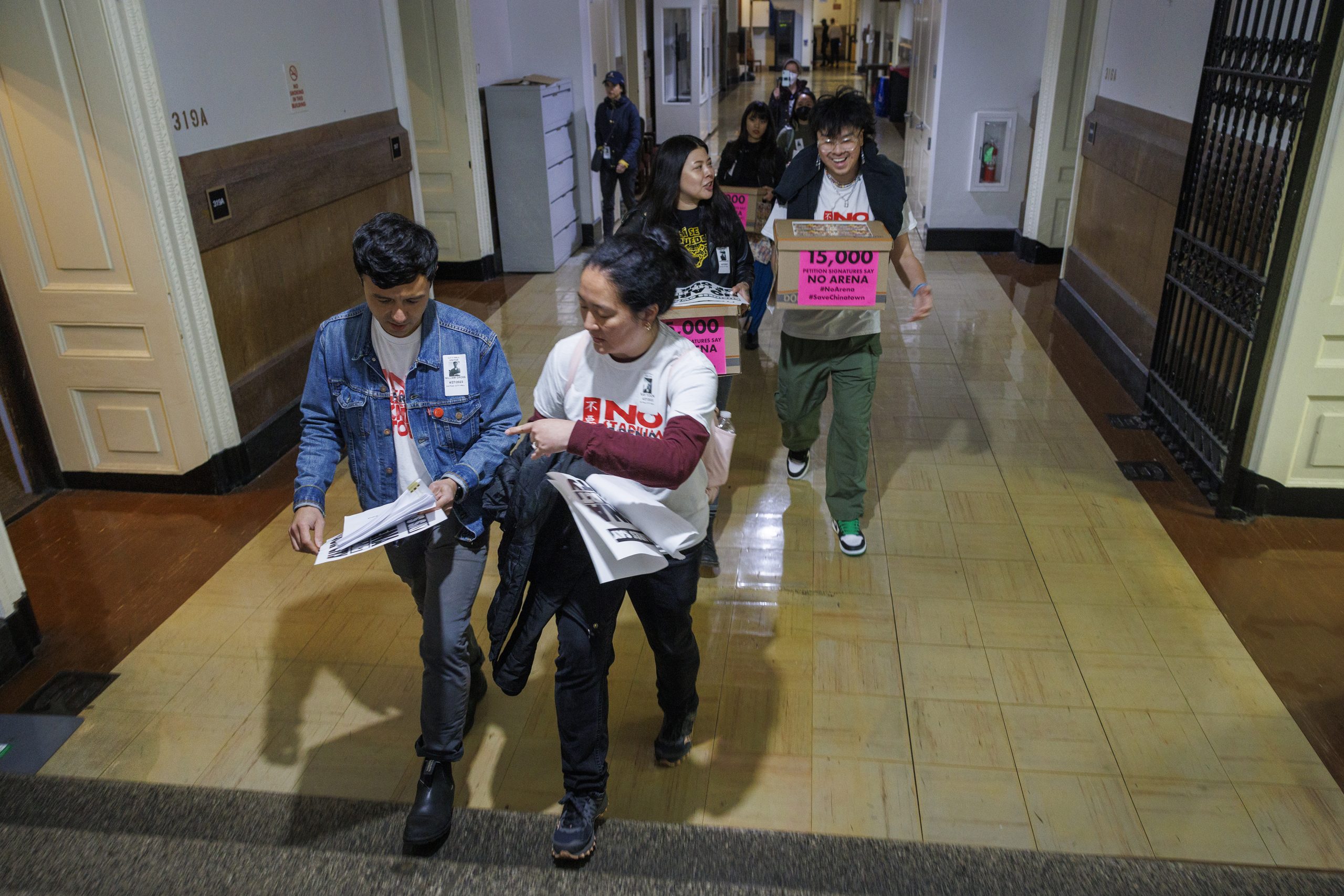
At left is Will Gross, small business owner in Queen Village and Kay Yoon, No Arena in Chinatown Solidarity, delivering petitions to Councilmember Mark Squilla. Community activists against the proposed building of a Sixers arena near the Chinatown neighborhood protest and carry signed petitions to members of Philadelphia City Council after a press conference outside City Hall on Thursday, April 27, 2023.
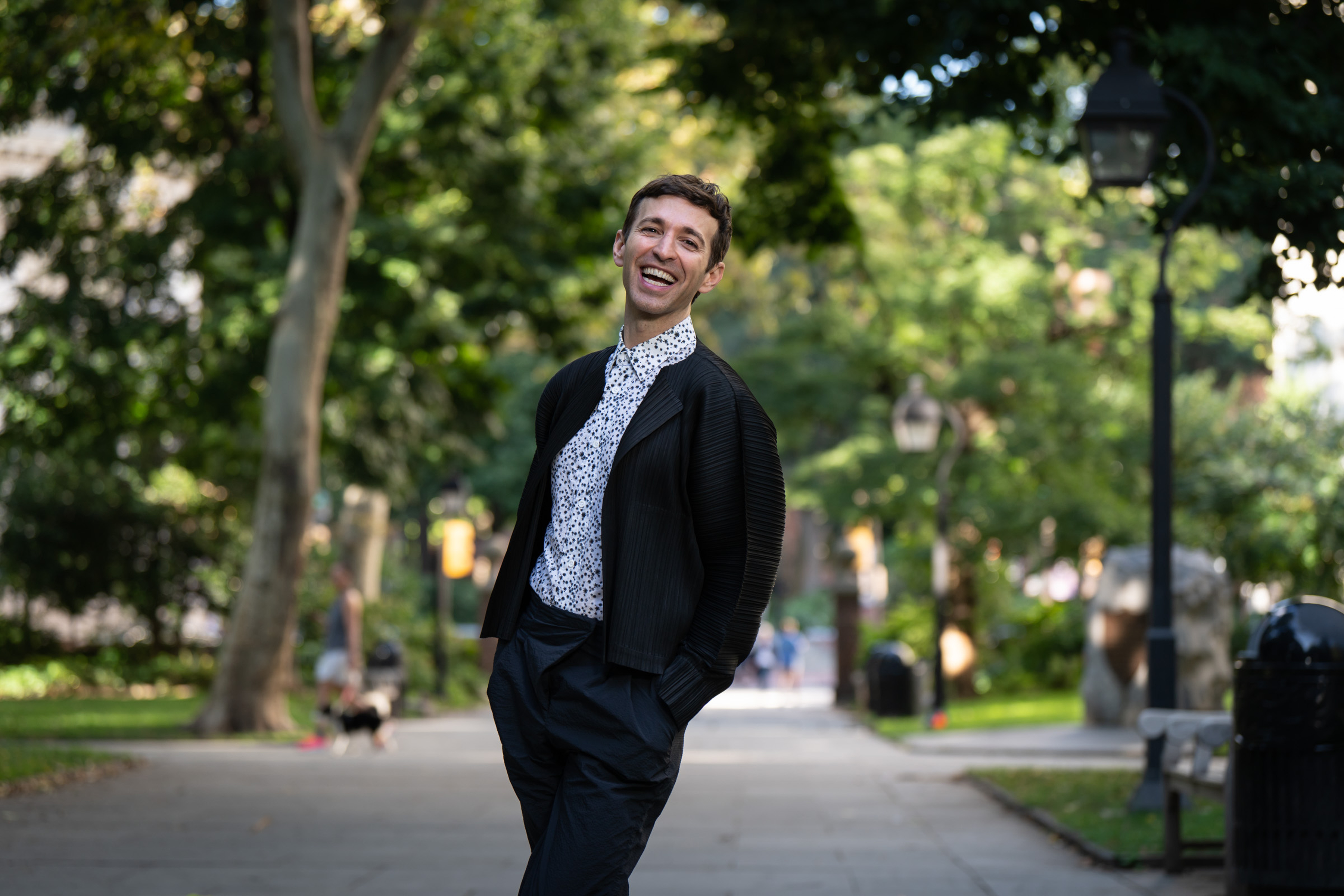
In addition to Gross, another potential candidate for the seat is Councilmember Rue Landau, who currently holds an at-large seat, meaning she was elected citywide. (Landau, who lives in the 1st District, voted against the arena.)
Multiple stakeholders in the city’s Democratic Party have asked Landau, a first-term lawmaker who in 2024 became Council’s first openly LGBTQ+ member, to consider running for Squilla’s seat if he does not seek reelection, according to a person with knowledge of the conversations who requested anonymity to speak freely about the political dynamic.
More than perhaps any other Council member, Landau has maintained strong relationships in both progressive circles and the party establishment. Party leaders may prefer her to Gross, who is more closely associated with the activist community.
A spokesperson for Landau declined to comment on her plans.
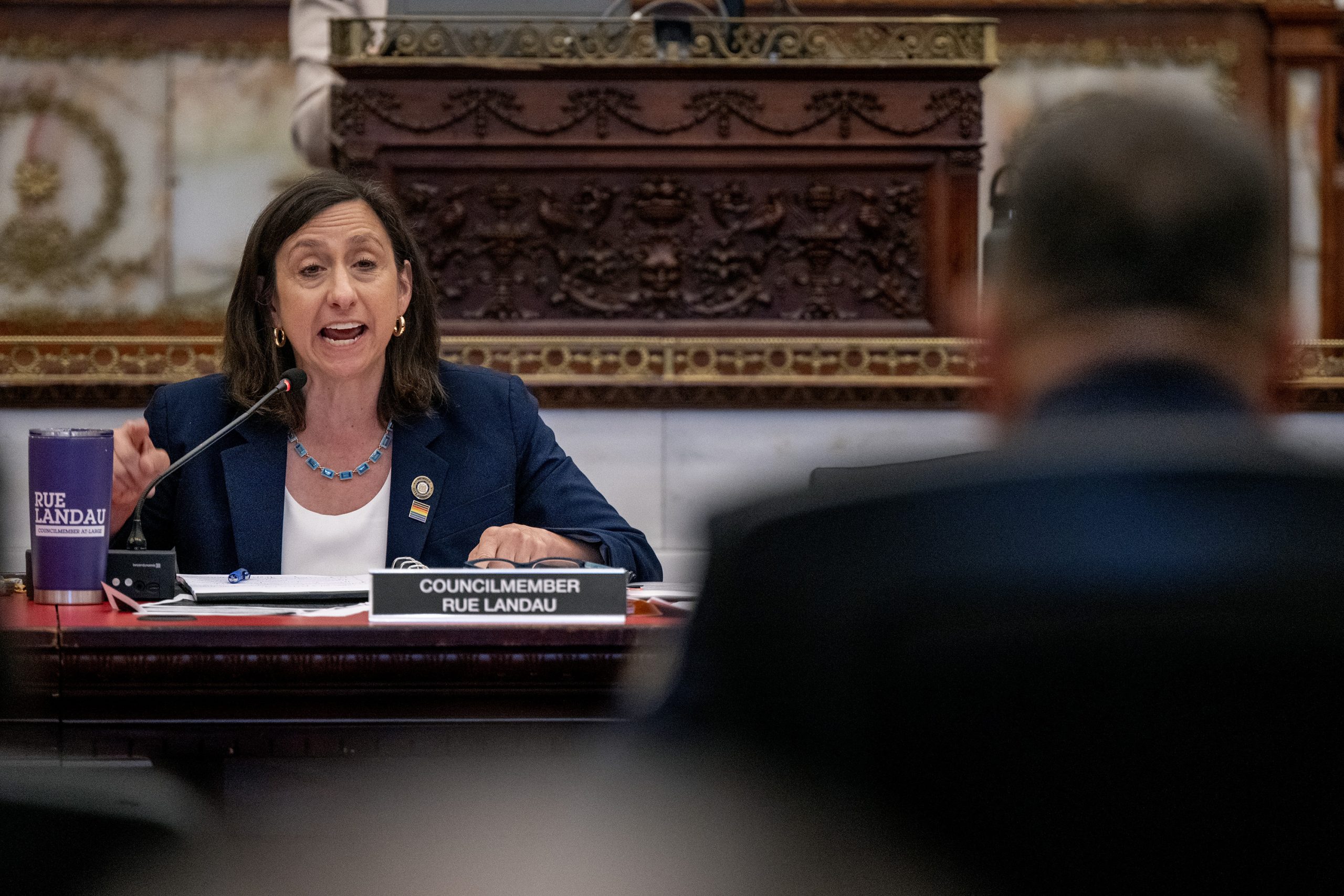
Councilmember Rue Landau questions Police Commissioner Kevin Bethel (foreground) as Council’s Committee on Legislative Oversight holds a hearing on Wednesday, Aug. 5, 2026.Tom Gralish / Staff Photographer
There are several reasons at-large members may want to seek district seats. District members are generally seen as less vulnerable to reelection challenges, and they enjoy substantial powers over land-use decisions in their districts thanks to the practice known as councilmanic prerogative.
A new reality in ward politics
Next year’s race for the 1st District seat could mark a notable moment in the ongoing power struggle between left-leaning insurgents and the city’s more moderate Democratic establishment: For the first time in a major city election, it appears likely that the official party endorsement will be determined by ward leaders aligned with the progressive movement.
The Democratic City Committee makes endorsements based on a vote of the ward leaders in a given district. Ward leaders are elected by Democratic committeepeople, who are in turn elected by neighbors in their voting precincts every four years.
In this past summer’s ward elections, progressive activists recruited scores of committeepeople and rallied around a roster of candidates challenging establishment-backed incumbents or targeting open seats. They fell well short of winning a majority of the 69 ward leader positions, allowing Brady to win a 11th four-year term as party chair.
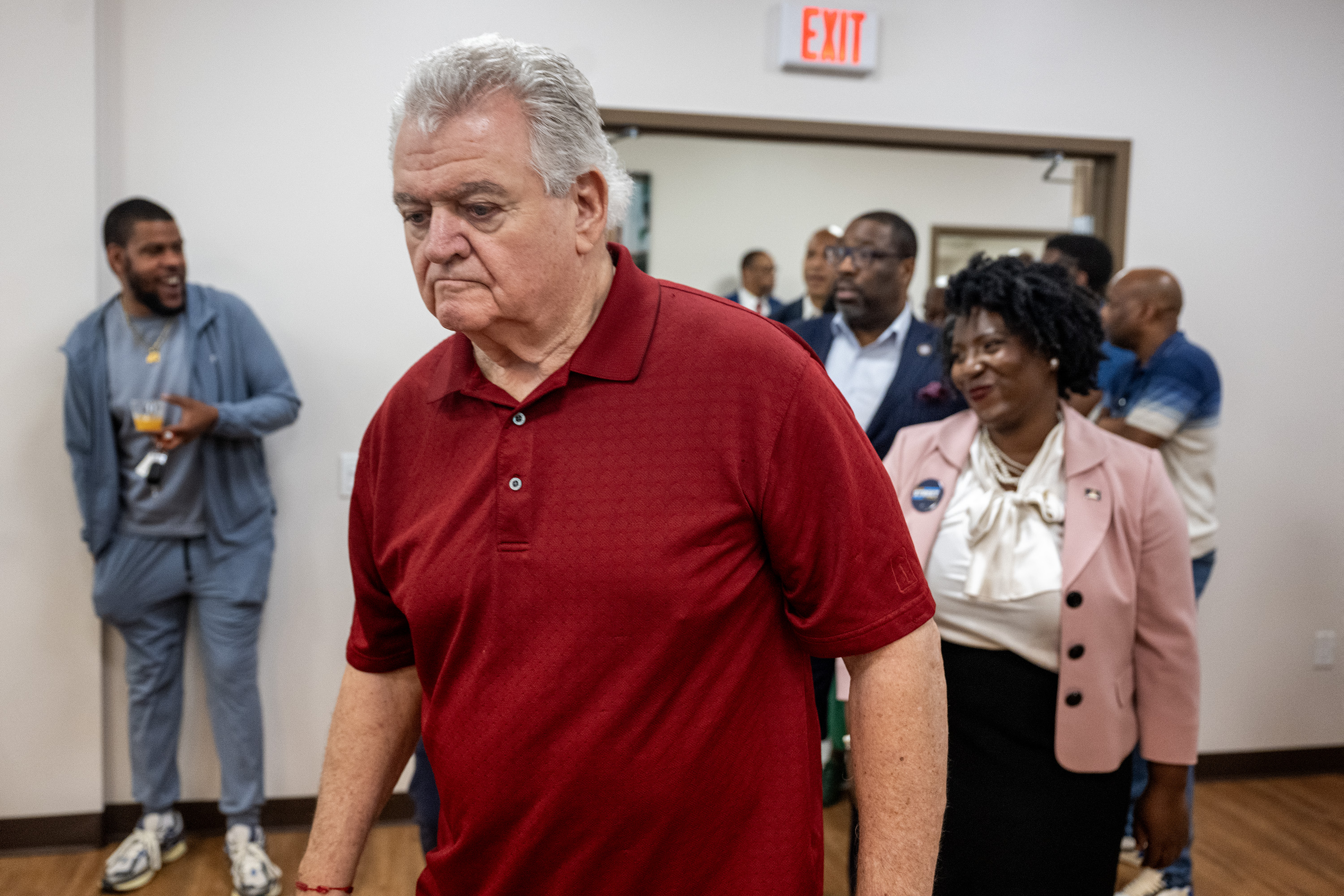
Philadelphia Democratic Party Chairman Bob Brady arrives for a rally for 3rd Congressional District primary candidate State Sen. Sharif Street May 18, 2026. Tom Gralish / Staff Photographer
But in the heavily gentrified 1st District, six of the seven wards are now led by people with ties to the left. If they unite around a candidate, progressives could have a unique opportunity to use the party machinery, so often wielded against them, for their own designs.
Sam Arnold, the Democratic leader of the South Philadelphia-based 1st Ward, said that about a third of his ward’s committeeperson positions turned over this spring, and that many of the new committee members are affiliated with the left-leaning Wards That Work coalition.
He said that while the 1st Ward will not make an endorsement in the Council race until the spring, there is a “very good possibility” that most of the wards in the Council district would back Gross.
Arnold said that Brady, who as party chair has at times clashed with progressives, has “acknowledged how effective a lot of the new energy has been.”
“He understands they are the ones doing a lot of canvassing, trying to get disaffected voters to come out and vote,” Arnold said. “I think he values that work a lot and has tried to welcome us into the party as best he can.”
Progressives began their foray into ward politics in 2018, when activists with Reclaim Philadelphia successfully elected the leaders of South Philly’s 1st and 2nd Wards.
Gross is now the Democratic leader of the 2nd Ward in Queen Village. Ward leaders are not required to resign to run for another office, but progressives and reformers often pledge to do so to avoid a conflict of interest when they are on the ballot.
Gross said Monday that he has informed committeepeople that he is stepping down from the party post to run for Council, and that a transition process is underway.
“Will Gross would be a formidable candidate,” Brady said. “He’s a worker. He’s a friend. He’s been great to the party. We’ve been OK.”
Winds whipped as a team from PolyGone Systems demonstrated what they and their Atlantic County partners say is the world’s first permanent installation of a machine designed to intercept microplastics at wastewater treatment plants.
In this case, they trap the particles before they reach the ocean.
Windmills, driven by those same winds, towered over the team’s stainless steel pod perched at the edge of the Atlantic County Utilities Authority’s (ACUA) wastewater treatment plant in Atlantic City.
Inside the chamber, known as a PolyPod, manifolds clutching specialized filters dropped into water below, attracting microplastics before they are released into the nearby Atlantic Ocean.
“Underneath that very simple, sleek design, there’s layers of engineering work,” said Yidian Liu, one of PolyGone’s founders.
The ACUA was a pioneer with its land-based windmills installed two decades ago to generate power.
The authority believes it is at the forefront again by installing the microplastics removal system in partnership with PolyGone Systems, which was founded in 2021 by Princeton University graduates Liu and Nathaniel Banks.
From pilot to program
Matthew DeNafo, president of the ACUA, said PolyGone had sent letters several years ago to treatment facilities about what it was trying to accomplish.
The ACUA was one of the only organizations that responded positively, and it began a pilot project with PolyGone in 2024.
That pilot project captured 580 million plastic particles a year from a facility that processes 40 million gallons of water per day, according to the ACUA.
Tuesday marked the announcement that the pilot had moved into a full-time operation.
The ACUAsays the system will safeguard water quality for over 200,000 residents, beach visitors, and marine ecosystems along the New Jersey coast.
Electric-generating windmills loom over churning waters of the Atlantic County Utility Authority’s wastewater treatment facility in Atlantic City.Frank Kummer
Simple design
DeNafo praised the unit’s simplicity.
“This is really a self-contained unit passive where we’re not having to pump anything,” DeNafo said. “We’re not having to worry about a lot of moving parts.”
The PolyPod is an enclosed filtration system built with silicone-carbon filters that attract microplastics — less than a grain of rice long — before they can make their way into the nearby Atlantic Ocean.
The project was funded by a $2 million loan with principal forgiveness from the New Jersey Infrastructure Bank to improve water quality.
The pod’s minimalist design stands out against the large concrete building and open tanks that filter out other contaminants and treat the water with chlorine.
It represents the final filtering before treated wastewater is released into a holding pond before eventually being released into the ocean.
Yueyu Yao, lead scientist for PolyGone, said the filters are silicone-based. They are designed to attract microplastics, unlike filters using carbon, mesh, or sand.
“That’s how we’re able to get the smallest microplastics,” Yao said.
She said the filters are capable of capturing 98% of microplastics, but the team will monitor the ACUA project to see what it captures.
How it works
Ariel Blumenberg, an electrical engineer at PolyGone, explained that the PolyPod works essentially like this:
The automated unit, housed in weatherproof-stainless steel, sits directly over water flowing from the treatment facility into the holding pond, without requiring complex piping.
Water flows naturally through the system, as a four-layer manifold drops the filter down into the wastewater flow.
The silicone filters capture nano- and microplastics ranging from submillimeter in length up to about 5 mm, or the size of a grain of rice.
An automated winch hoists up the filter once a day, or more frequently during storms for cleaning.
Jets from a high-pressure wash dislodge trapped plastics. An evaporation unit reduces the extracted plastics so they can be safely incinerated or recycled.
The filter, which needs to be replaced about once per year, is then redeployed back into the channel.
“All this is done right here from this handy operator panel,” he said, motioning to a digital screen.
The unit is built to last about 10 to 15 years.
Doug O’Malley, director of the nonprofit advocacy group Environment New Jersey, was on hand to watch Tuesday’s demonstration, as were officials from various other utility authorities.
“Every water department in the region, including the Philadelphia Water Department, should look at what PolyGone has done and figure out how to scale it,” O’Malley said.
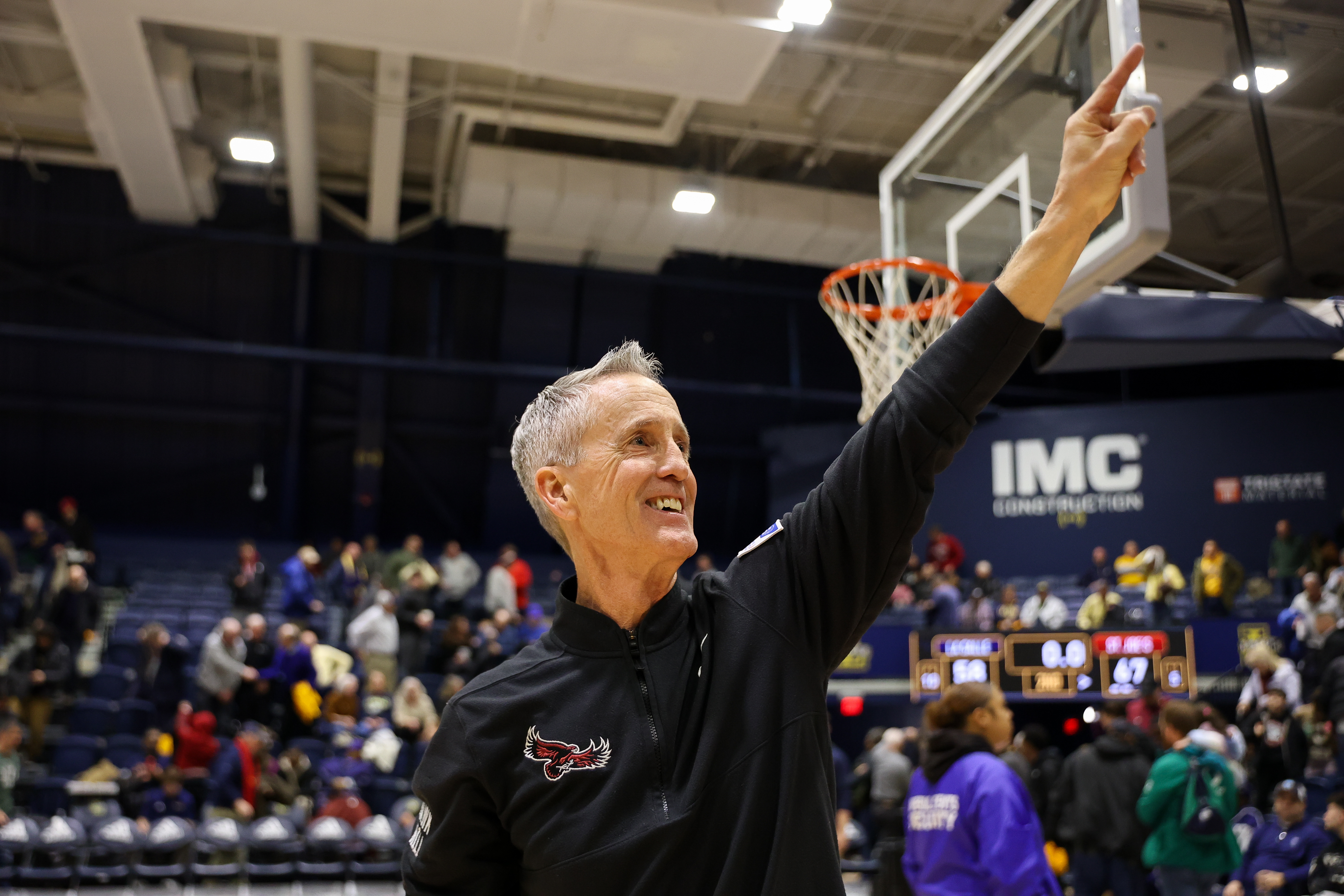
St. Joseph’s coach Steve Donahue has received a contract extension through the 2030-31 season, according to 247Sports.
Last season, Donahue was named the Atlantic 10 coach of the year after the Hawks finished third in the conference and 24-12 overall. Following a slow start, St. Joe’s won 13 of its final 16 regular-season games. The Hawks were eliminated by Virginia Commonwealth in the A10 Tournament’s semifinals.
The school could not confirm specific contract terms, a St. Joe’s spokesperson wrote to The Inquirer.
Last year, Donahue was hired by St. Joe’s as an assistant following his dismissal as Penn’s head coach after nine seasons. However, two months before the 2025-26 season, former Hawks head coach Billy Lange departed for a role with the New York Knicks. Donahue was promoted to head coach.
Donahue was elevated by former St. Joe’s athletic director Jill Bodensteiner, who left the school in February to become the commissioner of the Horizon League. Former La Salle Athletic Director Ash Puri was announced as the school’s new AD in May.
“[Puri is] an outside-the-box guy, which, in this landscape of college athletics, I think you need guys like him,” Donahue told The Inquirer on Monday. “He really cares. He cares deeply about the coaches, the student-athletes, and the university he represents.”
Mike Knuble would tuck his son, Cole, into bed when he was little.
“Dad, do you think I could play in the NHL?” Cole would ask before he drifted off to sleep.
“Of course,” Mike would answer, hoping, like any parent, that it would work out. He’d tell him it was a long way off, so have fun playing hockey now, and let’s see how it goes.
But Cole was determined. In elementary school, when asked to write a letter about what he wanted to be when he grew up, he’d always write: hockey player.
Cole Knuble grew up dreaming of playing in the NHL. That dream came true on Monday night.Courtesy of Mike Knuble
On Monday night in South Philly, the kid who wore a Flyers jersey as a tyke when learning how to skate, who would later mess with and be carried around by Alex Ovechkin, and who went to bed dreaming of following in his dad’s footsteps as an NHLer, became just that. In the process, he and Mike became the first father-son combo to play for the Flyers.
With injuries to several veteran forwards, the Flyers recalled Cole from Lehigh Valley of the American Hockey League before hosting the Colorado Avalanche. He took his rookie lap — accomplishing his goal of not falling — and, across 13 minutes, 44 seconds of ice time in the Flyers’ 3-2 win, showed the traits he can bring to an NHL lineup while skating with fellow youngsters Denver Barkey and Alex Bump.
“He’s a fast player, something we need,” coach Rick Tocchet said postgame. ”We need some fast players. And there was two times when the puck was inside our blue line, they were about to get it, and he got it. That we lack. That was unreal. Because [if] he doesn’t get that out and they keep it in, who knows what happens?”
Once critiqued for his skating, Cole used his speed and “dog on a bone” mentality to chase down and pressure the Avalanche, notably in the third period. His trademark high hockey IQ helped him read plays in the defensive zone and create chances offensively, like when he set up Bump for a quick shot off the rush in the second.
And the 22-year-old forward impressed the bench boss with his courage.
Standing at 5-foot-10 and 195 pounds, he was rocked by former Flyers defenseman Noah Juulsen in the middle frame. In the third period, he got the puck in the defensive zone, skated up the ice, and swung wide left before cutting around veteran blueliner Brent Burns to the net. He may have put a shot on, but it’s hard to tell because in the moment, he was meeting the full force of 6-3, 218-pound bruiser Josh Manson.
“Yeah, definitely the first one,” he said when asked if the big hits were “Welcome to the NHL” moments.
“I was telling the guys I lead the league in stitches per game, so I got three. But yeah, I’ll take a hit. I don’t know. I’m just trying to make a play, so I’ll do whatever it takes.”
Big shoes to fill
Monday was Game 1 for Cole. He knows it’ll be tough to match his dad’s games-played tally, “but I can get him on something, so we’ll see what it is,” he said with a grin in Allentown on Oct. 9.
The elder Knuble played 1,068 NHL games, signing with the Flyers two days after Cole was born, and following multiple seasons with the Detroit Red Wings, New York Rangers, and Boston Bruins. Mike played 338 games in orange and black across two stints, 2005-09, and 28 games in 2012-13, his final season.
“I think that short season, my older son Cam and Cole, they ran into Wayne Gretzky in the hallway, and Wayne kind of razzed them a little bit about, ‘Oh, I had so many points, and I would have had one more if your dad would have scored that open net for me,’” Knuble recalled of his former Rangers teammate. “They couldn’t wait to tell me that in the car.”
Cole Knuble made his NHL debut on Monday against Colorado. He and his dad, Mike, are the first father-son combo to both play for the team.Courtesy of
Although the family didn’t move back to Philly for Mike’s last season, opting to stay in Grand Rapids, Michigan, Cole remembers things like the PECO power play, fans leaving hats outside the family’s house in Haddonfield when Mike scored a hat trick, and skating in Learn to Skate as a 3- and 4-year-old before moving up to mites at the Flyers Training Center.
“There’s definitely pressure. I’d be lying if I said there’s not,” Cole told The Inquirer about being the son of not just a former NHLer, who also spent three years with the Washington Capitals, but a former Flyer.
“Definitely when I got drafted, I felt like I was in the shadow for sure. I feel like I’m slowly coming out of that, but I don’t really focus on that. I know I’m my own player.
“It’s something I’ve dealt with my whole life. Growing up, kids were always saying stuff to me. ‘You’re only here because your dad,’ all that stuff. So I’ve definitely dealt with it, but when I was younger, I felt like I was a little — I don’t know if I was a late bloomer, maybe a little bit. So I felt like I’ve always been kind of grinding to prove those people wrong.”
The pressure comes from all sides, including the fact that the younger Knuble did not get his dad’s 6-3, 230-pound frame. But he has an internal confidence and belief, and he knows he wasn’t drafted in 2023 as an overager because the general manager and his dad were teammates. There were no favors here.
As Flyers assistant general manager Brent Flahr told The Inquirer last December, Knuble “is one of my favorites. … So competitive, great motor, smart, plays every position.” That is why on Monday, the fourth-rounder became the fourth member of the team’s 2023 NHL draft class — six months after wrapping up his junior year at Notre Dame — to break in, joining Matvei Michkov, Barkey, and Oliver Bonk in the lineup.
‘Cole’s dad’
Mike and Cole’s mom, Megan Knuble, landed Monday morning from Michigan. They, along with Cole’s siblings — Monday was his sister Anna’s birthday — and other family members and close friends, watched from the stands as he made his NHL debut in No. 54. Proud dad Mike was spotted by the NBCSP broadcast taking pictures with his phone.
He watched his son grow up and prove people wrong as all the doubters — whether it was kids questioning his talent or Cole being “pretty devastated” when he was passed over his first year of draft eligibility — lit a fire.
Cole Knuble went to many a Flyers game as a kid to cheer on his dad, Mike.Courtesy of Mike Knuble
“He was a little bit undersized growing up, but I think it really helped turn him into the player that he is today,” said Mike, who is now a college scout for the Edmonton Oilers.
“And you watch him, he’s crafty, and he has the puck all the time, right? He has the puck and makes the right play all the time, and the puck sticks to him. He always has his head up, and he has excellent vision. I think that happened for him, as a positive, being a smaller guy because you have to have your head up because kids were bigger than you, and you had to go figure out ways to go get the puck, and you have to be brave, and you have to know you’re going to lose the battle of inertia and physics sometimes, right?”
Mike started coaching Cole around 8 years old for the Fox Motors Hockey Club in Michigan until he moved to North Dakota to play for Fargo of the United States Hockey League. Car rides home weren’t always roses, but at the end of the day, he was just Dad.
“I didn’t carry stuff over, and I didn’t pout. Some coaches will just carry things on. It’s like, man, this is kids’ hockey. Their development is the biggest thing. It’s not about whether we win and lose all the time. It’s how are we playing, and are we playing to the best of our abilities, and we’re competing. I’d give it my five-minute speech after, and every player knew, including my own son, when I walk out of the room, it’s over.
“I’m back to Cole’s dad, and back to [having] a smile on my face.”
That smile was prevalent at Xfinity Mobile Arena on Monday. From the Knubles in the crowd to the one on the ice under the brightest lights the sport has, doing it on the same rink his dad skated on.
“Yeah, the fans are as loud as I remember,” Cole said. “That was just so awesome being out there. And then ‘The Orange and the Black’ song brought back good memories after.”
Back in Philly. Back in the jersey he wore as a tyke. It feels quite full circle and always meant to be.
The only question remaining: Did Mike take him for Rita’s after the game like the old days, too?
Cole Knuble (bottom) with his brother Cam and sister Anna when they were younger at a Flyers game.Courtesy of Mike Knuble
Turks Head Wines may have its headquarters in West Chester, but everything about its tasting experiences evokes Napa, with both its wines and serene aesthetic of its space. As of this month, it has morphed from a winery to a winery-restaurant.
The tasting room at Turks Head Wines features a bar in the middle of an atrium, among many other dining spaces.Turks Head Wines
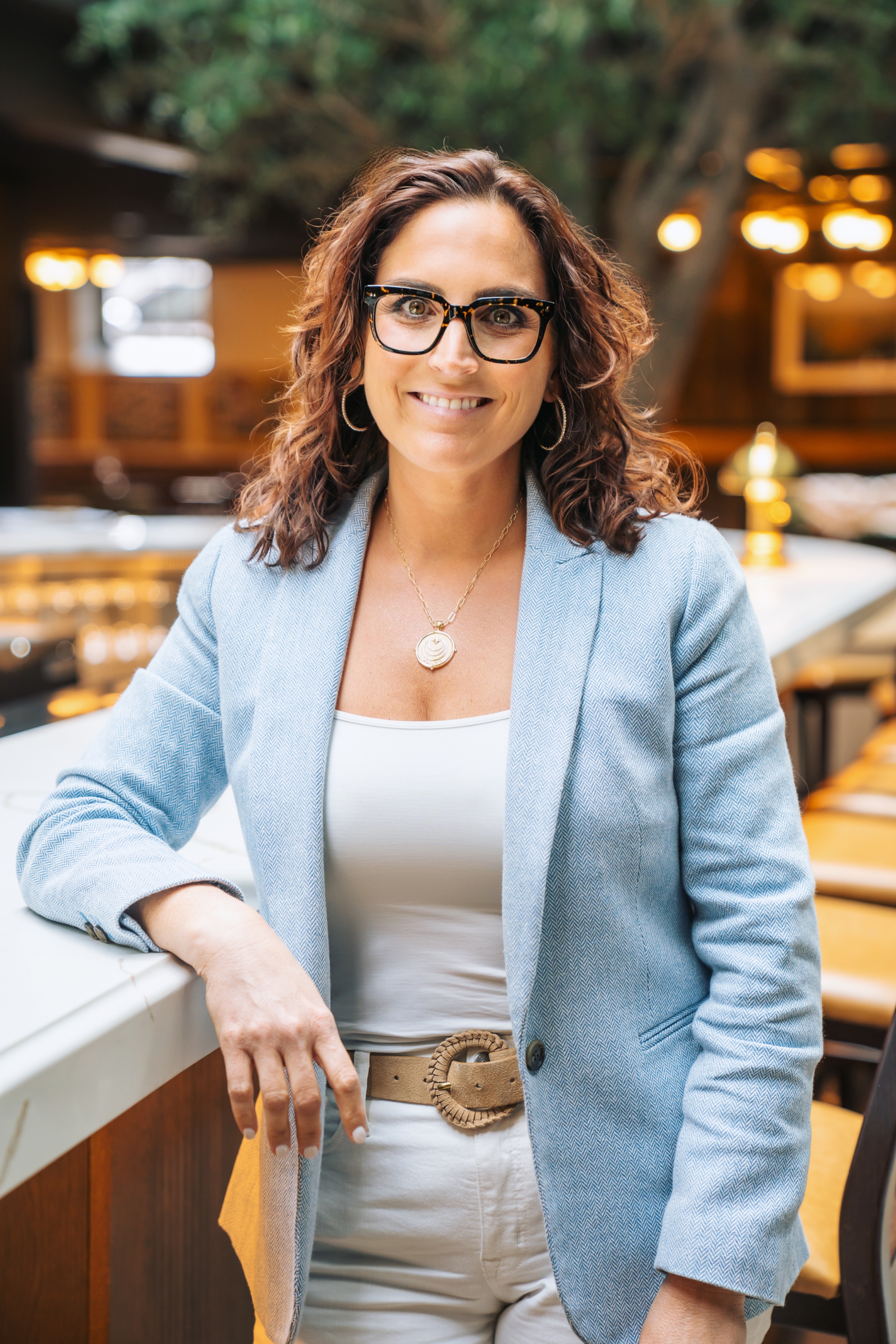
Founder Allison Owen, 47, opened Turks Head Wines after spending 20 years in human capital management and cloud software consulting. In 2022, she left, longing to enter the wine world. “I had lost the fire in my belly and was looking for a new challenge,” she said.
Allison Owen, the founder of Turks Head Wines.Turks Head Wines
“I started a California wine label while living in West Chester, with the concept to really bring the West Coast wine tasting experience to the East Coast,” she said. The label is named for West Chester’s historic moniker, which was a nod to a watering hole called Turks Head Inn (also known as Turks Head Tavern), built in 1769. “I felt like there were a lot of people that are very curious about learning more about wine, but aren’t necessarily ready to invest in making a trip across the country. So I decided to bring the California wine world to them.”
The bar at Turks Head Wines.Turks Head Wines
Owen opened her tasting room in 2024, after construction was completed on a building that has known many lives: Built in 1880, it was once a market house. During World War II, it was a packing plant for the penicillin produced in West Chester. It later became a mechanic’s garage and then a coworking office space.
All of Turks Head’s wine is produced and bottled in California and sent via refrigerated trucks to Pennsylvania. The arrangement is permitted due to Owen’s Pennsylvania limited winery license as well as her California wine manufacturing license. Turks Head Wine houses many plush tasting lounges within its cavernous space, some only open to members of their wine club.
The barrels in their basement sit empty, but are labeled with bronze plaques of their wine club’s founding members — the first 46 people to join. (One barrel bears the names of Anna Congdon and Saquon Barkley.) Wine club members commit to purchasing 12 bottles per year. New wines are released every spring and fall.
The cellar of Turks Head Wines is filled with barrels bearing plaques of wine club founding members.Kiki Aranita / Staff
Initially, Turks Head Wines’ tasting room only served cheese and charcuterie to pair with their portfolio of 30-something wines, including whites, reds, and rosés. “But people wanted us to offer more,” said Owen.
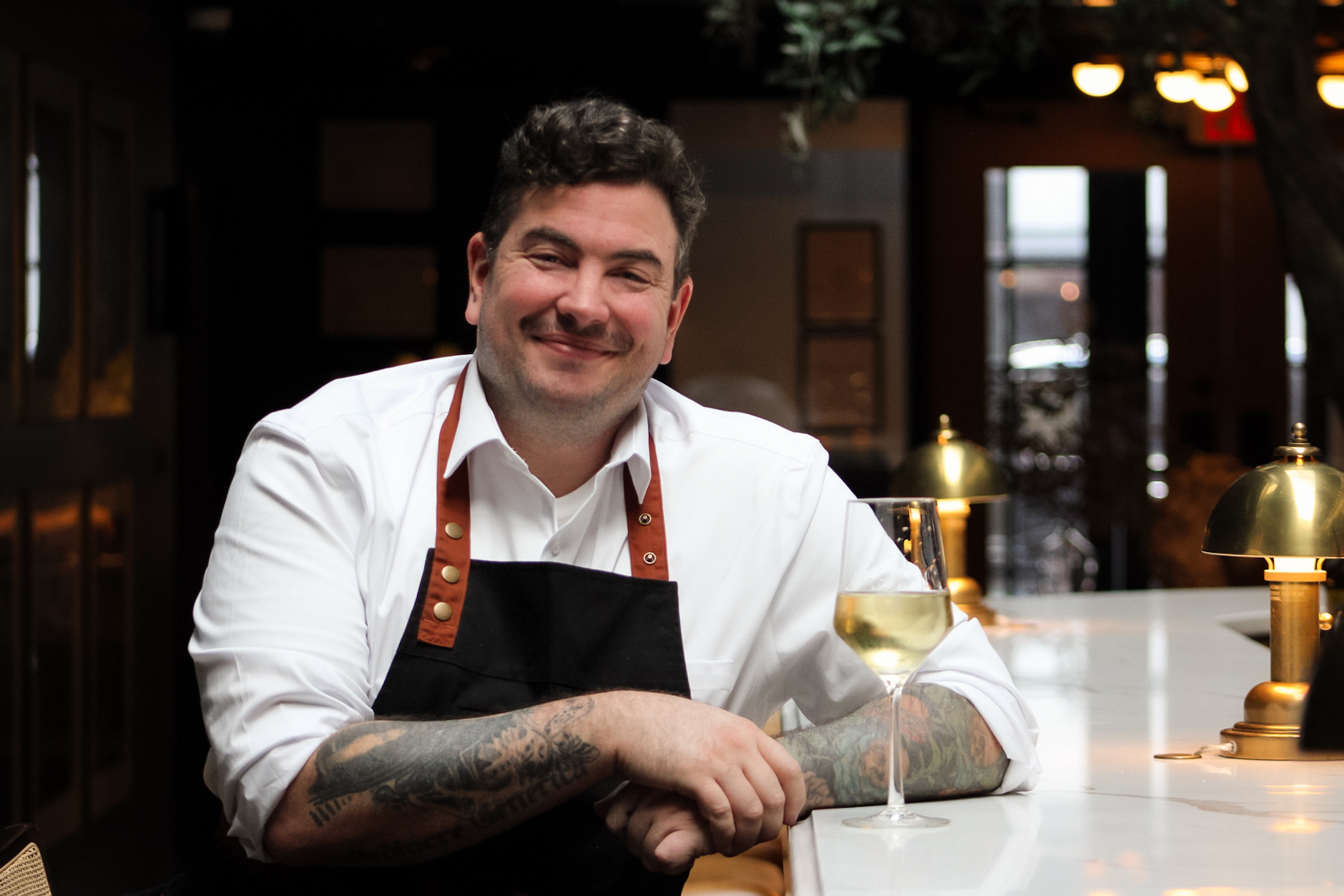
Dave McDonald, the executive chef of Turks Head Wines.Turks Head Wines
She added a hood system and hired a chef, Dave McDonald, who previously worked at Laurel Creek Country Club in Mount Laurel and Helm BYOB. Unlike most restaurants, where wine pairings are meant to complement the food, at Turks Head Wines, the food is intended to pair with the wine. They now offer two prix fixe menus, a three-course menu for $55 and a four-course menu for $75. Current fall offerings include a gnocchi sardi with butternut squash and Kennett Square mushrooms, roasted chicken breast, braised pork shoulder with a Turks Head red wine porcini sugo, and an array of desserts and small plates. The wines themselves are frequently integrated into the dishes, whisked into vinaigrettes and sauces.
Gnocchi sardi at Turks Head Winery consists of semolina pasta shells, butternut squash, Kennett Square mushrooms, and sage.Turks Head Wines
“The prix fixe menu feels like a natural extension of how we want people to experience Turks Head Wines,” said Owen, “We want guests to settle in, try a few different dishes and wines, and make an evening of it. Wine is always our starting point, and this gives people the freedom to build their own experience around what they’re excited to drink and eat.”
Turks Head Wines’ tasting room and restaurant are open Wednesday and Thursday from 4 to 9 p.m., Friday from 4 to 10 p.m., Saturday from noon to 10 p.m. and Sunday from noon to 7 p.m.
Turks Head Wines, 120 N. Church St., West Chester, 610-350-4183, turksheadwines.com
Suddenly Last Summer — the Tennessee Williams play lauded for its dark poetic writing but marginalized by grisly subject matter — is reentering the mainstream as an opera, but one that could never be typical.
Composed by Courtney Bryan and adapted by director Daniel Fish, the Opera Philadelphia production arrives Oct. 22, 23, and 25 at the Forrest Theatre with a tale of entitled predatory sex that’s hushed-up in ways both retrogressive and prescient.
It comes from a time when abuse wasn’t discussed under any circumstances but peers into an era that refuses to ignore it.
“Who would believe her, Doctor?” exclaims the rich, dignified, aging Violet Venable, disputing an eyewitness account of her socialite son Sebastian being killed by a mob of boys he had abused while on vacation in Spain.
It’s 1958, and Mrs. Venable dismisses such talk as “babble.”
Not a plot spoiler but a fasten-your-seat-belts advisory: Suddenly Last Summer is about silencing the truth through a proposed lobotomy — plus furthering gay stereotypes as abusers — all amid the veneer of New Orleans gentility. Characters are dressed for 5 p.m. cocktails, masking power dynamics to come.
Playwright Williams (1911-1983) had a taste for the gothic, but was deeply troubled by his own sister’s lobotomy and faced all the trauma that came with living as a homosexual celebrity in the 1950s.
But, how to frame this in 2026?
“In the time Tennessee Williams was writing this, you were not allowed to show anything remotely positive about being gay onstage. You could get arrested. They would padlock the theater,” said Anthony Roth Costanzo, president and general director of Opera Philadelphia. “I think he was trying to write a piece about being silenced.”
Very tough stuff — though successfully premiered at Bard (College) Summerscape 2026.
Is the Philadelphia crew troubled by living with a scenario that, by the way, also includes cannibalism?
“Not yet,” reports conductor Nathan Koci. “It’s a different flavor of shock … definitely an opera and a play simultaneously. The music doesn’t start with a grand overture.”
And, musically, the characters emerge gradually.
Composer Courtney BryanTaylor Hunter
As adapted by Fish and Gideon Lester, the piece is a hybrid. The instrumental score is nearly pervasive and has an insinuating presence with underscoring that tells much about characters, whether or not they’re singing. The orderly, intractable Mrs. Venable is surrounded by a tone row that hails from a strict compositional system, fashioned to her controlling temperament, according to composer Bryan.
Catherine — Sebastian’s cousin, who witnesses his death — has vocal lines not without high notes, but the music doesn’t aim for operatic hysteria or the kind of high-pitch Oscar-baiting portrayals by Katharine Hepburn and Elizabeth Taylor in the 1959 Suddenly Last Summer film.
Catherine (played by Mikaela Bennett) is given a truth serum — likely to be sodium Pentothal — with a tranquilizing, trancelike effect on her already fragile psyche; she has already survived a a date rape.
“While some characters talk themselves in circles, only one character [Catherine] is able to sing her truth,” explained Costanzo in his program note. Musically, the drug renders her words less-than-intelligible at first. Later they become elongated, but eventually have a laserlike focus.
“I didn’t have a template for this. And that’s why it opened up things creatively,” said the New Orleans-born Bryan, now in her mid-40s, having received a MacArthur Fellowship and been the resident composer at Opera Philadelphia 2022-2024.
“Each character has so many complexities … I could almost hear the music right away,” she said.
Bryan came to Suddenly Last Summer with a backlog of improvised vocal line to draw on, but for greater authenticity, retreated to familiar ground that, in her case, was Gulfport, Miss. She needed to be near water. Having grown up with the expressivity of gospel music, she took to improvising more vocal lines, choosing what suited the dramatic temperature of any given scene.
She also re-experienced her native New Orleans through the lens of Williams, who wrote poetically about the climate’s languid rainy afternoons in houses built for the heat.
Over multiple workshops, Bryan collaborated directly with soprano Bennett (no stranger to complex roles in musical theater and modern opera) by creating chord progressions over which Bennett spoke and sang the Williams text, drawing on that to write the finished version. Bennett was well-primed by director Fish to keep her acting style authentic, cautioning her not to frame or even portray the character in any traditional ways, but to exist in it, moment by moment.
Anthony Roth Costanzo, Opera Philadelphia’s general director and president, at Washington Square Park, in Philadelphia, August 20, 2024Jessica Griffin / Staff Photographer
“Give them permission to take away what they want,” said Bennett. “My job as Catherine is to relay the information … I’m just a messenger, singing the text in a way that’s honest and truthful and not biased. Never tell the audience what to think or feel.”
At one point in the play, Catherine recalls, “Cousin Sebastian said he was famished for blonds, he was fed up with the dark ones and was famished for blonds … that’s how he talked about people, as if they were — items on a menu.”
The idea is to let the words speak for themselves. And they do.
Two phantoms haunt the play and this operatic production. One is another actress named Taylor — Laurette Taylor — who starred in Williams’ first hit play The Glass Menagerie, and brought a more low-key, naturalistic kind of acting to the character of Amanda, in what became one of Broadway’s legendary performances.
The other is “Black Jack” Bouvier, the well-known Wall Street socialite, dapper-on-the-outside, troubled by numerous vices on the inside — not necessarily a model for Williams’ Sebastian, but what some commentators have recognized as a possible point of reference.
Near the end, he was too drunk to participate in the 1953 wedding of his daughter Jacqueline to John F. Kennedy. In the spirit of Mrs. Veneble, he was hauled off in an ambulance to save face and died the year Williams wrote Suddenly Last Summer.
Williams eventually created a piece that seems to gain its power from unanswered questions. Did Catherine’s truth serum reveal the truth? (Some of the Opera Philadelphia crew members wonder about that). How could Mrs. Venable and Catherine have such radically different views of Sebastian? Is it denial? Delusion?
Might these questions be a Rorschach test for our times?
“Suddenly Last Summer” plays 7 p.m. Oct. 22, 8 p.m. Oct. 23, and 2 p.m. Oct. 25 at the Forrest Theater. Tickets: $11-$250. Information: 215-732-8400 or www.operaphila.org.
Tacony residents have a new place to shop for groceries.
A new Super Foodtown opened on Oct. 16 selling produce, meat, seafood, and more at 6327 Torresdale Ave., the site of a former Rite Aid pharmacy. The pharmacy chain filed for bankruptcy last year and shuttered all of its stores.
The new location, which spans roughly 11,000 square feet, was announced this month by Allegiance Retail Services, a retailer-owned cooperative of which Foodtown is a member.
“We’re proud of Foodtown’s continued expansion in the Philadelphia market and helping to bring greater access to fresh, quality, and affordable food to the local neighborhoods,” Samer Rahman, president and chief operating officer of Allegiance Retail Services, said in a statement.
The new supermarket opened Oct. 16 at the site of a former Rite Aid pharmacy. The pharmacy chain filed for bankruptcy last year and shuttered all of its stores. Courtesy Allegiance Retail Services
Supermarkets nearby include a ShopRite and a Save A Lot on Frankford Avenue, and an Acme on Roosevelt Boulevard.
There are other Foodtown locations in Philadelphia in Kensington at 3528 I St. and in Oxford Circle at 6515 Castor Ave.
Foodtown’s online circular has deals for club cardholders including center cut pork chops for $1.99 a pound when customers buy at least 3 pounds, hot house beefsteak tomatoes for 99 cents a pound, and two 5-pound bags of russet potatoes for $5.
The new Torresdale Avenue Foodtown spans roughly 11,000 square feet and sells produce, meat, and seafood among other items. Courtesy Allegiance Retail Services
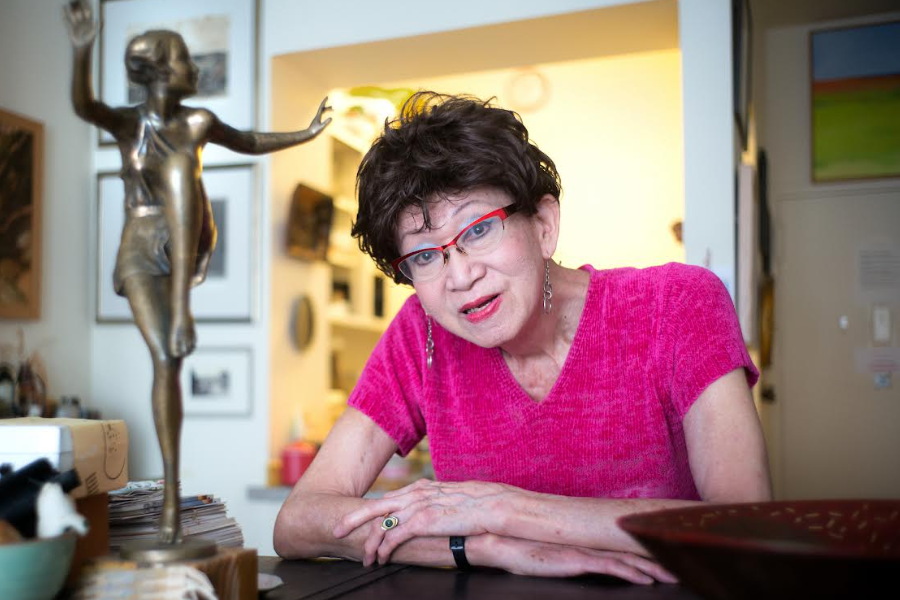
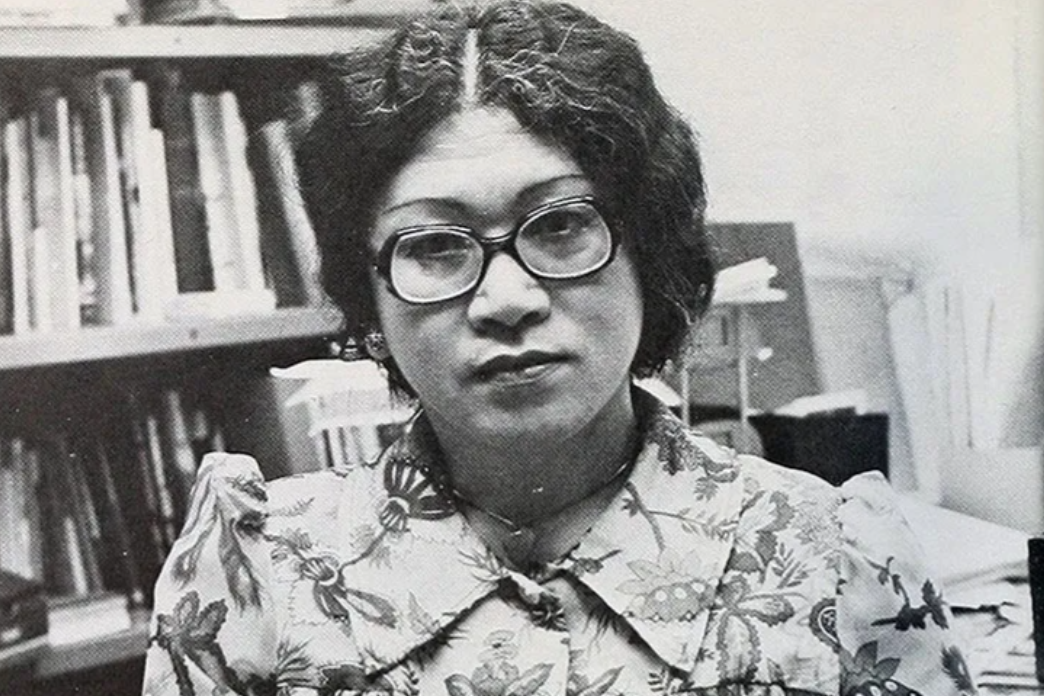
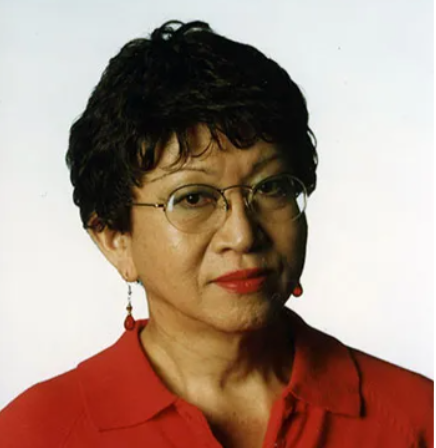
T. Kaori Kitao, 93, formerly of Swarthmore, retired professor emerita of art history at Swarthmore College, art education innovator, mentor, and pioneering transgender scholar, died Monday, Sept. 21, of age-associated decline at an assisted living center in New York.
Born in Japan in 1933, Professor Kitao grew up in Tokyo during World War II and persevered for years through hunger, poverty, and violence. She learned English and graduated from an international missionary school in Yokohama when she was 19, and came to the United States in 1952.
She earned a bachelor’s degree, a master’s degree, and a doctorate in architecture and art history, and joined the growing art history department at Swarthmore in 1966. For 35 years, until her celebrated retirement in 2001, she taught studio art and art history, and mentored hundreds of students and colleagues.
Colleagues called her “a Renaissance scholar” in a recent tribute and said: “As the college’s first openly transgender faculty member, she also modeled what it means to pursue both intellectual rigor and fearless personal integrity.” She said in 1997: “I can best describe that I assumed a male identity until I was 38, when I regained my rightful womanhood.”
Swarthmore president Valerie Smith called Professor Kitao a “brilliant, pioneering scholar.” Laurence Kesterson / Swarthmore College
As an expert in architecture, design, communication, cinema, and Japanese culture, Professor Kitao expanded Swarthmore’s attention to the arts and successfully integrated her curriculum with courses in technology, mathematics, and other disciplines. Swarthmore president Valerie Smith called her a “brilliant, pioneering scholar” and “a mentor to countless students and colleagues.”
She taught classes on Renaissance and baroque art, and architecture from Philadelphia to Hollywood to Tokyo. “Kitao’s classes were legendary,” colleagues said. A former student said on Facebook: “Her work at the college was transformative.”
She told colleagues in 1976: “I loved teaching courses that were new to me because I had to do my reading day by day, along with the students. The point is to enjoy learning and expanding one’s horizons so you develop that habit. School doesn’t end with college.”
In addition to art history, Professor Kitao championed the expansion of Swarthmore’s dance, theater, film, and media programs. She was chair of the art history department from 1975 to 1981, made numerouskeynote addresses, blogged about life, and wrote papers and articles about architecture and history, and program notes for former students.
Before Swarthmore, Professor Kitao taught for three years as an assistant professor of architectural history at the Rhode Island School of Design.Swarthmore College
She also won awards and grants, and lectured often around the country about art and culture. She belonged to at least eight professional associations and societies.
Before Swarthmore, she spent a year on a fellowship in Rome and taught for three years as an assistant professor of architectural history at the Rhode Island School of Design.
Colleagues noted her generosity and curiosity. In 2001, the Student Art Association established the Kitao Student Art Gallery on campus in her honor. On her 80th birthday, she donated $275,000 to establish Swarthmore endowments in mathematics, cinema history, and the List Gallery, and a fellowship in humanities research.
Tomoko Sakomura, Swarthmore professor of art, said Professor Kitao “brought joy, whimsy, and her razor-sharp wit to every space she entered.” Brian Goldstein, chair of Swarthmore art history, said: “Most of all, she taught students how to see.”
Professor Kitao earned a doctorate in art history at Harvard University in 1966. Swarthmore College
T. Kaori Kitao was born Jan. 30, 1933. She did drafting for an architecture firm in California during college and earned a bachelor’s degree in architecture and a master’s degree in art history at the University of California, Berkeley. She got her doctorate in art history at Harvard University in 1966.
She and her wife, Tokiko, married in 1957, and they had a son, Giulio. Her wife died in 1995.
Professor Kitao was eclectic in her interests, friends said, from Renaissance Rome to the architecture of train stations to Japanese gardens to the films of Steven Spielberg. She said she knew nine languages.
She moved to New York in the mid-2000s and enjoyed art museums and galleries, opera, chamber music, ballet, modern dance, and the theater. Andrea Packard, retired director at Swarthmore’s List Gallery, said: “Kaori had that rare ability to kindle the genius and bring out the best in her students, colleagues, and friends.”
Professor Kitao “had that rare ability to kindle the genius and bring out the best in her students, colleagues, and friends,” a colleague said.Swarthmore College
Sharon Friedler, Swarthmore professor emerita of dance, said: “Kaori’s light burned bright and wide.”
In addition to her son, Professor Kitao is survived by other relatives.
Services were held earlier.
Donations in her name may be made to Swarthmore College, 500 College Ave., Attn: Giving, Swarthmore, Pa. 19081.
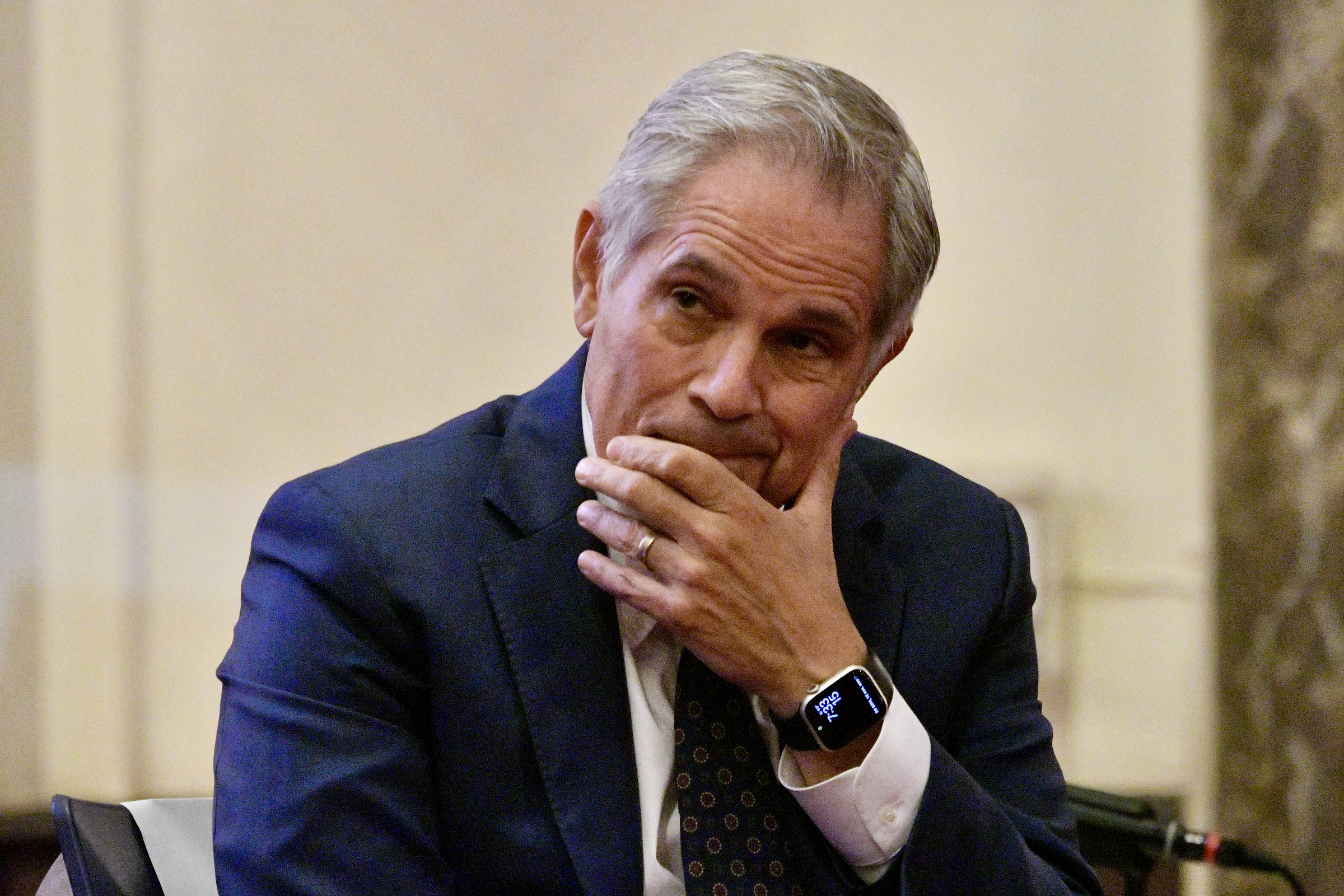
The Justice Department has opened a criminal investigation into Philadelphia District Attorney Larry Krasner’s office and sent grand jury subpoenas in recent days in an inquiry focused on potential obstruction of justice, according to two sources with knowledge of the probe.
The request is the latest development in a high-profile saga centered on a post-conviction case that has led to a series of controversial revelations about Krasner’s office.
And according to the sources — who requested anonymity to discuss an ongoing investigation — the inquiry was opened in response to a memorandum from U.S. District Judge Paul S. Diamond, who said last month that federal prosecutors should investigate Krasner for potential conspiracy, obstruction of justice, or perjury over actions he and his office took in the matter pending in Diamond’s courtroom.
One of the subpoenas sought documents and emails connected to that underlying case, one of the sources said, and was broadly directed at the office rather than any potential witnesses or targets.
A spokesperson for the U.S. Attorney’s Office in Philadelphia declined to comment Tuesday on whether that office was involved in the investigation into Krasner, which was first reported by Fox News. Spokespeople for the Department of Justice in Washington declined to comment.
Krasner said he could not respond to questions about any potential grand jury investigation because such cases, by law, are conducted in secret.
“I follow the rules,” he said.
Krasner, in court filings, has denied wrongdoing. And he has consistently said Diamond drew improper, unfair, and biased conclusions about his office’s actions in the case, calling the judge a “ringmaster” of a “circus” and saying his interpretations of what happened were not only wrong, but sometimes “Orwellian.”
The revelation that prosecutors have opened a federal criminal inquiry does not guarantee they will go on to file charges against Krasner or anyone else connected to the case.
But Krasner, a progressive Democrat, has repeatedly spoken out against President Donald Trump’s administration. And in court documents he filed last month, Krasner said he expected that might make him a target of the Justice Department or Attorney General Todd Blanche.
“Under AG Blanche and his predecessor, the DOJ has repeatedly functioned as an attack arm for people the President perceives as enemies,” Krasner wrote. “The President, his spokesperson, and Blanche himself have all made statements that identify DA Krasner, in their view, as the President’s enemy.”
The controversy has stemmed from a post-conviction matter before Diamond in which a man named Dennis Johnson has sought to overturn his 2009 murder conviction.
Krasner’s office, for a time, agreed that Johnson’s conviction should be thrown out. But earlier this year, prosecutors tried to change course after discovering that the staffer who filed the brief backing Johnson’s position had made a series of mistakes.
After that discovery, those prosecutors and Krasner held discussions about what went wrong and how the office should move forward. And this summer, as Diamond called hearings to address similar questions, the prosecutors told the judge that the district attorney had acted in ways they viewed as inappropriate — including, they said, by trying to pin all blame on the staffer who made the mistakes, saying they needed to “protect the office,” and threatening “consequences” for those who didn’t follow his orders.
Diamond said some of the allegations he heard — particularly those involving Krasner and one of his office’s supervisors, Matthew Stiegler — could amount to criminal wrongdoing.
Krasner has denied that, saying Diamond’s analysis “rests on nothing of substance.” And he said some of the prosecutors who spoke out against him — several of whom have since resigned — exhibited insubordination as they participated in the case, and were “legally incorrect” about disagreements they had with Krasner over how to handle the matter.