Neither Philly’s Mint nor the website has single coins for sale, so early buyers can get no fewer than 25 coins in a roll for $61. A bag of 100 coins for $154.50 is also available. Households are limited to two orders until Thursday at 2 p.m. when the cap will lift.
The commemorative coins, printed in Philadelphia to mark the 250th anniversary of the signing of the Declaration of Independence, may be used as legal tender.
Early buyers may also find unique coins with their purchases: 250,000 Trump coins with a special-issue “July 4” mark, minted on Independence Day, have been randomly hidden in some rolls and bags, Willy Wonka-style.
First announced in July by U.S. Treasury Secretary Scott Bessent, the coins bear Trump’s face on one side with the words Liberty, In God We Trust, and 1776 ~ 2026. The other side features the presidential seal, with “250″ inscribed on the eagle’s shield.
The coins faced hurdles in production with critics arguing that they violate U.S. code that says “only the portrait of a deceased individual may appear on United States currency.” In response, Bessent cited historical precedent: In 1926, the U.S. minted a commemorative half-dollar featuring living President Calvin Coolidge.
Although the coins are gold-colored, they are composed mostly of nonprecious metals, including copper, zinc, manganese, and nickel. No actual gold is used in the coins.
In November, the mint stopped producing pennies due to rising costs. According to the mint, it cost up to 3.69 cents to create one penny.
Philadelphia is home to the nation’s oldest mint, built in 1792. Visitors can tour the facility on weekdays. It is the world’s largest coin-making factory, according to the Guinness Book of World Records.
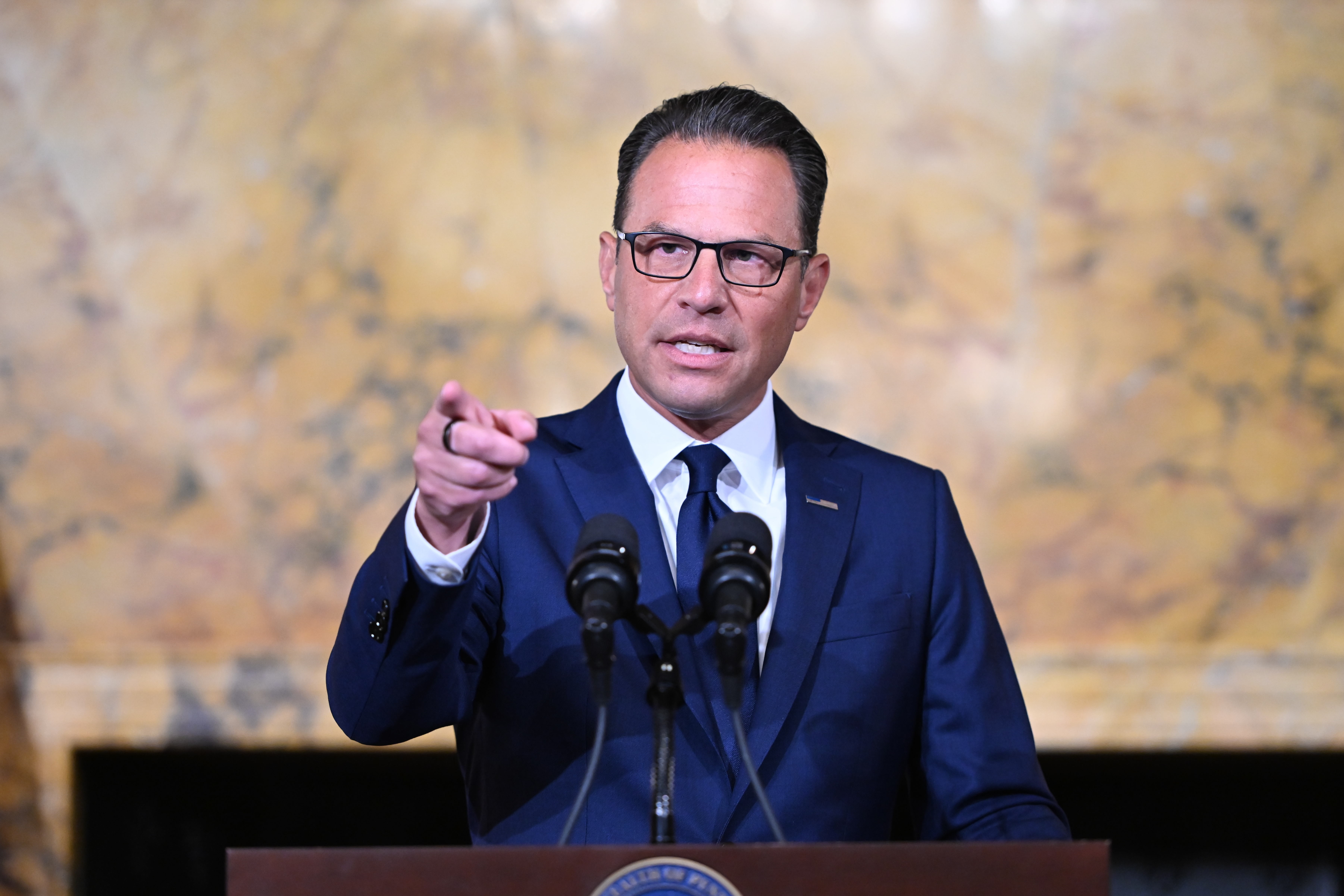
Pennsylvania Gov. Josh Shapiro has “real concerns” about the way Flock cameras — automated license plate readers that capture and store data gleaned from moving cars — are being used in the state, a spokesperson said Wednesday.
Open to banning the technology, Shapiro is wary of how Pennsylvanians’ privacy can be protected, Rosie Lapowsky, Shapiro’s spokesperson, said in a statement. Flock cameras can record license plates and other vehicle features such as bumper stickers of every car that passes them.
Lapowsky added that commonwealth agencies, including the Pennsylvania State Police and the Department of Transportation, “do not own Flock cameras and will not allow them to be used or installed on Commonwealth property.”
Shapiro, a Democrat up for reelection in November, has pointed out that there a several proposals being weighed by the Pennsylvania General Assembly that would either ban or strictly regulate this technology, Lapowsky said.
“And,” she added, “our administration is working with the General Assembly on what piece of legislation could make it to the governor’s desk in order to protect Pennsylvanians’ privacy.”
A bipartisan proposal would establish statewide privacy and accountability protections for automated license plate reader systems. The bill, which was introduced by Philadelphia Democratic State Rep. Tarik Khan, would create guardrails to prevent the misuse of personal data and to protect civil liberties.
In a statement Wednesday, Flock spokesperson Paris Lewbelcharacterized the cameras as “important public safety tools … helping [law enforcement] officers solve serious crimes and find missing people.”
But organizations such as the American Civil Liberties Union call the cameras “creepy” and part of what could grow into a nationwide, warrantless surveillance system.
Last week at a news conference in Franklin County, Shapiro said, “I think law enforcement needs to have tools to keep communities safe. Flock cameras are not a tool that I support. I would welcome bipartisan legislation to ban these across the state.”
The county announced it would terminate its contract with Flock, even though the sheriff’s department supported the technology.
Similarly, the Abington Township Police Department ended a contract last month that supplied the agency with Flock cameras over concerns about data security. The governor resides in Abington.
Concerns grew after it was learned that the network uses artificial intelligence to identify cars that frequently drive together, and allows officers to search for vehicles by behavior, rather than plate number.
Lewbel added that the company would “support thoughtful, bipartisan legislation that puts strong privacy, transparency, and accountability guardrails in place while preserving law enforcement’s ability to use technology responsibly to keep people safe.”
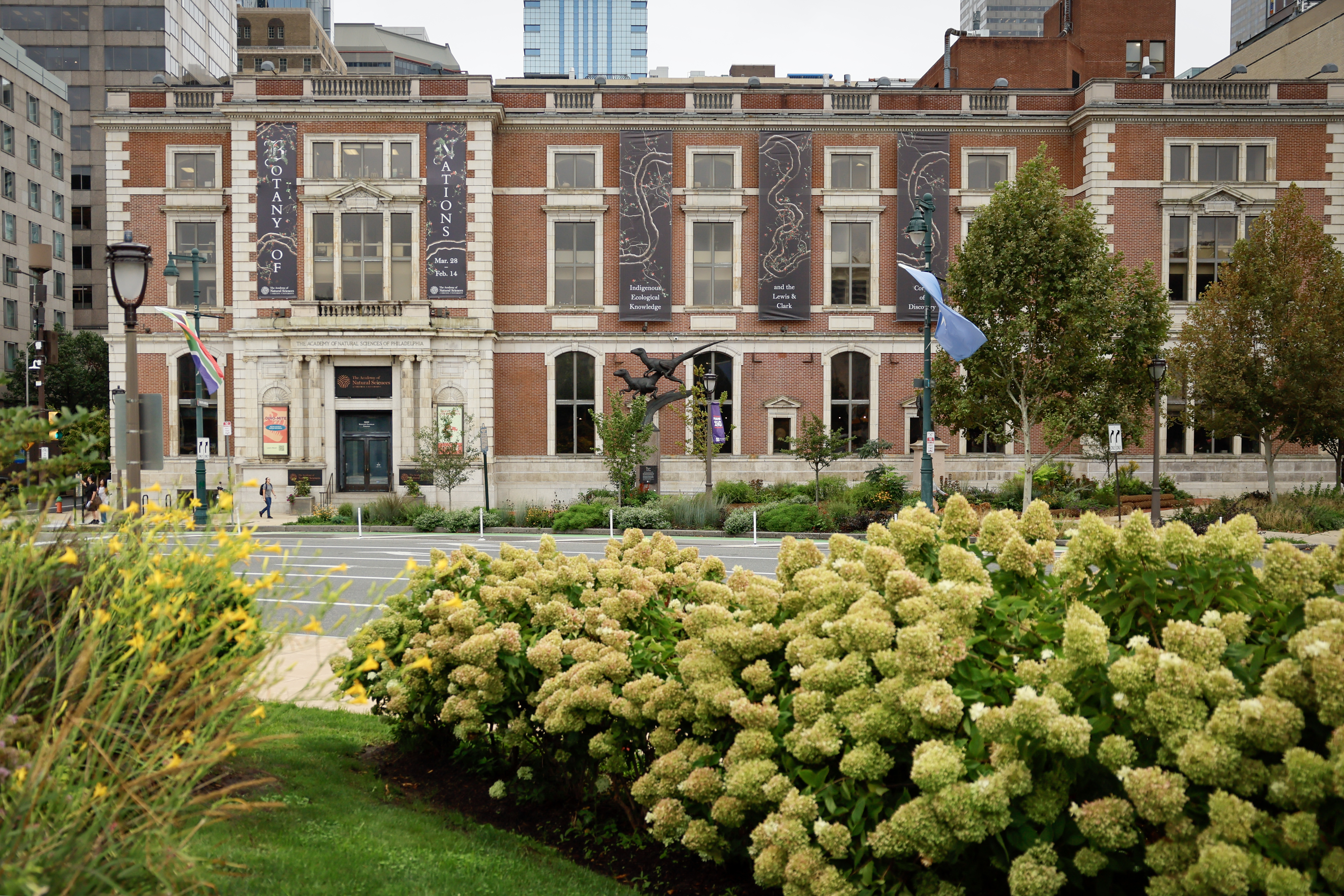
After the threat of a possible split, the Academy of Natural Sciences and Drexel University reached a tentative agreement that will continue their affiliation and maintain Drexel’s financial support of the Academy, multiple sources confirmed Wednesday. It will also give the university control over its major decision-making.
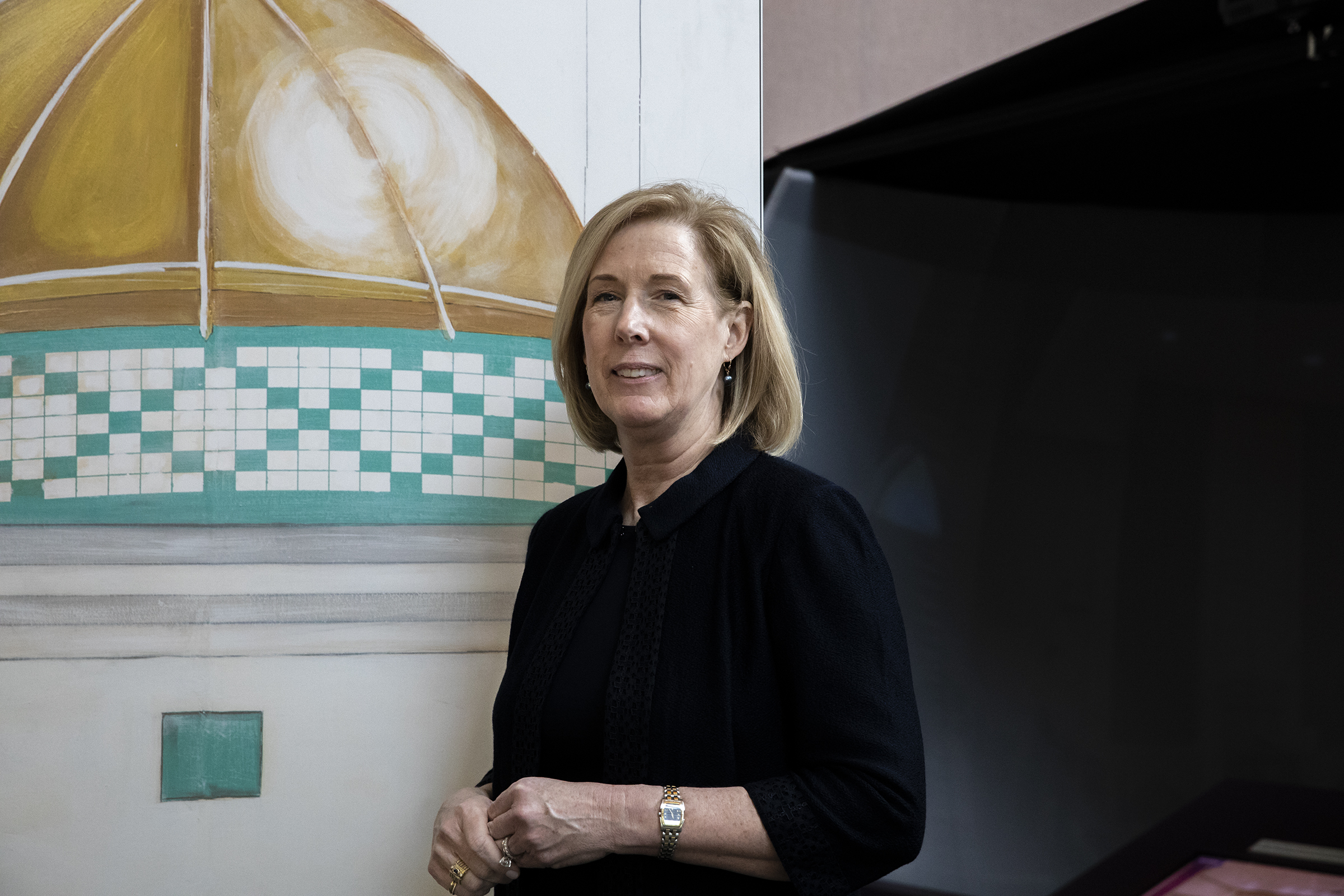
Also on Wednesday, Drexel and the Academy appointed Patricia “Trish” Wellenbach to temporarily lead the Academy, serving as its senior adviser. She is deputy mayor to Philadelphia Mayor Cherelle L. Parker’s administration and previously president and CEO of the Please Touch Museum. Wellenbach is on loan from the city and will not receive any compensation from Drexel or the Academy for her new role.
Drexel holds the reins
The announcement comes one day after Drexel and the Academy said they would close the Academy’s museum effective Sept. 30 and that Academy CEO Scott Cooper would be stepping down immediately. Sept. 27 will be the last day the museum will be open to the public.
Though not part of the new terms, the goal now is to relocate the Academy’s collections and sell its 1876 building at 19th and the Benjamin Franklin Parkway, which has numerous deferred maintenance needs, said a source close to the talks between Drexel and the Academy who asked not to be identified.
The new “nonbinding” terms of the letter of intent maintain Drexel’s financial support of the Academy, modify the governance structure, and preserve the right of the Academy board to de-affiliate from Drexel and find a new partner or partners for its collections should it wish to do so.
The terms cover issues such as selection of an interim leader and a permanent leader of the Academy and budgeting, according to a source close to the talks. While Drexel and the Academy will engage in a collaborative process to find a new leader, the final decision will rest with Drexel, the source said.
Dinosaur Hall at the Academy of Natural Sciences on Wednesday, Aug. 5, 2026.Allie Ippolito / For The Inquirer
“It’s fair to say all decisions of importance have to be approved by Drexel,” the source said, including the budget, which is about $25 million annually.
Under the affiliation agreement in 2011, Drexel provided substantial financial support to the Academy and covered its deficits.That will continue, and Drexel also will cover the costs of relocation of the collection and other transition expenses, the source said.
Academy board chair Suzanne Biemiller did not respond to messages seeking comment.
A ‘solid’ but nonbinding resolution
Of the new terms, another Academy board member said:
“I’m hopeful that something positive will come of it. The goal is to find a way to keep the Academy in existence and achieve its mission, so I think it’s a solid resolution,” said the board member, who asked that their name not be used.
Like most letters of intent, the agreement is nonbinding until the two sides come to a complete binding agreement, the source said.
The Inquirer reported in April that Drexel was seeking to totally take over the Academy or end the partnership. The terms signed Tuesday were brokered by former Comcast executive and U.S. Ambassador to Canada David L. Cohen at the behest of Gov. Josh Shapiro.
Sept. 27 is the last day the Academy of Natural Sciences of Drexel University will be open to the public.Elizabeth Robertson / Staff Photographer
The leaders of Drexel and the Academy signed the terms sheet on Tuesday, Cohen said. But there are significant ongoing issues for the Academy and Drexel to work through, he added.
“They include the responsible move of the collections, and a variety of other transition activities,” he said. “The Academy needs a senior representative, a senior voice in these ongoing discussions both to communicate internally at the Academy and with other stakeholders including Drexel.”
She will have a voice in discussions on finding another location to display some of the collections, now that the museum will be closed, Cohen said.
Patricia Wellenbach, former president and CEO of the Please Touch Museum.Heather Khalifa / Staff Photographer
A temporary leader
Wellenbach will be based at the Academy part of the week while also continuing in her city role. She will lead temporarily while Drexel and the Academy search for an interimleader.
“Ms. Wellenbach has had a distinguished career spanning nonprofit leadership, healthcare, governance and public service,” said the announcement from Drexel president Antonio Merlo and Biemiller.
Mayor Parker in a statement called the Academy “a critical, longstanding part of Philadelphia’s cultural and educational landscape” and said she was pleased to loan Wellenbach to the effort.
“We are working collaboratively with Gov. Shapiro, Ambassador Cohen, the Academy and toward the outcome we all seek for the City of Philadelphia,” Parker said.
The Academy museum is ending operations after nearly two centuries because of declining visitorship and rising expenses, according to the Academy and Drexel.
“Over time, it became clear that these were not temporary pressures, but fundamental changes in the economics of the Academy’s operational model, costs that have imperiled the Academy’s ability to discharge its overall mission and preserve its legacy,” the two institutions said in a joint statement Tuesday.
Biemiller and others have pledged to not abandon the Academy’s role in educating the broader public about the natural world.
While it was “incumbent upon us to find places and ways” for the museum to continue, she said earlier this week, the exact form it would take has not been determined.
While Drexel has the major decision-making power, the Academy board will continue to be the fiduciary board and decision-maker for the Academy’s endowment, though management of it has been delegated to Drexel’s investment office, according to the source close to talks.
The unofficial last weekend of Philly’s summer pop music schedule keeps the heat on. There’s Don Toliver and Kacey Musgraves in South Philly, Kehlani in Camden, Lily Allen in Fairmount Park, Los Lobos in King of Prussia, and the Delaware Valley Bluegrass Festival in South Jersey.
Thursday Sept. 3
Los Lobos
The great Chicano band Los Lobos is the focus of Native Sons, a documentary that is now making the film festival rounds. It shares a name with the band’s 2021 album of songs of Los Angeles. That album was produced by the band’s one non-Los Angeleno: Cheltenham-native sax and keyboard player Steve Berlin. So this Montgomery County gig is a hometown show of sorts for the band that — if justice is ever served — will one day wind up in the Rock & Roll Hall of Fame. 7 p.m., Concerts Under the Stars, 175 W. Valley Forge Road, King of Prussia, concertsunderthestarskop.com.
Don Toliver performs during the BET Awards on Sunday, June 28, 2026, at the Peacock Theater in Los Angeles. (AP Photo/John Locher)John Locher
Don Toliver
The Houston rapper born Caleb Zackery Toliver brought his “Octane Tour” to South Philly in May and already, he’s back. It’s the second “Nitrous” leg of the trek for Toliver’s Octane album, which features Teezo Touchdown and The Odyssey actor Travis Scott. Chase B. is also on the bill. 8 p.m., XfinityMobile Arena, 3601 S. Broad St., xfinitymobilearena.com
Friday Sept. 4
Kacey Musgraves
Kacey Musgraves comes back to country on Middle of Nowhere, the Grammy-winning Texas songwriter’s excellent seventh album. Willie Nelson, Billy Strings, and Philly Music Fest headliner Gregory Alan Isakov drop in. Musgraves also finds common ground with fellow Lone Star State singer Miranda Lambert, with whom she had a longstanding beef, on “Horses and Divorces.” Expect this show to turn into a Dolly Parton celebration. Flatland Cavalry opens. 8 p.m., Xfinity Mobile Arena, 3601 S. Broad St., xfinitymobilearena.com
Dan Tyminski headlines the Delaware Valley Bluegrass Festival in Pilesgove, N.J., on Saturday, Sept. 5.Courtesy of the Artist
Friday Sept. 4 to Sunday Sept. 6
Delaware Valley Bluegrass Festival
Founded at the urging of bluegrass titans Bill Monroe and Ralph Stanley in 1972, the Delaware Valley Bluegrass Festival is a Labor Day weekend tradition that endures.
This year’s three days of music kicks off Friday in Salem County in South Jersey with Kathy Mattea, the country-bluegrass singer who hosts public radio’s Mountain Stage, as headliner. Friday’s lineup also includes the Price Sisters — singing Ohio siblings Lauren and Leanna Price — as well as Virginia guitarist Junior Sisk and the Travelin’ McCourys, sons of bluegrass legend and frequent DVBF headliner Del McCoury.
On Saturday, Dan Tyminski gets top billing. The former member of Alison Krauss’ Union Station has had two moments of extraordinary popularity for a bluegrass musician: 2000’s O Brother, Where Art Thou? soundtrack, on which he sang “I Am a Man of Constant Sorrow,” and “Hey Brother,” an unlikely 2013 hit with Swedish dance music producer Avicii.
New Orleans street band Tuba Skinny at the Delaware Valley Bluegrass Festival in 2022. The band will return to play the Pilesgrove, N.J., fest on Saturday.Delaware Valley Bluegrass Festival
New Orleans ragtime street band Tuba Skinny also plays Saturday, as do Critten Hollow, Danny Paisley & Southern Grass, and the Gibson Brothers. The festival winds down Sunday with Black Eyed Suzies — self-described as “the Bluegrass Ladies of Maryland” — as well as Tennessee quintet Blue Highway, Chicago duo Special Consensus, Boone, N.C., roots band Burnett Sisters, and Nashville quintet Appalachian Road Show. Gates open at 8 a.m. each day. Salem County Fairgrounds, 735 Route 40, Pilesgrove, N.J., delawarevalleybluegrass.org.
Kehlani performing during the second day of The Roots Picnic at the Belmont Plateau on May 31, 2026, in Philadelphia.Monica Herndon / Staff Photographer
Saturday Sept. 5
Kehlani
Kehlani had the biggest hit of their career last year with “Folded,” which was co-written with Philly producer Andre Harris and won two Grammys. The R&B vocalist celebrated with a performance at The Roots Picnic, and now they’re back for a headlining show in Camden on a tour that includes Durand Bernard, TheArti$t, Wahseel, and Dixson. 7 p.m., Freedom Mortgage Pavilion, 1 Harbour Blvd, Camden, freedommortgagepavilion.com.
Lily Allen at the Met Philly in April during her show “Lily Allen performs West End Girl.” She returns to play the Highmark Mann on Sunday.Christina Bryson
Sunday Sept. 6
Lily Allen performs ‘West End Girl’
Lily Allen struck a nerve with last year’s West End Girl, a song suite inspired by the dissolution of her marriage to actor David Barbour, that resonated big time with an audience all too familiar with shady doings by unfaithful partners. Earlier this year, the British songwriter, who has displayed a winningly wicked wit going back to her 2006 Alright, Still?, performed West End Girl album in order in a terrific, if brief, show at the Met. Sunday’s show was scheduled for the Xfinity Mobile Arena but moved to the Mann. 8 p.m., TC Pavilion at the Highmark Mann, 52901 Parkside Ave., highmarkmann.com.
Philly tribute to the Clash
Many, including me, have argued that the four sides of London Calling, the 1979 double album by the British punk band the Clash, add up to the greatest album of all time. One side each goes to a Philly band: Citizens Riot, No Good Crowd, the Big Trip, and 2 Tones Clash. Guests on this tribute show include Hannah Taylor, Spoon Ferguson, John Faye, Cowmuddy, Phil Dunn, and Adam Weiner of Low Cut Connie (also playing a Free at Noon in Ardmore on Friday.) 6 p.m., Ardmore Music Hall, 23 E. Lancaster Ave., ardmoremusichall.com
Slowey and the Boats
Fab Philly instrumental quintet Slowey and the Boats’ breezy, light-on-its-feet sound is built around steel guitarist Isaac Stanford. The band’s delightful Slowey After Dark swings sweetly, using the Hawaiian origins of Stanford’s instrument as a starting point. 2 p.m. Wissahickon Brewing Company, 3705 W. School House Lane, sloweyandtheboats.com.
Peter Hook & the Light play Union Transfer on Monday.Adam Kennedy
Monday Sept. 7
Peter Hook & the Light
Bassist Peter Hook was a key player in Manchester, England, in the late 1970s and 1980s as cofounder of Joy Division, New Order, and Durutti Column. Since 2020, he’s played the music of Joy Division and New Order, with his bassist son Jack, who frees him up to sing. He’ll perform New Order’s 2001 album Get Ready, plus pull from the JD and NO catalogs. 8 p.m., Union Transfer, 1026 Spring Garden St., utphilly.com
Tuesday Sept. 8
Social Distortion
Longtime Southern California punk band Social Distortion is in fine form on Born to Kill, its first album in 15 years. Leader Mike Ness sounds refreshed after a battle with tonsil cancer, and the band is pushed hard by drummer David Hidalgo Jr., son of the coleader of Los Lobos. Social D’s fellow SoCal punks the Descendents and young Australian punks the Chats also perform. 8 p.m., themetphilly.com
Gary Clark Jr.
At Bruce Springsteen’s Music of America concerts in the spring, Gary Clark Jr. covered “Power of Soul” by Jimi Hendrix’s Band of Gypsys and Bobby “Blue” Bland’s Texas shuffle “Further on up the Road.” Those two songs hint at the range of the Austin-based Clark Jr., who has been Texas’ leading guitar hero since he gained nationwide renown with Blak & Blu in 2012. Dumpstaphunk and DJ Kurupt open. 8 p.m. Keswick Theatre, 291 N. Keswick Ave., Glenside, Keswicktheatre.com
DJ Jazzy Jeff performing at The Roots Picnic in Philadelphia, on May 30, 2026.Tyger Williams
Wednesday Sept. 9
DJ Jazzy Jeff
Jeff Townes has had himself a Semiquincentennial summer. At The Roots Picnic, the West Philly-born and -raised DJ put on a turntablism clinic on Belmont Plateau. Then Townes teamed with Will Smith and The Roots to shut down the Philly 250th celebration on the Ben Franklin Parkway in the wee hours of the morning. Now he’ll display his musical mastery at a Longwood Gardens illuminated Fountain Party. 8 p.m.,1001 Longwood Road, Kennett Square, longwoodgardens.org.
New Zealand singer Aldous Harding plays Underground Arts on Wednesday.Emma Wallbanks
Aldous Harding
New Zealand songwriter Aldous Harding is touring behind Train on the Island, the fourth album she’s recorded with PJ Harvey collaborator John Parish producing. The songs are in keeping with Harding’s reputation as an inscrutable, willfully strange songwriter but are also rock solid psychedelic folk tunes. Sam Burton opens. 8 p.m., Underground Arts, 1200 Callowhill St., undergroundarts.org.
One of the fastest-growing occupations is also a hot spot for wage theft complaints in Pennsylvania. A new initiative by state regulators aims to help change that.
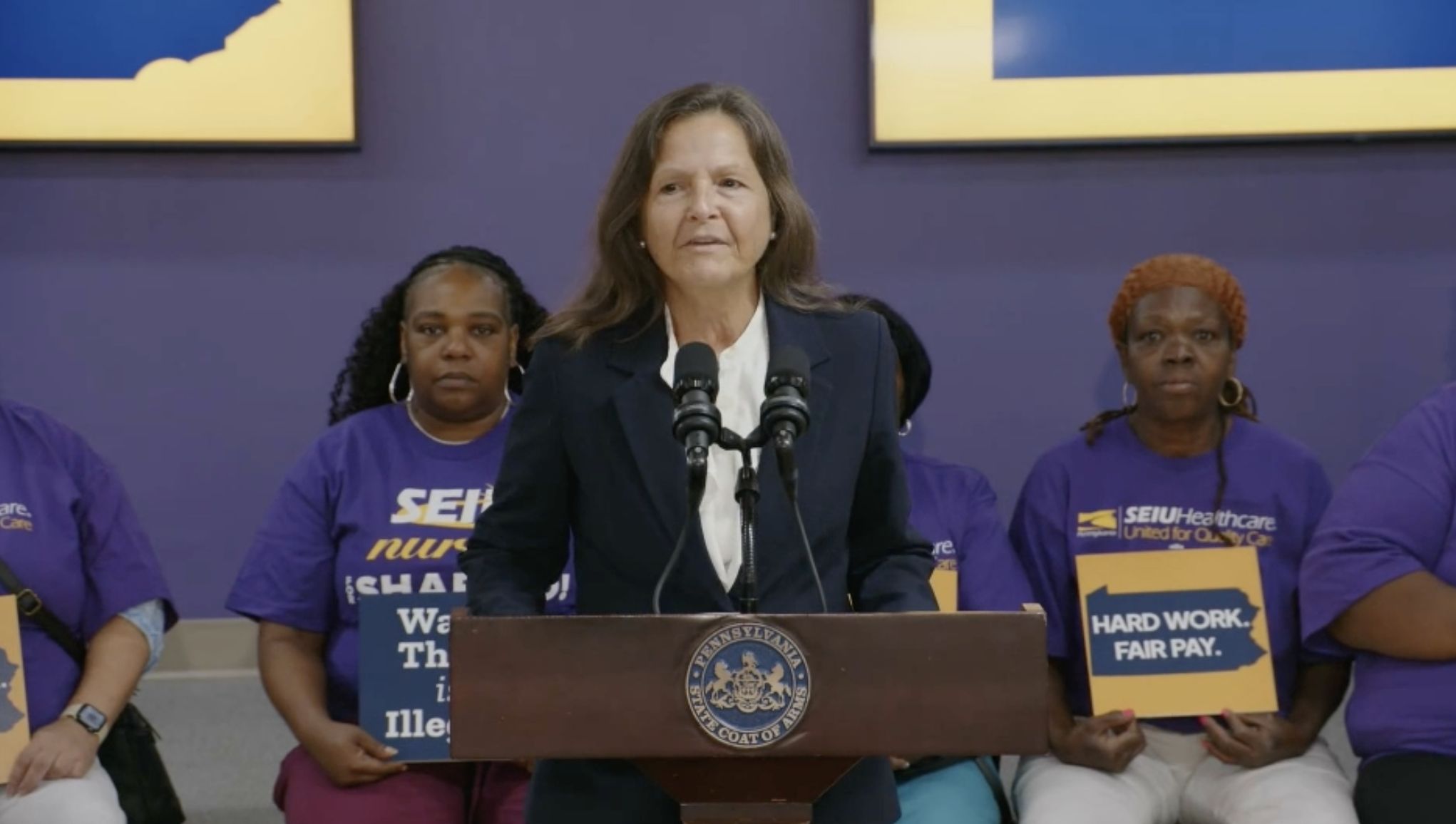
Nearly 40% of the minimum-wage complaints sent to Pennsylvania’s Department of Labor and Industry are from the home healthcare industry, State Labor Secretary Nancy Walker said at a news conference Tuesday.
Under the new initiative, the state won’t wait to receive new complaints, said Walker. Instead, regulators will audit home healthcare agencies, making “legal demands for wage and hour information,” said Walker, to find potential wage violations.
“We’re here today because these workers are not receiving the wages they earned, and that changes now,” Walker said.
Demand for home healthcare is expected to continue growing, but attracting workers to the industry has been a challenge.
Many home healthcare workers, who help patients with daily living needs, have been shorted on their overtime pay in Pennsylvania in recent years and employers have ultimately had to pay back millions in some instances. One contributing factor is that Medicaid doesn’t pay home healthcare employers extra for overtime.
“The workers doing this care are not always treated the way we should be,” Marshene Ellis, a home care worker for over 17 years, said at Tuesday’s news conference. “I’ve worked for different agencies and seen the broken promises and low wages.”
Making ‘good jobs’ in home healthcare
Pennsylvania is home to more than 257,000 home care workers, according to the Bureau of Labor Statistics, but more are needed to meet demand, especially as the population ages.
Nationally, home health aide is expected to be one of the fastest growing jobs in the coming decade, according to BLS, which predicts 847,300 more home health jobs by 2035.
In Pennsylvania, some 112,000 care shifts go unfilled every month, according to Matt Yarnell, president of the SEIU Healthcare Pennsylvania union.
“That means somebody who cannot get themselves out of bed, is laying in that bed hoping someone shows up,” said Yarnell. “We have a lot of work to do in this space.”
Those in need may find themselves in the emergency room instead, Yarnell added.
“When families cannot find a home care worker, the impact is immediate,” said Gabrielle Szymanski, of Pennsylvania’s Department of Aging. “Family caregivers are forced to leave work or take on additional responsibilities, and providers struggle to meet demand — and too often people end up in more restrictive and more costly settings.”
Attracting and retaining home-health workers has been challenging. Turnover is high in the industry, and wages are low. The median wage in Pennsylvania is $14.14 per hour.
Workers deserve higher wages, said Mia Haney, CEO of Pennsylvania Homecare Association in a statement on Tuesday and pointed to low Medicaid rates as part of the issue.
“We support holding bad actors accountable, but they should not define an industry overwhelmingly made up of providers committed to their workers and the people they serve,” said Haney, whose organization represents nearly 700 home care and hospice providers.
An 118-unit apartment building at 2301-11 Walnut St. received a warm welcome from a city-designated panel of architects and planners at Tuesday’s meeting of the Civic Design Review committee.
The eight-story proposal is slated for land that once housed a suburban-style Rite Aid and its surface parking lot.
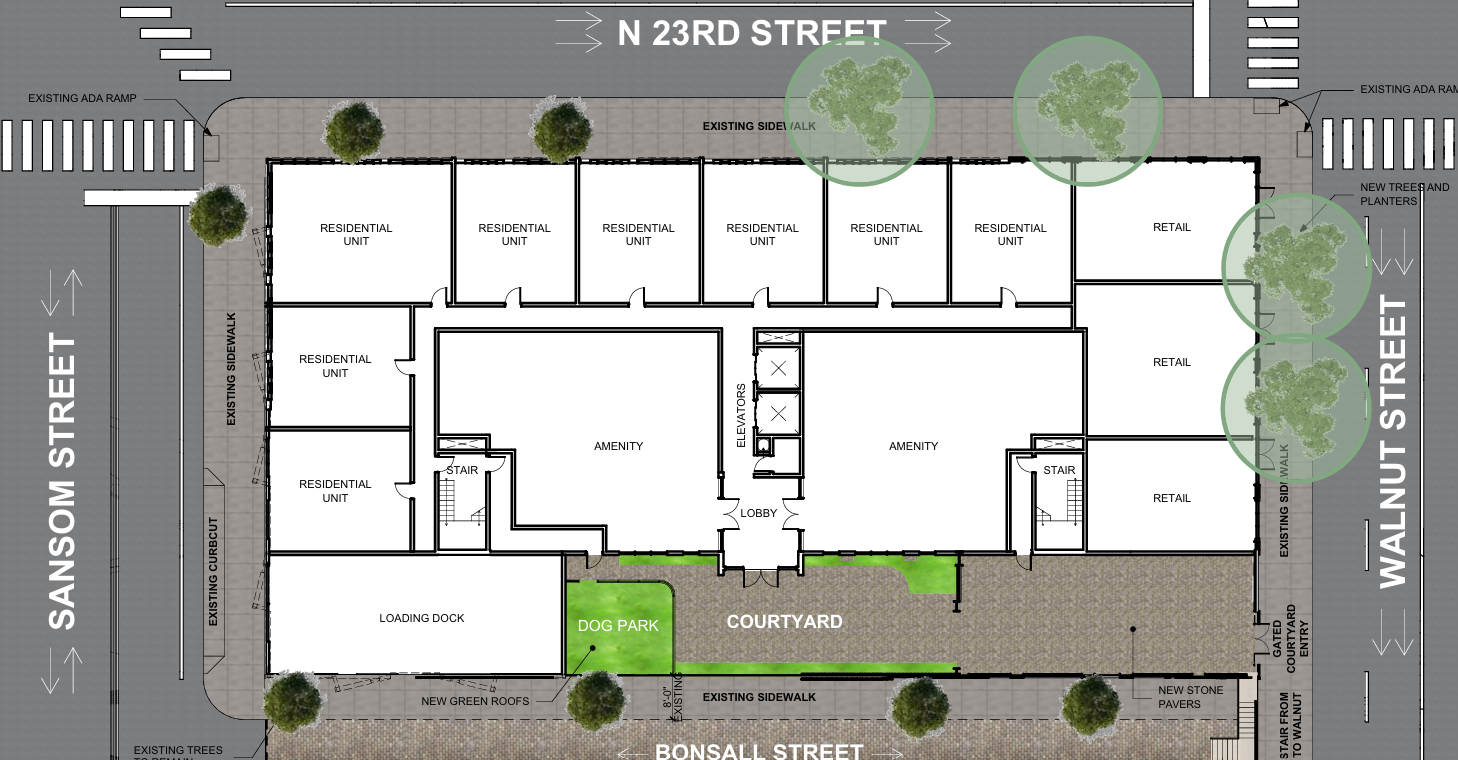
The new building would include 46 underground parking spaces, 2,750 square feet of retail on Walnut Street, and 5,675 square feet of amenity space facing an interior courtyard.
The property has long been held by Patriot Development Associates, a company that owns and operates parking facilities throughout Center City.
In 2022, developer Trammel Crow Co., based in Dallas, proposed a 172-unit tower on the site, but the project was scuttled when interest rates began rising sharply.
The new plans show Patriot developing the property themselves. The president of the company, Richard Zeghibe, did not respond to requests for comment.
Philadelphia-based Boxwood Architects is designing the project. The firm is known for high-end restaurant and bar design, as well as multifamily projects.
The architect plans a variety of plant life features, including new street trees, a green roof, and a garden in the courtyard facing Bonsall Street, as well as design detailing on the side of the building.
“We introduced an artistic gesture on Bonsall Street, inspired by the movement of the Schuylkill River, to activate the streetscape and connect the courtyard to the neighborhood through brick screens and sculptural metal railings,” said John Weckerly of Boxwood.
The detailing on Bonsall Street is “inspired by the movement of the Schuylkill River,” according to the project architect.[Box]wood Architects
“Gardens and green spaces are situated throughout the project to reduce the heat island effect and create a more welcoming experience for residents and neighbors,” Weckerly said.
The overwhelming majority of the project is comprised of one-bedroom units, with only 13 two-bedrooms.
The proposal does not require any breaks from zoning law, so the developer only had to meet with the local community organization — the Center City Residents Association (CCRA) — in advance of Tuesday’s advisory-only meeting.
“[We] welcome the addition of housing to the neighborhood, additional residents, and retail opportunities for more businesses,” Alex Roederer, head of CCRA’s zoning committee, said at the Tuesday meeting.
He noted that Patriot Development had expanded the bicycle room in response to the neighborhood’s feedback and that the company was considering a Community Benefits Agreement as well. Details are not yet available.
A close-up rendering of Patriot Development’s proposed building, with the green roof visible.[Box]wood Architects
The Civic Design Review committee generally praised the aesthetics of the project and its potential to enliven Walnut Street as it approaches the Schuylkill.
Multiple street-level businesses in the blocks of Walnut Street leading up to the river have shuttered since 2020.
Some members of the CDR committee encouraged the developer to add more street-level commercial space — currently only the Walnut Street side features room for retail — and others urged the architects to bring more definition to the existing street frontage.
Alternatively, they suggested wrapping amenity space, such as a gym, around to Walnut. (Currently, the space faces the courtyard, with residential units lining Sansom and 23rd Streets.)
A map of the ground floor of the proposed building, which unusually has apartments on the ground floor.[Box]wood Architects
“I would just love to see how you can … make this more special because right now I’m afraid it’s just a glass surface on the sidewalk,” said Ximena Valle, an architect who chairs the committee. “If they remain empty, which they might, it’s really quite ominous. It would be more of what’s already there” — vacant space.
When asked about specific amenities — beyond a dog park — Weckerly of Boxwood noted that those details have not been fleshed out.
Neither have potential retail offerings, with committee members noting that the current configuration did not appear to have the back-of-house space needed to sustain a restaurant.
However, the committee on the whole praised Boxwood and Patriot Development’s design, a contrast with the reception of Trammell Crow Co.’s project in 2022.
“Sometimes we have developers come in, and they do the absolute minimum to make an apartment, and this is more than that,” said Dan Garofalo, an architect who is the committee’s vice chair.
This is the second major development recently announced this summer on the western edge of Walnut Street. A 372-unit building from PMC Property Group is planned just to the west at 200-10 S. 24th St.
“I was excited to see the project come through. It provides a great opportunity of connecting West Philly and the east side of the Schuylkill,” Valle said. Right now, “I think that pedestrian experience, pre-bridge, heading west is pretty miserable.”
“No tax on tips” sounds simple. For employers, it isn’t.
Starting in 2025, employees who received tipped income can now take a deduction for this amount on their individual tax returns, which reduces their taxable income and taxes owed.
The benefits are obvious, but some of the rules are less so. Here’s what to know.
Cap on tips deduction
The deduction is capped at $25,000 per return, even for married couples filing jointly. It phases out for joint filers with $300,000 or more annual income and $150,000 for other taxpayers.
No deduction for mandatory service fees
Tips claimed must be voluntary. If you’re charging your customers a mandatory “service charge” and then disbursing the amount collected to your employees, that amount is not eligible as tipped income for purposes of the tax deduction.
Put simply, a mandatory service charge and a voluntary tip are not interchangeable, said Shanita Jones, a certified public accountant in Philadelphia.
“Calling a charge a gratuity on the receipt doesn’t automatically make it a tip for tax purposes,” she said. “Owners should verify that their point-of-sale system, bookkeeping records, and payroll system distinguish voluntary tips from mandatory charges.”
Specific jobs qualify for tip deduction
Eligible employees must work in one of the more than 70 occupations the IRS has designated as traditionally tipped. These include servers, bartenders, hairstylists, makeup artists, hotel workers, rideshare drivers, and personal trainers. Occupations such as accountants, tax preparers, and most legal professionals aren’t on the IRS list.
Self-employed workers can also take advantage of the tips deduction, but the deduction can’t exceed the net income of their trade or business.
States still tax tipped income
The “no tax on tips” deduction is applied only at the federal level. Neither Pennsylvania nor New Jersey makes this deduction available when calculating state income taxes owed.
The two states do have a reciprocal agreement so that if a worker who lives in Pennsylvania earns tipped income at their job in New Jersey, they’re still taxed at Pennsylvania rates.
Other taxes that still apply to tips
Also, tips are not exempt from all kinds of federal taxes. Employees must still pay the taxes for Social Security and Medicare.
“Before telling employees their tips are tax-free, make sure you can answer: free from which tax?” Jones said. “The distinction matters because employees may make spending decisions based on what they believe they will keep.”
Employers must also match the FICA and Medicare payments.
But restaurants and certain food service businesses may qualify for the federal FICA Tip Credit, said Adrienne Straccione, a partner at accounting and advisory firm Wouch Maloney in Philadelphia.
This credit is different from the employee tip deduction. It was expanded as part of last year’s tax legislation to include qualifying barbering, hair care, nail care, esthetics, and body and spa treatment businesses. The credit is not a deduction — it is taken against taxes owed and if it exceeds what’s owed it can generally be carried back one year and forward up to 20 years.
“This expansion can potentially provide a valuable tax benefit on certain employer-related taxes for more employers with tipped workers,” she said.
Employers must keep accurate tip records
If you’re an employer, you need to be familiar with the reporting required, Jones said, because no tax on tips does not mean “no reporting of tips.”
“A tax break for an employee does not erase an employer’s responsibilities,” she said. “Business owners should not stop recording tips or change their payroll practices simply because they hear the phrase “tax-free.”
For 2025, employers received transition relief because Forms W-2 and 1099 had not yet been redesigned to separately report the information needed for the new deduction. That’s different for 2026. Employers now report cash tips on Form W-2 using Box 12, Code TP, and identify the worker’s qualifying occupation in Box 14b.
Employers should expect “greater scrutiny of how tips are tracked,” categorized, and reported, Straccione said.
“Businesses need to understand what code section your employees fall under for the Treasury Tipped Occupation Codes,” she said. “Failure to comply with the new W-2 reporting standards can result in penalties.”
It’s important that your employees take advantage of the deduction during the course of the year by reducing the amount of federal taxes they’re having withheld from their paychecks. We’ve been recommending to our clients that they help their employees revise their W-4 withholding form to reduce the amount of tax taken from their paycheck. This will leave them with more money left over throughout the year, rather than waiting for a refund from the government.
Both Jones and Straccione are advising clients to establish written processes for reporting all tips, documenting the distributions, and getting that information into their payroll systems.
“Cash tips should not disappear from the records simply because they never passed through the business’s card processor,” Jones said. She advises that businesses review their process with their accountant and payroll provider, confirm the applicable year’s reporting requirements, and reconcile records regularly.
“Tax season should not be the first time you discover that your sales system, payroll records, and books tell three different stories.”
The no-tax-on-tips deduction is good for both employees and employers. Obviously, the employee gets to save money. But the employer, because their workers are effectively getting paid a little more by the tax savings, may feel less pressure to increase wages this year.
The deduction won’t last forever. It’s scheduled to expire after the 2028 tax year, unless Congress extends it.
There’s a special place in hell for a cop who leaves a human being lying in the street, and they get run over by a car.
It doesn’t matter who the person is, or if they are under the influence of a substance. It doesn’t matter if they resist. They need to be escorted to safety. If needed, rescue workers or a behavioral health expert should be summoned. No one — and I mean no one — should be left lying in the street.
If the police officer who encountered the 48-year-old pedestrian who wound up lying in the bike lane in the 5500 block of Rising Sun Avenue in the wee hours of Aug. 27 had a shred of humanity left in his soul, that man would still be alive today.
Instead of being a hero and saving that man’s life, the officer talked to the victim as he lay on his back in the roadway, then got into his police cruiser and drove away. Minutes later, the man was fatally injured by a hit-and-run driver. Two unidentified people pulled the man out of the street and contacted authorities.
The same officer who had encountered the man earlier was the first to respond. Did he even try to make up for what happened? Not according to First Deputy Commissioner John Stanford, who said at a news conference on Friday that the officer didn’t administer first aid or file a police report. “That goes against everything that we stand for,” Stanford told reporters. “We talk about empathy. We talk about compassion as an organization, and none of those things were on display.”
The officer, whose name hasn’t been released, has since been placed on administrative leave and is still on the Philadelphia police force.
He shouldn’t be.
His job is to serve and protect. But he lacks the human decency and compassion it takes to do that.
What happened last week reminds me of a similar incident that took place four years ago, which I also wrote about. In that case, Elizabeth Negron had wandered into the middle of Germantown Avenue near Coulter Street around midnight one hot summer night in 2022.
It’s unclear what exactly was going on with her, but clearly something was off. She stood in the roadway and blocked the path of a SEPTA bus as vehicles veered around her in different directions. Soon, a police car arrived. Officers got out of their vehicle and interacted with her briefly before driving off, leaving Negron still in the roadway.
They left her in the street like an old discarded shoe. At one point, Negron can be seen lying on her back. A video, recorded by a nearby business, ends shortly thereafter, leaving viewers to imagine what happened next as a passing car ran her over and then fled the scene.
I’ve had the privilege of meeting and interviewing many incredible police officers over the years. Most are good people both on and off the job. But there are some who forget that the people they encounter out on the streets acting oddly are as human as anyone else. They matter, too.
Negron was loved by her two young daughters, a devoted sister, and others who still mourn and miss her. Her sister, Jackie Martinez, told me she had been scrolling on her phone when she learned someone else had suffered a similar fate. “I’m hanging in there and trying my best to not let it bother me,” she said.
Martinez said she would never just walk by someone in harm’s way. “You put them somewhere safe,” Martinez said. “If you walk away and they end up back in the middle of the street, at least you know that was on them.”
Jackie Martinez poses next to a tree planted in honor of her sister, Elizabeth Negron, who was killed on Germantown Avenue near Coulter Street by a hit-and-run driver in July 2022.Jenice Armstrong
David Fisher, a 29-year veteran of the Philadelphia Police Department and president of the National Black Police Association, agreed, saying, “You don’t leave somebody on the street needing care.”
It’s really that simple. It should be obvious. But apparently it isn’t.
Large and small employers are bracing for what looks to be the sharpest increase in healthcare costs in more than two decades. The cost per worker is projected to go up an average of 11% next year, or somewhat lower if workers’ insurance benefits are reduced, according to a U.S. survey released Wednesday.
The employers’ final costs, after they make changes to health plans, are still expected to increase about 8% next year, the steepest since 2003, according to Marsh, the benefits consultant formerly known as Mercer.
More than a third of the 1,800 employers surveyed said they anticipated that costs would rise at least 10% after making cuts.
“This year was a rough year, and next year looks like it will be even rougher,” Beth Umland, director of employer research for health and benefits at Marsh, said in an interview.
The Marsh survey is the latest report by an employer group or benefit consultant predicting a sharp rise in healthcare costs next year. Many Americans, even those with insurance, are already struggling to afford care, according to various surveys, and healthcare has become a top issue for voters.
“This seems to be a new normal,” said Ellen Kelsay, the CEO of Business Group on Health, which represents large employers that offer health benefits.
From 2018 to 2027, healthcare costs could increase 76%, roughly twice the rate of general inflation, according to a survey the employer group released last month. For next year, companies predicted a 9.2% median increase, which fell to 8% after they made benefit changes.
The cost of providing coverage to employees is becoming an existential business issue, said Mike Pasterick, an executive at insurance broker Aon, which issued its own projection last month. Aon estimated employers’ costs would rise 9.5% next year, pushing the average cost per employee above $19,000 if no changes are made. “This is impacting the companies in a very material way,” he said.
The upshot is that about 160 million people under 65 who rely on employers for health insurance will again confront higher costs and shoulder more of the burden. More and more, workers are facing year-over-year increases that further stress household budgets already dealing with the growing expenses of groceries and gasoline.
Workers are facing higher premiums, deductibles and copays, which require them to carry a larger share of their medical bills. Some companies are cutting benefits by discontinuing coverage of expensive GLP-1 drugs to treat obesity, or dropping coverage for spouses who have other insurance options.
Employers and benefits consultants cited a number of factors contributing to higher costs: rising prices for hospital care and prescription drugs, including expensive medicines for cancer, and robust demand for GLP-1 drugs to treat conditions like diabetes.
But they also pointed to new contributors like hospitals’ and doctors’ use of artificial intelligence to increase payments through better documentation of care. They also blamed increasing reimbursements to some doctors who are out of network and are exploiting a new consumer protection law that allows them to challenge what they were originally paid.
The pressure by hospitals and doctors to charge employers even more is likely to intensify with looming cuts to government plans like Medicaid, the federal-state program for low-income individuals. Hospital groups are already seeing an increase in the number of patients who don’t have insurance or can’t pay their bills, and many are expected to charge employers more to help make up for lost revenue.
Many employees are already being asked to pay significantly more of their medical bills. Workers are paying an average of 10% more in out-of-pocket costs in 2026 — some $2,167 — than they were last year, Aon estimated.
These kinds of increases are not sustainable, said Rosa Novo, the benefits administrator for Miami-Dade County Public Schools, which covers about 45,000 employees and their families. “It’s become really, really difficult, extremely difficult,” she said. The bulk of the system’s costs are for hospital care, she said, but among the fastest-growing expenses are pharmacy costs.
For the first time, the school system is exploring new ways of delivering care. “We’re having to reinvent the way we operate,” Novo said. The system is considering contracting directly with hospitals and doctors for some of its employees’ care, like imaging, rather than relying on its insurer to negotiate for it. The system is also starting to demand more visibility into what it pays for care, requiring audits and detailed information about claims.
“I personally see a readiness to do things differently,” said Elizabeth Mitchell, the CEO of the Purchaser Business Group on Health, which represents employers. She said employers were more interested in seeing more information from insurers about how they were spending their money and consideration of alternatives.
“It’s more than just talk,” she said, saying many companies are revisiting their arrangements with their insurer or pharmacy benefit manager.
Like the Miami-Dade school system, many companies are in discussions directly with local hospital groups or other organization to provide care outside their traditional insurance plans. Others are contemplating ways to steer patients to select hospitals or doctors, either by charging them less to see those providers or limiting where employees can get care.
“We’re seeing a lot of employers taking a closer look at the network,” said Eric Miller, a vice president at Segal, another benefits consultant, despite concerns that employees will be upset if they can’t see their longtime doctor or go to the hospital of their choice.
“Unequivocally, there is more openness to change and disruption than there ever has been,” he said.
Smaller employers may be making the most significant changes, said Shawn Gremminger, the CEO of the National Alliance of Healthcare Purchaser Coalitions, many of whose members are smaller companies.
“I think it’s the smaller market where the pain is most acute,” he said.
While some are considering moves like offering employees a fixed amount of money to pay for a plan, others are taking a close look at the giant companies that sell them insurance or pharmacy benefit management. In the alliance’s most recent survey, 54% of employers said they were working with one of the three largest pharmacy benefit managers, a drop from 63% the year before. Many said they were moving to one of the smaller pharmacy benefit managers, many of which promise more transparency about how they operate and what they pay for drugs.
“We may be seeing a tipping point,” Gremminger said.
Carla and Steve Red had a pair of covetable outdoor living spaces on their Fitler Square rowhouse, with a first-floor patio and a rooftop deck. But they weren’t so pleasant in the summer.
“During Philly summers, you want to spend a lot of time outside on your patio, but the roof is basically baking in the sun,” Carla said. “There aren’t trees to cover you, and you really get crushed.”
So last year they added some shade, and it was a game changer.
With the help of a landscape designer and Paul Construction & Awning, the couple installed motorized retractable awnings over each deck. They now escape the summer heat and extend the outdoor season through the fall and early winter.
The roughly 600-square-foot roof deck is the prime spot for entertaining guests and enjoying an evening glass of wine while watching the sunset. During rain showers, they’re no longer forced to retreat inside and instead enjoy the pitter-pattering of precipitation on the gray-and-white striped awning.
The patio awning on their first level covers about half the 300-square-foot space, allowing for a mix of shade and sun. The couple also upgraded the furniture and added colorful flowers, a koi pond, and gas firepit.
“We created extensions of the house where people really want to hang out,” said Carla, who spent about $27,000 on the two awnings. “It’s a Zen experience.”
Outdoor structures, including pergolas, arbors, and gazebos, were added or upgraded by 35% of homeowners in 2026, according to the 2026 Houzz Outdoor Trend Study. That’s up from 20% in 2024. It’s a sign that homeowners are thinking about outdoor spaces less as occasional-use areas and more as functional living spaces, said Marine Sargsyan, head of economic research at Houzz.
The most budget-friendly shade options, like a simple pergola kit ordered online, have price tags of a few hundred dollars at the low end. Customized structures offering year-round comfort can come with six-figure costs.
“Shade structures are a key part of how homeowners turn outdoor areas into true extensions of the home,” Sargsyan said. “By adding comfort, definition, and protection from the elements, these structures help transform a yard, patio, or deck into an outdoor room.”
Choosing an outdoor structure
No matter the size of the property — from a city rowhouse’s garden to a sprawling yard in the suburbs — outdoor living can be enhanced with a thoughtfully designed shade structure. Options range from a DIY shade sail, constructed from UV-resistant fabric hung onto poles, to an elaborate gazebo outfitted with a retractable louvered roof and walls, rain and wind sensors, and radiant heat or air-conditioning.
People just want to spend more time outside, said Gregg DiSantis, president of Distinctive Outdoor Structures in North Wales. Finding a new appreciation for the outdoors during the pandemic, homeowners sought out ways to turn their decks and patios into structures they could enjoy year-round.
“They got used to being outside and really enjoyed it,” he said. “Now it’s a way of life.”
Popular options include a pergola, cabana, awning, or screen. The yard’s layout and the homeowner’s budget shape the options.
Rooftop decks, prevalent in the city and at the Shore, are a popular spot for a louvered pergola system with adjustable horizontal slats that open and close by the push of a button. The closed roof offers relief from the hot daytime sun and then opens to enjoy the evening breeze under the stars.
Structures come in a multitude of colors, wood grains, designs, and styles. Homeowners can choose decorative features and trim to match the home’s architecture. A custom-built pergola from Distinctive Outdoor Structures costs $35,000 to $45,000 on average.
Building an outdoor room at a historic city home
Construction projects in the city, even for an outdoor feature, come with additional challenges. Permitting, installing electricity, and using a crane to get materials up to the roof are more likely to be part of the project. These steps take time and are costly.
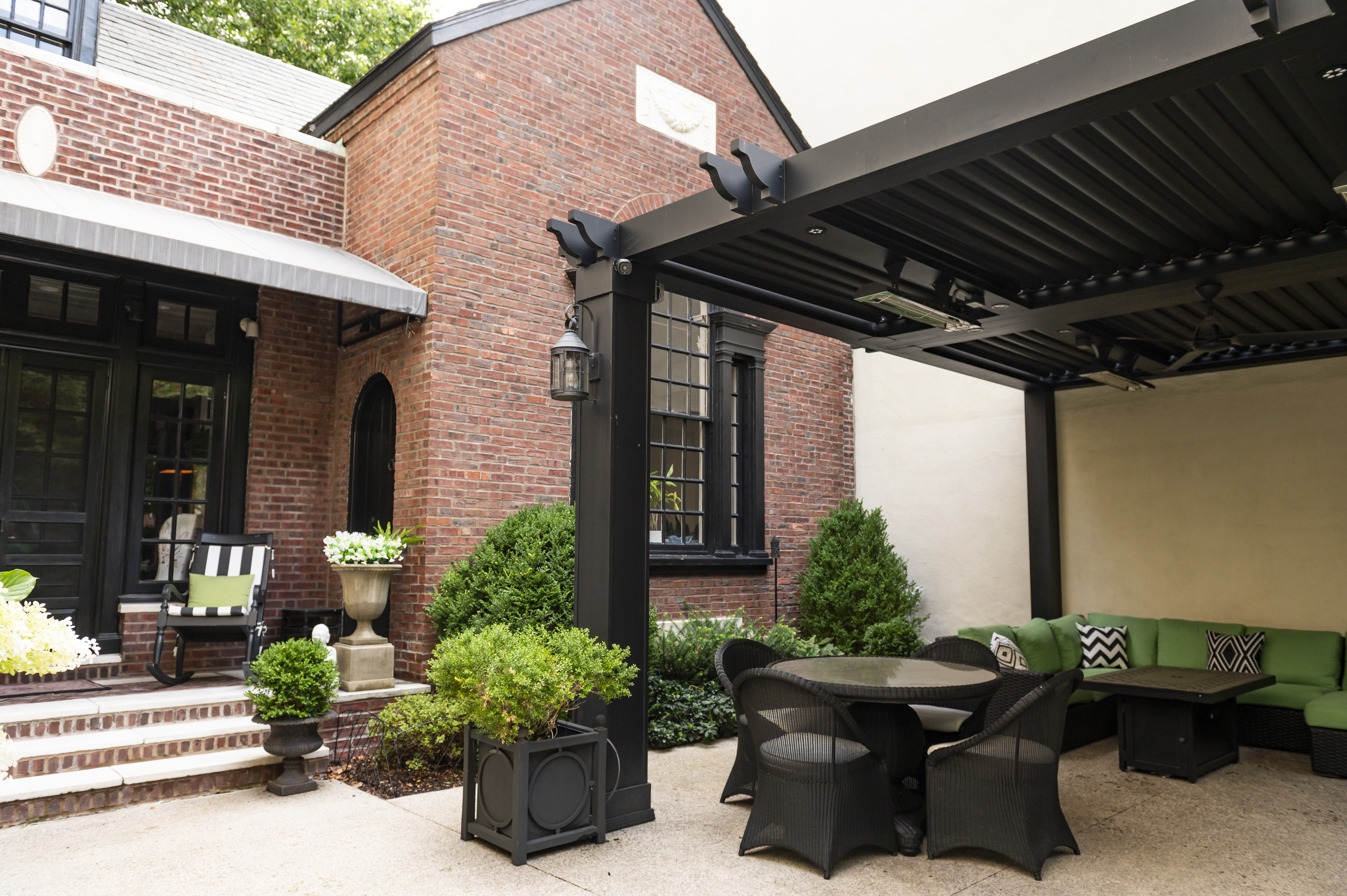
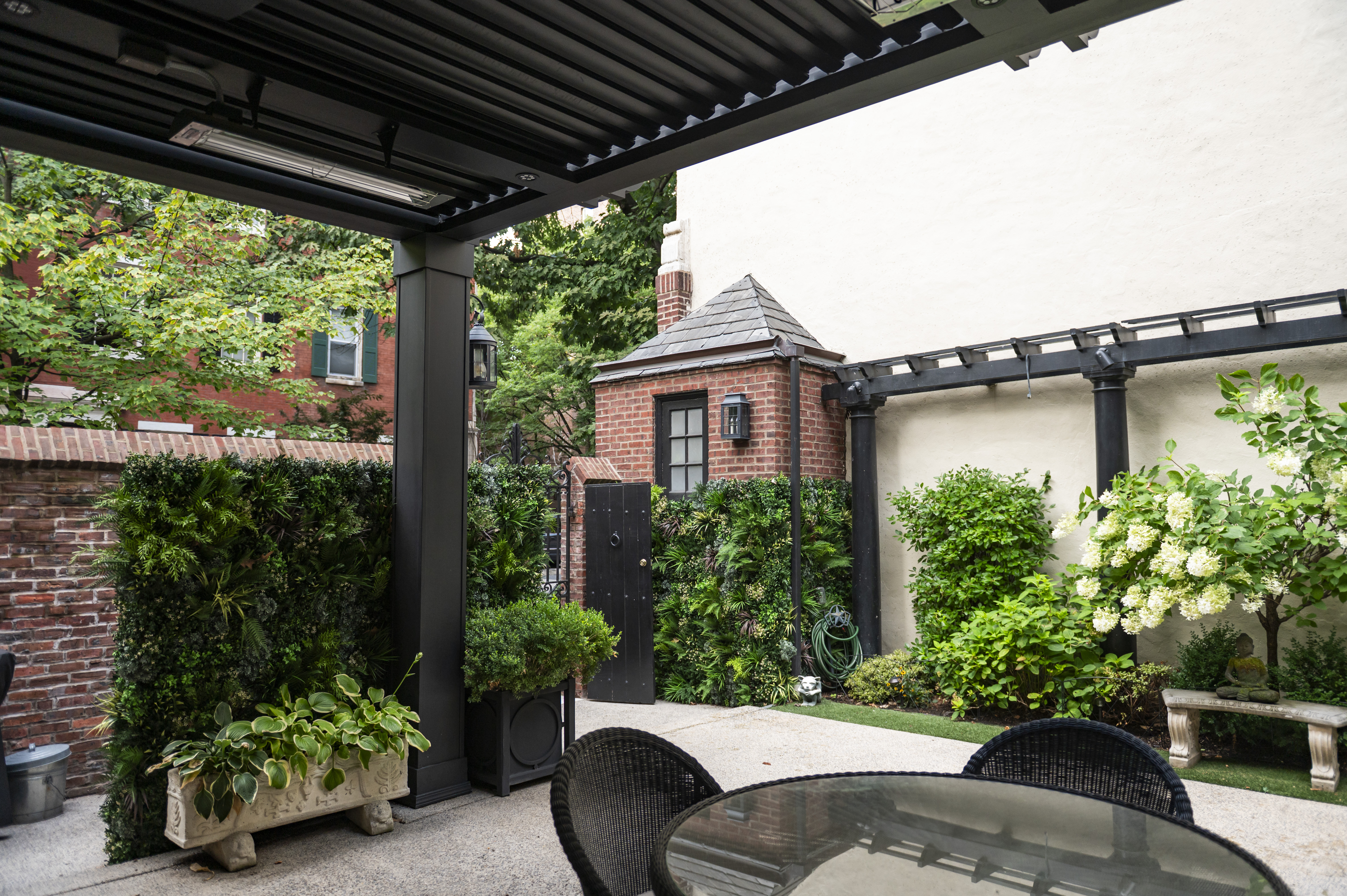
Bob and Amy Kothari’s outdoor space at their home in Washington Square West.Allie Ippolito / For The Inquirer
Amy and Bob Kothari took the time to see these challenges through. After many years living in the suburbs, the couple were anxious for city living when they bought a Washington Square West rowhouse in 2019. But they didn’t want to give up the outdoor space they enjoyed and depended upon when they lived in Ardmore.
Their new home offered the best of both worlds: the benefits of urban living and an 800-square-foot yard. The house is a designated historic home, requiring special permits before starting construction.
Distinctive Outdoor Structures built a 10-foot square pergola in their yard, complete with a louvered roof operated by a remote. In inclement weather, the roof closes automatically. The space includes lights, a ceiling fan to keep it cool in the summer, and heaters that kick on when it’s cold outside.
They use the space to entertain, enjoy evening cocktails and morning coffee, and for private work-from-home space. The project cost about $140,000 for the pergola, brickwork, lighting, landscaping, and flagstone.
“It’s a very functional but comfortable area,” Amy said. “It extends the inside of the house outside.”
Budget-friendly shade
Awnings and motorized retractable shades and screens are popular ways to create a cooler, more comfortable outdoor space.
“An awning is ideal when the homeowner wants protection from direct sun overhead, shelter from light rain, a lower-cost alternative to building a permanent roof, and the flexibility of a retractable system — sun when desired, shade when needed,” said AnnMarie Salassa, executive assistant at Paul Construction & Awning in Skippack.
Awnings are especially common over patios, decks, outdoor dining areas, and windows to reduce indoor heat gain.
Bob Kothari stands in his yard, under an awning that also provides protection from the elements just off the back of the house.Allie Ippolito / For The Inquirer
Screens are selected when homeowners want to enjoy fresh air without being bothered by mosquitoes and other insects, Salassa said. Screens also keep space clean from debris, pollen, or leaves, and reduce glare while maintaining views, she said.
Motorized screens are often paired with covered patios or decks because they can disappear when not needed.
“The shades we install can withstand 100-mile-per-hour winds,” DiSantis said. “They block out the sun and rain, and keep the heat in. They are a game changer in how people enjoy their spaces.”
Motorized awnings range in price from about $6,000 to $10,000 for a 12-foot installed product, depending on the materials used, DiSantis said. A 10-foot-wide retractable screen costs $4,500 to $6,000 on average. On the lower end, the screens offer shade or keep out insects but aren’t able to withstand strong winds, he said.
Budget-friendly shade options aren’t limited to awnings and shades. A prefabricated pergola, for instance, can be more affordable than a custom-built one. Hanso, for instance, a Scandinavian-based company with a large U.S. market, sells prefabricated aluminum gazebos and pergolas starting at $6,000. Ordered online, these are shipped to the consumer, who can then DIY the installation or hire a local contractor to help.
These structures are made with a powder coating that “last more than 30 years and does not require repainting,” Hanso CEO Darius Kunca said. And, he noted, “Aluminum kits can move with you when you move houses — simple to pack and rebuild again.”