Tag: topic-link-auto

  • Cathy Engelbert did next to nothing to help the WNBA. Its next commissioner has to be a real leader.

    Cathy Engelbert did next to nothing to help the WNBA. Its next commissioner has to be a real leader.

    Cathy Engelbert was the Jalen Hurts of the WNBA, the subject of the same kind of questions about whether a prominent figure on a speeding ship was the captain or a passenger — except with her, the answers were more definitive and damning.

    For these last few years, for the period in which the league has made its greatest gains in popularity, relevance, and quality of play, she was at best a nonfactor and at worst an impediment. The people behind those gains were the players, one in particular, and with the announcement Friday that Engelbert, a Collingswood native, was “retiring,” the WNBA has a better chance of accelerating its growth and calming the churning waters around it.

    No one looks or will look at Engelbert’s tenure atop the WNBA and credit her for the league’s progress, and no one should. The rise of women’s sports in America, particularly of women’s basketball, already was a wind at her back when she became commissioner in 2019.

    Title IX had been doing its good work on behalf of girls and young women for nearly two generations by then. Because the WNBA, founded in 1996, rarely has players to enter the league after leaving college early, women’s college basketball has been a fertile garden of talent and star power, feeding the league long before Engelbert oversaw it. UConn, Tennessee, Notre Dame, Baylor: These programs and others like them pumped out stars who had spent four years in school setting records and competing in Final Fours, whose names and games had become familiar before they’d ever signed their first professional contracts.

    The WNBA’s biggest stars include Caitlin Clark (left), Aliyah Boston, A’Ja Wilson, Olivia Miles, and Jessica Shepard.Nam Y. Huh

    That tide turned into a wave that has crested with Caitlin Clark, with the woman who can lay claim to the title of the most popular and important female athlete in the United States. The NBA lifted off in the early 1980s — once talent poured in after the league merged with the ABA, once Magic Johnson and Larry Bird brought their rivalry to the Lakers and the Celtics — and the WNBA should be on its way to telling a similar story. It has Clark. It has A’ja Wilson and Paige Bueckers and Olivia Miles and Breanna Stewart. It has a depth and breadth of talent unmatched in its history. The games should matter more than they ever have. The games should matter most.

    Except … they don’t. Who wants to hear that story now? Out of Engelbert’s lack of leadership, out of her inability and unwillingness to speak simple truths in plain language or take strong stands to benefit it, the WNBA has morphed into a cudgel in the culture war.

    On one side are the sexists and misogynists who don’t watch women’s basketball — and wouldn’t dare confess to tuning in even if they did — but whittle away their days complaining about the sport and attacking its athletes on Twitter/X. On the other are the activist players, coaches, fans and compliant media members so defensive and discomfited over the slightest criticism or question — about the inevitable byproducts of a major pro sport going mainstream and gaining a new audience — that they seem to wish that only people like them were permitted to play and watch and cover it.

    Engelbert let those sides squish her like a grape. It was bad enough for the league’s image, for its attempts to shake the perception that it was small-time in its operations and approach, that she botched the pronunciation of Golden State Valkyries coach Natalie Nakase’s last name when she presented Nakase (nuh-KAH-say) the WNBA Coach of the Year Award. That it took Clark’s presence and some timely social media posts before Engelbert stopped insisting teams fly commercial and instituted a charter flight program for the league. That her communication skills with the players were so poor that one, Napheesa Collier, felt emboldened enough to say that the league “had the worst leadership in the world.”

    No, what has been worse is Engelbert’s cowing in the face of obvious problems with obvious solutions. The league should have started hunting for better, more qualified officials years ago, rather than waiting until May to … form a task force about the topic. Engelbert must have been living in a dream world when, according to Collier, she said that Clark and the WNBA’s other stars “should be on their knees” thanking the league for the prominence it has given them … when it’s actually the other way around.

    But it’s the latest and silliest controversy — over the league’s policy, or lack thereof, on transgender athletes — that brought Engelbert’s weakness most clearly to bear.

    Royce White and Enes Kanter Freedom are clowns for their publicity campaign to declare themselves to be women so they can join the league. A commissioner with any spine would have swatted them away like gnats simply by pointing out what everyone can already see: Royce, you’re 6-foot-8. Enes, you’re 6-10. You guys played in the NBA! Do you have any idea how pathetic you are for begging to be in our league?

    A commissioner with any spine would have pointed out that FIBA, the IOC, and the USOPC already have policies that only biological females can compete in women’s sports, that the WNBA’s players follow those guidelines when they compete internationally — as they are right now, in the FIBA World Cup — and that the league’s policy reflects those policies. Instead, Engelbert has stayed silent, allowing the issue to fester, allowing this sideshow to dominate conversation about the sport.

    This is a critical moment for women’s athletics and for the WNBA. The league is expanding, adding three more franchises in the next four years, including one here in Philadelphia. It has an opportunity both to solidify its existing fan base and build upon it. It has an opportunity to climb to a level that, just a decade ago, few would have thought reachable. It will need a new commissioner who can be more than the one Cathy Engelbert was, more than someone sitting on the deck, doing nothing to avoid the swells and crashes, more than someone just along for the ride.


  • A 6-week-old Amish baby died from measles in Pennsylvania, local coroner confirms, as feud between Shapiro and RFK Jr. continues over the deaths

    A 6-week-old Amish baby died from measles in Pennsylvania, local coroner confirms, as feud between Shapiro and RFK Jr. continues over the deaths

    A six-week-old Amish infant from Lancaster County died from measles last month after receiving the care of a community clinic for a deadly genetic disorder, Lancaster County Coroner Stephen Diamantoni said Friday.

    The disclosure comes amid an escalating clash between Pennsylvania Democratic Gov. Josh Shapiro and President Donald Trump’s administration over whether two deaths reported by the state last week should be attributed to the ongoing measles outbreak in Pennsylvania.

    The six-week-old infant died from measles at home and had been in the care of the Clinic for Special Children, a Lancaster County-based treatment and research center focused on diseases found in Old Order Amish and Mennonite communities, LancasterOnline first reported.

    The baby had been getting treated for a deadly genetic disorder, Amish lethal microcephaly, prior to the child’s death from measles, Diamantoni confirmed.

    The baby had been receiving palliative care and was not expected to live much longer than six months due to the genetic condition that occurs in one in every 500 newborns within Pennsylvania’s Amish community, Diamantoni said.

    The announcement follows a nearly two-week-long public feud between Shapiro and U.S. Health and Human Services Secretary Robert F. Kennedy Jr. over whether to classify the Pennsylvania deaths as measles-related. Their standoff has led to the Centers for Disease Control and Prevention taking the unusual step of withholding the deaths from its measles tracker, reportedly under pressure from Kennedy.

    Shapiro, a first-term Democrat seeking reelection in November, initially provided little detail about two measles-related deaths when he announced them last Tuesday in a news conference, saying only the state’s first deaths from the highly contagious disease since 1991 involved residents of the county who were unvaccinated.

    Diamantoni, an elected Republican who is also a physician, subsequently said his office was investigating the death of a newborn who had measles, but did not believe measles contributed to the child’s death. He said the newborn died of a lacerated spleen, and postmortem testing showed a measles infection acquired before birth. He later said “measles” was included on the newborn’s death certificate under a section that lists “significant conditions contributing to death but not resulting in the underlying cause.”

    The deceased baby’s family, who are also Amish, told The Atlantic they believed a severe case of measles during pregnancy contributed to their newborn’s death.

    The discrepancies between Diamantoni’s statements and the state’s created an opening for anti-vaccine activists, including Kennedy, to publicly question whether the deaths could be attributed to the measles. Kennedy accused Shapiro of fearmongering about the disease — suggesting his office may have even fabricating the deaths.

    But the six-week-old infant reported Friday was confirmed to have died from the measles, Diamantoni said, after his office investigated the child’s death that previously was not reported to his office.

    The Clinic for Special Children did not know it was necessary to report the death to the Lancaster County coroner’s office, Diamantoni said.

    Diamantoni said he reported the six-week-old baby’s death to the CDC on Friday, but had not reported it to the state Department of Health.

    He said he did not know whether the six-week-old was the second measles-associated death reported by Pennsylvania last week.

    The Pennsylvania Department of Health said it was aware of the information shared by Diamantoni, noting the state had no new measles-related deaths to report Friday.

    The state has said the Pennsylvania health department’s epidemiology team’s thoroughly investigated and determined the two announced deaths were measles-related.

    The state defines a measles-associated death as deaths of people where evidence of measles is present, even when the disease may not be assessed by the coroner as the immediate cause of death.

    The Shapiro administration has said state privacy laws have limited their ability to release more personal information about the two measles-related.

    Shapiro reshared Friday a local news article about the six-week-old baby’s death and criticized Kennedy in an X post for choosing “to sow doubt, play politics, direct the CDC not to acknowledge these deaths, and even accuse me of fabricating these tragedies.”

    “That led to a firestorm of conspiracy theories that denied these families’ pain, invaded their privacy, and undermined public health,” Shapiro added.

    Kennedy highlighted the Lancaster coroner’s new disclosure in another X post later on Friday, noting “the facts emerging now demonstrate why CDC waited for the evidence rather than allowing political grandstanding to dictate its reporting.”

    A rare death

    As of Friday, there have been 577 measles cases in Pennsylvania, including 115 reported within the last week, according to the health department’s online measles dashboard.

    Measles deaths are rare. About three in 1,000 children who contract measles will die. While many infections are mild, measles can also cause severe complications, especially in young children, including pneumonia and brain swelling.

    Babies with Amish lethal microcephaly frequently die from respiratory infections due to the genetic condition leading the baby to develop with a severely small head and underdeveloped brain, Diamantoni said.

    But infants with the genetic condition usually do not die from the measles because the disease had been largely eradicated in the United States until recent years due to widespread vaccination, he said.

    “Usually there are not a lot of cases of measles, until recently,” Diamantoni added.

    Staff writer Sarah Gantz contributed reporting.

  • Ariana Andonian leaving the Blue Coats to become Los Angeles Sparks general manager

    Ariana Andonian leaving the Blue Coats to become Los Angeles Sparks general manager

    The WNBA’s Los Angeles Sparks have plucked their new general manager from the 76ers front office.

    The Sparks are hiring Blue Coats general manager Ariana Andonian for the role, a source confirmed.

    Andonian came to the Sixers under former president of basketball operations Daryl Morey. Though she’s only 31 years old, she has had an extensive career working in college and the NBA, including stints under Morey with the Sixers and under Memphis Grizzlies general manager Zach Kleiman. She also consulted for Duke’s program while earning a graduate degree from the school, according to an Inquirer profile of Andonian from 2025.

    The job will bring Andonian, a Los Angeles native who grew up a Lakers and Kobe Bryant fan, closer to home. Andonian first met Morey while in college at Southern Cal when she gave his daughter a tour of the USC campus and later joined the family for lunch.

    After that meeting, Andonian earned an internship with the Houston Rockets when Morey was the general manager there. She began as a scout and was coordinating the team’s college scouting group by age 23. A 2017 story from Bleacher Report cited her as the league’s only female scout at the time.

    Andonian’s career went from there to Duke, where she led the team’s high school scouting group while completing her MBA. She cites former coach Mike Krzyzewski and current coach Jon Scheyer as mentors.

    “It was almost like I had to tell her when she had to stop watching video,” Morey told The Inquirer of Andonian in 2025. “ … She picked up things quick and fit into a group.”

  • An all-cat band is performing this weekend in Philly. Good luck getting a ticket.

    An all-cat band is performing this weekend in Philly. Good luck getting a ticket.

    Even by rock and roll standards, the egos and drama within Tuna and the Rock Cats are something to behold.

    Sometimes, in the middle of a show, the band’s lead guitarist — St. Claude — will decide that he’d prefer to play Christmas music, and begin performing “Jingle Bells.”

    Roux, on clarinet, is a prodigy. But Annie, who plays the chimes, can be volatile; sometimes, if it gets too hot during a show, she’ll simply lie down onstage, refusing to continue.

    “Annie also plays guitar,” says Samantha Martin, the band’s founder. “But she wants to beat up the keyboard player, and we can’t have brawls onstage.”

    Behind the meowsic

    Despite this artistic anarchy — or perhaps because of it — Tuna and the Rock Cats have become an extremely hot ticket. Billed as the world’s only all-cat band, the Georgia-based group has been selling out venues across the country for years — strumming guitars, pawing piano keys, and batting at chimes from Seattle to St. Louis.

    Just how big are The Rock Cats?

    In Philadelphia, their current stop on a two-month U.S. tour, they were originally slated to play four shows at the 350-seat Suzanne Roberts Theatre on Broad Street.

    When those quickly sold out, a fifth show was added.

    Eli Milton Gizmo (Name Pending) handles drums for the band. Samantha Martin describes the cat as “not the brightest, but he’s very pretty.”Photo courtesy of Weekly Whiskers

    On Instagram, the group has nearly 100,000 followers. They’ve been featured on the Netflix series Cat People. A couple years ago, they left Theo Von mesmerized during an appearance on his wildly-popular podcast, This Past Weekend.

    “It really is just fascinating to think about them cats and everything they’re doin’,” Von gushed.

    Martin, a former wildlife educator, has been directing this Meowtly Crüe for about two decades, in addition to training animals for TV and film.

    Early in her career, she gravitated toward “misfit” animals: snakes, spiders, rats. (“Rats will never let you down,” she explains.) But then she eventually met Tuna, a cat “so brilliant I said, ‘Let’s give this cat thing a try.’”

    The band’s first show was in 2006, at an art gallery in Chicago. The group had only three members then, but when people heard there was a troupe of cats ready to perform, they lined up to get in.

    The show, Martin says, was “horrible.”

    Which is to say, it went fabulously.

    “People loved that the show was horrible,” Martin says. “They love the fails more than the successes.”

    Since then, she’s taught an array of cats to “play” a variety of instruments, some better than others. During performances, Martin joins the band onstage, giving visual and verbal cues — she mimes a tapping motion when she wants a cat to paw its instrument, for instance — and doling out treats for a job well done.

    How are the Rock Cats, musically?

    That depends who you ask.

    While their commercial success is undeniable, critical acclaim has been mixed. One reviewer, in Seattle, described the group’s style as “an unpredictable assortment of instrument clanging,” adding that “rarely does it sound like the cats are playing the same song, let alone an actual, fully realized piece of music.” Another bemoaned the fact that, at a Christmas-themed performance, the band did not actually play much holiday music — though this critique seemed a bit harsh.

    They are, after all, cats.

    On the road

    Tour life is not all bottle-service and Fancy Feast.

    Packed onto their tour bus at any given time are Martin, tour manager Ashley Murnan, tour assistant Amanda Fenick, feline care coordinator Willie Zamora, roughly 15 cats, and a chicken named Cluck Norris, who plays the cymbal.

    While the cats largely have the run of the bus, “the humans have a six-foot, coffin-sized bunk in a drawer,” says Murnan. Earlier on their current tour, in Baltimore, their generator — which powers the entire bus — went out for two weeks, putting them 10 days behind schedule.

    And this is to say nothing of the challenge inherent in managing 16 distinct personalities — a mixed bag of climbers, swatters, and what have you.

    “The band is chaos,” says Martin. “They’re all over the place.”

    She never misses a show.

    Martin has performed with a broken foot, with cancer, and with a voice so raspy it could hardly be heard through her microphone. Once, she paid to have the band’s broken-down tour bus towed from Wisconsin to Chicago in order to get to a show on time.

    “It was a $2,000 tow,” she says, “but we made it.”

    Twix is one of three guitarists for the (mostly) all-cat band, Tuna and the Rock CatsPhoto by David Soder (Courtesy of Rock Cats Rescue, Inc.)

    Despite the drama, Martin adores the cats, all of whom were once orphans, rescues, or strays. When they’re not touring, they live with her in Georgia, where she cooks them fresh chicken and salmon and turkey. (Martin also runs a nonprofit — Rock Cats Rescue, Inc. — that partners with local organizations to get cats adopted.)

    Even Miki — her impossibly apathetic trumpet player who was found abandoned in a discarded Huggies box — has stolen her heart.

    “They put a roof over my head,” she says. “Granted, it’s leaky and the gutters are falling off.”

  • Daughter of prominent Philadelphia family sues billionaire ex-boyfriend for $400 million

    Daughter of prominent Philadelphia family sues billionaire ex-boyfriend for $400 million

    Some romantic rendezvous end in heartbreak, others in a $400 million lawsuit.

    But that’s the fall out from the breakup between Oona Sperr, the daughter of the Please Touch Museum founder and a prominent Philadelphia architect, and an oil-tycoon from Texas.

    In a tell-all lawsuit, Sperr, 64, accused billionaire Sid Bass of breaking financial promises he made to her throughout their relationship.

    The New York City-based interior designer and Bass “lived together in a loving, committed relationship” since 2014 and “were very happy as a couple,” the suit says. The oil scion, has a net worth of $4.4 billion, promised Sperr that she would always be cared for financially and would receive ownership interest in his properties, according to the complaint.

    The 84-year-old began declining physically and cognitively in 2023, the suit says. He previously suffered three mini-strokes, signs of Parkinson’s disease appeared in a brain scan, and his excessive drinking worsened his tremors, the complaint says.

    Around that time, Althea Viafora Kress entered the picture.

    Viafora Kress pursued Bass since late 2022 under the pretext that she needed advice on how to invest money she inherited, the suit says.

    “Unbeknownst to Oona, Viafora Kress began grooming Sid and, at some point, achieved her goal of a coercive relationship with him, with devastating consequences for Oona and Sid’s partnership,” the complaint says.

    After breakfast in September 2024, the suit says, Bass broke up with Sperr with two sentences: “I want a separation. You are to pack and leave.”

    Sperr suspected that there was another woman, and in the following weeks she came to learn about Bass’ relationship with Viafora Kress.

    Immediately after the breakup, the suit says, Bass promised his former paramour a lump-sum payment of $50 million, the smallest of their New York homes, another property of her choosing, continued staff support, and care for her mother, the 96-year-old founder of the Please Touch Museum, Portia Sperr.

    These terms were less than Bass originally promised her, the complaint says. But in the following months, the commitment narrowed further.

    Sperr received a “maintenance agreement” via email from Bass’ lawyer in January 2025 that included a commitment for annual payments of $5 million for 10 years, denied her ownership of any home, and declined to pay for her mother’s care, among other things, the suit says. The agreement was also accompanied with a nondisclosure agreement.

    “In other words, what Sid was now proposing was that Oona … should be forced to depend entirely on Sid’s increasingly unpredictable whims, or, even more troubling, on the preferences of Viafora Kress,” the lawsuit says.

    The Inquirer was unable to reach Bass and Viafora Kress, who are both named defendants in the lawsuit, which was filed in the Southern District of New York.

    While a $400 million breakup is more than most could wrap their head around, it’s par for the course for Bass, the suit says.

    The billionaire previously had two extremely expensive divorces.

    Bass divorced his first wife, Anne Hendricks Bass, in 1988, leading to settlement that cost him $200 million to $500 million, the suit says. And in 2011 he divorced Mercedes Bass in an agreement that would allow her to sustain an “ultraluxury lifestyle,” according to the complaint.

    “This is a case about broken promises,” Roberta Kaplan, Sperr’s attorney, said in a statement. “Oona is the woman who spent a decade making Sid’s life convenient — abandoning her career, managing their shared homes and affairs, caring for him through his serious illnesses — all because Sid agreed that he would take care of her and her 96-year-old mother no matter what.”

    While Sperr comes from a more modest upbringing relative to the son of an oil dynasty, her family has a legacy of its own in Philadelphia.

    Her father, Otto Sperr, was a prominent Rittenhouse Square architect. He died in 1998.

    Portia Sperr was a Montessori educator who still lives in Philadelphia, the suit says.

    Oona Sperr moved to Philadelphia when she was 2, and went on to graduate from the Baldwin School in Bryn Mawr. She then moved to New York to study architecture and embarked on a career as an interior designer.

    But she abandoned that career after meeting Bass, opting to take care of him, their homes, and daily obligations because of a promise that she would never need to support herself or her mother independently.

    “Sid has breached his promises by refusing to provide Oona with the property interests and financial support he agreed she would receive,” the suit says, “in exchange for her years of devotion to their partnership and her enormous contributions to the life they built together.”

  • Tom Corcoran, retired president of the Delaware River Waterfront Corp., has died at 82

    Tom Corcoran, retired president of the Delaware River Waterfront Corp., has died at 82

    Tom Corcoran, 82, of Philadelphia, retired president of the Delaware River Waterfront Corp., founding president and former chief executive officer of the old Cooper’s Ferry Development Association in Camden, former business administrator for the city of Camden, onetime Peace Corps program director in West Africa, mentor, and poetry enthusiast, died Sunday, Aug. 30, of complications from dementia at his home in Center City.

    Born in Chicago and a graduate of Loyola University Chicago, Mr. Corcoran earned a master’s degree in public administration at the University of Pennsylvania’s Wharton School in 1975 and never strayed far from the Delaware River after that. He spent 25 years, from 1984 to 2009, as president and CEO of the Cooper’s Ferry Development Association on the Camden waterfront, and eight years, from 2009 to 2017, as president of the Delaware River Waterfront Corp. in Philadelphia.

    He championed what he called “the two cities, one waterfront strategy” and was especially adept, former colleagues said, at political maneuvering and marshaling funds and projects. Former colleagues on both sides of the Delaware called him “a tireless public servant,” “a visionary urban planner,” and an “economic development strategist with short-term practicality and long-term vision.”

    In Camden, Mr. Corcoran added more than $550 million of investments to the waterfront area and oversaw the development of what is now the Freedom Mortgage Pavilion, the Adventure Aquarium, Wiggins Waterfront Park, the Riverlink Ferry, several office buildings, and other projects. Another New Jersey developer called him a “cult figure” among state lawmakers.

    Mr. Corcoran talks at City Hall in 2011 about creating a string of parks along the Delaware River.Akira Suwa / Staff Photographer

    He said education as well as development was key to building a strong local economy and told The Inquirer in 2006: “Until Camden has a good-quality education system, we’re not going to be able to attract families with school-age children back to the city.”

    Dana L. Redd, former Camden mayor and current president and CEO of Camden Community Partnership, said on Facebook that Mr. Corcoran often slept on a cot in his Camden office and left daily handwritten messages that his project managers called “love notes.” Redd said: “He challenged a generation of urban leaders to think bigger, believe in Camden, and dream about what the city could become.”

    In Philadelphia, he initiated the Race Street and Washington Avenue pier parks, the Spruce Street Harbor Park, a miles-long bike and walking trail, and the I-95 overpass park to reconnect Center City with its waterfront. “The more we look at the concept of one waterfront, two states, the more opportunities we’re going to find,” he said when he left Camden for Philadelphia in 2009.

    When he retired in 2017, he said: “Instead of swinging for the fences, we decided we would hit singles and doubles and bunts and sacrifices, steal bases, and do whatever we could. Eventually, we thought, we’d always get back to the center.”

    Mr. Corcoran (left) shakes hands with then-Mayor Michael Nutter in 2009 after joining the Delaware River Waterfront Corp. Alejandro A. Alvarez / Staff Photographer

    Longtime colleague and friend Bill Hankowsky said: “It is truly unique that a single individual could have the vast impact across two facing waterfronts in the center of one of the country’s major urban metros.”

    Earlier, Mr. Corcoran served nine years, from 1975 to 1984, in Camden city government, rising from administrative aide to business administrator. In 2001, he earned a Good Neighbor Award from the Camden County chapter of the American Red Cross for his “integral role in the revitalization of the city.”

    In the 1960s, Mr. Corcoran joined the Peace Corps after college and spent seven years in Africa building dams and wells with local farmers. He spoke French and the local African language, and rose to program director.

    “What an exemplary life he led,” a former Peace Corps colleague said in a tribute, “without fanfare or drama and always with service to others.”

    Mr. Corcoran (right) led visitors on a tour of the Washington Avenue pier park in 2014.Viviana Pernot / Staff Photographer

    Off the waterfront, Mr. Corcoran was enthralled by poetry and his Irish heritage. He liked to recite lines from Ulysses and other poems, and sing songs from the old country.

    “He was a true Renaissance man who had a remarkable vision for communities and people,” a former colleague said. Former colleague John Grady said: ”Tom was a giant, unassuming, persistent force for the local community.”

    Thomas Patrick Corcoran was born May 13, 1944. He earned a bachelor’s degree in political science at Loyola in Chicago and rode camels to work in Africa during his time in the Peace Corps.

    He met Robin Lowey at a dinner society event, and they married in 2003, and lived in Camden and Philadelphia. They enjoyed traveling and dining together, and hashing over world affairs.

    Mr. Corcoran and his wife, Robin Lowey, married in 2003. Courtesy of friends

    In 2009, he said he often peered through a telescope at the Philadelphia waterfront from his home in Camden and wondered how he would develop Penn’s Landing. “He’s the one who brought together the business leaders and was able to steer through difficult political waters,” then-Camden County freeholder Jeffrey Nash said in 2009.

    His wife said: “He was a kind and generous gentleman. He was a good, nice person.”

    In addition to his wife, Mr. Corcoran is survived by three sisters, a brother, and other relatives.

    Services were held Thursday.

    Donations in his name may be made to the Caplan Caring Difference Fund at the Penn Memory Center, Office of the Treasurer, Box 71332, Philadelphia, Pa. 19176.

    Mr. Corcoran spent seven years in the Peace Corps after college. Courtesy of friends
  • What Burlington Stores’ HQ move to Philly means, by the numbers

    What Burlington Stores’ HQ move to Philly means, by the numbers

    Philadelphia officials are celebrating the news that Burlington Stores is moving its headquarters to University City’s Schuylkill Yards.

    With the relocation, set to start in two to three years, the discount retailer says it will invest a total of $370 million in the city. The company plans to keep warehouses in Burlington County, including on the site of its current headquarters, where it has been based for more than half a century.

    Here’s what else to know about the big numbers related to Burlington’s move to 3151 Market St.

    What does it cost to move to Schuylkill Yards?

    $370 million: What Burlington plans to spend on the move

    • $240 million: How much Burlington is paying for the 441,000-square-foot building, according to a Thursday SEC filing by Brandywine Realty Trust. That’s about $544 per square foot.
    • $130 million: How much Burlington plans to spend on “design and development of the space, creating an HQ built for collaboration and the modern needs of Burlington’s corporate workforce,” a spokesperson said.

    $223 million: What Brandywine had spent on 3151 Market, as of June 30, according to its latest earnings report.

    (function() { var l = function() { new pym.Parent( ‘burlington-move__graphic’, ‘https://media.inquirer.com/storage/inquirer/ai2html/burlington-move/index.html’); }; if(typeof(pym) === ‘undefined’) { var h = document.getElementsByTagName(‘head’)[0], s = document.createElement(‘script’); s.type = ‘text/javascript’; s.src = ‘https://pym.nprapps.org/pym.v1.min.js’; s.onload = l; h.appendChild(s); } else { l(); } })();

    $168 million: How much Brandywine estimates it will get from the sale. The company said in an SEC filing that it has a $57.3 million mortgage on the building that will be repaid at closing, which is set for later this month.

    96%: The vacancy rate at 3151 Market, which was completed in 2024.

    Burlington Stores’ future new home at 3151 Market St., in Philadelphia. Jessica Griffin / Staff Photographer

    What government incentives are going to Burlington?

    $30 million: How much Burlington is set to receive in grants from Pennsylvania.

    $8 million: What the City of Philadelphia plans to invest in Burlington’s move, including a $7 million forgivable loan and $1 million for a year of free SEPTA passes for employees.

    How much of Burlington’s workforce is coming to Philly?

    1,500: Number of Burlington employees the company plans to move from New Jersey to Philadelphia, starting in late 2028 or early 2029

    500: Number of hires Burlington plans at its new headquarters in the next five years

    0: Number of layoffs Burlington has planned as a result of the headquarters relocation

    Inquirer reporter Joseph N. DiStefano contributed to this article.

  • A Philly man who was serving life in prison for murder will be released after yearslong legal appeal

    A Philly man who was serving life in prison for murder will be released after yearslong legal appeal

    A man serving life in prison for a 2010 first-degree murder conviction will be released from prison after pleading no contest to lesser crimes for his role in a fatal North Philadelphia shooting.

    Rasheem Hall, 42, was granted the right to a new trial in April after a judge agreed with his defense attorney that prosecutors had withheld evidence that could have aided Hall’s ongoing effort to appeal his conviction.

    They said prosecutors’ main witness had been an unreliable jailhouse informant who had recanted statements he’d made about Hall’s involvement in the 2007 shooting that left 34-year-old Ronald Kennel dead.

    Rather than retry the case, however, prosecutors agreed to conditions Friday that allowed Hall to plead no contest to aggravated assault and a firearms violation. During the hearing, Common Pleas Court Judge Diana L. Anhalt approved a sentence of nine to 18 years in prison in exchange for Hall’s plea.

    Because he had already served that time in custody, he could be released as early as Friday afternoon, she said.

    Hall’s family members reacted to the news with a mixture of smiles and tears.

    “I’m just happy for Rasheem, I’m just happy for his family,” Hall’s defense attorney, Robert Gamburg, said after the hearing.

    The development comes as District Attorney Larry Krasner’s office faces scrutiny of its handling of post-conviction cases. Last week, a federal judge said actions city prosecutors took in another case could amount to perjury, conspiracy, or obstruction of justice.

    Friday’s hearing ended a yearslong campaign by Hall to appeal his conviction.

    That effort centered on issues with Deric Williams, an informant who was recorded on a jailhouse phone line telling his mother he had wrongfully implicated Hall in the crime and that he had tried, unsuccessfully, to recant his statements to detectives.

    Earlier this year, Gamburg told a judge prosecutors had failed to hand over that recording of Williams to Hall in 2013 during his appeal, though prosecutors contended that jurors had heard similar remarks from Williams at Hall’s 2010 trial.

    Judge Rose Marie DeFino-Nastasi sided with Hall, saying that in addition to the phone recording, emails between prosecutors with details of their relationship with Williams should have been turned over to his defense team.

    On Friday, Assistant District Attorney Trey Flynn told Anhault that while prosecutors accepted Hall’s plea, they stood by their earlier assertions about the case.

    He said prosecutors would have told jurors that Hall and another man, David Satchell, only fired guns during the May 20, 2007, incident after being shot at by another person first.

    Hall’s gunfire struck a bystander, Charlene MacDonald, in the leg, Flynn said.

    “It was individuals firing at Hall who actually struck Ronald Kennel, who was standing behind them,” Flynn said.

    Still, prosecutors would have argued that Hall was responsible for Kennel’s death via transferred intent, Flynn said. The legal theory holds a defendant responsible for injury or death based on their intent to harm, regardless of who was actually affected.

    Flynn said he had spoken with Kennel’s brother “at length” about prosecutors’ decision to accept Hall’s plea. And he said District Attorney Larry Krasner agreed with the decision as well.

    Outside the courtroom, Hall’s family members were moved to tears by his imminent release and return home for the first time since his early 20s.

    “It’s been almost 19 years,” said Hall’s father, Ronald. “He’s got a daughter, he’s got nieces, nephews. People that passed away. It’s a lot of time lost, time you can’t get back.”

    Ronald Hall said his son only learned of the opportunity to plea to lesser charges last week, and that the gravity of the news is still fresh.

    Naturally, Hall said of his son, “he’s ecstatic.”

  • An airman stationed in Dover raped a Bucks County teen he met on Snapchat, prosecutors say

    An airman stationed in Dover raped a Bucks County teen he met on Snapchat, prosecutors say

    Dylan Drake Williams knew the girl he had befriended on Snapchat was 15. But that didn’t stop him, federal prosecutors said Friday, from asking her how badly she wanted to be kidnapped, and whether she would be his “sex slave.”

    And Williams, an airman stationed at Dover Air Force Base, eventually followed through, according to court filings. He drove to the girl’s Falls Township home Aug. 20, instructed her to leave her phone behind and delete some of the incriminating text messages, and took her to his home, where, the girl told police, he raped her.

    Williams, 27, has been charged in U.S. District Court in Delaware with coercion and enticement, transportation with intent to engage in criminal sexual activity, and travel with intent to engage in illicit sexual conduct. Prosecutors in Bucks County have filed a parallel case, in which he faces similar charges, including unlawful contact with a minor and corruption of minors.

    He also faces a third, separate investigation in Kent County, Delaware, where he is charged with rape.

    Williams will remain in federal custody ahead of a detention hearing later this month, according to court records. Neither his federal attorney, Conor Wilson, nor the attorney representing him in Bucks County, Ellis Klein, returned calls for comment.

    The girl told police she began messaging Williams in April, according to the affidavit of probable cause for his arrest. He knew she was underage, she said, but asked her to send him explicit photos of herself, which he returned in kind.

    Eventually, Williams arranged to meet the girl in Bucks County, and drove to a basketball court not far from her home, the affidavit said. There, Williams coerced the girl to perform a sex act in his car.

    Afterward, the two continued to exchange sexually charged messages. In early August, Williams asked the girl if he could see her again, telling her he wanted “to take ownership” of her and was planning to drive to her home to pick her up in the middle of the night.

    As they planned the meeting, the girl, fearful, asked Williams if he was going to kill her, but he reassured her, telling her he genuinely liked her, and that she “was brave for doing this.”

    Before dawn on Aug. 20, the girl left her home through her bedroom window and walked to Williams’ nearby car. Per his instructions, she had left her cell phone behind.

    Her parents, finding her phone and reading some of the text messages the two had exchanged, called Falls Township Police. Detectives there were able to identify Williams through his Snapchat account, and find that he was enlisted at the Dover base.

    Meanwhile, Williams drove the girl more than 100 miles back to Delaware, where he hid her in the basement apartment he was renting. The girl later told police he forced her to have sex, ignoring her complaints that she was in pain.

    When police arrived at the base, Williams admitted that the girl was at his home, and that he had sex with her.

    He said he knew that getting caught would ruin his life, and said he preferred the death penalty, because he “was too much of a coward to take his life,” the affidavit said.

  • Echoes of the Lindsay Clancy case in a 1989 Northeast Philly infant murder

    Echoes of the Lindsay Clancy case in a 1989 Northeast Philly infant murder

    Samuel C. Stretton, the high-profile Chester County lawyer, said he’s been hearing from women about Lindsay Clancy, the Massachusetts mother facing murder charges for killing her three young children.

    “You know, Sam, she’s innocent,” he recalled one woman telling him at a supermarket.

    Stretton knows the Clancy case has struck a nerve. He knows because he defended a woman in a similar case 37 years ago.

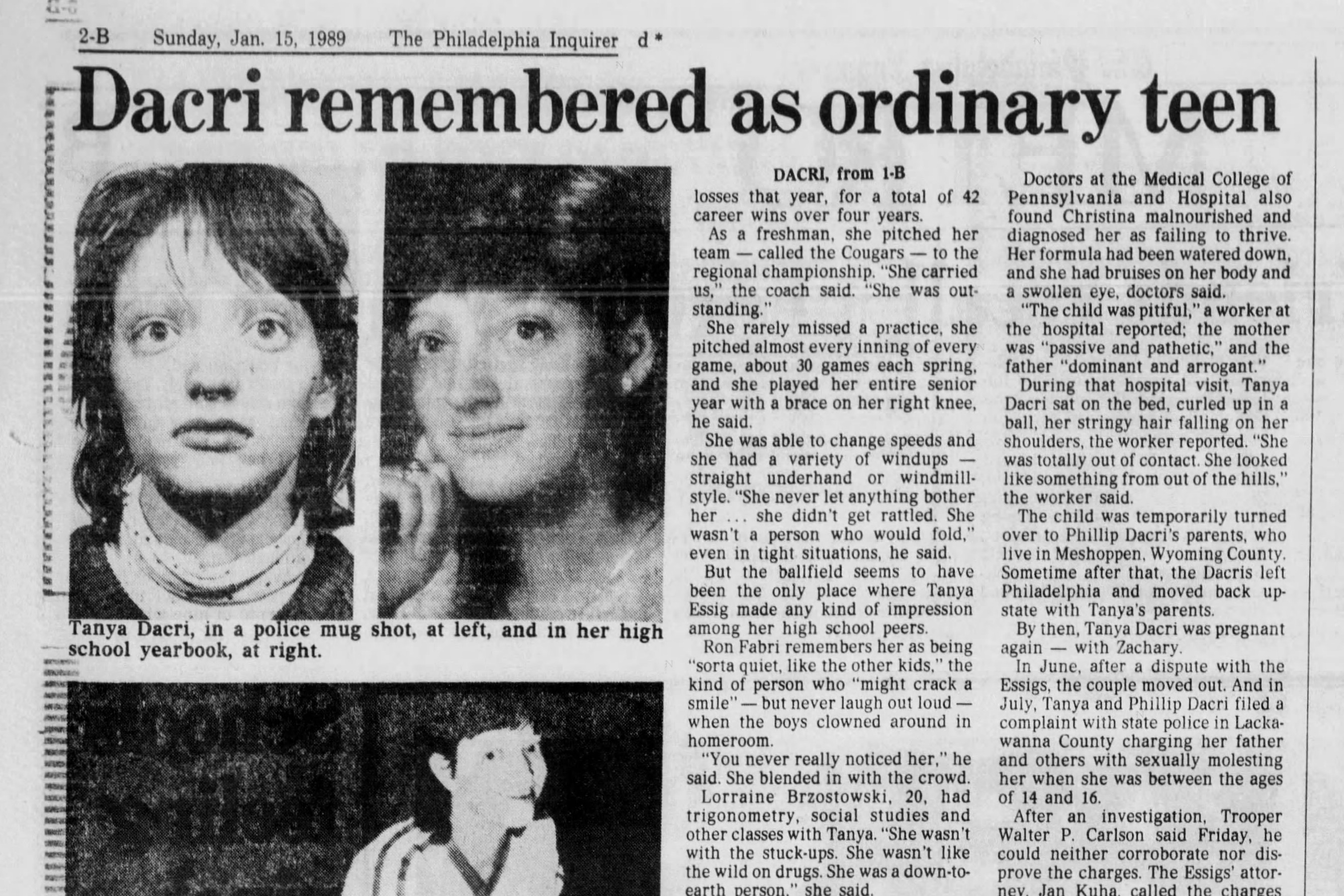
    He represented Tanya Dacri, a Northeast Philadelphia woman who pleaded guilty in 1989 to drowning her infant son Zacharry and dismembering his body.

    She was sentenced to life in prison.

    “I don’t think there’s any question now, in hindsight, that she suffered from [the] postpartum diagnosis. Problem was, it wasn’t understood back then, like it is now,” Stretton said in a phone interview Tuesday night.

    Lindsay Clancy sits at the defense table as Kevin Reddington asks the jury to find her not guilty during her murder trial at Plymouth Superior Court in Plymouth, Mass., on Aug. 27. Greg Derr

    The jury in the Clancy case began deliberating last week. Unable to reach a verdict, Judge William Sullivan declared a mistrial Friday afternoon. A status hearing to decide where the case goes from here was scheduled for Sept. 29.

    Clancy, a former labor and delivery nurse, admits she strangled her children, but her legal defense is that postpartum psychosis led to her actions. Clancy, 36, has pleaded not guilty by reason of lack of criminal responsibility. Prosecutors say she knew what she was doing.

    In Pennsylvania, Dacri, now 58, is serving her sentence at the State Correctional Institution at Muncy, the state prison for women.

    Stretton believes “it’s the right time” for Dacri to seek a pardon or commutation. That would require a unanimous decision from the state Board of Pardons, and then the approval of the governor.

    “She and I have been talking about it for about 10 years, but I told her to wait a little longer. I thought that would enhance her chances, and now I think it’s the right time,” Stretton said.

    The last time Stretton communicated with Dacri was by letter several years ago. Stretton said he would move forward with a clemency application “if she still wants to do it.”

    Dacri has been behind bars since she was arrested in 1989.

    In 1989, Tanya Dacri pleaded guilty to drowning her 2-month-old son Zacharry in a Northeast Philadelphia apartment and dismembering his body.Philadelphia Inquirer

    “She’s done well in prison. She’s adjusted. She’s attended all the programs. She’s sorry. She’s regretful,” Stretton said.

    Dacri “has been adequately punished, and therefore we’re asking them to allow a sentence to be commuted or a pardon be granted, so she can get out and have some of her life left,” Stretton said.

    “Postpartum psychosis” as a legal defense was unusual but not unknown before Dacri’s case, according to a paper published in the spring 1991 Dickinson Law Review.

    Wide-ranging sentences

    While Dacri was sentenced to life in prison, mothers with similar Pennsylvania cases were given wildly different sentences.

    For example, the paper’s author, Amy L. Nelson, cited the case of Sharon Weisensale, who was found guilty but mentally ill in Bucks County of third-degree murder for the 1984 drowning death of her 2-month-old daughter.

    “She was given a five-year suspended prison sentence and was required to undergo psychiatric treatment,” Nelson wrote.

    In another case, Sharon Comitz, of Osceola Mills, Pa., pleaded guilty but mentally ill to third-degree drowning in the 1985 death of her month-old son, Nelson wrote.

    According to testimony, Comitz was treated for severe postpartum depression at the time of the murder, Nelson said. Comitz received a prison sentence of eight to 20 years.

    In another Pennsylvania case, Chanda Smith was convicted of third-degree murder in the drowning death of her three-week-old daughter, Nelson said. Smith was sentence to five to 10 years in prison.

    “Experts testified that Smith, like Weisensale and Comitz, murdered her child while suffering from severe postpartum psychosis,” Nelson wrote.

    A false story falls apart

    On the morning of Jan. 12, 1989, the Dacri story hit the front page of The Inquirer under the headline, “Police: Mother drowned baby.”

    Tanya Dacri, who was 20 years old at the time, initially told police that Zacharry had been taken by purse-snatching Black men — a detail that drew accusations of racism from some media commentators.

    However, investigators were immediately suspicious. Dacri’s fake story quickly fell apart that same day and she told police she killed her son because he was always crying, The Inquirer reported.

    She told police she dismembered his body and put the pieces in weighted plastic bags. She and her husband, Phillip Dacri, then disposed of the bags in the Neshaminy Creek in Bucks County and a creek in Carbon County.

    Phillip Dacri pleaded guilty to helping his wife dispose of the remains and served 10 months in prison.

    In court, During court proceedings, a psychologist for the defense and a psychiatrist for the prosecution agreed Dacri had a mental disorder that might have deteriorated to psychosis on the day she killed her infant son, The Inquirer reported.

    But they disagreed on whether Dacri specifically intended to kill her Zacharry.

    “I am convinced beyond a reasonable doubt that, when you placed your son in that bathtub and when you turned on the water and put the plug in the tub, that it was your intention to kill him,” Common Pleas Court Judge Michael Stiles told Dacri during her sentencing.