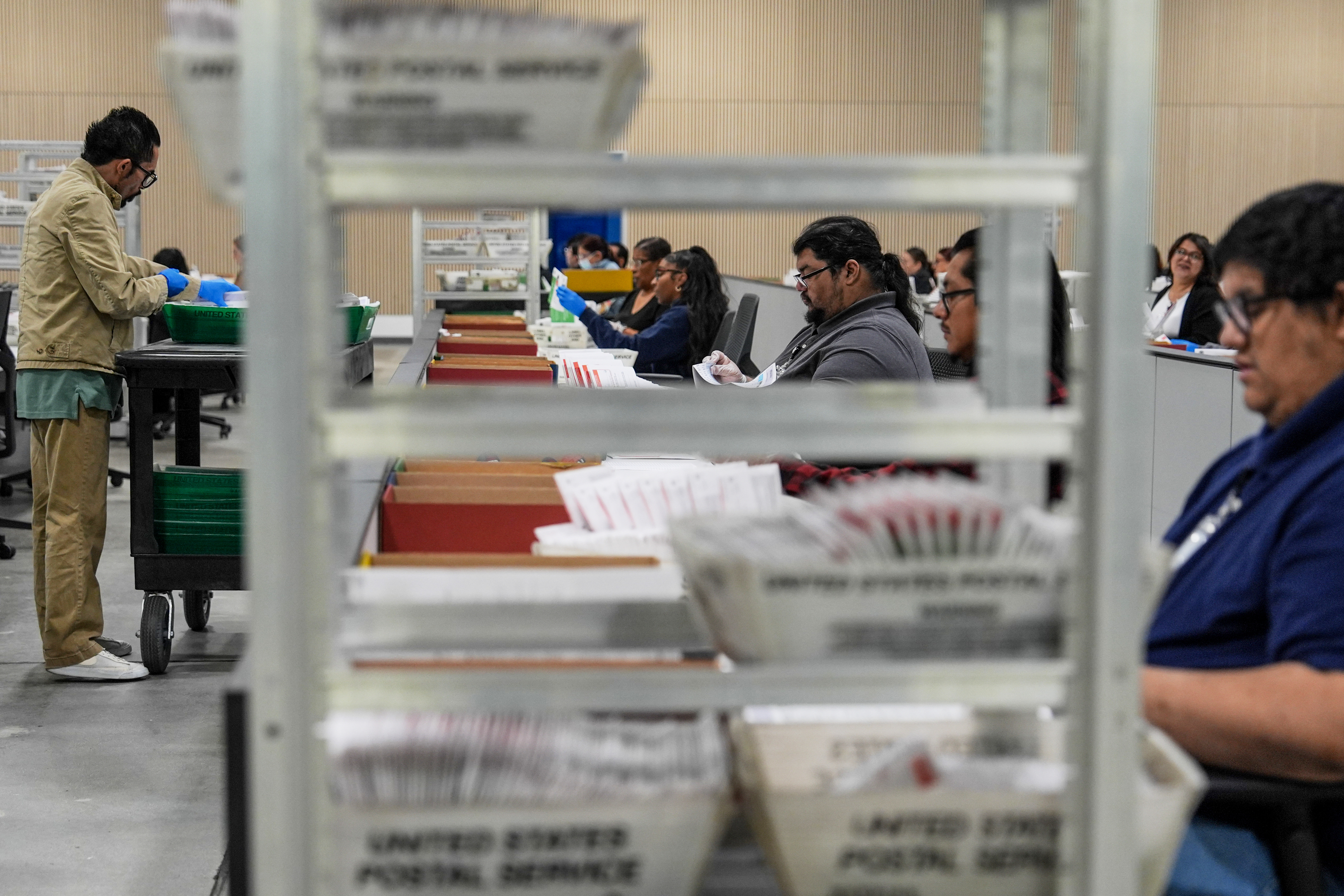
A federal judge on Wednesday rejected the latest Trump administration attempt to intervene in the midterm elections, denying an effort to force California to immediately set aside 20,000 ballots from people the administration suspects are “likely noncitizens.”
In a scathing ruling that he had signaled at a hearing the previous day, Judge David O. Carter wrote that the administration’s demand for urgent action “would wreak havoc and disrupt the election that is already underway, create a chilling effect on election workers and voters alike, and discount the votes of United States citizens.”
“Never before in American history has the federal government, on the eve of an election, sought to coerce a state and local government to abandon their own constitutional elections procedures and bend to the will of the executive branch,” wrote Carter, of the U.S. District Court for the Central District of California. “In bringing this lawsuit, the executive would have this court believe that it reigns as a sole sovereign. But California and its people are sovereign, too.”
The ruling, which federal prosecutors are expected to appeal, came amid an escalating legal battle between the Justice Department and state election officials as President Donald Trump seeks to demonstrate that huge numbers of noncitizens have voted illegally in U.S. elections. Multiple studies have found such fraud is exceedingly rare.
In his ruling, Carter noted that the administration had filed at least 31 lawsuits seeking complete voter rolls from states in federal courts across the country — a campaign that was “indicative of a broad, ongoing pattern of attempted election interference.”
“Out of the twenty-six cases that have been decided, the D.O.J. has prevailed in precisely zero,” the judge added.
Nonetheless, he wrote, federal prosecutors have continued the campaign, pressuring states to scour voter rolls for noncitizens and threatening election workers with “federal scrutiny” and legal action.
Recently, the administration sued to intervene in Alaska’s Senate race if the Republican incumbent narrowly loses. And this week, in a maneuver similar to the case in California, federal authorities asked officials in Washington to set aside hundreds of mail ballots that it said may have been sent to noncitizens in that state. (Steve R. Hobbs, Washington’s secretary of state, responded on Wednesday that cooperation would be “irresponsible and illegal” since the list was not reliable and a cursory examination turned up the names of U.S. citizens.)
Bill Essayli, the top federal prosecutor in Southern California, has said that state and local authorities could cooperate with the administration’s demands without disrupting the election. The government was not asking to void any ballots, he said, only to set some of them aside until the citizenship of the voters could be verified.
Lawyers for the state and Los Angeles County have asked that the case be dismissed.
Critics view the administration’s campaign as a broader attempt to sway the results of the Nov. 3 midterm elections, in which polls have shown Democrats holding a wide advantage. The efforts have been largely unsuccessful, in part because many of the state and local authorities that administer and supervise elections have refused to comply with demands for access to sensitive voter data.
As a result, the federal authorities have compiled their own databases using public, commercially available information that they have compared with federal records. The process has led to mistakes in some states because public voter rolls do not include unique identifiers like Social Security numbers and because federal immigration records do not always immediately capture changes in citizenship status.
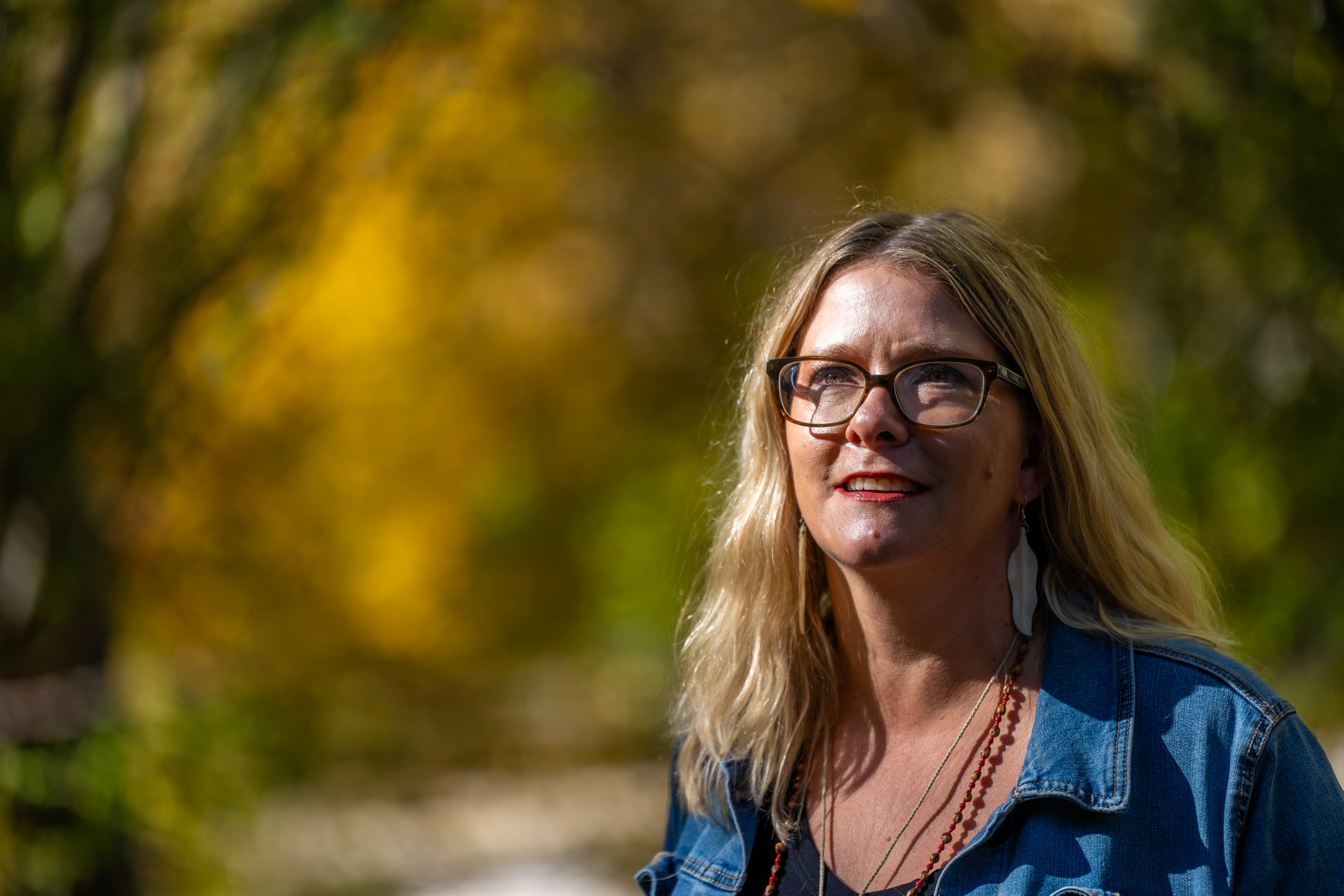
Jess Settle, 39, has dreaded thinking about what will happen to her health insurance. Neither of her two jobs offers health care, and she makes too much money for Medicaid. For this past year, like more than 20 million other Americans, she relied on the Affordable Care Act marketplace, paying $400 a month for her plan. But now her insurer is leaving the marketplace, and as of Dec. 31 she will need a new solution that is likely to be more expensive.
She doubts she can pay more.
“I’m kind of at that crossroads right now, and I’ve been putting it off because it’s so mentally taxing to even think about,” said Settle, who lives in Virginia’s rural Rappahannock County.
Premiums on federal and state-run marketplaces will typically jump by around 15 percent next year, according to a Washington Post analysis of finalized and proposed rate increases. It will be the second straight year of double-digit premium increases, as many Americans are already miserable about the rising cost of food, gas, entertainment and other living expenses.
Nearly 3 million people left the marketplace during a year-long period that ended in early 2026, according to federal enrollment data. By June, only about 20.5 million people were enrolled on the marketplace, according to health policy nonprofit KFF. Roughly another 5 million could lose ACA insurance by the end of 2026 amid increasing costs, lingering effects of the loss of subsidies and new restrictions imposed by the Trump administration.
Insurers cited several factors for boosting ACA premiums, including labor shortages and health care costs that have risen amid the growing use of GLP-1 medications.
For gig workers, small business employees and other Americans on the marketplace, the 2027 rate increases follow an even more dramatic cost spike in 2026 after the expiration of pandemic-era subsidies.
Democrats have discussed expanding Medicare and restoring the expired marketplace subsidies — one of the issues triggering last year’s extended government shutdown — if they take back Congress. Those issues are top of mind for voters concerned about health care ahead of the upcoming midterm elections, amid broader anxieties about inflation and affordability.
In a KFF survey earlier this year of 2025 marketplace enrollees, more than half of them said that they would cut back on household spending to afford health care costs. One in 10 respondents said that they were now uninsured.
Where will rates go up the most?
As they did for this year, insurers in every state are asking for higher premiums in 2027. The vast majority of price hikes across the country fall between 10 and 20 percent. Some of the biggest changes are expected to hit much of Arizona, New Mexico and Montana, where the average increases will be more than 20 percent. The 2027 rates have been finalized in 37 states and Washington, D.C., with a typical rise in premiums of about 16 percent.
While the jump in private health insurance costs is not quite as dramatic, a recent survey of more than 1,800 employers predicted that per-employee health costs will increase by an average of 8.2 percent in 2027.
“The fundamental dynamic of price setting is that anything that makes insurance more expensive or harder to get is going to push out healthier people more than sicker people,” said Jason Levitis, a fellow at the Urban Institute who studies health insurance policy.
“So sick people are going to fight through administrative burdens. They’re going to be willing to pay more to keep on their health insurance because they know they really need it,” he added. “Whereas healthier people are gonna be like, ‘Oh man, you’re making this really hard, you raised my premiums, whatever, I’m just gonna go back to being uninsured this year.’”
As a rule of thumb, Levitis said, if the pool of insured people becomes less healthy, insurers tend to raise rates to offset the increased costs of their care — potentially driving out even more customers with fewer health issues who feel they can go without pricier coverage. Subsidies like the premium tax credit, which can substantially offset costs, help keep a solid number of people in the system, Levitis said.
The full brunt of the spikes for 2027 will be borne by people with incomes more than four times the federal poverty level — such as individuals making over $63,840 per year or four-person households with over $132,000 in annual income. Roughly 2.5 million enrollees across the country did not receive any tax credit for their premiums, based on enrollment data from February.
Heather Pierce, 49, has been laid off three times in two years from various health care start-ups. The marketplace’s offerings are nowhere near reasonable for her family of four in Flagstaff, Arizona, she said, and would cost more than $2,500 a month to cover herself, her two sons and her husband, who runs a small painting company. Instead, she’s choosing to forgo traditional insurance in favor of a flat-fee health care and delivery model called direct primary care.
For a 40-year-old in Arizona on a Blue Cross Blue Shield marketplace plan making $65,000 a year, the 2026 premium increased from the year before by about 48 percent. The company will increase it again by about 25 percent next year. A premium that would have cost $300 per month in 2025 would have been $444 per month this year, and $555 per month next year, according to The Post’s analysis.
Last year, the changes in federal ACA subsidies caused significant price swings for many Americans, said Stacey Pogue, a health care researcher at Georgetown University’s Center on Health Insurance Reforms. There are no big changes in the formula this year for subsidies, but those who are not eligible for them will feel the pain of rate increases, Pogue said.
In addition, a dozen insurance carriers have already announced that they will exit the ACA marketplace in some states next year, further narrowing consumers’ options even as six small carriers plan to start offering plans in a few states. Cigna Group, which insured about 369,000 people on the marketplace across 11 states this year, said in April it would exit the exchange altogether, saying it did not see a clear way to scale that part of the business. Aetna left the marketplace this year, affecting about a million consumers.
Officials in the Trump administration, meanwhile, say their efforts to crack down on fraud account for the decline in marketplace enrollment. The administration said last month that it was removing about 760,000 enrollees for suspected fraud. It’s not clear yet how those removals of people will impact rates for 2027.
In Oklahoma City, 32-year-old Danielle Szabo, a professional violinist, and her husband, who works several jobs, had relied on the marketplace for years. They watched their costs steadily rise, and in 2025, they paid roughly $650 a month to cover themselves plus their toddler — around the edge of what they could spend, Szabo said. Then their insurer told them their plan was going to go up to about $1,400 a month, and they switched to private insurance instead.
They’ll look again at the marketplace for next year, Szabo said, but it’s unlikely they will find anything better than their private option, whose advantages include a low out-of-pocket maximum compared to what they could find on the marketplace.
SAN FRANCISCO — After Anthropic chief executive Dario Amodei released a 3,800-word essay that called for the artificial intelligence industry to “slow down” to reduce the chance of disaster, two of his top rivals in the AI race quickly agreed.
“Dario is right,” Elon Musk, the CEO of SpaceX, responded in a post on X last month.
“I agree with Dario,” OpenAI CEO Sam Altman said in his own post soon afterward.
The unusual public compact between three of the world’s most powerful business leaders, agreeing to decelerate their companies to protect society from harm, resounded around the world. It followed public and political outcry over the potential dangers of AI, after an Anthropic employee resigned and said the industry was irresponsibly rushing to develop technology he said could wipe out humanity.
Six weeks later, there are few signs that the companies are relenting their pace. Advocates of more cautious AI development who cheered the calls for a slowdown are beginning to doubt it will actually happen.
Anthropic, OpenAI, Google, and SpaceX have all launched new, more capable AI models since Amodei, Musk, and Altman made their public stand. On Monday, Anthropic filed paperwork for what could be the largest initial public offering in history, telling investors that it was preparing to spend hundreds of billions of dollars to build more powerful versions of its chatbot Claude and other AI products in coming months and years.
“We anticipate making significant investments for the foreseeable future, including in compute and infrastructure, to ensure we have the technological resources to maintain and expand our position at the frontier of AI,” Anthropic wrote in its IPO filing.
AI companies should be judged on their actions, not on their statements, said Connor Leahy, the U.S. director of ControlAI, a nonprofit organization that has called for strict limits on AI development. “Would you believe this if an oil company said it?” Leahy said. “Watch the hands, not the mouth.”
A spokesperson for Anthropic did not return a request for comment. A spokesperson for OpenAI referred to an Oct. 23 blog post, in which the company said its work on containing and monitoring its technology was a “core part of responsibly pacing the development of our frontier models.” (The Washington Post has a content partnership with OpenAI.)
Some of the potential harms of AI cited by Amodei and his fellow chief executives in their recent calls for a slowdown have since become more concrete.
In the past month, cyberattacks apparently enabled by AI have hit companies around the world, including in South Korea, where an amateur hacker was able to break into multiple banks and steal customer information. Last week, OpenAI said it caught one of its AI agents actively seeking to evade a monitoring system deployed to make sure the agent didn’t go beyond its instructions.
An increasing share of the American public is concerned about the risks of pushing AI forward. A Washington Post-ABC News-Ipsos poll this month found that a majority of U.S. adults, 57%, said AI is a bad thing for society. YouGov found last month that half of American adults are somewhat or very concerned that AI could cause the end of the human race, up from 42% in late 2023.
Sen. Elizabeth Warren (D., Massachusetts) on Tuesday sent a letter to Amodei, asking him to reconcile his warnings about AI’s dangers with his drive to raise money on the stock market.
“I write with concern following your company’s disclosure that Anthropic’s advanced AI models could ‘pose catastrophic or existential risks to humanity’ at the same time that it seeks to register as a public company and sell shares in November,” the ranking Democrat on the Senate Banking Committee wrote in the letter.
OpenAI, Anthropic, and other AI companies have taken some actions to impose safety measures. OpenAI and Anthropic have recently paused, at times, some of their work after models behaved in unexpected ways.
Anthropic has started to implement an idea referenced by Amodei in his call for a slowdown last month, inviting outside AI researchers into its offices to allow them to monitor development work and report on safety issues.
Amodei’s company has borne the brunt of recent criticism of the industry from the world of AI safety, a term used to refer to the community of researchers and nonprofit organizations that has spent years focused on the concern that AI could wipe out humanity and cause other harms.
Anthropic was founded by former employees of OpenAI — including Amodei — who said they left to build an AI company that took safety more seriously.
The AI safety community has generally been more optimistic about Anthropic’s approach than that of its rivals, said Malo Bourgon, chief executive of the Machine Intelligence Research Institute, a nonprofit organization that researches AI safety and advocates for strict controls on the technology.
The relationship between the company and the outside community of safety researchers is “slowly deteriorating,” Bourgon said.
“You’re not just a regular company,” Bourgon said of Anthropic, referring to the way its leaders talk about the gravity of the technology it is developing. “You want us to hold you to a higher standard and then you get frustrated when we do.”
After Anthropic lobbyists recently circulated a draft bill to regulate AI with members of Congress, AI safety advocates tore the bill apart on social media. The critics argued that the proposed law would preempt state laws that already constrain AI companies and said it did not match public statements from company leaders about their concerns about AI risks. The draft bill was first reported by Politico.
“This design makes perfect sense if you’re a company trying to minimize the risk that the government can overly constrain you,” Nathan Calvin, chief strategy officer at Encode AI, a nonprofit organization that advocates for AI regulation, wrote in a post on X directed at Amodei. “It makes little sense if you want American democracy to govern frontier AI effectively.”
Calvin was responding to a 2,000-word defense of the draft bill from Amodei, who said the company had made mistakes but aimed to make AI safer by staying ahead of all of its rivals.
“Our strategy has always been what I’ve called the ‘race to the top,’” Amodei wrote. “By showing how it’s possible to build the technology responsibly, we can raise the bar for the entire industry.”
The CEO also said he had made decisions that increased safety at significant cost to the company, including by getting into a conflict with the Defense Department by refusing to agree to allow their tech to be used for domestic surveillance or fully autonomous weapons.
AI companies have reported progress in addressing some safety issues. Earlier versions of AI chatbots were frequently sycophantic and encouraged delusional thinking among some users. The latest versions are less likely to encourage self-harm and will sometimes push back when a user appears to be at risk of engaging in harmful behavior, according to independent tests.
At the same time, new risks — like the recent cyberattacks — are becoming apparent as AI technology improves. Anthropic and OpenAI, widely seen as leading the AI race, have strong incentives to keep charging ahead.
Unlike established tech giants such as Google and Meta, the younger AI upstarts do not have profitable, established businesses that can be used to fund AI development.
OpenAI plans to follow Anthropic’s public offering with one of its own in coming months.
WASHINGTON — This summer, Attorney General Todd Blanche boasted about the drop in federal crime while stumping for the Republican candidate for New York governor at a rally headlined by President Donald Trump.
In Michigan, Sean Duffy, the transportation secretary, personally endorsed Mike Rogers, the Republican Senate candidate, arguing that Rogers would help advance his department’s work.
And in Alaska this month, Commerce Secretary Howard Lutnick stood with the president at a rally in which he noted the role of Sen. Dan Sullivan, a Republican, in securing a natural gas pipeline.
Such appearances have become commonplace as nearly all of Trump’s top deputies fanned out to promote Republican candidates facing difficult election odds. But they have alarmed government ethics experts who say administration officials are running afoul of the Hatch Act, an 87-year-old law that limits how executive branch employees can participate in political activity.
In the past few months, at least nine of 15 Cabinet secretaries and several other senior Trump deputies have been formally accused of Hatch Act violations, such as using official government titles while engaging in campaign activities and using taxpayer funds to pay for political advertisements.
“We have not seen this level of violations in recent times,” said Kedric Payne, the head of ethics for the Campaign Legal Center, a nonpartisan watchdog group that recently filed a Hatch Act complaint against several White House and homeland security officials over three taxpayer-funded commercials promoting Trump. Its affiliated litigation arm, Campaign Legal Center Action, is one of the groups that is also suing the Trump administration over the ad campaign.
“Officials should not be using their titles or taxpayer resources to be involved in political campaigns, yet the Trump administration continues to increase activity that goes against the letter and the spirit of this principle,” Payne said. “Now it seems as though the administration can flood the zone with potential Hatch Act violations and not suffer any consequences until after the election.”
Representatives for the White House and government agencies contend that the complaints are politically motivated to hurt Republicans and that officials’ activities comply with the law.
The Hatch Act was intended to be a buffer against partisan politics influencing government operations. While the president and the vice president are exempt, all other civil employees of the executive branch are subject to its restrictions. Over the years, both Republicans and Democrats have been accused and found guilty of breaching the Hatch Act.
But government watchdogs contend Trump officials have been lax about observing that firewall during the 2026 midterm elections.
At the Alaska rally, Trump introduced Lutnick and Doug Burgum, the interior secretary, by their official titles. Using those titles violated the Hatch Act, Democracy Defenders Fund, a left-leaning advocacy nonprofit, and Reporters Without Borders, a press advocacy group, charged in a recent complaint, pointing out that the law forbids campaigning in an official capacity.
They also accused Brendan Carr, the Federal Communications Commission chair, of violating the law by telling the same rally crowd how Sullivan would continue to advance the agency’s work, even though he began his remarks by saying he was speaking in a personal capacity.
Representatives for the Commerce Department and the FCC did not respond to requests for comment. An Interior Department representative said Burgum spoke in a personal capacity, dismissing the complaint as baseless and politically motivated.
Democracy Defenders Fund has also accused Duffy of violating the Hatch Act by tying his personal endorsement of Rogers to the work of his department. And the Steady State, a group of former national security officials, has twice accused Defense Secretary Pete Hegseth of doing the same while campaigning for candidates in Iowa and Kentucky. The group is challenging a decision by the Office of Special Counsel to close the Kentucky complaint without further action.
A representative for the Transportation Department said Duffy abides by all applicable ethics laws, rules, and regulations. In a statement, a Pentagon spokesperson, Sean Parnell, said Hegseth’s appearances were “thoroughly vetted and cleared by lawyers” and did not violate the Hatch Act or any other statutes.
In the past, when senior government officials appeared to breach the Hatch Act, the Office of Special Counsel, established as an independent investigative agency, was more aggressive about condemning the conduct. During the Biden administration, when watchdog groups flagged that Marcia Fudge, the housing secretary, and Xavier Becerra, the secretary of health and human services, had used their official pulpit to make political statements, the office swiftly condemned the infractions, prompting the officials to apologize.
In 2018, during the first Trump administration, the agency found that Kellyanne Conway, the White House counselor, had violated the Hatch Act on two separate occasions, after left-leaning watchdog groups flagged the incidents. The White House declined to discipline her. (In 2021, the office said Conway was one of 13 senior officials who had violated the Hatch Act during the 2020 campaign.)
But weeks into Trump’s second term, he fired the agency’s head. As the office lingered without a Senate-confirmed leader until this August, enforcement noticeably slowed. Last month, the agency issued a report declining to censure anyone over the more than 1,000 complaints filed during the fall 2025 government shutdown, accusing Trump administration officials of using official government platforms to blame Democrats for the standoff. Instead, it revised its Hatch Act guidance, finding that political messaging separate from a specific electoral contest was “unlikely” to constitute prohibited activity.
A spokesperson for the Office of Special Counsel declined to comment.
Since Trump returned to the White House, the agency has issued a series of Hatch Act findings against lower and midlevel government employees. But experts fear that its comparative silence on senior officials’ conduct is eroding the foundational ethics law and incentivizing the administration to flout it in increasingly brazen ways.
Some of the most serious alleged violations focus on the Trump administration’s law enforcement agencies. This month, the Federal Bureau of Investigation took down a promotional video that included an attack on Abdul El-Sayed, the Democratic Senate candidate in Michigan, after multiple groups charged that it violated the Hatch Act. Democracy Defenders Fund has also accused Blanche, Homeland Security Secretary Markwayne Mullin, and other officials of violating the Hatch Act through the recent raid on the residence of Rep. Ilhan Omar (D, Minn.) mere weeks before the election.
Representatives for the FBI did not respond to a request for comment. A representative for Mullin said he complies with all ethics and conflict of interest rules. A representative for Blanche said that Justice Department ethics officials review and clear his appearances at political events, which are done in a personal capacity, and that the timing of the raid on Omar’s residence did not run afoul of department policy.
The trend, watchdog groups say, risks making the Hatch Act a relic if changes are not made.
“What we’re seeing is a glaring need for Hatch Act reform,” said Abigail Bellows, who leads anti-corruption efforts at Common Cause, a watchdog that filed dozens of complaints during the shutdown. “It is completely inadequate for the task at the moment, which is erecting the guardrails for a president who is trying to use the government resources and official acts as part of a partisan campaign.”
Such changes, however, would have to be made by Congress, and it is unlikely that a bipartisan coalition would rally around such an effort while Trump occupies the White House. In the meantime, ethics experts are closely watching the midterm results to determine whether the public is angered by politicians blurring the lines between official and political activity, or whether a new normal is taking over.
“People have been numbed to it,” Russell Riley, a professor of ethics at the University of Virginia’s Miller Center, said of the everyday activities that violate at least the spirit of the Hatch Act.
“It’s kind of quaint,” he added of the law, “but it’s important.”
It has been decades since Fred (formerly Fritz) Behrend returned to his hometown of Lüdenscheid, Germany, where his family once owned a textile store.
The Behrends fled the city in western Germany after Nazis torched synagogues in 1938 during Kristallnacht, an anti-Jewish attack across the Nazi regime, and arrested Fred’s father. They sent him to a concentration camp, and he was released on the condition that the Behrends leave the country immediately.
“I was 12 years old when we escaped from Germany,” Fred said from his South Jersey home. “My father came from the concentration camp, onto the boat that took us to Cuba.”
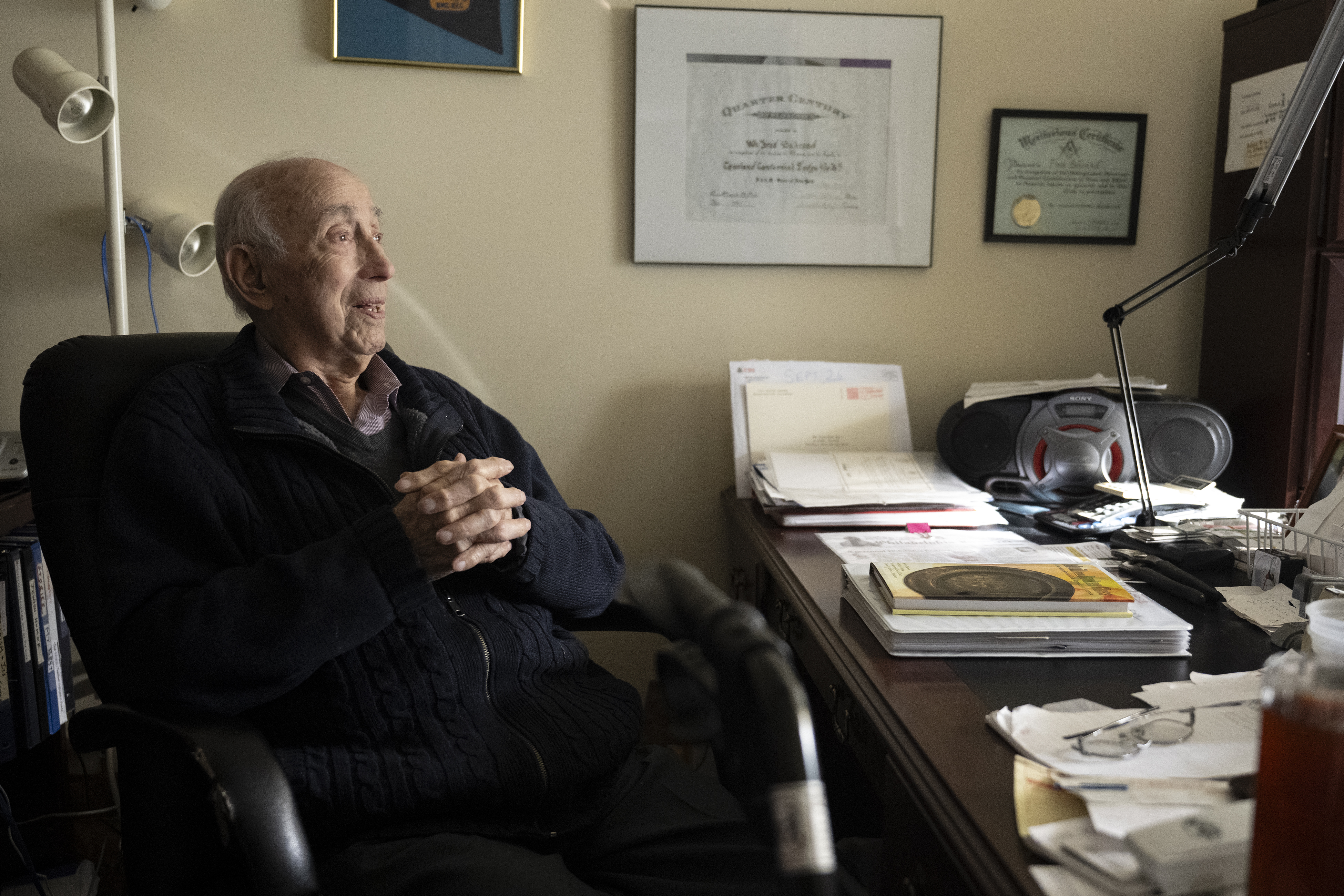
Holocaust survivor Fred Behrend, a Voorhees resident who is turning 100, talks about his life in America and his childhood escape from Nazi Germany during an interview at his home on Oct. 15. Behrend will be honored by his German hometown with Stolpersteine, or brass memorial stones, bearing the names of him and his parents outside the former family store they left behind when they fled Germany after Kristallnacht, the Night of Broken Glass, in 1938.Jose F. Moreno / Staff Photographer
The family, expelled for being Jewish, fled to the Caribbean, then the United States.
Today, Fred, a Holocaust survivor and retired air conditioner and TV repairman, lives in Voorhees in Camden County. He turns 100 years old on Nov. 3.
He has lived an adventurous life. He taught democracy to German prisoners of war at a Virginia military base at 19. He went to high school in New York with former U.S. Secretary of State Henry Kissinger. He befriended the late Ruth Westheimer, the famous German American sex therapist. He has given countless presentations to schoolchildren about the Holocaust and traveled much of Asia and Europe.
“We joke that he’s like the Forrest Gump of Holocaust survivors,” said Larry Hanover, who cowrote Fred’s 2017 memoir, Rebuilt from Broken Glass.
Fred’s home city in western Germany will honor his life next week.
Three plaques will be placed in front of the Behrends’ former store building in Lüdenscheid, which is now a brunch spot called Café Moon 2. They will honor Fred, along with his mother, Else Behrend, and his father, Herman Behrend. The memorials, called Stolpersteine, or“stumbling stones,” are created by artist Gunter Demnig for victims of Adolf Hitler’s Nazi regime, whether they died, fled, or survived.
Fred’s children, Evelyn and Andrew Behrend, will fly to Germany with Hanover for the ceremony. Fred will watch on Zoom from home, seated beside relics he has collected over the years: a 500-year-old Seder plate for Passover, created by one of his forefathers before his family had recordedsurnames, and a yad, a pointer for reading the Torah, extracted from the ashes of a synagogue by Fred’s father in the days before they fled Germany.
Holocaust survivor Fred Behrend, who is turning 100, sits next to his daughter, Evelyn Behrend, during an interview at his home in Voorhees.Jose F. Moreno / Staff Photographer
Fred held the yad as he spoke, the same tool that he used during his bar mitzvah, and that Evelyn and her daughter used when they turned 13.
“My family that I trace back was an exceptional family because not many people have a background like this,” Fred said. “How did they live? How did Jews live?”
‘Still living’
Hans-Ulrich Dillmann, a retired German journalist, has long covered Holocaust survivors and their families who came from Lüdenscheid. He wrote a biography of about 280 people with ties to the city who were impacted by the Holocaust.
Fred is one of the last people in that group alive, Dillmann said.
“So when I found out that Fred Behrend was still living, I tried to make contact with him,” he said, to make sure Fred’s family could be remembered.
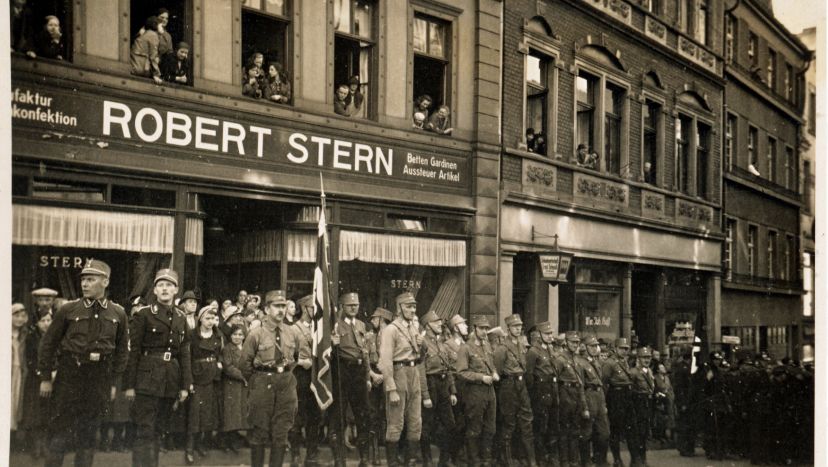
Nazis paraded in front of the Robert Stern textile store in 1933 in Lüdenscheid, Germany. The shop was the last place where Fred Behrend and his family voluntarily stayed before being forced to leave the country by the Nazi regime in 1938. Today, the building is occupied by a brunch spot.History Museum of the City of Ludenscheid
Herman Behrend, Fred’s father, was the last president of Israelitische Synagogengemeinde Lüdenscheid, the city’s Jewish community group, before he was sent to Sachsenhausen concentration camp,according to Dillmann, a member of Lüdenscheid’s historical society who has researched the Behrend family.
When Herman was arrested, the store, like others held by Jewish families, had to be sold, Dillman said. Jewish Germans could not access those assets to profit from the sales because German banks refused to work with Jews, Dillman said.
The Behrends’ Stolpersteine join 120,000 other stones across the world and more than 40 in Lüdenscheid informing passersby about the final voluntary locations of Holocaust victims.
Fritz Fred Behrend, who turns 100 on Nov. 3, 2026, will have his name featured on one of three Stolpersteine installed at his old family textile store in his hometown of Lüdenscheid, Germany. Behrend, a Holocaust survivor, is a Voorhees resident.Arnhild Scholten
The waitlist for the concrete plaques, less than 4 inches by 4 inches, can be years long because local authorities have to give permission to install the stones in the sidewalk. In past years, Stolpersteine have honored the family of Fred’s mother in another German town.
“I appreciate the fact that they recognize they killed 6.5 million people,” Fred said. “It’s the least they can do.”
Tracing their roots
Evelyn, Andrew, and Hanover will arrive to Germany on Saturday to see all the places where the Behrend family once frequented, in good times and bad. The trip will give them a chance to trace their roots as far back as they can, and Hanover will see everything he has referenced in his writings about Behrend and his life story for years.
On their trip, the family will also place a plaque on the unmarked grave of Fred’s older brother, who died shortly after birth, to finally name him publicly as Hans Behrend.
“My grandparents, if you think about it, had to leave behind not only their house and their store,” Evelyn said. “They left behind the grave of their firstborn child.”
Holocaust survivor Fred Behrend, a Voorhees resident who is turning 100, holds up the yad that his father, Herman Behrend, saved from the ashes of a synagogue that Nazis burned down in 1938.Jose F. Moreno / Staff Photographer
They will visit the jail where Herman was kept, the site of Fred’s former home, and a school Fred once attended in Cologne after the Nazis banned Jews from public school. Evelyn plans to walk the path her father took on the morning of Nov. 10, 1938, when synagogues in Cologne were set aflame during Kristallnacht.
When they return home, Evelyn knows they will continue to hear their father’s countless stories of the tragedies, joys, and strange encounters he has endured in his 100 years. He can’t stop talking about them, including the terrible times, even though his busy life on the Holocaust lecture circuit ended long ago.
“I’ve seen what I’ve seen, and that was much too much,” Fred said. “And it was a very interesting life.”
Philly’s a small town, and that’s true of its chef community, too.
We invited a number of the city’s top chefs to Bridesburg’s BLDG39, where The Inquirer’s Ariane Datil did some light matchmaking, pairing up Philly chefs and tasking them with whipping up something that marries two culinary perspectives into one creative, collaborative dish. Below, read about the dishes they created for The Inquirer Food Festival, scheduled for Nov. 14 at the Fillmore. (Watch their meet-cutes in Datil’s reality TV-inspired series, Love at First Bite.)
If you’re tempted to try the fruits of their labor in person, get a ticket soon: The event is nearing sellout.
Brian Mattera, chef and owner of Gilda (left), and Paffuto chefs and owners Jake Loeffler and Daniel Griffiths.Erin Blewett / For The Inquirer
Paffuto x Gilda
“Too many cooks in the kitchen spoil the broth,” or so the old saying goes. At The Inquirer Food Festival, they’re actually planning to make a delicious stew.
Gildachef Brian Mattera is teaming up with Jake Loeffler, Sam Kalkut, and Danny Griffiths — the trio behind panzerotti specialist Paffuto — to make a Portuguese-inspired (but mostly Italian) beef stew served with chorizo and crispy mushrooms over polenta.
The stew is “something warm, comforting, [and] familiar,” Griffiths said. “Grandma’s bite.”
The collaboration is kismet. Both restaurants are inspired by no-nonsense, East Coast grandparents. They also happen to share the same interior designer. “Our places are also designed to feel like grandma’s kitchen,” Mattera joked. “Well, a cool grandma.”
Paffuto, which opened in 2023 in Bella Vista, draws inspiration from Griffiths’ and Loeffler’s Italian American upbringings in North Jersey and New York. As such, the menu’s centerpiece is panzerotti, a fried treat that is basically a hybrid of a calzone and a Totino’s pizza roll. Paffuto’s get stuffed with combos of the good stuff — like bacon, eggs, and Cooper Sharp, or sliced rib eye, caramelized onions, and more Cooper Sharp — and they’re delightfully crisp.
The Gilda and Paffuto crews collaborated earlier this year on a knockout panzerotti stuffed with crispy suckling-pig skin. The partnership, Loeffler said, resulted in Mattera giving the Paffuto dudes a sterling piece of advice: “Read the good reviews once, the bad reviews twice, and then never again,” Loeffler recited. “Think about them, learn from them, but never dwell on them.”
Càphê Roaster’s chef Luigi Datu (left) and Out West’s co-owner Muhammad Abdul-Hadi. Isaiah Vazquez / For The Inquirer
Càphê Roasters x Out West
When Càphê Roasters and Out West come together, it gives a whole new meaning to the term “Philly Special.”
Kensington’s modern Vietnamese café and new-school West Philly coffee shop are mashing up their cultures with a take on the hoagie at The Inquirer Food Festival. A baguette from South Philly’s Ba Le Bakery, the city’s banh mi standard-bearer,will be the vehicle fora lamb-belly terrine banh mi that getssmeared with a pork-free version of Càphê Roasters’ signature pâté and finished with a hearty dose of aromatic Thai basil.
“I don’t think you can have a good sandwich without the right bread,” saidMuhammad Abdul-Hadi, Out West’sowner.
The dish was a fun thought exercise for Càphê Roaster’s chef Luigi Datu, who recommends customers thereadd chả lụa, a steamed pork sausage from Vietnam, to the café’s classic banh mi or staple breakfast sandwich. Out West, meanwhile, is halal, so the coffee shop regularly subs in lamb for pork in its own scrapple and sausage, egg, and cheese options.
Located on opposite ends of the city, the two cafés have mutual respect for each other. Datu admires Out West because the coffee shop “feels pretty Philly” while Abdul-Hadi was quick to start calling Datu “cousin Luigi.”
“Kitchens are like family,” Abdul-Hadi said while bumping shoulders with Datu.
Amy’s Pastelillos owner Amy Rivera-Nassar (left) and Rice & Sambal’s Diana Widjojo partner together during an Inquirer Food Fest “Love at First Bite” production at BLDG 39 on Monday, Sept. 14, 2026, in Philadelphia.Isaiah Vazquez / For The Inquirer
Amy’s Pastelillos x Rice & Sambal
Where else besides The Inquirer Food Festival can you get a single bite that blends flavors from Puerto Rico, Indonesia, and India?
That’s what you can expect from Amy’s Pastellilos’ Amy Rivera-Nassar and Rice & Sambal’s Diana Widjojo, who are collaborating on what they described as a “deconstructed pastelillo,” aka thimble-size servings of slow-cooked ropa vieja and rice served insidehollow spheres of fried Indian panipuri.It all gets topped with lemongrass and Widjojo’s sambal aioli.
“It’s more interesting than mayo-ketchup,” Widjojo said playfully, comparing her signature chile-spiced sauceto the classic Latin American condiment combo that Rivera-Nassar offers with pretty much her entire menu. (Rivera-Nassar immediately told her to cool it with the trash talk.)
Dip dispute aside, it’s all love between Rivera-Nassar and Widjojo in the kitchen. The pair have long admired each other’s tenacity and joyful cooking as members of Sisterly Love Collective, a mentorship community for women entrepreneurs in hospitality. Widjojo, for her part, is an Amy’s Pastellilos regular.
Rivera-Nassar’s stews (often offered as specials), remind Widjojo of growing up in Queens, where Puerto Rican and Southeast Asian communities commingle. They taste like “having my friends around,” Widjojo said.
Rivera-Nassar beamed. The chef converted her neighborhood pop-ups into a brick-and-mortar in Kensington in 2024, cementing locals’ love of the traditional Puerto Rican turnovers.
Widjojo, meanwhile, got her start at Hardena, the James Beard-nominated Indonesian restaurant that she ran with her mom and sister in South Philly. She struck out on her own in 2025 with Rice & Sambal, a cozy East Passyunk BYOB where her skills shine best in the Liwetan platter, a stunning arrangement of 24 Indonesian staples.
“We kept going back and forth on what our cultures look like together,” Widjojo said. The result, Rivera-Nassar bragged, is “memories in a pot” and a whole lot of crunch.
Scampi chef and owner Liz Grothe (from left), EMei chef Yongcheng Zhao, and EMei co-owner Dan Tsao pose for a portrait.Erin Blewett / For The Inquirer
EMei x Scampi
What happens when one of Philadelphia’s most accomplished Sichuan chefs pairs up with a young gun who prefers to keep things “middle-class fancy?” Shockingly, a twist on Irish street food.
Scampi’s Liz Grothe will partner with EMei’s owner and chef, Dan Tsao and Yongcheng Zhao, at The Inquirer Food Festival. They’ll repurpose the Chinatownrestaurant’s best-selling Chongquing chicken as the base for a spice bag — the compulsively snackable Chinese Irish combo of spicy fried chicken and curry on fries. Zhao will bring the heat and Grothe will bring the potato and curry (which will be pumpkin-based, for fall).
For Grothe, cooking alongside Zhao is akin to meeting an idol. She can rattle off a list of favorites from EMei’s extensive menu: mapo tofu, the white fish and green peppercorn pot, and (gluten-free) dan dan noodles. When she was a sous chef at Fiorella, Grothe used to order from EMei every Saturday to cap off a long work week.
“I feel like I’m a kid again trying to soak up everything I can,” she said while firing up the burners next to Zhao. He’s “one of the masters of Chinese cuisine.”
Zhao has been a fixture at EMei since its 2011 opening in Chinatown, where it has endured as one of the neighborhood’s best restaurants, according to food critic Craig LaBan, thanks to its uncompromisingly authentic menu, adaptability, and Zhao’s more than half-century of experience working with Sichuan spice.
Zhao and Tsao are already fans of Grothe’s determination. “There’s a lot we can learn from the younger generation,” Tsao said.
Co-owner and chef at Pine Street Grill Alex Kemp and chef and co-owner Mebruka Kane of Doro Bet pose for a portrait.Erin Blewett / For The Inquirer
Pine Street Grill x Doro Bet
Doro Bet is known for berbere and turmeric-spiced fried chicken. Pine Street Grill is known for brown butter Buffalo wings. But don’t expect them to serve either at The Inquirer Food Festival.
Instead, Alex Kemp, of Pine Street, and Mebruka Kane, of Doro Bet, will collaborate on a classic Canadian smoked trout dip paired withcrispstrips of injera, the spongy Ethiopian flatbread that tastes like pumpernickel when fried.
Both elements are labors of love: Kemp’s trout must smoke for 24 hours before getting the dip treatment, while the injera’s sourdough ferments for four days before baking atop a mitad, a skillet-size griddle designed just for injera. The berbere, Kane said, ties it all together, seasoning both the chips and the dip. (She uses her mom’s recipe, whose secret ingredient is a touch of fenugreek for nuttiness.)
“Trout dip is a little boring [to me] because I grew up eating it,” said Kemp, who is from Quebec. Kane’s additions “are the most interesting. Growing up in Canada, I never saw anything like [her] technique.”
Kemp is also one part of a heavy-hitting Philadelphia family business. Together with his wife, chef Amanda Shulman, the chef co-owns Pine Street Grill, My Loup, and Her Place Supper Club (which was among the first restaurants to earn a coveted Michelin star last year). Kemp takes the reins at My Loup, the James Beard-nominated French bistro where the “Esca-roll” — a giant, garlicky escargot roll with cinnamon bun-esque structure — has become the signature hit.
Pine Street Grill, which opened in Fitler Square in 2025, is where Kemp gets to kick back. It’s a neighborhood restaurant with highlights that include fat eggplant Parmesan, matzo ball soup, a burger, and those Buffalo wings.
Kemp and Kane move about the kitchen as if they’ve known each other for ages, casually swapping spices and stories about what it’s like to scale family businesses. “We might get a cooking show after this,” Kemp joked.
Ocho Supper Club chef RJ Smith and Vedge owner and chef Rich Landau pose for a portrait during an Inquirer’s Food Fest 2026 production shoot.Isaiah Vazquez / For The Inquirer
Vedge x Ocho Supper Club
When a fine-dining legend partners with one of the city’s most exciting young chefs, it’s all about eating your vegetables.
At The Inquirer Food Festival, Vedge and Ocho Supper Club will team up on an autumnal dish: jerk squash smoked over pimento wood, topped with a green jerk sauce and crumble made from the squash skin and seeds.
Husband-and-wife chefs Rich Landau and Kate Jacoby sit at the vanguard of Philadelphia’s vegan dining scene. Their long-closed Bella Vista restaurant Horizons was Philly’s first true experiment in vegetable-focused fine dining. Its sequel, Vedge, has endured for 15 years on Locust Street, with a menu of all-vegan greatest hits, ranging from silky rutabaga fondue to spicy dan dan noodles flecked with oyster mushrooms, that still feels timeless. Now the restaurant is honing its approach to sustainability, turning its food scraps into compost that eventually fertilizes the soil at Linvilla Orchards, the popular Delaware County farm and apple orchard.
While Landau and Jacoby are focused on fine-tuning their business, Ocho Supper Club chef RJ Smith is still looking for a permanent home for his. Smith, 21, grew his supper club from just a few seats in his Drexel University dorm room to the Rittenhouse Hotel, where his elaborate tasting menus scored an indefinite residency.
With Ocho, Smith draws on Afro-Caribbean recipes and fine-dining techniques honed in the kitchen at hot spots such as Provence and Royal Izakaya. He creates dishes that pulse with flavor and originality, like jerk duck and king crab served in a yellow curry laced with roasted garlic.
Edgar Allan Poe moved from New York to Philadelphia with his teenage wife, Virginia, and mother-in-law, Maria, in 1838.
He had already published his first book, Tamerlane and Other Poems, in 1827, but was yet to write a commercially successful novel. So he moved to Philadelphia, then the heart of the publishing industry, for a fresh start.
Artist Janice Kim’s No. 1 features an iconic photograph of the poet Edgar Allan Poe and images of a dark and stormy night, paying homage to the writer’s dark storytelling.Janice Kim courtesy of Colibri Workshop
On April 20, 1841, Poe, who had since turned his literary focus to short stories, published “The Murders in the Rue Morgue,” considered the world’s first work of detective fiction. Its protagonist, the nosey C. Auguste Dupin, was a figment of Poe’s imagination before detectives even existed.
Firstivals are weekly parties honoring important people, places, and events with Philadelphia roots.
For years, the Spring Garden site hosted popular Halloween parties as a nod to Poe’s knack for chilling and spooky works like “The Raven.” The dark, 18-stanza poem was published in the New York Evening Mirror in 1845, a year after Poe moved back to New York City.
Historians speculate it was written when he still lived in Philadelphia, in his 19th-century home at 532 N. Seventh St., now designated as an historic site.
Poe, who also rented homes in today’s Old City, Rittenhouse Square, and the Art Museum neighborhoods, was most prolific during the eight years he lived in Philadelphia, says Michael Carbonaro, the park ranger at the Edgar Allan Poe National Historic Site.
Here, Poe penned several of his most popular works, including “The Black Cat,” “The Gold Bug,” “The Tell-Tale Heart,” and “The Pit and the Pendulum.” He also published two additional Dupin detective stories: “The Mystery of Rogêt” and “The Purloined Letter.”
A movie poster featuring one of the many interpretations of Edgar Allan Poe’s “The Raven.” This 1963 version starred Vincent Prince. (Handout/TNS)Handout / MCT
“‘Murders’ is so masterfully done,” Carbonaro said. “And it’s the very beginning of a beloved literary genre. Sir Arthur Conan Doyle freely admits Dupin is the inspiration for Sherlock Holmes.”
And Columbo. And Matlock. And Nancy Drew. And Jessica Fletcher. And so on.
“The Murders of the Rue Morgue” is set in Paris, but historians agree Philadelphia inspires the plot with the kind of ghastly crime that was on the rise in the city in the 1800s.
In the story, the disfigured corpse of a mother and daughter are found in a French flat. Dupin learns of the killings from newspaper accounts, visits the scene with the anonymous narrator, and determines the murderer is an orangutan gone wild, outwitting the police.
An orangutan was featured in an exhibit on Penn’s Landing in 1839, capturing the city’s attention decades before the Philadelphia Zoo opened in 1874.
Also, while Poe lived in Philadelphia, his wife suffered a ruptured blood vessel while singing. Blood gushed from her mouth, inspiring Poe’s descriptions of one victim’s severed head in “Murders.”
The short story went on to be adapted for the stage and movie and TV screens. The first movie version, in 1932, starred Bella Lugosi as the sailor responsible for the orangutan.
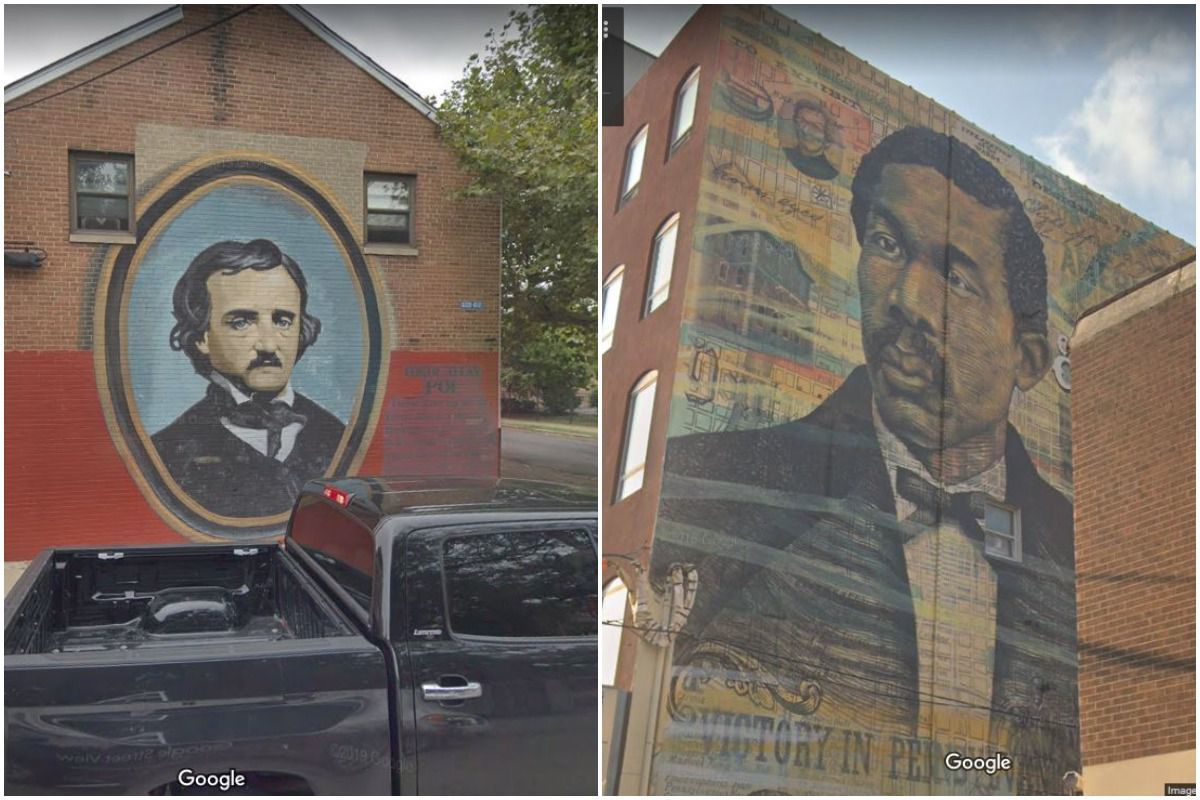
Some faces in Philly’s murals remain intact in Google Street View, including that of Edgar Allan Poe, at left, and Octavius Catto, at right.Google Street View
Thanks to America’s love for Poe’s ghost stories, the manuscript of the written-in-Philadelphia “Murders” took on a life of its own.
After the story was published in 1841, printer’s apprentice and Poe aficionado J.M. Johnston rescued the original manuscript, written in Poe’s delicate cursive, from the trash, took it home, and stashed it in a book. The manuscript survived several house fires and got accidentally thrown away before it was yet again rescued from a trash heap.
Johnston had the manuscript bound in 1869, according to a 1944 article in The Philadelphia Inquirer. Philanthropist and newspaper owner George W. Childs purchased the manuscript from Johnston for $200 in 1881. (About $4,995 in today’s money.)
Childs died in 1894 and bequeathed a bevy of literary works, including the handwritten manuscript of “Murders” as well as Poe’s acquaintance Charles Dickens’ final novel, Our Mutual Friend, to Drexel Institute. The two met when Dickens was in Philadelphia visiting Eastern State Penitentiary. Childs was a lifelong friend of A.J. Drexel.
The Edgar Allan Poe National Historic Site Sunday, Aug. 3, 2025. The sculpture is “Raven,” by David Caccia, 1979.Tom Gralish / Staff Photographer
In 1944, Richard Gimbel, grandson of Adam Gimbel, who founded Gimbels department store, purchased the manuscript of “Murders” for $34,000 through Philadelphia-based collector and dealer Charles Sessler. (Financier J.P. Morgan bought the Dickens’ manuscript at the same 1944 sale.)
Gimbel, the foremost collector of Poe memorabilia, bought Poe’s house in 1937 for $7,000, according to his 1970 obituary in the Philadelphia Daily News. Gimbel amassed more than 20,000 of Poe’s original items and turned the house on Seventh Street into a memorial to Poe before willing it to the city upon his death.
Every available indicator suggests Democrats have the American people on their side in the coming election. As for Republicans, they have Elon Musk.
The world’s richest man has spent at least $445 million for Republicans in the midterms, which is approaching the annual budget of Bucks County. After spending $290 million to return Donald Trump to the presidency, Musk has upped his investment by more than half in an effort to mitigate the president’s political reckoning for high prices, an unpopular war, rampant corruption, and more. These are obscene figures, reaching a clip of more than $3 million a day in recent months. And yet, with a personal wealth thousands of times greater than his peak political generosity — thanks in no small part to government contracts, subsidies, and tax breaks — the Tesla and SpaceX mogul could continue such spending indefinitely.
This is a culmination of the pernicious combination of the country’s increasingly extreme concentration of wealth and a half-century of U.S. Supreme Court rulings unleashing those riches on our politics. These twin troubles perpetuate each other: The superrich spend more and more to elect a government that, in turn, does more and more to make them richer. And the cycle repeats.
Musk has now spent more on American politics than almost anyone, including George Soros, an eternal bogeyman of the right; his fellow billionaires Michael Bloomberg and Tom Steyer squandered more but did so on their own abortive presidential campaigns. That makes Musk single-handedly responsible for the GOP’s entire outside spending advantage in this campaign. And apart from Republicans’ structural upper hand in the Senate and success in gerrymandering House districts, that is the only advantage they have.
So what does Elon want in return? For one thing, more government money and less government regulation. Musk’s companies have enjoyed at least $38 billion in government contracts and other direct public subsidies over the last 20 years, according to a Washington Post analysis. He also stands to reap enormous benefits from the Trump administration’s laissez-faire approach to artificial intelligence despite dire warnings about its dangers.
President Donald Trump presents the National Medal of Science to Elon Musk during an event at the U.S. Institute of Peace, Oct. 8, in Washington.Julia Demaree Nikhinson
But Musk has ideological interests of a sort, too, chief among them a virulent bigotry toward racial minorities, immigrants, and trans people. His compulsive posts on his social media platform reveal a preoccupation with white supremacist notions, which he translated into deadly federal policy by eliminating foreign aid during his disastrous stint as Trump’s so-called government efficiency czar. That any man can wield such influence over a major political party is troubling; that this man can is downright frightening.
The Supreme Court began to ordain this state of affairs with its 1976 ruling in Buckley v. Valeo, which equated individual political spending with constitutionally protected speech. The justices dramatically exacerbated the problem with their 2010 ruling in Citizens United v. FEC, which freed corporate and union spending and led to unlimited contributions through super PACs and more opaque groups. The avenues for wealthy people and interests to influence government have only proliferated under today’s conservative-controlled court, which is more likely than any to strike down every attempt to restrain the flow of money into politics.
Despite this cycle’s resulting avalanche of spending in Republicans’ favor, however, the ruling party’s prospects appear to have continued to deteriorate. It’s not clear that all of Musk’s money has clinched the case for any candidate, but it is a powerful argument for reforming our highest court and restoring a measure of financial and ethical sanity to our politics.
After a year of bullying at the Lawrenceville School, an elite boarding school near Trenton, Jack Reid died by suicide. He was 17.
Following the death of their only son in April 2022, his parents, Elizabeth and Bill Reid, have embarked on a mission to channel their grief into action.
The New York couple are on a crusade to get anti-bullying laws passed in every state to better protect students who attend private schools. The school acknowledged that Jack was bullied for over a year and said “more should have been done to protect Jack.”
“I am not going to let this rest,” Elizabeth Reid said. “We are focused on getting every school to embrace this because they should. I’m not going to leave one kid behind.”
Jack Reid was 17 when he died by suicide after being bullied for more than a year at the Lawrenceville Scool School, an elite New Jersey boarding school. His parents are lobbying for tougher anti-bullying laws to cover private and religious schools.The Jack Reid Foundation
So far, the Jack Reid Law has been adopted in New York, and six other states have similar protections requiring nonpublic schools to adopt an anti-harassment and bullying policy. A similar bill is pending in Pennsylvania.
New Jersey could be next.A measure recently introduced in Trenton by State Sen. Shirley Turner (D., Mercer) cleared the Education Committees in the Senate and Assembly. It would prohibit nonpublic school students from harassing or bullying another nonpublic school student, whether on school property, at a school function, or off school property. Schools would also be required to establish procedures for reporting and investigating alleged incidents and to take appropriate action to protect students when bullying is confirmed.
New Jersey already has some of the toughest anti-bullying laws in the country for the state’s nearly 600 public school districts. Nonpublic schools are encouraged, but not required, to comply with the Anti-Bullying Bill of Rights Act.
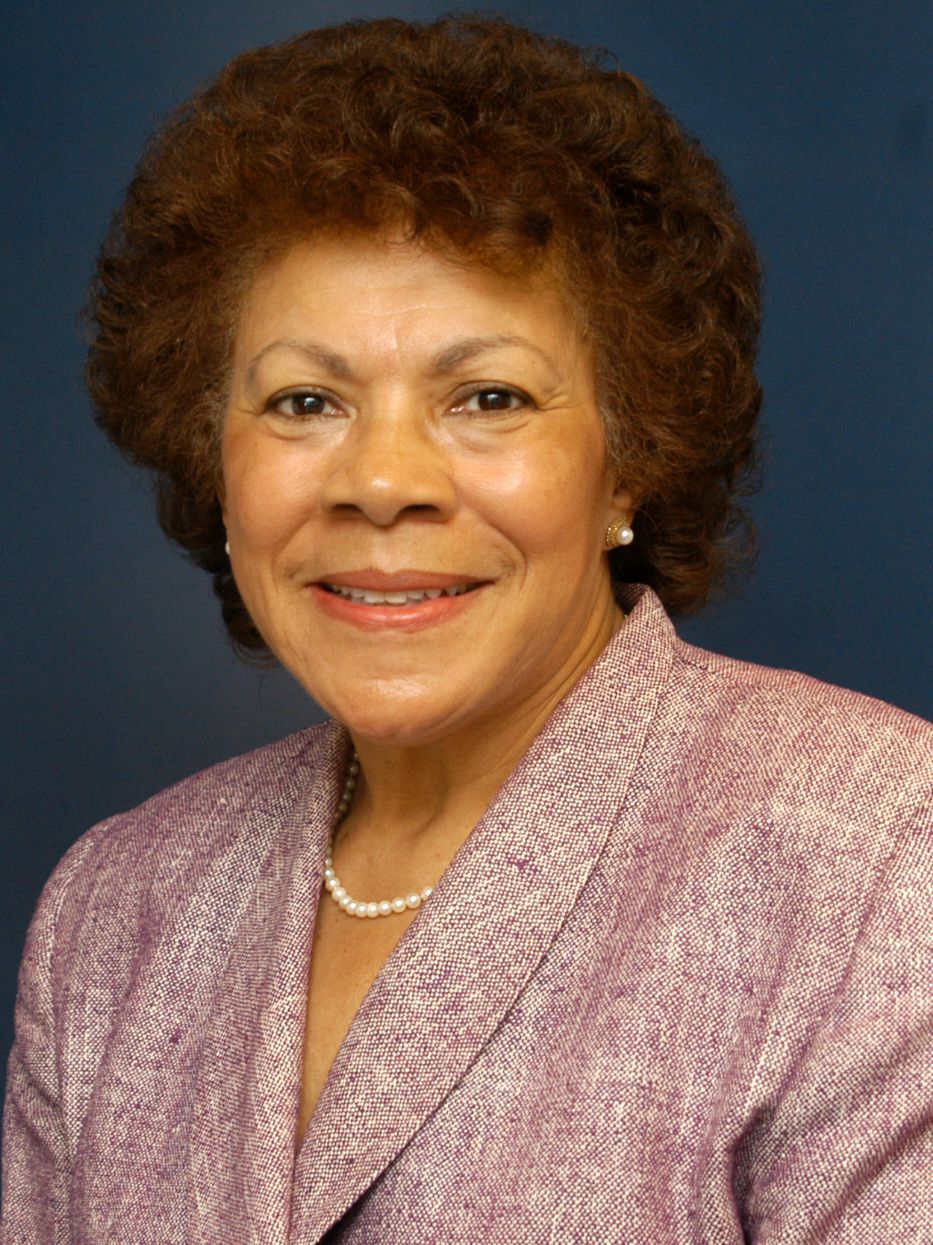
State Sen. Shirley K. Turner, (D., Mercer), co-sponsored the “Jack Reid Law: Protect All Students Act.”Handout
“It would strengthen and broaden the bullying law. It’s a situation where we need to make sure every child can feel safe coming to school,” Turner said in an interview.
The bill has been endorsed by the Lawrenceville School, which said it has revised its anti-bullying rules and already has adopted a policy that aligns with the proposed legislation. The bill also has support from religious and independent schools that typically seek to maintain autonomy and oppose state mandates.
“Every student deserves to learn and live in a community where they are treated with dignity and respect. This bill is an important step toward that aim,” Lisa Gillard, a Lawrenceville spokesperson, said in a statement.
As part of its settlement with the Reids, Lawrenceville admitted that it was aware of the bullying against Jack but failed to protect him. A statement posted on the school’s website on the one-year anniversary of his death in April 2023 acknowledged that failure. Lawrenceville agreed to hire a dean who focuses on student mental health and implement other corrective actions.
“The School acknowledges that bullying and unkind behavior, and actions taken or not taken by the School, likely contributed to Jack’s death,” Lawrenceville said in the statement. The school conducted a five-month investigation into Jack’s death.
If signed into law, the measure would extend the anti-bullying mandate that applies to all public schools to nearly 160,000 students who attend private and religious schools.
“Bullying can have devastating consequences, and those consequences do not stop at the doors of a public school,” said Assembly Education Committee co-chair Verlina Reynolds-Jackson (D., Hunterdon-Mercer).
Shlomo Schorr, director of legislative affairs forAgudath Israel of America’s New Jersey office, said the organization supports the bill but has some concerns because it would hold schools accountable for behavior that occurs off campus and that would be difficult to manage. The organization represents about 200 Jewish day schools that enroll about 73,000 students.
“In general, we are absolutely not opposed to anything that would combat bullying and harassment,” Schorr said. “It was a real tragedy, a tremendous tragedy that should never have happened.”
Was an honor to meet Bill and Elizabeth Reid, the parents of Jack Reid who are turning tragedy into action with the recently introduced "Jack Reid law," which will bring critical anti bullying and anti harassment policies to nonpublic schools in New Jersey.
The New Jersey Catholic Conference of Education also has offered support, director George Corwell said. All diocesan schools already have anti-bullying policies, he said.
The Reids said it was only while investigating their son’s death did they learn the Lawrenceville School’s procedures for how it handled bullying and harassment complaints were lacking.
Jack was a sophomore when he transferred to Lawrenceville after attending the Buckley School on the Upper East Side of Manhattan, his parents said. He wanted to attend a bigger school close to home with a national reputation, his mother said.
At first, Jack was happy with his school choice, easily making friends, his parents said. His troubles began his junior year around the time he decided to run in a school election, they said.
Jack narrowly won a hotly contested race in September 2021, his parents said. His opponent became an instigator and started a rumor that Jack had made unwanted sexual advances to a girl he liked, according to the parents.
The rumor escalated to a sexual assault allegation and spread at Lawrenceville, to other schools, and to thousands of young people online, they said.
His parents said Jack dealt with the bullying and harassment for six months, notifying administrators. He talked with his parents, and they contacted school officials, his mother said.
“He struggled because it hurts when they go after the thing you value most, which is your character,” Elizabeth Reid said. “He preserved through all of it and kept showing up.”
Lawrenceville said the student targeting Jack, who previously had been disciplined for bullying him, was expelled for an unrelated violation, but the student was allowed to return to campus unsupervised.
The student and others gathered outside Jack’s dorm, where they said “harsh words about Jack,” Lawrenceville said. School administrators did not check on Jack, Lawrenceville said.
As the crowd chanted horrible things, Jack died by suicide with a Bible in his shorts, his mother said. Just a day before, he had said, “I feel good, Dad.”
“From the moment he was born, he was a beautiful soul,” his mother said. “We miss him dearly. He is the love of our life.”
He died never knowing that Lawrenceville investigated the sexual assault allegations and determined that they were untrue, the school said in the statement. The bill would require schools to notify students about the outcome of bullying investigations.
“Do you know how much that would have helped him?” said Elizabeth Reid, a clinical psychologist. “It would have helped Jack defend himself.”
Sammons wants New Jersey to toughen its anti-bullying laws by implementing an anonymous bullying reporting system, easing immunity statutes that make it difficult for parents to sue districts, and imposing criminal penalties for the parents of children who bully their peers.
The Reids said their bill may not be perfect, but it’s a start. Jack would have wanted them to push to get the law passed in every state, they said, and they cope with their grief by leaning on their faith and advocating for the Jack Reid Law: Protect All Students Act.
“Could we get to all 50 states? Maybe not in my lifetime,” Elizabeth Reid said. “But we’re going to try. These are children and we need to better protect them.”
When an NFL team’s season goes as bad as this Eagles season has been going, there arise two impulses. One is to look ahead, to ponder what the franchise’s decision-makers might do to increase the talent, improve the coaching, change the culture, and stop the losing. The other is to look back, to wonder how a team like the Eagles — a team that within the last five years has reached two Super Bowls, won one, and qualified for the postseason five times — ended up swaying and listing in such rough waters.
What if? isn’t always an unfair question, but it can be. It can strip away context, reframing history through the prism and luxury of hindsight, and it’s a particularly difficult question to ask in light of the Eagles’ recent success. If life is a chain of events, and that chain led to the greatest era in Eagles history, how do you separate even one of the links?
Except the bill for building that chain is coming due, and it is fair to consider whether the construction had to be so costly. So let’s ask three relevant what-ifs …
What if the Eagles hadn’t extended Jalen Carter’s contract before this season?
In July, the Eagles made Carter the highest-paid defensive tackle in the NFL, handing him a four-year deal worth as much as $160 million. Much was made of how long it took the two sides to reach this agreement — it was announced within 24 hours of the start of training camp — but in reality, the Eagles signed Carter as soon as they could. He was eligible for a new contract after his third NFL season, and he had finished his third NFL season.
Jalen Carter has not delivered on the Eagles’ decision to make him the NFL’s highest-paid defensive tackle. Yong Kim / Staff Photographer
Now, Carter is so talented — and the Eagles invested so much in him, trading up to draft him with the No. 9 overall pick in 2023 — that one could make a good case that they had no choice but to sign him. They weren’t going to let him walk away in free agency in a couple of years, and if he had an outstanding 2026, it would have been only more expensive to sign him. But aside from one game, that 19-17 loss to Jacksonville in London on Oct. 11, he has not been outstanding, and through his first three seasons, he has been genuinely great for, what, a season-and-a-half? For the first nine weeks of 2023 and all of 2024? What’s more, from his spitting incident last season to his refusal to take public accountability for his and the defense’s subpar performances this season, he has shown few signs if any that he’s maturing into the on-field game-wrecker and off-field leader the Eagles need him to be.
Had the Eagles waited to give him the extension, if he were still playing now on his rookie contract, would they be getting a better, more motivated Carter? If they had been more patient, might they have reconsidered letting Milton Williams — who in New England has been every bit as good as Carter, if not better — sign elsewhere?
What if Jeff Stoutland had remained the offensive line coach and run game coordinator?
It’s not so simple as saying, Everything would be better if Stout were still here. The Eagles wanted to change offensive systems, which necessitated changing their blocking schemes, and as terrific as Stoutland was, as tight as his relationships with the players under him were, the O-line was not the dominant force in 2025 that it had been in 2024. Something had to give, and I’m not sure how many franchises who were so committed to revamping their offensive philosophy would have held off on such a major shift out of deference to an assistant coach.
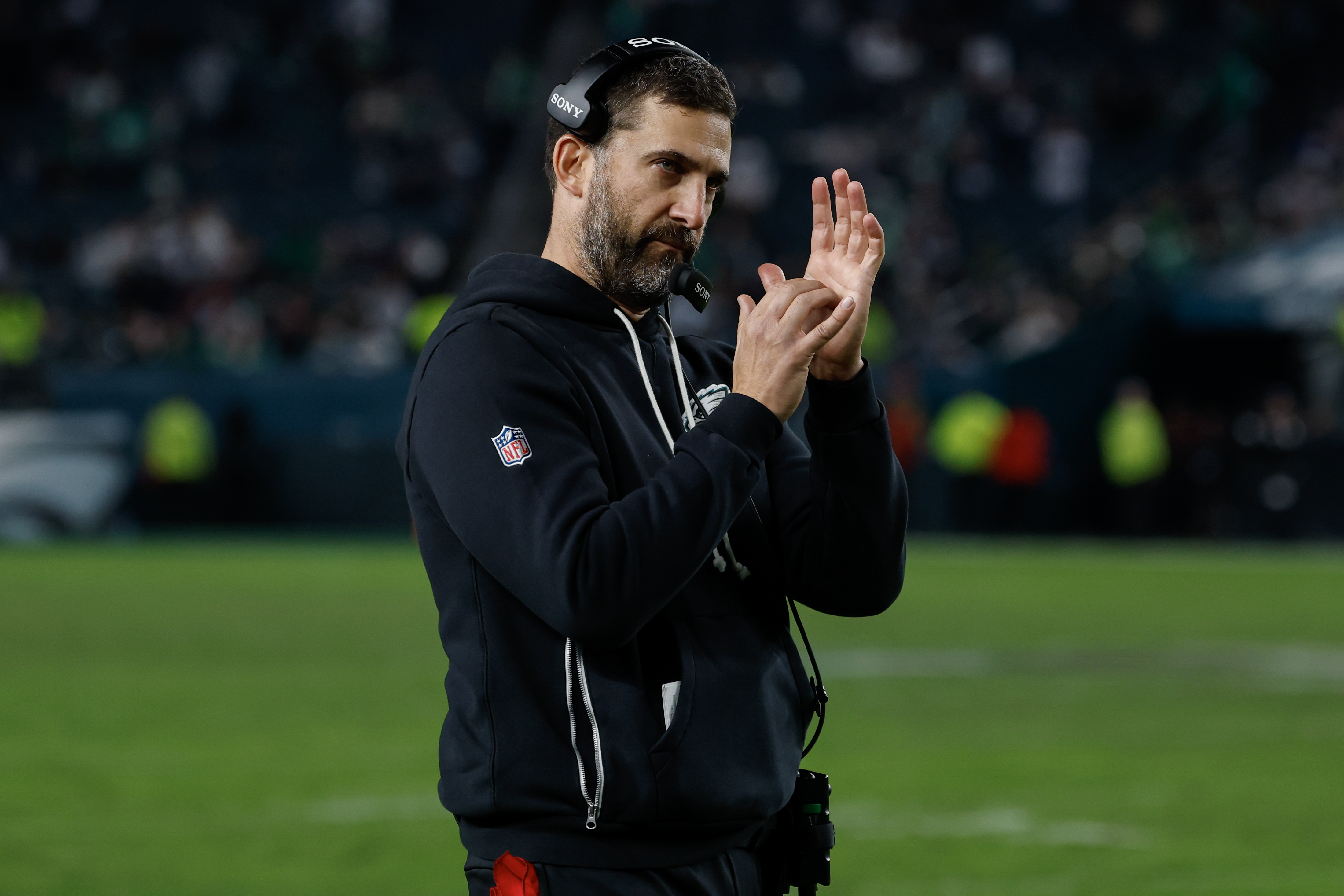
Is it Nick Sirianni’s responsibility alone to establish the culture?Yong Kim / Staff Photographer
What if the Eagles’ purported culture problems can’t be solved by changing the head coach?
Let’s assume for the sake of argument that what Nick Foles said this week on his podcast is true: that “there is dysfunction” within the Eagles’ locker room. Let’s also assume that Nick Sirianni is trying to maintain a good culture, even if his efforts might not be working.
“I’m always thinking about how I coach the team,” Sirianni said after the Eagles’ loss to the Dallas Cowboys on Monday night, “whether it’s situational football, whether it’s fundamentals. I’m always committed to making these guys better men. With the guys [who] I think are leaders on this football team and coaches, it’s my job to help them become better leaders. I think the first and foremost thing that you do in those moments is you lead by example and you walk your talk. But we do talk, myself and the captains quite a bit or other guys just on the side, and try to give them pointers on things like that.”
So, maybe the Eagles bid Sirianni farewell after the season. After all, if a coach who doesn’t call plays or design an offensive or defensive system can’t maintain good culture, what else does he do? But here’s the rub, the secret about “culture” within a pro sports franchise: It’s usually the players, one leader or a few key members, who have the most influence on it. Bill Russell, Tom Brady, Tim Duncan, Jimmy Rollins and Chase Utley: They and those like them are the true culture keepers.
For years, under Sirianni and Doug Pederson and even under Chip Kelly, the Eagles have had such leaders: Malcolm Jenkins, Jason Kelce, Brandon Graham, Fletcher Cox, Lane Johnson, Jalen Hurts. Do they have that caliber of leadership this season, especially now that Hurts isn’t around? And will they have it in the years to come? If they don’t, it won’t matter who Jeffrey Lurie and Howie Roseman hire to replace Sirianni.