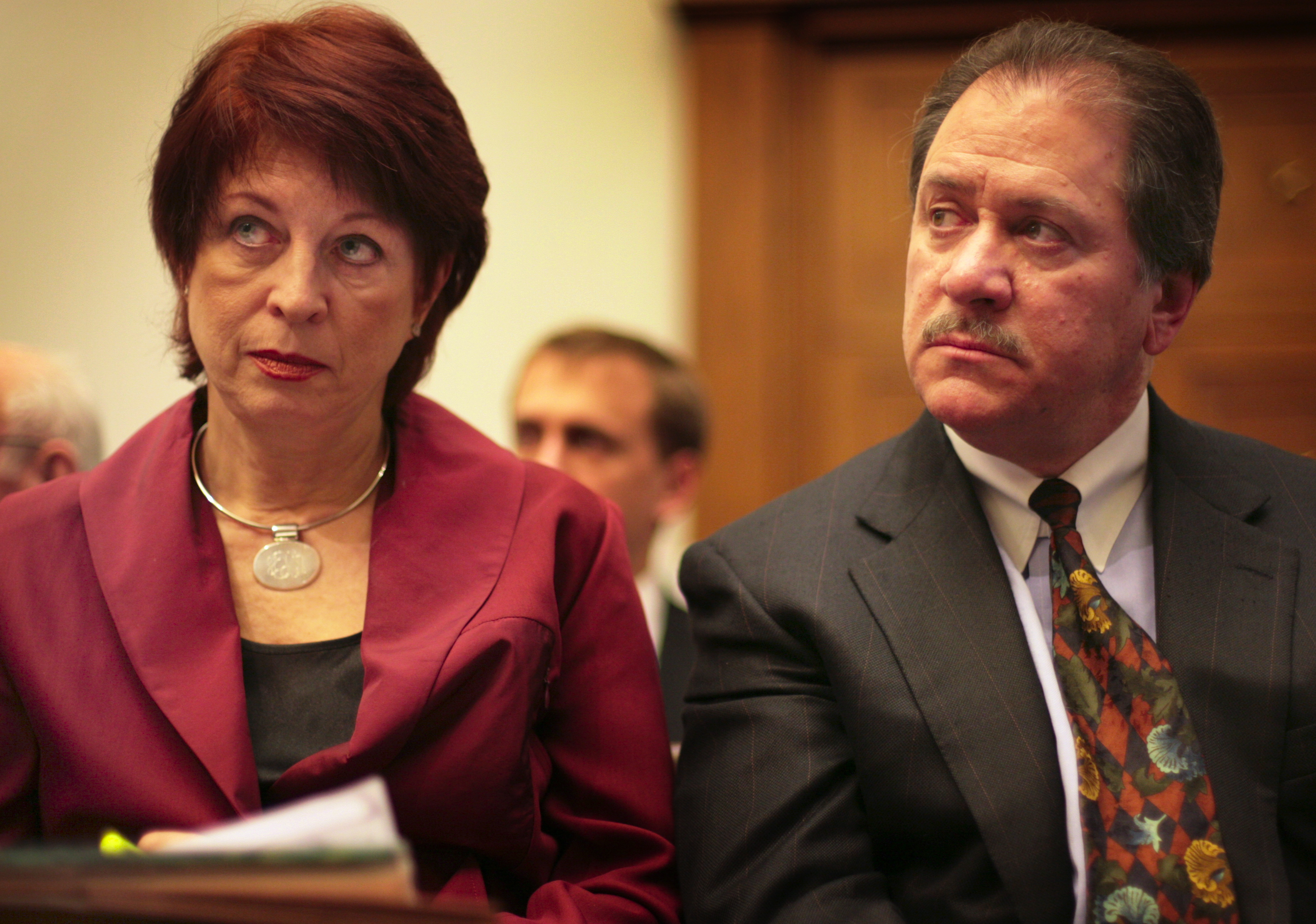
A loyalist prosecutor handpicked by the Justice Department to lead a contentious conspiracy investigation into several of President Donald Trump’s political opponents abruptly quit his job on Thursday, according to two people familiar with the matter.
The prosecutor, Joseph diGenova, had been in charge of what Trump’s allies have often referred to as the “grand conspiracy,” a sprawling inquiry based in the U.S. attorney’s office in South Florida that has sought to implicate federal officials who have investigated Trump in a single plot to deprive him of his rights.
DiGenova’s resignation was the latest setback in the case that began last year and has dragged on for months. Even though members of his team have issued numerous grand jury subpoenas to federal law enforcement and intelligence officials who have sought over the past decade to hold Trump accountable in a series of criminal inquiries, diGenova had yet to obtain an indictment.
“It was an honor and privilege to serve the president and the department,” DiGenova told CNN and CBS during phone interviews on Thursday.
A spokesperson for the U.S. attorney’s office did not respond to a message seeking comment.
Trump has repeatedly put pressure on prosecutors to bring criminal charges against his opponents, calling them out in private meetings and in social media posts. He has also expressed displeasure about the slow pace of the retributive investigations he has helped to set in motion.
But time and again, Trump’s desire for vengeance and his willingness to break through the walls of independence that have traditionally separated the White House and the Justice Department have resulted in failure. Judges and grand juries have repeatedly stymied his attempts to strong arm prosecutors into bringing charges.
Sometimes, as in the case of diGenova, prosecutors themselves have effectively reminded him that it is no simple matter to file indictments against people without real evidence or viable legal reasoning. The resignation was likely to cause consternation among far-right influencers who have long heralded the grand conspiracy case as the Trump administration’s most aggressive effort to go after the president’s critics.
From the beginning, the influencers pushed for charges to be brought against the widest array of Democrats possible, asserting that a cabal of “deep state” operatives — led by former President Barack Obama — had worked for years to destroy Trump and deserved to be punished.
With his move, diGenova became the second prosecutor who has either resigned or been removed from the case. The prosecutor in charge of an early phase of the investigation was forced to leave in the spring after telling her superiors that there was not sufficient evidence to bring charges against one of its first targets, John Brennan, a former CIA director who provoked Trump’s ire by helping to assemble an intelligence assessment that determined that Russia had sought to interfere in the 2016 presidential campaign.
The grand conspiracy inquiry has long been the most fevered of the many revenge investigations that Trump has demanded the Justice Department undertake. It has involved prosecutors seeking to link disparate criminal inquiries into the president — including the Russia investigation and a separate investigation into Trump’s mishandling of classified documents — as an overarching, multiyear scheme to damage his political prospects.
From the outset, diGenova faced an uphill battle in seeking to prove the basic theory of his case: that the various inquiries into Trump — conducted by different prosecutors and spanning nearly a decade — could be reasonably tied together in a single conspiracy. Those hurdles have led several current and former prosecutors in the office in southern Florida to wonder whether the investigation was largely a show put on to placate Trump.
DiGenova, a former U.S. attorney from the Ronald Reagan era who had not worked as a prosecutor in nearly 40 years, took control of the case in April after his predecessor, Maria Medetis Long, was kicked off the investigation. At 81, he was an unusual choice to oversee an inquiry involving multiple targets that quickly grew to include at least a dozen prosecutors, including his wife, Victoria Toensing.
Moreover, diGenova was a longtime ally of Trump’s who had publicly claimed that the Russia investigation was a plot by law enforcement to frame him and keep him out of the White House. DiGenova had also worked as a lawyer for Trump’s 2020 campaign, supporting his false assertions that the election that year had been rigged against him.
While Brennan was the initial focus of the inquiry, it has also involved an effort to implicate former FBI Director James Comey, who has been charged in a separate case in North Carolina. Late last month, diGenova’s office issued a subpoena demanding testimony from one of Comey’s close confidants.
More recently, subpoenas had been issued to federal agents who took part in the August 2022 search of Mar-a-Lago, Trump’s private club and residence in Florida, in the classified documents investigation.
NEW YORK — Once-friendly neighbors started to keep their distance. Undercover police officers began to monitor community events. And passersby would give them dirty looks on the street, and sometimes harass them, when they left home in hijabs or other religious garb.
Many American Muslims have faced a quarter-century of suspicion and hostility since the Sept. 11 attacks, which reshaped life for all Americans.
In New York, a generation of Muslim New Yorkers responded to the Islamophobia by organizing their communities. Mosques hosted makeshift legal clinics. Small businesses became hubs in a citywide civil rights network. Muslims of different racial, ethnic and linguistic backgrounds formed alliances the city had not seen before.
Their political organizing helped, years later, to elect the city’s first Muslim mayor, Zohran Mamdani. But anti-Muslim prejudice endures, echoing the Islamophobia that arose in the earliest days after Sept. 11.
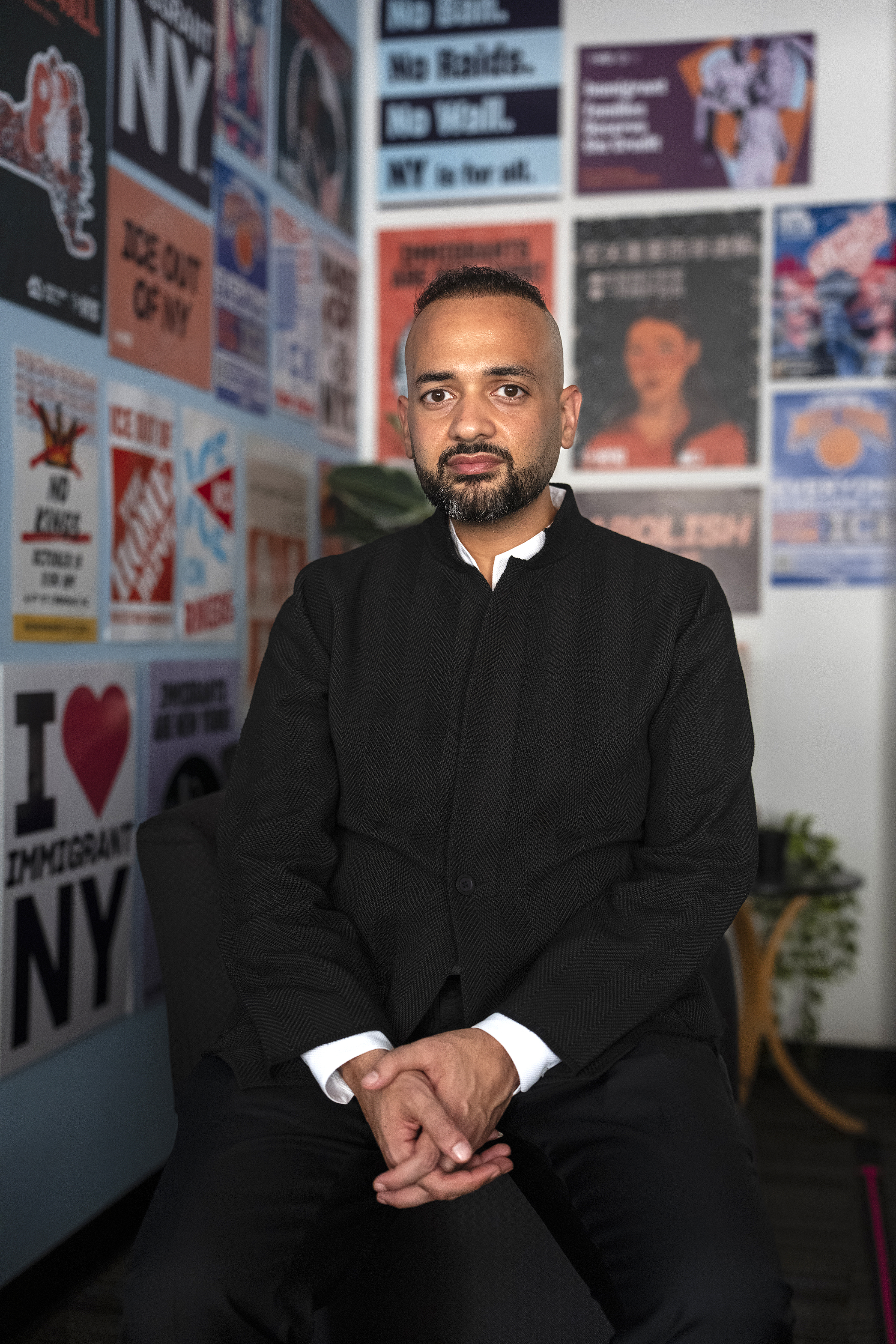
Murad Awawdeh was 14 in September 2001. The post-9/11 backlash, and the grassroots response of his friends and neighbors, led him to trade his biochemistry studies — and his mother’s American dream of having a doctor in the family — for a career in civil rights.
“I think that day belongs to everyone who lived it and what came after belongs to a smaller group of us,” said Awawdeh, 39, who is now the president and chief executive of the New York Immigration Coalition and a confidant of Mamdani. “That part of the story this country still has not told itself honestly.”
The Sept. 11 attacks left many Muslim American communities scarred by heavy-handed law enforcement tactics and the suspicion, if not outright hostility, of classmates, co-workers, elected officials and cable news commentators who blamed all Muslims for the terrorism they, too, had experienced that day. That experience spurred many to take political action.
“If you look at prior to 9/11, for the most part, Muslim Americans were not politically involved,” said Afaf Nasher, the executive director of the New York chapter of the Council on American-Islamic Relations. But, she added, “When you’re pushed against the wall, you’re either going to run in fear or you’re going to push back, and political empowerment was certainly one way that we are pushing back.”
The ascent of Mamdani has turned New York into perhaps the most prominent example of American Muslim success in the post-9/11 world. But the history of the city since the attacks has also highlighted the many challenges that Muslims in the United States continue to face.
Those include a history of police surveillance, backlash faced by high-profile Muslims in politics or the arts, and attacks on Islamic religious expression, including the construction of mosques and the wearing of religious clothing such as hijabs. Those biases have also affected followers of other faiths, in particular observant Sikh men, whose turbans are often mistaken for a form of Islamic dress.
Such sentiments have compounded in many ways since the start of the war in the Gaza Strip, which most Muslim Americans have vigorously opposed. Opponents of that war have been accused of terrorist sympathies, and some, including Columbia University protester Mahmoud Khalil, have been arrested and threatened with deportation for their advocacy. That has led some Muslims to say the war in Gaza has created an environment akin to the months and years after Sept. 11, when Muslim Americans feared that they could be marked as terrorist sympathizers for speaking out against the war on terror.
After Sept. 11, many Muslims in New York found themselves under covert police surveillance. Asad Dandia, 33, a public historian, was a plaintiff in a 2013 class-action lawsuit against the Police Department over its surveillance of the city’s Muslim neighborhoods, a program that was assisted by the CIA.
He had come under police surveillance after starting a charity as a teenager to feed poor families in his neighborhood. The police spying program was exposed in 2011 and caused a public uproar that led to its ending by 2018 after a series of legal settlements and other initiatives.
Today, Dandia is the official historian of the borough of Brooklyn and an informal adviser to Mamdani. One of his lawyers in the 2013 lawsuit, Ramzi Kassem, is the mayor’s chief legal counsel.
“We went in the span of 10 years from suing the government to being the government,” Dandia said. “And I think that is a classic and quintessential New York and American story.”
Mamdani is one of several Muslims who have become prominent in American public life in recent years. Others include Reps. Ilhan Omar and Rashida Tlaib, Michigan Senate candidate Abdul El-Sayed, Academy Award-winning actor Mahershala Ali, model Bella Hadid, and comedians Ramy Youssef and Hasan Minhaj.
“Muslim America now has a greater cultural footprint, more institutional power and a lot more support from allies, comrades and friends all throughout the country,” Dandia said. “Now when people think of Muslim America, they have names and faces they can point to.”
But despite these successes, many challenges remain. Mamdani, who was 9 on Sept. 11, has said the Islamophobic backlash to the attack lingered and “became a fact of life.”
According to a Pew Research Center survey conducted this year, 43% of American adults said Muslims are less patriotic than other Americans, and 42% said Muslim Americans are having a negative impact on the country. When asked to explain their views, respondents often cited the Sept. 11 attacks.
By some measures, the survey showed that public attitudes toward Islam were more negative now than they were immediately after the attacks. In March 2002, 25% of American adults said Islam was more likely than other religions to encourage violence, but that number rose to 51% in the survey conducted this year.
Those views have become highly polarized, with Republicans expressing far more negative views of Islam than Democrats, a change from after the attacks when supporters of both parties held similar views. Today, anti-Muslim sentiments have surged anew in some parts of the country with almost every election cycle.
Donald Trump campaigned for president in 2016 on a pledge to bar immigrants from Muslim countries and has restricted immigration from those nations and others that he views negatively during both his first and second administrations. In his second term, Trump has cracked down on students and universities over protests against the war in Gaza, portraying student demonstrators as supporters of terrorism and equating their arguments with antisemitic hate speech.
That has included the arrest of young Muslim activists, including Khalil at Columbia and Rumeysa Ozturk, who helped write an opinion piece critical of Israel for the student newspaper at Tufts University.
Kambiz GhaneaBassiri, a professor of religion and politics at Washington University in St. Louis, said the embrace of Islamophobia by the Trump administration posed a serious threat to Muslim Americans. But for Americans who are skeptical or critical of Trump, it may have also helped to undermine anti-Muslim arguments.
“People forget now the degree to which Islamophobia was not something that was just on the right but was present on both sides,” GhaneaBassiri said.
As an example of the reaction to Trump’s policies, he pointed to protests at airports against the president’s immigration restrictions in 2017 as a moment that “kind of shocked” some Muslim activists and organizations. They had become accustomed to pushing for their rights with few allies and little positive coverage in the news media, but the airport protests were filled with non-Muslims.
“Before that moment, if they criticized the state, their loyalty was always questioned by people on both the right and the left,” GhaneaBassiri said.
But in New York, Mamdani’s election has shown the resilience of anti-Muslim suspicion in both parties.
During last year’s mayoral campaign, Mamdani was accused of supporting terrorism by critics in both parties, including the campaign of former Gov. Andrew Cuomo, his main rival in the race, and Sen. Kirsten Gillibrand, who apologized after she falsely claimed in an interview that he had made “references to global jihad.”
The hate is nothing new to the mayor’s allies. Shahana Hanif, who in 2021 was the first Muslim woman elected to the New York City Council, was in elementary school when the attacks took place. She came of age as American policy and cultural attitudes shifted against the nation’s Muslims.
At age 10, she wrote a letter to President George W. Bush asking him to put a stop to the hate that seemed to engulf so much of the country. For Hanif, a Bangladeshi native of Brooklyn, it was an early form of organizing that helped inform her political career decades later.
“Seeing the injustice my community experienced” propelled her into progressive political organizing, Hanif said. “I can’t take away the Muslim part of it and just say, ‘Oh, no, this is only happening to us because we’re Bangladeshi immigrants,’ or ‘This is only happening to us because I’m a daughter of immigrants or I’m a woman of color,’” she said. “That association of being Muslim is certainly part of it.”
New York’s Muslim political and civil rights leaders said they also saw opportunities to keep building on their post-9/11 organizing work.
Nasher, the executive director of CAIR, said that her group and others like it saw their efforts as an outgrowth of the discrimination they faced and a way to guard against its happening to others.
“That’s not just because we’re Muslim — it’s because we’re American,” she said. “And you would think that as our fellow Americans, people would want every American to be politically engaged.”
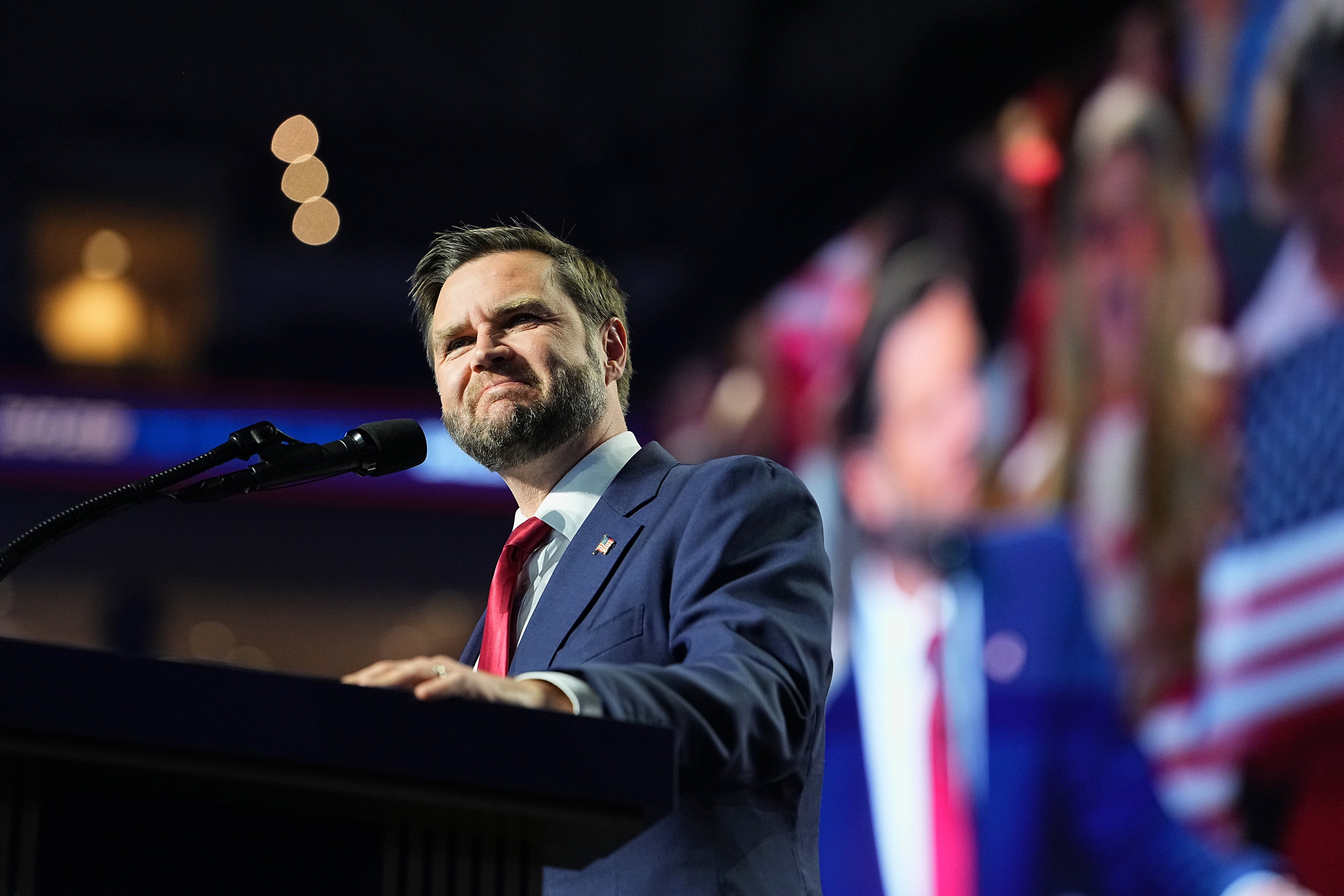
Vice President JD Vance was billed as the headliner of the second night of the Republican convention, but President Donald Trump stole the show.
With a hug and a handshake, Vance exited stage right after his speech as Trump returned to the place he likes most — center stage — to make his final pitch of the convention to keep Republicans in power.
At one point Trump asked attendees to raise their right hands and pledge to him that he would vote with their family and friends. Dutifully, they did.
“You know what happens if you don’t vote?” Trump said. “You go to hell.”
The two-day rally in Dallas came as Trump’s approval has sagged below 40% and Republicans fear losing control of both the House and Senate. Republicans hoped the gathering would help energize a base beleaguered by high prices and the Iran war to turn out in droves. But the two days of red meat tossed from the stage seemed unlikely to satiate independent voters whose support has flagged.
Here are seven takeaways from the convention:
Vance makes his 2026 (and 2028) pitch
Vance arrived in Dallas widely considered the front-runner in the 2028 Republican presidential primary. His speech offered some early clues about how he might approach a campaign.
Vance focused on restoring the primacy of the traditional nuclear American family, a theme he has championed in the administration. He did not mention the war in Iran, an operation he has defended publicly but raised concerns about privately. But he issued a plea for conservatives not to abandon the White House over policy.
“Do not throw the baby out with the bathwater,” he urged.
Vance speaks in a far more scripted political style than Trump. He caught fire with the crowd when he snapped back at a protester who interrupted his remarks by waving Palestinian and Mexican flags. “My friend, if you love Mexico so much, get your ass over there,” he said.
But he failed to sustain the kind of enthusiasm that Trump commanded either night. Nor did he win anything beyond perfunctory praise from the president, who quickly ushered him off the stage.
As the balloons fell, it was the president alone, along with a tenor singing. Trump is not giving up his crown quite yet.
Trump throws an affordability Hail Mary
Trump has called affordability — a top buzzword for Democrats this year — a “hoax.” In his speech Wednesday night, the president claimed that prices are on their way down. At the same time, he rolled out an audacious plan to address people’s concerns about costs: a massive cash giveaway.
He branded his dubious and detail-free plan to send $5,000 to every American adult a “Trump Dividend.”
But Trump was virtually the only one talking about it.
A day later, the splashy $1 trillion-plus plan barely made a ripple on the convention stage.
The president’s own son, Donald Trump Jr., didn’t so much as mention it.
Neither did the speaker of the House.
Neither did the vice president.
Only Trump did.
If the president wants the dangled cash to be a major factor in the midterms, the rest of the Republican Party didn’t use the rest of the convention to sell it.
Republicans have a new rogues’ gallery of liberal villains
Forget about Nancy Pelosi.
In Dallas, Republicans made clear that the former House speaker has been dethroned from her decades-long position as the party’s favorite political villain.
Speaker after speaker assailed Hasan Piker, a leftist online streamer, and Abdul El-Sayed, the Democratic Senate nominee in Michigan, for pushing what they described as an extreme and anti-American agenda. Their images, including Piker’s naked torso, were broadcast on the jumbotron over the stadium. Even Rep. Alexandria Ocasio-Cortez of New York, who is a frequent target of the right, got less airtime.
At one point, Speaker Mike Johnson outlined the new rogues’ gallery of liberals — “Hasan Piker and Bernie Sanders and AOC and Abdul El-Sayed and Zohran Mamdani” — while casting the rest of the Democratic Party as squishes who would succumb to them.
In their attacks on Piker and El-Sayed, several convention speakers embraced anti-Muslim rhetoric, including a promise popular among conservative activists to “ban Shariah law.”
“We must stand and defeat the Islamists,” Sen. Ted Cruz of Texas said in his speech.
GOP frames the election as common sense versus crazy
Republicans know that Trump is unpopular. They are banking on making Democrats unpopular, too — or at least unappealing and unelectable.
Over and over, speakers cast Democrats as out of the mainstream, frequently calling them socialists, communists and even worse. At times they stretched the truth. Democratic socialists might have won a number of Democratic primary victories since 2024, but no serious figure in the party is promoting communism.
“You guys are going to trigger the commies,” Donald Trump Jr., the president’s son, said at one point as the crowd chanted “USA! USA! USA!”
Vance, in the closing of his speech, summed up the message so many had delivered before him over two days: “It’s about the party of common sense beating the party of the crazies.”
Texas is a 2026 battleground
Six months ago, when it first emerged that Republicans were likely to pick Dallas for this convention, it was unclear whether Texas would wind up as a top midterm battleground.
It’s clear now.
A parade of speakers — from the president on down — used their precious time onstage to talk about Texas’ razor-close Senate race. They sought to boost Ken Paxton, the Texas attorney general (even as Trump mocked his sartorial choices on back-to-back nights), and tear down James Talarico, the Democratic nominee. On the eve of the convention, Trump’s super political action committee had reserved $10 million in ads to help Paxton.
“Tala-freako maybe tops the list,” Vance said of Trump’s nickname for Talarico.
But it wasn’t just the Senate race. Republicans gerrymandered the state in 2025 to create as many as five new safely Republican House seats. But Republicans running in several of those seats appeared at the convention, seeking a boost in regions that Trump won handily.
Was it must-see TV? Early signs suggest no
Trump has long been known as a master of the television audience. Not this time. An average of 2.5 million people tuned in to watch his Wednesday night speech on Fox News, one of the few major TV networks that aired the remarks in full, according to preliminary figures from Nielsen. That was an average primetime audience for the network, based on the most recent quarterly statistics, and below the usual viewership for programs at that time.
In other words, no Trump bump.
To be fair, the president’s programming faced some steep competition. The first game of the National Football League season was on at the same time as his speech. The season’s second game was on Thursday during Vance’s and Trump’s speeches.
Republicans make their bid to buck history
Parties in power traditionally attempt to expand their appeal in midterm elections through targeted outreach to independent voters. That was not the strategy charted by Trump and his allies in Dallas.
Only a handful of speakers offered any kind of outreach to moderate voters (one of those exceptions was Rep. Mike Lawler of New York). Far more focused their remarks on stoking fears of Shariah, transgender athletes and Democratic candidates who were repeatedly described as communists. Again and again, Trump begged his supporters to “pretend” that he would be on the ballot — an attempt to get enough of them out to prevent the usual losses for the party in power.
Trump and his allies are staking their chances on their ability to drive their own voters to the polls. At the top of the list are Trump loyalists who typically skip midterm elections.
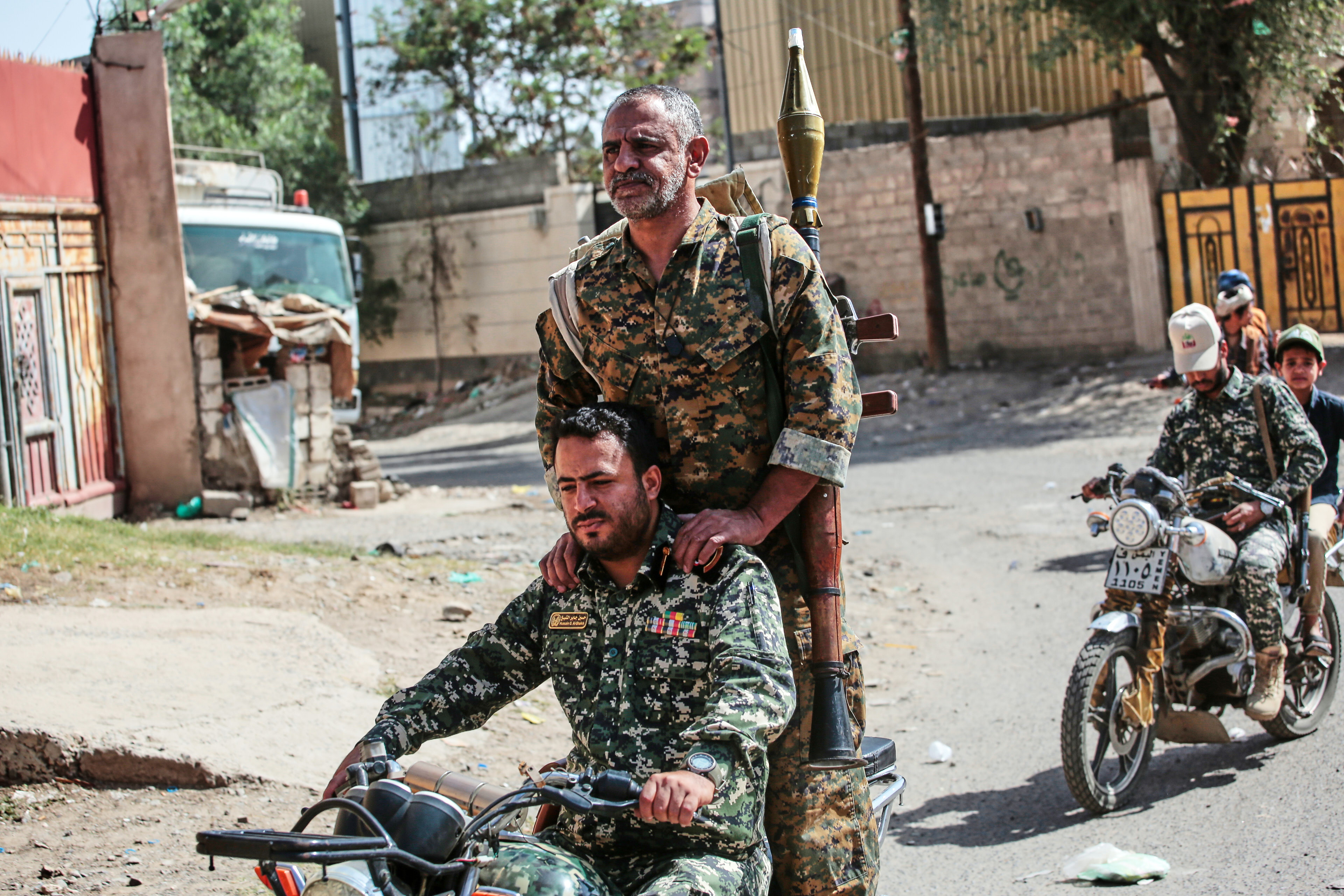
CAIRO — Yemen ‘s Iranian-backed Houthi rebels captured a strategic island in the Bab el-Mandeb Strait at the entrance of the Red Sea, two officials said Friday in a swift advance that further threatens Saudi oil exports through one of the world’s key commercial lanes.
Saudi Arabia responded with airstrikes against the airport in the key port city of Mokha that the Houthis seized on Thursday, a Houthi broadcaster said. There was no immediate report of damage or deaths.
The capture of Mayun, a tiny, barren volcanic island in the strait, was confirmed by a senior military official with Yemen’s internationally recognized government and by a Houthi official. Both spoke on condition of anonymity because they were not authorized to talk to journalists.
The island, also known as Perim, is about 3.5 kilometers (2 miles) off Yemen’s west coast.
The strait is a key alternative to the Iran-choked Strait of Hormuz. But there is “no need for international concern,” Hazam al-Assad, a member of the rebels’ political bureau, told The Associated Press, saying they are responding to Saudi aggression, and “our forces have a bank of big important targets” in case Riyadh keeps up the strikes.
Earlier Friday, Iran’s government called for an end to Saudi Arabia’s blockade of Yemen, throwing its support behind its ally, the Houthis. In its first statement since the rebels entered the port, Iran’s Foreign Ministry also called for a return to negotiations between Saudi Arabia and the Houthis.
There was no immediate Saudi comment on Friday.
The rebels’ capture of Mokha, overlooking tanker routes out of the Red Sea, could boost Iran’s strategy of driving up world oil and gas prices to pressure the United States, experts say. It also raises concerns of a new front opening after more than six months of war in the region – one in which Saudi Arabia is forced to respond.
Experts say the developments in Yemen could give Tehran more leverage in any negotiations with the U.S. On Wednesday, the spokesperson for Iran’s powerful Revolutionary Guard called for any negotiated settlement with the U.S. to include Yemen, the first explicit reference to that front.
Events threaten a key Strait of Hormuz alternative
The Houthis’ entry into Mokha on Thursday was their biggest territorial gain in years against their Saudi-backed Yemeni opponents. It brought them within 50 miles (80 kilometers) of the Bab el-Mandeb, a strait that has become an important alternative for global shipping as Iran targets vessels in the Strait of Hormuz.
A senior military official with Yemen’s internationally recognized government told the AP they were stunned that the Saudi air force didn’t strike the Houthis earlier, as they were advancing on Mokha. He assessed that Saudi Arabia didn’t get a green light from the U.S. to embark on a large-scale air campaign.
The official, who spoke on condition of anonymity because he wasn’t allowed to speak to the media, also blamed “lack of coordination” between Yemen’s army and allied forces, saying it gave the Houthis “a priceless opportunity.”
The Houthis had already attacked Saudi shipping in the Bab el-Mandeb and Red Sea since declaring a blockade there in July, as well as oil infrastructure inside Saudi Arabia. The Houthis said it was in response to the kingdom’s blockade of Houthi-held parts of Yemen, in place for years.
New disruption to the waterway could mean trouble for all shipping and for the price of crude oil, which has now soared again. Saudi Arabia has increasingly relied on the Red Sea and Bab el-Mandeb to export its crude since Iran has been targeting vessels in the Strait of Hormuz. About 12% of the world’s goods are typically shipped through the strait.
Shipping through the Bab al-Mandeb had fallen by about 60% since the Houthis began attacking some ships there in late 2023 while expressing solidarity with Palestinians in Gaza. Shipping increased this year as Saudi Arabia sought alternatives to the Strait of Hormuz, but renewed Houthi threats have “curtailed” that activity, according to Lloyd’s List Intelligence.
Saudi Arabia, which earlier this week said it had always offered “opportunities for negotiation,” also has said it has the right to defend itself in response to the Houthis’ blockade. The foreign ministers of Iran and Saudi Arabia spoke Thursday about diplomatic efforts to “restore stability” to the region, Iran’s Foreign Minister Abbas Araghchi said on social media.
The fighting risks a return to civil war
In a statement released Friday, the National Defense Council of Yemen’s Saudi-backed and internationally recognized government on Thursday strongly condemned the Houthis’ renewed attacks on Saudi Arabia.
The council also acknowledged that Yemen’s government is on the front line of freedom of navigation, and called for international support as the Houthis swept along the Red Sea coast toward the Bab el-Mandeb.
The escalating fighting threatens to end a fragile truce that had largely halted Yemen’s civil war since 2022.
At stake are the 40 million people in the Arab world’s poorest country who fear a return to the conflict that killed 150,000 and brought many others to the brink of famine.
The surge in fighting in the past week has sent over 46,000 people fleeing, and “overnight, large numbers of people were reportedly seen leaving Mokha with their belongings,” the U.N. migration agency said Friday.
The Houthis have been at war with Yemen’s government since 2014, when the rebels swept from their mountainous heartland and seized much of northern and central Yemen, and the capital of Sanaa. Saudi Arabia entered the war the following year on behalf of the government.
In the weeks after the Sept. 11, 2001, terror attacks, I went to New York to report on a story about Johanna Sigmund, a young woman from Wyndmoor who perished after one of the hijacked planes rammed the north tower.
Over the course of my career, I’ve spent more time than anyone would want writing pieces about people whose lives were cut short prematurely. One of the most memorable was Johanna, whose story and positive spirit remain seared into my soul.
Johanna’s parents invited me, a stranger, into their home at their worst hour. They took the time to tell me about their only daughter, and shared photograph after photograph after photograph — Johanna smiling after she ran the New York City Marathon, Johanna posing with her girlfriends at a wedding, and so on.
One image stood out.
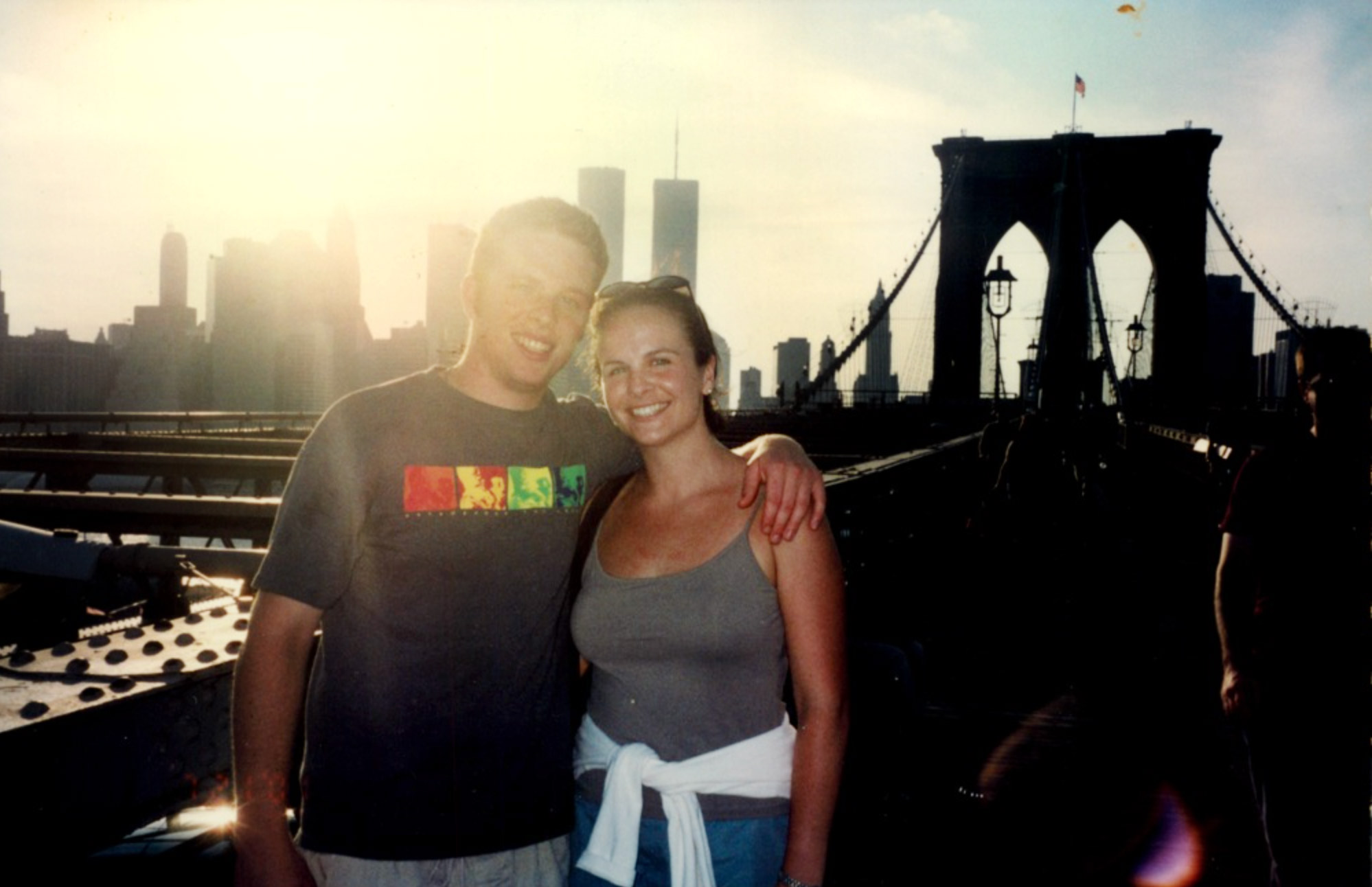
It was a photo of Johanna, 25, and her brother, John, 23, smiling while standing arm in arm at the foot of the Brooklyn Bridge. The photo was taken two months before the terror attacks. In the background loomed the twin towers.
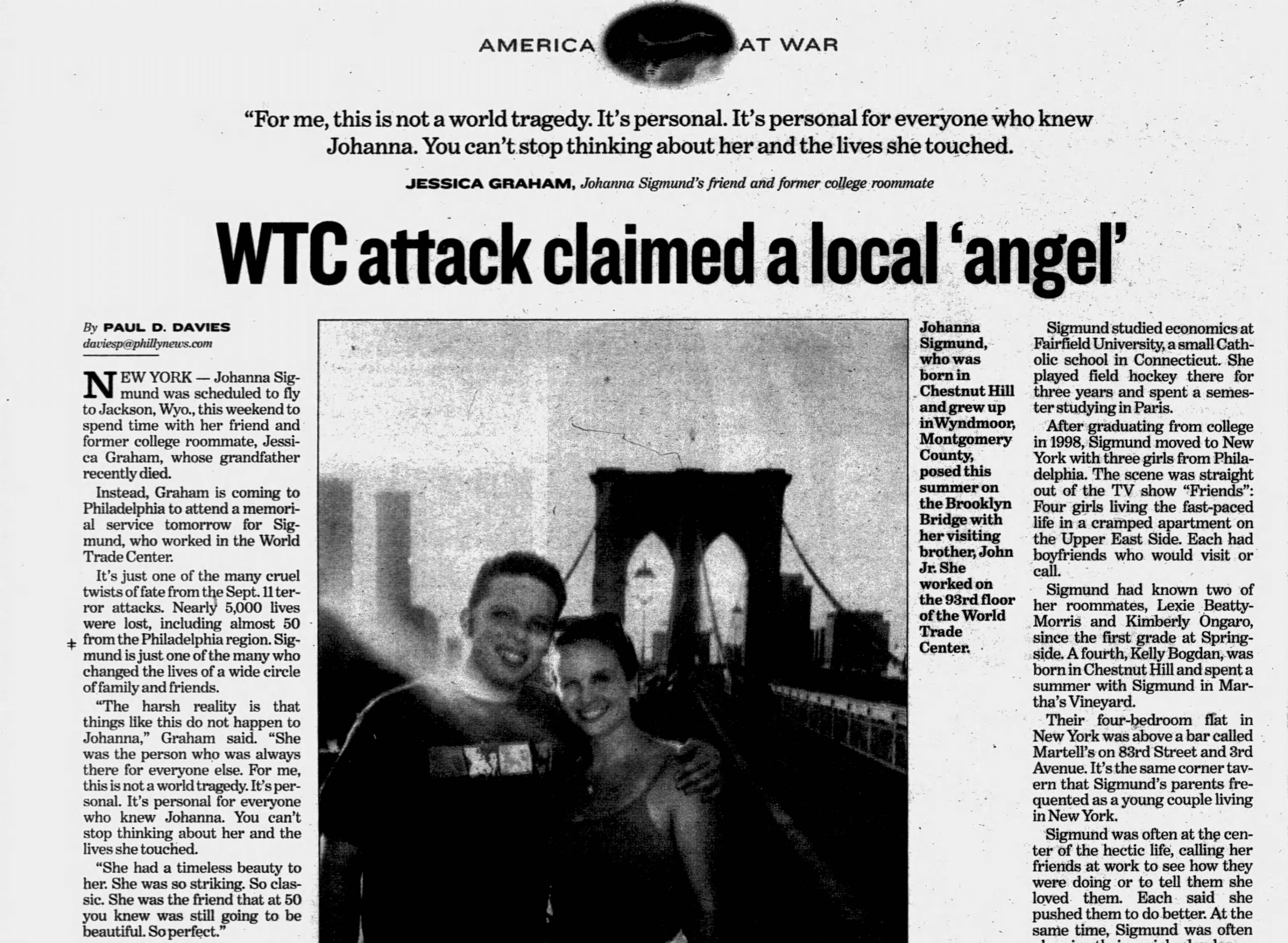
An article by Paul Davies about Johanna Sigmund in the Oct. 19, 2001, edition of the Daily News.Staff
Johanna’s story has stuck with me for a quarter century, but her life is emblematic of the promise and potential of so many others who were lost. At least 40 people with ties to Philadelphia and its western suburbs were killed in the attacks, including 18 from Bucks County, 11 from Montgomery County, five in Chester County, eight from Delaware County, and three from Philadelphia. It may be impossible for any of us to fathom how many other lives were forever impacted by the horrors of that day.
I wondered how Johanna’s family and friends had fared over the years.
So much has been lost in the 25 years since 9/11. Johanna would have turned 50 on the first day of summer — the longest day of sunlight. Her elegant beauty remains frozen in time, and — all these years later — her life remains a catalyst for good.
A scholarship fund set up in her name continues to help students attend St. Malachy School in North Philadelphia, as well as another at her alma mater, Springside Chestnut Hill Academy.
Johanna packed a lot into her brief time here. She was the captain of the field hockey, lacrosse, and squash teams in high school. She studied economics and played field hockey at Fairfield University, and spent a semester in Paris before moving to New York in 1998 with three friends from Philadelphia.
When I met with Johanna’s roommates a few weeks after the attack, they shared stories of her love of cooking, dancing, and listening to U2, often replaying the song “Stuck in a Moment You Can’t Get Out Of” that begins, “I’m not afraid of anything in this world.”
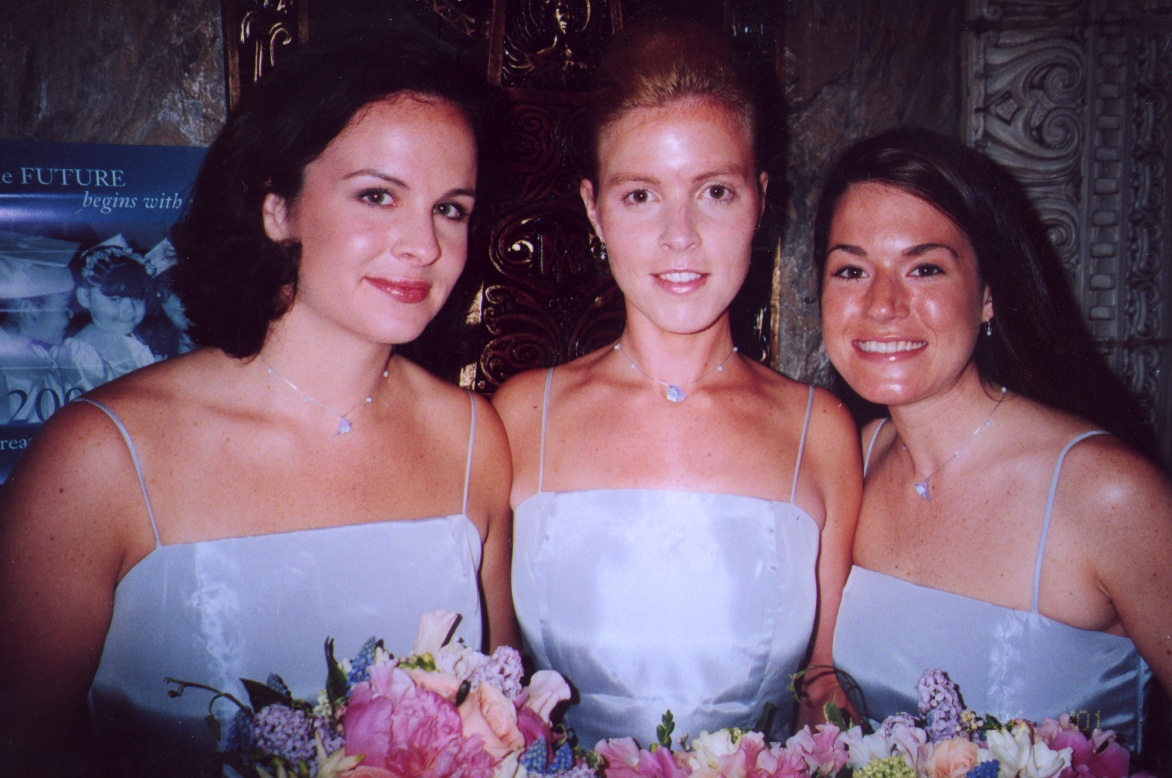
From left: Johanna Sigmund, Rory McDevitt, and Kim Ongaro were all bridesmaids at the wedding of their friend, Lexie Beatty, in May 2001. Sigmund was one of the victims in the 9/11 attacks.h
Johanna cared for others. She distributed pizza and McDonald’s to the homeless people in her neighborhood. She helped a woman who was thrown from a taxi get to a hospital. Johanna spent the night by her side and returned home in the morning with blood on her clothes.
Kimberly Ongaro, a roommate and friend from Springside, called her “an angel.”
The toughest interview in the weeks after the attack was with Johanna’s boyfriend, Joe Bonavita. They had dated for several years and had discussed marriage.
Their final weekend together was a whirlwind. They went to the Yankees game Friday night and drove to the U.S. Military Academy in West Point, N.Y., on Saturday, met up with friends, attended the Army football game, and walked through the cemetery for soldiers, which included Gen. George Armstrong Custer.
On Sunday, Johanna competed in a 5K race down Broadway before continuing on as part of her training for the Philadelphia Marathon. She and Joe shared dinner that night.
Johanna Sigmund and her boyfriend, Joe Bonavita, at the wedding of her friend Lexie Beatty Morris.
Johanna did not feel well on Monday, but went to work. When she was still under the weather on Tuesday — Sept. 11 — Joe urged her to stay home.
But she went into the office at an investment firm on the 93rd floor of the north tower.
Joe worked near the Trade Center. As he exited the subway, he saw the first plane smash into the north tower.
A life upended
I located her brother, John, and emailed him. He responded a few minutes later and graciously agreed to speak. When we connected after 25 years, it almost felt like old friends catching up.
John told me how 9/11 upended his life.
He had planned to move to New York after college, but lost interest after the attack. He visited ground zero to commemorate the first anniversary. President George W. Bush greeted families, including John’s aunt, who offered veiled advice regarding the plans to invade Iraq. “I hope you are making a prayerful decision,” she told the president.
Bush was taken aback, but continued shaking hands before circling back to tell John’s aunt that he prayed every day.
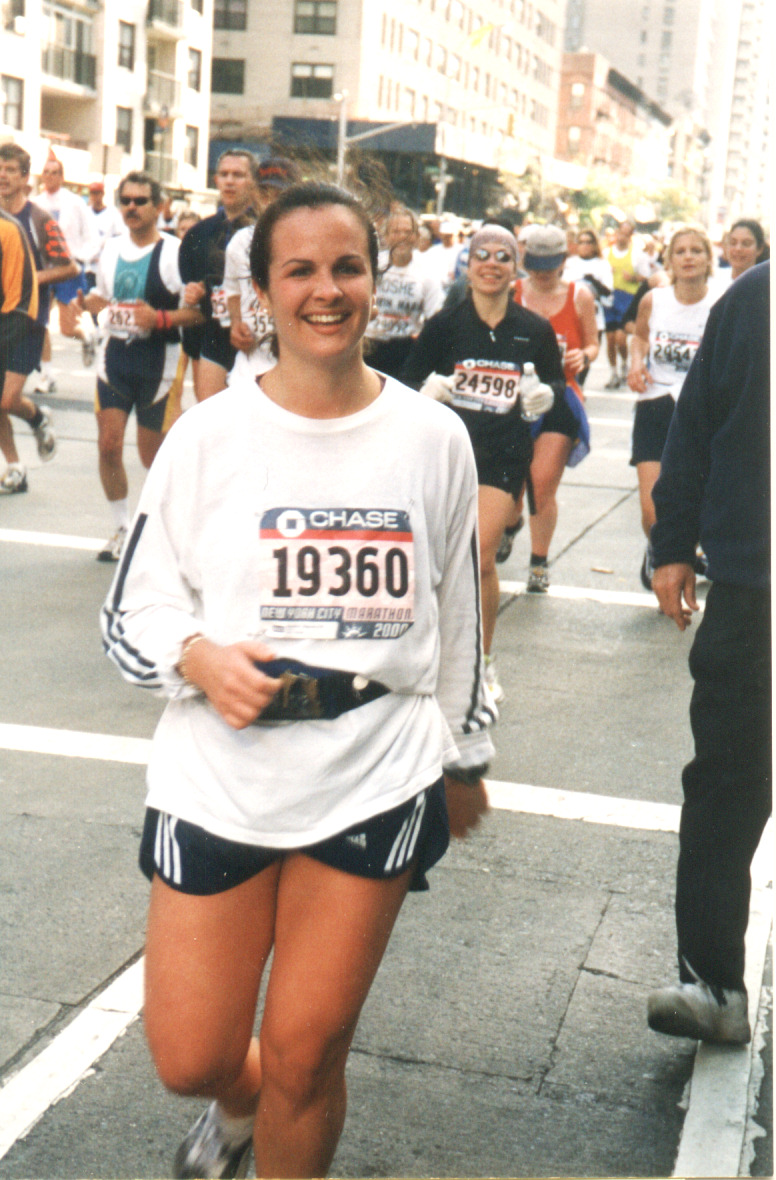
A photograph of Johanna Sigmund running in the New York City Marathon in November 2000.
After college, John, a Spanish speaker, spent a year with AmeriCorps teaching literacy to second graders in Kensington. After he explained to one class’s teacher why he wanted to take off for the anniversary of 9/11, she had her students write notes of support. John was struck by how many kids shared stories of loved ones they had lost to violence.
“Everyone has their 9/11,” he said.
Along the way, we all pay a price. Some more than others. But how one responds is a lesson for all as we navigate these trying times 25 years after 9/11.
John said he wonders how his life would have been different if not for Sept. 11. After a year teaching in Philadelphia, he moved to Texas, in part to get away. He earned a master’s degree in art education at the University of Texas in Austin before going on to teach at Say Sí, an after-school arts program in San Antonio.
John’s attempt to get away brought him back to New York. One of his students won an art award that included a trip for the student and teacher to Carnegie Hall. The artwork was displayed at the Winter Garden located near ground zero in May 2010.
“My heart sank,” John said. “I didn’t want to go anywhere near ground zero.”
Even then, nearly a decade after the towers fell, ground zero remained little more than a giant pit with the Freedom Tower slowly rising alongside it. In a macabre daily scene, tourists jammed the sidewalks, gawking and posing for pictures in front of what John could only see as a mass grave, while street hustlers sold photos of the hijacked planes crashing into the towers.
John tried to maintain his composure as he made his way through the gauntlet to the Winter Garden, but a man stepped in front of him and tried to sell him a fiery photo from the attack.
John snapped. He grabbed the stack of photos from the man, threw them in the air, and cussed him out. The two got into a tussle. After the fracas, John tried to gather himself by channeling his sister’s unflappable spirit.
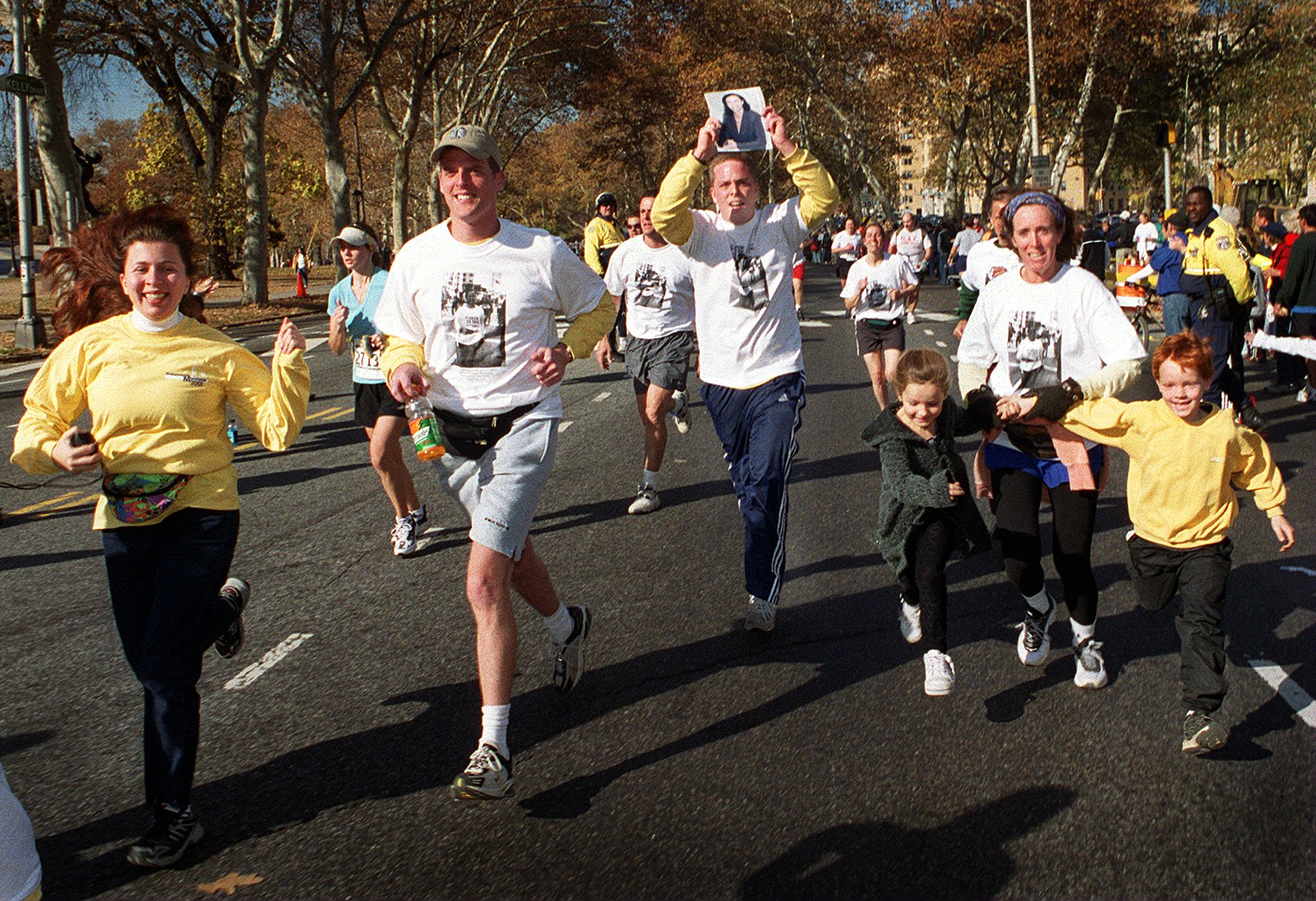
John Sigmund (center) holds a picture of his sister, Johanna, as he and his family run down Kelly Drive toward the finish line of the Philadelphia Marathon in November 2001.d
“Johanna, help me,” he said to himself while overlooking ground zero. “I need to get it together.”
‘Beyond coincidence’
John calmed down and carried on. After the event, he met friends at a nearby bar. John was telling them about the run-in with the street hustler when he suddenly saw Johanna’s old boyfriend, Joe Bonavita, across the bar.
Joe had moved to New Orleans but, in a twist of fate, was in town for a 9/11 event. The two were not close but quickly bonded. John viewed the reunion as his sister’s handiwork.
“Some things are beyond coincidence,” he said.
Eventually, John did move to New York. The city helped him better find himself. After years of worrying about disappointing his parents or adding to their suffering, John told them he was gay. His parents, who have a deep Catholic faith, were supportive.
Twelve years ago, John returned to Philadelphia and fell in love with the city, and especially Fairmount Park.
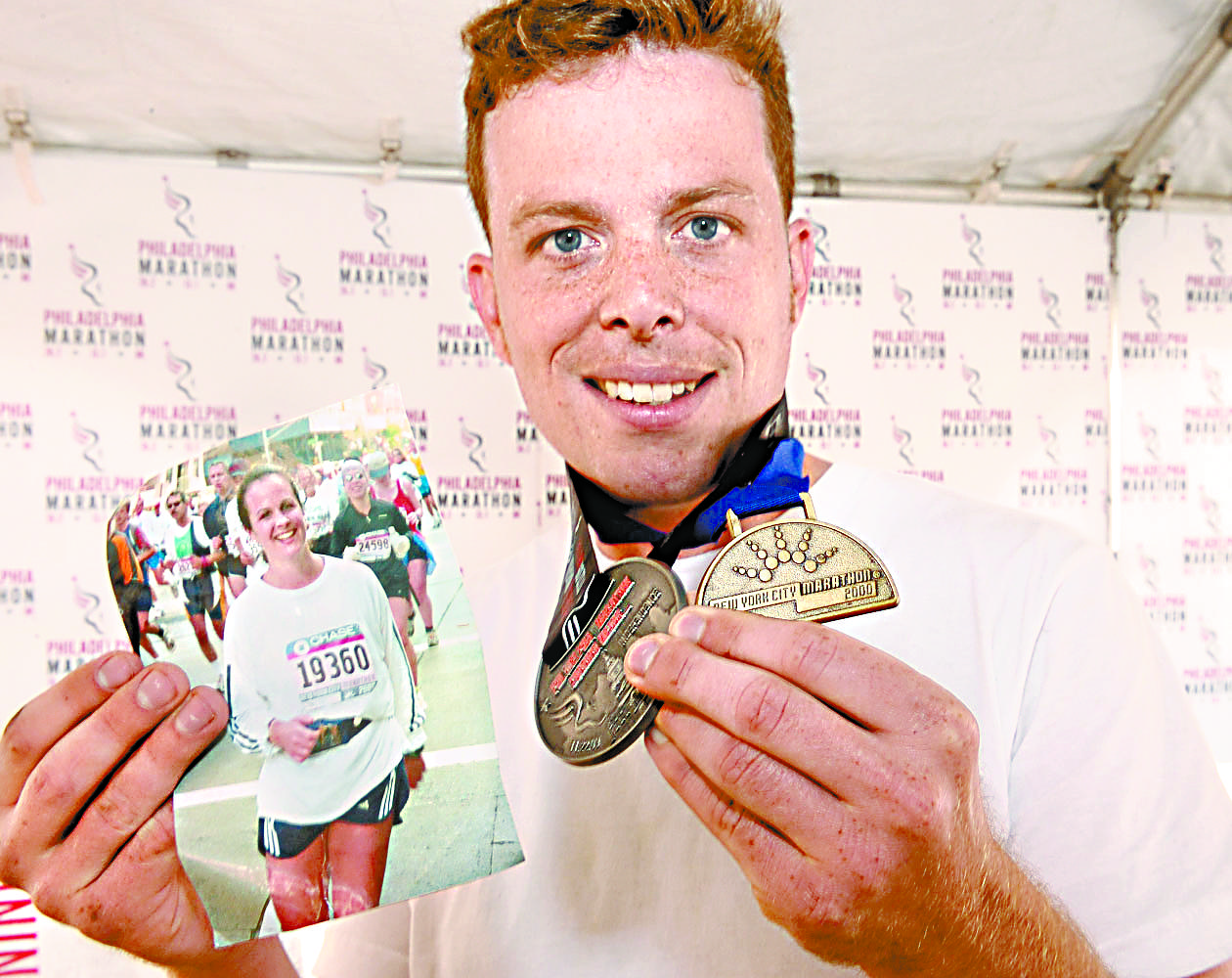
After running the Philadelphia Marathon in November 2001, John Sigmund holds a photo of his sister, Johanna, and wears two medals around his neck — one he earned after finishing the race and another his sister won after completing the New York City Marathon in November 2000.Courtesy of Tony Webb / Office of the City Representative
But tragedy struck again in September. Three days after the 20th anniversary of 9/11, his father died.
For John, September remains the cruelest month. But he credits a strong support network of cousins and friends for helping him navigate life’s challenges — and added that Johanna always feels close by.
“I have a thing with the wind,” John said. “When I think about her, the wind will kick up.”
After losing his sister and father in September, John and his partner, Jaime, decided to add some positivity to the month. They got married last Sept. 26 and are planning an anniversary party in a couple of weeks.
Alexus Mackenzye Dick and Trinity Jagdeo were 5 years old when they met on the blacktop at Mary F. Janvier School in rural Franklinville, Gloucester County.
While Dick isn’t around to tell the story anymore, Jagdeo remembers it well: They played hopscotch, but not in the traditional way. Dick zipped through the squares in her wheelchair. Jagdeo, a Vineland resident, said it amazed her.
“I’ve told the story 1,000 times,” said Jagdeo, 25. “But now that I think about it — and I’ve revisited the location — there was nothing else for her to do.”
The pair quickly became best friends. They bickered over the Justin Bieber tattoo Dick got at 15, gossiped at sleepovers, and traded lip gloss recommendations.
There’s a reason Jagdeo repeats those tales so often.
When they were still teenagers, Jagdeo founded a nonprofit, From We Can’t to We Can, inspired by her best friend. She has self-published comic books that turn local kids with disabilities into superheroes, hosted fashion shows for models with disabilities, frequented local TV stations, and gifted thousands of pieces of medical equipment to families denied by insurance or who can’t afford the supplies. Jagdeo has talked about Dick on social media for years, including to her nearly 50,000 TikTok followers.
The daily posts haven’t stopped since Dick died five months ago at 25 due to complications related to spinal muscular atrophy type 2, a genetic disease diagnosed in childhood that causes progressive muscle weakness.
“One of the things she said was, ‘I wish I could help people.’ … And so, in my heart, I knew that at that point, I wasn’t going to just let that conversation stay there,” Jagdeo said.
Now, another family is benefitting from the efforts to keep Dick’s memory alive.
Domenique Meyer, 33, lives in Aberdeen Township, Monmouth County, with her husband Mike and two children, Mikey and Mia. Born prematurely at 30 weeks, a lack of oxygen to Mikey’s brain left him with severe spastic quadriplegic cerebral palsy.
“He knows our voices, loves being talked to and cuddled, and has his own special way of showing us what he likes and dislikes,” Meyer said. “He has been fighting since the very beginning of his life.”
At 3 years old, Mikey is blind, nonverbal, unable to sit independently, and has multiple seizures per day. He receives his nutrition through a gastrostomy tube since he has a hard time swallowing. His disabilities mean a lot of time spent on care, and on one income, it’s been hard to get by, Meyer said. Their family fell behind on household bills as medical expenses piled up.
Mikey Meyer, 3, sits in a stroller given to him by From We Can’t to We Can in Aberdeen Township, Monmouth County.Domenique Meyer
“When you have a medically complex child, life does not stop because bills are due,” Meyer said. “There have been so many times when Mikey needed us at an appointment, in the hospital, or at home, and work simply had to come second.”
When Meyer reached out to From We Can’t to We Can for a medical stroller that would better suit Mikey’s needs, she explained their financial stressors to Jagdeo. Since the nonprofit had recently received thousands of dollars from anonymous donors, Jagdeo decided it was time to fulfill her best friend’s wish.
The Alexus Mackenzye Legacy Fund provided Meyer and her family with about $5,500 that went toward their mortgage and brought their utility bills up to date. And while times are still hard, Meyer said the foundation’s support gave them hope.
“For the first time in a while, it felt like we could breathe again and focus on our children instead of constantly worrying about what bill was coming next,” Meyer said.
The Meyers will attend Roar for a Reason at the Edelman Fossil Park & Museum in Mantua on Saturday, the first major event and fundraiser the nonprofit has hosted since Dick died. There, Jagdeo said she plans to release a hundred butterflies, Dick’s favorite, and read a letter addressed to her best friend. Kids with disabilities will walk the runway, and Jagdeo will introduce her newest book, Jaiyana and the Jainosaurus, which takes place at the museum and is based on the experiences of a local child with autism and a rare brain condition. She’ll introduce the new legacy fund to the public, which she said she hopes will support a family in need annually from now on.
Jagdeo has kept busy in the meantime. She still posts on social media every day, usually about Dick, and recently flew to Michigan to judge this year’s Miss Wheelchair USA competition. She’s been putting in hours on an outdoor memory garden for Dick in her yard, and she said she hopes monarch butterflies hatch this weekend in time for the celebration.
“Some people say, ‘This person was my world,’” Jagdeo said. “And for me, she wasn’t just my world. She was the world. I created a world because of her.”
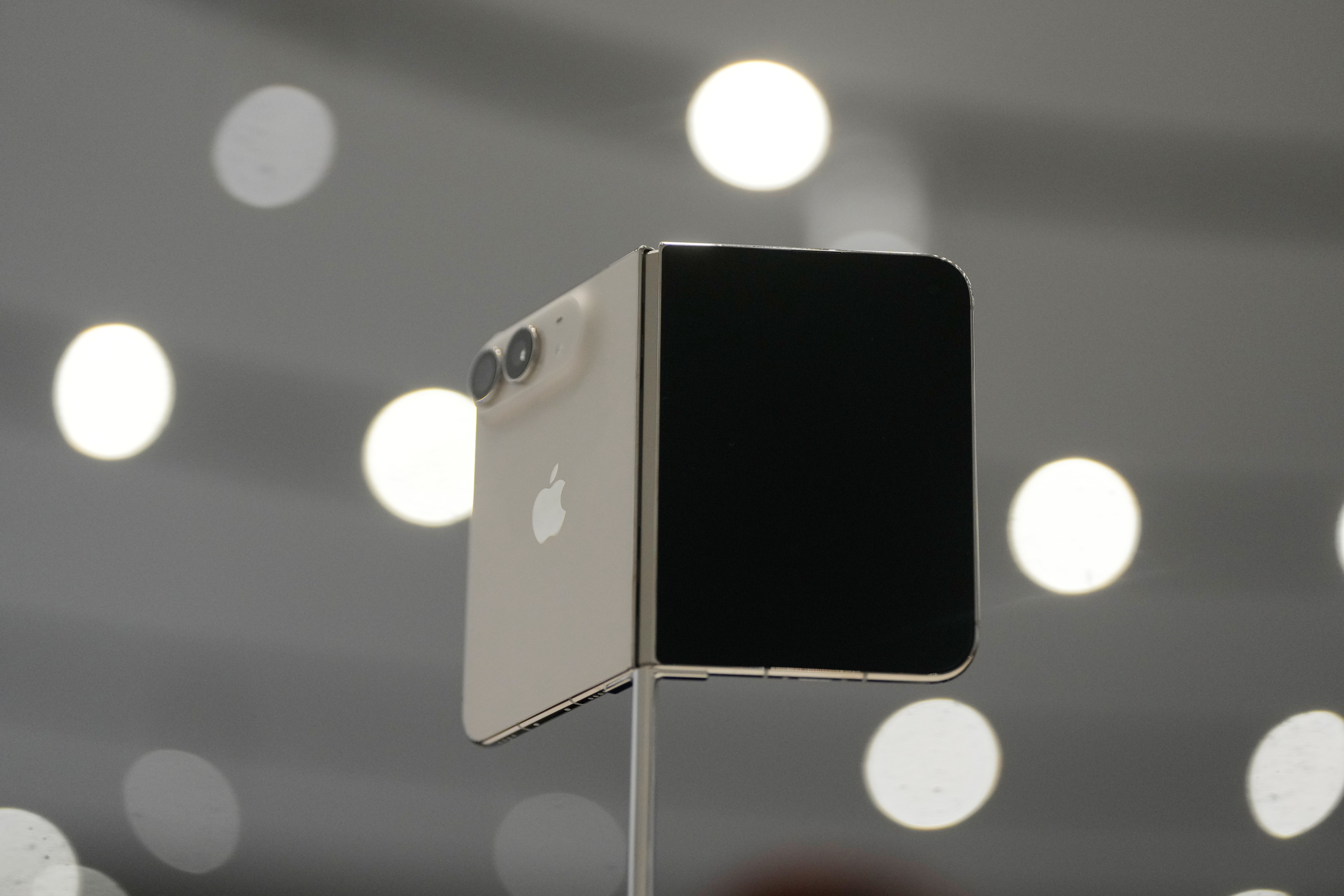
Apple’s latest iPhones, unveiled this week, come with new features, better cameras, and hefty price tags — including a folding model with a starting price of $1,999. If you’re planning to splurge on a new iPhone 18, you will want to take care of it to make it last as long as possible.
Or save money by holding on to your current device, whether it is Apple or Android, to get the most life out of it.
As smartphone technology has matured and innovations have become more incremental, people have stopped buying into the idea that they need to upgrade to the newest phone. There is also an environmental push to keep old phones out of landfills as electronic waste becomes a larger sustainability issue. Modern smartphones are also just sturdier and better able to survive dunks and drops.
The typical smartphone replacement cycle is now four years, according to Counterpoint Research. Some device owners boast in online forums that they have had phones last more than seven years.
Here are some pointers on extending your phone’s life:
Take care of your phone’s battery
The biggest factor in a phone’s longevity is the battery. A rechargeable battery’s life span is related to its “chemical age,” which is based not only on the manufacturing date but also on factors including “temperature history and charging pattern,” according to Apple. The company says that as lithium-ion batteries chemically age, they hold less charge, which results in “reduced peak performance.”
Samsung warns against running a lithium-ion battery down completely, because that could shorten its life.
“The battery is absolutely often the first thing to go in most people’s phones,” said Elizabeth Chamberlain, director of sustainability at the device-repair website iFixit.
Lithium-ion batteries typically last about 300 to 500 charging cycles before degrading noticeably to the point that they can’t last a day without needing a charge, she said. “Many people will hit 500 cycles in two years. Heavy users will get there faster.”
Batteries get stressed if they are completely drained or fully charged, Chamberlain said.
So avoid letting your battery die, and also avoid charging it all the way to 100%, “unless you really need a full charge,” she said. “Aim to keep the battery between 20% and 80% charged.”
If you are in the habit of plugging in your phone when you go to bed, Apple and Samsung both have charging optimization technology that improves battery life by delaying a full charge based on your daily routine.
This feature, which is on by default in iOS, pauses charging at 80% and then charges to 100% just before you wake up.
Phone batteries shouldn’t get too hot or cold
Device makers warn against exposing phones to extreme heat or cold, both of which can damage batteries.
Apple says batteries warm up as they charge, which can shorten their life span. It warns against using your phone or charging it in very hot temperatures, above 95 degrees.
Samsung says you shouldn’t leave your phone in, for example, a car’s glove box when it is very hot or cold. And don’t put it in a freezer either — it’s a myth that it can prolong battery life.
Google, which makes the Android operating system and Pixel phones, says hot batteries drain faster, even when they are not in use, and that can damage the battery.
Adjust your phone’s power options to boost battery life
Tweak your device settings so apps or features use less power, which extends your battery’s daily life and the time between charging cycles.
You can turn down your phone’s screen brightness, turn on the dark theme and reduce the time for the screen to power off. Enable the auto-brightness feature, which adjusts screen brightness according to the level of ambient light. Also check battery usage in your settings to see if there are any power-hungry apps you can switch off or uninstall.
If the power level dips below 10%, iPhone users can turn on low power mode to stretch their battery’s life before it needs recharging. Samsung’s Android phones have a similar “power saving mode.” You can also leave it on all the time, but it might affect your phone’s performance.
Phone cases and screens are essential protection
Phones are sleek capsules with glossy surfaces, meaning they can easily slip from your hand. A sturdy protective case is essential to help cushion the blow from accidental drops.
However, beware that some phone cases can retain heat, so your phone might stay hot even if it seems cool, Chamberlain warns.
Don’t forget a screen protector. Plastic versions are cheap but can scuff easily, according to iFixit, which recommends TPU film or tempered glass because they offer better protection against scratches and drops.
Keep your device clean
Keeping your phone in your pocket or purse means ports and sockets collect debris that needs to be cleaned out.
Chamberlain said that when a phone stops charging, often the problem is simply that the charging port is jammed with lint, preventing the cable from connecting.
You can buy kits with brushes, picks, swabs and dust blowers to give your phone’s ports, speaker and microphone grilles a thorough cleaning. But in a pinch, use a toothpick and a clean toothbrush.
Update the software regularly
Software is another important factor in a phone’s life span. Experts advise keeping your operating system and apps up to date so they have the latest privacy, security and battery management features.
That will be easier to do as your phone ages because some device makers have been extending the time limit for providing updates.
Google has pledged to provide Pixel 8 and newer phones with seven years of Android and security updates, compared with four to five years for older models. Samsung pledged in 2024 to extend its operating system updates to seven years.
Apple said Wednesday that iOS 27 will be available on Sept. 14 and the oldest phone with which it will be compatible is iPhone 11, released in 2019.
Some phones are designed to be easily repaired
Sometimes your phone will have a problem that can only be solved by repairing it, usually involving paying someone else to fix it.
But there are device makers that are making it easier to repair phones yourself. Netherlands-based Fairphone makes phones it says are designed for longevity, which come with a stripped-down version of Android and can be easily disassembled using a mini screwdriver. Replacement batteries, screens and other spare parts can be ordered online.
Fairphone’s Chief Technical Officer Chandler Hatton said the company aims to have its devices last at least five years.
“What we’re trying to do is to support people to be able to use their device for longer,” Hatton said.
It’s starting to feel like the Flyers are forever young, which is not a bad thing in a league that is continuously showing “youth’s like a diamond in the sun, and diamonds are forever.”
After years marred by a limited prospect pool, the Orange and Black have restocked the cupboard with promising youngsters who are either looking to make their mark in the NHL this season or take the next step in their development.
Compared to a year ago, the list has seen movement, with some players graduating, some moving up, and others falling. Three notable absences from this year’s list include Hunter McDonald and Helge Grans, who have aged out at 24, and Karsen Dorwart, who did not re-sign. Matvei Michkov has played too many games to qualify, as we are using 100 NHL contests as our cutoff.
With several Flyers prospects converging on Allentown and Voorhees this week for rookie camp, here’s our updated top 20 prospect rankings.
1. Porter Martone, RW, Flyers (NHL)
2025 rank: No. 1
There was some huffing and puffing when the Flyers did not take a center with the No. 6 pick in the 2025 NHL draft, but Martone, who will turn 20 at the end of October, quickly quieted the naysayers. The Calder Trophy betting favorite this year, Martone put together a dominant freshman campaign at Michigan State and made a scintillating NHL start last season. He tallied 10 points in nine regular-season games before adding five points, including two game-winning goals, in 10 playoff contests. A 6-foot-3, 208-pound winger, Martone brings size, strength, a big-time shot, playmaking ability, and an edge. He’ll play a significant role this season for the Flyers in the top six and on the power play.
2. Denver Barkey, C/LW, Flyers (NHL)
2025 rank: 8
What a start to Barkey’s pro career. After just 26 games with Lehigh Valley of the American Hockey League, he found himself in the NHL and never looked back. The 21-year-old used his high-end motor and responsible 200-foot game to stake a spot in the lineup, and posted 17 points in 43 regular-season games. Although he only put up two points in 10 playoff games, the 5-9 winger stepped up in the postseason, showing his relentless play style and willingness to be aggressive on pucks despite his small frame, especially when called upon by coach Rick Tocchet in the second round of the playoffs to play center. Barkey played so well as a pivot that some are penciling him as a bottom-six centerman instead of a winger.
3. Alex Bump, LW, Flyers (NHL)
2025 rank: 2
Where Martone and Barkey go, so goes Bump, and the 22-year-old will round out the trio of expected NHLers at rookie camp. This was the consensus belief last year, but the winger fell short and started the year with the Phantoms. The difference now? Bump has learned what happens if he doesn’t showcase his innate high-end offensive attributes and goal-scoring prowess at camp, and now has a full year of pro hockey — and a taste of the NHL — under his belt. After being recalled following the trade deadline, the Minnesotan played 23 games between the regular season and playoffs, racking up seven goals, 11 points, and a team-best shooting percentage of 21.2%.
Flyers winger Alex Bump, 22, has one of the best releases in the system.Yong Kim / Staff Photographer
4. Oliver Bonk, RHD, Flyers/Lehigh Valley Phantoms (NHL/AHL)
2025 rank: 5
The top blueline prospect in the organization, Bonk showed why during his NHL debut in the Flyers’ regular-season finale and his lone postseason appearance. A well-rounded defenseman, Bonk notched his first career goal and assist in April and has the tools to be an everyday top-four blueliner in the NHL. “I think you just have to be confident and believe that you’re good enough to be there, because you are there, and that’s pretty much it for me,” he said of the experience. “Just kind of working on that and realizing that I’m a good player and I should be there.” Last season he sustained an injury early in rookie camp and didn’t suit up until December; this year, a healthy Bonk, despite a short September, should strongly push for a spot with the main club.
5. Jack Berglund, C, Färjestad BK (Swedish Hockey League)
2025 rank: 11
The Swede skyrocketed up the Flyers’ prospect depth chart this season with his impressive play in Europe, Allentown, and for his country at World Juniors, where he captained Sweden to its first gold since 2012 and was one of the tournament’s standout players. Berglund linked up with the Phantoms for five games at the end of the season, and while he will return to the SHL this season on loan, he left quite an impression. “He drove play, he was around the puck, and his ability to play below the dots with the puck is exceptionally good,” Phantoms coach John Snowden told The Inquirer in May about the 6-4, 217-pound center. “He understands how to use his body and his frame to get guys on his back and get out of situations.”
6. Jack Nesbitt, C, University of Michigan (NCAA)
2025 rank: 6
After a strong season with Windsor of the Ontario Hockey League in which he scored at a 1.05-point-per-game clip, Nesbitt is off to the University of Michigan this fall. Tall and lanky, Nesbitt said at development camp he gained 10-15 pounds after the season by hitting the gym, and the 6-5, 193-pound centerman should only get stronger with the college hockey schedule. He’ll need that extra muscle to play his game of driving to the net and creating time and space with his body. Nesbitt has nifty hands for someone his size and is a player the organization believes has a long runway to develop as he grows into his frame.
The Flyers have high hopes for towering center Jack Nesbitt.Monica Herndon / Staff Photographer
7. David Jiříček, RHD, Flyers (NHL)
2025 rank: NA
The upcoming season will be a big one for the 6-4 blueliner who is on his third team despite being drafted just four years ago. A coveted right-shot defenseman with size, puck skills, and a booming shot, Jiříček is a bit of a project but will likely get a chance right away this season at the NHL level since he is no longer waiver-exempt. He impressed with the Phantoms after being acquired at the trade deadline — getting a chance to play at all strengths — and made his Flyers debut in the season finale. The Czech defender is someone Snowden says has “all the tools” to transition to the NHL, and the expectation is his “absolute missile” of a shot will get a chance to bolster the Flyers’ dismal power play.
8. Maksim Sokolovskii, LHD, London (Ontario Hockey League)
2025 rank: NA
When the Flyers selected Sokolovskii 27th overall in June, it turned a few heads. But watching the 6-7 defenseman play the body and skate like someone a foot shorter at development camp, it showed why he may prove to be a steal. Sokolovskii is still growing into his game as a mean shutdown blueliner, but the upside is tantalizing. Now that he’s no longer constrained to focusing only on his defensive game, he’s already shown in preseason action for London that he has an untapped offensive side. The 18-year-old, who will be at rookie camp this week, also showed that his confidence has skyrocketed evidenced by his heads-up plays through the neutral zone and in the offensive end for the Knights.
Here is another view of Maksim Solokovskii’s 1st Assist Yesterday against Erie. What a skater he is. @Flyers_Clips
9. Yegor Zavragin, G, Metallurg Magnitogorsk (Kontinental Hockey League)
2025 rank: 4
When will Zavragin come to the U.S.? It likely won’t be any time soon, as the goalie’s contract was extended by a year when he was traded to Metallurg of the Kontinental Hockey League in June. Last season the netminder split time between the KHL and the VHL, Russia’s second-highest league, but this season he should stick in the top flight. Zavragin, 21, has posted a .918 save percentage in 56 career KHL games, and in his first start of this season with his new team, he stopped 16 of 17 shots in a 2-1 win.
Russian netminder Egor Zavragin is the Flyers’ No. 1 goaltending prospect.Sipa USA via AP
10. Carter Amico, RHD, Boston University (NCAA)
2025 rank: 13
If anyone on this list has made the biggest transformation in the past year, it is Amico. This time last year, the 6-5 defenseman was still rebuilding his game after suffering a broken kneecap that sidelined him for most of his draft year. This past season, he left Boston University halfway through to get more playing time with Muskegon of the United States Hockey League. After a productive spell with the Lumberjacks, the Maine native will rejoin the Terriers this season, and if what he showed at development camp this past summer with his smooth skating and ability to close is any indication, it’ll be a good year. “He looks like a different player; he really does,” BU coach Jay Pandolfo told The Inquirer in June. “It was great for him to go there [to Muskegon] and just find his game again.”
11. Brek Liske, RHD, Everett (Western Hockey League)
2025 rank:NA
Taken in the second round in June by the Flyers, Liske is a versatile, well-rounded defenseman who needs to keep building his game, and he will do so this year alongside fellow Flyers prospect Luke Vlooswyk with Everett of the Western Hockey League. The son of a diehard Flyers fan from Manitoba, Liske is a strong skater and plays with confidence and smarts in his own end while adding some offensive punch. According to Flyers assistant general manager Brent Flahr, “he’s got some swagger,” and it has shown on and off the ice, notably when he was elevated to the top pair alongside projected 2027 No. 1 pick Landon Dupont amid the Silvertips’ run to the Memorial Cup final.
Brek Liske (left) will team up with fellow Flyers prospect Luke Vlooswyk this season with the Everett Silvertips.Courtesy of Luke Vlooswyk
While Amico and Berglund may have risen several spots, Luchanko fell considerably after a disappointing year in junior in which he scored just seven goals. There’s no denying there is talent within Luchanko, notably his speed and hockey IQ, but it was a tough slog for the center who was traded from Guelph to Brantford in the OHL and played sparingly for Canada at World Juniors. Luchanko has played in nine NHL games (including playoffs) but has yet to notch his first point. Expected to be a full participant at the rookie and main camps after undergoing core muscle surgery in June, this will represent a big year for the 20-year-old as he looks to get back on the trajectory that made him a lottery pick in 2024.
After two disappointing seasons at the junior level, Jett Luchanko, 20, is entering a massive season for his development.Yong Kim / Staff Photographer
13. Spencer Gill, RHD, Phantoms (AHL)
2025 rank:7
Since getting drafted in 2024, the 6-4 Gill has dealt with several major injuries — a broken ankle two years ago with Rimouski of the Quebec Maritimes Junior Hockey League and a wrist ailment that required surgery last year with Blainville-Boisbriand — that limited his playing time. But now the 20-year-old will turn pro and is projected to spend this season with Lehigh Valley, where he can expand his 200-foot game and get acclimated to the speed of pro hockey. “I really love the way he was able to kill the play effectively in the D zone along the boards. Once he put his hands on someone, that player was not going anywhere,” Armada coach Alexandre Jacques told The Inquirer in June, noting the blueliner is good offensively at the blue line and [at] getting shots on goal “ … I think where he needs to improve to play at the pro level, and he knows it, is explosion of his first few steps backward and forward. So, if he’s able to improve that, which I know the Flyers have been working really hard with him … I think you can become a good player for the team.”
Projected to be a bottom-six forward, Ruohonen had a solid freshman season at Harvard, chipping in 19 points in 28 games while also playing for Finland — wearing an “A” — at World Juniors. A shutdown forward and pass-first center, he is hard on the puck and has started to sprout his wings offensively. It’ll be interesting to see how he does this upcoming season under a new coaching staff for the Crimson
15. Nikita Grebenkin, LW/RW, Flyers (NHL)
2025 rank: 10
The 23-year-old Russian spent his first full season in the NHL in 2025-26, serving as a pest and a powder keg regardless of where he slotted in the lineup. He scored his first NHL goal in an early-season nail-biter the Flyers won in overtime, finished with 14 points in 55 games, and dropped the gloves a few times in defense of his teammates. Grebenkin has an infectious personality, and it translates to the ice, making him invaluable on and off the ice. The winger suffered an upper-body injury in late March that kept him out of the lineup for the rest of the regular season and playoffs, but if he can bring some pop and energy this season, he could become a mainstay in the bottom-six.
16. Cole Knuble, C/RW, Phantoms (AHL)
2025 rank: NR
Despite being one of Flahr’s favorites in the system, the son of former Flyers forward Mike Knuble may not have drawn eyes in the past. But at this year’s development camp, the 22-year-old looked like a man on a mission to stand out. The forward, who has been playing more center, showed off his improved skating, a good motor, aggressiveness, high hockey IQ, and vision as he followed the advice from his dad: “He used to say, ‘If you have 12 eggs in your pockets, they should all be broken.’”
Cole Knuble is a prospect that the Flyers have long been higher on internally compared to the consensus rankings.Elizabeth Robertson / Staff Photographer
17. Carson Bjarnason, G, Phantoms (AHL)
2025 rank: 9
As Snowden put it, it was a roller coaster season for the goalie who made the jump to the pros and suited up for the Phantoms for most of the season — he had a short stint in Reading of the ECHL — and posted 14-11-3 with a 3.43 goals-against average and .877 save percentage. A confident kid who should hit the ground running in Year 2, he will split this net in Allentown with Aleksei Kolosov. “It’s a good league, and you can’t guess; you have to understand the situations, and I thought he had a little bit of a stretch where it became pretty hard for him,“ Snowden said. ”But Brady [Robinson, Lehigh Valley’s goaltender development coach] did an incredible job with him, continuing to push him and teach the moments of where we’ve got to clean up.”
Another player who has snuck up the rankings is Quinn, who is coming off a 73-point season with the Remparts. He had 25 points on the power play and was tied for 10th in goals (34) and 17th in points in the QMJHL. Former Flyers forward Simon Gagné, who is now the general manager for Québec, expects a big year from the 5-11, 184-pound center he calls a force before he heads off to Northeastern University for 2027-28. “Quinners, more, maybe I’m going to say more passer … [but] he could surprise you,” Gagné told The Inquirer in June. “He’s got a really, really good wrist shot. He knows how to score a goal as well. He’s really a skilled player, really good high IQ, and is flying on the ice.”
19. Ty Murchison, LHD, Phantoms (AHL)
2025 rank: NR
Murchison hasn’t been quiet about his growth this past year. In his first full season in the pros — it lasted only 32 games due to an upper-body injury — he left impressions across the organization. So much so that in December he made his NHL debut and stuck around for three games, skating an average of 15 minutes a night. At 6-2, he plays a big, physical game while also being efficient with the puck, and is a strong skater despite a late start on the ice because he was a roller hockey player in his youth. “I think Ty Murchison is a guy you should keep on the radar,” Snowden said. “Obviously, an injury shortened his season, but he was trending in an incredibly good direction.”
Before transitioning to the ice, Ty Murchison got his start on rollerblades.Courtesy of Murchison family
20. Jack Murtagh, C/LW, Boston University (NCAA)
2025 rank: 12
Like most true freshmen, Murtagh struggled to find his footing in college hockey going up against bigger, stronger players. The Upstate New Yorker called his season at BU “a little bit inconsistent” and a “little bit rocky.” He learned he cannot take a single shift off, and the expectation is that the 6-1, 198-pound forward will put up more than the 11 points in 35 games he managed last season. “He needs to be consistent, shift after shift, game after game, like those are the big things for younger players, just learning to be consistent in everything you do,” Pandolfo said. “ … That’s the one thing that he’s gotten better at over the course of the season, and we expect him to have a really big jump in his play coming into his sophomore year.”
10 more to watch (alphabetical order)
Alex Čiernik, LW, Phantoms (AHL), Matthew Gard, C, Seattle (WHL), Max Laatikainen, RHD, Sport (Finnish Liiga), Ilya Pautov, LW, TBD, Noah Powell, RW, Phantoms (AHL), Martin Psohlavec, G, Saskatoon (WHL), KJ Sauer, C, Edmonton (WHL), Max Westergård, LW, Frölunda (SHL), Shane Vansaghi, RW, Michigan State (NCAA), and Luke Vlooswyk, RHD, Everett (WHL)
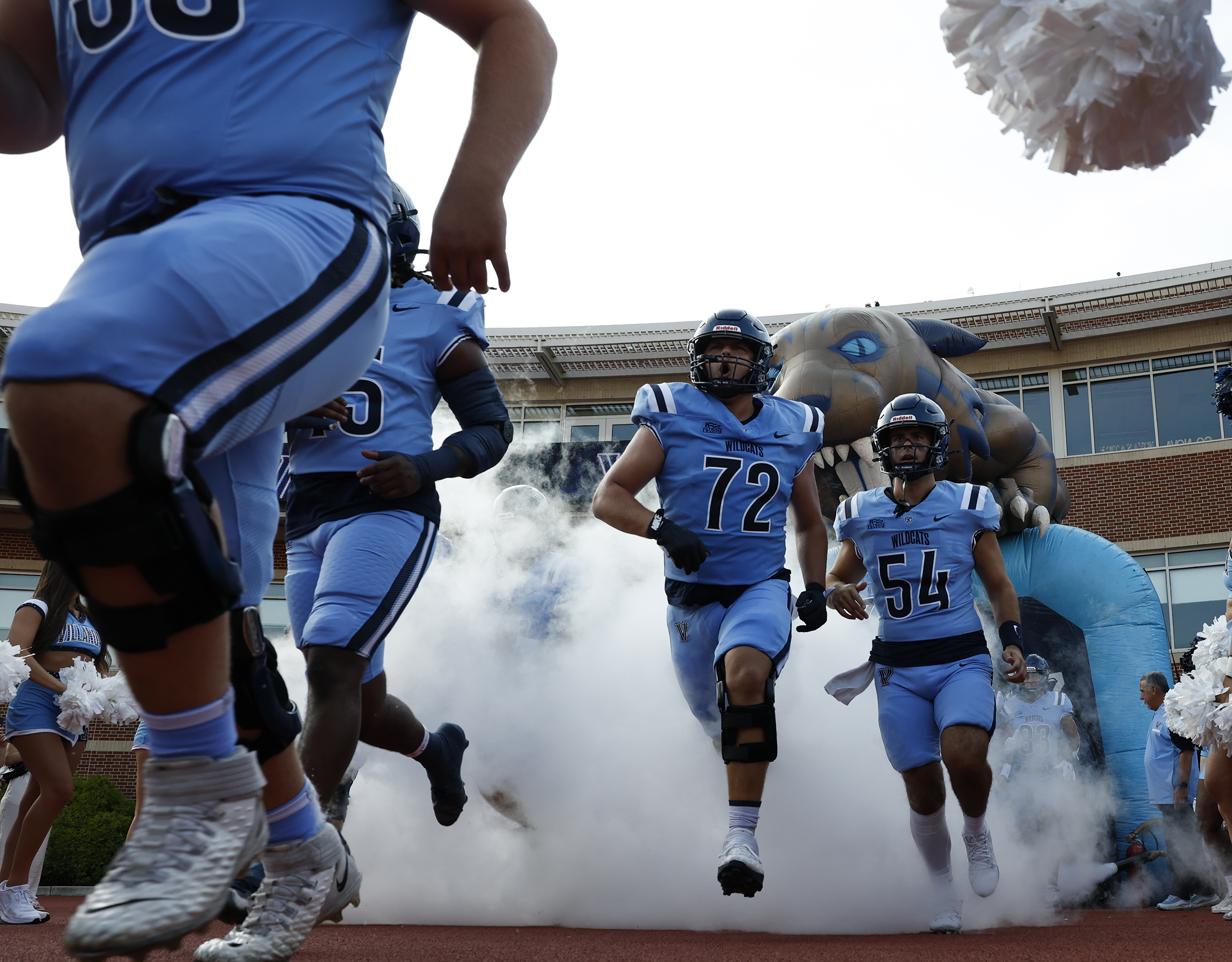
Villanova football is facing off against its annual FBS opponent tonight in a road matchup against Louisville.
After beginning the season ranked No. 7 in the FCS preseason coaches’ poll, the Wildcats have slipped to No. 18 over the last two weeks. And their FBS matchup at Louisville comes during a time when Villanova is trying to clean up all three phases of its game.
However, the Wildcats are looking to carry the momentum from their 17-16 win over Bucknell last week, which marked the team’s first victory in the Patriot League, to try to take down a Louisville program (7 p.m., ESPN/ACCN) that is ranked No. 24 in the Associated Press Top 25 Poll and lost, 41-38, to No. 9 Ole Miss on Sunday.
“We don’t talk a whole lot about it, to be honest,” said head coach Mark Ferrante when asked about playing an FBS opponent. “Nameless, faceless opponent. It’s not who we’re playing, it’s how we’re playing.”
Since the season-opening loss to William & Mary, Ferrante and his staff believe both sides of the ball cleaned up their penalties. The Wildcats had five penalties for 45 yards last week, compared to 15 for 107 yards in Week 1. They also didn’t turn the ball over.
As graduate quarterback Pat McQuaide becomes more comfortable with his receivers, Villanova’s offense is starting to show glimpses of what it was projected to be this offseason.
“Pat wasn’t here in the spring, wasn’t here in the summer, missed the first couple days of preseason practice, and then was able to rejoin the team based on all the stuff that transpired behind that,” Ferrante said. “I’m hoping that, again, Week 1 to Week 2, Week 2 to Week 3, and just keep progressing through the season, it’ll just be sharper, there’ll be better timing, there’ll be more understanding of each other.”
Against Bucknell, McQuaide had a couple of open looks that could have resulted in large plays or deep touchdowns, but he either overthrew or missed his receiver in stride.
Villanova football slides down to No. 18 in the AFCA FCS Coaches Poll.
“There were a few near misses last week where if he hits that one in stride, that might have been a touchdown,” Ferrante said. “ … Hopefully, with added reps, added practice, and more games on our belt, will tie them up better down the road.”
Villanova held on to its win against Bucknell thanks to linebacker Garrett Rogan’s blocked field goal at the end of the game, which would have put Bucknell up by two points. The fifth-year defensive back was one of Villanova’s preferred walk-ons at safety in 2022 and made the transition to linebacker this offseason.
Ferrante emphasized how important special teams is due to how many games are decided by a field goal. Villanova’s season opener was, and so was Louisville’s.
“Our two games, plus Louisville’s first game, plus SMU and Florida State’s first game all came down to field goals or field-goal attempts,” Ferrante said. “That goes to show you how important special teams can be.”
Villanova knows there is always room for improvement, even when it’s playing at its highest potential. That starts with Ferrante, then his staff, and finally the players.
Sophomore linebacker Omari Bursey is one of Villanova’s players who has grasped that concept early in his collegiate career. This offseason, Bursey was given the green dot on the back of his helmet, signifying that he communicates with the coaching staff and the defense while on the field.
Last week, he was named the FCS National Defensive Player of the Week after recording 14 total tackles against Bucknell.
Villanova LB Omari Bursey was named the FCS National Defensive Player of the Week. https://t.co/jBUiYG5LFK
“It’s honestly just a testament to this unit as a whole,” Bursey said of receiving the honor. “One of the biggest things I didn’t get to talk about last week is playing off of my nose guard, and we were able to show that this past week against Bucknell. [We] play so well off each other. It just allowed me to have a few more tackles than the rest of the guys.”
Ferrante said he has shepherd a team-effort mindset during his nine seasons as head coach. It’s an approach that’ll remain against Louisville, he said.
“From my perspective, from the head coach’s perspective, and that hopefully trickles down through their assistants, I approach every week the same,” Ferrante said. “I approach every season the same. People ask me that all the time, ‘So what do you think about this year?’ Well, one year to the next is never going to be the same.
“I enter every season, every game the same way, cautiously optimistic. I always feel if we play our brand of football and we play clean and we don’t shoot ourselves in the foot, and we’re not our worst enemy, we’re not the opponent, then I don’t care who we’re playing. I think we can go out there and compete with anybody.”