HARRISBURG — For more than two decades, Gov. Josh Shapiro has worn it almost every day.
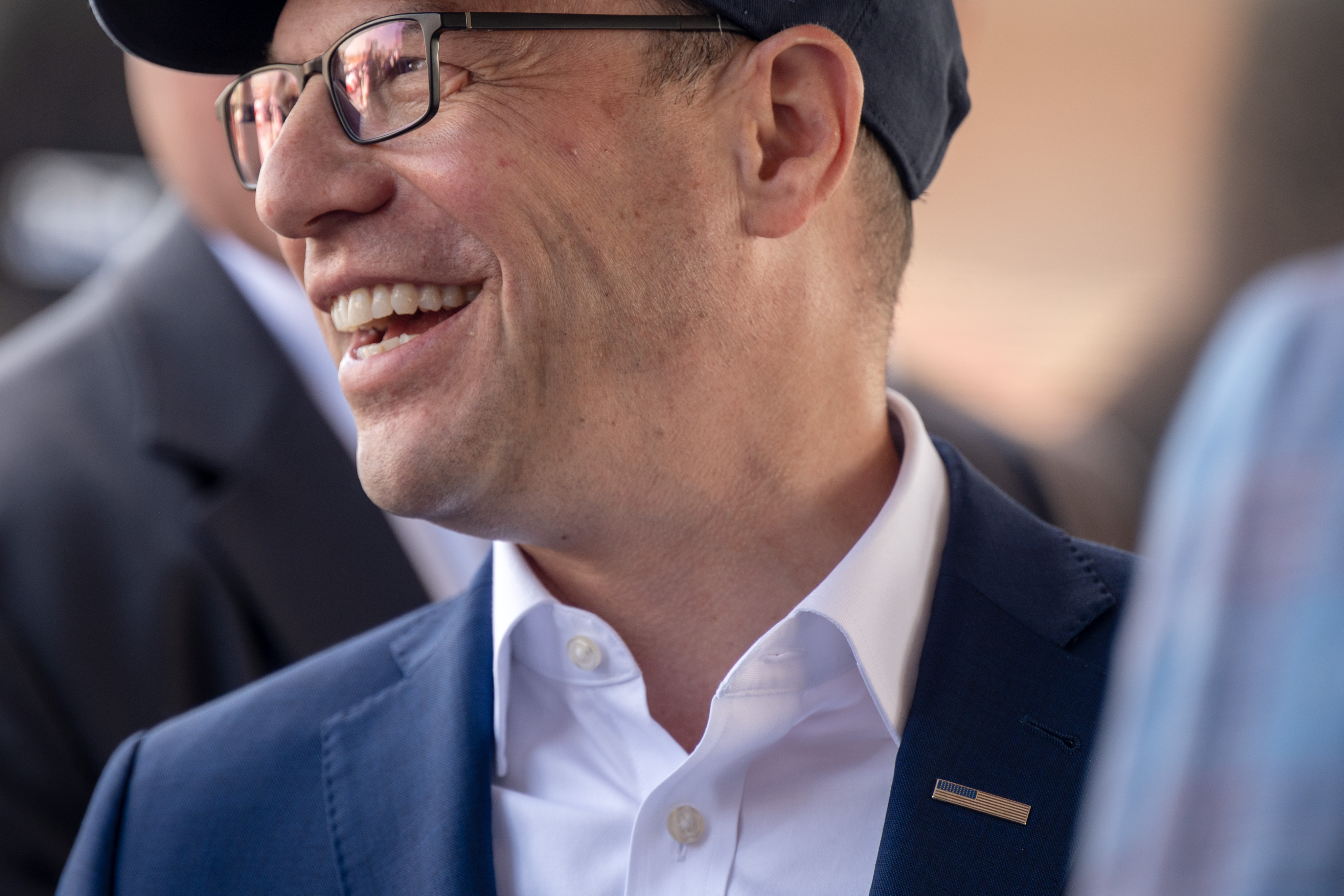
The small, thin accessory affixed to his lapel — a compressed version of the 50 stars and 13 stripes — may require one to squint to see. But it carries significant meaning to the Democratic governor, with an origin story that began on Sept. 11, 2001, when Shapiro was a young staffer on Capitol Hill.
Shapiro was working in Washington when he experienced the pain and confusion of the deadliest terrorist attack in the nation’s history, he said in a June interview.
He was just steps away from the U.S. Capitol building in then-U.S. Rep. Joe Hoeffel’s office, where he served as chief of staff, when he watched as the Today show anchors announced a plane had hit the World Trade Center. And then another.
He realized, like thousands of Americans, that the nation was under attack — with Washington as a potential target. Less than an hour later, Shapiro said, he saw the smoke coming from the Pentagon. Staff were given mixed signals on whether to evacuate before ultimately being told to hunker down in legislative buildings until the situation was clear, he said.
When Shapiro arrived on Capitol Hill the next day, a woman who worked in the Capitol gift shop was giving out American flag pins to anyone who passed by — the “typical gift shop” pin depicting a waving flag that President George W. Bush and other politicians began to wear in the aftermath of the 9/11 attacks, he said.
The pin became a part of Shapiro’s daily business uniform. He wore it every day, even after he left D.C. and began working at a law firm in Montgomery County while preparing to run for state representative — his first foray into elected office and the start of a decades-long career.
When Shapiro was knocking on doors for his 2004 run for the state House, a veteran in Glenside told him his gift shop pin wasn’t cutting it. The veteran gave Shapiro a nicer one: an image of the American flag in a thin, metal bar.
“And I’ve worn it basically every day since,” Shapiro said in June ahead of his appearance at a special session of the U.S. House at Independence Hall to commemorate America’s founding 250 years ago. Widely rumored to be a future presidential contender, Shapiro often talks about his pride in America and its ideals, and his fears that the country is becoming too divided and straying from the founders’ aspirations.
“I am a proud, patriotic American,” he said, referencing his pin. “I don’t think patriotism belongs to one party. I don’t think it should ever be partisan.”
Over the years, Shapiro has made slight changes to the flag accessory; he shaved down the pin stem and made it into a magnet.
“It was destroying my suits,” he added.
He said he once lost the pin when it fell off a jacket that he had hung up on a plane.
“I freaked out. I literally freaked out,” he said.
He said he and the flight attendant were on their hands and knees trying to find it in the plane’s closet. They found the pin, but never found the backing, which was replaced much more easily.
“I found the most important thing, and I just got another magnet,” he said.
Shapiro will appear at the Flight 93 Memorial near Shanksville, Pa., alongside members of President Donald Trump’s administration, includingU.S. Interior Secretary Doug Burgum, for a service on Friday to commemorate the 25th anniversary of the attacks, in which more than 2,900 people were killed.
United Airlines Flight 93, a San Francisco-bound passenger plane flying out of Newark, was hijacked on Sept. 11, 2001. It was believed to be headed to the White House or U.S. Capitol, near where Shapiro was working at the time — before its 40 passengers attempted to retake control and crashed the aircraft in a field near Shanksville.
We’re days from the start of Eagles season, but Philly’s summer sports teams — the Phillies and Union — are still going strong as they head down the stretch. From Citizens Bank Park to Chester, it was a busy week for the two clubs, with the Phillies hosting the Braves and Astros and the Union hosting Cincinnati and Montreal. And at some point along the way, Temple opened its season with a win over Rhode Island at Lincoln Financial Field. The Owls will be back there Saturday when they host No. 16 Penn State, a day before the Eagles kick off against the Washington Commanders.
As they do each Friday, Inquirer photo editors picked the best sports images from the last seven days to bring you this week’s Big Picture …
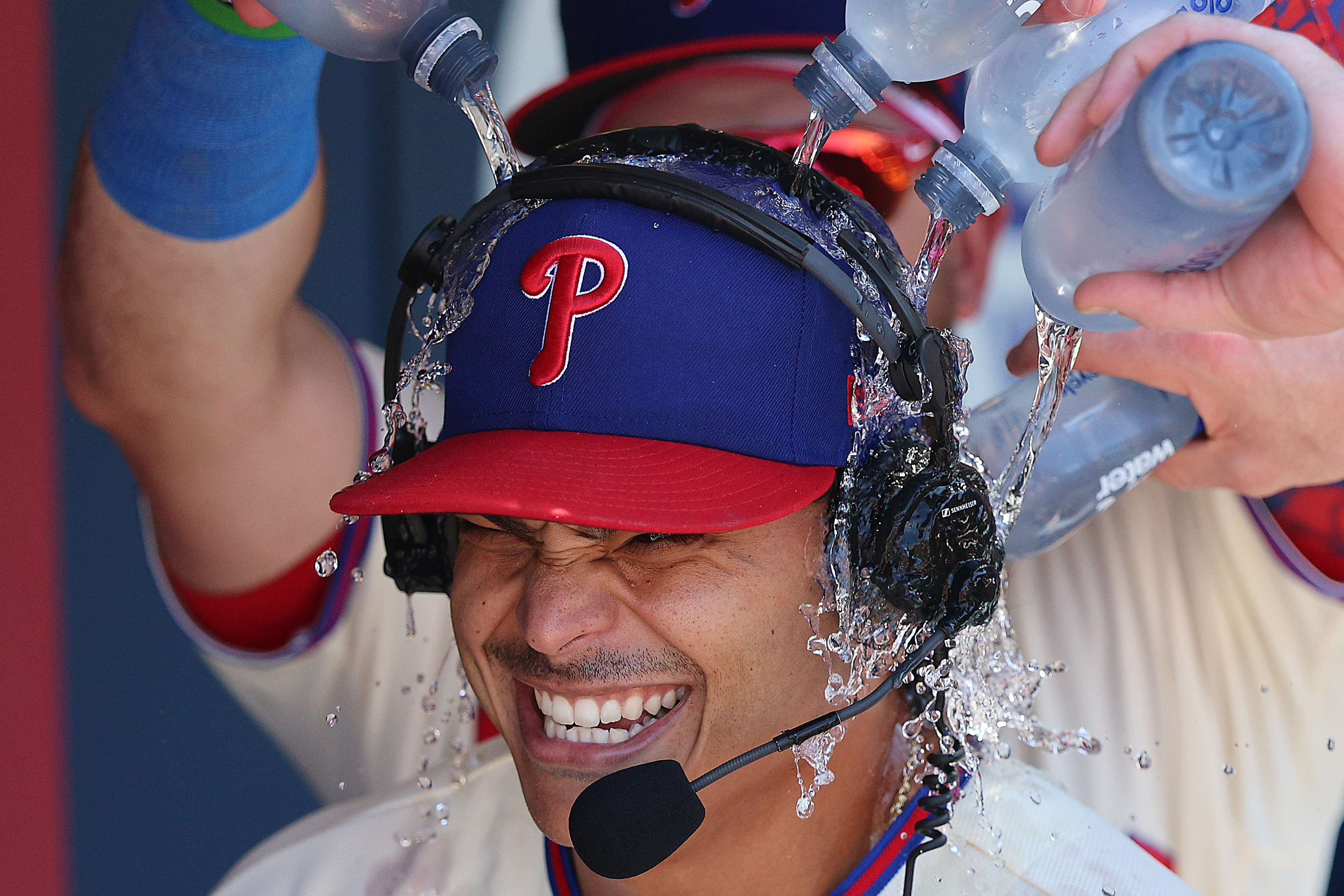
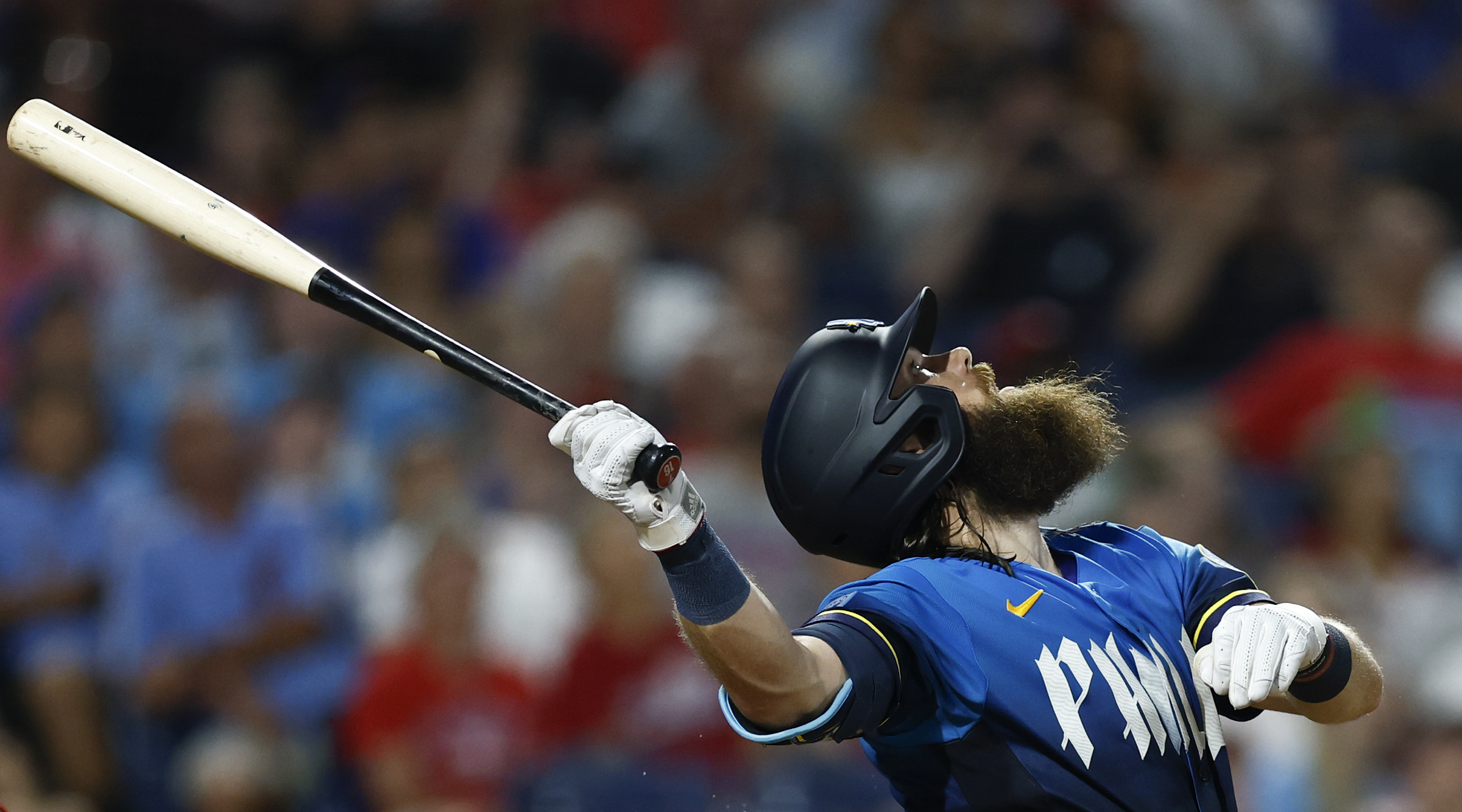
Trea Turner hit a two-run home run in the sixth inning against the Houston Astros on Tuesday, but it wasn’t enough as the Phillies dropped the series opener, 6-5.Elizabeth Robertson / Staff Photographer
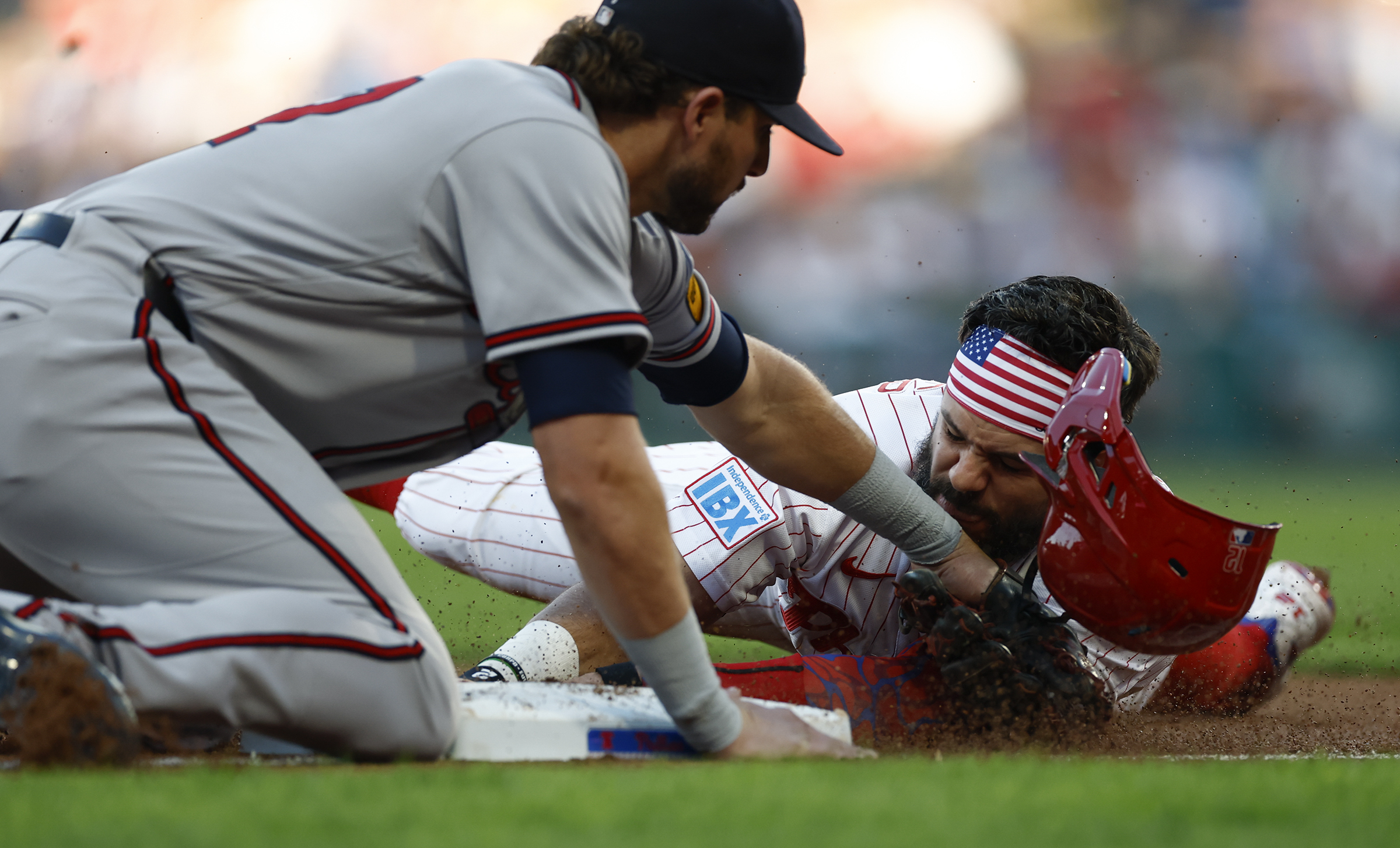
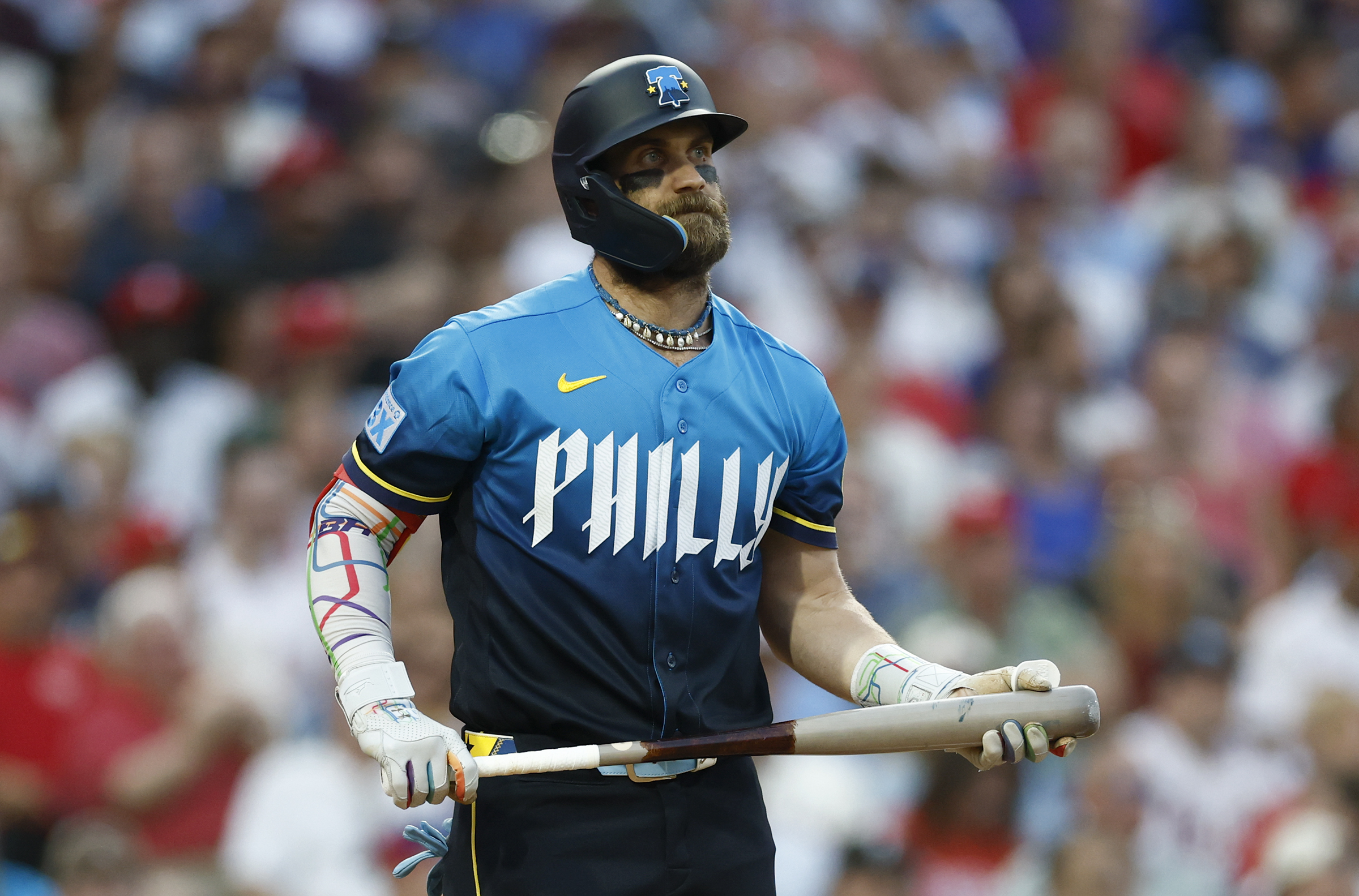
Phillies outfielder Bryce Harper waits for a pitch during Monday’s series finale against the Atlanta Braves. The Phillies won, 1-0, to split the series with their division rivanl.David Maialetti / Staff Photographer
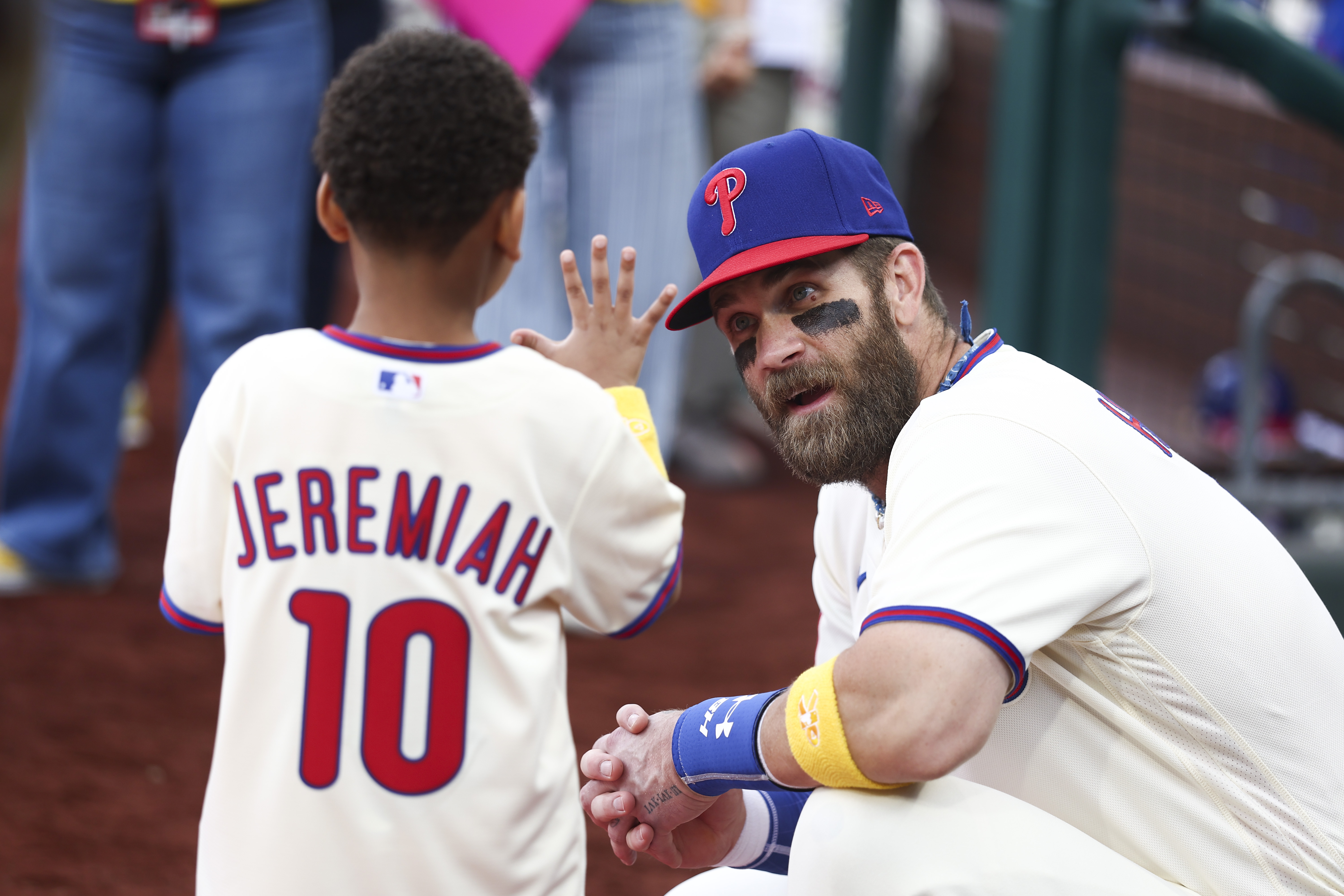
Jesus Luzardo pitched his first complete-game shutout in the Phillies’ 1-0 win over Atlanta on Monday.David Maialetti / Staff PhotographerA young fan named Jeremiah talks with Bryce Harper before Sunday’s game against the Braves at Citizens Bank Park, where the Phillies and Nemours Children’s Health hosted their Childhood Cancer Awareness Day.Monica Herndon / Staff Photographer
Jeremiah rounds the bases after hitting an honorary home run before Sunday’s game. The Phillies could’ve used Jeremiah, as they lost to the Braves, 5-4. Monica Herndon / Staff Photographer
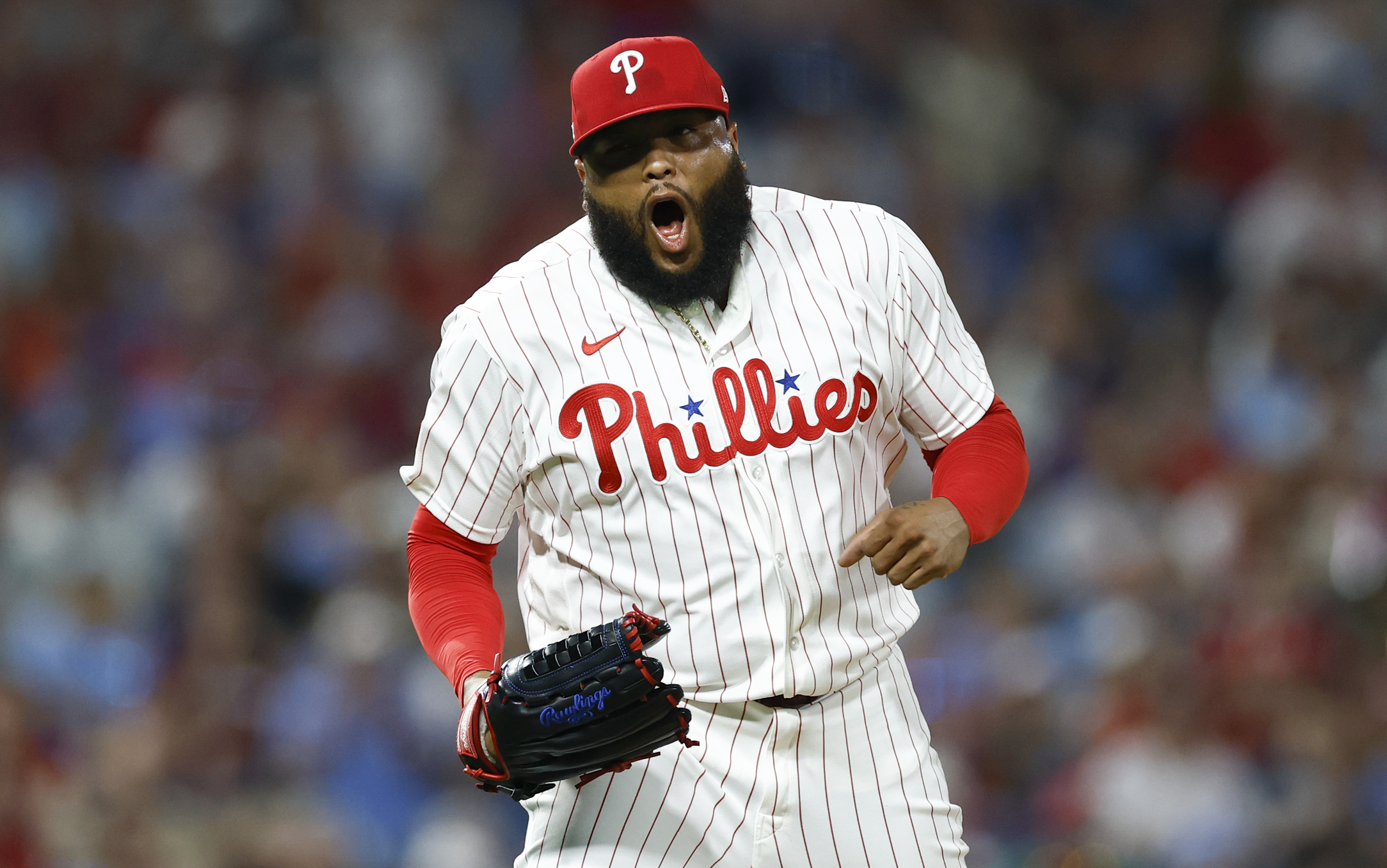
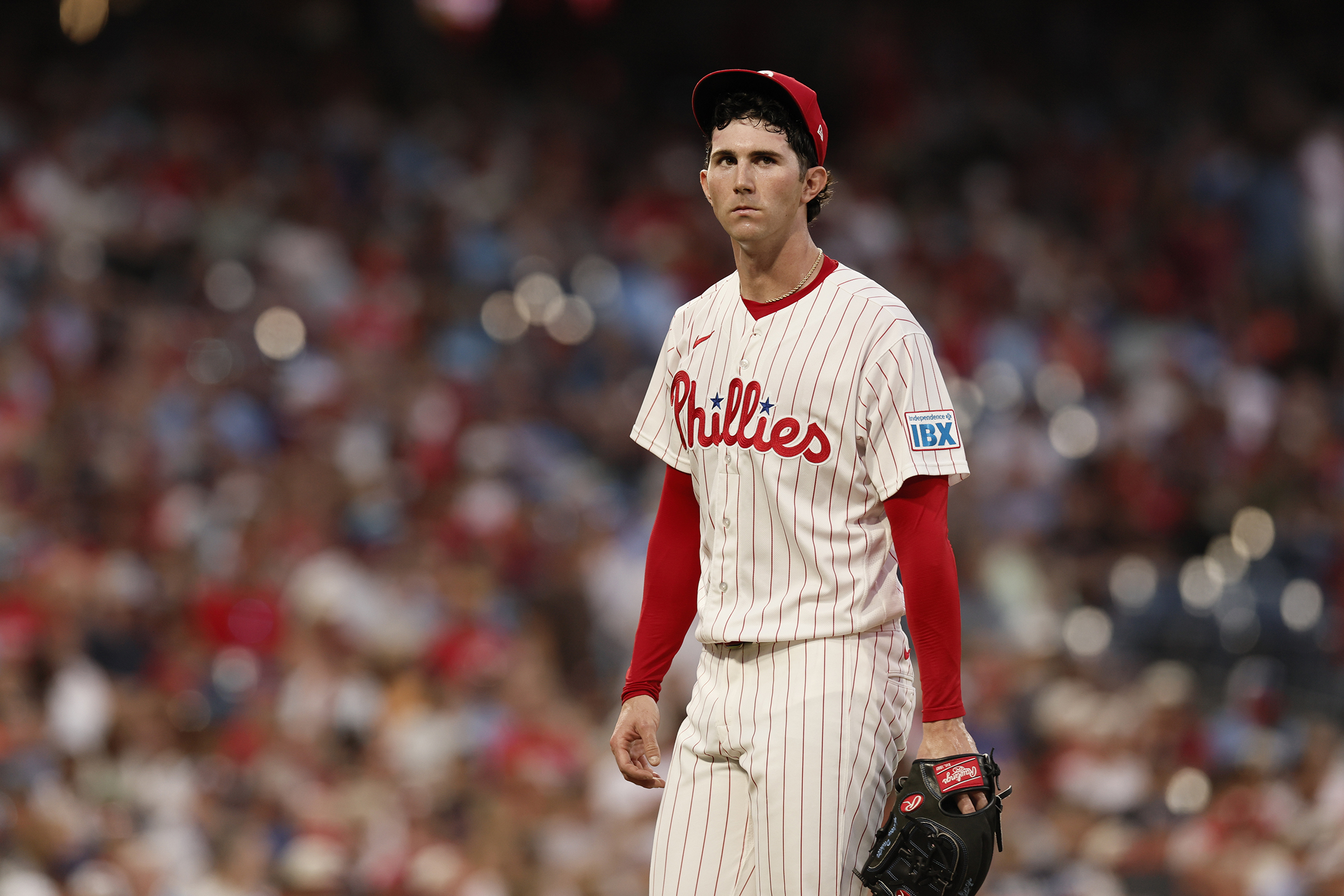
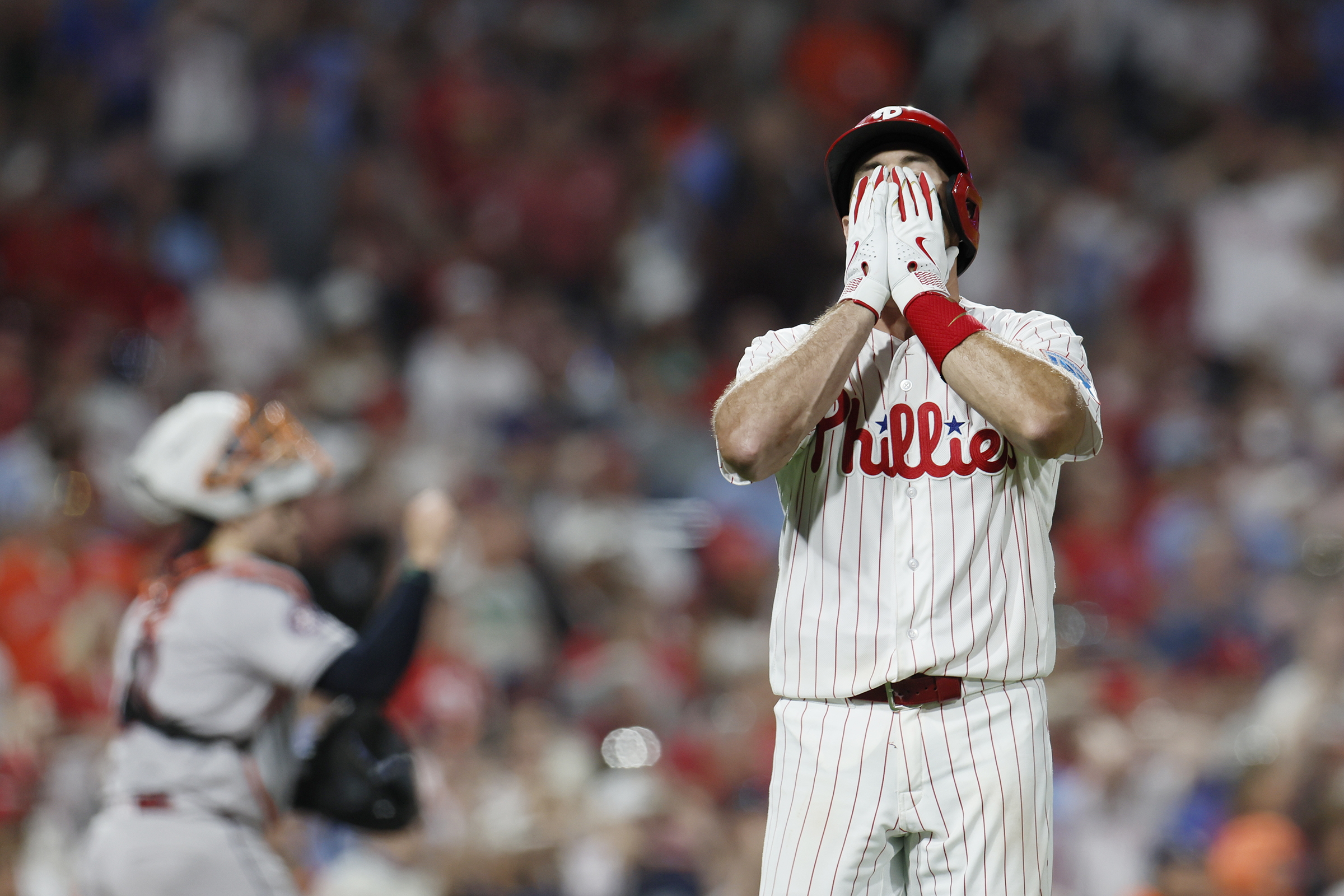
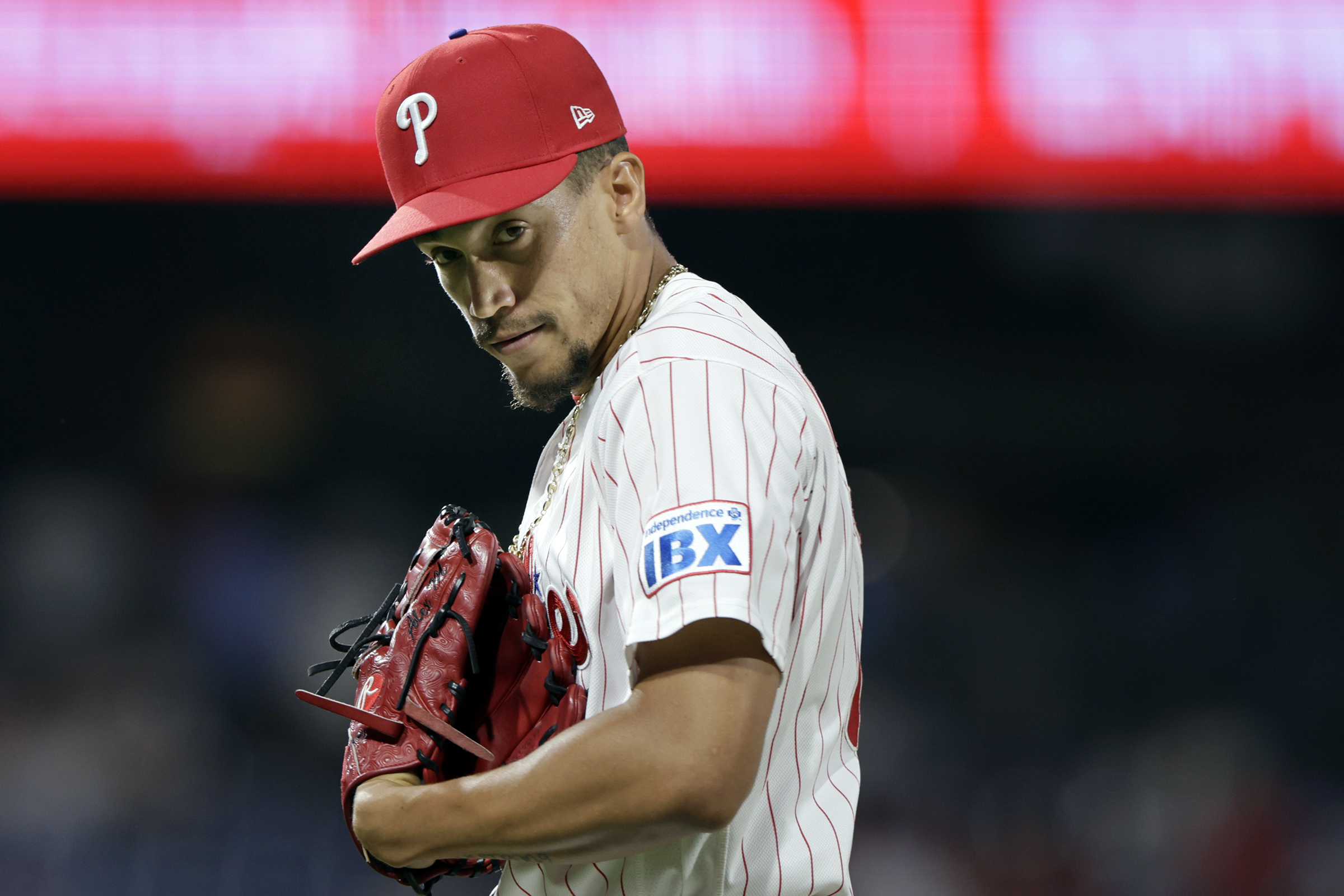
José Alvarado reacts after striking out Braves first baseman Matt Olson to end the eighth inning of Saturday’s 4-2 Phillies’ win.Yong Kim / Staff PhotographerPhillies pitcher Andrew Painter walks off the field after giving up four runs in the second inning against the Houston Astros on Tuesday. The Phillies rallied but their comeback attempt fell short, 6-5.Elizabeth Robertson / Staff PhotographerCatcher J.T. Realmuto reacts after he lining into a crucial double play in the seventh inning of Tuesday’s loss.Elizabeth Robertson / Staff Photographer
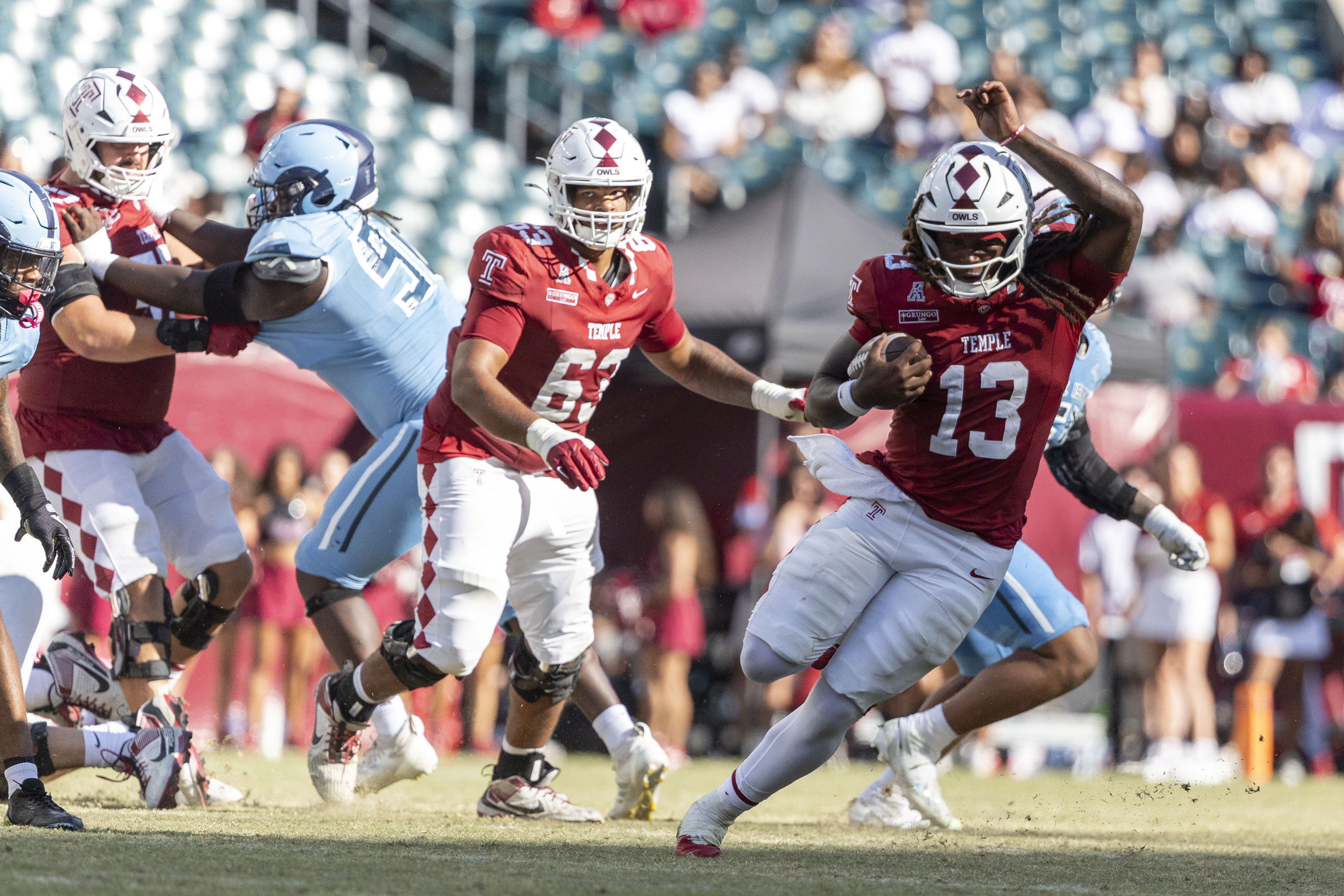
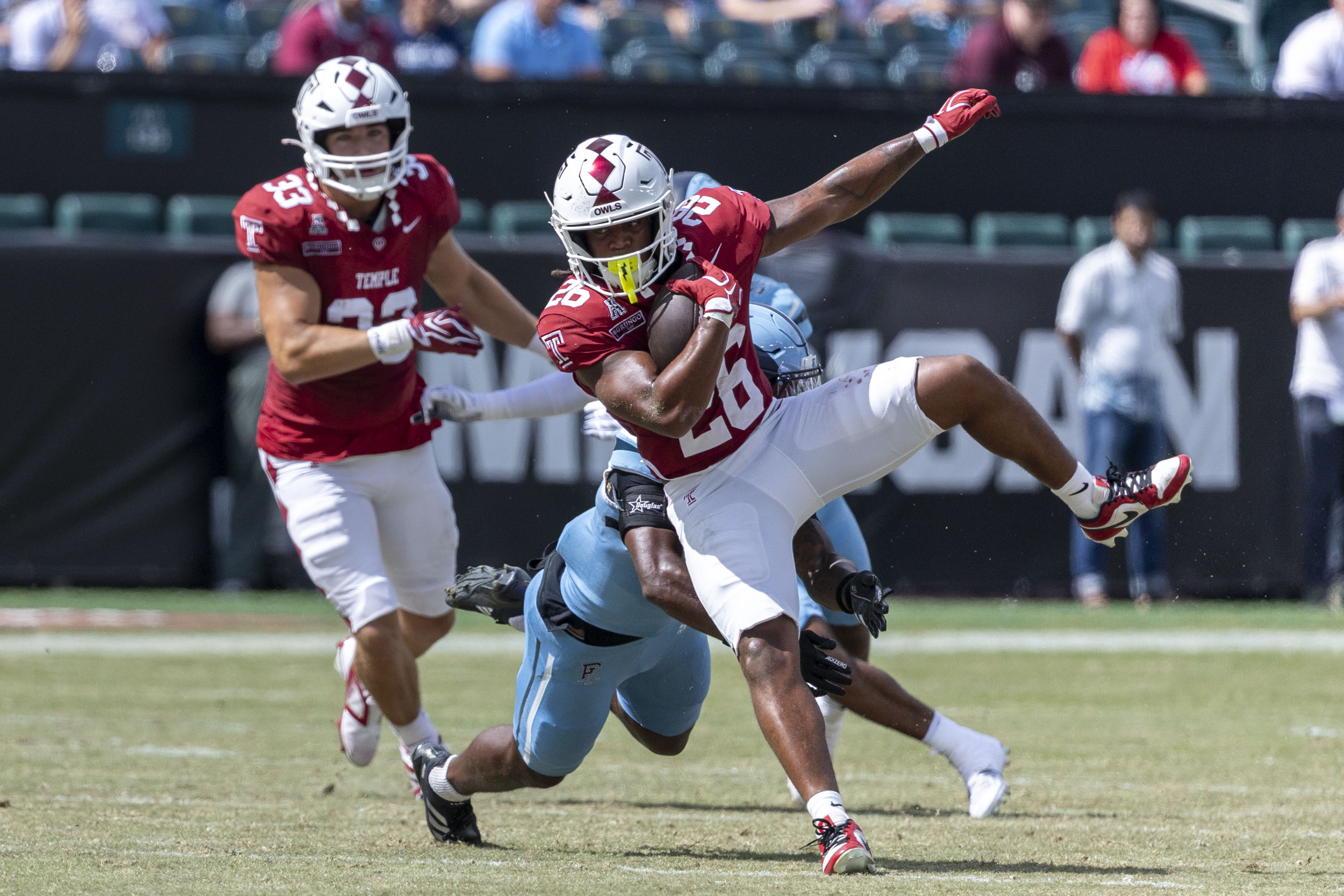
Temples quarterback Ajani Sheppard (right) cuts through Rhode Island’s defensive line during the second half of the Owls’ season-opening win.Tyger Williams / Staff Photographer
Temple running back Keveun Mason carried the ball 20 times for 158 yards and a pair of touchdowns in the Owls’ win.Tyger Williams / Staff PhotographerCincinnati’s Kyle Smith (left) and the Union’s Quinn Sullivan battle for the ball during Philly’s big 5-0 win on Wednesday.Elizabeth Robertson / Staff Photographer
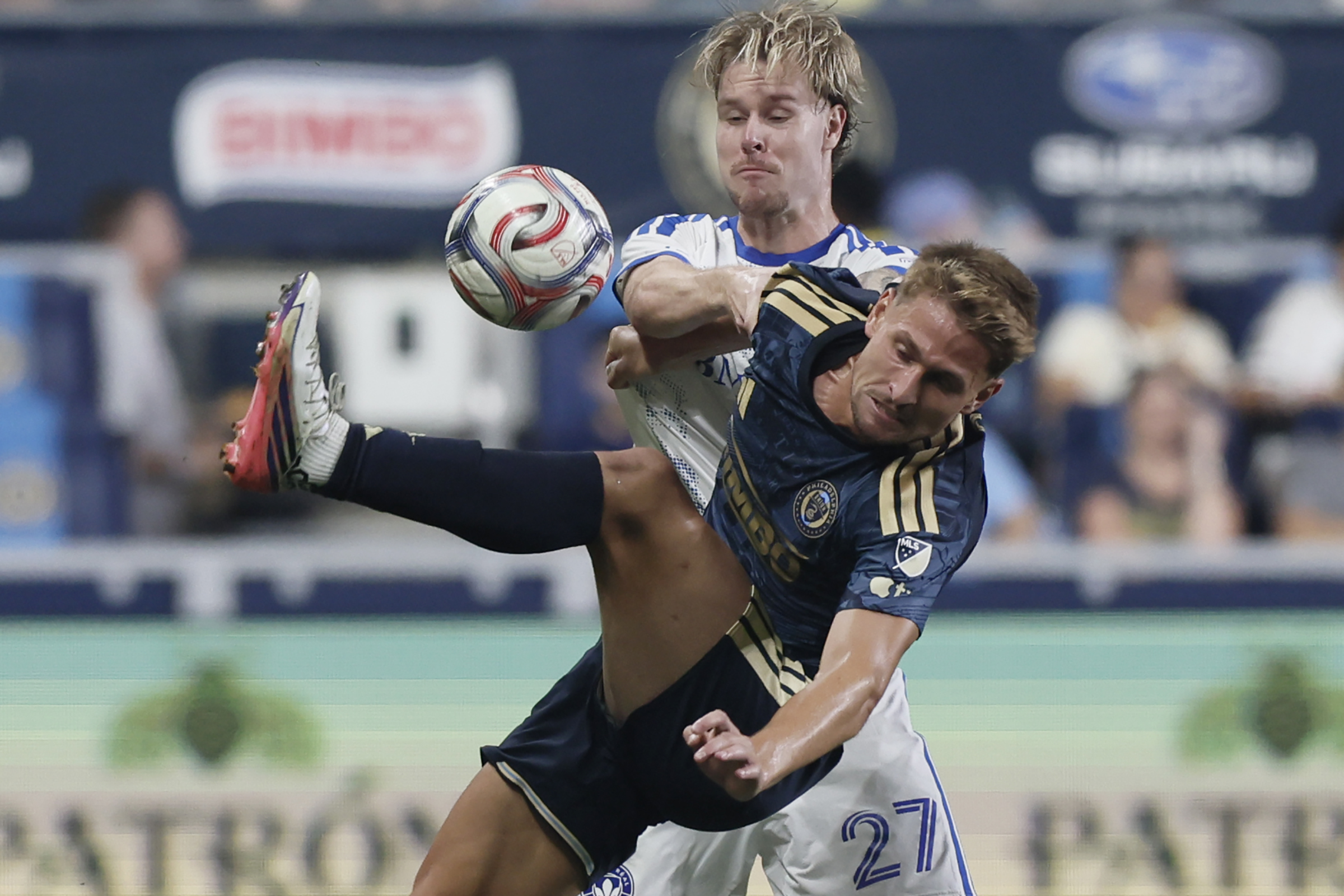
CF Montréal’s Wikelman Carmona (left) and the Union’s Jesús Bueno (right) chase after a ball on Saturday. The Union have won three straight.Elizabeth Robertson / Staff Photographer
The Union’s Bruno Damiani (front), seen here tangling with CF Montréal’s Dawid Bugaj, netted a hat trick in Wednesday’s win over Cincinnati.Elizabeth Robertson / Staff Photographer
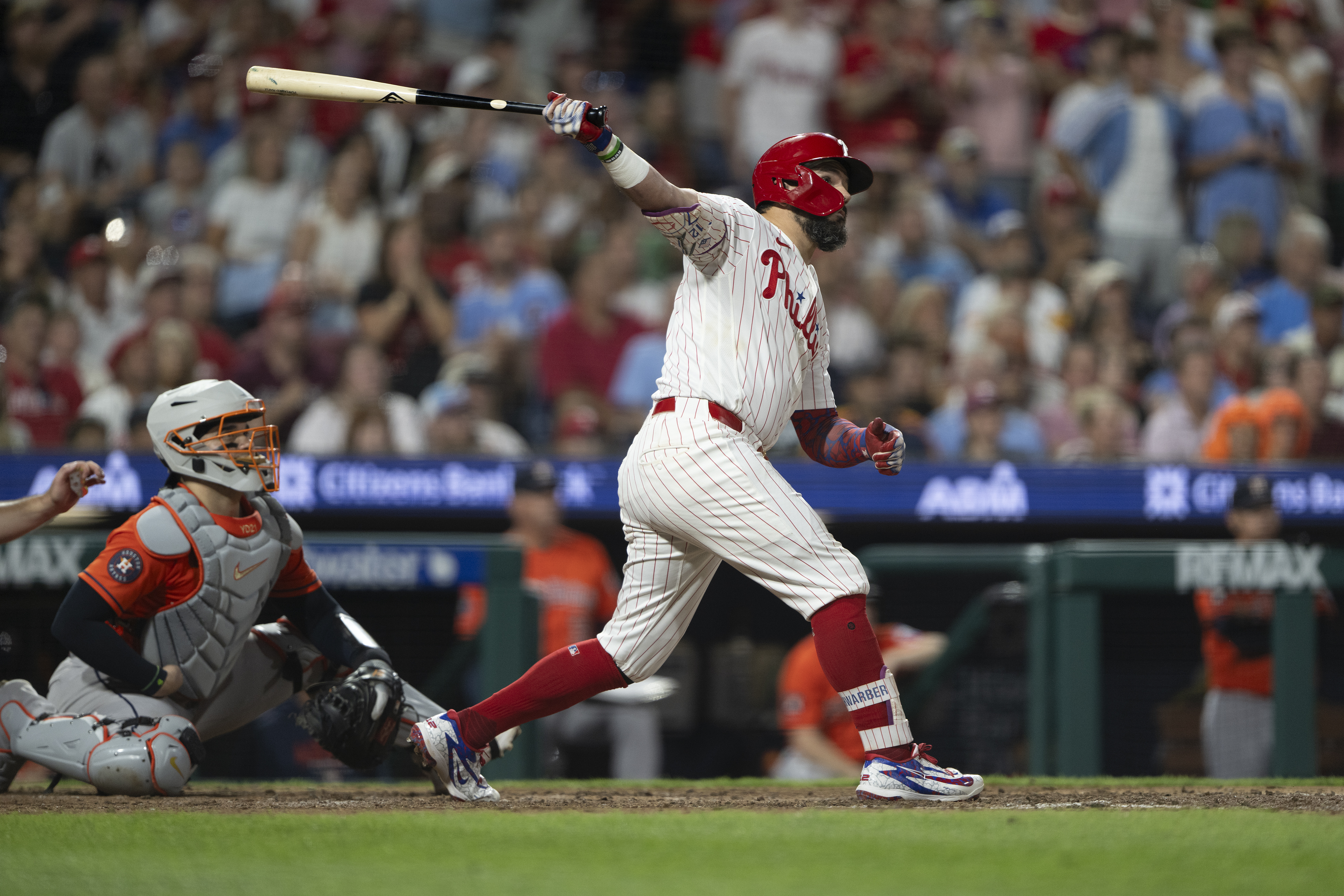
Kyle Schwarber’s sixth-inning grand slam helped the Phillies to their only win of the series against the Astros on Wednesday.Jose F. Moreno / Staff Photographer
Brandon Marsh and the Phillies have cooled off, but are still in a wild-card spot with just over two weeks left in the season.Yong Kim / Staff Photographer
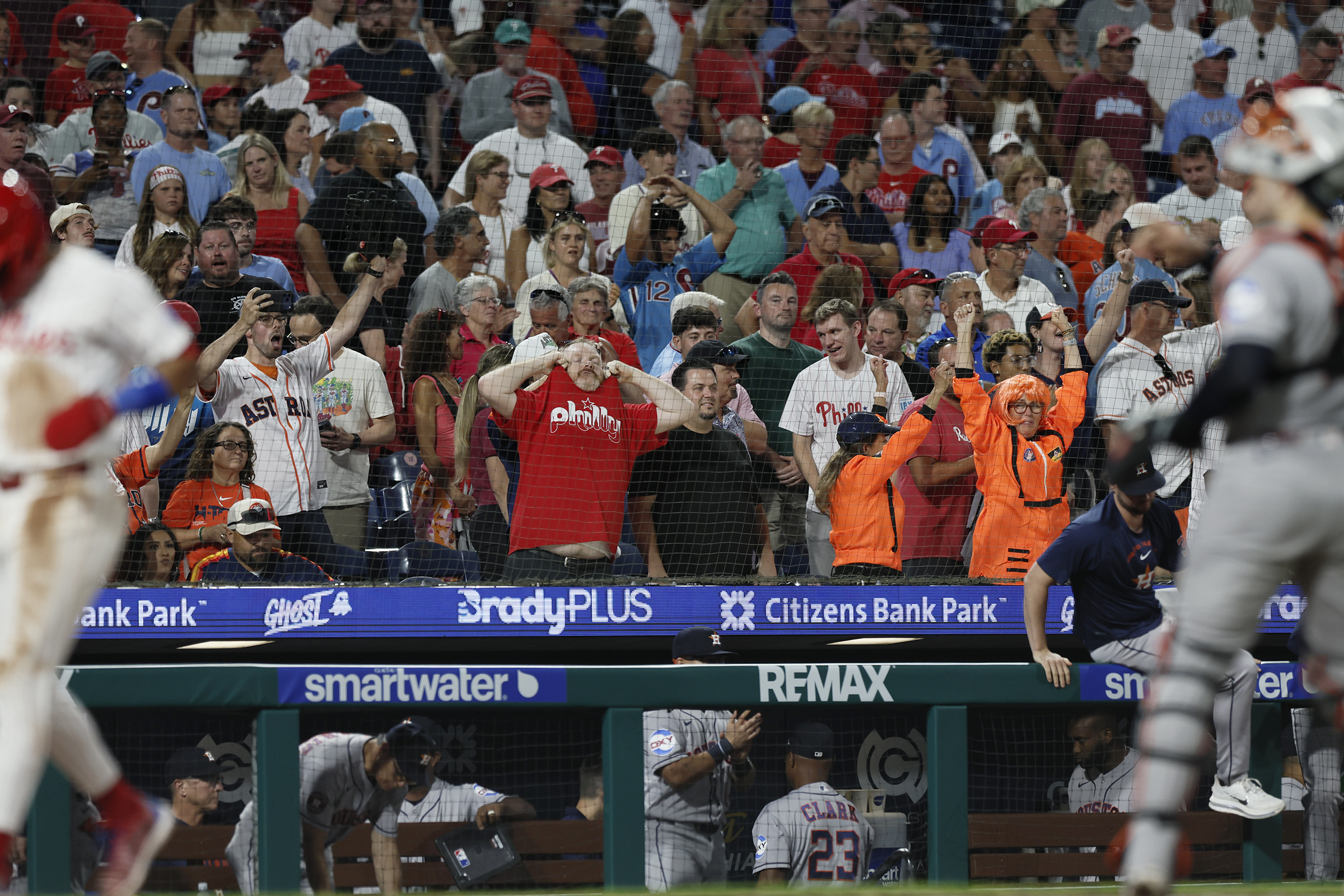
Houston fans behind the Astros dugout celebrate their team’s win, while a Phillies fan in a red T-shirt shows his frustration over Tuesday’s loss.Elizabeth Robertson / Staff Photographer
The twinkling of colorful lights can make everything feel more vibrant — like the Miracle on South 13th Street display during Christmas.
For some South Philadelphia blocks, however, holiday lights are not enough: They light up the night all year round.
Wondering about the blocks with iconic lights strung across the street, a reader asked Curious Philly, The Inquirer’s forum for questions about the city: “How does one get the decorative street lights and who looks after them?”
For many residents, the lights had inhabited the streets before they even moved in, so the answer is not straightforward. But it seems to fall on block captains and rely on the neighbors agreeing and paying the bill.
Anthony Scola III, 66, remembers when the decorative lights were set up on his block, the 1600 block of South 13th Street. He was 6 years old and his father, Anthony Scola II, was part of the neighborhood group that organized putting them up, he said.
At first, Scola said, neighbors wanted the holiday lights only on the trees, then around their homes, and soon the light show continued to grow.
He doesn’t remember the organizing process, or how the adults got the lights, and with his 94-year-old father recently dying, that part of neighborhood history remains untold.
But, as he pointed to the tree outside, Scola showed how the lights connect through a window to an outlet inside his home. Most of the lights are on year-round, he said, but Christmas lights are not lit until the Saturday after Thanksgiving.
If the lights are affecting his electric bill, he said, he hasn’t noticed it.
At the end of the block, Julia Morrison and her husband, Michael Edmonds, are settling into the neighborhood. The couple moved inover the summer, after having lived around the corner for six years.
“We always thought the lights were owned by the city, but the neighbors told us that everyone has to pay for the cost,” Edmonds said.
According to Peco, how the string light displays are paid for depends on the specific installation and location.
Some connections go directly into homes, and the cost comes out directly in each homeowner or resident’s electric bill. Other displays, however, can be paid for through a separate account specifically for the lights. Then that account gets billed instead of each individual neighbor with lights connected to their home.
Lights string across the street along East Passyunk in South Philadelphia on Thursday, Sept. 3, 2026.Yong Kim / Staff Photographer
The couple is not sure how much the bill will be for the year-round lights. They are hoping to find out more after Thanksgiving, when everyone in the block comes out to set up the Christmas lights.
Whatever the cost, they said, it is worth it for the effect on the block.
“It brings the people together, and it’s just cheer,” Morrison said. “It brings the community street together, makes people feel closer.”
On the 1200 block of Wolf Street, tiny blue, yellow, and red light bulbs dance in the wind on a zigzag above the street.
They have been there for as long as Maryann Mooney, 69, remembers.
“When I was a kid, it was magical to see the lights,” Mooney said.
Over the years, she said, the tradition shrank to only putting big lighting displays out for Christmas, but small light fixtures remain all year round.
She has moved away from the block but works at a hair salon in the area, and the lights continue to make her feel like “the block is alive,” she said.
Karen Farrell, the salon owner, said the block captain comes to collect the money for the light bill, usually in December. He also is in charge of replacing any broken bulbs throughout the year, she said.
“Last year they asked for $35,” Farrell said. “I like it. I think it is pretty. It makes it festive.”
On the 2700 block of South Smedley Street, blue, red, and white lights hang from every house. They put up Christmas lights, too, but these ones are up all year long.
Ryan Schubert, 31, moved to the block in 2022. The house, he said, belonged to his wife’s grandmother, so the lights hanging from his front porch preceded their ownership.
Schubert does not know when exactly the lights arrived, but he keeps a postcard from 1991 that already features the lights across the home’s porch.
“Right now, they are red, white, and blue for the Fourth of July, but the light bulb colors are changed depending on the occasion,” Schubert said.
As far as Schubert knows, the block captain is in charge of changing the bulbs and asking neighbors for collaboration to pay the bill.
“We chip in once a year. It’s not a requirement, and it’s a pretty cool time,” Schubert said.
The most he has contributed is $100, but he has also given $20, he said.
According to Peco, neighbors looking to set up an additional account for this type of lights can contact customer service for information through an online form or by calling 1-800-494-4000.
“The Christmas display can be a little annoying because lots of people come, but I love it and it’s worth it because everyone seems happy,” Schubert said. “The all-year lights feel unique to our street, but to be honest I’m so used to big displays that I don’t even pay much attention or register the little ones.”
The Phillies are exactly where we probably should have expected them to be, which is exactly where they were a week ago. That is, four games behind the Braves with 15 to play heading into this weekend’s three-game series in Atlanta. That’s not necessarily a bad thing, believe it or not. Treading water is as important as making up ground.
Right now, the Phillies number one goal shouldn’t be winning the National League East. It should be avoiding the Braves in the wild-card round. The NL playoff picture has changed considerably with the Dodgers winning seven straight and the Braves losing four of six.
Now that L.A. has a 3½-game lead over Atlanta for the NL’s second bye, it’s looking increasingly likely that the eventual NL East division champs will end up hosting a best-of-three series against the No. 6 seed. Which means the Phillies should be just as focused on maintaining or growing their current 3½-game lead over the Padres, who entered Friday with a half-game lead over the Diamondbacks for the NL’s final playoff spot.
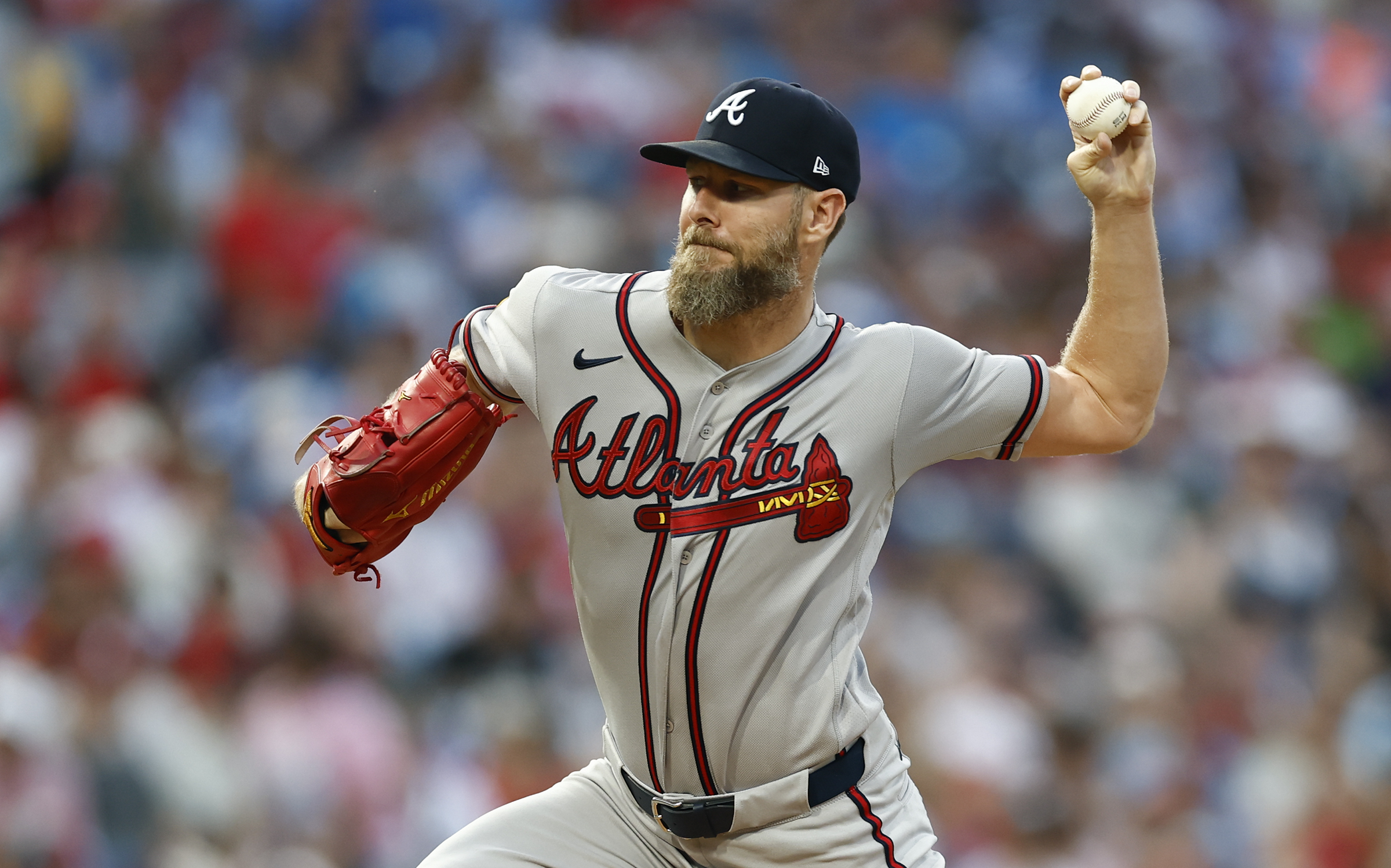
Some folks will scoff at the idea of the Phillies fearing the Braves in an October series. But best-of-three is barely a series. This isn’t about fearing the Braves. It’s about fearing Chris Sale.
Last weekend, the Phillies took their latest dose of medicine from one of the game’s all-time greats when Sale held them to two runs in six innings of a 5-2 Braves win. Atlanta’s presumptive Game 1 starter is not a problem the Phillies are magically going to solve just because the leaves are falling off trees.
The Braves are 3-0 in Sale’s three starts against the Phillies this season and they’ve won five of his seven since joining the team in 2024. His numbers should make you gulp. In his last five starts against the Phillies dating back to May of last season, Sale has allowed a grand total of four runs in 31 innings. He has struck out 40 of the 118 batters he has faced. That’s 33.9%.
Bryce Harper is one of the Phillies with bad career numbers against Chris Sale. He has just two hits in 18 at-bats against the lefty (.111).Yong Kim / Staff Photographer
In a longer series, the Phillies would have a clear starting pitching advantage over the Braves. Grant Holmes and Tyler Mahle have both had some success against the Phillies, most recently holding them to a combined two runs in 12 innings of last weekend’s series. Holmes has allowed just five runs in 20⅔ innings against the Phillies over the last two seasons, while Mahle held them scoreless in seven innings and 5⅔ innings in two of his three starts prior to last weekend (albeit dating back to 2021). Regardless, the Phillies would have a significant advantage in three of the first four games of a five-game series.
In a three-game series, Sale in Game 1 is a monumental equalizer of the odds. They’d much rather take their chances against the Cubs, who would presumably start Clay Holmes and Shota Imanaga, followed by a spin of the roulette wheel in Game 3.
A sigh of relief
Now, about that bullpen …
Give interim manager Don Mattingly credit for getting Alex McFarlane back on the mound in the eighth inning on Wednesday. The 25-year-old right-hander got ground balls from three of the four Astros batters he faced to deliver an 11-7 lead to Jhoan Duran in the ninth. McFarlane didn’t record a strikeout but threw strikes on 12 of his 15 pitches. This wasn’t exactly a high-leverage situation, at least not compared to the last time he walked off the mound. But it was a situation where a true set-up man gets the ball, and Mattingly gave it to him. Which is exactly what the Phillies manager should be doing.
Despite the homer he surrendered to Ronald Acuna Jr. last weekend, Alex McFarlane remains the Phillies’ greatest hope in the eighth inning.Elizabeth Robertson / Staff Photographer
The underdiscussed aspect of McFarlane’s welcome-to-the-bigs moment against Ronald Acuna Jr. and the Braves on Sunday was the fact that he was on the mound at all. Mattingly easily could have pivoted after McFarlane allowed a one-out single to Mike Yastrzemski and a double to Drake Baldwin to bring Acuna up as the tying run in a 4-1 game with a base open. He had a lefty warming and Braves lefties Matt Olson and Michael Harris due up after Acuna. Conventional baseball wisdom says you don’t put the tying run on base. Still, it said something about the Phillies’ estimation of McFarlane that he both remained on the mound and challenged Acuna Jr. throughout the seven-pitch at-bat.
It also says something that Mattingly didn’t flinch after McFarlane allowed a three-run, game-tying home run to Acuna.
“I don’t think you learn anything yet,” Mattingly said after the Phillies’ eventual 5-4 loss. “I think we see how he responds. I feel about the way he’s going to respond. When everything’s going good it’s pretty smooth sailing. Everybody’s going to struggle, what happened to him today is going to happen to everybody if you play long enough. So we’ll see. I think he’ll be fine. He’s been a kid that’s handled everything. The disposition’s been good.”
The Phillies are doing exactly what they should be doing with McFarlane. The first goal is to get to the postseason with an eighth-inning option that is something better than a flip of the coin. The second goal is to get there with somebody who actually gives them a significant advantage like the one they have in the ninth inning with Duran. On both counts, McFarlane is their best hope. Overwhelmingly so. There is nothing like exposure therapy for a big-league reliever. There will be plenty of big spots in October. The Phillies need McFarlane to become a guy who thrives in them.
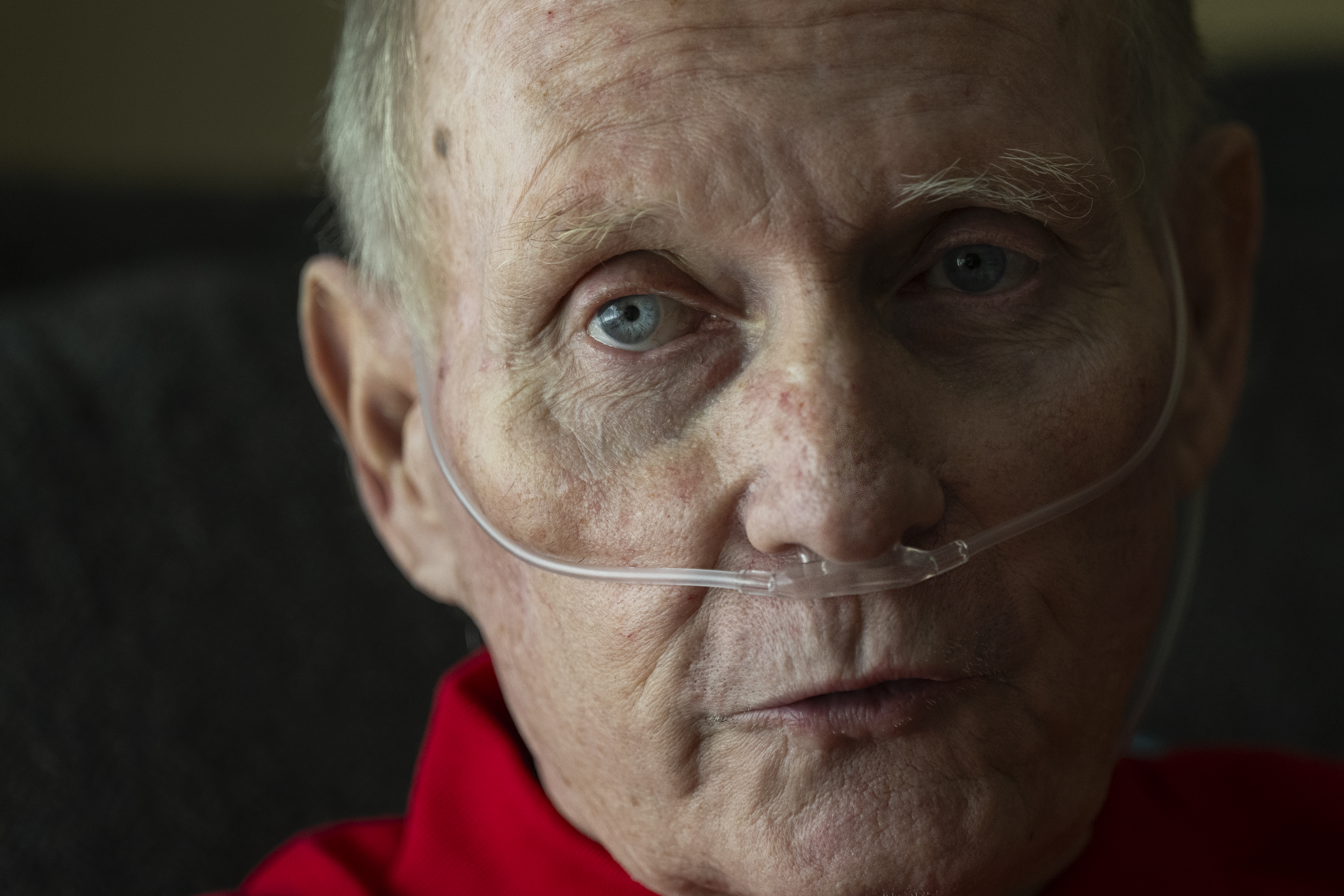
Retired Philadelphia Police Capt. Mark Fisher gets winded and lightheaded while emptying the dishwasher or pushing his gas-powered lawnmower, his lungs forever scarred by the ankle-deep ash that he trudged through at ground zero.
WhenFisherarrived at the nation’s worst crime scene, two days after the Sept. 11, 2001, terrorist attacks, each step he took kicked up a powdery plume, coating his tan work boots. Dense smoke from fires burning beneath the rubble of the World Trade Center site stung his eyes and clogged his lungs.
Then a lieutenant in charge of the Philadelphia department’s crime scene unit, Fisher scoured the wreckage for nearly two weeks. He helped recover the lifeless body of a firefighter crushed under concrete. A torso. The severed arm of a businessman.
The coughing fits started about a year later. Then, about six years after 9/11, a chest X-ray revealed a thick, hardened fluid around his lungs, makingit difficult to breathe. He developedsevere pulmonary disease linked to exposure to toxins.
Fisher, 69, needs a double lung transplant soon, his doctors say, that at best will extend his life by five to seven years. His deteriorating health shows how grossly federal and local health officials underestimated the environmental hazards.
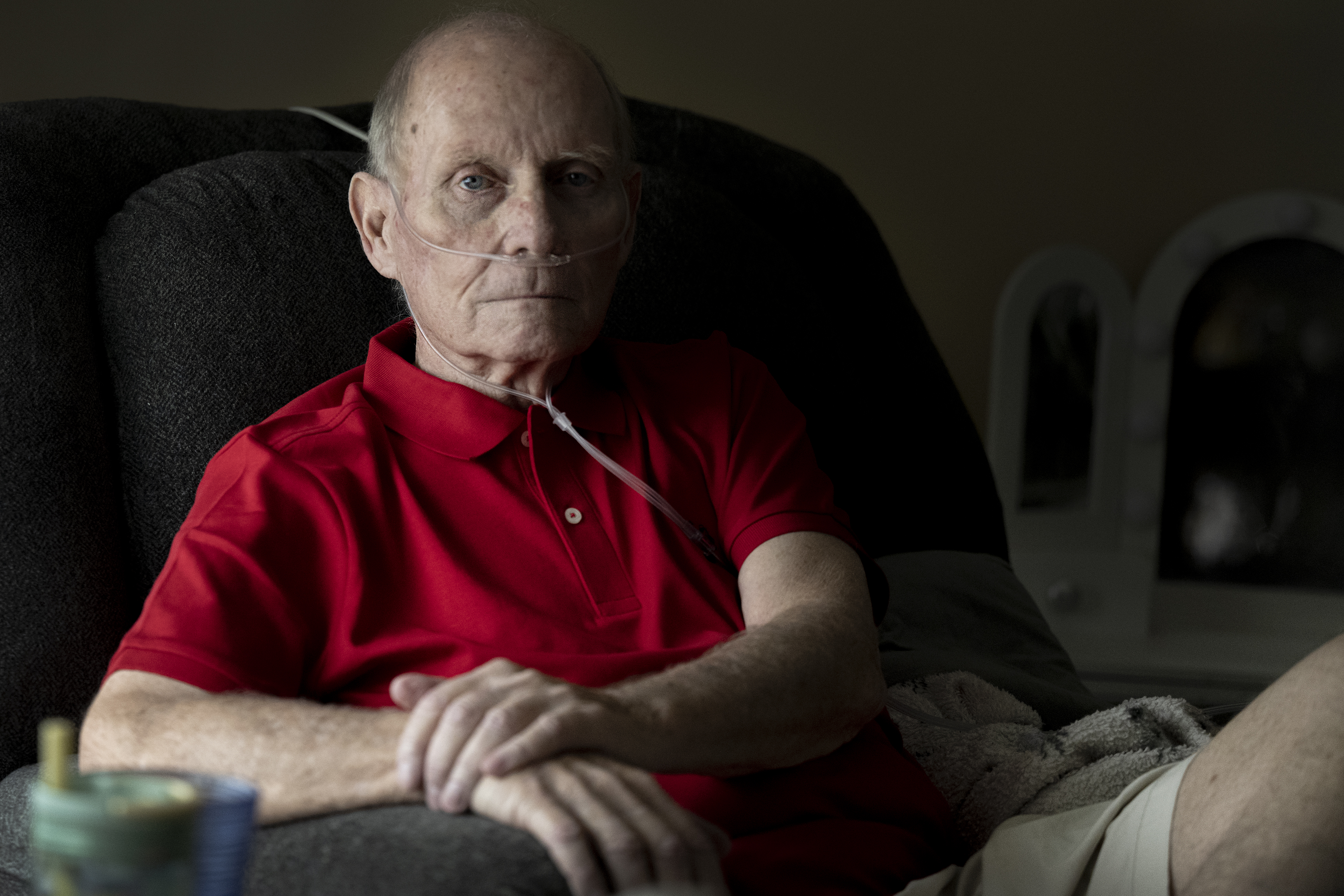
“I can’t breathe worth a darn. My lungs just aren’t going to last,” Fisher said, as he sat in his Northeast Philadelphia home with oxygen prongs in his nostrils and a heating pad against his back.
“Everything aches,” he rasped, coughing relentlessly.
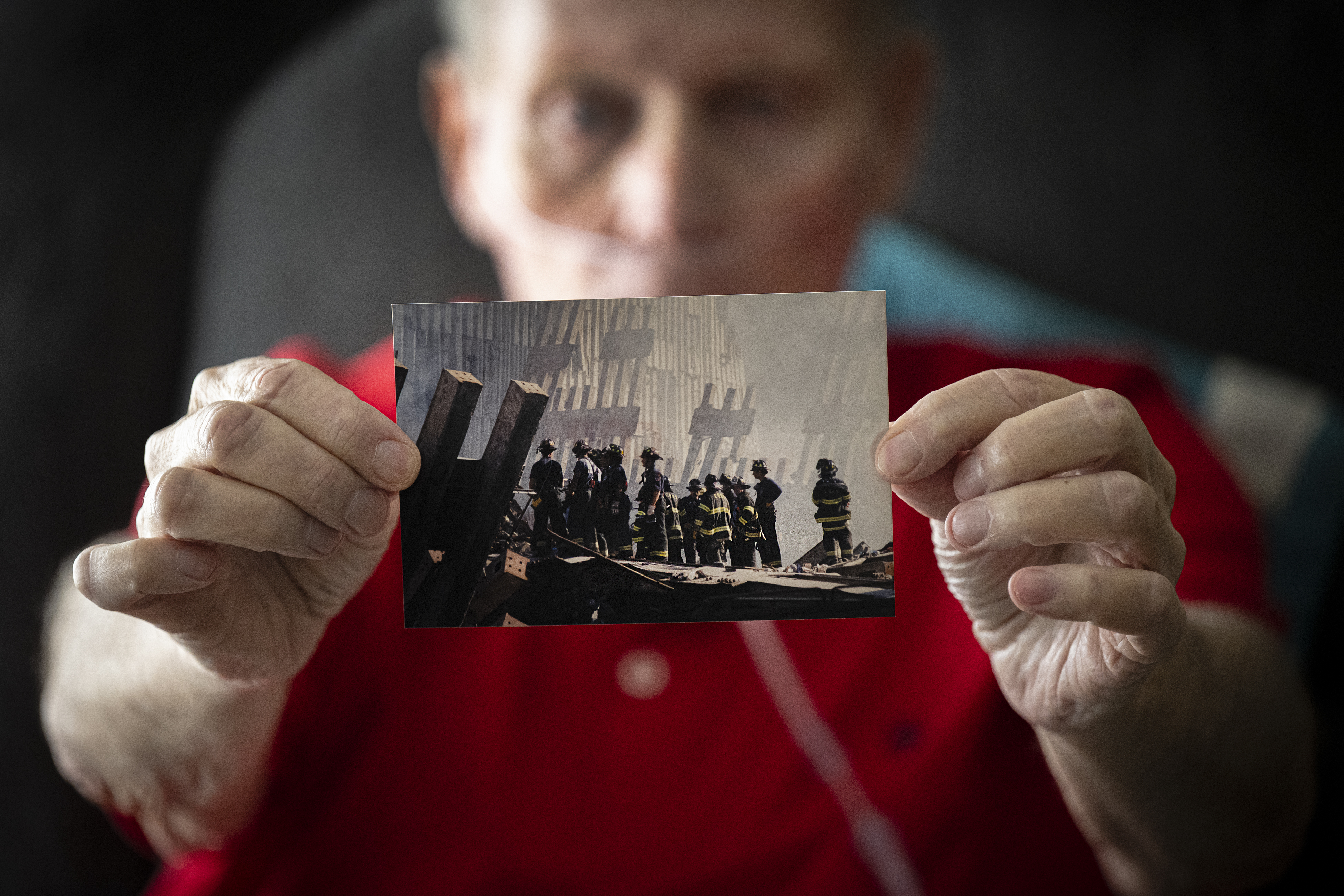
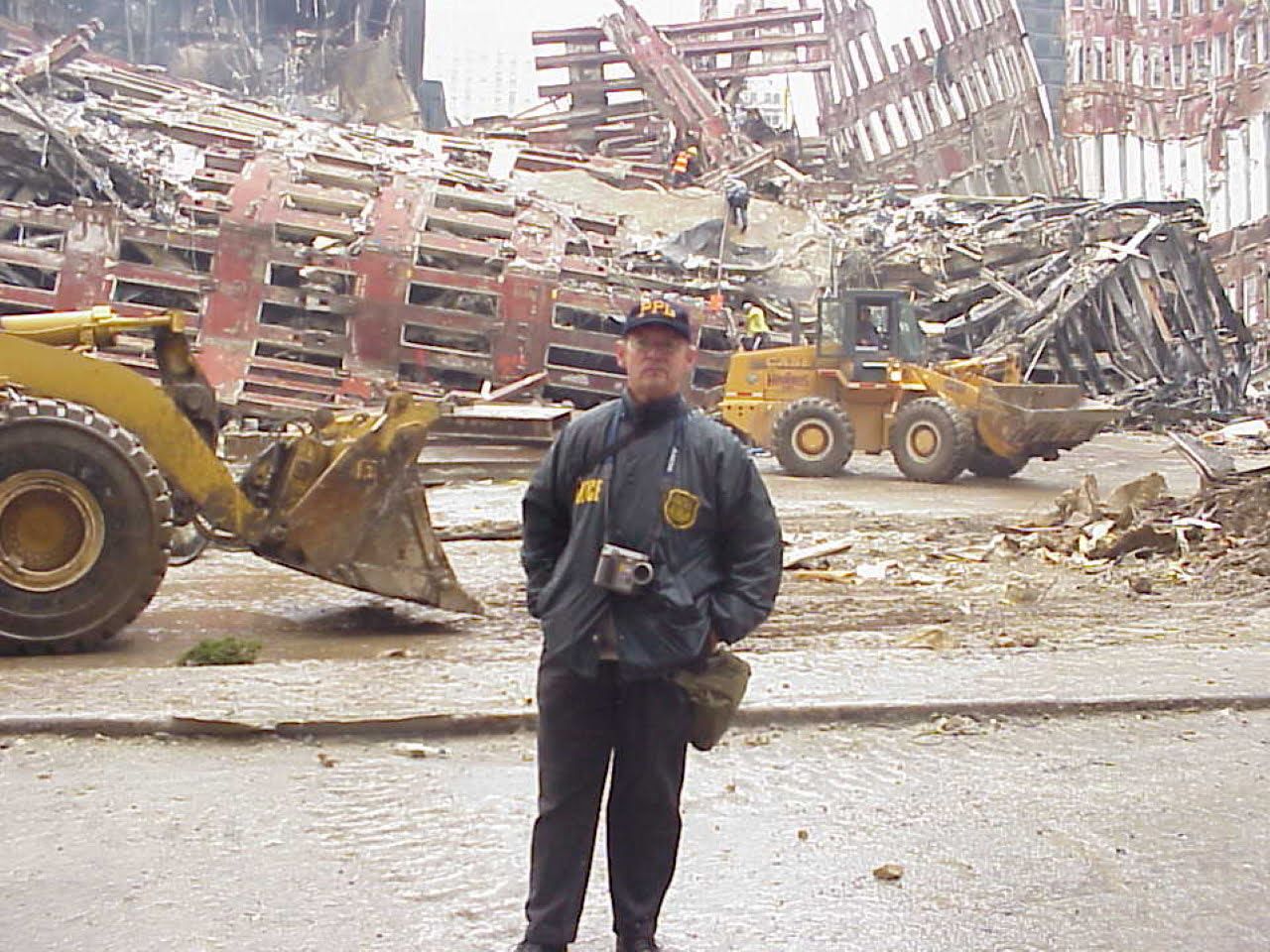
Retired Philadelphia Police Captain Mark Fisher, 69, shows a photograph he took while working as a crime scene investigator at ground zero.Jose F. Moreno / Staff Photographer
Cancer is the fastest-growing diagnosis, now that enough years have passed for tumors and other abnormalities to emerge, soaring from about 3,200 cases to more than 57,000 within the last 11 years.
Most of the toxic dust — as deep as snow drifts in spots — formed when the concrete floor slabs of the 110-story towers collapsed on top of one another in quick succession. The wreckage, known as “The Pile,” contained more than 350 chemicals andmineral agents:potassium hydroxide in concrete, calcium sulfate in wallboard, jet fuel, asbestos, glass insulation fibers, heavy metals — all finely groundand aerosolized.
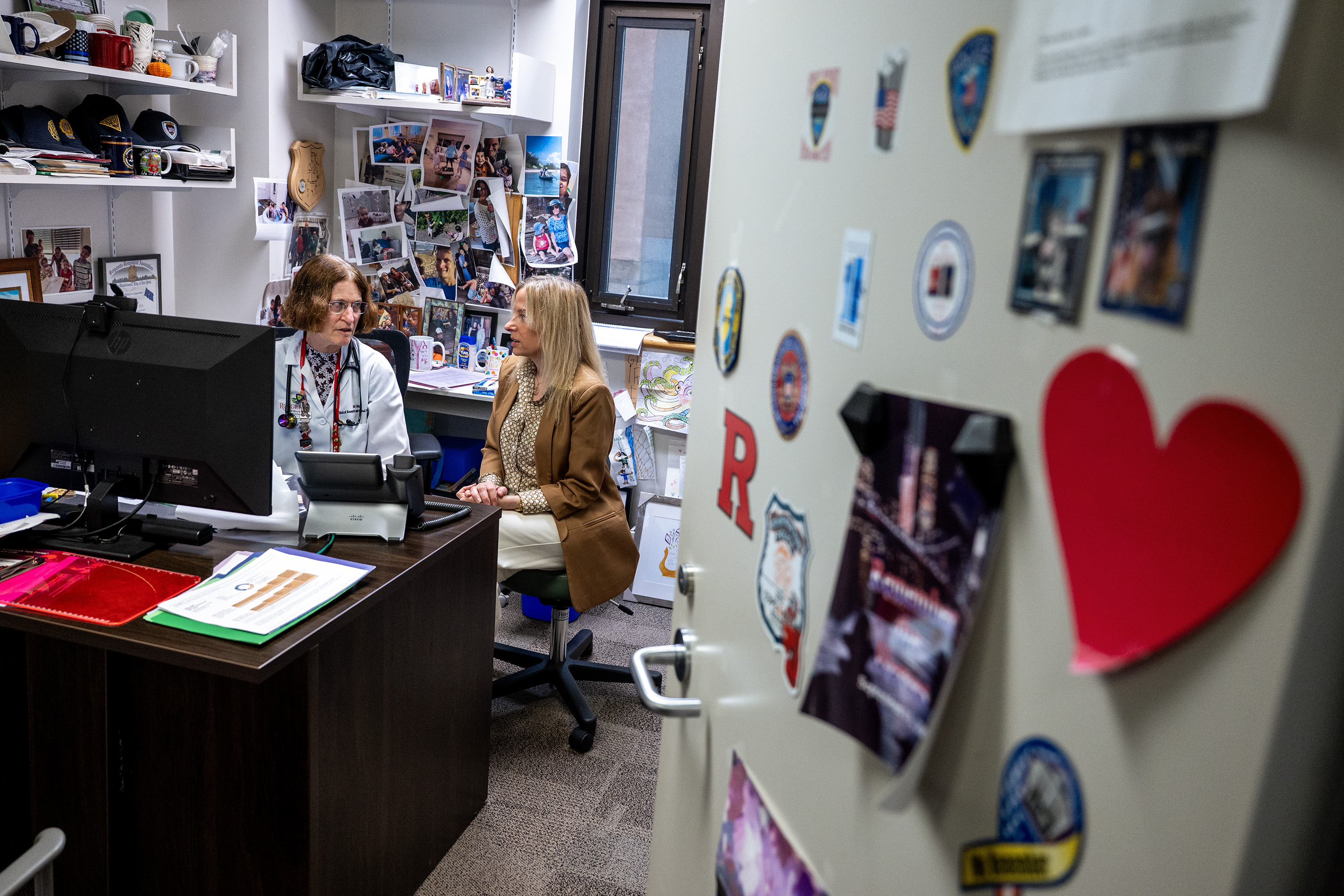
“It was such a mixture of stuff, like a witch’s brew,” said Iris Udasin, a Rutgers Health doctor who treats 9/11 responders and studies the long-term health effects of the attack.
The alkaline alone in “the cement from all these buildings was toxic in and of itself,” she said. “It basically burned holes in people’s noses and made them more likely to absorb other chemicals and gases that were in the air.”
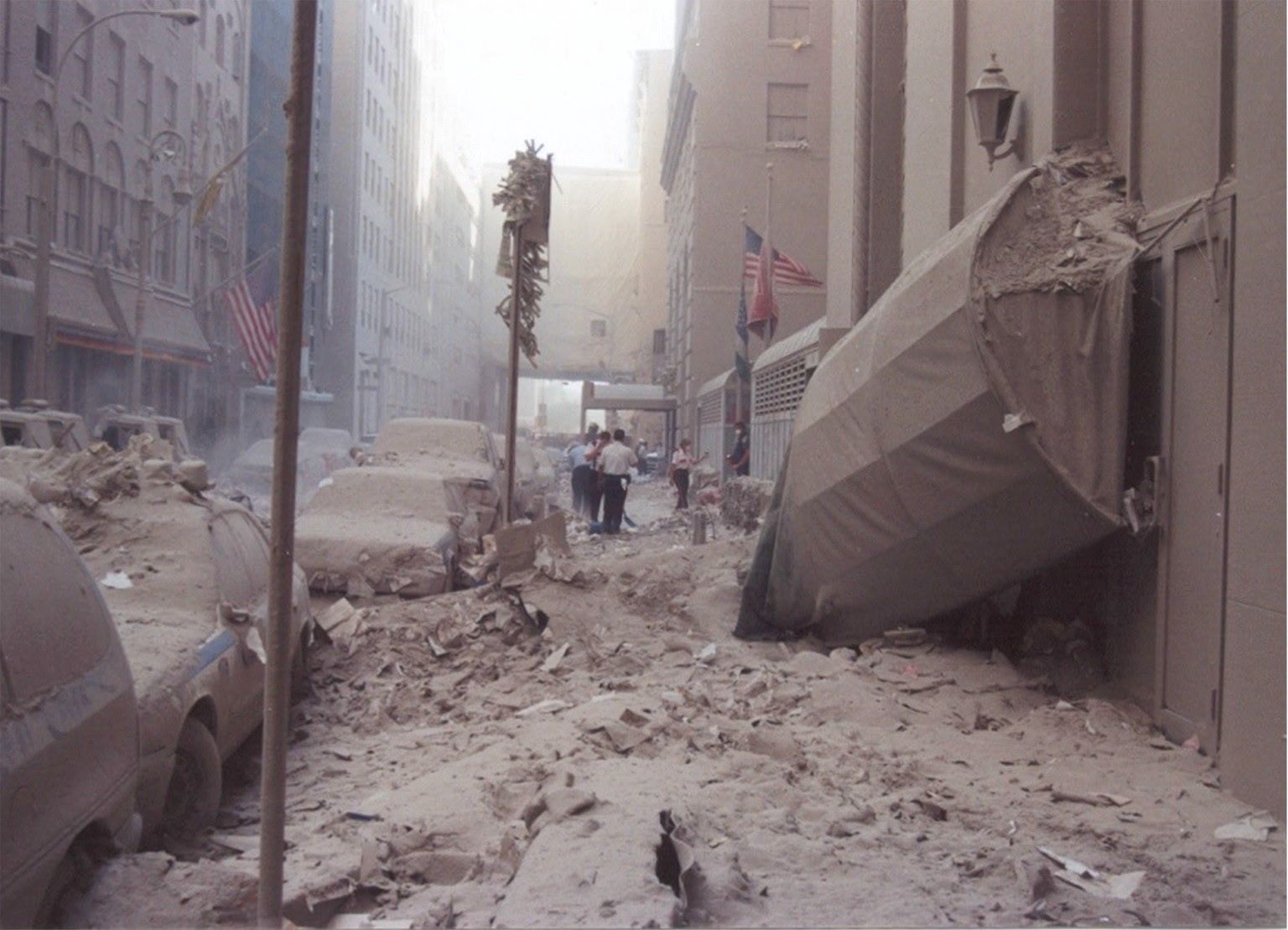
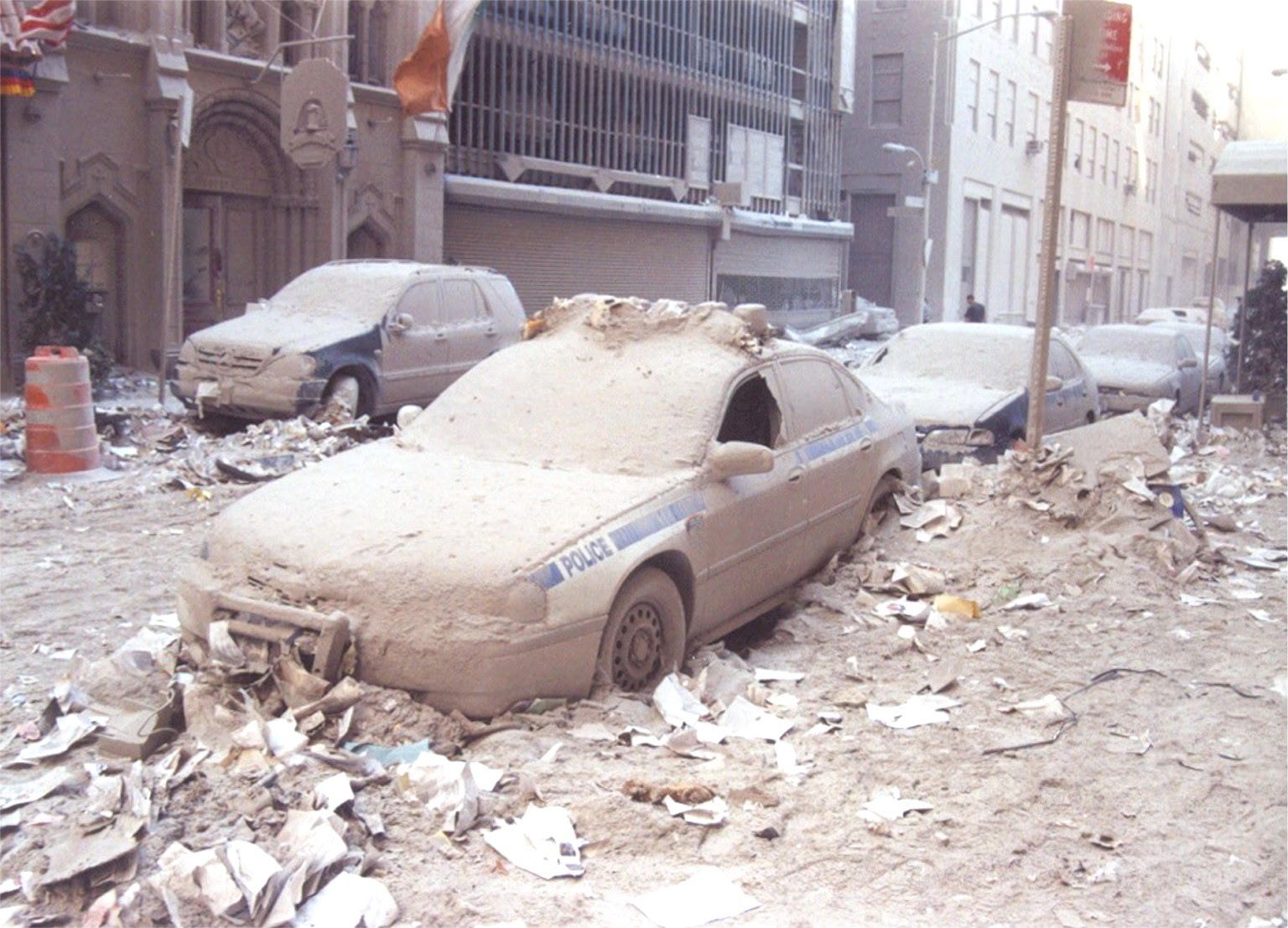
While at ground zero, then-Philadelphia Police Sgt. Greg Masi took photos of the dust and debris. When Masi started wheezing and coughing a few years later, he thought, “I’m just getting old. I didn’t want to believe that the days I was there affected me,” he said. He’s since been diagnosed with asthma, lung nodules, and a type of blood cancer linked to breathing toxic dust. Courtesy of Greg Masi
From WTC cough to lifelong disease
Udasin directs the WTC Health Program at Rutgers University in Piscataway, N.J. — one of six clinics created nationally to treat 9/11 responders.
When it opened in 2003, Udasin mostly treated responders for what she calls “World Trade Center cough,” a dry and persistent hacking that improved with asthma medication.
Now their cases are far more complicated and life-threatening, often requiring referrals to medical specialists, from pulmonologists to oncologists.
Udasin can name many of the roughly 3,000 responders she treats annually by their faces alone. She prefers to relay test results, both good and bad, to patients herself, rather than delegate.
On a recent morning,she escorted an older man from an exam room to the clinic’s lobby and asked: “Do you want me to call you with the results? If you are going to be scared, I can have somebody else call you with the results.”
Her patients, hailed as heroes after 9/11, could not have anticipated how working at ground zero would impact their long-term health.
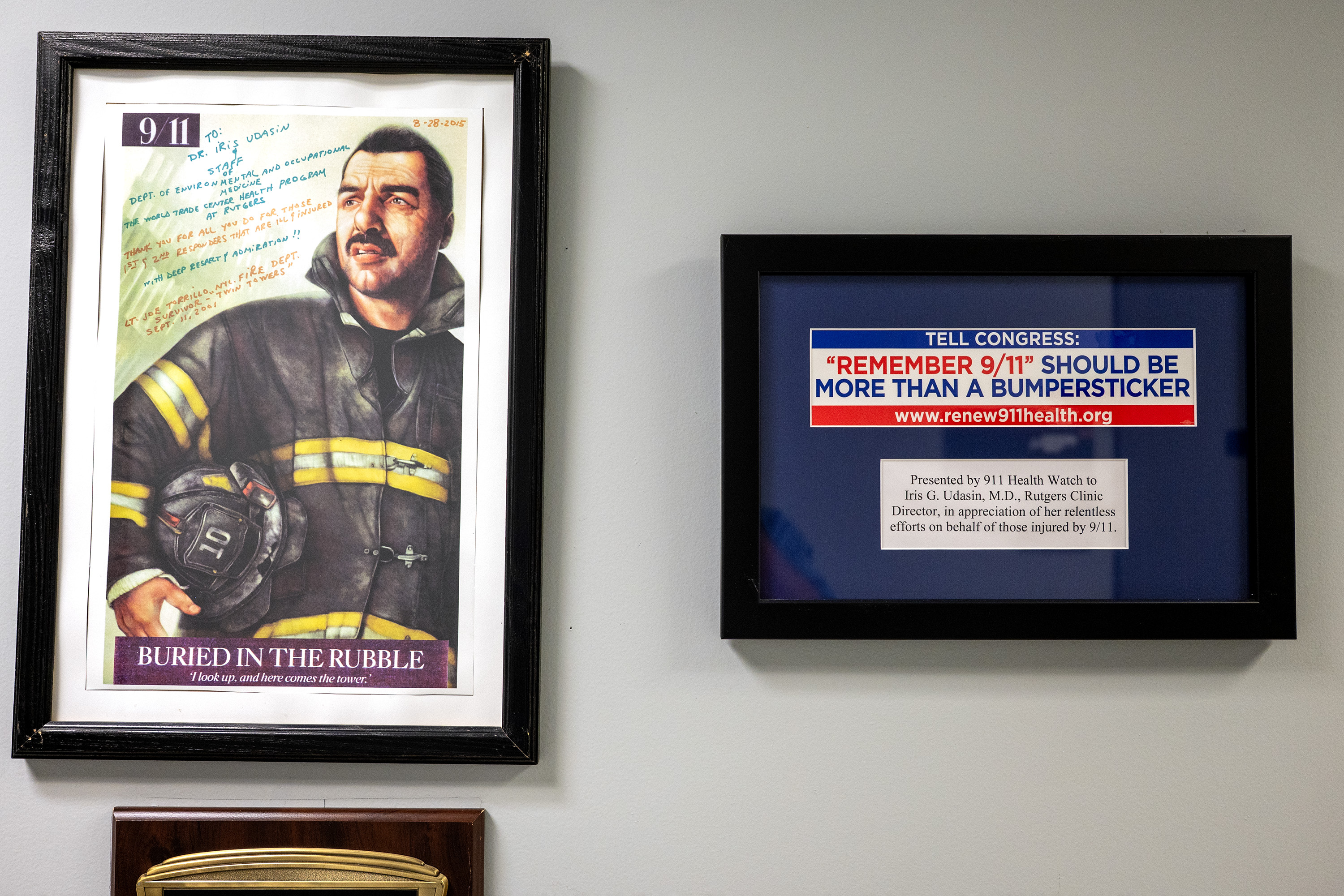
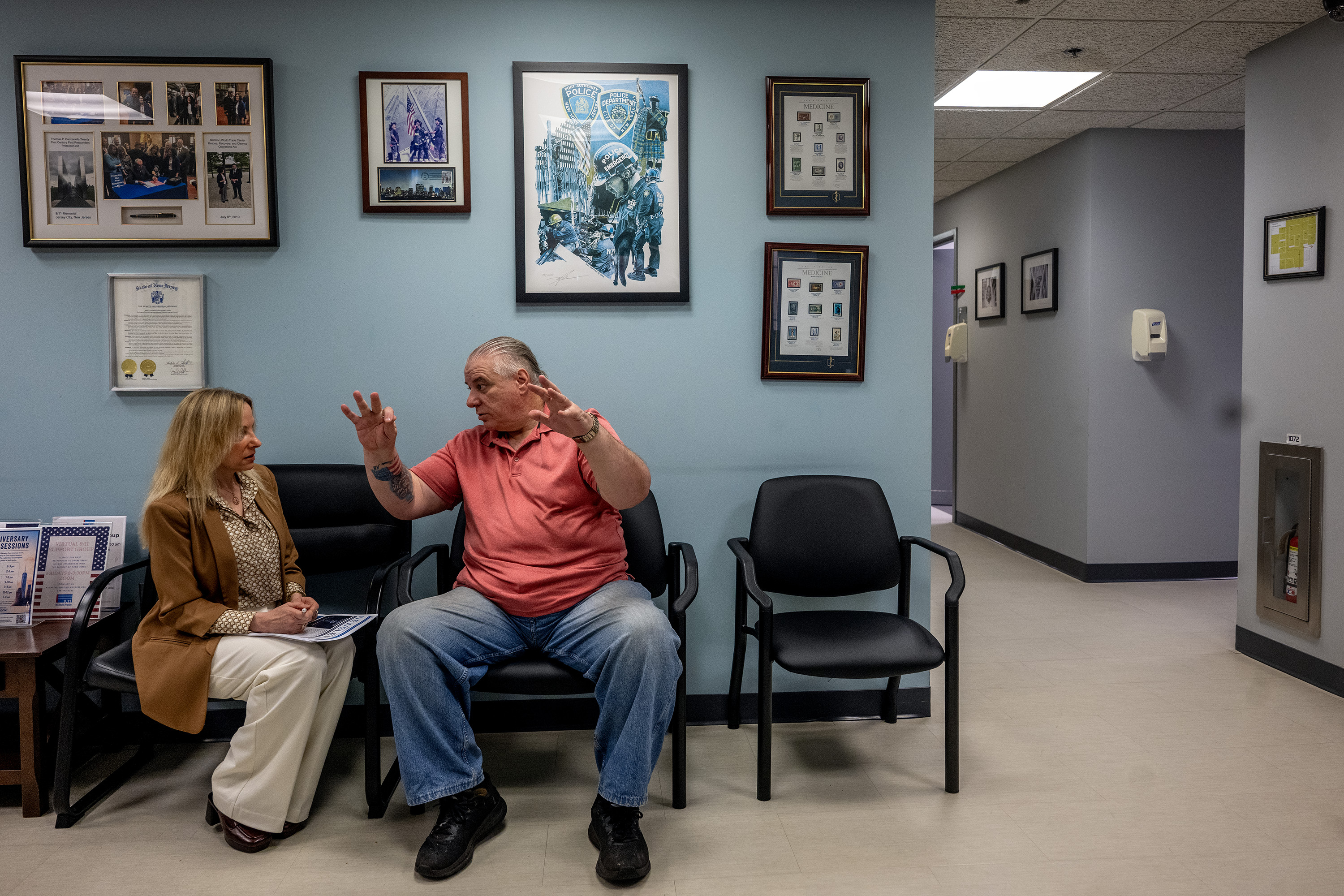
A plaque (right) presented to Iris Udasin, medical director of the World Trade Center Health Program at Rutgers University, hangs on the wall of the patient waiting room. Udasin’s federally funded clinic provides medical monitoring and free treatment to 9/11 responders. Tom Gralish / Staff Photographer
Local and federal officials initially minimized the environmental health hazards. Christine Todd Whitman, who was the head of the Environmental Protection Agency under President George W. Bush, infamously assured the public within days of the attack that the air around the WTC was “safe to breathe.”
“The [EPA] scientists did the best they could with the data that they had and with the knowledge they had at the time,” said Whitman, who had previously served as New Jersey governor.
“It’s a case of you don’t know what you don’t know,” Whitman added in an interview with The Inquirer late last month.
Whitman said her agency did urge responders on “The Pile” to wear protective gear, preferably respirators. The EPA distributed masks, but many refused to wear them, she said.
In hindsight, she said, the masks were not protective enough. Responders are now paying “the price” of breathing toxic air: “It sickens me to say it,” Whitman said.
The Rutgers program grew out of early alarms about air quality hazards, of which details are still emerging. On Tuesday, New York City officials publicly released a trove of documents revealing that toxins lingered in the air for months after the attacks.
Medical monitoring and free healthcare forresponders continue to evolve as the responder population ages.
Researchers evaluated more than 5,000 WTC responders, with an average age of 53 at the start of the eight-year study.
“As this population ages, we are seeing increasing concerns related to memory, attention, and executive functioning, sometimes at ages when the responders themselves are surprised to be experiencing them,” said Jodi Streich, mental health director at Rutgers’ WTC Health Program.
Iris Udasin, medical director, and Jodi Streich (right) mental health director, of the World Trade Center Health Program at Rutgers University sit together in Udasin’s office. They treat responders with WTC-related illnesses at the medical clinic, which is funded by the National Institute for Occupational Safety and Health (NIOSH) within the Centers for Disease Control (CDC). Tom Gralish / Staff Photographer
A stubborn and spreading blood cancer
Udasin’s clinic currently treats 1,177 cancer patients. Research shows that 9/11 responders suffer from thyroid, prostate, lung, and blood cancers at higher rates than the general population.
“The question is: Are certain cancers higher because we looked for them, or are they higher because they’re really higher?” Udasin said. “We really don’t know the answer to that, but my job is to treat everybody.”
In 2023, Udasin successfully lobbiedto have gynecologic cancers, including uterine, included on the list of WTC-related conditions.
Philadelphia Police Department Sgt. Greg Masi at ground zero just days after the twin towers fell. Then-Police Commissioner John Timoney dispatched Masi to New York City because of his expertise in radio communications. He’s developed asthma, lung nodules and T-cell lymphoma from breathing in toxic fumes and dust.Courtesy of Greg Masi
Greg Masi, 71, a retired Philadelphia police sergeant from the Northeast, was diagnosed with a form of blood cancer known as T-cell lymphoma in 2019.
First, red bumps appeared on his left arm. A scaly rash hassince spread over much of his body, killing hair follicles. His oncologists worry the cancer will find “a road map” into his organs.
Light therapy and topical medications did not work. Chemo and radiation would be a last resort. Since there is no cure, the goal is to slow it down.
Masi, an expert in radio communications, can still hear the horns that blared each time responders thought they found someone still alive beneath the rubble at ground zero, or to signal an imminent structural collapse.
The dust that caked cars and blanketed fire escapes struck himas a mere nuisance.
“We figured it was just dust, like dirt,” Masi said. “We had no idea it had harmful toxins in it.”
An avid runner and marathoner, Masi developed bad chest colds with wheezing about five years after Sept. 11. He was later diagnosed with asthma and nodules on his lungs, both common afflictions among responders.
He recently learned that one nodule has doubled in size, and doctors plan to monitor it for signs of cancer.
Then-Philadelphia Police Department Sgt. Greg Masi captured photos of the dust during his time at ground zero. Masi and three other department staffers have been diagnosed with WTC-related illnesses from breathing in deadly dust.Courtesy of Greg Masi
Mental health toll still mounting
Multiple diagnoses are commonly seen in 9/11 responders. Frank Geffre Jr., a retired firefighter from Central Jersey, has asthma, two types of cancer, and post-traumatic stress disorder.
In 2013, surgeons removed a “grapefruit-sized tumor” and parts of his colon and stomach to treat his stage-four colon cancer. Two years later, he learned the cancer had spread to his rectum.
After more than a decade of chemotherapy and radiation, his cancer is in remission. He credits Udasin, his primary care doctor, with saving his life.
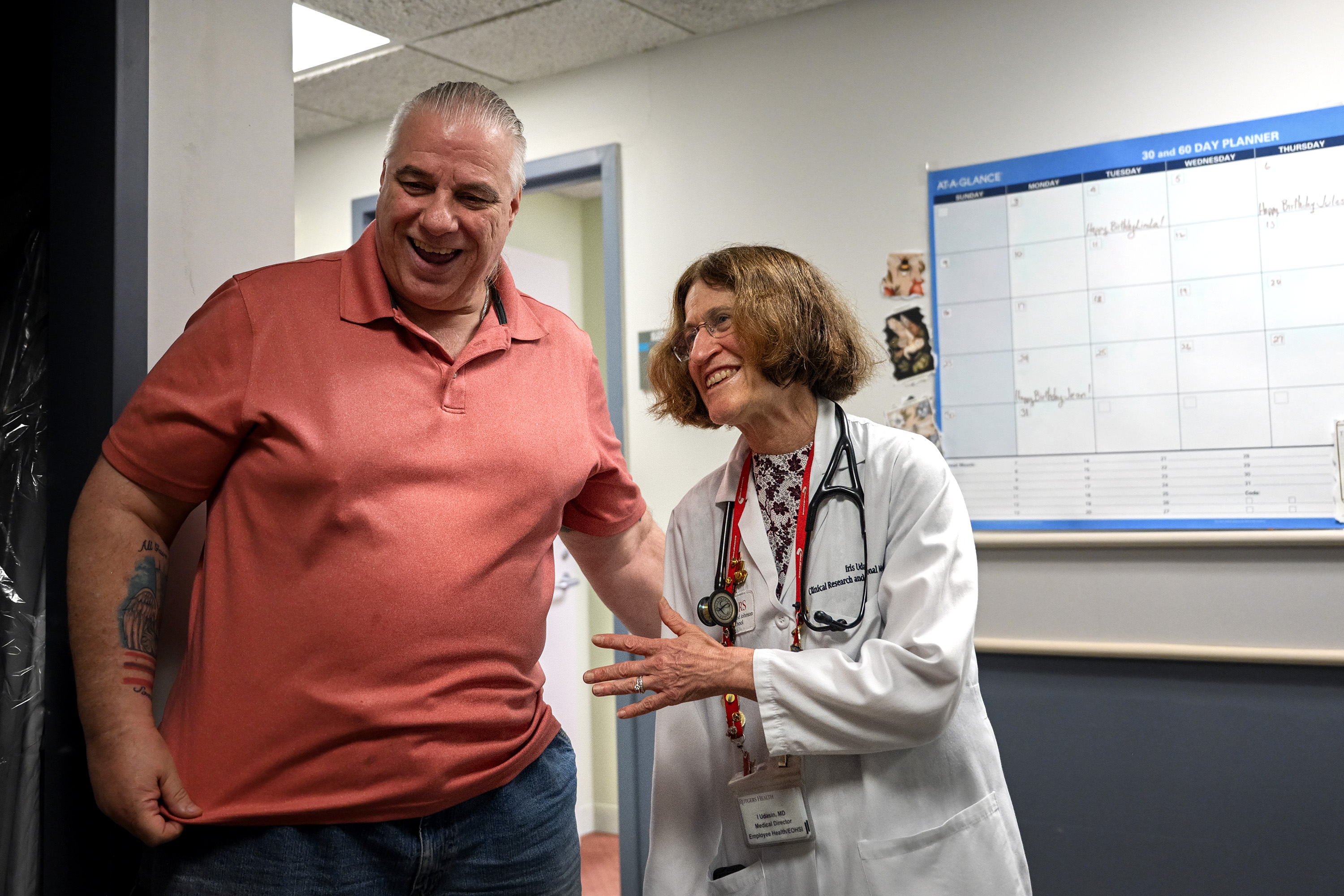
Retired Piscataway firefighter Frank Geffre Jr. shares a laugh with Iris Udasin, medical director at the World Trade Center Health Program at Rutgers University. Geffre credits Udasin and her team at Rutgers with saving his life after he was diagnosed with colon and rectal cancer. “Dr. Udasin is like the quarterback of the team,” he said.Tom Gralish / Staff Photographer
He sees a psychiatrist and a therapist for PTSD, which he finds especially hard to manage as Sept. 11 approaches each year. He lies awake after a recurring nightmare in which he is trapped in Manhattan with his family amid a terrorist attack, and he can’t get them out.
After the first plane struck on 9/11, Geffre and five other firefighters from Fire District No. 3 in Piscataway were immediately dispatched. His team got to ground zero shortly after the second tower violently pancaked.
“It was dark as can be, even though it was daylight. You had smoke clouds so thick you couldn’t even see your hand in front of your face,” Geffre said. “The dust was so thick it was like you had two foot of snow the night before.”
He initially wore respiratory gear, but the oxygen tank ran out as he worked nonstop over the first 30 hours. He saved roughly a dozen people after putting out fires that were blocking their exit from the burning buildings within the World Trade Center complex.
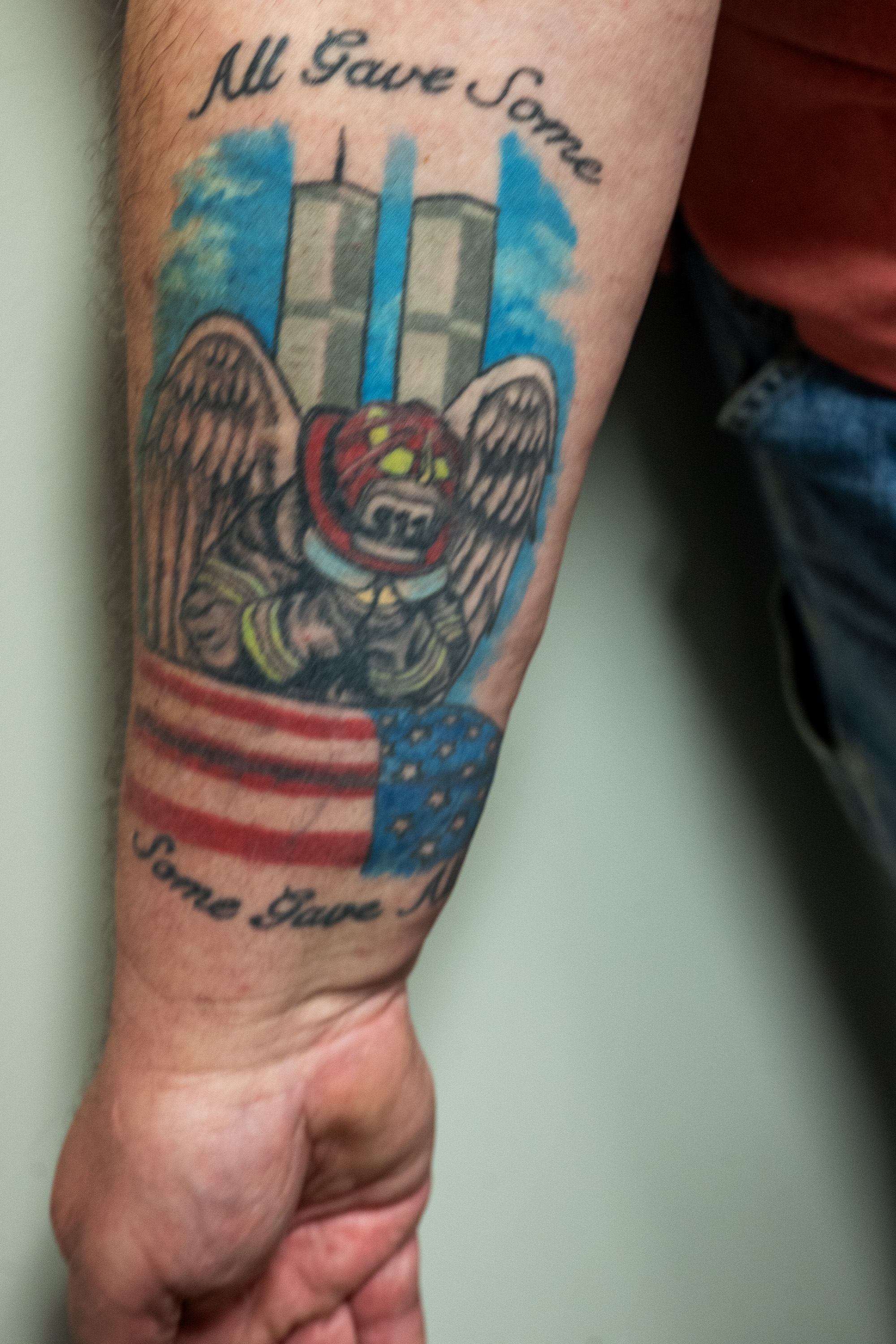
Retired firefighter Frank Geffre Jr. displays his 9-11 tattoo – “All Gave Some – Some Gave All” – during an appointment at the World Trade Center Health Program at Rutgers University. He designed the tattoo from a photo of himself splashing water on his face to rinse off dust and debris from ground zero. His wife said he looked like he was praying in the photo.Tom Gralish / Staff Photographer
He vividly recalls findinga brown dress shoe with a foot still in it. A blue polyester suit jacket with a torso seared to its lining. A wristwatch. A ring.
In all, he worked The Pile for 20 days, smearing Vicks VapoRub under his nose to cope with the“unforgettable, unbearably horrid smell of burning human flesh,” he said.
Now he can’t use the menthol and eucalyptus goo for his bouts of sinusitis, because the scent stirs bad memories.
“It feels like it was yesterday and a lifetime ago,” Geffre said. “The ‘Never Forget’ vow is not for first responders. We won’t ever forget. It’s embedded in us.”
He is ever-vigilant, prone to panic attacks. He avoids movie theaters and other places with crowds. “Too many variables,” he said.
He has a second home in Florida but drives back and forth. He won’t get on a plane. “I get paranoid that somebody on the plane is going to hijack it,” he said.
Two of the five firefighters with him on Sept. 11 have since died of cancer. He keeps in touch with four of the people he helped out of burning buildings. One committed suicide in recent years.
Retired firefighter Frank Geffre Jr. talks with Jodi Streich (left), mental health director of the World Trade Center Health Program at Rutgers University. Rutgers is one of six federally funded health clinics that monitors and treats 9/11 responders, as the health impacts continue 25 years later. The patient waiting room at the Rutgers clinic is adorned with photos of responders. Tom Gralish / Staff Photographer
Geffre, enrolled in the Rutgers program since its start, gets his mental healthcare through the clinic, which has seen a significant increase in demand for these services.
As more responders become ill or die from 9/11-related diseases, some have developed “heightened anxiety and vigilance about their own health,” Streich said.
Having more unstructured time in retirement, along with the loss of job identity and camaraderie, can be detrimental for mental health, she said.
“Things that we once buried — they come fully alive during retirement,” Streich said, adding that the support group she runs for retirees is now the most widely attended after the cancer support group.
Emergency responders who had felt too embarrassed or ashamed to seek help while working — because they feared being seen as weak — are coming in for the first time. Many are unable to eat or sleep, Streich said.
“We see them when they are at rock bottom,” Streich said. “They’ll come in and say, ‘I’m ready to talk about what I’ve been holding in for 25 years.’”
‘Exhaustion, desperation and heartache’
When asked if he regrets being dispatched to ground zero, Mark Fisher is emphatic: “Absolutely not.”
But he is tormented by images of people standing outside makeshift morgues with photos of their missing loved ones.
Fisher recalls becoming so distraught that a Red Cross volunteer pulled apart two tables piled with fresh clothes for responders to reach and embrace him.
“She hugged me for the longest time,” Fisher recalled, blowing air through his lips to steady his breathing and control tears. “I’m an Irish Catholic, so I wear my heart on my sleeve and face. I just had that look of exhaustion, desperation, and heartache.”
These days, he feels exhausted both emotionally and physicallyas his lung disease progresses. Fisher spent most of this summer in the hospital with a kidney infection that required two surgeries.
Five days after he got out of the hospital, his gall bladder became infected. “If I die, I want to die in a Catholic hospital,” he told his wife. Doctors removed his gall bladder in July.
The once-burly cop is rail-thin. He’s lost 35 pounds.
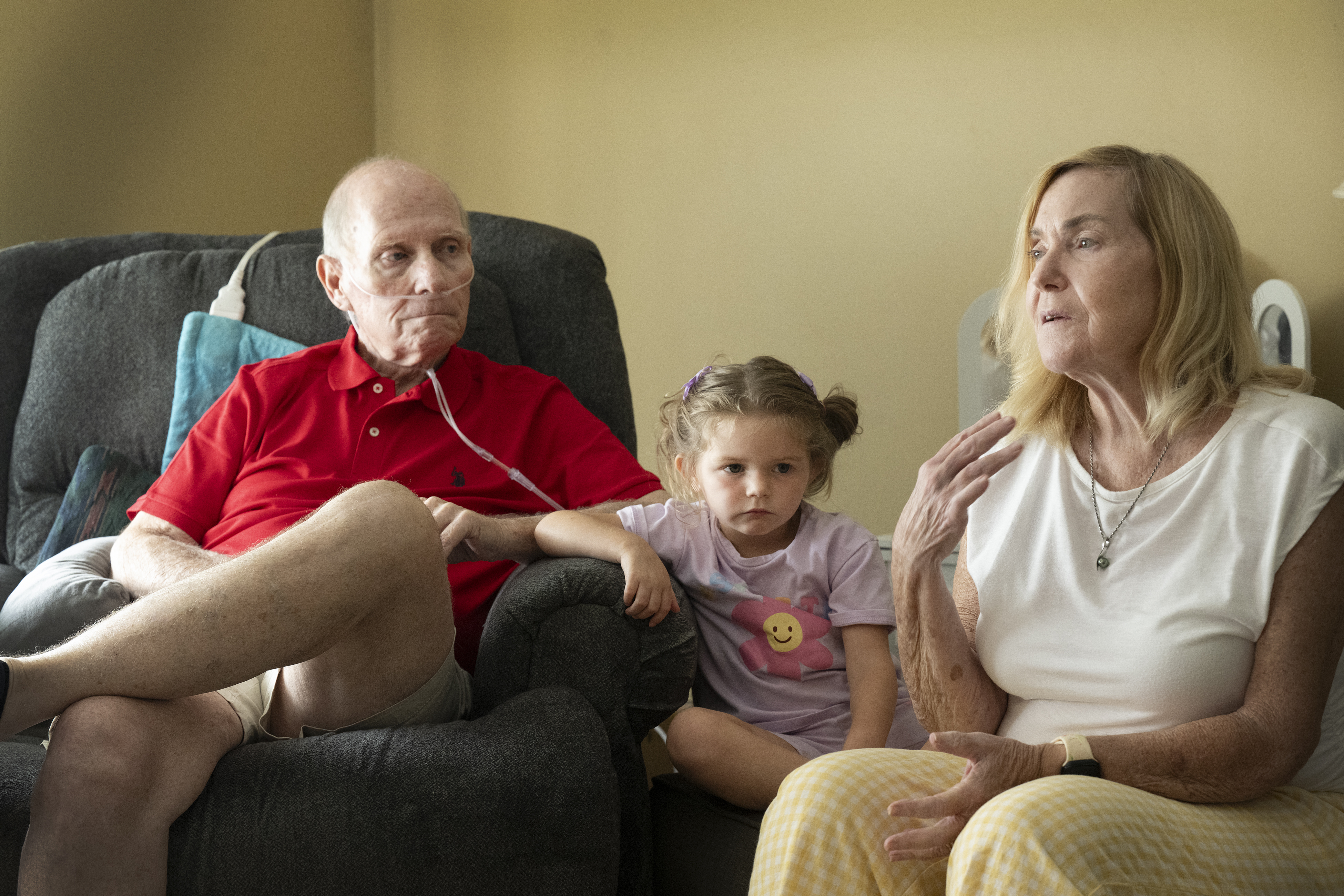
Inside their Northeast Philadelphia home, Sue Fisher (right) talks about the day she learned her husband, Mark Fisher, would need a double lung transplant. The couple’s 3-year-old granddaughter, Morgan Elizabeth Fisher, sits between them. Mark Fisher needs to use a portable oxygen tank to take walks with Morgan. Jose F. Moreno / Staff Photographer
Fisher’s priority right now is spending time with his wife and former sweetheart at Archbishop Ryan High School, and making sure she will be in decent financial shape when he dies.
Fisher, Masi, and two other responders from the Philadelphia Police Department are seeking written assurances from the city that if they die from their World Trade Center-related illnesses, their families will receive line-of-duty death benefits.
The status would enable their spouses to collect their full pensions, rather than half.
City officials said their families can apply to the Philadelphia Board of Pensions and Retirement, which would review each case individually after death.
Sue Fisher tries not to cry in front of her husband of 42 years;she’ll do it behind the shed in their backyard or on a walk with their golden retriever, Bentley.
He wants to delay as long as possible a double lung transplant, for which the survival rate is about five to seven years. “If they say that’s all he’s got, I’ll take it,” SueFisher said. “It’s better than him suffering the way he is.”
At night, she lies awake listening for the sound of Fisher’s breathing. Sometimes, she fears he has stopped. Then she nudges him with her toe until he stirs.
Retired Philadelphia Police Captain Mark Fisher wants the city’s word that if he dies of lung disease from his time at ground zero, his wife will get line-of-duty death benefits. City officials have said that his wife can apply to the pension board after he dies. Jose F. Moreno / Staff Photographer
Mike Riley and Sean Mannion were having one of their catch-up calls when Mannion, who played quarterback at Oregon State under Riley, told his former coach the latest project he was working on during the nascent days of his own coaching career.
Mannion, the most prolific passer in Oregon State history, told Riley that he was putting together and digitizing all of the passing concepts he could find dating back to the 1960s.
“This is what he does in his spare time,” Riley explained recently.
Mannion is just 34 years old and only three years removed from his playing career. He has never called plays in the NFL before and now is tasked with turning around an Eagles offense that was too stagnant in 2025 under another first-year coordinator and first-time play caller Kevin Patullo. Nick Sirianni said in February that he was looking for someone who was detailed and had “conviction in what they believed and why they believed in it, and the vision and conviction of how they went about it.”
Those traits seem to describe Mannion, whose father, John, called him “a saver” who took and saved detailed notes at every stop along his football path and even has comprehensive notes on concepts that pre-date his own life by some 30 years. Eagles quarterbacks coach Parks Frazier raved recently about Mannion’s attention to detail and his ability to recall and reference something he has learned along the way.
“He remembers every detail about all of those things and he’s constantly applying it to what he’s doing moving forward,” Frazier said. “He has extreme, detailed, categorized notes and film of everything he’s been through.”
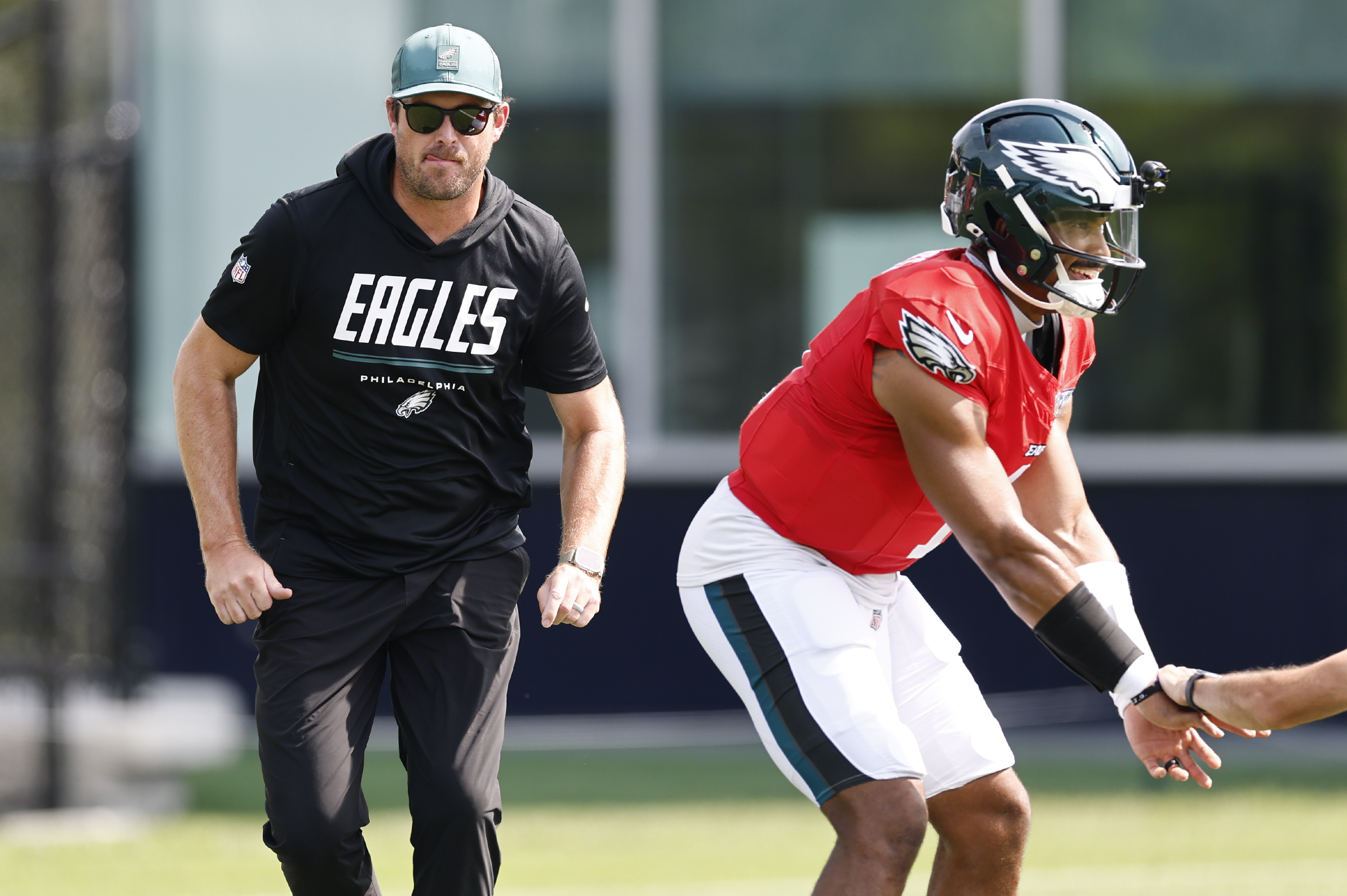
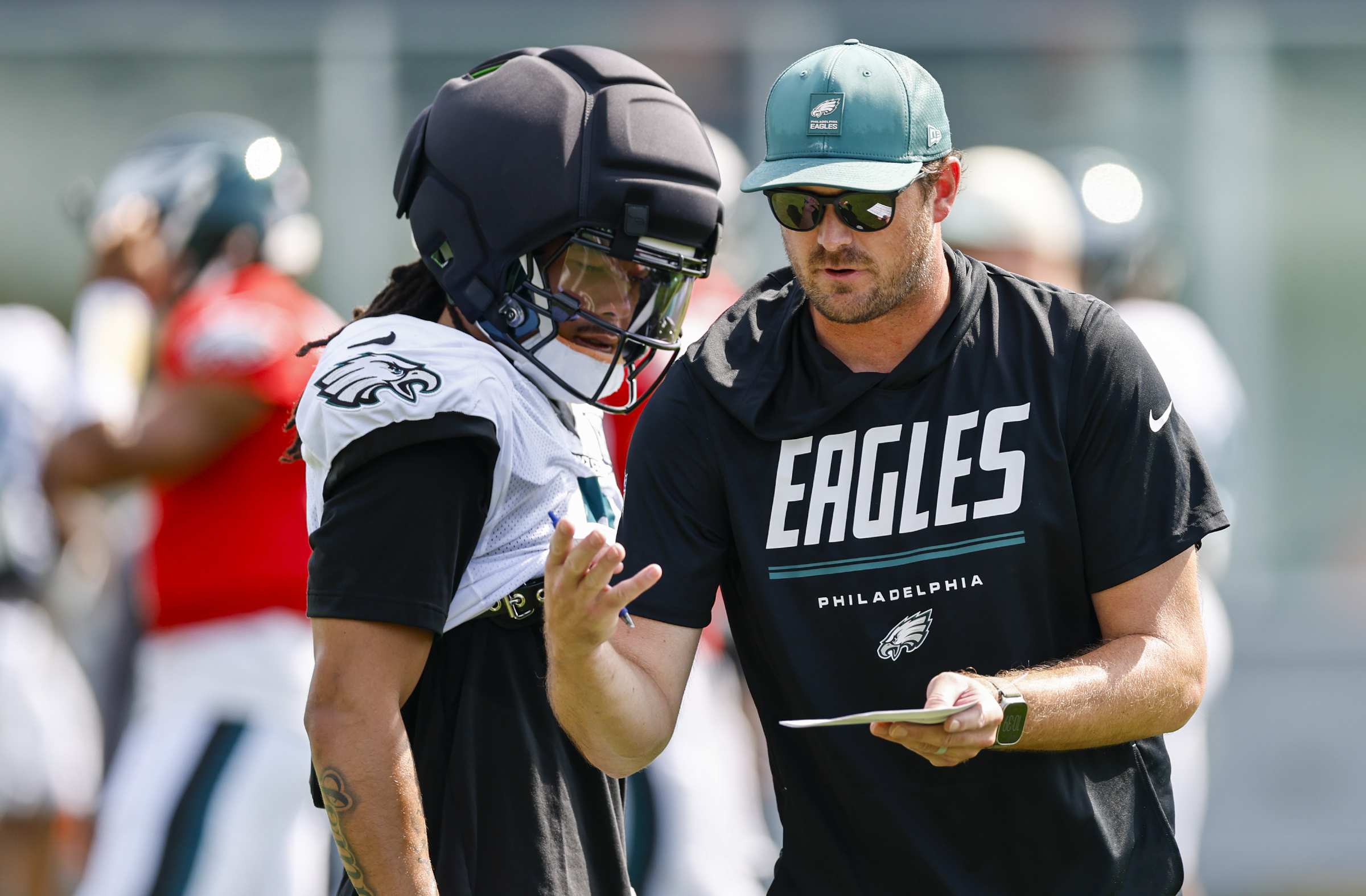
Eagles offensive coordinator Sean Mannion talks with wide receiver Makai Lemon during team drills last month. Yong Kim / Staff Photographer
Mannion is installing a new offense for Jalen Hurts and the Eagles, one rooted in the flavors of the trendy Kyle Shanahan-Sean McVay scheme. But Mannion’s history and influences suggest a style that ultimately will pull from every resource imaginable as he guides the Eagles offense into the future.
Sirianni and Howie Roseman took a calculated risk on a young and fast-rising offensive coach when they landed on Mannion, who spent two years on the staff in Green Bay, most recently as quarterbacks coach, before his big promotion. But a lack of experience doesn’t necessarily mean Mannion is any less equipped to succeed than a more experienced candidate. In many ways, Mannion, the son and grandson of football coaches, has been preparing for this job for most of his life.
“His thing was, he wanted to play as long as he could,” his father said. “The unsaid part was that when those days were done that he would turn his attention to coaching.”
Like father, like son
At its roots, coaching is teaching. In that sense, Sean isn’t just the son of a football coach; he is the son of two teachers, and his earliest influences can be traced to the classroom. He’d mess around in a playpen while his mother, Inga, an elementary school teacher, finished work in her classroom after school.
He was around his father’s football teams as much as he could be, too. One Saturday, John, who also has been a teacher for 36 years, was going to scout an upcoming opponent with a coaching friend and Sean wanted to tag along. He was around 7 years old and an inquisitive kid at the time, so he brought with him a yellow legal pad. While he watched the game next to the two adults, he doodled and drew notes and observations from the field.
“He spent a lot of time doing what we were doing,” John said of his son’s early days. “That notepad probably was a byproduct of all that time spent.”
Sean grew up in Pleasanton, Calif., Alameda County, about 20 miles east of the San Francisco Bay in a household that valued education. He was a good student who also excelled in sports. Football was his main sport, but he also played baseball and basketball.
When Sean was a rising sophomore at Foothill High School, John, a former assistant, was given the job as the school’s head football coach. He was nervous, though, about any appearance of nepotism, so from the outset of that season he had Sean playing on the JV team. Foothill was 12-1 the previous season and had two upperclassmen ahead of Sean on the depth chart. A week before the season, the senior quarterback hurt his ankle and was on crutches. Later that week, after throwing at least four touchdowns in a scrimmage, the junior quarterback showed up on Labor Day, the first practice of the first game week of the season, and complained about a back injury that eventually forced him to miss the season.
John called home right away. Sean had to get to the field and get to practice.
Sean’s freshman coach at Foothill was Mike Madden, the son of Hall of Fame coach John Madden. Mike approached John Mannion that first week and asked him if he was nervous for Sean.
“Gosh, I hadn’t thought about it,” John said. “I’m nervous for myself at this point.”
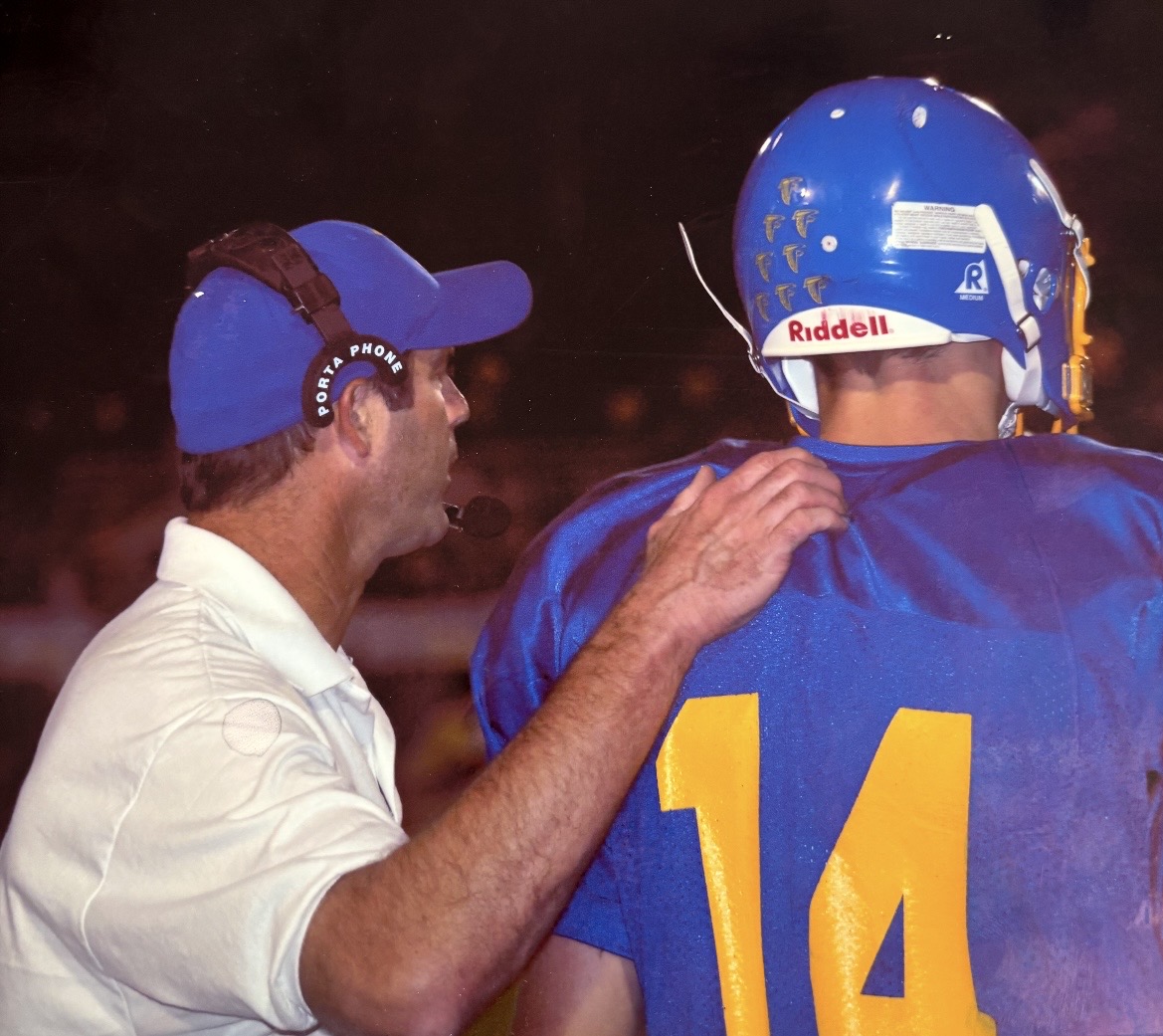
John Mannion (left) coached Sean (right) in high school.Photo courtesy of John Mannion
John’s first game as varsity head coach was also Sean’s first game as varsity starting quarterback. Asked if he remembered it well, John responded the way many coaches would, and the way the father of a detailed note-taker would: “Oh yeah,” he said. “Of course I do, yeah. We lost, 26-21, and Sean did really well. It was a really hot day and there was a lot learned by me.”
The team they lost to went to the state playoffs, but so did Foothill. Sean “knew the offense from all those years growing up around it” and “really absorbed a lot of things along the way,” John said.
“We kind of went through it together,” John said. “There was no plan of him ever being on the team that first year, but sure enough there he was. There’s challenges in there but I think it was a great experience for us to be able to do that.”
Sean finished his high school career as Foothill’s all-time leading passer and, after throwing for 3,521 yards and 27 touchdowns as a senior, was off to Oregon State.
That yellow legal pad Sean doodled on during that football scouting trip was part of a full-circle moment some 25 years later.
“When I got my first coaching job with the Packers, as a gift, he framed it for me,” Sean said. “So I still have it in my house. It’s pretty cool. The scheme has evolved since then, I will say, but it was a really cool, special gift that he kept.”
Riley’s favorite word to describe Sean is “diligent.” How many coaches born in the 1990s are digitizing passing concepts from the 60s?
Sean was the top quarterback Oregon State pursued in the class of 2010, and Riley and his staff were thrilled when he committed and later signed. The program had produced top quarterbacks like Derek Anderson and Matt Moore, and Riley thought Sean would be the next great one to come through Corvallis.
The diligence showed up right away. Sean was supposed to redshirt during his first season on campus, but the summer before his first camp with the Beavers, Sean got the keys to the facility from the graduate assistants to go in early and watch film.
“That was him the whole time,” Riley said. “He could really throw the football and he was a very hard worker physically, and then he was a very hard worker off the field. He wanted to know and learn and he’s one of the most diligent people that I’ve ever been around.”
That part of Sean made it easier when, during the second half of the first game the following season, Riley put Sean in the game over a junior who started. He was just a redshirt freshman, but he was Oregon State’s starter from that point until graduation.
“That was one of the first times probably in my career that I actually had the faith in a redshirt freshman to insert him sometime early in the year as a starter,” Riley said. “I think that said a lot about what we felt about his early development and what we thought he could do on the field.”
Eagles offensive coordinator Sean Mannion has worked diligently on offensive concepts dating back to his career as a player. Elizabeth Robertson / Staff Photographer
Sean became a captain the following season. He is soft-spoken by nature, those closest to him say, but his leadership showed up in the way he carried himself and how he approached the game. By senior year, he had a nickname: “The Machine.” That year’s offensive coordinator, John Garrett, referred to Sean by that moniker during a film session one day and it stuck, much to Sean’s chagrin. Oregon State’s offensive linemen sometimes walked robotically around Sean.
“That is a pretty appropriate nickname because he was just like that,” Riley said. “He just went to work and put in the work and everybody knew that about him. I think he’s one of the most probably respected teammates that I saw through all my years of coaching.”
Sean exited college as Oregon State’s all-time leader in passing yards and ranked in the top 10 in college football history. He’s still 19th.
The quarterback and coach have stayed in touch over the years. Riley, who left Oregon State for Nebraska after Sean’s senior year, is now retired, though he’s still on the College Football Playoff selection committee. Sean isn’t the most recent Mannion whom Riley had talked to as of a few weeks ago, though. John, who no longer coaches, now writes a newsletter on Substack called “John Mannion’s Coaching Playbook,” and recently interviewed Riley.
Sean’s most recent catch-up call with his college coach came after OTAs this season and just before camp.
“He sounded excited and he sounded like he would be because he’s always prepared — he sounded confident,” Riley said. “And I could also tell he was having a lot of fun.”
‘A 30,000-foot view’
Sean has described his father and Riley as his two biggest influences along the way. But his most relevant football influences when it comes to his current job came into his life in 2017, when Sean was backing up Jared Goff with the Los Angeles Rams and the team brought in a new coach, McVay, who hired a new offensive coordinator, Matt LaFleur. Both had been schooled under Shanahan and brought to the Rams a new style of offense that Sean took to.
“I just felt like I was learning so, so much,” Sean said. “It was such an exciting way to match the run and pass. They had such a way about teaching the game where we could feel ourselves challenging a defense, but it felt simple to us.
“Those are the things that really stood out to me going through that experience that really resonated with me as a player and certainly resonate with me as a coach. That was a very exciting point in my football life, just the exposure to that type of teaching, that type of scheme. I know Matt, obviously a mentor of mine, getting to play for [McVay]. I learned so much from those people. It’s certainly a big part of molding me into the type of coach I am now.”
Eagles offensive coordinator Sean Mannion with members of the offensive line during training camp last month. Yong Kim / Staff Photographer
How the Eagles offense will look come Sunday still remains a sort of mystery. There certainly will be more motion, more snaps from under center, and more play-action. But the Eagles ran a bland offense during the preseason in an effort to hide most of their playbook, and the first-team offense was rarely fully healthy during training camp and also had to go against one of the best defenses in the league.
The Eagles have a new style of running the ball, which will be a key to unlocking the passing game and play-action. The base of the Shanahan-McVay offense is outside, wide-zone runs that stretch the defense horizontally. The Eagles and longtime offensive line coach Jeff Stoutland parted ways this offseason, and new offensive line coach Chris Kuper has been in charge of implementing the new blocking scheme.
Kuper was the offensive line coach in Minnesota when Sean spent part of the 2023 season with the Vikings.
“He sees the game from a 30,000-foot view as well as being on the sideline and being into it with the players,” Kuper said. “I think it speaks volumes, his experience as a quarterback in this league and being able to connect people and become a glue guy has been incredible.”
There may be a misconception that Sean, a quarterback by trade, just focuses on the quarterbacking. But Kuper described a coach who is involved in every facet of the offense.
“What I love about Sean is how much he loves the run game,” Kuper said.
Kuper said part of Sean’s responsibilities in Green Bay when he was an offensive assistant in 2024 was to draw some runs. The Eagles do have a run-game coordinator in tight ends coach Ryan Mahaffey, but Kuper is confident Sean could handle it all.
“Sean could game plan and call a game all on his own, I think, if he wanted to,” Kuper said.
First-time play caller
The Mannions relocated to Oregon when Sean was in college, and one spring after John had taken over as the head coach at Mountainside High, he needed help.
The 2021 football season came together rather late in the midst of the COVID-19 pandemic, and a shortened spring season was on the table. Sean was home in Oregon doing remote OTAs with the Vikings when John asked him to be the offensive coordinator that season.
Sean’s younger brother, Brian, was the starting quarterback. It was a family affair.
On the day of the first practice, John walked out on the field and handed Sean his handwritten practice plan.
“You know there’s software for this, right?” Sean quipped.
John was calling plays, but after Mountainside was shut out in the second of their six games, John made a change.
“I handed the torch to him. It was fun,” John said.
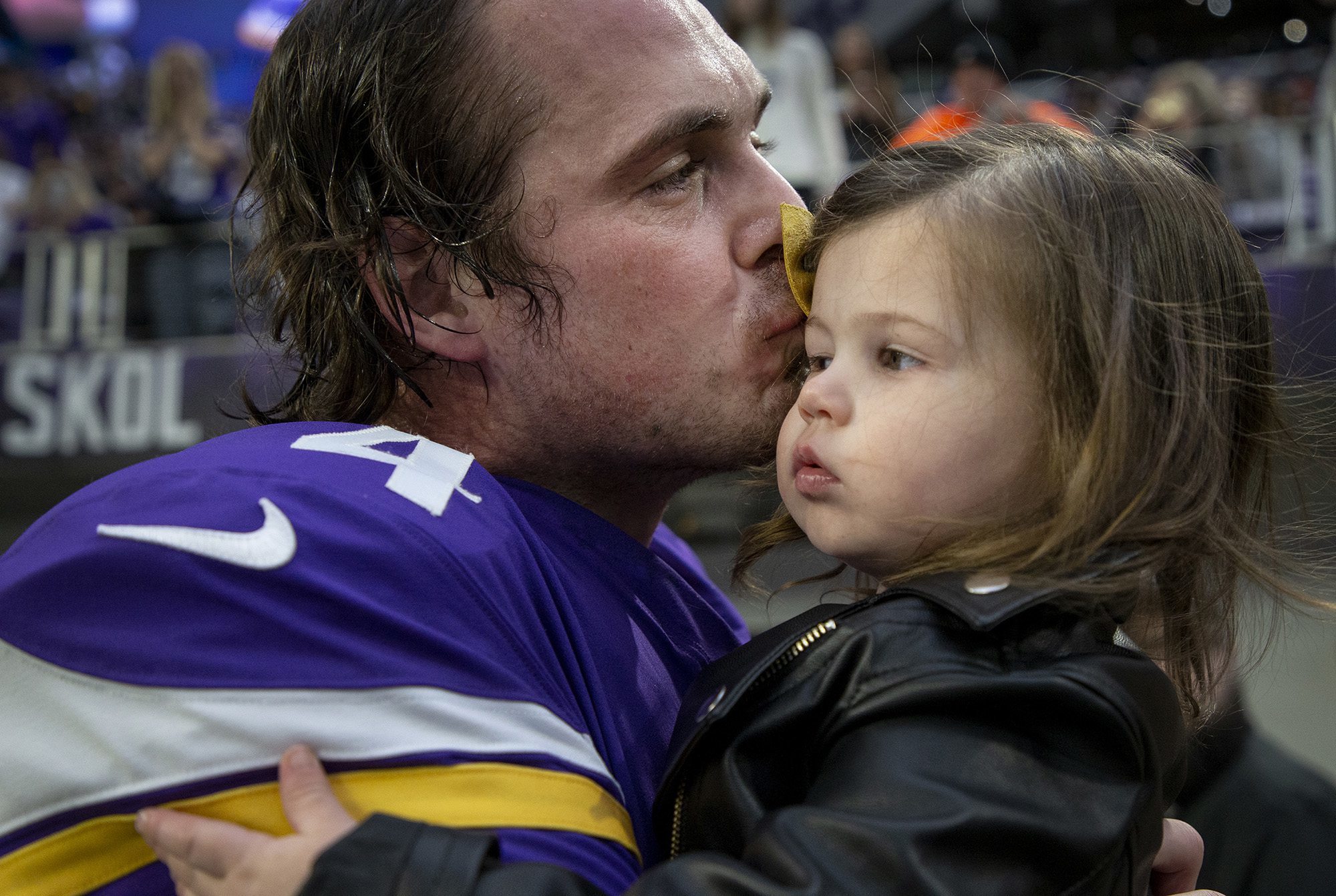
Minnesota Vikings quarterback Sean Mannion (4) kisses his daughter Sawyer after pregame warmups before a game against the Chicago Bears on Sunday, Dec. 29, 2019.Carlos Gonzalez / MCT
John has watched the oldest of his four children become a loving husband to his wife, Megan, and the proud father of three children. He always knew Sean could and probably would eventually become a successful coach, but that spring offered his first real chance to witness Sean’s future in person.
“I could see clearly he had a real knack for it,” John said.
Sean was still in the process of talking to the Eagles when he was tapped to call plays in January’s East-West Shrine Bowl. He called John during his father’s lunch break.
“You haven’t called a game since Mountainside vs. Grant High School back in March of 2021,” John joked.
The two shared a laugh. A few days later, Sean was hired to call plays for the Eagles.
All roads lead to Delco
Margaret Mannion was around 20 years old when she moved to California, but John’s mother spent her early days in Delaware County. She lived in Drexel Hill, graduated from Archbishop Prendergast High School, and worked at Villanova before moving west, where she met Jim Mannion, John’s late father.
Margaret, 84, has dementia now and still lives in California in an elder care facility, but John is pretty confident there will be at least one “proud Philadelphian” and Eagles fan watching the games this year from the elder care facility.
As for John, he’s a self-described “worrier.” When Sean redshirted at Oregon State, John loved the ease of watching the games with no pressure in the family section. After Sean was inserted as starter the next season, John called the box office. He wanted to sit in the far corner of the stadium in the last row. Tickets in the family section were free and required no work on his end, but every year he’d call the ticket office to secure his seats at the top of the stadium.
Sean rarely played in the NFL — he threw just 110 passes over nine seasons in the league — so Sunday Ticket usually sufficed. When Sean was hired by the Packers, they were on national television frequently enough, and for the games they weren’t, John would drive to his local Buffalo Wild Wings, where he’d watch quietly and hope the quarterback play was up to snuff.
Last year, while watching a game at the restaurant, a few Green Bay fans in their 20s complained to John about Packers quarterback Jordan Love. The group had a laugh when John told them, no, he wasn’t from Green Bay, his son coached the quarterbacks.
“I’m going to call him tonight and tell him there’s some guys in Oregon who say he’s got a lot of work to do,” John joked.
This year, it’s back to Sunday Ticket. John, who was in town for a few days in August observing the Eagles and Sean during camp, said he’ll build a fire at home, watch the game in peace, and “keep our fingers crossed.”
His son’s new job comes with a lot of pressure. Patullo was the most criticized person in the building last year and eventually took the fall after the team’s first-round exit, so all eyes will be on Sean as the season gets underway.
Margaret’s older sister, John’s aunt, still lives in New Jersey and called John after Sean got the job.
She was excited Sean was in a new, high-profile job back where his family has roots. But her excitement also had a tinge of nervousness: “Hopefully everybody is nice to him,” she said.
Chiles en nogada, no matter who makes them, are visually arresting dishes. They’re distinctive for their colors: a base of a deep green poblano pepper, a blanket of creamy white walnut sauce (the titular nogada), traditional pops of red from fresh pomegranate seeds, and a sprinkling of more green from parsley. These components represent the colors of the Mexican flag. The poblano is stuffed with picadillo, a mix of ground meats and fruits that marry savory and sweet flavors and can often be time-consuming to prepare.
Chiles en nogada season is fleeting, lasting just two to six weeks in late August and early September, when the dish’s main ingredients — poblanos and walnuts — are aligned and in season, along with the apples and peaches that are also at peak ripeness in Puebla, where the dish originated.
In Mexico, chiles en nogada has become a national dish, treated with great reverence and ceremony. At fine-dining establishments in Mexico City, diners can select which poblano they’d like stuffed, just as one might select a fish from a tank to be cooked. But you don’t have to go to Mexico to eat it — there are several excellent versions found in Philadelphia.
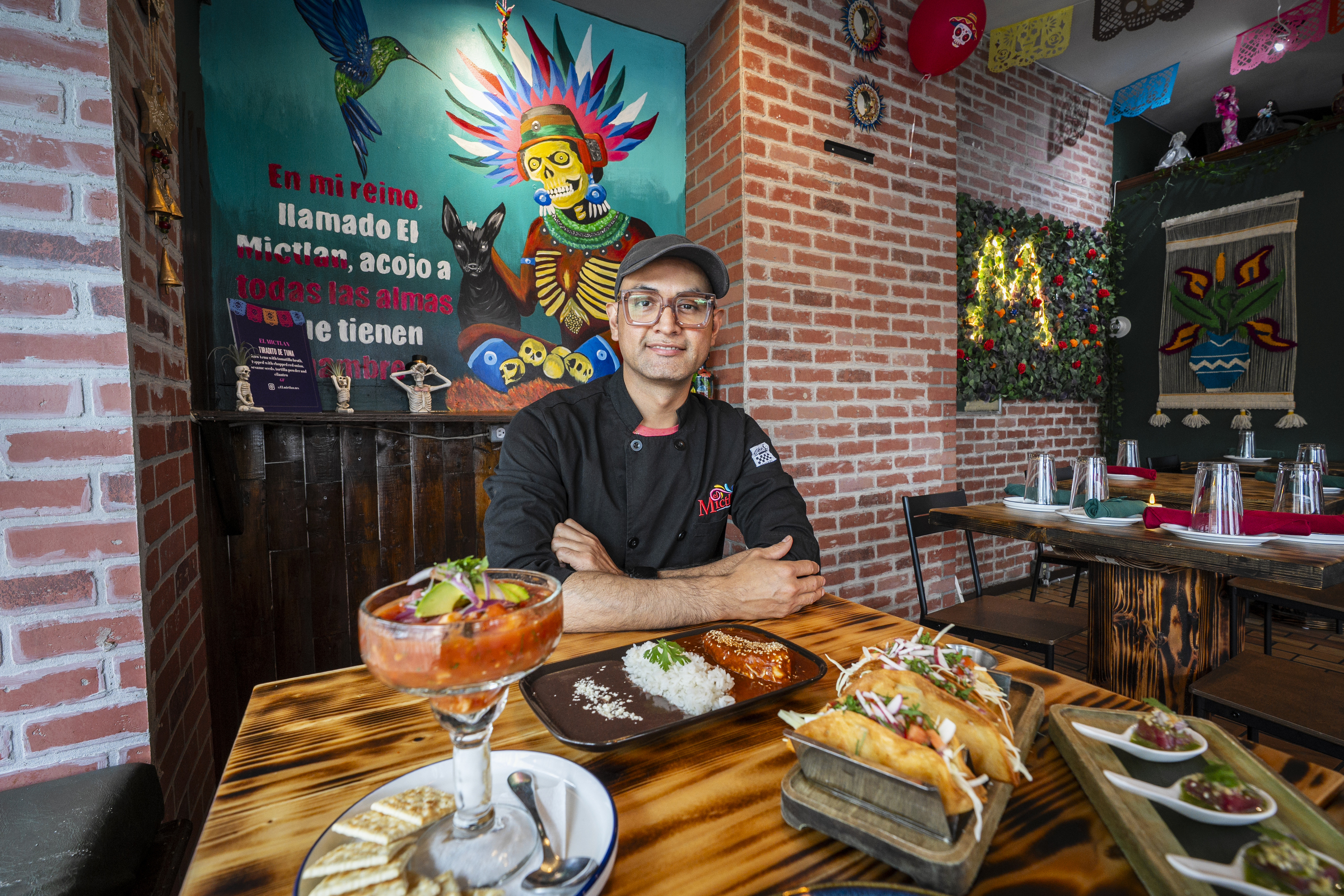
Chelo Manzanarez, chef and owner at El Mictlan, where the menu brings a taste of Guerrero and Acapulco to South Philly.Jessica Griffin / Staff Photographer
Chelo Manzanarez, the chef and owner of El Mictlan, which generally focuses on the food of Guerrero (the Mexican state located southwest of Puebla), has worked to make this fundamental Mexican dish his own.
“It’s usually a sweet and heavy dish, but I’ve tried to make it more flavorful and more personal,” Manzanarez said of the chile en nogada at his South Philly BYOB at Beechwood and Snyder Streets.
Manzanarez switched out beef in favor of a mix of pork and chicken, and he swapped raisins for dried dates. He seasons the picadillo with cinnamon, clove, and anise. He uses both green and red apples, “to get that contrast between sweet and sour.” He adds plantains and pineapples “for their tropical flavor.”
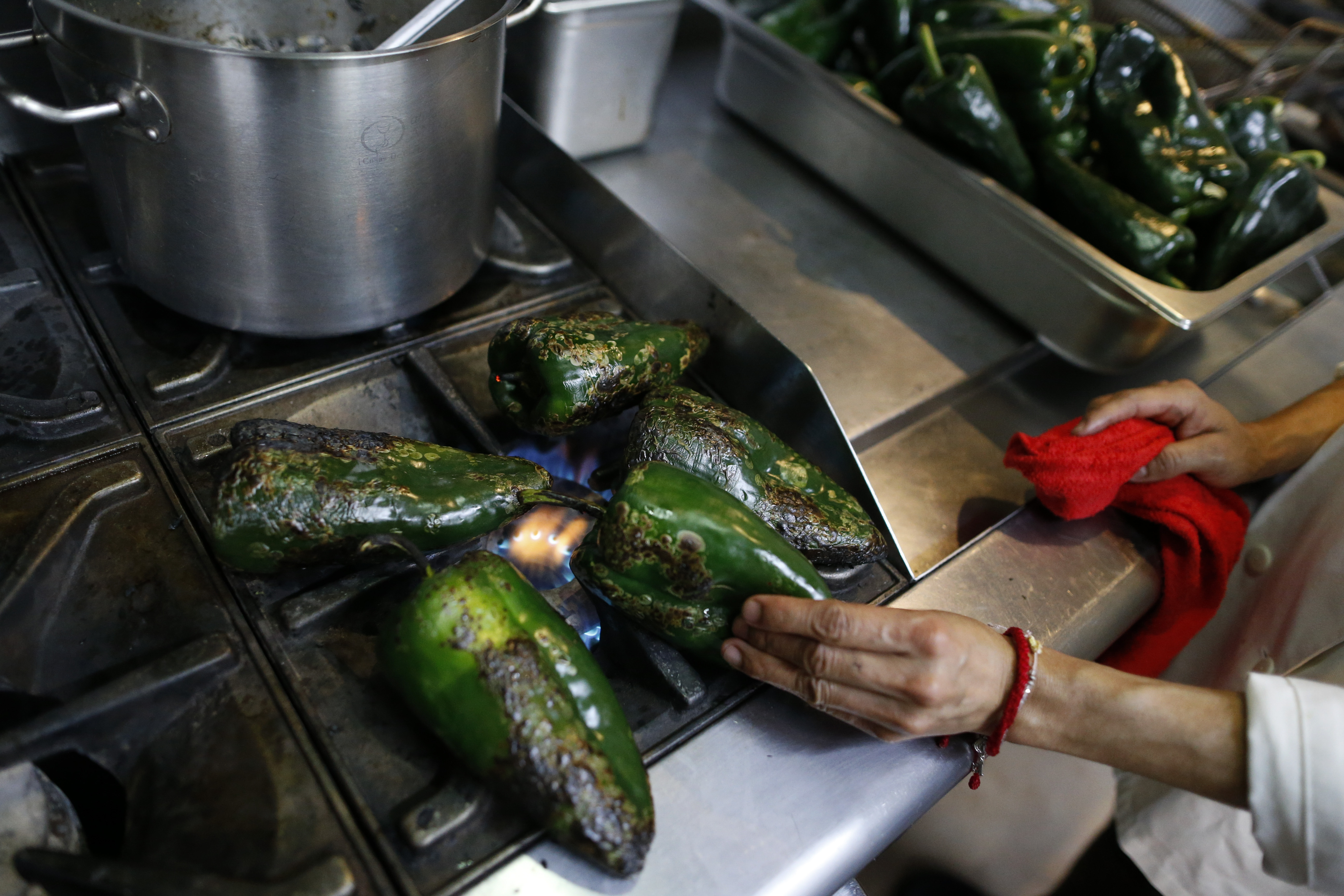
Making his chile en nogada is truly a labor of love for Manzanarez. “I cook each fruit and vegetable individually and caramelize them separately. Most of the work comes from dicing everything very small.” After mixing all cooked components together for the filling, he still has to roast the peppers, which he does for three to four minutes on each side before letting them sweat in a plastic bag, making it easier to remove their skins. “It’s complicated — getting the poblanos to the right consistency so that they don’t lose their shape,” he said.
For thewhite of the Mexican flag, Manzanarez eschews the traditional goat cheese, instead mixing cream cheese with queso fresco, walnuts, almonds, and a touch of milk. The result is creamy, luxurious, and not too rich.
A plate of chiles en nogada at Testal restaurant in downtown Mexico City.Rebecca Blackwell
Manzanarez finishes his chile en nogada with bright cilantro oil and red chili oil, doubling down on the colors as a deeper tribute to the Mexican flag.
He first came up with his recipe while working at La Llorona, also in South Philly. It’s a dish customers ask for every year.
A cook roasts poblano peppers on the stovetop in preparation for removing the skin, as kitchen staff make chiles en nogada at the Testal restaurant in downtown Mexico City in 2019. Rebecca Blackwell
Restaurants traditionally stop serving chiles en nogada after Mexican Independence Day, on Sept. 16. “But now we celebrate Independence Day for the whole of September,” said Manzanarez, which is how long he plans on serving it at El Mictlan.
More traditional iterations of the dish can also be found at La Llorona and El Chingon (usually only available at dinner).
La Llorona serves a richer but very classic version with the roasted poblano battered in egg whites and gently sautéed before being blanketed in an especially rich and dense nogada. The pepper is stuffed with ground beef and pork, peaches, and apples. Its parsley, sliced almond, and pomegranate seed garnishes replicate the stripes of the Mexican flag precisely.
The chile en nogada at La Llorona is stuffed with beef and pork and lightly battered in egg whites before being blanketed in nogada sauce.Kiki Aranita / Staff /
The availability of chef Carlos Aparicio of El Chingon’s chile en nogada ($30) is entirely dependent on the fresh walnuts he flies in, one kilogram weekly, from his hometown of San Mateo Ozolco, located in the Calpan municipality of Puebla — the same municipality where, according to legend, chiles en nogada were first invented by Augustinian nuns. They created the dish in 1821 in honor of General Agustín de Iturbide, after he signed the treaty that recognized Mexico’s independence from Spain. He became the first emperor of Mexico, and the dish represents the colors of what was then the Mexican Army’s flag.
The chile en nogada at El Chingon uses fresh walnuts flown in weekly from Puebla when they are in season.NaylaPolohovich
“This year, [Puebla] had a lot of rain so the walnuts fell off the trees too soon,” said Aparicio. “They really have to be fresh, and we can’t preserve them. As soon as they get here, we wash and clean them and put them in milk immediately.” After their milk bath, the walnuts get mixed with goat cheese, cream cheese, cinnamon, and sugar.
Aparicio’s chile en nogada is stuffed with beef, pork, and fruits, and garnished sparingly. Hewing to tradition, Aparicio’s serves it at room temperature.
Aparicio is hoping that this year he will receive at least one or two more shipments of walnuts, which means he can serve chiles en nogada for one or two more weeks. (El Chingon sells about 12 to 15 per day when it is available.)
Chiles en nogada season brings out the competitive nature in chefs and customers. “People will try to get every different chile en nogada in Philadelphia, make comparisons and [argue] about which one is the best,” said Manzanarez.
You have one, maybe two weeks left to decide for yourself.
Jonathan Altshul started this week as the new manager of Cheltenham, an ethnically and economically diverse township of about 38,000 people divided into historic neighborhoods like Elkins Park, Wyncote, and Laverock.
As he gets down to work on the township’s biggest priorities, including revamping facilities and boosting the tax base, Altshul wants to hear from them all, he said in an interview.
“That’s what we sign up for as municipal managers,” said Altshul, who will receive an annual salary of $225,000. “How do you get people with different viewpoints, different walks of life, to come to the table?”
It is a skill he mastered growing up as one of seven kids, Altshul said — “trying to make sure your voice is heard while respecting there’s also six others of you in the house.”
One of his first priorities is improving Cheltenham’s facilities — some of which are century-old relics of the township’s past as a playground for the wealthy.
“We are facing aging facilities and aging infrastructure,” Altshul said, and part of his job will be addressing that to attract new residents and businesses.
He hopes to do so while “holding the line on tax increases as much as possible,” Altshul said. Cheltenham residents — who are the most property tax-burdened in Montgomery County — “have high expectations about the services that they receive, so there’s not, generally speaking, a whole lot of fat to cut.”
In tackling the building challenges, Altshul’s penchant for hard conversations may be crucial. Township officials in recent years have discussed the possibility of closing facilities, raising worries from some residents in neighborhoods that stand to lose amenities.
Two community centers — La Mott and Rowland — have been largely closed to the public for several years, and renovation plans have been confirmed only for La Mott.
Adding to Cheltenham’s infrastructure challenges is the tax base itself. The township has less commercial space than nearby towns, but a larger proportion of institutional land, according to its recent comprehensive plan. Institutional land typically includes churches, universities, and hospitals that may not pay property taxes.
Encouraging those entities to pay fees in lieu of property taxes may be part of the solution, Altshul said. He plans to take a pragmatic approach.
“There are no silver bullets with public finances,” Altshul said. “It’s just listening and rolling up sleeves, getting your hands dirty, and thinking through problems.”
It is the kind of work that led Altshul to public administration in the first place: He got a graduate degree in public policy and finance, taking federal and county-level government jobs in the Washington area before moving to Chester County to work in local government.
His last job stint — two years as a suburban township manager — took him back to his native Connecticut while he helped his widowed father with a life transition, but his “heart is in the Delaware Valley,” Altshul said. “I raised my kids here.”
That is why he takes seriously the emotional and financial investments Cheltenham residents have also made, Altshul said:
“We’re talking about home.”
This suburban content is produced with support from the Leslie Miller and Richard Worley Foundation and The Lenfest Institute for Journalism. Editorial content is created independently of the project donors. Gifts to support The Inquirer’s high-impact journalism can be made at inquirer.com/donate. A list of Lenfest Institute donors can be found at lenfestinstitute.org/supporters.
If it weren’t for Abbott Elementary, longtime TV director Randall Einhorn thinks he probably would’ve retired by now.
After decades working behind the camera on essential sitcoms like The Office, It’s Always Sunny in Philadelphia, and Parks and Recreation, Einhorn could’ve stepped back from the industry — but then he met Quinta Brunson. The West Philly comedian approached him for the Abbott Elementary pilot in 2021 because she was such a big fan of his Scranton-set hit. Einhorn quickly realized Brunson and her show were special, so it was easy for him to say yes.
“From the day we started filming the pilot, it just felt right. It always felt right,” said Einhorn, 62, who also serves as an executive producer on Abbott.
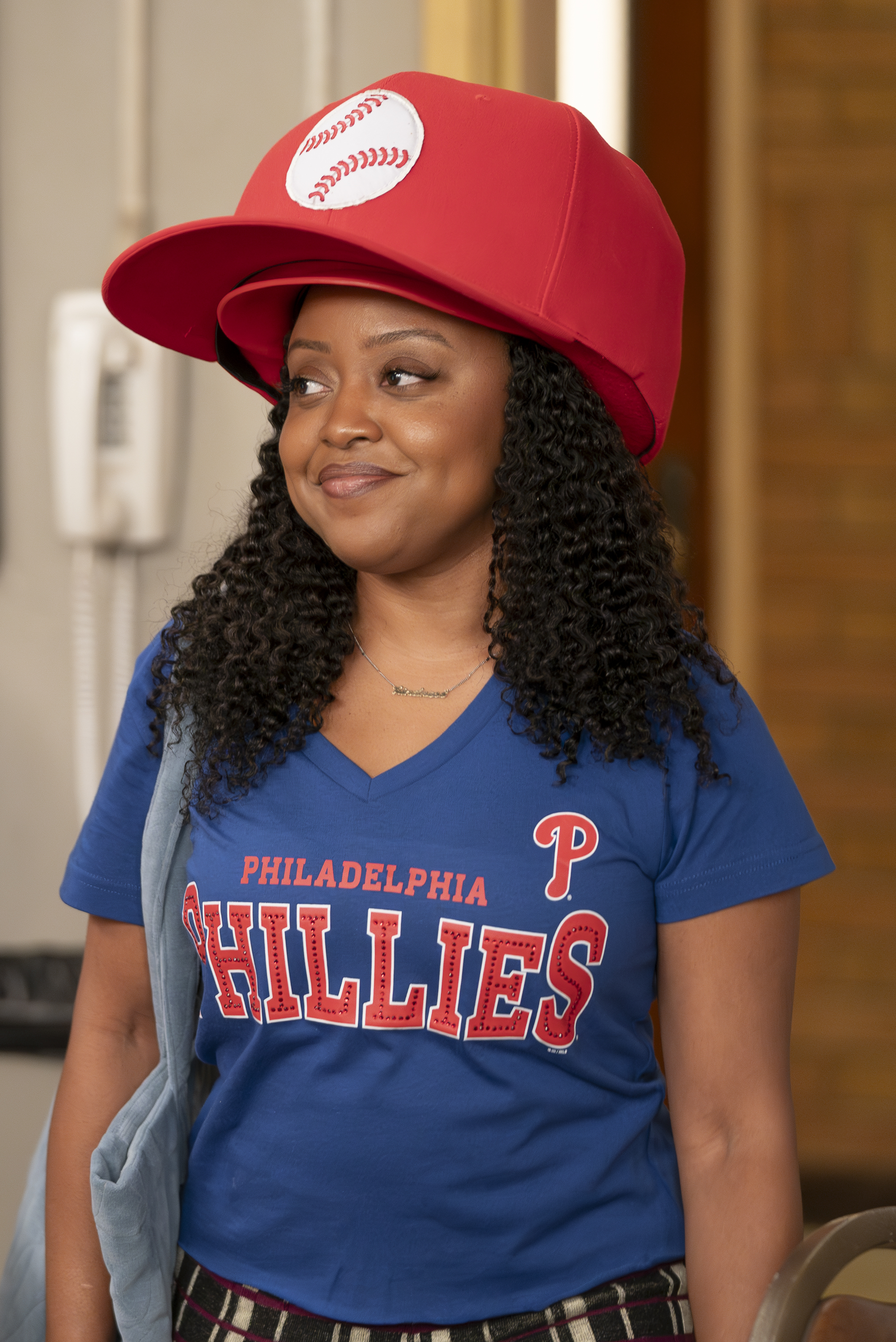
Janine (Quinta Brunson) gets ready for a Phillies game in “Abbott Elementary.”Disney/Gilles Mingasson
Now the beloved comedy has become an Emmy Awards darling and is about to premiere its sixth season this fall. Its fifth season alone is up for seven Emmys at the ceremony on Sept. 14. Einhorn is a nominee for outstanding directing for a comedy series, marking his second nod in that category for Abbott Elementary (he was also previously nominated for cinematography on Survivor).
Einhorn received the recognition specifically for his ambitious work filming the “Ballgame” episode during a Phillies game at Citizens Bank Park in August 2025.
Phillies fans remember it as the night Kyle Schwarber hit four home runs, making baseball history and leading the team to a 19-4 victory over the Atlanta Braves. After the field cleared, Schwarber joined the Abbott Elementary cast to film his guest appearance.
“Abbott Elementary” actors Tyler James Williams (Gregory Eddie) and Quinta Brunson (Janine Teagues) chat with Phillies star Kyle Schwarber and director Randall Einhorn at Citizens Bank Park in August 2025.Louie Escobar
“What a great dude! He had all the time in the world for us, and he was tremendous,” said Einhorn. “Nobody expected Kyle Schwarber to hit four home runs … there’s no type of energy like that. You can act that energy, but also you can’t. We fed off of that energy, which I think was really, really fun.”
As exciting as the game was, the Abbott cast and crew had already been at Citizens Bank Park for days leading up to the live event so they could capture the scenes with dialogue. That meant bringing in some 400 local background actors to play Phillies fans as well as roughly 200 workers from the Phillies and Aramark to staff the ballpark.
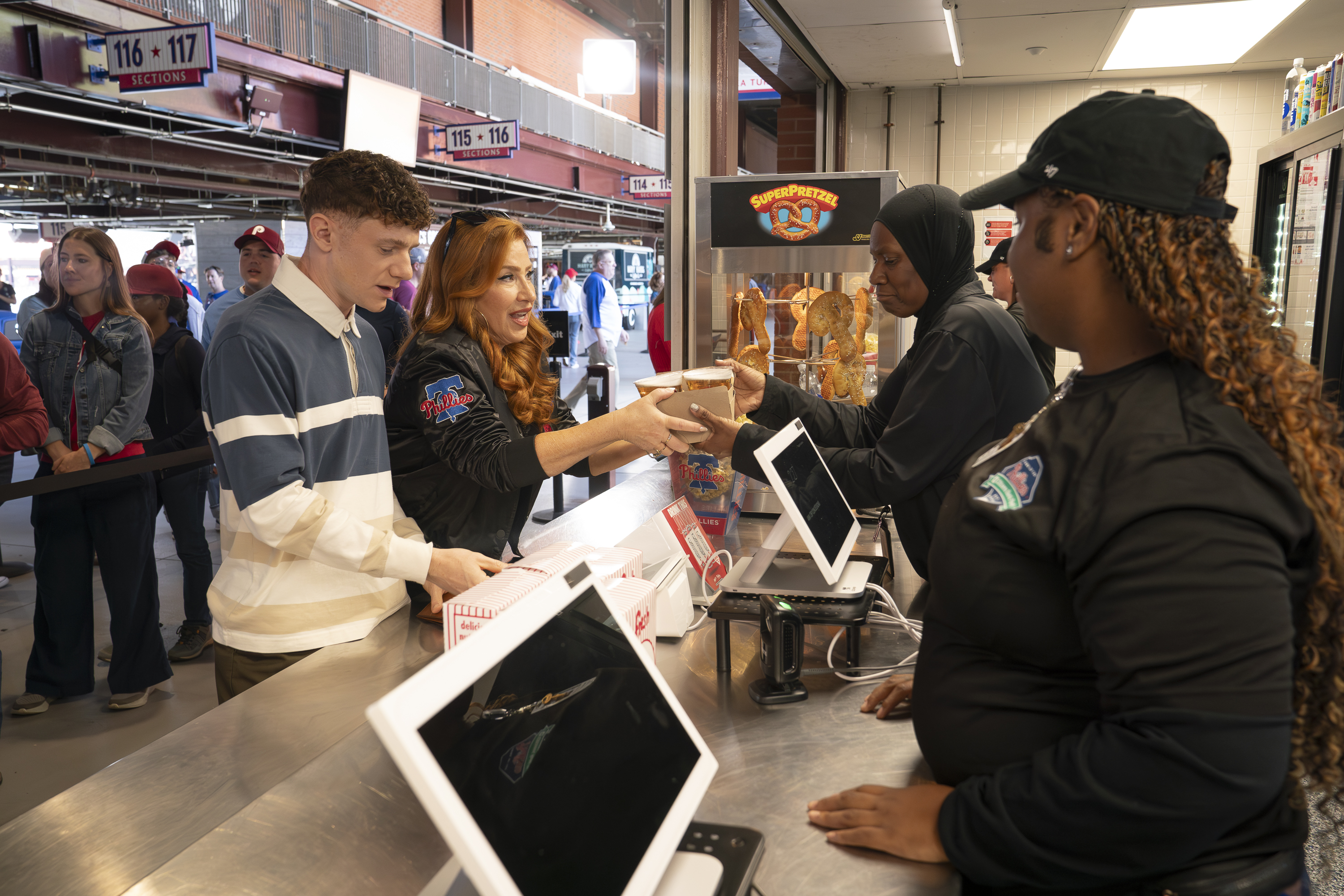
Jacob (Chris Perfetti) and Melissa (Lisa Ann Walter) at a concessions stand at Citizens Bank Park in the “Ballgame” episode of “Abbott Elementary.”Disney/Gilles Mingasson
The complicated logistics required precise coordination between the Abbott crew and cast, the Phillies staff (especially those behind PhanaVision), and Major League Baseball. Einhorn’s biggest challenge was ensuring that the dialogue scenes matched up with the baseball action and vice versa. That meant carefully plotting the camera’s focus to whip between the actors, the field, and the PhanaVision screen. The 14-page script had more than 70 instances of “whip offs and whip ons,” according to Einhorn.
“I had to have this really meticulous plan to connect the game day to dialogue day, which were two separate days. That was quite complex, I mean, I’ve never had so many notes to myself in the margins of, ‘Don’t mess this up, Randall,’” the director said. “I really enjoy something with a high degree of difficulty because once you stick the landing, it’s just so rewarding.”
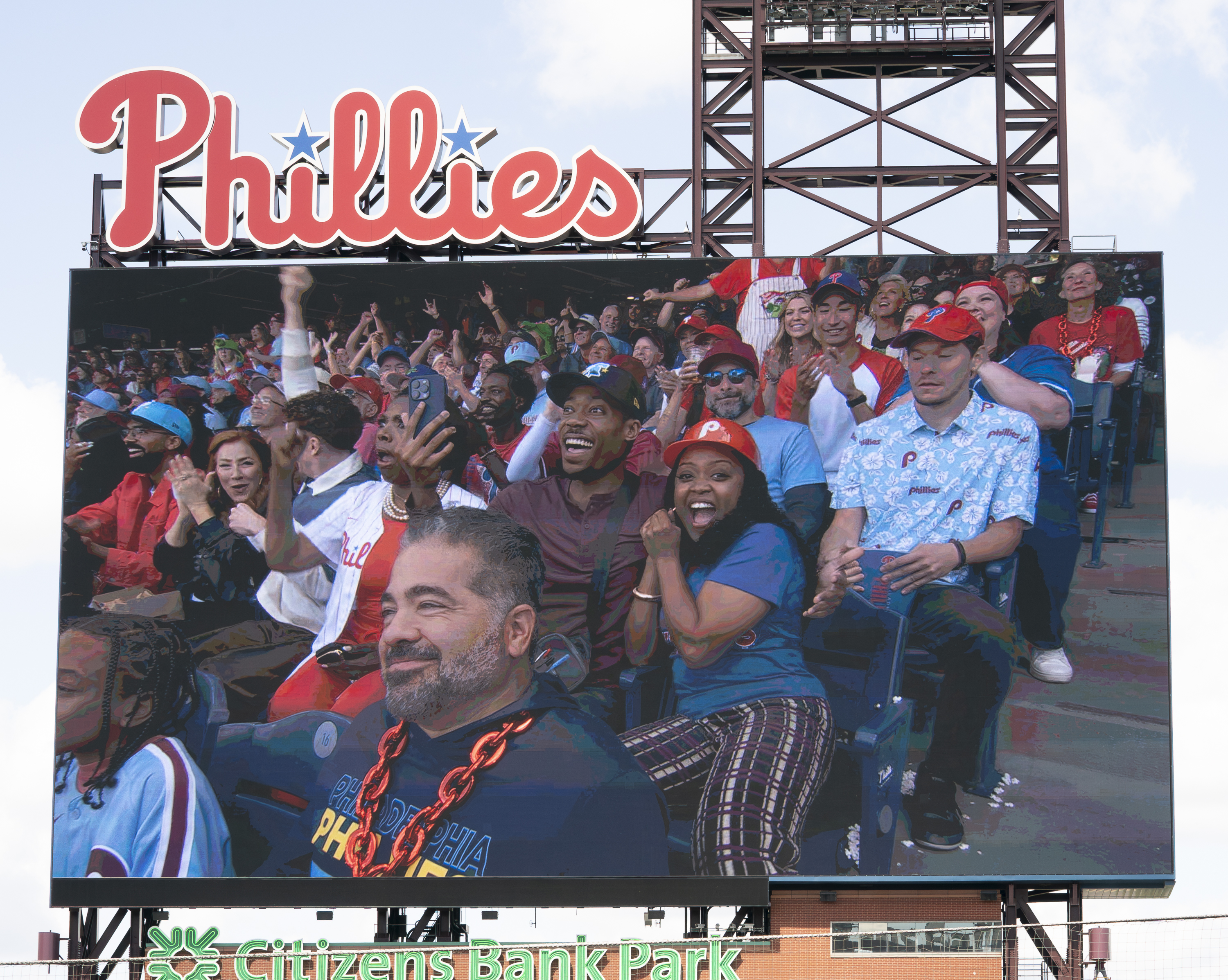
The teachers from “Abbott Elementary” captured on PhanaVision at Citizens Bank Park.Disney/Gilles Mingasson
Serendipitously, Brunson and her fellow writers had already planned to feature Schwarber as a guest star before he made baseball history as the 21st player in MLB history to hit four home runs in one game. (A diehard Phillies fan, Brunson was thrilled to meet Schwarber — and the Phanatic, of course — for the special opportunity to spotlight Philly’s robust sports culture; she called the episode a “complete fan service.”)
The Abbott team developed contingency plans to ensure that they’d capture at least one Schwarbomb for the show — even if they had to cheat it by filming a Schwarber hit and panning to another ball soaring in the sky — but that night, those plans were totally unnecessary. The episode, which aired on Oct. 15, wound up including multiple Schwarbombs.
“The camera operators did just spectacular work … the more times [he hit], the better we got at filming it,” said Einhorn. “It’s amazing how much of the show was from game day footage and our cast reacting to it.”
As Einhorn and the Abbott team prepare for the Emmy’s red carpet, Schwarber has continued to deliver wow-worthy performances on the field. If Einhorn’s “Ballgame” episode wins the Emmy, Schwarber will have one more thing to celebrate.
The 78th annual Primetime Emmy Awards will air 8 p.m. Monday, Sept. 14, on NBC.
As he commuted from South Jersey into Philadelphia on the afternoon of Sept. 11, 2001, Hugh Douglas kept glancing at the skies.
“I remember driving across the Ben Franklin Bridge, I was looking in the air for those planes. You know, the next planes,” Douglas said. “Because that bridge is the biggest way into Philly, and I thought they would attack that next.”
Douglas, then a star defensive end for the Eagles, was driving to the practice facility, summoned for a team meeting to address an emergency. By then, of course, the skies were empty. The FAA had closed U.S. airspace at 9:42 that morning, and by 12:15, only birds flew over America.
Terrorists had hijacked four commercial flights that brilliant Tuesday morning and turned them into missiles.
At 8:46 a.m., American Airlines Flight 11 crashed into the 92nd floor of the World Trade Center’s north tower. At 9:03 a.m., United Airlines Flight 175 crashed into the south tower. At 9:37 a.m., American Airlines Flight 77 crashed into the Pentagon. At 10:02 a.m., after a struggle between heroic passengers and hijackers, United Airlines Flight 93 crashed into an empty field in Shanksville, Pa., 200 miles west of Philadelphia.
Nearly 3,000 people died as a result of the attacks, still the largest death toll of any terrorist attack on U.S. soil. It stunned the world, and it left the nation shocked and terrorized, and it left the sporting world in turmoil.
Douglas had just turned 30. In his lifetime America had seemed invincible. Impenetrable. It was, by far, the most traumatic event he’d known.
“I thought it was the end of days,” Douglas said.
He was not alone.
Phillies center fielder Doug Glanville is a year older than Douglas. He grew up in Teaneck, N.J., less than 20 miles from what became to be known as Ground Zero, where the towers collapsed. He’d visited the towers frequently as a boy.
On 9/11, Glanville was with the Phillies in Atlanta, preparing for an important series against the Braves. When he heard that the terrorists targeted sites beyond New York, he worried about what might come next, and whether ballparks and stadiums were vulnerable.
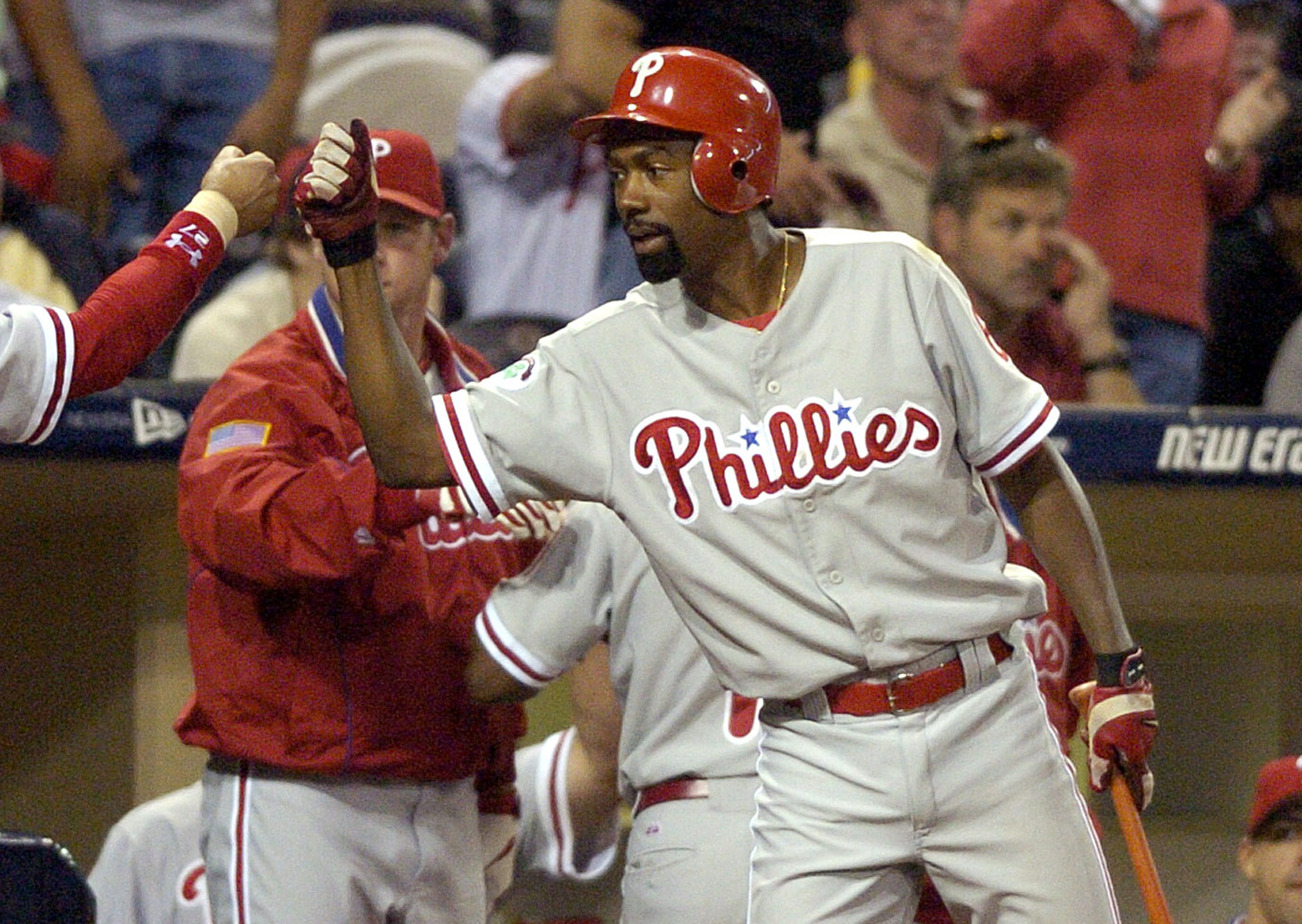
Doug Glanville, here in a 2004 game in San Diego, played six seasons with the Phillies.DENIS POROY
“We didn’t know what imminent threats were still there. We heard that they might attack Atlanta,” Glanville said.
That worry persisted even when games resumed six days later, and beyond.
“You felt like, if you were in a stadium, you were a target.”
‘I thought it was a movie’
Douglas learned of the attacks from the movers helping him settle him and his wife at the time, Simona, into their town house in Marlton, N.J.
“They blew up the tower,” one mover told Douglas. He wasn’t quite sure what the guy meant. The cable company hadn’t arrived yet, so the mover began to jerry-rig an antenna onto a television. Before he finished, another mover, still listening, announced, “They hit the other tower.”
Finally, a fuzzy image appeared on the screen, the towers burning. A few minutes later, at 10:28, the north tower collapsed.
Glanville had much better reception.
Baseball players are a nocturnal breed, but Glanville is one of the few who relishes a hearty breakfast. Also, he’s a reader — he has an engineering degree from the University of Pennsylvania — so he rarely turns on his hotel TV.
“There aren’t a lot of players who get up that early, except Kevin Jordan. So I go out of my room, get in the elevator, and Nina Jordan’s there, Kevin Jordan’s wife,” Glanville said. “I’m, like, ‘Good morning,’ with a smile. She’s like, ‘They hit the towers.’ ”
Glanville flashed back to Feb. 26, 1993, when terrorists attempted to take down the north tower with a car bomb. They failed. Seven people died. Glanville assumed this was similar.
“The first thing I thought is, ‘Oh, again?’ ”
Not exactly.
“We were in CNN country, so I came out of the elevator, I saw banks and banks of TVs,” Glanville said. “And then, of course, we were just, like, locked in.”
Phillies manager Larry Bowa wasn’t watching TV in his room, either, but, with a teenage daughter, he always kept his phone close. When it buzzed that morning and he saw her number he was concerned, of course, but not as concerned as he soon would be.
“She said, ‘Did you see the TV?’ And I said, ‘No.’ She says, ‘Turn it on,’ ” Bowa said. “And when I turned it on, I thought it was a movie.”
‘We took a vote’
What happened in the next couple of days is a blur for most of us who lived through 9/11, and most of us weren’t star entertainers and their bosses walking the thin line of propriety.
Would baseball be played Tuesday night? Would baseball or football, either college or pro, be played on the weekend?
Flights resumed sporadically just two days after the attacks, but it was about a week before air travel resumed full throat. The Eagles and the rest of the NFL hunkered down.
“We knew pretty quick we weren’t going to Tampa that weekend,” Douglas said. “So we just practiced. And it was weird, right? You get planes flying over South Philly all the time, because the airport is so close. There were, like, no planes that week.”
It was as if everyone held their breath, just as they’d done after President John F. Kennedy was assassinated in November 1963, which paused most of college football and briefly paused the NBA and NHL.
“Nobody knew what was the right time,” Bowa said. “Some people were saying they might cancel the whole season.”
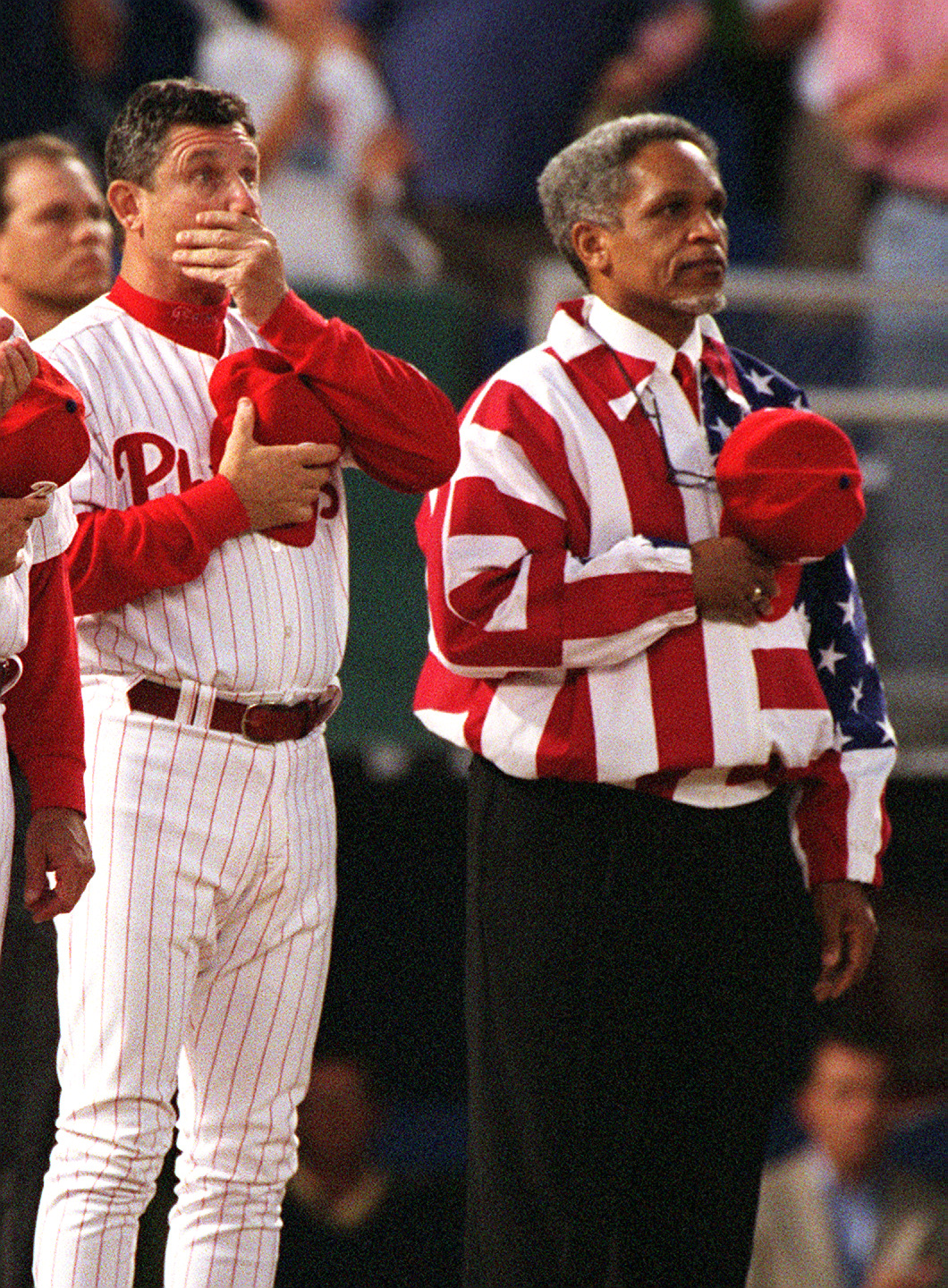
Phillies manager Larry Bowa wipes his face standing next to Philadelphia Mayor John Street during a moment of silence before the Phillies-Braves game on Sept. 17, 2001 at the Vet.D
As it turned out, baseball games resumed Sept. 17. The Expos hosted the Marlins with the first pitch thrown at 7:10 p.m., so baseball officially resumed first in Canada. But the Braves visited the Phillies and the Mets visited the Pirates, and both games went off at 7:19 p.m., so Pennsylvania co-hosted the return of America’s game in America.
‘We took a vote’
Getting from 9/11 to 9/17 was quite a journey for the Phillies.
Games were suspended immediately, but MLB dithered regarding when they would resume. The Phillies spent three days in Atlanta, then decided to bus to Cincinnati, where they were scheduled to play over the weekend. They were outside of Knoxville, Tenn., when they heard that those games might not happen, either.
What now?
They pulled the two buses into a rest stop. Players disembarked to try and get cellphone reception, which was poor on the buses, and check in with their families. At that point, mild chaos ensued.
Should they reroute to Philadelphia? Should they return to Atlanta, where flights would be easier to arrange? Should they just continue to Cincinnati and maybe ride out the weekend?
They couldn’t take the buses to Philadelphia because the bus driver had logged too many hours.
“We took a vote,” Glanville said. “It was everybody, 40 or whatever, to 2. And the two were Bowa and (reliever) Dennis Cook, and Cook lived in Atlanta.”
So, on to Cincinnati, where they discovered those games were, in fact, postponed. Inimitable traveling secretary Frank Coppenbarger, now retired, wheedled a chartered plane for the next day. The Phillies were home for supper on Sept. 15.
MLB delayed the playoffs for a week. The Phillies made up the postponed games in Atlanta and Cincinnati after the regular season ended. Like their NFL counterparts, they played the rest of the season in a daze of heightened security and heightened anxiety.
‘A sense of pride’
NFL players were used to being treated like royalty on their charter flights to games. A week and a half after 9/11, they found out what it was like on tarmacs in countries where terrorism is a constant threat.
“We used to just park our cars at the facility, get on a bus, ride to the airport, get off, and walk right on the plane,” Douglas said. “Now, you went to the airport, man, and everybody was on high alert. There’s guys with machine guns or whatever, there’s tons of security. Even on the plane. And you had to watch your mouth.
“I went to the bathroom and came back and told the fellas I blew it up,” he recalled, and was quickly admonished by security. “Yeah, you couldn’t say you ‘blew up the bathroom’ anymore.”
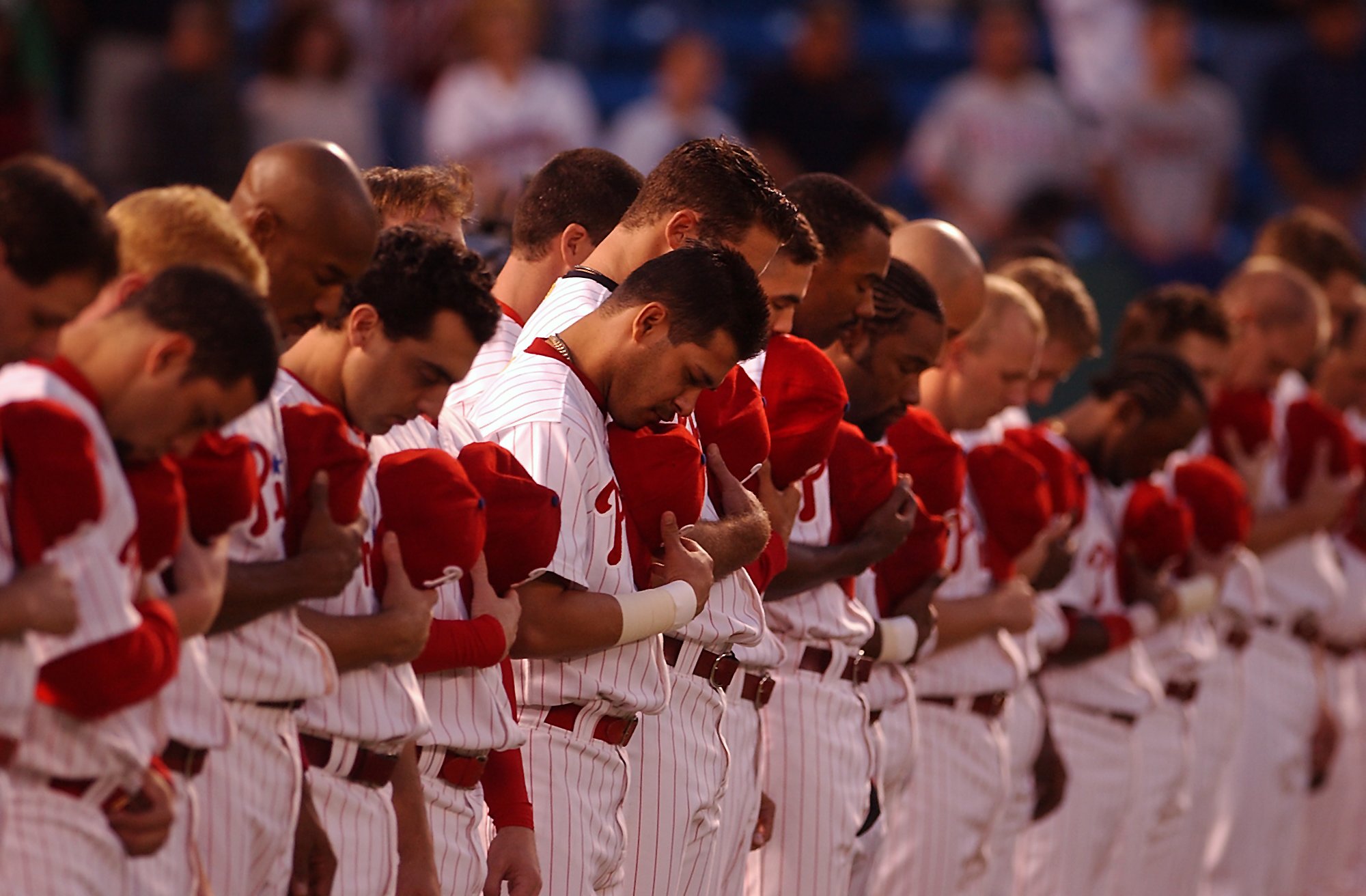
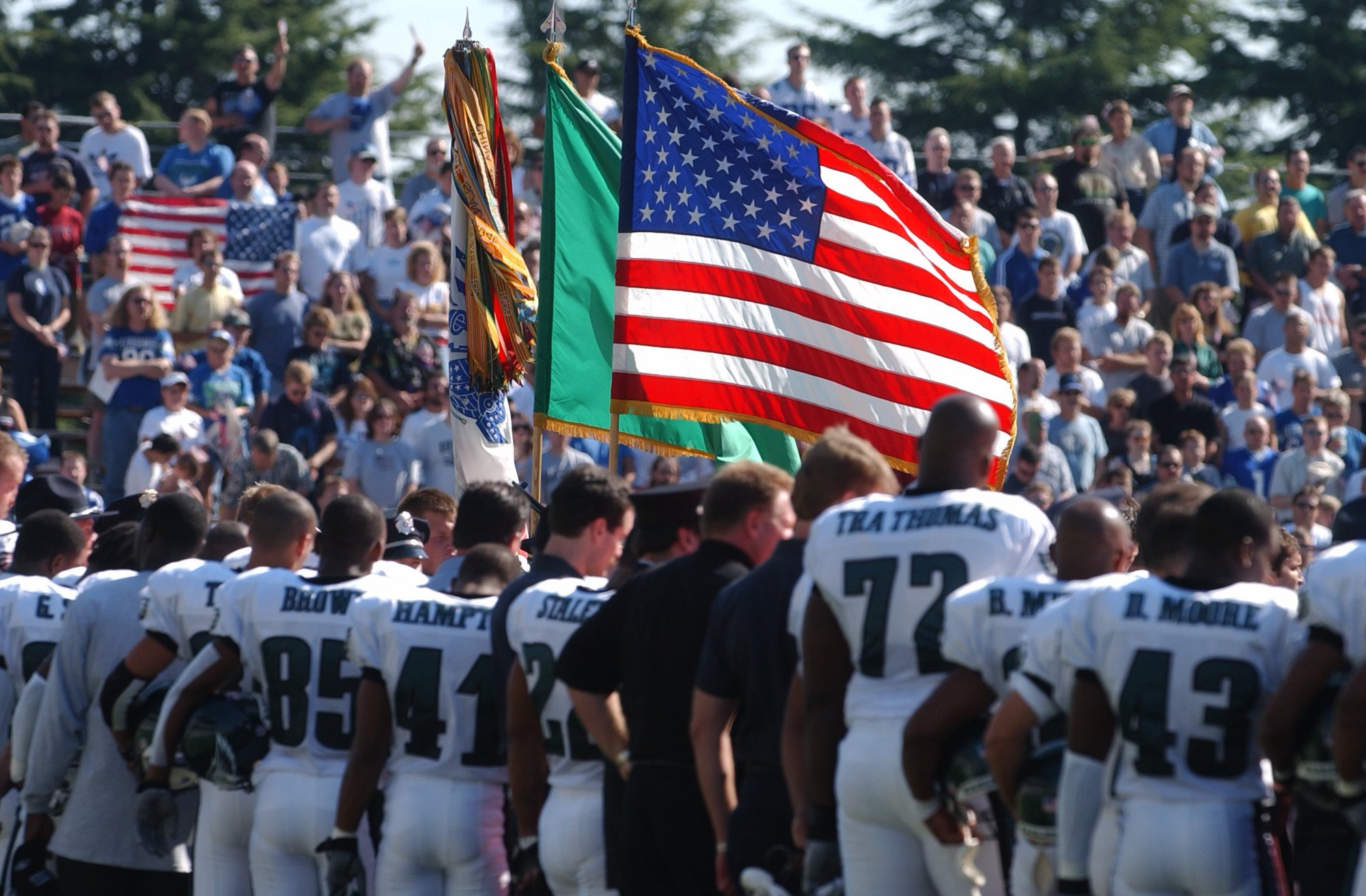
Eagles players line up during pregame ceremonies before the Eagles-Seahawks game on Sept. 23, 2001, the teams’ first game after the attacks.Ron Cortes / Staff Photographer
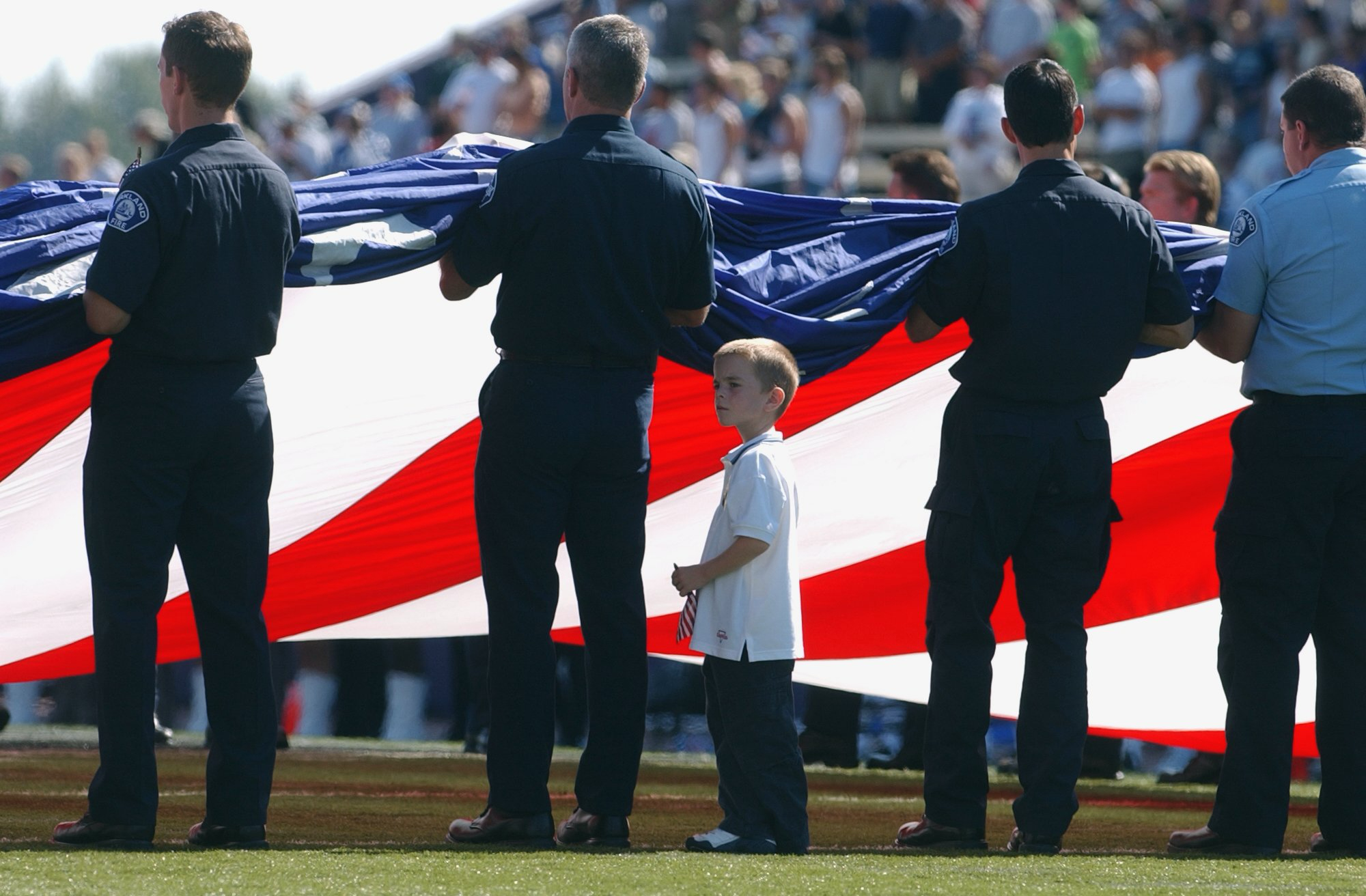
As with MLB, NFL playoffs were delayed by a week, so the Eagles made up their postponed game at Tampa in January after their final scheduled game of the regular season. Their first game after the attacks was in Seattle, where they played the Seahawks at the University of Washington stadium while their new stadium was being built. As in many stadiums that day, the pregame national anthem was performed as a giant flag that covered the entire field.
Who held it? Douglas, his teammates, and his coaches joined their counterparts from the Seahawks and dozens of first responders. Douglas had a hand on that flag, and he remains moved by that ceremony to this day.
“Just, I don’t know,” Douglas said. “Just a sense of pride.”
A giant American flag covers the field before the Eagles-Seahawks game at the University of Washington stadium during pregame ceremonies on Sept. 23, 2001.Ron Cortes / Staff Photographer
‘Tip your cap’
Pride: That’s what Bowa felt on Sept. 17. He’s proud that Philadelphia, the cradle of American democracy, was part of the return to sport. He’s proud that the franchise he played for and managed was, with the Pirates, the first team in the U.S. to resume, and he’s proud that baseball, America’s game, was the first front-line sport to restart.
Bowa is a hard man, but he understood the situation. He held a team meeting before the game and told the players that anyone who didn’t feel like playing didn’t have to; he understood. No takers.
The pregame left Bowa and Glanville shaken. As late Phillies broadcaster Harry Kalas delivered a moving pregame address to viewers, a montage compiled by “Video” Dan Stephenson helped settle the 27,910 fans at Veterans Stadium into their seats.
“People were in tears over that,” Glanville said.
It was the music that got to Bowa. He’d served in the U.S. Army Reserve as a young man, and his patriotism runs deep.
First, he recalled, there was Lee Greenwood’s “God Bless the USA” Then, right before the first pitch, with the teams lined up on the baselines, came “God Bless America” and the national anthem, performed back-to-back by — who else? — the star-spangled Valley Forge Chorus.
Phillies ace Robert Person went eight innings, gave up two runs, Jose Mesa got the save, and the Phillies won, 5-2, and drew to within two games of the Braves in the National League East.
Who’d they beat?
Braves legend Greg Maddux.
Glanville got a hit, Pat Burrell got two, rookie All-Star Jimmy Rollins scored a run, and MVP candidate Bobby Abreu tripled. But all of them — Person, Mesa, Glanville, Rollins, Abreu — they were just co-stars.
Nobody in baseball met the moment like Scott Bruce Rolen.
Chipper Jones’ homer gave the Braves a 1-0 lead in the first inning, but Rolen tied it with a leadoff homer in the second. He drove in Abreu from third base in the fourth for a 2-1 lead.
Then, with two out in the bottom of the sixth inning, Rolen homered again. The Phillies led, 3-2. The Vet rocked and rolled as Rolen returned to the dugout and, as ever, humbly took off his helmet. The crowd was nearly tearing the old stadium down, begging for a curtain call, but that just wasn’t the sort of thing Rolen did. Ever.
Bowa called Rolen over.
“Scotty,” he said, “you got to go out and tip your cap.”
Rolen replied, “Well, you know I don’t do that.”
“Scotty,” Bowa said, “this is something different.”