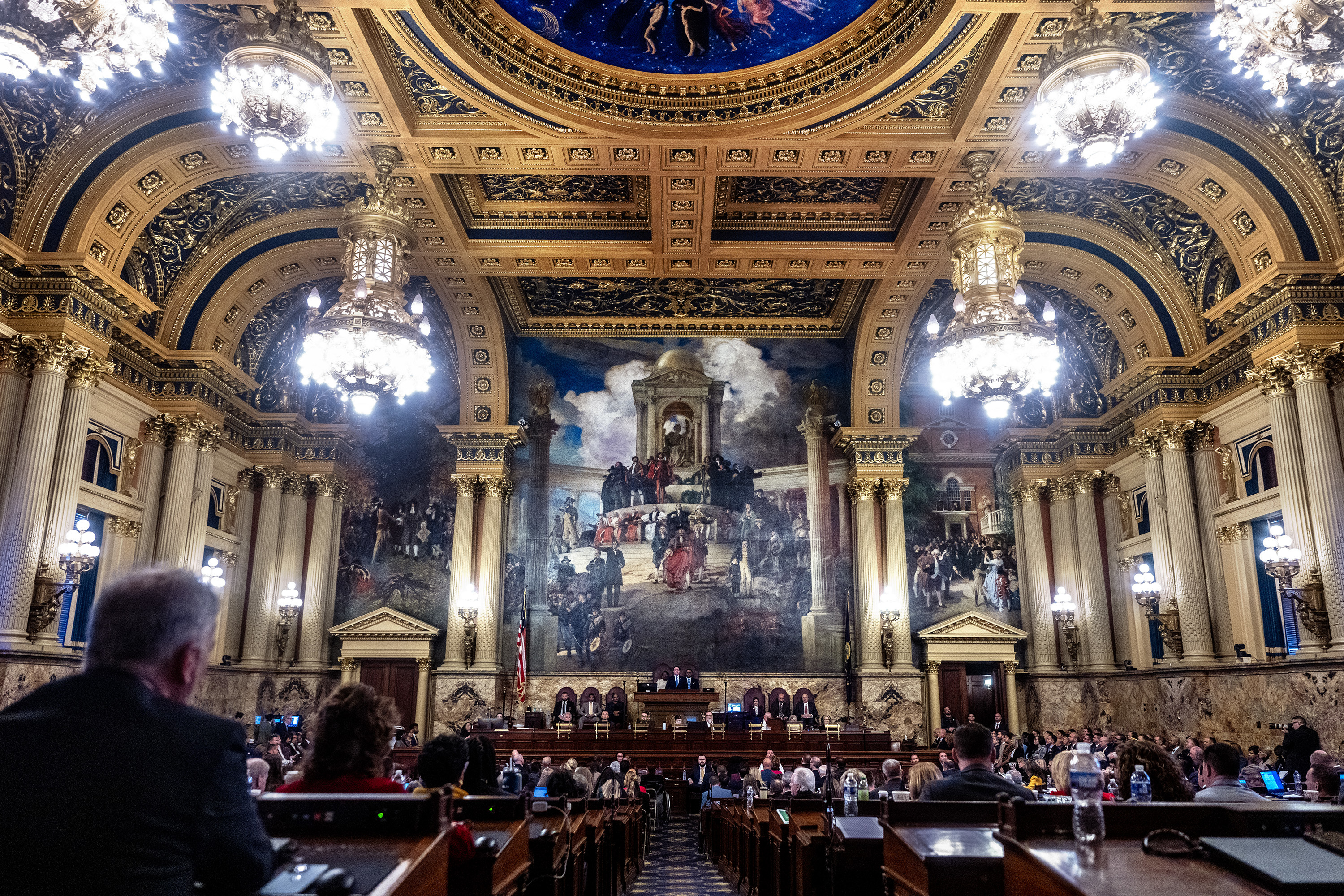
This essay is part of a series called “The Case for Impeachment,” which illuminates how Donald Trump has trampled the rule of law and is a clear and present danger to the republic.
President Donald Trump’s second term has left the Declaration of Independence and Constitution on life support.
He openly and notoriously proclaims that the sole constraint on his power is his moral conscience — not the Constitution, not the law, not the U.S. Supreme Court.
Trump’s impeachable lawlessness has become a way of life at the White House.
What other president has usurped the congressional power of the purse, including serial violations of the Impoundment Control Act of 1974 and the Anti-Deficiency Act, and illegally invoked the International Economic Emergency Powers Act and companion statutes to impose exorbitant tariffs for political, noneconomic reasons to evade congressional oversight?
And this is only the tip of the impeachment iceberg!
Doubting Thomases who dismiss impeachment maintain that Trump has been impeached and acquitted twice already, and the impeachment would be futile unless and until Democrats capture control of the House and Senate in the midterms.
The argument is unconvincing and ignores the many high crimes and misdemeanors Trump has committed since he returned to the White House.
A clear and present danger
Trump’s previous impeachments were for serious — but isolated — abuses of his power: a notorious phone call in which he pressured Ukraine’s president to investigate Joe Biden in return for American arms, and the conspiracy to overturn the 2020 election that culminated in the Jan. 6, 2021, insurrection at the U.S. Capitol.
Both should have resulted in his removal from office. But Trump 2.0 is even worse. He has turned the Constitution into a museum piece and claimed the infinite, unchecked power of a dictator.
Trump remains a clear and present danger. He is working to cancel or manipulate the midterm elections to keep Republicans in control of both chambers to head off investigations into his corrupt acts and avoid a third impeachment.
Trump has flirted with the Insurrection Act and related emergency statutes to justify dispatching the military to seize voting machines or paper ballots and to occupy voting places.
On Jan. 15, he mused, “We shouldn’t even have an election.”
If Trump is not removed from office, then the Constitution’s impeachment power will become a dead letter.
Trump is attempting to accomplish what the Confederate States of America failed to do in firing on Fort Sumter to destroy the Union and the Constitution.
Then, President Abraham Lincoln admonished in his second annual address to Congress, “We shall nobly save, or meanly lose, that last best hope on earth.”
Citizens and Congress in unity must awaken from their slumber and impeach Trump.
Bruce Fein is a former associate deputy attorney general under President Ronald Reagan and the author of “Constitutional Peril: The Life and Death Struggle for Our Constitution and Democracy.” Ralph Nader is an attorney, consumer advocate, and the author of more than two dozen books, starting with his 1965 best-seller, “Unsafe at Any Speed.”
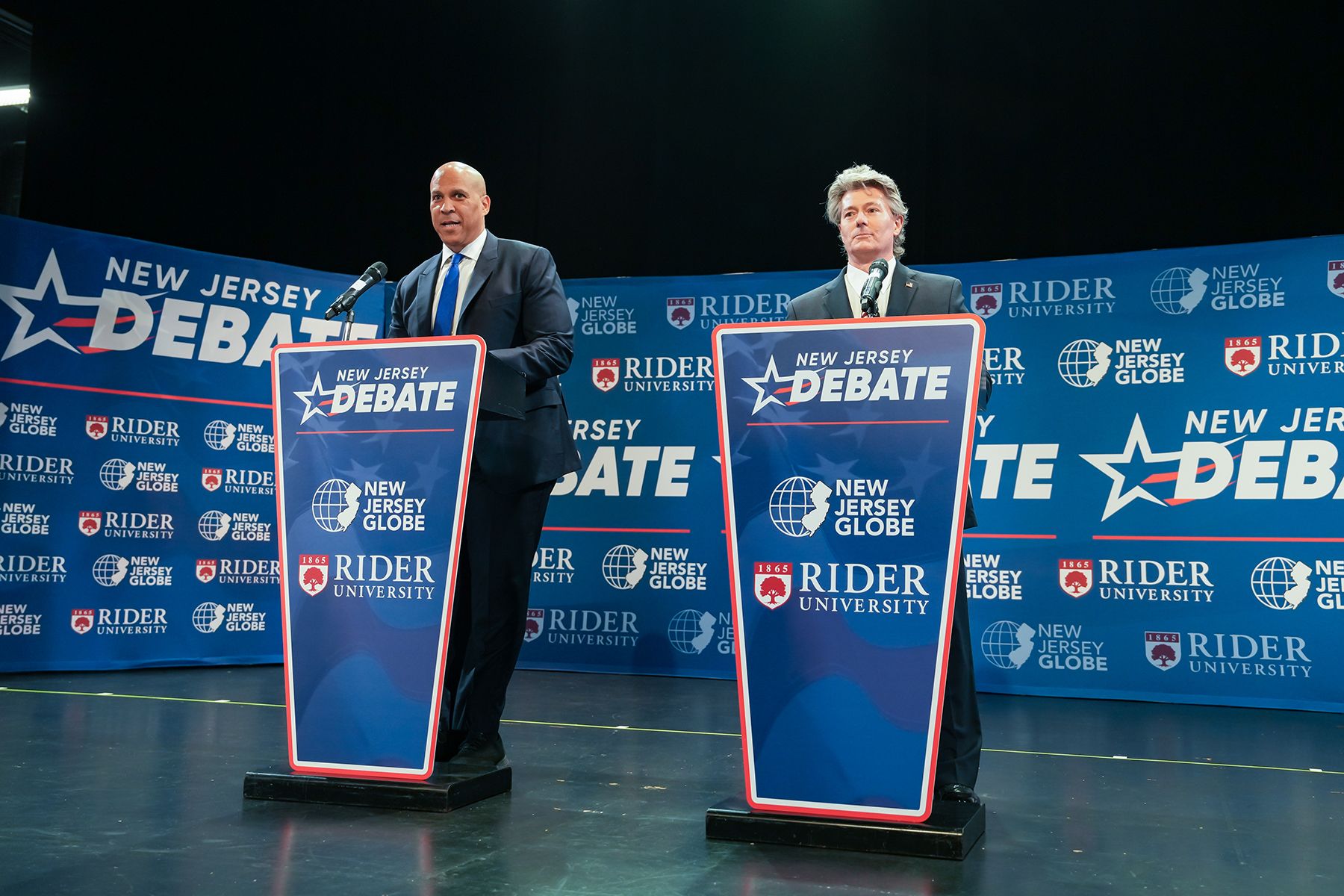
Democratic Sen. Cory Booker took to the stage Thursday for a debate with Justin Murphy, the South Jersey Republican mounting a long shot campaign to unseat the well-funded incumbent.
As of June 30, Booker raised more than $33 million while Murphy raised just over $27,000.
There are nearly 865,000 more Democrats than Republicans in New Jersey. The state’s electorate, as of June, includes 38% Democrats, 35% unaffiliated voters, and 25% Republicans.
The debate, which was hosted by the New Jersey Globe and Rider University and broadcast nationally by C-SPAN, lasted about one hour.
The moderators focused much of their questions onTrump’s policies.Booker criticized congressional Republicans, who he said have “enabled” the president. Murphy, on the other hand, praised the current economy — a stark contrast to Democrats’ messaging this campaign season.
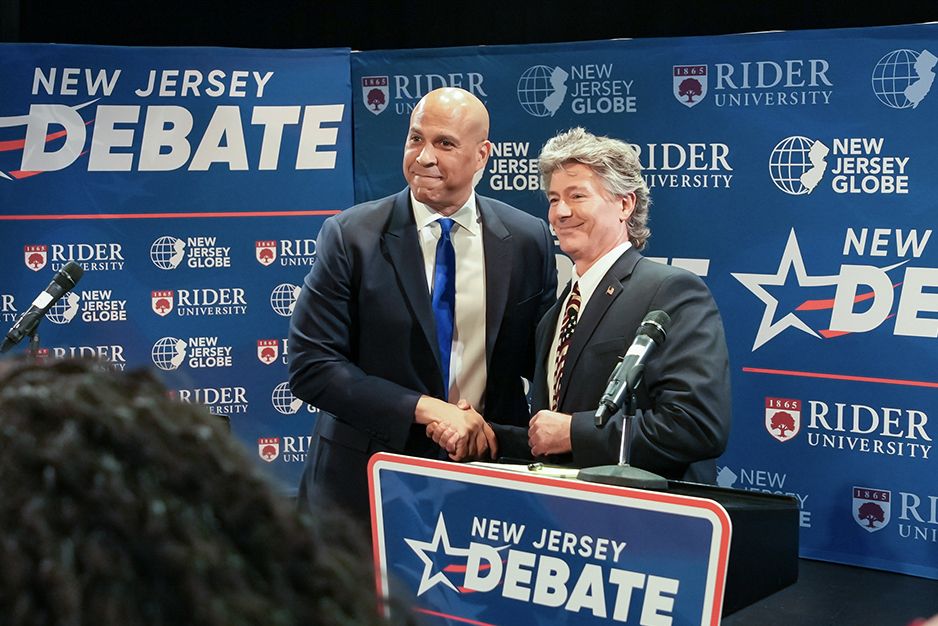
The two candidates were mostly civil, shaking hands and posing for a photo before getting started. Booker, who is bald, made a couple of jokes about Murphy’s voluminous head of hair.
The most raucous part of the debate was when audience members erupted during both Booker and Murphy’s remarks about the state’s sanctuary policy for immigrants.
Here are the highlights.
Sen. Cory Booker, left, and his South Jersey Republican challenger Justin Murphy, shaking hands on the debate stage Thursday night.Pete Borg / Rider University
Focus on Trump: His cabinet, Iran, and the Epstein files
Murphy supports Trump but said he’s not a “blind rubber stamp.” He admitted he is not well-versed on Trump’s cabinet picks or the Epstein files.
When asked about Trump’s cabinet members, the Republican said he trusts the president’s judgement but that he doesn’t know enough about them.
“I don’t know about their backgrounds. I couldn’t name them all for you right now,” he said.
“You’ve gotta be honest,” he added.
The Republican also said his knowledge is limited on the Jeffrey Epstein files, in which Trump is referenced thousands of times. Trump lobbied against releasing them to the public until it was clear he didn’t have enough support from his own party. Murphy said he supports the law that required the files to be released with redactions and exceptions — and supports an overall increase in transparency around them.
Booker had fierce criticism of the president on both subjects.
The incumbent said he voted for some of Trump’s appointees for his first term but the second time around, “something happened where it suddenly seemed like the standard he was creating for a cabinet position was loyalty to him.”
He said the Trump administration’s handling of the Epstein files was an example of Trump’s White House working to protect the president from valid inquiries “and as a sword to go after anybody that criticizes him.”
As for the Iran war, Murphy defended Trump but also said the president should wrap it up.
“Mr. President, put your cowboy hat on and get out there, and kick some … and get this done and done right,” he said to cheers from supporters.
Booker responded that Murphy’s attitude is precisely the problem, calling it a “false bravado.”
“We do not need yahoo policy,” Booker said. “We need sound people that use military force as a last resort, who know the power of diplomacy, who don’t insult your enemies and threaten to invade Canada and Greenland, but pull our allies together.”
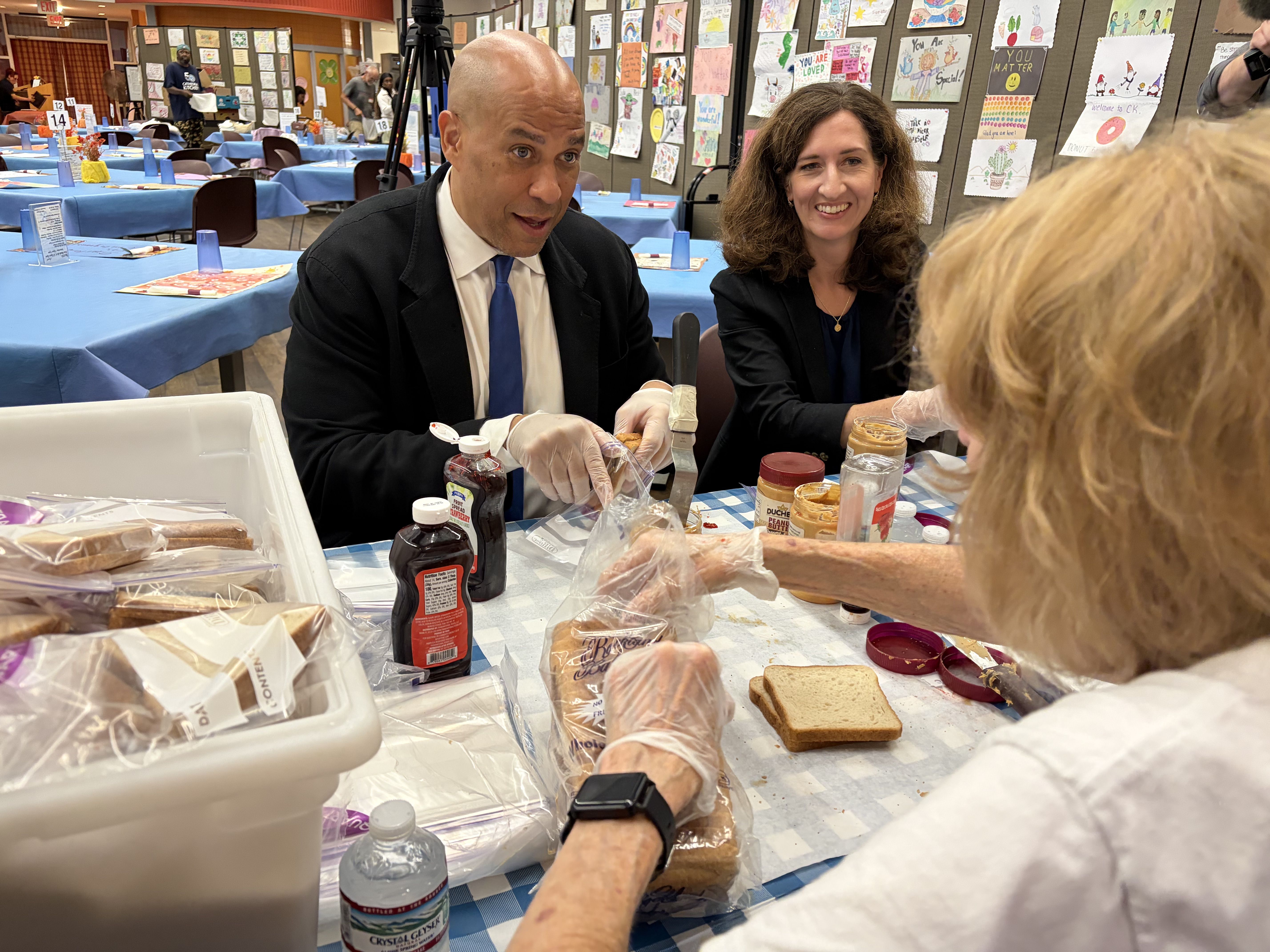
Sen. Cory Booker sits with volunteers at Cathedral Kitchen in Camden on Thursday, Aug. 27.Aliya Schneider / Staff
Housing policies
Sahmya Smith, a Rowan student and Passaic County voter, asked the candidates how they would address the racial wealth gap in New Jersey driven by home ownership disparities.
Booker touted bipartisan housing efforts including a new housing law and opportunity zones, the second of which he said resulted in affordable housing construction in Atlantic City.
“For me, as a guy who was the mayor of Newark, New Jersey, a majority minority city, we were able to double the production of affordable housing during the last housing recession we had in 2008, 2009, it’s something that I feel is really urgent right now,” he said.
He said that Trump’s trade war with Canada is driving up building costs.
Murphy said the best way towards home ownership “is being gainfully employed with low interest rates.” He said the Republican Party is providing the opportunity for the American Dream and that the country, referencing statistics from the Census Bureau that found that the median household income reached a historic high in 2025 since tracking began in 1967 and the poverty rate is the lowest it has been since tracking began in the 1960s.
That being said, the bureau also found that income inequality remained high, and the supplemental poverty measure — which considers non-cash benefits like food aid and household expenses — reached an all time low in 2021 under former President Joe Biden, AP reported.
“We continue to empower people through economic empowerment and betterment,” Murphy said, citing tax relief on tips, overtime, and Social Security benefits. He also noted that there should be more housing supply.
Candidate Justin Murphy, in the suit, at a Pinelands Republican Club event on Jan. 29, 2025.Aliya Schneider / Staff
Sanctuary state
New Jersey’s Immigrant Trust Directive, known as the state’s sanctuary policy, limits state law enforcement’s cooperation with federal immigration officers. Booker said the policy made immigrants feel more comfortable contacting law enforcement to report crimes, but that people feel unsafe again because of ICE immigration sweeps directed by Trump.
“My first priority is keeping New Jersey towns, municipalities, and cities safe, and to do that, I believe the policies of our state are good in keeping bright lines between what is a federal responsibility and what is a county and state and local responsibility,” he said.
Someone off camera shouted that they had to “butt in” and verbal chaos erupted with shouts from the audience.
Murphy said sanctuary policies “are a magnet for criminal illegal aliens,” even though “not every illegal alien is in this country to do us harm.”
“Sanctuary jurisdictions are a problem. They incentivize illegal immigration, and I don’t believe they help our state stay safe,” he added.
As he elaborated on his stance, another interruption erupted from the audience. Murphy responded by saying his position is “not xenophobia.”
Murphy recently received heat from Democrats for comments he made at an August town hall hosted by the Morris County GOP, saying “Islam creates a problem” in response to a question that mentioned a “big Muslim problem.”
Booker at the time called Murphy’s remarks “vile.” Murphy told Politico he intended to reference “radical Islam” and not all Muslims.
A nonpartisan election tracker shifted its ratings forthree competitive U.S. House races in Pennsylvania toward Democrats Friday morning, a sign of growing momentum for the party ahead of next month’s make-or-break midterm elections.
The Cook Political Report changed its ratinginBucks County’s 1st Congressional District race —where Democratic County Commissioner Bob Harvie is challenging longtime GOP incumbent U.S. Rep. Brian Fitzpatrick — to “lean” Republican after it had been sitting at “likely” Republican for most of the cycle.
That means Fitzpatrick still remains favored to win reelection, but his chances are less sure than previously thought. Meanwhile, Democrats look poised to flip other seats in the state.
In itsanalysis, the Cook Political Report said while Fitzpatrick still has the “chops” to win — and outperform his party like he has consistently done before — the 1st District race “could be quite close.”
“Democrats, who have more offensive targets on the map than they can afford to spend in, have another reason to believe this race is worth their investment,” according to the report. “If Harvie can pull off an upset this cycle, Democrats have a better shot at holding on to this seat in the long term than they do in other reach seats.”
Fitzpatrick’s campaign didn’t immediately comment on the analysis.
The last time a Democrat represented the Bucks County area was 2011.
The new ratings in the Pennsylvania contests were announced along with 15 other U.S. House races nationwide that Cook has shiftedin Democrats’ favor.
The Lehigh Valley’s 7th District and the Harrisburg-area’s 10th District have alsomoved from toss-up to “lean” Democrat in Cook’s rating. The 8th District in the Scranton area remains rated as a toss-up.
Harvie is also seeing increased financialsupport from the Democratic Congressional Campaign Committee.
In a statement, Harvie said that “the momentum behind our campaign is real and growing by the day,” noting his intent to vote to end the Iran war and “fight the corruption that is costing Pennsylvanians” if he were to be elected.
National attention from both parties still remains on the 7th District race between Democrat Bob Brooks and GOP U.S. Rep. Ryan Mackenzie, who is considered one of the most vulnerable Republicans in the countrythis cycle.
Asked about the rating, Benny Stanislawski, a spokesperson for Brooks, said “Bob Brooks spent 20 years putting out fires in Bethlehem, so he knows the job isn’t finished until the flames are fully put out.”
Andres Weller, Mackenzie’s campaign manager, said in a statement that “This race will be determined by voters, not political prognosticators” and that voters in the Lehigh Valley and Poconos will not elect Brooks.
Johnson, the Louisiana Republican who has held the speakership since 2023, campaigned for Mackenzie in the 7th District this week and for U.S. Rep. Rob Bresnahan in the 8th as he fends off a challenge from Scranton Mayor Paige Cognetti. Johnson also campaigned in support of U.S. Rep. Scott Perry in the 10th District in his rematch with Democratic challenger Janelle Stelson.
“This race is far from over – we will fight through November 3rd to send Scott Perry packing,” said Alma Baker, Stelson’s campaign manager, in a statement.
A spokesperson for Perry did not respond to a request for comment.
With one month left and an expanding map of battleground districts across the country, the fight for control of the U.S. House has arrived in Pennsylvania in full force.
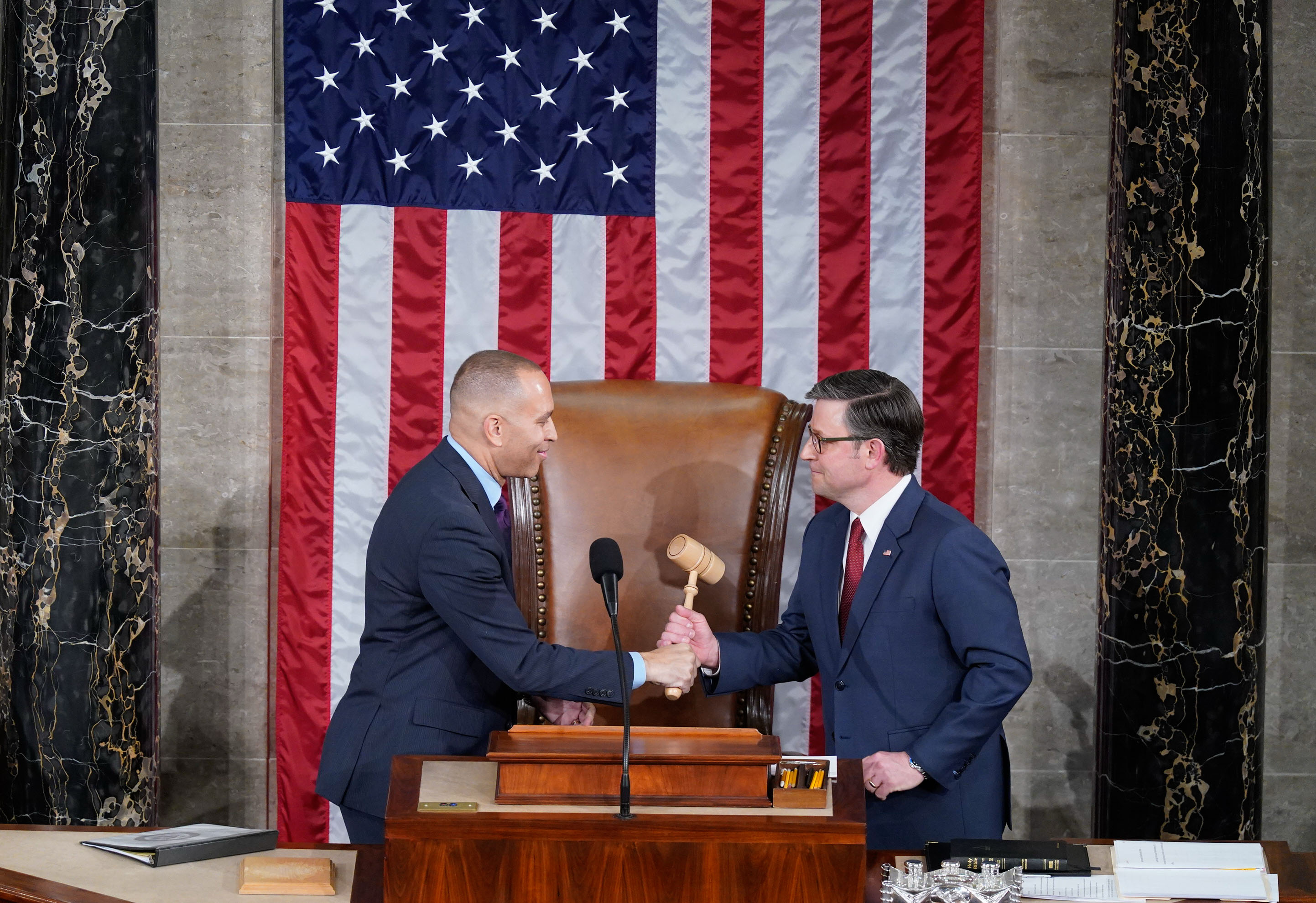
Republican House Speaker Mike Johnson and House Democratic leader Hakeem Jeffries — battling it out for the gavel come January — were bothkicking off the final push of Pennsylvania’s midterm elections this week, signaling the Keystone State’s importance in determining party control of the chamber, which Republicans have held since 2023.
Jeffries will visit Lower Bucks on Saturday to give a high-profile boost to Democrat Bob Harvie in his challenge against Republican U.S. Rep. Brian Fitzpatrick in the Bucks County-based 1st Congressional District.
The Democratic leader will appear alongside Gov. Josh Shapiro, marking the Democratic governor’s second weekend in a row in Bucks. Shapiro’s visit to Langhorne last week intensified the attention on the 1st District when he stumped for Harvie and other Democrats in competitive downballot races that could have determinative outcomes.
Jeffries’ visit follows Johnson’s time Tuesday in each of the four competitive Pennsylvania districts that Republicans are trying to defend, including a private meeting with Fitzpatrick in Bucks and public events with the other swing-district Republicans. The House speaker’s Pennsylvania stopslaunched a seven-state tour this week, as Democrats expand the districts they are targeting across the countryand the GOP goes on the defensive.
Johnson’s and Jeffries’ respective affiliated campaign organizations, meanwhile,are spending millions of dollars to flood the Pennsylvania airwaves in the coming weeks. That includes a new, nearly $1 million cash infusion for Harvie — a sign that Democrats see potential for a nationwide blue wave to oust Fitzpatrick after several failed attempts.
The National Republican CongressionalCommittee, for its part, has invested $120,000 in partnership with Fitzpatrick, who also has his own massive war chest, as the group prioritizes three other competitive districts in the state.
“We’ve seen this in past wave conditions where triage starts to happen,” said Chris Borick, a political science professor at Lehigh University. “It becomes a math game. How much do we have left in resources? Where is it going to make a difference?”
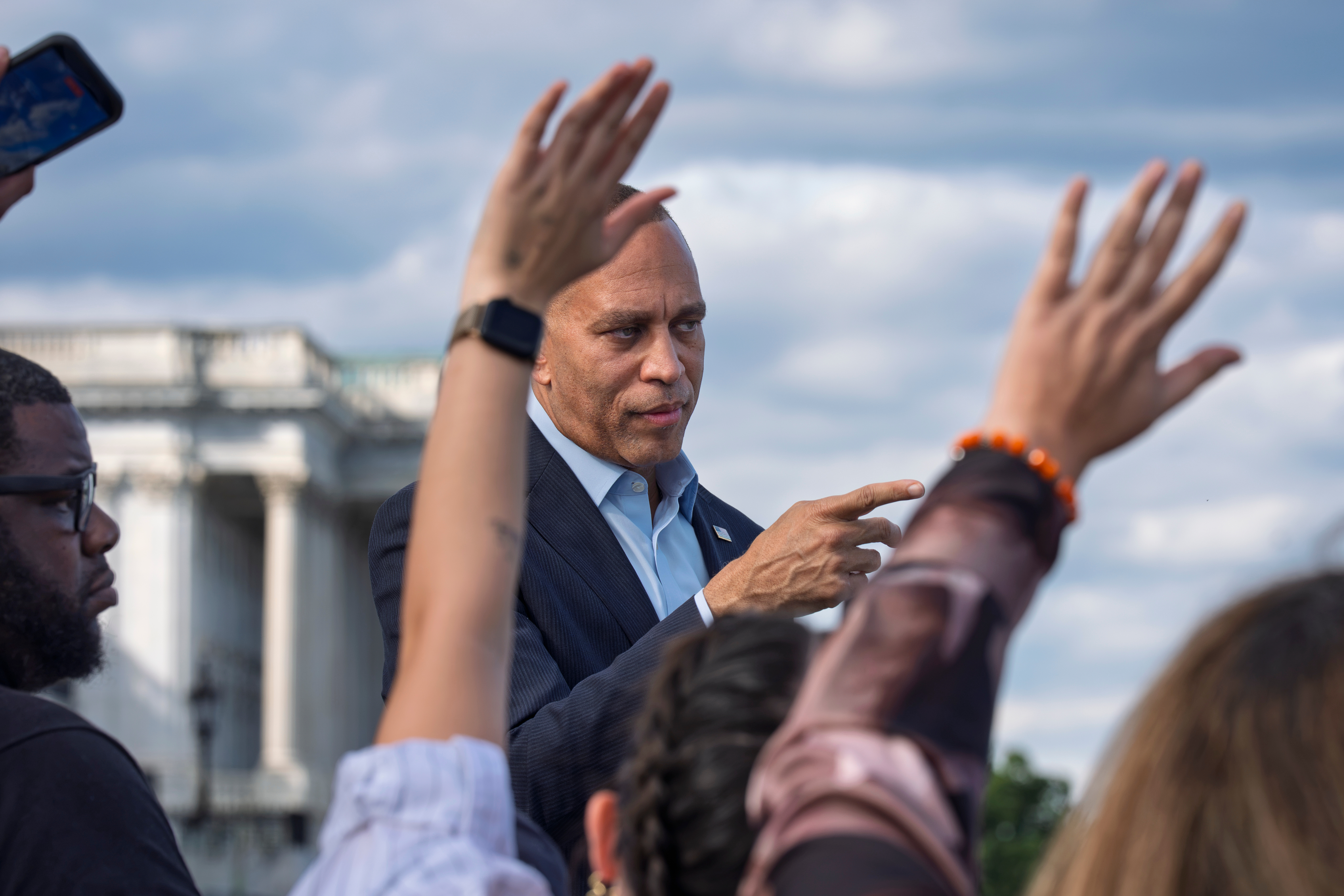
House Democratic Leader Hakeem Jeffries (D, New York) and House Speaker Mike Johnson (R, Louisiana) are traveling to key congressional districts in Pennsylvania.Jabin Botsford
The battle for the gavel
Johnson, a Louisiana Republican who has led the House since 2023, is trying to defeat the odds and preserve a narrow majority as a largely unpopular president from his party sits in the White House.
On Tuesday, he went to a Harrisburg diner and college campus with U.S. Rep. Scott Perry (R., York), a diner and Fraternal Order of Police headquarters in Bethlehem with U.S. Rep. Ryan Mackenzie (R., Lehigh), and a rally at a local Hazleton business with U.S. Rep. Rob Bresnahan (R., Luzerne). Johnson’s office confirmed he also met with Fitzpatrick, though they did not hold a public campaign event and Fitzpatrick’s campaign did not return a request for comment.
Though he votes with President Donald Trump and his party most of the time, Fitzpatrick is the last remaining Republican representing a Philadelphia suburb — one of the swingiest in the state. It is a political dynamic that has let him distance himself from Johnson and Trump more than any other GOP lawmaker from the state — or in the country — as he runs on a record of bipartisanship in a district that former Vice President Kamala Harris won in 2024.
Even in the other three competitive seats that Trump won, Johnson’s appearance is a risky maneuver, Borick and others say.
Sam Chen, an Allentown-based GOP strategist, worked for a candidate whom Mackenzie defeated in the Republican primary two years ago. He said the freshman lawmaker is a “formidable campaigner” who could benefit from any fundraising and get-out-the-vote message from a national figure like Johnson. But it might be only a “moderate” benefit considering voters are largely unhappy with Republican messaging on issues like affordability and the war in Iran, he said.
“I don’t think Mike Johnson is the right spokesperson for this. I don’t think the administration at all, or anyone in Republican leadership, has messaged this correctly,” Chen said. “They’re doing it the same way Joe Biden messaged it back when Harris lost in ’24. So [Johnson serving as a campaign surrogate] could backfire in that it might drive some Democrats to vote.”
Democrat Bob Brooks, the Lehigh Valley firefighter and union leader running against Mackenzie, was an early focus for the party as Jeffries and Shapiro rallied in support of the candidate in July, with the House leader declaring the 7th as the key place to kick off Democrats’ final 100 days of battle for the midterms.
The race, long considered a toss-up by nonpartisan national groups that evaluate elections, recently shifted to one that “leans Democratic,” according to the Center for Politics at the University of Virginia. The change followed a Franklin and Marshall College poll that found Brooks leading Mackenzie 45% to 40%.
Republican Rep. Rob Bresnahan, R-Pa., speaks before President Donald Trump arrives at the Mount Airy Casino Resort in Mount Pocono, Pa., Dec. 9, 2025.Matt Rourke
That optimism has filtered to Bucks County, where Fitzpatrick’s brand has made him popular among Republicans and Democrats. The Democratic Congressional Campaign Committee, the official campaign arm associated with Jeffries (D., N.Y.), has not helped fund a challenger to Fitzpatrick since 2020, but it now intends to invest about $900,000 to boost Harvie, according to a source familiar with the plans.
“Democrats now are thinking, ‘If we could be competitive in Nebraska and we could be competitive in Kansas and Texas, why can’t we be competitive in the Pennsylvania 1st Congressional District?’” Borick said. “Bucks County’s more amenable than Nebraska.”
Before the latest shift in sentiment, it was unclear whether Harvie — a twice-elected Bucks County commissioner whom Democrats saw as a key recruit this year — would receive competitive levels of support. Previous campaign finance reports show he lagged in fundraising compared with the Democratic challengers in the other swing districts.
Meanwhile, Fitzpatrick out-raised all candidates running in the four districts and has unleashed an unrelenting stream of ads targeting Harvie, a major shift from his previous campaigns. His campaign has allocated $4.5 million for ads from June through Election Day, according to the tracking firm AdImpact.
He spent a little more than $460,000 in total in his reelection bid two years ago. But as of this week, Democrats planned to outspend Republicans $8.4 million to $5.2 million through Election Day in the race — including Fitzpatrick’s spending — though reserved ad time in the next few weeks could change.
Out of more than $87 million worth of ads already spent or planned to be spent in all four races between June 1 and Nov. 3, the $13.6 million in the Fitzpatrick-Harvie matchup represented the smallest piece of that pie, according to The Inquirer’s review of spending tracked by AdImpact.
Where Johnson’s trip could help at this point, Borick said, is in fundraising — a strategy that became evident when Johnson said in a recent video that Mackenzie was running “one of the most important races in all of America” and Mackenzie immediately turned to asking viewers to donate through his website.
Videos that Johnson filmed with Bresnahan and Perry also aimed to lay out the stakes. Next to Bresnahan, the speaker called the contest in the Scranton-based district “one of the top five races in America.” Johnson,filmed in the Harrisburg-based district, nodded as Perry — a hard-line conservative — called the election “a choice between common sense and absolutely crazy.”
Perry faces a tough November rematch with former TV anchor Janelle Stelson, whom he beat by roughly 1 percentage point when Trump carried the state in 2024. And Bresnahan, who also won his seat narrowly last election, is running against Scranton Mayor Paige Cognetti in the closely watched race.
Eugene DePasquale, the chair of the Pennsylvania Democratic Party, said in a statement that Johnson’s visit showed the speaker was “doing everything he can to bail out the four members after they sold out their constituents to help him raise costs and cut healthcare.”
In the race between Mackenzie and Brooks, the $27.8 million in general election ad spending was more than twice the 1st District outlay. The GOP has allocated $17.1 million to that race, while Democrats have earmarked $10.5 million for the general election.
Jeffries’ visit will likely aim to boost Harvie’s campaign coffers. Chen, the Republican strategist, said it also would be wise for it to represent something of a course correction after Harvie’s ads have focused on attacking Fitzpatrick — who is largely popular — rather than highlighting the stakes of the race.
“Jeffries, if he’s smart, he’s going to come in and [say], ‘Hey, I know you might like Fitzpatrick. I know you guys might respect him. You respect that he calls out the president. But at the end of the day, we have to change the majority. Even if he’s a naysayer to the president’s agenda, it doesn’t help if we don’t have the majority,’” Chen said.
This essay is part of a series called “The Case for Impeachment,” which illuminates how Donald Trump has trampled the rule of law and is a clear and present danger to the republic.
Let’s start with the obvious: The chances of removing President Donald Trump from office are slim.
The failure of impeachment to meaningfully check corrupt or tyrannical presidents because of partisan acquittals may be the Constitution’s greatest modern failure. It is a betrayal of the principles that inspired the Declaration of Independence and the Constitution.
No kings
Fundamental to our founding is the idea that presidents are not kings — that no one is above the law, unaccountable for wrongdoing, or wields unchecked power.
That principle was fundamental to American independence. As the Declaration of Independence proclaimed, “The history of the present King of Great Britain is a history of repeated injuries and usurpations, all having in direct object the establishment of an absolute Tyranny over these States.”
Reciting a “long train of abuses and usurpations” and a “design” to place the American colonies “under absolute Despotism,” the declaration concluded that a king “whose character is … marked by every act which may define a Tyrant, is unfit to be the ruler of a free people.”
U.S. Rep. Liz Cheney (R., Wyo.) speaks to the media, along with (from left) U.S. Reps. Elaine Luria (D., Va.), Pete Aguilar (D., Calif.), Jamie Raskin (D., Md.), Adam Kinzinger (R., Ill.), and Chairman Bennie Thompson (D., Miss.), after the first hearing of the House Select Committee to Investigate the January 6th Attack on the U.S. Capitol.Jacquelyn Martin
That same spirit drove the Constitution’s framers to make presidents accountable through impeachment. As James Madison wrote in The Federalist Papers No. 47, “[t]he accumulation of all powers, legislative, executive, and judiciary, in the same hands … [may] justly be pronounced the very definition of tyranny.”
Madison approvingly quoted Thomas Jefferson, the declaration’s primary author, in The Federalist Papers No. 48: “An elective despotism is not the government we fought for … the powers of government should be so divided and balanced among several bodies of magistracy as that no one could transcend their legal limits without being effectually checked and restrained by the others.”
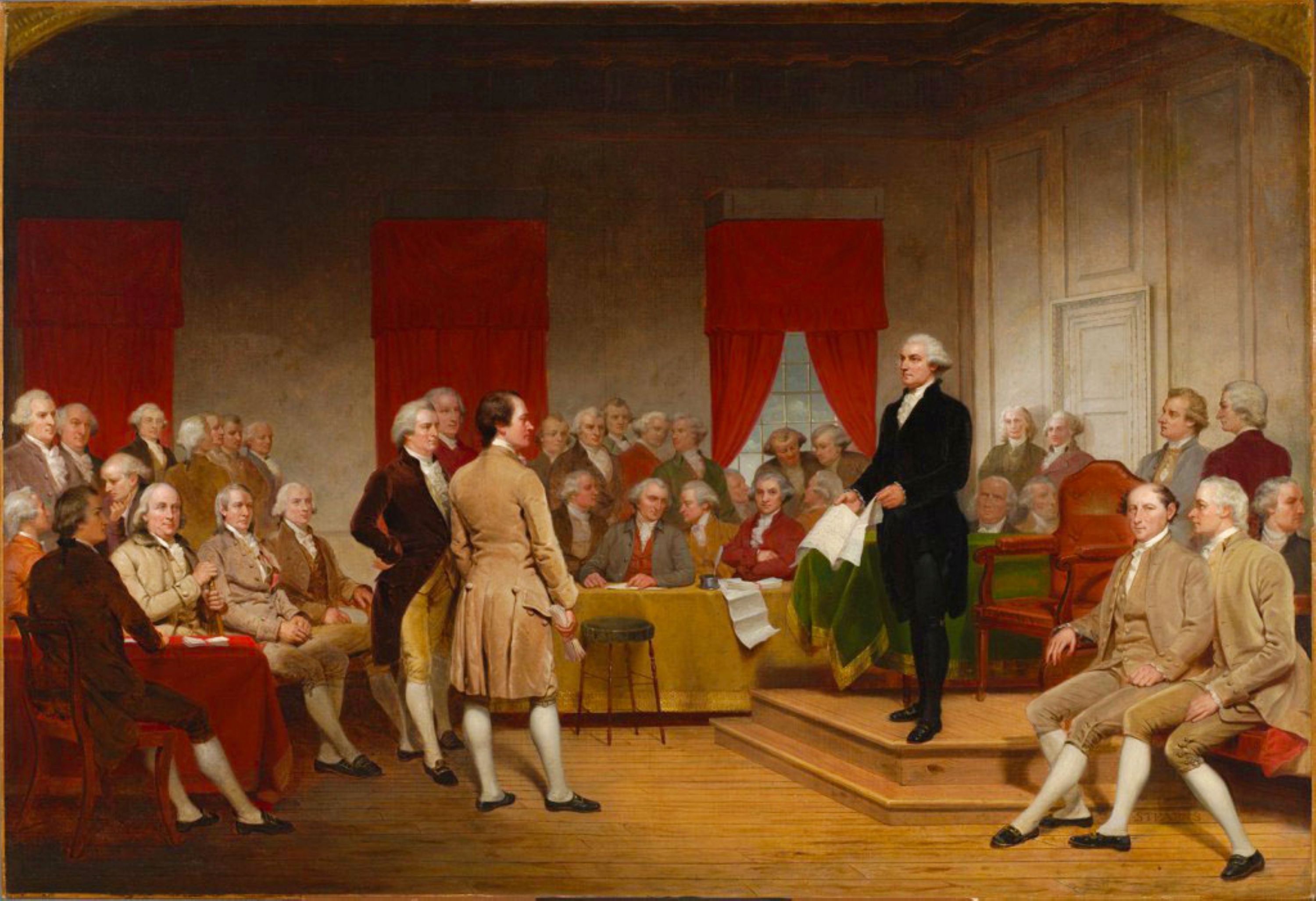
At the Constitutional Convention, George Mason foreshadowed Madison’s concerns: “No point is of more importance than that the right of impeachment should be continued. Shall any man be above Justice? Above all shall that man be above it, who can commit the most extensive injustice?”
The Constitution’s standard for impeachment — “Treason, Bribery, or other high Crimes and Misdemeanors” — is broad but not vague. Each term has a clear meaning drawn from long-standing English legal practice. Taken together, they embrace a wide range of culpable misconduct not limited to statutory crimes.
Impeachable offenses included deliberate violations of the Constitution, willful departures from sworn duty, abuses of power, self-dealing, bribery, corruption, any compromise of public interest for personal gain, being in the pay of foreign powers, or betraying national interests in foreign dealings.
As Alexander Hamilton explained in The Federalist Papers, impeachment could “never be tied down by such strict rules, either in the delineation of the offense by the prosecutors or in the construction of it by the judges, as in common cases serve to limit the discretion of courts in favor of personal security.” Congress has complete discretion over the rules, most procedures, and grounds (however, the House frames them) for impeachment proceedings.
Indisputable evidence
That Trump has committed impeachable offenses is indisputable. He has repeatedly violated the Constitution, usurped power, defied laws and judicial rulings, failed to execute laws, abused the pardon power, abused prosecutorial powers to target political enemies, issued executive orders and coerced “deals” targeting First Amendment freedoms, denied due process, started wars with other nations without congressional authorization, threatened and abandoned friendly nations and alliances, and engaged in corrupt self-dealing for financial, personal, and political gain to unprecedented degrees.
Trump’s misconduct is at the center of the constitutional bull’s-eye of impeachable wrongdoing — encompassing the core types, severity, and number of misdeeds the standard was designed to cover.
If Trump’s misconduct does not warrant impeachment, nothing does.
Constitutional constraints are meaningless if unenforced. If presidents are free to act as tyrants, the rule of law in America, including the Constitution, is dead. While President Trump’s successful impeachment and conviction seems beyond reach today, circumstances do change — sometimes dramatically and suddenly, making what had once been politically impossible newly achievable and even imperative.
We should stand ready to act.
Michael J. Gerhardt is a constitutional law professor at the University of North Carolina — Chapel Hill and author of several leading treatises on impeachment, including a new paperback edition of his book, “The Law of Presidential Impeachment: A Guide for the Engaged Citizen.” Michael Stokes Paulsen is the distinguished university chair and professor of law at the University of St. Thomas.
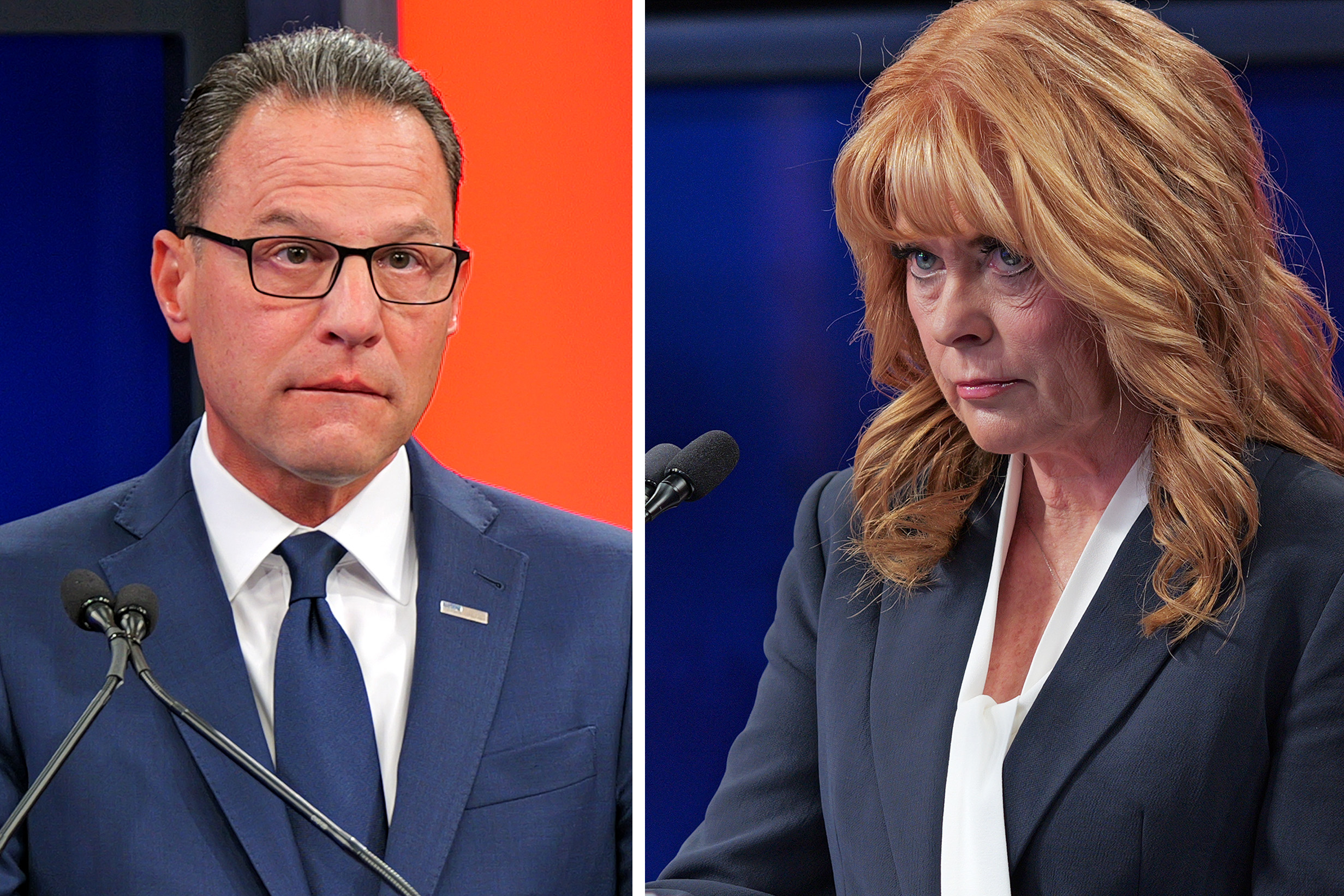
HARRISBURG — Gov. Josh Shapiro and State Treasurer Stacy Garrity on Wednesday sparred over President Donald Trump’s leadership, soaring gas prices, the state budget deficit, and other top issues facing Pennsylvania in their only scheduled debate before Election Day.
And at one point, the gloves came off.
In the wide-ranging and mostly even-tempered debate, Garrity, a Republican who is in her second term as the state’s top fiscal officer, turned to Shapiro after he swiped at her, accusing her of taking direction from Trump by denying the results of the 2020 election. (Garrity in 2022 told a crowd at a Trump rally that “we know that he won” but has since walked back those comments.)
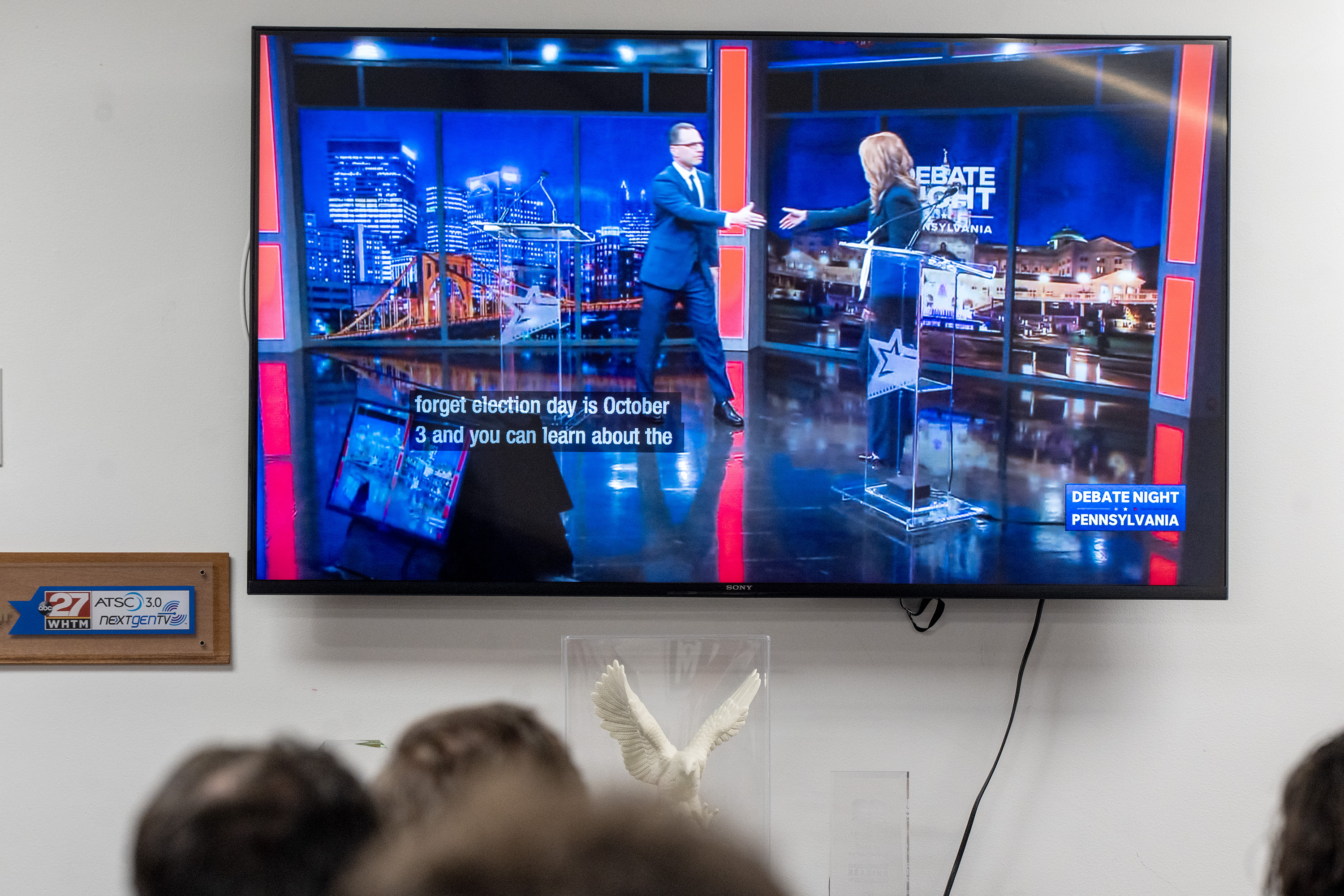
“I don’t even know why you’d say that, and how you can look yourself in the mirror at night,” Garrity said, turning to look at Shapiro across the abc27 studio in Harrisburg, in one of the most heated moments of the night.
Gov. Josh Shapiro and Republican challenger Stacy Garrity at the WHTM-TV studios in Harrisburg Wednesday, Oct. 7, 2026, during their lone debate ahead of next month’s gubernatorial election.Kaylee Lindenmuth / WHTM
The debate, moderated by abc27’s Dennis Owens and WPXI’s Lisa Sylvester, came as Shapiro maintains a double-digit lead in statewide public opinion polls of likely Pennsylvania voters ahead of the Nov. 3 midterm election, including a 25-point advantage over Garrity in a Quinnipiac University poll released Wednesday.
The televised debate, broadcast and streamed for free statewide, marked a consequential night for both candidates. Garrity needed to give an attention-grabbing performance to bring more eyes — and resources — to her struggling campaign. And the night presented Shapiro, who has long been rumored to have his eyes on a White House bid, the chance to show political observers whether he could compete on a crowded Democratic presidential primary stage.
Here are four takeaways from the debate.
With a potential 2028 run, Shapiro doesn’t promise to fulfill another four-year term
Shapiro, 53, from Abington Township, again declined to say whether he would fulfill another full, four-year term as governor if reelected. A well-rehearsed orator with two decades of political experience, Shapiro gave the debate’s moderators the same answer he has repeated to reporters for months:
“The only thing I am focused on is running for reelection as governor,” he said, before restating his frequent refrain about Trump’s chaos, cruelty, and corruption.
Gov. Josh Shapiro meets with patrons alongside Michigan Gov. Gretchen Whitmer inside Sam’s Morning Glory Diner in South Philadelphia on Friday, Sept. 25, 2026.Aidan T. Gallo / Staff Photographer
Wednesday’s debate took place on the third anniversary of the Oct. 7, 2023, attacks by Hamas on Israeli civilians that marked the start of the war in Gaza — a conflict that has divided Democrats nationally and is certain to remain a top issue in the years ahead.
Shapiro, who is Jewish, was asked by the moderators about a recent Inquirer-New York Times-Siena poll that found 60% of likely Democratic voters in Pennsylvania do not want the U.S. to provide economic and military support to Israel.
After firstlamenting the attacks, Shapiro dodged the question. When he was asked for clarity, Shapiro said he wants “America to have a strong relationship with Israel and with the Israeli government,” which he does not see as possible under Prime Minister Benjamin Netanyahu, whom he has criticized for years.
“I’ve been very, very, consistent in my position, in my love of Israel, and also in my disagreements with the Netanyahu government,” Shapiro said, adding that he hopes Israel chooses a new leader in its forthcoming election.
Garrity, for her part, opened her first response of the night — to a question about data centers — by recognizing “the lives that were stolen” in the Oct. 7, 2023, Hamas attacks.
Garrity distances herself from Trump
Garrity, 62, a retired U.S. Army colonel from Bradford County in Northeastern Pennsylvania, was endorsed by Trump in January and has remained largely loyal to him.
Shapiro’s campaign has seized on this support, running millions of dollars’ worth of negative ads calling her “100% MAGA.” Garrity, meanwhile, has no ads on TV with less than a month before the election, as she struggles to fundraise during an especially challenging midterm year for Republicans.
State Treasurer and Republican candidate for governor Stacy Garrity is seen on a big screen as she speaks to supporters before the arrival of President Donald Trump at Mack Trucks in Macungie on Tuesday, June 23, 2026.Tom Gralish / Staff Photographer
In an interview last month, Garrity said that she would have taken a different, “more targeted” approach to instituting tariffs on other countries, and she has called for a pause on development of data centers, in contrast to Trump’s embrace of them.
During the debate, she also put an arm’s length between herself and members of Trump’s cabinet, including Health and Human Services Secretary Robert F. Kennedy Jr., with whom she stood with at a “Make America Healthy Again” rally in Harrisburg earlier this year.
Garrity on Wednesday said she is vaccinated against measles, mumps, and rubella, and added that she does not share all of Kennedy’s views and that she attended the event to promote healthier food choices for children.
Blame game
Shapiro during his first term has frequently highlighted his ability to bring Democrats and Republicans together, as one of few governors leading a state with a politically split legislature, where Democrats control the House and Republicans control the Senate.
But he has struggled to forge consensus when it comes to solving some of the top issues facing Pennsylvania, including funding mass transit and taxing and regulating skill games. Garrity jabbed at that point multiple times during the debate.
“The governor has consistently … used the excuse that he can’t do anything because he has a divided legislature,” Garrity said. “Well, that’s not what real leadership is. Real leadership, they call the leaders to the table and you negotiate.”
During the debate, Shapiro blamed the legislature for its inaction on: voter ID, establishing new penalties for second-degree murder, temporarily halting the state’s gas tax, and regulating skill games.
Gov. Josh Shapiro delivers his third budget address to a joint session of the state House and Senate in the House chambers at the State Capitol Tuesday, Feb. 4, 2025.Tom Gralish / Staff Photographer
As the candidate at the top of the ticket, Shapiro is campaigning for Democrats up and down the ballot in hopes of flipping the state Senate to Democratic control for the first time in more than 30 years. If Democrats are successful, Shapiro would get the chance to lead a Democratic trifecta in Harrisburg, with the ability to more easily address the party’s top priorities, such as increasing the minimum wage and codifying abortion rights in the state constitution.
Shapiro has negotiated four budgets with the divided General Assembly through the state’s tough fiscal conditions, including one budget impasse over mass transit funding that lasted nearly five months and led to closures and pauses of state services. He noted that he brought lawmakers together to cut taxes for seniors, working residents, and start-up businesses.
“I’ve got a strong track record of bringing Democrats and Republicans together to cut costs for the good people of Pennsylvania, and in a second term, we’ll continue our work to cut taxes, not raise them,” he added.
As for why some Pennsylvanians are struggling, he pointed to Trump’s leadership, his tariffs, and his war in Iran — all of which Garrity supports, he said. (Garrity has recently begun criticizing some of Trump’s tariffs and has said she hopes the war ends soon.)
When asked how he would help make up the state’s budget deficit, Shapiro said: “There’s some priorities that the Republican Senate put in that I would likely cut. We’ll see what the makeup of the legislature looks like next year.”
He also rejected questions about why he had not called the legislature into a special session to handle time-sensitive issues, such as the forthcoming deadline to enforce a court decision that found skill games are illegal slot machines, or to pass a gas tax holiday. While governors can call a special session, they cannot compel lawmakers to consider specific legislation.
“It’s still up to the lawmakers to show up and do their jobs and vote on these matters,” Shapiro added, noting that the GOP-controlled Senate has been in session voting on legislation only 34 days so far this year, with five more days scheduled for the rest of the calendar year.
Should taxpayers pay for stadiums?
Should taxpayer money help fund construction for professional sports stadiums?
In Pennsylvania, where many Philadelphia or Pittsburgh fans are fervently devoted to their teams, state taxpayer money has helped build stadiums and arenas in the past.
But as both the Philadelphia Eagles and the Pittsburgh Steelers eye new stadiums, the moderators asked both Garrity and Shapiro whether Pennsylvanians should help pay for them directly through state contributions or tax incentives.
Jeffrey Lurie, the owner of the Philadelphia Eagles and a contributor to Shapiro’s campaign, has said he is exploring the idea of renovating Lincoln Financial Field or building a new stadium.
He has emphasized that he would make a decision that is “best for the fans” but kept open a range of possibilities that could mean moving out of the city. The Steelers are similarly looking to upgrade their stadium or find a new home.
Monitor at the WHTM-TV studios in Harrisburg Wednesday evening Oct. 7, 2026, at the conclusion of the lone debate between Gov. Josh Shapiro and Republican challenger Stacy Garrity ahead of next month’s gubernatorial election. There is no live audience but the one-hour debate was televised on several local stations statewide and streamed on their websites and YouTube channels. Tom Gralish / Staff Photographer
Shapiro said he has already spoken with Lurie and the owners of the Steelers about their new potential stadiums. And he noted that he opposed using public dollars toward the Sixers’ new arena and said he would “be a strong protector of our Pennsylvania taxpayers.”
“On my watch, the Steelers will remain in Pittsburgh, the Eagles will remain in Philadelphia. Period,” Shapiro said. “And as I’ve shown with the Sixers and Flyers scenario, you can do that without providing tax dollars in order to make that happen.”
Garrity, who has said she supports all Pennsylvania sports teams but admitted she is also a Buffalo Bills fan, pledged to make any new stadium costs the responsibility of the owners, not taxpayers.
“I don’t think that we need to be giving taxpayer dollars to billionaire owners,” she said.
This editorial is part of a series called “The Case for Impeachment,” which illuminates how Donald Trump has trampled the rule of law and is a clear and present danger to the republic.
When the Founding Fathers gathered in Philadelphia 250 years ago to “form a more perfect Union,” they studied the collapse of the Greek and Roman republics with an eye toward designing a system of government that could withstand a populist demagogue who could seduce the masses, undermine democracy, and catalyze tyranny.
The system of checks and balances the founders created has been the envy of the free world for two and a half centuries, thanks in large measure to the core principle that no one is above the law. The added deterrence and safety valve the framers created to hold a corrupt president accountable without waiting for an election was impeachment.
Impeachment is an extreme measure that has never resulted in a president’s removal, although Richard Nixon resigned rather than face that looming indignity.
Donald Trump was impeached twice during his first term, though the Republican-controlled Senate could not muster enough votes to convict and prevent him from returning to office — even after he spurred a deadly insurrection.
That failure — combined with the U.S. Supreme Court ruling that largely placed the presidency above the law — led to the current crisis in the White House.
Trump’s second term has been rife with so much naked corruption, self-dealing, and pocket-lining that the time has come to again contemplate his impeachment. This is obviously not a matter to be taken lightly. But Trump’s abuse of power combined with his erratic behavior must be confronted.
Sadly, this is not an issue the Republicans who control the House and Senate will seriously consider. Most of the GOP has sold its soul and ignored its constitutional oath in order to remain subservient to Trump.
Despite Trump’s relentless efforts to interfere with the November elections, the Democrats seem poised — if the polls can be trusted — to take control of one, if not both, chambers of Congress.
If that occurs, the Democrats will have the power to mount an impeachment inquiry. No matter which party is in power during the next Congress, The Inquirer Editorial Board believes impeachment should be a top priority.
For now, Democrats remain focused on confronting a full plate of seismic issues, from the rising costs in everything from gasoline, food, utilities, and housing to healthcare cuts, the ballooning deficit, the Iran war, regulating artificial intelligence, and combating climate change.
But an out-of-control president focused on his own profiteering while ignoring and trampling the rule of law remains a clear and present danger to the republic.
No doubt, if Democrats win control of either chamber, they must address the needs of the people. But they must also confront a corrupt president either through impeachment proceedings or the 25th Amendment.
The founders would expect nothing less.
Of course, removing Trump from office remains a long shot without some Republican support. But that doesn’t make what Trump is doing right. Nor should his corrupt actions be ignored.
Trump must be held accountable for the sake of the country today and tomorrow. If he continues to receive a free pass, that will set the bar for what is permissible for every president who follows.
To be sure, the politics of impeaching Trump are tricky for many Republicans who fear retribution or losing their seat. But the case of whether Trump has committed high crimes and misdemeanors is clear as day.
The Editorial Board contacted legal scholars and elected officials to seek their input. Their arguments for impeachment are included in this special Opinion section. Taken together, the case against Trump is strong.
Removing Trump from office would further splita divided country. But allowing and enabling his unchecked power poses a grave threat to America. Being led by a corrupt president is an affront to everything the founders fought for. Not to mention the tens of thousands of service members who made the ultimate sacrifice defending American freedoms and ideals over the past 250 years.
We either have a Constitution — and enforce it — or we don’t.
A foundational principle in America is that no one is above the law. But Trump has expressed ambivalence toward the Constitution. In a social media post, Trump said, “He who saves his Country does not violate any Law.”
Trump has acted with similar disdain for the rule of law. Even more shameful is how a cowed Republican-controlled Congress and conservative majority on the Supreme Court have enabled his lawless actions. History will not be kind to these cowards and oath-breakers.
Trump’s misdeeds mimic many of the grievances the founders listed against King George III in the Declaration of Independence. He “has refused his Assent to Laws, the most wholesome and necessary for the public good,” as the founders wrote, adding, “He has obstructed the Administration of Justice by refusing his Assent to Laws for establishing Judiciary Powers.”
Another line from the declaration presaged the U.S. Immigration and Customs Enforcement officers roaming American streets, and Trump’s costly war of choice in Iran that was started without the consent of Congress: “He has kept among us, in times of peace, Standing Armies without the Consent of our legislatures.”
Trump’s damage to the country is vast and alarming.
One report by a Swedish university said democracy had deteriorated in the U.S. so much that the country’s global ranking fell from 20th to 51st.
A survey of more than 500 U.S. political scientists concluded the U.S. system had fallen and was now midway between liberal democracy and a dictatorship.
A report by a democracy think tank found the U.S. registered one of the largest declines in political and civil rights last year.
When it comes to impeachable offenses against Trump, the list may be nearly as long as the 27 grievances against King George III.
Free Speech For People documented 17 articles of impeachment that include unconstitutionally usurping Congress’ powers; defying court orders and usurping judicial authority; terminating the U.S. Department of Justice and FBI officials based on retribution; co-opting and dismantling federal agencies for corrupt purposes; unlawfully imposing tariffs; receiving foreign and domestic emoluments; improperly using emergency and wartime powers; and abusing the pardon power.
Multiple members of Congress have introduced articles of impeachment against Trump.
U.S. Rep. John Larson (D., Conn.) filed 13 articles of impeachment in April for high crimes and misdemeanors that include circumventing Congress’ war powers regarding multiple military actions, the “militarization of domestic law enforcement” regarding National Guard deployments, and his administration’s use of detention and deportations of “citizens or immigrants based significantly on race or ethnicity or political opposition.”
U.S. Rep. Shri Thanedar (D., Mich.) introduced seven articles of impeachment against Trump last year that included charges of: obstruction of justice and abuse of executive power; usurpation of appropriations power; dismantling congressionally established agencies; violation of First Amendment rights; bribery and corruption involving dismissing criminal cases, soliciting foreign emoluments, and extorting settlements for personal and political gain.
A White House spokesperson dismissed the impeachment effort and called the Democrats in Congress “deranged.” But Thanedar said: “This is not about partisanship. It’s about protecting our democracy and ensuring that no one, not even a President, is above the law.”
We agree, and would be making the same case if Trump were a Democrat — just as this Editorial Board and dozens of other newspapers called for former President Bill Clinton’s resignation amid the Monica Lewinsky scandal.
A recent poll found the majority of Americans support impeaching Trump, including 21% of Republicans. More than one million people have signed a petition calling for Trump’s impeachment.
House Democrats also unveiled long-shot legislation that would create a commission to assess whether the 25th Amendment should be invoked to remove Trump from office. Some of these efforts could gain steam if Democrats win control of Congress.
While Trump’s poll numbers are sinking, many in the Republican base still support him, in part because they get their news from right-wing outlets and social media that skim over his failures and spread misinformation.
Trump also commits much of his corruption in broad daylight. It has come fast and furious amid much chaos, leaving many numb by normalizing the wrongdoing.
But much of what Trump has done is nowhere close to normal.
Trump even demanded the federal government he oversees pay him hundreds of millions of dollars for previous investigations of his wrongdoing that led to the criminal indictments that were dropped once he was elected again.
Anyone who believes Trump’s impeachment is not an option should ask themselves a simple question: What would the founders do?
Gov. Josh Shapiro and his Republican challenger, state Treasurer Stacy Garrity, will meet face-to-face on Wednesday night for the first and only scheduled live, televised debate in the Pennsylvania governor’s race.
For Shapiro, a popular Democratic incumbent and potential presidential contender, the night serves as an opportunity to tout his administration’s first-term successes — and could also provide a warmup for the 2028 Democratic primary debate stage.
For Garrity — who last month was unknown to one-third of likely Pennsylvania voters and a quarter of Republicans — the primetime debate is a chance to introduce herself and make the case for her vision for the state and why Shapiro does not deserve reelection.
A third gubernatorial candidate who will appear on the November ballot — Libertarian Ken Krawchuk — was not invited to participate.
Here’s what you should know about the Pennsylvania governor’s debate, hosted by abc27.
What time does the Pennsylvania governor’s debate start?
The hourlong debate is scheduled to begin at 8 p.m.
It will take place at WHTM Studios in Harrisburg and will be moderated by abc27 news anchor Dennis Owens. There will be no live audience for the debate.
How can I watch the debate?
The debate will air live on several stations owned by Nexstar Media Inc., including PHL17 In Philadelphia. It will also air on WTAJ-TV serving Altoona, WBRE/WYOU serving Scranton, WFXP/WJET serving Erie, and WPXI in Pittsburgh.
The debate will also stream live on each station’s website and smart TV apps and will be available on YouTube.
Who are the candidates?
Gov. Josh Shapiro meets with patrons out in the back patio of Sam’s Morning Glory Diner in South Philadelphia on Sept. 25.Aidan T. Gallo / Staff Photographer
Gov. Josh Shapiro, 53, was elected governor in 2022 after serving two terms as the state’s attorney general. A Montgomery County native, he previously represented Meadowbrook, Fort Washington, and parts of Glenside in the state House, and chaired the Montgomery County Board of Commissioners. In 2024, Shapiro was on the short list to become then-Democratic presidential nominee Kamala Harris’ running mate, a position he ultimately turned down. During his first term, he’s navigated a divided legislature in Harrisburg, and has touted his efforts to “Get Stuff Done,” including efforts to hasten slow permitting practices, attracting businesses to the state, and expediting the repair of a collapsed section of I-95 in 2023.
State treasurer and Republican candidate for governor Stacy Garrity in Philadelphia on Sept. 28.Tom Gralish / Staff Photographer
State Treasurer Stacy Garrity, 62, was first elected to the office in 2020, winning reelection in 2024 with record numbers. If successful in November, she would become Pennsylvania’s first female governor. She is endorsed by President Donald Trump and received a strong early showing of support from the state Republican Party, but has struggled to maintain momentum. A native of Northeastern Pennsylvania, Garrity spent more than 30 years in the U.S. Army Reserves, and retired as a colonel. She then became a business executive, at one of the world’s largest tungsten companies.
What to watch for
How will Shapiro and Garrity come across on the debate stage?
Neither candidate has recent debate experience to fall back on.
Shapiro hasn’t appeared in a debate since 2016, when he first ran for statewide office to be Pennsylvania’s attorney general. During his first bid for governor in 2022, Shapiro and his Republican challenger, State Sen. Doug Mastriano, could not agree on terms to debate as the far-right senator rarely spoke to the Pennsylvania’s traditional press corps.
And Garrity has not appeared in a debate against either of her Democratic opponents for treasurer, including incumbent Joe Torsella in 2020 and Erin McClelland in 2024. After Republicans cleared the field for her in an unprecedentedly early endorsement for governor, she ran unopposed in the April GOP primary.
How will they appeal to voters’ wallets?
Pennsylvania voters have repeatedly emphasized the economy and cost-of-living concerns as their top issues heading into the midterm elections. Shapiro has said one of his first priorities if he wins with a Democratic takeover of the state Senate is to enact a $15 minimum wage; Garrity has said the state’s $7.25 minimum wage does not need to be raised but wants to reduce costs for Pennsylvanians elsewhere by eliminating property taxes for seniors on fixed incomes, first responders, and veterans. Shapiro, for his part, boasts his efforts to cap utility costs.
Both candidates also have a mixed record on data center development. Although Shapiro celebrated an announcement last year that Amazon would be building two data centers in Pennsylvania, in August he enacted an executive order that requires data centers to be transparent, get local approval, and bring their own electricity generation.
Garrity also initially embraced Amazon’s announcement, but has since called for the legislature to allow municipalities to implement a six-month moratorium on data center development and a ban on their construction on farmland.
What will Garrity say about Shapiro?
The debate stage will offer both candidates the opportunity to lob attacks at one another.
Garrity has challenged Shapiro’s handling of Pennsylvania’s economy and his past backpedaling on his support for school choice, and is likely to do so again on Wednesday night.
She has also accused Shapiro of being opaque about his office’s handling of a sexual harassment allegation against of one of his closest aides, Mike Vereb, who later stepped down. Shapiro’s administration paid the woman $295,000 in an out-of-court settlement, largely covered by the state’s employee liability insurance and some taxpayer dollars. Garrity, in her digital video series “Twilight Justice,” has also criticized Shapiro’s role as attorney general in investigating the 2011 death of Philadelphiateacher Ellen Greenberg, which was ruled a suicide by the city’s medical examiner, leading to legal challenges, investigations, and public scrutiny.
What will Shapiro say about Garrity?
In a post on social media ahead of the debate, Shapiro’s team slammed Garrity as an “election denying conspiracy theorist.” She questioned President Joe Biden’s 2020 victory during a 2022 Trump rally in Western Pennsylvania, but reaffirmed in an interview last week that Biden was elected. Shapiro’s campaign has also Garrity can’t be trusted to protect abortion access. Garrity, who said she is against abortion, said she wouldn’t overturn the state’s law that permits abortion up to 24 weeks of gestation.
Shapiro’s campaign has also closely linked Garrity to Trump, who is unpopular among a majority of Pennsylvania’s likely voters. Garrity remains supportive of Trump, and Shapiro ads running across the state label Garrity as “100% MAGA.”
Who will tune in to watch?
Viewership is often low for state-level political debates, said Berwood Yost, a political-science professor who leads Franklin and Marshall College’s polling. And barring any major gaffes from either candidate, they “usually don’t change” an election’s outcome.
With Shapiro so far ahead in public opinion polls, it’s even more unlikely that the debate will play a role in helping voters decide who they will support.
“This race is pretty far down on peoples’ minds, in part because the Garrity campaign hasn’t been able to make a game of it,” Yost said.
Stacy Garrity really didn’t want to be running for governor right now.
If it were up to her, she’d still be in the U.S. Army Reserves, from which she was forced to end her tenure in 2016 as a colonel after serving a maximum 30 years and three tours in the Middle East. There, she earned the nickname “Angel of the Desert” for overseeing a prison with zero abuse allegations or escape attempts.
“Serving truly was and is the honor of my lifetime,” Garrity said in an interview in Philadelphia last week.
After the Army, Garrity pivoted, working as a business executive in government relations who did lobbying work. Soon after, she rosethrough the ranks in Pennsylvania’s Republican Party, twice winning statewide election to treasurer in record numbers, and being nominated in April as the party’s choice for governor. She’s now entrenched in a different kind of consequential battle, where her performance at the top of the ticket could help decide control of the U.S. House and the state legislature.
But the governor’s race is a steep hill to climb: Garrity is challenging one of the most influential figures in modern Pennsylvania politics, Gov. Josh Shapiro, in a midterm year when Republicans already face strong national headwinds. A poll conducted last month by The Inquirer, Siena University, and New York Times found that a quarter of Pennsylvania’s likely Republican voters didn’t know who she is, while Shapiro has maintained a double-digit lead. And though Garrity was endorsed by President Donald Trump and embraced by the state party unprecedentedly early in the election cycle, she’s been largely financially abandoned by state and national Republicans as they spend their resources elsewhere.
Garrity said she still has hope they’ll come through.
“We still have some time,” Garrity said last week during an interview in The Inquirer’s newsroom. “We fully expect that the cavalry will be coming.”
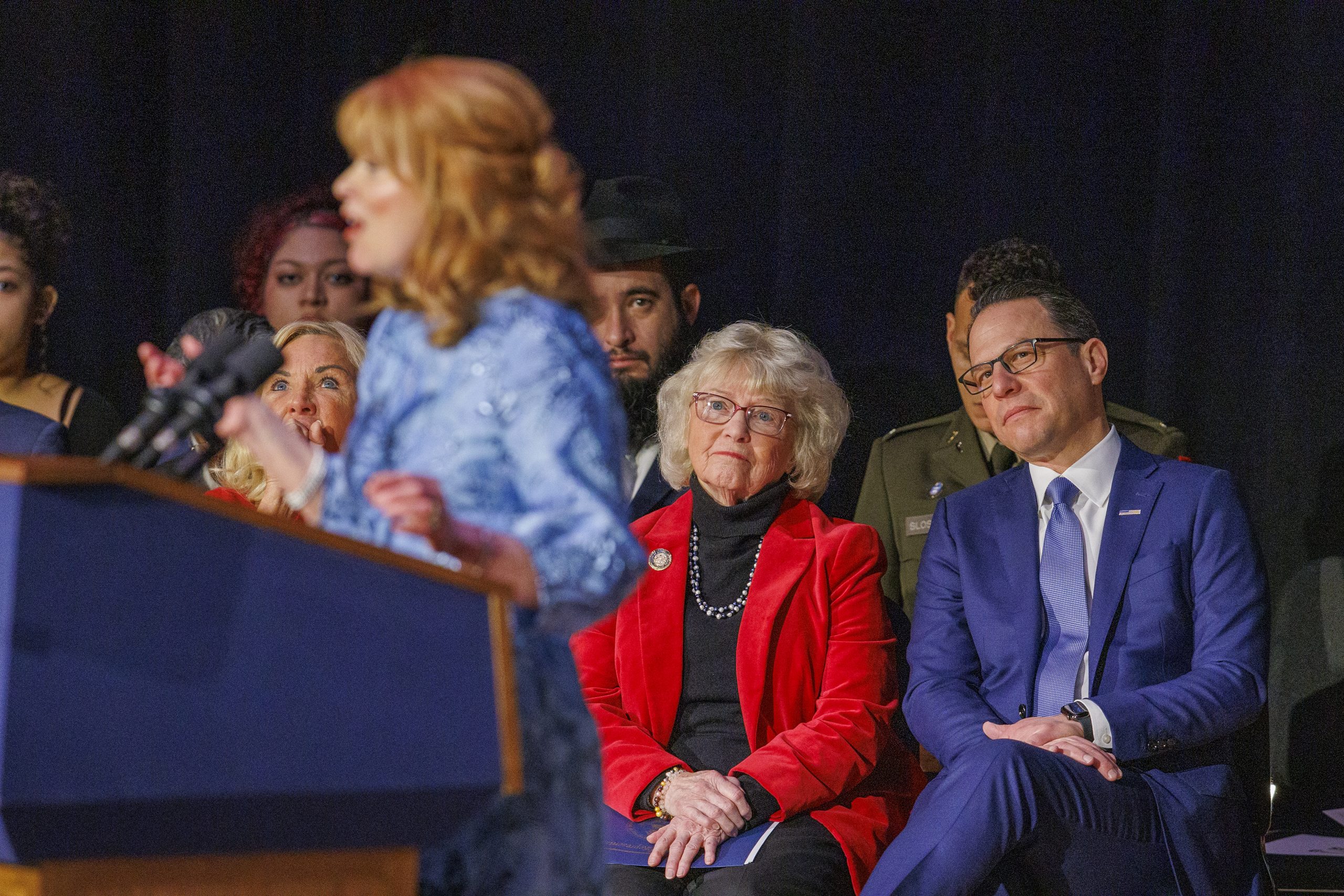
At right is Pennsylvania Gov. Josh Shapiro listening to Stacy Garrity, 78th state treasurer, in Harrisburg on Jan. 21, 2025.Alejandro A. Alvarez / Staff Photographer
Garrity, who would be Pennsylvania’s first female governor if elected, is running to lead one of the nation’s most coveted swing states, where registered Democrats narrowly outnumber Republicans and unaffiliated voters are the fastest growing classification.
And she’s bringing with her some creative solutions to address perennial problems facing Pennsylvanians like property and gas taxes — as well as a desire to allow natural gas producers to drill on public lands and a personal opposition to abortion that she says she wouldn’t enforce if elected. She is loyal to Trump and proud to defend his war with Iran, but said she “hopes that it wraps up quickly.” She has also distanced herself from a handful of his stances, including that she would have taken “a more targeted approach” to his tariffs, and called for a pause on data center development and a ban on farmland construction.
That hasn’t stopped Shapiro’s campaign from calling her “100% MAGA” in television ads, appearing on TV or digital screens nearly 74 million times in the Philadelphia area since Sept. 29.
“The governor is helping me increase [name recognition] by running over $2 million a week in negative ads,” she said wryly.
The Northeastern Pennsylvania native said she’s running for governor because she sees Shapiro, widely expected to be a 2028 Democratic presidential contender, as focused on a White House run rather than what’s good for Pennsylvanians. She believes he lacked transparency around multiple controversies during his administration, discouraged economic development by backing green energy, and recklessly spent more money than the state brings in — criticisms Shapiro disputes. She also frequently points to Pennsylvania’s sorry rankings by the U.S. News and World Report, including its overall ranking as No. 47 out of 50 states for its economy and No. 35 for education.
“We have world-class industries, great universities. Where we’re situated geographically, we should be the hub of global commerce. Our natural resources are the envy of the world,” Garrity said. “So there is no reason we should be trailing in all these metrics. We should be leading. But the thing is, leadership matters.”
Video: What’s driving Stacy Garrity to run for Pennsylvania governor against Josh Shapiro?
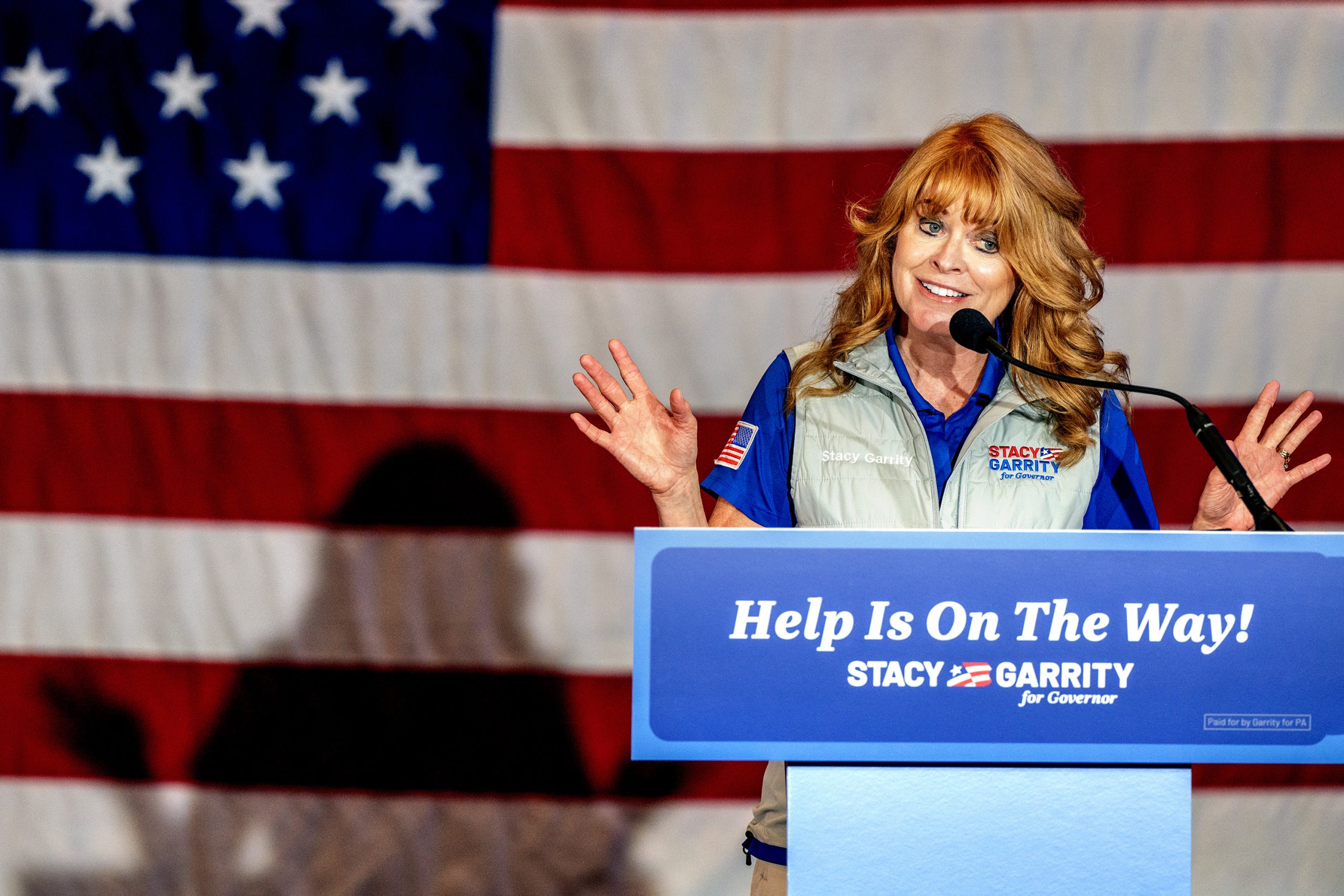
‘Help is on the way’
At her campaign launch in Bucks Countyin August 2025, Garrity stood behind a podium, unveiling her new campaign motto: “Help is on the way.”
But with just weeks left until Election Day on Nov. 3, it appears she’s still waiting.
Republicans endorsed Garrity last fall, an unprecedented move to clear the field and build enthusiasm for the top of the midterm election ticket. But with a lot on the line for her party and facing a popular incumbent, she has struggled to gain name recognition and fundraise. This month, the nonpartisan Cook Political Report rated the swing-state race “Solid Democrat.” According to the most recent campaign finance filings, Garrity has raised nearly $3 million while Shapiro brought in $60 million.
State Treasurer and Republican candidate for governor Stacy Garrity holds a rally in Bucks County Sept. 25, 2025, at the Newtown Sports & Events Center.Tom Gralish / Staff Photographer
Garrity, in part, blames her meager cash balance on Shapiro’s reputation as a calculated and sometimes spiteful politician. She said she’s been told by industry leaders — whom she declined to name — who usually support GOP candidates that they can’t support her financially because they fear retribution from Shapiro.
While Shapiro has campaigned alongside each of the Democratic challengers in four battleground congressional districts, the GOP incumbents have not appeared with Garrity in advertisements. And in several state legislative races, GOP candidates in swing districts are boasting their work with Shapiro in Harrisburg.
In a statement, a spokesperson for Shapiro’s campaign emphasized Garrity’s support for Trump’s agenda.
“Stacy Garrity has made clear that she would be nothing more than a rubber stamp for Donald Trump’s agenda of cruelty, chaos, and corruption,” said spokesperson Sam Reposa. “Garrity is completely wrong for Pennsylvania — and she cannot be trusted to stand up for our commonwealth.”
Garrity said she doesn’t expect help from the Republican Governors Association or political action committees backed by Pennsylvania’s richest person Jeffrey Yass — a few examples of the big-dollar donors Republicans usually rely on to help them bankroll their advertising, like the $30 million Shapiro has already spent on TV and digital ads in the race so far. While Shapiro spent nearly $3 million on ads last week, Garrity spent only $2,146, according to media tracker AdImpact.
The RGA and the Commonwealth Leaders Fund, the GOP PAC historically backed by Yass, did not respond to requests for comment.
But Garrity said she’s still hopeful Trump, who endorsed her in January, will visit the state to campaign on her behalf, although she added “we don’t know what his schedule is” and “we don’t have any dates.” When the president visited Pennsylvania in June to tout manufacturing jobs, he didn’t mention Garrity by name, instead musing about who else in the GOP could have run for the state’s top job. He later praised her in a video posted on social media, saying she would do a “fantastic job” as governor.
Pennsylvania Republicans are motivated to vote for Garrity come November, insisted Senate President Pro Tempore Kim Ward (R., Westmoreland), the top Republican in the state Senate.
“Republicans are definitely happy to have a candidate that they can trust if she becomes governor. They’re going to go out and they’re going to vote for her,” Ward added. “She’s a down-to-earth person and she will do what she says.”
The Pennsylvania Republican Party declined to comment.
The underdog
Garrity is familiar with being the underdog.
The 62-year-old veteran made her first foray into statewide Pennsylvania politics in 2020, when she campaigned for treasurer. She was challenging a well-funded Democratic incumbent Joe Torsella. She was outraised 13-to-1, and entirely underestimated.
But as Garrity tells it, she just put her head down and outworked him.
And she shocked many when she won, as some Pennsylvania voters split their tickets between former President Joe Biden and GOP state row offices. (Shapiro, then running for reelection as attorney general and the only Democratic incumbent to win statewide that year, held on by 300,000 votes, or 5 percentage points.)
Shapiro has often attacked Garrity for questioning Biden’s 2020 victory, referring to her comments at a 2022 Trump rally in Western Pennsylvania, where she told the crowd that “we know that he won.” Earlier this year, she walked back those comments, saying she had gotten caught up in the moment and was “painfully aware” Biden was the president. She reaffirmed that in an interview last week, formally recognizing that Biden was elected.
Buttons for State Treasurer Stacy Garrity’s gubernatorial campaign and President Donald Trump are left on a table following a VIP reception before a Garrity rally in Bucks County on Sept. 25, 2025.Tom Gralish / Staff Photographer
Garrity’s time as treasurer has been largely apolitical, aside from her decision to invest more than $56 million in Israel Bonds in the months after Hamas attacked Israeli civilians on Oct. 7, 2023, or her decision to withhold payments to contractors who did security work on Shapiro’s personal home following an arson on the state-owned mansion — a move which Shapiro viewed as politically motivated. She’s focused on making the office more transparent, promising to post online every hidden fee in utility bills as line items. She’s responsible for paying the state’s bills, investing its more than $180 billion portfolio, and more in the little-known row office job critical to the state’s daily function.
Unlike her opponent Shapiro — who has been in elected office for nearly two decades — Garrity isn’t a natural politician.
“She is a good person that you can trust, and who is almost your girl next door,” said Ward, a frequent critic of Shapiro on political and policy issues in Harrisburg. “She doesn’t come from a big town, she is that community-focused, small-town person that cares about people.”
Garrity “might not have the money to have her face on TV every day” like Shapiro, noting that his taxpayer-funded communications machine totaled at least 21 full-time staffers as of July 2025, and alluding to Garrity’s fundraising woes.
“She’s not one who is carrying a banner of ‘Look at me, I’m so great,’” Ward added.
Treasurer Stacy Garrity (center) meets people during an event hosted by Americans for Prosperity, Concerned Veterans for America, and the Libre Initiative at the National Constitution Center in Philadelphia on Jan. 29.Elizabeth Robertson / Staff Photographer
In the Army Reserve, Garrity was a whistleblower during the Iraq War, and her testimony was included in a sweeping abuse investigation that unearthed human rights violations at the infamous Abu Ghraib prison, SpotlightPA reported. She spoke out against alleged abuse of war prisoners at a different internment facility, Camp Bucca. She faced a personal cost for it, too, she told SpotlightPA, including alienation from her peers and even death threats. But she stuck it out, and during her next deployment, she was appointed acting commander of the camp.
Her pivot to politics, she said, came years later, during her time working at one of the largest tungsten smelter facilities in the world — a career she held throughout her time in the Army Reserve. As she tells the story, she had a meeting in Pittsburgh about the National Defense Authorization Act when a lobbyist approached her, mentioning the rare earth elements that the Department of Defense was prohibited from buying from American adversaries, like China, Russia, North Korea, and Iran.
Tungsten wasn’t on the list. She helped to change that and shortly after, lobbied a “don’t buy from the bad guys” tungsten campaign in Washington. And it worked. To date, the Department of Defense is still prohibited from buying tungsten for its munitions from American adversaries.
New ideas for old problems in Pennsylvania
Like many around the state, Garrity said her family in rural Bradford County is feeling the pinch of Pennsylvania’s economy.
She has a soft spot for seniors on fixed incomes like her aunt, for whom she pays her utility bills and helps her apply for property tax rebates each year.
If elected, Garrity wants to eliminate property taxes for seniors on fixed incomes, first responders, and veterans to be supported by savings found in wasteful spending in Pennsylvania’s Medicaid programs. She also wants lawmakers to amend the state constitution to cap how much school property taxes can be raised without voter approval.
She said she’d follow through on a promise Shapiro made on the campaign trail in 2022 to give all Pennsylvania drivers a $250 gas rebate during the summer. She wants to triple the program to $750 — for each month of the summer — to give every Pennsylvania driver over the age of 18 a check to cut their monthly gas bills by a third during the pricey summer months.
Day One in a Garrity administration would begin with support for a school voucher program targeted toward children in Pennsylvania’s lowest-performing schools — a plan Shapiro helped design with Senate Republicans during his first budget negotiations that he later line-item vetoed, a move that remains a sore spot among Republicans in Pennsylvania’s split legislature.
She doesn’t believe the minimum wage should be raised, either — a top priority for Harrisburg Democrats if they win control of the governor’s mansion and both legislative chambers. Pennsylvanians at most low-skill jobs are already earning hourly wages much higher than $7.25, Garrity contended. In 2025, there were 511,000 Pennsylvanians who earned between $7.25 and $15 an hour, and an additional 43,000 who earned $7.25 or less — all of whom would benefit under the Democrats’ minimum wage increase proposal, according to the state Department of Labor and Industry.
“When you have a humming economy, you know the wages are going up, up up up. It’s largely been taken care of,” she said. “If you can make $15 at McDonald’s, you’re not doing so bad.”
Garrity is married to Daniel Gizzi, a ceramics project analyst, and the two do not have any children. She completed several unsuccessful rounds of in vitro fertilization, she said, making reproductive health issues very personal to her.
“I would do anything that I could to support women and moms and make it easier to have children, if that’s what they want,” she said.
However, she maintains she is anti-abortion with exceptions for rape, incest, and life of the mother — but that her personal position doesn’t matter, becauseabortion in Pennsylvania has for decades been permitted up to 24 weeks of gestation.
Examining the state’s voter rolls harks back to Garrity’s pledge to be the “most transparent governor” in the state’s history, she said. If there’s nothing to hide, there should be no problem with sharing.
A fan of Pennsylvania — and Buffalo
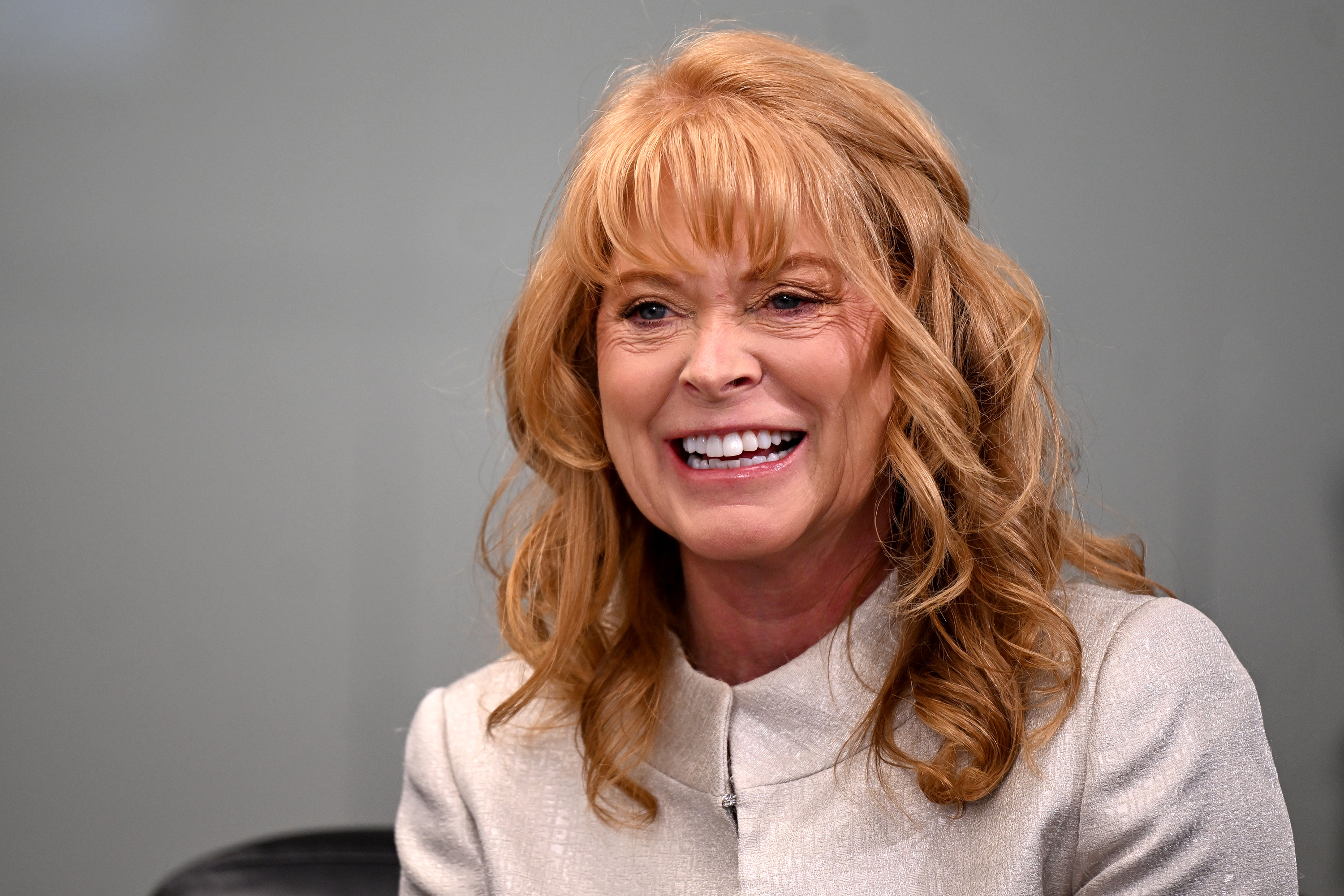
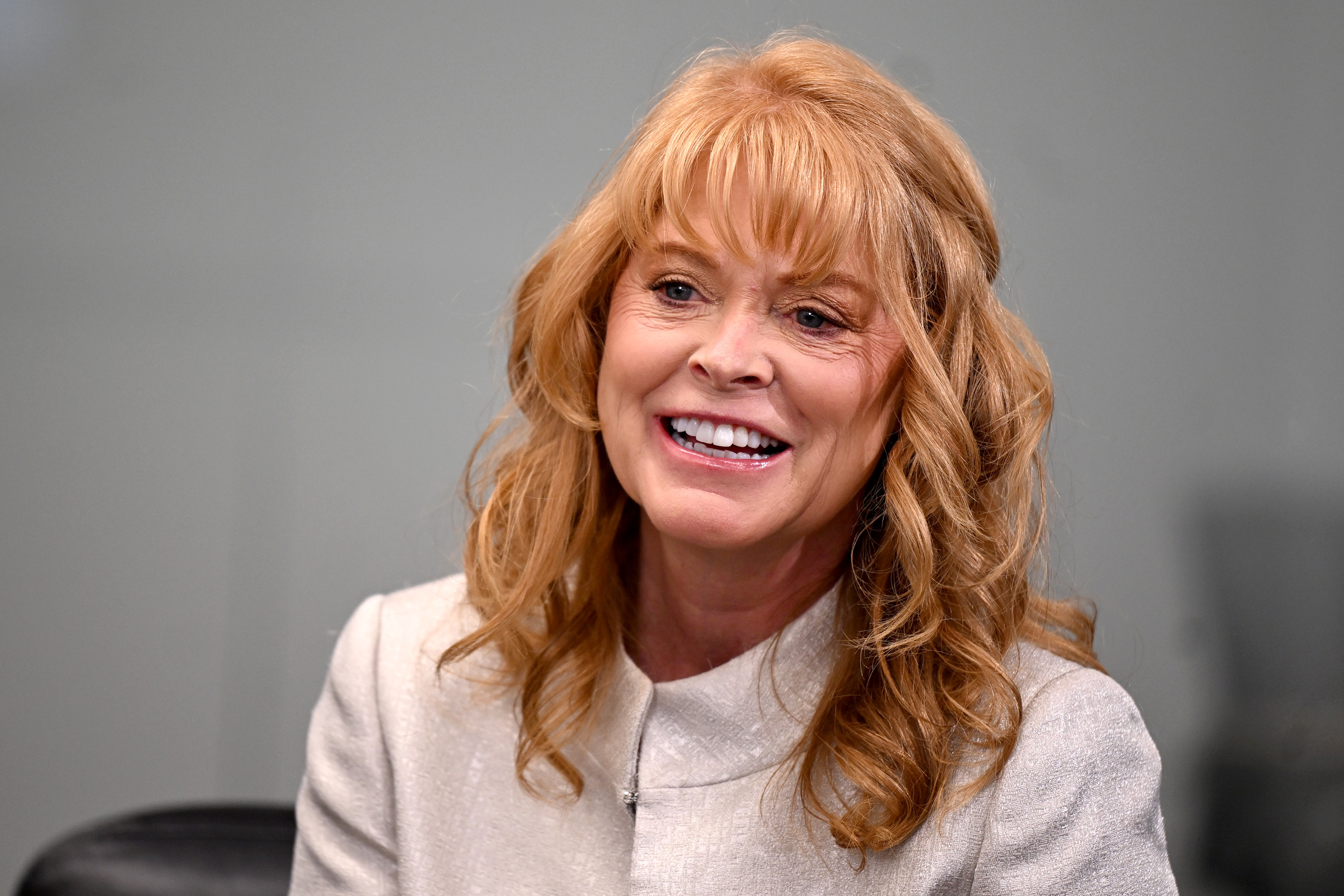
The former soldier looks much more like a state treasurer these days, in a matching beige skirt suit, a bright smile, and signature large-barrel curls of strawberry blond draping past her bangs onto her shoulders. She uses phrases like “Oh gosh!” and “My goodness!” when she gets excited about some of her policy ideas.
State Treasurer and Republican candidate for governor Stacy Garrity sits down for an interview at The Inquirer offices on Sept. 28.Tom Gralish / Staff Photographer
She doesn’t have any time for leisure these days between campaigning for governor and managing public funds, she said. “Oh I have no time for personal entertainment,” she added with a laugh.
She spends most days in the car on Microsoft Teams meetings, driving around the state for campaign or treasury events. She’s gotten back into running in the early mornings as a moment of solace for herself.
Unlike Shapiro, a son of Montgomery County and diehard Philadelphia sports fan, Garrity says she holds no strong sports team allegiances. She roots for all Pennsylvania’s teams: the Eagles and the Steelers, the Flyers and the Penguins, the Phillies and the Pirates.
“I probably shouldn’t admit this, but I also like the Buffalo Bills,” she said.
The New York team, whose games are often broadcast in the media markets near Garrity’s hometown,has fallen short in the playoffs in recent years, struggling to carry regular season success to a championship.
Garrity added that she still had fun celebrating the Eagles’recent Super Bowl win — a feat the Bills have never achieved.
Clarification: This story has been updated to describe Garrity’s work as a business executive.
I guess this is the reason they call autumn “the fall.” Here in Greater Philadelphia, the mornings are crisper, the nights are longer, and the sportsfans are apoplectic, to the extent we can even rouse ourselves from bed. It’s a bad week for the good guyswhen a 7-0 opening-night loss for the Flyers didn’t make the list of worst things that happened — not when the Phillies crashed and burned while the Eagles are failing to launch. Cavan Sullivan, our city turns its lonely eyes to you.
Why Nixon still stands in the way of Trump’s dictator dreams
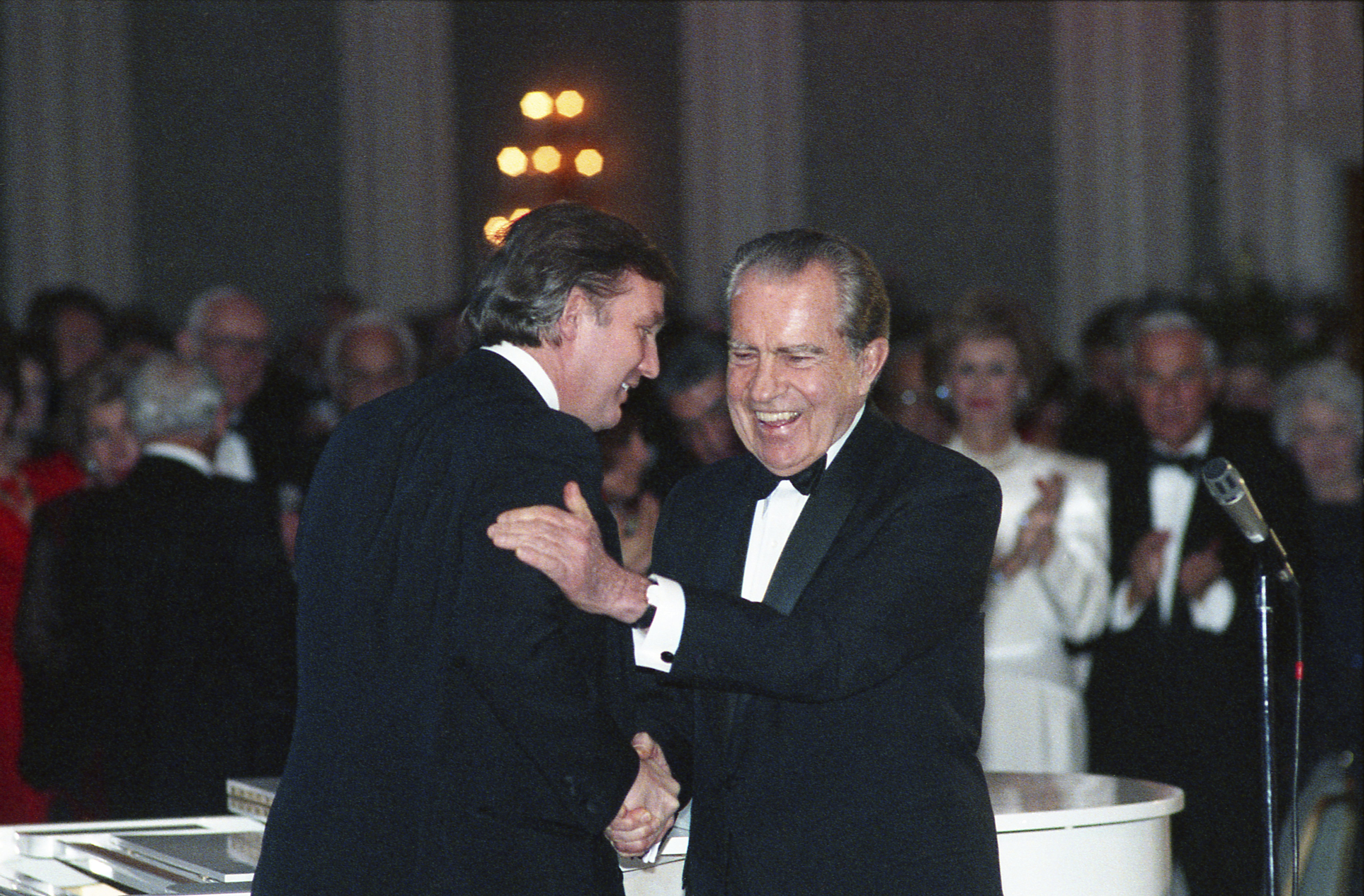
In this photo from March 1989, Donald Trump (left) shakes hands with former President Richard Nixon at a tribute gala to Nellie Connally at the Westin Galleria ballroom in Houston.Richard Carson
Although he later pretended it was not so when it came up in his first GOP primary debates, Donald Trump was never a fan of his party’s golden idol, Ronald Reagan. Most famously, the Manhattan developer at the peak of his 1980s fame surge lashed out at the Gipper as weak on defense policy, adding that late in Reagan’s second term, “people are beginning to question whether there’s anything beneath that smile.”
No, Trump always liked bad boys. No wonder the ex-president he had a crush on back then was Richard Nixon.
“You are a great man, and I have had and always will have the utmost respect and admiration for you,” Trump wrote the 37th president in 1993, nearly two decades after Nixon became the only president to resign, leaving the White House in the disgrace of the Watergate scandal. “I am proud to know you.”
The former president and the future felon had been exchanging letters for more than a decade by that point, as they shared their resentment over perceived media persecution. Nixon died in 1994, but after Trump’s first impeachment trial in 2020, he said in an interview that “I think of Nixon more than anybody else.”
All that said, one has to think it was a little more than merely a mutual admiration thing when the bizarre news broke last week that — more than a half century after the Watergate prosecutions scored 41 criminal convictions and a grand jury named Nixon as a coconspirator in the cover-up — the U.S. Department of Justice is weighing reopening the case. Their theory: Tricky Dick and all the president’s men got a raw deal.
The Wall Street Journal reported that Trump’s DOJ is in the early stages of a probe into the early 1970s special prosecutor’s office that investigated Watergate, presumably in an effort to prove that its judicial assault on Nixon and his underlings was an overreach, perhaps with the goal of a written condemnation.
There are a couple of very different ways to look at this. The MAGA era in American politics has produced more than its share of out-there people with at least slightly kooky causes who are able to capture the ear of a Trump regime that is populated by fellow conspiracy theorists.
In this case, the out-there gentleman is Geoff Shepard, a lesser-known aide to Nixon who now bills himself as a revisionist historian with a theory that the so-called deep state — lifers in the CIA and FBI, corrupt judges, the liberal news media, etc., etc. — conspired against his former boss. Shepard has crafted a two-hour presentation called “Watergate as Lawfare” — meaning Nixon’s “enemies” (and he had so many that he kept a list!) twisted the law to accomplish what they failed to achieve at the ballot box in the 1968 and 1972 elections.
Of course, the Trump regime is willing not only to forget the basic facts of Watergate, but laugh them off. Most famously, Vice President JD Vance told an audience back in June that the scandal that provoked Nixon’s resignation would be “like a 12-hour news story” today, adding, “The idea that it would have taken down a presidency is crazy.”
Which is exactly what this renewed interest in Watergate is all about. They seek a new American reality in which the notion that a presidency can become a criminal enterprise, and — more importantly — that there could be consequences for doing that is, well, “crazy.” That a POTUS cannot fail, but he can only be failed by the permanent “deep state.”
What’s crazy is that, as terrible as Nixon was — and make no mistake, Nixon was terrible — there is no comparison between his cut-and-dried high crimes and misdemeanors and the far worse ones committed by Trump. For example, it was a mini-scandal that Nixon increased his net worth during his first term … by $700,000. Trump increased his net worth in just one year, 2025, by an estimated $2.2 billion. Nixon has an enemies list, but Trump has sought — and occasionally received — invented felony indictments against his political rivals.
The Justice Department scheme to reopen Watergate might not be the most nefarious thing that’s taking place right now, but it is part of a much bigger mosaic of actions that all aim to show Trump can govern with total impunity — that he is untouchable.
This road to perdition started even before Trump’s second inauguration, when the U.S. Supreme Court in 2024 granted a president sweeping immunity for “official acts” — in essence, confirming Nixon’s famous interview comment to David Frost that “when the president does it, that means it is not illegal.”
Since returning to office nearly 21 months ago, Trump has been road testing his newly granted imperial powers. In the waters off South America, drone strikes on fishing boats ordered by Trump’s Pentagon have murdered at least 238 people, without any due process, in attacks that independent experts have labeled a war crime. That’s just one of thenumerous examples of the Trump White House testing the outer limits of defying Congress, or the courts, or the rule of law.
Yet, just as important to the president’s agenda is the implied notion that there is a straight line from 1973 to today, in the existence of an unelected “deep state” that wields the real power in America, or at least until Trump arrived to smash its hegemony.
This is why the Trump regime’s obsession with Nixon and Watergate is more than just a trivial matter. On one hand, Nixon’s full pardon from Gerald Ford unfortunately muddied the waters about whether or not the president is above the law. On the other hand, the overall message from Watergate was that most of the nation’s big institutions — Congress, the courts, the newsmedia — have a role in preserving democracy when the White House is breaking bad.
The reality that the system still worked when Nixon boarded that helicopter in August 1974 is the history the Trump regime wants to toss down the memory hole. Indeed, they are working on all cylinders to control the past so Trump can control the future.
Watergate remains an increasingly faint beacon of hope that America is not a dictatorship, and that a rogue president can be sanctioned for wrongdoing. That’s why Vance ridicules Watergate. That’s why Trump wants to erase it. Because the criminality that’s likely to comeafter Republicans go down in flames in November’s midterm election will probably make Watergate look like candy-store shoplifting.
Honestly, we should all reinvestigate Watergate — as the road map for 90% of what we need to do when our president is a crook. Then we should cover the remaining 10% of that ground and make it perfectly clear that Nixon was wrong about one more thing: that when a president does it, and when it’s against the law, that means it is illegal.
Yo, do this!
Autumn is peak season for foliage, for sports (well, quantity if not quality), for movies, and for books. It’s been hard to keep up with all the excellent tomes coming out — including the new one by Astra Taylor (who has appeared in this space as a fierce critic of the student-debt crisis) and the acclaimed left-wing author Naomi Klein, End Times Fascism: And the Fight for the Living World. The two made a riveting appearance on one of my favorite podcasts, Know Your Enemy, to discuss how the political right wing and Silicon Valley billionaires have found common cause in a frightening, apocalyptic vision of the future. But their book also promises hope and potential solutions, so I look forward to reading it after I whittle down the current pile.
We all need hope in these troubled times, which is why my new North Star is Cavan Sullivan, the straight-outta-Northeast Philly soccer phenom who just turned 17 about 10 days ago and has fans of the world’s greatest sport dreaming he can a) finally deliver an MLS Cup to the beleaguered Philadelphia Union before he leaves us in roughly a year for England’s (now scandal-plagued) Manchester City and b) help the U.S. men’s squad compete for the 2030 World Cup, when he’ll still be too young to legally drink at age 20. Check out his highlight reel goals for the Union and the USMNT, and then catch him twice this week: Tuesday night for the Americans against our archrival Canada (8 p.m., TNT) and then back with the Union here in Chester on Saturday night against Real Salt Lake (7:30, Apple TV).
Answer: That’s a more general question than I usually answer, but it’s clearly what’s on everybody’s mind. Of course, there are two layers here. On the voting that wraps up Nov. 3, the Democrats seem to be consolidating their gains, with taking the Senate along with the House (which is a slam dunk) looking increasingly likely. In a normal year, I’d expect a GOP recovery in the home stretch, especially with all their billionaire cash. But this is not a normal year, or a normal president. The bigger layer of uncertainty is what happens after Nov. 3 when Donald Trump doesn’t like the results. Some shocking attempt to reverse the outcome — in Congress, or the courts, or the streets — is a given. Are we ready for this level of dictatorial tomfoolery?
What you’re saying about …
I need to remember more often that it’s the simplest questions that bring the most impassioned responses. A lot of you wanted to weigh in on a proposal from Major League Baseball that initially drew interest from the Trump regime: building a new Field of Dreams to stage an MLB game in a national park, such as scenic Grand Teton. And the outrage — echoing the framing of my question, that it would be “a crime against Mother Nature” — was pretty much unanimous. “It’s maddening,” Rosann McGinley wrote. “What the Trump regime is doing to our parks is bad enough without MLB adding insult to injury.” Stephen LoRusso speculated that “Trump will insist if they name the [ballpark] after him, and erect a statue of him, he will approve it.” But you know who else realized this was a dumb idea? MLB. It dropped the plan after all the bad publicity.
📮 This week’s question: Thinking (still) about Cavan Sullivan made me wonder: What from the cultural world — like a TV series or a favorite musician — is getting you through these otherwise troubled times? Please email me your answer and put the exact phrase “Cultural escape” in the subject line.
Backstory on what’s so bad about Texas Senate ads during an Eagles game
Republican U.S. Senate candidate Texas Attorney General Ken Paxton speaks at the Republican convention in September in Dallas. Julia Demaree Nikhinson
If you’re one of the folks who tortured themselves for three hours by watching the Eagles’ excruciating loss to the Los Angeles Rams, you witnessed many head-scratching things. But while head coach Nick Sirianni’s decision to go for it on fourth-and-goal from the two-yard line instead of taking three much-needed points on a field goal was baffling, it made more sense than something else on your TV screen: the several expensive ads that aired for the Texas GOP U.S. Senate candidate Ken Paxton, in a game that was played some 1,662 miles northeast of the Austin city limits.
Football fans hoping for three hours of escape from the existential dread of modern America not only got a lousy game, from the Philly perspective, but had to watch a vicious smear job falsely claiming that Paxton’s opponent, Democratic Texas State Sen. James Talarico, had supported using taxpayer dollars for gender-assignment surgeries. That was followed by a second commercial supporting the current Texas attorney general’s Senate bid, in which Paxton’s soon-to-be ex-wife, who happens to also be a Texas state senator, urged voters to ignore the stench of scandal and vote a straight Republican ticket.
The ads appeared not just during the Fox telecast of the Eagles-Rams matchup, but on NFL games from coast to coast — the first time I can remember in a lifetime of obsessing over politics that I witnessed ads for a statewide race on a national telecast. The weirdest part? The ads appeared at the same time Texas’ two NFL teams, the Dallas Cowboys and the Houston Texans, were playing each other, so how many registered Texas voters were even watching the out-of-town games?
The appearance of the ads prompted several outlets, including The Inquirer, to write news articles noting that many fans were not just annoyed but angered by the spots, and speculating why they ran at all. Some noted the quirks of political advertising may have made it cheaper to buy a national spot than the high local ad rates in Dallas, Houston, or Austin. Or maybe the target audience was potential small donors, as campaigns like Paxton’s increasingly bombard Joe Sixpack with emails, seeking $5 donations from folks jacked up about national politics. But does that make sense? Spending a fortune on ads in Philly to raise money so you can buy ads in Texas? Why not just advertise in the Lone Star State with the first batch of cash?
No, I think the real answer is the alarming state of money and power in America right now. Those Paxton ads were funded by billionaires who want everyday voters to know they have money to burn on foolish political ad placement, because they will spend anything and everything to retain control of Capitol Hill.
Specifically, the pro-Paxton, anti-Talarico ads were paid for by a political action committee called the Texas PAC, which is currently pumping a whopping $131 million into the neck-and-neck Senate race. The actual source of those dollars comes through a separate PAC supported by the GOP Senate leadership committee, creating a series of nesting dolls to obscure who the actual donors are. That opaqueness is a feature of American campaign finance, not a bug.
Reporters have found that the Top 10 billionaire donors have so far donated a stunning $734 million toward the November election, with more to come, and that 16 of the Top 20 donors are supporting Republicans. Among the filthy rich supporting the GOP Senate candidates, including Paxton, are Silicon Valley’s Marc Andreessen ($115.3 million), the richest Pennsylvanian, Jeff Yass ($93.8 million), casino heiress Miriam Adelson ($67.6 million), and many more.
The oligarchy’s financing of Texas ads from Seattle to Jacksonville, Fla., is a raw power play, pure and simple. They are projecting an air of omnipotence — total domination of the U.S. body politic. In a moment when all the things voters actually care about — affording groceries or the rent, and staying out of dumb wars and our immigrant neighbors’ backyard — are going badly for the billionaires’ preferred Republican Party, the ads are a show of dominance. But will it work in November? In a democracy, it should be better to have the people on your side than the money.
What I wrote on this date in 2020
Every so often, it pops into my mind that Pennsylvania used to have a U.S. senator named Pat Toomey, and I think: Wow, that was weird. The pangs of regret I felt for not writing more columns about everything that was wrong about the conservative Republican ex-Wall Streeter before his 2016 reelection exploded into a series of pieces over the next few years, including multiple columns about the large protests outside his Philly office called Tuesdays with Toomey. When the senator shocked the political world six years ago by announcing he would not run for a third term, I hailed the demonstrators. “Protests, marches, calling your representative, writing letters to the editor, sending postcards and knocking on doors — all of it matters, in ways that are sometimes clear but often intangible.” I wrote. “What Tuesdays with Toomey has done is your living proof.”
Only one column this week as I continue to toil on a major project, coming in a few days. In that column, I took a step back to look at the shocking Cornell University gang-rape allegations from a wider lens. With campus sex crimes depressingly common, why did this case break through? I argued that the roots are found in rage over elite impunity, in a world where a man with multiple misconduct allegations can get elected president, or get a second chance as an NFL quarterback. People see the same instinct to protect the privileged in the minimal punishments for Ivy League boys, and they are furious.
Those of you who read this newsletter from out of town have probably come to learn that here in Philly, we hang a lot of our identity — as well as our mental health — on our sports teams. Now we’re discovering that — on top of the bottomless pit of losses — there’s another downside to our city’s sports mania: a propensity for gambling addiction. I told you recently about the amazing scoop by my friend and Inquirer colleague David Gambacorta, who revealed that FanDuel solicited a paid Cameo video from Phillies superstar Bryce Harper that it used to buck up an addicted local gambler while he accumulated $1.5 million in debt. That piece triggered a congressional hearing and more revelations, but it also hinted at a much bigger problem. This weekend, Gambacorta and William Bender (yay, Daily News alums!) did a deep dive into Pennsylvania’s bet-addiction crisis, backed by some stunning stats. The Keystone State is now the largest online gambling market in the United States, and the whopping $3.46 billion in revenue here is up 27% year over year. The article looked at the shattered lives behind the numbers, and this saga is only beginning. This is in-depth reporting you can’t read anywhere else, and it only happens with your support. Please consider subscribing to The Inquirer.
By submitting your written, visual, and/or audio contributions, you agree to The Inquirer’s Terms of Use, including the grant of rights in Section 10.