Tag: no-latest

  • DOJ files charges against woman accused of vandalizing World War II Memorial

    DOJ files charges against woman accused of vandalizing World War II Memorial

    The Justice Department filed two felony charges against the woman accused of vandalizing the World War II Memorial in Washington, according to court records.

    “Vandalizing our World War II Memorial is a despicable attack on a sacred monument honoring the Americans who fought and died for our freedom,” U.S. Attorney for D.C. Jeanine Pirro said in a statement announcing the charges on social media. “Those Americans include my father and grandfather.”

    On Thursday afternoon, part of the memorial on the National Mall was tagged with graffiti, and soapy bubbles overtook a fountain. Red graffiti spelled out “Clean hands dirty $” beneath the Atlantic Arch, and red and green paint was splattered on some of the granite stonework.

    Pirro said the woman suspected of vandalizing the memorial, Melissa L. Farris, was in custody. Two felony charges — depredation against U.S. property and destruction of veterans’ memorials — were filed against her, according to court records. Both charges carry a prison sentence of up to 10 years.

    Around 2 p.m. on Thursday, members of the U.S. Park Police and U.S. Park Rangers responded to a call about a disorderly person at the memorial, according to court records.

    On her Facebook account, Farris livestreamed herself at the memorial. In the video, she alternated between narrating her actions and getting emotional about the state of her life and of the country. She said she has autism and ADHD but that she was not suffering from psychosis.

    Farris also said that Thursday was her 41st birthday. Her current address is listed in Kentucky, according to public records.

    Later, Farris filmed herself dropping an item into the fountain near the Atlantic Arch. “Oops,” she said. Then, she shook spray-paint cans and livestreamed herself adding graffiti to the granite.

    “It was me. I’m doing it. I’m on camera,” she said.

    She said she was willing to be arrested because she wanted her day in court. The court filing said that as a ranger approached her at the Atlantic Pavilion, she fled.

    After spraying the graffiti, she said, “It’s time for a tea party, kids.”

    “This is democracy sometimes, guys,” she said as the livestream showed the fountain filling with bubbles. “And I didn’t have to shoot somebody. I didn’t have to go to war. I didn’t have to make choices that harmed another human being.”

    Shortly before 4 p.m., according to the court filing, Farris posted another video to Facebook, in which she said: “I was just allowed to deface Federal f—ing property, and nobody batted an eye, and that is very strange.”

    The Interior Department condemned the incident Thursday as an “utter disgrace” that “will not be tolerated.”

    The incident comes weeks after the White House blamed vandals for disturbing the nearby Reflecting Pool after President Donald Trump’s renovations quickly degraded, causing algae blooms and a peeling liner.

    Pirro eventually dropped the vandalism charges against four people and blamed the damage on flawed installation.

    In response, Trump said Pirro “folded like an umbrella.”

    “I just think she was totally wrong,” Trump told reporters earlier this month, noting that National Park Service employees had told authorities they saw vandals in action. He described problems with the contractor as “a couple of little things.”

    It’s unclear what material was used to create the bubbles in the fountain. Ryan Compton, owner of Domain Aquascapes in Northern Virginia, said adding standard bubbles to a fountain generally doesn’t cause system damage but is a “maintenance nightmare.” It requires draining, cleaning out, and rinsing the fountain and pump system.

    “That’s going to be a lot of man hours and work involved,” he said.

    Trump denounced the World War II Memorial vandalism in a Friday morning post on Truth Social.

    “THERE CAN BE NO GREATER INSULT TO THOSE AMERICAN HEROES WHO DIED IN WORLD WAR II,” Trump wrote. “First the Reflecting Pool, now this. We are on their trail! Where do these animals come from???”

    A preliminary estimate of the costs to clean and restore the memorial already exceeds $1,000, according to court records.

    The Washington Post was unable to immediately reach a representative of Farris for comment. Her sister declined to comment.

  • Trump signs memo authorizing private sector to launch cyberattacks

    Trump signs memo authorizing private sector to launch cyberattacks

    President Donald Trump signed an order Wednesday authorizing select private companies to carry out government-sponsored cyberattacks against foreign criminal hacking groups — actions that have until now been the domain of U.S. national security agencies.

    The memorandum enables the government to contract with U.S. firms to hack into and disrupt overseas digital networks belonging to “cyber-enabled transnational criminal organizations.”

    The memo stipulates that the companies, under the supervision of the federal government, may breach computer systems to conduct surveillance and manipulate or destroy digital or physical infrastructure “controlled by information systems” but are barred from targeting foreign governments or taking actions that result in the “loss of life” or “serious injury.”

    The move marks a significant shift from the more restrained approach of previous administrations, which prohibited companies that suffered intrusions from “hacking back” into their attackers’ systems for fear of geopolitical blowback. Now the Trump administration wants to enlist the private sector to help take the fight to criminal hackers.

    “President Trump is unleashing every available tool to stop foreign-based organized criminal organizations that exploit Americans in cyberspace,” the White House said in a fact sheet accompanying the memo.

    Some analysts and industry executives hailed the move, saying it should help the government degrade foreign criminals’ abilities to hack Americans. “Cyberattacks are cheap to launch and expensive to defend against,” said Joe Lin, co-founder and CEO of a Northern Virginia startup that builds large-scale cyber offense platforms for the U.S. government. “The more we can disrupt adversaries at scale using vetted commercial partners, the less our adversaries will be able to attack the United States.”

    Other experts say it could pose legal and geopolitical risks for the federal government and the companies themselves.

    “What if a company carries out an operation against what it thinks is an Iranian or Russian criminal group, but that group is actually controlled, influenced, or protected by Tehran or Moscow?” said Matt Curtis, who served as White House senior director for cyber policy in the Biden administration.

    “Suddenly, what was intended as an operation against criminals could be viewed as a U.S.-authorized cyber operation against a nation-state actor … and potentially trigger retaliation or escalation,” he said.

    The memo establishes a national coordination center to be run jointly by the Justice Department and the Department of Homeland Security, which will vet participating companies. The firms could be fined up to $1 million for contract violations.

    The order raises questions about potential liability for companies under the Computer Fraud and Abuse Act, which makes it a federal crime to gain unauthorized access to internet-connected computers. If the company is acting as an agent of the U.S. government, it probably would not be bound by this law, some analysts say, but would still have to comply with Fourth Amendment protections requiring a warrant to hack into a domestic system. The order does not directly address this issue.

    The FBI’s top cyber official says the memo is an effort to normalize what is currently “ad hoc” collaboration between industry and government.

    Just last month, for instance, the FBI and Google disrupted a botnet used by hundreds of criminal and nation-state hackers who didn’t want their attacks traced back to Beijing, Tehran, and Moscow, and so routed them through at least 2 million proxy IP addresses to TV streaming boxes and home routers, FBI Assistant Director for Cyber Brett Leatherman said in an interview with the Washington Post.

    Armed with a court order, the FBI seized hundreds of proxy domains and Google disabled accounts on its own networks that the botnet was using to control the malware.

    The presidential memo, he said, is about “providing additional authority and capability” to “empower” U.S. industry in helping the government battle foreign cybercriminals.

    Leatherman pointed to the Chinese state-sponsored Salt Typhoon espionage hack, discovered in late 2024, which compromised several of the largest American telecommunications firms and targeted the cellphones of U.S. political figures, including then-presidential candidate Donald Trump and his running mate JD Vance. At least one Chinese company assisted the campaign and was punished by the Treasury Department last year, Leatherman said.

    China and Russia often leverage private companies to carry off hacks that provide a measure of state deniability.

    “They are industry people [in China] that are doing this,” Leatherman said, referring to Salt Typhoon. “If we don’t close the gaps … we’re going to continue to fall behind.”

    U.S. agencies such as the FBI, the military’s U.S. Cyber Command, and the National Security Agency may legally hack systems overseas. But private-sector companies do not have such independent authority.

    Jason Kikta, a former U.S. Cyber Command operator, said using contractors to perform government work “makes us no better than China and Iran,” where, he noted, industry has conducted ransomware operations, attacked U.S. banks, and carried out indiscriminate cyberspying operations.

    “The U.S. has fought against such abuses for years, and this now makes us look hypocritical,” said Kikta, now chief technology officer at Automox, a cybersecurity firm.

    Former military cyber lawyer Gary Corn noted that Cyber Command’s primary focus is on countering foreign nation-state threats — not criminals. The command lacks the numbers and resources to take on the criminal threat. So the administration’s move could help fill that “big gap,” said Corn, who was formerly the command’s top lawyer and now directs American University’s Technology, Law & Security Program.

    Former White House aide Curtis, now CEO of the cybersecurity firm 190 Intel, said private companies have tremendous technical capability, data, and speed. With the right guardrails, he said, “this could be a very effective way to disrupt criminal networks that are otherwise hard to reach.”

    Charlie “Tuna” Moore, a former deputy commander of U.S. Cyber Command, has long called for the government to team with the private sector in conducting cyber offense. “It’s the only way to scale quality and quantity to defend the nation,” said Moore, now a visiting professor at Vanderbilt.

    The memo contains a classified annex, which describes how the companies and law enforcement agencies will coordinate their actions with the military and intelligence agencies, a process known as “deconfliction.”

    Moore noted that the military and spy agencies have extensive deconfliction rules, and it will be “critical” to see how well thought-out the new process is, he said.

    “The overarching approach is very good,” he said. “The devil’s in the details.”

  • Luigi Mangione pleads guilty to federal stalking charges in the killing of UnitedHealthcare CEO

    Luigi Mangione pleads guilty to federal stalking charges in the killing of UnitedHealthcare CEO

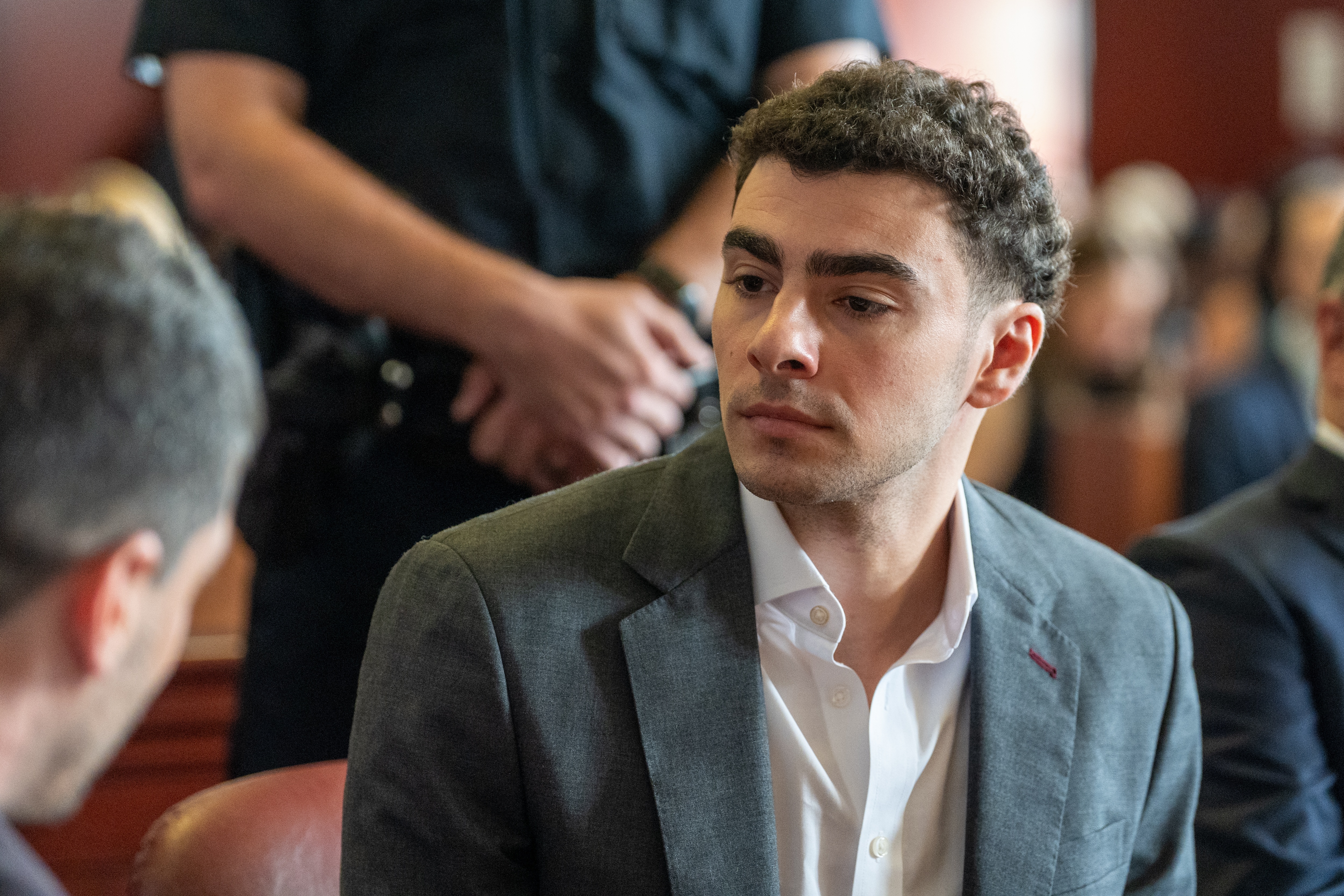
    NEW YORK — Luigi Mangione pleaded guilty on Friday to federal stalking charges in the killing of UnitedHealthcare CEO Brian Thompson, admitting matter-of-factly that he trailed the executive to an investor conference in 2024 and gunned him down on a New York City street.

    Mangione, 28, said he even used a ruse to glean information about the event, contacting the health insurance company ahead of time under the guise of being an investor at a multibillion-dollar firm.

    “On the morning of Dec. 4, 2024, I shot Mr. Thompson in Manhattan, and he died,” Mangione told the court as Thompson’s wife, Paulette, took several deep breaths and repeatedly wiped tears from her eyes. A supporter put an arm around the wife and held her tight.

    Mangione is set for sentencing Dec. 18. When U.S. District Judge Margaret M. Garnett asked whether he understood that he could spend the rest of his life in prison, Mangione answered neutrally: “Yes.”

    Mangione entered the plea at a hastily scheduled hearing in Manhattan federal court, resolving one of two cases against him in connection with Thompson’s death. Mangione’s lawyers could now seek to have his separate New York state murder case thrown out on double jeopardy grounds.

    Surveillance video of the ambush showed a masked gunman shooting Thompson, 50, from behind. Police say “delay,” “deny,” and “depose” were written on the ammunition, mimicking a phrase used to describe how insurers avoid paying claims. That detail — and revelations that Mangione’s private writings lambasted health insurers as greedy, according to authorities — made the case a fulcrum for debate about the industry and made Mangione a cause célèbre for some of its critics.

    Mangione told the court Friday that he pursued Thompson “after years of enduring severe pain from a broken back and navigating the obstacles of the health insurance system.”

    Mangione never was a UnitedHealthcare customer, according to police and the company. A University of Pennsylvania graduate from a wealthy Maryland family, he was arrested five days after the shooting, when he was spotted at a McDonald’s in Altoona, Pa. It’s about 230 miles west of Manhattan.

    Thompson led one of the United States’ largest health insurers, but he wasn’t well known outside the industry. Trained as an accountant, he had worked at parent company UnitedHealth Group Inc. for 20 years and became CEO of its insurance arm, UnitedHealthcare, in 2021. He and his wife had two sons, who were in high school when their father was killed.

    Both the federal and state cases could lead to a life prison sentence for Mangione. A federal judge earlier this year tossed out additional charges that could have exposed him to a potential death penalty.

    Mangione had complained about the prospect of two trials, telling a judge in February: “It’s the same trial twice. One plus one is two. Double jeopardy by any commonsense definition.”

    Under New York law, a state prosecution could potentially be barred if the federal case is resolved first.

    The state’s double jeopardy protections kick in if a jury has been sworn in a prior prosecution, such as a federal case, or if that prosecution ends in a guilty plea. Mangione’s cases involve different charges arising from the same course of conduct.

    In a letter last month, state prosecutors objected to the possibility of a guilty plea in the federal case wiping out the state case.

    Garnett has delivered some setbacks to the defense, including ruling in January that prosecutors could use items collected from Mangione’s backpack during his arrest as evidence against him.

    They included a 3D-printed pistol that investigators said matched the one used to kill Thompson and a notebook in which authorities say Mangione described his intent to kill an insurance executive.

    In June, Mangione’s lawyers said they would pursue a psychiatric defense in the state case but reversed course a day later. The defense, involving claims that he was suffering from extreme emotional disturbance at the time of the killing, isn’t allowed in federal court.

  • Trump asks Supreme Court to let White House ballroom construction continue during appeal

    Trump asks Supreme Court to let White House ballroom construction continue during appeal

    WASHINGTON — President Donald Trump’s administration on Friday asked the U.S. Supreme Court to allow the White House to continue construction on its $400 million ballroom project while it appeals a lower court’s order to halt the work.

    Trump’s solicitor general petitioned the high court to suspend last week’s decision by a three-judge panel from the U.S. Court of Appeals for the District of Columbia Circuit.

    The divided panel ruled last week Trump must stop the White House ballroom’s construction because Congress has not approved the project. The panel’s majority said Trump doesn’t have the unilateral authority to build a 90,000-square-foot ballroom where the White House’s East Wing stood before he ordered its demolition last fall.

    The lower court suspended its own ruling for two weeks to give Trump’s Republican administration time to appeal to the Supreme Court. Solicitor General D. John Sauer asked the Supreme Court to rule on its stay petition before the appeals court panel’s decision takes effect on Aug. 21.

    “This case involves an extraordinary and unlawful injunction that will halt the ongoing construction of the integrated military complex, including a totally secure ballroom space, at the East Wing of the White House, which is vitally required by national security,” Sauer wrote.

    The lower court’s 2-1 decision upheld an order to pause aboveground construction on the project, siding with historic preservationists who sued to stop construction of the ballroom.

    “Whether or not a massive ballroom should be constructed is for Congress to decide and is not a matter for Executive self-help,” wrote the majority’s two judges, both appointed by Democratic presidents.

    A third judge disagreed, finding that the preservationist group that challenged the project had no legal right to sue.

    “The district court elevated the aesthetic displeasure of a single passerby over the government’s security interests in the ballroom,” wrote Judge Neomi Rao, who was appointed by Trump.

    The Trump administration argues that the president, not Congress or the courts, has unimpeded authority to renovate the White House. The current state of the project, essentially an open construction site, makes it harder to protect the White House, the Justice Department contends.

    The administration also says the National Trust for Historic Preservation does not have the legal right, or standing, to sue over the ballroom, which is part of Trump’s plans to quickly remake Washington. The solicitor general said the ballroom project “should be a matter for the President and the political process, not construction-by-injunction.”

    During an appeals court hearing in early June, an administration lawyer defended a broad view of presidential control over iconic public facilities. The government could bulldoze the Statue of Liberty and the White House, Justice Department lawyer Yaakov Roth said in response to a hypothetical question, and the descendants of immigrants who came through Ellis Island and the enslaved people who built the White House would not have standing to sue.

    The D.C. Circuit panel upheld a ruling by U.S. District Judge Richard Leon, who was nominated by Republican President George W. Bush. Leon concluded that a pause wouldn’t jeopardize national security. He also exempted any construction work that is necessary for the safety and security of the White House.

    The ballroom has been under construction for 10 months. The administration says the work is roughly 65% finished.

    “Given those developments, the injunction promises chaos in service of nothing,” Sauer wrote.

  • Homeland Security paid $464M for airplanes, then it parked them

    Homeland Security paid $464M for airplanes, then it parked them

    WASHINGTON — Starting last fall, the Department of Homeland Security spent $464 million on a no-bid contract to buy 10 used airplanes from a firm in northern Virginia.

    That was an enormous price tag, but the department said it had no time to consider other offers. The planes were needed urgently for deportation flights.

    But since then, the department has barely used this new fleet — for deportations, or anything else.

    Three of the aircraft are luxury business jets. Just months after acquiring them, the department sought to loan or lease two to other agencies, including one for the use of FBI Director Kash Patel, according to a letter to the department sent Wednesday by top Democrats on the Senate Appropriations Committee.

    The other seven are older Boeing 737 passenger jets, which the government has left parked at an airport in Lake Charles, La., for months at a time. An internal government document, obtained by the New York Times, said the agency did not have the staff necessary to operate them.

    The acquisitions were part of a surge of rushed contracts handed out recently by the Homeland Security Department, which has repeatedly used the need for “urgency” to bypass regular contracting procedures. The idled planes highlight the risks of that approach. The agency rushed headlong to spend nearly half a billion dollars, only to end up with planes it did not fly.

    The contract also illuminated a broader trend within the second Trump administration: no-bid contracts awarded to people with connections to Trump or his cabinet secretaries. The company that received this contract, Daedalus Aviation Corp., is led by a chairperson who had donated to a political committee supporting the previous Homeland Security secretary, Kristi Noem.

    The department’s Immigration and Customs Enforcement agency has long outsourced its deportation flights by chartering planes from private companies. It also uses military and Coast Guard aircraft. Because of that, former immigration officials said, there seemed to be little need for the department to take on the expense of buying and maintaining a significant number of its own aircraft.

    “If you asked me to write a list of the things ICE needed to increase the number of deportations, buying its own fleet of airplanes would absolutely not make the top 10,” said John Sandweg, a former acting director of ICE during the Obama administration.

    In a written statement, the Homeland Security Department sought to shift responsibility for the contract to Noem. President Donald Trump fired her in March, and appointed Markwayne Mullin, a Republican senator from Oklahoma, as secretary.

    “The contract for Daedalus was made and approved by department leadership before Secretary Mullin was sworn in,” the department said in a statement. The agency said it “reserves the right to adjust course in an environment with evolving requirements and demands.”

    A spokesperson for Noem sought to place the responsibility on Mullin instead, saying the purchase was “finalized” under his leadership.

    Contracting records show that the size of the contract increased by $303 million on the day that Mullin was sworn in as secretary.

    The agency said that the idle 737 passenger jets had been undergoing maintenance checks, and that there were plans for two of them to begin deportation flights later this month.

    The situation with the planes was reminiscent of the department’s about-face on a plan to acquire warehouses to hold detainees. The department spent heavily on those when Noem was secretary, but reversed itself just months later under Mullin. The department is now giving away or selling seven warehouses that it bought for more than $700 million.

    A letter sent to the department Wednesday by Democratic Sens. Patty Murray of Washington and Christopher Murphy of Connecticut, who sit on the Senate Appropriations Committee, said Homeland Security officials had already conceded to the committee that most of the planes would not be used for deportations.

    “The American people deserve a full accounting of this gross misuse of their tax dollars,” the letter, which was reviewed by the Times, said.

    The senators asked for details about the purchase price of each plane and how they would be used.

    Federal law generally requires government agencies to seek competing bids before awarding a contract, to ensure taxpayers get the best deal. But the department sidestepped that requirement for the planes contract, by invoking an exemption for cases of “unusual and compelling urgency.”

    That exemption can be used only when delaying the contract would result in “serious injury, financial or other,” to the government. Historically, it has been used during natural disasters, war, and the coronavirus pandemic.

    The department declined to answer questions about what serious injury it was trying to prevent. Contracting regulations require agencies to publish the rationales for no-bid contracts, but the department refused to release this one, saying it “would compromise national security or create other security risks.”

    The department has invoked the urgency exemption to justify more than $29 billion in spending across about 500 contracts awarded during Trump’s second term, according to an analysis of federal data by the Times. Much of that total came from border wall spending. Urgency claims were also used to justify projects like the $220 million in media contracts awarded to firms tied to Noem and her allies, scrutiny over which contributed to her ouster.

    The exemption accounts for nearly two-thirds of the $34 billion that the department has spent on contracts signed in 2026. That’s up sharply from past years. In 2025, the figure was about one-quarter. In 2024, it was less than 1%.

    No other major agency has used the exemption for urgency as frequently as Homeland Security, even in an administration that has turned to no-bid contracts repeatedly — for event planning, fountain repair, and the troubled makeover of the Lincoln Memorial Reflecting Pool.

    Lorna Tedder, a retired contracting expert who spent more than three decades at the Defense Department, said that, “Some things truly are urgent — people are going to die if you don’t do this.” But if agencies claim the exemption all the time, “it will eventually be abused.”

    The contract for the planes was first awarded in late November. At the time, the government was already paying other contractors hundreds of millions to operate a network of charter flights called “ICE Air.”

    The immigration agency has chartered about 25,800 flights in Trump’s second term, shuttling immigrants between detention centers domestically and deporting them abroad, mainly to Latin America and the Caribbean, according to the ICE Flight Monitor tracking project at Human Rights First, a nonprofit advocacy group. The department sometimes has 25 or more planes in the air in a day, according to the nonprofit’s tracking.

    But at the time, the Homeland Security Department said it still needed its own planes.

    Last fall, Tricia McLaughlin, a department spokesperson, told the Washington Post that purchasing the planes would allow “ICE to operate more effectively, including by using more efficient flight patterns.” McLaughlin has since left the agency. The department did not respond directly to a question asking about her comments.

    Daedalus, the Arlington, Virginia-based company the government hired to find the planes, had not previously held a federal contract. However, a company spokesperson said it had worked as a subcontractor to other companies evacuating Afghans who had done work for the U.S. government.

    Daedalus’ chair is William Walters, a doctor who until 2021 led a State Department office that evacuated Americans from outbreaks of Ebola, COVID-19, and other crises. In 2024, after leaving government, Walters donated $10,000 to a political committee connected to Noem, then the governor of South Dakota.

    Last year, with Noem in charge, the agency gave a separate company run by Walters a contract worth nearly $700 million to encourage immigrants to leave the U.S. voluntarily.

    A Daedalus spokesperson said that Walters was unaware that the political committee was tied to Noem.

    Daedalus declined to say how much each of the 10 planes had cost, or what its profit margin was for acting, essentially, as a broker. It provided a written statement that it was proud to provide “the best value to the American taxpayer.”

    One of the planes is a Boeing 737 luxury jet, now painted in the color scheme of Trump’s new Air Force One. Two others are smaller Gulfstream business jets, each seating about 14 people.

    Those planes flew only sporadically after the agency acquired them, according to flight records from airplanes.live, an independent flight tracking service. And the department soon moved to jettison two of them to other agencies, according to the account from Senate Democrats and the internal document reviewed by the Times.

    One of the luxury jets “has already been leased to the FBI for 12 months to support director Patel’s travel — despite the fact that the FBI already has its own jets to support the director’s travel,” the Senate Democrats wrote.

    The FBI confirmed that it is using one of the Gulfstream jets, saying it was paying the Homeland Security Department significantly less than it had paid a private company to lease a similar plane and that the aircraft was being used to support a range of agency operations, in addition to Patel’s travel.

    The Homeland Security Department also wanted to lend the larger Boeing luxury jet to the Pentagon, according to the senators’ letter and the internal document. But a Pentagon spokesperson said no agreement had been signed.

    One Gulfstream jet will remain with Homeland Security, for the use of its top leaders, according to the letter.

    The other 737s seemed more suited for deportation flights. Flight records show they had been in active use by Avelo Airlines, a low-cost carrier that also flew charter flights for ICE.

    But when the government bought them, it parked them.

    Daedalus said that two were used briefly to evacuate Americans from the Middle East at the outbreak of the Iran war in early March.

    Senate Democrats said they were told by Homeland Security staff that four of the 737s were no longer expected to fly detained immigrants. The senators said the department said it would use them to fly members of Congress on overseas trips, a job now handled by commercial carriers or military aircraft.

    For the long term, the agency said it needs a contractor to provide crews and mechanics to operate its new fleet. A recent solicitation said that contract would start next summer.

    This article originally appeared in The New York Times.

  • Kids keep getting hurt and killed on e-bikes. Should parents be held responsible?

    Kids keep getting hurt and killed on e-bikes. Should parents be held responsible?

    NEW YORK — As traumatic injuries and deaths surge among children involved in crashes on e-bikes and other electrified vehicles, one California prosecutor is cracking down by pursuing criminal charges against some of the young riders’ parents.

    It is just one way officials across the country are trying to tackle the growing issue, while families navigate a patchwork of local laws and guidance on what kind of souped-up cycles and scooters are safe or even legal for their kids to ride.

    New York City’s mayor recently sent cease-and-desist notices to dozens of online retailers for selling products marketed as “e-bikes” that aren’t street legal after a 17-year-old died in a crash on an illicit vehicle. In neighboring New Jersey, new regulations require e-bike riders to be at least 15 and obtain a license and vehicle registration.

    But do the measures hit the mark? Cycling advocates worry regulations might be too broad — demonizing low-powered e-bikes instead of speedier motos — while some parents question whether localized, piecemeal strategies are enough.

    Monica Stafford, a San Francisco-area mother whose teen daughter fractured her skull falling off an e-bike, said officials are “missing the mark” if they’re seeking to lay the blame solely on parents. The San Rafael resident said a unified, national set of rules is needed.

    “We’re in a total Wild West of laws,” Stafford said. “Being for common sense laws doesn’t mean that you’re against e-bikes, just like you can be for cars but not think that it’s safe to put keys in the hands of a 10-year-old.”

    E-bike injuries disproportionately impact children, experts say

    The two-wheeled machines have become nearly ubiquitous in recent years, from packs of teens zipping around California beach towns to the army of delivery drivers dodging traffic on the congested streets of Manhattan.

    Hospital visits for injuries from e-bike, e-scooter and other motorized rides have, as expected, soared as they have grown in popularity, study after study has shown. But researchers stress that the more concerning trends are the severity of the injuries and the fact that they’re especially pronounced among children.

    “The big takeaway is that people are generally more severely injured than they would be if they were on a traditional, pedal bicycle,” said Dr. John Austin, a doctor at the University of California San Diego School of Medicine who led a recently published statewide study. “Overall, these patients tend to be younger, they tend to be unhelmeted and, in turn, be more severely injured.”

    Recent youth deaths prompt officials to take action

    Most e-bikes are classified as nonmotorized vehicles akin to traditional bicycles under federal law, meaning riders don’t need a license, insurance or to even wear a helmet. Most states, though, have enacted additional requirements for higher powered machines, including minimum age and helmet requirements.

    In New York City, the death of the 17-year-old just steps from City Hall has spurred renewed debate about the bikes. Gabriel Nacato had been riding a vehicle advertised as an “e-bike” but wasn’t legal on city streets.

    Earlier this month, Mayor Zohran Mamdani warned more than 40 online retailers, including Amazon, Walmart and Target, that they could face fines of up to $2,000 for each sale of an e-bike that exceeds city regulations.

    New York state requires riders of all forms of e-bikes to be at least 16, and New York City imposes additional restrictions, including a 15 mph speed limit. California, in contrast, has no statewide minimum age for lower-powered bikes, though riders must be at least 16 to use e-bikes that can go up to 28 mph.

    New Jersey and Illinois are among the states that have enacted statewide regulations recently, and Massachusetts is weighing measures. Meanwhile, Florida Gov. Ron DeSantis in June vetoed a 10 mph speed limit and other e-bike regulations, saying the measures would lead to “enhanced surveillance” of citizens.

    Other jurisdictions seek to hold parents accountable

    In Southern California, Orange County District Attorney Todd Spitzer says his office has more than two dozen open investigations against parents after launching a new unit focused on e-bike and e-motorcycle cases involving children.

    The office has already brought charges against four, including the mother of a 14-year-old boy accused of killing an elderly pedestrian while riding an e-motorcycle.

    That mother’s attorney declined to comment, but Mitchell Krems, the lawyer for another parent, dismissed the charges against his client as “absurd,” suggesting his client was being made a “scapegoat.”

    Richard Eyssallenne pleaded not guilty to child endangerment charges after prosecutors say he bought his 12-year-old son an e-motorcycle and helped him illegally modify it to make it go faster. The boy ran through a red light and was injured by a car.

    Other jurisdictions have also taken steps to hold parents liable. In Ohio, a Columbus suburb recently issued new e-bike rules making it clear that parents who knowingly allow their children to break the rules are subject to the same penalties as the rider.

    Cycling advocates blame electronic motorcycles

    PeopleForBikes, a national bicycle advocacy group that tracks state e-bike regulations, stressed that many of the problematic vehicles are actually electronic motorcycles with heavy frames, sturdy tires and sizable motors that are falsely marketed as e-bikes.

    Lower-powered and pedal-assisted e-bikes have been used safely for decades on U.S. streets and are key to reducing society’s reliance on cars, advocates argue.

    “Many of the dangerous behaviors people cite — running red lights, riding on sidewalks, not wearing helmets — are already illegal,” added Chloé Lauer, executive director of the San Diego County Bike Coalition. “We’d rather see those laws enforced than add new restrictions that limit mobility for kids who are riding responsibly.”

    Anya Dalal, a San Francisco-area high school senior who has been advocating for better safety measures, believes the problem requires multiple solutions, including setting age limits.

    “It should be a mix of parental accountability, accountability from the manufacturers and retailers and also education for kids to understand e-bike laws and road rules,” said the 17-year-old Hillsborough resident.

    Sharon Franke, a San Diego-area mother, agreed, though she said the first step starts at home, with parents doing their research, accompanying their children on rides and reinforcing safety once they set off on their own.

    “We want them to have fun, but we also want them to come back safe and we don’t want them to hurt anybody,” she said as her 15- and 12-year-old sons prepared to attend a safety training last weekend. “How do you balance all of it? It’s just overwhelming right now.”

  • Hurricane warning is issued for the Big Island of Hawaii as Tropical Storm Lala approaches

    Hurricane warning is issued for the Big Island of Hawaii as Tropical Storm Lala approaches

    HONOLULU — Tropical Storm Lala formed Thursday in the Pacific Ocean and is expected to become a hurricane while approaching the Big Island of Hawaii, where it could bring heavy rain and flooding this weekend, forecasters said.

    The storm is forecast to bring rain to the Hawaiian Islands starting late Friday as well as high winds and dangerous surf, the National Hurricane Center said.

    A hurricane warning is in effect for Hawaii County and a tropical storm watch is in place for Maui County including the islands of Maui, Lanai, Molokai and Kahoolawe, forecasters said.

    Lala was about 455 miles east-southeast of Hilo, Hawaii, and about 670 miles east-southeast of Honolulu with maximum sustained winds of 60 mph while moving west-northwest, the Miami-based center said.

    Lala is forecast to strengthen into a hurricane as it approaches the Big Island. It’s expected to be near the island Saturday. A hurricane warning means hurricane conditions are expected, and it is typically issued 36 hours before potential tropical-storm-force winds.

    The system could bring rainfall totals of 8 inches to a foot across Maui and the Big Island, with as much as 25 inches possible across the Big Island, forecasters said. That could produce life-threatening flooding and mudslides, the center said.

    Also in the Pacific, Tropical Storm Hernan formed Thursday but wasn’t threatening land and was weakening while moving south.

    Hernan was about 1,505 miles west-southwest of the southern tip of the Baja California peninsula of Mexico with maximum sustained winds around 40 mph, the center said.

    In the Atlantic Ocean, former Tropical Storm Cristobal weakened and degenerated into a post-tropical remnant low on Thursday, the center said. It was about 500 miles west of the Azores and didn’t threaten land.

  • American missionary kidnapped in Niger said to be released from captivity

    American missionary kidnapped in Niger said to be released from captivity

    Kevin Rideout, an American missionary pilot who was seized in Niger last fall, is in U.S. custody and on his way to the United States, two U.S. officials said on Thursday.

    The release of Rideout, a 50-year-old pilot who was kidnapped in October outside his home in Niger’s capital, Niamey, while working with an evangelical group, has been a priority for the White House and the military’s Africa Command since his abduction.

    Details of how and precisely where Rideout was released were unclear late Thursday, said the two officials, who spoke on the condition of anonymity to discuss operational matters. It was also unclear which terrorist or criminal group held Rideout at the end of his captivity, as he may have been moved recently, one of the two officials said.

    Rideout was in FBI custody and in good health based on proof-of-live images that were provided to U.S. officials in the past 48 hours, one of the officials said.

    The White House and Pentagon did not respond immediately to requests for comment late Thursday.

    Rideout had been working in Niger as a Christian missionary for 19 years. He was also a pilot for Serving in Mission, an organization based in Charlotte, North Carolina, that describes itself as a “global mission family serving in 70 countries” with a focus on outreach to communities with few Christians.

    In the past year, the U.S. military has been helping neighboring Nigeria with training and surveillance in its fight against jihadis. Nigeria also allowed the United States to fly surveillance missions from its bases, in part to try to locate Rideout.

    In December, the United States carried out missile strikes in northwestern Nigeria that President Donald Trump said targeted Islamic State group fighters. That operation was in coordination with the Nigerian military, the Pentagon said at the time.

    Thousands of Christians and Muslims have been killed in Nigeria in land disputes, sectarian violence and terrorism, which Christian activists and Republican lawmakers in the United States have viewed as the persecution of Christians. There is no clear evidence to show that Christians are attacked more frequently than any other religious group in Nigeria, analysts say.

    In May, U.S. and Nigerian forces killed Abu Bilal al-Minuki, one of the Islamic State group’s highest-ranking leaders, in an operation in Nigeria.

    U.S. officials said that al-Minuki oversaw the Islamic State group’s global operations, media, recruitment and finances. In that position, the officials said, al-Minuki was directly involved in plots like the kidnapping of Rideout.

    This article originally appeared in The New York Times.
  • 3 minutes of this activity may cut the risk of 13 cancers, study finds

    3 minutes of this activity may cut the risk of 13 cancers, study finds

    To reduce your risks for at least 13 types of cancer, jog up and down the nearest steps for three minutes or stand up from your desk or couch for 30.

    Either strategy might help drop your risks of certain cancers by as much as 7%, according to a new study of how the ways we move — and don’t move — during the day affect our chances of malignancies.

    The study, published in July in BMC Medicine, is one of the first to examine in detail how replacing sitting time with almost any kind of activity alters cancer risk.

    Relying on extensive activity data from nearly 60,000 men and women, it used statistical models to determine which movements, from standing to strolling to rushing around the block, seem most strongly associated with fewer cancer cases, including breast, colorectal, and lung cancers.

    “The reassuring finding is that every movement contributed,” said John J. Mitchell, a senior research fellow at University College London’s Institute of Sport, Exercise & Health, and the study’s lead author.

    But they didn’t contribute equally.

    “Some choices,” Mitchell said, “proved more beneficial than others.”

    Is standing up good for us?

    On average, American adults sit for nearly 10 hours a day, studies show. Being so sedentary is not good for us. Substantial evidence links uninterrupted sitting with heightened risks for heart disease, Type 2 diabetes, obesity and other conditions.

    Sitting also makes us more vulnerable to many cancers, studies show.

    Ideally, we should reduce the amount of time we spend seated every day and be more physically active instead.

    But how? Does standing up count? Do we need to move around? Is it enough to meander slowly down the hallway? Or should we raise our heart rates and break a sweat?

    Those questions matter because many of us are tied to our desks and schedules. In that case, what are the most realistic and efficient options for sitting less?

    The link between activity and cancer risk

    Past studies of sitting and health generally focused on one change, such as standing more often, and not multiple types of movement and how they might affect sitting’s health risks in comparison to one another.

    They didn’t tell us, in other words, if standing up for a few minutes would undo the effects of sitting as potently as climbing stairs.

    So, for the new study, the scientists drew records for 59,218 adult men and women who’d joined the large-scale UK Biobank health study and worn a sophisticated activity tracker for a week.

    Using machine learning algorithms, the researchers parsed everyone’s activity data and determined how much time they spent sitting (generally around 10 hours) or in other activities on most days, including standing up; light movement, such as leisurely walks; moderate activity, meaning brisker walks; or vigorous activities, which would get people breathing hard, such as running to catch a bus.

    They also checked medical records for eight years or so after people joined the Biobank, to see whether they’d developed any of 13 cancers that have been associated with inactivity.

    The best ways to break up sitting

    With those mountains of data, the researchers then created complex, statistical models of what theoretically would happen if people replaced some of their normal sitting time with movement.

    First, they looked at standing. Compared to nonstop sitting, standing up for any period of time reduced the cancer risks associated with sitting.

    But standing was about half as potent as moving. In general, moving in any way, even short, gentle strolls, for about 15 minutes dropped cancer risks to the same extent as half an hour of standing.

    The gains were even more striking when the researchers focused on different intensities of movement. Again, standing was better than sitting and light activity was better than standing.

    But vigorous movement — such as hurrying up and down the stairs or rushing to the subway station — was, by far, the most effective. Three minutes of daily vigorous activity dropped cancer risks to the same extent as 90 minutes of light-intensity movement.

    Pick the routine that works for you

    “I think these results show there can be different routes” to the same goal, said Emmanuel Stamatakis, a professor of physical activity and health at Monash University in Australia, and senior author of the new study.

    If we can’t find 90 minutes to wander around the block or from cubicle to cubicle, we could instead head for the nearest stairwell and jog up and down for a few minutes.

    “This is a really interesting paper,” said Lora Giangregorio, an exercise scientist at the University of Waterloo in Canada. She studies physical activity and health but wasn’t involved with the new study. “It is really encouraging that adding movement or standing is associated with reduced risk of cancer. But what stuck out for me was the finding that ‘only three minutes of additional vigorous physical activity in place of any other intensity was associated with lower cancer risk.’”

    Many of us can probably find a way to fit those three strenuous minutes into our day.

    ‘Any movement counts’

    The study was observational and shows links between more activity and lower cancer risk but doesn’t prove the additional movement directly caused that effect.

    It also doesn’t explain how moving instead of sitting changes the likelihood of cancer, though muscles release a slew of biochemicals when they contract, Stamatakis said. Some of them likely jump-start physiological processes that dampen the development or progression of cancer.

    The study doesn’t say, either, whether we should lump our movement time into a single session or spread those three minutes of speedy or 90 minutes of laid-back activity throughout the day.

    More study is needed, Stamatakis and Mitchell agree.

    But, for now, the takeaway is to rise from your chair whenever you can, Stamatakis said, even if it’s just to stand.

    “Any movement,” he said, “counts.”

  • Some Americans say they’re starting to cut corners as inflation persists

    Some Americans say they’re starting to cut corners as inflation persists

    As the war in Iran barrels toward the six-month mark, many Americans are growing weary of persistent inflation and high prices at the pump. While many still hope for relief, they are starting to think about tightening their belts.

    Consumers still haven’t slashed spending dramatically. Overall, spending remains resilient in the face of elevated inflation, which cooled slightly to 3.4% in the year ending in July, according to data released Wednesday.

    Still, in interviews, families across the country say they are looking for ways to keep their budgets in check, including by curbing gas usage, eating cheaper meals, and taking on DIY projects they once would have outsourced.

    “It absolutely still makes sense to pay for some things, but you just have to be a lot more deliberate,” said Lydia Royce, a 38-year-old mother of two in Norman, Okla., who works in financial tech.

    Royce said she’s privileged — her family isn’t worried about paying their mortgage or filling up their cars. But she also wants to be able to retire one day, so she’s cutting back where she can. For now, that means choosing less expensive extracurriculars for the kids, stretching out her salon appointments and learning to install a French drain herself instead of hiring an expensive landscaping team.

    In Chattanooga, Tenn., 43-year-old Sarah Bailey said her family has switched from seafood to cheaper proteins for dinner — lately, often pork. She’s drinking filtered water instead of spring water, and she’s being mindful about driving — planning purposeful, fuel-conscious routes on days full of work, errands, and kid-related activities.

    “I’m just moving through life a bit differently,” said Bailey, a drug and alcohol counselor and author.

    The same is true for Donny Plumley, 55, a nurse in Huntington, West Va. He and his wife rarely eat at restaurants anymore, he said. They grow vegetables in raised beds and occasionally buy whole steer in bulk to save on groceries. Plumley also equipped his house with solar panels and conducts a penny-saving meal prep each week.

    “We’re making a lot of little changes,” he said. “We have to seriously consider each thing because there’s just less money.”

    This quiet economizing has yet to show up in national data. Consumer spending ticked up slightly in June, as people’s purchases continue to defy high prices. Some of the increase is simply because gas, groceries, and other necessities cost more. But spending data from at least two major banks also show discretionary spending is solid, with consumers finding ways to afford extras despite rising prices.

    Mark Zandi, chief economist at Moody’s Analytics, said wealthy Americans benefiting from a strong stock market are contributing heavily to the overall economic picture even as the less well-off are feeling the strain.

    “The well-to-do are still driving the train,” Zandi said.

    And even middle-class Americans are still reluctant to make big adjustments, said Diane Swonk, chief economist at KPMG.

    “It’s not just that consumers will resist with everything in their power reductions in their standard of living, but they resist a reduction at the pace at which they accumulate stuff,” Swonk said. She added: “Even if they’re able to keep spending going, it’s not as easy and you’re not getting as many things as you once did.”

    Those cracks are starting to show. In the Federal Reserve’s most recent “beige book,” a report released in July that includes anecdotal evidence of economic conditions around the country, several Fed districts reported people seeking out more affordable alternatives and cutting discretionary spending.

    Meanwhile, the larger-than-usual tax refunds that helped prop up spending this spring are now gone for most families. In June, the personal savings rate — which measures how much of their disposable income people dedicate to savings — dipped to 2.7%, the lowest level in four years.

    That’s where Chase Johnson, a 38-year-old insurance sales operations manager in Maxwell, Iowa, is feeling the pinch. He said he and his wife haven’t cut back on everyday purchases or vacations, but they expect to save about 10% less this year.

    “We’re not going to quit living because prices are going up,” Johnson said. “The economy is the economy. We’re going to make it work either way.”

    By many metrics, the U.S. economy is stable, if not inspiring. Overall growth was somewhat sluggish in the second quarter, slowing to a 1.5% pace, but the unemployment rate remains low. And wages are still growing, though a Washington Post analysis found paychecks are stagnant compared to a year ago when inflation is taken into account.

    New data from the Bank of America Institute shows consumers remain solid financially and the gap between higher income and middle- and lower-income groups’ spending and wage growth is narrowing.

    Still, many Americans feel the economy isn’t working for them. Multiple polls showing a decline in consumer confidence. And the cost of living has dominated campaign rhetoric in the run-up to this fall’s midterm elections, with even some Republicans joining the chorus of online complaints about a viral $20 burrito.

    As the war drags on, Zandi said, people might finally have to spend down savings or rack up more debt, which could eventually lead to sagging consumer spending. But as long as the labor market remains steady, he said, it’s unlikely people will pull back too far.

    And for now, consumers at all income levels are navigating higher prices well — still spending on extras, said Michelle Meyer, chief economist at Mastercard. Higher-income families have been able to spend faster, but across the board, the stable labor market has propped people up.

    “There’s a lot of uncertainty,” she said. “But uncertainty is also our new normal.”