Tag: no-latest

  • Trump says he will report NBC host to FCC for ‘rebuke or punishment’

    Trump says he will report NBC host to FCC for ‘rebuke or punishment’

    President Donald Trump, angered by a comment that NBC anchor Kristen Welker made about his endorsements in the midterm elections, said Sunday he would report her to the Federal Communications Commission for a “rebuke or punishment” in his latest call for the agency to take action against broadcasters.

    Welker, ahead of the airing of her show Meet the Press, told NBC D.C. affiliate WRC-TV that Trump is “going to loom large” over the November midterm elections. She noted that he endorsed several candidates in the primaries and said he had “some mixed results.”

    Trump took issue with Welker’s characterization, insisting in a Truth Social post that his record of endorsements is, “without question, the strongest Endorsement in the History of Politics.”

    “Because of this purposeful inaccuracy, she will be reported to the FCC for rebuke or punishment,” Trump said in a post on Truth Social, saying he hoped its chairperson, Brendan Carr, “will take this Threat to our Country very seriously.” In a later post, Trump also complained about polls used by media organizations, without giving details, saying, “FCC TO THE RESCUE!”

    Trump’s calls for FCC action are the latest move by his administration to seek investigations and sanctions against journalists and media companies. The FCC did not immediately respond to a request for comment.

    In a statement, NBC News said, “Kristen is one of the best in the business and we stand by her.”

    Welker is a Philadelphia native and a former reporter and anchor for NBC10.

    In the Sunday comments, Welker pointed out that Trump’s most recent pick of Sen. Darline Graham in South Carolina’s GOP Senate primary was successful.

    Other major candidates in competitive primaries who won with a Trump endorsement include Texas Attorney General Ken Paxton, who defeated Sen. John Cornyn in the state’s GOP Senate primary runoff, and Julia Letlow, who defeated Sen. Bill Cassidy in the Louisiana GOP primary for the Senate seat.

    Some candidates Trump endorsed lost their primaries. Among them were GOP gubernatorial candidates Burt Jones in Georgia and Randy Feenstra in Iowa, and Rep. Cory Mills (R., Fla.), who was seeking reelection. As of Sunday, four Trump-endorsed House candidates and six Trump-endorsed statewide candidates have lost their GOP primary races.

    Historically, U.S. presidents have usually preferred to stay out of the fray in House and Senate primary races to preserve party unity. But Trump has taken pride in the power of his endorsement, especially in a year when his name is not on the ballot. On the campaign trail, he’s told voters: “What I really want you to do is pretend, please, that I’m on the ballot.”

    Carr, who since becoming FCC chairperson in Trump’s second term has relished the role of media enforcer, has previously warned that he would deny or revoke government-issued licenses if broadcasters run what the agency deems “fake news.”

    Under the Communications Act of 1934, the FCC has the power to issue broadcast licenses, and it has the authority to monitor that licensed stations serve the “public convenience, interest, or necessity.” It can enforce this by enacting broadcast programming restrictions, but it must adhere to First Amendment limitations.

    While the FCC has the limited ability to revoke stations’ broadcast licenses, it has not done so in over 40 years, and its powers do not include revoking licenses because of a disagreement over a viewpoint expressed on the station. Experts have said that revoking a license or censuring a news station because the president disagrees with its content would amount to a violation of the First Amendment.

    In March, Carr threatened to remove broadcast licenses over news coverage of the U.S.-Israeli war in Iran — a move Trump endorsed.

    Last month, the president demanded that ABC and NBC lose their government-issued broadcast licenses because they did not interrupt regularly scheduled programming to air one of his speeches.

    The FCC also mounted a separate battle against ABC over the summer after the president criticized the network’s late-night comedy host Jimmy Kimmel.

    As the FCC conducted an early review of its eight local broadcast licenses, ABC sued the agency, alleging that the commission’s review is unconstitutional under the First Amendment.


  • U.S. military has no plans to send troops to the polls in November, top general says

    U.S. military has no plans to send troops to the polls in November, top general says

    WASHINGTON — The highest-ranking officer in the U.S. military says there are no plans to send troops to polling places during November’s midterm congressional elections, addressing concerns among Democrats that the Trump administration could use the military to interfere with the vote.

    Gen. Dan Caine, chairman of the Joint Chiefs of Staff, made the statement in a letter to Michigan Democratic Sen. Elissa Slotkin, who recently asked Caine and Defense Secretary Pete Hegseth to confirm they won’t send troops to the polls.

    “The Joint Force has no plans to send Federal military personnel or Federalized members of the National Guard to polling places during the 2026 elections,” Caine said in the letter to Slotkin, which was obtained Monday by the Associated Press. “Likewise, the Joint Force has no plans to use such personnel to seize ballots, voting machines, or other election-related material.”

    Caine, who advises Hegseth and President Donald Trump on military matters, also wrote: “I have neither received nor anticipate receiving any unlawful order concerning the role of the Joint Force in the upcoming November 2026 midterm elections.”

    Anxiety among Democrats that the Trump administration could try to meddle in the midterm elections has grown, particularly after the president deployed federal agents in Democratic-led states over the objections of local leaders.

    Slotkin told the AP in August that Trump has been laying the groundwork to claim the elections were stolen. She noted that Trump contemplated using the military to seize voting machines after his loss in 2020 and has deployed the National Guard to cities against the wishes of Democratic leaders. He also deployed active duty Marines to Los Angeles during his immigration crackdown in 2025.

    Federal law prohibits the deployment of armed federal forces to election locations unless “necessary to repel armed enemies of the United States.” If any element of the military were to get involved, it would likely be the National Guard under state control.

    White House chief of staff Susie Wiles denied in a Vanity Fair interview last year that Trump would use the military to suppress voting in the midterms.

    Sonja Thrasher, Slotkin’s press secretary, said Hegseth has not replied to the letter asking him to confirm troops won’t be deployed to the polls in November. Slotkin had asked for a response by last Thursday.

    The Pentagon did not immediately respond to an email from the AP asking for the status of Hegseth’s response to Slotkin. The Pentagon previously said it would respond directly to the senator.

    Slotkin asked Hegseth during an April congressional hearing if he would follow orders to seize ballots. Hegseth called the question a “gotcha hypothetical,” but said, “I’ve never been ordered to do anything illegal, and I won’t.”

    In 2020, Gen. Mark Milley, then-chairman of the Joint Chiefs of Staff, responded to a similar letter from Slotkin, then a congresswoman.

    “I believe deeply in the principle of an apolitical U.S. military,” Milley wrote. “In the event of a dispute over some aspect of the elections, by law U.S. courts and the U.S. Congress are required to resolve any disputes, not the U.S. military.”

  • G20 finance officials gather in U.S. as Iran war grips global economy

    G20 finance officials gather in U.S. as Iran war grips global economy

    Top economic policymakers from many of the world’s wealthiest nations began two days of meetings Monday in Asheville, N.C., at an incredibly challenging moment. Global inflation is high, growth is choked by war in the Middle East, and rising borrowing costs are straining government budgets.

    But on the eve of the summit of finance ministers and central bankers from the Group of 20 nations, those questions were clouded by a series of controversies around participation, including whether the Trump administration would let Russia attend while refusing to allow South Africa’s delegation to join.

    Representatives from South Africa, a longtime member of the G20 and Africa’s largest economy, were not invited by the Treasury Department to Asheville. President Donald Trump announced last year, after skipping a G20 summit hosted by South Africa, that he would exclude the country from this year’s meetings, citing a false narrative that white South Africans were being indiscriminately killed and their land was being seized.

    Administration officials also invited a group of American business executives from industries including banking and cryptocurrency to meet with the government leaders, in an effort to create networking opportunities between government officials with the private sector. They rebuffed requests to also include executives from other G20 countries. The moves have unsettled some attendees at the gathering.

    The summit comes at a pivotal moment, with the International Monetary Fund projecting that global growth will slow this year and inflation will rise. The decision by the United States to attack Iran in February disrupted the flow of oil and pushed energy prices higher, darkening the outlook for a world economy that has been battered by wars and a pandemic in recent years.

    Huddled in a North Carolina mountain resort, officials are expected to discuss ways to reinforce global supply chains for commodities such as critical minerals, opportunities to increase international investment, and strategies for reducing or restructuring debt. The conversations are taking place as the U.S. gross national debt just topped $40 trillion, creating anxiety among bondholders and raising fears about higher borrowing costs.

    “Mounting fiscal pressures, as evidenced by rising bond yields, and a stalled disinflation process — they are sources of worries both for markets and for policymakers,” Kristalina Georgieva, managing director of the IMF, told reporters before the meetings.

    Those concerns have been especially evident in the United States. In recent weeks, Treasury Secretary Scott Bessent initiated surprising interventions in global currency markets and in the U.S. bond market in an effort to contain rising borrowing costs. Those measures have so far been only modestly effective, and they have drawn pushback from the European Union, which has seen its own currency suffer as a result of some of Bessent’s machinations.

    Global leaders also remain wary of the ongoing U.S.-Israeli war with Iran, which has driven up energy costs worldwide, disrupted supply chains and dragged on growth.

    “Everyone must contribute to reducing the massive global uncertainties” affecting growth, Lars Klingbeil, the German vice chancellor and finance minister, told reporters before flying to the summit. “That is why we are pushing for an end to the war with Iran and open shipping lanes through the Strait of Hormuz.”

    Unifying the G20 has been a challenge for the administration, as countries continue to cope with uncertainty surrounding Trump’s trade policies and the steep tariffs that he has imposed on imports, along with fallout from the war.

    U.S. officials have asked allies to join their Operation Economic Outcast initiative, which aims to strangle the Iranian economy and resolve the conflict through economic sanctions. Bessent last week warned that countries that do not sever economic ties with Iran would also face U.S. sanctions.

    A senior Treasury official said in a briefing before the Asheville meetings that the Iran plans would feature prominently in the discussions. Bessent signaled last week that the United States would have limited patience for countries that maintain economic ties with Iran but that he hoped other countries would comply with the Trump administration’s demands to cut off Iran in order to avoid a broader global economic war.

    “Why would I want to blow up the global financial system?” Bessent said.

    In another controversy, the Treasury has denied press credentials for attending the meetings to certain U.S.-based reporters for the New York Times and the Wall Street Journal, along with correspondents for Bloomberg News from several countries.

    Germany’s Finance Ministry intervened with the Treasury after it initially denied credentials to German-based reporters from the Times and Bloomberg, who planned to travel with Klingbeil to Asheville.

    The ministry succeeded in securing a credential for the Times reporter, the newspaper’s Berlin bureau chief, but not the Bloomberg reporter.

    A diplomatic official, speaking on condition of anonymity under a customary practice in the official’s home country, said German officials viewed the denial of credentials for Bloomberg, an international news agency, as unprecedented and unacceptable.

    This article originally appeared in the New York Times.

  • With shutdown looming, House leaders aim to quickly pass funding bill

    With shutdown looming, House leaders aim to quickly pass funding bill

    House lawmakers, fresh from their August break, are expected to vote this week on a Senate-passed measure that would fund federal agencies through Dec. 11, avoiding a government shutdown before the Nov. 3 midterm elections.

    Republican leaders aim to pass the stopgap funding bill Tuesday under a “suspension of the rules” — a fast-track process that requires support from a two-thirds majority of the chamber, according to two House GOP aides who spoke on the condition of anonymity to candidly discuss party strategy.

    Bills on the House suspension calendar get limited time for debate and are not subject to amendment or other procedural hurdles, allowing Republican leaders to move quickly to avert a shutdown. With control of Congress on the line, both parties are eager to return to the campaign trail.

    “That’ll be a priority over in the House because we get things done,” Majority Whip Tom Emmer (R-Minnesota) said Sunday in an interview on Fox News.

    The House passed its own stopgap funding measure in July, but it lacked support in the Senate. Senate appropriators Susan Collins (R-Maine) and Patty Murray (D-Washington) instead drafted their own stopgap bill, which passed the Senate on a bipartisan 90-6 vote.

    In addition to funding the government past the Sept. 30 deadline, the measure includes additional funding for housing and nutrition programs requested by the White House. It also would temporarily block the White House budget office from adopting a rule to give political appointees more power over discretionary grants.

    Despite that constraint on its authority, the White House has issued a statement of administration policy in support of the legislation.

    “President [Donald] Trump strongly opposes another futile Government shutdown,” the White House said in the statement. “Every Member of Congress should support passage of this [bill] to keep the Government open as discussions on fullyear appropriations continue.”

    If the House approves the measure, lawmakers will be free to head back out of town by the end of the week.

    Avoiding a shutdown is just the most urgent of several items on lawmakers’ to-do list before November elections. Republicans also hope to approve fresh funding for the war in Iran and implement new restrictions on voting — top Trump priorities. And they want to provide emergency assistance to American farmers battered by Trump administration policies, including tariffs and high fuel costs caused by the Iran war.

    GOP lawmakers are looking to use the reconciliation process to advance all three priorities, which would allow them to pass with a simple majority in both chambers, forgoing Democratic support. But last month, Senate Republicans delayed a vote on a budget framework — the first step in the reconciliation process — amid opposition from multiple members of the conference.

    Senate Budget Committee Chairman Ron Johnson (R-Wisconsin) told reporters that senators would bring forward a “better” budget framework in September.

    Work on the federal farm bill — which is due to expire Sept. 30 — is also stalled just as lawmakers are eager to find another way to demonstrate support for a critical constituency. The House passed its version in April, but the Senate has struggled to advance its own version amid opposition from Democrats who do not support reductions in federal funding for food stamps proposed by Republicans.

    With the Senate not due back in Washington until Sept. 14, House lawmakers are in a holding pattern on these measures. Emmer, speaking to Fox News on Sunday, expressed frustration with the Senate logjam.

    “We sent our priorities over to the Senate,” he said. “We sent the Clarity Act. … We sent the Save America Act several times, and it sits over there, languishing in the Senate. … It really is going to be on the Senate’s shoulders to start getting something done when we get back.”

    Besides voting on the stopgap budget bill this week, the House is expected to vote on a censure motion against Rep. Chuck Edwards (R-North Carolina) following a recommendation from the Ethics Committee.

    Earlier this month, the committee found that Edwards engaged in “persistent unprofessional and inappropriate conduct” toward two female staffers, behavior Edwards denies.

  • Grand Canyon braces for more storms after deadly flash flood, about 15 people still missing

    Grand Canyon braces for more storms after deadly flash flood, about 15 people still missing

    FLAGSTAFF, Ariz. — More rain and thunderstorms were possible Monday at the Grand Canyon following a major flash flood that left one person dead and about 15 others missing or unaccounted for, with scores of visitors evacuated and the only water pipeline for tourists and residents destroyed.

    Emergency water restrictions that began Monday prevented tourists from staying overnight at lodges and hotels within the park. Year-round residents were asked to conserve water.

    A flood watch was in effect. Visiting the Grand Canyon — a crown jewel of the national park system — can be particularly dangerous in the summer because of the risk of flash flooding that accompanies the monsoon, or rainy season. Clear days can give way quickly to thunderstorms and downpours.

    “With deep monsoonal moisture in place and already saturated soils in some locations, an elevated risk of flash flooding will be in place through Monday,” the National Weather Service said early Monday.

    The body of a 46-year-old man was recovered Sunday evening near Crystal Rapids along the Colorado River, the National Park Service said without providing additional details.

    The flooding Saturday in Bright Angel Creek, which flows into the river, led to more than 60 people being airlifted from the depths of the canyon. The park service asked anyone with details about hikers or campers still unaccounted for to get in touch. The Arizona Department of Public Safety helped with additional evacuations Sunday.

    “These measures are crucial for ensuring the safety and sustainability of water resources,” the park said in a statement.

    Parth Desai was hiking through a narrow passage in Bright Angel Canyon with fellow physicians and a park ranger when heavy rain started falling Saturday.

    “We saw the creek flood, waterfalls coming up out of nowhere, boulders, mud, landslides happening everywhere,” he said.

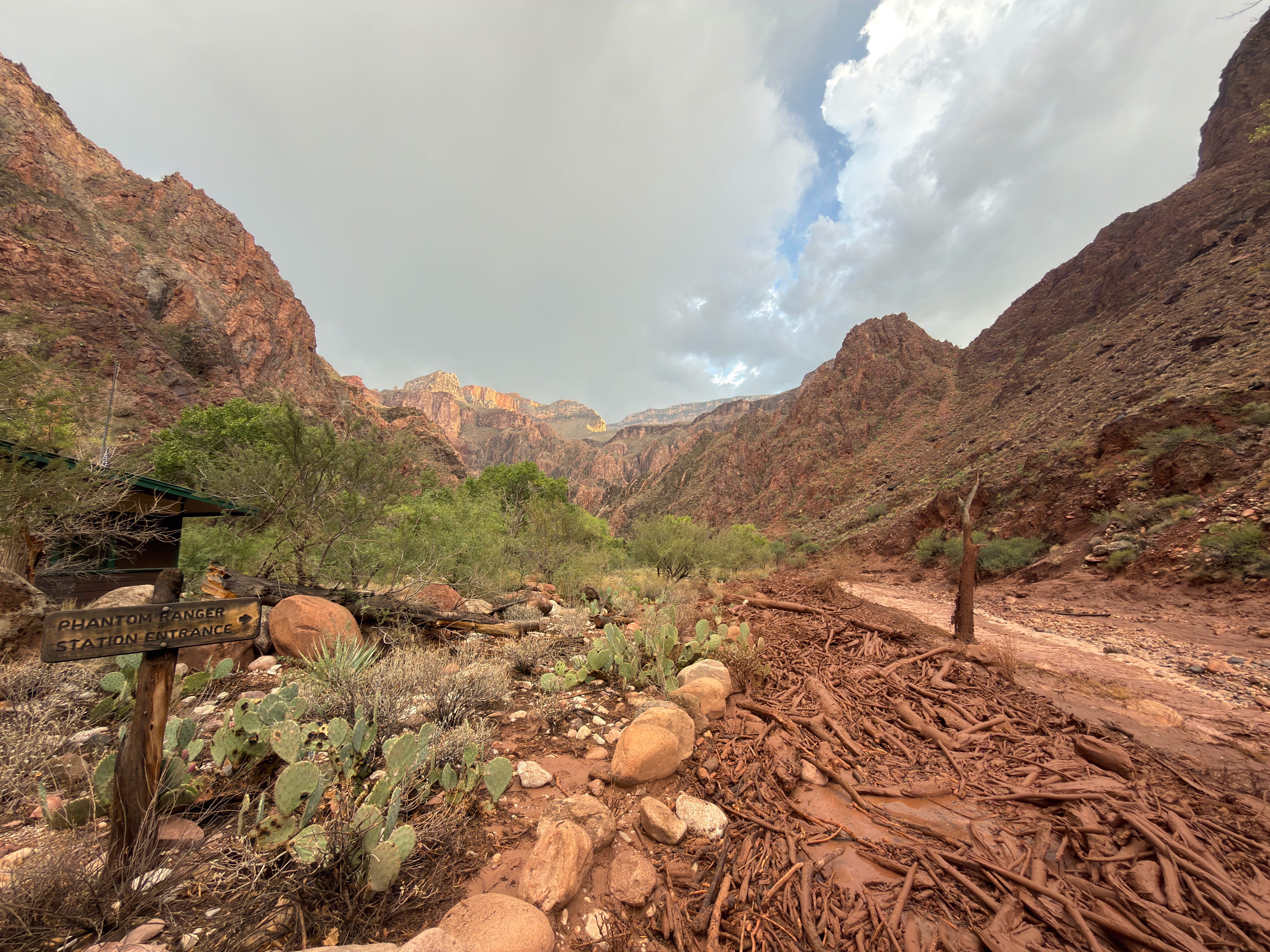
    Later, as they made their way toward Phantom Ranch, a colleague shouted “Up, Up, Up, Up!” as a 4-foot (1-meter) debris wall headed toward them and they ran up into a patch of cacti, he said. They were rescued by helicopter late Saturday after making it to the Phantom Ranch area, he said.

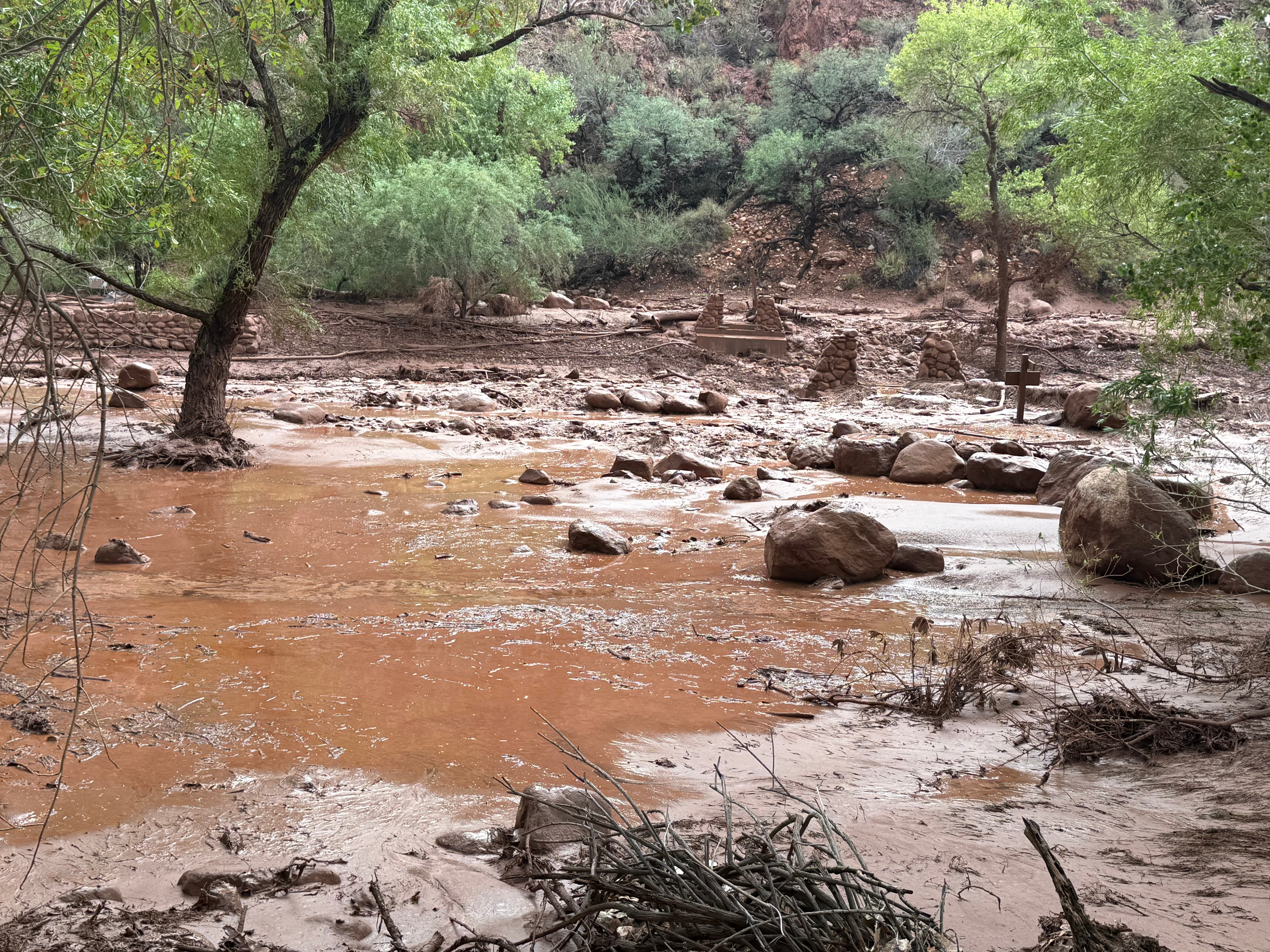
    Torrents of water wiped out footbridges over the creek and altered the landscape, widening the creek bed and extending an existing river rapid or creating a new one. The flood was a major blow to an enduring effort to modernize the pipeline that serves 6 million visitors a year and roughly 1,600 residents of Grand Canyon Village.

    “Heaven help us if the whole thing down there at the bottom has to be reconstructed,” said Jack Schmidt, director of the Center for Colorado River Studies at Utah State University. “Where are they going to get the money?”

    Halting overnight stays at the park because of a lack of water is rare, although the pipeline frequently has failed over the years. While the Grand Canyon has large storage tanks for potable water on the South Rim, they won’t be refilled while the pipeline is out of service.

    A $208 million rehabilitation of the pipeline and upgrades to the associated water delivery system started in 2023, with the park service calling it a crucial investment to ensure the park can meet the needs of residents and visitors. The project was expected to be completed next year.

  • This principal in Nepal evacuated 900 students before flooding swept away their school

    This principal in Nepal evacuated 900 students before flooding swept away their school

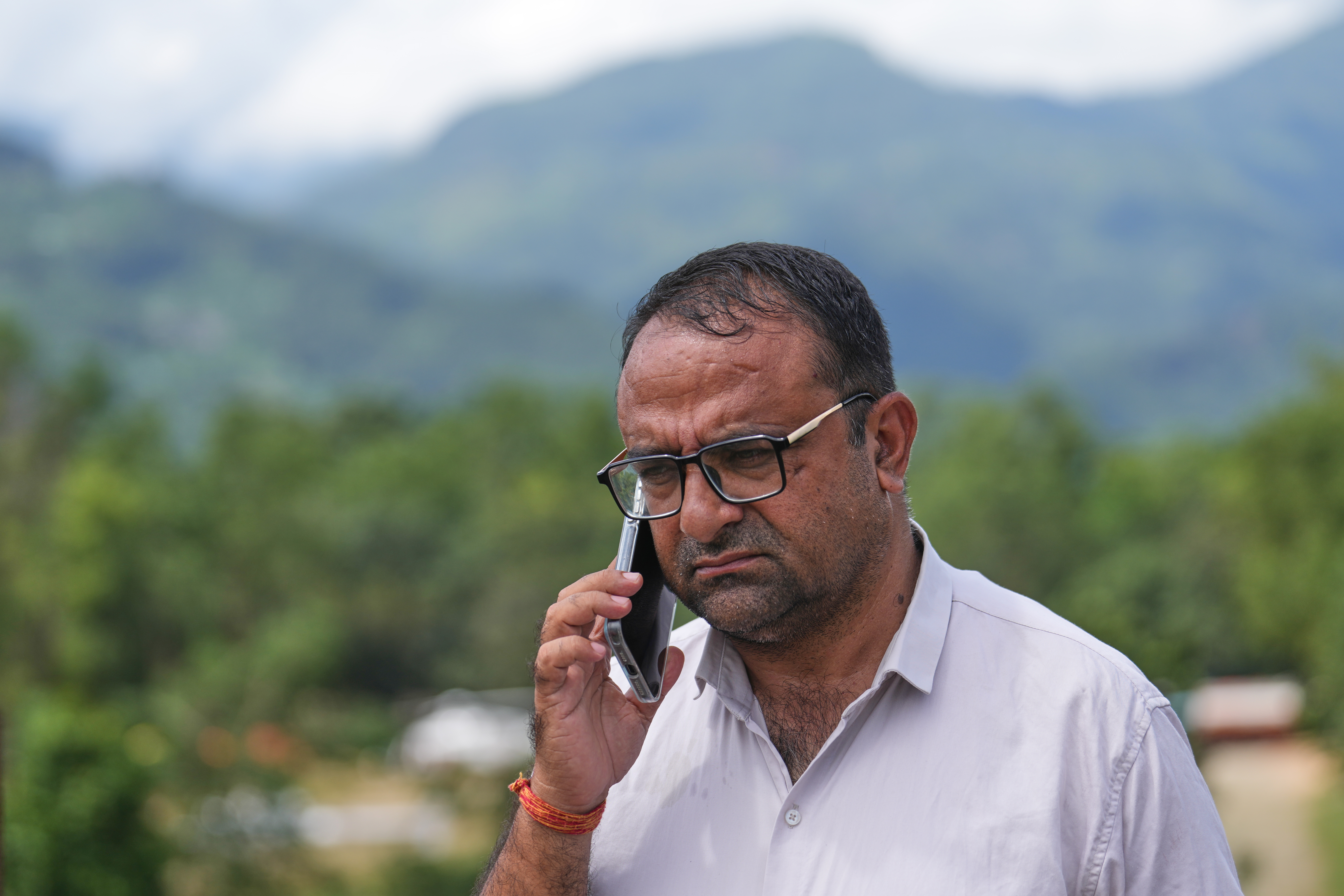
    BIDUR, Nepal — Rajendra Dawadi was inside his classroom when the school’s accountant rushed in with a warning: Floodwaters were racing through Nepal’s Trishuli Valley, tearing apart homes, bridges and entire villages.

    Then a teacher received another warning by phone. Moments later, a parent arrived to take her child home. The danger had not yet been confirmed, but Dawadi had little time to act. He rang the school bell and ordered his students and staff out of the building and toward higher ground.

    “I immediately decided to stop … school and (get the children out),” he told The Associated Press.

    As he followed them to a nearby hill, the floodwaters rose behind him. From the safety of the hillside, he turned to watch the school where he had once been a student — and where he had spent years teaching — disappear beneath a torrent of water, mud, boulders and debris. Two staff members could not make it and remain missing.

    Dawadi’s decision to evacuate the school saved at least 900 students from last week’s devastating flash floods in Nepal, unleashed after a glacial collapse in the Himalayas. The disaster killed over 900 people across Nepal and China, while more than 4,700 remain missing.

    As Nepal grapples with the catastrophic natural disaster, Dawadi’s story has emerged as a striking example of foresight and courage.

    The Tribhuvan Trishuli Secondary School in the Trishuli Valley of north-central Nepal had 1,643 students. At least 900 were on campus that morning, while some students were still making their way to school. Dawadi ordered those already there to leave and called bus drivers, telling them to only stop at safer places.

    One bus, packed with students, had already reached the school when Dawadi told the driver to turn back, he said. The bus crossed a newly constructed bridge and, moments later, the old bridge beside it collapsed.

    For Dawadi, the scale of the destruction has become personal, as the school had been both his workplace and a large part of his life.

    “I have no words. I got education from that school. And I gave education at that school,” he said.

    The destruction of Dawadi’s school was not an isolated loss.

    Across northern Nepal, the floods have left thousands of children without classrooms, disrupted their education and raised fears that the disaster could cost them months of schooling. Charity group Save the Children said in a statement that at least 69 schools in northern Nepal have been completely destroyed, putting the education of nearly 19,000 students at risk.

    Dawadi’s quick thinking and swift response during the disaster have been hailed as an act of heroism. When he returned to the site of the school days later, parents embraced him as they thanked him for saving their children.

    “Their parents hugged me, they cried with me,” he said. “They were emotional.”

    Student Suvina Tamang, 14, said the school’s three-story building was swept away shortly after all the students had been evacuated.

    “I will thank him when I see him” for saving my life, she said.

    But Dawadi is reluctant to accept the role of hero. For him, rescuing his students was his responsibility. Now he says, students will need psychological counseling. Then, lessons must begin again, even if the school must temporarily relocate.

    His appeal to the Nepalese government is simple: rebuild the schools and get children back to classes.

  • Letters to the Editor | Aug. 31, 2026

    Letters to the Editor | Aug. 31, 2026

    We need vaccines

    As a physician, my first response to your essay prominently displayed on the op-ed page with the headline “Why we need vaccines” was to laugh. But then the realization set in — how sad it is that this op-ed had to be written at all.

    Reading that piece makes you realize the size of the nation’s health literacy gap. Vaccines have a 230-year record of effectiveness and safety. They have saved hundreds of millions of lives. The misinformation surrounding them — disseminated largely by MAGA Republicans and their acolytes — has harmed this country immeasurably. How sad it must be to imagine that the parents of an unvaccinated child who dies of measles, a completely preventable disease, think to themselves, “Well, at least he didn’t have a vaccine complication.” You don’t need a college degree to know that vaccines are an invaluable part of modern healthcare. It’s been part of mainstream medicine ever since Edward Jenner developed the smallpox vaccine in 1796. For people to turn their backs on them now begs the question: How did we get here?

    Steven Barrer, Huntingdon Valley

    Woke — and proud

    I totally agree with Jenice Armstrong: In this day and age, with what we know about science, including sexuality, why should anyone be shamed for being woke? Fifty years ago, we either did not fully appreciate the inequities in employment, the oppressive environments in which women worked, the contribution of pollution to the destruction of the environment, the limited opportunities for people with disabilities, the continuum of sexual biology, and the insidious ways racism persisted among our society … or we didn’t know how to change them.

    But I — like a lot of other Americans — am certainly awake now.

    The principles of diversity, equity, and inclusion are about being kind and fair. It’s about helping people who have been denied opportunities during those years we were asleep. How can anyone be against that?

    P.S. No one wants to defund police.

    Beverly Moskowitz, Philadelphia

    Imagination Library

    I was very pleased to see the article explaining Dolly Parton’s program that gets books in the hands of babies, toddlers, and children under the age of 5. However, the article didn’t detail some important aspects of this 31-year-strong, genius idea.

    The 332,411,218 age-appropriate books that have been distributed so far have had a statistically significant and lasting effect on young learners’ scholastic and life outcomes. So much so that in many cases, whole states, including Delaware, have opted to fund the program for every child in their state.

    Philadelphia, and indeed the whole state of Pennsylvania, should use this moment in time to gift our children the love of books and learning.

    Liz Kory, Plymouth Meeting

    Join the conversation: Send letters to letters@inquirer.com. Limit length to 150 words and include home address and day and evening phone number. Letters run in The Inquirer six days a week on the editorial pages and online.

  • Dear Abby | The readers have spoken: The bride should have her way

    Dear Abby | The readers have spoken: The bride should have her way

    DEAR ABBY: I respectfully disagree with your response to “Woman’s wedding has been hijacked.” These mothers have no business trying to co-opt the bridal couple’s wedding. If the daughter gives in, it’s only the beginning of these two mothers trying to strong-arm themselves into trying to make future decisions for this poor couple.

    The couple should put their feet down and tell these mothers to back off. It’s their wedding, the only one (hopefully) they’ll ever have, and, if they cave to these mothers’ incipient narcissism at the expense of their wedding plans, they’ll all regret it (including these mothers) for the rest of their lives. I’m truly surprised you didn’t tell the couple to stand their ground.

    — DON’T BACK DOWN

    DEAR ABBY: Why should the bride put her hopes and dreams on the back burner just so the moms can impress their friends and associates? Not only does this advice fail to help the dad help his daughter, but it also sends the message to the daughter that her wedding is not really her wedding, it is a stage production the moms are orchestrating for their advantage.

    — THINK AGAIN

    DEAR ABBY: The advice for the hijacked wedding plans should have been for the bride to tell these two mothers to let the bride plan the wedding of her dreams, not theirs. I am assuming the bride can afford to pay for her small wedding. She can still include these mothers in something special.

    — ONCE IN A LIFETIME

    DEAR READERS: In the first line of my response to Doting Dad, I agreed that the daughter should have the wedding she wants. In retrospect, it’s clear I should have ended my answer there! If one of the moms had written in to complain about the intimate wedding the bride had planned, I’m sure I would have told her in no uncertain terms to back off and let the bride have her way. My apologies to the couple for wavering and siding with those pushy moms. Thank you all for calling me out on this one!

    ** ** **

    DEAR ABBY: I’ve been ill for almost a year now. Before this, I was in perfect health, able to take care of all my own needs. I have no spouse or significant other. Before I got sick, I used delivery only for the rare pizza I didn’t want to go out for. Now the only reason I have the food and medicine I need is because of delivery drivers. Thank you, delivery drivers! Bless you! I can’t imagine what I’d do without you. I’m sorry if the tip isn’t always the best. Please hang in there. You do more good than you will ever know.

    — GRATEFUL IN WEST VIRGINIA

    DEAR GRATEFUL: Being a delivery driver can seem like a thankless job some of the time. I’m glad you do your best to show gratitude and tip them, and I hope their employers compensate them fairly. Not only do these workers serve the underserved, but they also help keep local businesses afloat.

  • Horoscopes: Monday, Aug. 31, 2026

    Horoscopes: Monday, Aug. 31, 2026

    ARIES (March 21-April 19). Big version: Find out what it’s really like to live as the profession you admired as a younger person. The currently achievable version: Distill the job to its essence, which involves solving a certain kind of problem.

    TAURUS (April 20-May 20). Big version: See those dozens of locations that have long intrigued you. The currently achievable version: Pull together a vision board of your dream travels and start planning the most affordable one. You don’t have to believe yet.

    GEMINI (May 21-June 21). Big version: Spend time with the one you idolize. The currently achievable version: Ponder your interview questions and answer them yourself with research and imagination. You’re already more like this person than you think.

    CANCER (June 22-July 22). Big version: Experience another era firsthand. Currently achievable version: Cook its food, wear something inspired by its fashions and plan a day with its music, customs and ideas. The interest turns into a hobby, then a pursuit.

    LEO (July 23-Aug. 22). Big version: Gather brilliant people and improve your corner of the world. Currently achievable version: Invite two thoughtful people to brainstorm a problem you’re all well acquainted with. These ideas will break things open and lead to the next practical action.

    VIRGO (Aug. 23-Sept. 22). Big version: Invent something that solves a common frustration. Currently achievable version: Study the inconvenience from different angles. Take on one small aspect of the problem. Sketch the roughest version that could possibly work.

    LIBRA (Sept. 23-Oct. 23). Big version: Perform for an audience eager to see what only you can do. Currently achievable version: Consider every interaction as a chance to share some of your uniqueness. Even the most structured interactions have room to be yourself.

    SCORPIO (Oct. 24-Nov. 21). Big version: Live in the house that exists in your imagination. Currently achievable version: Choose one corner of your present home and give it the color, comfort and character of that dream. The process is addictive, and results will spread throughout your space.

    SAGITTARIUS (Nov. 22-Dec. 21). Big version: Vanish into the wilderness until the modern world lost track of you. Currently achievable version: Spend an afternoon where the trees outnumber the people and your phone has very little to contribute.

    CAPRICORN (Dec. 22-Jan. 19). Big version: Master the instrument whose sound goes straight through you. Currently achievable version: Investigate how to borrow, rent or own the instrument. Learn one song. AQUARIUS (Jan. 20-Feb. 18). Big version: Meet the people in your family who lived before photographs could capture them. Currently achievable version: Follow one name through records, places and stories until this person begins to take shape.

    PISCES (Feb. 19-March 20). Big version: throw a lavish celebration for everyone you love. Currently achievable version: Gather a few favorite people around something delicious, and give the occasion a novel name and a memorable purpose.

    TODAY’S BIRTHDAY (Aug. 31). It’s your Year of One Golden Decision. The single choice changes your entire reality for the better, and you make the same one again and again until it’s natural for you to live in this new uplifted state. More highlights: You’ll easily build strength and vitality because you’re in the right environment and surrounded by people on the same mission. A lucrative professional breakthrough. Gemini and Virgo adore you. Your lucky numbers are: 2, 10, 5, 16 and 42.

  • Dozens evacuated from Grand Canyon after flash flood hits creek leading to the Colorado River

    Dozens evacuated from Grand Canyon after flash flood hits creek leading to the Colorado River

    FLAGSTAFF, Ariz. — A major flash flood at the Grand Canyon forced the evacuation of dozens of people and swept large boulders, metal structures and other debris into the Colorado River that runs through it, the National Park Service said.

    The flooding in Bright Angel Creek, which flows into the river, happened Saturday afternoon and has left the park service seeking information about 15 people who may be missing or unaccounted for. Torrents of water wiped out footbridges over the creek and significantly altered the landscape, widening the creek bed and creating what appeared to be a new river rapid.

    As the park service tries to account for everyone in the area, it is asking anyone with details about people hiking or camping there to get in touch. It said it was working with the Arizona Department of Public Safety to continue evacuations Sunday.

    “This is a reminder of what a dynamic and active landscape Grand Canyon is,” said Jack Schmidt, director of the Center for Colorado River Studies at Utah State University.

    Popular tourist spots including the Bright Angel Campground, Phantom Ranch and parts of the North Kaibab trail remained closed on Sunday while park officials surveyed the damage, the park said. Rafting trips on the Colorado River also have been halted for now.

    More than 60 people were evacuated from Phantom Ranch, which has a historic canteen and dorms, and is a common spot for rafters to get off and on the river. More evacuations were planned Sunday, the park said. No injuries have been reported.

    Erica Viola said she was at Bright Angel Campground when the rain started Saturday afternoon, and she and about 50 other hikers watched the creek rise and then debris start to flow by, including what looked like a bunkhouse. The group was taken by helicopter to safety, ending her adventure two days early, she said.

    About half an inch to 1 inch of rain fell within about 30 minutes in the rocky area where there’s a steep drop in elevation, said National Weather Service meteorologist Justin Johndrow in Flagstaff.

    “Most of it ran off instantly,” Johndrow said.

    He said the flooding happened on the north side of the Grand Canyon, where Bright Angel Creek comes from the North Rim down to the Colorado River, dropping around 6,000 feet.

    More rain and thunderstorms were possible for the area into Monday.