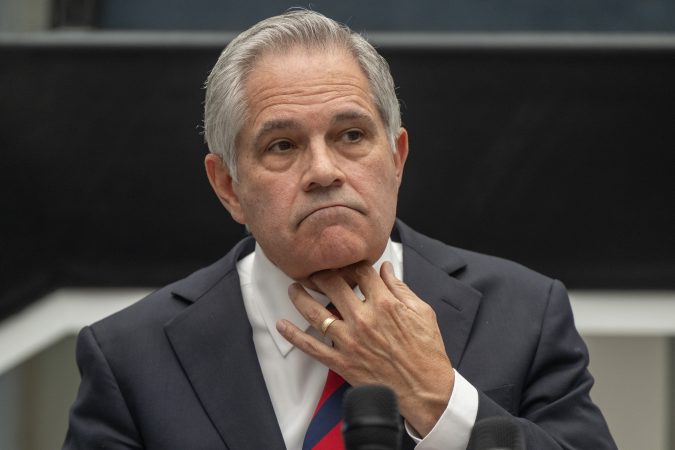
Tag: no-latest

  • Russia will close German cultural centers as Moscow and Europe spar over Ukraine

    Russia will close German cultural centers as Moscow and Europe spar over Ukraine

    WARSAW, Poland — Russia will close German cultural centers on its territory, Foreign Minister Sergey Lavrov said Thursday in a retaliatory measure reflecting the deepening tensions between Moscow and European countries that are helping Ukraine resist the Kremlin’s 4 ½-year-old invasion.

    Lavrov’s announcement came after Berlin blamed Moscow for an attempted drone attack at Leipzig/Halle Airport on Aug. 4. The explosives-laden drone was found near a Ukrainian plane at the airport, a major international freight hub used for providing support to Ukraine. The drone was later defused.

    Earlier Thursday in Munich, several incendiary devices were thrown at a construction site near a building where several companies, including from the defense sector, are located, the Bavarian State Criminal Police Office said. There was a brief fire that caused no significant damage, police said, adding they suspect the target was one of the companies in the area.

    Two Bulgarian nationals were arrested, police said, but their suspected involvement was not confirmed.

    Western officials have repeatedly accused Moscow of conducting a campaign of sabotage and disruption in their countries with the aim of undermining support for Ukraine and destabilizing European nations, something Russia denies.

    Germany says it has become a “daily target” of the Kremlin’s hybrid campaign.

    It said Wednesday it was closing both the Russian Consulate in Bonn and the Russian House cultural center in the German capital.

    Lavrov countered that cultural centers belonging to Germany’s Goethe-Institut would be closed in Moscow, St. Petersburg, and Yekaterinburg, adding that any other response would show a lack of “self-respect” on Russia’s part.

    He told an economic forum in the far east city of Vladivostok that Germany “could not have failed to understand” that closing the center in Berlin would “signify the end of their cultural presence in Russia.”

    Russian President Vladimir Putin said Berlin wants to distract from its own failings and dissatisfaction among voters. Any proof being offered “has been planted,” Putin said.

    Europe increasingly views itself as facing what it calls hybrid attacks by Russia, marked by cyberwarfare and disinformation as well as a conventional military threat. Each side accuses the other of state terrorism.

    The tension has continued for months and grown into a major foreign and defense policy challenge for countries in the European Union.

    Putin is testing the West with tactics that fall “just below the threshold of war” and is determined to “harass NATO members,” the head of Britain’s MI6 spy agency said last year.

    European countries seek to counter Russia’s threat

    Following Germany’s claims, Poland, Denmark, Finland, the U.K., the Czech Republic, and Lithuania have summoned Russian diplomats stationed in their countries.

    In Norway, authorities on Wednesday seized a Russian vessel in the Arctic archipelago of Svalbard at the request of Ukraine’s state-owned Naftogaz energy group.

    A Norwegian court ordered the seizure as part of efforts by Naftogaz to recover a $4.22 billion arbitration award stemming from Russia’s 2014 illegal annexation of Crimea and its seizure of Ukrainian energy assets, including gas fields and pipelines. After Moscow refused to pay the 2023 award, Naftogaz petitioned national courts for orders to seize Russian commercial assets.

    Putin on Thursday compared it to “state terrorism,” and Russia’s Foreign Ministry summoned Norway’s ambassador to Moscow, Heidi Olufsen, to protest the seizure of the vessel, which it said belongs to the state weather and environmental monitoring agency.

    It carried workers, scientists, and cargo to Russian settlements on one of the islands in Svalbard, the ministry said, adding that Moscow “will seek to lift the vessel’s arrest.”

    In Finland, meanwhile, more than 2,000 people took part Thursday in the biggest civil defense exercise in Europe since the end of World War II. Among the threats envisioned were missile strikes from neighboring Russia.

    EU weighs how to respond further

    EU ministers on Wednesday weighed how best to respond to the attempted drone attack but struggled to find new ways to meet the challenge without resorting to military means.

    The EU has slapped almost two dozen packages of sanctions on Russia over the war, targeting over 3,000 officials, oligarchs, and entities including banks, energy companies, and drone makers.

    One senior EU official said the bloc’s anti-terrorism procedures could be put to effective use.

    “If we list individuals as terrorists, we can deploy a range of instruments to actually target those individuals and to track them, all their activities, and people associated with those individuals,” EU Counter-Terrorism Coordinator Bartjan Wegter said.

    He told The Associated Press that EU methods for combating terrorist financing and money laundering, as well as boosting the resilience of infrastructure like airports, could be put to good use.

    “It is a very worrying development,” Wegter said of the failed Leipzig drone attack. But he noted that “it is not new what we’re seeing.”

    Both Russia and Iran have used hybrid warfare methods before, he said.

    “They’re actually deploying terrorist tactics” that are meant to “destabilize our society,” Wegter added.

    Denmark sounds alarm about Russian sabotage plans

    Danish security services are warning that Russian acts of sabotage against the country’s defense industry may be imminent.

    Intelligence services have seen signs of specific planning by Russia to conduct sabotage operations in Denmark, Emil Græsholm, head of counterintelligence at the national security and intelligence service PET, told the Berlingske newspaper.

    The targets are primarily companies in the defense industry and especially those associated with delivering military components to Ukraine, he said.

    Russian Ambassador Vladimir Barbin said PET has not presented any concrete evidence that Moscow was preparing sabotage acts in Denmark. He said Græsholm’s comments were actually an acknowledgement of Denmark’s involvement in Ukraine.

    The transformation of Danish territory into a production and logistics base for the Ukrainian military posed a security risk to Denmark, he added.

    Italy’s Defense Minister Guido Crosetto told AP on Wednesday that the German airport incident was “a very serious act that could have very grave consequences.”

    But he said the threats aren’t discouraging Italy from further helping Kyiv as Rome weighs whether to send SAMP/T air defense batteries. As in other Western countries, limited weapons production capacity is hampering efforts to supply more to Ukraine, he said.


  • EPA proposal could leave the public in the dark on data center plans

    EPA proposal could leave the public in the dark on data center plans

    WASHINGTON — A plan by the Environmental Protection Agency could make it harder for the public to learn about and comment on proposed AI data centers that have sparked backlash in communities across the United States and transformed the midterm election landscape.

    The EPA proposal would eliminate a federal requirement that states notify the public and seek comment before issuing air pollution permits for data centers and other industrial facilities. States could still offer opportunities for public comment, but the EPA would no longer mandate them as a condition for states to grant permits.

    Critics say the move could thwart local residents from learning about proposed data centers or making their voices heard before projects are approved and construction begins. The move comes during a widespread backlash as tech giants build hundreds of massive server warehouses to fuel artificial intelligence and cloud computing.

    “By eliminating the long-standing federal requirement for public notice, this proposal continues efforts by the Trump administration to turn its back on the fundamental EPA principle of transparency,” said Mike Koerber, a former deputy director of EPA’s air quality office.

    If made final, the plan could create “an unlevel playing field where citizens in one state are kept completely in the dark about new data centers and heavy industrial emissions in their backyards, while neighboring states maintain oversight,” he said.

    Under the EPA plan, states with weak or no requirements for public comment could speed permits for data centers, power plants and other pollution sources without consulting the public or even informing communities where the facilities are located, Koerber and other critics said.

    Communities deserve a chance to weigh in, advocates say

    “Data centers and other industrial sources should not be able to get their air pollution permits in secret,” said Keri Powell, senior attorney for the Southern Environmental Law Center, an advocacy organization that leads a coalition of nearly 200 environmental, health and community groups that filed comments with the EPA opposing the plan. “Communities deserve a chance to weigh in” before potentially harmful projects are approved.

    An EPA spokesperson called that a false narrative.

    “In our proposal we are saying that states get to pick how they want their permitting process to go for minor sources” of air pollution, spokesperson Carolyn Holran said.

    The EPA proposal does not specifically identify data centers, she said, noting that the plan also would apply to laundromats, car repair shops and even landfills and steel mills that are considered “minor” pollution sources under the federal Clean Air Act.

    The proposal does not demand that states make particular changes to their programs, nor does it alter federal emission standards or weaken environmental protections, Holran said. “Rather, the proposal simply aligns the national program with the Clean Air Act language to ensure that states are in the lead regarding their programs.”

    EPA Administrator Lee Zeldin, who has made U.S. leadership in AI a top agency priority, said in a statement that the plan is aimed at “cutting unnecessary and burdensome red tape, unleashing American energy and advancing cooperative federalism” with states. The EPA is expected to make the rule final next year.

    President Donald Trump continues to stick up for data centers, even as politicians from both parties criticize them and many communities try to block them. Trump said on social media this week that U.S. communities that don’t have data centers will “end up being backwards and poor.”

    Trump says data centers are crucial in the AI race against China

    Trump has acknowledged that data centers need “a little public relations help” and has pushed tech companies to generate their own electricity to shield consumers from higher utility bills. The Republican president calls data centers critical to winning the AI race against China.

    Environmental groups and other critics say the EPA proposal ignores the reality that many states, particularly in the South and Midwest, don’t require public notice or hearings beyond those set by federal agencies. The federal plan would leave many communities in the dark before data centers show up in their backyards, they said.

    “It’s beyond cruel for Trump’s EPA to silence front-line communities who bear the brunt of unhealthy air,” said Brandon Jones-Cobb, a senior attorney at the Center for Biological Diversity, another environmental group.

    The EPA “has already turned its back on science, cut enforcement against industrial polluters and eliminated life-saving air pollution measures,” he said. “Now it wants to shut the public out of decisions to build or expand facilities that expose communities to dangerous air pollution, including data centers.”

    Powell, whose organization focuses on six Southern states from Virginia to Alabama, said many states “only do what is required by federal law” when it comes to public notice of land-use projects and other environmental concerns.

    “We rely on a minimum federal requirement to ensure we have environmental protections and a voice,’’ she said in an interview, calling regulation of data centers a crucial issue in a region where the energy-hungry behemoths are proliferating. Virginia and Georgia are both among states with the highest concentration of current and proposed data centers.

    Americans worry data centers could cause pollution, job losses

    Besides powering AI and cloud computing, data centers are often sources of nitrogen oxide, which helps form ozone, as well as carbon monoxide and other air pollutants. Local communities also have expressed concerns about excessive water use and noise from data centers. Many Americans worry that AI could increase economic disparities and cause widespread job losses.

    Data center advocates stress that local taxes paid by the centers can help fund public schools, reducing the financial burden on homeowners.

    Jane Williams, executive director of California Communities Against Toxics, said even if data centers ultimately are approved, “every community should be able to participate robustly in governmental decisions that can pollute our air.’’

    Rolling back the EPA rule “pulls a dark cloud, filled with soot and toxic chemicals, over communities’ right to know what polluting facilities are planned in their community,” she said.

  • A federal judge has blocked Trump’s second try to restrict birthright citizenship

    A federal judge has blocked Trump’s second try to restrict birthright citizenship

    A federal judge in Maryland temporarily blocked much of President Donald Trump’s latest effort to withhold citizenship from babies born in the United States to noncitizen parents, ruling that the Supreme Court had already settled questions reopened by an executive order Trump signed in August.

    While the decision was limited to children born after Feb. 19, 2025, including those born in the future, Judge Deborah L. Boardman wrote that the order would likely affect babies the Supreme Court had already defined as citizens. The ruling delivered a sharp rejection of the president’s renewed efforts to restrict birthright citizenship, after the Supreme Court ruled 6-3 in July that a previous, more sweeping, executive order from 2025 was unconstitutional.

    “No presidential executive order can undo what the Supreme Court has done,” she wrote.

    Boardman’s order took a dim view of the Trump administration’s reasoning, which she characterized as a thinly veiled attempt to get around the Supreme Court’s decision. She wrote that the president and others named in the lawsuit “completely misread” the majority’s opinion and embraced a “distorted interpretation” of its conclusions.

    In a 35-page opinion, she described the latest order as only the most recent attempt to curtail birthright citizenship by any means that could survive legal scrutiny.

    “Since his second term in office began on January 20, 2025, the president has tried, through executive order, to upend our country’s longstanding tradition of birthright citizenship and eliminate, for large swaths of Americans, the right to citizenship by birth, a right enshrined in the Citizenship Clause of the Fourteenth Amendment,” she wrote.

    Boardman described a number of ways that children covered by the lawsuit could have their citizenship rescinded, including if the Trump administration moved to label their parents members of terrorist groups or “alien enemies” under arbitrary legal determinations. She cited a pattern in which the administration has accused Venezuelan nationals of being affiliated with the criminal organization Tren de Aragua, often without evidence, in deportation proceedings.

    While she stressed that it was too soon to find that the order itself was unconstitutional, she wrote that it already appeared clear that it was unconstitutional as applied to the class of babies defined when immigration groups initially sued last year to block Trump’s first order.

    The order this year had included other measures to create novel categories of babies that could be disqualified from citizenship, including those born to parents engaged in so-called “birth tourism,” through which mothers deliberately traveled to the United States to give birth.

    It was unclear how the Trump administration planned to tag those it suspected of traveling to the United States to have their children. But Boardman noted that the executive order was broad, describing anyone who engaged in a “commercial transaction” — such as purchasing a plane ticket — as traveling to access birthright citizenship.

    The Supreme Court’s decision upholding birthright citizenship “is the law of the land,” Boardman wrote. “The President must follow it.”

    This article originally appeared in The New York Times.

  • Letters to the Editor | Sept. 3, 2026

    Letters to the Editor | Sept. 3, 2026

    Krasner defended

    I’ve seen The Inquirer’s extensive coverage of the office of our district attorney, Larry Krasner, including its internal discussions. In general, scrutiny of an elected official is a good thing. If previous DAs had been subjected to such scrutiny, perhaps there would be fewer innocent people in prison, and fewer wrongful convictions to overturn. What the reporting fails to consider, however, is how much opposition there is to Krasner’s work. There are a lot of people who would rather see an innocent person remain behind bars than admit error. And there are a lot of people who figure that if someone is in prison, they must have done something wrong, even if it’s not the crime they were convicted of.

    These people want to see our district attorney fail. And they’ve tried very hard to make that happen, helping explain the DA’s caution, which columnist Paul Davies calls paranoia. Krasner has been impeached, his office undermined, his actions subjected to state oversight, and so on. Has any Philadelphia DA ever been impeached for overzealous prosecution? I don’t think so. Please take this into account. Krasner is fighting the good fight, on the side of the innocent, as he should be.

    Jon Webb, Philadelphia

    Broken system

    The overall need for mental health care has surged significantly post-pandemic, yet according to a 2024 survey, about 34% of psychologists and 45% of psychiatrists do not accept health insurance. For a private-pay psychiatrist, evaluations typically cost $300 to $500, and standard sessions range from $100 to $300. Enter Lindsay Clancy, married mother of three, a former labor and delivery nurse. Described by her coworkers as compassionate, kind, and an advocate for her patients.

    Months following the birth of her third child, Clancy recognized a change in her mental health. She had the courage to share those terrifying thoughts with her husband and parents. She called a crisis hotline, went to an emergency room, and voluntarily checked herself into a psychiatric hospital. She did all of this because she did not want to harm herself or her children. She desperately wanted to get well and was caught in a mental health care system strained by provider shortages and understaffed clinics. Mental illness, like every serious condition that threatens life, needs the proper treatment. Treatment that she didn’t receive. Compassion for Clancy, not conviction.

    Kathy Carroll, Wayne

    A true loss

    The planned closing of the Academy of Natural Sciences of Drexel University is a profound loss for our region and the history of science. Few institutions anywhere can claim a more consequential place in paleontology. In 1868, the academy became the first museum in the world to mount and publicly display a genuine dinosaur skeleton: Hadrosaurus foulkii, unearthed a decade earlier from a marl pit in Haddonfield. That landmark installation transformed dinosaurs from fragmentary scientific curiosities into creatures the public could see, imagine, and understand.

    The mounted Hadrosaurus helped ignite public fascination with dinosaurs that soon helped fuel the great fossil-hunting rivalries of the late 19th century — the era now remembered as the Bone Wars. It also helped establish the model of a natural history museum as the place where scientific research and public wonder meet. The dinosaur displays that now draw crowds around the world owe something to that moment in Philadelphia.

    To allow this museum to go dark would be an astonishing act of cultural and civic neglect. Philadelphia rightly invests enormous sums in sports and entertainment. It should not abandon an institution whose legacy reaches far beyond the region — a place bound to one of the defining chapters in the worldwide history of paleontology. The museum deserves not closure, but preservation, investment, and a secure future.

    Hoag Levins, Haddon Township

    Join the conversation: Send letters to letters@inquirer.com. Limit length to 150 words and include home address and day and evening phone number. Letters run in The Inquirer six days a week on the editorial pages and online.

  • Horoscopes: Thursday, Sept. 3, 2026

    Horoscopes: Thursday, Sept. 3, 2026

    ARIES (March 21-April 19). With so many answers to the world’s questions but a keystroke away, success secrets should be called “success Googles.” But knowing the answer isn’t the answer — applying it is. The one who can help you do this is the real success secret.

    TAURUS (April 20-May 20). Let each situation tell you what kind of exchange fits. When charity is called for, give with an open heart. When professionalism is called for, charge what it’s worth.

    GEMINI (May 21-June 21). Friends can offer perspective. Media can offer ideas. Experts can offer insight. Still, some truths about yourself can only be learned by living them. Your confidence comes from experience: Trust it.

    CANCER (June 22-July 22). A relationship doesn’t have to be perfect to be worthy of fighting for, and neither does it need to be bad to be worth fighting against. If it’s just “meh,” you can do better. Resist the pull by putting distance between you.

    LEO (July 23-Aug. 22). Familiarity has a curious side effect. It makes remarkable things blend into the wallpaper. A change of scenery may be all it takes to see your own life with fresh eyes. Home will become more interesting after you’ve been somewhere else.

    VIRGO (Aug. 23-Sept. 22). You’re so generous, though today you can’t seem to give anything away without being gifted with new rewards and resources. Don’t worry, you don’t need to repay every good thing you’re gifted. Just enjoy yourself.

    LIBRA (Sept. 23-Oct. 23). An offhand remark may surprise you, even though you’re the one who said it. Before you explain it away, sit with it for a moment, as there could be a tiny bit of truth or useful wisdom here.

    SCORPIO (Oct. 24-Nov. 21). A new project involves learning stages. The exciting part is brief. The interesting part lasts much longer. Today you’ll find yourself somewhere between the two. You’ll discover whether you came for the novelty or the craft.

    SAGITTARIUS (Nov. 22-Dec. 21). The way people show how they feel about you doesn’t always come across as intended, especially if their feelings are strong and unfamiliar to them. Expect some awkwardness and try to extend the most generous interpretation.

    CAPRICORN (Dec. 22-Jan. 19). Somewhere along the way you stopped asking what people usually do and started asking what works for you. One choice made life easier. Another made it more fun. Today you’ll look around and realize your life is unmistakably your own.

    AQUARIUS (Jan. 20-Feb. 18). There’s no good reason to put yourself in an uncomfortable situation or spend time in draining or negative situations. Your emotional body needs as much care, caution and attention as your physical body.

    PISCES (Feb. 19-March 20). Every collection begins with one item. Every tradition begins with one time. Every friendship begins with one point of connection. What’s the difference between a one-off and a runner? The first time is chance. The second is choice.

    TODAY’S BIRTHDAY (Sept. 3). It’s your Year of Fascination, when people, projects and environments captivate your curiosity, and relationships hum with mutual intrigue. More highlights: Your home environment is upgraded by good design and warm connections. You’ll learn ways of communicating that make work easier and more efficient, and profitable too. Hot tickets and big social events. Pisces and Scorpio adore you. Your lucky numbers are: 2, 26, 15, 9 and 7.

  • Dear Abby | Widow’s new beau does not pull his weight

    Dear Abby | Widow’s new beau does not pull his weight

    DEAR ABBY: My husband died six years ago. I met a widower three years ago. He was nice and attentive, but not anymore. We moved in together, and the last two years I have been miserable.

    I pay half the rent. I also pay for all the groceries and gas and pick up the check every time we go out to eat. He even takes my meds, so I have only half of what I need. The only time he is not moody is when I wait on him hand and foot.

    I have nothing. I live on Social Security, and so does he. He doesn’t hit or abuse me, so I feel like I should stay, yet I’m so unhappy. He doesn’t talk to me or even give me a hug. I think I’m stuck and don’t know where to turn. My grown kids don’t need to hear that I messed up, and I don’t want to burden them. Can you please advise me?

    — MISERABLE IN ARIZONA

    DEAR MISERABLE: Gladly. Your grown children need to know exactly what your situation is with this man. Whose name is on the lease of your dwelling? If it isn’t you, there is no reason why you can’t end this pain. Tell your kids what’s going on and ask for their help in getting out of this soul-crushing mess. It may be embarrassing, but it may be the only way to escape.

    ** ** **

    DEAR ABBY: I will be attending my nephew’s wedding in the northeast part of the country. I live in the mid-Atlantic. I have been told that at the reception each plate will cost $200, and they are expecting their wedding gifts to be worth at least the cost of the plate. Therefore, if a couple attends and both spouses dine at the reception, a $400 wedding gift is expected. Are these guidelines for real?

    — BAFFLED ABOUT ALL THIS

    DEAR BAFFLED: These “guidelines” do not exist except in the minds of the presumptuous individuals who are throwing this shindig. A wedding reception is not a quid pro quo affair. The cost of the celebration is borne by the bride and groom and their parents, and no one else. If you plan to attend, your wedding gift should not cost more than you can comfortably afford.

    ** ** **

    DEAR ABBY: I lost my wife in November to non-alcoholic fatty liver disease (NAFLD) that had progressed to cirrhosis. She also had polycystic ovary syndrome (PCOS), which was diagnosed in 1990. No doctor told my wife in the intervening years, “You have PCOS, so you need to get your liver checked.” For some reason, most general practitioners and OB-GYNs do not tell their patients this. According to the World Health Organization, about 10% of women have PCOS. According to the National Institutes of Health, between 34% and 70% of PCOS patients develop fatty liver disease. Could you use your platform to tell PCOS patients to advocate for themselves to get liver scans done? I don’t want any other family to experience the loss that my family has.

    — WARNING TO WOMEN

    DEAR WARNING TO WOMEN: Please accept my sympathy for the loss of your wife to this terrible disease. Readers, I can’t promise insurance will pay for the additional testing for all PCOS patients, but it can’t hurt to raise the subject with your doctor.

  • Gary Glitter pleads not guilty to child sexual abuse charges

    Gary Glitter pleads not guilty to child sexual abuse charges

    LONDON — Gary Glitter, the British glam rock singer whose music is still regularly played at U.S. sports events, pleaded not guilty at a London court Wednesday to four counts of indecently assaulting a girl more than four decades ago.

    The musician, whose real name is Paul Gadd, also pleaded not guilty to two counts of indecency and two of sexual intercourse with the same girl when she was between 8 and 11 years old.

    Tony Baumgartner, the presiding judge at Southwark Crown Court, said Gadd would face trial starting Nov. 22, 2027.

    During the hearing, Gadd, 82, who appeared via video link from a prison in Devon, England, and wore a gray jacket and hat, confirmed his name before a clerk read out brief details of the counts and asked for his pleas.

    When prosecutors and police announced initial charges in July, they said the abuse occurred between 1978 and 1981 at a residential address in the Kensington district of London and that it involved a woman who reported the accusations to police early last year.

    The clerk said Gadd was accused of having sex with the girl on at least five occasions.

    Gadd, who was sitting behind a table, said “Not guilty” to each charge, although he said “Absolutely not guilty” to two counts.

    Under British law, it is illegal for the news media to report information that could identify someone who has made such sexual abuse allegations, and they have lifelong anonymity.

    Gadd was a star of the glam rock era of the early 1970s that also included acts such as David Bowie and T. Rex. His 1972 hit “Rock and Roll (Part 2),” which reached No. 7 on the Billboard Hot 100 chart, is still regularly played at sports events in the United States. It also served as the soundtrack to a pivotal scene in the 2019 movie “Joker.”

  • Texas sees extreme flooding as more than a foot of rain falls in areas

    Texas sees extreme flooding as more than a foot of rain falls in areas

    HOUSTON — An extreme flood scenario was underway Wednesday in Southeast Texas with the remnants of Edouard.

    The storm, now a tropical depression, has dumped an estimated 15 to 22 inches of rain in spots, and some areas could experience rain totals of 25 to 30 inches.

    A flash flood emergency was issued for Hardin and Tyler counties until 10:45 a.m. local time. By noon local time, a weather station near Saratoga, Texas, was up to 17.75 inches — 5.91 inches of which fell between 5 and 6 a.m. A station south of Ivanhoe, Texas, near Warren, has recorded 15.68 inches of rain. Another near Wildwood is up to 16.52 inches. And considerably more has probably fallen in the rural areas away from weather stations.

    At least one person had to be evacuated in the East Texas town of Kountze after water entered a structure as heavy rain swept the area, according to staff at the National Weather Service office in Lake Charles, Louisiana.

    Forecasters urged people to get to higher ground as rain continued to fall early Wednesday, delaying damage assessments.

    “Move to higher ground now!” wrote the National Weather Service in Lake Charles. “This is an extremely dangerous and life-threatening situation. Do not attempt to travel unless you are fleeing an area subject to flooding or under an evacuation order.”

    Texas deployed rescue aircraft, boats and high-water vehicles, and the state’s emergency operations center has been activated, along with 1,500 state personnel.

    “We are getting it pretty good over here,” Kountze Mayor Glenn Matthews said by phone from his home, which has been without power since Tuesday night, noting crews were out doing welfare checks for the roughly 2,000 residents.

    Matthews said he had not heard any reports of injuries or deaths related to the storm, and there were no evacuation orders for the area. But there was concern about elderly residents like his parents who were without power and sometimes need oxygen.

    “What we’re doing now is making sure everyone is okay. Then we can try to assess the damage after the rain has let up some,” Matthews said. “It’s still raining as we speak. The city is pretty much flooded because this much rain at one time, there’s nothing the drainage can do about it. But it dissipates pretty well when it stops. This is not our first rodeo: We’ve been through this before many times.”

    He noted that the rains came after a lengthy dry spell: “We had just declared a burn ban. Be careful what you ask for.”

    At least 80,000 people were without power Wednesday morning across hard-hit areas of East Texas, the majority – about 50,000 — in coastal Port Arthur, an industrial refinery town of about 56,000.

    “We’re out doing damage assessments this morning in between wind and rain bands. It’s still an organized storm, albeit moving to our north. The winds are stronger than what had been forecast,” said Jeff Branick, chief executive for Jefferson County surrounding Port Arthur.

    Branick said the areas has “mostly debris issues, very little flooding” compared with Kountze and other areas to the north, where the state’s emergency management division has sent search-and-rescue boat teams.

    But he noted that the area has “some industrial upsets because of the loss of power,” including widespread complaints overnight of gas and burning rubber odors near refineries.

    “The investigation is still ongoing. Fortunately, after the odor appeared they determined one of their flares that’s used to offset the loss of power had not ignited and they got it ignited and the issue went away,” Branick said of a Valero refinery.

    Downtown Houston has seen only about a tenth of an inch of rain, if that. The edge of the heaviest rain is razor-sharp, with a flood disaster 50 to 75 miles away.

    Rainfall totals of 5 to 6 inches per hour are common in the heaviest bands. A staggering 5.91 inches fell in a single hour along Highway 787 west of Lumberton, Texas.

    Edouard is a waterlogged system, making for extremely efficient precipitation processes. Not only is there more water in the atmosphere to work with, but the saturated atmosphere means there’s little to no evaporation of the raindrops on the way down.

    There are even some indications that Edouard intensified a bit overnight. That’s because of several factors.

    For starters, diurnal — day/night — processes often lead to enhanced convection, or thunderstorm, activity after nightfall. That sometimes allows tropical cyclones to strengthen a bit after dark, even if they’re moving inland.

    The system also has an umbilical cord of moisture and instability, or thunderstorm fuel, feeding it from the southeast. That Gulf of Mexico connection helped fuel the storm, even far inland.

    But the tiny core has remained remarkably intact. It’s not often a well-defined eye is present 115 miles inland. Edouard’s decay may also be slowed by something called the “brown ocean effect,” a rare phenomenon in which a tropical system that has made landfall behaves as if it’s over water.

    It occurs when hot, saturated soils mimic a tropical ocean, allowing a cyclone to extract heat energy.

    That may seem surprising considering there’s a drought in Texas. But the hot, sunbaked soils may have become a bit warmer due to the drought. Then they were resaturated by the initial rains from Edouard’s outer bands. Soil temperatures in the top 6 inches of ground in Southeast Texas were between 82 and 85 degrees as Edouard made landfall.

    Marshall Shepherd, a researcher at the University of Georgia and a specialist on this process, likened it to a “flash brown ocean feedback.” In an email, he suggested the initial dry environment may have played a role.

    Something similar happened with the remnants of Tropical Storm Erin, which came back to life over Oklahoma on Aug. 18, 2007. Research from 2021 noted that dry conditions preceded Erin but that the storm re-wet the hot soils, allowing the brown ocean effect to occur.

    In the case of Edouard, the storm’s small size made it extra prone to interacting with the landscape, noted Brad Johnson, a research meteorologist and specialist on the role of land type.

    In the interim, Edouard will continue to dump prolific moisture.

    Steering currents are very weak, so there’s not much to scoot the system along. The storm was moving northwest at 5 mph — a brisk walking pace.

    An additional 6 to 14 inches of rain may still fall in some spots.

  • Coin with Trump’s face and gold finish to go on sale

    Coin with Trump’s face and gold finish to go on sale

    The $1 coin designed to celebrate America’s 250th birthday — and seemingly President Donald Trump, whose face gazes from one side of the gold finish — will go on sale Wednesday, according to the U.S. Mint.

    The coin’s design — Trump’s visage as “heads” and the Great Seal of the United States as “tails” — received the stamp of approval this year from the U.S. Commission of Fine Arts, whose members Trump appointed. In past comments, the president said that the idea to stamp his face on a coin was “very unusual” but that he was “honored by it.”

    The president’s second term has brought several such brandings, or attempts at them, that have become tangled up in lawsuits. That includes moves to put Trump’s name on the Kennedy Center and the U.S. Institute of Peace, as Trump works to leave his stamp on history and on Washington, D.C.

    The coins, which can be used as legal tender, drew some criticism, particularly because of federal law that bars the depiction of a living president on U.S. currency. But in some circumstances, the Treasury Secretary does have authority to authorize the minting and issuance of special coins.

    The coins were struck to “honor 250 years of great American heritage,” the U.S. Mint wrote on its website. In an arc above Trump’s face is written “LIBERTY,” and below is “1776 (tilde) 2026.” On the flip side is the Great Seal of the United States, with the bald eagle gripping arrows in one claw and an olive branch in the other. In a banner clutched in its beak is written “E PLURIBUS UNUM,” Latin for ”out of many, one.”

    A roll of 25 coins will cost $61, and a bag of 100 will cost $154.50, and the U.S. Mint said it randomly hid some special-issue coins among the rolls and bags. Those will be marked “July 4th” because they were struck on that day, the anniversary of the Declaration of Independence.

    Households are limited to only two orders, the U.S. Mint wrote, but that cap will be lifted at 2 p.m. Thursday.

  • Trump’s ‘lightning speed’ outpaces the courts

    Trump’s ‘lightning speed’ outpaces the courts

    WASHINGTON — The courts cannot keep up with President Donald Trump.

    In cases on immigration, spending, mass firings, and restructuring agencies, the administration has barreled ahead in the face of slow-moving legal challenges. If Trump loses when those lawsuits are finally resolved, it may be too late as a practical matter to undo what he has achieved.

    The challenge to Trump’s enormous White House ballroom project is just the latest example of a mismatch between a judicial system characterized by unhurried deliberation and a presidency built for speed.

    “Trump is going to get his ballroom — even if courts conclude it’s illegal,” said Leah Litman, a law professor at the University of Michigan.

    Over the past few months, three judges and four justices concluded that Trump likely violated a federal law by razing the East Wing and replacing it with a luxury building.

    Five other justices did not dispute that conclusion, ruling instead that the challengers probably lacked a direct interest in the matter sufficient to give them standing to sue.

    The litigation continues — but so does the construction. Trump said Tuesday that the project will be done by next year.

    Dissenting from an order in a different case last week, on mail-in voting, Justice Ketanji Brown Jackson wrote that she detected a pattern: a “Catch-Me-If-You-Can approach to pursuing the president’s policy agenda.”

    Davis Ingle, a White House spokesperson, said velocity was a virtue.

    “President Trump is moving at lightning speed,” he said, “because we don’t have time to waste in our mission to make America greater than ever before.”

    When the ballroom case was argued before a three-judge panel of the U.S. Court of Appeals for the District of Columbia Circuit in June, Judge Patricia A. Millett asked a telling question.

    If the government were to move very quickly to bulldoze the Statue of Liberty, she asked, was it true that “nothing can be done” by the courts?

    Yaakov Roth, a Justice Department lawyer, did not try to duck the question. “I think that’s right, yes,” he said.

    The panel ruled for the historic preservationists who had challenged the project by a 2-1 vote, affirming a ruling from a lower court judge blocking the project about four months after it was issued. That is pretty fast by judicial standards.

    But the injunction had been paused while the case moved along, and the appeals court added another two weeks. Then Chief Justice John Roberts added another pause, one that would turn out to last 10 days.

    During all of this, construction continued at a furious pace.

    When the case reached the Supreme Court last month, the challengers warned the justices that Trump had “decided to try to outrun judicial review.”

    In response, Solicitor General D. John Sauer did not exactly deny the charge. He crowed that a 250-person crew had been working 20 hours a day, seven days a week, and that the project, which he said included key security upgrades for the White House, had passed the point of no return. Echoing the challengers, he wrote that “the executive has raced to ‘outrun’ the extraordinary security threats facing this president.”

    In a decision Monday that let the project proceed for now, no justice said the project was lawful. The five-member majority, in an unsigned opinion, instead tentatively determined that the challengers had not suffered the sort of direct injury that would allow them to sue.

    Indeed, the majority went out of its way to say that “we do not pass upon the legality of the government’s East Wing project.”

    A frustrated Roberts, joined by the court’s three liberal members, wrote in dissent that “construction of the ballroom has proceeded apace for the better part of a year” even though it was most likely in violation of a federal law that requires Congress’ express permission to erect a building on federal property in Washington.

    Should Democrats capture one or both chambers of Congress in the coming election, they may be able to challenge the project in court or through legislation. But it will almost surely be too late.

    Aziz Huq, a law professor at the University of Chicago, said there was a pattern.

    He pointed to cases in which he said the administration had “immediately shut off funding in violation of law when the recipient depends on the funding and is discouraged from suing by even the temporary loss of funding.”

    This, Huq said, “is a striking use of practical power to outrun law.”

    The Supreme Court’s deliberate pace helped Trump during his last campaign, too.

    Jack Smith, the special counsel prosecuting him on charges that he had tried to subvert the 2020 election, sought to put the case on a fast track, one that would yield a trial before the 2024 election. Trump argued that he was immune from prosecution because his actions had been part of his official duties as president.

    Sauer, who was then Trump’s personal lawyer, urged the justices to go slow. The question, Sauer’s brief said, should be “resolved in a cautious, deliberative manner — not at breakneck speed.” He urged the justices not to “rush to decide the issues with reckless abandon.”

    The Supreme Court turned away a first appeal in 2023 and did not agree to hear the case until late February 2024, scheduling arguments for that April.

    The court’s decision, that July, granted Trump broad but not unlimited immunity, and Smith might in theory have been able to proceed with some elements of his case.

    But it had taken the court long enough to decide the immunity issue that the prospect of a trial before the election evaporated. After Trump won, the Justice Department dismissed the charges against him.

    “It was entirely foreseeable that the Roberts court’s decisions allowed Trump to outrun both the prosecutors and the lower courts,” said Jed Shugerman, a law professor at Boston University.

    The general problem, said Litman, a frequent critic of Trump, is that the Supreme Court, intentionally or not, “keeps missing the forest for the trees,” focusing on technical issues in the face of brazen conduct.

    “The court has created a maze of obstacles — and invented obstacles — that have the effect of allowing the executive branch to get away with lawlessness,” she said, “at least for enough time to accomplish what they’re trying to.”

    But Samuel Bray, a law professor at the University of Chicago, said courts are so powerful they must observe certain restraints. They cannot decide disputes not brought to them, for instance, and they can decide only cases in which the plaintiffs have a real stake.

    “Courts have the special power of giving judgments that are obeyed, even in the bitterest disputes,” he said. “But the special powers and special constraints of courts go together. And in the long run, the legitimacy of a judicial system depends on the judges’ commitment to working in a judicial mode, come what may.”

    Many presidents have been aggressive in pursuing their policies, and few have been eager to be second-guessed by the courts. But Trump’s actions are different in kind, said Pamela Karlan, a law professor at Stanford University.

    “He really has decided that he can just go ahead and do what he wants,” she said, “daring courts to stop him across a huge range of subject matters.”

    FILE — President Donald Trump boards Air Force One at Joint Base Andrews in Maryland, Aug. 27, 2026. In his breakneck construction of a grand ballroom and in many other initiatives, critics say, the president has tried to outrun judicial review. (Haiyun Jiang/The New York Times)Haiyun Jiang
    President Donald Trump speaks to reporters in the Oval Office after ordering the name of Lake Ontario to Lake America, on Thursday, Aug. 27, 2026. On Tuesday night, after the latest exchange of fire over control of the Strait of Hormuz, Trump called on the Iranian people to rise up — something he did six months ago, before he backed off and acknowledged that his command was easier said than done. (Demetrius Freeman/The New York Times)DEMETRIUS FREEMAN