Tag: no-latest

  • Blanche to meet with Epstein accusers after demand from Republican senator crucial to confirmation

    Blanche to meet with Epstein accusers after demand from Republican senator crucial to confirmation

    WASHINGTON — Acting Attorney General Todd Blanche was expected to meet Thursday with accusers of Jeffrey Epstein after a key Republican senator said it was necessary to earn his support for Blanche’s nomination to lead the Justice Department.

    Sen. Thom Tillis had indicated during Blanche’s confirmation hearing on Wednesday that he was leaning toward backing Blanche, who has been leading the department in an acting capacity since April. But after an Epstein accuser testified a day later, Tillis said he expects a meeting to occur before he’s “willing to vote out of this committee.”

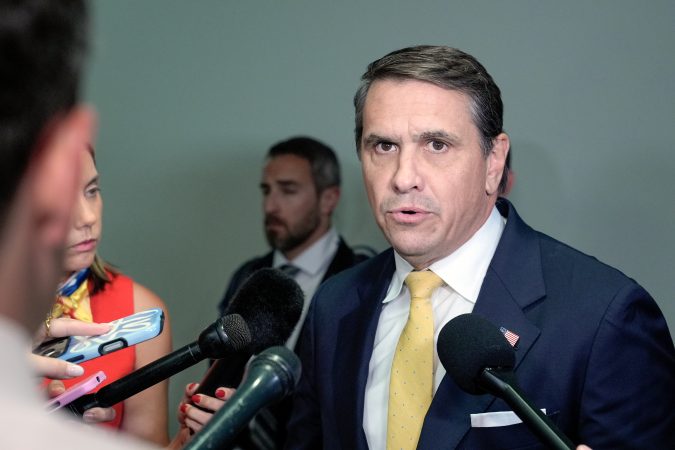
    Shortly after Tillis’ remarks, Blanche — who had been meeting with senators on Capitol Hill — told reporters he had tried to meet the Epstein accusers in a Senate office building but “it didn’t work out” and they were working to coordinate schedules. The Justice Department said later that the meeting was rescheduled for Thursday afternoon, adding: “He looks forward to their discussion.”

    “The Department of Justice will always meet with victims or their representatives, and if those victims or their representatives have evidence that anybody committed a crime — whether it has to do with Jeffrey Epstein or anybody else — we will of course move forward and investigate and prosecute,” Blanche told reporters.

    Epstein’s case and the Justice Department’s handling of millions of files related to his sex trafficking investigation have been a persistent political headache for the Trump administration.

    After missteps by then-Attorney General Pam Bondi that enraged Trump’s base, Blanche as deputy attorney general oversaw a massive review and release of millions of files related to the investigation into the disgraced financier with connections to wealthy and powerful people.

    Without Tillis’ support, Blanche’s nomination won’t make it through the Senate Judiciary Committee, which questioned Blanche for hours on Wednesday about the Epstein files as well as the creation of a fund to compensate Trump’s allies, a tax immunity deal for the president and a slew of other issues.

    Another Republican on the committee who says he has not made up his mind whether to support Blanche — Sen. John Cornyn — conveyed concerns that the Trump administration has yet to commit in writing that the fund is dead and could therefore conceivably be resurrected.

    One Epstein accuser, Dani Bensky, told lawmakers earlier Thursday that women harmed by Epstein repeatedly asked to meet with Blanche “through multiple channels and he never responded.”

    “We deserve to be heard directly, not dismissed and ignored,” Bensky said.

    Blanche has pushed back on suggestions that the Justice Department has been dismissive of the late financier’s accusers, saying Wednesday that officials have spoken with more than 30 representatives of the women over the course of its sweeping review of the files.

    Blanche has also defended the department’s staggered release of the Epstein files, a process beset by problems, including redaction errors that left exposed nude photos showing the faces of potential victims.

    Blanche said during his confirmation hearing on Wednesday that he takes responsibility for mistakes that were made, but noted that department lawyers were given a “herculean task” to quickly review millions of files for release. Blanche said department lawyers took pains to protect the women involved, and quickly fixed any errors that were found.

    “I am sorry that in about 1% of the documents mistakes were made,” Blanche said Wednesday. “But what I will say on top of that is we put tons of resources to rectifying those mistakes immediately, including pulling down documents within minutes of being informed that there were mistakes.”

    The political firestorm over the Epstein files dogged the Trump administration for much of last year, with lawmakers eventually passing a measure that compelled the release of a massive trove of documents in the government’s possession related to its investigation.

    The Justice Department began releasing the documents in late December, which included photos, call logs, grand jury testimony, and interview transcripts. The release did little to tamp down skepticism from conspiracy theorists and online sleuths, who have long pushed allegations of a government cover-up, without evidence.

  • White House faces stiff pushback on subjecting grants to political review

    White House faces stiff pushback on subjecting grants to political review

    WASHINGTON — Some of the nation’s top law enforcement officials were not pleased when the White House embarked on its push to assert more political control over more than $1 trillion in annual federal grants.

    The proposal, unveiled in May, stood to enable the administration to steer significant funding to causes and organizations aligned with President Donald Trump — and to cancel grants if recipients did not conform to his political views. That troubled a set of groups representing sheriffs, narcotics officers, and district attorneys, which said this month that the “undefined expectations” in Washington could interfere with public safety.

    The letter was one of roughly 500,000 formal comments that have flooded the Trump administration in recent weeks. Many of the posted submissions expressed misgivings with the draft White House plan to take greater control of federal spending.

    The opposition has been wide-ranging, spanning academic researchers, artists, city leaders, civil engineers, congressional lawmakers, housing experts, state attorneys general and regular Americans, who have warned that the White House could imperil public services if it subjects federal grants to political review.

    The administration proposal, which is not final, targets a vast set of federal funding for climate, education, health, housing, and infrastructure. If carried out, the regulation would require Trump’s political appointees to approve grants before they are awarded to cities, states, nonprofits, and other institutions. The review would primarily aim to ensure that the money supports purposes that “demonstrably advance the president’s policy priorities.”

    Recipients of federal funding would also be subject to broad political handcuffs. Taxpayer dollars could not “promote anti-American values,” for example, or be doled out to nonprofits that engage in some kinds of “issue advocacy” or that have certain “memberships and affiliations.” And a large set of topics would be off-limits, especially for scientists and researchers, who could face some of the most severe restrictions.

    The White House budget office has described the changes as necessary to eliminate waste, fraud and abuse, including spending that the office’s director, Russell T. Vought, deems to be “woke.” To achieve that goal, the administration has adopted an expansive view of its budgetary powers, even though Congress possesses the power of the purse under the Constitution.

    Many recipients of federal grants told the White House over the last two months that the proposed changes could be debilitating and that they cannot afford to have their aid revoked if Trump does not agree with their agenda.

    “This will put a lot of things up in the air,” said Andy Schor, mayor of Lansing, Mich., a Democrat. He added that the plan would affect “policing to housing to all the dollars we get from the feds.”

    Such interruptions have already plagued Schor’s community. The mayor recalled a series of incidents in which federal grants to the city and local nonprofits, including money to address redlining and combat violence, had been interrupted or canceled under Trump.

    Schor said the consequences could be greater if White House officials could more easily cancel a larger set of grants simply because “they suddenly decide they don’t like something.” In that case, the mayor said he would face a dilemma that could force him to choose between “staff we have to lay off or dollars we can’t get into the community for these important things that are needed.”

    A spokesperson for the Office of Management and Budget did not respond to a request for comment.

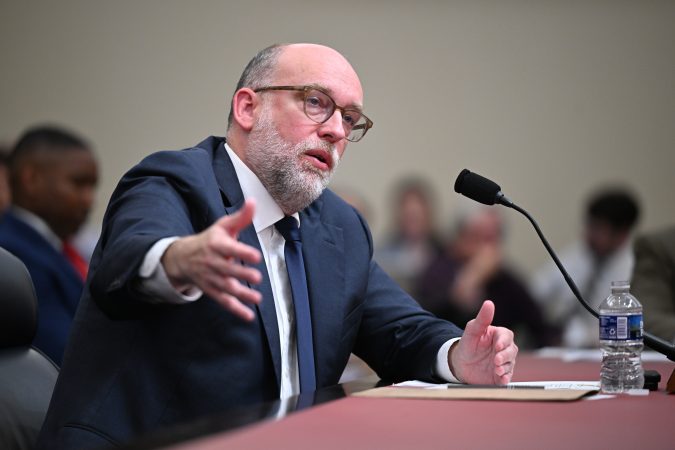
    Testifying at a Senate hearing Thursday, Vought said the proposal aimed to ensure “that we have democratic control of the spending that is going out.”

    But the stakes of his approach became clear when Sen. Tina Smith (D., Minn.) asked Vought how the administration might approach federally funded cancer research. She raised the example of a grant devoted to identifying the source of high cancer rates among Black people — and the extent to which the administration would disallow the money because of the president’s long-stated opposition to diversity, equity, and inclusion.

    Vought began by saying the White House was “against DEI policies,” adding, “How that would impact with that particular grant would be a decision for a political official, policy official, at NIH,” referring to the National Institutes of Health. He said administration appointees would “make the final decisions,” though they would take expert views into account.

    Smith said that revealed the “absurdity and the bias of this proposed rule, and the danger of what happens when you bring political ideology into grant-making processes, particularly around healthcare.”

    The proposed rules are the latest step in Trump’s contentious campaign to recalibrate how the government spends its money. With the help of Vought, the administration has fired thousands of federal workers while taking steps to hold up or cancel billions of dollars in congressionally approved aid, arguing that the spending was unnecessary or misaligned with Trump’s beliefs.

    Lawmakers from both parties sharply criticized some of Trump’s moves, and federal judges have repeatedly declared the president’s actions illegal. Yet the White House has continued pressing ahead and has taken steps to formalize some of its practices with its proposal targeting federal grants.

    The roughly 400-page blueprint, which the White House aims to put into effect in October, quickly stoked broad opposition.

    In Pennsylvania, the United Way, a network of nonprofit providers, warned that the grant rules could create “unpredictable financial and legal risks” for organizations that provide food, housing and other essential services. The group warned that those entities probably did not have the resources to comply or contest the government’s proposed restrictions.

    The Los Angeles County Department of Arts and Culture took issue with the way the administration tried to restrict the political activities of grant recipients. The agency said that approach could “chill free speech, creative expression, and activities supportive of diverse cultures and communities,” including at museums.

    The National Sheriffs’ Association and other law enforcement groups said they did not have the resources to incorporate all of the changes the White House had envisioned. A national network of civil engineers said the plan would impinge on its ability to collaborate with foreign counterparts on infrastructure research.

    And scientists, researchers and health providers expressed some of the loudest opposition. More than 300 organizations — many representing practitioners working on cancer cures, ALS and HIV treatments and pediatric medicine — urged the Trump administration to slow down because of the risks to their work and patients.

    The White House proposal reserved some of its strictest rules for academics funded by federal dollars. It aimed to limit the research they pursue, the conferences where experts can appear, and the organizations and foreign labs with which they are allowed to collaborate.

    Entire research areas would also be restricted if the rules were to take effect as drafted: Grants could not support work related to diversity, equity or inclusion, for example, or projects or groups that “deny the biological reality of sex or the sex binary in humans.”

    The strictures amounted to a major “escalation” from the president’s previous attempts to slash and control funding at agencies like the NIH and the National Science Foundation, according to Sudip S. Parikh, CEO of the American Association for the Advancement of Science, a nonprofit that promotes scientists.

    “It overemphasizes the political at the expense of scientific opportunities and the needs of the American people,” he said.

    Despite the president’s pursuit of deep cuts, Democratic and Republican lawmakers have ignored the requests and opted to keep most health and science funding intact. So the renewed push by Trump to cement his control over federally funded research enraged many Democrats, who view the proposed regulation as another encroachment of their spending powers.

    Rep. Rosa DeLauro (D., Conn.), who leads her party on the Appropriations Committee, said that the president, if successful, could undermine the idea enshrined in the Constitution that “money is directed based upon the needs of the American people, and that is transmitted through elected representatives.”

    DeLauro also joined with the 11 other House Democrats who serve in leadership positions on key appropriations committees this week to express deep reservations with the administration’s plans. The lawmakers estimated that the White House effort would affect more than $1 trillion every year.

    Democrats were not alone in airing frustration. In a separate letter last week, Sen. Susan Collins of Maine, the Republican chair of the Appropriations Committee who is facing a tough midterm election race, said the White House could imperil much-needed funding in ways that “harm small and rural communities.”

    The proposal drew support among Trump’s conservative allies. Daniel West, the government relations director for Heritage Action, said that some of the backlash had been “hyperbolic” and that he did not expect the White House budget office to retreat.

    “Everything I’ve seen indicates that OMB cares deeply about ensuring the proper stewardship of federal dollars, and they are moving this rule with that intention in mind,” West said.

    Some opponents still seemed to be readying for a legal battle. Citing the implications for education, healthcare, housing, science and other “critical services to hundreds of millions of people,” a group of governors and attorneys general from two dozen states told the White House on Monday that its proposed changes to grants would violate the Constitution. Many of the same states, including New York, California, and Colorado, have successfully fought Trump in the past over budget cuts enacted without the express permission of Congress.

    “The rule offends the Constitution,” the states argued at one point in their missive.

    This article originally appeared in The New York Times.
  • Trump administration revives rule that could deny green cards to immigrants who use public benefits

    Trump administration revives rule that could deny green cards to immigrants who use public benefits

    MIAMI — The Trump administration is reviving a rule that could deny green cards to immigrants who use public benefits that could include food stamps, Medicaid, and housing vouchers.

    The policy, known as “public charge,” appeared on Thursday in the Federal Register. It will be formally published on July 20 and take effect Sept. 18. Under the policy, applicants for green cards have to show they wouldn’t be burdens to the country or “public charges.”

    The policy was first implemented in February 2020 as one of President Donald Trump’s moves to limit legal immigration during his first administration, but it was reversed after Democratic President Joe Biden came to power.

    Its return comes when the Republican administration is implementing a hard-line policy to curb both illegal and legal immigration, and when the cost of healthcare and food is rising.

    The federal government “is reaffirming the requirement of self-reliance, protecting public resources and ending policies that encouraged dependency on the backs of hard-working American taxpayers,” U.S. Citizenship and Immigration Services said in a post published on its X account.

    “Under President Trump, USCIS is restoring the basic principle that immigrants must be able to support themselves,” the post said.

    While the administration’s crackdown on immigration has an increased focus on deportations and immigration enforcement in cities across the country and at borders and entry points, it has also taken actions that target legal immigrants and mixed-status families, in which the parents are foreign nationals with U.S.-born children.

    The rule expands disqualification options

    Federal law already requires those seeking permanent residency or legal status to demonstrate that they will not become a public charge. The Trump administration’s rule, however, broadens the grounds for disqualification.

    The new rule does not describe or specify by name the benefits and programs that could be considered a public charge. Instead, it says that officers who would implement the policy will make “individualized, fact-specific public charge inadmissible determinations, based on a totality of the alien’s circumstances.”

    It says that, “using good judgment and discretion, officers will more accurately assess an alien’s likelihood at any time of becoming a public charge.”

    The Trump administration first promoted the rule in 2018 as a way to ensure that only those who were self-sufficient came to the U.S. Immigrant rights advocates criticized it, saying it amounted to a “wealth test.” Public health experts said it would lead to worse health outcomes.

    Manatt Health, a group that provides advice to state and federal governments, estimated the policy would have deterred as many as 26 million people from seeking healthcare, food, housing, or other aid through programs for which they qualified under federal law. About half were U.S. citizens, mostly children or adults living in a mixed-status family, according to the group.

    Experts also noted that most people who receive benefits from the government are already legal residents.

    A 2020 study from the Migration Policy Institute said that while the “chilling effects” may be vast, the number of immigrants who could be deemed ineligible for legal permanent residence based on use of one of the public benefits under the rule was small.

    The institute estimated that no more than 167,000 people — less than 1% of the 22.1 million noncitizens residing in the United States at that time — could be determined ineligible for a green card based on their current use of a listed benefit.

    There were 22.8 million noncitizens living in the U.S. in 2023, according to the Census Bureau.

    Critics say the rule creates fear in the community

    Nongovernmental organizations said the policy generated confusion and fear and caused many immigrants and their U.S.-born relatives to decide not to apply for benefits and services to which they were entitled.

    Immigrant advocates condemned the government’s decision to revive the “public charge” rule and expressed concern.

    “This regulation is a direct assault on immigrant families, and a threat to our country’s health and economic security,” said Adriana Cadena, executive director at the Protecting Immigrant Families Coalition. “The Trump administration is basing immigration decisions on bias and politics, regardless of the resulting harm.”

    Sarah Krieger, senior policy counsel at the National Immigration Law Center, said the rule would make immigrants afraid to go to the doctor, buy food at the grocery store and file taxes.

    “With this new rule, they are sowing fear and chaos to ultimately reshape America into a country where only the few who are white and ultra-wealthy are welcome,” Krieger said. “The rule is not just deeply harmful, it also violates the law.”

  • FDA approves new pill to slash cholesterol levels

    FDA approves new pill to slash cholesterol levels

    The Food and Drug Administration approved a daily pill on Thursday that can lower cholesterol levels far below what can be achieved with statins, the cheap cholesterol-reducing pills.

    The drug, enlicitide, whose brand name is Lipfendra, is made by the pharmaceutical company Merck. Clinical trials have shown that it can bring levels of LDL — the dangerous type of cholesterol — down to 50 or 60 or even lower. Adults not taking cholesterol-lowering drugs usually have levels above 100. It works by inhibiting a protein known as PCSK9.

    New cholesterol guidelines issued by the American Heart Association and the American College of Cardiology say that people who have an above-average risk of heart attacks or strokes should get their LDL levels below 70. Those at high risk because, for example, they have had a heart attack, should get their LDL below 55.

    Lipfendra’s list price will be $315 for a 30-day supply, and it will be available in a few weeks, said a Merck spokesperson, Julia Cunningham.

    There are currently injectable drugs that work in the same way, but they are more expensive, with list prices of $500 to $600 a month or more. Insurers sometimes balk at paying, and some patients do not want injections. Only 1% of the 6 million eligible patients use the injected drugs. Yet a PCSK9 inhibitor can reduce the risk of heart attacks by 20% in high-risk patients.

    Cardiologists not associated with Merck applauded the FDA approval and the drug’s price. The hope is that a pill that costs less than an injectable and is easier to take will allow many more patients to get their cholesterol levels under control.

    “I’m thrilled,” said Christopher Cannon, a cardiologist at Brigham and Women’s Hospital in Boston who consults for several drug companies, but not Merck.

    “This would make a big difference compared with the cost of injectable PCSK9 inhibitors,” said David Maron, a preventive cardiologist at Stanford.

    Last November, Merck reported results from a 24-week clinical trial of Lipfendra, which involved 2,912 people. The drug lowered LDL levels by up to 60%. And there was no difference in side effects between the drug and a placebo.

    Those results are the same as what has been seen with the injectable drugs.

    In studies of the injectable drugs, blocking PCSK9 reduced the incidence of heart attacks, strokes and cardiovascular deaths 20% in high-risk people. Merck is conducting a study now to see if Lipfendra has the same effect. Dean Li, president of Merck Research Laboratories, said he is confident that it will.

    Li said the company wants to make lowering cholesterol with Lipfendra as easy and convenient as it is with a statin. Primary care doctors can prescribe it — it does not have to be limited to cardiologists. And, he said, patients are used to taking daily pills. Most who are at risk for a heart attack already take at least a blood pressure pill, a statin and an aspirin.

    It’s not clear yet whether companies making injectable PCSK9 inhibitors will lower their prices to compete.

    This article originally appeared in The New York Times.
  • Need for speed? Driving above the speed limit costs you — and doesn’t actually save much time

    Need for speed? Driving above the speed limit costs you — and doesn’t actually save much time

    Speeding in your car to work, to pick up your children from school, or go from one errand to the next not only wastes money in gas and sends harmful emissions into the air, it barely saves you time, new research says.

    It is something to think about as gas prices stay elevated throughout the summer months and add pain to day-to-day driving and seasonal road tripping.

    Instead, abiding by posted speed limits can save U.S. drivers millions of dollars at the gas pump and eliminate millions of gallons of fuel each day, according to a study published Thursday in the Nature journal Communications Sustainability. That is fuel that, when burned, emits planet-warming gases into the atmosphere. To top it all off, changing driving habits wouldn’t even add a full minute to a driver’s commute.

    University of Minnesota researchers analyzed 120 million vehicle trips across the United States from four Wednesdays in 2021 using driving data on national road networks, speed limits and U.S. Geological Survey elevation data. The analysis included roads with speed limits of 45 mph and higher.

    More than 43% of the studied trips included at least one instance of speeding, and drivers spent nearly 12% of their driving time going faster than the speed limit.

    They found that if drivers of light-duty, conventional internal combustion engine vehicles actually drove at posted speed limits, it could save an average of $22 million, based on fuel costs at the time, 6.7 million gallons of fuel, and 57,000 metric tons of carbon dioxide every day. The researchers said that is comparable to taking about 5.5 million passenger vehicles off the road.

    And while drivers say that speeding saves them precious time, researchers found that is not really the case. With an average daily driving distance of 28.6 miles, driving at or below the posted limit corresponds only to about 54 seconds longer per day.

    “If your goal is to shave one minute off your time, then you’ve got to drive fast. If your objective is to get to your destination safely and to save fuel, then you might drive slower than the speed limit,” said William Northrop, mechanical engineering professor at the University of Minnesota and study co-author.

    The research considered battery-electric vehicle efficiency only in California given the level of EV adoption in the U.S. at that time. Based on the California modeling, “We find that driving slower is beneficial for EVs as well,” he said.

    Interestingly, the study found differences among states. Nevada saw elevated speeding prevalence as well as high speed excess. There was high speeding prevalence in Florida, Georgia, and North Carolina, though those states did not necessarily exhibit high speed excess. Montana, Wyoming, Idaho, and South Dakota showed both low speeding prevalence and speed excess.

    The cost of faster driving today

    Driving faster increases a vehicle’s energy use and the emissions from its engine, as well as reduces efficiency. Vehicle engines have become increasingly more efficient over the past several decades even as vehicles have gotten bigger and more powerful. But speed limits have also climbed since the Emergency Highway Energy Conservation Act was implemented, which mandated 55 mph national speed limits amid the 1970s energy crisis.

    Accounting for the average cost of gas today and more vehicle miles traveled, that increases to roughly $26 million and 7.2 million gallons of fuel that Americans collectively could save each day this year just by not putting the pedal to the metal.

    One limitation of the research is that slower driving could impact traffic patterns, which could play a role in efficiency.

    However, it is especially timely as U.S. drivers remain price-sensitive to volatile gas prices as the war in Iran has sent the cost for a gallon of fuel above $4 this year. Experts have said there are a number of ways to improve one’s gas mileage, including something as simple as slowing down. Less fuel needing to be purchased because of better efficiency could influence oil market demand, which in turn could impact pricing.

    Rob Middleton, associate research scientist of mechanical engineering at the University of Michigan who was not involved in the research, said the study was well-done. But he also noted that the fuel saved from driving more slowly still only represents a fraction of daily gasoline consumption in the U.S., which is about 375 million gallons daily.

    “It’s a big number, but it’s a small fraction,” Middleton said. “This is a ‘freebie’ in that it doesn’t really cost anyone anything to do.”

    “The market penetration of selling EVs is still small, so we still need fuel, we still need ICE [internal combustion engine] vehicles, we’re still going to have them for a very long time,” he added. “Things that we can do to either make the new ones better or to improve our fuel supply, we need to do.”

  • Ukrainians protest Zelensky’s ouster of his popular defense minister

    Ukrainians protest Zelensky’s ouster of his popular defense minister

    KYIV, Ukraine — President Volodymyr Zelensky shook up his wartime government, drawing thousands into the streets Thursday across Ukraine to protest the ouster of his youthful defense minister — seen as an innovator of the country’s successful drone technology but who clashed with the traditional military establishment.

    The personnel overhaul, which included replacing his prime minister, could become a test of Zelensky’s political authority as Ukraine’s fight against Russia’s full-scale invasion approaches 4½ years. Zelensky has remained in office under martial law because wartime elections are prohibited but has periodically reshuffled his government.

    The moves threw Ukraine’s military leadership into an unwelcome crisis at a time when its actions against Russia are starting to bear fruit and as Moscow has unleashed unrelenting aerial attacks. Two people were killed and five others were wounded, including a child, when Russian missiles hit the capital of Kyiv overnight, Ukraine’s Emergency Service said.

    In making the changes, Zelensky cited friction between outgoing Defense Minister Mykhailo Fedorov and Gen. Oleksandr Syrskyi, the commander of Ukraine’s armed forces.

    “I’m just showing that if the sides can’t resolve an issue, I will have to resolve it,” Zelensky said at a news conference.

    The outgoing defense chief was seen as a modernizer

    Fedorov, 35, is considered to be a vigorous modernizer whose technological expertise is credited in part with significantly improving Ukraine’s military performance in recent months against Russia’s bigger army. He is leaving the government after only six months in the post.

    Fedorov appeared at a news conference in a dark T-shirt and jeans, and accused Syrskyi of blocking reforms needed because “the war has changed completely” due to new technology like drones.

    During his time in office, he secured restrictions on Russian forces’ access to the Starlink satellite communications system, allowing Ukraine to better leverage its midrange strike capabilities giving Kyiv significant battlefield advantages.

    Fedorov said he was willing to work with Syrskyi, “but we encountered a situation in which all the initiatives we proposed began to be blocked.”

    “Under this arrangement [with Syrskyi as commander], I personally do not know how the war can be won,” he said.

    On social media, Fedorov highlighted what he called his major achievements: redirecting funds earmarked for salaries into midrange strike capabilities, fiber-optic drones, reconnaissance systems and other technologies. He pointed to expanded drone procurement, Patriot missile defense contracts, successful ballistic missile tests and sweeping changes to military procurement.

    But he acknowledged he was unable to complete the Defense Ministry’s organizational transformation “according to NATO standards and common sense,” and move all procurement to competitive tenders, and build a culture of accountability.

    Syrskyi didn’t appear in public but in a Facebook post thanked Fedorov and said he hoped he would continue to serve Ukraine. “I wish him to continue to remain in the Ukrainian team,” Syrskyi said without elaborating.

    Zelensky said he had asked Maj. Gen. Yevhen Khmara to perform the defense minister’s duties in the meantime, according to a post on the Telegram messaging app. Since January, Khmara has been acting head of the state’s security service, known as the SBU. He had previously led the SBU’s elite Alpha special forces unit.

    Zelensky described a difficult relationship between the Defense Ministry and the military at multiple levels, not simply a matter of personalities, and he said both sides share responsibility for the consequences.

    “Together we win, and together we’re responsible for the things that cause confusion and public reaction,” he said, standing beside British Prime Minister Keir Starmer, who was making his final foreign visit before leaving office next week.

    Mostly young protesters support Fedorov

    Syrskyi, 60, initially organized the defense of Kyiv in February 2022, and seven months later masterminded a successful counteroffensive in the Kharkiv region. Born in 1965, he attended the Moscow Higher Military Command School before serving in the Soviet Artillery Corps before the USSR’s collapse in 1991.

    The Ukrainian military has rallied under Fedorov, slowing Moscow’s front-line advance to a virtual standstill and striking refineries and other energy sites inside Russian territory, causing widespread fuel shortages, Western officials and analysts say. Zelensky’s decision to fire him despite that record has dismayed many people.

    Before becoming defense minister in January, Fedorov headed Ukraine’s digital transformation policies. He won popularity by spearheading the rapid development and deployment of drone technology and introducing several successful e-government platforms.

    As minister, he moved to combat corruption, an issue that carries particular weight with Ukrainians who have repeatedly protested graft. Fighting corruption meant working against the interests of groups that had long profited from programs within the ministry, he said in interviews. He also sought to overhaul weapons procurement to make it more transparent.

    He had promised sweeping military reforms, saying it had faced about 200,000 desertions and draft-dodging by some 2 million people.

    The mostly young protesters who took to the streets of Kyiv and other cities to support Fedorov made crude remarks about the current military commander, chanting, “Syrskyi, go away!” and “A European army for a European country!”

    Kyiv resident Bohdan Huryak said he was “deeply outraged” by Fedorov’s exit.

    “I’m not deeply invested in the internal political debates, but this is a person who shows results on the battlefield, we see results, we feel the fighting spirit and confidence in victory rising,” Huryak told the Associated Press. “And then, six months later, he is removed from office? Come on.”

    Russian military correspondents and pro-Kremlin bloggers relished the controversy. Pro-Kremlin political analyst Sergei Markov described Fedorov’s comments as a “rebellion” against Zelensky.

    The deputy commander of Ukraine’s air force, Col. Pavlo Yelizarov, quit over Fedorov’s dismissal, saying on social media it will weaken Ukraine’s air defenses and lead to more deaths from Russian attacks.

    “I believe that the dismissal of Mykhailo Fedorov is a great evil for the country’s defense capability,” he wrote in his resignation letter on Facebook.

    State energy company chief is new prime minister

    Parliament overwhelmingly approved Serhii Koretskyi, the head of state energy company Naftogaz, as the country’s new prime minister.

    In nominating Koretskyi, Zelensky cited his record in the energy sector and argued he was best prepared to guide Ukraine through another winter, when Russian attacks on the power grid intensify.

    Unlike other senior government officials, the 48-year-old engineer did not rise through political parties, parliament or the civil service. He spent more than two decades managing fuel and food businesses before being picked to run some of Ukraine’s most troubled state-owned energy companies and gained a reputation as an effective crisis manager who could make them profitable.

    Zelensky has faced protests before over his decisions. Large demonstrations broke out in July 2025 when he fast-tracked a law that would have curbed the independence of the country’s anti-corruption watchdogs.

    The outcry threatened his leadership for the first time since Russia’s invasion, and he swiftly reversed course and submitted legislation to restore the agencies’ independence.

  • In Iran, Trump risks another American ‘forever war’

    In Iran, Trump risks another American ‘forever war’

    BERLIN — No one starts a war expecting it to last forever.

    Yet, since Vietnam, American presidents have repeatedly gotten into conflicts that seem like they could last forever, at least until the next president — or the one after that — decides that the expense and political pain are not worth it, declares victory and goes home.

    On Iran, President Donald Trump may have fallen into the same trap.

    He campaigned for office vowing to end wars, not start them, and to never get involved in a forever war, let alone one in the Middle East. And yet he risks doing so in Iran, his critics say.

    The war that Israel and the United States began with such force has alternated between moments of negotiation and military strikes. They have failed to reach Trump’s stated goals of regime change or ending Iran’s nuclear program, while the war has created a new, seemingly intractable problem, bottling up the Strait of Hormuz.

    With diplomacy at a dead end, at least for now, a frustrated Trump finds himself back at war, the ceasefire broken, the strait blocked. The memorandum of understanding he said “achieves everything we set out to accomplish” — despite wildly divergent interpretations of it — is in tatters after less than a month.

    “Both sides looked to the memorandum of understanding as the continuation of the war by other means, not as a bridge to peace,” said Ali Vaez, Iran project director for the International Crisis Group.

    Without a long-term strategy to produce a sustainable settlement, he said, there’s a risk of creating “the circumstances for a forever war.”

    The idea of the “forever wars” began with 9/11 and the “global war on terror,” pulling the United States into long military engagements, with troops on the ground, in both Afghanistan and Iraq. Those conflicts, which began by toppling hostile regimes before turning into counterinsurgency campaigns, ended either inconclusively or in defeat after considerable expenditure and loss of life.

    Powerful leaders with powerful militaries are prone to fall into “the short-war fallacy,” said Lawrence D. Freedman, emeritus professor of war studies at King’s College, London, who last year wrote an article, “The Age of Forever Wars.” “They think they can win quickly and not suffer adverse consequences,” he said.

    Like Trump in Iran and Russian President Vladimir Putin in Ukraine, “they fail to appreciate the limits of military power and so set objectives that can be achieved, if at all, only through prolonged struggle,” Freedman said.

    And even the most sophisticated military forces are not enough, if there’s no strategy to turn battlefield superiority into lasting political and diplomatic success. Trump faces the added challenge of trying to win using only air and sea power, without politically unpalatable use of ground troops on Iranian soil.

    The Persian Gulf war of 1991 was quick and succeeded in its aims, because President George H.W. Bush had a limited political objective — drive Saddam Hussein out of Kuwait. That was a lesson lost on his son, President George W. Bush, in the second war against Iraq, which ended up enhancing Iran’s power in the region. In Afghanistan, after the younger Bush drove out the Taliban, he and his successors tried vainly to remake the society, but when Washington tired of the effort, the Taliban returned.

    There is an argument, sometimes made by Trump himself, that he went to war in Iran to finally end what he considered a 47-year war between the United States and Iran, which began with the fall of the Shah of Iran in 1979 and the taking of more than 60 American hostages.

    The U.S.-Iran “forever war,” argued Vali Nasr, a professor at the Johns Hopkins School of Advanced International Studies, is just another round of a conflict that has sometimes blown hot and sometimes resulted in agreement, like the 2015 nuclear deal Trump tore up in 2018.

    Aaron David Miller, a senior fellow at the Carnegie Endowment for International Peace, said Trump, urged by Israel, has also inserted himself in a parallel “forever war” — the one between Israel and Iran, which is being played out with Iran’s proxies in Lebanon, the Palestinian territories, and Yemen.

    Trump still has the ability to sell this unpopular war to his base as a victory of some kind and go home. But to the surprise of many, he seems to be doubling down, albeit with no clear path to a diplomatic settlement. And his commitment to keep the Strait of Hormuz open, while Iran insists on maintaining control, could mean a very long U.S. military engagement, even with the help of allies.

    Still, the Iran war is different, especially compared to Afghanistan and the second war against Iraq. In both of those wars, thousands of U.S. troops were on the ground for long periods and ended up fighting militias and terrorists opposed to new governments propped up by the United States — not fighting a state like Iran.

    And unlike the case in Vietnam, Iraq, or Afghanistan, Iran can inflict economic pain on the United States by blocking access to the Strait of Hormuz, which gives the government in Tehran more effective leverage and is a prime reason it will refuse to give up control.

    There will be no return to the situation before the war, said Suzanne Maloney, director of foreign policy at the Brookings Institution. As in Iraq, American assumptions and misperceptions changed the balance of power in the region, she said, and now the days of the Strait of Hormuz fully free for transit are probably over.

    There can be “a new normal,” she said, “but with a much higher American force posture in the region” given Iran’s ability to hit ships whenever it pleases.

    Because Washington’s stakes in this war are simply smaller than those for Iran, said Nasr, who worked on the Afghan war, “the pace begins to slow, while the other side is willing to keep the same level of intensity.” As the United States began to withdraw from Afghanistan, as from Vietnam, “the balance began to shift.”

    But a negotiated end to the war in Iran still feels far away. Both sides have proved they can’t even stick to a minimal framework agreement that defers all the substantive issues to the future, Vaez said. If they can’t even do that, he added, “that could remove the last barrier between episodic confrontation and a forever war.”

    This article originally appeared in The New York Times.

  • A viral trend is back. Has ALS research progressed since the first Ice Bucket Challenge?

    Some of the country’s biggest football stars have brought back a decade-old internet trend where people douse themselves in ice water to raise money for research into amyotrophic lateral sclerosis, a neurodegenerative disease known as ALS.

    Former Tennessee Titans running back Chris Johnson put ALS and the Ice Bucket Challenge back in the spotlight in late June when he announced his diagnosis on “Good Morning America.”

    “Years ago, the ALS Ice Bucket Challenge united millions of people around the world around one cause and helped change the fight against this disease,” Johnson wrote on social media after his announcement. “Today, I’m asking you to help me do it again.”

    It was a callback to the original challenge, which raised over $100 million for ALS research when it originated in 2014, and is now described as one of the more notable success stories in an age of social media-driven activism.

    More than a decade later, experts say that windfall transformed ALS research by drawing more scholars into the field and powering breakthroughs in ALS diagnosis and care. They hope a revival of the trend might do the same as researchers continue to hunt for a cure.

    “We can do so much more now than we could then,” said Eva Feldman, a professor of neurology and director of the Scott Pranger ALS Center at the University of Michigan.

    The simple premise of the Ice Bucket Challenge in 2014, to film yourself getting an icy splash, make a donation and nominate three friends to do the same, was primed to spread across the internet and came as Facebook debuted hashtags and “trending” topic lists to boost viral videos. Celebrities, politicians and around 17 million people participated in the trend, according to the ALS Association.

    “It brought extreme recognition to the disease,” Feldman said.

    The swell of attention and funding from the Ice Bucket Challenge “spawned a generation of young investigators” who were newly drawn into ALS research, said Nicholas Maragakis, a professor of neurology at Johns Hopkins University.

    Experts said among the biggest breakthroughs in the past decade include the identification of over a dozen genes associated with ALS.

    Mutations in genes can cause cells to produce abnormal proteins that damage neurons and can lead to ALS, and identifying which genes carry these mutations has helped scientists understand the disease. New treatments for ALS include drugs that target these faulty genes.

    “Many of the genes we’ve identified are directly related to [funding from] the Ice Bucket Challenge,” said Calaneet Balas, the CEO and president of the ALS Association.

    Other areas where ALS research has progressed include the use of stem cells to model the behavior of neurons to better understand how they deteriorate, and the identification of more biomarkers, such as chemicals in blood or spinal fluid, associated with ALS.

    Those indicators can allow doctors to gauge the presence or severity of ALS in a patient, which has helped with diagnosing patients as well as evaluating the effectiveness of drugs in clinical trials.

    “We understand the disease much better than we did in 2014,” Maragakis said.

    The quality of care for ALS patients has also increased by “light-years,” Balas said. Research into brain implants has allowed some people with ALS to communicate, work and even reclaim their voices. Johnson gave his GMA interview using a device that uses recordings of his voice to synthesize speech, according to the program.

    “To be able to do all of that did not exist 10 years ago,” Balas said.

    The ALS Association says more work will be needed. A study last year funded by the ALS Association that analyzed a region of Italy projected that ALS prevalence could increase in the U.S. by around 16 percent from 2024 to 2040 — to an estimated total of around 42,000 cases — as the country’s population ages and ALS patients live longer.

    Further funds raised could go toward larger-scale studies on risk factors of ALS and ways to make the disease more livable, Feldman said.

    A cure for ALS may not be imminent, and there “won’t be one silver bullet,” Balas said. But she added that she is optimistic about making ALS livable with further advancements in patient care and treatment.

    The internet has changed in the years since the Ice Bucket Challenge’s heyday. But even if this revival does not eclipse the original challenge, Balas said it is reminding the public about ALS, and the power of a bit of viral goodwill.

    “I think it’s wonderful to have the resurgence, whether it matches what happened in 2014 or not,” Balas said.

  • Letters to the Editor | July 16, 2026

    Letters to the Editor | July 16, 2026

    Stalled progress

    In the push to pass another late state budget, quality has been sacrificed. The product is more noteworthy for what it does not do than for what it accomplishes. It does not:

    • Increase Pennsylvania’s archaic minimum wage of $7.25 per hour, which has not budged since 2009.
    • Provide a reliable funding mechanism for essential public transit.
    • Reap tax dollars from legalizing the use of marijuana.
    • Tax skill games.
    • Sell off the state liquor stores to garner hundreds of millions of dollars.
    • Eliminate the state’s unique and cruel death (inheritance) tax.
    • Hike state taxes on tobacco products to discourage use and boost revenue.
    • Finally end the ridiculous ban on automobile dealers to conduct business on Sundays.
    • Eliminate price-fixing on dairy products, which keeps prices artificially high and out of step with neighboring states.

    I find little to smile about in the new state budget.

    Oren Spiegler, Peters Township

    Firing four-star generals

    Why doesn’t Congress demand to know why Pete Hegseth is gutting our military leadership of the best and the brightest, like Gen. Christopher Donahue? It isn’t patriotic; it’s idiotic.

    Penny Stanger, Phoenixville

    Dream job

    I would like to know where else one can go to land a job like those in Congress.

    One can be AWOL and not owe anyone an explanation, be absent for an indeterminate amount of time without being held accountable for that or what might have transpired during their absence, lose any salary, or be penalized in any way for not coming to work.

    No one pushes back, questions what is going on, or insists on getting an explanation. One won’t be replaced or demoted, and whatever inconvenience your absence might have caused is of no consequence.

    When the question does arise, perhaps a “Further information will be forthcoming” might be issued, but that means just about as much as no information. You can be totally incommunicado without any fear of retribution, censure, loss of a position, demotion, or cut in pay. You can just show up when you are good and ready, with no concern as to whether your absence has caused problems for the others who do show up every day.

    When the rest of the government shuts down, these folks remain unscathed, as their paychecks just keep coming. There is always an impending “recess” that seems to come at the most convenient times. It doesn’t matter how much work needs to be done, nor how serious the matters at hand might be — when Congress is scheduled to leave town, that’s what they do. Everything else can just wait.

    Sounds like nice work if you can get it.

    Barbara Kotzin, Cheltenham

    Shameful dismissal

    The dismissal of the Proud Boys seditious conspiracy case is just another nail in the coffin of justice and another bitter pill the American people are forced to swallow by the present U.S. Department of Justice. It is a loathsome decision, and one that should be quickly overturned by another court.

    Carol N. Wright, Malvern

    Join the conversation: Send letters to letters@inquirer.com. Limit length to 150 words and include home address and day and evening phone number. Letters run in The Inquirer six days a week on the editorial pages and online.

  • Horoscopes: Thursday, July 16, 2026

    ARIES (March 21-April 19). The image of an overhead shot is interesting because overhead views reveal relationships between things that are hard to see from ground level. When you’re in the maze, you see walls. When you’re above the maze, you see the route.

    TAURUS (April 20-May 20). You think you know what you want, but since humans are famous for wanting what’s detrimental to their well-being, you’re open to suggestions from the wise. Hold desire firmly enough to pursue it and loosely enough to learn from it.

    GEMINI (May 21-June 21). Even pleasant surprises can be off-putting when what you really want is stability. Given recent events, your desire for a more straightforward, no-nonsense, predictable sequence is understandable and the universe will comply.

    CANCER (June 22-July 22). It’s worth it to build freshness and novelty into your plans because new environments will bring out a different side of everyone. Much can unfold in the spirit of discovery, including opportunity, growth, expansion, bonding and plain ol’ fun.

    LEO (July 23-Aug. 22). A relationship is stuck in a back-and-forth pattern. Such a pattern requires participation. If you can’t yet see how you are contributing, a realization will change that. Though you don’t control the entire dance, you still control your next step.

    VIRGO (Aug. 23-Sept. 22). Someone is getting in the way of your work by unnecessarily complicating things. They are not trying to solve the same puzzle as you. They are trying to solve the puzzle that is you. They are trying to impress you instead of understand you.

    LIBRA (Sept. 23-Oct. 23). You’re still learning a place. There’s more to be interested in than is readily apparent in these early stages. This environment will reveal itself to you over time. It’s as though you’re pressing on walls to find the secret doors.

    SCORPIO (Oct. 24-Nov. 21). You know so much and yet your mind is still open. That’s why you’re so valuable to a group. You model an ideal attitude and your input is vital. You’ll figure out how to help people work together.

    SAGITTARIUS (Nov. 22-Dec. 21). You want a person to take a step, so make it easy. Before asking for movement, make sure there’s a clear, inviting next step available. People are more likely to advance when they can see where to place their foot.

    CAPRICORN (Dec. 22-Jan. 19). It’s not what you say but the way you say it that determines what happens next. You’re very good at sensing the tone someone will respond to and delivering it just right. You’re nothing short of inspired.

    AQUARIUS (Jan. 20-Feb. 18). You’ve felt as though you needed closure from someone before you could move forward. Consider that maybe this closure is less about getting your due or getting answers and more about dropping the expectations and questions.

    PISCES (Feb. 19-March 20). If you were floating down a river on a raft, you could leave the steering to the current. But this is no river. It’s pavement to be pounded. It’s signs to read. It’s decisions about right or left. Your instincts are golden.

    TODAY’S BIRTHDAY (July 16). It’s your Year of the Sail. The wind is blowing toward your desired destination, and you catch it. And though your dreams are distant, this year closes the gap. The experiences so foreign to you in the beginning become your daily life. More highlights: A fresh source of income. Love you don’t have to translate or change yourself for in any way. Remarkable happenstance each season. Aquarius and Libra adore you. Your lucky numbers are: 12, 27, 4, 20 and 33.