Tag: no-latest

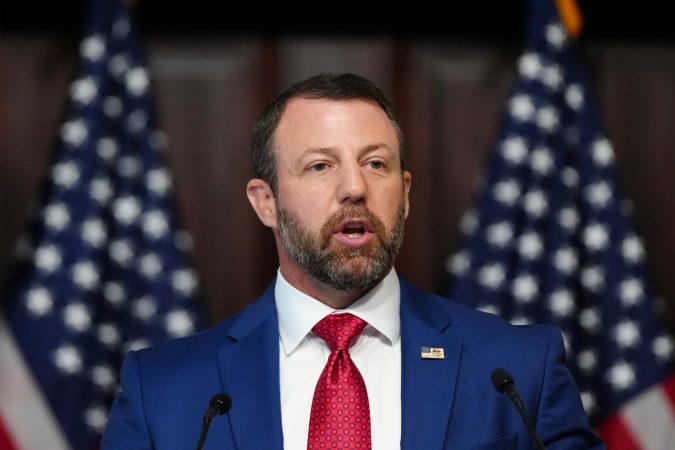
  • Mullin pushes states to comply with election demands, echoing Trump’s claims about midterm risks

    Mullin pushes states to comply with election demands, echoing Trump’s claims about midterm risks

    WASHINGTON — Homeland Security Secretary Markwayne Mullin on Friday warned that state officials could lose funding or face investigations if they fail to go along with President Donald Trump’s election security demands, part of the Republican president’s longstanding attempt to undermine Americans’ confidence in the vote.

    Experts said the threats — issued just months before midterm elections that will determine control of Congress — were likely hollow because Trump’s voting initiatives have been stalled by judges and the Constitution gives states control over how elections are run.

    Nevertheless, Mullin’s remarks, delivered from the White House complex one day after Trump’s primetime address on the topic, could further doubts about election processes and create headaches for states as they prepare for November.

    “We absolutely can build confidence in the American people, but the states have to do their part,” Mullin said.

    Trump continues to falsely claim that Democrat Joe Biden won only because of fraud in 2020, and he’s tried to marshal the powers of the federal government to rewrite that history since he returned to office last year — even though judges and his own attorney general in his first term concluded the election was legitimate.

    Mullin insisted that the president was not relitigating the 2020 election, “although he definitely could at this point.”

    “This is just about exposing what took place and making sure it never happens again,” he said.

    Mullin’s claims of noncitizen voters rely on incomplete data

    During his remarks, Mullin advanced an unsubstantiated claim Trump made Thursday that the federal government had found 250,000 noncitizen voters on the rolls in California, Nevada, New Jersey, and Pennsylvania. He said the Department of Homeland Security’s investigation was conducted using public data, which election experts say is insufficiently detailed and updated to properly identify whether a registered voter is a noncitizen.

    Election officials in California and Pennsylvania said they would review the Trump administration’s findings but noted that they conduct their own voter list maintenance and noncitizen voting is exceedingly rare. Research has supported that finding.

    California Gov. Gavin Newsom, a Democrat, responded to Mullin’s threats with a post on social media.

    “California has free, fair, and secure elections and we will fight for them,” he wrote. “Try us.”

    In Nevada, Secretary of State Cisco Aguilar, also a Democrat, said he was confident in the integrity of the state’s voter file.

    “We are constantly looking at the information to figure out how many registered voters in Nevada don’t have a Social Security number on file,” he said. “We have done significant work to make sure our voter rolls are as clean as possible.”

    Mullin also pledged to aggressively monitor public voter lists to pursue potential voter fraud cases before and after the 2026 election.

    “If you are an illegal or you are voting illegally, we will hunt you down, we will find you, and we will prosecute you,” he said.

    He urged states to participate in DHS’ recently overhauled SAVE program, a federal tool central to the Trump administration’s efforts to nationalize elections. At least 25 states have used it to check their voter rolls since April 2025, after the Trump administration significantly expanded its search abilities, and the Trump administration has demanded that states submit their sensitive voter data to the program to fully audit their voter lists.

    Mullin said if state officials don’t participate in SAVE, they could face fines, penalties, or prison time.

    But the overhauled program’s use was recently blocked by a federal judge over concerns about privacy and wrongful purges of eligible voters. The case included voters whose registrations were wrongly flagged by the program, temporarily threatening their place on the rolls.

    David Becker, the executive director of the nonprofit Center for Election Innovation and Research, said Mullin was making empty threats.

    “Every court to consider the DOJ’s demands — 15 of them to date, six of those judges appointed by President Trump — have confirmed that the federal government cannot legally demand access to states’ sensitive voter data,” he said. “What he’s suggesting is illegal.”

    In addition, Trump’s efforts to pass the SAVE Act, federal legislation that would require proof of citizenship for voter registration, has stalled in the Senate. Republicans don’t have enough votes to change the filibuster rules and pass it without Democratic support.

    Cybersecurity support for election officials diminished

    Mullin also elevated Trump’s concerns about vulnerabilities in electronic voting machines — which voting experts have long acknowledged. While Trump suggested Thursday that these risks make it possible to “rig” the vote, election officials say there are numerous safeguards in place to prevent that, including physical security, voting machine tests, postelection reviews, and paper ballot backups in most of the country.

    To address the concerns, Mullin said the nation’s Cybersecurity and Infrastructure Security Agency, which sits under DHS, would release an updated election infrastructure plan within 30 days and provide cyber threat resources to election officials if they participate in SAVE.

    However, Trump has broadly dismantled the agency’s election security operation.

    CISA was largely absent from its long-held role assisting states in last year’s elections after the Trump administration conducted a review of its election work, placed more than a dozen election-focused staffers on administrative leave, and slashed $10 million from two cybersecurity initiatives, including one dedicated to helping state and local election officials. The agency is also still without a Senate-confirmed director and has cycled through a series of acting leaders.

    Aguilar said his state has stepped up and will protect its own elections in the absence of federal help.

    “The fact that they think they’re going to come in prior to the general election in November and provide us infrastructure, that’s nuts,” he said. “Actions speak louder than words, and in their case, it’s all been talk.”
  • In primetime, Trump criticizes networks for not carrying his speech

    In primetime, Trump criticizes networks for not carrying his speech

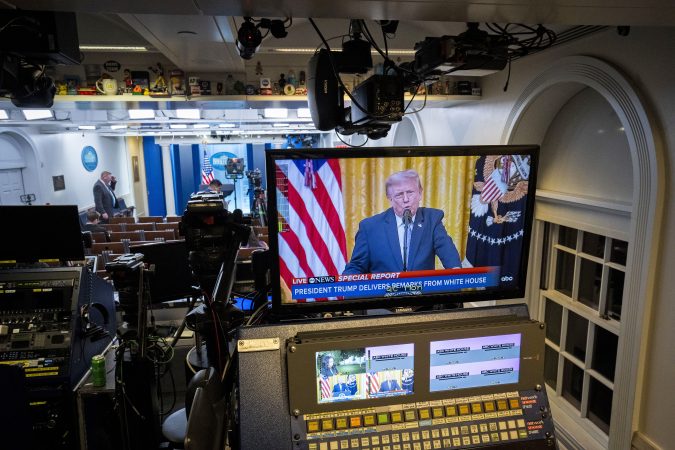
    Not every television network carried President Donald Trump’s primetime speech from the White House, and it did not escape the president’s notice.

    In a meta moment on Thursday night, Trump used his address to call out ABC and NBC for not airing his live remarks, claiming the networks declined to do so “because they know how corrupt our system is and they don’t want to reveal it.” He also repeated his frequent demand that the networks’ government-issued broadcast licenses be revoked.

    “They and others in the media are part of a plot,” the president said, offering no evidence for his claims.

    In fact, ABC and NBC did carry Trump’s speech live on their streaming platforms. After the president concluded, both networks broke into regularly scheduled entertainment programming to air special reports that analyzed his outlandish claims about the safety of American voting systems.

    Federal regulators are currently reviewing the station licenses owned by ABC, a move that the network has denounced as an “unconstitutional retaliation” for its programming.

    Presidents must request airtime from television channels when they wish to speak in primetime, and in the past, network executives have been loath to accommodate speeches that they view as distinctly political in nature, especially during election years. Former Presidents Barack Obama and Joe Biden both had some requests denied.

    On Thursday, TV networks took varying approaches to covering Trump’s remarks. Fox News and the Fox broadcast network ran the speech in its entirety; MS NOW and CBS aired some portions live, but then cut away for analysis and fact-checking from their correspondents. CNN aired clips and reporter commentary instead of the full remarks.

    Fox News, which paid $787 million to settle a defamation suit stemming from false claims about election interference that appeared on its airwaves in 2020, took a careful approach on Thursday.

    After Trump concluded his remarks, Bret Baier, the channel’s chief political anchor, summarized the president’s claims about the security of electronic voting machines. But he added, in a formal tone, that Fox News “has not seen that evidence directly yet, and is not in a position to evaluate the accuracy of the president’s statements at this time.” (Aishah Hasnie, a White House correspondent for Fox News, later repeated that caveat almost verbatim.)

    Even Sean Hannity, a Trump ally, was careful not to endorse the allegations, despite saying the president’s claims were “pretty remarkable.”

    “I’m sure anybody that cares about truth will want to do a deep dive into all of this,” Hannity told viewers.

    Network executives had been reluctant in the run-up to Trump’s speech to say whether they would air it live. The president had been expected to delve into partisan or incendiary comments about voter fraud, creating a conundrum for producers who would need to decide whether to fact-check the president’s remarks in real time, or wait until he was finished to provide context.

    This article originally appeared in the New York Times.

  • Beijing rejects Trump’s claim of meddling, but avoids a fight

    Beijing rejects Trump’s claim of meddling, but avoids a fight

    China on Friday rejected President Donald Trump’s claim that it had meddled in U.S. elections as baseless. But its response was relatively restrained, a sign that Beijing did not want to let the accusation derail a thaw in relations that both sides have spent months trying to preserve.

    Trump had said in a speech that China had carried out “the largest compromise of election data in history” starting with the 2020 cycle, one of several claims he made that was either overstated or untethered from reality.

    In Beijing, a Foreign Ministry spokesperson, Lin Jian, said China had “no interest in interfering in the U.S. elections and has never done so,” adding that the claims “are aimed at vilifying China.” It leveled a vague accusation back at Washington for “wantonly” interfering in other countries.

    The response was firm but made no demands for retractions or threats of punishment. On China’s social media, commentators who are usually stridently nationalist were mostly quiet.

    China experts said this showed that Beijing saw Trump’s speech as an attempt at playing to American voters before midterm elections, rather than a broadside directed at China.

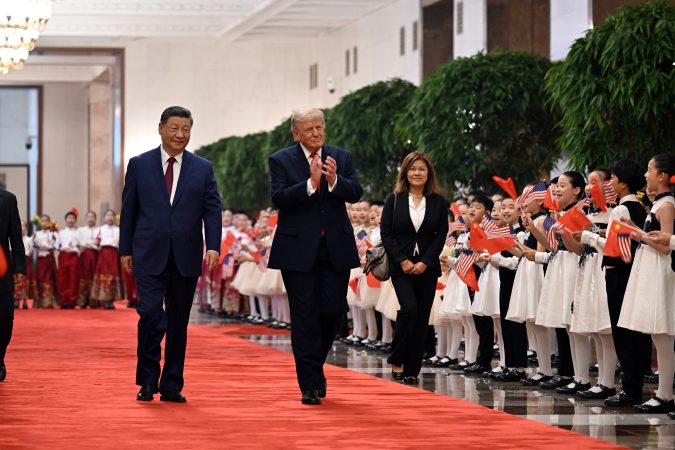
    It also underscored a desire on Beijing’s part to maintain a truce that was struck in May during a summit between Trump and China’s top leader, Xi Jinping.

    Trump’s rhetoric on China during his address was “definitely harsh,” said Sun Yun, a scholar of China at the Stimson Center, a research group in Washington. But Trump had built up so much goodwill in China in recent months, she added, “there is some resilience in the relationship.”

    Playing the China card

    From Beijing’s perspective, Trump was taking aim at China for domestic political reasons, experts said. Officials in China understand that the Republicans are under pressure as midterm elections approach.

    Chinese state media commentaries have argued that Trump has lost some of the support of his political base following his military intervention in Venezuela and the war in Iran. They have noted that he has failed to keep factory jobs at home, while consumers “bear higher fuel costs and inflation.”

    Viewed through this lens, Trump’s speech was an attempt at mobilizing voters by fanning the idea of foreign intervention, said Wu Xinbo, an American studies scholar at Fudan University in Shanghai.

    “Trump played this card mainly for domestic politics; it was not aimed at China-U.S. relations,” Wu said, adding that this was something Chinese officials would likely not respond to if it was a one-off.

    Documents released by the White House that Trump said bolstered his claims suggest there is evidence of a pro-China influence effort and that Beijing was skeptical of Trump. But that was a minority perspective inside the intelligence agencies, and the intelligence officers who held that view said they had only low or medium confidence in their assessments.

    China wants to preserve the stability

    The U.S.-China relationship steadied in October after Beijing agreed to suspend its limits on exports of rare earth metals, and Washington halved tariffs on China related to fentanyl. “We’re not going to hurt China,” Trump said at the time.

    After Trump met with Xi in Beijing, China said both sides had agreed that U.S. tariffs would not rise further. They agreed on a relationship based on “constructive strategic stability,” a vague term meant to signal that both sides would limit hostilities.

    During his trip, Trump invited Xi to the White House on Sept. 24, a meeting that officials are now working toward. Beijing expects the upcoming visit to help improve trade ties.

    Any disruption to the fragile detente will hinge on whether Trump decides to take additional action on his claims of election meddling.

    If Trump were to take fresh actions against China, like putting new tariffs on Chinese goods, Wu said, “China would certainly retaliate.”

    Chinese economy needs the U.S.

    China may also be tempering its response because it wants to make nice with the United States on trade disputes as its own economy stumbles and as its companies face pushback from foreign governments.

    This week, China reported that its economy grew at the slowest pace in three years. It is also facing increased scrutiny in other parts of the world as its exports surge, raising alarm among politicians in Europe and Southeast Asia. Chinese shipments overseas climbed 27% over the month of June, and its trade surplus with the world climbed to more than $125 billion, its second largest on record.

    At home, Chinese families are feeling poorer, consuming less, and seeing fewer job prospects. That means that China needs markets overseas to keep its factories churning, grow its economy, and create new jobs, said Ja Ian Chong, an associate professor of political science at the National University of Singapore.

    “Having more access to the U.S. market could also take some of the pressure off China’s economic relationships with a bunch of other countries from Europe to Africa and Asia,” he said.

    This article originally appeared in the New York Times.

  • Lettuce at Taco Bell in 5 states confirmed as a source of diarrhea-causing parasite

    Lettuce at Taco Bell in 5 states confirmed as a source of diarrhea-causing parasite

    ATLANTA — Federal health officials have identified lettuce from Mexico served at Taco Bell locations across five U.S. states as a source of a widespread outbreak of diarrhea-causing parasite cyclospora.

    The Centers for Disease Control and Prevention late Thursday warned consumers not to eat shredded iceberg lettuce from Taco Bell restaurants in Indiana, Kentucky, Michigan, Ohio, and West Virginia. A record number of cyclospora cases have been reported in more than 30 states, and experts have said not every recent U.S. illness might be caused by a single source.

    A Food and Drug Administration investigation so far has identified a single supplier of the lettuce. The federal warnings to consumers did not identify the company, but Taylor Fresh Foods, of Salinas, Calif., said FDA testing indicated it was “a specific independent farm” affiliated with the company.

    The FDA was working with the supplier “to determine if potentially contaminated shredded iceberg lettuce remains on the market,” including in other states, the CDC said. “Taco Bell has committed to stop using any lettuce from the supplier identified by FDA’s traceback investigation.”

    Taylor Farms has been tied to foodborne outbreaks in the past. The company said in a statement Friday afternoon that it was voluntarily removing all iceberg lettuce sourced from central Mexico from the U.S. market.

    “As a family owned and operated company, we are deeply concerned for those who became ill, their families, and the many Americans whose trust in the safety of their fresh produce has been shaken,” the statement said.

    Taco Bell says it will use a different supplier

    CDC, FDA, and public health officials in several states have been investigating a multistate outbreak of cyclospora infections.

    The illness is not usually life threatening and is typically treated with antibiotics.

    On Thursday, ahead of the federal government’s confirmation, Taco Bell issued a statement saying that it had taken “immediate action to voluntarily remove potentially impacted lettuce from a supplier in select states. The affected ingredient from our supplier is being indefinitely removed from our supply chain nationwide and will be replaced within 24 hours in select states.”

    It’s possible other businesses could be linked to outbreak

    In a statement, federal health officials stressed that other “brands, restaurants, retailers, or distribution channels” could be tied to the outbreak as the investigation continues.

    Michigan investigators are trying to figure out if the lettuce went to other restaurants or stores because many of the ill people said they didn’t eat at Taco Bell, state health officials said Friday.

    There is no evidence the outbreak “is related to poor food handling or preparation at any single restaurant or fast-food chain,” Michigan health officials said in a statement.

    For that reason, they continue to recommend that consumers purchase whole heads of lettuce instead of pre-washed, bagged lettuce or premixed salad kits. Taylor Fresh Foods said in its statement that no Taylor Farms-branded salad kits contain iceberg lettuce.

    Some past outbreaks linked to the company involved products sold under different brand names.

    North Carolina health officials on Friday reported their count has now surpassed 300 cases, but said the recent illnesses there are not considered to be linked to the outbreak in and around Michigan. They said the most commonly reported foods include parsley, cilantro, and lettuce, but it’s not clear if those ingredients were the source of the infections, they said.

    Cyclospora cases have been rising for years

    Cyclospora is a microscopic, spherical parasite that commonly causes watery diarrhea “with frequent and sometimes explosive bowel movements,” according to the CDC. Outbreaks tend to occur most often in the late spring and summer.

    The heat-loving parasite infects the bowels and spreads through feces. In the past, people have been infected by consuming fruits or vegetables that were exposed to feces-contaminated irrigation water.

    The illness, called cyclosporiasis, is less common than foodborne illnesses caused by other germs, including salmonella and E. coli. Many cases are never linked to a specific food or other source and, for years, few U.S. cyclospora outbreaks were reported. But the number started rising about a decade ago, with a particularly notable spike in 2018 and 2019.

    Previously, 2019 saw the most reported U.S. cyclosporiasis cases, with about 4,700. The current surge has far surpassed that. Michigan — the apparent epicenter of the current outbreak — is reporting more than 5,000 cases, and more than 2,000 additional probable and suspected cases have been reported in other states.

    No deaths have been reported. But Michigan officials say more than 100 people in that state have been hospitalized, and health officials say dozens more have been hospitalized in other states.

    Experts attribute the increasing trend in cases to climate change and better detection. They also say it’s likely that cyclospora cases historically were underreported, for several reasons.

    Some common tests used to check for food poisoning have not been geared to detect cyclospora. Technicians aren’t able to grow the parasite in labs, making it hard to draw evidence from contaminated produce. And it can be hard to figure out what food sick people had in common because sometimes it’s a single ingredient that might be common in multiple recipes — like basil or cilantro.

    Taco Bell, Taylor Farms have been tied to past outbreaks

    The FDA’s traceback investigation identified a single supplier of iceberg lettuce from Mexico used by the Taco Bell locations where people who got sick ate, federal officials said.

    The Mexican food chain is among the restaurants linked to foodborne illness outbreaks in the past.

    Taylor Farms also was tied to a 2013 cyclosporiasis outbreak linked to salad mix and a 2024 E. coli outbreak tied to onions served at McDonald’s.

  • Trump’s envoy faces protests in Venice on latest stop of super yacht diplomacy tour

    Trump’s envoy faces protests in Venice on latest stop of super yacht diplomacy tour

    VENICE, Italy — The billionaire U.S. ambassador to Italy faced protests when he arrived in Venice on Friday aboard his luxury yacht as part of a coastal diplomacy tour marking the 250th anniversary of American independence.

    Activists described hospitality mogul Tilman Fertitta’s arrival as an unwelcome display of American wealth and influence for many Italians at a time when they see the Trump administration as upending the post-World War II international order.

    The so-called Coastal Diplomacy 250 tour of 13 Italian coastal regions on a super yacht is intended to celebrate “our shared history, our economic partnership, and the cultural bonds that make the U.S.-Italy relationship so special,” Fertitta said in a social media post.

    In Venice, many of the same groups that protested the wedding last year of Jeff Bezos to Lauren Sanchez are mobilizing against Fertitta’s arrival aboard the 384-foot luxury yacht, Boardwalk, which features two helipads, a pair of swimming pools, and a fully equipped spa and gym.

    On July 4, protest organizers unfurled a banner reading “Venezia non si USA,” which is a play on words combining the Italian phrase “Venice is not to be used” with the acronym USA. The banner was as long as Fertitta’s yacht to illustrate what the protesters called “the dimensions of his arrogance.”

    “It’s arrogant to think he can do what he wants in a city that is ever more sold to the single culture of tourism,’’ organizer Stella Morion told the Associated Press. She said protesters are also opposed to President Donald Trump’s international politics, including U.S. strikes on Iran, which she said have prompted a spike in energy prices.

    “It is the umpteenth slap in the face of a city and all of the people in Venice who struggle to reach the end of the month due to an increase in prices caused by Trump’s war,” she said.

    Fertitta has declined a request for an interview to discuss the tour and the planned protest.

    The billionaire owner of Fertitta Entertainment was sworn in as ambassador to Italy in 2025. He made his fortune in the hospitality industry, including restaurants, hotels, and casinos. He also owns the NBA’s Houston Rockets. His official biography puts his net worth at $11.3 billion, while Forbes ranks him among the 100 wealthiest Americans.

    Details of who Fertitta will meet while in Venice have not been released, but he was expected to attend the famed Redentore festival on Saturday, which commemorates the end of the plague in 1576 culminating with celebratory fireworks over St. Mark’s Basin.

    He has already stopped over in the Sicilian port town of Cefalu, where his family’s roots trace back to 1566, and met with the governor in Palermo. He has also stopped at the Calabrian port of Le Castella and sailed along the coast of Puglia and up the Adriatic coastline to Venice.

    Fertitta’s tenure includes navigating a cooling in the once warm relationship between Italian Premier Giorgia Meloni and Trump, who has made a series of social media attacks against her. Meloni, who was once seen as a close political ally in Europe with similar views on such issues as immigration, did not attend 250th celebrations at the U.S. Embassy.

  • How PECO is Tackling Energy Affordability on Three Fronts

    How PECO is Tackling Energy Affordability on Three Fronts

    Rising energy costs have become a mounting burden for families across Southeastern Pennsylvania. For an average family of four, even the smallest increase on a monthly energy bill can force difficult tradeoffs between, for instance, groceries and keeping the air conditioning on.

    That creeping financial instability is the problem PECO is addressing through the Exelon Promise, an all-of-the-above approach to affordability designed by Exelon, PECO’s parent company, to keep bills manageable through three connected strategies: immediate relief, near-term cost protection, and long-term policy reform. “The Exelon Promise has to be felt in a very immediate and tangible way,” Doug Oliver, PECO’s senior vice president of governmental, regulatory, and external affairs, said. For customers, that means the plan must translate into meaningful support now.

    While PECO doesn’t produce energy or set supply rates, it is responsible for the infrastructure that delivers energy to customers in Southeastern Pennsylvania. Now, as rising costs put pressure on household budgets, the company is expanding its role in addressing energy insecurity and finding creative ways to make sure that anyone who needs help knows where to find it.

    Finding solutions today

    For PECO, delivering on the strategies in the Exelon Promise begins with providing immediate solutions for struggling customers.

    Established energy assistance programs are critical to the mission. The company connects more than 140,000 customers with energy assistance annually and delivers more than $200 million in support to households across its service area. That support took on several forms, depending on a household’s income, needs, and eligibility.


    For customers with a household income at or below 150% of the annual federal poverty level (FPL), for instance, PECO’s Customer Assistance Program (CAP) limits monthly bills at a percentage of household income. A qualifying family of four earning less than $4,125 per month might owe only a fraction of a $200 bill.

    For customers who need support but do not qualify for CAP, Exelon provided another form of relief through its Customer Relief Fund, which offered direct grants to qualifying customers. Since August 2025, the $12.5 million fund has supported more than 9,000 customers in Southeastern Pennsylvania. The PECO-specific program closed after available funds were fully allocated due to strong customer demand, but according to Oliver, it succeeded in its goal “to get more protection for more people.”

    That same philosophy extends beyond direct financial assistance. PECO also works to connect customers with community organizations like the United Way, which can help them apply to federally-funded programs like the Low Income Home Energy Assistance Program (LIHEAP). The company provides detailed application guidance and hosts virtual and in-person enrollment sessions for those who need support applying to energy assistance programs.

    “We’re actively meeting customers where they are,” Oliver said. “We’re out in our communities talking to people and connecting them to our programs in the short term.”

    Still, Oliver said, the most immediate month-to-month tool for lowering energy bills is reducing energy use by adjusting thermostats, weatherizing homes through utility-sponsored programs like the Low Income Usage Reduction Program (LIURP), and participating in energy efficiency programs that can help customers use less energy without sacrificing comfort. “The biggest saving comes from a kilowatt you don’t use,” said Oliver.

    Smart thermostats and other energy-efficiency tools can help customers monitor usage and lower monthly bills without sacrificing comfort.Getty Images

    Protecting customers from future costs

    While immediate resources can help customers manage their bills today, PECO’s affordability strategy also depends on protecting customers from costs that could emerge in the future, especially as new large-scale users connect to the grid.

    One likely pressure point is the rise of data centers. According to Oliver, there are more than a dozen data centers in development that, once built, could require nearly as much power as PECO’s entire current customer base. Some estimates forecast that peak energy demand will increase by more than 30 gigawatts by 2030, primarily driven by data centers.

    As part of the Exelon Promise, PECO is engaging large users, including data center developers, in contracts designed to ensure they pay their fair share. These agreements stipulate, among other conditions, that customers will not be responsible for grid upgrade costs if a proposed data center is never built. Instead, data centers and other large energy users would be expected to cover the costs created by their own demand. “We don’t want to make investments and then the data center doesn’t come to fruition,” Oliver said.

    Pennsylvania’s energy future

    The efforts above are designed to address affordability on short- and medium-term timelines — from the next monthly bill to the next few years of grid growth. But for Oliver and his team, keeping energy affordable over the long term will also require confronting the supply constraints driving up costs for customers. Because Pennsylvania utilities like PECO are currently restricted from building or owning their own power generation, they cannot directly add supply when demand rises. Instead, PECO must largely work through power generators, suppliers, and policymakers. That is why the company is also pushing for policy changes in Harrisburg that would protect consumers and give PECO more tools to respond when power supply falls short of demand.

    PECO employees distribute free fans and share energy assistance resources during the company’s annual Summer Fan Distribution Program.Courtesy PECO

    One focus is Pennsylvania’s competitive retail power market. PECO is advocating for two recently introduced bills, HB 2131 and SB 312, that would reshape how customers are served by third-party electricity suppliers. The retail market was originally intended to lower electricity prices through competition by allowing customers to select their power supplier. In practice, however, some contracts begin at competitive introductory rates then become increasingly expensive after those rates expire. Some suppliers have also been found to use deceptive marketing practices and target vulnerable populations.

    According to PECO, residential customers on competitive supply paid about 65% more in 2025 than they would have under default service. The proposed bills would return customers to PECO’s default service once their contracts with third-party suppliers end, unless a customer opts back in. The goal, Oliver said, is to prevent customers from being rolled into higher post-contract rates without fully understanding the change. “When we buy it, we buy it at the [lowest] cost, and we pass it through,” he said.

    PECO is also advocating for changes to the Electricity Generation Customer Choice and Competition Act, a 1996 law that bars Pennsylvania utilities from generating power themselves. Prior to the law, Pennsylvania’s utility companies both generated and distributed electricity through vertical integration, and Pennsylvania had some of the highest energy rates in the country. It was thought that prices would come down once private companies could build power plants based on demand in the retail power market. But nearly three decades later, rising demand and insufficient supply have exposed limits to that model.

    Two proposed bills, HB 1272 and SB 897, would roll back part of this restriction, allowing utilities like PECO to build or contract for energy generation if competitive markets fail to deliver enough power to the grid. “The biggest driver of bill increases in the last year and a half has been supply inadequacy,” Oliver said. “Utility-owned generation isn’t the only solution, but someone has to put a shovel in the ground to save our customers money.”

    For PECO, these policy efforts are part of the same affordability strategy as bill assistance, customer outreach, and cost protections for large energy users. The goal is not only to help customers weather the current moment, but to change the conditions that are making energy more expensive in the first place.

    Using every tool in the box

    Even as supply costs have driven up utility bills, Oliver said PECO has worked to keep its operating costs at or below inflation. According to Exelon, that operational discipline has saved customers $580 million system-wide over the past decade.

    For PECO, operational efficiency is another part of the affordability strategy set by the Exelon Promise. Immediate assistance helps more families keep their homes warm in winter and cool in summer. Agreements with new large-scale energy users can help protect customers from bearing the infrastructure costs associated with serving data center developers. And long-term policy changes could help secure the region’s energy future. “We have to be visible in all three swim lanes,” said Oliver, referring to PECO’s three-part approach. “That’s our commitment to all of our customers in the Exelon footprint and to all 2.1 million customers that we have here in southeastern Pennsylvania.”

  • Europe’s early heat wave led to a spike in deaths, may have killed over 10,000

    Europe’s early heat wave led to a spike in deaths, may have killed over 10,000

    Heat that hit Europe exceptionally early and hard this year appears to have led to a spike in deaths, with well over 10,000 more people dying at the height of the heat wave than would normally have been expected, according to figures that are still emerging across the continent.

    Measures of what researchers call “excess mortality” — the difference between the normally expected number of deaths and the actual number — spiked in late June, when parts of Europe experienced record temperatures. Experts caution that it takes a while for a full picture to emerge, and that many heat-related deaths will never formally be recorded as such. For example, a heart attack, which can be triggered by extreme heat exposure, especially in people who are older or have underlying health issues, may be listed on a death certificate simply as a heart attack.

    It’s an alarming start to the summer. Several heat waves have killed thousands of people in the past few years in Europe. Still, 2003 stands as the deadliest year in Europe for heat, with about 70,000 deaths. The frequency and intensity of heat waves are supercharged by climate change, which comes from the burning of fuels like coal, oil and gas.

    An exceptionally deadly week in early summer 2026

    The EuroMOMO mortality monitoring hub, which receives data from two dozen countries, gave an estimate of 14,260 for excess mortality from all causes in the week ending June 28, more than 12,000 of those deaths being among people age 65 and older. That’s out of a total 84,583 deaths that week. Figures in the preceding and following weeks were far lower.

    Lasse Vestergaard of Denmark’s Statens Serum Institut, which coordinates EuroMOMO, said that “we attribute this to the heat wave affecting quite a lot of countries in Europe, and we do that because there is no other obvious explanation that could explain such a high excess mortality happening at the moment.”

    Such a high excess in a single week is “highly unusual,” he added. EuroMOMO doesn’t give absolute numbers for individual countries, but found the highest rates of excess in France, Belgium and Germany.

    Nations that bore the brunt of the heat have issued their own estimates — which don’t always follow the same methodology or timelines. Here is a snapshot of heat-related deaths being reported by various countries.

    Germany

    Germany’s disease control center, the Robert Koch Institute, directly attributed 6,830 deaths to heat this year through early July, 6,470 of them among people 65 and older. Temperatures in Germany late last month hit their highest levels since records began, peaking with a measurement of 41.7 degrees Celsius (107.06 Fahrenheit) on June 28, according to the German Weather Service.

    United Kingdom

    Britain’s Met Office, the national weather agency, said that 2,700 people are believed to have died from heat-related causes during heat waves in England and Wales in May and June. Of those deaths, it says that about 550 occurred in late May and about 2,200 in late June. This year brought national heat records for May of 35.1 Celsius (95.18 Fahrenheit) and for June of more than 37 Celsius (98.6 Fahrenheit).

    France

    France’s public health authority said there were at least 2,000 more deaths in the week of June 22-28 than the previous week, when temperatures were already climbing. France recorded its hottest-ever days on June 24 and 25, when the Meteo France weather service said the national thermal indicator — an average of daily temperatures measured at 30 weather stations — hit 30 Celsius (86 Fahrenheit). More than 40% of France saw peak temperatures of above 40 Celsius (104 Fahrenheit).

    Spain

    An estimated 937 deaths in Spain in June were attributed to excess heat, according to the Carlos III Health Institute, an official Spanish monitoring agency. Last month was Spain’s second-hottest June on record, with temperatures 3.2 Celsius (5.8 Fahrenheit) above the monthly normal average, according to the AEMET weather agency. A five-day heat wave saw temperatures regularly surpass 40 Celsius (104 Fahrenheit), AEMET said.

    Belgium

    There were 1,747 deaths above what would usually be expected during the heat wave that ran from June 18 to July 1, according to Sciensano, Belgium’s public health institute. It said that “a certain excess mortality is expected during heat waves, as during waves of cold weather and flu epidemics. Nevertheless, the heatwave of June 2026 is distinguished by its exceptional breadth.”

    At the peak of the heat wave, there was a measurement of 35.5 Celsius (95.9 Fahrenheit) on June 26, the IRM weather institute said.

    Netherlands

    An initial estimate of excess death figures from the June heat wave found that the Netherlands had 480 more deaths than expected, according to the public health service. Increased mortality was particularly notable in eastern and southern areas, where the temperatures were the highest.

    The country saw its highest temperature ever for June, with the Dutch weather service registering 36.8 degrees Celsius (98.24 Fahrenheit). That’s more than a degree Celsius (1.8F) higher than the previous record, set in 1947.

  • Andy Burnham is declared leader of Britain’s Labour Party, will become prime minister on Monday

    Andy Burnham is declared leader of Britain’s Labour Party, will become prime minister on Monday

    LONDON — Andy Burnham was officially declared leader of Britain’s governing Labour Party on Friday, promising to bring hope to the British people and purpose to the floundering government as he cleared his final hurdle to take office as prime minister next week.

    The former mayor of Greater Manchester was the only contender in the center-left party’s leadership contest to replace departing Prime Minister Keir Starmer, who was forced out by a rebellion within his party. Friday’s announcement was a foregone conclusion after Burnham secured nominations from 379 of the 403 Labour lawmakers in the House of Commons.

    Burnham pledged to serve “people and places who have been waiting too long for politics to let them hope again.”

    “We’re going to give them hope back,” he told an audience of lawmakers, party activists, and trade union leaders in his first speech as leader. “I am ready.”

    “I have a plan,” he added, in a bid to reassure a party that has seen its popularity nosedive since winning a landslide election victory two years ago. He pledged to end Labour’s factional disputes, saying, “We won’t beat Britain’s new right if we are consumed by infighting and pulling in different directions.”

    Prime minister in waiting is about to take office

    Burnham has been prime minister-in-waiting for weeks, since winning a special election for a seat in Parliament a month ago, but he has revealed little detail about his policy priorities. He will arrive in Number 10 Downing Street largely unknown to voters outside Manchester.

    He sketched out some priorities in Friday’s speech, promising to deliver “hope in every heart” and “good growth in every post code,” in part by transferring power from central government in London to local leaders in cities and regions.

    “We will take power back from Westminster and Whitehall and give it to the place you live,” he told the audience. “More power over life’s essentials so you can make them work better.”

    Starmer announced last month that he would resign after two years in office marred by missteps and judgment errors that eroded his standing with his party and the public.

    Labour regularly trails behind anti-immigration party Reform UK in opinion polls, and the governing party had catastrophic results in local elections in May, triggering pressure on Starmer to step down that he couldn’t resist.

    Burnham deemed a better communicator than Starmer

    Burnham brings a more relaxed style of leadership than the rather stern Starmer, and is regarded as one of the Labour Party’s best communicators. But he faces many of the same problems as his predecessor, including a sluggish economy, a cost-of-living squeeze fueled by wars in Ukraine and the Middle East, and overstretched public services.

    And his promises of a new, less divisive politics are not too different to what Starmer pledged when he took office in 2024.

    “I will work to build a new politics. The country is crying out for it,” Burnham said. “How can politicians point fingers when living standards are falling and politics as a whole isn’t working for them? It infuriates them and makes them switch off.”

    He said he would have the “courage to fix the big things that politics has neglected,” such as tackling the patchy access to social care for those who need it because of age, illness, or disability. It’s a pressing issue in a country with an aging population, and one that has foxed previous Labour and Conservative governments.

    Burnham says he’ll reverse 40 years of bad decisions

    He highlighted plans to focus on economic renewal, more public control of key sectors, and creating new modern industrial jobs, arguing that Britain took “a series of wrong turns in the 1980s” when “political power was centralized and economic power privatized.”

    That’s the decade when Conservative Prime Minister Margaret Thatcher oversaw policies of privatization, deindustrialization, and political centralization that transformed the U.K. economy.

    “Slowly, at times imperceptibly, over four decades, political and economic power drained away out of our communities in every region and nation of the U.K.,” Burnham said, calling Britain’s change of prime ministers — for the sixth time in a decade — “the most significant change moment in our politics for 40 years.”

    Starmer will remain prime minister until Monday, when he formally tenders his resignation to King Charles III. The king will then ask Burnham to form a government.

    Britain’s parliamentary democracy allows governing parties to change leaders, and thus prime ministers, without the need for a general election. The next national election doesn’t have to be held until 2029.

    New prime ministers have come with increasing frequency in recent years. Burnham will be the U.K.’s seventh leader since 2016.

    He faces strong and sometimes conflicting pressures.

    Unions welcomed his focus on living standards but said the test would be whether he can deliver. Business group the Confederation of British Industry praised his emphasis on economic growth, but also aid that “the challenge is execution.”

  • US strikes bridges and collapses a tower at a key port as its Iran campaign expands

    US strikes bridges and collapses a tower at a key port as its Iran campaign expands

    DUBAI, United Arab Emirates — The United States expanded its airstrike campaign against Iran early Friday by hitting more bridges, energy sites and collapsing a tower at a key Iranian port, part of U.S. President Donald Trump’s threats to start striking infrastructure to pressure Tehran to ease its chokehold on the Strait of Hormuz.

    Iran launched new missile attacks against U.S.-allied nations in the Middle East, including Qatar, a key mediator in the war. It also damaged a power and water desalination plant in Kuwait — something crucial in the small, desert nation.

    The interim ceasefire agreed to last month has collapsed, and the region has endured days of back-and-forth attacks by the U.S. and Iran as they battle for control of the strait. Iranian officials say U.S. strikes have killed dozens of people and wounded hundreds of others, with new casualties reported in Friday’s strikes.

    When the U.S. and Israel launched the war on Iran on Feb. 28, Tehran effectively closed the strait to shipping traffic, a move that sent the price of oil soaring and gave Iran major leverage in negotiations.

    Speaking in a primetime address to the American public, Trump insisted the war was going well.

    “We are likewise winning big in Iran, and you will see the fruits of that labor very, very shortly,” Trump said.

    Bridges and ‘electrical infrastructure’ hit in Iran

    The U.S. airstrikes hit bridges overnight into Friday in Iran’s southern Hormozgan province, killing at least seven people, Iranian state television reported. The attacks hit Bandar Khamir, a city on Iran’s coast on the Strait of Hormuz.

    The highway and railway bridge strikes appeared aimed at cutting off Bandar Abbas, Iran’s main port, from roads leading into the Islamic Republic’s central region onward to Tehran, the capital.

    While other routes still are open, the U.S. strikes could expand further, potentially disrupting both the movement of military materiel and goods needed for Iran’s 90 million people.

    Iran also acknowledged “attacks on power infrastructure” during the U.S. airstrike campaign for the first time Friday when its Energy Ministry issued a call for people to use less power in southern provinces.

    It said those areas “are currently experiencing extreme heat and attacks on power infrastructure.” The ministry did not elaborate on whether it was power plants, transmission lines or other equipment that had been attacked.

    Such strikes on power infrastructure had been suspected for days. Tehran city councilman Mehdi Chamran told journalists asking about electrical problems on Tuesday, “Just look at how many power facilities they hit … and you wouldn’t be asking that question.”

    Tower at key port collapses in US strike

    The U.S. military’s Central Command said it hit dozens of targets in its latest airstrikes, which concluded at dawn Friday, the sixth night in a row of American attacks.

    The strikes also collapsed a tower at Iran’s Chabahar port on the Gulf of Oman, a key trade route for landlocked, neighboring Afghanistan, the state-run IRNA news agency reported.

    Chabahar port, which Iran had been running with support from India, has been a repeated target of American airstrikes. Iranian state media acknowledged a third round of strikes on the facility without immediately acknowledging the tower’s collapse.

    Iran described the tower as overseeing commercial traffic into the port. However, Iran’s paramilitary Revolutionary Guard also operates at ports across the country.

    As of 6 a.m. Friday, the U.S. strikes had killed at least 38 people and wounded more than 400 in Iran, Health Ministry spokesperson Hossein Kermanpour said.

    Iran retaliates by targeting Qatar, a mediator in the war

    On Friday, Qatar twice warned the public to take shelter as a barrage of Iranian missiles targeted the nation. People heard explosions overhead as air defenses fired to intercept the missiles. Qatar’s Interior Ministry said falling debris wounded a child.

    Qatar, along with Pakistan, is a key mediator in trying to reach an end to the Iran war. But talks have broken down over Iran’s chokehold on the Strait of Hormuz.

    Iran also targeted Bahrain and Kuwait early Friday. In Kuwait, authorities said Iran attacked a power and water desalination plant, causing widespread damage to the station. About 90% of drinking water comes from desalination — and any disruption can threaten life.

    Kuwait said it extinguished the blaze and was working to assess the damage and get the station working again.

    Jordan’s military said it intercepted three incoming missiles Friday morning launched by Iran.

    Explosions also could be heard Friday morning in Irbil and Sulaymaniyah in northern Iraq’s semiautonomous Kurdish region as air defenses targeted incoming fire. The attack apparently targeted the Iranian Kurdish dissident group Komala, killing at least nine people and wounding others, said an official who spoke on condition of anonymity for security reasons.

    Iran did not immediately claim the attack but has targeted Komala in the past.

    Also on Friday, a tanker came under attack traveling through the Strait of Hormuz taking the route closest to Oman, the British military said.

    The report from the United Kingdom Maritime Trade Operations center said the ship sustained minor damage without any of its crew being injured.

    Iran has been attacking tankers traveling on the route near Oman but did not immediately acknowledge any attack.

    Strikes come as Iran and US vie for Strait of Hormuz

    Trump has returned in recent days to his threats to target Iranian power stations and bridges to try to compel Iran to loosen its hold on the strait, through which about a fifth of all oil and natural gas traded once passed in peacetime. The U.S. also reimposed a naval blockade on Iranian ports to halt its shipments of crude oil.

    Week-to-week cargo shipments through the strait dropped by almost a quarter at the beginning of the month, according to maritime data firm Lloyd’s List Intelligence. And that was before the recent surge in violence.

    Given the risks, some oil shippers are transiting the strait with their location devices turned off, but many are just staying put, Lloyd’s said Thursday. A growing amount of the region’s energy is being shipped through pipelines, but not nearly enough to offset the decline in shipping through the strait.

  • A Trump obsession that carries a cost for democracy

    A Trump obsession that carries a cost for democracy

    WASHINGTON — President Donald Trump used a lot of alarming words on Thursday night as he addressed the American people about threats to the integrity of elections in the United States: “Deep state.” “Rigged and stolen.” “Conspiring.” “Manipulation.” “Corrupt.” “Fraud.” “Cover up.”

    But the bottom-line message he clearly wanted to leave with the public was this: He is not a loser, regardless of the result of the 2020 election. There were dark forces at work to thwart him. And if his party loses this fall’s midterm election, he intimated, that may not be an honest outcome either.

    Trump’s primetime speech from the East Room of the White House was an astonishing spectacle featuring a president intent on persuading the country that its elections cannot be trusted, at least not the ones where he or his allies fall short. He cited selectively declassified documents to make sensational claims about vulnerabilities of the election system, although nothing he revealed proved any outcomes were actually changed.

    The exercise underscored how much Trump in his second term has come to be obsessed with relitigating the 2020 election and finding ways to cast doubt on the 2026 election. In the 18 months since he returned to office, he has installed election deniers in key positions, sought to change the rules to make it harder to cast ballots, seized voting records in a bid to prove his conspiracy theories and purged officials who investigated his efforts to overturn his election defeat six years ago.

    “It does feel a little like Captain Ahab in ‘Moby Dick,’” said Trevor Potter, a Republican former chair of the Federal Election Commission. “He is just fixated on his claim that he didn’t lose the 2020 election. Armchair psychiatrists can say he doesn’t like losing, he can never admit he lost anything. But it’s clearly become an important part of his psyche and in some ways an important part of this administration.”

    On one level, according to people close to him, Trump’s fixation on rewriting the history of 2020 is about salving the wounded ego of a man who constitutionally resists ever admitting that he has lost anything. He has made it a litmus test for anyone working for him to accede to, or at least not contradict, the lie that he won back then, not Joe Biden.

    Trump has authorized investigations to revisit his many claims that have previously been debunked, inquiries seemingly aimed not at following wherever the facts may take them but in search of facts to back up his own unsubstantiated certitudes. It is hard to imagine that he would accept any investigation concluding that he lost fair and square.

    But while part of this is about looking backward, it also is about looking forward. With Trump deeply unpopular, according to polls — just 37% approve of his performance in the latest Washington Post-Ipsos survey — his party faces a possible drubbing in congressional races in November. So Trump seems intent on laying a predicate that, at the least, could explain away a defeat and, at most, his critics fear, potentially justify direct intervention aimed at changing the results.

    “It’s the standard approach to cast doubt on the electoral rules of the game where many populist authoritarians feel threatened by unpopularity at the polls or if the results declare them the loser at the ballot,” said Pippa Norris, who has taught political science at Harvard University for three decades and was the founding director of the Election Integrity Project. “Indeed, it’s been a leitmotif which the president has used for more than a decade now.”

    Trump’s allies insist that he has well-founded reasons for his election conspiracy hunt, that Democrats, the news media, career officials and foreign governments all had cause to try to stop him from winning a second term and then hide their tracks. A self-serving establishment, they say, is protecting its own power and eager to take down a disruptive outsider in the form of Trump.

    “The president passionately believes he was wronged in the 2020 election,” said Christopher Ruddy, his friend and CEO of Newsmax Media, “and I think he is motivated for two reasons, to get vindication and to prevent future election irregularities.”

    But some Republicans wish Trump would move on, seeing the issue as politically unhelpful in a campaign season when voters are focused on the cost of living and other matters close to home.

    An Economist-YouGov poll last month found that Trump has persuaded 50% of Republicans that the 2020 election was rigged, but that is more of an article of faith among the president’s base than the broader electorate. While 66% of self-identified MAGA Republicans share that view, just 32% of other Republicans do and only 23% of independents.

    Trump’s repeated forays into election denialism this term also reflect the change in his inner circle. While there were powerful voices in his first term who told him that his claims of election fraud were not true, most notably William Barr, then the attorney general, Trump this time is surrounded by advisers who either cheer him on or keep quiet.

    “Clearly, there’s nobody in the White House who can say no to him; there’s no adult in the room,” said former Rep; Barbara Comstock, R-Va., and a longtime Trump critic. “They won’t say to him, ‘Mr. President, you lost the damn election. Why are we doing this again?’”

    Indeed, would-be administration officials at the start of this term were asked point-blank during job interviews if they believed Trump won the 2020 election. Those who said no were generally not welcomed into the fold. Conversely, Democrats have now made a point of asking the same question during confirmation hearings of Trump nominees, leaving them struggling to find an answer under oath that does not anger the president.

    “Do you deny that Joe Biden won the 2020 election?” Sen. Mark Warner, D-Va., asked Jay Clayton, the president’s nominee for director of national intelligence, during a hearing this week.

    “Senator, I’m not an election denier,” Clayton responded. “Joe Biden was certified as the president of the United States.”

    Democrats noticed the use of the word “certified,” as opposed to “elected” or “won.” That has become an escape word for Trump nominees. Even the president does not deny that Biden was certified; he just claims that he should not have been.

    Sen. Jon Ossoff, D-Ga., tried to pin Clayton down. “Who won the 2020 election?” he asked directly.

    “I’ve answered it,” Clayton said. “I’ve answered it.”

    “Isn’t it humiliating to be unable to answer this question, to have to indulge the president’s delusions?” Ossoff replied.

    Trump’s laser focus on 2020 was evident in his speech Thursday night. As he spun out assertions of Chinese hacking, illegally registered voters and cover-ups, Trump referred seven times to the 2020 election that he lost, albeit without an explicit claim that he won. He offered no concerns about the validity of the 2016 or 2024 elections that he won.

    And while he suggested that China intervened in the election six years ago because it “wanted me to lose,” he made no mention of Russia’s intervention four years before that on his behalf. He used the words “China” or “Chinese” 20 times and mentioned Russia only once as part of a list of nations that have the capacity to hack election machines.

    In fact, U.S. intelligence agencies have concluded that while China made nascent efforts to influence American opinion during the 2020 election, it largely stayed on the sidelines, while Russia mounted an expansive and aggressive campaign to help Trump win in 2016.

    With just less than 16 weeks until the next election, the pressing issue is where Trump plans to take the matter. He used the speech to announce that he has ordered the FBI and other agencies to investigate election interference. He also pushed Congress again to pass legislation to require proof of citizenship to register and photo identification to cast ballots. But Senate Republicans have made clear to him again and again that there are not enough votes to pass it.

    The idea that Trump might opt to take action if the election does not go the way he wants it to is not unthinkable. In an interview with The New York Times in January, Trump said he regretted not heeding advisers who urged him to order the National Guard to seize voting machines in swing states that he lost in 2020.

    “Great damage has been done to our country,” he said Thursday night. “Our elections were left vulnerable to being rigged and stolen and the trust of the American people was lost. This cannot be allowed to continue.”

    The question for many Americans will be who do they trust.

    This article originally appeared in The New York Times.