Tag: no-latest

  • Dear Abby | Woman stuck in a rut after move to new area

    DEAR ABBY: My husband and I have been married 45 years, but over the last six months, we’ve had numerous fights about Facebook. I’m having issues with his addiction to social media and his constant posts and comments with people I don’t know.

    I get jealous about these interactions with women. He has never given me reason not to trust him, but I’m having trouble with this. It’s also a problem when he has one or two alcoholic drinks. If I ask him about something FB-related, it sometimes sets him off and we have a big fight. He becomes very unreasonable, and it’s always my fault. In person, he’s very friendly and sometimes teases women. I get jealous about that, too.

    We recently moved to this area and don’t have many friends, and that seems to be making things worse. I’m feeling sad and lack self-esteem right now. I don’t know how to get over this. Do you have any suggestions? He won’t go to counseling because he says it’s “my problem,” not his.

    — ALWAYS WRONG IN WEST VIRGINIA

    DEAR ALWAYS WRONG: Your husband appears to be a “people person.” Nowhere in your letter did you indicate that he has been unfaithful. It would be wrong to try to change his personality because you feel insecure.

    A way for you (both) to make friends in a new community would be to involve yourselves in it. Join a club or a service organization, sign up for a gym or volunteer to help others who are less fortunate. If you and your husband are religious, affiliate with a house of worship. This should facilitate integrating yourselves. However, if your sadness and lack of self-esteem don’t lessen, then discuss this with a licensed mental health professional.

    ** ** **

    DEAR ABBY: My daughter, “Amelia,” is 26 and has been dating her boyfriend for almost three years. He is great, and my family loves him. He has a son from a previous relationship who was born while my daughter was dating him. (He and the baby’s mom broke up while she was pregnant.) Amelia is great with the little boy, but we want more for her. We would love to see the relationship go further, but although he keeps telling her it’s going to happen “soon,” it never does.

    Amelia has taken on many roles, and I believe she deserves more of a commitment from him. She helps to raise his son with nothing in return but empty promises. Are my husband and I wrong for wanting more for her? She has expressed that she also wants the commitment. Should we approach the subject with him?

    — MAMA WANTS MORE

    DEAR MAMA: I don’t think it would be wise for you and your husband to approach Amelia’s boyfriend and try to wrest a commitment from him. You do, however, need to air your feelings with your daughter. She could remain in limbo for years if she doesn’t assert herself. If the romance doesn’t work out, the person who may suffer most is that little boy, who will have lost another mother figure.

  • Horoscopes: Wednesday, July 29, 2026

    ARIES (March 21-April 19). You know it’s yours when you’d still choose it whether you were getting applause or not. Buck Moon mantra: I’m the only one who has to approve. My reasons are enough, even when nobody else completely understands them.

    TAURUS (April 20-May 20). You know you’ve outgrown it when you keep explaining why you stay. Buck Moon mantra: I don’t need another reason to move on. My life has room for something that fits me better every day.

    GEMINI (May 21-June 21). You know you’ve found your people when it feels safe to say what’s on your mind, or not say it, because the silence is a safe place, too. Buck Moon mantra: I can be myself. Real connection doesn’t require constant performance.

    CANCER (June 22-July 22). You know you’ve made peace with the past when you stop rewriting the conversation in your mind. Buck Moon mantra: Yesterday is over and there’s no changing it now. I don’t have to win an argument that already ended.

    LEO (July 23-Aug. 22). You know the project is a good fit when working on it leaves you with more energy than you started with. Energy surplus is a gift. Buck Moon mantra: I gratefully recognize, receive and use the fuel available.

    VIRGO (Aug. 23-Sept. 22). You know you’re ready when you stop looking for one more sign and start with what you already know. Buck Moon mantra: I know enough to take another step. I’ll figure out the rest as I go.

    LIBRA (Sept. 23-Oct. 23). You know you’ve found the right project when the work becomes more interesting than the result. You enjoy solving the next problem more than imagining the end product. Buck Moon mantra: I love the work and the work loves me back.

    SCORPIO (Oct. 24-Nov. 21). You know you’ve found a good rhythm when work and rest both have a place in your day. Buck Moon mantra: I don’t have to choose between getting things done and taking care of myself. Both fit into a day.

    SAGITTARIUS (Nov. 22-Dec. 21). You know you’re being honest when the words leave your mouth and your body relaxes instead of tensing. Buck Moon mantra: I can handle the truth. Things get simpler once I’ve faced it.

    CAPRICORN (Dec. 22-Jan. 19). You know you belong when you stop editing yourself before you speak. Buck Moon mantra: I don’t have to earn my place by becoming someone else. My real voice is enough. The right people get it.

    AQUARIUS (Jan. 20-Feb. 18). You know you’ve found the truth when it keeps making sense after you’ve slept on it. Buck Moon mantra: Time helps me recognize what’s real. Clarity comes in its own time. My job is just to stay aware.

    PISCES (Feb. 19-March 20). You know a friendship is healthy when you leave the conversation feeling more like yourself. Buck Moon mantra: I make room for people who make room for me. We both leave feeling lighter — that’s the standard.

    TODAY’S BIRTHDAY (July 29). Welcome to your Year of the Lens, when everything comes into sharper focus and it’s as though you can see colors you didn’t know existed. Wonders abound and so much beauty, it becomes the norm. More highlights: A relationship that verges on cinematic. You’ll work on a talent and gain skill that takes you places, literally. Travels graced with good fortune. Pisces and Capricorn adore you. Your lucky numbers are: 5, 12, 39, 18 and 7.

  • Teen gets life without parole for killing 4 at Georgia’s Apalachee High School

    Teen gets life without parole for killing 4 at Georgia’s Apalachee High School

    A judge on Tuesday sentenced a teenager who killed two students and two teachers in a shooting at Apalachee High School in Georgia to serve life in prison without the possibility of parole, calling his crimes “deliberate, contemplated evil.”

    Colt Gray, 16, had pleaded guilty Friday to 55 counts, including murder, in the Sept. 4, 2024, shooting at the school about 45 miles northeast of Atlanta.

    Barrow County Superior Court Judge Nicholas Primm handed down the sentence after hearing from family members of those killed and victims, as well as investigators, Gray’s grandmother, and a forensic psychologist who had evaluated Gray.

    Murder carries a mandatory sentence of life in prison in Georgia, so the only decision Barrow County Superior Court Judge Nicholas Primm had to make was whether Gray should ever be eligible for parole. He decided the teen should never be allowed out.

    “You do not seem to be tormented by what you did. You seem to relish following in the footsteps of the murderers you idolize. You aren’t wracked with guilt. You’re proud of yourself,” Primm said.

    “We’ve seen no evidence he has any ability to develop a conscience or any ability ever to fully value human life,” District Attorney Brad Smith had said during his closing argument, insisting that Gray “cannot be in society.”

    Defense attorney W. Charlton Allen told the judge his client was “not irretrievably broken.” Allowing him the possibility of parole would give him “an opportunity of hope,” Allen said, adding that a lack of hope “takes away the ability for him to change.”

    The victims got the sentence they asked for

    “This is not a happy day. This is a relief day, I would say,” Smith told reporters after the sentencing, adding that he hoped his team had “done honor” to the victims and their loved ones.

    Teachers Richard “Ricky” Aspinwall, 39, and Cristina Irimie, 53, and students Mason Schermerhorn and Christian Angulo, both 14, died in the shooting. Another teacher and eight more students were wounded, seven of them hit by gunfire.

    Victims of the shooting and family members of those killed conveyed their anger and grief to Primm on Friday, almost all of them asking him not to allow the possibility of parole.

    Shayna Aspinwall, the wife of math teacher and football coach Richard Aspinwall, described “a life sentence of grief and trauma for those left behind.”

    Investigators say Gray aspired to be a mass shooter

    Investigators testified during the three-day sentencing hearing that Gray idolized mass shooters, talking about them online with other members of the “true crime community,” a group of young people online who are fascinated with such attacks. Gray had chatted online about gaining notoriety through a school shooting.

    Prosecutors played recordings of phone conversations Gray had with his mother, Marcee Gray, from a youth detention center in the months after the shooting. During those calls, he directed his mother to look up what people were saying about him online. He was excited when she described “fan art” drawings depicting him or comments people made about him and the attention he was getting online.

    Gray had the “mental wherewithal” to mimic details of other mass killings on the day of the shooting, Smith said. He placed those “Easter eggs,” anticipating that they would be mentioned in court one day and would perpetuate his fame, the prosecutor said.

    “The shooting was not the culmination of the plan. The shooting was just one of the steps of the plan. The plan was ultimate and lifelong fame inside of the TCC,” Smith said, referencing the “true crime community.”

    Gray’s grandmother says he needed help

    “Colt got less stability than he needed, which made him even more vulnerable,” Allen, the defense attorney, argued. He said his client got wrapped up in an online community where he found the acceptance he craved but wasn’t getting at home.

    Gray’s maternal grandmother, Debbie Polhamus, testified that the teen had a troubled childhood and that his parents failed him. Her grandson had grown “highly agitated and aggressive” in the weeks before the shooting, she said, adding that she had urged his parents to get him some help but they didn’t follow through.

    “I tried to help Colt because nobody else was helping him,” she said.

    Polhamus said she visits her grandson once a week at a youth detention center and that he has improved enormously with treatment and medication. She said her grandson has been doing a lot of reading and wants to study to get a GED diploma.

    “I’d like to see him have a chance at some point to prove himself,” Polhamus said.

    Gray was put in foster care while in detention because his father was in prison and there were concerns about his mother’s contact with him. Candice Broce, director of the state Division of Family & Children Services and commissioner of the Georgia Department of Human Services, managed his case.

    Broce testified that Gray appeared to show improvement. After Marcee Gray was barred from speaking with her son by a July 2025 no-contact order and he started taking medication, staff at the youth detention center told Broce it “changed him essentially into a different child,” she said.

    The judge acknowledged that Gray had been failed by his parents, his extended family, and, to a certain extent, society.

    “But that failure does not absolve you from who you chose to idolize, worship, and become,” Primm told Gray.

  • Keiko Fujimori is inaugurated as Peru’s president following a narrow election victory

    Keiko Fujimori is inaugurated as Peru’s president following a narrow election victory

    LIMA, Peru — Conservative leader Keiko Fujimori was sworn in as Peru’s president on Tuesday after winning the June presidential runoff by a margin of fewer than 50,000 votes, a victory that confirmed a regional shift in South America toward the conservative wing.

    With the ceremony, Fujimori, a four-time presidential candidate and leader of Peru’s largest political party, takes office as the country’s ninth president in a decade. The 51-year-old is hoping to stabilize Peru’s turbulent politics, reduce crime, and boost economic growth.

    Over the past decade, only three of Peru’s presidents have been elected by popular vote. The rest have come into office after their predecessors resigned or were removed by congress amid protests or corruption scandals.

    Fujimori’s Popular Force party and its main ally, Popular Renovation, will hold half the senate seats once the new legislature is installed, making it harder for opposing legislators to attempt to remove her as president.

    An incoming president with a political past, promises for the future

    Fujimori centered her campaign around promises to improve security in a nation where extortion rackets have become a significant problem. She has also promised to develop infrastructure by making it easier for government agencies to form partnerships with private investors.

    She is the daughter of former President Alberto Fujimori, who led the country in the 1990s and stabilized its economy while defeating terror groups, but was later imprisoned for human rights abuses committed under his rule by the Peruvian military as his government took an authoritarian turn. He was pardoned in December 2023 and died in September the following year.

    During her campaign, Keiko Fujimori pledged to fight crime with an “iron fist,” implementing some policies adopted by Salvadorean President Nayib Bukele, and also to build a megaprison modeled after the notorious Cecot penitentiary in El Salvador.

    To guarantee judges their safety, she has said she will implement reforms to enable them to hide their identities as they oversee criminal trials.

    She also said on Tuesday she would reorganize social services to fight malnutrition in rural communities and announced a 15% increase in the nation’s minimum wage.

    Fujimori said that the nation’s military will “temporarily” lead security operations in crime afflicted areas. And she also said she will focus on preparing the South American nation for the latest onset of El Niño, a weather pattern that warms ocean temperatures and often leads to flooding along Peru’s coast.

    “My goal is not only to administer the state,” Fujimori said. “My main objective is to narrow the enormous social deficit that affects millions of Peruvians.”

    Opposition leaders remember those killed in protests

    Opposition leaders have asked Fujimori’s incoming government to reverse a series of laws approved by Peru’s last legislature, which critics say weaken efforts to fight organized crime.

    The laws eliminate preventive arrests and stop prosecutors from processing political parties involved in corruption under the same statutes as criminal groups. The laws also make it harder for police to confiscate the goods of criminal groups.

    Opposition leaders are also asking the incoming government to create a commission to investigate the deaths of 50 civilians during anti-government protests in late 2022 and early 2023 following the removal of former President Pedro Castillo.

    During Fujimori’s swearing-in ceremony, some opposition lawmakers protested outside the parliament in Lima, Peru’s capital, holding photos of people killed during the protests. Relatives of the dead have said they do not recognize Fujimori as president and that they are protesting her inauguration.

    Fujimori will lead a deeply polarized country

    Fujimori was widely backed by voters in Peru’s capital and along the Pacific coast, but voters in the highlands, where there is a larger Indigenous population, overwhelmingly supported left-wing candidate Roberto Sanchez, an ally of Castillo.

    Sanchez challenged the election results, arguing there were irregularities in how votes were counted at Peruvian consulates abroad, but electoral authorities dismissed his complaints.

    Despite the political friction, Peru continues to be one of the most stable economies in Latin America. Its central bank has long kept the benchmark interest rate below 5%, and the government is known for a conservative approach toward public spending.

    But critics point out a growing gap in living standards between coastal areas and communities in the Andean highlands.

    Fujimori’s June election victory, along with those of Abelardo de la Espriella in Colombia and José Antonio Kast in Chile, underscored South America’s shift toward the conservative wing, a stark contrast from the panorama of a few decades ago when left-wing leaders such as Hugo Chávez in Venezuela or the current Brazilian president Luiz Inácio Lula da Silva emerged.

    Conservatives have won seven major presidential elections in Latin America in the past few years, most of them since the January 2025 inauguration of U.S. President Donald Trump, in a winning streak propelled by concerns over crime, immigration, and slow economic growth.

  • Russia closes window for dissent as Ukraine’s attacks stir public dismay

    Russia closes window for dissent as Ukraine’s attacks stir public dismay

    The Kremlin has initiated a new crackdown on anti-war voices ahead of Russia’s parliamentary elections in September, barring candidates from running if they show any sign of opposing the bloody, expensive, and increasingly unpopular military operation in Ukraine.

    While repression of political opposition forces is nothing new in President Vladimir Putin’s Russia, the new clampdown is jarring because for a moment this spring, it seemed like a rare window had opened for dissent, as the authorities appeared to create a pressure-release valve for growing dissatisfaction over the war.

    But with the government coming under increasing pressure over Ukraine’s relentless drone strikes and the growing toll on the economy, including an acute fuel crisis, hard-liners in the Kremlin and the security services are gaining the upper hand and have pushed successfully for more repressive measures.

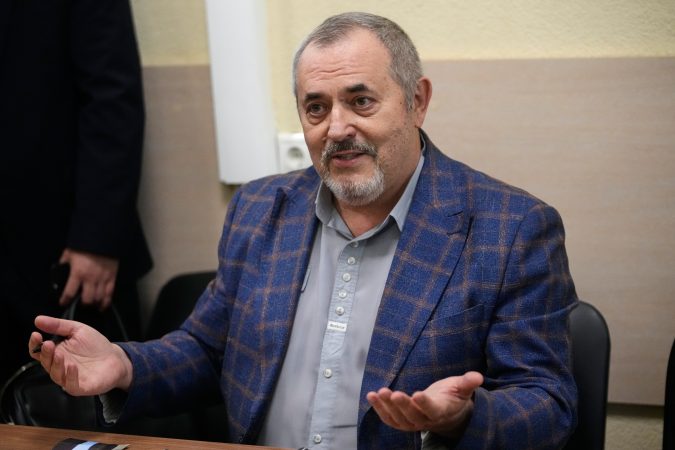
    In recent weeks, the liberal-leaning Yabloko Party, which is attempting to campaign under the slogan “For Peace and Freedom” — a pointed counter to Putin’s unyielding push for conquest — has come under increasing pressure across the country. Meanwhile, Russia’s most prominent anti-war politician, Boris Nadezhdin, who sought to run as an independent, has been barred from the campaign.

    Authorities in St. Petersburg last week refused to register Yabloko for the local parliamentary elections, and more than a dozen of its candidates have been barred from federal and regional elections over accusations they displayed alleged “extremist symbols” such as posting photos online of the late opposition leader Alexei Navalny.

    The Russian authorities “are not going to give any platform to people with anti-war views in the election,” said Andrei Kolesnikov, an independent political analyst in Moscow. “There is now not one noticeable voice against the war.”

    Recent challenges to Yabloko’s registration in several regions over claims of incorrect paperwork could lead to Yabloko being barred overall from the federal election, analysts say — a move that could strengthen United Russia, the ruling party that controls the parliament and has long backed Putin.

    Kremlin spokesman Dmitry Peskov denied the government was targeting anti-war voices, and said individuals were being punished for “violations of the law.”

    “Those who break the law are under pressure and those who don’t break it freely speak their opinion,” Peskov told The Washington Post. “I wouldn’t even call Yabloko a party. It’s no more than a cell,” he added.

    In spring, however, the atmosphere seemed very different. A video posted by social media influencer Viktoriya Bonya lambasting the government’s botched handling of internet restrictions and other problems went viral, forcing the Kremlin to respond.

    A former Kremlin lawyer, Ilya Remeslo, openly branded Putin a war criminal and a thief — but after a brief incarceration in a psychiatric hospital was somehow released and allowed to continue his tirade. More recently in June, German Gref, the head of Russia’s biggest state bank, broke ranks by publicly saying everyone wanted the war to end as soon as possible.

    Remeslo, whose open stance against the war had been seen as representing a divide in the upper reaches of the Kremlin, has since been quietly arrested, accused of spreading allegedly false information about the Russian military — a charge that carries a prison sentence of up to 10 years. He is now being held in a Moscow psychiatric facility, the Serbsky Institute, notorious for its incarceration of political prisoners, according to Remeslo’s lawyer, Sergei Badamshin.

    Forces in the Kremlin decided to put an end to the public dissent, Nadezhdin, the independent anti-war candidate, told The Post in an interview after he was briefly detained and fined for displaying alleged “extremist symbols” — for sharing a link to a video containing an image of Navalny, who died in prison in 2024.

    On July 10, the Justice Ministry declared Nadezhdin a foreign agent, a move that barred him from public office, and he was prohibited from leaving the country.

    “People trust Putin and United Russia less and less because the war has come to them,” Nadezhdin said. “Every day, warehouses and oil bases are exploding. People are dying. And in this situation they are trying to get rid of the most visible political actors like me and Yabloko, who speak against the war and for peace and freedom.”

    Nadezhdin, who won popularity on an anti-war platform in the 2024 presidential elections until the authorities refused to register him as a candidate, said he was now withdrawing completely from opposition politics because it had become impossible.

    In the weeks since public dissatisfaction spilled into the open, Putin’s popularity ratings continued to fall.

    On July 17, a state pollster, the Public Opinion Foundation, recorded the biggest one-week drop in Putin’s approval rating since Russia’s full-scale invasion began in February 2022, a decline of five percentage points to 66%.

    Putin’s falling ratings have been exacerbated by Ukraine’s campaign of long-range drone strikes on Russian oil facilities that have caused widespread fuel shortages and price hikes across the country and potentially pose a threat to this year’s harvest. His declining popularity has raised the stakes in the parliamentary elections, analysts and opposition politicians said.

    “More and more people don’t understand if the authorities at least have a plan about how to exit the situation with the war, and whether all these sacrifices and losses being wrought on Russian society and the economy are justified,” said Tatiana Stanovaya, a senior fellow at the Carnegie Russia Eurasia Center.

    “2026 is a turning point,” she added. “In the first four years of the war people lived in the understanding that the authorities know what they’re doing. Now they don’t know what to expect from tomorrow and there is the feeling that the situation is getting out of control while the authorities don’t have a plan.”

    “Everyone is living from day to day,” Stanovaya said, “while Putin seems far removed from reality.”

    The Kremlin can remove perceived opposition voices at will, and is widely expected to retain a tight grip on the election.

    Still, the gloomy backdrop appears to have forced the Kremlin to reassess what would constitute a win, especially amid persistent public anxiety that the government is planning a new military conscription effort after the election.

    Officials now forecast United Russia could win with 45% of the vote, Russian independent news outlet Meduza reported, down from a previous official prediction of 55%.

    In the Kremlin, officials are still divided over how to handle the increasingly thorny situation, according to Nadezhdin and Mikhail Khodorkovsky, a former Russian oil tycoon who is now a leading opposition figure living in exile in London.

    The recent arrest of Remeslo is a sign that Russia’s Federal Security Service is strengthening its hand against more progressive forces in the Kremlin who had supported figures like Remeslo, Khodorkovsky said.

    “In Putin’s circle a discussion is going on about what to do,” Nadezhdin said. “The [security services] are just trying to repress everyone … And the other part of the administration is trying to somehow work … and get some kind of acceptable result at the election. But it is becoming more and more difficult.”

    In recent weeks, at least 14 members of Yabloko have been barred from running over accusations that they displayed alleged “extremist symbols,” and the party’s registration is being challenged in several regions over claims of incorrect paperwork. The Federal Election Commission has yet to register Yabloko’s list of candidates.

    In addition, at least four members of the Communist Party have been barred from running over charges they posted “extremist symbols.”

    With little sign of renewed peace negotiations, some Russian officials appear to hope that the political situation in Kyiv will deteriorate first, Khodorkovsky said.

    Ukrainian President Volodymyr Zelensky last week ordered a far-reaching government shake-up, including the dismissal of the defense minister, the prime minister and the commander in chief of the armed forces.

    “They are counting on political destabilization in Kyiv,” Khodorkovsky said of hawks in the Kremlin.

    As Russia ramps up ballistic missile strikes on Ukrainian infrastructure in response to Ukraine’s drone campaign, the impact on Ukraine is becoming ever more worrying, one senior Ukrainian official said, speaking on the condition of anonymity to discuss sensitive matters.

    “Of course the Russians suffer a lot,” this official said. “But we suffer the same and on an even bigger scale and what will happen in the winter, no one can say.”


  • Lindsey Graham eulogized as an ‘American original’ with global reach

    Lindsey Graham eulogized as an ‘American original’ with global reach

    WASHINGTON — Sen. Lindsey Graham, the son of pool hall owners who rose to become one of his generation’s more influential U.S. politicians at home and abroad, was eulogized Tuesday as “a true American original” during memorial services in Washington.

    Graham’s flag-draped casket arrived for a tribute at the U.S. Capitol, where the Republican served for more than 30 years as an indefatigable dealmaker who talked and laughed and badgered his colleagues into action. Later, President Donald Trump joined foreign leaders at Washington National Cathedral, a testament to Graham’s stature on the global stage.

    Trump called Graham “a giant of the United States Senate, a true American original who left us much too soon.”

    In mostly prepared remarks, the president described his onetime presidential rival turned ally as “the first person to make you laugh and one of the last people that you’ve really ever wanted to fight.”

    Trump told the story of how he had publicly disclosed Graham’s cell phone number on the campaign trail, reciting the number in the cathedral, but said the senator had the last laugh because “Lindsey did not stop calling me for the next 10 years.”

    Among those gathered were Israel’s Benjamin Netanyahu and Ukraine’s Volodymyr Zelensky, leaders of two countries fighting separate wars, a nod to Graham’s role as a foremost believer in the power of the U.S. and its military to intervene in the world’s problems. Fox News’ Sean Hannity, in his remarks, said Graham would have been moved that they both made the long journeys to attend.

    Trump cabinet officials, including Secretary of State Marco Rubio and Defense Secretary Pete Hegseth, Supreme Court Justice Brett Kavanaugh, and current and former senators and lawmakers joined in the pews, as did Graham’s sister, now-Sen. Darline Graham, who was appointed by South Carolina’s governor to fill the remainder of her brother’s term.

    It was the start of two days of services, with burial Wednesday in Graham’s home state of South Carolina. Joint Base Charleston will be renamed in his honor, the White House said. Graham died suddenly on July 11 at his home in Washington of a likely aortic tear, according to preliminary findings. He had just returned from a whirlwind trip to a NATO summit in Turkey, where he celebrated his birthday, and a visit to Ukraine. He was 71.

    A place of honor for a ‘swashbuckling’ senator

    During the morning service in the Capitol Rotunda, Vice President JD Vance described Graham as a man of “swashbuckling” stature — “who swashbuckled into the Senate” with his suit jacket open — and was impossible not to like.

    “Lindsey was a towering figure,” Senate Majority Leader John Thune said, choking back tears during his remarks.

    First elected to Congress in the 1994 Republican revolt that swept the GOP to power, Graham was part of a new era of conservatives to take their seats in the House — and among the first Republicans from his Southern state since Reconstruction.

    He quickly rose to prominence as a manager in Democrat Bill Clinton’s presidential impeachment, and he was elected to the Senate in the 2002 election. There, he formed an alliance with Sen. John McCain, a Republican from Arizona, and Sen. Joe Lieberman, an independent from Connecticut, in what would become the “three amigos,” globe-trotting the world focused on national security issues.

    Vance recalled how he argued with Graham over the senator’s staunch support for aid to Ukraine, which has divided the GOP, but praised his legacy, saying Kavanaugh “would not be on the Supreme Court” were it not for Graham’s “fierce advocacy” during the confirmation hearing.

    For decades, Graham had been at the center of the action — a member of virtually every bipartisan gang in Congress — with a relentless ability to adapt to political realities, particularly when it came to Trump.

    One by one, many of Graham’s colleagues said their goodbyes in the Rotunda. Sen. Katie Britt (R., Ala.) placed both hands on his casket and then placed her hand on her heart. Sen. Tammy Duckworth (D., Ill.) saluted from her wheelchair. Former Sen. Richard Burr (R., N.C.) bowed and delivered a brief kiss, and Sen. John Kennedy (R., La.) gave a fist bump.

    The ‘Trump whisperer’ had one last mission: Russia sanctions

    Perhaps nowhere was Graham’s political dexterity on display more as when he navigated his on-again, off-again relationship with Trump.

    Graham had denounced Trump as a “unfit for office” during the 2016 presidential campaign, but over time he had become what senators called the “Trump whisperer,” someone even world leaders relied on to understand the president.

    Days before his death, Graham had won Trump’s support for a long-fought bipartisan proposal to impose sanctions on Russia over the war in Ukraine.

    Senators were scheduled later Tuesday to take a first procedural vote on the sanctions package, in Graham’s honor. Zelensky was expected to be on hand and meet with senators in the evening.

    Graham’s champions and potential successors

    At the Washington cathedral, a roster of socially conservative and anti-abortion leaders gave readings, including Tony Perkins of the Family Research Council, Marjorie Jones Dannenfelser of Susan B. Anthony Pro-Life America, and the Reverend William Franklin Graham III.

    When Hannity said how important Darline Graham and her family had been to the senator, she put her hand over her heart in response.

    Lindsey Graham never married, but he helped support his younger sister after both of his parents died while he was at college and then starting law school. He became the guardian for Darline, who was then 13, and he later in life often extolled the benefits of Social Security that helped keep them financially afloat.

    Darline Graham is now running in a potentially crowded primary field for the fall election. The filing period for the special primary election closes Tuesday, with voting set for Aug. 11.

    Graham went on to serve as a judge advocate general in the Air Force, and remained a reserve or National Guard member for decades. In the Senate, he briefly switched back to active status to help advise the Air Force during the Iraq War and was awarded the Bronze Star medal for service in 2014 before formally retiring as a colonel in 2015.

  • Wall Street’s flip from AI to less-loved stocks accelerates, while oil prices keep easing

    Wall Street’s flip from AI to less-loved stocks accelerates, while oil prices keep easing

    NEW YORK — Most of Wall Street rose Tuesday, even as stocks of computer chipmakers continued to tumble worldwide. Oil prices, meanwhile, eased further from the two-month high they hit last week.

    The S&P 500 added 0.2%, but the modest move masked big swings underneath the surface. The Dow Jones Industrial Average jumped 537 points, or 1%, while the Nasdaq composite slipped 0.2% after briefly dropping 9.3% below its record set last month.

    The majority of the U.S. market rose after more companies delivered stronger profits for the spring than analysts expected. Coca-Cola climbed 5% after its revenue rose 7% despite what CEO Henrique Braun called “a dynamic consumer landscape.”

    Sherwin-Williams rallied 8.3%, and Illinois Tool Works rose 3.6% after both likewise reported stronger earnings for the latest quarter than analysts expected. Stock prices generally follow the trend of corporate profits over the long term, and expectations are high for this most recent round of reports with the U.S. stock market still near its all-time high.

    Such expectations are weighing particularly heavily on stocks of chipmakers and other companies that have been huge winners from the boom in artificial-intelligence technology.

    Micron Technology’s stock came into the day having more than tripled for the year following gangbuster growth, for example. During the three months through May 28, its revenue more than quadrupled from a year earlier.

    But worries are rising about whether such growth is sustainable. Big spenders on computer memory could pull back on investments if AI does not produce as much profit or productivity as promised. Lower-cost AI models from China could also mean less demand for memory and computing power than earlier expected.

    Micron dropped 8.9% and was the heaviest weight on the S&P 500. Others also helping to keep the market in check were Advanced Micro Devices, down 8.1%, and Applied Materials, down 7.8%.

    All told, the S&P 500 rose 15.60 points to 7,428.78. The Dow Jones Industrial Average jumped 537.24 to 52,747.32, and the Nasdaq composite fell 55.17 to 24,876.91.

    The losses for chip stocks were even worse earlier in the day in other markets worldwide.

    Sharp drops for SK Hynix and Samsung Electronics dragged South Korea’s Kospi index down 10.8%. The market’s losses were so big that trading was temporarily halted at times in Seoul.

    “We believe the market was likely spooked by the progress of China’s chipmaking equipment capabilities, and was worried that this progress would threaten the competitive position of global chipmaking and chip equipment leaders,” said equity analyst Jing Jie Yu of Morningstar.

    “That said, we believe the sell-off today is largely a knee-jerk reaction and overdone,” he said. The dominant position of global chipmaking leaders is unlikely to be threatened meaningfully, he said.

    Several huge spenders on AI chips and data centers are scheduled to report their latest quarterly results this week, which could offer updates on how much they’re planning to invest. Meta Platforms and Microsoft are reporting on Wednesday, while Amazon is due on Thursday.

    Because AI superstar stocks have grown so big, their movements carry more weight on the S&P 500 and other indexes than many other companies. But the broad U.S. market could hold up despite their swings if other, less-loved areas are able to keep rising. It’s a rotation that some strategists have suggested could be healthy for the overall stock market.

    In the oil market, the price for a barrel of Brent crude to be delivered in October fell 4.4% to settle at $82.08.

    It’s been falling since late last week, when the price for a barrel to be delivered in September briefly shot as high as $102.

    Pushing up on prices have been worries that worsening fighting in the Middle East could slow the global flow of oil. On the other side, though, are hopes that the United States and Iran could still negotiate something to allow oil tankers to use the Strait of Hormuz to move crude.

    Lower oil prices helped to ease Treasury yields in the bond market. The yield on the 10-year Treasury fell to 4.60% from 4.65% late Monday.

    A weaker-than-expected reading on confidence among U.S. consumers also weighed on yields. Fewer consumers are saying they feel good about current business conditions, according to the latest survey released by the Conference Board Tuesday.

    The drop in oil prices helped push traders to trim their bets that the Federal Reserve could announce a hike to interest rates following its latest meeting on Wednesday. They’re forecasting a 31.5% probability, down from more than 36% a day before, according to data from CME Group.

    Higher rates could keep a lid on inflation, but they would also slow the economy by making it more expensive for U.S. households and businesses to borrow. Long-term mortgage rates have already hit their highest level in nearly a year, chilling the housing industry.

  • Trump meets separately with Zelensky, Netanyahu at White House

    Trump meets separately with Zelensky, Netanyahu at White House

    WASHINGTON — President Donald Trump held separate meetings Tuesday at the White House with Ukrainian President Volodymyr Zelensky and Israeli Prime Minister Benjamin Netanyahu. After each of the closed-door talks, the administration signaled a warming of the sometimes fraught U.S. relations with those nations.

    Trump and Zelensky met ahead of Sen. Lindsey Graham’s funeral, with the two leaders discussing ways for Ukraine to produce its own powerful weapons and “other ideas that could help” in its ongoing war against Russia.

    The sit-down in the Oval Office, which was closed to the media, followed a consequential meeting at the NATO summit earlier this month in Ankara, Turkey, where Trump announced that the U.S. will give Ukraine a license to make Patriot defense systems — a long-running request from Kyiv to counter Russian missile attacks.

    Taken together, those meetings underscore how much the U.S. president, once a major skeptic of continued assistance to Kyiv, has warmed to Zelensky as Ukraine continues to withstand the Russian barrage more than four years after Moscow’s invasion in 2022. The Ukrainian leader, whose relationship with Trump in his second term was marked early on by a raucous White House visit in which he was denigrated for being ungracious, has worked to court the Republican administration while relying on both likely and unlikely allies in Trump’s orbit to exert their influence with the president.

    The ongoing conflict in the Middle East, which has consumed much of the Trump administration’s focus this year, has also become gradually entwined with Ukraine, with Ukraine firing on at least one Iranian vessel in the Caspian Sea over the weekend while Zelensky asserts that Russia has been offering satellite imagery of U.S. bases in the Persian Gulf to Iran.

    In a post on social media after the meeting, Zelensky thanked Trump for the “good meeting” and the Republican administration’s efforts to aid Kyiv in the long-running war.

    “The President and I discussed licenses for Patriot interceptor production and several other ideas that could help,” said Zelenskyy, who also noted that he offered condolences to Trump for the death of Graham, a close ally of Ukraine. “We also spoke about diplomacy — it’s important that the diplomatic process be reinvigorated.”

    White House press secretary Karoline Leavitt said both the Zelensky meeting and a separate, later sit-down with Netanyahu were “positive and productive.”

    First meeting of U.S., Israel leaders since start of Iran war

    Netanyahu and Trump met at the White House on Tuesday for the first time since they launched a joint war against Iran, offering a chance for Netanyahu to smooth out strains in their relationship.

    The closed-door meeting lasted nearly an hour and a half. The White House did not immediately offer more details.

    Despite signs of tension between the two ahead of the sitdown, Netanyahu was effusive afterward and called it “excellent” in a post on his Instagram profile.

    “When I say excellent, I don’t mean it in a superficial way,” Netanyahu said in Hebrew. “A conversation with full partnership, with mutual support, with an understanding of the common goal of ensuring that Iran does not have nuclear weapons, and other goals as well. One of the best conversations I’ve had with the President of the United States, our friend Donald Trump.”

    The meeting comes as both leaders face growing pressures at home. Netanyahu is up for reelection and is embattled in part because of his deteriorating relationship with Trump. Trump is under pressure to end an unpopular war that has wreaked economic havoc and driven prices higher ahead of midterm elections this November.

    Netanyahu, who wanted to continue the fighting in Iran and against its ally, Hezbollah, in Lebanon, has been sidelined as Trump sought a deal with Tehran. His visit to the White House this week comes as the disagreements with Trump and Vice President JD Vance have burst into the open over the war in Iran and more.

    “The Americans are making it clear to the Israelis they are the ones who are running the war,” Israeli journalist and political analyst Amit Segal wrote Monday in the daily newspaper, Israel Hayom. “It is clear to everyone that Israel has been put in the back seat.”

    Near the White House where the public was able to gather near fencing, a small group of protesters chanted, “Netanyahu, you’re a tyrant” and “Bibi, you’re not welcome here,” referencing the prime minister’s nickname.

    The two leaders planned to discuss the framework agreement the U.S. and Israel signed with Lebanon over the Israel-Hezbollah war and the expansion of the Abraham Accords, according to a White House official, who spoke on condition of anonymity to preview the meeting.

    “We have a little difference,” Trump said Monday when asked by reporters if he and Netanyahu were on the same page on Iran. “But pretty close, yeah.”

    Meetings reflect Graham’s influence

    In a Fox News Channel interview Tuesday, Trump recalled Graham’s hawkishness and said the Republican South Carolina senator’s support for Ukraine never wavered. Trump said Graham had suggested it was time to make a deal with Iran but had no similar suggestion for the Russia-Ukraine war.

    “Ukraine, he’s very militant about,” Trump said on Fox & Friends. “I mean, Lindsey liked war, to be honest with you.”

    Ahead of the meeting, Zelensky warned that Russia has been aiding Iran as the war persists by capturing satellite imagery of U.S. bases in the Gulf region that later appear in Iran. The Ukrainian president also asserted that there was a “clear correlation” between Russia’s images and subsequent Iranian strikes.

    Iran is a key ally of Russia in its war against Ukraine and has helped Moscow build up its drone expertise.

    But on Monday, Trump downplayed any impact of potential Russian assistance for Iran, even as he said he would raise the matter with Russian President Vladimir Putin.

    “I don’t think they’ve been doing it, certainly not at a high level,” Trump told reporters on Air Force One as he traveled to Michigan. “And if they have, it has been very un-impactful.”

    On the Caspian Sea attack, the foreign ministers of Iran and Ukraine spoke about the matter, according to statements posted on social media Tuesday. Ukrainian Foreign Minister Andrii Sybiha called the conversation “frank” and said Ukraine’s focus is “solely at defending our country from Russian aggression and never intended to target civilian vessels or people.”

    Iran has said at least one sailor was killed in the attack. For his part, Iranian Foreign Minister Abbas Araghchi said Iran is also not seeking escalation but “made clear any attack on our citizens or interests is unacceptable” and “there must be restitution for losses.”

    Republican leadership is hoping to advance Graham’s sanctions legislation this week, although the Senate is juggling several other priorities before lawmakers leave Washington for their August recess.

    The bill has dozens of backers from both major political parties and is seen as the main policy tribute to Graham, who died unexpectedly this month from a tear in his aorta. It imposes tariffs on goods from the world’s top five purchasers of Russia oil or natural gas, including China and India.

  • France orders 4,000 more evacuated as fires displace a third of a million across southwest Europe

    France orders 4,000 more evacuated as fires displace a third of a million across southwest Europe

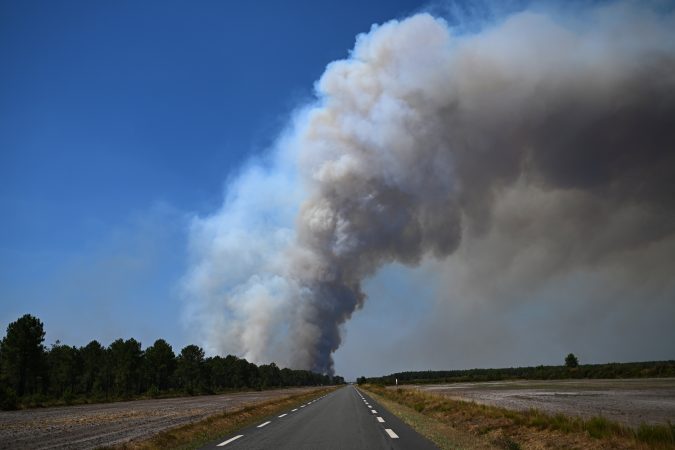
    LEGE-CAP FERRET, France — French authorities ordered 4,000 more people evacuated from tourist sites along its Atlantic coast on Tuesday, widening what may be France’s largest peacetime evacuation as returning heat threatened firefighters’ fragile hold on a vast wildfire west of Bordeaux.

    Fresh flames erupted later Tuesday near Grand Crohot, a popular Atlantic beach on the Lège-Cap-Ferret peninsula, local authorities said. A fleet of 23 planes and helicopters — up from 18 — dropped water and fire retardant as crews fought to keep the renewed flames from spreading.

    “The situation remains complicated. That’s clear. We’re not out of the woods,” Gironde prefect Sophie Brocas said.

    She said that about 60,000 residents who were evacuated as a precaution from Le Haillan and parts of Mérignac and Eysines outside Bordeaux’s ring road could return on Tuesday. No fires had broken out in the three areas, but residents were told to keep their mobile phones on and emergency bags packed.

    The opposing movements — thousands ordered out of coastal resorts while those returning told to be on the alert — underscored how precarious the fire’s hold remained.

    Across France and Spain, roughly 330,000 people have been driven from homes and vacation sites by huge wildfires. Spain braced for its fourth heat wave of the summer, with several blazes still burning out of control, including the largest in its recorded history.

    Even so, Spanish authorities began lifting evacuation and stay-at-home orders for thousands of people after firefighters made progress overnight.

    The Gironde fire has burned an area four times the size of Paris and forced 220,000 people to evacuate. Interior Minister Laurent Nuñez has said it is “very likely” the largest civilian evacuation operation carried out in the country outside war.

    Evacuations don’t deter some vacationers

    The precautionary evacuation order covered campsites, holiday villages, tourist residences, and leisure parks around the resort of Lacanau, Gironde regional authorities said.

    “We are at a point of fragility,” Eric Brocardi, spokesperson for France’s national firefighters federation, told the BFMTV broadcast network Tuesday. “We will continue attacking this fire despite the forecast rise in temperatures.”

    Even as nearby homes burned and authorities urged tourists to stay away, one family told Le Parisien newspaper it had gone ahead with its trip rather than forfeit a 4,000-euro ($4,558) holiday, while another group debated abandoning a vacation that had cost 650 euros ($741) each.

    A fire making its own weather

    At its most violent, the Gironde blaze created a gargantuan black thundercloud, electrified and lit from within. It generated lightning, violent winds, and new fires beyond the original front. The phenomenon, known as a pyrocumulonimbus cloud, was the first recorded in France.

    France’s national weather service placed Gironde under a yellow heat warning beginning at midday Tuesday, forecasting inland temperatures of 91 to 95 F.

    More than 448 square miles have burned across France this year, according to the Interior Ministry.

    Europe is the world’s fastest-warming continent, heating at more than twice the global average, according to the European Union’s Copernicus climate service. Western Europe recorded its hottest June on record, with extreme heat and widespread dryness contributing to the spread and intensification of fires in France and Spain, Copernicus said.

    Crews defend homes and cut firebreaks

    In Le Porge alone, west of Bordeaux, the municipal government said about 150 homes were destroyed.

    Officials warned that smoldering vegetation, rising temperatures and falling humidity could produce fresh outbreaks along the fire’s vast perimeter.

    Military engineers and forest-fire prevention crews resumed cutting firebreaks early Tuesday. Authorities said crews had completed 64 miles of firebreaks.

    At least 110 firefighters have been injured, the prefecture said.

    Thousands return as second fire stops advancing

    In Landes, about 15,000 evacuees — roughly half of those displaced here — were allowed home after a separate wildfire stopped advancing.

    “The fire is fixed, which is good news in the Landes,” French President Emmanuel Macron said Monday evening. Regional authorities said that meant its advance had stopped and no new outbreaks had been reported.

    Those allowed back included residents of Sanguinet, Parentis-en-Born, Biscarrosse’s aviation village, and a large campground. Several other neighborhoods remained inaccessible.

    Authorities warned that the Landes fire was not extinguished. Residual hot spots, wind, and drought could cause flare-ups, and surveillance and damping-down operations were expected to continue for days or weeks.

    Thousands begin returning in Spain

    Spanish firefighters made progress Tuesday, and authorities began lifting evacuation orders for at least 20,000 of the 79,000 people forced to flee over the weekend.

    Francisco Martín, the central government’s representative in the Madrid region, said orders would be lifted in 10 towns, allowing about 20,000 evacuees to return home and ending stay-at-home orders for another 14,000 people.

    Residents of some villages in Ávila were also being allowed home, though authorities did not specify how many. Another 6,000 people could return after a smaller fire near Toledo was brought under control, while several thousand more went home in Castellón.

    Hundreds of firefighters backed by military emergency brigades and water-dropping aircraft continued battling several major wildfires.

    Smoke from the fires reached Madrid in recent days. Emergency services said residents in central and eastern districts could smell smoke and ash.

    Spanish Interior Minister Fernando Grande-Marlaska said Tuesday that nonstop work through the night left him “reasonably positive,” though officials warned that crews had only a brief window before extreme heat returned.

    Spain’s national weather service said the country was bracing for its fourth heat wave of the summer, with temperatures expected to exceed 104 F in some areas.

    The government declared a national emergency over the fires.

    At least 13 people have died in wildfires in Spain this year, making 2026 one of the country’s deadliest fire seasons in decades.

    “I’ve been living in San Martín de Valdeiglesias for 20 years and I never thought I would see this,” said Estella Costales, an evacuated resident staying at a temporary shelter in Brunete, near Madrid. “It’s unfortunate, but I never thought I would see such destruction.”

    Surroundings of Madrid remain at risk

    The greatest concern was two large fires that had at times come close to merging into a single blaze in wooded hills about an hour’s drive west of Madrid.

    A fire in hilly, rural terrain in Ávila, west of Madrid, has become Spain’s largest on record, scorching more than 193 square miles, the government said.

    Local weather services in Ávila also shared images Tuesday of what they described as a pyrocumulonimbus cloud over the blaze. Spain has seen these fire-generated thunderstorms form at least twice during wildfires in recent years.

    “Look at how the valley is burned. Look at the houses, the people,” said David Gonzalez, a 48-year-old gardener who used his van to deliver supplies to firefighters in Ávila.

    “We are feeling a lot of anger and helplessness. It’s something inhuman,” he said.

    Fires have burned 590 square miles this year in Spain, Ecology Minister Sara Aagesen said.

    Spanish Prime Minister Pedro Sánchez has called for a national pact to fight wildfires, saying climate change is making them worse.

  • Tornado that carved a path of destruction in Wisconsin stayed on the ground for more than 20 minutes

    Tornado that carved a path of destruction in Wisconsin stayed on the ground for more than 20 minutes

    MADISON, Wis. (AP) — First responders searched damaged homes and buildings on Tuesday for possible victims of a powerful tornado that carved a path of destruction through several northeastern Wisconsin communities.

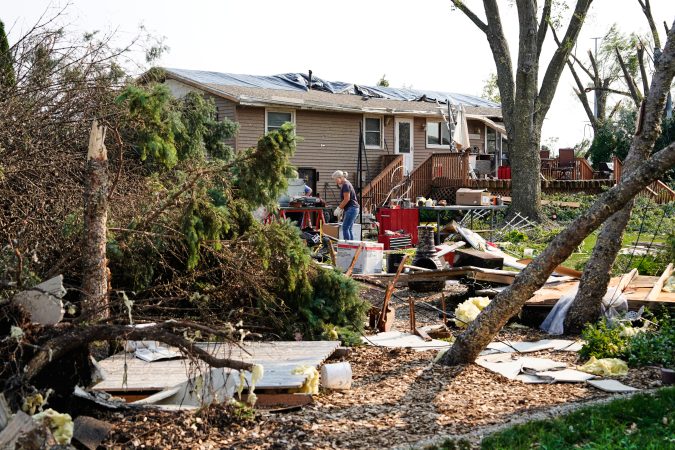
    The twister touched down in the Fox Cities region, which includes Appleton, Menasha and Neenah, at around 1 p.m. Monday and remained on the ground for more than 20 minutes as it cut a roughly 12-mile path of destruction through an area, the National Weather Service reported. It was nearly a mile (1.6 kilometers) across at its widest, and it destroyed homes and businesses, flipped cars and knocked down rows of power lines in the region, which is roughly 100 miles (160 kilometers) northwest of Milwaukee.

    The timing — it blew in when most people were awake and after warnings had been issued — could be why there have been no reported deaths, authorities said.

    “I think what helped us was it was during the week,” Menasha Police Chief Matt Albrecht said at a news conference Tuesday. “Everybody was at work. It was the middle of the day. Most people were not at home and at their place of employment.”

    Authorities said a number of people were injured and treated at hospitals, but they didn’t know exactly how many or how seriously.

    “The depth of the tornado and its impact is incredible, devastating. We’re really still at the assessment stage,” Winnebago County Executive Gordon Hintz told reporters.

    Gov. Tony Evers declared a state of emergency for the affected areas.

    As chain saws roared in the background, Appleton Mayor Jake Woodford said a number of neighborhoods were “truly devastated.” Like elsewhere in the region, electricity lines were tangled around broken trees, making power restoration a slow, risky process.

    More than 14,000 customers in Winnebago and Outagamie counties were still without power Tuesday afternoon, about 1,000 fewer than earlier in the day, according to PowerOutage.us. It could be several days before power is restored.

    Shelters were opened for displaced residents. A boil water advisory was issued for part of a water system in Fox Crossing that lost pressure.

    It was a relatively powerful twister

    The twister was spun off by a large storm system that moved through the Great Lakes, fueled by a buildup of heat and humidity, the weather service said.

    Weather service officials were assessing the damage Tuesday, said Roy Eckberg, an agency meteorologist.

    “To get that kind of tornado is pretty rare in northeast Wisconsin, but they do happen from time to time,” he said, adding that it was unusual that the twister moved southward instead of to the east or northeast.

    Preliminary data indicates it was an EF3 tornado, the weather service said, stronger than the EF2 estimate they made Monday.

    Residents describe terrifying moments

    Heather Schroeder said she heard cracking and popping all around her as the twister tore apart a laundromat, bakery and tavern along a street corner in Menasha.

    Rescue workers pulled someone out of one of the buildings and it wasn’t clear if they had survived, said Schroeder, who works nearby. Cars were turned upside-down, and there was a gas leak at the laundromat, she said.

    “There’s nothing left,” Schroeder said.

    Aerial video Tuesday showed homes in Menasha without roofs or that had been completely hollowed out.

    Greg Van Driest was working in downtown Appleton when the sky got as dark as night.

    “The word we all were using was ‘ominous,’” he said. “It’s like, ‘Whoa, look at that.’ … You looked outside and you thought it was three in the morning, it was that dark.”

    Hintz, the Winnebago County executive, said he received multiple reports of buildings destroyed and vehicles overturned. All storm warnings that could be made ahead of time to get people to safety were activated, he said.

    “Obviously when you look at the damage, Mother Nature doesn’t really care,” he said.

    ___

    Mayes-Osterman reported from Chicago and Seewer from Toledo, Ohio. Dave Collins in Hartford, Connecticut; Christopher L. Keller in Albuquerque, New Mexico; Laura Turbay in Little Rock, Arkansas; Sophie Bates in Jackson, Mississippi; Hannah Schoenbaum in Salt Lake City; and Michael R. Sisak in New York contributed to this report.