Tag: no-latest

  • Asylum seekers could be sent directly to deportation under new federal rule

    Asylum seekers could be sent directly to deportation under new federal rule

    The Trump administration launched a plan Tuesday to channel hundreds of thousands of asylum seekers directly into deportation proceedings, a change that some attorneys said could lead to people being removed from the United States without a hearing.

    Trump officials introduced a rule designed to reduce the 1.4 million asylum cases pending in U.S. Citizenship and Immigration Services, the Department of Homeland Security agency that processes immigration applications, by nearly a third. The rule took effect immediately, before the public could weigh in.

    In the past, asylum seekers who entered the U.S. legally or were never charged with an immigration violation had the opportunity to apply for refuge in an office before a trained asylum officer. The officer could refer them to immigration court for removal proceedings if they were rejected, or allow them to continue proceedings and potentially get on a path to obtaining U.S. citizenship.

    Under the new rule, officials say as many as 444,724 cases could be transferred directly to one of the Justice Department’s immigration judges. Trump officials have empowered judges to dismiss certain cases without a hearing, so attorneys say it is possible that many asylum seekers will be deported without a chance to be heard.

    Trump officials said in a statement that the rule is necessary because the asylum system is facing a “crisis.”

    “For far too long the asylum system has been exploited for purposes of delay and work authorization, not legitimate claims of protection,” USCIS Director Joseph B. Edlow said in a statement. “America’s asylum system exists to protect individuals who genuinely fear persecution and this rule will help ensure that resources are directed to the timely adjudication of those claims instead of to those seeking to use the system as a loophole.”

    The measure is the latest means through which the Trump administration has sought to transform the asylum system. President Donald Trump, in one of his first acts in office, barred asylum seekers’ entry into the United States by declaring an “invasion” at the U.S.-Mexico border.

    He has also targeted those who are already living inside the U.S., including hundreds of thousands of people who probably arrived legally and followed the rules to apply for asylum.

    Trump officials are preparing to terminate work permits for Haitians and Syrians in the coming days after the Supreme Court enabled officials to allow their temporary protected status to expire. If those immigrants also applied for asylum and their cases are referred to the courts, lawyers say, the threat of deportation could be imminent.

    “It’s all part of a plan to take legal people and make them illegal,” said Ira Kurzban, one of the attorneys who represented Haitians in the case that went to the Supreme Court. “That’s what they’ve essentially done.”

    The United States is a signatory to the 1967 United Nations protocol on refugees, which prohibits member countries from expelling immigrants to nations where they face serious threats to their lives.

    Trump officials, Kurzban said, are betraying that principle and turning the asylum system into “a joke.”

    “At a 30,000-foot level it sure looks like a deportation machine,” he said.

    Trump officials argue that smugglers have exploited the U.S. asylum system, flooding it with weak applications so that immigrants may live and work legally in the United States as their cases drag through the system.

    Asylum creates a path to U.S. permanent residency and, eventually, citizenship. To be eligible, applicants must show that they face persecution in their homeland based on their race, religion, nationality, political opinion, or another trait that makes them a specific target. They also must pass background checks and apply within one year of arrival.

    The more than 400,000 pending asylum cases before USCIS that could be sent to deportation proceedings largely involve individuals who filed for refuge after being in the United States for more than a year, officials said in announcing the rule.

    Federal law says asylum seekers must apply within a year of arriving, and officials contend that most late applicants referred to immigration judges in the past few years have been ineligible for an exception to that requirement.

    Advocates for immigrants have long argued that people fleeing for their lives are not well versed in the intricacies and deadlines of U.S. immigration laws, and note that the immigration courts do not assign them public defenders. Sometimes bona fide applications are filed late, they say, and federal law allows judges to overlook that in extraordinary cases.

    Though the new rule took effect immediately Tuesday, USCIS said it will accept public comments and later issue a final rule with its responses.


  • Betye Saar, artist who shattered stereotypes of Black women, dies at 99

    Betye Saar, artist who shattered stereotypes of Black women, dies at 99

    Betye Saar, who scoured flea markets for ordinary items – clocks and window frames, plastic dolls, miniature ships and masks — from which she crafted works of art that explored and exploded images of Black women in America, died Sunday in Los Angeles. She was 99 and would have celebrated her 100th birthday on Thursday.

    Her death was announced by Roberts Projects, the Los Angeles gallery that represented her.

    Ms. Saar, a lifelong Californian, was 93 when she became an art world star in 2019. That year, the Museum of Modern Art in New York and the Los Angeles County Museum of Art mounted simultaneous exhibitions of her work. Reviewing the Los Angeles show in The Washington Post, art critic Sebastian Smee wrote that her “modestly scaled assemblages address racism and female labor with excoriating intensity and moody finesse. But they also vibrate with spiritual yearning.”

    By then, she had been an artist for more than 50 years. In interviews, Ms. Saar described the assassination of the Rev. Martin Luther King Jr. in 1968 as the event that politicized her and gave her work purpose. “I was a mother with young children,” she told the New York Times. “I couldn’t walk in protest, but I did have a weapon, and that was art.”

    She began collecting likenesses of Aunt Jemima, Uncle Tom, Little Black Sambo and other caricatures that she described as “Black derogatory images.” She incorporated them into collages and assemblages, transforming the scavenged items into statements of political and social protest.

    The most famous of those works was “The Liberation of Aunt Jemima” (1972), in which she depicted the apron-wearing “mammy” with one hand holding a broom and the other a gun.

    “It’s like they abolished slavery but they kept Black people in the kitchen as Mammy jars,” Ms. Saar told the Los Angeles Times. “I had this Aunt Jemima, and I wanted to put a rifle and a grenade under her skirts. I wanted to empower her. I wanted to make her a warrior.”

    Ms. Saar worked in a variety of media, but her assemblages — collections of objects she found on the street or at swap meets — attracted the most notice. She was inspired by a 1967 visit to the Pasadena Art Museum (now the Norton Simon Museum), where she saw assembled works by a master of the form, Joseph Cornell. Ms. Saar said she recalled thinking: “Hey, I can do that. I’ve got all this fantastic stuff.”

    Some of her pieces told stories, and some didn’t. “I prefer it when they don’t tell a story so the viewer can invent their own,” she told the New York Times. Some assemblages displayed materials that belonged to Ms. Saar’s female ancestors, who were African American, Irish, and American Indian. Others referenced events in her life. In “Black Girl’s Window” (1969), a Halloween skeleton, alluding to her father’s death when she was 5, accompanies Ms. Saar’s self-portrait, among other images.

    Still others were overtly political. In his review of the Los Angeles exhibition, Smee focused on an assemblage called “The Edge of Ethics,” from 2010.

    A dark green birdcage contains an armless black figurine chained to a glass bottle and standing on outsize bird’s feet. Smee called the work “a masterpiece,” and he observed that “it makes a bald statement about slavery and incarceration.” He added, “It is more succinct, more poignant and more pressingly urgent than a roomful of research papers, a month of Sunday sermons, a year of news reports.”

    Ms. Saar’s work often referred to such religious traditions as shamanism and voodoo, as well as astrology, palmistry, phrenology and tarot. In a 1977 documentary about Ms. Saar, Los Angeles-based artist John Outterbridge, remarking on her interest in ancient beliefs, said, “She could be a daughter to one of the pharaohs.”

    Betye Irene Brown was born in Los Angeles on July 30, 1926. Around the time of her father’s death, her family moved in with relatives in Pasadena. She spent summers with her paternal grandparents in the Watts neighborhood of Los Angeles, where she watched the construction of Simon Rodia’s Watts Towers, a major work of architectural sculpture.

    Ms. Saar said Rodia, an Italian immigrant, influenced her by his use of broken dishes, seashells, rusty tools, even corn cobs that he pressed into cement, creating an art of assemblage and presaging her own eclecticism.

    At the University of California at Los Angeles, she majored in interior design. “Being from a minority family,” she told the Los Angeles Times, “I never thought about being an artist. But I could tell people how to buy curtains.”

    After graduating in 1949, she created a greeting card line and founded an enamelware business. She started graduate school in graphic design, but an encounter with printmaking changed her trajectory. The form was “liberating,” she told the Los Angeles Times. “It gave me the freedom to experiment.” She began creating color etchings, ink drawings, and intaglio prints.

    In 1952, while in graduate school, she married Richard Saar, a ceramicist. They soon had three daughters: Tracye Saar-Cavanaugh, now a writer, and Alison and Lezley Saar, both artists. In 1962, the family moved to L.A.’s bohemian Laurel Canyon, where Ms. Saar continued to live after she and her husband divorced.

    In addition to her daughters, survivors include six grandchildren.

    During a 1970 trip to Chicago, Ms. Saar studied the African artifacts in the basement of the Field Museum. From then on, many of her works incorporated objects and artworks from Africa.

    In 1974, she received a grant from the National Endowment for the Arts. It made her feel “like an artist for the first time,” she said. “Before I was just making stuff.” A year later, she was the subject of a small exhibition at the Whitney Museum of American Art in New York.

    Although she mostly avoided art world disputes, Ms. Saar led a letter-writing campaign in 1997 to protest the awarding of a MacArthur “genius grant” to Kara Walker, an African American artist whose silhouetted images included depictions of enslaved people as participants in debauchery with their masters.

    In an interview for the PBS series “I’ll Make Me a World,” Ms. Saar called Walker’s work “sort of revolting and negative and a form of betrayal to the slaves, particularly women and children, and that it was basically for the amusement and the investment of the White art establishment.”

    She subsequently explained to the International Review of African American Art: “Here we are at the end of the millennium seeing work that is very sexist and derogatory. … The trend today is to be as nasty as you want to be: TV, Rodman, rap. … There is no personal integrity. … Aunt Jemima is back with a vengeance.”

    But mostly, when she had something to say, Ms. Saar did so through her art. In her later years, her assemblages sometimes grew into room-size installations. “I’m basically a recycler,” she told the New York Times. “I’m a person who walks looking down, because you can find lots of great things on the ground.”

  • A desert town may run out of water. Others could face the same fate.

    A desert town may run out of water. Others could face the same fate.

    KEARNY, Ariz. — Mayor Curtis Stacy starts every morning checking two websites that tell him how much he needs to worry about water.

    One site tells him about the reservoir that supplies his tiny desert town — it’s effectively empty. The other site tells him if the town gets additional water that other communities with more senior rights aren’t using; right now, the answer is yes.

    But Stacy tries to remind Kearny’s roughly 2,000 residents that they could easily tip back into crisis mode, just like this spring. In newsletters, he underscores that fragility with no fewer than 20 exclamation points. If other communities call for more water, they will have to cut back again.

    “!!!!!!!!!!THIS SITUATION IS ALMOST CERTAINLY TEMPORARY!!!!!!!!!!” he wrote in one bulletin posted on the Kearny Facebook page and taped up and down the glass doors of the town office.

    Kearny is an extreme example of the water crunch facing communities across the West as states and cities stare down a future of “megadrought” and fight over scarce resources. An unusually dry winter this year left the Southwest parched, with not enough water for everyone laying claim to it. In the complex web of water rights that govern how that short supply is distributed, the tiny town of Kearny comes last.

    Other cities around the West could face similar challenges and cutbacks. The federal government is set to release a plan for the shrinking supply of Colorado River water this summer that could force dramatic cuts.

    The plan, part of which the Bureau of Reclamation described in an Environmental Impact Statement early on Friday morning, comes at a time of escalating crisis for the Colorado River, a crucial water source for seven states, 30 Native tribes and a swath of northwestern Mexico.

    Arizona, California, and Nevada will be required to curb their use of the water from the Colorado River by a combined 20% over the next two years — and could ultimately face even larger cuts, according to three officials familiar with negotiations over a long-awaited federal plan to rescue the depleted waterway.

    Kearny is not directly affected by the Colorado River negotiations, officials say, but its dilemma shows how dwindling resources — and water-rights rules that can feel arbitrary to those most affected — can upend daily life.

    Kearny usually uses about 280 acre-feet of water a year; this year, it was allocated 77 acre-feet (one acre-foot supplies about three homes annually). Town officials realized they were on track to run out of water in July.

    The crisis forced steep reductions in water use and now hangs over the town’s future, testing residents’ ability to adapt to shortage. It has also consumed much of Stacy’s final year in charge, giving him new gray hairs and new worries about his hometown, a community where everyone knows everyone and where you can get ahold of the mayor by walking into his office.

    Stacy thought he had seen Kearny’s worst crisis in 2024, when a wildfire blazed toward the edge of town. He ran from house to house getting people out while embers blew above their heads. But the water shortage has been, in many ways, worse.

    “It’s like a slow death,” Stacy said, “instead of an actual emergency happening right in front of your eyes where you can actually help.”

    The town tried to prepare residents late last year for what was coming. In a Dec. 29 letter, officials warned that the reservoir fed by their primary water source, the Gila River, was running low.

    The first question in the FAQ section was, “What happens if our allotment is zero?”

    Answer: “Severe restrictions will be imposed.”

    Light snowfall had left the reservoir, San Carlos Lake, at about 1% of its capacity, and Kearny’s rights to that small supply were “junior” to other communities under the complicated water-rights system laid out by a court in 1935, before the town was founded.

    Soon, Kearny was on track to run out of water by midsummer.

    “For years, they’ve been telling us that cutbacks were coming,” said Eric Armenta, Kearny’s public works director. “But it never did come until now. And it came drastically.”

    In late March, Kearny imposed “Level 5″ restrictions on water — the most stringent possible. A declaration of emergency told residents they could use water only for the essentials; the mayor went door to door to convey the situation’s gravity. There would be no washing of cars, no kiddie pools, and no watering of grass. Even the Little League field would go dry.

    “Laundry — wear it a second or even third day,” the mayor advised in another bulletin days later. “Bathing/Showers — no better time to connect with your significant other.”

    “What is the Town doing about this?” he wrote in the next note. “This emergency is our entire focus.”

    By the end of April, the message was sinking in and the town was using 30% less water. But when relief came later in the spring, town leaders were torn.

    The authority that oversaw river rights had given Kearny extra water, but only because those with higher priority were not requesting water. The moment that changed, Kearny would need to cut back again.

    The town council voted to go back to “Level 1” restrictions, which meant cutbacks were optional. “Flush, shower, keep the trees alive, launder your clothes, live a normal life again,” the mayor wrote.

    Not everyone thought the reprieve was a good idea. “We knew exactly what was going to happen — people were just going to use it freely,” said Armenta, the public works director.

    Kearny was not yet in the clear.

    Bits of grass around town were starting to turn green again in early July, but mostly the yards were still parched. Public works supervisor Jake Acton looked away when he drove by the Little League field — still dead and brown.

    Kearny officials were no longer worried about running out of water in the short term, but their broader challenge lingered.

    Fourth of July fireworks were canceled due to “dry conditions and limited water”; fire damage aside, Kearny could not afford the thousands of gallons it might take to put out a wildfire. And some officials worried news of their water woes would scare away businesses, scare away homeowners, and make it even harder to recruit teachers.

    Armenta stopped by an old rehabilitated well set to start pumping in a matter of weeks. No one knew how much it would produce until it started functioning, and they were trying not to get their hopes up.

    “We want above 50 gallons per minute,” Armenta said over the roar of a machine clearing sand and debris. “Below that, it’s a waste of time.”

    Armenta was spending some 90 hours a week, he said, on the public works job — a position he took early this year because he knew the city was headed for trouble. He did it because his family is here, and he doesn’t want to leave.

    “My mom still lives here. My sister lives here. I want to live here,” he said. “My kids, I want them to be able to always come back to Kearny.”

    At the bar across the street from the Little League field, people wondered when the monsoon season would bring some real rain. But everyone thought the town would get through the water crisis. When Kathy Taft asked her friend Dave Olsen if the town was “really going to run out of water,” Olsen answered without hesitation.

    “No,” he said. “I just don’t see that happening.”

    The well, when it began operating in mid-July, was a letdown. At 40 gallons a minute, it would cover only a fraction of the town’s need.

    San Carlos Lake, meanwhile, remains close to empty. The lake closed to the public in June after it grew so dry that -— in the words of the local recreation department — “approximately 100% of the fish population” died.

    Now the mayor was worrying about 2027. If the lake didn’t recover, Kearny’s apportionment of river water next year could be zero.

    “We got 77 [acre-feet] this year and we were able to stretch that,” Stacy said. “You can’t stretch zero.”

    What then? There were still other avenues to try. Hydrologists were looking for well sites farther out; a local mining company could give Kearny some of its water. Wastewater could be put back into the ground and reused.

    And the monsoon rains were picking up. Away on a trip to Minnesota, Stacy watched with interest as a flood watch went into effect for much of the Gila River Basin, which includes Kearny.

    With some strong storms, the town’s fortunes could change again.

  • Musk’s SpaceX tumbles back to Earth, dragging Tesla stock down with it

    Musk’s SpaceX tumbles back to Earth, dragging Tesla stock down with it

    It seemed to be only good news for Elon Musk and investors in companies he oversees.

    SpaceX had marked a record-setting IPO, Musk was the first trillionaire in history, and the rocket company vaulted to an all-time high of more than $225 per share.

    That was last month. Since then, their fortunes have shifted.

    Musk has shed hundreds of billions in wealth, demoting him from trillionaire status, and SpaceX’s stock price has been cut practically in half. The stock closed at $116.41 a share Tuesday in trading on Nasdaq. On top of that, electric vehicle maker Tesla has lost about 18% of its value over the past week, in part after falling short of its quarterly earnings expectations, as investor patience for its artificial intelligence and robotics bets has worn thin.

    Musk cheekily nodded at the situation in a post on X on Friday.

    “(Former) Trillionaire,” he wrote.

    But while the world’s richest person could become a trillionaire again with a few big up days in the market, the challenges for SpaceX are deeper. It’s a new era for a company that was once on a glide path, that seemingly could do no wrong on its way to a historic $75 billion initial public offering.

    For SpaceX, “one of the benefits of being private is that there wasn’t a market to weigh in on and evaluate business decisions,” said David Meier, senior investment analyst at the Motley Fool. “Being publicly traded means everything will be evaluated and information transmitted through market prices. So every SpaceX launch, every Starlink decision and every xAI decision will be scrutinized by the market,” he added, referring to the company’s satellite internet service and artificial intelligence arm.

    Case in point: After SpaceX aborted a launch because of engine issues this month, the company faced another problem — a plummeting stock. SpaceX’s IPO documents had touted its plans to establish a colony on Mars and put data centers in space.

    Then SpaceX was dealt its latest setback in propelling Starship off the ground. The company is trying to power its data center and exploration bets by using a roughly 400-foot rocket to carry out missions including taking humans back to the moon.

    But the program has been marred by reliability concerns and repeated explosions. While SpaceX has proved its ability to put satellites and even people into orbit, much of its success has been built off of earlier and less capable launch vehicles. The company ultimately conducted a successful flight test on Friday, after what it said were issues with four of the rocket’s engines during the aborted launch the prior week, but the questions about Starship’s overall viability remain.

    “The future of the company is riding on the ability to make Starship work. … They essentially have a very successful pickup truck that can move things across town,” said Clayton Swope, deputy director of the Aerospace Security Project and senior fellow at the Center for Strategic and International Studies, a nonprofit focused on policy research in areas including defense and geopolitics. “What they’re trying to do is switch to a freight train and get the economies of scale [of] something of that magnitude.”

    Meier, the Motley Fool analyst, said the “sharp sell-off” has been surprising to him.

    “One possible explanation is that investors had the time to digest the financials and believe the valuation is too risky,” he said. In the lead-up to its stock debut, SpaceX disclosed it had a record of significant losses, including at least $13 billion since the beginning of 2023.

    Things have hardly been rosier on the other side of the Musk empire, at Tesla. Battling what he said was an illness on the company’s earnings call, Musk tempered expectations about Tesla’s performance, saying the electric vehicle company would be spending heavily to fuel its ambitions. Tesla reported a decline in profits compared with the same quarter a year earlier, despite 26% higher revenue than during the same period last year.

    As Tesla has shifted away from the auto business that propelled its meteoric growth — making it the world’s most valuable car company — investors have clamored to see results from its new direction: a pivot toward robotics and what the industry calls “physical AI,” driven by products such as its forthcoming Optimus humanoid robot. Musk delivered little news of significance on those bets, sending that company’s stock sinking as well.

    “We’re investing a lot in growing the core business and really preparing for the future,” Musk said. “This is a massive [capital expenditure] year, but I’m confident that all the things that we’re investing in will yield incredible returns.”

    “I’m a little under the weather here, a bit ill, so if I sound a little off … I’m a little bit ill today,” Musk said later on the call.

    Tesla’s declines and the larger consolidation of Musk’s empire have fueled speculation that it could be absorbed into SpaceX. Musk did little to quell that speculation on the call.

    “Obviously we can’t talk about combining companies and that kind of thing on an earnings call, it’s got to be done with the appropriate process,” Musk said after citing increasing overlap between the two companies, before turning a question about a theoretical merger to the company’s general counsel.

    For SpaceX, meanwhile, there is little relief on the horizon, analysts said. Gene Munster, managing partner at Deepwater Asset Management, said the company is feeling the strain of looming lockup expirations, where people who acquired shares at low prices are suddenly able to sell their stakes. Until that is resolved, he said, SpaceX is likely to continue facing challenges.

    “It’s like a crushing unknown,” he said. “Typically what happens is the stock keeps going down, down, down until the lockup [resolves].”

    Swope, the senior fellow at the Center for Strategic and International Studies, said the public scrutiny on SpaceX could, however, have benefits. He said a publicly traded SpaceX could be even more attentive to risks.

    “I think we all know there is a bit of showmanship to how SpaceX and Elon Musk do business,” he said. “If anything, I guess I could see maybe this will attenuate some of that showmanship a bit and it will be more cautious.”

  • France evacuates 4,000 people as heat threatens wildfire fight

    France evacuates 4,000 people as heat threatens wildfire fight

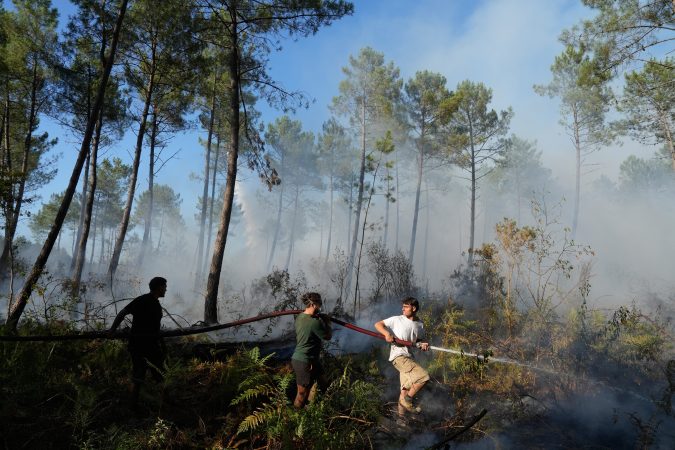
    LEGE-CAP FERRET, France — French authorities ordered nearly 4,000 people evacuated Tuesday from tourist sites on France’s Atlantic coast as returning heat threatened firefighters’ fragile hold on a vast wildfire west of Bordeaux.

    The order underscored a wildfire emergency of exceptional scale across southwestern Europe.

    Fires in France and Spain have forced roughly 330,000 people to evacuate. Spain braced for its fourth heat wave of the summer, with several blazes still out of control, including its largest on record.

    Firefighters held the French blaze in check through a calm night, bringing flare-ups near coastal dunes under control and keeping the burned area unchanged at 162 square miles.

    Authorities described the Gironde fire as stabilized, not fixed, meaning it could still spread again as temperatures rose and humidity fell.

    The precautionary evacuation order covered campsites, holiday villages, tourist residences and leisure parks around the resort of Lacanau, including Lacanau Ocean and both shores of Lacanau lake, Gironde regional authorities said.

    “We are at a point of fragility,” Eric Brocardi, spokesperson for France’s national firefighters federation, told BFMTV on Tuesday. “We will continue attacking this fire despite the forecast rise in temperatures.”

    France’s national weather service placed Gironde under a yellow heat warning from midday Tuesday, forecasting inland temperatures of 33 to 35 Celsius (91 to 95 Fahrenheit). Southeast winds were expected across Gironde, with westerly sea breezes along the coast.

    More than 448 square miles have burned across France this year, according to the Interior Ministry.

    Europe is the world’s fastest-warming continent, heating at more than twice the global average, according to the European Union’s Copernicus climate service and the World Meteorological Organization.

    Western Europe recorded its hottest June on record, with extreme heat and widespread dryness contributing to the spread and intensification of fires in France and Spain, Copernicus said.

    The Gironde blaze has been raging since last week and has proven wildly unpredictable, transforming at times into a self-feeding firestorm. It has burned an area four times the size of Paris and prompted the evacuation of 220,000 people.

    Officials warned that smoldering vegetation, rising temperatures and falling humidity could produce fresh outbreaks along the vast perimeter.

    Military engineers and forest-fire prevention crews resumed work early Tuesday on firebreaks designed to prevent the flames from spreading. Authorities said 103 kilometers (64 miles) of firebreaks had been completed.

    A total of 93 firefighters have been injured, the prefecture said.

    The A63 highway remained partly closed, while rail traffic south of Bordeaux was suspended except on the route toward Toulouse.

    Thousands return as second fire stops advancing

    In neighboring Landes, thousands of evacuees were allowed home after a separate wildfire stopped advancing. The fire had displaced more than 30,000 residents and vacationers.

    “The fire is fixed, which is good news in the Landes,” French President Emmanuel Macron said Monday evening. Regional authorities said that meant its advance had been stopped and there were no new fire starts.

    About 15,000 people were authorized to return home Monday night in Sanguinet, Parentis-en-Born and some parts of Biscarrosse.

    Residents of Biscarrosse’s aviation village and a large campground were among those allowed back, although several other neighborhoods remained inaccessible.

    The return marked a significant step for communities evacuated as flames swept through forests and tourist areas during the height of the summer vacation season.

    Authorities warned that the Landes fire was not extinguished.

    Residual hot spots, wind and drought could cause flare-ups, and surveillance and damping-down operations were expected to continue for days or possibly weeks.

    Spain braces for worsening conditions

    Hundreds of firefighters backed by military emergency brigades and water-dropping aircraft continued battling several major wildfires in Spain.

    Spanish Interior Minister Fernando Grande-Marlaska said Tuesday that nonstop work through the night left him “reasonably positive,” but warned that conditions could deteriorate as temperatures rose again.

    Spain’s national weather service said the country was bracing for its fourth heat wave of the summer, with temperatures expected to exceed 104 F in some areas.

    Authorities have evacuated about 79,000 people and ordered another 30,000 to remain in their homes. The government declared a national emergency over the fires.

    The greatest concern remained two large fires that had at times come close to merging into a single blaze in wooded hills about an hour’s drive west of Madrid.

    Another fire in the eastern province of Castellón also forced mass evacuations.

    A fire burning through hilly, rural terrain in Ávila, west of Madrid, has become Spain’s largest on record, scorching more than 193 square miles, the government said.

    “Look at how the valley is burned. Look at the houses, the people,” said David Gonzalez, a 48-year-old gardener who used his van to deliver supplies to firefighters in Ávila.

    “We are feeling a lot of anger and helplessness. It’s something inhuman,” he said.

    Fires have burned 590 square miles this year in Spain, Ecology Minister Sara Aagesen said.

    Spanish Prime Minister Pedro Sánchez has called for a national pact to fight wildfires, saying climate change is making them worse.

  • US looks to boost anti-China spending worldwide by hundreds of millions, documents say

    US looks to boost anti-China spending worldwide by hundreds of millions, documents say

    WASHINGTON — The Trump administration is preparing to ramp up funding by hundreds of millions of dollars for programs designed to counter China’s growing influence around the world, after it had put a halt to many of those initiatives last year during a flurry of budget and personnel cuts.

    The administration notified Congress late last week that it intends to spend $175.8 million to replace outdated and aging undersea telecommunications cables in the Caribbean and Central America to prevent China from moving in. The Associated Press obtained a copy of the notification on Monday.

    The administration has expressed deep concern about China’s activities in the Americas, pushing back on Chinese ownership of ports at either end of the Panama Canal, infrastructure projects funded by China’s Belt and Road initiative in the region, and Chinese investment in the telecommunications sector.

    A State Department official said China’s economic activities in the Western Hemisphere pose risks to U.S. national security and prosperity. The official, who was not authorized to speak publicly to the subject and spoke on condition of anonymity, said China’s offerings may seem cheaper but in the end wind up being more expensive due to cost overruns, hidden maintenance fees and poor performance.

    The underseas cable funding appears to be part of a broader push to restore support for initiatives aimed at blunting Chinese influence globally that would cost many hundreds of millions of dollars more. That is even as President Donald Trump and Chinese leader Xi Jinping put on a show of cooperation and Xi prepares to visit the U.S. this fall.

    US weighs wider spending to counter China globally

    The State Department is considering spending nearly half a billion dollars more on programs aimed at China throughout the Western Hemisphere, Africa and Asia, according to an internal State Department document obtained by AP.

    “The United States must respond to the CCP’s growing economic, technological, and diplomatic leverage around the world which undermines our national interests,” the document says, using the acronym for the Chinese Communist Party.

    Many of those proposed programs are designed to “reclaim diplomatic leverage” through investments in areas where the U.S. had previously been spending money but stopped as the Elon Musk-led Department of Government Efficiency, or DOGE, carried out deep cuts to government budgets and personnel last year.

    Those cuts, which dismantled the U.S. Agency for International Development and eliminated several hundred diplomatic posts worldwide, also affected previously approved projects, including some aimed at countering China.

    Chinese Foreign Ministry spokesperson Lin Jian said that China’s cooperation with other regions “is not about wooing or rivaling anyone, but about safeguarding world peace, promoting global development, upholding international order and building a community with a shared future for humanity.”

    A senior U.S. official, who spoke on condition of anonymity to discuss future administration plans, confirmed the Trump administration’s intent to boost funding on countering China but could not speak to specifics. The official acknowledged discussions of large-scale projects but said many were still in the discussion phase.

    Congress told about undersea cable project to keep China away

    The program described to Congress on Friday is called the “Countering CCP Control of Caribbean and Central America Undersea Cables project.”

    It will “fund the installation of strategically selected undersea cable infrastructure” and support foreign governments in partnering with private sector undersea cable installers, according to the notification. The money will “support replacement of outdated undersea telecommunications cables in the Caribbean and Central America region with secure, U.S. and trusted alternatives,” it said.

    Even as it pursues the war with Iran and peace efforts in Gaza and Lebanon, the Trump administration has put a focus on the Western Hemisphere, capturing Venezuelan leader Nicolás Maduro earlier this year, ramping up pressure on Cuba’s socialist government in the months since and imposing severe sanctions on the government in Nicaragua.

    Under the new program, funding is anticipated to be given to or in support of undersea cable projects benefiting El Salvador, Guatemala, Honduras, Nicaragua and Haiti, the document said. The U.S. has tenuous ties with Nicaragua and would not be working with the government there.

    Lin said undersea cables benefit people globally and that China is ready to work with the rest of the world to promote their construction and protection.

    “Turning it into a political or security issue will only disrupt international market rules and threaten global digital connectivity and cybersecurity, which serves no one’s interests,” he said in Beijing.

    Other anti-China efforts could focus on cyber and critical minerals

    At the same time, the administration has drawn up plans to spend more than $340 million for over 50 specific anti-China projects around the world, including many in the Western Hemisphere, according to the internal State Department document outlining various proposals.

    The administration notified Congress in May that it had spent several hundred million dollars in counter-China funding from the 2024 budget that was approved by the Biden administration. However, many other projects funded for 2024 and 2025 had been put on hold.

    Among the plans to be resurrected are the creation of security operations centers in Argentina and Belize to monitor Chinese threats to critical infrastructure and cyber platforms throughout the region. Also coming back would be initiatives to protect Ecuador, Jamaica, Mexico, Paraguay, Peru and Uruguay from alleged Chinese attempts to infiltrate port operations and illegally exploit offshore fishing and critical minerals extraction.

    More broadly, the proposal, which is still under consideration, would work against Chinese influence in the selection of a successor to the Dalai Lama “by developing proprietary technology to ensure secure communications and information collection.” It also would go after international support for China’s space program and push back against Chinese firms seeking to export surveillance and censorship technology.

    The document did not describe the initiatives in detail.

    Trump is expected to meet with Xi in September around the time of the annual U.N. General Assembly gathering of world leaders in New York. To prepare for that meeting, Secretary of State Marco Rubio met with Chinese Foreign Minister Wang Yi last week at a regional security conference in the Philippines.

    Trump has oscillated between anger and elation with Xi, whom the U.S. leader has sought to cultivate as an ally even while China pursues goals antithetical to many of his administration’s. The ultimate impact of the proposed new programs won’t be known for many months or years.

  • Zelenskyy will visit Trump at the White House before Sen. Graham’s funeral

    Zelenskyy will visit Trump at the White House before Sen. Graham’s funeral

    WASHINGTON — President Donald Trump and Ukrainian President Volodymyr Zelenskyy will meet Tuesday ahead of Sen. Lindsey Graham’s funeral, their second sit-down this month and after a far-right activist with the U.S. president’s ear had a widely publicized change of heart on Russia’s war against Ukraine.

    Trump is set to welcome Zelenskyy to the White House as the Ukrainian leader travels to Washington to honor Graham, whose final act as a public official was visiting Kyiv and securing an agreement on a package of sanctions that seek to punish countries that purchase Russian oil, gas and other exports.

    Zelenskyy posted on X early Tuesday that he had arrived in the U.S. and listed the goals for his visit.

    “Our schedule includes meetings with President Trump, his team, and those who can support our defense,” the Ukrainian leader said. ”Our number one priority is anti-ballistic defense and strategic cooperation with America. Peace needs to be brought closer.”

    Zelenskyy is now being bolstered by an unusual source: Laura Loomer, known primarily for her incendiary social media posts and her influence with the president. Traveling through Ukraine, Loomer has witnessed Moscow’s barrage firsthand and interviewed Zelenskyy while admitting she was “bamboozled by Russian propaganda.”

    Loomer said she spoke to Trump after she met with Zelenskyy in Ukraine last week, and she also expects to meet with the U.S. president once she returns from her trip.

    “It’s looking good for Ukraine, right?” Loomer said during an interview with The Associated Press. “Going into this meeting next week at the Oval Office is looking pretty good.”

    Ahead of the meeting, Zelenskyy has also warned that Russia has been aiding Iran as the war persists by capturing satellite imagery of U.S. bases in the Gulf region that later appear in Iran. The Ukrainian president also asserted that there was a “clear correlation” between Russia’s images and subsequent Iranian strikes.

    “The purpose is clear,” Zelenskyy said earlier this month. “None of us in the world should turn a blind eye to one very simple fact: Evil always seeks ways to make things worse and spread further.”

    On Monday, Trump downplayed any impact of potential Russian assistance for Iran.

    “I don’t think they’ve been doing it, certainly not at a high level,” Trump told reporters on Air Force One as he traveled to Michigan. “And if they have, it has been very un-impactful.”

    Still, he said he would raise the issue with Russian President Vladimir Putin.

    Zelenskyy has a busy itinerary during his latest visit to Washington. In addition to his White House meeting, Zelenskyy will head to the Capitol to meet with senators on Tuesday evening after Graham’s funeral at Washington National Cathedral, according to a person with knowledge of the meeting who was not authorized to discuss it publicly and spoke on condition of anonymity.

    Republican leadership is hoping to advance Graham’s sanctions legislation this week, although the Senate is juggling several other priorities before lawmakers leave Washington for the August recess.

    The bill has dozens of backers from both parties and is seen as the main policy tribute to Graham, who died unexpectedly this month from a tear in his aorta. It imposes tariffs on goods from the world’s top five purchasers of Russia oil or natural gas, including China and India.

    The legislation also includes sanctions against Putin, senior Russian political and military leaders, and Russian financial institutions and energy projects.

    Trump met with Zelenskyy on the sidelines of the NATO summit earlier this month in Ankara, Turkey, and announced that the U.S. will give Ukraine a license to make Patriot air defense systems, a long-running request from Kyiv in order to counter Russian missile attacks.

    The air defense systems are expensive to make and are in high demand. Noting that he and Zelenskyy have “actually developed a good relationship,” Trump said the U.S. will help Ukraine produce the Patriots and that the country would be able to produce them “pretty quickly.”

  • Letters to the Editor | July 28, 2026

    Letters to the Editor | July 28, 2026

    Fairway First

    As of Sunday, Donald Trump has gone golfing 116 days out of the 554 days he has been in office. That’s 20.9% of his time in office. That is one out of every five days.

    America is at war with Iran, and he’s golfing.

    America’s standing in the world is decreasing, and he’s playing golf.

    America’s economy is suffering, and he plays golf.

    And when he isn’t golfing, he is babbling incoherently, and his cabinet pretends everything is OK. Who is running this country? What is our long-term plan to keep our place as an economic powerhouse and the most powerful nation in the world?

    Susan Thompson, Media

    Election integrity

    Your recent analysis of the SAVE America Act and election integrity says more about The Inquirer’s disconnect with Pennsylvanians than the issue itself.

    Americans want secure, transparent, and trusted elections. They believe only U.S. citizens should vote in American elections, and according to Pew Research Center polling, 95% of Republicans and 71% of Democrats support requiring voters to show government-issued photo identification before voting. This isn’t a partisan issue. It’s common sense.

    Unfortunately, your reporting ignores reality. It dismisses the 6,600 noncitizens registered to vote in New Jersey as “fuel” to the rhetorical fire, ignoring that voting is a right reserved only for American citizens.

    The American people know better. They understand the importance of election integrity, and support practical, commonsense measures to ensure only American citizens vote in American elections. Dismissing these concerns as fringe or manufactured ignores what voters have said for years.

    This isn’t about making it harder to vote. It’s about making it harder to cheat, increasing confidence in our elections, and ensuring every legal vote counts. That’s why these reforms continue to earn support.

    I support the SAVE America Act and implore your readers to look elsewhere for a more thoughtful and honest appraisal of what the bill does.

    Dave McCormick, U.S. senator for Pennsylvania

    Deficit denial

    Peter Dobrin’s reporting on the Philadelphia Museum of Art’s record budget deficits should concern every Philadelphian who loves that institution. As a lover of the PMA — and a financial turnaround specialist — I read it with growing unease.

    Daniel H. Weiss, the museum’s director and CEO, is confident the budget will balance in three years, yet five of his six “keys to solvency” sit on the revenue side. His own CFO concedes the problem: Functional revenue has grown 0.3% annually over the past decade, “effectively flat.” The only levers management fully controls today are on the cost side. Yet, the museum insists there is “not a ton of opportunity” to reduce expenses. Its own tax filings say otherwise: Since fiscal year 2021, expenses have grown from $64.2 million to $83.9 million in FY 2025, all against a revenue line that hasn’t been able to keep pace. When revenue is structurally flat, an above-inflation cost trajectory is a deficit-creating machine.

    In my turnaround work, I call this the fundraising fairy myth: the belief that philanthropy, government, or a donor who “falls in love with us” will arrive on schedule. To its credit, the museum has avoided the other classic traps that doom turnarounds. But hoping revenue rescues you while declaring the budget uncuttable is how three-year plans become 10-year crises. Cut first. Stabilize. Then build back and fundraise from a position of strength. In that order.

    Larry Bomback, Philadelphia

    The writer is the former CFO of the Curtis Institute of Music and the founder and CEO of Strategic Nonprofit Finance. He led the financial turnaround of Albright College and is currently the interim CFO at Muhlenberg College.

    Join the conversation: Send letters to letters@inquirer.com. Limit length to 150 words and include home address and day and evening phone number. Letters run in The Inquirer six days a week on the editorial pages and online.

  • Dear Abby | Wife’s dream trip wouldn’t include her grumpy husband

    DEAR ABBY: I have just retired and want to spend the summer taking a long road trip from Florida to Alaska and back. I’ve dreamed about it all my life and finally have the time and money to do it.

    My husband hates long road trips, and I don’t want to take him. He would be miserable and make me miserable in the process. Further, he has a list of demands — no more than six hours of driving per day, a nice hotel every night rather than camping out, which I prefer, and leasing a gas-guzzling SUV rather than my energy-efficient midsized car — that would triple the amount of time and money this will cost. I suspect some or all of his demands are passive-aggressive because he really doesn’t want the trip to happen.

    I understand my husband not wanting to sit at home alone for six weeks while I enjoy myself photographing bears, moose and elk in the Yukon Territory, and I do worry about his ability to take care of himself and the house. Honestly, though, I’m not sure our marriage could survive this trip. I’m seriously considering just sneaking out the door and sending him postcards. Any ideas?

    — SOLO TRAVELER

    DEAR SOLO TRAVELER: This is your dream trip. If you don’t go, or if you let your husband spoil it with his demands and complaints, you will end up resenting him. You don’t need to sneak out. Instead, leave detailed instructions on caring for the homestead, and arrange for a friend or family member to check in on him regularly while you’re away. If you set him up for success, you won’t come home to a pile of smoking rubble or a steaming husband.

    ** ** **

    DEAR ABBY: I have been in cancer treatment for the past 10 years. I have infusions, monthly MRI and CT scans, six doctors and nine medications. No one other than my psychologist ever asks me how I am. I do look OK, so even my mother never asks. My sister overheard Mom ask my other sister to find out what I’m doing to my hair. My hair looks thicker because it became coarse due to the chemo.

    I don’t want to be a crybaby, but I would appreciate it if someone just acknowledged that I have cancer. When I once complained to my mom that I have to take too many drugs, her response was, “Well, you have money!” Do you have any suggestions?

    — GLOSSED OVER

    DEAR GLOSSED OVER: Please allow me to offer my sympathy over your struggles with cancer. The reason your family doesn’t bring it up may be because it makes them sad, and they worry that talking about it may upset you.

    You have the right to press them on the matter. Tell your mom you need her support and would like to be able to talk about your health issues with her. If you wish to bring your sisters into the circle, talk to them all together. The more family you have in the loop, the stronger you will be for the remainder of your treatment.

  • Horoscopes: Tuesday, July 28, 2026

    ARIES (March 21-April 19). Write out your idea before you talk about it because putting your thoughts on paper helps you discover what you actually think. Conversations are better when you’ve already done a little thinking alone.

    TAURUS (April 20-May 20). It seems like rules would limit your creativity, but they actually help it. The limits give you a direction by eliminating options. It’s easier to choose the best option of three than 103.

    GEMINI (May 21-June 21). Draw it before you write it. You’ll use different parts of your brain. A quick sketch can uncover relationships that words haven’t found yet. You don’t have to be an artist for pictures to help you think.

    CANCER (June 22-July 22). To broaden your perspective, take a picture of the problem and look at it again later. The time gap will give your mind a chance to let go of some assumptions and notice what escaped your attention the first time.

    LEO (July 23-Aug. 22). Explaining your idea to someone outside the situation takes courage, and it pays off — not because they buy or love the idea, though they might, but because their questions expose assumptions you’re unaware of and point out the path of improvement.

    VIRGO (Aug. 23-Sept. 22). Familiar territory offers few surprises, not because the mysteries aren’t there but because your brain stops looking for them. Assuming you already know makes it easy to miss what’s right in front of you. Step out of your element.

    LIBRA (Sept. 23-Oct. 23). Try the bad idea first. It lowers the stakes and gets you moving. Once something exists, it’s much easier to improve that than it is to start with a blank page. Give yourself permission to make something imperfect and progress from there.

    SCORPIO (Oct. 24-Nov. 21). Anyone can use the wrong tool when they don’t have the right one. But it’s creatively brilliant to use the wrong tool on purpose. This forces you to solve problems in new ways. The result is different, too, and maybe “different” in a very cool way.

    SAGITTARIUS (Nov. 22-Dec. 21). How would a child see this situation? How would you explain it to an alien? How would someone from 1726 solve it? You’re good at making these leaps of imagination that give you fresh perspective.

    CAPRICORN (Dec. 22-Jan. 19). It’s amazing how one small change can spark a whole new level of creativity. Rearrange the order. Swap the color. Shorten the sentence — now you’re getting somewhere. Or better yet, ask a different question entirely.

    AQUARIUS (Jan. 20-Feb. 18). Here’s a trick for honoring your influences and finding your own voice in one fell swoop: copy something you admire, then change half of it. Every artist begins by learning from someone else. Your own style appears in the changes you make.

    PISCES (Feb. 19-March 20). It seems the work would be better if you had more time, but today the opposite is true. Give yourself 10 minutes instead of an hour. A short deadline leaves less room for overthinking. A quick start becomes a finished piece of work.

    TODAY’S BIRTHDAY (July 28). It’s your Year of the Relay, when someone passes you something of value, and you pass it on. The exercise repeats time and again, giving you a sense of belonging, purpose, responsibility and pride. More highlights: You’ll love with new abandon, letting go of rules and experiencing a wider emotional range. Exceptional dining experiences and two merit-based bonuses. Aries and Sagittarius adore you. Your lucky numbers are: 11, 15, 5, 28 and 19.