Tag: no-latest

  • Iran launches renewed missile attacks as U.S. and Saudis strike Tehran-backed militias in Iraq

    Iran launches renewed missile attacks as U.S. and Saudis strike Tehran-backed militias in Iraq

    CAIRO — Iran launched a barrage of missiles at American forces in the Middle East early Wednesday as the U.S. partnered with Saudi Arabia to strike Tehran-backed militias in neighboring Iraq, killing at least 20 fighters.

    Six Iranian advisers were also killed in the U.S.-Saudi strike, two Iraqi militia officials told the Associated Press. They spoke on condition of anonymity because they were not authorized to comment publicly.

    The flare-up on multiple fronts, after several days of relative calm, raised the risk of a return to all-out war. It also underscored the difficulty of winding down a five-month conflict that has jolted the world economy and is unpopular among Americans. The fighting was also likely to add to concerns that the U.S. is further drawing down already diminished stockpiles of sophisticated munitions needed to defend its bases and allies.

    Meanwhile, a Fox News reporter said in an on-air segment that he spoke with President Donald Trump who, using a series of vulgarities, told him the U.S. will hit back hard in response to the Iranian attacks.

    Saudi Arabia had accused the Iraqi militias of firing drones against its oil facilities over the past two days. An umbrella group of Iraqi militias initially denied the allegations, while another Iran-backed group — the Houthi rebels in Yemen — said they had attacked Saudi energy facilities as part of a separate but related conflict.

    Before the latest eruption, mediators had expressed optimism about bringing the U.S. and Iran back to the negotiating table. An interim agreement collapsed in recent weeks over renewed fighting in the Strait of Hormuz, a crucial waterway for global energy supplies that Iranian attacks have again effectively closed.

    A regional official said mediators are “still trying with both sides” to restore calm and get the ceasefire back on track. He gave no details on whether progress was being made and spoke on condition of anonymity to discuss the closed-door diplomacy.

    The renewed hostilities sent oil prices spiking. Brent crude, the international standard, jumped 3.1% to $84.58 a barrel.

    Jordan intercepts missiles and US strikes militias in Iraq

    Iran’s paramilitary Revolutionary Guard said it fired ballistic missiles at Jordan’s Muwaffaq Salti Air Base, a key U.S. military hub for the region, in a statement carried by the state-run IRNA news agency.

    Jordan’s military said five Iranian missiles had been intercepted and destroyed. There were no immediate reports of casualties or damage.

    The U.S. military later announced that American and Saudi fighter aircraft had struck multiple logistics and weapons sites in eastern Iraq in response to the alleged drone attacks on Saudi Arabia. The Saudi Defense Ministry warned that it “does not seek escalation but will respond to any aggression.”

    The Popular Mobilization Forces, a coalition of primarily Shiite, Iran-backed armed groups that is officially under the command of the Iraqi military, said at least 20 fighters were killed and 32 others wounded in the overnight strikes.

    Those groups joined the fight against the Islamic State group after it seized large sections of Iraq in 2014. The Iraqi government later designated it as an “independent military formation” within the armed forces, but the militias have significant autonomy, and some have attacked U.S. facilities.

    The office of Iraqi President Nizar Amidi condemned Wednesday’s U.S.-Saudi airstrikes, calling them “an unacceptable attack and a blatant violation of Iraq’s sovereignty, targeting its official security institutions.”

    Iraq’s National Security Council also condemned the strikes, saying in a statement that they had been carried out “while the Iraqi government was in contact with relevant parties to investigate and address all the concerns raised by the Saudi and American sides.” It said “a number of innocent people” had been killed and wounded.

    A visit to Saudi Arabia by Iraqi Prime Minister Ali al-Zaidi that had been scheduled for Thursday was postponed indefinitely, said two Iraqi government officials on condition of anonymity because they were not authorized to comment publicly.

    Attacks on Saudi oil facilities could worsen global energy crisis

    Saudi Arabia is also locked in a renewed conflict with the Houthis. The rebels have declared a blockade of Saudi shipping that could choke off another crucial Middle East trade route, the Bab el-Mandeb strait from the Red Sea into the Gulf of Aden.

    On Monday, the Houthis said they had launched drones targeting oil facilities used to transport oil across Saudi Arabia to the Red Sea port city of Yanbu, a key bypass for Saudi exports blocked by Iran’s chokehold on the Strait of Hormuz.

    The rebels said their attack was in response to a Saudi drone they said had breached Yemen’s airspace.

    Planet Labs satellite imagery from Monday analyzed by The Associated Press showed damage to Saudi Aramco’s Abqaiq oil-processing facility. The massive facility is capable of processing approximately 7 million barrels of crude oil per day.

    In 2019, attacks on Abqaiq claimed by the Houthis disrupted production of 5.7 million barrels per day, spiking global oil prices and demonstrating the vulnerability of Saudi oil facilities to missile and drone attacks.

    Separately, a regional official said an oil refinery in Jazan, on Saudi Arabia’s Red Sea coast, has temporarily shut down due to “relatively significant” damage from a Houthi attack on Saturday. The official, who was not authorized to brief journalists and spoke on condition of anonymity, said it would take several days to be repaired. The refinery produces 400,000 barrels per day.

    The Texas-based IIR Energy consultancy said the refinery was tentatively expected to restart on Aug. 15.

    Iran rejects Oman proposal for managing Strait of Hormuz

    The Strait of Hormuz has been a major flashpoint in the conflict. Iran’s deputy foreign minister said his country rejected a proposal by Oman, which lies on the other side of the strait, to jointly manage ship traffic.

    In an interview with Iran’s state-run television, Kazem Gharibabadi said Oman’s proposal included dividing the strait into two routes, each allowing the transit of half the shipping through the waterway.

    Iran offered a counterproposal with a temporary plan for transit of vessels through its territorial waters, he said, adding that Tehran’s policy is for the strait “never to return to its prewar situation,” when ships moved freely.

  • U.S. bans foreign-made humanoid robots, targeting China over national security

    U.S. bans foreign-made humanoid robots, targeting China over national security

    HONG KONG — The U.S. Federal Communications Commission is banning imports of new foreign-made humanoid robots and power inverters, citing national security risks, in a move that targets China. Beijing quickly accused the U.S. of protectionism.

    The measures are likely to test relations with Beijing ahead of a planned U.S. visit by Chinese leader Xi Jinping to meet with President Donald Trump in September. China dominates the global market for humanoid robots with an estimated market share of roughly 85%.

    The FCC’s ban also includes new imports of quadruped robots, often referred to as four-legged robot dogs. The agency said imports of advanced robots pose cybersecurity and other national security risks. Offshore production of such equipment also leaves U.S. supply chains vulnerable to disruptions.

    The ban on power inverters, which are used to convert direct current (DC) electricity into alternating current (AC) electricity and are used in renewable energy systems, data centers, and household appliances, could have sweeping ramifications.

    This is the latest in U.S. restrictions on Chinese imports

    FCC chairperson Brendan Carr said Tuesday that the move was to “secure America’s critical supply chains.” He said the bans apply to “new versions” of such imports.

    The FCC’s bans follow a slew of U.S. restrictions on imports of Chinese products, including drones, and on exports of U.S. advanced technology to China.

    The U.S. is also weighing controls on use of Chinese open-source artificial intelligence models at a time when Chinese AI is rapidly gaining ground.

    “It’s a steady drumbeat of potential flashpoints heading into [the] Trump-Xi summit planned for September,” said Samm Sacks, a senior fellow at the New America think tank focused on Chinese technology policies.

    China has been rapidly expanding the use of robots, with policies supporting its technology sector. Morgan Stanley analysts forecast its market for humanoids could reach $15 billion by 2030.

    “Chinese manufacturers have been scaling production and reducing costs faster than most overseas competitors,” said analyst Kangyuxiao Li at Morningstar.

    “Restricting their access to the U.S. removes an important future market and protects U.S. developers from potential price competition,” he said. “However, it will not materially slow China’s overall humanoid development, given the size of its domestic manufacturing base and opportunities in other export markets.”

    Of the around 15,000 humanoid robots shipped globally in 2025, Unitree and AGIBOT, two of China’s largest advanced robotics companies, each shipped more than 5,000. Their U.S. counterparts, like Tesla and Figure AI, each shipped a few hundred or less, according to the technology research and advisory group Omdia.

    On the restrictions on power inverters, Cheng Wang, another Morningstar analyst, said the pressure on U.S. markets should be limited. The ban appears to not impact the continued use of existing devices nor the selling by Chinese companies of models that were previously approved by the United States.

    China says protectionism will only hurt the U.S.

    China’s Foreign Ministry hit back at the U.S. move, accusing Washington of overstretching the concept of national security to suppress Chinese companies.

    China will take “all measures necessary” to defend the legitimate rights and interests of Chinese businesses, it said.

    “Protectionism does not make the U.S. more competitive, and it will only hurt the interests of U.S. companies and consumers,” Mao Ning, a ministry spokesperson, told reporters at a regular news conference Wednesday in Beijing.

    The new bans could also potentially interfere with collaborations between U.S. and Chinese technology companies, said Lian Jye Su, a chief analyst at Omdia.

    Nvidia, for example, in June revealed a humanoid robot reference design which uses the humanoid chassis of China’s Unitree.

    The Pentagon recently included Unitree and several other major Chinese technology companies on its list of firms that it said have ties to or aid the Chinese military. Beijing has rejected that claim.

  • Rescuers search for survivors after a 7.1 quake kills 18 in southwestern Japan

    Rescuers search for survivors after a 7.1 quake kills 18 in southwestern Japan

    KUMAMOTO, Japan — Soldiers and emergency workers combed through a badly damaged shopping mall and collapsed houses looking for trapped survivors Wednesday after a powerful earthquake that killed at least 18 people, including a foreigner, in southwestern Japan.

    The magnitude 7.1 earthquake that hit a day earlier in the Kumamoto area on the southern main island of Kyushu also left at least 62 people injured, six of them seriously, the prefectural government said. The tally has been steadily growing, fanning fears it may continue to rise.

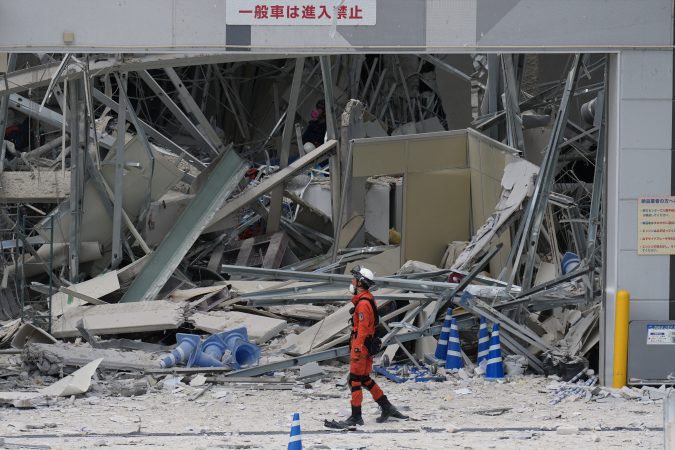
    Some of the most serious damage was at the Aeon Mall shopping center in the town of Kashima, which was bustling with thousands of people when the quake happened. The company said some 3,000 customers were evacuated to a parking lot before a gas explosion happened in another part of the mall, where some people were still working.

    Fumika Ono was shopping at a mall with her older sister when the ground shook so fiercely she lost her balance and ducked. Children began screaming and goods scattered on the floor.

    The 19-year-old was among the crowd of shoppers who managed to escape safely.

    The sweltering weather heightened worries about the survivors as rescuers braved the heat. It remained unclear how many people might still be missing.

    The mall’s second floor collapsed, trapping people. Witnesses said the explosion shook the area as much as the quake.

    Three people remained missing, while four deaths were confirmed at the mall site, according to Aeon President Akio Yoshida.

    “We take it seriously that an explosion happened and precious lives were lost,” Yoshida told a news conference in Kumamoto, where he bowed deeply along with two other executives.

    Japanese media footage of the mall showed that part of the ceiling had caved in, and metal pieces and other debris were scattered about as helmeted and masked rescue workers searched the area.

    Kiyoshi Matsunaga, 74, who lives in the mall’s neighborhood and was at a supermarket just a few blocks away, said Tuesday’s quake reminded him of a deadly quake 10 years ago that hit Kumamoto and killed 50 people.

    He stopped in his tracks when the shaking began while he was pushing his cart toward a cash register. Things scattered from the shelves. He could not move, he recalled.

    “I was frightened,” he said.

    Japan is one of the most quake-prone nations in the world.

    In the Nuyamazu district, a pair of temple gates at a 16th-century Buddhist temple collapsed. They had just been repaired five years ago.

    Yuki Kiyozumi, deputy chief priest at the temple, recalled how she had to crawl on the floor because the shaking was so violent. She had just returned home from a meeting and was about to feed her cat.

    “I don’t even know if or how we can rebuild them again,” she said, while cleaning up damaged ornaments and furniture.

    In nearby Yatsushiro, a chimney collapse at a Nippon Paper Industries factory killed five people while seven others were rescued from the debris, according to the Kumamoto prefectural government disaster team.

    Four people were still believed to be trapped there, it said.

    In the first reported death of a foreign national, a Vietnamese technical intern was killed after a crane fell on him at a factory where he worked, according to the Vietnamese government. He had arrived in Japan in January. Seven other Vietnamese technical interns at the factory evacuated safely

    Separately, a Vietnamese woman married to one of the workers was injured when a wall collapsed and was being treated at a hospital.

    Nearly 34,900 homes were still without electricity and some 15,000 homes without running water, Kumamoto officials said. More than 8,800 people left their homes to stay in over 400 shelters, where power sources were being added to provide air conditioning.

    Aerial police footage showed some homes in residential areas were completely flattened, including a few that crumbled into a nearby river.

    Japan’s Self Defense Forces joined rescue workers in the search and rescue operations. Hundreds of professionals were helping with the effort, including firefighters from Taiwan.

    “There are people who are still waiting to be rescued, and it’s a race against time,” Prime Minister Sanae Takaichi said. “We will go all out to find and rescue as many people as we can.”

    Takaichi said the government was preparing to deliver food and other necessities to hard-hit areas. She also offered her condolences to the victims and sympathy to their relatives, while urging those affected by the quake to take care of themselves under the hot weather.

    Bullet train services remained suspended. Although operations at Aso Kumamoto Airport resumed Wednesday, some airlines canceled flights as a precautionary measure.

  • Senate confirms Jay Clayton as new intelligence czar

    The Senate confirmed Jay Clayton as the director of national intelligence Tuesday, ending the tenure of Bill Pulte, a housing official and Trump loyalist, who held the role for more than a month.

    The 51-to-47 vote was more partisan than expected after Trump nominated Clayton in June. Many Democrats initially welcomed the pick and signaled they would support him.

    But their attitude changed after Clayton’s July confirmation hearing, where multiple Democrats pressed him to acknowledge that Joe Biden won the 2020 presidential election. Clayton repeatedly said that Biden had been “certified” as the victor but declined to answer the question directly.

    The question became a flash point for Democrats concerned about President Donald Trump’s use of the intelligence community to further his baseless claims that the 2020 election was rigged.

    Clayton previously served as the U.S. attorney for the Southern District of New York and chaired the Securities and Exchange Commission during the first Trump administration.

    His background has been less controversial than that of Pulte, who used his time leading the Federal Housing Finance Agency to further allegations of mortgage fraud against Trump’s perceived political enemies. But some Democrats have still argued that Clayton, like Pulte, lacks the national security experience required by law for the position.

    The director of national intelligence oversees the 18 agencies that span the U.S. intelligence community. Lawmakers established the role after the 9/11 terrorist attacks to try to prevent future lapses in intelligence sharing and interagency coordination.

    Pulte used his five weeks as acting intelligence chief to cut positions in the Office of the Director of National Intelligence, fulfilling Trump’s desire to vastly reduce its size. Since June 1, The Washington Post has reported, he has eliminated about 200 jobs within the ODNI.

    Pulte said in a posting on X on Tuesday that he had conducted “a 5th and Near Final Round of TERMINATIONS, an approximately 30% Staff Reduction from Weeks Ago.” ODNI has shrunk from around 2,000 people at the start of Trump’s second term to less than 1,300. The workforce’s precise size is classified.

    Clayton will take over an organization that has endured near nonstop upheaval in recent weeks, since the departure of former DNI Tulsi Gabbard in mid-June. Morale is low, former senior intelligence officials have said, noting they fear that ODNI’s recent politicized leadership and the firing of veteran analysts have discouraged independent analysis that clashes with White House narratives.

    Clayton’s confirmation could unlock a deal to renew Section 702 of the Foreign Intelligence Surveillance Act, a warrantless spy program that lapsed for the first time in June after Democrats protested Pulte’s temporary appointment and voted down the legislation. Civil libertarians and privacy advocates have long opposed the tool, arguing it needs firmer guardrails to protect American citizens from government surveillance.

    Lawmakers from both parties had sought to accelerate Clayton’s confirmation hearing in June to avoid having Pulte ever step into the acting director role. Trump abruptly canceled the previously scheduled session only hours before it was set to begin, instructing Clayton not to appear.

    The president instead called on the Senate to pass a voting restrictions bill and threatened to blockade future legislation without it. The Senate has not yet done so.

  • Investigators in Comey seashells case omitted key facts and distorted others, defense lawyers allege

    Investigators in Comey seashells case omitted key facts and distorted others, defense lawyers allege

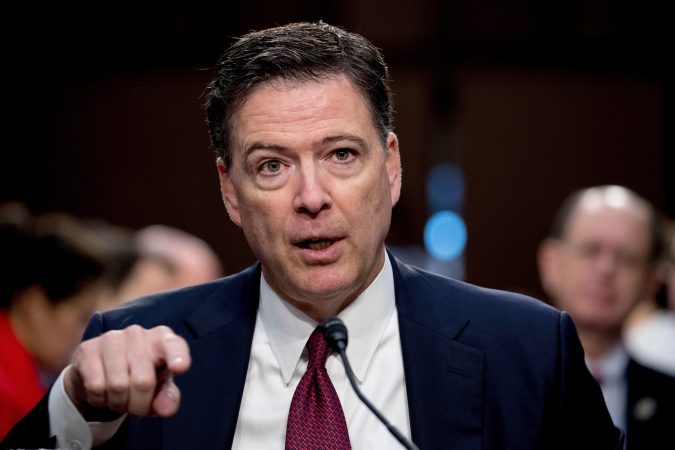
    WASHINGTON — Federal officials involved in the prosecution of James Comey misled judges, submitted false statements and withheld key facts during the course of the investigation, according to new defense filings that seek the dismissal of a case charging the former FBI director with threatening President Donald Trump on social media.

    Lawyers for Comey made the allegations of misconduct in motions filed late Tuesday that also call the case a vindictive and selective prosecution, request access to transcripts of grand jury proceedings to expose what they say are “irregularities” in how the indictment was secured, and describe “unlawful” surveillance of Comey by the Secret Service.

    Taken together, the new motions, along with an earlier one this week that called Comey’s social media post protected speech and not a threat, represent a multiprong defense effort to dismantle a case that defense lawyers say exemplifies a Trump administration retribution campaign targeting one of the president’s most vocal critics.

    “Ample objective evidence — much of which comes directly from government officials’ own public statements and admissions — establishes that the President’s animus toward Mr. Comey led to this vindictive and selective prosecution,” Comey’s lawyers wrote in one of the filings.

    A picture of seashells on the beach

    Comey was charged in April with threatening Trump through a photo he posted on Instagram a year earlier depicting seashells he said he found on the beach in North Carolina in the numerical arrangement of “86 47.”

    The Justice Department has said the photo constituted a threat against Trump, the 47th president. Comey deleted the post shortly after he put it up, saying he did not know that anyone interpreted the numbers as a call to violence. His lawyers have said that the slogan has long meant to “get rid of” or “eject” and has been featured on thousands of items sold online and regularly displayed at protests.

    Defense lawyers say investigators who tried to prove that Comey intended a physical threat, or knew that the number “86” suggested violence, repeatedly came up empty but withheld that from federal magistrates as they applied for warrants to search the digital accounts of Comey and his wife.

    For instance, the FBI searched an internal database of information about open and closed investigations for any indication of an association between Comey and the term “86” but found inconclusive results. An FBI agent also requested a review of the FBI file for the case against reputed mobster John Gambino, which Comey worked on as a young prosecutor, but found no references to the term “86.”

    Investigators also interviewed a key government cooperator in the case, Salvatore Gravano, who said he did not recall ever discussing the term “86” with Comey or hearing it in connection with the trial.

    “Evidence obtained during discovery supports at least a substantial preliminary showing that the affidavits submitted in support of two of the search warrants contained intentionally false statements and material omissions, and that those defects vitiate any conceivable showing of probable cause,” Comey’s lawyers wrote.

    Defense lawyers say case is rooted in Trump’s personal animus

    In addition, defense lawyers say the warrant applications distort statements made to investigators by a person who knew Comey but has been now estranged from him for years.

    The person, whose name is not revealed in the court filings, is described in the affidavit as saying that they immediately perceived Comey’s post to have a violent meaning. But investigators omitted from the affidavit that the person had said their initial impression was that “86” referred to being “out of something on the menu” and only later concluded that it could be understood as a call to violence.

    The person said that view was influenced by having listened to an episode of Rudy Giuliani’s online show in which the Trump loyalist claimed that Comey had worked on mob cases as a prosecutor in which mafia members used “86” to mean “kill.” But the FBI’s own investigation determined Giuliani’s claims to be untrue, defense lawyers said.

    The seashells case against Comey was the second in months targeting the ex-FBI director, a long-running Trump foe whom the president over the years has called a “corrupt piece of garbage” and other epithets.

    An earlier case in Virginia accusing Comey of lying to Congress was dismissed in November after a judge concluded that the prosecutor who charged him and another Trump adversary, New York Attorney General Letitia James, was illegally appointed to the job.

    Comey’s lawyers describe the prosecutions as rooted in Trump’s own personal animus, with the Secret Service closely coordinating with the Justice Department and with Trump, who received frequent updates on Air Force One.

    As Comey returned to Washington with his wife to be interviewed by law enforcement about his post, Secret Service agents were directed to conduct “unlawful” electronic surveillance, “including as they stopped to visit the grave of their deceased son,” his lawyers said. The surveillance had been requested by a senior Justice Department official.

    Comey was the FBI director when Trump took office in 2017, having been appointed by then-President Barack Obama and serving before that as a senior Justice Department official in President George W. Bush’s administration. Trump fired Comey in May 2017 during an FBI investigation into potential ties between Russia and Trump’s presidential campaign. The men have been openly at odds ever since.

    The Justice Department will have an opportunity to respond to the defense filings. The department has not elaborated on any evidence of intent the government has. But acting Attorney General Todd Blanche said earlier this year that prosecutors in every case prove intent with “witnesses, with documents, with the defendant himself to the extent it’s appropriate.”

    “And that’s how we’ll prove intent in this case,” Blanche said in April, shortly after he was elevated to lead the department after Pam Bondi’s ouster.

  • Schools are adding pepper-spraying drones to help combat active shooters

    Schools are adding pepper-spraying drones to help combat active shooters

    Schools in at least three states will be equipped with drones this year that can zoom through halls, smash windows, and pepper-spray active shooters if teachers report a threat.

    At least nine schools — three in Florida, five in Georgia, and one in Colorado — will have storage boxes that house the plastic, nonlethal aircraft made by Austin-based Mithril Defense. The drones, which can be activated by teachers, are capable of reaching a shooter within 15 seconds.

    The aircraft are designed to distract their targets by flashing strobes, blaring sirens, spraying them with pepper gel, or ramming into them at 60 mph.

    “Once I get the drones on you, you just can’t escape them,” said Bill King, a retired Navy SEAL and Mithril Defense co-founder.

    The programs continue a wave of spending on high-tech security on campuses — a multibillion dollar industry fueled by threat of school shootings. Nearly 400,000 students have experienced gun violence at school since the 1999 attack at Columbine High School in Colorado, according to a Washington Post tracker, which has recorded 435 shootings over that period.

    Deltona High School, a public school just north of Orlando, with about 1,700 students, became the first campus to install the system at the end of last school year. Two more Florida schools — Boyd H. Anderson High School near Fort Lauderdale and Godby High School in Tallahassee — were also tapped by the state to complete the $557,000 pilot spearheaded by state legislators.

    Five schools in Georgia will also test the drone systems after state legislators there approved a roughly $500,000 pilot program with Mithril Defense. The state has not finalized the schools that will participate, but Mithril said the systems will come online during the upcoming school year.

    Georgia state Rep. Matt Dubnik (R), chairperson of the House appropriations education subcommittee, said the technology could protect schools that don’t have resource officers on campus. The pilot will be tested in schools with and without the officers, he said.

    “I’m a believer in the technology,” Dubnik said, adding that hundreds of other state legislators agreed when they voted to pass the budget, which included the funding for the program.

    And in Colorado, John Adams Academy — a public charter school in Sterling Ranch for students in kindergarten through grade 12 — will self-fund a drone program for its inaugural year.

    Teachers will have an app or classroom panic buttons to summon the drones. Mithril Defense’s professional drone pilots can then fly them remotely.

    The drones have been tested in simulations but never by a shooting.

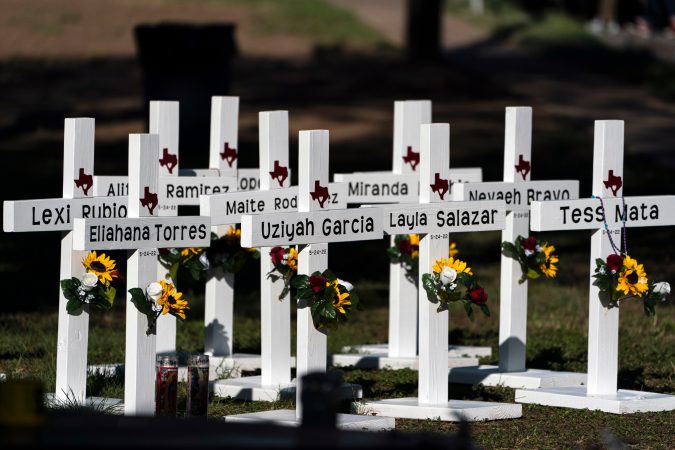
    Justin Marston, Mithril’s founder and CEO, said the massacre at an elementary school in Uvalde, Texas, where 19 students and two teachers were killed in 2022 as law enforcement waited over an hour to enter the classroom, inspired the project.

    When he learned of the Russian and Ukrainian military forces using cheap drones to attack each other, Marston said he figured a nonlethal version might have saved lives in Uvalde.

    “The first 120 seconds are incredibly critical, because that’s when most of the shooting happens,” Marston said.

    While the drones could be activated any time, they’re meant specifically for potentially lethal situations. The drones wouldn’t break up a schoolyard fight, Marston said. But if one of the students pulled a knife, they could.

    Schools across the country have embraced a range of defense technologies from artificial intelligence-powered cameras to weapons detectors amid the threat of campus shootings. But some say military-grade equipment, like Mithril’s drones, don’t belong on campuses packed with children.

    School security consultants have, for years, cast doubt on high-tech solutions to school shootings, arguing that low-tech measures, like simply locking external doors, are just as effective.

    Curtis Lavarello, who leads the School Safety Advocacy Council, a security consultancy firm, said he worried that Mithril’s drones might accidentally target a fleeing student instead of a shooter. Or that remote pilots, in a split-second decision, might mistake a law enforcement officer for a shooter, especially if teachers initiate a false alarm.

    “It’s almost like where gaming and school safety collide,” Lavarello said. “I have some really serious reservations about the deployment of drones in schools.”

    Mithril isn’t the first company to attempt to place anti-shooter drones in school. In 2022, Axon Enterprise halted development of taser-equipped drones after a mass resignation of its ethics board, which worried that the devices would stun innocent students or be abused by hackers.

    Jaclyn Corin, who survived the 2018 Marjory Stoneman Douglas High School shooting in Parkland, Florida, that killed 17, said she’d prefer to see officials prioritize policies that help prevent gun violence instead of responding to it.

    “School districts have finite budgets and limited attention,” said Corin, executive director and co-founder of March for Our Lives, a youth-led organization advocating for strict gun control. “If we spend significant resources on technologies designed to respond after shooting begins, we have to ask what we’re not investing in instead.”

    Nicole Lawrence said she found out from a local TV news story that her child’s Atlanta-area high school was solicited by Georgia to host Mithril’s drones this year. (District officials said they do not yet have specific plans for installing the devices.) Lawrence said she’s unsure whether the drones will be effective but is willing to give them a chance.

    “I’ve put $100,000 toward worse things,” Lawrence said.

    Florida plans to review the number of violent incidents at the schools and measure response times to threats. The state will also survey parents, students, and staff about whether they feel safer under the pepper-spraying, window-smashing devices.

    As the drones sat in Deltona High School this summer awaiting their first action, the state approved another $564,000 for the following school year.

  • Trump asks Supreme Court to overturn $83 million verdict in E. Jean Carroll case

    Trump asks Supreme Court to overturn $83 million verdict in E. Jean Carroll case

    President Donald Trump asked the Supreme Court on Tuesday to overturn an $83 million judgment against him for defaming advice columnist E. Jean Carroll, who accused him of sexually assaulting her decades ago.

    Trump’s attorneys asserted in court filings that the Supreme Court’s 2024 decision granting presidents sweeping immunity for actions taken in office shields him from liability in the high-profile case.

    “This is the first case in our Nation’s history in which a court has imposed damages liability on a President for his conduct in office,” the attorneys wrote.

    Separately, the Justice Department petitioned the high court Tuesday to allow the federal government to replace Trump as the defendant in the case.

    Should the justices permit the swap, it would potentially clear the way for the Trump administration to ask for the massive judgment to be voided because the federal government cannot be sued for defamation. Lower courts have denied similar requests by the agency.

    Justice officials argue that the United States should be substituted as the defendant under a law that grants federal employees some immunity from civil damages for actions taken within the scope of their employment.

    They said that some of the comments at issue in Carroll’s defamation claim occurred during Trump’s first presidency.

    “Absent this Court’s intervention, the sitting President is facing nearly a hundred million dollars of personal liability for conduct that was well within the scope of his federal office,” the Justice Department wrote. “That alone deserves this Court’s attention.”

    Trump’s and Carroll’s attorneys declined to comment on the appeal Tuesday night.

    A Manhattan jury awarded Carroll the money in 2024, following a civil trial in which she testified that Trump attacked her in a dressing room at the Bergdorf Goodman department store in Manhattan in the mid-1990s. Trump denies the allegations.

    Carroll first went public with the claims in 2019, prompting angry rebukes by Trump. Trump said the allegation that he had sexually assaulted Carroll was a “complete con job,” a “Hoax” and a “Scam” concocted to sell her memoir.

    At other points, he said she was too unattractive for him to take an interest in her and accused her of lying. The comments prompted years of threats and attacks against Carroll by Trump’s supporters.

    An appeals court panel upheld the $83.3 million verdict in September and denied Trump’s request in April for the full court to rehear the case. The moves paved the way for Trump’s appeal to the Supreme Court.

    In November, Trump appealed to the Supreme Court a $5 million verdict in a separate defamation case Carroll brought against the president.

    The jury found Trump liable for sexually abusing and defaming Carroll. In June, the Supreme Court let stand that verdict against Trump.

  • What the midterms mean for Pennsylvania Gov. Josh Shapiro’s 2028 hopes

    What the midterms mean for Pennsylvania Gov. Josh Shapiro’s 2028 hopes

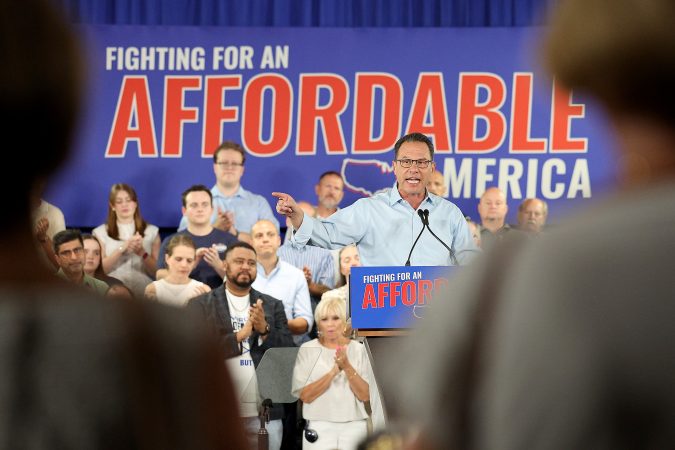
    BETHLEHEM — It was not by happenstance that House Minority Leader Hakeem Jeffries (D-New York) chose a union hall here in the Lehigh Valley to launch the final 100-day sprint toward the midterm election. “This is ground zero for the battle to control Congress,” the speaker-in-waiting declared.

    The same could be said for the centrality of this state — and this election — to the presidential aspirations of a Democrat who shared the stage Sunday with Jeffries: Pennsylvania Gov. Josh Shapiro.

    Were the popular governor to run nationally in 2028, and the current assumption is he will, what happens in his crucial state in November could be a compelling argument not only for his electability but for his ability to carry others over the finish line.

    This year, Pennsylvania holds four of the House races that Democrats consider to be among their top opportunities for flipping Republican-held seats. That’s more competitive races than in any other state, according to the House Democrats’ campaign operation.

    President Donald Trump carried three of those districts in 2024. But in the 2022 gubernatorial election, Shapiro, then the state’s attorney general, won all four by double digits against a far-right opponent.

    “Pennsylvania is always the ultimate swing state, the state that kind of decides it all,” Shapiro, who is running for a second term, said in an interview. “And so it is not a stretch to imagine if we win these races here, that’ll create a Democratic majority in the U.S. House.”

    Shapiro is a heavy favorite against the Republican gubernatorial nominee, State Treasurer Stacy Garrity. He has raised more than $50 million to run up the score, and create an updraft that could help candidates lower on the ballot.

    He has also had a hand in who those candidates are. Shapiro endorsed the Democratic candidates in all four of Pennsylvania’s most hotly contested congressional districts in their primaries. One of them, Bob Brooks, spent 20 years as a firefighter in Bethlehem and was Shapiro’s pick in a hard-fought primary to take on Republican incumbent Ryan Mackenzie. In 2024, Mackenzie beat Democratic Rep. Susan Wild by one percentage point.

    As he prepared to introduce Shapiro here on Sunday, Brooks emphasized his background as an outsider who can relate to the pressures that ordinary people are under: “I have to be honest. Running for Congress was not on my Bingo card. I’m not a politician. Far from it, actually. I’m a regular working person, like so many of the faces that I see in this room.”

    Meanwhile, Keystone State Democrats are also hoping to flip the state senate, where Republicans have a 27-23 majority, while also maintaining their narrow hold on the House. If they can do it, they would be looking at their first unified hold on state government in more than three decades.

    Shapiro has pledged he would use that power to raise the minimum wage to $15 an hour, from its current $7.25; fund mass transit; build more housing and codify abortion rights into state law.

    All of which could be rolled into a national message, the outlines of which became apparent as the governor talked about his agenda. “We all need to do our part to stop the chaos and cruelty and corruption of Donald Trump,” he said, “and that’s going to require us here at the state level having a trifecta so that we can pass policies that help the people of Pennsylvania while Trump is hurting them.”

    Having seen his state vote twice for Trump, in 2016 and 2024, Shapiro is working to build up the Democratic infrastructure. He recently unveiled a multimillion-dollar effort that party officials say is the largest coordinated midterm operation in the state’s history. It boasts having opened 27 offices across the state and hiring nearly 100 full-time organizers.

    The governor has also addressed one of the more worrisome trends for Pennsylvania Democrats: Their voter registration advantage over Republicans had dropped precipitously over recent election cycles.

    Between 2020 and 2024, the registration gap between the two parties had fallen by more than half, to 325,000 Democrats from 686,000 Republicans. It was a warning sign that Trump was going to win the state and its 19 electoral votes.

    This year, with the midterms approaching, the numbers are starting to turn around; Democrats have added nearly 25,500 to the registration rolls, while Republican numbers have dropped by more than 4,500, according to voter registration data analyzed by PennLive.com.

    Retooling and professionalizing the party is a project that Shapiro began almost a year ago, he said, and now, “I’m investing millions of dollars in helping elevate other Democrats on the ballot, spending my time campaigning for people like Bob Brooks and others.”

    If all of this works as he hopes, it might be the foundation for a presidential campaign. Unknowable at this point, however, is whether the Democratic base in 2028 will be looking for a Mr. Fix-It whose appeal stretches across party lines, or will move further leftward in its fury at the establishment.

    Shapiro insists — as presidential candidates nearly always do at this stage of the game — that none of this is his concern at the moment.

    “What I’m focused on are these midterms,” which in Pennsylvania “will be decided on a razor’s edge,“ Shapiro said. “Folks are fed up and angry and frustrated. The best way to demonstrate that, the best way to show that we’re against what Trump is doing, is to show up and vote in record numbers.”

  • The Trump administration is halting a Medicare drug subsidy. Will premiums rise?

    The Trump administration is halting a Medicare drug subsidy. Will premiums rise?

    Medicare drug coverage premiums are expected to rise in 2027 after the Trump administration said Tuesday it would end a temporary subsidy that reduced monthly premiums by an average of $16.

    But it’s not yet clear how much they’ll increase, or whether they will increase for all Medicare beneficiaries.

    The loss of the subsidy does not translate directly to how much premiums will rise, because companies that sell Medicare Part D drug coverage take into account many factors when setting rates.

    The cost to the government of the subsidy was $3.6 billion in 2026, according to KFF, a nonpartisan health policy organization. About 25 million people enrolled in Part D plans in 2026, up from 23 million two years ago.

    “It’s certainly possible that without this enhanced financial support in place for 2027, some Medicare beneficiaries enrolled in [Part D plans] could face relatively steep premium increases for drug coverage next year,” said Juliette Cubanski, director of KFF’s program on Medicare policy.

    Insurance companies received notice of the move late Tuesday and were examining the impact. Expected Medicare Part D rates for 2027 will be publicly announced in September.

    “We are closely reviewing today’s announcement. At a time of sharply rising prescription drug costs, health plans are focused on keeping Part D coverage and benefits as affordable as possible for seniors,” said Chris Bond, spokesman for AHIP, the insurance industry’s Washington trade group.

    The average estimated monthly Part D premium in 2026 was $34.50, according to the National Council on Aging. Part D premiums were already four times higher than the $8 average premium under Medicare Advantage, the privatized version of Medicare. Cubanski said higher Part D premiums in Part D in 2027 could accelerate beneficiary enrollment in the privatized plans.

    The Department of Health and Human Services, which oversees the Center for Medicare and Medicaid Services, did not respond Tuesday night to a question about the amount of expected increases.

    CMS said it ended the subsidy, which was intended to stabilize premiums after the agency made changes to the benefits, because “plan sponsors had sufficient experience” under the new program to support their cost assumptions.

    UnitedHealthcare, which offers Part D plans, said loss of the subsidy was not unexpected. “We are committed to working with CMS, ensuring seniors have access to affordable prescription medicines,” UnitedHealthcare spokesman Eric Hausman said.

  • Letters to the Editor | July 29, 2026

    Letters to the Editor | July 29, 2026

    Repeating history?

    Congress passed the Fugitive Slave Act in 1850, rewriting a 1793 law that was not being enforced in the North. The new measure gave slaveholders the ability to search for enslaved people who had escaped to the North, capture them, and force their return as the “property” of their enslaver.

    What was new about the 1850 law was that defendants were not permitted to testify in special courts before federal commissioners who would decide their fate without a jury. The commissioners would be paid $5 if the defendant was freed, $10 if he or she was returned to bondage.

    There’s more. The act had no statute of limitations for a search and capture — meaning five or 10 years after an escape and a new life, an enslaved person could be torn away from that life. Sounds a lot like what U.S. Immigration and Customs Enforcement is doing now.

    The Fugitive Slave Act was repealed in 1864.

    Murray Dubin, Philadelphia

    Murray Dubin and Daniel R. Biddle, former reporters for The Inquirer, are the authors of “Tasting Freedom: Octavius Catto and the Battle for Equality in Civil War America.”

    Shudder to think

    Why is Donald Trump permitted to “joke” about breaking the law by running for a third term with such seriousness that many people think he can and will actually do so, but if I even hinted in a joke I was going after him, the FBI would be breaking down my door? He is again playing the “I’m serious until I get in trouble, then I’ll say it’s a joke” game. A president declaring an intent to violate the law breaches their constitutional duties. A president swears an oath to protect and defend the Constitution and follow the laws. By saying he is going to ignore a very clear law saying he cannot run again is a direct breach of this oath. This is intentional defiance of the Constitution, which is an impeachable offense.

    I do not understand why some reporters don’t corner him with an assortment of masked law enforcement officials (I hear he is OK with masks) and ask him point-blank on camera if he is serious about the crime of running again. Then either drag him off to jail or tell him to stop riling up his followers depending on his answer.

    He is like an out-of-control child whose parents do absolutely nothing to stop him.

    Ted Swirsky, Erial

    Enough already

    I have always been a proud American. When many of my high school classmates were sick of saying the “Pledge of Allegiance” in high school in the 70s, I always said it proudly. I can tear up at sporting events when they play “The Star-Spangled Banner.” My grandparents were immigrants from Poland who settled in Camden and had a business. My mom got to graduate from high school. I was the first in my family to graduate from college, and my three children all have advanced degrees. America has treated us well. One of the highlights of my Sunday is reading The Inquirer. However, last week, it brought about discontent and sadness. First, I saw the article about Donald Trump’s insult-laden speech at the White House Correspondents’ Association dinner. Then I read about the signs being placed outside the Smithsonian National Museum of American History that say the displays are inaccurate. (Many people from outside the country visit this museum; they must think Americans are nuts.)

    As if all that isn’t enough, I turn to the Health section and see that the University of Pennsylvania and CHOP are forced to close research programs because of Trump’s cuts. Many of these programs are for children.

    When are Americans going to say, “Enough”? We cannot suffer through two more years of this administration and still have the country we had before. I haven’t even mentioned the war in Iran yet. To borrow a quote from the 1976 movie Network: “I’m mad as hell, and I’m not going to take this anymore!” Who is willing to stand up and say, “Enough”? This is not who we are.

    Jo-Ann Scarlet, Galloway

    Costly conflict

    On Feb. 28, Donald Trump started a war of choice by attacking Iran. He had been convinced by Benjamin Netanyahu — another leader on the world stage who is avoiding criminal prosecution only because he holds national political office — that together they could, by military force, effect regime change in Iran in a matter of days, with very little cost.

    Less than two weeks later, on March 11, Trump declared, “In the first hour, it was over.”

    But it appears that like cats, Trump’s war has nine lives.

    There are, however, several things that are over as a result of Trump’s war, including: the lives of at least 18 U.S. service members; the well-being of more than 400 wounded U.S. service members; the safety and security of our military personnel in the Middle East; an open Strait of Hormuz; decreasing inflation in the U.S.; low gas prices; and a sufficient supply of military weapons to deter China in Asia.

    On Nov. 3, I promise to remember the Republican sycophants who are more concerned about their jobs than the health, safety, welfare, and economic security of their constituents and supported the depravity of this president. I sincerely hope there are enough aware, concerned, patriotic voters who will do the same, so that we get a Congress whose allegiances are to our Constitution and its constituents and not to a would-be king.

    James A. Morano, New Britain Township

    Tyranny of secrets

    Leave it to the Greeks to have coined a term for a political process that appears to be playing out again in our own time. Plato’s notion of thymos, which means “spiritedness, courage, and righteous anger at abuse in a democratic polis,” has been debased by our current liar-in-chief and his cadre of oligarchs into a “thymotic politics” of paranoia, disclosure, persecution, victimization, and blood sacrifice, where mean-spiritedness and selective secrecy are the key. The extrapolation of this government of grievance is another Greek term, megalothymia, which is characterized as the desire to be recognized as superior to others, fueling drives for high status, dominance, or national greatness. Sound familiar? The arrogance of the MAGA agenda is just a recrudescence of an age-old grab for power at all moral costs.

    Charles Derr, Philadelphia

    Sour ‘Pickles’

    I was disappointed to see the Pickles comic strip published on July 24. The punch line — “Yeah, you and Gramma used to be people!” — may have been intended as humor, but it rests on a tired and demeaning stereotype: that growing older somehow means becoming less of a person. In a society that increasingly recognizes the harm caused by prejudice based on race, gender, disability, and other characteristics, ageism is still too often dismissed as harmless comedy.

    Older adults are raising grandchildren, volunteering, mentoring, creating art, serving our communities, working, learning, and contributing in countless ways. We are not relics of who we “used to be.”

    The Inquirer has long demonstrated a commitment to enlightenment and thoughtful journalism, and has always represented the diversity of our community. I hope the paper will also consider the messages conveyed by the syndicated content it chooses to publish. Humor can be funny without diminishing an entire generation.

    Patricia Conroy, Phoenixville, birds3711@gmail.com

    Winning feeling

    I normally have little interest in the 76ers or the NBA, but I was delighted to pick up The Inquirer Saturday morning and be greeted by a front page without a mention of 45/47. Thank you, LeBron James, for helping to provide that much-needed respite, no matter what else happens during your sojourn here.

    Edward “Ed” S. Bardzik Jr., West Chester

    Join the conversation: Send letters to letters@inquirer.com. Limit length to 150 words and include home address and day and evening phone number. Letters run in The Inquirer six days a week on the editorial pages and online.