Tag: no-latest

  • The Trump administration has refunded $100 billion in tariffs. Will you get any of the money?

    The Trump administration has refunded $100 billion in tariffs. Will you get any of the money?

    The Trump administration has refunded about $100 billion in tariffs in response to the Supreme Court ruling that declared the tariffs illegal, according to a new court filing this week.

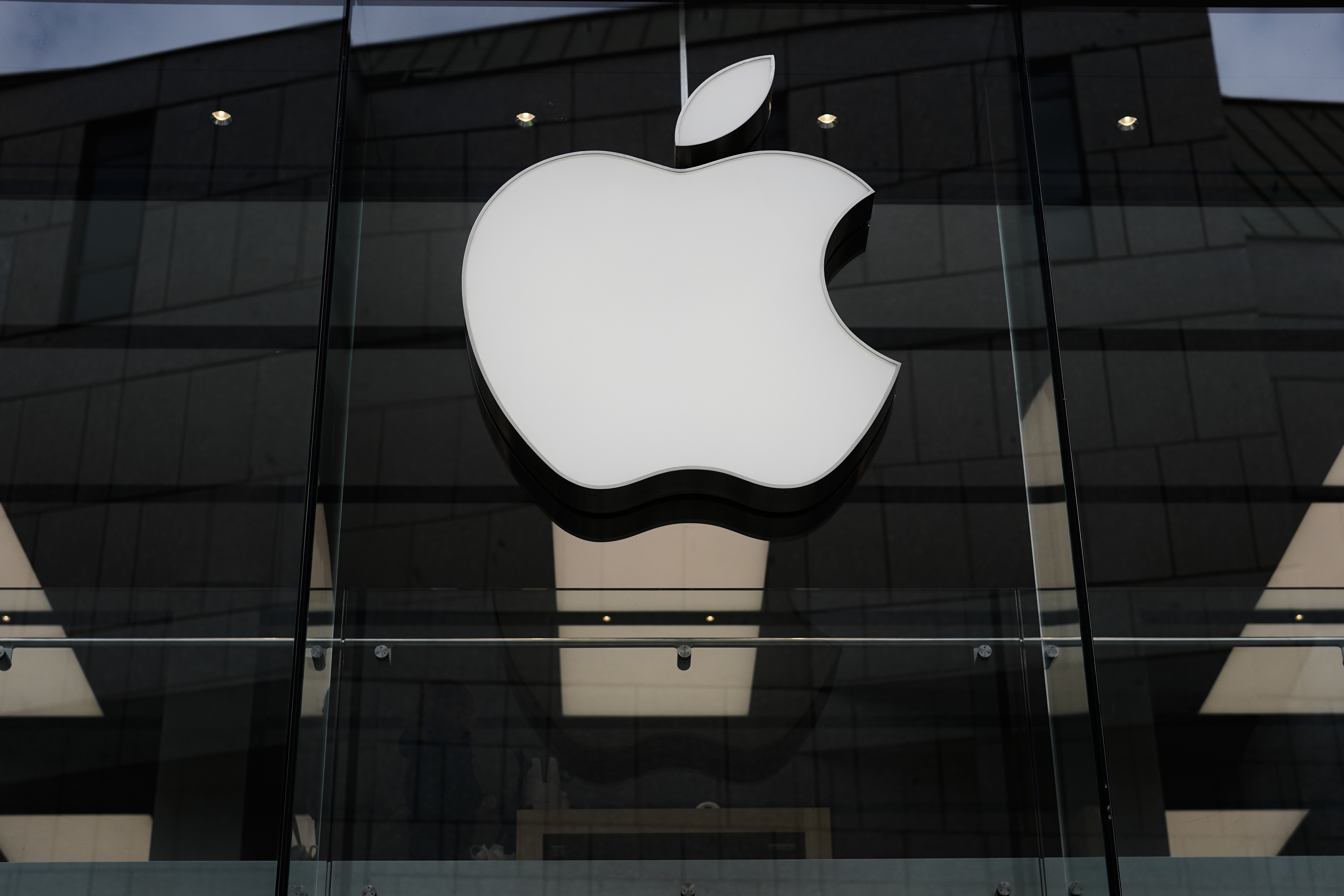
    Major corporations are getting huge refunds: $2.2 billion for Apple, $1.3 billion for Ford, $600 million for Amazon. (Amazon executive chairman Jeff Bezos owns the Washington Post.)

    While some companies have said they will use the refunds to reduce their prices, experts say not to expect many price cuts. Kimberly Clausing, a UCLA professor who served as a tax policy official under the Biden administration, said some companies don’t feel confident enough to change their prices based on the revoked tariffs, since President Donald Trump has replaced those levies with others that are also likely to be partially or completely thrown out by courts.

    “If you’re a firm, you’re wondering what the tariff policy is,” Clausing said. “Some of that pass-through to consumer prices has been slower than you might think if it were really permanent policies. That’s good news in the short term for consumers, but it also means you won’t necessarily see as big a swing in the other direction.” She noted that some companies were simply “gambling” all along that the import taxes would be thrown out in court, rather than raising prices much in the first place.

    Even if they paid higher costs because of the now-invalidated tariffs, most American households won’t see any of the refund money directly.

    The Tax Foundation estimates that the average U.S. household spent an extra $1,000 as a result of the tariffs in 2025, most of it relating to the specific tariffs that have been overturned.

    Because Trump has since replaced most of those tariffs with new ones authorized in a different way, the organization estimates the average household will pay about $900 extra in 2026.

    So why aren’t many individual consumers getting compensated alongside big companies?

    In response to the Supreme Court ruling, U.S. Customs and Border Protection set up a process for requesting refunds. To use the system, the payers have to be registered with the government as an “Importer of Record” or an authorized Customs broker — in other words, not just someone who ordered an item on the internet that was made in a foreign country and ended up paying more for it.

    If you paid a tariff on something you had shipped to you by UPS or FedEx, you can look up your tracking number for the shipment on the companies’ websites. If the companies got money back for your shipment, they are supposed to send you the refund.

    Amazon said in a quarterly earnings call that it plans to send refunds to individual customers in limited cases for which it can identify customers who paid more due to tariffs. The company said it would “proactively contact” those customers but did not provide more information about how it would find them.

    Some other companies that raised prices to accommodate the tariffs are taking heat for not passing on the refunds. Customers are suing Ford and Costco, among others.

    Alan Sykes, a trade law expert at Stanford Law School, said he doesn’t think the customers have much to go on.

    “They willingly paid the higher price. Ford could have raised the price of the car for any arbitrary reason. … You don’t have a claim,” Sykes said. “Certain companies are saying they’re going to lower their prices going forward … not because of a legal imperative, but a public relations logic.”

    Matilde Bombardini, an economist at the University of California at Berkeley, said she understands the logic of a customer who wants money back.

    She said research suggests that importers who paid 10% more because of the tariffs typically charged their customers about 3% more and absorbed the rest. “Costco’s getting back the whole 10%,” she said. “Conceptually, we could all agree that the 3% should go back to the consumers.”

    She noted that the refunds are likely unprecedented in scope. The tariffs that were invalidated applied to almost all categories of goods from every country in the world, though there were some exemptions.

    In the court filing this week, a Customs and Border Protection official said companies have filed more than 178,000 valid claims to refund tariffs on more than 25 million imports since the claim system opened in April, leading to more than $100 billion in refunds and interest so far.
  • Letters to the Editor | Aug. 7, 2026

    Letters to the Editor | Aug. 7, 2026

    Clean rivers

    A recent Inquirer article reported that Camden County is tackling a sewage problem in the Cooper River, with a real plan to make it swimmable.

    Does the Philadelphia Water Department have a plan for the Delaware River?

    I read in a recent PennEnvironment Research and Policy Center report that 12.7 billion gallons of untreated sewage and stormwater are dumped into the Delaware River every year. I’m glad I’m not a duck or a fish. I am, however, a Philadelphia resident who would enjoy recreating in our local waterways.

    The report also states that half of this sewage discharges from just 10 of 164 untreated outflow pipes. A relatively modest infrastructure investment could dramatically improve water quality for everyone who wants to paddle, swim, or fish here — not to mention the wildlife.

    I ask the Philadelphia Water Department to follow Camden’s lead and commit to a real plan to make the Delaware, the Schuylkill, and the streams that feed them clean and safe, even swimmable.

    Peter Furcht, Philadelphia

    . . .

    Sewage flowing into the Delaware River does not appeal to me, but untreated water has been flooding into our beloved waterways more and more due to the increased heavy rainstorms this summer. While Camden County has made commitments to cleaning up the Cooper River, Philadelphia is far behind. Our city has a combined sewage overflow system in which 60% of water pipes are used for both stormwater and sewage. When there are intense storms, both rain and waste flow into the river.

    According to a PennEnvironment report, this happened 65 times in 2025, with nearly 13 billion gallons of sewage overflow. This included 126 million gallons in Pennypack Creek alone, which flows near my house. Sewage contains viruses, parasites, and bacteria that carry the risk of illness to both people and animals who explore there.

    The Philadelphia Water Department must keep local rivers and creeks clean by improving infrastructure to deal with sewage overflow. In Camden County, there will be a voter referendum this fall concerning funding for a plan to fix this problem. Philadelphia can also find a solution. The Water Department should follow Camden County and implement a plan that makes our rivers safe for drinking and swimming.

    Judith Kotler, Philadelphia

    . . .

    Dozens of times throughout the summer, I receive alarming flash flood alert text messages informing me that very heavy rain is about to pummel my area and to seek shelter. I then worry about all the water flooding into the streets as it tries to flow into the storm drains, eventually overwhelming the sewage system, and polluting our rivers.

    What Philadelphians may not know is that the Philadelphia Water Department has a combined sewer system, which means that when heavy rains overwhelm the system, raw sewage mixes with stormwater and then flows untreated into a nearby river or stream. Sewage in our rivers puts people at risk of getting sick, harms our wildlife, and opposes the goal of the Clean Water Act. Research shows that contact with contaminated waterways less than 24 hours after a combined sewer overflow increased the risk of acute gastrointestinal illness by 39%-75%, compared with recreational activity more than 24 hours after an overflow.

    Philadelphia’s aging infrastructure wasn’t built for today’s population or the increasingly intense storms driven by climate change. The PWD needs to accelerate investments in green and gray infrastructure to rein in combined sewage overflows and protect public health, wildlife, and our waterways.

    One of my favorite summer activities is going kayaking, and this year I kayaked on the Delaware for the first time. I hope I will be able to enjoy recreating on the rivers that cradle Philadelphia for years to come.

    Emily Levine, Philadelphia

    Protect and serve

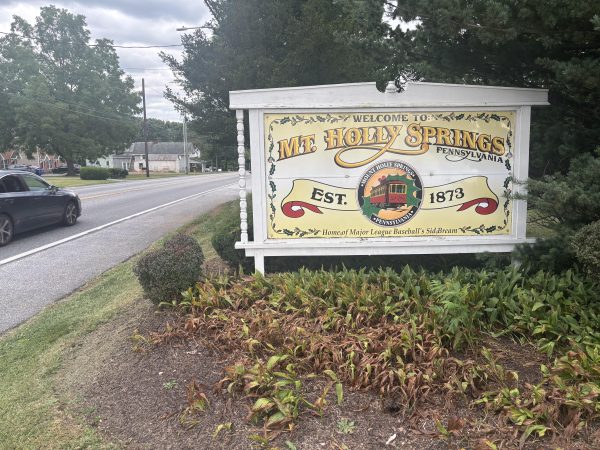
    Thank you for your multifaceted coverage of our immigration crisis. Will Bunch’s coverage of the immigration “speed trap” in Mount Holly Springs, Pa., evoked memories of the two opportunities I have had to work in cities with community policing. Officers took seriously their pledge to protect and serve, working to build community, encouraging all residents to call if they needed help, and to come forward if they had witnessed a crime. It was a win-win situation for police and the community they served. That is a different kind of police force than one willing to help capture Wu Shaoping and others like him, a force willing to fracture families for an extra allowance with little connection to road safety. For U.S. Immigration and Customs Enforcement, working with local police, delaying renewal requests of Deferred Action for Childhood Arrival (DACA) recipients and other immigrants in the process of improving their status makes more sense these days than continuing the work done in Minneapolis.

    ICE is helped by a partisan Congress and a U.S. Supreme Court willing to send Haitian families back to a country where the U.S. government has warned Americans not to travel, with “violence having left thousands dead and displaced more than 1.4 million people.”

    Clearly we have moved way beyond the “worst of the worst.” It is now the work of the electorate to protect and serve both our neighbors and our democracy.

    Thank you for keeping us informed.

    Sister Veronica Roche, Westmont

    Voter suppression

    Sen. Dave McCormick, Pennsylvania’s junior U.S. senator, has predictably taken exception to The Inquirer’s analysis of the SAVE America Act, which is currently before Congress. In a recent letter to the editor, he goes so far as to urge Inquirer readers to consider other sources of information for “a more thoughtful and honest appraisal of what the bill does.” According to the nonpartisan Brennan Center for Justice (presumably a reliable information source), if the SAVE Act were passed, it would block millions of eligible American citizens from voting. Viewed in a broader context, the SAVE Act is of a piece with other voter suppression measures being actively promoted by President Donald Trump and his allies. Such measures include wide-ranging congressional redistricting efforts, which are tantamount to state-sponsored, racist gerrymandering. More recently, Trump issued an executive order dictating new, restrictive standards for determining vote-by-mail eligibility, despite the lack of any lawful authority to do so. Any voter bringing common sense to bear on this issue (as McCormick recommends) must surely recognize that these tactics are more about improving the prospects of Republican candidates in future elections than about enhancing election integrity. In fact, earlier this month Trump gave away the game with the telling observation that, in the event the SAVE Act is passed, “we will not lose an election for 100 years.” In short, today’s GOP is fixated on maintaining majorities in both houses of Congress, by hook or by crook.

    Patrick J. Hagan, Ardmore

    Turn files into trials

    Remember how the Jeffrey Epstein files got released and nothing happened? Because they were in the wrong hands. On July 15, a bipartisan group of congressional representatives introduced HR 9694, the Epstein Files Transparency Act II, which allows state attorneys general and district attorneys access to the entire Epstein file. I and other activists have been advocating for this amendment since February because it addresses the two biggest roadblocks to “turning the files into trials”: 1) the fact that the U.S. Department of Justice has said (and demonstrated) it’s not going to prosecute — so turning the file over to a different set of prosecutors is the only way prosecutions are going to happen, and 2) the fact that a large body of highly probative evidence — the videotapes Epstein allegedly made of sex acts, which is evidence of crimes actually being committed, with perps recognizable with facial recognition software and timestamps that can establish the exact age of the victim — simply can’t be released to the public because of the graphic nature of that evidence. Giving the files to state AGs is the only way we’re going to get justice for the survivors, and establish that we, as a society, will never, ever, ever allow these crimes to go unpunished. If we really care about protecting children, we’ll pass this law.

    Linda Falcão, Baltimore

    Join the conversation: Send letters to letters@inquirer.com. Limit length to 150 words and include home address and day and evening phone number. Letters run in The Inquirer six days a week on the editorial pages and online.

  • Horoscopes: Friday, Aug. 7, 2026

    ARIES (March 21-April 19). Reality makes a wonderful starting point and a terrible ceiling. You don’t have to expect less. But it would help to get better at predicting what each situation is likely to give you, while remaining open to surprise.

    TAURUS (April 20-May 20). Even those you know very well are capable of surprising you, though you may need to lead the charge. What have you always wanted to know, but never asked? What have you noticed but never thought to compliment? There’s a deeper potential for this relationship.

    GEMINI (May 21-June 21). A quick wit is rarer than you imagine. It’s not about having lines ready to deploy. It’s being in the moment, noting the situation in real time and being confident enough to risk saying it aloud.

    CANCER (June 22-July 22). When you’re into a thing, it hits different. You just know. You can’t always explain it, and you really shouldn’t have to. Keys don’t explain why they fit the lock. It just works, and you’re suddenly in a new room.

    LEO (July 23-Aug. 22). Your moods move like weather, heart-first. Your heart will be full. It will also yearn, sparkle and beat to a shared rhythm, and skip beats, too, in response to the surprises and attractions of the day.

    VIRGO (Aug. 23-Sept. 22). Even if you’re totally decided about the next move, you’ll still hear all sides. You may secretly know that you’re not going to back down or give in, but it wouldn’t be diplomatic to lead with that. Besides, information is power.

    LIBRA (Sept. 23-Oct. 23). You can certainly work within constraints, but it’s better to break at least one of the rules. Maybe it’s the one about timing. You can’t rush greatness. Give yourself room to experiment, or at least get the details just how you like them.

    SCORPIO (Oct. 24-Nov. 21). When people want something, but aren’t saying what it is, you can feel that as though the unspoken has an actual weight. Direct questions won’t be ideal today, and anyway, you’re much cleverer than that. You’ll tease out the information.

    SAGITTARIUS (Nov. 22-Dec. 21). When you get tired, should you push through or ease up? Today it will be more productive to rest a while and recover your energy. New insights will come to you when you’re refreshed.

    CAPRICORN (Dec. 22-Jan. 19). Before chasing the next goal, take more time celebrating the last one. Because when you revel in what’s working, you become a magnet for easy success. It doesn’t have to be so hard to pursue what you want.

    AQUARIUS (Jan. 20-Feb. 18). Every day asks for a little tolerance. Today asks for more. Hanging in there with the tough stuff will be the main growth opportunity of the day: accepting and enduring the reality until the time it can be changed.

    PISCES (Feb. 19-March 20). What would you gladly practice for years whether you were paid to or not? This one makes you read the whole book, join the special club, keeps you in pursuit until you’re a master. The more you put into it, the more you love it.

    TODAY’S BIRTHDAY (Aug. 7). It’s your Year of Tutelage when you learn exactly what you want and need to know from the best teacher there is: experience. Every quest, adventure and lucky turn becomes part of the curriculum. More highlights: A family tradition or obligation becomes one of your greatest satisfactions. You’ll earn a distinction that puts you in remarkable company. A fresh look and healthier routines leave you feeling remarkably comfortable in your own skin. Gemini and Aries adore you. Your lucky numbers are: 13, 20, 21, 17 and 5.

  • Dear Abby | Husband places blame for everything on his wife

    DEAR ABBY: My husband and I have been living with my mom for a little over a year. Our 4-year-old lives here also. Mom has guardianship of her because of our past. A month ago, my husband decided he was leaving. I didn’t leave with him because of my daughter. Now he acts like everything that was wrong in our marriage is my fault.

    We are supposed to be working on our relationship. All he does is point out everything that’s wrong with me. We have been together for 11 years. He says I don’t put him first. I love him with all my heart. I don’t know what to do. Maybe you can give me some advice?

    — NOT ALL MY FAULT IN THE SOUTH

    DEAR NOT ALL MY FAULT: It is easy to assign blame to someone else, but when a marriage crumbles, rarely is it the fault of only one partner. Offer your husband an opportunity to air his grievances with you and a licensed marriage counselor. I wish you had mentioned who he feels is higher on your list of priorities than him. If it’s your daughter, your priorities are ordered correctly. Not knowing the man or the “past” to which you alluded, it’s possible he’s looking for an excuse to leave you and start over.

    ** ** **

    DEAR ABBY: I have a stepson, stepdaughter-in-law and stepgrandchild. My husband and I treat them whenever we are together. Although we always pay for everything, we are never invited to their house. We host every holiday and pay for that as well. At Christmas, we host, decorate our home and a tree, and buy presents for them along with providing the holiday meal, etc.

    In general, my stepfamily are nice people. However, I’m finding myself more and more annoyed with the one-sidedness of our relationship, not only the financial end but the effort as well. Last year, the gift I received from them was a handmade tree ornament I later threw out. I don’t know what to do. Any advice would be much appreciated.

    — TIRED OF ONE-SIDED RELATIONS

    DEAR TIRED: In some families, the parents feel it’s their role to be the providers. In others, there is more reciprocity. Because you are becoming increasingly annoyed, and the son, daughter-in-law and grandchild are not your blood relatives, discuss this with your husband before your resentment builds further.

    ** ** **

    DEAR ABBY: I have been with my boyfriend for six years. We are in our late 40s, and we both work full time. For the past six months, he has had zero interest in showering daily. I see him do it on the weekend occasionally. He drives a semi locally and is home each night.

    How does one even bring this matter up? Should I be concerned? Do I dare raise the subject, and if so, how? Maybe this shouldn’t bother me, but it does. I don’t want to embarrass him or hurt his feelings; I just need your advice.

    — CONCERNED IN IOWA

    DEAR CONCERNED: Not everyone showers on a daily basis. Any change in a partner’s behavior deserves a mention. Because this is new behavior, ask him why he has chosen to shower less often. If his hygiene needs improving, for both your sakes, you can’t avoid the subject.

  • McConnell says he’s leaving rehabilitation center to continue recovery at home

    McConnell says he’s leaving rehabilitation center to continue recovery at home

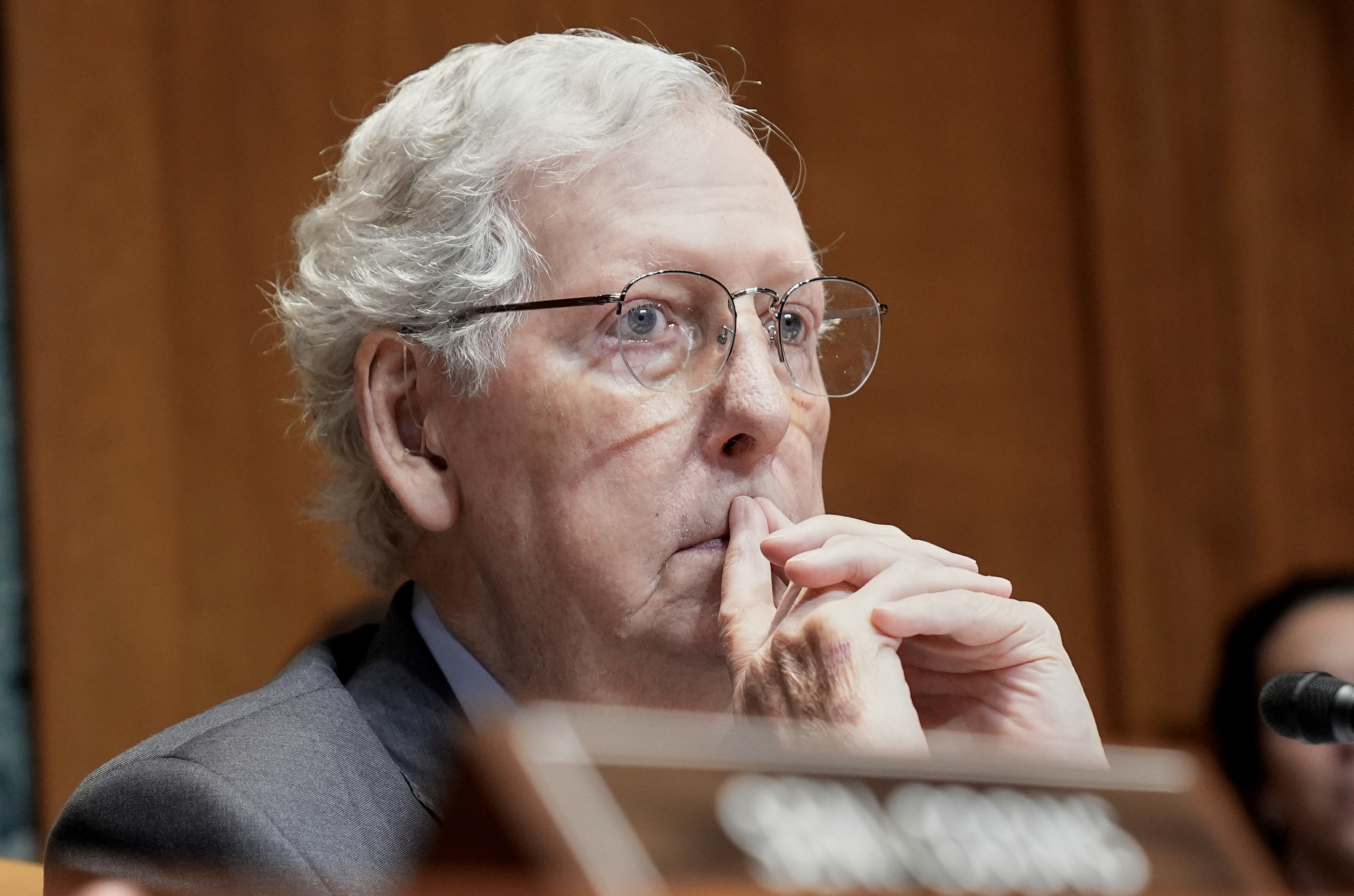
    WASHINGTON — Republican Sen. Mitch McConnell of Kentucky says he’s been discharged from a rehabilitation center and will continue his recovery from home.

    The former Senate leader was first admitted to the hospital on June 14. He disclosed weeks later that his hospitalization was the result of a fall and said he was undergoing physical therapy.

    McConnell, 84, gave no specific date for his return to the Capitol, but senators are expected to soon leave Washington for the traditional August recess. Votes are unlikely for the next five weeks once they adjourn.

    “On the advice of my doctors, I’ll maintain an intensive regimen of physical therapy from home during the state work period, and I’ll continue to engage with my staff and colleagues on important Senate business,” McConnell said in a statement released by his office.

    McConnell had polio in his early childhood and has long acknowledged some difficulty walking and climbing stairs as an adult. The Office of the Attending Physician has said McConnell was undergoing a strenuous course of physical therapy and rehabilitation since he left the hospital, which includes multiple sessions a day designed to rebuild strength and reduce the risk of future falls.

    The senator is determined to finish out his seventh term, which concludes in January.

    McConnell’s absence is being felt in the Senate as Republicans were unable to advance a farm bill out of committee Thursday. The committee’s chairman, Sen. John Boozman of Arkansas, said he spoke with McConnell this week about the bill.

    “I know how much he would have wanted to be here to advocate for Kentucky’s farmers and rural communities,” Boozman said in kicking off the committee’s meeting Thursday.

    But there has also been criticism that McConnell has not been transparent enough about his health. The state’s Democratic governor, Andy Beshear, recently called on the senator to either prove that he is fit to continue serving after his lengthy hospital stay or resign from office.

  • Trump signs 2 immigration actions to limit birthright citizenship

    Trump signs 2 immigration actions to limit birthright citizenship

    WASHINGTON — President Donald Trump said Thursday that he is once more trying to limit the number of people who are born in the country who can become American citizens, in a sign that even after his first attempt at limiting birthright citizenship was rejected by the Supreme Court, he’s ready to try again.

    The president said he was signing two executive actions on immigration.

    He said one will limit the number of people eligible for U.S. citizenship after being born in the United States.

    A second order seeks to curb what Trump called “birth tourism” by increasing restrictions on visitors to the U.S. who want to obtain visas to give birth while in the country.

    Additional details weren’t provided, but Trump said he thought his latest actions would be constitutional.

    In June, the Supreme Court rejected Trump’s previous efforts to declare that children born to people in the U.S. illegally or temporarily aren’t American citizens, and upheld a broad conception of birthright citizenship.

    On Trump’s first day in office of his second term, he signed an executive order aimed at ending birthright citizenship, which allows anyone born in the United States to automatically become an American citizen.

    Trump’s administration was immediately sued by opponents who said the executive order went against the 14th Amendment, adopted after the Civil War, which makes anyone born in the country a citizen, with very limited exceptions.

    The executive order was blocked by several lower courts and never took effect.

    In June, the Supreme Court struck down Trump’s order by a 6-3 vote. But the vote was too close for many immigration advocates and legal observers who felt the legal question of birthright citizenship was a long-settled issue.

  • Ukraine strikes more oil facilities deep inside Russia, Zelensky says

    Ukraine strikes more oil facilities deep inside Russia, Zelensky says

    KYIV, Ukraine — Ukraine hit more oil facilities deep inside Russia in overnight attacks, President Volodymyr Zelensky said Thursday, as Kyiv kept up its campaign to undermine Moscow’s wartime economy and embarrass the Kremlin.

    The repeated strikes have caused fuel shortages and rattled Russians. Ukrainians, meanwhile, are enduring regular barrages that Kyiv’s depleted air defenses are struggling to counter amid Moscow’s 4-year-old full-scale invasion.

    The Kyiv region observed an official day of mourning Thursday after a Russian missile and drone blitz killed 17 people the previous day, prompting an increasingly urgent scramble by Ukraine and its allies to find new air defense supplies.

    In the first six months of this year, 1,396 civilians were killed and 7,978 injured in Ukraine, the United Nations office in Kyiv said Wednesday. That was a 37% increase from the same period last year and a 114% jump over 2024, it said, attributing the rise to more long-range aerial attacks by Russia.

    Zelensky said he met with senior officials on how to accelerate the development of Ukraine’s own ballistic weaponry, similar to its swift wartime innovation in drone technology.

    “Developing one’s own ballistic capabilities and creating a new anti-ballistic system is a task that only a tiny minority of countries worldwide have managed to accomplish,” he said in a social media post. “Ukraine has this capability.”

    Zelensky said he expects the program to produce results this year and next after it overcomes “key challenges,” including procuring critical components, technological cooperation with partner countries, and choosing where to build the armaments.

    Ukraine says it hit Russian refineries and vessels at sea

    Ukrainian forces hit a refinery in Russia’s Bashkortostan region, more than 800 miles from the front line, as well as a refinery in the Yaroslavl region, almost 400 miles from the border, Zelensky said on social media.

    Yaroslavl Gov. Mikhail Yevrayev confirmed an attack on a refinery, saying in a Telegram post that drone debris hit the facility’s oil reservoirs, sparking a fire. Three private houses also caught fire, and several residential buildings were damaged, he added.

    Ukrainian forces hit two Russian military patrol boats in the Black Sea, Zelensky said, along with vessels belonging to Moscow’s so-called shadow fleet, which Russia uses to evade Western restrictions on its oil exports. He did not give any details.

    The Russian Defense Ministry said its air defenses overnight shot down 605 Ukrainian drones over its territory.

    Ukraine seeks more interceptor missiles to bolster air defenses

    Drone and glide bomb attacks across Ukraine overnight killed at least three civilians and wounded 22 others, authorities said Thursday, as countries helping Kyiv resist the invasion scrambled to find more vital air defenses for its fight.

    Moscow’s forces have in recent weeks pummeled Ukraine with ballistic missiles that Kyiv officials say only the U.S.-made Patriot air defense system can stop. But the Iran war has drained stocks of Patriot interceptor missiles, leaving Ukraine at the mercy of Russian bombardments that seek to exploit the weakened air defenses.

    “We are working as hard as possible with all partners who can assist with the supply of interceptor missiles to protect against such insane Russian strikes targeting life, people, and civilian facilities,” Zelensky said on social media late Wednesday.

    He said he had spoken to NATO chief Mark Rutte and Finnish President Alexander Stubb about urgently procuring interceptors from stockpiles. Zelensky said he and Rutte “coordinated our efforts regarding countries that have the necessary missiles and the capacity to help.”

    Rutte said on X that he was discussing with allies “how we can continue to get Ukraine the air defenses they urgently need.”

    Russian glide bombs wound 12 in Sumy region

    Russia appears determined to exhaust Ukraine through sheer weight of numbers in terms of soldiers, armor and weapons. Russian President Vladimir Putin believes time is on his side, that Western support will fade and that Ukraine’s resistance will eventually collapse under pressure, Western analysts and officials say.

    Ukraine’s air force said Russia fired four missiles and 101 long-range strike drones overnight, with air defenses shooting down or jamming 66 drones.

    Three people were killed in Balakliia in the Kharkiv region of northeastern Ukraine, said Vitalii Karabanov, head of the city’s military administration.

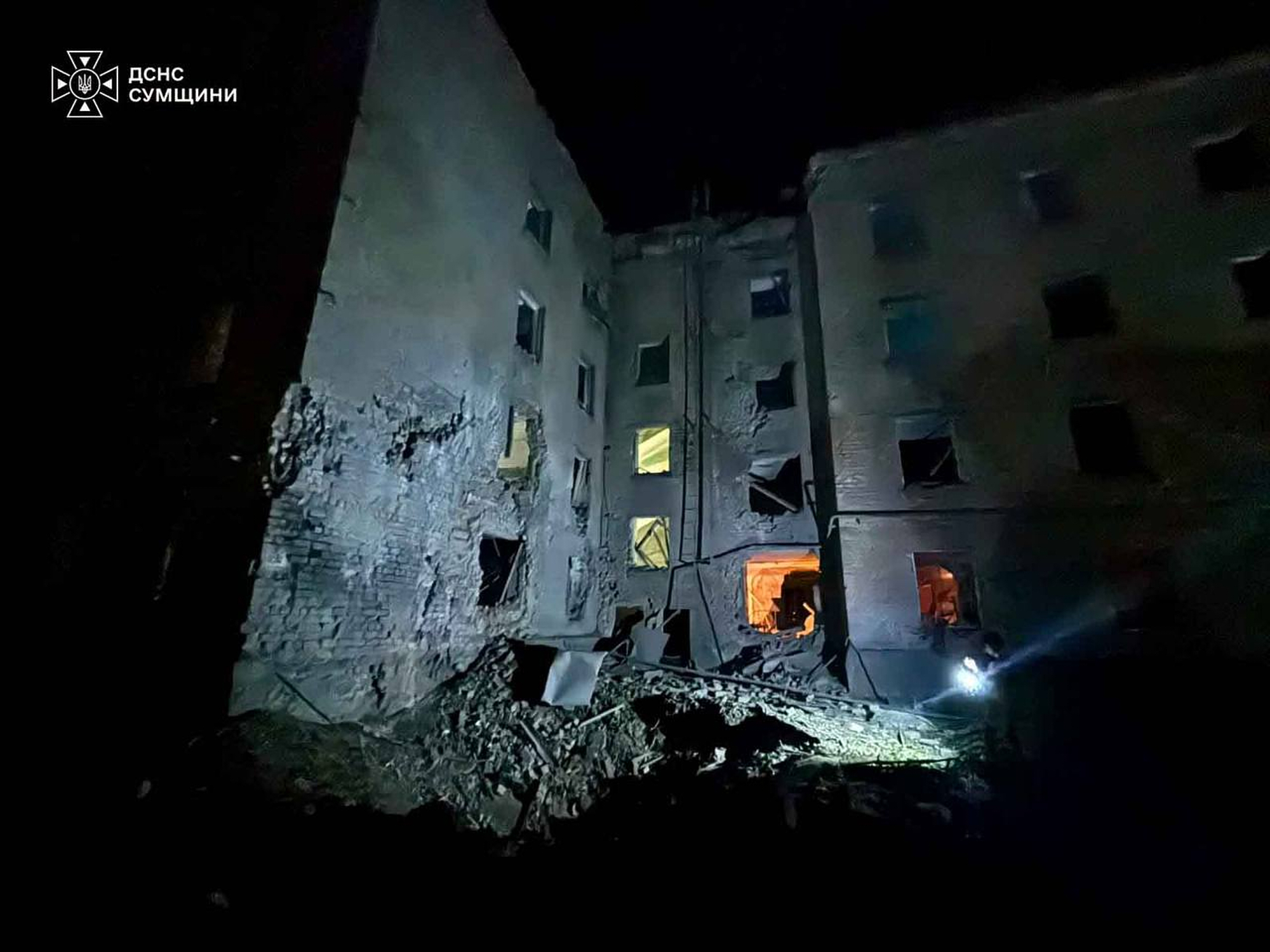
    In the neighboring Sumy region, Russian glide bombs wounded 12 people, the National Police said. Apartment buildings and infrastructure were damaged, with hundreds of windows shattered, said regional military administration chief Oleh Hryhorov.

    In the Kherson region of southern Ukraine, a Russian drone struck a bus carrying farmworkers, injuring six people, regional authorities said.

    A Russian drone also struck a residential area in the southeastern city of Zaporizhzhia, injuring four, said regional administration head Ivan Fedorov.

    UN chief condemns escalating attacks

    U.N. Secretary-General Antonio Guterres condemned both sides for their attacks, his spokesman said.

    “These latest series of attacks follow an alarming pattern of escalating strikes against populated areas, reportedly resulting in a record-level increase in numbers of civilian casualties and widespread destruction of residential and civilian infrastructure in Ukraine, as well as increasingly in the Russian Federation,” said Farhan Haq, Guterres’ deputy spokesman.

    The U.N. chief also called for freedom of navigation in the Black and Azov seas, expressing concern at the risks to shipping, the spokesman said.

  • U.S. suspends avocado inspections in Mexican state of Michoacan due to threat

    U.S. suspends avocado inspections in Mexican state of Michoacan due to threat

    MEXICO CITY — The United States announced Wednesday that it had suspended all government operations in the Mexican state of Michoacan because of a “threat to U.S. interests,” including a halt to the inspections of avocados required for their export.

    While the U.S. Embassy did not specify the nature of the threat in its security alert, Michoacan Gov. Alfredo Ramírez Bedolla said on social media that the temporary halt to inspections was intended to safeguard workers following recent arrests linked to extortion. The inspections are necessary for avocados to be shipped to the United States and their suspension could disrupt exports.

    The western state of Michoacan is the leading exporter of avocados to the U.S. and has a high level of organized crime activity with at least four cartels — designated as terrorist organizations by the Trump administration — operating in the region. Besides trafficking drugs, cartels also make money through extortion, including of the avocado industry.

    Michoacan State Security Secretary Antonio Cruz told The Associated Press that one of the arrests mentioned by the governor was of “El Poncho,” the alias of Alfonso Fernández Magallón, leader of a local cartel operating in the avocado-growing region around Los Reyes.

    U.S. Ambassador to Mexico Ronald Johnson welcomed the arrest, which came over the weekend. The U.S. government had offered a $5 million reward for Fernández Magallón’s arrest.

    Cruz said his department was unaware of any direct incidents involving the avocado inspectors. Nevertheless, 300 security personnel were deployed to the Los Reyes area as a preventive measure.

    The governor said the priority was to “ensure the security conditions necessary for these operations to resume normally,” as has happened in the past.

    Mexico supplies approximately 80% of U.S. avocado imports — a product known in the region as “green gold.” Its cultivation generates around 200,000 jobs in Michoacán alone.

    In 2025, Mexico sold $3.65 billion worth of avocados to the United States, and in the first four months of this year, those exports rose by 35% compared to the same period in the previous year.

    The U.S. Department of Agriculture sends inspectors in Mexico to monitor plantations and packing houses to ensure that exported produce is free of pests. Threats and violence against the inspectors have caused the U.S. to suspend inspections in the past.

  • How extreme heat is changing Americans’ lives, according to a new AP-NORC poll

    How extreme heat is changing Americans’ lives, according to a new AP-NORC poll

    Elisa Bracamonte has lived in Arizona her whole life, so she’s used to adjusting her schedule and outdoor activities around high temperatures, especially during the summer months.

    But the 74-year-old retired nurse from Tucson said she feels the heat has been impacting more of her day-to-day: summer plans with family members across the region, meetups with friends, road trips and her daily morning walk routine.

    “I’ve noticed at least a 10 degree difference in the weather,” Bracamonte said. “Every summer, it seems to be getting hotter and hotter.”

    Like Bracamonte, Americans are increasingly feeling a personal impact from extreme heat, according to a new poll from The Associated Press-NORC Center for Public Affairs Research.

    According to the survey, U.S. adults are more likely to say extreme heat has had either a “major impact” or “minor impact” on their travel or vacation plans, electricity bills, their sleep, their family’s outdoor activities and more parts of their day-to-day life than in July 2024.

    Much of that shift was among people who live in the West or Midwest.

    Democrats are also more likely than Republicans to say that extreme heat has had a “major” impact on each item asked about.

    Warming has endangered the globe especially in recent years; scientists calculated that Earth’s average temperature in 2025 hovered among one of the three hottest on record, along with 2024 and 2023. The U.S. has sweltered under dangerous heat domes over the past few years, and unusually high temperatures even early in the year.

    The recent scorching weather has played a role in thousands of heat-related deaths — killing more people every year than all other weather-related events. It impacts wildfire risk, strains public infrastructure, devastates agriculture and wreaks havoc on gatherings such as sporting events.

    Now, the poll shows how extreme heat is reshaping Americans’ daily lives.

    “I have to get up at 5 in the morning to walk before 6, because by 7 it’s already in the 80s … I lose a couple hours of sleep because I’m having to wake up earlier,” added Bracamonte, who said she identifies as a very liberal Democrat. “You can’t stay outside without being sick unless you’re guzzling water the whole time — it’s just so, so hot.”

    Electricity bills going up

    About 8 in 10 Americans say their electricity bills have seen a “major” or “minor” impact from extreme heat over the last year, compared with 69% in July 2024, according to the survey.

    Just under half of Americans living in the Midwest, 44%, say extreme heat has had a “major” impact on their electricity bills, up from 29% two years ago.

    Rising household electricity prices have turned into an increasingly prominent political issue over the past few years. Extreme weather is just one factor that affects electricity bills, but it means that people are using more energy for air conditioning — or in the colder months, heat.

    “I feel like my utility costs probably doubled in the last three or four years,” said Daemien Williams, a 50-year-old bridge inspector living in Cahokia Heights, Illinois, who identifies as a Democrat. “I do look at my bills pretty in detail and see that the kilowatts and the usage is actually up, not just the price that they’re charging for it.”

    Travel and vacation plans impacted, along with family outdoor activities

    Extreme heat is affecting Americans’ lives in other ways, the survey found.

    Around 4 in 10 Americans say extreme heat has had either a major impact or a minor impact on their travel or vacation plans, up from about one-quarter in 2024.

    “It has affected my entire family because we usually get together a lot during the summer,” Bracamonte said. ”We have family in Texas and we have family in upper Arizona. And we’ve seen that there’s been a lot more fires, a lot of more flooding, all that. So that kind of inhibits our plans to travel.”

    Extreme heat waves increase wildfire risk, and a warmer world supercharges storms that could ultimately send more rainfall.

    Around 7 in 10 Americans say extreme heat has had either a major impact or a minor impact on their family’s outdoor activities, compared with about 6 in 10 in 2024.

    Sean Conway, a 41-year-old direct marketer in North Shore, Massachusetts, said his kids’ soccer practice might either be postponed or canceled due to extreme temperatures, for example.

    But to Conway, who considers himself a moderate independent, leaning Republican, this is minor. “Sometimes, you’ve got to just be out in the bad weather.”

    It’s not surprising many Americans say they are feeling the impacts, said Jennifer Francis, a climate scientist at the Woodwell Climate Research Center who was not involved with the polling.

    “Brutal, life-threatening heat waves have become more frequent, more intense, and more persistent in many parts of the globe, including our Western and Midwestern states,” Francis said. ”Extreme heat compounded with long dry spells have affected our health directly, along with indirect effects on our wallets.”

    Climate change belief remains largely stable

    Even as more Americans say they feel a personal impact from extreme heat, that does not mean an increasing number believe in climate change.

    About two-thirds, 66%, of Americans believe climate change is happening, a slight decline from 73% in September 2025. About 17% say they are not sure if climate change is happening, and about 15% say it is not happening.

    Williams, the Illinois resident, attributes his belief in climate change in part to extreme shifts in weather including very high and very cold temperatures.

    “My biggest indicator of the change in the climate is just the flooding is a lot more often,” Williams said, noting that he believes in both natural and human causes.

    John Hazel, a 33-year-old in Waco, Texas, says he’s noticed changes from when he was younger.

    “When I was a kid, that seemed like a very rare thing when it did hit 100, everybody was like, whoa. And now it’s just every day,” said Hazel, a crime scene investigator. “Seasons felt a little more balanced. Now it feels like summer’s a bit lingering, it starts earlier and lasts longer.”

    Hazel, who identifies as a conservative Republican and believes in climate change, said he plans around the heat.

    “As soon as you walk outside, you’re already sweating even if you’re not doing much of anything. I’ve definitely noticed you’re having to take breaks from being outside, you have to bathe, shower more often,” Hazel said. “It’s definitely a bigger consideration.”

    ___

    The poll of 1,165 adults was conducted July 23-27, 2026, using a sample drawn from NORC’s probability-based AmeriSpeak Panel, which is designed to be representative of the U.S. population. The margin of sampling error for adults overall is plus or minus 3.7 percentage points.

    ___

    Alexa St. John is an Associated Press climate reporter. Follow her on X: @alexa_stjohn. Reach her at ast.john@ap.org.

    ___

    Read more of AP’s climate coverage.

    ___

    The Associated Press’ climate and environmental coverage receives financial support from multiple private foundations. AP is solely responsible for all content. Find AP’s standards for working with philanthropies, a list of supporters and funded coverage areas at AP.org.

  • Federal judge lets Utah enforce its anti-gambling laws on the prediction market Kalshi

    Federal judge lets Utah enforce its anti-gambling laws on the prediction market Kalshi

    SALT LAKE CITY — Utah can enforce its strict anti-gambling laws on prediction markets such as Kalshi and Polymarket, a federal judge ruled in a win for states seeking to rein in the popular betting platforms.

    Utah has been on the front lines of a battle between states and the federal government over who regulates the markets and whether they should be considered finance or gambling. The legal landscape is fragmented, with state and federal courts blocking restrictions in several states and allowing them in others.

    Kalshi sued Utah in February, asking a federal judge to prevent the state from enforcing its gambling restrictions on the platform. The lawsuit came as Utah was on the verge of enacting legislation intended to undercut prediction markets from doing business in the state.

    State law now bans proposition betting in sports — wagers on certain events happening in a game, rather than the game’s outcome — which is a significant source of revenue for the leading prediction markets.

    U.S. District Judge Robert Shelby rejected Kalshi’s request to block the Utah restrictions Tuesday, saying the federal law that Kalshi cited in its argument does not prevent the state from enforcing its laws.

    For now, Utah residents can still place bets on the platforms. The state’s attorney general, Derek Brown, said he will enforce state laws on Kalshi, but he was still exploring options.

    “Gambling is gambling, no matter what any company calls it,” Brown said.

    Kalshi said in a statement that it disagrees with the ruling and plans to appeal.

    The company maintains that prediction markets fall exclusively under federal jurisdiction and are not governed by a patchwork of state gambling laws. The Commodity Futures Trading Commission, the federal agency responsible for regulating financial markets, agrees and has defended prediction markets in court.

    Courts in Maryland, Nevada, Ohio, New York, and Wisconsin have ruled against Kalshi in similar lawsuits, while judges in New Jersey, Tennessee, Arizona and Minnesota have sided with the company. Other states have been allowed to restrict certain aspects of Kalshi’s operations without banning them entirely.

    The Trump Administration has been supportive of prediction markets, which allow anyone with a smartphone to wager on just about anything. The president’s eldest son is an adviser for both Kalshi and Polymarket, and an investor in the latter through his venture capital firm. Trump’s social media platform, Truth Social, is also launching its own cryptocurrency-based prediction market called Truth Predict.

    Utah leaders such as Gov. Spencer Cox have treated their fight to keep out anything they deem gambling as a moral crusade. The culture is rooted in the locally headquartered Church of Jesus Christ of Latter-day Saints, known widely as the Mormon church, which views gambling as a vice that leads to selfishness and addiction.

    Prediction markets are “causing tremendous harm to countless American families,” Cox said in celebrating the ruling.