Tag: no-latest

  • Giants acquire quarterback J.J. McCarthy from the Vikings for a 2027 fifth-round pick

    Giants acquire quarterback J.J. McCarthy from the Vikings for a 2027 fifth-round pick

    The New York Giants have acquired quarterback J.J. McCarthy from the Minnesota Vikings for a 2027 fifth-round pick.

    The Vikings announced the trade Monday pending McCarthy passing a physical.

    The Giants made the aggressive move days after Jaxson Dart had surgery on his left knee that will sideline him for at least the rest of the regular season.

    J.J. McCarthy was drafted in the first round of the 2024 draft by Minnesota.Bailey Hillesheim

    Jameis Winston started and beat Tennessee on Sunday, despite not scoring a touchdown and having just 238 yards of offense. Coach John Harbaugh said afterward that Winston would get the nod again this Sunday against Arizona.

    It’s unclear what New York’s QB situation will be moving forward after adding McCarthy, the 10th pick in the 2024 draft who lost the starting job in Minnesota to Kyler Murray and fell behind Carson Wentz on the depth chart.

  • Andrew Bailey, a deputy director at the FBI, leaves his job

    Andrew Bailey, a deputy director at the FBI, leaves his job

    WASHINGTON — Andrew Bailey, who has served as deputy director of the FBI as part of an unusual leadership arrangement, is leaving the job after a little more than a year, the second such departure amid the turbulence in federal law enforcement agencies under the Trump administration.

    An internal FBI email indicated Bailey was stepping down for family reasons, according to people familiar with the decision who spoke on the condition of anonymity to describe a move that was not yet public. In recent months, people familiar with the inner workings of the agency have described the arrangement between Kash Patel, the director, and his two deputy directors — Bailey and Christopher Raia, a longtime FBI agent and manager — as rocky.

    Patel and Bailey did not get along and often went long stretches without speaking to each other, according to multiple people familiar with their interactions who spoke on the condition of anonymity.

    For decades, the bureau has operated with a single deputy director, a career FBI official overseeing daily operations and reporting to the director, who is appointed by the president. But President Donald Trump upended that tradition by naming right-wing podcaster Dan Bongino, who had been a Secret Service agent but had no experience at the FBI, as the No. 2 to Patel. In essence, that put two firebrand influencers with scant management experience atop the 35,000-person agency.

    Patel and Bongino had a sometimes strained relationship with Trump’s first attorney general, Pam Bondi, whom they blamed for mishandling the release of files related to disgraced financier Jeffrey Epstein. She in turn complained about Patel’s management of the bureau, including his propensity to post premature or inaccurate information about continuing operations.

    In August 2025, the Trump administration announced a novel arrangement, saying that Bailey would come in as a co-deputy director alongside Bongino. At the time, Bailey was serving as the attorney general in Missouri, a post he had used to pursue Republican lawsuits related to culture-war issues.

    Many agents inside the bureau believed that Bondi, a former Republican state attorney general, had brought in someone to serve as director in waiting if Trump ever tired of Patel. But Trump fired Bondi in April, and Patel outlasted Bailey.

    In the interim, Patel had sidelined him, and Bailey left little imprint from his year at the bureau. His appearance when the FBI executed a warrant to see 2020 ballots from Fulton County, Ga., was notable not just because of the legal and political dispute over the inquiry — an effort to press on with Trump’s baseless rigged election claims — but because it was extraordinarily rare for Bailey to play a visible role in any operation.

    This article originally appeared in the New York Times.

  • SpaceX’s supersized Starship launches into orbit for the first time but flight ending early

    SpaceX’s supersized Starship launches into orbit for the first time but flight ending early

    SpaceX launched its enormous Starship into orbit for the first time Monday and successfully delivered the most advanced Starlinks yet, but decided to cut short the flight.

    SpaceX said the spacecraft would reenter over the Pacific and splash down north of Hawaii three hours after blasting off from Texas. The company had been aiming for a 10-hour flight, spanning six full laps around Earth, to prove its readiness for NASA’s Artemis moon program.

    The spacecraft almost didn’t make it to orbit after one of its engines shut down too soon. But with everything else working well and the bad engine no longer needed, flight controllers decided after several tense minutes to proceed as planned.

    “Starship is orbital,” Mission Control announced to cheers.

    NASA Administrator Jared Isaacman congratulated SpaceX on reaching orbit and “managing every step in a safe, responsible, and especially inspirational way.”

    Rocket carries 26 of Musk’s most advanced Starlink satellites

    Founder Elon Musk’s showpiece rocket — the biggest and most powerful ever built — carried 26 of the latest and most advanced Starlink satellites to join the 11,000 older models already providing internet service. They popped out of the spacecraft one by one, drawing more cheers from the SpaceX crowds looking on from the launch site at Starbase, Texas.

    The decision to end the flight early came soon afterward. No reason was provided.

    It was Starship’s 14th full-scale launch from Texas’ southern tip in three years. The earlier test flights ventured no farther than the Indian Ocean halfway around the world, often crashing in flames and briefly skimming space.

    This time, SpaceX was intent on circling the globe from an altitude of 170 miles — not just once but six times over almost 10 hours, ending with a Pacific splashdown near Chile. While Starship achieved the proper orbit zipping along at 17,500 mph, flight controllers opted to play it safe and bring it back several hours sooner, after just a couple of laps.

    The first-stage booster was never meant to return to the Starbase launch site either, instead dropping into the Gulf of Mexico within minutes of the morning liftoff.

    SpaceX wants to ensure that everything works before flying Starship back to Starbase. If the spacecraft breaks apart over land and rains debris onto people, “our popularity would diminish very rapidly,” Musk said at a business summit earlier this month. “That’s why we’re being extremely cautious here.”

    Depending on the findings from Monday’s orbital debut, the next Starship could return to the launch pad with giant mechanical arms grabbing the hovering spacecraft. If the catch works — Musk gives it even or slightly better odds — then SpaceX will refly the spacecraft by year’s end or early next year.

    The 407-foot rocket was designed from the start to be fully reusable — a key to lowering launch costs. SpaceX managed to salvage the last Starship from the Indian Ocean in July. Engineers modified the newly launched Starship’s heat shield based on hands-on inspections from the recovered spacecraft, which is being tugged back to Starbase.

    SpaceX wants Starship to be certified for orbital flight

    SpaceX is pressing hard to certify Starship for orbital flight, a vital step toward moon and Mars travel.

    NASA’s Artemis III mission is coming up as soon as next summer, a triple-launch docking exercise in orbit around Earth between an Orion capsule full of astronauts and competing lunar landers. Jeff Bezos’ Blue Moon will blast off first, then Orion — which will close in for a linkup — then Musk’s Starship for a docking with Orion once Blue Moon is unleashed.

    The next mission — Artemis IV slated for no sooner than 2028 — would have astronauts landing on the moon in either Blue Moon or Starship, whichever is ready first. Subsequent moonshots will alternate between the two billionaires’ landers.

    Musk originally developed Starship for Mars, intending to launch scores of them with the red planet’s first settlers. For now, he plans to focus on the moon and use Starship to haul satellites into orbit by the truckload, phasing out the company’s frailer Falcon 9 rocket within several years. A second Starship launch site is nearing completion at Florida’s Kennedy Space Center and a third is planned for Louisiana.

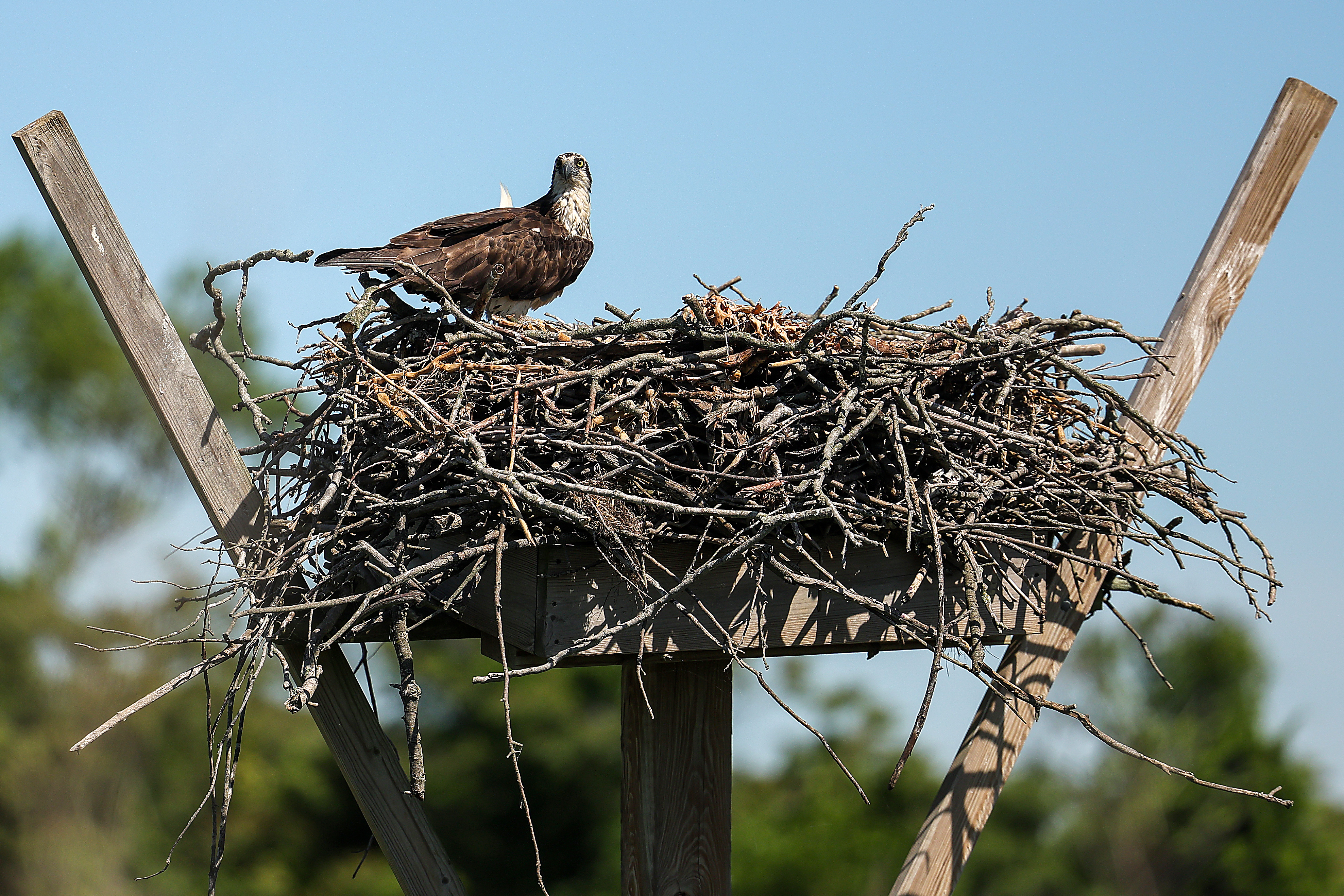
  • Ospreys are disappearing along the East Coast. Scientists think they know why.

    Ospreys are disappearing along the East Coast. Scientists think they know why.

    Bryan Watts has spent more than three decades watching ospreys reclaim the Chesapeake Bay, returning each spring from South America to crowd its tidal rivers and creeks, shorelines, channel markers, and nesting platforms. The William & Mary biologist followed their recovery from the DDT era as the bay became home to the world’s largest breeding population of ospreys.

    Now one of America’s great wildlife recoveries is coming undone. Across the Chesapeake this year, Watts and his colleagues at William & Mary’s Center for Conservation Biology recorded the worst osprey breeding season they have ever documented. Researchers working these waters have found chicks emaciated and starving in their nests.

    A starving osprey chick can seem almost weightless — its breastbone sharp beneath feathers, its body too small for the nest around it. Three summers ago, Watts spent 3½ hours checking 81 nests on Mobjack Bay: empty nest after empty nest, with just three chicks at the end. Seeing a dead chick still gets to him, but what really stops him is absence. Watts drove home, he said, “with a sick feeling that something is clearly not right.”

    The warning sign is no longer confined to the Chesapeake. Last week, Watts and his colleagues released the first picture of the 2026 breeding season up and down the East Coast: 2,886 osprey pairs in 65 study areas across 10 Atlantic states. Only 28% of saltwater study areas produced enough young to maintain their populations, compared with 93% of freshwater areas. The deficits extend from the Chesapeake through Delaware and New Jersey to Long Island and southern New England.

    At the center of that widening crisis is a fish most Americans would hardly recognize. Atlantic menhaden are silver, oily, and generally less than a foot long. Rich in fat and calories, they are the principal prey of Chesapeake ospreys and the nucleus of a food web extending far beyond the bay, including the fish humans do eat. Striped bass, bluefish, whales, and seabirds feed on them; Maine lobstermen put them in traps.

    A fight over menhaden has brought together an unlikely — and increasingly vocal — coalition. Recreational anglers want menhaden in the water for the striped bass and other game fish that eat them. Charter captains need those predators to make a living. Lobstermen need menhaden for bait. Conservation groups want enough left for ospreys and other wildlife.

    What remains uncertain is why menhaden aren’t there when birds and fishermen need them. Scientists are looking at several possible explanations, including commercial harvest and changing water conditions. Timing may matter, too: Osprey food demand has typically peaked from mid-May through mid-July, while in some recent years large numbers of menhaden haven’t arrived until weeks later.

    But a growing number of critics have begun to focus on Omega Protein, which runs the Atlantic Coast’s last remaining menhaden reduction plant, located in Reedville, Va. The state receives about three-quarters of the entire Atlantic Coast menhaden quota, and roughly 90% of its share goes to the reduction fishery supplying Omega.

    At the Reedville plant, menhaden are processed on an industrial scale into fishmeal, fish oil, and other products. Its exclusive supplier, Ocean Harvesters, caught nearly 300 million pounds of Atlantic menhaden for the plant in 2024. That scale alone has made the fleet impossible to ignore in the debate over how many menhaden are being left for everything else that eats them.

    Steve Atkinson, chairperson of the Virginia Saltwater Sportfishing Association, argues there are no longer enough menhaden in the bay to support both industrial reduction fishing at its current level and a healthy ecosystem. Members of his group are seeing fewer schools of menhaden and catching fewer game fish, which is why they support cutting the bay harvest cap in half in the meantime. “We need action now, not five years from now,” he said.

    Omega and Ocean Harvesters reject that conclusion, saying scientists have not established that their harvest causes local shortages or osprey failures. That dispute — over a fish neither side fully controls, eaten by a bird neither side can feed — is at the heart of the fight.

    Ben Landry, vice president of public affairs for Ocean Fleet Services, the parent company of Ocean Harvesters, said in a statement that blaming osprey starvation on the menhaden fishery is “an oversimplified explanation for a complex ecological issue.” Water conditions, other prey, predators, and habitat change all contributed to the birds’ decline, he added.

    Watts himself describes the evidence as a strong association, not proof that commercial harvest caused the nesting failures.

    Regardless of the exact cause, scientists have documented major shifts within the Chesapeake. In saltier waters, where ospreys depend most heavily on menhaden, 81% of nesting pairs failed to raise a single chick in 2026. Across those waters, four nesting pairs produced, on average, just one chick among them — far short of the rate needed to sustain the population. In fresher reaches, where ospreys can turn to catfish and gizzard shad, pairs produced enough young to sustain their numbers.

    The food reaching the nests has changed, too. At some Chesapeake nests, Watts found, ospreys are bringing home menhaden more than 80% less often today than they did in the 1980s.

    Anglers coastwide are seeing their own version of that shift. For 26 years, Chris Newsome made his living guiding fishermen on the Chesapeake from Virginia’s Middle Peninsula. A biologist by training, Newsome knows there will always be pockets of fish somewhere. What has disappeared, he said, is the ability to count on finding them. The good fishing comes in stretches that are “shorter and shorter and shorter.” For a charter captain, he said, what’s needed is “predictability.” This year, after what he called “the worst fishing in my lifetime,” Newsome closed his business and put his boats up for sale.

    Fishermen up and down the Atlantic Coast describe the same increasingly uneven pattern: One community can be surrounded by menhaden, also called pogies or bunker, but more fishermen cite long stretches between sightings where they once reliably found them.

    Off Virginia, spotter pilots search from the air for the dark stain of a menhaden school. Seine boats encircle the fish with massive purse-seine nets, close the bottom like a drawstring and pump the catch aboard larger vessels, including Ocean Harvesters’ new $9 million, 165-foot Tangier Sound. The fleet can also follow migrating menhaden north into federal waters, sometimes as far as New Jersey.

    Reedville is the survivor of a once-sprawling industry. At its peak, more than 20 processing factories operated from Maine to Florida. As stocks contracted and states imposed restrictions, the plants disappeared; by 2006, Reedville was the only one left.

    The corporate arrangement behind that fleet is unusual. Cooke, the Canadian seafood conglomerate that bought Omega for nearly $500 million in 2017, is constrained by a federal law that allows a fishing vessel to be owned by a company only if U.S. citizens own and control at least 75% of the company. Ocean Harvesters is 80% owned by Seth Dunlop, a U.S. citizen, Cooke employee, and nephew of Cooke CEO Glenn Cooke; Omega owns 20%.

    Most of the catch is reduced into fishmeal, fish oil, and concentrated products rather than sold as food for people. Before Cooke took Omega private, federal filings identified Nestlé Purina PetCare as one of Omega’s biggest customers. Some Blue Buffalo and Purina pet foods list menhaden fish meal or oil among their ingredients, though the labels do not identify suppliers. Landry said in an email that most of Omega’s fishmeal and oil is sold domestically, including into pet food markets.

    Most of Omega’s sales are domestic, with about 17% going overseas last year, according to Landry. Omega markets a concentrated menhaden product as an “attractant” for aquaculture feed pellets, and trade records reviewed for this story show its products shipped to Honduras, Indonesia, and Vietnam. That rankles fishermen who see menhaden becoming harder to count on at home.

    A menhaden left swimming is hard to value. But some of that hidden worth can be measured. A June 2026 study commissioned by the Theodore Roosevelt Conservation Partnership, an advocacy group, estimated that East Coast anglers spent $804 million in 2025 on trips using menhaden as bait, chum, or scent. The estimate combines a survey of 1,316 anglers with federal fishing and spending data. For comparison, Omega says its combined Atlantic and Gulf operations generate about $300 million in annual sales, and Omega and Ocean Harvesters say their Virginia operations directly employ about 260 people.

    Balancing those demands falls largely to the Atlantic States Marine Fisheries Commission, a 15-state body that manages menhaden along the coast. It classifies Atlantic menhaden as “not overfished” and says overfishing — fishing above the established threshold — is not occurring. But that is a coastwide finding. ASMFC says its assessment cannot tell whether menhaden are abundant enough in a smaller area such as the Chesapeake Bay.

    Last year, the commission lowered its estimate of the menhaden population after revising a key estimate in its assessment: how many menhaden die of natural causes each year. ASMFC stressed that the change reflected a better understanding of the fish, not a decline in their numbers.

    Jerald Ault and Jiangang Luo, University of Miami scientists whose reanalysis prompted that revision, now say even the revised estimate may be too high. “If natural mortality is set too high,” Ault said in a university statement, “the population can appear able to support more fishing than its biology allows.” ASMFC reviewed an earlier version of their analysis but not the final peer-reviewed paper.

    The lack of definitive science has become an argument against tighter limits. Yet Virginia lawmakers have spent years failing to fund the research that could provide it.

    In 2023, the General Assembly ordered the Virginia Institute of Marine Science to draw up a research plan for menhaden. Scientists, conservationists, anglers, and industry representatives agreed on nine research priorities, including abundance and localized depletion.

    But in each legislative session since, bills to fund that research repeatedly stalled. In 2026 alone, three different proposals failed to advance during the session: one to fund research aimed at understanding menhaden abundance in the bay, another to temporarily halt industrial fishing there, and a third to limit when and how the fleet could fish.

    Omega says it never opposed the research. But a letter its lobbyist sent to Virginia lawmakers last year proposed replacing the full study with a two-year pilot or deferring it until 2026. Landry said that officials at the company believed full funding was no longer available by then and that the study as written was not scientifically sound research.

    “The industry is now using that delay in definitive science as an excuse to stall new limits,” Chris Moore, the Chesapeake Bay Foundation’s Virginia executive director, said in an email. “The alarm bells in the bay keep getting worse. It’s mind-boggling.”

    Landry, however, said the industry has helped fund preliminary research, given Virginia Institute of Marine Science researchers access to its vessels and “supported the research appropriation included in Virginia’s current budget.”

    After the legislation failed again this year, Virginia Gov. Abigail Spanberger kept the research alive through the state budget, and Virginia provided $2 million over two years for the Virginia Institute of Marine Science to begin the work. Meanwhile, the commission is now considering changes to the Chesapeake reduction cap ranging from no cut to a 50% reduction.

    Omega and Ocean Harvesters oppose a 50% cut to the bay harvest, and Landry noted that regulators classify menhaden as “not overfished,” adding that tighter Chesapeake limits aren’t justified “without a demonstrated biological need.”

    The fight extends to Louisiana, where Omega operates alongside Daybrook Fisheries, another menhaden-processing company. After three net failures spilled an estimated 850,000 fish in 2023, lawmakers strengthened tracking, enforcement, and reporting. But a 2026 bill to move the fleet farther offshore and reduce other species caught with menhaden failed.

    Back on the Chesapeake, the numbers keep getting worse. In the saltier reaches where ospreys depend most on menhaden, the birds’ reproduction has fallen for three straight years. If that continues, Watts projects the bay’s osprey population could fall by roughly half within a decade.

    By September, the Chesapeake begins to empty of ospreys. The adults leave first; the young follow later, migrating alone, sometimes thousands of miles south. Those that survive will return next spring to the same rivers, the same navigation markers, sometimes the same nests.

    For generations, that journey has ended with the same promise. They came home to the Chesapeake, circled above the water and hunted.

    There were fish here.

  • At every turn, Trump’s ideas for aiding U.S. consumers run into resistance

    At every turn, Trump’s ideas for aiding U.S. consumers run into resistance

    First came a proposal to permit tariff-free beef imports, but that immediately angered America’s farmers and ranchers.

    Then came a plan to ban exports of domestic diesel fuel, but that met with pushback from major oil companies.

    In between, President Donald Trump pitched the idea of simply cutting $5,000 checks to adult Americans frustrated, polls show, by high food and gas prices — if the GOP maintains control of Congress. But that idea, too, has come under fire, even from some Republican lawmakers concerned about the potential hit to the budget deficit.

    With just five weeks until Election Day, the White House has thrown out multiple ideas for combating persistent inflation, which has outpaced wage growth. But experts say it is unclear whether Trump can execute any policy that would placate inflation-weary voters and help the GOP maintain control of Congress.

    “These are symptoms of panic in the administration about problems that they have in part created,” said David Wessel, director of the Hutchins Center on Fiscal and Monetary Policy at the Brookings Institution.

    Inflation has been running over the Federal Reserve’s target rate since 2021, but an array of Trump policies have fed the problem, economists say. Trump’s decision to join Israel in going to war with Iran has disrupted the global oil supply, leading to elevated energy rates. His tariffs have produced higher prices for some imported goods. And his administration’s immigration crackdown has made low-cost labor harder to find, keeping price pressures on domestic companies high.

    Consumer frustration is reflected in polling. The gap has steadily widened between voters who approve of and disapprove of Trump’s performance as president, and 73 percent of Americans said they disapprove of Trump’s handling of the economy in a recent poll conducted by SSRS for CNN. Only 27 percent approved — his lowest approval rating on the issue ever recorded by the survey.

    Against that backdrop, Trump has floated a parade of ideas for cutting prices.

    “President Trump pledged to lower costs and raise real wages for everyday Americans, and the Administration continues to rigorously evaluate every option on the table to deliver,” White House spokesman Kush Desai said in a statement.

    On top of the political hurdles, however, these policies have been “small in the grand scheme of things … if they’re helpful at all,” said Mark Zandi, chief economist at Moody’s Analytics. “So it’s not like it’s moving the dial on the affordability crisis.”

    Douglas Holtz-Eakin, president of the American Action Forum, a conservative-leaning think tank, said it’s not uncommon for politicians to try to bring down prices in the run-up to elections, especially when their party’s control of Washington is at risk.

    President Joe Biden did the same ahead of the 2022 midterms, notably by calling for a federal gas tax holiday and releasing millions of barrels of oil from the nation’s Strategic Petroleum Reserve in an effort to bring down sky-high gas prices.

    “This whack-a-mole with particular prices is something the Biden guys tried,” said Holtz-Eakin, who was a senior economic adviser to President George W. Bush and the 2008 presidential campaign of then-Sen. John McCain (R-Arizona). “It doesn’t solve the economic problem, and it doesn’t seem particularly politically successful.”

    For Trump, time is running out, said Rebecca Patterson, a senior fellow at the Council on Foreign Relations.

    The U.S. economy is so big and so complex that improving affordability “is simply not something anyone can do in a month,” Patterson said. “Actions taken today might help in the medium and longer term. But between now and the election, the best you can hope for is that voters appreciate that you’re trying.”

    One idea the administration has executed is buying back Treasury bonds. But so far, the payoff has been minimal.

    In part because of the competition for cash from massive private-sector spending on artificial intelligence, investors are demanding higher interest rates for Treasury bonds. Higher bond yields, in turn, raise interest rates for consumer loans such as mortgages. The average 30-year fixed mortgage rate hit 7 percent last week for the first time since January 2025.

    In August, Treasury Secretary Scott Bessent announced he would intervene in the bond market by buying back longer-term Treasury bonds to try to slow the rise in yields. That has not yet worked in bringing down yields, though Bessent contended in a recent congressional hearing that it is nonetheless a success because “we then proceeded to have the two most successful Treasury auctions that we’ve had in 20 years.”

    While Bessent was wrestling with the bond market, Trump decided to tackle meat prices.

    In late August, the president signed a proclamation that rolled back tariffs on foreign beef trimmings for 90 days in an effort to boost imports and lower ground beef prices, which have risen almost 25 percent since the beginning of Trump’s second term.

    But that drew rare pushback from farm-state Republicans, including Sen. Chuck Grassley (Iowa), Sen. Pete Ricketts (Nebraska), Sen. Roger Marshall (Kansas) and Rep. Ashley Hinson (Iowa), who is running in a competitive Senate election in her state.

    The lawmakers argued that a flood of cheap foreign beef would undermine American farmers and ranchers, who are already struggling with high fuel, grain and fertilizer prices due to the Iran war and other factors.

    Trump issued a follow-up executive order aimed at helping ranchers, and the Agriculture Department announced new policies aimed at supporting American beef producers. The administration is now reportedly considering reversing course on beef imports — though the White House has denied that.

    Then came the Republican midterm convention in Dallas, where Trump made his biggest pitch yet: If Republicans keep both the House and Senate on Nov. 3, Trump said he would give every adult American a $5,000 dividend to spend within the United States.

    Some Republican lawmakers applauded the idea, but others were skeptical, saying the checks not only could exacerbate inflation but also could increase historically large budget deficits. The proposal could cost more than $1 trillion at a time when concern is growing about the nation’s outsize debt, which recently surpassed $40 trillion.

    Public interest groups blasted the idea; Lisa Gilbert, co-president of the left-leaning consumer watchdog Public Citizen, called it an “explicit and desperate attempt to buy votes.”

    And voters largely have not been swayed: A YouGov poll released earlier this month found that 64 percent of U.S. adults felt they would probably or definitely not receive the dividend if Republicans were to win the election.

    So far, there have been few signs of interest on Capitol Hill, where lawmakers would have to draft legislation to authorize the checks and vote to approve it.

    Last week, after diesel prices hit a record high, Trump and Bessent announced a new idea for tackling soaring fuel prices: a ban on diesel exports. Their theory was that a ban would boost the diesel supply for American consumers, lowering the price at the pump.

    Several Republican candidates in competitive congressional races supported the idea. But major oil companies and Energy Secretary Chris Wright objected, arguing that such a policy would incentivize companies to lower diesel production, which would further raise fuel prices.

    By midweek, the fate of the diesel export ban, too, seemed uncertain: Wright said any new limits on diesel exports were likely to be voluntary.

    Scott Clement contributed to this report.

  • 5 British nationals arrested over suspected attack at a U.S.-operated air force base released on bail

    5 British nationals arrested over suspected attack at a U.S.-operated air force base released on bail

    FAIRFORD, England — Five young British men arrested on explosives and terror charges near a U.S.-operated air force base in England were released on bail Monday, and counterterror detectives said they were investigating “multiple lines of inquiry,” including whether there is a link to Iran.

    The men were detained early Sunday after three vans were spotted in the countryside near RAF Fairford, a U.K.-owned base that has been used by American bombers during decades of conflicts in the Middle East, including this year’s war with Iran.

    Investigators haven’t concluded whether the incident was state-backed. They are investigating a possible link to Iran, Russia, or nonstate militant groups. RAF Fairford has also been the focus of protests by anti-war campaigners.

    The five suspects, who haven’t been named, were initially held over suspected explosives offenses, and later also arrested on suspicion of preparing an act of terrorism. Police said the men are all British nationals from London and in their 20s.

    Britain’s national news agency, PA, reported without citing sources that police had not found viable explosives. Announcing that the suspects had been bailed, the head of U.K. Counter Terrorism Policing, Laurence Taylor, said that the suspects face stringent conditions and “absolutely remain under investigation.”

    Taylor said lines of inquiry include that the suspected offenses were committed by “proxies or individuals, either knowingly or unknowingly, working on behalf of a foreign state.”

    Iran denied involvement. The Iranian Embassy in London said that it “categorically rejects and strongly condemns the recent unfounded and malicious speculations” about the incident.

    Residents were evacuated from 85 homes in the village of Whelford near the base on Sunday, and army bomb-disposal experts used a robot to examine three white vans. The villagers were allowed to return home late Monday afternoon, though a cordon remained around the three vehicles, police said.

    Prime Minister Andy Burnham chaired a meeting of the government’s COBRA emergency committee on Monday “to make sure we have the full picture” of the incident, he said.

    Arrests came after reports of suspicious vehicles

    It was unclear whether the arrested men had been on security services’ radar. Local residents described seeing heightened security around RAF Fairford in recent days, with heavy vehicles parked across entrance gates.

    U.S. President Donald Trump said the suspects had been detained following cooperation between the U.S. and Britain, and had been “under view” for some time. Police, however, said the arrests were triggered by a late-night call about “suspicious vehicles” near the base.

    A local farmer said she called police after seeing three oddly parked vans as she drove home late Saturday night, and that nearby she came across “a large group of men,” some with their faces covered. She said they scattered when they saw her vehicle.

    She declined to be identified to protect her identity because she was describing what she saw as potential security lapses.

    British Defense Secretary Wes Streeting said the farmer “did exactly the right thing” by calling police but only had “a partial view” of the operation.

    The arrests came at a time of heightened tensions around the threat from hostile states, with British intelligence services saying Russia and Iran have both used proxies to commit crimes on U.K. soil. In March, officials said the number of national security cases involving activity by hostile states, including Iran, increased by 50% in the six months to December 2025.

    Iran has been linked to a series of attacks in Europe

    Britain didn’t join the U.S. and Israel in the Iran war, which began on Feb. 28, and initially denied Trump’s request to use bases in the U.K. to strike Iran. But then Prime Minister Keir Starmer agreed in March to let the U.S. use bases in Britain for what he called “defensive” operations against Iran’s missiles and their launch sites following Iranian attacks on U.K. interests and Britain’s allies in the Gulf.

    American B-1 and B-52 bombers have taken off from Fairford, 100 miles west of London, for operations during the Iran conflict.

    Iran has said that it considers any base used to attack its territory a legitimate target.

    British security officials say proxies linked to Iran have been behind a string of arsons and other attacks in the U.K. and other countries, many of them targeting the Jewish community and intended to sow fear. They have previously warned that Tehran could expand its targets in the U.K. if conflicts in the Middle East continue.

    Several people also have been charged with plotting to commit arson in the U.K. on behalf of Russia-linked groups.

    U.K. Foreign Secretary Ed Miliband said Monday that the incident is a “reminder of the threats our country faces.”

    Miliband met Iranian Foreign Minister Abbas Araghchi at the United Nations in New York last week and told him that “Britain will not tolerate intimidation, threats, or hostile activity on U.K. soil,” according to a U.K. readout of the conversation.

    U.S. Air Force says personnel remain vigilant

    The U.S. Air Force said that its personnel on the base “remain vigilant,” but “for operational security reasons we will not discuss specific force protection measures.”

    The U.S. Embassy in London has warned Americans in Britain to be cautious and mindful of their personal security.

    Trump said that authorities had the suspects “under view for a long time and we got them.”

    “It was an amazing job. We had them under investigation. They were looking to do big damage to our fort. And working with the British worked out great,” he told reporters in Chicago on Sunday.

  • Pope Leo leans into statesman role, urging peace in an era of renewed war

    Pope Leo leans into statesman role, urging peace in an era of renewed war

    METZ, France — Pope Leo XIV capped a four-day trip to France in the intellectual birthplace of the European Union, heralding its success at “tearing down walls that were dividing it” and leaning into his role not only as spiritual leader of 1.4 billion Catholics but as an increasingly influential statesman.

    In back-to-back addresses delivered symbolically in a conference center named after Robert Schuman, the late French foreign minister who was a founding father of the European Union — and now a candidate for Catholic sainthood — Leo struck what has become his trademark: a balanced tone on hot-button issues like migration that seem to leave interpretation to the beholder.

    He was less equivocal on religious freedom, the importance of international law and multilateralism, and his deep distaste for invoking God’s name for the purpose of war. Leo spoke in a part of Europe — near the once violently disputed border with Germany — where Schuman championed continental integration as a binder of lasting peace.

    At a time when President Donald Trump has pressed NATO allies into ramping up military spending, Leo acknowledged that “the search for peace in Europe, as throughout the world, must not be confused with a naive form of pacifism.” But he also warned against “the illusion that rearmament is the answer.”

    During tours of Africa and Spain in April and June, Leo — who initially seemed uneasy with fame — emerged as a confident and emotive spiritual leader capable of moving throngs.

    During his trip to secular France, the U.S.-born pope did just that in Paris, Lourdes and Metz, including drawing 800,000 faithful for an outdoor Mass on Saturday, the largest crowd in the capital since France’s World Cup victory in 2018. The night before, Leo, the 71-year old leader of a two-millennia-old faith, managed to easily pack a stadium with 80,000 roaring youth.

    Yet more than on some of his other trips, a different pope was also on display in France: Leo as an emerging elder statesmen.

    “We’re now dealing with a pope I’d describe more as a diplomat,” said Claude Dargent, a Paris-based expert on religion and politics.

    Leo is also being seen by some as the pope that many believe the cardinals who elected him had hoped for — a plain-talking, Chicago-born counterweight in an era of unbridled American power.

    In April, when President Trump openly criticized the pope as “WEAK on Crime, and terrible for Foreign Policy,” Leo appeared unbowed, saying he had “no fear.” But he has since sought to lower the tone and refrained from fanning the flames of a feud with the White House.

    Instead, he has taken to challenging the notion of “might-is-right,” and offering an alternative world where kindness, generosity and, above all, human dignity hold sway.

    He calls it our “common humanity.”

    Days after Trump skewered the United Nations and spoke of victors taking spoils, Leo addressed UNESCO — the UN’s cultural agency in Paris — to rousing applause. He spoke of the horror of war and the glory of peace. He reiterated the risks of artificial intelligence, as he did in his first major Encyclical, raising red flags at a time when Trump has defended its breakneck advancement.

    At a time when Venezuela is under the thumb of Washington, and Moscow is waging war in Ukraine, Leo condemned the quest for “domination” and the rise of modern “neocolonies” of powerful nations. In France, where nationalist Marine Le Pen is polling first in next year’s presidential election, Leo warned of creeping authoritarianism in the free world.

    “A truly free society does not impose uniformity but protects the diversity of consciences, preventing authoritarian tendencies and promoting an ethical dialogue that enriches the social fabric,” Leo said.

    In Metz, he doubled down on a point for which the White House has taken him to task: his claim that “God’s name” can never be used to “justify violence or oppression.” He reiterated his fears over the erosion of international law.

    “International law and multilateralism emphasize the genuine equality of States in their relations and constitute the best antidote to the desire for domination, which lies at the root of every conflict,” Leo said. “Today, relations between individuals and States are becoming increasingly uncivilized. The value of keeping one’s word is dismissed; instead, people boast of lies and deceit.”

    He spoke of a new European transformation through waves of migration. He reiterated earlier backing for legal pathways, and improving conditions in origin countries to inhibit migration. But he also called for integrating newcomers as if they were “part of one’s own family” and offering them opportunities.

    French President Emmanuel Macron, who was at the speech in Metz, had invited leaders from the E.U.’s other 26 member nations, though few appeared to have accepted. The prime minister and grand Duke and Duchess of Luxemburg attended, as did the head of a German state, Anke Rehlinger, minister-president of Saarland, the Élysée Palace said.

    The crowds in France, though perhaps slightly more reserved than those in neighboring Spain, were often young. In Paris, a smattering of nonbelievers joined the faithful in cheering the pope. At a university event in central Paris on Saturday, three young men — none Catholic or even religious — whooped for Leo, fanboying over a pope that one of them described as the American the world “needs.”

    “For us in France, it is important that we have an American saying these things, you know, an American with a wonderful message of peace who speaks so many languages, and who, you know, is speaking this truth when we have the insanity of Trump,” said Robin Pitrat-Demurger, 21, a Paris political science major.

    “I am here because I want to hear him and see him,” Pitrat-Demurger continued. “But also because I am happy to hear an American say these things, and to know that other Americans might listen to him because he is one of them.”

    As is customary in papal trips, there was pageantry, especially when Leo became the first pope to view the restored Notre Dame Cathedral following its devastating 2019 fire. He joined a high procession dressed in gleaming white and gold. As incense swirled and thunderous organ music played, he venerated a relic said to be the crown of thorns at the crucifixion of Jesus.

    In Lourdes, he comforted the sick and elderly who seek miraculous cures in a city where a 19th century miller’s daughter is said to have witnessed apparitions of the Virgin Mary. He said Mass for 150,000 pilgrims, and later met individually and collectively with seven carefully selected victims of abuse by clergy. Several of the victims praised Leo after the exchange.

    At an event at a hospital, rows of disabled people in rickshaw-like wheelchairs hung hopefully on the pope’s words, some of them in tears.

    MAGA influencers have dubbed Leo the “woke pope,” but in France, if anything, he was seen as the opposite, at least on social issues.

    In Paris, he spoke up for conservative Catholic principles not always popular in secular France, taking aim at surrogacy and the country’s recently passed euthanasia law — calling it an industry built around “arranging one’s own death.”

    He did so in a manner that was described by some in the French press as astutely aware of French identity and self-perception. Perhaps it was genetic. Leo spoke fondly of his familial roots in Normandy and Béarn.

    “He said some things that he doesn’t like in France and I feel like it’s important, because a pope can’t always have a speech everyone agrees with, but he does it in a gentle way,” Zoe le Barzic, a history major at the Catholic University of Paris who came to hear Leo. “There is so much division right now. I don’t think he wants to add to it. He is being very diplomatic.”

    Yet Leo has not shied away from all comments on American politics, albeit treading lightly and seemingly going there only when pressed by the media.

    Asked on the papal flight to Paris about Trump’s decision to ban CNN and other news outlets from the White House, Leo told reporters: “I’m very happy that here, you are all welcome. And good ​coverage. I ⁠think it’s very important that we have it all ​the way around for everyone.”

  • Letters to the Editor | Sept. 28, 2026

    Letters to the Editor | Sept. 28, 2026

    Mockery of peace

    During his address to the United Nations General Assembly last week, President Donald Trump mused:

    “I have a big decision to make. Will a deal be made with Iran … or do I annihilate the Islamic Republic and do it quickly? … Do I drive them into hell with no chance of survival and no hope of future greatness for generations?”

    An official threat to annihilate another country violates the U.N. Charter’s prohibition on the threat or use of force. If it contemplates destroying Iran’s people or denying them a future as a national group, it also raises the specter of the gravest crime in international law: genocide.

    Words from a president carry extraordinary weight. They can normalize mass violence, intimidate civilian populations, and signal that international law is optional for the powerful.

    The United States helped establish the postwar legal order to reject wars of conquest and collective punishment. A self-described president of peace should not stand before the United Nations and threaten an entire country with destruction.

    Terry Hansen, Grafton, Wis.

    Protect residents

    How truly disappointing to read about Lower Merion Township’s gas leaf blower ordinance through the narrow lens of enforcement “stress.” The article reads like a script from the fossil fuel industry, to share as “news” that it just might be too costly to shield people from hearing impairment and carcinogens, the indisputable and long-proven dangers of gas-powered leaf blowers.

    Lower Merion made enforcement cumbersome, and it must not now be weaponized to discourage protecting people from harm, which is the very point of gas blower ordinances nationwide.

    My town, Montclair, N.J., is one of them. We have prohibited gas leaf blowers here year-round since 2023. Residents and workers, including municipal staff, are safer and healthier because of our ordinance.

    Lower Merion’s officials should revisit its enforcement policy. If it’s the “burden,” “stress,” and “strain” they describe, they surely need to streamline their process. Would they talk like this about a new speed limit in a school zone?

    Bottom line: For a machine this dangerous, protecting public health is worth it.

    Anna Grossman, Montclair, N.J.

    Uneven praise

    It is a bit odd that, despite so much hand-wringing about partisanship, the state of our country’s politics, the divided electorate, and the purported need to work together, Sen. John Fetterman continues to be vilified.

    Although his voting record has supported his party’s position and Democratic leadership policies about 80% of the time — with the exception of supporting Israel — his party’s Democratic caucus and their supporters in liberal media have been outraged.

    When Sens. Thom Tillis, Bill Cassidy, Susan Collins, or Lisa Murkowski or former Sens. Mitt Romney and John McCain buck their party’s leadership or policies, they are praised as statesmen.

    I don’t support many of Sen. Fetterman’s votes — and did not vote for his election — but is bipartisanship worthwhile in just one direction, and only when it’s accompanied by a heavy dose of TDS?

    Daniel P. McCartney, Richboro

    Join the conversation: Send letters to letters@inquirer.com. Limit length to 150 words and include home address and day and evening phone number. Letters run in The Inquirer six days a week on the editorial pages and online.

  • Dear Abby | Recuperating elder does not need a houseguest

    Dear Abby | Recuperating elder does not need a houseguest

    DEAR ABBY: My father is in his mid-80s. He has been to the hospital several times in the last month because of age-related medical conditions. A family member is vacationing here and wants to stay at dad’s house for a week instead of a hotel or bed-and-breakfast. Dad told me he’s not feeling up to it, but he doesn’t know how to tell them without upsetting them.

    I passed this message to the family member, and they agreed. A week later, they announced that they were going to come anyway and would be there on a certain date. How do I explain that this is too much for him? Having guests stay at your house is a lot of work and can create a lot of stress.

    — GET A ROOM

    DEAR GET A ROOM: It was presumptuous of this family member to invite themselves in the first place. It is beyond the pale to insist on coming after being told they would be a burden to your ailing father. Your dad’s health and well-being must come first, so stop worrying about upsetting this person. Suggest a nice place for them to stay when they come to town, and be as blunt as necessary when you tell them they are not staying with your dad.

    ** ** **

    DEAR ABBY: I am a widow in my early 60s. I have had a best friend for 50 years. For the most part, we get along great and rarely have disagreements, partly because I don’t like conflict or confrontation. I usually let it go if I do not agree with something she has said. Recently, she made a comment I found disturbing and personally derogatory. I immediately called her out on it, and we had a strongly worded argument. We haven’t spoken since. I can’t decide whether to give her a call to try to smooth things out. If I do, I worry she may continue to belittle me. What do you think?

    — GROOVY MAMA

    DEAR GROOVY: Do you miss your friend? It seems like you would like to give her another chance. I say give her a call. You don’t have to mention the insult. Just invite her to a meal or other activity you both enjoy, and try to have a good time. If she doesn’t manage her tongue better, calmly ask her to stop hurting your feelings. Be clear that if she keeps it up, there will be no more chances.

    ** ** **

    DEAR ABBY: When I expect a visitor, it seems like I’m always rushing to be ready on time and, at the last minute, I need to use the bathroom. If it’s someone I don’t know well, or maybe someone I have never met, I debate whether I should dash to the bathroom and leave a note on the door saying, “I’ll be there in a few minutes,” or wait for the person to come in and immediately excuse myself. I worry that if my guest is late, I may be uncomfortable. What would be the best way to handle this?

    — NATURE CALLING

    DEAR NATURE CALLING: When nature calls, one cannot ignore it. If you would be comfortable inviting the person in and telling them you’ll be with them “in a minute,” I think it would be more hospitable than leaving a note on your door.

  • Horoscopes: Monday, Sept. 28, 2026

    Horoscopes: Monday, Sept. 28, 2026

    ARIES (March 21-April 19). You both say, “Let’s do it.” You hear permission to start and lead, while someone else imagines a careful plan and shared decisions. Before anyone moves, clarify who is leading, when you’ll begin and how much improvisation everyone can tolerate.

    TAURUS (April 20-May 20). You both say, “We can share.” One person imagines equal ownership and open access, while the other means a temporary loan or occasional use. Clarify who owns what, who pays for upkeep, when each person can use it.

    GEMINI (May 21-June 21). You both say, “I understand.” That could mean the person heard every word, sees your reasoning or agrees to what you proposed. Those are three different responses. Ask them to explain what they understood and what, if anything, comes next.

    CANCER (June 22-July 22). You both say, “You can count on me.” One person hears a lasting promise; the other means they’ll help with this one problem. Ask what support is being offered, for how long and what they will need in return.

    LEO (July 23-Aug. 22). You both say, “Let’s create this together.” You may imagine two equal creative partners, while the other person expects one director and one supporter. Clarify who makes final choices, who performs the visible work and the division of credit and payment.

    VIRGO (Aug. 23-Sept. 22). You both say, “I’ll take care of it.” One person may mean the immediate problem; the other may expect every related detail handled from now on. Define the task, the deadline and the desired result that means it’s finished.

    LIBRA (Sept. 23-Oct. 23). You both say, “We’re together.” One person may imagine exclusivity and a future with milestones; the other may mean they enjoy the relationship as it stands. Ask what each person hopes for the commitment, and which possibilities remain open.

    SCORPIO (Oct. 24-Nov. 21). You both say, “I trust you.” You may hear an invitation to complete openness, while the other person still expects privacy in certain areas. Ask what each of you considers private, and what must be disclosed.

    SAGITTARIUS (Nov. 22-Dec. 21). You both say, “Let’s go.” Is everyone packing for the same journey? You may picture a single trip with a return date, while your companion imagines the beginning of a quest. Discuss the destination, budget and duration.

    CAPRICORN (Dec. 22-Jan. 19). You both say, “I’m committed.” One person may promise effort until the goal is reached; another may promise a set number of hours or months. Clarify the duration, each person’s responsibilities and how you will measure success.

    AQUARIUS (Jan. 20-Feb. 18). You both say, “We’re on the same side.” It works if you agree on both the goal and the method. It doesn’t work if they support your goal and oppose your approach. Find out where your views divide.

    PISCES (Feb. 19-March 20). You both say, “I’m here for you.” You may prepare to listen and offer comfort while the other person expects advice, action or rescue. Ask what kind of help they want before giving it. Agree on what being “here” really means.

    TODAY’S BIRTHDAY (Sept. 28). Your Year of the Mighty Ocean is characterized by expansiveness, mystery and constant motion. You are more powerful than you know and always in the perfect flow of life whether you are making waves or riding deeper currents. More highlights: Improved habits and vitality bring confidence in a variety of social settings. What you make touches people of all ages. A savvy investment pays out. Cancer and Scorpio adore you. Your lucky numbers are: 8, 20, 3, 31 and 16.