Montgomery County on Tuesday sued some of the nation’s largest social media companies in a Northern California federal court, joining nearly 3,000 actions from parents, school districts, cities, counties, and states that say the platforms are harming the mental health of children and teens.
The social media giants have faced a flood of litigation in state and federal courts, part of a public reckoning over the negative impacts their products are accused of having on young people. The lawsuits allege that the companies have developed platforms that are addictive, especially to young people, and contribute to negative self-image and social isolation.
Montgomery County is suing Meta, ByteDance, Snap, and Google on behalf of the county’s 148 schools and more than 180,000 minor students, the filing said. It accused the companies and their popular products — including Instagram, Facebook, Snapchat, and TikTok — of negligence and creating a public nuisance.
“Too many young people are struggling with anxiety, depression, self-harm, and other serious mental health challenges,” Jamila Winder, chair of the Montgomery County commissioners, said in a news release Wednesday. “We believe social media companies must be held accountable for the role their products play in harming young people.”
Montgomery County’s lawsuit is one of nearly 3,000 cases before a Northern District of California judge through a mechanism called multidistrict litigation. The process allows the federal court system to handle a large volume of similar complaints in one court, usually leading to a number of bellwether trials that help assess the value of a potential global settlement.
The county’s suit is part of a larger partnership between its board of commissioners and its district attorney’s office “to proactively identify, investigate, and pursue cases against companies whose actions harm consumers or create illegal costs for taxpayers,” the news release said.
The 2025 Pennsylvania Youth Survey found that 97% of youth respondents have a phone that can access the internet, 81% have a social media account, and 24% spend four or more hours on a school day on social media.
Teens who spend more than three hours a day on social media platforms have double the risk of depression and anxiety, and half of teens report that social media makes them feel worse about the way they look, according to the advisory.
Spokespeople for TikTok and Snap did not immediately respond to requests for comment Wednesday.
José Castañeda, a spokesperson for Google, said in a statement Wednesday that “the allegations in these complaints are simply not true.”
“Providing young people with a safer, healthier experience has always been core to our work,” Castañeda said. “In collaboration with youth, mental health and parenting experts, we built services and policies to provide young people with age-appropriate experiences, and parents with robust controls.”
A Meta spokesperson also objected to the allegations, saying the company is “confident the evidence will show our longstanding commitment to supporting young people.”
“We’ve listened to parents, worked with experts and law enforcement, and conducted in-depth research to understand the issues that matter most. We’re proud of the progress we’ve made, and we’re always working to do better,” the spokesperson said.
Meta said that damages in the case could reach $1.4 trillion, according to Reuters, which is not far from the $1.5 trillion market cap of the company that owns Facebook, Instagram, and WhatsApp.
(In May, Meta settled for an undisclosed amount in a case brought by a rural Kentucky school district before jury selection took place. The case was slated to be the first bellwether trial in the centralized litigation.)
The social media giants face legal challenges elsewhere, too.
Also on Tuesday, Pennsylvania Attorney General Dave Sunday sued ByteDance, the company behind TikTok, in a Pittsburgh state court. That lawsuit accuses the company of creating an intentionally addictive platform and serving inappropriate content to teens as young as 13.
The companies have argued in courts across the country that they are protected by federal laws that govern the internet, which were enacted before the advent of social media, complex algorithms, and personalized feeds.
The social media platforms themselves cannot be held liable for the content other people post, the companies have argued in court. And, they said, social media addiction is not an established diagnosis and mental health harm cannot be directly linked to use of a platform, app, or website.
But jurors in the first trials over social media’s harmful effectsrejected most of the companies’ arguments. A New Mexico judge this month ordered Meta to pay nearly a billion dollars, combing a $567 million verdict and a $375 million civil penalty, after a jury found the company had committed 75,000 violations of the state’s Unfair Practices Act.
A partial eclipse will occur Wednesday, along with a planetary alignment that doesn’t happen all that often.
For star power, however, the annual Perseids meteor shower, which will be peaking late Wednesday night and early Thursday, may outshine them both as the moon gets out of the way to prepare for its big night at the end of the month.
The Perseids should put on quite a decent show this year for those who have access to reasonably dark skies and do not mind staying up a little late.
These things can produce 50 to 100 meteors an hour underultra-dark sky conditions, but you won’t see that many above light-polluted Philly.
Above the darkness-challenged Philadelphia Museum of Art, you might be able to catch 10 an hour, said Bill Cook, NASA’s meteoroid guru at the Marshall Space Flight Center in Huntsville, Ala.
The potential spoiler in all this would be the state of the skies, which are expected to be sunny Wednesday. But just how cloud-free they will be at night is not clear just yet, said Patrick O’Hara, meteorologist with the National Weather Service in Mount Holly.
The weather service is calling for mostly clear skies late Wednesday night, but some clouds may roll in after midnight, and it says the forecast contains “a frustrating level of uncertainty.”
About the eclipse
The eclipse has been generating media attention, and it is going to be a spectacular show — if you happen to be in Greenland or Iceland or northern Spain, places that will experience the haunting magic of totality, which will occur around 1:45 p.m. Philly time.
Locally?
“Philly just isn’t in the right place for any good eclipse viewing this time around,” said Teddy Kareta, assistant professor of astrophysics and planetary science at Villanova University.
Only about 8% of the sun will be blocked out at Philly’s latitude, said Dwight Dulsky, with the Bucks-Mont Astronomical Association.
Said Kareta, “That’s a small enough change that … I don’t think I’d even notice.”
Dulsky said the Bucks-Mont group “will be doing some safe solar viewing” of the eclipse in the marina parking lot of Nockamixon State Park, in Upper Bucks County.
Early risers (or late stay-uppers) on Wednesday can admire a planet parade in the western sky, or at least some of its participants.
Four planets — Jupiter, Mercury, Mars, and Saturn — will be lined up and visible to the unaided eye, said Kareta, though Jupiter and Mercury may be elusive, since they will be close to the horizon.
The line may be slightly less orderly on the 13th, but may not look much different from the perspective of the average earthling, Kareta added.
If you miss the planet show, Kareta advises that these things may be special but are not exactly rare. A similar alignment occurred “about a year ago,” he said.
“As an astronomer,” he said, “I find these planetary alignments more fun and beautiful than I find them super interesting.”
The Perseids are about to peak
Several hours after the moon gets in the sun’s way Wednesday, it will be fortuitously out of the way for the annual Perseid meteor showers.
As many as 50 to 100 meteors per hour may appear at their absolute peak, which this year would be in the early morning hours of Thursday.
Elsewhere in the great Philadelphia city-state, French Creek State Park, bordering Chester and Berks Counties, is a favorite among local sky watchers, and the prime viewing area is open all night.
At least a few watch parties are planned, including one by the Bucks-Mont group from 8 to 11 p.m. at the Nockamixon park, Dulsky said.
The Perseids are so named because they appear to radiate from the constellation Perseus, but they show up all over the sky. They are the most popular among the 30 or so showers visible in the night sky annually.
The Geminids, in December, outnumber the Perseids, but people prefer warmth with their meteor-watching. Plus, NASA reports that the Perseids are by far number one for those spectacular fireballs.
The meteors are the result of debris from the comet Swift-Tuttle, one of the larger meteor-producing comets, having a diameter of about 15 miles.
The earth encounters Swift-Tuttle detritus every year around this time, and those cosmic pebbles become bright streaks as they enter Earth’s atmosphere at 130,000 mph. If they’re big enough, they explode into fireballs.
Cook says that while the moonless skies offer the ideal background, this will not be an especially prolific year for the Perseids. He said the 2028 harvest will be more abundant, when the earth passes through “a denser stream” of the comet’s sheddings.
That once-in-a-blue-moon event
The moon will be returning later in the month, on Aug. 31, as the second full moon of August, thus a “blue moon.” Like those planetary alignments, it is something to expect once in a blue moon.
Tori Bauver was sitting at home on July 11 when the sky outside of the Wyndon Apartments in Wynnewood began to darken. Bauver watched the clouds roll in, then the rain come, blowing “literally sideways” outside her window. She remembers leaning in to see the darkening landscape and noticing that rain had begun to penetrate her windows. Then the “outside went stark white” and water started pooling on her windowsills.
“I was like, ‘Oh, my God. This is gonna flood. This apartment’s gonna flood,’” she said.
The light fixture above Bauver’s bed filled with water, then poured over the edges. The ceilings began to leak, then one by one, they collapsed. The building’s roof ripped off, and Bauver had a clear, and unsettling, view of the sky from her living room.
Bauver, now a resident of West Chester, where she and her partner moved after breaking the lease on her Wynnewood apartment, had been living in the Wyndon Apartments for two years when the July microburst storm tore through Lower Merion, destroying her home and more than $5,000 of her and her partner’s belongings. She was one of dozens of suburbanresidents who emerged from the storm with damaged property and a devastated home.
As the Philadelphia region sees hotter and more humid summers, flash flooding, extreme precipitation, and life-threateningstorms have become a more common feature of daily life.Weather eventsmarked by downed trees, dangerous flash floods, waterlogged roadways, and eroded bridges are, more and more,forcing suburban residents and cash-strapped local governments to pour millions into repair and resilience projects, all while large swathsof the region’s infrastructure are built to withstand weather patterns of a bygone era, one in which storms like July’s microbursthappened once in a decade, rather than multiple times a summer.
As the region’s weather patterns intensify, officials and climate experts say the municipal mosaic of Philadelphia’s suburbs faces unique challenges when it comes to planning for a future marked by climate change.
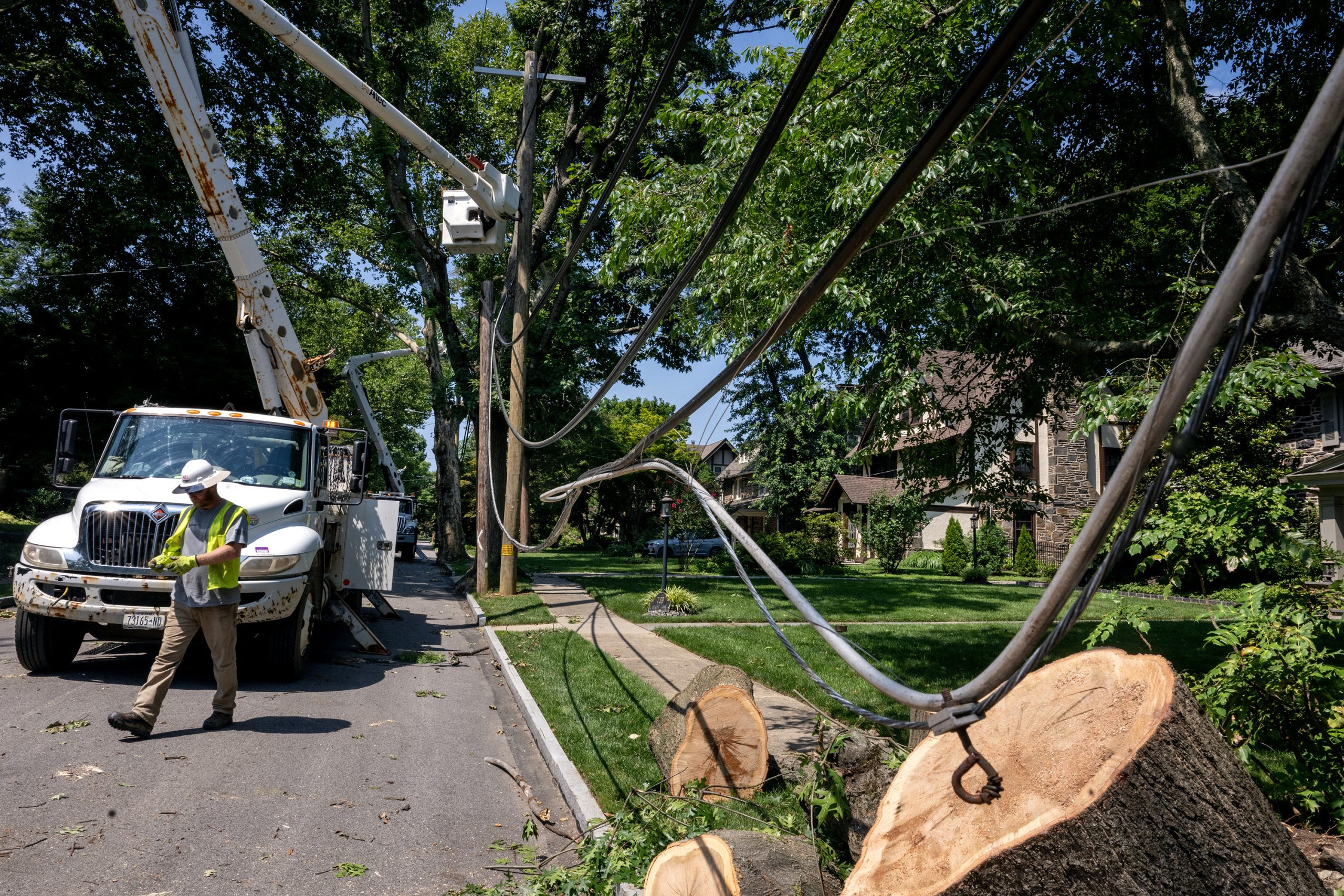
Utility workers restore power in Merion Station on July 13 after a microburst storm ripped through parts of Philadelphia and Montgomery County.Tom Gralish / Staff Photographer
The Philadelphia region’s changing weather
The average July temperature in Philadelphia has risen 4.4 degrees since 1940. In the 1900s, Philadelphia averaged four days per year with temperatures above 95 degrees, according to a 2024 EPA report. This summer, Philly has seen six days with high temperatures above 95 degrees, according to the National Weather Service. By the end of the 21st century, that number could climb to more than 50 days per year.
Hotter weather means more precipitation, and more frequent and intense rain events. For every 1.8 degrees the air temperature increases, the amount of water the atmosphere can hold increases by 7%.
“The infrastructure we have now is not always built to a standard to accommodate the extreme weather we’re seeing now,” said Chris Linn, manager of the Office of Resilience and Environment at the Delaware Valley Regional Planning Commission.
AsRay Courtney, a Lower Merion commissioner and chair of the township’s sustainability committee, said, “We get a 100-year storm every year.”
Cars in a flooded parking lot at the Ferry Avenue PATCO station in Camden on July 6. Philadelphia and its suburbs have been hit with numerous flash floods this summer, as an increasingly hot and humid atmosphere gives way to more extreme weather.Tom Gralish / Staff Photographer
Flooding as ‘the biggest and most common hazard’
The impacts of intense storms are multitudinous and cascading, and the topography of Philadelphia’s suburbs can make it particularly difficult to find effectivesolutions.
Linn said flooding is “the biggest and most common hazard that communities face,” and it presents the most “consistent and pervasive” issues for municipal leaders.
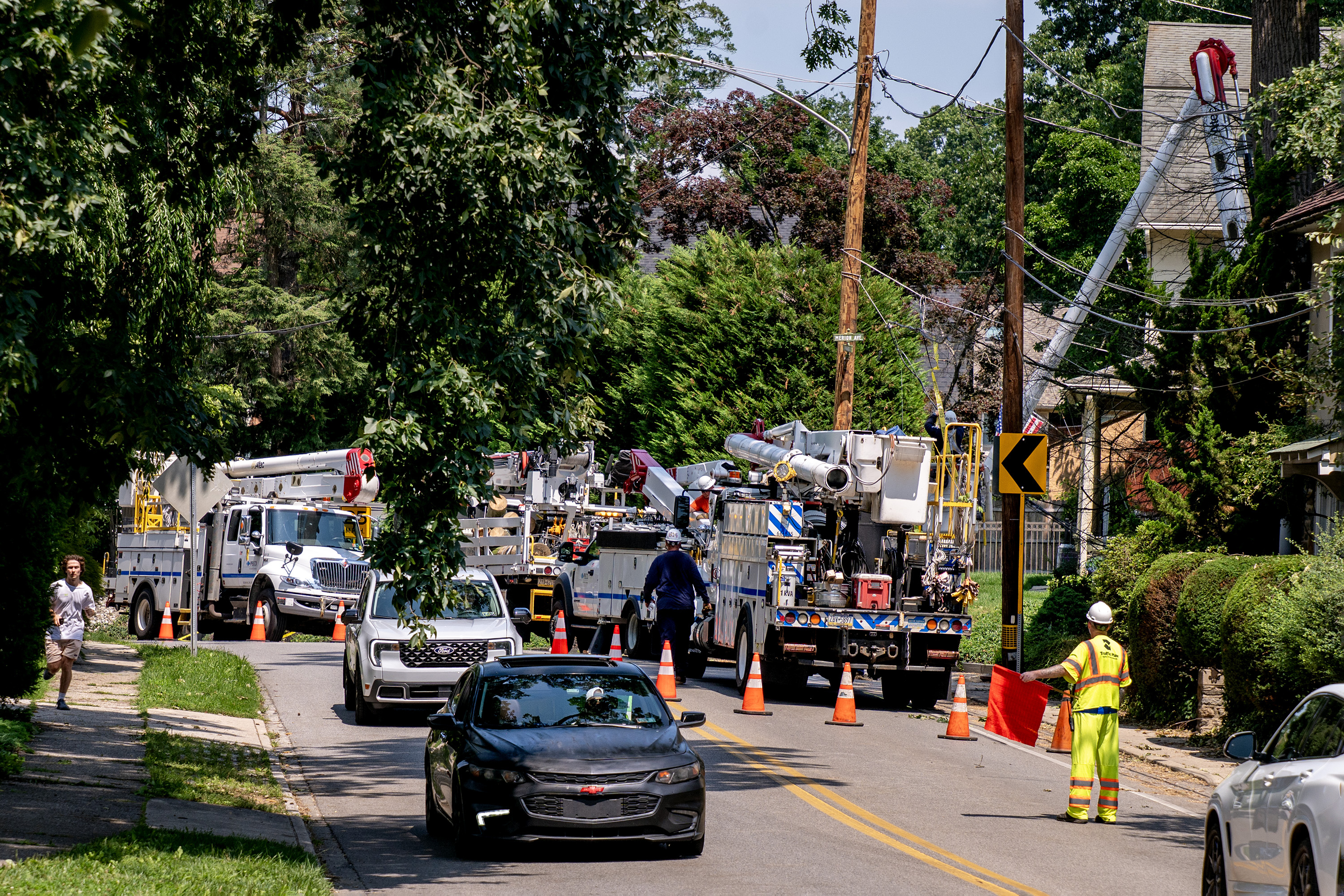
Intense precipitation and flash floods, which have been a constant this summer, can disrupt transit, turn roads into rivers, and endanger residents’ lives. High winds and saturated soil frequently bring down trees, damaging homes and cars and knocking out overhead power lines. Disruptions to power can be particularly dangerous when residents are left without fans or air-conditioning during hot summers.
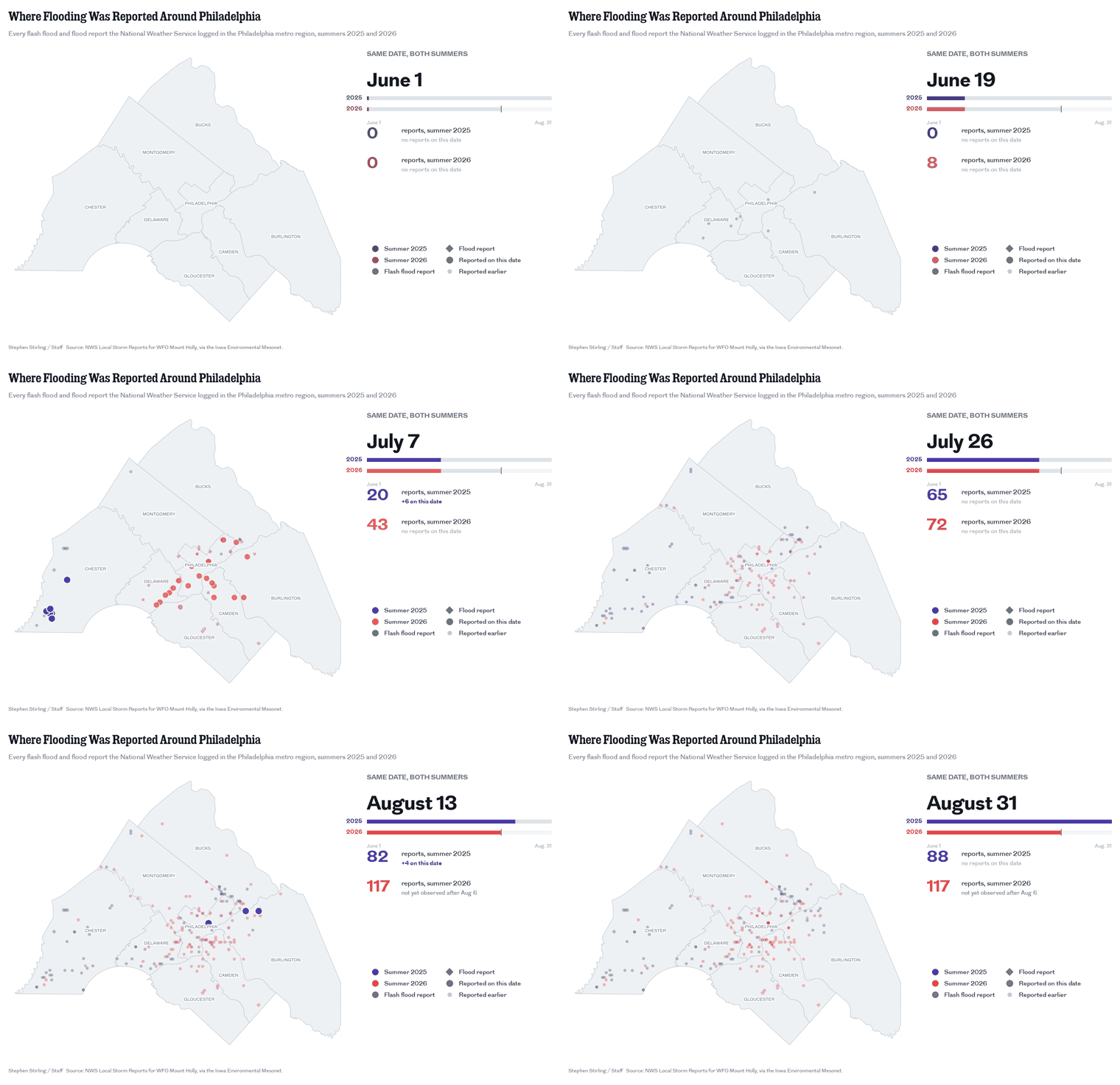
Flooding has been reported more than 200 times in the Philadelphia region over the last two summers.Stephen Stirling
“I see roads flooding consistently, trees coming down, power going out, and then our local government spending resources every time one of these storms happens. It’s overtime costs and tree costs, and then also all the private citizens having to spend costs cleaning up trees and other debris,” Courtney said.
“These unlikely, freak events are really the ones that break us,” said Matthijs Bouw, architect and professor at the University of Pennsylvania’s Stuart Weitzman School of Design.
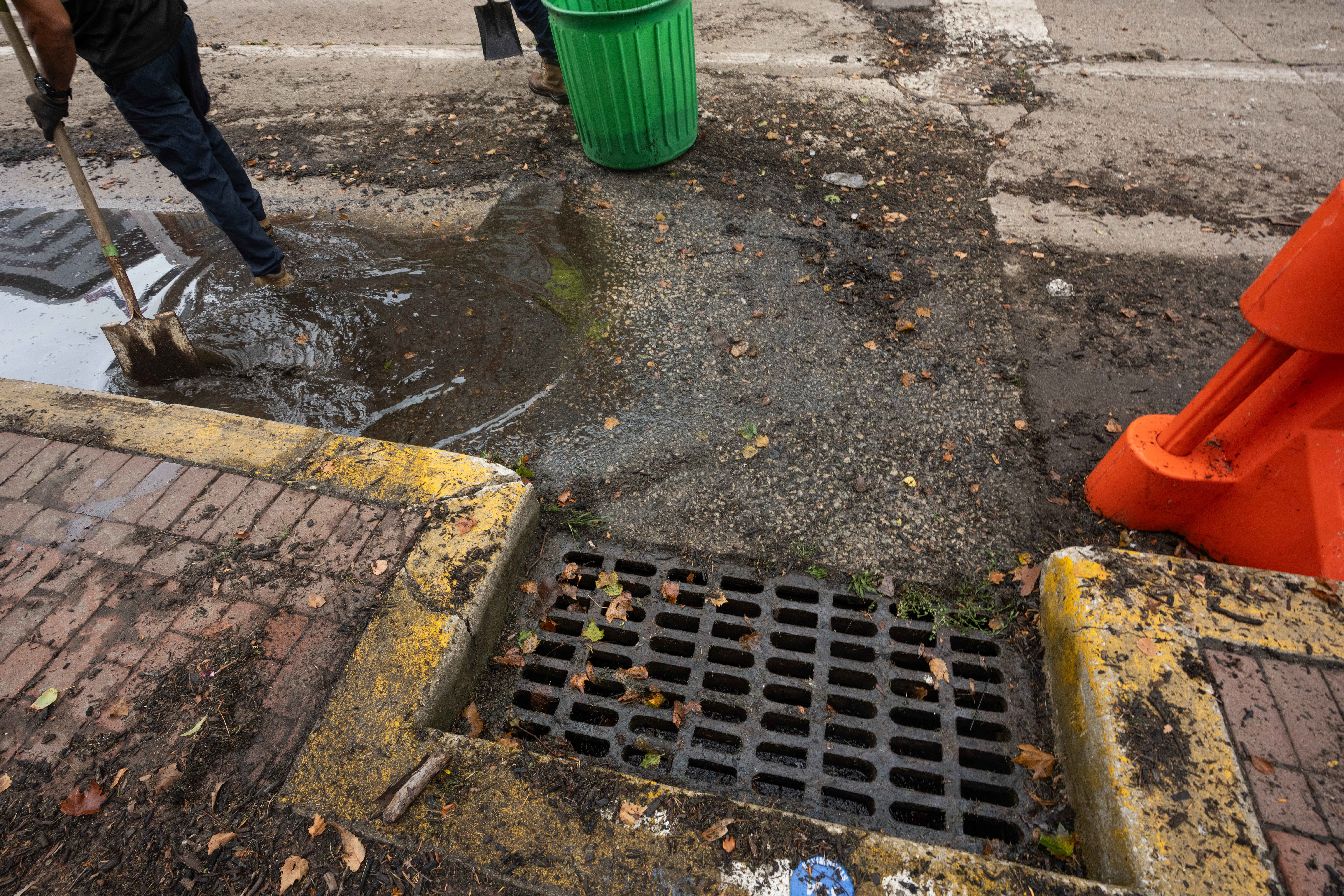
A key tool for managing extreme weatheris stormwater systems, or the collection of drains, basins, ditches, and pipes that collect rainwater and snowmelt and move it from developed areas into local waterways. Stormwater systems are critical in moving water off impervious, or impenetrable, surfaces, like the parking lots, paved roads, and shopping centers often found in the suburbs.
The more developed a suburb is, the more runoff a storm will produce, increasing flooding risks, said Franco Montalto, professor of civil, architectural, and environmental engineering at Drexel University.
Yet many municipalities are contending with aging stormwater systems that require costly repairs. Lower Merion’s 2018 Comprehensive Stormwater Management Plan listed aging pipes, undersized infrastructure, operational costs, and increasing flooding as challenges for the township. Many of Philadelphia’s suburban communities are composed of buildings that predate a 1978 state law requiring counties and local governments to plan with stormwater management in mind.
Some communities are more vulnerable to climate impacts than others, with density, land cover, wealth, and the state of repair of existing infrastructure as factors. A 2021 climate change vulnerability analysis by Montgomery County found denser, water-proximate communities like Norristown and Pottstown to have some of the highest risk of increased stresses due to climate change. Greener, more rural parts of the county like New Hanover and Marlborough Townships presented lower risks.
The aftermath and clean up of flooding in Camden on July 6. Stormwater systems are a critical tool for local governments to manage flooding. Jessica Griffin / Staff Photographer
How can communities mitigate impacts?
Experts described a range of interventions for managing climate impacts, from constructing rain gardens to rewriting zoning ordinances.
Maintaining a healthy tree canopy and building rain gardens can help rainwater permeate into the ground. Larger infrastructure efforts like stream restoration projects and floodplain maintenance can help stabilize the built environment.
However, Linn said, these interventions “don’t necessarily address more severe or catastrophic flooding in terms of mitigating those impacts.”
Long-term climate resilience, experts said, relies on making land-use and zoning decisions that preserve floodplains and natural drainage patterns and ensure stormwater systems can manage our new, rainy reality.
Montalto is interested communities that have become “safe to flood,” or that have created parks, parking lots, road medians, and other open spaces that trap water during floods, then properly drain it, keeping it away from buildings and roads. A basketball court built below a park, for example, can fill with water during a storm and slowly drain, mitigating runoff (one was recently installed in New York City). Copenhagen’s Cloudburst Management Plan, adopted in 2012 after a major storm, is a blueprint of sorts in Montalto’s mind.
However, bringing “safe to flood” infrastructure to Philly’s suburbs may be a far-out goal.
In the vast suburbs, the collection of boroughs, townships, and county lines makes unified action difficult, and forces officials to think along municipal, not watershed, lines. On the Main Line alone, rainfall and snowmelt drain into a collection of dozens of creeks and streams that do not start or stop where a municipal boundary is drawn, making it difficult to take coordinated and effective action when it comes to flood mitigation along certain waterways.
Finding the funding to repair and replace stormwater infrastructure, too, can be taxing, as local governments stare down costly projects, even with the availability of state and federal grants.Political will factors in, with municipalities differing in their desire and ability to use taxpayer dollars to tackle climate issues.
Philly’s suburbs, like the city, are also often old, dense, and built out, making it hard to retrofit them to be more climate-sensitive.
“So many of our communities are built out and have been built out for a long time, so the vulnerabilities and the challenges are built in to the community,” Linn said.
Utility workers restore power along Wynnewood Avenue in Merion Station on July 13.Tom Gralish / Staff Photographer
Solving ‘complex issues’ in Montgomery County
Despite the challenges, progress is being made, said Montgomery County Commissioner Jamila Winder.
Montgomery County in 2025 led a flood mitigation planning study for the 362-square-mile Perkiomen Creek Watershed, which stretches across Montgomery, Bucks, Berks, and Lehigh Counties. The study identified flood-prone areas, evaluated mitigation tactics, and worked to build a framework for long-term resilience. The county is currently in the process of carrying out a floodplain restoration project along the Wissahickon Creek in Whitemarsh Township. Both projects came to fruition after Hurricane Ida tore through the region, bringing record floods and killing multiple people.
The county has repaired 30 structurally deficient bridges since 2017 and has repaved dozens of miles of road. County workers also removed 200 dangerous trees earlier this year, resulting in a significant drop in emergency phone calls about tree damage, Winder said.
Lower Merion in 2021 hired its first full-time sustainability manager and in 2023 completed its first sustainability plan. Radnor Township has adopted a comprehensive climate plan, and Haverford Township has set out to achieve 100% zero-carbon renewable power by 2035.
The Pennsylvania Department of Environmental Protection in January announced more than $17 million in funding for environmental projects across the state, including stream restoration and stormwater management.
Winder said, “We’re seeing that when we work across federal, state, county, and local leadership, that we can come together to solve some of these complex issues.”
This suburban content is produced with support from the Leslie Miller and Richard Worley Foundation and The Lenfest Institute for Journalism. Editorial content is created independently of the project donors. Gifts to support The Inquirer’s high-impact journalism can be made at inquirer.com/donate. A list of Lenfest Institute donors can be found at lenfestinstitute.org/supporters.
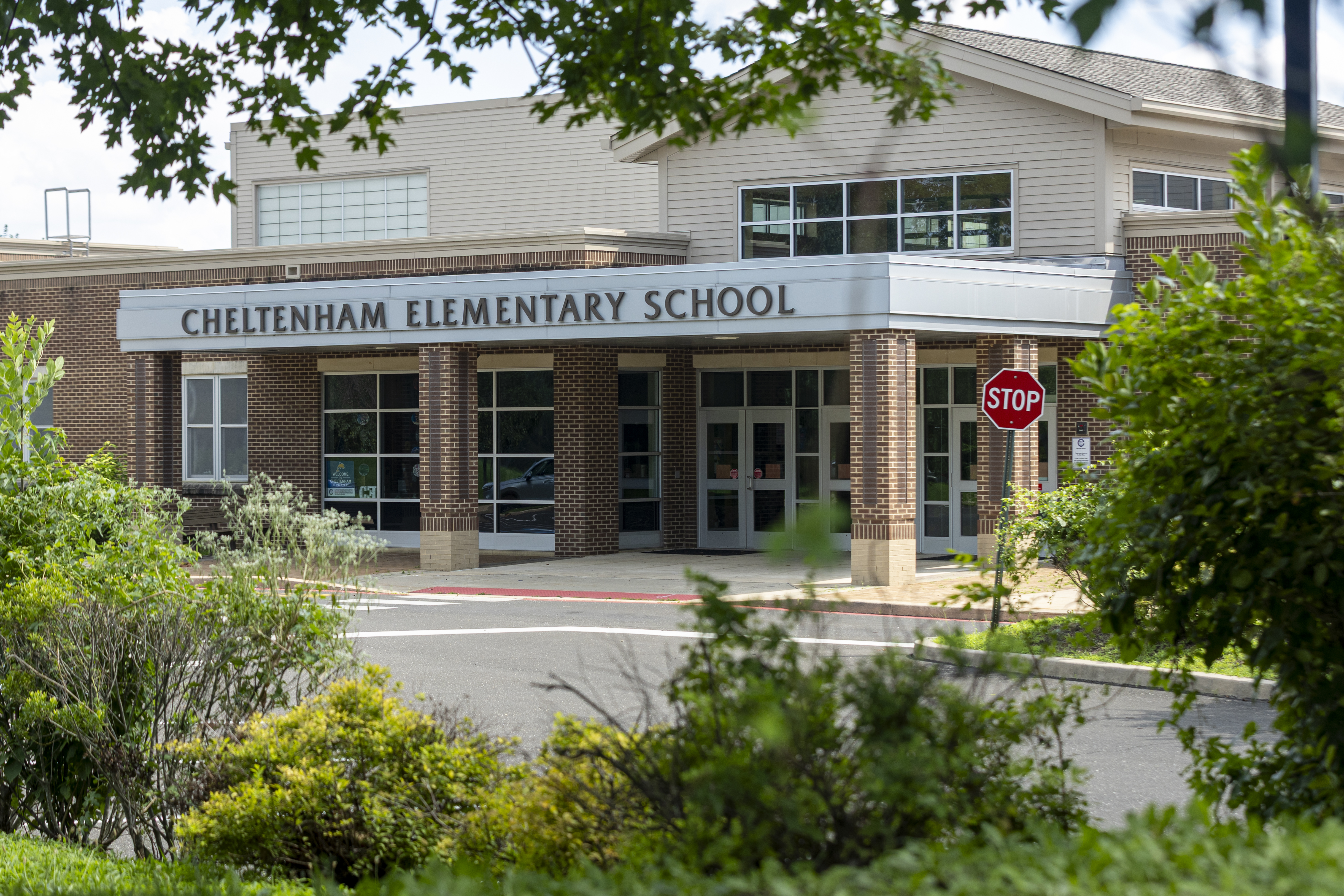
The Cheltenham school board said it would review safety procedures and assess the culture in all of its athletic programs as it pledged to rebuild community trust after an explosive grand jury report condemned the district’s response to the assaults of a football player last season in a high school locker room.
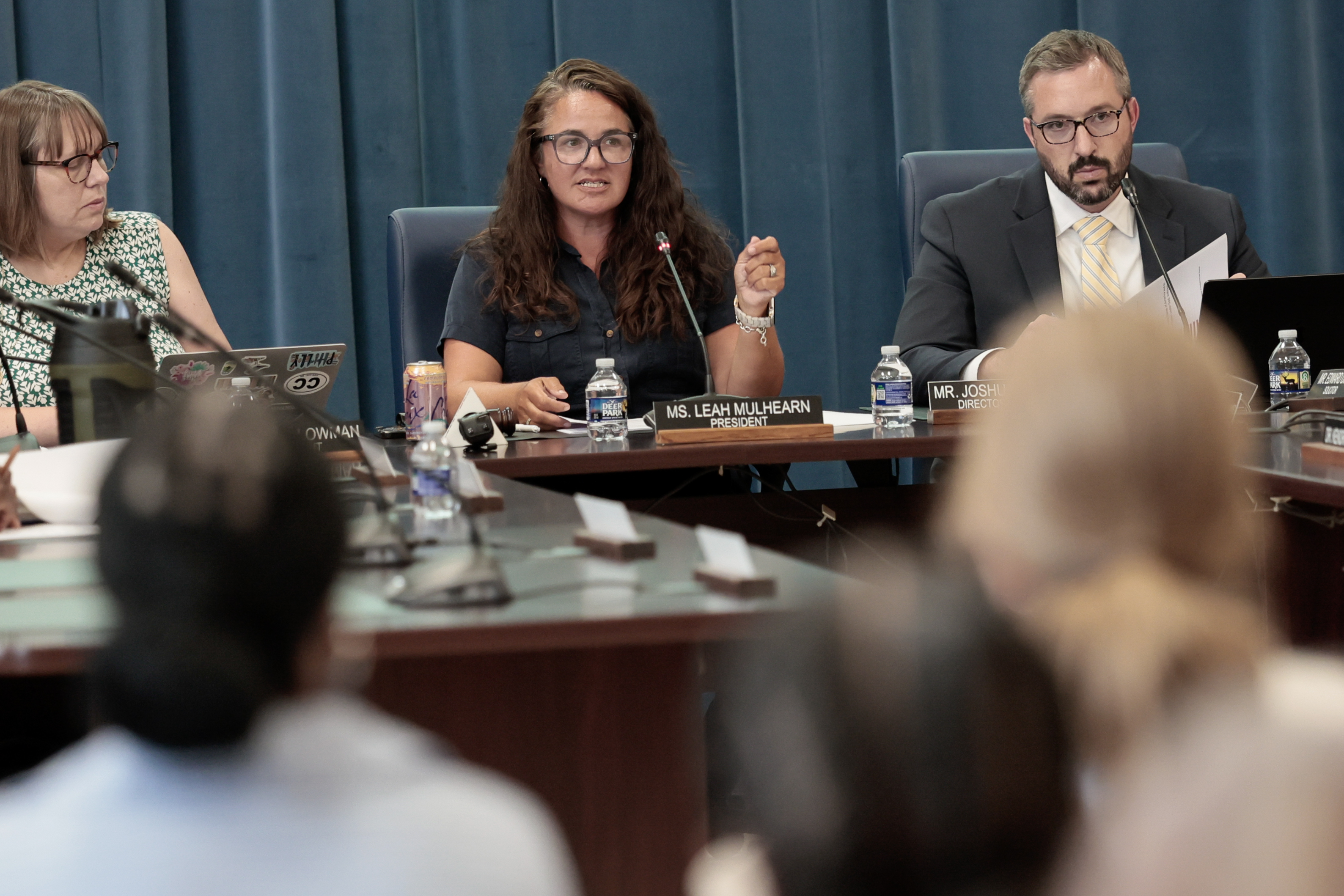
The attacks on the 15-year-old, which took place in August and September 2025, “arose in the context of a culture of intimidation and acceptance of violence,” board president Leah Mulhearn said Tuesday night at the board’s first meeting since criminal charges were announced against four coaches and six players.
Mulhearn, who also announced that veteran educator Chris McGinley would be tapped as interim superintendent, promised the board would move quickly to fix problems.
The district already canceled the 2026 football season in May. “Football will not return until we address this, no matter how long it takes,” Mulhearn said.
Parents, who lined up behind a microphone in the district’s administration building awaiting their turn to speak, expressed skepticism and demanded more from the board after a grand jury report accused the district of endangering students through a failed response to the assaults, one of which was captured on video.
In emotional comments, some parents said their children had been assaulted in the schools, while others questioned how they could believe the board, when they had warned against hiring a coach who has since been charged with conspiracy and endangering the welfare of a child.
“We entrusted our children to this district,” said Chowan Cowans, who withdrew her son, a rising senior and former Cheltenham football player, because “I don’t feel safe with him being there anymore.”
Cowans accused the district of a lack of transparency, which “has to mean something when the truth is uncomfortable,” she said.
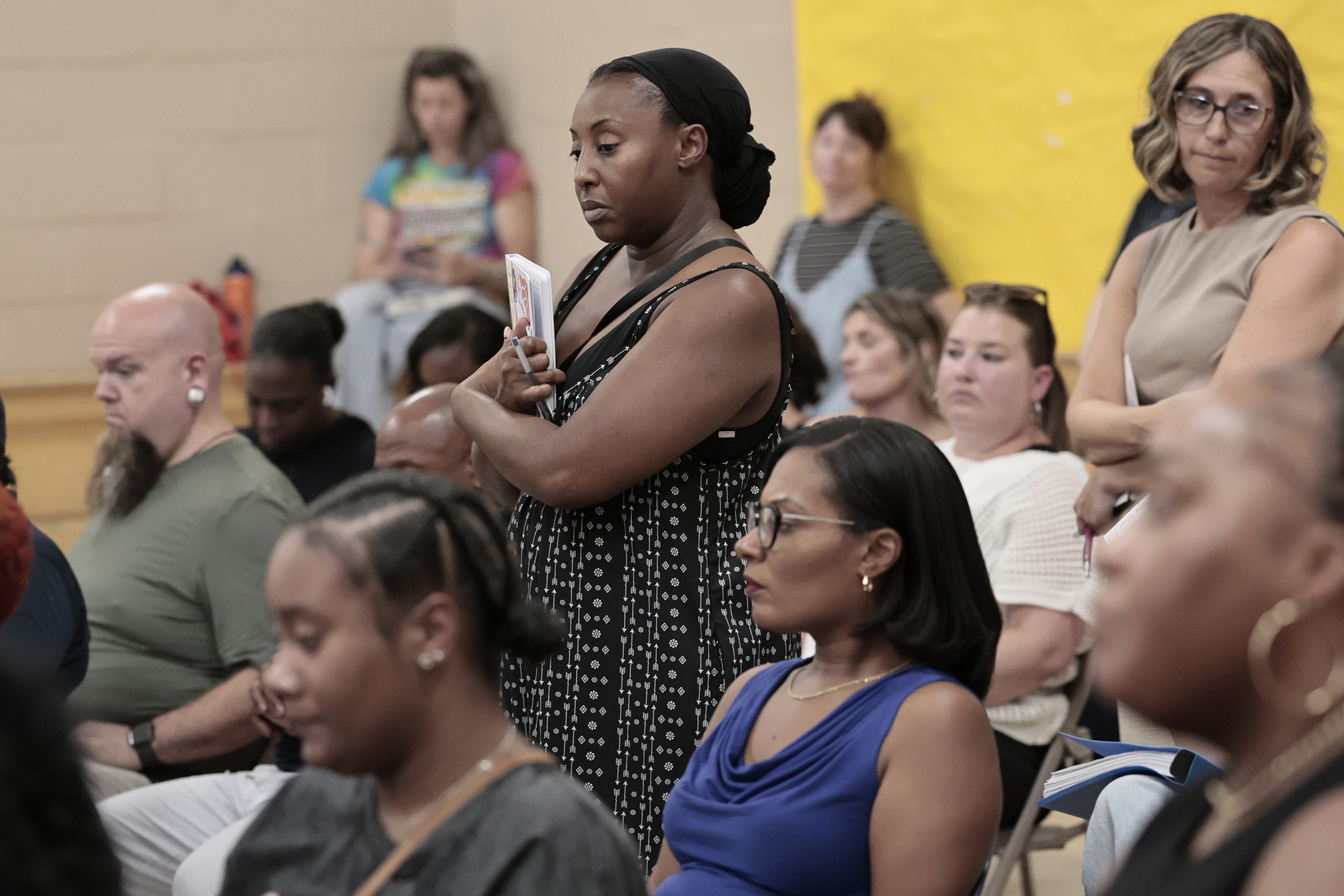
PTO president Stephanie Curry (center) waits in line to speak during the Cheltenham School Board meeting in Elkins Park on Tuesday, August 11, 2026. The school board was meeting for the first time since criminal charges against four football coaches and six players were announced, and since Brian Scriven resigned as superintendent. .Elizabeth Robertson / Staff Photographer
Employees at the high school appeared to minimize the Sept. 3 assault after it was reported to them by the 15-year-old victim’s mother, according to the grand jury report. They also took the head coach, Terence Tolbert, at his word that he had not instructed the player not to tell his parents what happened, and they included the coach in their investigation — which failed to uncover that there were two assaults, the report said.
It also noted that employees were also confused about their mandatory reporting requirements.
On Tuesday, Mulhearn said that while the board “may differ with the grand jury with respect to some of its findings about how the district and board responded, the hard truth is that we must acknowledge that mistakes were made.”
Mulhearn said the board would “move with deliberate speed to address these issues.” She said the board would enlist an outside attorney, Leigh Dalton — who was hired by the Central Bucks School District last year to investigate special-education abuse allegations — to review the district’s policies and procedures and make recommendations within 60 days.
She did not comment on Superintendent Brian Scriven’s resignation last week. Some parents questioned whether and when the board’s position on Scriven had shifted, after the board praised the superintendent’s leadership in May.
A district spokesperson did not respond to a question this week about whether Scriven, who received a new five-year contract in December, would receive any payout following his resignation.
Nor did the board indicate whether it was considering taking action against any employees at the high school. One parent, for instance, asked whether Mark Hoff, the former vice principal at Cheltenham High School, would still become the vice principal at Wyncote Elementary, in light of the grand jury report faulting high school employees.
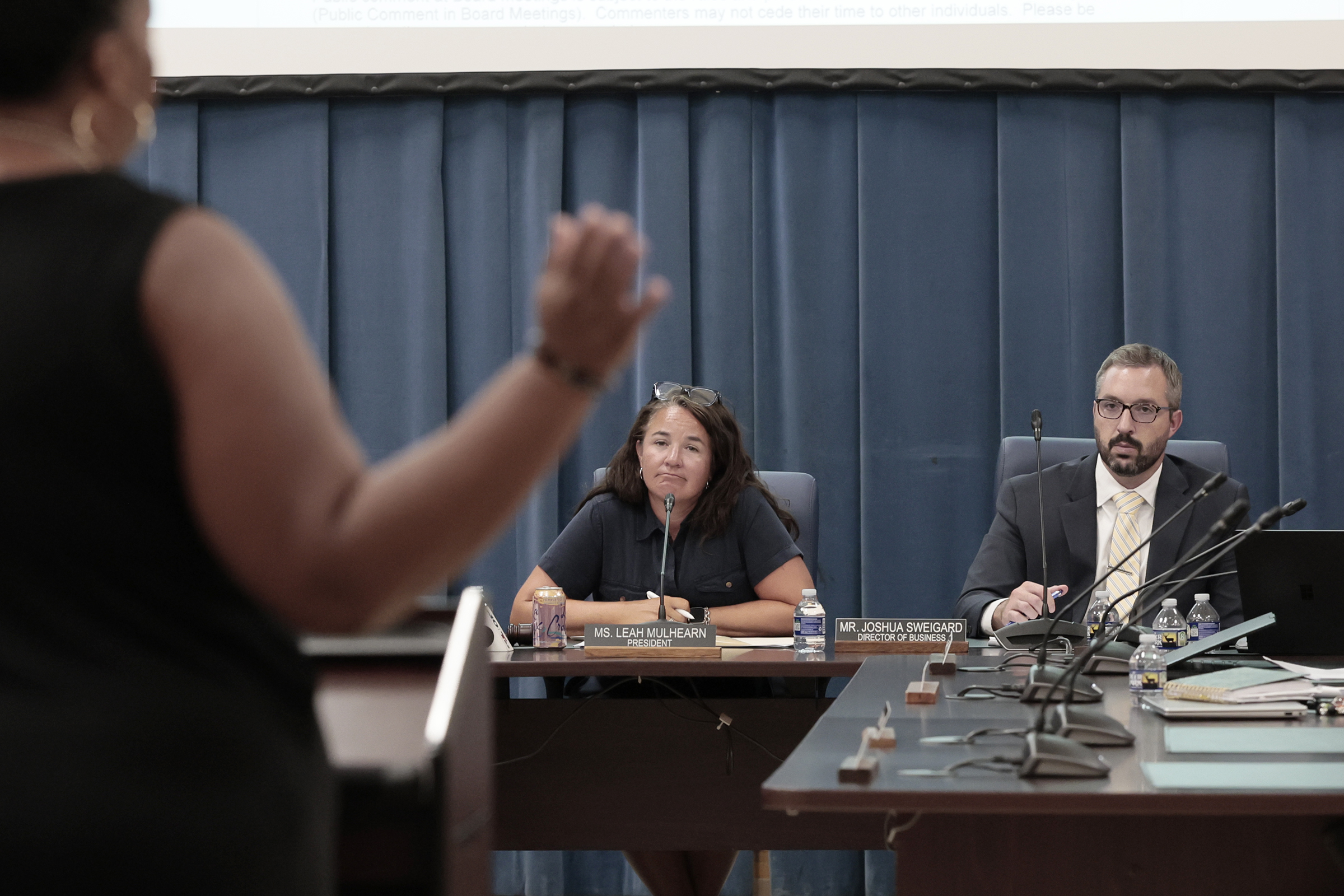
Taryn Knox (left) speaks to School Board President Leah Mulhearn and Director of Business Joshua Sweigard during the Cheltenham School Board meeting in Elkins Park on Tuesday, August 11, 2026. The school board was meeting for the first time since criminal charges against four football coaches and six players were announced, and since Brian Scriven resigned as superintendent. .Elizabeth Robertson / Staff Photographer
The board, which appointed director of business services Joshua Sweigard acting superintendent on Tuesday, will hold a special meeting next week to appoint McGinley as interim superintendent, Mulhearn said. McGinley previously led both the Cheltenham and Lower Merion districts and more recently served on the Philadelphia School Reform Commission and Philadelphia school board. His most recent position was as the faculty program coordinator of the Educational Leadership and Policy program at Temple University.
Parents’ pleas
Parents urged the board to commit to more steps. In a joint statement, the United Parents Group, the Special Education Alliance of Cheltenham, and the Cheltenham African American Alliance called for numerous actions, including a community town hall ahead of the first day of school and an assembly on the first day “to enforce a zero-tolerance policy regarding sexual harassment, bullying and hazing.” They also called for safety data to be a part of every school board meeting.
“We are demanding a fundamental shift in how our school district operates,” Aubria Nance, reading from the groups’ joint statement, told the board.
“Every time I hear a commitment to our students’ safety, I want to see the proof,” said Erin Fadako, a parent at the school.
The Inquirer reported last week that some football parents had urged the district not to hire Tolbert, saying he had allowed bullying while previously serving as head coach in Abington, where he left after one season.
“Everyone from the administration on down that has failed these students, you all have approved them to be hired here,” said Taryn Knox, who was among the football parents who had asked the district not to hire Tolbert.
After a year of negative news coverage, Knox said, “we’re now about to go into the next school year, and the news is still here.”
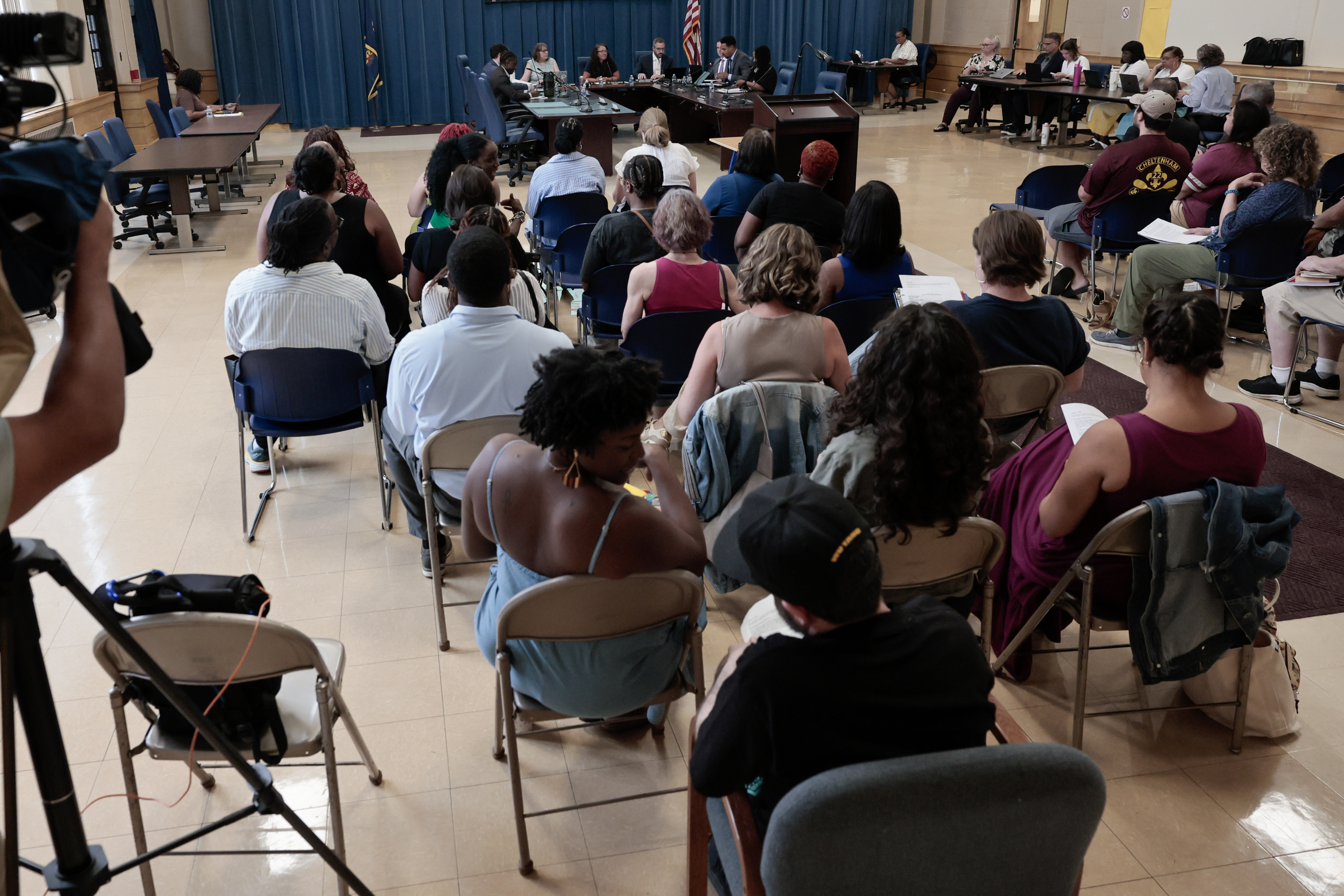
The Cheltenham school board meeting Tuesday, Aug. 11, 2026, in Elkins Park.Elizabeth Robertson / Staff Photographer
As they voiced their frustration, parents pleaded with the board to make real changes.
“Stop being risk averse and do what you need to do to make it safe for our children,” said Stephanie Curry, president of the high school’s parent teacher organization. “Our kids are the ones that are suffering.”
Janet Klein, 96, of Rydal, Montgomery County, former member of the Philadelphia Historical Commission, historic program director for the Fairmount Park Commission, regional project coordinator for the National Trust for Historic Preservation, chair of the Pennsylvania Historical and Museum Commission, volunteer, and philanthropist, died Tuesday, Aug. 4, of age-associated decline at her home.
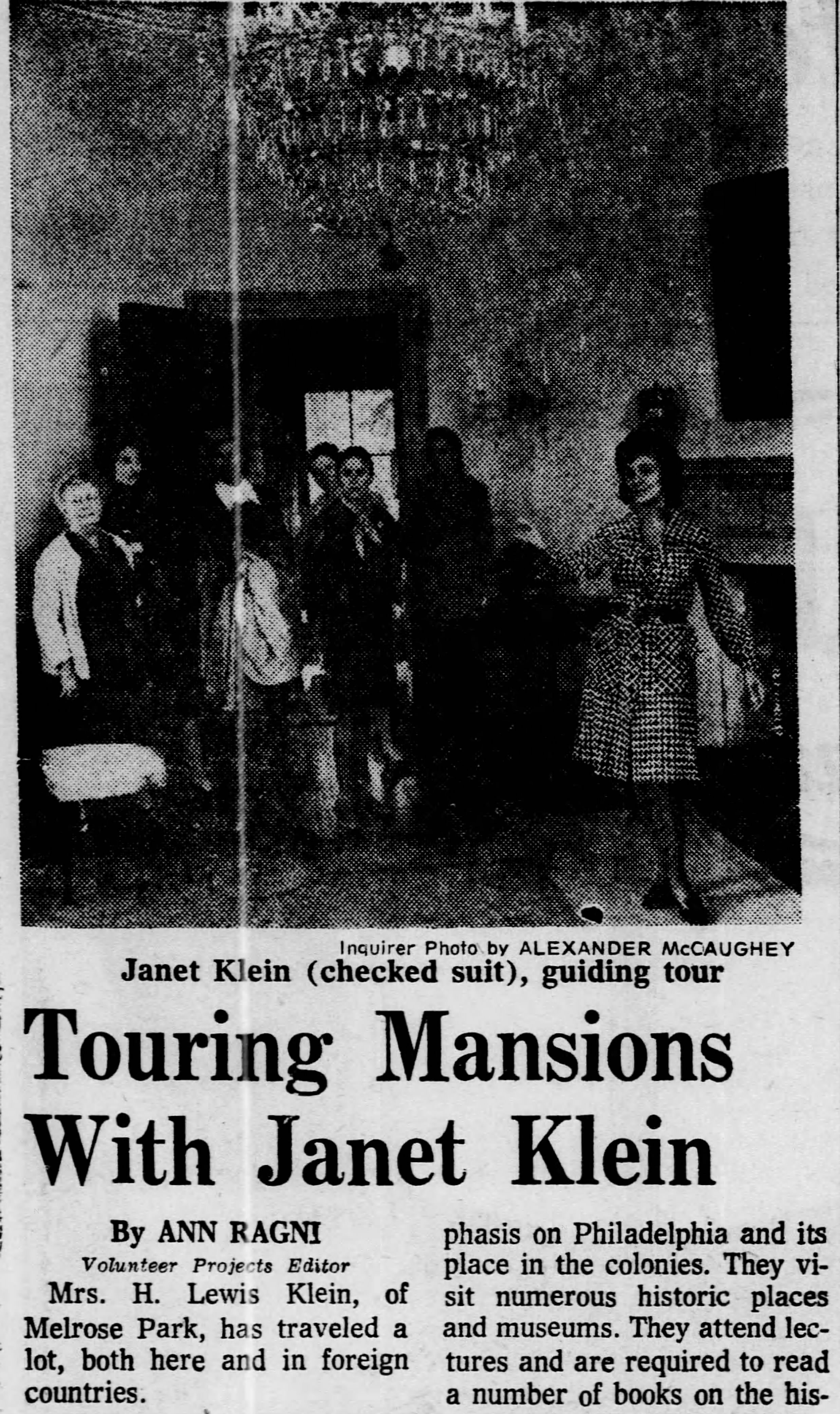
Born in Philadelphia, Mrs. Klein earned degrees at Philadelphia High School for Girls and the University of Pennsylvania. She and her husband, Lewis, traveled the world after they married in 1952, and she told The Inquirer in 1973 that she became interested in local historic preservation after returning from abroad in 1964.
“I felt something was lacking here,” she said. “There was no pride nor a thorough knowledge of what we really have in Philadelphia to share with visitors.”
So she joined the Philadelphia Museum of Art’s tour guide program, rose to chair of guides for the Fairmount Park house tours, and conducted hundreds of tours for thousands of visitors to the eight historic houses in the park. “The guides,” she said in 1973, “can’t help but sense that somehow they have passed on to the visitors the continuing life of historic Philadelphia.”
Eventually, Mrs. Klein became historic program director for the Fairmount Park Commission, was appointed to the Philadelphia Historical Commission by then-Mayor Wilson Goode in the 1980s, and served as chair of the Pennsylvania Historical and Museum Commission from 1997 to 2003. Friends called her “formidable” and compared her to the Energizer Bunny.
Keen to spark public interest in historic sites, Mrs. Klein forged partnerships between site officials and schools, community groups, businesses, and the media. In 1997, she oversaw filmmakers as they shot scenes for the movie Beloved at the Landis Valley Museum in Manheim Township.
She appeared often in The Inquirer and said in 1989: “We often find that people who live just around the corner from a house museum don’t know it existed.”
At Fairmount Park, she redefined the commission’s operating procedures and enlisted students as volunteers at its public mansions. At the city historical commission, she led walking tours of Old City and helped determine the historic designation of the old Lit Bros. building, the Boyd Theatre, the Dilworth house, and other significant structures.
This story and photo of Mrs. Klein (right) was published in The Inquirer in 1973.Newspapers.com
With the state historical and museum commission, she erected historical markers across the state, helped designate the Art Museum as a Commonwealth Treasure in 2002, and directed the commission’s public relations, tourist promotions, and preservation efforts.
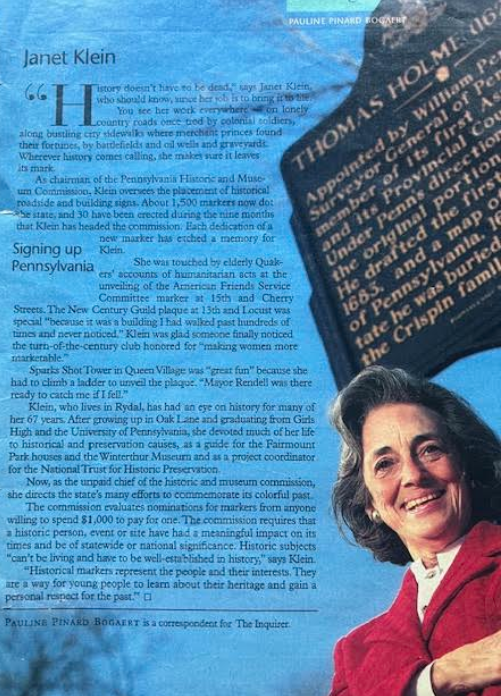
“History doesn’t have to be dead,” she said in 1998. “Historical markers represent the people and their interests. They are a way for young people to learn about their heritage and gain a personal respect for the past.”
She also led the Comprehensive Historic Assistance Program for the National Trust for Historic Preservation in the 1980s, helped create the Liberty Trail near Independence Hall, and directed the restoration of the first historic home in the Lukens National Historic District of Coatesville.
She served on the board of visitors at Temple University’s Ambler campus and Klein College of Media and Communications, on the collections committee at the Union League, and as a guide at the Winterthur Museum in Delaware. She was active with the Pennsylvania Department of Conservation and Natural Resources, the Museum Council of Philadelphia, and other groups.
This story and photo of Mrs. Klein appeared in The Inquirer in 1998.Temple University
She was honored for her service by the Women’s Center of Montgomery County in 1999 and by the Preservation Alliance for Greater Philadelphia in 2001, and was named a Distinguished Daughter of Pennsylvania in 2000. In 2018, she earned an award for service and philanthropy from Coatesville’s National Iron and Steel Heritage Museum.
As philanthropists, Mrs. Klein and her husband supported what became, named after them, the Klein College at Temple, the National Association of Television Program Executives, the Police Athletic League, the American Heart Association, and other organizations dedicated to education, healthcare, youth development, and social service. They created the Janet and Lew Klein Making A Difference Award for the Pennsylvania Association of Broadcasters and donated his professional papers to Temple.
“She was an inspirational community leader,” said David Boardman, dean of Temple’s Klein College, “who inspired others through her generosity, her brilliance, and her warmth.”
Janet Surman was born March 3, 1930. She grew up in Oak Lane and earned a bachelor’s degree at Penn.
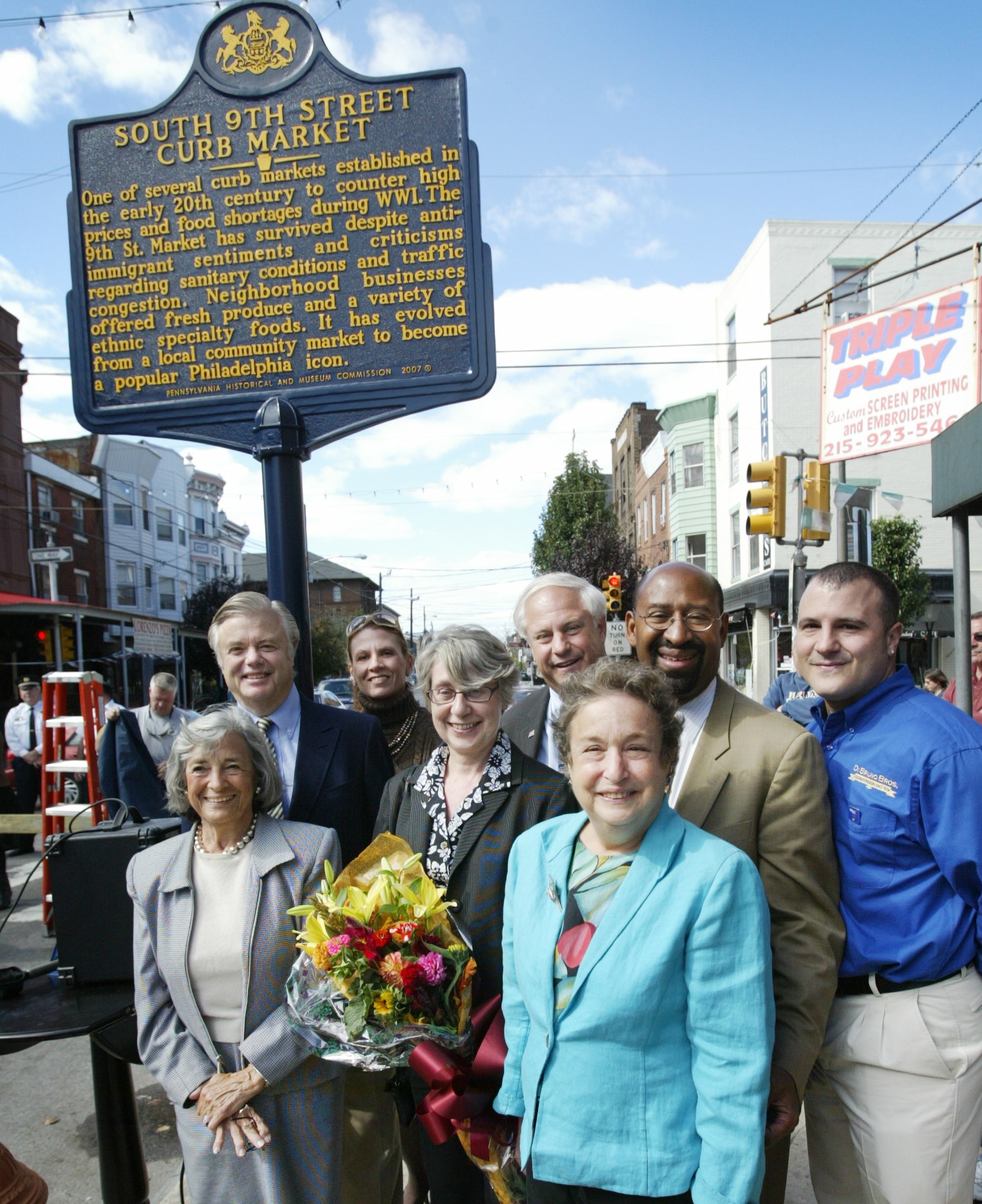
Mrs. Klein (left) appeared with others in 2007 to celebrate a historical marker at the corner of 9th and Christian Streets.Alejandro A. Alvarez / Staff Photographer
She met Lewis Klein in college, and they married in 1952. They had a son, Stephen, and a daughter, Ellen, and lived in Melrose Park and Rydal. Her husband, a pioneering TV broadcaster and cofounder of Gateway Communications, died in 2019.
Mrs. Klein and her husband traveled the world for decades and attended dozens of galas and fundraising events. She enjoyed gardening, was an avid reader, and liked to play Scrabble.
In 1993, Inquirer columnist Clark DeLeon called her “a wonderful, funny, vivacious lady.” Temple’s Boardman said: “She was truly one of the best human beings I’ve ever had the privilege to know.”
In addition to her children, Mrs. Klein is survived by a granddaughter, two great-grandchildren, and other relatives.
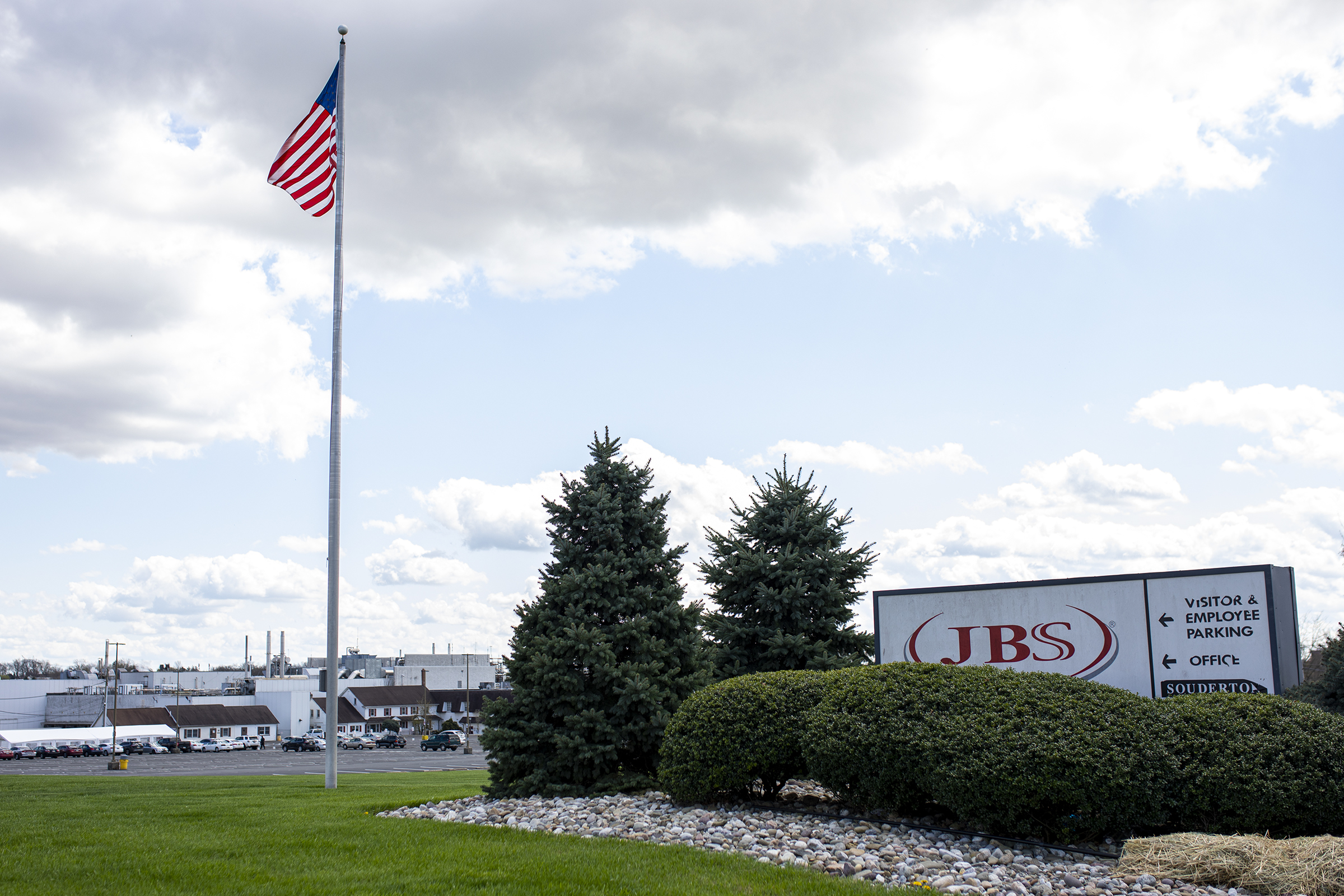
A meat processing facility in Souderton that was slated for closure this week will remain open, downsizing its staff from about 1,700 to 400.
Global meat producer JBS announced in June that it would shut down the facility as part of a larger strategy focused on “growth, modernization, and long-term competitiveness in the United States.” This week, the company said it changed plans and will keep the plant open, transitioning the site to a new use.
“This outcome allows us to preserve 400 good-paying jobs, strengthen our case-ready business, and continue serving customers in a key consumer market,” said Wesley Batista Filho, CEO of JBS USA.
The plant has been one of Montgomery County’s top 25 employers, recently employing roughly 1,700 people. The majority of them are represented by the United Food and Commercial Workers International Union (UFCW) Local 1776.
JBS plans to keep roughly 400 workers at the facility as it moves away from beef processing to become part of the business’ “value-added operation” arm. According to the company website, that side of the business is dedicated to “further-processed beef and pork products, and retail packaged meats.”
The plan includes investing over $30 million over the next 10 years to “modernize and enhance” the Souderton facility, the company said.
“This announcement provides stability for hundreds of workers and their families while creating a path for long-term success at the Souderton facility,” said Wendell Young IV, president of UFCW Local 1776.
JBS is the company behind food brands such as Pilgrim’s, and Just Bare. Most recently, the majority of the Souderton plant employees were in the fabrication department, which processes animal parts that move along a conveyor belt, according to the union.
The change in plans comes after discussions between the union, JBS, county officials, and Gov. Josh Shapiro, among other stakeholders.
“Pennsylvania’s agriculture and manufacturing industries have powered our economy for generations, and we’re making sure they continue to drive our future,” Shapiro said in a statement. “This facility will remain an important economic driver for Montgomery County.”
JBS has operated the Souderton facility since 2008, and had planned to distribute the work being done there among its other facilities.
Workers at the Souderton facility are among some 26,000 JBS employees who secured a new union contract last year with better wages and benefits including a more inclusive bereavement leave policy and the ability to accrue sick days.
The contract also established a pension plan for workers. That’s a rarity in the industry in recent decades, according to the union, which called the agreement “a new standard” in the meatpacking industry.
State Sen. Maria Collett, who represents Franconia Township,said in a social media post that the change in plans for the plant “came from the real collaboration of Governor Shapiro and his administration, the state Department of Agriculture, UFCW Local 1776, and countless Montgomery County officials.”
“No amount of job loss is something to celebrate, and harvesting operations at the plant will still wind down this week,” said Collett. “Some of our neighbors are facing a hard road.”
Cheltenham Township’s latest long-range plan, approved last month, provides a glimpse of how the township of 38,000 could look by 2040.
The Montgomery County Planning Commission, alongside officials and volunteers from the township — one of Philadelphia’s oldest suburbs — spent several years on the plan, said Carl Freedman, a Cheltenham planning volunteer.
“Communities like Cheltenham have a difficult time, being so developed, that being given an opportunity to direct where new development goes is helpful,” Freedman said.
The comprehensive plan, which exceeds 200 pages, lays out challenges and recommendations, ranging from streetlights to denser housing, for the township’s homes, businesses, transportation networks, community services, and historical assets over the next 10 to 15 years.
More business, more tax money
Many of Cheltenham’s residents still commute to Philadelphia, but more people are working from home after the pandemic, creating opportunities to welcome new restaurants and other businesses, planners wrote.
Which is sorely needed, because Cheltenham wants more tax money without a ton of new residents.
One of the challenges for the township, which has very little undeveloped land remaining, is its large proportion of institutional properties — universities, churches, and other nonprofit entities — that do not pay property tax, planners wrote: “Institutions such as non-profits or higher education have taken over many of the large estates in the township. This supports the preservation of these historic and beautiful places but at the same time has real impacts on the tax revenue of the township.”
Plans to attract business include reviewing rules for home-based enterprises, identifying opportunities to convert some of the parking spaces at large shopping centers into sites for new shops, and piloting a program to bring more food trucks to major commercial streets.
More main streets, more trees, slower traffic
The comprehensive plan identifies several neighborhood hubs with potential for more development that Cheltenham could encourage by slowing traffic with road narrowing and other measures, and adding decor to draw foot traffic into town centers.
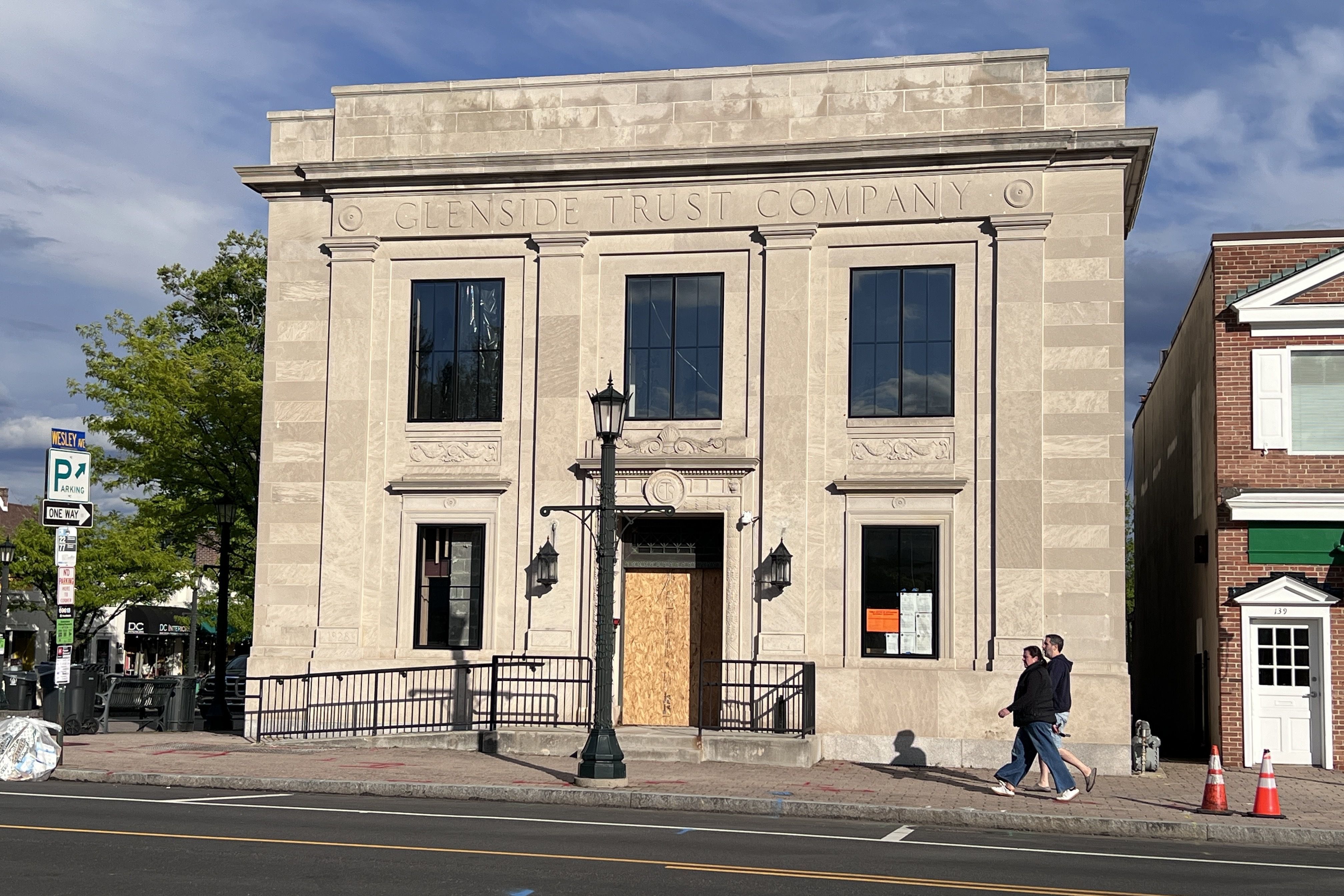
Glenside and Elkins Park East top the list for main street revitalization, according to the plan. Wider sidewalks on Glenside Avenue and decorative lighting on Wesley and East Glenside Avenues could be part of the solution, planners wrote.
Public art and infrastructure marking the entrances to the downtowns could also help to give these neighborhoods a sense of place.
Tree cover is also key, the planners wrote — both preserving existing foliage and planting new trees in hotter, exposed areas, like the parking lot at the Elkins Park Square mall.
Denser housing, more pedestrians
Cheltenham has plenty of multifamily apartments compared with other Montgomery County towns, making up about a third of residences.
But putting additional dense housing in the right locations could liven up Cheltenham’s downtowns without adding too much traffic, planners wrote, by encouraging public transit use.
Putting more apartments above existing storefronts would create taller buildings that balance out some of the township’s wider streets, encouraging pedestrian traffic and patronage of local businesses, the comprehensive plan notes.
Planners pointed to a similar approach Ardmore took in the 1990s as a model: “Through the Downtown Ardmore District’s work and an increase in multifamily residences in the vicinity of the business district, the neighborhood has experienced increased redevelopment and economic vitality without sacrificing its historic character.”
Cheltenham could build more attractive bus shelters and benches to further encourage mass transit, and add bike parking at SEPTA Regional Rail stations.
The township is also considering encouraging more accessory dwelling units, allowing residents to add in-law suites and other small homes to their existing property.
Tookany Creek in Elkins Park, PA pictured on Monday, April 11, 2022.
Fresh community spaces
Cheltenham’s municipal buildings are old: In 2022, the average age of township facilities was 117.
The township’s administrative building is located in the former home of the Breyer’s ice cream family, Freedman said — and it was built during World War I.
Cheltenham closed two of its libraries several years ago after boilers failed in both buildings, but plans to renovate only one, La Mott Free Library. The document does not mention plans to rehab the second, East Cheltenham Library.
The township also plans to continue connecting trails along Tookany Creek and making those trails bike-friendly, and to consider preserving more historic buildings, such as Glenside National Bank.
This suburban content is produced with support from the Leslie Miller and Richard Worley Foundation and The Lenfest Institute for Journalism. Editorial content is created independently of the project donors. Gifts to support The Inquirer’s high-impact journalism can be made at inquirer.com/donate. A list of Lenfest Institute donors can be found at lenfestinstitute.org/supporters.
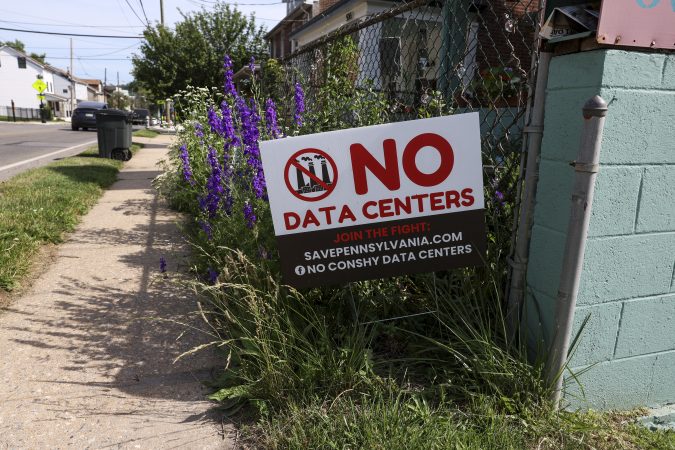
WASHINGTON — A new federal proposal to enact protections for communities opposed to the proliferation of data centers has drawn inspiration from both the Philadelphia suburbs and Western Pennsylvania fracking country.
The Data Center Bill of Rights is one of several national efforts to address a growing dissatisfaction with data centers, which have so far faced few restrictions at either the federal or state level in Pennsylvania.
U.S. Rep. Ro Khanna, a California Democrat and Bucks County native considering running for president in 2028, said his home state should be doing more.
He introduced thefederal legislation after a recent tour across Pennsylvania that he said was designed to hear from communities that have lost manufacturing jobs and other economic opportunities.
Data center concerns came up more than any other issue, he said — leading him to incorporate new ideas into the bill healready had in the works, and to call for a pause on data center development in Pennsylvania until further protections and local controls are enacted.
A statewide pause would be more than what Gov. Josh Shapiro — another potential 2028 Democratic contender — has proposed as he seeks to enact data center guidelines. It would also be less than other Democrats, both in Pennsylvania and nationally, who have called for more robust moratoriums. Shapiro’s Republican challenger this year, Treasurer Stacy Garrity, has also called for a pause but not for an extended moratorium.
“I was surprised by the anger about it in Pennsylvania,” Khanna said in an interview after his 15-county tour. “In other states, people are sometimes opposed in local communities, local pockets. But not this widespread anger.”
Khanna, a Council Rock High School graduate who has represented Silicon Valley in Congress since 2017, spoke about the Data Center Bill of Rights during his tour but said afterward that it was “partly inspired” by the concerns he heard in the communities similar to the ones where he grew up.
“As a kid, I used to go to Conshohocken and the King of Prussia Mall. I’m familiar with that area,” Khanna said. “You can’t ride roughshod over what Delaware County wants or when Montgomery County wants.”
The legislation would declare that communities have the right to reject data centers through a “transparent community process” or allow them with specific protections. That includes demanding that data centers don’t lead to higher electricity rates, that they use renewable energy sources and disclose their water consumption, and “pay their fair share of state and local taxes.”
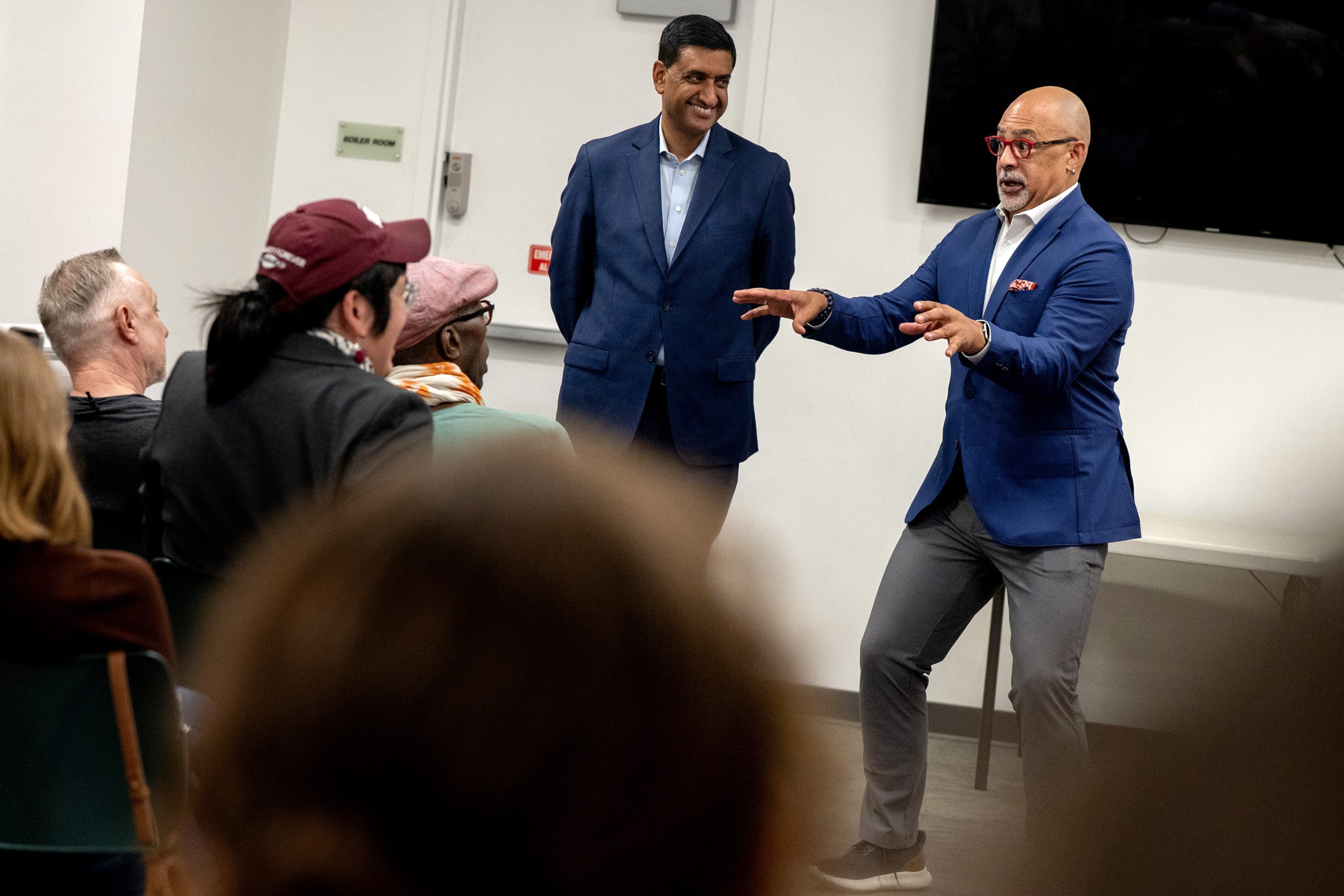
State Rep. Chris Rabb (right) joins U.S. Rep. Ro Khanna (left) Tuesday, July 28, 2026, as he stops on his “Made in PA: New Economic Patriotism Tour” at the City Institute Library on Rittenhouse Square.Tom Gralish / Staff Photographer
One specific provision, Khanna said, was informed by his visit in Washington County with individuals who are paid to host natural gas wells on their properties. It was there that he said he learned of community demands for oil and gas well sites to be at least 2,500 feet from residences. That buffer was a recommendation from a 2020 grand jury report released by Shapiro when he was serving as attorney general and that outlined health and safety issues caused by fracking in the Marcellus Shale region.
The recommendation was not followed, and advocates are continuing to push for extending the buffer from the current distance of 500 feet, according to Inside Climate News.
Khanna’s bill of rights would call for data centers to be built no closer than 2,500 feet from residences, schools, childcare facilities, hospitals or nursing homes. He said the environmental and health hazards for data centers aren’t the same as fracking but they should be kept at a distance from communities that don’t want to live directly next to them.
“At least they were offering royalty checks in the cases of fracking,” Khanna said. “[Data center developers are] not even giving the communities checks. It’s just kind of like, ‘OK, we’re going to build.’ What does the community get out of it? I literally don’t understand it.”
Data center advocates have argued their development is critical in winning an artificial intelligence war with China, and that they will bring construction and some skilled jobs to communities that need them.
Even the staunchest advocates, though, have acknowledged the public blowback.
“I do think that data centers in Pennsylvania have raised legitimate concerns,” U.S. Sen. Dave McCormick (R., Pa.) said during a recent telephone town hall as he continued to promote them in the competition with China and their creation of “thousands of jobs.”
When developers are making their pitch, McCormick said they should come with commitments to protect energy costs and overuse of water, use local labor, invest in the community and pay taxes.
“That should be part of the deal up front,” McCormick said during the telephone town hall in late July. “With all those facts, then the local community can decide whether they want the data center or not. And if they choose not to, that’s their choice.”
Khanna said he’s hoping for bipartisan support as he introduces the bill of rights idea. He’ll also be competing with other proposals — like one from fellow progressives U.S. Rep. Alexandria Ocasio-Cortez (D., N.Y.) and U.S. Sen. Bernie Sanders (I., Vt.) called the AI Data Center Moratorium Act. The bill would enact an immediate federal moratorium on data center construction until other safeguards are passed into law, including some of the ideas Khanna and McCormick have proposed, like around utility costs.
Several Pennsylvania state-level laws have been proposed, though the legislature did not address them during its busy budget season earlier this spring and summer. Lawmakers also left Harrisburg without ending tax breaks aimed at incentivizing data center construction even though the idea had garnered widespread support.
“They shouldn’t be getting these tax breaks to build,” Khanna said. “That’s absurd when you’ve got hyperscalers that are making trillions of dollars.”
The fact that many of those ultra-wealthy corporations are based in his district made the issue a politically dicey situation for him, but also one that the possible presidential hopeful said he was willing to take on.
“We’ve got to pause it in states like Pennsylvania,” Khanna said. “Some of my own constituents aren’t going to like that.”
Cheltenham Superintendent Brian Scriven resigned Thursday, a little more than a week after prosecutors charged four football coaches and six players in connection with violent assaults against a player last season in a high school locker room.
The superintendent’s resignation, effective immediately, came amid community outcry over the district’s handling of the August and September 2025 incidents, which prosecutors say both involved students attacking a 15-year-old and using a broomstick to poke at his buttocks.
Yet the district did not uncover that there had been two assaults, and administrators appeared to downplay a report from the 15-year-old’s mother, according to the Montgomery County grand jury that recommended the charges. It described a “level of incompetence” in the district that “put every young man on the football team at risk.”
Some parents who have been battling the district to take student safety more seriously said Scriven and his administration did not fail only in overseeing the football program.
“I see a complete lack of urgency,” said one mother who has been among a group of parents pressing the district since October to address violent incidents at Cheltenham Elementary School. The mother, who spoke on the condition of anonymity out of fear of retaliation for her child, said administrators still have not answered questions about how students are disciplined and how others are supported after assaults.
Another Cheltenham Elementary parent, Shanyl Jones, said her daughter, an incoming second grader, twice experienced sexual touching and comments in school. In kindergarten, a boy repeatedly touched her against her will, conduct that escalated to him grabbing her vagina, Jones said.
The boy also made sexually explicit comments to her daughter, Jones said. She reported the conduct and filed a Title IX sexual harassment case; the school moved the boy to a different classroom, she said.
After a separate boy made sexual comments to Jones’ daughter in first grade, the principal called Jones and apologized, though the boy was not moved to a different classroom, Jones said.
News of the football charges “just tore me up on what my daughter’s future would be in the school system,” Jones said. “It gave me no assurance they’re going to be able to reconcile what’s happening now.”
Scriven said in his resignation letter Thursday that “this year has tested our community in ways none of us anticipated.”
“I have come to believe that the district is best served by a fresh start under new leadership, and that stepping aside now is the right and necessary step to allow Cheltenham to move forward,” he said.
The district has not commented on how else it plans to respond to the explosive grand jury report released last week, which described the response of several employees at the high school — identified only as Employees #1, #2, and #3 — as minimizing an assault reported by the 15-year-old’s mother, and trusting the word of the head coach, Terence Tolbert, that he had not instructed the student not to tell his parents what happened.
The district did not respond to questions this week about its hiring of Tolbert — who was among the four coaches charged — including whether it had sought references from Abington, which cut ties with him after one year as its head football coach. Some parents of football players told The Inquirer they had “pleaded” with Cheltenham administrators not to hire Tolbert, whom they accused of allowing bullying during his tenure at Abington Senior High School.
Nor did the district respond to questions about whether it would take action against any employees, including those described in the grand jury report.
The Cheltenham High School vice principal whom the mother said she had reported allegations to, Mark Hoff, was named vice principal at Wyncote Elementary last month.
The grand jury report “details very troubling questions about the management and operation of the district’s athletic programs, including the football program,” school board president Leah Mulhearn said in a statement this week. “Our highest priority is the safety and welfare of the children we serve.”
Mulhearn, who did not address questions about Cheltenham Elementary in the statement, said the board was “focused on conducting a comprehensive review of the grand jury’s findings, including our policies and practices related to athletics, as the first step in implementing measures to ensure that no such conduct ever occurs again at our schools.”
The district has said a Title IX investigation into the allegations will soon be finished, with possible discipline for students. Two 18-year-old players charged as adults — the other four were charged as juveniles — have already graduated.
Community members are closely watching the school board’s next steps. Sharif El-Mekki, a nationally known Philadelphia-based educator who runs the Center for Black Educator Development and previously led Mastery Shoemaker Charter School, called on the school board in a letter to apologize to the victimized student and commission an independent investigation into the district administration’s conduct.
“Every student in Cheltenham, every teacher, every parent, and every young leader in Montgomery County is being taught something right now by how the district is responding,” El-Mekki said.
‘Environment of ongoing chaos’
Cheltenham Elementary parents said they raised concerns to administrators last October, after they heard from their children that a student touched another student’s penis sexually in class, over his clothes, in view of classmates.
Some initially did not believe it. “We would have been told about it,” said one mother, who also spoke on the condition of anonymity out of fear of retaliation against her child.
Parents began talking to one another to confirm what happened. Other parents and students told them the same child had been involved in previous sexual incidents, two mothers said.
A group of parents sent an email on Oct. 3 to ShaVon Savage, then the district’s assistant superintendent, saying they had recently learned that a student “touched another child sexually during class time” and that the child had been involved in “multiple sexual incidents over the past few years.” They asked to be notified about instances of physical or sexual assault.
In the email, shared with The Inquirer, they also asked for additional supervision and counseling for students with behavioral challenges and described an “environment of ongoing chaos” at the school, which last year served a larger number of students with emotional support needs than the district’s other three elementary schools.
Savage wrote back 10 days later, saying she needed more details “to conduct a full and thorough investigation,” according to an email shared with The Inquirer. She also said that when a situation poses a “threat to a particular school community,” the district would communicate with parents, but could not share details about particular children due to federal privacy laws.
Savage met with some parents in early November and said she would visit the school — though parents were unsure whether she did, the mothers said.
Their concerns escalated when on Dec. 5, a Friday, the school’s principal, Stephanie Junod, was assaulted by a student, according to the mothers.
That night, Scriven, the superintendent, sent an email to school parents, informing them that “while Ms. Junod was attempting to de-escalate a situation with a high-needs student, she was struck in the head by their thermos.” Scriven said the principal was “expected to make a full recovery.” Junod could not be reached for comment.
Scriven said central office staff would be at the school the following Monday “to begin implementing additional measures to strengthen safety and provide more comprehensive support for students who require additional behavioral interventions.”
Brian Scriven has resigned as superintendent of the Cheltenham School District.Courtesy of Cheltenham School District
The mothers were angry that the district had not already been providing that support. Around the same time as Junod’s injury, they said, there was an assault on a student, and “at least two” against staff members, one of the mothers said.
Parents had a meeting scheduled with Savage for Dec. 15, but administrators pushed it to January, one of the mothers said.
Scriven met with parents on Jan. 8 and apologized for not treating their concerns urgently enough, according to the mother, who said Scriven also assured parents that “the football situation had been handled.”
“Obviously, that was a lie,” she said.
Scriven met with them again on Feb. 25 and said changes would be made, including putting a behavioral specialist at the school four days a week, according to the mother.
Scriven did not mention that Junod would be resigning, the mother said — a decision announced shortly after the meeting.
‘Slow to respond’
Problems at the school continued.
On March 26, parents said, a student assaulted five staff members — including punching one in the face — in view of other children. Police came to the school.
The district did not immediately notify parents. But Scriven sent an email to the school community the next day, reporting that “an emotional support student had an episode during which he eloped from the building and engaged in physical altercations with a number of staff as they were trying to de-escalate” the situation.
“While I cannot share individual student consequences or placements, I can assure you that this situation is being addressed with the highest level of seriousness and urgency,” Scriven said in the email.
In an email the next day demanding a meeting with administrators, one parent wrote: “The frustration among parents has reached a boiling point.”
“Information is simply not being shared, and critical questions regarding the safety and education of our children are being ignored,” the parent said in the email, which one of the mothers shared with The Inquirer.
Scriven responded to the parents on April 14.
“I understand the urgency of your concerns and sincerely apologize for the delay in providing a comprehensive response,” Scriven said, in an email the mother shared with The Inquirer.
Scriven said the school’s new principal, Shareese Nelson, had needed time to settle into the job, but “we are prepared to move forward in a more formal and collaborative manner.” He invited families to the school for an April 29 community meeting.
The meeting was “highly emotional,” one of the mothers said, with parents sharing their children’s experiences. After the meeting, Scriven told a 6abc reporter: “I was slow to respond. I do have to own that, and rectify that immediately.”
Shanyl Jones recalled that administrators seemed “completely unprepared” during the meeting to address parents’ safety concerns.
In a message to the community May 6, the school board acknowledged “concerns around safety and student conduct have presented challenges that we continue to navigate.”
The board said it took “all concerns that are raised with us as a board” seriously and was paying attention to how they were addressed.
It also stood by Scriven, a former Baltimore County Public Schools administrator who was named Cheltenham’s superintendent in 2021.
“Five years ago, the board invested in Dr. Scriven and his vision for the district,” the board said, calling the superintendent a “strong strategic thinker.”
“We continue to support him and his vision,” it said.
On Thursday, Mulhearn said in a statement that the board thanked Scriven “for his dedicated service to Cheltenham public schools.” She said the board had selected Joshua Sweigard, Cheltenham’s director of business services, as acting superintendent.
While the district in May released an action plan for Cheltenham Elementary, including a safety audit, staff training, and monthly reports on school incidents, the mothers said it still has not clearly explained how it handles student assaults, and how kids who are victimized or witness them are supported.
Until it does, “beginning from kindergarten up, we are not going to see this change in any meaningful way,” one of the mothers said. “This is not a one-off event.”
For more than a year, Giuseppe Tosco tried to get Dave Portnoy’s attention with a giant roadside sign outside his Montgomery County pizzeria that read, “We Want Dave Portnoy.”
Two months ago, Tosco finally took it down to replace it with a sign advertising the new patio at Italian Delite in Trappe.
On Tuesday, Portnoy walked in anyway. “The first thing he asked was, ‘Where’s the sign?’” Tosco said. “I told him we’d taken it down. He said, ‘Oh my God, it’s been that long?’”
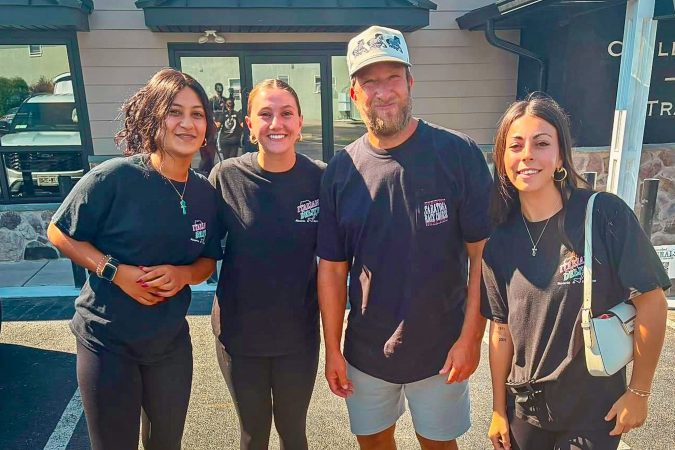
The surprise visit was one of at least five stops Portnoy made across Philadelphia and its suburbs Tuesday as the Barstool Sports founder filmed new installments of his influential “One Bite Pizza Reviews,” whose scores can transform the fortunes of a neighborhood pizzeria.
In each review, Portnoy samples a plain cheese slice — often taking much more than one bite — and assigns it a score on a 10-point scale. His ratings have become one of the pizza world’s most sought-after endorsements, often drawing long lines and national attention for top-scoring shops.
Three of Tuesday’s scores became known almost immediately, as onlookers shared them. Johnny’s received an 8.3, Liguria an 8.2, and Marina’s a 7.9. The owners of Pizza Di Vita and Italian Delite said they never heard their scores before Portnoy moved on; they are waiting for the videos to be released.
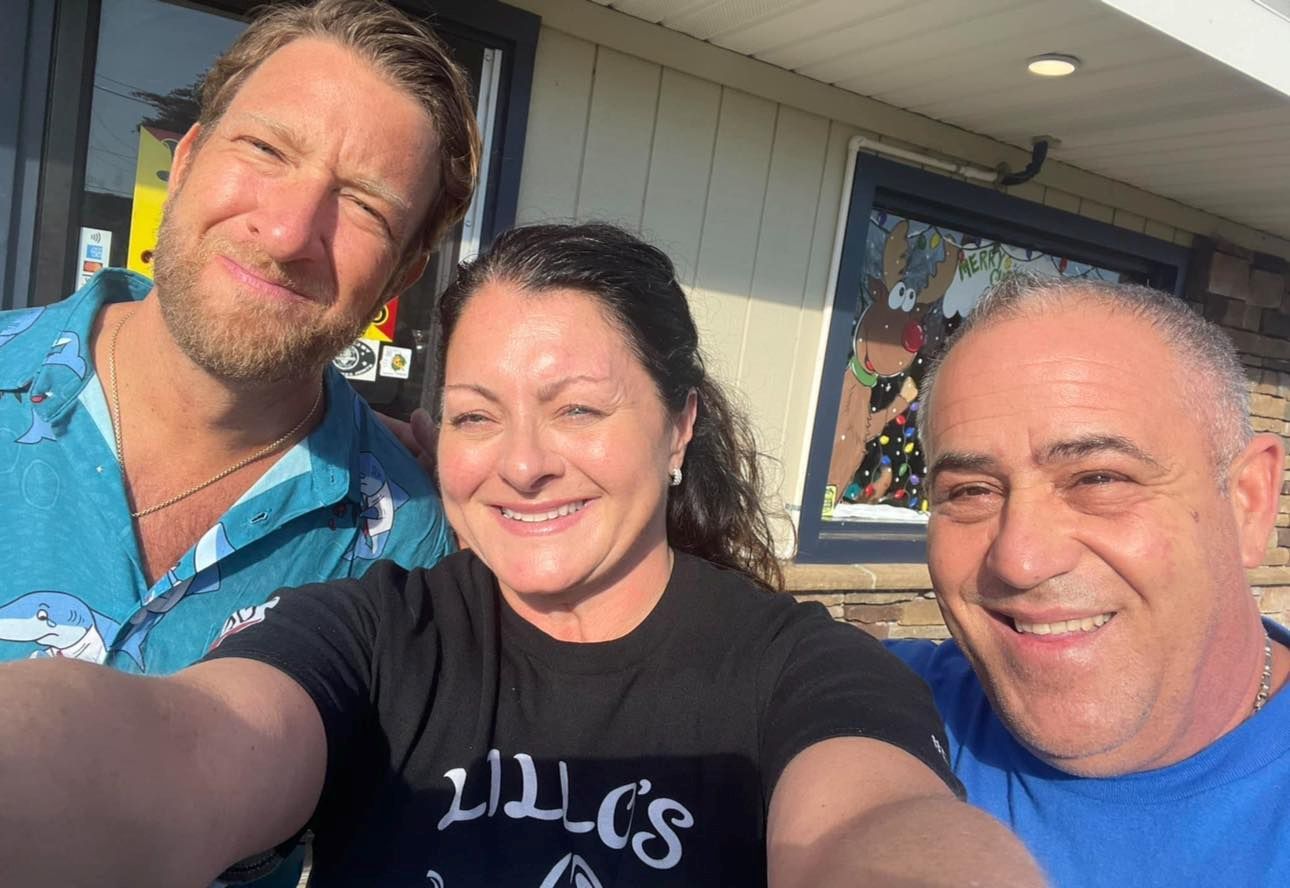
Lisa and John Paxia of Lillo’s Tomato Pies in Hainesport with Barstool Sports’ Dave Portnoy (left) in November 2022.Courtesy of Lillo Paxia
If Tosco spent more than a year trying to lure Portnoy to the Collegeville suburbs, John Bisceglie initially refused to believe the reviewer was coming to Johnny’s Pizzeria (which has a spot on The Inquirer’s 76 list).
“Somebody texted me, ‘Dave’s in Philly. Heads up,’” Bisceglie said. “I just laughed it off. I’ve heard that before.”
Still, he was working at his shop in Wayne when he sent a photo of Portnoy to his employees at Johnny’s Bryn Mawr, just in case.
Then, manager Jaison Velásquez called.
“He said, ‘I just got an order for Barstool,’” Bisceglie recalled. “I said, ‘Oh my God. It’s happening.’”
Bisceglie stayed on the phone coaching his staff. “I told them, ‘Wait about 10 minutes so the pizza comes right out of the oven. Make it crispy. Well done.’”
He credited Velásquez and manager Dan Bisceglie, his cousin, with staying calm. “He kept telling me, ‘I got this. Relax. I got this,’” Bisceglie said of Velásquez.
When Portnoy awarded the pie an 8.3 on camera, Bisceglie knew it was significant.
“Those pizza guys don’t hand out scores like that very often,” he said. “An 8.3 is a big deal.”
For Tosco, at Italian Delite in Trappe, the visit was memorable before the review even began.
Tosco said he had tagged Portnoy incessantly on social media. “I told him, ‘If you came, you came. If you didn’t, you didn’t. I just didn’t want to keep bothering you,’” Tosco said.
The day became even stranger when Portnoy reviewed the wrong pizza.
Tosco had been away at a catering meeting when his cousin called to say Portnoy had arrived after placing an order under the name “Austin.” By coincidence, the restaurant’s social media team was filming, and Tosco’s cousin had made workers prepare a practice pizza for the camera. That pie came out of the oven before Portnoy’s order.
“My cousin said, ‘That’s not your pie,’” Tosco recalled. “Dave said, ‘I don’t care. I want that one.’”
As Tosco pulled into the parking lot, Portnoy was already recording the review.
Afterward, Tosco asked Portnoy to hang for five minutes. “I told him, ‘I just want to make you a Philly cheesesteak,’” Tosco said. “He said, ‘You seem like a good dude. I’ll come back in for you.’”
Tosco still doesn’t know what score Portnoy awarded his pizza. “I ended up getting a cheesesteak review, too, which was really cool,” Tosco said.