A ninth person has died in Pennsylvania’s ongoing measles outbreak, with more than 1,600 cases reported in the nation’s largest outbreak in decades, state health officials said Monday.
The unvaccinated Centre County resident had tested positive for measles, the Pennsylvania Department of Health said in a news release. Citing state privacy laws, officials did not release additional information about the death.
The announcement came less than a week after the state had announced another death in neighboring Clinton County. Until this summer, Pennsylvania had not seen a death involving measles in 35 years.
All nine of the state-confirmeddeaths occurred in people who were not vaccinated or too young to be vaccinated, according to state health officials.
The state defines a “measles-associated death” as one that occurs within 30 days of a person developing measles symptoms, with clinical evidence of an infection and a positive lab test for the virus, that is not caused by another unrelated incident, like a car crash.
Centre County,the Central Pennsylvania home to State College and the main campus of Pennsylvania State University,has reported 50 measles cases.
Lancaster County remained the epicenter of the outbreak with 558 reported cases as of Monday, state data showed.
In suburban Philadelphia, Chester County has reported 101 cases, the state’s fourth-highest total this year. Montgomery County reported three cases last winter, in a separate, smaller outbreak. Bucks County reported one case earlier this month.
Pennsylvania has identified 1,638 measles cases so far this year, with 80 new cases tracked in the last week.Pennsylvania’s measles cases have spread across 46 counties, or more than two-thirdsof the state’s 67 counties.
About one in five people sickened have required hospitalization.
(function(){function e(){window.addEventListener(`message`,function(e){if(e.data[`datawrapper-height`]!==void 0){var t=document.querySelectorAll(`iframe`);for(var n in e.data[`datawrapper-height`])for(var r=0,i;i=t[r];r++)if(i.contentWindow===e.source){var a=e.data[`datawrapper-height`][n]+`px`;i.style.height=a}}})}e()})();
The Centre County Coroner’s Office referred questions about the latest measles-related deathto the county’s prothonotary office, which handles civil court records, including death records. A spokesperson for the prothonotary office could not immediately be reached for comment.
According to local coroners and news reports, the state’s deaths have included two infants from Amish families in Lancaster County, as well as a 20-year-old Lancaster County woman who had received treatment for cancer.
Additionally, an 18-year-old in Mifflin County died from a serious neurological complication of measles, and a 40-year-old woman with severe respiratory conditions was one of two deaths reported in Jefferson County. Another death reported earlier this month involved a Montour County resident.
The state health department said it has concluded its investigation into a measles-associated death reported by Franklin County’s coroner and deemed the case did not meet the state’s criteria to be considered a measles-associated death.
Outside of Pennsylvania, there have been four measles-associated deaths — all children — reported by states: one in New York, two in Wisconsin, and one in Virginia.
Nationally, the Centers for Disease Control and Prevention has confirmed 5,838 measles cases in 47 states and jurisdictions.
Last week, the Pan American Health Organization, a regional office of the World Health Organization, stripped the United States of its measles-elimination status.
Losing the largely symbolic designation indicates that measles — a highly contagious, vaccine-preventable disease — is once again circulating continuously in the U.S.
“We all find ourselves in complete shock and sadness that we’re here,” Pennsylvania’s Health Secretary Debra Bogen said Thursday at a webinar hosted by the Association of State and Territorial Health Officials (ASTHO), a national nonprofit made up of public health agencies across the U.S.
Staff writer Aubrey Whelan contributed to this article.
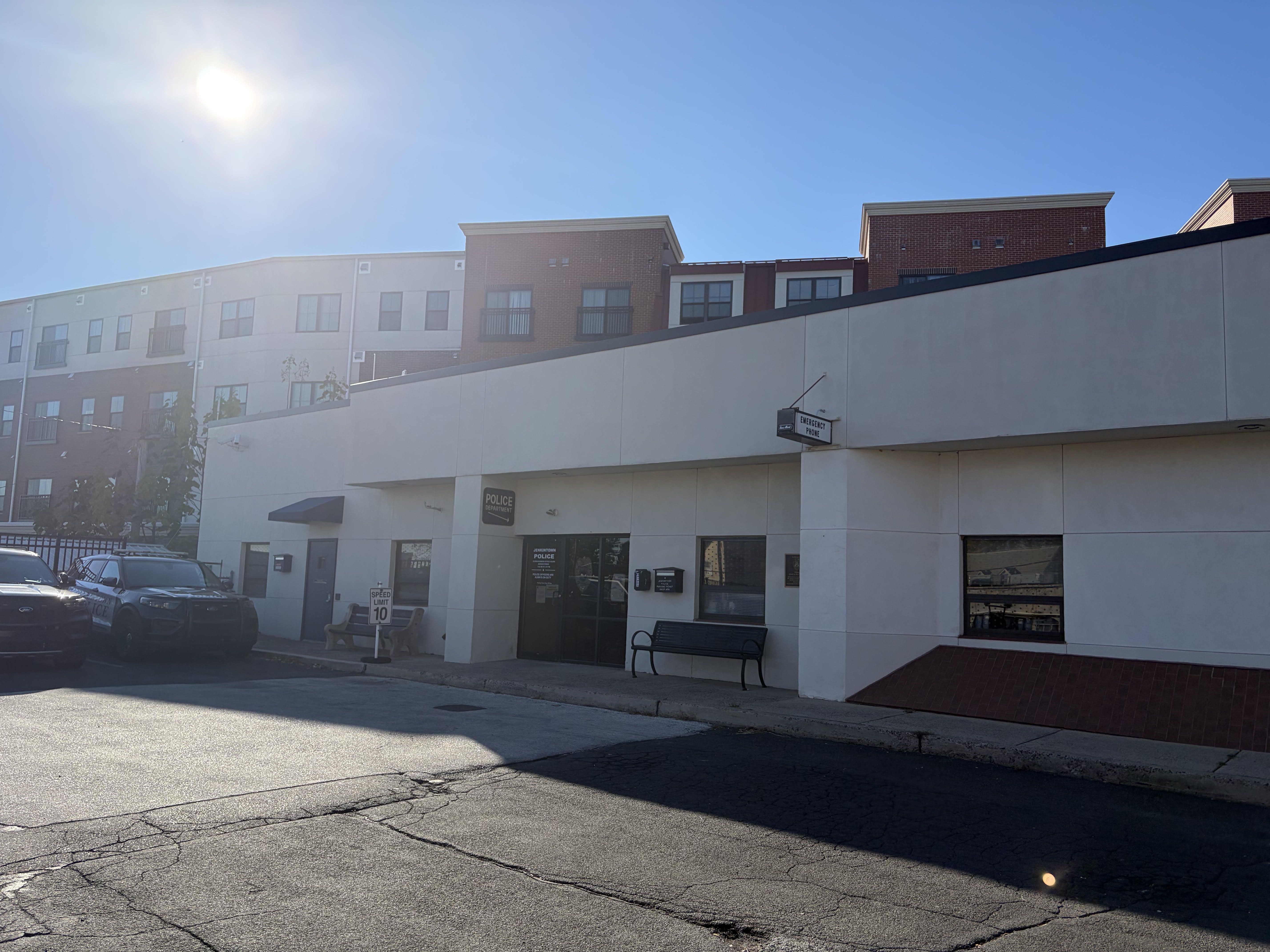
Just two years after the borough nearly closed its police department over rising costs and budgetary disarray, Jenkintown is set to hit a 13-year low on police spending for 2026.
As of mid-November, the 4,700-person borough’s projected spend on the police department is about $1.36 million for 2026, manager George Locke said — about $180,000 less than had been budgeted for the year. The figure isdown more than 25% from 2023, and it’s the lowest since 2013, when the town spent $1.25 million on police.
“The borough has struggled financially for many years,” police Chief Thomas Scott said. “We’re on the right track.”
The savings are largely due to personnel cuts, after two reports suggested that Jenkintown’s police department was too big. In the past year, two officers left the department, and another was furloughed, Scott said.
In 2024, a state cost-benefit analysis led by two retired police chiefs found Jenkintown’s force may be too big for its needs, and that the borough was spending more on police per resident than the Greater Philadelphia average for similarly sized towns. That report followed a 2020 assessment by an independent police consultant recommending that Jenkintown consider reducing its force and improve its police budget practices.
Jenkintown aims to keep its force at eight officers, Locke said, and therefore expects a slimmer budget for years to come.
The department is currently at seven officers, with one opening, Scott said.
The borough is also working to implement the dozens of other recommendations the reports made, including sending officers to more frequent trainings beyond the minimum requirements.
“Close to 200 policies have been revamped,” said Scott, who credited his officers for their openness to change.
“We’ve made great progress,” said Mayor Gabe Lerman, who oversees the department. “There are always going to be things to improve upon in an environment where continuous improvement is crucial.”
Next steps include pursuing accreditation, Scott said, which the department stopped applying for under his tenure.That decision was partly due to a lapse in standards and training that had built up over years and needed to be corrected before seeking accreditation again, he said.
The state report had come amid controversy in the department. Jenkintown appointedScott,the current chief, in 2022, and discussions about dismantling the police department and contracting services from a nearby municipality like Abington or Cheltenham reached a fever pitch less than two years into his tenure.
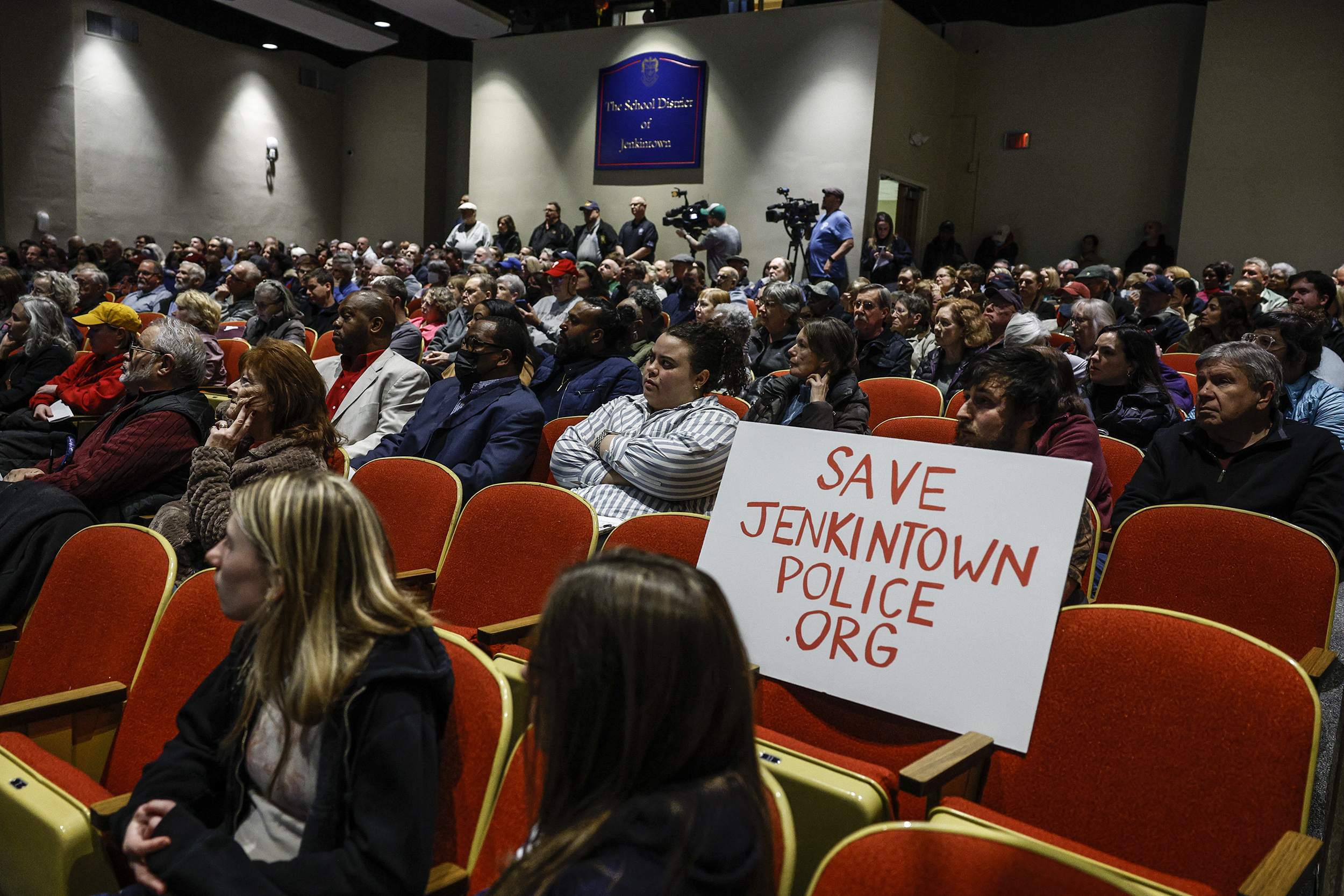
Residents pack the high school auditorium during a public meeting for community members to voice their thoughts on whether the Jenkintown Borough should disband its police department. Monday, February 26, 2024.Steven M. Falk / Staff Photographer
In September 2024, the police union claimed their members had voted no confidence in Scott over alleged misconduct.
The employment law firm that the borough hired to investigate the situation concluded that the misconduct claims were unfounded and stemmed from disagreement with Scott’s leadership decisions and opposition to the potential closure of the department. The firm also found that a formal vote of no confidence was not taken.
The current police union contract expires at the end of next year, but Jenkintown hopes to start negotiations at the beginning of 2027 and has already met with officers to prepare for bargaining.
A draft budget for 2027 would raise the police allocation by about $36,000 to $1,576,613.
Borough council is set to vote on the draft budget at the Nov. 23 meeting, which would then be made available for public viewing before it is finalized at a December meeting.
There are no longer plans to dismantle the department, Lerman said.
But it wasn’t easy to reach this point, Scott said: “You have to have hard conversations.”
This suburban content is produced with support from the Leslie Miller and Richard Worley Foundation and The Lenfest Institute for Journalism. Editorial content is created independently of the project donors. Gifts to support The Inquirer’s high-impact journalism can be made at inquirer.com/donate. A list of Lenfest Institute donors can be found at lenfestinstitute.org/supporters.
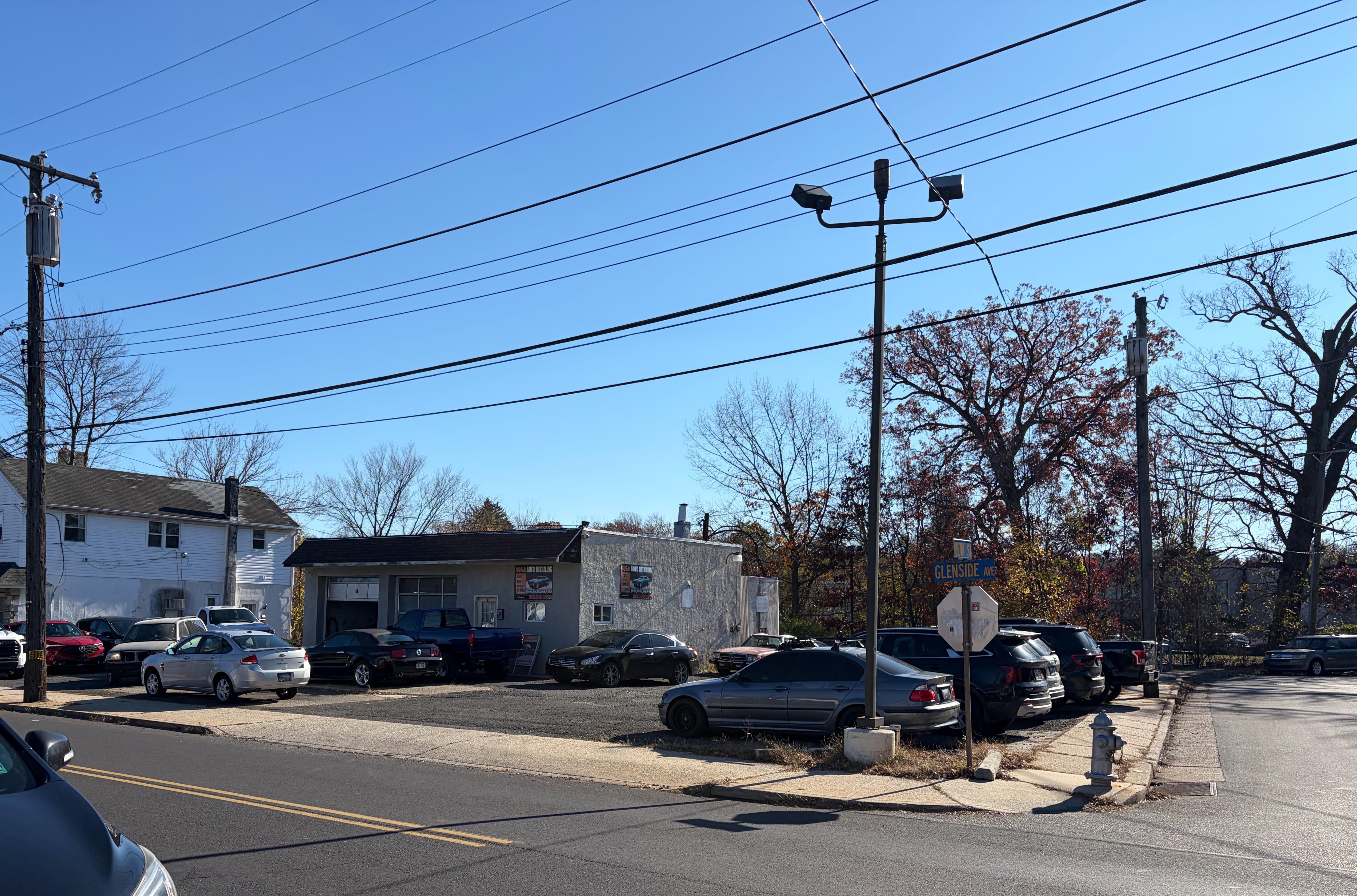
A developer wants to raze twin homes and two other buildings to build 20 apartments atop a retail space as part of a larger plan to build up Glenside Avenue.
The proposal, known as Glenside Crossing South, would combine four parcels between Stitch Central and the New Street intersection, about a quarter mile from the Glenside SEPTA Regional Rail stop, according to a proposal submitted to Montgomery County on Oct. 8.
A twin, a single-family home with a closed storefront on the bottom, and an auto body shop would be demolished to build a three-story structure with about 6,000 square feet of ground-floor commercial space, plus parking.
The twin and the apartment above the closed storefront are currently occupied, said Brian Regli, the developer and the CEO of Revere Suburban Realty.
Regli’s firm already owns all four parcels through two different entities, according to business and property records.
The project’s proximity to the Regional Rail station aligns with long-term goals for Cheltenham Township to build denser housing near mass transit.
Regli said he began getting rezoning approval from Cheltenham in 2022 to build denser structures on the four parcels and to replace the strip of offices his company owns across the street.
The county completed a review earlier this month. Cheltenham’s planning commission will consider the project at its Nov. 23 meeting, township spokesperson Lauren Walter said. It would then go to the building and zoning committee for review in December.
If the 20-unit plan is approved, Regli said, he expects to finish construction as early as 2028.
In place of the office spaces, which currently host two doctors, two elected officials, and other businesses, Regli hopes to build 60 apartments, in addition to about 20,000 square feet of commercial space, though he hasn’t submitted that proposal yet.
Regli, who lives in the same Cheltenham home he grew up in, said he’s excited to help bring denser development to the township’s transit corridors.
“Cheltenham is finally saying ‘yes’ to something,” Regli said. “I’m glad to be a part of it.”
This suburban content is produced with support from the Leslie Miller and Richard Worley Foundation and The Lenfest Institute for Journalism. Editorial content is created independently of the project donors. Gifts to support The Inquirer’s high-impact journalism can be made at inquirer.com/donate. A list of Lenfest Institute donors can be found at lenfestinstitute.org/supporters.
HARRISBURG — State lawmakers are readying themselves for a new beginning next year in Pennsylvania’s Capitol, where Democrats are set to control the state House, Senate, and governorship for the first time since 1993.
The first order of business: choosing who will be in charge.
Gov. Josh Shapiro and top Democrats have pledged to be more productive by passing more laws now that they do not have to compromise with Republicans to do so. During his first term, Shapiro often blamed the state’s split legislature — and the GOP-controlled state Senate — as the reason why so many top Democratic priorities were never passed. He is relying on the new Democratic trifecta to pass his agenda, in part, as a way to round out his resume before an expected 2028 presidential run.
Top Democrats from the state House and Senate are working with Shapiro to outline their priorities for the first 100 days of their trifecta. Shapiro promised that plan will include doubling the state’s minimum wage, securing a long-term funding source for mass transit, and more. The new legislative session begins on Jan. 5, 2027.
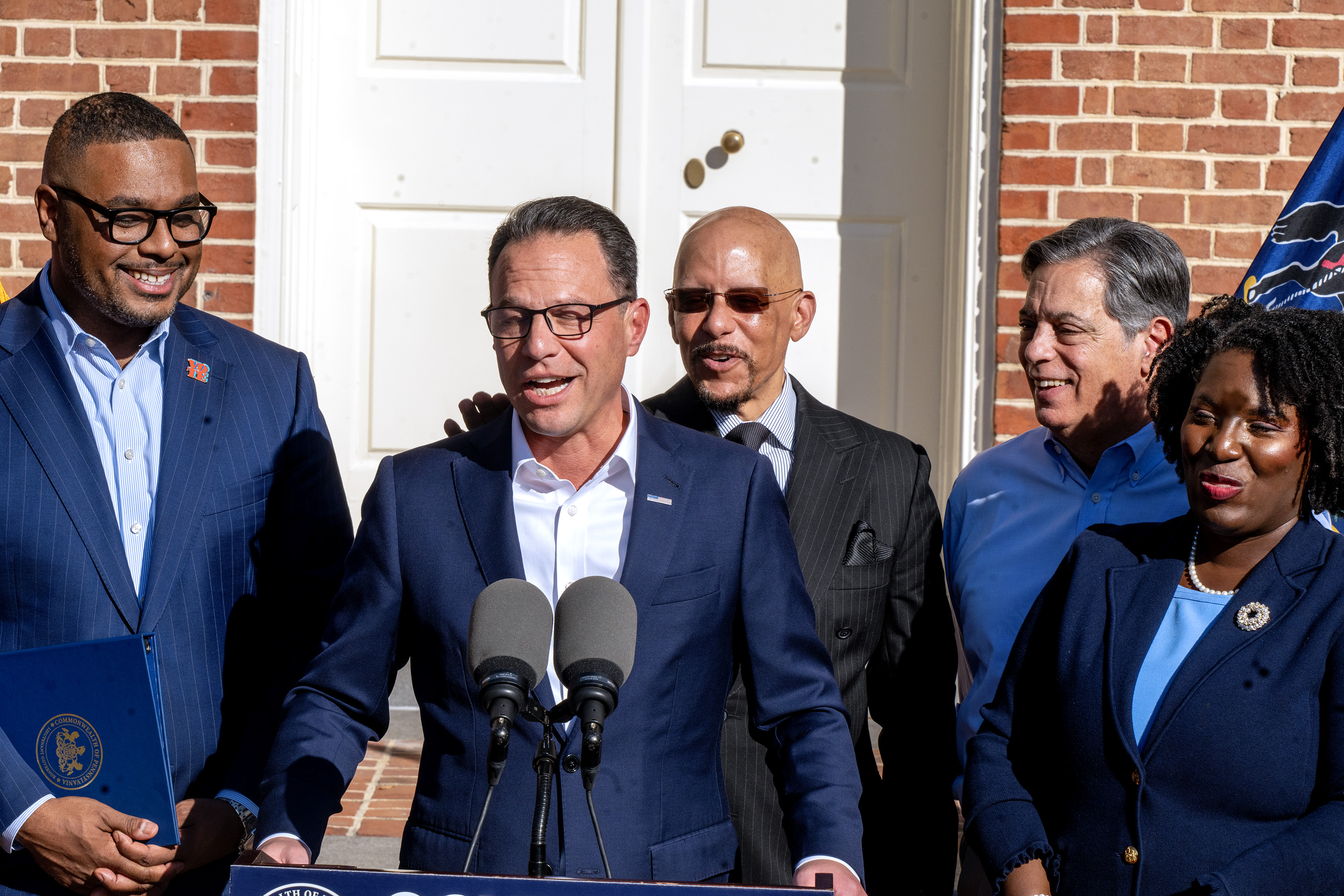
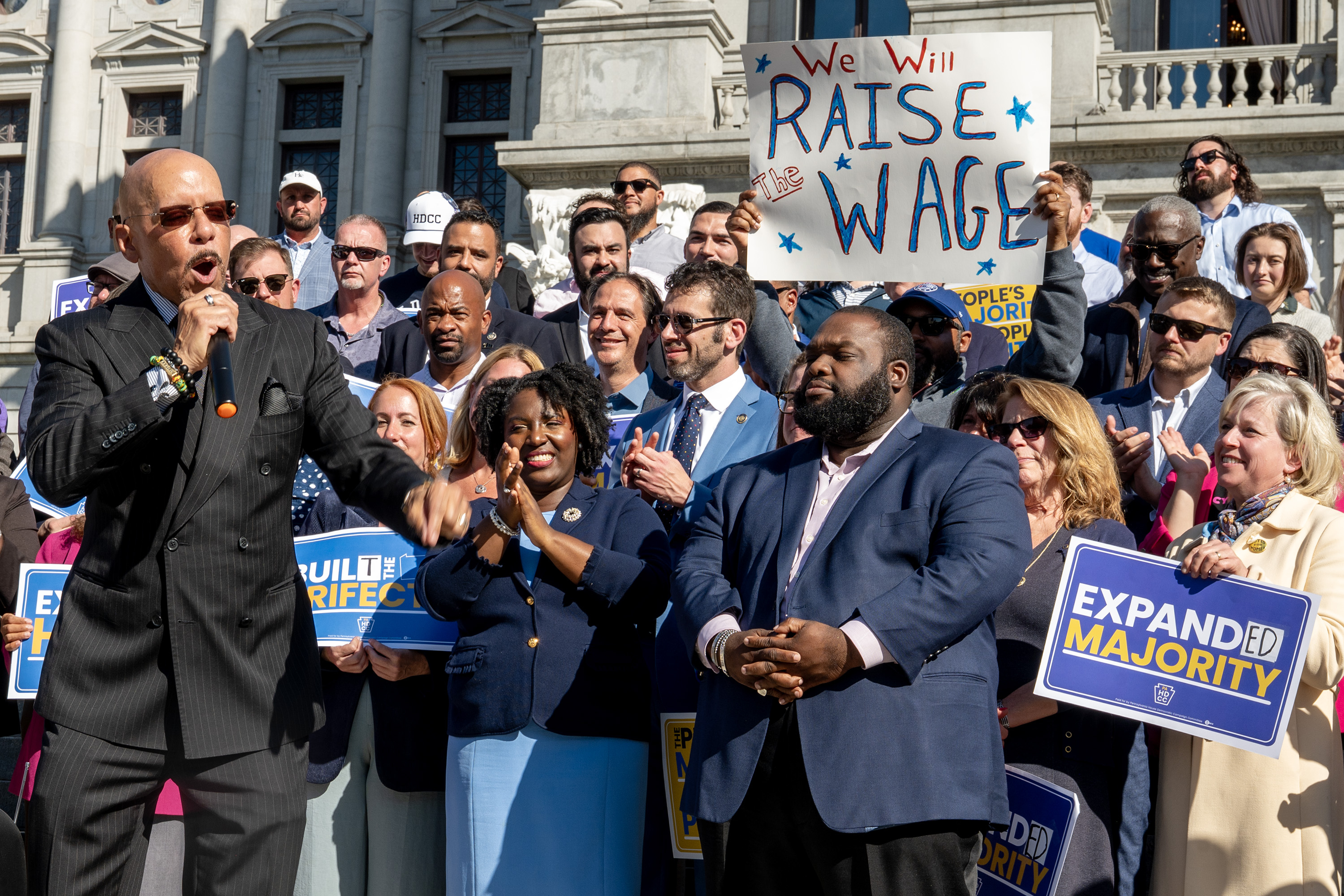
Gov. Josh Shapiro hosts a post election press conference with Lt. Gov. Austin Davis (left) and Democratic leaders at the Governor’s residence Wednesday, Nov. 4, 2026, including (from left) State Sen. Vincent Hughes, Senate Democratic Leader Jay Costa and House Speaker Joanna McClinton. It has been three decades since the caucus has had a trifecta.Tom Gralish / Staff Photographer
Despite Democrats consolidating power for the first time in decades and a lengthy list of long-stalled priorities to pass, it will not all be smooth sailing in Harrisburg. Senate Democrats, with a two-seat majority, will need to learn how to govern in the majority for the first time in decades while navigating a politically diverse caucus. Meanwhile, the outgoing top Senate Republican, President Pro Tempore Kim Ward (R., Westmoreland) — an outspoken critic of Shapiro — chose not to stay in leadership and has positioned herself to be a thorn in the side of Democrats as they move into power.
Each caucus chamber — Senate Democrats, Senate Republicans, House Democrats, and House Republicans — this month elected leaders for the next two-year legislative session. These administrative jobs play critical roles in the function of Pennsylvania’s General Assembly, which is the largest and most expensivefull-time legislature in the country, with 203 members in the House and 50 members in the Senate.
Who will lead Harrisburg?
The most powerful roles in the state legislature belong to each chamber’s highest-ranking officials: the Senate president pro tempore and House speaker. As the top leaders of their chambers, they can have as much control over the legislative agenda as they want. Some leaders, like former House Speaker Mike Turzai or former Senate President Pro Tempore Joe Scarnati, tightened their grip on everything that happened in the chamber and pushed their personal priorities, while others, like former House Speaker Bryan Cutler or current Speaker Joanna McClinton, focused on running the floor and the many administrative roles that come with the job.
Come January, longtime Minority Leader Jay Costa (D., Allegheny) will take the helm as the Senate president pro tempore.
The majority leader also holds a powerful position in the General Assembly, controlling which bills get a vote, working closely with their caucus whip to ensure they have the support they need to pass a bill, and negotiating an annual budget deal with the governor in closed-door meetings.
Senate Democrats chose Sen. Maria Collett, who this month was elected to her third term representing parts of eastern Montgomery County, to assume the majority leader role. She will replace Sen. Joe Pittman (R., Indiana), now the minority leader, as the new floor leader in the Senate. House Democrats also reelected Rep. Matt Bradford of Montgomery County as their floor leader, a role he has held since 2023.
Gov. Josh Shapiro talks with state Reps. Maria Collett (left, D-Montgomery) and Liz Hanbidge, (center, D-Montgomery) at a Johnson & Johnson event in Ambler Feb. 18, 2026.Tom Gralish / Staff Photographer
The appropriations committees in both the House and the Senate are influential panels that review every bill to determine whether a policy change will cost the state or its taxpayers any additional money. Chair of the appropriations committee is a coveted position responsible for allocating more than $50 billion in state revenues.Sen. Vincent Hughes (D., Philadelphia), who was formerly the minority chair, was elected as Senate appropriations chair.
Other leadership positions include: caucus whip, who is responsible for corralling votes; caucus chair, who leads the closed-door caucus meetings; policy committee chair, who is focused on developing the policy agenda for the caucus; caucus secretary, who has special recording duties for legislative action; and caucus administrator, who assigns parking spots and performs other operational duties.
Committee chairs, who will be chosen by leaders in early January, also play an influential role in what legislation gets considered. There are also a number of different caucuses that members can join, including those based on a member’s geographic or identity-based interests, which focus on how policies affect specific communities and regions.
Here is a look at who will lead each caucus in the 2027-28 legislative session.
Senate Democrats
The most anticipated choice among the new legislative leadership: Who will lead the state Senate as Democrats take control of the chamber for the first time in more than 30 years with a narrow 26-24 partisan split?The split will require Democrats to enforce party discipline and find consensus among its members from vastly different parts of the political spectrum — and, in some cases, may require them to compromise with Republicans.
Senate Democrats chose the following top leaders:
Jay Costa (D., Allegheny), a Pittsburgh native who has served as Senate minority leader since 2010, will be named Senate president pro tempore. (Costa’s position will not become official until the start of the new legislative session, when the full Senate casts a vote.)
Maria Collett (D., Montgomery), of Lower Gwynedd Township, will be the Democrats’ majority leader. She is a nurse-turned-legislator and attorney who was first elected to the state Senate in 2018.
Vincent Hughes (D., Philadelphia) will be the majority appropriations chair, after serving as its minority chair since 2010. He has been in the state Senate since 1994, with seven years in the House before that.
Senate Republicans
Senate Republicans will have to learn how to be in the minority and successfully negotiate with Democrats, after decades in control.
Senate Republicans on Tuesday chose these leaders:
Joe Pittman (R., Indiana) will be the Republican floor leader, after previously leading the chamber as its majority leader.
Scott Martin (R., Lancaster) will be the minority appropriations chair; he had led the committee since 2023.
President Pro Tempore Kim Ward gavels the opening as the Pennsylvania Senate hosts a ceremonial meeting at the National Constitution Center Tuesday, May 5, 2026.Tom Gralish / Staff Photographer
But there’s one name notably not on the GOP leadership list. Ward, the outgoing top Republican firebrandwho is known to frequently challenge Shapiro, said shesees herself as much freer to speak her mind by not operating on behalf of the chamber.
“It’s me, Kim Ward, unplugged,” she said in a brief interview Tuesday.
Ward will serve as the interim Senate president pro tempore until Costa is officially elected at the start of the year. She was sworn into the position on Tuesday.
“I’m rooting for you, because I care about our state,” she told Democrats in a brief speech following the oath of office.
House Democrats
With an expected 114-89 majority, House Democrats will no longer struggle for votes with a one-seat majority, as they did for the last four years.Since Democrats flipped the state House in 2022, they have sent hundreds of bills to the GOP-controlled Senate that never received a vote.
Now with fortified ranks, House Democrats are looking to promptly send legislation to a Democratic-controlled Senate that will pass it.
House Democrats reelected their same top leaders for the 2027-28 legislative session:
Joanna McClinton (D., Philadelphia), who was first elected to the job in 2023, will again be House speaker. She is the first Black woman and second Black person to lead the chamber in state history.
Matt Bradford (D., Montgomery) will also return as House majority leader. He has served in the state House since 2008.
Jordan Harris (D., Philadelphia) will again chair the House Appropriations Committee, which he has led since 2023.
House Republicans
Jesse Topper (R., Bedford) will return as House minority leader, a position he has held since 2025.
Jamie Barton (R., Schuylkill) will be the minority chair of the appropriations committee, replacing Rep. Jim Struzzi.
Challenges ahead
Both Democratic and Republican leaders in the Senate are poised to face a number of challenges over the next two years. And the most immediate one for Senate Democrats — soon to be in power — is finding a way to govern.
No current member of the Senate from either party was in office in 1993, when Democrats last held a trifecta. Senate Democrats have to quickly master the process, including whipping votes and finding consensus they have never had to do before. The 26-24 split leaves no room for Democrats to lose support from any member of their caucus — one with some deep ideological divides between progressive and moderate members.
Some of the divides between members are limited to specific issues, such as school choice, where at least one Philadelphia Democrat supports its expansion. Others are ideological, including at least one member who was endorsed by the Democratic Socialists of America. And other differences come from incompatible personalities who just do not see eye-to-eye.
Top Senate Democrats like Hughes and Collett said in interviews this month that although individual members may differ on specific issues, the caucus shares a core belief of “people first.”
“For decades, the Pennsylvania Senate has not been putting good energy toward making people’s lives better,” Collett said in an interview Tuesday. “For our purposes, we have been looking at this as our opportunity to deliver for people.”
State Sen. Vincent Hughes (left) on the steps of the State Capitol in Harrisburg Wednesday, Nov. 4, 2026, joining Democratic Senate and House members and staffers and newly elected members gathering in a post-election celebration. At right are House Speaker Joanna McClinton and State Rep. Jordan Harris. It has been three decades since the caucus has had a trifecta.Tom Gralish / Staff Photographer
Hughes, just minutes after the Associated Press called the state Senate control for Democrats earlier this month, said his caucus is representative of the differences across Pennsylvania.
“They’re ready to roll up their sleeves to get some work done, responding to the needs of the people of Pennsylvania,” Hughes added.
In the case of a tie, Lt. Gov. Austin Davis has some tiebreaking powers but cannot be the deciding vote on a bill’s final passage.
Senate Republicans, meanwhile, will have to learn how to be effective in the minority, including how to challenge Democratic policies while also persuading top Democrats to consider their proposals.
Collett said she hopes her Republican colleagues know that “now is their opportunity to collaborate with us to make sure that the people in their communities are benefiting from the initiatives that we’re putting forward, just as much as the people from our communities.”
“This is not a partisan issue,” she added. “This is about Pennsylvanians.”
The entire General Assembly will have to face the state’s tough financial straits, with Pennsylvania’s government on a path to spend $6.6 billion more than it brings in next fiscal year, according to an Independent Fiscal Office report released Tuesday.
Shapiro is likely to propose spending down the state’s Rainy Day Fund, which Senate Republicans have painstakingly protected over the last few years. The potential 2028 presidential candidate is also likely to pitch a number of new revenue generators, rather than broad-based tax increases.
Pew Charitable Trusts has cautioned against state legislatures using their emergency reserves to help balance the budget.
The U.S. Department of Education is investigating the Colonial School District in Montgomery County over policies allowing students to use different gender pronouns or names in school without the knowledge of parents, federal officials announced Wednesday.
The Colonial district, which serves approximately 5,7100 students across seven schools, was one of five named by the Education Department as part of a nationwide probe into policies the department said “appear to conceal information from parents about a child’s ‘gender identity’ and actively facilitate ‘gender transitions’ behind parents’ backs.”
Reached Wednesday, a Colonial spokesperson said the district had just received notice of the investigation and did not comment on legal matters.
“The policy referenced in this investigation has been in place since 2019 and is aligned to our mission to help students learn, grow, and contribute to a supportive school community that is welcoming for all,” said Jessica Lester, the spokesperson.
Federal officials pointed to the Colonial district’s “Gender Expansive and Transgender Students” policy, which says that the choice “to assert the rights of the transgender and gender expansive student belongs to the student and does not require additional parental/guardian consent.” Students are to be privately asked what names and pronouns they want school employees to use when contacting their home, the policy says.
The DOE also cited a “Gender Support Plan” that includes sections about preferred name and pronouns, and plans for protecting student privacy. The form, according to the department, includes a section to indicate whether or not a student’s parents are aware and supportive of the transition, and what considerations to take if they are not.
“The practice of schools withholding the most sensitive information about students from their own parents is unacceptable,” Frank Miller, director of the department’s Student Privacy Policy Office, said in a statement. He said the office “will hold every educational institution accountable to ensure it upholds parental rights.”
A conservative Christian legal group last month asked the Education Department to investigate the Pennsbury School District in Bucks County for allegedly concealing a student’s use of a different name and pronouns from the student’s parents.
Lawyers for the district stood by its policy in that case, and said there was no evidence the Quakertown student had lost opportunities by competing against the Colonial student.
In announcing the Colonial investigation Wednesday, the Education Department cited federal privacy laws, including the Family Educational Rights and Privacy Act, which it said “gives parents the right to access their children’s education records, the right to request record corrections or amendments, and the right to control (with important exceptions) the disclosure of personally identifiable information in education records.”
Advocates for transgender students have said there is no law requiring schools to notify parents if a student identifies as transgender to a staff member.
When Destino Jean Louis told Keyshaad Cook that his ex-girlfriend had ruined his life, Cook lent a sympathetic ear, Montgomery County prosecutors said Wednesday.
And when Jean Louis, 23, of West Oak Lane, told Cook, whom he once worked with at the Walmart store in Cheltenham, that he planned on killing Latosha Cooper, Cook did nothing to discourage him. In fact, prosecutors said, he egged Jean Louis on, telling him he “couldn’t wait” until he attacked her and told him to hurt Cooper “bad.”
A few hours before that fatal shooting in the store’s parking lot, Cook had texted Jean Louis, telling him to “come now,” according to the affidavit of probable cause for his arrest.
Now, Cook, 21, of Mayfair, has been charged with conspiracy to commit murder for providing Jean Louis with updates on Cooper’s whereabouts in the store and helping him plan the fatal ambush, according to the affidavit.
Cook remained in custody Wednesday in lieu of $1 million bail. There was no indication he had hired an attorney.
He joins Jean Louis in the county jail, where he was incarcerated last month after being charged with murder and related crimes in Cooper’s killing.
On the evening of the shooting, Cooper, a 22-year employee of that Walmart who most recently served as a stock coach, walked to her car with a coworker around 11:30, police said.
Meanwhile, Jean Louis had been hiding in a bush near the store’s entrance for about 30 minutes, investigators said. When he saw Cooper leave the store, he quickly walked toward her in an apparent attempt to catch up to her.
As he got closer to her, he grabbed her and fired twice with a .22-caliber handgun, then fled, according to investigators.
Jean Louis, a Haitian national, had previously worked at the store with both Cooper and Cook, but was fired last year due to issues with his immigration status, the affidavit said.
He had entered the United States in 2023 under a humanitarian program that was terminated by President Donald Trump, and he sought to remain here. Cooper, with whom he was intimately involved, offered to marry him to allow him to apply for a green card, the document said.
The couple were issued a marriage license in March 2025. However, there were issues with Jean Louis’ application, and Cooper cut ties with him as their relationship soured, the affidavit said.
Detectives said they learned from Cooper’s family that Jean Louis had physically abused her and frequently manipulated her for money. She had withdrawn $10,000 from her retirement account to support him financially, and covered the $3,000 filing fee for his immigration application, according to court documents.
She broke up with Jean Louis this summer after he demanded she give him $50,000 for ransom money after his mother was allegedly kidnapped in Haiti.
Cooper withdrew her petition that would allow him to stay in the U.S. as her husband in July, according to prosecutors.
After Cooper cut contact with Jean Louis, he fumed to Cook, saying she had ruined his life.
The two men began texting about Cooper’s schedule the same month she withdrew her petition. Jean Louis asked Cook when Cooper worked, and to provide him with pictures of her, according to text messages reproduced in the affidavit of probable cause.
During those conversations, Cook suggested where Jean Louis should ambush her, the affidavit said.
After Cooper’s killing, Cook denied speaking with Jean Louis about Cooper, the affidavit said. But when confronted by police with the text messages, Cook admitted he sent them, but said he had not believed Jean Louis was serious, since he had never seen the other man with a weapon.
Cook is scheduled to appear before a district judge on Dec. 3 for a preliminary hearing. A preliminary hearing for Jean Louis is scheduled for Monday.
Some students could be attending Montgomery County Community College with no out-of-pocket costs starting next year.
A last-dollar scholarship program, called Montco Promise, will make college free for eligible students in certain programs by covering the cost of tuition, fees, and books, after all other aid has been applied, the college announced Tuesday morning in collaboration with the Democratic-led Montgomery County Board of Commissioners.
“Today, we’re not simply launching a last-dollar scholarship program,” MCCC president Vicki Bastecki-Perez told a crowd gathered at the Blue Bell campus for the announcement. “We are making a sustainable promise to students of Montgomery County. A promise that talent, hard work, and determination should never be limited by financial barriers.”
Montco Promise, aimed at minimizing student debt and increasing access to education and local workforce development, comes amid the skyrocketing cost of living and as student debt has hit a historic high of $1.8 trillion nationwide.
The program’s focus on 20 degree and certificate programs, particularly in the sciences, is also partly a response to a rise in artificial intelligence and widespreadworries that it could reduce opportunities forhuman workers.
“We do need humans in these jobs,” Bastecki-Perez said in an interview Monday. “AI is not going to replace the humans necessary for critical thinking, problem solving, and to be able to do the human work that is necessary in these fields. So, certainly, that has been a consideration as part of the development and identification of these programs in Montco Promise.”
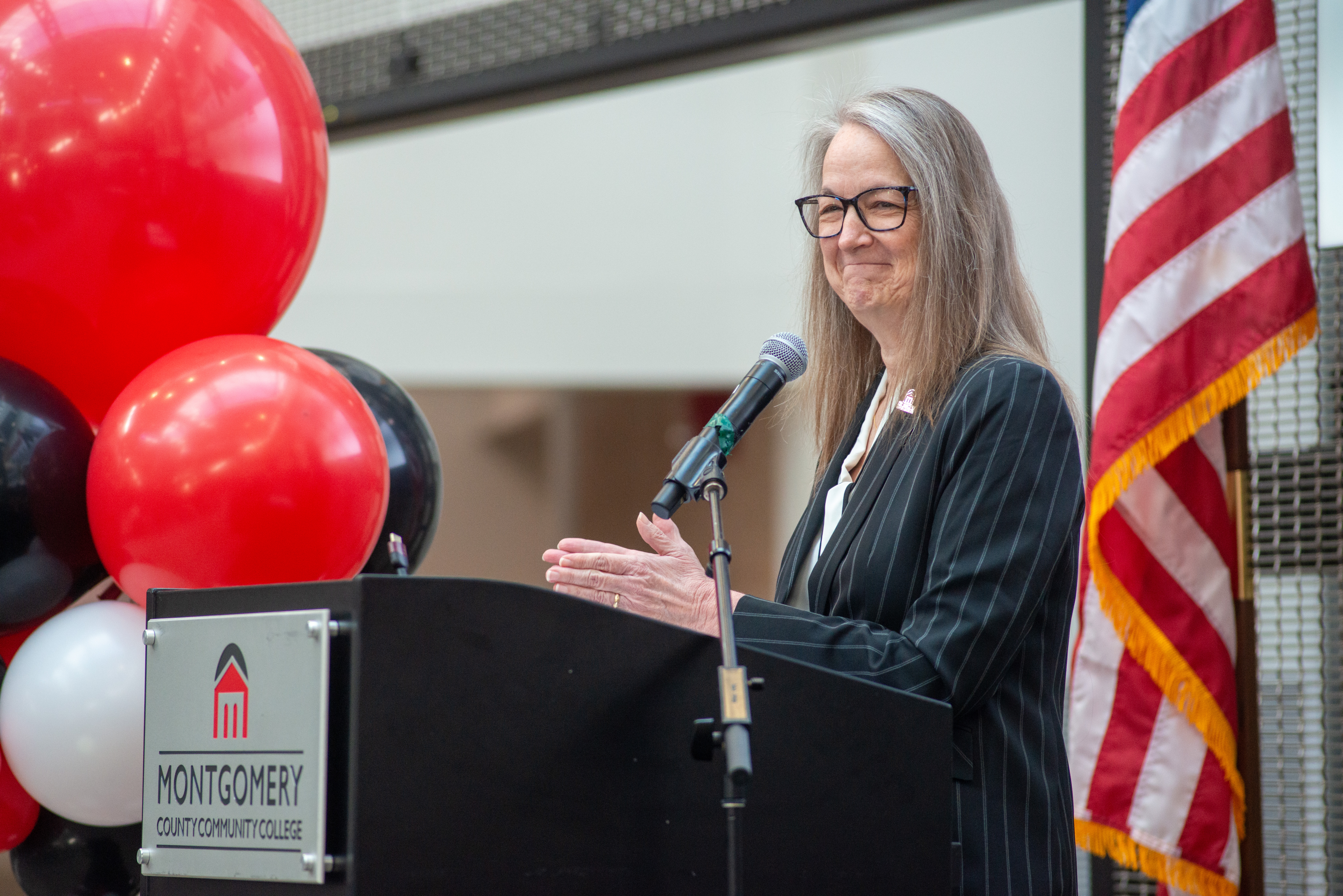
Dr. Vicki Bastecki-Perez, the president of Montgomery Community College, speaks at an event unveiling a new free tuition program. William Thomas Cain / For The Inquirer
“We really wanted to target a household that might be in the middle there, that may perhaps make a little bit too much to qualify for those traditional programs, but still being squeezed in this economic environment,” Mike Bettinger, the college’s chief of staff, said in an interview.
Students must be enrolled in programs across disciplines in health, sciences, education, STEM, life sciences, computer science, public safety, or tourism and hospitality. The college estimates that these subject areas align with a projected roughly 30,000 jobs opening in Montgomery County through 2032.
The college estimates that it will assist 1,000 students in the first five years of Montco Promise.
The program is funded by $3 million from the Montco Student Excellence Fund, established by the college’s board of trustees through the school’s charitable arm, the Montgomery County Community College (PA) Legacy Fund, after the county approved a millage rate increase for 2026. The college has also frozen tuition until 2029.
“There has been a lot of dreaming sessions, there’s been a lot of visioning, and there’s been a lot of conversations with key constituents to make this happen,” Bastecki-Perez said.
Students listen as Dr. Vicki Bastecki-Perez speaks in Blue Bell. William Thomas Cain / For The Inquirer
Bastecki-Perez said the current program builds on a recent partnership with the Aspen Institute College Excellence Program, which helped the college evaluate its career, workforce, and transfer programs.
With the last-dollar scholarship, college officials said, they are hoping for an increase in demand for these career pathways, and they have studied similar programs at schools across the country — from Oregon to Community College of Philadelphia — to project budgeting needs for enrollment.
“This is not something that we wanted to create and then have go away after a year or two,” Bettinger said. “Financially, we’ve looked at a number of different models to make sure that this is sustainable into the far future.”
And there is hope that the program grows, too, with Bastecki-Perez saying she would like to see the scholarship cover all students in the college someday.
With a Democratic trifecta in Harrisburg, local leaders are also hopeful that bills such as PA Promise, a last-dollar scholarship introduced by State Sen. Vincent Hughes for students attending a public college or university in Pennsylvania, come to fruition.
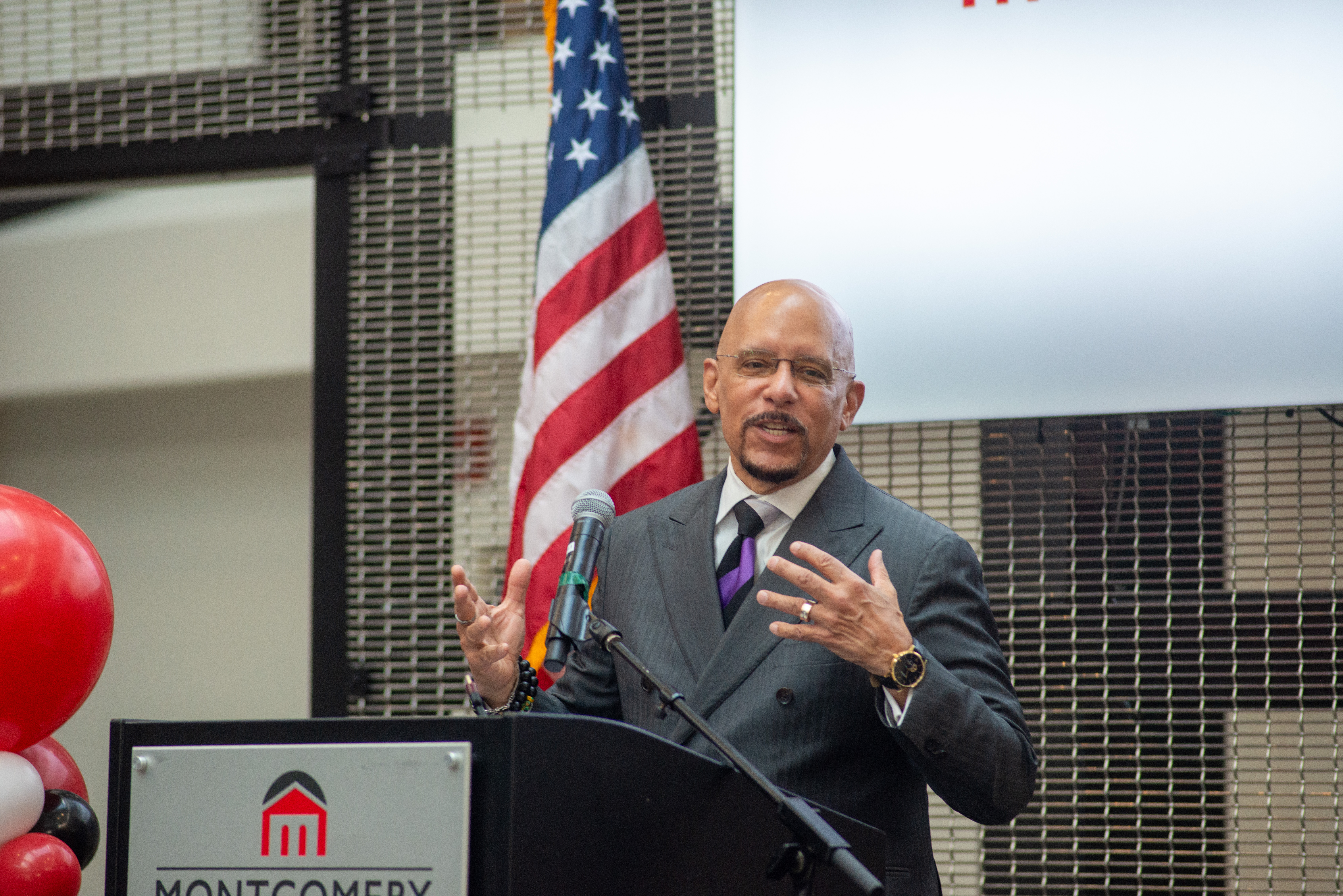
State Sen. Vincent Hughes speaks about Montco Promise Tuesday, November 17, 2026 at Montgomery County Community College in Blue Bell.William Thomas Cain / For The Inquirer
On Tuesday, Hughes, incoming Democratic chair of the Senate Appropriations Committee, said Montco Promise was a key “building block” for legislation in Harrisburg.
“You made some very wise decisions on Tuesday, Nov. 3, to change the course of the direction of Harrisburg and the commonwealth, and for students, we’re going to get this done,” said Hughes, who represents parts of Montgomery County and Philadelphia.
Montgomery County Commissioner Neil Makhija, a Democrat who has long advocated for affordable community college, said in an interview that he hopes Montco Promise will encourage Harrisburg “to consider providing the full funding for what it would take to provide free community college.”
The company is rebuilding, but with only half of its workforce due to automation, Makhija said.
“We want not only to encourage people, students, to enter because our communities really need them, but also ones that we think are going to be important in the economy despite what AI may disrupt,” he said.
On Tuesday, Montgomery County Commissioners Chair Jamila Winder, a Democrat, noted the important role that education played in her mother’s and grandmother’s lives and said Montco Promise has emphasized her family members’ teachings: “Education was the path forward and the path upward.”
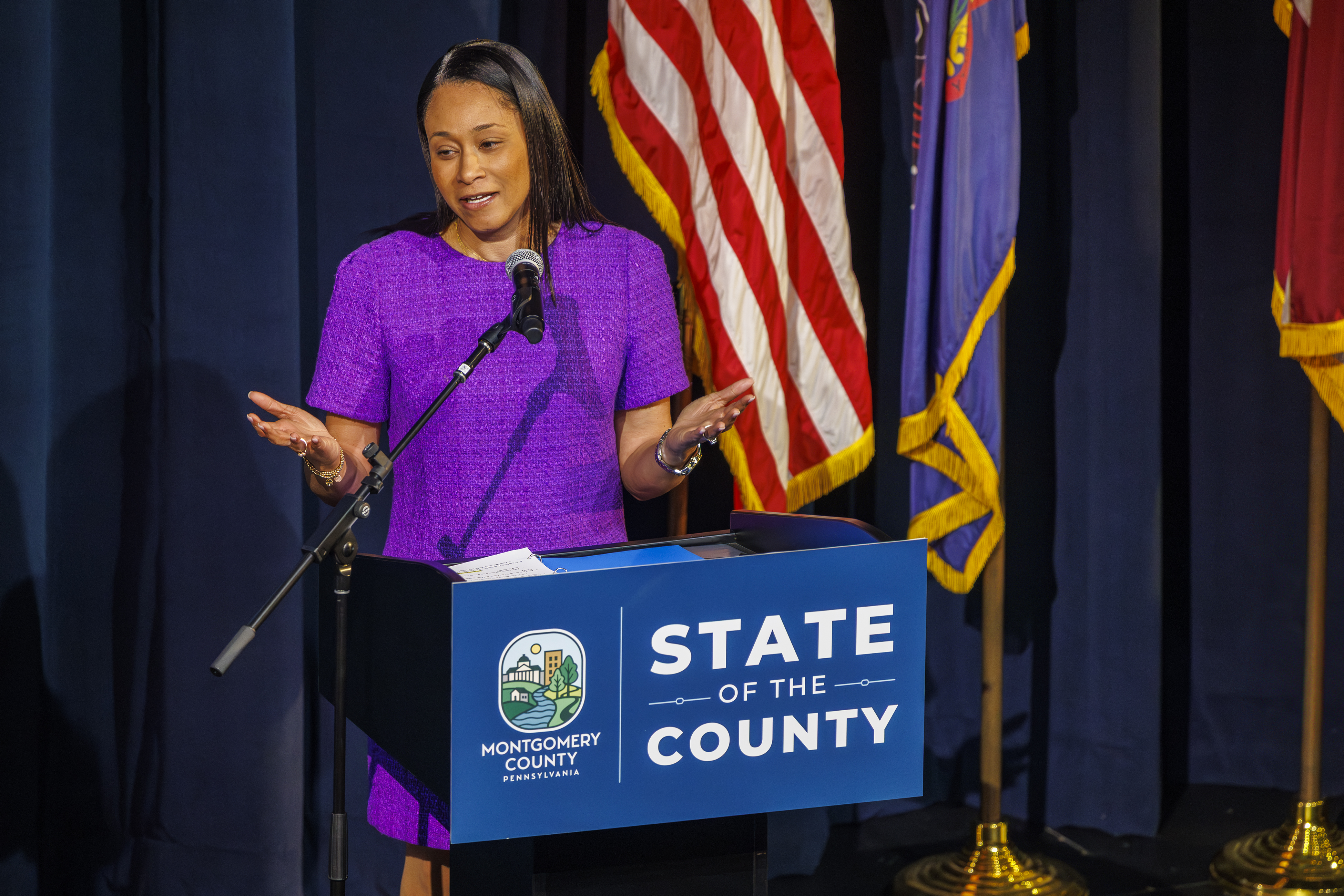
Jamila H. Winder, Montgomery County Commissioners chair, speaks at the 2026 State of County held at Montgomery County Community College in February. Alejandro A. Alvarez / Staff Photographer
But she acknowledged that student debt and other affordability issues have been major barriers to accessing higher education, noting that she had carried more than$80,000 in student debt between her undergraduate and graduate degrees.
“It can be crippling for so many, and can stop their journey before that journey has even started,” said Winder, who called the new program “life-changing.”
Montgomery County Commissioner Tom DiBello, the sole Republican on the board, was at first apprehensive when the program was proposed, saying that he “didn’t think that we needed to go there.”
But, he said, it ended up being a lesson in never trusting your initial reaction. After learning more about the scholarship and how it aims to serve as the “last piece” for someone who has exhausted other options in trying to obtain an education, he was in agreement.
“We don’t want that last-dollars-needed to be the barrier for stopping you and your dreams,” DiBello said.
Staff writer Susan Snyder contributed to this article.
A wedding in Fort Washington turned violent over the weekend, investigators say, when two women were arrested for fighting with and resisting police officers.
Samantha Dick, 30, was charged with assault of a law enforcement officer, resisting arrest, and related crimes after authorities said she head-butted, shoved, and spat on a Whitemarsh Township police officer who was dispatched to the Highlands Mansion & Gardens on Saturday for reports of a fight.
Another wedding guest, Janet Nordheim-Remig, 65, faces charges of obstruction of law enforcement and resisting arrest after she allegedly attempted to block officers as they took Dick into custody.
Both women remained in custody with bail set at $10,000 for Dick and 10% of $5,000 for Nordheim-Remig, according to court records.
There was no indication either of them had hired an attorney.
The incident started when Dick, of Bonita Springs, Fla., flirted with the husbands of other guests at the wedding, sparking a fight with another woman, according to the affidavit of probable cause for her arrest.
A spokesperson for the Highlands did not immediately respond to a request for comment about the fight.
Staff intervened and broke up the fight between Dick and Danielle Pellegrino, the affidavit said. Pellegrino was later issued a summary citation for harassment and released by police.
But when officers tried to speak with Dick about the dispute, she refused to listen, and walked away from them toward her mother’s car parked nearby, the affidavit said.
Nordheim-Remig, of North Wales, walked in front of the officers to prevent them from speaking with Dick, and ignored their commands to leave the area.
At one point, Nordheim-Remig pushed one of the officers, the affidavit said. She was placed in handcuffs and taken into custody.
Meanwhile, Dick, who smelled strongly of alcohol, refused commands to leave her mother’s vehicle, according to the affidavit.
She shoved one of the officers in the chest, and was taken into custody, according to the affidavit. While handcuffed in the back of the officer’s vehicle, Dick head-butted him, and kicked another officer in the groin, the document said.
Later, while left alone in the car, she slammed her head against its rear divider multiple times, the affidavit said.
The women are scheduled to appear before a district judge on Nov. 25 for a preliminary hearing.
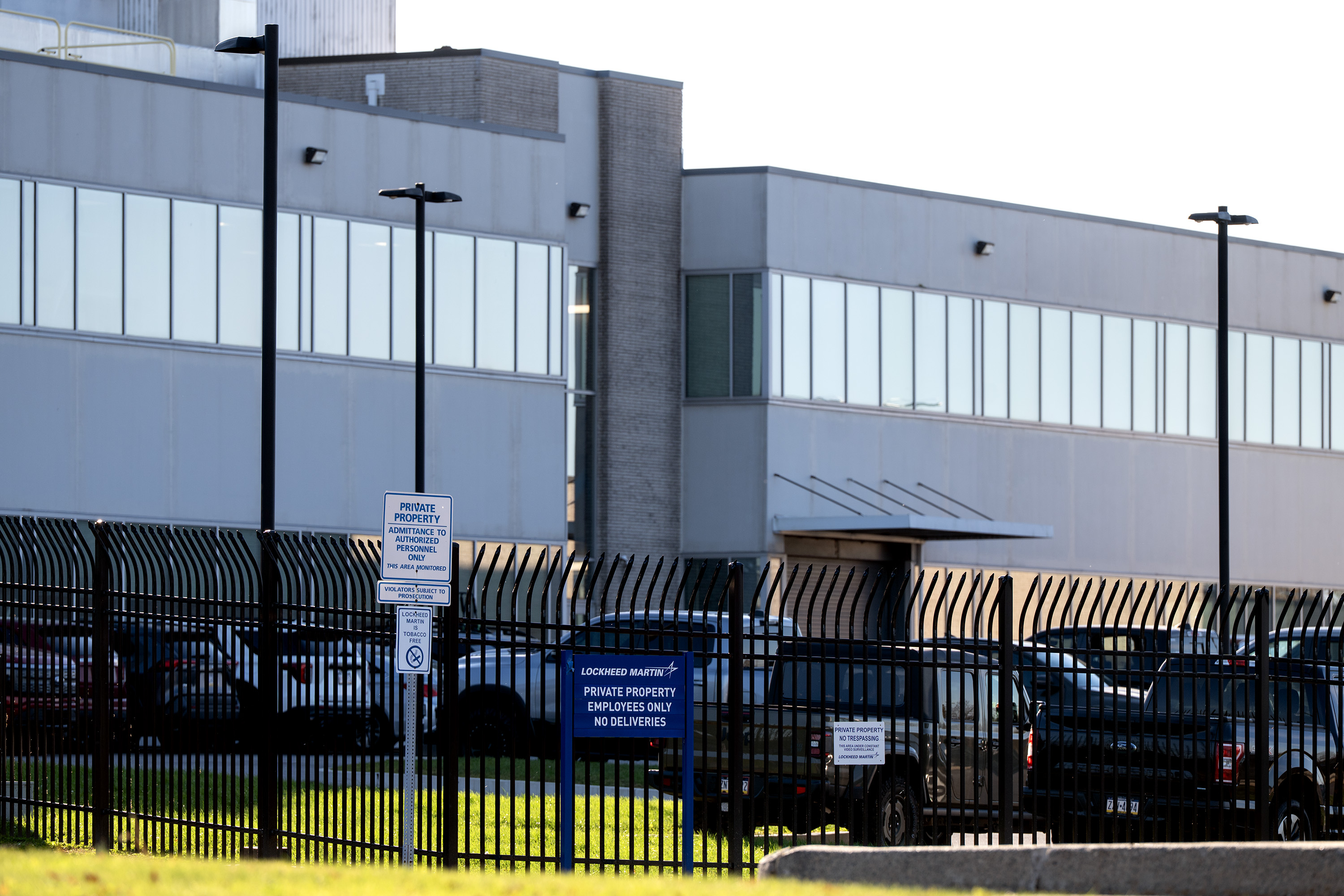
Lockheed Martin Corp. wants to build a new machine shop in Upper Merion Township, but neither the company nor the government will say what will be produced there.
The weapons and aerospace company,a major Defense Department contractor, submitted plans for the 73,000-square-foot building to Montgomery County in September, and the township is set to consider the proposal in December. Some of the parking details are public, but Upper Merion officials denied a records request for the building plans, citing public safety exemptions.
Lockheed Martin directed questions about what the building will be used for to the Defense Department, which referred the questions back to Lockheed Martin.
Lockheed Martin main entrance on Goddard Boulevard on the northeast side of the facility in King of Prussia Tuesday, Nov. 10, 2026. The private defense manufacturing facility is putting a 73,000-square-foot addition on the western side of the site, plus a parking garage. Some believe it will be used for chemical processing.Tom Gralish / Staff Photographer
What is Lockheed building in Upper Merion?
The new machine shop and chemical process linewould be part of Lockheed Martin’s 90-acre King of Prussia campus, along with a three-story, 45,000-square-foot parking garage, according to Montgomery County planning documents. If approved, it would bring Lockheed’s total footprint there to 1 million square feet, property records show.
Lockheed plans to adjust two other parking lots, in part because the company decided to end remote work this year, a manager wrote to Upper Merion in September.
“Lockheed Martin is also experiencing growth in terms of our production and test capabilities,” the manager wrote.
The company expects the machine shop to add 40 employees.
Though Lockheed is across the street from the fourth-largest mall in the United States, it’s difficult to see from public areas. Set on a hill, much of the site is surrounded by trees and fences.
Upper Merion denied a records request for details about the proposal this month under an exemption for a “military, homeland security, national defense, law enforcement or other public safety activity that, if disclosed, would be reasonably likely to jeopardize or threaten public safety or preparedness or public protection activity or a record that is designated classified by an appropriate Federal or State military authority.” The Inquirer has appealed the denial.
Matt Popek, chair of Upper Merion’s planning commission, said officials will share the building proposal with the public before the December meeting.
“We continue to invest in our infrastructure in thriving communities like Valley Forge to stay ahead of ready relative to warfighter demands,” Lockheed spokesperson Adam Smith said.
Lockheed Martin on Goddard Boulevard on the northeast side of the facility in King of Prussia, pictured on Nov. 10.Tom Gralish / Staff Photographer
This would be the second major development at the King of Prussia campus in five years, according to county planning records.
Lockheed Martin recently built a 55,000-square-foot laboratory. Upper Merion granted a height waiver for the building, which is more than 90 feet tall.
What does Lockheed Martin do in King of Prussia?
Although the purpose of the proposed facility is unclear, King of Prussia staff have played a significant role in more than a dozenDefense Department contracts awarded to Lockheed in the past five years, according to public contract information.
Since 2023, the Air Force has awarded contracts worth more than $1.4 billion to Lockheed’s King of Prussia and Utah sites to update the cone-shaped vehicles that take nuclear weapons in and out of the Earth’s atmosphere, according to Defense Department contract award postings. Lockheed and the Air Force tested a new version of the reentry vehicle over the Pacific Ocean earlier this month,the company announced.
The contracts are part of an Air Force project aiming to create a more accurate and deadly nuclear weapons system before 2036, according to a Pentagon budget document.
In this image provided by the U.S. Air Force, Senior Airman Jacob Deas (left) and Airman 1st Class Jonathan Marrs secure a titanium shroud, beneath which is a nuclear warhead, at the top of a Minuteman III intercontinental ballistic missile. Lockheed Martin developed the reentry vehicle used for this ICBM, and is working on an updated version for a new missile system.John Turner
The King of Prussia site is also involved in several software projects, including for Army artificial intelligence and missiles for foreign militaries.
Staff photographer Tom Gralish contributed to this article.
This suburban content is produced with support from the Leslie Miller and Richard Worley Foundation and The Lenfest Institute for Journalism. Editorial content is created independently of the project donors. Gifts to support The Inquirer’s high-impact journalism can be made at inquirer.com/donate. A list of Lenfest Institute donors can be found at lenfestinstitute.org/supporters.
Bristol Borough had a 32-percentage-point swing toward the Democrat compared with 2024.
All precincts in the 1st District, which includes all of Bucks County and a portion of Montgomery County, swung toward Harvie compared with two years ago, but he found his strongest support in his win against Republican U.S. Rep. Brian Fitzpatrick in Lower Bucks municipalities with a higher percentage of key voting blocs.
Bristol Borough and four other communities in Lower Bucks — Bensalem Township, Bristol Township, Falls Township, and Tullytown Borough — are younger and lower-income, have fewer people with college degrees, and have a larger Hispanic population that the rest of the district. These areas had the biggest swing toward the Democrat and helped move the needle for Harvie throughout the district, an Inquirer analysis of municipal-level election results and census data from 2024 and 2026 found.
Fitzpatrick won Lower Bucks two years ago when he won the district by double digits, but this yearBristol Borough and 10 other municipalities had a 20-percentage-point or more shift toward Democrats from 2024 — including Tullytown Borough, Falls Township, Richlandtown Borough, and Bristol Township.
(function(){function e(){window.addEventListener(`message`,function(e){if(e.data[`datawrapper-height`]!==void 0){var t=document.querySelectorAll(`iframe`);for(var n in e.data[`datawrapper-height`])for(var r=0,i;i=t[r];r++)if(i.contentWindow===e.source){var a=e.data[`datawrapper-height`][n]+`px`;i.style.height=a}}})}e()})();
Both Harvie and Fitzpatrick are from Lower Bucks (with thefive-termGOP lawmaker growing up in Levittown), but Harvie’scampaign particularly focused on his upbringing in the county and community ties. He spent 20 years teaching social studies at Bucks County Technical High School and more than a decade as a Falls Township supervisor. He has served as a county commissioner since 2020, making him the first challenger of Fitzpatrick’s to have previously won countywide elections.
Harvie improved on 2024 nominee Ashley Ehasz’s performance in every corner of the district, and Democrats saw gains nationally with virtually every demographic group.
But in a race decided by fewer than 6 percentage points, these are the people and places that propelled Harvie to victory.
Building on the youth vote
The younger the municipality, the more it shifted toward Harvie.
The Democrat won a majority of the two-party vote in every age group across the district, but he had his strongest performance in boroughs or townships with a median age between 23 and 39.
Harvie took 57% of those areas, the analysis found.
Fitzpatrick had won among all age groups in 2024, but Harvie benefited from a 22-percentage-point swing among the youngest municipalities.
(function(){function e(){window.addEventListener(`message`,function(e){if(e.data[`datawrapper-height`]!==void 0){var t=document.querySelectorAll(`iframe`);for(var n in e.data[`datawrapper-height`])for(var r=0,i;i=t[r];r++)if(i.contentWindow===e.source){var a=e.data[`datawrapper-height`][n]+`px`;i.style.height=a}}})}e()})();
Though the 1st District is older overall than the United States as a whole, the backlash to President Donald Trump was particularly severe among young voters and may have helped Harvie and other Democrats.
He was deeply underwater with young votersacross all issues, particularly on the cost of living,an issue on which90% disapprovedof his handling, compared withonly 9%who approved.Aquarterof voters under 30who had cast a ballot for Trump in 2024 disapproved of his performance on the issue.
The district is, on average, more affluent than the country as a whole, but Harvie saw a roughly 22-percentage-point shift in his direction in communities where the median household income is between $65,000 and $94,000, the analysis found.
The lower a municipality’s median household income — such as in places like Red Hill Borough or Tullytown Borough — the larger the move toward the Democrat this year.
(function(){function e(){window.addEventListener(`message`,function(e){if(e.data[`datawrapper-height`]!==void 0){var t=document.querySelectorAll(`iframe`);for(var n in e.data[`datawrapper-height`])for(var r=0,i;i=t[r];r++)if(i.contentWindow===e.source){var a=e.data[`datawrapper-height`][n]+`px`;i.style.height=a}}})}e()})();
Though Fitzpatrick had won all four of the district’s income categories in 2024, this year he held on to only one — municipalities where median income is roughly between $95,000 and $112,000 (a demographic that Trump has won in the past) — but by lessthan a percentage point, 50.3% to Harvie’s 49.7%.
Trump ran in 2024 on a promise to lower costs on day one, butvoters this year were frustrated by rising prices in the grocery store and at the gas pump. Harvie focused much of his campaign on affordability — often discussing heating oil prices, housing costs, and healthcare expenses.
Harvie’s strongest performance came in municipalities where fewer people have a college degree — a statistic that dovetails with income. He won 56% of the vote in places where between 21% and 32% of adults hold a bachelor’s degree or higher.
But he also performed nearly as well in municipalities where a larger portion of the population is highly educated. He had 55% of the vote in areas where between 56% and 75% of adults have at least a bachelor’s degree.
Fitzpatrick won municipalities where 32% to 42% of adults have at least a bachelor’s degree, but that was the only group he was able to hold on to — by less than a percentage point —after previously dominating among all education levels in 2024.
Hispanic communities helped boost Harvie
Most of the 1st Congressional District — about 79% of the population — is white, but Hispanic voters helped push Harvie to victory.
Almost 7% of the 1st District identifies as Hispanic, and the larger a place’s Hispanic population, the more strongly it shifted toward Harvie, with Telford Borough, Bristol Borough, Souderton Borough, and Bensalem Township at the top of that list.
(function(){function e(){window.addEventListener(`message`,function(e){if(e.data[`datawrapper-height`]!==void 0){var t=document.querySelectorAll(`iframe`);for(var n in e.data[`datawrapper-height`])for(var r=0,i;i=t[r];r++)if(i.contentWindow===e.source){var a=e.data[`datawrapper-height`][n]+`px`;i.style.height=a}}})}e()})();
Democrats also made a point in the homestretch to reach out to Asian voters — a key voting bloc in the 1st District — for Harvie, with the Democratic Congressional Campaign Committee tapping Montgomery County Commissioner Neil Makhija, a Democrat and the first Asian American county commissioner in Pennsylvania, for a digital ad.
Harvie won a slightly higher share of the vote in places with more prominent Asian communities, such as Hatfield Township, than in the rest of the district. But these were communities where his party had also done well two years ago.