Tag: Montgomery County

  • Narberth, Lower Merion residents and officials grapple with afternoon of vicious microburst storms

    Narberth, Lower Merion residents and officials grapple with afternoon of vicious microburst storms

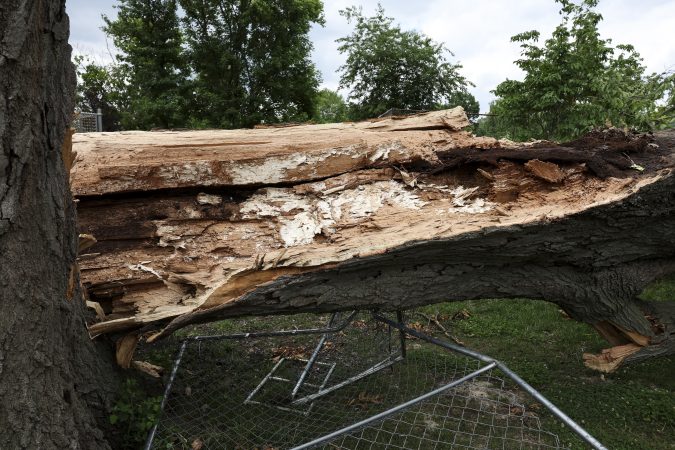
    When a violent microburst storm slammed into Narberth on Saturday, it brought down a 120-year-old Sycamore tree onto a home in the historic Narbrook Park neighborhood.

    The fire department in the surrounding Lower Merion Township responded to 98 incidents over the weekend, making numerous water rescues.

    And residents are still grappling with the aftermath of a violent storm shaking their communities.

    Communities in Montgomery County, along with other spots in the Philadelphia region, suffered vast amounts of damage Saturday afternoon as microburst storms ripped through the area.

    A microburst is a highly-localized column of sinking air during a thunderstorm that can produce strong winds and extensive damage and, in some instances, can be life-threatening, according to the National Weather Service.

    Peco has continued to restore power to affected households, as of roughly 5:30 p.m. Monday, with 119 outages affecting a little more than 1,500 customers.

    Narberth Council Vice President Cyndi Rickards said the skies went from clear to stormy in just a matter of minutes Saturday before a microburst ripped through the Montgomery County community.

    Then, just as quickly as it arrived, came the downed trees, power lines, flooding, and power outages.

    It was something Rickards, a more than 20-year resident of the community, had never seen before.

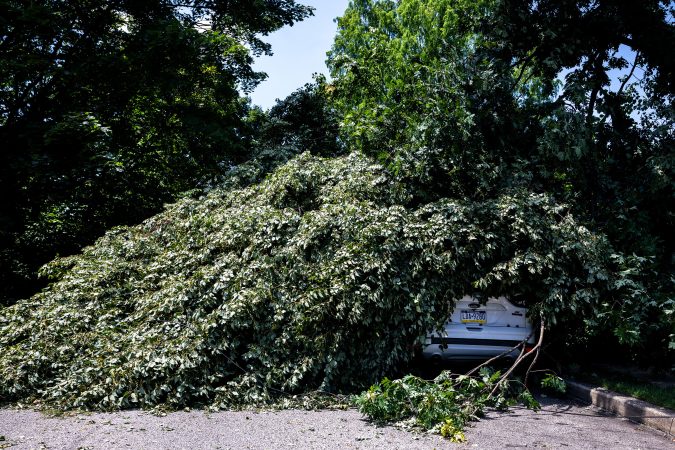
    “It became apparent that nearly every street in Narberth had a tree down, a substantial tree on a car,” Rickards said. “I believe we had two that fell on or near houses. Many that narrowly missed houses.”

    One of those near misses happened at Hugh Parker’s residence while he was spending time with relatives down the Shore. Once he and his family heard about the 40-foot tree knocked down in their front yard — covering their driveway and the car of his wife, Grace, they rushed home.

    Their basement had also been flooded and the family’s newly reconnected power lines started a fire, which eventually went out on its own.
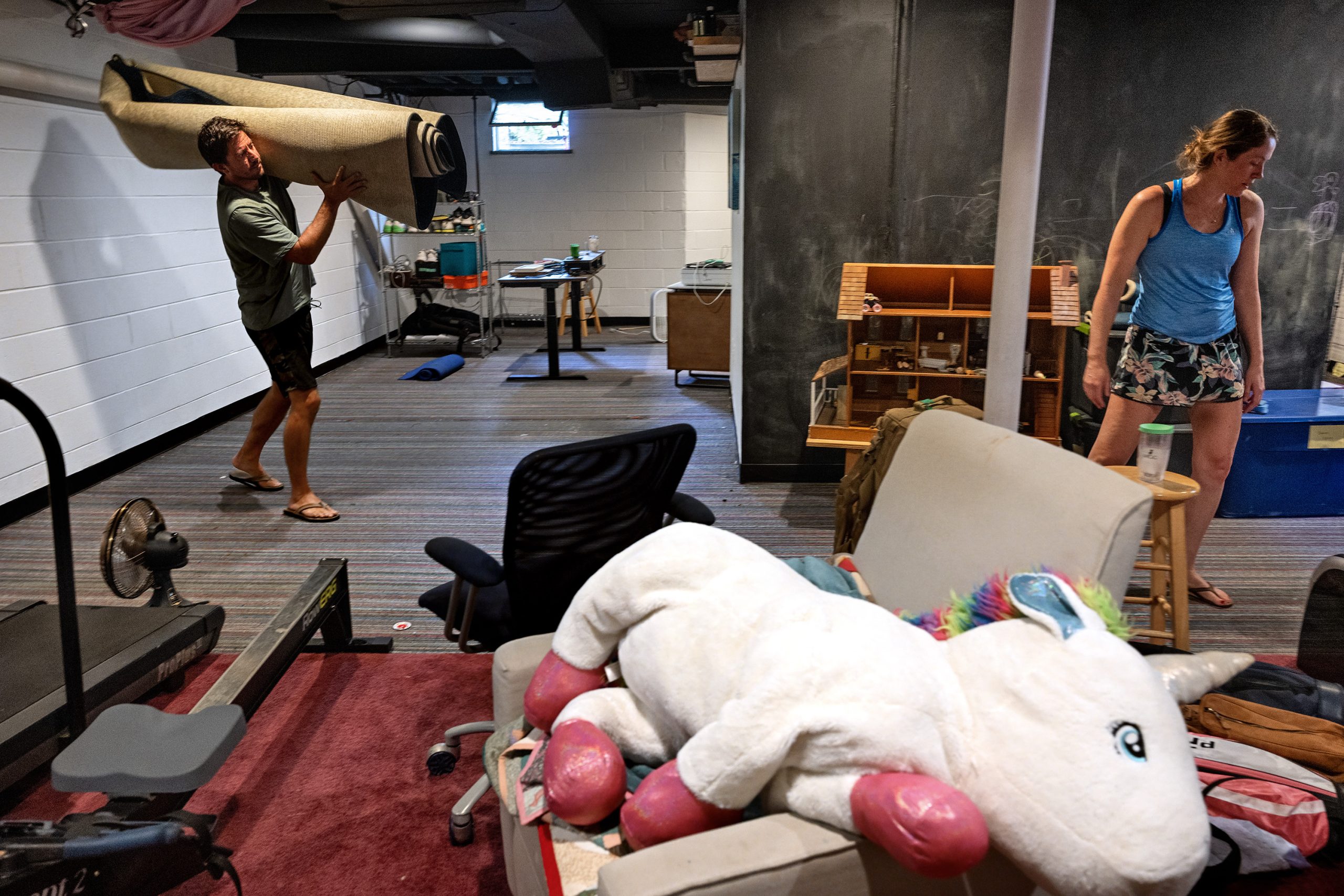
    Hugh and Grace Parker continue the cleanup in the basement of their Narberth home Monday, July 13, 2026, following the weekend’s storm. They weren’t home so don’t know why it flooded, as the house had not had any water enter since it was built in the 1990s. They also had a tree fall in front, crushing one of their cars.Tom Gralish / Staff Photographer

    Rickards described the local government’s response to the storm as “such a comprehensive disaster response for a small little borough,” adding that Jeff Eldon, the public works director, closed down any streets where he suspected downed wires or trees.

    Narberth Mayor Dana Edwards also declared a state of emergency, which has since been lifted, and has facilitated a spot at the borough hall where residents can cool off and charge their devices. He also indicated that the borough had “great support” from Peco.

    “It was really everything we could do just to keep everybody as comfortable as possible,” Edwards said.

    In the surrounding Lower Merion Township, commissioner Ray Courtney reported similar issues as Narberth’s, especially when it came to old trees that were toppled by the storm.
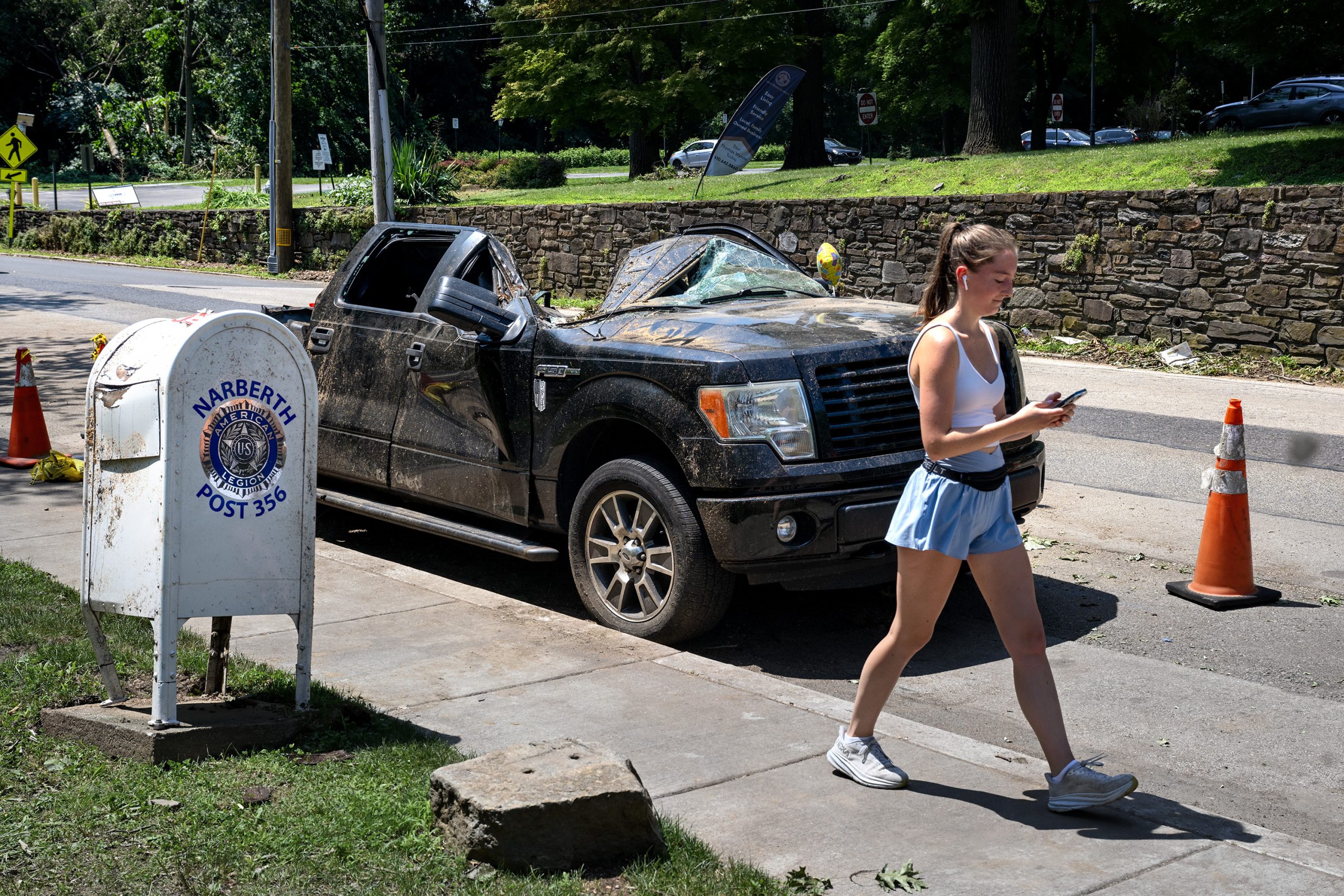
    A pickup truck is left crushed Monday, July 13, 2026, after the tree that fell on it had been cleared as the cleanup continued following the weekend’s microbursts that ripped through parts of the city and Montgomery County, downing trees and power lines and causing outages and road closures. This was along Wynnewood Avenue by the baseball fields in Narberth.Tom Gralish / Staff Photographer

    When the storm was over, the public works department closed the roads, some of which continued into Sunday morning, said Courtney, who represents parts of Ardmore and Wynnewood. As of Sunday night, crews had cleared 59 downed trees and there were 38 remaining.

    For local officials, the episode also underscored a need for further discussions regarding improving local infrastructure and resources for extreme weather events.

    Many communities, like Narberth and Ardmore, for instance, have historic infrastructure that cannot always handle aggressive storms.

    “I think this is the reality of storms now,” Courtney said. “They are hard, they are intense, and they dump a lot of precipitation in a short period of time, and all local governments, and our state and federal government, need to be thinking about improvements to our infrastructure, and the resiliency against this kind of weather event.”

    In the immediate aftermath of Saturday’s storm, residents — especially those whose property has been damaged — are hoping for incremental improvements.
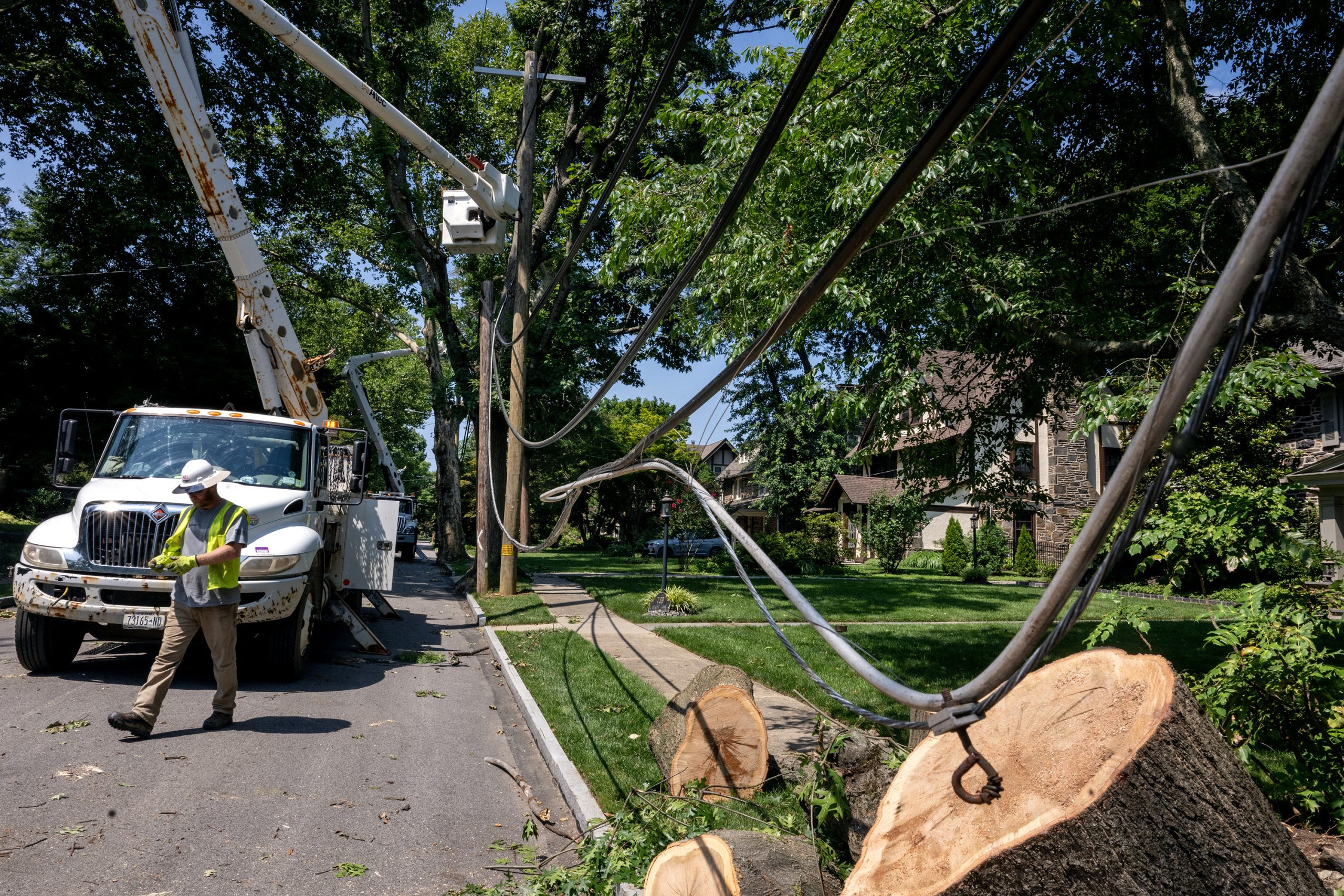
    Utility workers restore power on Beacom Lane in Merion Station, Monday, July 13, 2026, as cleanup continues following the weekend’s microbursts that ripped through parts of the city and Montgomery County, downing trees and power lines and causing outages and road closures.Tom Gralish / Staff Photographer

    A neighbor’s tree fell on the roof of Robert Hilton’s home on Merion Avenue. Water started dripping into his second-floor bedroom and the carpet remained soaked.

    “I’ve lived here for 41 years, and I’ve never seen anything like this,” said Hilton.

    The fallen tree, Hilton says, had been a concern for more than 20 years. It was old, unhealthy, and situated at the top of a bank, making it prone to structural instability. The microburst was the final piece of the puzzle, and the uprooted trunk now lays tangled with power lines in the middle of the street.

    Hilton lost power during Saturday’s storm, but it was reconnected on Monday at 2:30 p.m. “It’s baby steps,” he said. “That’s all we can hope for.”
  • Microburst storms caused unprecedented tree damage in some Philly-area neighborhoods

    Microburst storms caused unprecedented tree damage in some Philly-area neighborhoods

    Hundreds of trees fell in Philadelphia within a matter of minutes during a weekend storm that left a narrow but destructive band of what one official called “unprecedented” damage in its wake in the region.

    “We’ve never seen anything like this,” Parks and Recreation commissioner Susan Slawson said. “We’ve never seen a 15 and 20 minute storm come through an isolated area and take down that many trees.”

    Those downed trees came following a series of four “microbursts,” which brought wind gusts traveling 60 to 70 mph. Those isolated instances of high winds primarily impacted parts of Philadelphia and Montgomery County.

    Microbursts, the National Weather Service said, happen when a thunderstorm experiences a rapid increase in updraft. When that updraft stops, the mass of the storm system comes crashing back down, resulting in severe winds that sent trees tumbling into homes and vehicles, damaged public parks, and left neighborhoods grappling with cleanup efforts days later.

    Slawson’s department, which handles downed trees in the city, had responded to at least 340 emergency requests as of Monday afternoon, and inspected about 220 trees. The hardest hit areas, she added, were in South Philadelphia, Wynnefield, and Southwest Philadelphia.

    The harsh winter’s heavy caps of ice and snow that lasted for weeks likely left some trees weakened or damaged, Slawson said, making them more vulnerable to being toppled. Those that fell were being taken to the city’s Fairmount Park Organic Recycling Center in West Fairmount Park.

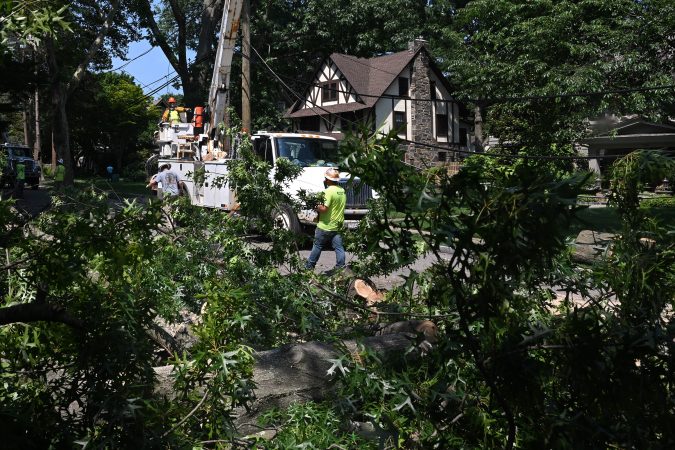
    Evidence of the damage was apparent around the region Monday. In Malcolm X Park in West Philadelphia, piles of giant fallen trees, cut into large chunks, sat waiting for disposal. And nearby on Spruce Street, a downed tree blocked a busy two-way road between 53rd and 54th Streets, its corpse resting atop a crushed red pickup truck.

    “They need to cut these trees down, they’re too tall,” said Schonder Pickney, 61, who lives across the street from the wreckage. She and her neighbors had asked the city to remove some of the old trees that appeared dangerous, but she said nothing came from it.

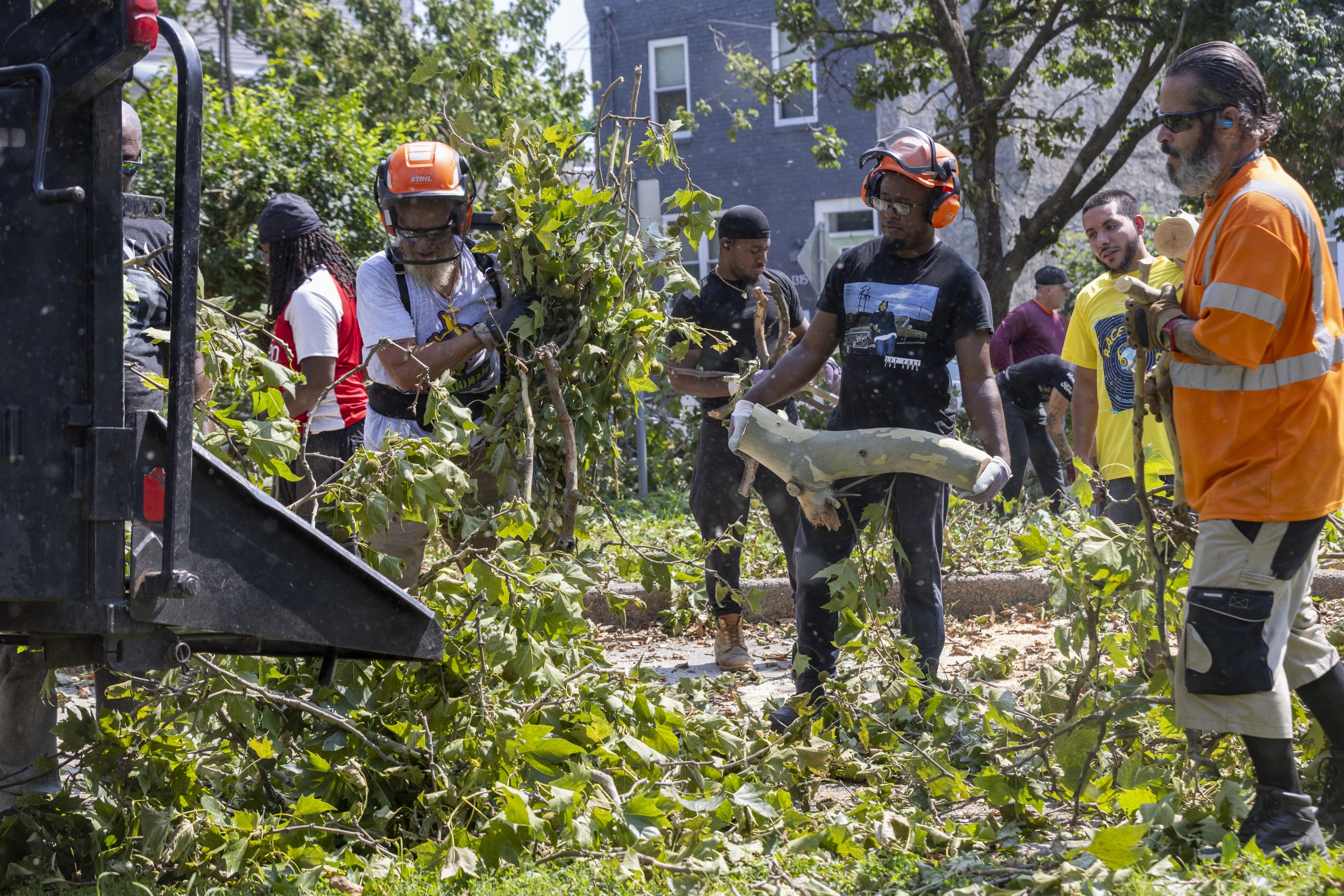
    Philadelphia Parks and Recreation workers throw debris into an auxiliary chipper at Wharton Square Playground in Point Breeze, on
    Monday.Aidan T. Gallo / Staff Photographer

    Private tree management companies, like Rapid Tree Care in Grays Ferry, were inundated with service requests following the storm. Caleb Coome, the company’s founder, said that the storm’s intensity knocked down large trees across densely populated city blocks, and across multiple homes.

    “It’s definitely unprecedented in terms of the amount of volume over a couple-day span,” said Coome, whose company has been in operations for three years.

    Homeowners impacted by fallen trees, he said, were largely concentrated near FDR Park and the stadiums in South Philly, as well as the Cobbs Creek and Cedar Park neighborhoods in West Philly. Homeowners face logistical and financial hurdles for cleanup, as much of the damage occurred in areas with tight rowhouses.

    In those tight quarters, a single fallen tree can span up to six properties, creating liability issues and disputes among neighbors over who is responsible for removal costs. A downed tree spanning multiple properties must be removed all at once, rather than limb-by-limb, for safety reasons, Coome said.

    Some parts of the suburbs also saw shared tree damage. For example, in Narberth, Hugh Parker and his family hurried home from the Shore Saturday after they heard from neighbors that a 40-foot tree had been knocked down in their front yard.

    Hugh and Grace Parker continue the cleanup in the basement of their Narberth home Monday. It flooded during weekend’s storm.Tom Gralish / Staff Photographer

    Located on their neighbor’s property, the tree landed to cover their driveway, as well as a car belonging to Parker’s wife, Grace. As it came down, the tree’s canopy also took down power lines and blocked the street, and the damage it did to the vehicle remained unclear Monday.

    A day later, Peco reconnected their power, which Parker said had been out for a little more than 24 hours. Then, he smelled smoke, thanks to a power line that started a fire after power had been restored. After about 30 minutes, the fire went out, but no one from the utility had come to check the power lines as of Monday morning.

    “It was like something from a movie scene — there were sparks flying 10 to 15 feet in the air,” said Parker.

    In Lower Merion Township, the local fire department responded to 98 incidents over the weekend, including numerous water rescues. Montgomery County communities were some of the hardest hit.

    “It became apparent that nearly every street in Narberth had a tree down, a substantial tree on a car,” said Narberth Council Vice President Cyndi Rickards said.

    The episode also highlights what many local officials have said is a need to further discuss improving local infrastructure and resources for extreme weather events.

    “I think this is the reality of storms now,” said Lower Merion Commissioner Ray Courtney. “They are hard, they are intense, and they dump a lot of precipitation in a short period of time, and all local governments, and our state and federal government, need to be thinking about improvements to our infrastructure, and the resiliency against this kind of weather event.”

    In addition to downed trees in the area, roughly 1,500 Peco customers remained without power across 119 reported outages as of late Monday afternoon. That number is down significantly from the height of the storm, when some 60,000 customers experienced extended outages. Overall, 105,000 Peco customers experienced some loss of power during the course of the storm, the company said.

    Power for all customers in the region, Peco added, was expected to be restored by 11 p.m. Monday.

    Among those impacted were West Philadelphia resident Lisa Phillips, who lives on the 5100 block of Hazel Avenue. A tree on her block went down Saturday, taking power lines with it. Electrical workers arrived Monday to take care of the downed lines, but she was still waiting for the city to clear the tree from her street.

    “Never in my life have I experienced anything like this,” she said.

    Staff writers Isabel Maney, Olivia Prusky, and Fallon Roth contributed to this article.

  • Glenside man charged with attempted murder for running over a 24-year-old he believed stole a bike, prosecutors say

    Glenside man charged with attempted murder for running over a 24-year-old he believed stole a bike, prosecutors say

    A Glenside man intentionally drove his Jeep into a cyclist, Montgomery County prosecutors said Monday, throwing the victim 90 feet and leaving him in critical condition with a serious head injury.

    Phillip Prince, 40, has been charged with attempted murder and related crimes in the crash, which took place Sunday evening on Meyer Avenue.

    It was not clear if Prince had hired an attorney.

    Investigators said Prince crashed into Colin Cassidy, 24, as Cassidy and a group of teens were riding bikes through Glenside. Multiple witnesses said Prince intentionally sped up “full throttle,” drove onto a sidewalk, and crashed into Cassidy just before 8:30 p.m., according to the affidavit of probable cause for his arrest.

    Prince told one of those witnesses that he was chasing Cassidy because he believed Cassidy had stolen the BMX bike Cassidy was seen riding through Glenside, the affidavit said.

    One of the teens who was with Cassidy on Sunday told police Cassidy had been riding a scooter before briefly disappearing and returning with the bicycle, according to the affidavit.

    Not long after, Prince drove up to the group in a Jeep Cherokee, attempted to grab Cassidy, and began chasing them.

    After the crash, as Prince went over to the unresponsive Cassidy, the teen turned off the Jeep and took the keys out of the vehicle so Prince would not drive away, the affidavit said.

    Prince and teen got into a brief fight, during which Prince punched the teen in the mouth, police said.

    Prince was still at the scene when Abington Township police arrived and took him into custody.

    Cassidy was taken to Jefferson Abington Hospital, where he underwent surgery for severe head trauma. He remained there Monday in critical condition, according to investigators.

  • Where microburst storm damage has been reported around Philly, mapped

    Where microburst storm damage has been reported around Philly, mapped

    Cleanup from Saturday’s storm was continuing Monday, as communities around the Philadelphia region deal with aftermath of fallen trees, flooding, and high winds.

    A series of four “microbursts” brought severe damage to a limited area Saturday, with wind gusts traveling up to 60 to 70 miles per hour. Those isolated bouts of high winds, which ripped through parts of Philadelphia and Montgomery County, toppled hundreds of trees and damaged or collapsed several buildings, while sudden and severe rains caused floods around the region.

    Microbursts, the National Weather Office said, occur when there is a rapid increase in the updraft of a thunderstorm. Once that updraft stops, the mass of the storm system crashes back down, resulting in severe winds.

    As of early Monday afternoon, Peco continued to restore power to affected customers, with more than 170 outages impacting nearly 2,400 people. And though a comprehensive account of damages was not immediately available, damage reported to the weather service and select other entities indicated dozens of recorded incidents.

    (function() {
    var l2 = function() {
    new pym.Parent(‘july_11_storms’,
    ‘https://media.inquirer.com/storage/inquirer/projects/innovation/arcgis_iframe/july_11_storms.html’);
    };
    if (typeof(pym) === ‘undefined’) {
    var h = document.getElementsByTagName(‘head’)[0],
    s = document.createElement(‘script’);
    s.type = ‘text/javascript’;
    s.src = ‘https://pym.nprapps.org/pym.v1.min.js’;
    s.onload = l2;
    h.appendChild(s);
    } else {
    l2();
    }
    })();

  • Abington looks to ban e-bikes at parks and trails, citing safety concerns

    Abington looks to ban e-bikes at parks and trails, citing safety concerns

    Abington moved toward banning e-bikes and e-scooters at public parks and trails during Thursday’s commissioners meeting.

    A majority of Abington’s 15-member commissioner board voted to advance a proposed ban on electric vehicles from Abington park systems because of safety and disruption concerns, according to a summary of the proposal.

    The ban would not apply to electrified vehicles designed for people with disabilities, and would not cover county-owned sites such as Lorimer Park.

    The rise in popularity of small electric vehicles has led to crashes and fatalities across the region. Earlier this week, two people in Pottstown were sent to the hospital after an apparent collision between an e-bike and an e-scooter.

    But some Abington commissioners voted against the motion after local cyclists raised concern that the ban would be too broad.

    Many local cyclists want a narrower ban that still allows slower, lighter e-bikes, said Ross Abel of Bike Montgomery County.

    Pedal-assisted bikes help seniors and parents with young children reach parks, Abel said. A full ban “would really prevent them from getting out in nature on their bikes.”

    The Bicycle Coalition of Greater Philadelphia has argued that the slower e-bikes have been wrongly lumped together with powerful e-moto bikes that look similar but can cause more damage.

    Last year, a cyclist on Schuylkill River Trail near Norristown was hit by an unregistered electric motorcycle, leaving him with a partially dissected artery in his neck.

    State law differentiates e-bikes from vehicles that require a license, like motorcycles. But unlike many e-bike manufacturers, Pennsylvania does not distinguish different e-bikes by power and top speed. And in practice, distinctions can be murky.

    Police responding to the Norristown collision appeared to view the faster vehicle as an e-bike, referring to the e-moto rider as “the other cyclist.”

    That trouble telling the bikes apart is exactly why some argue a narrower ban would be impractical for township staff to enforce, Abington commissioner John Spiegelman said.

    Though Abington’s commissioners have 60 days to finalize the ban once it’s advertised, some are already considering revisions.

    “I’ve been trying to think of some kind of workable compromise that accommodates all parties’ concerns,” Spiegelman said, “while ultimately protecting the folks in our parks and on our trails, including young kids, from injury.”

    This suburban content is produced with support from the Leslie Miller and Richard Worley Foundation and The Lenfest Institute for Journalism. Editorial content is created independently of the project donors. Gifts to support The Inquirer’s high-impact journalism can be made at inquirer.com/donate. A list of Lenfest Institute donors can be found at lenfestinstitute.org/supporters.

  • Gov. Shapiro can’t be sued by his Abington neighbors over a property dispute, judge rules. But Josh Shapiro, a homeowner, can.

    Gov. Shapiro can’t be sued by his Abington neighbors over a property dispute, judge rules. But Josh Shapiro, a homeowner, can.

    A federal judge had some good news this week for Josh Shapiro, governor of Pennsylvania, but not so much for Josh Shapiro, resident of Montgomery County.

    Shapiro, as governor, cannot be sued in his official capacity in a dispute over a strip of yard between his and his Abington Township neighbors’ adjoining properties, U.S. District Judge Harvey Bartle III ruled Tuesday.

    But Shapiro and his wife, Lori, will still have to face their neighbors in federal court as homeowners, Bartle also determined.

    The conflict came into public view in February, when Jeremy and Simone Mock, whose backyard abuts the Shapiros’ lawn in a tree-lined neighborhood near Pennsylvania State University’s Abington campus, sued Shapiro — both as governor and in his individual capacity — and George Bivens, acting Pennsylvania State Police commissioner. The lawsuit alleged the officials were illegally occupying part of the Mocks’ yard to build an eight-foot security fence last summer in what they claimed was an “outrageous abuse of power” that violated their constitutional rights. Bartle dismissed those claims in his ruling Tuesday, in what Shapiro’s administration called a major win.

    But while Shapiro and Bivens are immune from the federal lawsuit as state officials, Shapiro as an individual and his wife are not, Bartle’s opinion said.

    “We are pleased that the court has dismissed the claims against the office of the governor and the Pennsylvania State Police, and recognize that the allegations against these officials are without merit,” said Rosie Lapowsky, a spokesperson for Shapiro. “The Shapiros are confident that the facts will ultimately show that the Mocks’ remaining claims are meritless and politically motivated and will fail.”

    The dispute in federal court over the 2,900-square-foot strip of land disrupted the otherwise sleepy suburban neighborhood and led to a separate lawsuit in Montgomery County Court filed by the Shapiros, in their personal capacities, against the Mock family. Shapiro’s office has called the Mocks’ legal effort a political stunt, in addition to other efforts by Republican officials to scrutinize the safety measures state police say are needed to keep Shapiro and his family safe.

    The dueling lawsuits came in the wake of the attempted murder of Shapiro in April 2025 at the state-owned governor’s residence in Harrisburg, when a man firebombed the mansion on the first night of Passover while the governor and his extended family slept inside.

    The attack prompted more than $33 million in security upgrades to the state-owned governor’s residence, in addition to $1 million in upgrades and landscaping to Shapiro’s personal home in Abington Township, where he and his family live part-time.

    Shapiro’s safety remains a priority for state police, as one of the nation’s most prominent Jewish elected officials. A Delaware County man was arrested Wednesday for threatening to burn down the governor’s residence, state police said.

    But the Mocks’ attorney, Wally Zimolong, said the lawsuit at hand is about property rights and due process, and called Bartle’s ruling a “strong decision.”

    “Make no mistake about it,” Zimolong said, “a federal court has said that the sitting governor of Pennsylvania can be held liable for damages over constitutional violations.”

    The Delaware County lawyer who has represented high-profile Republican officials and candidates, including President Donald Trump, said it is “nonsense” to call the litigation political. Zimolong added that he hopes the Shapiros reconsider and attempt to resolve the case amicably.

    The conflict’s origins

    The dispute between the Shapiros and Mocks began last summer when, as part of a plan to build a security fence at the Abington house, a surveyor learned that a sliver of yard that the Shapiros had used for over two decades was actually on property belonging to the Mocks.

    After the Mocks rejected the Shapiros’ offer to buy the land, court fillings said, Pennsylvania’s first couple invoked a state law that allows a person to gain ownership of a property they have actively used for at least 21 years. The Shapiros have lived in their Montgomery County home for 23 years.

    “What followed was an outrageous abuse of power by the sitting Governor of Pennsylvania and its former Attorney General,” the Mocks’ February lawsuit said.

    (function() { var l = function() { new pym.Parent( ‘shapiroyard__graphic’, ‘https://media.inquirer.com/storage/inquirer/ai2html/shapiroyard/index.html’); }; if(typeof(pym) === ‘undefined’) { var h = document.getElementsByTagName(‘head’)[0], s = document.createElement(‘script’); s.type = ‘text/javascript’; s.src = ‘https://pym.nprapps.org/pym.v1.min.js’; s.onload = l; h.appendChild(s); } else { l(); } })();

    A security fence was purchased but never installed, SpotlightPA reported. Instead, contractors hired by the state began planting arborvitae-type trees and other plants on the Mocks’ property. State police also flew drones over the Mocks’ property, threatened to remove healthy trees, and chased away contractors, the Mocks alleged in the suit.

    The complaint also accused Shapiro of directing state police to patrol the property, and instructing the Mocks to leave the “security zone.”

    The Shapiros’ countersuit in Montgomery County asks a judge to find that they are the “legal and equitable owners” of the area in dispute, having tended to the land that borders their front yard for 23 years. That suit is pending and a judge is expected to rule on preliminary objections filed by Zimolong.

    Separately, the Shapiros and state attorneys filed motions asking Bartle to dismiss the federal complaint against them.

    This week, the judge partially obliged, finding the state officials to be immune from the lawsuit while allowing the case against the Shapiros to proceed.

    The judge also refused to freeze the federal case while the lawsuit in Montgomery County plays out, determining that the two cases are different enough to proceed.

    “The claims here extend far beyond a disagreement between neighbors over the metes and boundaries of their properties,” Bartle wrote.

  • Montgomery County DA drops assault charge against Mike Missanelli in domestic dispute

    Montgomery County DA drops assault charge against Mike Missanelli in domestic dispute

    Montgomery County prosecutors have withdrawn criminal charges against longtime Philly sports personality Mike Missanelli, ending their investigation into an alleged domestic dispute between him and his fiancee.

    Missanelli, a former Inquirer sportswriter best known for his 15-year stint as a host at 97.5 The Fanatic, was arrested in April and charged with simple assault and harassment after his fiancee accused him of slapping her across the face during an argument inside their home in Lower Merion.

    During a preliminary hearing late last month, prosecutors declined to move forward with the case.

    In a statement Wednesday, Kate Delano, a spokesperson for District Attorney Kevin Steele, said that “after reviewing additional information, the office made the determination that it would withdraw the charges.”

    “In every case, we are always continuing to investigate after charges are filed,” she said.

    Missanelli’s attorney, Brian McMonagle, declined to comment Wednesday. Missanelli did not respond to a request for comment.

    In the affidavit of probable cause filed by Lower Merion police, officers wrote that Missanelli, 70, was in a heated argument with his fiancee over their engagement. His fiancee’s name was redacted from court records.

    Police responded to a 911 hangup shortly after midnight, and Missanelli told officers the argument led to a “scuffle.”

    The fiancee struck him in the chest and Missanelli’s “open hand slapped her on the left side of her face/head,” the affidavit said. One officer said he saw fresh blood on the woman’s forehead from a laceration allegedly caused by the slap.

    Missanelli was fired from WIP in 2006 after he punched a producer. He was then fired by 6abc in 2017 for misogynistic comments he made about Beth Mowins, an ESPN broadcaster.

    In recent years, Missanelli has been in the news for various job changes. After 15 years with 97.5 The Fanatic, he was pushed out by management in 2022, then brought back in 2024, only to be ousted once more last August.

    Currently, he is embroiled with a legal battle with JAKIB Media and its owner, Joe Krause, for their alleged failure to pay him $85,000.

    Staff writer Rob Tornoe contributed to this article.

  • SEPTA cuts 3 Glenside Regional Rail trains along with other schedule changes

    SEPTA cuts 3 Glenside Regional Rail trains along with other schedule changes

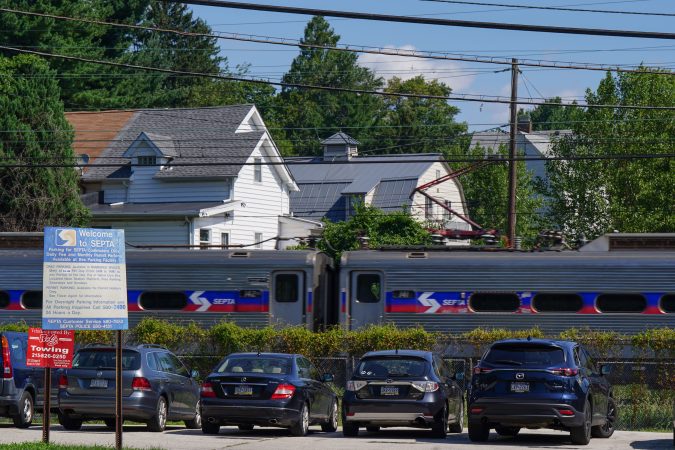
    SEPTA is trading Glenside Regional Rail riders three daytime trains for new off-peak options, more train cars, and new schedules aimed at reducing congestion between Glenside and Wayne Junction.

    The Warminster Line, which runs through southeastern Montgomery County, is the only Regional Rail line losing multiple trains under systemwide changes that began on July 5 to make trains more consistent and prevent delays.

    The new schedule cuts two weekday trains that left Glenside at 8:40 a.m. and 2:47 p.m. for Center City, and one weekday train that left Suburban Station at 4:53 p.m. toward Warminster.

    The morning train cut leaves a 27-minute gap in service to Center City from Glenside, while the afternoon cuts each add five minutes or less to the wait for the next train.

    SEPTA also added a train to the Warminster Line that leaves Suburban Station at 11:35 p.m. on weekdays, and a train on the West Trenton Line that leaves Suburban Station at 5:28 a.m.

    The late-night train will serve airport workers, and the dawn departure is convenient for people who commute into the suburbs, SEPTA spokesperson Kelly Greene said.

    The changes SEPTA made across the commuter rail system this week are aimed at improving consistency and reliability, the agency said.

    “As SEPTA continues to increase the number of train cars available for service, trains will be longer and provide more space for riders,” officials wrote in a statement.

    Between Wayne Junction and Glenside, SEPTA said, it hopes the new schedule will help “prevent trains from bunching together, which can cause delays.”

    The 8:40 a.m. train from Glenside was cut to reduce congestion, Greene said, and had the lowest ridership of the trains running around that time.

    Other changes affecting the Abington area include new departure times for some trains on the Lansdale/Doylestown, Warminster, and West Trenton Lines.

    SEPTA put out a full list last month of what is changing on each line, along with updated train schedules.

    This suburban content is produced with support from the Leslie Miller and Richard Worley Foundation and The Lenfest Institute for Journalism. Editorial content is created independently of the project donors. Gifts to support The Inquirer’s high-impact journalism can be made at inquirer.com/donate. A list of Lenfest Institute donors can be found at lenfestinstitute.org/supporters.

  • Federal legislation would increase pathogen testing for infant formula following botulism cases

    Federal legislation would increase pathogen testing for infant formula following botulism cases

    A 2-month-old Bucks County infant was struggling to swallow and could hardly hold his head up.

    He was diagnosed last month with infant botulism, a rare, potentially deadly infection that affects the nervous system and can lead to paralysis.

    The family and their lawyer believe the baby, now recovering at home, ingested the bacteria that causes the infection from an infant formula subsequently recalled by its manufacturer, Nara Organics, over contamination concerns.

    Federal legislation proposed this spring could protect babies by requiring formula manufacturers to test for more pathogens. The bill, HR 7867, is awaiting hearings in the House Committee on Energy and Commerce.

    “I want responsible manufacturers, responsible industry partners, who say we know there is a risk of this and we’re going to be ahead of the game,” said U.S. Rep. Madeleine Dean, a Montgomery County Democrat and cosponsor of the bill.

    When asked for comment on the proposed legislation, Nara Organics pointed to safety protocols posted on its website saying the company exceeds the U.S. Food and Drug Administration’s current requirements.

    The New York-based company said it voluntarily recalled all of its infant formula on June 13 “in an abundance of caution,” after the FDA and the Centers for Disease Control and Prevention reported three cases of infant botulism in babies who had consumed Nara formula.

    As of July 6, a fourth case had been confirmed, and FDA testing identified the botulism-causing bacterium C botulinum in some of the company’s formula, according to an update posted on the company’s website.

    Nara Organics did not comment directly on the proposed regulations. When asked for its position on the legislation, the Infant Nutrition Council of America, which represents manufacturers, said its members “share the goal of ensuring families have access to safe, high-quality infant formula.”

    “Infant formula is among the most highly regulated foods in the United States, and INCA supports science-based, risk-based improvements that strengthen infant formula safety,” the organization said in a statement.

    The push to bolster regulations comes several years after federal regulators and lawmakers started looking more closely at infant formula safety in 2022, when a massive recall for a non-botulism bacterial contamination left shelves bare for months.

    But two recent infant botulism outbreaks linked to formula show the inadequacy of the steps that companies are already taking, said Bill Marler, a Seattle-based food safety lawyer who is representing Erica and Micky Goldfin, the Yardley couple whose son developed botulism after being fed Nara Organics formula.

    “We need to do more to protect these kids,” Marler said.

    A dangerous infection

    Infant botulism occurs when babies ingest C botulinum in foods or dust and dirt particles. The bacteria’s spores colonize in the large intestine and release a toxin that affects the nervous system.

    Symptoms include changes in facial expressions, such as smiling less, slow feeding, constipation, and low energy. Untreated, the toxin can spread and cause paralysis, making it hard for babies to breathe and eat.

    Infants are at greatest risk of illness because their digestive systems are still developing and less able to fight off infection.

    Nationally, 181 cases of infant botulism were reported in 2021, the most recent year for which CDC data are available.

    The Goldfins’ baby, identified by the initials W.G. in court records, spent two nights in the intensive care unit at the Children’s Hospital of Philadelphia, where he was treated with BabyBIG, the botulism antitoxin that is manufactured by the California Department of Public Health. The medication’s antibodies bind to the toxin and neutralize it, improving symptoms within 48 hours.

    On June 6, he returned home, where he is feeding well again, and regaining movement in his arms and legs. He is receiving weekly physical therapy for developmental delays in his gross and fine motor skills, according to the lawsuit.

    Testing challenges

    Federal regulators began looking more closely at infant formula in 2022, after Abbott Nutrition issued a massive recall over concerns of non-botulism bacterial infections.

    Abbott temporarily shut down one of the largest formula manufacturing plants in the country while it investigated the cause of the contamination, leaving families scrambling to find the formulas they relied on for their infants and medically fragile children.

    Pinpointing the exact source of contaminants can be challenging.

    The bacteria that causes botulism, for instance, could have been present in the Nara Organics’ powdered milk formula, in dust that settled on the packages during transportation, in the water used to mix it, or on the hands of those preparing the food, said Molly Potter, a senior clinical dietitian with Nemours Children’s Health in Delaware.

    According to its website, Nara Organics tests its formulas throughout the manufacturing process, first testing raw ingredients, then during production, and again with the final product.

    The tests the company uses include so-called sulfite-reducing clostridia (SRC) enumeration, which a leading international food-safety group recommends for identifying spores of the bacteria that causes infant botulism.

    But research published in June in the medical journal Frontiers in Microbiology found that SRC enumeration testing suggests that test wasn’t sufficient to consistently detect the bacteria.

    Researchers from IEH Laboratories & Consulting Group, a Washington-based firm that specializes in laboratory testing and analysis for the food industry, worked with ByHeart to analyze its infant formulas that had been linked to at least 28 cases of infant botulism this year and last.

    A bottle of milk prepared from infant formula.Giulia Marchi

    Improving safety

    Dean said she hopes the proposed legislation will open up more conversation about how best to improve infant formula safety.

    The bill tasks the FDA with developing a list of pathogens that formula companies should test for, and working with manufacturers to begin any tests they aren’t already doing.

    The FDA would also set a schedule for how often manufacturers need to test for the new list of pathogens.

    Under the legislation, companies would be required to report contamination results within a day, and retain records of positive test results.

    Dean is among more than two dozen lawmakers to sign on as cosponsors. Rep. Jefferson Van Drew, who represents South Jersey’s 2nd District, is one of two Republican cosponsors.

    Potter, the Nemours dietitian, said she hopes increased testing will help families feel more at ease.

    In the meantime, parents can reduce the risk to their children by only purchasing formula from reputable stores, checking expiration dates, and storing powdered formula canisters properly. Caregivers should make sure to mix formula in clean equipment, and wash their hands before preparing and feeding it to a baby.

  • Cherry Hill Mall to get new stores including Aritzia

    Cherry Hill Mall to get new stores including Aritzia

    The Cherry Hill Mall is soon set to welcome five new stores that have committed to more than 25,000 square feet of retail space at the South Jersey mall.

    The additions include Aritzia, the viral women’s clothing brand, which is set to open a store at the 1.3 million-square-foot Camden County mall by spring 2027. The complex is also adding legacy brands such as Timberland and True Religion, according to executives with PREIT, which owns the mall.

    “Retailers at this level are choosing their next locations very carefully right now, and the fact that six of them chose Cherry Hill Mall in the same leasing period speaks volumes,” Paula Charles, PREIT’s senior vice president of leasing, said in a statement.

    “For shoppers, it means more of the brands they want in one place and an experience that keeps getting better every time they visit,” Charles added.

    The new stores are slated to open in 2026 and 2027, PREIT executives said.

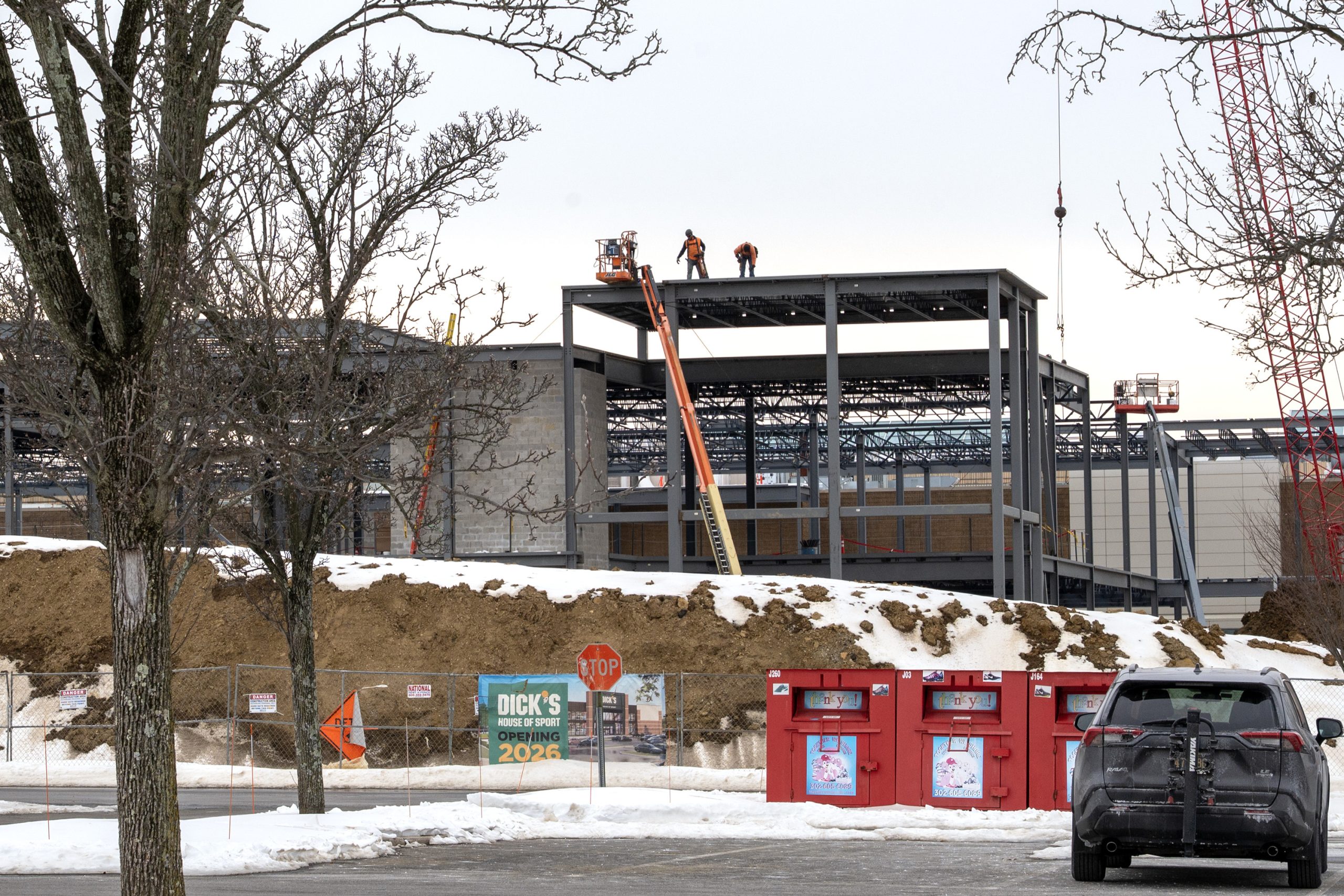
    The retailers will join Dick’s House of Sport, a 120,000-square-foot interactive sporting goods store that is on track to open later this year.

    Construction on Dick’s House of Sport at the Cherry Hill Mall, as seen in February.Tom Gralish / Staff Photographer

    Built on the site of a former office building, the two-story experiential space is set to include a climbing wall, golf simulators, an outdoor track and field, and batting and soccer cages.

    One of dozens of Dick’s House of Sport outposts, it will be represent “the largest single-tenant addition to Cherry Hill Mall in more than a decade,” PREIT executives said.

    The new retailers will also join Crocs, which last month opened a 2,000-square-foot store near the future Dick’s House of Sport, and DoneRight Doner Kebab, a fast-casual Mediterranean food spot that mall executives said will open later this summer in the food court.

    People walk by a new store, Pop Mart, at Cherry Hill Mall on Black Friday 2025.Tyger Williams / Staff Photographer

    Meanwhile, elsewhere in the region, some mid-level malls continue to struggle and even die. Chester County’s only enclosed mall, Exton Square, closed last week after more than five decades in business.

    But higher-end complexes like Cherry Hill and King of Prussia seem to be thriving. King of Prussia Mall, in Montgomery County, also just announced a slate of new openings.

    Here’s what to know about the new shops coming soon to the Cherry Hill Mall:

    • Timberland: The boots and outdoor-wear company is set to open an 1,800-square-foot store later this summer. It will be near Dick’s House of Sport.
    • Indochino: The custom-suit-maker is set to open a 1,200-square-foot store before the 2026 holiday season. It will be off the Grand Court, near American Eagle and Pop Mart.
    • Aritzia: Set to occupy more than 20,000 square feet in the central Grand Court, its space will include not only a clothing store but also an A-OK Cafe, the brand’s in-house coffee shop. It is on track to open in spring 2027.
    • True Religion: The denim company is set to open a 2,230-square-foot store sometime early next year near Dick’s House of Sport.
    • Gorjana: The viral jeweler known for its gold pieces is set to open a 1,107-square-foot store by the 2027 holiday season in the Grand Court.

    Also at the mall, Pandora and Spencer’s recently moved into larger storefronts, and Lululemon is set to relocate into an expanded space in the Grand Court before the 2026 holiday season.