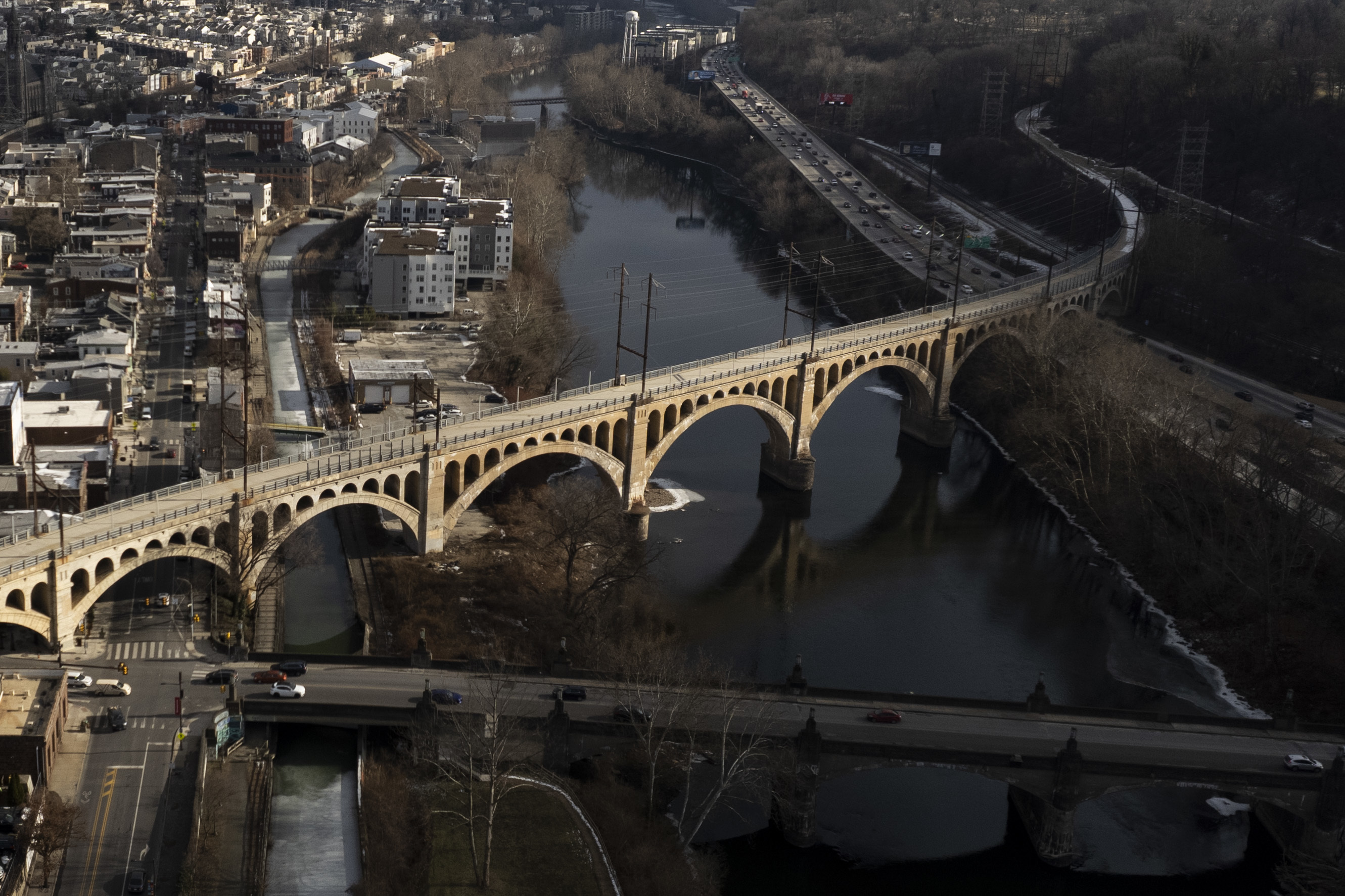
Towering 80 feet above the Schuylkill and shaped by its colossal concrete arches, the Manayunk Bridge is a key connector in the region’s trail system and a link between Philadelphia and its suburban neighbor, Lower Merion Township.
While the trail is beloved by city dwellers and suburbanites alike, a mid-trail traffic pattern switch for bikers and pedestrians has confused some users and prompted one reader to write in, asking The Inquirer to investigate. According to city and township officials, the traffic flow switch-up midway across the bridge is no accident.
The Manayunk Bridge connects Manayunk to Bala Cynwyd. Monica Herndon / Staff Photographer
The Manayunk Bridge connects the 80-plus mile Schuylkill River Trail with the Cynwyd Heritage Trail, a 2-mile multiuse path that runs along an unused segment of SEPTA tracks in Lower Merion. Much of the trail was once SEPTA’s Ivy Ridge line, which connected Philadelphia with Manayunk via Bala Cynwyd, but was truncated in the 1980s due to poor track conditions. The trail’s completion in 2011, and extension in recent years, has marked a major transformation for the previously underutilized corridor of Bala Cynwyd.
Penn Valley resident J.J. Cutuli enjoys running and biking with his kids on the Cynwyd Trail.
“We really love the pedestrian bridge. We really love the trail,” Cutuli said.
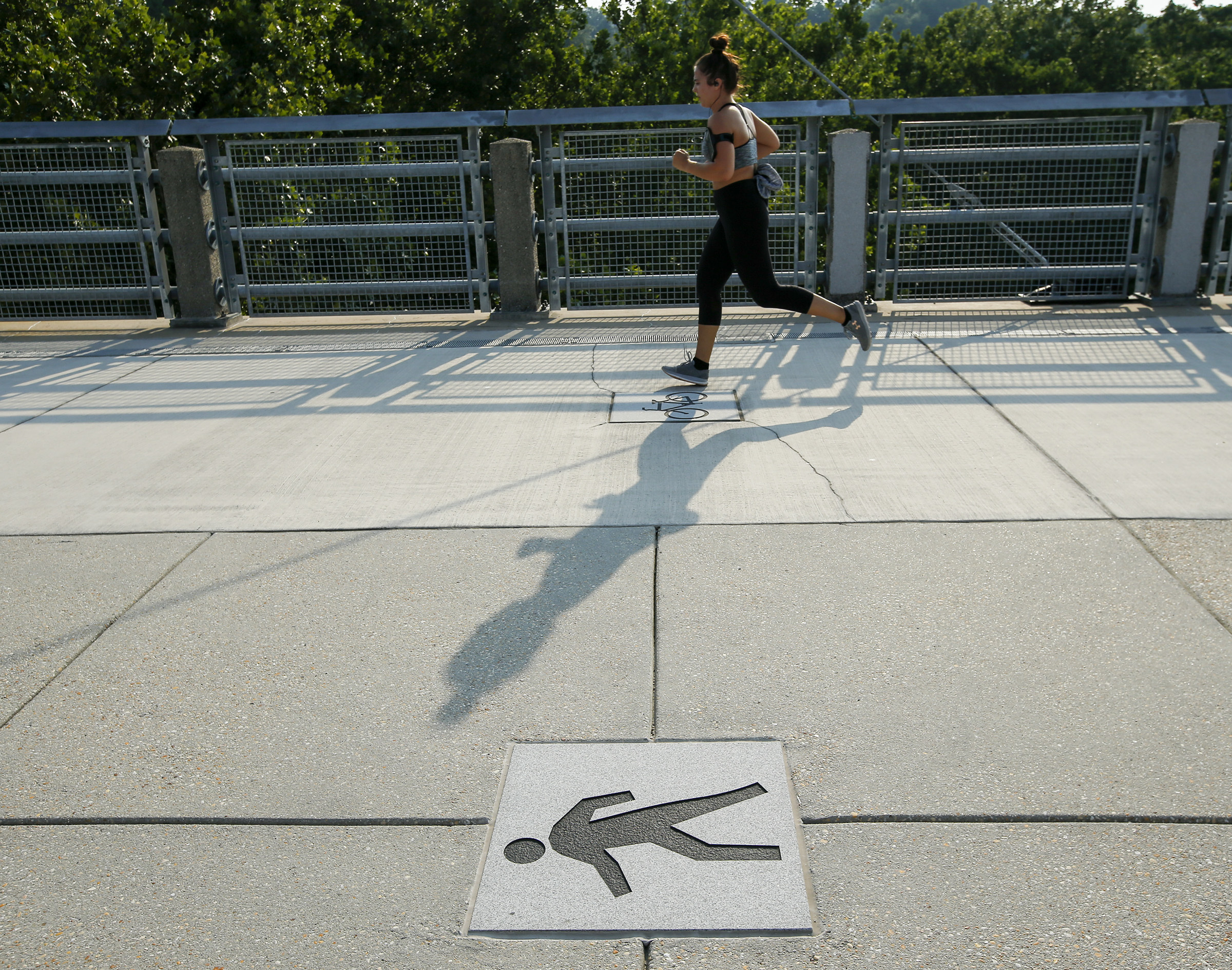
But halfway across the Manayunk Bridge, “there’s this curious little thing that happens,” Cutuli said. The trail’s traffic pattern switches. The bicyclist side becomes the pedestrian side, and vice versa.
“I’m kind of a rule-follower. One of my kids is a rule-follower, and he asked me that question. He was like, ‘What side should I be on? Should I be on this side? Should I be on that side? What are the rules of the road?’” Cutuli said.
Unable to summon an answer himself, Cutuli wrote into Curious Lower Merion, The Inquirer’s forum for answering questions about the Lower Merion community.
Chris Leswing, Lower Merion’s director of building and planning, said the traffic pattern switch was a deliberate choice to slow bikers traversing the downward slope from Lower Merion to Manayunk.
It’s “easy to speed through areas where people may linger and watch the river” and the “idea was that bikers would need to be aware of the pavement markings to check their speeds,” Leswing said in an email.
The city concurred.
The switching of the bike and pedestrian zones was designed to slow bikes down and allow users to “experience both sides of the bridge and the amazing views,” Ra’Chelle Rogers, spokesperson for Philadelphia’s parks and recreation department, said in an email.
The traffic pattern switch was in response to “what was heard from the public and stakeholders,” according to Rogers.
Are trail users following the rules? Not completely.
On one Reddit post, cyclists said the traffic pattern change and accompanying signage “makes zero sense” and “could not be more Looney Toons.” Most cyclists and pedestrians just stay to the right, commenters said.
This suburban content is produced with support from the Leslie Miller and Richard Worley Foundation and The Lenfest Institute for Journalism. Editorial content is created independently of the project donors. Gifts to support The Inquirer’s high-impact journalism can be made at inquirer.com/donate. A list of Lenfest Institute donors can be found at lenfestinstitute.org/supporters.
Lower Merion’s automated red-light cameras have captured hundreds of violations since they went into effect last month.
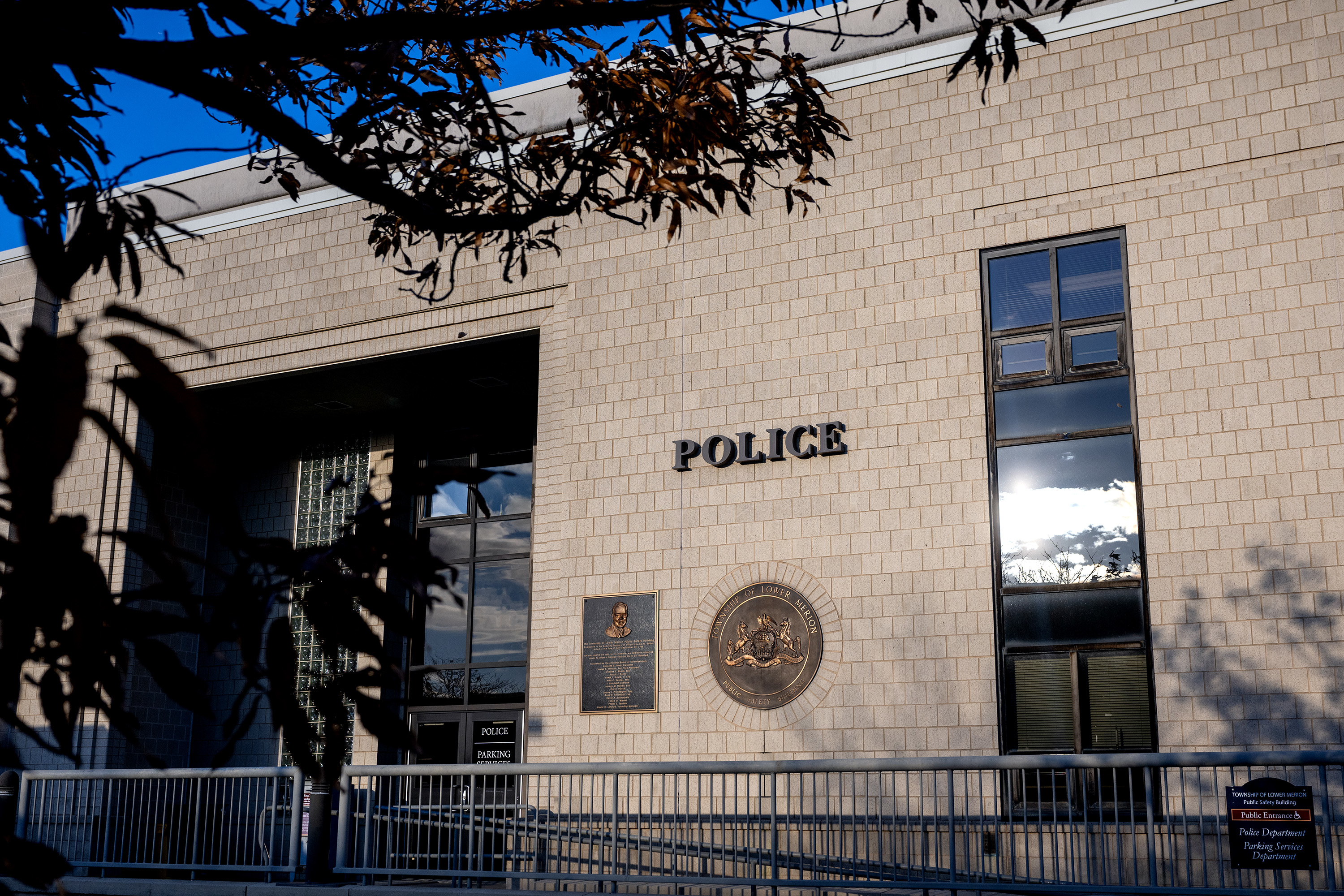
As of Monday, red-light cameras installed at the intersection of Lancaster Avenue and Remington Road had led to 663 citations, according to Andy Block, Lower Merion’s superintendent of police.
The cameras went live on May 13, kicking off a 60-day warning period before the police department began issuing tickets on July 13.
Lower Merion’s cameras capture photos and videos of drivers apparently running red lights. Video and photo evidence is sent to the police department, which reviews each case and determines whether to send a citation to the vehicle’s owner. Red-light violationscome with a $100 fine and can be contested at an in-person municipal hearing.
The intersection of Lancaster Avenue and Remington Road was chosen as the first site for the automated red-light enforcement cameras, and officials have said they hope to expand the program to other high-traffic intersections. Other locations being considered for red-light cameras include the intersections of Montgomery Avenue and Airdale Road and of Lancaster Avenue and Haverford Station Road.
The township has estimated that if cameras are placed at all three high-traffic intersections, around $24 million in annual revenue could be captured initially, with revenue dropping to around $8 million annually as compliance improves.
The township, however, will not collect revenue from the automated red-light tickets. Collected funds will cover administrative costs, with the rest going to a state fund that supports transportation enhancement projects across Pennsylvania. Municipalities that participate in the automated red-light enforcement program receive priority status when applying for transportation grants from the state.
Block said in an email that traffic enforcement is a priority for the police department and that using the automated cameras “provides additional safety for our motorists traveling in the township.”
Under the township’s ordinance, the cameras must be used strictly for red-light violations, not general surveillance. Photo and video evidence taken by red-light cameras must be destroyed within 30 days of a violation being settled and cannot be released under Right to Know requests.
This suburban content is produced with support from the Leslie Miller and Richard Worley Foundation and The Lenfest Institute for Journalism. Editorial content is created independently of the project donors. Gifts to support The Inquirer’s high-impact journalism can be made at inquirer.com/donate. A list of Lenfest Institute donors can be found at lenfestinstitute.org/supporters.
A member of the Lower Merion School District Board of Directors embezzled more than $50,000 from the marketing agency where she works, prosecutors said Monday, and spent the money on family vacations, clothing, and a videographer to film a friend’s son’s bar mitzvah.
Jennifer Rivera, 41, has been charged with theft, receiving stolen property, and related crimes in the theft from SMB Team, a Bala Cynwyd firm that helps lawyers advertise to prospective clients.
She was released on $25,000 unsecured bail. Rivera could not be reached for comment, and there was no indication she had hired an attorney.
Representatives of SMB did not immediately respond to a request for comment.
Rivera used a company credit card issued to her to make the purchases, which began in October, when she had a dress and a bathroom organizer shipped to her home, according to the affidavit of probable cause for her arrest.
Jennifer Rivera (second from left) paid for her family’s vacations using a credit card given to her by her employer, SMB Team, which Montgomery County prosecutors say was a violation of company policy.Denali Sagner / Staff
In a statement Monday, Lower Merion school board president Kerry Sautner emphasized that none of the criminal charges Rivera faces are related to the district or its finances.
“As of this time, I have not had an opportunity to discuss Ms. Rivera’s future on the School Board with her,” Sauter said. “While it is important to note that anyone charged with a crime remains innocent until proven guilty, we must also consider the potential impact of this situation on our Board.”
Her theft from her employer was uncovered in May, when a senior vice president at SMB found that she had used the company card to pay a coworker nearly $1,400 through Venmo, the affidavit said.
When questioned, prosecutors said, she lied and said it was a business expense.
But her coworker, who owns a private videography business, told company officials the payment was for a “last-minute” bar mitzvah gig he agreed to do after the original videographer canceled. He said Rivera told him he had paid her from her personal account, but he realized afterward she had used company money.
He said he knew it was “shady” and was “not sure how she could be so blatantly untruthful,” according to the affidavit.
The coworker said Rivera also used the company card to fly him and his wife to another employee’s wedding, where he was hired to take photos. He said Rivera assured him she was allowed to use the company card for that, according to the affidavit.
After being presented with evidence about the bar mitzvah payment, Rivera said she may have used the wrong Venmo account by mistake. She “became distraught” and said the accusations put her in a “dark place,” the affidavit said.
Rivera was placed on administrative leave, but asked to be fired, saying “the waiting is adding stress,” the affidavit said.
As SMB continued to investigate, the company learned that Rivera had also spent more than $25,000 for airline travel and family vacations, according to the affidavit.
At the time of the investigation, Rivera had booked a forthcoming trip to the Bahamas that was worth more than $9,000 in credit card travel points.
Rivera is scheduled to appear before a district judge for a preliminary hearing on Sept. 2.
The Lower Merion Board of School Directors recently banned two parents from attending meetings in-person for the next year.Joe Lamberti
Two parents were recently banned from attending Lower Merion school board meetings in person for the next year, with the district saying one exhibited “bullying” and “disruptive” behavior.
The parents, Rebecca Foscolo and David Smyth, are among those pushing for less screen time for their kids, a topic that Foscolo admits led to some “extra spicy” behavior at a recent meeting.
But being banned from in-person attendance — both can submit written comments and watch live streams — could be violating their constitutional rights, according to the ACLU of Pennsylvania.
West Nile virus-positive mosquitoes were recently found in the township. Officials suggest residents take precautions, including by reducing standing water on their properties and wearing protective clothing or repellent when outdoors.
SEPTA is rolling out the first phase of its bus network overhaul Sunday, impacting 30 routes, including along the Lancaster Avenue corridor. Here’s what to expect. See how your route is impacted with The Inquirer’s interactive map.
Basketball brand AND1 may be synonymous with New York, but it’s rooted in the Main Line. The Inquirer’s Alex Coffey revisits the cheeky company’s early days, which included an inaugural location in Ardmore and later Rosemont.
Neighboring Upper Merion Township rejected a proposed 5-million-square-foot AI data center campus last week, the nearest of which would have been not far over the township line at 411 Swedeland Rd. in King of Prussia. Developer Brian O’Neill can still appeal the board’s denial.
Two ramps on I-476 will be closed Friday at 10 p.m. and reopen Saturday at 9 a.m. They are the the northbound I-476 ramp to westbound I-76 and the westbound I-76 ramp to southbound I-476.
🎸 Classic Albums Live: Hear covers of the Rolling Stones, the Black Crowes, and Aerosmith. ⏰ Friday, Aug. 21, 8 p.m. 💵 $29.50-$71.42 📍 Ardmore Music Hall
📚 Philadelphia Book Crawl: Several local bookshops — Mavey Books in Ardmore, Children’s Book World in Haverford, Narberth Bookshop, and Chapter Two Books in Wynnewood — are participating in the region-wide event. ⏰ Saturday, Aug. 22, times vary 💵 Pay as you go 📍 Locations vary
🍬 End of Summer Camp: Kids can make edible crafts and play candy-themed games during each day session of this weeklong camp. ⏰ Monday, Aug. 24-Friday, Aug. 28, 10 a.m.-noon 💵 $42.40 per session 📍 The Candy Lab
🎵 Music in the Park: The final concert of the season features a performance by folk duo The Mingo Creek Balladeers. ⏰ Wednesday, Aug. 26, 7 p.m. 💵 Free 📍 Narberth Park gazebo
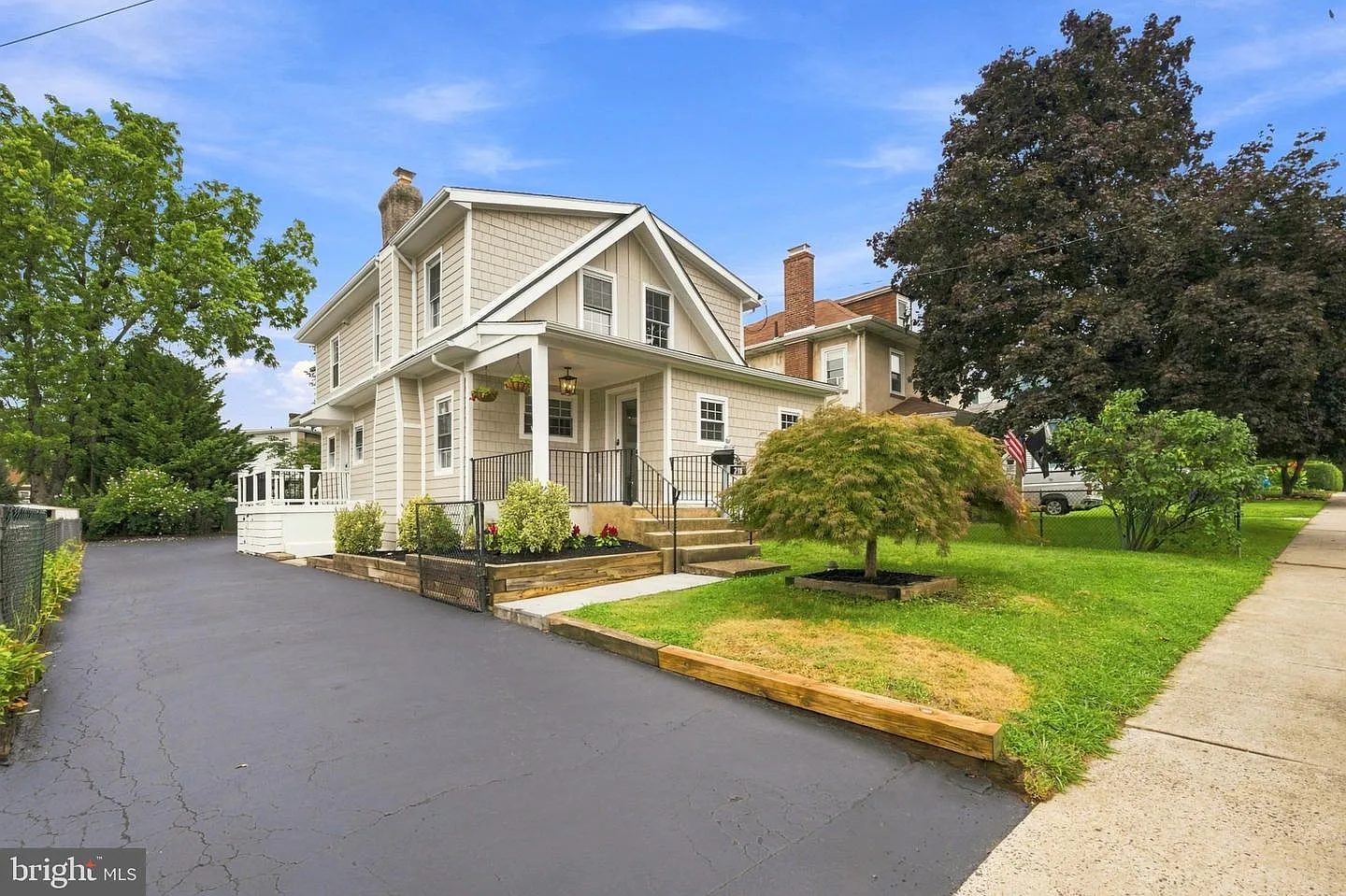
The home has been completely updated.Courtesy of Brian Griffin and Erica Deuschle/Keller Williams Main Line
Spanning four bedrooms and four bathrooms, this Ardmore home has been completely updated, inside and out. Among its features are a first-floor office, a kitchen with a butler’s pantry, and a nearby mudroom. It also has a finished basement with a full bathroom that could serve multiple uses. Upstairs, the primary suite has a walk-in closet, while outside there’s a deck leading to the backyard. There’s an open house today from 5 to 7 p.m. and on Saturday from noon to 2 p.m.
By submitting your written, visual, and/or audio contributions, you agree to The Inquirer’s Terms of Use, including the grant of rights in Section 10.
This suburban content is produced with support from the Leslie Miller and Richard Worley Foundation and The Lenfest Institute for Journalism. Editorial content is created independently of the project donors. Gifts to support The Inquirer’s high-impact journalism can be made at inquirer.com/donate. A list of Lenfest Institute donors can be found at lenfestinstitute.org/supporters.
Kindergartners, first graders, and second graders in Lower Merion schools will no longer receive personal iPads and laptops, under a policy passed by the school board Monday scaling back on students’ technology use.
The policy — which also specifies that third and fourth graders will not bring computers home and limits fifth and sixth graders’ use of computers at lunch and between classes — follows backlash from parents who have been confronting the board since spring about the use of screens in schools. These parents fault the district for providing their kids with devices they say distract them in the classroom, expose them to dangerous content, and fail to help them learn.
“We heard legitimate concerns and undertook an unusually significant amount of time to really make substantial change,” Anna Shurak, the board’s policy committee chair, said at Monday’s meeting, noting that the district will also give teachers and parents new tools to monitor what kids are doing on their laptops.
“What we actually will see will be much different when students walk into school this fall,” Shurak said.
After parents shouted at the board during a meeting earlier this month, it went into recess and moved the meeting online — and announced late last week that Monday’s meeting would be online only, citing disruptions and “threatening comments posted on social media pages.” The district has banned two parents from school board meetings for a year.
“Over the past several months, Lower Merion school board members and our school district superintendent have been subject to threats, our meetings have sustained disruption over and over, and we have witnessed harassment during our public meetings,” board president Kerry Sautner said at the start of Monday’s meeting, adding that “our school team has had their home and families harassed.”
“This is unacceptable,” Sautner said.
District spokesperson Amy Buckman said that comments posted on the Facebook page for Pencils Over Pixels, the parent group pushing for less technology use, “included calls for both death and doxing of Lower Merion School District leadership.”
The comments “were viewable for approximately 48 hours (and maybe longer),” Buckman said in an email.
In a statement Monday, Pencils Over Pixels said it was “horrified by threatening, violent, or hateful comments directed at board members and district employees.” The group, which has enlisted a public relations firm to help promote its message and has gained national attention, said it did not believe the comments came from its members, and once it became aware of them, “we deleted and reported them.”
The controversy, it said, reflected why the parents have been pushing back on screens in school.
“What chance do children and teenagers have in this toxic digital environment while their brains, judgment, and emotional regulation are still developing?” the group said.
The district is strengthening its filtering system to block kids from inappropriate sites, and parents will be able to restrict what kids can access on their school-issued devices in their homes, Shurak said.
The new technology policy makes clear that “teachers and relationships are central to learning,” Shurak said. “Technology is a tool, not a substitute for instruction.”
Tech changes by grade level
The new policy ends Lower Merion’s practice of giving personal devices to kindergartners, first graders, and second graders.
In the classroom, any use of devices at those grade levels “shall be minimal, highly structured, and limited to specific educational purposes such as diagnostic testing, whole-class demonstration, visual display, or, if applicable, state testing preparation,” the policy says. (Pennsylvania’s standardized tests, which start in third grade, are required to be done online.)
In third and fourth grades, students will have “teacher-directed” access to devices that remain in the classroom, while starting in fifth and sixth grades, kids will be issued individual devices. But they will stay in classrooms unless parents want their kids to bring them home, according to the policy.
By seventh and eighth grades, kids may take their devices to and from school under the policy, though they will not be penalized for not completing any computer-based homework, district officials have said.
The policy describes giving students increased independence with devices to form “responsible digital habits,” preparing high schoolers for college and careers.
Theresa Doggett, a parent of three children in district elementary, middle, and high schools, said the district was making substantial changes.
Because of pushback from parents, “public narrative is making it sound like nothing’s being done,” said Doggett, an administrator at a charter school network in Philadelphia. With help from another parent, she wrote and circulated an open letter to support the board and administrators that read in part: “Enough is enough.”
“We cannot continue creating conditions in which talented educators and leaders spend disproportionate amounts of their time responding to conflict, personal attacks, and the demands of whichever voices are loudest rather than leading our schools,” the letter says, noting high turnover in Lower Merion’s superintendent job.
Questions about implementation
But in comments submitted via chat and read aloud by the district’s solicitor during Monday’s meeting, parents continued to question how the policy would play out in practice.
Some noted the lack of strict limits on screen time. Administrative rules accompanying the policy list guidelines for how much time students should “typically” spend on devices each day: less than 30 minutes for third and fourth grades, 60 minutes for fifth and sixth grades, 90 minutes for seventh and eighth grades, and 120 minutes for high school.
The rules also describe “allowing reasonable flexibility based on educational purpose.”
The policy “leaves devices in my 7-year-old’s classroom and sets no enforceable limit on how long she uses them,” said Akshaya Kumar, a lawyer who teaches at Columbia Law School. She also questioned a separate technology safety policy passed by the board Monday, noting it does not require the district to tell parents what it sees while monitoring student devices.
Michael Post, a physician with two children in the district, said he had “never seen a group of people so adamantly disregard what is happening in front of them.”
“The amount of research and data showing educational technology harms to our children are astronomical,” Post said. He called on the district to form an expert panel to advise it on technology use and “eliminate all technology for elementary and middle school.”
One parent expressed an opposite concern — wondering if children would still be able to take home Chromebooks to do accelerated math, and if her fourth grader would have the same chance to learn how to create PowerPoint presentations as her seventh-grade son.
“Our community does not have one perspective on technology,” Shurak said.
Rebecca Foscolo acknowledges she was “extra spicy” at a Lower Merion school board meeting in June, when the board voted to repeal a policy that let parents like her opt their kids out of school-issued laptops and iPads.
Foscolo, who is part of a group of parents demanding that the affluent Montgomery County district scale back on screens, could not believe the board was moving ahead with the vote, after parents had pleaded for the option to say no to devices they said were imperiling their kids’ ability to learn.
“All these educated people are telling you you are doing something wrong, and you are sitting there and doing nothing,” Foscolo yelled at the board, while seated in a row in the Lower Merion High School auditorium.
Members of the district’s security came up to Foscolo, who left on her own.
Now she is no longer allowed to attend Lower Merion school board meetings in person, for a year.
After a second outburst during a board policy committee meeting on Aug. 3, Foscolo received a letter from the district’s solicitor, informing her she had violated Lower Merion’s civility policy.
A second parent in the Pencils Over Pixels group, David Smyth, said he had received a similar letter after the meeting.
In his Aug. 4 letter to Foscolo, Lower Merion solicitor Kenneth Roos wrote that at both the June 15 and Aug. 3 board meetings, she “displayed disruptive and bullying behavior, including yelling at school board members and administrators while they were conducting board business.” He said her conduct “contributed to the board needing to go into recess prior to the completion of each meeting.”
The district on Friday announced that its meeting on Monday night, when the board is expected to approve a new technology policy, would be virtual only “due to disruptions at two recent meetings,” as well as “threatening comments on social media pages.” It did not say what the social media comments were.
Foscolo, who shouted at the board that “the way you’re responding is ridiculous” after it cut off public comment on Aug. 3 before she had a chance to speak, accused the district of violating her constitutional rights.
“They’re basically just trying to bully me and silence me,” Foscolo said in an interview. She and Smyth were banned from attending school board meetings until June 30, 2027. They can watch meeting live streams and submit written comments, Roos said.
”While we would have preferred that everyone remained calm, and we recognize that the behavior may have been perceived as disruptive, we do not believe banning concerned community members from all future board meetings is an appropriate or productive response,” the group said in a statement.
In another statement, Pencils Over Pixels said it was “disappointed” by the decision to make Monday’s meeting virtual.
Any threatening comments “were not condoned by any member of this group and any threatening language is promptly removed,” the group said.
Is it legal?
First Amendment lawyers said the district’s actions in banning residents could be running afoul of their constitutional rights.
“Unless there’s a threat of violence, there’s really no basis” to ban someone from public meetings, said Sara Rose, deputy legal director of the ACLU of Pennsylvania. A person who is “truly disruptive” can be removed from a meeting, she said, and if the district referred the matter to prosecutors, a court could decide to ban the person.
“But the school district cannot unilaterally tell people they cannot attend future meetings,” Rose said, adding: “I haven’t found a single decision that says that’s permissible.”
The ACLU in November 2024 sued the Souderton Area School District after it banned two parents and a student from school properties, accusing them of threatening a school board member. The parents and student, who were part of a group of demonstrators protesting the board president, said they were wrongly accused, and the district lifted the ban in March 2025.
Melissa Melewsky, media law counsel at the Pennsylvania NewsMedia Association, questioned Lower Merion’s decision to end public comment after 45 minutes during its Aug. 3 policy committee meeting.
While governmentagencies are allowed to have guidelines for how long public comment can last, “there has to be flexibility,” Melewsky said. If there is not enough time to hear every person on a controversial issue, she said, agencies are supposed to schedule another meeting to finish the public comment, and “any proposed action has to be put off as well.”
Asked why the district believed its actions were legal, spokesperson Amy Buckman said that residents “were advised that intentionally disrupting a lawful meeting or the administration of a government function is a criminal offense in Pennsylvania.”
She noted the board’s policy for committee meetings includes a 45-minute time limit for public comment on agenda items, “unless extended by the board for special circumstances.”
Pencils Over Pixels said its members had been “assured by the board that the Aug. 3 meeting would be an opportunity to engage with the policy committee” and receive feedback to their questions about the district’s new technology policy.
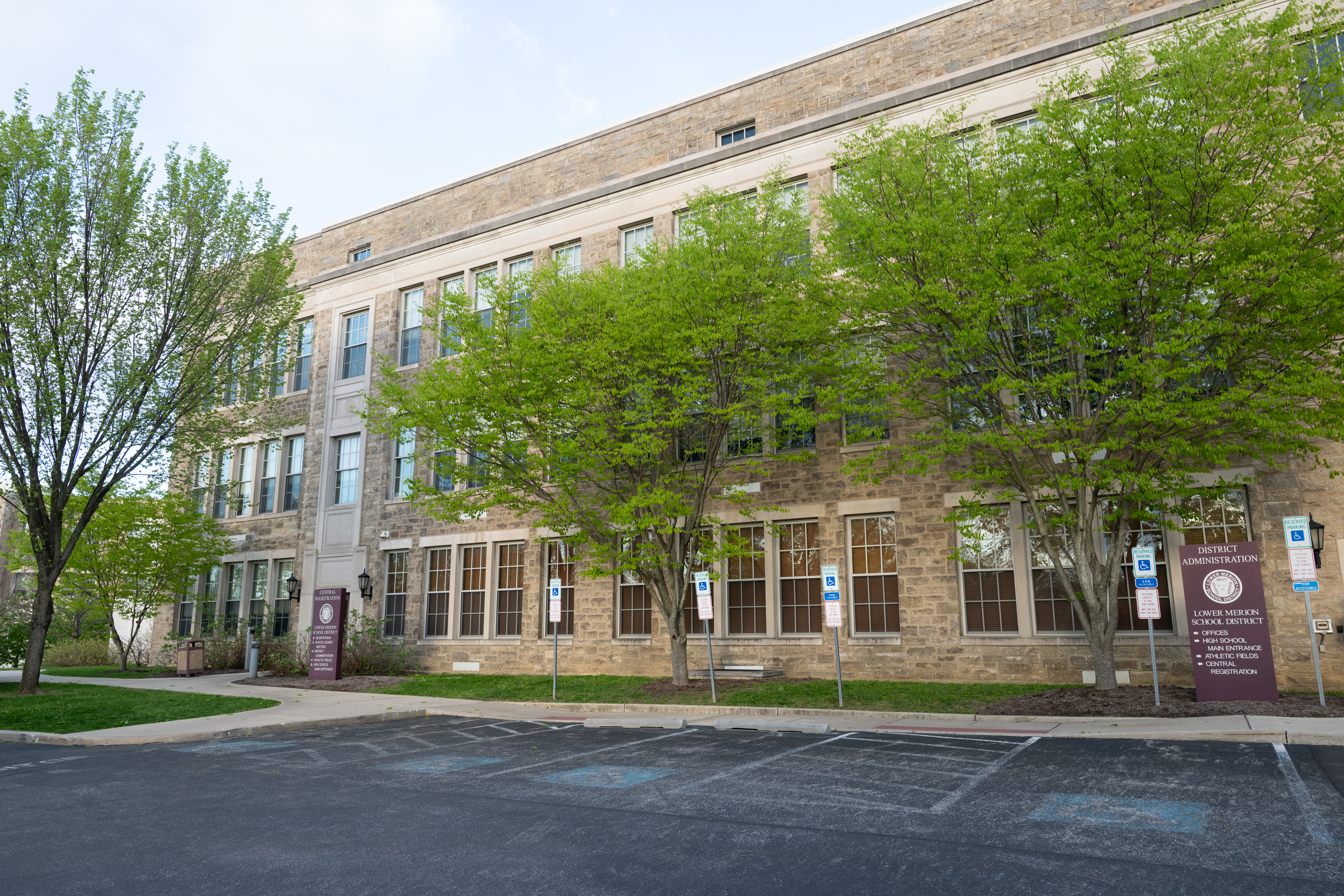
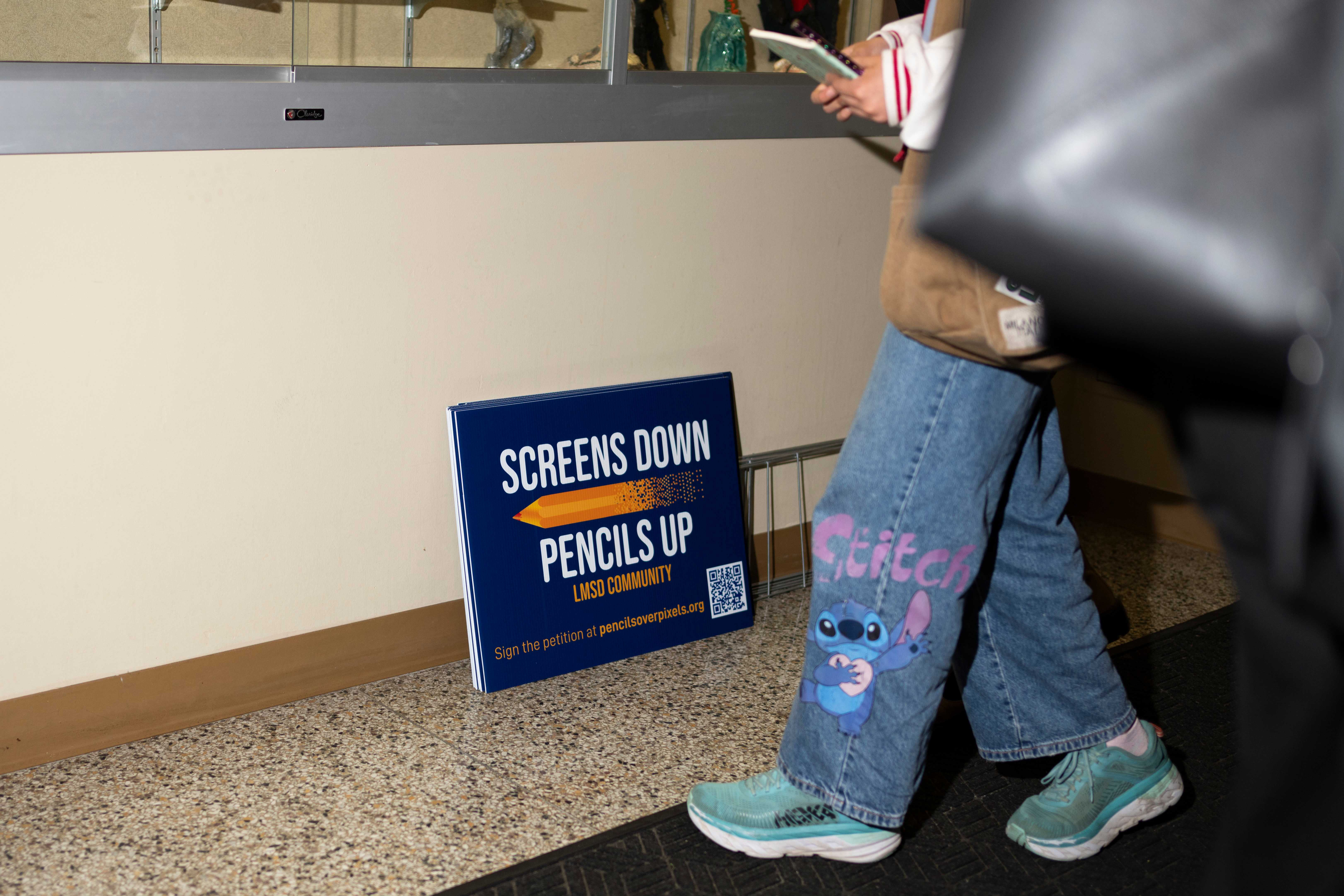
Signs reading, “Screens down, pencils up,” are seen a school board meeting at the Lower Merion School District Administration Building on Monday, May 11, 2026, in Ardmore, Pa. (AP Photo/Joe Lamberti)Joe Lamberti
While Pencils Over Pixels said it had urged its members to remain “calm and professional,” some “were rightfully upset that they were unable to engage in dialogue with the committee as promised,” the group said. “Unfortunately, their emotions governed their behavior.”
Frustrations around tech use
Lower Merion parents have been appearing before the board to complain about school technology use since the spring, describing kids focused on gaming or visiting inappropriate websites instead of doing schoolwork. Others have criticized the district’s use of educational technology programs as low quality, and say they do not want their kids doing reading and math on computers. Hundreds of parents signed a petition in favor of opting out of computers.
The district, which has said it is not possible to opt out of technology use, rescinded its policy allowing for that option and has been moving forward with a new version that places more limits on screens.
Under the policy, which the board is expected to vote on Monday, kindergartners and first and second graders will no longer be issued personal devices, while third and fourth graders will have personal logins to computers in the classroom. The policy includes new guidelines for screen time by grade, and district officials say there will also be new tools for teachers and parents to monitor kids’ internet usage.
Parents pushing for stricter limits have called for the district to release its contracts with educational technology companies and data on how long students are on screens during the school day.
They also want more say in how technology is used, including through the creation of a committee to review the district’s educational technology programs.
“They’ve not been really having good-faith personal conversations,” Smyth, who has a seventh and an eighth grader, said of the board.
Smyth, who went up to the microphone after the board said that public comment was over Aug. 3 and called on the board to answer how many speakers remained, said in an interview he was “only disruptive to insist on continuing public comment.”
Foscolo, who has a rising first grader and a 3-year-old, said that while she had previously addressed the board about the technology policy and had met with several board members, she had repeatedly asked to meet with the board’s president, Kerry Sautner, and the policy committee chair, Anna Shurak.
When Sautner responded, she told Foscolo to come to the Aug. 3 meeting, Foscolo said. She was frustrated she was not able to speak then.
To Foscolo, the board appears to be “placating” parents who have concerns about technology, rather than having genuine debate.
“You have a bunch of parents who want to help, and you’re like, ‘Don’t talk,’” she said.
A Main Line psychiatrist who lost her medical license after a state investigation found she had a yearslong sexual relationship with a young patient while prescribing him highly addictive psychotropic drugs may continue practicing while she appeals the revocation, a state judge ruled.
In ruling in favor of Amy Mazza MacIntyre on Thursday, the judge agreed that she posed no threat to patients, who would likely suffer if their care was disrupted or if they had to find a new provider amid what Commonwealth Court Judge Stella Tsai acknowledged as a “shortage” of specialized child and adolescent psychiatrists in the Philadelphia region.
Tsai also found that MacIntyre would be “irreparably harmed” if forced to close her Bryn Mawr practice because hundreds of current patients likely wouldn’t return, even if she later won her appeal to keep her license.
MacIntyre’s “actions leading to the instant revocation, although spread over several years, were focused on a single individual,” Tsai wrote in her opinion. “In that time, she has treated thousands of patients without reported incident, and there is a purported shortage of psychiatrists with [MacIntyre’s] subspecialty.”
MacIntyre, who specializes in treating young patients with complex psychiatric diagnoses, began seeing a then-17-year-old cancer survivor in 2004 when he was a senior at Lower Merion High School. She first had sex with him in 2011, when he was 24, and prescribed him powerful psychiatric drugs through mid-2017, according to an investigation by the Pennsylvania State Board of Medicine. The board found that the drugs, including Xanax and Adderall, were given to him without proper medical evaluations.
The board revoked her medical license in May, finding she had engaged in sexual misconduct and inappropriate prescribing in violation of state medical licensing laws. She then appealed the decision to Commonwealth Court, where the case is pending. Last month, she asked Judge Tsai to temporarily lift the revocation so she can continue seeing patients while she fights the board’s disciplinary action.
“We are extremely pleased by the judge’s decision and believe it to be appropriate,” MacIntyre’s lawyer, Gary Samms, wrote in a text message to an Inquirer reporter Friday. Samms declined to comment further, citing the appeal. He has advised MacIntyre not to talk to The Inquirer. MacIntyre, 52, did not respond to an email sent Thursday.
Matt Heckel, a spokesperson for the Department of State, which oversees state licensing boards, said the judge merely granted MacIntyre’s request to continue seeing patients but did not address the larger question of whether her license should be revoked. The state is fighting her appeal, arguing that “no sanction short of a revocation would adequately protect the public.”
The patient at the center of the case, Justin Kopicki, who is now 39 and in law school in Oregon, said the judge’s ruling was “extremely problematic,” opening up a “really dangerous can of worms.”
“It says to other psychiatrists and practitioners that it is OK to violate the laws of their license and to take advantage of their patients,” Kopicki said in an interview on Thursday evening. “The court is basically saying that the public interest is not at risk here. Quite frankly, it’s an egregious position to take.”
Kopicki, who gave The Inquirer permission to use his name, said it’s “a very large slap in the face against what I went through.”
“It was not an isolated incident,” he said. “It was something that went on for six, seven years continuously.”
Mixing sex and medications
Kopicki was diagnosed with leukemia at age 4. He received chemotherapy treatments at Children’s Hospital of Philadelphia until age 7, when the cancer went into remission.
In high school, he grew depressed and anxious. He isolated himself from peers. His mother worried his mental health problems stemmed from his childhood battle with cancer. She contacted CHOP, which referred him to MacIntyre, then 31.
During his first appointment in 2004, MacIntyre diagnosed Kopicki with anxiety and agoraphobia. She suspected he also suffered from obsessive-compulsive disorder. She put him on medication.
According to the board’s investigation, MacIntyre “became focused on [Kopicki’s] sexual activity” during treatment sessions in 2010. During a session in early 2011, she told him she “wanted to climb on top of him” and did so, kissing him, the board’s revocation order says.
Soon after, they had sex for the first time at Kopicki’s father’s house. Although MacIntyre stopped charging him for sessions, she formally treated him through June 2013, writing patient notes in his medical record. From 2013 to 2017, she continued having sex with him while prescribing a revolving mix of up to 12 medications to him, without proper evaluations, according to the board’s order.
The board’s investigation — based partly on emails, texts, and voicemail messages that MacIntyre sent Kopicki — revealed that she gave him a $5,000 saxophone and a Cartier watch, hired him to work in her office, proposed marriage to him, told him she miscarried his baby, sent him naked selfies, and took him on trips, including to Turks and Caicos and Walt Disney World.
The board also found that MacIntyre prescribed medications to Kopicki’s mother and father, although they were not her patients.
In an interview with The Inquirer last month, Kopicki said MacIntyre had “groomed” and manipulated him while prescribing “really large quantities” of stimulants and benzodiazepines, including “Xanax and Klonopin mixed together.” She would withhold his medication refills if he refused to go away with her or tried to end the relationship, he said.
Kopicki cut off all contact with her in 2017, shortly after MacIntyre showed up at his father’s house, yelling and demanding to speak with Kopicki. His father called 911, the board found.
Kopicki first complained to the state medical board in 2017. He also filed a medical malpractice lawsuit against her in Montgomery County Court. His lawyers did not want him to cooperate with state investigators while the case was pending, and the state dismissed his complaint.
MacIntyre settled the case with Kopicki in 2020 for an undisclosed amount, and he again complained to the board in 2021. The board launched an investigation, interviewing Kopicki and reviewing “thousands of text messages” between the two.
During the disciplinary proceedings, MacIntyre admitted to sexual misconduct, immoral and unprofessional conduct involving a patient, failure to maintain complete medical records, and fraudulent, reckless, or negligent practice. She had disputed claims that she engaged in improper prescribing, but the board found her culpable.
In her appeal, MacIntyre is seeking a lighter discipline, such as probation. While not excusing her behavior, MacIntyre provided explanations to the board. She testified at a state hearing last year that she had been afraid of Kopicki and that he forced her to have sex. She said she tried to get a protection-from-abuse order against him, but didn’t qualify for one because they weren’t married or living together.
The board rejected her arguments, citing a lack of evidence, finding her testimony not credible, and pointing to her “shifting explanations.”
MacIntyre also cited “personal stressors” in her life at the time of the misconduct, including the birth of a child and her mother’s dementia.
Samms argued that she has learned from her mistakes: She underwent an extensive evaluation with a psychologist who found her fit to practice, and she also went to therapy to address her behavior with Kopicki. Additionally, MacIntyre has limited her interactions with patients to mostly medication management, and has not violated any regulations for the last decade, Samms said.
Samms told Judge Tsai during oral arguments last month that MacIntyre has treated about 15,000 patients without any incident since at least 2017, when contact with Kopicki ended.
“While she acknowledged wrongdoing, it was an isolated patient due to isolated circumstances,” Samms said during the July 30 hearing. “There’s never been any other issues regarding her licensing or her practice.”
Dana Archer, the lawyer representing the State Board of Medicine, argued that the reason so much time had lapsed between her misconduct and the board’s sanction is because “she did everything that she could to hide it.”
“Just because you’re successful in hiding your inappropriate conduct doesn’t mean you should be rewarded and receive a lesser sanction because you were successful in keeping it a secret,” Archer told Tsai.
Archer said MacIntyre took advantage of a vulnerable patient, who was “basically a child” when she began treating him. Her conduct was one of the board’s “worst” cases, she said.
“It was one of the worst things that a psychiatrist can do to a patient,” Archer said.
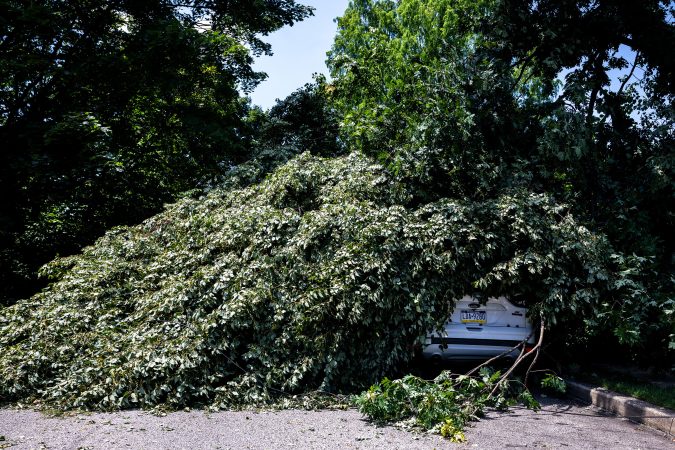
A July 13 microburst brought down part of a tree in Narberth. Tom Gralish / Staff Photographer
As summers grow hotter and more humid, residents throughout the region face increased climate threats that can lead to flooding, downed trees, and damaged property.
That was the case for Tori Bauver, whose Wynnewood apartment was badly damaged in last months’ microburst.
Once infrequent, intense weather events have ramped up due to climate change. “We get a 100-year storm every year,” said Ray Courtney, a Lower Merion commissioner and chair of the township’s sustainability committee.
Many areas, including Lower Merion, also contend with aging stormwater infrastructure, which can exacerbate problems.
Gianluca Torregrossa, a former cardiac thoracic surgeon specializing in robotics at Main Line Health, is suing the system for allegedly firing him after he reported a series of bad patient outcomes at the hands of another doctor. The Inquirer’s Abraham Gutman has the details.
The Narberth Community Food Bank has abruptly shuttered its doors. In a note on the website, founder Gigi Tevlin-Moffat said the nonprofit didn’t make “this change lightly or quickly,” but also didn’t expand on why it was closing, only noting that “the past year has been overwhelming with challenges.”
The Ardmore Avenue Pool won’t open at all this summer, the township’s Parks and Recreation Department said this week. The pool, which the department hoped would open for part of the season, has been closed since last summer to make way for work on the nearby Ardmore Avenue Community Center and area park, which are expected to open early next year.
Bala Cynwyd native Rob Evors is currently starring in new Freeform and Hulu unscripted show House of Stassi, where his Eagles fandom has become an unexpected storyline. The Inquirer’s Maggie Prosser explains why.
Gladwyne-based Waverly Senior Services is looking to build an independent living community on the historic Glencoe estate property in Radnor Township, which is currently owned by the Haverford School.
🍽️ On our Plate
Barstool Sports founder Dave Portnoy was in town last week and paid a visit to beloved Bryn Mawr joint Johnny’s Pizza for his “One Bite Pizza Reviews,” giving it an 8.3 on the spot (the official video has yet to be released). Inquirer food critic Craig LaBan noted the Lancaster Avenue eatery is a rare double threat, thanks to its excellent pies and cheesesteaks.
🎳 Things to Do
😂 Andrew’s Big Show: This drop-in event will feature juggling and comedy. ⏰ Friday, Aug. 14, 11 a.m.-noon 💵 Free 📍 Ludington Library
🥽 Pool Party Family Shabbat: Cool down at the pool, where there will also be music, games, and crafts. ⏰ Friday, Aug. 14, 5-8 p.m. 💵 $15 📍 Kaiserman JCC
🎭 Trial by Jury: The Savoy Company will perform the Gilbert and Sullivan comedic, one-act opera, along with some of the duo’s other works. ⏰ Saturday, Aug. 15, 6-7:30 p.m. 💵 $17-$42 📍 Stoneleigh
🍿 9 to 5: Catch a screening of the 1980 film starring Dolly Parton, Jane Fonda, and Lily Tomlin. ⏰ Monday, Aug. 17, 7:15 p.m. 💵 $11.75-$16.25 📍 Bryn Mawr Film Institute
🎵 Music in the Park: Bluegrass-forward Mark Schultz and the Wayne Rangers will take the stage. ⏰ Wednesday, Aug. 19, 7 p.m. 💵 Free 📍 Narberth Park gazebo
The interior of the home has been reimagined, while maintaining some of its original elements.Courtesy of Robin Halpern/Compass RE
This four-bedroom Ardmore home is 20th-century on the outside and 21st-century on the inside. Built in 1910, the stone estate has been overhauled to give it a modern interior while paying homage to its roots. Among its features is a chef’s kitchen, a wine room, a sun room, and a living room with its original carved wood mantel. It also has a primary suite with dual walk-in closets, a soaking tub, a steam shower, and a fireplace. Outside, there’s a patio with a fireplace, plus a detached two-car garage. There are open houses tomorrow from 2 to 4 p.m. and Saturday from noon to 2 p.m.
By submitting your written, visual, and/or audio contributions, you agree to The Inquirer’s Terms of Use, including the grant of rights in Section 10.
This suburban content is produced with support from the Leslie Miller and Richard Worley Foundation and The Lenfest Institute for Journalism. Editorial content is created independently of the project donors. Gifts to support The Inquirer’s high-impact journalism can be made at inquirer.com/donate. A list of Lenfest Institute donors can be found at lenfestinstitute.org/supporters.
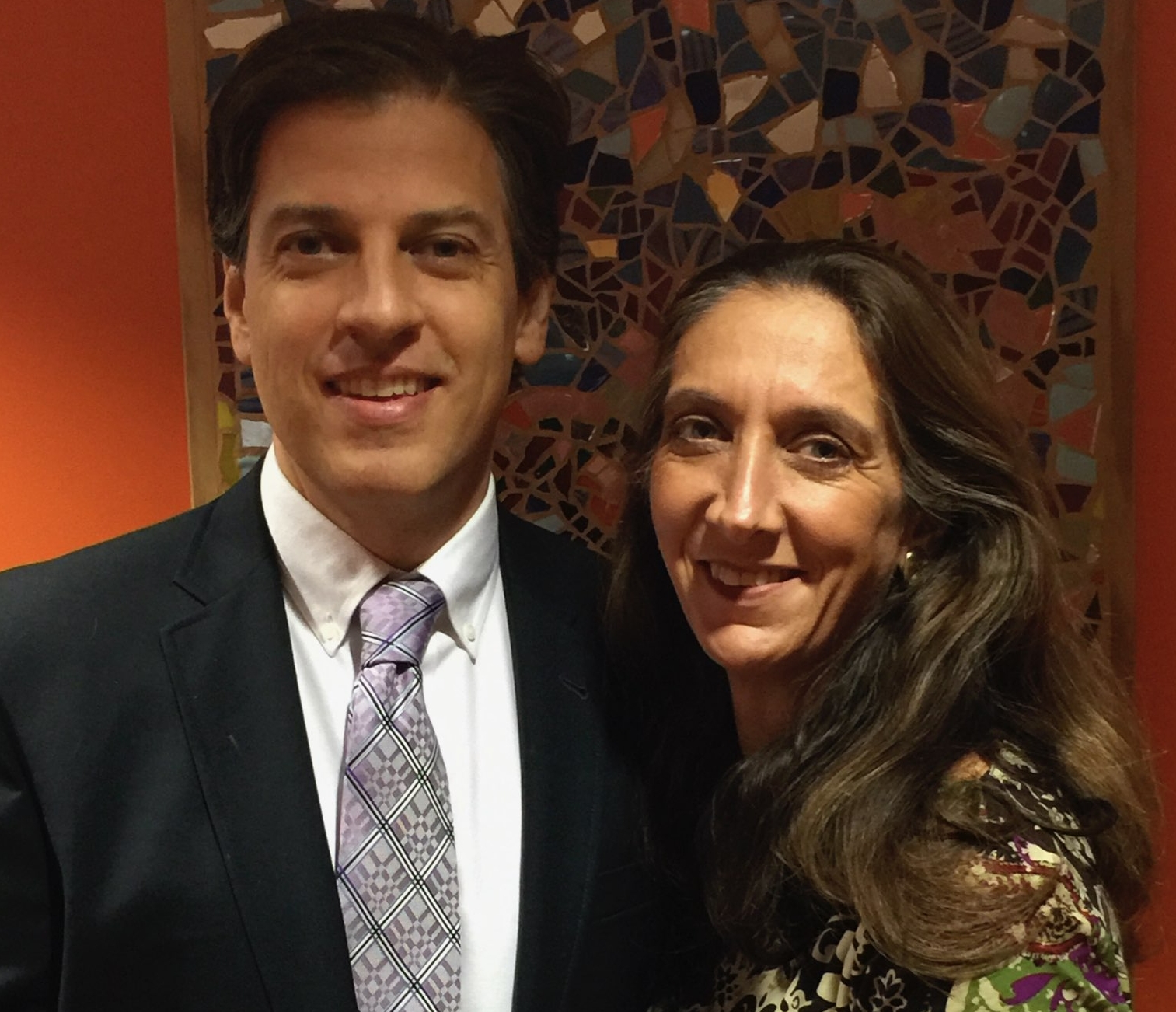
Albert James Mamary, 59, of Wynnewood, attending physician and professor of thoracic medicine and surgery at Temple University, researcher, writer, mentor, artist, outdoorsman, craftsman, and amateur bicycling champion, died Thursday, July 9, of cholangiocarcinoma at Temple University Hospital.
A 1999 graduate of Temple’s Lewis Katz School of Medicine, Dr. Mamary spent his career at Temple and affiliated hospitals. He was an expert in pulmonary disease, transplants, and sleep disorders at the Temple Lung Center, and became program director of the Pulmonary and Critical Care Fellowship at Temple Hospital in 2006.
He earned a master’s degree in anthropology at the College of William and Mary in Virginia and his premedical school credits at the University of Pennsylvania. In a tribute, his family said: “His education in both medicine and anthropology reflected a lifelong belief that caring for a patient required understanding not only the disease but the whole person.”
Over more than three decades at Temple — as a student, resident, fellow, professor, and physician — Dr. Mamary treated thousands of patients, mentored hundreds of students and doctors, lectured in classrooms and at seminars, and wrote more than 60 scientific papers and textbook chapters. He was named a top doctor by Philadelphia Magazine several times and was featured in The Inquirer and on 6abc TV for his lead role in a successful double-lung transplant in 2015.
“It’s been 120 to 145 patients, individual patients that we’ve been able to help every year,” Dr. Mamary told CBS News in 2024. “That’s really the aim here, is to add years of life to patients who otherwise wouldn’t have that opportunity.”
Colleagues called Dr. Mamary a “physician’s physician” and noted his “amazing intelligence and clinical acumen” in tributes. Gerard J. Criner, chair of Temple’s Department of Thoracic Medicine and Surgery, said: “His patients loved him not only for his clinical skills but also for the warmth, compassion, and humanity he brought to every encounter.”
A former patient said online: “He was a calm in the storm of my end stage disease. … The world has lost a hero.”
A former student said: “His kindness, thorough and balanced approach to medicine, and quiet, thoughtful approach to even the most stressful emergencies reminded me of a Jedi master.”
Dr. Mamary and his wife, CeilaSue, married in 1996.Courtesy of the family
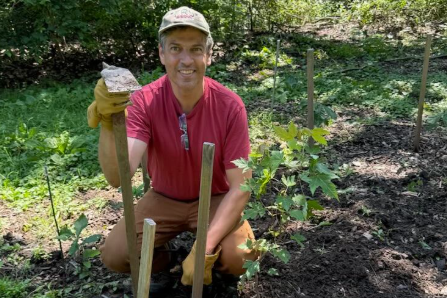
Away from the hospital, Dr. Mamary liked to bike, hike, and camp. He built his own 18-foot mahogany canoe, walked the entire 272-mile Long Trail in Vermont, and won masters bicycling championship races.
He also painted and sculpted, and earned a bachelor’s degree in art and psychology at Haverford College. He and his wife, CeliaSue, initiated the Shortridge Memorial Park Arboretum in Wynnewood and earned a 2024 community service award from Narberth and Lower Merion officials.
“James brought wisdom, kindness, curiosity, and genuine joy to every moment,” his wife said.
Albert James Mamary was born June 12, 1967, in Hempstead, N.Y. He grew up in Binghamton, N.Y., became an Eagle Scout, and was a wilderness river guide for the Boy Scouts in Maine during his college years.
Dr. Mamary was an avid bicyclist and won masters championship races. Courtesy of the family
He met CeliaSue Jaffe in class at Haverford, and they married in 1996 and had daughters HannahRose and LilyRuth. They lived in East Falls and Wynnewood, and he rode his bike from home to Penn and then Temple as often as he could.
Dr. Mamary enjoyed traveling, baking, cooking, and gardening. “His specialty is fruits and vegetables, and I grow the flowers,” his wife said.
He followed the Phillies, rescued cats and dogs, and doted on his daughters. Everybody said he was funny and silly.
“He was curious and always learning or doing something new,” his daughter LilyRuth said. “He took joy in simple things.” His daughter HannahRose said: “Even if he wasn’t my dad I would want him as a friend because he was so interesting and so easy to talk to.”
Dr. Mamary was a wilderness river guide for the Boy Scouts in Maine during his college years.Courtesy of the family
Dr. Mamary was diagnosed with cholangiocarcinoma, bile duct cancer, in 2020 and treated by longtime colleagues and friends at Temple, some of whom he had mentored. “It was a profound reflection of the life he lived,” his family said, “that so many of those he had taught ultimately became his caregivers.”
His wife said: “He was a very vibrant and adventurous person but so thoughtful, steady, and reliable. James was incredible.”
Tori Bauver was sitting at home on July 11 when the sky outside of the Wyndon Apartments in Wynnewood began to darken. Bauver watched the clouds roll in, then the rain come, blowing “literally sideways” outside her window. She remembers leaning in to see the darkening landscape and noticing that rain had begun to penetrate her windows. Then the “outside went stark white” and water started pooling on her windowsills.
“I was like, ‘Oh, my God. This is gonna flood. This apartment’s gonna flood,’” she said.
The light fixture above Bauver’s bed filled with water, then poured over the edges. The ceilings began to leak, then one by one, they collapsed. The building’s roof ripped off, and Bauver had a clear, and unsettling, view of the sky from her living room.
Bauver, now a resident of West Chester, where she and her partner moved after breaking the lease on her Wynnewood apartment, had been living in the Wyndon Apartments for two years when the July microburst storm tore through Lower Merion, destroying her home and more than $5,000 of her and her partner’s belongings. She was one of dozens of suburbanresidents who emerged from the storm with damaged property and a devastated home.
As the Philadelphia region sees hotter and more humid summers, flash flooding, extreme precipitation, and life-threateningstorms have become a more common feature of daily life.Weather eventsmarked by downed trees, dangerous flash floods, waterlogged roadways, and eroded bridges are, more and more,forcing suburban residents and cash-strapped local governments to pour millions into repair and resilience projects, all while large swathsof the region’s infrastructure are built to withstand weather patterns of a bygone era, one in which storms like July’s microbursthappened once in a decade, rather than multiple times a summer.
As the region’s weather patterns intensify, officials and climate experts say the municipal mosaic of Philadelphia’s suburbs faces unique challenges when it comes to planning for a future marked by climate change.
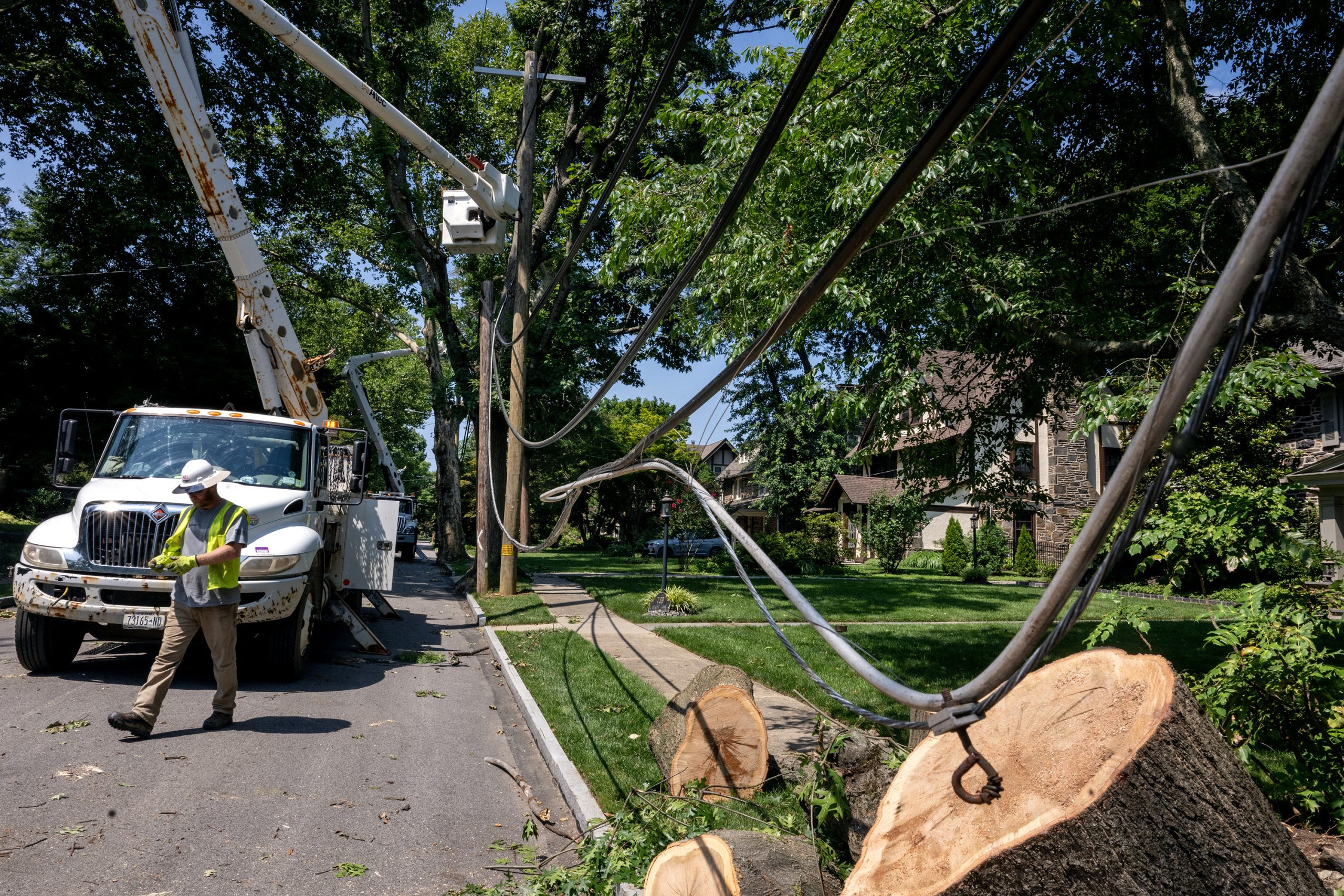
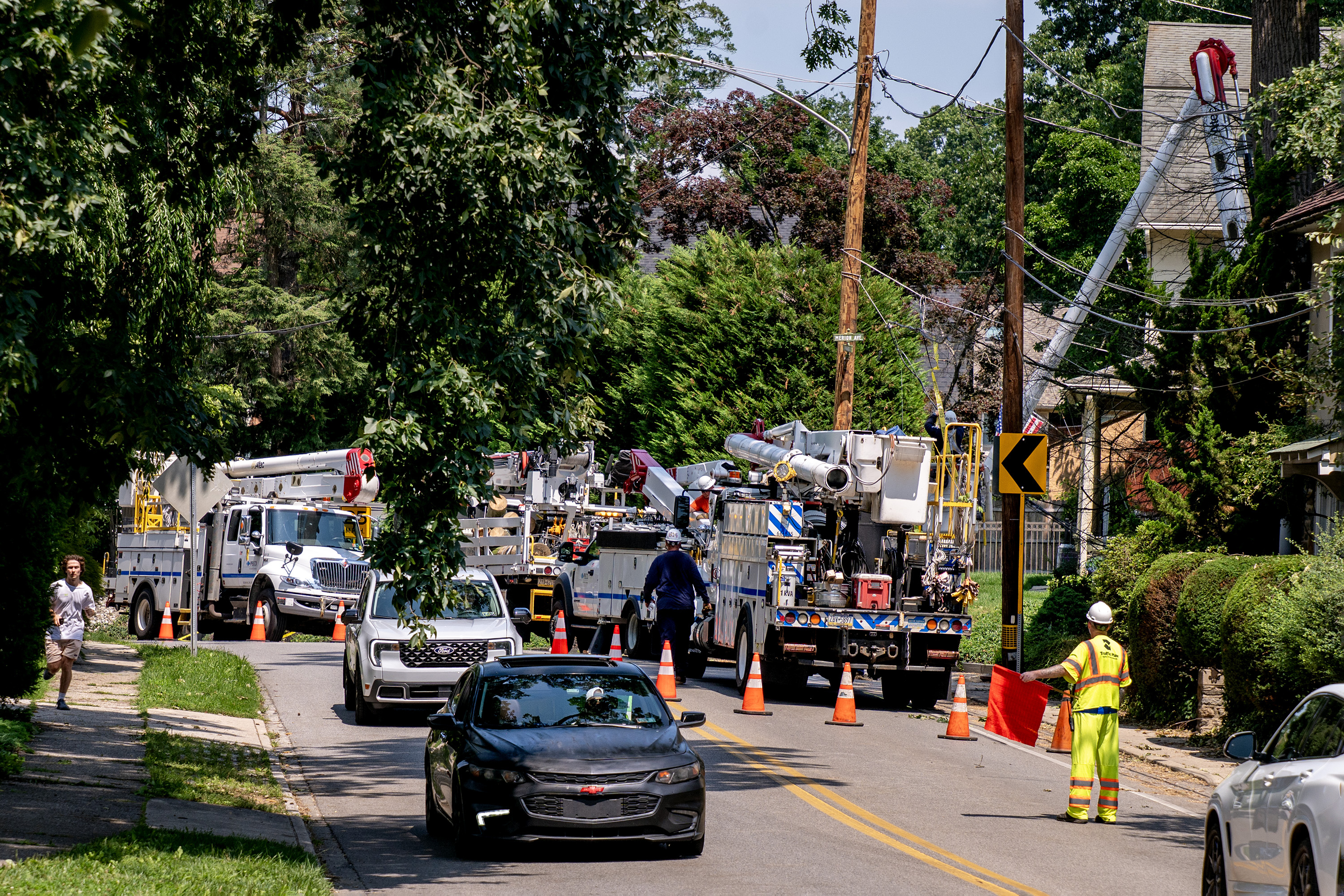
Utility workers restore power in Merion Station on July 13 after a microburst storm ripped through parts of Philadelphia and Montgomery County.Tom Gralish / Staff Photographer
The Philadelphia region’s changing weather
The average July temperature in Philadelphia has risen 4.4 degrees since 1940. In the 1900s, Philadelphia averaged four days per year with temperatures above 95 degrees, according to a 2024 EPA report. This summer, Philly has seen six days with high temperatures above 95 degrees, according to the National Weather Service. By the end of the 21st century, that number could climb to more than 50 days per year.
Hotter weather means more precipitation, and more frequent and intense rain events. For every 1.8 degrees the air temperature increases, the amount of water the atmosphere can hold increases by 7%.
“The infrastructure we have now is not always built to a standard to accommodate the extreme weather we’re seeing now,” said Chris Linn, manager of the Office of Resilience and Environment at the Delaware Valley Regional Planning Commission.
AsRay Courtney, a Lower Merion commissioner and chair of the township’s sustainability committee, said, “We get a 100-year storm every year.”
Cars in a flooded parking lot at the Ferry Avenue PATCO station in Camden on July 6. Philadelphia and its suburbs have been hit with numerous flash floods this summer, as an increasingly hot and humid atmosphere gives way to more extreme weather.Tom Gralish / Staff Photographer
Flooding as ‘the biggest and most common hazard’
The impacts of intense storms are multitudinous and cascading, and the topography of Philadelphia’s suburbs can make it particularly difficult to find effectivesolutions.
Linn said flooding is “the biggest and most common hazard that communities face,” and it presents the most “consistent and pervasive” issues for municipal leaders.
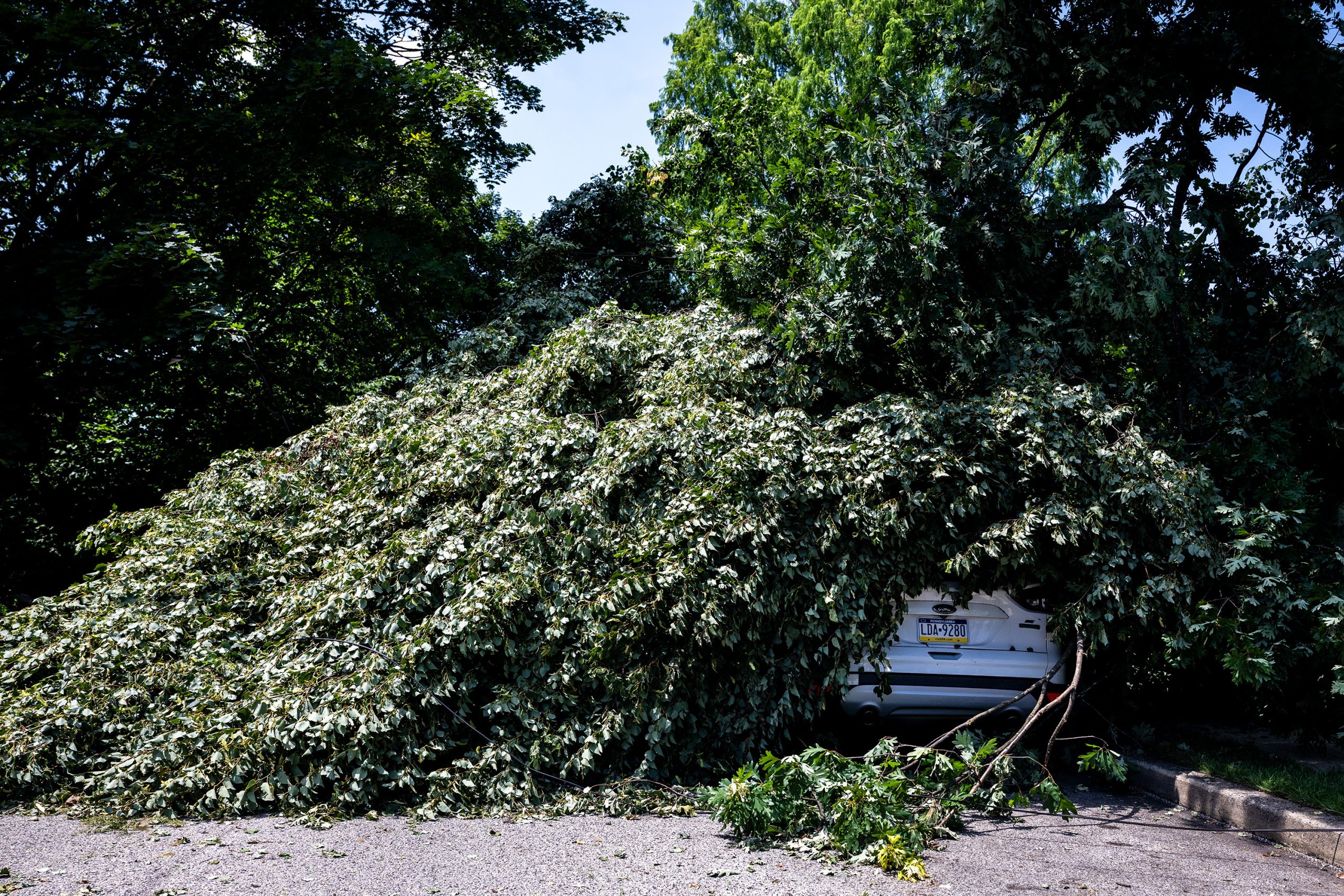
Intense precipitation and flash floods, which have been a constant this summer, can disrupt transit, turn roads into rivers, and endanger residents’ lives. High winds and saturated soil frequently bring down trees, damaging homes and cars and knocking out overhead power lines. Disruptions to power can be particularly dangerous when residents are left without fans or air-conditioning during hot summers.
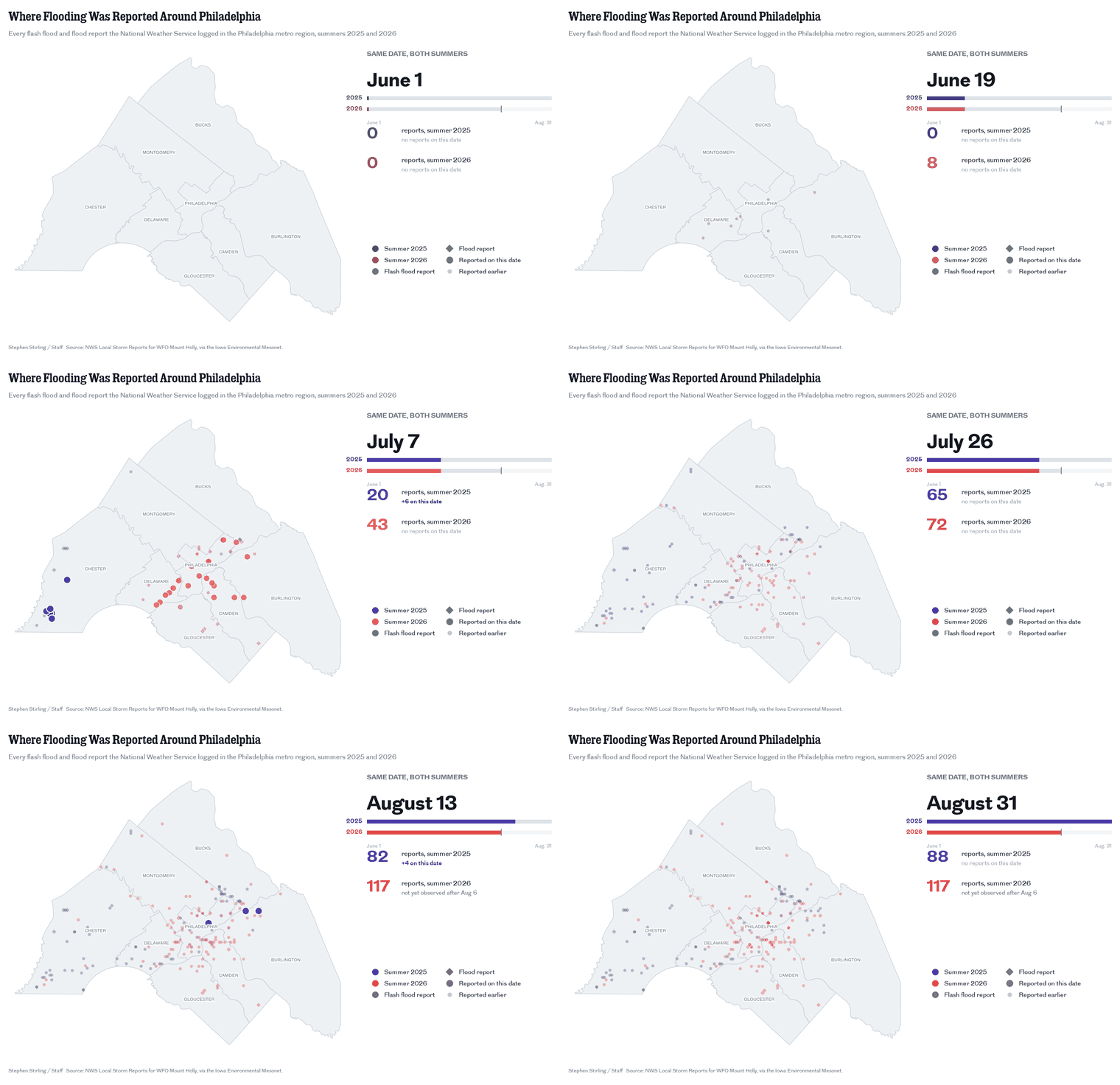
Flooding has been reported more than 200 times in the Philadelphia region over the last two summers.Stephen Stirling
“I see roads flooding consistently, trees coming down, power going out, and then our local government spending resources every time one of these storms happens. It’s overtime costs and tree costs, and then also all the private citizens having to spend costs cleaning up trees and other debris,” Courtney said.
“These unlikely, freak events are really the ones that break us,” said Matthijs Bouw, architect and professor at the University of Pennsylvania’s Stuart Weitzman School of Design.
A key tool for managing extreme weatheris stormwater systems, or the collection of drains, basins, ditches, and pipes that collect rainwater and snowmelt and move it from developed areas into local waterways. Stormwater systems are critical in moving water off impervious, or impenetrable, surfaces, like the parking lots, paved roads, and shopping centers often found in the suburbs.
The more developed a suburb is, the more runoff a storm will produce, increasing flooding risks, said Franco Montalto, professor of civil, architectural, and environmental engineering at Drexel University.
Yet many municipalities are contending with aging stormwater systems that require costly repairs. Lower Merion’s 2018 Comprehensive Stormwater Management Plan listed aging pipes, undersized infrastructure, operational costs, and increasing flooding as challenges for the township. Many of Philadelphia’s suburban communities are composed of buildings that predate a 1978 state law requiring counties and local governments to plan with stormwater management in mind.
Some communities are more vulnerable to climate impacts than others, with density, land cover, wealth, and the state of repair of existing infrastructure as factors. A 2021 climate change vulnerability analysis by Montgomery County found denser, water-proximate communities like Norristown and Pottstown to have some of the highest risk of increased stresses due to climate change. Greener, more rural parts of the county like New Hanover and Marlborough Townships presented lower risks.
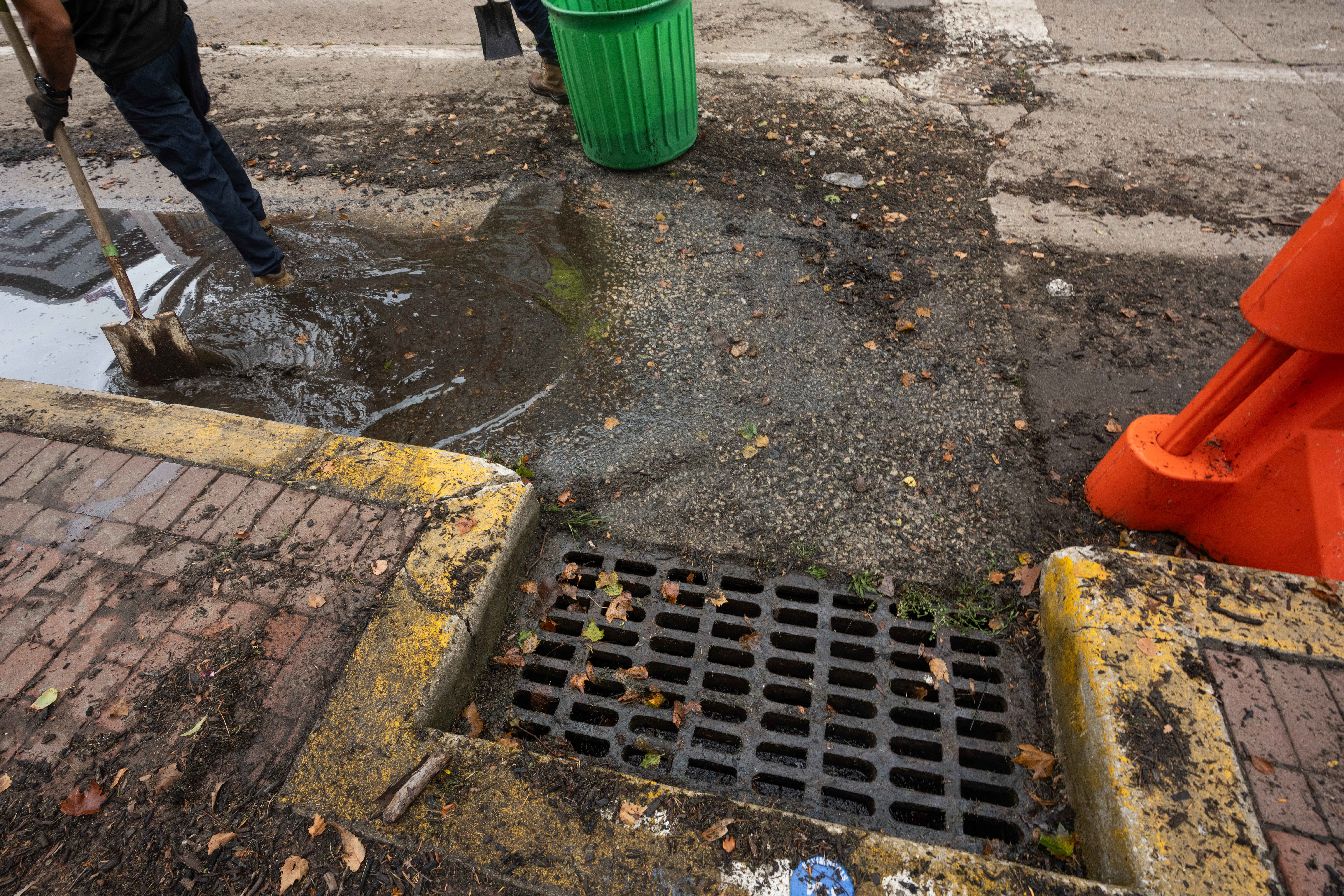
The aftermath and clean up of flooding in Camden on July 6. Stormwater systems are a critical tool for local governments to manage flooding. Jessica Griffin / Staff Photographer
How can communities mitigate impacts?
Experts described a range of interventions for managing climate impacts, from constructing rain gardens to rewriting zoning ordinances.
Maintaining a healthy tree canopy and building rain gardens can help rainwater permeate into the ground. Larger infrastructure efforts like stream restoration projects and floodplain maintenance can help stabilize the built environment.
However, Linn said, these interventions “don’t necessarily address more severe or catastrophic flooding in terms of mitigating those impacts.”
Long-term climate resilience, experts said, relies on making land-use and zoning decisions that preserve floodplains and natural drainage patterns and ensure stormwater systems can manage our new, rainy reality.
Montalto is interested communities that have become “safe to flood,” or that have created parks, parking lots, road medians, and other open spaces that trap water during floods, then properly drain it, keeping it away from buildings and roads. A basketball court built below a park, for example, can fill with water during a storm and slowly drain, mitigating runoff (one was recently installed in New York City). Copenhagen’s Cloudburst Management Plan, adopted in 2012 after a major storm, is a blueprint of sorts in Montalto’s mind.
However, bringing “safe to flood” infrastructure to Philly’s suburbs may be a far-out goal.
In the vast suburbs, the collection of boroughs, townships, and county lines makes unified action difficult, and forces officials to think along municipal, not watershed, lines. On the Main Line alone, rainfall and snowmelt drain into a collection of dozens of creeks and streams that do not start or stop where a municipal boundary is drawn, making it difficult to take coordinated and effective action when it comes to flood mitigation along certain waterways.
Finding the funding to repair and replace stormwater infrastructure, too, can be taxing, as local governments stare down costly projects, even with the availability of state and federal grants.Political will factors in, with municipalities differing in their desire and ability to use taxpayer dollars to tackle climate issues.
Philly’s suburbs, like the city, are also often old, dense, and built out, making it hard to retrofit them to be more climate-sensitive.
“So many of our communities are built out and have been built out for a long time, so the vulnerabilities and the challenges are built in to the community,” Linn said.
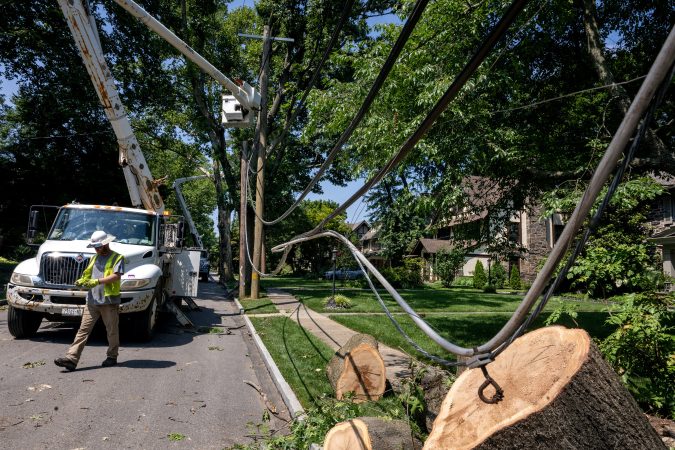
Utility workers restore power along Wynnewood Avenue in Merion Station on July 13.Tom Gralish / Staff Photographer
Solving ‘complex issues’ in Montgomery County
Despite the challenges, progress is being made, said Montgomery County Commissioner Jamila Winder.
Montgomery County in 2025 led a flood mitigation planning study for the 362-square-mile Perkiomen Creek Watershed, which stretches across Montgomery, Bucks, Berks, and Lehigh Counties. The study identified flood-prone areas, evaluated mitigation tactics, and worked to build a framework for long-term resilience. The county is currently in the process of carrying out a floodplain restoration project along the Wissahickon Creek in Whitemarsh Township. Both projects came to fruition after Hurricane Ida tore through the region, bringing record floods and killing multiple people.
The county has repaired 30 structurally deficient bridges since 2017 and has repaved dozens of miles of road. County workers also removed 200 dangerous trees earlier this year, resulting in a significant drop in emergency phone calls about tree damage, Winder said.
Lower Merion in 2021 hired its first full-time sustainability manager and in 2023 completed its first sustainability plan. Radnor Township has adopted a comprehensive climate plan, and Haverford Township has set out to achieve 100% zero-carbon renewable power by 2035.
The Pennsylvania Department of Environmental Protection in January announced more than $17 million in funding for environmental projects across the state, including stream restoration and stormwater management.
Winder said, “We’re seeing that when we work across federal, state, county, and local leadership, that we can come together to solve some of these complex issues.”
This suburban content is produced with support from the Leslie Miller and Richard Worley Foundation and The Lenfest Institute for Journalism. Editorial content is created independently of the project donors. Gifts to support The Inquirer’s high-impact journalism can be made at inquirer.com/donate. A list of Lenfest Institute donors can be found at lenfestinstitute.org/supporters.