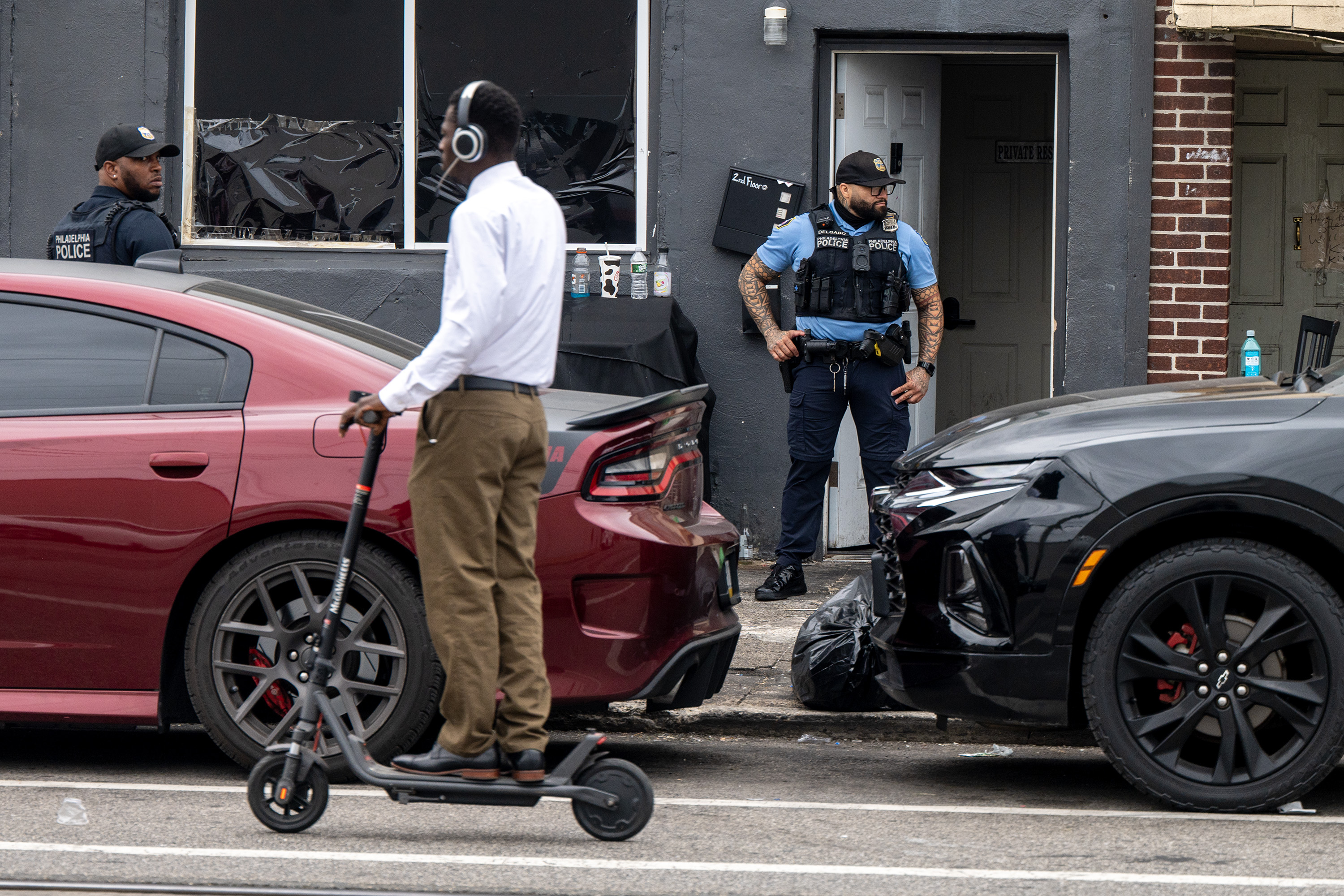
On Aug. 16, the sidewalk outside the after-hours nightclub that was advertised as “Nipsey’s” on social media became the scene of the killing of 29-year-old Officer Alhassane Barry.
Barry and another man had been arguing inside the Elmwood Avenue property in Southwest Philadelphia before the confrontation spilled outside, where the man opened fire on Barry, killing him and injuring another man, according to investigators.
Immediately after the officer’s death, questions arose over Nipsey’s business practices. The property was not licensed to operate as a nightclub, city records show, and its owner had been handed a series of L&I violations in recent years.
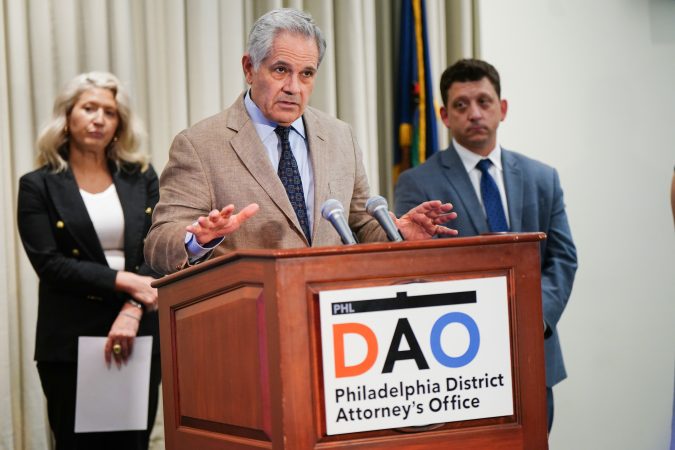
District Attorney Larry Krasner, speaking after Barry’s killing, vowed to shutter what he called a “nuisance business,” adding that investigators believe activity at Nipsey’s may have been connected to another death this summer.
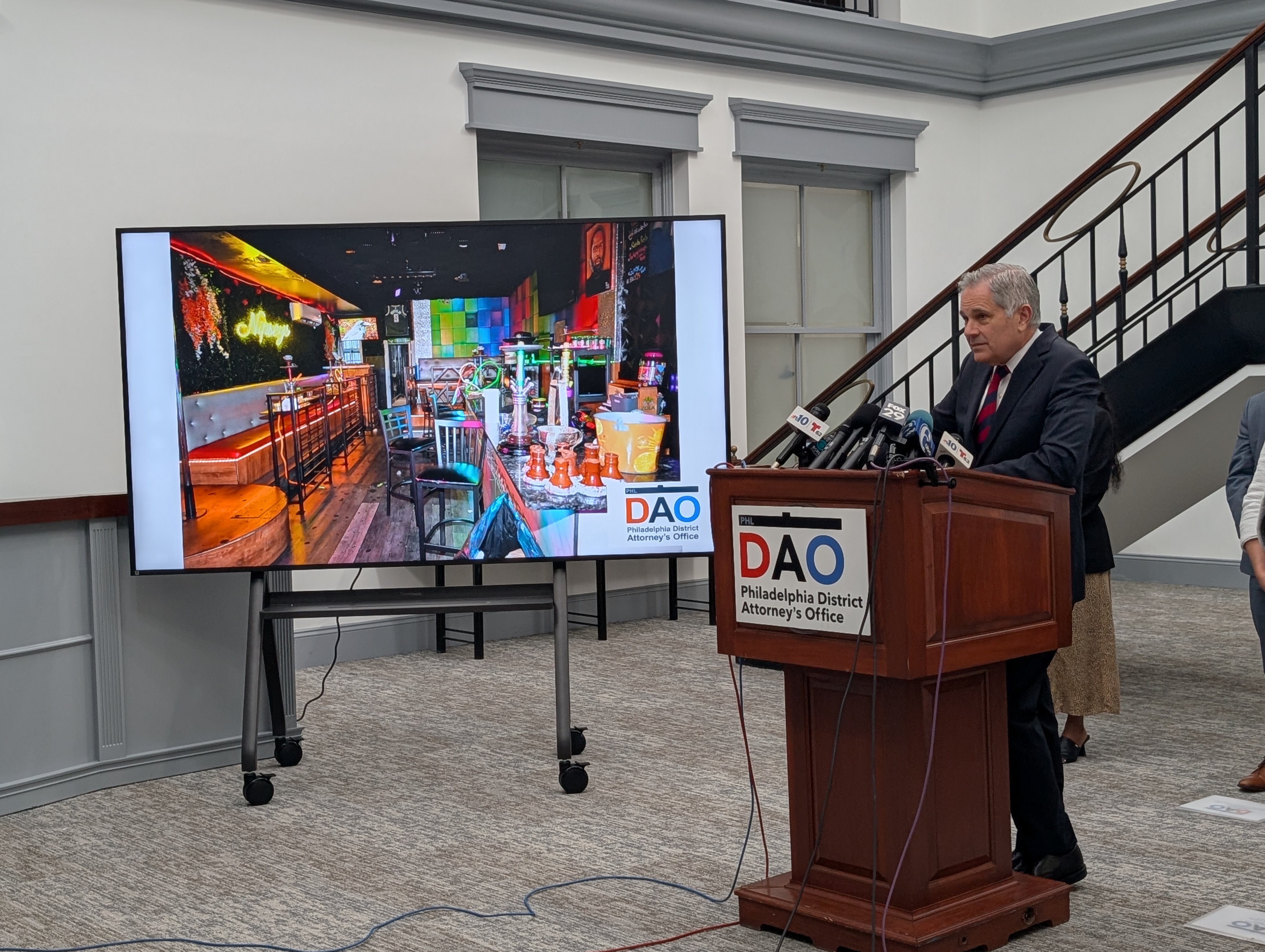
District Attorney Larry Krasner presents images taken inside Nipsey’s Hookah Lounge, an illegal speakeasy where, outside the club, a Philadelphia police officer was killed.Jesse Bunch
The matter was settled Wednesday in Common Pleas Court, when Judge Christopher R. Hall issued an injunction barring the property’s owner, Tran Yen, from conducting any commercial business there for one year. That includes any activity related to selling or offering alcohol, according to the ruling, which is enforceable by the Sheriff’s Office and city police.
A spokesperson for the district attorney’s office, Solomon Leach, said the decision “effectively shuts down this illegal speakeasy.”
“[W]hat we do know is that this establishment — and others like it — operated outside the law and was a problem waiting to happen,” the spokesperson said after the ruling.
Thomas Kenney, a lawyer for the property’s owner, Tran Yen, of Newark, Del., said his client was “shocked as anyone else” about Barry’s killing.
“We are cooperating with the Commonwealth to make sure there are no further nuisances,” he said. He declined to comment on the nature of the connection between Tran and those who operated Nipsey’s.
Tran could not be reached for comment.
In 2021 and 2024, Tran was issued violation notices from the city Department of Licenses and Inspections, violations that were filed anew after Barry’s death, city records show.
In addition to being cited for operating as a nightclub without proper permitting, the property was cited for using extension cords rather than permanent electrical wiring, storing unsecured gas containers, and having combustible materials in a rear lot.
Images investigators recovered from inside the lounge show patrons packed into the space amid brightly colored decorations and neon lights.
Image from inside Nipsey’s Hookah Lounge presented by the Philadelphia District Attorney’s Office.Jesse Bunch
The violations carried $3,200 in fines.
Still, Krasner vowed to close Nipsey’s through court action.
Wednesday’s order to do that came as the DA’s office continues to investigate the circumstances surrounding Barry’s death — including the possibility that the shooting was in self-defense.
A federal judge said Tuesday that he will not call Philadelphia District Attorney Larry Krasner to testify about his actions in a controversial post-conviction case — despite the fact that some of Krasner’s own staffers have accused him of overseeing the matter in ways they viewed as inappropriate.
The decision by U.S. District Judge Paul S. Diamond came at the end of a multiday hearing at which two of Krasner’s prosecutors testified about the discord that emerged among lawyers in the office as they worked to determine whether a man’s murder conviction should be overturned.
Both prosecutors who testified Tuesday, David Napiorski and Peter Andrews, largely echoed assertions two of their colleagues made on previous days of the hearing — including that Krasner vehemently opposed referring the case to the state attorney general’s office, and that he threatened unspecified “consequences” for those who didn’t follow his orders.
In earlier testimony, other staffers accused Krasner of calling state prosecutors “Nazis” and growing “apoplectic” when they memorialized their disagreements with him in writing. Diamond last week also suggested that some actions in the case could amount to crimes including perjury, conspiracy, or obstruction of justice.
Napiorski and Andrews continued to paint a portrait of an office consumed by internal conflicts over its actions in the matter. And they accused Krasner of sometimes amplifying the drama.
Despite that, Diamond said at the conclusion of the hearing that he did not intend to hear from any other witnesses, including Krasner. Instead, Diamond said, his next step would be to determine whether Krasner’s office should be allowed to continue participating in the case moving forward. He did not specify how quickly that ruling might come.
Krasner declined to comment Tuesday. He has previously declined to talk about the matter, saying it would violate ethical rules to do so while it remains pending.
The underlying case is the conviction of Dennis Johnson, who was found guilty of second-degree murder in 2009 for fatally shooting Kenyatta Smith outside a North Philadelphia convenience store.
Johnson appealed his conviction, in part because he said his trial attorney was ineffective. And in 2022, a newly hired prosecutor in Krasner’s law division, Jaclyn Mason, filed court documents agreeing with him and saying his conviction should be overturned.
But this spring, some of Mason’s colleagues began reviewing the case and took the opposite view — in part because they said she’d made clear and important mistakes in her brief supporting Johnson’s position.
That set off a sequence of events that has gone on to roil Krasner’s office.
First, Mason’s supervisors said they had to withdraw her brief and apologize to Diamond for her mistakes — an unusual step for lawyers to take in court.
And although they said they offered Mason a chance to join that effort, she resigned instead, saying she’d only filed her brief because her boss, Matthew Stiegler, had pressured her to do so, and that she didn’t want to be used as a scapegoat for the office.
In the weeks that followed, prosecutors testified, Krasner became involved in a series of disputes with those who remained on the case, including Napiorski, Andrews, and two of their colleagues: Katherine Ernst and Steven Wildberger.
All four went on to testify that they believed their office should recuse itself from handling Johnson’s case because their internal discussions had veered into areas of self-preservation rather than the merits of Johnson’s claims.
But Krasner disagreed, they said, at times angrily. He said he would not refer the case to the attorney general’s office because he viewed their staffers as “Nazis,” according to Ernst and Wildberger. And they and Napiorski said Krasner also wanted to keep the case in-house to “protect the office.”
By mid-July — about six weeks after Mason resigned — Ernst, Wildberger, Napiorski, and Andrews filed documents with Diamond saying they could no longer participate in the case due to the behind-the-scenes drama.
Krasner, in a court document of his own, called their assertions unauthorized and “ill-informed.”
As Diamond weighs how to sort out the turmoil, Roy Clark, Johnson’s father, said he’s become demoralized by how attention has shifted away from whether or not his son should be released from prison.
“With all the in-house fighting and stuff for the DA’s Office, it takes the human component out of the case,” he said outside the courthouse Tuesday. “We’re trying to get my boy home.”
Staff writer Jesse Bunch contributed to this article.
There were so many jaw-dropping moments in U.S. District Court Judge Paul S. Diamond’s courtroom on Thursday that it is hard to know where to begin.
For starters, I had a stint covering courts in the mid-2000s, and have never seen a courtroom packed with so many lawyers — including lawyers representing lawyers — for a hearing in an exoneration case. An overflow room was needed to handle the rapt onlookers.
The hearing grew out of efforts by Philadelphia District Attorney Larry Krasner’s office to overturn the conviction of Dennis Johnson, who was found guilty of second-degree murder in the 2007 shooting of a man at a North Philadelphia convenience store. While Johnson’s future was ostensibly on the line, it quickly became clear that so was Krasner’s.
By the end of the day, the future for both men looked bleak.
While Johnson was in court with his attorneys, the hearing focused on the machinations within Krasner’s office.
The office has already run into a heap of legal trouble over previous efforts to overturn other convictions or reduce sentences, mainly for those convicted ofmurder.
Federal courts have disbarred and suspended prosecutors in Krasner’s office for lying to the court. The state Supreme Court found more lies and, in an unprecedented move, appointed the state attorney general to review future efforts to undo prior convictions.
So essentially, Krasner’s office now has a court-appointed babysitter because it can no longer be trusted.
It was easy to see why after three prosecutors — who still work for Krasner — provided damning testimony about their own office’s sloppy handling of efforts to vacate Johnson’s conviction. They accused Krasner of conduct that bordered on paranoia and cover-up, and painted a picture of an office that seemed less focused on the pursuit of justice than on shielding itself.
Katherine Ernst, the chief of training in the law division, went first, followed by colleagues Steven Wildberger, an assistant district attorney in the appeals unit, and David Napiorski, the head of the law division.
David Napiorski, the head of the law division in the Philadelphia District Attorney’s Office, testified that Krasner eschewed his official email account and “always prefers oral, in-person conversations.”Alejandro A. Alvarez / Staff Photographer
They came with receipts, providing meeting times, memos, and emails documenting conversations with Krasner about how to handle errors in court filings by the DA’s office related to an attempt to undo Johnson’s conviction.
Krasner did not respond to a request for comment, but in an earlier filing his office said the prosecutors were “ill informed.”
The three prosecutors provided alarming testimony detailing how Krasner avoided using his official office email and threatened them.
“DA Krasner typically didn’t use that email,” Ernst said about his office email. “He wouldn’t check it. And so, if you wanted to email him, then you typically had to email his private address.”
Napiorski backed that view: “He always prefers oral, in-person conversations.”
In late June, after the three prosecutors drafted a memo to Krasner detailing the office’s conflict of interest in handling the Johnson matter, he responded with an email sent from the account of his chief of staff, Jennifer Lin, which began, “This response is not from Jen Lin, it is from Larry Krasner.”
At another point, Wildberger testified that when they presented Krasner a letter turning the Johnson case over to the state attorney general, he went “apoplectic.”
“He said something about having already told us not to bring him printed-out material, things in writing,” Wildberger said.
‘Paraguay’
The prosecutors pushed for the attorney general to take over, because their self-interest had become a focus rather than the merits of the case. In their view, they had conflicts, and so did Krasner.
But Krasner wanted to hire an outside lawyer to handle the matter, and repeatedly resisted efforts to turn the case over to the state Office of Attorney General, or OAG.
Ernst testified that Krasner “hated” everyone in the OAG. Wildberger said Krasner “referred to the Office of the Attorney General as Paraguay” and “the people that work there as Nazis.”
Adding to the drama was the fact that the attorney questioning Ernst and Wildberger was John Boscia, a senior deputy attorney general in the OAG.
To clarify, Boscia asked Wildberger, “So that the people from the OAG’s office were escaped Nazis who had gone to Paraguay?”
“That’s my understanding,” Wildberger responded.
All three prosecutors testified that throughout the internal discussions, Krasner remained adamant about retaining control of the case in order to “protect the office” — a phrase that came up more than two dozen times during the hearing.
At one point, Judge Diamond asked if Krasner’s reference to “protect the office” meant “protect himself?”
“I think that was probably part of it,” Napiorski said.
In another twist, Thomas Gaeta, the DA’s civil litigation supervisor, was involved in some of the internal discussion, yet he handled the brief and mild cross-examination of his colleagues on Thursday.
The roots of the DA’s conflict began after Johnson appealed the verdict, claiming his defense attorney was ineffective.
In 2022, then-Assistant District Attorney Jaclyn Mason filed a document that agreed with the arguments made by Johnson’s attorneys at the Pennsylvania Innocence Project, and that his conviction should be overturned. According to the document Mason signed, the detective’s testimony in Johnson’s trial was improper and had “tipped the scales” toward a conviction.
But this spring, following an order from Diamond, Ernst and some of her colleagues reviewed the case. Ernst said she found multiple errors in Mason’s motion and confronted her.
Ernst and her colleagues urged Mason to fall on her sword for the office,take responsibility for the errors, and withdraw the motion. Napiorski said he told Mason he had done something similar in a different exoneration case that blew up.
Profiles in courage.
‘Reluctantly but loudly’
The main hero in what is shaping up to be an unraveling of Krasner’s mass exoneration scheme appears to be Mason.
Her dramatic testimony in Diamond’s courtroom last month provided a window into the lack of independent investigation by Krasner’s office into the wrongful conviction claims. (Mason also appears to have provided some backbone to the three prosecutors who testified on Thursday.)
Mason explained that she had only been on the job a few months in 2022, and had largely taken directions from her supervisor, Matthew Stiegler, who she said told her if Johnson’s claims were good enough for the Innocence Project, they were good enough for him.
In the meeting with the prosecutors, Ernst recounted that Mason said, “This is all Matthew Stiegler’s fault.”
Mason told her colleagues that Stiegler should have to sign the withdrawal motion, as well. Apparently, that was not an option. Instead of going along with the plan to take all the blame, Mason resigned on June 2.
In a two-page resignation letter addressed to Krasner, Mason wrote that she had limited experience with federal habeas law when she was hired. Yet, the first two cases Stiegler assigned to her “involved complicated cases where he determined that it was appropriate to concede habeas relief.”
Mason said she “trusted” Stiegler, but later learned about a mass exodus of prosecutors when he oversaw the federal litigation unit.
Mason said Stiegler had “worked closely with the Innocence Project and the Federal Defenders on the [Johnson] case, deeming it worthy of a concession with little independent investigation.”
Therein lies the problem when it comes to reviewing past convictions. Under Krasner, the prosecution and defense are largely on the same team.
Mason added that Stiegler reviewed several drafts of the concession she filed in the Johnson case, but did not sign his name to it. Mason ended by writing that she “reluctantly but loudly” resigned.
After Mason quit, all three prosecutors testified that Stiegler hatched a plan to manage the fallout. He suggested combing through Mason’s past cases for errors and claiming she was a rogue operator.
Ernst testified that Stiegler asked to meet and told her, “Mason purposely inserted the false facts into the response.” Ernst explained that Stiegler wanted to make it seem as if any mistakes in the case were “100% [Mason’s] fault and 0% his fault.”
Krasner was on board with Stiegler’s plan, according to Ernst, who recounted a conversation with the district attorney.
Krasner said Stiegler “gave me this really good idea,” Ernst testified. “I think that we should go through Ms. Mason’s cases, say that this was a pattern by her, and then file something with the court saying that.”
Why the deference to Stiegler is unclear. He has come and gone from Krasner’s office three times and remains a lightning rod. Stiegler now oversees the Conviction Integrity Unit, a departmental name fast becoming an oxymoron.
Stiegler sat in the front row of Judge Diamond’s courtroom on Thursday as the other prosecutors testified about his role and reputation with the office.
Wildberger testified that in the meeting with Mason and the other prosecutors, he told her, “You’ll find no Matt Stiegler apologists here.” He later explained that Stiegler “was not well liked” and had chased away many prosecutors.
The internal drama and legal troubles have roiled Krasner’s office. Ernst testified that many frontline prosecutors were “angry” at Krasner for what happened to Mason. Wildberger said he had “lost faith in the administration of the Philadelphia District Attorney’s Office.”
Amid the discussions over whether to tell the court about the errors in the Johnson case came another bombshell.
Ernst testified that Napiorski warned her Krasner had threatened “to fire anyone who tells the judge about this.” She added that Wildberger clarified Krasner didn’t use the word fire, but said that “there would be consequences.”
Early on in the proceeding, Judge Diamond signaled his take on the emerging testimony.
“If what they say is true, potential wrongdoing abounds,” Diamond said. “There’s a question of whether perjury was committed, subornation of perjury was committed, criminal conspiracy was committed, and obstruction of justice was committed.”
The hearing is scheduled to continue on Tuesday. It is unclear what the judge will do next.
I left the courthouse thinking about the Watergate hearings and, in particular, a March 1973 meeting in which White House counsel John Dean warned RichardNixon about a “cancer” on the presidency.
Has something similar metastasized in Krasner’s office?
This week’s edition of Shackamaxon covers data centers, property assessments, and more woes at the Philadelphia Sheriff’s Office.
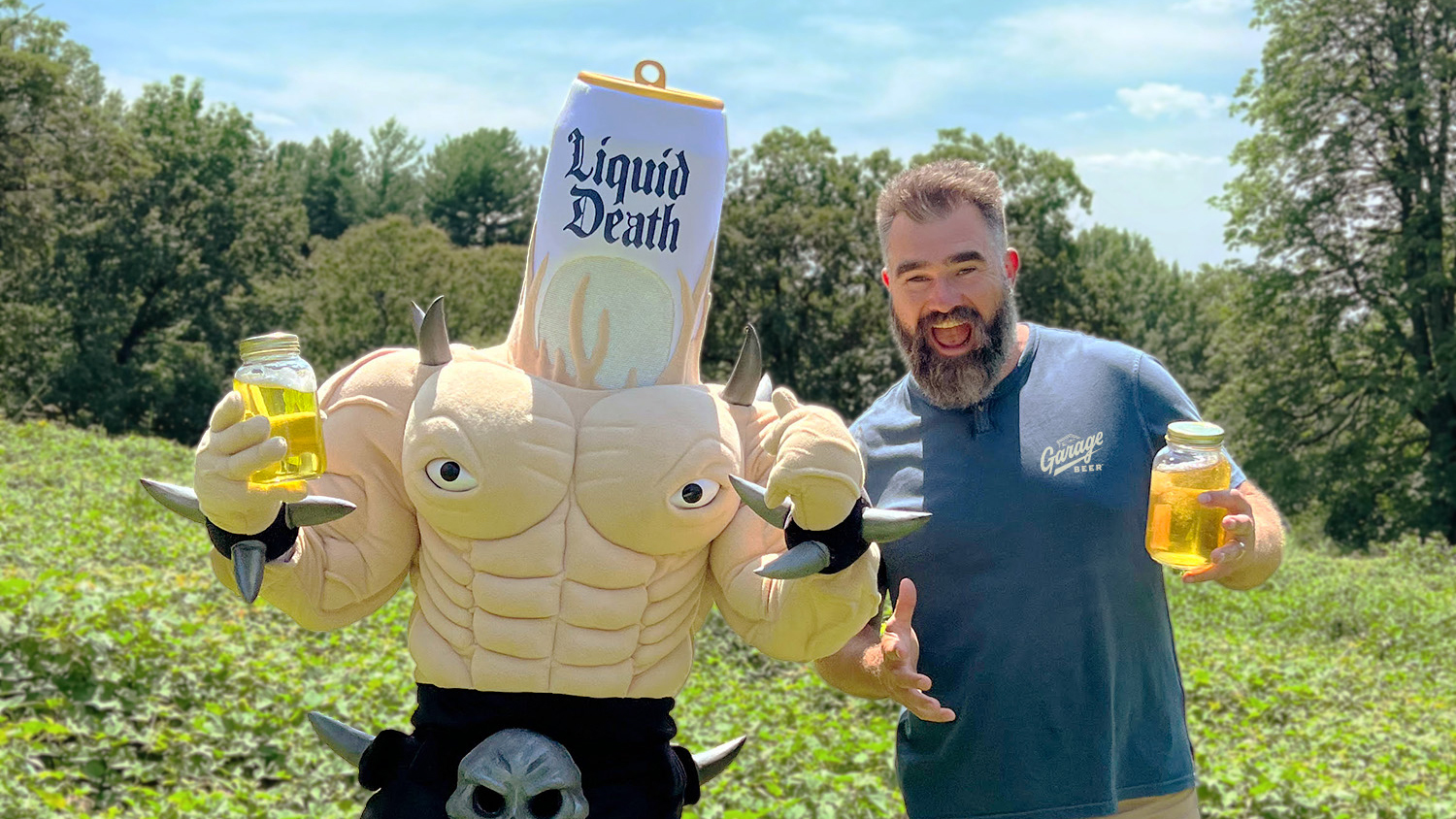
Jason Kelce with Liquid Death mascot Murder Man in an ad for the canned water and Garage Beer.Garage Beer
Sports data center
Former Eagles offensive lineman Jason Kelce seems to be more omnipresent in retirement than he was during his career. Most recently, he filmed a commercial for Garage Beer and Liquid Death that asked Americans to send him their urine to supply data centers.
While conjuring a negativeimage of yellow liquid in a cup is probably an unwise strategy for someone who co-owns a light beer company, Kelce’s commercial had another major problem — data centers don’t actually use as much water as public perception suggests.
In fact, the biggest threat to U.S. water supplies is something far more mundane: alfalfa farming.
Across the arid Western states, farmers are using vast amounts of water to irrigate their fields, which are then used to feed cows for the beef industry. A single acre of alfalfa uses 1.6 million to 2.5 million gallons of water. In Utah, feed farming uses over half the state’s water supply. Meanwhile, the data centers themselves increasingly rely on closed-loop systems. The water used as coolant gets purified and reused, reducing their own need.
The confusion over water use is emblematic of the general debate over the centers, which is rife with hard-to-vet claims. And shifting public opinion has left politicians in both parties flat-footed and scrambling to react.
Gov. Josh Shapiro, the ever-Ambitious Abingtonian, issued his own response to the situation. Much of what Shapiro said is reasonable. He wants tech companies to pay for their own power and contribute to community benefits agreements, and to respect the Pennsylvania Constitution’s guarantee of clean air and pure water. Some of it is less sensible, specifically his commitment to local control.
Local control sounds great in theory: Why shouldn’t communities have the final say over how they are developed? In practice, however, it is shortsighted. There are two reasons for this.
One, the impact of data centers is regional, not local. If opponents are correct about the impact on water and electricity bills, this impact will exist no matter where the centers operate. Given the PJM grid Pennsylvanians rely on spans multiple states, there is no plausible pathway for local communities to insulate themselves from rising energy demand by blocking data center proposals.
Two, not every community can afford to say no. Take the bankrupt city of Chester, for example. From its efforts to sell the Chester Water Authority to its role as host for the Reworld Trash Incinerator, financial considerations already play a big role in that city’s policymaking. By handing control to local authorities, the governor is ensuring cities like Chester will disproportionately play host to data centers.
For those who believe they will have a strong negative impact on quality of life, how is that possibly fair?
Instead, what is needed is federal, regional, or at least statewide coordination.
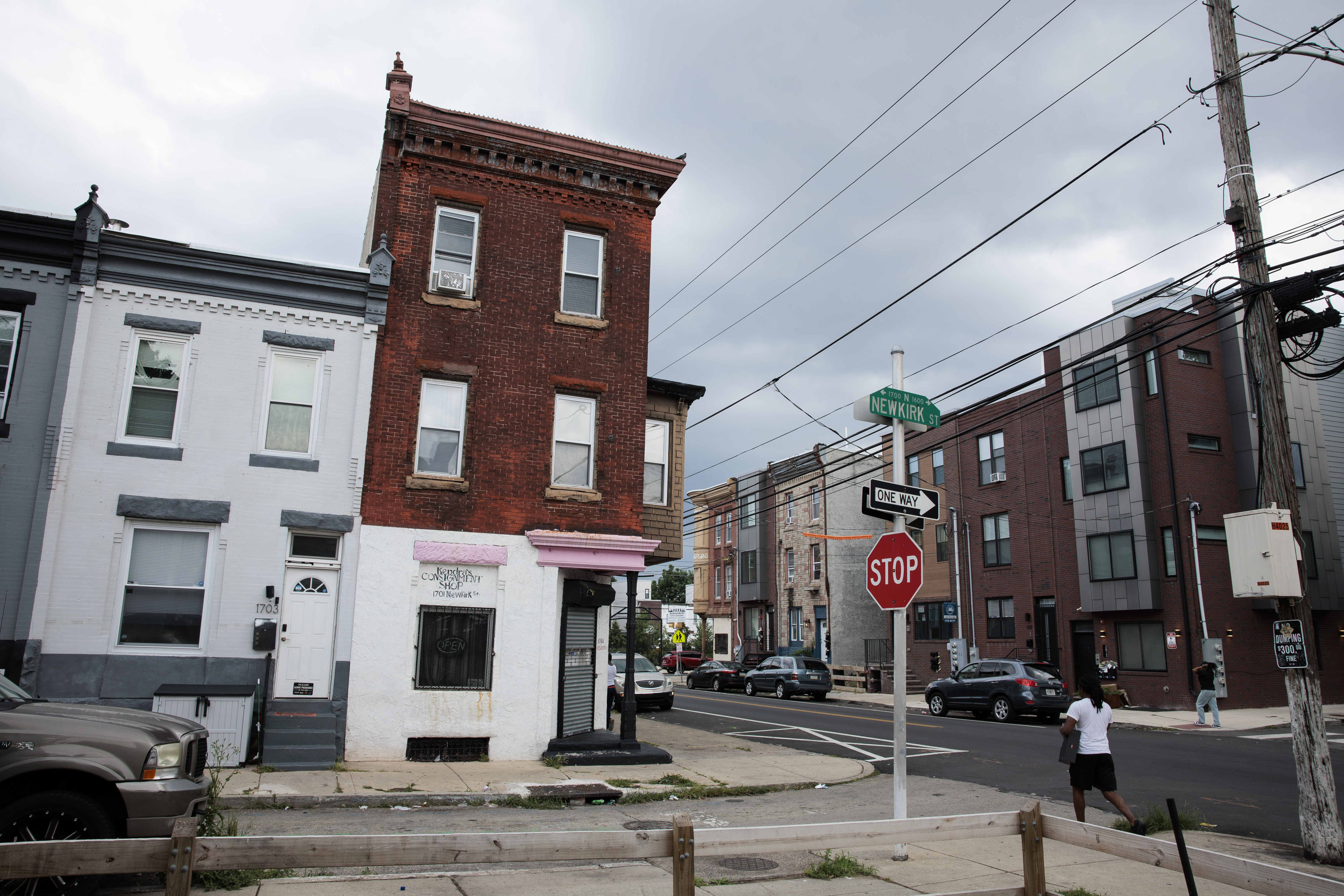
The 1700 block of North Newkirk Street on Aug. 20. On this block in Strawberry Mansion, some homeowners saw their property assessments double.Monica Herndon / Staff Photographer
Fair value
Over in Allegheny County, home to Pittsburgh and many of its suburbs, the courts have ordered local officials to begin a full property reassessment, which must be completed by 2032. Pennsylvania is unique in not requiring regular reassessment.
Pittsburgh’s values were last set in 2012, but more than a third of the state’s counties haven’t been reassessed since the 20th century. This leads to wildly out-of-whack and unfair tax bills for some residents.
Of course, Philadelphians can tell you that regular reassessment is not a panacea for discontent. The city’s most recent valuations have set off a firestorm of consternation, especially given how many lower-income areas saw big increases. It doesn’t help matters that the neighborhoods Cherelle L. Parker used to represent on City Council, and powered her election as mayor, saw some of the smallest boosts in valuation.
As tempting a story as the mayor favoring her core supporters while squeezing the city’s poorest neighborhoods may be, that is not an accurate assessment.
Given the massive decrease in shootings and consistent efforts to clean and green the city, it is not surprising to see increased demand for neighborhoods like Kensington, Grays Ferry, and Fairhill. While there is still a long way to go on public safety, higher valuations are a sign of progress.
It also should remind Council members that their theory that development drives property appreciation is faulty. Many of the neighborhoods with higher appreciation have seen little to no new development. In Northern Liberties/Fishtown, one of the city’s hot spots for new construction, values increased by just 1.7%.
Additionally, the city has a powerful tool for protecting low-income homeowners: the homestead exemption. While the city’s stated property tax rate is 0.013998, owner-occupants pay a much lower rate. For a home valued at the city’s median of $260,000, the total tax bill is $2,239.68, or 0.008614. In Fairhill, where the median home value is $80,000, the homestead exemption eliminates the total tax liability for many residents. Boosting the exemption from $100,000 to $110,000 or $120,000 would ensure more low-income homeowners are protected from rising tax bills.
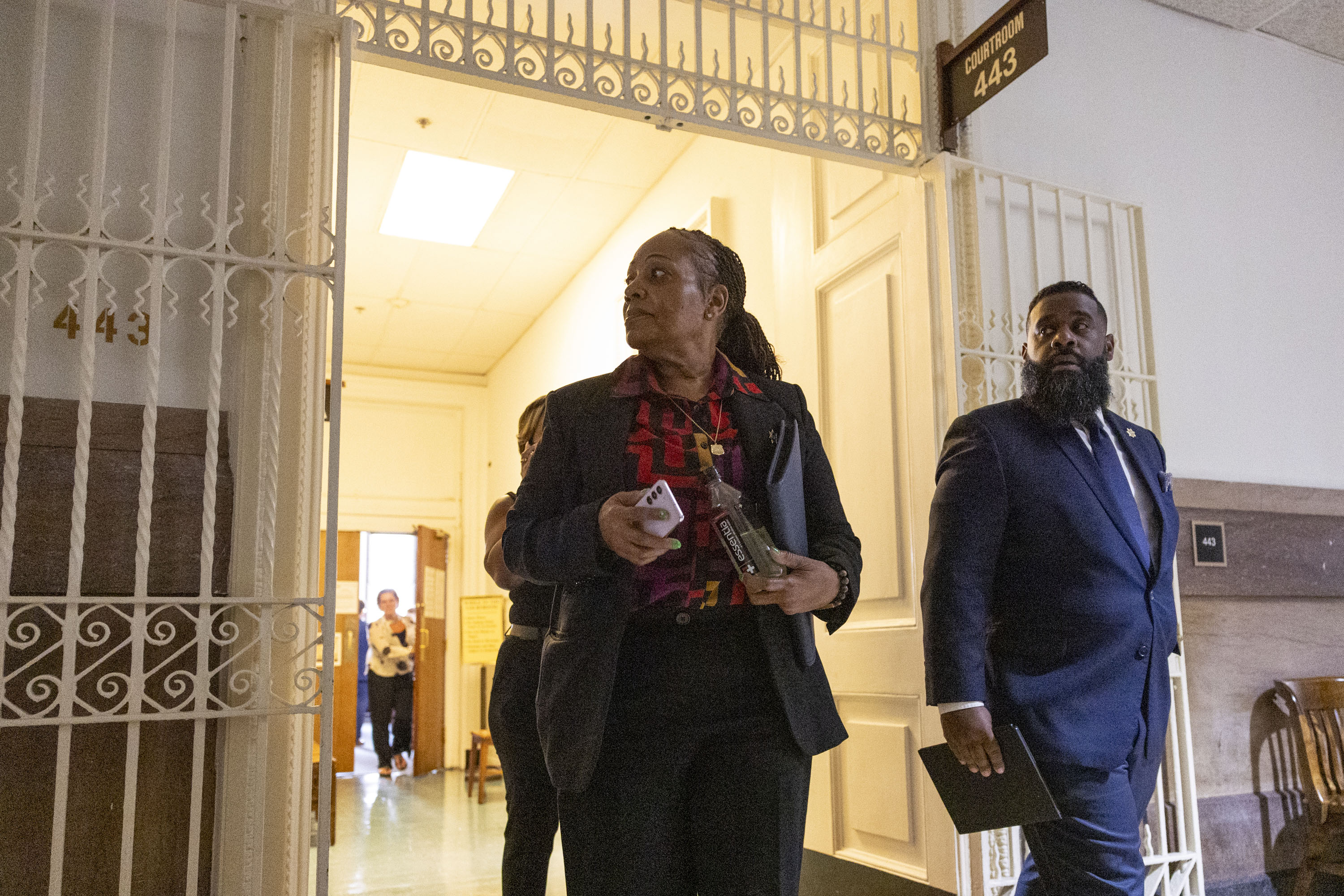
Sheriff Rochelle Bilal is seen exiting a courtroom at City Hall on Wednesday.Tyger Williams / Staff Photographer
Bilal’s babysitter
Mayor Parker wouldn’t do it. City Council wouldn’t, either. Accountability for the Philadelphia Sheriff’s Office instead came from Common Pleas Court Judge Paula A. Patrick.
After listening to a list of excuses and promises, it was clear Patrick had her fill of incompetence. The beleaguered department, which had been ordered to produce a specific set of documents months ago, suddenly released thousands of pages the night before the hearing.
Instead of putting officials before the court with direct knowledge of why a backlog in processing property deeds began, Sheriff Rochelle Bilal instead sent Steven Wakefield, a deputy undersheriff who was hired just two months ago. Wakefield was tasked with testifying about past events he was not privy to, despite repeated warnings from the judge.
As for Bilal herself, she claims to have “limited personal knowledge of the underlying facts.”
Issuing deeds is one of the core functions of her job, but apparently the sheriff had no idea what was going on. Instead, Wakefield tried to scapegoat a former employee named Melissa Simpson, who had apparently been handling the entire process on her own without oversight from anyone.
This testimony led to an agreement in which Bilal will have to identify someone to oversee deed sales for six months. A babysitter, essentially.
While it is good to see someone holding the sheriff accountable for once, a temporary babysitter is only a partial solution. The office should be abolished.
Sadly, that seems unlikely. Bilal may struggle to perform her day job, but she has thrived at building up political allies. She has been invited to news conferences by District Attorney Larry Krasner, remains a political player after her years running the Guardian Civic League, and faces next to no criticism from City Council. She was even honored by the Phillies as a “hometown hero.”
Troublingly, Bilal does not even seem to have an opponent in next year’s elections, despite the continued public mismanagement of her office. That, at least, should change.
Perhaps the Ambitious Abingtonian can find a Perspicacious Philadelphian willing to take on the challenge of replacing Bilal.
A federal judge on Thursday said actions city prosecutors took in a controversial post-conviction case could ultimately amount to perjury, conspiracy, or obstruction of justice — a stunning suggestion that inserted the threat of potential criminal consequences into a matter that has already roiled District Attorney Larry Krasner’s office.
U.S. District Judge Paul S. Diamond did not say whom he was referring to when he made that remark during an unusual hearing in his courtroom. But he raised the issue while an assistant district attorney was testifying about conversations she had with Krasner about the case, in which she said Krasner told her to “protect the office” and, by extension, violate her ethical obligations as a lawyer.
“If what they say is true,” Diamond said, “potential wrongdoing abounds.”
Diamond, as a judge, does not have the ability to file criminal charges himself. But his remarks from the bench were another new development in the case, which had already featured a host of explosive accusations about how prosecutors have behaved while determining whether a man’s murder conviction should be overturned.
And it was not the only notable moment during Thursday’s hearing.
During a full day of testimony, three prosecutors made a series of striking statements about the interoffice drama behind the case. And some of their assertions directly accused Krasner of questionable conduct.
Assistant District Attorney Katherine Ernst said Krasner repeatedly told her and others to protect the office and avoid additional scrutiny from the courts. She and colleague Steven Wildberger also said Krasner threatened “consequences” — which they believed to be potential firings — for those who resisted his preferred method of handling it.
Krasner also rejected their advice to ask the state attorney general’s office to take the lead on the matter, they said, because, according to Ernst, Krasner “hated” everyone in that office and said “everybody in that [office] is Nazis.”
And all three prosecutors said Krasner and another supervisor, Matthew Stiegler, tried to persuade them to effectively find a way to protect Stiegler’s reputation at the expense of a prosecutor he supervised, Jaclyn Mason.
As Ernst recalled it, Stiegler said he wanted to make it seem as if any mistakes in the case were “100% [Mason’s] fault and 0% his fault.”
In Ernst’s view, the events demonstrated that Krasner cared “more about the reputation of the office than competently handling this case.”
Wildberger said he was so disillusioned that he stepped down as a leader of the law division to move to a different unit because “I have lost faith in the administration of the Philadelphia District Attorney’s Office.”
The testimony from Ernst, Wildberger, and their colleague David Napiorski served as an extended rebuke of the office where all three still work. Ernst at one point acknowledged that some of her relationships in the office have become “icy.”
Ernst and Wildberger accused Krasner in court documents last month of some of the conduct they testified about Thursday.
Krasner’s office responded by saying their filings were unauthorized and “ill-informed.” He also said that he had taken steps to alleviate their concerns with how the case was being handled, and that they were in no position to comment on behalf of his office.
The prosecution at issue is the conviction of Dennis Johnson for second-degree murder. In 2009, a jury found Johnson guilty of fatally shooting Kenyatta Smith during a robbery outside a North Philadelphia convenience store two years earlier. He was sentenced to life in prison.
Johnson appealed, in part because he said his trial attorney was ineffective. And in 2022, Mason filed court documents agreeing with one of his post-conviction petitions and saying Johnson’s conviction should be overturned.
But this spring, Ernst and some of her colleagues reviewed the case and took the opposite view, saying they had discovered clear and important errors in Mason’s brief. They then took the unusual step of filing another brief to ask that Mason’s recommendation be withdrawn.
In the days after that development, Mason resigned, a decision she later said was an attempt to protect herself from what she viewed as a plot to turn her into a scapegoat.
Ernst and her colleagues denied that they were seeking to blame Mason. And in the weeks after Mason’s resignation, Ernst said, she and other supervisors got into an extended series of arguments with Krasner over how to handle the situation — which is what formed the basis of much of their testimony Thursday.
Most of the disputes concerned whether the office should recuse itself from handling Johnson’s case at all. Ernst said she repeatedly tried to get Krasner to let the attorney general’s office take over the case because the internal discussions had veered into areas of self-interest rather than the merits of the case.
Krasner consistently refused, she said. And Wildberger said Krasner once grew “apoplectic” when they attempted to memorialize their concerns in writing, because that would make their memos and emails potentially discoverable in future litigation.
Wildberger said Krasner threatened “consequences” if they continued to resist his preferred method of proceeding, which was to hire an outside lawyer to handle the matter on the office’s behalf.
But neither Wildberger nor Ernst saw that path as appropriate, and last month both signed on to a brief before Diamond saying they could no longer participate in the case because of their ongoing debates with Krasner.
Diamond paused Thursday’s hearing in the middle of Napiorski’s testimony. He plans to continue the proceedings next week.
He has not ordered Krasner to testify.
Krasner said it would violate ethical rules to comment while the hearing remains ongoing.
“As much as I would like to speak right now,” he said, “my comments will have to come at a later time.”
Investigators are in possession of a gun they believe was used in the killing of an off-duty Philadelphia police officer in Southwest Philadelphia and are interviewing the man accused of firing the fatal shots, authorities said.
District Attorney Larry Krasner offered those details Thursday as he gave updates on the investigation into the death of the officer, 29-year-old Alhassane Barry, outside an unlicensed speakeasy in the early morning hours of Aug. 16.
Surveillance video shows Barry, a two-year veteran of the force, and the shooting suspect exchanging words outside the after-hours hookah bar just before 4 a.m. before a third man punches the suspect.
The altercation then spills off-camera, resuming when Barry staggers back into the frame bleeding from gunshot wounds to his abdomen. Another person, a 35-year-old man, was also injured in the gunfire and is recovering in the hospital.
Krasner said during a news conference that investigators have identified the shooting suspect and that prosecutors are speaking with the man and his attorney to learn more about the nature of his role in the deadly encounter.
But police have yet to recommend charges to prosecutors, and Krasner said it could take up to two months for investigators to complete their review and determine what charges would be necessary.
Part of that process includes medical testing and further interviews with witnesses, Krasner said. Investigators also recovered footage of the shooting from multiple camera angles, though a sign blocks a camera angle depicting the moments immediately before shots were fired, complicating the review, according to the district attorney.
The updates came after two law enforcement sources told The Inquirer that self-defense had become part of the discussion about whether charges would be appropriate.
Asked whether the gunman told investigators he had acted in self-defense, Krasner declined to comment. But he said self-defense is “one of the issues under consideration” by investigators.
The shooter “does not dispute that he had a gun” or “that he fired,” Krasner said.
Rather, the man’s version of events “requires additional investigation,” he said.
Prosecutors are also working with police to authenticate whether a firearm handed over by the shooting suspect during discussions was the gun used to kill Barry, according to Krasner.
Meanwhile, the district attorney vowed to fight to shut down the unlicensed club where the incident began, saying that Nipsey’s Hookah Lounge was a nuisance to neighbors and that it may be connected to at least one other death.
The property has a history of violations with the city’s licenses and inspections office and was not permitted to operate as an after-hours club, The Inquirer learned.
In the wake of Barry’s killing, the district attorney’s office has filed a motion to shut down the business, Krasner said. A court hearing on the matter is expected early next month.
Philadelphia District Attorney Larry Krasner drew a rebuke Wednesday from Attorney General Todd Blanche after he said President Donald Trump’s White House ballroom, which is currently under construction, should be blown up and pieces of debris sold as paperweights.
Krasner, a progressive Democrat who has centered much of his political identity on opposing Trump, made the initial comments Tuesday during an event at the President’s House Site, George Washington’s Philadelphia home. The Trump administration this year removed educational panels about slavery from the site and replaced them with an exhibit that experts say sanitizes history.
According to NBC Philadelphia, the district attorney said during his remarks at the annual Slavery Commiseration ceremony on Tuesday that “there is a beautiful time coming [when] the memorial will be here.”
“Let me tell you what will not be here: There will not be a ballroom,” Krasner said, referring to the ballroom and military bunker that Trump wants to replace the demolished East Wing of the White House. “What is going to be happening is that, in about 10 or 15 years … I’m gonna have a paperweight sitting on my desk. You know what that paperweight’s going to be? It’s gonna be a piece of the ballroom after we all blow it up.”
Krasner paused, then added: “In an official ceremony, just so we’re clear. In an official ceremony, we’re gonna blow it up, and we’re gonna give the taxpayers their money back by selling all the pieces as paperweights.”
The remarks by the Philadelphia district attorney, a third-term prosecutor who has recently flirted with running for higher office, were the latest in a long line of provocative comments he has made about Trump and other GOP officials. Earlier this year, the White House press secretary and Republican members of Congress ripped Krasner after he called federal immigration enforcement agents “wannabe Nazis” and said Trump’s administration is orchestrating a “fascist takeover” of the country.
And last month, Krasner rallied with protesters in Washington and slammed House Republicans after they subpoenaed documents from his office related to the city’s immigration policies.
Video of Krasner speaking at the event in Independence National Historical Park rocketed around social media this week, drawing condemnation from prominent supporters of the president, some of whom said his comments were inciting violence.
The White House’s “rapid response” account wrote Tuesday on X that Krasner’s comments were “sick” and that “Democrats are the party of violence.”
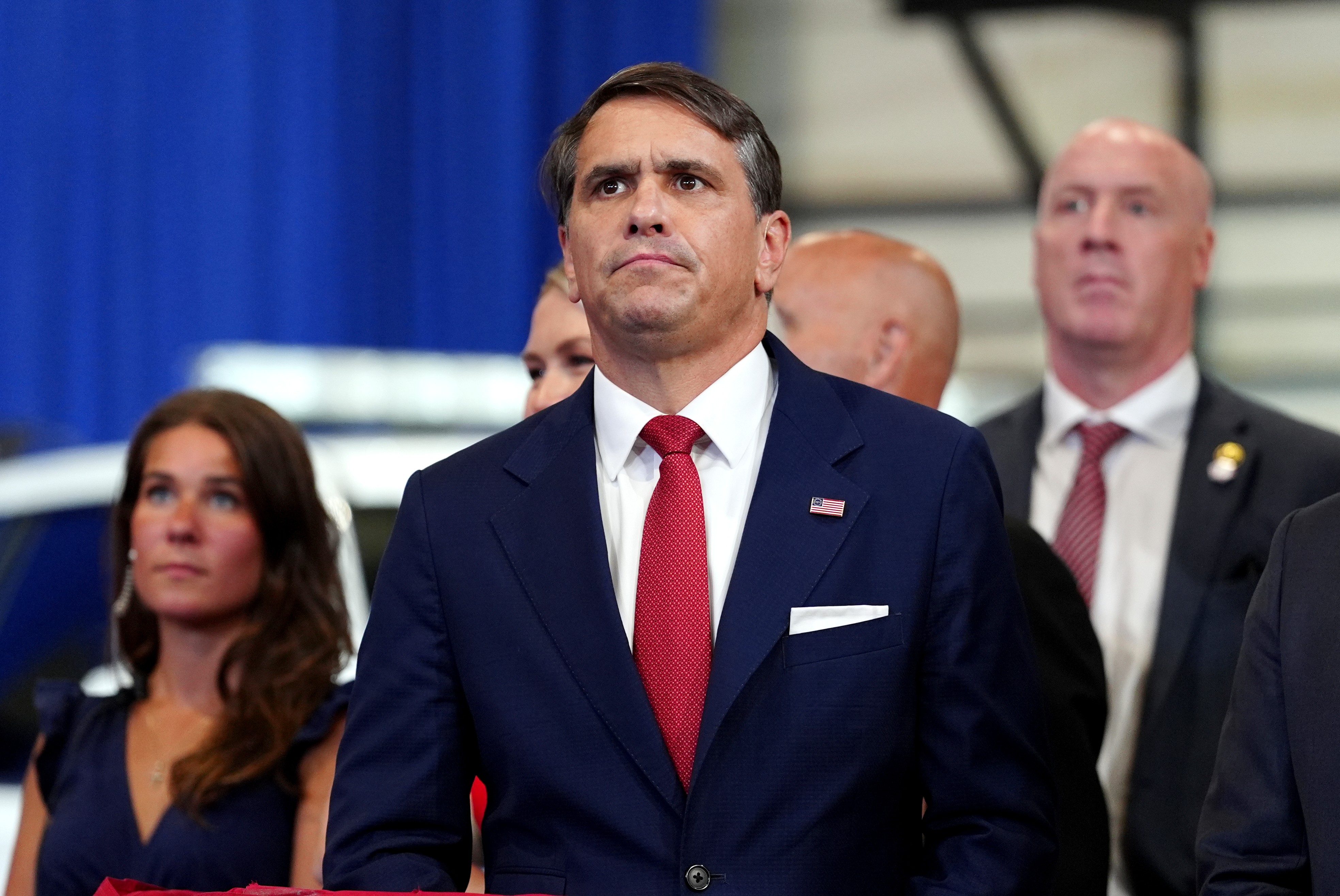
Attorney General Todd Blanche listens as President Donald Trump speaks at the David Mack Center for Training and Intelligence, Friday, Aug. 14, 2026, in Garden City, N.Y. (AP Photo/Julia Demaree Nikhinson)Julia Demaree Nikhinson
On Wednesday, Blanche, who was confirmed earlier this month, appeared on Fox News’ America’s Newsroom to discuss a range of issues. Host Dana Perino asked him about Krasner’s comments and the timeline for the controversial ballroom, which had been briefly on hold amid litigation contending the Trump administration needs congressional authorization for the project. The Supreme Court this week allowed construction to proceed while justices consider the case.
“The ballroom is being built,” Blanche said. “And it’s disgusting that a district attorney in Philadelphia, who, by the way, has a city with its own problems, is so focused on what the president is doing in the White House.”
In an interview Wednesday, Krasner said he stands by his initial comments about the ballroom “100%” because “when you demolish a building, you do it with explosives and/or wrecking balls.”
Krasner added that he sees Blanche’s opposition to his rhetoric at the Slavery Commiseration event as part of the Trump administration’s broader project of stripping historical sites like the President’s House of references to slavery.
“I support the permanent existence of this historically important memorial in Philadelphia. I know that may be disturbing to white supremacists, but too bad,” Krasner said. “Philly is going to stand up for its history, and Philly understands that being an elected official is not about making everybody your friend. It’s about having the right enemies.”
A day after U.S. marshals captured the man accused of menacing pedestrians in Center City while wearing a Chucky-style mask, Philadelphia District Attorney Larry Krasner urged victims to come forward, saying prosecutors are eager to pursue additional charges against the man whose antics terrorized people and went viral.
Zymire Hughes, 22, was taken into custody on Tuesday night in Las Vegas by marshals who tracked him across the country. Authorities said Hughes wore a frightening mask to harass and scare more than a dozen people, including a woman he approached while she was jogging near City Hall earlier this month and asked, “Are you ready to die?”
As the 40-year-old woman ran from him, Krasner said, she fell and suffered injuries that required hospitalization and weeks of recuperation.
Hughes faces aggravated assault and other charges in connection with that incident, the district attorney said, and prosecutors are reviewing as many as 15 other reported incidents involving the masked man that same morning.
“If more victims are identified,” Krasner said, “we look forward to prosecuting him in other cases as well.”
He added: “Who’s scared now?”
Authorities have not identified most of the people who appear to have been confronted or frightened by the masked man. But in a widely publicized incident, Jameka Wilson, a 25-year-old actress, told several news outlets that a man wearing a similar mask approached her on her way to an exercise class near City Hall and that she kicked him in the chest.
Philadelphia police said that Hughes did not display a weapon during the incidents and that the woman who fell was the only person known to have been injured. Investigators have said they believe he may have been frightening people to create social media content.
On Wednesday, Krasner dismissed the idea that Hughes could characterize the crimes as online entertainment.
“You can’t just say, ‘I’m an influencer,’ and commit crimes,” he said. “You can’t just terrorize people, terrorize a community, because the reaction of someone who believes she might die at any second, you find funny.”
Hughes remained in custody Wednesday in the Clark County Detention Center in Las Vegas, court records show, and was scheduled for a court hearing Thursday.
After Hughes is extradited to Philadelphia, prosecutors will seek “very high bail” in an effort to keep him in custody while the case proceeds through court, Krasner said.
“One of the questions that bail answers is: Will this person run?” Krasner said. “I mean, yes. Obviously, he already has. … Running away is the ultimate way to high bail.”
Hughes’ extradition could take as little as a week or stretch into months, depending largely on whether he contests his return, Krasner said.
Hughes’ flight from Philadelphia took him from New Jersey to Florida and then Nevada, authorities said.
He left the Philadelphia area Aug. 19 from Trenton-Mercer Airport in Ewing, N.J., according to the U.S. Marshals Service. He flew to Orlando and then to Las Vegas.
Philadelphia and Las Vegas deputy marshals began working together Friday, said Robert Clark, a supervisory deputy U.S. marshal, and spent the weekend trying to locate him.
Investigators eventually tracked Hughes to an apartment complex in southeast Las Vegas, where they believe he had been staying for about five days, Clark said.
Marshals arrested Hughes about 8 p.m. Tuesday. Clark said Hughes tried to pull away from his handcuffs and had to be subdued by deputy marshals.
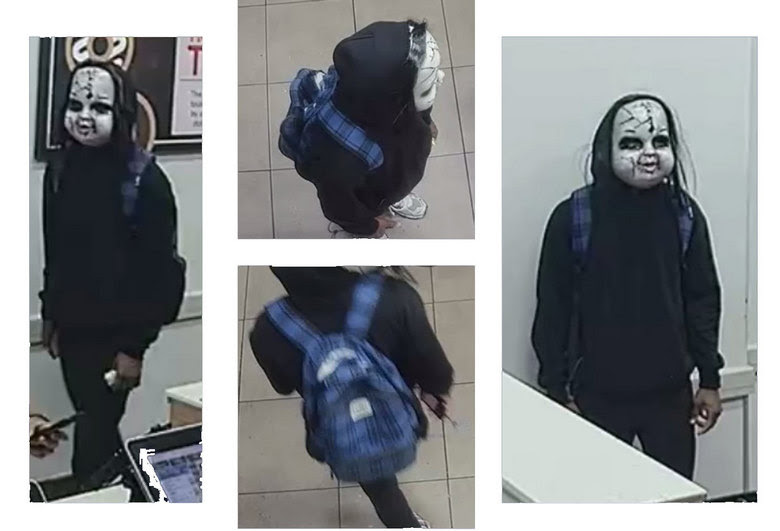
Hughes’ arrest followed a week of intense public attention after Philadelphia police released images of him and asked residents for help in finding him. The case had already gone viral because of photographs and videos showing a man wearing a cracked, baby-faced mask resembling the horror character Chucky from the movie Child’s Play.
Prosecutors are continuing to review evidence, Krasner said, and “will be pursuing all charges that apply.”
Anyone who was approached or menaced by the masked man can contact the district attorney’s office at 215-686-8000.
“Who’s running now?” Krasner said at a Thursday news conference where investigators announced they had identified the suspect as 22-year-old Zymire Hughes — and said it was possible he had already fled Pennsylvania.
It was the latest development in a nightmare-fueled story that has garnered national attention as images and videos of a man harassing pedestrians in the babylike mask went viral on social media this week.
Krasner said his office has issued a warrant for Hughes’ arrest for assault and related crimes.
The charges stem from the Aug. 12 morning that a man in a Chucky mask harassed and scared more than a dozen people near City Hall, including a 40-year-old woman who Krasner said was “severely injured” when she fell while running from Hughes in fear.
In all, investigators said, Hughes is accused of harassing around 16 people between 5 and 5:30 a.m. that morning.
Police documented the behavior through a host of camera angles due to the large number of security cameras monitoring Center City streets.
They saw a masked Hughes begin the harassment near 10th and Chestnut Streets that morning, where he approached a man who appeared to cower on his knees in fear, said Capt. Jason Smith of the Central Detective Division.
After Hughes harassed others in the Center City area, authorities said, his behavior culminated when he chased the woman as she jogged near City Hall.
Hughes asked the woman if she was “ready to die” during the confrontation, according to Smith.
After the woman fled, Hughes went into a Dunkin’ Donuts store near 13th and Chestnut Streets. He then entered Suburban Station, Smith said, where two SEPTA transit officers told Hughes to remove the mask.
He lifted the mask slightly but did not remove it. He calmly walked away from the officers, surveillance footage shows.
“He does successfully evade them,” the captain said.
Hughes later rode SEPTA’s 33 bus to his apartment near 23rd and Venango Streets, surveillance footage shows.
But Smith said investigators believe Hughes may have already fled the state.
Detectives learned he left his apartment with packed bags two nights ago. It is possible he may have gone to Los Angeles or Las Vegas, where he has connections through an employer, Smith said.
Meanwhile, they continue to consider whether Hughes was motivated to film the stunt and post content on social media.
Detectives have linked two TikTok and one Instagram accounts to Hughes. But the accounts do not include posts related to his alleged behavior from last week.
Investigators also do not believe Hughes intended to physically harm those he harassed, they said, given that he did not produce a weapon during any of the interactions.
Krasner said that Hughes could not run forever, and that additional charges could come as investigators urge anyone harassed by Hughes that morning to come forward.
The young man is currently on probation in Philadelphia for a criminal case out of Montgomery County, Krasner said, adding that he considered Hughes’ behavior last week to be a violation of those conditions.
“You think it’s funny to scare people?” the district attorney said in a message directed to Hughes. “Well, get ready to get scared by us.”
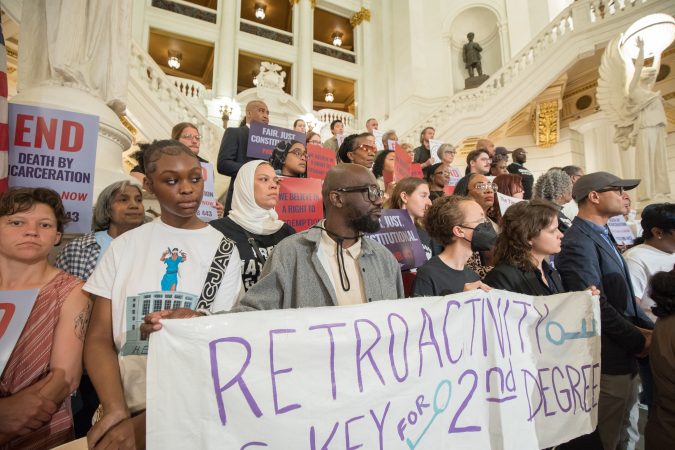
For decades, a second-degree murder conviction in Pennsylvania meant an automatic sentence of life in prison — even for people who did not kill anyone.
But in March, the Pennsylvania Supreme Court ruled that punishment unconstitutional in the case of Derek Lee, a Pittsburgh man who argued the mandatory nature of the sentence violated constitutional prohibitions against cruel punishment.
The high court gave the state legislature 120 days to devise an alternative and decide whether to apply it to those already serving the sentence.
That deadline passed without a resolution on July 24. And in early August, the high court rejected a bid by several district attorneys to give lawmakers more time.
So what happens now? Here’s what to know.
What was the maximum sentence for second-degree murder — and what is it now?
Before the ruling, the punishment was life without parole. Now there is no clear answer.
Setting criminal penalties is the legislature’s job, and lawmakers have not put in place a replacement.
The high court’s ruling did not abolish life without parole for felony murder; it only barred making the punishment automatic. A judge may still impose such a sentence, but only after weighing a defendant’s role in the crime.
The justices declined to say whether the ruling applies retroactively to people already serving those sentences, leaving that question to lawmakers, too.
How will judges sentence second-degree murder now that there’s no mandatory penalty?
With no law to guide them, judges are left to their own decisions. And without statewide guidelines, similar cases could end differently depending on the county in which a defendant is tried and on the judge who hears the case.
Philadelphia District Attorney Larry Krasner has expressed little concern about the lack of guidelines.
In an interview this week, Krasner, a Democrat who has forged a path as a progressive prosecutor, said “there’s nothing unusual” about asking judges to weigh the facts and use their discretion. “I’ve always believed that mandatory sentencing is problematic at best, usually a terrible idea, and that individual justice is what the system is supposed to be about,” he said.
But at a joint GOP policy committee meeting in Hazleton last week, several Republican prosecutors and lawmakers voiced concern about the lack of uniformity across the state.
Luzerne County District Attorney Sam Sanguedolce pointed to a case in which a defendant recently asked to plead guilty to second-degree murder.
“I can’t properly advise the defendant what the consequence might be,” Sanguedolce said. “Second [-degree murder] sounds like it’s better than first, but is it? We don’t even know.”
What happens to the people already serving life in prison?
For the nearly 1,100 people serving life for second-degree murder, nothing changes automatically.
The ruling made only one person eligible for resentencing: Lee. And even he could again receive life without parole, if a judge finds his role warrants it.
Others who wish to have their life sentences reconsidered have to go to court and ask to be resentenced. Bret Grote, a lawyer with the Abolitionist Law Center who represented Lee, said such petitions are likely to be denied by trial courts until retroactivity is settled.
Hundreds are expected to try anyway.
That flood could overwhelm courts and public defenders. Statewide, handling the cases could cost more than $34 million, the Public Defender Association of Pennsylvania estimates. In Philadelphia — home to more than 500 people currently serving such sentences — Chief Defender Keisha Hudson puts her office’s share at $40,000 per defendant, or $24 million total.
“We are going to need substantial funding,” she said last week, adding that she hopes to meet soon with city officials about how to pay for it.
Legal experts expect the question of retroactivity to reach the state Supreme Court again, either through an appeal of a lower court’s denial or a so-called King’s Bench petition asking the justices to take up the issue directly.
Lawmakers could also provide a quicker alternative by writing legislation that allows people serving second-degree murder sentences to seek parole, rather than requiring individual resentencing.
Can lawmakers still pass a fix, and what might that look like?
Lawmakers say negotiations will resume when they return in September. Each chamber has passed its own bill, but the two are far apart, with no compromise in sight.
The bill in the Republican-controlled Senate would set a 35-year mandatory minimum for most second-degree murder convictions, while keeping life without parole as an option. Current lifers would become eligible for parole after 35 years — or 20 years, if they are at least 70.
The measure in the Democratic-led House sets no mandatory minimum, instead directing the Pennsylvania Commission on Sentencing to write guidelines while keeping life without parole available. It would make current lifers parole-eligible after 30 years and add a medical parole option for the terminally ill.
Sen. Lisa Baker (R., Luzerne), who wrote the Senate proposal, said she is still hopeful that her caucus and House Democrats will reach a deal. But the parties remain far apart, she said.
“It’s difficult when you’ve got people whose priorities are no mandatory minimums for any crime,” she said. “I understand that we want to keep nonviolent first-time offenders [out of prison], give people second chances. But there needs to be accountability for these crimes.”
Few expect action before November’s midterm elections. “We can’t, unfortunately, make Harrisburg move any more quickly than they already are,” said Hudson, of the Defender Association. “And in the meantime, there are a lot of questions.”
What does all this mean for victims’ families?
Victims’ families are caught in a limbo of their own, said Melany Nelson, executive director of Northwest Victim Services, a Philadelphia nonprofit that assists crime victims.
Those whose loved ones’ killers have not been sentenced are now waiting to learn what punishment will come, and whether it will feel like justice. Those whose cases closed long ago face now the prospect of being summoned back — to a courtroom or a parole hearing — to confront the killer again and potentially watch them set free.
Nelson urged families to contact prosecutors’ offices and victim-advocate services now, rather than be caught off guard, and to weigh in with their state lawmakers.
“We do not want them to be blindsided by anything,” she said.
Correction: A previous version of this article incorrectly described what could happen to people who wish to appeal their sentences. Bret Grote, a lawyer with the Abolitionist Law Center, said such petitions are likely to be denied by trial courts until the question of whether a recent Pennsylvania Supreme Court ruling applies retroactively is settled.