Outside a Lancaster County fire station, an electronic billboard flashed an invitation toa forthcoming Halloween “trunk or treat,” a “thank you” to communitydonors, and the localtime and weather: a balmy 68 degrees on a Tuesday afternoon.
No signage advertisedthe pop-up measles vaccination clinic held inside the Robert Fulton Fire Company last week in the village of Peach Bottom, at the epicenter of the nation’s largest outbreak in decades. So far, Pennsylvaniahas reported more than 1,300 cases.
Yet moments after the clinic opened at 4 p.m., Amish families — parents with as many as 10 children — converged in the gravel parking lot behind the fire hall, out of view from the rural highway.
They slipped through a back door: mothers with babies hoisted on hips; fathers clutching the hands of toddlers. Some hired drivers because most Amish people, in keeping with tradition, don’t operate motor vehicles.
When the highly contagious virus began to spread this spring, notably in places with sizable Amish communities, state health officials faced the challenge of convincing an intensely private and insular community to get vaccinated. Many Amish residentshave skipped vaccines for generations, partly due to a cultural preference fornatural remedies and mistrust of what is in the shots.
Public health campaigns through social media, email blasts, texts, and highway billboards seemed unlikely to penetrate Amish communities who often avoid modern technology. Nor would news conferences and public service announcements of the kind that promptedmass COVID-19 vaccinations at health centers and crashed government websites as people tried to schedule appointments online.
This time, the state decided to bring measles vaccines to the doorsteps of Amish families.
Health department officials brainstormed ways to draw Amish community members to free measles vaccination clinics near their homes, or even allow them into their kitchens or barns to administer shots, according to pediatrician Jennifer Wallace, medical director of the state’s health centers.
They sought input from Amish elders and religious leaders, who recommended their own back channels. This “Amish Internet,” as some call it, is a word-of-mouth connectivity as invisible as radio waves.
“We thought, ‘Is this going to work or not?’ It totally flipped what public health normally is,” said Wallace, who runs the pop-up clinics. “We were very nervous about whether or not we could get the word out that way.”
Additionally, Amish leaders advised, the response would be better if their communitycould receive shots discreetly.
Health officials said Amish people are not necessarily opposed to vaccines. However, many had not felt any need or urgency to get vaccinated against a disease few could remember. Measles was declared eliminated in the U.S. in 2000, thanks to widespread vaccination, which also protected the relatively few Americans who were not vaccinated.
In the months since the outbreak started in April,Lancaster County has led the state with the highest number of measles cases, now reporting nearly 470 cases, or nearly 40% of all Pennsylvania cases. Two local infants and a 20-year-old woman from Lancaster County were among the six measles-associated deaths identified by the state and local coroner’s offices.
State nurses go out and do wellness checks on families. “When the mother answers the door, the nurses can hear the children moaning in the background,” Wallace said, describing measles’ high fever, rash, and dry cough as “miserable.” Some symptoms can last more than two weeks.
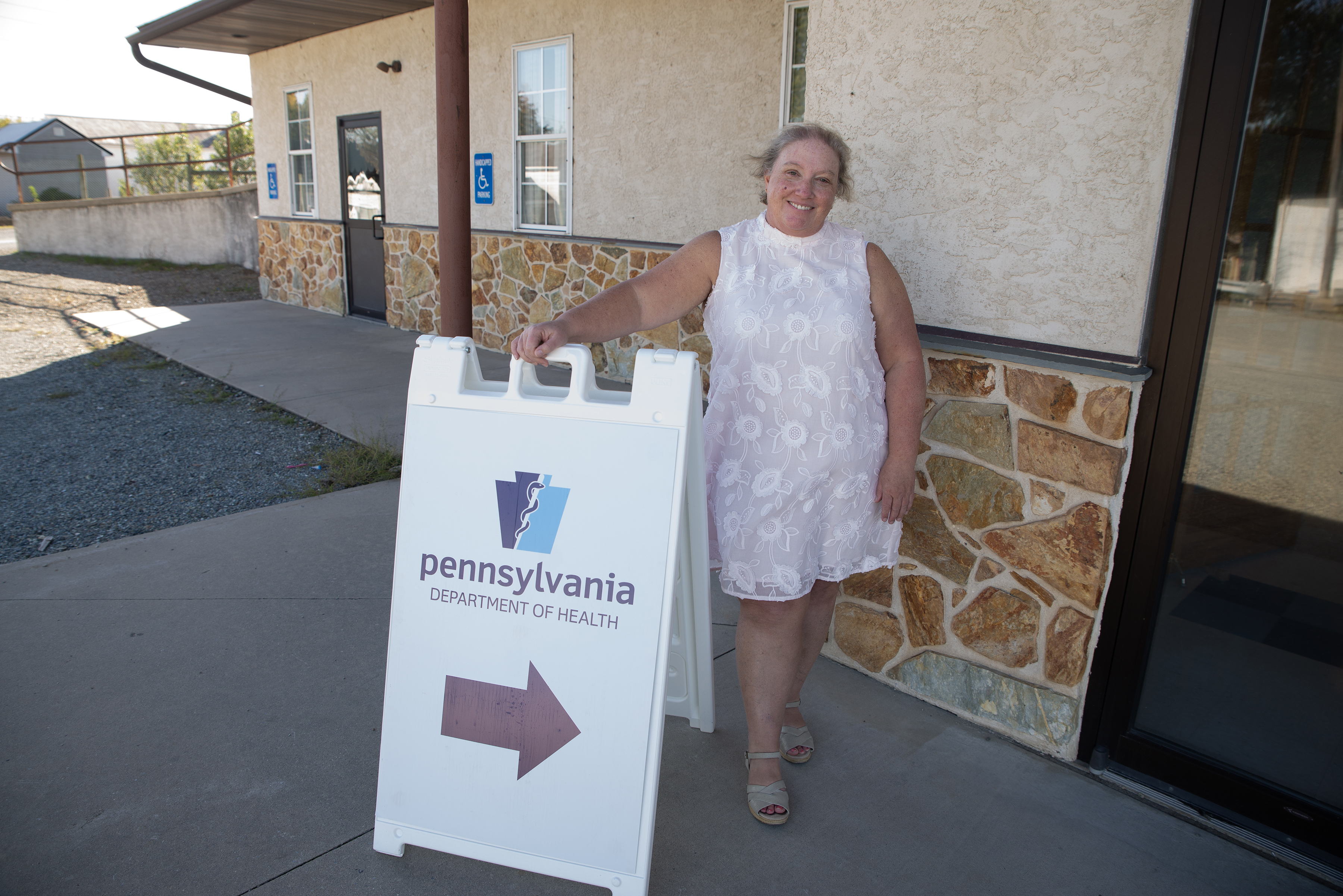
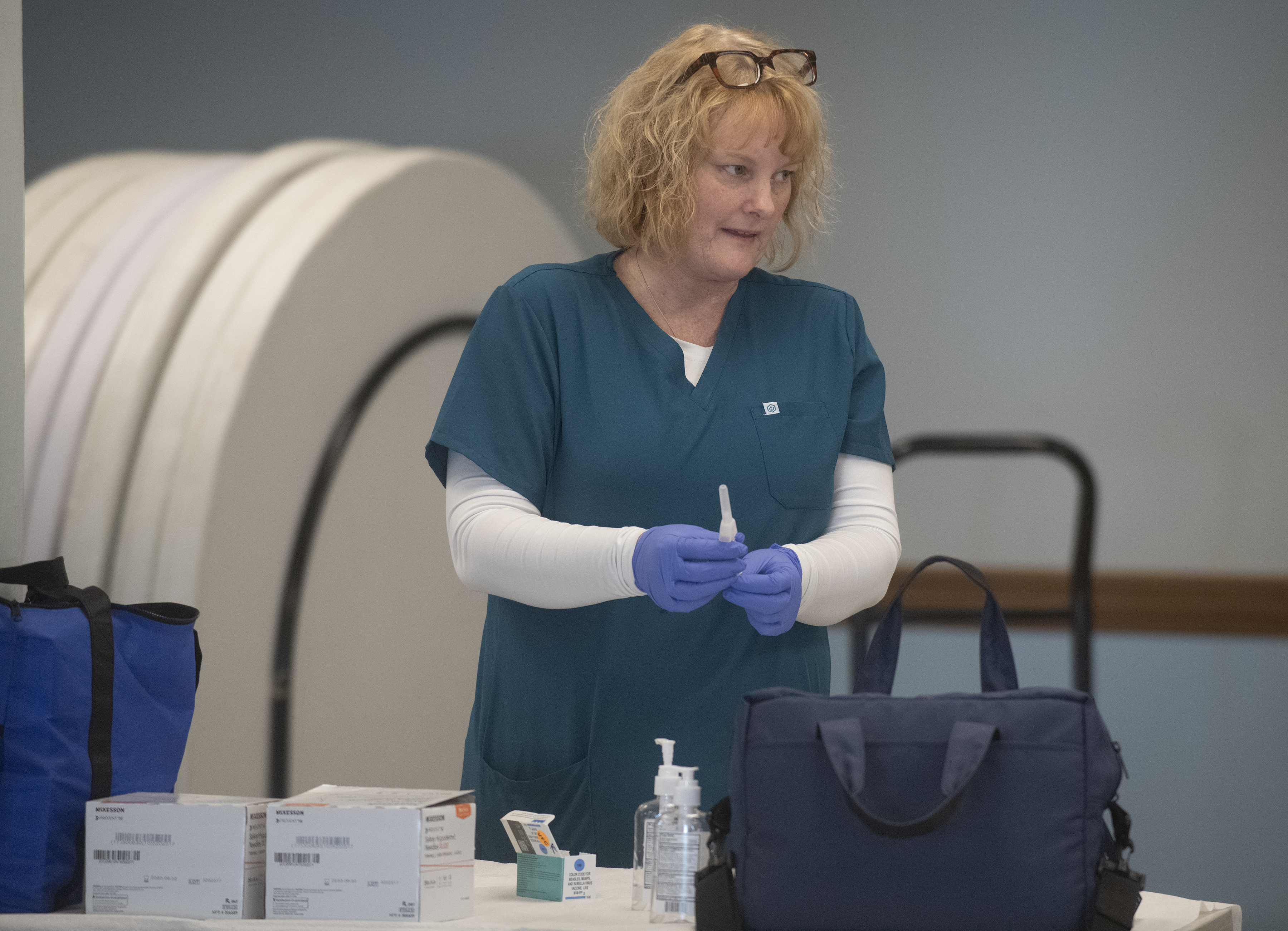
Pediatrician Jennifer Wallace runs the state’s pop-up measles vaccination clinics. The clinics are promoted mostly by word of mouth. The only indication that a clinic was happening at this Lancaster County fire station was this sign at the back entrance, out of view from the rural highway.
Bob Williams / For The Inquirer
‘It’s gone gangbusters’
When the state launched the pop-up clinics in early May, health officials worried about the low turnout.
At the first one, held in Lebanon County at the request of a community member, only 30 attended and 26 got shots, according to the health department.
Then, in mid-June, the clinics took off as word got out, Wallace said.
“We were willing to try it out, and it’s gone gangbusters,” she said.
The turnout picked up even more after health officials opened clinics in the evenings to accommodate farmers who work the fields until late afternoon.
The state has organized 223 clinics statewide, including 51 in Lancaster County, and vaccinated more than 6,000 people through them.
Sometimes, clinicians are invited to a private home to vaccinate a family of 12, only to also meet throngs of friends and relatives.
At one Lancaster County home, 110 people formed “a line out the kitchen door,” Wallace said.
“We were like, ‘Whoa.’ We had to run back to the health center twice to get more vaccine,” Wallace said. “It starts out as a very private family thing, and it ends up being a neighborhood community thing.”
At Tuesday’s clinic, 79 out of 94 people who showed up chose to get vaccinated, according to the state. It was the third clinic at that fire station, where the volunteer company includes Amish firefighters.
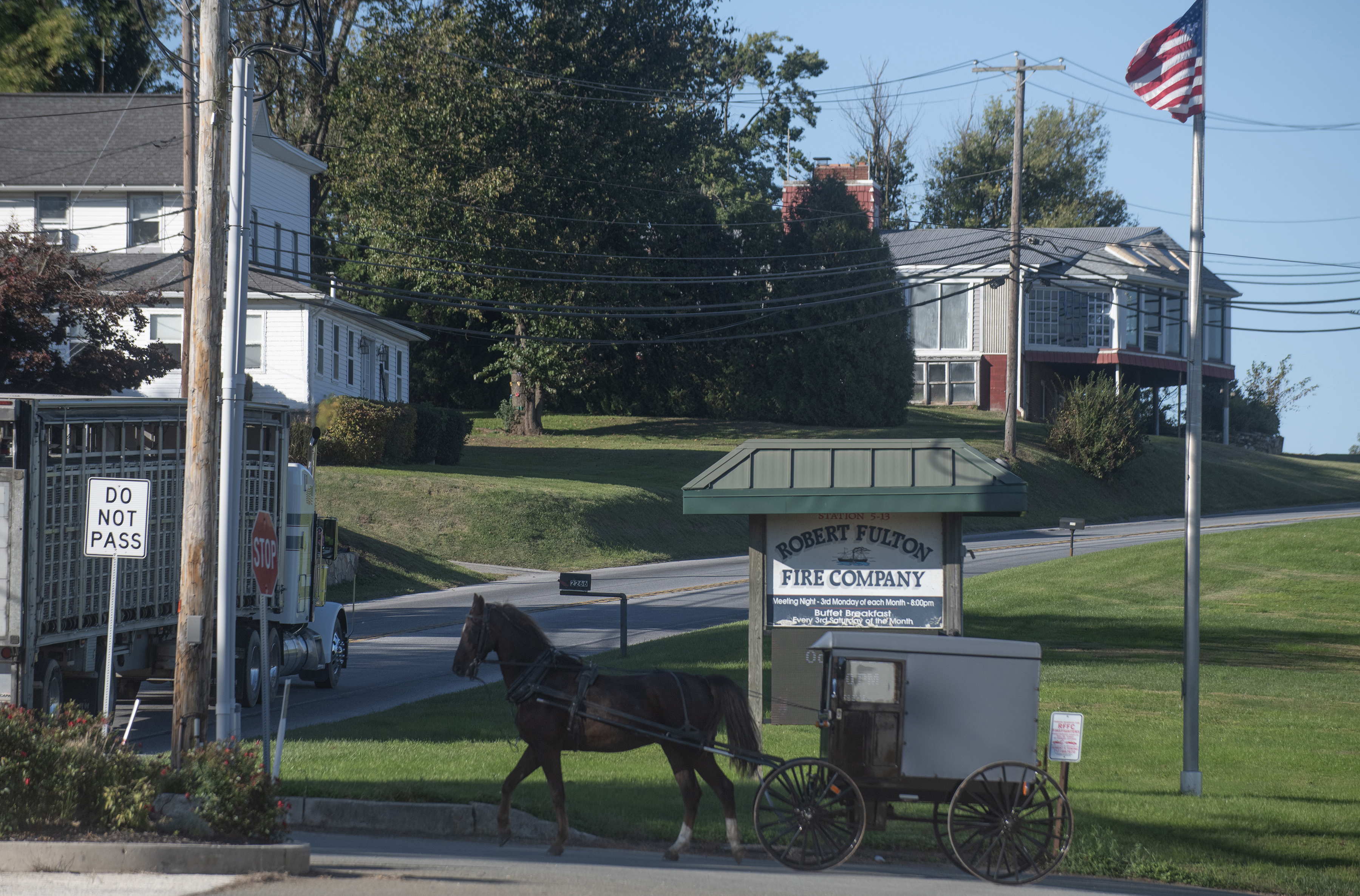
An Amish family leaves Tuesday’s pop-up measles vaccination clinic on at the Robert Fulton Fire Company in southeastern Lancaster County, four miles from the Maryland state border and about 15 miles outside Chester County, Pa.Bob Williams / For The Inquirer
Questions, then relief and tears
Wallace said most Amish people who come to the clinics ultimately opt to get vaccinated, but prefer to keep it private.
“There is an element of, they don’t want people to know both in their own community as well as outside their community,” Wallace said. “They tend to be very private people.”
Many ask about what’s in the shots.
Is there a microchip in the vaccine? No. Is it made of aborted babies? No.
What offers more immunity? Getting measles or the vaccine?
Wallace has a ready answer. “They both give you immunity. However, I would rather have the measles vaccine, which maybe gives you a little bit of a fever, maybe a little bit of a sore arm for a couple of days, vs. the measles disease, which can have very serious consequences up to death.”
She will tell them the vaccine is free, whether they are insured or not. Some will counter, “Well, I’ll just get measles. That’s free, too,” and she will reply that measles complications can result in expensive hospital bills. Most Amish do not have health insurance, and sometimes must pay cash or turn to a community medical fund.
Increasingly, mothers coming to the clinics are more worried about their kids getting measles than about the vaccine. Wallace will administer doses into tiny arms and watch the mother’s face wash over with relief. Some cry afterward, she said.
“It all started with, ‘What are the communities we are trying to target, and how can we be respectful and work with them? Let’s not push what we think public health should be,’” Wallace said. “And it worked. It’s just snowballed.”
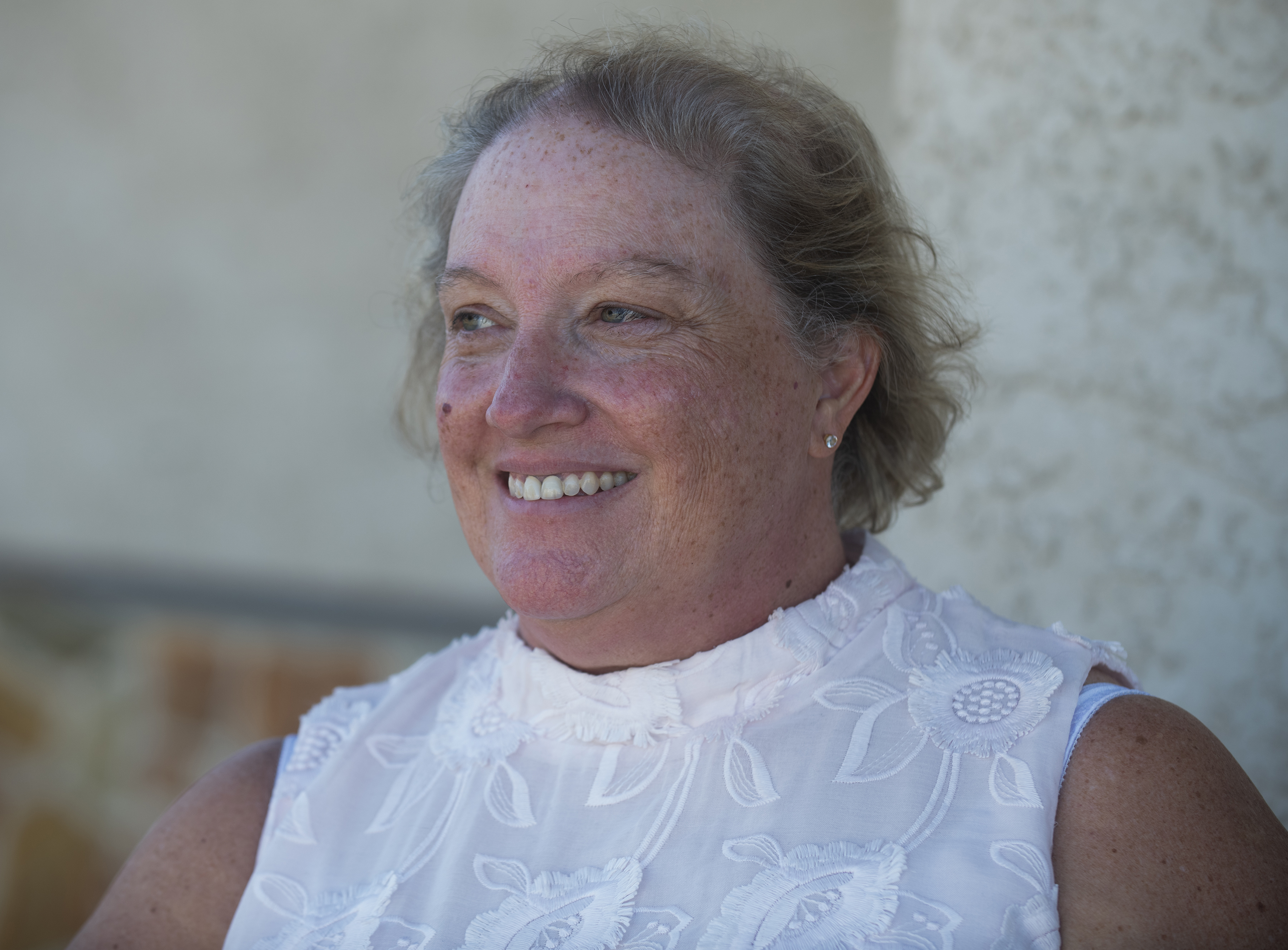
Pediatrician Jennifer Wallace, who serves as medical director of the state’s 58 health centers, is also in charge of the pop-up measles vaccination clinics. “I can tell you quite honestly that since May, this has been the most rewarding work of my life,” she said.Bob Williams / For The Inquirer
‘Never been vaccinated in my life’
The pop-up clinics are not aimed at persuading those who oppose vaccinations, Wallace said.
“The anti-vaxxers are never going to walk through these doors. They’ve made up their mind,” she said. “Many of them have already closed their mind to it.”
Art Winter, 48, runs an auto-repair business behind the fire station where Tuesday’s clinic was held. The clinic drew Amish families from Quarryville, about 10 miles away, where Winter lives, but he had not heard about any of the state’s clinics.
“I don’t fall for that crap,” he said about vaccinations. “Never been vaccinated in my life.”
He went to a public elementary school in Upper Darby. Although state law required the measles, mumps, and rubella vaccine to enroll, his mother opted out under Pennsylvania’s widely permitted exemptions for people with religious, philosophical, or medical concerns.
He is not worried about getting measles, even though cases are all around him. “I don’t live my life in fear,” he said.
Angela Conrad, who lives about 30 feet from the fire station in a white trailer, said she had “no clue” that a vaccination clinic was occurring. “Was that on social media?” she asked. Regardless, the 57-year-old resident said she had been vaccinated as a child, like more than 90% of Pennsylvanians.
People who are unsure whether they were vaccinated as infants, or cannot remember whether they had measles, can get a blood test to show whether they need vaccine protection. But people who get tested do not need extra outreach to get vaccinated.
As the conversation around measles vaccinations has become increasingly politically charged, some providers consider not publicizing the pop-up clinics to be a security precaution.
“There are so many people who maybe don’t approve of vaccines that we don’t want to bring any negative attention to the clinics, so it’s just a word-of-mouth type of clinic,” said Beth Smith, a nurse whose worked for the state health department for 27 years and was at Tuesday’s clinic administering shots.
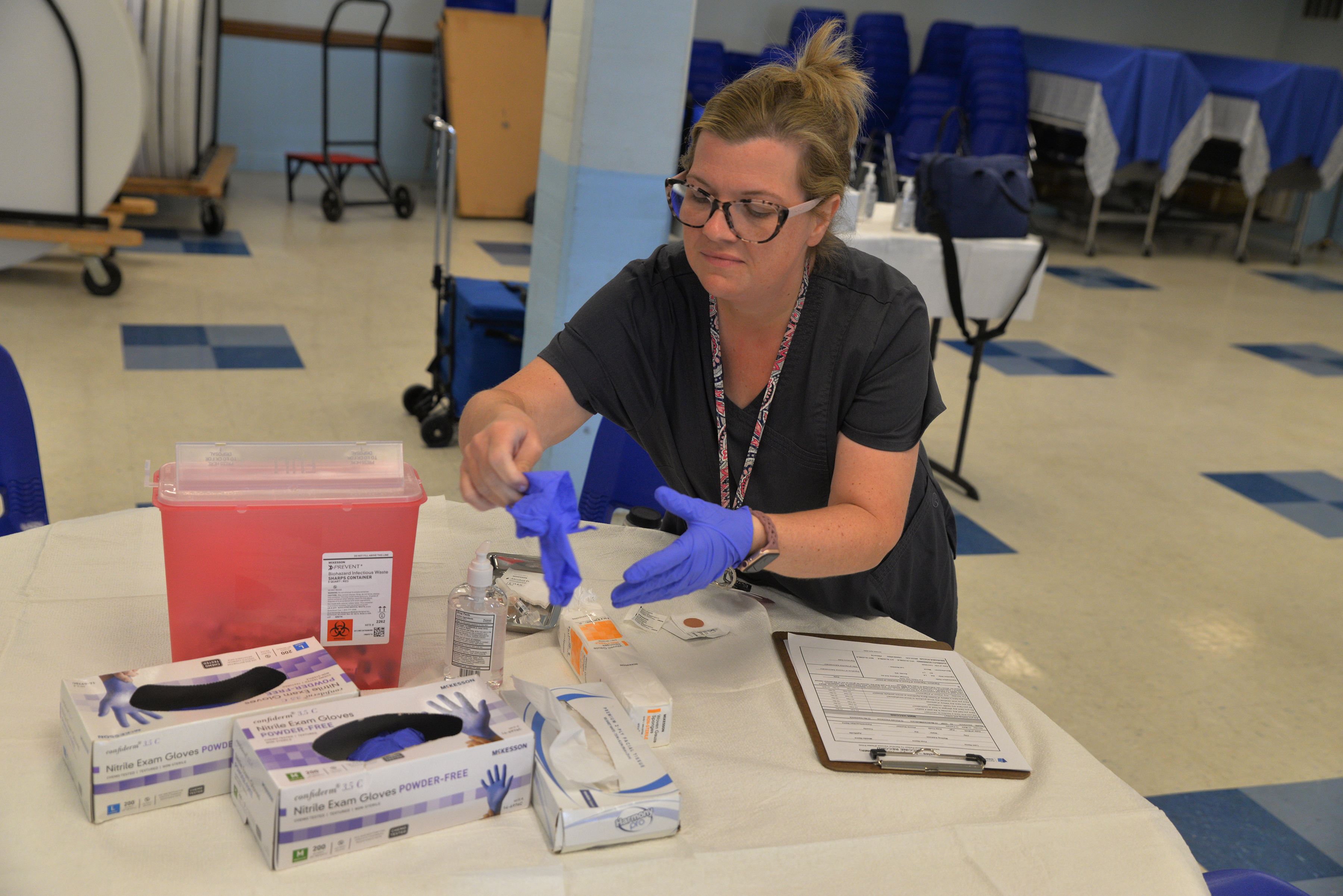
Beth Smith was one of four nurses who administered measles vaccinations on Tuesday to Amish community members inside a fire station in rural Lancaster County. Bob Williams / For The Inquirer
Every Sunday, Mike Newall brings you an inside look at a story defining Philly this week and a preview of what’s coming in the week ahead.
The divorce at the Academy of Natural Sciences feels real. Drexel, once lauded as the endangered dino museum’s white night, lost money, then interest. Academy administrators lost their ATM. Philadelphians just plain lost.
This Monday, Drexel leadership and Academy stewards will finally face public heat over their bungling of Philadelphia’s 200-year-old prehistoric palace — the oldest natural science museum in the Western Hemisphere before the portals to its lost worlds were padlocked.
The keepers of its collections are expected to testify at a City Council hearing on the matter Monday. Until now, love for the museum has mainly fallen on deaf ears — at least in the cloistered rooms where Drexel and Academy officials claim to still be talking. Now it falls to Councilmembers Nina Ahmad and Jeffrey Young Jr. to excavate a little candor from the museum bigwigs on a question that should have been aired geological ages ago: How did they allow a Philadelphia treasure to slide so near into extinction?
While it remains to be seen just how searching the council’s inquiry will be, we’ve got the Inquirer’s Peter Dobrin, a reporter steeped in the city’s cultural life, who has been all over the Academy saga from the start, to fill us on in on what he’ll be looking out for at the hearings.
Mike: What are the questions you want answers to?
Peter: I’m looking to learn more about what each side actually wants — if one or both sides are looking for a disaffiliation, then under what terms and conditions, and over what period of time? Both Drexel and the Academy are going to need some time to adjust to a divorce before it’s finalized if divorce is where this is going.
Mike: You’ve reported that there seems to be no savior on the horizon?
Peter: What’s really been missing so far is an indication that someone is doing due diligence to get the kind of information needed to make an intelligent decision.
Is someone commissioning a facilities study to determine the extent and cost of deferred maintenance to the Parkway building and how urgent those needs are? Has a study been commissioned to gauge the fundraising appetite locally, nationally and internationally? Is a business plan being researched that would establish what it would cost to run a first-class natural science museum?
Mike: Why all the secrecy?
Peter: I’d like to know what the apparent rush is. This is a more-than-two-century-old institution of worldwide significance. Its future deserves to be considered carefully and soberly, armed with as much information as possible. Why was it necessary to shut down the museum with just 30 days’ notice, before the general public had a chance to participate in a rescue?
Mike: Can the hearings have an impact at this point?
Peter: The hearing is likely to play a role in keeping the dialogue going. There is a lot of energy focused on the Academy right now, and any solution is going to take a diverse group — concerned citizens; money from government, foundation, corporate and individual angels, and the scientific community.
Video of the Week
Video: LeBron James makes his first introduction as a member of the Sixers
He got the boos. He got the cheers. And then he heard Philadelphia fans blow the roof off the building. LeBron James’ South Philly debut was nothing short of “electric,” says Inquirer sports columnist David Murphy. With a new Sixers era underway, a question remains: When the World Champion Knicks come to South Broad on Friday, will Xfinity Mobile Arena once again be “MSG South?”
A look ahead
Tension between the District Attorney’s Office and police is as old as crime-fighting itself. But rarely does it get this ugly and public, even in the time of Larry Krasner. Expect more blame-throwing and sparring as inquiries continue this week into a suspected cop-killer’s past murder case.
The estate of the Jaws author is auctioning off his personal memorabilia stash for charity on Thursday. I wish I could pony up $10,000 for an original, ratty “Jaws” T-shirt gifted by Spielberg.
One more thing
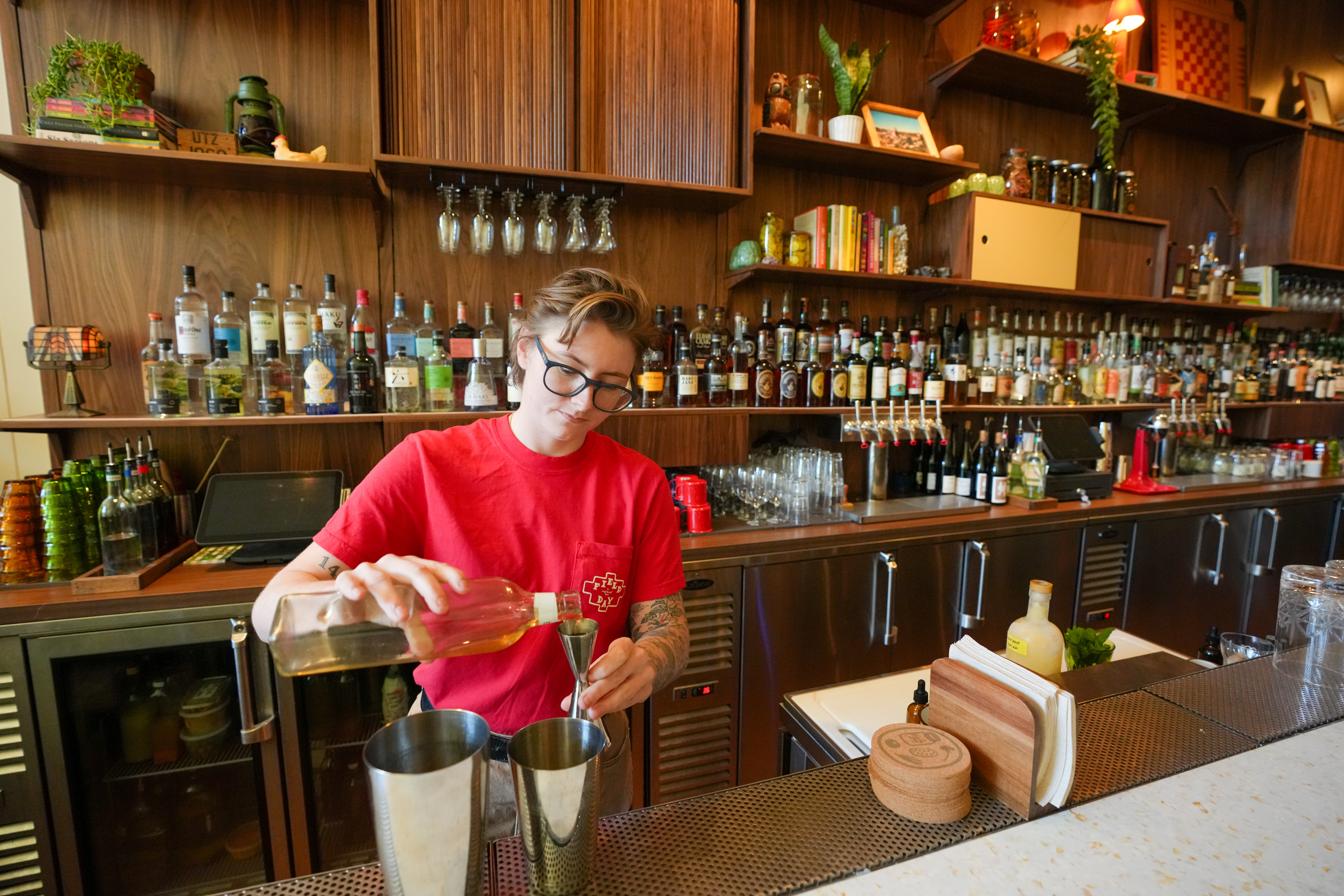
Erin Dassler makes cocktails at the bar Field Day, in Philadelphia, October 20, 2026.Jessica Griffin / Staff Photographer
During my decade tending bar in Philly, I’m embarrassed to admit the most creative I ever got with a non-alcoholic drink was wedging a lime into a bottle of Kaliber non-alcoholic beer.
The doctorate-level mixologists at Field Day — Danny Child’s highly anticipated new cocktail bar and restaurant, which opened up in Northern Liberties on Wednesday — take far better care of their nondrinking brethren.
“We really wanted to make sure that there were just as many options and beautiful touches to these non-alcoholic drinks as you would for alcoholic ones,” said bartender Erin Dassler, sliding open Field Day’s lauded drink menu on a recent afternoon, sunlight tossing shadows across the bar’s midcentury pastoral backdrop, as a crowd filled the stools.
Read Jenn Ladd’s gorgeous deep-dive for how Childs — the James Beard Award-winning bartender and leader in the Slow Drinks movement, essentially farm-to-table for cocktails — is sowing the seeds of a beverage revolution far beyond Philly.
Childs, and his wife, and co-owner, Katie, pour the same craftsmanship into their non-boozy concoctions — a treat for rising non-imbibers, like myself, sober a decade now, and enjoyer of the occasional buzzless highball.
I went for the no-groni, which Dassler made with precision (Dassler and Childs recently drove to Jersey to collect birch branches for their delicious Birch beer). Non-alcoholic wine, aromatic pine and juniper water, and just a touch of hibiscus. All local, all fresh — and as perfect as a nonguilt gulp can be.
Democratic congressional candidates in a pair of Pennsylvania swing districts have pulled ahead of Republican incumbents beforethe high-stakes midterm elections — putting them on track to reclaim seats that President Donald Trump helped flip two years ago, according to a new Inquirer/New York Times/Siena University poll.
The results are within the margin of error. Between 3% and 6% of voters remain undecided, according to the survey of about 400 likely voters in each of the districts from Oct. 16 to 22.
But as Democrats make an aggressive push to win control of the U.S. House amid Trump’s lagging approval ratings, the polling underscores where the party sees two of its best chances of defeating Trump-aligned Republicans — not just in the state, but across the country.
“I just feel Cognetti has the right outlook for Pennsylvania,” said Mercedes Vinsko, a 23-year-old law student from Shavertown, Luzerne County, who wants Democrats to “flood” Congress in the midterms. “I’m hoping a blue wave will trend in a better direction for America.”
The 5-percentage-point leads held by Cognetti and Brooks in their congressional districts represent Democrats’ widest advantages heading into the final stretch of four battleground races in Pennsylvania, according to the poll.
In the Bucks County-based 1st Congressional District, where Republican U.S. Rep. Brian Fitzpatrick is seeking another term, Democrat Bob Harvie leads by 2 percentage points. In the Harrisburg-based 10th Congressional District, Republican U.S. Rep. Scott Perry and Democrat Janelle Stelson are tied, the poll found.
Both parties have invested heavily in all four matchups. Collectively, they have funneled more than $116 million into television ads and have brought in national party leaders to stump for their candidates.
Nowhere have the candidates and their allies spent more, though, than in the Lehigh Valley-based 7th and Scranton-based 8th Congressional Districts, where Mackenzie and Bresnahan narrowly beat multi-term Democrats in 2024. As Trump won the state and surged to the White House that year, Mackenzie and Bresnahan combined to win 10,300 more votes than their opponents out of nearly 790,000 votes cast.
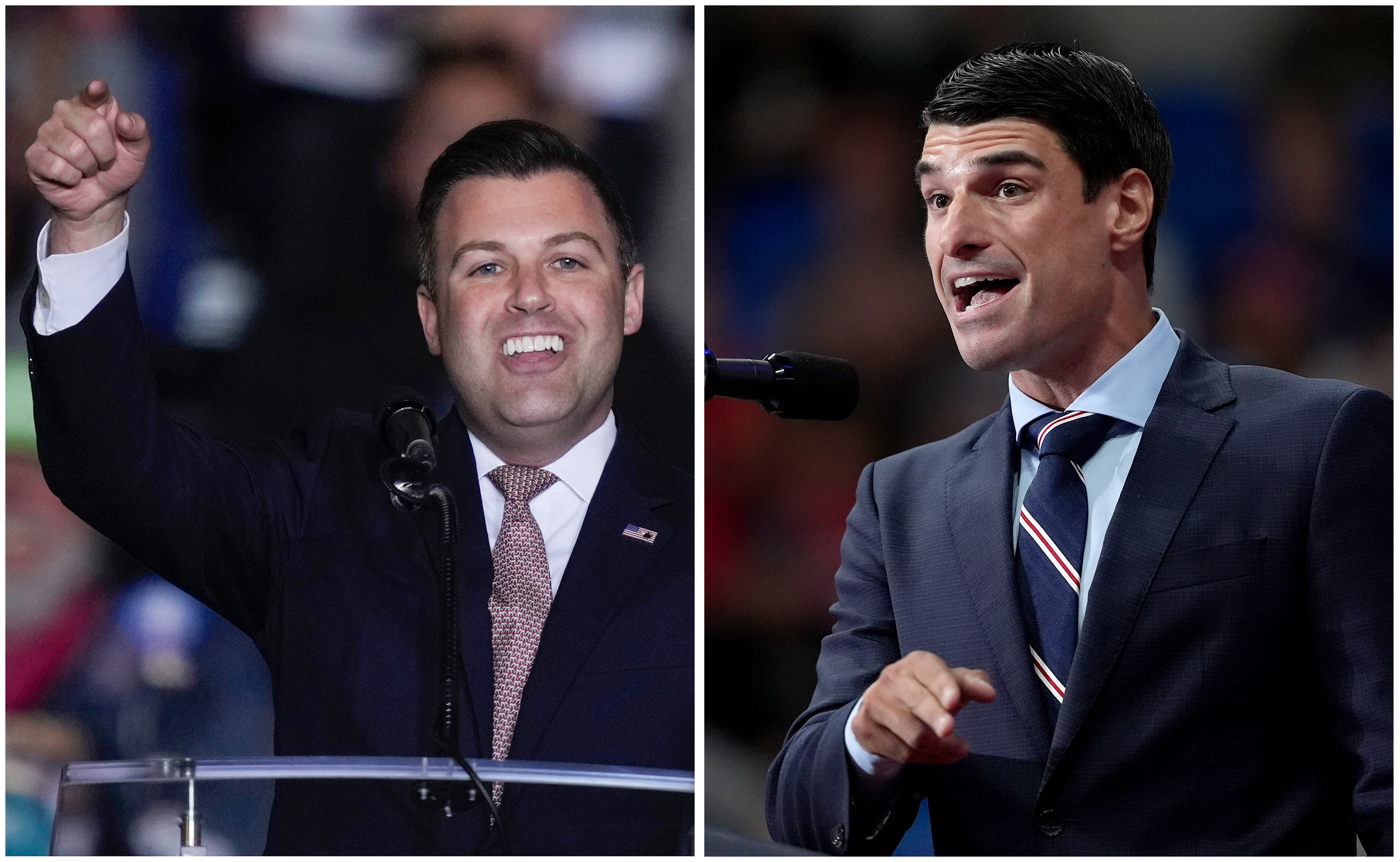
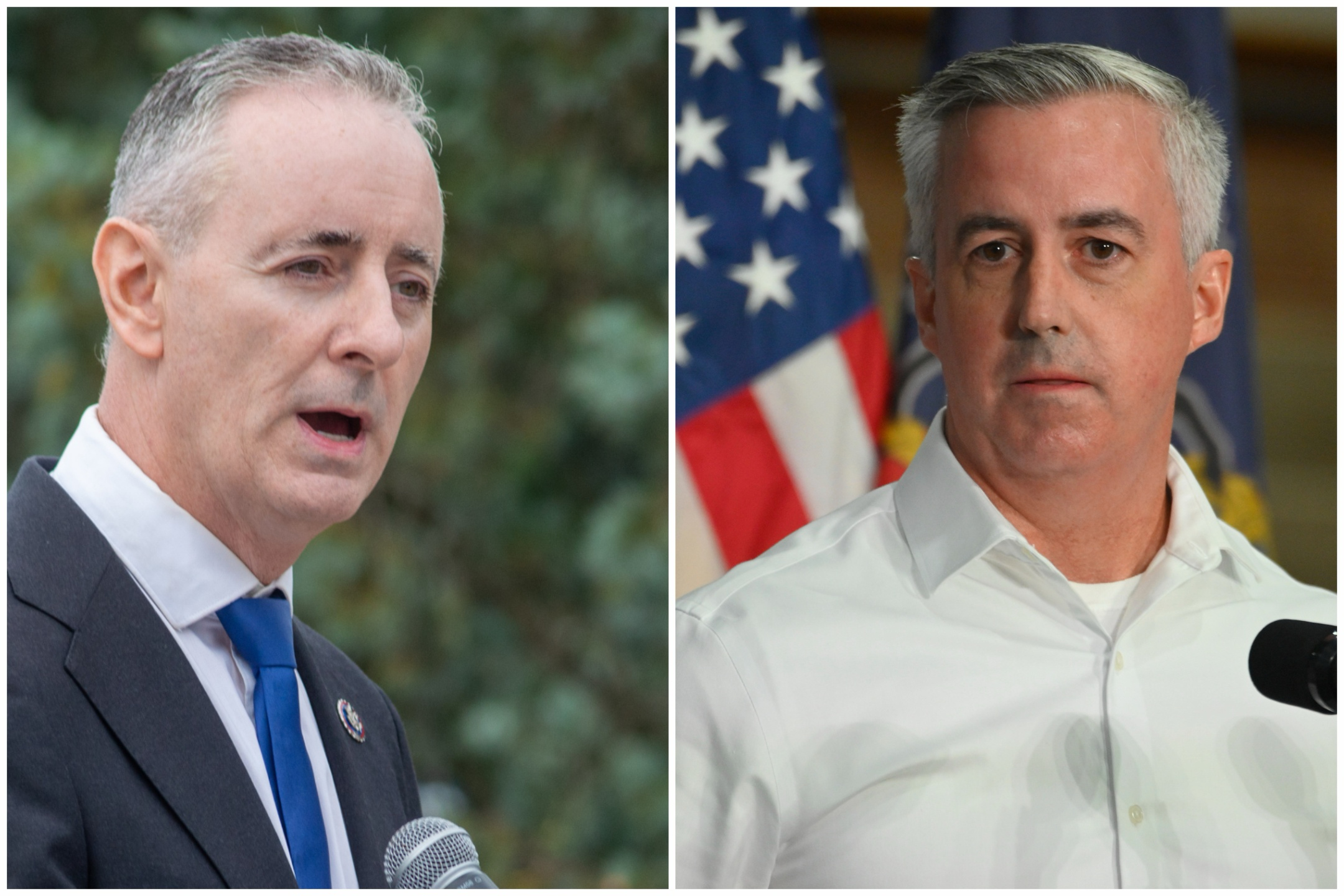
U.S. Rep. Ryan Mackenzie (left) and U.S. Rep. Rob Bresnahan (right).AP / File photos
Two years later, both freshman lawmakers have closely aligned themselves with the president — promoting his economic agenda and defending controversies like the war in Iran — while Democrats hope that unpopular alliance benefits their nominees. Trump’s job performance gets low grades across both districts, and particularly in the Lehigh Valley region, where his approval sits at 37%, according to the poll.
Another factor working in Democrats’ favor, observers say, is Gov. Josh Shapiro’s expected strong performance at the top of the ticket as he seeks reelection, which could elevate downballot candidates from his party. In the Lehigh Valley district, Shapiro’s 19-percentage-point lead over Republican Stacy Garrity matches the statewide result from The Inquirer/New York Times/Siena poll in September. In the Northeastern Pennsylvania district, Shapiro leads by 11 percentage points, the latest poll found.
Former U.S. Rep. Charlie Dent, a Republican who represented the Lehigh Valley seat until it flipped blue in 2018, said Shapiro’s commanding performance is “compounding” the issues around Trump’s favorability that are dragging down GOP candidates across the country.
“The challenge for Pennsylvania Republicans is the governor’s race, … Trump’s approval rating, and just the overall midterm environment,” Dent said, calling it a “daunting” mix.
7th District: Mackenzie vs. Brooks
Among the four competitive Pennsylvania races, the 7th District was the first to move further in Democrats’ direction in recent months.
Two frequently cited nonpartisan election ratings groups reclassified the race from a “toss-up” to one that “leans Democratic” as the national environment changed and as Brooks and his national allies poured money into his campaign.
The president of the Pennsylvania Professional Fire Fighters Association, Brooks was considered a top Democratic recruit after Shapiro encouraged him to run and he consolidated support from across the party’s ideological spectrum. Over the summer, he raised $2.6 million — more than three times as much as Mackenzie brought in and, according to Brooks’ campaign, more than any previous candidate over a similar period in the Lehigh Valley.
“We are running this like we’re losing,” Brooks said in an interview last week.
(function(){function e(){window.addEventListener(`message`,function(e){if(e.data[`datawrapper-height`]!==void 0){var t=document.querySelectorAll(`iframe`);for(var n in e.data[`datawrapper-height`])for(var r=0,i;i=t[r];r++)if(i.contentWindow===e.source){var a=e.data[`datawrapper-height`][n]+`px`;i.style.height=a}}})}e()})();
Mackenzie, a former state representative, has spent much of the recent weeks of the race lobbing attacks at his opponent — alleging Brooks has a troubled business background and personal life. In mailers that went out to voters last week, Mackenzie’s campaign depicted Brooks in a prison jumpsuit with the message, “Is jail the next stop for Bob Brooks?”
Brooks has denounced the accusations, which focus on whether he was required to pay for workers’ compensation insurance for his small business. Brooks said he was not required to do so, and his lawyer sent a cease-and-desist letter to Mackenzie’s campaign, which the Republican rejected, then doubled down on the message.
Christopher Karabinus, 51, an educator who lives in Northampton County and responded to the poll, said that he has been inundated with negative political advertising in recent weeks but that it has “zero impact” on how he decides whom to vote for.
He said he is voting for Mackenzie because he trusts that Republicans can get the cost of living “under control.” He said his message to elected officials from both parties is simple: “Democrat, Republican, just unite everybody, solve our problems, make it a better place. Let’s stop the fighting, let’s stop the arguing, and let’s make it a better country.”
Donald Jennings, 85, who lives outside Allentown in Lehigh County, said he plans to vote for Democrats up and down the ballot. He said he has not seen “any Republican’s bills help anybody,” citing cuts to healthcare coverage under the One Big Beautiful Bill Act.
“I’m just hoping that [Brooks] will be able to convince people to pass bills that will lower the costs and increase our freedoms,” Jennings said, adding that a Democratic-controlled Congress could serve as a check on the Trump administration.
According to The Inquirer/New York Times/Siena poll, 59% of voters in the district disapprove of how Trump is handling his job as president. About the same percentage of people believe Mackenzie supports Trump too much, 39%, as those who think his support for Trump is “about right,” 35%.
Rating the candidates’ abilities to handle issues in Congress, the voters polled said Brooks would handle the cost of living, foreign wars, data centers, and corruption better than Mackenzie. Voters were split evenly on who has better character between Brooks and Mackenzie, while more believed Brooks would do “what’s best for ordinary Pennsylvanians.”
(function(){function e(){window.addEventListener(`message`,function(e){if(e.data[`datawrapper-height`]!==void 0){var t=document.querySelectorAll(`iframe`);for(var n in e.data[`datawrapper-height`])for(var r=0,i;i=t[r];r++)if(i.contentWindow===e.source){var a=e.data[`datawrapper-height`][n]+`px`;i.style.height=a}}})}e()})();
8th District: Bresnahan vs. Cognetti
Pennsylvania’s 8th District is the only one of the four competitive races in the state that is still considered a true “toss-up” by the ratings experts.
(function(){function e(){window.addEventListener(`message`,function(e){if(e.data[`datawrapper-height`]!==void 0){var t=document.querySelectorAll(`iframe`);for(var n in e.data[`datawrapper-height`])for(var r=0,i;i=t[r];r++)if(i.contentWindow===e.source){var a=e.data[`datawrapper-height`][n]+`px`;i.style.height=a}}})}e()})();
Bresnahan, who led his family’s electrical contracting business before entering Congress, has largely backed the president’s agenda but distanced himself from his party’s positions on organized labor and has earned union support in his campaign for a second term.
Cognetti, who originally ran for and won the Scranton mayor’s office as an independent, has been a prolific fundraiser — raising $2.5 million to Bresnahan’s nearly $1 million in the recent quarter — and received the backing of national Democrats. She has relentlessly targeted Bresnahan over his stock trading while in office, making fighting public corruption a hallmark of her campaign.
Scranton Mayor Paige Gebhardt Cognetti on Apr. 16, 2024. Tom Gralish / Staff Photographer
But Cognetti’s message appears to have gained some traction, according to the poll, which found 51% of voters trusted her to handle issues of corruption compared with 40% who trusted Bresnahan — the largest gap on the topic in any of the matchups across the four competitive districts.
“I just don’t trust him,” said Sandra Carson, 79, a semiretired lawyer and Democrat living in Stroudsburg, Monroe County. “I never have. It’s a vibe thing. Something about him makes me feel that he’s self-interested, and that was long before there was a problem about him trading stock[s] in Congress.”
Carson said she uses her gut rather than disciplined analysis to judge candidates, and the incumbent makes her uneasy.
“He just seems unworthy to me,” Carson said.
(function(){function e(){window.addEventListener(`message`,function(e){if(e.data[`datawrapper-height`]!==void 0){var t=document.querySelectorAll(`iframe`);for(var n in e.data[`datawrapper-height`])for(var r=0,i;i=t[r];r++)if(i.contentWindow===e.source){var a=e.data[`datawrapper-height`][n]+`px`;i.style.height=a}}})}e()})();
Ashley Oliver, 40, of East Stroudsburg, Monroe County, said she always votes Democratic. But this year, the mortgage banker supporting Cognetti said, she is looking forward to voting for change because of ongoing affordability issues. She said she was laid off recently and needed help with food and utilities, leaving her to use programs like SNAP and LIHEAP that she believes Republicans do not support.
“First they make things hard, then they don’t like giving social assistance to help us,” she said. “They’re not the party for that.”
Michael Giordano, 70, of East Stroudsburg, Monroe County, said he is more independent-minded and is voting for Bresnahan. Cognetti is “a little too progressive-liberal,” he said, adding that he likes “the idea of a person with more traditional thinking running the country.”
Immigration, in particular, is on his mind as he votes.
“I’ve been saying for years that if we keep letting the world’s poorest people flood our country, we’ll become a poor country,” Giordano said. “That means we’ll need more housing, energy, water.”
According to the poll, voters tilt toward trusting Bresnahan more than Cognetti on immigration issues. Cognetti led on all other issues voters were asked about: the cost of living, foreign wars, data centers, and corruption. Voters were also more likely to say that she had good character and that she would do “what’s best for ordinary Pennsylvanians.”
Don Levy, director of the Siena Research Institute, which conducted the poll, said that Democrats consistently outranking Republicans on the ability to handle the cost of living — which remains the top issue on voters’ minds — is a sign of the electorate connecting Trump’s handling of the economy to the downballot Republican candidates. And Trump’s message, polling has shown, is not necessarily meshing with voters’ realities, he said.
“When the president stands up and says, ‘It’s a golden age of American economy,’ you know, people’s, voters’ heads blow up,” Levy said. “You know, because for most people it’s not.”
Staff writer Fallon Roth contributed to this article.
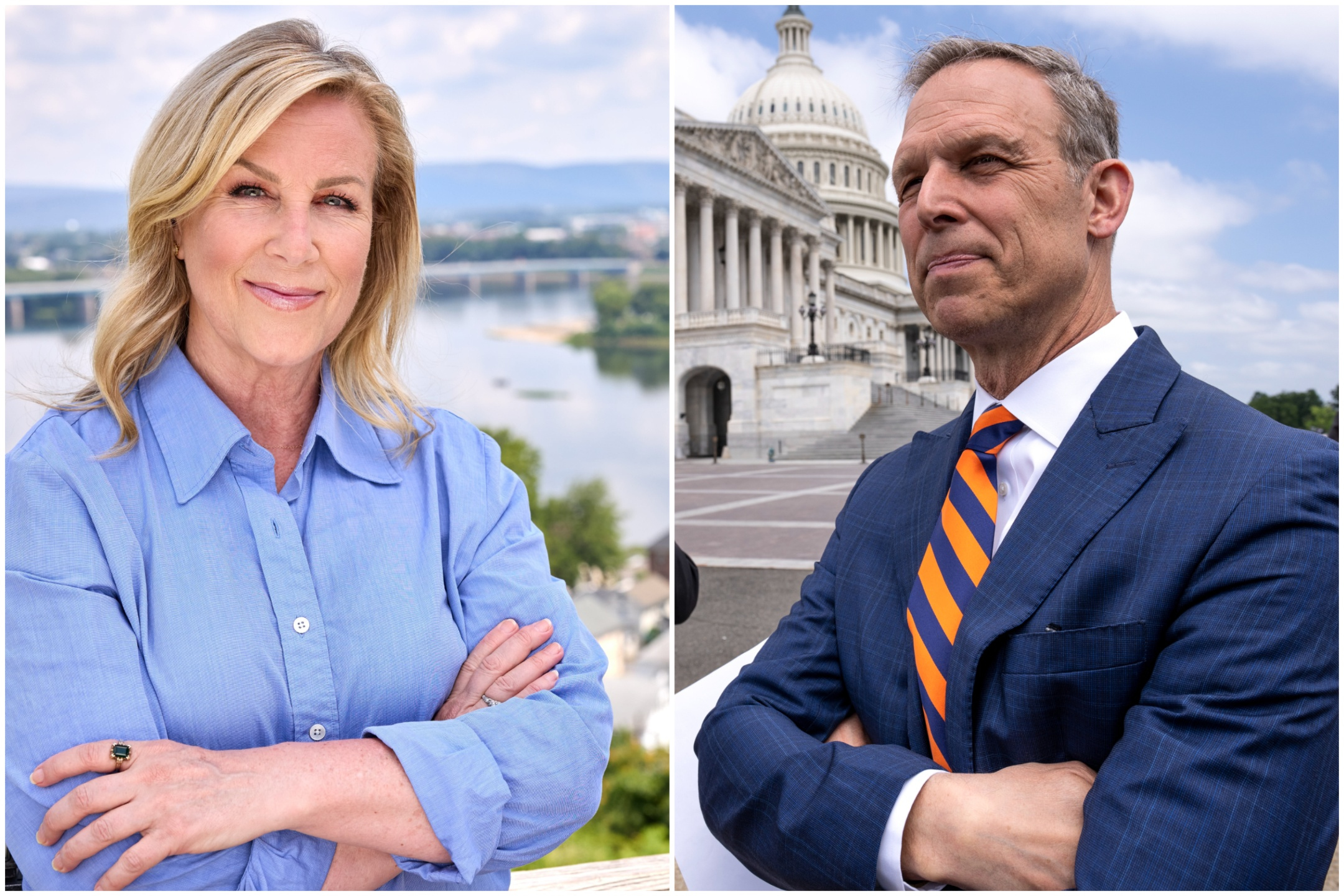
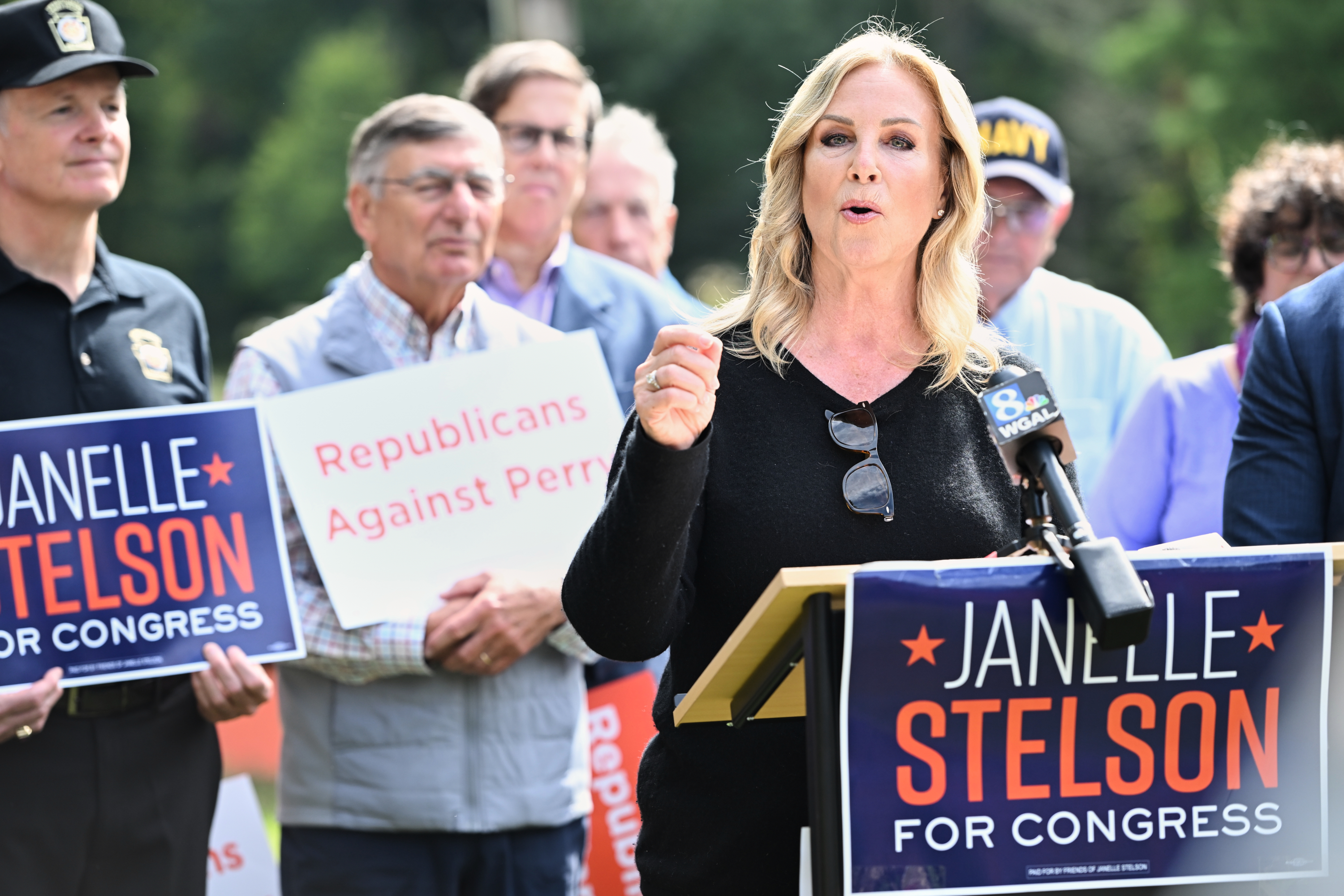
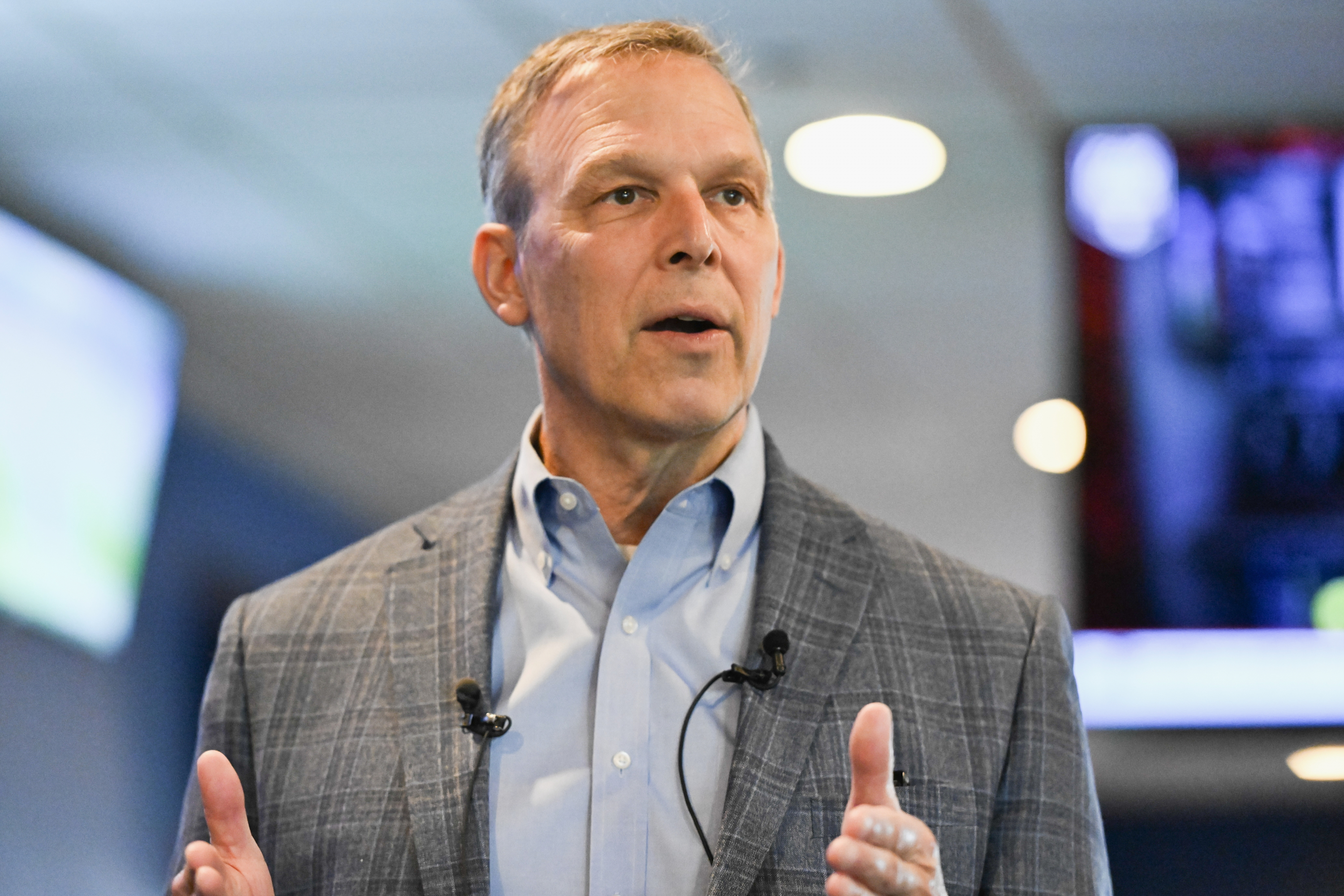
U.S. Rep. Scott Perry and his Democratic challenger, Janelle Stelson, are in a dead heat in their rematch to represent the Harrisburg area in Congress, despite deep dissatisfaction with President Donald Trump among voters in the district.
Perry is the only Republican incumbent in the state’s four swing districts who did not trail his Democratic opponent in the set of surveys released Sunday. The four districts could decide control of the U.S. House.
Perry, who has unabashedly embraced Trump, eked out a narrow win over Stelson two years ago when Trump won the district and the state, but this year the president is underwater in the district, with 55% disapproval compared with 43% approval, according to the poll of 404 likely voters conducted between Oct. 16 and 22.
(function(){function e(){window.addEventListener(`message`,function(e){if(e.data[`datawrapper-height`]!==void 0){var t=document.querySelectorAll(`iframe`);for(var n in e.data[`datawrapper-height`])for(var r=0,i;i=t[r];r++)if(i.contentWindow===e.source){var a=e.data[`datawrapper-height`][n]+`px`;i.style.height=a}}})}e()})();
Voters in the poll gave Stelson, a former TV anchor, a more favorable view when judging the candidates on issues related to character, the cost of living, and tackling corruption, but they gave Perry the edge on handling foreign wars and immigration.
“I think [Perry] has done a pretty good job,” said Richard Shroy, 73, a Republican. He got to know Perry while working in Dauphin County and said the incumbent was competent and reliable.
Gabriel Robinson, 52, said the economy has been a drag on him and is among his top concerns heading into the midterm elections.
“I’m feeling it at the tank. I’m feeling it at the grocery store. I’m feeling it in my industry,” said Robinson, a Democrat from Cumberland County.
An HVAC salesman, he said his sales are down as more customers try to fix their older appliances rather than buy new ones. He is voting for Stelson, he said, because he is ready for a change in Congress.
“Scott Perry is 100% with Trump,” he said.
Splitting the ticket
Democrats are hoping Harrisburg and its affluent suburbs will be part of the next wave of districts to flip blue, as Philadelphia’s collar counties did years before.
Perry, first elected to Congress in 2012, has held on to his seat in multiple elections even when being out-raised, including in 2024 against Stelson. (She also holds a cash advantage this year.)
But this time around Gov. Josh Shapiro is also on the ballot — polling strongly in the district — and Democrats are hoping he can help elevate Stelson and other battleground candidates.
A 57% majority of voters in the district approve of the governor, the poll found,compared with 38% who disapprove.
But even in an unfavorable environment for Republicans, Stelson has not won over all of Shapiro’s supporters, a bloc that includes 14% of 2024 Trump voters.
Cathy Hughes, an unaffiliated voter who voted for Trump three times, said she plans to split her ticket andvote for Shapiro and Perry this year.
“I feel people have to give President Trump his next two years to get everything done, and I think in another year, we will be rolling,” said Hughes, 74, of York County. She sees reelecting Perry as key to that mission and saidStelson would be an obstacle.
“Democrats are going to go to Congress, and the first thing they’re going to do — and I don’t care what anybody says — is impeach President Trump,” said Hughes, a retired nurse.
For longtime residents, each candidate also brings familiarity. Perry has represented the district for years, and Stelson, a longtime local news anchor for NBC affiliate WGAL, was broadcast on TV screens in many of their homes.
“I grew up in the area, so I know her as our TV news anchor and always thought she was pleasant,” Robinson said.
Democrat Janelle Stelson speaks at a campaign event in her race against Republican U.S. Rep. Scott Perry of Pennsylvania, Sept. 23, 2026, in York Haven, Pa. (AP Photo/Marc Levy, File)Marc Levy
Frustration with the cost of living — and Trump’s war
Trump’s weakest area in the district is pocketbook concerns. Only 36% of voters approve of his handling of cost-of-living issues, and 62% disapprove. And economic issues top the list of voters’ most important concerns determining their choice.
That could be a hurdle for Perry.
(function(){function e(){window.addEventListener(`message`,function(e){if(e.data[`datawrapper-height`]!==void 0){var t=document.querySelectorAll(`iframe`);for(var n in e.data[`datawrapper-height`])for(var r=0,i;i=t[r];r++)if(i.contentWindow===e.source){var a=e.data[`datawrapper-height`][n]+`px`;i.style.height=a}}})}e()})();
“Our economy is terrible. People aren’t making enough,” said Susan Wert, a 57-year-old nurse in Cumberland County. She calls Trump “an embarrassment to our country” who wants to be a king.
To get the country back on track, said Wert, a Democrat, she supports Stelson.
Voters in the poll gave Stelson a 50%-to-43% edge over Perry on trusting she would do a better job of handling cost-of-living issues. By the same ratio,they trust her more than Perry to do what is best for ordinary Pennsylvanians.
“Republicans, to me personally, they’ve done enough damage. Now somebody needs to fix it, and I think that [Stelson] will do her best to try,” Wert said.
Many voters also linked high gas prices and the war in Iran, which Trump initiated with Israel earlier this year. In retaliation for military strikes, Iran closed the Strait of Hormuz, through which barrels of oil flow, which several experts said spiked the price at the pump.
The fluctuation in prices was enough to persuade Tom Myers, a 75-year-old Republican from Dauphin County, to vote for Stelson in the contest to put a check on Trump.
Myers blamed Trump’s decision during his first presidency to withdraw from former President Barack Obama’s Iran nuclear deal for creating the current predicament.
“We shouldn’t be there,” he said. “I mean, yes, they were going to possibly have a nuclear weapon, but Trump tore up the treaty that was in place, which is what precipitated this whole thing.”
Alfred Milbourne, a 73-year-old retired truck driver, put it more bluntly: “I don’t trust Scott. I don’t trust nothing about him. [Perry] believes in bombing places and not helping the American public.”
“He’s a Trump guy, and Trump people need to be out of there,” added Milbourne, a Democrat.
But Hughes said she still plans to back the president and Perry even though she has struggled to afford food after her husband died in 2023 and her car recently broke down. She has written multiple letters to Trump with advice, including encouraging him to end the war in Iran, she recalled.
“It’s hard for people right now because of the gas prices and because of oil and because of the grocery store,” she said. But, she added, “it’s not really [Trump’s] fault. I mean, we can’t let Iran have a nuclear weapon.”
U.S. Rep. Scott Perry (R., Pa.) speaks at a campaign event at Arooga’s sports bar on Sept. 30, 2026, in Harrisburg, Pa. (AP Photo/Marc Levy, File)Marc Levy
Meanwhile, Perry has attempted to brand Stelson, a former Republican, as a socialist.
It is a point that has resonated with Stefan Szurdi, 70, who immigrated to the U.S. from Austria and became a U.S. citizen in the 1990s.
“When I hear the word socialist, it irritates me because I used to live in it,” said Szurdi, a Republican who now lives in Dauphin County. “I’m conservative. I pay my taxes and leave me alone.”
From his own experiences immigrating to the U.S., Szurdi, who said he “went by the rules” and expects everybody else to do so as well, said he aligns with Perry and supports Trump’s efforts to ramp up enforcement.
Immigration and Customs Enforcement (ICE) agents are “doing a great job, and it’s just unfortunate all the protesting against them,” he said.
Perry has also sought to tie Stelson to a Nigerian man who authorities said was in the country illegally and found with Stelson’s campaign flyers inside his car. Stelson, during the candidates’ Oct. 14 debate, said the man was not an employee of her campaign or a volunteer.
Still, the accusation lingered and has cast a shadow on Stelson’s campaign for some voters.
“You can’t keep giving to people who are here illegally when the country has more than enough people here legally that are not receiving the help that they need,” said Janice Yeager, 63, of York County, who is supporting Perry.
When it comes to immigration, voters in the district trust Perry over Stelson, 50% to 45%, the poll found.
But even among those who agree changes were needed in the U.S. immigration system, many thought ICE has gone too far in its enforcement.
Alaina Snyder, a 23-year-old cashier, said she plans to vote for Stelson, who she believes stands up for human rights.
“She doesn’t believe that ICE should be on the streets hurting people,” said Snyder, who lives in Harrisburg. Perry she sees as being “fully for ICE and handling things with whatever cost necessary, and it’s just not necessarily safe for people.”
For Democrats like Snyder and others, Election Day cannot come soon enough.
“I just am so over the Republican Party in all ways, and I would vote for anybody who was running against any Republican right now, but especially [Perry],” said Matthew Fahnestock, 47, a Democrat from Cumberland County who teaches high school.
“He just seems completely out of touch with a district like ours.”
Democrat Bob Harvie holds a narrow lead over Republican U.S. Rep. Brian Fitzpatrick in a Bucks County race that could decide control of the U.S. House.
Harvie’s lead is within the margin of error, but the poll shows the Democrat has a shot at flipping the district a little more than a week before Election Day —an unthinkable prospect just two years ago.
Fitzpatrick, the last remaining House Republican in the Philadelphia suburbs, entered the final month of this race with a massive fundraising advantage and decades of family name recognition. But in the swing district he also faces the drag of his party’s increasingly unpopular president amid gains in Democratic momentum.
A loss for Fitzpatrick would be monumental, but not unprecedented. His late older brother, former U.S. Rep. Mike Fitzpatrick, was defeated in 2006 amid a similar national political environment before winning the seat back four years later.
Out of the state’s four swing congressional districts, President Donald Trump has his worst approval rating in the 1st District — where Gov. Josh Shapiro, who has a double-digit lead against Republican Stacy Garrity in the governor’s race, has his highest.
The younger Fitzpatrick has survived blue wave after blue wave.
The Bucks County Republican leads Harvie on character 46% to 39%, according to the poll of 400 likely voters conducted from Oct. 16 to 22.
Many voters are still forming opinions on the county commissioner. Harvie was seen favorably by 38% of respondents compared with 32% who view him unfavorably, with the rest of the electorate offering no opinion. Fitzpatrick, meanwhile, was viewed favorably by 43% of voters and unfavorably by 44% after five terms.
(function(){function e(){window.addEventListener(`message`,function(e){if(e.data[`datawrapper-height`]!==void 0){var t=document.querySelectorAll(`iframe`);for(var n in e.data[`datawrapper-height`])for(var r=0,i;i=t[r];r++)if(i.contentWindow===e.source){var a=e.data[`datawrapper-height`][n]+`px`;i.style.height=a}}})}e()})();
The 1st District, which also includes part of Montgomery County, is one of the swingiest areas in the state and home to many independent voters who will helpdetermine the election. With both campaigns courting the district’s moderate profile, Harvie and Fitzpatrick are tied at 44% among independents.
Don Levy, director of the Siena Research Institute, said that Fitzpatrick has demonstrated some independence “in a district that demands it,” and that his likability among voters could help him succeed on Election Day despite any disdain for the president.
But, Levy said, the race is a “toss-up.”
“Clearly, Harvie has an opportunity to hold on to this two-point lead on Election Day,” he said.
Democrat Bob Harvie talks with people during a town hall meeting at the Horsham Township Building on Thursday, Oct. 8, 2026.Elizabeth Robertson / Staff Photographer
They mean entirely different things for the 1st District.
Shapiro, who is unusually popular as governor, is leading Garrity in the district by 27 points, 61% to 34% — enough to potentially pull Harvie and other Democrats along on his coattails in key downballot races. Shapiro alsohas a 67% approval rating in the district with just 27% disapproval.
Meanwhile, Trump — who won Bucks County in 2024, though former Vice President Kamala Harris won the 1st District overall — has a 35% approval rating and 61% disapproval.
(function(){function e(){window.addEventListener(`message`,function(e){if(e.data[`datawrapper-height`]!==void 0){var t=document.querySelectorAll(`iframe`);for(var n in e.data[`datawrapper-height`])for(var r=0,i;i=t[r];r++)if(i.contentWindow===e.source){var a=e.data[`datawrapper-height`][n]+`px`;i.style.height=a}}})}e()})();
He is also deeply underwater on his handling of the cost of living (68% disapprove) as more than a quarter of 1st District voters view the economy as the most important issue in the congressional race.
This is the political landscape Democrats have been hoping for as they champion Shapiro and Harvie’s bond while trying to tie Fitzpatrick to Trump — a strategy that has not been fruitful in years past but may have more traction now given the president’s unpopularity.
Almost half of 1st District voters, 48%, think Fitzpatrick supports Trump too much, while 31% say he is about right on the president and 8% believe he opposes him too much, according to the poll.
Thirty-nine percent of voters think Harvie is about right on Trump, 30% say he opposes the president too much, and 26% did not know or declined to say how they feel about the Democrat’s perspective on the president.
Democrat Carolyn Perzan voted for Fitzpatrick in 2022 and 2024 but said she is switching her vote to Harvie this timebecause she feels the GOP lawmaker has changed since Trump has come back into office, noting Fitzpatrick’s key vote to advance the One Big Beautiful Bill Act (though he later voted against it on final passage).
“I don’t really know a lot about Bob Harvie, to be honest,” said Perzan, 57, of Hilltown Township. “I did do a little bit of research. I was influenced by the negative ads a little bit, but then I looked into it and I’m just going to vote Democrat because I don’t like what the Republicans are doing. At all.”
Christine Mecutchen, 60, of Furlong, similarly said that she doesn’t know much about Harvie, but that ousting Fitzpatrick is more important.
“Honestly, I’d vote for a watermelon with a hat on over that man,” the Democrat said.
An Inquirer analysis shows that Fitzpatrick is the least loyal House Republican to both Trump and his party, though he has voted with both at least 70% of the time this congressional term. The Bucks County Republican has been explicit in his disagreements with the president (Trump has not endorsed him), including his recent votes in favor of war powers resolutions for the conflict in Iran.
But the war might be a reason Mary Schoenharl’s kids stay home.
The 59-year-old independent, Libertarian-leaning voter from Chalfont plans to cast her ballot for Fitzpatrick because he aligns with her views on small government, public safety,foreign policy, and local issues. But she said she is worried about her 23- and 26-year-olds — conservatives who would otherwise vote forthe incumbent — stayinghome on Election Day as a protest vote against ongoing foreign wars.
“They think they’re all the same, basically, and that no matter who’s in, nothing’s going to change,” Schoenharl said. “It’s how they feel. They’re disheartened.”
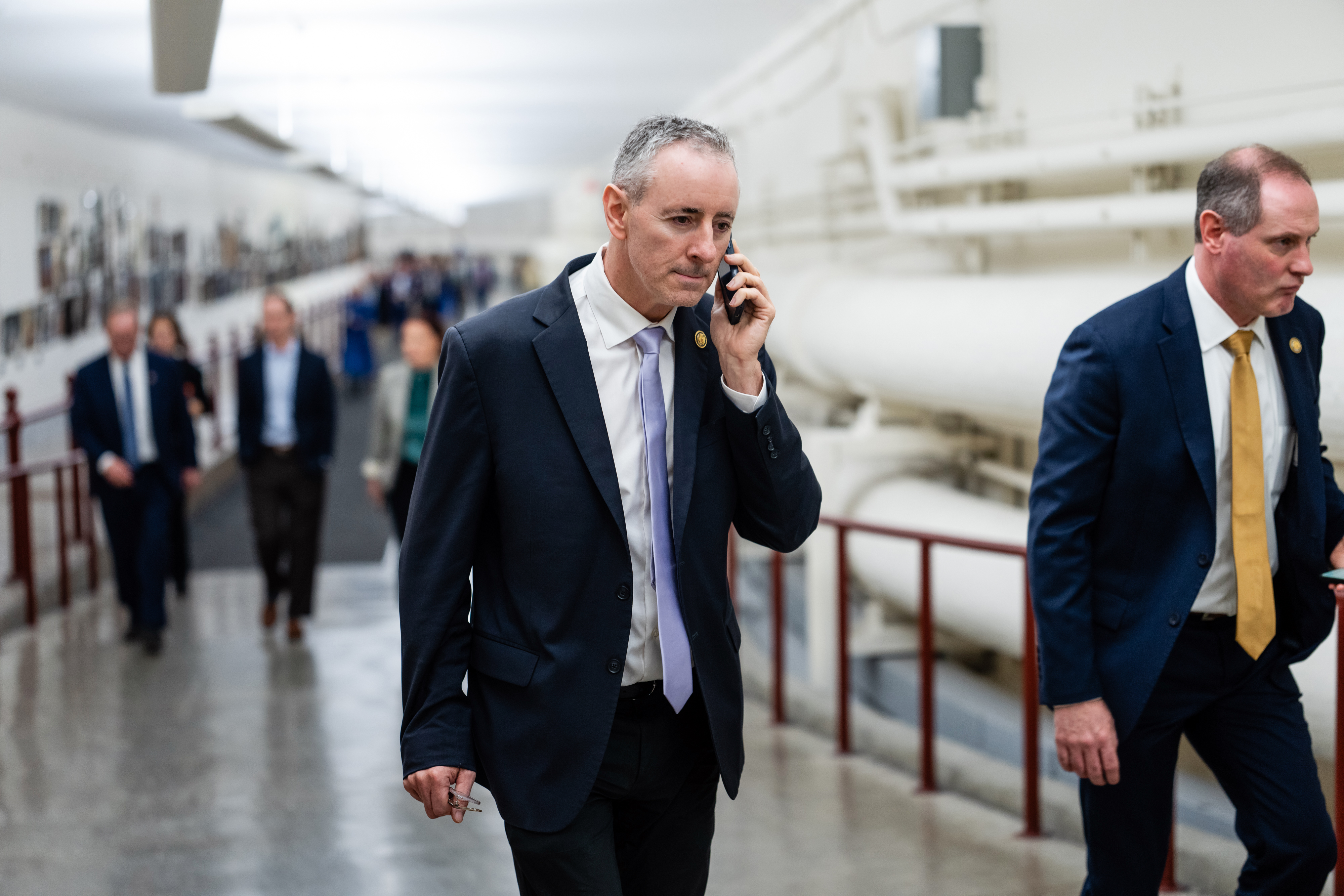
U.S. Rep. Brian Fitzpatrick at the Capitol in Washington on March 5, 2026.Eric Lee
The Shapiro factor
Meanwhile, Democrats in the homestretch are working to keep Harvie aligned with a more popular figure — Shapiro.
The Democratic Congressional Campaign Committee, which recently started making bigger investments in the 1st District, is promoting the governor’s endorsement of Harvie, including in itsclosing ad in the contest that also seeks to connect Trump and Fitzpatrick.
At the same time, Shapiro and Fitzpatrick appear to have an amicable relationship. Fitzpatrick earlier this year said he believes the governor will win reelection and referred to him as a friend. Fitzpatrick invited Shapiro to his wedding this summer, but the governor did not attend and instead sent a “lovely note,” the New York Times reported.
In an interview with The Inquirer this month, Shapiro said, “I like Brian. I think he’s a good man, and I think he works really hard in that district,” but that his fundamental difference with him is “around the idea that he empowers Speaker [Mike] Johnson, who enables Donald Trump.”
“I think that at a time where we need more accountability for Donald Trump, enabling, you know, pathetically weak people like Mike Johnson, who just roll over and do whatever Donald Trump wants, I don’t think that that’s something that we can afford any longer,” Shapiro said. “I think it is important that there be a check on this president in Washington.”
It is likely that some voters in the 1st District will split their ticket between Shapiro and Fitzpatrick, especially in purple Bucks County, where Shapiro won by 20 points during his first bid for governor in 2022 while Fitzpatrick comfortably won reelection.
Hank Conicelli, 67, is one of those voters.
The self-described “middle-of-the-road” Republican will cast his ballot for Shapiro — he said he does not know much about Garrity — and will vote once again for Fitzpatrick, whom he describes as a “nice guy.”
“I don’t see him ever doing anything, you know, on the negative side,” the Yardley resident said, adding that Fitzpatrick “seems like he’s the type of person that helps people in need.”
Conicelli, who voted for Trump in 2024, said he believes the president had done an OK job with the economy up until the spike in oil prices due to the Iran war. But Fitzpatrick should not be bogged down by any potential negative association with Trump or the GOP, he said.
“I think he’s done a good job, and I think people will see that,” Conicelli said. “For me, personally, I look at the person vs. the ‘R’ vs. ‘D.’”
Hank Conicelli, a split-ticket voter, chats about the midterm elections on Friday, Oct. 23, 2026, at his home in Yardley. William Thomas Cain / For The Inquirer
‘A lot more people that are unhappy’
The 1st District race is also tight on the issues.
Harvie holds a slim lead over Fitzpatrick on his handling of all issues covered in The Inquirer/NYTimes/Siena poll, including thecost of living (46% to 43%), immigration (47% to 45%), foreign wars (47% to 42%), AI and data centers (43% to 40%), and corruption (47% to 40%).
Forty-six percent of voters said Harvie would do what is best for ordinary Pennsylvanians, while 44% said the same of Fitzpatrick.
The Bucks County contest has become a race focused both on the economy and corruption. Democrats and Republicans are each working to become the party of affordability and trying to paint their opponents as corrupt — namely by Fitzpatrick continuously claiming Harvie is the “subject” of an FBI corruption investigation and Democrats arguing that the Republican has enriched himself while in office.
And for Fitzpatrick’s part, spokesperson Heather Roberts said an ad by Harvie and the DCCC on the congressman’s finances is “completely absurd and completely fabricated.”
“Brian leads the charge in banning stock trading and has engaged in a total of Zero stock transactions during his entire time in office,” she said in a statement.
(function(){function e(){window.addEventListener(`message`,function(e){if(e.data[`datawrapper-height`]!==void 0){var t=document.querySelectorAll(`iframe`);for(var n in e.data[`datawrapper-height`])for(var r=0,i;i=t[r];r++)if(i.contentWindow===e.source){var a=e.data[`datawrapper-height`][n]+`px`;i.style.height=a}}})}e()})();
For Perzan, the Democrat from Hilltown Township, her vote next month is also about searching for leaders who will hold Trump accountable for what she says is his corruption.
The former Fitzpatrick voter says that everything has “gotten so outrageous,” but that something feels different this year for Democrats, who are battling to represent Bucks County in Congress for the first time in a decade and a half.
“I think there’s a lot more people that are unhappy with what’s going on,” Perzan said.
This story was updated to clarify each candidate’s net favorability rating.
Staff writers Joe Yerardi, John Duchneskie, Michelle Baruchman, and Gillian McGoldrick contributed to this article.
If the polls are accurate, Gov. Josh Shapiro, who was twice elected Pennsylvania’s attorney general, should cruise to his fourth statewide election on Nov. 3.
In these divided political times, in one of the most evenly split states in the country, that says a lot about Shapiro’s ability to appeal to a broad swath of voters across the commonwealth.
While the two political extremes on the right and left generate the most noise, Shapiro sits in the moderate middle. That rankles many on the far left and the right, but it is smart politics in Pennsylvania.
While Shapiro is pragmatic, he is also tough and empathetic. He takes public service seriously but is also a regular guy from Abington who is passionate about Philly sports. He is welcome in boardrooms, Black churches, and even red counties.
Shapiro surrounds himself with competent people and prides himself on getting stuff done. His administration has been largely free of drama and major scandals — a stark difference from the chaos, corruption, and incompetence coming from the Trump administration.
As state attorney general and governor, Shapiro repeatedly stood up to Donald Trump. He went 43-0 defending flimsy lawsuits Trump filed to overturn the results of the 2020 presidential election. Shapiro also brought some accountability to opioid companies, racist mortgage lenders, and decades of sexual abuse within the Roman Catholic Church.
As governor, Shapiro has sued the Trump administration two dozen times, opposing efforts to slash federal funding for Pennsylvania and roll back environmental regulations. Shapiro — and Al Schmidt, the Republican he appointed to run state elections — are ready to defend against Trump’s efforts to subvert the 2026 election.
As democracy teeters, Shapiro’s legal bulwark against Trump is reason enough to keep him in the governor’s mansion. But his commonsense policies, willingness to stand up for what is right, and ability to work across the aisle cements the case for why The Inquirer Editorial Board endorses Josh Shapiro for a second term as governor.
This was not a difficult decision, because his opponent, Stacy Garrity, the Republican state treasurer from Bradford County, has a slim record. Even worse, she supports Trump’s disastrous MAGA agenda as well as data centers and sleazy skill games — three big strikes.
Gov. Josh Shapiro and Republican challenger Stacy Garrity at the WHTM-TV studios in Harrisburg, Oct. 7, during their lone debate ahead of next month’s gubernatorial election.Kaylee Lindenmuth / WHTM
Garrity’s main accomplishment as treasurer has been returning unclaimed property to Pennsylvanians and hundreds of unclaimed military decorations to veterans. That constitutes a practical, down-to-earth baseline for her role to be sure, but Garrity’s resumé lacks the kind of expansive, broad-based signature achievement to suggest that she would bring a truly transformational approach to governing. Her biggest donor is Robert Asher, a longtime GOP power broker from Montgomery County who was convicted of bribery in 1986.
Garrity’s best argument may be that she is not Doug Mastriano, the GOP’s 2022 gubernatorial nominee, who dressed up in Confederate garb and helped plan Trump’s Jan. 6, 2021, coup attempt.
The Editorial Board invited Garrity to advocate for her candidacy, but she did not respond to multiple requests to meet. Shapiro, on the other hand, has a compelling case to make, which explains his commanding lead in the polls.
Shapiro’s most high-profile accomplishment was rebuilding the stretch of I-95 that collapsed in Northeast Philadelphia after a tanker truck fire in 2023. The highway closure along the main artery connecting the Northeast trucking corridor was expected to take many months to fix.
But Shapiro mobilized federal, state, and local officials, used accelerated emergency contracting rules, and hired a Philadelphia-based construction firm that worked round the clock to reopen the highway in 12 days.
Under Shapiro, the commonwealth has lowered taxes for some, increased public safety, and pushed policies to make housing more affordable. Unlike Trump’s relentless efforts to restrict voting, the governor expanded voter registration by making it automatic for eligible voters when they renew or receive a driver’s license or ID at driver and photo license centers.
Gov. Josh Shapiro visits Vare-Washington Elementary School in July.
Shapiro has also increased funding for public education by hundreds of millions of dollars. Pennsylvania remains far below adequate funding levels, even after a state court found in 2023 that the state’s funding system was unconstitutional.
Shapiro’s efforts to close the education funding gap faced opposition from the Republican-controlled state Senate. The recalcitrant GOP has stymied other efforts to adequately fund mass transit, increase the minimum wage, and tax skill games at the same rate as slots.
But it is not due to a lack of effort by Shapiro. The divided legislature makes Harrisburg largely ungovernable. That is why Shapiro is working to help Democrats flip at least two seats to win control of the state Senate and maintain their thin majority in the state House.
The last time Democrats controlled all three chambers of government was in 1993. As a result of the chronic stalemate, a lot hasn’t happened in Harrisburg beyond keeping lobbyists employed and lawmakers in power. Just getting the budget passed is an annual ordeal.
If Shapiro’s coattails can power Democrats to control of the House and Senate, the first bill he plans to sign will be to increase the minimum wage to $15 an hour. Other major initiatives on Shapiro’s to-do list include increasing mass transit funding and codifying abortion and LGBTQ rights.
“I’ve got a lot more to do, which is why I’m running again,” Shapiro told the Editorial Board.
Of course, the governor is far from perfect. He was for data centers before he was against them. (But he listened to voters and adjusted.) He supports legalizing and taxing skill games — which are more predatory than slot machines — rather than banning them as Kentucky did.
Gov. Josh Shapiro announces a $20 billion investment by Amazon in Pennsylvania data centers in Salem Township and Falls Township.
Shapiro has been largely mum on efforts to reform or better yet repeal Act 12, which has allowed for-profit companies to buy public water and sewer utilities, and jack up rates for residents. (He did force Peco to withdraw a double-digit rate-hike request.)
Shapiro helped attract thousands of new jobs to Pennsylvania, often dangling financial incentives like the ones used to lure the Burlington Stores headquarters and a Chobani facility to Philadelphia. Another pricey deal that included more than $600 million in state and federal money combined is expected to add 6,000 jobs at the Philadelphia Port. (Attracting jobs is nice, though there is an argument to be made as to whether the state should use tax dollars to pick winners.)
It is widely assumed Shapiro will run for president in 2028. That campaign will begin early next year, raising concern if Shapiro enters the race that he may be distracted from his day job while campaigning in South Carolina, Iowa, New Hampshire, and beyond.
Since the road to the White House leads through Pennsylvania, Shapiro may be uniquely positioned to clean up Trump’s mess. But a White House win means Shapiro would not complete his gubernatorial term. Though two years of Shapiro is certainly better than four of Garrity.
When asked about running for president, Shapiro told the Editorial Board, “The only thing I’m running for is governor.” (Check back in a few months and see how well that quote ages.)
During recent campaign events with students at the University of Pennsylvania and at an event at a Black church in Abington, Shapiro looked beyond his own reelection and painted a picture of what could happen if Democrats take control of the state Senate and the House in Washington.
“You have the power to make a difference,” Shapiro told the Penn students.
At Salem Baptist Church, Shapiro told the crowd of mostly Black women their votes could give hourly workers a raise, increase funding for mass transit, and protect reproductive rights.
Shapiro’s reelection could bring positive change across Pennsylvania — and maybe propel the governor to new heights.
This week’s edition of Shackamaxon covers a frustrating change at the Christmas Village, a misguided attempt to foster affordability, a proposal to fund transit by keeping so-called games of skill, and an outrageous campaign boast.
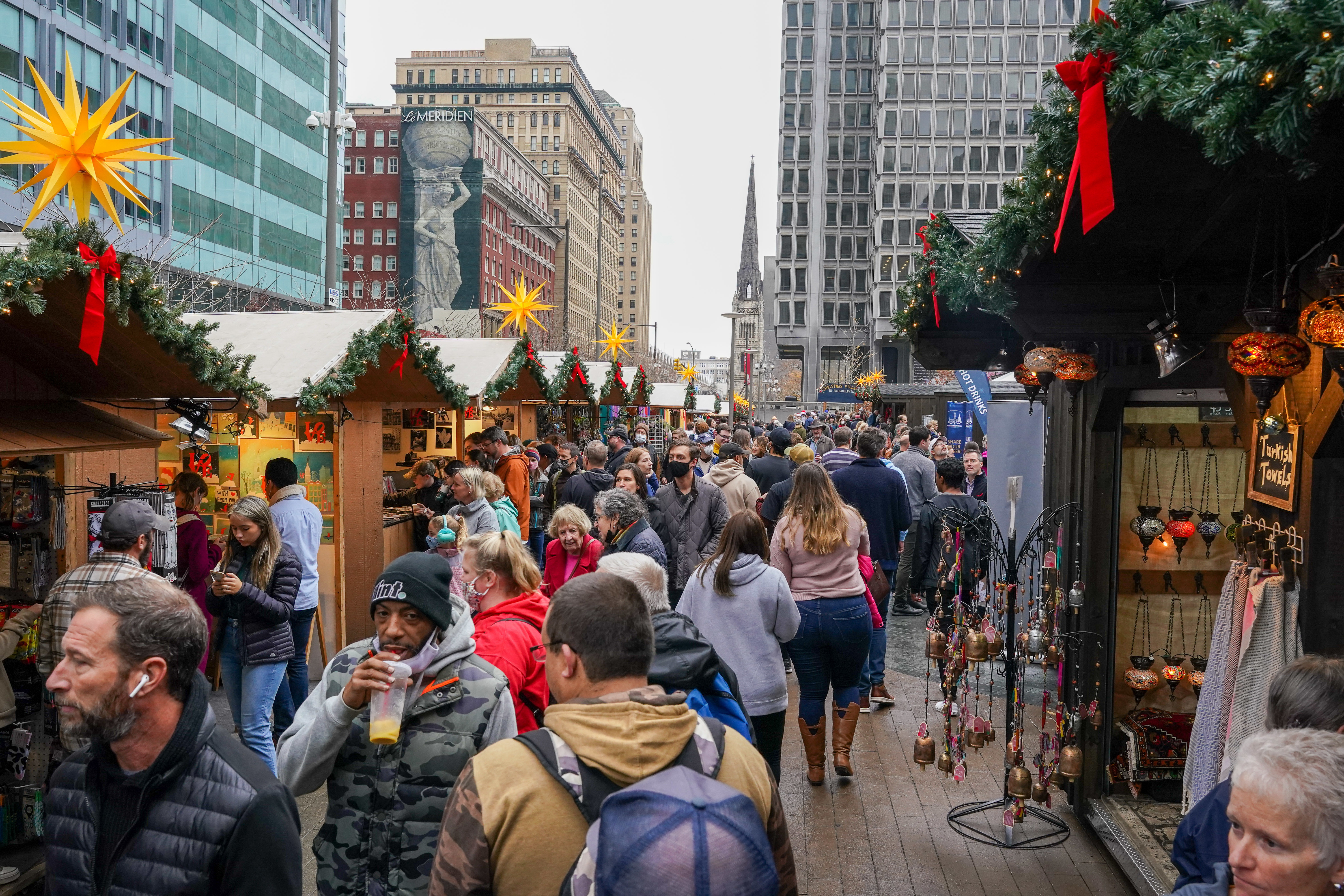
People browse and shop at Christmas Village at LOVE Park.THOMAS HENGGE / Staff Photographer
Counter space
One of the highlights of the holiday season in Philadelphia is the Christmas Village that sets up at LOVE Park and Dilworth Plaza every year. Local artists and artisans sell everything from clothing to ornaments from tiny stalls, a tribute to the markets that have been set up during December in German towns and cities for hundreds of years.
This year, merchants are facing a significant change: The interior of their stalls will now be off-limits to shoppers. Instead, they are expected to build counters, with customers remaining outside, away from most of the merchandise.
On social media and in The Inquirer, sellers complained this undermines the experience.
The new setup will force cashiers to fetch items that potential buyers typically peruse on their own, adding to their workload and slowing sales. It also removes the serendipitous magic of finding the perfect product while browsing.
German American Marketing, which runs the whole operation, has painted the change as a necessary response to accessibility concerns. They’ve cited input from their legal team and ongoing efforts to make the Village more welcoming to customers who cannot navigate the stalls’ tight spaces.
Accessibility is of course essential, but let’s hope that management, the city, disability advocates, and the vendors can find a better solution in time for next year’s holiday season. Especially if the new setup has a measurably negative impact on sales.
Councilmember Jeffery Young Jr. during a community meeting at the MLK Recreation Center in September.Elizabeth Robertson / Staff Photographer
A break for lawbreakers
For the second year in a row, Philadelphia was named the worst U.S. city for drivers. It’s not only traffic, as my colleague Stephanie Farr chronicled, we all know that the city’s bad motorists can make life frustrating, if not outright dangerous, for everyone else.
Fifth District City Councilmember Jeffery “Jay” Young Jr.’s plan? Reward them.
First, Young proposed lowering fines from the city’s speed and red-light cameras. Now, he’s proposing a general parking ticket amnesty. Young has painted these moves as a response to the national affordability crisis. Except there’s a big difference between paying for food and paying for tickets. We all have to eat; we don’t all have to break the law.
Of course, there are many Philadelphians who have turned resenting the Philadelphia Parking Authority into a major part of their personality. The fact that the city’s ticket-issuing agency seems to have more firepower than its pothole repair squad, school district, Licenses and Inspections Department, and transit agency is legitimately frustrating. The solution, however, isn’t giving scofflaws a break. It is improving these other services.
No matter how many social media posts insist that it is all a cash grab, parking and traffic laws exist for a reason. With limited curb space, ensuring spots regularly turn over is essential to having thriving commercial corridors. Especially in the age of same-day delivery.
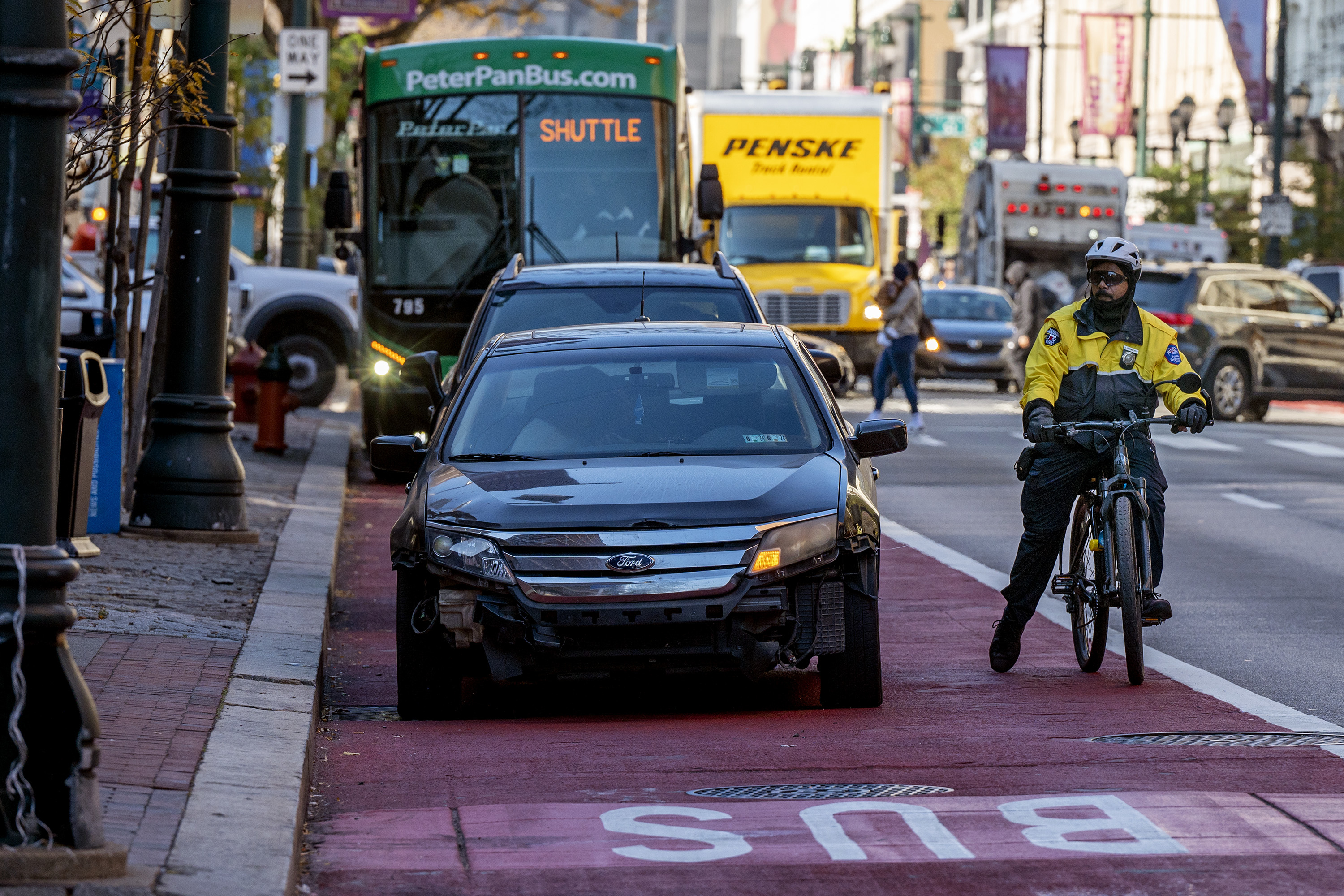
Motorists who park in crosswalks, on sidewalks, and on top of the trolley tracks or bus lanes are putting convenience for themselves over safety and access for their fellow Philadelphians. The ability to extend a reservation by phone has made paying for meters easier than ever before, and traffic cameras have made the city’s most dangerous corridors significantly safer.
Young’s office defended the push as a way to help people who may have made an honest mistake. The city’s parking signs can be confusing to navigate at times, but that only explains the first fine. Residents who have accumulated significant balances are, by definition, repeat offenders.
A sign with “Frequent Red” designation is posted at a South Philadelphia bus stop in August.Tom Gralish / Staff Photographer
Missed connection
Northeast Philadelphia State Sen. Joe Picozzi is an outlier in his caucus. He’s the only Republican who represents Philadelphia in a chamber where many of his colleagues are old enough to be his parents, and he supports additional recurring revenue to support public transit (one of his fellow Harrisburg Republicans calls bus drivers “chauffeurs”).
In an op-ed for Broad and Liberty, Picozzi called for state leaders to agree to a plan I’ve proposed myself: taxing skill games and sending the revenue to infrastructure needs across the commonwealth. Beyond transit agencies, Pennsylvania also has more miles of state-owned roads than all six New England states combined.
It’s an idea that has a lot of merit. SEPTA just posted its best month for ridership since February 2020 — with 822,753 riders using the system on an average day. This boost happened despite the closure of 11th Street station on the Market-Frankford Line, and work in the trolley tunnel for three out of four weekends. The New Bus Network contributed significantly to this increase, helping to drive a 14% surge in bus ridership alone. While challenges remain, things are clearly moving in the right direction.
A new recurring funding source would help avoid a repeat performance of last year’s capital budget raid, putting the transit agency in a better position to deliver the faster, more frequent service and upgraded trains and stations promised in the Accelerate plan.
In a recent interview with The Inquirer Editorial Board, Gov. Josh Shapiro indicated support for the idea as well, blaming Senate Republicans for failing to bring a bill forward. State Senate Majority Leader Joe Pittman, despite once making the same proposal himself, more recently suggested that the money should go into the general fund, and that the tax rate for the machines is too high. A last-minute effort to forge a compromise seems to have failed.
For Picozzi and his fellow Southeastern Republicans, this failure only makes life harder. The more people associate the state Senate with inaction, the harder it will be to appreciate the individual qualities of each legislator.
Sheriff Rochelle Bilal steps up to testify before City Council during the annual city budget hearing in April.Tom Gralish / Staff Photographer
Bilal blunders
Several readers forwarded me a copy of a text message they received from the campaign to re-elect Sheriff Rochelle Bilal.
Citing an unnamed fugitive and a mother and child who are now safer thanks to his arrest, Bilal cast herself as a champion of domestic violence victims. The text also included a link to her campaign’s fundraising page.
There’s one big problem with this boast. Under Bilal, the city has struggled to collect guns from people who are under protection from abuse orders. An Inquirer report put the confiscation rate at just 13%, measurably lower than neighboring counties.
While Bilal’s immediate predecessor also failed to confiscate enough guns, she’s had seven years to improve. I asked her office and her campaign for the current figure. No reply yet.
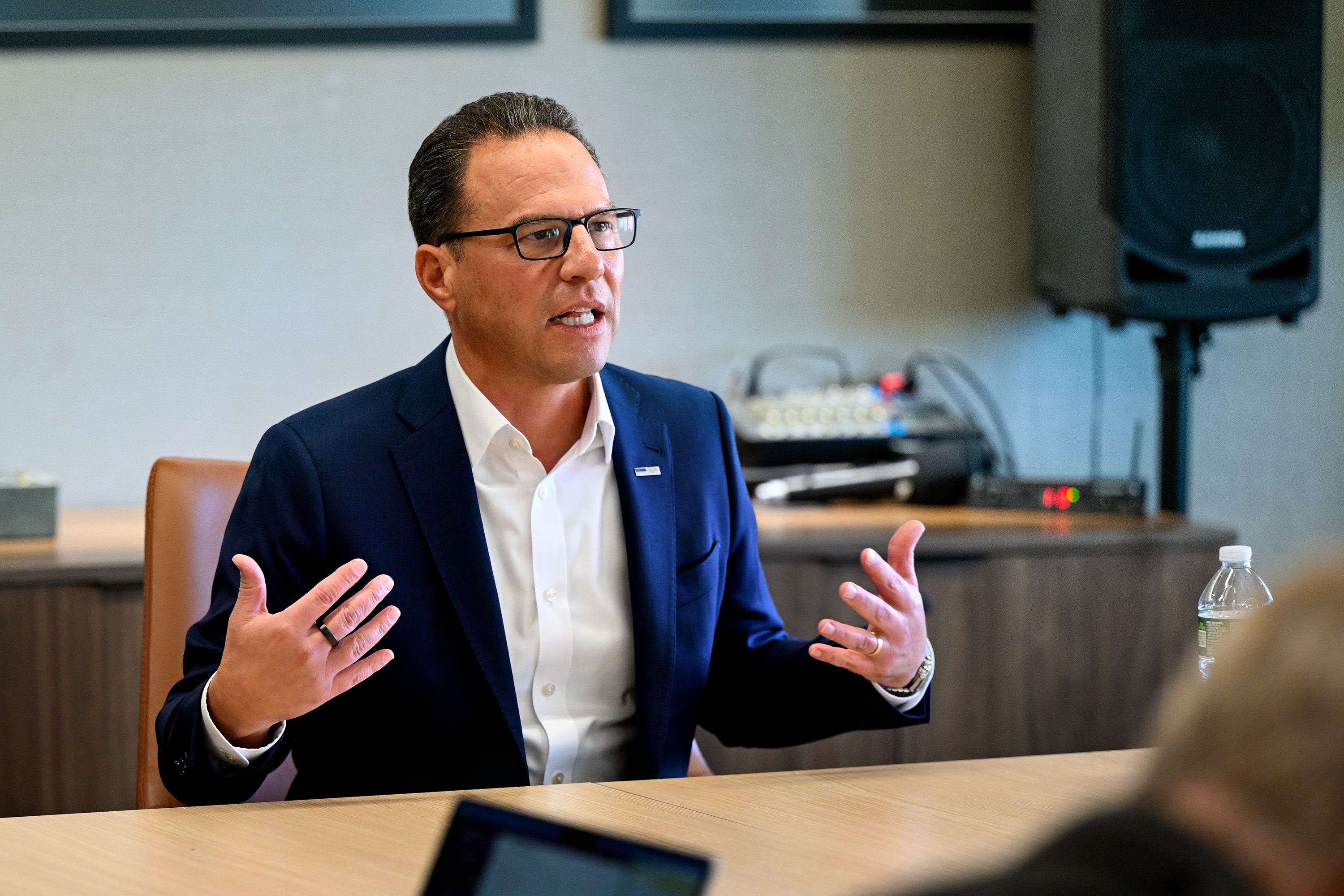
He won’t flinch when you do. No jutted lip, no flicker of emotion. No fiddling with his wedding band or smart ring, one on each hand.
He’s been preparing for this kind of thing for decades.
Shapiro, 53, of Abington Township, has been rumored to have his sights set on the White House dating back to his time as a state representative, as a Montgomery County commissioner, as the state attorney general, and now as Pennsylvania’s governor. And while other 2028 Democratic presidential hopefuls are more outward with their ambitions, hosting fundraisers and making themselves known in early primary states, Shapiro — a disciplined and careful communicator — has led a calculated balancing act as he runs for reelection to the state’s top post, hoping to carry the rest of the Pennsylvania ballot with him.
Are you running for president in 2028?
“I’m going to give you the same answer that I’ve given everyone,” Shapiro told the moderators at a debate earlier this month against his Republican opponent, Stacy Garrity. “The only thing I am focused on is running for reelection as governor, and I’m focused on these midterms in trying to generate the kind of turnout and support the kind of candidates who will push back on the chaos, the cruelty, and the corruption of Donald Trump.”
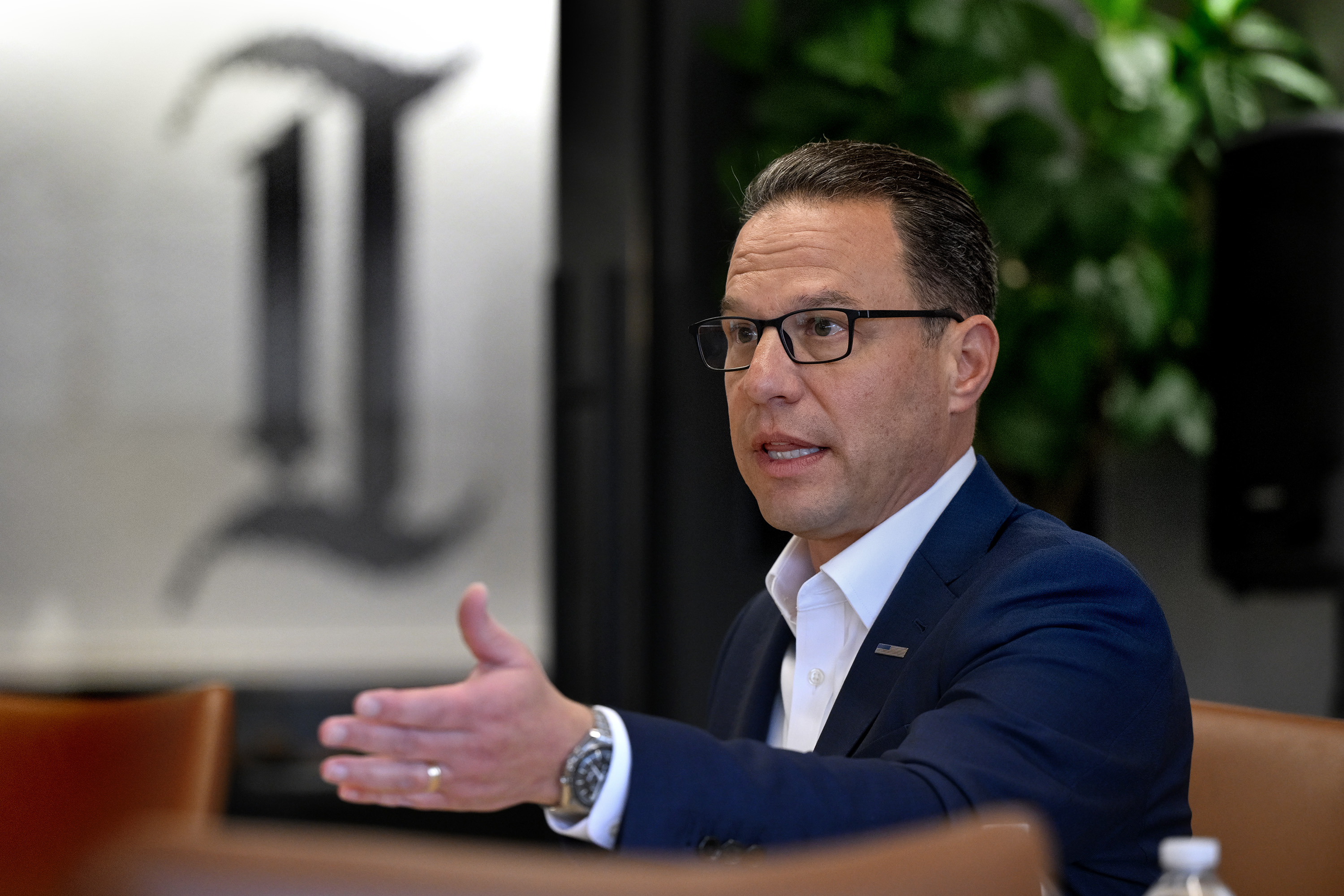
The first-term governor — wearing his daily uniform of a navy blue suit, bright white dress shirt with no tie, white tennis shoes, andblack-framed glasses — does the same again earlier this month in a set of interviews in The Inquirer’s newsroom across from Independence Hall; he smoothly sidesteps the question of whether he’ll promise to fulfill another four-year term if reelected.
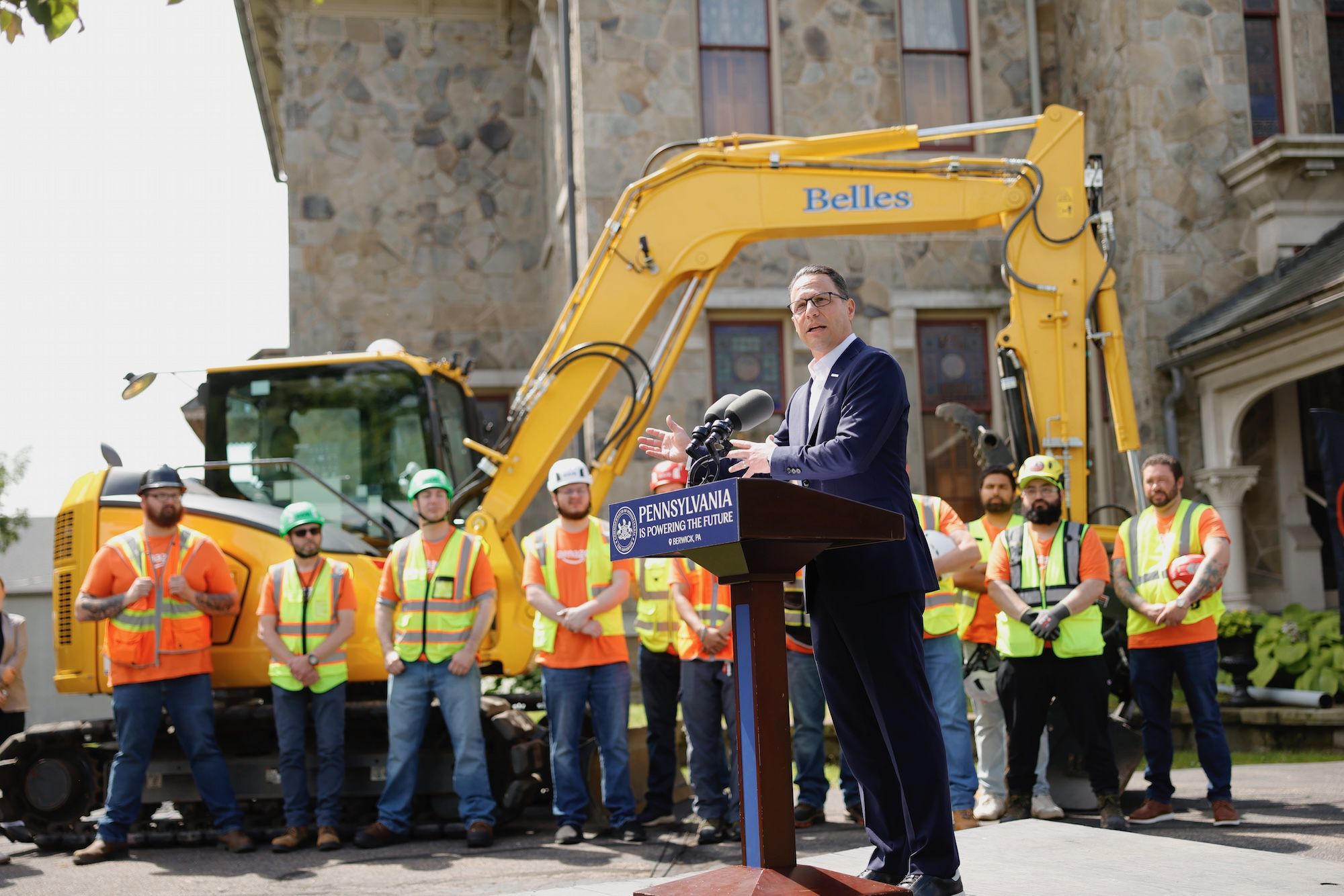
Instead, he boasts his administration’s “get stuff done” motto, citing some of his proudest accomplishments as the leader of Pennsylvania, such as reopening I-95 in 12 days, speeding up the state’s process to get licenses or permits to do work, utility rate caps, and new pathways to careers in the trades. In the run-up to the Nov. 3 election, those triumphs have blanketed the state’s TVs, social media and mailboxes, as his campaign tops $42.3 million in ad buys, according to media tracker AdImpact.
Nearby, his campaign staffer sports a pin featuring the number 48. Shapiro is Pennsylvania’s 48th governor. If he runs in 2028, he’d be vying to become the nation’s 48th president.
Nowadays, there’s a noticeable shift in the Democrat who has long prided himself in his willingness to work across the aisle, but who has struggled as a dealmaker in the state’s split legislature as he goes all-in on flipping the Senate in hopes of more easily achieving his goals.
At the same time,he’s become more willing to directly challenge Trump in the state that helped boost the president to a second term just two years ago, as Trump’s approval ratings continue to decline — and national Democrats are looking for a strong leader to carry them into 2028.
“When he’s going to do something to hurt Pennsylvanians, I’m going to stand up to him, and when I stand up to him, I win every single time,” Shapiro said earlier this month.
The shift — and the sharper edge — may be strategic as Shapiro readies himself for a White House run, said Christopher Borick, a political-science professor and pollster at Lehigh University.
“He is more willing to express his animosity toward Republicans, toward Republican policies, and of course, the president,” Borick added. “He’s been more vocal than you may have thought he would be, given his brand.”
‘Straight down the middle’
When Shapiro sat down for an interview at The Inquirer’s offices earlier this month, he studied where he should sit before answering the question himself.
“How’s this, straight down the middle?” the moderate Democrat suggested with a grin, setting himself up at the center of the table.
Gov. Josh Shapiro at The Inquirer’s office on Monday, Oct. 12, 2026.Tom Gralish / Staff Photographer
Shapiro’s brand as a centrist has been tested over the last few years, as he governs one of the only states in the country with a politically split legislature. An early misstep in Shapiro’s first budget negotiations in 2023 over school vouchers tarnished his relationship with the state’s Senate Republicans, a wound that has never fully healed. Republicans accused Shapiro of reneging on their handshake deal to create a new school voucher program. At the time, Shapiro said the move was necessary to avoid a protracted budget impasse.
Still, for the past four years, Shapiro and top state negotiators have struggled to agree on a state budget before the constitutionallyrequired deadline, as Pennsylvania faces worsening fiscal conditions and spends more money than it collects in revenue.
He’s had some major wins, too. State lawmakers have approved $3 billion in funding increases and created a new funding system for public education, after a state appellate court ruled that Pennsylvania’s previous system was unconstitutional. He has celebrated increases to the state’s property tax and rent rebate programs for seniors, a new state tax credit for working families, and a pension bump for retired teachers, police officers, and firefighters. He boasts significant reductions in wait times for business licenses and environmental permits and continued cuts to the state’s corporate net income tax, as part of his cut-red-tape approach.
Shapiro has faced criticism throughout his tenure as governor from top Republican leaders, who say he lacks conviction on the issues he says he cares about and instead changes his stances to reflect what’s popular.
“He was for helping kids out of failing schools, then he was against it,” Senate President Pro Tempore Kim Ward (R., Westmoreland), the top Republican in the state Senate, said last month. “He was for data centers, then he was against them.”
On school choice, he said this month he still supports the creation of a new school voucher program if House Democrats and Senate Republicans can agree on it. And he has defended himself on his recent reversal on increasingly unpopular data center development, which became a political flashpoint that threatened Shapiro’s popularity. He has said his change in position was a direct response to constituent concerns.
Garrity’s campaign has capitalized on the perceived flip-flops, calling Shapiro in a statement a “career politician whose policy failures have left Pennsylvania families struggling.”
His first term as governor also saw the resignation of a longtime top aide, former Rep. Mike Vereb (R. Montgomery), who was accused of sexual harassment by another staffer in the governor’s office that resulted in the state paying the accuser a $295,000 settlement.
Shapiro, previously largely untested on the national stage, also came under scrutiny when he was being considered by Vice President Kamala Harris to be her running mate in 2024. She ultimately passed him over, and he later said he didn’t want the job. But the consideration significantly boosted Shapiro’s rising national profile, and he later retold the story in his memoir, Where We Keep the Light, released earlier this year.
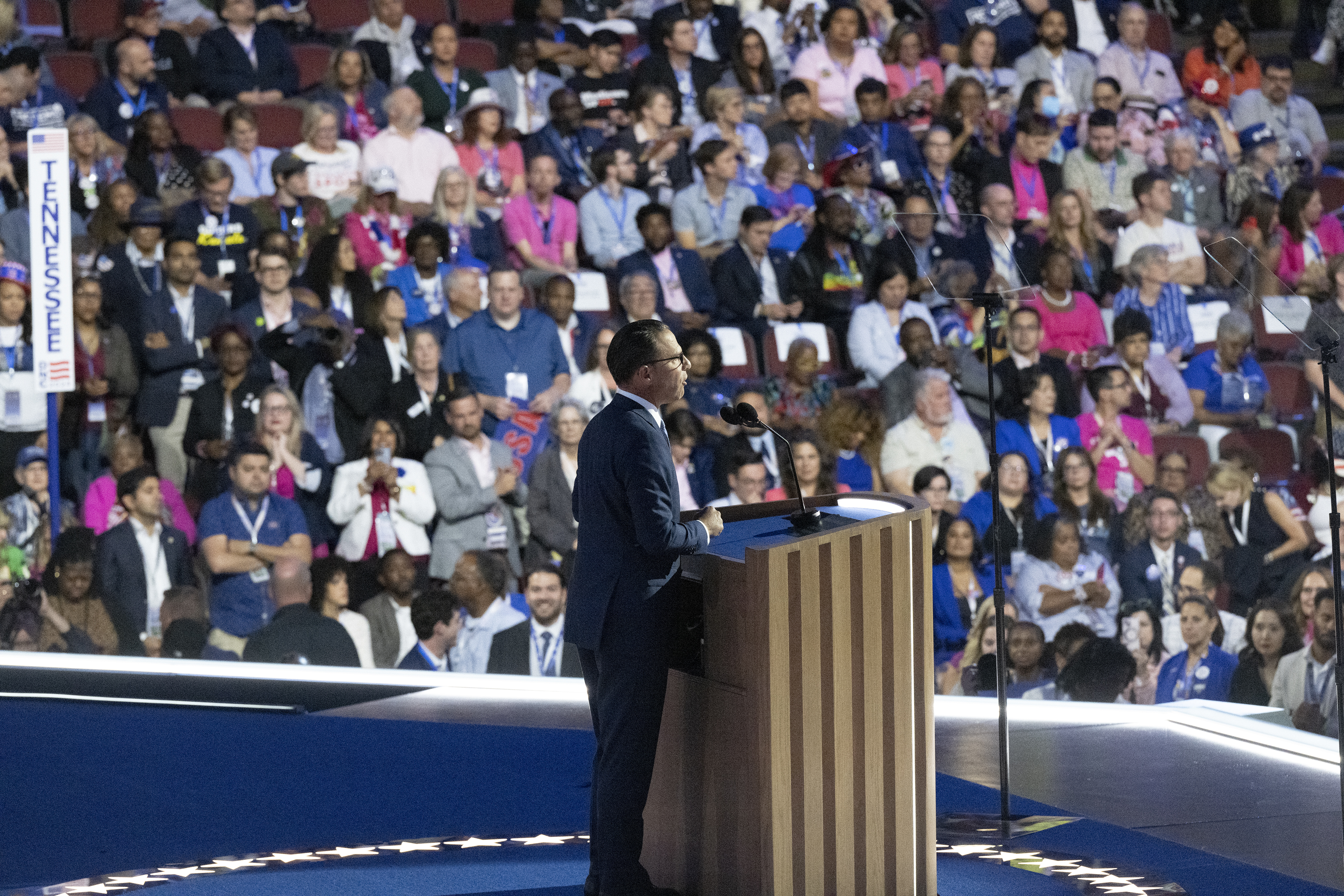
Pennsylvania Gov. Josh Shapiro speaks during the Democratic National Convention on Aug. 21, 2024, in Chicago.Jose F. Moreno / Staff Photographer
And most recently, he’s faced the state’s worst measles outbreak in more than three decades, which the state says has led to the deaths of six Pennsylvania residents. The surge in measles cases, which now tops 1,317 cases in Pennsylvania, led to a public clash with Health and Human Services Secretary Robert F. Kennedy Jr. As of Thursday, the Centers for Disease Control stillrefused to recognize three of the measles-related deaths as caused by the preventable disease.
“There’s a whole bunch we’ve been able to get done by bringing people together, and then there’s some things that I view as quite common-sense that I haven’t been able to convince the Senate to move on — raising the minimum wage to 15 bucks an hour, funding mass transit — even though it helps their communities,” Shapiro told The Inquirer’s Editorial Board this month. “I’m frustrated I haven’t been able to get that done, but again, that’s why I’m still working at this. That’s why I’m still going forward.”
(The Editorial Board, which runs The Inquirer’s opinion pages and decides endorsements, operates independently from the newsroom. Newsroom editors and reporters — including two reporters who attended the Editorial Board meeting as observers — have no role in endorsements, and opinion staffers have no role in news coverage.)
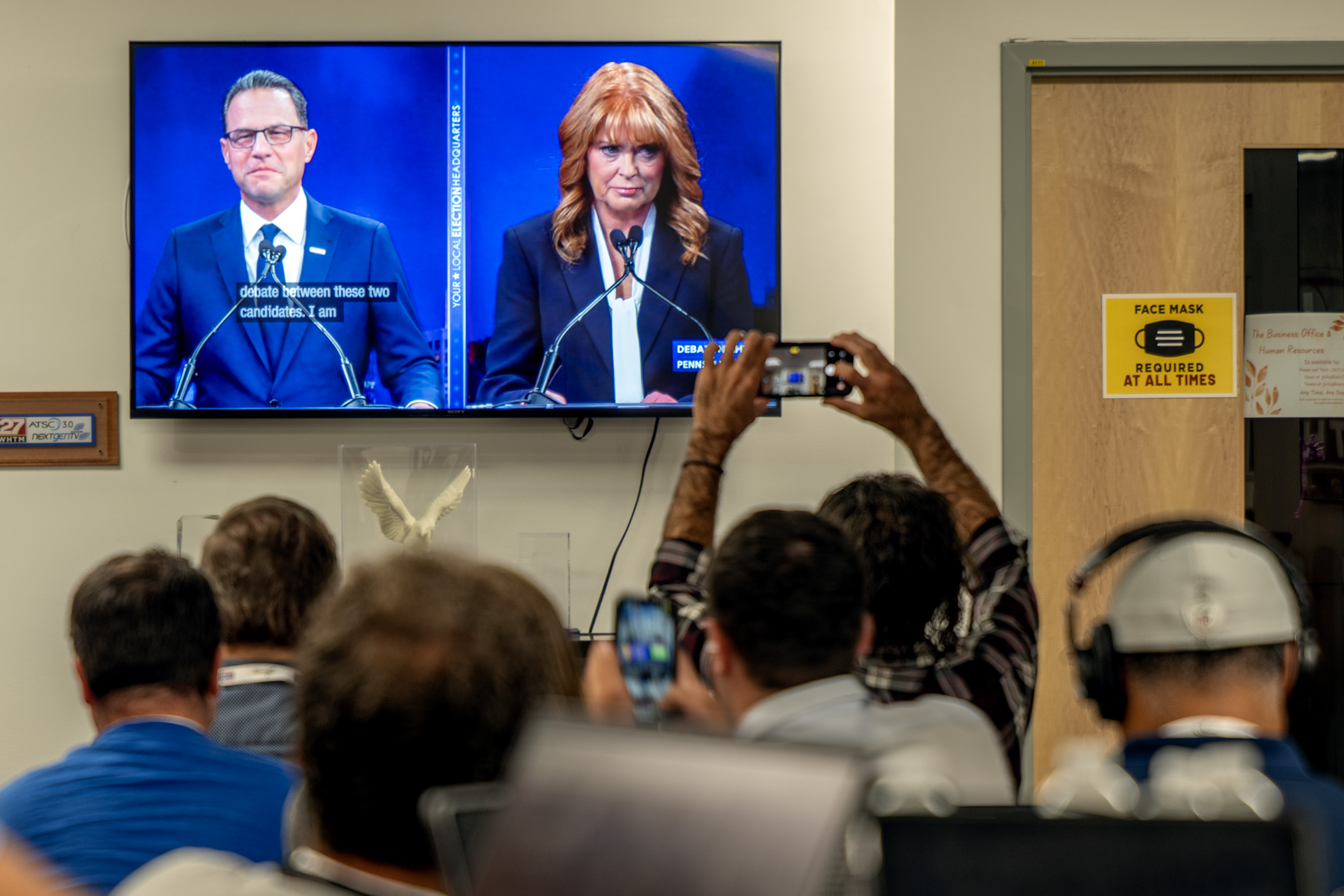
Monitor at the WHTM-TV studios in Harrisburg on Oct. 7, 2026, during the lone debate between Gov. Josh Shapiro and Republican challenger Stacy Garrity.Tom Gralish / Staff Photographer
Shapiro has maintained widespread popularity throughout his first term, including among some Trump supporters, recent polls of likely Pennsylvania voters show. Shapiro’s job approval topped 63% in a Quinnipiac University poll released Oct. 7, and he led Garrity in the poll by 25 points. A poll released Thursday by Franklin and Marshall College had similar findings, including a 22-point lead for Shapiro over Garrity.
“If you can be as popular as he is with divided government and the dysfunction in our Senate… that’s a pretty damn good comment on what he’s been able to accomplish,” said House Majority Leader Matt Bradford (D., Montgomery).
’A responsibility and pride’
These days, Shapiro can’t go to the store or take a walk with his wife, Lori, and their dogs, Bo and Bentley, without a state police detail present and careful coordination.
As Shapiro, one of the nation’s most prominent Jewish politicians, seeks reelection and eyes a presidential run, the impacts of his high-profile, public-facing office have weighed on him, he said. At least six people have been charged in the last nine months with making terroristic threats or ethnic intimidation in regard to the governor, he said.
“If I ever got to the point where I was afraid to go out, or afraid to do my job, or unwilling to do something because I was fearful, that would be the day I would hang it up,” he said. “I don’t feel that way. I feel a lot of purpose in my work, and I feel unafraid when I’m doing it.”
Shapiro said he believes many of the threats he’s received have stemmed from the open practice of his Jewish faith, and he wrote in his memoir that since Hamas’ Oct. 7, 2023, attack on Israel, he and his family “feel both a responsibility and pride demonstrating our faith and living it out loud.”
Pennsylvania Gov. Josh Shapiro stands with his family as he listens to remarks at the Philly Stands With Israel Rally outside a Jewish community center in Wynnewood on Oct. 9, 2023.Steven M. Falk / Staff Photographer
For Shapiro, Israel is“a place that’s meant a lot to me and my family,” he said. It’s where he proposed to his wife, and is a country he said he loves — which has been complicated by Prime Minister Benjamin Netanyahu’s actions during the war in Gaza that he sees as weakening Israel’s position globally. He supports a two-state solution, with Palestinians having a state and living side-by-side with Israel, and said he hopes Israeli voters will select a new leader in its Oct. 27 election.
“Unfortunately, we’re in a time where there are people who are calling into question whether the very country has the right to exist,” he said.
None of these positions, Shapiro points out, have much to do with his role as governor.
But they could be key in the 2028 Democratic primary as debate over the United States’ relationship with Israel continues to fracture the party. According to a September Inquirer/Times/Siena poll of likely Pennsylvania voters, 63% of Democrats said they would support a candidate who opposed aid to Israel.
“Josh is very religious and proud of it, and he has learned about the religion, and it made him a better person,” said former Gov. Ed Rendell, Pennsylvania’s second Jewish governor. But, Rendell raised: “Does it make it harder for him to go further in politics?”
“It’s a tough time for Josh if he’s thinking about launching a national campaign,” Rendell, a Democrat who also served as Philadelphia mayor, said, but “one thing Josh has convinced me of is that anything he wants to do, he’s going to have a good chance of succeeding at.”
Growing impatient
When Trump returned to office in 2025, Shapiro vowed to work alongside the president — as long as it didn’t compromise Pennsylvanians. He joined lawsuits on Pennsylvania’s behalf as Trump threatened to slash federal funding.
His tone has since changed. As Trump’s approval numbers continue to decline, Shapiro has begun to moredirectly instigate Trump, often repeating that Trump has caused “chaos, cruelty, and corruption” in Washington.
He has also put his reputation on the line to flip the U.S. House, endorsing, campaigning and fundraising for four Democratic challengers in competitive congressional districts across Pennsylvania in hopestheywin and take control of the chamber.
In Harrisburg, he has poured more than $10 million in total into the state Democratic Party and the House and Senate Democrats’ campaign arms, his campaign said Thursday.
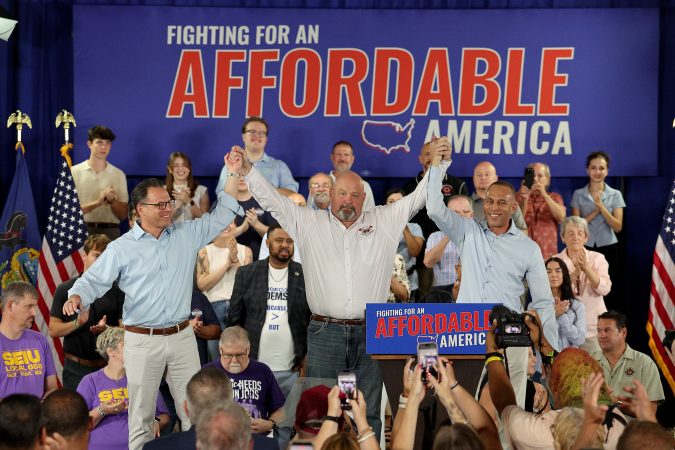
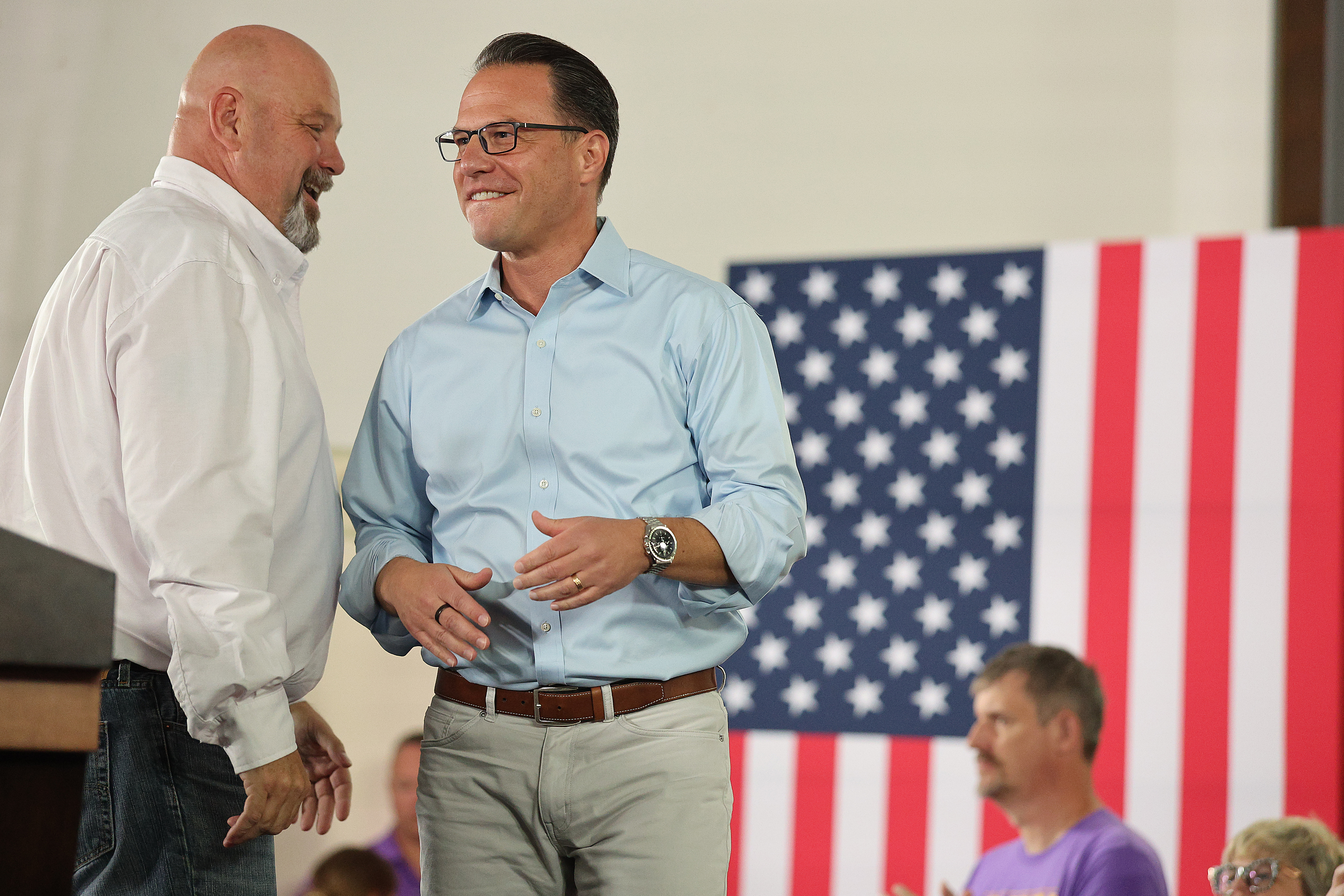
Bob Brooks (left), who is running for Pennsylvania’s 7th Congressional District, and Pa. Gov. Josh Shapiro (right) exchange greetings on the stage during a July 26 rally at the United Steelworkers Union Hall in Bethlehem, Pa.David Maialetti / Staff Photographer
And after he struggled to break through gridlock with Senate Republicans, he went all in on winning full Democratic control in Harrisburg for the first time since 1993.
That move is an example of Shapiro as a pragmatic leader, said Bradford, who has known Shapiro for decades. He wanted to find common ground with Republicans, Bradford said, but when he couldn’t, he found a new solution: winning a trifecta.
“His ideology is competence,” Bradford said. “He’s not an ideologue, and I say that as a proud progressive. … It’s also a recognition that at times he is stymied by a Senate that is incapable of governing.”
Shapiro has been strengthening his grip on the state’s Democratic Party, too, since the fallout of the 2024 election, when Democrats failed to deliver Pennsylvania for Harris. He installed a former top aide as the party’s executive director. The state party has since turned around its declining voter registration numbers.
Still, Shapiro said finding common ground is the most necessary strategy to being a good elected official.
“The people make their choice, and if you’re privileged like I am to be elected, then you’ve got a responsibility when you’re in the room to govern,” he added.
‘Campaign 101′
A lot is on the line this November for Shapiro. If he successfully helps flip control of the U.S. House and gains a trifecta in Harrisburg for the first time in decades, he will have “a great resumé in America’s premier swing state,” Borick said, giving him a leg up among other 2028 contenders.
“That’s a great result that you can bring out on the campaign trail if you so choose to run in 2028,” Borick added.
But if he doesn’t meet expectations, “there may be some questions” about his viability for a presidential run, Borick said.
A staffer holds name sign for Gov. Josh Shapiro, a surrogate for Vice President Kamala Harris in the spin room at the Convention Center on Sept. 10, 2024, after her debate with former President Donald Trump at the National Constitution Center.Tom Gralish / Staff Photographer
That may help explain why Shapiro has never publicly said he’s considering a run, as he needs to win reelection first, Borick said.
“You don’t want to get hit at all for looking like you’re thinking ahead and not focused on the race before you,” Borick said. “That’s Campaign 101.”
Still, he’s left a breadcrumb trail for a 2028 run: writing a book, a national media tour, and, earlier this month, creating a federal political action committee, which he could use in the future to finance a White House run.
(His campaign has stressed he is using the PAC to contribute financially to the four Pennsylvania Democrats vying to flip the U.S. House.)
State Sen. Greg Rothman (R., Cumberland), who chairs the state Republican Party, said he believes Shapiro is running for president in 2028. “And I read his book,” he added.
He had some advice for the potential presidential hopeful: Improve your debate performance.
“I’ve been alive for 20-plus presidential debates. He’s gonna need work if he’s gonna compete on a national stage,” he said.
Manuel Bonder, a spokesperson for Shapiro’s campaign, said in response that he appreciates Rothman “taking a break from overseeing this disastrous, flailing Republican campaign for governor to offer unsolicited advice,” adding that Shapiro is only focused on electing Democrats down ballot.
Rothman said he’s still hopeful for a “huge upset” against Shapiro, citing past examples where the expected winner ultimately lost the election, including most recently former U.S. Sen. Bob Casey’s loss to U.S. Sen. Dave McCormick in 2024, without mentioning Garrity. The state party has given no financial support to the state treasurer’s gubernatorial campaign, according to her September campaign finance filings.
“We are a state known for huge upsets,” Rothman added.
Shapiro has also cultivated allies from across the country and ideological spectrum. After conservative influencer Charlie Kirk was murdered while on a Utah campus, Shapiro forged a strong relationship with Republican Utah Gov. Spencer Cox to speak out against political violence. And earlier this month, U.S. Sen. Elizabeth Warren (D., Mass.), who ran for president in 2020 as a progressive,headlined a fundraiser with him in Delaware County, introducing Shapiro as “a man who has the right values.”
“Winning Pennsylvania makes a great argument” for Shapiro’s chances as a prospective 2028 candidate, U.S. Sen. Chris Coons (D., Del.) said. “If you win Pennsylvania, you win the whole presidency.”
But no Pennsylvania governor has ever won the presidency.
(James Buchanan represented the state in the U.S. Senate a decade prior to his election to the presidency in 1856, and Scranton-born Joe Biden’s political career was forged in Delaware.)
Former Govs. Milton Shapp, a Democrat and Pennsylvania’s first Jewish governor, and William Scranton, a Republican, sought their parties’ nominations in 1976 and 1964, respectively. Other popular governors, like Rendell, Bob Casey Sr., and Tom Ridge also considered runs for the nation’s highest office, Borick said, but didn’t pursue them.
Shapiro, he said, is the most poised Pennsylvania governor to be considered seriously for a presidential run in modern history.
Bradford, a top state Democrat who has negotiated the last several state budgets alongside Shapiro, said Shapiro should “absolutely” run for president in 2028. He cited the governor’s popularity and his “record of accomplishment that is rewarded in not just the polls, but by the people.
“And I think that’ll show on Election Day on Nov. 3,” he added.
Correction: A previous version of this story stated the incorrect amount spent on upgrades to Shapiro’s personal home. The state spent $1 million on those upgrades.
Pennsylvania lawmakers this week passed a bill banning cell phones in schools, joining states across the country amid mounting backlash to technology in classrooms and social media addiction.
Gov. Josh Shapiro, who previously called for a so-called bell-to-bell ban, is expected to sign the measure into law soon.
“It’s time to get back to the basics in school and let our kids be kids,” the Democratic governor said in a post on X on Wednesday, after the House and Senate had passed the bill.
The bill will require schools to bar kids from using cell phones throughout the school day, starting next fall. Here is what to know about the new rule and how schools are reacting:
A ban on ‘mobile devices’
Under the bill, both public and private K-12 schools will be required to prohibit students from using personal mobile devices from the start of the school day to the end.
That applies to cell phones, but also to other internet-connected devices, like smartwatches, according to the bill.
Before the 2027-28 school year begins, Pennsylvania schools will have to adopt policies describing how they intend to prohibit students from using their phones.
“For too long, access to a phone-free school day depended on which school a student attended,” Alex Bird Becker, a Wallingford-Swarthmore parent and coleader of PA Unplugged, a statewide advocacy group, said in a statement. “Once this law takes effect, every student in the Commonwealth will have freedom from addictive algorithms, from the first bell to the last.”
Exceptions for medical and special needs
The bill allows a number of exceptions for “limited use” of a phone:
Students who need phones due to a medical condition.
Students with individualized education plans or 504 plans that require phones as an accommodation.
Students who are English learners who use phones for translation.
Teachers can also permit students to use phones “for instructional purposes,” if a school-issued device is inadequate or unavailable and the principal approves the use, according to the bill. Principals can also apply to their chief school administrators for exceptions.
The law was supported by the Pennsylvania State Education Association, the state’s largest teachers union. President Aaron Chapin said the law “takes an essential step toward reducing distractions for students during class time and keeping lessons and teaching on track.”
How schools are responding
While most school districts already have policies related to cell phones in place, the bill will require many districts to restrict phones more than they already do. Many area high schools allow students to use their phones between classes and at lunch, which will be barred by the bill.
At the 1,600-student Garnet Valley High School in Delaware County,“we don’t have the manpower” to have staff at three different entrances used by students, telling them to put their cell phones away, Superintendent Marc Bertrando said.
Instead, he expected responsibility would fall to first-period teachers — and teachers throughout the day, given a lack of adequate supervision to enforce a ban in hallways between classes.
While “you try to minimize conflict points with students,” Bertrando said, he anticipated more conflict as a result of the ban, “especially if we’re going to get down to the level of ‘Let me see that watch.’” He also predicted pushback from parents used to being able to reach their children directly during the school day. (The bill says schools must provide parents with a phone number or email address to be used for receiving messages during school.)
Bertrando noted that Garnet Valley had worked to produce a policy supported by teachers, parents, and students that restricted, but did not entirely bar, cell phone use by middle and high school students during the school day.
“To take that away from us is incredibly frustrating,” Bertrando said.
The Pennsylvania School Boards Association believes “elected school boards should retain the flexibility to determine the approach that best serves their students and communities,” spokesperson Mackenzie Christ said.
A number of districts have been preparing for new restrictions. Lower Merionin Montgomery County,which has faced parental pressure to adopt a bell-to-bell ban, has said it would enact one in 2027-28, regardless of whether the state required it.
The Philadelphia School District currently allows individual schools to set their own cell phone rules, though the system-wide policy says that district students “should not use cell phones or wearable devices in classrooms unless permitted by a school staff member, or permitted by this policy expressly. Each school shall create their own protocols that designate areas within the school and times of day where student use of cell phones” is permitted during school hours.
That looks different in different buildings. Some schools require students to secure cell phones in lockers outside the building; others require students to place phones in sealed pouches. In some cases, students have access to phones in hallways and the cafeteria, but surrender phones when entering individual classrooms.
Wanda Odom, a spokesperson for the Philadelphia school board, said the board “recognizes the impact excessive cell phone use can have on student learning and well-being.”
“While current district policy allows schools to establish their own cell phone restrictions, the district will work with principals, educators, students, and families to inform the development of a districtwide policy for consideration and adoption by the board of education ahead of the 2027-28 school year, consistent with the new state legislation,” Odom said in an email Thursday.
Staff writers Kristen A. Graham and Gillian McGoldrick contributed to this article.
Homer City, Pa. — a tiny borough of just 1,746 people about 50 miles east of Pittsburgh in Western Pennsylvania, named for the Greek bard and home to a museum that fits inside an old railroad caboose — is not a place you’d expect would get much attention from the president of the United States … or his avaricious family.
But this remote outpost in Indiana County has been on Donald Trump’s radar since his 2024 campaign, when he bemoaned the looming implosion of the towering 100-foot smokestacks that has once made a massive coal-fired power plant the region’s most prominent landmark. In July 2025, the now-47th president returned to Pennsylvania with news.
Trump said a global fund called Knighthead Capital would spend some $15 billion in Homer City to build a massive new power plant — now to be fueled by natural gas from fracking — and a data center at the abandoned coal plant. “They’re going to spend billions of dollars on rebuilding it,” he said. “It’s going to be the largest plant of its kind in the world, I believe. It’s going to be great.”
Just over three months later, a Bombardier Challenger private jet touched down at Indiana County’s Jimmy Stewart Airport, and out popped a modern-day Mr. Potter: Jared Kushner. Trump’s son-in-law, in a North Face vest and baseball cap, posed for a photo with the airport manager amid unconfirmed rumors he was checking out the Homer City project.
This July, a veteran financial journalist named Miles Weiss unearthed a regulatory document showing that a Cayman Islands-based subsidiary of Kushner’s Affinity Partners, his $6 billion investment vehicle funded almost solely by oil dictatorships like Saudi Arabia and the United Arab Emirates, has made a major investment in the Pennsylvania power plant.
Jared Kushner waits to walk into the ring after the lightweight championship bout at UFC Freedom 250 on the South Lawn of the White House on June 15 in Washington. Alex Brandon
The confluence of 21st century power and wealth on little Homer City — not just the involvement of the Trump family and Middle East oil money, but the news that a whopping 36 data centers on the site will power artificial intelligence, or AI, for Amazon Web Services — would overwhelm even the Everyman heroes portrayed by local native Stewart. But that’s not even the biggest question here.
No, that would be this: How — after a summer when global warming fueled record heat waves, wildfires and killer floods, and as the United Nations said just this week that civilization is blowing its last chance to avert climate disaster — did this rising greenhouse-gas monstrosity in Western Pennsylvania get this far along?
The massive bank of gas turbines at Homer City aims to produce up to 4.7 gigawatts of power, or considerably more than double the capacity of the coal plant, which in its heyday was the largest source of electricity in Pennsylvania. The size of the project overrides the fact that natural gas is a cleaner source of energy than coal. The gas turbines are projected to spew more particulate matter, volatile organic compounds (VOCs), and carbon dioxide into the air than the coal plant did.
An alarming new report on data centers and their natural gas power plants by the environmental group Earthjustice notes that the opening of the Homer City facility would increase carbon emissions from all Pennsylvania power plants by a whopping 15%, right at the moment that climate change is becoming a five-alarm fire.
The potential damage is stunning: The formula developed by the U.S. Environmental Protection Agency for the global social costs of carbon pollution would peg the annual damage from Homer City at $2.5 billion. A separate EPA formula projects that ozone and particulate pollution would kill at least 13 to 22 people prematurely every year.
“The AI data center boom is truly the greatest threat to a stable climate that we face today,” Alex Bomstein, executive director of the Clean Air Council in Pennsylvania, told me.
The pollution projections are alarming both to the national community of climate groups — who see Homer City as the vanguard of a trend that would see nine of the 10 largest power plants in the United States as new gas-fired facilities driving AI data centers — and to locals who lived through the environmental degradation of the coal plant for decades.
“Homer City is an environmental justice area, which means these communities are more vulnerable to climate and health risks, and are supposed to get special attention from the state,” Leigh Hendrix, a local activist with Concerned Residents of Western PA (CROW) told me this week.
Instead, the special attention for the Homer City project from government officials has been often silent acquiescence from their local representatives, a speeded-up “concierge” permitting process from Gov. Josh Shapiro’s administration, and an endorsement from the president as a close relative saw dollar signs.
Some local support for this project in an economically struggling corner of Western Pennsylvania is understandable. The massive private development would mean a surge in tax dollars for a Homer-Center School District which, like many rural districts, struggles with resources and enrollment. The coal plant was a major employer, and while job creation by data centers is often underwhelming, the sheer size of this project would eventually means hundreds of new hires, on top of the construction work.
Still, Jack Hanna — a retired, politically active, attorney who’s lived most of his life in Indiana County — said he’s deeply troubled by the secrecy from county and other local officials who professed to know little about the massive project even as it gained momentum behind gilded locked doors.
“Very, very little information is released by the company and by public officials,” Hanna said. “The company — they have their motivations and I understand that. But public officials, in my opinion, have a duty to have transparency and public disclosure …”
For the developers, there have been many advantages to building at the coal-plant site — existing connections to the power grid and local water supplies, as well as emissions credits for ending coal burning, and some established permits for the site, which was bought by Knighthead in 2017 as a bankrupt “distressed property,” that have greatly eased permitting.
The Earthjustice report noted the Homer City gas plant received an air permit from the Pennsylvania Department of Environmental Protection (DEP) in just seven months, far less than typical. A Right-to-Know request by environmental opponents found a communication from a DEP staffer that the goal was “to provide a concierge level of service” for a project that Shapiro had endorsed as a source of economic development for Indiana County.
In August, Shapiro publicly reversed course on data centers and said the state would now be imposing strict guardrails, but Homer City plant opponents say they’ve seen no change in state policy. Local residents continue to fight a wastewater permit for the plant — arguing it would dump 110-degree water into creeks that were coming back to life after a coal era when they often turned orange with waste — while a coalition of groups including the Clean Air Council is aggressively appealing the air permit.
Little opposition is expected from Trump’s totally neutered EPA, with the president continuing to serve as a cheerleader for both fossil fuels — including the fracking of natural gas in Pennsylvania that would need to increase in order to power Homer City — and data centers, even as their popularity with voters plummets. Earlier this month, Trump praised data centers in Ohio as “so much money to be made …”
Now it appears his own son-in-law will be making some of that cash. Weiss, the financial journalist with a site called Deadline Disclosures, uncovered a June regulatory filing by an affiliate of Kushner’s fund called Affinity HC Cayman Blocker L.L.C. The Cayman vehicle disclosed that it held an equity stake in Homer City Holdings L.L.C., parent company to the power plant. Weiss wrote that the filing did not disclose the size of the Affinity/Kushner investment but he speculated it was sizable, noting that the firm had disclosed borrowing money against its stake.
The source of Affinity Partners’ assets is almost entirely from the sovereign wealth funds of Middle Eastern oil producers such as the Saudis, UAE, and Qatar — all nations that Kushner routinely deals with in his wildly conflicting role as a “peace” negotiator in the region for his father-in-law. The world’s most powerful people taking such interest in a small Pennsylvania borough only makes sense as part of their drive to maintain the dominance of fossil fuels, climate crisis be damned.
I know you’ll be shocked to learn that Affinity Partners has not yet responded to my request for comment.
The locals who are fighting against an environmental nightmare understand what they are up against, because Pennsylvania has been here before, again and again. From the first oil rigs in the mid-19th century backed by John D. Rockefeller that scarred the landscape, to the bloody workers’ battles with coal mine owners, the story of the Keystone State has been the brutality of an extraction economy.
And every time we try to get out — like the implosion of those coal plant smokestacks in March 2025 — they pull us back in with their newest discovery of black gold under our lush hillsides.
“That’s a really critical thing about this place — this history of boom and bust and extraction,” Hendrix told me. But while the prospect that AI data centers will create billion-dollar fortunes for a handful of politically wired folks — money that even Rockefeller could not have dreamed of — is now sparking significant backlash, the vampire squids of a fossil-fuel kleptocracy will keep drilling for new gushers.