Tag: Josh Shapiro

  • Pa. lawmakers have proposed dozens of ways to fix the state’s low housing stock. They’re making a database instead.

    Pa. lawmakers have proposed dozens of ways to fix the state’s low housing stock. They’re making a database instead.

    HARRISBURG — More than one million Pennsylvania households spend over 30% of their income on housing. And over the next decade, the state’s housing crunch is slated to intensify, with estimates that Pennsylvania will have nearly 185,000 fewer new homes than it needs to keep up with projected demand.

    State legislators have pushed to address the need, introducing bills that would increase the housing supply through accelerated approval processes and lifting restrictions on new developments — and urged leaders to include those initiatives in this year’s budget negotiations.

    Gov. Josh Shapiro also put housing at the forefront of his budget address in February, asking the General Assembly to ease restrictions for rental applications and to cap costs on manufactured home increases.

    But none of the proposed policies were included in the final budget deal, passed last month. Instead, the budget included the creation of a housing database — a move some lawmakers and advocates say falls short of addressing Pennsylvania’s burgeoning housing crisis.

    “I think the budget generally left a lot of questions unaddressed. And housing, one of the top three issues in terms of the cost-of-living crisis, was one of them,” said Sen. Nikil Saval (D., Philadelphia).

    Saval was one of six senators who voted against the budget. He has since said that was because it left many key policy issues, including housing, unaddressed. Sen. Katie Muth (D., Montgomery), the only other Democratic senator to vote against the budget, has also said she believes the budget left issues like housing, rising energy costs, and affordability unanswered.

    Shapiro’s office did not respond to a request for comment.

    (function() {
    var l2 = function() {
    new pym.Parent(‘pa_housing’,
    ‘https://media.inquirer.com/storage/inquirer/projects/innovation/arcgis_iframe/pa_housing.html’);
    };
    if (typeof(pym) === ‘undefined’) {
    var h = document.getElementsByTagName(‘head’)[0],
    s = document.createElement(‘script’);
    s.type = ‘text/javascript’;
    s.src = ‘https://pym.nprapps.org/pym.v1.min.js’;
    s.onload = l2;
    h.appendChild(s);
    } else {
    l2();
    }
    })();

    The new housing database — incorporated through a bill sponsored by Saval and authored by fellow Philadelphia Democratic Sen. Vincent Hughes — will be overseen by the Pennsylvania Housing Finance Agency. Saval said it will ensure more robust data collection to provide transparency on how much affordable housing is available across the state.

    Under the new legislation, the agency will be required to create an online searchable database of all publicly financed housing that is subjected to public assistance programs. It will include anticipated termination dates on properties’ affordability restrictions and will note if the property has been granted an extension on those restrictions.

    Saval said the publicly available database will ensure lawmakers have a better idea of the state’s affordable housing stock. Much of the affordable housing in the state was created with the help of low-income tax credits that are subject to expiration dates. As termination dates on these housing units loom, with many set to expire within the next five years, Saval said, the database will keep lawmakers aware of when housing is no longer affordable and allow them to see if restrictions can be extended.

    The database will be updated annually by the PHFA, with local housing agencies submitting data every year.

    Chris Anderson, communications officer for the PHFA, wrote in an email that the database is still in the early stages of being built, but that it will not pose any significant costs to the agency and existing resources will be used to create it.

    There are no penalties if the PHFA does not update the database, and the new law does not make it mandatory for local agencies to report information to the agency. The intended audience is primarily housing advocates and organizations, as well as policymakers, Anderson said.

    Saval said the database will help lawmakers know how much affordable housing there actually is in the state.

    But he said the state budget — where legislators often pass policies in addition to the yearly spending plan — was still a missed opportunity to address Pennsylvania’s housing concerns.

    “Anytime there’s a set of budget negotiations where there’s the potential to allocate funding, or create policy that would increase the supply of housing, or address the concerns faced by renters, and anytime that opportunity is missed as it was in this budget, I think it’s a step back,” he said.

    ‘Missed opportunity’

    Carrie Rathmann, vice president of strategic partnerships for Habitat for Humanity Philadelphia, said one initiative notably absent from the final budget deal was the PA Home Preservation Program, a grant administered by the Pennsylvania Department of Community and Economic Development to provide funding for construction cost gaps and keep homeowners in their houses through repairing outdated buildings. The initiative was last funded when it was signed into the budget in 2022, but has not received funding since.

    Previously known as the Whole-Home Repairs Program, the state allocated $125 million toward the program using American Rescue Plan dollars, repairing more than 2,600 affordable homes across the state.
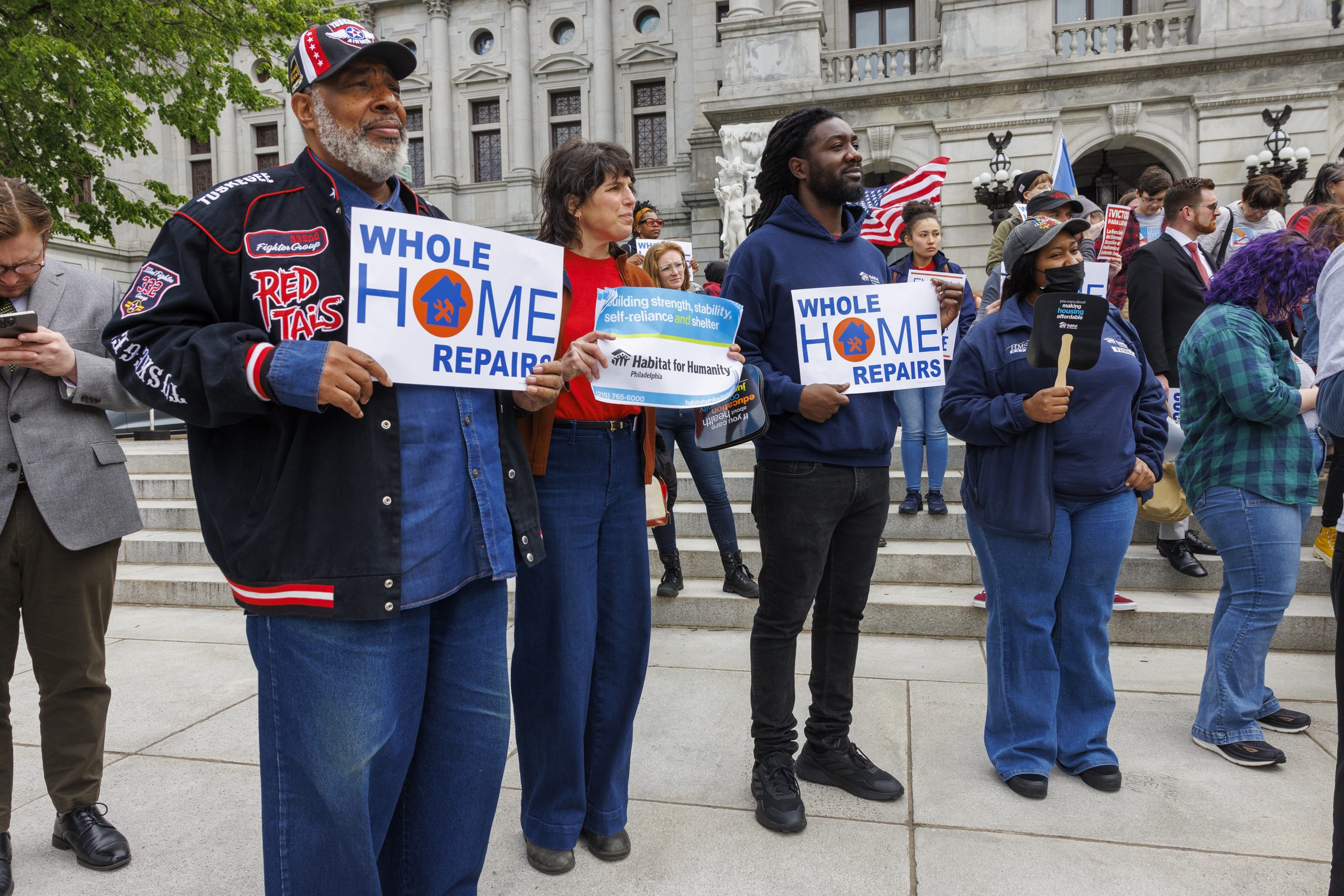
    Douglas Paige (from left), Carrie Rathmann with Habitat for Humanity, Tyron Cheeseboro, and Danielle Paige on the steps of Pennsylvania Capitol during a 2023 rally for the Whole-Home Repairs Program.Alejandro A. Alvarez / Staff Photographer

    Housing advocates have pushed for the state to renew the funding, with the Housing Alliance of Pennsylvania calling it one of the organization’s biggest priorities.

    In an email, spokespeople from the housing alliance noted that the state funding in 2022 was not enough to support the number of people that applied for it, meaning there are still people waiting to have their homes repaired.

    “The program received far more applications from qualified homeowners than available funding could support, highlighting both the scale of unmet need and the importance of preserving existing housing,” the spokespeople wrote.

    The program has not returned in a line item in the state budget since 2022. Companion bills in both chambers supporting the program have received bipartisan support — the House bill passed 122-80 — but are sitting in the Senate Urban Affairs and Housing Committee.

    “That felt like it represented a huge missed opportunity to help thousands of Pennsylvanians stay housed and to keep homeowners safe and healthy in the homes that they already own, because without that dedicated investment, this crisis will only grow,” Rathmann said.

    Habitat for Humanity is a nonprofit that does not rely on state dollars, but Rathmann said state money goes to counties and housing providers like the Philadelphia Housing Development Corp. The money helps an “ecosystem” of housing organizations in the Philadelphia area, and Habitat uses it for a portion of the organization’s work. That included the Built to Last program, an initiative spearheaded by the Philadelphia Energy Authority that inspired the statewide initiative of Whole-Home Repairs in 2022.

    Rathmann said state initiatives that increase efficiency on building houses are key to developing homes faster and cheaper, which in turn increases the housing supply and can keep people in high-quality houses. This includes incentives like building lower density “by right,” meaning property owners can build low-density housing without special approval.

    “We see every day at Habitat that that impact is real, it’s tangible, it crosses different sectors like kids can get to school and do better,” Rathmann said. “Seniors are healthier. People are healthier. People feel less stressed. They have more money in their pocket for medication and food.”

    ‘Risk aversion on all sides’

    Lawmakers on both sides of the aisle in Pennsylvania’s divided state legislature have pushed for their own housing initiatives. Bills have passed through the Democratic-controlled House or Republican Senate, but have yet to move forward in the opposing chamber.

    Democratic-backed House bills sitting in Senate committees include proposals to remove barriers to building accessory dwelling units, lift restrictions on how many unrelated people can live in one home, and seal eviction records to help tenants.

    And the Senate GOP also has a number of bills sitting in the House’s committee, like creating an accelerated approval process for new housing, or establishing a Housing Regulatory Compliance Officer.

    Beth Rementer, spokesperson for House Democrats, wrote in an email that the House has sent 22 bills to the Senate Housing Committee, while the Senate sent two in June.

    The state’s lack of housing action marks a difference from the Republican-controlled federal government. In early July, Congress sent the ROAD to Housing Act to President Donald Trump’s desk — a bill that reduces barriers to home construction and modernizes housing programs alongside other initiatives, including a pilot of Whole-Home Repairs.

    Saval attributed the Pennsylvania legislature’s inaction to a desire to pass the state budget quickly without debate on hot-button policy issues ahead of the November election, when half the Senate and all members of the House are on the ballot.

    “Essentially, there was risk aversion on all sides,” Saval said. “And, understandably, an unwillingness to get into a budget discussion that would prolong the budget negotiation process.”

    Kate Flessner, spokesperson for the Senate Republicans, said in an email that the Senate supports a number of housing initiatives, but that underlying issues lie in how the state will pay for them in light of the roughly $5 billion structural deficit.

    “As we continue working to address the state budget’s serious structural deficit, we will be primarily focused on ways we can improve housing access that do not require vast sums of taxpayer money — and there are many of them,” Flessner said.

    Natalie Javitt is an intern with the Pennsylvania Legislative Correspondents’ Association. She can be reached at natalie.javitt@gmail.com.


  • Why Pennsylvania quietly repealed its 1929 midwifery law — and is now getting sued for it

    Why Pennsylvania quietly repealed its 1929 midwifery law — and is now getting sued for it

    HARRISBURG — Hidden deep in more than 600 pages of state budget documents, Pennsylvania lawmakers last month quietly repealed an unenforced 1929 law that allowed traditional midwives, the main group of midwives delivering home births, to practice.

    Now, traditional midwives — who differ from midwives usually found in hospitals, are not medically trained, and often serve religious minorities like the Amish — are worried they have no legal standing to work in Pennsylvania and are challenging the repeal and a new law in state court.

    The 1929 law had been on the books for nearly a century, asking traditional midwives to submit a paper application and a $10 fee to get a state certificate. But it had not been enforced for decades, and Pennsylvania, which has one of the highest rates of home births in the nation, was counted as one of 13 states that did not regulate the practice at all.

    Meanwhile, other forms of midwifery — such as nurse midwives and certified midwives, who are medically trained and are formally affiliated with a doctor or health system — are highly regulated by the state and its medical board. But these affiliations often prevent nurse midwives and certified midwives from offering home births, as the health systems see them as possible risks for medical malpractice lawsuits.

    The practice of traditional midwifery dates back to the Old Testament and has lived on through centuries of community knowledge and traditions. It can include Amish and Mennonite midwives, who are limited in the amount of education they are allowed to receive, as well as other unlicensed midwives who say they take only low-risk pregnancies.

    Some Pennsylvania traditional midwives say their practice is more necessary than ever, citing the United States’ maternal mortality and morbidity rate and cesarean section rates that outpace most of the rest of the Western world. They see their work as more holistic and personal than the American medical system, offering more personalized care to the new parent and baby for weeks after birth, as well as an answer to maternity care deserts as more hospitals and birth centers close.

    Medically trained midwives and physicians, who receive licenses from the state, argue the practice of traditional midwifery is potentially unsafe for mothers and babies, and requires little to no oversight in comparison to their medical training and licensure.

    A new law, and legal uncertainty

    There is no state law regulating home births — which are chosen by a variety of families for different reasons, from Amish who have religious beliefs about delivering at home to Black and brown women who have felt underserved or discriminated against by the modern healthcare system. But if traditional midwives — the primary group delivering babies in home births — cannot practice, some argue, home births will become inaccessible.

    The legal fight over midwifery began earlier this year, when the General Assembly approved changes to a separate law to include another class of midwife: certified midwives, who have all the same education training as nurse midwives except the nursing degree. To receive a certification from the Pennsylvania Board of Medicine, nurse midwives and certified midwives must provide proof of education and a collaborative agreement with a physician or medical institution.

    The law, the Midwife Modernization Act, was written to protect traditional midwives’ ability to practice, its author, Sen. Rosemary Brown (R., Monroe), said in a statement.

    Kate McHugh, a nurse midwife who has worked for a decade with lawmakers on updates to midwife regulations, said stakeholders approached traditional midwives during earlier iterations of the bill to see how they would like to be regulated. The different groups of traditional midwives could not agree, so the nurse midwives and certified midwives moved forward on their own.

    But the changes to Pennsylvania’s laws created a legal gray area, some midwives argued in a lawsuit filed last month.

    An anonymous group of two traditional midwives, a nurse midwife, and an Amish man whose family utilizes traditional midwifery filed a lawsuit in a state appellate court, challenging Brown’s law as unclear about their ability to practice, and asking the state to enforce the 1929 law already on the books.

    After the lawsuit was filed, legislators repealed the 1929 law as part of an overall state budget deal, creating more uncertainty for traditional midwives, according to their amended filing. Some lawmakers said they did not know they had voted to repeal the law, as the state budget is drafted in closed-door meetings among top leaders and fast-tracked through the legislative process with little time for rank-and-file members to review what they are voting on.

    The law was repealed as part of a request by Democratic Gov. Josh Shapiro’s administration, according to a source briefed on budget conversations. The administration works closely on legal matters with Republican Attorney General Dave Sunday’s office, which is defending the state in the case. Shapiro’s office declined to comment.

    “It’s not fair the way [the budget] is done,” said Rep. Dave Zimmerman (R., Lancaster), who said he unknowingly voted in support of the bill that repealed the 1929 law in an omnibus bill. “It concerns me a little bit that we repeal something in the fiscal code rather than right up front where it’s transparent.”

    “You have people in the Amish and Mennonite community that this is what they do. We have midwives that have been doing this for 30 and 40 years, They’re probably as good as anyone else doing it, certified or not,” Zimmerman added.

    The lawsuit

    The group of traditional midwives filed the lawsuit anonymously out of fear of retribution from the state for continuing to practice, said the group’s attorney, Jonathan Goldman, of the Goldman Law Team, based in Fort Washington. The midwives spoke with The Inquirer on the condition of anonymity for the same reason.

    One of the midwives, who serves south-central Pennsylvania with a largely Amish and Mennonite clientele, said she has delivered 1,600 home births over 38 years. She had practiced traditional midwifery in other states, before similar certifications were required there. At one point, she said, she was arrested and charged with a misdemeanor for continuing to practice home births in New York.

    Unlike medically trained nurse midwives and certified midwives, traditional midwives are prohibited from practicing medicine, which could mean dispensing medication or conducting medical procedures as simple as stitches. They have historically been investigated by state boards of medicine if this is called into question, making the group even more distrustful of state oversight.

    One of the anonymous traditional midwives, who has delivered an estimated 600 births around eastern parts of Pennsylvania, said her clients are often religious and want traditional models of care, such as no lab work and one ultrasound — a very hands-off approach compared to the highly surveilled pregnancies in modern medicine.

    The midwife, who delivered four of her 10 children in the hospital before finding an interest in home births, said her faith as a born-again Christian drew her to the “completely different model of care” that does not rely on pharmaceuticals, with a comfortable home setting and few restrictions like in a hospital.

    “In the hospital, it’s a fractured system. There are several midwives and physicians, you never know who you’re going to get, who is going to be on call,” said the midwife, who works with Amish and Mennonite populations in south-central Pennsylvania. “We are the community midwives. We know the secrets, we know the stories, we know what kind of care works. We know the family intimately. And it improves outcomes because knowing them intimately and emotionally allows us to provide that kind of specialized care.”

    Sunday’s office, defending the state in the suit, said in a July 24 filing that the midwives’ claims are a “misreading and misunderstanding of the current law,” and that traditional midwives “can continue to practice as lay midwives without certificates.” Sunday’s office did not respond to a request for comment.

    The case is scheduled for a preliminary injunction hearing to block the law from going into effect on Wednesday, where Brown and other lawmakers may be called to testify and a judge is expected to rule whether current laws prevent traditional midwives from practicing.

    Outside the medical system’s framework

    Obstetricians in hospitals and birth centers routinely work with certified midwives, who have an advanced degree in midwifery, and nurse midwives, who have a nursing degree in addition to specialized midwifery training.

    “As an OB-GYN physician, I absolutely respect somebody’s right to make a medically informed decision about how they take care of themselves in their pregnancy, and who they request assistance from in birth, and where they give birth to their babies,” said Holly Cummings, an OB-GYN in Philadelphia and chair of the Pennsylvania section of the American College of Obstetrics and Gynecology, a leading physician organization. “But I do also believe a hospital or an accredited birth center is the safest place to give birth. I don’t think in the U.S. in 2026 we can currently safely, uniformly support home birth.”

    ACOG does not support traditional midwives, who can also be known as lay midwives.

    But traditional midwives maintain they should be able to continue their work outside the medical system’s framework, citing it as a religious tradition and safe practice, and hope the judge rules in their favor.

    “Pennsylvania has a rich history of midwifery,” said the midwife listed in the lawsuit who serves parts of eastern Pennsylvania. “We have some of the highest home-birth numbers in the country. … It would be sad to see Pennsylvania not acknowledge the heritage in midwifery that we have here.”

    Staff writer Sarah Gantz contributed to this article.

  • A sports complex in King of Prussia? Here’s why Upper Merion says it makes sense

    A sports complex in King of Prussia? Here’s why Upper Merion says it makes sense

    Upper Merion Township wants to build a sports and entertainment venue in King of Prussia, and has been looking to get state funding for the project.

    The facility, which as proposed could host over 7,500 people, could be used by professional soccer and baseball teams as well as for concerts, festivals, graduations, and other community gatherings, according to a grant application seeking funding from the state.

    “There is still extensive preliminary work that needs to be discussed and developed,” Tina Garzillo, chair of the township’s board of supervisors, said via email on Monday, noting that “there is nothing definitive,” at this time about the project.

    The venue has been envisioned for Moore Park area, near hotels, housing, the Valley Forge Casino Resort, and a Topgolf. The proposed address on a state grant application is 650 Park Ave., but Garzillo said that is only “only one of several identified possible sites.”

    Garzillo did not say what teams could be expected to lease out the stadium, but the venue’s capacity is in the ballpark of other minor league baseball venues. The Lehigh Valley IronPigs play at Coca-Cola Park, which can host roughly 8,000 seated spectators, and the Brooklyn Cyclones play at Maimonides Park, which can seat roughly 7,000, with additional standing room.

    “The facility will serve as a catalyst for converting a traditional office park into a vibrant mixed-use district,” the grant application notes. “This transformation is especially important in a post-COVID world, as communities adapt to new work patterns and the decline of single-use office environments.”

    The DeVonta Smith & Friends celebrity softball game at Coca-Cola Park in Allentown on June 10, 2023.Yong Kim / Staff Photographer

    What would it cost?

    The proposed project would cost an estimated $197 million, which the township wants to fund through state, township, and county dollars as well as private contributions.

    The township applied for a $20 million grant through Pennsylvania’s Redevelopment Assistance Capital Program, but the project was not selected in the latest round of funding.

    The township is currently evaluating other funding options, Garzillo said, and does not currently have a new application in the works for the Redevelopment Assistance Capital Program.

    The program receives hundreds of applications in each funding cycle, and the majority do not get awarded, said Rosie Lapowsky, a spokesperson for Gov. Josh Shapiro’s office. Not receiving funding “is not a commentary on their value as projects or any potential future engagement from the state,” Lapowsky added.

    The funding application to the state program noted that the project includes “walkable connections, shared parking, and high visibility along major regional highways, positioning it as an anchor for ongoing redevelopment of the area into a dynamic ‘live, work, play,’ destination.”

    The development of the venue would create 3,196 jobs, according to the application. It does not specify what positions would be needed, and if some of those jobs would be temporary, for the construction of the site.

    The venue is also expected to create revenue through taxes, naming rights, corporate sponsorships, and other branding deals, the application notes.

    Those leading the project say they have been in touch with county and state elected officials as well as members of Gov. Josh Shapiro’s administration, noting that “these discussions highlighted the project’s alignment with state priorities and its anticipated benefits to the Commonwealth, including economic growth and community impact.”

    Upper Merion Township is interested in adding entertainment options to the area, said Garzillo, citing the success of nearby attractions such as Topgolf; the casino; Netflix House, which opened in November at King of Prussia Mall; and Dave & Buster’s.

    Exterior entrance to Netflix House at the King of Prussia Mall.Alejandro A. Alvarez / Staff Photographer

    As part of its effort to bring more entertainment options to the area, the township has changed the zoning language for the King of Prussia Mall to allow entertainment venues to occupy retail spaces, Garzillo noted.

    The King of Prussia District, a nonprofit focused on economic development in the area, declined to comment on the project.

  • ‘People are sacrificing necessities.’ Ahead of Pa. governor’s race, the economy weighs heavily for Latino voters

    ‘People are sacrificing necessities.’ Ahead of Pa. governor’s race, the economy weighs heavily for Latino voters

    Jorge Luis Burgos of North Philadelphia, a registered Democrat, was one of many Latino voters who shifted to the right and voted for President Donald Trump in the 2024 presidential election.

    Now he’s planning to shift back and vote for Democratic Gov. Josh Shapiro as he runs for reelection in the key swing state.

    “Shapiro 100%. I love the way he manages everything,” Burgos said while attending Arte en las Calles, an event last weekend celebrating Latino culture held by the Esperanza Art Center in North Philadelphia.

    Burgos, 57, who moved to Philadelphia from Puerto Rico in 1980, said he voted for Trump in 2024 because he was worried about inflation and felt betrayed by the last-minute switch that swapped then-President Joe Biden for Vice President Kamala Harris as the Democratic nominee. But he said Trump has failed to fulfill his promises, and he has found himself turning back to the Democratic Party.

    “I was disappointed, and that’s why I switched. But you ask me now, I’m disappointed, too. Big time,” Burgos said. “Trump didn’t accomplish his promise: ‘On Day One,’ inflation is gonna go down. It didn’t happen.”

    In the past decade, support of Republican candidates, specifically Trump, has grown in the majority Latino precincts of Philadelphia — with Trump’s share of the vote increasing from 6.1% in 2016 to 21.8% in 2024.

    While Harris still won these wards — and a slight majority of Latino voters nationally, according to exit polls — Trump’s improved performance with this voter group helped him win both Pennsylvania and the presidency.

    Burgos, like many other supporters who shifted to the right, said Trump’s promises to bring the cost of living down to its pre-COVID rate ultimately won over their vote.

    Ninety-three percent of Trump’s Latino supporters cited the economy as the main issue driving their vote in the 2024 election, according to a September 2024 Pew Research Center poll.

    Jorge Luis Burgos with his grandchildren Luis Burgos Jr. and Athena Burgos, in Philadelphia. His wife Carmen is standing in the doorway in this photo.Jessica Griffin / Staff Photographer

    But now many Latino voters have not seen the outcomes they were hoping for, with a May poll from Pew finding that Trump’s support has fallen more sharply with Latino voters than other voters. Only 66% of Hispanic Trump voters approved of his job performance in the poll, falling 27 percentage points from the start of his presidency.

    According to a May poll from UnidosUS, a national Latino civil rights organization, 66% of Latino voters say Trump and congressional Republicans are not focused on fixing the economy.

    Pennsylvania Democrats and Republicans will be seeking to sway these voters in November when Shapiro faces off against Republican nominee Stacy Garrity, the state’s treasurer, in the race for governor.

    What are the issues on the minds of Latino voters?

    Latino voters, who make up more than 600,000 of eligible voters in Pennsylvania and are the fastest-growing demographic group in Philadelphia, said in interviews that the economy, immigration, and support for small businesses are the issues that will determine who they vote for.

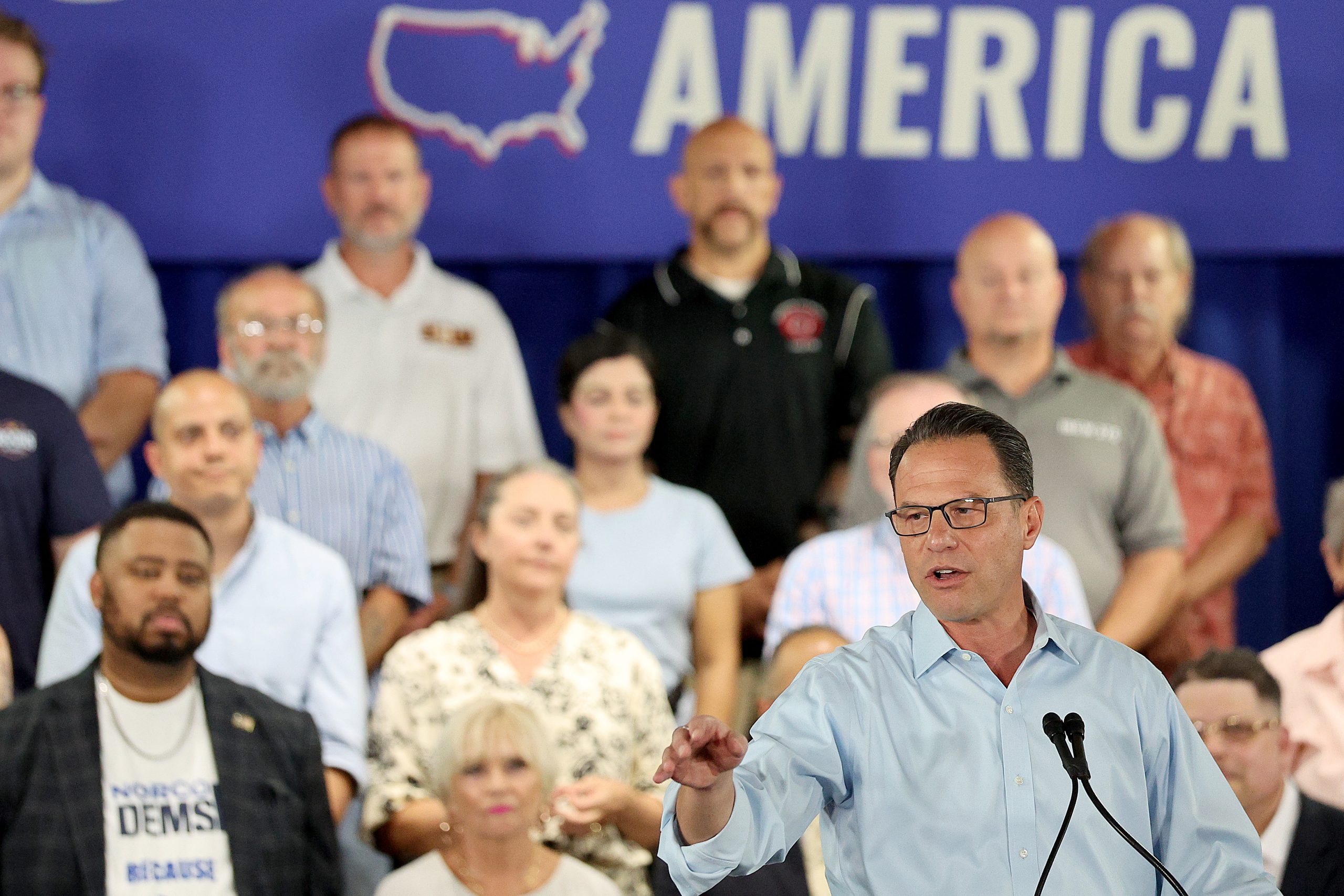
    “They’re focused on cutting costs,” Shapiro said of the region’s Latino voters at a rally with congressional candidate Bob Brooks and House Minority Leader Hakeem Jeffries in the 7th Congressional District, one of four GOP-held seats in the state Democrats are hoping to flip after the area accounted for some of Trump’s biggest Pennsylvania gains in 2024.

    “They’re focused on their small businesses getting help,” Shapiro said. “They’re focused on more cops on the street for safer communities and schools that are stronger.”

    Gov. Josh Shapiro addresses the audience during a rally for congressional candidate Bob Brooks at the United Steelworkers Union Hall in Bethlehem, Pa. on Sunday, July 26, 2026.David Maialetti / Staff Photographer

    Jaime Negrone, 67, from North Philadelphia, has lived in Pennsylvania his whole life but has roots in Puerto Rico. He said the cost of living is the major issue he is hoping to see tackled.

    “Everything has become so expensive,” Negrone said. “People are sacrificing necessities on one end to cover for the other end: food, gas, housing.”

    Negrone said he will vote for Shapiro over Garrity because the governor seems to be more connected to the people of Pennsylvania.

    “Shapiro has a pulse on the issues in Pennsylvania,” Negrone said. “He’s been in the office, he knows the politics, and he seems to be a politician for the people.”

    Seth Ortiz, 30, a second-generation Puerto Rican from Northeast Philadelphia, said he’s going to vote for Democratic candidates in November because he feels that’s the only way to protect people’s rights amid increased immigration enforcement.

    “I don’t like the fact that ICE is pretty much doing what they want in U.S. cities. At some point, even killing American citizens and getting away with it, it’s horrible,” Ortiz said. “So anyone who is going to stand up for immigrant rights is probably the most important thing for me. And it’s probably always going to be the Democrat.”

    Gladis Avila, 55, a Venezuelan business owner from South Philadelphia, said she is not sure who she is going to cast her vote for yet. She wants a candidate who is going to stand up for her community and small businesses but has not heard much outreach from either campaign.

    “The Latino community needs people who work more for our community,” Avila said. “…When we vote, we want to feel like we are voting for someone who is going to help our community. Because that’s our voice, and our voice has an impact.”

    Gladis Avila stands in a park near her house in South Philadelphia.Andrea Padilla

    Echoing this, Jennifer Rodriguez, president of the Greater Philadelphia Hispanic Chamber of Commerce, a nonprofit focused on the economic growth of the Hispanic community, said she’s heard worries from businesses about being able to keep up with their expenses.

    “Small businesses are very, very concerned about the viability of their businesses,” she said. “And in the really escalating cost environments. Particularly, the labor force has become very costly.”

    How are campaigns reaching the Latino community?

    Matt Beynon, a representative for the Garrity campaign, said that helping small businesses is the main concern the campaign has heard from Latino voters.

    “And a lot of concerns she’s hearing are about the overregulation and red tape that is preventing them from either starting a business, growing their business, expanding their business,” he said.

    Outreach to the Latino community has so far included attending community events in Philadelphia and other communities with large Latino populations, like Allentown, Beynon said.

    State Treasurer and Republican candidate for governor Stacy Garrity holds a rally in Bucks County Sept. 25, 2025 at the Newtown Sports & Events Center.Tom Gralish / Staff Photographer

    Shapiro has also spent time in majority Latino areas. In May, he attended and co-hosted “Fiesta on Hamilton,” in Allentown, a street festival that celebrates Latino culture in the Lehigh Valley.

    “During Fiesta on Hamilton, Gov. Shapiro met with local small business owners, entrepreneurs, creators, cultural leaders, and local officials as part of Shapiro for Pennsylvania’s ongoing commitment to engaging, uplifting, and investing in Latino communities across the Commonwealth,” the Shapiro campaign wrote in a statement.

    Samantha Reposa, a representative for the Shapiro campaign, said the campaign is also running Spanish-language radio ads to further engage voters.

    ‘I feel left behind’

    Despite this, many Latino voters in Philly said they haven’t felt reached by either campaign.

    Rodriguez expects messaging to ramp up closer to the election. Because of the Latino community’s lower voter turnout in relation to other groups, Rodriguez said they are often the last to be reached, a strategy she is hoping to see change

    “One thing that typically happens is that the Latino community oftentimes is the last community to be approached by politicians and their systems,” Rodriguez said. “The Latin community’s voter engagement is relatively low. And a lot needs to be improved, but a lot of it has to do with candidates really seeking the relationship with our community much earlier on.”

    Carolina Hansell, 61, immigrated from Venezuela 33 years ago and is planning to vote for Shapiro, but said she has seen and felt the conservative shift in her community and that it’s in part due to a lack of outreach.

    “They need to work and talk to real people and the neighbors over here,” Hansell said. “It’s the only way to convince people and have a good plan. There’s not a plan right now, not in that Democratic Party.”

    Anjoli Santiago, 41, said it’s not just the Democrats that are lacking but feels like both political parties have lost touch with the Latino community and sees that trend continuing.

    “I think it will continue if we don’t have more conversations about how diverse our people are and the different needs that our people have,” Santiago said. “I feel left behind by both parties definitely. It feels like we are voting and those who we vote for no longer represent us.”

    Staff writer Michelle Baruchman contributed to this article.

  • Shapiro, Democrats blasted Trump’s ‘conspiracy theories.’ That message has not changed after New Jersey’s noncitizen voting revelation.

    Shapiro, Democrats blasted Trump’s ‘conspiracy theories.’ That message has not changed after New Jersey’s noncitizen voting revelation.

    The day after President Donald Trump delivered a prime-time speech contending, among other claims, that 250,000 noncitizens were registered to vote in just four states, Pennsylvania Gov. Josh Shapiro derided it as “a whole bunch of conspiracy theories that are just simply not connected to reality.”

    A week later, when New Jersey revealed that 6,600 noncitizens were improperly registered to vote in the state and nearly 400 cast a ballot due to a glitch, Shapiro’s message was nearly identical — that Trump is pushing “baseless conspiracy theories” as he seeks more power over state-run elections.

    Pennsylvania and New Jersey were both on the list of Democratic-led states that Trump claimed had thousands of noncitizens on their voter rolls. The methodology of how the Trump administration arrived at that figure remained unclear, but his administration has sought to leverage the New Jersey disclosure as evidence of a larger problem.

    But Shapiro and other national Democrats have not shifted their messaging on the issue ahead of the high-stakes midterm elections. They are refusing to cede to the GOP any suggestion that New Jersey’s voter rolls are evidence of widespread voter fraud and are warning that the changes Republicans seek would make it tougher for many Americans to vote.

    Shapiro, a likely presidential contender in 2028, joined 25 other Democratic officials from across the nation in a lawsuit last Thursday challenging the administration’s ramped-up attempts to coerce states to share their raw voter data by threatening to withhold money for homeland security and disaster preparedness.

    “Withholding this funding will make our communities less safe and would be dangerous under any circumstance, but doing this in an attempt to undermine states’ authority over elections is reckless and unconstitutional,” Shapiro said.

    Kentucky Gov. Andy Beshear, another potential 2028 candidate, also joined the suit. (Both Shapiro and Beshear lead states with Republican attorneys general.)

    The day after Trump’s speech, Shapiro challenged the administration to present “real evidence” of noncitizen voting, which Pennsylvania election officials say is extremely rare.

    In addition to Pennsylvania and New Jersey, the White House also targeted Nevada and California for additional scrutiny over their voter rolls, according to a document posted to the White House website last week shortly after Trump’s speech.

    California Gov. Gavin Newsom, one of Trump’s most vocal critics in the Democrats’ potential 2028 field, said the president’s speech was fueled by debunked lies.

    “It was unhinged. Unfounded allegations of election fraud — it’s madness. But he’s setting it up. He’s setting you all up. You know what he’s doing. He’s doing it in plain sight. He’s socializing all of this to normalize all of this,” Newsom said last week, during a news conference that took place the same day as New Jersey’s announcement.

    Trump has repeatedly promoted conspiracy theories about California elections in recent weeks — including in two Pennsylvania speeches — despite no evidence that fraud occurred.

    For U.S. Sen. Cory Booker (D., N.J.), pushing back against Trump presents a tougher challenge.

    Booker, also a likely 2028 aspirant, must balance the governing changes he sees as needed in New Jersey with the larger politics of the moment. He said the failure of the software was “not acceptable” but rejected Trump’s efforts to portray the entire election system as faulty.

    “There are those who will choose to weaponize this issue to undermine confidence in our elections,” Booker said in a statement. “We cannot allow that.”

    But Republicans have pointed to New Jersey as proof that a sweeping overhaul is needed for November’s results to be trusted.

    Trump’s allies are pushing the SAVE America Act, which would require voters to provide proof of citizenship when registering to vote and to show photo ID at the polls. The effort has stalled in Congress amid concern, even among Republicans, that the bill’s restrictions on mail voting could make it harder to cast a ballot and that many citizens could wrongly be blocked from voting if they do not have access to required paperwork.

    Vice President JD Vance, widely viewed as a 2028 Republican candidate and a potential political heir to Trump, seized on New Jersey’s revelations as a renewed opportunity for the legislation’s relevance.

    “If only there was a way to stop this type of ‘software error’ that allowed non citizens to vote in our elections,” he wrote in a post on X that targeted Booker and Sen. Andy Kim (D., N.J.), both of whom are unlikely to support the Republican-led bill.

    But the registration glitch happened despite these individuals answering “no” when asked on a keypad whether they were U.S. citizens. They were added to the system “through no fault of their own,” New Jersey Gov. Mikie Sherrill said last week, so it is not clear that showing additional documentation would have prevented the error.

    Sherrill ordered her chief counsel to investigate the issue, which occurred under her predecessor, former Democratic Gov. Phil Murphy, and promised to hold those responsible for the error accountable.

    Talking about this issue can pose an obstacle for both parties now that New Jersey’s glitch has been identified, said Sam Chen, a Pennsylvania strategist who has worked for former Gov. Tom Corbett and other Republicans.

    Republicans have overplayed their hand and are not seen as an authoritative voice on voter fraud, but Democrats have spent the same amount of time dismissing all of Republicans’ concerns, including some that are legitimate, Chen said.

    “When you’ve got an entire party saying, ‘No, this is never happening,’ and now you see what you see in New Jersey, it is going to leave a serious credibility issue for them,” Chen said.

    Democrats, like Shapiro, could build more credibility if they acknowledged the positive parts of the SAVE Act, he contended.

    “Grab what’s good, vehemently oppose what’s bad, and states can blaze their own path,” he said.

    But J.J. Balaban, a Philly-based Democratic ad maker, said it does not make sense for Democrats to go along with the SAVE Act because the charges are being made in bad faith.

    While many Democrats would support efforts to make election systems more secure, Balaban said, that is not what the Trump administration is trying to do — and New Jersey does not change that.

    “Voter fraud was shockingly rare a month ago. It remains shockingly rare today,” he said.

  • Gov. Josh Shapiro’s admin consulted with Amazon and data centers on his marquee protections, records show

    Gov. Josh Shapiro’s admin consulted with Amazon and data centers on his marquee protections, records show

    Gov. Josh Shapiro spent months preparing a set of standards he promised would “hold data center developers accountable.”

    But behind the scenes, top Shapiro administration aides were drafting the framework with the input of Amazon and the powerful data center lobby and sharing early drafts with company officials before making them public, records show.

    The emails, first reported by climate change media outlet HeatMap earlier this year and obtained by an anti-data center activist in Montour County through the state’s open records law, show a cozy relationship between Shapiro’s administration and data center developers. But they also show the role the technology giants played in influencing the final version of Shapiro’s guardrails — though that influence only went so far.

    Shapiro in May introduced the initiative as the Governor’s Responsible Infrastructure Development, or GRID, which are a set of transparency and environmental standards data center developers would need to meet to access state tax breaks and other incentives Shapiro asked the General Assembly to write into law. The Democratic-controlled state House approved these standards, but it’s stalled in the GOP-controlled Senate, as legislators struggle to find common ground on one of the most hot-button issues facing them today.

    A spokesperson for Shapiro said the administration consulted numerous stakeholders as part of the drafting of the policies, including the Pennsylvania Building & Construction Trades Council, the Pennsylvania Environmental Council, the Natural Resources Defense Council, and more. Data center development is supported by many building trade unions across the state, which are likely to benefit from the major projects.

    Environmental groups broadly support Shapiro’s proposal and want stronger regulations on data center projects. Some groups want to ensure the provisions are mandatory, instead of voluntary, as Shapiro proposed.

    “As finalized, the Governor’s GRID standards set firm guardrails to protect Pennsylvania communities and hold data center developers accountable to strict standards requiring them to take additional action to ensure Pennsylvania communities benefit — and are not harmed — by these projects,” said Rosie Lapowsky, Shapiro’s press secretary, in a statement.

    Shapiro, a Democrat seeking reelection this year and a possible 2028 presidential contender, has remained data-center friendly and emphasized that Pennsylvania should play a core role in the “battle for AI supremacy.”

    But he has sharpened his rhetoric in recent months, citing his own personal evolution on the issue, as public opinion has also shifted with roughly 76% of Pennsylvanians across party lines opposing the projects.

    “Too many of these projects have been shrouded in secrecy, with local communities left in the dark about who is coming in and what they’re building,” Shapiro said in his budget address in February.

    Yet as other states like New York have put moratoriums on data center development, Shapiro has chosen to fast-track permits and support tax breaks to incentivize the massive projects, though he now believes they should meet certain voluntary standards.

    Amazon has already committed to a $20 billion investment in Pennsylvania — the biggest investment in state history — to build two data center campuses in Luzerne and Bucks counties and will access the state’s sales tax exemption for data centers as approved by the General Assembly in 2021.

    The Data Center Coalition — the powerful industry group made up of data center developers like Amazon, Google, Anthropic, OpenAI, and Microsoft — shared feedback on several drafts of Shapiro’s GRID principles and approved of most of its measures. But the industry still has “some significant concerns” with the voluntary program, including its clean energy provisions requiring certain percentages of its power to be from low- or zero-carbon sources.

    Dan Diorio, the Data Center Coalition’s executive vice president of state policy and government affairs, described the proposed GRID program’s requirements to access tax breaks as “extensive” compared to the 37 other states that offer sales tax exemptions.

    “We look forward to continuing to work with the legislature and the governor’s office on outlining what would ensure Pennsylvania remains a strong and competitive data center market,” Diorio said.

    Fengqi You, an energy systems engineering professor at Cornell University and data center expert, said it’s best practice for governments to consult all stakeholders, including industry leaders. But data center developers and local communities have opposing viewpoints that must be balanced, he said.

    “The right model, in my view, is to consult widely all the stakeholders, decide independently, and disclose transparently,” You said. “The standards are only as strong as the conditions and the consequences.”

    But some of the conditions should not be voluntary incentives, like Shapiro proposed, You said. This has been echoed by some environmental and anti-data center groups, which argue that the provisions don’t go far enough if compliance is ultimately voluntary for the tech giants.

    “It’s a useful starting point, but the incentive conditions should not substitute a minimum public protection for all,” You said. “If a company is receiving a tax exemption, then the state should have every reason to attach some very strong public interest conditions.”

    ‘Not ban or discourage data centers’

    Ahead of Shapiro announcing his plans for GRID as part of the state budget address, Shapiro administration officials went further in their efforts to reassure companies like Amazon, which they’ve courted for years, records show.

    In a Feb. 3 email, Department of Community and Economic Development Secretary Rick Siger wrote to Amazon Web Services staff that Shapiro would not “ban or even discourage data centers” and that “this new approach will not look back at projects or agreements already in place.”

    Other emails, sent in March by Sam Robinson, a deputy chief of staff to Shapiro, request that Amazon and the Data Center Coalition submit their feedback and mark up drafts. Shapiro’s administration declined to share those earlier feedback drafts.

    Legislators in Pennsylvania’s split General Assembly did not write Shapiro’s GRID proposal into law as part of this year’s $50.8 billion budget deal, and only enacted one new data center requirement despite near-unanimous support to repeal tax breaks for the projects. Shapiro now says he’s “considering all executive actions” he can do without the legislature.

    Colby Wesner, a pediatrician in Montour County, received troves of emails from top Shapiro administration officials, top Amazon staff, and more as part of several Right-to-Know Law requests he submitted to find out more about a now-blocked project near his home.

    “It’s a really insincere attempt,” Wesner said of the GRID principles. “It’s a public relations stunt.”

    Now that Shapiro is considering acting on his own, Wesner said he wants to know whether Shapiro will add restrictions or continue to welcome the projects into Pennsylvania.

    “Maybe he is listening to constituents and an executive action will demonstrate that he is listening to citizens,” Wesner added. “If it is, then great for him. But to date, everything he has done has been pro-data center industry.”

    Amazon , for its part, declined to comment on its role in the drafting of the GRID principles, which, if approved, would not apply to their ongoing projects. Becky Ford, a principal for global infrastructure expansion at Amazon Web Services, replied to Robinson on March 18 that they “look forward to providing feedback.”

    “We’re committed to being good neighbors in the communities where we build and operate, and will continue working with state and local leaders to invest responsibly and to keep creating good jobs across the Commonwealth,” an Amazon spokesperson said in a statement.

  • Pa. lawmakers can’t agree on how to sentence second-degree murder cases. The state Supreme Court may extend their deadline.

    Pa. lawmakers can’t agree on how to sentence second-degree murder cases. The state Supreme Court may extend their deadline.

    HARRISBURG — As state legislators failed to reach an agreement on a new sentencing structure for second-degree murder convictions on the eve of a deadline imposed by Pennsylvania’s highest court, the Allegheny County district attorney has asked the Pennsylvania Supreme Court to extend its deadline 120 days.

    Unless the court agrees, the state’s divided legislature is all but guaranteed to not reach a deal by the Friday evening deadline set by the court, which ruled in March that mandatory life sentences for crimes of that category were ruled unconstitutional.

    That means that judges would begin to sentence individuals across the state without legislative guidance — and likely tees up about 1,100 individuals already serving life sentences for lengthy litigation over what comes next.

    In a filing with the court Thursday afternoon, Stephen Zappala, the Allegheny County district attorney, requested that the judges give the General Assembly the ability to continue debating new sentencing guidelines when they return in September from summer recess.

    Lawmakers were not due back to Harrisburg until the fall, but Senate and House Republicans lambasted House Democrats for failing to pass any legislation on second-degree murder. The House returned to the Capitol for a special session Thursday to vote on a Democrat-backed plan for second-degree murder sentencing.

    The passage of that bill, however, did not bring lawmakers closer to a deal.

    “We still want to have a legislative solution, we believe it is going to be the most equitable way statewide to address the issue of people who are currently serving unconstitutional sentences,” said Roxanne Horrell, the legislative director for Straight Ahead, a decarceration advocacy organization. “We are ready and willing to come to the negotiating table.”

    The House-advanced plan, which passed 102-100, would allow individuals who have already been convicted of second-degree murder to seek parole after serving 30 years. A decision on new sentencing guidelines would be left to the state’s Sentencing Commission.

    In a brief statement to reporters, House Majority Leader Matt Bradford (D., Montgomery) said that bill “is a real attempt in the House to meet the Senate more than halfway.”

    In floor arguments that at times grew heated, House Republicans took issue with the outlining no minimum sentence for future cases and instead placing that decision in the hands of the Sentencing Commission.

    Republicans also criticized Democratic leadership for not taking a vote on the Senate-passed plan.

    That bill — which several Senate Democrats voted for — creates a sentencing minimum of 35 years to life for future cases. Individuals would be eligible for parole after serving 35 years, or after serving 20 years for those older than 70.

    “This is one of those issues that requires a great deal of thought, and it requires bringing in some of the stakeholders that we are hearing from that was opposed to this legislation today,” House Minority Leader Jesse Topper (R., Bedford) said. “Those are people who need to be in a room to come up with a solution, and unfortunately, that’s not what happened.”

    He called for party leaders, the state’s Fraternal Order of Police, Gov. Josh Shapiro, and Attorney General Dave Sunday to come together and reach an agreement instead of shuttling bills back and forth between both chambers.

    “When you don’t have that kind of collaboration to deal with an issue such as this,” Topper said, “nothing will be done.”

    Horrell said the decarceration organization would support discussions that include their input.

    In a letter on Thursday, the attorney general urged state representatives to vote against the plan backed by House Democrats.

    “This approach does not foster appropriate and thoughtful re-entry initiatives or put individuals on a path to success,” wrote Sunday, a Republican. “Thoughtful re-entry initiatives are necessary and important, and I support those initiatives. But not this approach, which ultimately fails to hold dangerous offenders accountable.”

    The plan advanced Thursday is the latest development in months of back and forth between Republicans and Democrats who have advanced differing visions for what the new sentencing parameters should be.

    Lawmakers were unable to reach a deal as part of budget negotiations that concluded earlier this month.

    “Today, the House took important action prior to the court-imposed deadline by passing a package to address this issue and it’s time for Senate Republicans to return to Harrisburg and bring this matter to conclusion rather than grandstand,” Shapiro said in a statement.

    The House-passed bill also expands the state’s compassionate release program. Under existing law, incarcerated individuals can only be candidates for release if doctors determine that they have less than a year to live.

    The bill would allow for an individual to be released if they have been diagnosed by a doctor with a terminal or life-threatening illness, or if a physician diagnoses them with an illness that could be treated better outside of a correctional facility.

    Democratic Rep. Rick Krajewski, who represents West Philadelphia, said that the program is designed for incarcerated individuals who are facing serious illnesses “that require real, complex medical care” that can’t be provided while an individual is serving out their sentence.

    “I am glad that the House was able to put a vision forward about how to fulfill our constitutional mandate and reform our carceral system generally,” he added.

    Several Republicans had supported Krajewski’s initial bill, which passed the house 111-92. The program is estimated to save $15 million a year in healthcare costs for incarcerated individuals, he said.

    Now that both the House and Senate have passed a bill, either could be amended and voted on by both chambers in a single day.

    “Instead of allowing a vote on either of the bipartisan bills passed by the Senate, [House Democrats] chose to engage in political theater and failed to produce any feasible product to protect our communities and victims’ families,” Senate Republican leaders wrote in a statement.

    A spokesperson for Senate Republican leadership did not respond to a request for comment on whether the chamber planned to return for a vote Friday.

    On Thursday morning, Topper morning said that he hoped the legislature could come to an agreement in the coming weeks if an agreement could not be reached by the deadline.

    However, speaking to reporters after the House adjourned, Topper said the decision to advance the House bill without a vote on the Senate bill on Thursday “sets things back considerably.”

    Ethan Young is an intern with the Pennsylvania Legislative Correspondents’ Association. He can be reached at ethanmyoung@gmail.com.

  • Josh Shapiro joins lawsuit against Trump administration’s plan to withhold disaster aid to pressure states on voter data

    Josh Shapiro joins lawsuit against Trump administration’s plan to withhold disaster aid to pressure states on voter data

    Pennsylvania Gov. Josh Shapiro was one of 26 Democratic officials from across the nation to join a lawsuit challenging President Donald Trump’s administration over its efforts to compel states into sharing raw voter data by threatening federal funding for natural disasters.

    “Withholding this funding will make our communities less safe and would be dangerous under any circumstance, but doing this in an attempt to undermine states’ authority over elections is reckless and unconstitutional,” Shapiro in a statement Thursday.

    New Jersey and Delaware are among the other states on the Illinois-led lawsuit. The complaint, filed in U.S. District Court in Rhode Island, comes amid escalating tensions between Democratic-run states and the federal government over how best to ensure noncitizens are not voting in any elections — a situation these states say happens extremely rarely.

    But New Jersey’s admission Tuesday that about 6,600 noncitizens were inadvertently added to the state’s voter rolls, due to a system error in the state’s department of motor vehicles voter registration program, has thrust the issue into the national spotlight as these efforts were already underway.

    The Department of Homeland Security announced earlier this month that the Federal Emergency Management Agency would require states to hand over their unredacted voter rolls and adhere to significant changes in their election administration in order to receive funding for preparation and recovery from catastrophic disasters, such as major storms.

    The policy puts nearly $6 million in federal aid at jeopardy for Pennsylvania, according to Shapiro.

    Shapiro has routinely signed on to lawsuits against the Trump’s administration, particularly when federal funding to the state has come under threat.

    Pennsylvania election officials have repeatedly declined to hand over unredacted voter rolls to the Trump administration, citing privacy concerns.

    New Jersey has also refused to provide voter roll data to the Trump administration, though the federal government is using the state’s registration mishap to justify its request.

    “We are not in the practice of turning this kind of personally identifying data over to the federal government because we have seen them weaponize it … and they don’t have a reputation for keeping it private, either,” New Jersey Gov. Mikie Sherrill said after a news conference Thursday.

    As for the FEMA funding, New Jersey Attorney General Jennifer Davenport said in a social media post Thursday that the Trump administration “threatens our safety when it plays politics with these funds.”

    While most of the plaintiffs are attorneys general, Shapiro was one of two governors to join the complaint, along with Kentucky Gov. Andy Beshear, another potential 2028 presidential contender who also leads a state with a Republican attorney general.

    In a prime-time address last week, Trump called for an overhaul of U.S. election administration and ticked through old debunked claims about his 2020 election loss.

    Pennsylvania and New Jersey are among four states — along with California and Nevada, which also joined the suit — that the Trump administration is targeting for additional scrutiny over their voter rolls, according to a document posted to the White House website last week. The one-pager claimed widespread instances of noncitizen voting, much broader than what New Jersey said it uncovered, though election experts have suggested caution when examining these numbers.

    “The Trump Administration is holding critical funding for homeland security and disaster response hostage in their latest attempt to take over our elections and perpetuate baseless conspiracy theories,” Shapiro said in his statement Thursday.

  • Josh Shapiro may be the biggest fundraising juggernaut Pennsylvania politics has ever produced

    Josh Shapiro may be the biggest fundraising juggernaut Pennsylvania politics has ever produced

    The Rev. Ed Stafford first donated to Josh Shapiro in August 2024, sending the Pennsylvania governor $10 through the Democratic fundraising platform ActBlue. A few weeks later, he gave him $5. And then he made two more $5 contributions on the same day toward the end of the month.

    He would go on to make 105 separate contributions to Shapiro between that August day two years ago and early June, an average of one donation every 16 days.

    “I’ve been getting a lot of text solicitations, and his [Shapiro’s] have come by rapidly and frequently, and that’s how I got to get to know him,” said Stafford, a priest at the Diocese of Youngstown, Ohio. He was particularly impressed with Shapiro’s handling as attorney general of the Catholic Church child sex abuse scandal in the state.

    Stafford’s donations, totaling just under $1,200 over the last two years, form a microscopic share of the $60 million Shapiro has raised since the current fundraising cycle began in 2023. But smaller, repeat contributions from dedicated donors like him are one piece of a strategy — along with eye-popping checks from wealthy donors and a nationalized fundraising network — that has allowed the governor to shatter state fundraising records as he looks beyond this November’s race to a prospective presidential run in 2028.

    Blowing past prior candidates

    Between the start of 2023 and June 8, Shapiro raised more than $60 million, 56% more than the $39 million he raised at this point four years ago when adjusted for inflation.

    That figure is nearly double that of the second-best fundraiser: former Democratic Gov. Tom Wolf, who had raised an inflation-adjusted $31 million at this point in his successful 2018 reelection campaign.

    Shapiro raised the eye-popping amount from roughly 22,000 unique individuals, about 44% more than the 16,000 who had given to his campaign at this point last cycle. That is more than triple the number of donors for the closest comparison, former Republican Gov. Tom Corbett in 2014, who had only about 6,000 donors at this point in his unsuccessful reelection campaign.

    That figure does not include contributions from donors who gave $50 or less in a campaign finance reporting period, as campaigns are not required to disclose information on those individuals. When including that group, Shapiro’s campaign said, it has more than 120,000 unique contributors. The campaign declined to comment on the rest of this article.

    Perhaps most staggering, Shapiro’s current campaign has raised nearly one in every five dollars collected by every major party gubernatorial candidate since the 2010 cycle.

    (function(){function e(){window.addEventListener(`message`,function(e){if(e.data[`datawrapper-height`]!==void 0){var t=document.querySelectorAll(`iframe`);for(var n in e.data[`datawrapper-height`])for(var r=0,i;i=t[r];r++)if(i.contentWindow===e.source){var a=e.data[`datawrapper-height`][n]+`px`;i.style.height=a}}})}e()})();

    Robin Kolodny, a political science professor at Temple University, said Shapiro is benefiting from a strong personal brand, a weak GOP opponent in State Treasurer Stacy Garrity, and a favorable national environment with an unpopular president of the opposing party dragging down GOP candidates across the country.

    “This is what happens when you have a highly popular incumbent running for reelection,” Kolodny said.

    Differing motivations for large and small donors

    Shapiro has raised about $2.5 million from donors who have given $50 or less in any given campaign finance reporting period — more than any prior candidate since 2010. That is about 4.3% of his total fundraising. Garrity has raised about $530,000 — 9.6% of her funds — from such small donors.

    Among Pennsylvania gubernatorial candidates who raised at least $1 million, Shapiro’s percentage is relatively high. Only Garrity; Shapiro’s 2022 opponent, State Sen. Doug Mastriano; and 2010 GOP candidate for governor Samuel Rohrer raised a higher share from small-dollar donors. Shapiro’s 2026 run is also pulling in a slightly smaller percentage of small-dollar givers than his 2022 campaign.

    Kolodny suggested that improvements in technology have likely aided Shapiro’s hunt for smaller-dollar donors.

    “It’s so much easier to reach somebody on their phone with an Instagram post or whatever and get them to Venmo me 10 bucks, while it was definitely more steps in earlier elections,” Kolodny said.

    Stafford, whose most common contribution was for $10, agreed.

    “They make it real fast and easy to donate,” Stafford said of the multiple daily text messages he gets from ActBlue. “You gotta watch [that] you’re not pressing the button too quickly if you don’t want to let go of all your money,” he added with a laugh.

    (function(){function e(){window.addEventListener(`message`,function(e){if(e.data[`datawrapper-height`]!==void 0){var t=document.querySelectorAll(`iframe`);for(var n in e.data[`datawrapper-height`])for(var r=0,i;i=t[r];r++)if(i.contentWindow===e.source){var a=e.data[`datawrapper-height`][n]+`px`;i.style.height=a}}})}e()})();

    Dan Mallinson, an associate professor of public policy and administration at Pennsylvania State University’s Harrisburg campus, suggested an additional factor: National politics has filtered down to state politics in ways it had not in the past.

    “[Pennsylvania] voters don’t have a presidential candidate on this ballot to express support or anger [about],” Mallinson said. “So that gets translated into these other races, and Shapiro’s is obviously the most high-profile.”

    On the flip side, Shapiro has raised more than $33 million from donors who have given $100,000 or more in aggregate. That figure is vastly greater than any prior candidate for the office since 2010 and accounts for about 58% of his total funds raised. Garrity, by contrast, has raised about 21.3% of her money from such mega donors.

    Kolodny said big donors’ motivations can differ from those of more modest givers.

    For some donors, it’s practical: They want access to the halls of power in case their business interests intersect with government policy — regardless of the party in charge.

    With such donors likely viewing Shapiro’s reelection as a sure thing, Kolodny suggested their money has one place to go.

    “There’s no reason for a lot of these donors to even think, ‘Well, just in case, I should give some money to Garrity,’” Kolodny said. “There’s only one horse to bet on.”

    For other donors, it’s ideological: They share Shapiro’s moderate views and want to demonstrate their support.

    A national fundraising network

    More than two-thirds of Shapiro’s money has come from donors who live outside Pennsylvania. That figure is vastly higher than any prior candidate for governor since 2010. Only 6.4% of Garrity’s money has come from outside the state.

    Mallinson pointed out that Shapiro finds himself in a unique position among the state’s recent crop of gubernatorial candidates.

    “This is the first time Pennsylvania’s really had a governor who’s attracting the national attention that Shapiro’s gotten,” Mallinson said, referring to the widespread expectation that he will run for president in 2028. “So if we’re comparing across governors, it makes sense he’d be attracting more outside [the state] money.”

    Among the $33 million Shapiro has raised from donors who have given at least $100,000 or more over the course of the campaign, nearly 70% has come from outside Pennsylvania, with California accounting for about 29% of the money and New York accounting for a little over 18%.

    (function(){function e(){window.addEventListener(`message`,function(e){if(e.data[`datawrapper-height`]!==void 0){var t=document.querySelectorAll(`iframe`);for(var n in e.data[`datawrapper-height`])for(var r=0,i;i=t[r];r++)if(i.contentWindow===e.source){var a=e.data[`datawrapper-height`][n]+`px`;i.style.height=a}}})}e()})();

    Here, too, changes in media and technology likely play a role.

    “At an earlier point in time, we didn’t have that much information about people representing other areas that shared a characteristic or a position similar to me as the donor, but now, this is easy information to find,” Kolodny said.

    Shapiro, for example, has repeatedly emphasized the impact his Jewish faith has had on his political values and how those values are shared among adherents of many religions. That sort of openness about his identity can be appealing to donors of all faiths.

    As he learned more about the governor, Stafford, a devotee of Catholic social teaching, came to believe the two men shared similar values.

    “He’s a good, just man — a good, holy man — set on serving people, especially people who’ve been hurt and victimized, and those are the kind of leaders we need more than ever.”

    Staff writer Michelle Baruchman contributed to this article.

  • ICE formally withdraws plans to build two Pennsylvania detention centers, Gov. Josh Shapiro says

    ICE formally withdraws plans to build two Pennsylvania detention centers, Gov. Josh Shapiro says

    The U.S. Department of Homeland Security has formally reversed its plans to establish two ICE detention centers in Pennsylvania that were intended to hold up to 9,000 immigrants, Gov. Josh Shapiro said Wednesday.

    The decision, which comes amid opposition from the state and from local communities, marks the end of efforts to convert warehouses in Berks and Schuylkill Counties, as the Trump administration works to offload some sites that were intended to support its mass-deportation agenda.

    Shapiro, a first-term Democrat seeking reelection this year, told DHS officials in February he would “aggressively pursue every option to prevent these facilities from opening,” and his administration later denied permits to update local water and sewage systems to handle thousands of additional people.

    On Wednesday, Shapiro praised the federal decision and credited his administration’s work to block the facilities.

    “From the beginning, I’ve been clear that these warehouses should not be used as ICE detention centers because they are not suitable for people and converting them to detention centers would have posed serious risks to the health, safety, and infrastructure of the surrounding communities,” he said.

    Gov. Josh Shapiro on July 21.Tom Gralish / Staff Photographer

    Two sites had been purchased in Pennsylvania ― one in Upper Bern Township, in northern Berks County, and another in Tremont Township, in Schuylkill County, where the plan for a former Big Lots discount store warehouse drew the ire of residents. Both plans faced steep opposition from top officials like Shapiro and from local community activists.

    ICE confirmed its plans to withdraw its permit requests in a filing Wednesday to the Pennsylvania Environmental Hearing Board, as well as in a July 13 letter from DHS Assistant Director James Ingalsbe.

    News emerged earlier this year that U.S. Immigration and Customs Enforcement planned to spend more than $38 billion to buy warehouses and retrofit them as detention centers that would hold tens of thousands of immigrants. Those two dozen properties, including the two in Pennsylvania, would be located across the country, with some holding as many as 10,000 detainees.

    In Pennsylvania, the Berks County project would have held 1,500 detainees, while the Schuylkill County one would have held 7,500.

    An expanded ability to confine immigrants was central to Trump’s plan to deport as many as 1 million people a year. The additional space was necessary to help ICE respond to White House demands for greater numbers of arrests.

    As of July 11, ICE held 65,765 people in detention, up from 60,311 in April, but below the record high of 70,766 set in January, according to Syracuse University professor Austin Kocher, who studies immigration data.

    During Trump’s first year in office, the government fell short of his million-deportation goal, removing 622,000 people through mid-December, fewer than the 778,000 deportations carried out in President Joe Biden’s final fiscal year, according to the American Immigration Council in Washington.

    While some around the country saw the conversion of empty warehouses as a chance for new jobs, others were opposed over humanitarian concerns, the impact on water and sewerage use, and the potential loss of tax revenue.

    Earlier this summer, it appeared likely that the plans in Pennsylvania were being discarded.

    The New York Times reported in June that ICE planned to offload its two properties in Pennsylvania and a third in New Jersey, which were purchased for more than $336 million. Those were among seven warehouses across the nation that would be sold or handed off to other federal agencies, according to the Times.

    The same month, U.S. Sen. John Fetterman (D., Pa.) said that detention-warehouse plans would not go forward in Tremont and Upper Bern Townships and that Homeland Security Secretary Markwayne Mullin had “recognized the negative impacts these facilities would have in Pennsylvania.”