President Donald Trump says he’s holding Canada accountable for “ripping off” the United States through unfair trade practices.
But by imposing new tariffs on Canadian goods and prompting retaliation from one of America’s largest trading partners, U.S. businesses and consumers could face higher costs, analysts said — including in key electoral battlegrounds like Pennsylvania.
Pennsylvania sold $13.4 billion in goods last year to Canada — its largest export market.
About $2 billion worth of those goods, or 16%, will be subject to higher tariffs — some as high as 50% — starting Sept. 8 after Canada this week announced new levies, according to an Inquirer analysis of trade data. Some of the state’s top exports facing new tariffs include raw aluminum, lumber, and passenger vehicles.
(function(){function e(){window.addEventListener(`message`,function(e){if(e.data[`datawrapper-height`]!==void 0){var t=document.querySelectorAll(`iframe`);for(var n in e.data[`datawrapper-height`])for(var r=0,i;i=t[r];r++)if(i.contentWindow===e.source){var a=e.data[`datawrapper-height`][n]+`px`;i.style.height=a}}})}e()})();
Canadian officials said the tariffs on hundreds of U.S. goods worth a total of $20 billion are meant to protect its workers in response to increased U.S. levies on the same amount of Canadian imports. That affects a relatively small share of trade between the two countries, but analysts said the situation is still evolving.
“There’s so many things that go back and forth, some of it multiple times. The effect and the amplification of these tariffs, we’ll definitely feel,” said Lauren Swartz, CEO of the nonprofit World Affairs Council of Philadelphia. “When we think about what that means for Pennsylvania, it’s going to be loud.”
“My sense is the rhetoric that we’re hearing, and the fact that it’s already being labeled a trade war, is that both countries are reserving the right to escalate the level, the percentage of tariffs, as well as the scope of goods that will fall under the new trade war,” she said. “So it will expand.”
Steel, dairy, electronics impacted
The new tariffs came after talks between the U.S. and Canada over a trade deal fell apart last weekend. Trump imposed 50% tariffs on goods such as hockey sticks, national flags, and building materials.
“Canada has been ripping off the United States for decades — and President Donald J. Trump is done letting them get away with it,” the White House said on Tuesday. It said the U.S. had offered Canada “the most preferential market access of any country on Earth” but that the country chose “unreasonable demands, walk-backs, and flat-out rejection.”
Canadian officials said the country’s counter tariffs would protect the country’s workers and businesses. They said the levies on U.S. goods targeted sectors such as appliances, steel, dairy, and electronics.
(function(){function e(){window.addEventListener(`message`,function(e){if(e.data[`datawrapper-height`]!==void 0){var t=document.querySelectorAll(`iframe`);for(var n in e.data[`datawrapper-height`])for(var r=0,i;i=t[r];r++)if(i.contentWindow===e.source){var a=e.data[`datawrapper-height`][n]+`px`;i.style.height=a}}})}e()})();
Influence on midterms?
The trade dispute could inject new uncertainty into the economy less than three months before the U.S. midterm elections decide control of Congress and statehouses around the country. Republicans are seeking to retain control of the U.S. House and Senate. Pennsylvania has several competitive House races in which Republican incumbents are seen as vulnerable.
Pennsylvania Gov. Josh Shapiro, a Democrat who is running for reelection against Republican state Treasurer Stacy Garrity, has repeatedly criticized Trump’s tariffs.
“Donald Trump’s reckless tariffs are a tax on Pennsylvanians — and Gov. Shapiro has been fighting back against them from day one,” said campaign spokesperson Manuel Bonder.
“This President has raised costs for families, screwed over our farmers, and shut down markets for businesses — all with Stacy Garrity’s 100% support,” Bonder said in a statement.
Garrity’s campaign didn’t respond to requests for comment. She has in the past said Trump’s tariffs could result in some “short-term pain” but would ultimately bring jobs to America. “It’s going to be fantastic,” she said in a clip that Shapiro’s campaign has highlighted. More recently, Garrity told reporters in July she would “do the tariffs a little bit differently.”
Canadian officials appeared to target some goods that are important in electoral battlegrounds, such as seafood in Maine, the Wall Street Journal reported.
Analysts said Pennsylvania didn’t appear to be a principal target. “But unfortunately, it’s one of the states that does a lot of goods transfer with Canada, and unfortunately, they’re hit in the crossfire,” said Kyle Peacock, a trade expert and founder of Peacock Tariff Consulting.
Peacock said that after previous rounds of tariffs, many businesses were able to absorb the costs.
But now that some products face 50% levies, that will likely change, he said. “Not a lot of industries or products have 50% margin that you can just eat,” he said. “So I think you’re going to see that this time, unfortunately, that’s going to be passed on to the consumer.”
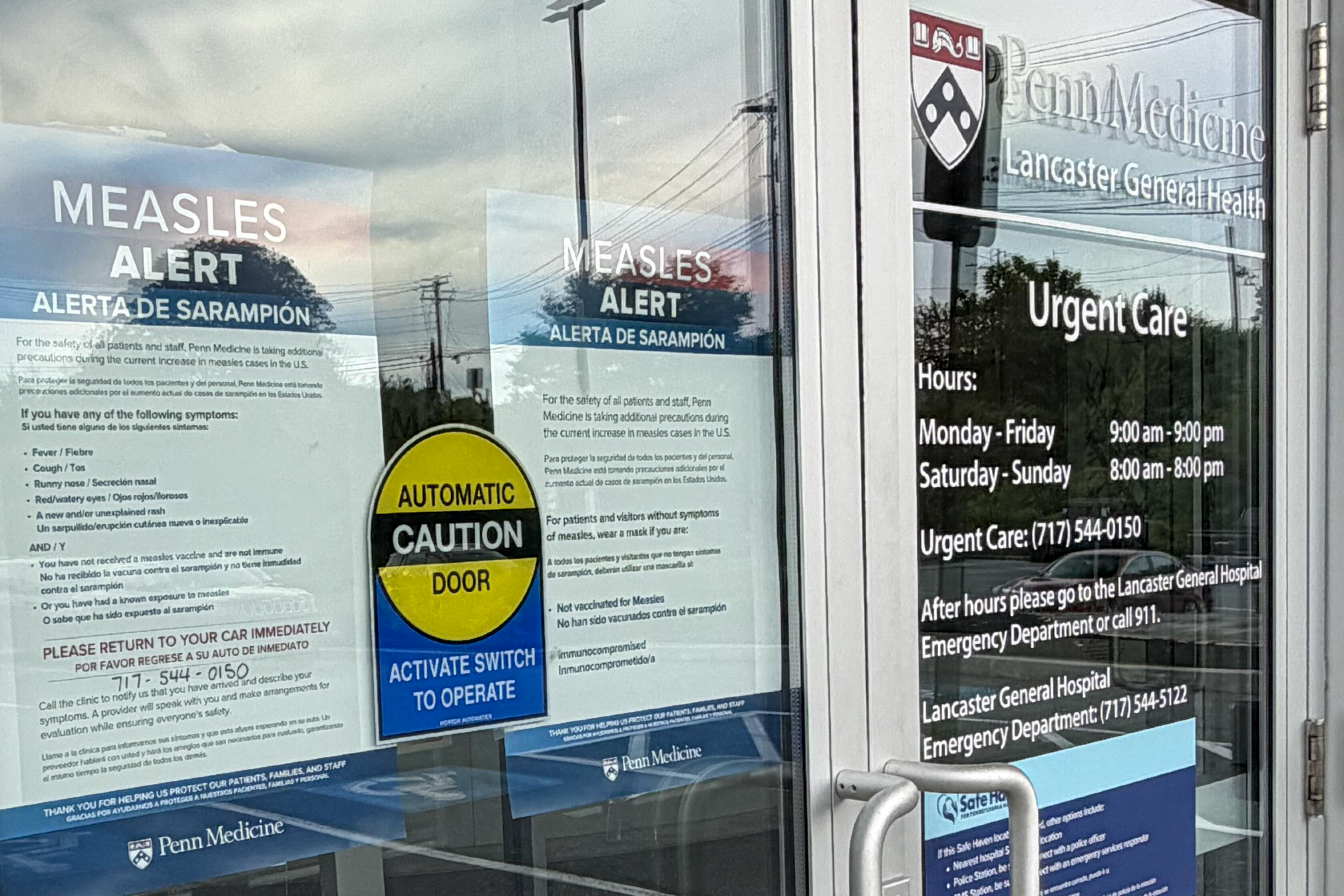
A newborn baby from Lancaster County was among the two unvaccinated residents whose deaths were associated with measles, Pennsylvania health officials said Wednesday.
As vaccination rates decline in the state, an outbreak that began in April this year has sickened more than 400 people in 29 counties — with the epicenter in Lancaster County, where nearly 200 individuals have tested positive for the viral disease. Local physicians and health officials say the true case count is likely much higher.
The state initially declined to share any information about the deaths, citing privacy concerns, and no information has been released about the second Lancaster resident who died.
The Pennsylvania Department of Health confirmed information about the newborn’s death on Wednesday only after the Lancaster County coroner publicly stated his office was investigating a newborn who had tested positive for measles and died from a ruptured spleen.
Lancaster County Coroner Stephen Diamantoni, a physician, said the cause of death was not the measles. The newborn died shortly after birth from a laceration of the spleen. A postmortem test on the baby’s lung tissue showed that the child had a measles infection that was acquired before birth, he said in an interview.
His description of the death, shared with reporters and a local county commissioner, contributed to a growing uproar on social media over the nature of the deaths and the state’s release of information.
President Donald Trump’s secretary of health and human services, Robert F. Kennedy Jr., traded attacks with Gov. Josh Shapiro, a Democrat, on X over the deaths and the safety of the measles vaccine.
Late Wednesday, Kennedy went further in another X post. He accused Shapiro’s administration of potentially having “fabricated” the deaths, after saying in an interview on C-Span that “they cannot find any measles deaths in Lancaster County.”
He said that Shapiro was not cooperating with the Centers for Disease Control and Prevention or the county in giving information on the deaths.
Shapiro administration staff said the department has been in regular contact with the agency during the outbreak.Pennsylvania Health Secretary Debra Bogen said in a statement late Wednesday that she “sadly can confirm” two measles-associated deaths in Lancaster County.
Measles deaths are rare. Most patients recover after mild illness, but the virus can cause pneumonia and brain swelling and kills about one to three patients in 1,000. The disease is so contagious that it can infect nine in 10 unvaccinated people.
The Pennsylvania Department of Health explained thatit reports deaths where measles are present as “measles-associated,” and it “may not be assessed by the medical examiner or coroner to be the immediate cause of death.”
In Lancaster, the coroner’s officedetermined that the baby’s primary cause of death was a laceration of the spleen, Diamantoni said.
Despite the baby’s positive measles test, the forensic pathologist who conducted the autopsy “did not feel it was related to measles,” Diamantoni added.
His office is seeking to learn whether the baby’s mother had measles at the time of the baby’s birth.
He said state health officials had not contacted him personally as of Wednesday about the two Lancaster County measles-associated deaths, but his chief deputy spoke to the department prior to Shapiro’s news conference Tuesday.
Paul Offit, a national vaccine safety expert and physician at Children’s Hospital of Philadelphia, said news of the coroner’s investigation “doesn’t really give us more information” on the death.
Children can acquire the disease after birth, or can be born with measles if their mother is infected and develops a rash within 10 days of giving birth, he said.
Measles can cause an enlarged spleen, and birth can cause it to rupture, he said. After a spleen ruptures, Offit said, it is difficult to tell whether it had been enlarged, and he added that the coroner should provide an alternate explanation for the rupture if it had not been caused by measles.
Diamantoni said the doctor who performed the baby’s autopsy did not note that the spleen was enlarged, and the office is still investigating the cause of the rupture.
To prevent speculation, the state could release information about the patients’ age, vaccination status, and cause of death while still protecting their privacy, Offit said.
In conversations with state health officials, he said, he learned that “these patients would not have died were it not for measles.”
Anti-vaccination advocates “try and completely misdirect and say it really wasn’t measles. They try to do everything they can to distance themselves from it,” he said. “You’re making it a lot easier for them when you don’t give more information.”
In her statement, Bogen said the department reported the deaths to the CDC on Tuesday morning and met with CDC staff on Wednesday afternoon to discuss the cases.
“DOH’s Epidemiology team thoroughly investigated and verified both individuals tested positive for measles. The information was not reported to the public until the results of the epidemiological investigations were confirmed,” she said.
She noted that state health officials are prohibited from releasing death certificate information except under limited circumstances that do not apply to this case.
A county commissioner questions measles-associated deaths
The clash over the deaths began within hours of Shapiro’s Tuesday news conference.
Lancaster County Commissioner Josh Parsons, a Republican, shared the coroner’s account on Facebook, suggesting the state was spreading incorrect information on the deaths.
In several posts, Parsons questioned whether the patients had died “OF measles or WITH measles” and suggested the state was spreading incorrect information on the deaths.
“We have ZERO information that corroborates the idea that there were two measles deaths in Lancaster County,” he wrote in a post several hours before the state’s announcement. Later, he shared Kennedy’s remarks on C-Span.
Parsons has not responded to several requests for comment from The Inquirer about the outbreak over the last several months.
Yoder, who attended the Tuesday news conference, said at a Lancaster commissioners meeting Wednesday that she had no additional information on the recent deaths.
The consequences, he said, were apparent in the deaths reported in Pennsylvania. He said he had told Kennedy as much in a recent phone call.
Later that night, on X, Kennedy said that Shapiro had falsely accused him of spreading misinformation and that drops in the state’s high vaccination rates occurred mostly during President Joe Biden’s administration.
Replying to Kennedy on X, Shapiro said that he asked the secretary to help him encourage people to get vaccinated and “stop spreading misinformation.”
The governor joined a lawsuit earlier this year against Kennedy’s department’s decision to scale back federal vaccine recommendations for children.
Shapiro noted that Kennedy had visited Lancaster in 2021, during the Biden administration, and told a crowd there that measles could be cured by “chicken soup and vitamin A.”
Measles has no specific treatments, and although vitamin A is sometimes given to severely ill patients, it cannot prevent the disease and is not a cure.
Shapiro added that measles cases have increased in the United States and Pennsylvania under Kennedy’s watch.
Editor’s note: This story has been updated to clarify that the newborn who died had a measles infection acquired before birth.
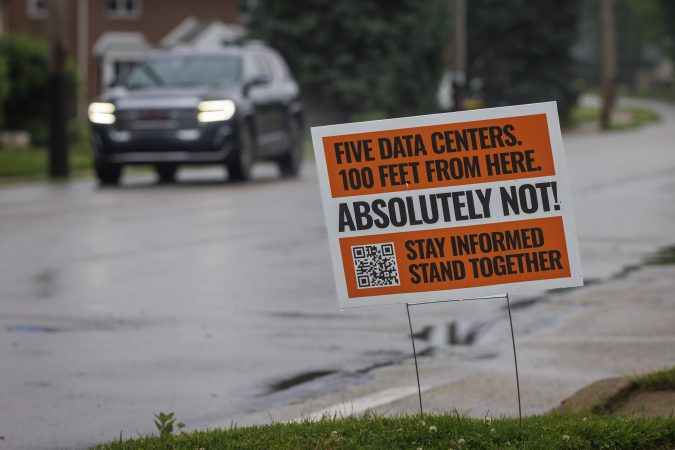
A majority of Pennsylvania voters oppose data center development in the United States, according to a new poll, as the issue has quickly become a flash point in the state’s gubernatorial race and other midterm elections.
Six in 10 likely Pennsylvania voters do not want the U.S. to construct data centers to house artificial intelligence, according to a poll conducted from Aug. 17 to 21 by The Inquirer, the New York Times, and Siena University. The poll, which surveyed 760 likely voters in Pennsylvania, found that Democratic and independent voters oppose data centers at higher rates, while just over half of Republicans support their construction.
(function(){function e(){window.addEventListener(`message`,function(e){if(e.data[`datawrapper-height`]!==void 0){var t=document.querySelectorAll(`iframe`);for(var n in e.data[`datawrapper-height`])for(var r=0,i;i=t[r];r++)if(i.contentWindow===e.source){var a=e.data[`datawrapper-height`][n]+`px`;i.style.height=a}}})}e()})();
The United States is in an international race to lead advancements in AI, with $2.3 trillion in data center projects underway or in the planning stages across the country. Pennsylvania, with more than 100 proposed projects, is among the hot spots targeted by developers for its key location near top U.S. metropolitan areas, vast rural space for building, and significant energy resources.
Gov. Josh Shapiro originally welcomed data center developments to the state, and last year championed a $20 billion investment from Amazon to build at least twodata center campuses in Bucks and Luzerne Counties. He also offered developers fast-track permitting in an attempt to establish Pennsylvania as a leader in AI development.
But in a year’s time, public animosity toward data centers has grownin Pennsylvania and beyond, as residents say they fear the facilities will drive up electricity costs, overuse water supplies, depreciate home values, and disrupt their daily lives. Last week, Shapiro, a Democrat running for reelection in November and a 2028 presidential prospect, announced plans to restrict data center development in the state.
Shapiro said his position on data centers evolved as he listened to more constituents who live in areas like Archbald, a small northeastern Pennsylvania town with six data center campuses under construction, and pointed to a developer in Montgomery County who he said is “bullying” residents to push projects through amid public opposition.
(function(){function e(){window.addEventListener(`message`,function(e){if(e.data[`datawrapper-height`]!==void 0){var t=document.querySelectorAll(`iframe`);for(var n in e.data[`datawrapper-height`])for(var r=0,i;i=t[r];r++)if(i.contentWindow===e.source){var a=e.data[`datawrapper-height`][n]+`px`;i.style.height=a}}})}e()})();
Pennsylvania’s youngest voters were most likely to reject data centers, according to the poll: 83% of likely voters ages 18 to 29 opposed their development, as did 71% of voters ages 30 to 44. Opposition, while above 50% for all age groups, decreased among older voters.
Kelly Harrington, 29, of Conshohocken, who participated in the poll, said she has been attending Plymouth Township Council meetings to oppose a controversial proposal for a 2 million-square-foot data center project there.
“Some of my concerns about that specific data center are selfish in the sense that I think my home value is going to go down, I think it’s going to be loud and obstructive, I think it’s going to pollute the air that I want to breathe every day,” Harrington said. “But in a wider sense, I’m also concerned about the environmental impacts of data centers.”
Front and center in the Pa. governor’s race and beyond
Data centers have become a key issue in the Pennsylvania gubernatorial election, where Shapiro hopes to ride his high popularity to reelection and usher in Democratic gains in down-ballot races for the statehouse and Congress.
Both Shapiro and his Republican opponent, State Treasurer Stacy Garrity, have released ads criticizing the other’s past support for data center development.
Democratic and Republican politicians across the country have reversed course on data centers in recent months as the projects have grown increasingly unpopular.
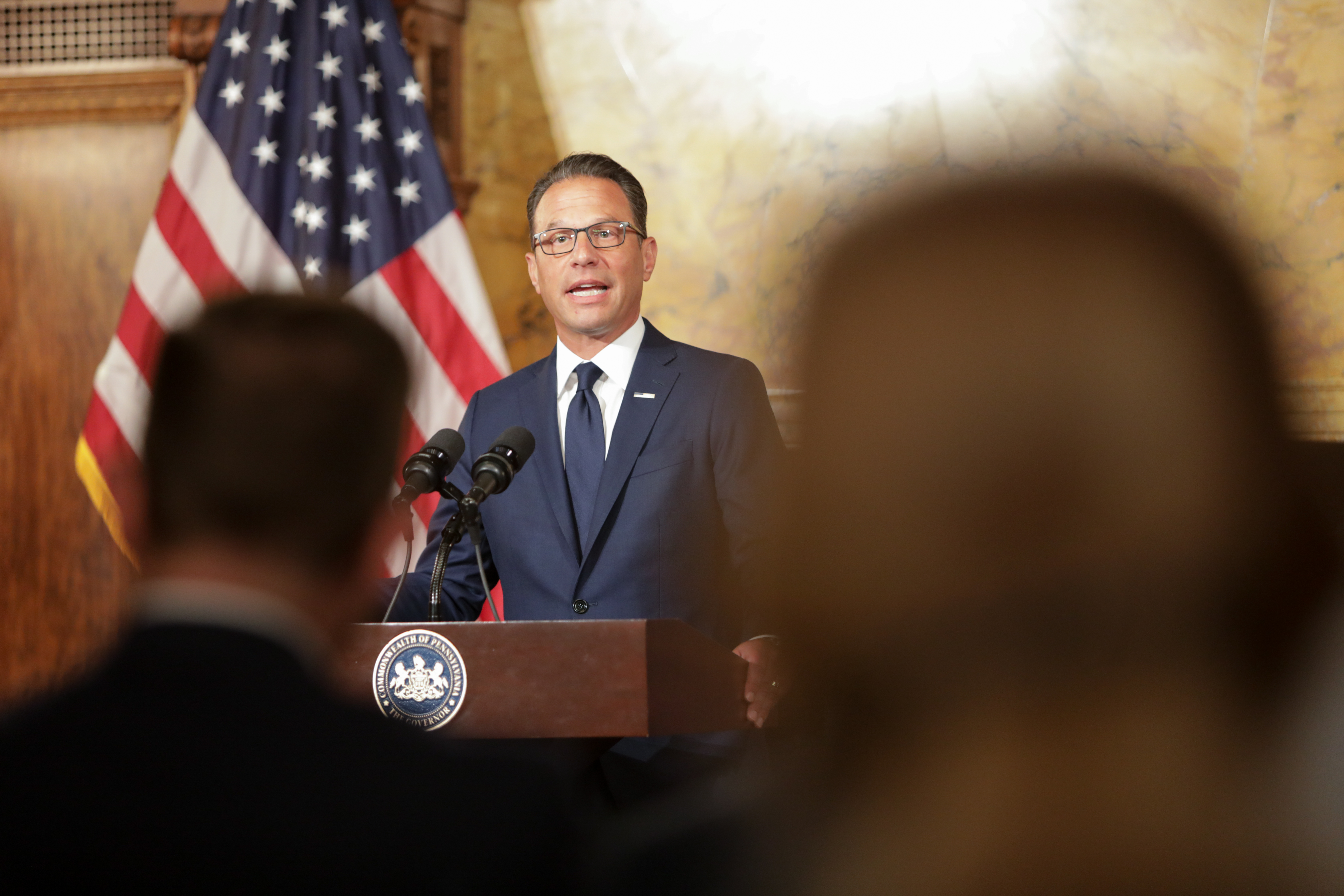
Gov. Josh Shapiro answers questions after signing an executive order restricting data centers in Pennsylvania during a ceremony in the Capitol in Harrisburg, Pa., Tuesday August 18, 2026.Kalim A. Bhatti / For The Inquirer
Prior to Shapiro’s announcement last week touting the “strictest guardrails in the nation” for data center development, his support for the projects appeared to be one of the major tests of his popularity. A Quinnipiac University poll published in July found that while 56% of voters approved of Shapiro overall, only 24% approved of how he was handling data center development in Pennsylvania.
Andsome Pennsylvanians who had voted for Shapiro in 2022 said his support for the developments had caused them to contemplate sitting out the November election or writing in a different candidate for governor.
For some voters, like Montiese McKenzie, Shapiro’s change in position has been enough.
“I’m very proud of Gov. Shapiro for being anti-data center,” said McKenzie, 48, of West Philadelphia. The Democratic voter said she fears that poor communities will face disproportionateconsequences of the construction of AI data centers.
“What happens will be very important for how I see him as a future leader,” McKenzie said.
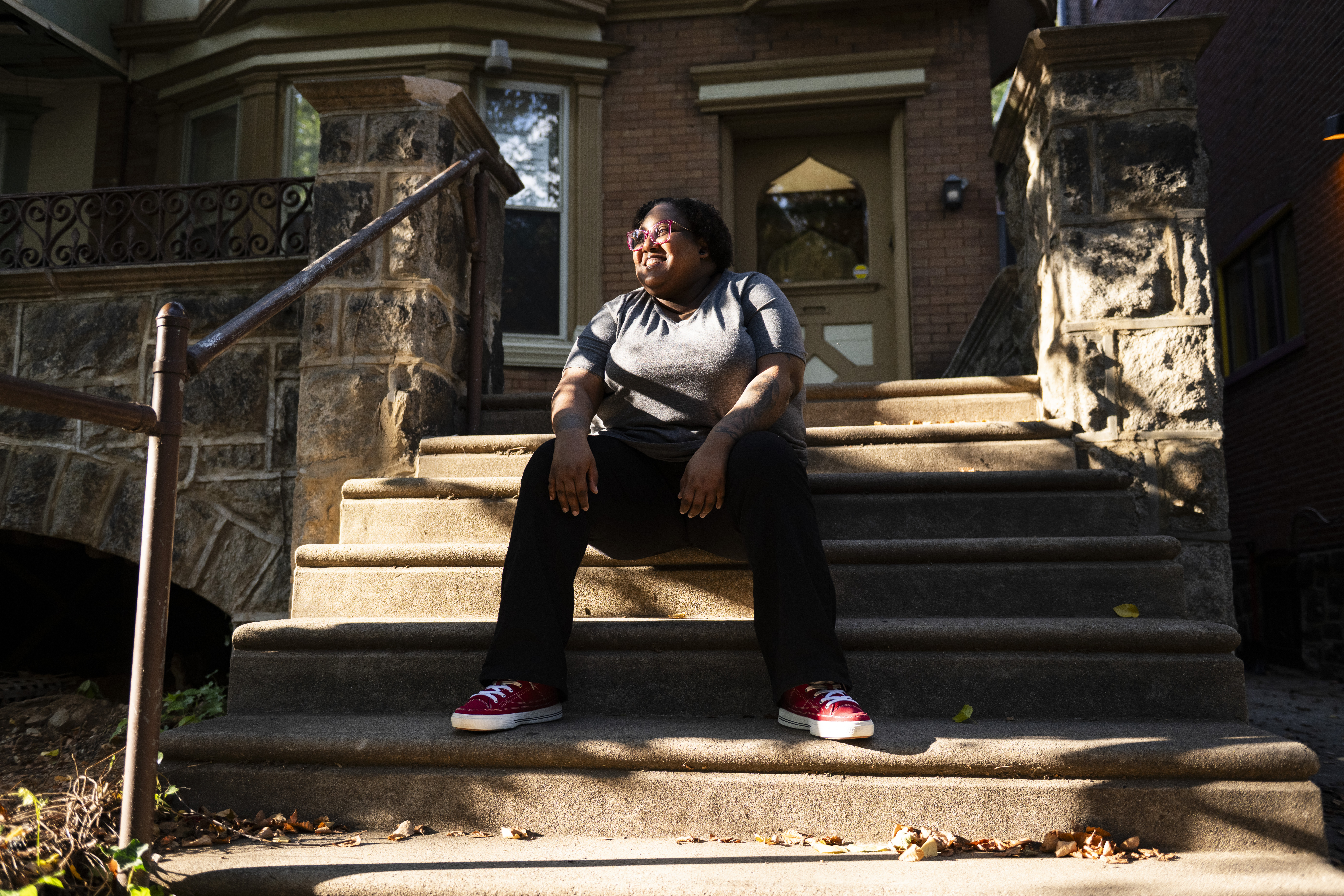
Montiese McKenzie, 48, poses for a portrait near her home in West Philadelphia on Monday, Aug. 24, 2026.Allie Ippolito / For The Inquirer
Still, Shapiro’s recent change in position has not wooed all Pennsylvania voters.
Maryann Klaus, 82, a Democrat in Upper Bucks County, supported Shapiro in 2022. But, she said, his initial embrace of data centers in the region without consulting the community was “just not good governance.” Despite Shapiro’s recent moves to restrict data center development, Klaus said, she is still reconsidering her vote for his reelection this fall.
The executive order Shapiro signed last week is a “a start,” Klaus said. “But, unfortunately, when you open the door, too many things occur and then you can’t walk them back.”
Others, like Steven Keenan of Ridley Township, say they want more data center development in the state.
Keenan, 60, a Republican who is supporting Garrity in November, said he wants Pennsylvania to lead on data centers.
“I’m not afraid of advancement in technology,” Keenan said. “I think we need all that [development]. We’re in a race with other countries that we want to dominate.”
Keenan said Shapiro’s change in position reaffirmed his support for Garrity. The shift in stance, he said, showed Shapiro was reacting to public opinion instead of doing what is right for the state. (Garrity, too, has moved away from her public support for data centers. She has called for the state to temporarily pause all data center development.)
“He goes where the wind blows,” Keenan added.
Staff writer Fallon Roth contributed to this article.
Two years ago, every child in the kindergarten class at Eleanor Emlen Elementary in Mount Airy had vaccine protection against measles.
A year later, the school’s kindergarten immunization rate had dropped to just 80%, putting students and the surrounding community at risk of an outbreak of the highly contagious disease.
Emlen is among more than two dozen Philadelphia-area schools that saw double-digit declines in kindergarten immunization rates last school year — in many cases because parents are increasingly refusing vaccines.
The affected schools span a diverse range of communities, from city neighborhoods like Mount Airy to the outlying suburbs. In Chester County, for example, a small private school in Downingtown saw its vaccination rates plunge by 20%.
Even as countywide immunization levels remain relatively high, some 40% of kindergarten classrooms across the region became vulnerable to an outbreak during the 2025-26 school year, up from 33% the year prior, an Inquirer analysis of newly released state data found.
(function(){function e(){window.addEventListener(`message`,function(e){if(e.data[`datawrapper-height`]!==void 0){var t=document.querySelectorAll(`iframe`);for(var n in e.data[`datawrapper-height`])for(var r=0,i;i=t[r];r++)if(i.contentWindow===e.source){var a=e.data[`datawrapper-height`][n]+`px`;i.style.height=a}}})}e()})();
That means that at least 249 schools had vaccination rates below 95%, the level at which scientists say a population must be vaccinated to prevent the spread of measles, one of the most contagious diseases.
Of these, 98 Philadelphia-area schools reported measles vaccination rates below 90%, presenting an even greater risk to students.
A sharp increase in parents opting out of vaccination for religious or philosophical reasons continued to drive down vaccination rates; exemptions in this category rose by 15% in the latest two years for which data are available.
(function(){function e(){window.addEventListener(`message`,function(e){if(e.data[`datawrapper-height`]!==void 0){var t=document.querySelectorAll(`iframe`);for(var n in e.data[`datawrapper-height`])for(var r=0,i;i=t[r];r++)if(i.contentWindow===e.source){var a=e.data[`datawrapper-height`][n]+`px`;i.style.height=a}}})}e()})();
Pennsylvania is among a handful of states that allows parents to opt out of vaccine requirements for philosophical or religious reasons, often by simply signing a form.
The health department published more granular, school-level vaccination data this summer for the first time, after reporting by The Inquirer and the Pittsburgh Post Gazette made this information public for the prior school year, exposing pockets of vulnerability within counties with overall high vaccination.
The new data show the growing public health threat to the region from Pennsylvania’s growing measles outbreak, in which two people in Lancaster County have died, state officials reported Tuesday. They were the state’s first measles-related deaths in three decades.
(function(){function e(){window.addEventListener(`message`,function(e){if(e.data[`datawrapper-height`]!==void 0){var t=document.querySelectorAll(`iframe`);for(var n in e.data[`datawrapper-height`])for(var r=0,i;i=t[r];r++)if(i.contentWindow===e.source){var a=e.data[`datawrapper-height`][n]+`px`;i.style.height=a}}})}e()})();
So far, nearly 400 cases have been diagnosed, with nearly half in Lancaster County. The rapidly spreading outbreak is edging closer to densely populated Philadelphia. Chester County, just west of the city, has reported the second-highest number of cases in the state.
At a news conference on the measles deaths Tuesday, Gov. Josh Shapiro stressed his concern about the rise in Pennsylvania parents opting out of vaccinations over the last 10 years.
“It has dramatically reduced community immunity in different areas of our Commonwealth,” he said. “Today, we see the consequences of a lack of immunization.”
The new school-level data on vaccines, he said, allow “everyone to see their school’s vaccination coverage and make informed decisions.” Lawmakers have also said they hope that having more access to data about their children’s schools will make families more aware of risks within their communities and encourage them to vaccinate their children.
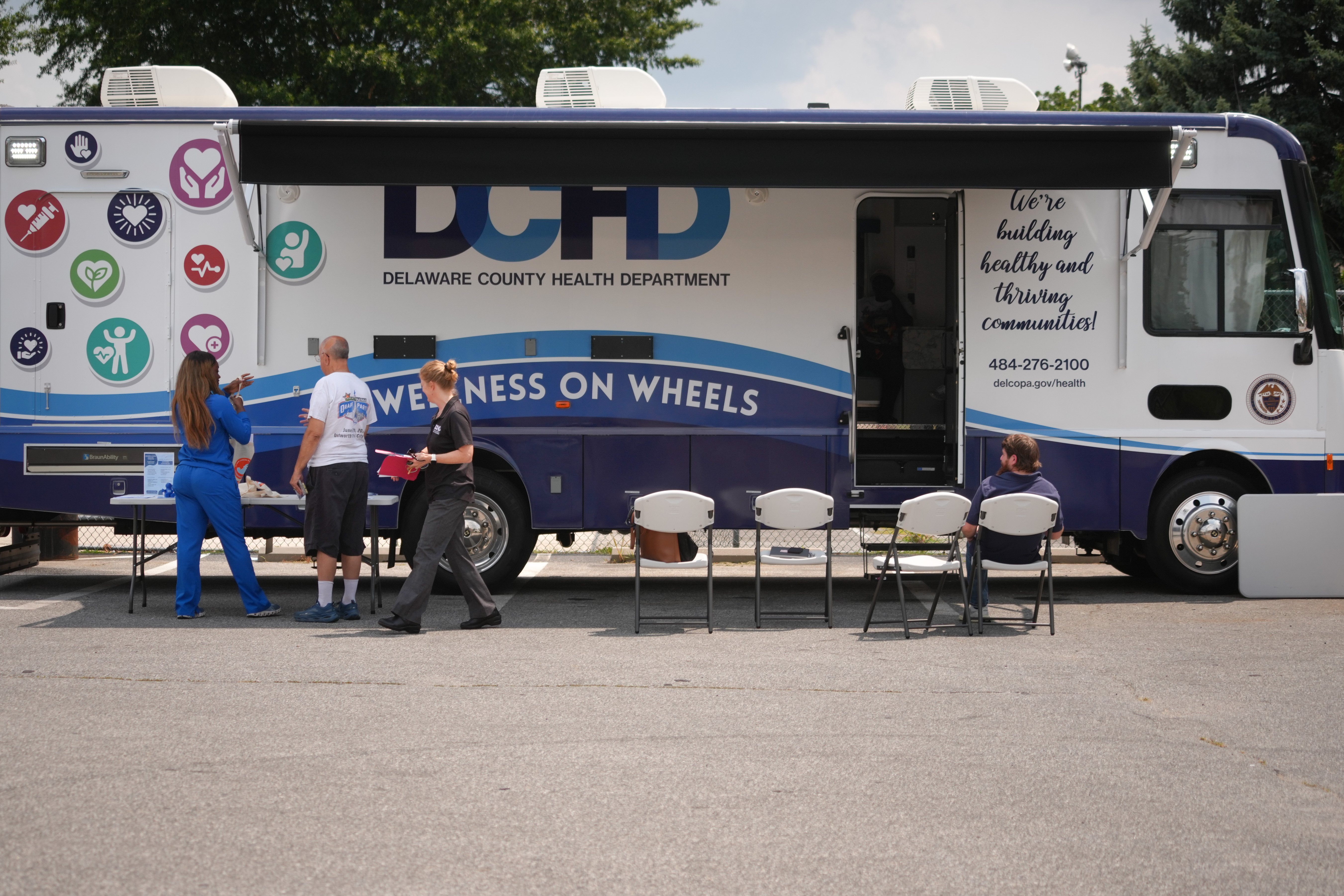
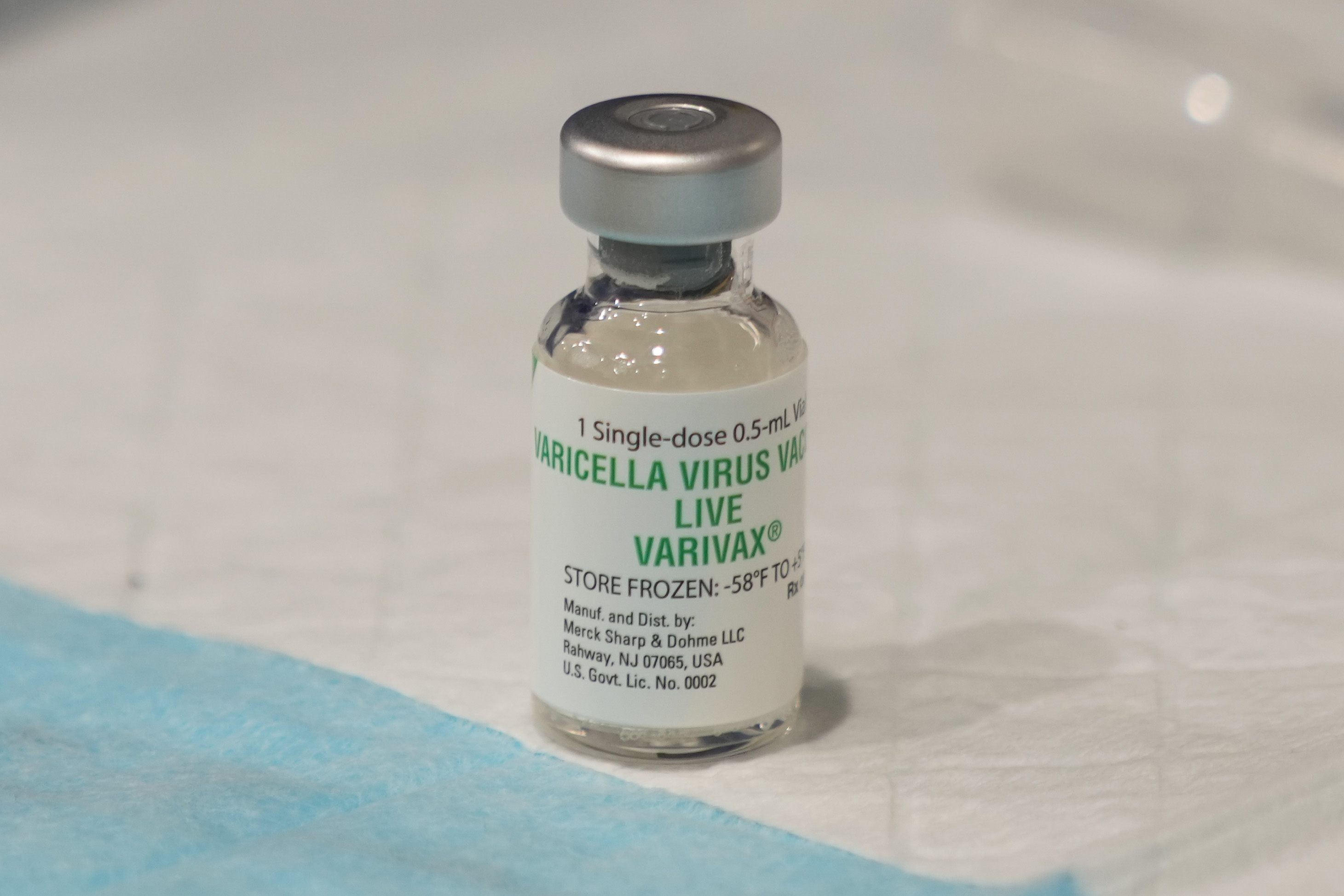
Amid rising measles case counts and declining immunization rates, Delaware County’s health department launched an immunization campaign over the summer to encourage families to vaccinate.Jessica Griffin / Staff Photographer
Emlen, which saw one of the steepest drops in protection, was one of 40 schools in the five-county region that reported 100% measles vaccination rates two years ago, only to drop below the 95% herd immunity threshold last year.
Philadelphia school officials say the changes at Emlen likely reflect increasing hesitancy among parents to immunize their children against measles, mumps, and rubella (MMR) and other diseases. State records show that most unvaccinated kindergarteners at Emlen have philosophical or religious exemptions.
Some fluctuations in kindergarten vaccination rates are typical from year to year, but the rise of anti-vaccine rhetoric in federal leadership appears to be exacerbating fears around vaccination, said Kendra McDow, a pediatrician who serves as the Philadelphia school district’s medical director.
“What we’re seeing is reflective of what I believe are local and national trends,” McDow said. “Families are confused, and they want to do right by their children.”
In the latest federal vaccine maneuver — opposed by the medical establishment, prominent Democrats, and Republican Sen. Bill Cassidy, a physician — President Donald Trump signed an executive order this month asking states to “consider updating” laws to require fewer vaccinations for schoolchildren without any medical justification. He also advocated for splitting the MMR vaccine into three separate shots — even though no separate measles, mumps, or rubella vaccines are licensed in the United States.
The order came after a chaotic year in which Health and Human Services Secretary Robert F. Kennedy fired federal vaccination advisers and pushed to upend the federal vaccine schedule. Kennedy, a longtime anti-vaccine activist, has promoted false concerns that vaccinations can lead to autism.
Families are faced with a barrage of misinformation about vaccines. Jessica Griffin / Staff Photographer
With Pennsylvania now experiencing its largest measles outbreak in three decades, Kevin Ressler, a healthcare nonprofit leader in suburban Philadelphia who was raised in Lancaster County, worries that declining vaccine rates reflect increasing political polarization.
“You don’t have to be a scientist to recognize that’s a problem,” said Ressler, the CEO of Alliance for Health Equity, a Coatesville nonprofit that works to improve access to health services. “A lot of this is rooted in whether we are able to hold trusted relationships.”
Philly-area counties all at risk
Philadelphia and its suburban counties overall remain well protected against measles, state officials say. The declines seen in the latest school year amount to less than 1% of all kindergarteners in each of the five counties in the area, an improvement from the drops that followed the COVID-19 pandemic.
But even small drops can be significant given the contagiousness of measles, which can linger in the air for hours and infect nine in 10 unvaccinated people who come into contact with it.
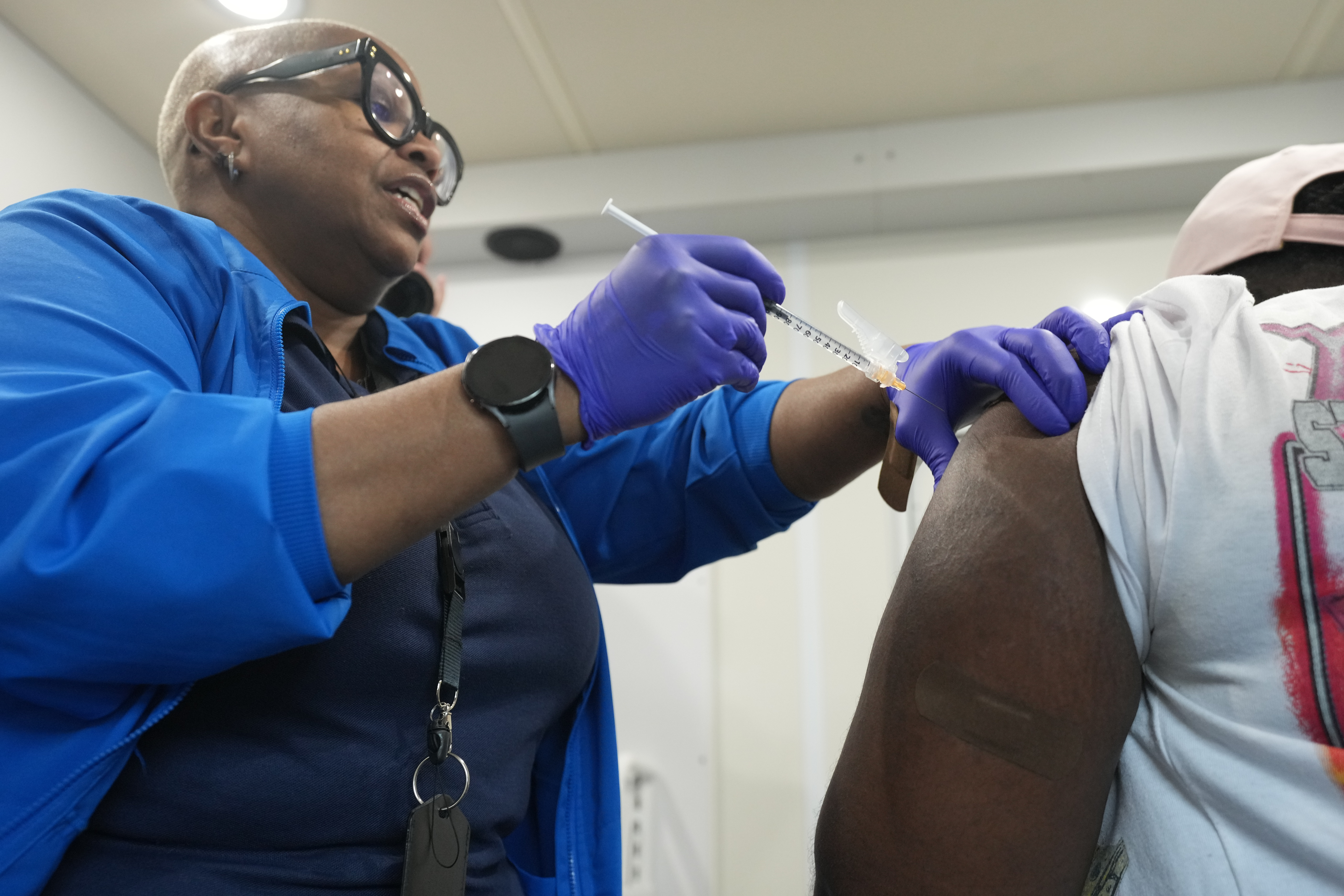
Mia Williams, a registered nurse, vaccinates a client at Delaware County’s mobile clinic in Upper Darby in July. Jessica Griffin / Staff Photographer
“The risk has definitely gone up because of lower vaccination numbers,” said Rene Najera, the director of public health at the College of Physicians of Philadelphia.
Najera says slipping vaccination rates especially endanger vulnerable students and community members beyond the schools, like pregnant women, cancer patients, or babies too young to be vaccinated. Parents of high-risk children should speak with their pediatricians about the risks of attending a school with lower vaccination rates, he said.
Last year marked the first time in more than 10 years that no Philadelphia-area county had reported measles vaccination rates above herd immunity.
Bucks County had the lowest MMR vaccination rate for kindergartners, at 93.7%, down by more than a half a percentage point from the year before.
Montgomery County, the only county in the Philadelphia region with kindergarten vaccination rates at herd immunity two years ago, slipped just below the threshold in 2025, to 94.8% vaccinated.
About 94% of Delaware County and Philadelphia kindergarteners were vaccinated last school year.
In Chester County, the only Philadelphia-area county to report cases in the current outbreak, vaccination rates for kindergartners have held steady at 94.5% for the last two school years. Some schools in the county reported steep drops in MMR coverage ahead of the current outbreak, which has seen 40 cases confirmed since June.
At Windsor Christian Academy in Downingtown, only one in four kindergarteners were vaccinated last year at a school that exceeded the herd immunity threshold the year prior. About 14% of the class had religious exemptions for vaccination. School officials did not return a request for comment.
Caln Elementary School in Thorndale saw measles vaccination rates drop from 100% to 74% in a year. Officials at the school declined to comment. (Caln closed at the end of last school year, and most of its students are transferring to the newly built Doe Run Elementary this year.)
Jeanne Franklin, Chester County’s health director, said she is “moderately” concerned about the current measles outbreak, given that many of the county’s most populous public schools still have high vaccination rates.
The school-level data improve the county’s ability to identify schools with lower vaccination rates.
Chester County health officials talk to school nurses, principals, and other administrators before the start of every school year to remind them of what to do if they identify a case of measles.
Under county policy, a single measles case in a school will mean all unvaccinated students and staff must stay home for 21 days.
This year, conversations that are usually hypothetical have taken on more urgency.
The health department has urged schools to take stock of who within their school is unvaccinated and develop a plan for how they will teach unvaccinated students who are sent home and staff classrooms of absent teachers.
“You don’t own getting them vaccinated,” Franklin said she tells administrators. “But you have to think through these things.”
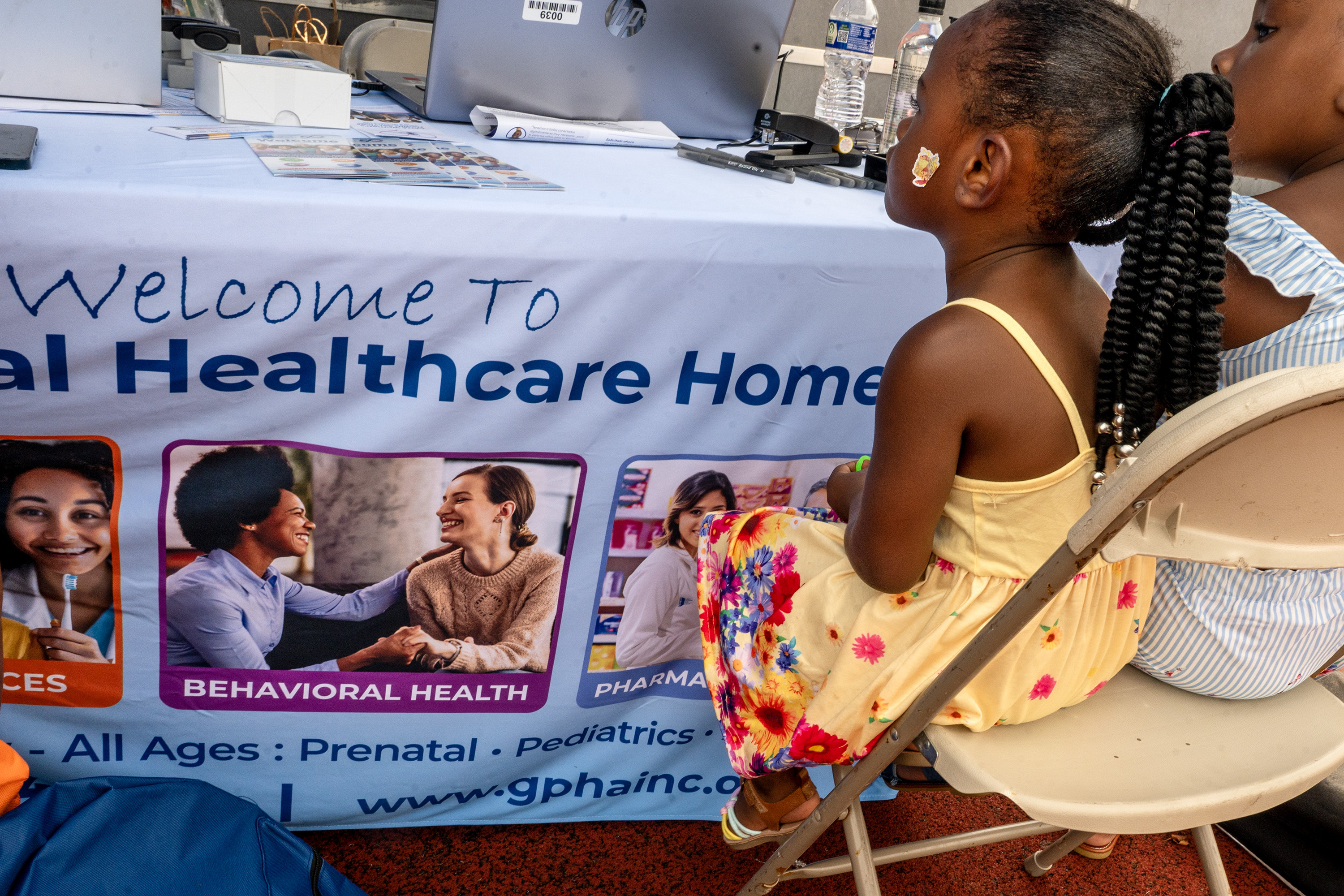
Sisters A’zuri, 3, and A’Sara, 6, wait while their mother, Shania’ Jason, checks in at a vaccination clinic during the School District of Philadelphia’s sixth annual Back-To-School Bus Tour stop this month at Marcus Foster Memorial Stadium. Tom Gralish / Staff Photographer
Philly schools on alert
As the school district’s lead health officer, McDow worries about the threat of measles so close by, but believes concerted efforts in the city have kept vaccination rates “as high as they can be in this current climate.”
She’s also monitoring Philadelphia schools where the state data show declining vaccination coverage. (The publicly available school-level data does not include classes with fewer than 20 students, for privacy reasons, or schools that did not report to the state. About 90% of schools statewide reported data in 2025.)
In some cases, what looks like a decline can be explained by delays in data reporting due to administrative issues or staff absences. School vaccination records are reported to the state during the month of December.
For example, Mantua’s Morton McMichael School reported a 50% drop in MMR vaccination coverage, initially going from nearly nine in 10 kindergarteners vaccinated to just over a third.
But by the end of the 2025-2026 school year, records show 93% of McMichael kindergarteners were fully vaccinated against measles, district officials said, though the state data does not show the improvement.
McDow worries about drops at other schools, from Mount Airy’s Emlen Elementary to North Philadelphia’s James Logan Elementary’s 18.5% decrease in vaccination rates, which are likely related to parents increasingly refusing vaccines.
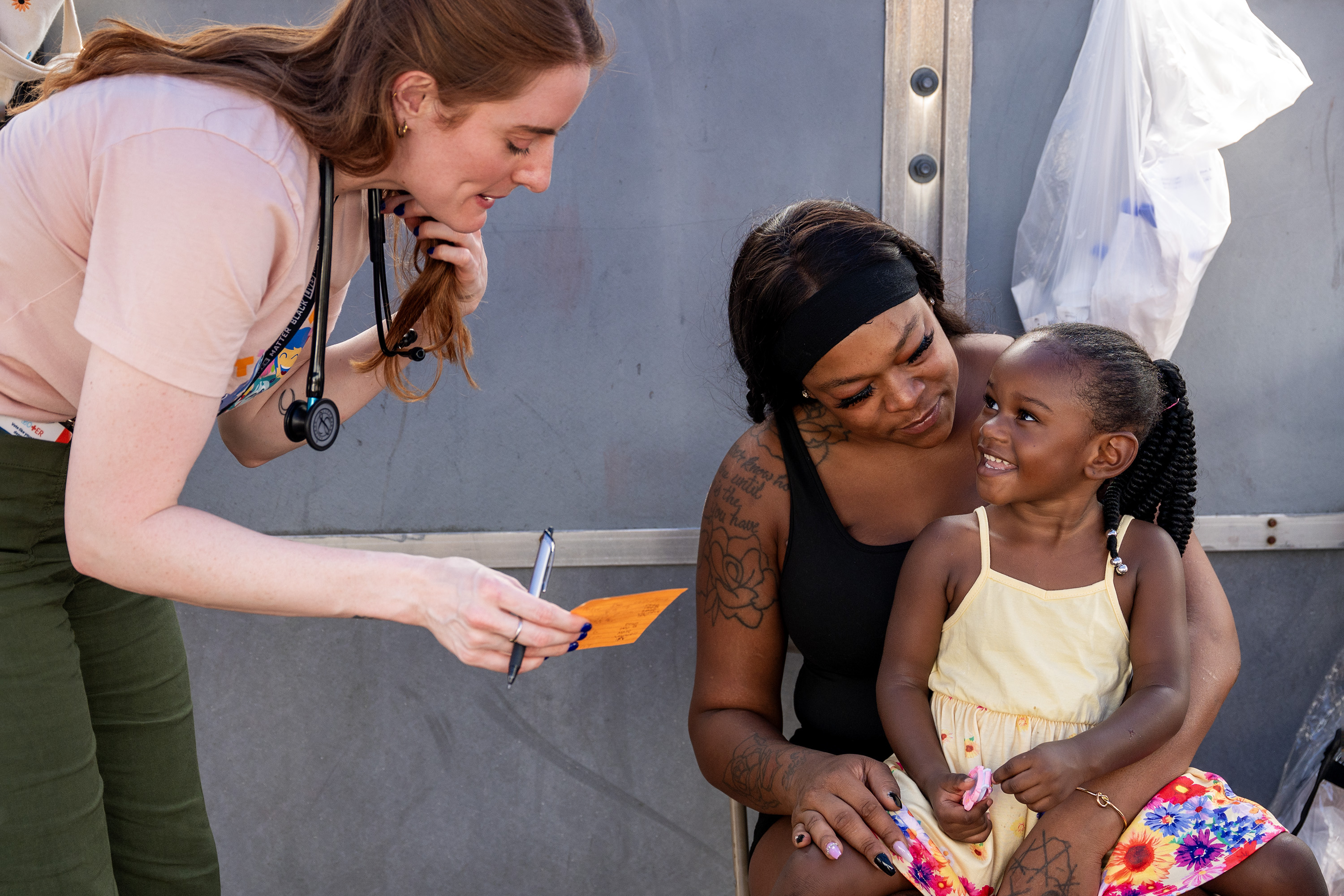
Pediatrician Amanda Bernard (left) talks with Shania’ Jason and her daughter A’zuri, 3, at a vaccination clinic hosted by the Philadelphia School District this month at Marcus Foster Memorial Stadium.Tom Gralish / Staff Photographer
The school district hosts vaccination clinics over the summer and during the school year, working with the city health department to target families with unvaccinated children and schools with low vaccination rates.
The district also works to ensure vaccination clinics are accessible to working parents, organizing some on weekends or evenings.
“We need to be talking to families and answering questions in transparent ways,” McDow said. “But we also need to be providing the opportunities for vaccination.”
Some families line up for immunizations
On a recent sweltering August afternoon, families lined up at a tent pitched on the football field at Marcus Foster Memorial Stadium in Olney, part of a back-to-school fair sponsored by the Philadelphia School District.
“IMMUNIZATIONS,” read a flag waving in the breeze. Business was brisk all day.
Some families who visited the tent were recent immigrants, getting caught up on vaccinations before their children started at their new schools.
“We’re vaccinated, my husband and I, because our parents vaccinated us. And I’ll do the same for my children,” said Betty Bachene, who moved to Philadelphia from Paris this summer. Speaking in French, she said she’s never been afraid of vaccinating her children, but does fear the diseases vaccines prevent.
Anaiya Burnham, a nurse, said she’d opted against getting COVID or flu shots for her two children, one of whom is entering kindergarten this year. But vaccinating them against measles was never a question.
“I would really be curious to know why anyone would opt out of the MMR, given the research,” she said.
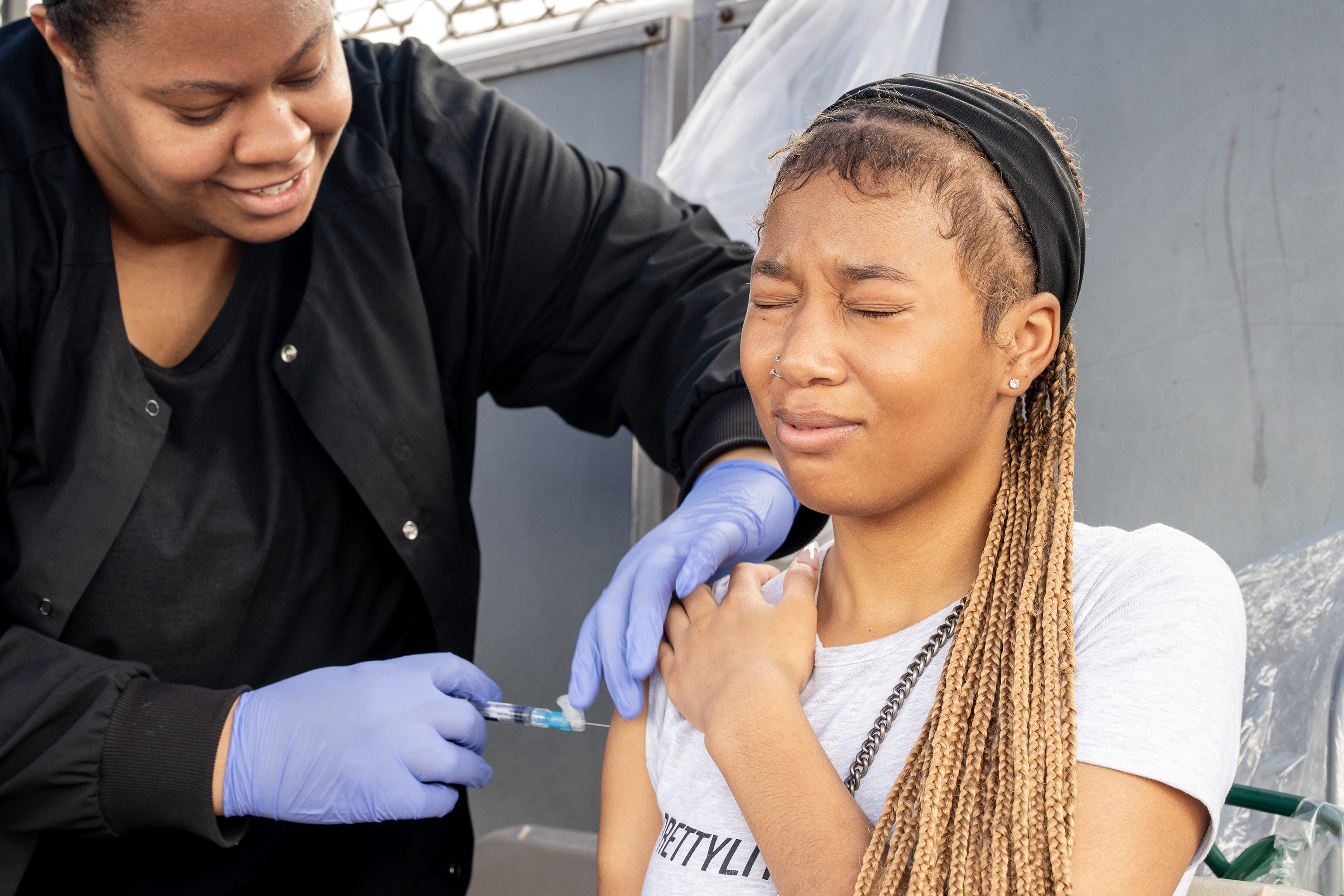
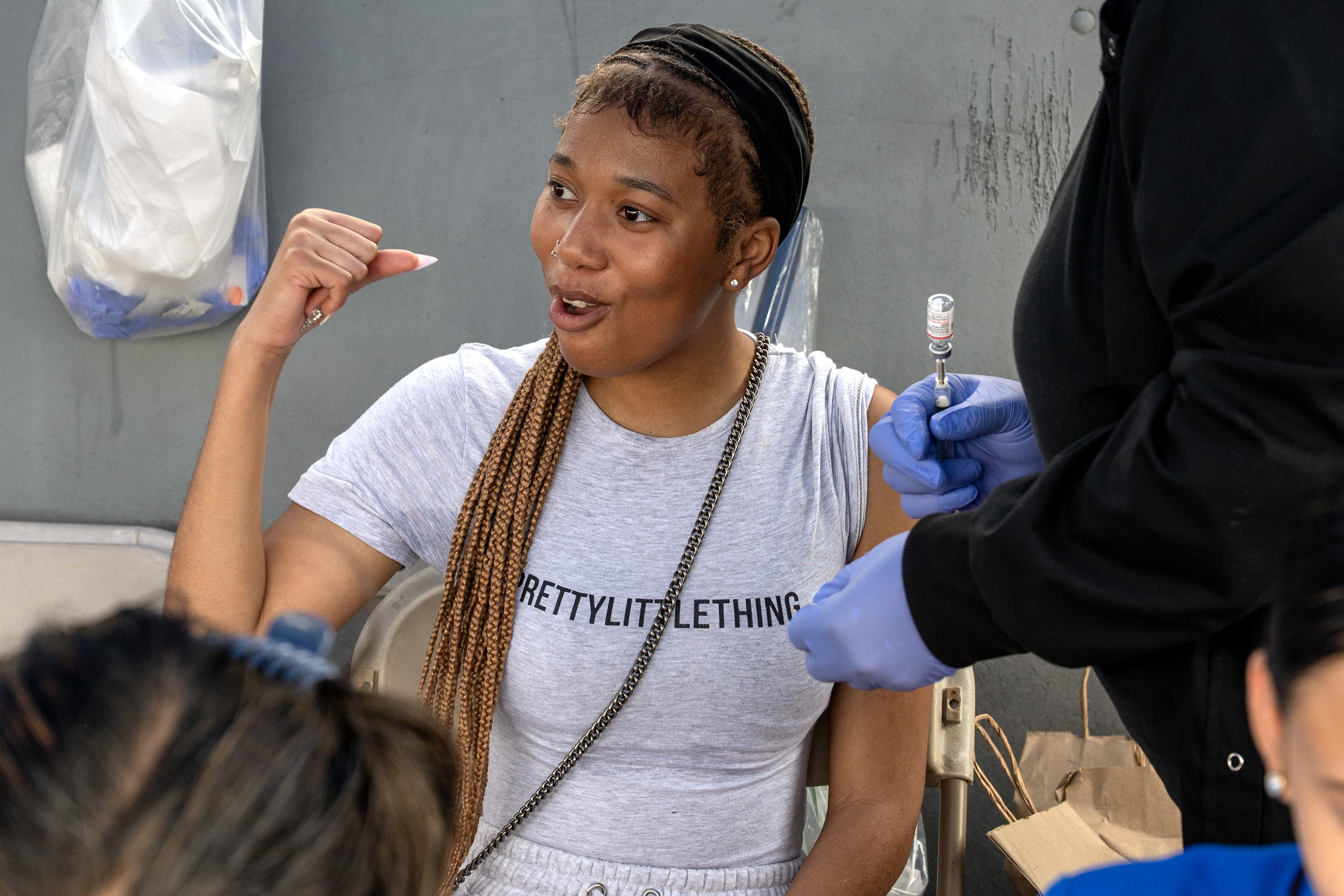
Cianey Brown, 16, reacts and turns to her family after getting an immunization at a Philadelphia school district vaccination clinic this month at Marcus Foster Memorial Stadium. Tom Gralish / Staff Photographer
Philadelphia parents face a number of different barriers that keep them from vaccinating children — and not all of them are related to vaccine hesitancy, said Amanda Bernard, a pediatrician with Greater Philadelphia Health Action, the clinic offering vaccinations at the event.
Some lack transportation to get to a health center outside their neighborhood, or don’t speak English well enough to navigate the healthcare system, she noted.
“I think that these sorts of events are really a way that we could combat that,” said Bernard, who has heightened her advocacy around vaccination as Pennsylvania’s measles outbreak has spread.
“There’s almost a desperation in my education. I sometimes feel like I’m almost begging [families] to get it.”
Editor’s note: This story has been updated to correct the name of James Logan Elementary in Philadelphia.
(function(){function e(){window.addEventListener(`message`,function(e){if(e.data[`datawrapper-height`]!==void 0){var t=document.querySelectorAll(`iframe`);for(var n in e.data[`datawrapper-height`])for(var r=0,i;i=t[r];r++)if(i.contentWindow===e.source){var a=e.data[`datawrapper-height`][n]+`px`;i.style.height=a}}})}e()})();
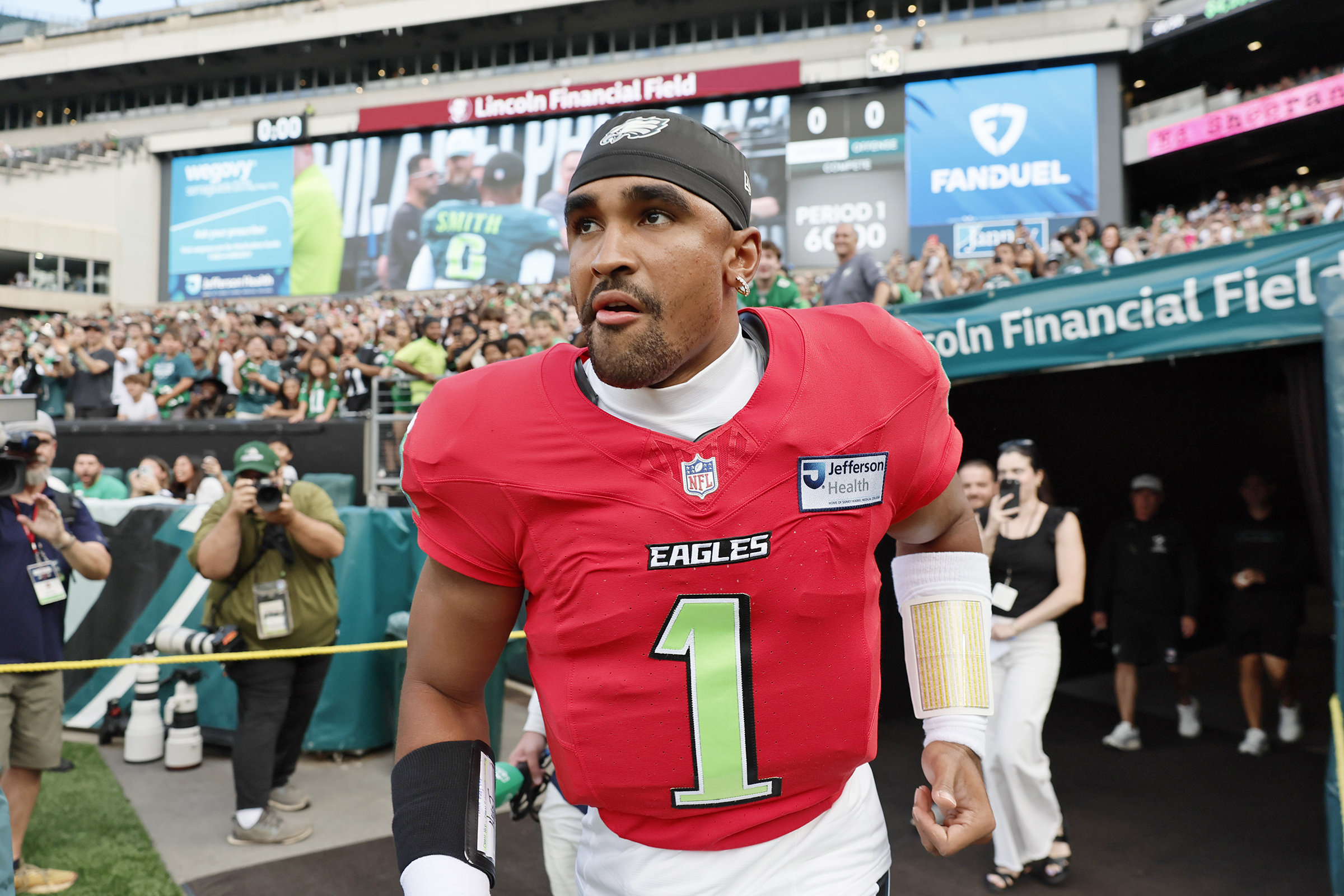
The Eagles held the 16th open practice of their 2026 training camp on Tuesday at Lincoln Financial Field. Here were my observations from Day 16 (and links to Days 1, 2, 3, 4, 5, 6, 7, 8, 9, 10, 11, 12, 13, 14, and 15):
Stowers update
Eli Stowers missed a second straight practice with a hamstring injury that he suffered in the second preseason game against the New England Patriots. The rookie tight end is expected to be out for about two weeks, from what I understand. If he’s healthy by the Wednesday before Week 1 of the regular season, he could be available for the season opener.
The following Eagles were also held out because of injury: Tackle Markel Bell (thumb/leg), cornerback Jonathan Jones (shoulder), tight end Grant Calcaterra (back), cornerback Jakorian Bennett (knee) and safety Cole Wisniewski (concussion). Cornerback Mac McWilliams (shoulder) was limited.
The Eagles had a number of players make full returns from injury, including center/guard Willie Lampkin (stinger), defensive tackle Byron Young (shoulder), running back Dameon Pierce (hamstring), tackle John Ojukwu (pectoral), wide receiver Quez Watkins (foot), cornerback Ambry Thomas (groin), and receiver Danny Gray (groin).
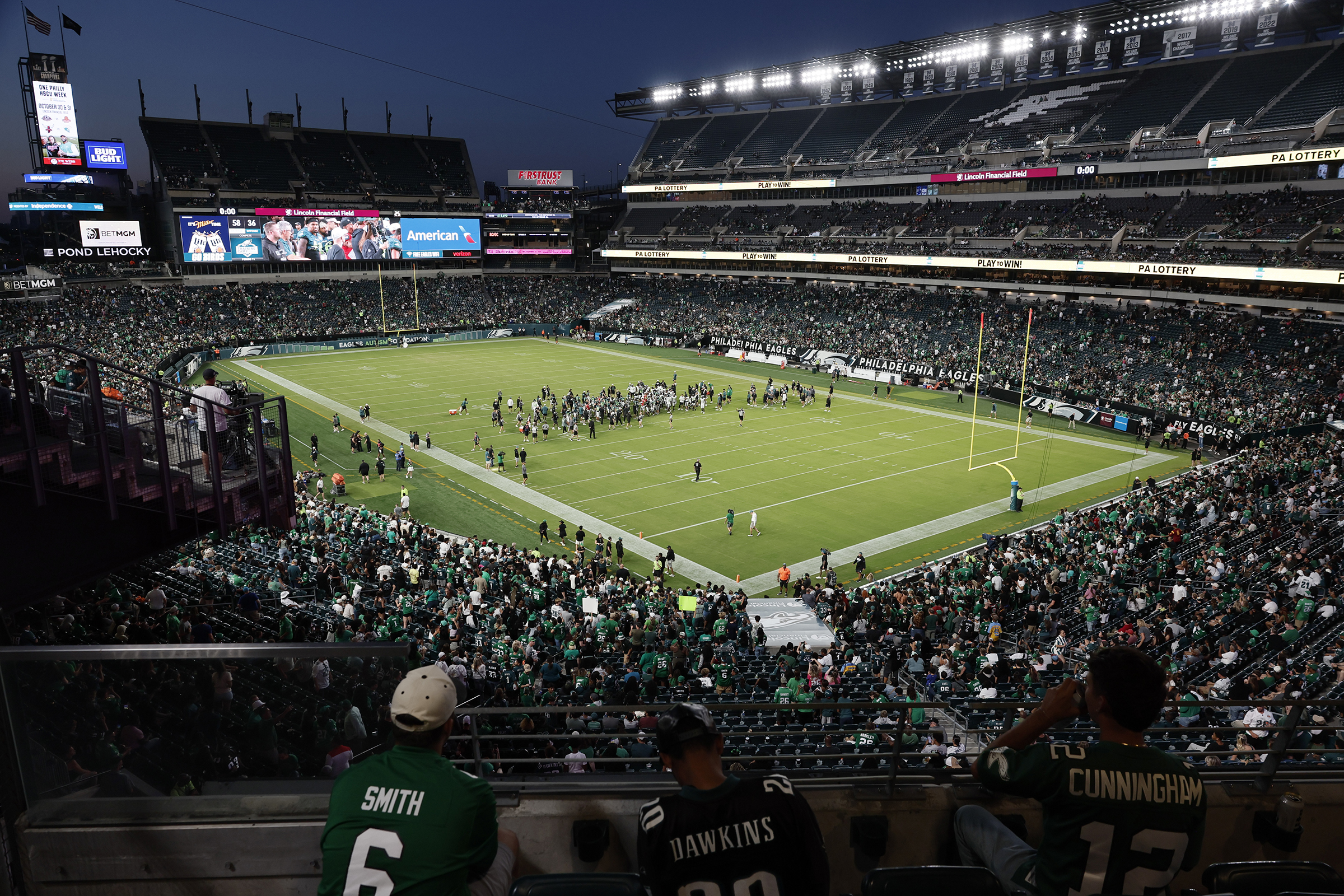
Eagles fans were back at the Linc and witnessed a defense-dominated display. Elizabeth Robertson / Staff Photographer
Oh, O-line
Guard Landon Dickerson was given a not-injury-related rest day. Whether it’s a coincidence or not, he tore the meniscus in his knee during last year’s open practice at the Linc. The Eagles may have sat him to stay away from potential bad juju. Dickerson rushed back from surgery in time for the opener a year ago, but recently said that he should have waited until he was fully recovered.
Drew Kendall took all the repetitions at left guard in Dickerson’s place. He had his ups and downs in a scrimmage that favored the Eagles defense, particularly the first unit. Kendall got toasted by defensive tackle Moro Ojomo on an inside rush that resulted in a sack at one point. Right tackle Lane Johnson left early not long after edge Nolan Smith Jr. beat him inside for a hurry. Fred Johnson took his spot with Bell out. Ojukwu got bumped up the depth chart and filled in the few times left tackle Jordan Mailata took a rest.
DeVonta Smith (right) was an offensive standout and gave Eagles fans something about which to cheer. Elizabeth Robertson / Staff Photographer
D-lightful
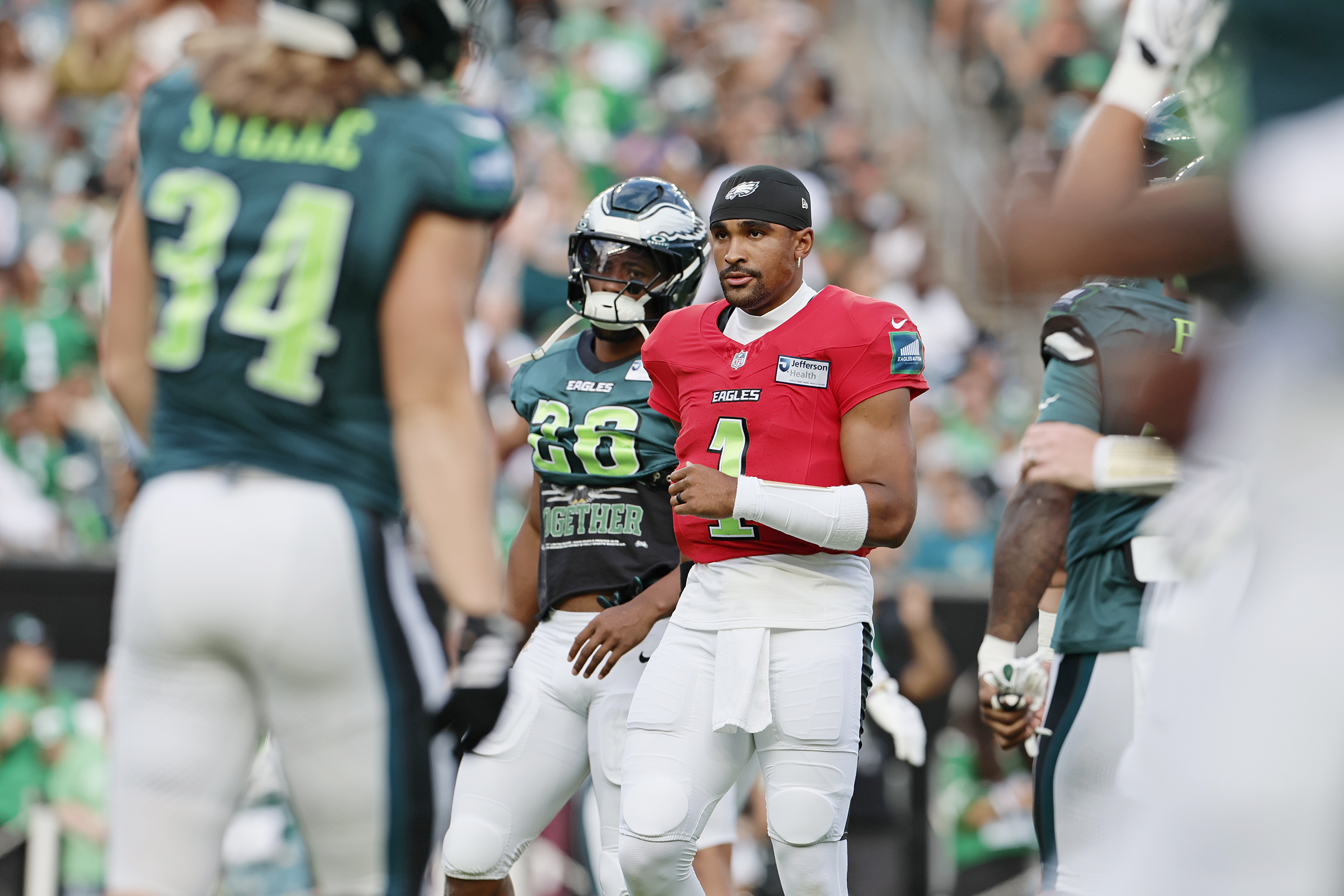
The makeshift O-line likely had something to do with the struggles of Jalen Hurts and Co. The quarterback was pressured a bunch. But Sean Mannion’s unit was often out of sync except for a couple successful red-zone plays and one good drive after being backed up. Hurts’ two interceptions to cornerback Riq Woolen will make headlines — as they should for both parties — but there were a lot of reasons why the first-unit offense looked sloppy.
Credit has to be given to Vic Fangio’s group. He’s had all of his starters for most of the summer and that same 11 was in the lineup again. Mannion’s installation has been completed for over a week, so there isn’t much new to throw at the defense. The group knows the plays, the snap count, and often what’s coming before it even happens.
On the first series, Hurts hit receiver Dontayvion Wicks for a short gain and Saquon Barkley had a solid run to the left, but it was mostly defensive dominance thereafter. Safety Marcus Epps snuffed out a Hurts draw play. Defensive tackle Jalen Carter met Barkley at the line of scrimmage for a stop. Hurts hooked up with receiver DeVonta Smith after getting forced to his right. But his pass to receiver Makai Lemon on an inside route was broken up by cornerback Quinyon Mitchell.
Jalen Hurts and the offense remains a work in progress. Elizabeth Robertson / Staff Photographer
Hurts so much
The next set was less productive for the offense or more fruitful for the defense — take your pick. Hurts went to Lemon on a schemed-up pass off play-action, but cornerback Cooper DeJean was in the receiver’s pocket. Smith burned Mitchell on a deep post route, but Hurts’ pass was underthrown and Mitchell recovered to break up the pass. Smith is clearly head and shoulders above the rest of the Eagles’ receivers.
Jalyx Hunt made Fred Johnson look like a turnstile on the way to a would-be sack. Hurts continued the play and hit Wicks over the middle, but the play was given to the defense. Another short toss to Lemon netted few yards with cornerback Michael Carter II in tight coverage. Jalen Carter touched up Barkley for a stop. And when Hurts did well to roll away from an unblocked blitzer and found Smith as his outlet, the receiver dropped the ball. On the last play of the set, Hurts chucked the ball wide and out of bounds with a covered Smith.
Jalen Hurts missed some throws behind a patchwork line but was more effective in the red zone. Elizabeth Robertson / Staff Photographer
Lemon aid
Lemon has been getting a tutorial from DeJean, one of the best slots in the NFL. Mannion called for another quick hitter to the receiver off a naked bootleg, but with Hunt in Hurts’ mug, DeJean was all over Lemon by the time the ball arrived. Jalen Carter gifted the offense five yards when he jumped offside, but a Barkley outside zone run on the next play was blown up in the backfield. Hurts likely needed to check out of that call with so many defenders in the box.
It just got worse. A Fangio blitz collapsed the pocket, but Hurts still threw to Lemon on a crossing route. It wasn’t the greatest route and Woolen snatched the ball for his first interception of the night. An offensive false start followed. Hurts did hook up with receiver Darius Cooper on a button hook. And running back Tank Bigsby had decent gains up the middle on the ground.
But Ojomo’s sack and another drop — this time from Cooper — ended the set.
Fans watched as the Eagles defense defeated the offense by a count of 58-36, based on practice scoring. Elizabeth Robertson / Staff Photographer
Red zone district
The offense rebounded in the red zone. On the first play from the 20-yard line, Barkley ran a sort-of corner route and got behind linebacker Zack Baun. Hurts’ throw was perfect and the running back made the catch for a touchdown.
On the next red-zone possession, Barkley gobbled yards up the middle on first down. But on the next play, Hurts’ downfield throw to Lemon off play-action was broken up by Mitchell. The rookie receiver didn’t appear to get enough depth on his route. The ball went back to Lemon on his next pattern — when he motioned inside and ran a wheel route — and the defense didn’t account for him. He waltzed into the end zone untouched.
Hurts built off that modicum of success during the backup portion. A first-down run didn’t net many yards. In fact, it resulted in defensive tackle Jordan Davis hobbling off after he dinged his left arm. (He later returned, outfitted with a brace.) But Bigsby churned ahead on the ground on a couple carries. And Hurts again rolled away from the rush and found tight end Cam Latu for a first down.
We got a rare glimpse of tight end Johnny Mundt in the backfield. The Bigsby rush was thwarted, but not exclusively because of Mundt’s lead block. A screen pass to Smith on the ensuing play was blown up by DeJean. But Hurts wisely kept feeding his best receiver. He rifled a dart to Smith on a comebacker ahead of Mitchell. And two plays later, tossed a strike to No. 6 just out of Woolen’s reach and Smith jetted upfield for chunk yards.
A busted play that forced Hurts into a throwaway and DeJean snuffing out a Will Shipley draw forced another third down. But receiver Hollywood Brown got wide-open downfield and raced the last 10 yards untouched into the end zone.
Saquon Barkley had a frustrating night on the ground in the open practice. Elizabeth Robertson / Staff Photographer
Two for two
The first two-minute drill was an odd one as the offense worked on getting the defense to jump offside. Barkley and tight end Dallas Goedert looked back at their coaches upset or confused or something else when a couple of the tailback’s rushes were curtailed. Center Cam Jurgens walked out of the huddle and was replaced by Jake Majors. Jurgens didn’t appear hurt. But Hurts’ hard count finally did get an impatient Ojomo to jump. It wasn’t exactly riveting stuff for the fans.
Nevertheless, the first units came out for one last hurry-up period. The offense got off to a solid start with a Barkley catch-and-run out of the backfield, a checkdown to Smith and a Hurts seed to Wicks over the middle. But when Hurts was pressured again by Hunt, he tried for Smith near the sideline. Woolen was in lockstep with the receiver, jumped the route and went the other way with the ball for a pick-six.
Nick Sirianni gave Andy Dalton the first crack at No. 2 reps on Tuesday night. Elizabeth Robertson / Staff Photographer
Second best
This was a night almost exclusively for the starters with fans in the house, and the final preseason game reserved for guys fighting to make the roster or the practice squad. There were some periods for the second and third units. Andy Dalton got the nod at quarterback as he and Tanner McKee continued to split snaps in their battle for the No. 2 job.
Dalton overthrew Cooper on his first drop. But he got into a rhythm with receiver Elijah Moore and scored on their third connection when Moore found space on a crossing route and zigzagged into the end zone.
McKee had some good moments, too. He went to Brown for a couple quickies vs. zone coverage. He found Moore as his outlet vs. the blitz. And on fourth down, he hit tight end E.J. Jenkins on a short release. Shipley did the rest on the ground and scored when he ran off right tackle. McKee’s two-point conversion try in the back of the end zone went off Brown’s hands.
McKee shined in the two-minute period. He hooked up with Cooper on a deep crosser and hit Moore on a 15-yard out. His downfield pass to Cooper was on target, but the receiver eased up his route and the ball sailed by. Cooper reacted as if he knew he messed up.
Extra points
The final score was Defense 58, Offense 36. … Rookie quarterback Cole Payton got a few reps in the backup period. … Britain Covey was again the first up to field punts, but Lemon took turns as well. If the Eagles believe the rookie can handle punts, it could make Covey expendable on game days … Shipley and Bigsby were paired as the first two kick returners. … The Eagles announced attendance of more than 45,000. Pennsylvania governor and noted Eagles fan Josh Shapiro was among them. … The Eagles will return to the Jefferson Health Training Complex for practice on Wednesday afternoon. They will have a closed walkthrough on Thursday ahead of Friday’s preseason finale at the Linc vs. the Cincinnati Bengals.
Josh Shapiro spent his formative years in Montgomery County as a rabid Philadelphia sports fan, but as an undersized point guard at Akiba Hebrew Academy, the path to signing autographs for Philadelphia fans as a sports star wasn’t all that probable.
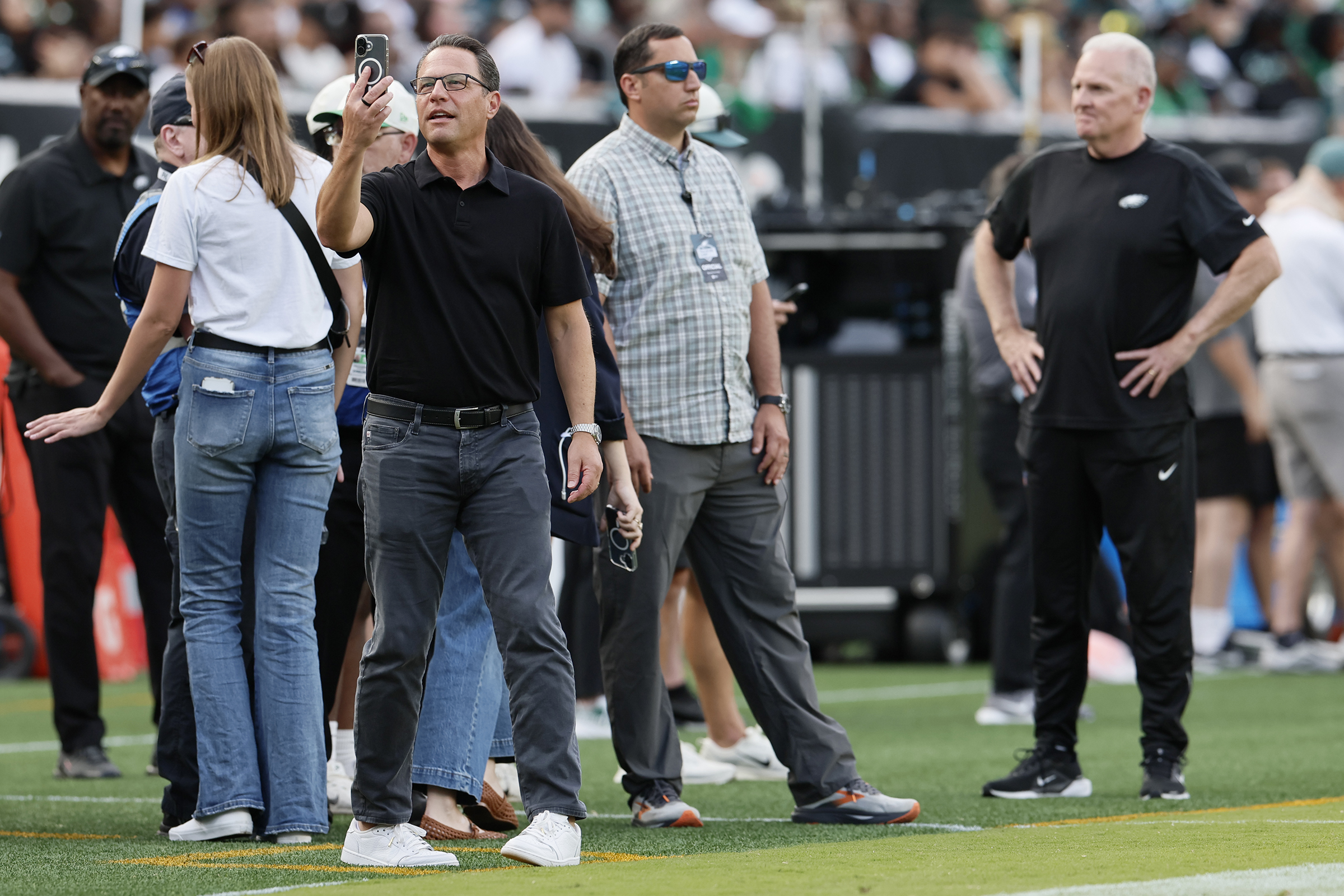
As the governor of Pennsylvania, though? Shapiro found himself catching miniature footballs and jerseys from fans and tossing them back into the stands after applying his signature Tuesday night as the Eagles warmed up at Lincoln Financial Field ahead of their open practice.
“I was joking with some of the kids, I think I was decreasing the value of their Jalen Hurts jersey,” Shapiro joked.
“Look, it’s humbling. It’s an honor to be with all these folks and to be with fellow Birds fans, who are not only out here to watch our team but also support an incredible cause. The amount of money they’re raising, about $800,000 tonight for the Eagles Autism Foundation, it’s an amazing thing Jeffrey [Lurie] has done for this city and the example he’s set for the entire country.”
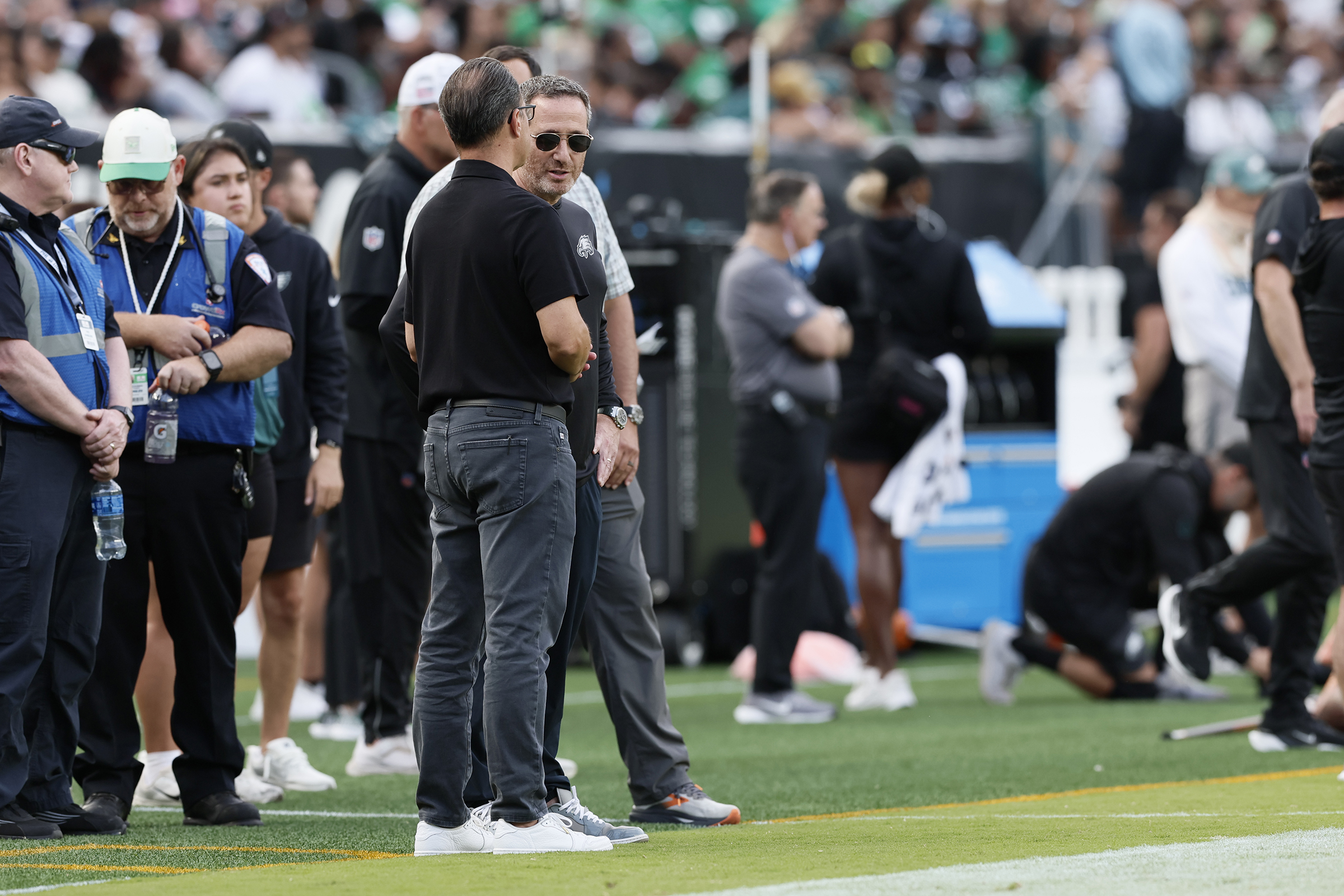
Shapiro, after finishing with autographs and pictures, made his way to the sideline, where he chatted with Eagles general manager Howie Roseman, who he later called “the best GM in all of sports, although Mike Gansey is giving him a hell of a run for his money landing LeBron.” The longtime Eagles fan is optimistic that Roseman has put together a team that can compete for another Super Bowl. Shapiro attended each of the last two Eagles Super Bowl appearances.
“I think there’s a lot of hope, there’s a lot of optimism, a lot of excitement after, obviously, a down year last year,” Shapiro said. “It didn’t end how we wanted. Folks are pumped up. I think there’s something unique about this city that 50,000 people came out to watch a practice. They’re fired up and so am I.”
Tuesday was the team’s annual open practice at Lincoln Financial Field. The stadium itself has been a topic of conversation since Lurie made public statements earlier this year about his team’s future home, indicating all options were on the table when it comes to the type of stadium and even where it’s located.
Gov. Josh Shapiro (left) talks with Eagles GM Howie Roseman during an open Eagles practice at Lincoln Financial Field on Tuesday. Elizabeth Robertson / Staff Photographer
“I appreciate the way [team president] Don [Smolenski] and Jeffrey and the entire franchise are thinking really critically about what they want for the future of a home for the Philadelphia Eagles,” Shapiro said Tuesday. “Here’s what I can tell you for sure: It’s going to be in the city of Philadelphia, and we’ll work with the Eagles once they determine what it is they’re interested in doing, but I appreciate the thoughtful and deliberate approach that they’ve taken to this process.”
The Eagles are at Lincoln Financial Field until 2032 under their current lease agreement. But the team has begun what Lurie called “exploratory research” on a new or renovated stadium. Last year, the organization sent out surveys to season-ticket holders to seek input on the prospects of a stadium renovation or a new building. It is similar to what the Eagles did before they moved from Veterans Stadium to Lincoln Financial Field in 2003.
Lurie said the goal is to have a more “definitive approach” to the team’s stadium plans in a year or two.
“They’re going to think about what they want as a home for the next 30, 40, 50 years, and then we’ll have a conversation when they’re ready to have that,” Shapiro said.
Shapiro won’t be in his current office when the lease expires. He’s up for reelection in November, and while polls show him with a 16-point lead, he’s term-limited and can’t be governor beyond the next four-year term. It remains possible, too, that he considers a run for president in 2028.
A second daily Amtrak passenger train between New York’s Penn Station and Pittsburgh will begin operating in mid-November, after an $80 million state investment in track and safety upgrades, the Pennsylvania Department of Transportationannounced Monday.
Bringing another Pennsylvaniantrain into service will double travel options for people traveling east-west between the state’s two largest cities; it also will provide more capacity for riders to and from New York.
The train currently has stops in Philadelphia, Harrisburg, Altoona, Johnstown, Latrobe, Greensburg, and Pittsburgh.
“The people of Western Pennsylvania have waited a long time for more passenger rail service and my administration has chased every opportunity to get this done,” Gov. Josh Shapiro said in a statement.
The Pennsylvaniantravels the Norfolk Southern-owned Pittsburgh Line, part of a main artery for freight moving between Chicago and metropolitan New York. The freight railroad has major terminals in Toledo, Cleveland, Pittsburgh, Harrisburg, and the Lehigh Valley.
A Supreme Court decision on mail voting has created uncertainty with 70 days until critical midterm elections, but Pennsylvania Democrats are trying to reassurevoters that they will have the option to cast a ballot by mail.
More litigation over this highly watched issue is expected and further rulings could still come even after November, affecting the next presidential election.
“We will continue to fight at every stage — including in the Supreme Court the moment they attempt to implement this — to make sure every eligible Pennsylvanian can cast their ballot by mail, free from federal interference,” said Montgomery County Commissioner Neil Makhija, a Democrat and an attorney who sits on the county’s election board.
The procedural update, issued Monday, does not rule on the underlying legality of President Donald Trump’s March executive orderthat directed the U.S. Postal Service to help decide which voters should receive mail ballots but rather whether lower courts had the authority, at this stage, to block it.
Pennsylvania was among the states suing to block the order.
“Absolutely nothing has changed here in Pennsylvania. You can vote in person on Election Day or you can vote by mail before Nov. 3,” Democratic Gov. Josh Shapiro said Tuesday evening during a visit to the Eagles’ training camp.
“Your vote will be counted. Your vote is safe and secure,” Shapiro said. “No matter how many times the president wants to try and undermine people’s right to vote in this commonwealth, he needs to know that he will be met with a swift rebuke from me.”
Shapiro noted that the election is administered by the state and its counties under the Constitution.
Revival of the debate about the availability and security of mail voting, and the temporary clearance, however, may instill doubt among voters that their ballot will be received and tabulated, Makhija said.
“With just weeks until ballots go out, last-minute federal interference sows chaos for the voters we serve,” he said.
Trump’s efforts to restrict mail voting, part of his long-standing grievance against the system despite repeatedly utilizing the method himself, are still working through the courts, and several experts doubt the proceedings will move fast enough to affect the November elections, whenfour swing districts in Pennsylvania could help determine control of the U.S. House.
“Whatever may ultimately happen in this litigation, I’m pretty skeptical that anything is going to change for this November’s election,” saidBen Geffen, staff attorney at the Public Interest Law Center in Philadelphia, a nonprofit group that monitors election issues.
States across the country will soon begin preparing applications and mailing ballots to voters.
Pennsylvania voters, who can cast a ballot by mail for any reason, must complete an application by Oct. 27, and all ballots must be returned by Nov. 3 at 8 p.m., according to the Pennsylvania Department of State’s website.
“Turning that battleship around in a matter of days is extremely unlikely,” Geffen said.
A spokesperson for the Pennsylvania Department of State said the ruling does not change state law, and voters should be confident that counties will continue to ensure eligible voters can cast their ballot by mail.
“The USPS action is not lawful, and we will continue to challenge that rule to ensure that Pennsylvania voters can have their voice heard — whether they vote in person, on demand, or by mail,” Geoff Morrow, the department spokesperson, said.
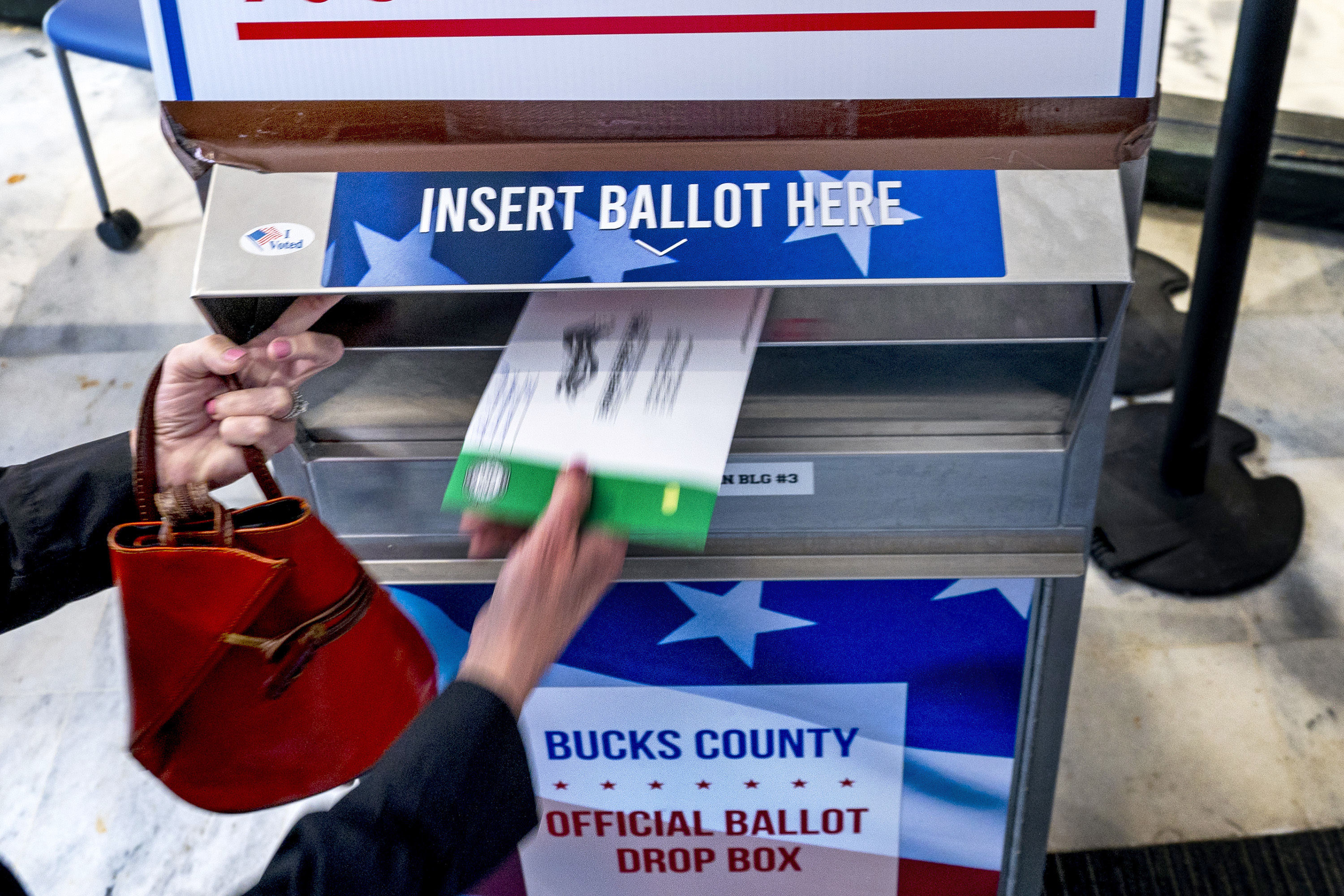
Geffen’s advice for those concerned is to start early. Get your mail ballot application in right away, and as soon as you receive your ballot, fill it out and return it. For now, you can still send your ballot through the U.S. mail. But you can also drop it off at your county election board, and many counties offer satellite locations and drop boxes.
If you prefer to vote in person on Election Day, go in the morning, he said.
“You have options for how to vote, and you will get to vote. Nobody’s taking away the election, and just jump on it early,” he said.
After Trump, through his directive, ordered the Postal Service to withhold mail ballots to individuals who are not on an approved list, which he instructed states to develop in order to prevent noncitizens from voting, Shapiro promised to protect Pennsylvanians’ right to vote by mail. In April, he used his power as governor to join other Democratic states in a lawsuit that argued the order violated states’ constitutional power to carry out elections.
The unions representing postal employees also criticized Trump’s push to restrict mail voting as November approaches.
“Any insinuation that voting by mail is not safe and secure is severely misguided. Letter carriers have securely delivered ballots for decades, and there is no evidence that the existing system requires substantial changes,” NALC president Brian L. Renfroe said in the statement.
Gwen Ivey, president of the American Postal Workers Union, Local 89, which represents between 1,300 and 1,400 U.S. clerks in Philadelphia who process mail, maintenance employees, and drivers who transport mail, also warned against inserting the Postal Service into decisions over voting.
“The Postal Service is a public institution that serves the American people,” Ivey said Tuesday. “It should not be placed in a position of determining who is entitled to participate in elections or becoming an instrument for restricting access to the ballot boxes.”
Trump has long railed against mail voting, referring to the ballots as “crooked” in his State of the Union address and suggesting they amount to cheating. But his 2024 victory in Pennsylvania was thanks, in part, to a higher rate of mail voting by Republicans.
The practice is particularly useful for seniors and voters in rural areas — often with strong Republican bases — where voters may live far from their nearest polling location.
“If you want to win, mail it in, that’s our message to our Republican voters,” then-Pennsylvania GOP chairman Lawrence Tabas said two years ago. The Pennsylvania GOP did not respond to a request for comment for this article.
Pennsylvania Republicans have been more supportive of Trump’s SAVE America Act, an election reform proposal stalling in Congress that he insists will make voting more secure, though most election experts say new guidelines in the legislation would make it harder to vote.
You’ve probably noticed that many of your favorite TV news anchors are on vacation right now, because the conventional wisdom is that nothing ever happens in August. That conventional wisdom has been wrong since Aug. 24, 79 A.D., when Mount Vesuvius erupted. The calendar has failed to stop natural disasters like Hurricane Katrina (see item below) or human-made ones like Richard Nixon, who resigned on Aug. 9, 1974. I’m going to tempt fate and take some vacation time next week, including a rare newsletter skip. I’ll see you in two weeks. What could possibly go wrong?
Trump’s autocratic assault on Stars and Stripes isn’t just bad. It’s personal.
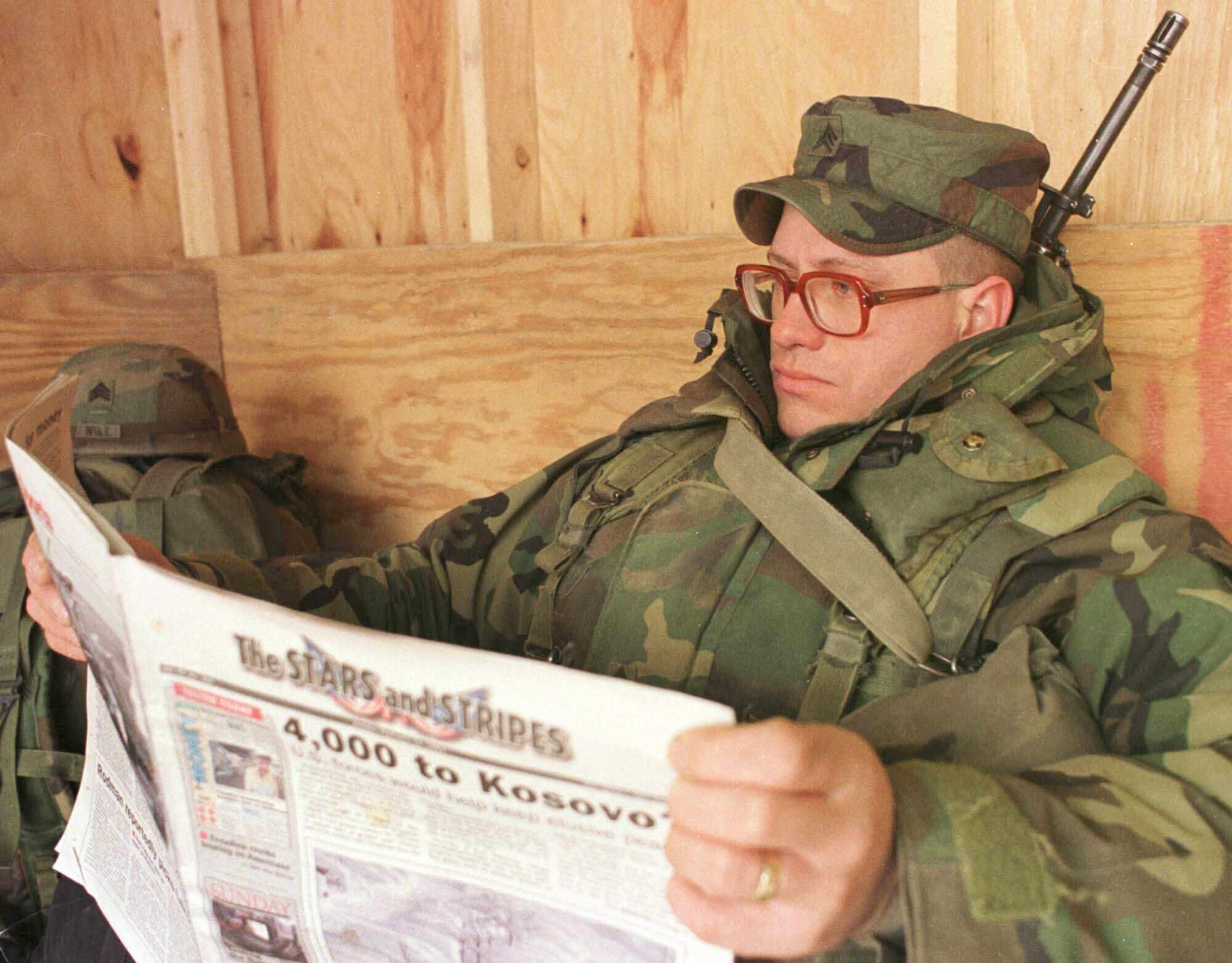
Sgt. John Hubbuch of Versailles, Ky., one of the members of NATO-led peacekeeping forces in Bosnia, reads a copy of the Stars and Stripes in 1999.AMEL EMRIC
Less than two months after the U.S. dropped the most powerful weapon humankind had ever invented — the atomic bomb — on the cities of Hiroshima and Nagasaki, the American military arrived in Japan to implement a very different kind of tool in the U.S. arsenal of democracy.
A free and largely unfettered newspaper.
The first edition of the Stars and Stripes Pacific newspaper was published from downtown Tokyo on Oct. 3, 1945, when the ink on the Japanese surrender that ended World War II was barely dry. This was the start of a decades-long run when print journalism was still the best way to get information that could be entertaining or essential out to hundreds of thousands of U.S. troops who initially occupied Japan and other Pacific outposts, and later would see combat in Korea and Vietnam.
Stars and Stripes Pacific — like virtually everything tied to U.S. imperial might after the war — is part of a complicated legacy that overlapped with American censorship of local and outside media in Japan. Yet, U.S. soldiers managed to get their own information from a publication that celebrated the better angels of the First Amendment back home, with coverage of Tokyo’s war-crimes trial and later from the front lines in Korea.
It was only part of a much grander legacy for Stars and Stripes, which has been the American military’s independent news source tracing all the way back to 1861 and the Slaveholder’s Rebellion.
Famously, when legendary World War II Gen. George Patton threatened to jail editorialcartoonist Bill Mauldin over a cartoon lampooning him, his superior, Gen. Dwight D. Eisenhower, stopped him. “Stars and Stripes is the soldiers’ newspaper,” Ike reportedly said. “We will not interfere.” Mauldin was awarded a Pulitzer Prize for his wartime cartoons. In 2010, Stars and Stripes reporters exposed the Pentagon’s efforts to slant mainstream media coverage of the war in Afghanistan, and won a George Polk Award.
That feisty spirit of Stars and Stripes runs deep in my family’s DNA. My maternal grandfather, Thomas Blender, who’d been a photo editor at the Peoria (Ill.) Journal Star before joining the Army, was sent to Tokyo in those early days to work as a top editor of the Pacific publication. I’ve always regretted, after Grandpa Tom died when I was only 11, that I never got to ask him about those days once I’d been infected with the family journalism bug I’d eventually pass on to my own son.
That must be why it felt like a personal attack last Friday when the Pentagon of Donald Trump and his like-minded “Secretary of War” Pete Hegseth obliterated 155 years of editorial freedom by firing its editor, its publisher — who, seeing the writing on the wall, was about to retire — and its Middle East correspondent. That journalist, Lara Korte, said she was pink-slipped for an interview with CBS News about her reporting on the dreadful conditions for Navy sailors aboard the USS Abraham Lincoln.
The fuse had already been lit back in January when Hegseth’s Pentagon gutted the regulations regarding the government-funded news organization by stripping language that called for “a free flow of news and information to its readership without news management or censorship.” The new rules, which instead said Stars and Stripes’ journalism “must be consistent with good order and discipline of the military,” were seen asan invitation for censorship. Sean Parnell, the formerly embattled Pennsylvania Republican who is now Hegseth’s chief spokesperson, blasted Stars and Stripes for “woke distractions.”
Three months later, Jacqueline Smith, the internal editorial watchdog of Stars and Stripes at the Pentagon, criticized military brass for editorial interference and was promptly fired. But the last straw for the outlet came two weeks ago with its aggressive reporting about problems aboard the Lincoln, which spent nine months mostly at sea with dwindling supplies tied to Trump’s ill-advised war on Iran. Journalist Alison Bath reported that sailors’ families were growing deeply concerned about the mental health of the aircraft carrier’s exhausted crew.
That work epitomized everything that has been good and decent about Stars and Stripes. What the newspaper has shown at its best is that — despite all the contradictions and moral failings of U.S. postwar imperialism — a democratic government can value the press freedom that its armed readers literally died for from Gettysburg to Omaha Beach. That high-minded ideal was a beacon to set us apart from our adversaries in Nazi Germany or Soviet Russia, who never would have permitted the kind of honest coverage Stars and Stripes offered for decades.
Until America found itself with a government with the same philosophy as 1939 Berlin or 1949 Moscow. Just like his boss, Hegseth has shown nothing but contempt for the notion that his “warfighters” might actually serve to protect Americans’ right to the truth about their own government, including the foibles of his Pentagon.
On Monday, it came out that the military’s U.S. Central Command told the Intercept that it maintains “a list of people to disregard,” a.k.a. a blacklist. This is the same U.S. Department of Defense — sorry, Pete, that is still its legal name — that also forced out any journalist who wouldn’t sign their integrity away to work in the press room at the Pentagon.
The firings at Stars and Stripes and the Pentagon’s apparent desire to turn the award-winning newspaper into a Pravda-style propaganda sheet for Hegseth’s testosterone-dosed military feels like a new low on the road toward the utter obliteration of all press freedom.
Since returning to power last year, Trump and his MAGA minions have waged war against journalists they’ve called “the enemy of the people” — and they’ve done so not through some grand Orwellian censorship edict, but through a mix of billionaire carrots and sticks that have inflicted a thousand small cuts. That means rewards for wealthy allies who buy prominent news organizations (think the Ellison family assuming control of CBS and being on the brink of getting CNN) or neuter them (Jeff Bezos at the Washington Post) — but lawsuits, obstacles, or straight-up bullying for everyone else.
Another alarming example of the precarious state of the First Amendment came earlier this month when a lawyer for Trump threatened a $5 billion (with a “b”) lawsuit against a left-leaning think tank, the Center for American Progress (CAP), if it didn’t retract a factual report that the Trump regime’s deployments of National Guard troops to U.S. cities have not lowered crime rates.
The CAP has stood its ground so far, but this reveals the state of play right now. MAGA World has already either bought off or intimidated much of the mainstream media, so now they are hoping they can crush the outliers like Stars and Stripes or CAP, one by one.
The mission my grandfather was dispatched to Tokyo to carry out after World War II was on the fringe of an idea that came to be known as “soft power” — the now-quaint notion that America could form healthy alliances with the rest of the world through good things like vaccinating children or printing uncensored journalism, instead of dropping bombs. Other organizations meant to show people in oppressed lands that press freedom and democracy are things to fight for — like Radio Free Europe — have been forced to grapple with Trump-ordered cutbacks.
The right knows exactly what it is doing — that truth and knowledge are kryptonite for its authoritarian project. Increasingly, they are saying the quiet parts out loud. The great Tennessee journalist Phil Williams recently unearthed a sound bite from a white supremacist confab in Rome in which the conversation turned to America’s growing number of news deserts where journalism has all but perished.
“Local media has been dying all over America, which means that there’s essentially no real way to hold local governments accountable — and they can do whatever they want,” white nationalist Kevin DeAnna told the gathering. “You should be fantasizing about this. This is a good thing.”
No, it’s not. The government’s bludgeoning of Stars and Stripes has truly — to borrow from a storied military campaign of yesteryear — crossed the Rubicon of no return for its all-out blitzkrieg against the truth. All of us, including the laggards of the mainstream media who continue to pretend this war doesn’t exist, need to fight back with everything we have.
I never got to know my Grandpa Tom very well, but I know in my soul that this is what he would have wanted.
Yo, do this!
Meep, meep! If timing is really everything, then the half-animated, half-real feature film Coyote vs. Acme, which hits theaters this week, will be the greatest motion picture of all time. The film is based on a 1990 New Yorker essay that imagines Warner Bros. cartoon icon Wile E. Coyote suing the giant Acme Corp. over years of faulty products that literally blew up in his face and ruined his shot at catching the speedy Road Runner. The fact that real-world corporate baloney delayed for several years the release of this film mocking the excesses of runaway capitalism is an unbelievable irony. I’m really looking forward to seeing it.
Books, despite their apparent looming extinction, remain a great way to track what humankind is thinking about. This summer, the hot topic is anxiety over AI and the unchecked power of Silicon Valley. In addition to the best-selling Nerd Reich, now there’s the great essayist and Harvard historian Jill Lepore with her new tome, The Rise and Fall of the Artificial State, out today. Lepore’s timely work tracks the rise of authoritarianism run not so much by a tinhorn dictator, but by machines, and how humanity can fight back.
Ask me anything
Question: Do PA Dems have a legit chance of freeing us from Joe Pittman’s reign of terror in the state Senate? — Travis (@unraptured.bsky.social) via Bluesky
Answer: Travis, the answer is absolutely yes. Democrats in the Keystone State have managed to chip away at what once seemed like a permanent GOP majority in the upper chamber at the same time that they’ve recaptured the state House. The current Republican Senate edge is just 27-23, meaning Democrats have to flip only three more GOP seats among November’s 25 contests. Every arrow — Trump’s high disapproval, the popularity of Gov. Josh Shapiro at the top of the ticket, and special-election results like last week’s shocking Democratic House victory in a blood-red district in Western Pennsylvania — points toward a blue tsunami. The Democrats have reportedly targeted three suburban swing districts. The big question for 2027 may be whether Shapiro really wants a Harrisburg trifecta pushing him to the left.
What you’re saying about …
OK, last week’s question about Georgia Sen. Jon Ossoff’s pointed comments regarding Donald Trump’s corruption, including an eyebrow-raising mention of ever-present aide Natalie Harp, was kind of a slam dunk for readers of this newsletter. You saw nothing uncivil in the fighting spirit of his remarks, and a surprising number of you echoed back a phrase from my question: “a breath of fresh air.” Wrote Daniel Fleischer: “Jon Ossoff called Trump a ‘crook.’ If anything, that’s a euphemism understating Trump’s criminality.” Added Patricia Eisenberg: “What he said was undeniably true — the President chose this young woman to travel on his escape plane, not one of his cabinet members.”
📮 This week’s question: It seems like the GOP’s got nothing ahead of the midterms beyond its opposition to what it calls “men playing women’s sports.” It’s kind of pathetic, but it does pose a question for Democrats: Do they strongly embrace transgender rights, or is that risking political defeat in today’s culture wars? I have a strong opinion on this, but what do you think? Please email me your answer and put the exact phrase “transgender politics” in the subject line.
Backstory on Indiana’s new, outrageous Katrina
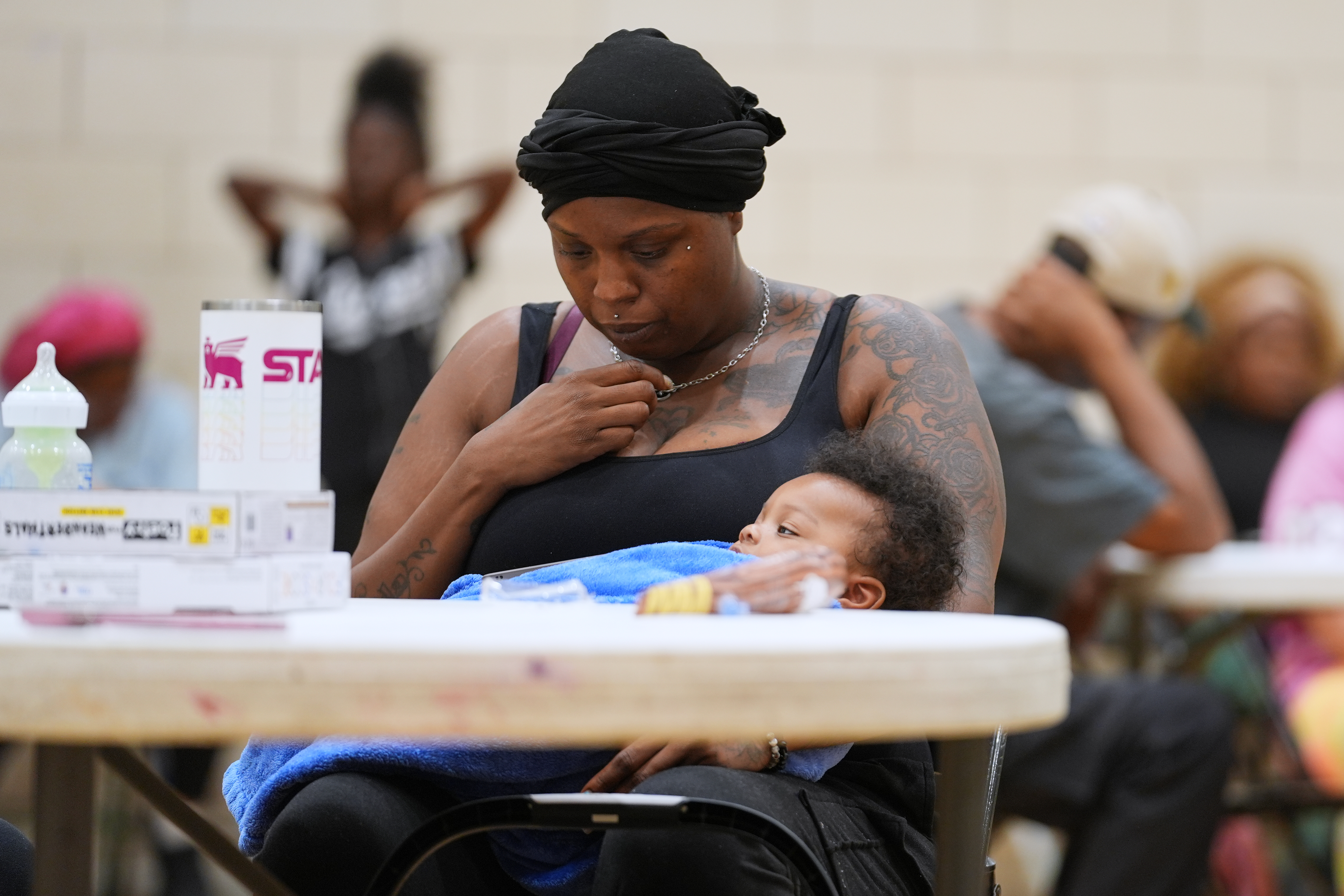
A woman sits inside the City Life Center as she waits for food in Gary, Ind., on Aug. 20, more than a week after a deadly storm passed through the area.Nam Y. Huh
Exactly 21 years ago today, a tropical storm in the Atlantic Ocean rapidly intensified into a hurricane — Hurricane Katrina — and raced across Florida on a path into the Gulf of Mexico, where it became a Category 5 monster. Still, many of us in 2005 briefly thought the Gulf Coast dodged a bullet when Katrina weakened slightly, and its center struck what looked like only a glancing blow on populated New Orleans. Then, one by one, the city’s levees began to break, and the water rose.
The death and destruction in Katrina’s wake was covered around the clock on cable TV, yet it took a couple of days for news anchors to articulate what viewers were seeing with their own eyes. The thousands of people who crowded interstate overpasses or were trapped on roofs were almost all Black, and most were desperately poor.
In These Times wrote the following week that “many Americans were surprised that most of the victims of the New Orleans flood were Black: Their image of the Crescent City had been one of jazz, tasty cuisine and the good-natured excesses of its lively festivals. Where did all those black people come from, they wondered; and where were the white victims?” Katrina triggered some long-overdue conversations about inequality and racism in America, and the inept response from the George W. Bush administration would start his steep decline in public approval. Long before the roughly 1,400 New Orleanians who died in the flooding or chaotic aftermath could be buried, many folks were asking how to prevent this from ever happening again.
It wasn’t a hurricane that struck Gary, Ind., and surrounding communities in the state’s northwest corner exactly two weeks ago on Aug. 11 — just a thunderstorm — but the winds were nearly as intense, snapping trees and downing power lines across the region. Gary’s 67,000 predominantly Black residents hunkered down in the dark nights and blistering hot August days as their refrigerated food went bad, and waited for help. And waited.
While life returned to normal across the rest of the storm-battered Midwest, the massive outage in the region that includes Gary that began with some 375,000 homes lacking electricity dwindled at a snail’s pace. After two weeks, there were still more than 5,000 families without power and struggling with spoiled food and closed schools and workplaces. There is growing anger among residents who say that Indiana’s heavily Republican power structure and Donald Trump’s federal government feel no sense of urgency to rescue a city that is mostly African American.
“This isn’t a problem that started with the storm,” the hip-hop star Freddie Gibbs, who grew up in Gary, told MS Now Monday night. “We are a predominantly Black city that tends to get ignored.” It feels like Katrina redux — an island of utter despair in the world’s wealthiest nation, with a government’s inaction bordering on criminal neglect. But there is one big difference: This festering crisis has been mostly ignored by the national media. The tragedy isn’t just our inability to stop the next Katrina, but our inability to care.
What I wrote on this date in 2022
One of George Orwell’s greatest passages in 1984 concerns Winston Smith’s job of cutting out old newspaper articles and tossing them into “the memory hole” — inconvenient truths meant to be forgotten by civilization. That’s how it feels now reading news stories from those four years in the early 2020s when Donald Trump was out of power, and America took baby steps back toward normalcy that would later get crushed. On Aug. 25, 2022, I wrote about one of these: Joe Biden’s eventually failed plan to wipe out some $300 billion of the nation’s massive student loan debt. I wrote that “this week will be remembered as one giant leap toward an idea that can change everything — the notion that higher education should be a public good, not the privatized rat race that has demoralized our rising generations.”
Look what’s happening out in the streets, got a revolution — and it’s not the one anyone saw coming. Growing public rage against Big Tech — the intrusiveness of artificial intelligence and the noisy, polluting data centers that power it, and increasingly also against omnipresent surveillance cameras — has become the surprise issue of the 2026 midterms. Politicians in both parties are performing backflips to join the bandwagon. Over the weekend, I wrote about how voter anger against Silicon Valley and its billionaires is rapidly reshaping our politics, and what could happen if our broken system fails to deliver radical change.
For the first time in recent memory, August has been living up to its reputation as a slow news month (so far), but on the baseball diamond things have really been heating up as kids are drifting back to school. The Phillies’ just-ended nine-game winning streak has electrified a city that’s been having a pretty good summer in spite of everything. The Inquirer’s oft-cynical sports columnist Marcus Hayes even published a list of five reasons to believe the Phils can go deep into October with a reenergized starting lineup, world-class pitching, and improved defense. A stunning turnaround from long-anticipated rookie pitcher Andrew Painter has also been key to the team’s revival in the National League East. It’s an old-fashioned pennant race, and subscribing to The Inquirer is the best way to keepup.
By submitting your written, visual, and/or audio contributions, you agree to The Inquirer’s Terms of Use, including the grant of rights in Section 10.
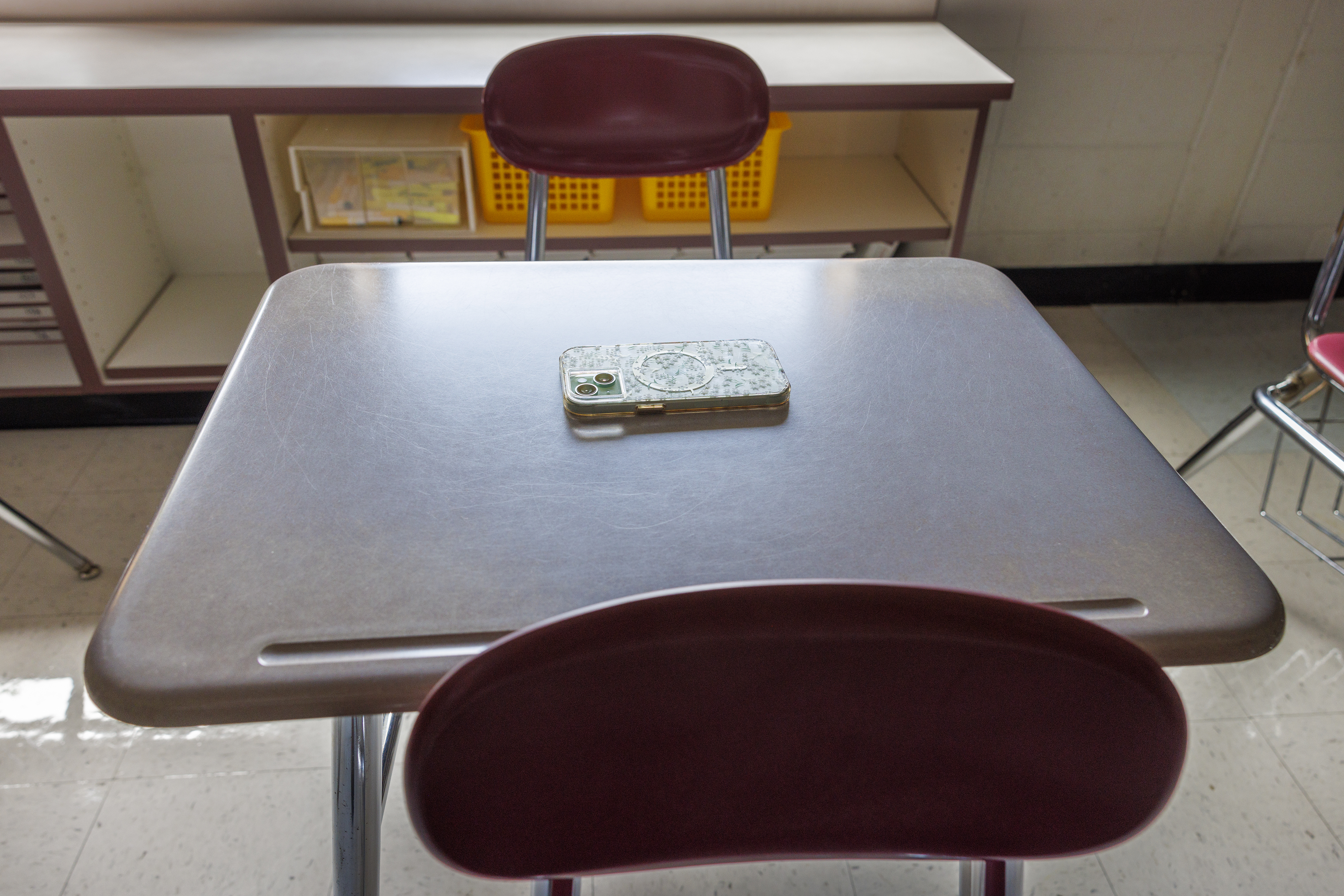
New Jersey students are going back to school with a new phone-free routine in September.
Starting on the first day of classes, all K-12 students in public schools must power off and put away phones and most internet-enabled devices before the bell rings, with only a few exceptions.
Heartily endorsed by educators who believe it will ease classroom distractions, promote academic performance, and improve student mental health, New Jersey’s new rule marks a big change for students accustomed to having their cellphones and other devices nearby and checking them regularly — even during class.
Some districts, such as Cherry Hill and Woodbury, have voluntarily implemented cell phone bans. Woodbury Superintendent Andrew Bell said most students embraced the restrictions and spend more time interacting with each other during breaks.
“At this point, it’s simply part of our culture and daily routine,” Bell said of the cell-free policy, passed two years ago.
The state left it to local school boards to determine how to implement the law at a district level, while complying with the guidelines. Because policies may vary, parents and students should check with their local district.
The law requires the state’s nearly 600 public school districts to adopt a policy banning the use of cell phones and other personal devices for the entire school day. The law allows some flexibility on enforcement and how the devices are stored.
The state Department of Education issued guidelines this summer to help district set local policies. Some districts including Cherry Hill in Camden County and Washington Township in Gloucester County this month are voting on amending existing policies.
Districts had to decide whether students would be required to store their phones in their lockers or bins, in locked pouches, or in their backpacks with their personal belongings. The devices must be powered off.
The guidelines apply to all internet-enabled devices, typically smartphones, smartwatches, smart glasses, and ear buds, or any device that can access online content.
Some districts have also included other communication devices like flip phones, two-way radios, and walkie-talkies. Some rules may vary, for age appropriateness, depending on grade level, too.
What is bell-to-bell?
Cherry Hill school board member Bridget Palmer explained the restriction this way at a recent board meeting: “The minute you walk in to the meeting, you leave.”
The law restricts students from using their phones during lunch and study hall periods.
Districts get to decide whether phones can be used before and after school on school grounds, on school buses, and during school-sponsored events, such as athletic events and extracurricular activities.
“We’re not going to tell kids they can’t use their phones when they’re at Disney,” Washington Township Superintendent Eric Hibbs said at a board meeting. “We couldn’t enforce it anyway.”
Districts must also provide parameters for how and when parents can contact their children during an emergency. Hibbs said Washington Township will have phones available in every office that a student can use, and is developing a way for parents to contact their child on a district-issued device.
“A true emergency — all of this goes away,” Hibbs said. “No child will ever get in trouble for calling 911 for reporting an emergency.”
Where will the phones be stored?
The law lets the districts decide where the phones will be stored during the school day. The state provided some funding for districts to purchase locked Yondr pouches. Others are designating lockers or bins.
Lianah Carruolo, 12, a seventh-grade student, unlocks her cell phone pouch outside the junior high entrance to Woodbury Junior/Senior High School on Friday, Sept 20, 2024. Alejandro A. Alvarez / Staff Photographer
Cherry Hill’s amended policy would allow students to keep their phone in their personal belongings. It must be turned off, not just on vibrate or silent.
“We prefer that you don’t bring it to school, but if you bring it to school, it has to be off and in your backpack or your locker for the duration of the day,” Palmer said.
In Camden, the district’s new “off and away” policy says phones should be off and out of sight. They are permitted at a teacher’s discretion for instructional purposes. After a first offense, the phone will be confiscated and returned to the student at the end of the day; for subsequent offenses, the phone will be returned to a parent or guardian.
In Washington Township, pre-K to fifth graders must store their phones in their backpacks, sixth to eighth graders must store theirs in their lockers, while high schoolers will be allowed to keep theirs in their backpacks.
Hibbs said few high school students use their lockers so it was decided to allow them to keep their phones in their personal property. With about 2,100 students, the high school is among the largest in South Jersey.
Are there any exceptions to the law?
The law mandates exemptions for students with a disability or an Individual Education Plan (IEP) or 504 plan that stipulates the need for an internet-enabled device.
The exemptions include students with a health plan, such as students with diabetes who need their phone to check glucose levels.
There are also exemptions for students who use the cell phone for translation, or are the primary caregiver responsible for the well-being of a family member.
School policies must also outline procedures for mobile devices that will be implemented in the event of an emergency, such as a lockdown.
In the event of a family emergency, parents should contact the school office, and not the student directly, according to the guidelines.
How will violations be handled?
Districts are posting the new policy on district and school websites, in newsletters, and on social media sites to inform parents and students about the changes. They may also review it at back-to-school-nights, orientations, and training sessions for staff.
The disciplinary action may vary, depending on the district, and typically begins with a warning that could escalate with additional violations. Districts must specify how a phone may be confiscated.
Washington Township’s policy calls for progressive discipline, based on grade level. Administrators, not teachers, will be responsible for confiscating a phone if warranted.
There are 10 possible “consequences” for high school students beginning with an administrative warning for the first two violations, Hibbs said.
For additional violations, students will get a lunch detention and have their phone confiscated for three to four infractions, Hibbs said. Sanctions for additional violations include requiring a student to store the phone in a locker or main office, a two-day internal suspension, and a mandatory parental meeting.
“It’s going to be a very big change, but we’re going to navigate it,” Hibbs told the board.