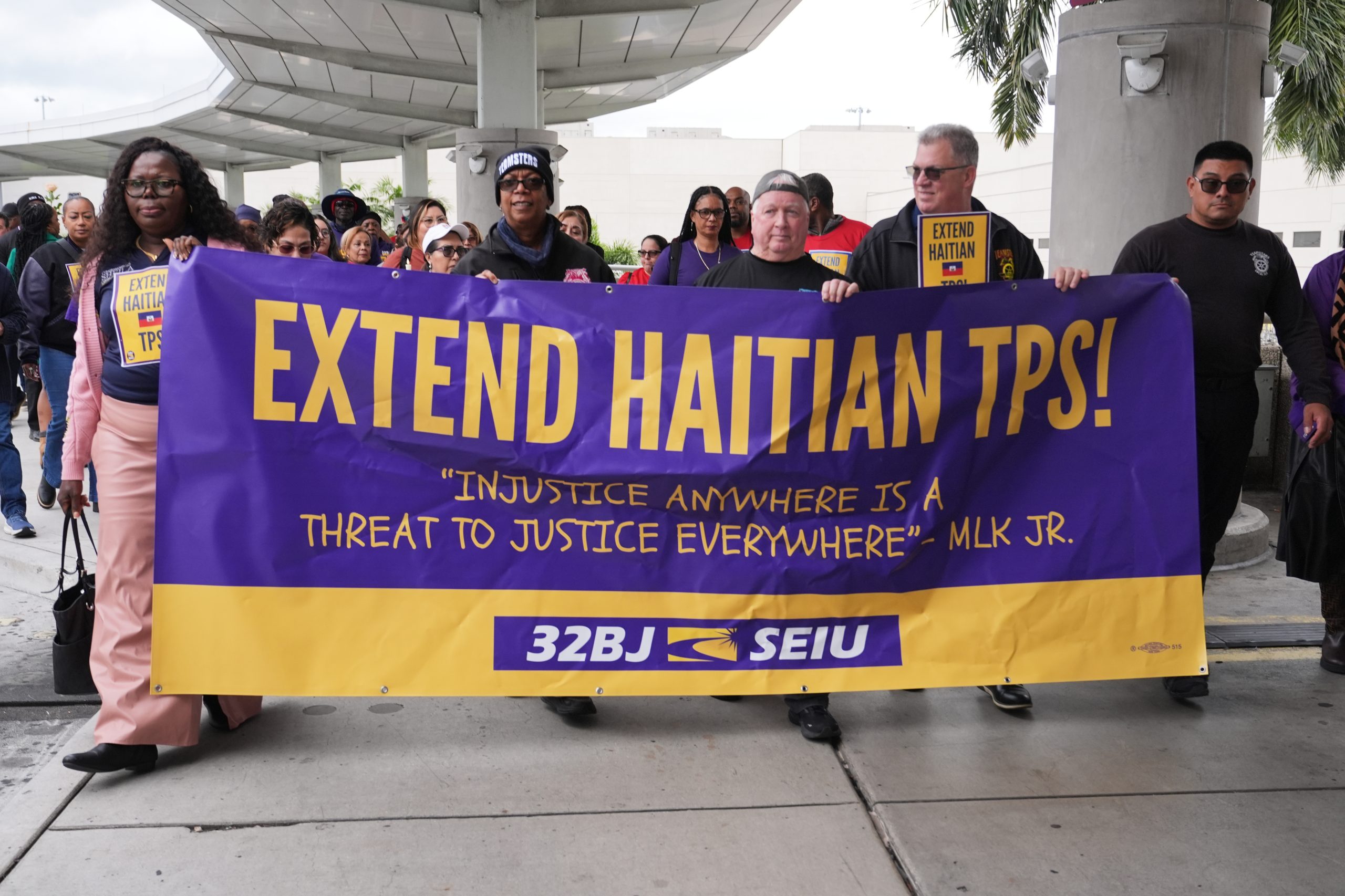
WASHINGTON — The Supreme Court on Thursday allowed the Trump administration to end legal protections for migrants fleeing violence and natural disaster in Haiti and Syria, exposing hundreds of thousands more people to potential deportation.
It marked another victory at the high court for Republican President Donald Trump’s sweeping crackdown on immigration. Though the conservative-dominated court has put the brakes on some of Trump’s immigration policies over the last year, it handed him a second win Thursday in a decision clearing the way for the revival of a policy restricting immigrants seeking asylum.
The court’s conservative majority found that immigration authorities have sole authority over the program, and the law doesn’t allow judges to intervene.
The majority opinion from Justice Samuel Alito also brushed aside arguments that derogatory comments from Trump about Haitians showed the decision was unlawfully tinged by prejudice. He called the statements “insufficient to show that the termination of Haiti’s TPS designation was based on the race of the Haitian people.”
Justice Elena Kagan forcefully disagreed, calling Trump’s comments “so repellent and racially inflected that the majority declines to put them in print.” She pointed out that Trump had said Haitians in the U.S. “probably have AIDS,” and he also amplified false rumors during the 2024 campaign that Haitian immigrants in Ohio were abducting and eating dogs and cats.
Lawyers said Haitian immigrants would be in serious danger if they are sent back. “Simply put, the Supreme Court’s ruling will directly result in thousands of innocent people dying violent, needless deaths,” Geoff Pipoly and Andy Tauber said.
They urged the Senate to approve an extension of deportation protections for Haitians that’ passed the House on a rare bipartisan vote in April.
“Families are here, kids are going to school, parents are going into work, folks are trying to commute, and it’s like the Supreme Court just put all those activities on stop and put folks in limbo,” said Viles Dorsainvil, who runs a support center for Haitians in Springfield, Ohio.
Derrick Johnson, president and CEO of the NAACP, called the “a devastating betrayal of Haitian families who have lived, worked, and contributed to this country for years — only to be cast out based on anti-Black immigration sentiment.”
Haitians with TPS are also a key part of the workforce in long-term care facilities. “This would be a dreadful loss for all seniors in our community,” said Rita Siebenaler, a resident at Goodwin Living, a senior living community in Virginia.
The Justice Department appealed to the Supreme Court after judges postponed the end of the program for about 350,000 Haitians and 6,000 Syrians. The high court sided with the administration before and allowed the end of the program for people from Venezuela.
Federal authorities deny prejudice played a role. They also cited a Supreme Court decision from Trump’s first term that rejected bias claims based on his social media posts and upheld a travel ban on several Muslim-majority countries.
James Percival, DHS general counsel, applauded Thursday’s ruling. He said the program had, in many cases, become “de facto amnesty. This is a win for the rule of law and common sense.”
Since Trump returned to the White House in January 2025, Homeland Security has ended the protections, including some that had been in place for more than a decade, for people from 13 countries.
The terminations were made even though countries such as Haiti and Syria remain dangerous, immigration lawyers said. Four Haitian women who were deported from the United States in February were found beheaded and dumped in a river several months later, lawyers said in court documents.
The United States first granted protections to Haitians in 2010 after a catastrophic earthquake and extended them multiple times amid ongoing gang violence that has displaced more than a million people, according to court documents.
Syrians were first granted protected status in 2012, during a civil war that lasted for more than a decade before the fall of President Bashar Assad’s government in late 2024.
“Today, many of our community members they feel lost,” Farrah AlKhorfan of Immigrants Act Now said about Syrian immigrants losing TPS protections. “They are trying to understand … what this decision means for them and how it will be implemented and how much time they will have to prepare for what comes next.”
The program was created by Congress in 1990 to prevent deportations to countries suffering from natural disasters, civil strife and other instability. It allows people already in the country to stay with work permits in increments of up to 18 months, but it does not provide a path to citizenship.
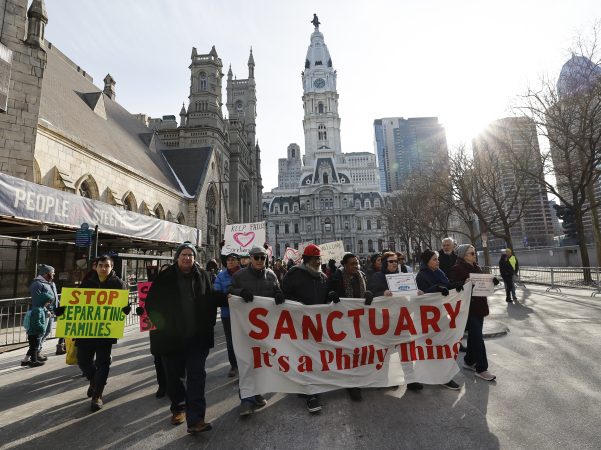
A significant majority of residents want Philadelphia to remain a sanctuary for immigrants, according to a new poll that shows the overwhelmingly Democratic city is undeterred by President Donald Trump’s threats to defund so-called sanctuary cities.
A recent Suffolk University/Philadelphia Inquirer poll that surveyed 500 city residents asked respondents if Philadelphia should remain a sanctuary city, “even if it means losing federal funding.” A commanding 59% answered “yes,” with only 28% saying “no” and the remainder undecided or unwilling to say.
The support for Philadelphia’s sanctuary status was consistent across age and racial groups. The only geographic region where a plurality of respondents answered “no” was far Northeast Philadelphia, which is among the most politically conservative areas of the city.
The survey question did not elaborate on what a loss of federal funding could mean for the city in terms of the impact on residents. Philadelphia received $2.2 billion from the federal government in fiscal year 2024 to pay for a wide range of critical services, including infrastructure needs, as well as healthcare, food, and housing assistance for low-income people.
(function(){function e(){window.addEventListener(`message`,function(e){if(e.data[`datawrapper-height`]!==void 0){var t=document.querySelectorAll(`iframe`);for(var n in e.data[`datawrapper-height`])for(var r=0,i;i=t[r];r++)if(i.contentWindow===e.source){var a=e.data[`datawrapper-height`][n]+`px`;i.style.height=a}}})}e()})();
Still, the results of the poll show relatively widespread support in Philadelphia for the city’s sanctuary policies, which include its practice of not complying with detainers issued by U.S. Immigration and Customs Enforcement without a court order. Those detainers are effectively requests submitted by federal agents to local law enforcement agencies that ask to hold undocumented immigrants in custody.
Mayor Cherelle L. Parker’s administration does not refer to Philadelphia as a “sanctuary city” — she and her top aides instead call it a “welcoming city,” language that has been increasingly adopted nationwide as Trump and his allies in the Republican Party have sought to crack down on sanctuary cities.
President Donald Trump travels to the Lehigh Valley to visit Mack Trucks in Macungie on Tuesday, June 23, 2026.Tom Gralish / Staff Photographer
The sanctuary policies predate Parker’s tenure and were in place under an executive order signed by former Mayor Jim Kenney. They were codified into law earlier this year after City Council passed a package of legislation aimed at limiting ICE’s operations in the city and instituting some of the nation’s toughest restrictions on ICE.
In May, Parker signed six of the seven bills in the package, but took no action on one that bars law enforcement officers from concealing their identities, including by wearing masks. City Solicitor Renee Garcia wrote in a letter to Parker that the legislation may not be legally enforceable, but the mayor did not veto the bill, allowing it to become law.
Last week, the Trump administration sued Philadelphia and some of its top officials, including Parker, over the mask-ban ordinance. The Trump administration contended that the law is “blatantly unconstitutional” and undermines federal law enforcement’s ability to do its job.
The lawsuit is one of several filed across the nation by the Trump administration challenging local laws related to immigration as federal authorities carry out the massive deportation campaign promised by the president.
That effort is also tied up in litigation. Last year, a federal judge issued an injunction blocking the Trump administration from denying funding to jurisdictions that limit cooperation with ICE, saying the White House could not impose funding conditions without authorization from Congress.
Staff writer Sean Collins Walsh contributed to this article.
A 36-year-old survivor of slavery said he has tried to follow all the rules since fleeing Mauritania, a mostly desert land in West Africa, and seeking asylum in the United States in 2023.
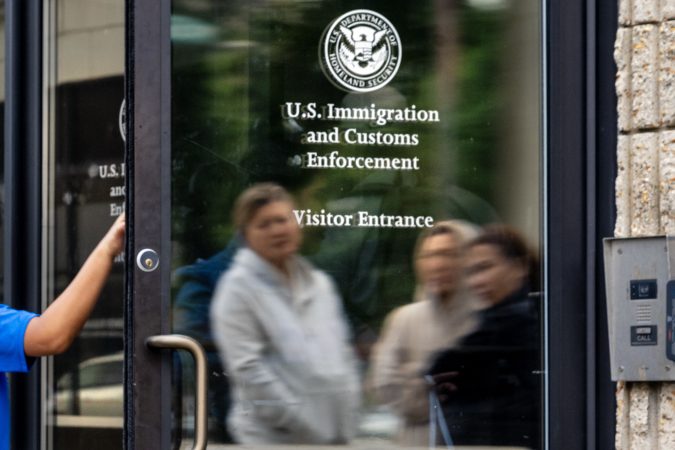
But when Ousmane Soumare arrived at the U.S. Immigration and Customs Enforcement office in Philadelphia in November for a routine check-in, he was detained by officers.
Now Soumare, who was released by a federal judge’s order, and two other immigrants who fear a similar fate in their forthcoming appointments are suing ICE and the Department of Homeland Security over the policy change that led to such arrests.
The Philadelphia ICE field office violated federal law when it “unlawfully rescinded” a longstanding policy that largely allowed immigrants to pursue their immigration cases without fear of rearrest, the suit says. ICE then “began re-arresting and re-detaining people previously determined to pose no risk of flight or danger to the community and still in full compliance with all conditions of their release,” the suit says.
Soumare, Lassana Dianifaba, and a third immigrant, who was not named in court documents, filed the lawsuit Wednesday in federal court in Philadelphia.
“When the government releases a person from custody, there is an implicit promise that their liberty will be honored as long as they follow what is asked of them,” said Vanessa Stine, senior staff attorney with the ACLU of Pennsylvania, which represents the immigrants. “These rearrests disregard a decades-old policy and sow fear and chaos.”
ICE does not comment on pending litigation, a spokesperson said.
‘Unheard of’
In Philadelphia, ICE arrests of people who arrive for what they thought would be routine check-ins and appointments have gone from rare to common.
That is because “sometime toward the middle of 2025,” the suit says, the local ICE office rescinded its policy that required individualized evaluation of new circumstances that would indicate an immigrant is a danger or flight risk.
Each year thousands of people report to ICE or related immigration agencies for the mandatory check-ins. Some immigrants are required to appear every couple of weeks, some once a month, others once a year.
The appointments help immigration officials keep track of people who in the past have been low priorities for deportation, allowed to live freely as they pursue legal efforts to stay in the United States. Now that landscape has shifted.
The changes have put immigrants in risky positions, making every visit to the ICE field office a gamble, because they have little choice but to show up.
Six immigration attorneys filed affidavits in support of the new proposed class-action lawsuit that detail an explosion of cases. Christopher Casazza estimated his firm has represented roughly 190 people who were detained at ICE check-ins since September.
Before 2025, it was “unheard of” for a law-abiding immigrant to be detained at a routine check-in, Casazza said.
Steven Morley, who served as an immigration judge between 2010 and 2022, said in an affidavit that he could not recall “any circumstance” of people being re-detained unless they had committed a crime.
Philadelphia federal judges responding to the flood of lawsuits by immigrants challenging their detention have also taken notice of the shift.
In February, U.S. District Judge Gail A. Weilheimer wrote that ICE had set a “trap” for “thousands of noncitizens” by arresting immigrants who were following instructions.
ICE offices in other cities have similarly reversed course on requiring a material change in circumstance to re-detain released immigrants, and federal judges in California and New York found the lack of individual assessment unlawful.
The proposed class action in Philadelphia asks a federal judge to certify the class, and declare the rescission of the changed circumstances policy unlawful.
Soumare’s next check-in is scheduled for July, and he is anxious about visiting the ICE office again.
“When I think of the risk of being re-detained at my next check in, it scares me,” he said in a court filing. “But I will still attend because I want to follow all the necessary steps to stay here.”
Visa holders and green card applicants
Even people who are seeking legal status through lawful government processes are in danger of arrest.
Green-card applicants, asylum seekers, and others who have ongoing legal or visa cases to stay in the United States have been unexpectedly taken, part of a Trump administration strategy, lawyers and advocates say, to boost the number of immigration arrests and to deport anyone who can possibly be deported.
Arrests have occurred not just at ICE offices, but also at U.S. Citizenship and Immigration Services and at private offices of federal contractors.
ICE says that all immigrants who do not hold legal immigration status may be subject to arrest and removal. They say that arrests undertaken at federal agencies are safer for officers, because visitors have been screened for weapons when they enter the buildings.
The son of the Jersey Kebab restaurant owners whose ICE arrests sparked wide condemnation last year now confronts his own battle to stay in the United States.
Muhammed Emanet, 26, said he is trying to be upbeat as he faces the prospect of being separated from his wife and two sons, ages 4 and 1, all American citizens.
“I try not to dwell on what I can’t control,” said Emanet, who with his parents operates the popular South Jersey eatery in Collingswood. “I still have a restaurant to run, employees that depend on me, customers, family. I have no other choice but to be positive.”
Still, his situation feels disorienting, as what seemed to be settled is now newly unsettled.
In spring the Department of Homeland Security ended its effort to deport Emanet, which seemed to clear the path for him to stay in the U.S. But this month, a different federal immigration agency told him it plans to deny his request for legal permanent residency, what is known as a green card.
That intended denial carries a 30-day window for Emanet, who came here from Turkey as a boy, to present new or additional evidence to try to change the minds of officials at U.S. Citizenship and Immigration Services.
The government also told him that under a new Trump administration policy, he and other immigrants who are pursuing green cards while living in the U.S. must leave the country and apply from their home nations. Emanet hasn’t been in Turkey since he was 12.
It’s unclear what will happen when the 30-day deadline expires around July 2.
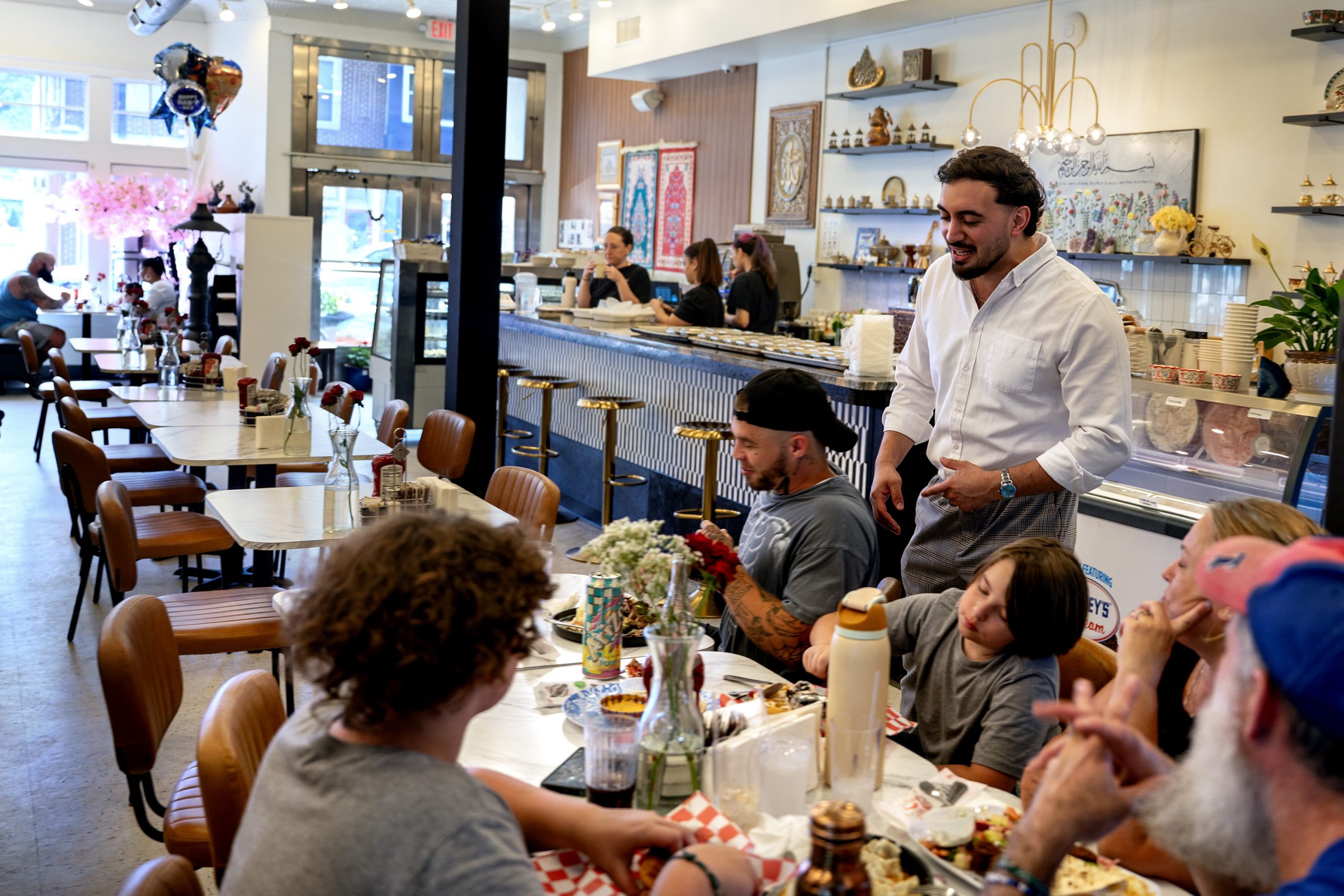
Muhammed Emanet greets Elijah Brown, a friend from high school, and his family, at Jersey Kebab in Collingswood on Sunday.Tom Gralish / Staff Photographer
A little more than a year ago, on Feb. 25, 2025, the small Mediterranean restaurant on Haddon Avenue generated national headlines. Immigration advocates and local leaders railed against what they saw as government injustice, after ICE agents arrested owners Celal Emanet and his wife, Emine.
Their arrests angered a South Jersey community that has long known the couple as caring people who offer free food to the hungry. A GoFundMe campaign to pay family costs and expenses raised $327,000, drawing donations from across the country and beyond, including from Ireland, Germany, and England.
Now, a community effort to help Muhammed Emanet is driving a new letter-writing campaign, with person after person attesting to his good character and his importance to his neighbors. Hundreds of letters have been signed and gathered to be presented on his behalf, said Lori Leonard, who organized the GoFundMe campaign last year.
“People are rallying behind Muhammed,” she said.
State Assemblyman Bill Moen, a Democrat who represents parts of Camden and Gloucester Counties, signed a letter of support. He said on social media that Emanet “has touched the lives of many people throughout South Jersey” as a husband, father, neighbor, friend, and businessperson.
“While I don’t make immigration decisions,” Moen said, “I do believe decision-makers should understand the character of the people whose lives are affected by those decisions.”
U.S. Rep. Donald Norcross, a South Jersey Democrat, met with the family soon after Emine Emanet was released from ICE detention, and as her son’s situation emerged this month he stressed in a statement that the family had been long “rooted in our community.”
In response to questions on Muhammed Emanet’s situation, USCIS said it does not comment on individual immigration cases.
Being removed to Turkey would likely separate Emanet from his wife and children for years. It also could subject him to reprisals from the Turkish regime, where repressive human-rights conditions under President Recep Tayyip Erdogan has driven an exodus.
Marriage to a U.S. citizen by someone who legally entered the country ― as Emanet did ― has long been a reliable route to an adjustment of status and acquisition of a green card.
But the Trump policy change announced in May said adjustment should be an “extraordinary” relief, one that depends on government discretion, not merely on having a valid marriage and submitting the proper forms. Failing to depart the U.S. under the policy can by itself be treated as a negative factor in the government’s decision-making.
Emanet’s immigration lawyer, Joseph Best, said that change in administration policy does not alter the law around eligibility for green cards.
“If USCIS follows the law,” Best said, “he will attain his lawful permanent resident status just as Congress intended. It is not some fluke or exceptional ‘ask’ here.”
Discretionary factors, he said, all favor Emanet, who was brought legally to the U.S. as a child, was admitted under a valid visa, and has no criminal history. He is loved in his community, and a key person in a successful family business that is known for helping others, Best said.
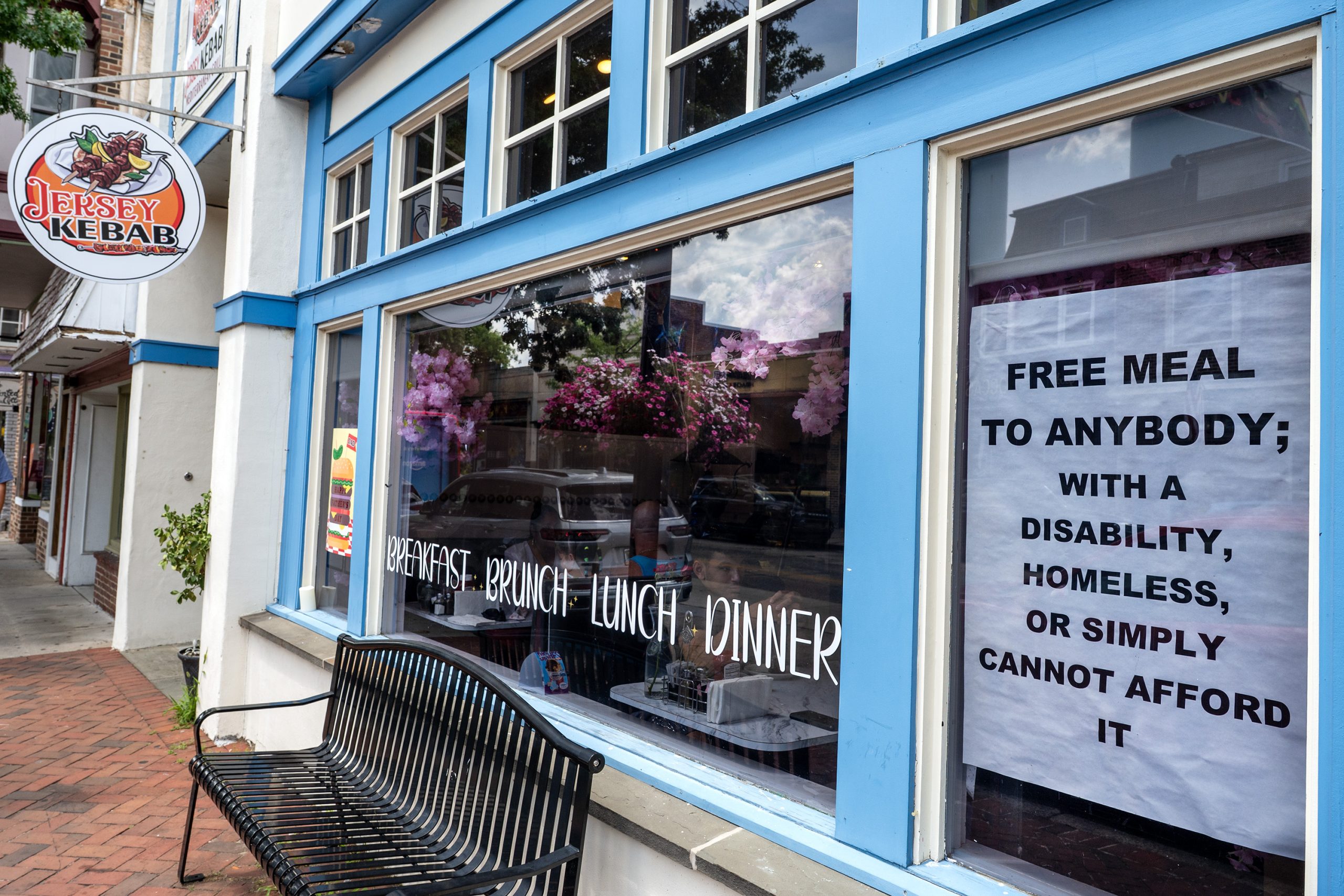
The Jersey Kebab restaurant in Collingswood where Muhammed Emanet works is seen on Sunday, June 21. It offers the same “Free Meal” policy as at the prior location in Haddon Township.Tom Gralish / Staff Photographer
Celal and Emine Emanet came legally to the United States with two young children in 2008, entering under a religious visa that allowed the father to work at a New Jersey Islamic center.
They said that they sought green cards before that visa expired in 2013, but that the application has been in government limbo for years.
In 2021, they founded Jersey Kebab in Haddon Township, and the restaurant recently moved west on Haddon Avenue to a new location in Collingswood.
The couple’s immigration cases continue. Celal Emanet’s next hearing is scheduled for December, while his wife is to appear in April 2027.
The family stands among roughly 386,000 Turkish immigrants and people of Turkish ancestry who live in the United States, according to Inquirer computations of U.S. Census figures. That includes about 15,000 in Philadelphia and surrounding suburban Pennsylvania and New Jersey counties.
Turkey is a longtime U.S. ally, a rectangular land bridge between Europe and Asia that is surrounded by sea on three sides. It is a Muslim nation, a country of tea drinkers, the place where Julius Caesar is said to have immortally proclaimed “Veni, vidi, vici” ― “I came, I saw, I conquered” ― after a decisive battle victory near what is now the modern town of Zile.
Today, people are leaving the country amid economic instability and political purges, with many trying to get to the United States.
U.S. government apprehensions of Turkish nationals at the Mexican and Canadian borders surged from 67 in 2020 to more than 15,000 in 2022 and another 15,000-plus in 2023, dropping to 10,500 in 2024. Figures for 2025 were not immediately available.
President Donald Trump is expected to be in Turkey next month to attend the NATO summit in Ankara.
Muhammed Emanet works at his family’s restaurant, Jersey Kebab, in Collingswood on Sunday, June 21.Tom Gralish / Staff Photographer
During Trump’s second term, USCIS has repeatedly paused the processing of applications for all types of immigration benefits, including those for legal permanent residency.
Last month, the administration announced it would require foreigners who are living in the U.S. and want to obtain green cards to leave the country to do so. The administration said they must now apply in their homelands, a departure from longstanding policy that has sowed confusion and concern.
For decades, foreign nationals who meet requirements have been able to complete the green-card process in the United States, including those married to U.S. citizens, holders of work and student visas, and refugees and asylum seekers.
USCIS spokesperson Zach Kahler said in a statement that entering the U.S. on a visa should not be a first step toward obtaining a green card, that tourists and temporary workers are permitted to come here for limited times.
“Our system is designed for them to leave when their visit is over,” he said.
Making people leave the country to apply for green cards “reduces the need to find and remove those who decide to slip into the shadows and remain in the U.S. illegally,” he said.
The administration instructed immigration officers to consider violations of immigration laws, including overstaying a visa, as negative factors in their decision-making.
Since the uproar, though, USCIS has seemed to walk back the policy, saying it would be implemented on a case-by-case basis. That could mean that some immigrants will be able to stay in the U.S. while they seek green cards.
Emanet said his immigration case started in 2020, when two plainclothes ICE officers arrived at the family home and said he was in the country illegally.
In spring, his attorney persuaded an immigration court in Newark to terminate Emanet’s court case ― with no opposition from the DHS Office of the Principal Legal Adviser, the ICE prosecutors. That termination seemed to clear the way for Emanet to adjust his status.
Instead, on June 3 he received a Notice of Intent to Deny from federal immigration officials, indicating they plan to reject his application to adjust his status. He is not sure what will happen when the 30-day deadline for new information expires.
“I have children here who need my support ― American citizens who depend on me,” Emanet said. “I thought I was that one, that I did everything exactly how I was supposed to, that I should receive my green card. … It feels like a punch in the gut.”
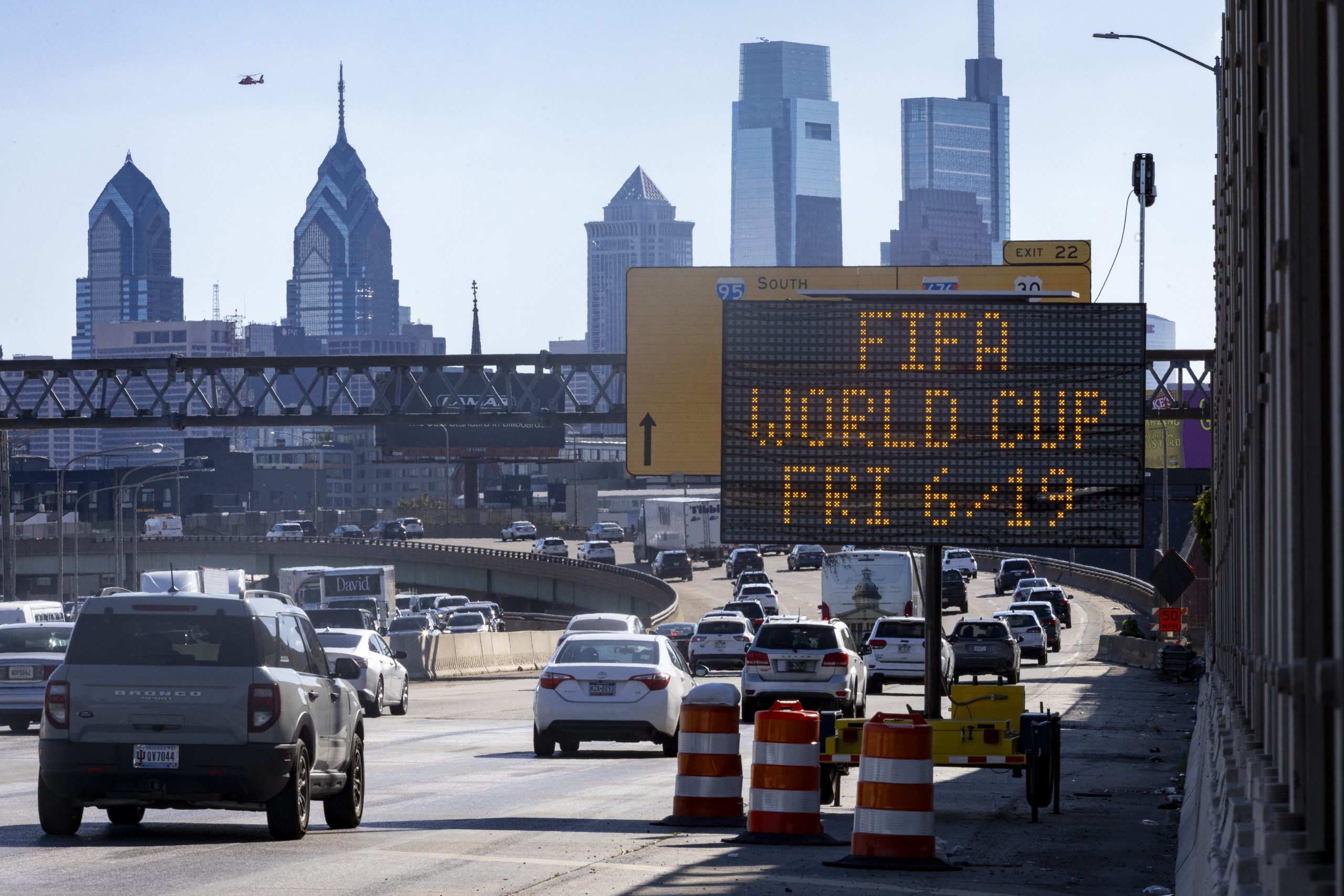
Haiti’s June 19 World Cup match against soccer’s most decorated nation, Brazil, held at Philadelphia’s Lincoln Financial Field, encapsulates the contradictions at the heart of FIFA’s flagship event this summer.
A traffic sign on I-95 informs drivers of expected traffic delays to occur because of the World Cup match — Brazil is set to face Haiti — on Friday at Lincoln Financial Field in Philadelphia.Aidan T. Gallo / Staff Photographer
The World Cup — and Haiti’s first appearance in it since 1974 — is a welcome distraction from the humanitarian and security crisis at home. For many Haitians, however, the Trump administration’s cruel immigration policies, including its effort to terminate this Caribbean country’s temporary protected status (TPS) — a form of protection against deportation to dangerous situations — casts a shadow over the tournament.
Since a catastrophic 2010 earthquake, Haitians have dealt with one disaster after another, including a cholera epidemic, devastating hurricanes, increasing violence, and chronic political instability.
The current crisis, during which criminal groups have consolidated control over most of the capital, Port-au-Prince, and expanded to at least four more of Haiti’s 10 regions, has killed thousands, displaced more than 1.5 million people, and led to widespread sexual violence.
Even before the World Cup began, the odds were stacked against Haiti’s “Grenadiers” — a nickname that pays homage to the revolutionary soldiers who fought for Haiti’s independence in 1804. The squad managed to top their regional qualifying group for the tournament despite not being able to play a single game on home soil; their national stadium is in an area controlled by criminal groups. It was a remarkable feat — one that ended Haiti’s 52-year wait to participate in another World Cup, and became a source of immense pride for Haitian soccer fans around the world.
Haiti fans cheer during the World Cup Group C soccer match between Haiti and Scotland in Foxborough, Mass., near Boston, on June 13.Charlie Krupa
For the coming weeks, Haitians will be celebrated on the world stage and their players welcomed with open arms, but their fans may find their paths to the stadiums — or to the United States itself — inaccessible.
In Philadelphia, many by now will have already seen proud Haitian fans sporting their team’s blue and red jerseys. But while the World Cup inspires hope and pride for Haitians living in the U.S., the Trump administration’s immigration policies, including the possibility of U.S. Immigration and Customs Enforcement presence at or near World Cup venues, may elicit anxiety, fear, and exclusion.
Haiti is one of 39 countries affected by U.S. government travel restrictions that prevent fans from supporting their countries in person this summer. Although the ban includes an exception for athletes, Woodensky Pierre, the only Haitian player based in the country, missed a vital pre-tournament match after his U.S. visa wasn’t approved in time. He landed at Miami airport shortly after the game began and was later embraced by his teammates on the pitch at the final whistle.
It is the attempts to terminate Haitians’ temporary protected status, however, that pose the most serious human rights concerns for Haitians who are already in Philadelphia and other cities.
Under U.S. law, the Department of Homeland Security can designate a country for this status when conflict, environmental disasters, or other circumstances temporarily prevent its nationals from returning safely, or when the country cannot adequately handle their return.
TPS protects beneficiaries from removal, allows them to apply for work and travel authorization, and prevents Homeland Security officials from detaining them solely based on their immigration status.
Haiti first received this designation after the 2010 earthquake. Since then, and because conditions in Haiti itself have not improved, hundreds of thousands of Haitians in the U.S. have built lives, raised families, and become essential contributors to local communities, including in Philadelphia. Approximately 330,000 Haitians now have TPS in the United States.
Haitian TPS holders in the U.S. need stability, protection, and a durable path forward, writes Robbie Newton.Lynne Sladky
The Trump administration is now trying to strip Haitians of this protection.
Despite clear evidence that the human rights crisis in Haiti is worsening, the Department of Homeland Security insists that “country conditions have improved to the point where Haitians can return home safely.” A Supreme Court decision on the legality of ending this protection is expected this summer.
Residents flee their homes to escape clashes between armed gangs in Port-au-Prince, Haiti, in May.Odelyn Joseph
Terminating the protection would have devastating consequences, exposing hundreds of thousands of Haitians to detention and possible return to the “cataclysmic” situation unfolding at home, where they would face serious risks of kidnapping, extortion, and other abuses by criminal groups.
For the 15,000 Haitians protected by TPS in the state of Pennsylvania, making it to the World Cup and cheering on their team represents a powerful symbol of hope and unity at a precarious time for the community.
Other soccer fans who root for the underdog will very likely cheer on Haiti as it makes its way through all of its Group C matches (and, hopefully, into the knockout stage). But support for Haiti should extend beyond the World Cup. The U.S. government should renew temporary protected status for Haitians.
Haiti’s Grenadiers deserve their place at the World Cup. For Haitian TPS holders in the U.S., the stakes go far beyond the tournament.
Robbie Newton is a senior coordinator and in the sport and human rights team at HumanRights Watch.
In the tumultuous five-plus months since masked federal immigration agents descended on her hometown, the Rev. Jen Crow of the First Universalist Church of Minneapolis has already been arrested at an airport sit-in, organized a vigil after the murder of her neighbor Alex Pretti, and held trainings at her church for volunteer observers.
So when Crow learned on Tuesday that 15 local activists had been indicted by federal prosecutors on felony conspiracy charges for monitoring and allegedly at times impeding U.S. Immigration and Customs Enforcement and Border Patrol officers, she did the one thing the Donald Trump regime does not want anyone to do.
She went down to the St. Paul federal courthouse to protest, again. Crow told me by phone Wednesday that everyday Americans who oppose immigration raids can’t surrender to the fear that the Justice Department wants to create by threatening long prison terms.
“When you see the federal government turning on its own people, the thing is we have to act anyway and just trust in the purpose and trust in what we’re doing and our care for each other, and just really lean into that,” Crow said. “To let the fear wash through, but not get stuck in it.”
Crow and as many as 200 other Minnesotans chanting “Free them all!” outside the 15 activists’ arraignment on Tuesday were rewarded for their ongoing courage with a blast of chemical irritants from U.S. Marshals, which, according to videos, started with little or no provocation by the outside protesters.
“Witnesses tell me that what was going on at the time is that they were holding the doors open, so that you could hear the chants inside the building, when suddenly somebody saw folks putting on gas masks inside the courthouse,” local journalist Pilar Pedraza of KSTP-TV reported. “And all of a sudden they came out and started spraying a chemical irritant at them.” Videos showed other protesters hit with pepper spray, with one violently thrown to the ground.
The indictment of the Minneapolis 15 — a so-called “conspiracy” that included innocuous acts of dissent like discussing ICE activities on the Signal app or publishing an article on a pro-anarchist website — and the chemical assault against citizens exercising their free-speech rights are all the same instinct from a violently repressive government.
The good news is that the government’s intimidation campaign is being met with renewed resistance in the Twin Cities — the place where regular folks with whistles and cell phones eventually drove away most of the immigration raiders, albeit at the horrible cost of more than 4,000 immigrant arrests and two citizens gunned down in the street.
“The only thing I did was care about this, my community and my neighbors,” Natasha Rakotz — one of the Minneapolis 15, a caretaker whom prosecutors accused of sideswiping an immigration agent’s vehicle — told reporters after her arraignment.
The charges against the Minneapolis 15 — tied to a protest group known as Direct Action Minnesota, or DAMN — is arguably the most aggressive in a flurry of actions by Trump’s Justice Department aimed at convincing the public that the ideology of aggressively fighting fascism, known as “antifa,” is some kind of highly organized terrorist cell along the lines of ISIS or al-Qaeda.
Federal prosecutors have been racing to crayon in the blanks since Trump’s September 2025 executive order that declared “antifa” — again, not an actual group — as a “domestic terrorist organization.” The Minnesota indictments are the most dramatic of a myriad of federal cases from New Jersey to Oregon.
These prosecutions have run the gamut. In Texas, an actual criminal act that warranted charges — when a protester at an ICE detention site fired a gun — became the impetus for a sweeping dragnet that led to convictions against nine activists. In Spokane, Wash., prosecutors recently gained convictions against three protesters who tried to stop ICE agents from transporting two Venezuelan immigrants, even after an acting U.S. attorney resigned because he believed the charges were unwarranted.
But other Trump efforts to criminalize dissent have collapsed, almost farcically so — from a jury’s speedy acquittal of the Washington, D.C. man who threw a salami sandwich at an agent, to the implosion of a case against Chicago ICE-detention-center protesters, including congressional candidate Kat Abughazaleh, known as “the Broadview Six.” The former defendants and some members of Congress are calling for an investigation of alleged grand jury misconduct by Chicago U.S. Attorney Andrew Boutros and his underlings to obtain their indictment.
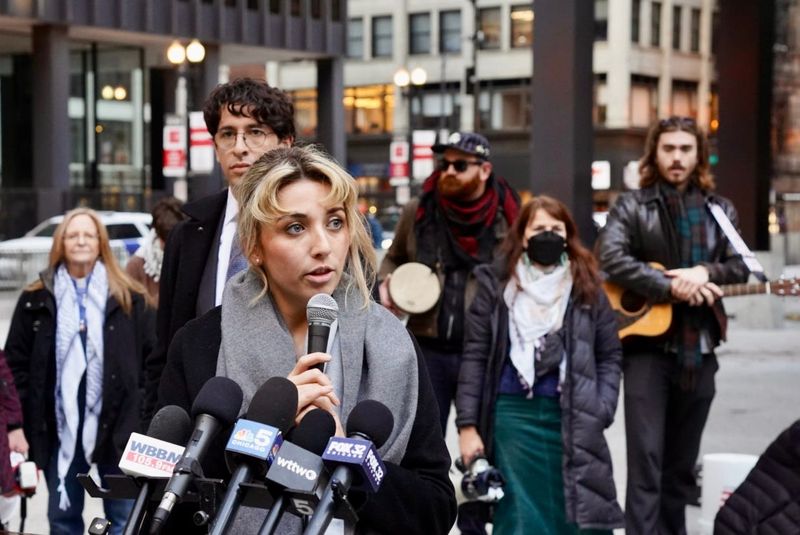
Democratic Congressional candidate Kat Abughazaleh addresses supporters in downtown Chicago outside the federal courthouse where she pleaded not guilty to charges filed in connection with a protest against the Trump administration’s mass deportation campaign.Michael Loria, USA TODAY
In Minnesota, U.S. Attorney Daniel Rosen strived on Tuesday to defend the new prosecution as skeptical reporters asked him why felony charges were lodged when not a single agent was hurt, why the urgency of this case when there’s been no prosecution of the agents who shot and killed Pretti or the unarmed motorist Renee Good, and whether the case amounted to what writer George Orwell famously called “thoughtcrime.”
Rosen insisted that “whether or not they actually, at the end of the day, caused bodily harm is not the measure of whether or not they committed a serious federal crime.”
Still, the federal case against the Minneapolis 15 contained just a couple of instances of alleged property violence ― the sideswipe andthe kicking out of a vehicle’s tail light. Mostly, the indictment describes a lot of activities —like Signal chats, monitoring the movement of immigration agents on public streets, discussing the use of protective gear like shields, or an anarchist’s speaking tour about the protests — that would seem to be constitutionally protected free speech.
With the enactment of the First Amendment in 1791, America’s founders vowed to protect “the right of the people peaceably to assemble, and to petition the Government for a redress of grievances.” Just days before the nation’s 250th birthday, an authoritarian regime in Washington wants to make this a crime for which you could spend a large chunk of your life in prison.
“It does look like the government is throwing the book, maybe even over-charging some of the protesters,” Roy Gutterman, director of the Tully Center for Free Speech at Syracuse University, told me yesterday, noting that any act of actual violence wouldn’t be protected by the First Amendment. But he added that “even if some of the charges end up being thrown out, the breadth of the government’s arguments and the weight of the charges certainly send a message to protestors.”
Exactly. Although the indictments are a living hell for the Minneapolis 15, the real target here is regular American folks like you — citizens who aren’t normally inclined to protest the government, but are starting to wonder what to do as the regime and its 80-year-old and increasingly out-of-touch leader spiral out of control.
Before you even dare venture out to a church meeting where they pass out whistles and teach you how to warn your neighbors that masked ICE agents are snatching people off the streets, they want to plant seeds of doubt. Am I risking my freedom, and my family, just for posting something in a Signal or WhatsApp chat?
They want you to be terrified, and on some level you should be afraid, not just of what the government is doing but why they are doing this now. Trump was already nearing record-low approval numbers before this week’s humiliating surrender deal aimed at ending the president’s foolhardy war of choice with Iran. The near inevitability of a Democratic House in 2027 all but guarantees Trump’s next impeachment and two years of political hell to end his 47th presidency.
Thus, Trump’s desperate determination to interfere in the November election is becoming increasingly clear, with everything from unwarranted meddling by the U.S. Post Office to his insistence that grossly unqualified loyalist Bill Pulte serve as his director of national intelligence, in order to invent foreign election plots.
Criminalizing dissent isn’t a sideshow. It’s central to the plan. They want to stop you from taking to the streets in massive numbers if and when they take illegal actions to keep the Republican Party in power. They are using these bogus indictments to lay the foundation for the solution that Vice President JD Vance proposed for Minneapolis back in January — to invoke the Insurrection Act and send in tanks.
The case against the Minneapolis 15 reminds me of the remarkable novelEvery Man Dies Alone by the German novelist Hans Fallada, based on the true World War II era heroism of Otto and Elise Hampel, who placed postcards around Berlin criticizing Adolf Hitler and the Nazis for two years before they were arrested and executed by guillotine. Are we now becoming such a totalitarian society?
Hopefully not, if American citizens like the Rev. Jen Crow continue to speak out.
“We’re not going anywhere,” she said after the feds’ courthouse chemical attack. “Those of us who care about each other and care about the rule of law and care about following the rules we’ve set out as a society that protect basic human rights, we’re not going anywhere.”
Employing foreign workers is more difficult than ever. But it’s not impossible.
A Philadelphia employer can potentially secure a Canadian engineer in a matter of years. But hiring a similarly qualified worker from India could take decades.
“It’s not easy for business owners to recruit or target these individuals that they deem essential to their operations because of current immigration policy,” said Alex Isbell, an immigration attorney at Palladino, Isbell & Casazza LLC in Philadelphia. “If a company wants to hire someone from overseas, they’re going to have to overcome some pretty big challenges.”
The Trump administration wants American companies to hire more home-grown workers. And the rules have changed to encourage this.
H-1B
Until recently, the best way to bring in workers from overseas has been the H-1B visa, a temporary U.S. work visa program that allows American employers to sponsor and hire foreign professionals in specialty occupations and jobs that typically require at least a bachelor’s degree in a specific field. The federal government has historically issued tens of thousands of these three-year visas annually through a lottery for companies that could prove technical need.
But last year the Trump administration began clamping down on these visas by instituting a $100,000 fee on companies applying. And recently the administration announced a higher wage barrier for companies looking to hire foreign workers.
As a result, applications for these visas have dropped 27% in the past year.
Last week a federal judge stayed the fee as unconstitutional, but the administration plans to appeal this decision. Natalia Gouz, an attorney with Philadelphia-based Klasko Immigration Law Partners LLP, is hoping to see the fee reduced or eliminated.
“Most of our clients are not really able to invest that kind of money, because that could be more than a salary,” she said. “The fee makes things much more challenging to hire someone from overseas.”
TN and E-3
There are other options for employers who want to avoid the H-1B process. That’s because current U.S. immigration policies favor the hiring of employees from some countries over others.
Hiring a Canadian worker vs. hiring someone from India can be a dramatically different process, said Jonathan Grode, U.S. managing partner at Green & Spiegel in Philadelphia.
Citizens of Canada, Mexico, and Australia may qualify for special TN and E-3 visa programs tied to existing trade agreements that are generally faster and less expensive than traditional employment visas, he said. Chile and Singapore are also good places to look for workers because of favorable trade agreements.
“The process is much easier for these countries,” Grode said. “For a Canadian with a bachelor’s degree, if I was to apply for a green card today, the full start-to-finish wait time would take about three years. But unfortunately, if you’re an Indian national, the same process is estimated right now to be 40 years.”
No, that’s not a typo. According to Grode, because India lacks the trade and investment treaties that benefit some other countries, employers often face fewer visa options and extremely long green-card backlogs.
O-1 and EB-1
But there are still more options.
The O-1 visa is reserved for individuals with “extraordinary abilities’” and is not subject to annual lotteries. The EB-1 is a permanent residency (green card) category for those workers, which also includes “outstanding” professors and researchers or multinational executives and managers.
“Those are not subject to quotas, availability, or the $100,000 fee,” Isbell said. “But they’re difficult to receive.”
To get one of these visas, Isbell said, “A person has to be, as the regulation says, one of the very few in their field who’s risen to the top. You have to be a very high achiever, and you have to have been a very high achiever for a long period of time.”
OPT
One overlooked source of talent is international students already studying in the United States.
According to Gouz, these students may be eligible for an Optional Practical Training (OPT) work authorization and can begin working immediately once they have it. Employers can hire an OPT worker without the H-1B lottery process. Most graduates receive 12 months of OPT, and many STEM graduates can receive an additional 24-month extension, providing up to 36 months of work authorization.
“Employers still have obligations, including signing off on the worker’s responsibilities, as well as reporting responsibilities,” she said.
Compliance
It sounds daunting, and yes, the process has become much more difficult for employers. But immigration attorneys like Gouz say not to assume that hiring a foreign worker will be impossible. And — just as importantly — once a foreign worker is hired, it’s critical to stay up to date on compliance in order to keep that worker.
Gouz recommends investing in an experienced immigration attorney and maintaining complete employment documentation including the I-9 Employment Eligibility Verification form, maintaining proper records, and training staff responsible for verifying employment. Using the federal E-Verify platform — a free, internet-based system operated by the U.S. government that allows businesses to electronically confirm the legal employment eligibility of their worker — is helpful, but not a substitute.
“If somebody is presenting documents that don’t belong to them, E-Verify is not necessarily going to catch that,” Gouz said.
It’s important to keep up-to-date I-9 forms for all employees, Gouz noted. And employers must make sure that each worker’s occupation lines up with the approved jobs for their type of visa and continues to qualify for that program.
“The system is really hard to navigate right now,” Grode said. “You can really step in it if you’re not careful.”
One of my many New Year’s resolutions back in January was never to write what I call “Captain Obvious columns” about the Donald Trump scandal du jour that’s all over your social media feed. So you’ll have to imagine the column I didn’t write about Trump’s tacky UFC cage match that desecrated the White House, and the role of bread and circuses (or just circuses…where’s the bread?) in the inevitable decline and fall of decrepit empires.
A ‘President JD Vance’ would be a different kind of dictator. The scary kind.
They say you never get a second chance to make a first impression — unless your name is JD Vance, or it becomes JD Vance after a few false starts. In 2016, a then utterly unknown Yale Law grad introduced himself to America with a No. 1 bestseller, Hillbilly Elegy, that used his (sort-of) Appalachian family’s hardscrabble story to come off as an empathetic horse whisperer for the white working class.
He cemented that first impression when we learned he’d privately described Trump as a kind of a demagogue feeding off the pathologies he’d written about in Elegy — someone he feared might become “America’s Hitler.”
But Trump’s victory coupled with some exposure to the ketamine-fueled paranoia of Silicon Valley’s billionaires gave the former James Donald Bowman yet another shot at reinvention — now embracing extreme right-wingers and crackpot conspiracy theories all the way to his election, at age 40, as the 50th vicepresident of the United States.
Today, less than two weeks before the 10th anniversary of Hillbilly Elegy’s publication, Trump has become America’s…Mussolini, a strutting yet sometimes buffoonish strongman and a hopelessly corrupt invader of faraway lands.
It’s Vance who could actually become America’s Hitler, if he gets that chance…a very real possibility.
That’s a strong statement, but it’s also perhaps the most powerful takeaway from the heavily promoted, about-to-be-published book from all-access New York Times reporters Maggie Haberman and Jonathan Swan, Regime Change. It portraysthe vice president as eager to go much further than Trump in crushing domestic dissent.
In book excerpts published Monday, Haberman and Swan depicted Vance — in a tag-team alliance with Trump’s ruthless mass-deportation guru Stephen Miller — as calling for the radical step of invoking the Insurrection Act to send in troops to put down protests by everyday Americans in Minnesota who were enraged by masked goon squads snatching their immigrant neighbors and the killing of two U.S. citizens.
Describing a White House meeting of senior aides — but not Trump — in late January after Renee Good and Alex Pretti were gunned down, the Times reported that “Vance got to the point. They needed to invoke the Insurrection Act, swiftly, to crush the unrest in Minnesota. It would be painful in the short term, he said, but the message it would send — that paid agitators could not get away with disrupting ICE operations — would make sure no one tried it again.”
There are many problems with Vance’s anti-democratic impulses. As Haberman and Swan reported, even most of the Trump aides in the room agreed that invoking the 1807 law in this circumstance would be both a significant expansion of presidential power and a public-relations nightmare. Even worse, the nation’s No. 2 official was urging this would-be abuse of power based on a right-wing internet lie — the falsehood that Minnesota’s angry neighbors were “paid protesters.”
The deeply reported episode isn’t the only disturbing glimpse of Vance’s governing philosophy in recent months, but it’s the most revealing, and mostdamning: a true believer in the worst conspiracy theories about the left, with the inclination to wield dictatorial powers against them.
Earlier this month, Vance — arguably the regime’s top cheerleader for Europe’s extreme far-right political parties — stunned the United Kingdom’s center-left government by weighing in on growing unrest over the stabbing death of an 18-year-old English college student by a Sikh migrant. He sounded more like a wannabe X influencer than a top official of the U.K.’s historic American ally. As racist hate mobs prowled streets in England and Northern Ireland, Vance said the murder of Henry Nowak proved that “European elites” had failed to oppose the “politics of self-hatred and the mass invasion of migrants.”
One thing is clear: Vance is not on the side of calm, which is problematic when what the world needs now is love, sweet love.
Increasingly, Vance seems to disappear for longer stretches of time, and when he reemerges he is bathed in the stench of the social media sewers where he seems to spend much of his time.
That’s certainly appears to be the case with his main mission in 2026; rooting out fraud, which isn’t targeted at the nation’s biggest scam — the multi-dollar enrichment of the president’s family — but at alleged schemes by Somali immigrants and other heirs to Ronald Reagan’s racially coded “welfare queen.” A recent Washington Post report found many claims by a Vance-led task force are misleading or overhyped, and that legitimate business have been swept up in its wide net.
Ten years ago, Vance wrote a book seeking your empathy because that served his true purpose: ruthless ambition. In that context, it was no moral conflict at all to pull a 180 and support a victorious Trump, or to leverage his rising fame into a hookup with Silicon Valley types like his billionaire patron Peter Thiel — people who believe in building private cities to protect them from the masses and the government, and who are more prone to conspiracy theories than your 79-year-old uncle on Facebook.
Thiel and the other tech billionaires have programmed Vance into a true believer of whatever nonsense they believe, and lined him up next in the queue for power. That makes him even more dangerous than Trump, who believes in nothing beyond himself.
Ever since Trump first claimed victory on Nov. 8, 2016, I’ve worried that the next guy would be even worse — chasing American autocracy with a real plan, not clown-car narcissism. Vance is the one I was worried about, and he is only an 80-year-old, Big Mac-infused heartbeat away from the presidency for the next 31 months.
I’ve made clear my disgust at political violence, and the possibility of a Vance succession is another reason why I shudder to think what would happen if an attack killed or disabled the 47th president someday. If Vance was willing to send troops to Minneapolis to stomp down soccer moms and baristas with whistles, his militaristic power grab against the left after an assassination would end any last hope for our bedridden democracy.
It’s one more item on the pro-democracy checklist. It may be the proverbial lost cause worth fighting for, but we should try to ensure that JD Vance does not become the 48th president of the United States.
If Democrats stay on track to retake the House and possibly the Senate, they should hold hearings not only on Trump’s high crimes and misdemeanors but on the vice president’s involvement — and, based on that evidence, his possible impeachment. It may prove impossible to remove Vance from office, but hearings will help to establish a record that will end his dreams — and those of his billionaire buddies — about 2028.
It’s past time for the next transition for this American chameleon who calls himself JD Vance: back to private citizen.
Yo, do this!
The World Cup’s return to North America has gone much as I expected it would: Marred by its runaway commercialism and the U.S. immigration hassles that kept too many fans and a world-class referee from Somalia at home, but with a focus on joy on the pitch and in the stands now that the games have begun. Here in Philadelphia, the essence of everything good about the World Cup has been the FIFA Fan Festival at Lemon Hill, the city greenspace on the hill behind the Art Museum on the Schuylkill. It’s been a daily gathering post for thousands of fans to watch the matches on a 60-foot screen, imbibe from a beer garden, and load up on official merch. It’s free but ticketed; learn how to gain access and how to get there here.
Some 51 years after Jaws, filmmaker Steven Spielberg is still finding ways to get us out to the multiplex for a summer blockbuster. His new the-aliens-are-here epic, Disclosure Day, merges nostalgia for his greatest hits like E.T. with our 21st century anxieties about artificial intelligence, outsiders, space, and what it means to be human in our modern world. It’s getting excellent, but not perfect, reviews, and I’m looking forward to seeing it for myself.
Ask me anything
Question: What is your favorite fast food joint? — @funkndonuts.bsky.social via Bluesky
Answer: Most of this week’s questions were in this lighthearted mode; it feels like the good sports excitement of the World Cup and the NBA finals has provided us a calm eye in the hurricane. Anyway, as an apparent donut lover you’ll be glad to know that my modern family runs on Dunkin coffee. As a kid, my barely-evolved-from-hillbillies family had low-brow tastes that I now appreciate in hindsight, and on our yearly road trips to the ancestral home of Peoria, I fell in love with the greasy pizza — later augmented by greasy fried chicken — at Shakey’s. The chain has shrunk to a few West Coast outlets and I haven’t been in decades. Probably for the best.
What you’re saying about…
Last week’s question about what the next, hopefully normal U.S. president should do about the ballroom monstrosity rising on the east side of Donald Trump’s White House drew a good array of responses. Although a couple of you wanted to see the project repurposed for community gardens or housing for D.C.’s homeless, others believe any Trump creation must be expunged in dramatic fashion. “Provide Pulaskis (fire axes) and sledgehammers and a good crew of competent supervisors and let we the people come and pay five bucks for the privilege of fifteen minutes of smashing it up,” wrote Linda Nafziger-Meiser. “Hell, I’ll bring my own Pulaski.” But architect Larry Weintraub thinks the White House needs a ballroom, as long as it meets historical and architectural standards. “Hopefully, the new design will be understated but appropriate and subordinate to the majesty of the White House,” he wrote.
📮 This week’s question: In a recent column, I announced that I’ve deleted Elon Musk’s social-media app X, which once thrived as Twitter. I saw that as a way to protest Musk’s racism, and his obscene wealth. Should governments and corporations continue to use X for communications? Are you still on X or have you left, and why? Please email me your answer and please put the exact phrase “Deleting X” in the subject line.
Backstory on the birthright citizen who’s a U.S. hero
Folarin Balogun, now 24, grew up in London, which is where one of the world’s top clubs, Arsenal, spotted him as a potential soccer star at age 8. His parents are Nigerian. He currently plays club soccer in Monaco. So how was it that Balogun found himself last Friday wearing the red, white, and blue jersey of the United States in front of 70,000 delirious Americans on the pitch near Los Angeles, mixing skillful footwork with an aura of glee as he scored two goals in a 4-1 World Cup opener win over Paraguay?
Credit the 14th Amendment — or maybe blame it, if you’re one of the reactionaries who believe that people like Balogun should not be U.S. citizens, soccer gods be damned.
Even if for some weird reason you’re not yet a soccer fan, you’ve probably followed the heated debate over birthright citizenship. The notion that anyone born on U.S. soil is automatically an American citizen — an idea enshrined after the Civil War to remove any potential doubts about the citizenship of formerly enslaved African Americans — is disputed by the Donald Trump regime. The president’s executive order seeking to undo the longstanding interpretation of the 1868 14th Amendment, and strip citizenship from millions of people born here to immigrant, non-citizen parents, is currently before the U.S. Supreme Court. Trump’s xenophobic MAGA supporters have long slurred children of undocumented migrants with the epithet, “anchor babies.”
It turns out that Balogun, when he’s not lighting up the back of the net, is a law-school case study of the immigration debate roiling his accidental country. In the summer of 2001, Balogun’s future mom, who was seven months pregnant, and dad decided to vacation in the United States. When the couple attempted to fly home to London, an unnamed airline worker who would change the course of soccer history told Florence Balogun she was too pregnant to safely fly. So she stayed in Brooklyn, gave birth to her son, and the family left America after two months.
As he developed into a world-class striker on European soil, Balogun came to understand that his U.S. citizenship offered a much better shot at competing in the World Cup than the other two nations where he was also eligible, England or Nigeria. For his mom, Balogun’s fate was sealed in the summer of 2001. “Even when he wasn’t even thinking of making an international decision, I’d already made up my mind that he is going to play for America,” Florence Balogun said.
They say that the Supreme Court, despite all the blather about “calling balls and strikes,” is in reality always aware of the political zeitgeist. Even a right-wing justice who happens to also be a long-suffering Phillies fan in Samuel Alito probably sees on some level that stripping citizenship from the breakout star of U.S. men’s soccer would be highly unpopular. The World Cup — the idea, and not its capitalist corruption by FIFA — imagines a society that abhors exclusion, where it takes every kind of people to make what life’s about. I dream of an America that can run with France and Argentina on the pitch, and that welcomes human beings like Balogun, even ones who’ve never kicked a soccer ball in their lives.
What I wrote on this date in 2019
This newsletter goes out Tuesday on the 11th anniversary of the day that changed America forever: Donald Trump’s gilded Trump Tower journey down an escalator to join the 2016 presidential race, as Neil Young’s “Rockin’ in the Free World” blared behind him. In 2019, I used that date to reflect how much we’d fallen in just four years since June 16, 2015. I wrote: “The president’s “shocking” tweet or statement of the day still sparked hours and hours of cable TV blather, including a parade of congressional Democrats who were concerned or saddened or what not. They called Trump’s worst acts impeachable offenses, but then nobody impeached him. They said Trump was unpresidential, but the next day he was still president.” Read the rest: “4 years since Trump came down that escalator and the cycle of empty outrage has become unbearable.”
Recommended Inquirer reading
Last week I focused on the little people who’ve been crushed by the return of Donald Trump, and the big guys getting obscenely rich. In my Sunday column, I looked at the agonizing fate of Tuan Van Bui, an Amerasian born in Saigon at the height of the Vietnam War who was welcomed to Philadelphia in 1990 under a government-approved visa. Why was he violently arrested by U.S. Immigration and Customs Enforcement, and what is the truth about his April death behind bars in Indiana, at age 55? Over the weekend, I voiced my outrage over Elon Musk, who in just one week used his massive platform on X to whip up race riots in Belfast, and was rewarded by Wall Street as the world’s first trillionaire. I looked at how we enable this situation, and announced my small step in fighting back by deleting the X app.
One depressingly constant story in the 21st century is the way that supposedly liberal blue states and big cities still fall back on oppressive, militarized policing to crack down on protesters. Progressive activists in New Jersey took to The Inquirer this week to express their lingering disappointment in first-year Gov. Mikie Sherrill — a Democrat that many of them had worked to elect in 2025 — and her state police’s aggressive handling of demonstrations outside the ICE detention center in Newark, Delaney Hall. They would have found an amen chorus here in Philadelphia’s LGBTQ+ community, where city cops showed up at the annual Gayborhood Pride festival in riot gear and arrested 15 of the revelers. The backlash against the police actions has already triggered a City Council investigation. Journalists are typically society’s first line of defense against police misconduct. You support that mission when you subscribe to The Inquirer.
By submitting your written, visual, and/or audio contributions, you agree to The Inquirer’s Terms of Use, including the grant of rights in Section 10.
A U.S. Immigration and Customs Enforcement agent was hit with a vehicle in Manahawkin early Monday as he tried to arrest a man who later fled in the car, according to local police. As the suspect got away, the officer struck the vehicle with his firearm.
The attempted arrest played out on Route 72 near Mermaid Drive, according to the Stafford Township Police Department, which learned of the incident around 9:30 a.m.
An ICE spokesperson said immigration officers were conducting a targeted car stop to arrest Peruvian national Friedrich Castillo-Ormeno, who’d been given a final order of removal Jan. 30.
“The driver then weaponized his vehicle and struck an officer resulting in the officer discharging his weapon,” said the ICE spokesperson in a statement, adding the incident was part of a “pattern of vehicle attacks” against its officers.
The ICE agent was reported to have sustained injuries, but his condition was not immediately clear. The ICE spokesperson did confirm the officer was transported to a local hospital for treatment
Stafford Township Police said it’s unclear whether the suspect fired back at the ICE agent as he tried to flee, but noted they believed there is no threat to public safety.
For now, local police continue to secure the area, which is expected to see road closures for several more hours as ICE continues to investigate. The FBI was also on the scene.
New Jersey’s Immigrant Trust Directive and other state policies limit police cooperation with ICE. Stafford Police said they were not part of the attempted arrest when the incident occurred, adding they would not be investigating the incident, either.
New Jersey State Police similarly directed all questions regarding the ongoing investigation to ICE.
An ICE spokesperson said the agency would update the public when more information is available.
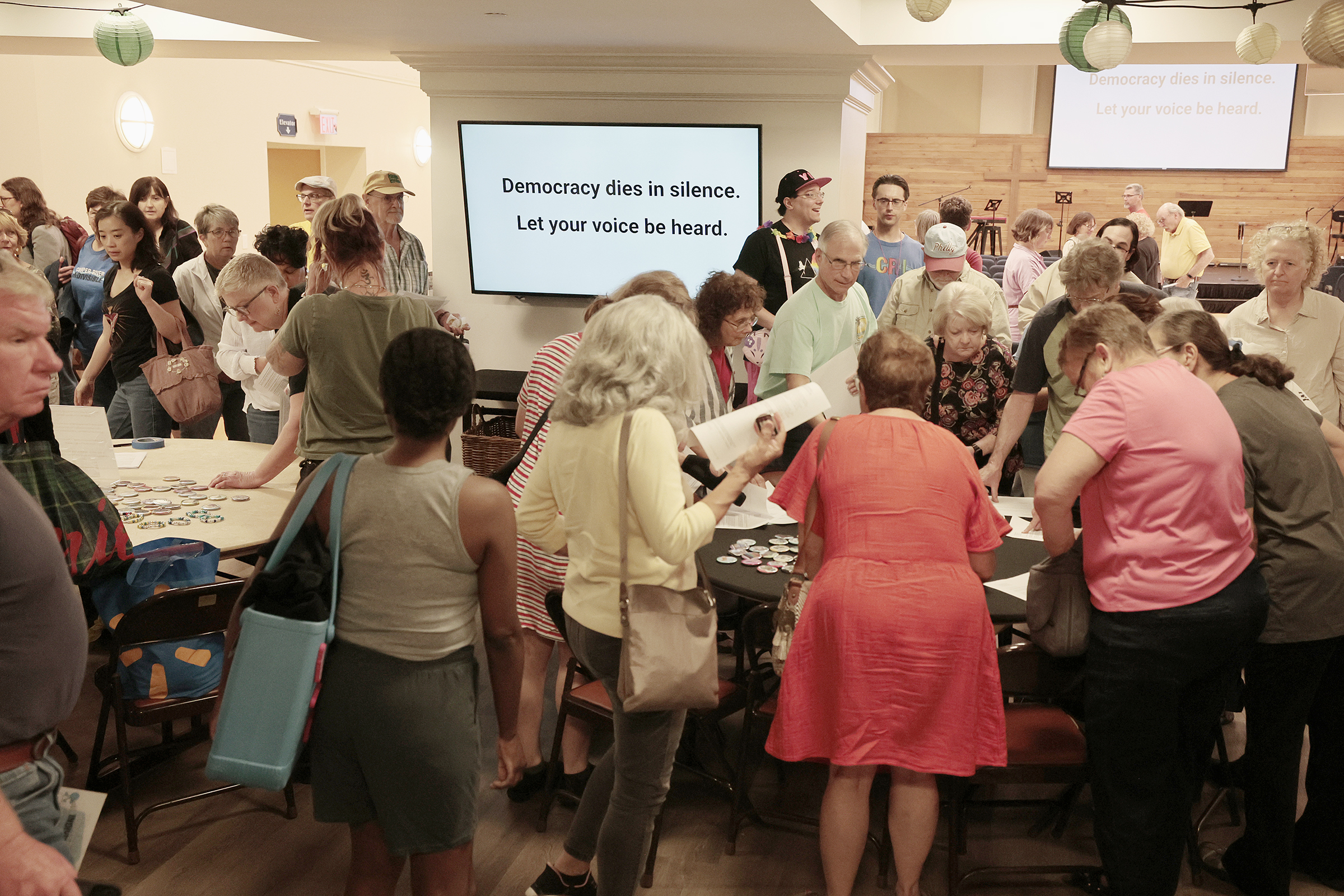
Josue Barreiro stood in front of a crowd of 200 people seated inside a church last week in Haddonfield. He was there to speak about his experience as one of 61 protesters arrested in one night outside Delaney Hall after Gov. Mikie Sherrill had sent over state police.
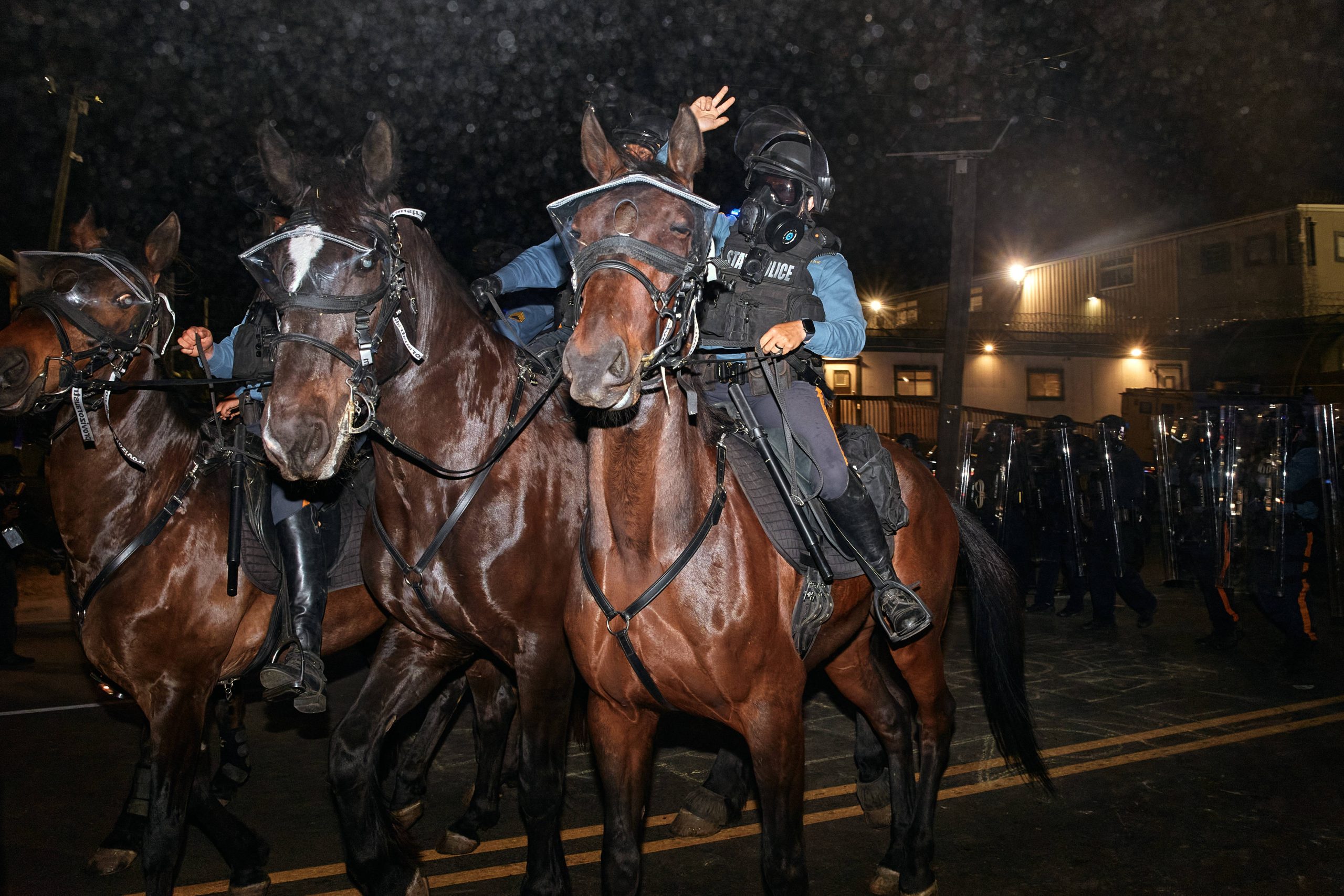
He told the crowd, gathered for a meeting of the South Jersey progressive group Cooper River Indivisible, that the governor made it seem like she was sending state troopers to protect demonstrators from federal immigration officers. Instead, he said, they brutalized protesters on horseback in riot gear. He showed a video of state police knocking him to the ground.
“All accounts say the state police were considerably more violent than the federal government was,” Barreiro, a Bridgeton resident and activist with Los Tequios, told receptive audience members who made sounds of disgust.
Josue Barreiro speaks about the protests outside Delaney Hall during the Cooper River Indivisible general meeting at the Haddonfield United Methodist Church on June 9.Elizabeth Robertson / Staff Photographer
Sherrill, a former member of Congresswhose double-digit victory last year was seen as a rebuke of President Donald Trump, has been in her most high-profile political bind yet as she juggles her opposition to the ICE detention center while facing widespread criticism for her handling of protests outside it.
The first-term governor campaigned as a fighter against Trump and Immigration and Customs Enforcement. She highlighted her experience as a Navy helicopter pilot and said she was trained “that in a crisis, you run toward the fight.” But to South Jersey progressives who worked hard to campaign for her, Sherrill’s decision to respond to tensions between protesters and ICE with a designated protest zone policed by state officers represented a betrayal. The governor called the decision “absolutely necessary to protect public safety and avoid escalation from ICE.” But the state police’s show of force, video of which replayed across national news and social media channels for days, “kind of resembled what ICE was doing in the first place,” said Newark Mayor Ras Baraka, one of Sherrill’s primary opponents, who was arrested outside the facility last year.
“This was not the kind and quality of leadership we were voting for, or hoping to see,” said Michele Messer, 52, a leader of Cooper River Indivisible, one of the groups that campaigned for Sherrill.
People sign up to volunteer after the Cooper River Indivisible general meeting at the Haddonfield United Methodist Church.Elizabeth Robertson / Staff Photographer
Sherrill said she was trying to “lower the temperature” to prevent Newark from becoming another Minneapolis when she announced her plans to send state troopers to Delaney Hall. She later disagreed with a comparison between state police and federal immigration officers in Minneapolis during a tense interview on WNYC’s Ask Governor Sherrill, noting that state police didn’t kill anyone.
“I don’t think they have the same concern for human life in many cases that I do, and that our police forces in New Jersey share,” she said.
Activists said she should have known that sending in police and corralling people into a free speech zone can escalate already fraught demonstrations.
“I mean, there’s precedent, there’s history. We’ve all read about how these things go, and yet that was the choice she made,” said Messer, a Haddon Township resident who has protested at Delaney Hall.
Patricia Campos-Medina, a former campaign adviser to Sherrill, said the governor’s handling of Delaney Hall — and how she manages “the fallout of her decisions” — has been an early test of her leadership.
“It’s her first real test [of] how she manages the duties of being the highest public safety officer of the state leading New Jersey, and then still protecting the immigrant community who lives here,” said Campos-Medina, an ally of the governor who works with the labor movement.
Sherrill has built her national profile on fighting the Trump administration, and those who have become the most frustrated with her share that mission. How she navigates this moment could determine whether she can keep that base focused on fighting the president, instead of her.
Mounted New Jersey State Police troopers move toward protesters outside the Delaney Hall detention center on May 29 during a protest against the transfer of detainees and federal immigration policies.AP Photo/Andres Kudacki
‘I’m not proud to have voted for her’
Sherrill has called for the closure of Delaney Hall and her administration announced multiple measures to support the fight against the detention center since the late May backlash against her began.
Activists from across the staterallied in Trenton on June 1 and delivered a letter to Sherrill calling on her to “honor our First Amendment rights, cease police brutality and to enable the closure of Delaney Hall.”
“As the grassroots who campaigned for you, we also expect ongoing communication with your administration to navigate this perilous time in New Jersey,” the letter continued, signed by about 40 organizations statewide, including Cooper River Indivisible and several other South Jersey groups.
The next day, New Jersey Attorney General Jennifer Davenport, Sherrill’s appointee, filed a lawsuit against GEO Group — the private company that runs Delaney Hall — to give the state health department full access to the facility over reports of “inhumane and unsanitary conditions.”
Two days later, Sherrill and the state legislature announced an infusion of $20 million to assist with immigration defense and launched a rapid legal defense effort amid concerns about due process.
Marie Henselder-Kimmel, 65, a Cherry Hill resident who leads the South Jersey group NJ Voters Want More Say, said the reports of bad conditions in the facility are not new, so she doesn’t understand why the administration did not take legal action months earlier.
“I foresee that we’re going to have to keep pressuring to get them to keep doing those more bold things,” she said.
Henselder-Kimmel said she feels “torn” about Sherrill’s decision to send state police because she agrees ICE would have escalated otherwise. But she said it seemed like Sherrill may have sent the police in without understanding what they were going to do.
Marie Henselder-Kimmel (left) and Michele Messer (right) talk with Vikki Toomer (back to camera) after the Cooper River Indivisible general meeting at the Haddonfield United Methodist Church.Elizabeth Robertson / Staff Photographer
Cristian Moreno-Rodriguez, who works as the executive director of El Pueblo Unido of Atlantic City, an organization that supports Latino immigrants, said Sherrill’s handling of the protests has fully broken the trust with his community.
Sherrill’s campaign made a particular effort to target Latino voters. She did particularly well in New Jersey’s largest Hispanic-majority cities, which moved an average of 18 points toward the Democrat after rightward shifts in 2024.
“We’re not going to forgive her for what she’s done,” said Moreno-Rodriguez, who worked for One Giant Leap, asuper PAC that supported Sherrill and raised about $9 million by the end of 2025.
Sherrill was not Moreno-Rodriguez’s first choice in the primary, but she was a better choice for his community than Republican Jack Ciattarelli, he said. Still, he said he was expecting better from the Democrat.
“I don’t regret voting for Mikie Sherrill because she was better than Jack Ciattarelli, but I’m not proud to have voted for her,” he said.
Gov. Mikie Sherrill poses for a selfie at a Latinos for Mikie event at the Rancho Mateo restaurant in Elizabeth, N.J., last May.Aristide Economopoulos
Activists have been demanding Sherrill meet with detainees, but she says she has not been allowed in except for one “closely controlled and limited tour” on June 8, in which she was not allowed to speak with those being held there.
Several members of Congress, who are authorized to conduct oversight visits, have visited the detention center, including Sen. Andy Kim, a South Jersey Democrat who made headlines for getting pepper-sprayed while trying to de-escalate tensions between federal immigration officers and protesters. Kim faced criticism from some activists for what they viewed as trying to negotiate with ICE, but others have praised him for being on the ground in a way they have not seen from Sherrill.
Sen. Andy Kim stands between federal agents and demonstrators in an attempt to prevent a clash outside the Delaney Hall migrant detention center in Newark on May 25.DAKOTA SANTIAGO
Sherrill and activists alike have said that the demonstrators have been largely peaceful. But U.S. Rep. Jeff Van Drew, a Cape May County Republican, accused the protests of being “more like anarchy” and called on Sherrill to bring state police back.
State Sen. Michael Testa, a Cumberland County Republican, praised Sherrill’s “decision to cooperate with federal authorities” and “restore order” by bringing state police in, and added fuel to the fire by thanking her for “supporting President Trump and the brave men and women of ICE.”
‘The buck stops with her’
Activists have expressed frustration that the narrative has strayed from the conditions inside Delaney Hall to the fight outside it — a point Sherrill has echoed.
But after state police clashed with protesters, Sherrill focused her criticism on what she described as “aggressive and dangerous” disruptors and defended the officers.
Her remarks further infuriated activists who accused her of echoing the state police’s narrative, which they say does not align with what they experienced on the ground or saw online.
When a radio caller confronted Sherrill on WNYC over state police brutalizing nonviolent protesters, the governor said “if there were incidents like that, the attorney general will be looking into that.”
Vikki Toomer, a Cooper River Indivisible leader who has protested outside Delaney Hall, said that listening to Sherrill’s news conferences have given her “that same visceral reaction” she gets from listening to Trump.
Vikki Toomer speaks during the Cooper River Indivisible general meeting at the Haddonfield United Methodist Church.Elizabeth Robertson / Staff Photographer
“I don’t know if they were feeding her lies, or that’s the narrative she was trying to spin … all I know is what she was saying was not true, and she was not taking the time to listen,” Toomer said.
Toomer said she believes the governor knows her plan did not go well but also “has not come out publicly and said, ‘Oops, I made a mistake.’”
When asked on the radio whether she believes her administration has suffered a loss of trust, Sherrill said sending state police “was really not done focusing on politics, and I certainly hope not.”
“This was focused on making a really hard decision in a situation that nobody wanted,” she said.
Folks leave messages on a collage (left) during and after the Cooper River Indivisible general meeting at the Haddonfield United Methodist Church on June 9. The poster will be part of an exhibit at Perkins Center for the Arts.Elizabeth Robertson / Staff Photographer
Linda Greenwood, 74, a Voorhees resident who belongs to Cooper River Indivisible and campaigned for Sherrill, believes the governor has good intentions but does not think she has been unfairly blamed.
“She’s the governor,” Greenwood said. “The buck stops with her. She brought the state police in. She has to take responsibility for what happened there, and I think she will.”
Lawrence Garrity, 29, was the lead volunteer for long shifts at Sherrill’s Cumberland County campaign office between overnight shifts at Wawa last year. The Rowan student said he feels “salty” he worked so hard to elect her and it feels like she is not on their side.
“It doesn’t feel like she’s not on our side either. It’s like she’s sitting in the middle … people are genuinely in danger, and you’re trying to, like, half-ass fight it,” he said.
Garrity said he had to go to urgent care after state police unleashed tear gas and pepper balls on protesters.
“Somebody said they’re gonna make T-shirts that said ‘I voted for Mikie Sherrill and all I got was tear-gassed,’” he said.